From the FasterSkier archive — posts syndicated from athletes’ and coaches’ own blogs between 2004 and 2012, kept online as published. Current coverage is at fasterskier.com.

Tag: Washington University

  • Former Swimmer Kendall Gretsch on Unexpected Paralympic Golds, Hunger for More

    Former Swimmer Kendall Gretsch on Unexpected Paralympic Golds, Hunger for More

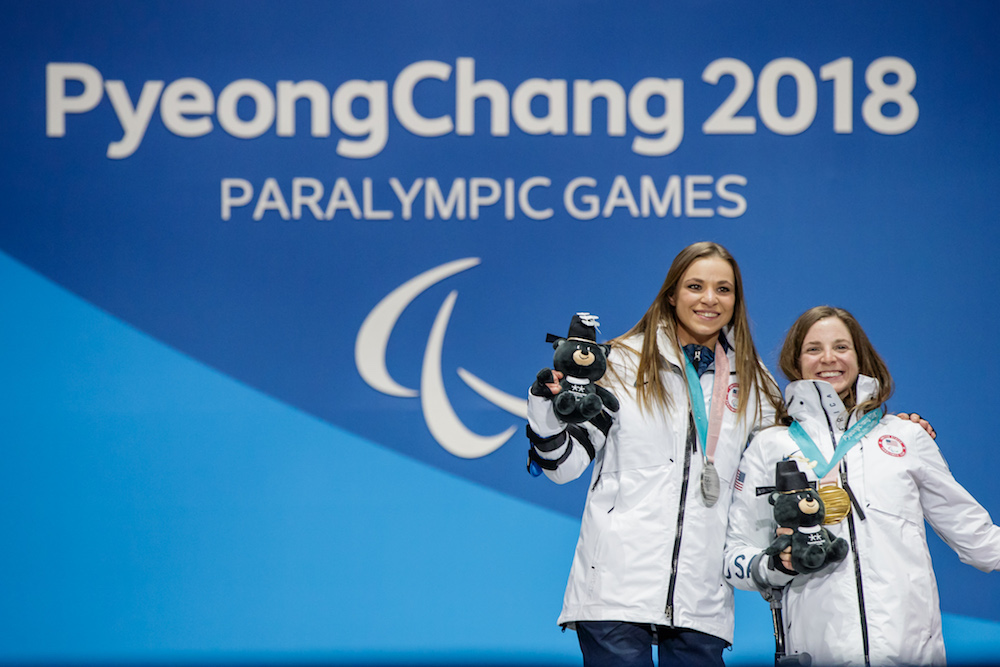
    Kendall Gretsch (r) and Oksana Masters at the 2018 Paralympics medal ceremony for the women’s sitting 6 k biathlon sprint after Gretsch won gold and Masters claimed silver on the first day of competition in PyeongChang, South Korea. (Photo: U.S. Paralympics/Joe Kusumoto)

    As a sophomore at Washington University in St. Louis, Missouri, Kendall Gretsch stumbled across an article that would change her life. It was the spring of 2012, just a few months before the Summer Paralympics in London.

    Gretsch had been reading the local news when she came across a story about a St. Louis college student who hoped to attend the London Games as part of the U.S. Paralympics Swimming team.  

    Born with spina bifida, Gretsch had been a swimmer in high school. After graduating in 2010, she enrolled at Washington University with the intent of studying biomedical engineering and no plans to swim collegiately. 

    However, within the first few months of her freshman year, she missed the athletic outlet. She began to swim and exercise on her own. By the time she came across the aforementioned article about a year later, she was ready to jump back into the pool, struck by the idea of pursuing the Paralympic dream.

    “I was just so oblivious to any sort of para-sport,” Gretsch, 26, reflected on the phone earlier this summer, noting that she had not really thought of the Paralympics as “an option” for continuing her athletic career until reading the piece.

    Competing at the Paralympics quickly became her goal, but it wasn’t limited to swimming.
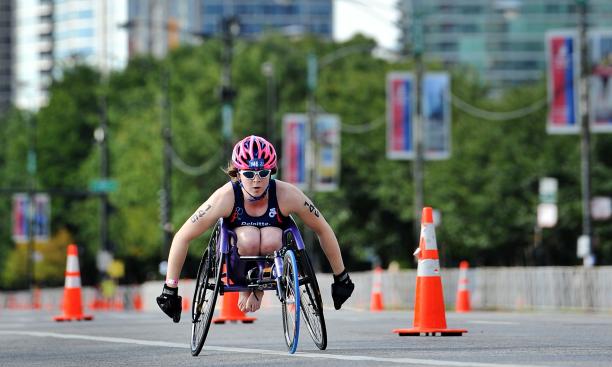
    Kendall Gretsch is a three-time world champion in the women’s paratriathlon PT1 classification. (Photo: IPC)

    “In high school, I just liked being a part of the team and the social aspect of [swimming], the sport elements of being able to push yourself and set your own individual goals,” said Gretsch, a native of Downers Grove, Illinois.

    Following her sophomore year of college, Gretsch returned to Illinois in search of an adaptive sports program to join. What she found was Dare2Tri. Based out of Chicago, the Dare2Tri program offered swim sessions, and Gretsch made it out for the final swim practice of the season. After getting out of the pool, she was approached by one of the instructors. Would she be interested in stepping outside and trying her luck on the track?

    “She had me come right out after the swim practice and try racing wheelchair,” Gretsch recalled. “I ended up doing my first triathlon race that summer.”

    After graduating in college in 2014, she competed in her first international race and started focusing solely on paratriathlon. At 2014 world championships, she won gold in the PT1 classification and was later awarded 2014 Female Para Triathlete of the Year by USA Triathlon.

    In 2015, Gretsch won another World Championship paratriathlon title and was also nominated for an ESPY Best Female Athlete with a Disability award. (She would earn a third World Championship title in 2016.)

    World Championships and awards aside, the Paralympics were still on Gretsch’s radar in the spring of 2016. Her chance seemed forthcoming. The 2016 Summer Paralympics in Rio de Janeiro, Brazil, would be the first in history to feature paratriathlon. However, the PT1, Gretsch’s class, was not to be contested for women.

    If she wanted to compete at the Paralympics, she would have to wait and see if her classification would be included at the 2020 Summer Paralympic Games in Tokyo or turn her attention elsewhere. But where to go?

    During her first year with Dare2Tri, she had heard about adaptive cross-country skiing.

    “Someone I had met through triathlon mentioned to me in passing, ‘Hey, there’s this group up in Madison, [Wisconsin], they do adaptive nordic skiing, you should check it out sometime,’” Gretsch explained. “So nordic skiing was in the back of my mind [leading up to Rio].”

    She decided to give nordic skiing a go. She moved to Madison and took a technical-support job with an electronic health records company, Epic Systems, while training in an effort to make the 2018 Winter Paralympics in PyeongChang, South Korea.

    “Maybe it’s just because I had a background in swimming that I felt like triathlon came a little bit more naturally,” Gretsch said of her transition to nordic. “The hardest part about learning to nordic ski was definitely the maneuvering. In nordic, when you’re in a sit ski, your skis are fixed together, straight. When you’re maneuvering around a corner, you can’t just pick up your foot and step around a corner, like you would if you were standing. So learning how to maneuver was really fun and challenging. We spent a long time on that in practice.”

    Kendall Gretsch takes aim during the women’s 6-kilometer sitting biathlon at the 2018 Paralympic Winter Games on Saturday in PyeongChang, South Korea. She won the race to become the first American woman to medal in a biathlon event at the Paralympics (or Olympics). (Photo: US Paralympics/Mark Reis)

    Beyond the challenge of learning a new sport, Gretsch also bumped up against a lack of snow during her first season as a cross-country skier.

    “I would travel every weekend to find snow,” Gretsch said of her first winter in Wisconsin. “In Madison, there wasn’t really any snow, so during the week I wasn’t really skiing that much at all. I was just sort of skiing during the weekends and then as much as I could during the week.”

    Gretsch remained in Madison through the winter and into the summer. A little less than a year out from the 2018 Paralympics, she turned her attention completely to skiing, putting paratriathlon on hold. Four months prior to the Games, she moved Bozeman, Montana, to train with the U.S. Paralympics Nordic team and then-head coach Eileen Carey (Carey recently became the director of U.S. Paralympics Nordic).

    By the time the Winter Paralympics rolled around, Gretsch had a full year of nordic training under her belt. Still, what came in South Korea was slightly unexpected.
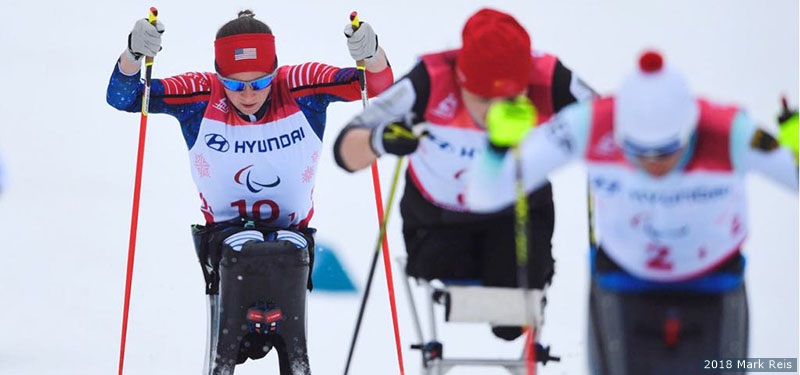
    American Kendall Gretsch (l) racing in the 4 x 2.5 k mixed relay at the 2018 Paralympic Winter Games in PyeongChang, South Korea. Her team finished seventh. (Photo: U.S. Paralympics/Mark Reis)

    In the opening event of the Games, Gretsch became the first American to take home a gold medal in Paralympic biathlon by winning the 6-kilometer sitting sprint. One day later, she won a second gold medal in the 12 k sitting cross-country distance race.

    “A lot of times — this probably sounds really terrible — I feel like in triathlon, people are waiting for me to fail,” Gretsch said. “Whereas in a new sport, you have your own personal expectations of how things should go, but no one else really has those expectations for you. You don’t have a target on your back. So there’s a lot of freedom with that.”

    With two Paralympic gold medals to her name, Gretsch plans to continue cross-country skiing. She also hopes that her classification will eventually be included in the Summer Paralympics so that she may become a Paralympic triathlete as well.

    “I think we’ll know by the end of this year whether or not my classification will be in Tokyo for triathlon,” she said. “So the plan right now is to do both.”

    And for someone as strong and talented as Gretsch, more medals from both sports is not out of the question.

    “It’s a very humbling experience being able to hear your anthem,” Gretsch said, according to a U.S. Paralympics Nordic press release after her second gold medal in PyeongChang. “Puts everything into perspective. Knowing that you’re here not just here for yourself but for your country.”
  • Heather and Brooke Mooney on Where Skiing Led Them and What’s Next

    Heather and Brooke Mooney on Where Skiing Led Them and What’s Next

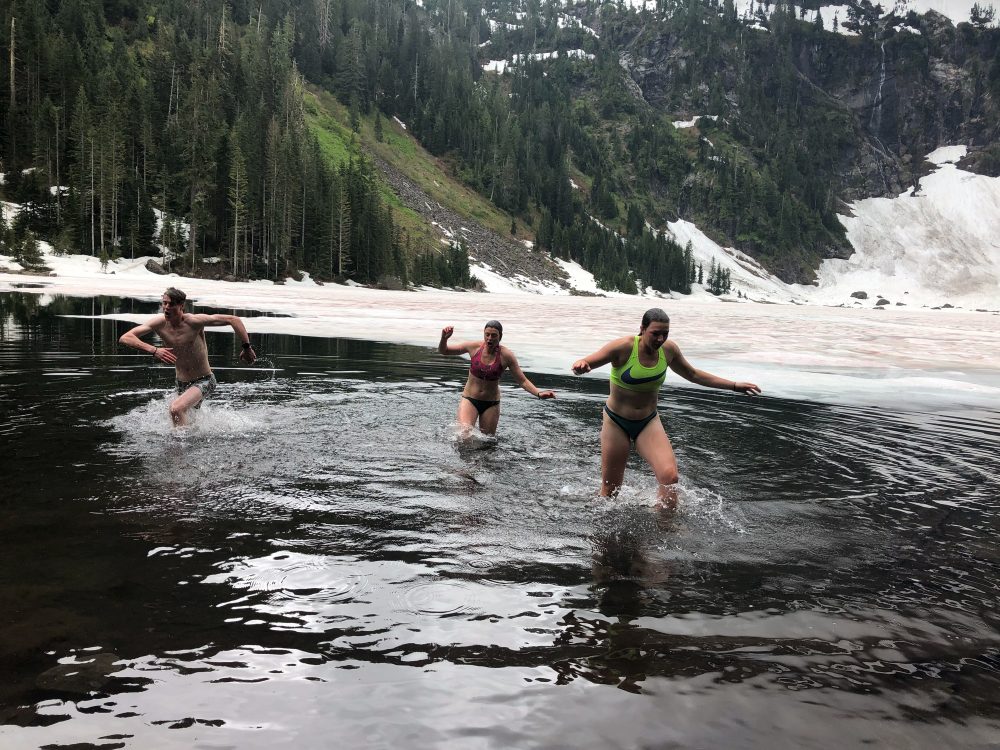
    Mooney siblings (from left to right) Scott, Heather and Brooke after jumping into Lake 22 just outside of Seattle, following Brooke’s graduation from Washington University in June. “With two siblings peer pressure works wonders, not going to be the wimpy one who doesn’t jump in!” Heather wrote. (Courtesy photo)

    Perhaps you have heard of them. Or at least seen them. At 6 feet and 6 feet 2 inches tall, respectively, the Mooney sisters, Heather and Brooke, are hard to miss. But their height is not the only reason the two women stand out.

    The sisterly pair also share a talent for the sports they pursue. At one point, for both of them, that sport was skiing. And at one point, for both of them, it was not.

    Having grown up in Peru, Vermont, where the Green Mountain range serves as the town’s backdrop and skiing is the norm, the two were certainly primed with the ideal environment for becoming interested in nordic.

    “Our school bus had a ski rack on the side of it because we would ski at recess,” Heather recalled during an in-person interview this month in Bozeman, Montana. “In southern Vermont, that is what everyone did.”

    “That” meant skiing. Their mother had picked it up as an adult and also worked as a promotion manager for a skiing magazine. Their father was the headmaster at Vermont Academy, providing the the family access to a plethora of trails directly from their residential backdoor.

    Both parents were also active outdoor enthusiasts, encouraging Heather, Brooke and eventually their younger brother Scott, to partake in anything that got them moving: swimming, hiking, soccer, tennis. (It didn’t hurt the family’s sporting M.O. that their father had been Yale’s soccer goalie as an undergrad.)

    By the time she was a freshman, Heather had enrolled at the Stratton Mountain School ski academy. Three years later, her sister Brooke had as well. (Heather and Brooke are two years apart, but Heather skipped first grade).

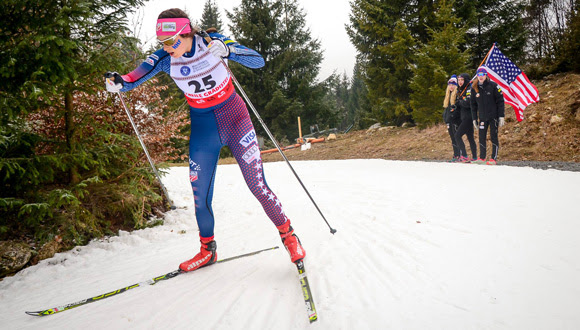
    Heather Mooney racing to 42nd in the women’s 10 k freestyle at the 2016 U23 World Championships in Rasnov, Romania. (Photo: FIS)

    They became well-known names on the eastern ski circuit. They also found national and international success while still U18s. Heather qualified for Junior Nationals four times, Junior Worlds twice and U23 Worlds in 2016. By her junior year in high school, Brooke had qualified for three Junior Nationals.

    As J2 skiers, both Mooney girls received coaching from Pepa Miloucheva, the head ski coach at the Craftsbury Outdoor Center. With a background in sculling, as well as ski orienteering, Miloucheva had her eyes on Heather and Brooke, who showed the potential to qualify for Junior Nationals in rowing as well. Both girls were invited to a youth rowing camp held at the Outdoor Center.

    “The director told me I needed a snorkel,” Heather reminisced with a laugh. “But Brooke was very good.”

    ***

    During an early season training session at the University of Washington (UW) this past year, Brooke sat down for testing on a rowing ergometer. She pulled for the alloted test time, one minute, and stopped. Her sustained pace was 615 watts.

    National team coaches could not recall any other woman surpassing 600 watts, The Seattle Times reported.

    “You don’t have to know rowing to see her strength,” UW head rowing coach Yasmin Farooq told the Times. “Watch her and you think, holy smokes, this woman has some serious power.”

    Unofficially, Brooke holds the watts record for an American woman on the rowing machine. Officially, she was named the Pac-12 Women’s Rowing Athlete of the Year in May and is now living in Princeton, New Jersey, one month removed from UW. She’s also a national-team recruit.

    Her invite to join USRowing came in December, and following her graduation from UW in June, Brooke headed back east. In Princeton, she is training with U.S. rowing veterans like Meghan Musnicki and Elle Logan — both multiple Olympic gold medalists — with the hope of working toward a spot on the 2020 Olympic team (selection won’t take place until 2019).

    “I kind of figured I would be pretty crazy to turn down this opportunity, whether it leads to greater results or not, I had to try it,” Brooke told FasterSkier on the phone.

    The seeds of opportunity were planted in the initial rowing camp Brooke attended in Craftsbury. She spent her senior year at Vermont Academy, where she took up rowing as her newfound, full-time passion.

    “I knew I wasn’t going to want to keep on skiing through college, so I figured I might as well try rowing,” Brooke said.

    She filled out a few higher-education recruiting questionnaires and received a response from UW.  As one of the top rowing schools in the country, UW had her attention. Throughout her four undergraduate years, Brooke developed into one of the country’s top college rowers, even with a slight scare before her senior season.

    ***

    When Brooke first started getting headaches in the summer of 2016, the doctors told her she was dehydrated. At a sculling camp in Craftsbury post-doc visit, her headaches continued. Most of the time, they got progressively worse throughout the day.

    Brooke Mooney, who was recently recruited to the U.S. women’s national rowing team, during a sculling camp in Craftsbury, Vt. in 2016. (Photo: Craftsbury Outdoor Center)

    “I would be able to get up in the morning and work out a little bit, but if I didn’t work out before 9 o’clock, I couldn’t workout,” Brooke recalled. “I would just lay on my bed in so much pain.”

    With dehydration as her diagnosis, she did what she could to work out. Sometimes the headaches would lapse, but most often they would not.

    “I started the school year in and out of headaches. I talked to the team doc and went to the headache clinic,” Brooke said.

    It wasn’t until April, almost a year after her headaches began, that Brooke was given an MRI. The results: she had a cyst in her optic chiasm. The mass was pushing on her optic nerve and needed to be removed, or else it could expand and cause permanent damage to her vision, even blindness.

    Her eye doctor allowed her to finish the race season (for rowing, championship racing occurs in the spring) before removing the cyst. Following her surgery in June 2017, Brooke was not allowed to train or work out for eight weeks the summer before her senior year at UW.

    “I was so worried,” Brooke said, particularly when she found out that her team would be racing the famed Head of the Charles Regatta that fall.

    “I wanted to race that more than anything and I panicked that I was going to miss my opportunity because of the surgery,” she said. “But then I ended up making it … every once in awhile, a good break is really beneficial.”

    ***

    If you peruse Heather’s blog, one post from April 2017 blares the title “On Burnout and Bye for Now.” This was her informal farewell to cross-country skiing.

    The post itself came two years after she graduated from Middlebury College, a time when skiing held great promise for Heather. She had capped off her senior year with seven collegiate wins and had also qualified for the 2012 Youth Olympic Games as a college sophomore.

    Following graduation, Heather signed on with the Craftsbury Green Racing Project (CGRP), but later found things weren’t aligning the way she had hoped they would. Particularly, she felt she was not performing to her expectations, given the amount of support she had (according to Heather, CGRP covers most of their athletes’ expenses for food, housing and travel.)

    “I thought I was done for good,” Heather, now 24, continued. “Pepa [Miloucheva] was the one who encouraged me not to look at it that way.”

    Even with Miloucheva encouraging her not to give up completely, Heather forfeited skiing, and even gave up physical activity for a bit.

    “In the beginning of the summer when I quit, I was like, ‘I’m not exercising, I’m not being an athlete, I’m just doing whatever what I want — I can be happy without skiing,” Heather said. “Very quickly I realized that I need exercise to be happy.”

    That summer in Truckee, California, Heather landed a coaching gig that gave her the opportunity to travel to Australia. By the fall, she decided to move to Bozeman, with plans to gain residency at Montana State University and enroll in its architecture graduate program.

    In Bozeman, she reconnected with Austin Caldwell, a longtime friend from Vermont and the current head coach of the Bridger Ski Foundation Elite team. The two went for a few early fall skis together and Heather soon found herself attending Caldwell’s agility practices, then interval sessions. When the winter hit, Heather even jumped into some races, but only as many as she chose.

    In all, she competed in about a dozen SuperTour races, finishing last season ranked 36th overall on the circuit. Heather also raced to 14th in the 50-kilometer American Birkebeiner skate race in February.

    “It was really refreshing to step out of expectation,” Heather said. “I feel like we all get into such definitions of like how we should be in the sport. I realize [now] there are so many different ways to engage with it. Likely that’s how we many of us will reach our potential, is by engaging in a way that works for you as a person.”

    After a break, Heather is currently planning to defer from MSU and focus once more on skiing.

    “It’s been exciting for me slowly lose that anxiety of how I should be performing and how I wanted to perform,” Heather said. “I look at how can I work with myself, versus trying to fit myself into the pro-athlete mold.”