Tag: Washington

  • Lobbying for change: Gus Schumacher heads to Washington, D.C. with Protect Our Winters

    Lobbying for change: Gus Schumacher heads to Washington, D.C. with Protect Our Winters

    Jessie Diggins and Gus Schumacher join Protect Our Winters in Washington, D.C. to advocate for climate policy. (Photo: Instagram @jessiediggins)

    On April 27th, Gus Schumacher and Jessie Diggins headed to Washington, D.C. with six other winter Olympians and Paralympians as members of the Protect Our Winters (POW) athlete alliance to advocate for progressive changes in climate policy. While Diggins has been partnered with POW for several years, Schumacher only recently came on board, making the trip his first experience lobbying for climate activism; it was also his first trip to the nation’s capital.  

    While in D.C., the POW team met with members of the conservative climate caucus, led by Utah Congressman John Curtis, to advocate for the support of the following five “asks” in climate package negotiations:

    • Funding programs that focus on reducing emissions, like the Greenhouse Gas Reduction Fund and Climate Pollution Reduction Grants/
    • Investment in electric vehicle (EV) infrastructure.
    • Upgrade the grid to power a renewable energy future by funding projects that upgrade transmission lines and intertie incentives.
    • Assist communities in worker transitions with programs like energy community reinvestment financing.
    • Stop drilling in the Arctic, specifically stopping the Willow Project from moving forward in the National Petroleum Reserve Alaska. 

    Following a dinner with the Republican caucus where athletes shared the ways in which their sports and home communities have been affected by climate change, the group spent the day lobbying in congressional offices, discussing the importance of the asks with senators, congresspeople, and members of their staff. 

    Not knowing what to expect from his first lobbying experience, Schumacher noted he was happy to hear the agreement among the Republican and Democratic politicians with whom they spoke surrounding the need to reduce emissions and address the “big problem” of climate change head on.

    “To a degree, everyone agrees we should reduce emissions and it’s figuring out how to do it where everyone is in a different place,” Schumacher said in a call. “So I learned a bit about how [different politicians are] approaching it, and how people generally care [about the issues], but I think it’s just hard for a lot of people to agree on a methodology.”
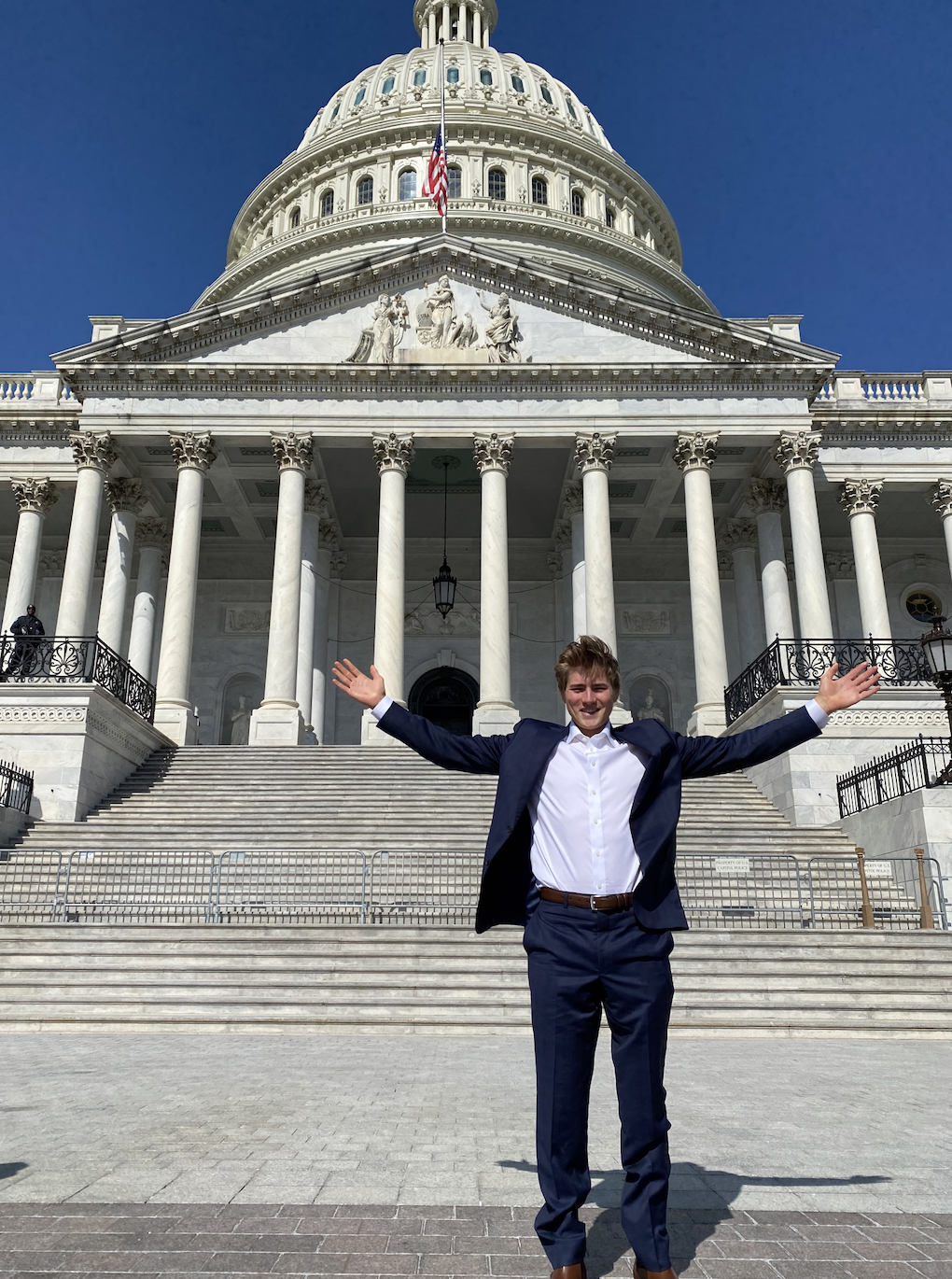
    Gus Schumacher travels to Washington, D.C. to lobby for climate initiatives with Protect Our Winters. (Courtesy photo)

    The conversation most engaging for Schumacher personally took place with Alaskan Senator Lisa Murkowski. In addition to discussing topics that were close to home, the conversation felt significant in that Murkowski is “on the fence” when it comes to supporting each of the asks. 

    Alaska’s economic dependence on oil is juxtaposed with the grave reality that the Arctic is warming at a faster rate than other parts of the world. Murkowski had just returned from a visit to the small city of Kotzebue in rural Northwest Alaska, roughly 30 miles above the Arctic circle. Despite its size and location, the city has adopted infrastructure, specifically wind and solar, that allows it to depend heavily on renewable energy sources when possible. 

    “They have one solar panel that works on both sides, so [it also captures energy as] the sun reflects off the snow, plus they have a couple of windmills. They were running 80% renewable that week, which is really big for those communities… So that was really cool that she’s at least interested in those kinds of advancements. She also mentioned electrifying our ferry system using hydropower in the area, which seems pretty sweet if you can make it work.”

    At the same time, Murkowski recognizes Alaska’s dependence on oil, and therefore was unwilling to support the ask to stop drilling in the Arctic.

    “That’s a huge source of income for Alaska and is going to positively impact in the short term Alaskans and rural Alaskan,” said of the complicated issue. “[Because of the impacts of climate change on the Arctic], rural Alaskans need carbon to not be emitted anymore, but they also need to be able to pay for the gas currently to heat their homes and for food that they can’t get from subsistence hunting. So you’re kind of falling on your own sword a little bit, and that’s something that I can appreciate as being a political problem. It’s hard to deal with because you can’t just like immediately switch to renewables – or in the contiguous United States – and then have all these people that don’t have any source of income.”

    Jessie Diggins and Gus Schumacher join Protect Our Winters in Washington, D.C. to advocate for climate policy. (Photo: Instagram @jessiediggins)

    Settled back in Alaska at the time of the call, Schumacher remained energized by the experience and expressed interest in continuing to participate in climate advocacy in the future.

    “The advocacy really was cool because it makes it feel like [my voice has] more power than just voting, which is cool. And it’s exciting to realize that by skiing, I’ve gotten myself to that position. And yeah, I’m really proud of it and excited and hopeful to do some more and hopefully those asks can change and get stronger and stronger.”

    Schumacher also enjoyed the opportunity to engage with the other members of POW’s athlete alliance and to learn more about the various experiences that led them to engage with climate advocacy. 

    “It was cool to hear everyone’s story and hear that they care about climate change, but come at it from a different way. Like [Olympic halfpipe skier] David Wise in Nevada where, obviously, it looks a lot different [than Alaska], but he has a creek that dries up near his house and he’s a farmer… so that was [interesting] to hear about. The POW organizers were really dialed and made it easy for us. Just getting involved with the whole scene of lobbying was eye opening. Definitely like nothing I could have learned from middle school history. I sort of knew how it all worked, but being able to actually go inside of those offices and just see the whole lobbying system was really neat.”

    Schumacher’s interest in these topics extends beyond his partnership with POW into his academic studies. In choosing to major in civil engineering, Schumacher was interested in furthering technological innovation to support a more sustainable future. 

    “Especially civil engineering, which deals with large scale infrastructure – the more that can be dialed in and efficient, I think that’s a big source of moving towards the future of how we function as a society.”

    While there is plenty of action needed to make significant progress in fighting climate change, Schumacher expressed that he left the experience feeling optimistic. 

    “Some people, I’m sure, will say that it’s naive. They’re politicians and they want to make you happy and, obviously, we come in with a big sign that says ‘we care about climate’, so know what to say to make us happy… but the Democratic members were leaning far forward on climate protection, which I was a little surprised with… And then the Republican senators that were plainly like, ‘Yeah, we need to reduce emissions and we didn’t need to do it quickly…’ And I think maybe they want to do it more in a natural gas route, which seems like a step to the side. But to at least have people saying, ‘yeah, we need to do this quickly,’ hopefully, that can be converted to action.”

    He continued that he believed that the representatives with whom POW spoke genuinely listened to what they had to say, and expressed belief that the more individuals and groups who lean on those politicians to make those changes, the more likely they will be to take action.

    “The message here would be to call your representatives and because I think they do listen to that. These offices aren’t that big, so if they get a ton of calls about updating the electric grid and developing renewable energy, I think that’s going to have some weight.”

    Gus Schumacher races the third leg of the men’s 4 x 10 k Olympic relay. (Photo: NordicFocus)

    Recognizing that it can be challenging to stay informed when a new bill is on the table, which may be an impactful time to call, Schumacher recommended following the news tab on the Protect Our Winters website or through their social media platforms

    Schumacher concluded by emphasizing the collective power that individuals in the “Outdoor State”, which includes the cross-country ski community, have in advocating for change. According to POW, outdoor recreation unifies 50 million people across the US, resulting in an nearly $670 billion dollar industry.

    “That’s bigger than pharmaceuticals and oil and gas combined, which I don’t think people necessarily realize. And I think part of it is that’s a group that has a lot of little voices, generally, but it’s a powerful group and it’s bipartisan – POW itself is represented by roughly 40% Democrat, 30% Republican and 30% Independent. So it’s something that everyone cares about, and I think that’s a confidence boost.”

  • It’s Been a Bad Combo Out West: Wildfire Smoke and Training

    It’s Been a Bad Combo Out West: Wildfire Smoke and Training

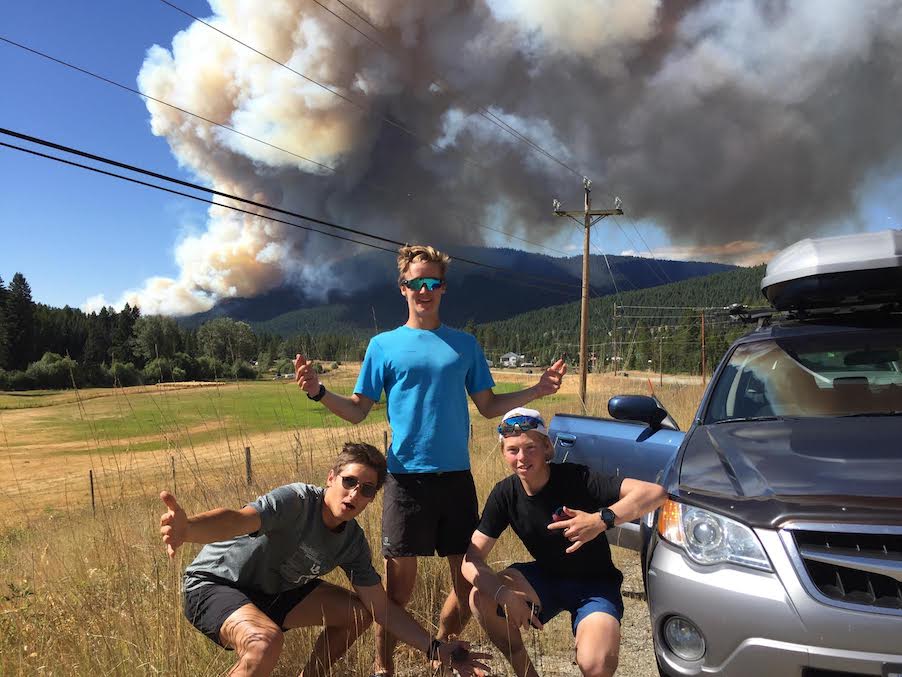
    Fran Vukonic, Tallon Noble, and Ian Williams pose at the end of a bluebird day trail run at Big White in front of the newest Kelowna fire, September 5, 2017. (Photo: Gareth Williams)
    Canadians Fran Vukonic, Tallon Noble and Ian Williams after completing a trail run on Sept. 5 at Big White in Kelowna, B.C.,with the backdrop of the newest Kelowna fire on an otherwise bluebird day. (Photo: Gareth Williams)

    This week’s featured articles are made possible thanks to the generous support of The Loppet Foundation, host of the Masters World Cup 2018. Registration opens in October.

    ***

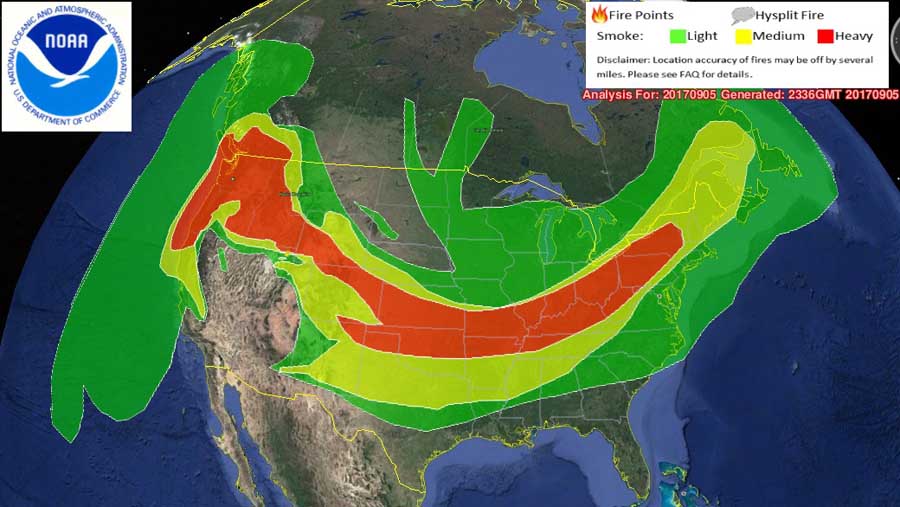
    Beyond the hundredth meridian, a traditional geographic line demarcating where the West begins, it’s been a hot and dry summer. Wildfires have raged from Washington to California, the Intermountain West, and in western Canada. The conditions remain ripe for extreme fire danger. Even if a wildfire didn’t burn near you, odds are the smoke found its way there. 

    Across the board and across the U.S., it’s been an off-the-charts summer. While many Americans have been consumed with hurricane coverage and concerns over the last several weeks, fires have scorched more than a million acres in Washington and Oregon alone this year, according to Quartz Media. That’s up from 513,226 total acres in 2016, but in 2015 and 2014, more than a million acres were affected.

    NOAA wildfire smoke and the correlating Air Quality Index for Sept. 5, 2017. (Photo: NOAA)

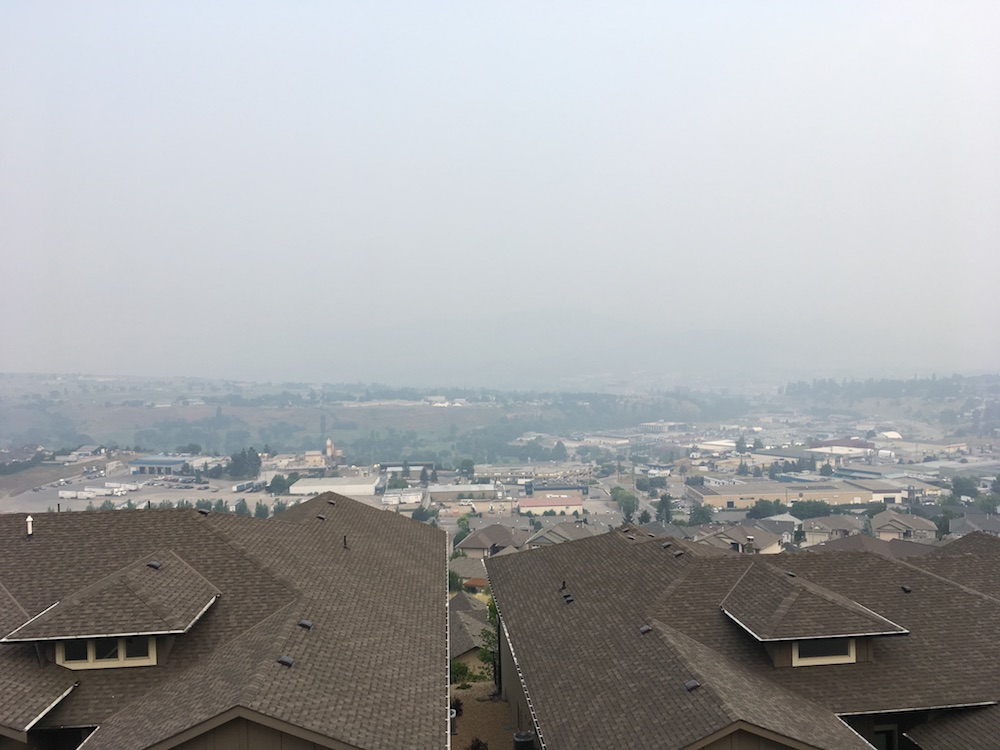
    Along with the devastated landscapes and loss, the wildfires’ byproducts of smoke and ash have made for smoggy, poor air quality. We’re talking about seriously hazy days when visibility often wasn’t more than a mile or two.

    Training outside in less-than-ideal quality air can compromise an athlete. To better understand when it’s OK to go out or stay in, many skiers and coaches became intimate with the scientific benchmarks for air quality.

    “I sort of have this rule where if I can see the glaciers on the mountain, I would rollerski but not do intervals,” Dakota Blackhorse-von Jess, who’s based out of the Bend Endurance Academy in Oregon, said on the phone last Friday. “My personal limit for being outdoors is that 75 AQI limit. That’s the unhealthy or moderate zone.”

    Here’s a quick primer. The U.S. Environmental Protection Agency (EPA) has developed an user-friendly Air Quality Index (AQI). The index is color coded and provides a numerical value indicative of a region’s air quality. An AQI of 75 means the air has a PM2.5 concentration of 23.5 micrograms per cubic meter. Going further, PM2.5 refers to the size of particulate matter in the air. In this case, the 2.5 corresponds to particulate matter 2.5 microns or less in width. That’s small enough to penetrate deep into the lungs, even the bloodstream.


    U.S. Environmental Protection Agency Air Quality Index (Photo: EPA/AIRNOW.gov)

    That 75 Blackhorse-von Jess limit falls midway into the moderate zone on the AQI.

    “The higher end of moderate,” Blackhorse-von Jess clarified. “You see what the station says and then you walk outside and determine if it is going to work. Honestly, at this point, it’s been five weeks. I’ve done so much training indoors, that now it’s more of a mental break than a training deficiency.”

    In places like Bend, Ore., where Blackhorse-von Jess calls home, some athletes have ignored the warnings.

    “I saw guys out there riding today, I see them every time when I am looking for breaks in the smoke,” Blackhorse-von Jess explained. “I cannot believe that people are out there. I think people living in the smoke have accepted a lower standard and are going about their daily lives and actually, their daily activities in the smoke have come to accept the shittiness of the feeling they are experiencing. And for the professional athlete, it is something that you cannot afford, I don’t believe.”

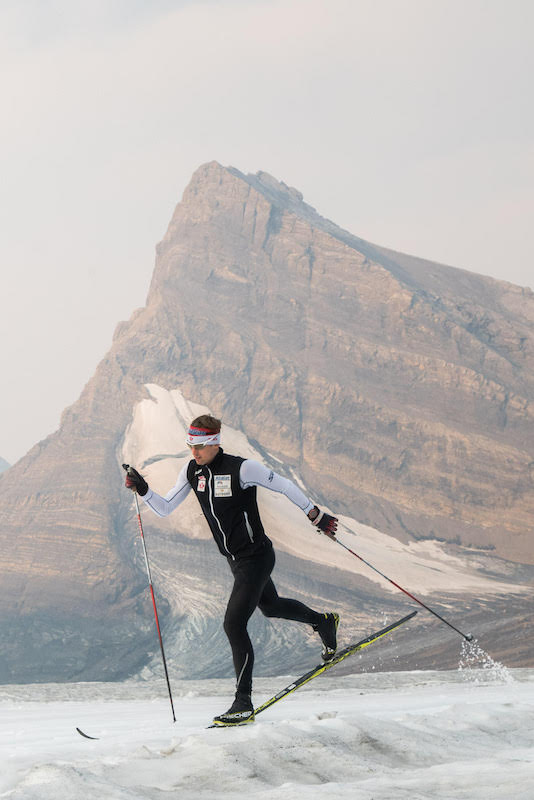
    BlackJack's Julien Locke training at a hazy Haig Glacier camp, August 2017. (Photo: Anthony Killick)
    Julien Locke (Canadian U25 Team) training at a hazy Haig Glacier camp in August. (Photo: Anthony Killick)

    While several fires continue to burn, the smoke cleared in Bend on Sept. 9. During much of August and into the beginning of September, Blackhorse-von Jess relied on a SkiErg, running treadmill and a stationary bike for much of his over-distance training.

    He is not alone.

    “Actually today, it was still dark when I woke up, but when the sun came up there was actually blue sky,” U.S. Ski Team member Liz Stephen said Friday from her home in Park City, Utah. “Where other days, you weren’t even sure the sun was up. It was really nasty.”

    Like other elite skiers across the West, Stephen had made use of indoor training opportunities. The day before Stephen spoke to FasterSkier, she logged four hours on a ski treadmill at U.S. Ski and Snowboard’s Center of Excellence (COE) in Park City.

    The AQI is also careful to note what are called “sensitive groups”. That can mean older adults, children, or people with lung or heart issues. Those populations must take precautions when high exertion exercise and poor air quality mix. Being responsible for junior athletes places a premium on being cautious. 

    For Leslie Hall, director of the Methow Valley Nordic Team in Washington state, dealing with smoke and subsequent air quality issues have been an on-and-off again affair.

    We had a bad two week period at the beginning of August and it was leading into our annual Methow PNSA [Pacific Northwest Ski Association] Camp … so we had to make the call to move the camp,” Hall wrote in an email. “We ended up going to Oakridge, Ore., for the camp and had a great camp there with 32 kids but a fire started nearby there while we were there so we had one moderately smoky day and it has since gotten much worse there.”

    Like her athletic and coaching counterparts, Hall keeps an eye on air-quality websites to determine if a practice is indoors our out. But kids are kids.

    “It is quite hard to keep the kids motivated and they do not enjoy the gym workouts,” Hall noted. “But during the early smoke time, we knew we were going to go somewhere else to train fairly soon so we kept that in mind.  This past week was good because there are a variety of kids running and different coaches which help.  Also, intensity workouts on the exercise machines help the time go by quicker. There is plenty of complaining and calls to move East, but I think all the kids realize that we are very fortunate in general and it is hard to complain when the hurricanes are decimating the south and we just have bad air for a week or so.”

    Reports from Canada mirrored the smoke-filled experience of skiers in the Western part of the U.S.

    According to FasterSkier’s Gerry Furseth, on Sept. 7, British Columbia’s indices for air quality deemed Fort St John and Terrace as the only locations in the province “safe” for exercise. (The Canadian AQI is based on particulate matter 2.5 microns or smaller, but uses a 1-10+ scale with “1” being low health risk and “+” very high.)

    Air Quality Health Index 5 in Vernon. BC (Photo: Gerry Furseth)
    Air Quality Health Index 5 in Vernon. BC (Photo: Gerry Furseth)
    Air Quality Health Index 1, Vernon, BC (Photo: Gerry Furseth)
    Air Quality Health Index 1, Vernon, BC (Photo: Gerry Furseth)

    Gareth Williams, a member of Canada’s national U25 Team and a native of Kelowna, B.C., wrote in an email that the smoke was a near-constant companion this summer.

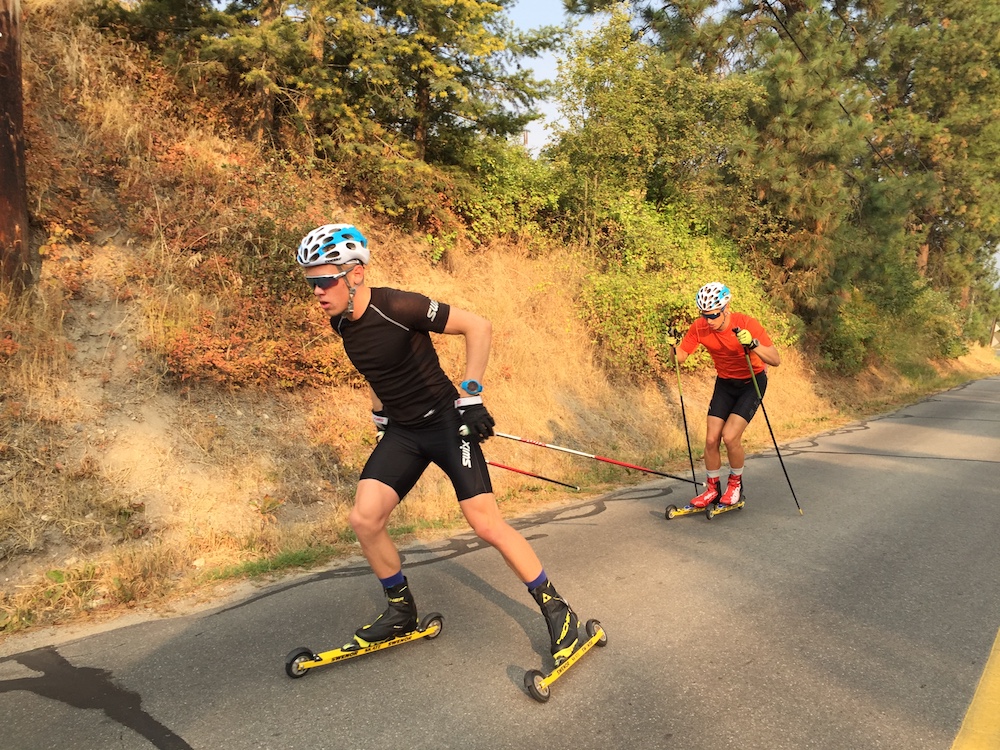
    Gareth Williams leads Fran Vukonic through an orange-tinted rollerski in Kelowna, BC. (Courtesy photo)
    Gareth Williams (Canadian U25 Team) leads Fran Vukonic during an orange-tinted rollerski in Kelowna, B.C. (Courtesy photo)

    “Summer has been great for me, I spent much of it on the Haig [glacier near Canmore, Alberta] in July,” Williams explained. “I’ve been in Kelowna the whole month of August and the smoke has yet to subside, it has actually gotten much worse recently. In past years the smoke has been bad, but I have never seen it like this. …  I think the smoke isn’t as bad as some people have suggested, for me it’s not the greatest worry. I will be happy once it is gone though, getting a little tired of the orange lighting and not being able to see the sun!”

    Michael Somppi, who trains with the Alberta World Cup Academy (AWCA) in Canmore, altered his plans depending on conditions.

    “Personally, I haven’t found the breathing to be too bad,” Somppi wrote. “That said, I am avoiding doing any hard intensity efforts on smoky days.  Today was the first day (in Kelowna) I was forced to alter my training plans, as I had planned to do a rollerski time trial, and instead opted to do zone 3 because of the smoke.  Even breathing semi hard felt sketchy with how bad the air quality is at the moment.”

    Another member of Canada’s U25 Team, Julien Locke has literally trained above the smoke on occasion.

    “I’ve been lucky in that the smoke hasn’t been too thick during most of the important training blocks so far,” Locke wrote. “I was at the Haig Glacier 4 times this summer and while we had some hazy days, for the most part, 2400m elevation was high enough to have clear skies.”

  • Men Go to SoHo, U.S. Women in the Methow (Camp Photo Galleries)

    Men Go to SoHo, U.S. Women in the Methow (Camp Photo Galleries)

    The U.S. Ski Team women’s team at work during a 10-day camp in the Methow Valley. (Photo: Matt Whitcomb/U.S. Ski Team)

    (Note: This article has been updated to include comments from Canadian coach Ivan Babikov on his team’s recent camp in Park City, Utah.)

    Two days after Andy Newell and Erika Flowers tied the knot in Bozeman, Mont., seven members of the men’s U.S. Ski Team and eight U.S. women’s team members jumped into an intensity training block at their respective dryland camps in Park City, Utah, and the Methow Valley in northern Washington.

    The 10-day camps were scheduled simultaneously from June 26-July 5 to accommodate the wedding. Newell is a longtime U.S. Ski Team (USST) member and teammates with Flowers on the Stratton Mountain School (SMS) Elite Team out of Stratton, Vt. Because several national-team members ventured to Bozeman (Flowers’s hometown) to watch them say “I do,” the USST coaches decided to reduce travel and keep their squads together out west.

    “We wanted to capture the men in the Intermountain West immediately following Andy Newell’s wedding in Bozeman, and therefore reduce the overall travel load for athletes who were already coming to the West from the East or Alaska,” head coach Chris Grover explained in an email.

    The men based themselves in Midway, Utah, about 1,500 feet lower in elevation than Park City and 1,000 feet lower than Deer Valley, where they typically reside for summer and fall camps. Grover explained that this was by design, “because of the shorter duration of the camp (i.e. too short to create a meaningful stay at altitude), the focus on specific intensity workouts, and the benefits of quicker recovery at lower altitude,” he wrote.

    Staying closer to the Soldier Hollow training venue was also ideal for the men’s team’s “PyeongChang-specific workouts”, Grover explained, including sessions focused on the freestyle team sprint, classic sprint and 4 x 10-kilometer relay, which will be contested at the 2018 Winter Olympics in PyeongChang, South Korea.

    Newell, Simi Hamilton, Erik Bjornsen, Scott Patterson, Paddy Caldwell, Ian Torchia, and Ben Saxton attended and worked with coaches Jason Cork, Pat O’Brien, Grover, and U.S. Ski & Snowboard Strength and Conditioning Coach Tschana Schiller.

    “The men did a great job of bringing heightened focus and effort to these key intensity workouts and we are grateful to the staff at Soldier Hollow for preparing the track for us,” Grover wrote. “Overall, it was a very productive camp and I think sent the men into the main summer preparation period with important areas to work on, a good gauge of fitness, and a further understanding of what skills need to be developed for the WC [World Cup] season and for PyeongChang.”

    (Article continues below)

    ***

    Meanwhile, the U.S. women tried a new camp in the Methow Valley, home of current national-team members Sadie and Erik Bjornsen. The athletes themselves dubbed it the “CAGS Camp“, which U.S. women’s coach Matt Whitcomb explained stood for “a secret and mildly inappropriate team acronym that pokes fun at girls being girls. Sophie had hats made for the camp that she handed out at the airport when everyone arrived.”

    All kidding aside, the goal of the camp was to be small and intensity focused, “with eight days of training and hard intervals every other day,” Whitcomb wrote in an email. “It’s an unusual setup for our team as we usually run joint camps with the men, but both enjoyed the simplicity of having such small training groups.

    “We chose the Methow in part because it is where Sadie and Erik Bjornsen grew up, but also because we could get close to sea-level to maximize our hard efforts,” he added. “Another draw was that Pete Dickenson, one of our team physical therapists, was able to provide great treatment all week. Winthrop PT & Fitness sponsored our strength sessions, which meant we didn’t have to drive very far to get strong.”

    Like Grover, Whitcomb used the word “ideal” to describe the Methow as a training site, yet emphasized that the community that hosted them was “even more incredible.”

    “A local couple gave us their two cabins in a location as beautiful as we’ve seen anywhere in the world,” he wrote. “The chance to meet Olympians Laura McCabe (’94, ’98) and Leslie Hall (’88, ’92, ’94) was an important experience for the team. We owe them special thanks not for just guiding us to their favorite training spots, but for helping pave the early path for elite women’s skiing.”

    The women’s team, which included Sadie Bjornsen, Rosie Brennan, Sophie Caldwell, Jessie Diggins, Katharine Ogden, Kikkan Randall, Ida Sargent, and Liz Stephen, spent one afternoon working with with the Methow Valley Nordic Team, which McCabe and Hall both coach.

    “We invited a handful of their top athletes to join our bounding and ski walking sessions, and were encouraged by their technique and fitness, but also their love for the sport,” Whitcomb wrote. “They are doing a good job up there. I don’t know what the future holds for us regarding camp locations, but the Methow Valley will be considered as a great option moving forward.  Thanks to so many people for making it happen.”

    Women’s team staff included Whitcomb, Tim Baucom and physical therapist Pete Dickenson.

    (Article continues below)

    ***

    Cross Country Canada also recently finished up a two-week camp in Park City (June 26-July 11) with its entire men’s World Cup team — Alex Harvey, Len Valjas, Devon Kershaw, Jess Cockney, Knute Johnsgaard, and Graeme Killick — and U25 national-team member Julien Locke. Co-World Cup coaches Ivan Babikov and Louis Bouchard accompanied the team for the duration, and Joel Jaques joined for the first week.

    While Park City has become an annual staple for the Canadian team, Babikov explained that this was their first time there in the summer, as opposed to the fall.

    “We love the area and training there. … It was pretty hot but we managed,” he wrote. “The main goal was a big training volume/hours at the altitude. We were planing on doing a time trial at the SoHo but it got closed for those dates so we ended up doing intensity down in Salt Lake instead.
    It was a great camp for all the guys, everyone feels good and no injuries on the team.”

    https://www.instagram.com/p/BWF7eG6HLJo/?taken-by=coach_babs_

    https://www.instagram.com/p/BWP_Wi_nYV3/?taken-by=coach_babs_

    https://www.instagram.com/p/BWdDCu1nObo/?taken-by=coach_babs_

  • Casey Smith Says Goodbye to Biathlon and Hello, Again, to the West

    Casey Smith Says Goodbye to Biathlon and Hello, Again, to the West

    Casey Smith (Maine Winter Sports Center/U.S. Biathlon "B" Team) on his way to placing second in a NorAm mass start in Canmore, Alberta, in December 2014. (Photo: Jake Ellingson)
    Casey Smith (Maine Winter Sports Center/U.S. Biathlon B-team) on his way to placing second in a NorAm mass start in Canmore, Alberta, in December 2014. (Photo: Jake Ellingson)

    Casey Smith has endured a few things that would cause any athlete to question whether to continue with their professional career.

    In February 2015, the Washington biathlete crashed hard while training in Canmore, Alberta, before the International Biathlon Union (IBU) Cup races to be held a few days later. He was knocked unconscious, broke ribs, a shoulder blade, and bones surrounding his vertebrae, and punctured a lung.

    While recovering from those devastating injuries, he learned in April 2015 that he had been cut from U.S. Biathlon’s B-team, and also that Maine Winter Sports Center (MWSC), where he had been based, was no longer funding senior elite athletes.

    But Smith – using the physical and mental endurance he had cultivated in biathlon – persevered, joining the Craftsbury Green Racing Project (CGRP) in Vermont and returning to international competition in the 2015/2016 season.

    “It definitely [felt sweet],” he said of a few good races last season. “It was really cool to be able to – I got back to the same level I was at before. In Europe this year I didn’t have quite as good results as the year before, but also the first week I got food poisoning really bad. That took a pretty big toll on me, and didn’t have anything to do with the crash.”

    Come spring, the 24 year old decided to call it quits with his biathlon career and return to Bozeman, Mont., to finish a degree at Montana State University. He had enrolled after high school before transitioning to being a full-time athlete.

    His decision was unrelated to the ordeals of the year before. It came down to something much simpler: joy.

    “The whole year of the training season and racing season, I wasn’t feeling as motivated,” he explained on the phone from his home in Washington’s Methow Valley. “I said that I wanted to do this as long as I was having fun, but it was turning into more of a job kind of thing. It was getting to the point where it wasn’t as much fun anymore. So I thought it was time to move on.”

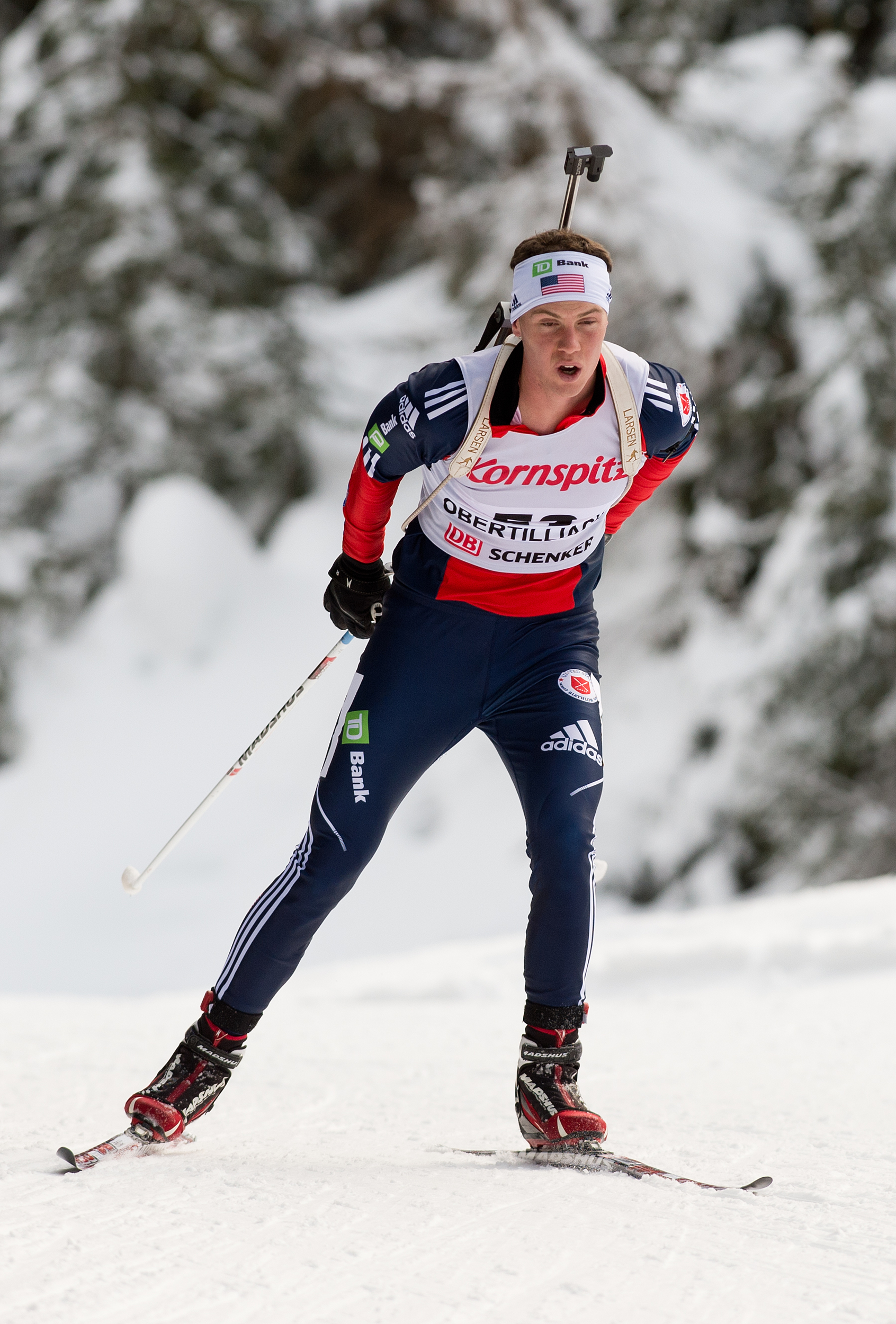
    Casey Smith (USA) en route to 37th place in the junior men's individual at World Junior Championships in Obertilliach, Austria, in 2013. He had his career-best finish of 23rd place in the pursuit there. (Photo: US Biathlon/NordicFocus.com)
    Casey Smith (USA) en route to 37th place in the junior men’s individual at 2013 World Junior Championships in Obertilliach, Austria. He had his career-best finish of 23rd place in the pursuit there. (Photo: US Biathlon/NordicFocus.com)

    Smith was a top junior for the U.S. before and during his first stint in Bozeman. He had top-30 finishes at World Youth and Junior Championships in 2011 and 2013, as well as two apiece at Open European Championships in the junior races in 2012 and the senior races in 2014.

    He then spent two years with the MWSC – including the successful 2014 season, which launched him onto the national B-team – and one in Craftsbury.

    “It was great having other guys to train with,” he said of his time in Vermont. “I really hadn’t had too much of that, at least when I was in Maine. So that was really nice, and I really enjoyed working with Pepa [Miloucheva]. It helped me with my ski technique a lot, for sure.”

    Looking back, he said having the chance to travel the world was one of the best things the sport had offered him.

    “The last several years we would always go to Canmore over Thanksgiving, and so I could build relationships with people there,” he said. “Then when you land in Europe at competitions you run into them again, and I was able to make friends from all around. That was pretty cool.”

    There were results highlights from this season, too.

    “At [U.S. National Championships], it was really cool that all the national team was there [after the World Cup finished],” he reminisced. “It made it real races. In the sprint I had a pretty good race, and right in the mix. Also in Canmore at the trials it was a little bumpy the first few, but the last race I was finally able to pull it together and have a really good race.”

    After the injuries sustained the year before, Smith had attacked training and racing with a new direction, and it worked.

    “It was a traumatic experience, but I felt like I was able to bounce back from it miraculously quickly,” he said. “It almost helped me a little bit because I was so much more focused on being perfect on my physical therapy and being super diligent every single day. So I had to be really focused in general.”

    Pepa Miloucheva skates behind CGRP biathlete Casey Smith while at a training camp at La Forêt Montmorency in Quebec. (Photo: Caitlin Patterson)
    Casey Smith leads Craftsbury Green Racing Project Head Coach Pepa Miloucheva at a training camp at La Forêt Montmorency, Quebec, in November 2015. (Photo: Caitlin Patterson)

    And yet, he became aware that he wasn’t as fired up to keep it up for years. He decided that he would return to Bozeman for the fall semester. Smith initially told himself that he would return home to Washington and mull over whether to continue to compete while he finished his degree, or to call it quits on biathlon altogether.

    The latter won out, and now he’s fully invested in school and his future outside of sport.

    “I’m going to be in the animal science program,” he explained. “My plan is that my family has a small sheep farm here in Washington, and I’d like to come back and grow that bigger… and live in the Methow and have that lifestyle.”

    Most of the friends he started school with at Montana State years ago have graduated, but that didn’t concern Smith.

    “I feel like now I’m going to school because I want to learn, and before I was there because I wanted to do biathlon and train and there was other people doing that there, and by the way I was going to school on the side,” he said. “Now I’m going there because I really want to go to school.”

    Until the fall semester begins, he’s helping his family and uncle out on their farms and doing odd jobs in the Methow Valley.

    He may help with biathlon in the Bozeman region, and will definitely help his mother, Betsy Devin-Smith, who is the head coach of the Methow Valley Nordic Ski Education Foundation’s biathlon team.

    “I’m sort of stuck helping her with that, like it or not,” he joked.

    Of the life transition, Smith said that everything was feeling good so far.

    “I don’t really miss it now,” he said of biathlon. “The opportunity to ski as often, maybe I’ll miss. I’m sure I’ll still ski a lot, but not every day for hours.”

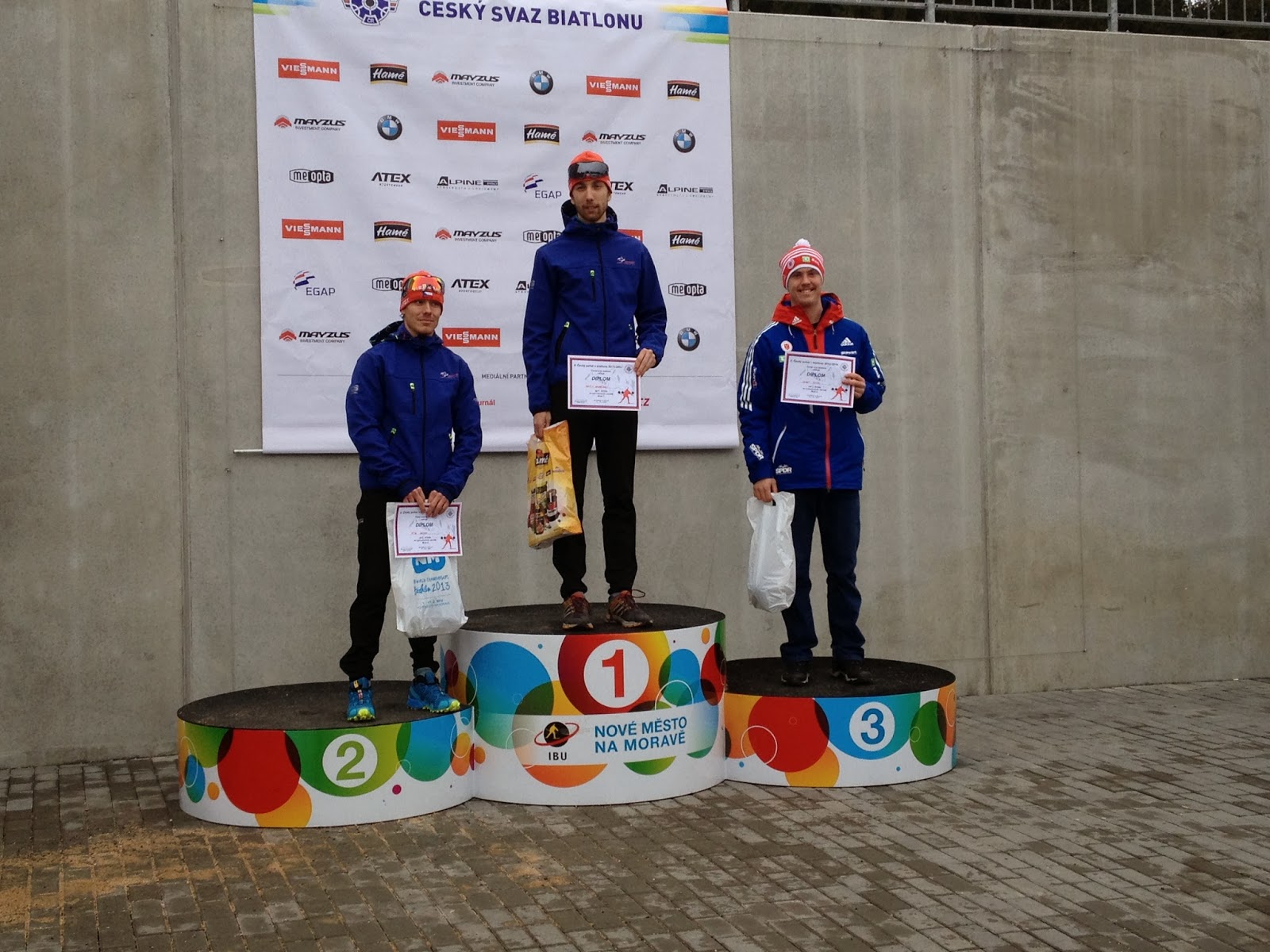
    Casey Smith on the podium at a Czech Cup biathlon race in 2014. (Photo courtesy of Casey Smith)
    Casey Smith (right) on the podium at a Czech Cup biathlon race in 2014. (Courtesy photo)
  • After Summer Wildfires, Methow Valley United, Undeterred and Open for Business

    After Summer Wildfires, Methow Valley United, Undeterred and Open for Business

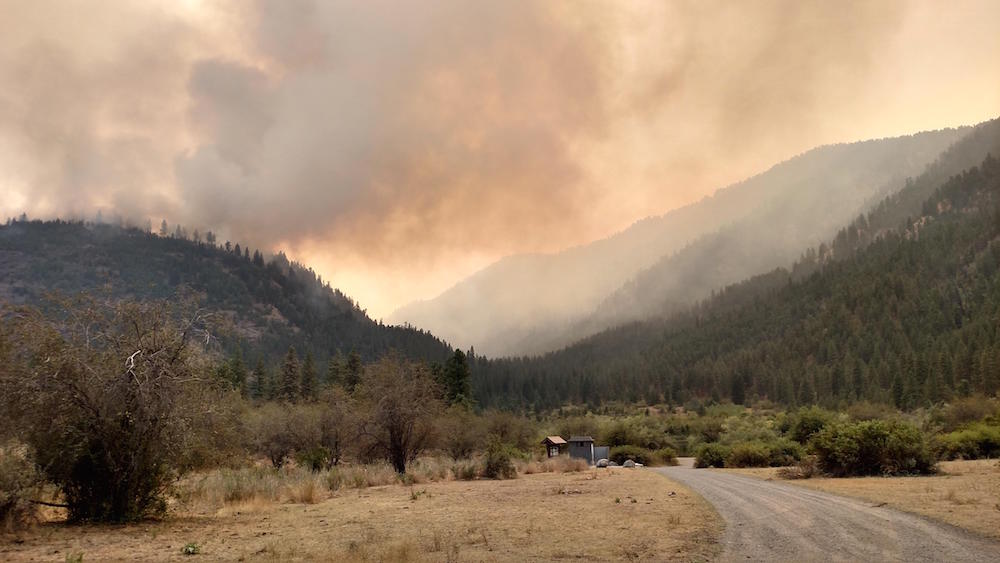
    The Okanogan Complex Fire near Omak, Wash., began with a lightning strike on Aug. 15, 2015 and consumed more than 300,000 acres. (Photo: US Forest Service)
    The Okanogan Complex Fire near Omak, Wash., began with a lightning strike on Aug. 15, 2015 and consumed more than 300,000 acres. (Photo: US Forest Service)

    In late October, snow fell on Washington Pass just outside the Methow Valley in Washington state’s North Cascades. Just yesterday, grooming began on the Methow Trails in anticipation of the earliest opening in the nordic center’s history, set for this Saturday. This kind of start to the season is warmly welcomed by a community that endured two consecutive summers of record-setting wildfires.

    A skiing mecca and home to four 2014 Olympic cross-country skiers (the Bjornsen siblings, Brian Gregg, and Torin Koos), the Methow Valley is also home to the Methow Trails, the self-proclaimed “nation’s largest cross-country ski area.” With more than 200 kilometers of trails in Winthrop and Mazama, Wash., this recreational area attracts visitors from around the country for skiing, trail running, mountain biking, and hiking.

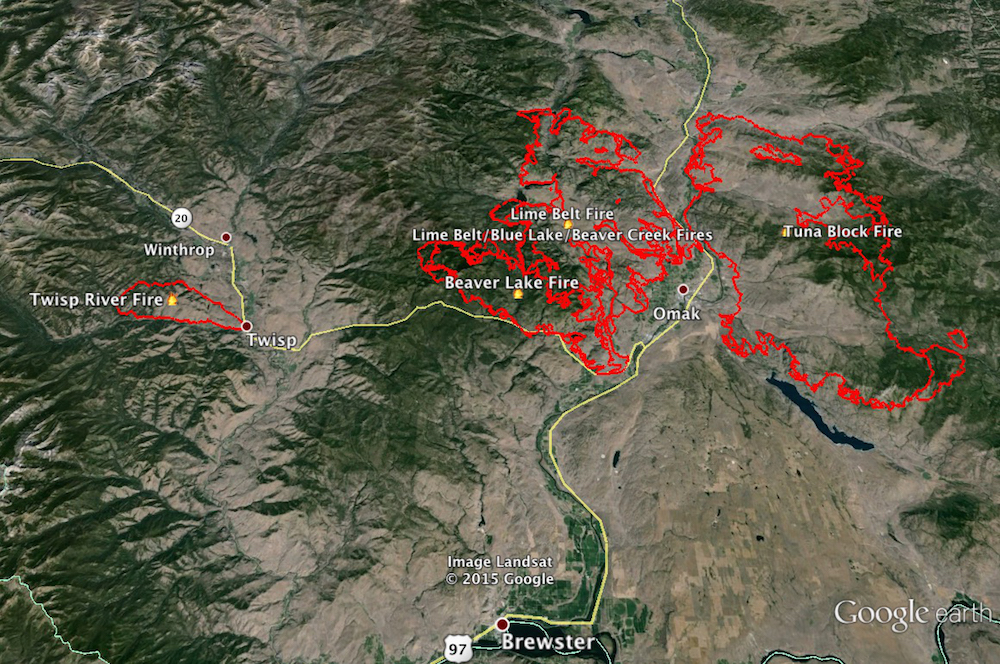
    This past August, lightning strikes ignited what was named the Okanogan Complex Fire, an immense fire that grew to threaten homes, businesses and livelihoods. Actually five fires fought as a single fire due to their proximity to one another, the Okanogan Complex surpassed the previous year’s Carlton Complex Fire to become Washington’s largest wildfire on record. Peaking at 304,782 acres, the fires burned from Aug. 14 through the declaration of 95-percent containment on Sept. 20, according to the National Incident Information System.

    A map of the Okanogan Complex Fire (Photo: Jeremy Blazar/Overlays by InciWeb)
    A map of the Okanogan Complex Fire (Photo: Jeremy Blazar/Overlays by InciWeb)

    Starting just down the valley from the ski towns of Winthrop and Mazama, the Twisp River Fire posed the highest threat to the ski infrastructure of the Methow Trails and Sun Mountain Lodge.

    Roughly thirty miles to the east, the Beaver Lake, Lime Belt, Tunk Block, and Tuna Block fires combined to create a much larger blaze, forcing evacuations of about 5,400 homes in Okanogan County.

    It was this evacuation that drew the attention of U.S. Ski Team athletes Erik and Sadie Bjornsen, who call the Methow Valley their home despite living and training in Anchorage, Alaska. Their parents still live in the valley.

    “For Eric and I it was a bit a scary because we didn’t hear from our parents right away,” Sadie Bjornsen said in a phone interview. Once they made contact with their parents, they learned they had evacuated to Seattle.

    Bjornsen also mentioned that aside from the size and unpredictability of the last two fires, it had been the idea of getting trapped that Methow residents feared the most.

    “The really freaky thing that happened this summer was that there was a fire over the North Cascade Highway … and there was a fire down in Twisp, and then there was a fire in Omak,” she said. “So all three ways of getting out of the valley were potentially blocked.”

    None of these closures coincided for a total road blockage; however, the valley’s entrapment by fire was a conceivable reality.

    This was more of an issue the previous summer when heavy rains created flooding and mudslides in addition to the ongoing fires. From the experience with the Carlton Complex in July 2014, the valley as a whole learned and was “a little better prepared for evacuation and the infrastructure issues,” Mark Waechter, longtime resident and owner of the Winthrop-based ski shop, Nordic Ultratune, wrote in an email.

    Waechter, who wrote about the fires on his blog in August, didn’t feel the affects of the fires on his business due to the shop’s exclusively winter focus and high volume of mailed-in, ski-grinding work.

    While the Winthrop and Mazama townships that many skiers call home were not immediately affected, the blazes quickly captured national attention when three firefighters died on Aug. 19 and four others were injured. These deaths, especially overwhelming for a small community where just about everyone knew or had a connections to one of the deceased, also drew enough regional media attention to spread an exaggerated sense of devastation throughout the valley, potentially dissuading tourists.

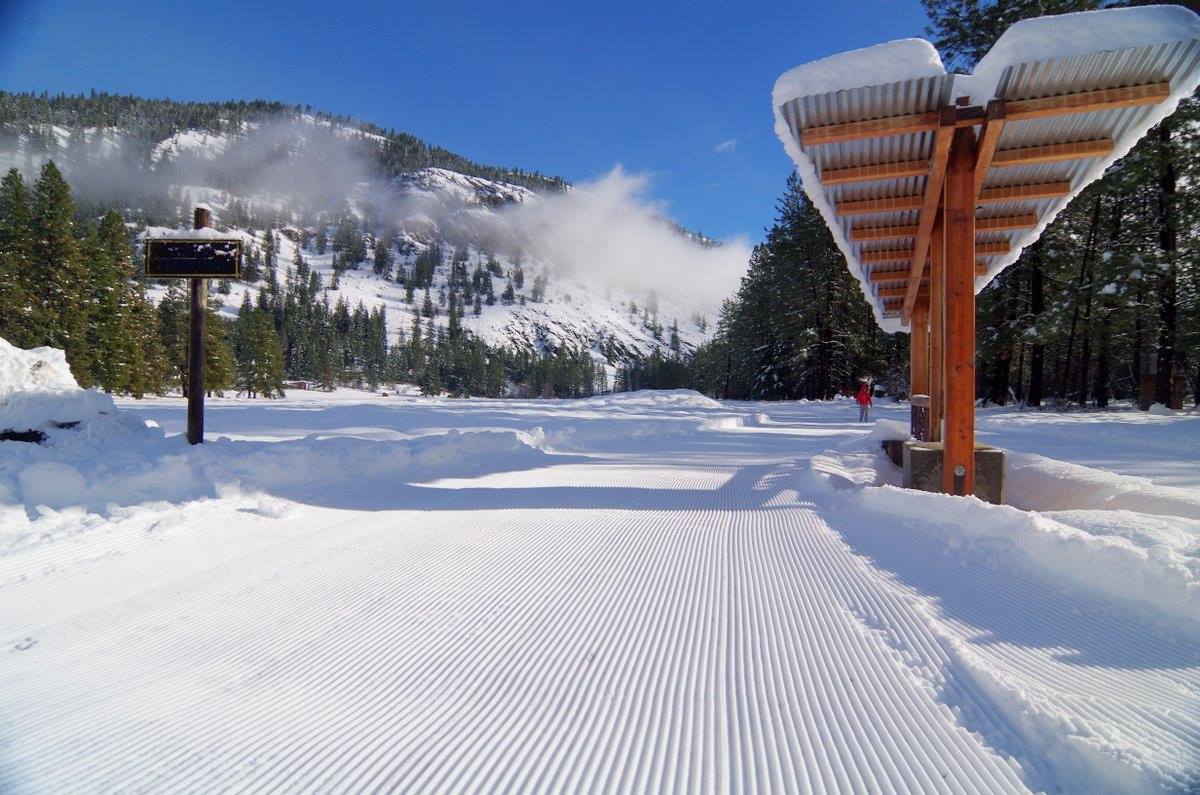
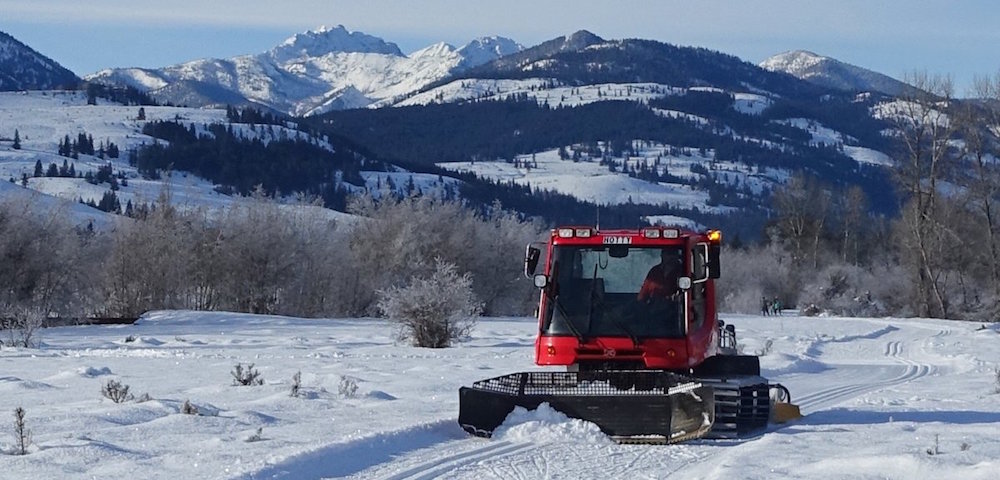
    The first grooming pass of the season took place Wednesday at the Methow Trails. The 200-plus-kilometer trail system is on track for the earliest opening ever on Saturday. (Photo: Methow Trails/Facebook)
    The first grooming pass of the season took place Wednesday at the Methow Trails. The 200-plus-kilometer trail system is on track for the earliest opening ever on Saturday. (Photo: Methow Trails/Facebook)

    “The hardest part about the recovery is convincing people to come visit after the smoke and fire went away,” Methow Trails Executive Director James DeSalvo wrote in an email. “Within a few weeks after this fire took off, the valley was open for business, but our marketing engine can’t compete with national disaster news.”

    All of the skiers and members of the ski community interviewed for this article echoed that sentiment, including Methow Olympic Development (MOD) Squad Head Coach Scott Johnston.

    “If you came here and you drove just up the Methow Valley on the main road, you’d hardly see any damage other than some burned, blackened hillsides,” Johnston said.

    Methow Valley Nordic Team coach Leslie Hall expressed sorrow for the loss of life and property, but explained that her team, “never really missed a beat even with smoke and fire.”

    “The hardest part about the recovery is convincing people to come visit after the smoke and fire went away.” — Methow Trails Executive Director James DeSalvo

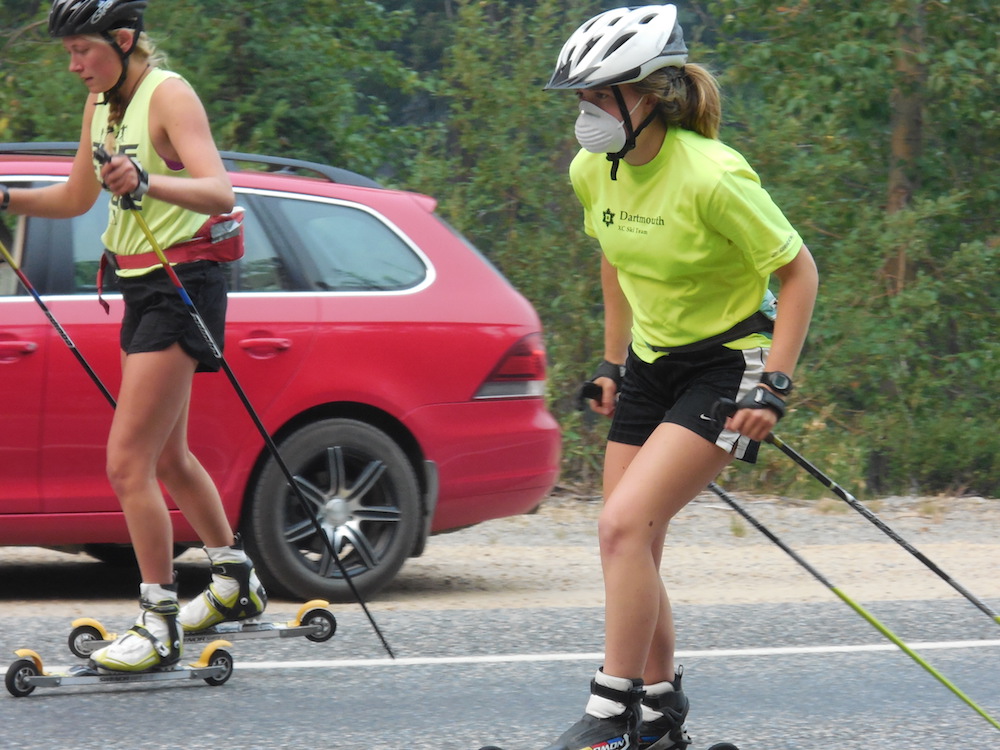
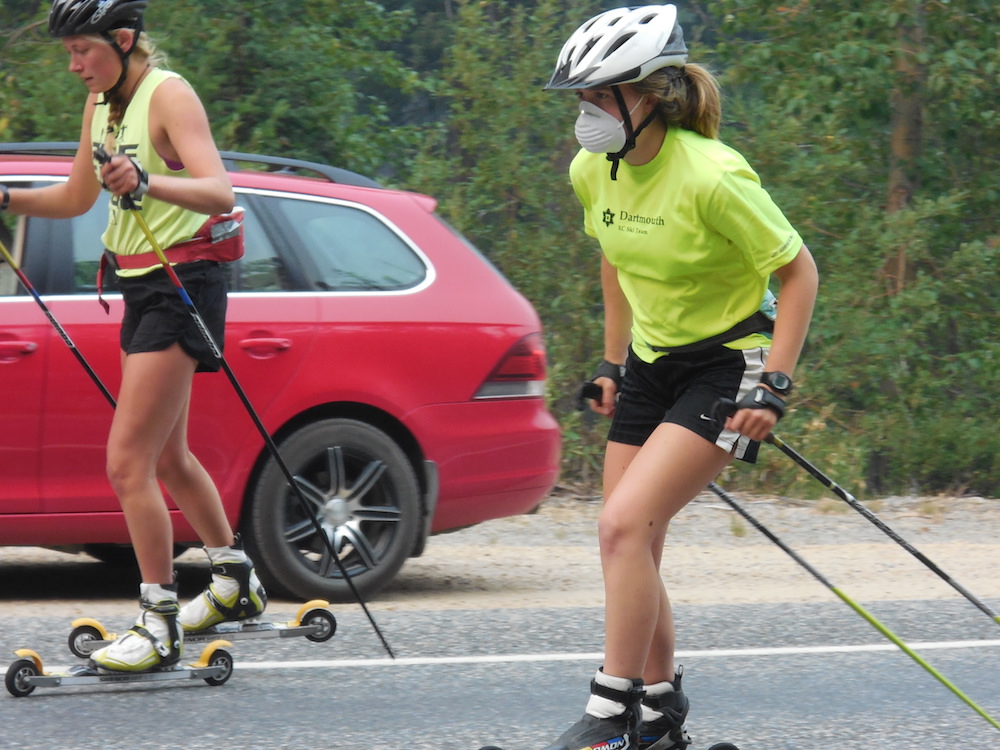
    Training deviated from the planned schedule only when smoke levels hit unhealthy levels. Hall, Johnston and former MOD athlete, Sam Naney, who now runs Momentum Northwest in Seattle, all mentioned the smoke as a training inhibitor, but explained it was easily avoidable by adjusting to the wind and elevation. Bjornsen said her parents still got outside with the use of breathing masks, and she only missed one interval session because of smoke during the week she visited after the fires.

    Methow Valley Nordic Team skiers Ella Hall and Claire Waichler rollerski amidst the smoke on closed Highway 20 this summer. (Photo: Leslie Hall)
    Methow Valley Nordic Team skiers Ella Hall and Claire Waichler rollerski amidst the smoke on closed Highway 20 this summer. (Photo: Leslie Hall)

    From an economic perspective, many agreed that it was imperative for early snow in order to draw tourists back to the Methow. Despite the fires and forest closures, DeSalvo’s staff at Methow Trails has done all of their normal preparation in readying the trails for the winter. On Saturday, they’ll open earlier than ever, right in the nick of time, according to a grooming report.

    To understand the nordic center’s role in the economic recovery of the region, one might consider its return on investment. According to the Methow Trails’ economic analysis published in August, it creates 152 full-time jobs each year, and has accounted for $700,000 dollars in sales tax revenue and $12.4 million dollars in combined direct and secondary expenditures made by trail users. Also, for every dollar spent on trail maintenance, $23 is returned to the local economy.

    Not only do the trails serve the community’s transportation and recreational needs, they are aiding in economic recuperation. Now they just need the snow to cooperate this winter.

    Winter on the Methow Trails. (Courtesy photo)
    Winter on the Methow Trails. (Courtesy photo)

    Looking toward the future, it’s easy to predict more fires as the snowpack and weather becomes more unreliable, and each year seems to be drier than the previous. Wildfires are natural and essential to the ecosystem; thus this will happen again. However, it’s the severity and relentless nature of these past fires that’s scared the community.

    Naney, who grew up in the valley and lived there until this past year, mentioned that this year’s fires were “essentially burning over areas that burnt last year,” making the entire event “… horrifying for people.”

    On the other hand, the community, and the skiers within it, know that preparation is key. Part of this is trail advocacy and promotion since, “the last three major wildfires in our area have all been redirected away from homes and towns due in some part to the trail network acting as a fire line,” according to DeSalvo.

    Part of it is simply working around what the fire destroyed. The Methow Nordic Team did so by offering free membership to those team members whose families lost property.

    As the snow falls, skiing and tourists will return to the valley, and life as usual will continue for all of Okanogan County.

    “Our official opening will be this Saturday and forecast is for sunny and cold for the foreseeable future,” DeSalvo wrote in an email. “Good news for everyone.”

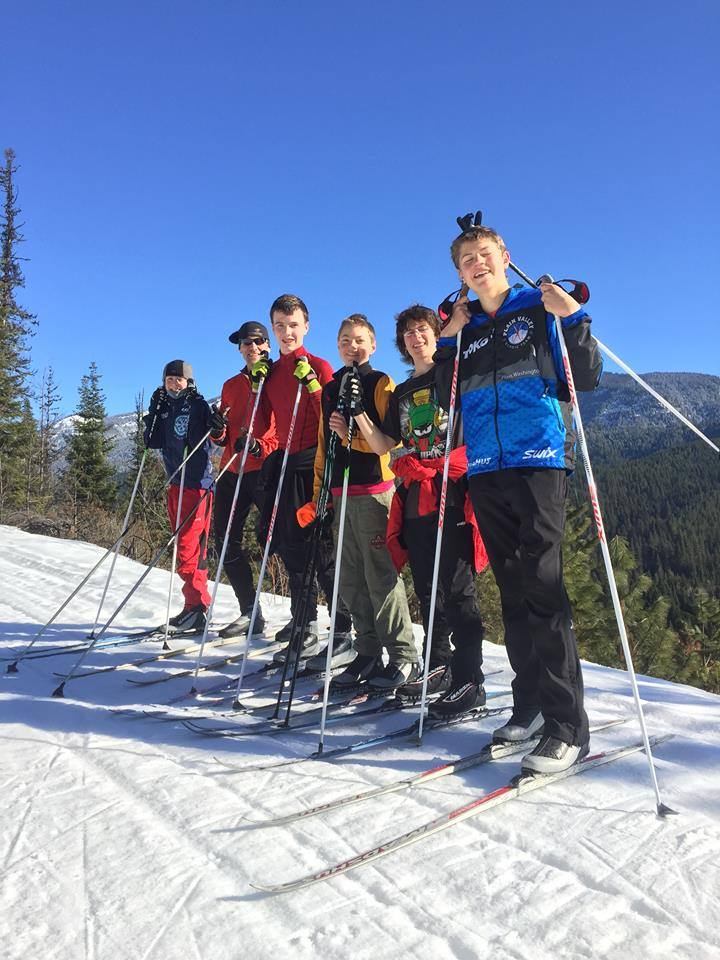
  • Plain Valley Nordic Looking for Junior Head Coach

    Plain Valley Nordic Looking for Junior Head Coach

    Pine Valley Nordic Team

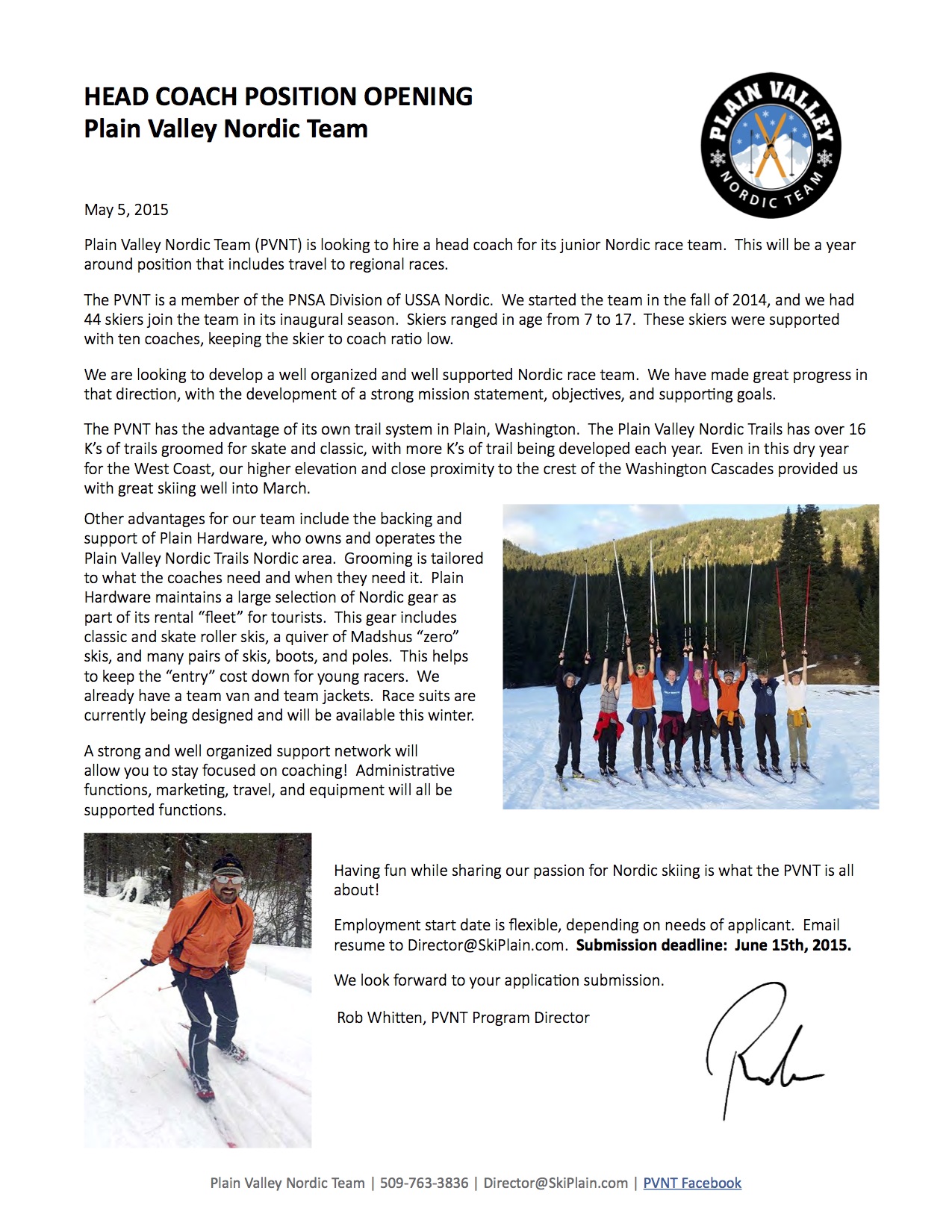
    Plain Valley Nordic Team (PVNT) is looking to hire a head coach for its junior Nordic race team. This will be a year-round position that includes travel to regional races.

    The PVNT is a member of the PNSA Division of USSA Nordic. We started the team in the fall of 2014, and we had 44 skiers join the team in its inaugural season. Skiers ranged in age from 7 to 17. These skiers were supported with ten coaches, keeping the skier to coach ratio low.

    We are looking to develop a well organized and well-supported Nordic race team. We have made great progress in that direction, with the development of a strong mission statement, objectives, and supporting goals.

    The PVNT has the advantage of its own trail system in Plain, Washington. The Plain Valley Nordic Trails has over 16 K’s of trails groomed for skate and classic, with more K’s of trail being developed each year. Even in this dry year for the West Coast, our higher elevation and close proximity to the crest of the Washington Cascades provided us with great skiing well into March.

    PVNT Coach Packet 050415

  • Greggs, Boundary Bay Once Again Dominate Ski to Sea

    Greggs, Boundary Bay Once Again Dominate Ski to Sea

    Brian Gregg, Caitlin Gregg, Patrick Johnson, Todd Eastman, and Russell Kennedy — those names sound familiar? The five U.S.-born cross-country skiers started each of their eight-person teams off two weekends ago in the 93-mile Ski to Sea Race on May 25 from Mount Baker to Bellingham, Wash.

    A Washington native, Gregg put his Boundary Bay Brewery men’s team in the lead through the first stage of the multi-sport race — the 8-kilometer ski race — then handed off to Greg Ruckman for the downhill portion.

    “The course is very challenging and honestly quite similar to the 5km Freestyle loop in Sochi,” Gregg later wrote on his blog. “I competed with the Boundary Bay Brewery competitive open race team.  I have been competing with the same group of guys for the past 5 years and it is always a fun event.”

    Kennedy, who moved north from Truckee, Calif., to pursue a professional ski career in Canmore, Alberta, raced the NW Sleep Solutions to second in the competitive open category, 1:17 behind Gregg.

    Brian Gregg (l) with his Boundary Bay team, which won its fourth-straight Ski to Sea title on May 25. (Photo: Brian Gregg/Facebook) https://www.facebook.com/photo.php?fbid=10202976820959831&set=a.1734034989031.2090232.1183237201&type=1&theater
    Brian Gregg (l) with his Boundary Bay team, which won its fourth-straight Ski to Sea title on May 25. (Photo: Brian Gregg/Facebook)

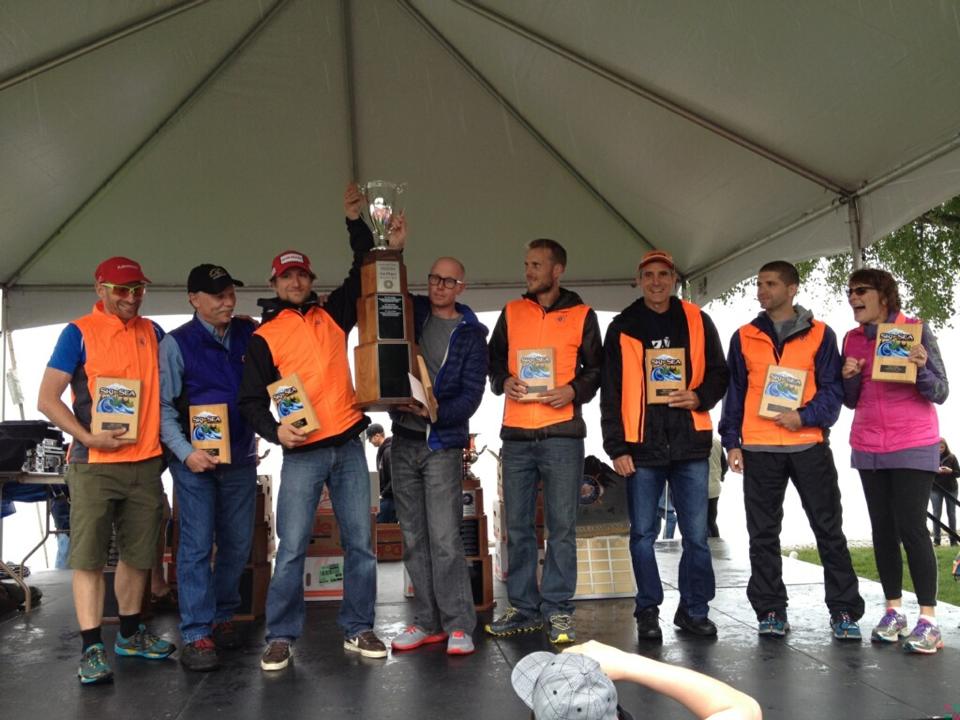
    The powerhouses of the day, Boundary Bay went on to tag third in the downhill, and second in every event thereafter (the run, road bike, two-man canoe, cross-country bike, and kayak, respectively). Gregg teamed up with Ruckman, Justin Ricks, Dan Harm, Brad Bauer and Steve Corlew, Russell Stevenson, and Olympic gold medalist kayaker Greg Barton — in that order — for the win in 5:40:08, beating Team Aeromech (with Johnson racing to third in the nordic portion) by 6 minutes and 32 seconds. It extended their win streak to four years in a row.

    “I’m on a team with a bunch of fast guys,” said Stevenson, who gave Boundary Bay a seven-minute lead on Aeromech in the cross-country bike, to the Bellingham Herald. “The guys in the morning just crushed it and demoralized everybody, I think.”

    Aeromech (with Johnson, Max Taam, B.J. Christenson, David Kessler, Ivan English and Mike Vincent, Gage Hecht, and Kenny Rice) took second, and the truly local Beavers Tree Service won the Whatcom County Open category and placed third overall (with Eastman, Brent Molsberry, Matt Cummins, Ian Baldwin, Brian Boatman and David Williams, Brian Ecker, and Brandon Nelson), 19 minutes behind Boundary Bay.

    Kennedy’s NW Sleep Solutions (with Steve Sellers, Jeff Grassley, Andrew Coe, Mike Norton and Jon Davies, Ian Murray, and Gareth Tudor-Jones) outlasted the masters winners GetSimpleBox.com by 28 seconds for fourth.

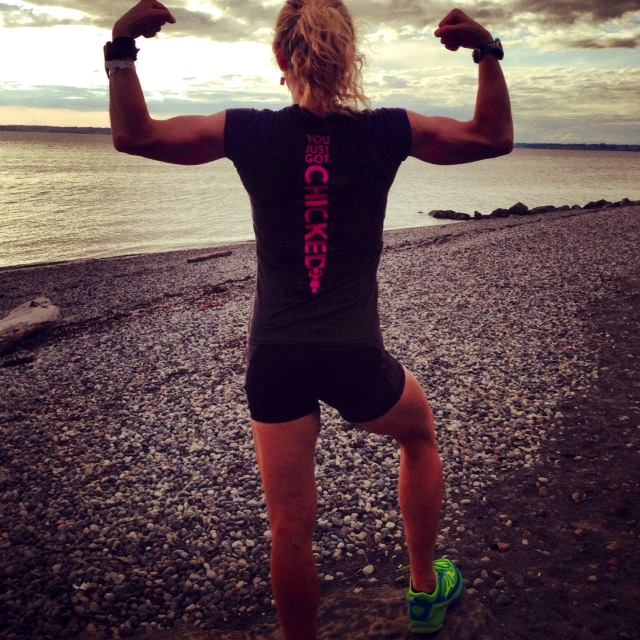
    Boundary Bay swept the afternoon, winning the women’s division as well in 6:33:29 for their 15th straight victory. Caitlin Gregg gave the team a four-minute lead after the nordic leg, putting them fifth overall while wearing a jersey that read, “You just got chicked” on the back. Thirteenth overall, the Boundary Bay women ended up winning by more than 13 minutes.

    Caitlin Gregg in her "You just got chicked" T-shirt. (Photo: Caitlin Gregg/Facebook)
    Caitlin Gregg in her “You just got chicked” T-shirt. (Photo: Caitlin Gregg/Facebook)

    “Psyched to be representing ‘You just got Chicked’ … at Ski to Sea!” Caitlin wrote on Facebook. “Jennifer Martin is an awesome PT AND an incredible ambassador for getting women (young and old) active and into sports of all kinds!”

    For the first time, this year organizers awarded both the men’s and women’s winning teams with universal airline ticket to all 16 members. Caitlin Gregg told the Herald she’s going to use hers to get to a training camp at Alaska’s Eagle Glacier.

    The day before on May 24, her husband Brian set a personal record in a 10 k running race, winning the Mazama Fun Run in 35:12  in the Methow Valley, where he grew up. He and his father started the race 20 years ago from their driveway to Mazama for the annual Memorial Day Pancake Breakfast.

    “I was too young to run so far, so I did it as a bike ride,” Brian wrote on his blog. “A few years later I did it as a relay team with my twin brother.  The race has grown beyond the capacity of the bathroom at my parent’s house and now runs a loop from Mazama.”

    One day after on Memorial Day, he and his extended family did a 100 k bike ride on San Juan Island in northwest Washington.

    “Why stop at a 10km Running Race and 8km Ski Race when you have a 3 day weekend,” Brian wrote. He and his wife Caitlin flew home to Minnesota that Tuesday for a month of training in the Midwest. They celebrated their third anniversary on May 21.

    Ski to Sea results

  • The 12: Methow Olympic Development

    The 12: Methow Olympic Development

    Sam Naney leads Rogan Brown during a Trout Lake Camp time trial. (Photo: Curt Hawkinson)
    Sam Naney leads Rogan Brown during a Trout Lake Camp time trial in Washington. (Photo: Curt Hawkinson)

    Note: This is the ninth preview in our U.S. elite-team series, called the “The 12.” We asked coaches to tell us what’s new and whom to look out for this season, and we’ll publish additional previews in the coming weeks in no particular order.

    Team: Methow Olympic Development (MOD)

    Coach: Scott Johnston

    Roster: Sam Naney, Brian Gregg; Caitlin Gregg, Maya Seckinger

    Brian and Caitlin Gregg skiing on Donner Pass in California. (Photo: Mark Nadell/MacBeth Graphics)
    Brian and Caitlin Gregg skiing on Donner Pass in California. (Photo: Mark Nadell/MacBeth Graphics)

    Who’s new: Both Greggs (formerly of Central Cross Country, a.k.a. CXC) and Seckinger (Methow Valley Nordic Team). Brian Gregg was previously an MOD training partner, working out with Naney and Johnston in Washington’s Methow Valley last summer while Caitlin balanced school and training in the Midwest. Seckinger, a junior, will be pursuing success at Junior Nationals, according to Johnston.

    Top results last season: The team’s longstanding staple, Naney, 28, qualified fifth in the classic sprint at U.S. nationals in January and went on to place ninth in the heats at Soldier Hollow in Midway, Utah. He was ninth again at the SuperTour Finals classic sprint in Soda Springs, Calif., placed 10th in the American Birkebeiner in Wisconsin, and was fourth in the Madison SuperTour skate sprint.

    Brian Gregg, 29, narrowly missed the podium in the 15 k skate at nationals, placing fourth, and was the second-fastest qualifier in the skate sprint at Soldier Hollow. He won a SuperTour in Aspen, Colo., and was second in the hill climb at SuperTour Finals.

    Caitlin, 32, qualified for the Canadian World Cup sprints in Quebec, where she was 18th in the team sprint and 49th in the individual skate. She won the American Birkebeinerfor the second time since 2011 and took the 5 k title at Canadian Nationals in Whistler, B.C. Like her husband, she qualified second in the U.S. nationals skate sprint at Soldier Hollow.

    Maya durign the Trout Lake time trial. (Photo: Curt Hawkinson)
    Maya Seckinger during the Trout Lake time trial. (Photo: Curt Hawkinson)

    As a first-year J2, Seckinger clocked the eighth-fastest relay leg at Junior Nationals in Fairbanks, Alaska, where she was also ninth in the sprint qualifier and 14th in the 5 k freestyle. Her stellar season earned her an invite to the USSA National J2 Camp in late July in Michigan.

    Coach’s comments: “The new additions have brought challenges but great rewards, too,” Johnston wrote in an email. “As a coach I am continually learning from the athletes and having more top level skiers has made my job more interesting. My approach is to design each athlete’s training to meet their individual needs and at times were are going 4 different directions but all with the same ending destination.”

    ***

    Other previews: Alaska Pacific University | Bend Endurance Academy |Bridger Ski FoundationCraftsbury GRP | Maine Winter Sports CenterSSCV/Team HomeGrown | Stratton Mountain School T2 | Sun Valley SEF Gold Team

  • Elite Team Preview: Methow Olympic Development

    Elite Team Preview: Methow Olympic Development

    Methow Olympic Development skier Sam Naney (left) rollerskiing with Brian Gregg of CXC during a recent training session in Washington state’s Methow Valley. Gregg joins the MOD squad as a training partner this summer, but will continue to compete for CXC. (MOD photo)

    Note: This is the seventh preview in a quick-and-dirty series on U.S. elite teams. We asked coaches to send their 2012/2013 rosters and tell us what’s new for the coming season. We will be publishing additional reports over the next few weeks. Teams are presented in no particular order.

    Team: Methow Olympic Development (MOD)

    Coach: Scott Johnston

    Roster: Sam Naney

    What’s new: Brian Gregg as a training partner. Gregg will spend much of the summer in his hometown of Winthrop, Wash., working with Johnston and Naney in the Methow Valley. Naney tied the knot in June, marrying massage therapist Alison Hanks in his parents’ backyard.

    Top results last season: Naney, 27, notched a career best of 13th at U.S. nationals in the 15 k skate. In the Tour de Twin Cities that followed, he tallied three top-five finishes and ended the season with a slew of SuperTour and NorAm top 10s. He made the podium in St. Paul, Minn., placing third in the 20 k freestyle pursuit.

    Coach’s comment: According to Johnston, last year was an important building block for Naney, a sprinter with aspirations of being a better all-around skier.

    “We chose to take a slightly different approach with his training and focus more on building a better aerobic base training. We did this at the expense of his Sprint specific training and his results bore this out,” Johnston wrote in an email. “We had to make decisions to deviate from his traditional strengths of sprinting and power in the training, and those decisions cost us in the season; despite qualifying 5th in the Nationals skate sprint, Sam did not move on through his quarter and went on to have similar disappointing results in sprinting, usually his strongest event.”

    Sam Naney of the Methow Olympic Development squad working out in northern Washington. (MOD photo)

    This year, they’re working “to bring the whole package together,” Johnston wrote, adding that the progression was already happening.

    “This winter should be Sam’s strongest yet,” he continued.

    In an email, Naney explained that he specifically wanted to boost his speed and anaerobic power by the start of the season.

    “The hope is to carry the training well all the way through to November and the Canadian World Cup trials,” Naney wrote. “Last season we built a great ‘cake’ but didn’t have time to add the finishing touches.”

    It can’t hurt to have Gregg, 28, training alongside him. Entering his seventh year with Central Cross Country (CXC), Gregg will continue to compete for the Midwest’s elite team, keeping his home base in Minneapolis. His wife and CXC teammate, Caitlin, will stay there, training between a series of five-week intensive anatomy and physiology courses at Normandale Community College.

    Reflecting on his performance last year and goals of improving, Brian Gregg decided to return to Johnston, his high-school coach in Winthrop, Wash., as a personal coach.

    “Scott and I have discussed his training philosophies a lot and we have identified a number of areas that I have to improve,” Gregg wrote in an email.

    Gregg detailed the move on his blog, explaining that he’d return to the Midwest for training camps while working individually with Johnston and Naney out West. He aimed to minimize travel, training in long blocks, and liked Johnston’s scientific approach with speed and intensity monitored by GPS, lactate and heart rate. Gregg is currently training most days with the two-man MOD crew and loving the coach-to-athlete ratio.

    “Scott’s coaching style is very hands on and individual and requires a small group,” Gregg wrote. “For Sam and me, our individual strengths complement well with opportunities for the other to improve.  We are able to push each other and are making notable improvements.

    “It is tough to be away from Caitlin but I do get to spend more time with my family, and I believe this will help me make that next jump in performance,” he added.

    His childhood friend, Naney is excited.

    “It’s been a great change from last season in which I spent the whole year training solo,” Naney wrote. “Brian offers distinct qualities as a training partner and his distance skiing focus contrasts well with my sprinting, allowing us to feed off each other and push each other in our weaknesses.”

    As for Johnston’s method, Naney has always liked its unique and out-of-the-box ideas.

    “Scott has made a concerted effort to look outside traditional ski training and into other sports to find better ways to train endurance and speed athletes,” he wrote. “Currently we’re working with a mixture of marathon runner training and swimmer training. Instead of maintaining a cyclical-style training plan where we repeat the same workouts all year, we operate off progressions of workouts, increasing workloads and intensities all the way into the fall. We’ve found that in this manner, we can continue stressing the various physiological systems such that they respond faster and stronger than before.”

    ***

    Other previews: Bend Endurance Academy | Craftsbury GRP | CXC | Far WestMaine Winter Sports Center | XC Oregon