Tag: wax techs

  • An accountant, a summer flooring salesman and an Estonian helped Diggins deliver bronze. Here’s how.

    An accountant, a summer flooring salesman and an Estonian helped Diggins deliver bronze. Here’s how.

    ZHANGJIAKOU — Patrick Moore is a cheerful accountant from Edmonton, Alberta. Tim Baucom spends his summers working sales for a Vermont plank flooring company. Oleg Ragilo runs a cosmetic shop in Estonia with his wife.

    Jessie Diggins, the American cross-country ski star, couldn’t have won her Olympic bronze without them.

    Jessie Diggins earns an Olympic bronze medal in the 1.5 k freestyle sprint. (Photo: NordicFocus)

    Moore, Baucom and Ragilo all belong to America’s nine-member ski service team here — a mix of mostly paid staff and a couple of volunteers like Moore.

    “I can’t speak highly enough of their work ethic — they’ve been out here every single day, hours and hours and hours, probably skiing like 50 k a day,” Diggins said after finishing eighth Thursday in her third race of the Games. She added, referring to her medal-winning ski: “They delivered such a clutch performance the other night.”

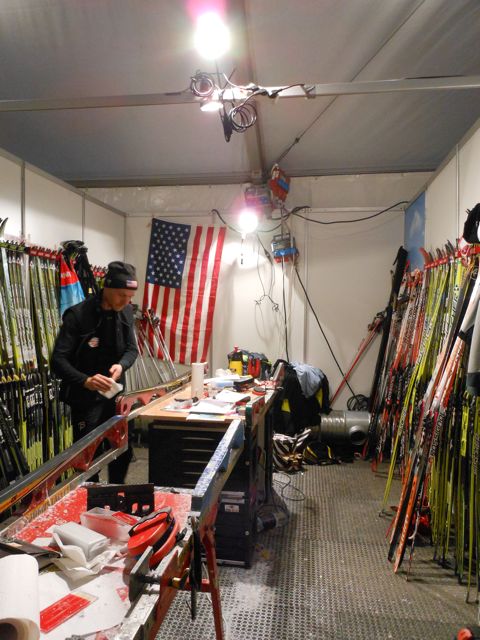
    The service crew is charged with the complicated, high-stakes work of choosing the right skis and wax for the snow conditions in Zhangjiakou, the mountain resort town outside Beijing where Olympic cross-country events are taking place.

    The task sometimes can make the difference between an average day and a medal. 

    But the work, which happens in drab tan buildings off a corner of the stadium, is relatively anonymous — except when things go wrong.

    “I think it’s sometimes hard for people at my regular job what I look like here,” said Moore, the accountant. “And it’s probably hard for people at this job to understand what I look like there.”
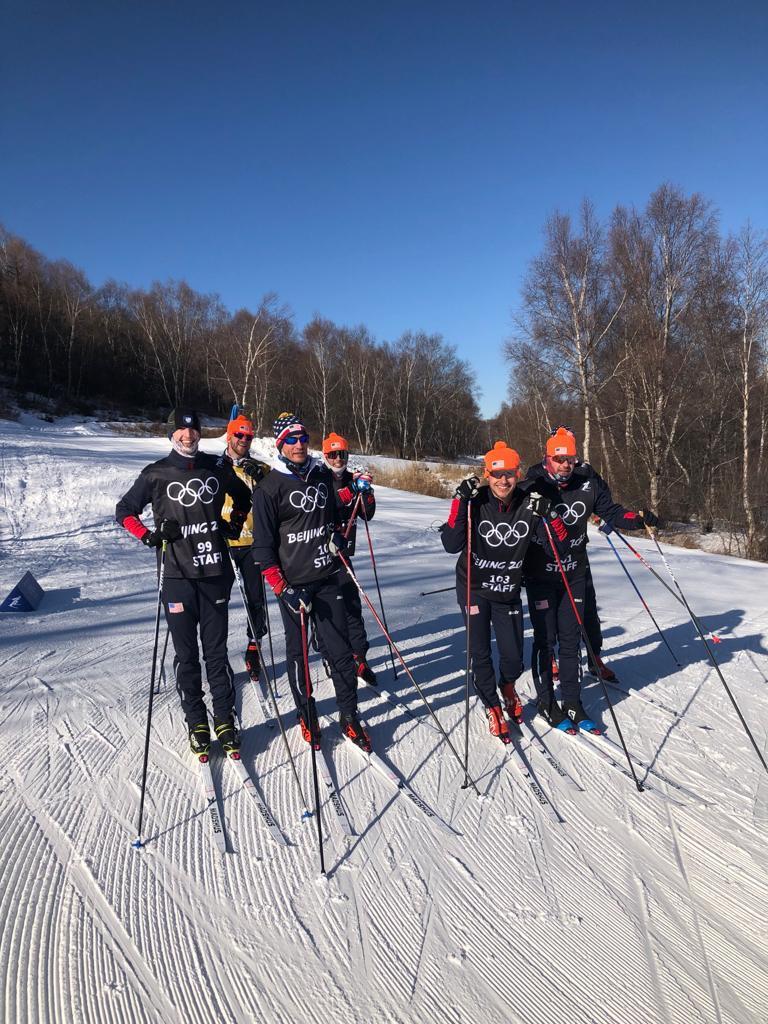
    The U.S. wax staff arrives in Zhangjiakou. From left to right, Patrick Moore, Andrew Morehouse, Bjorn Heimdal, Tim Baucom, Chris Hecker, Jason Cork, and Eli Brown. (Photo courtesy fellow technician, Karel Kruuser)

    The U.S. service team is composed of a mix of Americans and Europeans — including Ragilo, who previously waxed for superstars in Estonia and is something of a legend there.

    To appreciate the crew’s work requires a quick lesson in ski technology.

    Cross-country ski bases — the part that slides across the snow — are generally made of a plastic called polyethylene, or p-tex. The material has tiny pores, somewhat like a sponge, which means it absorbs wax that’s ironed or rubbed in by technicians; the excess can be scraped off to leave what appears to be a smooth plastic surface.

    Manufacturers produce different waxes to help the skis slide faster in different conditions: warmer or colder, natural snow or man-made.

    The waxes are typically layered, and they can be applied in different ways — ironed in, rubbed in with a cork or even a spinning wool cylinder attached to a drill, for example.

    Technicians can also enhance the gliding potential of skis with metal tools that press tiny, intricate patterns into the bases, known as structure. Then there are the skis themselves, which are built stiffer or softer to suit snow conditions. American athletes each brought dozens of pairs to the Olympics — perhaps 300 total.

    Sorting through each of those variables and identifying the best skis, waxes and structures takes hours and hours of testing. U.S. service team members arrived in Zhangjiakou a week before the first race, and got to work.

    “None of us are scientists,” said Baucom. “But we just tinker around with all this stuff.”

    Old entries in a U.S. wax technician’s notebook keep track of the many iterations tested en route to a winning selection. (Photo: Nat Herz/FasterSkier-ADN)

    The crew spends its first day or two skiing the race courses, setting up gear and getting a feel for the place. Then, they start testing the first layers of waxes and the best methods for applying them, as well as durability: How far can they ski before the wax starts losing potency?

    Most of the testing is done by feel, with two technicians gliding down a hill, side by side, on two pairs of skis with different waxes to see which pair is faster. The American technicians can ski 30 kilometers a day or more; some or the Scandinavian teams with larger staffs have workers whose sole job is testing and can ski twice that far.

    When race day arrives, the U.S. team may have tested 50 or 60 types of glide wax, and a similar number of kick waxes, which skiers use to grip the snow and push themselves uphill. 

    Olympic team staff test skis and wax Friday, February 4, 2022 at the Zhangjiakou National Cross-Country Skiing Center. (Nat Herz/FasterSkier-ADN)

    They’ll narrow that number to perhaps 16 waxes to test in the hours before the gun goes off. Athletes, who are paired with the technicians, will also test a handful of pairs of skis before a race to see which are fastest.

    The Americans aren’t typically expecting to find a magic bullet that makes their skis the best in the field, said Baucom, the U.S. team’s head of glide waxing in Zhangjiakou.

    “You always want to have skis that are ridiculous, and make you look good,” he said. “But really, our goal is to have competitive skis. And it seems like in these conditions, as far as I can tell, almost every team has had pretty competitive skis.”
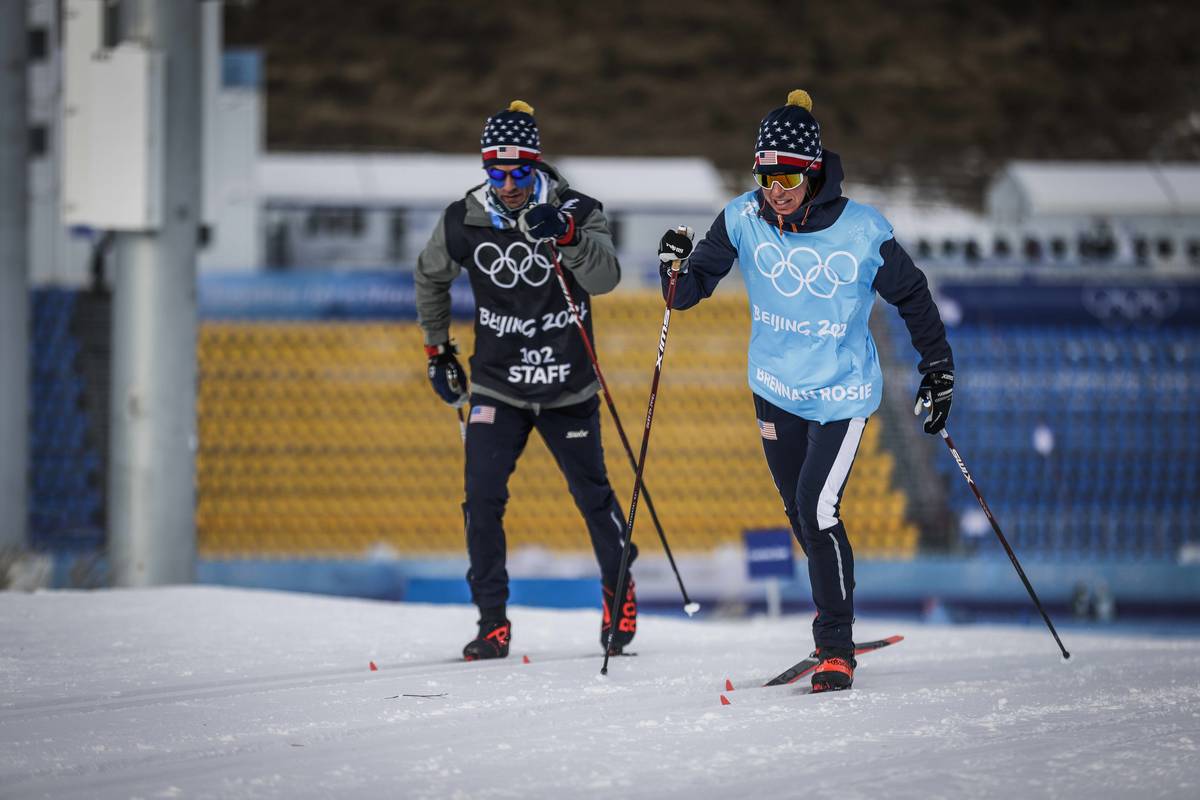
    Rosie Brennan tests skis with her tech, Bjørn Heimdal, before the opening 15 k skiathlon. (Photo: NordicFocus)

    The conditions in Zhangjiakou were the subject of intense speculation before the Games. 

    The area is not far from the Gobi desert and gets minimal precipitation, so skiers are racing mostly on manmade snow. Before the Games, Baucom heard about storms that deposited sand on the trails that ruined skis. 

    But so far, he said, the skiing at the Olympics has been quite good, even if the snow is a little dirty and wears away wax a bit more quickly than usual.

    “It’s not throwing us for a loop as far as being very different from other really cold, dry snow that we’ve raced on,” Baucom said. “It’s abrasive, but it’s not, like, crazy.”

    Ski preparation at the elite level can be something of an arms race: On the European World Cup cup circuit, bigger teams, including the U.S., travel with huge trucks that have been outfitted as roving wax rooms at a cost of $500,000 or more. Those trucks, however, did not make the trip to Zhangjiakou.

    Scandinavian teams spend more money on ski service and have bigger workforces, which can sometimes produce inequities. At the World Championships in Germany last year, the U.S. technicians had an especially tough day in the women’s pursuit race, where the skis they gave athletes were too slow to be competitive. Baucom described the feeling as “gut-wrenching” for the staff.
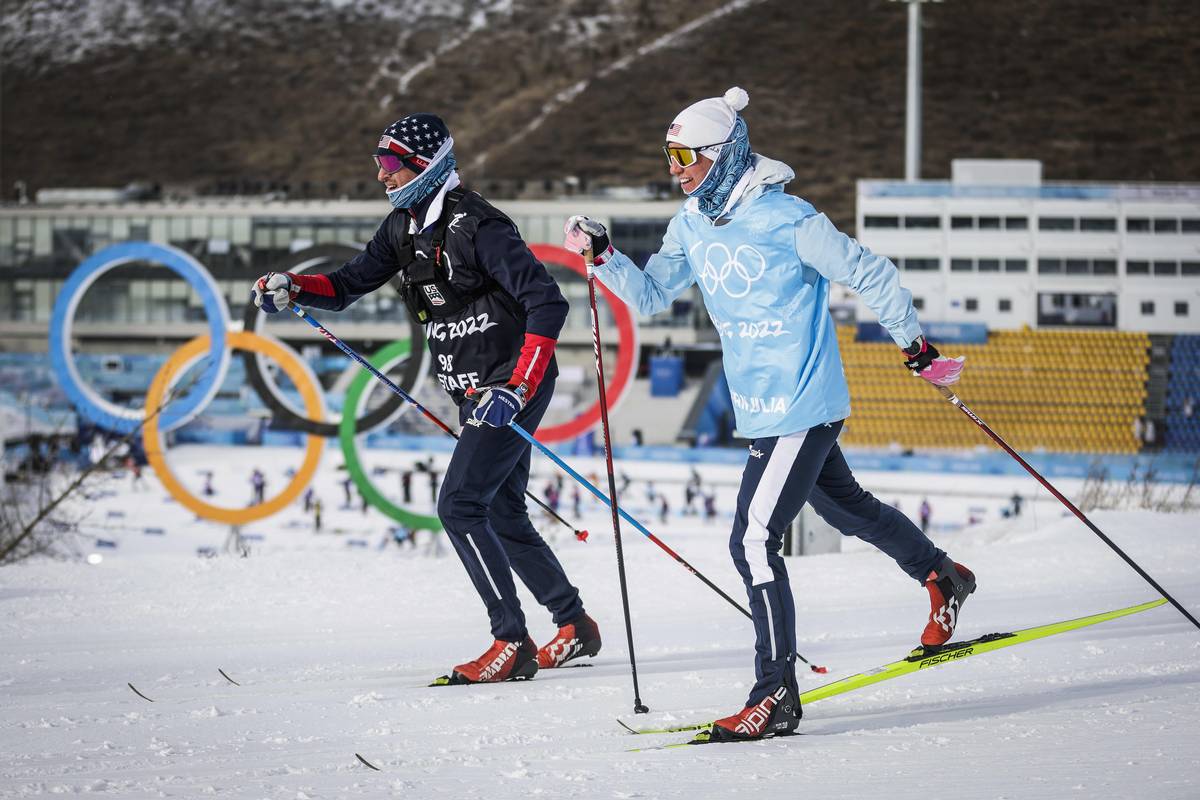
    Julia Kern prepares for the 15k skiathlon with her wax technician, Eli Brown. (Photo: NordicFocus)

    When things go wrong, the U.S. team will often collect skis after the race and retest, to see what went wrong.

    At the Olympics, though, conditions have been stable and relatively straightforward for waxing, even after a flurry of fresh snow Saturday morning. So far, the American athletes have had few complaints.

    “It feels good to know that everyone has a pretty fair shot,” Diggins said. “I’m just so grateful to our staff, because we win as a team.”

  • This Month in Journals: Aerosol Particles and Wax Tech Health

    This Month in Journals: Aerosol Particles and Wax Tech Health

    Peter Johansson works on some of the many U.S. skis in preparation for another day of racing in Gallivare, Sweden, in 2012.
    Peter Johansson works on some of the many U.S. skis in preparation for another day of racing in Gallivare, Sweden, in 2012. U.S. skiers have been outspoken in the past about the health risks to their service team.

    The health effects of airborne particles from ski waxing is a hot topic – and the more expensive and fluorinated the wax, the worse the health effects are.

    Just ask the U.S. Ski Team, which two years ago raised a fuss at the Davos, Switzerland, World Cup, where there is no ventilation system in the common waxing tent shared by all the teams.

    “They put up a huge tent with very little ventilation,” Noah Hoffman wrote on his blog in 2013. “All of the air is communal so as soon as one team starts burning fluoro-powders, the air is bad for everyone. This poses a huge health risk for the wax techs and is a major reason many of the wealthy teams have gotten wax trucks. The techs and athletes have complained about the Davos setup for years and nothing has been done to address the problem. Some athletes are talking about boycotting venues that don’t address technician health.”

    But how many of these particles, also called inhaled aerosol fractions, are wax techs actually exposed to? And what are the implications for racers who wax their own skis, or waxers who work in a ski shop, for instance?

    That’s the topic of a recent study in the journal Annals of Occupational Hygiene. And it’s published by researchers at Norway’s National Institute of Occupational Health – of course, because Norway is perhaps the only country where being a wax tech is a widespread enough occupation to merit government investigation.

    Dr. Baard Ingegerdsson Freberg and six other authors write that “Ski waxing cabins used during World Cup competitions most often have no ventilation system, or at best limited general ventilation systems…. Also the time pressure and the stressful working conditions for the ski waxers reduce the potential for preventive actions and exposure control.”

    To assess the amount of inhaled aerosol fractions, the team used size-selective aerosol samplers attached to a belt so that the air sampled would actually be in the area that the wax techs were breathing from. Furthermore, they used two different filters: one for inhalable particles (100 microns or smaller in size), and one for respirable particles (10 microns or smaller).

    They convinced 45 different wax techs to participate in the study, sampling for the duration of a waxing session – which lasted from as short as half an hour to a full eight-hour day. The wax techs all worked for different international ski teams, and data was collected at six different race weekends in Oslo, Trondheim, and Beitostølen, Norway.

    They found average exposures of 3.1 mg·m−3 and 6.2 mg·m−3 to respirable and inhalable aerosols, respectively. What does that mean? There’s no set occupational exposure limit for ski wax fumes, but a comparable hazard might be paraffin wax fumes. In Norway, the maximum exposure limit for that is 2 mg·m−3 in the inhalable aerosol mass fraction.

    The average inhalable aerosol fraction for the wax techs was about three times that – not a good sign. It explains why wax techs have reported respiratory problems or even long-term issues with lung function.

    Still, those numbers might not mean much to anyone other than a chemist, but there were also some interesting patterns: over the course of a work day, there were peaks in exposure, generally occurring just before the start of a race.

    And biathlon and Nordic combined wax techs were exposed to much higher concentrations than cross country ski wax techs, perhaps because classic kick wax does not produce as many aerosols.

    Together, these patterns suggest that if there’s ever a time to wear a good respirator, it’s when the powders are flying in the final push to get skate skis to the start line.

    (A previous study by the same team found that applying powders was the most hazardous work task for wax techs in terms of chemical exposure, although using solvent to remove kickwax wasn’t so great, either.)

    What’s a better solution? An effective ventilation system which would make waxers less reliant on respirators, which may be uncomfortable and limit communication between different members of the ski prep team.

    The research team built its own custom-made ventilation hood which covers the whole length of a ski, and compared the exposure to aerosols with and without the hood when preparing a series of 15 pairs of skis. The system did succeed in reducing exposure by 95% when using fluoro powders, and by 88-92% when using block glidewax.

    Here’s hoping that a system like this begins to make its way into wax cabins and tents at the World Cup and many other levels of competition.

  • USST Seeks Staff for U23/Junior Worlds and U18 Championships

    USST Seeks Staff for U23/Junior Worlds and U18 Championships

    US Ski Team Logo

    The U.S. Ski Team and National Nordic Foundation are looking for applicants to staff the 2015 Junior World Ski Championships in Almaty, Kazakhstan, as well as the U18 trip in Örnsköldsvik, Sweden. Please see the two press releases below.

    ***

    Coach and Service Positions Open for 2015 Junior World / Under-23 Championships

    Almaty, Kazakhstan: January 30 – February 9, 2015

    The U.S. Ski Team is hiring two coaches and five service persons to join Trip Leader Bryan Fish (USST) to this year’s championships in Kazakhstan. The positions will be funded by National Nordic Foundation. Each position filled will provide invaluable experience to individual, club, and our developing ski nation. While a goal of the National Team has been to get many coaches experience on these trips, an experienced staff is paramount. All applicants are welcome. The work is hard and the job is rewarding.

    The desired coaching applicant is a team player, and should have prior experience leading and participating in many camps and race trips. International experience is preferable, though not requisite. Applicants should be comfortable, clear, and effective in communicating regularly with athletes age 16 – 22, and be willing to work long days that may include leading team meetings, group activities, transporting athletes, orchestrating training sessions, mentoring athletes, and working with the service staff. Coaching applicants must be licensed USSA Level 100 coaches, and have a valid passport. All coaches on this trip must be able to drive manual transmissions.

    Competition schedule

    Feb 02: Junior Sprint CL

    Feb 03: U23 Sprint CL

    Feb 04: Junior 5/10km FR

    Feb 05: U23 10/ 15 km FR

    Feb 06: Junior 5/5km and 10/10km Skiathlon

    Feb 07: U23  7.5/7.5km and 15/15km Skiathlon

    Feb 08: Junior  Relays – 4X3.3km & 4X5km

    Pre-Camp Jan 26- Feb 01 Almaty, Kazakhstan

    Applications should send a brief cover letter and resume to Bryan Fish bfish@ussa.org by November 1. Questions about the trip are welcome. The staff will be selected by November 15. Trip details will be finalized and posted during November. 

    ***

    Positions Open for 2015 U18 Nordic Junior Countries Competition (J1 Trip)

    Örnsköldsvik, Sweden: Feb 1 – Feb 11, 2015

    The U.S. Ski Team and National Nordic Foundation are hiring two service staff and one Trip Leader to this year’s championships in Sweden. The positions will be funded by National Nordic Foundation. The position will provide invaluable experience to individual, club, and our developing ski nation. All applicants are welcome. The work is hard and the job is rewarding.

    TRIP LEADER:

    The Trip Leader will be in charge of planning, budgeting, reporting, and managing the trip with planning assistance from the U.S. Ski Team Development coach (Bryan Fish) and the National Nordic Foundation.

    SERVICE STAFF:

    The service staff will support the Trip Leader with management, coaching, and logistics. Staff support will be in charge of ski selection, testing skis flexes, grinds, and wax.

    The desired coaching applicant is a team player, and should have prior experience participating in many camps and race trips in organizational and ski service capacity. European experience is preferable, though not requisite. Applicants should be comfortable, clear, and effective in communicating regularly with athletes age 15 – 17, and be willing to work long days that will include talking with athletes about ski selection, testing skis flexes, grinds, and waxes, with both the coaches and athletes. Applicants must be licensed USSA Level 100 coaches, and have a valid passport. All staff on this trip must be able to drive manual transmissions.

    Competition schedule

    Friday, Feb 6: Sprint Classic
    Saturday, Feb 7: 5/10 km Freestyle
    Sunday, Feb 8: 3x3km & 3X5km Mixed Relays

    Applications should send a brief cover letter and resume to Bryan Fish bfish@ussa.org by November 1. Questions about the trip are welcome. The staff will be selected by November 15. Trip details will be finalized and posted during November. 

  • Hunting Down The Golden Pairs

    Hunting Down The Golden Pairs

    Knut Nystad, Norway's waxing czar. Photo, Langrenn.com.

    This week, Norwegian wax techs and Head Wax Coach Knut Nystad are headed for the ski tunnel in Torsby, Sweden, with truckloads of skis and tools to find the optimal combinations.

    “Normally, the national teams have a training camp in the ski tunnel, but this year they don’t. So we decided to have a testing camp here on our own,” Nystad explains to www.langrenn.com.

    Testing and adjusting
    Although it is, as Nystad points out, not a national team camp, several of the national team skiers will be in the tunnel to help the test crew and get their own boards dialed. “We’ll go through all the skis in the current ski pool, as well as test any new skis the racers have received over the summer. In short, we’re doing inventory and fine-tuning the ski pool,” Nystad says.

    Representative sample
    What can the wax team learn from testing in a tunnel?
    “If you stay within the manufacturers’ ‘series,’ you’re fine. In our experience, those test results will correspond to what you’ll find on real snow,” Nystad replies, adding that he has already completed some of the initial testing for the upcoming season.

    “We started the testing at Sognefjellet in June, and we’re on track. We have constant conversations with the skiers and the wax techs. We got off to a good start. Now we need to decide how to continue the project with the racers and the wax crew”

    Continuous process
    There were some changes in the wax crew roster after last season, and the new techs presented some of their tricks to the racers during the national team camps at Sognefjellet.

    “We’ve added a few new faces,” Nystad says. “The new wax team is complete, and there are no changes after what we presented at Sognefjellet. Now we need to make sure we carry a healthy, active dialog between racers and wax techs. That’s a process that pretty much never ends.”

    Positive changes
    During the 2010 Olympics in Vancouver, a lot of the communication between the athletes and wax techs was delivered via the media. Especially in the beginning of the Games, when the Norwegian racers had sub-par results, there were a significant number of “ice clumps in the klister,” as Nystad put it. However, missed opportunities in the first few days evened out, and the racers regained their game as the Games went on. So despite the initial trouble, Nystad believes the wax team weathered the storm well and came away a stronger unit.

    “Over time, this was actually a really good experience,” he says. “The media seems to love creating scapegoats, but the relationship between the racers and the wax techs is a team effort. The racers rely on the wax techs, and the wax techs rely on the racers. During the Olympics, there was far too much focus on isolated details. But those are insignificant in the big picture.”

    “Overall, Norway was the top nation in cross-country skiing at the 2010 Olympics. We were also the top cross-country nation during the 2009 and the 2007 World Championships. We hope to continue that record on home turf for the 2011 World Championships this season,” Nystad said.

    Many contenders
    Although Norway’s skiers, coaches and wax techs are all doing their best to succeed in Holmenkollen–and surely have some home turf advantage–there are several contenders.

    “We’ll have a lot of bodies at Holmenkollen and in the surrounding areas this winter who will be testing relentlessly, focusing on the World Championships at home. But there are a lot of racers and wax techs out there all over the world wanting a piece of the podium, so you can’t take anything for granted,” Nystad says.

    These racers will be helping the wax crew in Torsby this week:

    Eirik Myhr Nossum (ski tester for Petter Northug jr.)
    Petter Eliassen
    Astrid Uhrenholdt Jacobsen
    Maiken Caspersen Falla
    Øystein Pettersen
    Anders Gløersen
    Eirik Brandsdal
    Kristian T. Rennemo
    Martin J. Sundby
    Simen Østensen

    From Langrenn.com, August 16, 2010. By Ivar Haugen, translation by Inge Scheve

    Testing skis at Sognefjell. Photo courtesy of Roman Toferer, Atomic.