From the FasterSkier archive — posts syndicated from athletes’ and coaches’ own blogs between 2004 and 2012, kept online as published. Current coverage is at fasterskier.com.

Tag: Wednesday Workout

  • Developing Single-Leg Stability for Improved Glide

    Developing Single-Leg Stability for Improved Glide


    If you’ve found your way here, you are likely familiar with the three tenets of cross country skiing: push off, weight transfer, and glide. Whether it’s diagonal stride in the track or V2 on the corduroy, your ability to experience a complete weight transfer, ride a flat ski, and carry momentum is heavily dependent on the stability of your standing leg. 

    Why is developing that balance and stability a challenge? For those who choose modalities other than roller skiing to enjoy the outdoors in the offseason, consider what types of motion those activities entail. Cycling, running, hiking, and walking are all very linear movements with fairly rapid tempo, meaning there is little emphasis on the lateral push off or extended single leg balance that are the cornerstones of cross country ski technique. 
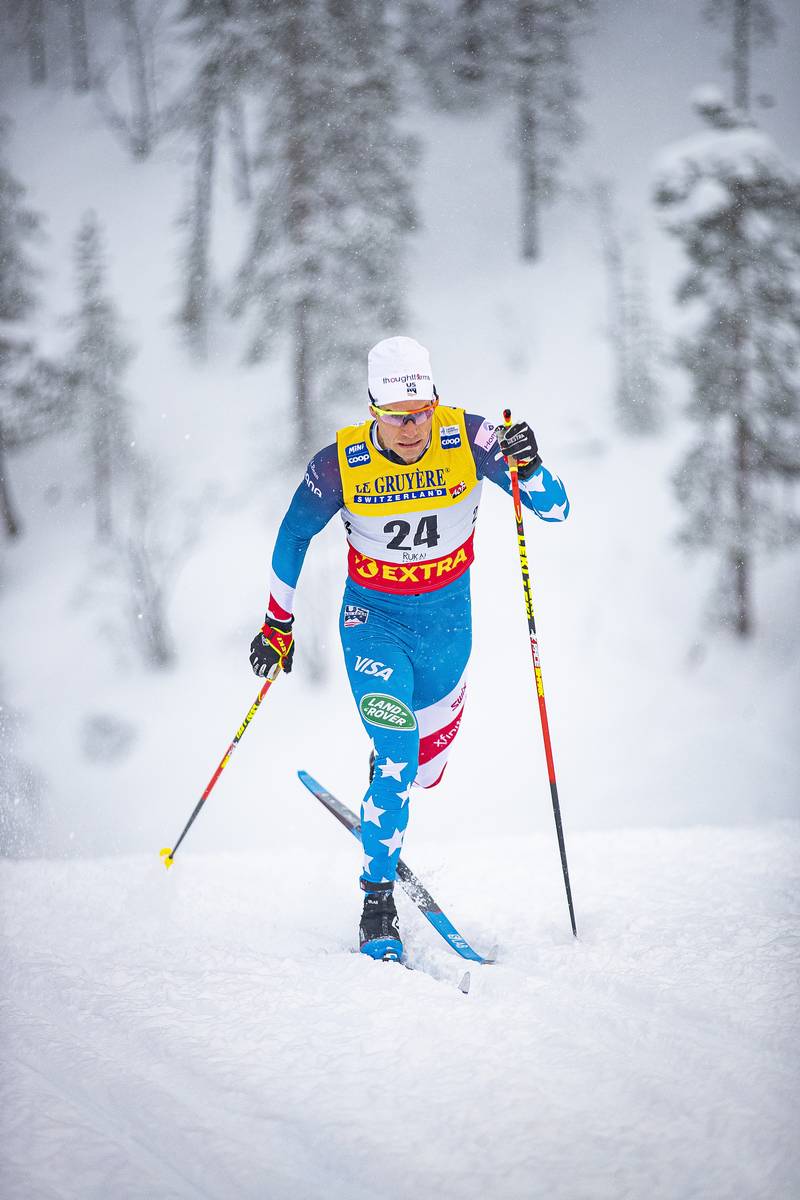
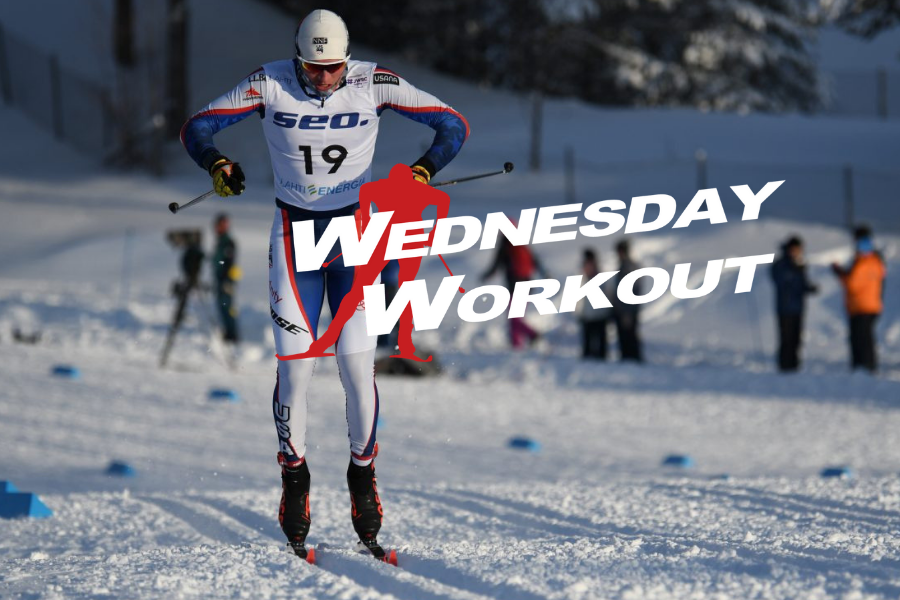
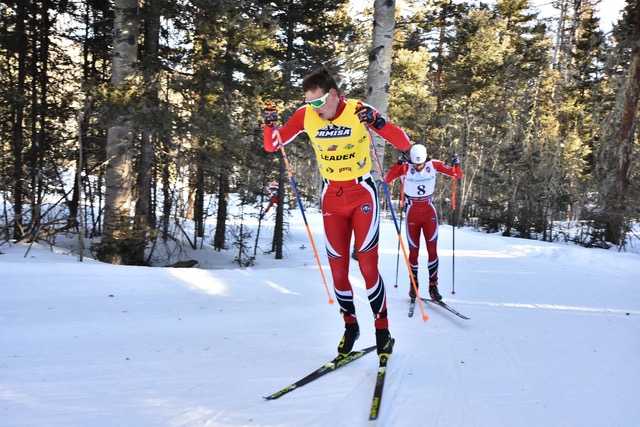
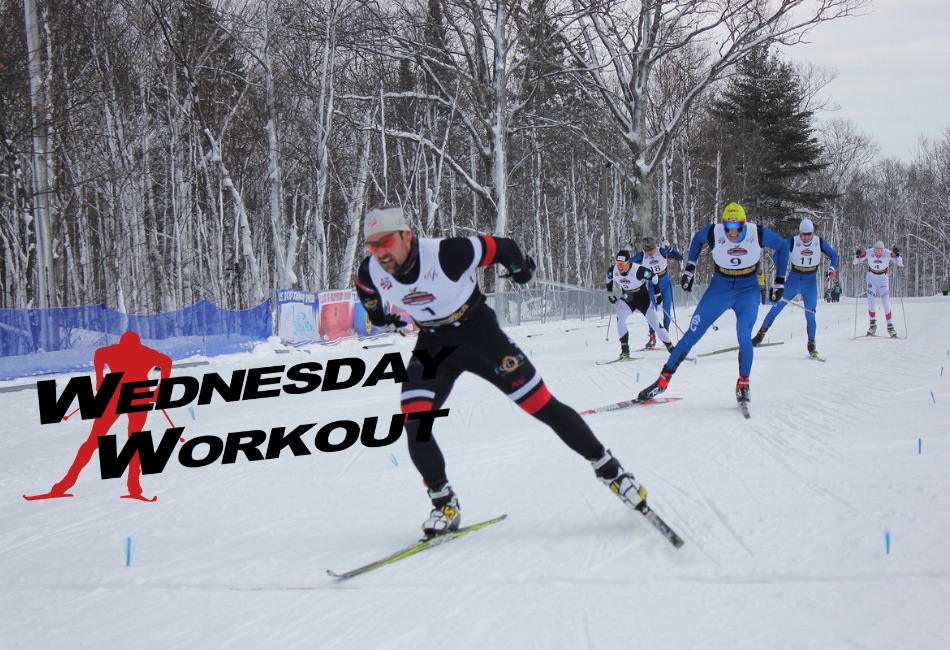
    Simi Hamilton skiing to a World Cup career best 34th in a distance classic event. He popped the result in Ruka, Finland’s 2019 15 k classic. (Photo: NordicFocus)

    Be it your first season on skinny skis or your 50th, strengthening the lateral musculature of the hip and the tiny stabilizer muscles throughout the leg will help you develop confidence in your weight transfer and glide to help you hone your technique and enjoy sliding on snow this season. 

    There are lots of ways to improve single-leg stability; yoga, Pilates, even simply standing on one leg while brushing your teeth or doing the dishes is helpful. But if you want a few simple and targeted exercises, we have a few beneficial suggestions. Here we use mini resistance bands, which can be found for less than $20, to combine dynamic and isometric (holding in place against resistance) moves that target the musculature of the hip, improving strength and stability down the chain.

    The progression is endorsed by Doctor of Physical Therapy candidate, Australian National Team and APU Elite Team skier, 2018 Olympian, and 2020 Birkie Champion Jessica Yeaton. 

    Clamshells 

    Lie on your side with the band just above your knees. Hips and ankles should be in line with the knees bent roughly 90 degrees in front of the body. Then, rotating from the hip like a hing, open the top leg, holding at the top for two seconds, then slowly rotating back to the starting position. You should feel this in the outer part of your hip, specifically in the gluteus medius muscle which is responsible for abduction and external rotation of the leg from the hip. In layman’s terms, this means it helps keep your knee from caving inward in compensation for poor hip stability when you’re gliding on your ski and helps power your skate push off.  
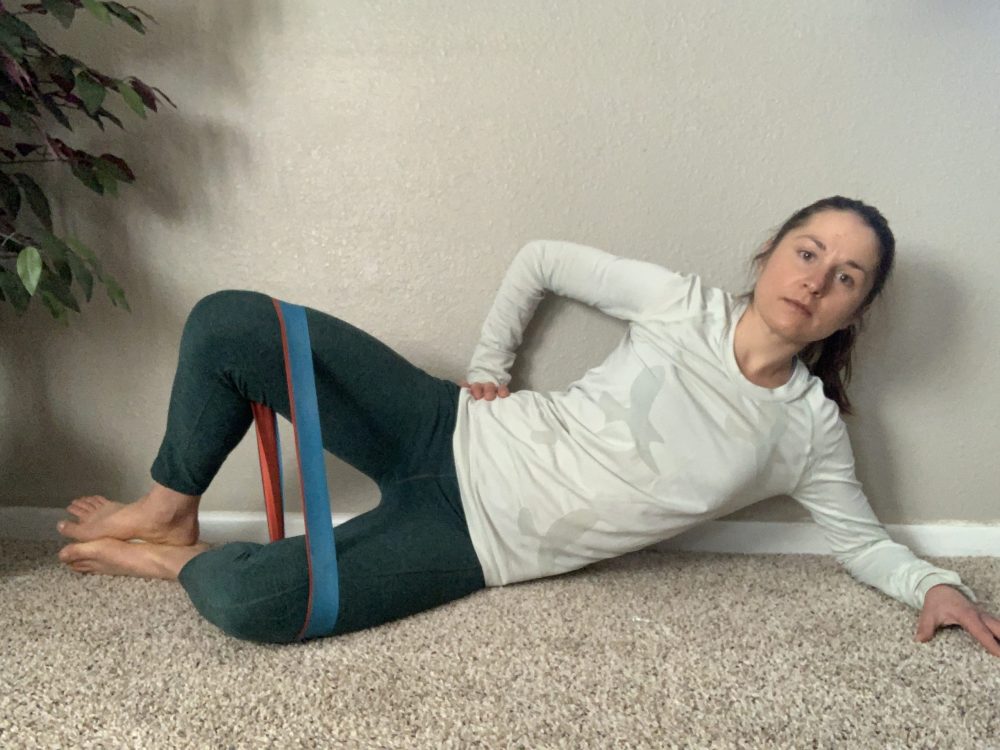
    Try 2-3 sets of 10 to start, adding a longer hold or additional repetitions as you build strength.

    Some essential reminders from Yeaton: “Keep your top hip rolled forward, avoid flaring your ribs, keep your ankles together, and think about rotating at the hip rather than just lifting your knee. Again, the key is to keep your hip rolled forward and don’t let it roll back, or else you are working the wrong muscles.”

    Fire Hydrants

    Starting on hands and knees with the core engaged and the band above the knees, rotate from the hip to lift one knee off the ground. Hold at the top for two seconds, then slowly release. Keep a flat back and make sure you are not compensating by shifting your hips to the side or rotating from the spine. Keeping a ball or a light book on your low back can be a helpful cue — if it slides off, you are probably rotating your hips rather than just rotating the leg outward.  
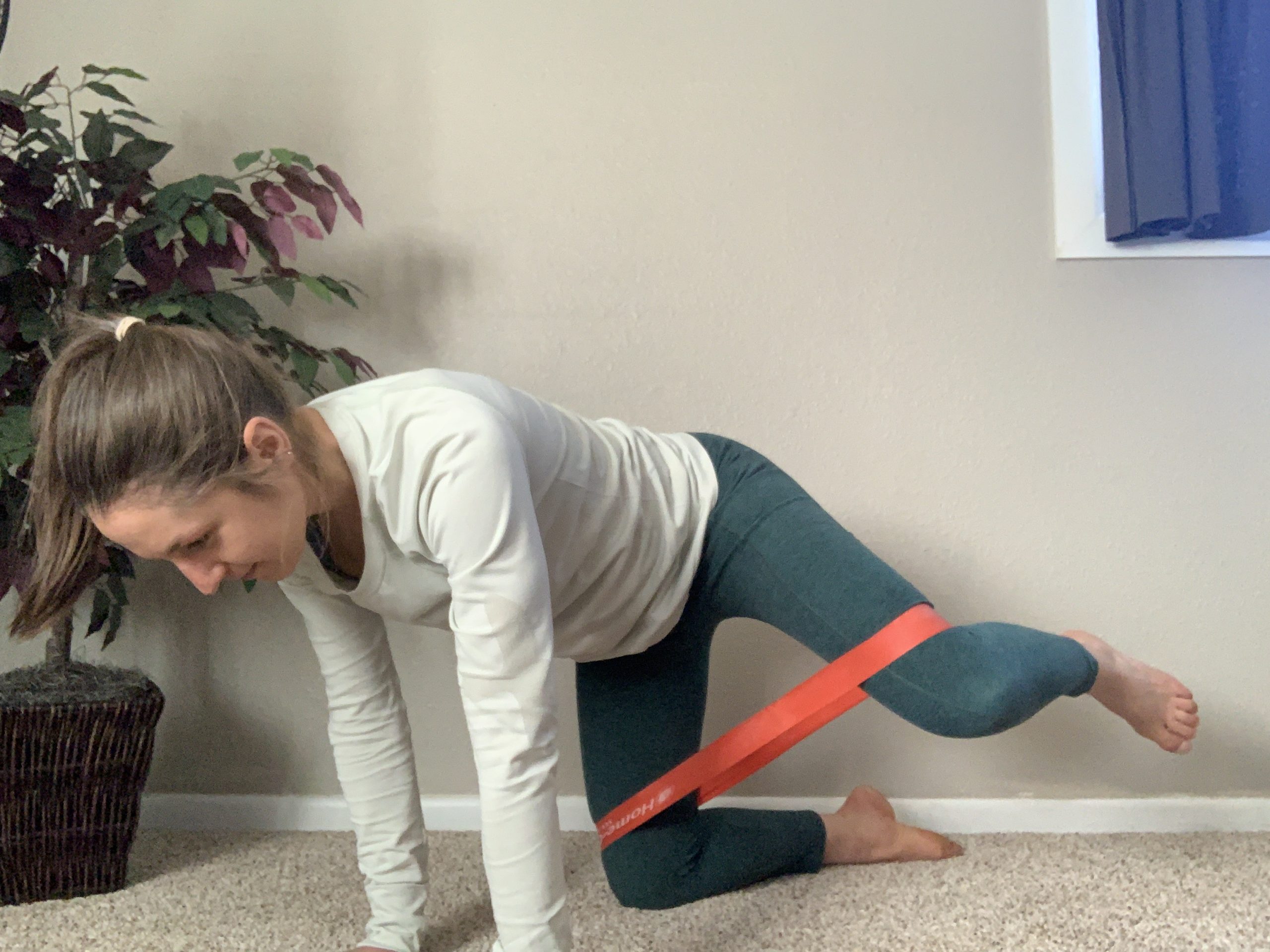
    Try 2-3 sets of 10 to start, adding a longer hold or additional repetitions as you build strength.

    Glute Bridge With External Rotation

    For both of the exercises below, the band should again be placed just above the knees. 

    Level 1:

    Lying on your back with knees bent, feet hips width apart, and heels close to your butt, push your hips up into a bend. This should put your knees at a roughly 90 degree angle. Keeping the hips high, rotate the knees outward from the hips, further stretching the band.

    Try 2-3 sets of 30 second holds, increasing the time or repetitions as you progress.
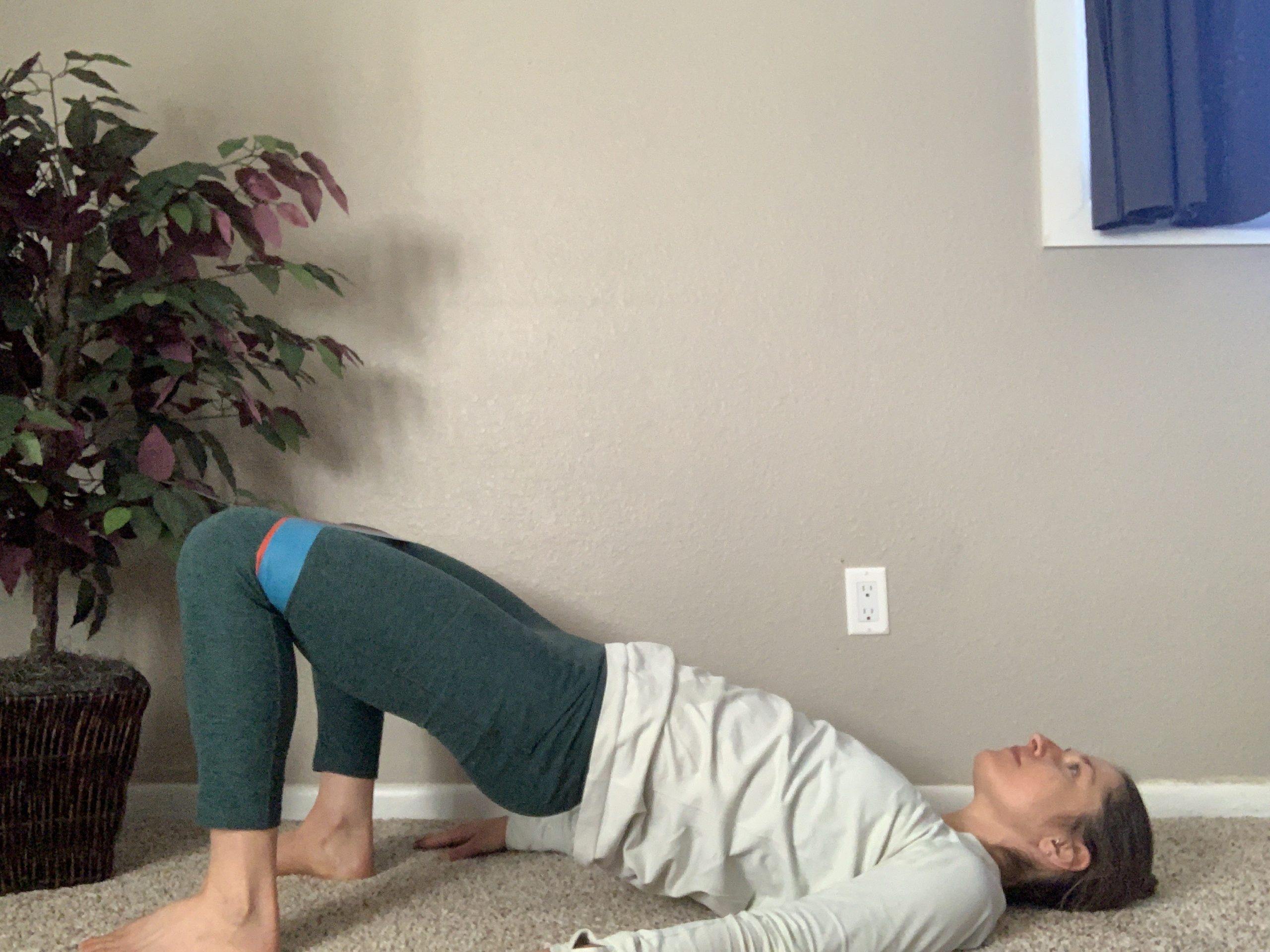
    Level 2:

    Beginning again from the bridge position, extend one leg while focusing on keeping the hips level and not shifting side to side. You should maintain some tension in the band to keep the outer hip muscles firing, but do not need to try to add additional tension to the band.

    Again, try 2-3 sets of 30 second holds, increasing the time or reps to add challenge. 

    Yeaton reminds, “Really focusing on keeping your hips level. Don’t let the hip of the leg you are lifting off the ground drop — that’s the most important part.” 

    Skate Pushes

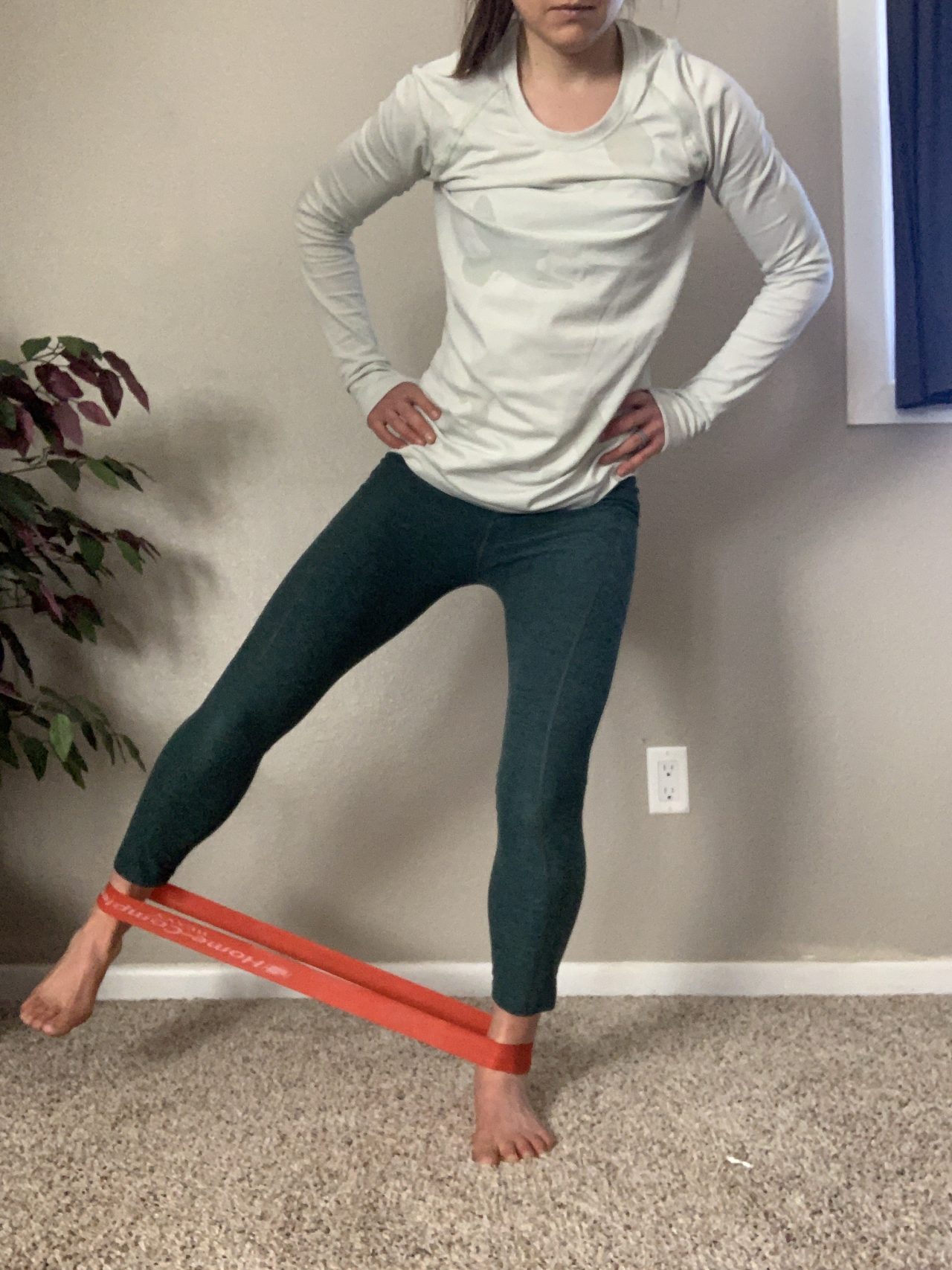
    With the band just above the ankles, stand on one leg with a skate ski body position. There should be a bend at the ankle, the angle of the shin and back should be parallel, and hips should be stacked over the heel. Slowly extend the free leg outward as if you were pushing off perpendicular to the trail. Hold at the top for two seconds and release slowly to the start position.

    It’s important to keep the motions slow and controlled. Just like in skate skiing, you do not want to compensate by tipping your torso to the side or letting the standing hip pop outward. A mirror can be helpful to help you maintain good form. If you’re finding it hard to maintain balance and form, try decreasing the resistance level of the band, or simply try it without the band until it becomes easier.

    Try 2-3 sets of 10 to start, adding a longer hold or additional repetitions as you build strength.
    Single-Leg Squat With Band

    If you found yourself wobbling and struggling to maintain good form with the skate pushes, it might be best to focus on the first three exercises for the time being. For those looking for a more advanced challenge, here is what Yeaton called her “favorite” exercise for single-leg stability. 

    This exercise uses a full sized resistance band wrapped just below the knee of the standing leg. Fix the other end to something stable, like a table or the vertical rung of a railing. The band should be providing resistance that tries to rotate your knee inward, and you’ll be focusing on keeping the knee in line with the toe to resist the band. 
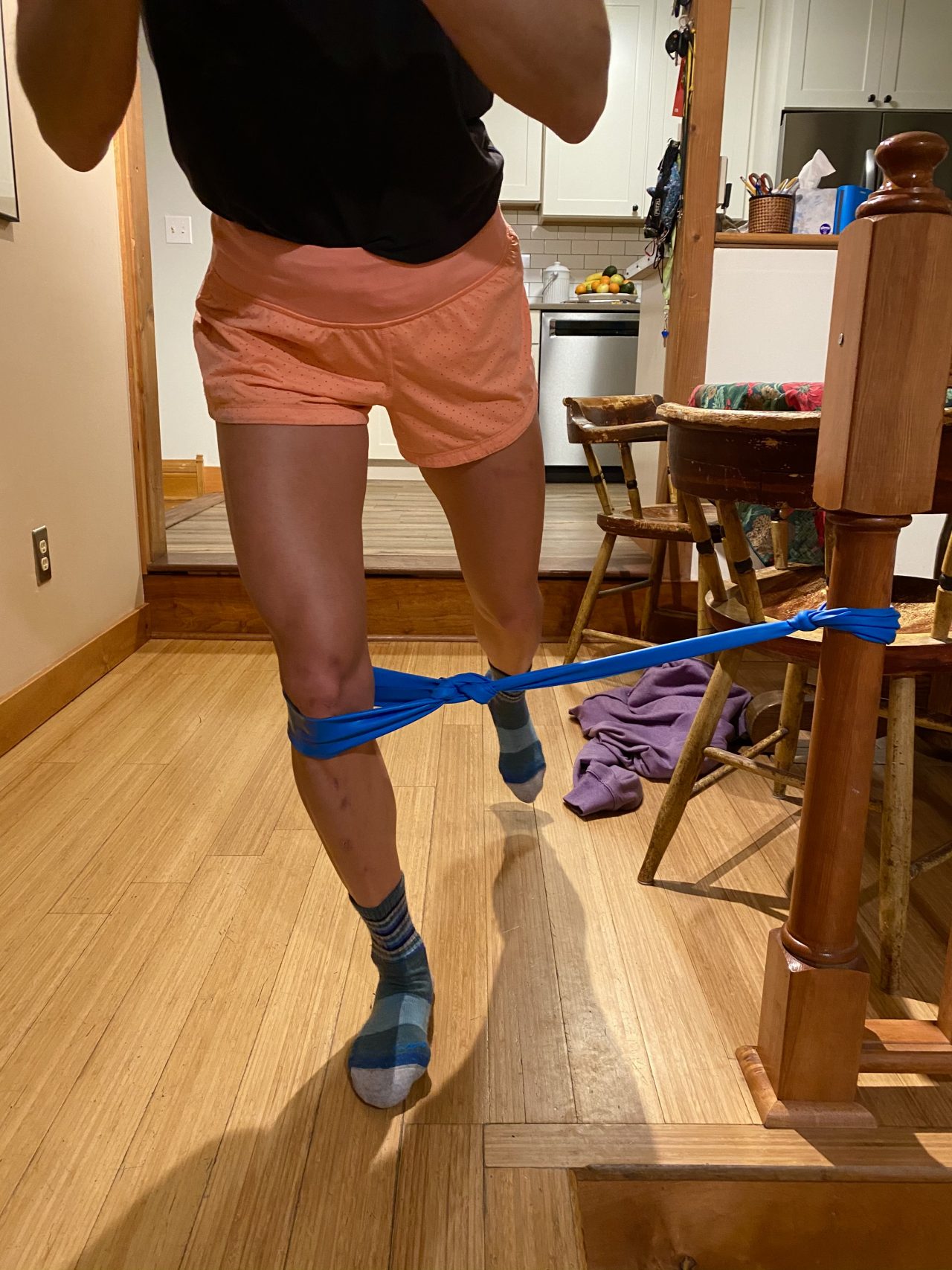
    With the free leg extended behind, focus on maintaining pressure through the outside of the foot and keeping the hips squared forward as you drop into a single-leg half squat. You should have flexion at your ankle, knee, and hip, so the hip is stacked over the knee, just like when you’re out for a ski.  

    “Don’t let your hips rotate towards the resistance, or again, you aren’t working the right muscles!” Yeaton warns. 

    Yeaton adds, “Another option is to tie the band around the opposite leg (leg in the air), which can actually make it even harder to stabilize and keep your hips in line and not rotating.”

    Note: These exercises can all be made more challenging by incorporating a Bosu half ball or inflated disk to decrease the ground stability. 

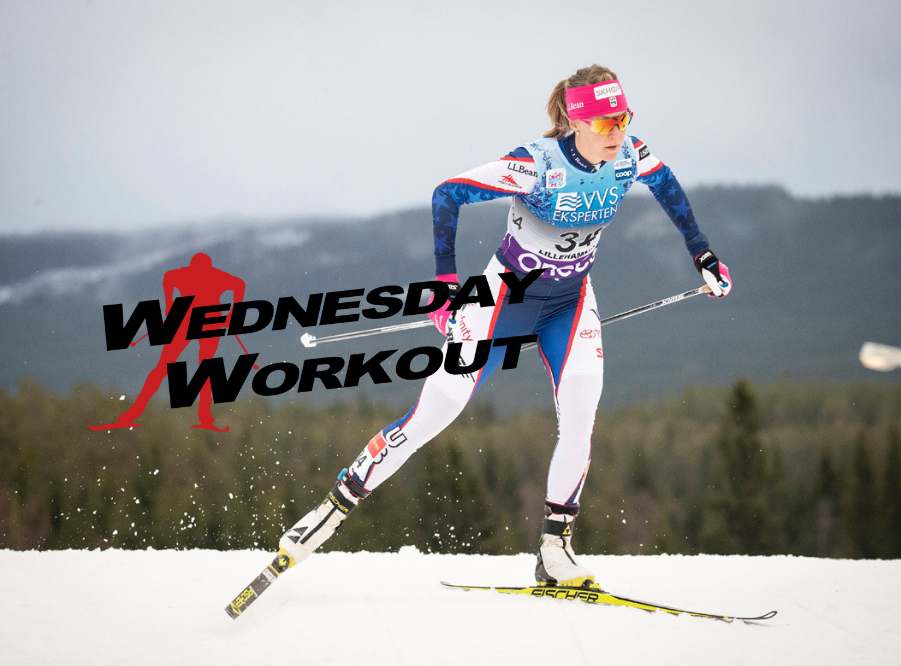
    Wishing you improved balance and glide, and snowy trails to practice on! Give these exercises a try and you’ll be gliding like Sophie Caldwell in no time!
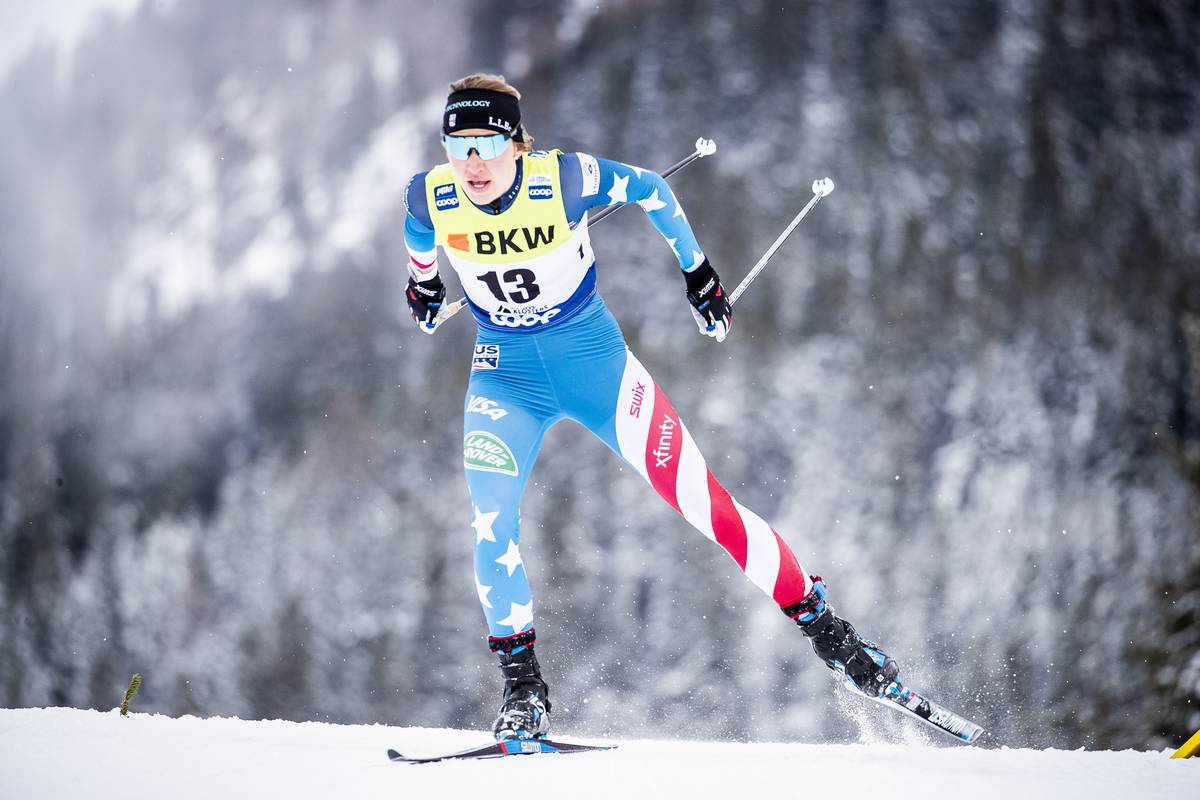
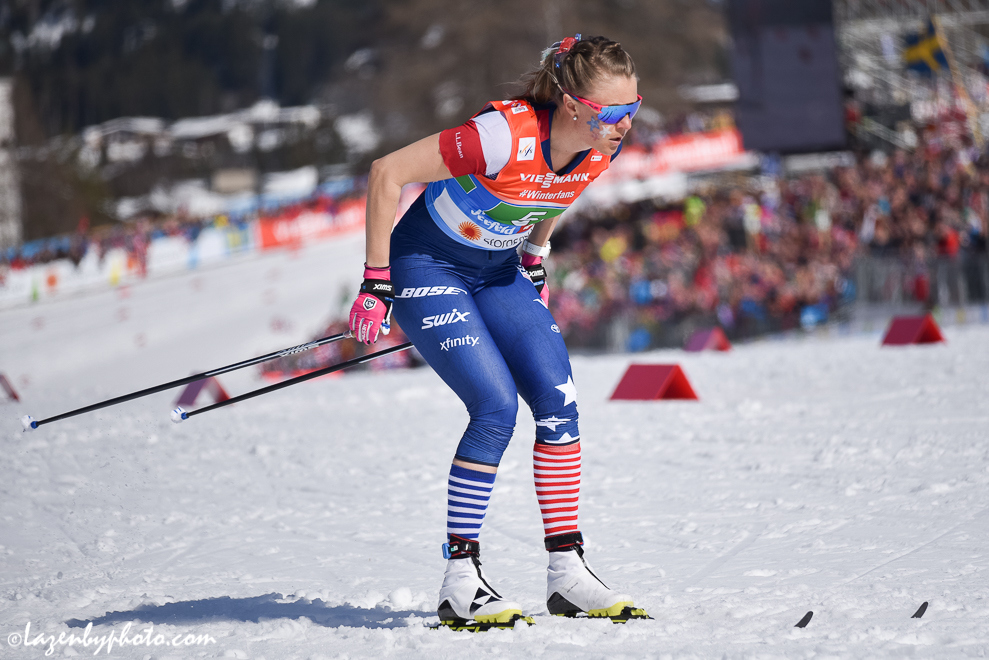
    Picture perfect. Sophie Caldwell on her way to qualifying in first in the 2019 Davos, Switzerland skate sprint. (Photo: NordicFocus)


  • Wednesday Workout: Strong From Home with Carolyn Parker of the Ripple Effect Training Center

    The small mountain town of Carbondale, CO is home to the Ripple Effect Training Center.

    Like many mountain towns, Carbondale, Colorado is a magnet for athletes. The definition of that word is used broadly — though there are plenty, it is not just home to the uber endurance junkie. Within 30 miles, you can find world-class rivers for whitewater kayaking or fly fishing, five ski resorts, a variety of rock climbing and bouldering objectives, and miles of single track to be run, hiked, or ridden. With this unbelievable backyard, we are a town full of people who like to play outside. 

    Another common thread that links many of us is our belief in and gratitude for “the Injury Unicorn”, Carolyn Parker, who is the owner and lead trainer at the Ripple Effect Training Center. We flock to Carolyn to help us identify the source of our problems and to guide us to a solution through functional strength and mobility. In her words, it’s “outcome based training.”

    Carolyn Parker, founder and lead trainer at the Ripple Effect Gym in Carbondale, CO, shares a workout to develop functional strength and mobility from home without any equipment. Parker has been training athletes since obtaining her certification through Gym Jones in 2010. (Photo: rippleeffecttraining.com)

    Carolyn and her team have helped athletes correct muscle imbalances, increase power and strength, and recover from surgeries or pregnancy. She has helped athletes chase a Grand Canyon speed record in a raft, keep their body healthy for 100 mile running races, and even relearn to walk after spinal cord injuries. Her training supports the longevity and progress of athletes of all levels so we can stay healthy and continue to adventure in the mountains for years to come.

    The Ripple Effect dogma is this:

    “Our goals are to train the mind of the individual alongside the body, for the mind compels the body to endure and to achieve. To injury proof the body all the while encouraging the athlete to excel. We have created an environment of support, where honesty, character and integrity are paramount; and where motivation, instruction, and guidance are given to those with the desire to change.

    “These practices do not apply to just the ‘elite’ of the athletic world. They apply to each and every one of us. We are all athletes! We all desire health, strength, happiness, and the capacity to excel in whatever we choose to do, at any level.”

    When the gym was forced to close due to public health orders in mid March, the Ripple Effect crew hopped to and created a set of workouts athletes could complete from home without any equipment. The workout below is from that list and shared with permission. 

    The team at Ripple Effect is also leading small group and private instruction via Zoom. Parker also offers virtual or in person coaching to develop a periodized training program using the equipment available to you to help you reach your goals in the mountains. You can find out more by contacting Ripple Effect through their website or by following along on Instagram.  

    ———————————————————————————————————–

    Warm up with 10 minutes of walking, light jogging, heavy house work like vacuuming, wrestling with kids, or a Zumba video. You get the idea — get your heart rate up a bit and get your body warm.

    Activation/Mobility:

    • 2 x 8 shoulder opener with belt, ski pole, or towel
    • 2 x 5 push-up, knees or toes.
    • 3 x 5 air squats

    Then: 

    • 4 x 30 sec push-ups/30 sec plank – 4 min total
    • 1:00 rest
    • 4 x 30 sec air squat/30 sec hold in the bottom of the squat – 4 min total
    • 1:00 rest
    • 4 x 30 sec sit up/30 sec with straight leg elevate 6” off the floor – 4 min total
    • 1:00 rest
    • 4 x 30 sec windshield wiper/30 sec flutter kick – 4 min total
    • 1:00 rest
    • 4 x 30 sec lunges in place/30 sec “rest” jog in place – 4 min total
    • 1:00 rest
    • 4 x 30 sec bicycles on back/ 30 sec mountain climbers – 4 min total

    Cool down with some light mobility exercises. 


    Celebrating her 50th birthday with a dream trip ski mountaineering in Antarctica. (Photo: Instagram @blitzkriegbarbie)

    Carolyn Parker is the founder and lead instructor at the Ripple Effect Gym in Carbondale, Colorado. She has been training athletes since obtaining her certification through Mark Twight / Gym Jones in 2010. Outside the gym, Parker is a life-long climber and AMGA certified mountain guide who has made the successful transition into full time coaching work. She has lead 5.12 rock, A3+, M8 mixed, and skis 50 degree couloirs. Parker has ski guided Mont Blanc, the famous Chamonix-Zermatt Haute Route, and the Italian Ortler Traverse multiple times. In 2001 she attempted to climb Makalu by a new route on the South Face with a small 4-person team. Most recently she has been competitive in mountain races and adventures, such as the Imogene Pass run, R2R2R in the Grand Canyon, the Sandia Crossing, the Four Pass Loop Elk Mountains, and the Power of Four Skimo Race. In 2019, she celebrated her 50th birthday by guiding a group of friends on a ski mountaineering trip to Antarctica, among other burly and spectacular mountain adventures. 

    Disclosure: The author is a paying member of the Ripple Effect Gym. Her goal is to be as badass, strong, and kind of a human being as Parker at 50. 


  • Tara Geraghty-Moats on Finding Speed

    Tara Geraghty-Moats won the Nordic Combined Continental Cup in the previous season and is set to be a podium contender for the overall standings in this year’s cup as well. Now she finds herself in Lillehammer ready to jump in this weekend’s World Cup. FasterSkier met up with her to hear her thoughts on training, what it’s like to compete at her level and the future of nordic combined for women. 

    Today, a Monday, she opted for a 7×1 minute hill intervals up the first hill on Lillehammer’s course. This particular hill is the first challenge the skiers tackle as they race the 1994 Winter Olympics. Some 15-25 seconds after the gun goes off, the skiers will find themselves battling it out on the steep hill, which offers a slight break midway through. This break, however, does not offer much of a pause, as Geragthy-Moats’ heart rate will tell you. one hundred and ninety seven beats per minute during her intervals places her just over 96 % of her tested max of 205 and sent her lactate level relatively high above threshold levels. Anyone with knowledge of sports physiology knows what this means: your muscles will be sore. 

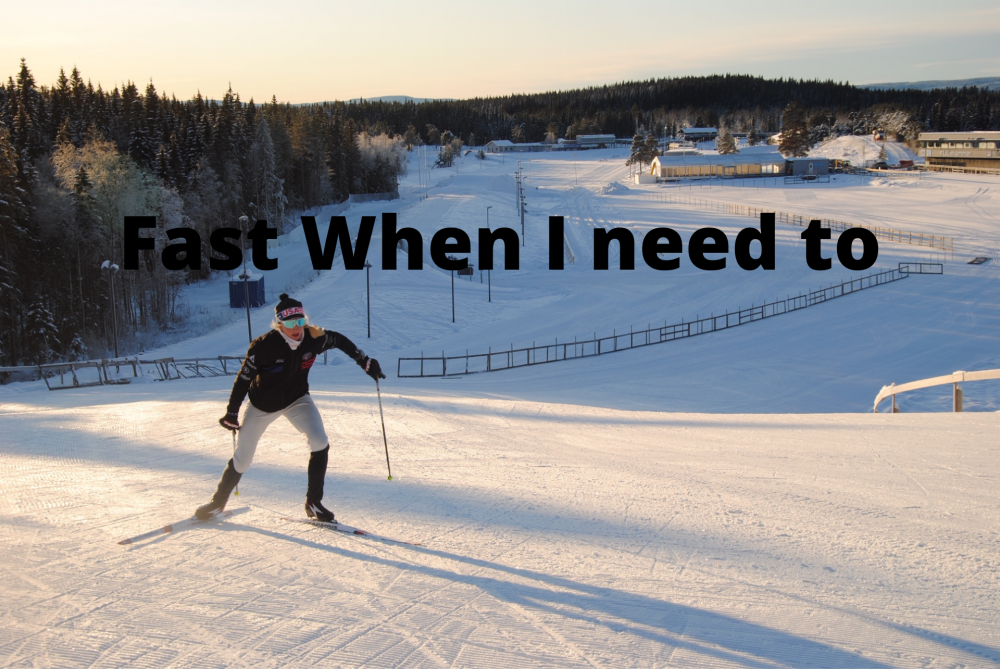
    “Fast when I need to”

    Geraghty-Moats explains why she puts herself through a workout like this by saying “the idea is to install a super-boost in your legs”. This top gear, as she also calls it, is something she’s been working on this year. When asked about her workout of the day and why she did it, she explains: “so if I’m skiing in a pack I’ll be able to sprint away from the pack and make a clean break, something that’s really useful in mass-start racing and the nordic combined pursuit format.” 

    She goes on to say that she’s hopefully in good shape, with good endurance and good conditioning for a race and that “this is sort of the cherry on top of my conditioning for the year, where I’m trying to get my speed up so I have the ability to go fast when I need to.”

    How do you feel like a workout such as this one prepares you for an upcoming race?

    “Basically those one minute sprints are sort of warming up my engine and making sure that my legs can move quickly, I feel pretty in shape and I feel in good condition this season but that doesn’t necessarily mean you’re ready to race so this is sort of the last prep to race, also for me I have to balance between ski jumping and Nordic skiing, so I have to focus on quality over quantity.”

    And how are you able to improve on both?

    “For me, the most effective way is to take training blocks where I focus on jumping and different training blocks where I focus on skiing.”

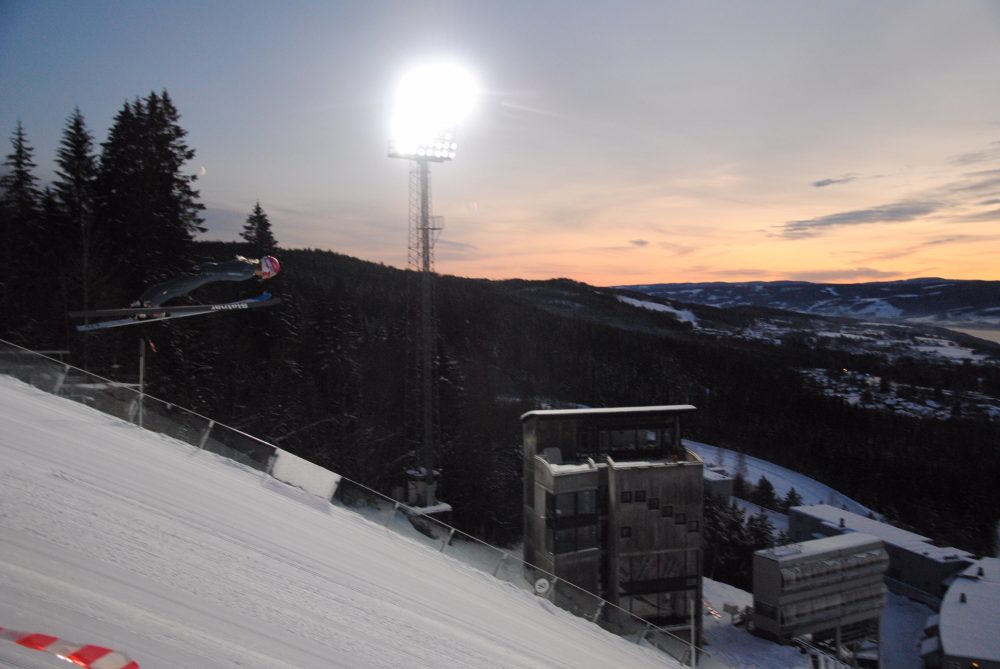
    Tara Geraghty-Moats flying off Lillehammer’s HS140 as she prepares for the new season of racing. (Photo: Aleks Tangen)

    The training block for this week started with seven sprints in the morning and seven jumps off the big hill (HS140) in Lillehammer. When it comes to deciding what to do in training, Geraghty-Moats considers her competitions. She writes her own training plans and explains that she has an overall plan, which stretches for 2-3 months. As she gets closer to competition, she specializes her sessions. When asked about how she factors in yesterday and tomorrow when deciding what to do today she says: “I decided to do my longer intervals yesterday and shorter intervals in the morning and then have some rest and get ready for jumping. But really I look at when my competitions are and when I’m going to want to be feeling fast and good and then build sort of backwards from there.” 

    She explains that an important aspect to this process is knowing how long it takes to recover and how long it takes for the intervals to have an effect on overall skiing speed. On December 13-15, the Continental Cup comes to Park City, Utah and the effect she speaks of will show if things are going according to her plan or not. 

    Below is a lightly edited and condensed version of an interview with Geraghty-Moats. 

    Aleks Tangen: For your workout today what were you doing?

    Geraghty-Moats: So today I was doing one minute sprint intervals something I’ve been working on a lot of this year is really just improving my Top Gear so if I’m skiing in a pack I’ll be able to sprint away from the pack to make a clean break something that you really useful in mass start racing and the nordic combined pursuit format

    AT: The reason why you’re doing your workout like that at this time of year is because you want to be able to sprint past the other racers?

    G-M: Hopefully with this year’s training I’m in pretty good shape, I have pretty good endurance, good conditioning for a race and this is sort of the cherry on top of my conditioning for the year where I’m trying to get my speed up so I have the ability to go fast when I need to. And I was doing it on the hill, obviously it’s a little bit harder there, where are you get a lot more lactic acid in your legs and preparing my body for that really helps when I’m in a race where I’m already going fairly hard and have to put on the gas and really sprint.

    AT: How do you feel like a work out such as this one prepares you for an upcoming race?

    G-M: Those one minute sprints are sort of warming up my engine and making sure that my legs can move quickly I feel pretty in shape and I feel in good condition this season but that doesn’t mean necessarily, that you are ready to race. So this is sort of the last prep to race, also for me. I have to balance between ski jumping and nordic skiing. So I have to focus on quality over quantity. Yesterday, I did an interval session, ideally I would do another hard session if I was simply a nordic skier. But today doing a shorter interval session, my body is already tired from yesterday, I don’t have to ski for so long, I don’t have to do so many laps. I still get the training affect, and I still have the hours where I have time to jump and I can feel fresh for the jumping I’m doing later.

    AT: It’s a Monday, you’re competing this weekend, what factors playing into doing this particular kind of workout?

    G-M: This week I’m actually just competing in ski jumping World Cup, so I’m trying to get a good number of intensity workouts done early in the week so by the time the weekend rolls around I am pretty fresh. I’ll probably do some weights and plyometric workouts on Wednesday and Thursday to get my legs fresh and activated for jumping. But at the same time I still need to stay in shape for cross-country skiing, which will be the weekend after next, in Park city Utah, so yeah it’s always a balance with nordic combined, because you really want to be the best at both sports so you have to stay on top of everything, but also not overextend yourself.

    AT: For a workout like this one, how do you structure the warm up?

    G-M: For me warm-ups are really important, especially with one minute intervals, because if you’re not warmed up properly first of all you can’t really go that fast and second of all it’s a really big shock to your system, you can get sick or the lactic acid floods your system so you can’t do as many sets. I usually ski between 20 and 30 minutes for warm-up. I start pretty slowly and then I  do 3 x 3 min. level III, threshold intervals, before I start the sprint – all out work out – so that gets my system going. 

    Tara Geraghty-Moats training in Lillehammer, Norway. (Photo: Aleks Tangen)

    AT: Considering you are sprinting up the hill, it’s kind of tough, how do you prepare yourself mentally for such a work out?

    G-M: Actually, I really like these workouts because they’re pretty quick, and I just enjoy going fast on skis, it’s fun for me. I just look forward to it. It’s kind of easy on a day like this when the conditions are perfect. I have the whole stadium to myself. I mean I don’t really need much motivation, and physically it’s nicer when I’m fresh and not tired. But realistically that’s part of the job, some days my legs are just going to hurt a little bit.

    AT: How do you feel the workout you did today, what part of your performance does that improve?

    G-M: Anything that short is definitely anaerobic, it really helps you deal with anything lactate flooding your system, and just gets your body moving fast. You see a lot of the women especially in skiing have a lot of high tempo even in the longer races and if you’re not efficient at that and don’t feel comfortable doing that you really have no chance.

    AT: Strength training plays an important role in that if you’re strong then it’s easier to maintain high speed and high intensity.

    G-M: For me actually it’s important to not do a lot of weight and strength session but make sure the ones that I do are really quality. I don’t necessarily do strength workouts after an interval workout or after a long day. I think that’s another thing most nordic skiers tend to do — they will slide in strength after an session or when they are already tired and it is really important to do strength when you are fresh. It gives you a chance to improve, and really focus on getting stronger, and not just maintaining.

    AT: Being in the moment and not necessarily measuring quantity, but doing it as good as possible?

    G-M: Right. And I think that’s nordic combine in a nutshell: quality over quantity. Because there’s no way I can train 800 hours like the cross-country girls on World Cup. It is not going to happen it’s not realistic so I have to have a paired down training plan for nordic.

    AT: How many hours do you train every year?

    G-M: This is actually my first full year of being a true nordic combiner, so I’ll probably do about 480-500 hours so it’s not nothing, but it is not sort of what you would expect of nordic skiers. I think it’s not really comparable, and you have jumping which is a completely different sport from long-distance nordic skiing. They can do somewhere between 700 and 800 or 900 but they don’t do as much explosive and plyometric work which requires a totally different recovery.

    Also the time of the day I can do training sessions for jumping but I might not be that tired but I might’ve still been on the hill in training mode for five or six hours on that day because we usually warm up for about 45 minutes and then we are on the hill for an hour and a half and I can go for a ski in the evening and it means that I might be training close to seven hours that day.


  • Wednesday Workout: Structuring Training for Para Athletes Q&A with Martin Benes

    This insight into training para nordic athletes comes from Martin Benes, head coach of U.S. Para Nordic skiing. Benes joined U.S. Para Nordic in August 2018 after spending five years as the nordic ski director and head coach at Sugar Bowl Academy in Norden, CA. Benes responded via. email following a team training camp in Canmore, Alberta. 

    Martin Benes, head coach of U.S. Para Nordic, shares insight into structuring training for para nordic athletes. (Photo: Screenshot TeamUSA.org)

    FasterSkier: Before taking this job, did you have any background in or connections to para sports? What have you learned in your time with U.S. Para Nordic?

    Martin Benes: I had not had any background working with para athletes. As a junior I remember para Nordic skier Candace Cable training and racing in the Truckee-Tahoe area. I’d also seen the athletes at events here and there. I’ve been with the program a little over a year and just one full competition season. I feel like I’ve been constantly learning since I took the job, and a lot of that is just learning the individual athletes and how best to support them.

    FS: Do you work with and write training for the whole USA para nordic crew or only certain athletes?

    MB: I’m currently working with our National Team athletes which consists of four sit-skiers and one standing skier. It’s a little bit of a mix with how specific I’m getting in supporting training plans for those athletes. Educating athletes and supporting them as they make decisions for themselves is definitely the best thing I can do for athletes of this caliber. There’s some great collaboration happening with summer sport coaches for some of our sit-ski athletes and good support from clubs around the country for standing athletes.

    FS: What are some of your takeaways in regard to coaching para athletes vs. able bodied? Are there different considerations in training philosophy? Similarities?

    American Kendall Gretsch (l) racing in the 4 x 2.5 k mixed relay at the 2018 Paralympic Winter Games in PyeongChang, South Korea. Her team finished seventh. (Photo: U.S. Paralympics/Mark Reis)

    MB: Fundamentally, there is a lot of overlap from a physiology perspective. With any group of elite-level athletes, in comes down to individualizing their training so they get the most out of each camp or training block. With Para Athletes, that individualization becomes even more paramount. One challenge will always be what works best for each athlete and trying to maximize their training.

    In addition, we’re dealing with different types of injuries that can limit how an athlete can prepare for the competition season. So we’ve got to take those into account and first and foremost ensure an athlete stays healthy enough to train to their full potential.

    FS: When leading a training session for para athletes with varying abilities and needs, how do you structure workouts to ensure everyone gets what they need from the session? Does the look of this change in summer vs. winter?

    USA Para Nordic Gold Medalist Dan Cnossen shows the paddle board he uses to prepare his upper body for sit skiing. (Courtesy Photo)

    MB: One of the big things that we do is allow athletes to drive the sessions. We tend to seek out a lot of athlete feedback and learn where they’re trying to improve and try to support that. It leads to a lot of interesting conversations about technique and tactics. When we do group work, which is still important, we try to be very deliberate in structuring it so that all athletes can get something out of it. Those sessions are typically either agility- and skills-based or speed-work.

    In the summer our seated athletes tend to do a lot of cross-training and we avoid ski-specific movements to give them an opportunity to mentally and physically reset. They obviously are doing a lot of work with their arms and so anything to change it up is a positive and contributes to their long-term athlete health.

    It’s also about learning what their strengths/weaknesses might be and then adjusting training, strength, and technique to maximize their session.

    FS: What or who should people keep an eye out for this season? What is the team most excited for?

    MB: We’ve got a really strong National Team going into this season, and excited to hopefully have some new athletes qualifying for World Cup racing this season in January and February at our races in Germany. Certainly our returning World Champs medalists Oksana Masters, Kendall Gretsch, Dan Cnossen, and Aaron Pike are all contenders this season and Ruslan Reiter, a standing skier, has made some big gains over the summer. We’ve got a combined race with FIS in Dresden which will be an exciting event for everyone and also Biathlon World Championships in March in Sweden.

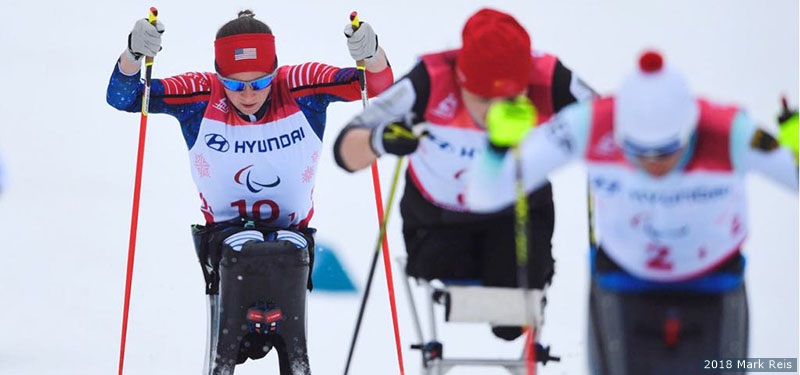
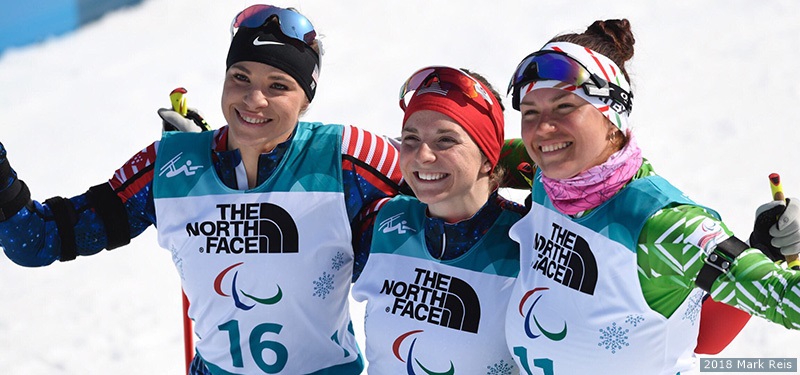
    The women’s 6-kilometer sitting biathlon podium on Day 1 of the 2018 Paralympics in PyeongChang, South Korea, with Americans Kendall Gretsch (c) in first and Oksana Masters (l) in second, and Lidziya Hrafeyeva of Belarus (r) in third. (Photo: US Paralympics/Mark Reis)
  • Wednesday Workout: Mitigating Risks in Mountain Running Races with David Norris and Jessica Yeaton

    Before we begin, if you have not heard of the Mount Marathon Race, which takes place annually on the Fourth of July in Seward, AK, watch this video. If you’re short on time, fast forward to the six minute mark to witness racers scale the direct route up the mountain which towers over the town, about 3,000 vertical feet in less than two miles. They then cascade down a harrowing descent, a semi-controlled fall down loose rock, snow, and rocky ledges before a final pavement sprint to the finish. 


    Mount Marathon is not the only race of its kind. Runners compete around the globe in technical mountain races of varying distances in the Sky Runner Series, and in the US, hundreds of racers “push peaks” up and down Western ski resorts in the Cirque Series. This is only a small subset of the hundreds of events that send runners through grueling terrain up and down peaks and along ridges. 

    In the list of past Mount Marathon champions, there are several familiar faces, including Kikkan Randall, Holly Brooks, David Norris, Scott Patterson, and Jessica Yeaton. This begs the question, why do some of the best skiers in the country put their bodies at risk racing through potentially high consequence terrain? Is it worth the potential setback from a bad fall that sidelines you from training?

    David Norris stood atop the podium of the 2019 Cirque Series Alyeska race. Norris also won the race in 2017 and took third in 2018. (Photo: Instagram @cirqueseries / Keith Fearnow)

    To answer these questions and get a deeper look into mountain running, specifically the Mount Marathon Race and the Cirque Series Alyeska race, FasterSkier spoke with Jessica Yeaton (APU/Australia XC Ski Team) and David Norris (APU) who have racked up a slew of wins in these races.

    Norris is a two time Mount Marathon winner and course record holder. In 2016 he bested the time of world renowned mountain athlete Killian Jornet. Norris chose to sit out this year’s event due to the smoke-induced poor air quality. Norris also won the Cirque Series Alyeska race in 2017 and 2019 and took third in between.

    In 2018, Yeaton won the Cirque Series race and both members of the duo won Mount Marathon — this is a perfect record for Yeaton as she has only entered each race once. (Fellow APU athlete Rosie Frankowski was the female Cirque Series Alyeska winner in 2019.) A nagging hamstring injury has kept Yeaton from incorporating doing much running into her training over the last year, keeping her out of competition. 

    At the time of the conversation, the couple was wrapping up a road trip from their home base in Anchorage through Western Canada and south through Montana, Wyoming, and Colorado before reaching their final destination of Albuquerque, NM where Yeaton begins Physical Therapy school this fall. She will continue to train and compete in skiing but acknowledges that her race schedule will look different this season as she will be navigating around the academic calendar. 

    Jessica Yeaton leads the women’s field up a ridge during the 2018 Cirque Series Alyeska race. (Photo: Instagram @jjyeaton)

    Apart from dealing with a lingering cold through June, Norris is feeling fit and putting together a solid summer of training. He shared that he is “looking forward to November.”

    As both Norris and Yeaton are primarily focused on ski racing, they take a slightly different approach to these races than athletes targeting mountain running. Rather than training specifically for Mount Marathon or Cirque Series, they use the efforts to compliment their high volume of training. 

    “The race itself is really good training for ski racing and the downhills are the only risky part,” said Norris in a call. “The uphill and cross country side of mountain racing is super good for our training. Usually, we don’t taper for the races, we just add it into the week’s schedule, so instead of hammering out intervals on Friday, we’ll adjust the workout to a speed session then do the race Saturday as our intensity for the second half of the week.”

    While this strategy might not be attainable for the average racer, Norris and Yeaton explained that they capitalize on their fitness and power to excel on the uphill, cushioning their lead so they can ease up and stay in control on the downhill, which they believe minimizes the risk of sustaining an injury. This allows them to reap the benefits of a race effort without the danger of halting their otherwise steady progress in skiing.  

    “I think we’ve been kind of fortunate that in a lot of these uphill races that include technical downhills, if you have enough of a lead [on the uphill], you can stay within your comfort zone [on the downhill], and I don’t think the risk is absurdly high,” explained Norris. “What’s always made me nervous about Mount Marathon is if I were to get to the top in second or neck-in-neck with someone, then I don’t know if I would hold back. With my competitive nature, I think I would hammer the downhill and try to win, and that’s when I think it becomes more risky and that’s when you’d have to decide if that was the right thing for cross country skiing and the training.”

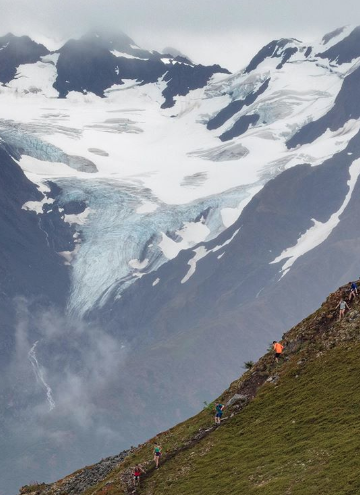
    Look closely to see athletes ascend a steep ridge on the shoulder of the Alyeska Ski Resort during the Cirque Series race. (Photo: Instagram @cirqueseries)

    As they would with any summer race, both athletes discuss their race strategy and their decision to enter with their coach, Erik Flora. Both agreed that he is on board with them racing but might not advise all of his athletes to do so.

    “In my position, being injured, definitely I could enter races and do them and just continue to go down that path, and [Flora] would definitely advise against that,” Yeaton stated. “But if you’re in a place where you’re not battling injuries and you’ve been running and practicing downhills a lot, which is where I was two years ago leading into Mount Marathon, then he was totally supportive of that. A lot of it is knowing your boundaries and knowing what you’re capable of. 

    “It’s something that is on a case by case basis,” she continued. “Because some athletes are constantly battling injuries and are less skilled at technical running, he’d maybe advise against entering these races, but I think a lot of us can handle that.”

    For the skier interested in trying a mountain race, Norris explains that not much alteration to typical summer training is necessary as the fitness will already be there. However, as with mastering any skill, practice and time moving through the type of terrain encountered during the race is valuable.  

    “For the uphill, all the rollerskiing and the hill bounding and plyometrics are awesome training for running uphill, so I think most skiers have good leg strength and aerobic capacity to climb hills fast,” Norris explained. “Then, it seems like for the descending, my downhilling has improved a bunch just since moving to Anchorage, because growing up in Fairbanks it’s more trail running and just dodging roots. In the afternoons, I do a lot of two hour runs that are just roaming around in the mountains. Once you get above treeline, you don’t really need trails, so you’re just scrambling around on ridges. I think my footwork and my agility has improved by just training out there a bunch. Not necessarily doing drills out there, but just the time and running trails in that terrain.” 

    Descending is not the only aspect of mountain running that requires practice. As the ascent often requires using hands and arms to scramble and navigate around steep rooty and rocky ledges, this too requires technique and practice to develop efficiency. 

    “For me, it was just practicing the uphill enough and being in good enough shape and knowing that I could be in front on the uphill,” Yeaton shared. “Then knowing that I could get down the downhill fast enough without putting myself in a risky place. So trying to make up all my time on the uphill, because that’s such good training for skiing — and that’s our strength is fitness. If you can get in a place where you’re already putting time on people on the uphill, then you don’t have to necessarily put yourself at risk, which I think is a really good tactic when you’re ski training.” 

    For the novice athlete interested in trying one of these races, Norris recommends developing enough stamina to feel strong throughout the event and also moderating effort to prevent the mental haze that can result from overextending one’s physical capacity. 

    “At any level, if you’re a first-timer going into it, just being fit enough that when you get to the top, your legs aren’t wobbly or shaking under you, because I think that’s where the risk would really increase is if you’re totally fried and you’re just trying to make it back to the bottom. I think with skiers, you start running down the hill for five or ten seconds and you’re already starting to recover. Your legs are strong and you’re able to maneuver downhill safely. But if you’re totally new to the sport and you got to the top of the hill and you’re cramping and crumbling, then your risk of just getting down is so much higher because your legs are so tired. 

    “Good advice for first-timers is to stay within yourself so that you have the energy and strength to maintain coordination for the downhill,” he said simply.

    David Norris (APU) takes on the steep and technical descent during the Mount Marathon Race. (Photo: Screenshot norrisnordic.com)

    Even though gravity is in the athlete’s favor during the descent, the difficulty should not be underestimated. Running downhill forces the legs, particularly the quadriceps, to work eccentrically, meaning the muscles are lengthening while under stress from the force of each footfall. Essentially, the tension in the muscles is preventing the legs from collapsing, versus the pulling forces from the glutes and hamstrings which power a runner forward or upward.

    Ever had to walk down the stairs backward after a hard downhill run or hike? This type of work causes muscles to fatigue quickly or potentially to fail if they are not properly trained and is correlated with increased muscle soreness after the activity. 

    For any athlete looking to try a mountain race, it is important to spend some time running downhill beforehand to condition the legs to sustain this toll. 

    “Just in training, we jog around really easy then you start going down the hill and you realize your legs are getting super fatigued and tired on the descent. It’s deceptively hard to just run downhill,” Norris emphasized. 

    While no races are on their calendars at this point, both are eager to jump into more mountain races in the years to come. The couple agreed that they would like to find ways to race outside of Alaska; this has been tricky for Norris as his travel budget is focused on the winter race season, but as Yeaton will be based out of Albuquerque for the next two years — “closer” to the other Cirque Series races — both hope it might be possible in the near future. 

  • Wednesday Workout: Inside or Out, Improve Your Double Poling

    Wednesday Workout: Inside or Out, Improve Your Double Poling

    We are trying to stay slightly ahead of the overuse injury and poor air quality curves. You may be midway through your summer training schedule and dealing with a bum ankle. Or you live in a place like much of the Western U.S. that has been or will be affected by poor air quality due to wildfires. 

    Whatever the causation, skiers can find themselves in make-do mode. If the air quality index (AQI) is high where you live, or a bum ankle precludes running or roller skiing, you have training options. And to remain optimistic, what you might think of as a compromise, can, in fact, benefit you in the short and long term. 

    Talk to most elite athletes who have trained abroad, and they will tell you that double pole specific workouts are the norm. Double pole capacity remains one mandatory piece of results success. This is where a Ski-Erg and upper body specific strength programs come in handy.

    antabuse online

    Many athletes are lucky to have access to a ski-erg. If you don’t, please don’t stress. According to a study published in 2017 that compared the effects of strength training and specific ski-erg training on junior cross-country athletes, both groups made double poling gains. 

    The researchers examined double-poling gross efficiency, maximal speed (V max), and peak oxygen uptake (VO2 max). 

    No ah-hah moments in terms of an either-or. “No between-group differences were found for any of the investigated variables,” was a key conclusion.

    Sadie Bjornsen of the U.S. during the second leg of the 2019 World Championship 4 x 5 k relay in Seefeld, Austria. (Photo: John Lazenby/lazenbyphoto.com)

    For those with access to a ski-erg, here’s a 2017 Wednesday Workout from a newly married Sadie Bjornsen. (Congrats!) If your local air quality is sub-par, we’re hoping the ski-erg is located indoors. (If you have a bum ankle, grab a chair, sit down in front of the ski-erg, and begin pulling.


    The Start: “I start my workout with a fifteen-minute warm up. During this time, I often shut my eyes, and visualize skiing. This helps bring in true ski form, and feel my movements, rather than just fall into a ‘SkiErg-specific technique.’”

    Getting Speedy: “During this time, I will do some little ten-second increases in power to warm up my back and arms, and get ready to go hard.”

    The Workout: “After fifteen minutes, I begin the workout known as 30-30’s. This means 30 seconds of intervals followed by 30 seconds of recovery, then repeat for 30 minutes. What may feel easy at first, quickly catches up after 10 minutes, so I always start this workout more conservative than feels appropriate.”

    Keeping It Going: “After about five minutes of 30 seconds on, 30 seconds off, I start to see a common number of watts I am exerting during the 30 seconds. This is where I set a goal. Maybe it’s 190 watts I am hitting, I want to continue to reach that level or more for the next 25 minutes of this workout. This becomes increasingly hard around 20 minutes, and requires a certain amount of mental power. The 30 seconds of rest begins to pass too quickly, and I find myself becoming really focused in my own little world… forgetting where I am (maybe a garage, maybe a gym).”

    Finishing Up: “By the end of 30 minutes of 30-30’s, I am pretty worked, and feel like I have just done a race out on the snow. This is when I bring myself back to my surroundings, and finish with a fifteen minute easy warm down to help flush my arms out.”

    Final Thoughts: “Not only does this one hour pass really fast, but it is a really focused workout that feels like it truly helps build specific power. I always make sure I finish this workout with a little five minute walk. This helps flush all my muscles, but also helps make sure my back goes back to moving naturally after a pretty intense workout.”


    And to keep things fair between the siblings, here’s a 2017 non-ski-erg double pole specific workout from Erik Bjornsen. This session is more suited for those smoke-free days. 


    The Workout: Solo, high-focus, double-pole distance session

    Erik Bjornsen of the U.S. skiing to 17th overall during the 15 k classic at the 2019 World Championships in Seefeld, Austria. (Photo: John Lazenby/lazenbyphoto.com)

    Find suitable terrain and timing: “I choose the terrain based on how hard I want the workout to be. I try to fit this workout in mid-week between intervals sessions,” he wrote in an email. “The point is to get the biggest benefit without fatiguing the body too much.  

    “Most often I head up Campbell airstrip road. It’s a five-mile-long road, with a majority of the terrain measuring out at a gentle 5% incline,” Bjornsen continued. “There’s one steeper climb in the middle that’s about 500 meters long. For this workout, I go out and back twice.”

    Warmup: 15-minute easy Level 1 (roller)ski to the start.

    Go-time: Typically takes him 1 hour and 20 minutes to rollerski the 5-mile section twice.

    “The steep 500-meter section is VERY hard to double pole — that portion of the road is something you would for sure stride in a race. During this workout, I try to spend an hour at L2 [Level 2] and end up bumping up to L3 [Level 3] only when double poling up that steep segment (2 X 5min in L3). I like having the two short but demanding double pole sections in this workout.

    “The important part of this training session is not the 2 x 5-minute L3 sections, it’s the time before and after that L3 effort. You have to figure out how to get the muscles to recover from the hill while still double poling and determine what gear/tempo to use while still applying power efficiently — and recover at the same time.”

    Cool down: 15-minute easy ski home.

    Notes:

    • “The idea is to work specifically on double pole and upper body strength. You get an opportunity to work on all gears, from long double pole to very quick choppy double pole up the steep section.

    • “You can gain a lot from just focusing on two intensity sessions a week throughout the summer. This is a way I find I’m able to gain quite a bit from specific double pole training. But ideally, you don’t fatigue the body so much that it takes energy away from the true intensity sessions.”

    Lastly, here’s the strength protocol from the 2017 study we mentioned up top. After a specified warm-up, here is what the researchers prescribed for the non-ski-erg test group.

    (1) for different training days, the participant was allowed to alternate between five repetitions maximum (RM) of snatches, squats or deadlifts at 60–85% of body mass,

    (2) 8 RM sit-ups or vertical sit-ups,

    (3) 6 RM pull-downs, chin-ups or seal row

    (4) 6 RM of pushdowns, bar-dips or narrow bench press

    (5) 6 RM of belly-backs with or without dumbbells.

    “All five exercises were conducted with two sets per exercise and 1-min rest between sets. Thereafter, the participants completed 5–10 min with different core-stability exercises, which were followed by 90 s of cable crunches, 60 s of pulldowns with a rope, and 30 s of triceps pushdowns with a rope without rest between exercises. After 1-min rest, these three exercises were repeated once. Finally, 3 sets of 45 s of medicine-ball slams (3–5 kg) with 15-s rest between sets were conducted. After the group-specific training session, the [strength] group performed 20 min of roller skiing using the double-poling technique in the heart-rate intensity zone MIT”

    Happy double poling. 


  • Wednesday Workout: Evaluating the Training Year with Caitlin Patterson

    Wednesday Workout: Evaluating the Training Year with Caitlin Patterson

    Caitlin Patterson during the 2019 Cogne, Itlay World Cup 10 k classic. (Photo: Fischer/Nordic Focus)


    This Wednesday Workout dives into one athlete’s approach to reviewing last season’s training and how to move forward. Newly minted U.S. Ski Team member and longtime Craftsbury Green Racing Project athlete Caitlin Patterson provides the details. 

    ***

    Looking back on a year of training is an important part of planning the year ahead.

    My first step is to think broadly over the past year as a whole and to ask myself a series of questions. Usually, I try to write the questions and answers down, and revisit them over the course of a few weeks, to allow myself to contemplate.

    1. What were the best races, the worst races, the most energized feelings or the most frustrating moments of the season?
    2. Were there major themes or flaws that ran throughout the year, is there anything right away that I can pick out that I did very well or very poorly?
    3. What were my goals, and did I achieve them?
    4. At the moments that counted most, did I feel prepared? And if I didn’t, what area of body/mind/health was least prepared to ski my best?

    I keep a detailed training log, which can be difficult to sift through for a yearly analysis, since there are comments for every single one of 500-plus workouts I’ve completed. However, it’s important to have details for a focused evaluation of particular weeks. For example, if I felt tired and raced poorly in week 40, I’ll look back at that week and the previous one. By reading comments and looking at the training volume and intensity, I might be able to see a way in which I overdid it, which will guide me towards smarter training next year. A training log is particularly useful for the aggregation of objective data, such as training hours per week. This year there were a few winter weeks when I trained 17 hours, which was several hours higher than I’d seen in previous years; while it’s not necessarily a bad sign, it might be a cue to take a closer look.

    buy arcoxia online

    The question about feelings of preparation for the key moments, #4 in the above list, is one of the most important. For example: during a certain classic race that I was targeting, my lower back got extremely tired in the double poling sections and it affected my ability to ski the rest of the terrain. This means that I need to strengthen my lower back, an objective which I might accomplish in a few different ways:

    A. Put more back strengthening exercises into my weight room routine.

    B. Do more double poling on rollerskis and skis.

    C. Make sure that my body position on distance skis is realistic to the way that I race.

    Once I’ve made a preliminary analysis myself, it’s time to consult with my coach. At the end of each season I meet with Pepa Miloucheva, my coach of these last 7 years with the Green Racing Project, and we talk through the training and competition season. Usually, our analysis of the problems matches up pretty well, but sometimes we have different approaches towards how to improve for the next year. It’s great to talk about your season with someone, because even if it’s just a family member who is good at listening, by verbalizing your judgements you might notice that you’re being too hard on yourself or are missing high points. The process of evaluating the year shouldn’t be all about finding the problems; it’s also about noticing the strengths and building upon what has been done well.

    For me personally, I am not planning to change particularly much this coming year. The focus will be on quality training and making the most of every session. My volume and intensity will stay similar, but I may adjust the details of intensity and strength a little bit in order to better target particular mid-winter races. By putting together quality workouts with help from coaches and with companionship in the hard work from teammates, I know that I can keep pushing my racing fitness to higher levels of preparedness.

  • Wednesday Workout: Summer Training for Junior Athletes Competing in Fall Cross Country

    Wednesday Workout: Summer Training for Junior Athletes Competing in Fall Cross Country

    This Wednesday Workout comes to us from Matt Boobar who has been coaching the Stratton Mountain School (SMS) nordic team since 2007. In the fall, he also works with the cross country running and mountain bike programs, and leads cycling in the spring. Boobar has a B.S. in exercise science and has earned a USSA Level 200 certification. He has been the head coach of the New England Junior National Team eight times and was recognized as the NENSA coach of the year in 2009. The SMS Nordic and the elite SMST2 teams were selected by USSA as 2019 Cross Country Club of the Year; it is the clubs fourth time earning this recognition in the last six years. 

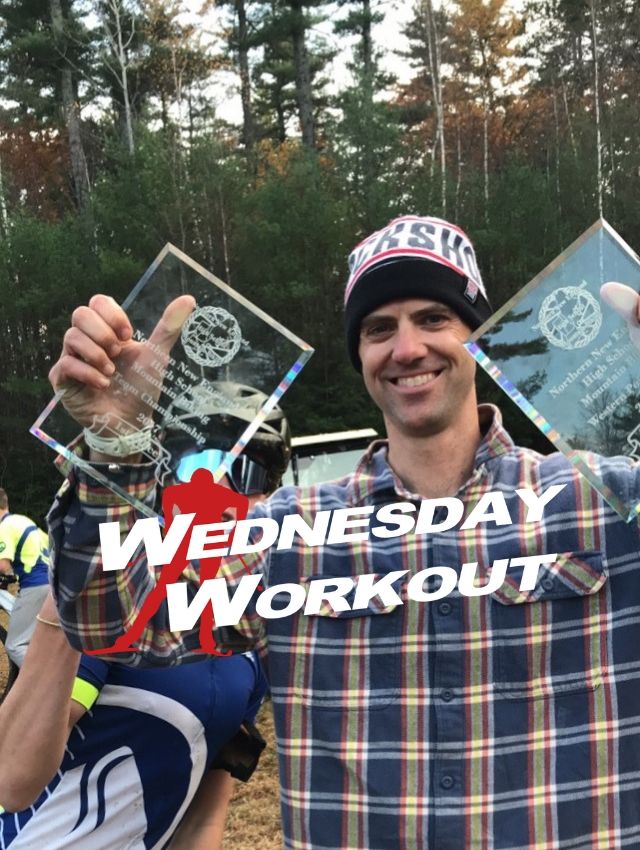
    Matt Boobar holds up the trophies earned at the 2017 Northern New England High School Mountain Biking Team Championships. SMS won the team title in both 2017 and 2018. (Courtesy photo)

    If you have been so lucky as to grow up and go to school in a place where nordic skiing is possible, the scenario of fall cross country running followed by nordic skiing in the winter is likely one that you are familiar with. Looking at a Venn diagram of the teams, the union might not be significantly different than the intersection. With the growth of youth mountain bike and cycling programs creating a different opportunity for adolescents to become endurance junkies, the running-skiing symbiosis might be less prominent than it once was, nevertheless, it remains the approach of many U18 athletes nationwide.

    In cross country running, there is a saying, “autumn holds no secrets of how summer was spent.” Similarly, in the ski world, you may hear, “skiers are built in the summer,” which leads to the challenge many athletes face when they head into summer with goals in both sports.

    Depending on the long term goals of the athlete, at some point, it is wise to decide which sport holds the priority. This way, an athlete can fall into one of two camps: the runner who also wants to see improvement in their ski racing or the skier who wants to improve their running (and remain injury free through the fall). In Boobar’s mind, the time when this decision is made is unique to the individual making it.

    buy ventolin online

    “It has to be personally goal dependent on the athlete,” he said in a call. “I think helping to create awareness that, ‘I just can’t run and do my eight-week cycle [for cross country running] which gets me peaked on November 1st, and then jump in November 15th with my nordic team and build up for an eight or ten-week cycle for that’. I think they have to think, whether their goal is running or skiing, they need to definitely think year-round training.”

    Members of the SMS cross country team charge up a hill during a fall race. (Courtesy photo)

    First, let’s look at the skier who also wants to perform well in fall cross country races. This scenario is one Boobar is most familiar with, as the athletes that attend Stratton Mountain School are already committed to making ski sports their priority. Though his athletes compete in the local Vermont high school races and state championships, they do not train full time for running the way one might on a more traditional team. Athletes that train year-round with a club program, but also participate in their school’s cross country team may relate to and benefit from this approach.

    “We use markers like some of the championship races in the fall as goal setting tools,” Boobar explained. “So for the state meet for cross country running, we’ll attempt a version of a taper and peak format and just see how their energy is for that event… We try to use that going forward in how they react to a certain type of taper and peak.”

    While the hard efforts are beneficial, the races are not prioritized the way nordic races would be.

    “The issue we run into with trying to run fast or even bike really fast is that we don’t really want to be at a peak level at the end of October,” said Boobar. “We want to be in the middle or more of a base building, pretty high volume, just pretty solid heavy training load.”

    The challenge he faces in recommending summer plans for his athletes and training with them throughout the fall is prescribing them enough running specific work that they are able to hold their own in races without sustaining any injuries, while the primary focus of training remains more ski specific.

    “What we run into nowadays with the running is a lot of soft tissue injuries: shin splints, Achilles tendinitis, sore knees,” Boobar noted. “Some kind of result of how kids are growing up possibly, they’re not doing as much crazy free play in the woods – but it’s definitely something that we’ve noticed, so we have to train our kids to build up some of that running durability. And I don’t think it’s enough to just be like, ‘Oh, we’re going to go trail running on the Appalachian Trail,’ I think they need to do some actual running repeats on a fairly hard surface and incrementally increase that so they can build up that durability and leg speed turnover.”

    He added that for most skiers, running is used as a training modality on long endurance days possibly with poles in the mountains, so the body gets used to a much slower cadence than what is needed for a cross country race. While this cadence isn’t necessary to ski fast in the winter, it can certainly inhibit performance in a 5k run. By including some higher speed running, perhaps 400 meter or 1-kilometer repeats, Boobar expects to see a decrease in the frequency of running related injuries and an improvement in performance in his athletes at the championship benchmark races. They also include drills regularly to help promote proper running form. 

    SMS science teacher David Sinclair works with cross country athletes on their running form. (Courtesy photo)

    What about the other camp? For athletes whose primary focus is on cross country running but are also interested in seeing improvements in their skiing, Boobar offered a few simple recommendations.

    buy antabuse online

    “If you’re a cross country runner that had skiing goals, you could add three things: you could add a longer double pole rollerski once a week, you could add skate agility once a week, and add as much core stability work as you can handle. You can’t really overdo that.”

    Because of the high-impact nature of running, he also noted the difference in training hours (though most runners measure in miles).

    SMS coach Matt Boobar demonstrates double pole technique during a training session. (Courtesy photo)

    “Our kids [at SMS] are training 8-15 hours a week in the fall, and I would guess most public high school running teams or even a prep school, they’re training under ten hours a week and that might be a huge week for them running. So I would look at them and say they need to add a longer day.”

    For the double pole rollerski, he recommends 1.5 hours easy, potentially following a run. This provides the athlete with the aerobic benefit of a long session without adding any load to their already fatigued legs. A 45-minute skate with agility focus helps with balance and coordination and works the musculature involved with lateral movement, which is not as recruited as much in cross country running.

    At the end of the academic year, Boobar will be advancing to the role of director of the SMS nordic program following the retirement of Sverre Caldwell, who led the program for 39 years. While it might seem as though he is stepping into shoes that are tough to fill, Boobar feels confident that the transition will happen seamlessly.

    “Luckily, I’ve worked here with him for ten years,” said Boobar. “So following along with his coaching style and philosophy will be pretty easy. We both have a similar philosophy with how we like to coach anyway, which is to try to provide an environment for kids to take ownership of their own training and goals. So not so much tell them what to do, but having all the pieces there for them to figure out what they need to do.”

  • Wednesday Workout: Informal On-The-Go and Recovery Food

    Wednesday Workout: Informal On-The-Go and Recovery Food


    From the dawn of sports nutrition when PowerBars were ubiquitous to the DIY world of handcrafted nibbles for athletes on-the-go and recovering, sports nutrition has become an industry.

    For this Wednesday Workout, we wanted to revisit a few classic low cost and relatively simple items when it comes to nutrition. Without diving into the deep science, the basics are well agreed upon: you’ll need some protein, carbohydrates, and some ingredients to make it all palatable. We’re thinking a smidge of salt or sugar or even both for that savory combo.

    The first recipe comes from Peter Minde and can be attributed to Skratch Labs. To Skratch Labs’ credit, although they are a manufacturer/marketer of their own line of pre-packaged sports nutrition products, their blog features great recipes that keep costs down and the nutrition/functionality ratio high. It’s a solid resource.

    Bacon maple almond butter rice cakes

    3 cups sweet rice, 4 cups of water

    Bragg’s Amino acids to taste

    salt to taste

    maple syrup to taste

    1/4 cup rice vinegar

    1 cup warm almond butter

    8 oz bacon

    Cook rice.  Cook bacon separately and drain fat.  Cut the bacon into little pieces.

    Mix Bragg’s, rice vinegar, maple syrup, salt in a bowl. When the rice is cooked, transfer to a large bowl and add Bragg’s salt, maple syrup, and rice vinegar.nnStir to mix thoroughly.  

    In an oblong baking dish, layer half of the rice, spreading with a spatula.  Then layer the almond butter on top of the rice. Sprinkle bacon across almond butter.  Cover with remaining rice. Refrigerate overnight.

    In the morning, Cut into squares, and wrap each square in heavy aluminum foil.  Freeze until ready to use. Yield should be 16 rice cakes.

    The Kikkan Smoothie

    This is as basic as they come: the recovery smoothie. This smoothie recipe was mined from a 2011 FasterSkier piece on featuring a Kikkan Randall over distance workout. To keep with the times, we might suggest you always use some type of red frozen berry – like a raspberry. When the smoothie concoction is blended up, you’ll see and think pink (or a shade of pink). Total Kikkan.

    1 cup Greek non-fat plain yogurt

    1 cup frozen berries

    1 scoop protein powder

    1/2 cup milk

    1/2 cup juice

    1 Tbsp honey.

    Turmeric Beet Recovery Smoothie

    This smoothie recipe is for those more daring. If you are into climbing, it’s kind of like jumping from a fourth class scramble to a directissimo on the Eiger’s north face. It came to FasterSkier from Claire Waichler way back in 2014.

    It contains protein, potassium, iron, antioxidants, detoxifiers, and lots of anti-inflammatories.

    (Quantities are a rough estimation)

    Makes 1 blender full, 2 or 3 servings

    1 medium beet, peeled

    2 cups of milk

    1 scoop or serving of protein powder – the one in my smoothie is 34g and vanilla flavored

    2 cups of greens, spinach or kale

    1 banana

    A handful of candied ginger.

    A turmeric finger/root

    Ground cinnamon and nutmeg to taste. You can also substitute ground ginger and turmeric for the whole ingredients

    Ice

    Blend all the ingredients in a blender. Then guzzle.

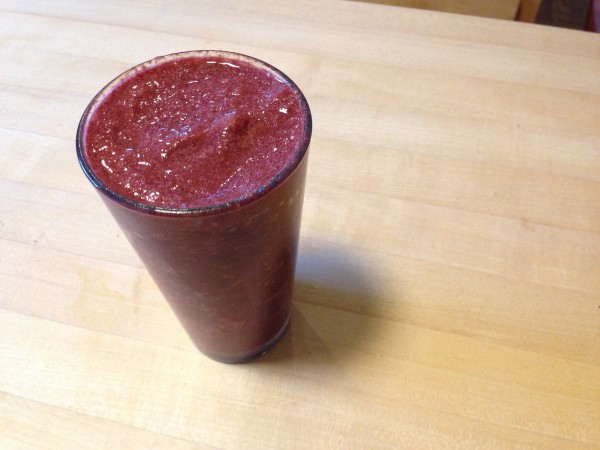
    Turmeric Beet Recovery Smoothie

    The Zoë

    OK. Let’s digress for a bit. If you are ski-touring, as our glance at Instagram suggests many of you still are, you might have a rucksack to carry some on-the-go food. We asked Zoë Roy for an idea. Roy is busy this week (busy-trap busy) prepping for the PPP. What we got though was some culinary gold that highlights the umlot in her first name: it’s Euro-themed.

    This first photo says it all.

    Zoë Roy on-the-go grub.


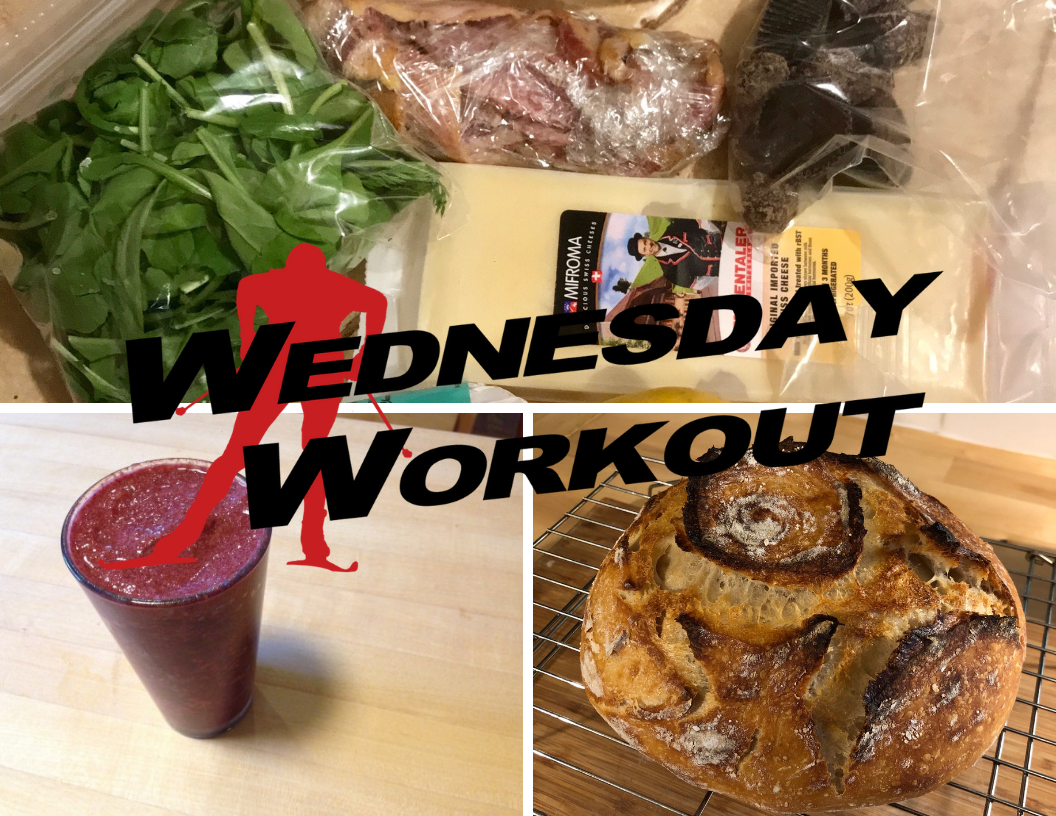
    She’s packed greens, salami, jam, fruit, cheese, bacon, sweets, and kombucha. So good. So tasty. But it for sure is the type of on-the-go food requiring a slight stop.

    tizanidine

    Roy is also known around Bend for her homemade treats and meals. So we also asked for a shot of her freezer to better understand where she is coming from. The freezer, it is often said, is a peek into the soul. Here it is: Alaskan salmon, an Ocean Roll from Sparrow Bakery, homemade ice-cream and some other basics in there. (Note, no freezer burn on any items which indicates a steady rotation of goods.)

    Zoë Roy freezer contents.

    The Dak Delivery Vehicle

    The delivery mechanism is key when it comes to ingesting food. Bread is basic. And it is perhaps humankind’s greatest achievement in nutrition delivery mechanisms. Take a look at Dakota Blackhorse-von Jess’s homemade sourdough – tell us it’s not a golden round of raised dough (see photo).

    Once the bread is cooked and sliced, it becomes the perfect vehicle to deliver protein to the system. Fry an egg, toss it on a slice. The sky is the limit here in terms of combining the fundamentals of recovery nutrition with the downright tastiness of the sourdough.

    Dakota Balckhorse-von Jess sourdough.

    Here’s the recipe:

    200g Sourdough Starter

    700g 80° water

    900g 00 flour (bread flour)

    100g Whole Wheat Flour

    Combine by hand, let rest for 30-60 minutes

    20g salt

    Fold to incorporate salt

    Let rest 30 minutes

    [Repeat 4 times]

    Fold (4-fold method)

    Let rest 30 minutes

    Split dough into two balls, fold to center, put seam down, shape and cover for 10 minutes.

    Reshape to build surface tension, place dough ball seam side up into proofing basket

    Let proof for 3-6 hours (room temp) or in the fridge overnight (up to 48 hours) for a more sour tasting loaf.

    Place Dutch Oven in the oven and turn on to 500°. Let warm up for 30’.

    Turn oven down to 450°

    Dump loaf into Dutch oven (seam down), score the top, cover and cook for 30′.

    Remove lid and cook for an additional 10-20 minutes. Look for dark brown crust (experience will let you cook to suit taste).

    Remove loaf and let cool on rack – DO NOT CUT WHILE HOT – this is part of the internal cooking.

    Once the crust is slightly warm to the touch (~30’), slice and enjoy!

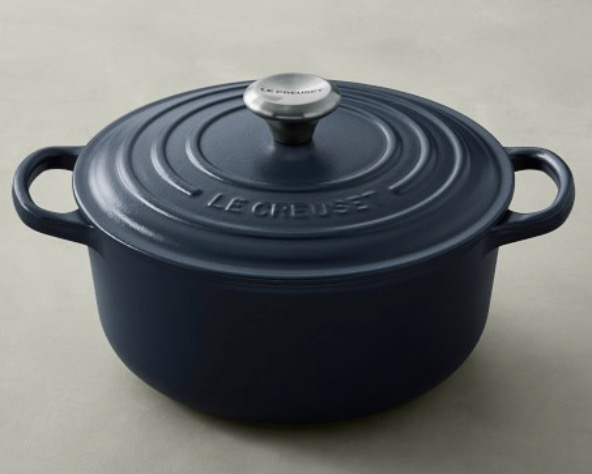
    When we asked clarification on “Place Dutch Oven in the oven”, Dak sent this photo.

    The Dutch oven.


    The Basic

    Say you are a college kid or an upstart SMS T2 skier. Or just not that motivated to bake bread. You still need a post-workout nutrition delivery vehicle. There’s the bagel. Nothing perhaps could be more basic than the bagel. Less regal than the sourdough, but tasty too. And perfect for piling on protein and fats.

    Lina Sutro (UVM skier on left) and Alayna Sonnesyn (former UVM skier and current SMS T2 athlete) consuming bagels.


  • Wednesday Workout: Review the Training with Jessica Yeaton

    Wednesday Workout: Review the Training with Jessica Yeaton

    APU’s Jessica Yeaton skiing to second overall during a 2018 SuperTour 5 k skate in Craftsbury, Vermont. (Photo: John Lazenby)


    May 1. Start of a new training cycle for some.

    In this Wednesday Workout, we checked in with Jessica Yeaton. Yeaton resides in Anchorage, Alaska where she trains with APU and has represented Australia on the World Cup, World Championships, and the Olympics.

    She earned two U.S. National Championship podiums in Craftsbury, Vermont last season. She placed second in the 10-kilometer classic and third in the 20 k mass start freestyle. A sixth place in the National Championship skate sprint rounded out her week in the Northeast Kingdom. At the Seefeld, Austria World Championships she skied to 31st in the 30 k mass start skate. Those were a few of her race highlights. The results, however, came after a summer and fall training season fraught with an overuse injury. (We’ll get to that in a minute.)

    Yeaton’s training experience last year saw her rely less on what many would consider the staples of ski specific training: bounding, roller skiing, and running (after addressing her overuse injury). Yeaton learned to be flexible in her training regimen. So we wanted to know how she plans to reflect on her past season’s training.

    “I will look at in a more general sense than in a number sense,” Yeaton said in a call on April 30.  “I will go back and look through my log, and note it looks like I was doing a lot of running here and I look at the comments and see how I was feeling. I will not get too analytical about it. But, it was such a bad overuse injury, it impacted my training enough that I think I can get value out of going back and looking and trying to analyze the numbers a little better.”

    Yeaton won the famed Mt. Marathon mountain running race this past July 4. As a lover of mountain runs she had relied in the past on big days running in the hills as part of her ski training. With all the hours of pounding, she injured a hamstring.

    “I think it is important to look into how much of every activity you are doing,” Yeaton said. “I think one thing for me last year if I had broken down and looked specifically at that period say between May and August, my running was so high. I probably was doing way too much relatively in terms of what you might expect a typical runner to do progression wise compared to the rest of my training.”


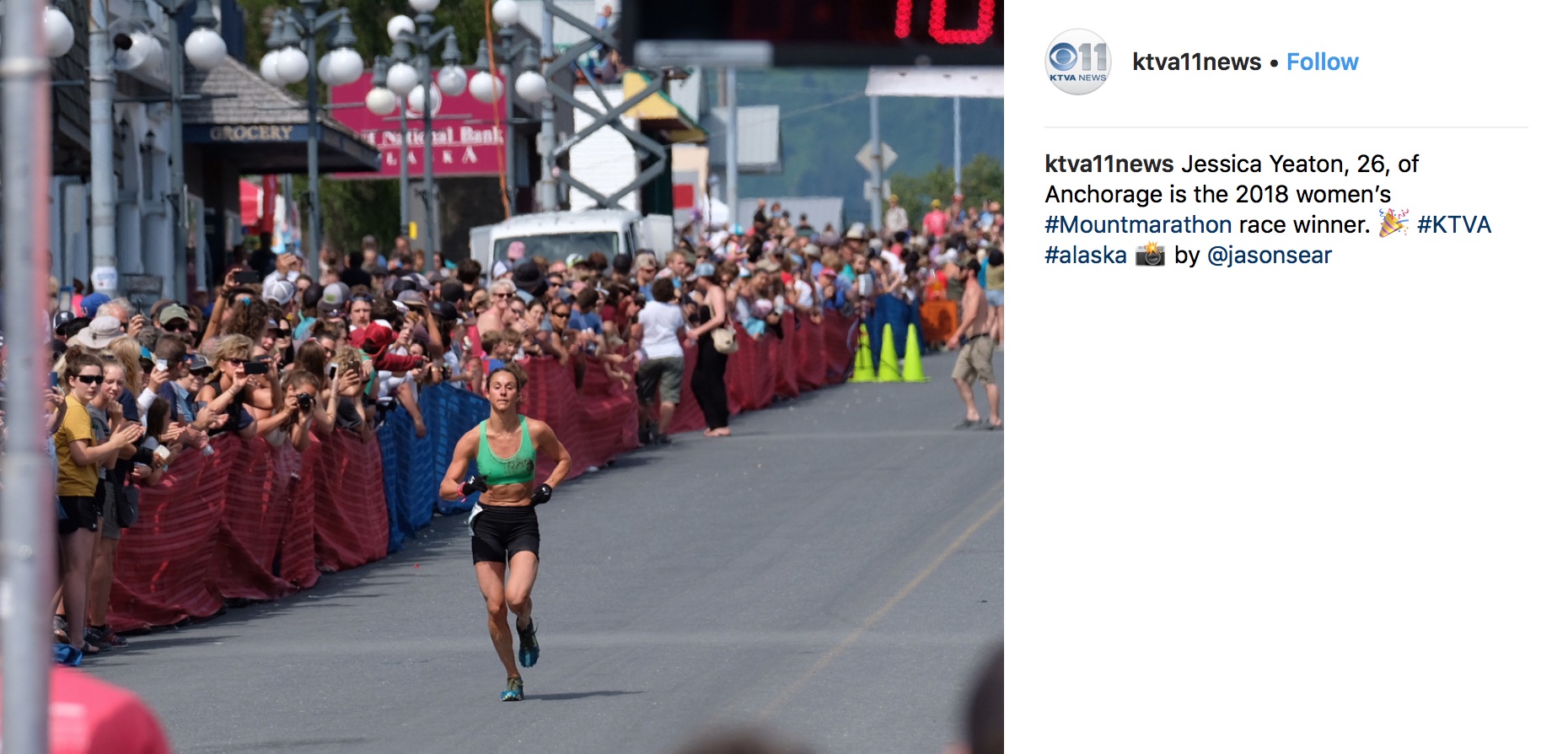
    (Jessica Yeaton on her way to winning the 2018 Mt. Marathon race. (Photo: KTVA 11 News/Instagram)

    Yeaton’s results did not suffer as she incorporated more biking and non-traditional training into her routine. This season, she said she will place restrictions on her running as the injury still nags.  

    “Coming into U.S. National I was not expecting my results at all,” said Yeaton. “But also, it taught me just so much: that a lot of our sport is reliant on fitness. I did know going into the season that I had done less, especially in the fall. I had done less ski specific training that I wanted. I wasn’t, for a while, I wasn’t able to roller ski. I was literally just biking, doing workouts like on the treadmill at the gym, or just stuff that I did not want to be doing. Not doing any bounding intervals and things like that. And it just stressed me out because I was like ‘I am not training for skiing right now’. Maybe I am in good shape, but it is not as ski specific like I wanted. That is what I learned. That maybe if you keep your fitness really high, maybe you don’t need to be specific all the time. I think you need to be to a certain degree, but I was also able to have a really good season without doing exactly what I would have probably done had I been one hundred percent healthy and uninjured.”

    The women’s podium from the 10 k classic at Cross-Country Nationals in Craftsbury, Vt. (l-r), Jessica Yeaton in third, Caitlin Patterson first, and Kaitlynn Miller third. (Photo: John Lazenby)

    Below is less of a workout Yeaton prescribes, and more of the holistic approach she took to training as she navigated an injury yet still maintained her ski specific goals for the winter. Maybe before you head out and log the hours it is time to review what worked and didn’t last season and ponder how to change it up.

    buy tretinoin online


    Although this past season has been standout in terms of results for me, it has also been the most difficult with regards to injury. I developed an overuse injury in my hamstring in August last year after a summer full of tons of mountain running training/racing, which plagued me throughout the entire fall and winter. Because of this injury, I went from running every single day to not at all; I was also unable to skate or stride on roller skis for a good chunk of time. I was pretty desperate to maintain my fitness without hurting myself further, and the best way I found to do this was on my mountain bike. I discovered that the natural flow of mountain bike trails mimics nordic skiing super well; I could do quality intervals by powering over punchy climbs, pushing through the flats, and carrying my speed over technical downhills. I also found that standing up out of the saddle as much as possible worked muscles that translate really well to skating. I honestly think that my training on the bike last fall really improved my fitness, leg strength, and even my agility on skis this winter. Looking back on my training, I wish I had made this realization years sooner. As someone who struggles a lot with injury while trying to train big hours, I now know that I need to do as much cross-training and variety as possible. In retrospect, I actually think my injury was a blessing in disguise, as some of the “alternate” training I did while injured was the highest quality. I think as skiers we are often afraid to go outside the norm (i.e. roller skiing, running, bounding intervals), but I truly believe there are other ways to train well for skiing. Going into this summer, I plan to switch things up a lot more not only so I decrease my risk of injury, but also because I think cross-training provides a different, high-quality stimulus. I definitely plan to do more mountain bike intervals throughout the summer, and I also won’t be afraid to trade running for swimming or the rowing machine to give my legs a break. Not only do I think this will help me ski faster next year, but I also am excited about the ability to do more activities throughout the summer- without fear that it’s not “quality” training!


  • Wednesday Workout: How One Skier Keeps Marathon Race Fit in Portland, Ore.

    Wednesday Workout: How One Skier Keeps Marathon Race Fit in Portland, Ore.


    This Wednesday Workout comes to us from Harrison Harb; Portland, Oregon denizen. 

    HH grew up racing bicycles and xc skis in Hopkinton, NH. He graduated from Stratton Mountain School in 07, and UNH in 2011. H has lived in Portland, Ore. since 2014 where he coaches cyclists and skiers while racing for XC Oregon on skis and River City Bicycles/Bike Law on the bike. 

    ***

    Portland, Oregon: home of craft beer, mycological diversity, and drizzly, snowless winters. Notice that “a thriving cross-country ski racing scene” is absent from the list. Since moving here from New Hampshire five years ago, and returning to ski racing with XC Oregon after a brief hiatus, I’ve settled into a training groove I find satisfactory in quality despite less than ideal external conditions, and one that I think many city-dweller-ski-racers can likely relate to.

    I don’t want to sound like I’m complaining. Although the drive (90 minutes each way) to snow tends to wear one down over an entire season, the snow here–or rather–there, on Mt. Hood, is surprisingly consistent. We usually have our first days skiing at or just before Thanksgiving week, and our last days often as late as May. We also spend much of December kicking on Rode Super Extra Blue, so, it’s good.

    I train on average around nine hours per week during the winter months. Most elite skiers would probably say that that’s weekend warrior status, and most true weekend warriors would probably call me a full-time athlete. Nevertheless, as time goes on I find myself more focused on races between 80 and 150 minutes, i.e. marathons of varying lengths. More bang for the buck, perhaps. The thing is, I’m only on snow twice a week. The rest of my hours are split between a rushed combination of short intervals on roller skis, ski-erg (rarely), or bicycle (indoors, on rollers). Not exactly ideal marathon training. What I want to share are a few ideas for making the most of those one or two days on snow per week, and hopefully, ways to keep training fresh, varied, and fun (if training isn’t [our sick version of] fun, the quality probably isn’t super high). I should add: hard! I like to think of the mid-week sessions (rushed intervals priorly mentioned) as my “A” workouts, and these–the hard, on-snow days, as my “A+” workouts. Race simulation is another way of thinking about it. Ideally, I want to come away from sessions like these pretty knackered. So here you go:

    zyloprim

    1. Warm up 30-45 minutes easy, building into a steady pace. Then ski for 45 minutes at marathon pace on rolling terrain (as similar to the course you’ll be racing as possible). Take a 5 minute break for water and maybe a little food. Find a long, steady section of trail if possible, and do 2 x 7 minutes of hard climbing. Cool down 45 minutes. (total workout time 2.5+ hrs)
    2. Warm up 30 minutes. Lay out a difficult 10-15 k course and do a time trial on it. Try to make it as similar to a race effort as possible. Take a 10-15 minute break. Warm up for a few minutes then find a steep climb. Do 6 x 1 min full-freaking-gas efforts up it with equal recovery time between them. Cool down for 30 minutes. (total workout time ~2 hrs)
    3. Warm up for 90 minutes building into a steady tempo pace for the last 30 minutes. Try and get right into 2 x 10 minutes full-gas (4 min recovery between efforts), followed by a 6 x 1 minute set (equal recovery), preferably on a climb. Cool down 30 minutes. (total workout time 2.5 hrs)
    4. Warm up/ski steady 60 minutes, continue into another 60 minutes of tempo, continue into another 60 minutes of as hard as you can manage to keep it rolling: in other words, ski it like it’s the last 20 k of a marathon. Cool down 15 minutes. (total workout time ~3 hrs)
  • Wednesday Workout: The Pressure is Off Approach to Your First World Cup

    Wednesday Workout: The Pressure is Off Approach to Your First World Cup

    Gus Schumacher during the 1.6 k classic sprint qualifier at Junior World Ski Championships in Lahti, Finland. (Photo: Doug Stephen)

    At eighteen-years-old, Gus Schumacher remains composed in what is a pressure cooker of endurance sport. There he was last week on his home tracks of Kincaid Park in Anchorage, AK., claiming four first place medals and providing locals a deep-well of pride. If in fact this young man is stressed before or during a race, it’d be hard to notice. And maybe part of that demeanor has to do with his preparedness. Schumacher is prepared. 

    FasterSkier spoke to Schumacher on Tuesday, a day after he arrived in Québec City for his first career World Cup. The races begin Friday with a skate sprint.

    This Wednesday Workout is less a specific workout idea, and more a look at how one athlete is approaching their initial exposure to the sport’s big-tent-circus. Rather than stress about the possible unknowns he’ll begin experiencing on Friday, Schumacher has attempted to make pre-World Cup life this week as normal as possible.

    On changing time Zones (four to be precise as Schumacher flew from Anchorage to Québec).

    For me it is really easy because often times travel takes a lot out of me. We traveled over night so I didn’t sleep that well on the plane. So when I got here, I went on a little run and did some light core to feel like I was not in travel mode anymore. I went to sleep and slept for eleven hours and woke up Tuesday morning feeling really good.

    On brining his own wax tech (non-World Cup regulars provide their own wax tech).

    Jan [Buron], my primary coach is with me mostly because I needed my own tech. But it is cool for him to be able to come too. To have an athlete under him doing a World Cup race. For me anyway, that is how it is going. Obviously, all the coaches are helping the team but he is my main coach and tech. It will be make it simple. He knows my skis pretty well. I am used to how he waxes and stuff like that.

    On maintaining race fitness (coming into World Cup finals) not in Europe but at home in Alaska.

    I hadn’t race a whole lot since the mid-season. I had done a fair amount of training. Those races at Junior Nationals were actually perfect for me to get back into my primed racing shape. So I thought it was helpful to go really hard in all of those and get that super high effort – the ability to push really hard again. If you just train for a while, you sort of lose that. Those races were perfect to go hard in. They set me up really nicely.

    On maintaining the engine this week.

    Monday post-flight: Light jog and core.

    Tuesday: Tuesday morning I did an easy ski to get an understanding of the course. And I will do afternoon jogs, just for some activity.

    Wednesday: I think I am going to do some intervals, sort of race prep tomorrow.

    Thursday: I’ll take it easier Thursday, maybe some speeds on the sprint course to again get an idea of how things will flow.

    Friday: And then…the sprint race.

    On staying calm and maintaining perspective.

    Mentally it is easier to race if you have less expectations. As a junior I always liked it when they paired U12 and U14. I could race as fast as I could, If I did badly it was against U14s…and if I did well, I beat the U14s. I don’t know, I am still visualizing and thinking about how I am going to race so I can race my best. It is a little easier than when you think, like World Juniors that is your shot to really do it. You have to have a good results at some point. You can tell yourself you do not need to do that well, there are other races. You really do want to do your best and that is for sure harder. And it still helps to visualize and think about what you are going to do on the day instead of exactly how you are going to warm up, instead of thinking exactly about your results goals.

    On choosing to accept his World Cup start.

    When I talked to Jan, he thought I should do it no matter what I guess. But I definitely talked to Gus Kaeding a little bit, we have been pretty careful about the approach to these types of races and there was a possibility for some other starts earlier in the season, European starts earlier in the year. But, I think I am trying to tread lightly to the approach to this. The biggest deal is not putting too much pressure on myself here.

    minocycline

    There are always doubts a little bit. There are fast kids in Norway that don’t start. That is how Norway does it. It is hard to say exactly it is hard in the U.S. because we don’t have a large experience with it. There is not the same volume of high quality skiers that come through like Norway. But, I think, not putting too much pressure on yourself. You have got to start at some point and If I get beaten badly, I think that is probably the biggest downside of doing it maybe. Is being discouraged from that. I don’t know. I am not super worried about it, racing at my level has gone fairly well, I know the people that are at my level are not so far ahead of me.

    I don’t know, if I do poorly here, I don’t think it matters too much.

    I think it is a cool opportunity to do and I think it is important to get this high level racing even if I do badly, and things don’t go my way. I think having done it, I guess I will know more in six days..I think afterwards I will know more and have a better grasp of what I need to do to really thrive on this stage. I think it is a good opportunity for me and I am excited to see what happens and have some fun.


  • Wednesday Workout: Guiding Junior Athletes With Adam St. Pierre

    Wednesday Workout: Guiding Junior Athletes With Adam St. Pierre

    Ben Saxton (SMST2) skis with a junior athlete during a past USST annual training camp in Park City, Utah. (Photo: Liz Arky)

    This Wednesday Workout includes guidance from Boulder Nordic Junior Race Team (BNJRT) Head Coach Adam St. Pierre. After earning a BS in Physics and Biochemistry while skiing for Colby College in Maine, St Pierre earned a masters in Kinesiology and Exercise Science at the University of New Hampshire. While in graduate school, he was the assistant ski coach to Marty Hall at Bowdoin College and has since coached all age groups. His primary role at BNJRT is working with high school aged athletes, although he has also coached the U14 development program, and also runs a private coaching business, ASTP Coaching, where he works with adult athletes, primarily in trail and ultra running. St. Pierre is also the Rocky Mountain representative to the USSA Sport Committee, instructs coaching development courses including the USSA Level 100 course, and assists with coaching at regional and national junior camps. He is currently in Anchorage, AK leading the Rocky Mountain Nordic Team at Junior Nationals trip. Additionally, he is the parent of two skiers aged five and two. In this Wednesday Workout, St. Pierre shares insight into guiding junior athletes as they progress through their career as a skier.

    Adam St. Pierre is the head coach of the Boulder Nordic Junior Race Team. (Photo: bnjrt.net)

    “Is it okay for my child to start training for skiing?” “How much training is appropriate at this age?” Whether they come from the parent of an eager U14 athlete chomping at the bit to qualify for junior nationals someday, the eager parent of a U14 athlete hoping to groom their child for elite skiing, or somewhere in between, these questions certainly make the “frequently asked” list for many junior coaches. Add to the complexity of the answer the physical development of the athlete, their list of other sports, and their dedication to skiing, and the response quickly becomes “it depends.” When it comes to blossoming U14 and younger skiers, St. Pierre likes to differentiate between formal training and general exercise.

    “Training is exercise with a purpose,” he said in a call. “Exercise for the sake of exercise is good, it’s good for health, it’s good for all that stuff, but then training is when you have that goal or that long-range plan. So I think exercise is important as a youth. I don’t know if I would call what 8, 9, 10 year olds are doing training, although I guess if you want to go real general, if the purpose is to improve ski technique or improve skills, then I guess its training.

    “But I think it’s important that young kids exercise a lot, whether that’s hiking, playing soccer, running around in the backyard, whatever they do,” he continued. “But from a training perspective, the younger the start [of skiing], the more likely it is that you will pick up the movements well and quickly and be able to really perfect them.”

    The agility, balance, and coordination developed in other sports build an athletic foundation with age, and experience sliding on snow and enjoying winter helps to develop a love of the sport, both of which are essential components to excelling in or simply sticking with skiing long term.

    “Kids need to be exposed to skiing as young as possible, but they can probably hold off until 10, 12, maybe even 14 years old until they do specific training as long as they have a good multilateral background that includes cross-country skiing, maybe even downhill skiing and ice skating, just a variety of sliding sports,” St. Pierre concluded.

    As an athlete transitions from skiing purely for enjoyment to a more focused and performance-based training program, it is important for a coach to look beyond the skier’s chronological age, i.e., how old they are, to both the athlete’s biological age and training age. Biological age refers to the individual’s physical development including whether they have reached puberty, while training age refers to the number of years the athlete has participated actively in cross country skiing.

    “There’s always the giant U14 or the tiny U16, and I think the training for those types of athletes is different, what they’re biologically ready for,” said St. Pierre. “I think the physical age or the biological age usually is pretty straight forward, you can tell based on their size and the way they move, but I think the training age is also fairly easy to tell. You can tell how proficient a skier is just by looking at them and if they’re able to have coordinated movements and ski with good technique. Even if they’re relatively new to the sport, it shows that they have a pretty adept handle on it.”

    With these considerations, a coach can begin to write a training plan that is appropriate for that particular skier, as one size does not fit all. High volume and VO2 max efforts do not create the same response in a prepubescent athlete, so it is best to allocate time instead to shorter efforts that foster good technique and balance while skiing fast. These efforts also help the athlete acclimate to harder physical exertion than they might have previously experienced.

    “I think it’s really important to include training for the individual,” St. Pierre expressed. “An athlete pre-puberty isn’t going to respond as well to 4 x 10min threshold intervals just because they don’t have the hormonal milieu to really adapt to those intervals, whereas they may be better off doing something shorter and faster to work on the neuromuscular component of how to move fast.”

    At the onset of puberty, most adolescents hit a rapid growth spurt and begin to accrue lean muscle mass. Prior to puberty, this muscle mass is much harder to put on. This should be taken into account in writing a junior plan, but that is not to say that strength training should be avoided completely until puberty.

    “Strength training is the other big one where the late bloomers or the athletes that are a little later to puberty – strength training for them doesn’t have the same effect for them as an athlete that is surging with hormones,” explained St. Pierre. “But they can still make the neuromuscular gains even if they are not growing bigger muscles.”

    He concluded, “So I think that a lot of the training is the same, it just takes on a slightly different goal depending on their chronological age or their age in the sport.”

    Once an athlete is at an age and stage of their development as a skier to begin to include strength training, St. Pierre advises including strength training on a regular basis if possible, but acknowledges that due to time constraints and travel to and from a practice venue, it is not always possible after the dryland season ends.

    “If you look at the research, the ideal is two strength sessions a week for males and three for females,” he explained. The difference in frequency is due to the differing levels of testosterone which sparks muscle growth in response to the workout. “But that just doesn’t fit in logistically with many of the athletes that I work with because they have school and they have jobs and they have music lessons and many of them are really accomplished students and they just don’t have the time.

    “I really prioritize on-snow training,” he continued. “I’m not willing to sacrifice an afternoon where we can go skiing to go do strength. I think strength is important, but I think on-snow training is the most important thing for junior athletes, really maximizing that time on snow.”

    Adam St. Pierre seen with the 2018 Junior National team from the Rocky Mountain division. (Photo: Rocky Mountain Nordic)

    Perhaps unique to this generation of kids, it is not uncommon for a young athlete to compete in a variety of sports year-round, sometimes multiple sports within one season. While this benefits athlete development in the early years, it can make truly excelling in any of the sports a challenge as an athlete moves through their high school years.

    “There are kids that at 10 or 12 years old that decide they want to be ski racers – whether that’s some outside pressure, parental pressure, peer pressure, or because they saw Jessie Diggins ski and they decided that’s what they want to do – and I think that’s awesome and we should nurture those athletes. But I think there’s also athletes that run cross country, and they ski, and they cycle, and if they want to compete in all of those sports or in a variety of sports through their high school years. I think that’s great, but I think for elite performance, they need to pick one that is the primary.”

    For ski racing, St. Pierre feels this choice needs to take place early in their high school career for most athletes.

    “I think it’s important for athletes to know and prioritize one sport over the other, but I also think it’s important that they participate in a variety of complimentary sports and activities. Usually around high school is when that prioritization has to occur if an athlete wants to be competitive in one sport, I think prior to that, you can have an athlete that plays soccer, and golfs, and swims, and skis all fairly equally.”

    In an ideal world, athletes that chose to prioritize cross country skiing should be able to fully invest themselves in training by strength training regularly while also putting in the volume and interval training needed to enhance their performance. But, time and resources often inhibit this from being a reality for many athletes.

    “The ultimate consideration for any athlete is time. Any competitive athlete would love to have 20 or 30 hours a week to train, but very few do. At the junior level, with school and other considerations, 10 to 14 hours a week is kind of a big ask… I like to structure as much training as can be tolerated, then the level that can be tolerated is largely dependent on their age, their training background, and their dedication to the sport.”

    Looking at the weekly hours an athlete has available, a coach divides training time between low intensity volume training, technique work, and strength training. As St. Pierre mentioned, for BNJRT athletes who drive 45 minutes each way to ski, strength training in the gym often falls to the backburner during the winter in order to maximize time on snow. During his training sessions, he always includes some technique work regardless of the goal of the session for fitness.

    “You can never separate technique from endurance,” he said. “If you’re skiing, there’s got to be some technique there. I like to take the first 20 – 30 minutes of practice and have a focus, maybe it’s a handful of drills or a quick technique progression as part of the warm up, then we go into the day’s workout which might just be an easy ski or it might be an interval workout.”

    He elaborated, “I’ll pick a loop with a specific [technique] focus, so we’ll warm up for that focus, then on that loop I’m able to see the kids repeatedly, so I’m able to give them feedback and make corrections.”

    While structured training is essential to becoming a competitive skier, it is important not to forget that fostering a love of skiing is essential for retaining youth in the sport, which will ultimately make for better skiers.

    fordrinkers

    “I also think it’s important at least every other week to just let the kids go ski and have fun,” said St. Pierre. “Talk about boys and girls and school and parents, whatever else they do when they’re out of earshot of the coaches.”

    Lastly, St. Pierre reflected on the mistakes he notices his junior skiers making most commonly. Unsurprisingly, it can be a challenge for adolescents to reign it in for level 1, especially with eager to improve skiers. However, this might not be as big of a concern as it might be for an older athlete putting in a larger number of training hours.

    “To train a sufficient volume requires the bulk of that training to be easy,” reasoned St. Pierre. “I think a lot of juniors make the mistake of training too hard too frequently, this is especially true for our kids at altitude just because it’s hard to move forward uphill at an easy intensity… but if they’re not really training a ton of volume, that’s not really as big a mistake as it is if they’re really dedicated and really training. So often it’s the young athletes, the U14’s or U16’s maybe that are chasing around the older kids, and I think that’s not necessarily a bad thing. But once they’re U18 or U20, they should have a pretty solid idea of what easy feels like and hopefully have the fitness base to maintain easy while putting in that volume.

    “I think the converse is also true,” he continued. “I think some athletes are scared to go above level 1 that they end up compromising their technique and skiing poorly and ingraining really bad habits. So I think it’s important that athletes have a balance between not killing themselves every day but also not ingraining poor technique habits by waddling around on their skis.”

  • Wednesday Workout: Recovery and Nutrition on the Road During the U18 Nations’ Cup Trip

    The U18 Nations Cup team poses with the flag in Otepaa, Estonia. Bottom row (from left to right): Annie McColgan (Mt Bachelor SEF), Kate Oldham (AVSC), Charlotte Ogden (SMS), Abigail Streinz (Craftsbury), Adriana Proffitt (Alaska Nordic Racing), Nina Seeman (SMS); Top row: Lane Myshrall (PCSS), Will Koch (SMS), Brian Bushey (GMVS), Michael Earnhart (Alaska Nordic Racing), Joshua Valentine (GMVS), Kai Mittelsteadt (Bridger SF). (Photo: Jane Mittelsteadt)

    Kate Oldham is a U18 athlete from Carbondale, CO who skis for the Aspen Valley Ski and Snowboard Club. After strong results at US Nationals, Kate was selected as one of the six female U18 skiers to travel to Otepää, Estonia from January 20th – 30th to race in the Nations’ Cup races, where she competed in a field of about 40 junior athletes from Norway, Sweden, Finland, and Estonia. Kate finished 24th in the 1.3-kilometer classic sprint, and 20th in the 5k skate. The top three members of the team also competed in a 3 x 3k relay.

    Staying in peak form while traveling domestically or internationally is a challenge that takes trial and error to dial in, making it difficult for many junior athletes. In this week’s Wednesday Workout, Kate shares what she has learned about staying healthy and ready to race while traveling, and what a typical day in the life of a U18 skier looks like during the Nations’ Cup trip. Here’s Kate’s Write up. 

    Kate Oldham of Carbondale, CO was selected for the U18 Nation’s Cup Trip in Otepaa, Estonia. (Photo: Austin Colbert/Aspen Times Screenshot)

    Being on the road makes recovering from training and preparing for races more challenging. Staying on top of nutrition and self-care are very important since it’s easy to get run down or sick from the added tax on your body. To ensure that I do not allow myself to become depleted, I always bring a snack with simple carbohydrates and lots of protein for right after training, and I make sure that I have a dry change of clothes for when we are done. The snack jumpstarts my recovery since I am replacing the glycogen that is depleted during training and making protein available for my body to begin repairing the muscles that get broken down. It also stabilizes my blood sugar levels so I don’t feel as much of a post-ski crash. The change of clothes keeps me from being chilled on the ride home.

    Traveling overseas adds a whole different stress. Sitting during long plane or car rides makes for a stiff body, and the sleep disruption, jet lag, and exposure to new germs can make it easy to get sick. Wearing compression socks or tights, drinking lots of water, and bringing healthy snacks are all key for big travel days. It also helps a lot to get up and walk around whenever possible to keep circulation in the legs. An easy jog or light walk will usually help to flush out lactic acid once I arrive at my destination as well, and can help with adjusting to a time change.

    Kate Oldham (AVSC) climbs a hill during the Nation’s Cup 5-kilometer freestyle race in Otepaa, Estonia (Photo: Jane Mittelsteadt)

    Luckily, managing daily nutrition in Estonia was fairly easy. The hotel we stayed at was very accommodating and helpful and provided healthy food options. As a backup or to follow a training session, I brought along protein bars and my favorite shake mix so that I always had a really good portable protein source available. My go-to’s are Vega protein powder and Bobo’s peanut or almond butter bars. That way if there are any issues with the meals being served, I can substitute a protein shake in for another part of the meal and still get the nutrients I need. I also use the bars and other protein sources like beef jerky as a quick snack before bed, which helps to sustain glucose levels overnight since they are slower to digest so I’m not as depleted in the morning.

    A Day in the Life

    Kate Oldham (AVSC) striding forward in the Nation’s Cup 1.3-kilometer classic sprint qualifier in Otepaa, Estonia (Photo: Jane Mittelsteadt)

    A day in Estonia begins with a short easy jog or walk to get my muscles moving for the day and to boost my metabolism. Then I eat breakfast, ideally three hours before the start of the day’s race. My usual breakfast before a sprint or 5k is cereal with almond milk, banana, and a scoop of peanut butter, though sometimes I eat something similar with oatmeal instead of the cereal before longer races where I want more sustained energy. After breakfast, I like to stretch before getting ready. Then glitter… very important!!

    Around an hour and a half before my start, I head to the venue. I begin warming up an hour prior to the start, then it’s race time! After the race, my focus shifts to recovery again. I switch into my dry clothes and have a quick snack. I like to take a shower if possible to wash the bacteria from my skin and to warm up so I can avoid getting sick on the road. I also try to get in a larger meal within a couple hours post-race, preferably a burrito bowl with rice, beans, lots of veggies, some kind of meat, and all the toppings. 

    In the evening, we go for a second easy jog or walk to help flush the lactic acid that has built up from the day, followed by some stretching. Then it’s early to bed to rest up for the next day!

    The U18 Nations’ Cup team celebrates their accomplishments in Otepaa, Estonia. Back row: (Photo: Jane Mittelsteadt)
  • Wednesday Workout: Race Prep with UNM’s Kornelius Grov

    Wednesday Workout: Race Prep with UNM’s Kornelius Grov

    University of New Mexico’s Men’s Team, from left to right, Ben Berend, Kornelius Groev, Johan Eirik and Ricardo Izquierdo-Bernier (Photo: Ben Berend)

    For this week’s Wednesday Workout, FasterSkier talked to University of New Mexico (UNM) racer Ben Berend about how his teammate, Kornelius Groev, the fastest skate skier on the RMISA circuit this season, gets ready for a race weekend. We are already over halfway through the collegiate race season and Groev has established himself as a favorite for NCAA Championships, which take place at the University of Vermont in early March. Groev has won every single skate race on the RMISA college circuit this season. Groev is twenty-two years old and hails from Norway. Free online slots on a special site, https://reallybestslots.com/ many game providers with the ability to play a demo version or try to catch your luck and play for real money.

    Here’s Berend with this week’s Wednesday Workout:

    “By February the work has already been put in and many of us know if we are slow, fast, or not fast enough; the thing is, in February you are what you are. Kornelius Groev, he is FAST. So this week we are going to share some pre-race intervals from the fastest guy around, Kornelius Groev, known to his teammates as Big Fudge, Kelly Slater, or Korn Dog.

    The workout:

    2 x 6-8 minutes Level 3 (3-minute rest in between)

    4 x 4 minutes Level 4 (2.5-minute rest in between)


    The idea here is to get a solid amount of time in Level 3 to start the workout. Please, don’t spend any time in Level 4 during the first two intervals… please. All of us can keep up with Kornelius during these L 3 intervals.

    After two really solid L3’s, Kornelius moves onto the second part of the interval session- 4 x 4 minutes L4. If this was a movie, here is the part where All Along the Watchtower by Jimmy Hendrix starts playing. Korn Dog goes really fast, nobody can keep up. Do you catch the drift? Very controlled in L3, almost conservatively so, then go HARD during the L4 section.

    Kornelius Grov (UNM) skating to another victory in Red River, New Mexico (Photo: Ben Berend).

    These intervals work well in between race weekends as a way to help the body stay awake without overdoing anything. Many of us have started to use these intervals as well, hoping to magically turn into Kornelius overnight.  We do a lot of these sessions on rollerskis, because we live in Albuquerque, New Mexico where it is 50 ℉ for the majority of the winter. So, if you are like us and don’t have access to snow on a race week don’t stress out; rollerskiing and running work as well. One thing we have all learned here at UNM, lack of snow doesn’t factor into results.”

    Workout written by: Ben Berend

  • Wednesday Workout: Cold Weather Resource for Insiders and Outsiders

    Wednesday Workout: Cold Weather Resource for Insiders and Outsiders

    If you find yourself this morning in a part of the world where it’s truly cold, we feel for you. If you get outside and ski today, say in the Midwest (we’re thinking of you Duluth), the snow might be sandpaper slow, but the upside, there will be no snow melt. The trail conditions will hold until the next banana belt puff of air blows through.

    Here at FasterSkier, we scanned the archives to bring you some cold-related resources. This may not be the type of Wednesday Workout you expected. If it’s not: be careful in the sub-arctic cold, but by all means, head out and kill the 30 x 30’s or the pre-Birkie 4 x 4 threshold efforts.

    Kaitlynn Miller (Craftsbury Green Racing Project) on a cold training day in Quebec City on Thursday before the third stage of the Ski Tour Canada. (Photo: John Lazenby/Lazenbyphoto.com)

    By the way, not so fast Houghton. By comparison, maybe it’s time for beach towels in the UP. Duluth’s cold is real-deal-cold at -22 Fahrenheit at the time we pressed “publish”. 


    First on the resource list is this brief piece on cold-related injuries. This comes complete with grim photos to deter those from heading out with improper protection.

    The saying goes: “Hydrate or die.” So true. But remaining hydrated in cold air can be a puzzle for some.

    For those of you keen on reading up on respiratory issues and the cold, here’s an interview written by Chelsea Little. The article below features Michael Kennedy, PhD Associate Professor of Kinesiology, Sport, and Recreation at the University of Alberta.

    If you’re ambitious, here’s a link to Dr. Kennedy’s 2017 research on cold air and athletes:

    If you’re looking to log a rest day, and have already written the following into the notes section of your log, “Too Cold to Exercise”, the New York Times (NYT) published a piece back in 2008 that still resonates. And the title of the article may have you rummaging for those hand and toe warmers, face tape, and respiratory heat exchanger. 

    Don’t leave the NYT so fast. Knowing much of the country would be blanketed in frigid air today, they published a short resource for combating cabin fever. 

    Yes, we agree, it is downright cold out there. We’d say under a certain temperature, cold is simply cold, no matter what the thermometer reads. Editors at Scientific American ran a piece yesterday titled, “The Coldest Place on Earth”. They may disagree with the assertion that under a certain benchmark (its personal for each skier) cold is cold.

    They aptly end yesterday’s piece with this sentence: “So take heart if you’re experiencing a polar cold, it will get warmer again, and it could be much worse.”

    Stay warm out there. Cold-related injuries are no joke. 

  • Wednesday Workout: Exploring Macro and Micro Terrain with Bernie Nelson

    Wednesday Workout: Exploring Macro and Micro Terrain with Bernie Nelson

    Bridger Ski Foundation out for a first ski in West Yellowstone in 2015. (Photo: Courtesy Bernie Nelson)

    This Wednesday Workout comes from a true cross-country coaching whisperer: Bernie Nelson. First off, if you aren’t familiar with Bernie — she’s not a dude as the name might suggest. It’s Bernadette, but its Bernie on the name tag.

    Nelson grew up in Truckee, California as a cross-country ski racer and you’d have to ask her yourself, but she came into her own mentoring aspiring skiers. An informal or formal on-snow technique session with Nelson is like sitting in on a master class in theoretical physics with Stephen Hawking or being guided up El Cap by Tommy Caldwell. Hyperbole you say? Not so much when you find yourself thinking of your classic or skate technique in eye-opening ways.

    Nelson is currently pursuing a nursing degree in Bend, Oregon but teaches cross-country skiing classes off and on at the Mount Bachelor Nordic Center and has a regular Friday morning class for women.

    Here’s Nelson in her own words:

    “For this workout, we break the terrain into macro sections (uphill, downhill, flat – the obvious) and micro sections (all of the transitions that connect the macro terrain together AND all of the micro-terrain within those bigger more obvious pieces). The point of this workout is to emphasize the micro terrain in an effort to find a flow state in our skiing — a balanced state of effort and ease. From this place, we can learn to maintain momentum and build momentum. It takes some diligence but the payout is worthwhile, and it’s a fun way to explore your gears!

    Warm up: Easy 10-15 minutes skiing. Warm yourself up, get centered on your skis, and chase that “feeling” as best you can. When you are feeling warm, take 10-15 minutes to do some of your skiing chores. These are the things we don’t like to do. Maybe it’s cornering. Maybe it’s agility. Maybe it’s climbing. Get curious, have fun with it! It’s okay if you look goofy, or fall down. The bobble is important, being uncomfortable leads to changes, and as nordic skiers we really have to learn to love living in that space!
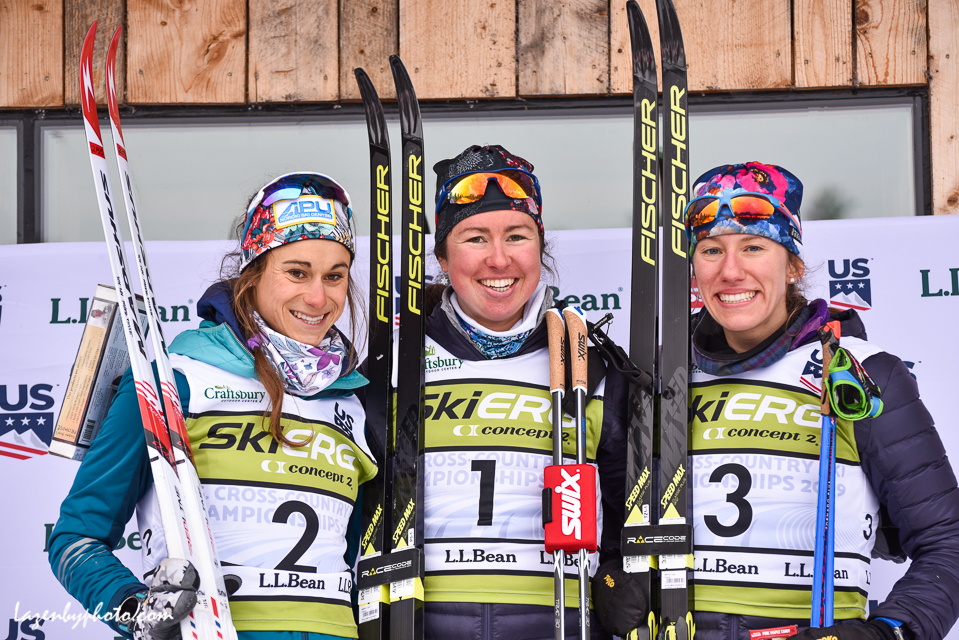
    Alright on to the workout!

    Find a 2-3 k loop with a good mix of terrain. It’s okay if you don’t see all the rolls and transitions right away, we’ll get there. Once you find your loop, drop your water at the start and get ready to roll. You’ll be skiing four laps at a moderate effort (L2/L3). Time each lap for personal reference/learning, or don’t… it’s okay to go out without a watch and just feel your body working, your skis gliding, and your gauge your effort. This workout is less about your HR and more about technique and your adaptations to the terrain. So as tempting as it might be to jump into L3/L4 intervals, before you do, make sure that is going to make you a better skier (not just fitter)!

    Lap 1 – Skier’s Choice

    Preview your course at a moderate effort (L2). While you are skiing, focus in on the terrain. What are the major sections in your course? What are the less obvious sections? Are there any sections that throw you off?

    Lap 2 – Macro Terrain

    For this lap, head out at a moderate effort (L2). Focus on the larger, more obvious pieces of terrain. For these sections, increase your effort (L3) but do not sacrifice good technique, if you start to fall apart, decrease your effort.

    -5min Rest-

    Lap 3 – Micro Terrain

    Same effort, moderate (L2). Switch your focus. Now you are looking for the micro terrain. These are all the places we bleed time. Over the tops of hills, standing too early out of a tuck, not accelerating out of corners. Plus! All the little segments of pitch change we steamroll right over when we are focused on Macro terrain – anticipate the changes, and ask yourself how will you change technique, tempo, or glide to accommodate the terrain’s fluctuations. Like the preceding lap, increase your effort slightly (L3) to help emphasize and differentiate the micro terrain.

    -5min Rest-

    Lap 4 – Maintaining Momentum

    For this lap, we put it together. Head out at a moderate pace (L2) and ski all the big sections of terrain at this level. It should be controlled, but not easy. All of the micro terrain discovered in the previous lap should be emphasized with an increase in effort (L3). The goal is to find yourself in a flow state, focused on small changes that sew together the big picture.

    Adaptation for higher intensity: have your intervals be structured with your Anaerobic Threshold as the defining line, so L3 / L4 mix. Good for lactate tolerance and clearance. Natural intervals/race simulation.”

    From left to right, Logan Diekmann, Bernie Nelson, Alayna Sonnesyn, Bill Harmeyer – all smiles. (Photo: courtesy of Bernie Nelson)
  • Wednesday Workout: What’s the Prescription for “Flooding” Legs?

    Wednesday Workout: What’s the Prescription for “Flooding” Legs?

    Now retired from competition, Dakota Blackhorse-von Jess (bib 1) skates away as he earned his second national title at the 2015 U.S. Cross Country Championships 1.5 k freestyle sprint in Houghton, Mich. You don’t need to look too closely to see Blackhorse-von Jess is a skier with flood-proof quads in the sprints.

    2014 is when a relatively green Patrick O’Brien took charge of the Stratton Mountain School’s elite team, otherwise known as SMS T2. In a relatively short time, by way of juggling athletes, wax-teching, training plan writing, and life-living O’Brien has become a problem-solving resource. Jack of many trades, and very much an emerging master of elite level coaching, FasterSkier tossed a general question out to O’Brien for our Wednesday Workout series: what are some workouts for an athlete experiencing “flooding” in their legs when laying down big efforts?

    Here’s O’Brien’s response:

    So if I understand the question correctly, the goal here is to do some workouts that will help an athlete keep from “flooding out” during a skate race, correct? Not sure if we are talking distance or sprint so I will answer both to the best of my ability.

    I think we are all aware of what the sensation of “flooding” feels like. The workload is high, we are pushing along fine in a race until finally we feel toxic and the motions break down, velocity drops and we either have to slow down or worse still, totally lock up. This has probably happened to just about everyone at some point in their racing career. At the surface, the issue and solution are relatively simple. Blood lactate is rising and being produced from anaerobic energy pathways faster than it can be cleared and turned back into fuel by the body and working muscles. Skiing is by nature a power endurance based sport. We rely upon both aerobic and anaerobic energy pathways to fuel the motions in a ski race. Depending on the race distance, course profile, elevation, athlete physiology, that balance is always shifting. The longer the duration of work and race distance, the more we rely on aerobic energy pathways, the shorter the duration of exercise and more intense, the more we are relying on anaerobic energy pathways.

    So at a very simple level, we are utilizing aerobic energy production more in marathons and 50km races and anaerobic pathways for shorter events such as sprint events. Now the caveat is we are always using both, and we need to tune up both systems to execute good race efforts. We need a big aerobic base to carry our fitness for distance races but also need to be able to recruit anaerobic power when punching it over hills, through transitions, and in the finishing stretches of a race. You need to be able to produce lactate and tolerate and clear it quickly both for distance and sprint races,

    Everyone naturally has different physiologies. Different size “motors” (call it V02 Max, but basically how big of an engine they have). Different ratios of fast twitch to slow twitch muscle fibers (are they a natural sprinter or more inclined to distance), different size frames and builds. Additionally, everyone has different technical skills and proficiency in skiing that are tied in with all of this. Our goal in training is to raise all of these capacities up, and ideally do so in a balanced fashion. You need a big aerobic base to support an anaerobic system and power and the ability to apply force correctly to maximize velocity and do it efficiently.

    Now let’s circle the wagon back around to the original problematic scenario: someone struggling with sensations of “flooding out” in racing. It could be caused by an imbalance in any of these capacities, or. simply because of an athlete’s natural physiology.

    Someone with a naturally strong anaerobic system, good strength, and technique solid enough to produce this power is going to “flood” more easily than someone who is more aerobic and cannot produce the same amount of power.

    For someone like this they still need to train and refine their strengths (they sound like they could be a good sprint racer!) but they also probably need to train their weakness. They need to build enough of an aerobic base so the body can support these other energy systemsEasiersy aerobic training and well-paced L-3 threshold training during the preparation and competition season will help them make their hard training harder and more repeatable. We do a fair amount of threshold intervals because it allows athletes to rely almost exclusively on aerobic energy pathways while still ingraining good technical motions and allowing them to become more efficient at this speed.

    You can structure threshold intervals many different ways but for those without access to either a Heart Rate or blood lactate monitor, I tend to find longer intervals allow athletes you to find your natural “threshold”. It should be medium-hard, breathing well but not building an O2 debt or hanging on your poles at the finish. 4-5 x 10 minutes on time with 3 minutes recovery is a good starting place. You should be controlled enough during the interval that you should feel ready to begin again before the end of the recovery period. You should get tired and fatigued from the duration of the work, not the absolute intensity of it.

    Now, the flip side to this could be an athlete that has a very well developed aerobic system but lacks either the anaerobic system to tolerate and clear lactate, lacks the muscular endurance for sustaining a full race effort, or has a technical weakness that is magnified during these race efforts. Basically, they start a race, and at some point, they can not maintain the workload and velocity to continue at this pace — they have to slow down.

    For an athlete like this, doing some anaerobic power work is a great place to improve their racing. Here’s a classic:  30-30 intervals. We format them a number of different ways but the idea is as follows: 30 seconds of skiing at or above race velocity followed by 30 seconds of easy recover skiing. Vary your “on time” depending on fitness and energy level and repeat as long as the motions and workload allow. We typically start conservatively, doing 2-3 sets of 8-10 minutes of on time. As athletes build fitness and capacity they can either increase the ground speed and intensity of the on time or increase the duration of the interval.

    This workout is so effective because it trains a number of different systems. It taxes the neuromuscular system by challenging them to ski a pace close to, or faster than race pace. In this way, they become more technically proficient and comfortable moving fast. It recruits anaerobic pathways by demanding high power output and subsequently the production of lactate while also allowing them to tolerate and clear this lactate while building in recovery time to keep the overall cost of the session manageable. Workouts like these should help athletes feel like they can repeatedly “redline” their tachometer while not blowing their car engine.

    So my long convoluted answer is that it is difficult to prescribe one workout or even a progression of workouts to fix an athlete who tends to “flood” during races because there are so many possible causes. They should evaluate their strengths and weaknesses as an athlete and racer and see if there is an imbalance and try to execute workouts that will help with this. You need to train your weaknesses as much as your strengths. If they can go really fast but tend to blow up, my recommendation would be to try to prop up the aerobic system by adding some sustainability to their racing.

    Start your workouts nice and controlled so that carries over to your racing. More easy distance and threshold intervals will help with this. If an athlete feels like they have good fitness but they go over the line once in a race and blow up or lock up, doing more anaerobic power work could be a good solution to making those big digs in a race environment more sustainable and repeatable. You need to be able to recruit the anaerobic system, build lactate, tolerate it, and on the recovery sections of the course clear it quickly so you can repeat again on the next working section. Incorporating some 30-30 intensity sessions could be a good starting place.

    So many variables — this is what makes the sport an evolving puzzle!


    Puzzle master Patrick O’Brien at the 2018 SuperTour Finals in Craftsbury, Vermont. (Photo: Matt Whitcomb)
  • Wednesday Workout: A Flashback to 2016 and Midweek Race Prep with the U.S. Ski Team

    Wednesday Workout: A Flashback to 2016 and Midweek Race Prep with the U.S. Ski Team

    The U.S. Ski Team’s Sadie Bjornsen during the 2018 World Cup 10 k pursuit in Lillehammer, Norway. (Photo: Fischer/Nordic Focus)

    We hear a lot about the details of a cross-country ski racer’s day on race day, but what about those four or five days in between? What do World Cup racers do then, in the middle of the week? FasterSkier Norwegian contributor Aleks Tangen ventured to Lillehammer back in late November 2016 to find out. 

    ***

    LILLEHAMMER, Norway — FasterSkier spoke with Bjornsen, Jessie Diggins, Andy Newell and U.S. Ski Team Coach Matt Whitcomb to see how they prepared for Lillehammer and in particular, the mini tour. Back in 2016, the three-day series consisted of a classic sprint on Friday, 5- and 10-kilometer freestyle races on Saturday and 10/15 k classic pursuits on Sunday.

    Whitcomb explained that on Wednesdays, in this case, two days before a race, it’s common for the athletes to do 90 to 120 minutes of light skiing in the morning and a strength session in the afternoon.

    “Some might do an easy jog instead,” Whitcomb said. “On a normal week, our strength session falls on a Wednesday. That gives us two full days of recovery before the races. Usually, this is also our intensity day and we like doing strength in the afternoon of those. However, in an instance such as this one, where we’re going from a World Cup weekend into a mini tour, we have limited time to recover and for most of our team that means that they will have to pass on mid-week interval session in place for something speed-oriented.”

    On Wednesdays, in this case two days before a race, it’s common for [U.S. Ski Team] athletes to do 90 to 120 minutes of light skiing in the morning and a strength session in afternoon.

    Bjornsen, who placed 17th in the 2016 Ruka 10 k classic, did just that. She said this week that she thinks it’s possible to improve upon that performance and that she is looking for more.

    “Two weeks ago, I was not even sure that I was going to be here…,” she said, referring to bone spurs in her feet that impeded her World Cup lead-up. “Each time I ski, it’s going to become more familiar and hopefully better.”

    This week, Bjornsen opted for a distance ski with some speed.

    “I find it really special that we can ski on the non-race courses, because we’re always dealing with the lack of snow and then we’re left with a 3.5 k, exceptionally hard, groomed course,” she explained. “It’s something that can contribute to built up fatigue.”

    She also did speed work on the course to familiarize herself with the transitions and plan where to change gears.

    Jessie Diggins during the 2e018 10 k skate in Davos, Switzerland. Diggins placed fifth for her best result for the season. (Photo: Reese Brown/U.S. Ski Team)

    Her teammate Diggins chose a similar kind of workout on the trail leading to Sjusjøen, for 90 minutes of easy skiing.

    Asked on Wednesday what goes through her mind during a training session two days before a race, Diggins said it doesn’t have much to do with the race itself.

    “I don’t think about the race really, I just try to stay relaxed and do what I’m supposed to do,” she said. “In the middle of two race weekends, you want to stay relaxed, but also improve your conditioning, so I did five minutes at L3 [Level 3 intensity] and 4 x 4 [minutes] at low level on Tuesday in order to have time to recover from traveling and in time for the race.”

    In terms of how she balances recovery and improves conditioning at the same time, she said, “That’s a good question. I think it’s really about listening to your body and paying attention to the signals it’s sending you. If you don’t feel good in the morning then maybe you should take it easy and vice versa. And you should always communicate with your coaches, but I really think that first and foremost, it’s important to pay attention to your mind before schedule.”

    Diggins said her schedule amounts to roughly 750 training hours a year, but she warned against looking too far into those numbers.

    “I don’t like to think about the numbers, really, I feel like that’s not the right thing to do,” she said. “It’s what you do in those hours that matter. It’s more about quality than quantity, and I feel like focusing on the numbers sends the wrong message to for example young athletes.”

    Asked what she would say to young athletes considering increasing their volume, Diggins said they should be “very careful about increasing hours. Don’t just throw on hours for the sake of more, think about what the hours contains and go from there.”

    According to Whitcomb, Diggins “is in a great state of fitness. … She’s just a really hard worker who does what she needs to do during workouts. She has also gotten to a point where she absorbs her training really well,” he explained.

    Andy Newell (U.S. Ski Team) racing in the quarterfinals of the 2017 World Cup men’s freestyle sprint in Davos, Switzerland. He finished fifth in the heat for 21st overall. (Photo: Reese Brown/U.S. Ski & Snowboard)

    Newell met with FasterSkier on the Thursday before the race to talk about his preparations. Normally he would do some form of threshold training “like 3 x 8 minutes and some shorter speeds, just to get a feel for the track,” but this Wednesday, things didn’t turn out quite the way he had hoped. Newell skipped training to treat a cold that had been brewing since last Thursday.

    “I might have gotten sick from traveling” he said.

    If he had been training, his race-prep day would have likely included an hour of skiing, with ski testing (maybe four or five pairs) for the first 45 minutes.

    “Once I find a good pair, we usually get together as a team and ski the lap, once at 70 percent of max and once at 90 percent.” Newell said of previewing the course.

    When asked about how he balances recovery and fitness, Newell’s answer was similar to that of Diggins and Bjornsen. He said it’s about feeling good before the races, and since the races are like hard workouts, what matters in the time in between is to recover well enough in order to feel good when you’re on the starting line.

    “Some people come out of, for example, the Tour de Ski super-fit and that’s the kind of magical balance we’re striving for, where we can be in a state of fitness where we can absorb the benefit of the races,” he said. “For me, that means to maintain threshold base and focus on short bursts of speed during the races.”

    And how does nutrition factor into this equation, especially considering you’re in a different country every week?

    “I normally don’t have any problems with it, the foods really good here and there is so much to choose from,” Newell said. “I might supplement with multivitamin or fish oil, especially in places like Kuusamo.”

    Speaking specifically about Lillehammer, Newell said he loves the course, calling it “perfect”, “very challenging but very skiable, unlike Kuusamo, which are not that fun. Lillehammer’s [courses] are very enjoyable.”

    This season, Newell explained that his biggest goal is “to stay strong and healthy.”

    “I am trying to be careful with the cold I have now. I know I can be among the strongest in the world and I try not to think about place, but instead feeling strong and take one race at the time,” he said.

  • Wednesday Workout: Getting Out With Kids in Tow

    Wednesday Workout: Getting Out With Kids in Tow

    Mom. Wife. Kikkan. Fighter. Kid-tower. Gold medalist. All of the above. Kikkan Randall tows Breck. (Photo: Kikkan Randall collection)

    This week’s workout comes from contributing reporter Rachel Perkins, a former USCSA National Champion turned dedicated citizen racer and now a new mom to a baby girl born in October. Here Rachel shares tips from her own experience as well as the wisdom of local chariot pulling veterans. This article is an introduction to an upcoming series highlighting the pregnancy and postpartum experiences of skiers including Kikkan Randall, Holly Brooks, and Caitlin Gregg as they ski their first tracks as a new parent.


    Whether you are a professional athlete, dedicated age-grouper, or just enjoy a tour on your cross-country skis, balancing exercise and family is a challenge for most active parents. Luckily, there are ways to marry the two, especially while your child is easily portable. Anyone who has towed a child of any size uphill can attest that skiing with a pulk or chariot is not for the faint of heart (or legs)!

    I found out I was pregnant a few days after skiing 50-kilometers in a charity skiathlon where I felt remarkably flat. About two weeks prior, I raced a team sprint with my husband and felt super strong. I was confused why a long but easy tour felt so taxing. Had my skis been slowed by dirt collected from the eternal “early-season conditions” that plagued Colorado in its low-slow year last season? Were they desperately in need of wax? Better to blame the skis than the body. 

    I was incredibly fortunate to have a healthy and active pregnancy. I spent the summer trail running, hiking in the mountains, and swimming laps, and I rollerskied until the week before I went into labor. Once my little girl was born and my body had time to heal, I was eager to get out in the newly fallen snow. And, after nine months of bouncing around in my belly, my baby is quickly lulled to sleep by motion. Laps at our local ski area with the chariot are a golden ticket for mutual happiness.

    buy skelaxin online

    With the infant sling installed in our Thule Cheetah XT, think modernized-pulk, it is possible to begin skiing with our baby almost right away. And by the time she outgrows the child seat, we hope that she will be propelling herself down the trails.

    Here are the answers to a few commonly asked questions to help make your workout enjoyable for everyone involved.

    Can you ski normally with a chariot?

    When you first start to tow a ski chariot, it might feel like you have never been on skis before, as the weight you are propelling is distributed much differently than it is when you ski on your own. However, with some practice, you will forget there is anything behind you. At least on the flat sections. … Regardless, since the chariot will keep your little one secure and warm, it is well worth the added weight.

    Whether you are skating or classic skiing, it is important to keep your hips forward so that your own center of gravity is just in front of you, aiding forward momentum and power delivery. Having your hips too far back will be especially noticeable on uphills. The hip belt can actually be a good technique cue; keep your eyes up the trail and be mindful of keeping your hips tucked under you, and skiing will begin to feel more natural.  

    If you are classic skiing, err on the side of more kick as you have more weight to propel with the little one tagging along. Fish-scales or skin skis are a foolproof way to go. The weight of the chariot will make up for any losses in speed on downhills, not that you’ll be trying to set any records.

    Some cautionary advice in physics: with the chariot trailing behind you, it is essential to brake early and make wide turns. Remember that the force of the chariot behind you will push tangent to the curve that you are rounding, meaning it will try to push you off the trail. Having your speed in check and a wide radius helps keep everyone safe and upright.

    How do I keep my baby warm?

    Only one of you is working hard, so it is important to make sure your little one is well-bundled for the outing. For infants, insulated layers that can’t unintentionally be kicked off are key, like a fleece or down bunting suit. It can also be helpful to tuck the baby in with a blanket or a puffy jacket.

    A well-bundled baby fast asleep on the trail. (Photo: Rachel Perkins)

    When using the infant sling, keep in mind the dead space between the sling and the child seat below. Unless this space is filled with insulation, it is a bit like sleeping on the frozen ground with a blanket on top of you; probably not the most comfortable experience. Tucking another blanket or a down jacket into the space can help keep your baby better protected from the cold.  

    How do you tell they are warm enough? A good way to see whether your baby is warm enough (or too warm) is to stick a finger behind their neck or down the back of their clothes. If the baby feels warm, but not sweaty, they should be comfortable.

    What if my kid hates the chariot?

    It may not be the best idea to embark on a two-hour ski as your child’s first rodeo. Start with a short outing and gradually increase the length of the ski. This will also help you build up your towing stamina!

    Out for a ski on a bluebird day. (Photo: Rachel Perkins)

    If your kiddo is hungry or bored, your ski might end quickly. Don’t forget to pack snacks, water, and maybe a toy or book to keep everyone entertained and well fueled. The interior is easy to clean, so don’t worry about the sticky peanut butter and jelly messes.

    If you are skiing with a baby, try to time the outing with a nap. For a young baby, it may be helpful to get them soothed and calm before starting the ski. I have found that the portable sound machine we use for my little one’s naps at home also works wonders in the chariot. Once we are moving, she drifts quickly off to sleep.