Tag: West Yellowstone SuperTour

  • Wednesday Workout: Journaling and Time Trials with Anne Hart

    Wednesday Workout: Journaling and Time Trials with Anne Hart

    Anne Hart getting on early season snow in Sjusjøen, Norway. (Courtesy photo)

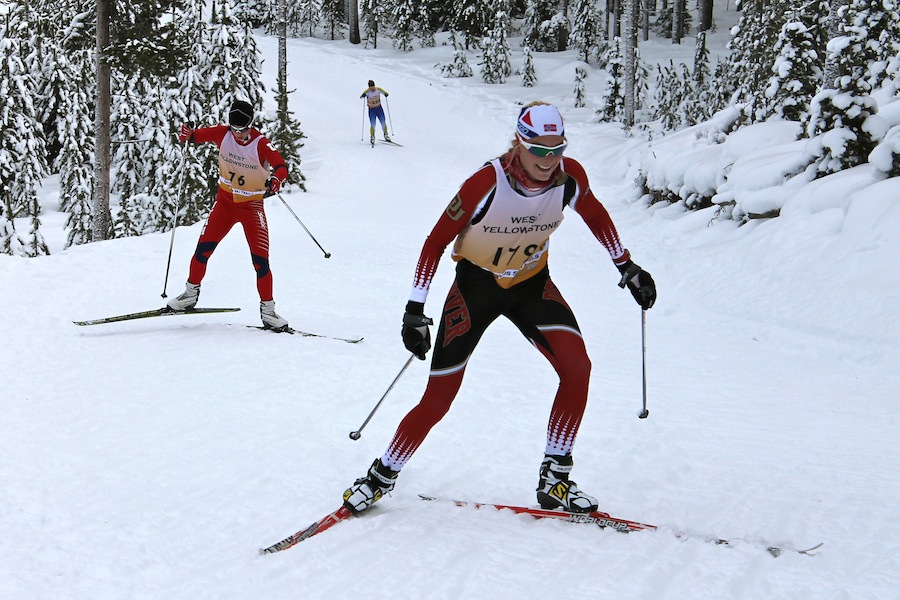
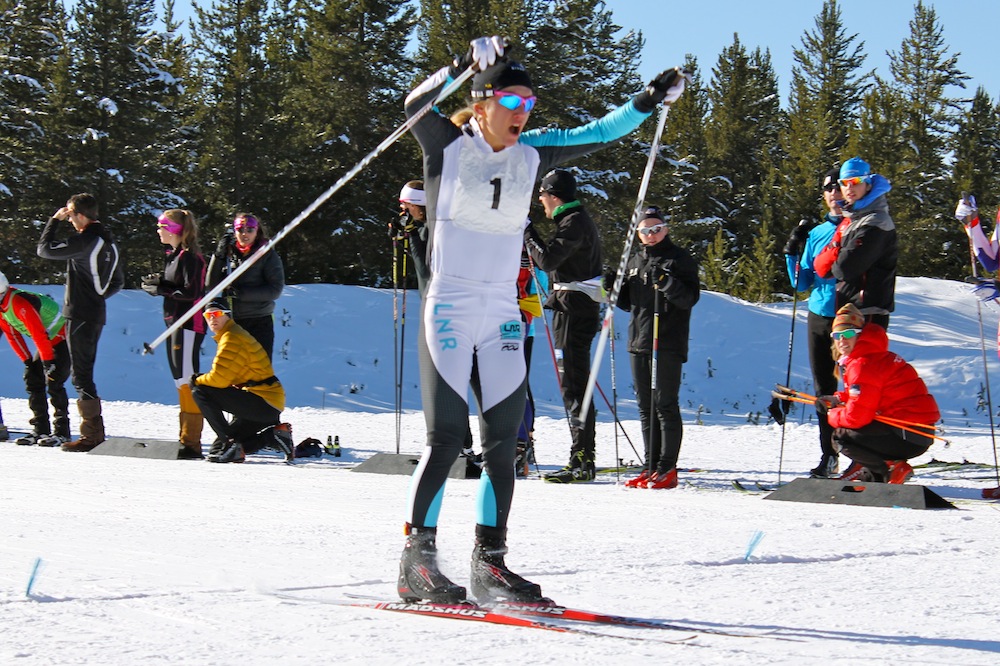
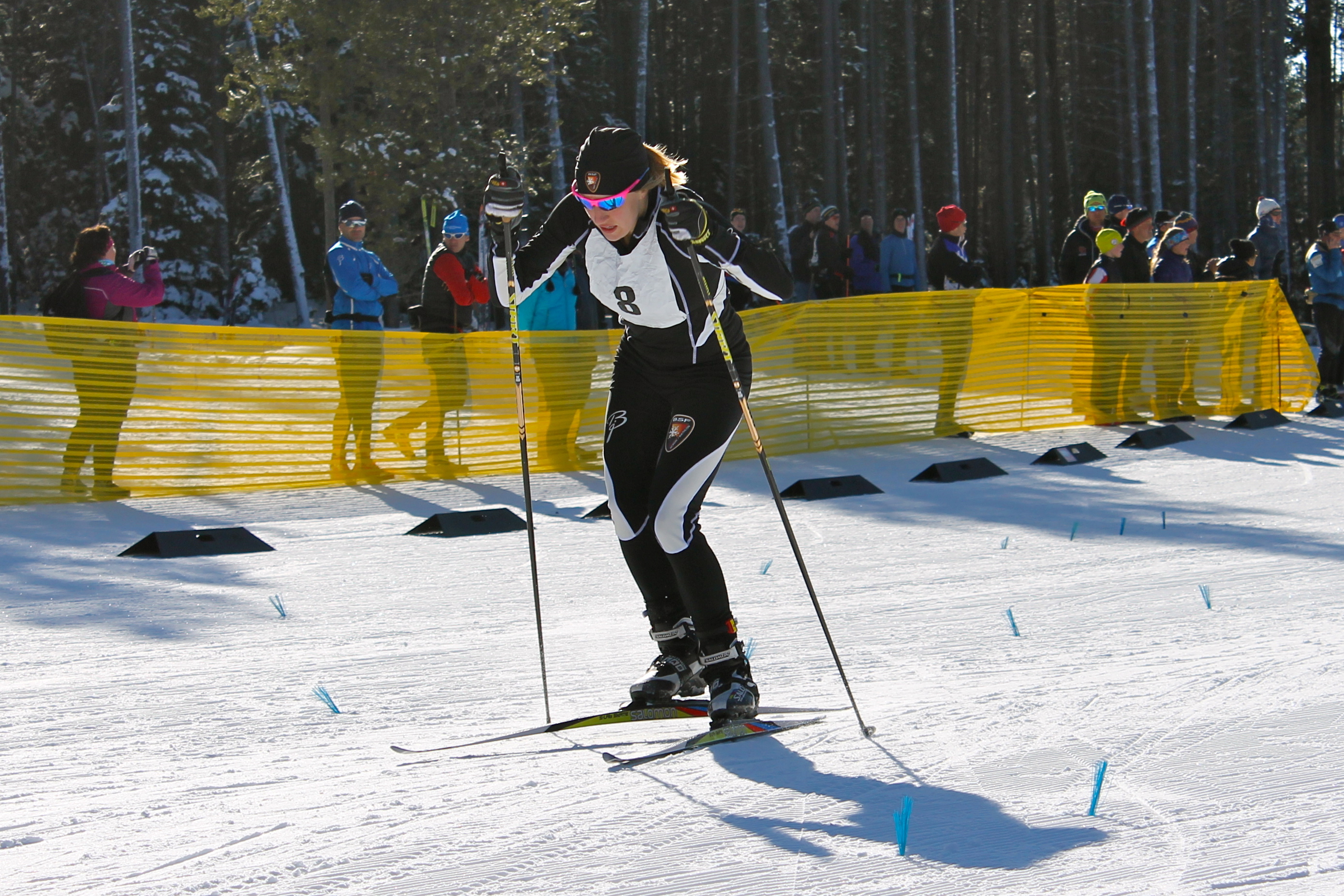
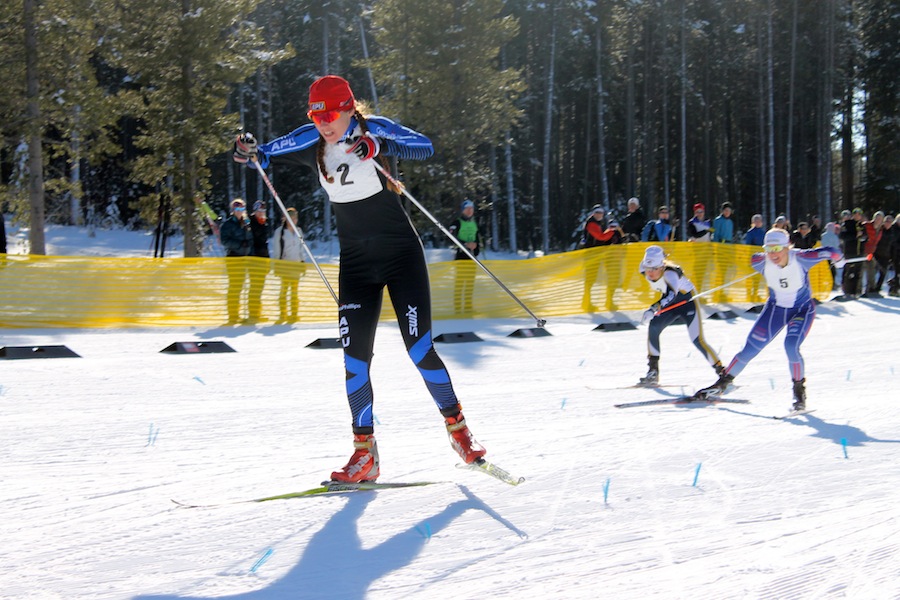
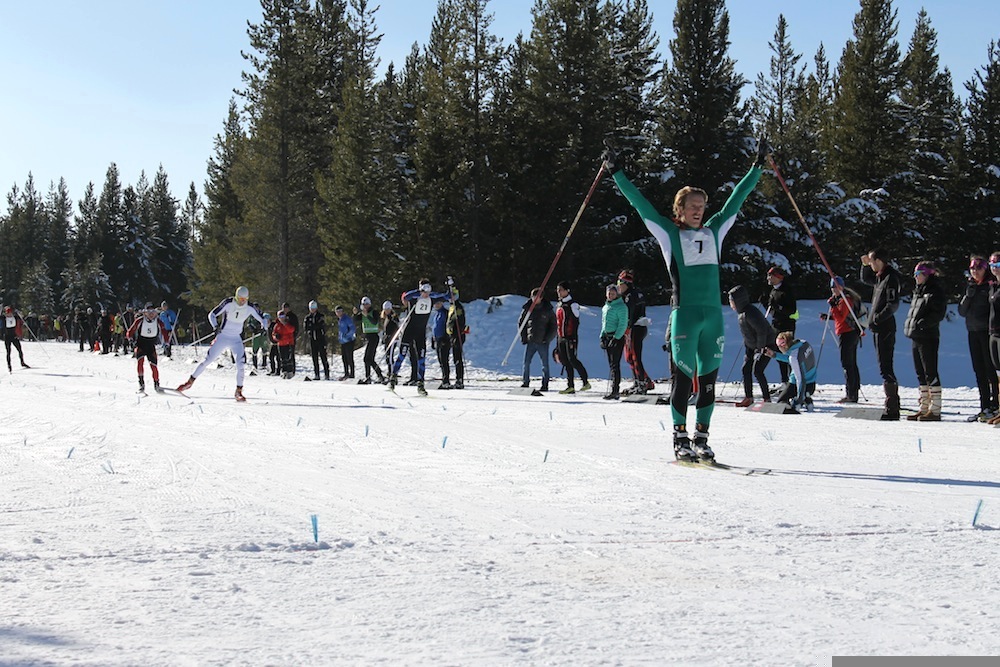
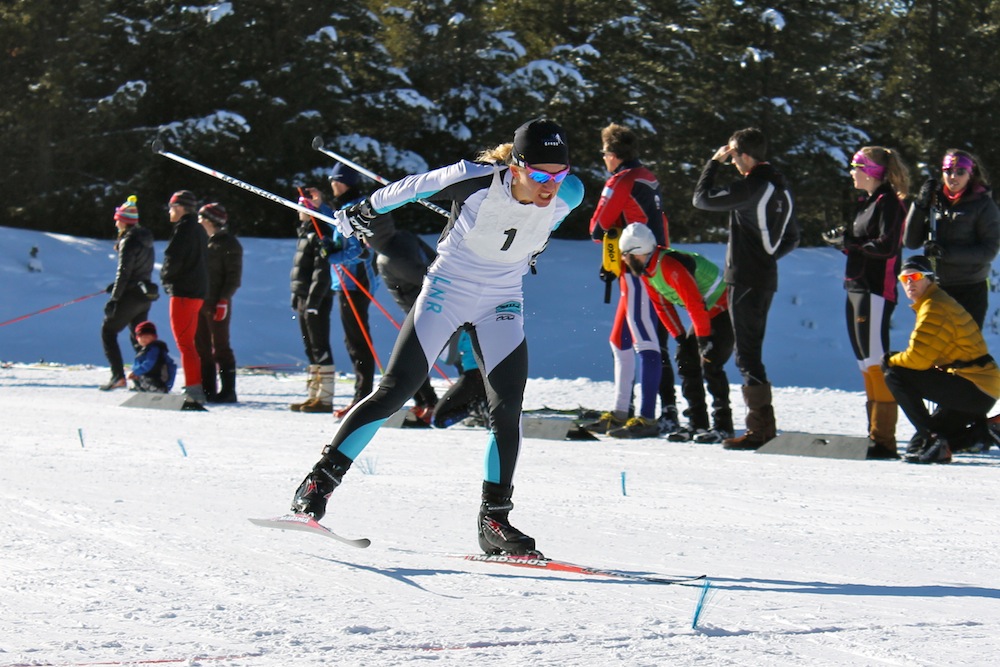
    Coming off a top-20 distance result during Norway’s season-opening International Ski Federation (FIS) races a little less than a month ago in Beitostølen, Anne Hart, of the Stratton Mountain School (SMS) Elite Team, jetted to a victory in the first SuperTour race of 2017/2018 — the freestyle sprint in West Yellowstone, Montana.

    “I haven’t straight out won a highly competitive race in two years, so winning on my arch nemesis course of West Yellowstone was huge,” Hart, 25, wrote in an email last week about her Dec. 2 sprint win. “I know that the period one altitude is not my best friend, and am really working on keeping a positive and confident mentality. The race for period two World Cup starts is tight (I think right now there are five or six women all within three points), so I’m trying not to focus on that too much.  It would obviously be wonderful to lock those up, but more than anything I just want to set myself up physically and mentally well for a stellar nationals in Alaska.”

    The day after her win in the 1.3-kilometer skate sprint, Hart finished 15th in West Yellowstone’s 10 k classic mass start on Dec. 3. Last weekend up at Sovereign Lake in British Columbia, Hart finished seventh both in the NorAm-opening skate sprint and 10 k skate, which counted toward SuperTour standings.

    She started her season with a training block in Sjusjøen, Norway, then at the Beitostølen races, with a goal of racing on snow before it really counted at this month’s SuperTour and U.S. nationals. In Beitostølen, she told FasterSkier she was mostly focused on recovering, feeling fresh, and above all, having fun.
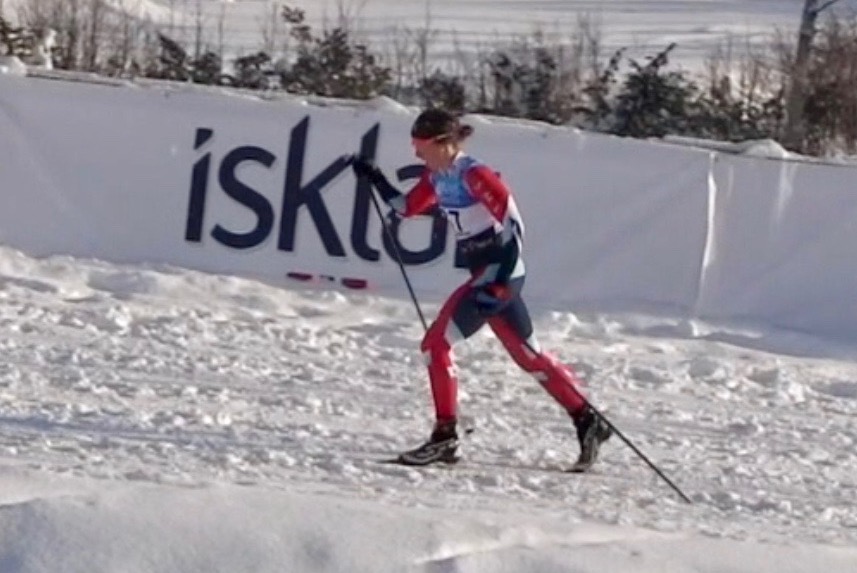
    Anne Hart (SMS Elite Team) racing in last month in Beitostølen, Norway. (Courtesy photo)

    “I’ve just been doing way less training this year and paying attention with my strength coach, saying that you’re trying to be an athlete first and then the skiing comes,” she said on Nov. 17, after placing 31st in the 10 k classic in Beitostølen (she raced all three races there, repeating in 31st in the classic sprint, then 19th in the 10 k skate). “So this whole summer I’ve been working on my general athleticism and I’m just now starting to hone in on the skiing intensity of that.”

    In West Yellowstone, she talked about using her journal to map out the sprint course, point pointing areas to focus on.

    “In my journal last night I actually had part of the course labeled ‘mushroom boost,’ which is right over the top of that last hill,” Hart said after her sprint win, alluding to the speed burst featured in the Mario Kart Nintendo game.

    “So I was able to do my planned mushroom boost at the end, came across with the win and I couldn’t be more thrilled,” she said.

    That mushroom-boost reference got us thinking: what kind of journal does Hart keep? It’s nothing like a training log, she explained, but rather a tool she picked up from a mental trainer she’s been working with since the summer, at the suggestion of her strength coach Max Lipset.

    “I had been doing all of this physical training, but had been struggling a bit with how to wrap my mind around all the variables inherent in ski racing,” Hart wrote in an email. “This past season I had a really hard time shaking off bad races, and ended up carrying negative feelings from one weekend to the next. And I can tell you that there is no amount of physical training that can surmount that.”

    She started speaking with John D’Agostini of Invictus Leadership, a “mindset and personal leadership coaching” company based out of the Twin Cities, according to D’Agostini’s Linkedin profile. Hart grew up in Stillwater, Minnesota, attended Dartmouth College in New Hampshire, and now trains out of Stratton in southern Vermont.

    Hart explained that they initially spoke twice a week and are now in contact about once every 10 days.

    “The Invictus program is a bit unique in that John is not a sports psychologist — he is just an individual with a lot of experience in the arena of mental fortitude, and has developed a curriculum that has helped me immensely,” Hart wrote. “As part of my ‘homework’ he suggested I start keeping a journal. I’m the only one who looks at it (although I’ll give you a sneak peak), and it has been a great way for me to critique myself without being negative.”

    Here are the key aspects of Hart’s journaling:

    1. Don’t think of it as a training log. It’s for everything else that’s on your mind.

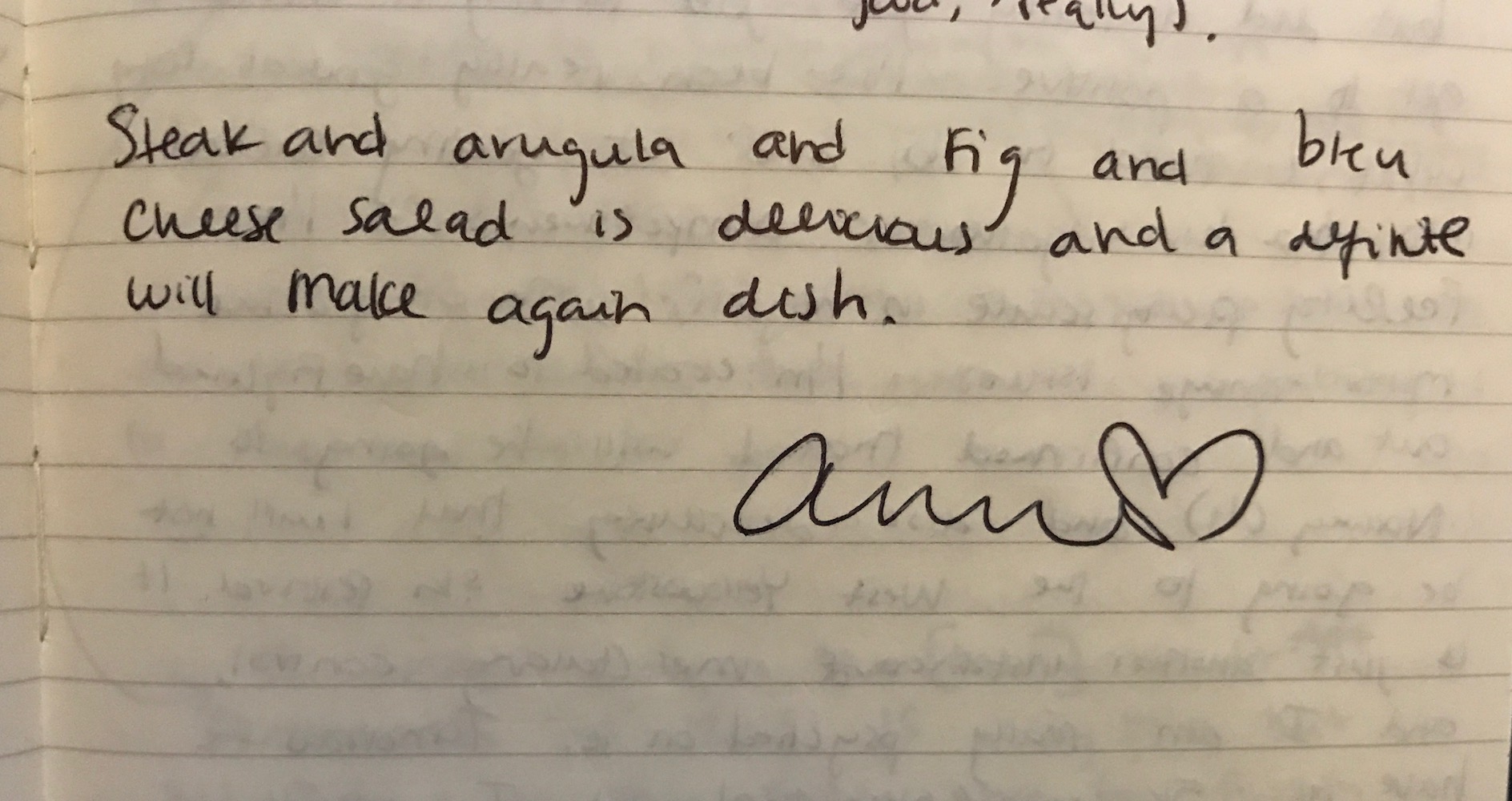
    “It has absolutely nothing to do with a training log (I have a big old google spreadsheet for that), but is instead a place I write down random thoughts, anything that is bothering me, things that are empowering me, and even recipes I want to try,” she explained.

    2. It can include drawings, or more specifically, course maps for pre-race, mental training.

    In West Yellowstone, Hart “drew a very loose representation of the sprint course, noting how I wanted to ski different sections and places I should look for passing opportunities (to either pass or be passed),” she explained. “This ended up being a huge help, as when it came to the final of the sprint and I found myself in the back, I had already figured out four or five different places I could attempt a pass as long as I kept my head cool and my wits about me. I ended up being able to use one of my pre-planned places and come out with the win.”

    3. It’s your journal. Nobody else needs to see it. Although Hart did share a few excerpts (below) as examples:
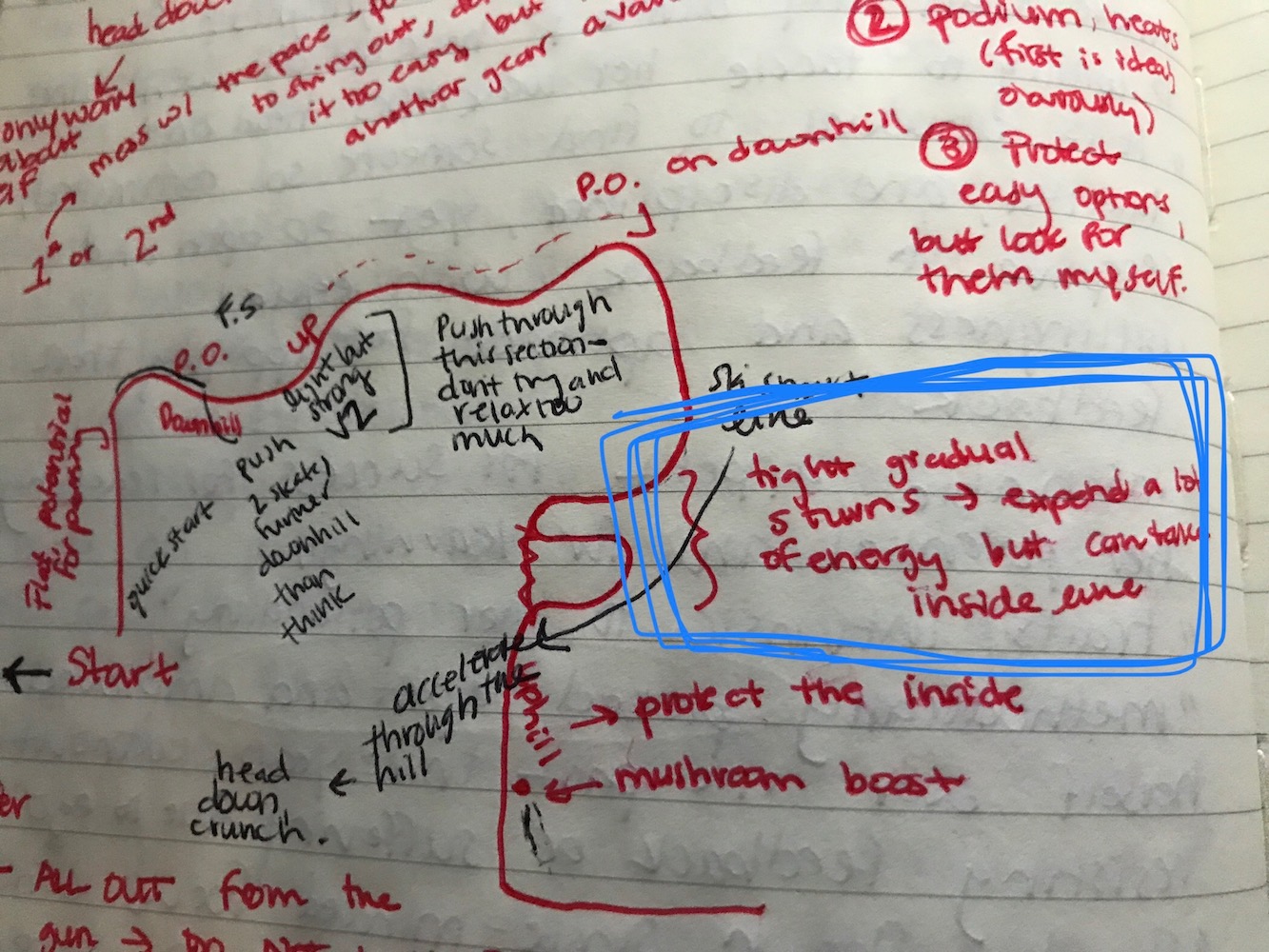
    Anne Hart’s course map, as she drew it in her journal, of the SuperTour sprint course in West Yellowstone, Montana.
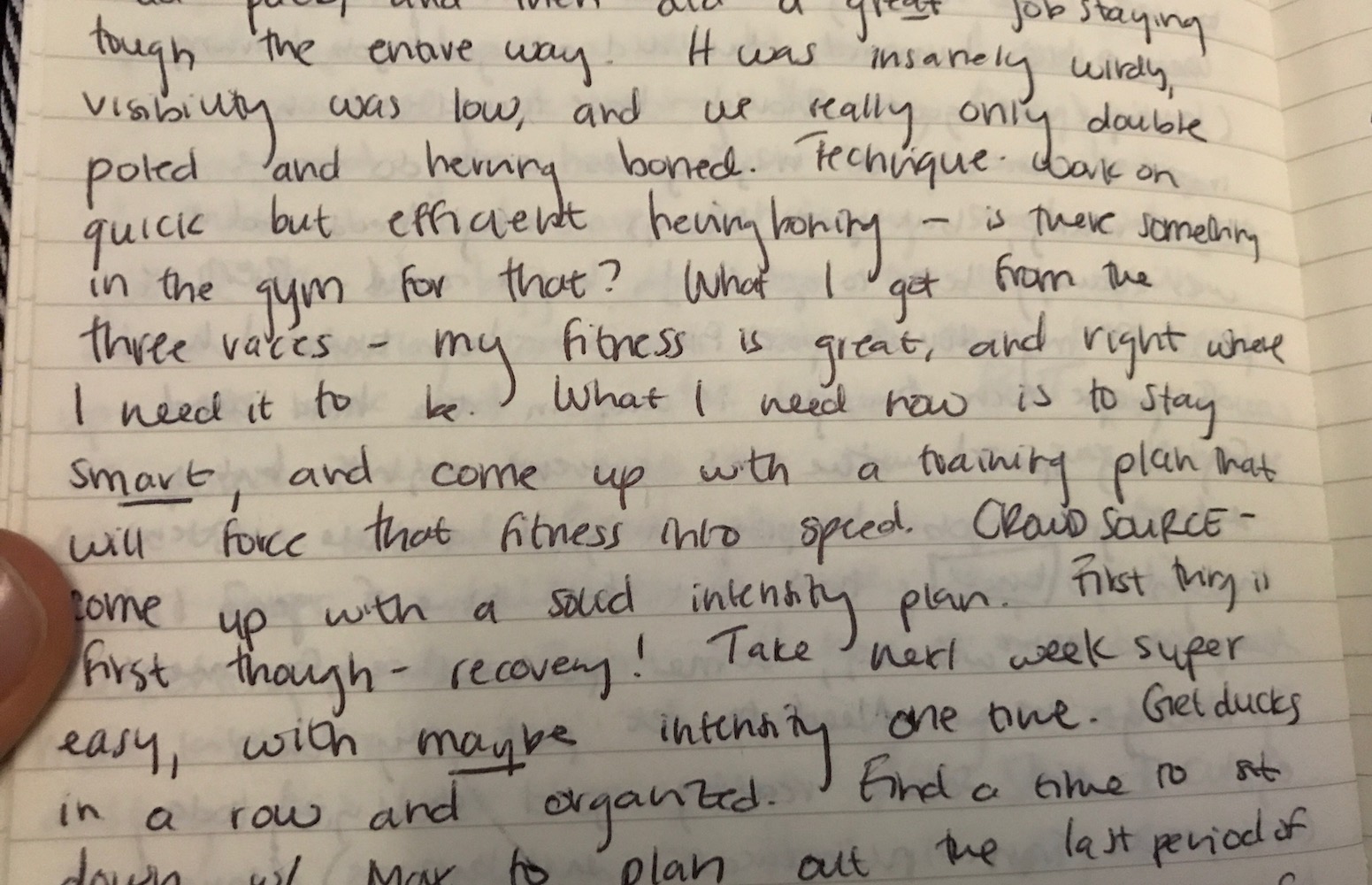
    An excerpt from Hart’s journal entry after racing in New Zealand in this past September.
    Recipe notes as seen in Hart’s journal.

    In terms of a physical workout, here’s one Hart recommended:

    “Late last winter I did a workout with the Craftsbury team that I really loved,” she wrote. “It is designed to prepare for a hard but somewhat paced 10-kilometer race, and I did it once while I was in Norway to get ready for individual start distance races.”

    The Workout: 2 x 5 k time trial

    Warmup: 30 minutes of easy skiing, plus 3-6 minutes of threshold

    The workout: On a measured 5 k loop, time yourself while completing 5 k at threshold with an occasional Level 4 pace.

    Rest for five minutes, then try to complete the same loop 15-30 seconds faster.

    “It is WAY harder than I would have initially thought, but is an awesome way to find a hard but sustainable pace, and a good way to pay off part of the mortgage on your own personal pain house :)” Hart wrote.

    Cool down.

  • Saturday Rundown: Lillehammer; Östersund; West Yellowstone (Updated)

    Saturday Rundown: Lillehammer; Östersund; West Yellowstone (Updated)

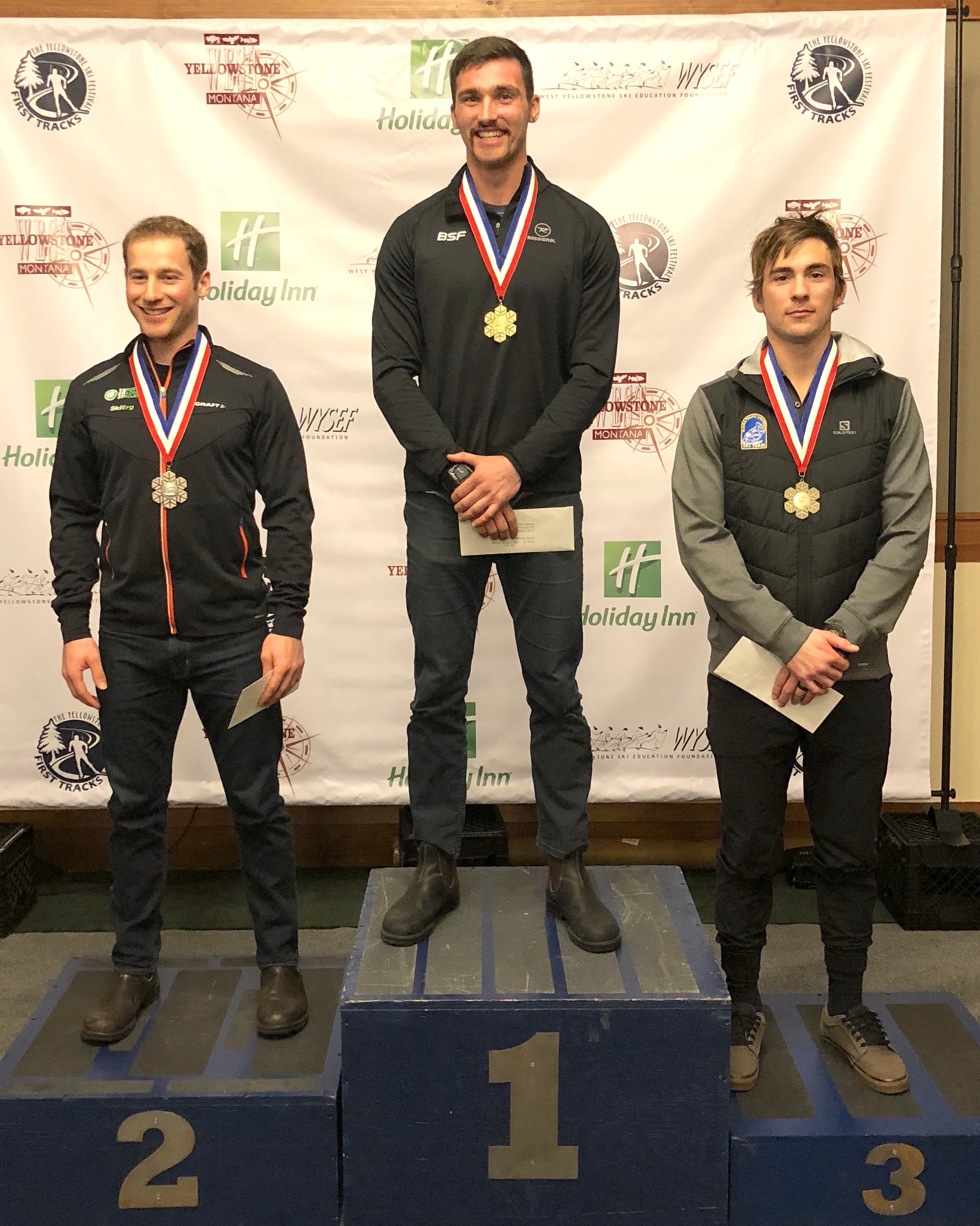
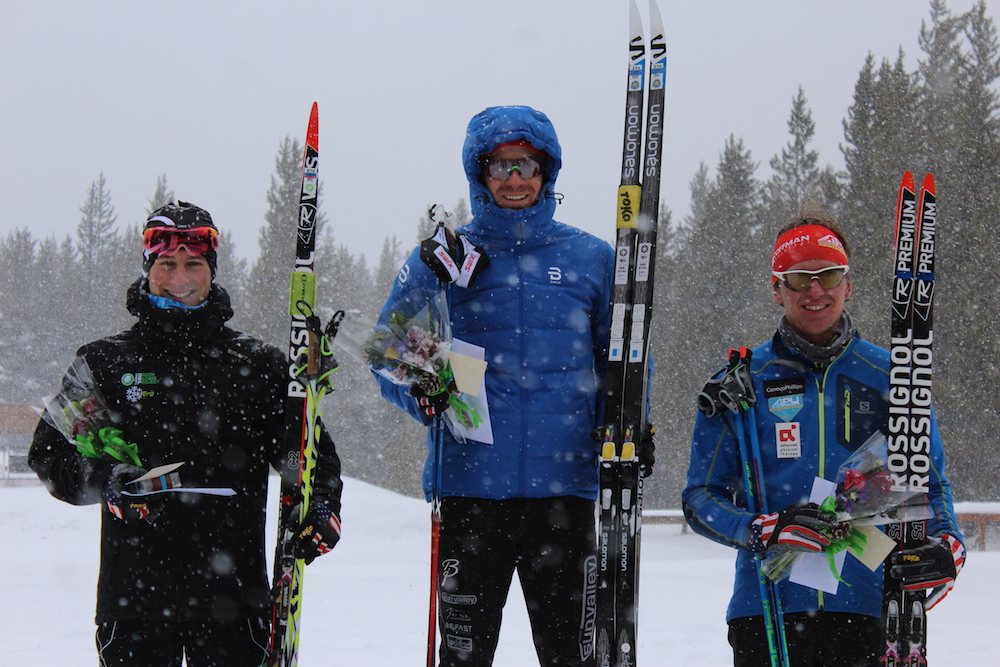
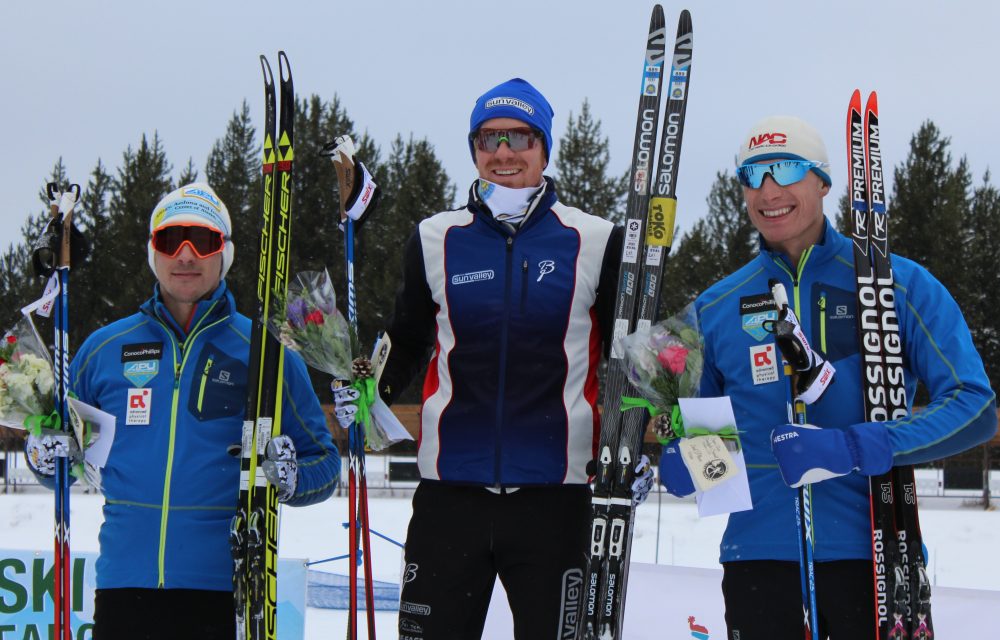
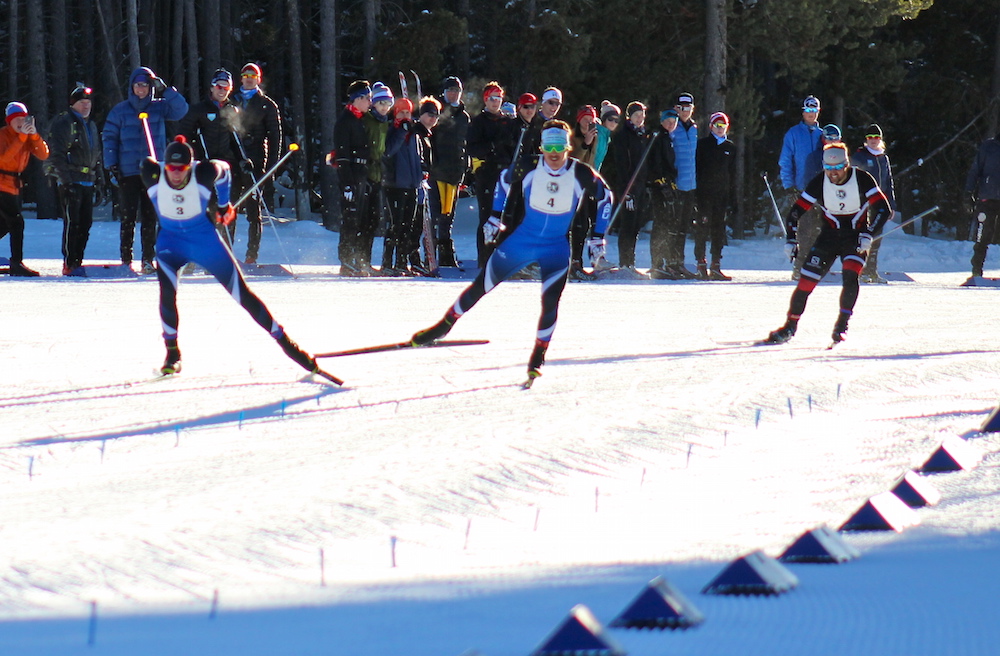
    The men’s skate sprint podium at the first race of the 2017/2018 SuperTour season, with Nick Michaud (c) in first, Ben Lustgarten (l) in second, and Reese Hanneman in third. (Photo: FBD)

    US SuperTour (West Yellowstone, Montana): Freestyle sprints

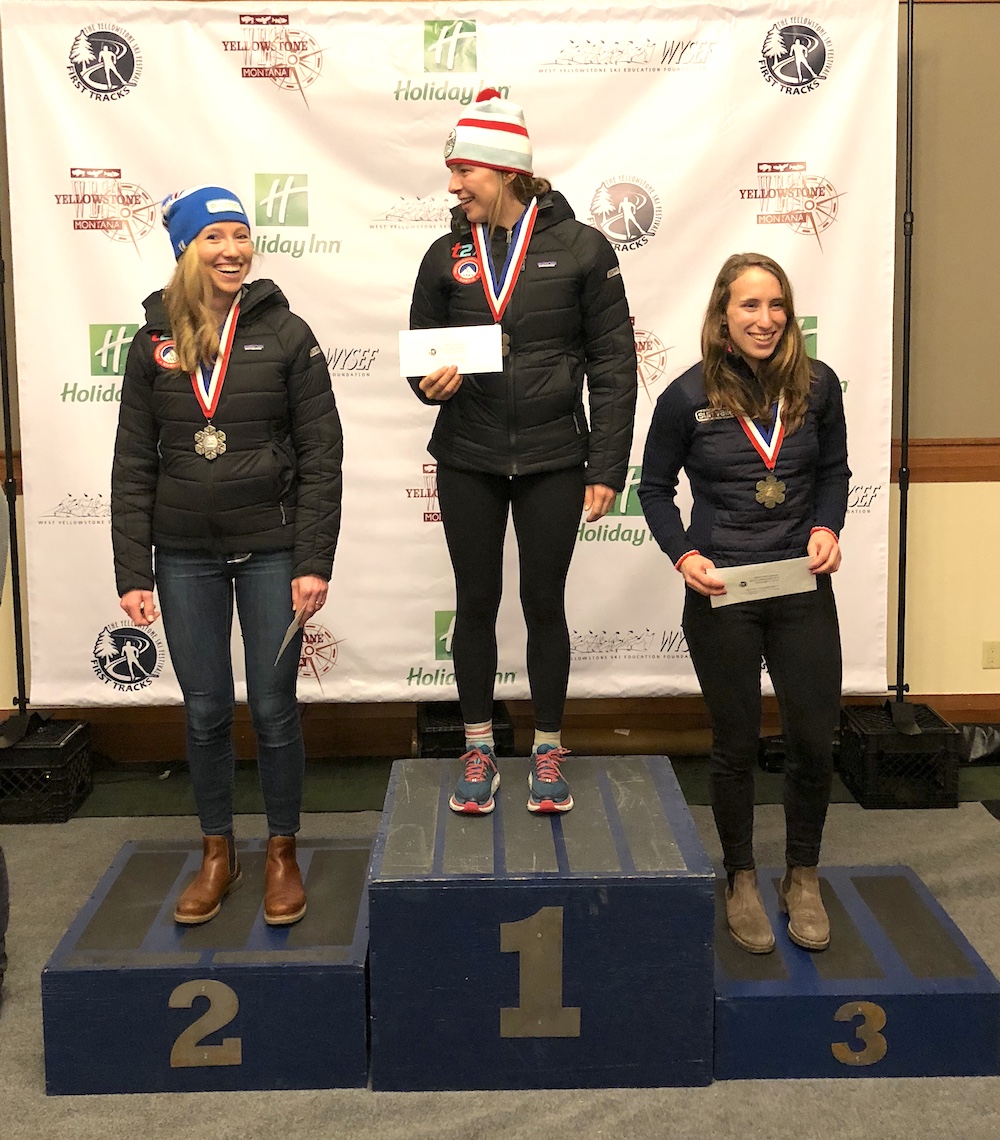
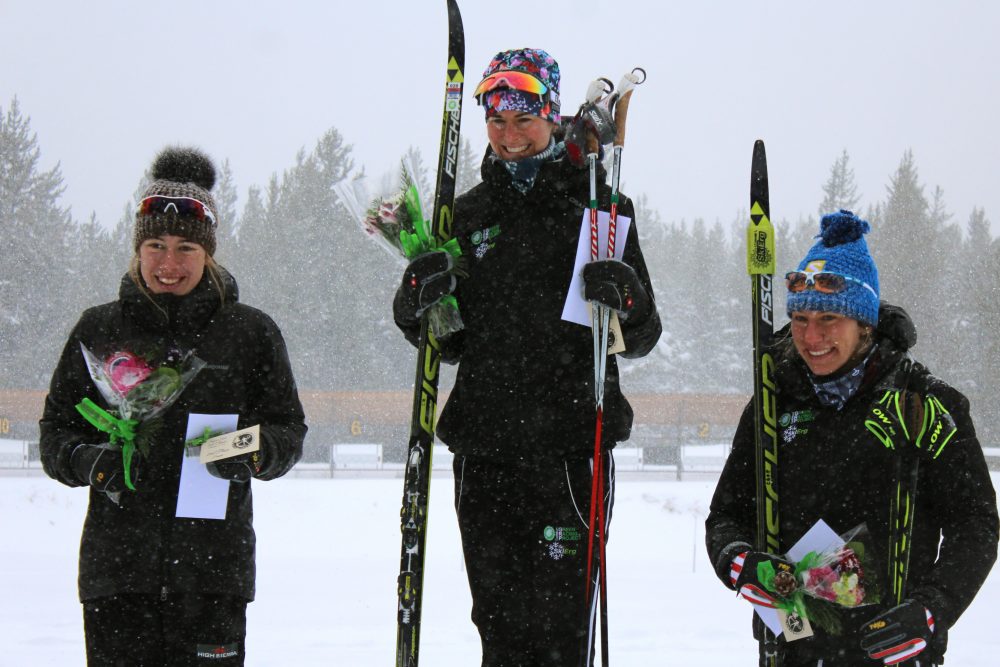
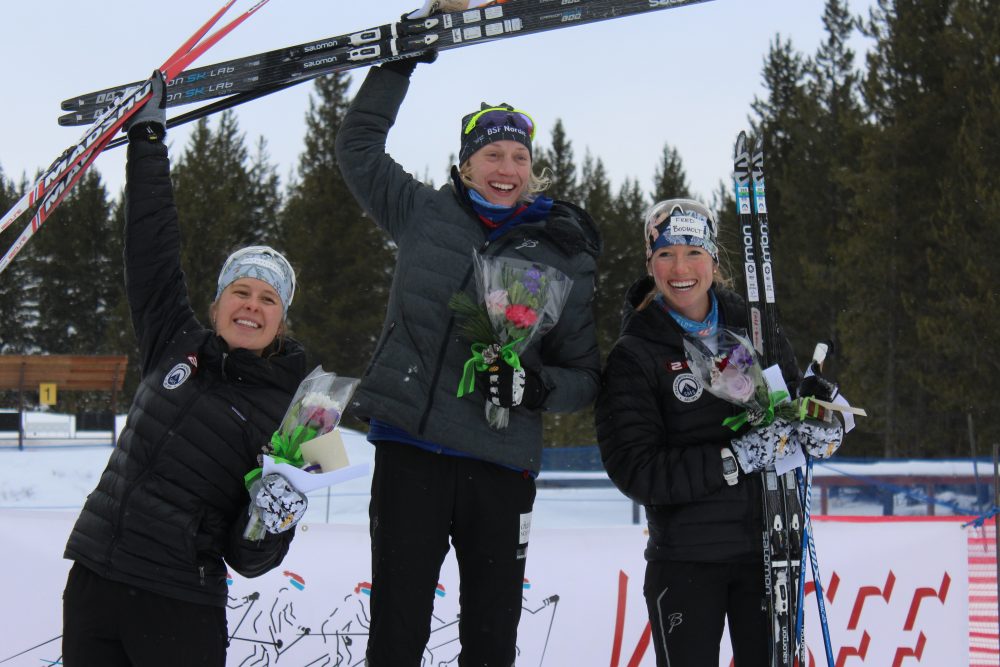
    The women’s skate sprint podium at the first race of the 2017/2018 SuperTour season, with the SMS Elite Team’s Anne Hart (c) in first and Erika Flowers (l) in second, and Sun Valley’s Kelsey Phinney in third. (Photo: FBD)

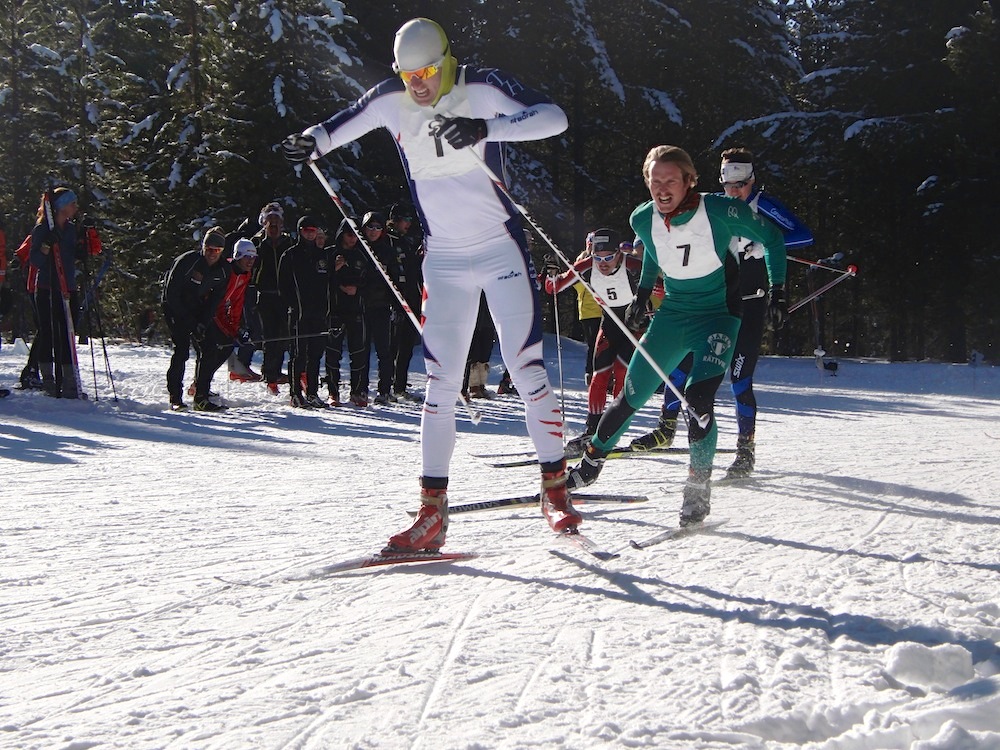
    Anne Hart and Nick Michaud were the big winners on opening day of the US SuperTour season at the Rendezvous Ski Trails on Saturday, taking individual victories in the women’s and men’s freestyle sprint finals, respectively.

    Hart led into the finishing straight to take the win in 2:52.49 minutes, 0.88 seconds ahead of Erika Flowers, her teammate on the Stratton Mountain School (SMS) Elite Team, who placed second, and Kelsey Phinney, of the Sun Valley Ski Education Foundation (SVSEF))in third (+0.92).

    Hannah Halvorsen, of Alaska Pacific University (APU) and the U.S. Ski Team D-team, finished fourth (+2.16), Caitlin Gregg (Team Gregg) was fifth (+6.99), and Caitlin Patterson, of the Craftsbury Green Racing Project (CGRP), sixth (+7.22).

    The win was Hart’s second on the circuit after winning a SuperTour 5 k skate two seasons ago. Last year in West Yellowstone, she placed third in the skate sprint (behind Jennie Bender, of the Bridger Ski Foundation, and Flowers, respectively).

    Michaud, of the Bridger Ski Foundation (BSF), won the men’s final in 2:30.69 for his first SuperTour podium, just 0.17 seconds ahead of Ben Lustgarten (CGRP) in second and Reese Hanneman (APU) in third (+0.84). Rounding out the final, Kevin Bolger (SVSEF) finished fourth (+2.11), Ben Saxton (SMS Elite Team) fifth (+2.86), and Cole Morgan (SVSEF) sixth (+3.42).

    On Sunday, the SuperTour continues with 10/15 k classic mass starts.

    Video interviews with the winners: Hart & Michaud

    Complete results (scroll to bottom for men’s and women’s final results)

    ***

    FIS Cross Country World Cup (Lillehammer, Norway): Classic sprints

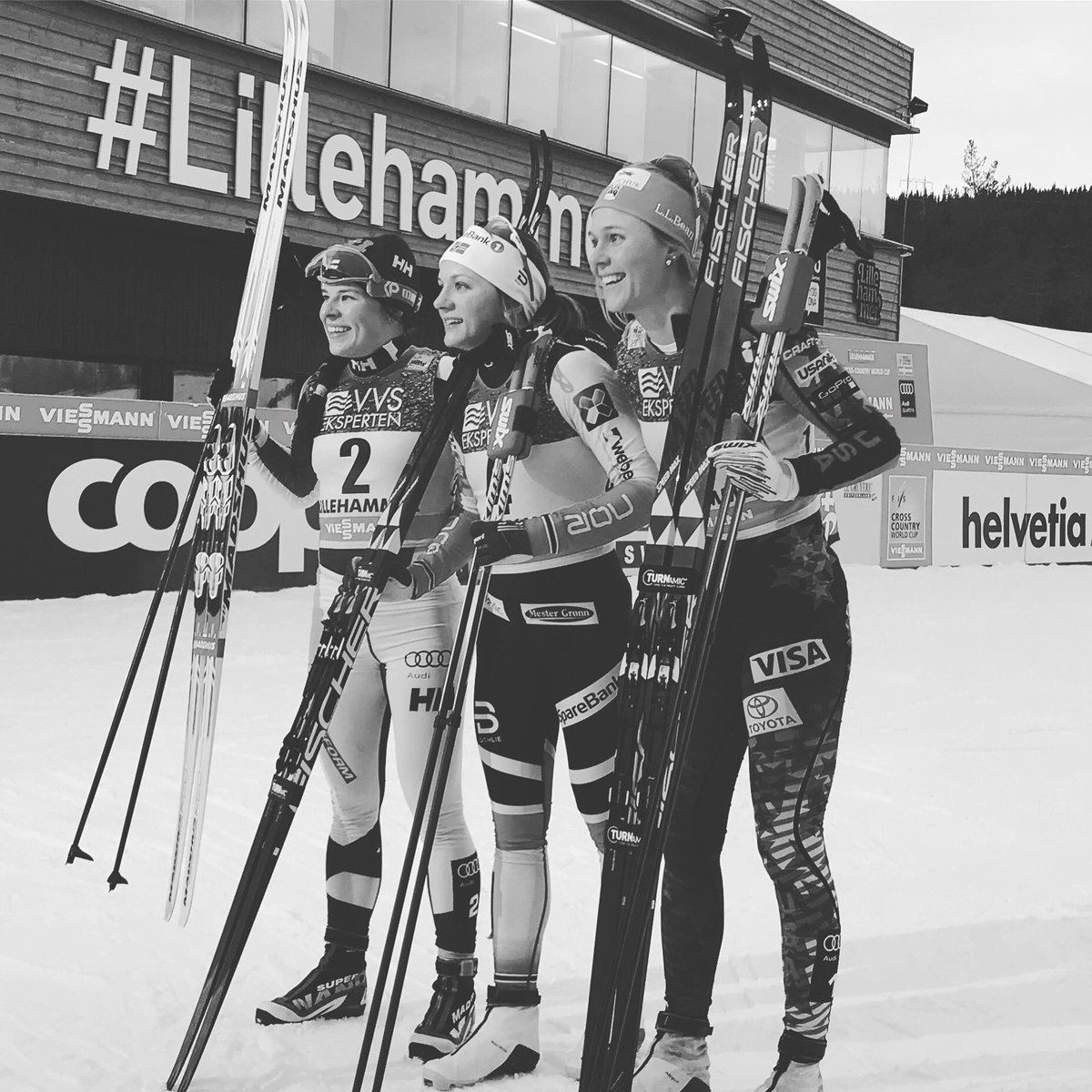
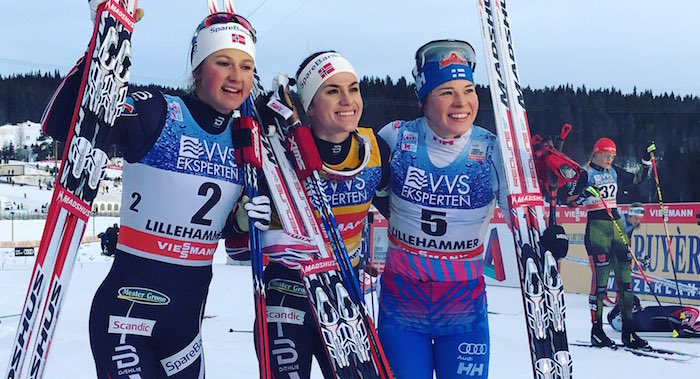
    From right to left: American Sadie Bjornsen, Norway’s Maiken Caspersen Falla and Finland’s Krista Parmakoski after placing third, first and second, respectively, in the women’ 1.3 k classic sprint at Friday’s World Cup in Lillehammer, Norway. (Photo: FIS Cross Country/Twitter)

    Women’s report

    Men’s report

    American Sadie Bjornsen returned to the World Cup podium for the second time in as many classic sprints this season on Saturday, placing third in the women’s 1.3-kilometer classic sprint behind Norway’s Maiken Caspersen Falla in first and Finland’s Krista Parmakoski in second.

    Bjornsen started the day by winning the qualifying round by one-hundredth of a second over Parmakoski and Russia’s Natalia Nepryaeva, which were listed as qualifying in second and third, respectively (despite having the same time).

    The U.S. Ski Team (USST) member who placed second in last week’s classic sprint in Kuusamo, Finland, Bjornsen won the qualifier in 3:22.45 minutes. She went on to advance in second out of her quarterfinal and then won her semifinal by 0.46 seconds over Sweden’s Stina Nilsson — who beat her in last week’s sprint.

    While Falla won Saturday’s final in 3:19.98 (after qualifying in fourth, then winning her quarterfinal and semifinal as well), Parmakoski followed in second overall (+2.07) and Bjornsen achieved her second podium of the season in third (+5.01). Norway’s Ingvild Flugstad Østberg was just behind in fourth (+5.28), Nilsson finished fifth (+6.09), and the second American in the final, Jessie Diggins was sixth (+7.81).

    Diggins previously qualified in seventh, finished second in her quarterfinal then advanced as a lucky loser in fourth place out of her semifinal (which Falla won).

    Three American women raced in the heats, with Sophie Caldwell qualifying in ninth and ultimately placing ninth overall. She advanced in second out of her quarterfinal then finished fifth in the semifinal behind Diggins.

    Also for the USST, Rosie Brennan finished 33rd in the qualifier, missing out on the top 30 needed to qualify by 0.26 seconds. Kikkan Randall finished 42nd, Ida Sargent was 44th, and Chelsea Holmes 64th.

    Canada started four women, with Emily Nishikawa placing 58th, Dahria Beatty 59th, Cendrine Browne 63rd, and Katherine Stewart-Jones 65th.

    Klæbo Still Undefeated, Ustiugov 2nd

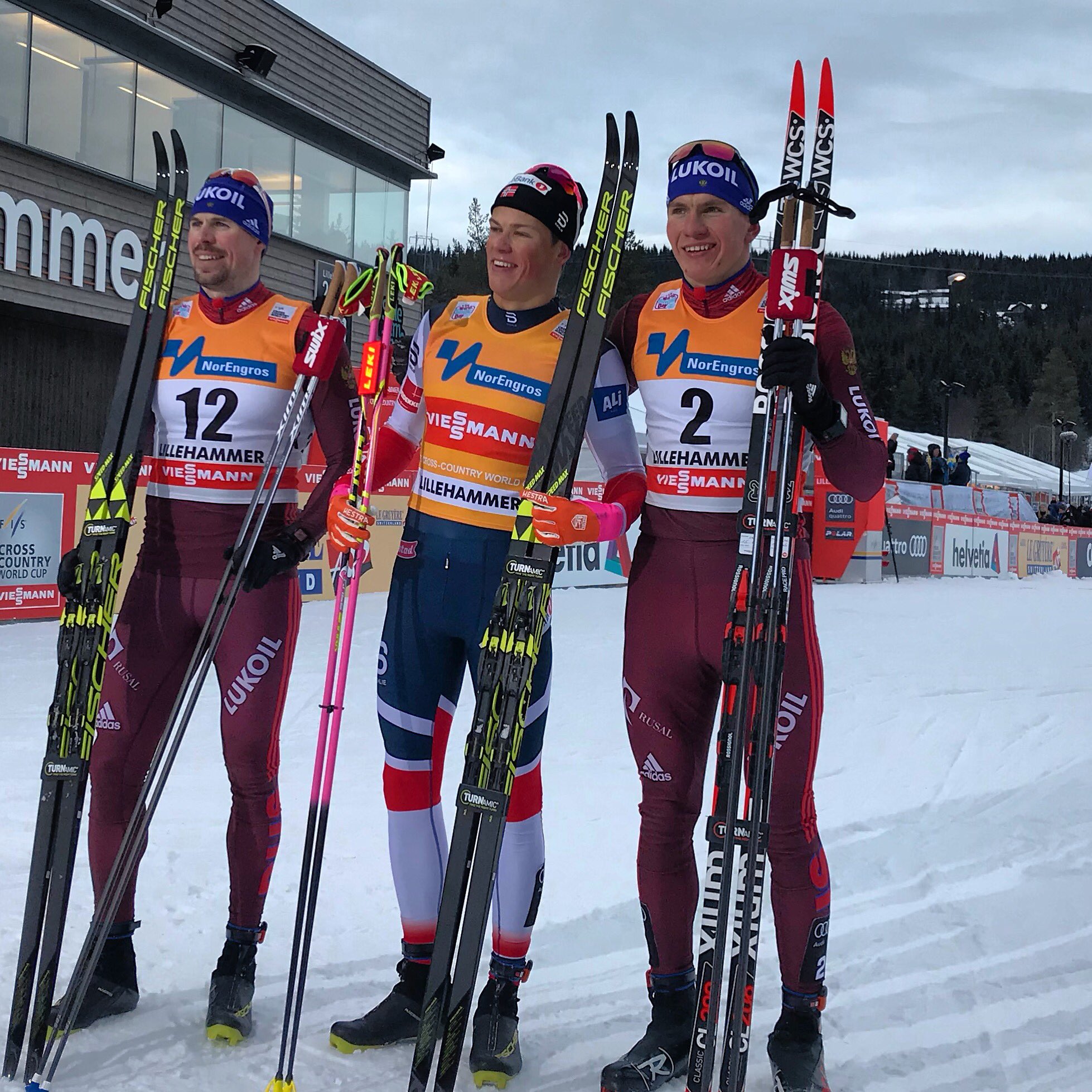
    The men’s 1.5 k classic sprint podium with Norway’s Johannes Høsflot Klæbo (c) in first, Russia’s Sergey Ustiugov (l) in second and Russia’s Alexander Bolshunov (r) in third. (Photo: FIS Cross Country/Twitter)

    In the men’s 1.5 k classic sprint, Norway’s Johannes Høsflot Klæbo continued his undefeated World Cup streak with his fourth win in as many races this season.

    He started off by winning the qualifier in 3:40.79, then his quarterfinal by 0.17 seconds over Russia’s Sergey Ustiugov. Klæbo and Ustiugov met again in the semifinals, where Ustiugov beat the Norwegian by 0.25 seconds, but in the final, where it really mattered, Klæbo again had the edge, winning in 3:33.88. Ustiugov finished 0.83 seconds back for second place, and Russia had two on the podium with Alexander Bolshunov in third (+1.29). Sweden’s Calle Halfvarsson finished fourth (+1.64), and Norway had two more in the final with Emil Iversen in fifth (+8.2) and Sondre Turvoll Fossli in sixth (+17.3).

    Canada’s Alex Harvey was the lone North American to qualify for the men’s heats after racing to 22nd in the qualifier, 11.89 seconds out of first. Harvey’s day ended in the quarterfinals, where he finished sixth, 3.06 seconds behind Norway’s Pål Trøan Aune in first. Norway’s Even Northug took second in that heat (+0.26), Finland’s Ristomatti Hakola was third (+0.36), Norway’s Håvard Solås Taugbøl fourth (+0.67) and France’s Maurice Manificat fifth (+1.72) in that heat. Overall, Harvey placed 28th on the day.

    Erik Bjornsen was the top American man in 35th and missed qualifying by 1.06 seconds. Andy Newell finished 38th and Scott Patterson was 74th for the U.S. Ski Team.

    Jess Cockney was the second Canadian man in 57th, Len Valjas followed in 59th, Julien Locke was 61st, Russell Kennedy 63rd, and Knute Johnsgaard 67th.

    Results:

    Women’s final | Women’s qualifier

    Men’s final | Men’s qualifier

    ***

    IBU World Cup (Östersund, Sweden): Men’s 10 k sprint

    Norway’s 29-year-old Tarjei Bø wins his first World Cup race in four years and three Canadians land in the top 26, led by Scott Gow with a career-best 16th that puts him one step closer to securing his place on Biathlon Canada’s Olympic team. Of the nine men that cleaned the two-stage race, four of them were North Americans (Gow, American Lowell Bailey in 22nd, and Canada’s Nathan Smith in 24th and Christian Gow in 26th).

    Race report

  • Gelso Wins Back-to-Back in West; Guiney Garners First SuperTour Title

    Gelso Wins Back-to-Back in West; Guiney Garners First SuperTour Title

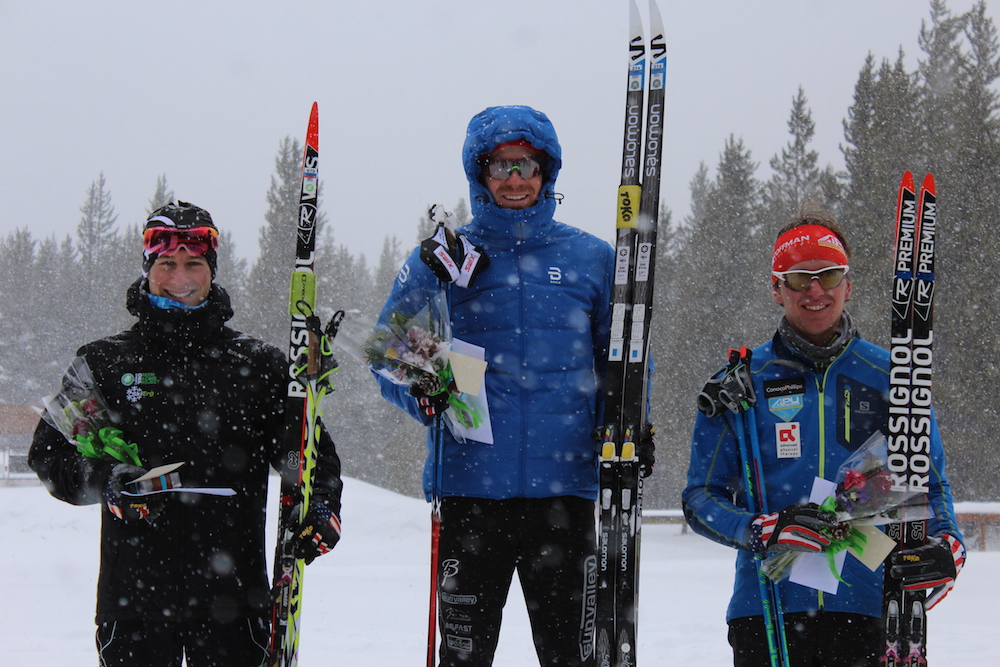
    Matt Gelso (SVSEF) topping the SuperTour podium for the second-straight day on Sunday in West Yellowstone, Mont. Joining him on Sunday's 15 k classic podium: CGRP's Ben Lustgarten (l) in second and APU's Scott Patterson (r) in third.
    Matt Gelso (SVSEF) topping the SuperTour podium for the second-straight day on Sunday in West Yellowstone, Mont. Joining him on Sunday’s 15 k classic podium: CGRP’s Ben Lustgarten (l) in second and APU’s Scott Patterson (r) in third.

    WEST YELLOWSTONE, Mont. — It was the type of day every alpine enthusiast dreams about: fresh powder snow that keeps falling down.

    For cross-country skiers gearing up to race the first classic distance races of the SuperTour season, it was the type of day that creates questions: more or less kick? Chance a step out of the track or stay settled in? To double pole or not to double pole?

    With nearly an inch of fresh snow covering much of the 5-kilometer race loop by the time the men’s field hit the Rendezvous Ski Trails on Sunday for the 15 k classic event, a few skiers opted to forego kick wax altogether and pole through the powder.

    Sun Valley Ski Education Foundation skier, Matt Gelso racing to a first place finish in the men’s 15-kilometer individual start classic race on Sunday in West Yellowstone, Mont.
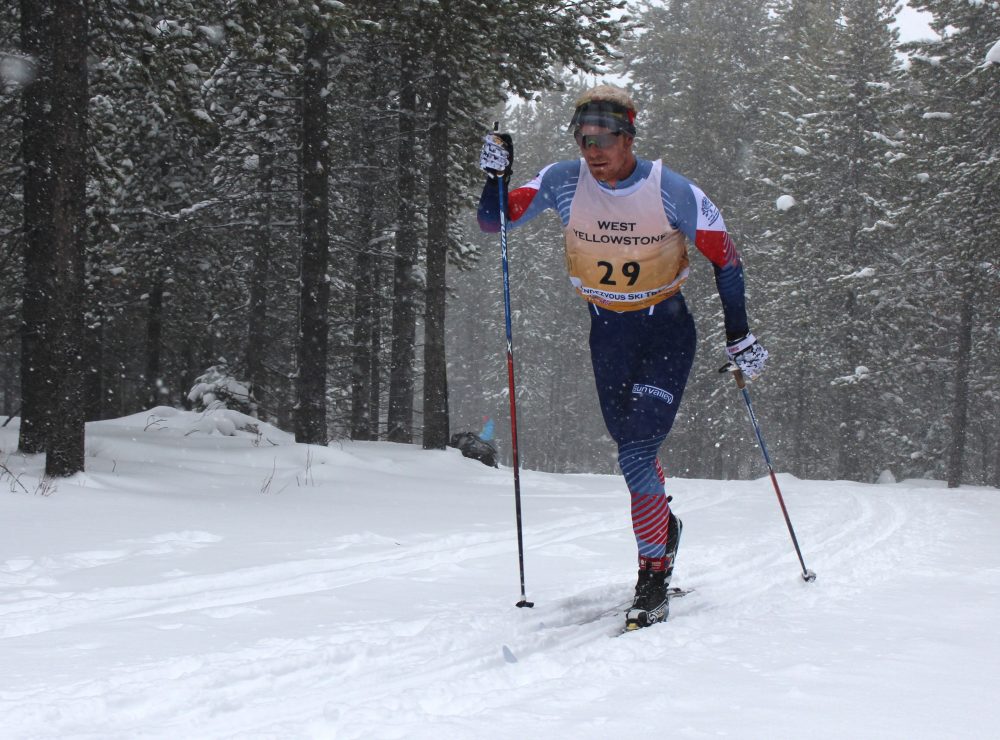
    Matt Gelso (SVSEF) racing to his second-straight victory at the West Yellowstone SuperTour on Sunday in the men’s 15 k classic. In two SuperTour races this season, he’s undefeated.

    Scott Patterson of Alaska Pacific University (APU) was one skier who saw kick wax as costing him seconds. The 28th skier out of the start, Patterson proved his double-pole strength, catching his APU teammate Logan Hanneman — who started 30 seconds ahead of him — within the first 2 k.

    However, by the second time Patterson reached the high point of the course, another blue-suited skier was closing in. Matt Gelso, of the Sun Valley Ski Education (SVSEF) Gold Team, who started 30 seconds after Patterson, was now striding within 15 meters of the APU skier.

    “I didn’t know how the [other] double polers were doing because the only double poler I saw was Scott,” Gelso, 28, told FasterSkier after. “Anybody could have a bad day at anytime, so I was like ‘OK, maybe Scott is having a bad day or maybe double pole wasn’t the right call.”

    Still a fairly early starter in the field, Gelso didn’t see the gap he was closing between himself and Patterson as a sign of securing the win. He continued to drive through the blowing snow, even after passing by Patterson.

    “It was hell of a day out there,” Gelso added. “On that third lap I came through … passed a few people and then it was like the track was blown in and it looked like no one had skied by in like 15 minutes.”

    Completing his third and final 5 k lap, Gelso finished in a time of 42:57, taking the top spot with a little over half the men’s field still on course. As each consecutive skier completed the 15 k, Gelso’s only challenger came from Ben Lustgarten, of the Craftsbury Green Racing Project (CGRP), who finished 32.2 seconds back in second.

    “Baring being super blown out from yesterday[’s sprint], I was expecting to be up there, in the top fighting for it with some guys because I knew my fitness was good,” said Gelso, who also won Saturday’s 1.3 k freestyle sprint. “But … I didn’t realize I had a lead like that.”

    With his back-to-back wins at this weekend’s SuperTour opener, Gelso sees his season and training as heading in the right direction.

    Craftsbury Green Racing Project’s Ben Lustgarten cresting the highest point on course during the men’s 15-kilometer individual start classic race on Sunday in West Yellowstone, Mont.
    Ben Lustgarten (CGRP) racing to the highest point of the course during the men’s 15 k classic on Sunday in West Yellowstone, Mont.

    “I always want to be up there, you don’t train to come in 10th,” Gelso said. “World Cup starts are always a goal …i t’s [also] a World Championship year. … I am sure not the only person out here whose overarching goal for the season is to go to world champs. I went two years ago and it would be pretty cool to go again.”

    In second place on Sunday, Lustgarten also hopes to earn World Cup starts. With that in mind, he will focus in on the upcoming Canadian NorAm/SuperTour races taking place this upcoming weekend at the Sovereign Lake Nordic Centre in British Columbia. 

    “As of now Matt has a great start to the season, so I will need a great few races next weekend to make Period 2,” Lustgarten wrote in an email.  “If not I always have Nationals to do well at.”

    Rounding out the men’s podium in third was Patterson, 1:16.8 seconds back from Gelso.

    “The third time I double poled up Telemark Hill I looked over at some of the guys striding and thought I wouldn’t have minded trading with them,” Patterson reflected. “But you know, whatever you decide, you have to go to the start line and have the confidence you made the right choice.”

    About two seconds behind Patterson, Kyle Bratrud (CXC Team) placed fourth (+1:18.9), and Kris Freeman (Team Freebird) finished fifth (+1:40.2). Completing the top 10, David Norris (APU) placed sixth, Brian Gregg (Team Gregg) was seventh, Ben Saxton (SMST2) eighth, Tyler Kornfield (APU) ninth, and Rogan Brown (SVSEF) 10th.

    (Article continues below)


    Left to right: Stratton Mountain School’s Katharine Ogden and Craftsbury Green Racing Project skiers Kaitlynn Miller, and Liz Guiney along with standing on the podium for the women’s 10-kilometer individual start classic race on Sunday in West Yellowstone, Mont.
    The women’s 10 k classic podium at the SuperTour in West Yellowstone, Mont., with (from left to right) Katharine Ogden (SMS) in second, Liz Guiney (CGRP) in first and Kaitlynn Miller (CGRP) in third.

    Guiney Gets the Ball ‘Rolling’ with First SuperTour Win

    In the women’s 10 k classic on Sunday, Craftsbury’s Liz Guiney (CGRP) took first, claiming her first ever SuperTour victory.

    Guiney covered the two-lap 10 k in a time of 33:52.8, besting second-place finisher Katharine Ogden, of the Stratton Mountain School (SMS) and U.S. Ski Team D-team, by 7.7 seconds.

    Craftsbury Green Racing Project’s Kaitlynn Miller leading Team Gregg’s Caitlin Gregg during the women’s 10-kilometer individual start classic race on Sunday in West Yellowstone, Mont.
    Craftsbury Green Racing Project (CGRP) skier Kaitlynn Miller leading Caitlin Gregg (Team Gregg) during the women’s 10-kilometer individual start classic race on Sunday in West Yellowstone, Mont.

    “Obviously there’s an opportunity to lead the SuperTour,” the 25-year-old Guiney told FasterSkier on Sunday. “[But] I’m kind of just taking it one race at a time … I’m happy with where my fitness is right now and am just going see if I can keep it rolling.”

    Ogden, who recently turned 19, saw her performance as a sign of improvement in her classic skiing.

    “I struggled a little bit with classic racing last year so this is a really encouraging result for me,” Ogden said after.  “I actually love West Yellowstone … I was petty excited, psyched [when the races were moved here].”

    The second Craftsbury GRP racer on the podium, Kaitlynn Miller placed third, finishing 28.4 seconds behind Guiney. While many racers may not have been rejoicing over Sunday’s snowy conditions, Miller explained that a 10 k classic individual race in fresh powder primed her performance.

    “This is kind of my favorite race format and favorite race conditions,” Miller said after.

    Miller, who started 30 seconds behind Caitlin Gregg (Team Gregg), had caught Gregg by the start of the second lap, and the two skied together for the rest of the race.

    “Honestly, I didn’t get a single split during the whole race,” Miller said. “I heard like, Craftsbury’s doing really well and some enthusiastic cheering so I figured things were going well, but mostly I was just out there going for it and having fun.”

    Gregg finished fifth, 1:01.1 behind Guiney and 32.7 seconds behind Miller. Saturday’s skate sprint winner, Jennie Bender placed fourth, 42.4 seconds out of first. Rounding out the top 10, Petra Hyncicova of the University of Colorado-Boulder (CU) placed sixth, Merete Myrseth (University of Utah) was seventh, Christina Rolandsen (CU)  eighth, Erika Flowers (SMST2) ninth, and Guro Jordheim (Utah) 10th.

    With her first SuperTour win packed away, Guiney is excited to get the rest of the season ‘rolling’, especially the upcoming U.S. nationals, which will be held in Park City, Utah, from Jan. 7 to Jan. 12, 2017.

    “Soldier Hollow is kind of my home course, having grown up in Park City,” Guiney said. So I’m excited to race in front of my family and friends and hopefully have some fast races.”

    Complete results

  • Sunday Rundown: Lillehammer, Östersund & West Yellowstone (Updated x6)

    Sunday Rundown: Lillehammer, Östersund & West Yellowstone (Updated x6)

    Matt Gelso (SVSEF) topping the SuperTour podium for the second-straight day on Sunday in West Yellowstone, Mont. Joining him on Sunday's 15 k classic podium: CGRP's Ben Lustgarten (l) in second and APU's Scott Patterson (r) in third.
    Matt Gelso (SVSEF) topping the SuperTour podium for the second-straight day in West Yellowstone, Mont. Joining him on Sunday’s 15 k classic podium: CGRP’s Ben Lustgarten (l) in second and APU’s Scott Patterson (r) in third.

    Welcome to The Rundown, your quick primer of need-to-know information about the day’s racing. We’ll be updating this digest as the day goes on with additional results, photos and quotes. The Rundown is NOT a race report; stay tuned for complete race reports later today with interviews from the day’s top racers.

    (Note: This Rundown has been updated to include comments from U.S. Nordic Combined’s Bryan Fletcher, who placed ninth on Sunday at the World Cup in Lillehammer, Norway.)

    ***

    U.S. SuperTour opener in West Yellowstone: 10/15 k classic

    Matt Gelso made the case that he can win any discipline and format when it comes to cross-country skiing, topping the SuperTour podium for the second-straight day of the circuit’s opening weekend in West Yellowstone, Mont. Gelso, of the Sun Valley Ski Education Foundation (SVSEF) Gold Team, won the men’s 15-kilometer classic individual start in 42:57. He finished 32.2 seconds ahead of Ben Lustgarten of the Craftsbury Green Racing Project (CGRP) in second, and Scott Patterson, of Alaska Pacific University (APU), clocked in 1:16.8 back in third.

    In the women’s 10 k classic, Liz Guiney (CGRP) tallied the distance victory in 33:52.8. Katharine Ogden, of the Stratton Mountain School (SMS) and U.S. Ski Team D-team, finished 7.7 seconds back in second place, while Craftsbury put two on the podium with Kaitlynn Miller in third (+28.4).

    Results

    Nordic Combined World Cup in Lillehammer: Two individual comps and a relay

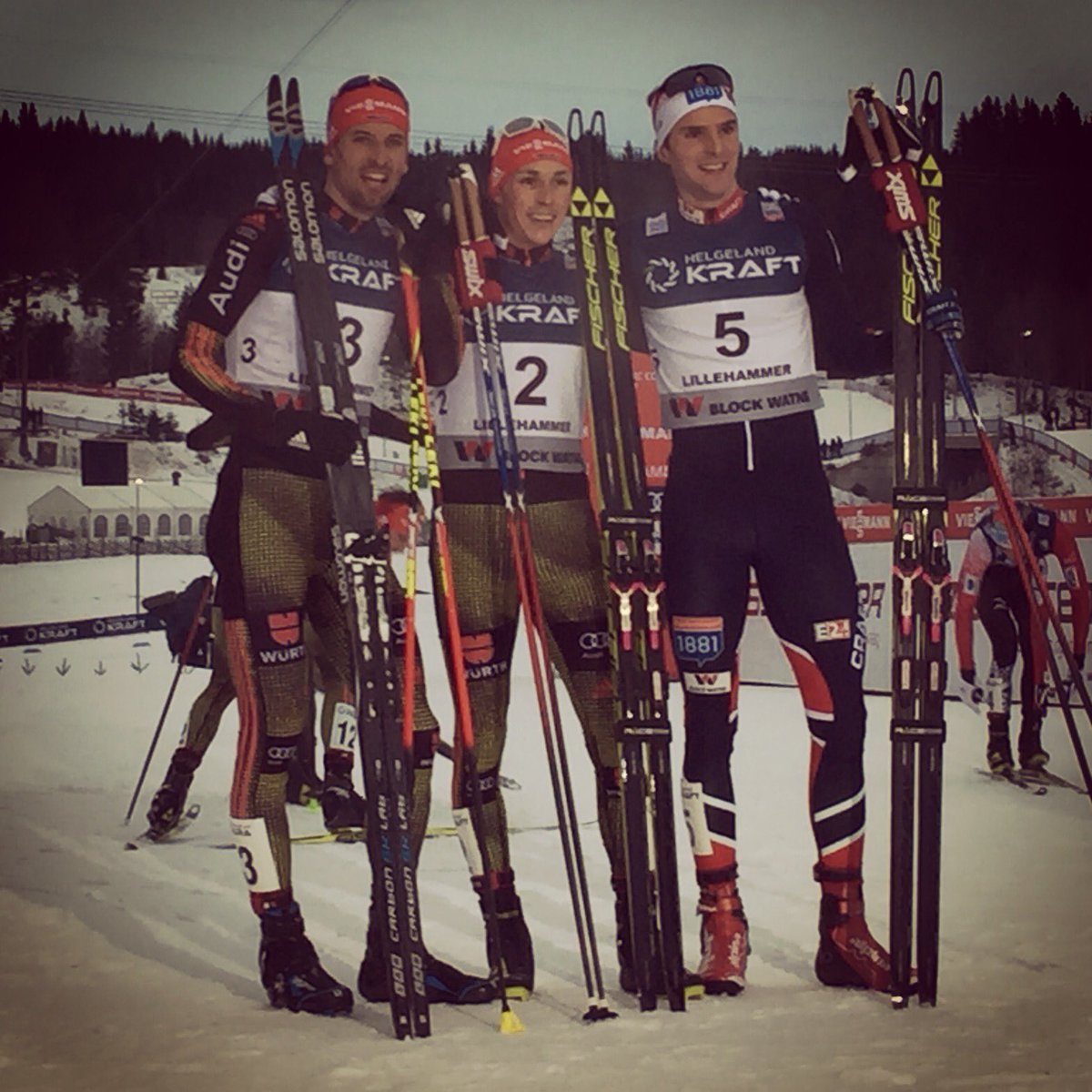
    German winner Eric Frenzel (c) with teammate Björn Kircheisen (l) in second and Norway's Jørgen Graabak (r) in third on Day 3 of the Nordic Combined World Cup in Lillehammer, Norway. (Photo: FIS Nordic Combined/Twitter)
    German winner Eric Frenzel (c) with teammate Björn Kircheisen (l) in second and Norway’s Jørgen Graabak (r) in third on Day 3 of the Nordic Combined World Cup in Lillehammer, Norway. (Photo: FIS Nordic Combined/Twitter)

    [UPDATE) Twenty-second in the jump. Ninth at the finish. That’s a bit more like it for U.S. Nordic Combined’s Bryan Fletcher. The American jumped to 22nd on Sunday on the large hill in Lillehammer, Norway, then raced to ninth in the 10 k Gundersen start cross-country race. He finished 1:22 minutes behind race winner Eric Frenzel, who notched his second-straight individual victory and third win (including Friday’s team event) of the Nordic Combined World Cup’s long weekend in 25:13.6.

    “Going into the race on Sunday I was confident that with a good race I could move up quite well,” Fletcher wrote in an email. “So I just set out to ski my own race and right from the start I was moving up. Top 10 was the goal and I was happy to accomplish that.”

    Germany went 1-2 with Björn Kircheisen in second (+10.8) and Jørgen Graabak of Norway finished third (+23.4) on Day 3 in Lillehammer. Fletcher’s younger brother Taylor Fletcher placed 26th (+2:21.1), moving way up from 48th in the jump (with the fastest overall course time). Also for the U.S., Ben Berend placed 49th (+4:30), and Ben Loomis was 52nd (+5:16).

    The Nordic Combined World Cup is turning out to be all about Germany (most) all of the time, with Frenzel and Johannes Rydzek at the forefront, after Rydzek won both opening World Cup competitions last weekend.

    On Friday, the German teammates started off the three-day series with a victory in the first 4 x 5 k team event of the season. They teamed up with Kircheisen and Fabian Riessle for first, beating Norway by 31.5 seconds with a winning time of 49:34.9.

    Norway’s squad, with Mikko Kokslien, Espen Andersen, Håvard Klemetsen, and Graabak, finished second without anyone else in sight. Austria took third (+1:23.7) with David Pommer, Mario Seidl, Wilhelm Denifl, and Phillipp Orter.

    Finland placed fourth, Japan was fifth, France sixth, the Czech Republic seventh, Italy eighth, and the U.S. ninth (+4:19.1), ahead of Russia in 10th.

    The order for the U.S. team was Bryan Fletcher, Berend, Loomis, and Taylor Fletcher. They rose as high as sixth during Bryan’s first leg, but dropped to eighth and finally ninth.

    On Saturday, in the individual normal hill/10 k competition, Frenzel overtook Rydzek for the win in 24:35. Rydzek started the day by winning the jump, and Frenzel ranked fourth heading into the 10 k Gundersen start. Frenzel overcame a 24-second deficit at the start to pass Rydzek and beat him by 15 seconds at the finish. Germany ended up sweeping the podium with Riessle in third (+25.8), after Riessle improved from 11th at the start with the second-fastest course time.

    Also on Saturday, Taylor Fletcher led the Americans in 26th (+1:51.2) after jumping to 44th and starting 2:02 minutes back from Rydzek. Fletcher skied the ninth-fastest course time.

    Bryan improved from 43rd at the start to 32nd (+2:32.9), Loomis ended up 43rd (+5:02.6) and Berend 44th (+5:33.4).

    “Going into this weekend I was feeling good and had some solid jumps in training so I knew that I was capable of a decent performance,” Bryan wrote on Sunday. “However, I struggle to put all the pieces together through the weekend. The team event was a good performance on my part and it was fun to ski with our young guys too. In Saturday’s event, I was close but had a rather unusual race in which I just couldn’t get going and fell off the pace quickly. Sunday however it all came together with a decent jump and race to finish 9th. This is more indicative of my true level at the moment so I was happy to finally fall into form.


    “This is definitely a result that I was hoping for in this period,” he continued. “I would like to finish in the top 10 consistently this year and it was a bit of a shaky start but I am starting to find the rhythm now. I hope to continue this momentum in Ramsau.”

    Results: Friday’s relaySaturday’s normal hill/10 k | Sunday’s large hill/10 k

    ***

    IBU World Cup in Östersund: 10/12.5 k pursuits

    Men’s report | Women’s report

    Lowell Bailey came oh-so-close to fourth place on Sunday. Just two fewer misses and he could’ve been in the hunt, but that’s how biathlon goes.

    US Biathlon’s top man so far this season, Bailey started 13th in the IBU World Cup 12.5 k pursuit on Sunday in Östersund, Sweden, and by the first prone stage, he was up to seventh with clean shooting. Two-and-a-half kilometers later, he was back in the range and shooting without a miss again. Bailey headed out on his third loop in fourth, and more or less held that position through the third shooting — cleaning yet again in standing.

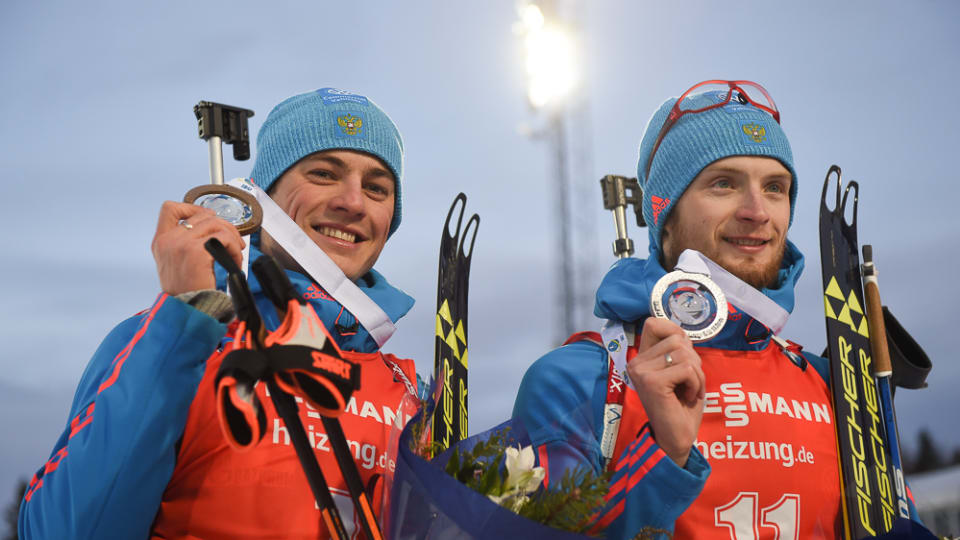
    Russia went 1-2 in the men's 15 k pursuit on Sunday at the IBU World Cup in Ostersund, Sweden, with Anton Babikov (l) winning his first World Cup and Maxim Tsvetkov (r) placing second. (Photo: IBU)
    Russia went 1-2 in the men’s 15 k pursuit on Sunday at the IBU World Cup in Ostersund, Sweden, with Anton Babikov (l) winning his first World Cup and Maxim Tsvetkov (r) placing second. (Photo: IBU)

    But two misses on the final standing dropped him to ninth, and on the final loop, Bailey slipped six spots to 15th at the finish. With two penalties (0+0+0+2), Bailey finished 1:21.8 behind the winner, Russia’s Anton Babikov, who hit 19-of-20 targets en route to his first World Cup victory and podium. Russia took second place as well with Maxim Tsvetkov shooting clean (0+0+0+0) and finishing 10.5 seconds behind his teammate, and France’s Martin Fourcade pushed through four penalties (2+0+0+2) to place third (+15.2).

    Fourcade started the day in first, after winning Saturday’s sprint, and lost the lead on the final stage, with two misses sending him to the penalty lap. On that last shooting, Babikov (the seventh starter) took control, and Tsvetkov (who started 11th) moved up from skiing in third for most of the race to second place.

    Also for the U.S., Tim Burke placed 35th (+2:39.2) after starting 29th, with four penalties (0+1+2+1).

    Canada’s Scott Gow finished 47th (+3:34.8) with three misses (0+0+2+1), Brendan Green was 50th (+3:45.5) wit five misses (1+3+0+1), and Macx Davies 51st (+3:54.6) with four penalties (0+0+2+2).

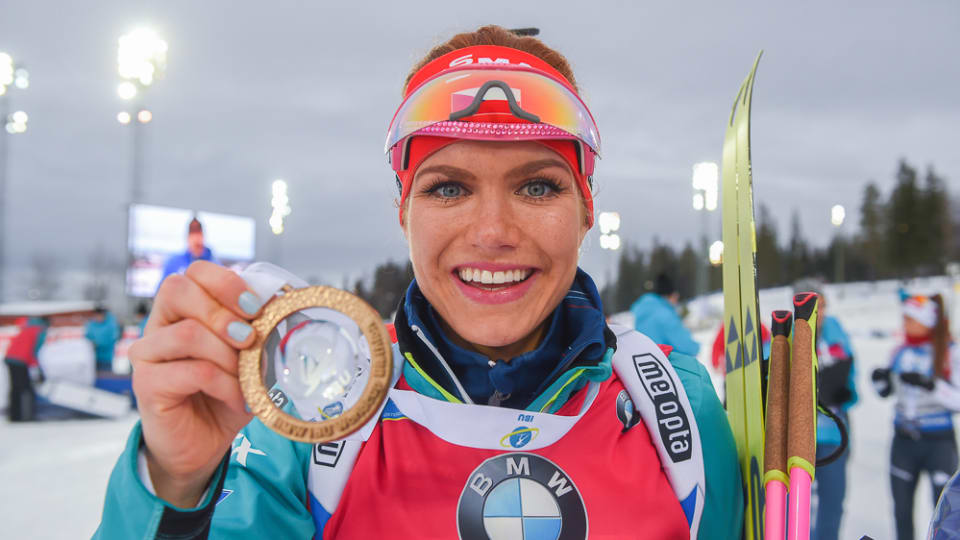
    Gabriela Koukalová of the Czech Republic with her first-place prize after winning Sunday's 10 k pursuit at the IBU World Cup in Ostersund, Sweden. (Photo: IBU)
    Gabriela Koukalová of the Czech Republic with her first-place prize after winning Sunday’s 10 k pursuit at the IBU World Cup in Ostersund, Sweden. (Photo: IBU)

    In the women’s race, Gabriela Koukalová (formerly Soukalova, you’ll get used to it, we promise), took her third-place finish in Saturday’s sprint and catapulted herself into first on Sunday in the 10 k pursuit. Koukalova shot 19-for-20, missing just one on the first standing (0+0+1+0) to cross the finish line first, 8.4 seconds ahead of Germany’s Laura Dahlmeier.

    While Koukalova, of the Czech Republic, took the win in 31:43.3, Dahlmeier placed second (after starting fourth) with two penalties (0+1+1+0). Italy’s Dorothea Wierer improved from 19th to third (+21.4) at the finish, with perfect shooting (0+0+0+0).

    Switzerland’s Lena Häcki also cleaned for fourth (+36.3), after starting 12th.

    The first out of the gate (the winner of Saturday’s sprint), France’s Marie Dorin Habert dropped to seventh, more than a minute and 15 seconds back, with six penalties (2+1+2+1).

    American Susan Dunklee moved up to 22nd (+2:55.7) after starting 27th, despite five penalties (2+2+0+1).

    Also for US Biathlon, Clare Egan improved to 30th (+3:35.4), up from 44th, with three misses (0+0+1+2).

    Joanne Reid (US Biathlon) finished 47th (+4:59.6) with four misses (1+1+1+1), and Canada’s Julia Ransom finished 58th (+6:36.8) with eight misses (2+0+4+2).

    Results: MenWomen 

    ***

    FIS Cross-Country World Cup in Lillehammer: 10/15 k classic pursuits

    Women’s report | Men’s report 

    Martin Johnsrud Sundby is the man to beat once again after winning the men’s 15-kilometer classic pursuit on Sunday in Lillehammer, Norway. The Norwegian started seventh and overcame a 50-second deficit to Sweden’s Calle Halfvarsson, the leader going into the final day of the mini tour. Halfvarsson dropped to fifth, while Sundby rose to first and brought another Norwegian Johannes Høsflot Klæbo to the top with him. Klæbo started sixth, 3 seconds ahead of Sundby, and placed second, 2.3 seconds behind him. Finland’s Matti Heikkinen took the final spot on the podium in third (+2.7), by 0.9 seconds over Norway’s Emil Iversen in fourth. Halfvarsson was 6.3 seconds back in fifth, his Swedish teammate Marcus Hellner sixth (+6.8), Norway’s Pål Golberg and Finn Hågen Krogh seventh (+9.9) and eighth (+15.0), respectively, and Canada’s Alex Harvey ninth (+16.2), ahead of Finland’s Iivo Niskanen in 10th (+52.0)

    Canada had two in the points with Devon Kershaw rising from 43rd to 27th (+2:08.5). Len Valjas placed 48th (+3.44), Graeme Killick was 53rd (+3:53.9), Knute Johnsgaard 72nd (+6:20.3), Bob Thompson 81st (+8:16.3), Andy Shields 83rd (+9:57.3).

    For the U.S., Noah Hoffman rose to 36th (+2:39.5) after starting 48th, Erik Bjornsen finished 57th (+4:33.3), and Eric Packer finished out his first overseas mini tour in 68th (+5:45.1).

    Heidi Weng (c) held onto her lead to win the Lillehammer mini-tour by 16.1 seconds over Norwegian teammate Ingvild Flugstad Østberg (l). Finland's Krista Parmakoski was third after losing a shot at second thanks to a crash. (Photo: FIS Cross Country/Twitter)
    Heidi Weng (c) held onto her lead to win the Lillehammer mini-tour by 16.1 seconds over Norwegian teammate Ingvild Flugstad Østberg (l). Finland’s Krista Parmakoski was third after losing a shot at second thanks to a crash. (Photo: FIS Cross Country/Twitter)

    Heidi Weng of Norway started the 10 k pursuit in first place, and that’s where she finished it, 16.1 seconds ahead of teammate Ingvild Flugstad Østberg. Finland’s Krista Parmakoski rounded out the podium in third, after skiing up from a fifth place starting position and passing Østberg near the end of the race but then crashing on a downhill and losing valuable seconds. Nevertheless her effort gave Parmakoski the fastest ski time of the day.

    Jessie Diggins, who started the race in third position after winning yesterday’s 5 k skate, made an early bid to ski with Østberg but ultimately lost ground, ending eighth, +1:39.4.

    Instead it was Marit Bjørgen who took fourth, +57.5. Stina Nilsson of Sweden was one of the biggest movers of the day, skiing from 27th at the start all the way up to fifth, +1:26.1.

    Following Diggins, Sadie Bjornsen finished 11th, +1:51.2. The American had started in a pack of skiers and stayed there for most of the race. Liz Stephen was 38th (+3:31.8), and Rosie Brennan and Caitlin Patterson 41st (+3:50.2) and 42nd (+3:56.8). Ida Sargent rounded out the U.S. results in 57th (+5:39.7).

    Emily Nishikawa led the Canadians in 46th (+4:08.5), with Cendrine Browne and Dahria Beatty 52nd (+4:41.5) and 59th (+6:08.2).

    Results: Women | Men

  • Gelso Wins First SuperTour Sprint; ‘Big Win’ for Bender in West

    Gelso Wins First SuperTour Sprint; ‘Big Win’ for Bender in West

    From left to right: Alaska Pacific University’s Reese Hanneman, Sun Valley Ski Education Foundation’s Matt Gelso and Alaska Pacific University’s Tyler Kornfield on the podium for the men’s SuperTour 1.3-kilometer freestyle sprint on Saturday in West Yellowstone, Mont.
    From left to right: Saturday’s third-place finisher Reese Hanneman (APU), winner Matt Gelso (SVSEF) and runner-up Tyler Kornfield (APU) on the podium at the men’s SuperTour 1.3-kilometer freestyle sprint on Saturday in West Yellowstone, Mont.

    WEST YELLOWSTONE, Mont. — With a little less than a kilometer left, the pack started to panic. Saturday marked the first SuperTour sprint of the season and the gap Sun Valley Ski Education Foundation (SVSEF) Gold Team veteran Matt Gelso had put on the five other skiers in the men’s sprint final was not getting smaller.

    The winner of last year’s SuperTour sprint season opener, Reese Hanneman of Alaska Pacific University (APU), saw the nearly 15-meter lead Gelso had established halfway through the 1.3-kilometer men’s freestyle sprint final heat as a sign.

    Alaska Pacific University's Tyler Kornfield racing during the qualifier for the men's SuperTour 1.3-kilometer freestyle sprint on Saturday in West Yellowstone, Mont.
    Tyler Kornfield (APU) racing during the qualifier of the men’s SuperTour 1.3-kilometer freestyle sprint on Saturday in West Yellowstone, Mont.

    “I was in third or fourth thinking, ‘Uh, OK, we better start closing this down,’” Hanneman said during an in-person, post-race interview.

    The odds seemed against Gelso. Racing behind him was not only Hanneman (a two-time national sprint champion), but also APU’s Tyler Kornfield (a 2012 national sprint champion), Bend Endurance Academy’s Dakota Blackhorse-von Jess (winner of three national sprint titles), as well as American junior sprint star Cole Morgan (SVSEF), and sprint specialist Ben Saxton of the Stratton Mountain School (SMST2).

    “Basically in the final it was five sprinters and then Matt,” Hanneman said. “So I think he knew that he had to go out like … and then I think none of us thought that [Gelso] could hold it all the way. … It was really impressive skiing by him to just go for it the whole time.”

    Yet, as Gelso began to climb the final hill of the course on the Rendezvous Ski Trails, he proved his gap on the other five finalists would take a strong challenge to beat. Hanneman pushed around Morgan, Saxton and Blackhorse-von Jess, while racing behind his teammate Kornfield. The two APU racers began gaining on Gelso, but not soon enough.

    With 100 meters to go, Gelso, a 28-year-old SuperTour regular best known for his distance skiing, left the two sprint champions chasing, and crossed the finish line first in a time of 2:36.85 for his first SuperTour sprint win.

    “I was pretty fired up,” Gelso said after. “I didn’t know going into the semifinal and final if [leading from the start] was going to still work … but I had the body and the skis to stay consistent with my plan.”

    Crossing 1.94 seconds after Gelso was Kornfield, who indicated that his second-place finish was his best performance on the West Yellowstone sprint course since the start of his sprint career.

    “The first year [I raced] here I didn’t even qualify,” Kornfield said after. “This is the first year I’ve moved on from the quarters…[last year] I got taken out and I took Eric Packer out too.”

    “I think none of us thought that [Gelso] could hold it all the way … It was really impressive skiing by him to just go for it the whole time.”— Reese Hanneman (APU), on Matt Gelso’s sprint performance Saturday

    The final podium finisher for the day was Hanneman, finishing 2.27 seconds after Gelso and 0.33 seconds out of second place.

    “I didn’t feel that good in the qualifier,” Hanneman said. “I was skiing a couple gears lower than I needed to be but then I started feeling better in the heats … I think after today I’ll definitely wake up and feel a little bit better.”

    The final three finishers included Saxton in fourth (+5.1), Morgan in fifth (+5.34) and Blackhorse-von Jess in sixth (+22.85).

    Results: Qualifier | Heats

    ‘Big Win’ for Bender

    In the women’s 1.3 k freestyle sprint, it was Jennie Bender of the Bridger Ski Foundation (BSF), who took first, besting SMST2’s Erika Flowers and Annie Hart.

    Bender, 28, started the day by winning the women’s qualifier in 3:08.76, holding off Hart by three hundredths of a second.

    “My goal is to do better in qualifying, and I did that today, so that was a big win for me,” Bender said. “I love this course and I hope to repeat last year, get back to Europe and race some World Cups.”

    From left to right: Stratton Mountain School skier Annie Hart, Bridger Ski Foundation skier Jennie Bender and Stratton Mountain School skier Erika Flowers on the podium for the women’s SuperTour 1.3-kilometer freestyle sprint on Saturday in West Yellowstone, Mont.
    From left to right: Saturday’s third-place finisher Annie Hart (SMST2), winner Jennie Bender (BSF), and runner-up Erika Flowers (SMST2) on the podium at the women’s SuperTour 1.3-kilometer freestyle sprint in West Yellowstone, Mont.

    After winning the qualifier, Bender’s course time only got faster. She won her quarterfinal in 3:08.24 and her semifinal in 3:06.86. By the time she finished the women’s final in first, she had covered the 1.3 k course in 3:04.78, almost four seconds faster than her qualifying time.

    With a strong headwind challenging many of the racers who chose to lead, Bender decided in her final to follow the other finalists for the first half of the course before making her move.

    “There’s a lot of wind happening so … you kind of have to play with the wind and whether or not you want to be the only one blocking it or not,” Bender said of the heats. “I led my quarter, and I was like  ‘Holy sh*t, I took all the wind myself!’ so I was trying to kind of mess around with sitting behind people the next two heats, and that felt way better.”

    While Bender’s plan for the final was to tuck in and conserve for the first half, then surge to the front in the second half, Hart decided to lead out of the start.

    “Because we had some big headwinds [today] … the debate was whether to lead or follow,” Hart said. “I went into the rounds and decided to lead most of them, because I ski better generally when I kind of feel like I’m in control.”

    Hart skied at the front of the pack up until the course’s last climb, where her teammate Flowers passed her on the right side and Bender cruised by on her left.

    “I just, one, didn’t have much energy left, and two, there really wasn’t anywhere to go,” Hart said of her attempt to hold onto the lead. “I typically don’t do very well in West Yellowstone, so this year was by far the best first race I have had … I will take it.”

    Bridger Ski Foundation skier Jennie Bender (bib 1) leading her semifinal during the women's 1.3-kilometer freestyle sprint on Saturday in West Yellowstone, Mont.
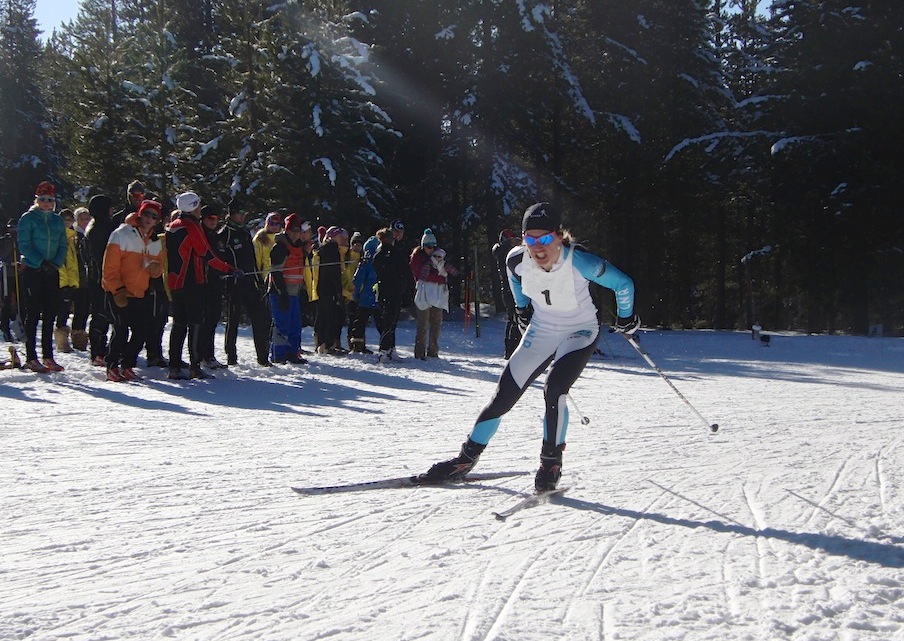
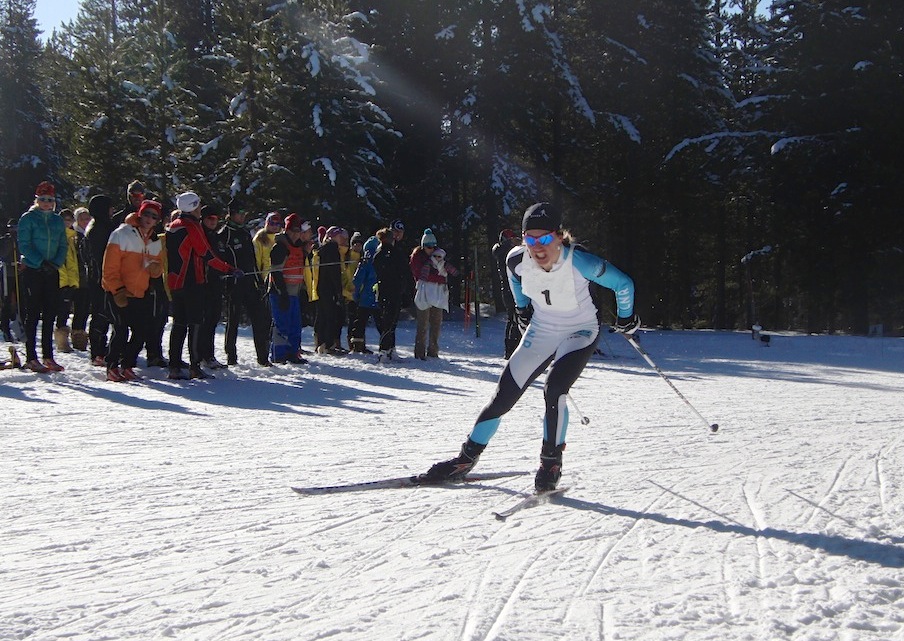
    Jennie Bender (1) of the Bridger Ski Foundation leading her semifinal during the women’s 1.3-kilometer freestyle sprint on Saturday in West Yellowstone, Mont.

    Rounding the final turn, Bender took the inside lane while Flowers remained to the far outside left. The two raced head-to-head through the final 100 meters, lunging to the line for a photo finish.

    Bender was eventually awarded the win and Flowers took second by a mere 0.09 seconds. Hart crossed in third, 1.94 seconds behind Bender.

    “I needed a lane, so I moved outside early and zoomed up the hill as fast as I could, and then into the finish,” Flowers said of final move up the course’s last climb. “I don’t think I quite realized I was as close to Jennie as I was until about ten feet from the finish line. It was exciting, I’ve never thought of myself as a sprinter, so it was fun to do well.”

    “She was behind me the whole time until that hill,” Bender said of Flowers. “And you just save so much energy, due to headwind, so I think that helped both of us. It’s funny, we talked about it before our quarter — she was in my quarter, I was like, ‘it’s better drafting,’ and it worked out!

    “I feel pretty fit compared to previous years, I would say, and I’m hoping for a good season,” Bender concluded.

    Also in the final was Hannah Halvorsen of the Sugar Bowl Ski Academy and U.S. Ski Team in fourth (+2.0), APU’s Chelsea Holmes in fifth (+3.86), and University of Colorado-Boulder (CU) skier Petra Hyncicova in sixth (+4.53).

    Results: Qualifier | Heats

  • Liebsch Earns Final Spot for U.S. at Ski Tour Canada

    Liebsch Earns Final Spot for U.S. at Ski Tour Canada

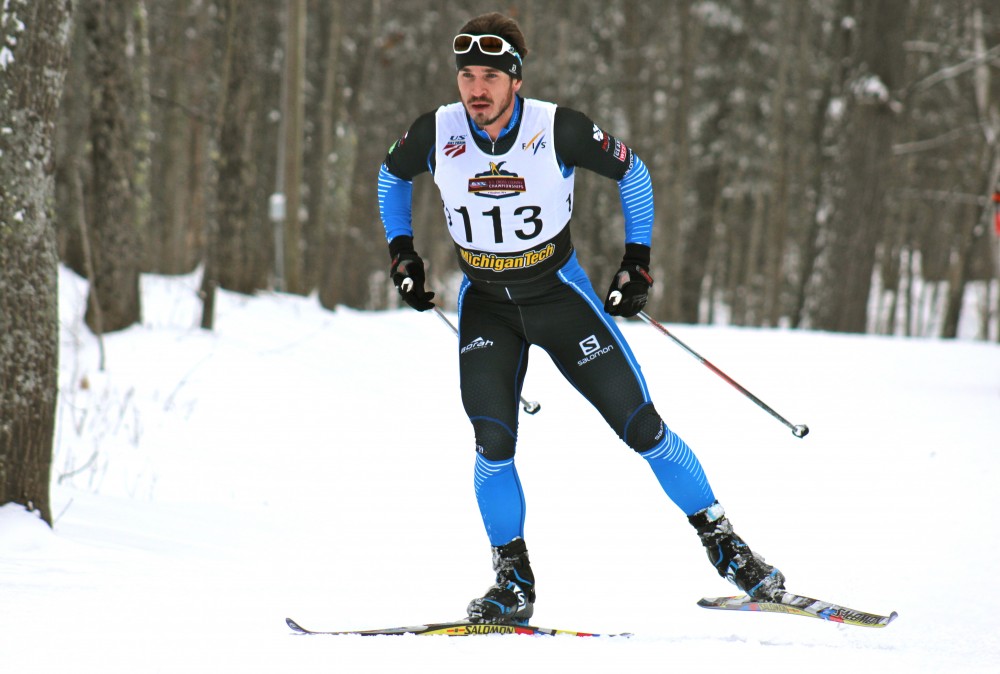
    Photo: Gear West/Salomon skier Matt Liebsch racing to an overall eighth place finish in the men's 30 k freestyle mass start on Thursday at U.S. nationals in Houghton, Mich.
    Matt Liebsch (Gear West/Salomon) racing to an eighth-place finish in the men’s 30 k freestyle mass start at 2016 U.S. nationals in Houghton, Mich. (Photo: Toko)

    Earlier this month, FasterSkier published an article outlining the likely starters for the Ski Tour Canada. Scrolling down the list of Americans, there was a gap with “???” below Noah Hoffman’s name and above Eric Packer’s.

    That mark represented the single U.S. men’s quota spot remaining since Adam Martin, a Northern Michigan University skier and the third man on the SuperTour distance list (post-nationals), declined the opportunity to race at the Ski Tour Canada (STC) World Cups so he could focus on NCAA Skiing Championships in March.

    According to Matt Liebsch, a Gear West/Salomon skier from Orono, Minn., he received an email from U.S. Ski Team Head Coach Chris Grover on Thursday morning stating he’d been officially selected for that remaining spot.

    The Tour begins next Tuesday, March 1 in Gatineau, Ottawa. It may be last minute, but it’s something Liebsch, a longtime racing veteran, welcomes.

    I didn’t know if they were going to take somebody from U23’s,” Liebsch said on the phone about the waiting game, which could have spanned until the end of U23 World Championships on Friday. “They said they would if somebody had a real good result there, but nobody skied quite strong enough so I got the email yesterday [Thursday] at 8 a.m. saying I was in.”

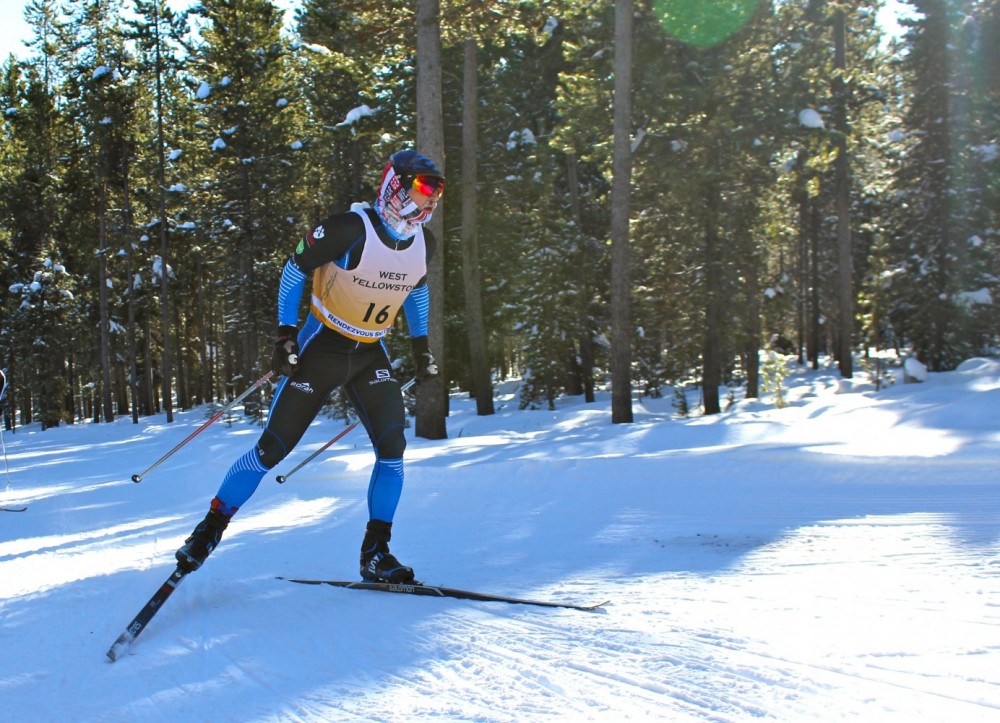
    Matt Liebsch (Gear West/Salomon) racing to second during the SuperTour men's 15 k freestyle in November in West Yellowstone, Mont.
    Matt Liebsch (Gear West/Salomon) racing to second during the SuperTour men’s 15 k freestyle in November in West Yellowstone, Mont.

    It’s been a long road for 32-year-old Liebsch, who scored his first SuperTour points in 2006 in West Yellowstone, Mont. Nearly a decade later, this past November, Liebsch placed second to his friend Brian Gregg in the West Yellowstone SuperTour distance opener: the 15 k freestyle.

    “I was a little bit surprised that I was on the podium for West, honestly,” Liebsch said. “And Brian Gregg, my training partner and I were both like, ‘Wow, geez, how’d that happen?’ We felt pretty good during the race.”

    That podium may have been a surprise for Liebsch, but he had set his intentions for the season well in advance.

    “My goal since summer training was to make Tour du Canada. That’s why I trained a bunch and why I trained pretty hard with Brian all summer,” he said. “So that was kind of something that I circled on my calendar, yeah, I want to qualify and do those. There are a couple of 15 k skates, and the only 15 k skate I have done at a World Cup level, I was in the points. There is a 15 k at Canmore and then there is a pursuit on the East Coast, so I like my chances in those a lot.”

    In his career, Liebsch has competed in four World Cups, all in Canada. The 15 k freestyle in which Liebsch scored World Cup points was in 2010 in Canmore. He finished 29th for the second-best American result

    After his West Yellowstone podium, Liebsch set his sights on the distance races at U.S. nationals in January to solidify his goal of earning starts at the season-ending STC.

    “I just knew that nationals was double-distance Super Tour points, so I figured I needed to be in the top 10 of both of those [distance races] to be in the mix,” Libesch said.

    In the first distance race at nationals in Houghton, Mich., Liebsch placed eighth in the 30 k freestyle mass start, finishing 47.4 seconds behind winner Tad Elliott of Ski & Snowboard Club Vail. Earlier in the week, in the 15 k classic individual start, Liebsch finished ninth.

    Liebsch entered nationals with one outcome in mind regarding the 30 k skate race.

    “I wanted to be on the podium, honestly I wanted to win that thing,” Liebsch recalled. “I’ve been second and third in the distance races at nationals over the past five or six years. But I’ve never taken a national title, that was my chance. I just skied tactically a little bit too aggressively early in the race and burnt too many matches … But I went out and was skiing  aggressively like I was going to try and win that thing.

    “I wasn’t really thinking I need to ski conservatively to try to just place well enough to make the Tour du Canada,” he added. “If that had been my goal, I probably would have been maybe top five, somewhere in there for the skate race. And then I would have been on Tour du Canada for sure, and I would have known back in, I don’t know, early January. That of might made things a little bit easier for me logistics-wise. But I was at nationals trying to win that race.”

    “I wasn’t really thinking I need to ski conservatively to try to just place well enough to make the Tour du Canada. … I was at nationals trying to win that race.” — Matt Liebsch

    Since being notified of his STC invite, Liebsch has had little time for logistics. Soon after, his friend Brian Gregg nudged him to start an online fundraiser.

    “I started it last night, maybe around 7 o’clock,” he said on Friday. “I left work early and I told my bosses that I need to figure some stuff out to get up there.”

    Liebsch works at Gear West in Long Lake, Minn., as the full-time director of nordic ski sales and service.

    Nation’s Group skiers, like Liebsch, are responsible for funding the entire cost of their trip. He estimates with flights, housing and food, along with hiring a wax technician, the price tag will be somewhere around $5,000 dollars.

    Just prior to his phone conversation with FasterSkier, Liebsch had raised around $3,500 dollars. By the time he had hung up, he’d surpassed his initial goal. Late Saturday morning, that number was up to $6,600 (and he’d set a new mark of $6,800).

    “I’ve just been totally taken aback by the support from the ski community. It’s just been super humbling. I’m super blessed to have that support,” he said.

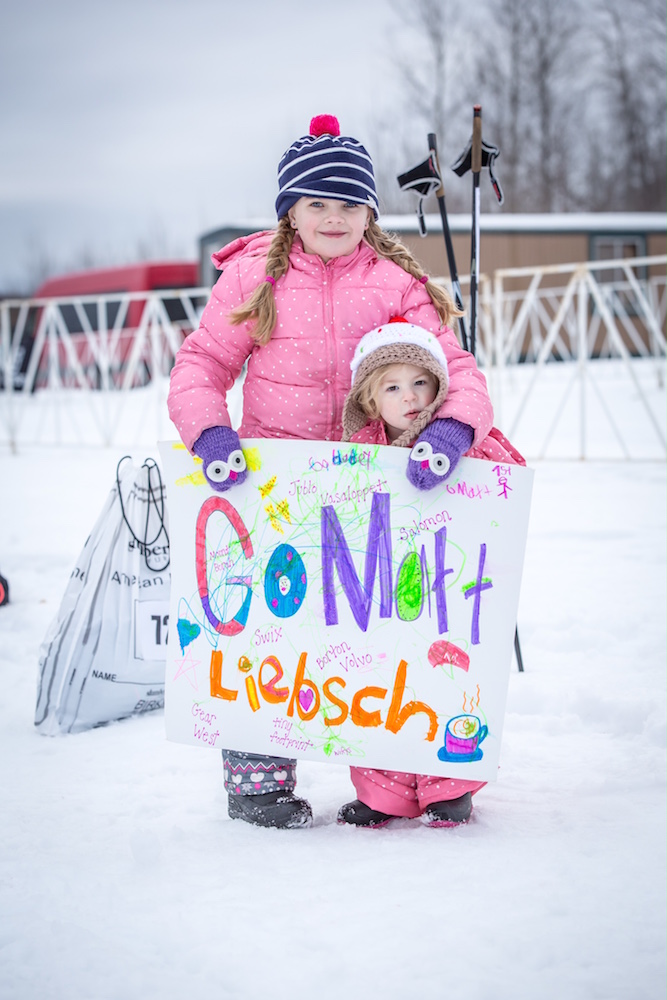
    Matt Liebsch's two daughters, Samatha and Charlotte (Cha-Cha) at the 2016 American Birkebeiner earlier this month. Liebsch placed 17th in the elite men's 52 k freestyle race in Hayward, Wis. (Courtesy photo)
    Matt Liebsch’s two daughters, Samatha and Charlotte (Cha-Cha) at the 2016 American Birkebeiner earlier this month. Liebsch placed 17th in the elite men’s 52 k freestyle race in Hayward, Wis. (Courtesy photo)

    Liebsch is an anomaly at the elite level of U.S. cross country skiing. He works many hours at Gear West along with the more full-time part of his life: raising three children, ages 7, 6, and 2, with his wife, Marybeth.

    Liebsch jokingly referenced Norwegian World Cup leader Martin Johnsrud Sundby’s parenting duties.

    “I think Sundby’s got three kids as well, although his full-time job is skiing,” he said. “It’s exhausting sometimes, but honestly, I live about a mile from my work, I’m in the western metro area [of Minneapolis]. The rollerskiing, the trail running, and the training opportunities are literally right out my front door.”

    This was Liebsch’s schedule Friday morning: Marybeth, who works at the Loppet Foundation, took the two older kids to the bus first thing. Then, she drove to work while he watched the baby at home.

    “I’m a buyer for the store so I was just doing some pre-season reporting and watching the kid,” he said. “Then I took the baby down to Wirth [Park] and swapped and gave her the little one and then met Brian [Gregg] at 10, and we skied for two hours real hard. Now I am going home to have lunch and take a nap and then get a massage and then I think I’m going to lift lightly this afternoon. Friday and Saturday are my normal off days from work.”

    Juggling work, the real nuts and bolts of raising children, and keeping dreams alive can be a pressure cooker — especially when those dreams are elusive.

    “It seems like I’ve lived most of my athletic life on the bubble,” Liebsch said about his not making the cut for the last two Olympics or a World Championships. “It definitely has been heartbreaking at times to get left home. I just love skiing so much. If I’m here locally it just means I get into some local races. I think for some in the ski community that when they are done racing, they kind of look at it like their job, and when they are done racing they might be done skiing. I just love skiing, so when I get to race or train, that’s just what I like to do.

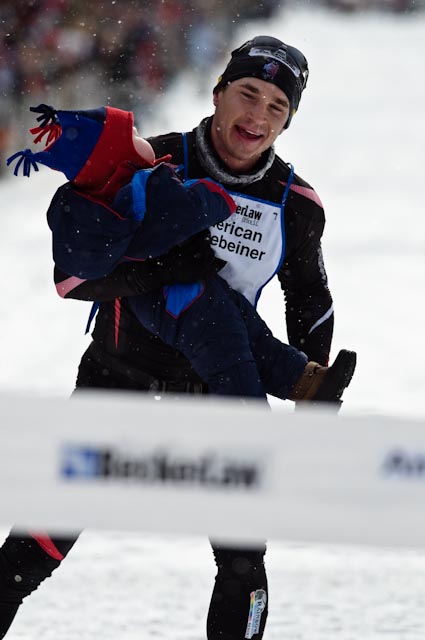
    Matt Liebsch carries his son across the finish line of the 2009 American Birkebeiner
    Liebsch crossing the finish line at the 2009 American Birkebeiner with his son.

    “If I’m not in Russia racing the Olympics, I’ll be stateside racing SuperTours, or jumping in some local races, local marathons,” he added. “I just have that perspective. When I get left home from things that I felt like I should be at, it’s kind of easy to get down on yourself. But I like skiing so much usually I get over myself pretty quick and just keep at it.”

    This time around Liebsch won’t be left back at home. Although known as a distance skier, when Tuesday’s freestyle sprint initiates the STC, Liebsch says he’s ready.

    “The skate sprints, I’m super pumped about that,” Liebsch said of Stage 1 in Gatineau and Stage 3 in Quebec City. “I’m going to approach them like I normally do. I’m excited at the opportunity, and if I have god skis and a good day, I think I can do real well. I am most excited about the distance stuff and there are only three sprints in the Tour, and we’ve got five distance days. I am pretty pumped about that.”

    With his plane ticket booked, and some minor details to be worked out, Liebsch will soon head north. It just may be without the kids in tow.

    “Hopefully I can convince my wife to come up to Canmore for a couple of days to watch me. We are going to leave the kids with Grandma and Grandpa,” he said. “I’m super pumped to get an opportunity to score some World Cup points again. I think I’ve got a legit chance in some of the distance stuff. Hopefully I stay healthy and sharp and I’m expecting I just get stronger as the Tour goes on … I won’t have any work stuff. I’m going to just be able to put my feet up and hopefully just get sharper as we go.”

    Matt Liebsch with his three children on the podium at a local race in the Twin Cities: Ski Renne. (Courtesy photo)
    Matt Liebsch with his three children on the podium at a local race in the Twin Cities: Ski Renne. (Courtesy photo)
  • Twin Cities Training Partners, Gregg and Liebsch Take First and Second in SuperTour 15 k

    Twin Cities Training Partners, Gregg and Liebsch Take First and Second in SuperTour 15 k

    WEST YELLOWSTONE, Mont. — An athlete is often only as good as his or her training partner. Such was the case for the Hanneman brothers as seen in Friday’s SuperTour sprint and again on Saturday during the men’s SuperTour 15-kilometer freestyle individual start at the Rendezvous Ski Trails.

    This time, however, the one-two podium pair belonged to good friends and Twin Cities training partners, Brian Gregg (Team Gregg/Madshus) and Matt Liebsch (Gear West/Salomon).

    “Matt and I train a lot together back in the Twin Cities,” said Gregg, the 15 k winner by 5.5 seconds in 35:25.1. “We do a lot of intervals and time trials together.”

    While the two share no blood relation, they do share a breadth of respect for each other.

    [I’m] super impressed with Matt because he also has a full-time job and three kids,” said 31-year-old Gregg.

    “Maybe that’s something Caitlin and I need to start on,” he added. Gregg’s wife, Caitlin, was named to the U.S. Ski Team this year after taking bronze at 2015 World Championships in the 10 k freestyle.

    Matt Liebsch (Gear West/Salomon) races to second place during the 15k men's SuperTour distance race on Saturday in West Yellowstone.
    Matt Liebsch (Gear West/Salomon) races to second during the SuperTour 15 k freestyle on Saturday in West Yellowstone, Mont.

    Liebsch, 32, was equally excited for his buddy’s overall win.

    “I’m hoping he can get SuperTour Leader so he can get [race] start rights over in Europe [and] go see his wife,” Liebsch said.

    The overall U.S. male and female leaders at the end of two SuperTour weekends will earn a trip to Europe after U.S. nationals in January to start World Cups in Period 2. Gregg put himself in that position two years ago leading up to the 2014 Sochi Olympics.

    For Gregg and Liebsch, their close training over the years translated into a close finish in Saturday’s distance race, despite starting more than 9 minutes apart. Liebsch started 16th; Gregg went out 53rd.

    Gregg skied much of his race with the man who started 15 seconds ahead of him, Mads Strøm of the University of Colorado-Boulder. Strøm went on to place fourth, 14 seconds behind Gregg and 0.7 seconds back from Scott Patterson (Alaska Pacific University) in third.

    “[My start was] definitely a lot faster than I’ve gone out in the past,” Gregg said. “In the past, I’ve probably been 15 seconds down to the leaders at the top of the coach’s climb. This year I was right even with [the leaders].”

    Gregg believed his uncharacteristic charge out of the start gate was the right call.

    “It was nice, because I’d make a big pull, then I’d get tired, then Mads would pull, then he’d get tired, and we sort of switched off leading a little bit,” he said.

    While Strøm and Gregg jostled throughout the race, Patterson spent much of his race solo.

    “The only time I really had a group was when people were behind me,” Patterson said.

    “Oscar Friedman [of Dartmouth] skied with me for two laps,” he added. “It’s nice to have someone on your heels, but not quite as good as trading off the lead.”

    Friedman went on to place 13th. During the race, Patterson heard he was in contention.

    Scott Patterson of APU leads Dartmouth's Oscar Friedman during the men's 15k skate SuperTour race in West Yellowstone.
    Scott Patterson of APU leads Dartmouth’s Oscar Friedman during the men’s 15 k skate SuperTour race in West Yellowstone, Mont.

    “I was getting some splits early on that I was leading Matt Liebsch,” he said. “I was a little bit disappointed they got me in the end.”

    This being the first time Patterson has ever raced in West Yellowstone, the 23-year-old Alaska native called it a solid start to his season.

    “Last fall I had a fairly significant injury and that’s what kept me away from these races,” Patterson said. “But I knew a I had a good summer training and a good fall [this year] and I was definitely going in looking for a spot on the podium.”

    Rounding out the men’s top five after Strøm in fourth (+14.0) was Canada’s Kevin Sandau of the Alberta World Cup Academy (AWCA) in fifth (+20.2). Sandau’s teammate Knute Johnsgaard was sixth (+34.5),  and Sun Valley took the next three places with Ben Lustgarten in seventh (+37.7), Rogan Brown in eighth (+52.5) and Matt Gelso in ninth (+53.5). Lex Treinen (APU) was 10th (+1:04.1)

    While Patterson plans to race next weekend’s SuperTour races in Sun Valley, Idaho, Liebsch and Gregg said they were undecided.

    “I’m supposed to be working next weekend, so I don’t know we’ll see,” said Liebsch, who manages Gear West nordic sales and service. “I’m probably going to go home and train and go to nationals and do the distance races and just see how things go there.”

    Gregg, on the other hand, will either plan to race the SuperTour weekend or take advantage of the altitude training in Sun Valley instead.

    Regardless of what happens next weekend, Gregg and Liebsch were grateful for being able to train together and contribute to each other’s success.

    “Brian drags me out of bed a lot of mornings to do intervals,” Liebsch said. “We’re literally the same speed in most workouts so, it’s cool to be right around him [in races].”

    Results

  • Ogden Pulls the Upset, Edges Holmes in West Yellowstone 10 k

    Ogden Pulls the Upset, Edges Holmes in West Yellowstone 10 k

    Katharine Ogden (SMS/USST) racing to her first SuperTour win in Saturday's 10 k freestyle individual start at the West Yellowstone SuperTour in Montana. She beat Chelsea Holmes (APU) by 1.8 seconds.
    Katharine Ogden (SMS/USST) racing to her first SuperTour win in Saturday’s 10 k freestyle individual start at the West Yellowstone SuperTour in Montana. She beat Chelsea Holmes (APU) by 1.8 seconds.

    WEST YELLOWSTONE, Mont. — Katharine Ogden, or KO as she’s known to many of her friends on the SuperTour circuit, used patience, pacing and tactics to deliver a knock-out punch to the rest of the women’s field in the first distance SuperTour race of the 2015/2016 season.

    Cold temperatures persisted in West Yellowstone, the annual site of the season-opening SuperTour races, but despite a one-hour start delay to let temperatures rise, the competition heated up quickly. The course for the women’s 10-kilometer freestyle individual start was flatter than many that the SuperTour regulars face throughout the season, but because they also offer fewer opportunities to glide on downhills, courses with less climbing aren’t always easier. Saturday’s race utilized a 5 k loop in near-perfect, cold conditions.

    As a concession to the cold, racers started at 15-second intervals, and after about 20 B-seeded skiers through, the elite women in the field started out on the course.

    Chelsea Holmes (APU) led most the women's SuperTour 10 k freestyle on Saturday in West Yellowstone, Mont. She ultimately finished second to U.S. Ski Team rookie Katharine Ogden, who had been sitting in third or fourth for much the race.
    Chelsea Holmes (APU) led most the women’s SuperTour 10 k freestyle on Saturday in West Yellowstone, Mont. She ultimately finished second to U.S. Ski Team rookie Katharine Ogden, who had been sitting in third or fourth for much the race.

    Chelsea Holmes of Alaska Pacific University (APU), certainly one of the favorites heading into the day, was one of the first A-seeds to start.

    “I was psyched on the late start – I love a long morning,” Holmes said in a post-race interview. “My skis were great, the techs worked really hard and did an amazing job, but honestly, I was rather terrified in my warmup. I just felt smashed.”

    An experienced competitor, Holmes, 28, didn’t let that get to her.

    “I don’t think that how you feel in warmup is always an indication of how your race is going to go, so I just tried to keep that in mind,” she said.

    However, as one of the first A-seeds on the course, Holmes didn’t get a lot of feedback regarding her position in comparison to others.

    “I tried not to let it affect me, I was going as hard as I could, and honestly, I don’t know if those splits would have made any difference,” she said. “I was focused on my race plan and not really thinking about what was happening behind me.”

    Holmes is often a fast starter, and Saturday was no exception. She had a strong lead at 5 k, and at the 7.5 k mark, she was still some 22 seconds ahead of Ogden, according to splits from coaches on course.

    A U.S. Ski Team rookie, Ogden of the Stratton Mountain School (SMS) started 15 seconds behind Holmes. In the same distance opener last year, Ogden, who turned 18 earlier this month, placed second in West Yellowstone.

    Going into Saturday’s race, she said she was “feeling pretty nervous but trying not to think about it … I had a lot of expectations, partly because I had a pretty good day last year on this course.”

    Emilie Cedervaern (University of New Mexico) placed third in Saturday's SuperTour 10 k freestyle in West Yellowstone, Mont., 35.6 seconds behind winner Katharine Ogden (not shown).
    Emilie Cedervaern (University of New Mexico) placed third in Saturday’s SuperTour 10 k freestyle in West Yellowstone, Mont., 35.6 seconds behind winner Katharine Ogden (not shown).

    After a good warmup, and feeling that her “skis were really fast,” she set out behind Holmes and 15 seconds ahead of of eventual third-place finisher, Emilie Cedervaern of the University of New Mexico.

    “My first lap was pretty slow actually,” Ogden said. “That wasn’t part of my race plan, but it happens to me pretty often. … I was pretty psyched because I was starting behind Chelsea Holmes, and she’s really fast. It was awesome to be able to get a glimpse of her now and then and think ‘OK, this is a good race because she hasn’t completely dropped me!’ ”

    As the race progressed, Ogden continued to ski well, but didn’t pose an obvious threat.

    “Emilie actually passed me at one point,” Ogden reflected, “but I managed to pass her back.”

    At the 7.5 k mark, with just 2.5 k left to go, on-course splits indicated that Ogden was still some 20 seconds down to Holmes, skiing in third or fourth place. In those last few kilometers, however, she found another gear.

    “I was getting myself back into a position where I could see Chelsea again, and at the bottom of the last hill, my coach Matt Boobar told me that I was only four seconds down. I thought, ‘OK, maybe I can catch up.”

    She did. At the finish, Ogden clocked 27:07 minutes, beating Holmes’ time by 1.8 seconds.

    As the A-seed skiers continued to roll in to the finish, it became apparent that Holmes and Ogden had outpaced the rest of the field. When final results were posted, the up-and-comer Ogden had eked out the victory and Cedervaern held on for third, 35.6 seconds behind Ogden. It was her first SuperTour win and third podium.

    Despite narrowly missing the win, Holmes, who placed fourth in Friday’s sprint, called it a “very successful start to the race season.”

    In a text message after the race, Cedervaern wrote that she was generally happy with her race despite feeling “tired and slow” between 5 and 7 k. “Other than that I thought it went very well!” she wrote.

    Six-and-a-half seconds off the podium, Jennie Bender, who won Friday’s freestyle sprint, placed fourth (+42.1). The Bridger Ski Foundation skier finished 3.1 seconds ahead of the University of Utah’s Veronika Mayerhofer in fifth (+45.2), and Caitlin Patterson (Craftsbury Green Racing Project) was sixth (+52.4).

    Seventh through ninth were separated by half a second, with APU’s Rosie Frankowski in seventh (+53.4), Eliska Hajkova, a Boulder Nordic Junior Racing Team coach, in eighth (+53.6), and Becca Rorabaugh (APU) in ninth (+53.9). Utah’s Sloan Storey rounded out the top 10 in 10th (+1:01).

    The SuperTour’s next stop is in Sun Valley, Idaho, for next weekend’s classic sprint and distance races.

    Results

    ***

    About the Author: Travis followed up a somewhat undistinguished competitive career with the University of Colorado with coaching positions in Steamboat, Boise, and most recently as the Gold Team Coach in Sun Valley. As of 2011, he works with middle school skiers, including his own two boys, and sells second homes to dot-com millionaires in Nordic Town USA: Sun Valley, Idaho. 

  • Hanneman Brothers Go 1-2, Logan Edges Reese in West Yellowstone Sprint

    Hanneman Brothers Go 1-2, Logan Edges Reese in West Yellowstone Sprint

    The Hanneman brothers after placing first and second in the men's SuperTour freestyle sprint on Friday in West Yellowstone, Mont. Younger brother Logan Hanneman (r) won the final for his first SuperTour victory and Reese (l) placed second.
    The Hanneman brothers, both of which race for Alaska Pacific University, after placing first and second in the men’s SuperTour freestyle sprint on Friday in West Yellowstone, Mont. Younger brother Logan Hanneman (r) won the final for his first SuperTour victory and Reese (l) placed second.

    WEST YELLOWSTONE, Mont. – Reese Hanneman spent much of the cold afternoon in West Yellowstone unchallenged on Friday. He cruised to wins in both his quarterfinal and semifinal. However, the challenge came from close to home, as Hanneman led down the final stretch in the men’s final before his younger brother and Alaska Pacific University (APU) teammate Logan powered past him for the win.

    After a cold morning with temperatures hovering in the negative single digits, resulting in a two-hour start delay, the men’s field jumped into the first SuperTour race of the season shortly after 11:30 a.m. Nerves were running high as athletes headed out on to the relatively flat 1.3-kilometer course in 15-second intervals to test themselves against the clock and gauge the effectiveness of their summer training.

    “The course was in great shape, grooming was perfect,” Reese Hanneman reflected in a post-race interview.

    Canadian national-development team member Knute Johnsgaard took the win in the qualifying round in 2:30.9 minutes, 0.72 seconds ahead of defending U.S. national sprint champion Dakota Blackhorse-von Jess of the Bend Endurance Academy.

    APU teammates and brothers, Logan, 22, and Reese Hanneman, 25, qualified in third and fourth, respectively, and Canada’s Andy Shields (Thunder Bay National Development Centre) advanced in fifth.

    Most of the established elite racers in the men’s field managed to ski their way in to the top 30, earning the right to compete in the afternoon’s elimination rounds.

    Dakota Blackhorse-von Jess (Bend Endurance Academy) racing to second in the qualifier on Friday at the SuperTour skate-sprint opener in West Yellowstone, Mont.
    Dakota Blackhorse-von Jess (Bend Endurance Academy) racing to second in the qualifier on Friday at the SuperTour skate-sprint opener in West Yellowstone, Mont. He went on to place third in the final.

    As the rounds progressed, two men skied to comfortable wins in their quarterfinals and semifinals. Reese was one of them and Blackhorse-von Jess was the other, displaying impressive finishing speed to win his quarterfinal by a convincing margin. Johnsgaard and Shields also skied strong through the quarters, as did Matt Gelso of the Sun Valley Ski Education Foundation (SVSEF) Gold Team, after qualifying in 20th. Montana State University’s Forrest Mahlen and Alex Howe (Craftsbury Green Racing Project) also stayed in contention through the semifinals.

    When eventual winner Logan Hanneman saw the list for his semifinal, “I thought, ‘Good grief!’ ” he explained. “Mads [Strøm, of the University of Colorado-Boulder], [Ben] Saxton [of Stratton and the U.S. Ski Team], Dakota… I don’t know how this is going to go! That’s a tough group.”

    But by the end of the semi, Logan and Blackhorse-von Jess had established themselves as the frontrunners and the finish was almost too close to call.

    “At that point, I knew I had a pretty good chance heading in to the final,” Logan said.

    When the lucky losers had been sorted out and the start list for the men’s final was posted, Blackhorse-von Jess, Johnsgaard, Gelso, Howe and both Hanneman brothers had reached the final round. Mahlen, Brian Gregg (Team Gregg) and Saxton narrowly missed the cut.

    The tension increased as the six men toed the line for the final, with two consecutive false starts due to malfunction with the starter’s pistol.

    The start of the men's final in the 2015/2016 SuperTour opener, the 1.3 k freestyle sprint, on Friday in West Yellowstone, Mont. APU took first and second with Logan Hanneman and Reese Hanneman, respectively, and Dakota Blackhorse-von Jess placed third.
    The start of the men’s final in the 2015/2016 SuperTour opener, the 1.3 k freestyle sprint, on Friday in West Yellowstone, Mont. APU took first and second with Logan Hanneman and Reese Hanneman, respectively, and Dakota Blackhorse-von Jess placed third.

    When the gun fired in earnest, Blackhorse-von Jess shot to the front, a move he had used all day.

    “If you’re willing to burn your jets early, you can get to that first corner with a lead,” he said afterwards. “It worked for me in the quarters, it worked for me in the semi, and it worked for me last year.”

    Several athletes have noted that, on this particular course, there aren’t many spots to pass, which made Blackhorse-von Jess’s strategy successful. Until the final, that is.

    “Reese made a really bold move at the bottom of the climb,” Blackhorse-von Jess said. “It’s a risky move, because if you can’t execute it all the way, you can drop from second back to fourth or fifth.”

    It worked for the older of the two Hannemans, as Reese moved in to the lead at the bottom of the course’s only real climb.

    According to Gelso, who finished fifth, “There was a lot of bumping and grinding in the final. Everyone was amped up and trying to get in to position all the way around the loop.”

    “I was thinking that Dakota was the guy to beat,” Reese said. “He’s so consistent. When I saw the chance to get around him at the bottom of the climb, I jumped on it.”

    A few skiers back, 22-year-old Logan had been focusing on strategic cornering through the lower “NASCAR” section of the course.

    Logan Hanneman (l) leads older brother Reese Hanneman (c) and Dakota Blackhorse-von Jess into the finishing stretch to win the 1.3 k freestyle sprint at the West Yellowstone SuperTour opener for his first SuperTour victory.
    Logan Hanneman (l) leads older brother Reese Hanneman (c) and Dakota Blackhorse-von Jess into the finishing stretch to win the 1.3 k freestyle sprint at the West Yellowstone SuperTour opener for his first SuperTour victory.

    “There’s a corner in there, the last corner before the climb… I’d been focusing on taking a little bit wide in the quarters and the semis and had used that move to pass a few guys each time,” Logan said.

    In the final, his timing was perfect. “Just after that corner, Reese made his move, and I jumped on with him and got past Dakota,” he said.

    When they emerged from the trees at the top of the climb and made the 90-degree turn to toward the finish, it was Reese, followed by Logan and Dakota, with Johnsgaard, Gelso and Howe close behind. A bit of contact between Gelso and Howe slowed the duo, but in the front, a battle for the win was shaping up between the Hannemans.

    “I was leading, but I could hear Logan behind me, then I could see the tips of his skis coming up beside me,” Reese recalled. “I knew that he and Dakota were back there, and when it comes to sheer wattage those guys are so powerful, they’re like a couple of bison. Plus, Logan is like 6’3”. On a gradual downhill like the one leading in to the finish, he’s just so fast.”

    Crossing the line with a three-meter lead, Logan grabbed his first-ever SuperTour win, coming off of successful college career at the University of Alaska-Fairbanks. Reese joined him on the podium in second, with Blackhorse-Von Jess there as well in third. Johnsgaard skied to fourth, Gelso was fifth and Howe came in sixth.

    “I think I may need to stop giving him all my good hand-me-down skis,” joked Reese, who was both satisfied with his own performance and thrilled with his younger brother’s victory.

    The West Yellowstone SuperTour continues with the first distance race of the season, the 10/15 k freestyle individual start on Saturday.

    Results

    ***

    About the Author: Travis followed up a somewhat undistinguished competitive career with the University of Colorado with coaching positions in Steamboat, Boise, and most recently as the Gold Team Coach in Sun Valley. As of 2011, he works with middle school skiers, including his own two boys, and sells second homes to dot-com millionaires in Nordic Town USA: Sun Valley, Idaho. 

  • West Yellowstone SuperTour Women’s 10 k (Photo Gallery)

    West Yellowstone SuperTour Women’s 10 k (Photo Gallery)

    WEST YELLOWSTONE, Mont. — A look at the top 10 and some others in the women’s 10-kilometer freestyle individual start on Nov. 30 — the final race of the West Yellowstone SuperTour. Read more.

  • Weekend Roundup: And So It Begins

    Weekend Roundup: And So It Begins

    Sadie Bjornsen (USA) on her way to seventh place.  Photo: Fischer / Nordic Focus.
    Sadie Bjornsen (APU/USST) on her way to seventh place in Satuday’s 5 k classic. (Photo: Fischer / Nordic Focus)

    The official beginning to the 2014 racing season didn’t disappoint with tons of exciting nordic action taking place across the globe. The World Cup kicked off in all three nordic disciplines, including the highly anticipated Super Tour races in West Yellowstone, Mont., which FasterSkier covered on-site.

    World Cup racing began on Friday with the classic sprint as the first leg of the Ruka Triple mini-tour in Kuusamo, Finland. Kikkan Randall (APU/USST) come out firing with a second-place finish, her best in a World Cup classic sprint. Justyna Kowalczyk won it, looking as strong as ever. Sadie Bjornsen (APU/USST) dominated in the qualifier in third and finished the day in 26th, and teammate Ida Sargent finished 16th. On the men’s side, Eirik Brandsdal of Norway overcame Anton Gafarov and Teodor Peterson to win the first World Cup race of the season. Andy Newell was the lone North American to qualify and finished the day in 24th.

    Bjornsen demonstrated that Friday’s result was not a fluke by finishing seventh in the 5 k classic on Saturday, followed by Randall in 15th. Kowalczyk won the race with the Norwegian duo of Marit Bjørgen and Therese Johaug in hot pursuit. Lukas Bauer won the 10 k classic, followed closely by Eldar Rønning. Canadian Ivan Babikov and Noah Hoffman (USST/SSCV/Team HomeGrown) were the only two North American men to crack the top 30, finishing 21st and 28th respectively.

    On the final day of action in Kuusamo, Bjørgen captured her fourth-straight Ruka Triple title, besting Swede Charlotte Kalla and teammate Johaug by nearly 20 seconds in the 10 k pursuit. For the U.S., Randall, Jessie Diggins (SMST2/USST), and Liz Stephens (Burke/USST) respectively recorded the seventh, eighth and ninth fastest times of the day, with Randall finishing fifth overall. Hoffman made major waves and skied the fastest time in the men’s 15 k, rising from 38th to ninth in the mini tour. Norway’s Martin Sundby won the Ruka Triple, just 12 seconds ahead of Hoffman.

    The U.S. SuperTour opened in West Yellowstone and Team Gregg dominated. The Midwest couple, Caitlin and Brian Gregg conquered the field with Caitlin winning both Friday’s skate sprint and Saturday’s 10 k skate (by over a minute and 20 seconds) and Brian taking second overall in the 15 k skate (to Norwegian Mads Strøm, a University of Colorado freshman).

    The International Biathlon Union (IBU) World Cup opened on Thursday in Östersund, Sweden, with a 20 k individual, which France’s Martin Fourcade won. Canadian Jean-Philippe Le Guellec finished an impressive fourth and teammate Nathan Smith placed 16th.  More impressive results followed, with American Tim Burke notching third in Saturday’s 10 k sprint behind winner Fourcade. Teammate Lowell Bailey finished 14th, and Susan Dunklee was 16th in the women’s 7.5 k sprint on Friday. Sunday’s pursuit races were canceled due to inclement weather.

    In nordic-combined action in Kuusamo, American Taylor Fletcher posted the fastest time in his anchor leg to give the U.S. seventh in the 4 x 5 k team event.

    FIS Cross-Country World Cup, Kuusamo, Finland (results)

    Friday’s Classic Sprint | Men’s Report | Women’s Report |

    Saturday’s Classic 5 k and 10 k | Men’s Report |North American Men’s Report |North American Women’s Report|

    Sunday’s 10 k and 15 k Pursuits | Men’s ReportWomen’s Report | Canadian report |

    Super Tour, West Yellowstone, Mont. (results)

    Friday’s Skate Sprint | Men’s ReportWomen’s Report |

    Saturday’s Skate 10k and 15 k | Men’s ReportWomen’s Report | Men’s Photo Gallery | Women’s Photo Gallery

    IBU Biathlon World Cup, Östersund, Sweden (results)

    Thursday’s 15 k and 20 k | Men’s Report

    Friday’s 7.5 k Sprint | Women’s Report |

    Saturday’s 10 k Sprint |Men’s Report |

    FIS Nordic Combined World Cup, Kuusamo, Finland (results) | RecapInterview

  • Strøm Overcomes Fatigue for West Yellowstone SuperTour Win; Gregg Second in 15 k Skate

    Strøm Overcomes Fatigue for West Yellowstone SuperTour Win; Gregg Second in 15 k Skate

    Mads Strøm (University of Colorado) starting his first of three times up Tele Hill in the SuperTour 15 k freestyle individual start on Saturday in West Yellowstone, Mont. Strøm won the race by more than 14 seconds.
    Mads Strøm (University of Colorado) starting his first of three times up Tele Hill in the SuperTour 15 k freestyle individual start on Saturday in West Yellowstone, Mont. Strøm won the race by more than 14 seconds.

    WEST YELLOWSTONE, Mont. – Mads Strøm is a 22-year-old full-time student in his freshman year at the University of Colorado (CU), yet he’s been training like it’s his job.

    In Saturday’s SuperTour 15-kilometer freestyle individual start – the second and final race in West Yellowstone – it showed as Strøm beat more than 120 men, completing the three-lap course at the Rendezvous Ski Trails in 34:22.9 minutes. He finished 14.1 seconds faster than runner-up Brian Gregg (Madshus/Team Gregg) and was 20 seconds ahead of Sylvan Ellefson (Ski & Snowboard Club Vail/Team HomeGrown) in third.

    “I know I’m fast, but we’ve been training almost 30 hours this last week so [on Friday] I didn’t feel that good,” said Strøm, who spent the summer working out with his home club Bærums Verk IF in Oslo, Norway. He was coming from a good place after last season, when he tallied placed 26th at Norwegian nationals in April in the 50 k classic.

    It could’ve been West Yellowstone’s altitude of nearly 7,000 feet, about 1,500 feet higher than that of his college town in Boulder, or the effects of the first race of the season: the 1.3 k freestyle sprint. Strøm didn’t advance through the quarterfinals on Friday after being knocked out in a photo finish with eventual winner Emil Johansson, of Sweden, and Skyler Davis (Stratton Mountain School T2 Team).

    Mads Strøm, a Norwegian freshman at the University of Colorado (r), passes Moritz Madlener (University of Denver) on Tele Hill during Saturday's SuperTour 15 k freestyle individual start in West Yellowstone, Mont. Strøm won the race by more than 14 seconds.
    Mads Strøm, a Norwegian freshman at the University of Colorado (r), passes Moritz Madlener (University of Denver) on Tele Hill during Saturday’s SuperTour 15 k freestyle individual start in West Yellowstone, Mont.

    That left Strøm “kind of pissed off actually,” he said, which he used as fuel as the fifth starter on Saturday. Without many splits to work with early on, Strøm simply went fast. After the first lap, he heard was fighting for a top three – mostly with Ellefson – and 14 seconds out of first. One lap later, he was within 1 second of the lead, and by the third time around, up to 17 seconds ahead.

    “I was really pushing it really hard on that last lap,” Strøm said.

    Meanwhile, Ellefson and Matt Liebsch (XC United/Team StrongHeart), who started 30 seconds apart, respectively, were duking it out as well. Starting 6 minutes behind Liebsch, Gregg was also gunning for a top three, making all three SuperTour favorites push even harder along the working course, with little opportunity to rest.

    From the splits Ellefson was getting, he heard Strøm was “just crushing it” on the first lap, but slowing on the second lap. “Then [he] got pissed off on his third lap and finished hard,” Ellefson said. “My goal being the first person in the A-seed was to set a good time. I think I went out just a little bit too hard.”

    Ellefson said he suffered the effects on the last two laps, feeling less snappy like he would’ve liked, but “was able to hold a solid pace.”

    “I have mixed feelings about today,” Ellefson said. “I am really happy with the result, but I wasn’t totally happy with the way my body felt.”

    Brian Gregg (Madshus/Team Gregg) en route to second in the West Yellowstone SuperTour 15 k skate.
    Brian Gregg (Madshus/Team Gregg) en route to second in the West Yellowstone SuperTour 15 k skate.

    Gregg knew where he stood in regards to Ellefson and Liebsch, who ended up fourth, but wasn’t sure about Strøm. Down by 20 seconds on the first lap, he focused on building into the race, like his former coach Scott Johnston of the Methow Olympic Development squad had advised.

    “I have a tendency to start out too hard and sort of fade in that last little bit,” Gregg said. “[I] tried to stay a little relaxed, but I was a little worried that I was so far back from those guys.”

    Ultimately, Gregg’s plan worked. “I was able to pace pretty well,” he said as the second-place finisher (and top American), which puts him in a good spot for early season racing.

    “My two focus races are this 15 k and then the 15 k at Silver Star next weekend,” Gregg said.

    Unlike many SuperTour skiers, including his wife, Caitlin, Brian Gregg won’t be heading to Bozeman for the second series next weekend, instead opting to race the season-opening NorAm in British Columbia. Several Americans will venture to Canada for the first two weekends of NorAms (in Silver Star and Rossland) in an effort to boost their FIS points.

    On Saturday, Caitlin won the women’s 10 k skate for her second win of the weekend. That puts her in a prime spot as the overall SuperTour leader shooting for World Cup starts in January.

    “It was very good to have a win yesterday, and I actually was pretty happy about my sprint result, too,” said Brian Gregg, who qualified in 26th and narrowly missed advancing out of the quarterfinals in third. “We’re pretty excited about where our fitness is, and we have the whole family out here for Thanksgiving.”

    Team Gregg gathers Saturday after Caitlin won and Brian placed second in West Yellowstone (from left to right): Jim and Jan Gregg, Brian and Caitlin Gregg, and Chad and Alieta Gregg.
    Team Gregg gathers Saturday after Caitlin won and Brian placed second in West Yellowstone (from left to right): Jim and Jan Gregg, Brian and Caitlin Gregg, and Chad and Alieta Gregg.

    Standing with his parents, brother and sister-in-law, and Caitlin after Saturday’s races, Gregg referred to them all as Team Gregg.

    “My mom brought the sewing machine to sew all the [sponsor] patches on our uniforms,” he said. “And then my brother and sister-in-law and my dad were out there doing the splits, [and I had] a couple friends out there …”

    One of his good friends, Liebsch was missing his family, which typically travels from the Twin Cities to watch him in West, but he understood the decision. His wife, Marybeth, wanted him to focus on racing, he said. And she was also due with their third child in late March/early April.

    “I just talked to her, she’s a saint,” Liebsch said. “I was pretty sad that she didn’t make it out here with the kids this year, but we will make it out another year as a family. … This was not quite the result I was looking for today, but a good start.”

    Despite feeling pretty good, Liebsch said he was still working into the race season.

    “I didn’t have top gear when I tried to push it,” he said. “I didn’t feel like I went any faster that effort. I just skied really big and smooth and then tried to close as hard as I could.”

    Up on Gregg for the first two laps, he knew what his friend was capable of.  “I did intervals with him a week ago and he was moving really fast,” Liebsch said. “So I knew he would probably ski pretty well out here.”

    Syvlan Ellefson (SSCV/Team HomeGrown) leading a train his second time up Tele Hill in Saturday's 15 k skate at the West Yellowstone SuperTour.
    Syvlan Ellefson (SSCV/Team HomeGrown) leads a train his second time up Tele Hill in Saturday’s 15 k skate at the West Yellowstone SuperTour. Ellefson had skiers racing behind him most of the race.

    Liebsch focused on catching Ellefson, who put time into Liebsch on the first lap. Liebsch ended up 10.8 seconds behind Ellefson, just off the podium. Next weekend, Liebsch will also race at Silver Star.

    “This is a big season, trying to make the Olympic team,” he said. “I really would like to ski that 50 k skate at Sochi. We are all kind of gunning for race wins and low FIS points. We are not overseas racing, but maybe some of us might go over, it depends.  I know nationals is really important, so I am targeting that this year.”

    Strøm said he was excited for the NCAA season and will try to race at Norwegian nationals in January. “We’ve been training a lot and trying to do good races here, too, to show that we are able to ski fast even though we are living in the U.S. and studying full time,” he said.

    In fifth place, NCAA champion Rune Ødegaard (CU) finished 55.7 seconds behind Strøm, and Miles Havlik (Sun Valley Ski Education Foundation) was sixth (+1:06.6). Tyler Reinking (Bridger Ski Foundation) finished seventh, Niklas Persson (Utah) was eighth, Pierre Guedon (Denver) placed ninth, and Sawyer Kesselheim (Montana State University) was 10th.

    — Lander Karath and Matt Voisin contributed reporting

    Complete results

    Matt Liebsch (XC United/Team StrongHeart) on his way to fourth in the 15 k skate at the West Yellowstone SuperTour.
    Matt Liebsch (XC United/Team StrongHeart) skiing ” big and smooth” before placing fourth in Saturday’s 15 k skate at the West Yellowstone SuperTour.
  • West Yellowstone SuperTour Men’s 15 k (Photo Gallery)

    West Yellowstone SuperTour Men’s 15 k (Photo Gallery)

    WEST YELLOWSTONE, Mont. — A look at the top 10 and some others in the men’s 15-kilometer freestyle individual start on Saturday — the second and last race of the West Yellowstone SuperTour. Read more.

  • Gregg Makes It a Double at West Yellowstone SuperTour, Wins 10 k Skate

    Gregg Makes It a Double at West Yellowstone SuperTour, Wins 10 k Skate

    Caitlin Gregg (Madshus/Team Gregg) on her way to winning Saturday’s West Yellowstone SuperTour 10 k freestyle individual start by 1:21.4 minutes in 25:45.6.
    Caitlin Gregg (Madshus/Team Gregg) on her way to winning Saturday’s West Yellowstone SuperTour 10 k freestyle individual start by 1:21.4 minutes in 25:45.6. It was her second win of the weekend in as many races, and she did it after her husband, Brian, placed second in the men’s 15 k skate.

    WEST YELLOWSTONE, Mont. – Watching her husband round the 5-kilometer race course at the Rendezvous Ski Trails three times on Saturday, Caitlin Gregg (Madshus/Team Gregg) had a sense it was going to be another good day.

    Less than 24 hours after winning the qualifier and every heat of the women’s 1.3 k freestyle sprint – including the final – on Friday, Gregg was witnessing her hubby Brian make a run for SuperTour podium as well. He ended up second in the men’s 15 k freestyle individual start, 14.1 seconds behind Mads Strøm, a Norwegian freshman at the University of Colorado (CU).

    Congratulating Brian afterward, Gregg maintained her focus for her 10 k freestyle race, and Brian didn’t waste time getting out on the course to cheer her on. She had played it cool all morning, not letting Friday’s victory take hold of her – or the cold symptoms she was fighting when she woke up Saturday.

    “I pretty much used that mind over matter thing: I just said, let’s go with it,” Gregg said. “I was walking around this morning and I was super chill and super calm because I didn’t want to use up any extra energy before the race. … I told Brian, basically, ‘I want to kick my own butt today.’ ”

    The second A-seed in a field of 83 women, Gregg knew her best gauge during the race would be her own intuition; back splits wouldn’t be available. So she pushed – hard on the first lap and even harder on the second at nearly 7,000 feet above sea level.

    Having faith in her summer altitude training in places like Utah, Canada and Truckee, Calif., and results in unofficial races, such as the Frozen Thunder distance time trial on Nov. 1 in Canmore, Alberta (which she won), Gregg didn’t worry about red-lining or taking herself out of contention.

    That all-or-nothing attitude resulted in her second straight victory in as many SuperTour races this season. Gregg won the 10 k by more than a minute and 20 seconds in 25:45.6.

    After arriving in West Yellowstone about a week and a half before the races, Gregg said she mostly trained alone to practice the feeling of skiing hard in strategic parts of the course.

    “I was able to work on some pacing tactics and different aspects of the terrain to know where to find the seconds,” she said. “I think that was a huge advantage … because when I did see the start list, I knew that it would be more of a time trial.”

    Caitlin Patterson (Craftsbury Green Racing Project) races to second in Saturday's 10 k freestyle individual start on the final day of the West Yellowstone SuperTour.
    Caitlin Patterson (Craftsbury Green Racing Project) races to second in Saturday’s 10 k freestyle individual start on the final day of the West Yellowstone SuperTour.

    By the time she ascended the most significant climb on Saturday, Tele Hill, it was clear to coaches timing their own athletes that Gregg was way ahead of anyone else. Caitlin Patterson of the Craftsbury Green Racing Project (CGRP), who ultimately placed second, said Gregg was 25 seconds ahead of her around two kilometers in, when Patterson was in third.

    “That was a little bit of a shock but I tried not to let it bother me too much,” Patterson said. “It’s good to hear splits, but to some extent you have to just keep trucking along, especially at altitude when weird things can happen.”

    Bonking is a very plausible reality for most skiers in a distance race at high elevations – less oxygen makes it difficult to dig deeper and easy to slow down. And with choppy conditions on the uphills on a damp day in the mid-30s, the hardest parts of the course were even tougher.
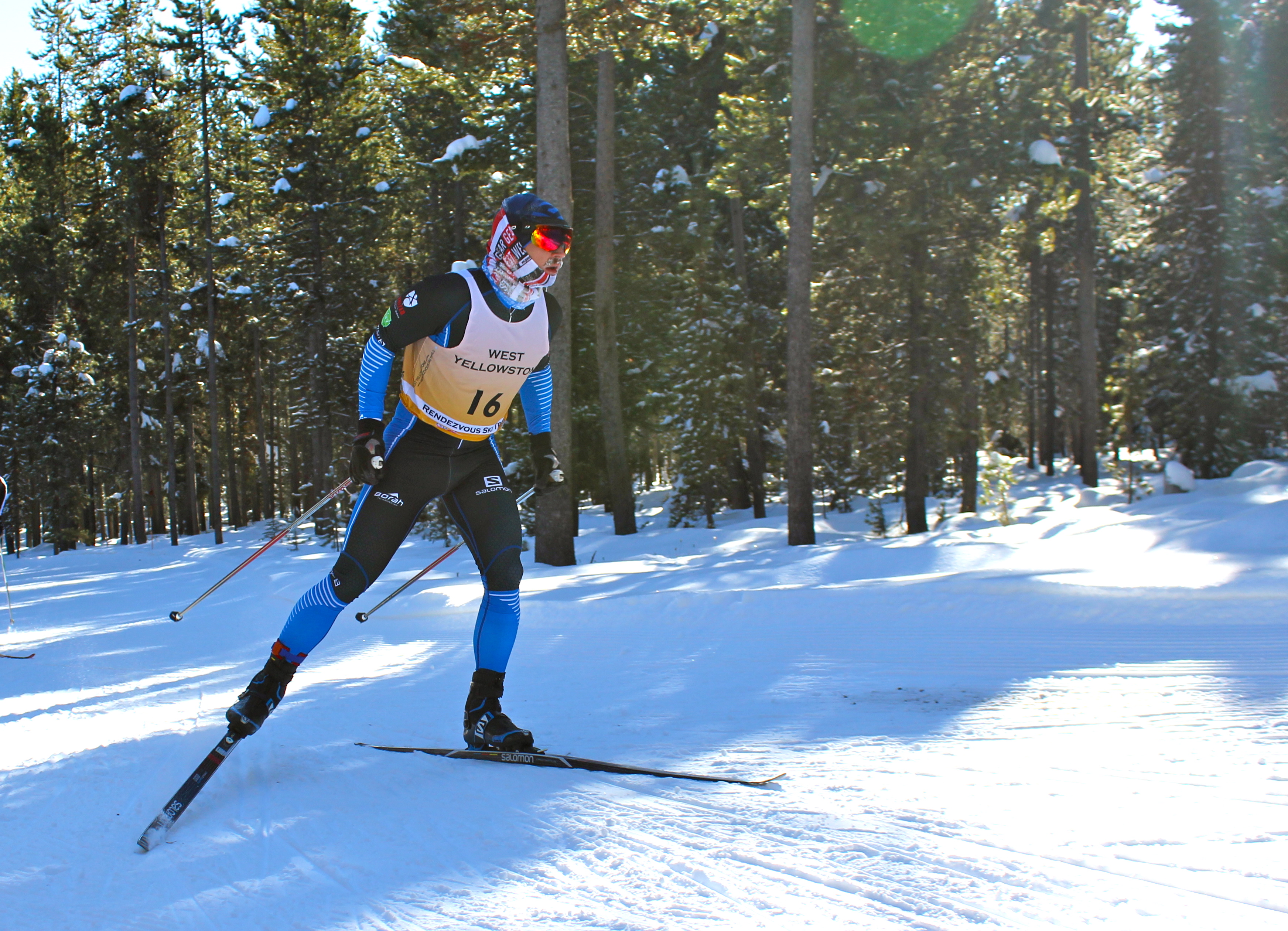
    But bonking wasn’t part of Gregg’s plan. She didn’t really consider it, and by her second and final time up Tele Hill, she was well over a minute ahead of anyone else.
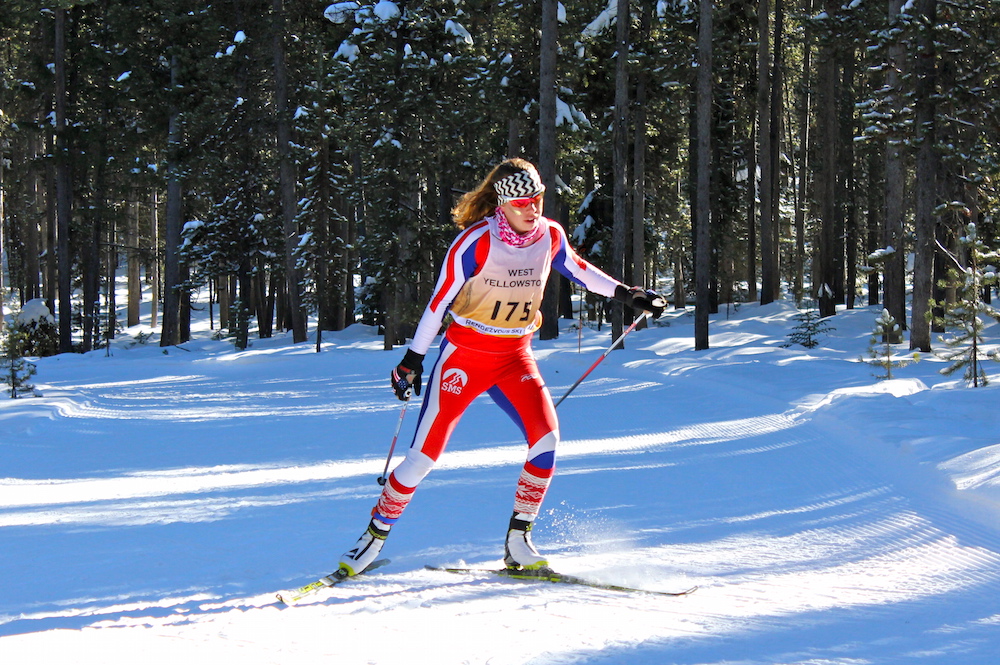
    “I’ve been joking with some people that this year is one of those years to just go big and see what happens, and to put it all out there,” Gregg said. “If I don’t do that, I’ll never know. I figure if I do and it doesn’t happen at least I gave it my all.”

    Caitlin Gregg (Madshus/Team Gregg) gets ahead of the pack the second time up Tele Hill at the Rendezvous Ski Trails in West Yellowstone, Mont.
    Caitlin Gregg (Madshus/Team Gregg) gets ahead of the pack the second time up Tele Hill at the Rendezvous Ski Trails in West Yellowstone, Mont.

    By it, Gregg means qualifying for the 2014 Olympics in Sochi, Russia, which would be her second Olympics since the 2010 Vancouver Games. She could do so by continuing to lead the SuperTour circuit through next weekend’s races: a classic 10 k and classic sprint in Bozeman, Mont. On Friday, Gregg said she was grateful the SuperTour opened in West Yellowstone with skate races to boost her confidence.

    The male and female SuperTour leaders will earn World Cup starts in Europe in January, giving them an opportunity to show their capable of solid international results as well. From there, a U.S. Olympic team will be named.

    For Team Gregg, Saturday’s results were a step in the right direction toward that goal; Brian was the top American in the 15 k.

    “It’s incredible,” Gregg said. “It’s so fun when this stuff happens.”

    All the preparation she and Brian did, especially through last winter with Methow Olympic Development Coach Scott Johnston, paid off. Since forming Team Gregg for this season, Caitlin said she’s been writing her own training plan.

    “We are super grateful for the training [we did with him],” Gregg said of Johnston. “He has some really innovative ways for training and I think that’s been really helpful for Brian and I. … I’d say he one of the best technique coaches I’ve ever, ever worked with.”

    In second place, Patterson was a little discouraged by finishing 1:21.4 minutes behind Gregg.

    “I never like being beaten by so much, but Caitlin Gregg must’ve been really flying today, and I can see that she’s in really great shape,” Patterson said.

    Kate Fitzgerald (APU) holds her own in third while ascending Tele Hill for the second time on Saturday. She went on to place third in the West Yellowstone SuperTour 10 k freestyle individual start.
    Kate Fitzgerald (APU) holds her own in third while ascending Tele Hill for the second time on Saturday. She went on to place third in the West Yellowstone SuperTour 10 k freestyle individual start.

    After turning up her tempo after the first couple kilometers, Patterson heard she was in second for most of the race. She stayed there, finishing 24.4 seconds ahead of Kate Fitzgerald (Alaska Pacific University) in third.

    For Patterson, the key was skiing conservatively to start, but making sure she wasn’t holding back too much. “I did a pretty good job pacing, not bonking at all,” she said.

    “Podium was my goal [so] I’m happy with it, definitely,” she added. “I would’ve liked to have been closer to the lead, but there’s nothing I can do about that now except ski faster next race.”

    Third most of the race, Fitzgerald kept her position with an 11-second margin over Sylvia Nordskar (University of Denver) in fourth. She had a sense it was going well, feeling “big and powerful” and remembering to stay in control.

    “It was just steady work the whole time, just keeping it steady and not freaking out at any one certain part,” Fitzgerald said. “You couldn’t really kill the uphills. There’s not enough time to recover if you tap out.”

    “I’m pretty stoked to have a podium,” she added. “It’s a big year and everyone is really excited about the Olympics. I think it’s pretty sweet.”

    Following in fifth, Erika Flowers of the Stratton Mountain School T2 Team (SMST2) finished 2:02.6 back from Gregg. Independent skier Cambria McDermott was sixth, Eliska Hajkova (CU) placed seventh, Annie Pokorny (SMST2) was eighth, Jessica Yeaton (Montana State University) took ninth, and Mary Rose (Sun Valley Ski Education Foundation) was 10th.

    — Mark Vosburgh contributed reporting

    Complete results

    Team Gregg, Caitlin and Brian (second from r) with their longest-running sponsor, Toko rep Ian Harvey (r), and a Midwest fan.
    Team Gregg: Caitlin and Brian (second from r) with their longest-running sponsor, Toko rep Ian Harvey (r), and a Midwest fan in West Yellowstone, Mont.
  • A Crowd Favorite, Gregg Cruises to Women’s SuperTour Sprint Victory in West Yellowstone

    A Crowd Favorite, Gregg Cruises to Women’s SuperTour Sprint Victory in West Yellowstone

    Caitiln Gregg (Madshus/Team Gregg) rounding the final corner into the stadium at the Rendezvous Ski Trails to win Friday's 1.3 k skate sprint, the first SuperTour race of the 2013/2014 season, in West Yellowstone, Mont.
    Caitiln Gregg (Madshus/Team Gregg) rounding the final corner into the stadium at the Rendezvous Ski Trails to win Friday’s 1.3 k skate sprint, the first SuperTour race of the 2013/2014 season, in West Yellowstone, Mont.

    WEST YELLOWSTONE, Mont. – The highlight of Caitlin Gregg’s day was seeing all her Midwest fans, her Loppet Nordic Racing buddies, at the finish of each heat on Friday during the first SuperTour race of the season.

    That gave her reason to celebrate and smile every time she won, which the 33-year-old Gregg did all morning and early afternoon at the Rendezvous Ski Trails. After posting the fastest women’s qualifying time of 2:55.52 in the 1.3-kilometer freestyle sprint, Gregg went on to ski away from her competitors in each round thereafter.

    Pushing all the way across the line for the fourth time of the day – seconds ahead of Jennie Bender (Bridger Ski Foundation), who placed second, and Becca Rorabaugh (Alaska Pacific University), who finished third in the final – Gregg threw her hands in the air. Couldn’t have gone any better, she thought.

    Caitlin Gregg (Madshus/Team Gregg) celebrates a big opening win at the West Yellowstone SuperTour 1.3 k skate sprint.
    Caitlin Gregg (Madshus/Team Gregg) celebrates a big opening win at the West Yellowstone SuperTour 1.3 k skate sprint.

    “This is probably one of the biggest races for me,” said Gregg, of Madshus Racing and more recently Team Gregg.

    “We’ve got my family, my husband’s family here, all of the other people on the circuit that we’ve worked with. Just to have that energy here right now actually means some of the most to me. I think I had six or seven Loppet Nordic Racing kids … at the finish line [of every heat]; that’s the best feeling ever. You just realize that’s what it’s about. It’s ski racing, and it’s just fun to share with everyone.”

    In her first official race of the 2013/2014 season, Gregg won the qualifier by 2.18 seconds over Becca Rorabaugh. She went on to dominate her quarterfinal, beating runner-up Sylvia Nordskar (University of Denver) by 3.5 seconds.

    Gregg then commanded her semifinal in 2:48.3, six-tenths of a second faster than runner-up Caitlin Patterson (Craftsbury Green Racing Project). Patterson went on to place fifth in the final, ahead of Andrea Lee (University of New Mexico) in sixth and behind Erika Flowers (Stratton Mountain School T2 Team) in fourth.

    For Gregg, it was a great start – one that puts her on the path to World Cup starts in January if she continues to rule the SuperTour series, which next stops in Bozeman, Mont., Dec. 7-8.

    “I’m very grateful that we’re starting out with skate races,” she said of her preferred discipline. Saturday’s SuperTour 10 and 15 k distance races in West Yellowstone are freestyle as well.

    “It’s always nice to feel that’s in your favor and you’re starting off on a good foot,” she added.

    With the University of New Mexico waxing for Gregg and her husband Brian this weekend, she quickly credited the team’s coaches and staff.

    “They just nailed the waxing so, for me, it became very easy,” she said. “[In the heats, I] kind of hung and tried to stay out of trouble, and then it was pretty obvious after that first little bit of the downhill my skis were just awesome so I just decided to go for it.”

    Rorabaugh, who won her quarterfinal and was second to Bender in a photo-finish semifinal, recalled when Gregg took off in the final: not too far in, right after the last downhill.

    After descending from the flat stretch out of the stadium, the five other women tried to keep up with Gregg on the low-lying backstretch, still nearly 7,000 feet above sea level. It was curvy and technical. “Lots of jostling for position,” Bender explained.

    “I knew that Caitlin was probably just gonna go for it and I still wasn’t ready to go with her, which was silly,” said Rorabaugh, who was jockeying for third when Gregg accelerated across the flat.

    Earlier, Rorabaugh tried to control her heats and ski conservatively, knowing she could make the final if she played her cards right.

    “The danger is sometimes you check out a little bit rather than being in full-on go mode the entire day,” she said. “I think it made it harder for me when Caitlin decided to take off.”

    Jennie Bender (BSF) racing to a quarterfinal win in Friday's West Yellowstone SuperTour 1.3 k skate sprint. She went on to place second in the final to Caitlin Gregg (Madshus/Team Gregg).
    Jennie Bender (BSF) racing to a quarterfinal win in Friday’s West Yellowstone SuperTour 1.3 k skate sprint. She went on to place second in the final to Caitlin Gregg (Madshus/Team Gregg).

    Meanwhile, Bender was trying to come back from an early slipup just outside the stadium, in which she dropped to sixth.

    “I got in a bad spot and everyone passed me and I was like, ‘Uh oh,’ ” Bender recalled. “But there were good places to tuck in behind people and then swing around them. … I tried to plan it so that coming up that last hill, I would be in a decent spot.”

    As Bender picked people off, Gregg held her gap up the final climb and skied out of reach by the time she entered the stadium. Bender followed, and Rorabaugh tried to challenge her for second, but Bender had the better line.

    Uncontested through the finishing stretch, Gregg had strung out the entire group, yet she pushed entirely through the finish.

    “Honestly, I’m a nervous wreck,” Gregg said of lining up against talented sprinters like Bender and Rorabaugh. “I think that’s the best thing to be because if you get too complacent you forget to go for it. I was telling the little kids that: never assume anything until the race is over. You’ve got to work every inch of the way.”

    After qualifying in eighth, Bender owned her quarterfinal with a 1.5-second win over Anika Miller (Montana State University), the third-fastest qualifier. Troubled by a back injury throughout the summer and even a few days ago, Bender was pleased to be pain free on Friday and able to give her all through the heats. She had made a point to do as much precautionary work as possible (stretching, ibuprofin and ice) while training in West Yellowstone.

    “I felt like it’s the one thing that’s been throwing off my balance, but it felt good today,” she said. “So I was happy about that.”

    In her first race with the Bozeman-based BSF, the former CXC skier said its been a good transition.

    “I do miss my Midwest crew for sure, but the Bozeman people have been amazing,” Bender said. “Both parties have been really supportive and understanding … I’m hoping for a healthy year because I feel like I have more to give.”

    Becca Rorabaugh of Alaska Pacific University (l) chases Jennie Bender of the Bridger Ski Foundation (not shown) down the final stretch of Friday's SuperTour 1.3 k skate sprint semifinal in West Yellowstone, Mont. A similar chase ensued in the final, where Bender took second after Caitlin Gregg, and Rorabaugh was third.
    Becca Rorabaugh of Alaska Pacific University (l) chases Jennie Bender of the Bridger Ski Foundation (not shown) down the final stretch of Friday’s SuperTour 1.3 k skate sprint semifinal in West Yellowstone, Mont. A similar chase ensued in the final, where Bender took second after Caitlin Gregg, and Rorabaugh was third.

    While Rorabaugh said she made some tactical errors and got a little tired in Friday’s final, she was excited about her first SuperTour podium in two years.

    “I know that this is a big year and in order to go anywhere from a domestic-racing standpoint, you have to make a pretty big impression,” Rorabaugh said.

    From a World Championships biathlete to a 2010 Olympian and SuperTour favorite, Gregg has seen her share of podiums. But this could have 2014 Olympic implications if she makes it to Europe and meets U.S. Olympic-qualifying criteria on the World Cup.

    But Gregg didn’t get ahead of herself. On Friday, she soaked up the support of her Midwest crew, including friends, family and fellow Loppet Nordic Racers. After recently launching Team Gregg with Loppet Nordic, the Greggs were already watching one dream unfold.

    “With our travel and our schedule and where we’re based out of [Minneapolis], we kind of see it as an opportunity,” she said of the decision to part ways with Methow Olympic Development, which she and Brian joined earlier this season, to form their own elite team.

    “It’s going to be a little bit of a challenge we’re piecing together some wax support and so forth, but people have been super willing to help out,” she said. “The opportunity to race in your true home club – we see these kids day in and day out. I can’t think of anything better to have some older elite athletes racing in the same suits.”

    The funny thing is, those juniors think she’s wearing their suit. “The kids came up to me and said, ‘Hey! You’re in our Fast Kids uniform!’ ” Gregg said. “We’ve always had [this] in the back of our head and never knew how it would work out and it all came together this year.”

    Results: Sprint brackets | Complete

  • Johansson Surprises in Yellowstone SuperTour Sprint; Hanneman Outlunges Scott for Second

    Johansson Surprises in Yellowstone SuperTour Sprint; Hanneman Outlunges Scott for Second

    Emil Johansson of Sweden's IK Jarl Rättvik celebrates his decisive victory in the West Yellowstone SuperTour 1.3-kilometer skate sprint on Friday. The seventh-fastest qualifier, Johansson went on to beat qualifying winner Ryan Scott  of SSCV/TeamHomeGrown (in white) and Reese Hanneman of APU, second from r. Hanneman outlunged Scott for second.
    Emil Johansson of Sweden’s IK Jarl Rättvik celebrates a decisive victory in Friday’s West Yellowstone SuperTour 1.3-kilometer skate sprint at the Rendezvous Ski Trails. The seventh-fastest qualifier, Johansson went on to beat qualifying winner Ryan Scott of SSCV/TeamHomeGrown (in white) and Reese Hanneman of APU (second from r). Hanneman outlunged Scott for second.

    WEST YELLOWSTONE, Mont. — A lot of people might not know who Emil Johansson is. To SuperTour spectators and most of the 200-plus racers (between the men’s and the women’s races) on Friday, he was an unknown: a Swede racing in the green suit of his home club IK Jarl Rättvik. An exchange student at the University of Colorado in Boulder, he’s not part of the nordic team there. It was hard to know what he was capable of.

    A SuperTour staple, Ryan Scott (Ski and Snowboard Club Vail/Team HomeGrown) won Friday’s qualifier and a quarterfinal in the 1.3-kilometer freestyle sprint, yet didn’t know half the men he was racing once he got to the final. Last year’s West Yellowstone skate prologue winner, Scott quickly learned who Johansson was.

    Ryan Scott (SSCV/Team HomeGrown) leads Swede Emil Johansson (7) and Reese Hanneman (APU) in the semifinal of Friday's 1.3 k skate sprint at the SuperTour opener in West Yellowstone, Mont. All three finished less than a tenth of a second together to advance to the finals.
    Ryan Scott (SSCV/Team HomeGrown) leads Swede Emil Johansson (7) and Reese Hanneman (APU) in the semifinal of Friday’s 1.3 k skate sprint at the SuperTour opener in West Yellowstone, Mont. All three finished less than a tenth of a second of one another to advance to the finals.

    He had just advanced from the semifinal with a three-way photo finish for first with Johansson and Reese Hanneman, of Alaska Pacific University (APU). All three were in the final, along with Pierre Guedon (University of Denver), Sam Naney (Methow Olympic Development), and Dmitriy Ozerskiy (CXC).

    Johansson turned on the jets at the opportune time — on the last of two climbs on the short course — to win the SuperTour-opening sprint in 2:28.90. He hadn’t been the fastest throughout the day, ranking seventh in the qualifier (+5.17 off Scott’s time of 2:27.14), and winning the slowest quarterfinal in 2:30. But Johansson knew the game and beat Hanneman in second (+1.7), Scott in third (+1.8). Guedon, Naney and Ozerskiy finished separately in fourth through sixth, respectively.

    “Both the quarterfinal and semifinal was really close, but the final was pretty easy,” Johansson said. “Actually, it was the easiest round. Ryan was in the lead and I think he was kind of tired. I just got in his draft all the time and my plan was to push it hard on the last uphill. I thought someone should keep up with me, but they didn’t. I was pretty tired the last 200 meters, but I made it.”

    Johansson had enough time to look around before finishing, throwing with his arms into the air while cruising across the line. He pulled an upset on both Hanneman and Scott, whom he had gapped on the hill. Unable to respond, they lunged for second, which Hanneman took by 0.1 second. The two rolled across the line together, untangled themselves and showed  respect for each other after.

    “He was clean coming up behind and I never had any real contact with him,” Scott said of Hanneman, after leading the final up to the one-and-only hill, but failing to respond to Johansson’s attack on it. “I was loosing speed. I was trying to keep my tempo up; I know Reese had good cadence coming into that [finishing] stretch and a lot of power.”

    Craftsbury's Pat O'Brien (second from l) and Pierre Guedon of the University of Denver (l) crashed just meters before the finish line in Friday's SuperTour 1.3 k skate sprint semifinal in West Yellowstone, Mont.
    Craftsbury’s Pat O’Brien (second from l) and Pierre Guedon of DU (l) crashed just meters before the finish line in Friday’s SuperTour 1.3 k skate sprint semifinal in West Yellowstone, Mont. CXC’s Dmitriy Ozerskiy (r) won the semi to advance to the final, along with Sam Naney of MOD (third from l).

    Unlike some the men in Friday’s heats, Scott made it through the rounds without falling victim to roughhousing “minus my poles being stepped on a couple times.” Others, like Pat O’Brien (Craftsbury Green Racing Project) and Noe Bellet (University of Utah), weren’t so lucky. The two crashed about a few meters before the finish of their semifinal when O’Brien tried to avoid tripping up with another skier on his left. He moved to the right, stepping into Bellet, and the two fell out of the running.

    Hanneman, who qualified in 21st, lunged at the finish of every round, finishing 0.5 seconds behind Scott in the quarterfinal. Not too thrilled with his qualifier, Hanneman made a point to push it in the heats and ended up with his career best in a SuperTour skate sprint.

    “I’ve been really focusing on my skating this summer so this is a great way to affirm to myself that I’ve hopefully made some progress,” he said.

    As for the course, Hanneman said it was “really fast”  with many tight corners in the middle section that made it “one of the most physical courses as far as contact between the skiers.” About 200 meters into the final, all six men converged on a single line, and Hanneman was caught in the middle. He said he double poled until there was room to move again, at which point he was in “dead last.”

    “Halfway through … I worked really hard to accelerate out of a couple of those corners and take some really aggressive far-outside and far-inside lines and pass some people,” Hanneman said. He got behind Scott and failed to latch onto Johansson on the uphill.

    “That’s where most people were [making a move] in the heats,” Scott said. “I think everyone was ramping up and expecting it, but people were just unable to answer that surge. It was a decisive move and impressive victory.”

    A student from Sweden’s Uppsala University currently on exchange at CU, Johansson was a big fan of the sprint course at the Rendezvous Ski Trails. “It’s a good course; I love it,” he said. “And on a day like this I love it even more.”

    For the two-day SuperTour series, the first of the season, Johansson said he was staying the CU nordic team. “When I came here I knew there was a ski team so I’ve been training with them sometimes,” he said. “Now I’m living with them this week, but I’m competing for my home club in Sweden.”

    Ryan Scott (SSCV/Team HomeGrown) pushes hard to win Friday's 1.3 k skate sprint qualifier by 0.62 seconds over teammate Sylvan Ellefson (not shown).
    Ryan Scott (SSCV/Team HomeGrown) pushes hard to win Friday’s 1.3 k skate sprint qualifier by 0.62 seconds over teammate Sylvan Ellefson (not shown).

    For Scott, third was short of his goal, but he’d take it.

    “Obviously my goal for today was to win the prologue and to win overall,” he said. “To be that close is tough, but I think it sets me up well for the weekends [ahead].” SuperTour leaders, including the top male and female sprinters, through the next weekend of racing in Bozeman, Mont., can earn World Cup starts in January.

    Scott was off to a solid start after winning the qualifier by 0.62 seconds ahead of teammate Sylvan Ellefson. According to Scott, Ellefson said he was “boxed out” in the quarterfinal, losing some finishing speed and placing third in the heat, 0.1 seconds behind Alex Schulz (CGRP) and Bellet, respectively. 

    According to U.S. Ski Team and APU member Erik Bjornsen, something similar happened to him. After qualifying in 16th, Bjornsen placed fourth in his quarterfinal, 0.5 seconds back from winner Ozerskiy, and did not advance to the semis. After leaving “a little too much in the tank” for the qualifier, Bjornsen made a move up to third on the final hill, but wasn’t in good enough position coming into the flat finishing stretch.

    “I tried to go right and [Guedon] kind of closed me off,” Bjornsen said. “That’s the way sprinting goes.”

    “It’s hard to say I feel good after posting that result; but honestly I didn’t feel that bad,” he added. “Everyone seems to be in really good shape which is awesome for the U.S. team. I’ll definitely go into the next races shooting for that podium!”

    Friday morning, Bjornsen woke up to discover his older sister and fellow USST member, Sadie, placed third in the classic sprint qualifier at the opening World Cup in Kuusamo, Finland. She ended up 26th on the day.

    “I was so excited for her,” Erik said. “I can tell she is in great shape and she has more to show. It’s been so fun to watch her train this past summer. She finally seems to be injury free and she deserves to have great results after all the hard work she has put in the last few years.”

    Results: Sprint brackets | Complete

    APU's Reese Hanneman (r) outlunges Ryan Scott of SSCV/Team HomeGrown for second place in Friday's West Yellowstone SuperTour 1.3 k skate sprint.
    APU’s Reese Hanneman (r) outlunges Ryan Scott of SSCV/Team HomeGrown for second place in Friday’s West Yellowstone SuperTour 1.3 k skate sprint.
  • Yellowstone SuperTour Distance Skate: Who Will Win?

    Yellowstone SuperTour Distance Skate: Who Will Win?

    Caitlin Gregg (Madshus/Team Gregg) just before winning Friday’s 1.3 k freestyle sprint at the 2013 West Yellowstone SuperTour in West Yellowstone, Mont.
    Caitlin Gregg (Madshus/Team Gregg) winning Friday’s 1.3 k freestyle sprint final at the 2013 West Yellowstone SuperTour in West Yellowstone, Mont.

    While Caitlin Gregg (Madshus/Team Gregg) and Sweden’s Emil Johansson took the cake in Friday’s SuperTour freestyle sprint in West Yellowstone, Mont., we want to know who you think is up for a victory in the women’s and men’s 10- and 15-kilometer freestyle individual starts on Saturday.

    Who do you think will win? Vote on the men’s and women’s polls with some of top seeds below.

    Last year’s freestyle distance race was a point-to-point 9 k race on West Yellowstone’s South Plateau, won by Matt Liebsch (XC United) and Rosie Brennan (APU). Last year’s prologue results: menwomen

    On Saturday, all racers will compete on a 5 k loop, with the men rounding it three times and women twice. Weigh in below, and if your favorite isn’t an option, leave a (respectful) comment about who you’re rooting for.

    More race info | Course profile

    Who will win the men’s 15 k skate?
      
    pollcode.com free polls 
    Who will win the women’s 10 k skate?
      
    pollcode.com free polls 
  • Yellowstone SuperTour Sprint Start Lists Posted: Who Will Win?

    Yellowstone SuperTour Sprint Start Lists Posted: Who Will Win?

    Hundreds of skiers took to the Rendezvous Ski Trails on Tuesday in West Yellowstone, Mont.
    The biathlon stadium at the Rendezvous Ski Trails, where 72 women and 134 men (including juniors) will start and finish Friday’s SuperTour skate sprint in West Yellowstone, Mont.

    To jumpstart our U.S. SuperTour coverage in West Yellowstone, Mont, we’re leaving the predictions to you! The SuperTour opens Friday morning with men’s and women’s 1.3-kilometer sprint on a short-and-fast course at the Rendezvous Ski Trails.

    Who do you think will win? Vote on the women’s and men’s polls with some of top seeds below.

    As a refresher, last year’s freestyle sprint took place on the South Plateau in West Yellowstone. It was a point-to-point 1.6 k prologue, with a single round (as opposed to a qualifier followed by heats and a final), won by Sophie Caldwell (SMST2) and Ryan Scott (SSCV/Team HomeGrown). Last year’s prologue results: women | men

    Sprint rounds are an entirely different ball game than prologues, and this year’s SuperTour field is full of skiers that will be gunning for some recognition (and most importantly, World Cup starts).

    So weigh in below, and if your favorite isn’t an option, leave a (respectful) comment about who you’re rooting for.

    Friday’s start list (randomized by seed) | More race info

    Who will win the women’s freestyle sprint?
      
    pollcode.com free polls 
    Who will win the men’s freestyle sprint?
      
    pollcode.com free polls 
  • West Yellowstone Prologue, In Photos

    West Yellowstone Prologue, In Photos

    WEST YELLOWSTONE, Mont. — Images from Saturday’s 1.6 k freestyle prologue on the Whisky Trail. Though it wasn’t a full sprint, it sure didn’t look like anyone pushed themselves less. (Note that not everyone is pictured and photos are not necessarily in start order).

  • West Yellowstone 9k, In Photos

    West Yellowstone 9k, In Photos


    WEST YELLOWSTONE, Mont. — FasterSkier had two cameras on location at the South Plateau to take in all the 9 k freestyle action. Below a teaser; click though to SmugMug link for hundreds more (note that not everyone is pictured and photos are not in start order).