From the FasterSkier archive — posts syndicated from athletes’ and coaches’ own blogs between 2004 and 2012, kept online as published. Current coverage is at fasterskier.com.

Tag: Whistler Olympic Park

  • Reflections from Whistler 2023—U23 10km Free

    Reflections from Whistler 2023—U23 10km Free

    Sunshine and a World Championship podium. (l-r) Izabela Marcisz (POL), Helen Hoffmann (GER), Margrethe Bergane (NOR). (Photo: Doug Stephen @vr45phtography)

    Another day at Whistler and another day of great skiing. The day started just below freezing with a little new snow overnight, intermittent sunshine, no wind, and no snowfall until after the last skier finished.

    The course was two laps of the Olympic Red 5km, the same course used in 2010 for the classic races. About 3km of the loop was the same as used in the classic 20km Monday and Tuesday. There is a big difference between the two techniques: in classic, when a relatively straightforward downhill is too fast to double pole, the skier gets a rest in a tuck, but those same sections reward free skating. Even the podium athletes admitted there was a bite to this course in free technique.

    The women’s 10km put two new faces on the podium. Germany’s Helen Hoffmann won in 26:13, edging out Poland’s Izabela Marcisz by just 1 second. Norway’s Margethe Bergane collected her second bronze of the week, finishing 4 seconds back. Tuesday’s silver medallist Lisa Lohmann from Germany was fourth, 14 seconds back.

    The USA put three women in the top ten without cracking the podium and it was a solid but not spectacular day for North American men. For the US, Sophia Laukli was best in fifth, at 17 seconds, followed by Novie McCabe in seventh at 40 seconds, Sydney Palmer-Leger in ninth at 43 seconds, and Kate Oldham tied for 39th at 3:22.

    Canada had an interesting day. For Canada, Jasmine Lyons had another great day, placing 17th at 1:04. Liliane Gagnon was 27th at 1:58, then Amelia Wells in 31st at 2:24, and Marielle Ackermann in 44th at 4:12 back.

    Once again, we will let the athletes tell their own stories in the interval start race.

    Women’s 10 k Freestyle

    Hoffmann

    The day: “My day was very great. I don’t expect that my race would be so good, and I am happy.”

    The course: “The course is very hard, very hard.”

    Visiting Canada: “It’s beautiful here, much snow.”

    Marcisz

    The day: “Oh my god, I’m really happy. I have silver. It was really beautiful and really hard to race. I’m really satisfied, I have this medal for all my team.”

    The course: “I think this course is really difficult and really sneaky. This is Olympic course, so it have to be really difficult. For the skate and for me, it’s quite nice. I have long steps [one skate/v2 glide] so I felt quite comfortable.”

    Visiting Canada: “Before these competitions, we were in Prince George and we did race there. For sure, I want to back to Canada, but probably more for chill and a little bit more than course and hotels.”

    Bergane

    The day: “It was very, very hard, but very fun to race. I’m very happy with the medal.”

    The course: “Oh, I really like the course. It’s tough, and I really like that.”

    “It was a hard course, but very, very good conditions. In Norway, we have hard courses as well, so kind of the same like in Norway.”

    Visiting Canada: “I had so much fun. I really like Canada so I hope I can come back someday.”

    Laukli

    The day: “It was good. I was a little bit nervous and curious how it would go. I’ve been a little bit sick and coming off of that, so I was definitely happy to get a top five. I had big goals, but with how I’ve been feeling, I was really happy with how it went.”

    The course: “It is incredibly hard. I’ve skied it a lot now, but not until racing it today did I realize how insanely [hard], you’re just grinding all the time.”

    The profile looks like 3km of easy downhill: “You don’t feel like there is, it feels like there is only climbing.”

    Lesson learned this week: “I’ve learned that you’ve got to be patient with racing. I’ve learned, that I can personally work on is skiing tactically, and this course has made me realize that. I’m really into climbing, but there’s so much more to racing than that. That’s something I want to start working on more.”

    Favourite race this season: “I feel like I can’t say anything except the hill climb in the Tour de Ski. That was a pretty great day, and a lot of fun.”

    McCabe

    The day: “It was pretty good. It was a fun fight out there and we had a lot of strong performances from the team, so I think overall a good day.”

    My day: “I feel okay about it. I was hoping for a little more, but it was what I could do today, so I’m proud of it.”

    Lesson learned this week: “I had a lot of practice in going through racing that was not quite what I’d hoped and trying to get past that and start fresh in the next race.”

    Racing here: “It so nice. This is like a dream venue. It’s so beautiful, I thought today was supposed to snow or rain or something, this is a real treat.”

    Palmer-Leger

    The day: “I had a pretty good day today. I started that first lap not sure how it would go, my legs were flooding a little bit from the last two races. The second lap, I caught a ride with the German Lisa Lohmann who ended up top three today. It actually turned out a really good race. I’m really excited how it went.”

    The course: “I like the course. It’s a lot of climbing the first half, then it’s smaller, like gradual, some powerful V2 the last end of the course.”

    Lesson learned this week: “Honestly, just learning that trust my training, trust that I’ve been doing this for a long time, and just find my strengths on the course and push it. Whatever happens, happens. If it doesn’t work out as planned, just try to find the positives in everything. Today, we had three women in the top ten, so that was pretty cool.”

    Lyons

    The day: “It was a tough one out there. It wasn’t the race I was hoping for, but there’s another one coming up.”

    The course: “Course was definitely challenging, it was quite hilly, but the conditions were pretty perfect, the grooming was awesome.”

    Lesson learned this week: “Learned a lot about getting prepared for races, staying in the zone. Really learned a lot about how high the level is and how much I need to keep training and improving to try to keep up.’

    Gagnon

    The day: “It was really hard. The two rest days weren’t the best thing for me, my body was feeling pretty tired, and those uphills my legs were burning up, but made it to the finish. It will be a new day tomorrow.”

    The course: “Very, very hard skate course. It’s a long uphill right from the start. You get some recovery downhill, but you go back up on the highest point of the course.”

    Lesson learned this week: “I learned that maybe classic is getting way better for me. It’s been interesting racing with those fast girls, I’ve got a lot of experience now.”

    Wells

    The day: “It was pretty good. It was hard out there, it’s a tough course, feeling a little tired from the 20km. Overall, I had fun.”

    The course: “It’s a lot of uphill. The first 2k are all work, you get a little rest at the end.”

    Lesson learned this week: “I learned so much, it’s hard to think of one thing. Double pole, and learning to ski with the best.”

    Oldham

    The day: “Today was pretty awesome. I’m really glad the weather held up for us. The skis were fabulous and we have a really strong team here that’s a pleasure to part of.”

    The course: “The course is really high level, really well maintained and cared for these championships. It’s really fun, it’s really hard.”

    Lesson learned this week: “I think I learned a lot about leading up to race, how important the little things are. I’m surrounded by an elite team that does those little things well, so it’s been awesome to get another window in that lifestyle from girls that ski on the World Cup, who went to the Olympics.”

    Ackermann

    The day: “Pretty bad, to be honest. It was pretty tough out there, my legs were not in it, my mind was not in it.

    The course: “It’s tough. The hills just go on and on, and then there’s this long working section. You’re wiped from the hills and it’s really hard.”

    Lesson learned this week: “I learned to just accept bad races. It happens, and sometimes it happens at the biggest event of the year. That’s tough and it’s mostly about having fun. So as long as you don’t get too down on yourself, you can just move on and learn from it.”

    “Norwegian U23 Nationals”. (l-r) Lars Agnar Hjelmeset (NOR), Martin Kirkeberg Mørk (NOR), Jonas Vika (NOR). (Photo: Doug Stephen @vr45photography)
    Men’s 10 k Freestyle

    The men had the now-traditional distance podium sweep by Norway, although it is the first time it has happened here.

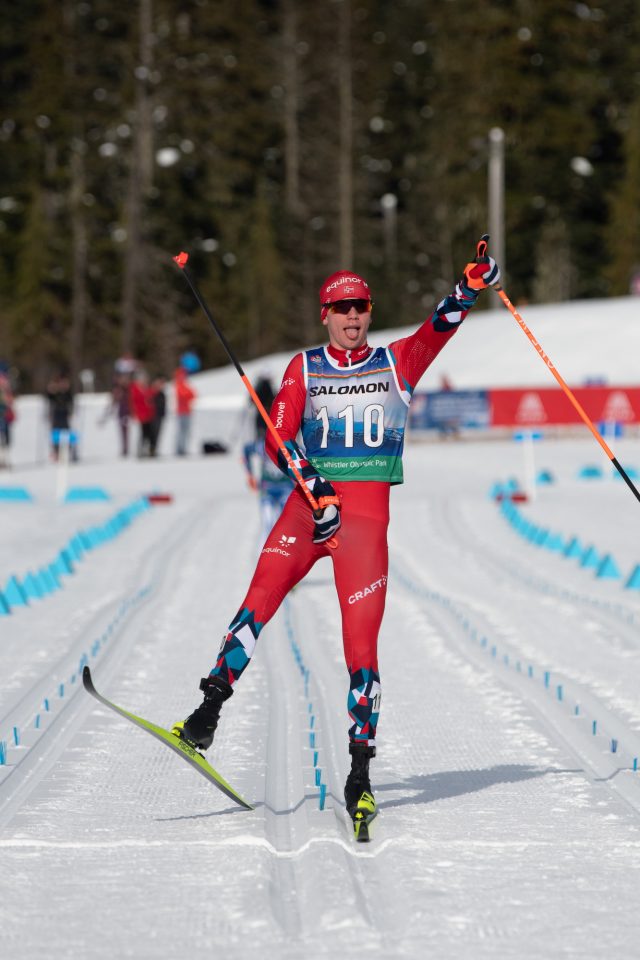
    Martin Kirkeberg Mørk won in 22:52, a full 26 seconds clear of Lars Agnar Hjelmeset. Tuesday’s 20km winner Jonas Vika was 43 seconds back, part of a second ahead of France’s Gaspard Rousset and six seconds clear of 8th place.

    The top North American was Whistler product Joe Davies in 13th at 1:04. Davies represents Great Britain, but still received huge support from the local volunteers. Wearing the Stars and Stripes, Gus Schumacher was 14th at 1:06, Zanden McMullen was 15th at 1:08, John Steele Hagenbuch was 19th at 1:16. and JC Schoonmaker was 29th at 1:43. For maple leaf-wearing Canadians, Rémi Drolet and Max Hollman tied for 23rd at 1:33, Sasha Masson was 32nd at 1:46, and Erikson Moore was 41st at 2:26.

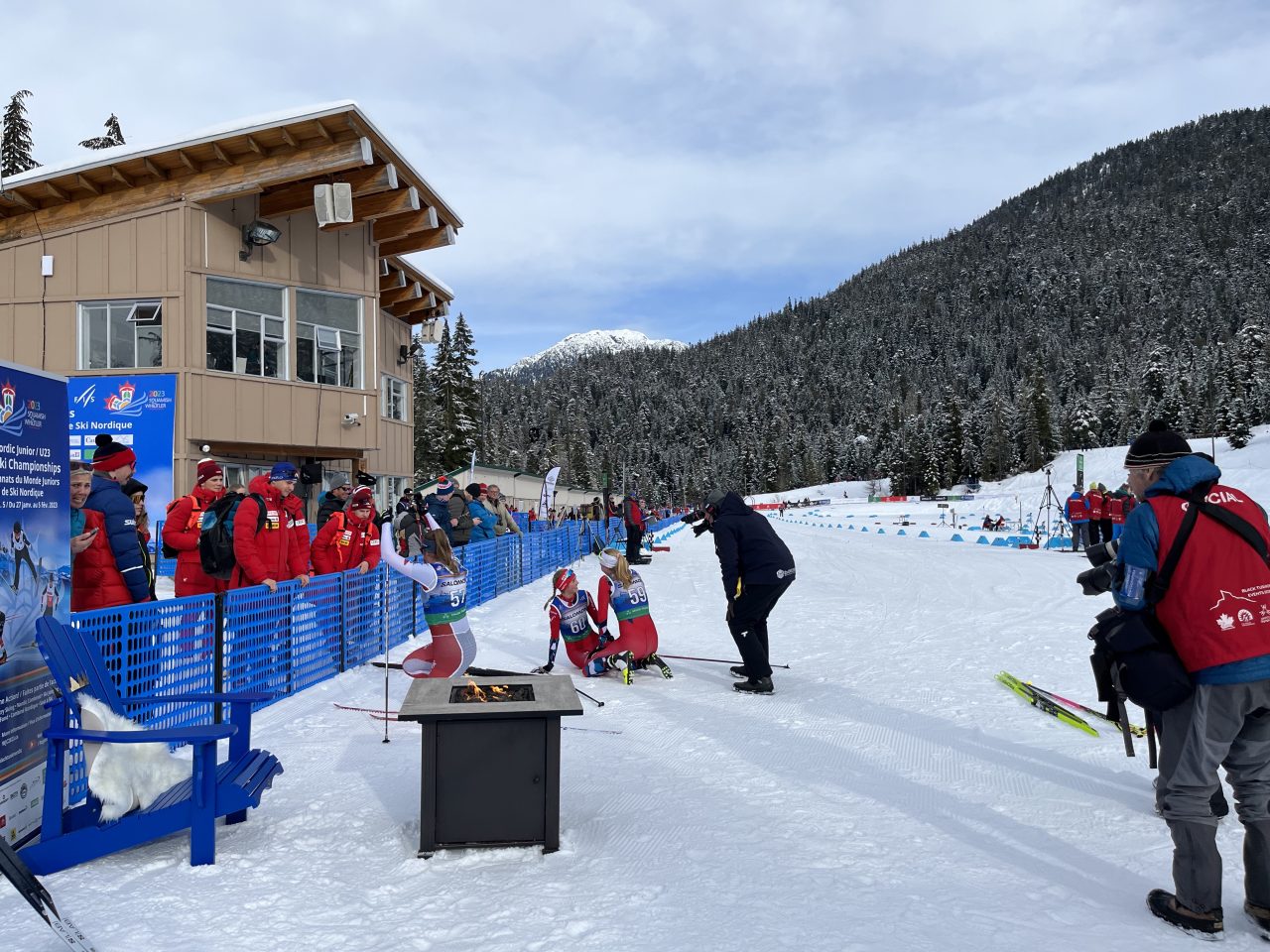
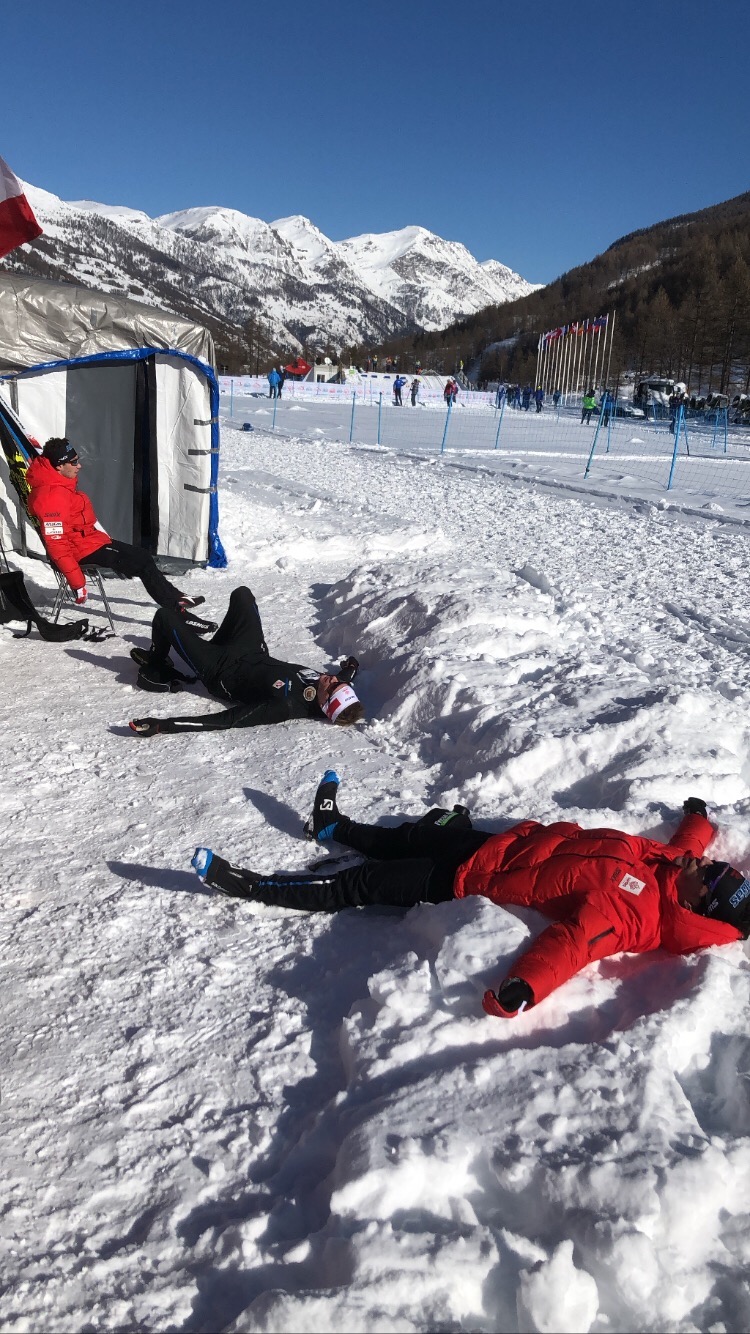
    The field was distinctly clumped, with many skiers only a couple seconds from better placings. This may sound easy from the sofa, but a look at the bodies lying in the finish pen makes it clear that skiers were giving it everything already.

    Kirkeberg Mørk

    The day: “My day today is superb. It’s a quite tough course, you have to hold a little bit off on the hardest climbs, and then go fast on the easier terrain. Especially on the first lap, and then on the second lap, if you did that, you can push hard. And that’s what I did.”

    The course: “I like it very much. A lot of the second gear [one skate/V2], and I’m good at that. It’s a good Olympic course.”

    Agnar Hjelmeset

    The day: “Yeah, today it was really fun to ski. It was tough, but the conditions and the course here is very good. You just have to be a warrior out here.”

    The course: “The course is really fun, a lot of uphills, and a lot of technical downhills. The conditions are very good.”

    Pacing: “I don’t know, go fast everywhere and push. You just have to be a warrior and push.”

    Vika

    The day: “It was quite tricky conditions to be skating. The snow was like, it was hard to stand safe on one ski. I felt my calves starting to cramp up, I had to loosen my shoes halfway. I think I’m third, I hope I became third.”

    The course: “The course is super tough, it’s harder in skate than in classic. I felt on the classic you could relax on the downhills, but here you had to work all the time.”

    Comparing courses: “Back home, we have so many different tracks. This, it definitely could be a track in Norway, it’s really high standard, the courses are wide and it’s easy to ski fast. It’s fair for everyone.”

    Davies

    The day: “It was okay. Definitely felt a little bit fatigued. Not quite the race I was hoping to feel, but it went all right.”

    The course: “I like the course, I don’t know if I had it in me today. It’s a course that requires a lot of fitness.”

    Pacing advice from a local: “Ideally, it’s best if you can control the middle of hills, not get too greedy on those, and really gain time over the top and on the gradual, flattish climbs.”

    U23 Championships at home: “It’s cool. It’s really nice that there’s so many people coming out to cheer that I’ve grown up with, or just skied with my whole life.”

    Lesson learned this week: “I’ve learned that my fitness is good, but sometimes the mental game can get in the way.”

    McMullen

    The day: “It was good. It’s a really hard race. As a team, we decided the best way to race it is to take it conservative the first lap. I was getting some splits, I was pretty far back, but I had in the back of my head not to freak out about that. I was hoping for a little more time, but overall pretty happy.”

    The course: “It’s hard, I really enjoy it. It’s pretty deceiving, you think you’re going to get some rest on the second half of the course, the last 2k, but you’ve got to work all of that downhill and flat. There’s very little recovery on this course.”

    Lesson learned this week: “I gotta get a little more fit. I’m coming out of the championships motivated as per usual. I’ve got one more year of U23’s, so I’m excited.”

    Hagenbuch

    The day: “Not great. I was trying hard, and I think the Americans were fighting the skis a little bit. I was pushing far inside on that first downhill after the fast steep pitch and slid out a bit. I’m happy with the effort, it’s hard racing out here.”

    The course: “It’s a great course, I didn’t have the legs to push the hills the way I wanted to, but it’s still fun.”

    Lesson learned this week: “I’ve had the big push of racing I’ve been doing catch up to me a little bit. It will be nice to get back and do a little bit of training, and hopefully get back into shape.”

    Drolet

    The day: “I think it was not very good. It felt like I didn’t have anything to give today. No matter how much I tried, I started going one pace and couldn’t go any faster.”

    Lesson learned this week: “That preparation is really key. I haven’t had the greatest preparation for a lot of the season. I have had better races here than earlier, but the preparation still was there. I need to be better prepared because everyone at these events is really strong and it takes your best shape to complete.”

    Studying theoretical physics at Harvard while training: “I’ve been at school a lot of the year. School is good, I’m enjoying it a lot. I’m maybe falling a bit behind these couple weeks [Tour de Ski, Trials in PG, Whistler]. Overall, I’m enjoying it a lot, and really happy where I’m at with that.”

    Hollman

    The day: “It was good. I woke up this morning, kind of scraped it together. The skis were amazing, absolutely rockets today. Shout out to the wax team for sending those out.”

    The course: “It’s a hard course, you’re never going to feel amazing on it.”

    Differences from last March at nationals: “The corners are definitely nicer, because you can actually get an edge, they’re not just pure ice into slush, that was super nice, you could really rip down it.”

    Lesson learned this week: “This week? I need to do more volume before these races, that’s my big takeaway from this.”

    Schoonmaker

    The day: “It was good. I didn’t have the best body feeling day, but I executed everything I had, and I’m happy with the performance overall.”

    The course: “It’s a hard course. I knew it was going to be hard, but it ended up being harder that I even thought. I got to the top of the first climb and I was just almost already shot from there. It’s fun, a flowy course.”

    TV commentators say you are only a sprinter: “I would say it’s true right now. I’m definitely better at sprinting than distance. It’s definitely something that I want to change. I want to get better at distance skiing and hopefully, it’s coming along.”

    Lesson learned this week: “I’ve learned we have a kick ass bunch of American juniors and U23’s. We had the best week, lots of energy, and I’m really excited for the future, for everyone here.”

    Masson

    The day: “It was not bad. The techs did an amazing job with the skis, we really had some rockets out there. I think personally I’m missing a little bit of energy. I think I drained myself in the last two weekends in Prince George and Whistler, but really motivates me for next year to be in top, top shape.”

    The course: “This course is deadly. It’s one of the hardest courses that there is out there. You have so little recovery and you really have to place yourself to not blow up.”

    Lesson learned this week: “I learned that we have a lot of work to do. We’re very much there, we just need a little bit more detail in training. I’ve learned a lot from this week, and going on to next year, I’m really motivated to get there.”

    Results, live timing, and livestream/saved video are here at the event website. Keep scrolling to on the livestream page for older videos.

    Nordic Combined raced after the 10km free. They got more traditional Whistler weather. (Photo: Doug Stephen @vr45photography)
  • Athletes in Their Own Words as Norway Dominates Whistler U20 10 k Freestyle

    Athletes in Their Own Words as Norway Dominates Whistler U20 10 k Freestyle

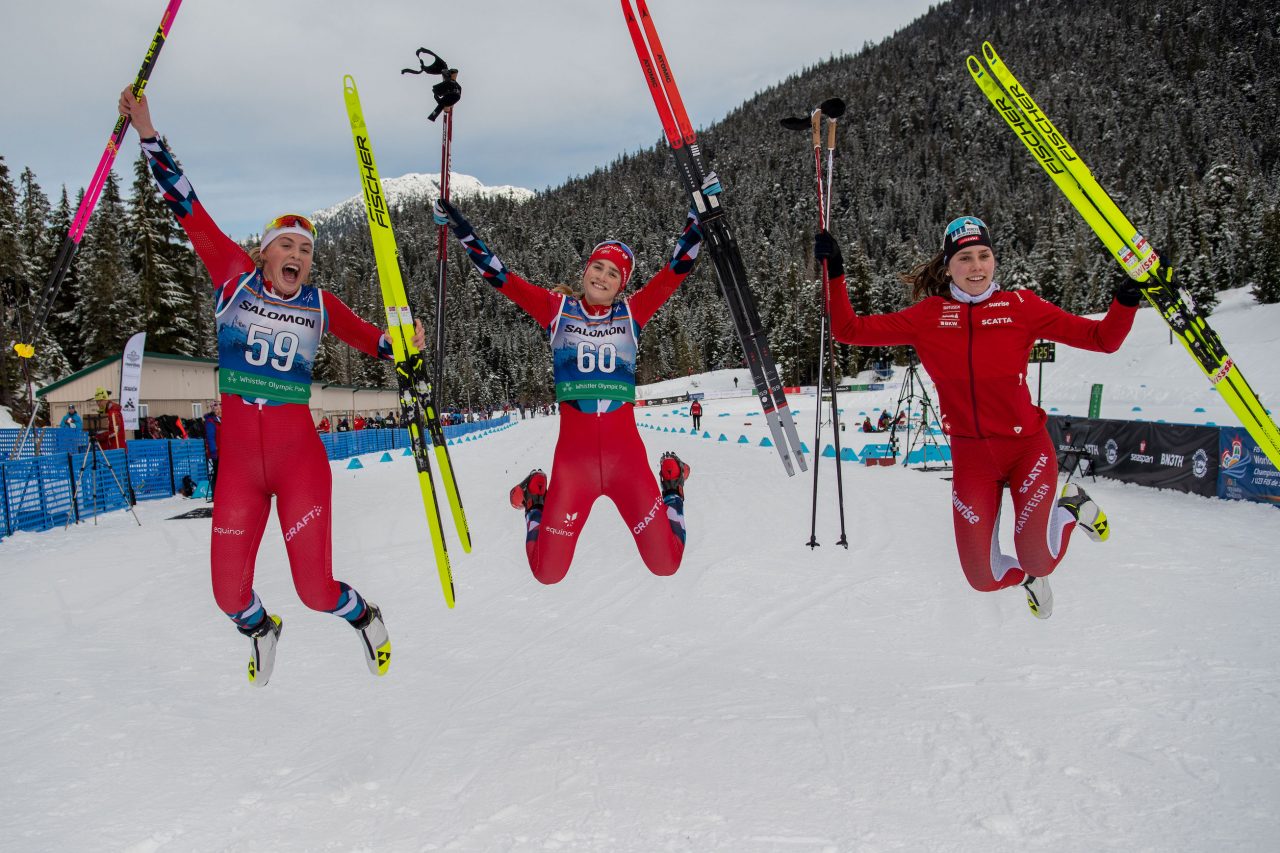
    The U20 Women’s Podium finds joy after a great day on snow. (Photo: Doug Stephen @vr45photography)

    Day five of racing at Whistler Olympic Park delivered with an interval start 10km free technique race in great conditions and intermittent sunshine. The tracks were fast and almost silky, the corners held up all day, the glide was exceptional, and (if anyone cared to classic on a great skating day) VR45 was magic.

    Early on, North American skiers spent quality time in the leader’s chair before the top ranked skiers took over. Norway put four skiers on the podium today, somewhat to the surprise of their head coach.
    “Beyond all expectations,” Kristian Dahl said. “We didn’t think about all these medals.”

    Like many countries here, Norway sees this Junior Worlds as a development opportunity first. Reflecting this, our coverage will quickly go through the podiums and then get into the North American experience.

    The top two unpack their day after crossing the line 11 seconds apart.

    Norway’s Milla Grosberghaugen Andreasson collected her third medal and second gold today, winning in 26:55. Her US-based teammate Tuva Anine Brusveen-Jensen was six second back in second while Switzerland’s Marina Kaelin got her country’s first medal of the week at 15 seconds back.

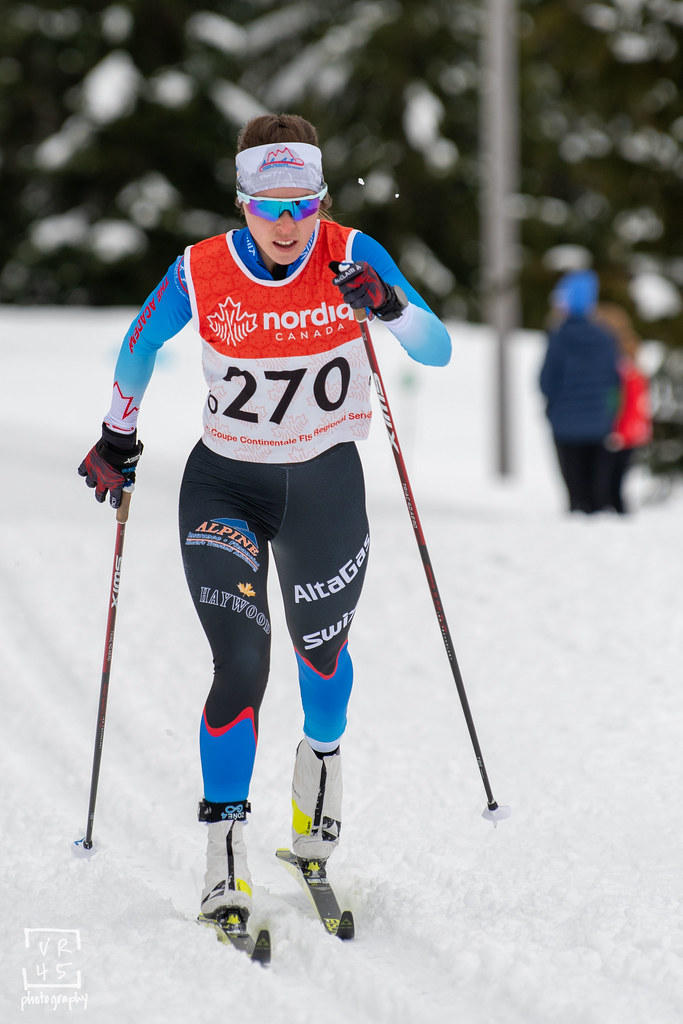
    For the US, it was Samantha Smith in sixth at 41 seconds back, Haley Brewster in 10th at 1:16, Hattie Barker in 14th at 1:38, and Nina Schamberger in 36th at 2:40.

    For Canada, Alison Mackie was 15th at 1:34, Alexandra Luxmoore was 29th at 2:30, Marlie Molinaro was 39th at 3:19, and Maeve Macleod was 44th at 3:48.

    There were 60 finishers and one DNF. There isn’t much an author can add about individual start races; here are the athletes words instead.

    Grosberghaugen Andreasson

    The day: “It was really good, but it was a tough race. I had to fight the whole race, I felt a little tired in the legs but the head was on fire today.”

    The course: “It’s a very hard course, but I like a hard course so it was good for me.”

    Visiting Canada: “Gold, gold, silver, so that’s good.”

    Brusveen-Jensen

    The day: “It was tough, but first of all it was good. I felt I pushed everything and did what I could, so it was good.”

    The course: “For me, it was to start tough. It’s a long uphill in the start, everybody gets tired. You just have to have the motivation and stay positive. And keep the speed high.”

    Visiting Canada: “Canada is amazing. The nature and everything around the stadium. It’s always sunny here. The course is so nice. We live in Whistler, and it’s very nice there too.”

    Kaelin

    The day: “I was really surprised with the good weather and the nice conditions, because yesterday the slopes were pretty slow and well it was a little harder to ski. It was surprisingly good and I thought it might be a good day.”

    Visiting Canada: “I’m really proud to win a medal for Switzerland and it’s so cool to be here on the Olympic tracks. It’s also my first time in America and Canada, and it’s really, really cool.”

    Smith

    The day: “Very challenging. I’m hoping my time holds up, but we’re waiting for the fastest skiers to come in.”

    The course: “I felt pretty good, I think I started out a little too hard. Second lap I was hurting a lot. It was a ton of fun, and certainly difficult.”

    Lesson learned this week: “Just try your hardest out there, you can’t control what the other racers are doing. As long as you put your best foot forward, that’s all you can do.”

    Brewster

    The chair: “It was awesome [sitting in the leader’s chair], and really nice tagging off with Heidi Barker. Definitely a little awkward with that camera pointing in your face.”

    The day: “It was good. I’m happy with it. Really fun to have all your teammates cheering who are done racing for the week. And my dad came out which is really special to have him here.”

    Lesson learned this week: “There’s a lot of stuff to work on. Strength and speed, a lot of strength, a lot of these girls are really strong out here.”

    Barker

    The day: “It was amazing. I’m so thankful to have this opportunity. The course was really hard but really fun and it’s a beautiful day of skiing.”

    Lesson learned this week: “It’s a really good team to be part of, and you ski your best when you are surrounded by friends and family, and a really good community.”

    Mackie

    The day: “It was really rough. It was a really, really hard course. A really hard race, but I did a good job of focussing on my technique and my race plan and I think I executed it quite well.”

    Lesson learned this week: “This is my third international start and I really surprised myself with how I can compete with the best juniors in the world.”

    Luxmoore

    The day: “It was super fun, nice warm weather, the course was awesome, the skis were fast. I think I had a good race, I felt pretty strong.”

    Lesson learned this week: “I had a great experience racing with people from other countries. I had fun skiing with people who are the fastest in the world.”

    Molinaro

    The day: “It was okay. The course is super hard, there’s a huge climb out the stadium, obviously that’s hard. Lots of pushing, trying to make up time on the flats, that was my goal out there today. I think I did a good job on that.”

    Racing at home: “I grew up in Whistler, so these are the home trails and it’s super cool to be racing World Juniors here. The weather all week has been gorgeous, because lots of the time it’s pouring rain in Whistler, so I’m super stoked that everyone gets to experience nice weather.”

    Lesson learned this week: “It’s been super cool to see all the other skiers from all the other countries and how fast and strong they are. Also, my own teammates, we’ve have some really good results.”

    McLeod

    The day: “It was super good. It’s a tough course out there, you’ve got to work hard all the time, but the skis were super killer, so thank you waxers, the skis were amazingly fast.”

    Lesson learned this week: “It’s so inspiring seeing all these super strong skiers. There’s just so much of a journey from here, you can always go harder. It’s pretty inspiring.”

    For the men, it was another two Norwegians on the podium but Finland’s Nico Anttola took the win in 23:35. Lars Heggen was second at 6 seconds back, followed by Thomas Linnebo Mollestad at 7 seconds.

    For the US, Jack Lange was 11th at 47 seconds, Adrik Kraftson was 30th at 1:48, Anders Weiss was 33rd at 2:00, and Jack Conde was 51st at 2:46.

    For Canada, Xav McKeever was 28th at 1:43, Luke Allen was 31st at 1:56, Garrett Siever was 54th at 2:59, and Noah Weir Chaba was 57th at 3:16.

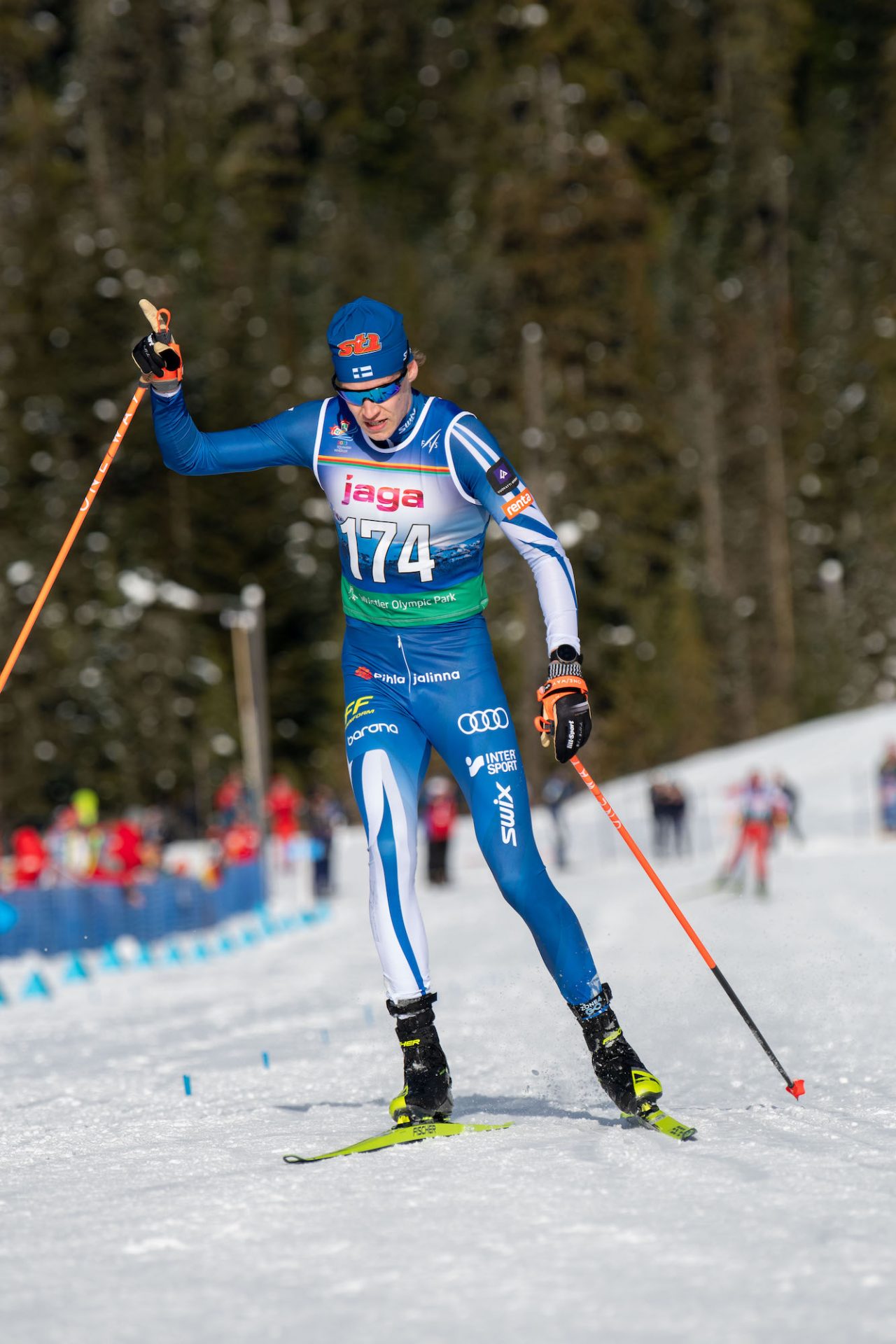
    Finland’s Nico Anttola celebrates his gold medal in the Whistler sunshine. (Photo: Doug Stephen @vr45 photography)

    Anttola

    The day: “It was very good. I had very good skis. The staff has been working really, really hard and I’m glad the skis was good, and the day was awesome.”

    The course: “The course was very tough, but I think it’s good for me.”

    Comparing this course to European ones: “I think this is one of the toughest ones, it’s very hard.”

    Heggen

    The day: “It was good, really nice conditions in the slope, really good.”

    The course: “I like the course very much. It’s pretty good, but fun and very nice course. I’m from Lillehammer, and it’s pretty much the same as Lillehammer, really tough.”

    Visiting Canada again: “Yeah probably. But when I come back, I ski downhill.”

    Linnebo Mollestad

    The day: “It was great. The form was good, I had really good skis, and I think I had a very good opening speed and managed to keep it for 10km so I’m really happy.”

    The course: “I think it’s a great course. It has some long uphills, which I like, and also the stadium here is really, really beautiful. In this weather, it’s just great.”

    Visiting Canada again: “I hope so. It’s really beautiful here, so I hope they will host some big ski competitions in the future, that would be great.”

    Lange

    This event is more casual than a World Cup. A journalist can walk up to the leader’s chair and grab an interview before the athlete catches his breath. Raw and unedited.

    McKeever

    The day: “Yeah, pretty rough today. Just the body was not firing on all cylinders. One of those days you want to forget about.”

    The course: “The course was definitely a hard one. A lot of climbing right off the start, for the first 1.5, 2 km, and then some gradual rolling sections where you have to push hard.”

    Lesson learned this week: “I’ve learned the extent of how a big championship at home feels. I’ve learned how I react to things, and handle different stresses and self-pressure. I’ve learned some stuff in general in training. Some deeper things for sure, from early in the season and training year that correlate to today’s poor performance. Just a lot to unpack and definitely a lot to learn.”

    Kraftson

    The day: “It was tough out there. I tried to race a smart race but ended up going out a bit too hard and paid the price towards the end.”

    The course: “It was a lot of fun. It’s a lot of climb in the first 2km and rolling downhill for the next, for the most part.”

    Lesson learned this week: “Just how fast the world is. That’s my biggest takeaway from the week. We’re trying to put in a bigger summer next year and try to compete with these Europeans.”

    Allen

    The day: “It was good. Skis were really fast and definitely went out hard on the first lap and lost a bit of energy on the second lap. Super fun course and what a nice day for it.”

    Lesson learned this week: “Guys are fast from Europe. Competition is pretty stiff out here. Definitely eye opening to see all these fast guys from international countries coming together.”

    Weiss

    Direct from the leader’s chair:

    Siever

    The day: “Honestly, it didn’t go very well. I’ve been dealing with some lower back pain, and I generally didn’t feel good out there.”

    Lesson learned this week: “There’s lots of work to do to compete on the world circuit.”

    Weir Chaba

    Second to the finish line, first into the leader’s chair.

    Lesson learned this week: “Gotta be patient. Gotta know what your plan is.”


  • Whistler 2023: Norwegians Dominate, North Americans Surge in U23 20km Classic

    Whistler 2023: Norwegians Dominate, North Americans Surge in U23 20km Classic

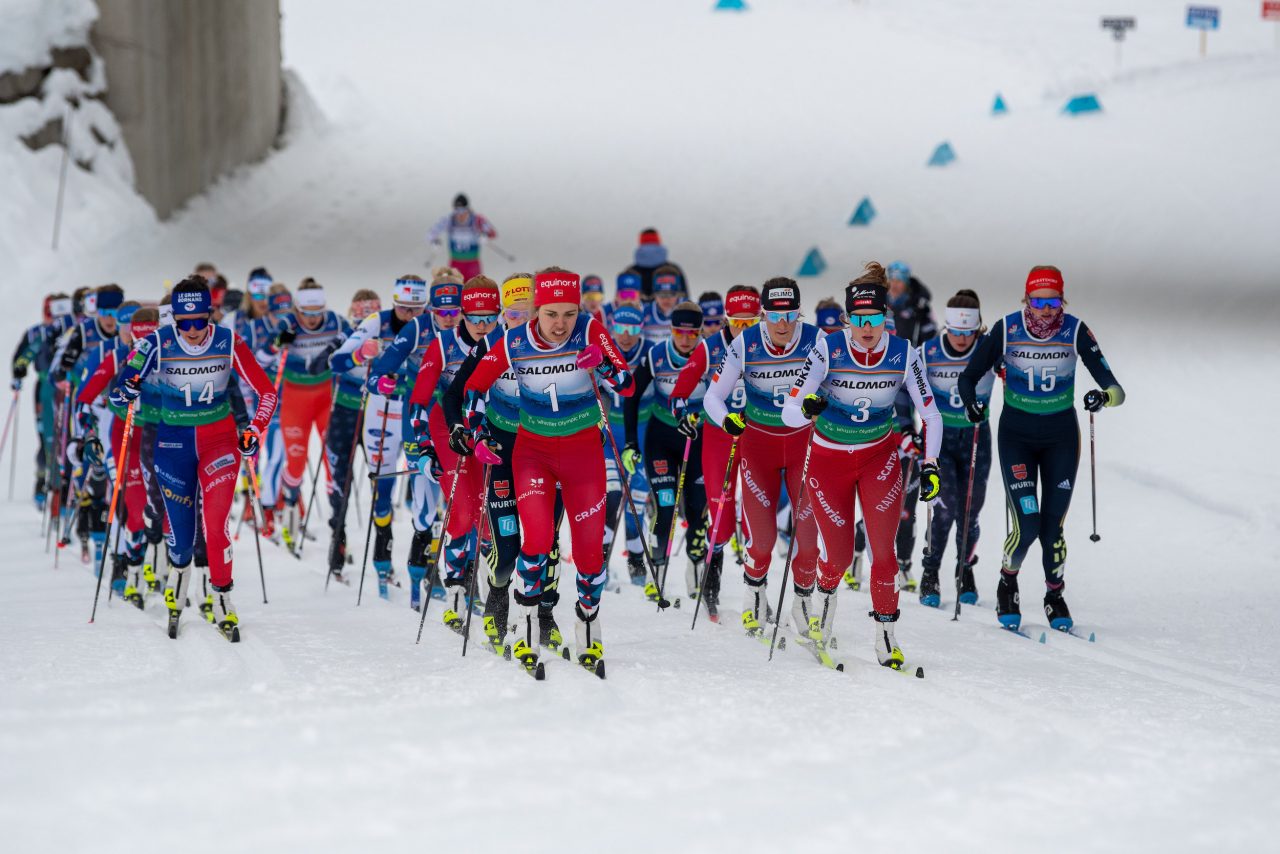
    Norway’s Margrethe Bergane (#1) pushing the pace early on first lap. (Photo: Doug Stephen @vr45photography)

    Day four of the Junior Worlds at Whistler Olympic Park brought new weather and more excitement in mass start racing.

    The day dawned with a light snowfall at -8C. The wax techs were as secretive as ever, but it was clear at the finish that most athletes were on hard wax. While Norway, Germany, and France owned the podiums, it was also a good day for North American skiers.

    Women’s 20 k Classic

    The women’s race started fast, with Norway’s Margrethe Bergane animating the race. After the first of four laps, 15 women were skiing together, including USA’s Sydney Palmer-Leger and Canada’s Liliane Gagnon. At the halfway point, Palmer-Leger and Italy’s Martina Di Centa were working together behind a lead group of eight, while Gagnon had been joined in pursuit by teammate Jasmine Lyons and USA’s Novie McCabe.

    Bergane continued to push the pace, reducing the lead pack to three in the final lap. Norway’s Kristen Austgulen Fosnæs attacked on the final hill, opening a gap she held to win in 1:01:40.0, 2.3 seconds ahead of Germany’s Lisa Lohmann. Bergane was very happy with third, 7.2 seconds back.

    Fosnæs was unable to stop smiling half an hour after adding a gold medal to her sprint silver on Sunday.

    “It’s unbelievable,” she exclaimed. “This is getting better and better. I feel like I’m dreaming.”

    “I felt like it was really hard from the start, Margrethe she put up some really fast speeds. I tried to lay back and save some power to the end.”

    Fosnæs liked everything today, laughing with joy: “I love [the course], I love being in Canada.”

    Lohmann was also smiling. “My day was simply perfect, because I won a silver medal.”

    “My tactic was to follow the Norwegian guys, it was a good plan to not be in the front.”

    Bergane was on a different plan: “I tried to go fast from the start and I’m happy with the bronze.”

    “The two other girls, they were very strong in the finish.”

    Bergane was happy, but picked the Alpe Cermis stage of the Tour de Ski as her favourite race this year. Because it was fun? “Yeah, it was hard.”

    The battle for top North American wasn’t really a fight, as US and Canadian skiers worked together to pick off skiers who had pushed too hard following Bergane.

    “I had an incredible day,” Palmer-Leger said. “I was right in the lead pack, top ten from the start, stayed relaxed and up there the full time.”

    After Bergane put in a concerted effort that reduced the lead group to eight, Palmer-Leger and Di Centa worked together to chase. Palmer-Leger led the flats with her better glide and Di Centa led the climbs with better kick before Palmer-Leger won the double pole sprint for 8th at 1:25.9 behind.

    “I’m a first year U23, I’m only 20 years old, I didn’t have any expectations,” Palmer-Leger told FasterSkier during her cooldown ski. “I just wanted to go out there, go hard, enjoy the race. That’s what I did, and it was a pretty incredible day.”

    The next North Americans were Canadians Gagnon in 12th at 1:40.7 and Lyons in 13th at 1:48.2.

    Jasmine Lyon leads Liliane Gagnon into a downhill. (Photo: Doug Stephen @vr45photography)

    “It was a slower start, got caught up in there, but then made my way up, slowing catching up to those other groups,” Gagnon said. “I definitely tried to be more chill in the beginning, keep the technique good, try to catch my breath in the downhills, and it really paid off the the last lap, I was able to push to 12th place.”

    “I’m definitely pleased,” Lyons said of her 13th place. “We had super-great skis from our wax techs, they’ve been working so insanely hard all week. I got to work with my teammate Liliane.”

    “The grinding double pole sections are pretty hard. We skied with so many North Americans, we tried to match each other’s rhythms and work as a team to catch some people ahead.”

    Asked about skiing with Gagnon for much of the race, Lyons said “Definitely working together, exchanging the lead. We’re great friends, definitely working together.”

    Lyons and Gagnon will continue to work together as they are both headed to Planica for senior World Championships.

    McCabe finished 14th at 2:01.6, and was visibly disappointed with her day. She was working with the group, but was short of grip later in the race, causing her to yoyo off the back.

    Canada’s Emilia Wells was 27th in her first international race, 4:20.9 back.

    “It’s being an amazing experience, being part of Team Canada,” Wells said. “All the coaches and staff are amazing, and the races have been so much fun.”

    Teammate Anna Parent was 30th, a little ahead of USA’s Anabel Needham in 33rd.

    “It was kind of hard, my first mass start at a big event,” Needham said. “There was a point where I just wanted to finish the race. I’m happy I stuck with it, and I really liked my coke feed.”

    Like so many athletes here, Wells, Parent, and Needham were here to gain experience. Judging by the enthusiasm of their coaches, they are getting it.

    Sophia Laukli, who started with bib 2 to match her ranking, was one of five who did not finish the demanding course.

    The lead pack stretched and regrouped. Andreas Fjorden Ree leads Jonas VIka, Edvard Sandvik, and Gus Schumacher near the top of the long climb. (Photo: Doug Stephen @vr45photography)
    Men’s 20 k Classic

    The men’s race was also animated by racers who didn’t want to sprint at the finish. Early in the second 5km lap, Gus Schumacher and Zanden McMullen were leading side by side into the long climb. On the final lap, it was a group of 11, with Switzerland’s Nicola Wigger and Cla-Ursin Nufer pushing the pace with help from Schumacher.

    In the final kilometre, it was Norway’s Jonas Vika who attacked up Hermodt’s hill and entered the stadium with a gap. Norway’s Edvard Sandvik closed the gap to 1.3 seconds with Julien Arnaud collecting the first medal for France at 3.6 behind. Two packs of four sprinted for the minor places.

    In an interview that is completely inaudible due to wildly celebrating Norwegians, Vika was very happy, described a Norwegian plan to keep the pace fast but save energy for the final hill, and admitted to practising the right hand turn into the stadium where he spectacularly saved a bad line choice in Sunday’s sprint.

    “I had a nice day today, sadly second behind this guy,” Sandvik said, pointing to Vika beside him. “but I’m happy.”

    “We figured that there was no breakaway [coming], so the last two laps were save energy and move cheap around the pack,” Sandvik explained. “I missed a bit of the start of the last sprint uphill and Vika got a good lead and it was all about the second place.”

    The European athletes are much more experienced with working in larger packs in deeper fields, and it showed today.

    “To take the third place was just fantastic,” Arnaud said, “and I am very happy to share that with my teammates and coaches who make incredible wax on my skis.”

    His tactics were simple: “I just follow the first place … I want to put all I have in the last kilometres.”

    Schumacher was in the next group of four, finishing seventh at 6.3 seconds.

    “I got to start in bib 3, which is nice compared to 30 on the World Cup,” he told FasterSkier at the finish. “The start was pretty chill, the hills were solidly hard every time, but [the group] stayed together.”

    “My skis were really fast, so I knew I could give up a little time on the top and just ski back through. The Swiss guys put a big push towards the top, strung it out a bit, but again it came back together. Positioning down those last hills was pretty big and I thought I did a good job of finding a spot, but I didn’t have enough kick in the end.”

    “I’m happy with it, it was really fun to ski at the front and not just, like World Cup, where I stay on the line the whole time. That’s what I remember loving about racing, the tactics, and being able to keep your head out there.”

    The top Canadian was Whistler’s own Joe Davies at 46.5 seconds back in 15th. Unfortunately, he was representing Great Britain. More on him Friday when he skis his favourite format on the trails he grew up on.

    Rémi Drolet was dropped on the third lap, hanging on for 17th at 1:18.5, just ahead of McMullen.

    “I made a couple of mistakes in the first few laps that cost me energy,” Drolet said. “You had to be a little bit lucky to be in the right position, or position yourself, and I wasn’t quite able to do that. It was a good learning experience.”

    “I was definitely starting to slip a little bit,” Drolet said of the last two laps. “I’m not sure if it was the skis or I was just getting tired and having trouble skiing them properly.”

    “I definitely blew up there, trying to chase the lead pack. Overall, I had pretty good skis today. If the body was there, they were good enough have a result.”

    Drolet raced his first Tour de Ski this season. “A good experience overall. I did get pretty sick once I got there. I think it’s on the mend now, and this race felt better than previous ones this year, and I’m optimistic that there will be more good races to come.”

    “It was rough,” McMullen said. “I had higher hopes, shooting for the top ten, but I just didn’t have it when the pack made that move.”

    From there, it was John Steel Hagenbuch in 23rd at 1:38.2 back, then Max Hollman in 25th, Luke Jager in 33rd and Erikson Moore in 40th out of 58 finishers.

    Canada’s Sasha Masson had a good ski despite a crash: “First lap felt really good and then coming out of the feed zone, got caught up with some skiers and went head over heels. Did a little front flip and got back on skis, tried to reconnect.”

    Masson did not get a good result as he was disqualified later, possibly for skiing outside the v boards just after the start. The coaches from Canada, USA, Norway, and Chile have all been emphasizing that this a development event, with learning the priority, and here is just one example of an extra lesson.

    The event page has more links, including the full results for the eight days. Update: The livestream videos are not disappearing after a day, they simply move to the very bottom of the page under ‘rewatch the action’.

  • Whistler 2023: U20 Mass Start 20km Classic

    Whistler 2023: U20 Mass Start 20km Classic

    Finland’s Eevi-Inkeri Tossavainen wins the sprint for bronze. (Photo: Doug Stephen @vr45photography)

    The World Juniors rolled on in Whistler with sunshine, easy classic waxing, and a new distance.

    Most skiers had done a 20km event before today, some had done two, but it was a new pacing experience for many. Add in a 5km loop that an athlete from Holmenkollen described as ‘hilly’ and you have a recipe for good racing and a pretty good day for North American skiers.

    Team USA’s Samantha Smith led the way for the continent, tying for 8th place, while both Alison Mackie and Xavier McKeever earned 13th place finishes for Canada.

    In the women’s 20km, it was the same names as the sprint on Saturday, but with different medal colours. Sweden’s Lisa Eriksson and Norway’s Milla Grosberghaugen Andreasson pushed the pace from the start, splitting the 52 starters into small groups. By the halfway point, those two were alone in front, maintaining a 30 second lead over the first chase group. Andreasson went hard on the long climb on the final lap, breaking Eriksson to win alone in 1:01:17.6, 21.2 seconds ahead.

    “I think Lisa was a little bit tired today, and I was very strong,” Andreasson explained. “I felt good on the second last round, so I tried to go a bit faster.”

    “Hard today,” Eriksson said. “From the beginning, I was a little bit tired. I do the best I can do today, but Milla was super strong.”

    A group of four was chasing hard, with sprint winner Eevi-Inkeri Tossavainen confident in her ability to take bronze.

    “It was quite tough,” she said. “I didn’t have a chance, it was Milla and Lisa, they was too strong today, I was only fighting for the bronze.”

    “I knew I would be the best one at the end, with the double poling, that was my only plan.”

    That plan worked, and the podium was set. Smith had skied in what was the third group for much of the race, and tied for second of the four survivors, joint 8th place with Sweden’s Tove Ericsson, at 1:39.8 back.

    “I was happy with the result,” Smith told FasterSkier. “Another top ten, so I’m really excited about that.”

    “It was a pretty fast start, like I had anticipated. Luckily I did the 15km skate in Lygna [last year at U20’s] so I knew what to expect.”

    “That was my second 20km, so I don’t have a ton of experience with pacing a race like that,” she expanded. “I was with skiers, [thinking] just stick with them, they probably know how to pace.”

    Mackie skied in an ever changing fourth pack competing for 12th and held on through the final hill disintegration to get 13th, 2:09.8 behind.

    Alison Mackie (#41) double poling her way to 13th place. (Photo: Doug Stephen @vr45photography)

    “It was amazing, this was my best race of the season so far,” Mackie told FasterSkier. “It was so much fun to work with a group of girls in such a big mass start. I’ve never done anything like this, this is my second international start.”

    “I love the atmosphere,” she said. “I’m really lucky my first world juniors is here, I’ve race here a couple of times before.”

    Mackie may only be 17, but she has been listening to her coaches: “I want to thank my techs, I had great grip and great glide.”

    Constance Lapointe was the next Canadian in 21st, in her first world juniors days after her 18th birthday. “Definitely one of my best races ever,” she said.

    Lapointe came in without any expectation except gaining experience, but she has already learned what to say in interviews:”My wax techs just nailed the wax.”

    Ava Thurston was the second US finisher in 28th, 4:52.4 back: “It was pretty solid, it was definitely a very hilly course, but the four laps went by surprisingly faster than I thought they would.”

    “Skis were great, had plenty of kick, just really nice classic skiing. The corners were pretty good today, no treacherous downhills for me anyway.”

    Canada’s Anna Stewart and Alexandra Luxmoore were 34th and 40th in what was expected to be a learning week.

    USA’s Rose Horning was 42nd while Nina Schamberger did not finish after skiing the second lap in obvious discomfort.

    For the men, it was the same countries on the podium but new names.

    Early on, it was Finland’s Niko Anttola driving the pace with all four Norwegians staying in the top five. Canada’s McKeever skied close to the front for the first lap and a half, but looked like he had good skis on a day when the Germans and Norwegians had great skis.

    Mathias Holbæk takes the U20 World Champion title. (Photo: Doug Stephen @vr45photography)

    Anttola and Norway’s Mathias Holbæk pulled clear on the third lap, leaving three Norwegians to be caught by a chase pack of five. Anttola looked like he was driving the pace, but it was Holbæk who skied away on the final Hermodt’s hill into the stadium for victory in 53:05.7. Anttola was 7.7 seconds behind, with Norway’s Kristian Kollerud winning the sprint for bronze at 28.1 seconds.

    “It was a great day, I feel strong. My tactic was to be behind and take it in the last sprint uphill,” Holbæk said. “We go very fast [on the third lap] and got a little split. It was fun.”

    “It was good day, good weather, and tracks were very nice,” Anttola said. “I tried to go hard in the uphills, but Mathias a little bit too strong today.”

    “It was a great day, a tough race. I’m really glad that I came third,” Kollerud told FasterSkier. “The two guys in front of me were too good, so I need to focus on third place.”

    If it was a hard race for the podium finishers, it was harder for the rest of the field. For most of the North American skiers, the coaches were talking about learning and developing, not results.

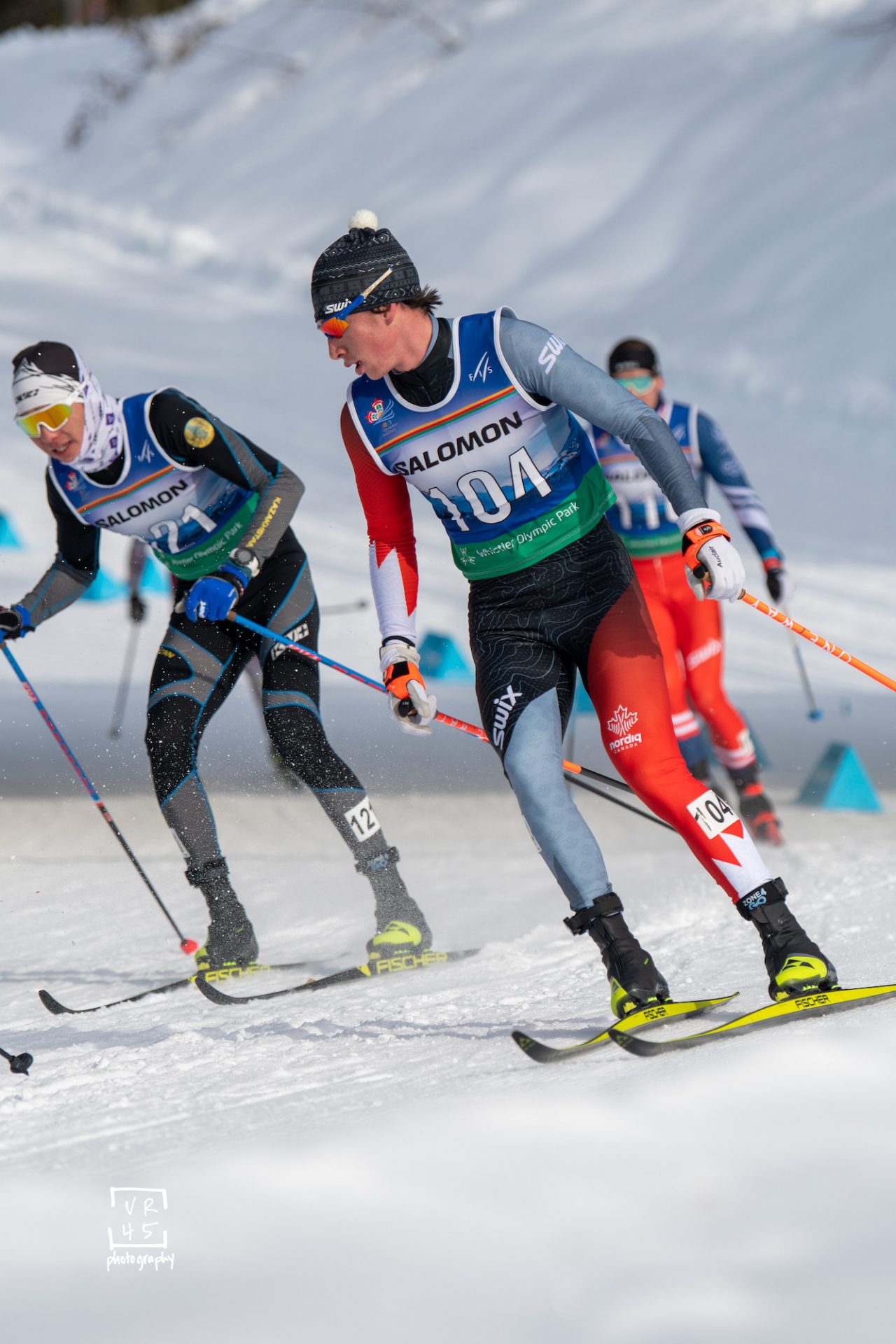
    Xav McKeever (#104) looking relaxed on the fast downhill under the bridge. (Photo: Doug Stephen @vr45photography)

    “A bit of a tough one, the pace was really hot off the start,” McKeever said. “I redlined a bit in the second lap, but came alive for the end.”

    “I was still happy I was able to come back … and fight for 13th. Obviously, not quite what I wanted, but there are takeaways from being able to recover.”

    McKeever had come in with expectations from outside and inside, allowing him to be disappointed with a top 15 in his favoured race at a home country event. While this is his fifth World Juniors, he is still a U20 and working on the mental aspects that lead to success. A big part of his thoughts ten minutes after finishing: “How I react to having this big event in Canada, and how I react to some added self-pressure from a championships at home.”

    Luka Riley was the top US skier, 34th at 4:24.6, just ahead of Canada’s Luke Allen in 36th.

    “It was really fun other there,” Allen said. “Super hard race, super deep field out there.”

    “Tracks were remaining pretty hard, the kick was solid throughout, the corners were fast but not sketchy. Honestly, just a beautiful day in Whistler. Sun was out, can’t really ask for much more here.”

    The US trio of Adrik Kraftson, Jack Lange, and Max Kluck were 39th, 41st, and 57th. We could quote them, but it’s more fun to watch the video that shows the team.

    Canada’s Raleigh Tarte finished 47th while Garrett Siever did not finish after a start that looked strong.

    Full results for the week and live timing are here. Livestream video for upcoming races is on the same link.

  • U18 NTG Camp Wraps up in Whistler B.C.

    U18 NTG Camp Wraps up in Whistler B.C.

    After an untold number of bear sightings and many hours of quality training, the U18 National Training Group (NTG) camp wrapped up in Whistler, B.C. the third week of June. The first of the National Nordic Foundations (NNF) Summer Series, the goals of the camp were twofold: the first was to give these athletes a chance to meet and train together, particularly since the annual U18 Nordic Nations Cup trip was canceled in January due to high COVID-19 cases in Norway; the second was to familiarize the athletes with the venue and living environment in Whistler, as it will be the site of the upcoming 2023 Junior/U23 World Ski Championships in January. 

    The camp’s attendees earned a spot on this trip after selection by the U.S. Ski & Snowboard (USSS) based on their performances at last year’s Senior Nationals in Soldier Hollow, UT and/or other USSS sanctioned races. Hailing from all over the country, 13 athletes made their way to Canada for a week of training and exploration. 

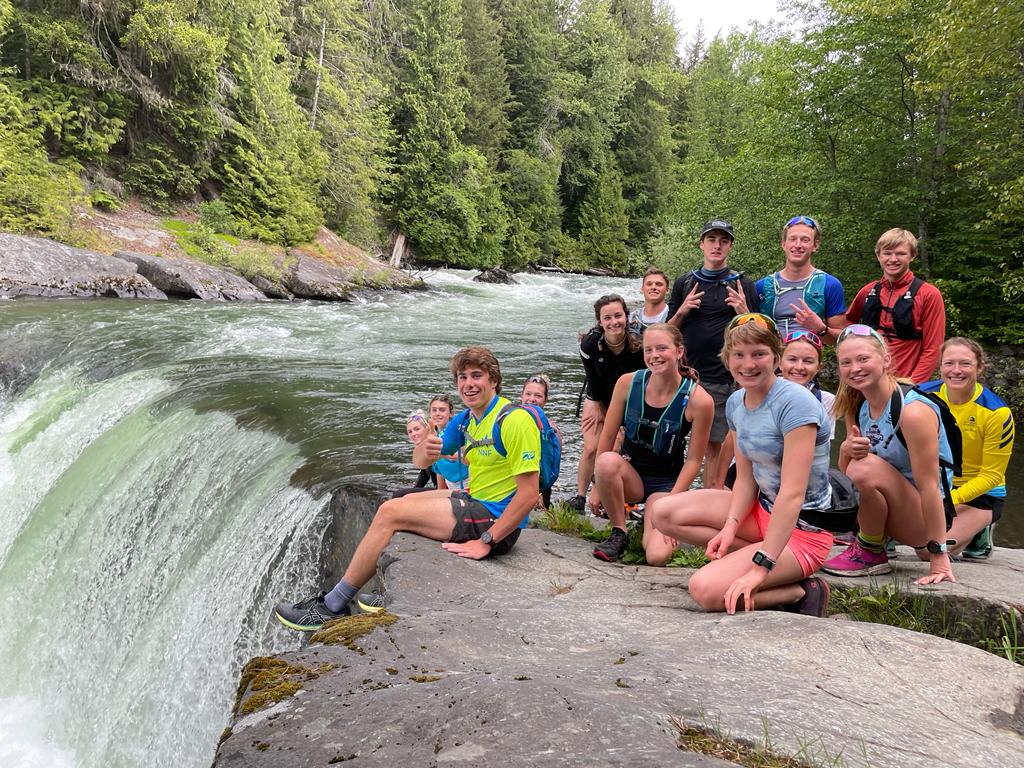
    Group shot of the 13 athletes from around the US who participated in the U18 NTG camp in Whistler, BC (Photo: Bryan Fish)

    Six years after Junior World Championships were last held on North American soil (Soldier Hollow, UT 2017) – an event which resulted in a historic bronze medal from Katharine Ogden in the 5/5 k skiathlon and bronze in the women’s 4 x 3.3 k relay – the upcoming races in Canada offer an exciting opportunity. Additionally, the 2023 World University Games will be taking place in the U.S. this year, in Lake Placid, NY in January.

    U.S. Ski & Snowboard Cross-Country Sport Development Manager Bryan Fish, explained in an email what this might mean for the American juniors. “Our teams have become very good at traveling well and executing overseas, however our first Junior World Ski Championship medals became a reality in 2017 when Park City, UT hosted Jr Worlds. Those home-field championships helped spark the successful trajectory of USA cross-country skiing. We are trying to build a similar positive environment for these 2023 Championships.” 

    Getting familiar with the trails at the Whistler Olympic Park before 2023 Jr World Championships (Photo: Greta Anderson)

    In addition to Fish, the camp’s coaching staff was comprised of U.S. Development Team Coach Greta Anderson, Alex Jospe from Stratton Mountain School, and Naomi Kiekintveld from Alaska Pacific University Nordic Ski Center.

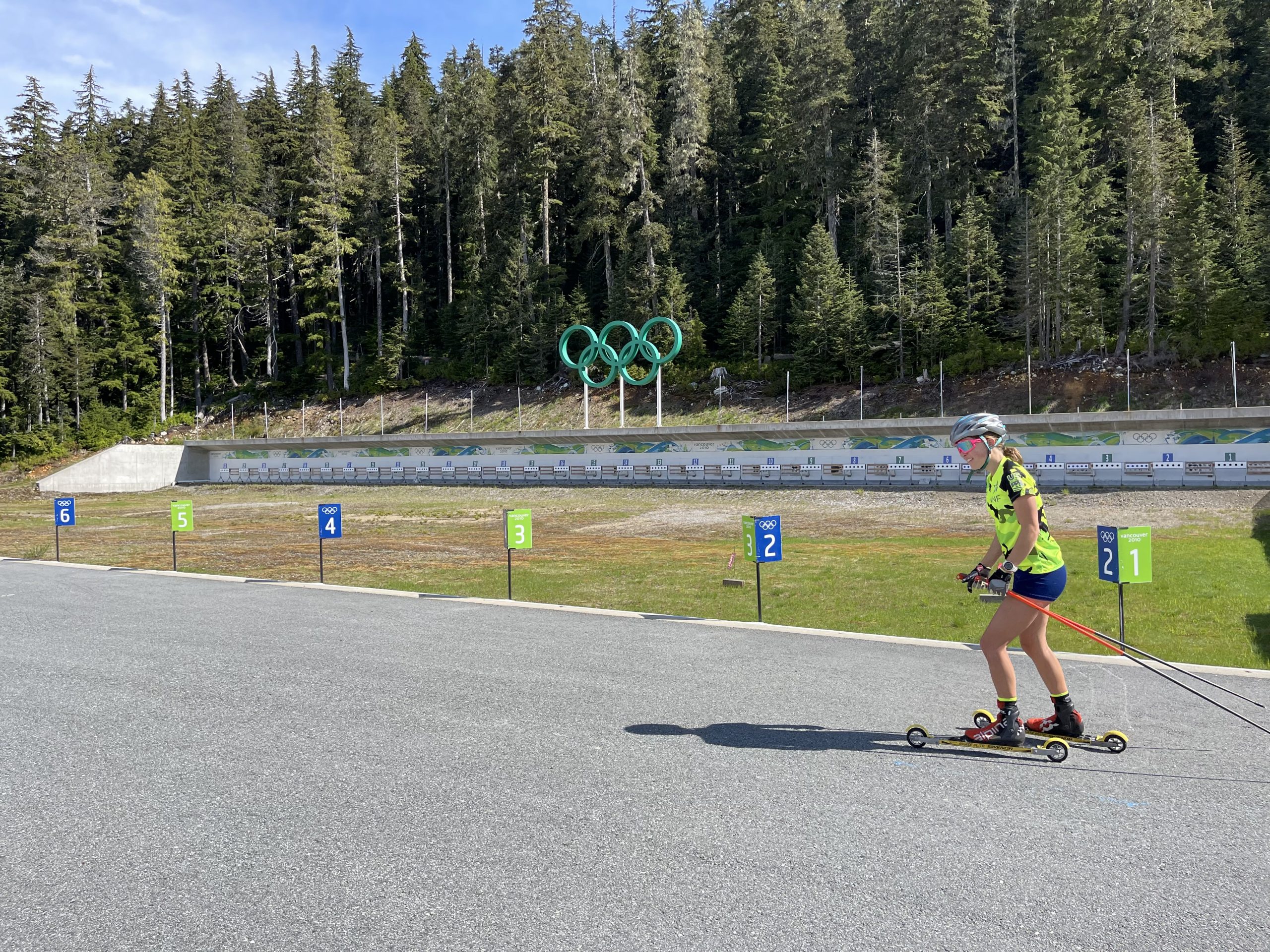
    After the recent conclusion of the NTG camp, Fish felt that the camp’s objectives had been achieved. He wrote, “the camp successfully achieved the goals of familiarizing ourselves with all aspects of the venue, the race courses, and the living arrangements. It was a great group of athletes which made for positive and motivating training sessions. The Whistler rollerski track is on a portion of the Jr World race courses, so we spent a great deal of time getting comfortable on the track at speed to understand how the course flows.” 

    Through collaboration with Nordiq Canada, the joint U.S./Canadian Spring National cross-country Championships were also held in Whistler in March, which Fish explained, “provide[d] our athletes with true on-snow race experience on these courses.”

    Exploring the area outside of the Whistler Olympic Park and getting some training (Photo: Greta Anderson)

    As for the athletes’ perspective, in a blog post written for NNF, Midwest junior Cooper Camp reflected that for him, “one of the most valuable parts about this camp was being able to ski with the best juniors in the nation. Not only being able to get quality training in with each other, but also skiing behind others and learning from what they do, is one of the biggest benefits from camps like these.” 

    Campers head out for a long run (Photo: Greta Anderson)

    Although the athletes have returned home to their respective clubs, there may be more opportunities for them to train together before the summer is over with both Regional and National Elite Group camps still to come. As to who will be returning to Whistler to represent the U.S. at the Jr/U23 World Ski Championships starting January 27th, 2023, both athletes and fans will have to wait until the conclusion of Senior Nationals (Houghton, MI) at the beginning of January before the team will be announced. 

    Campers cooling off after a day of training (Photo: Greta Anderson)

    For an on-the-ground look at the recent camp, a recap video made by coach Alex Jospe, can be found here. 

  • Martin and Kern Stride to the Top on Day Two in Whistler

    Martin and Kern Stride to the Top on Day Two in Whistler

    Carrying the momentum from the first day of racing into a second distance event, athletes lined up once more at the Whistler Olympic Park for a 10 / 15-kilometer interval start classic. Over 130 men and 90 women participated in the open categories, representing clubs across Canada and the United States. 

    Adding a springtime layer of complexity to remind us that we are officially past the equinox, temperatures in Whistler hovered above freezing while a mix of precipitation fell off and on throughout the day. Webcams of the venue showed the spectacular mountain backdrop hidden amongst dense clouds and conifers still laden with the week’s snow.

    It’s a humidity-temperature combo that makes classic waxing tricky. Consequently, many athlete chose to use “hairies”, which are known as “rub skis” in Canada, essentially foregoing kick wax and opting instead for a sandpapered kick zone. For those with strong striding technique, this achieves grip without as significant a risk of icing issues, as klisters can be known create in such conditions. 

    Top Canadian U20 racer Xavier McKeever (Foothills Nordic), who was 13th overall today, explained how this changes the game for those who haven’t had the experience: “You have to be a bit more careful with your kicks and a bit more gentle, because they can slip out really easily. That was the biggest focus for me [today], just to try and ski technically well.”

    Craftsbury’s Adam Martin takes the 15 k classic win in Whistler. (Photo: Doug Stephen / VR 45 Photography)

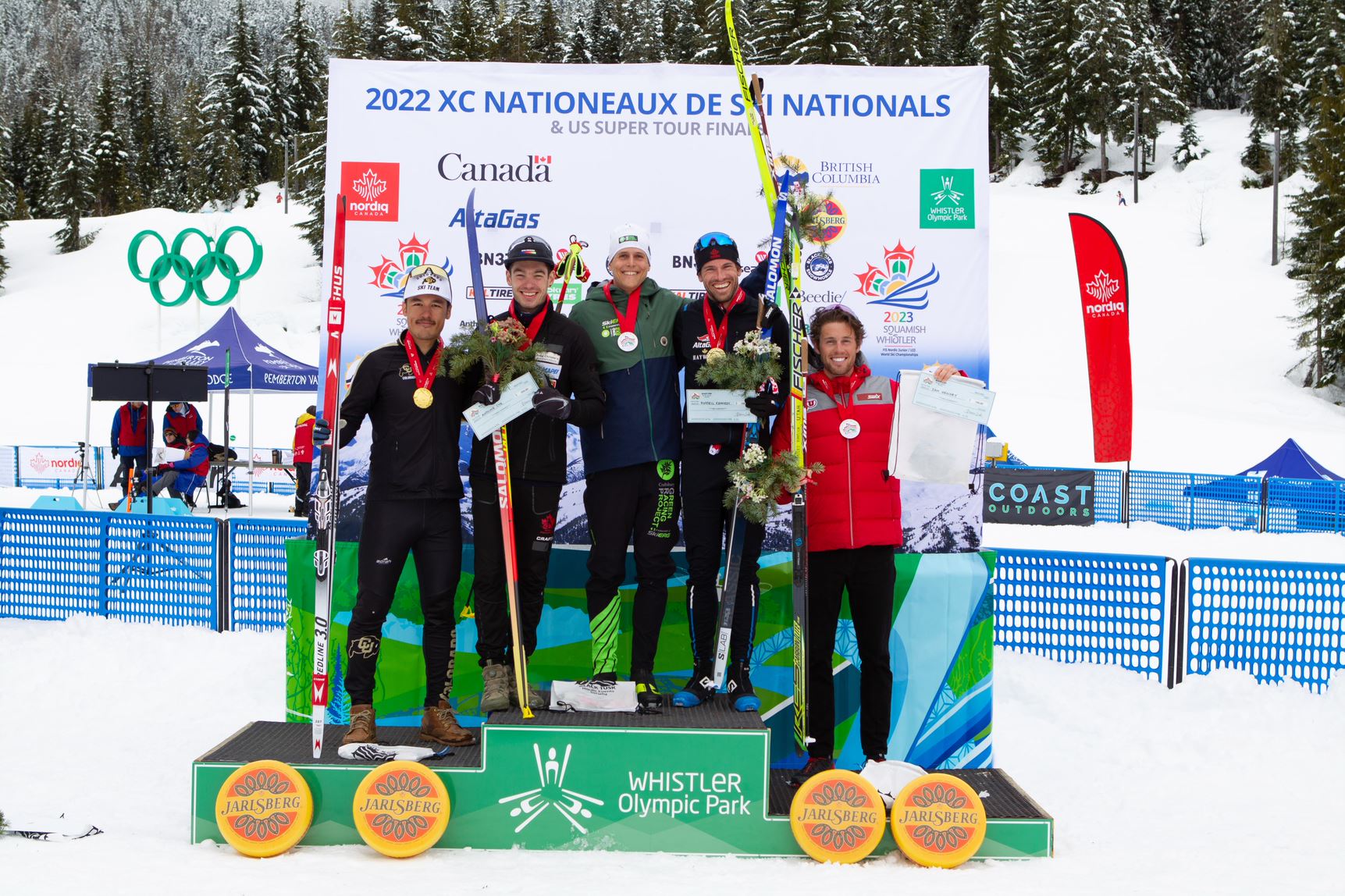
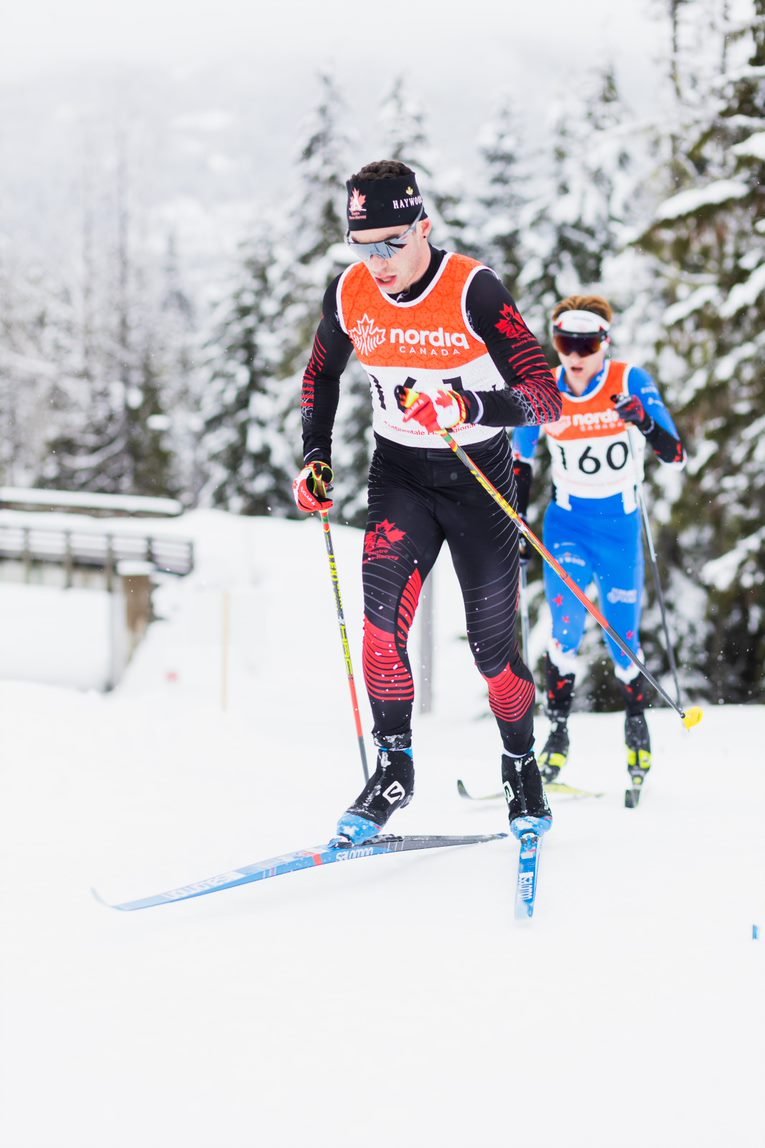
    Following 10 k sitting and standing events contested by Nordiq Canada’s Para Nordic athletes, the open men’s category headed out for the three 5 k loops. In a close race for the top podium spot, Craftsbury’s Adam Martin took the win with a time of 40:29.3. Martin was chased by today’s Canadian National Champion, Antoine Cyr (Skinouk) who hunted his times from 19 bibs behind.  

    Though Cyr led through the first 10 k, a strong closing lap from Martin moved the American to the lead in the splits, with Cyr skiing the third fastest final lap to take second (+1.3). Canmore’s Russell Kennedy was third overall (+13.1) for the second spot on the Canadian podium, while fellow Canmore athlete Sam Hendry, who now trains with the University of Utah, was third for Canada in fifth overall (+48.0). Both Cyr and Kennedy had also raced onto the podium in yesterday’s 10 k free. 

    “I felt really good today,” Martin wrote to FasterSkier after the race. “Particularly in the second half, I started to figure out how to best race this course and these conditions, and I found a good place mentally to push. I’m really happy with the outcome – that was a dream to win.”

    The men’s 15 k classic podium in Whistler: Adam Martin (CGRP) took the win ahead of Antoine Cyr (Skinouk), and Russell Kennedy (Canmore Nordic). (Photo: Joern Rohde / Nordiq Canada)

    A successful season of SuperTour racing has Martin ranked at the top of the rankings, and earned him starts in post-Olympic World Cup events. After taking third at the American Birkie, Martin headed to Norway to race the 50 k classic at Holmenkollen, where he finished 26th. The following weekend, he skied to 44th in the 15 k free in Falun, Sweden. A week later, Martin is back with his Craftsbury team and standing atop the US SuperTour podium. 

    “It’s nice to return from the World Cup and still feel in good shape. After two 50 k’s, and travel, and a season that I’m really happy with, everything is a bonus at this point. I think it’s great that we are able to combine with Canada for these races. There are a lot of guys at a similar level, so it makes for some tight, fun racing.”

    A 23-year-old Quebec native, Cyr’s best results have been in classic this season, namely an 11th place finish in the opening World Cup 15 k classic in Ruka, Finland, and racing with Graham Ritchie to put the Canadian team in fifth during the Olympic classic team sprint in Zhangjiakou. After the team sprint, he was praised by both his teammate and coach Erik Bråten, along with armchair quarterback Devon Kershaw, for his classic technique.

    “Classic is always good for me and is a race I love,” Cyr said of today’s 15 k in a post-race interview with Nordiq Canada. “It was tough conditions this morning, and a good skier normally comes out on top in hard conditions. I was able to ski well, focus on the race, and came second overall, which is a little bittersweet because it was a really tight battle in the end. But it was really fun, the track is amazing. It’s an Olympic standard track, so it’s just really good.”

    Antoine Cyr races for the Canadian National Title in the 15 k classic in Whistler. (Photo: Nordiq Canada / Nathaniel Mah)

    In his second lap, Cyr had caught yesterday’s winner, Rémi Drolet (Team Black Jack), whom Cyr credited in supporting his strong result today.

    “When I saw was closing the gap on him on the first lap, I decided to go a little harder than I planned to catch up with him. [I then tried] to relax behind him for a lap or half of a lap.. In the end, I was missing a little bit on the last lap. I think that that helped for sure, skiing with someone strong like Rémi.”

    Finally, Cyr spoke to the importance of an international field featuring all age groups coming together this week, particularly on the heels of a two-year hiatus due to pandemic restrictions.

    “It is so good for the young kids — us older guys, we’ve been racing on the World Cup, but like the juvenile and junior, they almost have no races in Canada. To have a big event like this is just amazing and we’ve been looking at the younger guys’ results for an hour yesterday, seeing who’s in good form, and who’s coming up, and you are the next guys to be like taking over. So for them, it is awesome, and for us too, racing with the US is always — it should always be like this.”

    Joining Martin for the SuperTour podium, BSF Pro Team athlete Finn O’Connell was 7th overall (+1:06.4) and second American, with University of Utah’s Luke Jager half a second behind in 8th overall (+1:06.9).

    Julia Kern strides for the win in tricky conditions during the 10 k classic in Whistler. (Photo: Doug Stephen / VR 45 Photography)

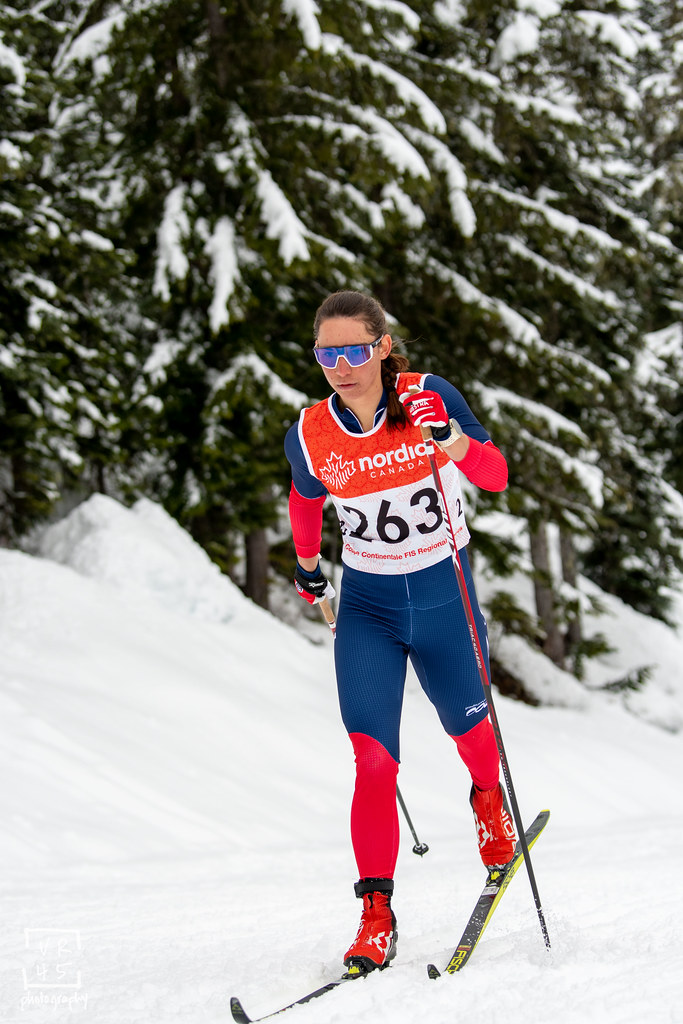
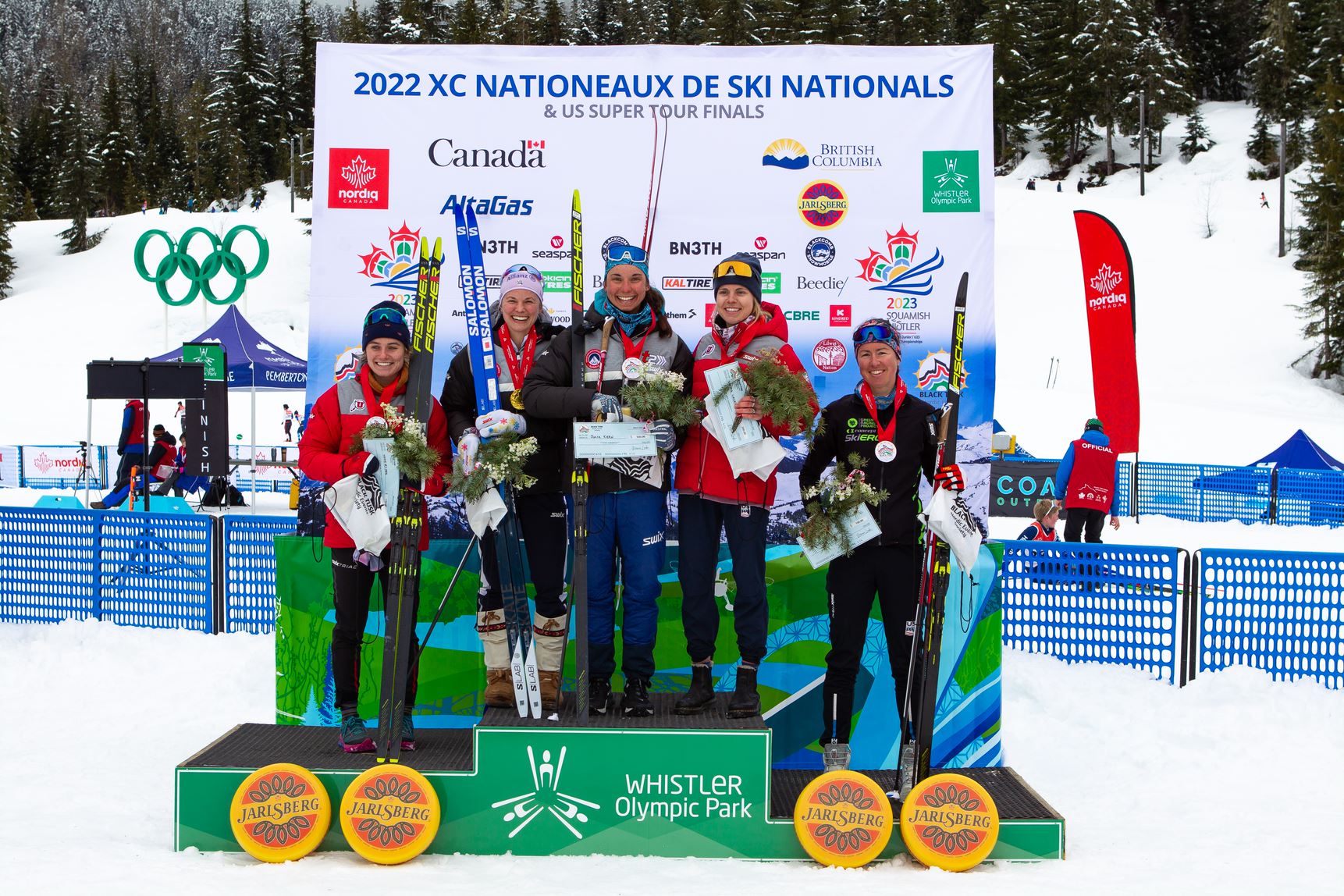
    In the women’s 10 k, SMS T2’s Julia Kern skied a strong second lap to take the win in her second consecutive day on the podium, stopping the clock at 29:54.3. Her club and national teammate, Jessie Diggins, took the second step finishing +18.3 back, while University of Utah’s Sophia Laukli skied to third (+1:03.2).

    Looking at tough conditions, Kern explained she raced by trial and error today, exploring which techniques were most efficient on different sections.

    “I kind of had an open mindset going in today,” she told Nordiq Canada after the race. “I knew that the tracks might be a little bit punchy or washed out in sections, and so I was double pulling wide or double polling narrow or just like power striding on the flats if it was getting too punchy out there. So just trying it all.”

    She continued that she was looking to “have fun, send it from the start, and see if I could hold that pace the whole time,” which she ultimately proved able to do. It’s the time of year where the hay is in the barn training-wise, and athletes have had a long season, leaving them in varying states heading into the last hurrah. On whether she was looking to just have fun at these races, or whether it was a serious quest for the podium, Kern said “both”.

    “I think the end of the season is always really fun. It’s so cool to have this many athletes here. And I’ve been feeling really good the last few weeks and so enjoying racing when it does feel good and when I’m able to push really hard. We’re all really tired at the end of the season, but also, when the body’s in form you might as well take advantage of it and send it on the course.” 

    The women’s 10 k classic podium on day 2 in Whistler: Julia Kern (SMS T2) took the win ahead of Jessie Diggins (SMS T2) and Sophia Laukli (Univ. of Utah). (Photo: Joern Rohde / Nordiq Canada)

    Winning back-to-back Canadian National titles, Katherine Stewart-Jones (Nakkertok Nordique) was again on top for the Canucks, finishing sixth overall (+1:17.5). Finishing in the same order as yesterday, Dahria Beatty (Whitehorse Ski Club) was second for Canada in eighth overall (+1:55.0), while Cendrine Browne (Fondeurs-Laurentides) rounded out the podium in ninth overall (+2:14.5). 

    “I went out really hard knowing that that’s what I had to do if I wanted to make the podium,” Stewart-Jones said of her race. “I had a good first lap, and I definitely slowed down a lot on the first part of the second lap. I was just tired and was having a hard time staying in the zone and keeping the rhythm, but I was able to pull it together a bit for the second half of the second lap. So I was really happy with that. And I was happy with how hard I pushed. I just didn’t have it quite in me today, and sometimes that happens.”

    On the importance of focusing on her technique on this type of course with sub-optimal conditions, she continued, “It’s really important, especially on the climbs. The grip isn’t always perfect in these conditions, so you really have to make sure to stay on top of your skis. If you get tired and you start leaning forward, then it makes it even harder to kick… And then on the flatter sections, it was a bit awkward, and you had to expect that. Either you’re striding awkwardly or you’re doing a kick double pool, but your poles are sinking. You have to just really focus on committing to whatever you decide to do and not like trying to switch too much between.”

    Speaking to already standing atop two podiums, Stewart-Jones responded with pride, while also acknowledging that the overall win would be sweeter.

    “Oh, it’s definitely nice to be winning the national championship title… because we’re racing against the Americans, I obviously care about the overall too, so maybe it feels a little less exciting, but for sure, I’m proud of that.”

    Katherine Stewart-Jones (Nakkertok Nordique) takes back-to-back national titles in the women’s 10 k classic in Whistler. (Photo: Doug Stephen / VR 45 Photography)

    In order to get closer to the overall podium, she said he would focus on resting as much as possible and maintaining the head space to perform her best. “It’s been a long season and I haven’t raced this much in a long time. I think everyone’s pretty tired. But also just being able to also be mentally strong [over the next races]. And yeah, you never know what’s gonna happen.”

    Racing continues Wednesday with individual classic sprints, which will be live-streamed by the Black Tusk Nordic Events Society. If you’re looking for additional video updates, follow along on the Nordiq Canada and Black Tusk Instagram pages. 

    Full Results

  • (Press Release) Nordiq Canada Unveils 2021-22 FIS Canada Cup Regional Race Series

    (Press Release) Nordiq Canada Unveils 2021-22 FIS Canada Cup Regional Race Series


    September 29, 2021


    Olympic and Junior/U23 World Championship Trials set for Canmore; Canadian Ski Championships head to Whistler

    CANMORE, Alta.— After working extensively with its Divisional partners, Nordiq Canada has created a regional, high-level cross-country ski race series for the 2021-22 season that has been designed to strengthen the performance pathway across the country while minimizing travel for the nation’s young cross-country skiers and emphasizing developmentally appropriate racing.

    Canada’s cross-country ski athletes will have equal opportunity to compete in two regional races in either Eastern or Western Canada in December prior to heading west following the holiday break for the Olympic and FIS Nordic Junior/U23 World Ski Championships trials.

    The FIS Canada Cup Series will provide the country’s high-performance nordic athletes the opportunity to earn FIS points without leaving their region by competing in two regional race series opportunities in Eastern and Western Canada. The FIS sanctioning of an event only affects the elite Open category. All other race categories will be run as Provincial Cups. U20 athletes racing in their respective East-West FIS Canada Cup Series will have the opportunity to qualify for a Nordiq Canada development trip to US SuperTour Period III. Selection criteria will be outlined in the forthcoming NST Trip Selection Criteria.

    “Our number one focus is to support all of Canada’s cross-country ski athletes in their continued development by providing safe training and competitive race opportunities close to home in an effort to improve our athlete pool in all corners of the country,” said Julie Beaulieu, sport development director, Nordiq Canada.

    “The FIS Canada cup series not only provides high quality competition for the athletes who are preparing for nationals and trials, but also for our up-and-coming athletes who are still focused on regional racing and have their eyes set on future international podiums. The FIS Canada Cup series will help these athletes continue to grow and develop in the sport while minimizing costs in an effort to keep them developing further through the high-performance pipeline.”


    The following are races scheduled in Eastern and Western for the FIS Canada Cup Series.

    December 4-5 – Sovereign Lake, Vernon, B.C. West

    December 11-12 – Black Jack Ski Club, Rossland, B.C. West

    December 11-12 – Nakkertok Nordic Centre, Gatineau, Que. East

    December 18-19 – Mont Sainte-Anne, Que. East


    The action will heat up at the Canmore Nordic Centre when the nation’s best square off for the first time since 2020 at the 2022 Olympic and Junior/U23 World Championship Ski Trials, January 6-11. Coveted spots will be up for grabs to determine Canada’s final spots on the 2022 Olympic Team and the premiere event on the international race calendar for the next generation of Nordic stars.

    The best cross-country skiers at all levels across Canada will reunite once again at Whistler Olympic Park in the Callaghan Valley for the Canadian Ski Championships, March 20-27, to wrap up the 2022 competitive season.

    More than 700 senior, junior and Para-Nordic skiers will compete for national crowns in sprints, distance races and team sprints on the trails at Whistler Olympic Park, which were homologated to meet international standards to host the 2010 Olympic and Paralympic Winter Games.

    “We are super excited to be the host Organizing Committee for the 2022 national championships which will see the best skiers in Canada back at Whistler Olympic Park,” said Norm Laube, Chair, Black Tusk Nordic Events Society. “Our officials and volunteers are working hard with Whistler Sport Legacies to be prepared to showcase the Olympic legacy venue.”

    For the first time ever, Nordiq Canada will conduct a joint 42-kilometre ‘Marathon’ event at the Canadian Ski Championships that will replace the long held traditional 30- and 50-kilometre distance races for women and men respectively. Canada’s junior athletes will compete in a joint half marathon event. The Canadian Ski Championships, will also play host to the US Super Tour Finals. The Trials along with Nationals will not be part of the FIS Canada Cup Regional Race Series.

    The Canadian Cross-Country Ski Championships have been contested twice at Whistler Olympic Park (2013 and 2008).  A World Cup test event was also held in 2009 as part of final preparations to host the 2010 Olympic and Paralympic Games.

    The 94th running of the Canadian Cross-Country Ski Championships will serve as a dry run for Laube and his team at the Black Tusk Nordic Events Society as they ready themselves to host the 2023 Nordic Junior/U23 World Ski Championships. Last fall, the International Ski Federation (FIS) declared the next generation of Nordic stars – in cross-country skiing, ski jumping and Nordic combined – will be striding and soaring into Canada’s west coast for the first time since the 2010 Olympic and Paralympic Winter Games.

    Nordiq Canada is the governing body of para-nordic and cross-country skiing in Canada, which is the nation’s optimal sport and recreational activity with more than one million Canadians participating annually. Its 60,000 members include athletes, coaches, officials and skiers of all ages and abilities. With the support of its valued corporate partners – Haywood Securities Inc., AltaGas, Swix and Lanctôt Sports– along with the Government of Canada, Canadian Olympic Committee, Canadian Paralympic Committee, Own the Podium and B2Ten, Nordiq Canada develops Olympic, Paralympic and World champions. For more information on Nordiq Canada, please visit us at www.nordiqcanada.ca.

  • Canadian Racing Rundown: Westerns, Pragelato, and Lausanne

    Canadian Racing Rundown: Westerns, Pragelato, and Lausanne

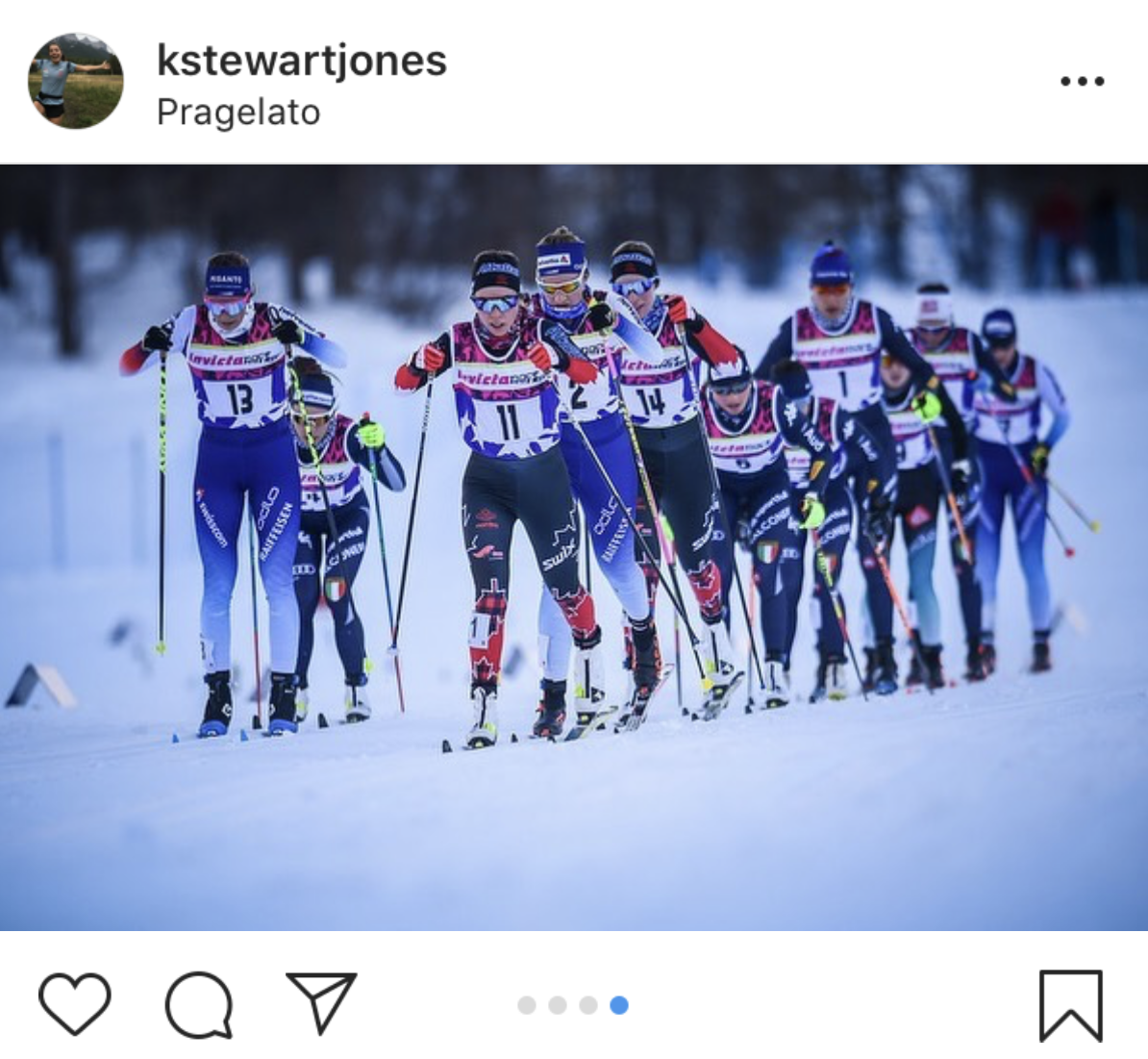
    Katherine Stewart-Jones leads the mass start on the way to a Canadian 1-2 at the OPA Cup in Pragelato, Italy. (Photo: Athlete Instagram, credited to @damianobenedettophoto)
    Katherine Stewart-Jones leads the mass start on the way to a Canadian 1-2 at the OPA Cup in Pragelato, Italy. (Photo: Athlete Instagram, credited to @damianobenedettophoto)

    Canada took a step back from the World Cup circuit this weekend and focussed attention into development series. As the country tries to build momentum in a post Alex Harvey world, the focus has moved away from World Cup podiums and towards a consistent presence in the top 30. The road to the World Cup goes through local and regional races on the way to national/continental races.

    One of the development challenges in Canada is size. The second largest country has roughly the same population as California. Skiers from Newfoundland live closer to Holmenkollen than Whistler Olympic Park.

    The Continental Cup series in each FIS ‘continent’ is the top level race series below the World Cup. Canada has the NorAm series. The USA has the SuperTour series. France, Germany, Italy, Slovenia, Switzerland, and Austria share the OPA Cup series. This distribution of ‘continents’ may seem odd, but remember that the combined land area of the OPA countries is equal to British Columbia and Nova Scotia. Canada has three more time zones separating those two provinces.

    As part of an effort to reduce travel demands on developing skiers in Canada, Nordiq Canada has been making changes. For the second year in a row, Westerns is not a NorAm event, but a regional event (albeit for a region larger than continental Europe). While this eliminates one east/west flight for eastern-based skiers, western athletes from Saskatchewan, Manitoba, Nunavut, North West Territories, and the Yukon still have a flight to pay for.

    8 young Canadians are in Lausanne, Switzerland, for the Youth Olympic Games. Another 8 were in Pragelato, Italy, for an OPA Cup event, where two Canadians won. If you know someone who doesn’t think winning an OPA Cup is a big deal, listen to what Devon Kershaw and Jess Cockney think in the latest podcast. Cockney may ‘only’ have four top 10 results on the World Cup before he ‘retired’, but he did win a combined NorAm/SuperTour earlier this season.

    As Cockney reminded us in the podcast, development comes in cycles. It is hard to remember that ten years ago Norway needed to borrow a biathlete to make a mens relay team for the Olympics, the same Olympics when Canada had four different men with top 10 individual finishes. The glory of being at the top of the roller coaster comes with an unseen cost of getting a big machine up a steep hill. This weekend was part of that climb.

    Western Canada Cup, Whistler Olympic Park

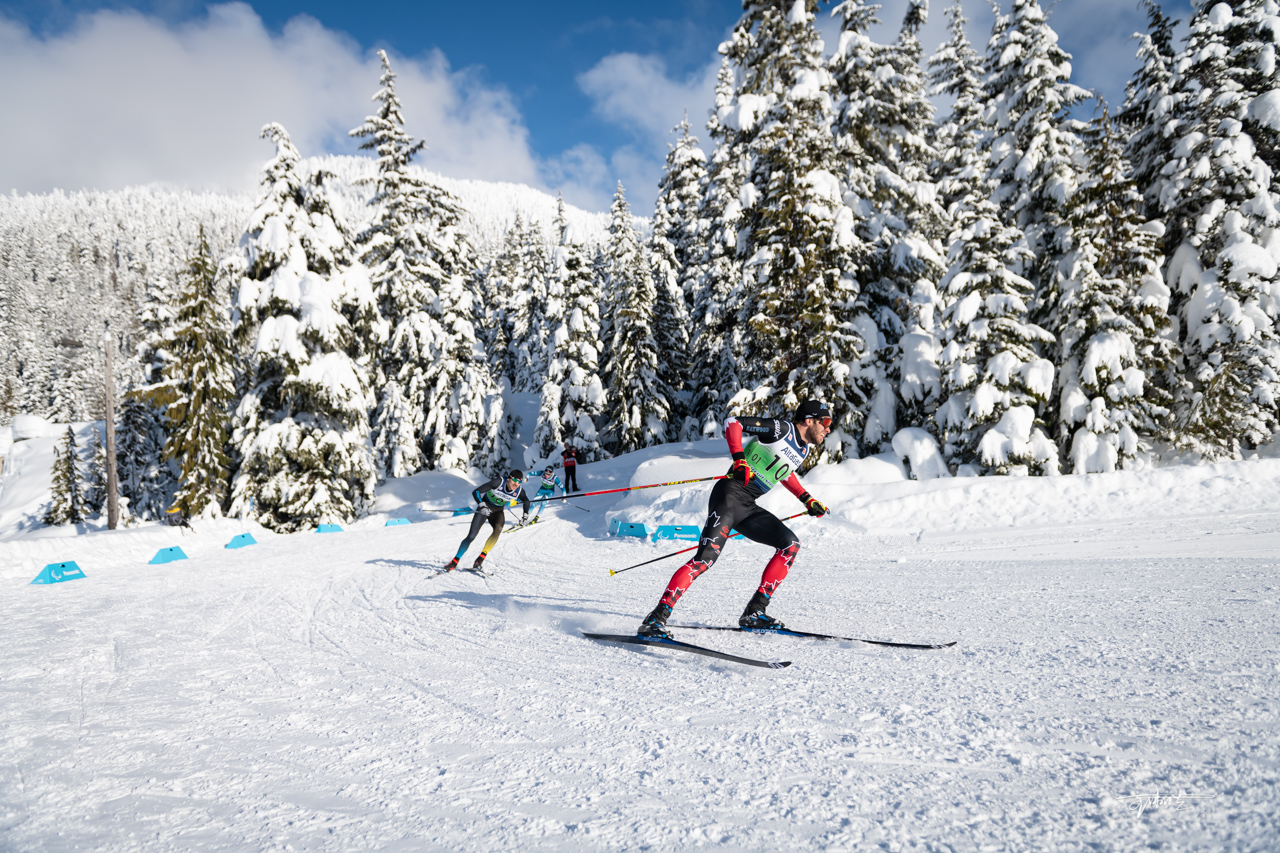
    Russell Kennedy leads the A final out of a corner that Petra Majdic remembers well from the 2010 Olympics. (Photo: Weisheng Wang)
    Russell Kennedy leads the A final out of a corner that Petra Majdič remembers well from the 2010 Olympics. (Photo: Weisheng Wang)

    Western Canadians was held at Whistler Olympic Park, with over 250 athletes competing for titles under a slightly changed name: Western Canada Cup. Record-setting snow storms and very challenging driving conditions should make for some good stories from the athletes who completed the trip.

    The embedded videos are the full-length interviews by Nordiq Canada’s Jeff Ellis. Social media has edited versions.

    On a spectacularly sunny Friday, AWCA’s Annika Richardson won the 1.3km classic sprint on a course that will bring back Olympic memories for older fans. Richardson’s 3:16.95 put her 1.45 seconds ahead of Benita Peiffer and 2.11 seconds clear of Elizabeth Elliott which made an all-AWCA podium. Peiffer and Elliot are in their final season of U20.

    Bragg Creek’s Sebastien Boehmler-Dandurand edged out Canmore’s Russell Kennedy by 0.28 seconds to win the men’s 1.3km in 2:41.37. Telemark’s Gareth Williams grabbed third at 1.90 seconds, well ahead of his brother Ian in 4th who claimed the top U20 finish.

    On Saturday, WOP showed the changeable weather with falling snow and soft tracks after a heavy overnight snowfall. In the men’s 15km classic interval start, Kennedy confirmed his favourite status with a win in 46:57.6, 45.3 seconds clear of Gareth Williams. AWCA’s Jack Carlyle grabbed the bronze at 1:20.3 back. Ian Williams was again 4th overall to take the U20 win.

    In the women’s 10km, Emily Nishikawa showed why she was Canada’s top distance skier on the World Cup last season with a 35:42.4 time. Sprint winner Richardson claimed second, 2:51.4 back followed by AWCA teammate Sadie White at 3:09.0 Whitehorse’s Amanda Thomson was 5th at 3:45.5 to take the U20 title.

    Sunday continued the domination by the favourites. Nishikawa won the 15km free mass start in 43:06, 2:07.6 ahead of Elliott and 2:13.8 ahead of Revelstoke’s Gina Cinelli.

    In the men’s 15km, Kennedy snatched a second win in 37:29.4, 1.6 seconds ahead of Gareth Williams and 19.4 seconds ahead of Carlyle.

    “It is fun to be back in Canada and see how well people are skiing here!,” Kennedy wrote to FasterSkier. “Whistler is so pretty but it is super tricky with weather. Always unpredictable but really good for testing skis I don’t use that much.”

    While the regional field may not have been as deep as MSA will be, the return of Nishikawa and Kennedy from World Cup period 1 gave nearly 300 athletes a good vision into what the next level of competition looks like.

    Results: Full Weekend, Sprint Qualification, Sprint Heats, Interval Classic, Mass Start

    The organizing committee has photo galleries.

    OPA Cup, Pragelato, Italy

    Dahria Beatty wins the OPA Cup ahead of Katherine Stewart-Jones. (Photo: Beatty's Instagram)
    Dahria Beatty wins the OPA Cup ahead of Katherine Stewart-Jones. (Photo: Beatty’s Instagram)

    While the western athletes were at the 2010 Olympic venue, eight Canadians made the trek to the 2006 Olympic venue to compete in the OPA cup. Dahria Beatty won the Saturday’s mass start 15km classic in 49:09.0, 8.1 seconds ahead of teammate Katherine Stewart-Jones. Italy’s Sara Pellegrini was third at 38.7.

    In the men’s 30km, Antoine Cyr edged out Bob Thompson for 22nd place at 5:56.1 back from winner Paolo Ventura who won in 1:26.36.3.

    On Sunday, Stewart-Jones moved up, taking first in the 5km free in 14:03.5, 5.2 seconds ahead of Italy’s Elisa Brocard and 10.4 seconds ahead of Beatty in third.

    “Being on the podium for both races is a huge confidence booster going into next weekend’s World Cup races, especially because the courses in Pragelato are World Cup level,” Stewart-Jones wrote in an email. “With Dahria also on the podium the last two days I couldn’t be more excited with how well our Canadian Women’s team is performing.”

    Stewart-Jones is targeting the Scando Tour, starting in Åre, Sweden, on February 18th and ending in Trondheim, Norway, on the 23rd.

    “The courses here in Pragelato are awesome which made for some good hard racing this weekend,” Beatty wrote after her third OPA podium of the season.
    “I had only done one distance race this season before this weekend so it was really good for me to get some high caliber race kilometres in. My distance skiing is feeling strong right now so I am excited to do a few distance World Cups in the next month and do some classic skiing since Saturday was also my first classic race of the year.”

    Canadian men recovering from the 30km classic in Pragelato's OPA Cup. (Photo: Erik Bråten)
    Canadian men recovering from the 30km classic in Pragelato’s OPA Cup. (Photo: Erik Bråten)

    In the men’s 10km, Cyr was again top Canadian, finishing 23rd, 1:38.2 behind France’s Jean Tiberghien who won in 24:05.1.

    Thompson is a sprinter by preference and was in Pragelato with Oberstdorf’s sprint in mind.

    “The main focus for me this weekend was to get some longer really hard work in, which a 1.5 hour 30k definitely accomplished,” Thompson wrote. “I think the OPA’s are a great chance to find near World Cup level racing and for those who are looking to get a bit more experience at that level they are a great challenge for those looking to make a jump in their racing.”

    The OPA cup is a continental cup series (like the NorAm and SuperTour) and the field is studded with athletes who move up and down between the World Cup and this series. The athletes best known to North Americans would probably be France’s Richard Jouve (8th here) and Italy’s Elisa Brocard (12th and 2nd).

    Head coach Erik Bråten is with the team until Oberstdorf and back to Canada briefly for MSA Trials. He is excited with the progress this season and happy with the visit to Pragelato.

    “What I take away is that we have some young athletes that is getting great race experience outside of North America, and a couple of girls that really showed a high level even in a tough training week.”

    Results: Full Weekend, Women’s 15km C, Men’s 30km C, Women’s 5km F, Men’s 10km F

    Youth Olympic Games, Lausanne, Switzerland

    The YOG started off with a ‘cross country cross’ event including obstacles on Saturday, followed by the more traditional events: Sprints Saturday, classic mass starts Tuesday, and a mixed relay on Wednesday. The American athletes outshone the Canadians over the obstacles on the first day, taking 4th in each gender before working up to podiums on Tuesday. Full results for the event are here.

    While this is an important event in young athlete’s lives’ and there have been some great individual results, fans and media alike have to be careful not to apply expectations and pressure to the developing minds in those developing bodies.

  • Whistler Olympic Park to Host International Ski Jumping Event from Dec. 7-10

    Over 100 athletes from more than 20 countries compete in biggest event since the Olympics

    WHISTLER, BC — Whistler Olympic Park is getting ready to host the biggest ski jumping event since the 2010 Winter Olympic Games, with a FIS Cup Ski Jumping on December 7 & 8 and a FIS Continental Cup Ski Jumping on December 9 & 10.

    Over 100 ski jumpers from over 20 nations will compete on the park’s normal hill. There will for example be athletes from Canada, Japan, Germany, Poland, Norway, USA, Korea, Italy and many more countries. The FIS Cup category will see both women’s and men’s competitions, while the FIS Continental Cup will have a men’s event.


    Training Schedule (subject to change):

    Monday, Dec 4                 10:30-12:00am                   Training (women/men)

    1:00-2:30pm                       Training (women/men)

    Tuesday, Dec 5:                10:30-12:00am                   Training (women/men)

    1:00-2:30pm                       Training (women/men)


    Competition Schedule FIS CUP SKI JUMPING
    (subject to change, check www.whistlersportlegacies.com/fiscup2017 for latest schedule):

    Thursday, Dec 7               

    9:30am               Official Training, Ladies HS104 FIS Cup

    9:45am                 Trial round, Ind. Ladies HS104

    10:00am               1st competition round & final round, Ind. Ladies HS104

    11:15am               Official Training, Men HS104 FIS Cup

    12:20pm               Trial round, Ind. Men HS104

    1:45pm                 1st competition round & final round, Ind. Men HS104

    Following             Prize giving ceremonies


    Friday, Dec 8                     

    9:30am                 Trial round, Ind. Ladies HS104 FIS Cup

    9:45am                 1st competition round & final round, Ind. Ladies HS104

    11:00am               Trial round, Ind. Men HS104 FIS Cup

    12:30pm               1st competition round & final round, Ind. Men HS104

    Following             Prize giving ceremonies


    Competition Schedule FIS CONTINENTAL CUP SKI JUMPING
    (subject to change, check http://www.whistlersportlegacies.com/fiscontinentalcup2017 for latest schedule):

    Saturday, Dec 9                

    9:30am               Official Training, 2 rounds FIS COC

    11:00am               Trial round, Ind. Men HS104 FIS COC

    12:00pm               1st competition round & final round, Ind. Men HS104

    Following             Prize giving ceremony


    Sunday, Dec 10                

    10:00am               Trial round, Ind. Men HS104 FIS COC

    11:00am               1st competition round & final round, Ind. Men HS104

    Following             Prize giving ceremony


    Spectator Access:

    Spectator access to the jumps is free with a valid:

    • Park pass for spectating only – (no trail access) $15 per vehicle
    • Ski or snowshoe day ticket – access to park’s ski/snowshoe trails + spectating
    • Season Pass – Ski Callaghan/Winter Olympic Park winter season’s pass


    On-Site Services:

    • Whistler Olympic Park’s full-service Day Lodge will open on all training and event days.
    • Food & drinks available at the Day Lodge’s licensed restaurant


    Results will be available on the FIS website: https://data.fis-ski.com/ski-jumping/calendar.html

    ***

    About Whistler Olympic Park

    Whistler Olympic Park (WOP) is operated by Whistler Sport Legacies, a non-profit organization dedicated to grow sport at three venues: Whistler Olympic Park, the Whistler Sliding Centre, and the Whistler Athletes’ Centre. Each facility plays a unique role in inspiring sport excellence for the benefit of athletes, residents, and visitors. WOP was the 2010 Olympic Winter Games venue for competitions in ski jumping, Nordic combined, cross-country skiing and biathlon; and the 2010 Paralympic Winter Games cross-country skiing and biathlon competitions. Today, participation in WOP’s recreational activities helps support the growth of Nordic sport in the Sea to Sky corridor. For more information, visit whistlerolympicpark.com

  • May Skiing in Canada (and Abroad) in Photos

    May Skiing in Canada (and Abroad) in Photos

    The BC development team getting ready to ski out of the biathlon stadium at Whistler Olympic Park last weekend.

    While most people have moved on to other sports by May, the more obsessive skiers are starting the new training year on snow.

    Canada’s “first” cross-country ski “races” of the 2017/2018 season were held on May 6. “First” because, while we haven’t exhaustively researched this, it was the first Saturday after May 1, which is the traditional new year for the Northern Hemisphere. “Races” is also a bit misleading as most athletes were viewing the events as an opportunity to do some intensity.

    Here then, in the order which photos arrived, are the places where people are skiing in May. Did we miss one? Share in the comments below or email photos with caption and credit info to info@fasterskier.com.

    Sovereign Lake, Vernon, B.C.

    The Sovereign Lake Nordic Centre (SLNC) re-opened from May 4 to 7 for the Spring Fling camp and the “SLNC 1st Annual Pushups Classic Time Trial” race. The May camp has been running for years, but was moved to earlier in the month to ensure prime conditions. A number of clubs brought athletes out for technique lessons and long snow sessions. Canmore Nordic broke the pattern by focussing on low-elevation training with shorter training sessions. As the Canmore athletes live at 1,400 metres above sea level, the opportunity to train at 400 metres was more exciting than skiing at 1,700 metres.

    Canmore, Alberta

    The Canmore Nordic Centre lost its snow at the end of April, but Sunshine Meadows just a short drive west in Banff National Park hosted a large group of skiers starting May 9. Ivan Babikov is leading a training block for the Canmore-based national team members, Chris Jeffries has the Alberta World Cup Academy crew, and a number of other groups are there as well.

    https://www.instagram.com/p/BT7dTJHjPhS/?taken-by=andrewkchisholm

    https://www.instagram.com/p/BT7TVIfFWrc/

    Sjusjøen, Norway

    OK, not in Canada, but Canadians Dahria Beatty and Russell Kennedy went and enjoyed some superb skiing conditions. They raced at Bysprinten in Mosjøen, Norway, and then moved on to Sjusjøen’s 100 kilometres of trails.

    Menihek, Labrador City, Newfoundland and Labrador

    The Menihek Nordic Ski Club is officially closed, but has snow and will set track for Mother’s Day, according to club president Gerry Rideout.

    Whistler Olympic Park, Whistler, B.C.

    This venue is closed to the public, but has been hosting camps on natural snow. Biathlon got the first weekend of May and cross-country has the Victoria Day weekend. These photos are from the biathlon camp on the Olympic trails, mostly below 900 metres in elevation.

  • Western Canadian Championships at Whistler: Notes & Quotes

    Western Canadian Championships at Whistler: Notes & Quotes

    Start of the junior boys 3 x 5 k relay on Sunday, Jan. 22, at NorAm Western Canadian Championships at Whistler Olympic Park in Callaghan Valley, B.C. (Photo: Callaghan Valley XC)
    Start of the junior boys 3 x 5 k relay on Sunday, Jan. 22, at NorAm Western Canadian Championships at Whistler Olympic Park in Callaghan Valley, B.C. (Photo: Callaghan Valley XC)

    Last Friday through Sunday, Jan. 20-22, Whistler Olympic Park (WOP) in the Callaghan Valley hosted the NorAm Western Canadian Championships. More than 600 racers attended, making it the largest event the venue has held since 2013 Canadian nationals.

    Western Canadian Championships opened Friday with the men’s and women’s 1.2-kilometer freestyle sprints, which national-team members Jess Cockney and Dahria Beatty won, respectively.

    On Saturday, Emily Nishikawa (Canadian World Cup B-team) won the women’s 10 k classic interval start, and Andy Shields of Lappe Nordic took the men’s 15 k classic win.

    Sunday was team day, with three-person freestyle relays (men’s 3 x 7.5 k and women’s 3 x 5 k) — an event added per the athletes’ request. While a relatively small number of teams participated in the open (elite-level) category (the turnout affected by preparation for U23/Junior World Championships, as well as some athletes departing for the World Cup), 146 total teams competed in the relays. The open victories went to Ontario (Bob Thompson, Jack Carlyle and Shields) in the men’s 3 x 7.5 k and B.C. (Katie Weaver, Anna Goodwin and Hannah Mehain) in the women’s 3 x 5 k.

    Here are comments from some of the podium finishers each day:

    Friday’s freestyle sprints

    Results: Qualifier | Heats

    Dahria Beatty (Alberta World Cup Academy/Canadian U25 Team), 1st overall (2nd in qualifying):

    “It’s always amazing racing at Callaghan on a sunny day. Such a beautiful venue. My qualifier was a bit chaotic feeling, but I was able to calm things down and ski a strong second half of the course in my heats.”

    Olivia Bouffard-Nesbitt (Alberta World Cup Academy/NST U25 Team), 2nd overall (1st in qualifying):

    “I was really happy to secure another win in the qualifier today. I felt like that was really important for me to do after missing the races in Soldier Hollow, so I’m happy I was able to do that.

    “Today was a very tactical race. I think the recipe was — you didn’t want to be leading going into the second to last corner, but you definitely wanted to be leading going into the last corner. The final was really played out in that second last corner and the straight away that followed. Up to that point there were basically three of us battling to get into that ideal second spot. I didn’t have a perfect second-last corner, but felt really strong on the straight away. I moved into second going into the final corner and that’s how I finished the race.

    “All things considered I can only be extremely happy with how the season has gone so far! I’m very happy that my race shape is better than I expected, and other than that little speed bump of sickness during US Nationals, I think I’m going to be well prepared by the time I get to mix it up with everyone over seas!”

    Katherine Stewart-Jones (NTDC Thunder Bay/NST U25 Team), 3rd overall (8th in qualifying):

    “I was quite happy with my racing today. My qualifier was not the best, I felt like I didn’t ski that well technically. In the heats I think I skied well tactically, skiing at the back from the start and making my way up. So far my season has been good, I’m feeling more and more ready to tackle on the races at U23 World Champs.”

    Jess Cockney (Canadian World Cup B-team), 1st overall (2nd in qualifying):

    “I was really happy with today. The course is very short and over before you know it making it really important to start fast. Tactically I tried to be conservative in the final and I made my move on the final downhill which thankfully worked out for the best. I feel as though I’m finding a rhythm this season leading towards big races and looking forward to fine tuning the plan for the rest of the year’s chances. Especially excited for the [World Cup] finals in QC [Quebec City]!”

    Julien Locke (Alberta World Cup Academy), 2nd overall (10th in qualifying):

    “We lucked out with a beautiful day for racing at WOP. After skiing in a snow storm on Friday, it was a pleasant surprise to arrive to blue skies and hard tracks.

    “My day started off on a poor note with some bad luck in the qualifier, first a broken pole and then a crash near the end. However, the legs felt great and I was excited to race the heats. Despite the small field, the race was pretty fast in all of the rounds. We were racing on the short 1.2km course here in Whistler which has a very gentle profile, so the speed was high the entire way. The final started relatively quickly. I stayed near the front and then took the inside to move into the lead around the last downhill corner. However, Jess Cockney came by me in a tuck with good speed and carried it to the finish. I felt good and was skiing well, but had to settle for 2nd today.

    “I’m off to Korea tomorrow. I will compete in the Korean National Championships at the Alpensia Resort in Pyongchang in advance of the World Cups at the same venue.”

    Saturday’s 10/15 k classic 

    Results

    Andy Shields (Lappe Nordic), 1st:

    “It’s been great to be battling for wins again after racing against hyper-competitive fields since the start of the season. Obviously happy to get the win today. Jesse and I were both on soft, short pocket classic skis with klister for today’s 15km. Seemed to be the winning skis today. I stayed at altitude in Utah all last week and it was great prep for this weekend.

    “Next up for me are Eastern Canadian champs [Feb. 3-5]. Hopefully I can hit some more podiums.”

    Emily Nishikawa (Alberta World Cup Academy/NST World Cup B-team), 1st:

    “I was happy to have a good race yesterday.  I felt good, which is a good sign as I prepare for World Champs.  There was some tricky waxing conditions, typical of Callaghan Valley, so I did my best to make my skis work in all sections of the course, but struggled with icing up a little bit in the third lap.  But overall I am happy with how I skied and look forward to getting back to Europe soon to join up with my teammates who are doing exceptionally well right now. It is inspiring to watch them!

    Beatty, 2nd:

    “I paced it well. It was hard waxing conditions so you really had to make your skis work for you and I felt I did a good job of that.

    “I am already back in Canmore now to start my U23 World Champs prep so I won’t be doing the relay tomorrow.”

    Maya MacIssac-Jones (Alberta World Cup Academy/NST U25 Team), 3rd:

    “I am really happy with my race today. I’ve been struggling to get into race shape this season and today was the first distance race where I felt as if I could push hard instead of just trying to survive. I’m always working on becoming more of an “all-around” skier, and for my first NorAm podium this year to be in a distance race is really cool!

    “I think the biggest difference between this race and my other distance races this season was my mental approach. I really just tried to focus on skiing in the moment, approaching every section of the course with a ‘what is the fastest way I can race this part’ instead of worrying about pacing or saving energy for the end.

    “I haven’t been very happy with my season to date. I set some big goals for myself this year, and thus far I haven’t been meeting them. That being said, this weekend things started to feel much better, and I’m feeling a lot more confident heading into U23 Championships next week!”

    Sunday’s freestyle relays

    Results

    The junior girls 3 x 5 k relay on Jan. 22 at NorAm Western Canadian Championships at Whistler Olympic Park in Callaghan Valley, B.C. (Photo: Callaghan Valley XC)
    The junior girls 3 x 5 k relay on Jan. 22 at NorAm Western Canadian Championships at Whistler Olympic Park in Callaghan Valley, B.C. (Photo: Callaghan Valley XC)

    Bob Thompson (NTDC Thunder Bay), 1st in men’s 4 x 7.5 k with Team Ontario (Thompson, Jack Carlyle & Shields):

    “This weekend was starting to feel more like my normal NorAm race form, I am hoping to still find a bit more as I was missing the pace for the semi final but felt my distance was very close to where I want it to be. Conditions made waxing tricky and my tech did an amazing job but the course was behaving fairly different with the grip even just from the hill out of the stadium to the top of the course just on the 2.5km loop

    “I think the relay was definitely a success. I haven’t done one since my first nationals in 2006 at Lappe. It’s unfortunate the athletes who needed to be in Canmore for the pre Worlds Camp couldn’t attend or those that did come out couldn’t stay but that was decided it was what was best for them. And while the open categories weren’t that large, a reality of the size of our country and the cost of travel, the younger age groups looked like they had large fields and really enjoyed themselves, which is always great to see. I really blew up halfway through but it was great to then really want to cheer and watch how the rest of the race developed, I think we need more team events like this through the regular season, not just one at nationals.”

    MacIsaac-Jones (didn’t race):

    “I think relays are a great, and I absolutely think they should be done at this level again. I think they are a great way to keep people having fun and engaged in the sport.

    “In the future, having a mixed relay (men and women on the same team) might be better because there sometimes aren’t enough people from both genders from each province to fill a relay team. Unfortunately, Westerns this year was really close to U23/Junior World Champs, which I think contributed to there not being many athletes in the open categories. If Westerns had been later in the year I would guess more athletes would have raced the relay.”

    — Gerry Furseth contributed reporting

  • Saturday Rundown: Ulricehamn, Antholz, Chaux-Neuve, Zuoz, Whistler, & Truckee (Updated x6)

    Saturday Rundown: Ulricehamn, Antholz, Chaux-Neuve, Zuoz, Whistler, & Truckee (Updated x6)

    Ben Lustgarten (Craftsbury Green Racing Project) with his $750-dollar check for winning the men's SuperTour classic sprint on Saturday near Truckee, Calif. Stratton's Ben Saxton (l) placed second and APU's Reese Hanneman (r) was third.
    Ben Lustgarten (Craftsbury Green Racing Project) with his $750-dollar check for winning the men’s SuperTour classic sprint on Saturday near Truckee, Calif. Stratton’s Ben Saxton (l) placed second and APU’s Reese Hanneman (r) was third.

    U.S. SuperTour (Truckee, Calif.): Classic sprints

    [UPDATED] Less than a week after being named to the U.S. team for 2017 World Championships, Ben Lustgarten — the men’s 30 k classic mass start champion at this year’s U.S. nationals — won Saturday’s SuperTour classic sprint as well.

    Lustgarten, of the Craftsbury Green Racing Project, raced to a 1.58-second victory in the men’s A-final at the Auburn Ski Club in Soda Springs, Calif., finishing in 3:03.4. Ben Saxton, of the Stratton Mountain School (SMS) Elite Team, placed second, and Reese Hanneman, of Alaska Pacific University (APU), was third (+2.77).

    Hannenman’s younger brother Logan also reached the final and placed fourth (+4.5), Dakota Blackhorse-von Jess (Bend Endurance Academy) was fifth (+5.86), and the third APU skier in the final, Tyler Kornfield sixth (+18.69).

    Blackhorse-von Jess started the day off as the fastest qualifier in 2:58.8. Saxton qualified second, 4.1 seconds back, Logan Hanneman qualified third (+4.2), and Lustgarten fourth (+6.5). Blackhorse-von Jess went on to win his quarterfinal and place second in his semifinal, while Lustgarten and Saxton both won their quarterfinals and semifinals.

    Jennie Bender (3) of the Bridger Ski Foundation leading Stratton's Julia Kern (2) and Sun Valley's Deedra Irwin (5) during the second women's classic sprint semifinal at Saturday's SuperTour near Truckee, Calif. Bender went on to win the semifinal, as well as the final.
    Jennie Bender (3) of the Bridger Ski Foundation leading Stratton’s Julia Kern (2) and Sun Valley’s Deedra Irwin (5) during the second women’s classic sprint semifinal at Saturday’s SuperTour near Truckee, Calif. Bender went on to win the semifinal, as well as the final.

    In the women’s A-final, Jennie Bender of the Bridger Ski Foundation, coming off a classic sprint win at nationals, scored another victory in 3:29.07. She edged Craftsbury’s Kaitlynn Miller by just seven-hundredths of a second, and Stratton’s Julia Kern placed third (+3.42). Racing at home, Hannah Halvorsen (Sugar Bowl Academy) finished fourth (+3.88). Craftsbury had three in the women’s final with Caitlin Patterson in fifth (+3.93) and Heather Mooney in sixth (+27.35).

    Miller proved to be the woman to beat throughout the day, winning the qualifier in 3:30.9, along with her quarterfinal and semifinal. Kern qualified second (+3.2) and Bender third (+4.6). Bender went on to win her quarterfinal and semifinal as well before facing off with Miller in the final.

    Results: Men | Women

    ***

    NorAm Western Canadian Championships (Whistler, B.C.): 10/15 k classic 

    It was interval-starts day at Western Canadian Championships at Whistler Olympic Park and national-team veteran Emily Nishikawa completed the four laps of the women’s 10 k classic in 30:35.5 to win ahead of teammate Dahria Beatty, 16.5 seconds behind. Maya MacIsaac-Jones completed the national team and Alberta World Cup Academy (AWCA) sweep in third (+1:36.5).

    Sovereign Lake’s Hannah Mehain, of the national junior team, was the top junior for the second-straight day in eighth overall (+3:22.1).

    In the men’s 15 k, Lappe Nordic’s Andy Shields won the six-lap race in 40:34.2, showing some of the form that won him the NorAm overall last season. National-team member Jess Cockney collected his second-straight podium, finishing second, 4.3 seconds behind Shields. Evan Palmer-Charrette (NTDC Thunder Bay) completed the podium in third (+55.1).

    Results

    ***

    FIS Cross-Country World Cup (Ulricehamn, Sweden): 10/15 k freestyle

    The men's 15 k freestyle podium at Saturday's World Cup in Ulricehamn, Sweden, with Canadian winner Alex Harvey (c), Norwegian runner-up Martin Johnsrud Sundby (l), and Sweden's Marcus Hellner (r) in third. (Photo: FIS Cross Country/Twitter)
    The men’s 15 k freestyle podium at Saturday’s World Cup in Ulricehamn, Sweden, with Canadian winner Alex Harvey (c), Norwegian runner-up Martin Johnsrud Sundby (l), and Sweden’s Marcus Hellner (r) in third. (Photo: FIS Cross Country/Twitter)

    Men’s report | Women’s report

    First individual win of the season (second straight, after winning last weekend’s team sprint), fifth individual victory of his career. That’s the latest news on Canada’s Alex Harvey, who won the World Cup men’s 15-kilometer freestyle individual start on Sunday in Ulricehamn, Sweden, for his first victory in a 15 k skate race and fourth individual podium of 2016/2017.

    To say Harvey is on a roll is an understatement. On Saturday, he beat Norway’s Martin Johnsrud Sundby by 6 seconds after starting a minute behind the Norwegian defending World Cup champion. Harvey’s fastest time across the line in 32:46.2 held up through 76 finishers, with Sweden’s Marcus Hellner coming somewhat within range after starting a minute behind him. Hellner ended up 14.3 seconds back from Harvey at the finish for third place, behind Sundby.

    Switzerland’s Dario Cologna missed the podium by 0.5 seconds in fourth (+14.7), and Norway’s 24-year-old Daniel Stock broke through in fifth (+16.2) for his first World Cup top 20.

    Great Britain’s Andrew Musgrave placed sixth (+18.7), Sweden’s Daniel Rickardsson was seventh (+25.0), Norway’s Finn Hågen Krogh eighth (+32.2), Russia’s Petr Sedov ninth (+33.9), and Japan’s Keishin Yoshida 10th (+34.2).

    American Erik Bjornsen landed in the points as he tied Norway’s Simen Andreas Sveen for 28th (+1:09.2), leading fellow U.S. Ski Team members Noah Hoffman, who placed 41st (+1:28.8), and Simi Hamilton in 53rd (+1:56.2). Also for the U.S., Matt Gelso, the Period 1 SuperTour leader from the Sun Valley Ski Education Foundation (SVSEF) Gold Team, finished 68th (+3:00.3).

    Harvey’s Canadian World Cup teammates Len Valjas finished 35th (+1:17.7) and Devon Kershaw 38th (+1:22.2). Knute Johnsgaard (Canadian U25 Team) did not start.

    The women's 10 k freestyle podium on Saturday in Ulricehamn, Sweden, with Norwegian winner Marit Bjørgen (c), Finland's Krista Parmakoski (l) in second and Sweden's Charlotte Kalla (r) in third. (Photo: FIS Cross Country/Twitter)
    The women’s 10 k freestyle podium on Saturday in Ulricehamn, Sweden, with Norwegian winner Marit Bjørgen (c), Finland’s Krista Parmakoski (l) in second and Sweden’s Charlotte Kalla (r) in third. (Photo: FIS Cross Country/Twitter)

    In her first World Cup race in over a month and at a brand-new World Cup venue, Norway’s 36-year-old Marit Bjørgen returned to her winning ways, topping the women’s 10 k freestyle on Saturday in Ulricehamn.

    Bjørgen started 40th out of 61 finishers and took the lead from Finland’s Krista Parmakoski at the finish with a time of 23:46.3 minutes. Parmakoski, who started a minute ahead of her in bib 38, ended up second, 10.7 seconds back. Sweden’s Charlotte Kalla reached the podium for the second time this season in third (+24.9).

    “It is always great to win,” Bjørgen said, according to an International Ski Federation (FIS) press release. “I stayed at home for five weeks and was training. It is great to come back with a victory. I know that the training I had done was good. It was an amazing atmosphere today by the course. There were people cheering everywhere.”

    Norway swept fourth through sixth with Astrid Uhrenholdt Jacobsen in fourth (+25.7), Ragnhild Haga in fifth (+32.3) and Heidi Weng in sixth (+34.0).

    American Jessie Diggins raced to seventh (+34.9), ahead of Sweden’s Hanna Falk, who recorded her best distance result in eighth (+36.4). Norway’s Ingvild Flugstad Østberg finished ninth (+44.8), and Germany’s Sandra Ringwald was 10th (+56.6).

    “I didn’t have the snappy good feelings I was hoping to have in my body today, but it was a solid race,” Diggins wrote in a post-race email to FasterSkier. “It’s always hard when you know that on your best days you are capable of more, but at the same time we had great skis, and it was really fun for me to be able to ski with my teammates today!”

    The U.S. had three in the top 20 and four in the top 30 with Sadie Bjornsen in 12th (+1:00.5), Liz Stephen in 16th (+1:07.3) and Rosie Brennan in 24th (+1:30.7).

    Cendrine Browne as Canada’s lone woman in the race achieved 35th (+1:52.0) for her career best in an individual race. Also for the U.S., Kikkan Randall placed 40th (+1:59.6) and Liz Guiney of the Craftsbury Green Racing Project 52nd (+2:33.2).

    Results: Men | Women

    ***

    IBU World Cup (Antholz, Italy): Men’s relay & women’s mass start

    Men’s report | Women’s report

    The photo finish of the men's 4 x 7.5 k relay on Saturday at the IBU World Cup in Antholz, Italy, with Germany's Simon Schempp outlunging Norway's Emil Hegle Svendsen. (Photo: IBU screenshot)
    The photo finish of the men’s 4 x 7.5 k relay on Saturday at the IBU World Cup in Antholz, Italy, with Germany’s Simon Schempp outlunging Norway’s Emil Hegle Svendsen. (Photo: ZDF broadcast screenshot)

    For the U.S. men, top six was a target for the 4 x 7.5 k relay on Sunday in Antholz, Italy, according to US Biathlon Men’s Coach Jonas Johansson.

    Mission accomplished. In the final team event before 2017 World Championships, Lowell Bailey, Leif Nordgren, Tim Burke, and Sean Doherty combined for sixth, finishing 1:04.9 minutes behind the German winners. The Americans used a total of 10 spares but avoided the penalty loop, as did the Germans who used seven spares to clean the eight-stage race and won it in 1:13.57.2.

    Germany’s Simon Schempp narrowly outlasted Norway’s Emil Hegle Svendsen in the finishing stretch to secure the victory for Germany (with teammates Erik Lesser, Benedikt Doll and Arnd Peiffer) by one-tenth of a second. Norway finished second with nine spares and no penalties (with Lars Helge Birkeland, Henrik L’Abee-Lund, Johannes Thingnes Bø, and Svendsen), and Russia secured third (+33.6) with nine spares and zero penalties as well (with Maxim Tsvetkov, Evgeniy Garanichev, Dmitry Malyshko, and Anton Babikov).

    Ukraine used a total of just five spares and had zero penalties for fourth (+46.7), and Austria took fifth (+49.2) with eight spares and no penalties, after Austria’s Dominik Landertinger skied away from Doherty on the final loop and finished 6.9 seconds ahead of him for fifth place.

    For the U.S. men, sixth was close to their team-best fifth with the same lineup in last year’s World Cup relay in Presque Isle, Maine. The same group also took sixth in Ruhpolding, Germany, last year as well.

    With all four making US Biathlon’s World Championships team, announced Saturday, they will likely be aiming for a best championships result early next month in Hochfilzen, Austria.

    Canada (Christian Gow, Scott Gow, Macx Davies, and Brendan Green) finished 16th (+4:13.8) on Saturday with two penalties and 11 spares. Scott Gow skied them up to 15th by the second exchange but they dropped to 18th after Davies had two penalties on the third leg. With Green anchoring and using just one spare, they recouped two places before the finish.

    In the women’s race, Germany’s Nadine Horchler achieved a lifetime dream with her first World Cup win, after starting in bib 30 and earning her start as a reserve athlete. Germany took first and second with Laura Dahlmeier in second, and the Czech Republic’s Gabriela Koukalova placed third. Susan Dunklee of the U.S. was the lone North American starter and finished 24th after leading at the start of the second loop.

    Results: Men’s relay | Women’s 12.5 k mass start

    ***

    FIS Nordic Combined World Cup (Chaux-Neuve, France): Individual large hill/10 k

    Saturday's Nordic Combined World Cup podium in Chaux-Neuve, France, with German winner Johannes Rydzek (c), German runner-up Fabian Rießle (l) and Japan’s Akito Watabe (r) in third. (Photo: FIS Nordic Combined/Twitter)
    Saturday’s Nordic Combined World Cup podium in Chaux-Neuve, France, with German winner Johannes Rydzek (c), German runner-up Fabian Rießle (l) and Japan’s Akito Watabe (r) in third. (Photo: FIS Nordic Combined/Twitter)

    The first part of Saturday’s Nordic Combined World Cup individual large hill/10 k competition was a shining moment for U.S. Nordic Combined skier Ben Berend, who jumped to second for a total of 127.5 points, trailing only Norway’s Jarl Magnus Riiber with 139 points in Chaux-Neuve, France.

    Berend flew farther than Germany’s Eric Frenzel, who jumped to third on the Chaux-Neuve large hill.

    Later in the day, they started the 10 k Gundersen in that order, with Riiber heading out first, followed by Berend 46 seconds later, then Frenzel 53 seconds back in third.

    Germany’s Johannes Rydzek started 1:15 minutes back in 12th and skied the fastest 10 k to take the victory at the finish (in 23:01.7). He held off his German teammate Fabian Rießle by 2.8 seconds for the win, after Rießle started sixth and 1:01 back. Japan’s Akito Watabe reached the podium in third (+5.7) after jumping to seventh and starting the race 1 second behind Rießle.

    Frenzel ended up fourth (+8.3), and the fourth German in the top five, Björn Kircheisen improved to fifth (+22.6) after starting 11th.

    Riiber dropped to 15th (+54.0), and Berend fell outside the top 30 to end up 32nd (+2:26.0) with the 39th-ranked course time.

    Berend finished 12.2 seconds ahead of his U.S. teammate Taylor Fletcher, who placed 34th (+2:38.2) after the jump put him in 48th.

    Bryan Fletcher was 49th after the jump but did not start the 10 k.

    The Nordic Combined World Cup continues Sunday in Chaux-Neuve with another large hill/10 k.

    Results

    ***

    Ski Classics #5: La Diagonela (Zuoz, Switzerland): 50 k classic

    [UPDATED] Under “blue skies, no wind and perfect track conditions” in the Swiss Engadin Valley on Saturday, according to a Ski Classics press release, Russia’s Ilya Chernousov and the Czech Republic’s Kateřina Smutná won the men’s and women’s La Diagonela, respectively, in Zuoz, Switzerland.

    Chernousov, of Team Pioneer Investments, and Tord Asle Gjerdalen (Team Santander) led a large pack of men into the final major climb on the 50 k course. There, Gjerdalen attacked and Chernousov matched him, accelerating away from his competitors up the last steep pitch to the finish, according to the press release. He finished in 2:03:39.6 hours, holding off Gjerdalen by 1.5 seconds, while Øystein Pettersen (Team BN Bank) finished third (+3.0).

    In the women’s race, Smutná (Team Santander) pushed to break up the field around the halfway point, where the men caught the women. Britta Johansson Norgren (Lager 157 Ski Team) hung with Smutná, but lost contact over the last 5 k. After finishing second in the last two Ski Classics races, Smutná took the win by 1:03.2 minutes in 2:20:49.2. Nordgren finished second, ahead of Sara Lindborg (Team Serneke) in third, who finished more than three minutes later (+4:17.4).

    Results


  • November Skiing in Canada: Where The (Skiable) White Stuff Is

    November Skiing in Canada: Where The (Skiable) White Stuff Is

    Len Valjas, Graeme Killick, Knute Johnsgaard, and Bob Thompson at the start of a classic sprint heat (Photo: Jenn Jackson)
    (From left to right) Bob Thompson (NTDC Thunder Bay) chases Lenny Valjas (Canadian World Cup A-Team), Graeme Killick (AWCA/NST B-team), and Knute Johnsgaard (AWCA/NST U25 Team) at the start of a classic sprint heat at 2016 Frozen Thunder in Canmore, Alberta, on Nov. 1. (Photo: Jenn Jackson)

    As promised, the Canadian version of “Where the (Skiable) White Stuff Is” (a.k.a. November skiing) is here, minus the bit about where to ski at Thanksgiving. Canada doesn’t usually have much snow at Thanksgiving, mostly because Canadian Thanksgiving is in early October. But by the time U.S. Thanksgiving rolls around in late November, there is an abundance of reliable snow to choose from in Canada.

    In addition to major camps and well publicized early season track setting, there are a lot of places in Canada where people quietly start skiing when there is snow. Whitehorse in the Yukon is one of those places where “early” doesn’t have the same meaning as it does in the south. No one will advertise October skiing at Barkerville, British Columbia, but the Caledonia Nordic Ski Club in Prince George can tell you about it. FasterSkier’s West-Coast based Canadian contributor was on snow Oct. 8 this year.

    All of the western venues mentioned here were affected by the same weather pattern than forced the cancellation of the Bozeman SuperTour. A heatwave rolled in on Nov. 3, starting with a very warm classic sprint in Canmore, Alberta, and ending in spectacular flooding near Whistler, B.C. It has been a better start in the east.

    This article will focus on reliable set track and camps open to the public in November — in Canada (for the U.S. version, click here).  If your favourite early season spot isn’t featured, you are in good company. Let us know in the comments below.

    And if you are visiting Canada, remember that the U.S. dollar is worth $1.35 up here.

    ***

    CAMPS

    XC SuperCamp

    Where: Sovereign Lake Nordic Centre and Silver Star Mountain Resort, Vernon, B.C.

    SuperCamp at Sovereign Lake/SilverStar (Courtesy Photo)
    A trailside photo from 2015 SuperCamp at Sovereign Lake/Silver Star (Courtesy photo)

    SuperCamp has evolved over 30 years, but its always been held on natural snow and it’s always run camps in November. Four of this season’s seven camps are in November, and biathlon options were offered this month as well.

    “SuperCamp is a very comprehensive nordic experience,” Shane Landreville, SuperCamp coordinator, wrote in an email. “Trail passes are included, as are lunches, off snow programs, wax sessions, massages, and ski demos.”

    Ski-in/ski-out accomodation and restaurants are available at Silver Star. Vernon, a 20-minute drive and 1,200 metres lower in elevation, offers a wide range of food and lodging alternatives. Some of the November camps sold out in mid-October when registration opened.

    Glenn Bond XC Ski Camps

    Where: Labrador City, Newfoundland

    Glenn Bond XC Ski Camp at Menihek Nordic on November 3rd, 2016. (Courtesy Photo)
    The 2016 Glenn Bond XC Ski Camp at Menihek Nordic on Nov. 3. (Courtesy photo)

    The four-year old Glenn Bond XC Ski Camp program travelled to Menihek Nordic in Labrador City, Newfoundland, for a November camp on natural snow.

    “[This camp] was November 3-6 with 70-80 cms of snow and big smiles,” Bond wrote. “Menihek Nordic wins the prize for best early season xc ski conditions this year hands down.”

    (Longtime SuperCamp attendees remember Bond from his time with that program.)

    NATURAL SNOW

    Menihek Nordic

    Where: Labrador City, Newfoundland and Labrador

    50 cms (20") of natural snow at Menihek on October 23rd, 2016. (Courtesy Photo)
    Fifty centimetres (roughly 20 inches) of natural snow at Menihek Nordic in Labrador City on Oct. 23, 2016. (Photo: Menihek Nordic)

    Mention ‘Lab City’ to a national team member from the 1980s and you will see the good memories scrolling behind the smile. In the glory days of Pierre Harvey, the national team would kick off its season at Menihek before moving on to Silver Star for an early season elevation camp. After that national team stopped visiting the venue in 1988, it quietly dropped off the radar, to the point that FasterSkier missed this October skiing opportunity in last year’s guide.

    Labrador City is not visited by many tourists. It’s at least a 13-hour drive from Quebec City, which is the nearest major population centre. But there are some big-name skiers that have visited, including Sweden’s Gunde Svan, Americans Bill Koch and Tim Caldwell, Norway’s Anette Bøe, and the Firth sisters from Canada’s Northwest Territories. Menihek Nordic hosted the 1983 World Cup Final, the 1985 World Cup opener and was a national training centre from 1981 to 1988. Mining communities are often multicultural: the World Cup hosts were able to find local translators for 20 languages from a population of less than 10,000. Koch designed some of the trails in 1981.

    What makes this venue unique, other than reliable October-to-May skiing?

    “Labrador is unique in that it is nearly the last frontier,” Menihek Nordic Ski Club President Gerry Rideout explained. “There is a certain magic about Labrador, it gets in your blood.”

    This season, Menihek opened on Oct. 23, held four camps in November, had the full 34 k system set on Nov. 3, and plans to stay open to the first week of May (as usual).

    Sovereign Lake/Silver Star

    There were lots of smiles during US Thanksgiving at Sovereign Lake. Laura McCabe's group of 30 kids skied over the top from SilverStar and FasterSkier caught her as the group started back. Locals know to start at Sovereign and grab a croissant in SilverStar village to fuel the second half of the ski. (Photo: Gerry Furseth)
    There were lots of smiles during U.S. Thanksgiving at Sovereign Lake. Methow Valley Nordic coach Laura McCabe (a two-time Olympian) led 30 kids over the top from Silver Star and FasterSkier caught them on the way back. Locals know to start at Sovereign and stop for a croissant in Silver Star village to fuel the second half of the ski. (Photo: Gerry Furseth)

    This destination is actually two ski areas. The Sovereign Lake Nordic Centre (also Sovereign Lake Nordic Club) has been operating since the 1930s under a variety of names, while Silver Star Mountain Resort is more recent, opening as an alpine-skiing area in 1958.  The two organizations have 105 kilometers of interconnected nordic trails and a surprisingly good relationship between the commercial resort and the volunteer-based club (which is one of the largest cross-country ski clubs in B.C.). Silver Star hosted a World Cup in 1991, Sovereign Lake in 2005.

    Daily track setting runs from November to early April, with the full 105 k usually available from late November to mid-March.  Sovereign Lake reopens in May for team camps and diehard skiers.

    This season, both sides opened 10 days late on Nov. 20, with 57 k set by Nov. 25.

    “We are still well below our average snow pack for this time of year, but are optimizing our small machine grooming to create great tracks and corduroy,” Sovereign Lake manager Troy Hudson wrote in an email on Nov. 24.

    There were at least eight private camps in November, ranging from a master’s women’s group to biathletes to a combined U.S. club camp with the Mt. Bachelor Sports Education Foundation, Methow Valley Nordic and Momentum Northwest from Oregon and Washington.

    MANMADE & STORED SNOW

    Frozen Thunder

    Where: Canmore Nordic Centre in Canmore, Alberta

    Canmore is perhaps the best known of Canada’s nordic venues. Between the 1998 Olympics, reoccurring World Cups and last season’s final stages of the Ski Tour Canada, it is famous beyond the skiing world. Each October, Frozen Thunder opens a small loop with a combination of stored snow and manmade snow.

    This year, Frozen Thunder opened on Oct. 22 with a 1.7 k loop. The regular season began on Nov. 19 and is scheduled to run to April 30.  So far, Canmore has hosted seven days of cross-country ski races and three biathlon races in November. All the camps were private, with the Ukraine biathlon team traveling the farthest to Canmore.

     Boreal Glide (Glisse Boréale)

    Where: Forêt Montmorency, owned by the Université Laval, in Saint-Ferréol-les-Neiges, Quebec

    Skibec skiers on the Boreal Glide at Forêt Montmorency north of Quebec City. (Photo: La Forêt)
    Skibec skiers on the Boreal Glide at Forêt Montmorency north of Quebec City. (Photo: La Forêt)

    Located 45 minutes north of Quebec City and belonging to Laval University, the ‘Boreal Glide‘ is an early season favourite in Quebec. Set in the largest teaching and research forest in the world (at 412 square kilometers), La Forêt Montmorency has 2.5 k of early season trail using stored snow and a larger system that depends on natural snow. As of Nov. 20, it had 20-24 inches of packed snowed and track groomed for both skating and classic.

    “If I had to invest my money in one single cross-country skiing area in North America, I would honestly choose the Forêt Montmorency,” La Forêt’s Director of Operations Hugues Sansregret wrote in an email. “The fact that it sits on top of the Laurentian mountains is the best guarantee for early skiing.”

    Boreal Glide opened on Oct. 28 without any official camps or events — just skiing. Can’t argue with that.

    Callaghan Gold

    Where: Whistler Olympic Park, Callaghan Valley, B.C.

    Callaghan Gold on November 7th, 2016. New this year, the loop includes the biathlon range. (Courtesy Photo)
    Callaghan Gold on Nov. 7, 2016, at Whistler Olympic Park in Callaghan Valley, B.C. New this year, the loop includes the biathlon range. (Courtesy photo)

    Canada’s other Winter Olympic venue has created Callaghan Gold, an early season loop of stored snow. The regular season opens on Nov. 24 (U.S. Thanksgiving) and ends in early April.  Located in a cool valley surrounded by rainforest, this venue has been known for lots of snow in non-Olympic years. Weather has been a challenge in the fall of 2016, eased by two last-minute storms that expanded the stored snow loop to 21 k during the opening weekend.

    In the project’s four-year history, Callaghan Gold has met some challenges. In its experimental year, the stored snow came out ‘gold’, coloured by the sawdust insulation. In 2014, the storage methods were improved and an 800-metre loop of lovely, white snow greeted skiers on opening day. In 2015, record-setting warm weather melted all the snow in March, leaving nothing to store. In 2016, Callaghan Gold opened on Oct. 29 with 600 metres of trail, expanding to 1.4 k on Nov. 4.

    “The warm temps and significant rainfall of November took its toll on the Callaghan gold trail depth but we feel it held up well considering,” managing director Tim Hope wrote in an email.

    Nakkertok Nordic

    Where: Gatineau, Quebec

    Nakkertok snowmaking in action for the first time in November, 2016. (Courtesy Photo)
    Nakkertok snowmaking in action for the first time in November, 2016. (Courtesy photo)

    With two sets of ski trails just outside Ottawa and Gatineau, Nakkertok is the newest addition to reliable November snow. This month, one of the country’s largest ski clubs recently turned on its brand-new snowmaking equipment (which was largely funded by from its Project Play grand prize) and opened for skiing on Nov. 25.

    According to Nakkertok Head Coach Kieran Jones, the club turned on five snow guns for the first time on Nov. 20 and was excited to test its new system and equipment. That night, the trails received an additional 15 to 20 centimeters of natural snow.

    “Winter has definitely come to Ottawa-Gatineau, which is awesome!” Jones wrote. “Our initial goal was to create an 800m loop that covered our stadium, and extended out both ends. At that point we could then begin to push snow further to create 1 km of skiable terrain with a couple of quality climbs as well.”

    He hoped they would have 1 k open for skiing by the end of last week.

    “For now, the focus is on making sure we can have skate grooming,” Jones added. “Classic tracks will depend on the depth of snow that we’re able to produce. Nakkertok isn’t officially open to the public for day usage of the loop yet, but we’ll let you know as soon as it is!”

    The Nakkertok Early Season Ski Loop (NESSL) is an important step for the region.

    “It is great for the club, other clubs in the region and should allow a quality early season race site in the East,” Nakkertok fundraising mastermind Toni Scheier wrote in an email. “It will also ensure snow for the Easterns where clubs from across the country attend, (700 plus competitors) and for our Nationals bid, likely 2019.”

    — François Léger Dionne contributed reporting

  • Sigge’s P’ayak Cancelled Because of Low Snow

    Sigge's Payak

    Despite a lot of snow dancing over the last two weeks, Mother Nature did not cooperate and organizers of the Sigge’s P’ayak made the difficult decision to cancel event for this year.

    “Although there is some snow and skiing ongoing at the venue, we cannot hold a quality event on the limited terrain available,” said event chair Dirk Rohde. The loppet was scheduled for February 28, with the kids’ and youth event on Sunday, March 1, 2015.

    Given the continued warm forecast, the organizing committee opted not to reschedule the event for later in March.

    “It’s very disappointing to have to cancel, and we waited as long as we could to make the decision,” said Rohde. “It’s very unusual for the Callaghan Valley to not have snow at this time of year, and we believe this is an anomoly.”

    The Sigge’s P’ayak had over 430 registrations, which Rohde considered a good signup given the low snow season prior to February 1.

    “We’d like to thank the staff at Whistler Olympic Park for trying to keep the course open for us. The warm weather undermined all their hard work,” said Rohde.

    It is the largest loppet in BC, and has been attracting a significant following. The Sigge’s P’ayak is also a qualifier for the US Birkebeiner event in Wisconsin.

    For more information, go to www.payak.ca or check out the Twitter feed @payakentsut. Dirk Rohde can be reached at 604 942-6410.

  • Wednesday Workout: Max Aerobic Speed Intervals with Colin Foley

    Wednesday Workout: Max Aerobic Speed Intervals with Colin Foley

    Colin Foley (Callaghan Valley Training Centre) racing. (Courtesy photo)
    Colin Foley (Callaghan Valley Training Centre) racing. Foley, 18, likes time-based interval workouts that mimic sprint qualifiers, like max aerobic speed at 15-second intervals. (Courtesy photo)

    This week’s workout brought to you by Colin Foley, 18, of the Callaghan Valley Training Centre in British Columbia. Want to submit your own go-to workout? Email alex@fasterskier.com.

    After years of ski training it seems like I’ve done any variety of intensity workouts. From VO2 max to speed, to tempo to you name it, it’s almost a rare event when we do the same intensity breakdown!  Anyway, we did a great workout recently in practice: max aerobic speed at 15-second intervals, it’s something that we’ve done a few times and I really hope we do more in the future.

    The workout: Time-based interval workout, with four intervals of 3 minutes and even rest (3 minutes) in between. We did them at Zone 4, or just as hard as you can maintain for the 3-minute interval.

    Warmup: We warmed up as a group with a 30-minute easy classic ski.  To warm up properly, we stuck to the flatter trails between the stadiums at Whistler Olympic Park for the first 10 minutes then went into some hillier terrain for the last 20 minutes and regrouped in the cross-country stadium at Whistler Olympic Park.

    Interval start: While lots of intervals can be done as a large group (there are 9 on my team), we chose to do this set of intervals in a 15-second interval start format. I really liked this format because it made the workout feel like a sprint qualification … four times!

    When you are doing intervals as a group it’s often easier to push yourself because you have your teammates there at your side, and you don’t want them to get away.  I really like the 15-second interval start format of these intervals because it really helped me practice pushing to the max when I don’t have somebody there at my side.

    “When you are doing intervals as a group it’s often easier to push yourself because you have your teammates there at your side, and you don’t want them to get away.” — Colin Foley

    We definitely have some stronger and weaker “sprinters” on our team, so our coach mixed up the order of our interval start from interval to interval.

    Colin Foley (CVTC) warming up. (Courtesy photo)
    Colin Foley (CVTC) warming up. (Courtesy photo)

    Rest/recovery: In between the intervals we tried to recover as much as possible.  For me, this meant skating easily around the stadium.  We were doing the harder sets on the hills of the sprint course, just outside of the cross country stadium so it was easier to come back (and also hear our coach call the end of the set).

    Result: We do these intervals to increase the amount of time that we can push ourselves at our maximum aerobic output.  I have really found that this has helped my sprint qualifiers this year.

    Post-workout: After the final interval we did a long cool down, but not before we first had some good nutrition.  For us, that’s a bottle of a protein drink and some hydration drink (we also have energy drops if we were feeling a bit hungry).

    We skied for about an hour, this time sticking to rolling terrain (the Madeley Creek Loop at Whistler Olympic Park is great for a longer cool down like this).

    Then it was back to the van, back to our homes in the Whistler Athletes Village (now known as Cheakamus) and a proper lunch and rest.

    We enjoyed being home in Whistler for a few weeks and getting in some good training before heading off to more NorAm competitions and, eventually, Canadian Nationals.

    Callaghan Valley Training Centre team prep (Courtesy photo)
    The Callaghan Valley Training Centre team preps for one of its workouts. (Courtesy photo)


  • International Couple Top Canadian Nationals Mass Starts; McMurtry Ends Career with Gold (Updated)

    International Couple Top Canadian Nationals Mass Starts; McMurtry Ends Career with Gold (Updated)

    Former US Ski Team member Torin Koos (Bridger Ski Foundation/Rossignol) leading Saturday's 50 k freestyle mass start at 2013 Canadian Nationals in Whistler, B.C. Koos won the race by 0.4 seconds over Brent McMurtry (AWCA). (Photo: Martin Kaiser)
    Former U.S. Ski Team member Torin Koos (Bridger Ski Foundation/Rossignol) leading Saturday’s 50 k freestyle mass start at 2013 Canadian Nationals in Whistler, B.C. Koos won the race by 0.4 seconds over Brent McMurtry (AWCA). (Photo: Martin Kaiser)

    WHISTLER, B.C. – Canadian Cross Country Nationals ended the way it started at Whistler Olympic Park, with exciting racing and sunshine on a freestyle-technique day.

    In the men’s 50-kilometre race, American Torin Koos (Bridger Ski Foundation/Rossignol) attacked on the final hill and held on to edge Brent McMurtry of the Alberta World Cup Academy (AWCA) by just 0.4 seconds in 2 hours, 4:55.2 minutes. His girlfriend, Bettina Gruber of Switzerland, later won the women’s 30 k.

    Brent McMurtry of the Alberta World Cup Academy (AWCA) checks back during the men's 50 k freestyle mass start at 2013 Canadian Nationals on Saturday in Whistler, B.C. McMurtry went on to place second to American Torin Koos for his second Canadian title of the week. (Photo: Martin Kaiser)
    Brent McMurtry of the Alberta World Cup Academy (AWCA) checks back during the men’s 50 k freestyle mass start at 2013 Canadian Nationals on Saturday in Whistler, B.C. McMurtry went on to place second to American Torin Koos for his second Canadian title of the week. (Photo: Martin Kaiser)

    The men’s runner-up by a ski length, McMurtry, 26, ended his season and career as a National Senior Development Team athlete with one last Canadian title (he won the 15 k classic earlier in the week).

    His teammate, Kevin Sandau was third, 1.8 seconds behind Koos, and Brian McKeever of the Para-Nordic Ski Team took fourth and the Canadian bronze (+2.2).

    The race started at 9 a.m. Saturday at -2 degrees Celsius with the sun starting to rise over the mountains to warm the stadium. The first hour featured hard, crusty snow, with fertilizer making a few climbs hard enough to be difficult for skating.  The first lap was the blue 5 k (Olympic skating) loop, then the men settled in for six 7.5-k laps, featuring the first 4 k of the red loop (Olympic class) then the last 3.5 k of the blue.

    This was the fifth event and eighth day of cross-country nationals and tired bodies contributed to a relaxed pace on very fast snow (the opening 5 k, with a total climb of 170 meters, was completed by the leader at the time – McMurtry – in just over 11 minutes).  The next four 7.5-k laps were completed in about 19 minutes each, with slightly softening snow and increasing intensity resulting in an even pace.  An all-Academy pack with McMurtry, Michael Somppi and Chris Hamilton led much of the opening 35 k, while Graham Nishikawa (AWCA) and Koos skied relaxed in the group.

    On a slower-starting sixth lap, Somppi tried a push before Sandau made a real attack, but Koos ultimately closed on Sandau.

    “I was a little worried; that was the first time I thought maybe I’m not going to have it today,” Koos said. “Two k’s later I felt good again, and I was like, ‘Okay, all right, I know how to win this race.”

    Fifteen men were still together at the start of the final lap.

    “With 5k or one lap to go, I thought Torin was the guy to mark,” McMurtry said. “I was trying to stay on him, watch him.”

    Koos went to the front with about 1.5 k to go and “just slowed the pace to his speed,” Sandau said. “He was definitely one of the guys you didn’t want to bring to the finish line, but he had some good endurance today.”

    “I am a little disappointed,” McMurtry said of his second place. “I had the gas at the top of the hill, but I was behind Brian [McKeever] and I didn’t push to get on Koos. He opened up a bit of a gap. Coming into the stadium, I used some gas to catch up to him. In the final stretch, I just didn’t have the legs to get around him.“

    “I felt really strong and had perfect skis,” McMurtry said, “I enjoyed the final race of my career.”

    McMurtry’s first Nationals win, as a juvenile boy in 2001, was in the sprint where he was beaten by an American, so it was “a fitting way to end my career with a title but also getting beat by an American.”

    The men had similar views on the course conditions:

    Koos: “It was awesome!”

    Somppi: “Conditions were awesome.”

    McMurtry: “It was amazing. A perfect day for ski racing in March, or almost April. You can’t really ask for anything more. Sunny, super fast at the beginning, and still held up really well. A perfect way to go out, a super, super day.”

    In the junior men’s 30 k, starting just after the open men, national-junior team member Raphaël Couturier of the Pierre-Harvey National Training Centre (CNEPH) attacked with more than a kilometre remaining to take the gold by 8.3 seconds in 1:18.15.4. Matthew Vrielink of Rocky Mountain Racers (RMR) placed second, and Sebastien Dandurand (Callaghan Valley TC) outsprinted four others to take the bronze medal, 18.8 seconds after Couturier.

    Gruber Dominates Women’s 30 k

    Japan's Chisa Obayashi (second from r) leads a group after crashing early in Saturday's 30 k freestyle mass start at Canadian Nationals in Whistler, B.C. Eventual winner, Bettina Gruber of Switzerland (r), runner-up Zina Kocher (l) and Heidi Widmer (second from l) follow. (Photo: Martin Kaiser)
    Japan’s Chisa Obayashi (second from r) leads a group after crashing early in Saturday’s 30 k freestyle mass start at Canadian Nationals in Whistler, B.C. Eventual winner, Bettina Gruber of Switzerland (r), runner-up Zina Kocher (l) and Heidi Widmer (second from l) follow. (Photo: Martin Kaiser)

    The women’s freestyle mass start began just before noon with the temperatures already up to 9 degrees Celsius and sun on most of the course.  Organizers previously fertilized the entire stadium, plus the climbs and corners, to preserve the course and it held up well for the women, with a thin layer of slush over a frozen base for most of the blue 5 k course.

    The action started on the first climb out of the stadium with Japan’s Chisa Obayashi (Madshus/Black Jack) taking a hard fall, breaking her pole across both knees, and losing about 40 places.  Obayashi quickly rejoined the leaders, finishing the first lap in the top 10.
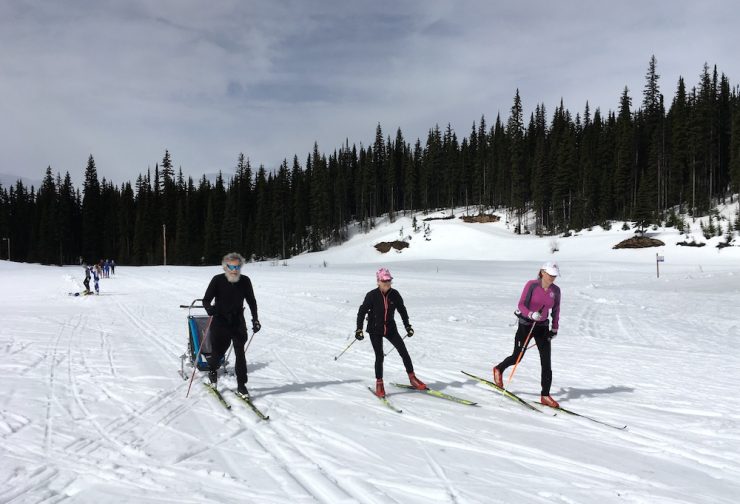
    Bettina Gruber of Switzerland's National Ski Team en route to her first victory at 2013 Canadian Nationals in Whistler, B.C. Gruber won the women's 30 k freestyle mass start by over 40 seconds. (Photo: Martin Kaiser)
    Bettina Gruber of Switzerland’s National Ski Team en route to her first victory at 2013 Canadian Nationals in Whistler, B.C. Gruber won the women’s 30 k freestyle mass start by over 40 seconds. (Photo: Martin Kaiser)

    The second lap quickly separated with a group of four who would ski most of the race together at the front.  Heidi Widmer (AWCA), Zina Kocher (Biathlon Canada), Bettina Gruber (Swiss National Team) and Obayashi slowly grew their lead through three laps.

    On the fourth lap, Obayashi dropped back, with the combination of a tired body from chasing back to the group on the first lap and swelling knees slowing her down.

    On the final lap, Kocher made a hard attack up the first hill out of the stadium and only Gruber followed.  By the staircase climb, Gruber was comfortable again.

    When Kocher faltered, Gruber was able to ski away for the victory in1:18:41.1, 40.2 seconds ahead of Kocher, the top Canadian, in second.  Widmer wasn’t able to close on Kocher, finishing another 19 seconds back in third.

    Resurgent Brittany Webster (Highlands Trailblazers) skied two fast final laps and outsprinted Obayashi for fourth place and the Canadian bronze.  Eliska Hajkova (University of Colorado-Boulder), who struggled with ski speed as the snow softened, took sixth.

    “Until about 15 k, it was four girls together, it was solid speed, a good pace,” Gruber said. “Then it went a little bit faster, and we dropped Chisa.”

    “We kept it pretty easy until that final lap and then we really tried to put on the moves,” Kocher said. “The first one I did and dropped Bettina a bit, but she caught me after the downhill and then she made a move on me on the second uphill in the woods and I could go for half of it, and then I was done.”

    Zina Kocher attacks during Saturday's 30 k freestyle mass start at Canadian Nationals. Kocher was the first Canadian and second overall behind Switzerland's Bettina Gruber.
    Zina Kocher (Biathlon Canada) attacks at the start of the last lap of Saturday’s 30 k freestyle mass start at Canadian Nationals. Kocher was the first Canadian and second overall behind Switzerland’s Bettina Gruber (second from l).

    “It was a lot of fun,” Widmer said. “I definitely exceeded my expectations as far as 30 k’s go. Really strong girls to ski with; Zina, Bettina, Chisa Obayashi and I skied the first four laps together and then on the fifth lap Chisa dropped off.

    “At the end, coming out of the stadium for the sixth lap, Zina and Bettina attacked and I didn’t have the gas to go with them,” she added.

    “That race was really fun,” Webster said, despite struggling with the pace from the start. “I was yoyo-ing off the back, got swallowed up by the girls behind and then kind of accelerated again.

    “I had the best skis ever, so that was definitely a bonus,” Webster added. “Foothills Nordic did my skis, and yeah, they were phenomenal.”

    “After start, I crashed, my pole is broken and I scratched my knees,” Obayashi said. “First lap, I used too much energy, so fourth, fifth, sixth laps, I lost energy.”

    Gruber said the conditions were “pretty good. I was surprised, I thought it would be slower and more sluggish, but the track held up pretty well.”

    In the junior women’s 20 k, Cendrine Browne (CNEPH) skied away from teammate Anne-Marie Comeau to take the gold by 3.7 seconds in 54:47.6.  Biathlete Julia Ransom (Canmore) finished third, 49 seconds after Browne.

    While the fertilizer gave the men an extremely fast course and the women a fairly fast course, the sheer volume of younger skiers and a high of 15 C created slushy skiing by the end of the day.

    At the end of a long week and a long season, the start list was shorter.  There were 79 open men, 45 junior men, 53 open women, 22 junior women, 73 juvenile boys, 82 junior boys, 59 junior girls, 74 juvenile girls, and 14 para-nordic skiers.

    More than 150 volunteers made this event possible.

    ***

    Full results and splits are at zone4.ca, with photo galleries coming at the event website.

    Results by race:

    Men’s 50 k

    Junior men’s 30 k

    Women’s 30 k

    Junior women’s 20 k

  • Gaiazova, Valjas Take Charge in Canadian Nationals Classic Sprints

    Gaiazova, Valjas Take Charge in Canadian Nationals Classic Sprints

    Dasha Gaiazova leads Switzerland's Bettina Gruber in Thursday's 1.4 k classic sprint A-final at Canadian Nationals in Whistler, B.C. Gaiazova won the final ahead of Gruber and Canadian World Cup teammate Perianne Jones, respectively. (Photo: Martin Kaiser)
    Dasha Gaiazova leads Switzerland’s Bettina Gruber in Thursday’s 1.4 k classic sprint A-final at Canadian Nationals in Whistler, B.C. Gaiazova won the final ahead of Gruber and Canadian World Cup teammate Perianne Jones, respectively. (Photo: Martin Kaiser)

    WHISTLER, B.C. – On another sunny day at Whistler Olympic Park, Canadian World Cup team members Dasha Gaiazova and Lenny Valjas set the standard, earning national titles in their favourite event – the classic sprint – on Thursday.  Both won their respective 1.4- and 1.6-kilometre qualifiers at Canadian Nationals on fast, icy snow before delivering once more in the soft-and-slow finals.

    Racing started early, as the para-nordic skiers and more than 300 younger racers competed in the sprints on Wednesday.  By the time 75 women and 117 men finished the qualifiers on the Olympic courses, the crunchy, fast snow of Thursday morning was already turning to a thin layer of slush.

    Dasha Gaiazova smiles as she cruises across the finish in first, claiming her second-straight title at 2013 Canadian Nationals in Thursday's 1.4 k classic sprint in Whistler, B.C.
    Dasha Gaiazova smiles as she cruises across the finish in first, claiming her second-straight title at 2013 Canadian Nationals in Thursday’s 1.4 k classic sprint in Whistler, B.C.

    The women’s event was fairly straightforward with Gaiazova leading each heat most of the way around before finishing the 1.4 k course with a clear gap. In the final, Gaiazova coasted in with a big smile, followed by Swiss National Team skier Bettina Gruber comfortably in second.  Gaiazova’s teammate, Perianne Jones over-powered Alysson Marshall of the Alberta World Cup Academy in the final stretch to take the silver medal.

    “Classic sprinting, I love it!” Gaiazova said.  “I had a great qualifier and it went really well in the heats.”

    Still struggling with jet lag, Gaiazova came to the venue on Wednesday to watch the younger racers and award medals.

    “It could be almost more fun than winning medals because you just see the joy on the faces of those people,” she said. “I got a chance to give out medals to para-skiers. It is so inspiring to see them race and fight.”

    Gruber, who was second in the same event at Swiss Nationals earlier in the month and is headed to U.S. SuperTour Finals next week, was happy with her day.

    “Pretty good, I would say, for just coming over to Canada,” she said. “Qualifying felt no so good; it was hard fight.”

    “Qualifying was pretty icy, hard packed conditions are not my favourite,” Gruber said.  “Right now, it’s pretty good, it’s a little slushy but still kind of good track.”

    The second Canadian, Jones was happy with her performance. “It was really fun, and I am really happy that my season is over now,” she said.

    Signing autographs before Thursday’s medal ceremony, Jones also handed out awards on Wednesday.

    “It was great to be up here and see the kids race and give out medals at the end of the day,” she said. “That’s why we’re here, to see that next generation come up.  It’s nice to see them race super-hard and then get to shake their hands at the end.”

    Marshall collected her third individual bronze of these championships, putting a strong finish on a challenging season.

    “I was feeling strong, and I was pretty close to Peri, so I am happy with that,” she said.

    Marlis Kromm and Heidi Widmer took fifth and sixth for the Academy, making the A-final after winning Saturday’s team sprint.

    Marshall and Gruber will be racing Saturday’s 30 k freestyle mass start, while the other podium finishers take a break.  Gaiazova will be going to Russia in two weeks for a sprint race, and is resisting the temptation to do the distance race.

    “The race organizers have done a great job and it’s a great venue,” she said.  “It’s a pleasure to race here, for sure.”

    Emily Nishikawa (AWCA), who also made time to give out awards on Wednesday, opted out of the sprints coming off some fatiguing races at World Cup Finals.

    Vajlas Takes Control

    In the men’s 1.6 k sprints, Valjas relied on tactics to collect his third national title in his only race at this year’s championships.

    Lenny Valjas of the Canadian World Cup Team leads Phil Widmer of the AWCA (l) and Knute Johnsgaard of the Yukon Elite Squad (r) in Thursday's  1.6 k classic sprint A-final at Canadian Nationals in Whistler, B.C. Valjas went on to beat Graham Nishikawa and Widmer, who were second and third, respectively, for the title. (Photo: Martin Kaiser)
    Lenny Valjas of the Canadian World Cup Team leads Phil Widmer of the AWCA (l) and Knute Johnsgaard of the Yukon Elite Squad (r) in Thursday’s 1.6 k classic sprint A-final at Canadian Nationals in Whistler, B.C. Valjas went on to beat Graham Nishikawa and Widmer, who were second and third, respectively, for the title. (Photo: Martin Kaiser)

    His tall build and slick skis allowed him to move to the front on every downhill.  With marginal grip, he judged his efforts on the climbs and finished comfortably in the top two in the quarterfinal and semifinal.  In each heat, he led into the finishing straight, taking the fastest lane in the increasingly wet snow.

    In the final, Phil Widmer (AWCA) followed Valjas into the stadium and moved over a lane to start the double-pole battle.  In the slower lane, Widmer was unable to stay with Valjas, and his teammate, Graham Nishikawa, took advantage of the faster tracks to steal second, nearly running over Valjas, who slowed at the line.

    “I was just out here to enjoy the day and have fun,” Valjas said. “It’s been a long season and I’m happy with how it ended up.”

    Asked about his backup plan for the finish, he said, “I had one extra, tiny, gear if someone did show up beside me.”

    A man of few words, Nishikawa answered a question about whether he expected to get a medal in the classic sprint with “No,” and a laugh. On tactics, he was more verbose.

    Graham Nishikawa (AWCA) puts out his hands to prevent crashing into Thursday's sprint winner Lenny Valjas (l).
    Graham Nishikawa (AWCA) trying not to crash into Thursday’s sprint winner Lenny Valjas (l) after the A-final.

    “A lot of guys [had] superfast skis,” Nishikawa said. “I think mine were right in the middle, good kick and decent speed, I got passed on the first downhill by some guys with fast skis but my strength is striding so I need the good kick.”

    Widmer could have played it safe and followed Valjas for a near-certain silver, but chose to put it all out there, to the delight of the crowd.

    “It is the end of the season, and the body is feeling it a little bit, but for the most part it was good,” Widmer said after the race.  “It’s nice to have Lenny here and the Americans.”

    Jess Cockney (AWCA) took fourth, after poor grip in the final caused him to lose ground on each of the climbs.  Cockney saved his energy for a fast finish in the quarter and semi, but wasn’t close enough in the final to use his speed.

    Rune Ødegärd of the University of Colorado-Boulder took fifth ahead of a breakthrough performance by Knute Johnsgaard (Yukon Elite Squad).

    Two Norwegians, Ødegärd and his Colorado teammate Trygve Markset, who was ninth, were the only men to try double poling on skate skis and qualified in 16th and ninth, respectively.

    After the race, Ødegärd said they made the decision so they wouldn’t have to re-wax after the qualifier.  Without a support team, they skied all three heats on the same wax. Ødegärd had great skis in the quarter, gliding up from the back of the group to win, but reversed the process in the final, losing places on each downhill.

    Americans Torin Koos (Bridger Ski Foundation/Rossignol) and Dakota Blackhorse-Von Jess (Bend Endurance Academy), who qualified in second and third behind Valjas, took advantage of those results in the quarters, knowing that a third place would guarantee them a lucky-loser spot.

    NorAms and nationals use untimed heats to reduce the number of volunteers required. This changes the way that lucky losers are chosen from the best two times among third- and fourth-place finishers to the two lowest bib numbers who placed third.

    Koos reported to the jury that he was obstructed in the semifinal and requested a spot in the A final.  The jury reviewed the video and decided that there was “no evidence of obstruction.” After a 10-minute delay, the A-final was run without Koos being added as a seventh starter. He ended up 12th and did not start the B-final.

    Final results

    Complete qualifying results

  • Vaillancourt, Smith Collect Mass-Start Titles at Canadian Biathlon Nationals

    Audrey Vaillancourt (Quebec) completed her set of three titles at 2013 Canadian Biathlon Championships on Tuesday with a photo-finish victory over Megan Heinicke (Biathlon BC) in the 12.5 k mass start in Whistler, B.C.

    “We both deserved to win today,” Vaillancourt wrote in an email. “I’m just glad I managed to have a better stretch.”

    Vaillancourt shot clean at Whistler Olympic Park to finish in 34:54.0. Heinicke was just 0.2 seconds behind and missed one shot (0+0+1+0).

    “Today skiing didn’t feel as good as during the weekend,” Vaillancourt wrote, “So I focused more on shooting and it worked very well; I had a perfect day on the range.”

    Vaillancourt enjoyed her first mass start of the season: “On the last lap we came out of the range together, so I knew this was going to be a really tough one,” she wrote. “We both tried to drop each other at different places on the course, but we were both dead tired and ended up together for the final sprint! It has been a photo finish for the win!”

    Corrine Malcolm (U.S. Biathlon) took third place in 36:38 (1+0+1+0), 30 seconds ahead of Julia Ransom (Biathlon BC) in fourth.

    “Today was actually the best I’ve ever shot in a race,” Malcolm wrote.  “Unfortunately I lost a little bit of time when I accidentally started to ski onto the 2km cut off on our second loop.  Luckily [Canadian biathlete] Rosanna [Crawford] saw me veer off and was able to yell to me to turn around. By the time I made it back to the right trail Julia was coming by and I was able to get in with her and ski nice and relaxed.  Julia and I stayed together until the last shooting stage where I cleaned and she missed her final shot.”

    Ransom’s time of 37:08 (2+0+1+1) was good enough for third Canadian, but shooting was perhaps not surprisingly the difference for the 20 year old who started her first Cross Country World Cup earlier this season in Canmore, Alberta.

    In the men’s 15 k mass start, Nathan Smith (Alberta/Biathlon Canada) struck back after Sunday’s starting error by dominating the day. He won by 44 seconds in 37:53 despite missing three shots (1+0+0+2) during what he described as ideal shooting conditions.

    “I missed that first shot prone and was a little concerned, but after that I felt comfortable and in control,” Smith told Biathlon Canada. “I know I didn’t win the pursuit race, but I feel like I’m in great shape and accomplished what I came here to do.”

    Marc-André Bédard (Quebec) was second in 38:37 with four misses.

    “Shooting was perfect 3 out of 4 times,” he wrote in an email.  “[I] missed 4 at my first standing!”

    Although disappointed by his shooting, that should not be a problem next week when Bédard competes at Canadian cross-country nationals. “I’m hoping to repeat or do better than my 4th at the 15 free last year!” he wrote.

    Bill Bowler took third place to lead a large American contingent with his second podium. He finished 43 seconds behind Bédard, and also had four penalties (0+1+2+1).

    “I felt good on the skis,” Bowler wrote. “Definitely better than in the races earlier this week.”

    He agreed that the conditions weren’t a problem. “It was a perfect day for racing with fast tracks,” he wrote. “The weather in Whistler can be volatile so it was nice to have sun and solid conditions.”

    Kurtis Wenzel (Alberta) grabbed the Canadian bronze with 39:31 (0+0+1+1), good for fourth overall.

    Biathlon wraps up Wednesday with the relays.  The Sea to Sky Nordic Festival continues with cross country nationals (March 23 to 29), nordic combined (March 28 to 30) and ski jumping (March 28 to 30).

    Mass-start results

  • Buoyed By Trust Fund, Callaghan Valley Readies for Future

    Buoyed By Trust Fund, Callaghan Valley Readies for Future

    Women competing in the individual sprint at Whistler Olympic Park during the 2010 Olympic Games.

    This article is the third in a series looking at the use of cross-country ski venues left behind by the Winter Olympics. The first two were on Utah’s Soldier Hollow and New York’s Lake Placid.

    After a Winter Olympics where nordic skiing took center stage, Whistler Olympic Park (WOP), 77 miles north of Vancouver, British Columbia, faces the future with optimism, but with plans that are still murky.

    Cleaning up the detritus of the 2010 Games, including grandstands, transformers, cameras and approximately 150 kilometers of fiber optic cable, WOP is preparing for life after the Olympics. Cushioned with government funding, WOP is developing plans to transform itself into a major tourist destination and training center.

    Like Lake Placid’s Mount Van Hoevenberg, WOP is part of an umbrella organization that manages other legacy venues from the 2010 Winter Olympics. But unlike Mount Van Hoevenberg, or Utah’s Soldier Hollow, WOP is a beneficiary of a trust fund that will help pay operating expenses for the near- or medium-term future.

    As the venue for cross-country, nordic combined, biathlon and ski jumping at the 2010 Winter Olympics, WOP hosted fully one-third of all the events at the Games. Last February, billions of TV viewers tuned in to watch top athletes ski at one of the world’s first “green” cross-country venues.

    Situated to minimize disturbance of old-growth forest and wetlands, WOP shoehorned 14 kilometers of cross-country and biathlon trails, three technical buildings and an 11,000-square-foot ski lodge into a single square kilometer. Three technical buildings went up 400 meters apart. The lodge is built to LEED Silver Certification for green buildings. The square kilometer is a thirty percent smaller footprint than originally designed.

    Forty kilometers of additional trails link to the 14 kilometers of race trails used for the Games, with six kilometers lighted for night skiing. In addition, WOP’s trail system connects with neighboring Callaghan Country’s 40 kilometers of trails, making for a nearly 100-kilometer network available to skiers.

    A Legacy in Mind

    More athletes racing at the Olympics in Whistler.

    On June 1, 2010, Whistler 2010 Sport Legacies (WSL), a not-for-profit organization, took over management of WOP from the Vancouver Organizing Committee (VANOC). WSL also operates the Whistler Sliding Centre, which hosted luge, bobsled and skeleton, as well as the Whistler Athlete Centre, which offers housing and strength and conditioning facilities to developing athletes training in the Whistler area.

    “Legacy programming was going on since the day VANOC started,” said Georgia Manhard, a member of Cross Country British Columbia’s board of directors. She said that VANOC was already planning for the post-Olympic future even as it developed its bid for the 2010 Games.

    The Whistler venues are funded in part by the 2010 Games Operating Trust (GOT), a second non-profit that was founded shortly after Vancouver won the right to host the 2010 Olympics. The Canadian federal government and the B.C. provincial government each contributed $55 million Canadian to the trust as seed money, which in turn disbursed funding to the venues in 2007, 2008 and 2009.

    But WSL isn’t the trust’s only beneficiary. According to Chairman James Bruce, GOT also supports the Olympic speed skating oval in Richmond: 80 percent of the trust’s principal is split evenly between supporting WSL and the speed skating arena. Money from the remaining 20 percent is held aside as a contingency fund.

    Each year, Bruce said, GOT distributes up to five percent of the average three-year balance of the fund to its two beneficiaries. Like the larger economy, the trust lost money in the stock market in calendar year 2008, but it realized an approximately 14 percent return on investments in 2009.  Bruce said that it was reasonable to expect a positive return on the trust’s investments over the long term.

    Anticipating Growth

    Keith Bennett, WSL’s president and CEO, said that it’s “difficult to say right now” what proportion of the nordic center’s operating budget will come from ticket sales, and what proportion will come from GOT funding. But his goal is to generate 50 percent of WOP’s revenue from ticket sales, equipment rentals, and food service.

    According to Bennett, WOP had approximately 40,000 visitors in the winter of 2008-2009, the year preceding the Games. That figure, though, included elite athletes who arrived to participate in pre-Olympic events in all the disciplines: cross-country, biathlon, jumping and nordic combined. For the coming winter, Bennett is planning on 25,000 visitors, with a goal of 50,000 by 2014; he said the organization would target “new Canadians” and youth.

    Bennett’s numbers contrast markedly with post-Olympic tourism numbers projected in the planning stages for the Olympics. In an article published on the

    Athletes training on rollerskis at Whistler Olympic Park in 2009. Photo courtesy of TeamToday.org.

    website XCOttawa.com in 2004, Tom McCarthy noted that the pre-Games master plan called for 60,000 visitors to WOP within three years of the Olympics, growing to 75,000 by 2015.

    Bennett acknowledged the discrepancy, but stressed that he wanted to develop 50,000 “paying skier visits,” at $20 per person, each winter. He distinguished between paid visits and visits by “carded athletes”: Canadian national team, junior national team and development team athletes aren’t charged for trail passes.  With virtually no publicity, Bennett added, WOP has already attracted 5,000 to 6,000 visitors this summer.

    By comparison, according to information obtained by FasterSkier, approximately 40,000 skiers visited Sovereign Lake last winter, another cross-country area in British Columbia. In the eastern U.S., according to the New York Olympic Regional Development Authority’s just-released annual report, Lake Placid’s Mount van Hoevenberg attracted 30,000 skiers in 2009-2010. According to the document, that was an all-time record for attendance.

    Reaching Out

    As part of its effort to increase visits to the Callaghan Valley, WSL has three areas of focus:  attracting aspiring elite athletes, recruiting new people to the sport of cross-country skiing, and reaching out to area clubs.

    “We see [the clubs] as a really important part of delivering nordic skiing to the community,” said John Heilig, WOP’s manager of nordic sport.

    WSL is negotiating with the province of British Columbia to modify the terms of its lease, in order to build cabins for some of the clubs—especially those that come from outside Whistler.

    Based at Cypress Bowl, on the outskirts of Vancouver, Hollyburn Jackrabbit Ski Club runs youth programs for everyone from five-year-old beginners through aspiring junior racers. While Cypress is close to most members, club president Dirk Rohde said that anyone involved in Hollyburn’s race program skis at Callaghan Valley. “It’s a couple-hour drive, but the training is worth it,” he said.

    Hollyburn organizes one or two races each season at Callaghan Valley. “They have facilities and equipment to run an event properly,” Rohde said. Callaghan’s venue is especially suited to bigger races, Rohde added—those at the regional level or above. He noting, in contrast, that Cypress Bowl used a makeshift stadium—often a tent or an awning would suffice as the technical building.

    WOP only charges a nominal fee for clubs to host events, and the venue also retained a number of wax trailers from the Olympics that it makes available. However, club members do not receive discounts on trail passes.

    A Magnet for Development

    Based in Whistler, the Callaghan Valley Training Centre (CVTC) is one of Canada’s national athlete development programs. In the scheme of Cross Country Canada (the country’s governing body for cross-country skiing), CVTC’s mission is to prepare local and regional juniors for national-level competition.

    Canadians George Grey and Alex Harvey celebrate their 3rd place finish in the team sprint in the 2009 pre-Olympic World Cup in Whistler.

    Chris Manhard, CVTC’s head coach, said that WSL “have been exceptional” in their support of his organization.  The training center’s seven skiers lodge in the Whistler Athlete Center for a nominal fee.  And whenever possible, Manhard said, WSL hires athletes for part-time positions, to help them defray training expenses.

    WOP is also continuing an outreach program that focuses on school groups from local areas. A supplier provided WOP with rental equipment—skis, poles and boots—with the proviso that the gear would be used in such an initiative.

    “We’re trying to engage all the local communities,” Heilig said.  He specified the Sea-to-Sky corridor as a target, which encompasses the towns of Pemberton, Squamish and Whistler, but Heilig also said that groups have come from as far away as Vancouver.

    WOP charges a nominal fee to offset the costs:  $12 Canadian covers equipment rental, a lesson and a trail pass. In the winter of 2008-2009, the program saw 62 percent growth over the previous winter, with 1,762 kids participating.  (Figures weren’t available for the ’09-’10 season.)

    In addition to their own outreach effort, WOP is also signed on with the Canadian Ski Council’s (CSC’s) SnowPass program.  After registering through the CSC website, any child in grades four and five is eligible for three free trail passes at WOP.

    Each program is a piece of the puzzle.  As Bennett acknowledged, WOP “will have to develop skier visits that don’t exist right now. Part of our job is to cultivate that.”

  • Can North Americans Unseat the Scandos in the Sprint?

    Emil Joensson (SWE) will have his hands full holding off Norway's Ola Vigen Hattestad, but he is the favorite for the men's sprint today

    Sunny skies and warm temperatures greeted sprinters on their arrival at Whistler Olympic Park this morning for the men’s and women’s sprint.

    This is a big chance for the Canadians and the U.S.—all six Americans are capable of qualifying for the heats, with three medal hopefuls in Kikkan Randall, Torin Koos, and Andy Newell.  The Canadians are set up just as well, with Devon Kershaw, Sarah Renner, Dasha Gaiazova, and Perianne Jones gunning for the heats, and hopefully more.  Defending Olympic gold medalist Chandra Crawford should be able to qualify as well, but she is unlikely to repeat her Torino performance due to the change in technique from skate to classic.  With a good day, any of the other Canadians could also make the heats.

    That is one of the most exciting aspects of sprinting – there are so many skiers with a legitimate shot at qualifying, and though Nat threatens to quit every time I say it, once you are in the heats, anything CAN happen.

    The big hope for the US is obviously Andy Newell.  A consistent top-10 World Cup sprinter, the podium has eluded Newell in recent years.  He can’t be considered a medal favorite, but the finals are realistic.  Newell told FasterSkier that his goal is to advance to the finals and once there, give it his best shot.

    Koos is a bit an unknown quantity.  Will the Torin who finished 2nd in qualifying, just behind Emil Joensson, in Canmore show up?  Or the one who failed to qualify for the heats during the entire first World Cup period?  His form is good, and Canmore demonstrated he has the speed right now.  After battling illness in 2006, Koos will be looking for redemption, and the heats are likely.

    After those two, both Garrott Kuzzy and Simi Hamilton have the speed to advance, but they will have to have their best races.  While they did qualify in Canmore, their races would not have been good enough for the full field they face today.

    On then women’s side, Kikkan Randall needs to be on her game to advance in classic.  She is improving steadily, and at this point is definitely a top-30 classic sprinter.  While it would be nice to predict her battling for the podium, she has yet to show that she has that level in classic.  A top-10 would be a great result for Kikkan.

    Holly Brooks also qualified in Canmore, and like Hamilton and Kuzzy, could do so here, but will have to have the race of her life.

    On the Canadian side, Sarah Renner rejuvenated her sprint career in Canmore, finsihing 3rd.  A repeat is unlikely, and she is not a sure thing for qualifying.  But on home soil, look for her in the heats.

    Gaiazova and Jones are both capable of the top-30, with Gaiazova the more likely.

    For the men, Kershaw will be gunning for a medal.  He has been on the World Cup sprint podium in the past, and with the home crowd cheering him on, he will be in the running.  He is a somewhat inconsistent sprinter – never a sure thing to qualify, so hopefully he will be in top form.

    The rest of the Canadian men, led by Stefan Kuhn, will need perfect performances to advance, but no one can be counted out.

    And the favorites?

    For the men, it comes down to Ola Vigen Hattestad and Emil Joensson.  The two are a clear step above the rest of the field in sprinting.  My gut is Joensson, but Hattestad has an almost Northug-like ability to pull out a win from the jaws of defeat.  The two men race with contrasting styles, with Joensson preferring to race from the front.  Hattestad is very patient, biding his time before making a big move – often on the biggest climb.  Both are powerful doublepolers.

    From there, you can pick any number of men for the podium.  Northug should be in the hunt, especially after his disappointing 15k.  The other Norwegians, Petersen and Kjoelstad are certainly medal-capable, as is young Teodor Petersen of Sweden and his teammate, the veteran Bjorn Lind.

    But then there are the Finns, the Russians, the Germans – however you slice it, it will be a battle, with no sure things.  And with a nasty corner at the bottom of the course, crashes are not unlikely.

    The favorites on the women’s side come down to the usual group – Justyna Kowalczyk (POL) and Petra Majdic (SLO).  But they will be challenged by young Hannah Falk of Sweden as well as the always strong Aino Kaisa Saarinen (FIN).  Marit Bjoergen (NOR) is an interesting pick, and while the gold seems unlikely, a second medal in these games is in reach.

    Predictions

    Men:

    Gold – Emil Joensson (SWE)

    Silver – Ola Vigen Hattestad (NOR)

    Bronze – Petter Northug (NOR)

    Women:

    Gold – Justyna Kowalczyk (POL)

    Silver – Hanna Falk (SWE)

    Bronze – Petra Majdic (SLO)

    Top Americans:

    Andy Newell – 6th

    Kikkan Randall – 11th

    Top Canadians:

    Devon Kershaw – 12th

    Sarah Renner 27th