Tag: Whistler

  • Canadian Nationals/US SuperTour Finals: Julia Kern wins again, while Xavier McKeever takes first Canadian title in Classic Sprint

    Canadian Nationals/US SuperTour Finals: Julia Kern wins again, while Xavier McKeever takes first Canadian title in Classic Sprint

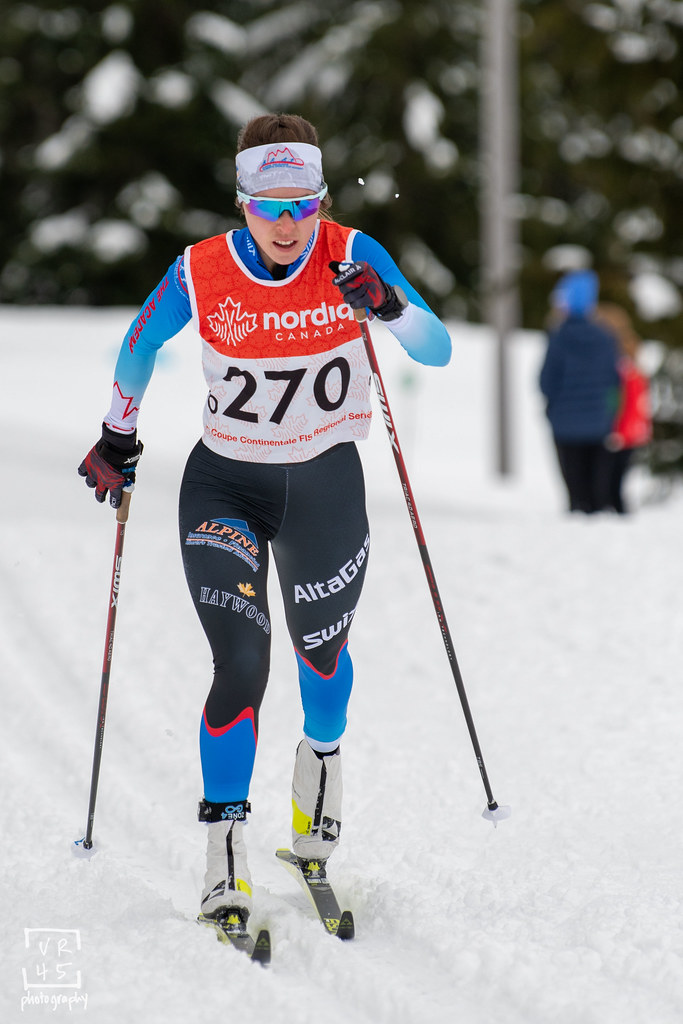
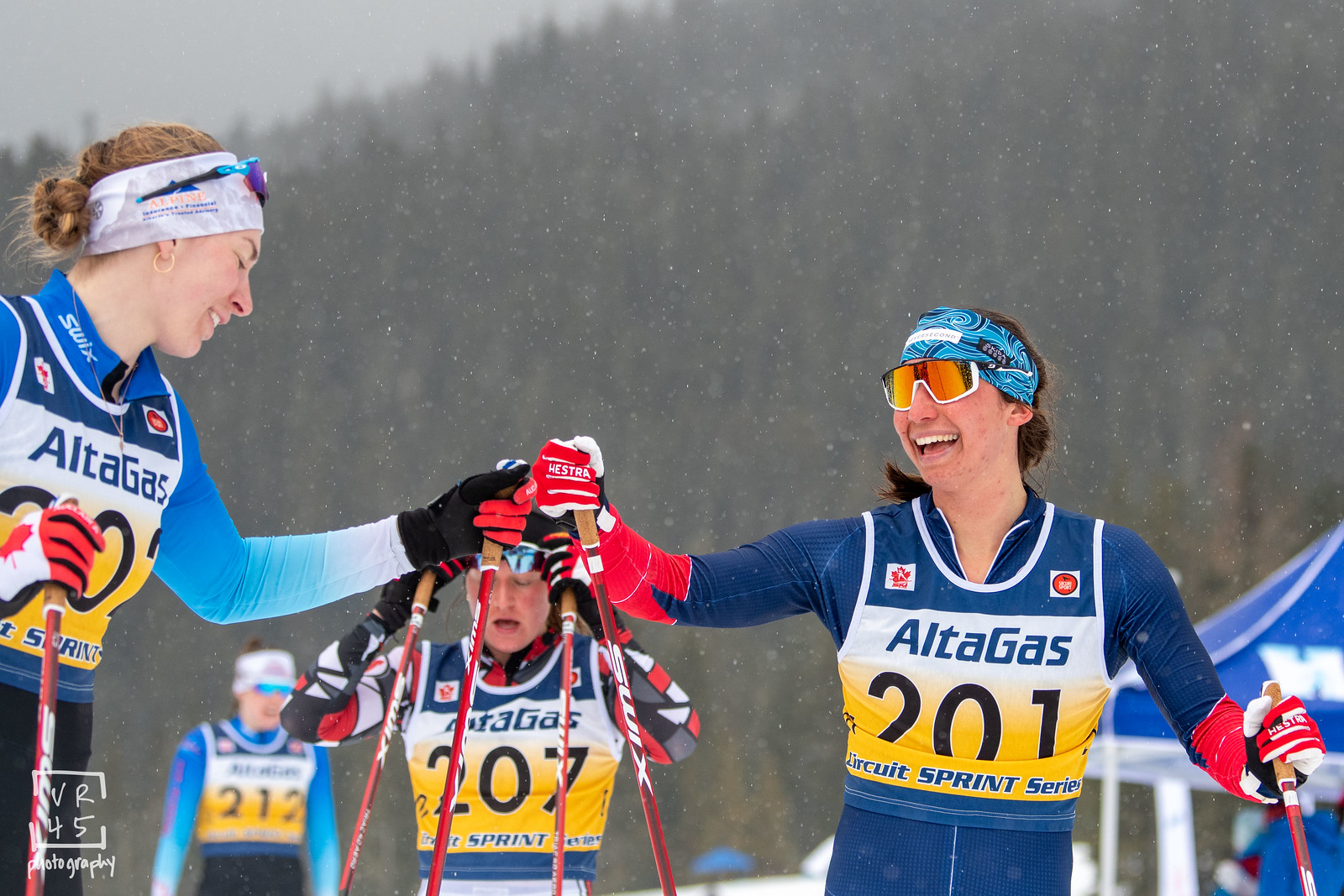
    Julia Kern (SMS T2) and Dahria Beatty (Whitehorse) fist bump at the finish of the women’s classic sprint final. (Photo: Doug Stephen / VR 45 Photography)

    Racing at the joint Canadian Nationals/US SuperTour Finals resumed on Wednesday, showcasing some of the best racers in North America facing off for a classic sprint. 

    As the Whistler Olympic Park was home for cross country skiing during the 2010 Vancouver Games, the classic sprint course on Wednesday was one that played host to an important stepping stone in North American skiing history. In that competition, both American and Canadian skiers solidified the inroads they had made into the top echelons of the sport through the burgeoning discipline of sprinting. Names like Kikkan Randall (USA), Daria Gaiazova (CAN), Chandra Crawford (CAN), Devon Kershaw (CAN), and Simi Hamilton (USA) all qualified for heats, while gracing the television screens of many athletes who now, twelve years later, carried momentum from those inspiring performances onto today’s start line in Whistler.

    If my waxing nostalgia about those 2010 Olympics is making you open a new tab to see if they’re available to revisit on YouTube, let me help you: they are! But before you go, let me send you an assignment: watch how Marit Bjørgen and Justyna Kowalczyk race the final on the 1.2 k course (the men raced a 1.4 k course). Ok, here’s the link (46:16 for the final, and yes, the genders are flipped in the title).

    What you’ll have seen if you completed this FasterSkier sidequest (trademark pending) is that the rolling course at Whistler presented two distinct tactical options for the skiers who made it into the heats on Wednesday. One: the Kowalczyk – attack on the steep climb that left the stadium to try and create a gap on the field that would hold as you went into the first downhill and leave you with an advantage on the second (and final) climb, or two: the Bjørgen –  hold onto the pace-setter until the second hill, when a punchy attack could leave a skier with a distinct advantage going into the mostly downhill approach to the stadium and subsequent final stretch. The latter approach worked in 2010 for Bjørgen, but 2022 was twelve years on and a different field with the SuperTour.

    Before we got to the heats, however, we, and the skiers, had to go through qualifying. 

    The Classic Sprint started off with the women’s champion in the 10 k Classic yesterday, Julia Kern (SMS T2). And after every racer in the women’s field completed the course, Kern finished in first too (3:11.14). Her qualifier was commanding, with second place Dahria Beatty (Whitehorse) +6.58 seconds back. In third place was Alayna Sonnesyn (SMS T2) (+7.54), in a field that otherwise was tight all the way through to the last heat qualifier, 30th place Mariah Bredal (BSF) (+21.37).

    The men’s field that followed proved to be an even tighter affair. At the top of the field, less than a second split first place Andreas Kirkeng (Denver University) (3:09.82), second place Luke Jager (University of Utah) (+0.41) and third place Logan Hanneman (APU) (+0.88). It was only +11.97 seconds back to the last heat qualifier in 30th place, Montana State’s Reed Godfrey.
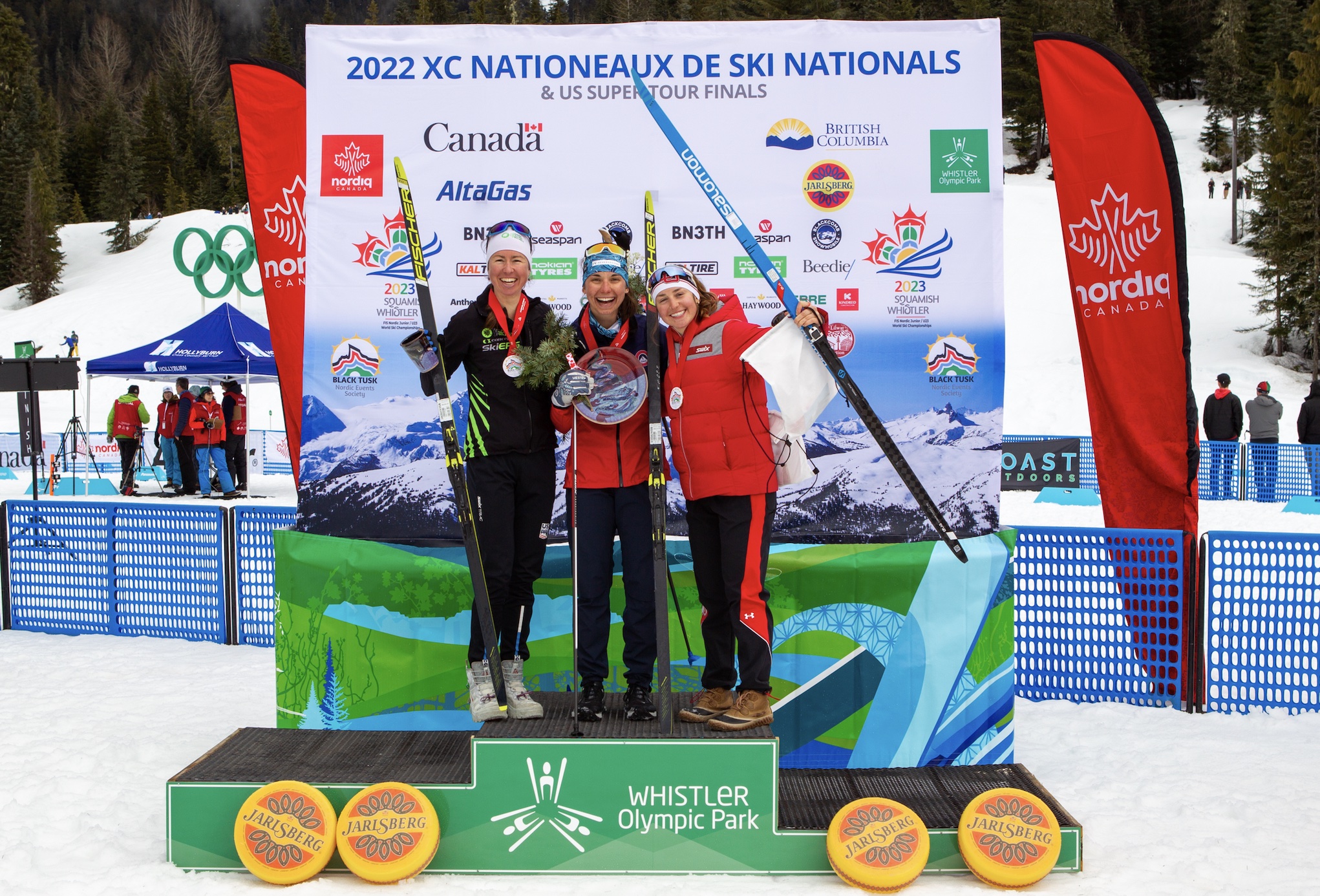
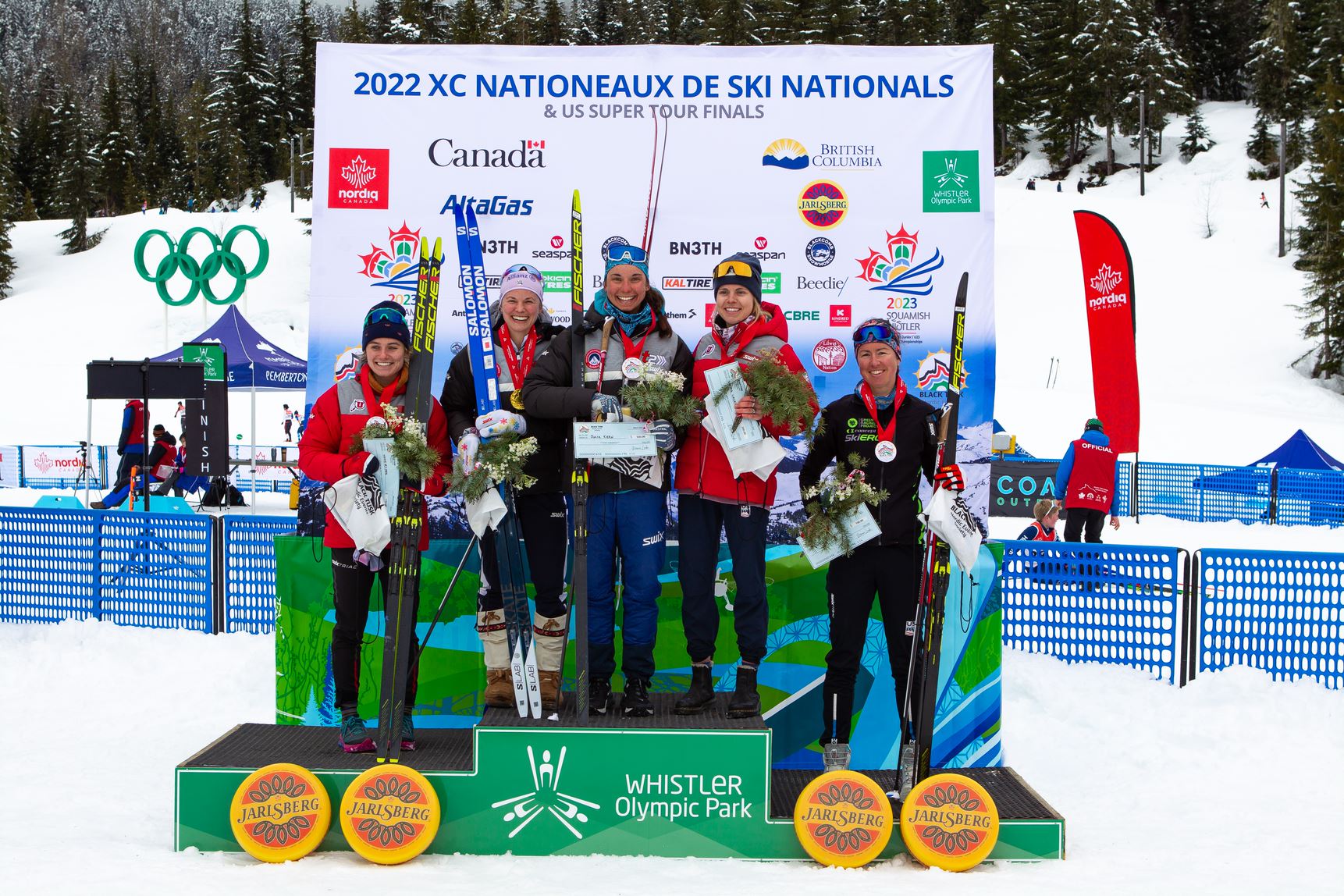
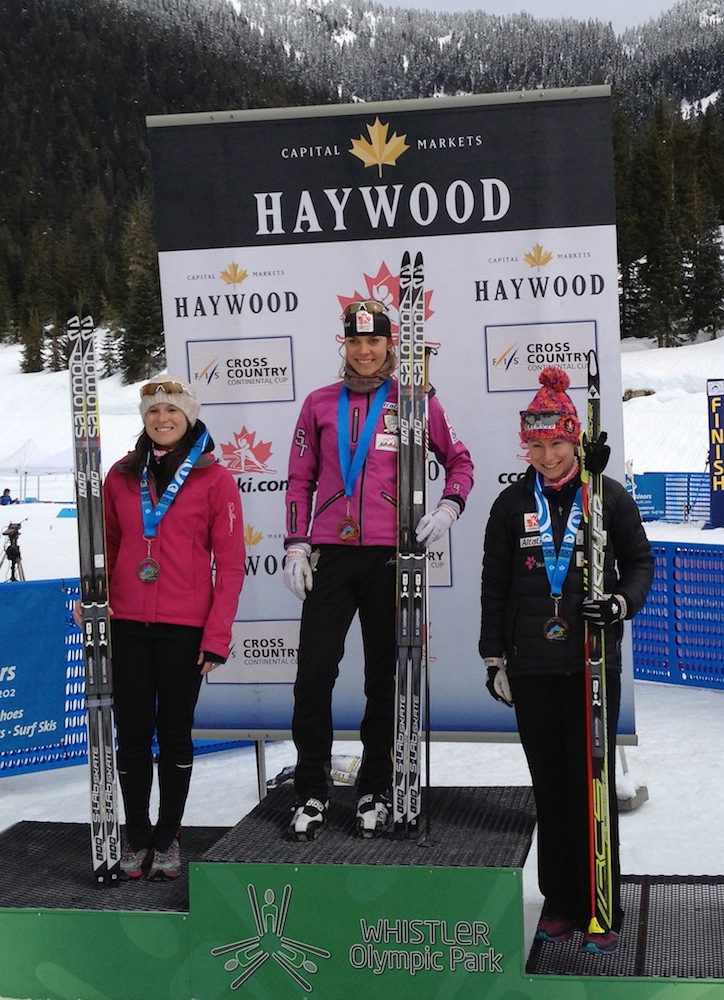
    The women’s US SuperTour podium saw Julia Kern take the top step ahead of Caitlin Patterson and Sydney Palmer-Leger. (Photo: Joern Rohde / Nordiq Canada)
    Women’s Open

    In the women’s open quarterfinals, the top qualifiers were able to win their heats handily. Julia Kern turned in the fastest quarterfinal in the field, finishing first in a time of 3:29.93, ahead of Novie McCabe (+1.93), who advanced to the semifinals by taking second place. Kern’s fast pace-setting in heat one proved to animate the field from the gun, and third place Zoë Williams (Nakkertok) was rewarded for keeping pace with one of the lucky loser spots (+3.56).

    That pattern held in the 2nd heat, when a pack loaded with talent including Caitlin Patterson (Craftsbury), Alexandra Lawson (Craftsbury), Sydney Palmer-Leger (University of Utah), Sophia Laukli (University of Utah) and Cendrine Brown (Fondeurs-Laurentides) set a furious pace from the start and held it all the way through. In a five-person sprint, Patterson took first (3:32.13), and Lawson second (+0.55), to take the automatic semi-final bids. In third place, Sydney Palmer-Leger (+1.47) took the other lucky loser spot.

    When the first semi-final took to the start-line, it was filled with five skiers from those first two quarterfinals, with the sixth, 16-year-old Samantha Smith (Sun Valley), having won the third quarterfinal (3:36.43). It was no surprise then, when the “fast from the gun” tactics of those quarterfinals followed into the semis. Julia Kern (SMS T2) again attacked as soon as they hit the first incline out of the stadium, and held her lead throughout. The only skier that proved to be able to match her pace through the course was Caitlin Patterson (Craftsbury), and it would be those two who took the automatic advancement places to the finals; Kern in first (3:34.27) and Patterson second (+3:35.27).

    Behind them, two of the youngest bright stars of US women’s skiing had shown their intrepid ability to match their older counterparts, with Palmer-Leger (UU) taking third place (+3.47) and Novie McCabe (UU)  taking fourth (+3.74) in a sprint ahead of Samantha Smith (Sun Valley) (+4.03). For their efforts, the third and fourth place pairing advanced to the finals.

    In the second semi-final, previous Canadian Sprint National Champion Dahria Beatty (Whitehorse) was able to take first place (3:38.39) ahead of second place Laurence Dumais (Fondeurs-Laurentides) (+0.34) for the second heat in a row. They finished strong in a pack that otherwise remained tight throughout, and created separation in the last stretch to finish ahead of third place Alayna Sonnesyn (SMS T2) (+1.18) and fourth place Katharine Ogden (SMS T2) (+3.45).

    The final field then, was set. For the overall win, four US women – Julia Kern (SMS T2), Caitlin Patterson (Craftsbury), Sydney Palmer-Leger (UU), and Novie McCabe (UU) – and two Canadian women – Dahria Beatty (Whitehorse) and Laurence Dumais (Fondeurs-Laurentides) – would compete. That latter pairing also made the matter of the Canadian Sprint National title on the line simple; a duel between Beatty and Dumais.
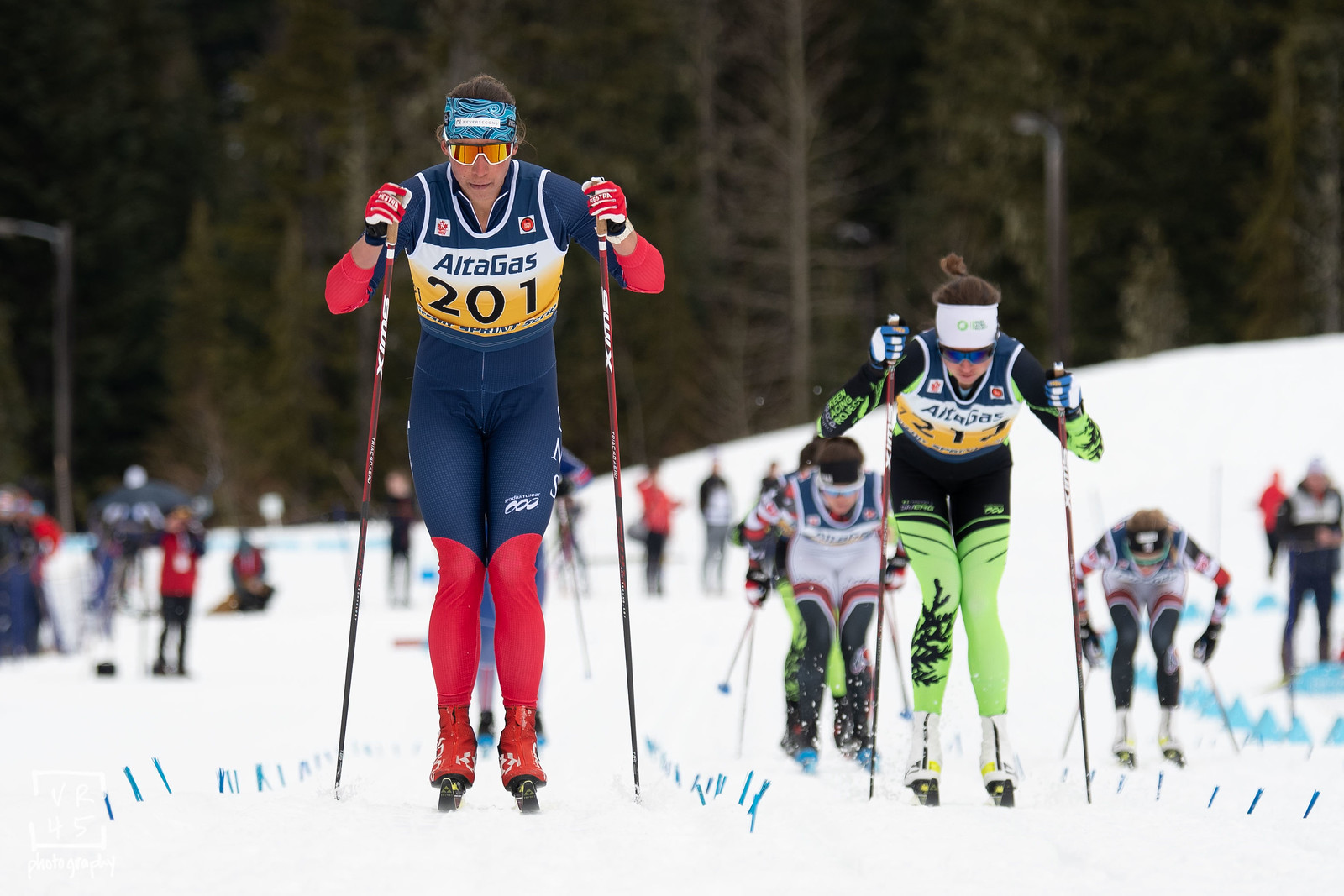
    Julia Kern strikes again in the women’s classic sprint, taking the win ahead of Caitlin Patterson (CGRP) and Dahria Beatty (Whitehorse). (Photo: Doug Stephen / VR 45 Photography)

    Kern, spurred on by her success racing hard from the gun all day, went for it again. In an interview with Nordiq Canada she said, “All day I just wanted to ‘send it’ – practice skiing hard and not taking any chances out there. My form and fitness is really good so I wanted to try and not leave it until the end.”

    The whole field was tasked with matching her confidence…and her speed. As in the semi-finals before, just one was up to the task the whole 1.2 k through; Caitlin Patterson. Behind her, Dahria Beatty led a charge to try and keep pace, but as she said in an interview with Nordiq Canada “I was confident in my finish but trying not to lose time on the uphills today. Unfortunately, [in the final], I let a gap open up to Caitlin [Patterson] and wasn’t able to close back on that.”

    And “send it” Kern did in the final. Kern took the pace out hot from the start. With a look over her shoulder, she saw that she had gapped the field by the top of the long striding climb, a position which she held, despite a bobble on the tight left hand curve on the subsequent descent, comfortably through the finish to win by several seconds.

    Patterson having lead the chase group after a gap throughout the heat, found herself sprinting with a powerful doublepole into the stadium to hold her ground in second place.

    Behind them, the race for the last podium spot coalesced around Beatty, Palmer-Leger and McCabe. As they entered the stadium together, Beatty stuck to a strategy that her coach pointed out earlier in the day, “it was working really well to try and go in the outside in the finish chute because people hadn’t skied there in the qualifier.”

    With that bit of tactical maneuvering, she opened up a gap on the two UU teammates behind her, and came across the line in third place overall (+6.16). In doing so, she also came across with a Canadian National title – her second Canadian Sprint title (and first classic). Following her in the Canadian Nationals race was second place Laurence Dumais (Fondeurs-Laurentide), who finished the finals heat in 6th place (+21.57). Based on her time in the semi-final, Zoë Williams (Nakkertok) took third place.

    Kern’s win marked her second in a row at SuperTour finals this week, which have been marked by all sorts of varying conditions that she has used to her advantage, saying to Nordiq Canada:

    “I love variable conditions. Everyone says if it’s a rainy day, it’s a Julia Kern day – I’ve thrived under those conditions before…it makes you have to adjust your skiing and that makes you a better athlete.”

    The Canadian women’s sprint podium, with Dahria Beatty coming out on top in the classic sprint. (Photo: Joern Rohde / Nordiq Canada)
    Men’s Open

    The men’s quarterfinals saw a similar pattern to the women’s, with experienced sprinters grouping together in heats, attacking early, and producing fast times that punctuated the number of racers they sent to the semi-finals. For the men that happened in quarterfinal two, with Graham Ritchie (Georgian Nordic), Antoine Cyr (Skinouk), Kjetil Bånerud (Northern Michigan), Bill Harmeyer (SMS T2), and Étienne Hébert (Montériski) all pushing each other to the line. When the five skiers came into the final stretch, it ended up being Ritchie (3:23.11) and Cyr (+0.32) who took the first and second spots, respectively. Both lucky losers came from the heat, with Bånerud in third (+0.95) and Harmeyer fourth (+1.73).

    Ritchie, Cyr, and Harmeyer would all meet again in the first semi-final. There, they were joined by Andreas Kirkeng (DU), Logan Diekmann (BSF), and Magnus Bøe (CU). With tight racing throughout, Kirkeng was able to gain an advantage and hold off all challengers as he advanced to the final in first place (3:22.97) ahead of second place Antoine Cyr (+0.83). The aggressive tactics of Ritchie and Cyr again proved to push the entire field forward, with Ritchie the benefactor when his third place finish (+1.47) secured him a lucky loser spot alongside fourth place Logan Diekmann (+2.76).

    The second semi-final, meanwhile, was a duel between the young stars from both sides of the 49th parallel. American Luke Jager (UU) and Canadian Xavier McKeever battled to a sprint finish in which Jager took first place (3:23.34) and McKeever took second (+0.50) to advance to the finals.

    Jager and McKeever stepped up alongside Antoine Cyr (Skinouk), Andreas Kirkeng (DU), Graham Ritchie (Georgian Nordic), Magnus Bøe (CU) and Logan Diekmann (BSF). The two young skiers showed no signs of timidness against their older competitors. Jager launched an attack on the first hill that opened a gap as the field rounded the corner leading into the final climb. McKeever was back in the field, looking to “limit damage, if I’m honest” as he said in an interview with Nordiq Canada.

    He followed Graham Ritchie, who was leading the charge to try and catch up to Jager. When they crested the hill, Ritchie, McKeever, and Kirkeng had all managed that feat – joining up with Jager as they went into the downhill leading to the stadium.

    McKeever was still at a disadvantage though, back in the pack, when the curious mix of rain, ice, and sunshine that had worked the snow at Whistler park all day became a factor. As McKeever said to Nordiq Canada, “going into the downhill I had insane boards, and was able to glide back up to the leaders and double-pole from a good position.”
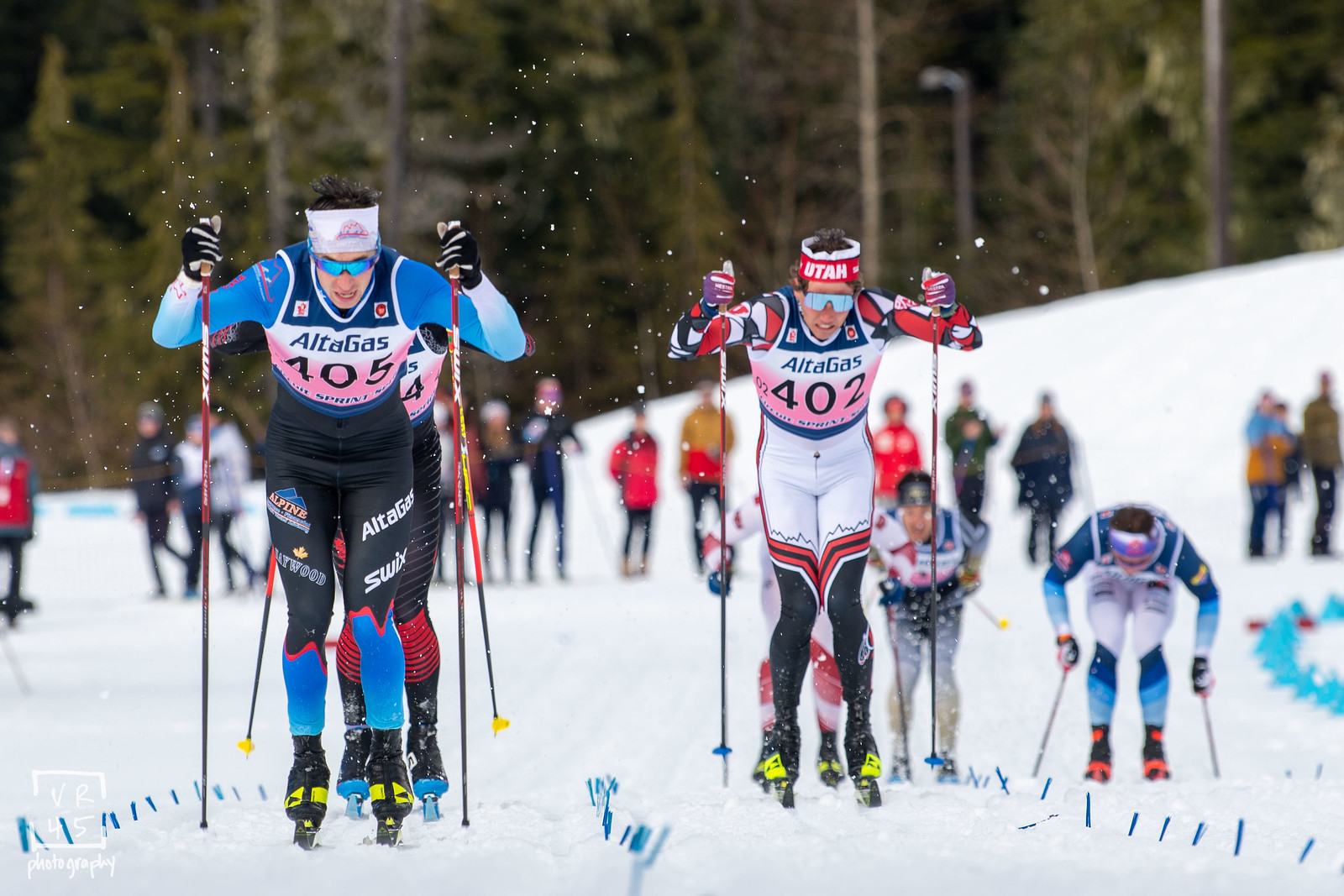
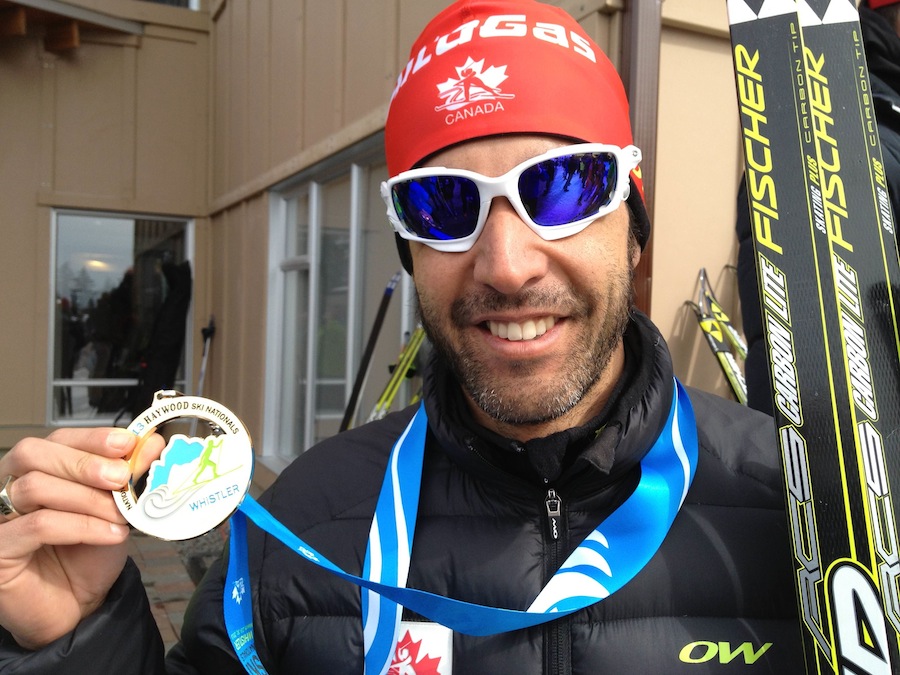
    Xavier McKeever (Foothills Nordic) takes the classic sprint win with Antoine Cyr (Skinouk) on his tails and Luke Jager (University of Utah) chasing in the lane to his left. (Photo: Doug Stephen / VR 45 Photography)

    When he found himself in that good position he could hardly believe it, “I was just stoked to be in the final and top-three in Canada. Going into that finish was insane, and I knew I had to get to the finish line as quickly as possible to try and steal [the National title].”

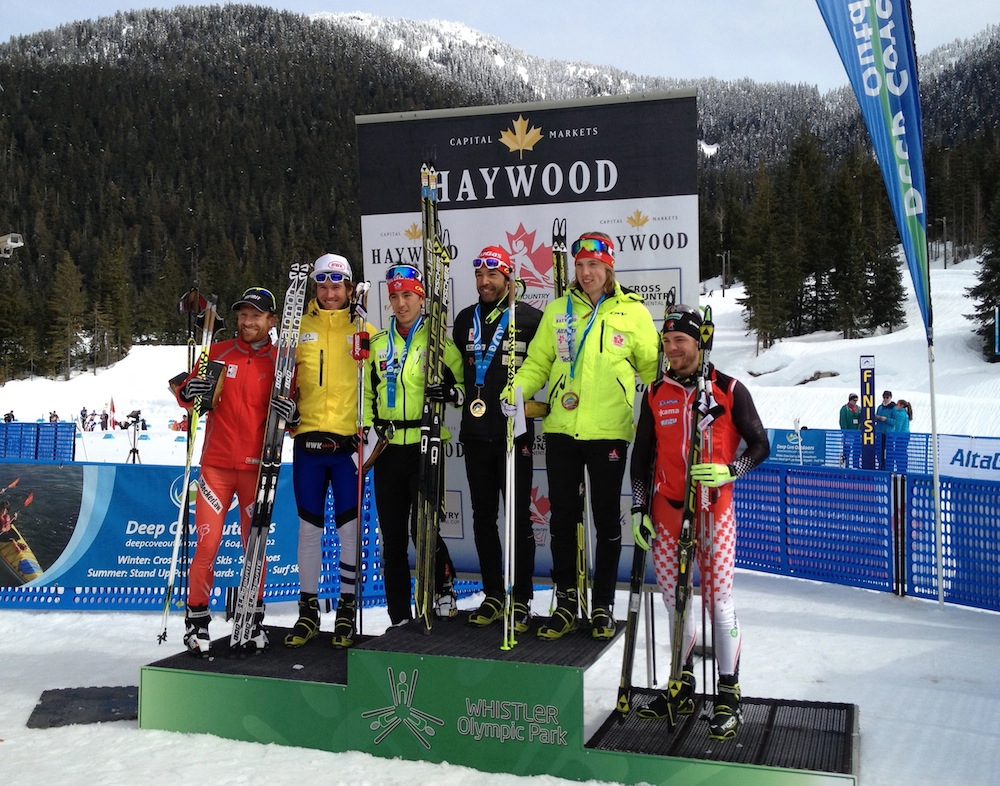
    What he categorized as stealing, we’ll categorize as earned. The 18 year-old out-sprinted North America’s best head-to-head, winning the overall race, and his first Canadian National title in a time of 3:19.72. Behind him in second place was fellow Canadian Antoine Cyr (+1.38), with Luke Jager rewarded for his long-range attack with a third place overall (+1.99). Graham Ritchie, finishing fifth overall, rounded out the Canadian Nationals podium (+4.13) after a day of leading out attacks in every heat he raced.

    It a promising indicator for Canada’s young up-and-comers with McKeever taking on a field of North America’s best and eeking out a win. For McKeever though, the race was only a preparation for bigger things to come, saying post-race that, “I’ve had some really good sprints this year, so I just wanted to try and challenge myself [racing up] since this is the course that we’ll be racing at World Juniors next year.”
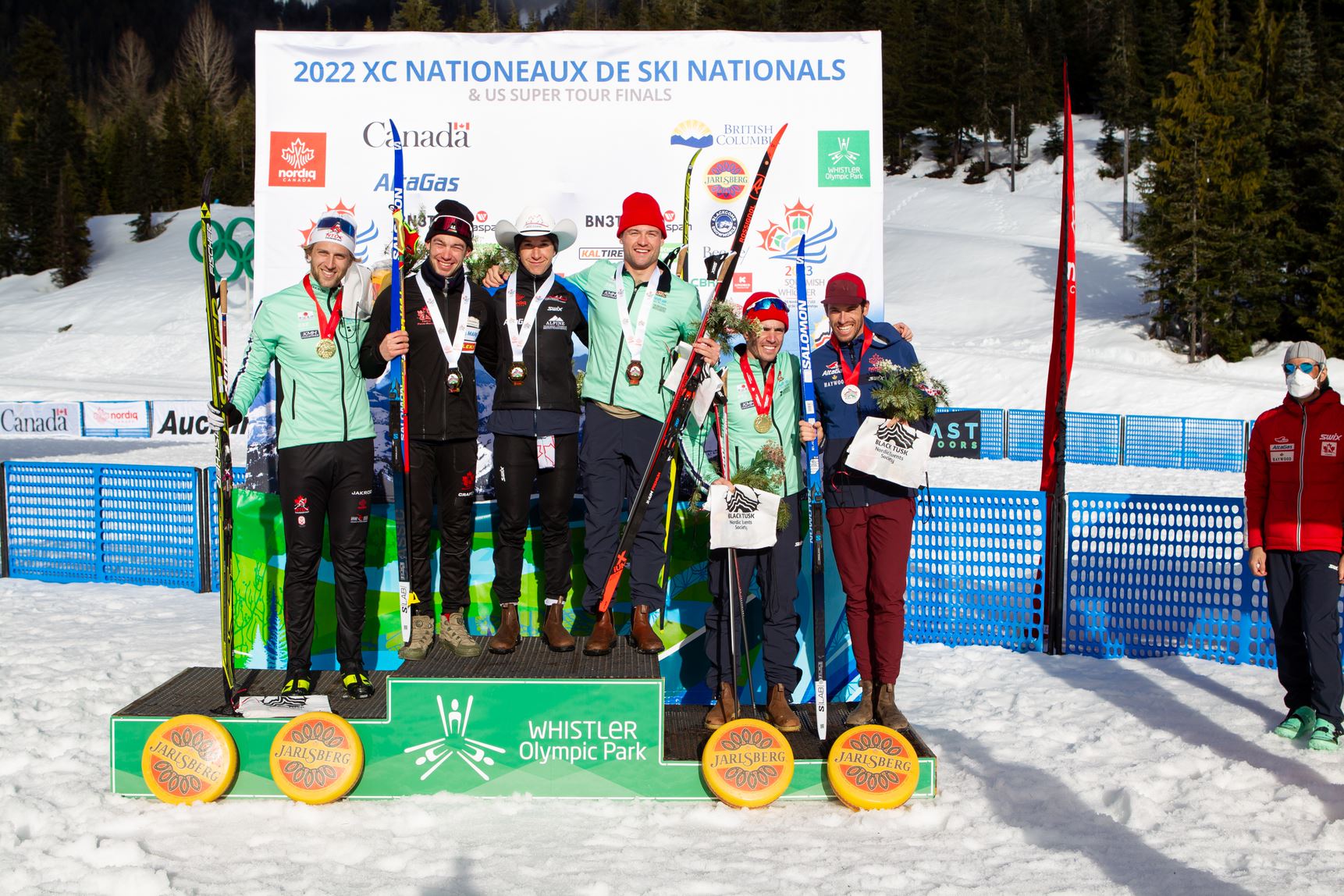
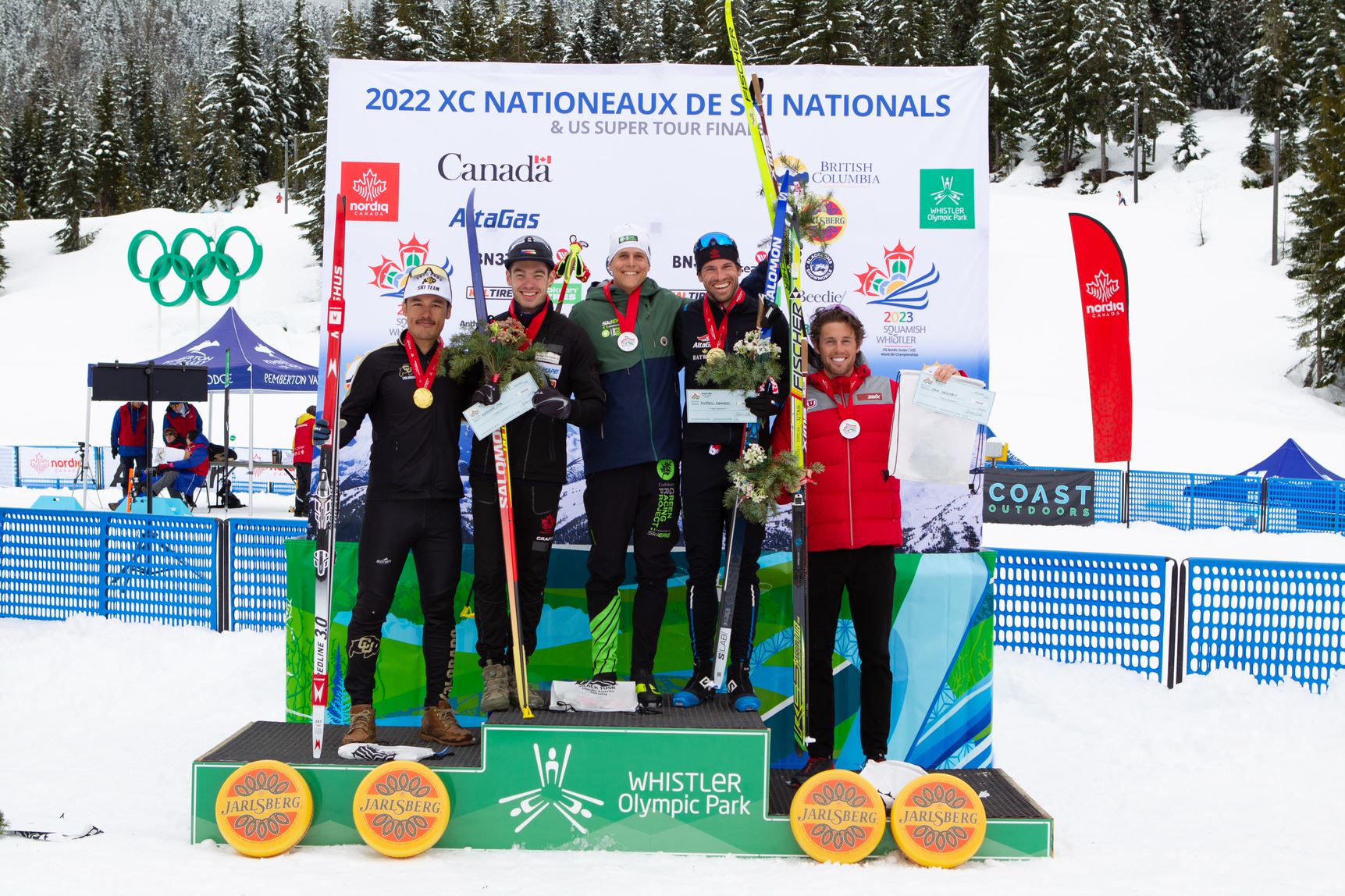
    The Canadian national podium for the classic sprint saw the young Xavier McKeever take the win ahead of Olympic classic team sprint duo Antoine Cyr and Graham Ritchie. (Photo: Joern Rohde / Nordiq Canada)

    Racing continues Friday with a freestyle team sprint, which can be live-streamed here.

    Full Results:

    Qualifiers  | Open and U20 Heats


  • Martin and Kern Stride to the Top on Day Two in Whistler

    Martin and Kern Stride to the Top on Day Two in Whistler

    Carrying the momentum from the first day of racing into a second distance event, athletes lined up once more at the Whistler Olympic Park for a 10 / 15-kilometer interval start classic. Over 130 men and 90 women participated in the open categories, representing clubs across Canada and the United States. 

    Adding a springtime layer of complexity to remind us that we are officially past the equinox, temperatures in Whistler hovered above freezing while a mix of precipitation fell off and on throughout the day. Webcams of the venue showed the spectacular mountain backdrop hidden amongst dense clouds and conifers still laden with the week’s snow.

    It’s a humidity-temperature combo that makes classic waxing tricky. Consequently, many athlete chose to use “hairies”, which are known as “rub skis” in Canada, essentially foregoing kick wax and opting instead for a sandpapered kick zone. For those with strong striding technique, this achieves grip without as significant a risk of icing issues, as klisters can be known create in such conditions. 

    Top Canadian U20 racer Xavier McKeever (Foothills Nordic), who was 13th overall today, explained how this changes the game for those who haven’t had the experience: “You have to be a bit more careful with your kicks and a bit more gentle, because they can slip out really easily. That was the biggest focus for me [today], just to try and ski technically well.”

    Craftsbury’s Adam Martin takes the 15 k classic win in Whistler. (Photo: Doug Stephen / VR 45 Photography)

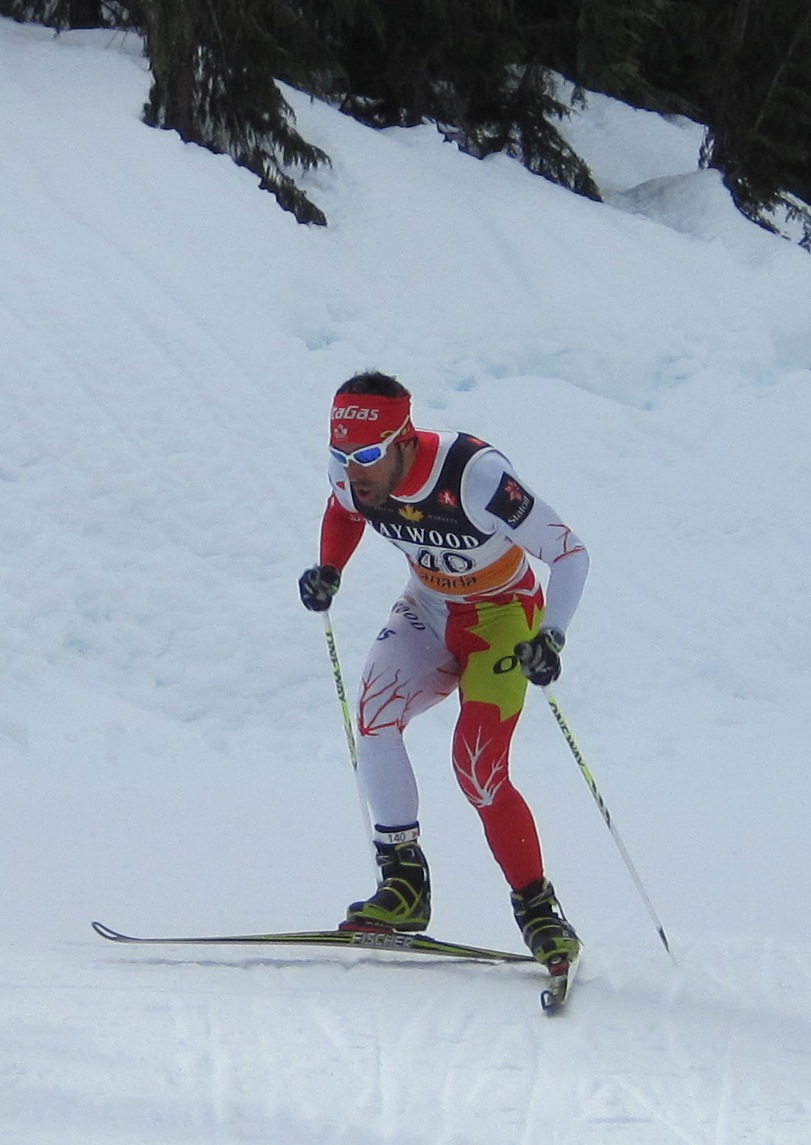
    Following 10 k sitting and standing events contested by Nordiq Canada’s Para Nordic athletes, the open men’s category headed out for the three 5 k loops. In a close race for the top podium spot, Craftsbury’s Adam Martin took the win with a time of 40:29.3. Martin was chased by today’s Canadian National Champion, Antoine Cyr (Skinouk) who hunted his times from 19 bibs behind.  

    Though Cyr led through the first 10 k, a strong closing lap from Martin moved the American to the lead in the splits, with Cyr skiing the third fastest final lap to take second (+1.3). Canmore’s Russell Kennedy was third overall (+13.1) for the second spot on the Canadian podium, while fellow Canmore athlete Sam Hendry, who now trains with the University of Utah, was third for Canada in fifth overall (+48.0). Both Cyr and Kennedy had also raced onto the podium in yesterday’s 10 k free

    “I felt really good today,” Martin wrote to FasterSkier after the race. “Particularly in the second half, I started to figure out how to best race this course and these conditions, and I found a good place mentally to push. I’m really happy with the outcome – that was a dream to win.”

    The men’s 15 k classic podium in Whistler: Adam Martin (CGRP) took the win ahead of Antoine Cyr (Skinouk), and Russell Kennedy (Canmore Nordic). (Photo: Joern Rohde / Nordiq Canada)

    A successful season of SuperTour racing has Martin ranked at the top of the rankings, and earned him starts in post-Olympic World Cup events. After taking third at the American Birkie, Martin headed to Norway to race the 50 k classic at Holmenkollen, where he finished 26th. The following weekend, he skied to 44th in the 15 k free in Falun, Sweden. A week later, Martin is back with his Craftsbury team and standing atop the US SuperTour podium. 

    “It’s nice to return from the World Cup and still feel in good shape. After two 50 k’s, and travel, and a season that I’m really happy with, everything is a bonus at this point. I think it’s great that we are able to combine with Canada for these races. There are a lot of guys at a similar level, so it makes for some tight, fun racing.”

    A 23-year-old Quebec native, Cyr’s best results have been in classic this season, namely an 11th place finish in the opening World Cup 15 k classic in Ruka, Finland, and racing with Graham Ritchie to put the Canadian team in fifth during the Olympic classic team sprint in Zhangjiakou. After the team sprint, he was praised by both his teammate and coach Erik Bråten, along with armchair quarterback Devon Kershaw, for his classic technique.

    “Classic is always good for me and is a race I love,” Cyr said of today’s 15 k in a post-race interview with Nordiq Canada. “It was tough conditions this morning, and a good skier normally comes out on top in hard conditions. I was able to ski well, focus on the race, and came second overall, which is a little bittersweet because it was a really tight battle in the end. But it was really fun, the track is amazing. It’s an Olympic standard track, so it’s just really good.”

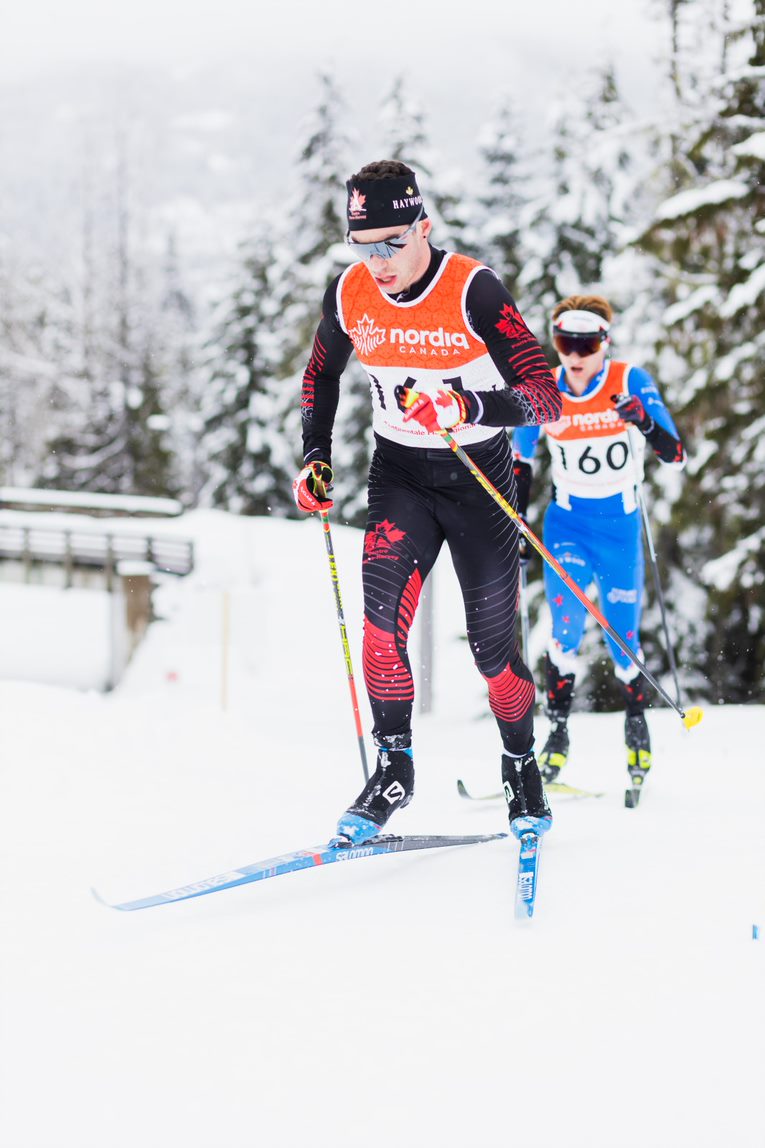
    Antoine Cyr races for the Canadian National Title in the 15 k classic in Whistler. (Photo: Nordiq Canada / Nathaniel Mah)

    In his second lap, Cyr had caught yesterday’s winner, Rémi Drolet (Team Black Jack), whom Cyr credited in supporting his strong result today.

    “When I saw was closing the gap on him on the first lap, I decided to go a little harder than I planned to catch up with him. [I then tried] to relax behind him for a lap or half of a lap.. In the end, I was missing a little bit on the last lap. I think that that helped for sure, skiing with someone strong like Rémi.”

    Finally, Cyr spoke to the importance of an international field featuring all age groups coming together this week, particularly on the heels of a two-year hiatus due to pandemic restrictions.

    “It is so good for the young kids — us older guys, we’ve been racing on the World Cup, but like the juvenile and junior, they almost have no races in Canada. To have a big event like this is just amazing and we’ve been looking at the younger guys’ results for an hour yesterday, seeing who’s in good form, and who’s coming up, and you are the next guys to be like taking over. So for them, it is awesome, and for us too, racing with the US is always — it should always be like this.”

    Joining Martin for the SuperTour podium, BSF Pro Team athlete Finn O’Connell was 7th overall (+1:06.4) and second American, with University of Utah’s Luke Jager half a second behind in 8th overall (+1:06.9).

    Julia Kern strides for the win in tricky conditions during the 10 k classic in Whistler. (Photo: Doug Stephen / VR 45 Photography)

    In the women’s 10 k, SMS T2’s Julia Kern skied a strong second lap to take the win in her second consecutive day on the podium, stopping the clock at 29:54.3. Her club and national teammate, Jessie Diggins, took the second step finishing +18.3 back, while University of Utah’s Sophia Laukli skied to third (+1:03.2).

    Looking at tough conditions, Kern explained she raced by trial and error today, exploring which techniques were most efficient on different sections.

    “I kind of had an open mindset going in today,” she told Nordiq Canada after the race. “I knew that the tracks might be a little bit punchy or washed out in sections, and so I was double pulling wide or double polling narrow or just like power striding on the flats if it was getting too punchy out there. So just trying it all.”

    She continued that she was looking to “have fun, send it from the start, and see if I could hold that pace the whole time,” which she ultimately proved able to do. It’s the time of year where the hay is in the barn training-wise, and athletes have had a long season, leaving them in varying states heading into the last hurrah. On whether she was looking to just have fun at these races, or whether it was a serious quest for the podium, Kern said “both”.

    “I think the end of the season is always really fun. It’s so cool to have this many athletes here. And I’ve been feeling really good the last few weeks and so enjoying racing when it does feel good and when I’m able to push really hard. We’re all really tired at the end of the season, but also, when the body’s in form you might as well take advantage of it and send it on the course.” 

    The women’s 10 k classic podium on day 2 in Whistler: Julia Kern (SMS T2) took the win ahead of Jessie Diggins (SMS T2) and Sophia Laukli (Univ. of Utah). (Photo: Joern Rohde / Nordiq Canada)

    Winning back-to-back Canadian National titles, Katherine Stewart-Jones (Nakkertok Nordique) was again on top for the Canucks, finishing sixth overall (+1:17.5). Finishing in the same order as yesterday, Dahria Beatty (Whitehorse Ski Club) was second for Canada in eighth overall (+1:55.0), while Cendrine Browne (Fondeurs-Laurentides) rounded out the podium in ninth overall (+2:14.5). 

    “I went out really hard knowing that that’s what I had to do if I wanted to make the podium,” Stewart-Jones said of her race. “I had a good first lap, and I definitely slowed down a lot on the first part of the second lap. I was just tired and was having a hard time staying in the zone and keeping the rhythm, but I was able to pull it together a bit for the second half of the second lap. So I was really happy with that. And I was happy with how hard I pushed. I just didn’t have it quite in me today, and sometimes that happens.”

    On the importance of focusing on her technique on this type of course with sub-optimal conditions, she continued, “It’s really important, especially on the climbs. The grip isn’t always perfect in these conditions, so you really have to make sure to stay on top of your skis. If you get tired and you start leaning forward, then it makes it even harder to kick… And then on the flatter sections, it was a bit awkward, and you had to expect that. Either you’re striding awkwardly or you’re doing a kick double pool, but your poles are sinking. You have to just really focus on committing to whatever you decide to do and not like trying to switch too much between.”

    Speaking to already standing atop two podiums, Stewart-Jones responded with pride, while also acknowledging that the overall win would be sweeter.

    “Oh, it’s definitely nice to be winning the national championship title… because we’re racing against the Americans, I obviously care about the overall too, so maybe it feels a little less exciting, but for sure, I’m proud of that.”

    Katherine Stewart-Jones (Nakkertok Nordique) takes back-to-back national titles in the women’s 10 k classic in Whistler. (Photo: Doug Stephen / VR 45 Photography)

    In order to get closer to the overall podium, she said he would focus on resting as much as possible and maintaining the head space to perform her best. “It’s been a long season and I haven’t raced this much in a long time. I think everyone’s pretty tired. But also just being able to also be mentally strong [over the next races]. And yeah, you never know what’s gonna happen.”

    Racing continues Wednesday with individual classic sprints, which will be live-streamed by the Black Tusk Nordic Events Society. If you’re looking for additional video updates, follow along on the Nordiq Canada and Black Tusk Instagram pages. 

    Full Results

  • Calgary in Final Three for 2026 Olympics

    Calgary in Final Three for 2026 Olympics

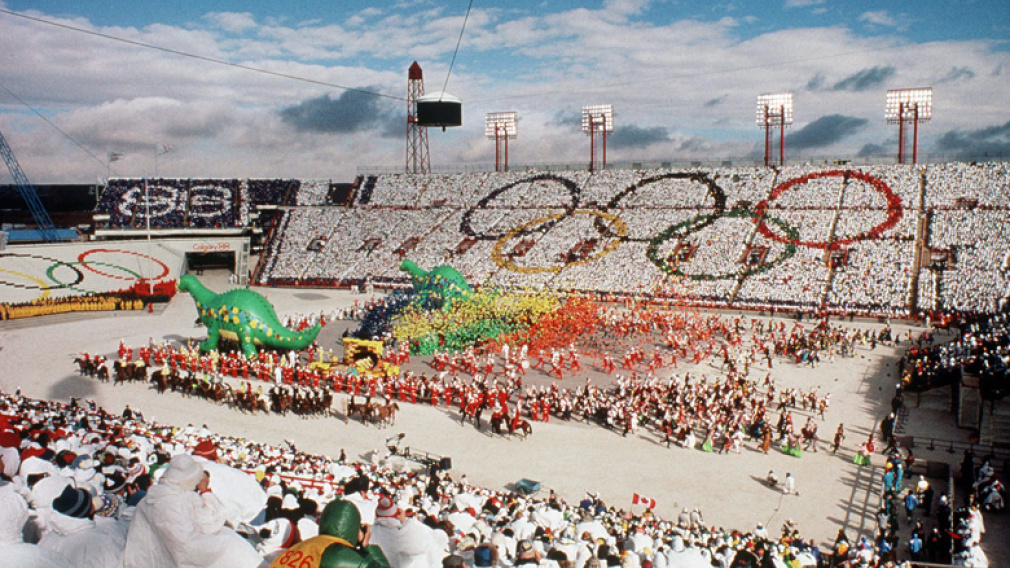
    The Opening Ceremony at the 1988 Winter Olympics in Calgary, Alberta. Calgary is in the final three for hosting the 2026 Winter Olympics and Paralympics. (Photo: Olympic.ca)

    The bidding process for the 2026 Winter Olympics and Paralympics is crawling forward, and when the International Olympic Committee (IOC) announced the shortlist last Thursday, Oct. 4, Calgary was in the final three. 

    Calgary, Alberta, is one of the final three in the running to host the 2026 Winter Olympics and Paralympics. (Photo: www.calgary2026.ca)

    Much has changed since the last time Calgary, Alberta, hosted the Games in 1988 as well as since Vancouver, British Columbia, in 2010. The IOC is now in favour of joint bids, re-use of existing facilities and lower costs. These improvements have resulted in more competition for 2026 than for 2022 (which was awarded to Beijing), but each comes with challenges.

    The increased interest in 2026 may turn out to be temporary. Sapporo, Japan, ended its bidding process after a major earthquake. Sion, Switzerland, dropped out after losing a referendum, and Graz, Austria, couldn’t get the support of its regional government.

    Last Thursday, the IOC announced that Erzurum, Turkey, was out of contention. IOC Vice President Juan Antonio Samaranch, Jr., referenced telecommunications, transport and airports as concerns, but did not mention that there was no sliding centre (for bobsled, luge and skeleton). The Turkish government had previously declined the suggested use of Sochi’s sliding centre, some 650 kilometers away in Russia, which would likely have been unpopular with the IOC as well.

    Calgary, Stockholm (Sweden), and Milano/Cortina d’Ampezzo (Italy) are still in the running, each with their own advantages and challenges. While most cost estimates are being disputed by local “experts”, comparing costs between bids remains difficult.

    buy vibramycin online

    Bid books are to be delivered in January 2019 with a final decision announced in September 2019. The September announcement will be in Lausanne, Switzerland, replacing the originally planned meeting in Milano, as bidding countries are not allowed to host decision meetings.

    Calgary

    An image from the “Yes Calgary 2026” Eventbrite page.

    Many of Calgary’s 1988 Olympic facilities are still in tact, the most visible being the 70- and 90-meter ski jumps. By the 1992 Winter Olympics in Albertville, France, the standard jump sizes were increased, replacing the 90-meter hill with the HS106 (K95) and adding a larger HS140 (K125) hill. Neither of the existing jumps, slated for closure this month, are suitable for upgrading. 

    The current proposal from Calgary is to maintain the jumps in Whistler, B.C., to current standards, allowing ski jumping and nordic combined events to be held in Whistler. This would save a great deal of money and avoid the construction of facilities that will get minimal use after the Olympics. The 11-hour drive and one-hour time difference between Calgary and Whistler is the largest separation of the remaining bids. The flying time from Calgary to Vancouver is about 90 minutes, but requires an additional 2 1/2 hours of driving to and from airports. The distance is not viewed as a problem in the IOC’s new vision. This is a big change from the 2010 bid process, when the two-hour drive from Vancouver to Whistler was originally seen as a deal-breaker. The cooperation between Whistler and Calgary makes financial sense for the local organizing committee, but will be difficult to achieve during the current economic battle between Alberta and British Columbia (see “The Alberta/B.C. Conflict” sidebar).

    The Alberta/B.C. Conflict:
    This is a very complicated and long-standing issue, but the conflict is currently front and centre in both provinces.

    Alberta’s economy is almost entirely dependent on oil exports. Alberta is desperate to build a new pipeline to transport diluted bitumen to the coast for shipping. Alberta needs this export capability to restore its status as the richest province and re-employ laid-off citizens. The Alberta government needs the tax revenue from increased exports to function, let alone maintain support for expensive recreation facilities like Canmore Nordic Centre and Frozen Thunder.

    B.C.’s economy depends on tourism, fisheries, and forestry, all of which would be seriously damaged by an ocean oil spill. A large increase in tanker traffic through the narrow and rock-infested passage to the open ocean is a serious concern, with the cleanup expected to be more difficult than the Exxon Valdez oil spill, with Vancouver, Victoria and Seattle all at risk.

    The dispute between the provinces is unlikely to be solved quickly, unless the politicians of one province put their own voters’ jobs at risk to help the other province. The federal government is feeling the pain of Alberta’s tax revenue drop, but the Federal Appeals Court ruled that they must consider risks of an ocean oil spill before expanding their recently purchased pipeline to Vancouver. The Washington state government is concerned about the risk its state will face while Alberta reaps all the rewards, but it seems unlikely that it can interest the U.S. federal government in an environmental issue.

    A natural gas (LNG) pipeline from Alberta to the coast is currently proceeding with support from the B.C. government as the risks to B.C. are much smaller. While the gas pipeline is in the news, it is unlikely to distract Calgary’s residents from viewing the 2026 plebiscite as a way to share their economic pain.

    There is an idea that the Olympics should move around the world, and many feel that it is Europe’s turn. Calgary already hosted in 1988 and Vancouver in 2010. Asia has hosted since 2014 with Sochi in 2014, PyeongChang (South Korea) in 2018, and next up Beijing (China) in 2022.

    Calgary has the most organized bid, having started the process three years ago.

    The city of Calgary’s non-binding plebiscite is scheduled for Nov. 13. Voters will be considering their struggling economy, growing provincial debts, the disputed legacy from 1988, costs, and hitting back at B.C. against the possibility of a better legacy after 2026. While cross-country skiers wouldn’t doubt the value of the Canmore Nordic Centre to North American skiing, not all Calgarians are convinced about the value of hosting the Games.

    The IOC is campaigning for Calgary to support the bid.

    As a side note, in 2010, most Canadians saw the Vancouver Olympics as a two-hour event. The men’s gold-medal hockey game was what changed those Olympics from ‘disaster’ to ‘best-ever’ status.

    Milano/Cortina d’Ampezzo

    The Milano/Torino/Cortina d’Ampezzo bid briefly lost Milano in August before Italy’s differences were resolved. Then, when the national government confirmed that it would not support the bid financially, Torino dropped out, apparently for good. The Lombardy and Veneto regions are expected to provide funding, and considering that the two regions’ combined GDP is larger than Sweden’s, this may not be a problem.

    This bid is very spread out, in European terms, with events in Milano, Cortina d’Ampezzo, Val di Fiemme, and Anterselva (“Anterselva” is the official Italian name for what the biathlon world and German-speaking locals call Antholz). Milano has excellent train service and two major airports, making it the most accessible host city. However, the mountain communities are served largely by bus and travel times can be as much as six hours from Milano. Express buses could reduce this to four hours.

    order antabuse online, order betnovate cream

    Italy’s national political situation is always interesting, with short-lived coalitions running the country most of the time. This bid is dependent on the far more effective regional governments; while Lombardy and Veneto officially represent only 40 percent of Italy’s GDP, their influence is much larger.

    Milano/Cortina, Italy, is among the final-three candidates in the running to host the 2026 Winter Olympics. (Photo: Neveitalia/Twitter)

    Stockholm

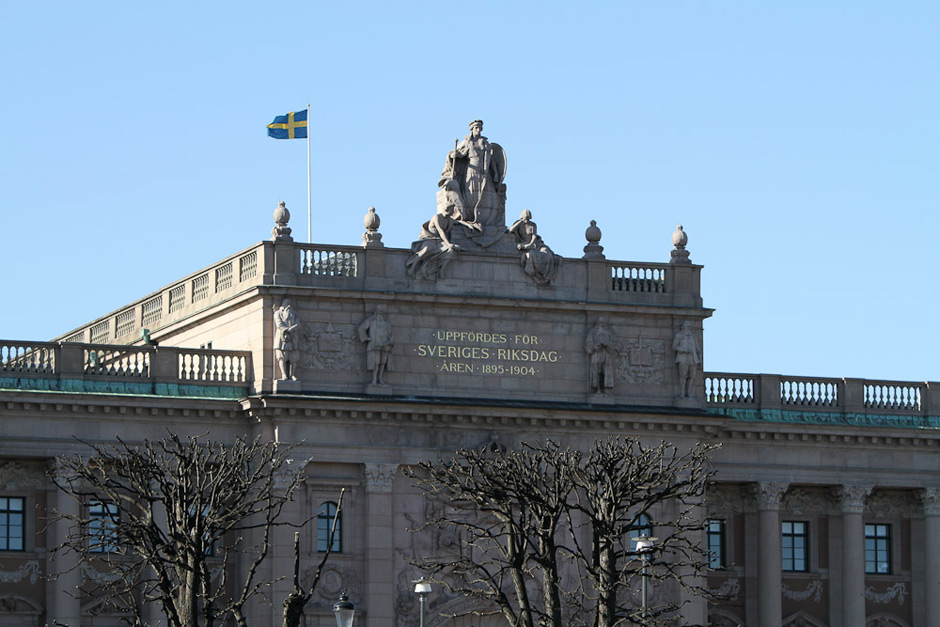
    Stockholm’s Royal Palace as seen in 2012 during FIS Cross Country World Cup Finals.

    Stockholm’s bid is moving along quietly, with Latvia planning housing for its existing sliding centre at Sigulda, 680 kilometers and a ferry ride away from Stockholm. Sweden has most of its facilities in place already and appears to have the least building costs of the candidates. Sweden’s bid currently has no official support from any level of government, which is partially why it’s been less visible. Sweden’s September federal election has added some uncertainty, with the far right making large gains and the prime minister losing a vote of confidence on Sept. 25. It is not clear that a stable coalition will form, which brings more uncertainty to the process of gaining political support and funding.

    More on the 2026 candidates

    Robert Livingstone of gamesbids.com wrote a good summary of bid politics before the announcement of the final three. 

    The Canadian Broadcasting Corporation (CBC) asked some experts to rank the three short-listed bids. The result is interesting, more for the reasoning that the ranking.

  • Whistler Nordics is Hiring Coaches

    (Job posting)

    Whistler Nordics Ski Club in Whistler, British Columbia, is looking for all level cross-country ski coaches who would like to pass on their enthusiasm and skills to our local youth (ages 5 – 12).

    We welcome interest from previous XC racers, novice skiers and parents who would like to get more involved in coaching.

    Previous coaching experience (CC or L2T) would be preferred, but is not required, as there are opportunities to become a qualified coach this fall.

    There is an opportunity to do the basic ICC course online in your own time and we have a CC course running the end of Oct in Whistler.  As a coaching requirement, you’ll need to complete a coaching course to become a coach for Whistler Nordics.

    Programs:

    10 sessions on Saturdays at WOP (Dec – March)

    10 sessions on Tuesdays at Lost Lake (Jan – March)

    Perks:

    Season pass to coaches who commit to a 10 session program at the area they coach.

    If you are interested in coaching at any level, please email Katrina Heron at sdp@whistlernordics.com for more info.

  • 20-for-20 with Ryan Elden

    20-for-20 with Ryan Elden

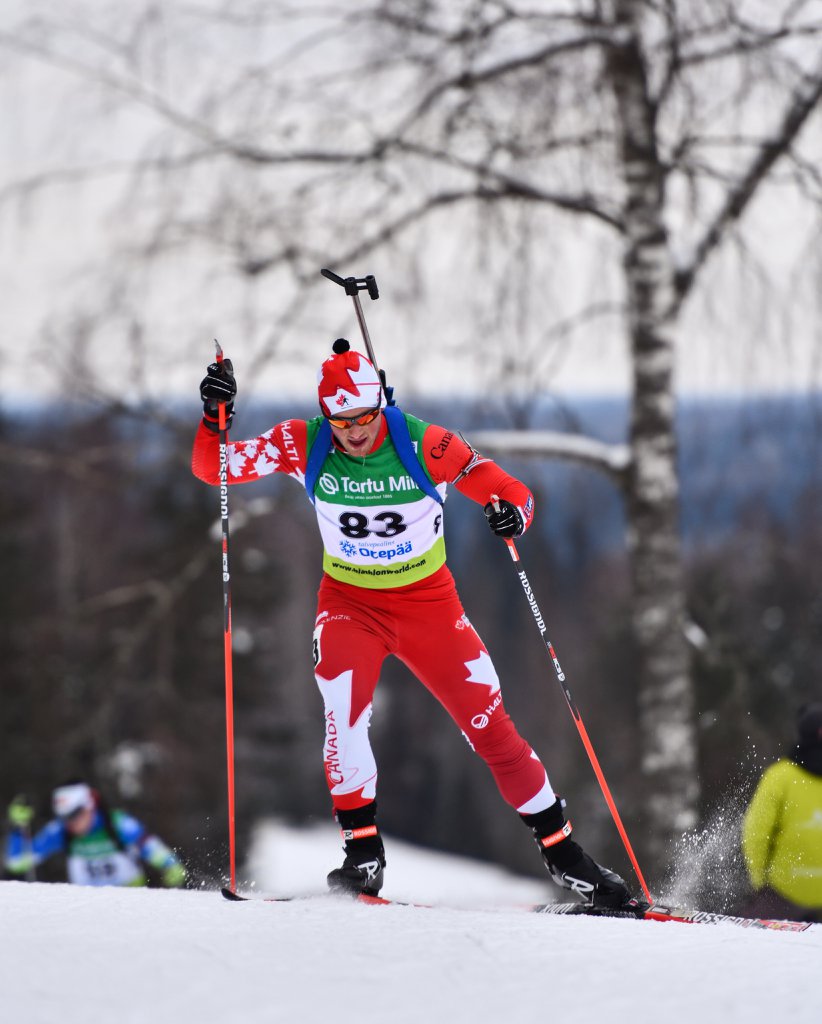
    Canada’s Ryan Elden racing in the youth men’s 7.5 k sprint at 2018 IBU Youth World Championships in Otepää, Estonia. (Photo: Bryan Dickson)

    In an effort to showcase the North Americans competing at this past week’s International Biathlon Union (IBU) 2018 Youth and Junior World Championships in Otepää, Estonia, we asked those qualifying athletes several questions about themselves — actually, we had them fill in the blanks. Here we have 18-year-old Ryan Elden, who represented Canada at his first World Youth Championships.

    Over the last week, Elden placed 49th in the youth men’s 10 k pursuit, 59th in the 7.5 k sprint and 81st in the 12.5 k individual.

    ***

    “My full name is Ryan Alexander Elden, but I go by Ryan pretty much all the time.
    I was born and raised in Quesnel, British Columbia, and I learned to ski at the age of 2.
    Between Trials and Youth Worlds I spent my time competing in Europe on the 2nd international Biathlon tour. I competed in races in Nové Mesto, Czech Republic and Pokljuka, Slovenia. After racing I spent the last 2 weeks in France, at my coach Etienne’s hometown, doing our final bit of training before Worlds. 
    The hardest/most fun workout we did during the summer in Whistler with the Whistler Nordic Training Centre was pulling tires on our roller skis.
    The biggest thing I’ve been working on this season is shooting. I’ve been a little inconsistent in the past so I’ve been doing a bit of extra work to improve in that area.
    This is my first time in Estonia and my second time racing internationally. My first time were the races I did in Czech Rebublic and Slovenia three weeks ago. It’s been a huge learning experience and a ton of fun. 
    One difference I’ve noticed between Canada and Estonia are the older buildings. It has a really cool mix of very modern buildings and very old buildings. 
    At Worlds, I’m really excited to see how I size up against the other biathletes from all around the world.
    One race I’m especially targeting is the pursuit because it is the most fun in my opinion.
    Watching the Olympics before racing has been really inspiring. My favourite part of watching the Olympics is hearing the stories of the athletes and what they’ve gone through to get to where they are today. I get so excited every time medalists are tearing up with happiness on the podium after finally achieving their dreams. If I had to choose someone, I would like to be like Johannes Thingnes Bø. A great champion and amazing athlete, but also personable and humble.
    Here at Worlds I want to meet as many different as I can and learn about the other countries.
    My favourite thing at breakfast (not here specifically but also here) is eggs with cheese. 
    The first thing I thought of before coming here was cold.
    Now that I’m here, I don’t think I will ever forget how flat it is. Our course is anything but flat, surprisingly, but the countryside we drove through was very flat. It has beautiful scenery though. 
    If I had a ton of spare time here I would spend it exploring the larger towns and checking out cool buildings.
    The best way to follow my endeavours is on Instagram @ryan.a.elden or on Facebook @Ryan Elden.”
  • 20-for-20 with Benita Peiffer

    20-for-20 with Benita Peiffer

    Benita Peiffer competing this winter. (Courtesy photo)

    In an effort to showcase the North Americans competing at this week’s International Biathlon Union (IBU) 2018 Youth and Junior World Championships in Otepää, Estonia, we asked those qualifying athletes several questions about themselves — actually, we had them fill in the blanks. Here we have 17-year-old Benita Peiffer, of Whistler, British Columbia, who is representing Canada at her first World Youth Championships.

    Today in Otepää, Peiffer finished 11th in the youth women’s 10 k individual, +1:43.1 with one penalty.

    ***

    “My full name is Benita Peiffer but you can call me B.

    I was born Vancouver, BC and raised in Whistler BC and I learned to ski at Whistler Olympic Park as well as Lost Lake.

    I spent the time between World Youth/Junior trials and Worlds training in Whistler to prepare, and then I came over to Europe early to do some racing in Pokljuka for Biathlon, and then I met up with the BC Ski Team to do some Cross Country Ski races in Zwiesel.

    My favourite workouts I did in the last training year to prepare for this were the workouts we did in Sweden, intervals up sand dunes, swamp running, skiing in the Torsby tunnel, participating in roller ski races and doing some roller ski classic heats with a group of athletes on the BC Team and Development Squad as well as a huge group of Swedish athletes.

    One thing I’m working on this season to improve my biathlon is to stick to my basics of shooting. I often get overwhelmed with everything and forget the basics as well as keeping a positive mindset because a negative attitude will never get me anywhere.

    Canada’s Benita Peiffer, who finished 11th in the opening race of World Youth Championships. (Courtesy photo)

    This is my first time in Estonia and third time racing internationally, and so far it’s been an amazing experience. The competition over here is definitely much harder than in Canada and has showed me how much harder I have to work if I want to get to the level of some of these athletes. 

    One difference I’ve noticed between Estonia and the Canada is the food. Lots of potatoes and the desserts have been very interesting.

    One of the things I’m most excited about for World Youth/Junior Championships in Otepää is the Sprint race. It is one of my favourite races to compete in. It is a 6km race with two shooting bouts. It is the perfect distance for me and perfect amount of shooting for me. I don’t get too overwhelmed with the amount of shooting and I am able to leave it all out there on the course feeling satisfied with my effort. 

    Watching the Olympics in the leadup to my own races was very inspiring. One of my favourite  moments of the Games was watching my cousin, Arnd Peiffer win  gold in the men’s sprint. I want to be like Laura Dahlmeier because she is a very consistent athlete who won several medals at the PyeongChang Olympics. 

    At Worlds, I really hope I can chat/make friends with someone from the German team and ask them where they train in Germany because I am very interested in coming to Germany at some point to train and compete.

    My favourite thing at the breakfast where we are staying is the fresh bread.

    Before this trip, if you said “Estonia”, the first thing I’d think of would have been “Where?”

    Now that I’m here, I’m pretty sure something I’ll always remember will be the beautiful scenery and weather here. We have been lucky to have many beautiful sunny training days. 

    If I had a totally free day here and didn’t have to worry about race fitness or training, I’d spend it doing a relaxed ski through the countryside followed by a walk through the town exploring what Otepää has to offer.

    The best way to follow me on social media is on Instagram @benitapeiffer.

  • May Skiing in Canada (and Abroad) in Photos

    May Skiing in Canada (and Abroad) in Photos

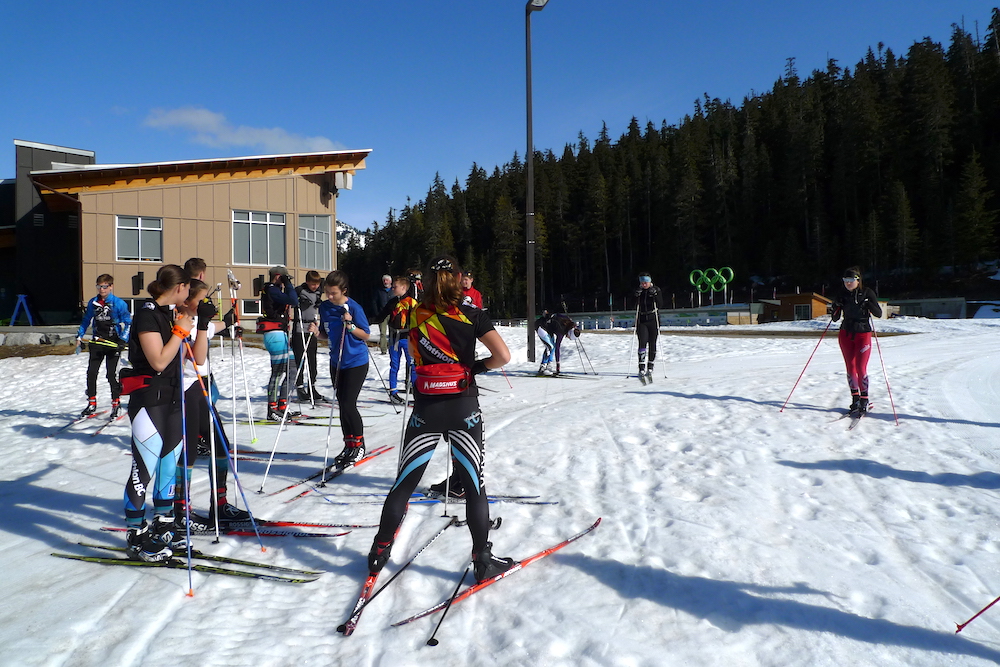
    The BC development team getting ready to ski out of the biathlon stadium at Whistler Olympic Park last weekend.

    While most people have moved on to other sports by May, the more obsessive skiers are starting the new training year on snow.

    Canada’s “first” cross-country ski “races” of the 2017/2018 season were held on May 6. “First” because, while we haven’t exhaustively researched this, it was the first Saturday after May 1, which is the traditional new year for the Northern Hemisphere. “Races” is also a bit misleading as most athletes were viewing the events as an opportunity to do some intensity.

    Here then, in the order which photos arrived, are the places where people are skiing in May. Did we miss one? Share in the comments below or email photos with caption and credit info to info@fasterskier.com.

    Sovereign Lake, Vernon, B.C.

    The Sovereign Lake Nordic Centre (SLNC) re-opened from May 4 to 7 for the Spring Fling camp and the SLNC 1st Annual Pushups Classic Time Trial” race. The May camp has been running for years, but was moved to earlier in the month to ensure prime conditions. A number of clubs brought athletes out for technique lessons and long snow sessions. Canmore Nordic broke the pattern by focussing on low-elevation training with shorter training sessions. As the Canmore athletes live at 1,400 metres above sea level, the opportunity to train at 400 metres was more exciting than skiing at 1,700 metres.

    Canmore, Alberta

    The Canmore Nordic Centre lost its snow at the end of April, but Sunshine Meadows just a short drive west in Banff National Park hosted a large group of skiers starting May 9. Ivan Babikov is leading a training block for the Canmore-based national team members, Chris Jeffries has the Alberta World Cup Academy crew, and a number of other groups are there as well.

    https://www.instagram.com/p/BT7dTJHjPhS/?taken-by=andrewkchisholm

    https://www.instagram.com/p/BT7TVIfFWrc/

    Sjusjøen, Norway

    OK, not in Canada, but Canadians Dahria Beatty and Russell Kennedy went and enjoyed some superb skiing conditions. They raced at Bysprinten in Mosjøen, Norway, and then moved on to Sjusjøen’s 100 kilometres of trails.

    Menihek, Labrador City, Newfoundland and Labrador

    The Menihek Nordic Ski Club is officially closed, but has snow and will set track for Mother’s Day, according to club president Gerry Rideout.

    Whistler Olympic Park, Whistler, B.C.

    This venue is closed to the public, but has been hosting camps on natural snow. Biathlon got the first weekend of May and cross-country has the Victoria Day weekend. These photos are from the biathlon camp on the Olympic trails, mostly below 900 metres in elevation.

  • Let It Snow: Despite Weather Woes, First Two NorAms in the Bag

    Let It Snow: Despite Weather Woes, First Two NorAms in the Bag

    Kris Freeman on his way to winning the 30 k freestyle interval start by more than a minute and a half on Dec. 20 at the Sovereign Lake NorAm in Vernon, B.C. (Photo: Frances Weeks)
    Kris Freeman on his way to winning the 30 k freestyle interval start by more than a minute and a half on Dec. 20 at the Sovereign Lake NorAm in Vernon, B.C. (Photo: Frances Weeks)

    Canada’s NorAm circuit is what the International Ski Federation (FIS) calls a Continental Cup series, similar to the U.S. SuperTour.  The name NorAm is short for North American, a hold-over from when Canada and the U.S. had a combined race series.  These races are critical to the elite racers, with guaranteed World Cup starts, national-team positions, and trips to Junior/U23 World Championships in Almaty, Kazakhstan, on the line.

    Or to put it another way, it would take a major event to cancel a NorAm race — like perhaps a record-breaking storm in a unusually snowless early season.

    As organizing committees secured the final details for the first two NorAm weekends, a major storm was expected to bring heavy rain to most of southern British Columbia.

    By the end of the four-day storm, a Vancouver suburb had declared a state of emergency, heavy rain at 12-degree Celsius (54 Fahrenheit) had closed numerous ski resorts across B.C. (including Whistler Blackcomb). Seattle set weather records, and 220,000 people were without power in California.

    While all this was going on, organizers in La Clusaz, France, canceled their World Cup and later moved it to Davos, Switzerland, a venue which had previously avoided canceling its original race weekend because of a huge snow-moving effort largely funded by a retired alpine skier.

    Black Jack Ski Club

    The start of the women's 7.5 k classic at the Black Jack NorAm on Dec. 13 in Rossland, B.C. ( Saturday’s 11 k classic individual start at the NorAm opener in Rossland, B.C. (Photo: Fresh Cafe & apres/Facebook)
    The start of the women’s 7.5 k classic interval start at the Black Jack NorAm opener on Dec. 13 in Rossland, B.C. (Photo: Fresh Cafe & apres/Facebook)

    The first NorAm weekend this year was scheduled for Dec. 13-14, hosted by the Black Jack Ski Club in Rossland, B.C. Outside the province, Black Jack is best known as the club that produced George Grey (top-10 finisher at the 2010 Olympics) and the current home of long-time national team coach Dave Wood.

    When low snow, warm weather and predicted rain made the club’s homologated courses unsuitable for skiing, the club decided to move the opening races up to the biathlon trails, more than 200 meters (650 feet) higher in elevation. As the four-day storm progressed, the freezing level was up to 2,000 meters (6,500 feet) in the area, well above the 1400-meter(4,590-foot) elevation of the biathlon trails.

    When rain made the sprint loop unskiable two days before the race, the organizing committee didn’t give up. Club members, neighbours and team coaches spent hours shoveling snow onto the course. When another wave of rain destroyed the sprint course overnight, the organizing committee switched to two individual-start classic distance races and volunteers headed out again to shovel more snow onto the distance course.

    After four days of rain and a move to a higher venue without electricity or a timing building, the races were held. Generators provided power, live results were available on the internet and the event was generally agreed to be up to the Continental Cup standard.  Some 140 official volunteers plus an unknown number of shovelers made this possible.

    “We estimate we did about 130 man-hours of shovelling this week,” Chief of Competition Ian Sibbald wrote in an email.

    Unsolicited athlete quotes from the Black Jack NorAm

    “The volunteer base is incredible.  That is an astounding number [of volunteers] since only 3,500 people live in Rossland. Given the lack of snow, the conditions were great.” — Kris Freeman (Team Freebird)

    “Conditions were good! A few twigs poking through here and there, but tracks were fast and hard. Big thanks to the volunteers and organizing committee for working hard to run these races!” — Michael Somppi (Alberta World Cup Academy/Canadian Development Team)

    “Conditions were remarkable, especially considering the challenging weather the Black Jack Ski Club has been dealt. One would hardly know that though skiing the course, unless you look closely and notice all the shoveling marks on the side of the trail.” — Brian Gregg (Team Gregg/Madshus)

    “Conditions were much better than I expected, the organizers and groomers did an amazing job making the race happen with tough conditions and the tracks today were great!” — Alysson Marshall (AWCA/National Development Team)

    “Conditions today were amazing considering the weather … The race organizers and many volunteers from the town have worked hard to get a good track to make these races happen.” — Andrea Dupont (Rocky Mountain Racers)

    “The crew at Black Jack did an amazing job on the course, it was close to perfect considering what they had to work with. The tracks were great, I was very impressed.” — Dahria Beatty (AWCA/National U23 Team)

    “The course held together exceptionally well, due to the work of the volunteers and the slightly colder weather that appeared day of.” — Jennie Bender (Bridger Ski Foundation)

    Callaghan Valley Cross-Country

    Callaghan Valley Cross-Country (CVXC), the host of the second NorAm weekend, isn’t so much a ski club as it is a consortium of four clubs based in the Vancouver/Whistler area: Nordic Racers, Whistler Nordics, Hollyburn Jackrabbits, and Spud Valley Nordic. Squamish Nordic contributes, as do a number of other clubs from the province. For higher-level events, volunteers from other clubs commonly join in, either to add expertise to help the host club earn the event, or gain experience and knowledge so their own club can host similar events in the future.

    Scheduled the weekend before the holiday break, CVXC was on track with 85 volunteers with two weeks to go. Snow is rarely a problem at Whistler Olympic Park. In 2010, no provision for snow making was made and the Olympics were held on natural snow despite a seven-week block of rain that ended a week before the Olympics started.

    With very little snow and the forecast of the storm earlier this month, the organizing committee had to make a decision to commit, cancel or move the NorAm races with 12 days to go. On decision day, 100 millimetres (4 inches) of rain was forecast for the race venue.

    At this point, much of the sponsorship money had been spent, hundreds of volunteer hours had been invested, and teams had booked lodging and flights well in advance.

    With heavy rain falling at the venue, few people were surprised when organizers announced they were moving the races to Sovereign Lake in Vernon, B.C.

    Once the decision was made, the logistical headache began. The new venue is more than 400-kilometers away, which meant the existing volunteers wouldn’t be sleeping at home. Many of the teams had booked flights leaving Vancouver on Sunday night.  With two mountain passes and six-driving hours separating Sovereign from the airport, there wouldn’t be time to hold the planned events on Sunday.  Moving the races to Friday and Saturday solved the travel problem, but made the volunteer issue more difficult.

    At this level of competition, there are strict rules about roles and responsibilities. The assistant technical delegate, Sharon Clarke, was no longer eligible, as the new host was her home club. Clarke and the chief of competition, Sherryl Yeager, swapped roles before tackling the rest of the changes.

    “Having to change the event at such a late date due to weather is heartbreaking,” Yeager, also the CVXC vice chair, explained in an email. “All the work that went into planning, arranging sponsors, maps, courses, setting up run sheets, the race notice, registration, accommodation, food, the website and more is largely of no use.”

    Andrew Pohl of the New Zealand Ski Team crossing the line in 15th in the men's  NorAm 30 k freestyle interval start on Dec. 20 at Sovereign Lake, B.C. (Photo: Frances Weeks)
    Andrew Pohl of the New Zealand Ski Team crossing the line in 15th in the men’s NorAm 30 k freestyle interval start on Dec. 20 at Sovereign Lake, B.C. (Photo: Frances Weeks)

    Sovereign Lake Nordic Club

    Sovereign Lake is a perennial NorAm host, using trails built for a World Cup event in 2005. The trail system is interconnected with Silver Star Mountain Resort, which leaves most visitors a bit confused. In recent years, the division is simple: race at Sovereign, sleep at Silver Star, ski at both.

    Sovereign was hosting a CPL race (one level below Continental Cup) when the possibility of moving the NorAm was raised. With 80 volunteers on site, it was easy for the organizers to quickly find out how many might be available for a potential NorAm and make the commitment to offer the venue.

    The shift from Saturday/Sunday to Friday/Saturday was essential for the teams, but difficult for the organizers. More of the CVXC volunteers were unable to help and many of the Sovereign volunteers were unable to get a day off work at short notice.

    Without a sprint in the first NorAm weekend of racing, Sovereign’s first day became a classic sprint, requiring another rewrite of the race notice. Ultimately, the merged organizing committee was able to get about 100 volunteers over the two days, including some from neighboring clubs.

    Several racers generally viewed the event as a typical NorAm, with more comments on the challenges of heavily falling snow than the logistical obstacles of the event move.

    While athletes, coaches, families, and race-day volunteers have moved on, the two organizing committees are sorting out how to share the entry fees and sponsorship money to cover their extra expenses.

    The Result

    After two weekends and four races, more individuals volunteered than raced.  Athletes got crucial early season race time into their legs.  Several athletes have positioned themselves to race in Europe later this season.

    Was it all worth it? Dahria Beatty, Raphaël Couturier, Annah Hanthorn, and Philippe Boucher pre-qualified for Junior/U23 World Championships in early February in Almaty, and based on his NorAm results, Patrick Stewart-Jones earned his spot at the World Cup sprint in Otepää, Estonia, from Jan. 17-18.

  • Wednesday Workout: Max Aerobic Speed Intervals with Colin Foley

    Wednesday Workout: Max Aerobic Speed Intervals with Colin Foley

    Colin Foley (Callaghan Valley Training Centre) racing. (Courtesy photo)
    Colin Foley (Callaghan Valley Training Centre) racing. Foley, 18, likes time-based interval workouts that mimic sprint qualifiers, like max aerobic speed at 15-second intervals. (Courtesy photo)

    This week’s workout brought to you by Colin Foley, 18, of the Callaghan Valley Training Centre in British Columbia. Want to submit your own go-to workout? Email alex@fasterskier.com.

    After years of ski training it seems like I’ve done any variety of intensity workouts. From VO2 max to speed, to tempo to you name it, it’s almost a rare event when we do the same intensity breakdown!  Anyway, we did a great workout recently in practice: max aerobic speed at 15-second intervals, it’s something that we’ve done a few times and I really hope we do more in the future.

    The workout: Time-based interval workout, with four intervals of 3 minutes and even rest (3 minutes) in between. We did them at Zone 4, or just as hard as you can maintain for the 3-minute interval.

    Warmup: We warmed up as a group with a 30-minute easy classic ski.  To warm up properly, we stuck to the flatter trails between the stadiums at Whistler Olympic Park for the first 10 minutes then went into some hillier terrain for the last 20 minutes and regrouped in the cross-country stadium at Whistler Olympic Park.

    Interval start: While lots of intervals can be done as a large group (there are 9 on my team), we chose to do this set of intervals in a 15-second interval start format. I really liked this format because it made the workout feel like a sprint qualification … four times!

    When you are doing intervals as a group it’s often easier to push yourself because you have your teammates there at your side, and you don’t want them to get away.  I really like the 15-second interval start format of these intervals because it really helped me practice pushing to the max when I don’t have somebody there at my side.

    “When you are doing intervals as a group it’s often easier to push yourself because you have your teammates there at your side, and you don’t want them to get away.” — Colin Foley

    We definitely have some stronger and weaker “sprinters” on our team, so our coach mixed up the order of our interval start from interval to interval.

    Colin Foley (CVTC) warming up. (Courtesy photo)
    Colin Foley (CVTC) warming up. (Courtesy photo)

    Rest/recovery: In between the intervals we tried to recover as much as possible.  For me, this meant skating easily around the stadium.  We were doing the harder sets on the hills of the sprint course, just outside of the cross country stadium so it was easier to come back (and also hear our coach call the end of the set).

    Result: We do these intervals to increase the amount of time that we can push ourselves at our maximum aerobic output.  I have really found that this has helped my sprint qualifiers this year.

    Post-workout: After the final interval we did a long cool down, but not before we first had some good nutrition.  For us, that’s a bottle of a protein drink and some hydration drink (we also have energy drops if we were feeling a bit hungry).

    We skied for about an hour, this time sticking to rolling terrain (the Madeley Creek Loop at Whistler Olympic Park is great for a longer cool down like this).

    Then it was back to the van, back to our homes in the Whistler Athletes Village (now known as Cheakamus) and a proper lunch and rest.

    We enjoyed being home in Whistler for a few weeks and getting in some good training before heading off to more NorAm competitions and, eventually, Canadian Nationals.

    Callaghan Valley Training Centre team prep (Courtesy photo)
    The Callaghan Valley Training Centre team preps for one of its workouts. (Courtesy photo)


  • The Four: Callaghan Valley Training Centre

    The Four: Callaghan Valley Training Centre

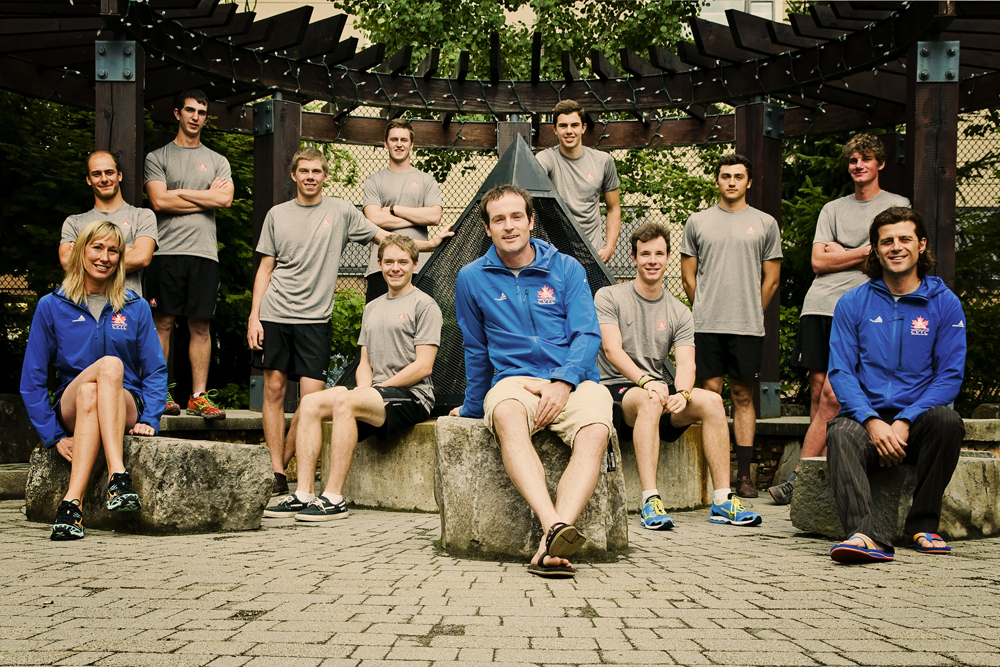
    The 2013/2014 Callaghan Valley Training Centre team, including head coach Chris Manhard (c), assistant coach Maria Lundgren (l) and wax tech Graham Maclean (r). (Photo: CVTC)
    The 2013/2014 Callaghan Valley Training Centre team, including head coach Chris Manhard (c), assistant coach Maria Lundgren (l) and wax tech Graham Maclean (r). (Photo: Ashley Nagy Ouellette/CVTC)

    Note: This is the first of four previews providing an inside look at Canada’s national training centres and their respective senior teams this season. We asked coaches to tell us what’s new, whom to look out for, and the outlook on the winter ahead.

    Team: Callaghan Valley Training Centre (CVTC)

    Coaches: Chris Manhard (head coach), Maria Lundgren (assistant coach), Graham Maclean (wax tech), Shannon Thompson (mental performance coach)

    Athletes: Martin Schrama, Paul Dupuis, Geoffrey Richards, Sebastien Dandurand, Andrew Avis, Sam Morris, Liam Patterson, Colin Foley, Benjamin Osorio

    No women because there weren’t enough applicants, according to Callaghan Valley’s marketing and communications director Magi Scallion.

    “It just so happens that in the past couple years we’ve not had enough female applicants to create a reasonable female training group,” she wrote in an email. “We would love to have more females on the team and are just waiting for the right opportunity and critical mass.”

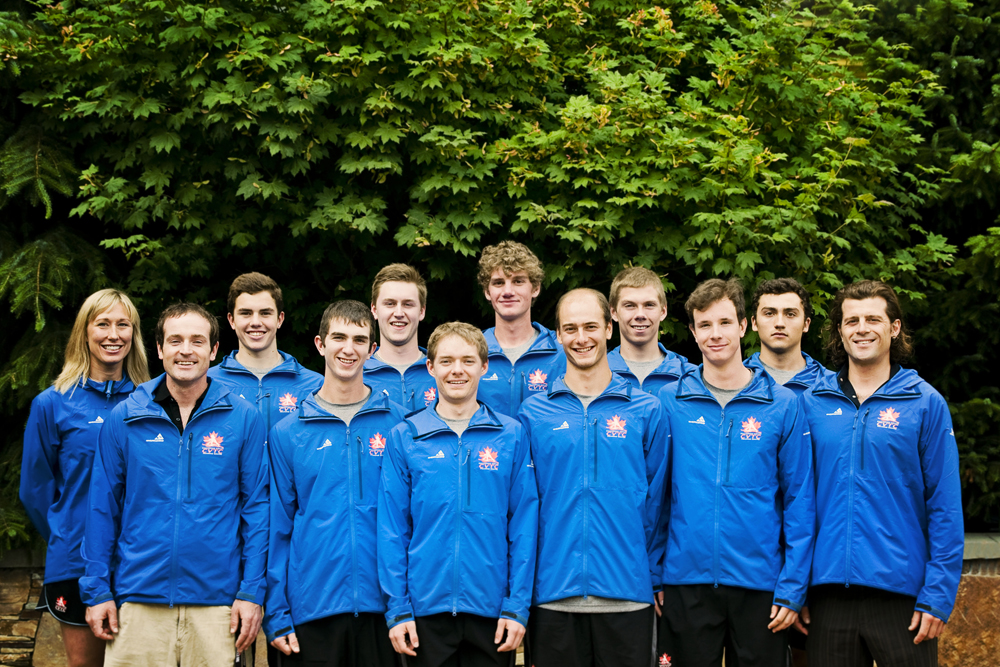
    The faces of the Callaghan Valley Training Centre. (Courtesy photo)
    The faces of the Callaghan Valley Training Centre. (Photo: Ashley Nagy Ouellete/CVTC)

    Who’s new: Avis (from Goderich, Ontario) “Andrew is relatively new to the sport of cross country skiing as he came from a boxing and hockey background,” Scallion explained. “He’s fitting in really well and seeing some big improvements in training this year.”

    Morris (West Vancouver, B.C.) “… A tenacious competitor and really enjoying the team dynamic,” she added. “He’s one of the younger members of the team but certainly not scared of taking leadership or duking it out with the older boys in time trials.”

    Patterson (Thunder Bay, Ontario). “Thunder Bay is a real hotbed of skiing and Liam’s got some great experience and talent,” Scallion wrote. “He’s had some injuries and has not be able to run as much as the rest of the team, but is getting healthy quickly and is looking forward to a great winter.”

    Foley (Ottawa) “… Very talented and driven,” according to Scallion. “We’re enjoying having his skill and passion around. Technique is a major focus for him this training season.”

    Osorio (Huntsville)  “Ben joins the U23 squad of the CVTC and is really enjoying training in a focused environment,” she wrote. “He’s going to see some big improvements this winter.”

    Who’s missing: Yannick Lapierre and Sebastien Townsend (accepted at Alberta World Cup Academy in Canmore); Stefan Sander-Green (returned to hometown of Kimberley, B.C., and is training with local club there); Colin Ferrie (living in Kimberley, training with BlackJack Ski Club and head coach Dave Wood out of Rossland, B.C.); Fred Weaver (off to school)

    Top results last season:

    At 19, Dandurand, who previously excelled in nordic combined, earned three bronzes in each of the junior distance races at Canadian nationals in Whistler, B.C. Earlier in the season, he topped the NorAm junior podium at Western Canadian Championships in Grand Prairie, Alberta, where he won the skate sprint and 30 k freestyle pursuit for third overall in the mini tour. He also made the podium at the Ottawa NorAm, placing third as a junior in the 15 k skate.

    Another junior, Dupuis, 20, was fourth in the NorAm skate sprint in Grand Prairie, and placed fifth in the 15 k classic there and classic sprint at the NorAm in Thunder Bay.

    As a senior, Richards, 21, pulled off a top 20 in the classic sprint at Canadian Nationals and nabbed 10th in the Sovereign Lake NorAm 15-kilometer classic mass start early last season.  Also 21, Schrama was in the top 25 at three NorAms last season.

    Coach’s comments:

    Everybody is in great shape and great spirits following a pretty hard training camp throughout September,” Scallion wrote, based on conversations with coach Manhard.

    In early July, the team got together and down to business in Whistler, B.C., then flew to Park City for a camp later that month. Its athletes spent September touring British Columbia (plus a week on the Haig Glacier in Alberta), and later this month, they’ll head back to Canmore for a week on snow at Frozen Thunder before returning to Whistler for more skiing, weather permitting. In November, they’ll ski some more at Silver Star in Vernon, B.C., before the race season starts.

    “Our goals this season are to qualify as many athletes as possible for U23 and World Junior Championships,” Scallion wrote, noting the team’s relative youth in its fourth season since its inception in 2010. “Medals at national championships are also important.

    “One of our major focuses is team cohesion and having a positive, energizing, supportive team atmosphere,” she added. “We’re carefully monitoring this and our mental coach, Shannon, has been very useful to this regard.”

    Bonus: For more on the CVTC, check out their introductory video.

  • At Long Last: Canadian Season Wrap (Video)

    At Long Last: Canadian Season Wrap (Video)

    Japan's Chisa Obayashi (second from r) leads after crashing early in Saturday's 30 k freestyle mass start at Canadian Nationals in Whistler, B.C. Eventual winner, Bettina Gruber of Switzerland (r), runner-up Zina Kocher (l) and Heidi Widmer (second from l) follow. (Photo: Martin Kaiser)
    Japan’s Chisa Obayashi (second from r) leads after crashing early in the 30 k freestyle mass start at 2013 Canadian Nationals in Whistler, B.C. Eventual winner, Bettina Gruber of Switzerland (r), runner-up Zina Kocher (l) and Heidi Widmer (second from l) follow. (Photo: Martin Kaiser)

    WHISTLER, B.C. — Wondering how your favorite Canadian skier is feeling about last season? We asked many of them at Canadian Ski Nationals in late March. Here is the final product of our efforts: a montage of interviews with some of the best (at least the ones at nationals) talking about their seasons and final races in Callaghan Valley.

    Like this? Check out our “Bits from Canmore” video from the Alberta World Cup in December.

  • After Trip to Test Out Sochi, First National Title is ‘Perfect Way to End Season’ for Canada’s Wenzel

    After Trip to Test Out Sochi, First National Title is ‘Perfect Way to End Season’ for Canada’s Wenzel

    Canada's Kurtis Wenzel won a gold medal at 2012 World Junior Championships; his coaches and teammates hope that he'll soon be contributing as a senior. Photo by Judy Geer.
    Canada’s Kurtis Wenzel won a gold medal at 2012 World Junior Championships; this year, his first senior national title. Photo by Judy Geer.

    After taking a year off from biathlon, coming back to win his first World Championship, and then graduating from the junior ranks, last year was a bit of a whirlwind for Canada’s Kurtis Wenzel.

    And then, he was faced by a challenge familiar to all newly-senior North American biathletes: what do you do next? With many teammates who already have World Cup or even World Championships experience and a small number of lightly-attended NorAms, it’s sometimes a challenge to find racing opportunities and stay motivated.

    Luckily, Biathlon Canada has been sending more athletes to second-tier IBU Cup races in Europe, and in February Wenzel hit the circuit, where he stayed for the next several weeks.

    Then, some good news, and the end of the season began to take off. Wenzel got the surprise call to go to Sochi, Russia, to compete in his very first World Cup – at next year’s Olympic venue. The he flew home and competed in national championships, earning his first title as a senior. Not a bad way to wrap up a season that had its downs as well as its ups – for instance when Wenzel got sick in Bansko, Bulgaria, and missed every race of Open European Championships.

    Olympic Preview

    To say that the Sochi trip was last-minute would be an understatement. It wasn’t always clear that the team would even bring four men to the venue, much less that Wenzel would be one of them.

    “I wasn’t really picked out to test the new venue, more just to secure four start sports,” Wenzel explained to FasterSkier in an interview. “Biathlon Canada received a grant for that specific reason from the Canadian Olympic Committee. Without the grant I would have had to pay my own way for two weeks in Europe just for one race, which would have been hard for me to justify. I wasn’t the first choice for the spot either: Marco Bedard turned down his spot due to some tendon problems and Nathan Smith had just got back to Canada when they found out about the grant.”

    The Canadians were trying to make it into the top 15 of the year’s Nations Cup standings, which would secure them four starting positions on the World Cup, as opposed to the three they had for men this year. Since relays count heavily in the scores, the team had secured the grant to send a full relay team to Sochi, even if Wenzel wouldn’t have a spot in any of the individual races.

    “I found out I would be coming to do the WC8 relay just before European Championships in mid-February,” Wenzel said. “I had to go on my own to Munich for five days to get my Russian visa… Sochi was my last stop on a tour that began mid January and I was feeling incredibly run down. I was sick at European Championships in Bulgaria and it was a big struggle to get myself feeling like I could race again. I actually requested they send another athlete to take my place, but it was too late to change everything at that point.”

    So in some ways, his big debut did not go as planned, at all. The whole team was feeling a little under the weather; several of the men suggested at the time that they had been much stronger early in season and their ski form was simply gone. The team failed to score points in either the individual or the sprint, and placed 15th in the relay, one spot behind Belarus. The two teams had been dueling for the top-15 position all season, and Belarus ended up getting it, leaving Canada with a three-man quota again next season.

    “I was certainly unhappy with my ski form, which is not at World Cup level at the moment,” Wenzel said. “However, my shooting was satisfactory and saved me from losing more time off the leaders… Our goal was to secure a top 15 overall World Cup ranking and I was not able to hold up my end of that.”

    The team had started out in 17th after Jean Philippe Le Guellec struggled on the shooting range; Scott Gow pulled Canada up to 13th before Gow took his turn, tagging off to Scott Perras who held 15th. Even if his skiing was below par, Wenzel held his own on the range, using a single spare round. That showed he could handle the pressure of perhaps the most stressful event on the World Cup circuit.

    “It wouldn’t say it was ‘over’ whelming for me to race in Sochi,” he joked. “I think it was just the right amount of ‘whelming’. Apparently I can keep my cool in these kinds of situations.”

    And, the 22-year-old now has a bit more experience that will surely help him in the future.

    “It was an amazing experience,” he said. “I have always wanted to race in front of big packed stands and I feel lucky I got to do it at one of the most epic venues imaginable. The venue is the biathlon temple of Russia. The trails are some of the hardest I have ever seen.”

    And just in case he gets the call for next year’s Olympics – where Canada will have four starting spots – he knows what to expect from a venue that was universally described as great, but strange.

    “There is a stark contrast between the original dwellings in Krasnaya Polyana, the new hotels and Olympic village,” Wenzel said to add his own description. “Imagine a glorious winter resort built from nothing with no history of skiing in a short time. In Russia they truly believe that if you build it, they will come. There were lots of enthusiastic fans and volunteers excited to be a part of something so big. I was glad they all got to see the home team pull through for the men’s relay.”

    On To Nationals

    Like most of the other North American national championships in the nordic disciplines, Canadian biathlon nationals – which this year doubled as North American Championships – is not attended by most World Cup athletes. But the event, held in Whistler this year as part of the Sea to Sky Festival which also included Ski Nationals, allowed Wenzel to go head to head with some of his rivals for World Cup starts.

    He wasn’t sure how things would go.

    “I was expecting bad jet lag and a repeat of the exhaustion I felt while on tour in Europe, but coming back to Canada after two months abroad really perked me up,” he said. “I wasn’t in great ski shape, but it was good enough and my shooting mentality was spot on. It was the right combination of wanting to hit targets and not worrying about it.”

    Wenzel started the series off with clean shooting, finishing second in the sprint to Smith by 59 seconds to earn a silver medal. That normally would have put him in a tough place in the pursuit, skiing alone with little chance of catching the World Cup veteran; but racing in North America is often different than in Europe, where pursuits are started based on time gaps from the sprints.

    “The pursuit was actually a special NorAm circuit start where everyone goes at 5-second intervals based off their sprint race ranking,” Wenzel explained. “This gave me hope that I could beat Nathan up until the middle of the race where he opened up a gap from skiing and shooting much faster then me.”

    But, although Wenzel didn’t know it, Smith had started early and was given a 30-second time penalty. So it was a good thing that the younger racer kept his cool, hit all 20 targets – making him 30 for 30 for the weekend – and stayed focused.

    “I was actually still very close to catching him,” Wenzel said. “He missed two at the last shooting and I was able to stay clean which put me out 10 or 15 seconds behind him without the penalty. He tried his best to open that up to 30 seconds to overcome his penalty but I held on for the win! Most of the race I was just focused on holding on to second place so it was a big surprise when I found out I won.”

    Even though it was his first year as a senior racer, it wasn’t his first time in the open class at nationals. So Wenzel had come into the weekend knowing what was possible, but also cautious and doubtful that it could happen.

    “I raced up and competed as a senior last year at nationals and earned a bronze medal,” he said. “I know I had it in me to win at Nationals, but I was surprised I pulled it out after being out of shape for so long.”

    Wenzel finished off the weekend by placing fourth, the third Canadian, in the mass start, which Smith won. He then joined forces with Smith and World Cup racer Rosanna Crawford to win the mixed relay for Alberta.

    Despite the slow ski shape, Wenzel continued on with his race season, competing in two races at ski nationals; in his year away from biathlon, he had focused on skiing, so in some ways that was a return, too. Tired, he placed 50th in the 10 k skate and 39th in the 50 k marathon.

    But of all the events in Whistler, it was unsurprisingly the national championship that stood out.

    “I have had some chances to beat Marco and Nathan this year besides nationals,” Wenzel said. “At trials for IBU Cups 6 and 7 I won against Marco in the sprint and at an Alberta cup in January I was able to beat Nathan as well. I have to say, even with the unusual circumstances, doing it at Nationals was much more satisfying! It was a perfect way to end the season.”


  • Canadian Nationals: Much More than Cross Country

    Canadian Nationals: Much More than Cross Country

    Female ski jumpers in action on Friday at 2013 Canadian Nationals in Whistler, B.C. (Photo: Jim Hegan)
    Female ski jumpers in action on Friday at 2013 Canadian Nationals in Whistler, B.C. (Photo: Jim Hegan)

    WHISTLER, B.C. – Friday was an official-training day for the cross-country athletes, but the Sea to Sky Nordic Festival isn’t all about cross country.  While biathlon wrapped up earlier, ski jumping and nordic combined had their first competitions on Friday.  Fast and Female hosted an event, and there were lectures on coaching female athletes.

    Our cross-country coverage has focused on the open categories, which is just a small part of the event.  The vast majority are Canadians, with 696 athletes eligible for national titles in four age groups, CCUNC (university students), and two para-nordic categories.

    The U.S. is well represented with 25 athletes.  Norway has seven athletes, largely representing U.S. colleges.  Switzerland and Slovakia each have two athletes.  Australia, Belarus, the Czech Republic, Spain, France, Japan, the Netherlands, and Peru have one athlete each.

    Biathlon had 175 competitors for four competition days, ending March 20th, with about 40 athletes from the U.S.

    Female Nordic Combined skiers starting Friday's 5 k at 2013 Canadian Nationals in Whistler, B.C. (Photo: Jim Hegan)
    Female Nordic Combined skiers starting Friday’s 5 k at 2013 Canadian Nationals in Whistler, B.C. (Photo: Jim Hegan)

    With the addition of female ski jumpers to the 2014 Sochi Olympics, it is no surprise to see that a significant number of the competitors are female (12 of 40 competitors on Friday).  The new frontier is female nordic-combined competitors.

    There were seven women who went on to complete the 5k skiing portion.  Jumping and nordic-combined results are posted here. There are about equal numbers of Canadian and U.S. athletes.

    Fast and Female held an event at the race venue on Friday morning.  FasterSkier’s representative was not able to attend, being neither fast nor female, but a lot of female athletes, both young and role models, appeared to be having fun.

    The CCC Women’s Committee held a coaching session with sport’s psychologist Sharleen Hoar and National Team women’s coach Eric DeNys titled, ‘Maximizing the Potential in your Female Athlete’.

    A Conversation with Champions featured Olympic Champion rower Marnie McBean and World Champion mountain biker Catherine Pendrel.  Pendrel has been doing cross-country ski races as part of her training the last few winters.

    Official training for cross country was also on the program with the stadium and intersection controls set up.  A few hundred skiers took advantage of the opportunity to ski the courses and get familiar with the stadium setup, starting at -2 degrees Celsius and warming up to 11 Celsius by mid-afternoon.

  • Weekly Roundup: Falun and Done

    Weekly Roundup: Falun and Done

    Marit Bjorgen may not have won this year's World Cup title, but she dominated World Cup Finals. Fischer/Nordic Focus; facebook.com/FIS Cross Country)
    Marit Bjorgen may not have won this year’s World Cup title, but she dominated World Cup Finals. Fischer/Nordic Focus; facebook.com/FIS Cross Country)

    Well, what else is there to say? The World Cup season is over, and in stunning fashion. After Justyna Kowalczyk and Petter Northug winning the sprints around the palace in Stockholm quite convincingly. That day, however, Emil Joensson and Kikkan Randall had some fun of their own, picking up the crystal Sprint Cup globes even if they didn’t win the day.

    From there the circuit’s 50 fastest men and women moved to Falun for World Cup Finals proper, starting off with prologue races that were almost canceled due to an athlete protest (here’s the follow-up to that saga). Marit Bjørgen and Northug set the tone for a weekend of Norwegian dominance as they won the opening 2.5 k races; the U.S. women put three in the top eight and Andy Newell finished 16th, while Canada, in a bad omen for the rest of the weekend, limped home.

    In the next day’s 10/15 k classic mass starts, the Norwegian women swept the top three spots, led by Bjørgen, while Eldar Rønning scored another victory for the team in red. While Bjørgen cruised to the overall victory in Sunday’s pursuit, Therese Johaug moved up behind her for second place. Rønning fell behind and instead Northug won for his second overall World Cup title, crossing the line just ahead of teammates Finn Hagen Krogh and Martin Johnsrud Sundby. The only non-Norwegian on the podium was Charlotte Kalla, who finished third in the women’s tour.

    With strong racing over the weekend, Kikkan Randall secured third place in the overall World Cup standings and shared a podium with Kowalczyk – who had dropped out of Finals after it appeared that she had no chance of winning – and Johaug. Liz Stephen, Holly Brooks, Jessie Diggins, and Noah Hoffman also finished in the top 30 of the tour itself. Alex Harvey was the top Canadian, placing 25th at the end of the weekend.

    From here, most of the Americans are returning home and some will be racing at Spring Series. Domestic racers tuned up at Canadian Nationals, where Caitlin Gregg won the 5 k classic, and at the Craftsbury Spring Tour, where Sophie Caldwell and Pat O’Brien won overall titles and Eric Packer also notched a victory in the sprint.

    Speaking of Canadian Nationals: they have started up and will continue. While Gregg won the first women’s individual race and several other non-Canadians made themselves known at the top, two first-time winners claimed the Canadian titles on Sunday, with Paralympian and recent IPC World Champion Brian McKeever winning the men’s 10 k and Heidi Widmer the top Canadian in the 5 k at Whistler Olympic Park.

    FIS World Cup Sprint, Stockholm, Sweden

    men’s & women’s race reports | American men’s & women’s reports | Canada | results

    FIS World Cup Finals, Falun, Sweden  | results

    Friday prologues: men’s & women’s reports | American men & women | Canada

    Saturday classic 10/15 k: men’s & women’s reports | American men & women | Canada

    Sunday 10/15 k pursuits: men’s & women’s reports | American men & women | Canada

    Canadian National Championships, Whistler Olympic Park

    Saturday team sprints: report  | results

    Sunday 5/10 k freestyle: report  | results

    Craftsbury Spring Tour, Craftsbury, Vermont

    Friday prologue: results

    Saturday sprints: report  | results

    Sunday pursuits: report  | results

  • Widmer, McKeever Earn First Individual Titles at Canadian Nationals

    Widmer, McKeever Earn First Individual Titles at Canadian Nationals

    Heidi Widmer (AWCA) on a mission to capture her first individual national title at  2013 Canadian Nationals on Sunday in Whister, B.C. There, she was the top Canadian and third overall in the 5 k freestyle individual start.
    Heidi Widmer (AWCA) on a mission to capture her first individual national title at 2013 Canadian Nationals on Sunday in Whister, B.C. There, she was the top Canadian and third overall in the 5 k freestyle individual start.

    WHISTLER, B.C. – Heidi Widmer of the Alberta World Cup Academy (AWCA) didn’t win Sunday’s 5-kilometre freestyle individual start at Canadian Nationals outright, but she took home her first individual national championship at the age of 22.

    American Caitlin Gregg of Central Cross Country (CXC) made the trip to Canada and took the overall win in 12:02.9 on a fast-and-warm day at Whistler Olympic Park.  She was happy with her race and is feeling that this event will be good preparation for the U.S. SuperTour Finals in April.

    Caitlin Gregg (CXC) en route to the overall win in Sunday's 5 k freestyle individual start at Canadian Nationals in Whistler, B.C.
    Caitlin Gregg (CXC) en route to the overall win in Sunday’s 5 k freestyle individual start at Canadian Nationals in Whistler, B.C.

    University of Colorado-Boulder senior Eliska Hajkova took second place, 10.9 seconds behind Gregg. Along with some Colorado teammates, she decided to celebrate spring break in Canada this year. A Sochi hopeful, she wanted to test herself against an international field before returning home.

    Hajkova was excited by her race, particularly enjoying the fast snow and low elevation (900 metres compared to Boulder’s elevation of 1,650 m).

    “The [course] has hard uphills and tricky downhills, but it is so fun to race,” she said. “The trails here, oh my God, this is really a heaven for skiing.”

    The fastest Canadian, Widmer was third overall, 22.4 seconds behind Gregg.

    “It was definitely a lung burner, but I am very happy and ecstatic,” she a day after winning the team sprint with Marlis Kromm. “It is my first Canadian championship, so I am really happy with that.”

    “It was a really fast course today and good conditions, but different than we expected,” she added. “I wanted to finish stronger than I started. Five k is about pushing right from the beginning and trying to hold off that blow up as long as possible.”

    Nakkertok’s Alana Thomas was second Canadian and fourth overall (+32.7) and Alysson Marshall (AWCA) brought some upside to a rough season, collecting the bronze less than two seconds behind Thomas.

    “It was a pretty decent distance race for me,” Marshall said. “I am happy with how it turned out.”

    Asked what her season highlight was, she responded “Later this week!” A sprint specialist, she is looking forward to the classic sprints on Thursday and the classic interval start on Tuesday to provide that highlight.

    Julia Ransom (Biathlon Alberta) was the top Junior Woman in eighth (+48.9). She was not the top biathlete on the day, edged out by Canadian national-team biathlete Rosanna Crawford, also from Canmore.

    Fresh off Sochi, McKeever notches first Canadian title

    Brian McKeever (Canadian Para-Nordic Ski Team) after notching his first national title at Canadian Nationals on Sunday in Whistler, B.C. There, he won the 10 k freestyle individual start just days after flying back from IPC World Cup Finals in Sochi, Russia.
    Brian McKeever (Canadian Para-Nordic Ski Team) after notching his first national title at Canadian Nationals on Sunday in Whistler, B.C. There, he won the 10 k freestyle individual start just days after flying back from IPC World Cup Finals in Sochi, Russia.

    In the men’s 10 k freestyle individual start, Canadian Para-Nordic Ski Team member Brian McKeever collected his first national title in 21:18.1.

    A perennial winner in International Paralympic Committee (IPC) events with 10 Paralympic medals and an unbeaten streak on the World Cup this season, the 33-year-old visually-impaired skier started fast on Sunday. He posted one of the fastest splits up the opening climb and kept up the tempo.

    Graeme Killick (AWCA) started faster, but faded on the second lap to concede the silver medal to teammate Graham Nishikawa, who was 14 seconds behind on the first climb.

    “You never really know how you are going to feel after getting off the plane from Russia,” McKeever said after flying from IPC World Cup Finals in Sochi just 48 hours prior.

    “First national championship win in my career,” he said. “I am really happy about that.”

    About 10 seconds behind with three kilometers remaining, Nishikawa finished strong, 11.6 seconds behind McKeever.

    The 5 k ‘blue’ loop, best known as the second loop of the 2010 Olympic 50 k course, has a testing final kilometre, with the steep climb from ‘Way Out’ followed by a rolling section into the Hermodt’s hill before the drop into the stadium.  Many racers bled time on the apparently easy Hermodt’s on the second lap, Killick included. With 3 k remaining, Killick was close to McKeever.

    “I lost a lot of it probably coming to the stadium here,” Killick said.

    Coming off two golds at IPC World Cup Finals and two at IPC World Championships this season, Brian McKeever returned to Canada to claim his first national title on Sunday in the 10 k freestyle individual start in Whistler, B.C.
    Coming off two golds at IPC World Cup Finals and two at IPC World Championships this season, Brian McKeever returned to Canada to claim his first national title on Sunday in the 10 k freestyle individual start in Whistler, B.C.

    Hearing how McKeever one-skated the final climb, Killick laughed and said that wasn’t an option for him.  Killick held on for bronze, 23.0 seconds out of first.

    “It was super-fast conditions,” Nishikawa said. “Just go from the gun and a lot of pain. I usually start slow and hopefully pick it up. I am happy with my effort, it hurt a lot so that’s a good thing.”

    Nishikawa’s also coming off some intense racing at World Championships in Val di Fiemme, Italy, but said he’s recovering.

    “[Today] feels better than yesterday, so I am looking forward to Tuesday a lot,” he said.

    Killick was also upbeat, saying “it was good for a skate race.”  In a 10 k individual start, “you have to keep your speed up all the time, and I think I was almost there, but not quite.”

    Like the others, Killick enjoyed the conditions, describing them as “nice and fast, good speed. It held up better than when we were testing yesterday.”

    While the men’s podium was all-Canadian, the U.S. took fourth and sixth with Sylvan Ellefson (Ski & Snowboard Club Vail/Team HomeGrown) and Bryan Gregg (CXC), respectively.

    Marc-André Bédard (Biathlon Canada) led a good showing of biathletes, placing fifth overall and fourth Canadian (+30.4) to match his result at Canadian Nationals last year, where he was fourth in Quebec.

    Results: women | men

    2013 Canadian Nationals 10 k freestyle men's podium, with winner Brian McKeever (third from r), Graham Nishikawa in second (second from l), Graeme Killick in third (second from r), Sylvan Ellefson in fourth (second from l), Marc-Andre Bedard in fifth (r) and Brian Gregg in sixth (l).
    2013 Canadian Nationals 10 k freestyle men’s podium, with winner Brian McKeever (third from r), Graham Nishikawa in second (second from l), Graeme Killick in third (second from r), Sylvan Ellefson in fourth (second from l), Marc-Andre Bedard in fifth (r) and Brian Gregg in sixth (l).
    2013 Canadian Nationals 5 k freestyle women's podium
    The top-three Canadian women in Sunday’s 5 k freestyle individual start at Canadian Nationals in Whister, B.C., with Heidi Widmer (c) in first, Alana Thomas (l) in second and Alysson Marshall in third.


  • Elite Team Preview: Callaghan Valley TC

    Elite Team Preview: Callaghan Valley TC

    Members of the Callaghan Valley Training Centre hike up the Haig Glacier near Canmore, Alberta, during a high-low camp in July. (Photo by Geoffrey Richards)

    This is the fourth and final preview in a quick-and-dirty series about Canadian national-training centres. We asked coaches to send their 2012/2013 rosters and tell us what’s new for the coming season. Teams were presented in no particular order.

    Team: Callaghan Valley Training Centre (CVTC)

    Coaches: Chris Manhard (head coach), Graham Maclean (assistant/wax tech), Maria Lundgren (administrator/part-time coach), Neil Manhard (part-time wax tech)

    Senior roster: Geoffrey Richards, Yannick Lapierre, Martin Schrama and Sébastien Townsend

    Who’s new: Townsend and Lapierre (from Nakkertok)

    Who’s missing: Colin Abbott (Yukon Elite Squad), Jeff Kerkovius (back to university), Jeff Wood (University of British Columbia), Adriene Underhill (retired), Kajsa Heyes (ankle surgery), Olivia Nesbitt (Rocky Mountain Racers)

    Callaghan Valley skiers during a daily hike up to the Haig Glacier at a Yo-Yo training camp in July near Canmore, Alberta. (Photo by Geoffrey Richards)

    Top results last season: Shortly after his 20th birthday, Richards won the junior men’s 15 k skate race at Canadian Ski Nationals in Mont Sainte-Anne, Quebec, by about a minute. He had previously placed second in the junior men’s 1.4 k skate sprint at nationals, and was 16th in the pursuit at the Junior World Ski Championships in Erzurum, Turkey.

    Kerkovius notched silver at nationals in the junior men’s 10 k classic race, just ahead of Schrama, who was third.

    A CVTC junior squad member, Stefan Sander-Green was the second Canadian in the junior men’s 30 k classic mass start at nationals and fourth overall after two Norwegians.

    Abbott had what coach Manhard called an “excellent year as U23,” finishing ninth at nationals in the open men’s 50 k classic mass start and consistently placing within the top 20 on the NorAm circuit. Originally from Whitehorse, he’s returning to his roots in the Yukon Territory.

    Coach’s comment: “New and notable seems to be a emergence of a gentleman’s club,” Manhard wrote in an email, adding, “(this term I use very loosely).”

    With four men on its senior roster and five junior males, this team doesn’t have a single woman, and Manhard explained why.

    “With one coach for a centre, it was very difficult balancing the boys training and social environment and the girls training and social environment,” he wrote. “With only the boys to manage it has given me more of an opportunity focus on each athlete do a better job.”

    He went on to state that a smaller team has been “far more manageable this year,” and he’s pleased with the group: “[They’re] very close in abilities and they work well in training to push each other every session.”

    In the program’s third year as a national-training centre (based in Whistler, B.C.), Manhard commented on how far it’s come and the struggles it has endured.

    “When I moved to Whistler, I was the first person in the athlete village (Olympic Village) and to see it now is quite amazing,” he wrote. “Creating the centre has been wonderful and stressful. There always seems to be more to add to the program and getting to know the Whistler locals has been slow so most of the time it tends to be the athletes and me.”

    Team members live in athlete townhouses about 20 seconds away from Manhard’s home, making for “24-7 immersion,” he wrote.

    “The rest of the training centres coaches have been very helpful and supportive in every way,” he added. “If I am having a problem with anything, I know that I can phone either the national team or training centre coaches and discuss the issues and options. I am happy where the training centre has made it to and despite a few setbacks along the way, the centre has grown tremendously and I am very happy to see where it is now.”

    This season, Manhard’s especially impressed with his junior skiers and is excited to see who will lead them once racing starts.

    “[Former nordic-combined skier Sebastien] Dandurand has been the skating leader in time trials and [Paul] Dupuis has been the double pole champion so far,” he wrote. “The seniors have stepped up their game, but Geoffrey continues to lead the pack in the time trials.”

    However, Manhard didn’t overlook Townsend, who’s coming off an arm injury from last season and missed most of the time trials.

    Extras:

    The Callaghan Valley team starting their backpacking trip up Mount Assiniboine on the Great Divide of the British Columbia/Alberta border. (Photo by Geoffrey Richards)

    The CVTC started its training season with a week of skiing at Callaghan Country Lodge in Callaghan Valley, B.C., according to Richards. In July, they completed two Yo-Yo sessions at lower and higher altitudes between Canmore, Alberta, and the nearby Haig Glacier. They also spent a few days backpacking and running along Mount Assiniboine on the Great Divide.

    “Training so far this summer has been amazing,” Richards wrote in a message. “For me, the best season so far, Chris has really stepped this up this year and taken us to lots of cool new places to train.”

    On a coaching note, when it comes to the role of Maclean (also a national-team wax technician), Manhard explained he is part-time and mostly involved with camps, early season work, and equipment management.

    “He will be on the world cup for part of the winter and he is helping manage the tech side of Sochi [Olympics in 2014],” Manhard wrote. “We sit down at the beginning of the year and go over where my needs are the greatest for support and he fills in where possible.”

    Lundgren could be working nearly full time next year to offset the seasonal absence of Maclean, but she recently had a child and has mostly been on administrative leave.

    ***

    Other previews: Alberta World Cup AcademyNDC Thunder Bay | Pierre-Harvey NTC

    CVTC skiers hiking out on their last day of backpacking at Mount Assiniboine on the British Columbia/Alberta border. (Photo by Geoffrey Richards)
  • At Long Last, a Victory for McMurtry

    Brent McMurtry at the NorAm Teck Sprints in Sovereign Lake in Vernon, B.C., on Saturday. McMurtry was second in the classic sprint to open the 2011/2012 NorAm season. Photo by Jesse Winter/JesseWinterPhotography.com

    Standing at the starting gate in bib No. 107 on Sunday, Brent McMurtry of the Pierre-Harvey National Training Centre (CNEPH) looked out and saw only space in front of him.

    Numbers 106 and 105 weren’t present, leaving empty race spots and more time waiting for the countdown.

    While some would view not having someone to chase in an interval start as a disadvantage, McMurtry liked it. On the last day of NorAm competition in Whistler, British Columbia, he used the openness in front of him to set his own pace.

    “I was really out there skiing my own race and going off feel,” McMurtry said. “I started fairly hard.”

    The effort worked as planned as McMurtry secured his first NorAm victory of the season after placing second in five of the last six races. He won Sunday’s 15 k classic individual start at Whistler Olympic Park in 41:31.1.

    The man who beat him in every previous distance race this season, Kevin Sandau of the Alberta World Cup Academy (AWCA) was second, 7.2 seconds behind. David Greer (CNEPH) was the top U23 male on Sunday, placing a third at the 2012 World Junior/U23 Trials.

    Throughout the race, McMurtry said he heard Greer’s splits, and knowing that his teammate and roommate was doing so well motivated him. He also knew Sandau started a minute behind him, and McMurtry wanted to stay out of his sight.

    After taking a narrow lead in the first of four laps and extending it the second time around, McMurtry heard he was losing ground to Sandau and AWCA teammate, Graham Nishikawa, on the third lap. Nishikawa had passed Sandau, pushed the tempo and ultimately placed fourth.

    “I heard that I had an 18-second gap [and] tried to hang on for dear life,” McMurtry said.

    With about 3 kilometers remaining, McMurtry was confident he had the win. However, after narrowly missing first several times and crashing near the finish of Saturday’s freestyle sprint final, McMurtry knew he had to stay alert.

    In three losses to Sandau, his fellow Canadian Senior Development Team member, McMurtry said their time difference amounted to about 20 seconds.

    “I have had lots of close calls and lots of good opportunities,” McMurtry said. “I know it’s going to be tight … it feels good to know I’m on the right side of that.”

    After losing his first NorAm distance race of the season, Sandau said he probably wouldn’t have changed much about his race, except shave 8 seconds from his time to beat McMurtry.

    “It wasn’t a matter of not knowing where I stood. I thought I skied pretty comfortably,” Sandau said, adding that Nishikawa gave him a second-half boost when he needed it.

    Sandau started 30 seconds behind Nishikawa and said he passed him at about 4 k. The man affectionately known as “Nish” pushed back.

    “That’s definitely one of the reasons why we closed [on McMurtry],” Sandau said. “If I didn’t catch Nish, I think I would’ve still been 20 seconds behind Brent.

    “I knew it was going to be a tight day today and I knew Brent was going to be hungry. I would have liked to have been eight seconds better and put him in his spot,” Sandau said with a laugh. “I know what it feels like to be second now.”

    The two will have an opportunity to go at it again on Friday when the NorAm circuit moves to Canmore, Alberta.

    According to Cross Country Canada, World Junior and U23 national team selections will be announced within 48 hours of Sunday’s race.

    Men’s 15 k classic interval start results.

  • In Whistler, Widmer Completes Perfect Day for AWCA

    In Whistler, Widmer Completes Perfect Day for AWCA

    Heidi Widmer standing atop the sprint podium on Saturday. Photo: Mike Cavaliere.

    The women’s headline from Whistler on Saturday could have read exactly like the men’s. Heidi Widmer (AWCA) took gold in the Haywood NorAm freestyle sprint, leading an Alberta World Cup Academy sweep of the top three spots on the podium. Her brother Phil accomplished the same feat only minutes after the completion of the women’s A-final.

    “That was super special, for sure,” said Widmer of winning the same day as her brother. “It’s really great watching him do well.”

    Joining Widmer on the podium were her teammates Alysson Marshall in second and Marlis Kromm in third.

    AWCA Race Director Mike Cavaliere was understandably pleased with his team cleaning up in both the men’s and women’s races.

    “We’re pretty happy…it was a really good day,” he said.

    Heidi and Phil Widmer; siblings on top of the podium. Photo: Mike Cavaliere.

    Widmer set out for the sprints with a straightforward strateg: lead from the start to avoid getting caught in the shuffle.

    “For the heats, I figured there would be only one good line on the track,” said Widmer. “Passing was quite a hassle, so I wanted to control the pace.”

    New snow on Friday night and Saturday morning made the sprint course at Whistler Olympic Park slow and soft. The lesser-used passing lanes became an added challenge to contend with, and factored into the race strategy.

    Besides notching her first win of the winter and leading her team to a perfect day, Widmer had another reason to celebrate her result. She automatically qualified for Canada’s World U23 Championship team.

    “It’s a huge relief,” said Widmer.

    Marshall had been hoping to break her recent silver-meal streak with a win on Saturday, but was nonetheless complimentary of her teammate’s performance.

    “Heidi skied really well today and deserved the win,” said Marshall.

    Marshall said she fought against tired legs in the qualifier, and didn’t start feeling fast until she had to fight for second place in her semifinal.

    The A-final, she said, was rough. Marshall narrowly avoided a crash with Andrea Dupont (Rocky Mountain Racers), who ended up in fifth. Coming into the stadium, Marshall was in third.

    The start of the women's A-final.

    “I had to wait until the final stretch to pass Marlis [Kromm], as there was only lane that was skied in,” she said. “I was able to go around Marlis on the last corner but I didn’t have enough gas to catch Heidi.”

    For Kromm, a bronze-medal finish represented her first time on the podium in the senior women’s category. Like her competitors, she said the snowy conditions were an added challenge to contend with.

    “It was a different race that I’d imagined with the new snow,” she said. “I had to change my tactics, and think on the spot about changing my strategy.

    Kromm characterized the course as “basically, a one-lane highway” as a result of the new snow, which gave the heats an added scramble for the best position on the fastest lane.

    “There was definitely contact out there,” she said. “It led to a lot of stepping on poles and bumping to get the best spot. It’s important to keep that in mind and know you’ll get pushed around a bit, and be ready for it.”

    The women compete in a 10 k classic on Sunday to conclude the three-event, four-day set of races in Whistler.

    Women’s final results.

  • Widmer Leads AWCA Sweep in Whistler Freestyle Sprint

    Widmer Leads AWCA Sweep in Whistler Freestyle Sprint

    Phil Widmer led a one through three podium sweep for the Alberta World Cup Academy on Saturday in Whister, BC. Photo: Mike Cavaliere.

    New-fallen snow at Whistler Olympic Park created additional excitement on Saturday during the Haywood NorAm freestyle sprints in Whister, BC. The deciding factor became who could best adjust to the slow powder while navigating the usual sprint-day tangles.

    Phil Widmer (Alberta World Cup Academy) led the men’s A-final from the start, and crossed the line in first to headline an AWCA podium sweep with his first victory of the season. Teammates Graham Nishikawa (AWCA) and Jesse Cockney (AWCA) came in second and third, respectively. Brent McMurtry (Foothills/CNST) finished fourth, Michael Somppi (NDC Thunder Bay) fifth and Drew Goldsack (Rocky Mountain Racers/CNST) sixth.

    Phil Widmer on his way to victory.

    “I tried to ski at the front of my heats for the most part,” said Widmer. He was able to execute his plan, which enabled him to ski clear of collisions behind him.

    Skiing from the front was especially important, as six inches of new snow that accumulated Friday night and through Saturday morning made for an especially slow course. Despite fresh grooming, the best line on the course became more packed than the others throughout the day. The softer, slower outer lanes made passing a challenge.

    “It kind of shrunk the course,” Widmer explained. “If you had to pass, you had to conserve energy and make a big effort to be able to move up. It kind of wrecked havoc all day.”

    Runner-up Nishikawa agreed. He started off the day by posting the fastest qualifying time, which is his best-ever qualifier.

    “Fresh snow made it a little tricky—there wasn’t much space to move around,” he said. “The final was pretty entertaining: a lot of tangles, a few big falls, but I managed to stay away from them.”

    Nishikawa managed to lead his earlier heats, but got off to a slow start in the final.

    “I was in the back, and it was messy for some sections, but that’s sprint racing,” he said. “There was one really big crash at the end, but I sidestepped that.”

    The stadium in the morning.

    Not everyone was so lucky. Drew Goldsack (Rocky Mountain Racers/CNST) took the brunt of the crash and wound up breaking both a pole and a ski.

    “It was pretty hairy,” said Cockney, who also got caught in the finishing tangle.

    Though he felt like his legs failed him on Saturday, Cockney hopes his third-place finish will be enough to secure his spot on Canada’s U23 Championship team. The races in Whistler on Thursday, Saturday and Sunday serve as the trials for both the U23 and World Junior teams that will compete in Erzurum, Turkey this February.

    Competitors in the freestyle sprint have just one night to recover from their effort on Saturday—racing resumes Sunday with a 10/15 k classic race.

    Final sprint results.

  • Nishikawa Takes First Season Victory in Whistler NorAm Skiathlon

    Canada's Emily Nishikawa racing to 16th place at U23 World Championships in Estonia last winter.

    On a blue sky day in Whistler, BC, Emily Nishikawa (Alberta World Cup Academy) skied away from the rest of the NorAm field for her first win of the season. She completed the 15 k skiathlon at the Whistler Olympic Park in 46:03.0, just 7.0 seconds ahead of runner-up Alysson Marshall (AWCA). Alana Thomas (Nakkertok) took a close third (+7.2).

    The lead women skied in a pack for the classic portion of the race, and after the exchange to skate gear, Nishikawa said she made her move in the final lap, pulling away from Marshall, Thomas and Zoe Roy (Stella Racing), who finished 9.3 seconds back.

    Racing in Whistler this weekend is a return to familiar territory for Nishikawa, who has previously trained with the host club, the Callaghan Valley Training Center.

    “I know the trails pretty well,” said Nishikawa, who is a member of Cross Country Canada’s Senior Development Team. “It’s definitely good to be back.”

    The series of three races over four days—Thursday’s skiathlon, a freestyle sprint on Saturday and a 10/15 k classic on Sunday—serve as Canada’s trials for its World Junior and U23 Championship teams. In the past, an outright win at the trials has guaranteed skiers a spot on the team, which has Nishikawa pretty pleased with her race.

    “The goal is to perform well at U23s, but the first step is to qualify, so I’m pretty excited,” she said. “This takes some pressure off.”

    Marshall, her teammate at AWCA, was happy with her execution of the skiathlon.

    “I tried to stay relaxed for the classic portion and my exchange went well,” she wrote in an email. “I started to get fatigued in the skate section and Emily got away from me in the last lap and I wasn’t able to reel her back in.”

    Overall, she said she felt good out on the course. Marshall is also a member of Canada’s Senior Development team, and competed on the World Cup earlier this season.

    Marshall was happy with the conditions at Whistler—”It was sunny, the tracks were fairly firm and my skis were great!” she said.

    For Thomas, Thursday’s third-place finish was her highest of the season thus far. “My plan for the year is to do as many NorAms as I can and do my best in all of them,” she said.

    Last week, Thomas competed in the freestyle sprint at U.S Nationals in Rumford, ME, where she posted the 10th-fastest time in the qualifier. On the opposite side of the continent on Thursday, Thomas said her energy was up.

    “My plan was to go out hard and stay with the fastest girls I could,” said Thomas. From there, she tried to ski calm and keep the effort up through the finish.

    Competition resumes in Whister on Saturday with the freestyle sprint.

    Women’s skiathlon results.