Tag: Whiteface Climb to the Castle

  • Rollerskiers in the  Mist: Patterson, Brown Win Foggy Climb to the Castle

    Rollerskiers in the Mist: Patterson, Brown Win Foggy Climb to the Castle

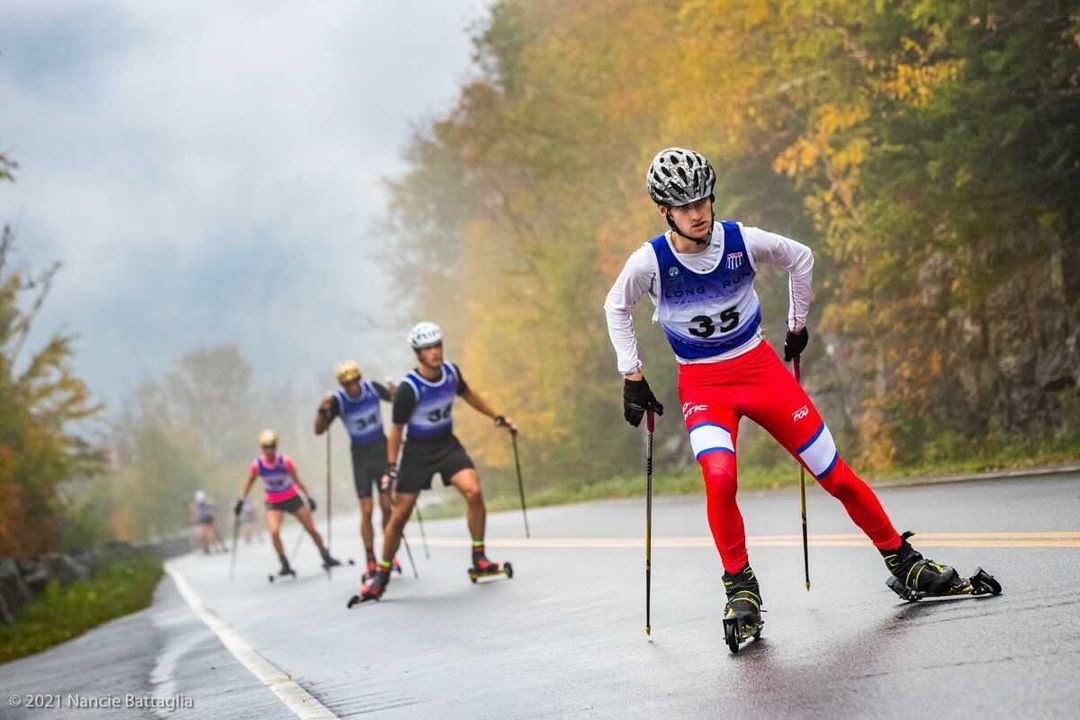
    Racers climb the Whiteface Veteran’s Memorial Highway during the 2021 Climb to the Castle. (Photo: Nancie Battaglia/NYSEF)

    The rain stopped just long enough for Caitlin Patterson and Jake Brown to savor their wins at the 2021 edition of the Climb to the Castle last Saturday in Wilmington, NY, near Lake Placid. 

    Craftsbury Green Racing Project (CGRP) swept the women’s podium; Caitlin Patterson edged Margie Freed for the win in 46:48.8, with her teammate just .7 second back in 46:49.5. Tara Geraghty-Moats placed third in 47:35.0.

    Brown, skiing for US Biathlon / CGRP, took the men’s win in a time of 38:04:00. CGRP teammate Akeo Maifeld-Carucci came second in 39:34:9, and Junior athlete Tabor Greenberg, a U16 athlete out of the Green Mountain Valley School (GMVS), interrupted CGRP’s command of the podium in third place at 41:24.7.

    After taking 2020 off due to the pandemic, the Climb to the Castle returned to the Northeast roller ski calendar, co-hosted by NENSA and NYSEF. The race leads skiers five miles up the Whiteface Veteran’s Memorial Highway at an average eight percent grade. Whiteface is the fifth highest mountain in New York’s Adirondacks; start too hard, and you’ll never recover. This author can attest. 
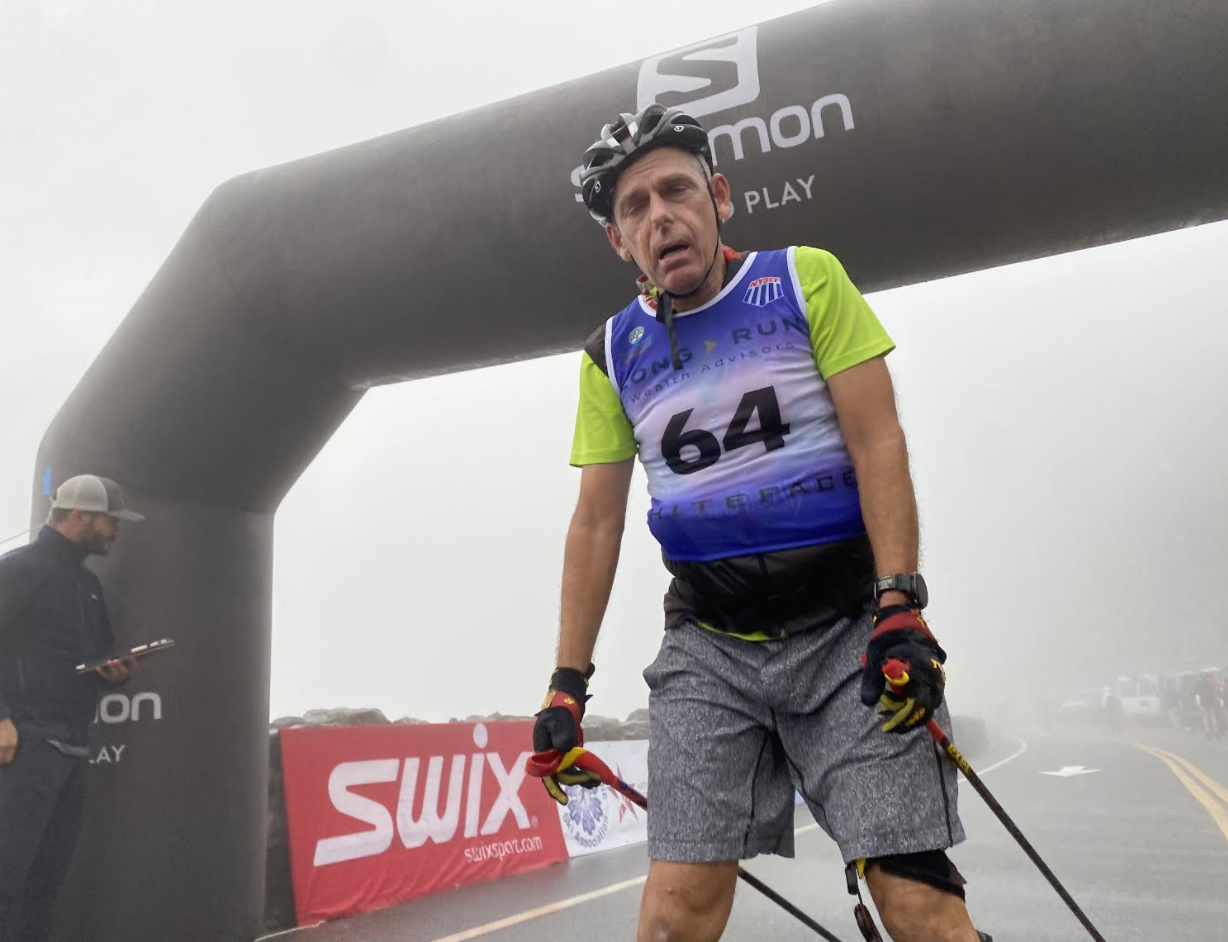
    The author completes his Climb to the Castle. (Photo: NENSA)

    As is often the case, weather made the race…. interesting. Light overnight rain tailed off about an hour before the start. Although the temperature hovered in the low 50s, the humidity made it feel warmer.  Clouds and fog obscured vision throughout the day.  In some places, one was lucky to see a hundred feet. For a change, there was little wind, even at the infamous Windy Corner and chute, 800 meters or so from the finish.

    For COVID safety, organizers started five waves of skiers, each two minutes apart. Competitors wore masks at bib pickup and on the summit after finishing their race.
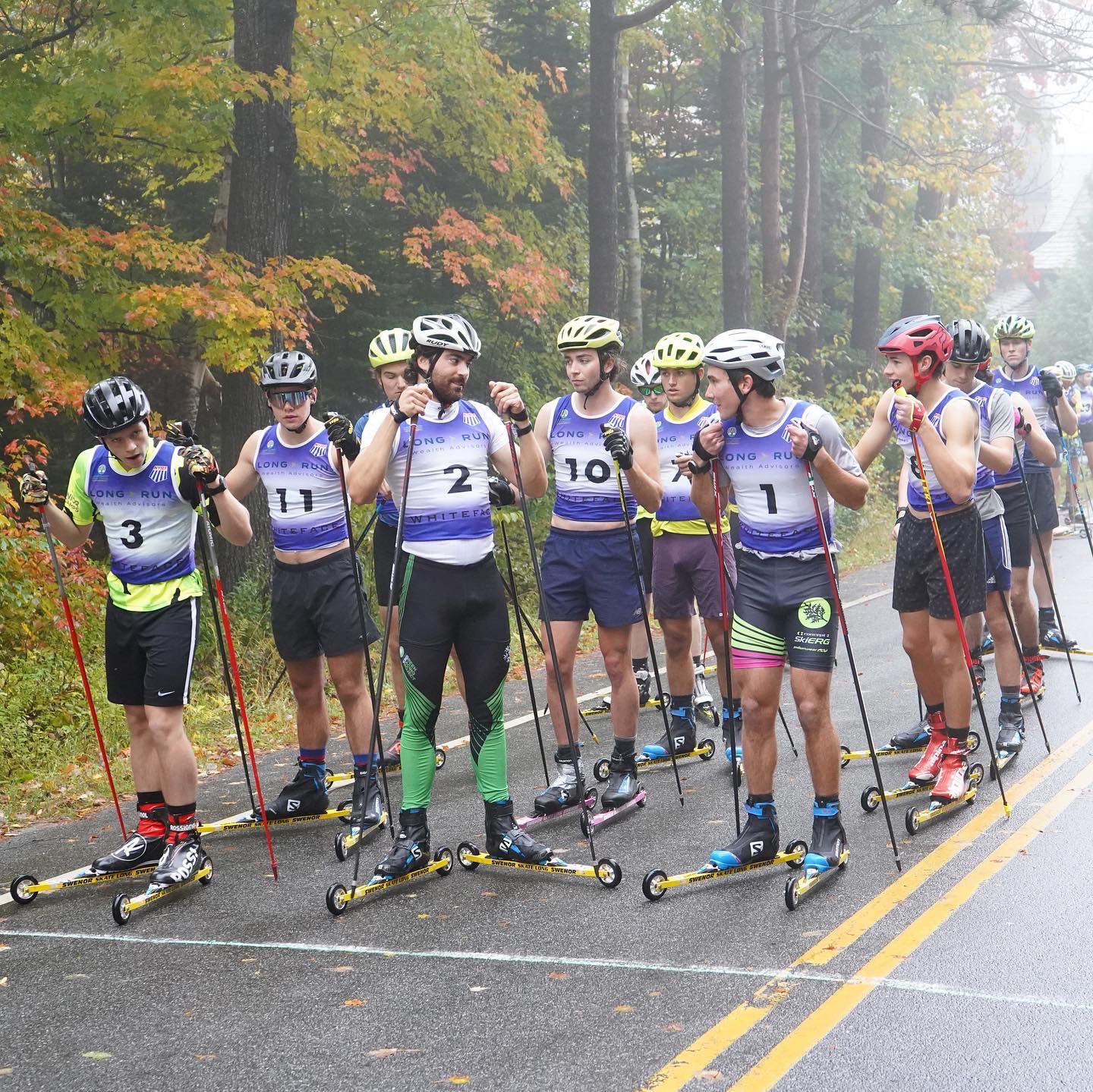
    Visibility low, energy high: a wet start for the men’s wave in the 2021 Climb to the Castle. (Photo: NENSA)

    The women’s race was high drama as Patterson, Freed, and Geraghty-Moats worked together up the road.

    “Tara and Margie and I knew we wanted to work together, especially with the way the Climb can be pretty windy at the top. It was just gonna be: ski smooth, work together, and shuffle around the leads, which is what we did. I definitely wanted to make sure not to start too fast.  I did that well, though I certainly had some rough moments in the middle.”

    From the start, Patterson said that she and Geraghty-Moats took turns in the lead, trading off about every kilometer.  “Towards the upper part, Margie was taking some really strong leads. I was suffering a bit,” Patterson added.
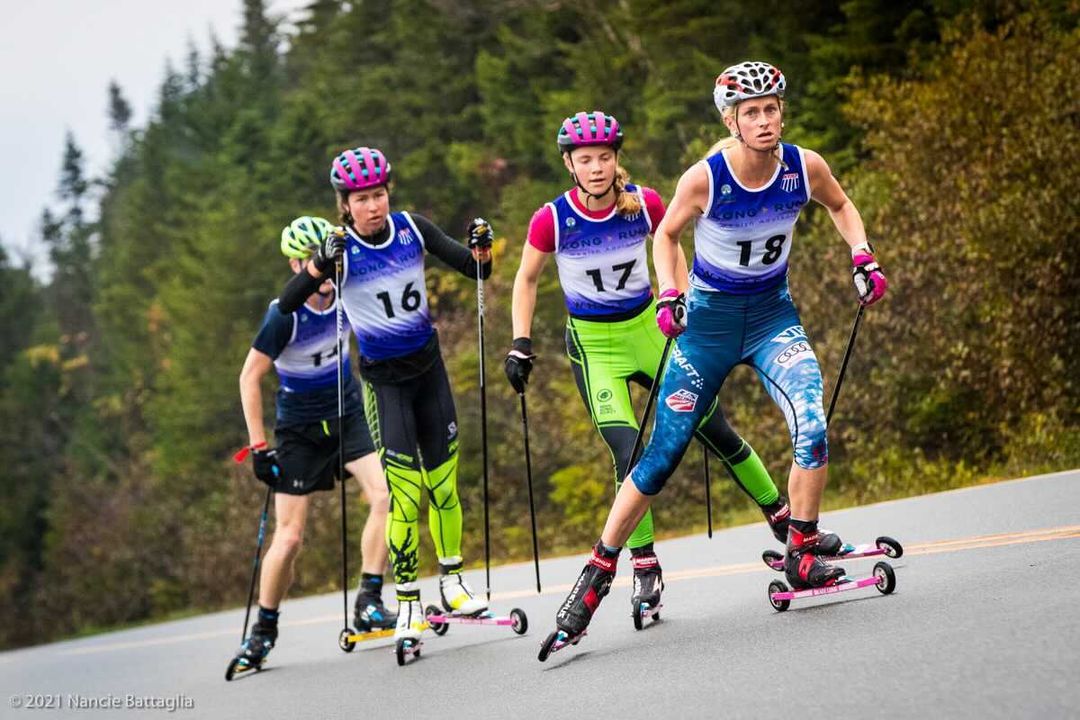
    With two kilometers left, Freed opened a gap from Patterson and Geraghty-Moats. Patterson said it took a few minutes for her to regain contact.  At that point, Patterson and Freed pulled away from Geraghty-Moats, skiing to the finish.  

    “Maybe 30 seconds out, I passed [Margie],” Patterson said. “It was really strong work by both of them. It was great to ski with people because it was as tough a course as ever.”

    Of her finishing kick, Patterson said, “I know that I can tap into a late surge. We were working together for most of it, and as the finish line was drawing near, it was definitely every person for themselves.”
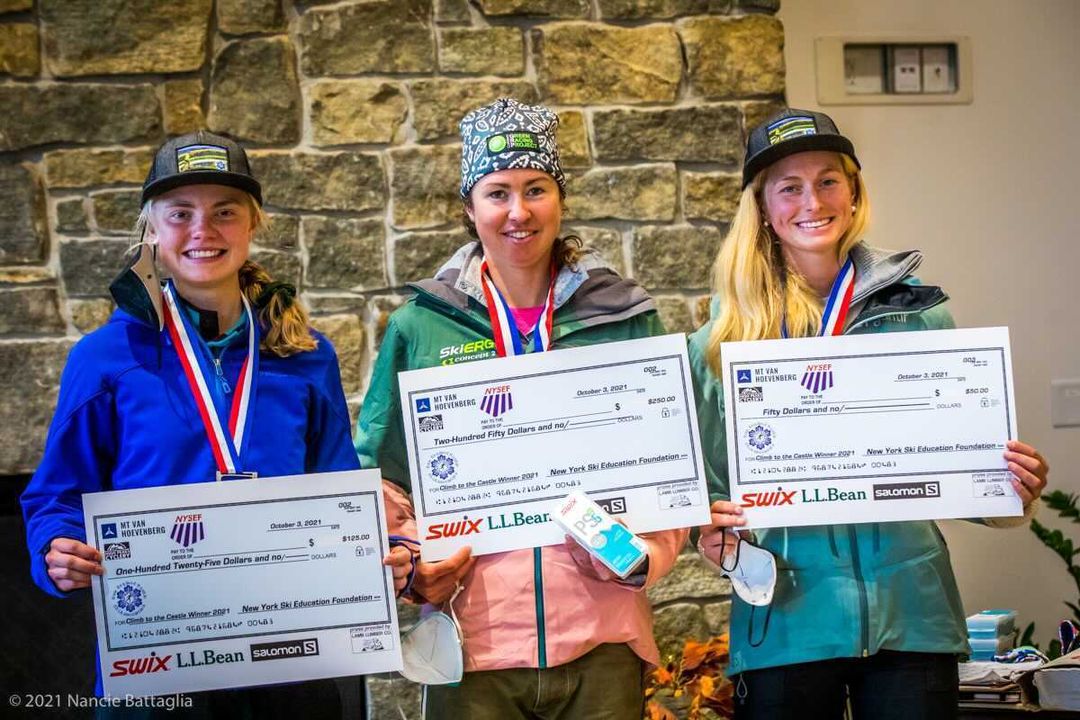
    Craftsbury women clean up at the 2021 Climb to the Castle. Caitlin Patterson took the win ahead of Margie Freed (left) and Tara Geraghty-Moats (right). (Photo: Nancie Battaglia/NYSEF)

    “It went pretty well today,” said Freed of her race. “It was awesome to ski with Tara and Caitlin for so long. I don’t think I could have kept up that pace if I was alone.

    “I’ve never done this race before, so it was exciting to have every step be something new for me,” Freed continued. “Even though I didn’t quite know where the finish was, or when it was coming.  I couldn’t quite see it because it was so foggy.  It was an awesome day out there, and I was glad it wasn’t as windy or rainy or cold as I was thinking it was going to be.”

    This past winter, Geraghty-Moats won the first ever crystal globe for FIS Women’s Nordic Combined.  She also won the Climb in 2018. After the race, she wrote, “It was really nice to go all out with my teammates. We skied together really well. We all had moments of fading and then climbed back on. I dropped back about half a k after the Lake Placid turn — I just kind of ran out of  gas. I’m pretty happy with how I felt and it was a really fun race.”

    Jake Brown wins the 2021 Climb to the Castle in a long solo effort. (Photo: Nancie Battaglia/NYSEF)

    For Brown, this was his third win at Climb to the Castle, his previous two coming in 2017 and 2018.

    “I wanted it to be a good, solid effort,” Brown said. “I knew that I couldn’t sprint too hard off the line, but I wanted to get into that high heart rate zone and stay there as long as I could.”

    Asked about race strategy, Brown said, “I was with Akeo [Maifeld-Carucci], my Craftsbury Green Racing Project teammate. He led for the first 3 minutes or so.”

    At that point, Brown said, he took a turn pulling and developed a gap. “I was hoping we could work together a little bit more, but we ended up with an awkward 20-meter gap between us that we  held for maybe half the race. Then I slowly pulled away and was by myself.”
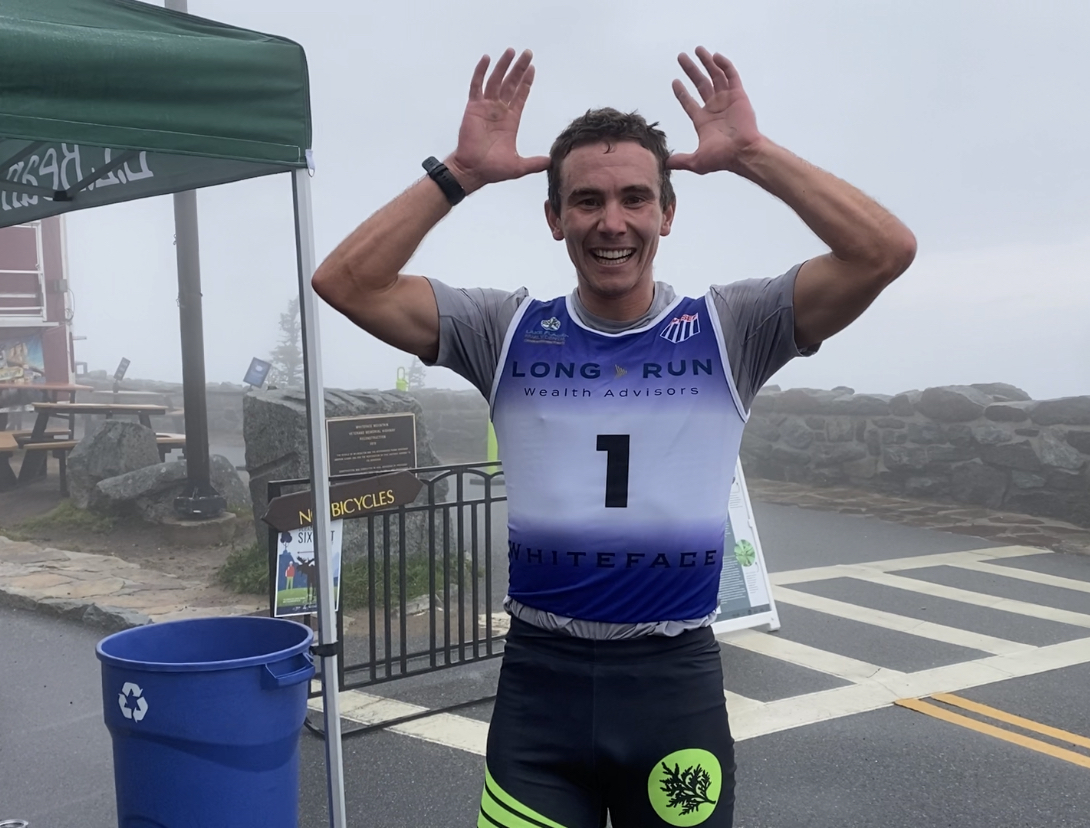
    Jake Brown wears the moose-antler crown after winning the 2021 Climb to the Castle. (Photo: NENSA)

    Asked if he could use this as a fitness benchmark, Brown said, “This was my fourth time doing the race. This was a bit of a slower year; I’m hoping it was just because of the weather. Maybe a little later in the year and a little colder pavement. It was kind of warm today, but maybe the pavement was a little colder.  Maybe my fitness isn’t where it was.  We’ll find out when the winter comes — that’s what matters.” 

    For Maifeld-Carucci, “It was a sweet day. I wanted to do this race for a long time, since early in college. So it was great to actually be here and do it.  The weather was way better than we expected. It was a little wet and a little cloudy at the top, but there were moments when it opened up and it was super pretty. Constant great climb, hard skiing — it was definitely a hard race and a really good effort.”

    Commenting on the men’s pacing and tactics, Maifeld-Carucci echoed Brown’s explanation of the duo’s ability to collaborate. 

    “Jake and I were hoping to ski together and trade leads,” Maifeld-Carucci explained. “He was feeling a little stronger than I was so I fell off early and we were dangling 20 meters apart for a long time. Then he started to open it up.”
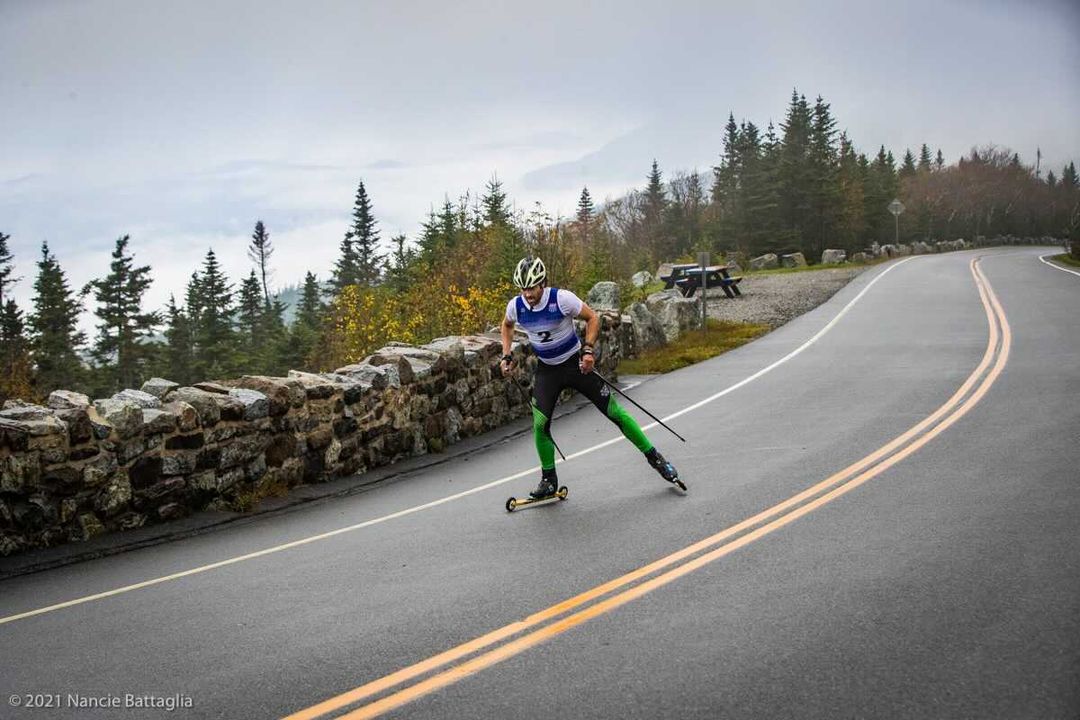
    Akeo Maifeld-Carucci skis to second place at the 2021 Climb to the Castle. (Photo: Nancie Battaglia/NYSEF)

    In addition to Greenberg nabbing third place overall, the GMVS boys swept the junior podium. 

    Responding to an email, GMVS head coach Colin Rodgers said that his skiers didn’t taper for the race. “Tabor actually trained a lot in the past week including a 120 mile bike ride to raise money for the Kelly Brush Foundation.”

    Commenting on the preparation for this event, and how it fits into the season preparation, Rodgers explained:

    “We spent some time recently working on climbing technique. When we were recently on snow on the Stelvio glacier we were working on standing well (balanced and forward) on our skis. We did not discuss any mass start race tactics for today — I really just wanted the crew to focus on pacing the effort properly and being consistent throughout the duration of the climb. [Having] a dialed warm up and trying to keep good form when tired were also a few other things we were honed in on today.”
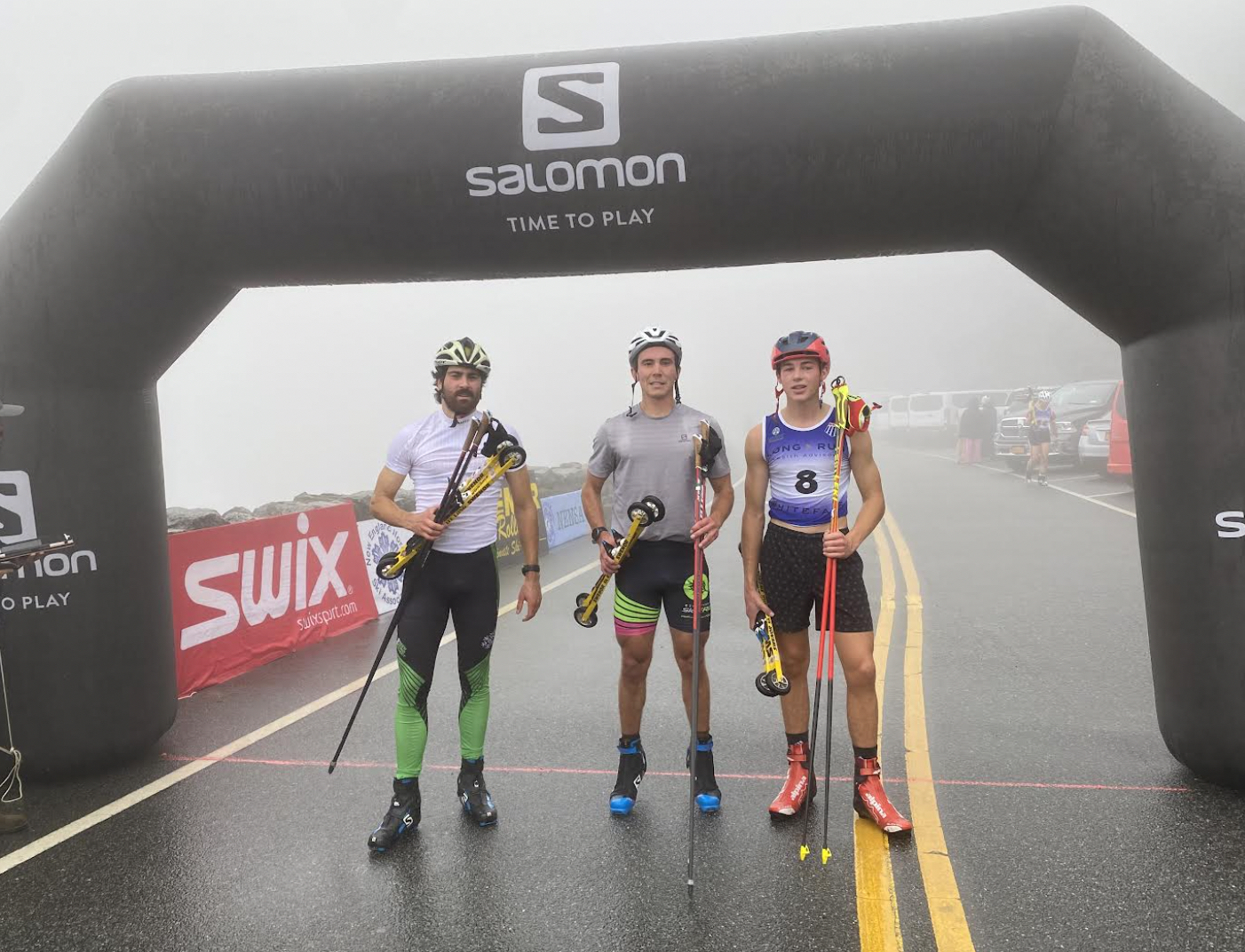
    The men’s podium at the 2021 Climb to the Castle. Jake Brown (CGRP) took the win ahead of Akeo Maifeld-Carucci (CGRP) and Tabor Greenberg (GMVS). (Photo: NYSEF)

    Did Rodgers have an inkling that Greenberg might podium? 

    “We were not focused on the podium, we were just focused on executing a solid race effort. We are primarily focused on competitions in March, so all of this is just trying to build momentum towards the end of the race season.”

    Although COVID border closures prevented Canadian clubs from driving across the border, many clubs and colleges still showed up to throw down.  

    According to Sara Falconer, a coach at Mansfield Nordic (MNC) in Vermont, “It’s a good opportunity for [MNC junior athletes] to race other high school athletes and college athletes that are here.  It’s also a chance for them to compare their times to last year and see the results of all the work they put in over the summer.  They can see a lot of dramatic improvement.  It’s a really motivating thing for them.  And it’s also a good workout.”

    From juniors to collegiate to masters, racers ascended Whiteface during the 2021 Climb to the Castle. (Photo: Nancie Battaglia/NYSEF)

    Ethan Townsend, Saint Lawrence University’s (SLU) head nordic ski coach, planned a training weekend for his team. SLU athletes also roller skied the new loop at Mount van Hoevenberg on Friday.

    “Saturday morning, we got up early and did a run/hike” said Townsend. “They had the option of going up Algonquin or Wright or Marcy. A lot of them took the option of going up Marcy. A few of them went up Phelps and Tabletop. Probably an average of five hours.” 

    Mount Marcy is the highest Adirondack mountain at 5,344 feet and Algonquin, the second highest, stands at 5,114 feet. The remaining peaks named are also among the 46 Adirondack High Peaks, which are all above 4000 feet. 

    After coming out of the woods, the SLU team reconvened for an afternoon double pole roller ski session.

    “We weren’t concerned about performance, necessarily, in this race,” Townsend said. “It’s a training race. Something to do as a group. I told them, ‘Don’t worry about the results so much.  It’s great that we can come here and do this. If you just stay in level three the whole time and you’re not feeling it to go super hard, I think that alone would be worthwhile.’”

    You can find more footage of the 2021 Climb to the Castle on NENSA’s YouTube channel.
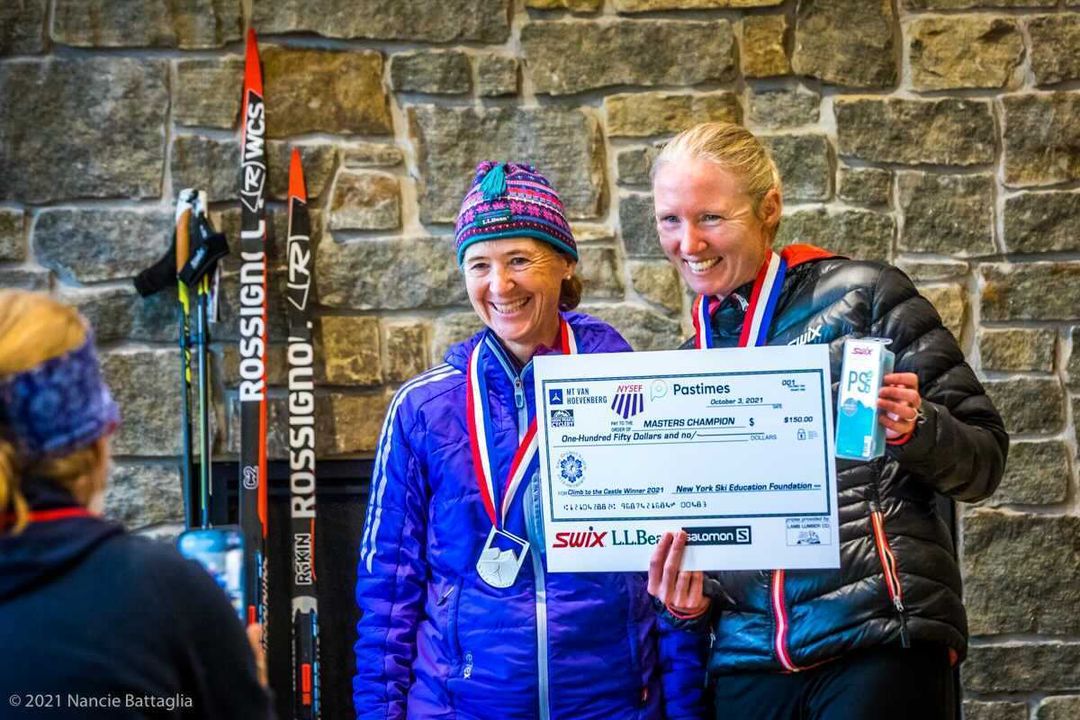
    From Juniors to Collegiate to Masters; a broad scope of rollerskiers ascended Whiteface during the 2021 Climb to the Castle. (Photo: Nancie Battaglia)

    Women’s complete results

    Men’s complete results

  • Duncan Douglas: Old, Jacked and Still Skiing Strong

    Duncan Douglas: Old, Jacked and Still Skiing Strong

    Duncan Douglas
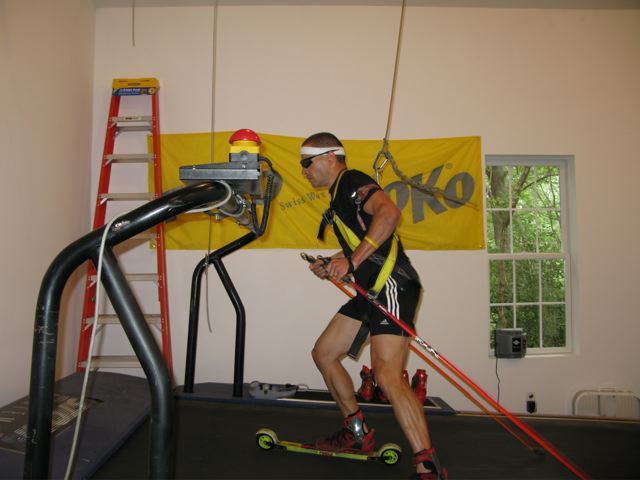
    Duncan Douglas rollerskiing on his treadmill in Honeoye Falls, NY. Photo courtesy of Duncan Douglas.

    There is only one thing that I really know about Duncan.  Duncan truly enjoys punishing himself through endurance activity more than any other human that I know. Training is his drug of choice and he is a serious addict. – Tim Burke

    Utter the name “Duncan Douglas” to anyone who knows anything about skiing, and you are guaranteed to elicit one of three responses: (1) dismissive incredulity, (2) respectful awe, or (3) idolizing hero-worship. If you hadn’t heard of the two-time Olympic biathlete before 2007, when he beat Kris Freeman to win the first Climb to the Castle on custom V2s, you certainly did in the ensuing uproar over wheel speed limitations.

    For all the US ski community at large presumes to know about Douglas, there seems to be a general consensus there’s something about him—like what really motivates an ex-Olympian past his prime to try to prove that you can be fast and old—that can’t quite be pinned down. His is a rare enigma in a sport that keeps tabs on everybody’s business. This is perhaps why, at the height of its internet glory, Jacked Up Old Man got a few thousand hits a month. How that compares to regular FasterSkier blog traffic is proprietary information, but suffice it to say that for an anesthesiologist from Upstate New York, that’s pretty impressive.

    Jacked Up Old Man, that legendary persona that captivated young and old ski fans alike, has now all but disappeared from the blogosphere. The Vancouver Olympics, which he was unabashedly shooting for, have come and gone without him. But at the age of 45, Douglas shows no signs of stopping.

    When the idea for a story on Douglas came up during a FasterSkier planning meeting, I leapt at the chance to write it. As a native on Honeoye Falls, NY, where Douglas now lives, I’d grown up hearing about his latest athletic insanity from my high school ski coach, his good friend Bernie Gardner. Stories of some ex-Olympian biking up the Whiteface Mountain toll road five times in one morning were somehow supposed to goad us all into training harder for our next league meet.

    And so the assignment was mine. What began as a simple workout piece turned into a full-on profile, as it became apparent that a brief account of Douglas on his rollerski treadmill couldn’t really do him justice. Nevermind what this guy does to get in shape, the real question is: why?

    It is a testament to the infectiousness of Douglas’s enthusiasm for training that he convinced me to wake up before dawn for a strength workout when we had already planned a rollerski later that day. I got the impression over the phone that the treadmill demo I’d been hoping for was not going to be possible, but a roller-board session at 5:00 a.m. seemed like a good substitute for hardcore. So, we agreed to meet at ‘Area 143,’ the small barn in his backyard that houses his workout equipment.

    Douglas had already started the circuit when I arrived the next morning: 50 reps on the roller-board, a minute of plyos, and 20 reps with an ab wheel. Repeat.

    “You might want to do only twenty of these,” he said, stepping down from an original model of the VasaTrainer. Instead of being positioned flat on one’s stomach to muscle up the slide, like most trainers I’d seen before, Douglas’s version allowed for a pretty close approximation of an upright double pole. It looked painful.

    “I’ve gotten off the roller-board wagon. Normally I like to do a workout like this three or four times a week. After a few months of that, I can go out on rollerskis and double pole like it’s nothing,” he said in between sets.

    With a seemingly limitless tolerance for pain and general exhaustion, “nothing” for Douglas probably qualifies as excruciating for others. Never mind the fact that he races 30 to 40 times a year; he’s on call up to three times a week as an anesthesiologist at Rochester General Hospital and could be asked to leave his family at a moment’s notice for deployment as a National Guardsman.

    Duncan Douglas racing
    Douglas racing this winter. Courtesy photo.

    When I asked Tim Burke, a 2006 and 2010 Olympian who lives and trains out of Lake Placid, NY, to describe his fellow biathlete, this is what he wrote: “Duncan once told me that when he was training full time, he would go for a three hour run and if his average heart rate was not high enough when he finished, he would simply drink a coffee and a coke and do the run again. Another time, he was telling me how much he trained when he was my age. So I asked him, ‘Did you ever train over 1000 hours in a year?’ He simply replied, ‘Try 2000.’ If anyone else told me these stories, I would simply cry bullshit, but Duncan is crazy enough that you just never really know.”

    This was the difficult thing about interviewing Douglas: it was hard to know when he was being serious, and when he was simply saying something for pure shock value, and probably laughing to himself while I tried to figure out whether he was joking or not. He’s so fit now you have to wonder: maybe he really did train 2000 hours a year when he was on the biathlon team.

    According to the man who taught Douglas to ski at St. Lawrence University, he’s always attacked life with unwavering intensity. Robert Axtell, who retired from coaching at St. Lawrence in 2008, recalled Douglas’s first ski race at Tupper Lake.

    “I was still racing quite a bit at the time,” said Axtell. “Duncan didn’t really know what to do, so I said to him, ‘Just follow me, and when you get ready to go, go.’ It was a mass start in a big field, and I was going along pretty good. I looked behind me for Duncan—he wasn’t there. I looked ahead, and there he was going up the hill. He ended up winning his first race.”

    Douglas was at St. Lawrence for less than two years, and in that time qualified for NCAAs. Despite his brief time as college racer, he always maintained a strong relationship with his coach. Douglas lived with Axtell for a time, and would ski at night in the lit loop behind Axtell’s house.

    With a seemingly insatiable appetite for self-inflicted pain and suffering, it would seem that Douglas would have been a difficult athlete to reign in. But Axtell said that the young Douglas was perfectly coachable, willing to learn and listen.

    “He does what’s best for Duncan,” explained Axtell. “I think maybe people will think he won’t listen; he’s had coaches in the past he kind of balked at…but years ago he was really eager to learn and get ahead.”

    “There might be times when he over trains,” Axtell conceded. “But he’s the type of person who can get by on very little rest; he’s just a high energy individual.”

    This was my training partner for three separate workouts on a Monday in August. Our morning strength session was, predictably, excruciating. Within the first ten reps on the VasaTrainer my arms were screaming. I could tell my triceps were going to make me pay for thinking I could keep up.

    “Right now I’ll do 15 to 20 sets of these, but eventually I’ll get up to 30,” said Douglas in between exercises. I decided it would be best for me not to bother counting how many sets it took for me to decide to start rolling tape instead.

    Extreme muscle soreness didn’t set in until the next day, however, so I was still ready to tackle our rollerski scheduled for that afternoon. We met at the site of local club Rochester Nordic Racing’s (RNR) afternoon practice. I arrived earlier than Douglas to tag along for a warm-up with the RNR juniors. Upon hearing who would be stopping by later, head coach Jason Hettenbaugh told his athletes, “Keep an eye out: if you’re lucky, you might spot a Jacked Up Old Man on the road!”

    Most of Douglas’s fan base might be over the age of 40, but you wouldn’t know it from the reactions this announcement elicited from the 20 or so high school kids around me. Five years after I’d graduated high school, Douglas was still being held up as the epitome of no-excuses dedication for local juniors. No more Olympics to ostensibly train for? No matter. “I’m just happy to get out there now,” he said after he arrived and we started an easy skate rollerski past farm fields.

    At the December 2009 Mt. Itasca US Olympic Trial selection races in Coleraine, MN, which served as a pre-qualifier for a shot at the last few places on the Vancouver biathlon team, Douglas finished ninth in his best three out of five races. The US Biathlon Association ended up taking the top four guys from that event to IBU Cup races in Altenberg, Germany, where the last few spots on the Vancouver biathlon team were contested. After Mt. Itasca, Douglas took to his blog to talk about coming up short of his goal.

    “Yes, I would’ve been thrilled to race in another Olympics and would not have tried if it wasn’t possible. The truth of the matter is that I just love training and racing,” he wrote.

    Setting such a lofty goal for himself simply let him get away with the sheer volume of training that he would love to dedicate to the pursuit of athletic excellence all the time, Olympics or no. With a wife, four kids, and a demanding job, Douglas recognized that being an athlete was now a more selfish endeavor than when he was younger.

    It was partly out of the need for an efficient way to fit in quality training that first prompted Douglas to purchase the piece of training equipment normally reserved for physiological testing labs. With few training partners and no coach but himself, Douglas set out make his comeback with a tool that let him rollerski in the dark before and after work.

    “I used to rollerski around here in the dark with my headlamp, but that got to be too dangerous,” he explained.

    He obtained the used Skatemill three years ago from the Netherlands, where it originated. His particular machine was a demo model in its previous life, and the company sent a technician to Douglas’s house to help him set it up. He had to rework the electricity coming to the barn so that it could handle the voltage the treadmill required. With the small shooting range he has set up in his backyard just outside the barn, he can combine rollerski workouts with target practice, simulating a winter race as best as possible.

    “It was cheaper than building a rollerski loop,” he said.

    The treadmill, it turned out, was perfectly operational, so back to The 143 we went after our rollerski, this time with my brother, Steve, in tow. After a quick safety briefing (“hit this red button to turn it off”), Douglas strapped into the harness and slowly brought the treadmill to speed. Skiing with it set to a 10% grade, he settled into an easy V2 near the front of the platform.

    Though I’d prepared for the real thing by watching a few YouTube videos of Douglas on the treadmill, I was still struck by its sheer size. It was like being in some sort of NASA virtual-reality lab, only here we were mapping out the limits of an addiction to endurance sport, and the lengths to which a person would go to achieve a goal. There was nothing virtual about it.

    When it was my turn to buckle into the harness, I was a little nervous. I started off without poles, to give myself a chance to get used to the feel of the belt moving under the skis. Surprisingly, rollerskiing on the treadmill was more like skiing on snow than on asphalt. It was easier to balance on one ski and let the belt freely move under my feet more. Of course, if I lost my balance for a split second here I’d end up flying off the back. At least asphalt stops moving if you fall.

    After adding poles and experimenting with V1 and V2 for a few minutes, I decided I’d had enough for one day. Douglas is just as busy as ever, after all, and it was time to let him have dinner and get back to his family.

    Before I’d tagged along for this series of workouts with Douglas, I had my theories as to why he held the attention of the ski world. I assumed it had something to do with his dedication to this sport beyond all reason.

    But in spending a few hours with him, I realized there was more to it than that. I was honestly inspired when I drove away from his house that evening. If Douglas, with more than enough distractions in his life to make him surrender his aspirations of being a world class athlete, could find a way to still be competitive with skiers 20 years his junior, then what the hell was my excuse? True, I probably couldn’t afford my own rollerski treadmill, but my day spent trying to keep up with a jacked up old man made me realize that it actually wasn’t that hard. Painful, maybe, but all it really took was a commitment to a goal and the decision to try and meet it no matter what. A healthy enjoyment of punishing yourself certainly didn’t hurt either.

    Correction: We originally stated the Robert Axtell retired as the head coach at St. Lawrence University in 2008. While he was the head coach from 1963 to 1973, he was an assistant when he returned to the program from 2001 to 2008. Ethan Townshend has been the St. Lawrence head coach since 2003. We apologize for the mistake.

  • On Fourth Attempt, Freeman Finally Gets a Win on Whiteface

    On Fourth Attempt, Freeman Finally Gets a Win on Whiteface

    Kris Freeman (USST) on his way to victory

    It took him four tries, but the U.S. Ski Team’s Kris Freeman can add a victory at the Whiteface Climb to the Castle to his list of accomplishments.

    “I finally won the Climb to the Castle!” Freeman said.

    Stymied in three previous attempts by inferior competition with superior rollerskis, Freeman left his teammate Noah Hoffman behind at halfway mark of this year’s edition of the five-mile race, skiing unchallenged to a 39-second victory. Ben Sim, the aspiring Australian nordic combined skier, rounded out the podium another minute back.

    It was only Freeman’s second race effort against a quality field since a disappointing performance at the 2010 Winter Olympic Games in Vancouver, where bad skis and complications from diabetes kept him from cracking the top 40 in three competitions. But he showed Friday that he hasn’t lost much ground, topping Hoffman by roughly the same margin he did last year.

    Noah Hoffman (USST) brings it home

    The two broke away quickly from a deep group of men, including Sim, nordic combined World Championship medalists Billy Demong and Todd Lodwick, U.S. 50 k national champion Tad Elliott, and the U.S. Ski Team’s Andy Newell.

    The pace was relaxed at the start, but Freeman said that he had no desire to fight a stiff breeze alone all the way to the top.

    “I knew I didn’t want to lead the whole way into a headwind, so I said, ‘hey, Hoff, you want to work together and break this thing open?’” Freeman said afterwards.

    Hoffman, one of the country’s best climbers, traded pulls with Freeman for roughly a mile before he was felled by an acceleration.

    “I was hoping to be able to stick with [Freeman] a little longer…but he’s obviously a world-class skier,” Hoffman said.

    The gap between the two athletes didn’t grow after the three-mile mark, but Freeman’s steady pace kept Hoffman from clawing back much of the deficit. The wind was relentless, refusing to let the athletes relax.

    “It was rough windy coming into [the] finish—just about a standstill,” Freeman said. “Any time you tried to glide, you just stopped, so I was just going as high-tempo as I could muster.”

    Behind Freeman and Hoffman, the final spot on the podium came down to a battle between Sim and CXC’s Tad Elliott.

    Sim was in Lake Placid for a camp with the American nordic combined team, and he had topped that group in an uphill time trial earlier in the week. After competing in the 2010 Olympics as a cross-country skier for Australia, he’s now trying to make the jump to nordic combined.

    Coming off a season of racing in the Australian winter, Sim had just enough gas to catch and pass Elliott, who is making his own transition to dryland training after racing mountain bikes professionally through the summer.

    Aiden Lennie, a Canadian U-23 who trains with the Nakkertok Nordic club in Ottawa, took fifth place, aided by a blazing fast pair of Ski Skett Shark rollerskis. After breaking a pole tip at the start and making more than one switch to find a replacement, U.S. Ski Team sprinter Andy Newell nearly caught.Lennie at the finish, but ran out of road.

    Complete Results

    Men's Start
  • Spector Bests USST Women on Windy Whiteface

    Spector Bests USST Women on Windy Whiteface

    Laura Spector all by herself toward the top of Whiteface Mountain

    Chalk one up for the biathletes.

    Just over halfway through Friday’s Climb to the Castle race on Whiteface Mountain, U.S. National Biathlon Team member Laura Spector went to the front of a five-strong women’s pack and left behind four of the country’s best cross-country skiers.

    Churning her way through fierce gusts of wind—which staff at the summit estimated at 60 miles per hour—the diminutive Spector crossed the line with a big gap on U.S. Ski Team members Morgan Arritola and Liz Stephen, notching a mark for biathletes around the country.

    “This was for them,” Spector said. “We’ve been training really hard.”

    Spector was nowhere to be seen at the beginning of the race, which ran five miles up the Whiteface Veteran’s Memorial Highway to the stone castle at the top.

    Conditions for the event have ranged from decent to abysmal over the past three years—the 2009 edition went off in a cold, steady rain.

    This morning’s race began with far more agreeable weather—cool and crisp at the bottom, with a light breeze.

    Arritola leading the pack early on.

    Arritola led out of the start at a restrained pace, but after a couple of miles, the lead group was down to five: Spector, Stephen, Arritola, Jessie Diggins (CXC), and Ida Sargent (Dartmouth/Craftsbury Green Team).

    As the women moved from the sheltered portion of the road onto the mountain’s upper flanks, the wind intensified from a breeze to a full-blown gale, alternating between a brutal headwind and a powerful tailwind as the athletes made their way around the highway’s switchbacks.

    Spector had been biding her time since the start, content to feel out the course and let others do the work—especially since it was the first time she’d competed in the race.

    “It was a pretty conservative pace, but I didn’t know what to expect, so I just wanted to sit in for a while—see who was going to make a move,” she said.

    Around the three-mile mark, Spector said she decided to take a turn at the front.

    “I…ended up making a gap, and I just decided to go for it,” she said.

    Topping out at 4’9”, Spector said that her technique is more suited to climbing—and it showed. She fought her way through a stiff headwind on the course’s upper portions, and shook off a broken pole tip close to the finish line. At the top, Spector had roughly a minute’s advantage over Arritola.

    “Spector went by, and blew us away,” Stephen said.

    While the top three women were all on Marwe rollerskis, Arritola said that she did notice a difference between her equipment and Spector’s.

    “She was on some faster skis, I think,” she said. “She was V2-ing pretty easily, and I was V1ing hard, so—it’s always hard in a race like this to tell.”

    Arritola crossed the line with a fifteen-second edge over Stephen, and Diggins and Sargent rounded out the top five.

    Spector, 22, competed at the 2010 Olympics in Vancouver, her best finish a 65th in the women’s 15 k individual.

    She’s enrolled at Dartmouth College for the fall, but after racing in the national team trials in Canmore later this fall, she’ll leave school and compete full-time through the winter.

    Complete Results

    Liz Stephen battling to a third place finish.