Tag: whiteface mountain

  • New to the Climb to Castle Winners’ Circle: Caldwell and Rose Top Whiteface Race

    New to the Climb to Castle Winners’ Circle: Caldwell and Rose Top Whiteface Race

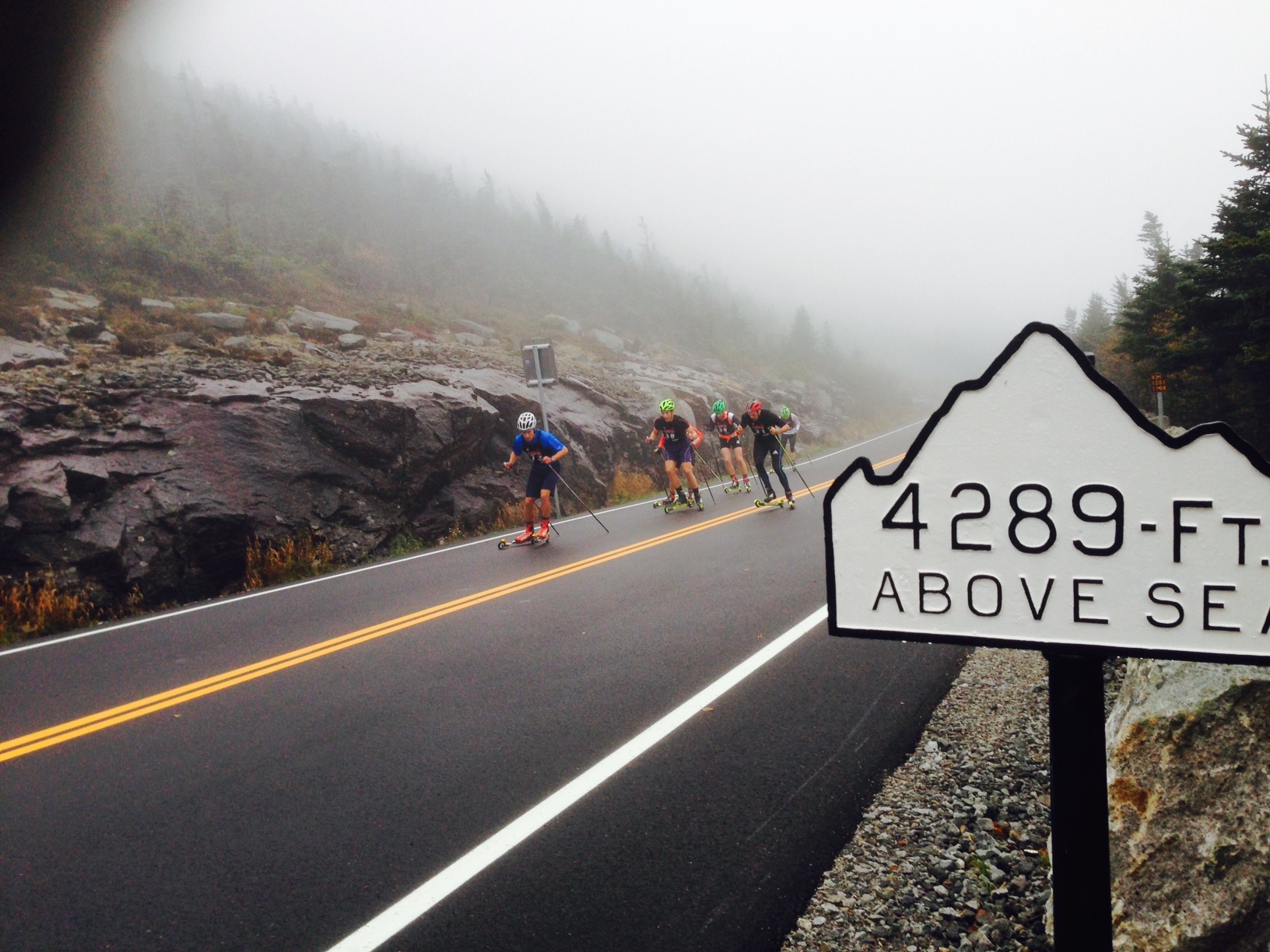
    Paddy Caldwell of the U.S. Ski Team D-team and SMST2 Team won Sunday's Climb to the Castle up Whiteface Mountain in Wilmington, N.Y. Here, around mile four of five, he's seen leading the pack, which includes biathletes Russell Currier and Tim Burke, and Rogan Brown (SVSEF) and Kyle Bratrud (CXC). (Photo: Tim Cowan)
    Paddy Caldwell (black shirt, yellow helmet) of the U.S. Ski Team D-team and SMST2 Team chases Rogan Brown (l) around mile four of five in  Sunday’s Climb to the Castle up Whiteface Mountain in Wilmington, N.Y. Caldwell won the race, followed by biathletes Russell Currier and Tim Burke in second and third, respectively. Brown (SVSEF) placed fourth and Kyle Bratrud (CXC) was fifth. (Photo: Tim Cowan)

    Note: Two photo captions have been corrected to reflect the leader of the men’s race around mile four in the 2015 Climb to the Castle. Rogan Brown of Sun Valley led the pack at the time.

    For years, U.S. Nordic Ski Team athletes and their coaches trucked themselves up to the start of the Whiteface Veterans Memorial Highway, clicked into their rollerskis and allowed an ample amount of time for warming up before ascending New York’s fifth highest peak.

    Before it became an official race nine years ago, it was a workout: a five-mile grind to the summit of Whiteface Mountain, 4,867 feet above sea level in Wilmington, N.Y.

    Now, for many top-level skiers, especially those based on the East Coast, the annual Climb to the Castle an offseason staple. And if you win, you get a T-shirt and a medal for your efforts.
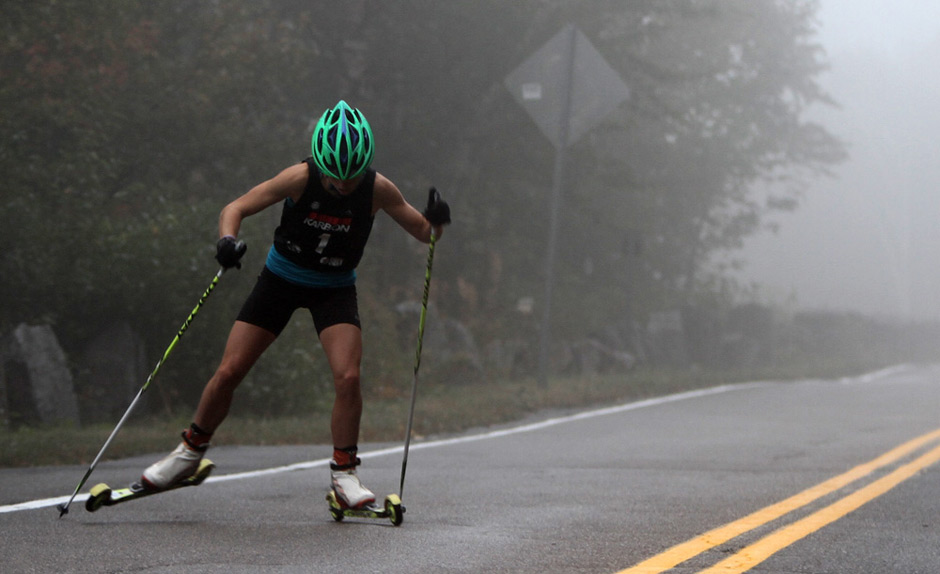
    Mary Rose (SVSEF) leads US Biathlon's Annelies Cook up the Whiteface Mountain toll road during the annual Climb to the Castle. Rose won and Cook finished second, 32 seconds later. (Photo: Tim Cowan)
    Mary Rose (SVSEF) leads US Biathlon’s Annelies Cook up the Whiteface Mountain toll road during the annual Climb to the Castle. Rose won and Cook finished second, 32 seconds later. (Photo: Tim Cowan)

    “Climb to the Castle was a blast this year!” wrote women’s winner Mary Rose of Idaho’s Sun Valley Ski Education Foundation (SVSEF) Gold Team. “My goal going into this race was to have good energy the whole time, focus on technique and hopefully put together a good effort.”

    She reached the top on Sunday in 45:15.1 and topped her competition — the closest of which was US Biathlon’s Annelies Cook — by 32.6 seconds.

    “It was a fun, tough effort,” men’s winner Patrick Caldwell of the U.S. Ski Team D-team and Stratton Mountain School (SMS) T2 Team said in an interview after the finish.

    The 21-year-old Caldwell outlasted biathletes Russell Currier and Tim Burke by 5 and 11.5 seconds, respectively. Caldwell won in 37:05.2, Currier was second and Burke was third.

    “Right from the start, we stayed pretty much together against a decent headwind,” Burke said after the finish. “I think a lot of us were fatigued at the end of a big camp, so I didn’t really want to push like crazy.”

    The US Biathlon and U.S. Nordic teams spent at least the last week training in Lake Placid, N.Y., with biathletes like Burke logging five race efforts in nine days preceding the Climb.

    “I decided today instead of going for time, I wanted to go for the win,” said Burke, a defending multiple-time Climb to the Castle (C2C) champion. “So I decided to sit in and push that last half mile.”
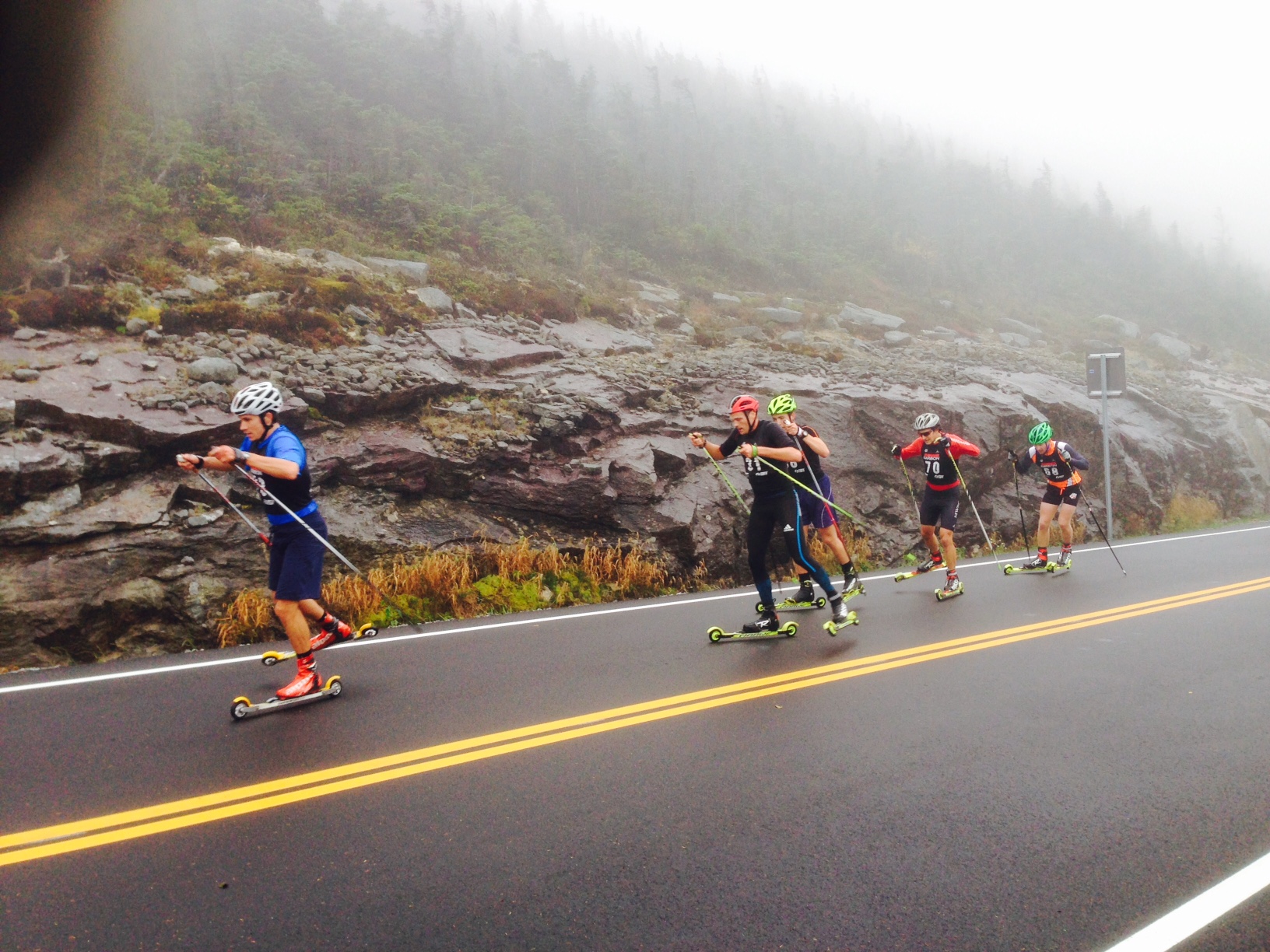
    Paddy Caldwell of the U.S. Ski Team D-team won today's Climb to the Castle up Whiteface. Here he's seen around mile 4 leading the pack, which includes veteran biathlete Tim Burke (who placed 3rd). (Photo: Tim Cowan)
    Rogan Brown (l) of Sun Valley leads Tim Burke (second from l) and Paddy Caldwell (third from l) and Russell Currier and Kyle Bratrud around mile four in Sunday’s Climb to the Castle up Whiteface Mountain in Wilmington, N.Y. (Photo: Tim Cowan)

    He said he “did a lot of pulling and got some help towards the end.” Rogan Brown (SVSEF) led around mile four, and Burke explained that five men battled in the lead pack for the last two miles.

    “I broke my pole in the last couple hundred meters, that kind of took me out of it,” he explained.

    Caldwell took the blame what he called an “unfortunate incident” in the final 200 meters. “I broke Tim Burke’s pole,” he said. He did so when Burke made his final attack toward the finish.

    “Aside from that, it was a good, solid race,” Caldwell said.

    “It’s a good way to end it,” Burke said after 10 days of hard training.

    Currier, who placed second, called it an “entertaining race” with five men contending throughout.

    “For a rare change I was able to be on the better side of tactics and consistently stay in the back of the pack,” Currier wrote in an email. “On the other hand, the final 100 meters came up a lot earlier than I expected and didn’t give much time to react. The pace picked up and Tim Burke lost a pole tip. The next thing I knew there was an opening for the lead. I’m not much of a sprinter and didn’t do much to challenge Patrick, but was I was still pleased to break out of the back of the pack just in time for the podium.”

    A former US Biathlon (USBA) B-team member, Currier, who trains with the Maine Winter Sports Center, was not renamed to the team this spring and is working towards making the cut via a series of trials ending in October.

    “The status for the National team is still very unclear,” he wrote. “… All I can do is make the best of every training session and go for better results. The second round of trials is coming up in October. A couple of good enough results there should help my cause for the coming race season.”

    Brown placed fourth in the men’s race, 4.3 seconds from the podium and 15.8 seconds after Caldwell. Brown edged Kyle Bratrud of Central Cross Country (CXC) by 0.3 seconds, and behind them, another CXC skier Duncan Douglas placed sixth.

    USBA’s Sean Doherty and Lowell Bailey finished seventh and eighth, respectively, Miles Havlick (SVSEF) was ninth and developing biathlete Max Durtschi finished 10th of 61 men.
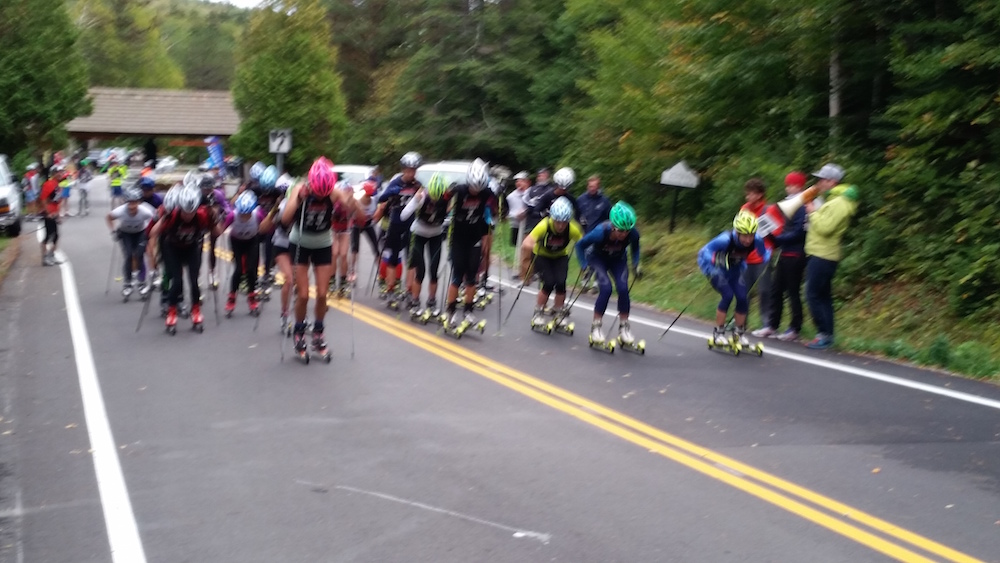
    The start of the women's race at the 2015 Climb to the Castle up Whiteface Mountain in Wilmington, N.Y. (Photo: Peter Minde)
    The start of the women’s race at the 2015 Climb to the Castle up Whiteface Mountain in Wilmington, N.Y. (Photo: Peter Minde)

    In the women’s race, Rose and Cook pushed each other to the top. Rose recalled it being just the two of them shortly after the start. A perennial contender, USBA’s Susan Dunklee had some pole issues at the very beginning, Rose explained in an email.

    “I knew I needed to break away about 1/2 mile to the finish because I can’t beat [Cook] in a sprint,” Rose wrote. “I fought pretty hard through the ‘wind tunnel’ and I think that is where I broke away.”

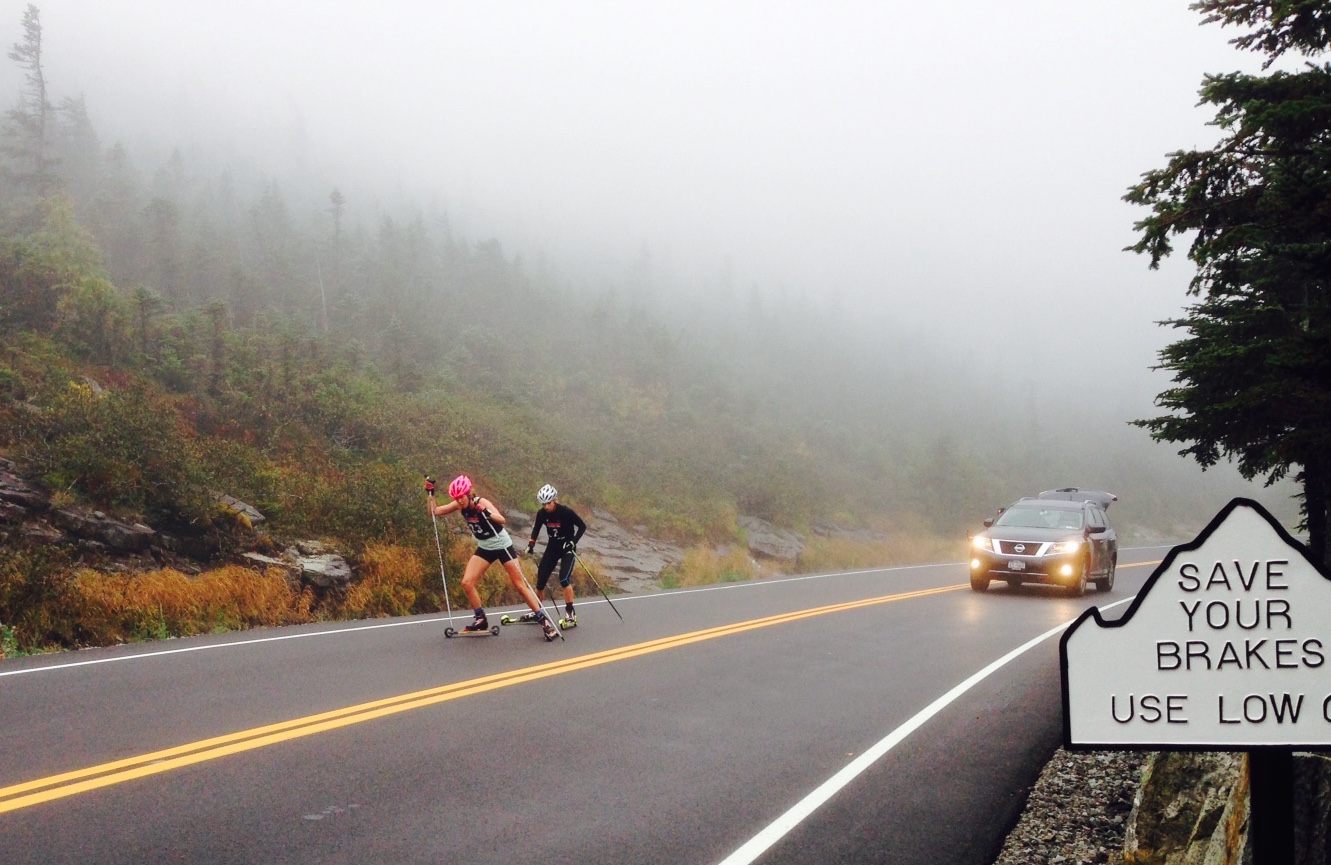
    Overnight rain left the toll road wet, and wind dried out its lower sections. From about the halfway point to the finish, skiers pushed through mist on wet pavement and faced a steady wind blowing 10 to 20 miles per hour throughout the race. After starting in temperatures around 47 degrees Fahrenheit, they met temperatures in the mid-30’s at the top.

    “It sounds weird to say it aloud, but I actually had fun doing the climb to the castle,” Cook wrote in an email. “Mary and I skied together the entire time and switched leads back and forth. I usually get bored doing the climb and lose focus and switching back and forth with her kept me in the game mentally.

    “She got me at the last turn right before the finish when I suddenly flooded with lactic acid and had no chance,” she added. “But I don’t really think of myself as a climber and so it was fun to be the two people leading the race. That doesn’t happen too often! Of course, the usual suspects were not there and that obviously made it difference.”

    With the exception of Paddy Caldwell, the U.S. Ski Team (USST) skipped the Climb this year for the first time in years.

    “As hard as it is to miss it because it is a fantastic event, it just didn’t play well athletically for the needs of the group,” USST Head Coach Chris Grover said on the phone last week. “We wanted to do more sprint-specific training and short intensity as opposed to giving up a whole workout or two to do the Climb to the Castle.”

    The USST camp was also only a week long, compared to the two weeks the team usually spends in Lake Placid this time of year. On the other hand, the largely Lake-Placid-based US Biathlon team did either time trials or Level 5 (race-pace) workouts for last 10 days.

    “I had my personal best by quite a lot and I felt strong skiing,” Cook said of the Climb. “It felt good to end a really tough ten days on a good note. … I think we are all pretty glad to be done.”

    The Climb marked the end of a two-week training block for Rose and her Sun Valley teammates, who were in Stratton, Vt., with the SMST2 team for the first week.

    “We had some super hard intensity sessions over the past two weeks and all were very productive,” Rose wrote.

    USBA’s Hannah Dreissigacker, who placed third, 2:05.9 after Rose, explained in an email that the women’s race broke up quickly.

    “Mary and Annelies started off a little faster than I really wanted to be going, and I tried to hold on for a bit but then gave up pretty quickly and lost contact,” Dreissigacker wrote. “My goal in the Climb to the Castle is always to not start too fast and then blow up. Then I skied with Susan for a mile or so and then slowly inched ahead of her a bit. Eventually we skied into a cloud and I lost sight of Annelies and Mary and just skied the whole second half by myself.”

    She finished 1:10.9 ahead of Dunklee, who placed fourth, while wearing a figure-skating tutu she wore the first time she did the race.

    “The lacy elbows really allowed for added breathability and the rhinestones gave me some extra motivation on those long hard stretches when I was all alone,” Dreissigacker wrote.

    Another biathlete, Clare Egan finished fifth, Paige Schember (SVSEF) was sixth, Erin Perryman (St. Lawrence University) was seventh, Jackie Garso of the local New York Ski Education Foundation (NYSEF) was eighth, St. Michael’s assistant coach Silke Hynes was ninth, and Stratton U16 skier Anna Lehmann was 10th of 25 women.
    Results: Men | Women

  • Elliott Takes Over Castle Crown, Bests O’Brien

    Elliott Takes Over Castle Crown, Bests O’Brien

    FasterSkier would like to thank the Mirror Lake Inn for providing lodging and meals in Lake Placid this weekend.


    WILMINGTON, N.Y. — Over the years, the Climb to the Castle rollerski race up Whiteface Mountain has become a fixture of the annual US Ski Team (USST) Lake Placid training camp.

    A challenging race that provides a good barometer of fitness, the event features excellent head-to-head competition and good-natured drama.

    The question this year? What would happen with USST stalwart and the usual focal-point of the race, Kris Freeman, half a world away in New Zealand?

    For two years, Freeman settled for second position behind biathlete and self-proclaimed “Jacked-Up Old Man” Duncan Douglas (albeit with Douglas on far faster skis). With Douglas out of the picture in 2009, nordic-combined skiers Taylor Fletcher and Nick Hendrickson relegated Freeman to third, also taking advantage of faster skis.

    Finally, in his fourth try, Freeman skied away from USST teammate Noah Hoffman to take his first win in 2010. Last year he repeated, narrowly edging biathlete Tim Burke in a hard-fought battle.

    But Freeman opted for an on-snow camp in New Zealand along with Hoffman and the Canadian National Team, and with Burke sidelined with a cold, the top step of the podium was free for the taking.

    Freeman, contacted in New Zealand, went with Tad Elliott (USST) as his pick for the win, while Hoffman noted that he and Freeman would certainly be paying attention.

    “First of all, Kris loves that race so he’s always talking about it,” Hoffman wrote in an email to FasterSkier. “Second, there’s not a lot going on down here so we have little else to think about.”

    He added that the unique nature of the race — sustained climbing for the 5-mile duration — simplifies the matter.

    “You’re either good at that type of thing or not,” Hoffman wrote.

    The duo were not the only ones with Climb to the Castle Fever. According to US Ski Team Head Coach Chris Grover, the event has become a staple for the top athletes in the country.

    “The Climb has become one of the focal points for us in the fall, I’d say less from an athletic perspective and more from a team excitement, winter approaching perspective,” Grover said. “Athletes start talking about it early, people get fired up, trading barbs and insults, bets are being made. So for us it’s a really fun event to participate in.”

    Tad Elliott skiing to victory in the 2012 Climb to the Castle Rollerski Race in Wilmington, N.Y.

    Freeman may have missed out on the race itself, but if he was a betting man (and if there were any way to actually wager on the Climb to the Castle) he could have hit pay dirt as Elliott came through with a ten-second victory over Pat O’Brien (CGRP).

    Canadian Julien Dorais was third, another eight seconds back.

    After the race, O’Brien told FasterSkier that he had expected the race to play out differently in Freeman’s and Hoffman’s absence.

    “They usually go out and push the pace, and I usually try to stick on them as long as possible and blow up,” O’Brien explained. “We started out more controlled which was nice. We were still moving along but it was a more sustainable pace.”

    Despite finishing sixth last year, Elliott had no plans to push at the front early.

    When asked of his strategy on Wednesday, Elliott said, “Follow. My tactic is follow, try to hang on.”

    A sizeable pack stayed together for the first two-thirds of the climb, a novelty in the history of the race and Elliott stuck to his pre-race guns, allowing others, including biathlete Lowell Bailey (USBA), Sylvan Ellefson (SSCV/Team Homegrown), Andy Newell (USST) and Ryan Scott (SSCV/Team Homegrown) to take turns pulling.

    Ellefson did a lion’s share  of the work holding at the front for nearly two miles. But as the three-mile mark came around, it was Elliott who had the gas to make a move.

    Right after Newell put in a hard pull and took a look around for someone to take over, Elliott dropped what he called “bike tactics” shooting by and quickly gapping the pack.

    He laughingly called himself a “little jerk” for the move, but added, “it worked out for me.”

    Newell and O’Brien rallied to respond and stopped the bleeding at twenty seconds. The veteran World Cup sprinter couldn’t hang however, and O’Brien was left on his own chasing Elliott.

    He was able to close down, but ran out of time, though he stayed clear of Dorais.

    The pack, led by Lowell Bailey

    Calling the Canadian a darkhorse is an understatement to say the least. Racing in the M1 category (30-35), Dorais had no club listed and has no FIS points profile.

    A triathlete, Dorais raced at Canadian Nationals last year, placing 130th in the 15km freestyle. He proved a high level of fitness last summer when he nearly bested Canadian National Team Biathlete Marc-Andre Bedard in the grueling Spartan Beast Race in Killington, Vt. — though Bedard got the win when Dorais doubled back on the course to tackle several missed obstacles.

    However, one should not expect Dorais to round out a World Championship relay team any time soon. While his performance is still impressive impressive, the 34-year-old was aided by quick rolling skis.

    Ellefson, none the worse for wear after pulling early, closed on Newell and skied to fourth, a result he was “really happy about.”

    The weather is always notable on Whiteface Mountain —either cold, wet and very windy, or the absence of such. After extremely high winds two years ago gave way to bluebird skies and cool fall weather last fall, today was a mix of both.

    Winds stayed reasonable, and light rain and mist never became more substantial.

    “Conditions were surprisingly good,” O’Brien said, and several other top finishers echoed the thought.

    Official Results: 2012 NYSEF Climb to the Castle Men

    — Matt Voisin and Alex Matthews contributed reporting


  • Stephen Trounces Field in Climb to the Castle

    Stephen Trounces Field in Climb to the Castle

    FasterSkier would like to thank the Mirror Lake Inn for providing lodging and meals in Lake Placid this weekend.

    Liz Stephen (USST) on her way to winning the 2012 Climb to the Castle up Whiteface Mountain in Wilmington, N.Y.

    WILMINGTON, N.Y. — One thing was clear to the women’s field racing the Climb to the Castle on Saturday morning: Liz Stephen (U.S. Ski Team) was not messing around. Her competitors expected a hard effort from the traditionally strong climber, but her half-mile gap on the rest of the field just three miles into the 5-mile race up Whiteface Mountain left no room for doubt that Stephen was in good shape.

    She won the climb just over five minutes ahead of Jessie Diggins (SMS T2/USST) on a cool, windy and misty morning. Last September, the weather on race day was warm and calm by comparison, and yet Stephen beat her own winning time from a year ago by over a minute.

    The Climb to the Castle has come to mark a fall transition for skiers; a switch from high volume training to more focused intensity, an early test against other top U.S. athletes to measure how well summer work is paying off, and a reminder that the racing season is just around the corner. Stephen’s dominant performance sends a clear message: she’s ready for winter.

    USST head coach Chris Grover was surprised at how fast Stephen skied.

    “She’s had one great time trial after another this summer,” he said. “It’s really good for her to know her training’s going so well.”

    Stephen herself didn’t sound surprised at the finish as much as excited. Her plan at the base of the climb had been to not stress about the end result and enjoy the race.

    “I went into it without so much of a plan, I just wanted to ski hard the whole time,” Stephen said at the top. “This race is uncomfortable no matter how you ski it and I was just picturing someone right in front of me. I thought I heard poles the whole time. It’s good to play tricks with your mind because on the World Cup there’s always someone there and every second matters.”

    Stephen hadn’t realized she’d created such a huge lead and kept skiing as if someone would catch up to her at any moment.

    “I was getting some updates, but the fog was heavy. And I’ve seen Jessie come back from minutes back before, so I knew the race was not locked up until the finish line,” she said.

    Diggins knew the fight for the win was over the moment Stephen made her first breakaway.

    Diggins powers through the fog on her way to second place.

    “Liz took off and we were like, ‘Sweet, see ya! Maybe one day we’ll be a climber like you but not today,’ ” Diggins said.

    With Stephen out of reach, the race for second unfolded between Diggins, Ida Sargent (CGRP/USST), Sophie Caldwell (SMS T2), Hannah Dreissigacker (CGRP/USBA) and Clare Egan (CGRP). A fairly strong wind forced skiers to take turns pulling from the front.

    “It was fun to have someone to ski with this year, last year I was by myself,” said Sargent, who finished third. “This year skiing with Jessie was really fun, taking turns leading and just making it to the top as fast as possible.”

    A climb like Whiteface is practically designed to inflict as much pain as possible, so the goal for many skiers on Saturday was to simply maintain it at a manageable level and hope their legs were there for the finish.

    “I think the technique held on until the last five minutes, so I’m pretty happy with the process goals,” Diggins said. She focused on keeping her skiing “light and quick and not bogged down,” but also on practicing her mental approach to racing.

    “When the going gets tough, instead of thinking about, ‘Wow, this hurts, this sucks,’ [I was] thinking about ‘OK, how can I keep my technique together, just keep moving?’ ” Diggins said.

    As hard as the climb was, there is no rest for the weary. The U.S. team had a strength session to look forward within a few hours of finishing the race.

    “That’ll be fascinating to watch,” Diggins said.

    Official Results: NYSEF Climb to the Castle Women

     — Matt Voisin contributed reporting

  • NYSEF Announces Climb to the Castle

    NYSEF Announces Climb to the Castle

    A look at the Whiteface Memorial Highway, site of the annual Climb to the Castle.

    NYSEF CLIMB TO THE CASTLE ROLLERSKI RACE

    Saturday, September 15, 2012

    WILMINGTON, N.Y. — The New York Ski Educational Foundation and the Olympic Regional Development Authority announce the 6th annual NYSEF Whiteface Climb to the Castle Rollerski Race on Saturday, September 15 at 8:00 am. The course starts at the Whiteface Toll Booth, climbing for 5 miles with an average 8% grade up the Whiteface Memorial Highway to the castle on the summit of Whiteface Mountain, New York’s 5th highest peak with an elevation of 4,867 ft. The race is freestyle technique and athletes will be greeted at the finish with a 360-degree panoramic view of the Adirondacks, New England and Canada. Attendance is expected from the US Ski Team, the US Biathlon Team, the National Elite Group and many top senior and junior racers from around the country.

    Registration link (open soon): AlpineReg

    Check out the NYSEF XC webpage for updates: http://nysef.org/vanhoevenberg.html

    Full race details:

    REGISTRATION

    • $30 pre-registration entry fee, $40 day-of-race registration entry fee
    • Pre-register online at alpinereg.com
    • Pre-registration closes Thursday, September 13 at 9 AM
    • Day-of-race registration from 6:30 – 7:00 AM at the Whiteface Toll Booth
    • Bib pick-up from 7:00 – 7:30 AM at the Whiteface Toll Booth

    START TIMES

    • 8:00 AM Women’s Mass Start (all age classes)
    • 8:10 AM Men’s Mass Start (all age classes)
    • The race will be timed for 2 hours. Any competitors not able to finish in this time window will be picked up before the finish.

    RACE DIVISIONS

    • Women’s and Men’s age classes for the following divisions:
    • Open/Elite, OJ/U-23, Junior (J2/J1), Master (30+)

    EQUIPMENT SAFETY

    HELMETS ARE REQUIRED! All rollerskis must be inspected by competitor and be in proper working order.

    COURSE DETAILS

    Freestyle Technique. 5-mile hill climb with an average 8% grade up the Whiteface Memorial Highway. Course: start at the Whiteface Toll Booth in Wilmington and finish at the Castle on the summit of Whiteface Mountain (elevation 4,867 ft)

    Disclaimer: Inclement weather may limit the race distance. Course is closed to rollerskiing before the start. Pre-race warm-up on rollerskis can only occur in a designated area. All post-race cooling down must be done on foot.

    VEHICLE TRAFFIC AND POST-RACE INFO

    Please carpool to the race start, parking will be limited. The Whiteface Memorial Highway will be closed to the general public during the race. Coaches and spectators who will be watching the race will be able to drive up and park off the road until 7:50 AM. All traffic must be parked off the road from 7:50 AM until 9:00 AM. There will be no moving traffic allowed during the race. All competitors will be shuttled back to the race start. No athletes will be allowed to ski back down after the race. Competitors may place a bag in the NYSEF van with post-race clothing that will be driven to the finish line.

    AWARDS

    • Awards at the Whiteface Castle immediately following the event at 10 am.
    • Prizes awarded to Top 3 Overall and Top 3 in each age class.


    Questions? Email Margaret Maher margm@nysef.org or call the Nordic office at (518) 523-1900.