From the FasterSkier archive — posts syndicated from athletes’ and coaches’ own blogs between 2004 and 2012, kept online as published. Current coverage is at fasterskier.com.

Tag: Whiteface

  • Climb to the Castle Weekend—Climb, Sprint, and Biathlon

    Climb to the Castle Weekend—Climb, Sprint, and Biathlon

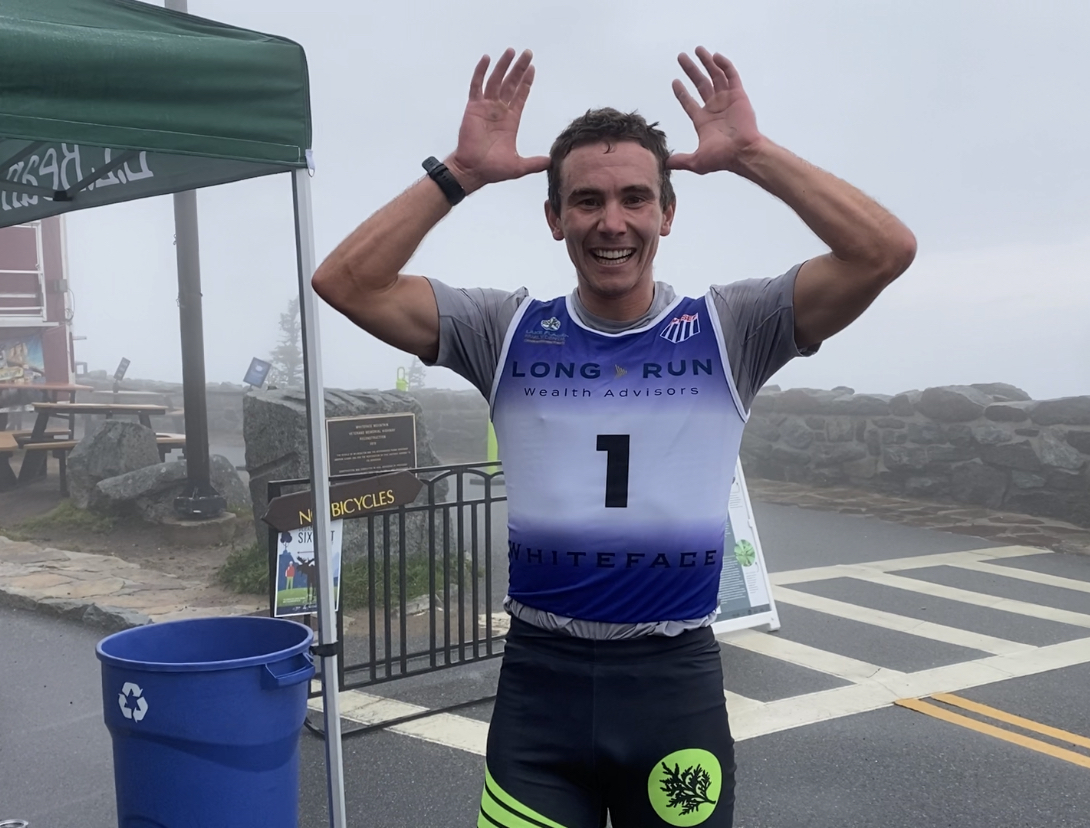
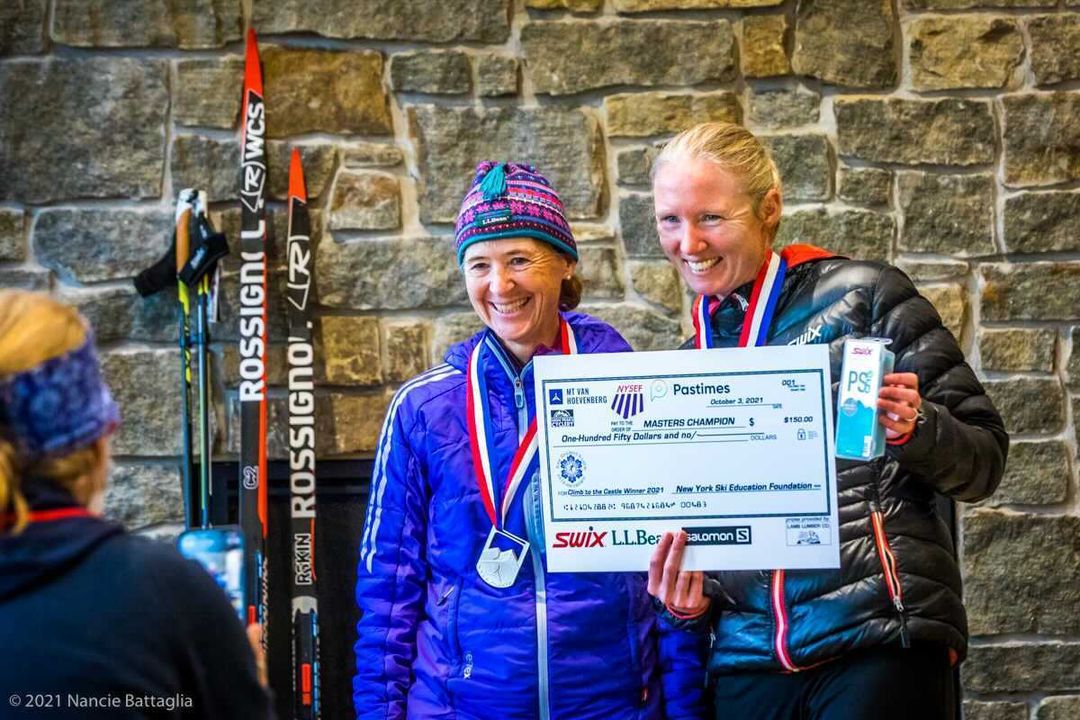
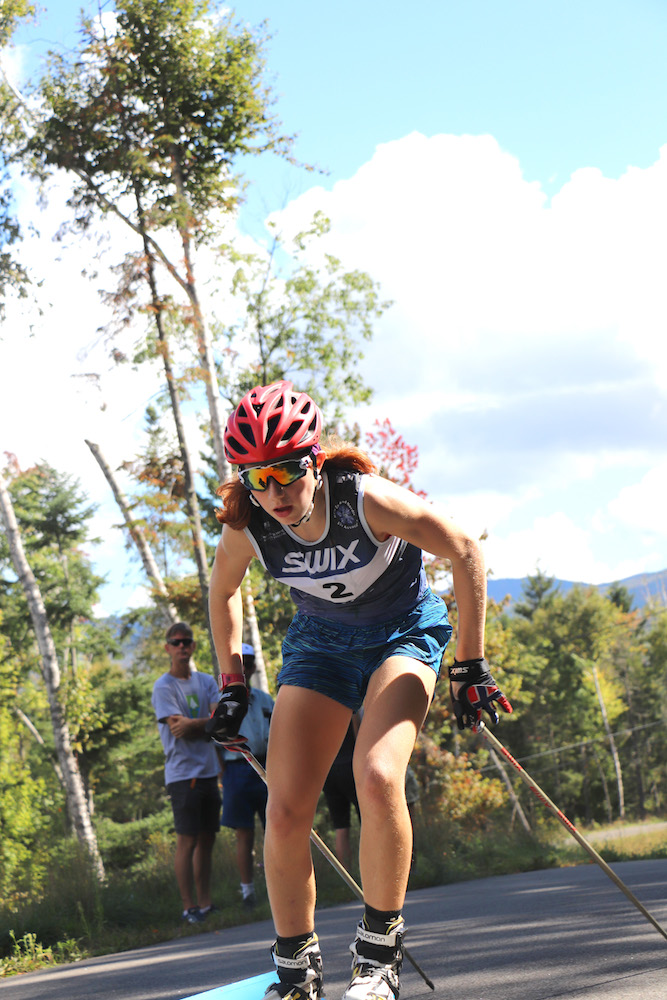
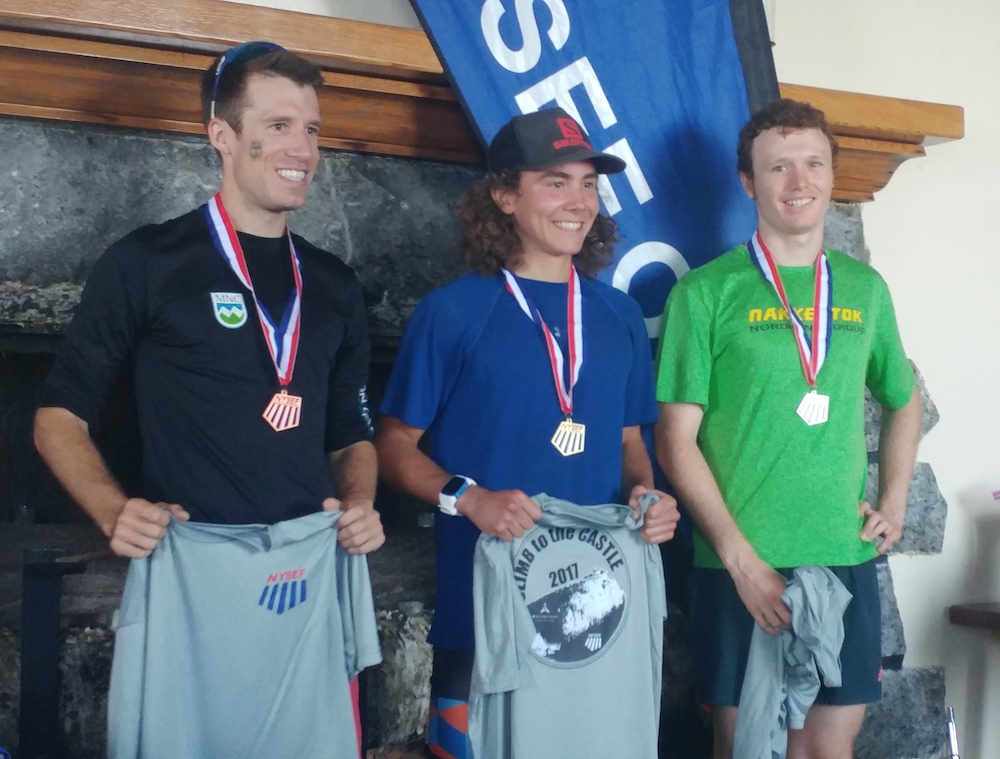
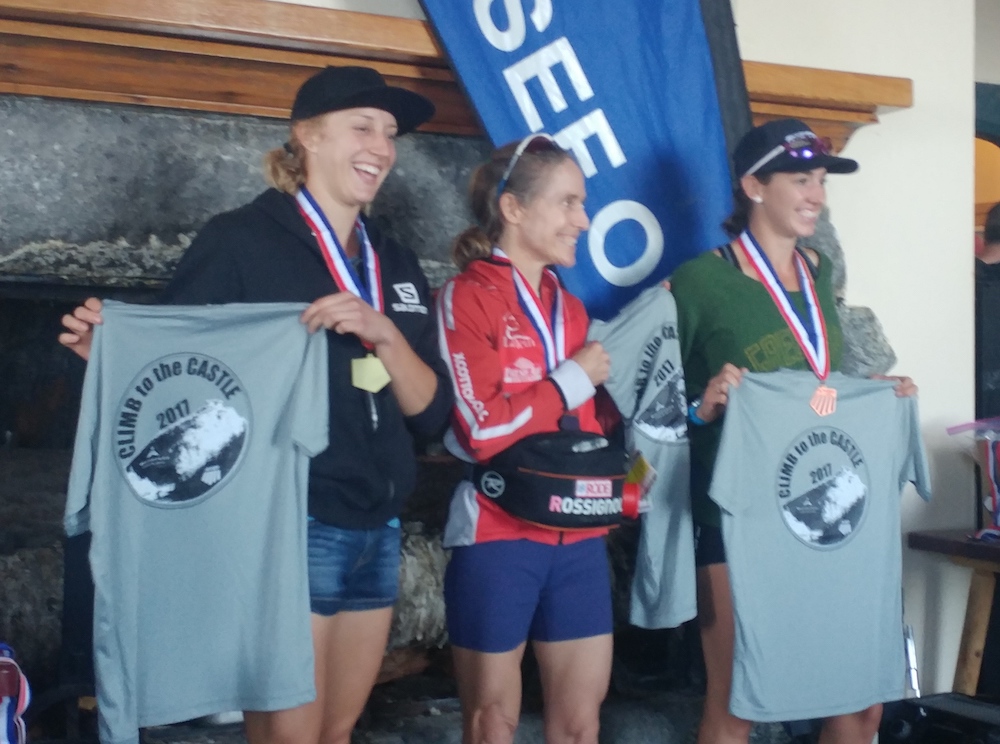
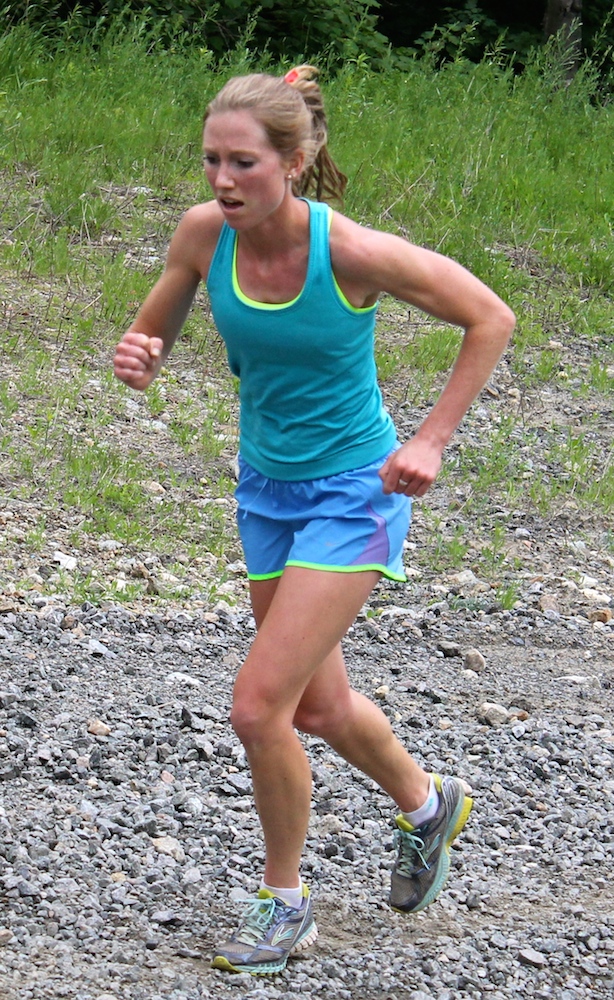
    On an overcast Sunday, Ricardo Izquierdo-Bernier and Emma Page were the men’s and women’s winners of the Climb to the Castle roller ski race. Both were first-time victors.

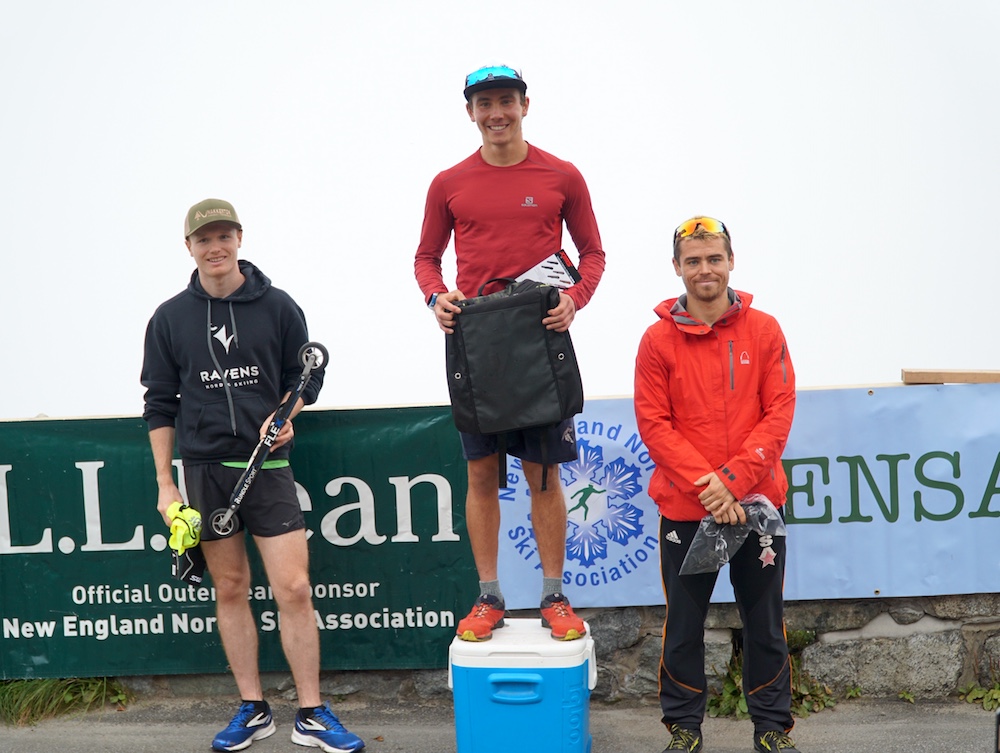
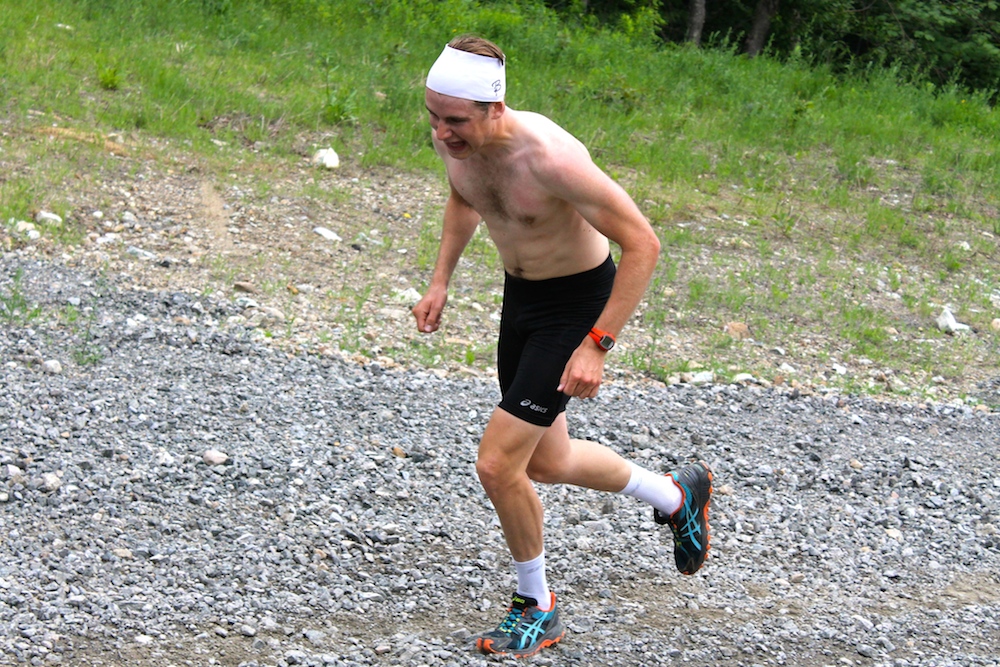
    Izquierdo-Bernier, of the club Fondeurs-Laurentides north of Montreal, won in 39:06.5.  Aidan Ripp, of Paul Smith’s College, finished second for the men in 41:17.0.  Behind him, Parke Chapin of Green Mountain Valley School (GMVS) took third in his first Climb to the Castle, in 42:41.7.

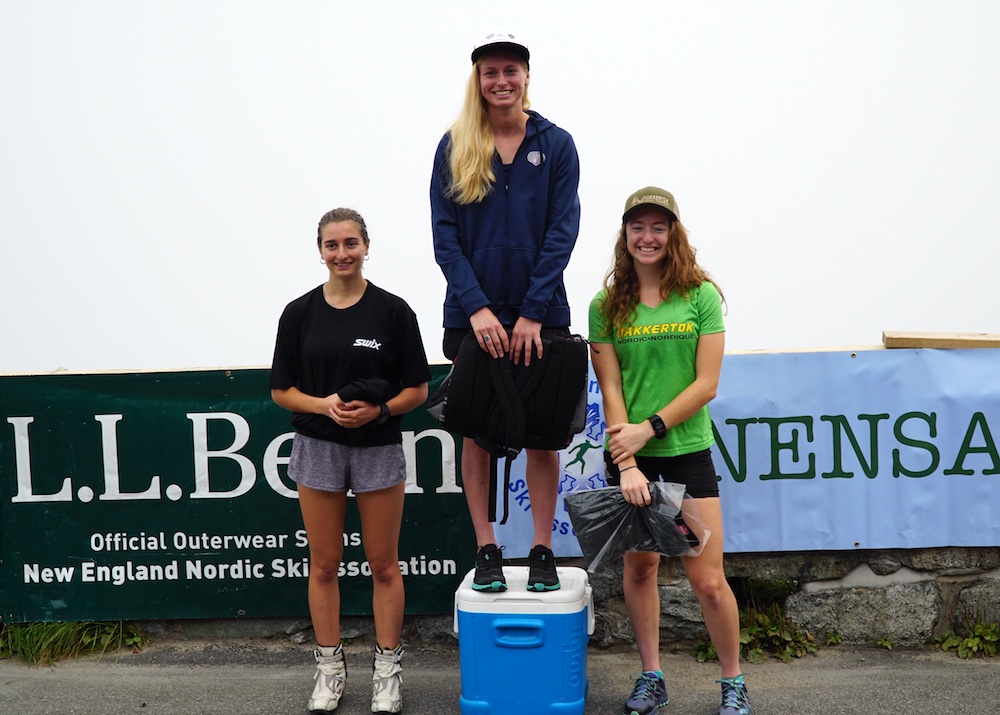
    In the women’s event, Emma Page of Mansfield Nordic (MNC) finished in 52:42.7, Dolcie Tanguay came second in 55:06.2, and Master skier Kathy Schwenk finished third in 57:52.2.
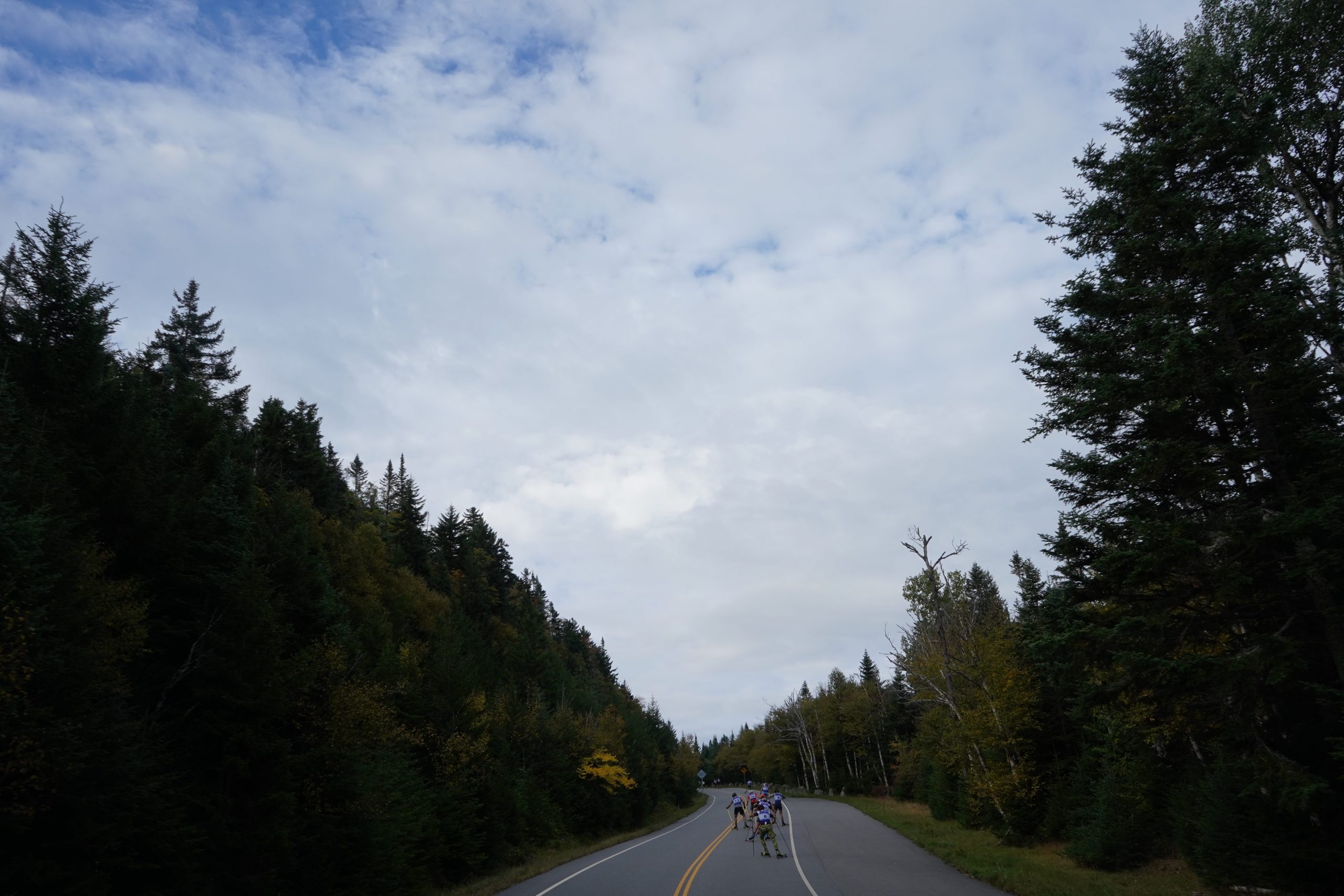
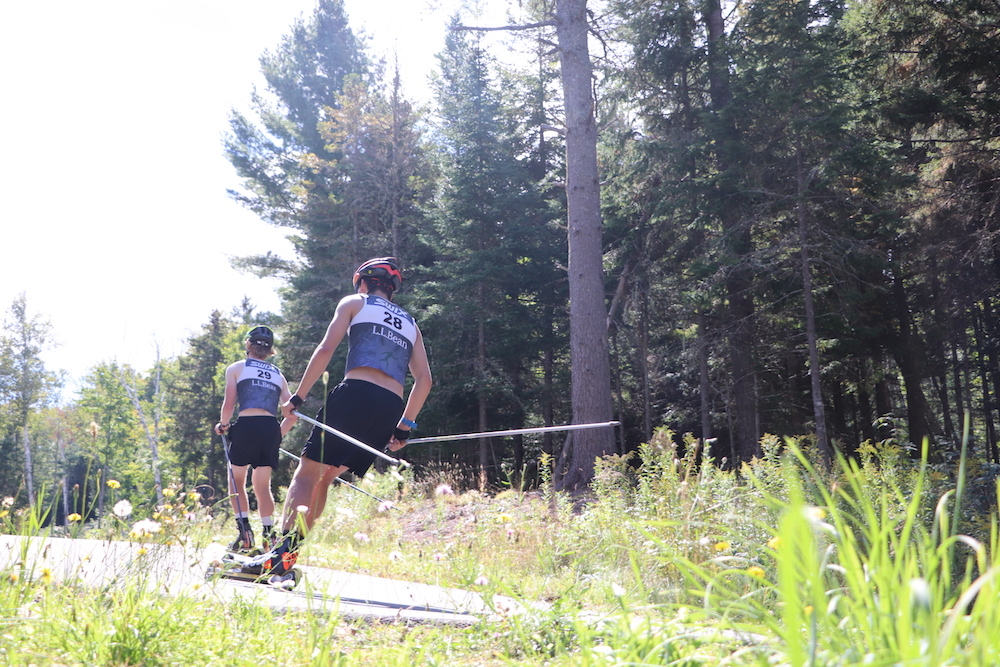
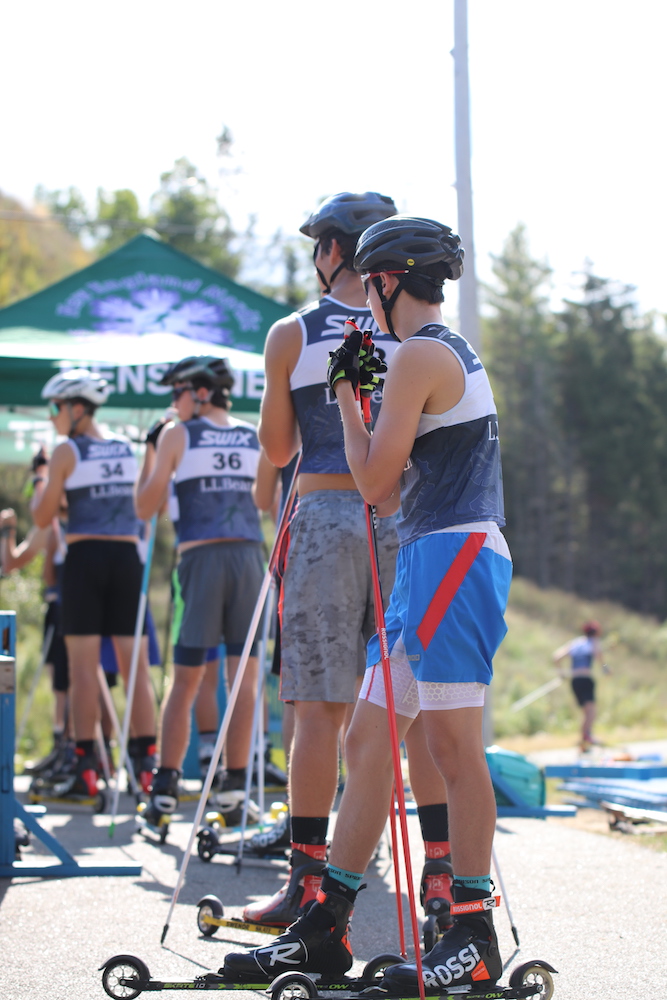
    Climb to the Castle, 2022.

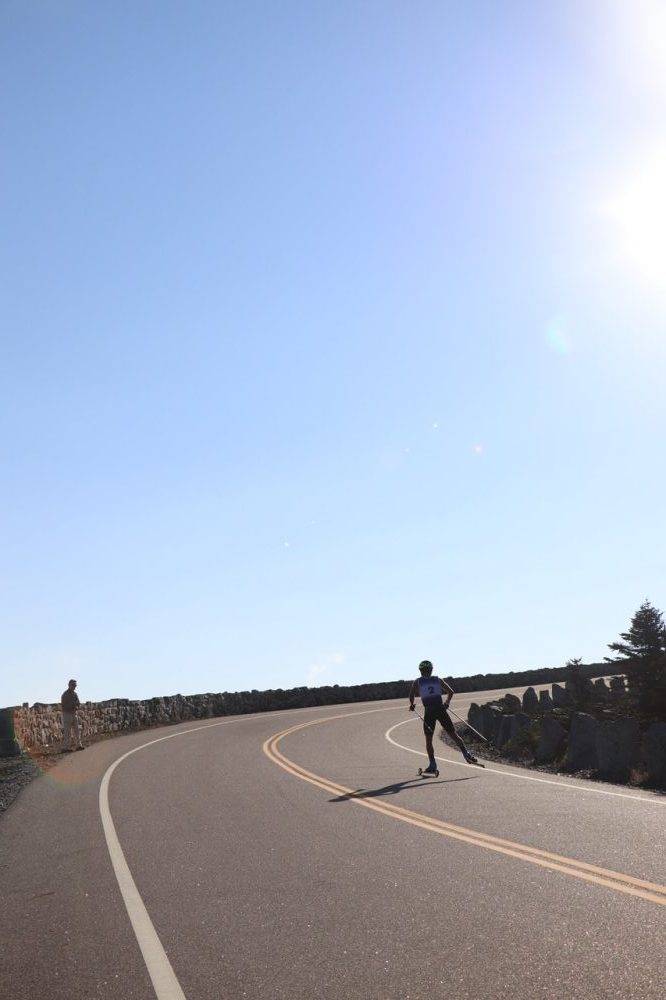
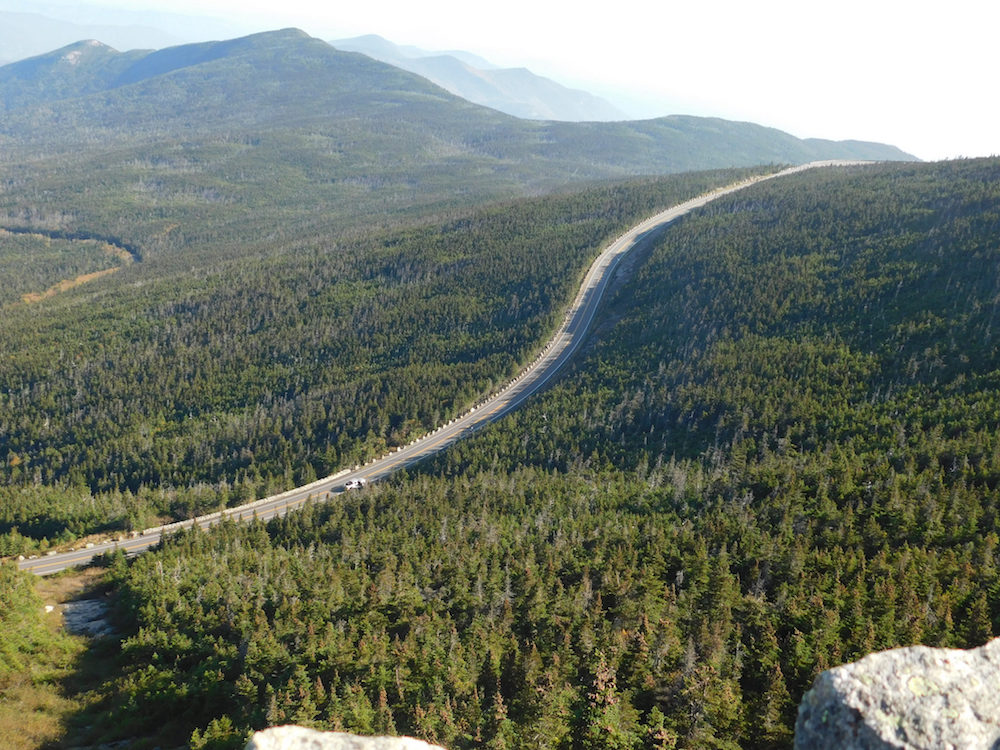
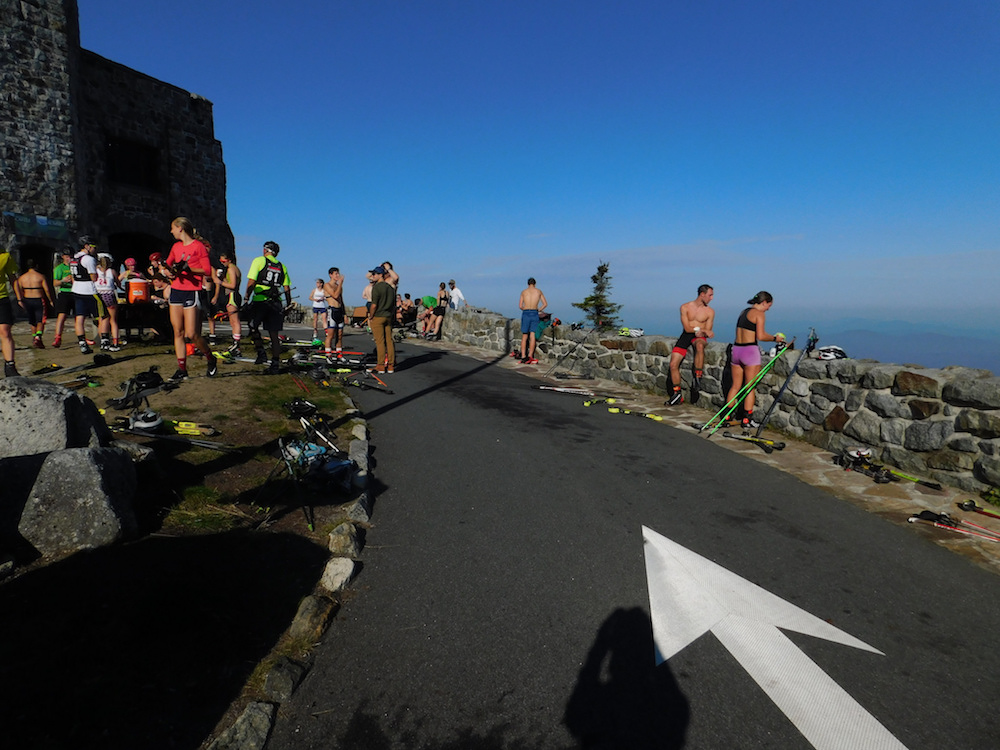
    The Climb to the Castle follows the auto road on Whiteface Mountain in New York’s Adirondacks. At 4,867 feet, Whiteface is the fifth highest Adirondack peak. The toll road snakes upward for five miles at an eight percent average grade, gaining about 2300 vertical feet.  Unlike the wet racers experienced in 2021, today the weather was dry, with a start time temperature around 50 degrees, and only a light breeze. Every two minutes, athletes went off in waves of 15.

    Ripp led from the start, gradually dropping the rest of the first wave.  Starting in the second wave, Izquierdo-Bernier bridged the gap up to the first wave around the halfway mark.  “I stayed with [Ripp] all out to the top,” Izquierdo-Berniuer said. “In the last (kilometer) and a half, I put in a gap.  That was fun to have someone to ski with.”
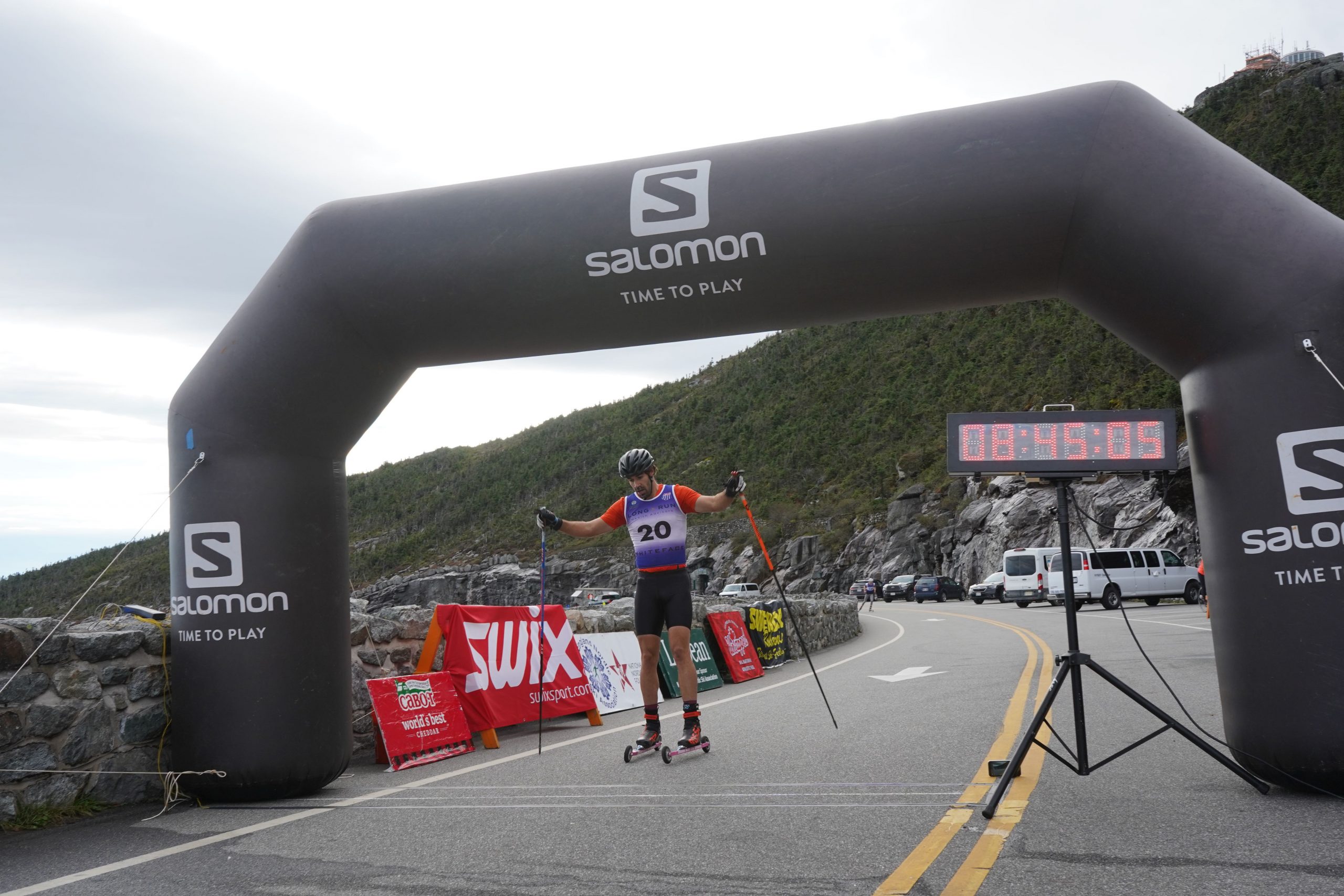
    Ricardo Izquierdo-Bernier takes the win at Climb to the Castle, 2022.

    Not only was this Izquierdo-Bernier’s first win, it was his first trip to the Climb. “I had wanted to come a couple times, but it never fit in my training,” he said. He added that he didn’t have a specific race plan. “Try not to start too fast, that was the only plan. I didn’t the course and where I was going, so it was more controlled, and try to have fun.”

    In this his second Climb to the Castle, Ripp applied lessons learned from last year’s race. “Last year, we got drawn out really quickly, and a lot of guys went out hard,” Rip said. “Last year, Jake Brown went really hard off the gate so you were trying to chase him down. But this year it was just me off the front. It was a little bit odd to have to lead and have to pace myself to try and figure out what felt like a good pace. But it was nice because Ricardo caught me about halfway through and then it was really fun racing with him. Around the last corner [Windy Corner]  was where he dropped me.”

    For Parke Chapin, it was also his first attempt at the Climb, finishing with a solid third place.  “I didn’t know what the course was like, I just knew it was five miles,” he said. “So I started out with two other dudes in my wave. They were similar pace, and I pushed with one of them. Towards the top, I felt like there was more in me and I turned the dial a little more. A positive day out there.”


    Women’s Climb

    On the women’s side, Emma Page gapped the field at the start and never looked back. She admitted to having a tough point, mid-race: “There was definitely a hard part in the middle where I was getting bogged down, but one of the master skiers, he was really helpful and he was pushing me through it,” she said.
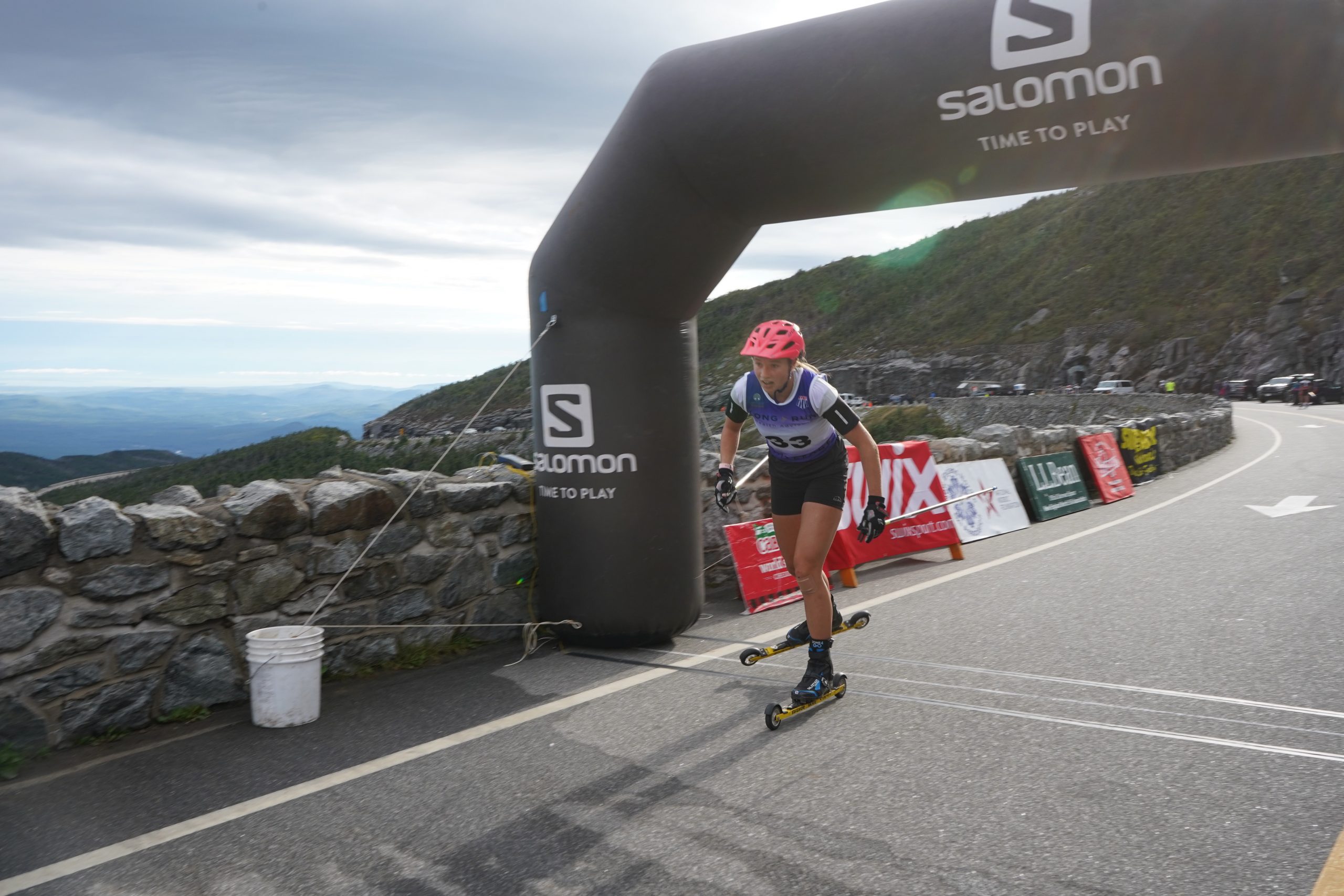
    Emma Page for the win, finishing well clear of the field on the summit of Whiteface Mountain.

    Like several other skiers, Page competed in (and won, as we shall see) the previous day’s sprint races at Mount van Hoevenberg. Was she fully recovered from the previous day’s effort? “I could definitely feel my legs, but I think that once I got through the warmup I was recovered and ready to go,” Page said.

    “I wanted to not start out too hard because last year I started too hard and I ended up dying a bit,” she continued. “So I wanted to make sure that I eased my way into it. I went kind of hard in the start, to the first corner, and then I reeled it in a little because I realized I might need a little extra [energy]. But I did feel good the whole time, I never had to stop or slow down.”

    Dolcie Tanguay also raced not only the previous day’s sprints, sprints, but also the biathlon race at the end of the day. She said that at the start of the Climb, she didn’t feel 100% recovered. “I did it last year for the first time, so I knew what to expect. This time, I paced it pretty consistently, which is an improvement. At the start, Emma Page went out way ahead, and I couldn’t hold on to her. That’s pretty much how it stayed. I caught a couple of people along the way. I just tried to keep it consistent.”

    Master skier Kathy Schwenk commented on her finish: “I just appreciate the opportunity to race. I thank the race director and everyone who put it on. I started in a group of six, and I wanted to go just a little bit faster. So I got out of that and pretty much skied by myself the whole way.”
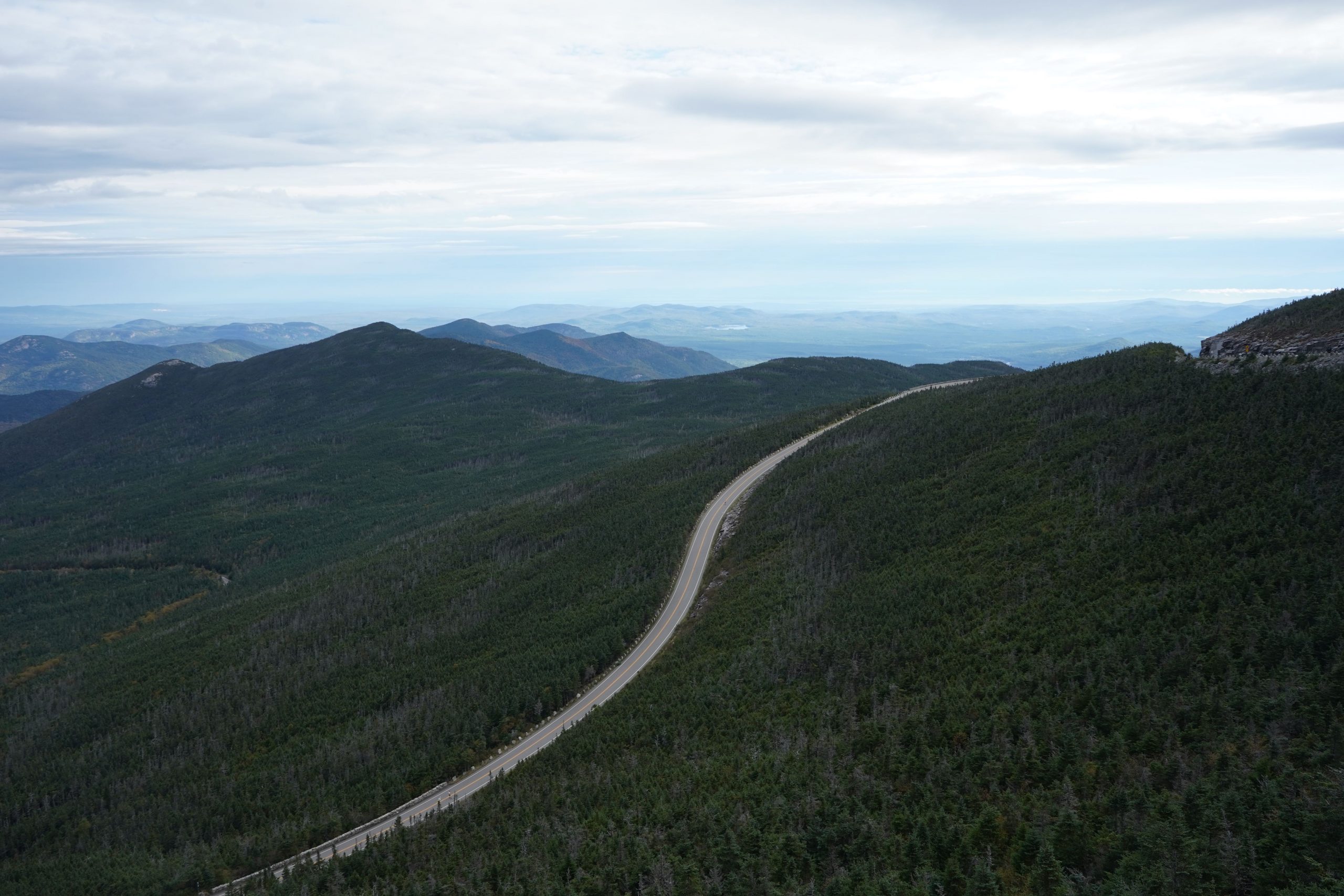
    The Whiteface Toll Road climbs to the castle.

    Once again this year, racers could sign up to ski classic technique in a separate category. New this year was a short course: Athletes could choose to start further up the mountain in a three-mile race. New England Nordic Ski Association (NENSA) Competition Director Justin Beckwith wrote, “We’ve always talked about a junior race that was a more appropriate distance and time – but why limit that to just juniors? Hopefully it boosts participation and gives folks a way to participate and get the experience without having to ski for an hour.”

    Results:  Climb to the Castle


    Keys to the Castle (Saturday)

    Rollerski Sprints and Rollerski Biathlon took place on Saturday, with action on the paved rollerski trails at Mount van Hoevenberg.

    Men’s Freestyle Sprint

    Sprints were contested on the 1500-meter sprint course that had seen use last winter. Instead of a typical “knockout” format, races were organized in a “king’s court” format. Individual start qualifiers determined athletes’ start positions with competitors racing four to a heat. Winners of each round moved up a bracket; second and third places remained in their bracket; fourth place finishers dropped to a lower bracket.

    The action was fast and furious on the race course, as athletes accelerated to establish a lead before the first hill under the bridge. Some groups were incredibly tight—even in high-speed corners—while other heats saw athletes more spread out. There was less recovery time between rounds than in a normal sprint, and athletes approached recovery in a number of different ways. Most skied easy around the biathlon penalty loop, some did speeds, others changed into sneakers for a jog.
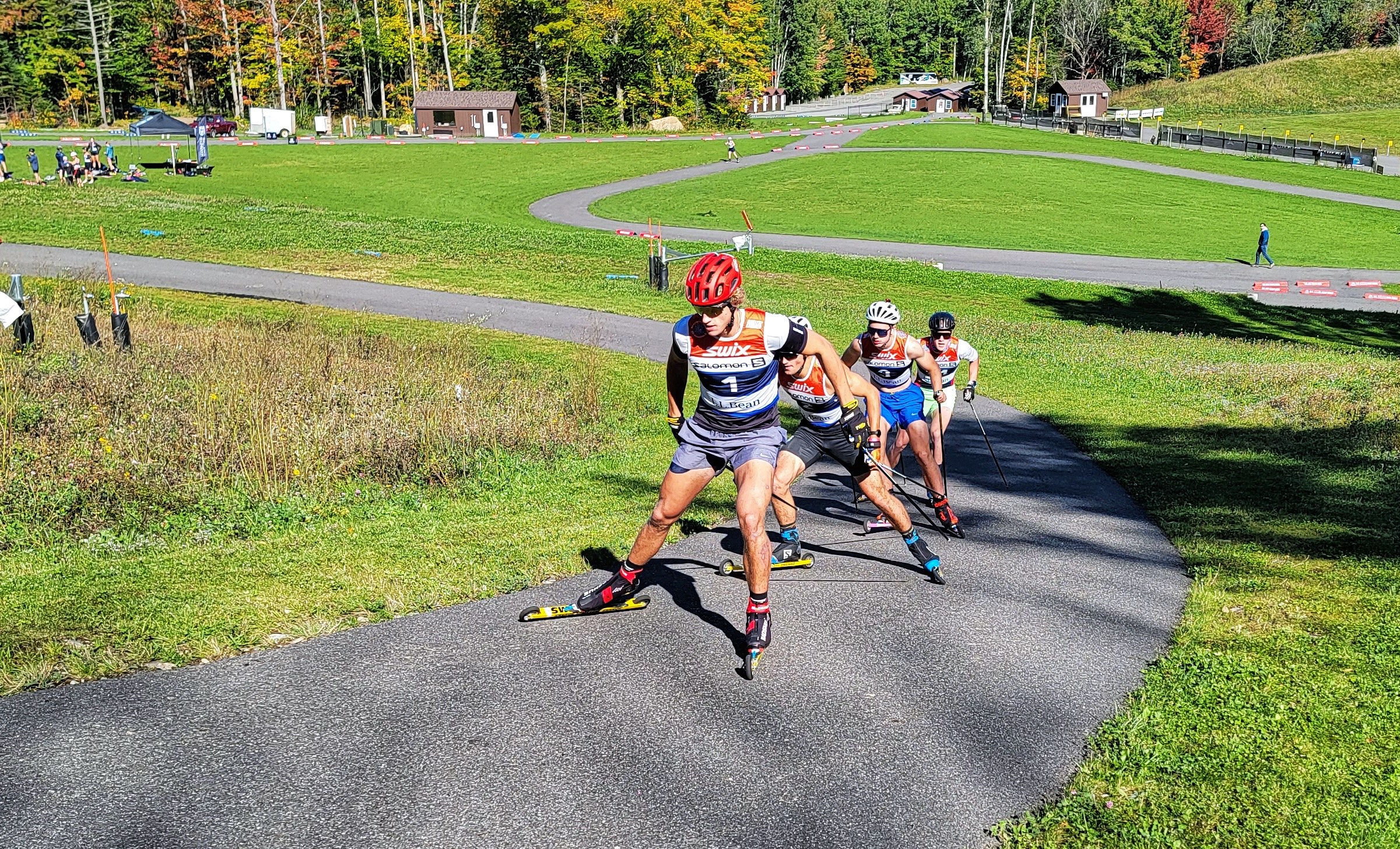
    Eventual winner, Fin Bailey, leads the first quarterfinal ahead of Elvis McIntosh, Sam Gallaudet, and Wyatt Teaford.

    Fin Bailey of Stratton Mountain School (SMS) won the men’s sprint in dominating fashion, winning the prologue and every subsequent round.  Through the morning, he never appeared fatigued. On the decisive climb to the high point of the course, he jump skated to build a gap from other skiers.

    “I pretty much worked as hard as I can,” Bailey said. “Worked with Elvis [McIntosh] in our heats, had a little strategy that when we got to the big hill, we just hammered.  That’s about it.”

    The final climb on the sprint course leads to a sweeping downhill past the lodge, to a hard turn and an uphill finish. Owning that climb was key to Bailey’s strategy: “That was a pretty important part of the course,” Bailey said. “You come over the top of the hill, right at the big swooping downhill to the finish, you can get ahead… you’ll be set for the finishing straight.”

    Elvis McIntosh, of GMVS, was hunting for a podium before he broke a pole in the final round. “First couple of rounds went pretty well,” McIntosh said. “I was working with Fin to keep it controlled and keep the pace good and we’d hammer up and over the final hill and sweep around the [downhill] corner into the finish. It was working pretty well and then in the final, my pole broke.  Final didn’t go as well as I would have liked. It was a good, fun, race.”

    Wyatt Teaford of SMS described his day: “I qualified fourth today. I moved up and down throughout the heats; I narrowly missed out on the final (getting) narrowly out-cornered on the last corner there. I think races like this are really great for preparing for winter.”

    When everyone’s in a tight group on a small piece of real estate, do you get nervous? “I think it’s faster than a normal ski race, but I don’t think it’s scarier,” Teaford said. “Because everyone knows the etiquette of the course. No one’s gonna cut people off on corners where it could be dangerous. I think in skiing in the winter, everyone can get more physical in sprint races.”

    Aidan Ripp of Paul Smith’s and Charles Martell of SMC-MNC came second and third in the men’s sprint.

    Women’s Freestyle Sprint

    Emma Page was first in the women’s sprint, followed by Dolcie Tanguay and Margot Nightingale in second and third respectively.

    “It was great! I fell in the warmup, but other than that, it was great,” Page said.
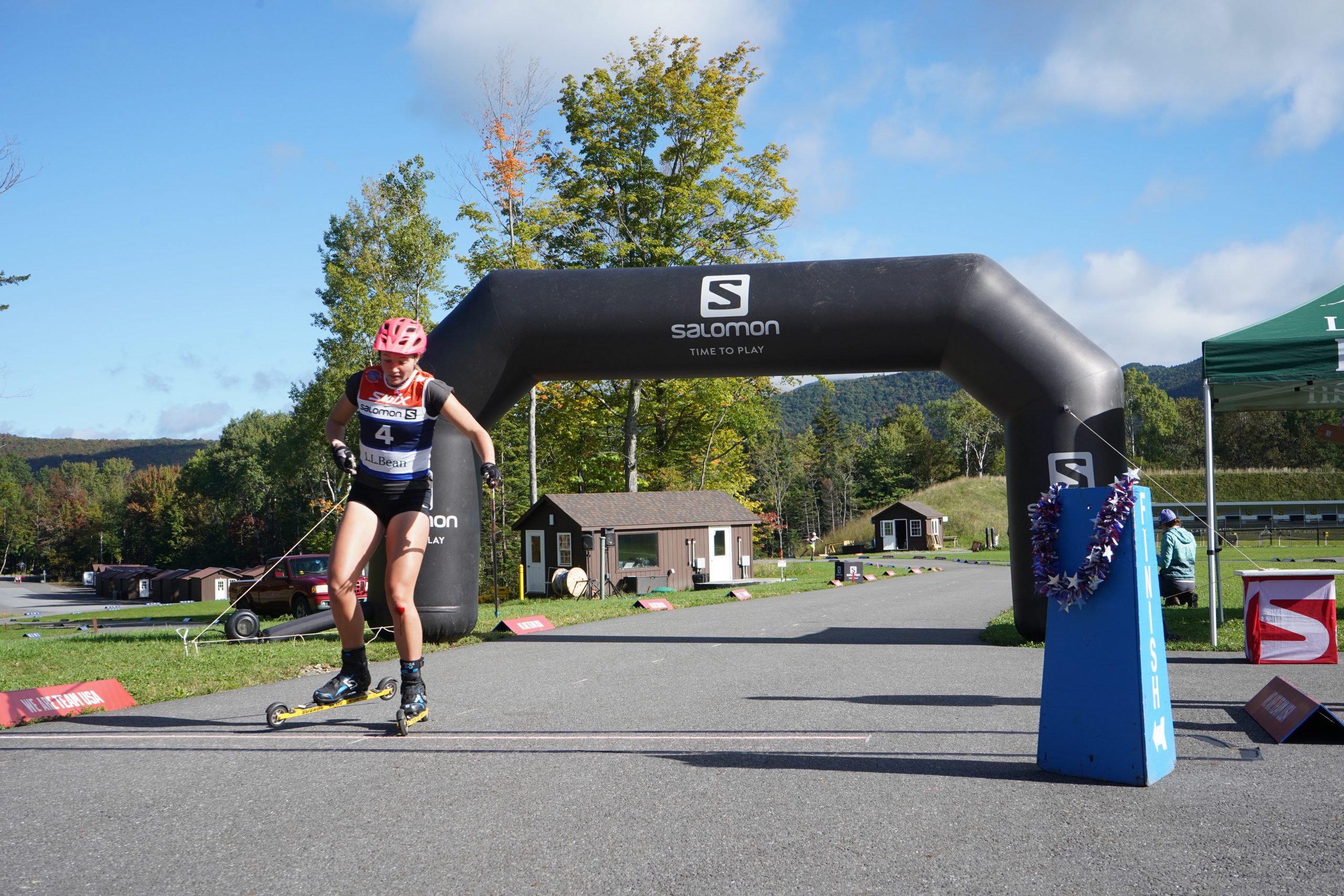
    Emma Page was the top qualifier—and eventual winner—of the Women’s Sprints.

    Asked how she manages her efforts to keep a consistent pace, Page said, “I’m usually really excited, so that’s actually my worst thing. I generally have worse energy towards the end. That’s what I worked on this summer. I’ve been working on doing speeds at the end of training, no matter what the training was. To try and get myself to push all the way to the end.”

    Dolcie Tanguay took second place in the sprints before moving to the biathlon race later in the afternoon. “Usually, the point is to go pretty hard in the qualifier,” Tanguay said. “And then go from there. The high schoolers put on some pretty good competition today, so I just took each heat one at a time, went as hard as I could. The last one, I definitely slowed down a bit. But it was fun overall.”

    Did she hold anything back for the biathlon? “Maybe a little. But the biathlon race is fairly short. I’m treating today more like a regular workout day, like two interval sessions.”

    Results: Men’s and Women’s Sprints

    Biathlon

    After the sprints, the biathlon race was contested: five laps of a 940-meter loop (with 140-meter penalty loop) with the high point of the course occurring near the lodge. There were two prone and two standing rounds of shooting. NYSEF head biathlon coach observed Maddie Phaneuf explained the challenging conditions that Mount van Hoevenberg is known to serve up:

    “Here at the new van Ho range, it’s a bit more challenging wind,” Phaneuf explained. “You might zero with a consistent wind from left to right, like we have right now, then it keeps shifting from dead wind or wind from right to left. The athletes really have to pay attention to the wind flags and know what their zeroing wind was and then make corrections throughout the race.”

    Paul Smith’s College grabbed five of the six podium positions in the biathlon. Kaisa Bosek of Paul Smith’s won the women’s event, getting shouts from spectators as one shot clean in the first standing round. What went through her mind when she shot clean, then had a couple of misses on the final shooting? “First, you get excited, I think you leave the range a little faster,” Bosek said. “Then after not doing as well in the next round, it’s a mental game so you have to try to forget about that. At least mine [multi-miss standing] was on the last round so I didn’t have to think about it any longer. Then leave the range, try to finish the race strong and keep going.”

    Dolcie Tanguay took second place in the women’s biathlon with Taylor Landrum, also of Paul Smith’s, finishing third.

    Logan Jensen of Paul Smith’s was the men’s biathlon winner. He said of his race, “It was all right; it’s early in the season. [I’m] using it as a benchmark to hopefully keep working, and get better, faster, shoot better as the season goes on.”

    On his race plan, Jensen said, “Today the course was super interesting. Super flat. I was working on getting my heart rate up, seeing how high I could shoot and stay accurate.”

    Diego Shillaci of Paul Smith’s finished second among the men’s biathlon competitors, while Frazier Patterson of Mansfield Nordic finished third.

    Results:  Biathlon

  • Rollerskiers in the  Mist: Patterson, Brown Win Foggy Climb to the Castle

    Rollerskiers in the Mist: Patterson, Brown Win Foggy Climb to the Castle

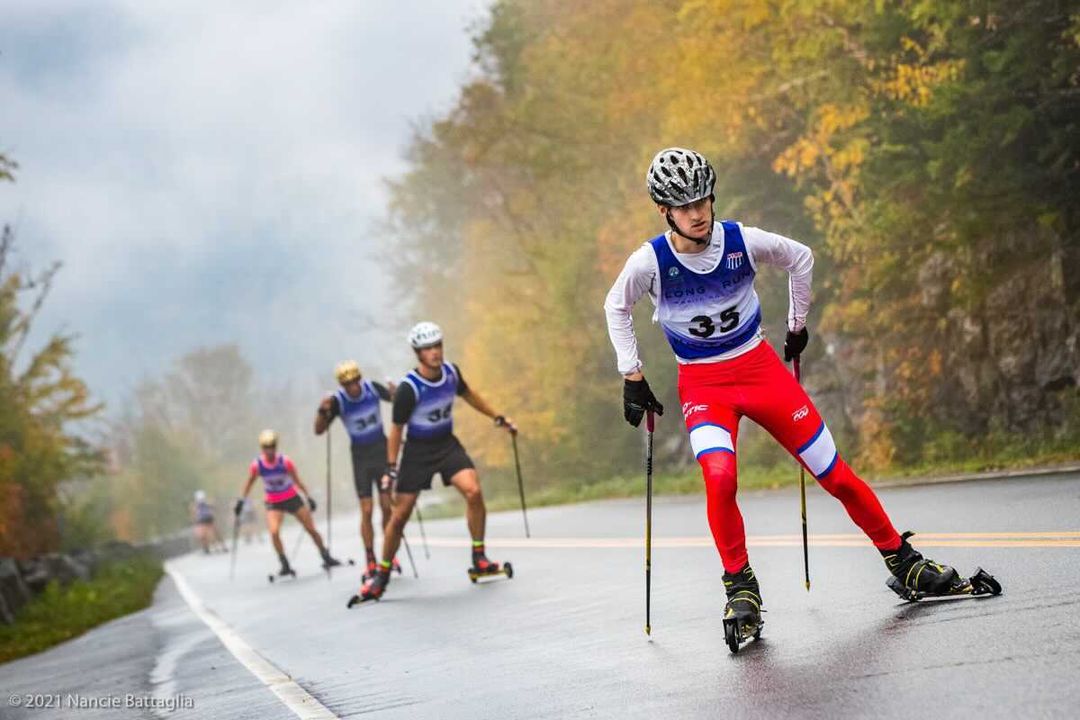
    Racers climb the Whiteface Veteran’s Memorial Highway during the 2021 Climb to the Castle. (Photo: Nancie Battaglia/NYSEF)

    The rain stopped just long enough for Caitlin Patterson and Jake Brown to savor their wins at the 2021 edition of the Climb to the Castle last Saturday in Wilmington, NY, near Lake Placid. 

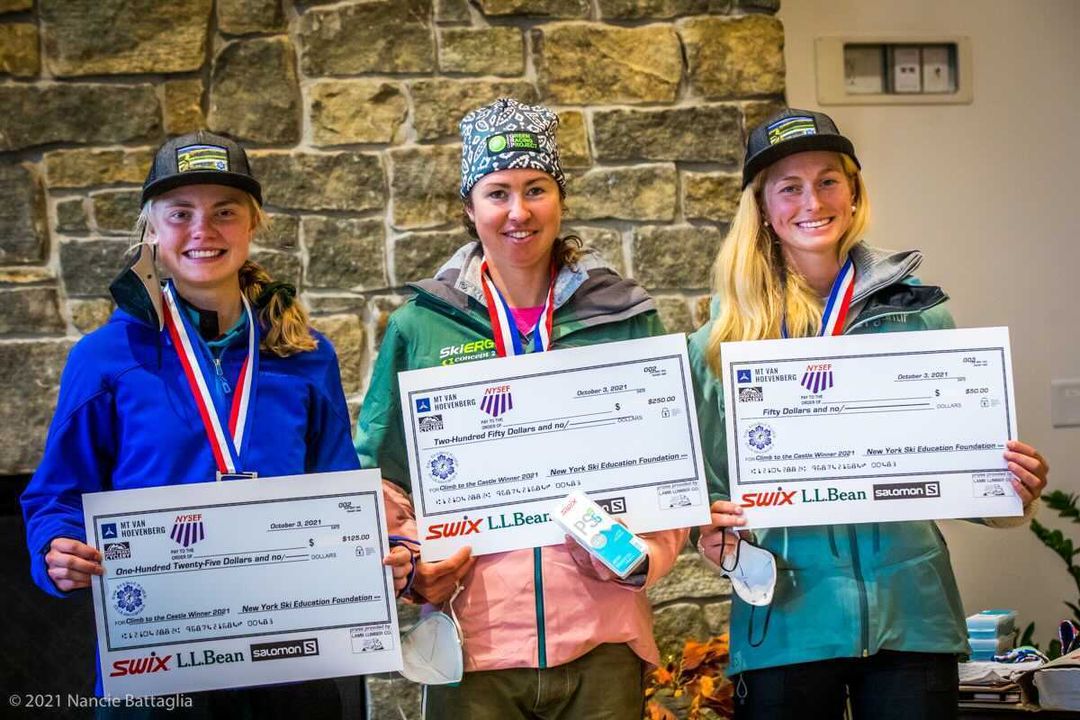
    Craftsbury Green Racing Project (CGRP) swept the women’s podium; Caitlin Patterson edged Margie Freed for the win in 46:48.8, with her teammate just .7 second back in 46:49.5. Tara Geraghty-Moats placed third in 47:35.0.

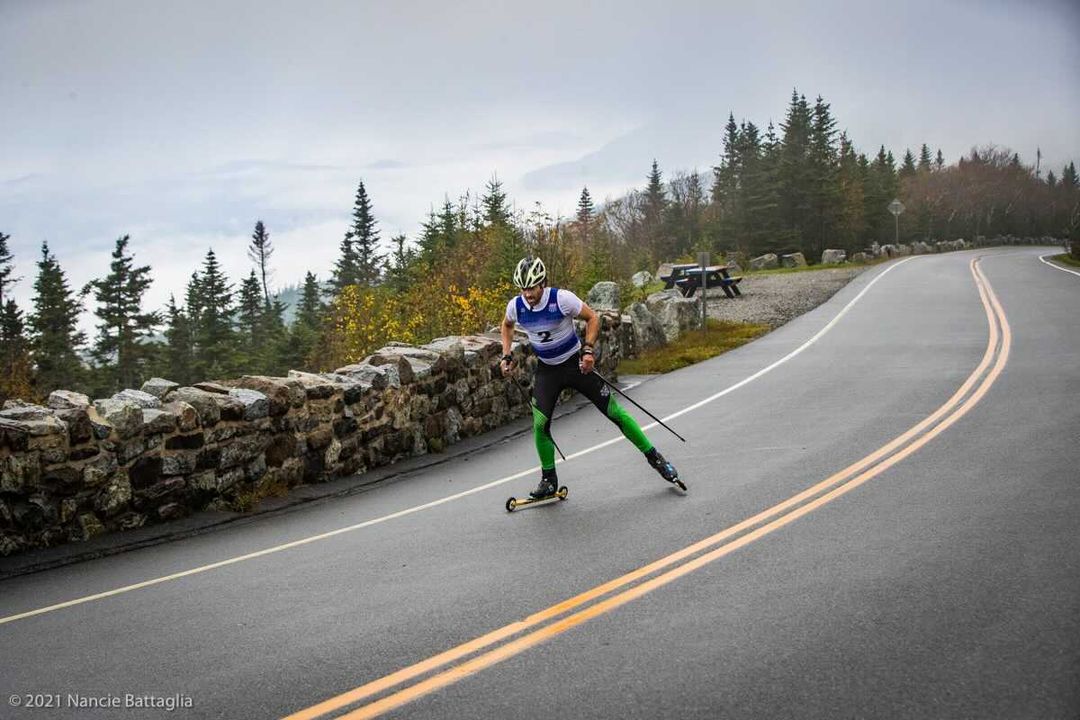
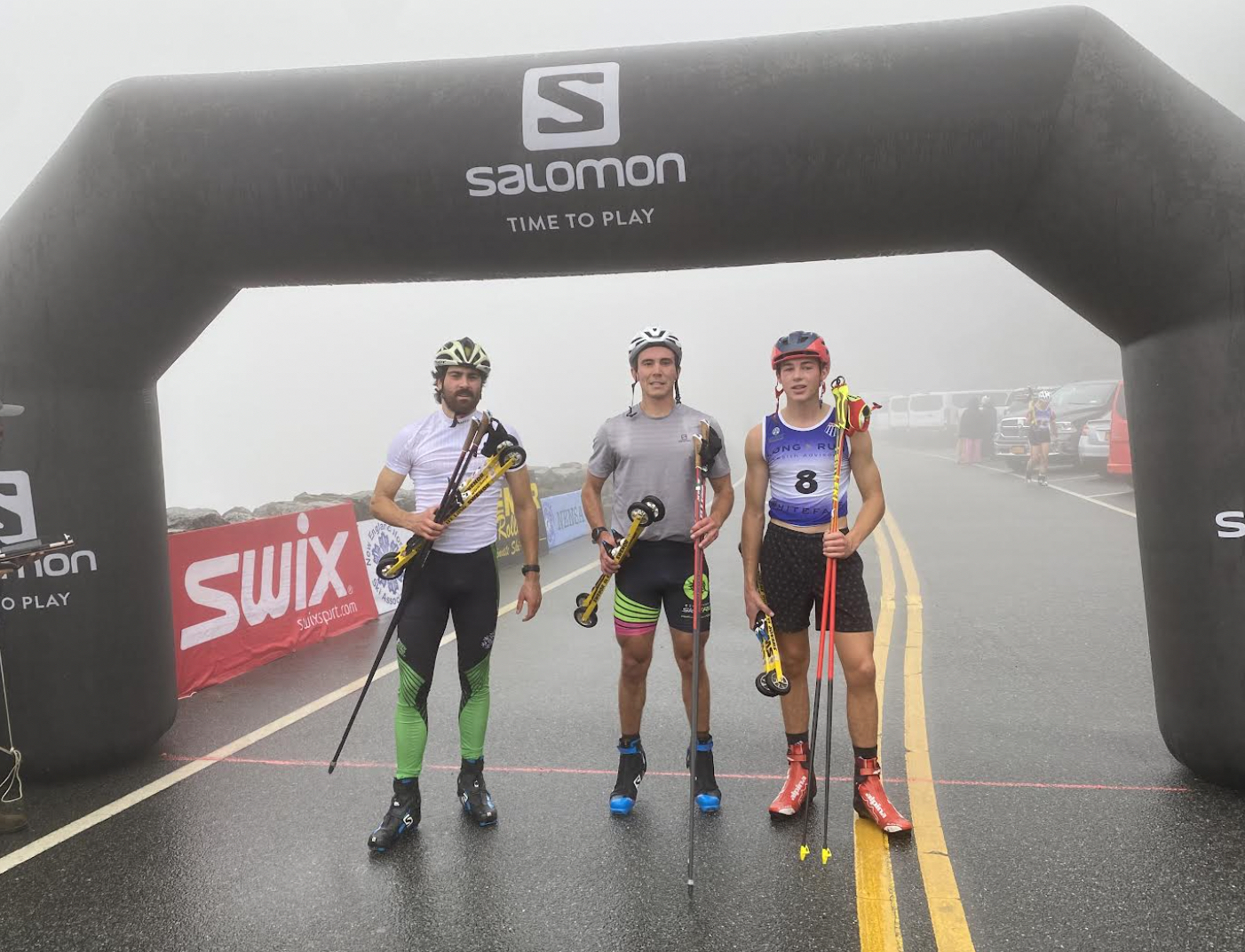
    Brown, skiing for US Biathlon / CGRP, took the men’s win in a time of 38:04:00. CGRP teammate Akeo Maifeld-Carucci came second in 39:34:9, and Junior athlete Tabor Greenberg, a U16 athlete out of the Green Mountain Valley School (GMVS), interrupted CGRP’s command of the podium in third place at 41:24.7.
    After taking 2020 off due to the pandemic, the Climb to the Castle returned to the Northeast roller ski calendar, co-hosted by NENSA and NYSEF. The race leads skiers five miles up the Whiteface Veteran’s Memorial Highway at an average eight percent grade. Whiteface is the fifth highest mountain in New York’s Adirondacks; start too hard, and you’ll never recover. This author can attest. 

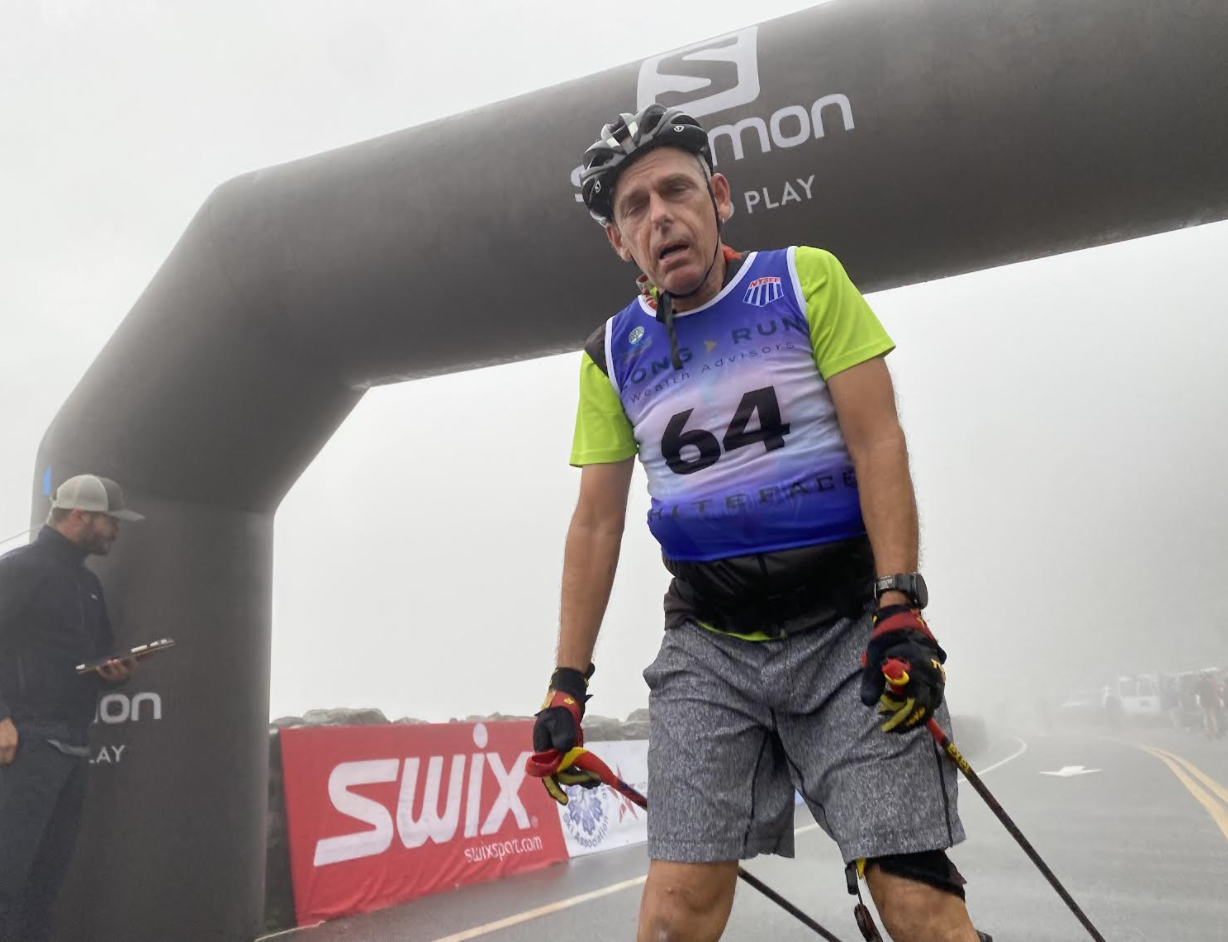
    The author completes his Climb to the Castle. (Photo: NENSA)

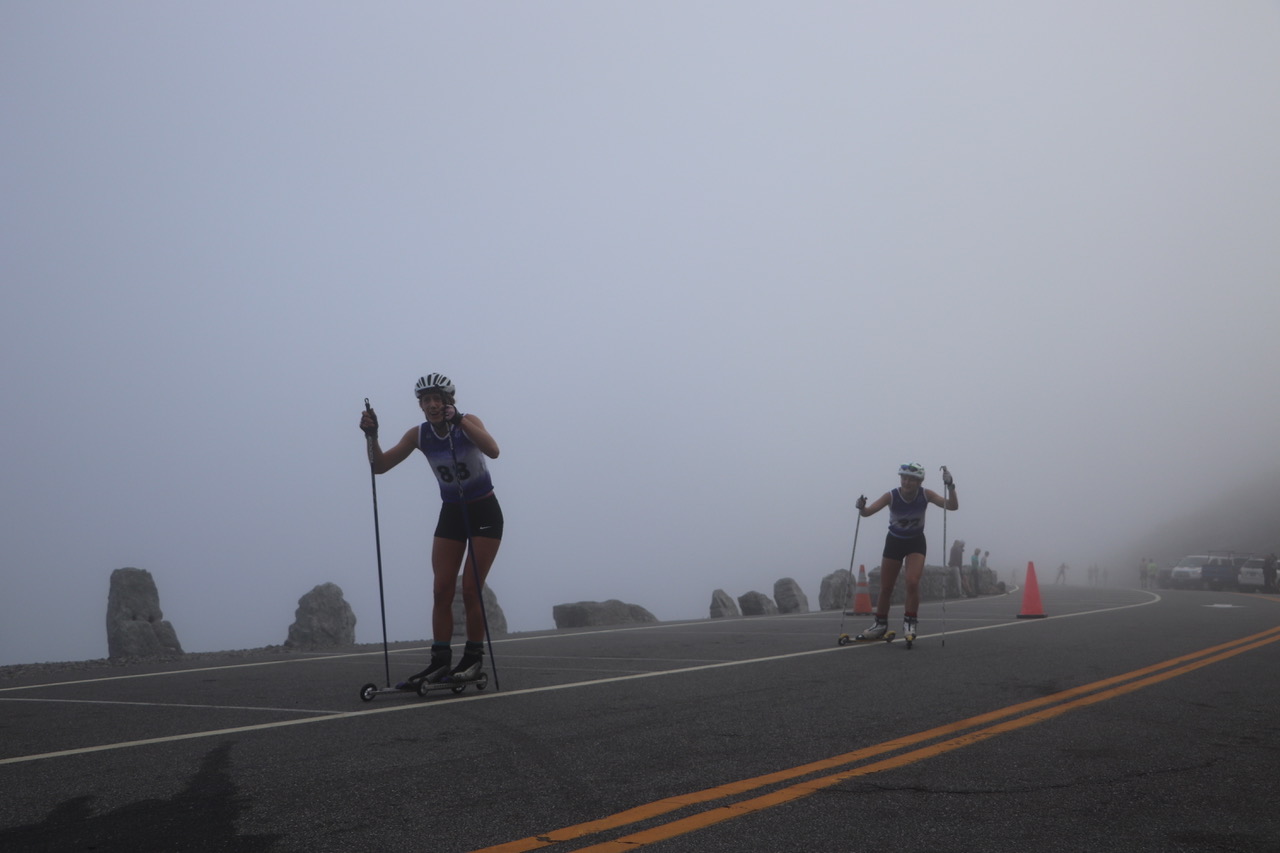
    As is often the case, weather made the race…. interesting. Light overnight rain tailed off about an hour before the start. Although the temperature hovered in the low 50s, the humidity made it feel warmer.  Clouds and fog obscured vision throughout the day.  In some places, one was lucky to see a hundred feet. For a change, there was little wind, even at the infamous Windy Corner and chute, 800 meters or so from the finish.

    For COVID safety, organizers started five waves of skiers, each two minutes apart. Competitors wore masks at bib pickup and on the summit after finishing their race.

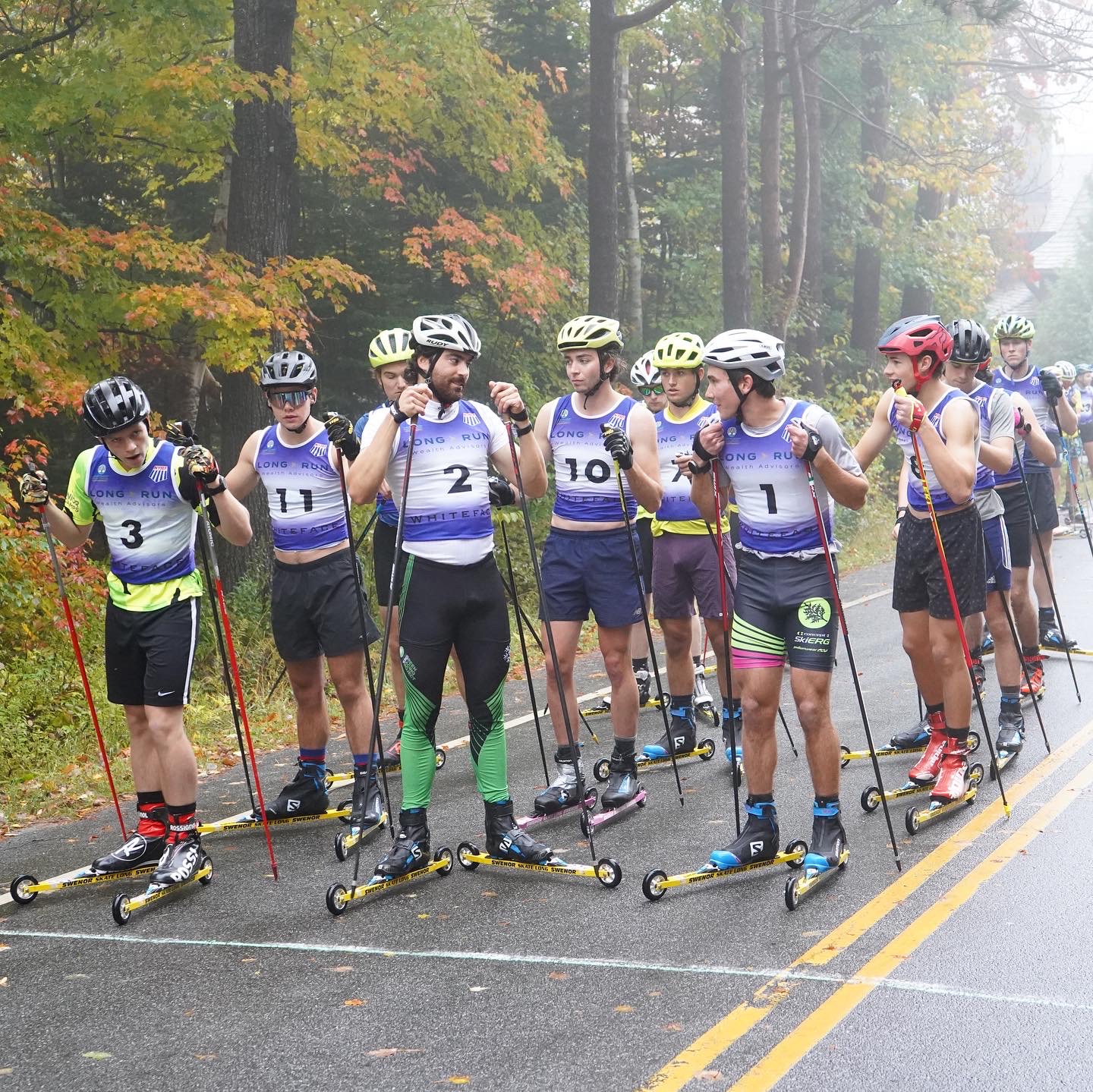
    Visibility low, energy high: a wet start for the men’s wave in the 2021 Climb to the Castle. (Photo: NENSA)

    The women’s race was high drama as Patterson, Freed, and Geraghty-Moats worked together up the road.

    “Tara and Margie and I knew we wanted to work together, especially with the way the Climb can be pretty windy at the top. It was just gonna be: ski smooth, work together, and shuffle around the leads, which is what we did. I definitely wanted to make sure not to start too fast.  I did that well, though I certainly had some rough moments in the middle.”

    From the start, Patterson said that she and Geraghty-Moats took turns in the lead, trading off about every kilometer.  “Towards the upper part, Margie was taking some really strong leads. I was suffering a bit,” Patterson added.

    With two kilometers left, Freed opened a gap from Patterson and Geraghty-Moats. Patterson said it took a few minutes for her to regain contact.  At that point, Patterson and Freed pulled away from Geraghty-Moats, skiing to the finish.  

    “Maybe 30 seconds out, I passed [Margie],” Patterson said. “It was really strong work by both of them. It was great to ski with people because it was as tough a course as ever.”

    Of her finishing kick, Patterson said, “I know that I can tap into a late surge. We were working together for most of it, and as the finish line was drawing near, it was definitely every person for themselves.”

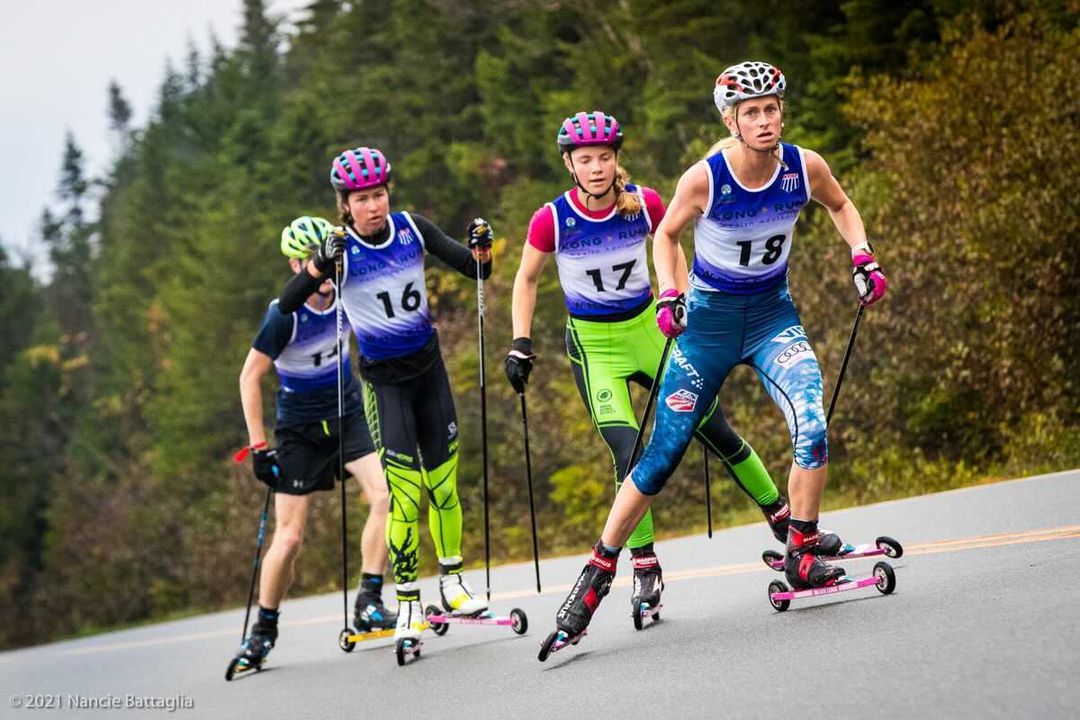
    Craftsbury women clean up at the 2021 Climb to the Castle. Caitlin Patterson took the win ahead of Margie Freed (left) and Tara Geraghty-Moats (right). (Photo: Nancie Battaglia/NYSEF)

    “It went pretty well today,” said Freed of her race. “It was awesome to ski with Tara and Caitlin for so long. I don’t think I could have kept up that pace if I was alone.

    “I’ve never done this race before, so it was exciting to have every step be something new for me,” Freed continued. “Even though I didn’t quite know where the finish was, or when it was coming.  I couldn’t quite see it because it was so foggy.  It was an awesome day out there, and I was glad it wasn’t as windy or rainy or cold as I was thinking it was going to be.”

    This past winter, Geraghty-Moats won the first ever crystal globe for FIS Women’s Nordic Combined.  She also won the Climb in 2018. After the race, she wrote, “It was really nice to go all out with my teammates. We skied together really well. We all had moments of fading and then climbed back on. I dropped back about half a k after the Lake Placid turn — I just kind of ran out of  gas. I’m pretty happy with how I felt and it was a really fun race.”

    Jake Brown wins the 2021 Climb to the Castle in a long solo effort. (Photo: Nancie Battaglia/NYSEF)

    For Brown, this was his third win at Climb to the Castle, his previous two coming in 2017 and 2018.

    “I wanted it to be a good, solid effort,” Brown said. “I knew that I couldn’t sprint too hard off the line, but I wanted to get into that high heart rate zone and stay there as long as I could.”

    Asked about race strategy, Brown said, “I was with Akeo [Maifeld-Carucci], my Craftsbury Green Racing Project teammate. He led for the first 3 minutes or so.”

    At that point, Brown said, he took a turn pulling and developed a gap. “I was hoping we could work together a little bit more, but we ended up with an awkward 20-meter gap between us that we  held for maybe half the race. Then I slowly pulled away and was by myself.”

    Jake Brown wears the moose-antler crown after winning the 2021 Climb to the Castle. (Photo: NENSA)

    Asked if he could use this as a fitness benchmark, Brown said, “This was my fourth time doing the race. This was a bit of a slower year; I’m hoping it was just because of the weather. Maybe a little later in the year and a little colder pavement. It was kind of warm today, but maybe the pavement was a little colder.  Maybe my fitness isn’t where it was.  We’ll find out when the winter comes — that’s what matters.” 

    For Maifeld-Carucci, “It was a sweet day. I wanted to do this race for a long time, since early in college. So it was great to actually be here and do it.  The weather was way better than we expected. It was a little wet and a little cloudy at the top, but there were moments when it opened up and it was super pretty. Constant great climb, hard skiing — it was definitely a hard race and a really good effort.”

    Commenting on the men’s pacing and tactics, Maifeld-Carucci echoed Brown’s explanation of the duo’s ability to collaborate. 

    “Jake and I were hoping to ski together and trade leads,” Maifeld-Carucci explained. “He was feeling a little stronger than I was so I fell off early and we were dangling 20 meters apart for a long time. Then he started to open it up.”

    Akeo Maifeld-Carucci skis to second place at the 2021 Climb to the Castle. (Photo: Nancie Battaglia/NYSEF)

    In addition to Greenberg nabbing third place overall, the GMVS boys swept the junior podium. 

    Responding to an email, GMVS head coach Colin Rodgers said that his skiers didn’t taper for the race. “Tabor actually trained a lot in the past week including a 120 mile bike ride to raise money for the Kelly Brush Foundation.”

    Commenting on the preparation for this event, and how it fits into the season preparation, Rodgers explained:

    “We spent some time recently working on climbing technique. When we were recently on snow on the Stelvio glacier we were working on standing well (balanced and forward) on our skis. We did not discuss any mass start race tactics for today — I really just wanted the crew to focus on pacing the effort properly and being consistent throughout the duration of the climb. [Having] a dialed warm up and trying to keep good form when tired were also a few other things we were honed in on today.”

    The men’s podium at the 2021 Climb to the Castle. Jake Brown (CGRP) took the win ahead of Akeo Maifeld-Carucci (CGRP) and Tabor Greenberg (GMVS). (Photo: NYSEF)

    Did Rodgers have an inkling that Greenberg might podium? 

    “We were not focused on the podium, we were just focused on executing a solid race effort. We are primarily focused on competitions in March, so all of this is just trying to build momentum towards the end of the race season.”

    Although COVID border closures prevented Canadian clubs from driving across the border, many clubs and colleges still showed up to throw down.  

    According to Sara Falconer, a coach at Mansfield Nordic (MNC) in Vermont, “It’s a good opportunity for [MNC junior athletes] to race other high school athletes and college athletes that are here.  It’s also a chance for them to compare their times to last year and see the results of all the work they put in over the summer.  They can see a lot of dramatic improvement.  It’s a really motivating thing for them.  And it’s also a good workout.”

    From juniors to collegiate to masters, racers ascended Whiteface during the 2021 Climb to the Castle. (Photo: Nancie Battaglia/NYSEF)

    Ethan Townsend, Saint Lawrence University’s (SLU) head nordic ski coach, planned a training weekend for his team. SLU athletes also roller skied the new loop at Mount van Hoevenberg on Friday.

    “Saturday morning, we got up early and did a run/hike” said Townsend. “They had the option of going up Algonquin or Wright or Marcy. A lot of them took the option of going up Marcy. A few of them went up Phelps and Tabletop. Probably an average of five hours.” 

    Mount Marcy is the highest Adirondack mountain at 5,344 feet and Algonquin, the second highest, stands at 5,114 feet. The remaining peaks named are also among the 46 Adirondack High Peaks, which are all above 4000 feet. 

    After coming out of the woods, the SLU team reconvened for an afternoon double pole roller ski session.

    “We weren’t concerned about performance, necessarily, in this race,” Townsend said. “It’s a training race. Something to do as a group. I told them, ‘Don’t worry about the results so much.  It’s great that we can come here and do this. If you just stay in level three the whole time and you’re not feeling it to go super hard, I think that alone would be worthwhile.’”

    You can find more footage of the 2021 Climb to the Castle on NENSA’s YouTube channel.

    From Juniors to Collegiate to Masters; a broad scope of rollerskiers ascended Whiteface during the 2021 Climb to the Castle. (Photo: Nancie Battaglia)

    Women’s complete results

    Men’s complete results

  • Brown, Geraghty-Moats Win 2018 Climb to the Castle; Doubleday Race Format Unveiled

    Brown, Geraghty-Moats Win 2018 Climb to the Castle; Doubleday Race Format Unveiled

    Jake Brown (Craftsbury Green Racing Project/US Biathlon) racing to a sizable win at the 2018 Climb to the Castle on Saturday, Sept. 15 in Wilmington, N.Y. (Photo: Heloise Rolland)

    On a humid fall Sunday in northern New York where temperatures reached an uncharacteristic 80 degrees, Jake Brown of the Craftsbury Green Racing Project and US Biathlon Development Team and Tara Geraghty-Moats of USA Nordic won the 2018 Climb to the Castle.
    Brown’s time was 35:40.7, while Geraghty-Moats finished in 45:03.

    Big Gaps and Clear Wins

    On the men’s side, Brown’s Craftsbury teammate Raleigh Goessling finished second in 38:16.6, and Erikson Moore of the Fondeurs-Laurentides team in Quebec was third in 39:00.3.

    Among women, Jackie Garso of Saint Lawrence University was second, in 49:24.1, and Nakkertok’s Zoe Williams third in 49:40.6.

    This year was a high water mark for attendance, with 102 athletes finishing.

    The overall women’s podium at the 2018 Climb to the Castle at the top of Whiteface on Sept. 15 in Wilmington, N.Y., with winner Tara Geraghty-Moats (c) of USA Nordic, Jackie Garso (l) of St. Lawrence University in second, and Zoe Williams (r) of Nakkertok in third. (Photo: Colin Delaney)

    While a few degrees cooler than last year, dank humidity settled like a blanket over the five-mile climb, with athletes moving through a couple of patches of dense fog on the higher reaches of the mountain.

    “It was a hard one today,” Brown said following the race. “Last year, I felt like I went a little too hard off the line, and kind of buried myself early. So I wanted to be a little more conservative and finish strong today. I tried doing that and it felt a lot better, and I skied a little faster. I was on different rollerskis, so it’s hard to be able to compare it to last year. I was happy with my effort and it was a good push today.”

    This year was Brown’s second consecutive win, and he beat his 2017 time of 39:01.9.

    “It’s always a tough race, but I’m happy with how my summer training has paid off,” Geraghty-Moats said. “I felt strong and I had a good race.”

    Asked if the race was part of her training plan, she replied, “I just finished competing in the Ski Jumping Grand Prix in Russia, so I’m still pretty jet-lagged. I love this race, NYSEF puts a lot of energy into putting it on every year, so I figured I’d make the trip over. It’s really fun and I enjoy racing with a good crew.”

    A ski jumper winning a cross-country ski competition? For those not in the know, Geraghty-Moats is one of the pioneers of the developing women’s nordic combined.

    The overall men’s podium at the 2018 Climb to the Castle at the top of Whiteface on Sept. 15 in Wilmington, N.Y., with winner Jake Brown (c) of the Craftsbury Green Racing Project (CGRP)/USBA Development Team in first, Raleigh Goessling (r) of the CGRP in second, and Erikson Moore (l) of Fondeurs-Laurentides in third. (Photo: Colin Delaney)

    “I’m on the women’s ski jumping team and I’ve been to a World Championship in 2015 and on the World Cup team for the past 4 years,” she explained. “Before that, I was a biathlete, so nordic combined was sort of a natural step for me. FIS has put in a lot of resources to developing women’s nordic combined. This year, they’ll have a Continental Cup circuit; next year, there’ll be a World Cup circuit; and the following year after that, there’ll be a World Championship. I’m starting to learn how to compete in nordic combined and I’m really enjoying it.”

    Zoe Williams, along about 60 other athletes, had participated in the previous day’s Doubleday events at the Intervale Ski Jump. (for more on the Doubleday, keep reading!)

    “I felt a bit tired in my warmup,” Williams said. “By the time I got to the start line and the race started, I didn’t feel as bad as I could have. My legs for sure felt tired in the first kilometer, but after the first k, I started settling into that rhythm and I ended up feeling pretty good for the rest of the race. Climb to the Castle, you just have to find that gear and grind away.”

     In 2017 she was fourth overall, five seconds behind biathlete Deedra Irwin.

    Meredith Stetter (88) leads her Mansfield Nordic Club teammate Jennifer Wilbraham during a foggy Climb to the Castle rollerski race on Sept. 15 in Wilmington, N.Y. They finished 19th and 20th, respectively. (Photo: Heloise Rolland)

    “This year, I ended up leading the group that I was with, which was kind of a fun change,” Williams said. “But the whole time I was thinking ‘what did Deedra do here? We one-skated [V2’ed] here. I can one-skate here!’”

    Asked if Climb to the Castle was a good fitness benchmark, Williams said, “Because the next couple of months are where you start getting the really high intensity zone four, this is a really  good indicator of the base level fitness that you have, because of the endurance focus of the race.  But I’m for sure looking to find my top end gear in the next couple of months.”

    Full Climb to the Castle Results

    Doubleday Takes Off: New Events Added to the Climb to the Castle weekend

    On Saturday, the New England Nordic Ski Association (NENSA) and the New York Ski Education Foundation (NYSEF) collaborated on a new event held on the rollerski loop at the Intervale Ski jumps.

    Quincy Massey-Bierman won the junior women’s 3 k prologue. (Photo: Heloise Rolland)

    The Lake Placid Doubleday started with a three-kilometer prologue; after a break, there was a 1.5 kilometer sprint time trial. The results of the two races were aggregated to determine winners.

    Nicholas Clifford of Carleton University in Ottawa, Ontario, was the open men’s winner, while Nakkertok’s Williams was the open women’s winner before going on to be the runner-up in the Climb to the Castle.

    “We’ve had the  Climb to the Castle for 11 years, and this year we wanted to expand it to a full weekend,” NYSEF head coach Shane McDowell said. “We started talking with Justin [Beckwith, NENSA Competitive Program Director] ] in the spring and he proposed the idea of trying [NENSA’s] new format of the doubleday, which will be used at the Eastern Cup scheduled for 23 February at the Dublin School.”

    “The format came out of discussions this spring,” Beckwith said. “Three kilometers is a national junior relay distance and we were valuing shorter, sprinting efforts in the results because we were usually a little heavy on the distance qualifications for our Junior National team in New England. When partnering with Shane and ORDA [the Olympic Regional Development Authority] to make it a reality, for us to test out the event which has a physiological effect of doing the 3k prologue in the morning and do a prelim in the sprint, the 1.5, would be the timing of a typical quarter final.”

    The roller ski loop at Intervale is serpentine and narrow, with fast downhills. In the pre-race meeting, Beckwith admonished the athletes to be conservative as they warmed up. As they warmed up, the rollerskiers gradually became more aggressive in their approach to the course.

    buy diflucan online, buy bactrim online

    Taking a corner on the Intervale Ski Jump loop during Doubleday. (Photo: Heloise Rolland)

    The race started and finished at the biathlon range located midway through the long climb from the lowest to the highest sections of the course.
    Clifford is the coach of the Carleton University ski team, located in Ottawa, Ontario.

    “It was really exciting,” he said. “It was the first time I’ve skied at [Intervale]. I’ve heard a lot about some of the sketchier downhills but it was actually really well done. It was just like ski racing.”

    Asked how he planned his races, Clifford said, “Not so much. I’m not a shorter distance guy, so the Climb to the Castle tomorrow is the real show and this was just a bit of a tuneup to get some speed in the legs.”

    Of the Doubleday format, the consensus was that it was tough.

    “The course here… It’s pretty much straight up and then you go down and come back up,” CSU’s Alex Burt said. “For the 3 k, you do it twice. It’s a lot more brutal. I had to actually pace it. For the1.5 k, my strategy was to go out as hard as I can and just keep it up.”

    But it was also fun, many participants agreed.

    Racers lined up at the start for a Doubleday competition. (Photo: Heloise Rolland)

    “It was fun,” said Williams of the Doubleday. “The course here was super awesome, because it was like actually skiing, whereas a lot of roller ski races are on roads. It’s so twisty and turns up and down, it’s a lot like actually ski racing.”

    On getting used to the downhills, Williams said, “It took me through mid warm up, to get used to the corners. In the race itself, I didn’t even think about it. It was super nice. I worried about it in the warmup, because there are some really gnarly corners, but when you’re racing, all your focus is on going fast.”

    Amy Duclos of Saint Michael’s College in Burlington VT, was the third overall female finisher at the Doubleday.

    “I wasn’t really sure about the course going into it, because of the turns, the hills, but it was a lot of fun,” she said. “I thought today was a good warmup to get the legs moving for tomorrow. It’s definitely a different type of race.”

    Laura Appleby, of Cambridge Sports Union (CSU), won the junior women’s division at Doubleday and was the fifth junior woman finisher at Climb to the Castle.

    “They went really well,” she said of the Doubleday races. “It was super fun. I liked the downhills… The first race was a little bit longer, so I was definitely pacing it a little bit slower. But generally just go out and ski the course, ski the transitions.”

    Shilo Rousseau, Chandra Rousseau, and Zoe Pekos, all of Barrie [Ontario] Cross-Country, sat for an interview in a downtown Lake Placid coffee shop following the Doubleday.

    ethings

    “It was a little scary at first with the safety meeting,” said Shilo, who finished third junior woman both at the Doubleday and C2C. “After skiing the lap a few times, you realize it’s not that bad.  As you go on, your laps get faster. You really have commit on roller skis.”

    Did she save energy for the C2C?

    “Full send every day,” Shilo replied. “I’m not leaving anything in the tank.”

    Chandra Rousseau said, “The last downhill was bad. The prologue wasn’t as good as I wanted it to be.  I probably could have pushed a little harder on the downhills. On the sprint, I was more used to the course.”

    Recovering in a bench outside the Castle, a reporter asked the Rousseaus and Pekos, so, did you go full send?

    In unison, they replied, “Full send!”

    Full Doubleday results

  • Bender, Brown Top Balmy Climb to the Castle

    Bender, Brown Top Balmy Climb to the Castle

    The men’s top three finishers at NYSEF’s 2017 Climb to the Castle on Sunday, Sept. 24, at the top of Whiteface Mountain in Wilmington, N.Y., with winner Jake Brown (c) of US Biathlon, runner-up Aidan Kirkham (r) of Nakkertok Nordic, and Mansfield Nordic Club Head Coach Adam Terko (l) in third.

    (Note: This article has been updated with comments from Adam Terko in regards to rollerski safety.)

    WILMINGTON, N.Y. — On what may be the hottest day in memory for the annual Climb to the Castle (C2C) rollerski race, hosted by the New York Ski Educational Foundation (NYSEF) up Whiteface Mountain, Jake Brown and Jennie Bender were fastest to the top. Both have spent at least part of their summer training with the US Biathlon Association (USBA) in nearby Lake Placid, N.Y.
    Brown, a 25-year-old USBA X-Team member, finished the five-mile climb up Whiteface’s toll road on Sunday in 39:01.9 minutes, more than five minutes clear of runner-up Aidan Kirkham, a Canadian racer with Nakkertok Nordic, who finished in 44:16. Adam Terko, Mansfield Nordic’s head coach and executive director, placed third in 45:35.7.

    Bender, 29, racing under the team name of “The Dark Side”, which she later explained was a joke, topped the women’s race in 48:59.4. She finished 21.5 seconds ahead of 51-year-old (no, that’s not a typo) Sheila Kealey, who skis for XC Ottawa and coaches for Nakkertok. Deedra Irwin of the Sun Valley Ski Education Foundation (SVSEF) was third woman in 51:13.5.

    “I had put my name in the registration as ‘Darth Vader’, but they changed it on the other end,” Bender wrote in an email. “When I am in Bozeman MT I train with Bridger Ski Foundation, and when I am in Lake Placid, I train with USBA.”

    At the tollgate at 7 a.m., the temperature was already 66 degrees Fahrenheit with clear skies. With mild weather the previous two days, the pavement was dry for 83 skiers who rolled to the start line. At the castle at the summit an hour later, temperatures were upwards of 70, making an already grueling race even more fatiguing.

    The men’s and women’s races played out quite differently. According to Kirkham, Brown led “off the start and gapped the whole field.”

    Familiar with the territory in and around Lake Placid, which has become an annual training camp for Nakkertok, based out of Ottawa, Kirkham said it was one thing to ski the toll road in Zone 1 and another to race it.

    “I wanted to pace it well, and I think I did that,” he added. “I didn’t want to go too hard off the start because there’s no chance to recover on a course like this. … Once I got to the last mile I knew I could try to pick it up a little bit. But I was pretty tired. Just getting to the finish felt good.”

    Having completed five or six C2Cs, Terko said experience was his advantage. But he didn’t exactly have a race plan.

    “The field can vary wildly,” Terko said of the level of competition. “You’re never really sure how the start’s going to play out. I found myself near the front and there wasn’t a ton of US Ski Team or US Biathlon folks.”

    Looking down at the Whiteface Veterans Memorial Highway, a five-mile toll road to the top of Whiteface Mountain in Wilmington, N.Y., as seen on Sunday, Sept. 24, for the 2017 NYSEF Climb to the Castle rollerski race. (Photo: NYSEF)

    As recently as a few years ago, the U.S. Ski Team held annual dryland training camps in Lake Placid and competed at the C2C. But that camp has been replaced by an on-snow camp in New Zealand. This year, US Biathlon’s top athletes recently spent several weeks training in Germany.

    “Jake Brown was right off the front so I realized that this could be a good day and I might as well try and hang in there,” Terko added.

    While Terko skis and rollerskis plenty with his athletes, he says it’s not always adequate training for a race like this.

    “As a coach, it’s more about generally making sure the workout is going well for the athletes,” he explained. “I’ve made an effort the last few weeks to get out after practice and ski around in the dark myself.”

    (Terko later clarified in an email that he was referring to Mansfield Nordic’s primary training venue, a paved and lit rollerski loop at Camp Ethan Allen in Jericho, Vermont. “Rollerskiing in the dark there is pretty standard as opposed to being in a dangerous road situation which I of course do not advocate!” he wrote.)

    As for Brown, a Northern Michigan University graduate student who is currently living and training with US Biathlon in Lake Placid, he had a slightly different recollection of the start on Sunday.
    “It wasn’t so much I dropped everyone. It was more like I just slowly pulled away,” Brown said. “Within the first 400 meters, I had a small gap. The gap got bigger and bigger as we went along. Maybe by the first mile, I couldn’t hear anyone behind me.”

    Sticking to his own race, he resisted the temptation to look behind.

    “I was trying to get a good effort today on the skis,” he continued. “I was hoping that some of the faster junior skiers would have some fast rollerskis and be able to push me, but pretty much right from the get-go I was on my own, so I was just trying to keep the pedal to the metal and make it a good effort, which gets tough at the end. It definitely helps to know the course.”

    The women’s top three finishers at NYSEF’s 2017 Climb to the Castle on Sunday, Sept. 24, at the top of Whiteface Mountain in Wilmington, N.Y. (From left to right) Jennie Bender in first, Sheila Kealey (XC Ottawa) in second, and Deedra Irwin (SVSEF) in third.

    In contrast, the women’s race swapped leaders. Clare Egan, a USBA national-team member and Craftsbury Green Racing Project (CGRP) member finished fifth (+5:02.4) after leading early.

    “I did lead a little bit at the beginning,” Egan said. “Jennie, Sheila and I were together for the first 1.5 or 2 miles, and then Jennie and Sheila pulled away, and I got caught by Deedra and Zoe [Williams].”

    “From doing this race in the past, the order doesn’t usually change so much after the first mile or so,” she explained. “It’s just so hard to make up gaps on this grade. I wanted to try to hang on for as long as I could and stay in front the whole way, but I wasn’t able to do that. So it was very hard work out there, and I didn’t have what it takes to stay with Jennie and Sheila. Respect to them.”

    Irwin explained in a post-race email that her plan was to pace off Bender and Egan and stick with them for as long as she could.

    “Jennie and Sheila pulled away just around mile two, I think,” wrote Irwin, a SVSEF Gold Team member who was invited to train with US Biathlon (following its Talent ID Camp) in Lake Placid this fall. “My race went really well. I’m really happy with my result. This was my first time doing Climb to the Castle. I didn’t really know what to expect, it’s a tough climb!”
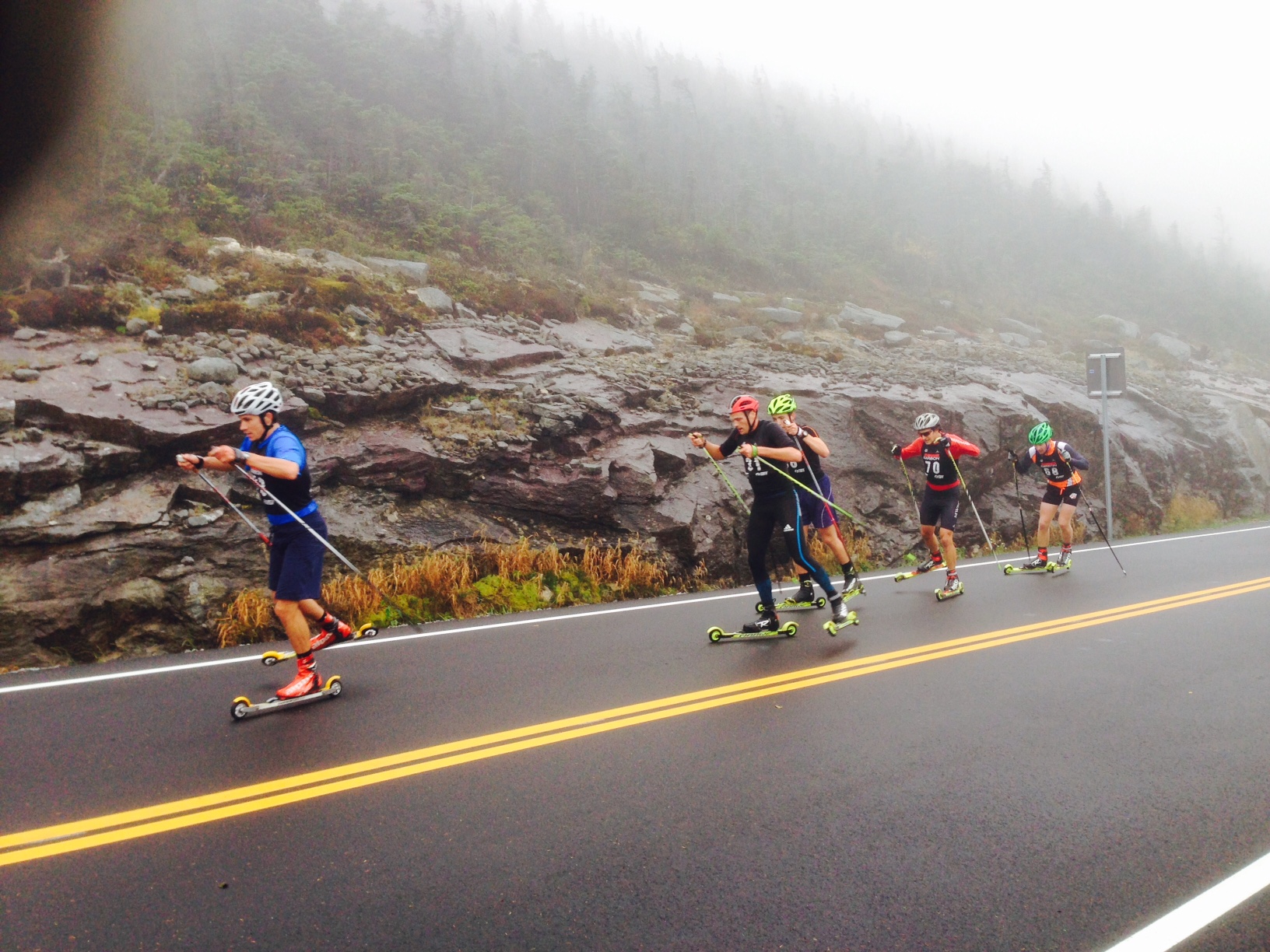
    Blue skies and no snow post-race at the castle atop Whiteface Mountain in Wilmington, N.Y., at the 2017 NYSEF Climb to the Castle on Sept. 24. (Photo: NYSEF)
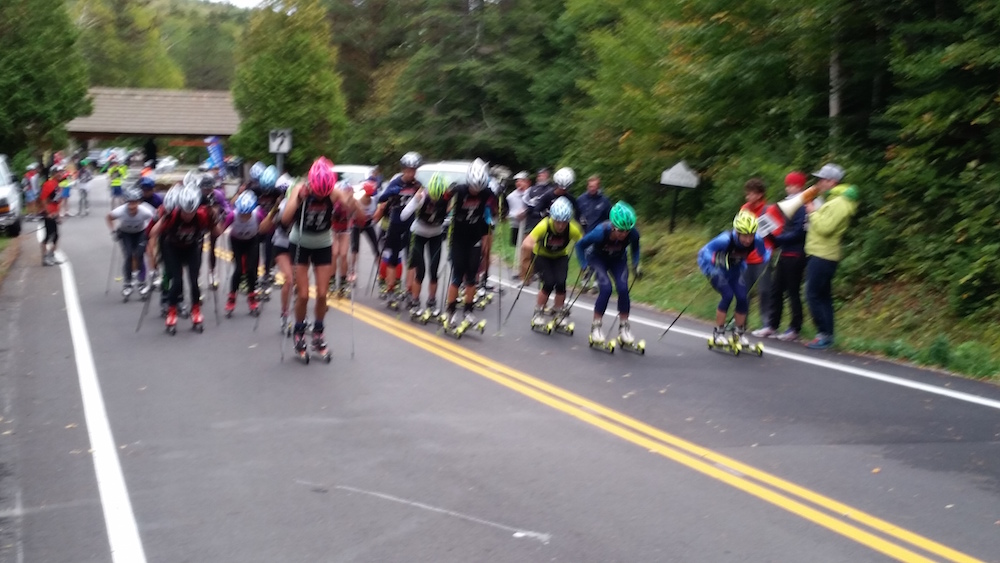
    As for Kealey, a top-level masters racer on the Canada Cup, she had done the race a few times before.

    “Every year I did it, Liz Stephen did it, and it went out really, really fast,” she said of the U.S. Ski Team member who holds the women’s course record of 41:50. “Really hard at the beginning, and then people dropped off, but today’s pace was a good pace.”

    Kealey described wanting to keep a consistent rhythm all the way to the top. She spent much of the race trading off with Bender.

    “And then I managed to get a gap,” Kealey said. “I had a gap on [Bender] almost until the last 800 meters, and then she caught me. She was hurting, but she put the guns on at the last bit and just pulled away. She skied really well.”

    Reflecting on her win, Bender said, “It wasn’t snowing, and it wasn’t freezing, so that was awesome. My V1 has been getting a lot better. It was a small crowd, but I was stoked to feel good for the whole duration. I haven’t done this race in a long time. I did it probably in college, and it’s fun to see the giant progression since then.”

    She explained that she’s been working with US Biathlon in Lake Placid more this summer.

    “I think in the big picture, it’s fun to see that I’m not just a sprinter,” she said.

    On her race plan, Bender said, “The biggest thing, you have to pace it and not go out too crazy. We kind of started splitting up a bit, and I was going back and forth between first and second throughout the race. First with Clare, then with Sheila and then, near the last 200 to 400 meters, that tunnel, which is always so crazy with the wind, we both were like, ‘Oh.’ We were feeling it.”

    “I saw someone coming up behind us,” Bender continued. “I thought it was Clare, I didn’t realize it was Jake. And then I sprinted it in to the finish. I was stoked to get in under 50 minutes.”

    Bender, Egan, Irwin, and Brown all skied on matched Marwe rollerskis that they also used in time trials, Bender said.

    Zoe Williams, the fourth-place woman (+2:18.8) from Nakkertok and Carleton University, said she wasn’t sure what to expect for her first C2C.

    “About 15 minutes in, I kind of all of a sudden realized that it was all uphill,” Williams said. “I was like, ‘Whoa, what have I got myself into?’ But it was fun. I was following Deedra for most of it. I was trying to match her tempo.

    “The last mile was tough because you can see the castle,” she added. “I really wanted to try to stick with the lead pack as long as I could.”

    In the 11th year of the C2C, Margaret Maher, NYSEF’s outgoing head cross-country coach, said this was one of the warmest race days they’ve had.

    “We’ve had every kind of weather possible,” she said. “It’s just fun to see everybody out there getting ready for winter.”

    “It was really a blessing to have this awesome weather,” Brown concluded. “Normally you come up here and [the castle] is in the clouds, even if it’s sunny down low. It’s cool to do something here with NYSEF and show our support from US Biathlon.”

    Results: Men | Women

  • NYSEF Climb to the Castle on Sept. 24

    NYSEF Whiteface Climb to the Castle Rollerski Race

    Sunday, September 24, 2017

    Climb to the top of Whiteface, New York’s 5th highest peak for a 360-degree panoramic view of the Adirondacks, New England and Canada

    NYSEF.org

    REGISTER HERE

    Race notice (PDF)

    REGISTRATION

    • $30 online registration entry fee
      • Online registration at SkiReg.com – closes Friday, September 22 at 5 PM
    • $40 day-of race registration entry fee
      • Day-of race registration from 6:30-7 AM at the Whiteface Toll Booth Bib pick-up from 6:30-7:30 AM at the Whiteface Toll Booth

    START TIMES

    • 8:00 AM Women’s Start (all age groups)
    • 8:10 AM Men’s Start (all age groups)

    Race will be timed for 2 hours

    Competitors not able to finish in this time window will be picked up before the finish

    RACE DIVISIONS

    Women’s and Men’s race divisions for the following age groups: Junior (U16/U18), U20/U23, Senior, Master (30+)

    EQUIPMENT: SAFETY HELMETS ARE REQUIRED!

    All rollerskis must be inspected by competitor and be in proper working order

    COURSE DETAILS

    Freestyle Technique. 5-mile hill climb with an average 8% grade up the Whiteface Memorial Highway. Course: start at the Whiteface Toll Booth in Wilmington and finish at the Castle on the summit of Whiteface Mountain (elevation 4,867 ft)

    Disclaimer: Inclement weather may limit the race distance. Course is closed to rollerskiing before the start. Pre-race warm-up on rollerskis can only occur in a designated area. All post-race cooling down must be done on foot.

    VEHICLE TRAFFIC AND POST-RACE INFO

    Please carpool to the race start, parking will be limited. Whiteface Memorial Highway will be closed to the general public during the race. Coaches and spectators who will be watching the race will be able to drive up and park off the road before 7:50 AM. All traffic must be parked off the road from 7:50-9 AM. There will be no moving traffic allowed during the race. All competitors will be shuttled back to the race start. No athletes will be allowed to ski back down after the race. Competitors may place a bag in the NYSEF van with post-race clothing that will be driven to the finish line.

    AWARDS

    Awards at the Whiteface Castle immediately following the race at 10 AM

    RACE CONTACT

    Margaret Maher margm@nysef.org

    Interested in volunteering? Click here.

  • Climb to the Castle Archive: Top Results from the Last 10 Years

    Climb to the Castle Archive: Top Results from the Last 10 Years

    Liz Stephen celebrates her win and new course record at the 2014 Climb to the Castle. Stephen clocked her fastest time and fifth win at Whiteface Mountain despite a strong headwind and exhaustion at the end of the U.S. Ski Team's training camp in Lake Placid, N.Y.
    Liz Stephen celebrating her win and new course record at the 2014 Climb to the Castle. Stephen has the most women’s wins in 10 years of the Climb, winning five of those races, and also holds the women’s course record.

    For the last decade, the Climb to the Castle has been a fall staple in northeastern New York. It’s been a circled on the calendars of the U.S. Ski Team and US Biathlon national team almost every year since its inception and attracts 75 to 100 no-joke skiers to Wilmington (near Lake Placid, N.Y.) each year.

    Following the 10th annual rollerski race up Whiteface Mountain’s toll road, a five-mile grind with an average 8 percent grade, we thought it would be worth looking at course records and some of the climb’s legendary winners.

    ***

    Most wins: Liz Stephen (5), Duncan Douglas (3)

    Course records: Duncan Douglas (34:56.6) 2007, Liz Stephen (41:50) 2014

    ***

    Paddy Caldwell (black shirt, yellow helmet) of the U.S. Ski Team D-team and SMST2 Team chases Rogan Brown (l) around mile four of five in  Sunday’s Climb to the Castle up Whiteface Mountain in Wilmington, N.Y. Caldwell won the race, followed by biathletes Russell Currier and Tim Burke in second and third, respectively. Brown (SVSEF) placed fourth and Kyle Bratrud (CXC) was fifth. (Photo: Tim Cowan)
    Paddy Caldwell (black shirt, yellow helmet) of the U.S. Ski Team D-team and SMST2 Team chases Rogan Brown (l) around mile four at the 2015 Climb to the Castle. Caldwell won the race, followed by biathletes Russell Currier and Tim Burke in second and third, respectively. Brown (SVSEF) placed fourth and Kyle Bratrud (CXC) was fifth. (Photo: Tim Cowan)

    2007:

    Date: Oct. 13

    Notes: sunny/cold; 25 degrees F

    Men’s top 3:

    1. Duncan Douglas (34:56.6)
    2. Kris Freeman (37:09.1)
    3. Noah Hoffman (38:38.9)

    Women’s top 3:

    1. Liz Stephen (47:22.9)
    2. Morgan Arritola (47:48.8)
    3. Dorcas Wonsavage (49:12.7)

    Complete results


    2008:

    Date: Oct. 6

    Notes: *Shortened course; athletes did not reach summit because of snow.

    Men:

    1. Duncan Douglas (32:26.44*)
    2. Kris Freeman (34:22.90*)
    3. Noah Hoffman (36:56.87*)

    Women:

    1. Caitlin Compton (45:19.91*)
    2. Morgan Arritola (45:27.89*)
    3. Liz Stephen (45:52.83*)

    Results: Men | Women

    Video


    2009: 

    Date: Oct. 7

    Men:

    1. Taylor Fletcher (39:11.54)
    2. Nick Hendrickson (39:25.40)
    3. Kris Freeman (39:49.97)

    Women:

    1. Morgan Arritola (50:54.85)
    2. Liz Stephen (51:09.57)
    3. Ida Sargent (51:23.85)

    Results: Men | Women

    Report | Video


    2010: 

    Date: Oct. 8

    Notes: Clear weather

    Men:

    1. Kris Freeman (38:37)
    2. Noah Hoffman (39:16)
    3. Ben Sim (40:32)

    Women:

    1. Laura Spector (46:58)
    2. Morgan Arritola (48:02)
    3. Liz Stephen (48:43)

    Results: Men | Women

    Women’s report | Men’s video


    2011:

    Date: Sept. 17

    Men:

    1. Kris Freeman (36:18)
    2. Tim Burke (36:29)
    3. Noah Hoffman (37:03)

    Women:

    1. Liz Stephen (44:50)
    2. Ida Sargent (46:14)
    3. Tara Geraghty-Moats (47:43)

    Results: Men | Women

    Womens’ report | Men’s report | Video | Photos


    2012: 

    Date: Sept. 15

    Men:

    1. Tad Elliott (39:28)
    2. Pat O’Brien (39:38)
    3. Julian Dorais (39:46)

    Women:

    1. Liz Stephen (43:33)
    2. Jessie Diggins (48:38)
    3. Ida Sargent (48:55)

    Results: Men | Women

    Women’s report | Men’s report | Notes & Quotes


    2013:

    Date: Sept. 15

    Men:

    1. Tim Burke (37:13)
    2. Simi Hamilton (39:59)
    3. Karl Nygren (40:04)

    Women:

    1. Liz Stephen (42:04)
    2. Caitlin Gregg (45:21)
    3. Ida Sargent (47:19)

    Results: Men | Women

    Report


    2014:

    Date: Sept. 6

    Men:

    1. Tim Burke (38:19)
    2. Russell Currier (39:02)
    3. Welly Ramsey (40:01)

    Women:

    1. Liz Stephen (41:50)
    2. Caitlin Gregg (45:25)
    3. Katharine Ogden (48:12)

    Results: Men | Women

    Report


    2015: 

    Date: Sept. 20

    Men:

    1. Patrick Caldwell (37:05.2)
    2. Russell Currier (37:10.2)
    3. Tim Burke (37:16.7)

    Women:

    1. Mary Rose (45:15.1)
    2. Annelies Cook (45:47.1)
    3. Hannah Dreissigacker (47:21.0)

    Results: Men | Women

    Report


    2016:

    Date: Sept. 18

    Men:

    1. Duncan Douglas (37:15.6)
    2. Russell Currier (37:23.9)
    3. Paul Schommer (40:18.2)

    Women:

    1. Hannah Rieders (55:03.1)
    2. Anna Lehmann (55:18.8)
    3. Madeline Rieders (56:26.4)

    Results: Men | Women

    Report

  • NYSEF Whiteface Climb to the Castle on Sunday, Sept. 18

    NYSEF

    Sunday, September 18, 2016 

    Climb to the top of Whiteface, New York’s 5th highest peak for a 360-degree panoramic view of the Adirondacks, New England and Canada

    WILMINGTON, NY – The New York Ski Educational Foundation and the Olympic Regional Development Authority invite athletes to the NYSEF Whiteface Climb to the Castle Rollerski Race on Sunday, September 18 at 8 AM. The course starts at the Whiteface Toll Booth, climbing for 5 miles with an average 8% grade up the Whiteface Memorial Highway to the castle on the summit of Whiteface Mountain, New York’s 5th highest peak with an elevation of 4,867 ft. The race is freestyle technique and athletes will be greeted at the finish with a 360-degree panoramic view of the Adirondacks, New England and Canada.

    This is the 10 year anniversary!

    Please see PDF with race details

    Link to race registration: SkiReg

    Online registration closes Friday, September 16 at 9 AM

    Click here to sign up to volunteer

    Please email margm@nysef.org with questions

  • Wednesday Workout: L4 Uphill Rollerski Intervals with Mary Rose

    Wednesday Workout: L4 Uphill Rollerski Intervals with Mary Rose

    The Sun Valley Ski Education Foundation (SVSEF) Gold Team hiking down from Mount Mansfield, Vermont's highest peak, in early September. (Photo: Paige Schember)
    The Sun Valley Ski Education Foundation (SVSEF) Gold Team hiking down from Mount Mansfield, Vermont’s highest peak, in early September. (Photo: Paige Schember)

    For this week’s workout, we turned to Mary Rose of the Sun Valley Ski Education Foundation (SVSEF) Gold Team. On Sunday, Rose, 24, won the ninth-annual Climb to the Castle by 32 seconds over US Biathlon’s Annelies Cook. After two weeks of dryland training on the East Coast, first with the Stratton Mountain School (SMS) T2 Team in Vermont, then with the National Elite Group (NEG) and U.S. Ski Team in Lake Placid, N.Y., Rose sent us this workout — Level 4 uphill rollerski intervals — from her travels. 

    ***

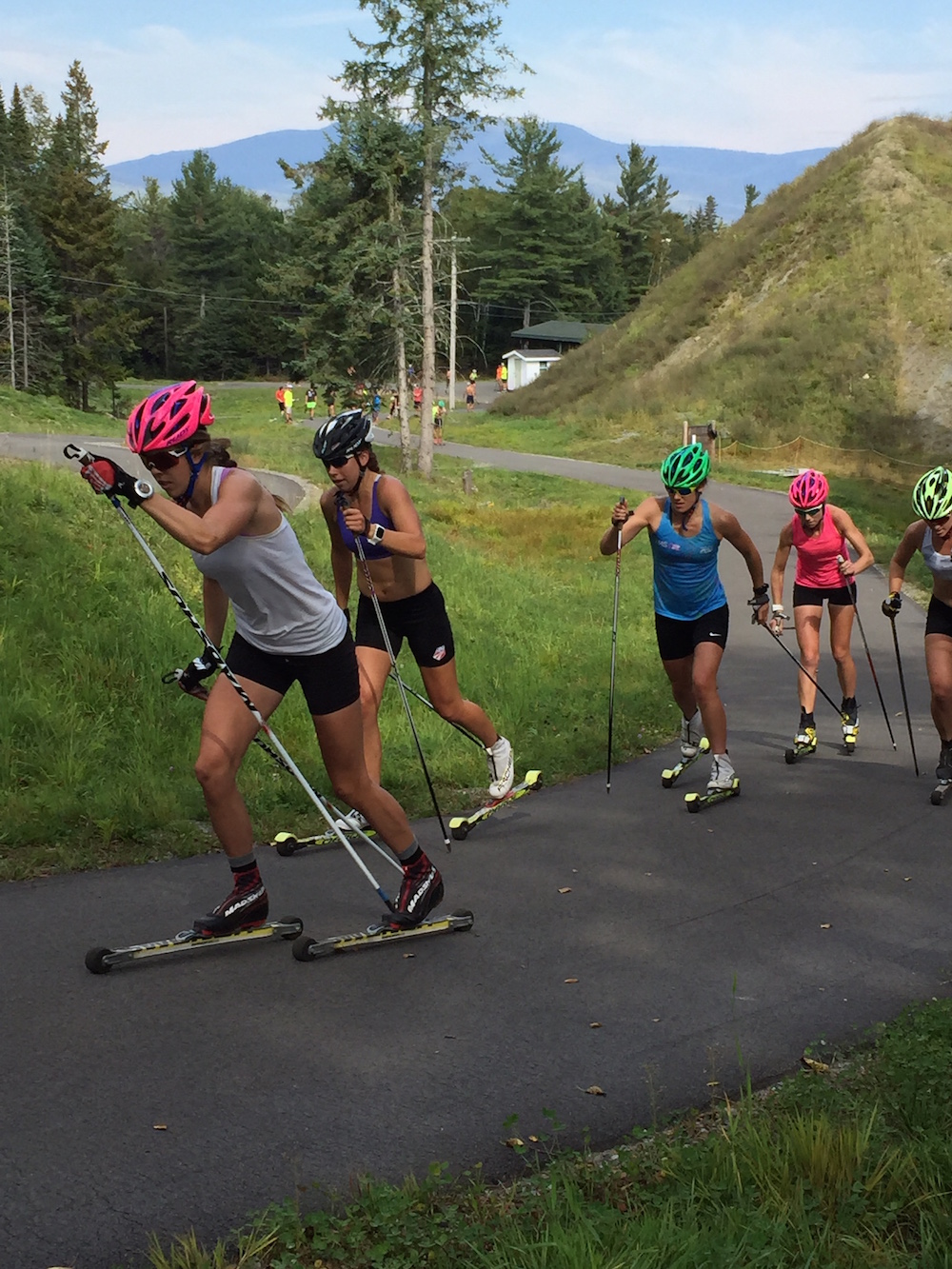
    Sun Valley's Mary Rose (l) leads Katherine Ogden (SMST2/USST), Annie Pokorny (SMST2), Erika Flowers (SMST2), and Paige Schember (SVSEF) during a sprint simulation at the Olympic Jumping Complex rollerski trails in Lake Placid, N.Y. (Photo: Colin Rodgers)
    Sun Valley’s Mary Rose (l) leads Katherine Ogden (SMST2/USST), Annie Pokorny (SMST2), Erika Flowers (SMST2), and Paige Schember (SVSEF) during a sprint simulation at the Olympic Jumping Complex rollerski trails in Lake Placid, N.Y. (Photo: Colin Rodgers)

    Every individual has his or her strengths and weaknesses when it comes to cross-country skiing. It is important to train your weakness because there is usually a lot of room for improvement.

    The Sun Valley SEF Gold Team spent two weeks out East in Stratton, VT and Lake Placid, NY for a low-elevation training block. This camp was extremely productive for all of us because we were able to train some of our weaknesses: speed and pacing at low elevation, and rollerskiing in steep terrain.

    One of the most beneficial workouts during this training block was a Level 4 uphill rollerski interval session. This is a great session if you don’t have a strong V1, are not strong climbing in skate, or if you need to build capacity in your legs. For me, this was an important workout because living in Sun Valley, ID, we lack the super steep, sustained uphill terrain (for rollerskiing) that can be found on the east coast. This is ironic, I know but the roads in Sun Valley are in the bottoms of the valleys and there are not very many of them.

    The Workout: Uphill Rollerski 4-6 x 4 minutes at L4

    Where: Find a location that offers a long uphill climb (8%-10% grade)

    Warmup:

    • Rollerski easy (Level 1) for 20-25 minutes. Start the warmup on rolling terrain and then gradually move onto steeper terrain to get the body used to climbing.
    • Do 5-10 minutes of mobility/stretching exercises, targeting every major part of your body. This part of warmup is important to help get the blood flowing to all parts of your body and to get all the muscles ready to work hard. Think of this as injury prevention!
    • Rollerski easy for an additional 5-10 minutes.
    • During warmup focus on where you can make technique gains and apply that to the workout.

    Now the fun part: 4-6 x 4 minutes at Level 4.

    The first interval should start at threshold (Level 3) or right above it and gradually work into Level 4. Take full recovery (4 minutes) between each interval. Make sure to ski very easy during the recovery. Intervals 2-6 should be at a solid Level 4 the entire time.

    Try to complete at least four intervals, but listen to your body and take a moment to assess where you are at. If you feel completely drained and your technique has taken a turn for the worse or your pace has dropped off, call it a day and cool down.

    Cool down: Should consist of 15-20 minutes of easy skiing.  Once your cool down is complete, you should hydrate, eat and sleep!

    During this workout, I did a total of five intervals and left one in the tank, meaning that I could have done one more quality interval, but I held back due of the amount of intensity sessions I had already done that week and the amount of intensity sessions yet to come.

    You want to feel good for all of the intervals, so remember that before pushing yourself too much. There is no need to do all six intervals if you are feeling tired. In this case, less is more. Important thing to remember is that ALL the intervals should feel great!

    Sun Valley Gold Team members Paige Schember and Mary Rose after the 2015 Climb to the Castle on Sept. 20. (Photo: Mary Rose)
    Sun Valley Gold Team members Paige Schember and Mary Rose after the 2015 Climb to the Castle on Sept. 20. (Photo: Mary Rose)
  • New to the Climb to Castle Winners’ Circle: Caldwell and Rose Top Whiteface Race

    New to the Climb to Castle Winners’ Circle: Caldwell and Rose Top Whiteface Race

    Paddy Caldwell of the U.S. Ski Team D-team and SMST2 Team won Sunday's Climb to the Castle up Whiteface Mountain in Wilmington, N.Y. Here, around mile four of five, he's seen leading the pack, which includes biathletes Russell Currier and Tim Burke, and Rogan Brown (SVSEF) and Kyle Bratrud (CXC). (Photo: Tim Cowan)
    Paddy Caldwell (black shirt, yellow helmet) of the U.S. Ski Team D-team and SMST2 Team chases Rogan Brown (l) around mile four of five in  Sunday’s Climb to the Castle up Whiteface Mountain in Wilmington, N.Y. Caldwell won the race, followed by biathletes Russell Currier and Tim Burke in second and third, respectively. Brown (SVSEF) placed fourth and Kyle Bratrud (CXC) was fifth. (Photo: Tim Cowan)

    Note: Two photo captions have been corrected to reflect the leader of the men’s race around mile four in the 2015 Climb to the Castle. Rogan Brown of Sun Valley led the pack at the time.

    For years, U.S. Nordic Ski Team athletes and their coaches trucked themselves up to the start of the Whiteface Veterans Memorial Highway, clicked into their rollerskis and allowed an ample amount of time for warming up before ascending New York’s fifth highest peak.

    Before it became an official race nine years ago, it was a workout: a five-mile grind to the summit of Whiteface Mountain, 4,867 feet above sea level in Wilmington, N.Y.

    Now, for many top-level skiers, especially those based on the East Coast, the annual Climb to the Castle an offseason staple. And if you win, you get a T-shirt and a medal for your efforts.

    Mary Rose (SVSEF) leads US Biathlon's Annelies Cook up the Whiteface Mountain toll road during the annual Climb to the Castle. Rose won and Cook finished second, 32 seconds later. (Photo: Tim Cowan)
    Mary Rose (SVSEF) leads US Biathlon’s Annelies Cook up the Whiteface Mountain toll road during the annual Climb to the Castle. Rose won and Cook finished second, 32 seconds later. (Photo: Tim Cowan)

    “Climb to the Castle was a blast this year!” wrote women’s winner Mary Rose of Idaho’s Sun Valley Ski Education Foundation (SVSEF) Gold Team. “My goal going into this race was to have good energy the whole time, focus on technique and hopefully put together a good effort.”

    She reached the top on Sunday in 45:15.1 and topped her competition — the closest of which was US Biathlon’s Annelies Cook — by 32.6 seconds.

    “It was a fun, tough effort,” men’s winner Patrick Caldwell of the U.S. Ski Team D-team and Stratton Mountain School (SMS) T2 Team said in an interview after the finish.

    The 21-year-old Caldwell outlasted biathletes Russell Currier and Tim Burke by 5 and 11.5 seconds, respectively. Caldwell won in 37:05.2, Currier was second and Burke was third.

    “Right from the start, we stayed pretty much together against a decent headwind,” Burke said after the finish. “I think a lot of us were fatigued at the end of a big camp, so I didn’t really want to push like crazy.”

    The US Biathlon and U.S. Nordic teams spent at least the last week training in Lake Placid, N.Y., with biathletes like Burke logging five race efforts in nine days preceding the Climb.

    “I decided today instead of going for time, I wanted to go for the win,” said Burke, a defending multiple-time Climb to the Castle (C2C) champion. “So I decided to sit in and push that last half mile.”

    Paddy Caldwell of the U.S. Ski Team D-team won today's Climb to the Castle up Whiteface. Here he's seen around mile 4 leading the pack, which includes veteran biathlete Tim Burke (who placed 3rd). (Photo: Tim Cowan)
    Rogan Brown (l) of Sun Valley leads Tim Burke (second from l) and Paddy Caldwell (third from l) and Russell Currier and Kyle Bratrud around mile four in Sunday’s Climb to the Castle up Whiteface Mountain in Wilmington, N.Y. (Photo: Tim Cowan)

    He said he “did a lot of pulling and got some help towards the end.” Rogan Brown (SVSEF) led around mile four, and Burke explained that five men battled in the lead pack for the last two miles.

    “I broke my pole in the last couple hundred meters, that kind of took me out of it,” he explained.

    Caldwell took the blame what he called an “unfortunate incident” in the final 200 meters. “I broke Tim Burke’s pole,” he said. He did so when Burke made his final attack toward the finish.

    “Aside from that, it was a good, solid race,” Caldwell said.

    “It’s a good way to end it,” Burke said after 10 days of hard training.

    Currier, who placed second, called it an “entertaining race” with five men contending throughout.

    “For a rare change I was able to be on the better side of tactics and consistently stay in the back of the pack,” Currier wrote in an email. “On the other hand, the final 100 meters came up a lot earlier than I expected and didn’t give much time to react. The pace picked up and Tim Burke lost a pole tip. The next thing I knew there was an opening for the lead. I’m not much of a sprinter and didn’t do much to challenge Patrick, but was I was still pleased to break out of the back of the pack just in time for the podium.”

    A former US Biathlon (USBA) B-team member, Currier, who trains with the Maine Winter Sports Center, was not renamed to the team this spring and is working towards making the cut via a series of trials ending in October.

    “The status for the National team is still very unclear,” he wrote. “… All I can do is make the best of every training session and go for better results. The second round of trials is coming up in October. A couple of good enough results there should help my cause for the coming race season.”

    Brown placed fourth in the men’s race, 4.3 seconds from the podium and 15.8 seconds after Caldwell. Brown edged Kyle Bratrud of Central Cross Country (CXC) by 0.3 seconds, and behind them, another CXC skier Duncan Douglas placed sixth.

    USBA’s Sean Doherty and Lowell Bailey finished seventh and eighth, respectively, Miles Havlick (SVSEF) was ninth and developing biathlete Max Durtschi finished 10th of 61 men.

    The start of the women's race at the 2015 Climb to the Castle up Whiteface Mountain in Wilmington, N.Y. (Photo: Peter Minde)
    The start of the women’s race at the 2015 Climb to the Castle up Whiteface Mountain in Wilmington, N.Y. (Photo: Peter Minde)

    In the women’s race, Rose and Cook pushed each other to the top. Rose recalled it being just the two of them shortly after the start. A perennial contender, USBA’s Susan Dunklee had some pole issues at the very beginning, Rose explained in an email.

    “I knew I needed to break away about 1/2 mile to the finish because I can’t beat [Cook] in a sprint,” Rose wrote. “I fought pretty hard through the ‘wind tunnel’ and I think that is where I broke away.”

    Overnight rain left the toll road wet, and wind dried out its lower sections. From about the halfway point to the finish, skiers pushed through mist on wet pavement and faced a steady wind blowing 10 to 20 miles per hour throughout the race. After starting in temperatures around 47 degrees Fahrenheit, they met temperatures in the mid-30’s at the top.

    “It sounds weird to say it aloud, but I actually had fun doing the climb to the castle,” Cook wrote in an email. “Mary and I skied together the entire time and switched leads back and forth. I usually get bored doing the climb and lose focus and switching back and forth with her kept me in the game mentally.

    “She got me at the last turn right before the finish when I suddenly flooded with lactic acid and had no chance,” she added. “But I don’t really think of myself as a climber and so it was fun to be the two people leading the race. That doesn’t happen too often! Of course, the usual suspects were not there and that obviously made it difference.”

    With the exception of Paddy Caldwell, the U.S. Ski Team (USST) skipped the Climb this year for the first time in years.

    “As hard as it is to miss it because it is a fantastic event, it just didn’t play well athletically for the needs of the group,” USST Head Coach Chris Grover said on the phone last week. “We wanted to do more sprint-specific training and short intensity as opposed to giving up a whole workout or two to do the Climb to the Castle.”

    The USST camp was also only a week long, compared to the two weeks the team usually spends in Lake Placid this time of year. On the other hand, the largely Lake-Placid-based US Biathlon team did either time trials or Level 5 (race-pace) workouts for last 10 days.

    “I had my personal best by quite a lot and I felt strong skiing,” Cook said of the Climb. “It felt good to end a really tough ten days on a good note. … I think we are all pretty glad to be done.”

    The Climb marked the end of a two-week training block for Rose and her Sun Valley teammates, who were in Stratton, Vt., with the SMST2 team for the first week.

    “We had some super hard intensity sessions over the past two weeks and all were very productive,” Rose wrote.

    USBA’s Hannah Dreissigacker, who placed third, 2:05.9 after Rose, explained in an email that the women’s race broke up quickly.

    “Mary and Annelies started off a little faster than I really wanted to be going, and I tried to hold on for a bit but then gave up pretty quickly and lost contact,” Dreissigacker wrote. “My goal in the Climb to the Castle is always to not start too fast and then blow up. Then I skied with Susan for a mile or so and then slowly inched ahead of her a bit. Eventually we skied into a cloud and I lost sight of Annelies and Mary and just skied the whole second half by myself.”

    She finished 1:10.9 ahead of Dunklee, who placed fourth, while wearing a figure-skating tutu she wore the first time she did the race.

    “The lacy elbows really allowed for added breathability and the rhinestones gave me some extra motivation on those long hard stretches when I was all alone,” Dreissigacker wrote.

    Another biathlete, Clare Egan finished fifth, Paige Schember (SVSEF) was sixth, Erin Perryman (St. Lawrence University) was seventh, Jackie Garso of the local New York Ski Education Foundation (NYSEF) was eighth, St. Michael’s assistant coach Silke Hynes was ninth, and Stratton U16 skier Anna Lehmann was 10th of 25 women.

    Results: Men | Women

  • Burke, Dunklee Edge Teammates in Whiteface Footrace (with Photo Gallery)

    Burke, Dunklee Edge Teammates in Whiteface Footrace (with Photo Gallery)

    Tim Burke nears the finish of Tuesday's Tim Burke Uphill Run Test at Whiteface in Wilmington, N.Y. He set a new record up the course in 13:21.
    Tim Burke nears the finish of Tuesday’s Tim Burke Uphill Run Test at Whiteface in Wilmington, N.Y. He set a new course record in 13:21.

    WILMINGTON, N.Y. — “You know we do other workouts,” Tim Burke says with a laugh more than halfway up the 4,867-foot Whiteface Mountain. Minutes before, the 32-year-old U.S. biathlete completed his big effort of the day in 13 minutes, 21 seconds, finishing about 1,300 feet higher than he started on Tuesday.

    In doing so, Burke set a new time to beat in the third edition of the Tim Burke Uphill Run Test (TBURT), named after him because he mapped the route a few months earlier. U.S. Biathlon (USBA) teammate Russell Currier was just four seconds off his mark for the second-fastest time on Tuesday, and USBA Talent ID recruit Max Durtschi was another four seconds back in third.

    “This is my second time doing it all out, and it was just as painful as the first,” Burke said near the top of Whiteface’s Face Lift on a 50-degree morning with 100-percent humidity.

    The run ended nearby at the base of the Summit Quad, and while it didn’t rain, the course was muddier than usual with several construction vehicles sharing the trails.

    “This is my second time doing it all out, and it was just as painful as the first.” — Tim Burke on the Tim Burke Uphill Run Test

    “It’s a great climb to get you up to your max heart rate,” he added. “It’s pretty quick and then you have to hold it. It’s not too long so endurance really doesn’t come into play; it’s more of just a max test.”

    Susan Dunklee edged Clare Egan (not shown) by 1 second for the fastest women's time in the Tim Burke Uphill Run Test on Tuesday at Whiteface in Wilmington, N.Y.
    Susan Dunklee edged Clare Egan (not shown) by 1 second for the fastest women’s time in the Tim Burke Uphill Run Test on Tuesday at Whiteface in Wilmington, N.Y.

    Whiteface is New York’s fifth-highest mountain and earlier this month, Burke was the fastest to ascend it on rollerskis in the annual Climb to the Castle.

    In June, aspiring biathletes at the USBA tryout camp ran the route for the first time, with Durtschi posting the best time of 13:56. Five of those athletes returned a couple weeks ago to run it again.

    On Tuesday, 13 athletes at the two-week, USBA national-team camp, between the A, B, development and X teams and Talent ID crew, pushed up it once more.

    “There’s no real variables,” Burke said of the test’s advantages, compared to say, rollerskiing, which can be affected by temperatures and different ski speeds. “Today, it was a little bit muddier than it was in the past, but I don’t think it really slowed the times down.”

    To the surprise of four USBA coaches present, everybody’s time was faster.

    “I was expecting it to be slower since the conditions seemed slippery and soft, but just really happy to see that,” development coach Jean Paquet said. “That means the training is going well. Before this week we had a pretty heavy week, so we don’t know how the athletes are going to respond to that.”

    Camp started Sept. 8 with a week of high-intensity training, including a rollerski time trial last Friday. Considering that, women’s coach Jonne Kähkönen, who heads up the team’s Lake Placid training, said he was interested to see how the uphill run would go.

    “As soon as I saw them starting the time trial [on Tuesday], I thought, it will be another good one,” Kähkönen reflected. “It’s been tough for sure, not too long per session, but several sessions every other day in a short block.”

    “As soon as I saw them starting the time trial, I thought, it will be another good one.” — U.S. Biathlon Women’s Coach Jonne Kähkönen

    The top woman, Susan Dunklee started 30 seconds behind development skier Clare Egan and edged her by 1 second, setting a women’s record in 15:43. Another A-team skier, Annelies Cook was third fastest in 17:09. Hannah Dreissigacker did not race, ski walking to the top instead because of a recent back injury, which Kähkönen described as a possible pinched nerve between her shoulder blades.

    “We’ve been taking gradual steps to get her back to 100 percent,” he explained.

    As for Burke, the defending king of the mountain in multiple disciplines, he said he’s feeling good and pleased with his summer results despite some changes to his normal training. Most notably, he’s been trying to boost his speed.

    “In the past, my intensity efforts weren’t quite as hard and I started to see that definitely my biggest strengths in skiing were the 20 k, the 15 k; I really like doing hill climbs and stuff like that, sustained, longer efforts,” he explained. “I was struggling a little bit in the sprints, I felt like, as I got older. The sprint is so important in biathlon because you have the pursuit after that. This year I wanted to focus on getting my 10 k down a bit.

    “It’s been really exciting for me to try some different things and try different ideas that I had for a while,” he said. “I basically had used very similar periodization in my training in the last eight years … but this year I totally started from scratch with my periodization. So I’m doing my intensities more in a block format and my endurance weeks are a lot bigger than they used to be in a short period of time.

    “It’s less consistent throughout the year, and if I’m doing intensity, I’m doing a lot of it and really hard efforts.”

    Coming off an intensity week, he viewed the TBURT as another good marker.

    “This is something we’ll have consistent from year to year, and it’s also a great way to test some of the younger guys to see what kind of capacity they have,” he said.

    The U.S. Biathlon team next heads to Park City, Utah, for another two-week camp in late September/early October. That will also be open to the western-based Talent ID recruits, and the national team will be back in Lake Placid before its final IBU World Cup rollerski trials Oct. 25-26 in Jericho, Vt.

    Unofficial TBURT results (Sept. 16):

    Men

    1. Tim Burke (A Team) 13:21
    2. Russell Currier (B Team) 13:25
    3. Max Durtschi (Talent ID) 13:29
    4. Sean Doherty (X Team) 13:50
    5. Lowell Bailey (A Team) 14:30
    6. Leif Nordgren (A Team) 14:34
    7. Brian Halligan (Development Group) 15:47
    8. Casey Smith (B Team) 15:55

    Women

    1. Susan Dunklee (A Team) 15:43
    2. Clare Egan (Development Group) 15:44
    3. Annelies Cook (A Team) 17:09
    4. Kelsey Dickinson (Talent ID) 18:26
    5. Maddie Phaneuf (X Team) 19:37
  • Wednesday Workout: U.S. Biathlon’s Tim Burke Uphill Run Test

    Wednesday Workout: U.S. Biathlon’s Tim Burke Uphill Run Test

    Patrick Johnson (Far West) was second fastest on the Tim Burke Uphill Run Test, held Tuesday at Whiteface Mountain in Wilmington, N.Y. He was just a second behind winner Max Durtschi.
    Patrick Johnson (Far West) was second fastest in the Tim Burke Uphill Run Test, held Tuesday at Whiteface Mountain in Wilmington, N.Y. He was just a second behind winner Max Durtschi.

    WILMINGTON, N.Y. — Go out and find a hill, a mountain even — something with a steep, sustained pitch that goes on about 2 1/2 kilometers. Those were the instructions Bernd Eisenbichler, U.S. Biathlon chief of sport, more or less gave to team veteran Tim Burke, who grew up in nearby Paul Smiths, N.Y., just a short drive away from Whiteface Mountain.

    While Burke mostly cut his teeth on the local cross-country terrain around Lake Placid, rather than the alpine slopes of Whiteface, he knew one dirt road that followed a couple ski trails backwards up the mountain. And it wan’t easy.

    Legend has it that Burke, 32, ascended the climb — from the beginner-run Kids Kampus up to Easy Street and Easy Way — in 17 minutes at Level 3 (not quite race pace). The hill climb ended just above the Whiteface’s Face Lift, halfway up the 4,867-foot mountain.

    Erika Flowers racing to the fastest women's time in the inaugural Tim Burke Uphill Run Test at Whiteface Mountain.
    Erika Flowers racing to the fastest women’s time in the inaugural Tim Burke Uphill Run Test at Whiteface Mountain.

    Trail names aside, the route was settled. It would become the new standard for the U.S. Biathlon Association (USBA) in its dryland camps throughout the summer. Eisenbichler dubbed it “The Tim Burke Uphill Run Test” and sent 11 athletes up it for the first time at race pace on Tuesday, the second day of the USBA Talent ID Recruiting Camp. Max Durtschi (Dartmouth) and Erika Flowers (Stratton Mountain School T2 Team) posted the fastest male and female times of 13:56 and 17:54, respectively. So much for Burke’s record.

    Eisenbichler was quick to explain that Burke hadn’t actually raced it yet.

    “He for sure would be faster to be honest, but they did a really good job, too, today,” Eisenbichler said.

    “We were really happy to see the tempos on the men’s and women’s side,” he added. “We call it Tim Burke because I asked him to scope a good uphill, gave him the time frame and the kilometer frame and I think he did a great job finding this track. From now on this will be our testing track.

    “In Germany we have fixed times from 30 years ago,” said Eisenbichler, who lives in Munich. “It’s just fun, you know, when you were growing up an athlete and you can see the times from Peter [Angerer], an Olympic champion in ’84, and Mark Kirchner, an Olympic champion in ’92, and try to beat them or try to get challenged by them.”

    So try it yourself — either by following the orange spray-paint arrows up Whiteface’s winding trail  — or pick a mountain or large hill of your own that takes about 30 minutes to hike. Shoot for steep enough terrain that’s going to require 13-23 minutes of running, depending on the athlete.

    With the help of new men’s national-team coach Jonas Johansson and Erik Lewish, assistant coach at the Lake Placid high-performance center, Eisenbichler started the athletes off in 30-second intervals. Johansson gave splits at roughly halfway and Lewish logged the finishing times.

    Durtschi, a former professional cyclist (for three different teams, including Garmin-Cervelo and Leopard-Trek) and member of the U.S. national cycling team, set a new Whiteface standard in just under 14 minutes, just a second ahead of Far West skier Patrick Johnson. Durtschi started off nordic skiing, and like 10 other athletes at the USBA tryout camp, he’s now considering a career in biathlon.

    “It hurt,” said Durtschi, a Dartmouth junior from Ketchum, Idaho. “I haven’t run much at all in the last five years because I’ve been cycling and you’re not even supposed to really walk in cycling. It was really humid, which I’m not quite used to from the high desert, but it was a nice effort and it feels good to blow out the legs and lungs sometimes.”

    Dartmouth neuroscience major Max Durtschi on his way to winning the inaugural Tim Burke Uphill Run Test at Whiteface Mountain.
    Dartmouth neuroscience major Max Durtschi on his way to winning the inaugural Tim Burke Uphill Run Test at Whiteface Mountain.

    Eisenbichler explained that the 11 athletes were selected from 28 applicants, and that an undetermined number of them will be invited back for Lake Placid for a follow-up Talent Group Camp from August 24-31. From there, those athletes will be named to either USBA’s development or X teams.

    “It’s not about the shooting part so much … it’s introducing to biathlon,” he said of the four-day camp, which includes everything from a 30-meter run to a SkiErg 7-8 minute test as well as interviews to gauge each athlete’s attitude toward the sport.

    “What we for sure look at, the uphill run is important, is endurance,” he added. “We have a shuttle run tomorrow, that gives you a little bit of an idea about the engine, then for sure we look a lot at technique. Coaches will be out skiing with different athletes and see how they are on skis … and then it’s a combination of things, looking at the flexibility and strengths.”

    And if an athlete doesn’t make the cut, they’re not going to be sent home empty handed.

    “They all will get recommendations for their training, they will get all their tests analyzed … I think everybody, even if they’re not willing to change to biathlon, should get something out of this week,” Eisenbichler said. “They have the chance to come back next year for the same thing and it’s not that if we don’t select them for this next camp that we lose sight of them. If they want to change to biathlon we will try to help them connect with a club, connect with a coach and supervise them too, because there should be sustainability about it.”

    The faces of the U.S. Biathlon Talent ID Recruiting Camp together on Whiteface Mountain after completing a 2.5 k Uphill Run Test named after Tim Burke (not pictured), who mapped the course. From left to right: (back row) Paul Schommer, Casey Shannon, Paul Everett, Luke Brown, Patrick Johnson, Max Durtschi, (front) Elizabeth Izzo, Greta Anderson, Erika Flowers,  Kelsey Dickinson, and Elizabeth Guiney.
    The faces of the U.S. Biathlon Talent ID Recruiting Camp together on Whiteface Mountain after completing a 2.5 k Uphill Run Test named after Tim Burke (not pictured), who mapped the course. From left to right: (back row) Paul Schommer, Casey Shannon, Paul Everett, Luke Brown, Patrick Johnson, Max Durtschi,  Elizabeth Guiney, (front) Elizabeth Izzo, Greta Anderson, Erika Flowers, and Kelsey Dickinson.
    End of the Tim Burke Uphill Run Test at the US Biathlon Talent ID Recruiting Camp in Lake Placid.
    End of the Tim Burke Uphill Run Test at the US Biathlon Talent ID Recruiting Camp in Lake Placid.


  • NYSEF Climb to the Castle Rollerski Race

    C2C_logo_2013Sunday, September 15, 2013

    WILMINGTON, NY — The New York Ski Educational Foundation and the Olympic Regional Development Authority host the 7th annual NYSEF Whiteface Climb to the Castle Rollerski Race on Sunday, September 15 at 8:00 am. The course starts at the Whiteface Toll Booth, climbing for 5 miles with an average 8% grade up the Whiteface Memorial Highway to the castle on the summit of Whiteface Mountain, New York’s 5th highest peak with an elevation of 4,867 ft. The race is freestyle technique and athletes will be greeted at the finish with a 360-degree panoramic view of the Adirondacks, New England and Canada. Attendance is expected from the US Ski Team, the US Biathlon Team, the National Elite Group and many top senior and junior racers from around the country.

    See the attached flyer for race details

    Link to online registration (closes Friday 9/13 at 9 am ): https://www.alpinereg.com/EVENTS/store/XC.cfm

    Check out the NYSEF XC webpage for updates: http://www.nysef.org/x-c-biathlon/
    Questions? Email Margaret Maher margm@nysef.org or call the Nordic office at (518) 523-1900


    Climb to the Castle flyer 2013

  • Bounding Up Whiteface: Video from USST Elite Camp (Updated with Quotes)

    Bounding Up Whiteface: Video from USST Elite Camp (Updated with Quotes)

    About 25 elite nordic skiers did maximal-intensity, ski-bounding intervals up Whiteface Mountain on Tuesday as part of the U.S. Ski Team Elite Camp in Lake Placid, N.Y.

    WILMINGTON, N.Y. — The view from partially up Whiteface Mountain on Wednesday morning was about as picturesque as they get. From the trail, one could see that the leaves had started to turn shades of red and yellow — just in time for the U.S. Ski Team’s fall training camp in Lake Placid, N.Y.

    Way down below, a few small dots proceeded up the dirt access road: first to warm up, then to get after it. US Ski Team Head Coach Chris Grover organized the maximal-intensity, ski-bounding interval workout for about 25 athletes, and said it was probably the toughest many had done this training season.

    “Typically what we’re doing in the fall is switching gears from kind of our base anaerobic phase in training, where we’re concentrating more on is distance and technique acquisition, and now starting to work a little bit more poignantly with developing the athletes’ VO2 max,” Grover said. “You probably heard comments from athletes who said this was the first session of quite hard bounding that they’ve done this season. A lot of these guys have done quite a bit of threshold-type bounding, but they haven’t done short, hard bounding like that. It’s intended to develop their maximal aerobic capacity.

    “So that’s what we’re going for,” he added. “It’s the beginning of September, kicking it into a little bit more intensity mode. Obviously during the camp, we have some more hard workouts coming up, including the Climb to the Castle [on Saturday], the sprint rollerski time trial, as well as some threshold sessions. Just trying to start into a little bit more hard training.”

    Click here for a photo gallery

    More quotes from the US Ski Team:

    Head Coach Chris Grover: 

    “We saw some great performances [today] out of individual athletes, both national-team athletes and club athletes, but it’s definitely early in the season and we won’t get the real measuring stick until we get to Muonio [Finland], get to Gällivare [Sweden] in the fall and see how these guys stack up.

    “This is the point of the year where I think everyone around the world is looking around going, ‘Oh yeah, these guys have made great progress through the summer,’ but it’s easy to forget that probably everybody in the world has made good progress through the summer. It’s kind of hard to take away from this particular workout except for particular technique changes, perhaps, that someone’s made, that they’re maintaining their form through the bounding sessions, for example. And if they’re mature enough to learn to really pace it well so that they’re still there at the end.”

    How did each athlete decide whether to do five or seven intervals?

    “Each of these guys is pretty much talking with their individual coach about what they should be doing right now and kind of what their training history has been over the summer, how old they are, and particularly what they’ve done over the last couple of weeks. Some athletes have come in with a good rest week, for example, and they’re ready to do the full-prescribed seven [intervals]. Others are coming off a little bigger training block, for example, and they’ve got to kind of work their way into camp a little slower.”

    Andy Newell: 

    “I felt good. I always try to pace this workout well. It’s one of the harder ones we do at the camp, I think, as far as how much it takes out of your body. It kills my legs usually. But these are the kind of workouts that really you make lot of gains in building VO2 max. We haven’t done a ton of them so far this year, so for me I try to build into them so I can make the last few intervals hard. But it’s a long camp so we try not to blow ourselves out too much.”

    How did you like doing the intervals with about 15 others, including some up-and-comers pushing to lead the pack?

    “I like that. Some people don’t like training with a big group, but I think it’s sweet. I think the more people you have out, the better for an interval session. It’s funny, some of the young guns come to the front and go really hard on one, and they’re dead two intervals later. I was that same guy probably five or six years ago back when I was coming to these camps, too. So it’s cool to see these younger guys go out and hammer in front.”

    Jessie Diggins:

    “At the start of the workout I wasn’t feeling that great. It wasn’t the worst workout, definitely not the worst, but I wasn’t feeling the very best. It took me a while to warm into it and on the last three it started feeling really good, which is nice. I’m still trying to experiment with when beforehand I should take my inhaler. … I’m getting closer and closer to make it kick in when I want it.

    “When you do these intervals, it’s super, super important to not dig yourself into a huge hole, but once in a while it’s really good to figure out exactly where your limits are and know what it feels like right before you hit the wall, and I found that 30 seconds before I was done today so that was really nice.”

    Tad Elliott:

    How was your summer?

    “I’ve had a great summer out in Park City, [Utah]. I’ve been there pretty much all summer and then, just to Europe and back really quick [for a USST men’s camp in Austria and Germany]. It’s really nice to have my old coach Jason Cork back [as] the U.S. Ski Team men’s coach. He trains with me every day and we hang out, so training’s been going really well and it’s fun to have him around, too. Things are going awesome.”

    What kind of training changes have you made?

    “Ski training. I’ve been ski training a lot more, haven’t been mountain biking as much and a lot more strength, too, this year with our coach Michael [Naperalsky] at the COE. A lot more bounding, a lot more running, and yeah, less biking.”

    What are some of the bigger mountain bike races you’ve done this year?

    “I did nationals and that went all right. I was still solid when I came on the last lap, but nowhere near as well as I did last year. I think it’s all this muscle I’ve gained in my upper body, can’t carve as fast. I was 14th this year, sixth last year [in my first two years in the elite field].”

    What was it like watching mountain biking at the Olympics?

    “Man, the Olympics was awesome. Todd [Wells] is one of my good friends back in Durango. My dog, Gus, and his dog, Winston, have little man crushes on each other so we always go on play dates together with Todd, and I play golf with him. It was really fun to see him get a 10th place in his final Olympics [the best U.S. men’s result in Olympic history]. That was really cool. And then I’m good friends with Georgia [Gould], got to talk to her at nationals; she came home with some hardware [as the second U.S. mountain biker to ever win Olympic bronze] so that was sweet.”

    Ida Sargent:

    How was your summer?

    It’s been great. I was in Craftsbury [Vermont] for basically the whole summer, except for our camp in Sweden, so it’s been good to be home and in one place for a while.

    What have you been working on, and what did you learn from your first season on the World Cup?

    “More hard training and keeping some consistency with the gains that I made last year and a lot of technique stuff, too. … It was tough to race the full season on the World Cup. I was pretty tired at the end of the year after having been on the road and traveling and racing the World Cup every weekend, so that was a great experience. This year I’m looking forward to building on that and returning to some of the same venues and having a little more familiarity with the whole scene, just ready to improve my results with that extra experience.”

    What would you say your strengths are?

    “I think sprinting is my strength, so this year I’m going to try to focus a little bit more on [that], but I would love to be a really good distance skier, too, so I don’t consider myself a sprinter. I want to be in the points in the distance races as well. It’s great to do training camps with Jessie, and Liz will be here later this week, and these other girls, too, to kind of improve my distance skills, too.”

    How was your joint camp with the Swedish women’s national team in Sweden?

    “It was good. We trained a ton. It was a lot of hard work, a lot of hours, but it was cool to see that they weren’t doing anything different than us, and we could hang with those guys and train with them. It was just a good confidence builder that our team’s really on the right track and building momentum also.”

  • On Fourth Attempt, Freeman Finally Gets a Win on Whiteface

    On Fourth Attempt, Freeman Finally Gets a Win on Whiteface

    Kris Freeman (USST) on his way to victory

    It took him four tries, but the U.S. Ski Team’s Kris Freeman can add a victory at the Whiteface Climb to the Castle to his list of accomplishments.

    “I finally won the Climb to the Castle!” Freeman said.

    Stymied in three previous attempts by inferior competition with superior rollerskis, Freeman left his teammate Noah Hoffman behind at halfway mark of this year’s edition of the five-mile race, skiing unchallenged to a 39-second victory. Ben Sim, the aspiring Australian nordic combined skier, rounded out the podium another minute back.

    It was only Freeman’s second race effort against a quality field since a disappointing performance at the 2010 Winter Olympic Games in Vancouver, where bad skis and complications from diabetes kept him from cracking the top 40 in three competitions. But he showed Friday that he hasn’t lost much ground, topping Hoffman by roughly the same margin he did last year.

    Noah Hoffman (USST) brings it home

    The two broke away quickly from a deep group of men, including Sim, nordic combined World Championship medalists Billy Demong and Todd Lodwick, U.S. 50 k national champion Tad Elliott, and the U.S. Ski Team’s Andy Newell.

    The pace was relaxed at the start, but Freeman said that he had no desire to fight a stiff breeze alone all the way to the top.

    “I knew I didn’t want to lead the whole way into a headwind, so I said, ‘hey, Hoff, you want to work together and break this thing open?’” Freeman said afterwards.

    Hoffman, one of the country’s best climbers, traded pulls with Freeman for roughly a mile before he was felled by an acceleration.

    “I was hoping to be able to stick with [Freeman] a little longer…but he’s obviously a world-class skier,” Hoffman said.

    The gap between the two athletes didn’t grow after the three-mile mark, but Freeman’s steady pace kept Hoffman from clawing back much of the deficit. The wind was relentless, refusing to let the athletes relax.

    “It was rough windy coming into [the] finish—just about a standstill,” Freeman said. “Any time you tried to glide, you just stopped, so I was just going as high-tempo as I could muster.”

    Behind Freeman and Hoffman, the final spot on the podium came down to a battle between Sim and CXC’s Tad Elliott.

    Sim was in Lake Placid for a camp with the American nordic combined team, and he had topped that group in an uphill time trial earlier in the week. After competing in the 2010 Olympics as a cross-country skier for Australia, he’s now trying to make the jump to nordic combined.

    Coming off a season of racing in the Australian winter, Sim had just enough gas to catch and pass Elliott, who is making his own transition to dryland training after racing mountain bikes professionally through the summer.

    Aiden Lennie, a Canadian U-23 who trains with the Nakkertok Nordic club in Ottawa, took fifth place, aided by a blazing fast pair of Ski Skett Shark rollerskis. After breaking a pole tip at the start and making more than one switch to find a replacement, U.S. Ski Team sprinter Andy Newell nearly caught.Lennie at the finish, but ran out of road.

    Complete Results

    Men's Start