From the FasterSkier archive — posts syndicated from athletes’ and coaches’ own blogs between 2004 and 2012, kept online as published. Current coverage is at fasterskier.com.
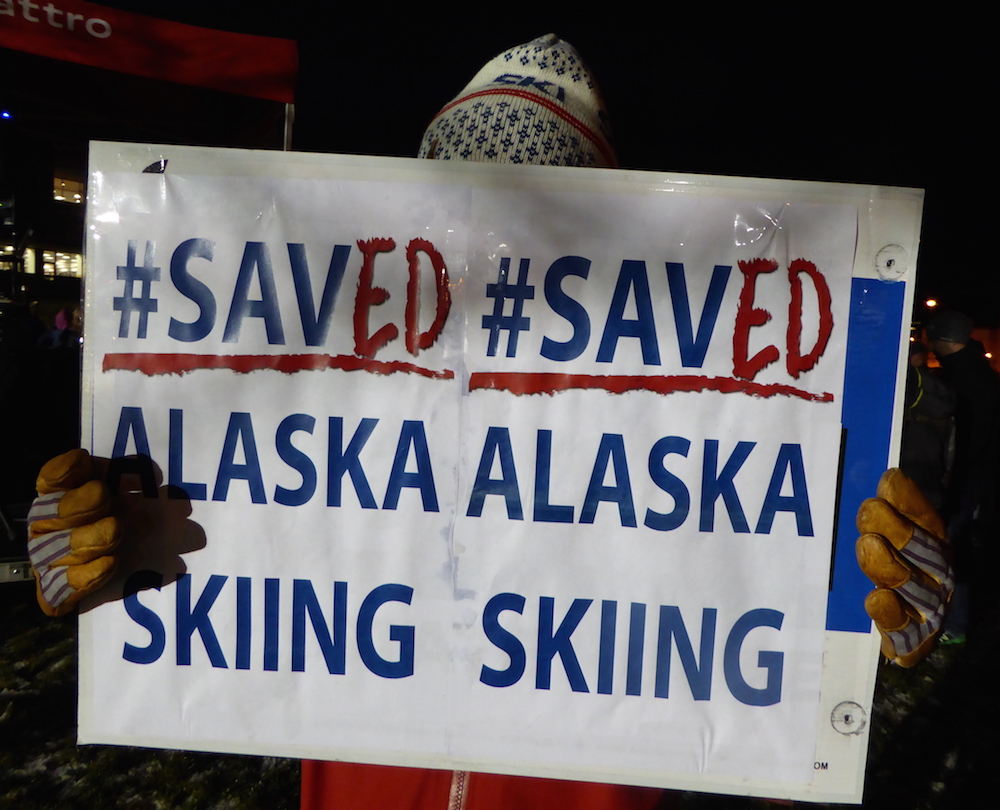
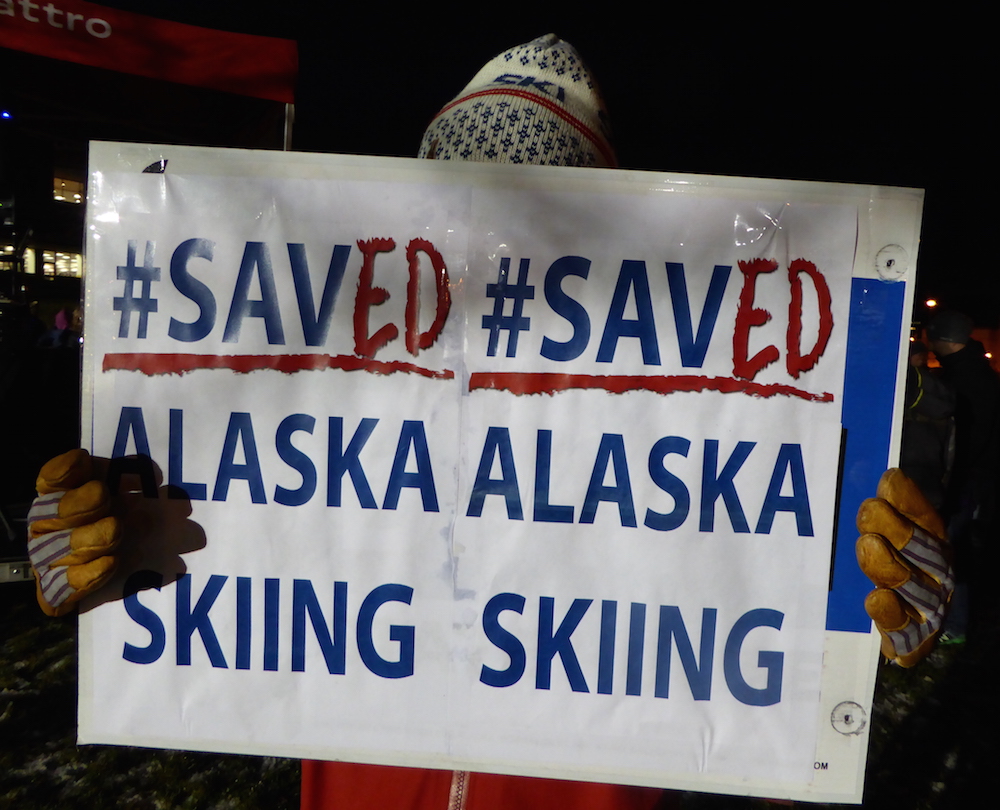
A supporter holds an updated sign at the #savealaskaskiing rally in Anchorage, Alaska, on Nov. 10. (Photo: Gavin Kentch)
ANCHORAGE, Alaska – Thursday morning, University of Alaska (UA) President Jim Johnsen announced that the NCAA had declined to reach the school’s waiver request that could have led to the end of NCAA skiing in both Anchorage and Fairbanks. Thursday afternoon, the UA Board of Regents officially voted to support the president’s recommendation to leave both schools’ athletics teams intact.
Thursday evening, it was time to celebrate. The previously scheduled #savealaskaskiing rally in Midtown Anchorage quickly became rebranded as something more jubilant. The food trucks were still there, the DJ was still there, and the supporters were still there, a cross section of the Alaska skiing community past and present. But the mood was suddenly upbeat rather than funereal.
The Alaska Dispatch News reported that a crowd of “about 250” gathered on the lawn outside the Anchorage public library. FasterSkier estimates the crowd size as closer to one third of that. But no matter their numbers, they were there, and they were happy.
“This is a huge relief for all of us [on the University of Alaska Anchorage (UAA) ski team],” said Charley Field, a junior alpine skier from Pemberton, B.C., addressing the rally. “I’ve never felt so relieved.”
Field recounted that she had applied to only a single school, UAA, when making a college choice, and was thrilled to be able to continue there. “I’ve always wanted to graduate as a Seawolf,” Field said.
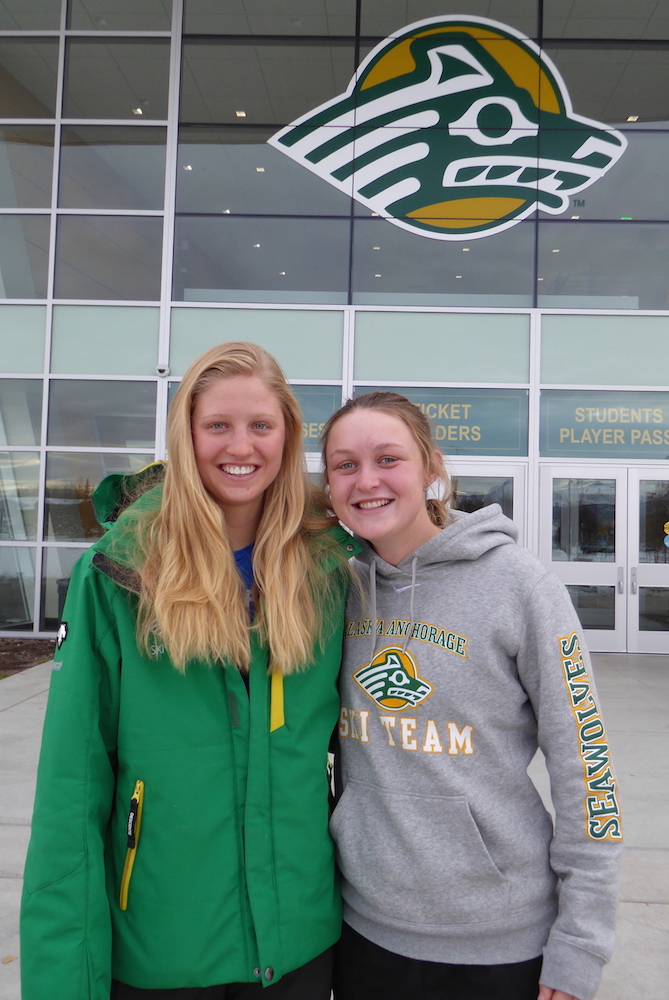
UAA skiers Hailey Swirbul (l) and Casey Wright (r), photographed on the UAA campus in Anchorage, Alaska, in October 2016. (Photo: Gavin Kentch)
Another athlete, nordic skier Casey Wright, also spoke. The junior skier and Australian national had been defiant even in the face of adversity, telling FasterSkier two weeks ago – the day after news first broke of the ski team’s apparent demise – that “we’re going to rally together, and we’re going to have a memorable season.”
Wright was happier at the rally, but no less confident. “We’re all going to try our absolute best to kick some butt” this year, she told the crowd, “and show everyone what it means to be a Skiwolf.”
A common theme among all the speakers was heartfelt gratitude at the groundswell of support from across the state and around the world.
“I can’t say thank you enough to all the people who wrote letters and signed the petition,” Field said. “We’re so blessed.”
The UAA ski team released a video earlier Thursday thanking supporters for their help.
André Horton, an Anchorage native, former member of the U.S. Alpine Ski Team and one of the guiding forces behind the formal #savealaskaskiing movement, expressed similar sentiments.
“At one point yesterday,” Horton said, “the Board of Regents was getting one email [from #savealaskaskiing supporters] every two minutes. … I think if I were them, I would be uninstalling Outlook right now.”
Horton audibly choked up as he addressed the assembled crowd. “They say there’s a rivalry,” Horton said, in reference to perhaps exaggerated antagonism between Anchorage and Fairbanks, “but when someone threatens our sport, we all pull together.”
(A contemporaneous march in Fairbanks also featured strong turnout, including at least one marcher dressed as a polar bear in homage to the University of Alaska Fairbanks mascot, the Nanooks.)
Another speaker, Anchorage’s Holly Brooks, echoed Horton’s reaction to the rapid rise of #savealaskaskiing.
“It’s amazing how fast this community came together,” Brooks said from stage. The sheer numbers of people who signed the petition (over 5,000 as of Thursday evening) show “how amazing this small ski team is.”
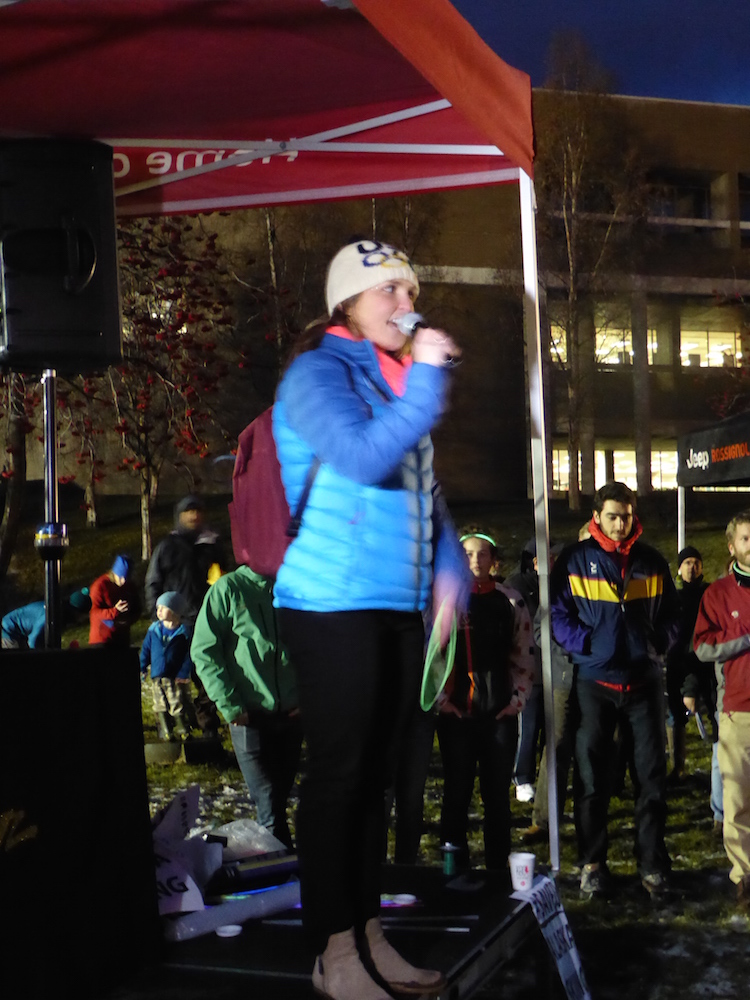
Former Whitman College and USST skier Holly Brooks addresses the crowd at the #savealaskaskiing rally. (Photo: Gavin Kentch)
Brooks attended Whitman College in the early 2000s, and skied collegiately there. But the Whitman ski program was cut a few years after she graduated. “That pulled at my heartstrings,” Brooks recounted, “and I wanted that not to happen again.”
Brooks recounted that if she hadn’t skied in college, she wouldn’t have come to Alaska, wouldn’t have coached high school skiing, let alone for Alaska Pacific University, and never would have made two Olympic teams. NCAA skiing was very important to her in her journey to the Olympics, Brooks said, her relatively lackluster results as a college racer notwithstanding.
“It was a really important time for me, even though it was not my fastest time as a skier.”
Current UAA skier Hannah Rudd, a freshman from Plymouth, Minn., is working on becoming a faster skier right now.
“Right now, we’re just really focusing,” Rudd told FasterSkier in an in-person interview when asked about the current priorities of the nordic team. “We’re getting into a lot of intensity right now. For sure, we’re going to keep on fighting for the team, but we are really focusing on our skiing and trying to have the best year that we can possibly have, so we can really prove ourselves.”
Recounting recent events, Rudd said, “This whole last week has been quite, like, an emotional rollercoaster. But we woke up this morning, just thinking it was a regular day. We went to practice, and we could see, like, a big smile on our coach’s face, and he was like, ‘We have been saved!’ And it was one of the most exciting things that has happened.”
Rudd said that it had been “amazing” to see 5,000 people sign a petition and stand up for college skiing in Alaska. “I come from Minnesota,” Rudd said, “where it’s a pretty big ski community, but Alaska – the ski community is just phenomenal. It’s been just so good to hear everyone’s responses and support. It feels good to have someone behind us.”
Charlie Renfro, a lifelong Alaskan and former UAA skier, helped to organize the #savealaskaskiing movement and provide an avenue for that support. He was unapologetic about doing all this work even when college skiing – even in Alaska – typically suffers from a low profile within the American ski community.
“I think it’s just really important to this community to have skiing be really visible,” Renfro told FasterSkier in person. “We’re a winter city, Fairbanks is a winter city, we believe in skiing. I think as long as there’s snow on the ground here, and as long as people are recreating outside, I think skiing needs to be represented at the university.”
Renfro was optimistic about the next steps for this cause.
“I think just figuring out how to harness this momentum that we’ve got going [will be the next challenge],” Renfro said, “and to be able to really get this group of people that’s supporting skiing to be able to reach out and fund the cause monetarily. And we’re not totally sure how we’re going to do it yet, but we’re just really happy that we’ve been able to unify, and hopefully moving forward we’ll be able to mobilize monetarily like we have for this.”
Horton sounded similar notes, in an in-person interview before the rally, when asked what happens next year.
“That is a 50-million dollar question,” Horton said, referring to the total amount cut from UAA’s budget this year alone.
UAA assistant nordic coach Sara Studebaker-Hall (center, white hat) at the #savealaskaskiing rally. Former UAA skier and current USST member Sadie Bjornsen (pink jacket) is to her left. (Photo: Gavin Kentch)
“I think today’s success was very exciting for the community, yes, but I told everyone it should be a scaled success,” Horton said. “Meaning, we know cuts are going to be inevitable in the future. But what this has done is it’s galvanized very disparate communities of skiers all into one group. So I think, going into the future, we’re going to have a unified group of people able to make corrections in our spending, so that we can actually afford skiing the way we should.”
Horton also addressed the question he had occasionally received over the past few weeks – why did someone who didn’t even ski for UAA care about this program?
Horton’s answer was instantly relatable to any nordic skier who has ever pored over a USSA points list or sought out an event with a more favorable race penalty: “I’m very thankful, because I would have never made the national team [without UAA], because I utilized UAA’s points base,” Horton said. “Meaning like, without their rankings, I would not have been able to go to the Lower 48 and actually have a chance. So there are several races I know that were key, where I could ski fast enough against UAA guys that, by the time I got to the Lower 48, my rankings were there.”
From a less utilitarian perspective, Horton also addressed the importance of visible role models. “As a younger kid even,” Horton continued, “you look up to these, like, really fit ex-World Cuppers that are at UAA, and that was pretty cool. And to go further with that even, if UAA goes away, I feel for the younger base of athletes. They won’t have that base I did. And you can’t replace it. If you rebuild a program, it takes years.”
Horton’s views on the role of college skiing in developing American athletes were readily applicable to either nordic or alpine skiing. “I always told people this analogy,” Horton recounted: “For every one college athlete, you have 200 juniors. Just how the funnel works, how the pipeline works. So it’s like a pyramid, you know. You got your World Cuppers, your U.S. Ski Teamers, and your college skiers at the top. So every one of those you lose, you lose that junior base.”
In the rally itself, Adam Verrier, a local longtime volunteer assistant coach for the UAA nordic team, closed by acknowledging future budget cuts and the need for secure funding moving forward. “This isn’t over,” Verrier said.
The rally’s final speaker, Tlisa Northcutt, the development director for UAA Athletics, was glad to share the link to the Annual Fund to support UAA sports. The comparable site for UAF Athletics is here.
Soon after Northcutt finished speaking, the rally dispersed. Junior skiers from local training group Alaska Winter Stars flocked to the waffle truck. Happy Skiwolves danced in front of the stage. The next morning, they would wake up and go to training.
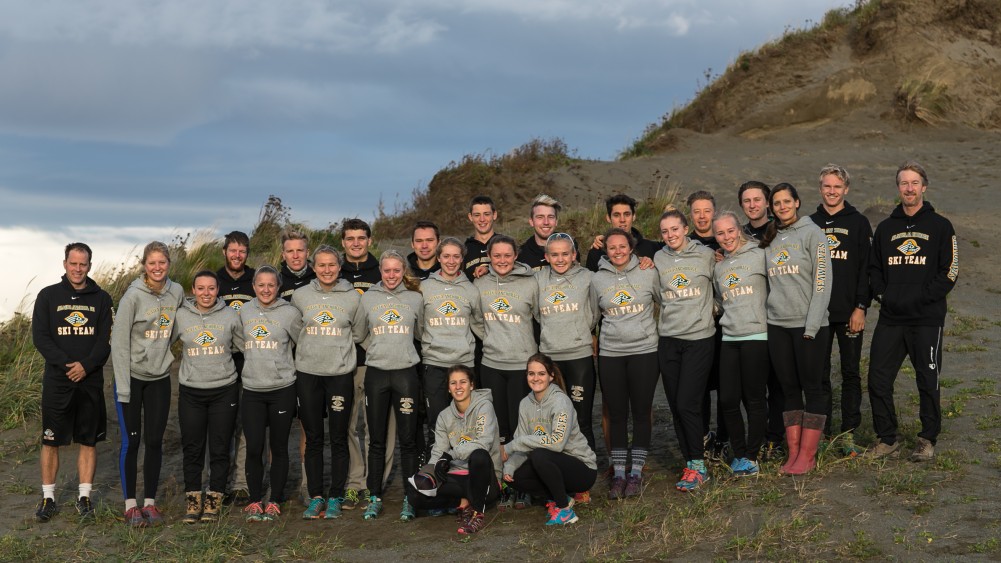
The present faces of the 2016/2017 University of Alaska Anchorage Ski Team (both nordic and alpine) at Kincaid Park in Anchorage. (Photo: Adam Phillips/UAA Athletics)
College skiing in Alaska is on its deathbed. (Or perhaps on its deathbed in Anchorage, and at least in the sick bay in Fairbanks.) FasterSkier previously posted thoughts and reactions from some of the more prominent University of Alaska Anchorage (UAA) skiing alumni, including Olympians Brian Gregg and Sadie Bjornsen. But there are other people who stand to be even more immediately affected if the University of Alaska Board of Regents cuts college skiing after this season: the athletes who ski for UAA, and the people who coach them. Here we share some thoughts from those groups, in an attempt to understand the human cost of the proposed elimination of UAA skiing following the 2016/2017 season.
Two Athletes: Hailey Swirbul and Casey Wright
Hailey Swirbul, 18, is a true freshman at UAA. Born and raised in Colorado, she visited Anchorage for the first time on her official recruiting visit to UAA last fall. To her surprise, Anchorage was love at first sight (“I stepped off the plane and I saw those mountains glowing pink, and I was like, Whoa, this is magical. This is nothing like Fairbanks!”), and she happily committed to ski for UAA soon after. Swirbul competed and trained internationally prior to coming to UAA, including anchoring the U.S. women’s relay team at Junior World Championships in Almaty, Kazakhstan, in February 2015, and attending International Junior Camp in Norway that summer.
Casey Wright, 21, took a slightly more circuitous path to skiing for the UAA Seawolves (fondly referred to by the team as the “Skiwolves”). Wright, an Australian, was born in Melbourne, and is a member of the Australian National Ski Team. She has raced for her country at several international competitions, including world juniors in 2013 and 2014 and World Championships in Falun, Sweden, in 2015. Wright previously skied in the U.S. for the Sun Valley Ski Education Foundation (SVSEF) Gold Team in Sun Valley, Idaho. (She is one of at least three Australian national team skiers who currently live and train in Anchorage, including Alaska Pacific University athletes Jessica Yeaton and Paul (PK) Kovacs.)
UAA present: ‘Skiwolves’ Hailey Swirbul (l) and Casey Wright (r), on the UAA campus in Anchorage, Alaska, in October 2016. (Photo: Gavin Kentch)
Both athletes spoke with FasterSkier in an in-person interview on the UAA campus on Oct. 28, slightly more than 24 hours after news came out that their program was slated to be discontinued at the end of this season. Both Wright and Swirbul were surprised and disappointed, but nonetheless impressively buoyant given the circumstances.
And speaking of buoyant, it is not just an orthographic coincidence that you can’t spell “Seawolves” without “love.” Both athletes’ sincere love – for their sport, for each other, for their suddenly endangered ski program – was apparent throughout the interview, in which Wright and Swirbul at times literally finished each others’ sentences.
This particularly came through in each athlete’s overriding concern at this moment: for others and for their team.
“I’ve gone from initial, like, absolute being distraught to kind of angry, and now I’m trying to understand why, and trying to look in the future,” Wright said when asked how she was feeling. “For us at the moment, or for me anyway, it’s just, like, looking for out my team, looking out for my coaches, just trying to make sure everyone’s okay. I think that’s really my main concern at the moment – that everyone is coping as well as they could be.”
Swirbul expressed similar sentiments: “One of the hardest things … that each of us are going to face is breaking up this team, ’cause we have such a young team, and we have so much potential, and it is horrible to see that go right now.”
“We are really close,” Wright added. “I’ve never been on a team where I’ve had this connection with teammates, where it’s like – we’re just like a family, an extended family.”
Indeed, Wright called the Skiwolves “my second family.” “It takes me, like, over 30 hours to get home,” she observed, reflecting the distance between Alaska and the antipodes. “This team is my family,” Wright stated, her voice and syntax breaking, “and – the thought of not being able to see all these people every day – like, after this year – or not even a year, after, what is it, going to be five months, pretty much, six months, is just like – it’s devastating. I can’t even fathom… that’s just heartbreaking.”
Swirbul, discussing the Oct. 27 meeting at which they were told that their program was slated to be cut, continued with the familial theme. “One of our teammates actually paralleled it to a funeral, and it feels like our team is dying,” Swirbul said.
“It feels like a death in the family,” Wright concurred.
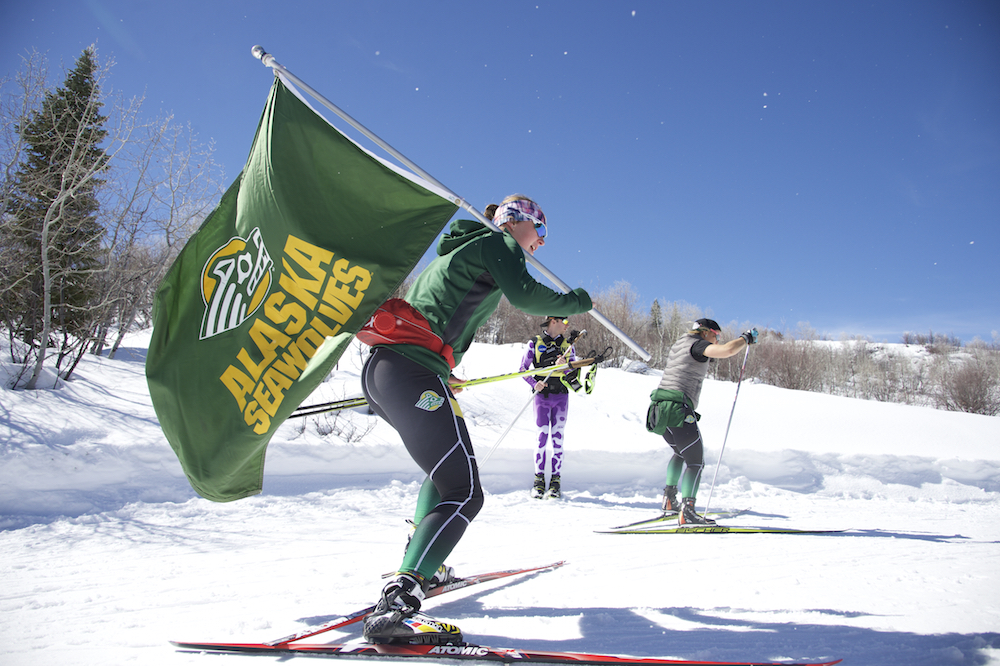
UAA present: Casey Wright carries the Seawolves’ team flag at the 2016 NCAA Skiing Championships last March at Howelsen Hill in Steamboat Springs, Colo. (Photo: Jamie Schwaberow/NCAA Photos)
While both athletes underscored that the team was quickly becoming tighter than it ever had been, they admitted that they had begun thinking about what might come next if their program – and college scholarships – come to an end.
(UAA Athletic Director Keith Hackett wrote in his public statement that “UAA will honor our commitment to those Student-Athletes who have been impacted by this decision by keeping them on scholarship through the spring of 2018.” But head nordic coach Andrew Kastning said that he was “a little surprised” to hear that his athletes only had two more years on scholarship (counting the 2016/2017 season), “because at one point when we thought that we were going to be – when the cuts were being talked about, [assistant nordic coach] Sara Studebaker had asked Keith what would happen to our athletes that are here. And he said, ‘Their scholarships will be honored until they graduate.’ But it didn’t sound like that was arranged, at least at this point.”)
“It’s impossible not to think about [next year],” Swirbul, 18, said. “I’ve been thinking about it for the past couple months, unfortunately, especially when [my] parents have been encouraging me to look into that in case that happened, and it did. First off, I need to clear up what this whole situation with the scholarship in the coming years is. And that’s a huge factor in my decision. If that’s the case, then my first option would be to attend school here still, and potentially ski for APU [Alaska Pacific University]. Otherwise, I need to start applying to colleges all over again.” (While athletes who transfer schools are typically required to sit out a year before playing again at their new school, the one-year waiting period is waived when the athlete’s sport was cut at the previous school.)
Swirbul reiterated that she yearned to stay in Anchorage: “I love it here. I don’t want to leave. Taking that away from me, taking that away from all of us, is just heartbreaking.”
Wright, who turns 22 next month, had similar goals, but was still working with the NCAA to gain some clear answers to something as simple as how many years of NCAA eligibility she had remaining before she began the process of seeking out other schools. “I’m in a bit more of a difficult situation, being an international student-athlete,” Wright said.
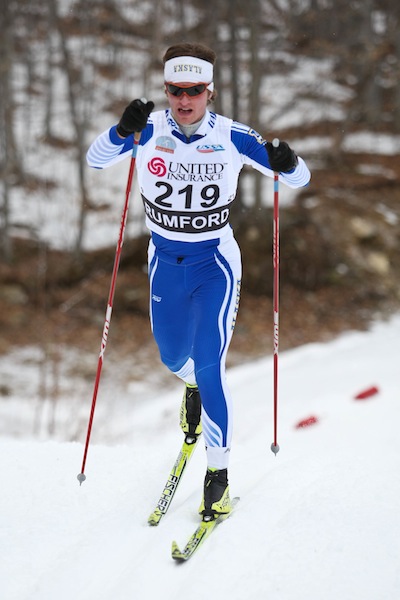
UAA past: Erik Bjornsen (then UAA, now APU and USST) races in the men’s 15 k classic race at 2011 U.S. Nationals in Rumford, Maine. (Photo: FlyingPointRoad.com)
“In order for me to achieve my goals,” she continued, “the best place for me to be, I believe, is in the U.S. It’s just, the calibre of skiing here is fantastic in order for me to develop and reach my goals. Although I don’t have as many years of eligibility left, so that would be a difficult one to try and convince another team to take me on.” Wright also hoped to stay in Anchorage if at all possible.
Wright recounted her self-initiated “recruitment” into the UAA program (she had been skiing with the SVSEF before she began reaching out to American NCAA ski teams), and how it led to the current team at UAA. “Andrew was the only one that responded to an Australian girl contacting him saying that I was a skier,” Wright said. “I don’t think anyone else believed me.”
UAA originally didn’t have scholarship space for her, but a space then opened up on short notice. “So I pretty much just jumped on a plane and came here. … It was the best decision I could have made. It’s just been incredible,” she said.
Wright recounted the process by which this year’s team – which, she pointed out, skews young and blonde – was assembled soon after she came on board. “Andrew was talking about all these freshman girls we’ve got coming in. He was like, ‘We’ve got a lot of 18-year-olds.’ It was like, ‘Oh boy, we’re going to have a lot of Justin Bieber [Swirbul cracks up], and teeny-bopping around’ – but it’s been nothing like that.”
Swirbul: “Wow, thank God.”
Wright: “He just kept signing girls.”
Swirbul: “And they’re all blonde and they’re all freshman.” (This is almost literally true.)
Wright: “Andrew has dubbed us The Blondetourage. That pretty much sums us up.”
On a more serious note, and discussing the process that led to the ski team being cut, both athletes were quick to reject a reporter’s suggestion that they might feel betrayed.
“I absolutely would not say betrayed,” Swirbul said. “And I think that’s how the coaches feel. They feel like they betrayed us – I think some of them are blaming themselves for this. And that’s the hardest thing for me to see, is thinking about my teammates and my coaches that might not have a clear path of where to go in the next few years. I think that I’ll figure something out, and a new door will open. I just worry – I feel so much for the people that don’t have that clear path.”
Swirbul also disagreed with the premise that skiing had been singled out in some manner. “I I don’t think we were necessarily singled out,” she said. “But I can’t understand why they would cut skiing in Alaska. I don’t understand that. And I don’t think they understand why they cut us. I don’t know. … Were we singled out? No. Are we some of the best academic and hard-working people at UAA? Yes. And I don’t think they would purposefully single out those types of people to remove.”
“Were we singled out? No. Are we some of the best academic and hard-working people at UAA? Yes. And I don’t think they would purposefully single out those types of people to remove.” — Hailey Swirbul, UAA freshman nordic skier
Finally, Swirbul graciously declined an invitation to compare the ski team’s record of success to the consistent mediocrity and decades-long trend of losing seasons that plague the UAA hockey team.
“I would never wish this upon anyone else, and I can’t say that I would rather have the gymnastics be cut, or the hockey be cut – because this sucks. And I don’t want anyone to go through this,” Swirbul said.
At the same time, Swirbul expressed some confusion as to whether it was really money or something else that was driving the decision to submit skiing for proposed elimination.
UAA past: Sadie Bjornsen (then UAA, now APU and USST) skis to a third place finish in the women’s 5 k classic race at the 2009 NCAA Championships in Rumford, Maine. (Photo: FlyingPointRoad.com)
“Actually, what the director [Hackett] ended up saying,” Swirbul recalled of the Oct. 27 meeting, “was that it doesn’t even come down to money at this point, it’s more NCAA rules. They’re cutting our teams from 13 to nine. And so they need a 10th team, potentially. And they said, ‘If we do need a 10th team, if that waiver goes through and we need to find a tenth team, they will find the money to do that somehow.’ However, they can’t let us find the money to fund ourselves. I don’t even know what they’re talking about. They said there’s money there if they need to have a 10th team.”
Wright expressed similar sentiments: “We want the opportunity to, if it is down to money, we want the opportunity to fundraise. We were told that Alaska wasn’t a giving state, that people here don’t want to give money, that’s what he told us, which, we don’t believe that’s true, considering that APU is able to fundraise six figures annually.”
The Alaska Dispatch News, or ADN, has reported that the annual budget of the APU program is “about the same amount” as that of the UAA ski team. “With APU always in financial straits,” the ADN wrote, “the team raises most of its own funds.”
While it is hard to quantify the generosity of a state, some indication of Alaskans’ attitudes toward charitable contributions may be gleaned from the success of Pick.Click.Give, a program that allows Alaskans to voluntarily choose to donate a portion of the Permanent Fund Dividend (PFD), the share of oil revenue that is annually given to most Alaskans. Last year 5.5 percent of Alaskans who filed for a PFD online made a donation through the program, donating an average of $108 per person from a revenue check that this year came out to $1,022 per person.
“If we were given the opportunity to raise funds,” Wright continued, “or to meet a target, or who knows what … we would have done it. We would have been knocking on doors, asking for people to donate, selling cookies like Girl Scouts. We would have had a bake sale. I think that’s what hurts the most, is that we couldn’t do anything, we weren’t given the opportunity to save ourselves; it was basically said, ‘This is out of your hands.’ … That kind of stings as well, when we’re told, ‘You just have to sit back and wait,’ which skiers aren’t good at doing. If there’s something that we can do, we want to do it.”
The Coach: Andrew Kastning
Head coach Kastning, 34, now in his sixth season at UAA, also yearns to take action and find a solution. He and his wife, former Whitman ski coach Calisa Kastning, have a new house in Anchorage and two young girls. “We got another kid on the way, coming in March,” Kastning noted. “So the stakes to figure something out are kinda high.”
Kastning spoke with FasterSkier by phone on Oct. 29, shortly before the lifelong Cubs fan watched Chicago lose Game 4 of the World Series 7-2 to the Cleveland Indians.
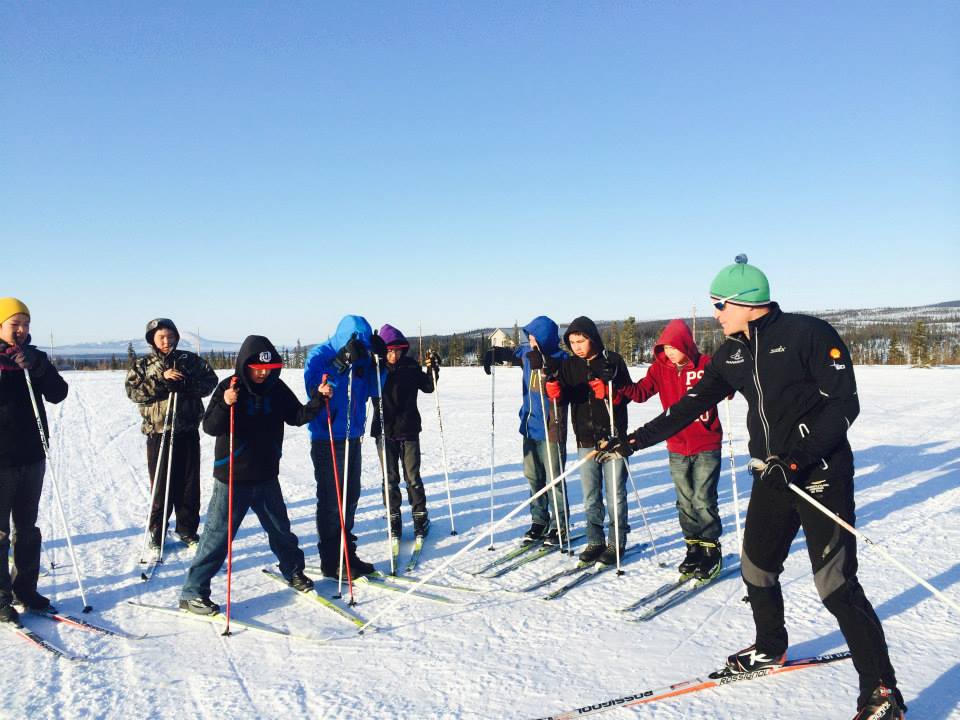
Coach Andrew Kastning teaching seventh-grade boys to V2 in Kiana, Alaska, on a Skiku ski outreach trip to rural Alaska. (Photo: Celia Kastning)
Beyond the obvious, there are several aspects of Kastning’s situation that are particularly poignant. The first is that, as he said, “I’ve got the team now that I’ve always wanted. And nothing against the teams I’ve coached before, but since I got to Alaska I’ve been trying to get kids – young, promising Americans combined with experienced international racers. And for the most part, it’s been experienced international racers that I had.”
Until, Kastning continued, “I turned the corner when Hailey signed a year ago. She signed early, and that opened the door, opened the eyes of other American recruits coming out of high school to look at Alaska. And this is the team that I’ve always wanted to coach. Because we have so much talent and they’re so young, and so moldable, and they’re getting along so well … it’s been awesome to do that. It makes the sting of it a little bit extra, because there are eight freshmen on my team and four sophomores. And so we’re set up well to be stronger and stronger.”
But this is cross-country skiing, a sport where your speed this season is largely determined by how much you were training the year before (and the year before that, etc.). And it appears that Kastning will only have one season in which to help his athletes achieve their best. “We’re just trying to get the best peak performance that they have within them,” Kastning said, “and I know they’ll ski their hearts out.”
Kastning remains clear-eyed about the artificial limitations of taking what should be a four-year progression and compressing it down into one season. “It would be a Disney story to win the NCAAs this year,” Kastning said. “However, looking ahead in the next two to four years, given this group of kids, I don’t think that’s out of the question. The way they’re working together, and the talent level that they have.”
“It would be a Disney story to win the NCAAs this year. However, looking ahead in the next two to four years, given this group of kids, I don’t think that’s out of the question.” — Andrew Kastning, UAA head nordic coach
The other reason this is especially poignant for the Kastning family is that together they’ve been through this drill before. Twice. Kastning was assistant nordic coach at the University of Nevada, Reno, in the late 2000s, until he saw the writing on the wall and left for a more secure coaching job elsewhere. A year later, the Nevada athletic director – a man named Keith Hackett – announced that skiing was going to be cut at Nevada.
UAF past: David Norris (now APU) racing at U.S. nationals in Rumford, Maine. (Photo: Kris Dobie)
(Hackett would take the same job at UAA in 2012. His official UAA bio notes, “UAA’s skiing, men’s basketball, women’s basketball and men’s cross country [running] teams have all produced top-four national finishes since 2008.”)
Kastning’s then-girlfriend, now-wife, Calisa (Schouweiler) Kastning, was coaching at Whitman at the time. Until, Andrew says, “Calisa called me at the conclusion of the 2009 NCAA mass start races – I was still in my ski boots – and she was in tears, telling me that her program had just ended. … And it was a shocking announcement. And they had no chance to fight it, and no ability to fundraise to keep it going, and even a few donors there came through with a big chunk of money that wanted to keep the team, but the athletic department stood their ground and said ‘no.’ ”
Andrew happened to visit Calisa in time to attend the final team gathering for the Whitman College Blues ski team (most famous skiing alumnae: Holly Brooks ’04 and Laura Valaas ’06).
“And it was heartbreaking.”
“I wasn’t even involved with that program at all,” Andrew said. “But then through my girlfriend at the time, to see those kids trying to cope with the last team gathering – which we’ll have to go through too if this decision stands – it was really hard. And I was just kind of a bystander in that situation. So I’ve already been through one final gathering for that team. And it was a little bit by happenstance, but I know what it’s like and I know what the emotional rollercoaster is that we’re going to have to go through until the end of the spring semester.”
Andrew continued, looking ahead to a year full of lasts: “We’ll have Athlete of the Year banquets, with the whole athletic department, and it’s going to weigh on everybody’s mind there. And we’ll have our final team barbecue gathering where we name our most valuable players and our most improved, and all that. And normally we give framed pictures to our seniors, and talk about each senior athlete and what they’ve contributed to the program and say goodbye to them. And now we’ll probably have to make framed pictures of everybody, and try and talk about everybody. Which will take all night, because they’re all such awesome kids.”
UAA breakfast present: Local skiers show their support for #savealaskaskiing. (Photo: Holly Brooks)
Despite Andrew’s shared history with Hackett and shuttered ski teams, he hesitates to blame Hackett for the current decision at UAA: “I wish the president [UA President Jim Johnsen] had been there [at the meeting to make the announcement], because he’s the one that’s really pulling all these micromanagement strings above, and unfortunately Keith is having to, for lack of a better word, be his puppet, and take orders from the top. Because even though Keith cut skiing once [before], I don’t – at least I don’t want to believe that that was his first choice. It seemed like it was just a fait accompli, like it was agreed upon on both campuses that the ski team was an easy target. And that was going to be the first tree to fall.”
(Many symbolic trees are falling on the UAA campus these days. A survey of faculty and staff released earlier this week showed that “more than half” of current staff members “feel that morale [at UAA] is the lowest they have ever seen.”)
As a small silver lining, Kastning appreciates that at least someone else had to give his athletes the bad news: “In a sense I was glad that Keith had to be the one to look them in the eye and tell them that their hopes and dreams were going to be crushed in Alaska.”
A final season to remember
It is clear from coach and athletes alike that, while news like this could potentially cleave some teams apart before the season even began, it is instead leading the 2016/2017 Skiwolves to cleave together even stronger than before. Here’s the final word from the athletes:
Swirbul: “It’s quite bizarre that they’re cutting out this part of Alaskan culture in Anchorage. … And we’re hosting nordic U.S. Nationals in two years – Anchorage is hosting that – and there won’t be a college team here. That’s ridiculous. That’s outrageous.”
Wright: “It’s almost comical to think that we won’t be there in green and gold on the start line. It’s really heartbreaking. It’s just sad.
“But we’re going to rally together, and we’re going to have a memorable season. And people are going to remember the Seawolves. It’s not that we’re just gonna hang our heads low, and walk out from our last race. We’re going to go out there, and people are going to know that we’re there. We’re going to be there loud and proud. And I think that’s going to be – that’s the thing I’m looking forward to most this season, is that we’re going to make it one that people are… next season they’re going to miss us, because we’re not on the start line with them.”
Swirbul: “Nice. That makes me hyped.”
Wright: “I think that makes everyone hyped right now. We’re going to make this season count.”
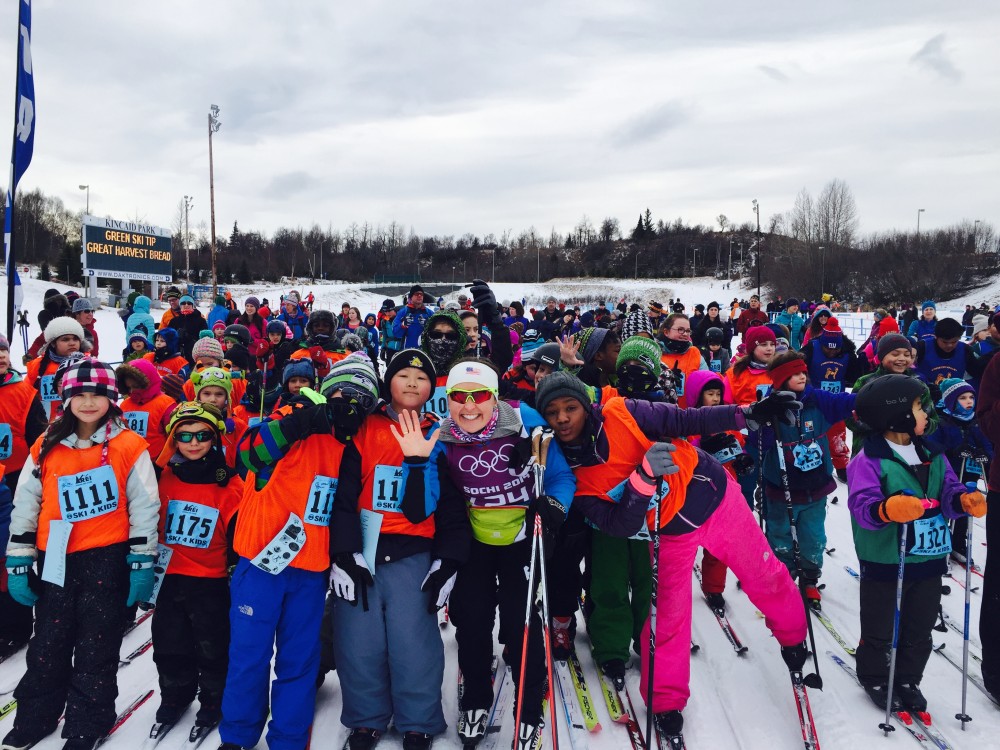
Holly Brooks (in purple Olympic bib) inspiring local youth in Alaska. (Courtesy photo)
Prior to her emergence on the national and then international cross-country ski scene, Holly Brooks, now 34, wasn’t exactly relay sock worthy, but that too would eventually transpire.
A graduate of Washington’s Whitman College in 2004, Brooks hadn’t tapped her potential as an athlete. Upon graduation she moved to Anchorage, Alaska, and took a part-time job coaching West Anchorage High School. Two years later, she was hired by Alaska Pacific University (APU) Nordic Director Erik Flora as a coach. In 2008, after thousands of kilometers coaching/skiing, she won the Tour of Anchorage.
In 2010, Brooks made the U.S. Olympic team and headed to Vancouver, British Columbia, for what would be the first of her two Olympics. The next year, she qualified for 2011 World Championships, and in 2012, Brooks won the American Birkebeiner was named to the U.S. Ski Team.
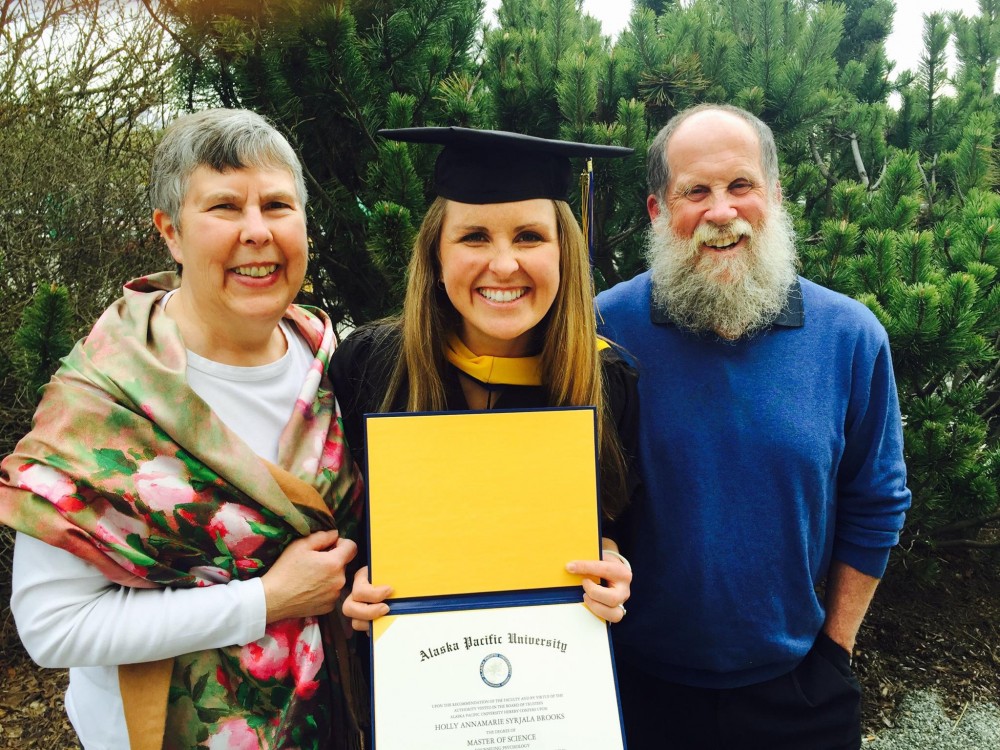
Holly Brooks with her parents Don Brooks and Chris Syrjala at her graduation in April. Brooks received a master’s in counseling psychology from Alaska Pacific University. (Courtesy photo)
Although a late career move, Brooks had arrived.
At the start of the 2012/2013 season in Gällivare, Sweden, along with Kikkan Randall, Liz Stephen and Jessie Diggins, Brooks proved the infamous relay socks had legitimate mojo: the foursome were the first Americans to podium in a 4 x 5 k women’s World Cup relay.
Brooks’ retirement, as she explains, became “official” just weeks ago. But she hasn’t really considered racing for a bit over a year. As mentioned in the podcast, she and her husband, Rob Whitney, himself an accomplished cross-country skier and former national-team member, began thinking about starting a family. The backstory to all this: during her serious training and racing, Brooks was without her period for eight years.
As she has navigated the complexities of fertility, Brooks has found new meaning in her master’s degree in counseling psychology — she’ll be starting a business with a focus on helping female athletes.
Holly Brooks with her husband Rob Whitney and their six chicks in Alaska. (Courtesy photo)
There’s a lot more in the podcast as we go beyond simply scratching the surface. Brooks also reads a poem by runner Lauren Fleshman, “From Retiring to Rewiring“.