From the FasterSkier archive — posts syndicated from athletes’ and coaches’ own blogs between 2004 and 2012, kept online as published. Current coverage is at fasterskier.com.
The men’s Classic Sprint heats got started with quarterfinal number one at the US Nationals Cross-Country Ski Championship at Mt Vanhoevenberg in Lake Placid NY. (Photo Nancie Battaglia)
The last day of the U.S. National Cross-Country Ski Championships in Lake Placid arrived the way honest days in this sport often do. The snow at Mt. Van Hoevenberg had been churned and scoured by a week of racing and changing weather, its surface no longer pristine but revealing, the kind that gives little for free. Legs were tired. Arms were tender. Expectations had been trimmed back by accumulated kilometers and decisions already made.
For the men lining up for the classic sprint, this was not simply a final chance at a national title. In an Olympic winter, nothing is ever only what it claims to be. The sprint was an audition—not necessarily for Olympic selection, but for relevance. For future start rights. For the ability to say, credibly, that range still exists.
Sprint qualification, in particular, has a way of stripping sport down to its essentials. No drafting. No hiding. One lap to explain yourself. As has been said all week about sprints, it does not matter how clever you are in the heats if you cannot arrive there in the first place. In Lake Placid, that truth shaped the day from the first starter onward.
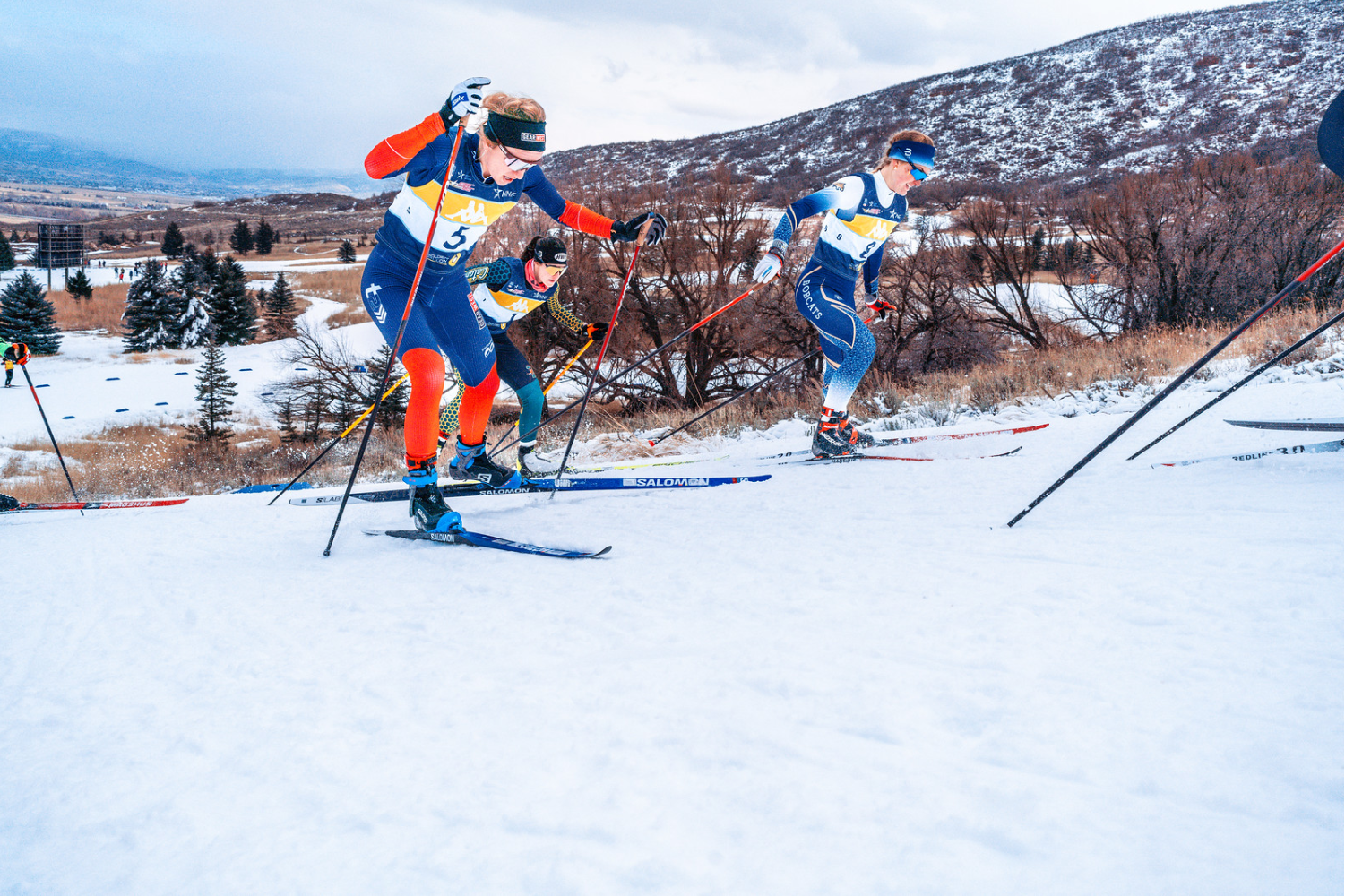
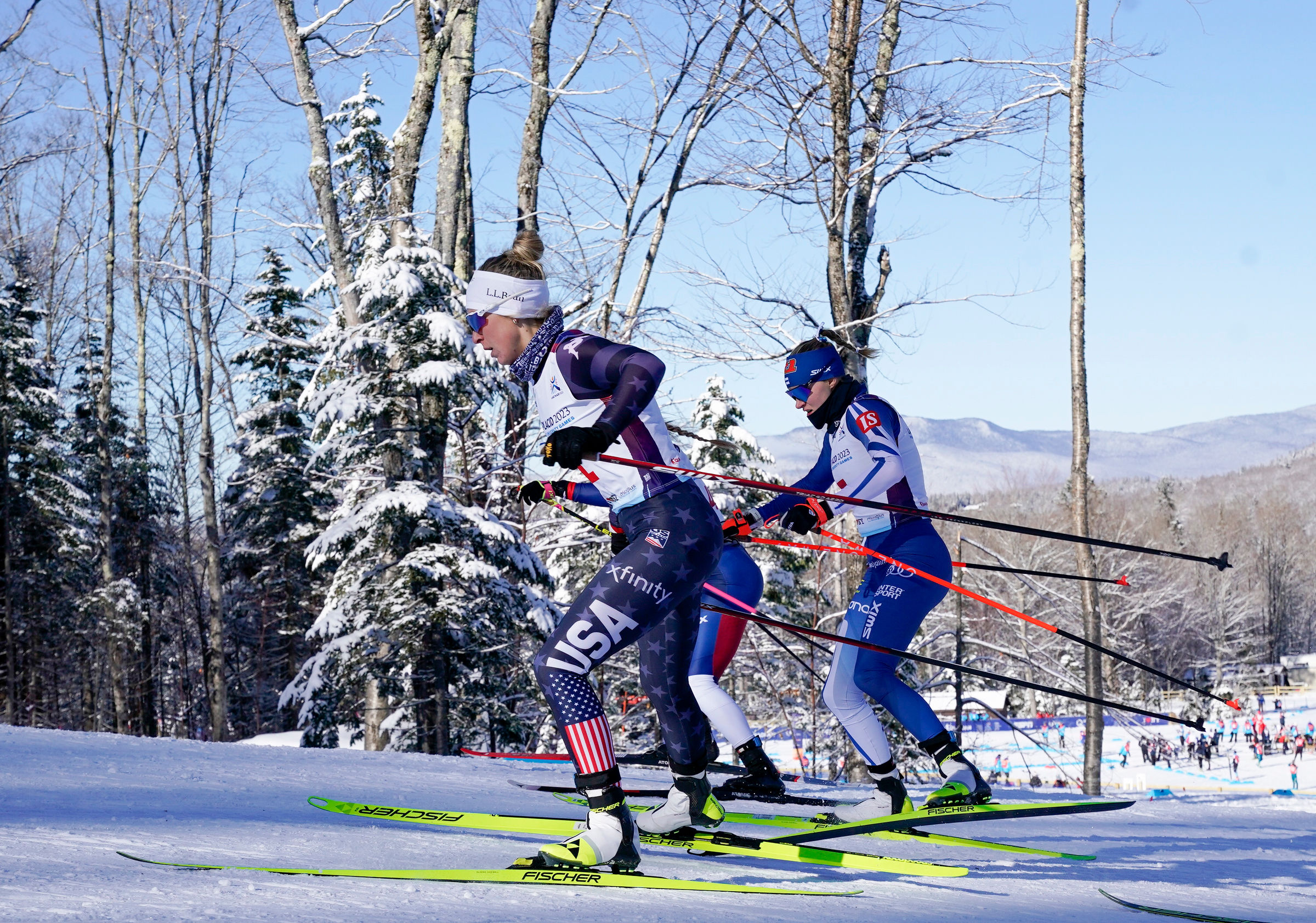
Fin Bailey (UVM) makes his way up the Lake Placid sprint course’s signature climb. (Photo Nancie Battaglia)
Qualification: where the day declares itself
Qualification mattered here in a way that went beyond podiums and medals. With sprint start rights in the World Cup largely determined by qualification speed, the men knew exactly what was at stake. If this were a sorting mechanism, it was a blunt one.
The fastest man through the course was John Schwinghamer, whose time at the top of the board set the early benchmark. But the story quickly widened. Pierre Grall-Johnson followed closely, and then Will Koch, who would soon become central to the day’s most unusual tactical thread, placed third.
A few seconds farther back sat a cluster of names that told a deeper story: athletes with distance pedigrees, athletes chasing U23 selection, athletes managing fatigue from a long week and still trying to produce speed on demand.
Among them was Zanden McMullen, who qualified tenth, solid but not dominant. “The qualifier felt a little off,” McMullen admitted. “I didn’t feel smooth and thought I skied poorly through the terrain. I was happy to qualify and have another chance to improve on the day.”
That, in retrospect, was the quiet warning shot.
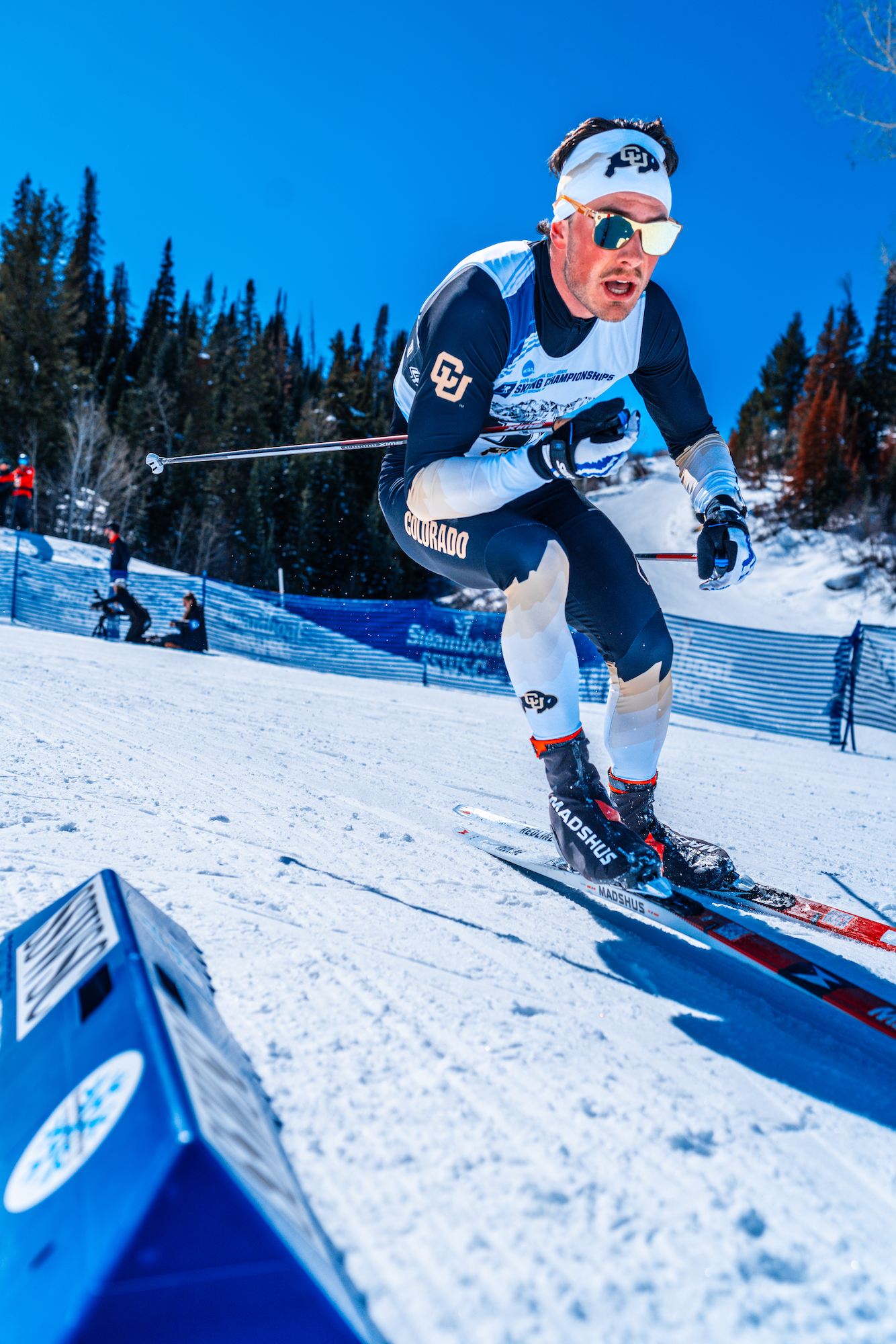
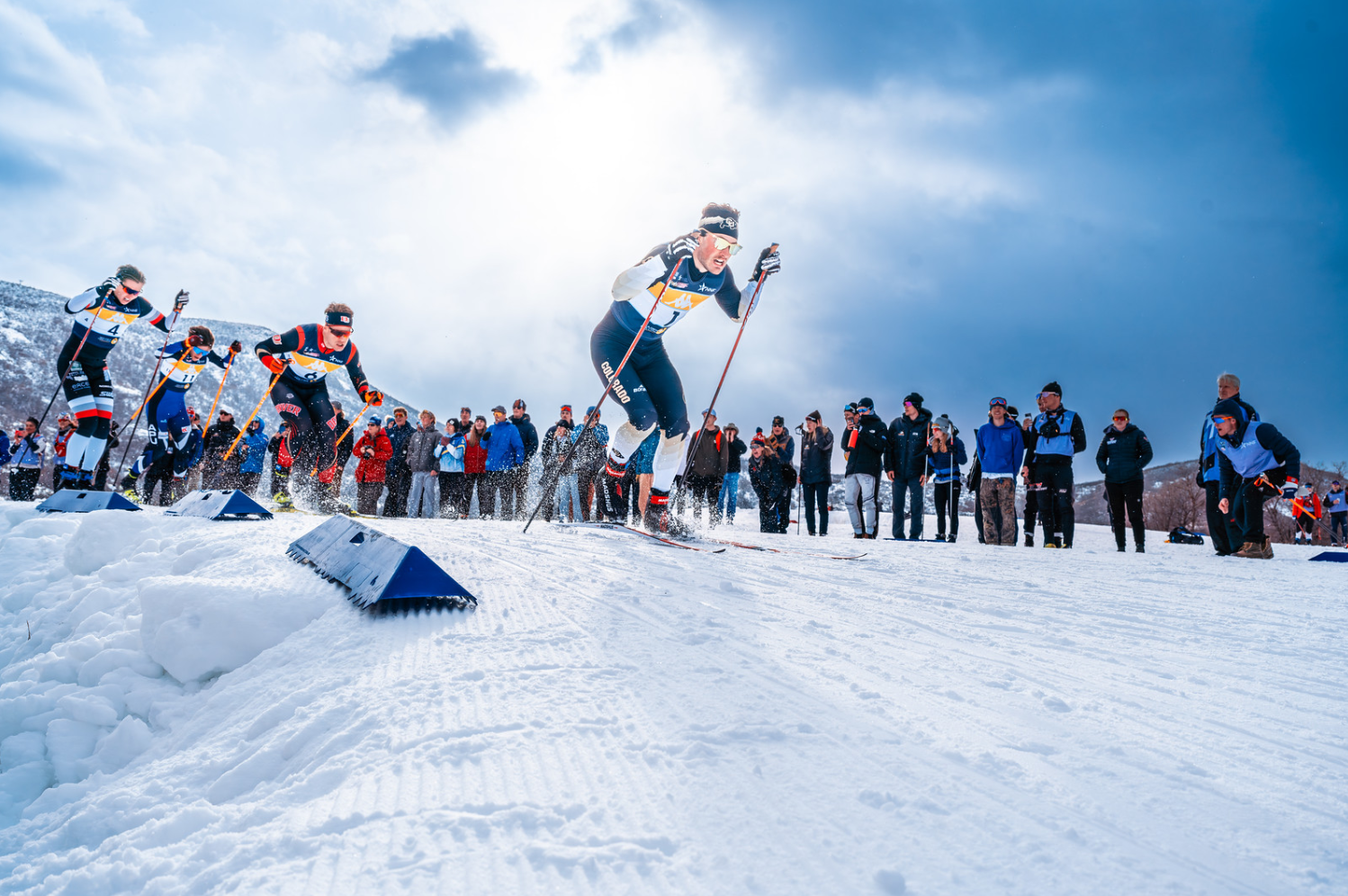
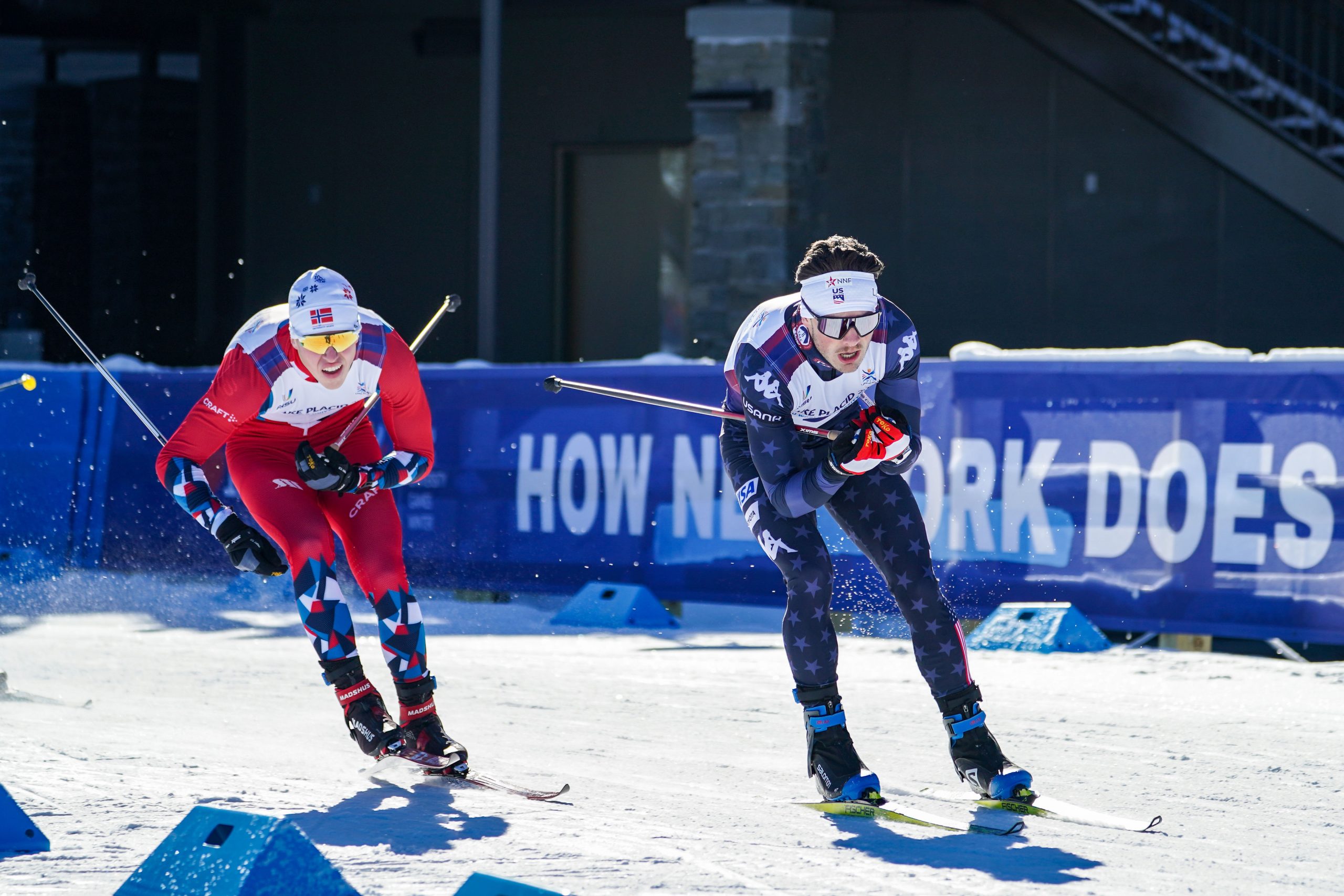
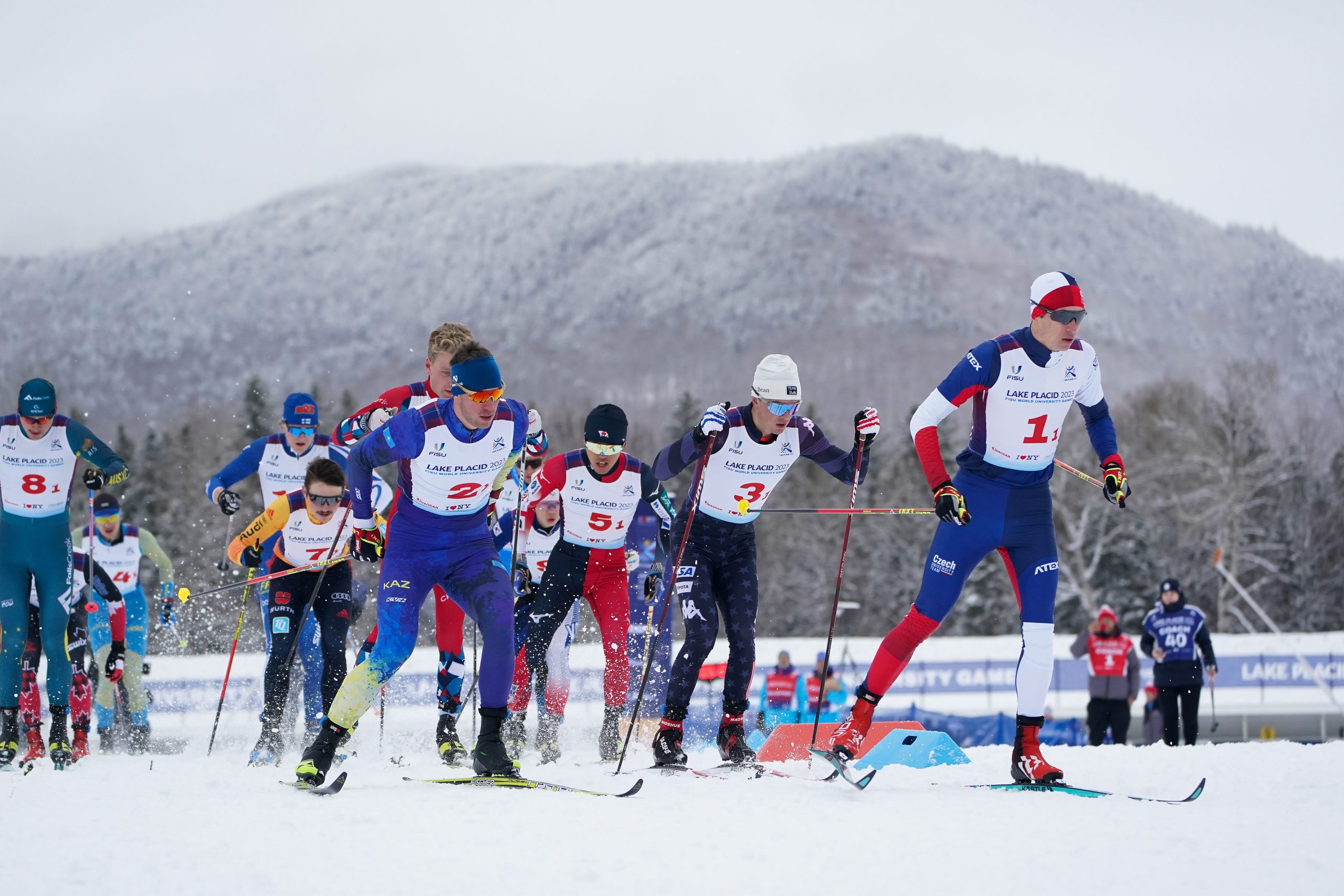
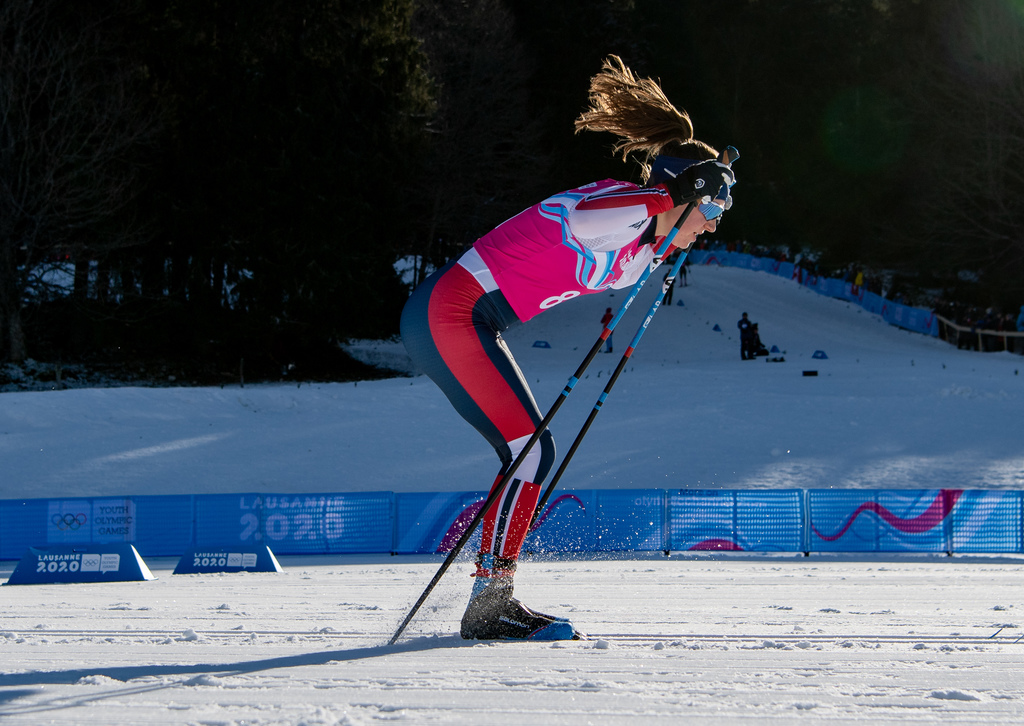
Classic striding versus powerful double poling was one of the key storylines in the men’s Classic Sprint. (Photo Nancie Battaglia)
A decision made in minutes
If qualification is the most honest part of sprinting, it is also where improvisation sometimes reveals itself. Koch arrived at the start line with little margin and even less certainty.
“I was already pretty tired going into the classic sprint,” Koch said. A bonk midway through the 20-kilometer freestyle earlier in the week had drained his reserves, and classic sprint had never been his strength. “With about ten minutes to go before my qualifier, I still couldn’t get my classic skis to kick.”
The decision that followed was not theoretical. Koch asked his coach to prepare a pair of skate skis — not as a backup, but as a commitment. He reached the start with roughly 90 seconds to spare, hoping that strength alone might be enough to advance.
Third in the qualifier erased doubt immediately. “When I ended up third, I knew it was the right call,” he said. “I never even tested a classic ski the rest of the day.”
The gamble would ripple through every round that followed.
Will Koch (SVSEF) powered through the qualification and heats, double poling on skate skis. (Photo Nancie Battaglia)
Heats: when fatigue starts to speak
Classic sprint heats at Mt. Van Hoevenberg reward clarity. The course offers opportunities, but they are conditional. Mistime a move, and the course and competition punish hesitation. Get trapped behind the wrong skis, and speed evaporates.
Koch’s plan was simple and exhausting: lead early, create space before the climb, and survive long enough for glide to matter again. “If I could crest the climb with the group, my skis would be fast enough to carry me through,” he explained.
For a time, it worked exactly as intended.
But others were playing different games.
Zach Jayne arrived at the sprint with a different set of calculations. Already qualified for U23 Worlds and carrying a narrow SuperTour points lead, his goals were layered. “I wanted to finish strong,” Jayne said. “I also wanted to make the final so I could displace other U23 athletes and help ensure my teammate Max Kluck made the trip.”
Jayne, Koch, and teammate Carl Rune all opted to double-pole the heats on skate skis, a choice that paid dividends early. “It worked really well in the quarterfinal,” Jayne said. “But as the rounds went on and fatigue built, I was definitely wishing I’d brought a pair of klister skis.”
That fatigue — cumulative, unrelenting — became the quiet theme of the afternoon.
Zanden McMullen (APU) showed he had made the right calculations for himself in the final, creating a gap on the large climb, which he was able to maintain on the final downhill. (Photo Nancie Battaglia)
Trusting kick in uncertain snow
While some chased glide, Max Kluck made a different bet. His week had been defined by nerves more than novelty. “I was more nervous than I’ve been in years,” Kluck said. “I knew my U23 spot was on the line.”
The snow tempted experimentation, but Kluck resisted. “I was pretty certain I wanted to stay on classic skis unless the weather took a major turn,” he explained. “I stuck with my gut.”
The reward came immediately. In the quarterfinals, Kluck ran the climb with confidence, kick biting cleanly while others labored, arms already beginning to pay the price. “I figured I might be able to make double-poling work once,” he said. “But I didn’t think I could personally do it four times.”
His solution was economy. By trusting his wax and striding more often, Kluck preserved his upper body for the finishing straight — a detail that would matter later.
UVM’s Fin Bailey was showing he was on form and a threat for the podium throughout the heats, but his final got off to an unlucky start with a broken pole. (Photo Nancie Battaglia)
The final: legs versus arms
By the time the final assembly was complete, the calculus was visible even from the sidelines. The men who had double-poled all day carried speed — and fatigue. Those who had relied on kick carried legs.
McMullen understood the equation precisely. “Going into the final, I knew the few boys that double-poled all day would be tired,” he said. “My plan was to keep them in reach before the final climb and then gap them.”
Snow conditions had continued to degrade, wind and rain complicating grip and timing. McMullen’s classic skis, however, remained reliable. “Our classic skis felt good,” he said. “I didn’t think there was a need to try and double-pole the race.”
When the decisive climb arrived, McMullen did not hesitate. He strung together clean transitions, trusted his kick, and separated decisively. “I felt really fresh still at the start of the final,” he said. “I knew I would be able to run away with it.”
Behind him, the chase unfolded exactly as predicted. Koch’s glide carried him, but the cost of four rounds of double-poling showed. Kluck’s restraint paid dividends, his saved arms helping him close strongly. Jayne fought valiantly through fatigue, his earlier work for teammates already done.
McMullen crossed the line alone — a national champion not because he had chased novelty, but because he had waited for the moment that mattered.
Zanden McMullen (APU) comes to the finish of the Classic Sprint with his second national title in as many days at the US Nationals Cross-Country Ski Championship at Mt Van Hoevenberg in Lake Placid, NY. (Photo Nancie Battaglia)
What the result actually means
The men’s classic sprint did not reshape Olympic selection overnight. Sprint specialists were unlikely to be named from Nationals alone. But the race clarified something subtler and perhaps more important.
It showed who can adapt under stress. Who can make decisions when plans unravel? Who understands that qualification speed opens doors long before medals do?
For Koch, the day was a revelation. “The classic sprint was a really pleasant surprise to end the week,” he said, even as he acknowledged that broader goals remained unmet.
For Jayne, consistency mattered more than headlines. “I don’t race to prove people right or wrong,” he said. “I know what I’m capable of.”
For Kluck, the outcome was tangible. “Securing my U23 spot was the biggest goal of my season,” he said. “Locking it down here feels incredible.”
And for McMullen, the victory was both affirmation and invitation. “I hope people know now that I’m an all-around skier,” he said. “And I hope the Olympic selection committee knows I have a lot of potential to succeed at the Olympics.”
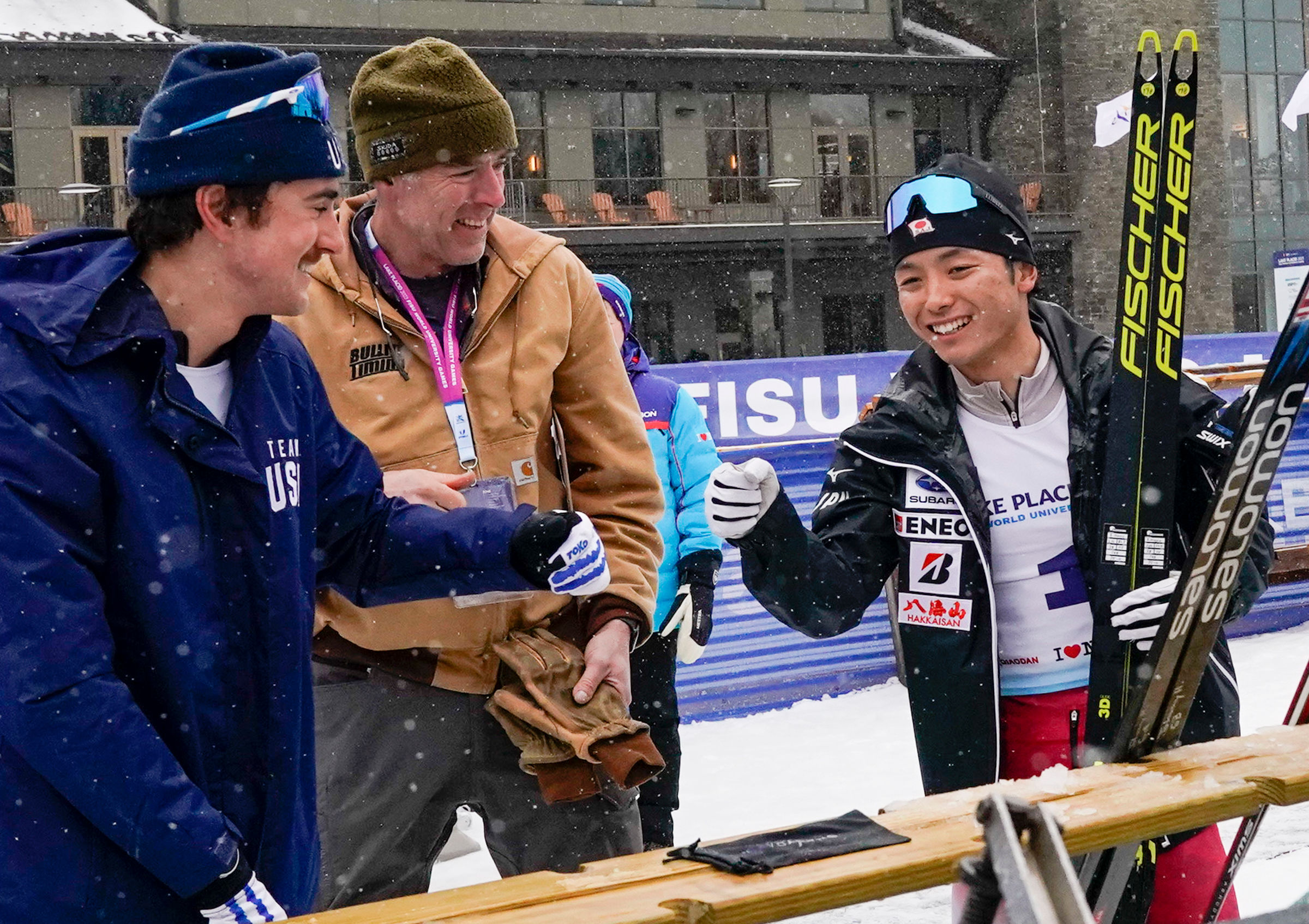
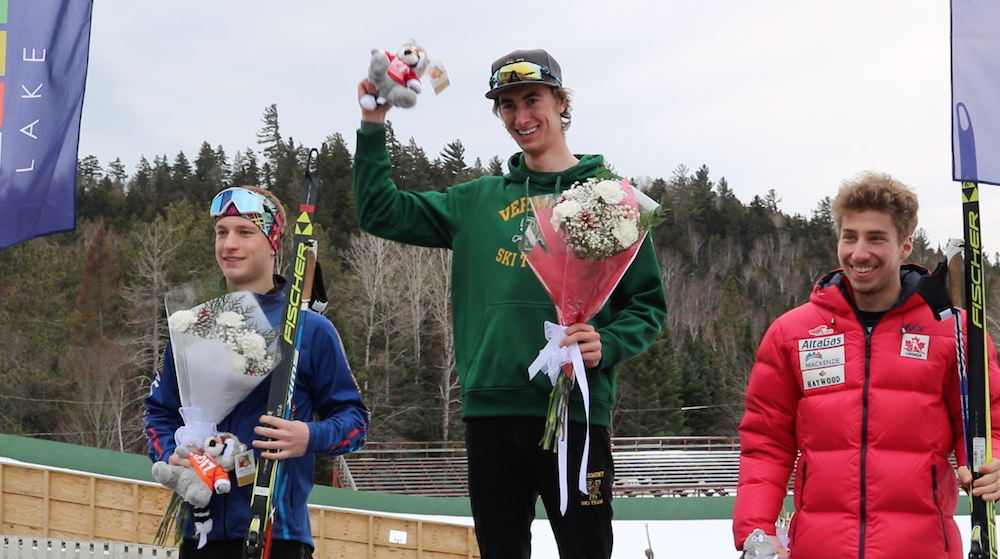
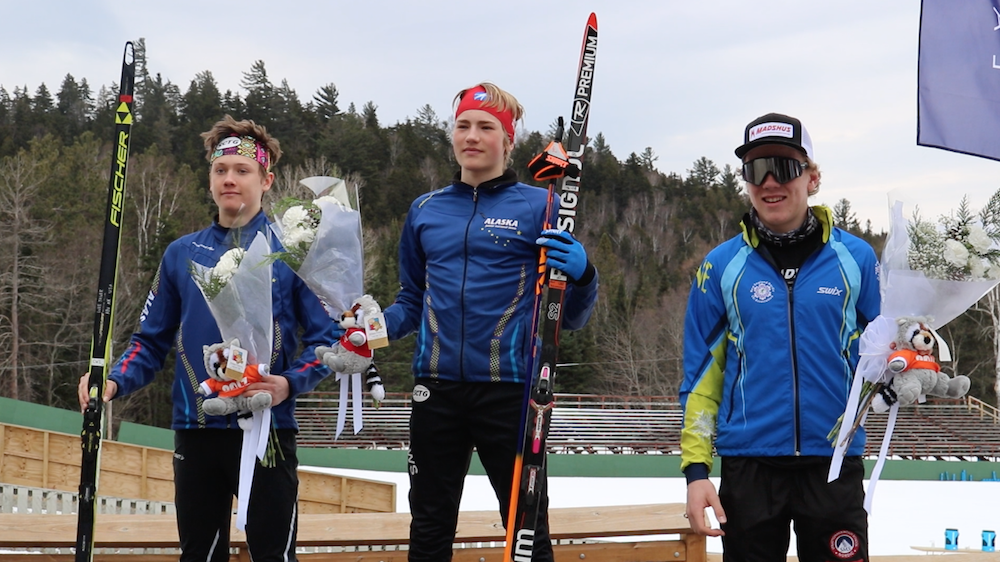
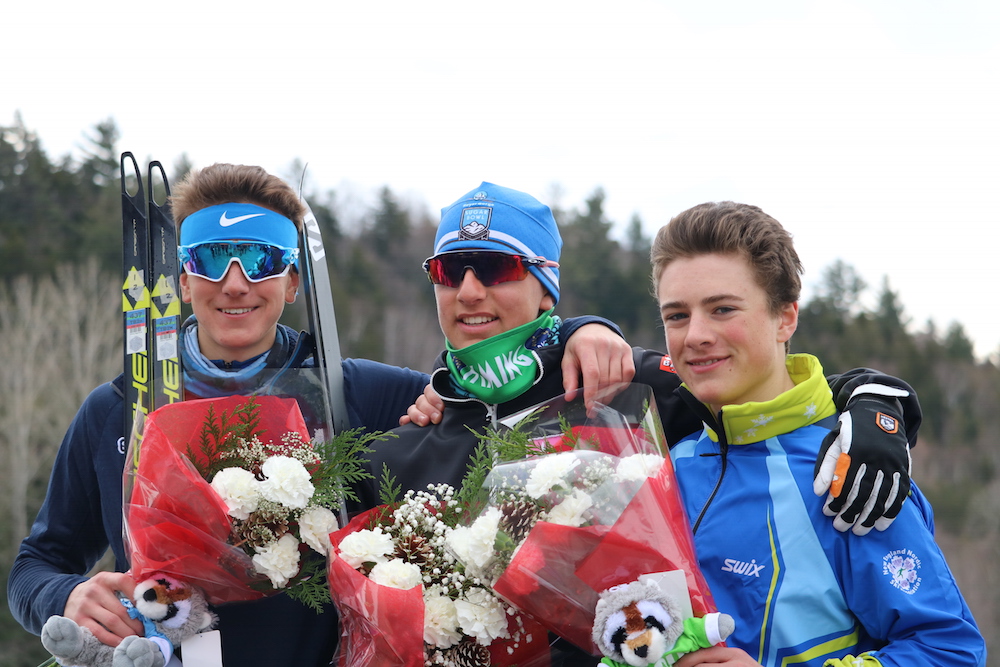
Zanden McMullen (APU) first place, Will Koch (SVSEF) second place, and Max Kluck (UU) third place at the US Nationals Cross-Country Ski Championship Classic Sprint at Mt Vanhoevenberg in Lake Placid NY. (Photo Nancie Battaglia)
A quiet ending, honestly earned
As the course emptied and the equipment was packed away, Mt. Van Hoevenberg returned to stillness. Another Nationals was complete. Another set of arguments had been made — not loudly, not always cleanly, but honestly.
Sprint racing, especially in January of an Olympic year, has a way of revealing truths athletes might prefer to delay. Qualification does not negotiate. Fatigue does not compromise. Decisions, once made, echo through every climb and corner that follows.
On this final day in Lake Placid, the men who listened closely to their bodies, their skis, and the snow underfoot, were the ones who left with something lasting.
Feature stories like this one take time, access, and care to produce. If you value thoughtful storytelling and independent ski journalism, please consider becoming a Voluntary Subscriber. Your support directly fuels the work we do to cover the people, places, and moments that make our sport special.
What was truly on display this week at the US Nationals Cross-Country Ski Championship at Mt Van Hoevenberg in Lake Placid, NY was not only that cross-country skiing is an awesome sport, but the community that embodies it is something worth celebrating. (Photo Nancie Battaglia)
The US National Championships got started yesterday with the 10 k Classic Individual Start in Lake Placid, NY. Hunter Wonders (#369 – APU) took top honors in the men’s race. (Photo: Nancie Battaglia)
On a January afternoon in Lake Placid, Mt. Van Hoevenberg did what it has always done best: it asked skiers to be honest.
The 10-kilometer classic individual start is not a format that rewards theater. It doesn’t care how good you looked in warm-up, how confident you sounded the night before, or how convincing your season-long narrative might be. It rewards pacing that’s brave but not reckless, technique that doesn’t unravel under strain, and the ability to keep making good decisions when your legs are trying to renegotiate the terms of the day.
This year, the U.S. National Cross-Country Ski Championships opened with that race—two laps on the 5-kilometer loop—and the timing was no accident. In an Olympic winter, Nationals is never just Nationals. It’s an argument. It’s a week where results don’t merely “count,” they accumulate, and the accumulation becomes the story that follows athletes into selection meetings, petitions, and—if all goes right—onto a plane headed for Italy.
Will Koch (SVSEF) on his way to 8th place on the day. (Photo: Nancie Battaglia)
The Course: Where You Can’t Afford to “Blow Up”
The Van Hoevenberg course is famous for being “fair,” but fairness in skiing is rarely gentle. The climbs arrive in layered sequences—sections where you can press, sections where you can survive, sections where you can lose seconds simply by being a fraction late to a gear change. There are places to win time, and places where you simply try not to hemorrhage it.
Hunter Wonders described the central problem precisely after the finish:
“It has some big hills. And I really think that in this course you can’t afford to blow up. If you blow up, you’re just going to bleed so much time.”
That idea—bleeding time—was the hidden refrain of the day. Not because athletes were exploding spectacularly, but because this loop punishes any lapse in restraint. It is a course that rewards a mind that stays intact.
Corbin Carpenter (UAA) on his way to 10th place in the 10 k Classic at US Nationals. (Photo: Nancie Battaglia)
Men’s Race: Seconds as a Selection Language
At the front of the men’s race, the margins compressed into something almost absurd: a national title decided in a space so small it could be measured in one imperfect corner, one extra step of herringbone, one pole that slips just slightly at the wrong moment.
Hunter Wonders won the men’s 10 k Classic National Championship. Behind him, the podium fight came down to an almost unnerving closeness. The story wasn’t simply that the race was fast; it was that it was tight—tight enough to turn pacing into the defining skill.
Wonders’ post-race reflection didn’t sound like someone who had “controlled” the race so much as someone who had managed it correctly, which is often the same thing in interval start racing:
“Yeah. So going through it never really felt like it was my day. I knew it was going to be a competitive one, and I knew that it would just come to good skis, good feelings in the body, good pacing, and I’m just really happy that I was able to pull it off.”
He returned to pacing again, emphasizing that his strategy wasn’t about heroics, but about avoiding the one mistake that the Van Hoevenberg loop will magnify:
“I think pacing was the biggest challenge for me today… So I was trying to take it out hot to where I could be competitive but not blow myself up.”
What made Wonders’ win especially convincing was how he described staying committed to his plan and then finishing with intent when the splits told him the race was available:
“I never really changed my race plan mid-race. But I did get some good splits, especially near the end, so I just tried to finish as hard as I could.”
And then, because it’s 2026 and everyone knows what this week represents, he said the part that matters most:
“And then, of course, U.S. Nationals does carry some heavy weight in an Olympic year. And I’ve been thinking about this race since the races in Anchorage ended, so I’m just really happy to have it behind me.”
He wasn’t pretending the pressure isn’t real:
“I definitely felt the pressure, and I’m going to continue to feel the pressure throughout the rest of this Nationals. But I think I have good momentum going, and I have good confidence. I know that I’m in shape, and everything else just kind of hopefully falls into place over the next week.”
The finish-line truth of the men’s race is that it created a kind of selection tension that will hang over the rest of the week: the top contenders weren’t separated by a narrative gap. They were separated by seconds.
Luke Jager, who finished second, captured what that tightness means on this course and in this moment:
“Yeah, crazy how close the times were! The course is cool because there are so many different gears in the climb that people can all have different focus spots and still end up so close together at the finish line. It is really cool, fair racing like that.”
That line—different focus spots, same finish—explains why the top of the results can look like a near-tie without being random. You can ski this course well in different ways. But you still have to ski it well.
Jager also spoke directly to the Olympic subtext without overplaying it:
“I’m not naive enough to say that the Olympics aren’t on all of our minds, but I’m also really having fun just trying to do my best and working to solve the puzzle of how to perform on any given day. Italy would be sweet, but I’m super thankful for this opportunity to even be feeling that pressure at all. It’s been fun to have such a big challenge.”
And then the warning embedded in the closeness:
“The close times just show me that you can’t take anything for granted, and each race could be someone else’s day. Fun to have to try and be as dialed and prepared as you can every day when the stakes are high.”
In other words, this wasn’t a day that “settled” anything. It made the next races more consequential.
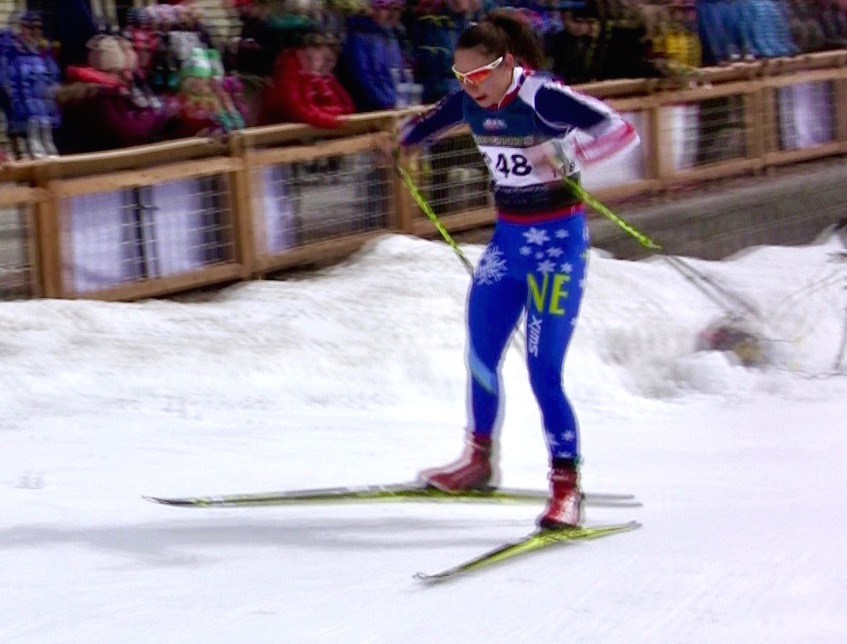
Hailey Swirbul (APU) on her way to a national title in the 10 k Classic at US Nationals in Lake Placid. (Photo: Nancie Battaglia)
Women’s Race: Swirbul’s Return, and a Course That Doesn’t Flatter Anyone
If the men’s race was defined by a razor-thin margin, the women’s race had a different feel: not less intense, but shaped by a performance at the front that felt like a statement. And the words that followed from the winner did not sound like someone who had stumbled into a good day; they sounded like someone who had been building toward a day like this for a long time.
Hailey Swirbul framed her win as the visible outcome of a longer experiment:
“Winning this race felt like finally getting to watch the outcome of a long experiment unfold! I’ve wanted to approach this season from a place of curiosity to see if I can get fitness and strength back after a 2.5-year hiatus. It has felt so rewarding to get stronger and remember how it feels to race and go hard again.”
She described the way racing itself can re-teach an athlete what “hard” feels like:
“Each race or hard interval session reminds me what it feels like a little bit more.”
And then she said what almost everyone in the finish area seemed to be thinking, whether they admitted it or not:
“This course is legit. I didn’t hear the words ‘I felt good out there!’ come out of a single person’s mouth! It was a battle of self against hill.”
That sentence carries the whole day inside it: not a battle against other people, exactly, but against the course’s capacity to strip away pretense.
Hailey Swirbul (APU) charges up one of the many climbs on that Lake Placid course behind Virginia Cobb (#120 – DAR) and Marit Flora (#76 – UAA). (Photo: Nancie Battaglia)
Swirbul’s race plan—at least as she described it—was deeply personal in its logic. Not a copy of someone else’s pacing, not a response to what she imagined others were doing, but an attempt to ski in a way that matched her strengths:
“I tried to ski true to myself. I wanted to use momentum and my own body weight the most effectively I could to get around that course as fast as I could- regardless of how the pacing looked for others.”
And because it’s an Olympic year, she made the subtext explicit:
“I have my eyes on an Olympic Team spot, and I’m going to continue to fight for it until the team is officially named. I’m not thinking beyond this week of racing here at Nationals. One step at a time, staying present…”
Then the line that reminds you why athletes keep doing this:
“…and enjoying getting to live this life and see so many people from old racing days— it’s a good life.”
Novie McCabe’s post-race comments carried a tone that felt especially relevant to this week: gratitude, yes—but also a clear-eyed description of how fragile a season can feel, and how an athlete can build stability by focusing on what can be controlled.
“It meant a lot to be starting today for sure! I think that being a bit unsure of whether I’d be starting these races made me feel pretty grateful for the opportunity to go out there and give it my best today.”
She described the emotional mix honestly:
“There were, of course, lots of doubts and some nerves going in as well, but I really tried to just enjoy the skiing and made that my main goal going into it.”
And she emphasized that conditions and course feel matter—not as excuses, but as context:
“The conditions were insanely nice today, which helped, and this course is one of my favorites!”
On pacing, McCabe described a strategy rooted in self-knowledge:
“Honestly, I kinda just went out as hard as I could within reason, and tried to relax and hold onto it. I know the splits don’t really make it look that way, haha, but I am not the fastest starter, so it is usually best for me to go out at what feels like a pretty hard pace.”
Then she explained the architecture of her day: not results goals, but process goals. She made a point that’s easy to dismiss until you remember what an Olympic week does to people:
“Being focused on process goals going into a race really helps me develop a framework for success.”
She listed those goals with specificity—how she wanted to feel, what she wanted to focus on, what she wanted her mind to do when discomfort arrived:
“…going out hard but comfortable and trying to hold it, skiing well (not skiing hard), be the focus of the day, keeping up the positive self-talk, and finding the good and noticing what is going well throughout the race.”
And on Olympic pressure, she offered a perspective that will sound familiar to anyone who has ever had a season disrupted by health or inconsistency:
“I think it has honestly helped me out in terms of handling self-imposed Olympic qualification pressure to not have had the best lead up and be pretty unsure of what I would be doing as far as racing goes this year…”
She described her focus as narrower—day by day—because it has to be:
“…it has taken some of my focus off of results… It has just kind of led to an approach where I take it day by day, and don’t really think much further into the future than that.”
That isn’t resignation. It’s an operating system. And it’s one that often works, especially on a course where you can lose time in the exact moment you start racing the future instead of the hill in front of you.
Rosie Fordham (UAF) leaving it all on the course on her way to 7th place overall. (Photo: Nancie Battaglia)
Samantha Smith: A Double Life and a Very Real Result
Samantha Smith’s presence near the top of the women’s results came with a storyline that’s unusual even in American ski racing: balancing elite cross-country skiing with Division I soccer at Stanford, and arriving at the heart of ski season off a long NCAA tournament run.
She spoke about the short transition plainly:
“Yes, that’s correct, that our soccer team’s long run into the NCAA tournament has made for a much shorter transition to the season. I’ve only been on snow for a few weeks, so I know my ski fitness is improving every day.”
She described the emotional carryover of playing for a national title—how it can become fuel rather than a distraction:
“Playing in the National Championship was an amazing experience—we were so close to winning it all. It was a tough way to end such a great season. I’m taking that fire from our final game and pouring it into my skiing.”
And she framed her path as something she’s embracing, not defending:
“I know my path is different from others, but I’m doing what I love, and I think there’s a lot to be said for staying true to that. I’m trying to take everything step by step, live in the moment, and focus on what I can control!”
On the scrutiny that comes with missing ski events earlier in the season, she emphasized the lessons she’s drawn from doing two sports seriously:
“…for me, I feel like there’s actually a lot I can pull from the two sports and use it to my advantage.”
She described last year as a “trial year” and explained how she’s adjusted:
“I needed that test phase to figure out what works and what doesn’t work. I made some adjustments this year in training, switching things up a bit, and I feel like that’s helped me a lot going into this season.”
She credited Braden Becker for helping with training and coaching through the fall:
“I owe a huge thank you to Braden Becker, a retired skier, who’s now a grad student at Stanford. He helped me a lot with training this fall, and it honestly made a world of difference…”
And then she returned to the mental challenge of this week—high stakes, lots of uncontrollables—and the philosophy that keeps an athlete from spiraling:
“…I’m just trying to focus on what I can control—my attitude and effort.”
Finally, she addressed the question of what a distance result might “say” about her:
“I was happy with today’s result… I think today’s race was a good indication of my trajectory for the rest of the week and the rest of the season.”
And she framed versatility—distance and sprint—as part of the argument she wants to make this winter:
“…hopefully showcase some of my versatility in different distances and disciplines, which I think can be important for big competitions like the Olympics.”
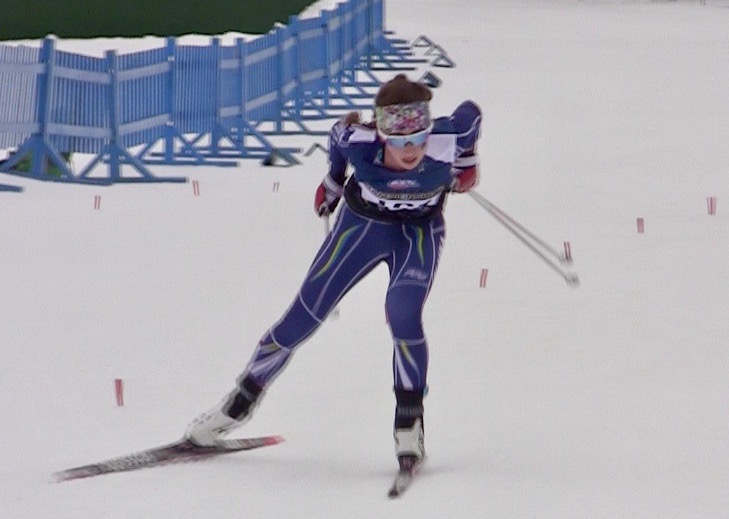
Alayna Sonnesyn (Team Birkie) on her way to 10th place overall. (Photo: Nancie Battaglia)
Why This Week Matters So Much
For the men, the arithmetic of Olympic selection is already partly written—and partly unresolved. At present, the United States is allotted seven men’s quota spots for the Olympic team, with the possibility that an eighth could roll down following this weekend’s World Cup races in Oberhof, Germany. That uncertainty is where much of the tension at U.S. Nationals resides.
It is also where most of the speculation comes from—so take it for what it is, informed but unofficial. The six American men who recently raced the Tour de Ski appear, by any reasonable reading of the criteria, to be on solid ground. Each currently ranks in the top 45 on the FIS World Cup sprint and distance overall lists, the threshold set by the US Ski Team that meets the objective requirements for Olympic selection.
Within that group of six, there is also ample sprint depth to cover the four available starts in the individual classic sprint and to form a competitive two-man sprint relay. As a result, Tuesday’s Freestyle Sprint at Nationals is likely to carry less weight for those athletes racing in Lake Placid with dreams of making the Olympic roster. Instead, the races most likely to function as closing arguments—particularly if an additional quota spot materializes—were Sunday’s 10 k Classic and Thursday’s 20 k Freestyle Mass Start. For at least one man, and potentially two, those performances may determine whether this week in Lake Placid becomes a footnote or a turning point.
On the women’s side, the picture is far less settled—and far more fluid. The United States has eight Olympic quota spots available, but only a portion of them is considered secure. Jessie Diggins—if it were ever in doubt—has already satisfied the objective criteria by finishing in the top eight in World Cup races that are part of the Olympic schedule. Julia Kern and Rosie Brennan also appear well-positioned, based on their respective rankings on the sprint and distance overall lists.
That still leaves as many as five remaining spots to be determined, drawing from a complicated blend of results across Period One on the World Cup, the SuperTour events in Alaska, and, critically, U.S. Nationals this week in Lake Placid. For those athletes, Nationals is not simply a domestic championship. It is an audition, a data point, and—in some cases—the clearest remaining path onto the Olympic team.
John Steel Hagenbuch (DAR) on his way to 5th place overall on the day. (Photo: Phillip Belena/EISA)
Grover: “There’s Going to be Space”… and then the Paperwork
US Cross-Country Ski Team Director Chris Grover offered perhaps the clearest explanation for why the opening races at Nationals feel unusually charged—not because they deliver final answers, but because they create space. Space in which athletes can move themselves from the margins of the conversation toward its center.
The story, as Grover framed it, is not simply who wins. It is what a result permits: what doors it opens, what arguments it strengthens, and how it positions an athlete within the broader, inevitably imperfect machinery of Olympic selection.
As Grover put it in an interview with FasterSkier, U.S. Nationals does exactly that—it creates room:
“…it’s going to be a great story because there’s space. There’s going to be space on both the men’s squad and the women’s squad, by the looks of it, for athletes to qualify from Nationals, to have great U.S. Nationals and come over, especially on the women’s side…”
That space, however, is not filled automatically. In an Olympic year, it is accompanied by paperwork, petitions, and deliberation—an acknowledgment that performance, while central, is rarely the entire story.
Grover outlined the petition process that follows Nationals, a step that often receives less public attention but carries significant weight:
“…all athletes who want to be considered for discretionary selection… We’ll put in an application. Or a petition rather, where they will kind of write out what their case is, why they should be considered…”
Those petitions, Grover explained, are then evaluated by a selection committee—six people tasked with translating results, trends, and context into final decisions:
“…we have the six-person selection committee that will pick the team. So as a committee, we’ll read everybody’s application, and then we, as a committee, will decide whether we want to elevate somebody using Coach’s discretion to be selected.”
Even the arithmetic of quota spots, Grover noted, is subject to forces beyond any one athlete’s control. On the men’s side, the possibility of an additional spot remains unresolved:
“…it’s after Oberhof… qualification for nations also closes on January 18… and at that point a spot [might be] available…”
Which is to say: timing matters. So does patience.
Taken together, Grover’s explanation underscores a truth that every athlete racing this week understands intuitively. Lake Placid does not merely crown national champions. It produces evidence—sometimes decisive, sometimes ambiguous—for a selection process that will soon harden from theory into reality. And once it does, the margins that feel abstract today will become permanent.
Ava Thurston (#45 – DAR) on her way to 6th place overall on the day. (Photo: Phillip Belena/EISA)
What Sunday Actually Did
The first day of Nationals did not select the Olympic team. It did something subtler and, in some ways, more powerful: it established the tone of the week.
On the men’s side, it proved that the domestic field is not going to give anyone breathing room. Wonders’ win was decisive in the only way that matters in interval start racing: he was fastest when everyone had to ski alone. But the closeness behind him reinforced Jager’s point—each race could be someone else’s day. In a week like this, that’s not a platitude. It’s a forecast.
On the women’s side, Swirbul’s victory felt like a day where preparation and belief finally aligned. But even she framed the week properly: one step at a time, staying present, not thinking beyond Lake Placid. McCabe and Smith offered two different versions of the same survival skill: build a framework, focus on process, control what you can, and let results become the output rather than the obsession.
If there was a single emotional throughline, it was this: the athletes weren’t pretending the Olympics weren’t there. They were trying, in different ways, to keep that fact from hijacking the work.
A Conclusion in the Shape of an Interval Start
There’s a particular quiet that follows an interval start classic race—not silence, exactly, but the hush of athletes doing their internal accounting. A national championship can feel like a celebration. In an Olympic year, it can also feel like a deposit: something placed into the larger selection ledger, something that will matter later, in rooms the athletes won’t be in, in conversations they can’t control.
What makes Lake Placid different—what makes Mt. Van Hoevenberg feel so permanent—is that it refuses to dramatize any of this. It simply asks the same thing of everyone: ski two laps honestly, manage the climbs, keep your head when your legs get loud, and finish without bargaining.
Wonders said he felt the pressure—and expects to keep feeling it. Jager said the closeness means nothing can be taken for granted. Swirbul described a long experiment that finally yielded its outcome. McCabe described building success from process, not prediction. Smith described a life lived between two sports, and a focus narrowed to attitude and effort.
Taken together, those aren’t just post-race quotes. They’re the first chapter of the week.
And in an Olympic winter, first chapters matter—because the next race arrives quickly, and the story keeps writing itself, one start at a time.
Love stories like this? Help keep them coming.
Feature stories like this one take time, access, and care to produce. If you value thoughtful storytelling and independent ski journalism, please consider becoming a Voluntary Subscriber. Your support directly fuels the work we do to cover the people, places, and moments that make our sport special.
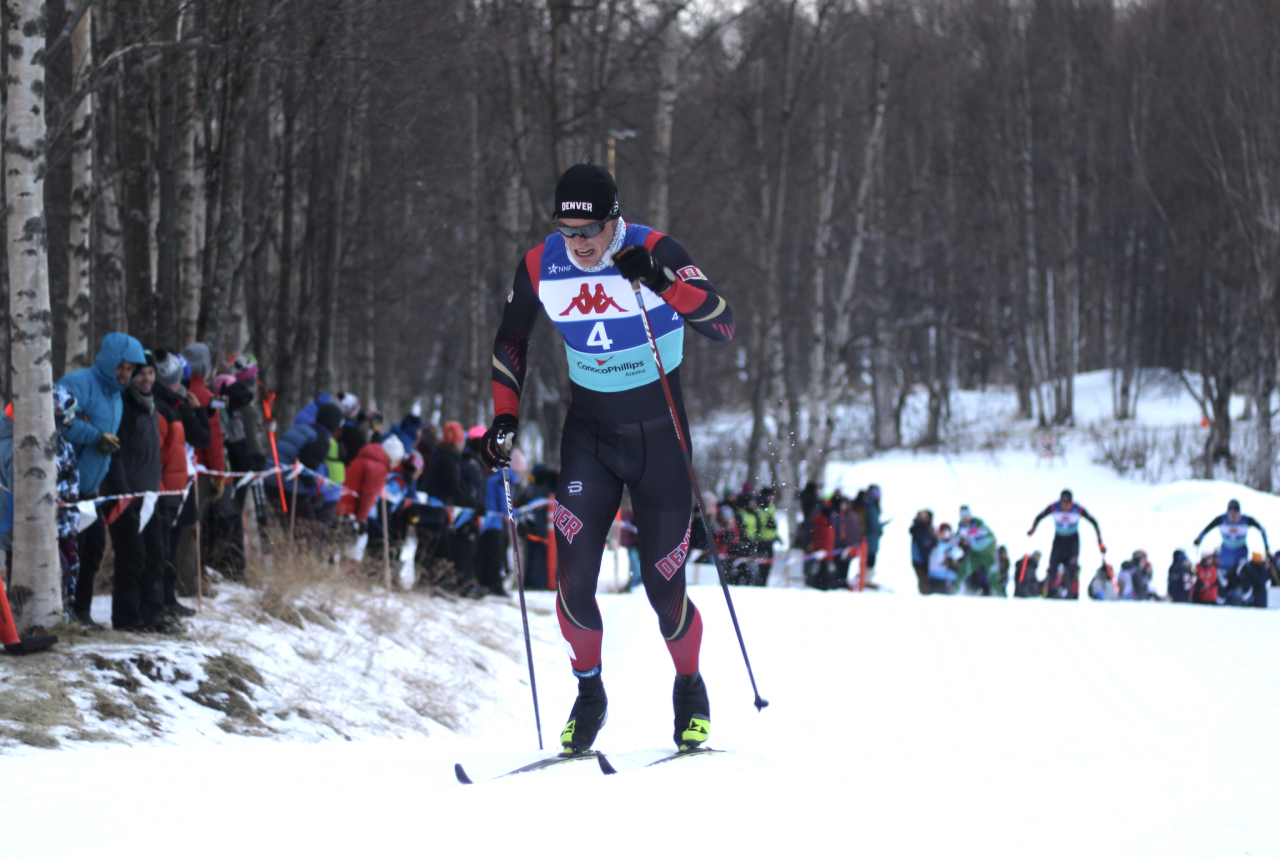
Norway’s Andreas Kirkeng, racing for the University of Denver, skied away from the men’s pack at U.S. Nationals on Sunday. (Nathaniel Herz/FasterSkier)
ANCHORAGE — The winner of two of three U.S. National Championships races in Alaska this week is just 24 years old, and poised for what could be a long career in cross-country skiing.
But instead, Andreas Kirkeng is considering retirement.
The explanation is simple: The star University of Denver athlete is not American. He’s Norwegian.
And in Norway, aspiring to be a top cross-country skier is like trying to become an astronaut: Many, many try, and nearly all of them fail, because the field is so deep and talented.
“I genuinely believe he could be one of the best World Cup skiers in the world. It’s a bummer that it’s just so hard to be Norwegian — any other country on Earth and they’d greenlight you for the Olympics for the next 10 years,” said Luke Jager, one of the Americans edged out by Kirkeng at nationals this week. “I’ve been telling everyone in the world: Everybody who knows that guy needs to tell him to not quit skiing next year.”
Kirkeng won his second race at U.S. Nationals on Sunday in dominating fashion, dropping the top Americans in the field on the last of four five-kilometer laps in the classical technique.
Because Kirkeng was ineligible for the U.S. championship, Dartmouth College’s John Steel Hagenbuch claimed the title by finishing second, narrowly edging Jager, who skis for Alaska Pacific University. Will Koch, skiing for the University of Colorado, was third.
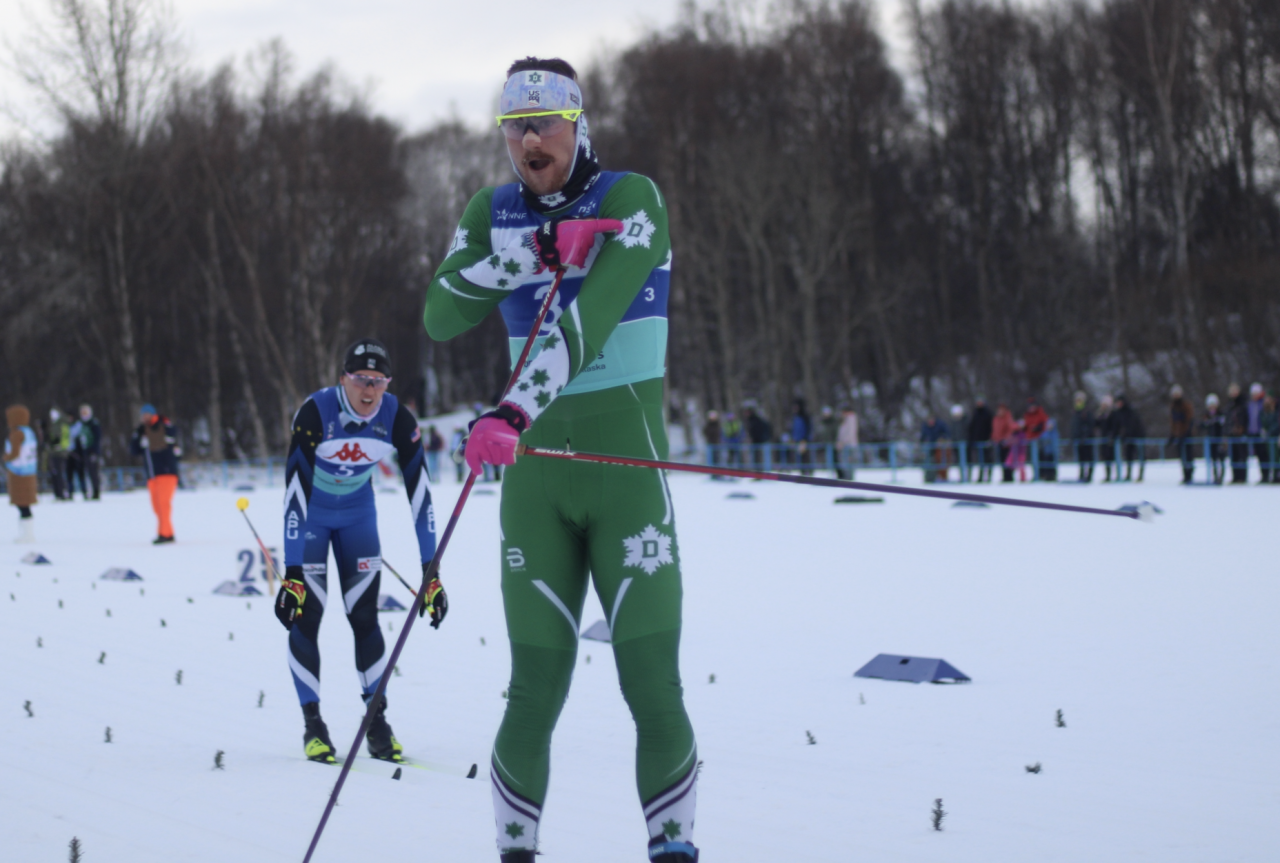
John Steel Hagenbuch points to the Dartmouth College snowflake on his arm to celebrate winning a national title at Anchorage’s Kincaid Park on Sunday. He finished behind Kirkeng but ahead of all the other Americans in the race, with Luke Jager just behind him. (Nathaniel Herz)
But Kirkeng has been the undisputed star of the week at Anchorage’s Kincaid Park, where he also won Saturday’s classical technique sprint race by beating Jager on the homestretch.
In Thursday’s 10-kilometer skate-technique distance race, he finished second, less than a second behind Hagenbuch.
After Sunday’s event, Kirkeng conceded that he hasn’t made up his mind about his future — and noted that his girlfriend told him the day before that it would be “sad” if he retired.
But, he added: “I’ve been ski racing for 13, 14 years. At some point you have to do something else.”
Observers offered mixed opinions about the significance of Kirkeng’s results in Anchorage, with U.S. Olympian Scott Patterson saying that they might not have translated into a top-30 finish on the World Cup, the top international circuit.
But Jostein Vinjerui, who coaches an elite professional team based in Norway, Aker Daehlie, said he thinks Kirkeng’s results show some promise.
“It would be very sad if he gives up now,” Vinjerui said in a phone interview Sunday. “He should at least test one year in Norway, what he can do there. Because the U.S. level now is pretty good.”
Kirkeng grew up in Lier, a community not far from Oslo and just a few miles from Drammen — the city that long hosted an iconic World Cup sprint race every year, with loads of snow trucked in and smoothed over its streets.
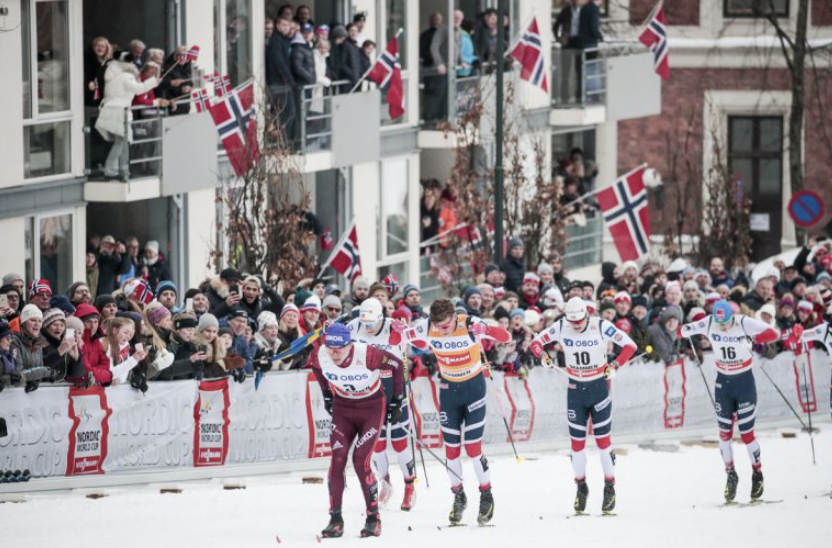
Athletes race at the Drammen World Cup sprint in 2018. (Fischer/Nordic Focus)
“When I was in elementary school, I would walk straight out of class to Drammen to watch,” Kirkeng said.
There were numerous areas with snowmaking to cross-country ski near his home, and Kirkeng’s family also had a cabin in the mountains.
He joined a club program in elementary school and made junior national and regional ski teams. But Kirkeng lost some of his motivation after a tough first year as an adult competitor, when a high-intensity block training program “sort of killed” him, he said.
It was time for Kirkeng to try something new and different, he said, and he decided to follow his brother to the University of Denver. Kirkeng is now a senior studying finance on a full scholarship — and has broadened his horizons.
“It’s actually crazy — I’m telling all my friends in Norway it’s the best thing you can do,” he said. “You get everything covered, you have chances to train, and you get an education and ski at the highest level.”
The dilemma confronting him at the end of the season is stark.
To make a career of ski racing back in his home country, he’d have to fight his way into the elite Norwegian men’s field — the strongest in the world.
Organizers cap the number of skiers from each country who can start each race on the World Cup. But even so, Norway’s male athletes regularly take five of the top six places in distance events — beating the best competitors from all other nations, including the U.S.
Dozens of other Norwegians toil in relative obscurity on the country’s domestic race circuit, fighting to earn a single chance to prove themselves on the World Cup. Kirkeng has never gotten a World Cup start, even as some of the U.S. athletes he’s beaten have been racing on the circuit for years.
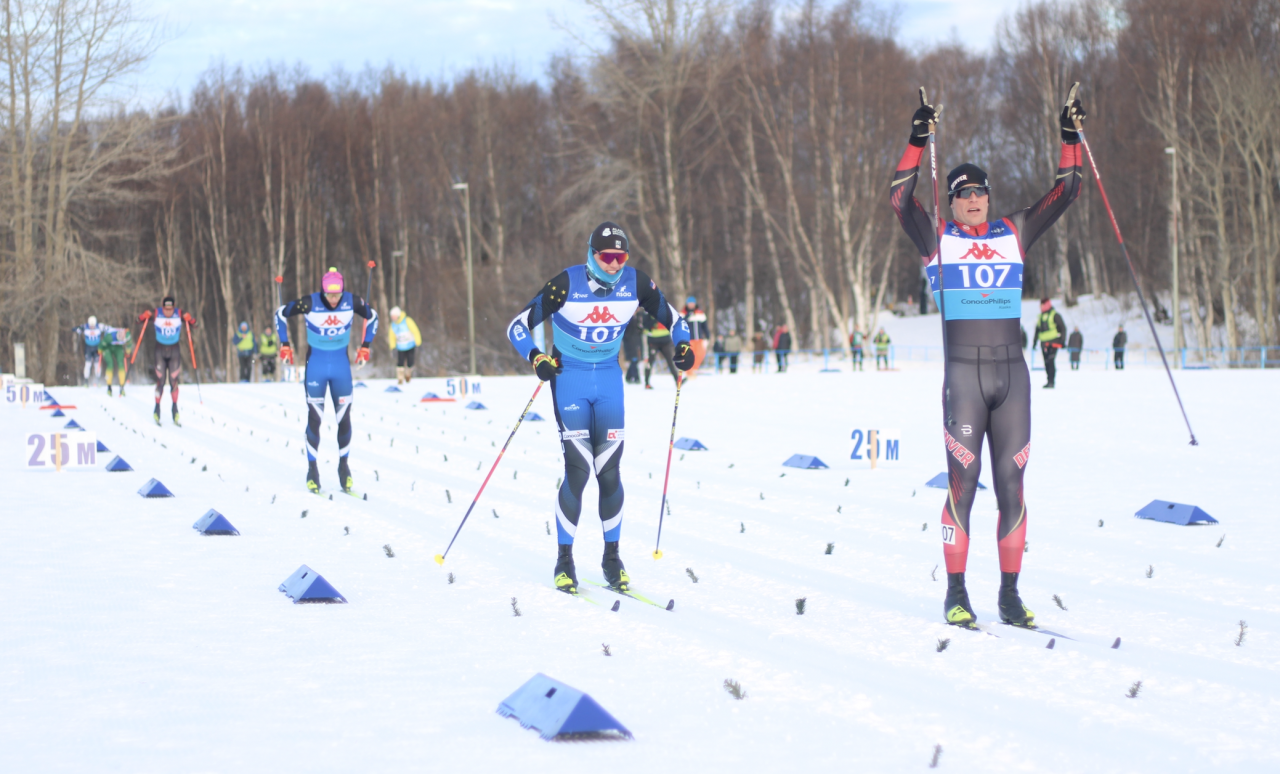
Kirkeng his win in Saturday’s sprint race at Kincaid Park, where he narrowly beat Luke Jager. (Nathaniel Herz/FasterSkier)
Just last week, the Norwegian team had an athlete drop out before the start of one of the season’s marquee World Cup events, the Tour de Ski. The first alternate declined his spot because he got sick, and the second alternate, Haavard Moseby, finished on the podium in one of the stages.
“For Andreas, it’s almost impossible, as a Norwegian,” said Florian Knopf, a German athlete who races with Kirkeng in Denver. “He’s super strong. But the Norwegians have 10 other guys like that, even better.”
Knopf is in a similar position in his home country, where, if he returns to full-time ski racing, he’ll be on the bubble to qualify for international events.
“You have to be brutally honest with yourself, and also ask yourself what you want in life. Being 25 years old and still being able to ski among the best is making me really happy,” Knopf said. But, he added: “I know many Germans who are Olympians who are not happy.”
Knopf and Kirkeng will also leave Denver with college degrees — meaning that continuing as ski racers would require them to forsake other professional opportunities. Both have applied for jobs on Wall Street.
“The only struggle is his brain is almost as good as his ski talent,” said Selma Anderson, Kirkeng’s girlfriend and a teammate at Denver.
Kirkeng said he’s been contemplating his options to continue ski racing. There’s a marathon circuit in Europe; he could also try to work part-time and ski part-time. But he’s not sure he wants to ski race if he can’t fully dedicate himself to training.
Kirkeng skied in the men’s lead pack for most of Sunday’s race at U.S. Nationals before breaking away for the win. (Nathaniel Herz/FasterSkier)
“It would be really cool to give it a shot and see where it brings me,” Kirkeng said. “And I’m definitely open to it. But at the same time, I feel I’ve been doing it for so many years now.”
Jager, the American skier, is still making his pitch. He said he thinks that Kirkeng’s intellect and education serve as a fallback that can allow the Norwegian to keep ski racing for longer without risking his future.
“I know he’s got the whole finance thing going on. But for me, that’s all the more reason to postpone that as long as possible,” Jager said. “He can go be the Wolf of Wall Street when he’s in his 30s.”
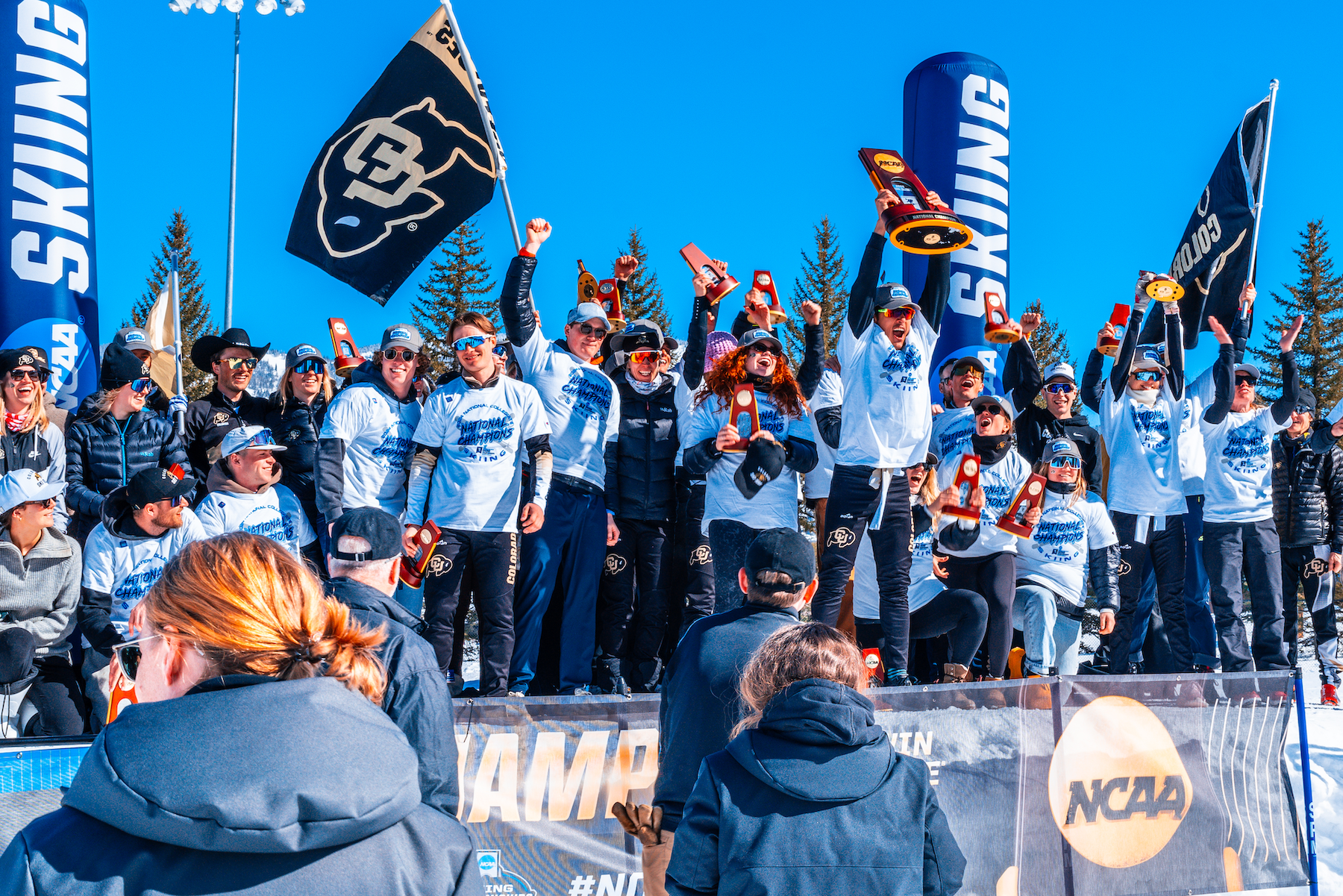
The 2024 NCAA Champion University of Colorado Buffaloes. (Photo: Tobias Albrigsten/ @UnTraceableG)
Winning a fifth NCAA championship in a row would represent a program milestone for the University of Utah, though going into the final day of NCAA competition, Utah’s path to victory was less than a foregone conclusion. Nonetheless, Utah has shown itself to be the dominant collegiate program—both Alpine and Nordic—of the last few years, entering the final day of NCAA competition as the favorite to take the crown. All that history would be decided in the Men’s and Women’s 20 k Mass Start Classic races held at Howelsen Hill in Steamboat Spring, Colorado. Clear skies and perfect conditions made waxing and preparation quite straightforward; the races—and the championship—would be decided on the trails.
The NCAA Skiing Championship is awarded to the team with the highest combined score after two Alpine races and two Nordic races. The University of Utah entered Saturday’s 20 k Mass Start Classic races (Men’s and Women’s) with a substantial lead (444.5 points) over University of Denver (401 points) and University of Colorado (393.5 points). These would be the final races of the 2024 NCAA Championship—trophy presentations, unfurled flags, and whole-team podium photos to follow.
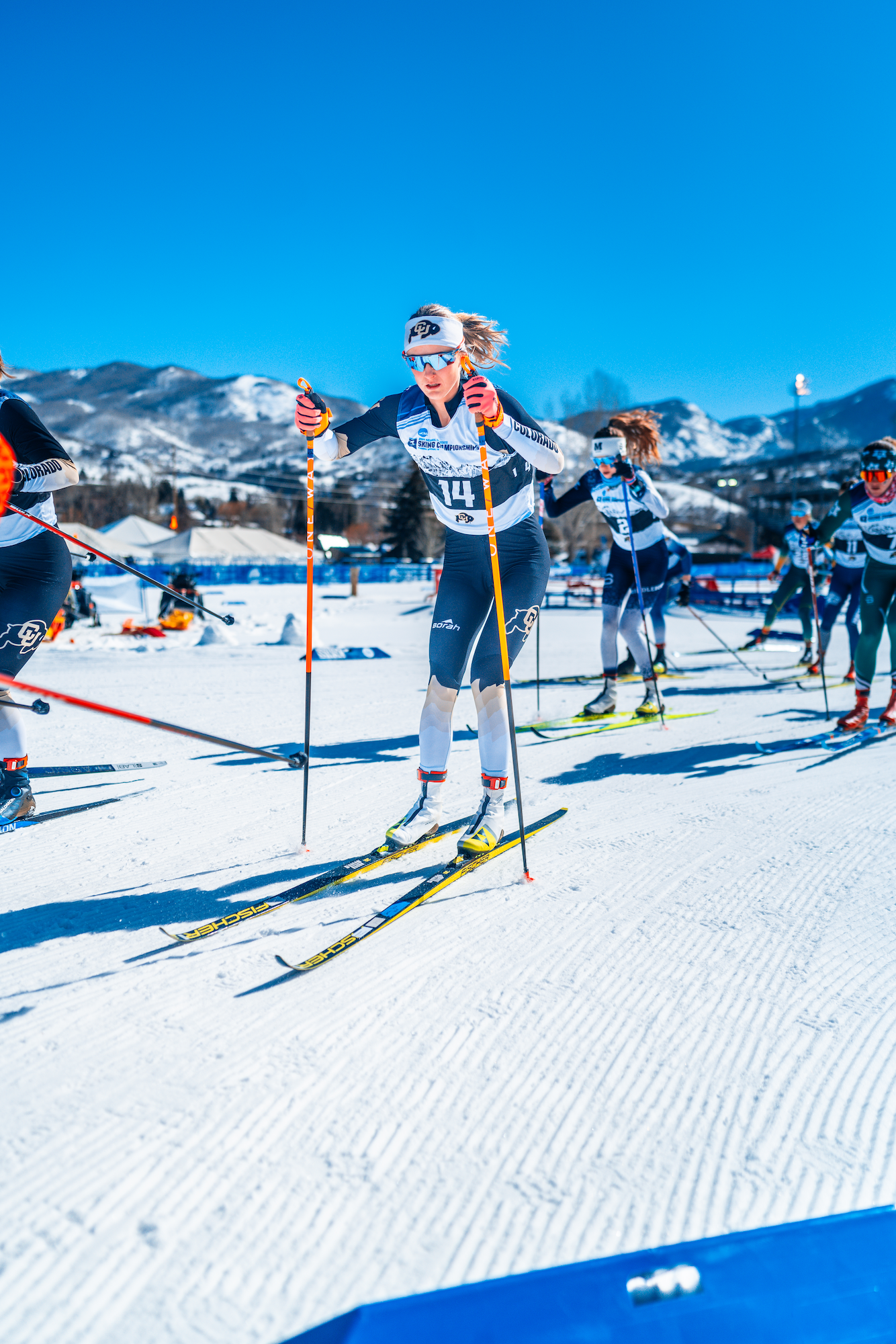
University of Colorado’s Weronkia Koletta during Saturday’s NCAA 20 k Classic Mass Start. Koletta finished ninth, part of a CU effort that placed three in the top ten to secure a closely-contested NCAA Team Championship. (Photo: Tobias Albrigsten/ @UnTraceableG)
Women’s 20 k Classic Mass Start
Earlier in the week, Thursday’s 7.5 k Individual Start Freestyle race was won by Utah’s Sydney Palmer-Leger (UU) who ended her own three-year title-drought by returning to the top step of an NCAA podium for the third time in her career. Palmer-Leger was a two-time NCAA champion as a freshman in 2021, but since those early-career successes, she has had to watch as her teammates—Novie McCabe in 2023 and Sophia Laukli in 2022—won races and garnered headlines. With McCabe and Laukli now racing full-time on the World Cup circuit, the responsibility of delivering national championships for the Utes has returned to Palmer-Leger.
Along with Palmer-Leger, the list of contenders in the Women’s race is deep and distinguished, and many of those names went straight to the front as the race began. Led by Tilde Baangman (MSU) and Hannah Abrahmson (CU), a group of seven separated themselves from the field by the top of the very first hill. By the end of the first of four 5 k laps, that lead group would grow to ten: Jasmine Drolet (DAR), Baangman, Abrahamson, Kariana Dengeruud (UU), Palmer-Leger (UU), Anna-Maria Dietze (CU), Weronika Kaleta (CU), Haley Brewster (UVM), Ava Thurston (DAR), Kate Oldham (MSU). The challenging climbs and the daunting elevation of Steamboat’s Howellson Hill course continued to whittle away at the lead group for the next two laps. Conversely, Kendall Kramer (UAF) was able to work her way up to the lead group as other contenders continued to fall away.
At the beginning of the final lap, the lead group had seen itself shrink to seven: Abrahamson, Baangman, Palmer-Leger, Drolet and Dietze, with Kaleta hanging just off the back in sixth. If that combination of skiers—three from CU and only one from UU—were to finish in that order, it would mean a massive points swing to CU with only the Men’s race remaining in team scoring. But racing rarely goes to script.
Midway through the final lap, a major climb caused another split in the lead group as Abrahamson, Palmer-Leger, and Brewster powered to the front, only to see themselves caught and passed on the subsequent downhill by a rocketing Drolet who quickly established a gap and shattered the small group of leaders.
Drolet would storm across the line first, followed seconds later by Brewster second, Palmer-Leger third, Abrahamson fourth, Dietze fifth, Kramer sixth, Baangman seventh.
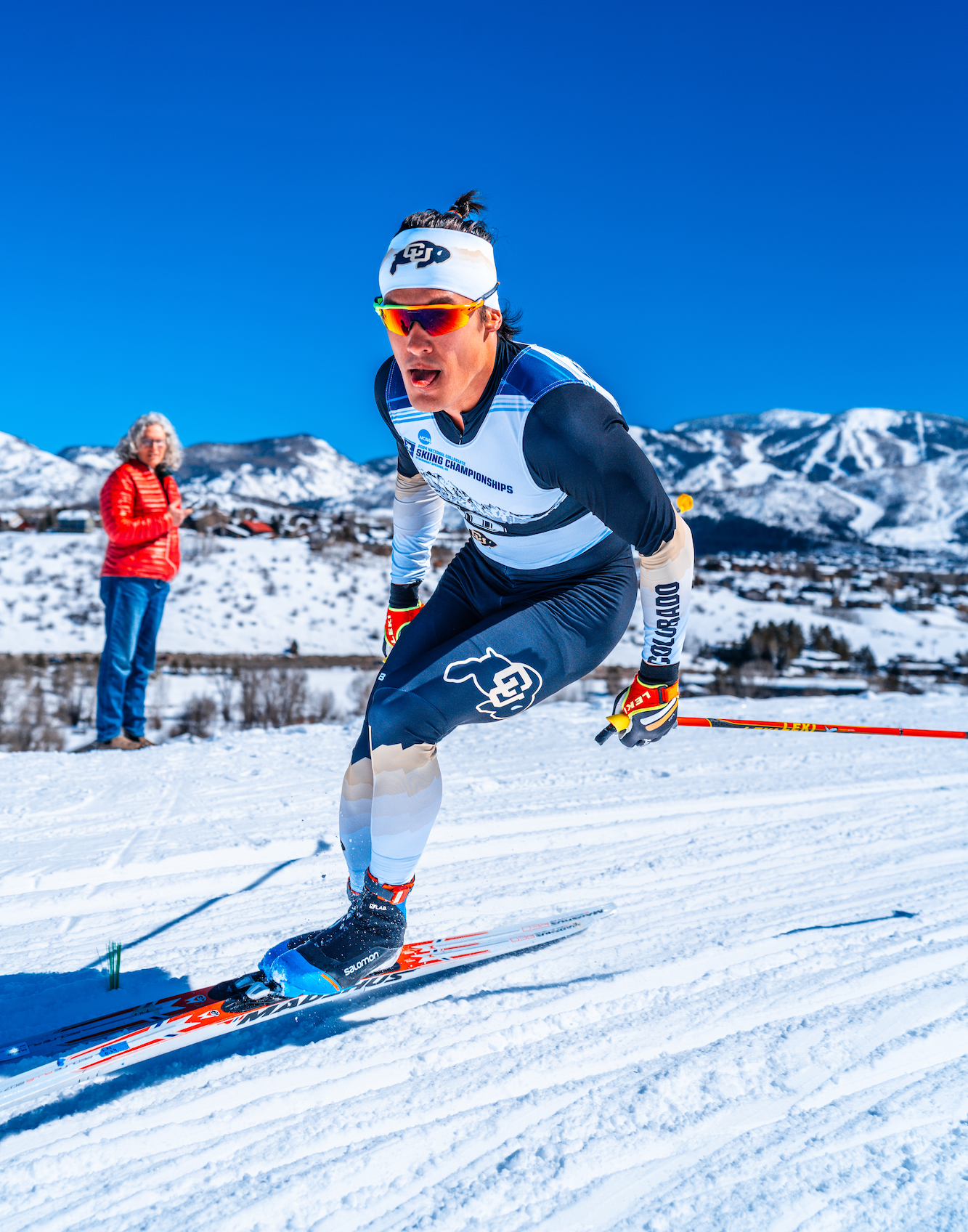
Magnus Boee (CU) delivered the third NCAA race win of his career, leading the Colorado Buffaloes to an unlikely final-day comeback and the NCAA Skiing Championship. (Photo: Tobias Albrigsten/ @UnTraceableG)
Men’s 20 k Classic Mass Start
Utah led team scoring going into the final Men’s race, with Colorado trailing by only 17 points. NCAA bragging rights would be up for grabs over the next 20 kilometers.
In the 2023 NCAA Mass Start race, Dartmouth’s John Steel Hagenbuch had found himself out-dueled by Remi Drolet of Harvard (the first NCAA race-winner in that school’s history). Drolet returned to this year’s NCAA championship, but he appeared to have left his best form on the World Cup courses where he spent much of the winter and spring. Drolet finished Thursday’s 7.5 k Freestyle an uncharacteristic 16th. Hagenbuch, too, has raced through a calendar dominated by World Cup racing, but he appears to be getting stronger and stronger as the collegiate season continues.
The Men’s race broke up quickly; by the beginning of lap two, a lead group had formed of Andreas Kirkeng (DU), Florian Knopf (DU), Magnus Boee (CU), and Will Koch (CU). That lead group was followed closely by 2023 NCAA Champion Joe Davies (UU), Tom Mancini (UU) Hagenbuch, and Drolet.
Mid-lap attacks by Boee shook up the lead group, shedding Koch and stringing out Kirkeng and Knopf. It seemed an audaciously early move, though with potential to develop points gaps (especially with Boee in the lead and Koch remaining ahead of Utah’s skiers) that could bear heavily on the final NCAA standings.
Boee’s tremendous double-pole continued to put time into his rivals. All that remained was the upcoming 30+ kilometers, and the question of whether or not Boee’s gamble would pay off. Through the end of the second lap, Boee’s gap continued to grow. Behind him, Knopf continued to chase gamely, though Kirkeng was overtaken by Koch.
Working together behind Koch was a group of contenders including Tom Mancini (UU), Drolet, Hagenbuch, Brian Bushey (UU), Davies, and Florian Winker (MSU).
Beginning the final lap, Boee held a gap of over 20 seconds over second place Knopf, then another 20 + seconds to Koch, then a final 20+ seconds to the main group of chasers. Someone would need to surge—and someone would need to blow—for those standings to be much changed before the finish. At the beginning of this final lap, CU led the NCAA team standings by a mere two points.
University of Coloardo’s Will Koch held off a late surge by John Steel Hagenbuch (Dartmouth) to take third in the NCAA 20 k classic mass start, helping win the Team Championship for CU by just 2 points. (Photo: Tobias Albrigsten/ @UnTraceableG)
On the major climb, Drolet and Hagenbuch began to pull away from the Utah skiers. And by the last kilometer of the final lap, Hagenbuch and Drolet were beginning to track down Koch who gave everything he had to get over the top of the final climb ahead of his pursuers.
Boee skied across the line waving a CU flag, Knopf crossed the line, Koch crossed the line, Drolet outsprinted Hagenbuch for fourth, then a trio of Utes crossed together. A few skiers later, Colorado’s Johannes Flaaten crossed the line for 11th place . . . and a NCAA TEAM CHAMPIONSHIP for the Colorado Buffaloes . . . a win they took from the Utah Utes by a team-total of two points.
Will Koch leads the Men’s Final over the top—and finished on top—of the US National Championship Skate Sprint on Thursday in Soldier Hollow. (Photo: Tobias Albrigsten/@UntraceableG)
Though temperatures hadn’t dropped much at Soldier Hollow on Thursday, things felt different. The pure blue skies that had been a reliable fact of life at this year’s US Cross Country Ski National Championships (US Nationals) were clouded over as skiers took to the course for Skate Sprint qualifying. Temperatures hovered just below freezing creating fast, abrasive, consistent snow. The result was consistent wax conditions between morning qualifying and afternoon heats.
Logan Diekmann (BSF Pro Team), John Steel Hagenbuch (Dartmouth Ski Team), and Micahel Earnhart (APU) (L-R) during the Men’s Skate Sprint Final. (Photo: (Photo: Tobias Albrigsten/@UntraceableG)
Men’s Skate Sprint
Two years ago, when US Nationals was last held at Soldier Hollow, University of Colorado Sophomore, Will Koch, qualified first in that year’s Classic Sprint. Things on Thursday were the same: again Koch qualified in the top position. Two years ago, Koch had skied out in the quarterfinals. On Thursday, things felt different . . .
Skiing from the first quarterfinal heat, Koch held the pack together from the front, glancing side-to-side as he marked any surges from his competitors. Time and time again—through quarterfinals, semifinals, and Finals Koch had a response. Though things would wax and wane in a Men’s final that featured 2021 Classic Sprint runner-up Logan Diekmann (BSF Pro Team), last year’s Sprint Champion Kristoffer Alm Karsrud (Northern Michigan University), John Steel Hagenbuch (Dartmouth Ski Team), Michel Earnhart (Alaska Pacific University), and Florian Knopf (University of Denver), Koch would hold off all-comers, putting in a final burst to put bib #1 into position #1. Just behind Koch was Logan Diekmann, edging out John Steel Hagenbuch to complete the Men’s Overall podium.
The Men’s field had winnowed down over the course of heats that tended to be raced faster and faster throughout the day. The Soldier Hollow course, with its downhill finish and steep climbs, should theoretically be a very tactical one, but its length—and its location 6,000ft above sea level—seemed to lead to a more outright version of sprint racing, where maneuvering gave way to pure stamina on the day. Koch’s first quarterfinal had been a relatively lax affair early on, but subsequent heats would start the heated action earlier and earlier within the course. The third quarterfinal featuring Tom Mancini (University of Utah), Graham Houtsma (BSF Pro Team), Florian Knopf (DU), and Kristoffer Alm Karsrud (NMU) would push from wire to wire to pull two lucky losers into the semifinals. Mancini and Houtsma advanced 1-2 in the heat, while Knopf and Karsrud would contest a chaotic final sprint that saw them both claim semifinal spots. Both semifinals also featured more aggressive tactics, with the second semifinal seeing the top junior performance of the day, as Trey Jones (CU) sprinted to fourth place in the heat. Jones was joined on the junior podium by quarterfinalists Fin Bailey (Stratton Mountain School) and Murphy Kimball (Alaska Winter Stars).
The Women’s Sprint Final pushes over the top of the ultimate Soldier Hollow climb. Karianne Olsvik Dengerud (UU), at the front, would take the win in the Skate Sprint. (Photo: Tobias Albrigsten/@UntraceableG)
Women’s Skate Sprint
Tactical nuances were evident in the Women’s Skate Sprint field throughout the day, but they tended to be more subtle than definitive, fast-surging, field-breaking pushes. The Sprint Final, which featured top qualifier Haley Brewster (University of Vermont), Karianne Olsvik Denegrud (UU), Alayna Sonnesyn (SMS), Alex Lawson (Craftsbury Ski Club), Tuesday’s classic champion Tilde Baangman (Montana State), and Mariel Merlii Pulles (University of Alaska-Fairbanks) did show that those nuanced tactics had an effect. Sonnesyn led from the front of the field, with UU’s Dengerud marking her through the first set of hills. The pair had, at points, appeared to open a gap, but the rest of the field surged as the race went into the final climb to make for a closely contested race in the finishing straightaway. Emerging from that pack was University of Vermont’s Haley Brewster, who would work the long downhill into the finishing stretch to put herself within a group that featured Dengerud and Sonnesyn, and then use the final stretch to challenge their place at the front. That led to an exciting final sprint between four skiers in which Dengerud narrowly came out on top. Sonnesyn would follow in second, and Brewster would round out the Overall podium in third place. Behind them, Alex Lawson had created space to take fourth place on the day, and to step onto the American podium in third place behind Brewster and Sonnesyn.
Alayna Sonnesyn (SMS) skied to her first US National Championship in Thursday’s Skate Sprint. (Photo: Tobias Albrigsten/@UntraceableG)
Sonnesyn’s second place Overall delivered her first American National Championship (she had finished runner-up in the 2020 Skate Sprint at US Nationals in Houghton, Michigan). It also marked the first time that UU’s Dengerud, a native Norwegian, stepped onto the top spot of the podium at US Nationals.
Earlier in in the day, Dartmouth Ski Team’s Ava Thurston was the only junior to advance to the semifinal before finishing 12th on the day. Thurston was joined on the junior podium by quarter finalists Nina Schamberger (UU) 19th on the day and in second, and Sofia Scirica (Middlebury College) 29th on the day and in third.
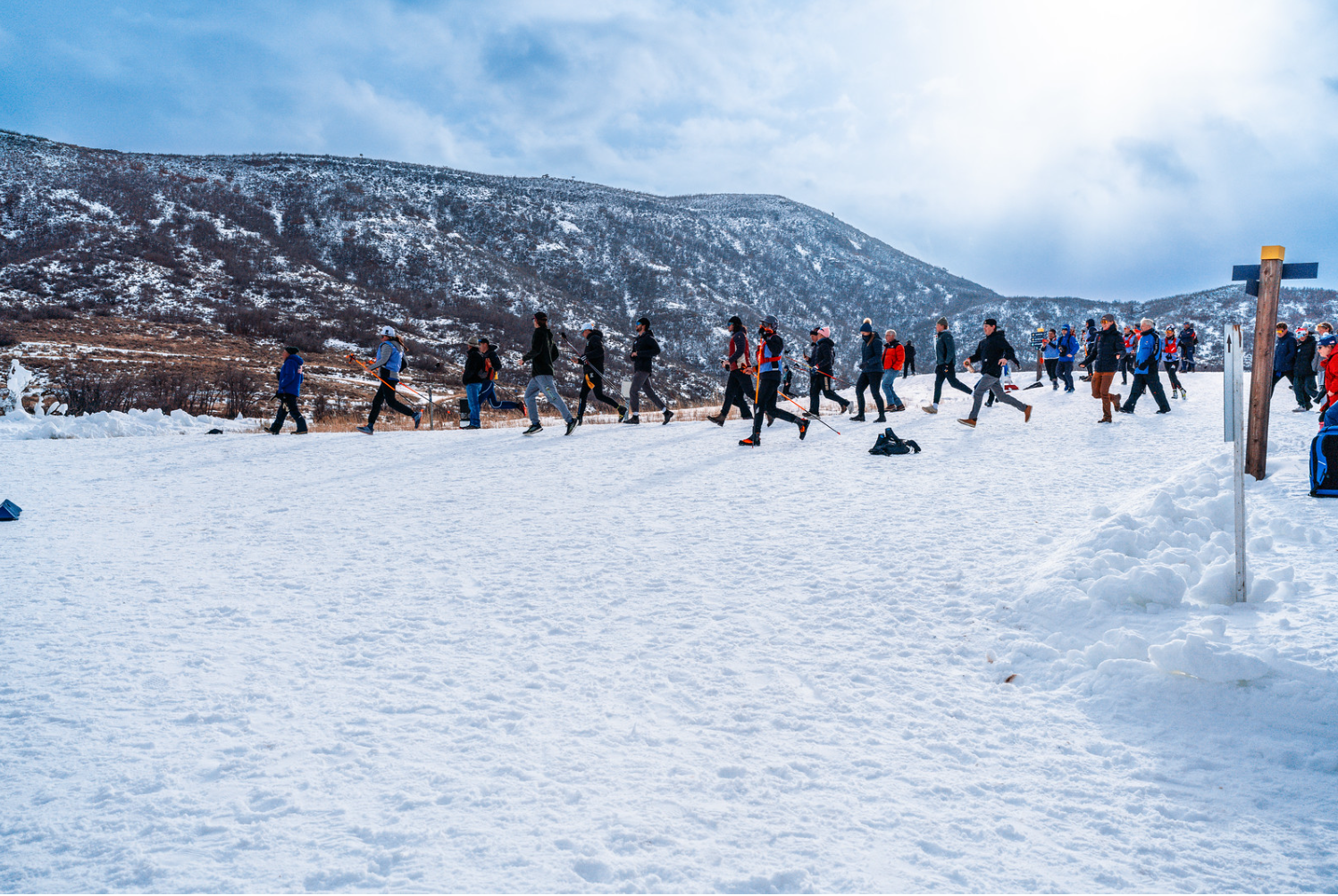
Spectators on the move during a sprint heat Thursday. (Photo: Tobias Albrigsten/@UntraceableG)
Snow Likely for Friday’s 20 k Mass Start Skate
A front developing over the Wasatch is headed towards Soldier Hollow ahead of the 20 k mass start skate race that will mark the finale of US Nationals on Friday. That left for an anticipatory mood around wax cabins, the Heber Valley, and the US ski community. When Soldier Hollow first hosted a National Championship in 2006, 36 skiers completed that year’s mass start skate race, then a 30 k. On Friday, the field is likely to be four times that size. With an American ski community that has been largely starved of snow, the scene is set for a race that will be a reminder of the joys and the revelry that this winter sport of skiing can bring.
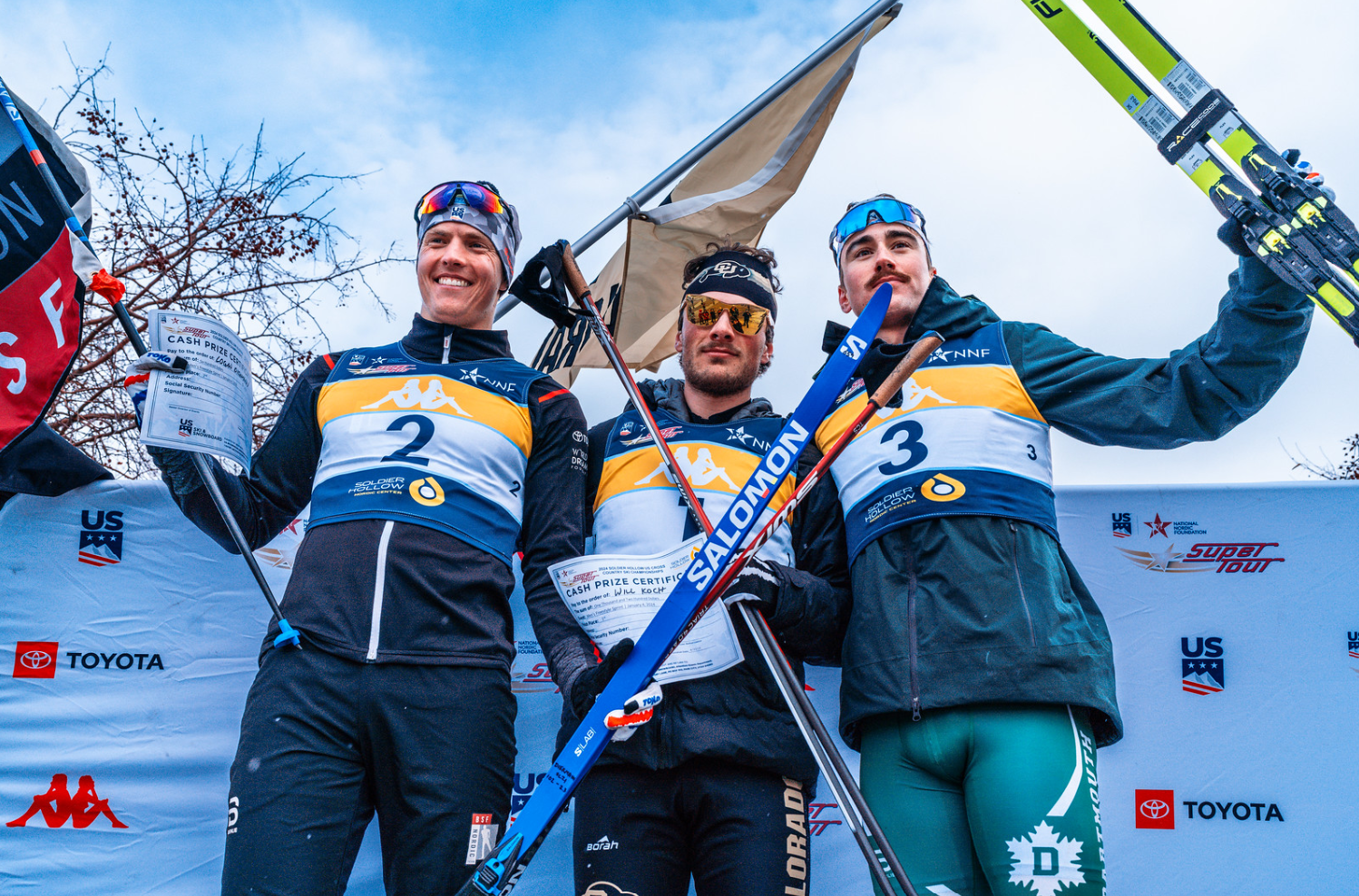
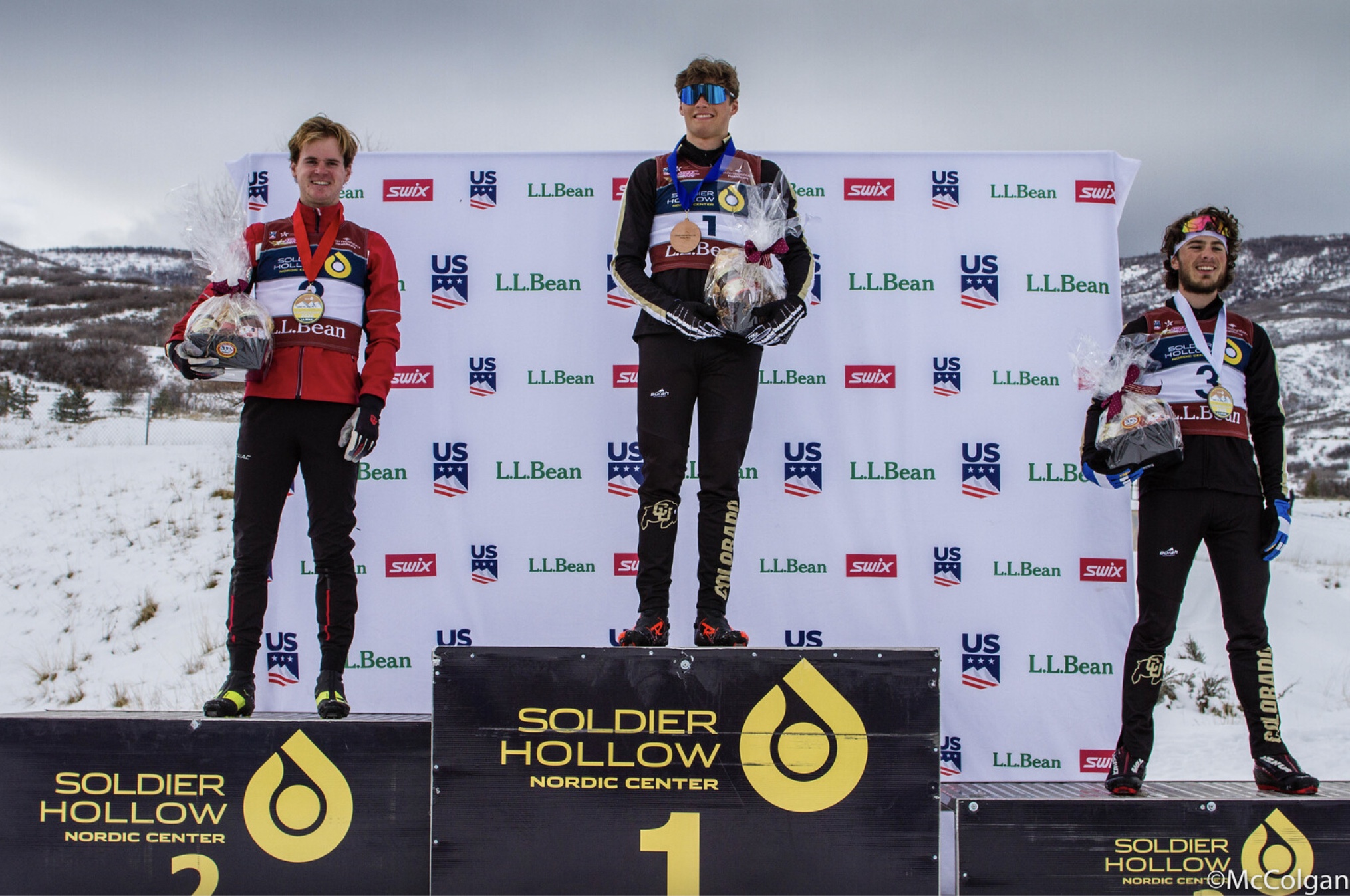
The Men’s Skate Sprint podium: 1st) Will Koch (CU) first, Logan Diekmann (BSF Pro Team) second, and John Steel Hagenbuch (Dartmouth) third. (Photo: Tobias Albrigsten/@UntraceableG)
Tobias Albrigsten contributed photos to this coverage of US Nationals. A full gallery from Thursdays Skate Sprint is available on his website here, and you can follow him on Instagram @UntraceableG.
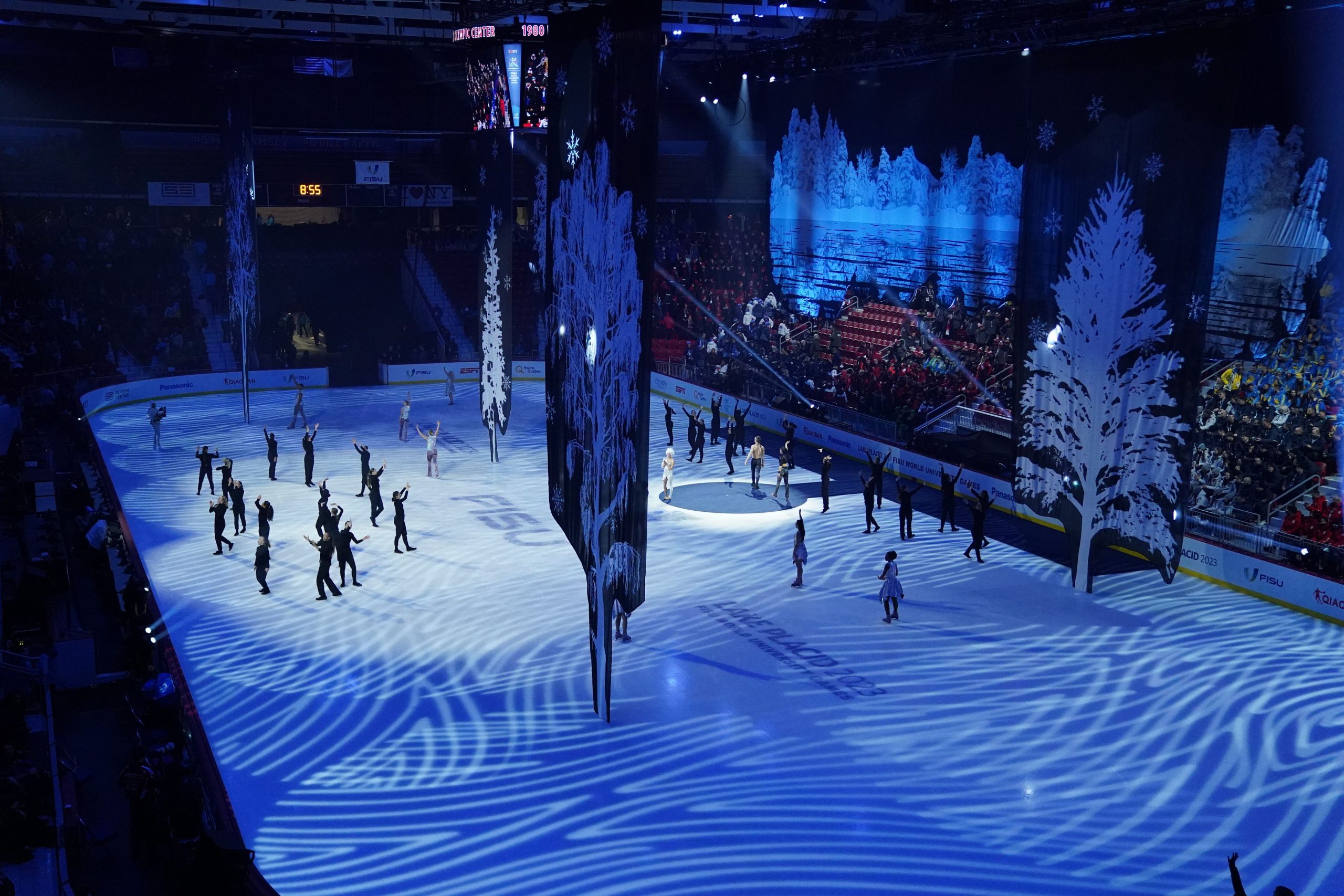
With the State of New York having spent $500 million (through the Olympic Regional Development Authority) to dramatically overhaul facilities originally constructed for the Olympic Winter Games of 1980, Lake Placid was dolled up and ready to host the 31st World University Games, the first time these competitions had been held in North America since 1972. And so, not even the light drizzle outside on opening night could dampen the prospect of a week that promised competition, fellowship, and a glimpse at athletes likely to shape the future of winter sports.
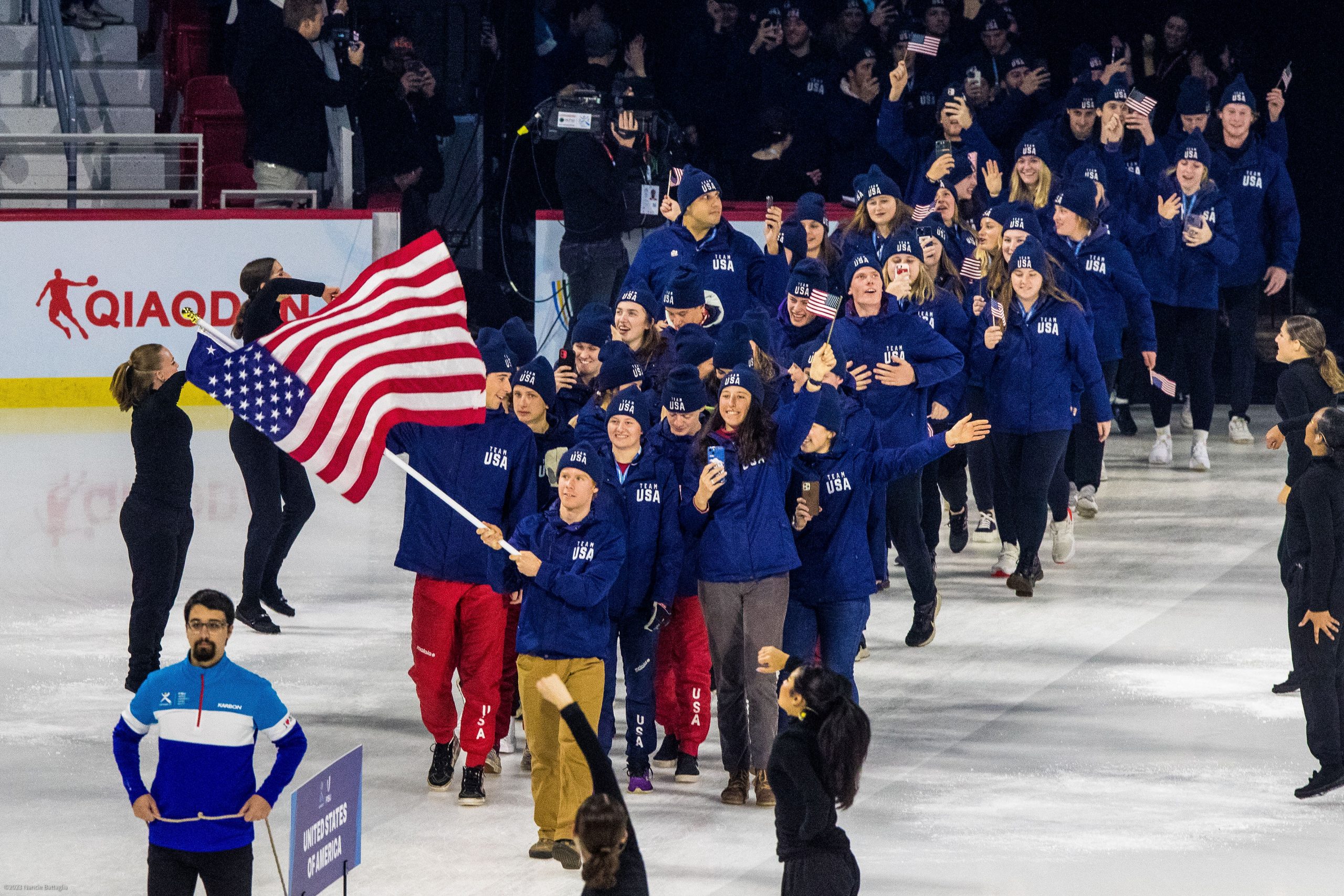
Lake Placid, NY—Biathlete Van Ledger waves the American flag as he leads Team USA into the Opening Ceremony of the 2023 FISU World University Games (Photo: Nancie Battaglia/FISU Games)
The World University Games highlight collegiate athletes, and the gathering of American cross country athletes underscored just how central the collegiate circuit is to athlete development in the United States. With several members of Team USA using the World University Games as a pitstop on the way to their first World Cup starts—and plenty of the international athletes in the field representing American university teams—signs pointed towards the American collegiate circuit acting as a robust and competitive field for athlete development in the United States, and beyond.
By the close of cross country competitions in Lake Placid, Team USA had won five medals (three individual, two team) in events as diverse as the Mixed Team Sprint and the 30 Kilometer Skate Mass Start. The young Americans built a case for the the ever-deepening pool of US Skiing, and the dynamic athletes who are contained in that community.
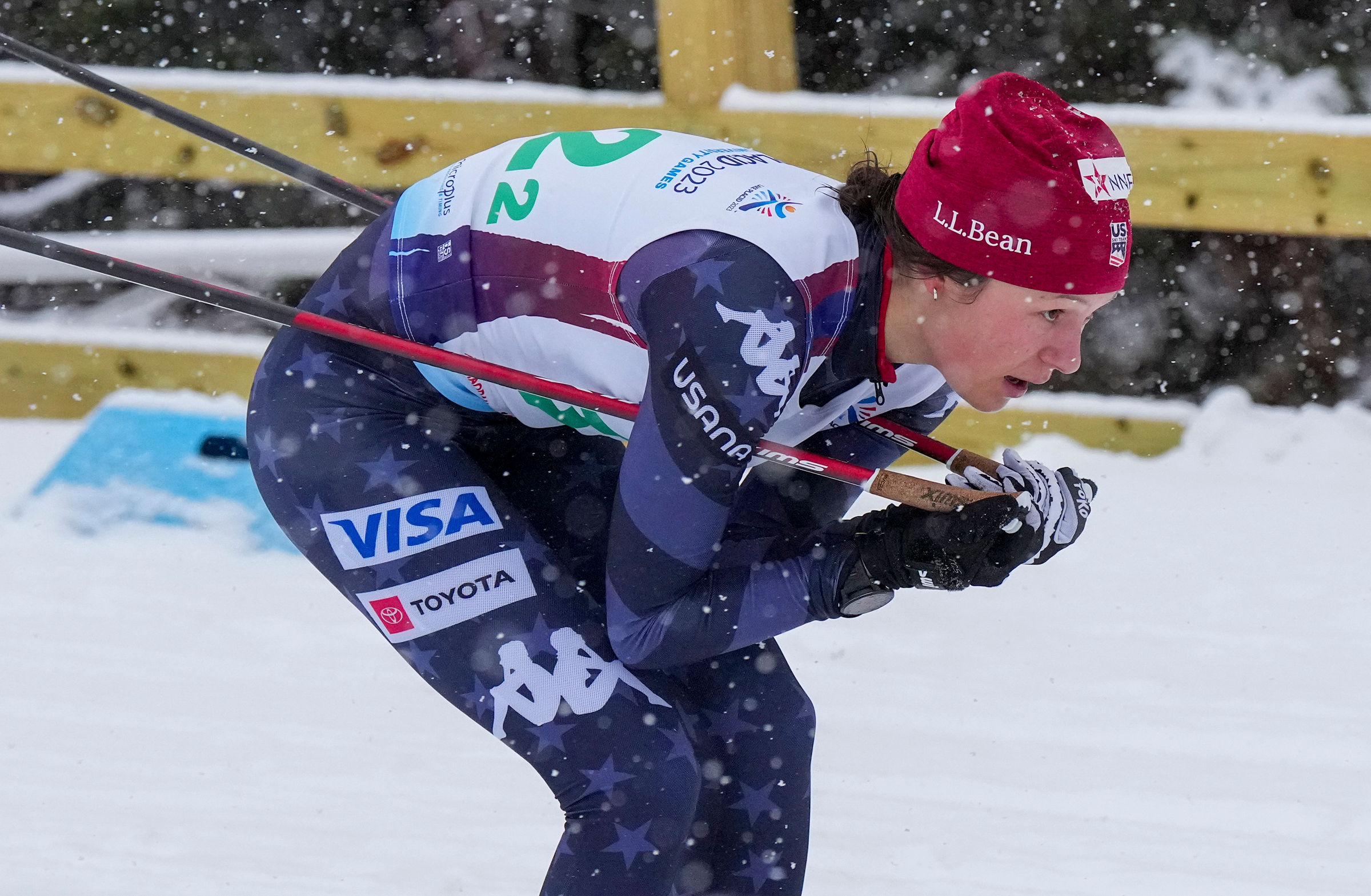
Erin Bianco (1) of the USA during the Cross Country women’s sprint free during the World University Games on January 15, 2023 in Lake Placid, New York. (Photo by Porter Binks/FISU Games)
Team USA at the 2023 World University Games in Lake Placid, New York:
Men
Gregory Burt (University of Vermont)
Garrett Butts (Alaska Pacific University)
John Steel Hagenbuch (Dartmouth College), Gold and Bronze Medalist
Will Koch (University of Colorado)
Alexander Maurer (University of Colorado)
Finn Sweet (University of Vermont), Silver Medalist
Adam Witkowski (Michigan Tech.)
Cameron Wolfe (Dartmouth College)
Women
Lucinda Anderson (University of New Hampshire)
Renae Anderson (Bowdoin College), Silver Medalist
Erin Bianco (Colby College), Bronze Medalist
Kendall Kramer (University of Alaska-Fairbanks), Silver Medalist
Annie McColgan (University of Vermont)
Sophia Mazzoni (Montana State University)
Anabel Needham (Michigan Tech.)
Nina Seemann (Dartmouth College)
Mixed Team Sprint—Classic
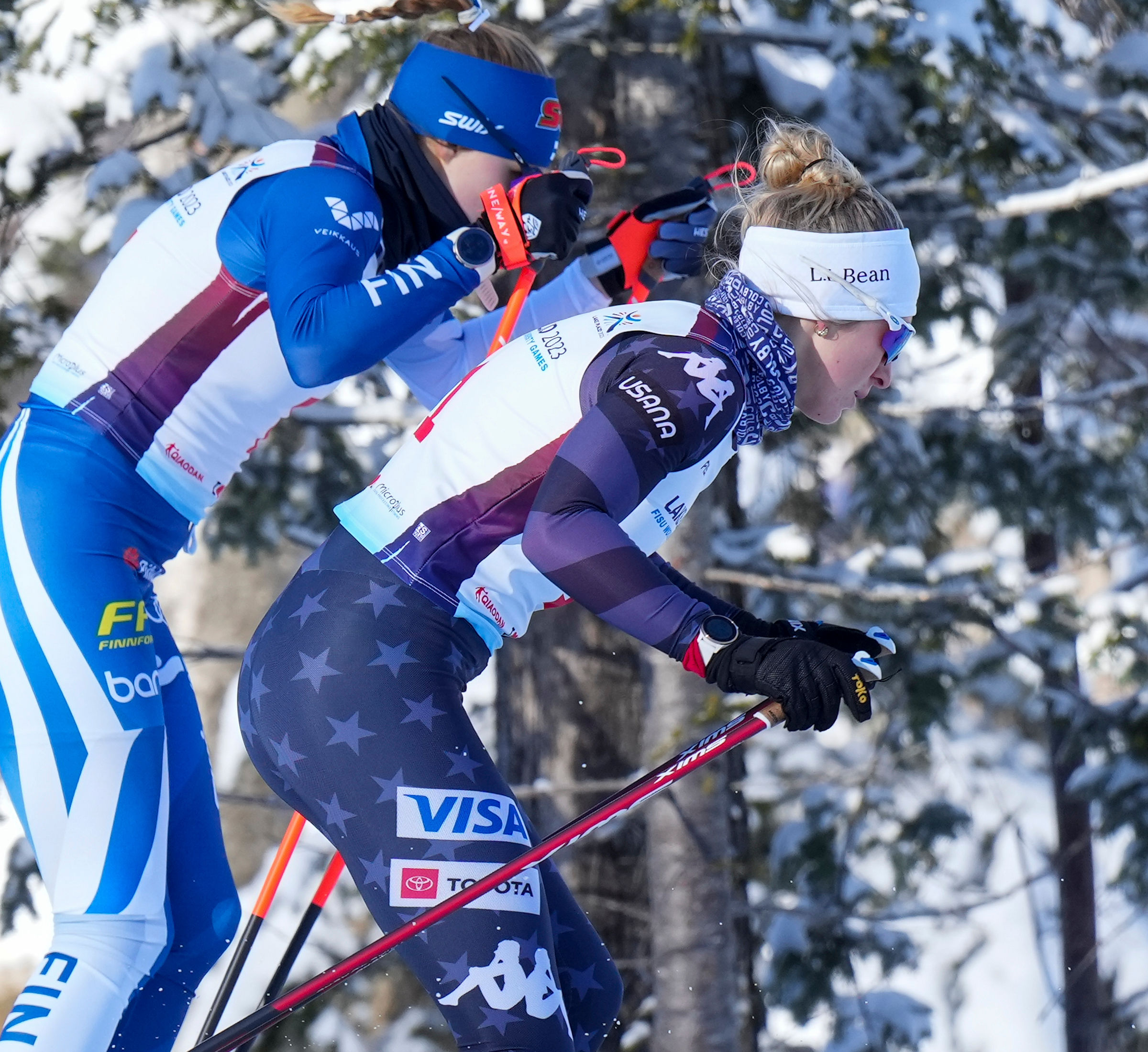
Skiers, including Team USA’s Renae Anderson (Bowdoin College), brave rough snow conditions during the Classic Team Sprint at the World University Games. (Photo: FISU Games)
First on the program was the Mixed Team Sprint: two partners each completing three legs of a 1.35 km course. The event followed a semifinal/final format somewhat similar to individual sprints, with the top two teams from each semifinal automatically advancing, but with a total of six, time-based, lucky loser spots filling out the final field of 10 teams.
The United States entered two teams: University of Colorado’s Will Koch and University of Alaska-Fairbanks’ Kendall Kramer forming USA I came fourth in a tightly contested second semifinal, from which only Italy I and Finland II advanced. Team II was comprised of University of Vermont’s Finn Sweet and Bowdoin College’s Renae Anderson who advanced to the final as lucky losers.
As Sweet-Anderson made their way to the starting line of the sprint final, it began to snow . . . hard. With temperatures hovering near freezing, a snow squall blew in to cover Lake Placid’s warm, granular, man-made snow. That suited the two New England Carnival circuit veterans who made up USA II, with Sweet saying in post-race comments that he and Anderson were “confident [choosing] zeroes, which were definitely the right call.”
Renae Anderson (USA) during finals of the Mixed Team Sprint Classic at the 2023 FISU World University Games on January 13, 2023 in Lake Placid, New York. The USA team placed 2nd behind the winning team from Japan. (Photo: Porter Binks/FISU Games)
Despite being part of the Olympic program since Torino 2006, Team Sprint formats are still a rare event. Sweet echoed that novelty for himself and Anderson: “[The format] was different for sure,” he said. “[In the semi-final] I took it pretty conservatively and looked at it more like a distance race, whereas Renae said she skied it more like a sprint and ended up bonking a bit at the end. Going into the Final I think we were both on the same page with how to pace it which helped out a lot.”
The Final was a tightly contested affair raced on glazed-over tracks: man-made, re-frozen ice covered by new snow. After an initial push from University of Denver student Andreas Kirkeng (skiing as part of the Norway I team alongside University of Utah’s Karianne Olvisk Denegrud) the pack tended towards parity. Eventually, the Japanese tandem of Ryo Hirose and Rin Sobue—both from Tokyo’s Waseda University ski team—pulled away for the win. Into the final exchange, Kirkeng and Sweet had created a clear race for second and third, and Renae Anderson closed with an impressive push that brought USA II to Team USA’s first medal of the week—a silver for the Bowdoin College-University of Vermont duo.
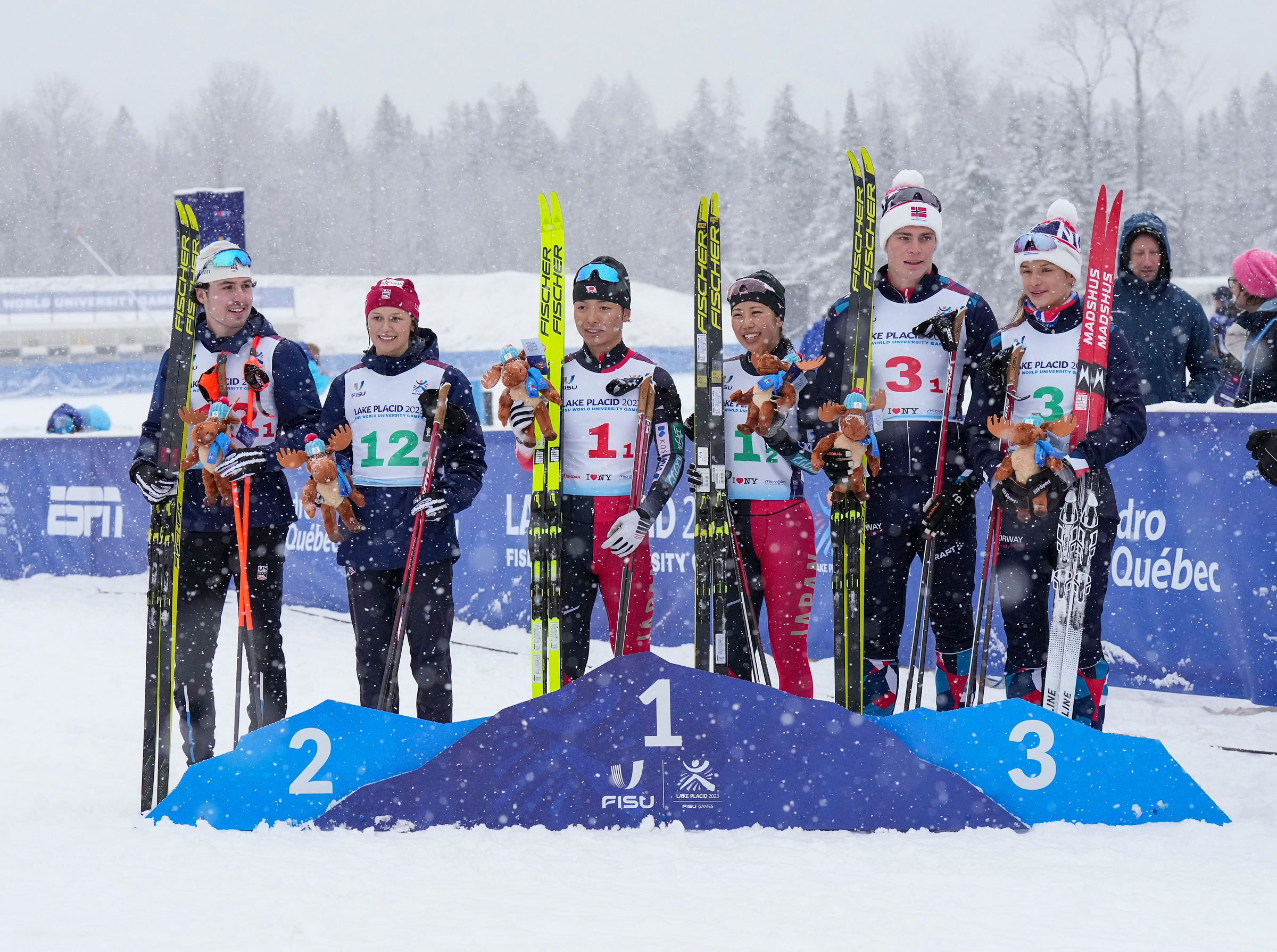
The podium of the Mixed Team Sprint Classic at the 2023 FISU World University Games. L to R: Finn Sweet and Renae Anderson (USA) 2nd place; Ryo Hirose and Rin Sobue (JPN) 1st place; Andreas Kirkeng and Karianne Olsvik Dengerud, (NOR) 3rd place. (Photo: Porter Binks/FISU Games)
Sweet said that he was “super happy with the result. I wasn’t sure what the level of competition would be [in Lake Placid] but after a few days of racing were behind me, I grew more and more proud of what Renae and I accomplished.” Sweet also said that the “Games were a great way to mix up the EISA [Carnival] circuit, especially in a year where the American U23 Team was going to be so strong and a bit out of reach.”
Individual Skate Sprint
The athletes quickly pivoted from Team Sprint to Individual Sprint, a discipline that has highlighted US Skiing’s depth from the World Cup team on down. American performances at the World University Games would prove no different. When qualifying had concluded, Erin Bianco (Colby College) was at the top of the field. In the men’s race, Adam Witkowski (Michigan Tech) and Will Koch (University of Colorado) ranked second and third behind Spain’s Jaume Pueyo. In a further show of American strength, every one of Team USA’s skiers had finished in a position to qualify for heats.
Erin Bianco (USA) races the Women’s Freestyle Sprint during the World University Games in Lake Placid, New York. (Photo: Porter Binks/FISU Games)
In post-race comments on winning the qualifier, Bianco said, “I was extremely excited to qualify first. I have been loving the amount of sprint races there are on the pro circuit and would consider it one of my strengths so to start World University Games by crossing the line in first place might be one of the highlights of my ski career!”
Bianco also provided a comprehensive overview of the course that the Americans would race in the heats: “The sprint course was twisty and hilly,” she said. “The course begins with a quick little up and a sweeping downhill into a significant climb. It then turns left down a more straight downhill into a gradual flat section, quick gradual down into the long uphill. This hill is a steady grind that ends with a steep downhill back under the bridge into the stadium. The final kicker is a tight right hand turn into the finishing stretch. I had never raced here before and was a bit intimidated on the warm up but sprinting happens so quickly that you don’t have time to think about how hard it is!”
In the Women’s heats, Bianco made quick work of advancing to the Final where she matched up against a Finnish contingent of Tiia Olkkonen, Siiri Kaijansinkko, and Niemela, along with American university students Mariel Merlii Pulles, skiing for Estonia and University of Alaska-Fairbanks, and Anna-Maria Dietze, skiing for Germany and University of Colorado.
“[In the Final] I did not want to be in the lead for the first part of the course as the moves were made on the big uphill,” Bianco said. “My skis were extremely fast, so I sat behind for the first half k and then started to push the pace on the uphill. I crested the hill in third which was where I wanted to be so I could catch a draft on the downhill. This plan worked until I hit some ice or slush or maybe just even lost my balance on the final swooping corner into the finish and lost my balance. Luckily I stayed on my feet but this gave [Anna-Maria Dietze] just enough time to edge me out of the podium.” Ahead of the sprint for third with Bianco and Dietze, Mariel Merlii Pulles was able to hold off Finn Tiia Olkkonen to take the gold medal. “Although I was a bit sad to walk away without a medal, I am very proud of how I skied all day” said Bianco on her 4th place finish for Team USA.
In the men’s quarterfinal, New York state native Adam Witkowski found himself doing some unexpected sightseeing of his old stomping grounds. “There was a large crash in my quarterfinal that led to me having to take avoiding action and ski off the trail and through one of the coach zones.” Witkowski stayed calm; in an impressive show of resiliency, he was able to ski himself into a semifinal. On the day’s fast-moving snow, crashes were more the norm than the exception. In the semifinal, Witkowski found himself again swerving to avoid a crash into the first set of downhills. This time, he tumbled in such a way that individual resiliency could do little to overcome.
Having qualified second, Adam Witkowski (USA) found himself hampered by unfortunate crashes that ultimately took him out of contention in the Sprint Free event at the 2023 FISU World University Games. (Photo: Bond Demetri Photos/FISU Games)
Will Koch managed to stay head of the fray in that semifinal. “It was strange to go so ‘quick’ again . . . compared to the other sprints I’ve done this year, this one felt most like a true ‘sprint’ since it was low altitude and had restful downhills.” Koch felt confident that he could push the entirety of the race, “I wasn’t concerned about leading into the final downhill since Perry Thomas, Team USA’s main wax tech, had made the skis so fast.” Koch eased into the Final alongside Northern Michigan University and Norwegian skier Kristoffer Karsrud.
Will Koch (University of Colorado) leading Kristoffer Karsrud (Norway, Northern Michigan University) down the last hill of the Freestyle Sprint event at the 2023 FISU World University Games. Karsrud would ultimately place 5th, with Koch placing 6th. (Photo: Bond Demetri Photos/FISU Games)
Koch and Karsrud joined a Finals field filled out by Finland’s Verneri Poikonen, Spain’s Jaume Pueyo, German Marius Bauer, and Frenchmen and University of Utah skier Tom Mancini. Koch had been through blistering paces in both his quarterfinal and semi-final, and in the Final, he said, it took a toll, “I was very tired from the heats and did not have the energy to ski as fast as the prior heats.” Koch still held strong in a tight pack, and finished 6th, as Poikonen took gold, Pueyo took silver, and Utah Ute Tom Mancini took the bronze. “At the end of the day, there were some very talented sprinters I was up against in the final who would have been hard to beat even with more rest” said Koch on his finish.
Pursuit: Men’s 10 km Pursuit and Women’s 5 km Pursuit
Bronze medalist John Steel Hagenbuch (7) of the USA, left, with gold medalist Ryo Hiose after the Cross Country mens pursuit free at the World University Games on January 17, 2023 in Lake Placid, New York. (Photo: Porter Binks/FISU Games)
From the opening sprint weekend, the World University Games turned to a two day pursuit on Wednesday and Thursday of last week. The event entailed a classic individual start Wednesday, followed by a pursuit start on Thursday.
Top performers in the first stage individual start classic race were University of Alaska-Fairbanks’ (UAF) Kendall Kramer, who finished 12th place on the day, and a sixth place for University of Vermont’s Finn Sweet. Dartmouth College’s John Steel Hagenbuch, meanwhile, was just .02 seconds off Sweet in seventh place, with both 37 seconds back going into day two. Finland’s Hilla Niemela finished first in the women’s race, with UAF and Estonia’s Mariel Merlii Pulles in second place. Japan’s Ryo Hirose won the men’s race ahead of University of Colorado and Norway’s Magnus Boee.
From seventh place the next day, John Steel Hagenbuch would work and wind his way through the field. The Sun Valley native had a race rivaled by only winner Ryo Hirose, who held his gap from day one for gold, as he pushed through the dense pack that formed the top 10, passed, and passed, until he was right up to Andreas Kirkeng. Kirkeng, who had finished third on day one, eventually used the energy savings earned from day one to open a gap on Hagenbuch for second place, but Hagenbuch had made his case for bronze crystal clear. He stepped onto a podium, and earned Team USA’s second medal of Games, and first in an individual event.
In the women’s race, Kendall Kramer pushed to move up a place on day two, and ended the pursuit race in 11th place. Mariel Merlii Pulles fought to join Hilla Niemela at the front of the a race from 18 seconds back, but Niemela was able to leverage her advantage to take gold for Finland in the pursuit. Pulles earned her second medal of the Games, a silver, while Maria Eugenia Boccardi finished third for Italy.
Team Relay: Men’s 4 x 7.5 km and Women’s 3 x 5 km
Krystof Zatloukal of Czech Republic leads the pack to start the Men’s 4 x 7.5km Relay at the 2023 FISU World University Games on January 20, 2023 in Lake Placid, New York. (Photo: Isaiah Vazquez/FISU Games)
Friday moved to a classic Olympic event, the Team relay. The Men would race a 4 x 7.5 km race alternating classic and skate legs, while the women would do a 3 x 5 km in the same format. Team USA for the Women’s relay included lead leg Sophia Mazzoni (Montana State), Anabel Needham (Michigan Tech), and anchor Kendall Kramer (UAF). Team USA for the Men’s relay included lead leg Garrett Butts (APU), Finn Sweet (UVM), Gregory Burt (UVM), and anchor Alexander Maurer (University of Colorado).
The Women’s race saw Finland and Norway establish a lead early and hold it until the very end. A Final sprint from pursuit champion Hilla Niemela saw Finland clip Norway for gold, Kazakhstan held onto the Nordic duo’s push until the very end to take a bronze medal. Team USA finished in 10th place.
France was the dominant force in the Men’s race, holding a lead nearly unencumbered from the first exchange on out. It was University of Utah’s Tom Mancini who anchored the gold medal performance, as Norway and Japan finished 2nd and 3rd. Team USA finished fifth place.
Mixed Nordic Team Event: Nordic Combined/Jumping/Cross-Country: Erin Bianco
Erin Bianco, of the USA, bursts from the transition zone at the skiing portion of the Mixed Team Nordic at the 2023 FISU World University Games in Lake Placid, NY. (Photo: Logan Swney)
In keeping with the theme of innovative events at the World University Games, the Relay portion of the week also included a Nordic Combined/Jumping/Cross-Country cross-over event. The event was, at its core, a Nordic Combined race, a jumping portion followed by a pursuit start 2×2.5 km cross-country skate race. At the World University Games though, National team’s competed in trios of one pure jumping athlete, one nordic combined athlete, and one pure cross-country athlete. The jumper and nordic combined athlete combined for the jump portion. The nordic combined athlete and the cross-country athlete then combined for a pursuit start team relay in which both skiers did a 2.5 k leg. A format that may sound like the work of a mad nordic scientist, but one that provided loads of excitement for Team USA.
The cross-country athletes for Team USA included Erin Bianco (Colby College) for USA I, and Cameron Wolfe (Dartmouth College) for USA II. Erin Bianco combined with Jumper Cara Larson and Nordic Combined athlete Niklas Malcinski for USA I, Cameron Wolfe combined with Jumper Logan Gundry and Nordic Combined athlete Tess Arnone on USA II (Gundry is also a Nordic Combined athlete, but just jumped in this competition).
After the jumping competition, USA I was in 3rd place going into the cross-country portion. Behind strong legs from both Malcinski and Bianco, they held their position, and in the old-school, new-wave or Nordic Combined competitions, the USA took home a bronze medal. Japan, long a powerhouse in the ski jumping world, took gold, with fellow jump-strong nation Poland taking silver.
Team USA crosses the line for a bronze during the Mixed Team Nordic Combined Sprint at the 2023 FISU World University Games on January 19, 2023 in Lake Placid, New York. (Photo by Hailey Trejo/FISU Games)
Skate Mass Start: Men’s 30 km and Women’s 15km
John Steel Hagenbuch on the finishing straight during his Gold Medal performance in the 30km Mass Start World University Games in Lake Placid, NY. (Photo: Logan Swney)
As it entered the second Sunday of competition, the World University Games program wound down by turning the intensity up. As in the Olympics, the Universiade would finish on a—note the quotes— “marathon.” The Men’s race would be 30 kilometers: 10 kilometers longer than the longest race on the NCAA circuit. The Women’s race, however, would be 15 kilometers, which matches the longest distance on the NCAA circuit. While both still definitely distance races, there was already a kind of archaic overtone as the races arrived in the new age of equal distance racing.
On a difficult, winding, hilly five kilometer loop, the Men’s field didn’t contain anyone who wanted to take chances too early. Among the lead pack that formed in the early part of the race were two Americans, John Steel Hagenbuch (Dartmouth College) and Garrett Butts (Alaska Pacific University). Both showed the poise and patience indicative of confidence in a large mass start field. Hagenbuch, fresh off his pursuit push to bronze on Thursday, was set to ski with anyone. While Gunnison, Colorado native Garrett Butts had come into the Games fresh off of a career-best SuperTour 3rd place in the Seeley Hills Classic 30 k two weeks prior. His mother, Two-time Olympian and American Birkebeiner Champion Ingrid Butts, was set up in the stadium as Butts and Hagenbuch swung through the low-spot between the testing hills on the Lake Placid course.
As the final lap began, the lead pack had taken full shape. Hagenbuch and Butts were in, alongside Japanese skier Ryo Hirose, France’s Simon Chappaz, Italy’s Compagnoni, and Norway and University of Colorado’s Magnus Boee. Hagenbuch then went to work, grinding out an upturn in the pace that stretched, but did not break, the pack. Boee stayed on him, Compagnoni and Chappaz came too.
By the final kilometer though, it was all but clear who the strongest skier on the day was. The margins would be tight, but John Steel Hagenbuch came into the storied Lake Placid stadium and claimed a gold medal for Team USA. Boee followed to earn a silver, and Compagnoni finished in third for the bronze. Garrett Butts crossed the line in sixth place, the last member of the lead pack to hold on.
John Steel Hagenbuch of the USA leads the pack up the climb and into the depths of Mt Vanhoevenberg during the 30km Mass Start World University Games in Lake Placid, NY. (Photo: Logan Swney)
The Women’s 15 kilometer would also see a pair of Americans establish themselves in the lead pack early. Kendall Kramer (University of Alaska – Fairbanks) and Erin Bianco (Colby College) skied their way to the front of the race as the lead pack coalesced into four skiers strong. The Americans were joined by Kramer’s UAF teammate Estonian Mariel Merlii Pulles, and Kazakhstani Xeniya Shalygina.
University of Alaska -Fairbanks Teammates Mariel Merlii Pulles of Estonia, and Kendall Kramer of the USA sprint to the finish of the Women’s 15 k Skate Mass Start at the FISU World University Games in Lake Placid, NY. (Photo: Logan Swney)
The UAF Nanooks, Kramer and Pulles, soon made the World University Games a kind of team time trial, pulling away from Bianco and Shalygina on the final turn around the 5 k course. When they pulled into the stadium at Mt. Van Hoevenberg, they were dead even. For the crowd waiting in the stadium – and it was a crowd – it would be either the perfect introduction to cross country skiing, or the perfect conclusion to a week of racing. They sprinted for the line, and Pulles, the champion on the week, ended up pulling out a gold medal by .4 seconds over Kramer, who claimed a silver medal and a first individual medal for Team USA’s Women. Erin Bianco held strong through the final five kilometers, and finished fourth place behind Xeniya Shalygina.
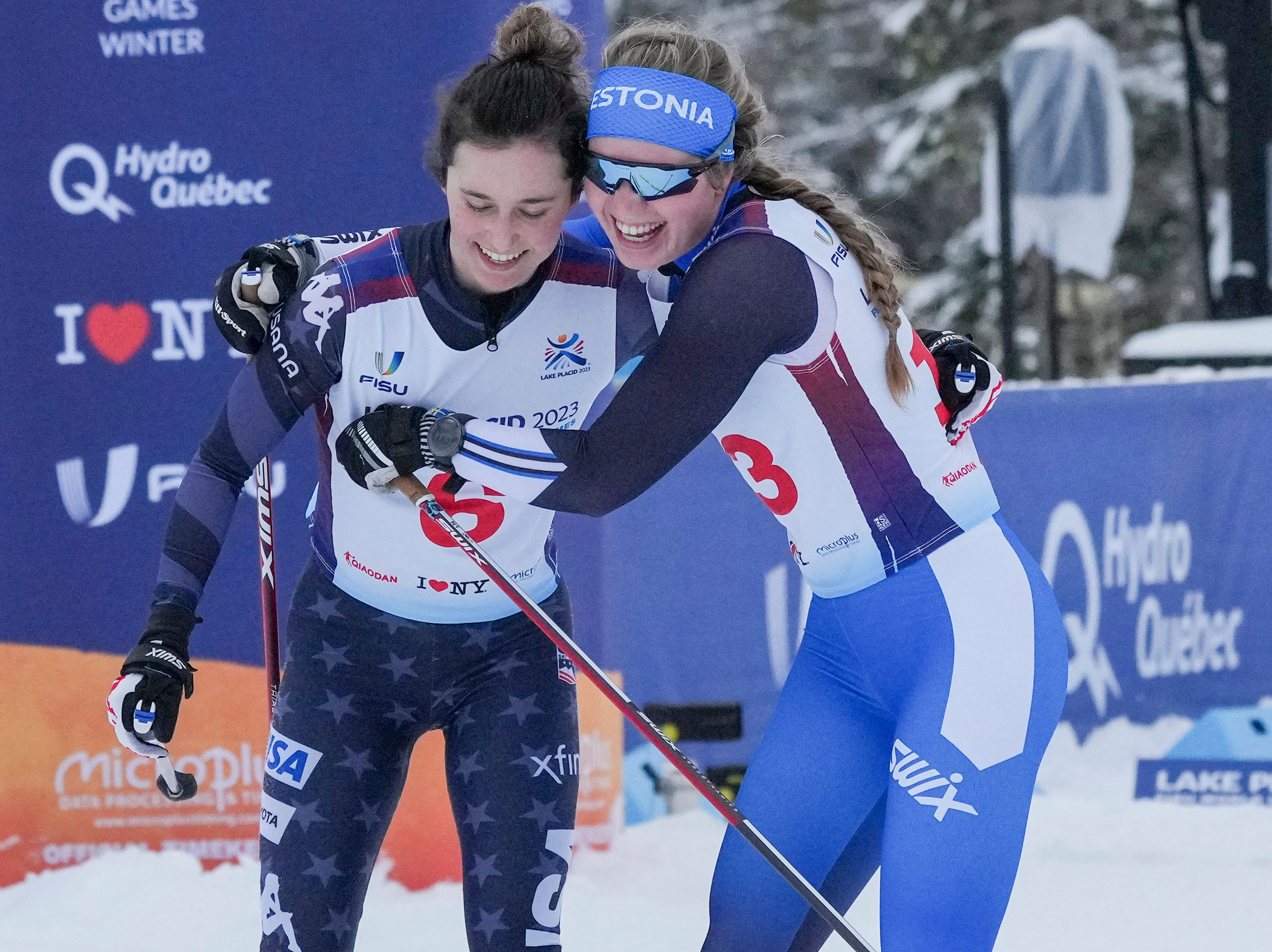
Kendall Kramer (6) of the USA, left, and her teammate at the University of Alaska-Fairbanks Mariel Merlii Pulles (13) of Estonia embrace at the finish line of the women’s Cross Country 15 k mass start at the World University Games on January 19, 2023 in Lake Placid, New York. Pulles won gold and Kramer took silver. (Photo: Porter Binks/FISU Games)
From World University to World Cup, and more, for Team USA
John Steel Hagenbuch came away from the World University Games in Lake Placid with a Gold and Silver Medal for Team USA. (Photo: Hailey Trejo/FISU Games)
For Adam Witkowski, the Men’s sprint he qualified for in third place came with some well-deserved extra nerves. “With [the World University Games] being my first international race of my career I had quite a few nerves at the beginning of the [sprint] day.” His first international race was followed quickly by his second: a World Cup sprint the following weekend in Livigno, Italy. Witkowski wasn’t alone in the making the jump from Lake Placid to Livigno, either. Will Koch rushed on from his start in the Lake Placid 10 km Classic to “catch a redeye flight from Montreal to Italy for my first World Cup Starts!” The duo both made starts, with Koch highlighting making the Team Sprint Final in Italy alongside teammate Kevin Bolger.
For other members of Team USA, this World University Games in Lake Placid offered a perfect coda for their time spent on the collegiate circuit. Erin Bianco, who graduated in 2022, this was a “big highlight to represent the US for the first time, and Colby College one last time.”
Closing Ceremonies of the 31st World University Games took place in the arena where the sporting world’s most famous question and answer, “Do you believe in miracles? . . . Yes!” was immortalized. For every fan who remembers those words echoing from our television sets in 1980, there is a constant reminder of miracles that occur in Lake Placid. Team USA saw four medals in cross country skiing at these World University Games. Hard work and collective belief are indeed acts of will, bu—for a national ski program aspiring to become the best in the world—there’s a hint of something mystical at play, too. So we leave with the familiar refrain: “Do you believe in miracles?” . . . Yes.
It’s been a couple weeks since you last heard from us. The World Cup and the Devon Kershaw Show are back from a hiatus with a recap of the high altitude sprint weekend in Livigno.
Devon and Nat break down the individual and team sprints from the Italian Alps, including some strong American performances. We’re still planning a mailbag episode in the not-too-distant future, so keep those questions coming: devon@fasterskier.com and nat@fasterskier.com. We’ll be back soon.
Americans Julia Kern and Rosie Brennan celebrate after a 3rd place finish in Sunday’s team sprint. (Photo: Nordic Focus).
U.S. Ski & Snowboard recently announced its U.S. Ski Team nominations for the 2022-23 season. Of the 22 athletes named to the team this season, six were not on the previous year’s roster, either newly named or renamed: Michael Earnhart, Walker Hall, Zak Ketterson, Will Koch, Finn O’Connell, and Sammy Smith.
To help fans get to know these new(er) faces, FasterSkier is doing a series of interviews, providing insights into the factors that have contributed to development, progress, and growth for these athletes last season. In this installment, we talk with Will Koch following his nomination to the U.S. Ski Team on its D-Team.
Koch grew up in Vermont and is now a member of the University of Colorado Ski Team, where he will be entering his junior year this coming fall. Son of Olympic Silver-Medalist, Bill Koch, Will began his racing career in the New England program named after his father (the Bill Koch League) and attended high school at Stratton Mountain School.
Ella Hall/Faster Skier: Can you give us a little introduction, where are you from? When did you start skiing? What was your relationship with skiing growing up?
Will Koch: I’m from Peru, Vermont, which is a tiny little town in Southern Vermont, just like 80 people as a population. And I’ve been living there since I was two years old. I got into skiing when I was super young, because my dad was a professional ski racer, Bill Koch. So I actually started skiing before I was even able to walk – nine months old on a beach in Hawaii was my first time on skis. Since then, I’ve just been pretty much training.
I grew up in a really vibrant ski community: starting as a youth, then Stratton Mountain School for my high school years, and now I’m at University of Colorado at Boulder. And this is my first year on the [U.S. Ski Team]. So that’s super exciting.
A young Will Koch hitting his stride in a junior race. (Courtesy photo)
FS: As the daughter of a three-time Olympian I can maybe relate to the potential challenges of being the child of a successful ski racer… so acknowledging that, can you talk a little bit about your dad’s role in your skiing career?
WK: I definitely get that question quite a bit about like, you know, is it stressful or pressure to have your dad being like, Olympian and everything. Honestly, I think that my dad does a really good job of not having expectations for me, which is really nice. My dad totally recognizes that skiing is awesome and everything, but that there’s a lot more to life than skiing at the same time. He’s very much left the coaching to my actual coaches, but at the same time, he’s always there to give advice when I want it.
He’s obviously like, been there, done that with everything that I’m given going through in terms of skiing, so I think it’s really inspiring to have a person like that always around when I need it, but it’s really awesome that it doesn’t feel like a burden. It’s really an opportunity.
Will Koch competing at a junior race in New England (Courtesy photo)
FS: How was the transition from high school at Stratton Mountain School (SMS) to college skiing at the University of Colorado (CU)? Both in terms of training but also general life changes? What drew you to CU?
WK: One of the biggest reasons that I wanted to go out west for college was that I loved the mountains out west. And I also really liked the people out there. I think they’re super open and fun. I also think that being at a PAC 12 conference school comes with certain advantages as far the resources available in the athletic departments. On top of that, I think CU had a really top level nordic team compared to certain schools that I was looking at. So those were all factors that made me want to go out there, and I definitely never regretted that choice once I was up there. I’ve been loving it for my two years, it’s a lot of fun. [There’s] a really good mix on the ski team, I think, of having fun, but also being serious about training.
I’d say, as far as training, transitioning from high school to college one difference was the altitude. When I first went up to altitude in Boulder, and was training up there, I really thought that I could just keep doing exactly the same volume and workouts that I was doing in Stratton. But I put myself in a little bit of a hole when I first got out there, and then learned from that and realized that it’s a little more taxing on the body. But once I dialed it back, training wise, I was able to get some real fitness benefits from the altitude. Now that I’ve been out there for two years, I was able to have a really good fitness year this past season and [make] kind of a breakthrough in my skiing. I think part of that is being in altitude and building fitness with a really strong team.
In general, I found that the college schedule allowed me to have more flexibility in terms of when I trained and it’s easier to do two sessions a day in college compared to high school, just because you spend a little bit less time in the classroom. You have a little more flexibility in how you structure your day.
The junior men’s podium for the 2022 Senior Nationals 15k interval start classic in Soldier Hollow: Alexander Maurer (CU) took the win ahead of Walker Hall (UU) in second and Will Koch (CU) in third. (Photo: John McColgan)
FS: By my count you’ve been on five different international racing trips, including the Youth Olympic Games (YOG). What were some of the highlights from those experiences, particularly in terms of how they supported your development and goals?
WK: Yeah, of all the international trips I’ve been on, definitely the Youth Olympics stands out as the coolest one and the most memorable. YOG is pretty different from World Juniors, in terms of it’s a fair amount less intense, I would say and more about having fun. And yet, even though it’s less intense, it’s the same level of competition, either way, you’re up against the best people in the world.
I think that’s what I really loved about the Youth Olympics, it was fun to win the medal there and everything, but it was also mainly just a really cool experience. That was my first time meeting people from a lot of different countriesI still have my friends from Kazakhstan and Australia from the Youth Olympics, which I love. And, of course, that was also before COVID was really a thing, that was also a time when we were able to do a little bit more socializing on international trips.
I think that those [international] trips are really crucial in development, just to really see that next level of competition that you’re going to be up against, and to really see that every second counts. In the Youth Olympics race where I got my bronze, it was two seconds between me and second place, and I was about five seconds from being back in eighth place. It was just ridiculous how tight it was. That just kind of goes to show how you really need to be thinking about getting those small gains where you can, and that the rest of the competition in the world is out there doing the same thing.
FS: So you’ve just been named to the U.S. Ski Team D-Team, can you reflect on how that feels and maybe what is most exciting to you about this opportunity?
WK: It’s definitely pretty validating to be named after being kind of on the edge for a few years now. It’s exciting. At the same time, though, it’s also basically almost the same training group that I’ve been training with for years, now that me, Walker [Hall] and Michael [Earnhart] are all on there.
Being at my first US Ski Team camp (in Bend), I was kind of looking around, and I was like, Hey, this is really not that different from NTG, three years ago, when we all first made that. So it’s really cool to see how we all progress together. I’d say, making the team, it’s nice and everything, but it’s also really just one more step in development that we’re all taking together, which is really fun.
At World Juniors in Lygna, Norway- a psyched American team congratulates anchor Will Koch, securing bronze in the U20 4×5 k relay. (Ella Hall photo)
FS: What are some of your goals for the upcoming ski season?
WK: I would love to make a debut on the World Cup if that worked out. It’s obviously a really competitive scene right now for Team USA to make it there, and getting picked is by no means guaranteed. I think that’d be a really good next level experience to have. I’d also like to get on the podium at NCAA’s.
FS: Sounds like you made it out to Bend for the annual spring U.S. Ski Team camp there, and now are you back with SMS. What does the rest of your summer/fall look like?
WK: For the rest of the summer, I will be in Stratton training with the SMS T2 team. It’s pretty exciting, because we should have a lot of really fast guys on the US Ski Team coming out here to join our training group, which I think will be awesome, having grown up in Vermont, to get to show a bunch of people how we do it over here. I’ll be here until mid-August and then go back to Colorado and start school and training with the CU Ski Team.
The 2021/2022 SMS T2 Team. Back row (l – r): Ian Torchia, Ben Ogden, Bill Harmeyer, and Will Koch; front row: Alayna Sonnesyn, Julia Kern, head coach Pat O’Brien, Lina Sutro, Katharine Ogden, and Jessie Diggins. (Photo: SMS T2 Blog)
The 2022 FIS Junior/U23 World Ski Championships trip has been made possible through support from the National Nordic Foundation (NNF), which has identified this invaluable opportunity for developing athletes as one of its “Pillar Projects”. You can support the NNF and the next generations of America’s top skiers by making a donation here.
Friday at 2022 FIS Junior World Ski Championships in Lygna, Norway, marked the phase that Steve Fuller, on site to take photographs qua Flying Point Road, calls “the ‘groundhog’s day’ stage” of the championships. “Things are happening so fast that you’re not quite able to get caught up with each day before you get up and do it all over again,” Fuller wrote on Instagram.
Will Koch races to 13th in the 10 k classic during the 2022 Junior World Ski Championships in Lygna, NOR. (Photo: John McColgan)
Undeterred, the Americans headed out on course Friday morning for their seventh and eighth races in four days. The coaches and wax techs (see the back row in the lead picture of the relay story) prepped skis for their eighth championship race within less than 72 hours. At the end of the day, Russia took a combined four out of six podium spots; Canadian skiers Xavier McKeever and Jasmine Drolet placed sixth and eighth, respectively; and Will Koch and Sydney Palmer-Leger led the way for the Americans in 13th and 19th.
Women’s 5 k Classic
Let’s back up. The women again had the day’s first race, a 5-kilometer interval-start classic. The first starter headed out on course, over a single lap of yesterday’s 5 k course, at 11 a.m. The official results describe conditions as somewhere between moderate and perfect: air temp of -2 C, snow temp of -3 C. Skies were overcast for the women’s race, but the sun came out for the men; as USST Development Team Coach Greta Anderson told FasterSkier later Friday, conditions sped up noticeably by the afternoon.
82 starters later, Dariya Nepryaeva, who started at the sharp end of the field in bib no. 80, had logged the day’s fastest time, crossing the line in 14:30.1. She was closely followed by her compatriot, Elizabeta Bekisheva, in second, 2.9 seconds back. Emma Kirkeberg Mørk of Norway was close behind for third, 4.0 seconds back.
Sydney Palmer-Leger skis into the top-20 in the 5 k classic during the 2022 Junior World Ski Championships in Lygna, NOR. (Photo: flyingpointroad.com)
The day’s fastest North American finisher, and fastest Jasmine in the field, was Jasmine Drolet of Revelstoke, B.C., in eighth, 21.5 seconds back. She was followed in the North American standings by American Sydney Palmer-Leger (University of Utah/Park City, Utah) in 19th (+51.3), and Canadian Jasmine Lyons in 26th (+1:03.3).
“I felt pretty good. I really like classic skiing and my goal was to give it all I had,” said Drolet in a press release from Nordiq Canada. “You only ski the lap once, so the key was to just go hard the whole time. We had amazing conditions, perfect for classic skiing so it was a good day.”
Behind Lyons were the two Ninas, Nina Schamberger (Summit Nordic Ski Club/Leadville, Colorado) in 31st (+1:14.2) and Nina Seemann (Dartmouth Ski Team/Craftsbury, Vermont) in 36th (+1:23.0). Annie McColgan (University of Vermont/Bend, Oregon) was 40th (+1:27.3). Canadian athletes Sarah Cullinan (44th, +1:34.2) and Tory Audet (59th, +2:08.2) followed.
Annie McColgan races the 5 k classic in Lygna, NOR, her first start of the 2022 Junior World Ski Championships. (Photo: John McColgan)
McColgan radiated enthusiasm when she talked with FasterSkier following her first race at these championships. “It was nice to have everyone cheering out there, and my parents were here so it was really, really fun. It was really cool,” McColgan said.
McColgan also provided insights on the course, describing it as “a really interesting 5k” with plenty of rolling terrain, but not many opportunities for recovery. “There’s a lot of steep little hills that you just have to be really good at… But it also is 16 minutes long. So you kind of have to make that balance [with energy expenditure]. And then the final climb was so brutal.”
Men’s 10 k Classic
The men again had the day’s second race, starting a two-lap, 10 k interval-start classic race at 1 p.m. local time. Taking athletes’ distance points as an informal form chart, in a field with 101 athletes the podium finishes came, relatively unsurprisingly, from bibs no. 90, no. 100, and no. 101. The gold medal on Friday went to Russian Saveliy Korostelev, the penultimate athlete on the course. Korostelev posted the fastest split time at 3 kilometers, at 5 kilometers, and at 8 kilometers, crossing the finish line in 26:15.8.
Will Koch leads the American junior men with a 13th place finish in the 10 k classic during the 2022 Junior World Ski Championships in Lygna, NOR. (Photo: flyingpointroad.com)
Korostelev enjoyed a hefty advantage over silver-medal finisher Niko Anttola of Finland, who finished 21.4 seconds back. Anttola ranked one to eight seconds behind Alexander Ivshin of Russia at all intermediate checkpoints, but skied the final two kilometers just barely faster. When Ivshin, the day’s final starter, crossed the line, he had fallen 0.8 seconds behind Anttola and had to settle for third.
Put another way, Russia came within a second of going 1–2 in both the men’s and women’s races. They instead had to settle for first and second in the women’s race, and first and third in the men’s.
Shortly behind the podium, Xavier McKeever of Canmore, Alberta, skied a strong race to finish sixth, 52.4 seconds back of Korostelev and roughly 30 seconds off the podium. It was McKeever’s best international result since, well, Tuesday, when he was fifth in the men’s 30 k mass start skate. McKeever’s sixth today tied Palmer-Leger’s sixth, from Tuesday’s women’s 15 k skate, for the second-best North American individual result of these championships.
“I am stoked to be in the top-10 again,” McKeever told Nordiq Canada in a press release. “I was getting splits that I was close to the podium in the first lap, but I just couldn’t keep the high pace that I started with. Honestly, I feel like the podium is still a fair bit away, but today just motivates me more to make the steps toward being able to contend for a medal. … I have been able to build my confidence over the course of this season. After last year, it was instrumental for me to refocus on putting in the hard work each and every day, which I think has helped me race with more confidence than ever before.”
McKeever was followed by his countrymen Max Hollman (Thunder Bay) in 17th (+1:28.8), Derek Deuling (Whitehorse) in 19th (+1:31.5), and Thomas Stephen (Calgary) in a tie for 26th (+1:40.0).
Brian Bushey races the 10 k classic during the 2022 Junior World Ski Championships in Lygna, NOR. (Photo: John McColgan)
Will Koch (University of Colorado/Peru, Vermont) led the way for the Americans, finishing in 13th (+1:23.4). He was followed by Alex Maurer (University of Colorado/Anchorage, Alaska), also 26th (+1:40.0); Brian Bushey (University of Utah/Waitsfield, Vermont) in 36th (+2:00.2); and Finn Sweet (University of Vermont/Waterbury, Vermont) in 47th (+2:11.3).
Thoughts from the coach
Greta Anderson is in Lygna at her third World Juniors as a coach or tech, her first since assuming her current coaching position with the U.S. Ski Team. (Disclosure, Anderson was this reporter’s coach in APU Masters in 2014–15, and has remained a close personal friend ever since.)
Asked what she saw about today’s races, Anderson noted, “They were really fun to watch. Between FIS live timing and back split, the radios were pretty lively. One thing I did learn this year, and this is more than I’ve seen in the past, is that our athletes – every single one has the raw speed to compete at this level. We’re working on the durability portion of it. I think the top athletes in these races often are running negative splits in a big way; I would have to sit down and look at percentages. I’m sure we’ll do that at some point in time. But you know, the speed is there early on, we have very good placement, and then we need to figure out how to speed up just a little bit more. But that’s, you know, that’s been a big step for us as a country.
“Will Koch, obviously very, very strong today. Brian Bushey came out on the top end of ten places being within four seconds, or eight places within four seconds maybe. So you know, really phenomenal. … Annie McColgan had her first ever World Juniors race today. And that’s always really fun and special to watch. I think often athletes come away seeing like, ‘wow, there’s another level,’ and it can be really motivating for the following year.”
Sydney Palmer-Leger leads the junior women during the 5 k interval start classic. (Photo: John McColgan)
Turning to Schamberger, Anderson observed that the 16-year-old has “had a pretty heavy week of racing so far. She’s had three starts, and the first day was not what she wanted. And the second day she had the gift of getting redemption the very next day, which I think is one of the best things athletes can have. And she was really happy with how she skied the relay, a big smile on her face. And then a really good race today. It’s fun to watch athletes – the moment that they realize they’re skiing at that level. Because we know they can do it, and we watch it, but that aha moment of ‘Oh, okay, in the world, this is where I am.’ That moment is really cool. It’s one of my favorite parts of my job for sure.”
Anderson also described the environment at the venue more broadly, highlighting the effects of vocal parental support. “There’s quite a few parents here from the U.S.,” she said.
“And Americans are really loud compared to other countries, and it’s probably taken as obnoxious, but I really appreciate it. We can always hear the Americans. It’s fun to stand by them and listen to them get all excited. Next to the parents during the relay is one of my favorite places to stand.”
In that vein, Anderson concluded, “I look around, and I’m so proud to be an American coach. I’m so proud of the American skiers; there’s not a single other nation I would – I’m really glad that I work for our staff. And I think our athletes are really glad that they ski for the U.S.A. I don’t think they look around and think, like, ‘I wish I was on that team,’ or, ‘I wonder what that team is up to.’ We’re definitely in that, ‘We’re Americans and we’re here to beat you. Or at least die trying’ mode. And that’s pretty fun.”
U.S. Ski and Snowboard Development Team Coach Greta Anderson encourages athletes during the men’s 30k distance race during the 2022 U.S. Cross Country Championships in Soldier Hollow. (Photo: Tobias Albrigtsen / @untraceableg)
Racing continues tomorrow with skate sprints for U23 athletes, both genders, before wrapping up Sunday with both men’s and women’s U20 skate sprints and the U23 mixed relay, sending athletes and techs out with three races, two techniques, and a combined sixteen sprint heats on the final day of racing. Groundhog’s Day, indeed.
Coaches, support staff, and athletes celebrate a bronze medal in the men’s 4 x 5 k relay. Staff, left to right: Greta Anderson (front left), Bryan Fish (back left), Dr. Katie Eichten (partially obscured), Olof Hedberg, Pat O’Brien, Julia Hayes (middle row, blue NNF hat), Paul Smith, Anson Moxness, Lizzie Larkins, August Teague, Jack Novak. (Photo: flyingpointroad.com)
The 2022 FIS Junior/U23 World Ski Championships trip has been made possible through support from the National Nordic Foundation (NNF), which has identified this invaluable opportunity for developing athletes as one of its “Pillar Projects”. You can support the NNF and the next generations of America’s top skiers by making a donation here.
LYGNA, NOR — The second event of the week for 2022 FIS Junior World Ski Championships, and perhaps the most highly anticipated, was the men’s and women’s relays. It was in the relay in 2017 when the US women broke onto the podium on home turf at Soldier Hollow, Utah, starting a cascade of strong American performances in the World Juniors relay. The next year, in Goms, Switzerland, it was the men who landed on the podium with an historic second-place finish, which they then one-upped the next two years to bring home gold from Lahti in 2019 and Oberwiesenthal in 2020. The US women also finished on the podium in 2020, in second place.
After a little lapse in 2021, when the US junior women were not even able to field a team due to Covid contact-tracing protocols, both the men’s and women’s teams were ready to fight today.
First up was the women’s 4 x 3.3 k, which featured separate courses for the classic and skate legs. As the women warmed up and made final preparations, the stadium filled with eager spectators in the form of young schoolchildren. As the announcer explained, one of the event sponsors had paid for the transportation of hundreds of local school kids to the venue each day. Thus as the start gun went off, it was to the chorus of many small voices shouting “heia, heia!” and many waving Norwegian flags.
Enthusiastic young fans prepare for the start of the women’s 4 x 3.3 k relay (photo: Ella Hall)
Skiing the scramble leg for the US team was Kate Oldham (Aspen Valley Ski Club/Carbondale, Colorado). “It was really fast,” she shared afterwards, “everyone went out really hot, it was fun just trying to ski with the best.” Oldham finished her 3.3 k in a time of 10:03.5 and tagged off to her teammate, Samatha Smith in eighth position.
Kate Oldham skis the first leg of the women’s 4 x 3.3 k relay in Lygna, NOR. (Photo: flyingpointroad.com)
As Russia started to pull away at the front, Smith (Sun Valley Ski Education Foundation/Sun Valley, Idaho) worked to gain ground on the others, moving the team up to fifth place at the completion of her leg. From there, Nina Schamberger (Summit Nordic Ski Club/Leadville, Colorado) took over as the technique switched to skate. Schamberger closed on the Swiss team, who was sitting in fourth, just ahead.
As the skiers entered the final climb, dubbed “waffle hill,” a pack had formed with Russia still out front. “I definitely tried to pace it like a sprint and just really push myself and try to use the downhills to recover as best I could,” explained Schamberger, “but it was definitely very painful but short enough because you were able to push as hard as you could the whole time.”
Kate Oldham tags Samatha Smith during the junior women’s 4 x 3.3 k relay. (Photo: flyingpointroad.com)
For the final leg, Schamberger tagged Sydney Palmer-Leger (University of Utah/Park City, Utah), handing off in seventh place. Up front, Norwegian anchor Anna Heggen was closing the gap to the Russian, Elizaveta Bekisheva and the two entered the stadium together, leading to a sprint finish and lunge which ultimately went in favor of the host nation. The Germans were next in third, +35.4 behind. Palmer-Leger picked off two places on her leg to land the US women in fifth, +1:14.7.
“It was really windy out there and you just try to push every little part because there’s no rest until the end,” said Palmer-Leger.
For three of the four athletes on the US team, this was their first time competing in a relay. When asked if they practiced exchanges at all they said, “it was pretty much just winging it.” Palmer-Leger elaborated saying, “It was pretty smooth, it’s a really short course and just taking a few seconds in the tagging is not going to do much. You don’t want to crash or mess up the hand-off because then that’s 30 seconds so, yeah you kinda just look back and double-pole and then wait for them to tag you.”
The junior women’s 3 x 3 k relay team: Sydney Palmer-Nina Schamberger, Samantha Smith, and Kate Oldham (l – r). (Photo: flyingpointroad.com)
With the women’s race complete, it was time for the men to line up, the race for them a 4 x 5 k with each leg skiing two 2.5 k loops. For the US, Michael Earnhart (APU Nordic Ski Center/Eagle River, Alaska) took the scramble leg. After the first 2.5 k it seemed that Swedish skier Måns Skoglund had broken away but the pack hunted him down as they exited the stadium for the second time, Earnhart tucked in behind Team Norway. Entering the stadium for the second of their two laps, Skoglund (SWE) had again gained a slight lead, with teams Russia and Japan in second and third. Behind them, Earnhart was leading the chase to close them down.
Into the first exchange, the gaps had closed and Brian Bushey (University of Utah/Waitsfield, Vermont) took over for Team USA.
Brian Bushey skis the second leg of the junior men’s 4 x 5 k relay in Lygna, NOR. (Photo: flyingpointroad.com)
Heading out into a ripping headwind, it was Sweden, Japan, Russia, and the US, being chased by Norway. As they descended into the stadium for the first time, there were still four teams up front, though Japan had dropped and Norway had joined. This time with the wind blowing in their favor, the skiers all chose to stay outside the tracks. “The first lap, coming through, I saw everyone hop out of the tracks so that’s when I decided to,” explained Bushey. “It was definitely faster.”
As Russia started to pull away slightly, Norway and the US were slightly detached at the start of the second lap of leg two. Canada was closing in on them and by the time they entered the exchange zone, they were a group of four, behind Russia, the US tagging in second position with Team Canada on their tails.
Switching to skate, Walker Hall (University of Utah/Winthrop, Wash.) took over for the US and over the course of his first lap closed the gap to Russia, bringing the lead pack up to five nations. Letting the Russian break the wind, the others slotted in behind as Sweden began to fade.
Nikita Denisov (RUS), Elde Holmbœ (NOR), Walker Hall (USA) and Sasha Masson (CAN) head out for the final lap of leg three as Sweden starts to fade. (Photo: Ella Hall)
Canada too dropped off the pace, leaving Hall and Nikolai Elde Holmbœ of Norway skiing together. Up the steep “waffle hill,” Hall pulled away from the Norwegian, leaving the front three teams all separated by some seconds as they executed the final exchange.
Will Koch (University of Colorado/Peru, Vermont) took the anchor leg for the US. He was soon caught by Aleksander Elde Holmbœ of Norway, the two of them skiing together with Russia off the front. In a scene that brought to mind Rosie Brennan’s efforts in the Olympic 30 k, though admittedly lasting a much shorter duration, Koch tried to get the Norwegian to take on some of the lead work as they headed straight into a bracing wind.
“As soon as that Norwegian caught me, I almost tried to stop and let him by,” said Koch, “but he didn’t want to lead either so he kinda stopped with me, but we luckily didn’t get caught by anyone.”
At this point, they were well clear of Team Canada, who was in fourth position.
Will Koch races Norway’s Aleksander Elde Holmbœ during the anchor leg of the men’s 4 x 5 k relay. (Photo: flyingpointroad.com)
Passing through the stadium, with only the “waffle hill” remaining, Koch had the lead, though he was overtaken by Holmbœ (NOR). The Norwegian seemed to have pulled away, but Koch put in a surge. This move was answered by Norway, and when they came into view on the descent, Norway had maintained its lead. “It came down to just a final sprint over the last hill!” said Koch afterwards.
Team Russia took gold in a time of 49:16.4, followed +21.8 seconds later by Norway. The US was close behind in bronze-medal position, +22.4 back.
“I think we definitely wanted to get on the podium, that was a huge [goal], it would have been fun to win but we’re really stoked with bronze,” concluded Koch. Adding to that Hall said, “Yeah, I think just going out, and skiing the best we could.” Bushey echoed that sentiment saying, “Yeah, we all just had to ski our best.”
The bronze medal winning junior men’s relay team: Walker Hall, Brian Bushey, Will Koch and Michael Earnhart. (l-r) (Photo: flyingpointroad.com)
To the fans following along at home, the boys said “We love you guys, it would not be possible without all of you! Thanks for the support, thank you NNF, go USA!”
The program now switches to U23 competition for a day with a 10/15 k classic race on Thursday. The juniors will resume racing on Friday.
Jessie Diggins brought home a couple of small trophies last season. *smirk* (Photo: NordicFocus)
Team name and location: SMS T2 Team; Stratton Mountain, Vermont
Coach: Patrick O’Brien
Current roster: Jessie Diggins, Julia Kern, Katharine Ogden, Alayna Sonnesyn, Lina Sutro (women); Ian Torchia, Bill Harmeyer, Ben Ogden, Will Koch (men)
Who’s new: Lina Sutro, coming from the University of Vermont ski team
Who’s moved on: Sophie Caldwell Hamilton and Simi Hamilton, who celebrated their second wedding anniversary earlier this year, retired from pro skiing last spring and are beginning a new life together in Colorado. Ben Saxton also retired.
Julia Kern races in classic sprint qualification in Oberstdorf. (Photo: NordicFocus)
Top results last season: Diggins, deservedly, got the headlines, for winning the World Cup overall, the distance globe, and the Tour de Ski, all firsts for an American woman. (Bill Koch won the inaugural World Cup overall title in 1981/1982 to provide her only American competition here, though if you want to split hairs about it Koch’s World Cup season looked a little shorter than Diggins’s.)
After Diggins, Kern had a down season, by her lofty standards, but still notched an 11th and 12th in World Cup sprint finals. Ben Ogden was the top American man in the World Championships sprint, qualifying 11th and finishing 17th overall, and qualified 3rd at World U23s en route to an 11th-place finish. Katharine Ogden raced a full season of distance races on the World Cup, highlighted by 23rd overall in the Tour de Ski, and finished 38th in the distance standings for the year.
Domestically, Rochester, Minn., native Ian Torchia won the skate American Birkebeiner, then gave an all-time classic finish-line interview while slumped exhausted in the snow, interrupting his gasps to drink some chocolate milk handed to him by a concerned onlooker. Not to be outdone, Plymouth, Minn., native Sonnesyn won the skate Birkie, and was second in the classic Birkie.
Ian Torchia, far right, leads bounding intervals up Stratton Mountain in summer 2021. (photo: courtesy SMS)
Coach’s comments: Coach Pat wrote as follows:
“The dryland season has gone very well for our group. It’s hard to imagine just a few short months ago we were doing hot sweaty hill bounding and rollerski intervals in Stratton, but fall is certainly here and the winter season feels just around the corner. The air is cool and crisp, the leaves are mostly down and soon we will be seeing our first glimpse of snow at the higher elevations in the Green Mountains.
“We had a productive and steady dryland season. We kicked off the training year back in May with many athletes out in Bend, Oregon, for our startup on snow and dryland camp. From June till August we were primarily based out of Vermont with some small ‘mini camps’ and fun adventures but no major travel or camps afar. One thing we learned overall as a program from the pandemic and travel restrictions in place in Vermont last year is that while variety is the spice of life, skiers are made in the summer, and time spent traveling is time that impacts recovery and training opportunities, so with the cancelation of a July glacier camp in Alaska and the wildfire/smoke situation in the greater American West, we just put our heads down and focused on high quality but training in the Green Mountain state for June-August. Fortunately for us, aside from the ever present rain and humidity that Vermont is known for, we have incredible roller skiing, running, biking, and strength and conditioning facilities in Stratton and the greater area so we never need to go far to find high quality dryland training.
SMS athletes in the ski tunnel (from left: Julia Kern, Jessie Diggins, Alayna Sonnesyn, Lina Sutro), Oberhof, Germany, September 2021. (photo: courtesy SMS)
“The two areas that we did make a conscious decision to target this year in addition to stable dryland blocks, were on snow time and training at altitude. Traditionally we travel to New Zealand for 2-3 weeks at the end of August and the start of September. The skiing (being wintertime in the southern hemisphere) is high quality and representative of actual ski conditions unlike glacier snow that can often be rotten, slow, and located at high altitudes. While we weren’t able to get on snow as a program last year due to the pandemic and Vermont travel restrictions, many athletes still achieved standout results last winter but we did recognize it put our athletes at a competitive disadvantage in the early season where athletes were getting their ski legs under them so we sought to find on snow training options this year. We were hoping to have New Zealand as an option but with their tight quarantine policies and lack of widespread vaccinations it became clear by July that was unlikely to change. Instead we traveled to the ski tunnel in Oberhof, Germany, to grab 10 days of high quality on snow training which turned out to be a great replacement camp. Being three months removed from skiing should make the transition to snow in Kuusamo a little easier and faster than being six months without contacting snow as we did last year. As an East Coast based team traveling to and from Europe was also a helpful reminder for the time change and travel athletes will be undergoing again shortly in a few weeks.
“The final area we did want to focus on was getting in some time and harder efforts at altitude. With the Olympic venue being at around 5500 feet we were able to practice skiing at a similar elevation out in Bend, Oregon, back in May and recently finished a great dryland camp in Park City complete with many harder efforts and time trials at Soldier Hollow which is nearly the same elevation as the Olympic venue and equally demanding terrain as what we should see this coming February.
From left, Jessie Diggins, Katharine Ogden, Lina Sutro (partially obscured), Alayna Sonnesyn, and Julie Kern rollerskiing in Vermont in summer 2021. (photo: courtesy SMS)
“Our athletes are looking forward to the coming race season because it is shaping up to be a ‘return towards normal.’ Both the limited options for domestic racing and the strict restrictions needed for safe racing on the international level were very difficult for elite athletes last year.Certainly there will still be safety protocols in place, disruptions, and some uncertainty as we continue to navigate our way out of this pandemic, but the prospect for a complete race season both on World Cup and at a national level is very encouraging. We have all been vaccinated and many of our group have already received their booster shots so some of the uncertainty and apprehension of travel has been reduced. We can now focus on what we all love to do; ski racing with a robust national and international calendar!”
The news coming out of Lausanne, Switzerland this week was reaffirming for competitive U.S. skiing: at the Winter Youth Olympics two American junior skiers podiumed and one had a near miss in fourth. Kendall Kramer, out of Fairbanks, Alaska placed third (+20.6) in the 5 k individual classic while Sydney Palmer-Leger of Sun Valley, Idaho was fourth (+27.6). Will Koch of Peru, Vermont placed third in the 10 k individual classic.
The results speak of individual drive, community support, and a U.S. pipeline rife with talent.
U.S. skier Kendall Kramer during the cross free at the 2020 Winter Youth Olympic Games, Lausanne, Switzerland. (Photo: OIS/Chloe Knott)
These performances came down earlier this week. But here at FasterSkier, we have been discussing how we cover juniors in the sport for several weeks. The key component for us is balancing news with respecting the nature of teenagers in a high pressure sport.
Just take a moment at races with live timing and vibrant cell coverage or Wi-Fi, and you’ll see parents, athletes, and coaches often glued to their phones. Live timing is perhaps as scalpel-like as it comes. It’s easy to get caught up in a game where the result is the story.
Juniors are not professional athletes. In the case of disappointment, in the case of feeling too much pressure, what support systems are in place for junior athletes? We’ve been thinking about the answers to these questions.
We all know these teens are more than their results.
We know “Son of Legend” has a name — that would be Will Koch. And he has his own narrative that is his to tell. The story in Lausanne was beautiful. The legend Bill Koch, the only male American to win an individual Olympic medal (1976 Winter Games 30 k silver), is on hand to watch his son Will achieve his own goals. It’s a dream narrative. A proud moment for both.
Will Koch (USA) during the 10 k classic at the 2020 Youth Olympic Games in Lausanne, Switzerland. Koch placed third in the event. (Photo: OIS/Joel Marklund)
Let’s reflect. While covering the sport at FasterSkier, we hear many stories. Most prominent, and frankly the easiest to relay, are those falling into the tidy box of a podium result. Who doesn’t love that? The harder ones, and we hear about these as well, are those of athletes falling through the pipeline’s cracks for some reason or another. Maybe the gift of DNA didn’t align precisely. Maybe the athlete struggled with the social-emotional aspects of a high pressure medals-matter environment. It is complex. As we were reminded in a group phone conversation yesterday on the topic of juniors, “success early does not guarantee success late”.
Sydney Palmer-Leger of the U.S. during the 5 k classic at the 2020 Winter Youth Olympic Games, Lausanne, Switzerland. (Photo: OIS/Joel Marklund.)
Imagine for a moment a teenager in this high stakes game we call sport? That’s what we have been trying to do. Sometimes the outcome here at FasterSkier will be less than perfect. But we are and have been thinking about how we effectively cover junior athletes. The results in Lausanne just made it more acute.
Which reminds us to celebrate Kramer, Ledger-Palmer, and Koch. And to celebrate Nina Seemann, Brian Bushey, and Kai Mittelsteadt who also represented the U.S. in Lausanne.
Nina Seemann of the U.S.competes in the women’s skate cross at the 2020 Winter Youth Olympic Games, Lausanne, Switzerland. (Photo: OIS/Joel Marklund)
Kai Mittelsteadt of the U.S. during the men’s cross qualification the 2020 Winter Youth Olympic Games, Lausanne, Switzerland. (Photo: OIS/Joel Marklund)
Brian Bushey during the skate sprint at the 2020 Winter Youth Olympic Games, Lausanne, Switzerland. (Photo: OIS/Dylan Burns)
The men’s World Cup 1.2 k classic sprint podium on Wednesday in Drammen, Norway, with Norway’s Eirik Brandsdal (c) in first and Johannes Høsflot Klæbo (l) in second, and Russia’s Sergey Ustiugov (r) in third. (Photo: FIS Cross-Country/Twitter)
FIS Cross-Country World Cup (Drammen, Norway): Classic sprints
Just three days after 2017 Nordic World Championships ended in Lahti, Finland, World Cup cross-country skiers were back to their regular-season grind with 1.2-kilometer classic sprints on Wednesday in Drammen, Norway.
In the men’s race, Norway stole the day with Eirik Brandsdal notching his first World Cup win since 2015 in Drammen, but Russia’s Sergey Ustiugov broke up the team’s total domination of the final with a third place, behind Brandsdal (who won it in 2:39.35 minutes) and Johannes Høsflot Klæbo in second (+2.55). Ustiguov placed third (+3.28) for his seventh consecutive podium coming off five medals in five races at World Championships, and three other Norwegians, Petter Northug, Pål Golberg and Sondre Turvoll Fossli finished behind him in fourth through sixth, respectively, in the final.
To start the day, Klæbo won the qualifier in 2:33.81, 3.62 seconds ahead of Brandsdal in second. Ustiugov qualified 10th (+6.21).
Canada’s Alex Harvey and Len Valjas qualified for the heats in 18th and 21st, respectively, and Andy Newell was the lone American to reach the quarterfinals after qualifying in 13th.
In the third quarterfinal, Newell finished third, 1.7 seconds behind Brandsdal, who won it. Sweden’s Oskar Svensson took second in that heat (+0.66).
Harvey won the fifth quarterfinal, and Canada originally took first and second with Valjas outlunging Alexander Bolshunov for second place. Valjas was ultimately relegated to last in the heat for his move around Bolshunov at the line, and the Russian was listed as second (+0.27) for an automatic spot in the semifinals.
While Klæbo won the first men’s semifinal by 0.46 seconds over Brandsdal, Ustiugov topped the second semi by 0.32 over Golberg. Harvey initially finished fifth in that second semi but moved up one spot to fourth (+4.41) after Norway’s Finn Hågen Krogh was disqualified (putting him in last, 67th overall). Harvey ended up eighth overall on the day.
Newell placed 18th overall and Valjas 27th.
Also for the North Americans, U.S. Ski Team members Simi Hamilton and Erik Bjornsen finished 40th and 44th, respectively, and Ben Lustgarten (Craftsbury Green Racing Project) was 62nd. Canada’s Russell Kennedy (Canmore Nordic/Team R.A.D.) finished 63rd.
In the women’s 1.2 k classic sprint, Stina Nilsson commanded the day and Sweden ended up with two on the podium, with Hanna Falk in third.
Nilsson started off by qualifying in fourth, 1.54 seconds behind Finland’s Krista Pärmäkoski, who topped the qualifier in 3:00.28. While Pärmäkoski went on to win her quarterfinal and place third in her semifinal (advancing as a lucky loser to the final), Nilsson won both her quarterfinal and semi, and ultimately took first in the final in 3:07.57. Pärmäkoski notched second (+0.42), and Falk third (+1.26) ahead of Norway’s Kathrine Rolsted Harsem in fourth (+3.27), Sweden’s Ida Ingemarsdotter in fifth (+4.86), and Slovenia’s Anamarija Lampič in sixth (+9.67).
Three U.S. women qualified for the heats, with Sadie Bjornsen in fifth, Jessie Diggins in sixth and Sophie Caldwell in 11th.
Bjornsen and Diggins were eliminated in the quarterfinals after placing fifth and sixth, respectively, while Caldwell finished third in the third quarterfinal (0.79 seconds behind Østberg, who won that heat) and advanced as a lucky loser to the semifinals with Finland’s Aino-Kaisa Saarinen, who was fourth in that heat (+0.95).
In the semifinals, Nilsson led her teammate Falk across the line by 0.14 seconds, and Lampic advanced as a lucky loser in third (+1.05).
Ingemarsdotter won the second semifinal by 0.22 seconds over Harsem, and Pärmäkoski made the cut for the final with a fast-enough time in third (+0.56). In that heat, Slovenia’s Katja Višnar (who had posted the second-fastest qualifying time) finished fourth (+0.83), and Caldwell fifth (+1.44).
That put Caldwell in ninth overall, while Bjornsen placed 21st and Diggins 26th. Also for the U.S., Rosie Brennan finished 37th in the qualifier, Ida Sargent was 42nd, and Kikkan Randall 52nd.
One day after her 23rd birthday, Canada’s Dahria Beatty finished 48th.
USSA Cross Country Junior Championships (Lake Placid, N.Y.): Classic sprints
The U20 women’s classic sprint podium at U.S. Junior Nationals on Wednesday in Lake Placid, N.Y., with Julia Kern (c) of the Stratton Mountain School in first, Canada’s Katherine Weaver (l) of Hollyburn XC Ski Club in second and Maddie Morgan (r) of the Wasatch Nordic Ski Academy in third. (Photo: XCJuniorNationals2017.com)
[UPDATED] On the second day of racing at 2017 U.S. Junior Nationals in Lake Placid, N.Y., Novie McCabe, Haydn Halvorsen, Gus Schumacher, and Julia Kern achieved their second national titles of the week in the classic sprints on Wednesday at the Olympic Jumping Complex.
Representing the Pacific Northwest division and Methow Valley Nordic Ski Educational Foundation, McCabe won the U16 girls’ A-final more than 5 seconds ahead of anyone else in 5:04.22 minutes. New England’s Anna Lehmann, of the Stratton Mountain School (SMS) followed in second (+5.14) and Intermountain’s Sydney Palmer-Leger notched her second-straight podium in third (+5.96). Also in the U16 girls’ final were Rocky Mountain’s Bridget Donovan (Ski & Snowboard Club Vail) and Waverly Gebhardt (Steamboat Springs Winter Sports Club), who placed fourth and fifth, respectively, and Intermountain’s Sarah Morgan, of the Wasatch Nordic Ski Academy (WNSA), in sixth.
In the U16 boys’ A-final, Halvorsen (Far West/Sugar Bowl Ski Team & Academy) won by 3.31 seconds in 4:28.29 minutes. New England’s Will Koch (SMS) placed second for his second podium in as many races, and Intermountain’s Lane Myshrall (Park City Nordic Ski Club) took third (+6:39). Also in the U16 boys’ final, Johnny Hagenbuch (Intermountain/SVSEF) placed fourth, George Cvancara (Alaska/Alaska Nordic Racing) fifth and Will Lange (Pacific Northwest/Mt. Bachelor Sports Education Foundation) sixth.
The U18 boys’ classic sprint podium at U.S. Junior Nationals on Wednesday in Lake Placid, N.Y., with Gus Schumacher (c) of Alaska Winter Stars in first, Scott Schulz (l) of the New York Ski Educational Foundation in second, and Adam Glueck (r) of Ford Sayre in third. (Photo: XCJuniorNationals2017.com)
Alaska’s Gus Schumacher (Alaska Winter Stars) topped the U18 boys’ A-final by 1.13 seconds in 4:35.95. Local Mid-Atlantic skier Scott Schulz (New York Ski Educational Foundation) took second, and New England’s Adam Glueck (Ford Sayre) placed third (+5:04). Alaska’s Canyon Tobin (APUNSC) followed in fourth, Far West’s JC Schoonmaker (Auburn Ski Club Associates Inc.) fifth, and New England’s Ben Ogden (SMS) reached the final but was disqualified.
The U18 girls’ classic sprint podium at U.S. Junior Nationals on Wednesday in Lake Placid, N.Y., with Marin Coletta (c) of the Bridger Ski Foundation in first, Rena Schwartz (l) of GMVS in second and Anna Gibson (r) of Jackson Hole Ski Club in third. (Photo: XCJuniorNationals2017.com)
In the U18 girls’ A-final, Marin Coletta, representing Intermountain and the Bridger Ski Foundation (BSF), took the win in 5:14.30, 4.4 seconds ahead of New England’s Rena Schwartz (Green Mountain Valley School). Intermountain’s Anna Gibson (Jackson Hole Ski Club) rounded out the podium in third (+6.26). Also reaching the final, Brooke Dunnagan (Intermountain/BBNT) finished fourth, Jenna DiFolco (Alaska/NSCF-FXC) fifth, and Callie Young (New England/Craftsbury Nordic) sixth.
U.S. Ski Team Development Team member Julia Kern picked up her second-straight win in the U20 women’s category, winning the A-final by a resounding 18.47 seconds. After Kern (New England/SMS) finished in 4:47.54, Canada’s Katherine Weaver (Hollyburn XC Ski Club) placed second for the second-straight race, and Intermountain’s Maddie Morgan (WNSA) took third (+33.38) in the most strung-out final of the day. Also in that final, Intermountain’s Leah Lange (University of Utah) finished fourth, Margie Freed (Midwest/Loppet Nordic Racing) fifth, and Canada’s Catherine Reed-Metayer (Skibec) sixth.
From left to right: Alexandra Lawson (New England/Craftsbury Nordic) and Maya Seckinger (Pacific Northwest/Bend Endurance Academy) go head to head during a U20 women’s classic sprint heat on Wednesday at 2017 U.S. Junior Nationals. Both reached the B-final, where they placed fourth and third, respectively. (Photo: XCJuniorNationals2017.com)
The U20 men’s classic sprint win went to Canada’s Reed Godfrey (Canmore Nordic/Team R.A.D.), who finished first in 4:33.64. Kam Husain (SMS) crossed 3.32 seconds later as the top American in second overall, and Canada’s Ryan Jackson (Team Hardwood) was the third man on the podium in third (+5.68). Rounding out the A-final, Finn O’Connell (New England/University of Vermont Ski team) placed fourth and Daniel Streinz (New England/Mountain Endurance) fifth, and Canada’s Étienne Hébert (Montériski) was disqualified.
The U20 men’s 10 k freestyle podium on Day 1 of 2017 U.S. Junior Nationals in Lake Placid, N.Y., with Lake Placid’s own Karl Schulz (c) of the University of Vermont in first, Hunter Wonders (l) of Alaska Pacific University in second, and Canada’s Étienne Hébert (r) of Montériski in third. (All photos: India Harvey)
USSA Cross Country Junior Championships (Lake Placid, N.Y.): 5/10 k freestyle individual starts
The U.S. Ski & Snowboard Association (USSA) Cross Country Junior Championships (a.k.a. Junior Nationals) opened Monday in Lake Placid, N.Y., with U16, U18 and U20 men’s and women’s 5/10-kilometer freestyle individual start races taking place at the Olympic Jumping Complex trails just up the road from Mt. Van Hoevenberg, where organizers had originally planned to host the weeklong event. A lack of natural snow led to the use of a 2.5-kilometer loop on manmade snow at the Olympic Jumping Complex, US Biathlon’s home training base.
The U20 men’s 10 k freestyle proved to be the closest race of the day, with Karl Schulz, a University of Vermont (UVM) freshman who grew up in Lake Placid, winning by 0.1 seconds over Alaska’s Hunter Wonders, of Alaska Pacific University (APUNSC), in second place. Racing for the Mid-Atlantic division, Schulz clocked the fastest time in 24:58.6 minutes, which was 33 seconds faster than Canadian third-place finisher Étienne Hébert, of Montériski. New England’s Daniel Streinz (Mountain Endurance) was the third American in fifth overall, 59 seconds off Schulz’s winning time and 16.4 seconds behind another Canadian, Ty Godfrey (Canmore Nordic/Team R.A.D.) in fourth.
Julia Kern (New England/SMS) racing to the win in the U20 women’s 5 k freestyle on Monday at 2017 U.S. Junior Nationals in Lake Placid, N.Y.
Julia Kern, of New England and the Stratton Mountain School (SMS), won the U20 women’s 5 k by the biggest margin of the day: 42.4 seconds in 13:48.5. Canada’s Katherine Weaver (Hollyburn XC Ski Club) placed second and UVM’s Mackenzie Rizio took third (+43.9), while Sarah Goble (Great Lakes Division/Sun Valley) was the third American in fourth overall (+49.3).
The U18 boys’ 10 k freestyle podium on Monday at U.S. Junior Nationals in Lake Placid, N.Y., with Gus Schumacher (c) of Alaska Winter Stars in first, Luke Jager (l) of APU in second, and Ben Ogden (r) of SMS third.
In the U18 boys’ 10 k, Alaska took first and second with Gus Schumacher, ofAlaska Winter Stars (AWS) topping the podium in 25:07.3, and Luke Jager (APUNSC) finishing 3.7 seconds back in second. New England’s Ben Ogden (SMS) notched third (+10.6).
Alaska’s Margaret Gellert (Alaska Winter Stars) racing to a U18 girls 5 k freestyle victory at U.S. Junior Nationals on Monday in Lake Placid, N.Y.
Alaska topped the U18 girls’ 5 k as well, with Margaret Gellert (AWS) winning by 17.6 seconds in 14:02.9. Intermountain’s Sofia Shomento (Bridger Ski Foundation) finished second and Rocky Mountain’s Ezra Smith (Summit Nordic Ski Club) placed third (+23.6).
The U16 boys’ 5 k freestyle podium on the first day of 2017 U.S. Junior Nationals in Lake Placid, N.Y., with Haydn Halvorsen (c) of Sugar Bowl Ski Team & Academy in first, Johnny Hagenbuch (l) of SVSEF in second and Will Koch (r) of SMS in third.
In the U16 boys’ 5 k race, Far West’s Haydn Halvorsen (Sugar Bowl Ski Team & Academy) raced to a 5.3-second victory over Intermountain’s Johnny Hagenbuch, of the Sun Valley Ski Education Foundation (SVSEF). Halvorsen finished in 12:35.2 minutes, and New England’s Will Koch (SMS) was 29.5 seconds back in third.
In the U16 girls’ 5 k, Novie McCabe (Pacific Northwest/Methow Valley Nordic Ski Educational Foundation) earned a junior-national title by 1.7 seconds in 14:14.6. Intermountain’s Sydney Palmer-Leger (Park City Nordic Ski Club) placed second and Far West’s Nina Seemann (Auburn Ski Club Associates Inc.) reached the podium in third (+28.8).
Novie McCabe (83) of Pacific Northwest/Methow Valley Nordic Ski Educational Foundation at the start of the U16 girls’ 5 k freestyle. She went on to win by 1.7 seconds on Monday at Junior Nationals in Lake Placid, N.Y.
Ida Sargent (Craftsbury Green Racing Project/U.S. Ski Team) tied with teammate Kaitlynn Miller for the win in Saturday’s 5 kilometer Eastern Cup classic race on home turf. (Photo: John Lazenby)
Note: Photos from this story are courtesy of John Lazenby. Many more photos from the Eastern Cup weekend are available at his website.
The New England Nordic Ski Association (NENSA) tried out an old format for the first time in years at this weekend’s Eastern Cup openers in Craftsbury, Vermont: a two-day pursuit, with interval-start classic races on Saturday and a freestyle pursuit on Sunday based on the classic results. The races were particularly competitive with dozens of Canadians from Quebec and Ontario joining the standard field from the Eastern U.S.: club teams, senior elite teams, and some college athletes.
Saturday saw snow falling all day. In the women’s 5 kilometer classic, U.S. Ski Team member Ida Sargent tied with Craftsbury Green Racing Project teammate and 2016 U.S. National Champion Kaitlynn Miller for the win in 17:20.9. Teammate Liz Guiney was just 3.5 seconds back to give Craftsbury a podium sweep on home turf. U.S. Ski Team and Stratton Mountain T2’s Julia Kern was fourth, +23.3, and University of Vermont’s Alayna Sonnesyn fifth, +54.3.
U16 girls were in the same race, with Anna Lehmann of the Stratton Mountain School clocking the fastest time for 12th overall, +2:12.9. She also topped the U18 field, which was led by Green Mountain Valley School’s Rena Schwartz in 20th overall, +2:31.6.
The men raced 10 k, with Craftsbury’s Ben Lustgarten topping the field in 29:45.1. It was a hard-fought battle as he only beat Patrick Caldwell of the U.S. Ski Team and Stratton Mountain T2 by 7.4 seconds. In third was Colby College’s Silas Eastman, +1:27.4. U18 Ben Ogden of the Stratton Mountain School finished fourth overall, +1:38.9, and Williams College’s Braden Becker landed fifth, +1:52.2.
In the U16 boys’ 5 k classic, Stratton Mountain School’s Will Koch won in 16:36.1 over Mont Orford’s Olivier Leveille (+44.1).
Temperatures warmed on Sunday and the snow turned to rain, but luckily the manmade base of the Craftsbury Outdoor Center’s 2.5 k loop held up well through nearly 400 racers doing two to four loops each.
In the U16 girls’ 5 k skate, Lehmann held onto her lead, as did Koch in the U16 boys’ 5 k skate. Guiney clocked the fastest isolated pursuit time in the women’s 10 k skate, and passed her Craftsbury teammates, dropping first Miller and then Sargent, who also had a broken pole.
In the men’s 10 k skate, Caldwell caught and passed Lustgarten to take the win; the pair also had the fastest two isolated pursuit times.
Sunday results (isolated pursuit times only, not order of finish):
Kaitlynn Miller (Craftsbury Green Racing Project) heading in for the win in the 5 k classic, alongside Alex Cobb of Middlebury College. (Photo: John Lazenby)
Mae Chalmers, Stratton Mountain School. (Photo: John Lazenby)
Ben Lustgarten, Craftsbury Green Racing Project. (Photo: John Lazenby)
Alayna Sonnesyn, University of Vermont. (Photo: John Lazenby)
An athlete measuring pole length before the classic race. (Photo: John Lazenby)
Ida Sargent, Craftsbury Green Racing Project. (Photo: John Lazenby)
Liz Guiney, Craftsbury Green Racing Project. (Photo: John Lazenby)
Trevor Aitken, Mont Orford. (Photo: John Lazenby)
Julia Lazzaroni, Colby College. (Photo: John Lazenby)
An athlete measuring pole length before the classic race. (Photo: John Lazenby)