
Tag: Will Wicherski

  • Push for Homologation at Williams’ Prospect Mountain

    Push for Homologation at Williams’ Prospect Mountain

    Every two years, the Williams College nordic team hosts its Winter Carnival 20 miles north of Williamstown, Mass., at Prospect Mountain in Woodford, Vt. By 2016, it could have a five-kilometer ski loop up to International Ski Federation (FIS) standards.
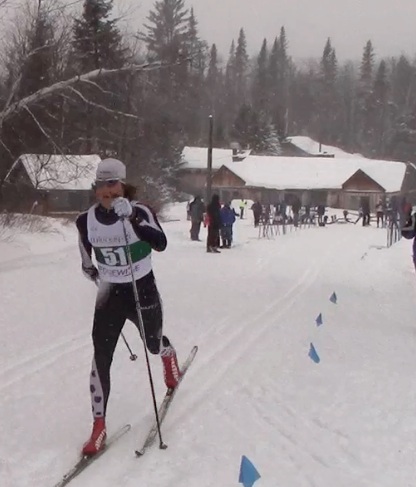
    A scene from the Williams' College Winter Carnival at Prospect Mountain in Vermont. (Photo: Jason Lemieux)
    A scene from the Williams’ College Winter Carnival at Prospect Mountain in Woodford, Vt. (Photo: Jason Lemieux)

    “It started with my coach, Bud Fisher,” said Williams senior Will Wicherski. “He’s been at Williams forever.”

    Williams’ associate director of athletics, Fisher suggested that Wicherski study Prospect’s trail system to determine whether a homologated trail would be feasible.

    “Within the EISA [Eastern Intercollegiate Ski Association], there’s more and more of a move to get all our races on homologated courses,” Fisher said. “We’ve been thinking about it for some time, and we’re taking a probably a little bit more conservative, slow-paced approach to it.”

    Wicherski characterized some of the EISA race loops as “really uneven,” pointing to Dartmouth’s Skiway at Oak Hill as an example.

    “The climb is way too big and not that wide,” he said. “Our course at Prospect is kind of unfair. It’s old-school, not wide, and there isn’t a lot of climb. We can’t really have mass start races there.”

    Homologating race trails evens the playing field, he explained. “Among the coaches, there’s more of a desire to hold races at homologated race sites.  They know what they’re getting.  There are more schools that want to host carnivals.”

    Some New England schools already hold their carnivals on homologated trails, including the University of New Hampshire (which hosts in Jackson); the University of Vermont (at Trapp Family Lodge in Stowe), and Middlebury (at Rikert) and Colby (in Waterville, Maine).

    The course will combine existing trails with new sections.  Much of Prospect Mountain’s trail network is on U.S. Forest Service land, where the permitting process makes large-scale alterations difficult. As a result, Williams wants its race loop to include minimal new trails.

    Ultimately the college would like to create a course that will accommodate interval-start freestyle and classic races as well as team relays. Mass-start skate races require wider trails than interval starts, and Fisher said that while it wouldn’t be impossible to make them happen, it would be “very difficult.”

    Interval-start freestyle, classic, and relay events require trails 5 meters wide.  Even for interval-start homologation, some sections of trail — all on forest service land — would need to be widened.

    Wicherski described southern Vermont/northwestern Massachusetts as “being on the edge of consistent snow,” adding that if the homologation project works out, the college may consider snowmaking in the future.

    “Getting the course homologated is the first step towards snowmaking,” he said.

    According to Williams’ Nordic Head Coach Jason Lemieux, snowmaking is a “long term goal/dream … it’s a battle we’ll wait to fight until the completion of the homologation project,” he wrote in an email.

    Prospect Mountain’s ski roots trace back to 1939, when it started as an alpine-ski area with a rope tow. At 2,250 feet above sea level, its base elevation is the highest of any ski area in Vermont. In the 1970s, Prospect’s owners cut cross-country ski trails to enhance their business, and in 1992, Steve Whitham and Andrea Amodeo purchased the area after its previous owner abandoned it. Instead of reopening the lifts, they focused on cross-country skiing.

    At 2,250 feet above sea level, its base elevation is the highest of any ski area in Vermont.

    Getting Up is Half the Battle

    One of the biggest challenges was designing an appropriate downhill from the main climb. Running under the old lift line, the A-climb diagonally crosses the alpine hill, ending up on a trail called Shay’s.

    “We know where the A-climb is, but we don’t have a way to get down off it,” Fisher said.

    This summer, they plan to build the descent. Williams will test it this coming winter, after which they plan to finish work on the trail.

    The other challenge exists at the opposite end of the course. Prospect’s trail system is bisected by a forest-service road that sees heavy snowmobile traffic during the winter. During Williams’ last Winter Carnival, course workers had to stop snowmobiles 17 times during the races. “It’s a dangerous situation,” Fisher said.

    To avoid the road, Williams would need to construct a short connector trail on forest-service land.  They’ve applied to the U.S. Forest Service (USFS) both for this and to widen trail sections where necessary. The carnival trail falls into the forest service’s small-projects category, which requires less time, ecological compliance and money than a large-scale endeavor.

    Pending USFS approval, construction will start with trail work this summer.

    We haven’t actually gotten an FIS [inspector] in yet,” Fisher said. “We wanted to get all the homologation parameters met before we do that. We launched into the project and came up with a number of ideas to us where show we get an A-climb and a B-climb.”

    Lemieux estimated the project’s cost to be “easily more than $15,000.”

    Approval will give Williams a 10-year permit. If the downhill from A-climb works, they’ll continue work on the land the following summer. At that point, they would bring in a course inspector from the FIS for any tweaks.

  • USST Puts National Training Group Through the Paces

    USST Puts National Training Group Through the Paces

    Members of the National Training Group during a threshold workout at Soldier Hollow last week. Photo: Matt Whitcomb/U.S. Ski Team.

    Members of the U.S. Ski Team’s National Training Group (NTG) spent last week in Park City, Utah, for a training camp centered on group training and exposure to the resources at the Center of Excellence. Athletes joined interval sessions with the national team on the rollerski track at Soldier Hollow and underwent a series of physiological tests for assessment and feedback on their development.

    The camp was a new addition over last year’s schedule; the result of a decision by USST coaches to further focus on development.

    “Back in the spring we sat down and decided that we’d put in another camp into our development pipeline specifically for this NTG and have them come out to Park City with the intent to get them into the COE,” said Bryan Fish, USST development coach.

    Quality training was the camp’s primary goal, but with the COE nearby athletes were also able to work with the USST’s staff of physiology, strength and nutrition experts.

    “The feedback we got was very positive; the athletes felt like they got a lot of education out of being here,” Fish said. “We could send them home with test results and feedback, which we provided to their club coaches, on areas where they’re strong, areas where they can improve.”

    Emily Hannah, Marion Woods and Mary O’Connell. Photo: Matt Whitcomb/U.S. Ski Team.

    Over the course of the week, Fish said the workouts and test results he saw were encouraging.

    “What I’m seeing in the REGs and the J2 camp is that our athletes are indeed getting more fit and more prepared, tactically and technically. We’re seeing that in the physiology results that come in house,” Fish said. “For us, from the national team coaching staff, what we saw was hugely positive. It’s a testament to the clubs and these athletes that we’re training more; training better.”

    One such workout to provide positive feedback were threshold skate intervals at Soldier Hollow, which the NTG athletes completed alongside resident national team athletes across multiple disciplines — cross country, nordic combined and biathlon were all represented in the same workout.

    “Our general premise, from my perspective, is to get our best athletes together on occasion to train and compete,” Fish said. “They don’t have to train together 24/7 but getting together and going head-to-head they all learn and they all improve.”

    With most of the U.S. nordic combined team, biathlete Jeremy Teela and several U.S. cross-country athletes on the course with the NTG skiers at the same time, the threshold workout got “kinda frisky,” said nordic combined skier Billy Demong.

    “With all these cross country skiers and our guys, we went a little harder than we planned.”

    Too fast or no, Fish thought the collaboration was a valuable experience.

    “There’s a part of the training that’s intensity-based and another that’s tactical,” he said. “There’s a balance, and I feel you have to let a little bit of that go and train like you’d race. It was a prime opportunity to get in good tactical training on the Soldier Hollow courses, and for the most part they did a good job.”

    Billy Demong leading the pack through the flats during threshold. Photo: Bryan Fish/U.S. Ski Team.

    National Training Group Park City Camp Roster:

    Women:

    Emily Hannah (Steamboat Springs Winter Sports Club)

    Mary O’Connell (SSWSC)

    Becca Rorabaugh (Alaska Pacific University)

    Marion Woods (Alaska Winter Stars)

    Jesse Knori (Sun Valley Ski Education Foundation)

    Nichole Bathe (Central Cross Country)

    Heidi Halvorsen (Green Mountain Valley School)

    Men:

    Ryan Scott (Ski & Snowboard Club Vail Team HomeGrown)

    Will Wicherski (Williams College)

    Patrick Caldwell (Stratton Mountain School)

    Eli Hoenig (Cambridge Sports Union)

    Cal Deline (SSCV)

    Adam Martin (CXC)

  • Ustiugov Dominates For Skate Sprint Title at World Juniors

    Ustiugov Dominates For Skate Sprint Title at World Juniors


    The junior men's A-final finish in the skate sprint at World Juniors on Monday.

    ERZURUM, Turkey — For elite skiers under the age of 20, the FIS Junior World Championships are a focal point of the previous year’s training. No matter the national team, an athlete’s success at World Juniors causes elated finish-line celebrations, as it confirms he can ski as fast, or perhaps faster, than he ever thought possible.

    The freestyle sprint, the opening events of the 2012 championships at Kindalli Nordic Ski Center, was no exception. For the second year in a row, Sergey Ustiugov (RUS) claimed the top of the podium, having won last year’s classic sprint in Estonia. He raised his arms in triumph as he crossed the line ahead of two Norwegians, Sindre Bjoernestad Skar in second (+0.7) and Sondre Turvoll Fossli in third (+1.1).

    Roman Schaad (SUI) took fourth after a gap (+5.1) to lead a respectable showing for the Swiss—three in the top 10 on the men’s side. Ermil Vokuev (RUS) was fifth (+6.9) and Erwan Kaeser (SUI) sixth (+34.3), who suffered a fall and got left behind by the goup.

    Ustiugov was dominant all day on the 1.6 k course, having won the qualifier and every single one of his heats. During the final, he skied from the front right from the gun and never looked back. As the lead group of three free skated back down into the stadium, Ustiugov still led the Norwegians, and afterwards he remarked that he had been confident all day that he could win again.

    Skar and Fossli, close friends and competitors on the Norwegian squad, said in the press conference that they had each been aiming for the win, but still seemed pleased with podium finishes. Brit Baldishol, one of the Norwegian coaches, said she was “very happy” with how her athletes had performed.

    Asked if she had expected multiple podium finishes on Monday, Baldishol said, “It was not unexpected… But, you never know in sprints, how people will do.”

    The US men get started at World Juniors in the sprint qualifier.

    American Men Come Close, But Miss Heats

    In their first test against the best junior skiers in the world, the Americans Logan Hanneman and Cole Morgan came within a second of the top 30, but didn’t quite make it. Hanneman was 0.7 seconds out of qualifying in 34th, and Morgan was just behind him in 35th, 1.0 second back from 30th.

    Hanneman, a sprint-specialist, had been aiming to both qualify and move onto the semifinals, and was subdued after his inaugural World Junior Championship run.

    “I went fast, but it wasn’t quite fast enough,” he said after his qualifier. “Those guys are pretty quick.”

    In describing the course, Hanneman said it favored strong V2 skiers, as the climbs weren’t steep and the rest of the course was either transition or free skating.

    “It’s just on the gas all the time, and at altitude that’s a hard thing to do. Near the end you’re dying pretty good,” he said. “But, if you have something left in the tank, you didn’t go hard enough.”

    Hanneman thought he’d had plenty of time to adjust to the 5,000-plus feet of elevation, and though disappointed he’d fallen short in his main event, he was optimistic for the 10 k classic on Wednesday.

    “We have a whole week left.”

    Morgan, like Hanneman, was competing in the first Junior Worlds race on Monday. He took the one-second difference between himself and the heats as a source of confidence rather than disappointment.

    “I’m a little bummed about not making the heats,” Morgan admitted. “Those guys are fast; I was happy to be close. I wasn’t too far away, so it was kind of a confidence boost that I can ski a little bit with those guys.”

    Will Wicherski was the next U.S. finisher behind Morgan in 72nd (+25.39). As a distance-specialist, Wicherski hadn’t originally been planning on entering the sprint, but decided to ski to get another start under his belt.

    “I’m not much of a sprinter, so for me it was just hard to get that kind of power you need on these courses,” he said of his race.

    During the free-skating transitions of the course, Wicherski felt he skied well, but knows that he needs to develop his V2 power. His man focus this week, however, will be the 20 k pursuit. There, he’s hoping for a top-30.

    Forrest Mahlen was the fourth American in the qualifier in 87th (+38.46). He skied what he thought was a good sprint until the final downhill before the stadium, where his ski caught on the unusually wide corduroy and he fell, losing valuable momentum.

    “On the final descent, a coach was yelling for me to tuck skate, and I was just tucking,” Mahlen recalled. “My ski got caught in the grooming, and I took a little spill. Up to that point thought it was really good.”

    Mahlen didn’t appear to be taking his fall too hard, and was already looking forward to the 20 k pursuit.

    “I’m super stoked for that, it’s a mass start, it should be good… I’m feeling pretty ready to go.”

    Final results

    World Junior men's podium (l to r): Sindre Bjoernestad Skar (NOR) 2nd place, Sergey Ustiugov (RUS) 1st place, Sondre Turvoll Fossli (NOR) 3rd place, Roman Schaad (SUI) fourth place and Emil Vokuev (RUS) fifth place.