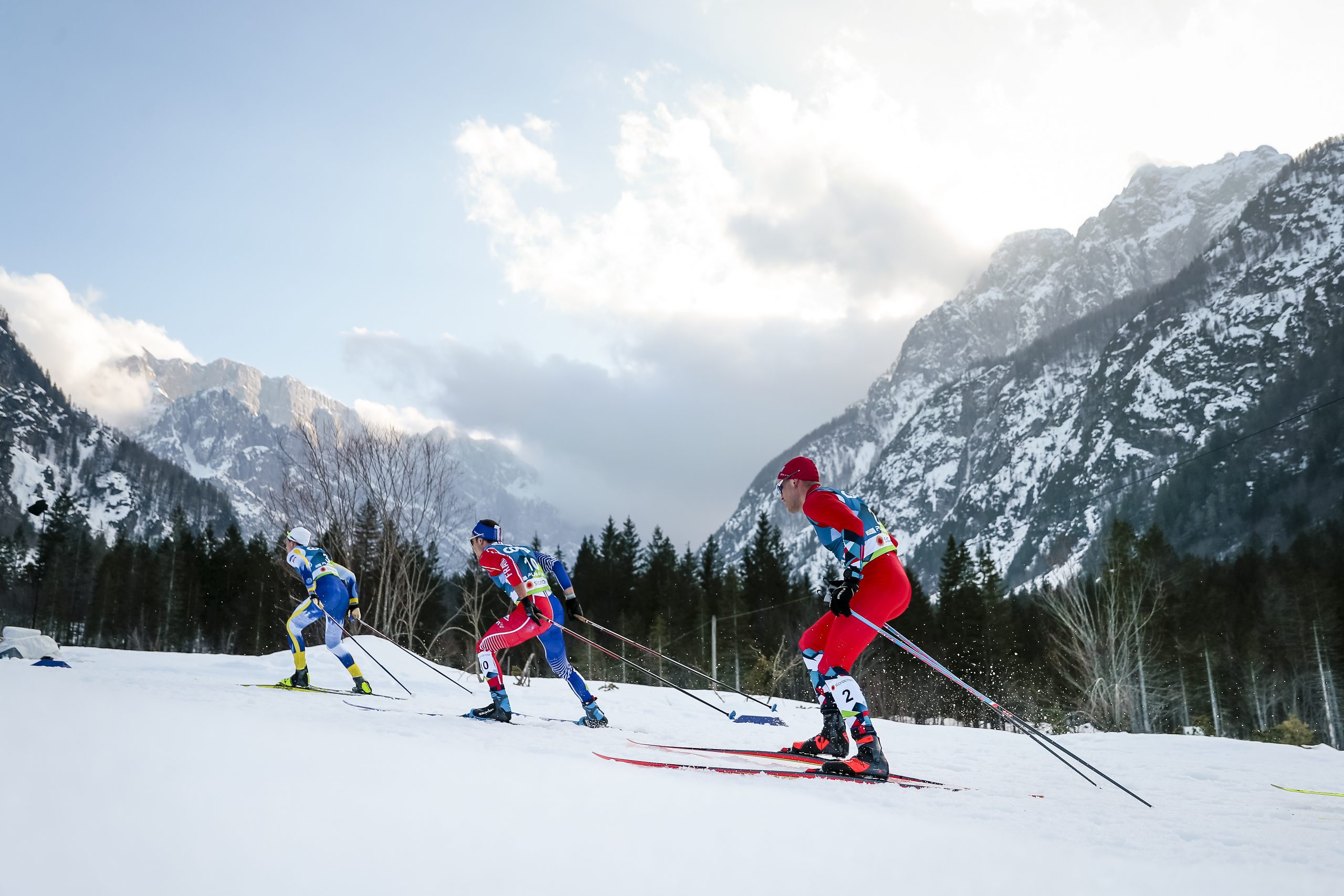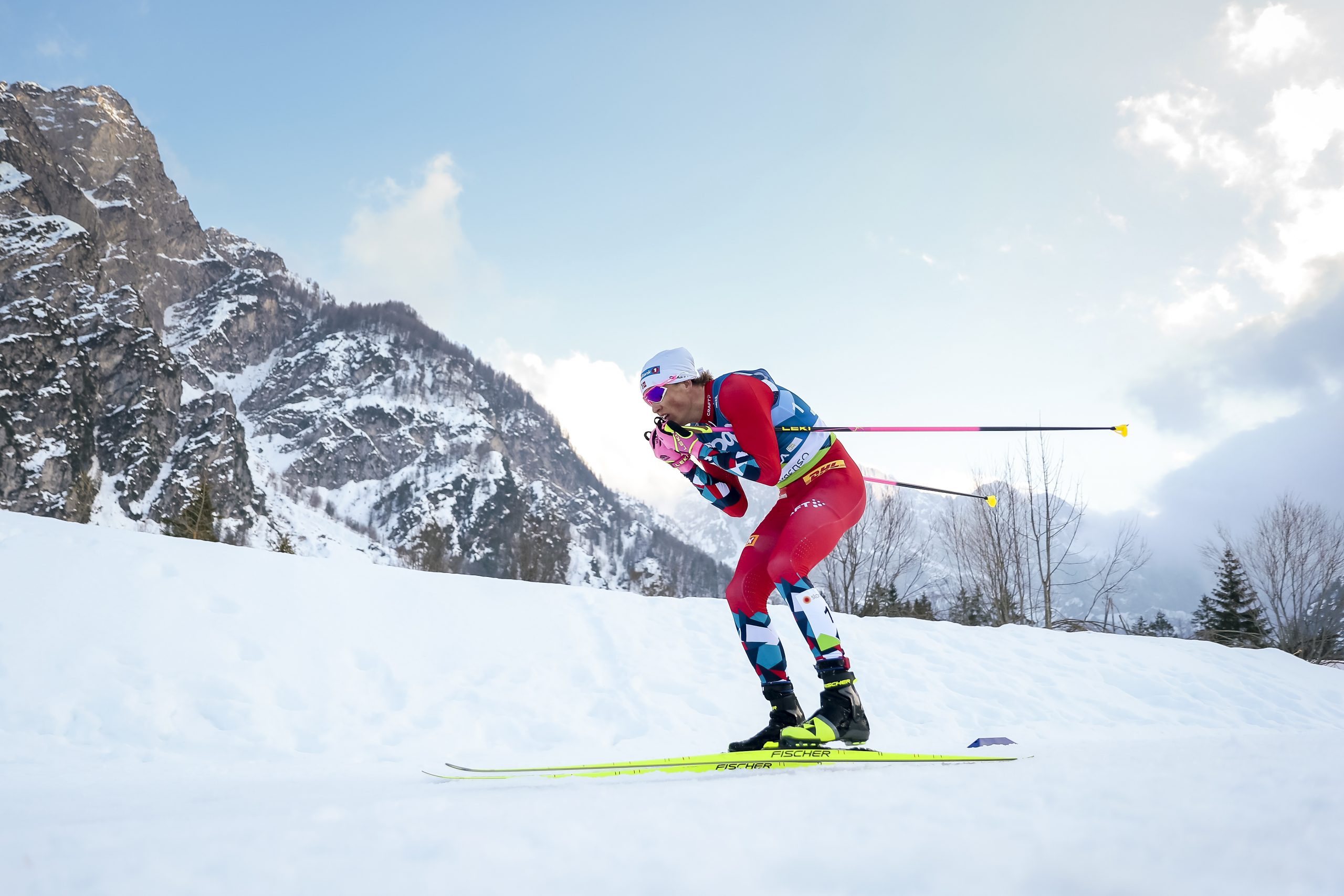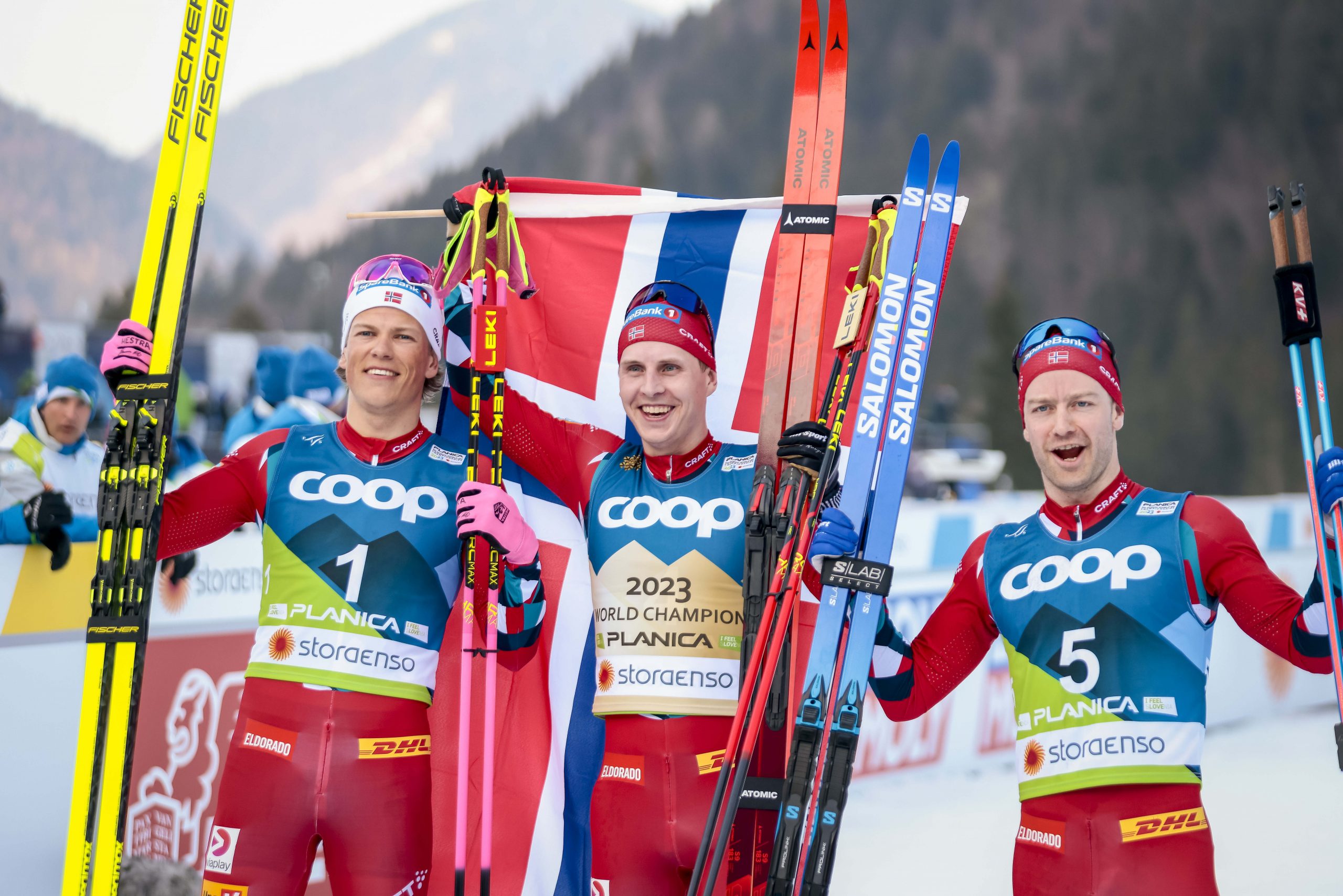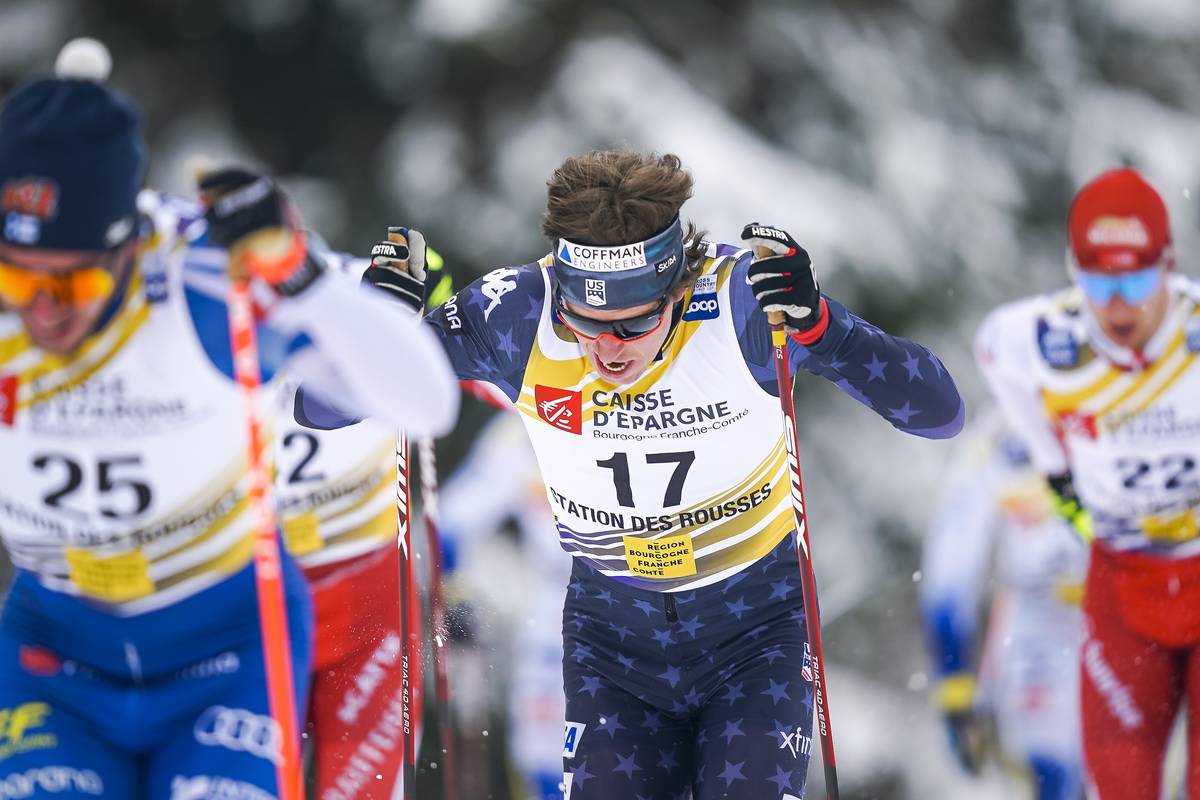
From the FasterSkier archive — posts syndicated from athletes’ and coaches’ own blogs between 2004 and 2012, kept online as published. Current coverage is at fasterskier.com.

Tag: William Poromaa

  • Einar Hedegart has only been a ‘cross-country skier’ since November. On Friday, he could dethrone the sport’s Olympic king.

    Einar Hedegart has only been a ‘cross-country skier’ since November. On Friday, he could dethrone the sport’s Olympic king.

    This article was made possible through the generous support of our voluntary subscribers who have helped put our Nat Herz on the ground at the Olympics. If you value coverage like this, please support FasterSkier with a voluntary subscription.

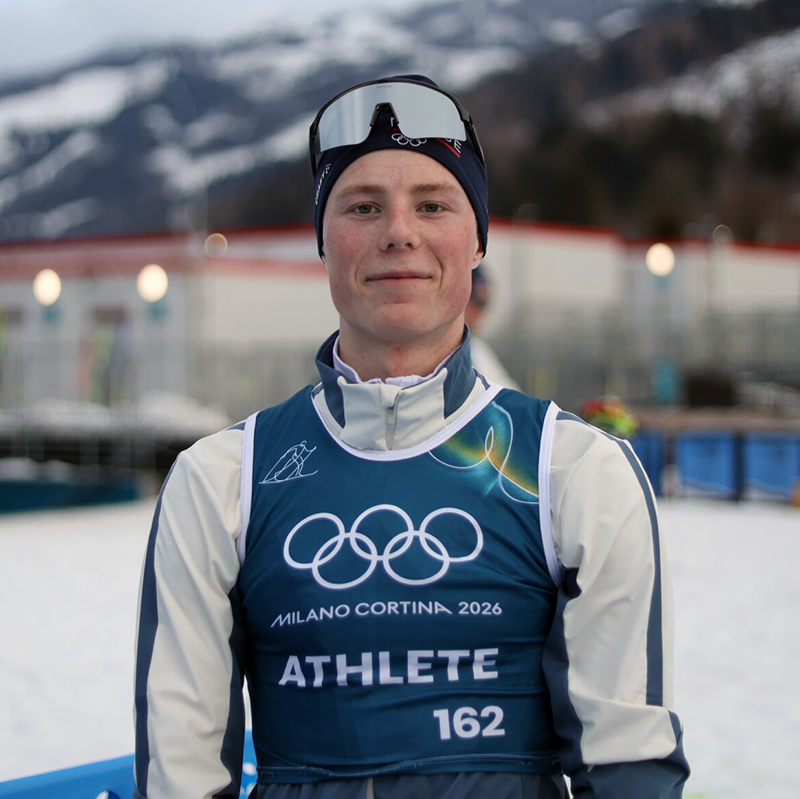
    Einar Hedegart poses for a photo after training at the Olympic cross-country ski venue in the Dolomites in Northern Italy. (Nathaniel Herz/FasterSkier)

    PREDAZZO, ITALY — Johannes Høsflot Klæbo is, almost without question, the greatest cross-country skier who’s ever lived.

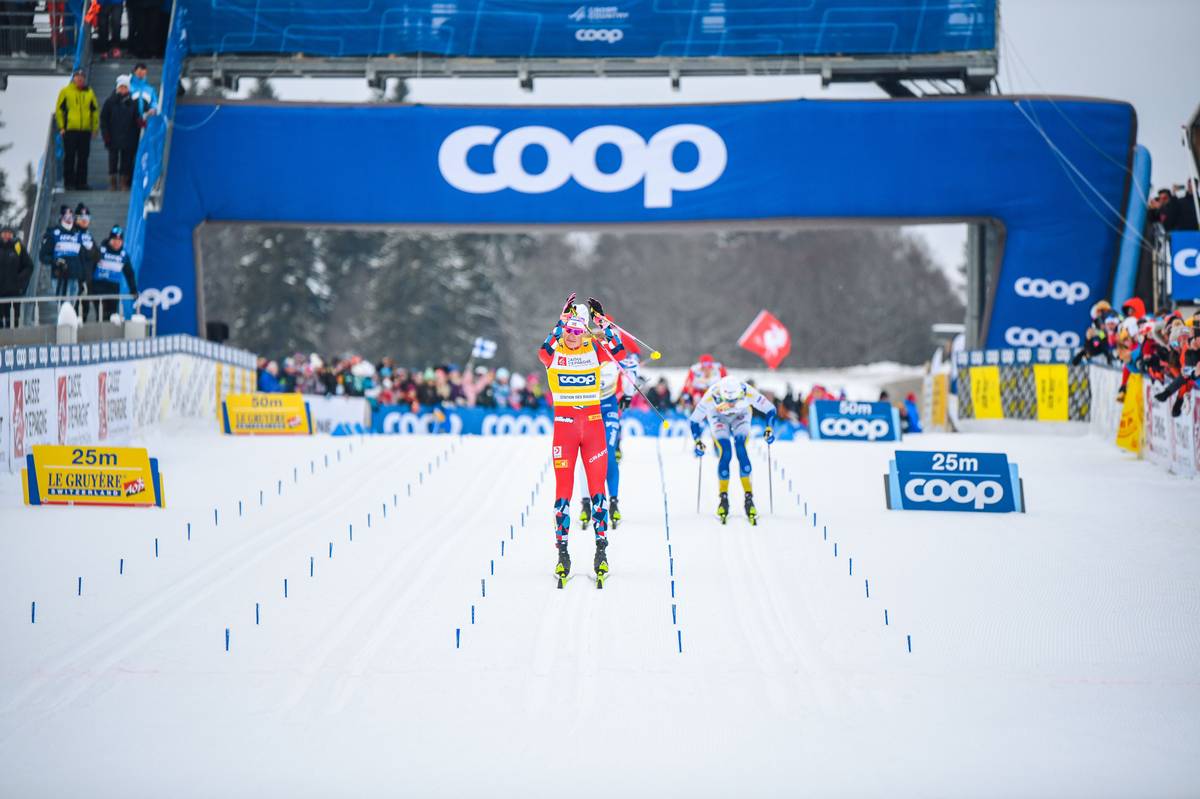
    The Norwegian athlete has won gold in eight consecutive championship races spread across two seasons — including the first two events at this year’s Olympics, in Italy. It’s quite possible he could walk away from the Games with gold in all six events.

    His biggest threat comes from a guy who’s been a cross-country skier for less than three months.

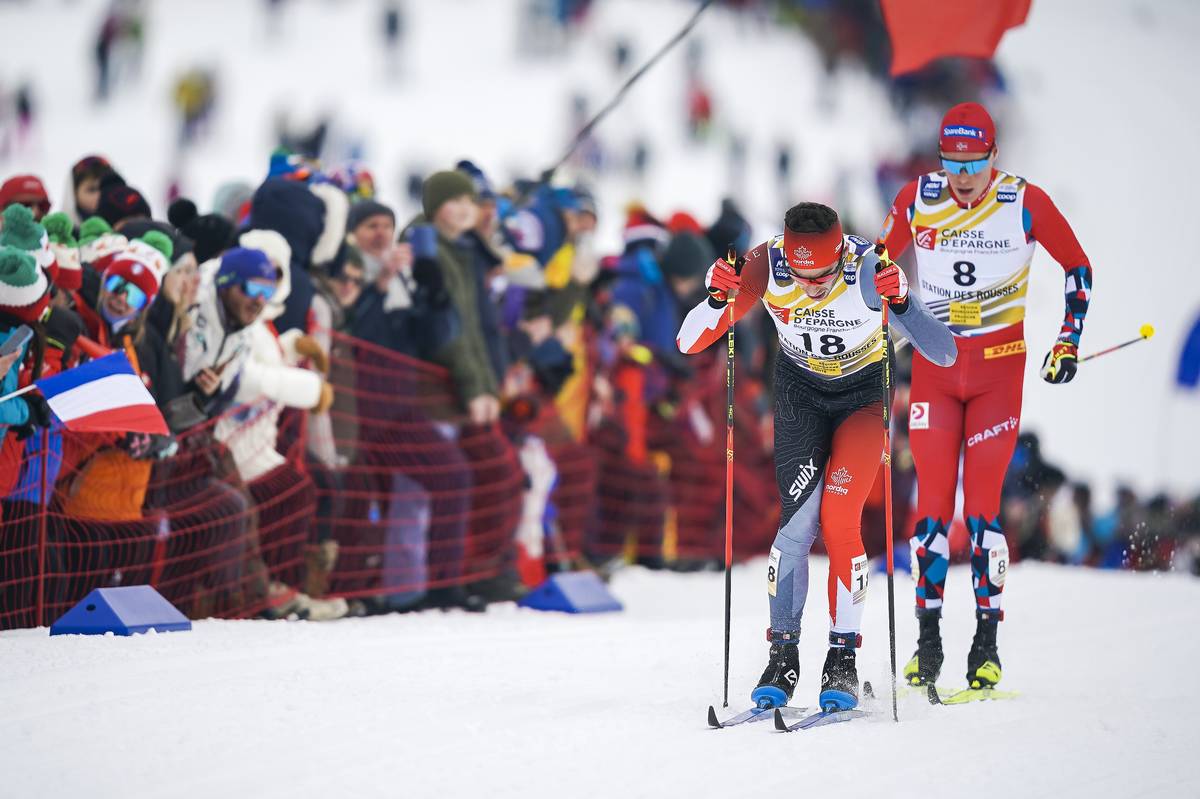
    Norwegian Einar Hedegart has beaten Klæbo all three times they’ve raced each other this winter. He’s won five of the six cross-country events he’s entered since the season began in November.


    Johannes Høsflot Klæbo celebrates a gold medal at the Olympics in Italy. (Davide Barbieri/NordicFocus)

    November is when, at least according to Hedegart, he finally accepted the label of cross-country skier. Before that, he’d still been, at least partially, a biathlete — the Olympic discipline that combines cross-country skiing with precision shooting.

    In biathlon, Hedegart was a fast skier, but not always a reliable shooter. Last season, he jumped into a World Cup race against cross-country skiing’s best competitors, and finished a surprising second place.

    That result set off a chain of events that have led him to Italy on Norway’s Olympic cross-country team, with a specific focus on the 10-kilometer freestyle event. That’s where, on Friday, he’s expected to challenge Klæbo for Olympic gold.

    “We’re looking forward to Friday,” Emil Hosøy, the coach of Hedegart’s club team in Norway, said in a phone interview this week. “It will be a hard competition.”

    In a brief interview Tuesday after training with a teammate at the Olympic venue in the Dolomites, Hedegart said he’s prepared for the showdown.

    “Everything has gone according to plan,” he said.

    Biathlon vs. cross-country

    Hedegart’s meteoric rise has enlivened a long-running, colorful debate between cross-country skiers and biathletes over which discipline is superior, and who’s faster. Biathletes have periodically crossed over and notched competitive results, though it doesn’t happen often.

    Swedish cross-country star William Poromaa sparked a furor in Scandinavia two years ago by joking that biathlon, with its stops for target shooting, was for athletes who need a rest between ski sessions.

    Hedegart is the latest test case — showing that on today’s racing circuits, elite biathletes can be, at a minimum, competitive with the best cross-country skiers.

    “I think a lot of cross-country skiers underestimate the level biathlon is at, and the amount of training we are doing,” Hedegart told two cross-country Olympians on their podcast, Skirious Problems. “You guys have to give us some credit, please.”

    Hedegart, 24, is from a little north of Trondheim, a city in central Norway that’s produced some of the world’s best cross-country skiers, including Klæbo.

    As a kid, he watched cross-country skiing on television, because the Norwegian superstar Petter Northug Jr. came from his area. But Hedegart’s focus was biathlon, and he showed promise early — winning medals at the World Junior Championships and, in 2023, reaching the top 30 in the World Cup, the sport’s highest level of competition.

    Einar Hedegart competes in a cross-country World Cup race in Switzerland (Federica Vanzetta/NordicFocus)

    Hedegart would also, from time to time, enter elite cross-country races. Some of those decisions were happenstance — one because he didn’t have a partner for a biathlon relay on the same day, and another that he entered on a whim after a registration deadline.

    But in both of those cases, he won.

    His results earned him an entry into a cross-country World Cup race in Oslo last year, where he placed second — prompting questions from Scandinavian pundits about whether Hedegart was focused on the right sport.

    So, over the summer, Hedegart hedged his bets: He switched from training with biathlon teams to training with a cross-country ski team — albeit one that would allow him to keep shooting his rifle and compete in biathlon.

    “All the way from May to November, I was 50-50,” Hedegart said. “I brought my gun to every camp and shot a lot.”

    At the start of this winter, Hedegart entered two sets of races over two weekends — biathlon and cross-country — to help decide how he would spend the rest of the season.

    In biathlon, he shot poorly. In one race, he missed eight of 20 shots; only one athlete out of 59 competitors missed more.

    The cross-country race, meanwhile, he won by a big margin — besting not just Norway’s top skiers but other top talents from France and Austria. That was the day things changed, Hedegart said.

    “I’m a cross-country skier this winter season,” he said.

    Klæbo, whose championship winning streak is at risk, has taken notice of Hedegart’s rise, which resulted in him being named to Norway’s Olympic cross-country team early in the winter.

    “It’s impressive, what he has done,” Klæbo said. “I’m going to try to give him a good match.”

    The best skater of all time?

    Both Klæbo and Hedegart himself credit Hedegart’s success this season to a unique aspect of his training.

    Cross-country skiing, both on the World Cup circuit and at the Olympics, features events in two techniques — the traditional forward striding and poling known as classical, and the side to side pushing called skating.

    Biathletes compete only in skating, and Hedegart, this past year, has focused his training almost exclusively on that technique. He hasn’t even bothered to contest classical cross-country competitions this winter. 

    Hedegart said on the podcast, in November, that he’d spent less than 12 hours practicing classical style in the previous six months — a tiny fraction of the hundreds of hours he’d spent training in total. Top cross-country skiers, meanwhile, typically divide their training close to evenly between the two techniques.

    Einar Hedegart, center, celebrates winning a World Cup cross-country race in Switzerland. (Federica Modica/Nordic Focus)

    “That is my strength, that I can use more time than anyone else ever has on skating,” said Hedegart in the interview. “I’ve just really done my thing, and that has gotten me this far.”

    Hedegart’s training plan has other unconventional elements, including lots of moderately hard sessions and few extra-hard ones, which allows him to spend more time training overall, said Hosøy, his coach. Hedegart is also a “very clever” athlete who’s shown a keen awareness of his own body that’s unusual for someone his age, Hosøy added.

    But it’s the added emphasis on skating that’s allowed Hedegart to take the technique “to a new level,” said Pål Golberg, a former top Norwegian skier who’s competed against Hedegart and now is working at the Olympics as an expert TV commentator.

    “The training he does is out of this world,” Golberg said. “He can be the best skater the sport has seen — if he wants to do that.”

    A postseason dilemma

    That’s the question Hedegart will have to answer after this season — and it poses a real dilemma. 

    Avoiding the classical technique means he can only compete in half of cross-country’s racing schedule. And because his success, so far, has come mostly in distance events, Hedegart has not yet earned a chance to race individual sprint races for the Norwegian team, whose start slots are hotly contested.

    As a result, Hedegart has started just six cross-country races this winter — far less than athletes competing in both disciplines.

    “If you want to get old in this sport, maybe you have to get to compete more to have the motivation to train as much as he does,” said Hosøy, the coach.

    But training and racing in the classical technique would risk the success Hedegart has found after specializing in skating.

    “I wouldn’t take the chance,” said Golberg. “If he has this skating that’s so good, why would you risk it? He would never win a distance race in classic, I’m pretty sure.”

    There’s also the question of whether Hedegart will ultimately return to biathlon — which, he said, would make it pointless to try to improve his classical technique, since it’s not used on the biathlon circuit.

    Hedegart celebrates a podium finish at a cross-country World Cup race in Finland earlier this year. (Federico Modica/NordicFocus)

    At the start of the season, Hedegart said, he still planned to go back to biathlon next year. Now, he added, he’s pretty sure he’s changed his mind: If he’s offered a spot on Norway’s national cross-country team for next year, he’d take it, at least for one season.

    But in 2029, the biathlon World Championships will be held in Oslo — a chance to compete in a marquee event in Hedegart’s home nation. “That is a big, big dream of mine,” he said. “And I really hope that I can compete there.”

    “That is the back and forth I have to do,” Hedegart added, referring to the balance between the two sports. 

    If Hedegart’s success this season has complicated his career planning, it’s at least provided Scandinavians with a compelling new storyline — particularly in men’s cross-country skiing, where some pundits complain that Norwegian dominance is making the sport boring.

    “Norwegians are pretty tired of watching one Norwegian fighting with another,” said Golberg. “But now, suddenly, you have two sports clashing together.”


    Help Support Our Olympic Coverage!

    FasterSkier has our own Nat Herz on the ground at the Olympics, which is a significant financial lift for us. If you value the thoughtful work and access FasterSkier provides at championships like this one, please consider becoming a Voluntary Subscriber. Your support directly fuels our work to cover the people, places, and moments that make our sport special.

    Join the FasterSkier community!


  • Holmenkollen 20 k Classic—Nyenget’s Revenge, Schumacher Seventh

    Holmenkollen 20 k Classic—Nyenget’s Revenge, Schumacher Seventh

    This coverage is made possible through the generous support of Marty and Kathy Hall and A Hall Mark of Excellence Award. To learn more about A Hall Mark of Excellence Award, or to learn how you can support FasterSkier’s coverage, please contact info@fasterskier.com.

    Martin Loewstroem Nyenget (NOR) dominated the 20 k Classic on Holmenkollen’s trails high above  Oslo. In this place where Norway crowns its heroes, Nyenget may have tasted sweet revenge for the bad luck that befell him at the World Championships in Trondheim. (Photo: Modica/NordicFocus)

    Holmenkollen is the home of Norwegian cross country skiing. It’s their Yankee Stadium, their Churchill Downs, their Wimbledon Centre Court, their Indianapolis Speedway. It’s the place where the Kingdom of Norway would usually crown its greatest champions, identify its cultural icons. But Norway already did that a week ago in Trondheim at the FIS World Championships where Johannes Hoesflot Klaebo (NOR) so totally dominated the racing that no other performance in World Championship history even begins to compare. Klaebo sits alone atop the throne of Nordic skiing, making today’s races at Holmenkollen less of a coronation, and more of a victory lap.

    Johannes Hoesflot Klaebo (NOR) may be forgiven for seeming a bit flat in Holmenkollen. Last week’s six World Championship gold medals is a tough act to follow. (Photo: Authamayou/NordicFocus)

    But Klaebo was not the only one racing in Holmenkollen, and the event staged on Holmenkollen’s first day of racing—the 20 k Classic Interval Start—was not likely to be his best. Frankly, Klaebo’s six gold medal performance in Trondheim could easily have been upset by the presence of Iivo Niskanen, the Finnish Classic specialist who skipped the championships due to lingering illness. Had Niskanen been healthy for the 10 k Classic in Trondheim, Klaebo’s World Championship headlines might have been markedly different. But the stars aligned over Klaebo in Trondheim, allowing him to etch his name into skiing’s history books. In Holmenkollen, just one week later, Niskanen might’ve been hoping to etch his own name . . .

    If he hoped to do so, Niskanen would be forced to do things the hard way: his start position in Holmenkollen made him the first of the true contenders to start. He races hard regardless of start position, but he would be at the disadvantage of having all his Norwegian rivals (Klaebo, Martin Loewstroem Nyenget, Simen Hegstad Krueger, Erik Valnes, Paal Golberg, Andreas Fjorden Ree) start behind him. They’d get plenty of useful information, while Niskanen would race virtually alone.

    Iivo Niskanen (FIN) may have attempted to quick a return from the illness that also kept him out of Trondheim’s World Championships. He would be a DNF in Holmenkollen. (Photo: Authamayou/NordicFocus)

    In the end, Niskanen looked as though his recovery from the flu was not yet complete. He and Klaebo both skied with little fire, with Klaebo finishing 14th, and Niskanen a DNF.

    The athelte who did display considerable fire was Martin Loewstroem Nyenget (NOR) who seemed to be channelling the bottomless disappointment that must’ve resulted from his untimely fall in last week’s World Championship 50 k. Nyenget stormed through all the checkpoints of the Holmenkollen 20 k Classic on his way to an astronomical 51 second victory. He was joined on the podium by William Poromaa (SWE) and Simen Hegstad Krueger (NOR).

    Olivier Leveille (CAN) strided to a remarkable 10th place finish at Holmenkollen’s 20 k Classic. (Photo: Modica/NordicFocus)

    Canadian finishers included Olivier Leveille in a terrific 10th place, followed by Xavier McKeever 28th, Remi Drolet 47th, Thomas Stephen 52nd, Max Hollmann 57th.

    Among Americans, Gus Schumacher delivered a masterfully paced performance to finish seventh, only 22 seconds from the podium. Other Americans included Ben Ogden 33rd, Kevin Bolger 36th, Luke Jager 59th.

    “I’m feeling tired after the 50 k, for sure,” said Schumacher. “But every day was getting better than the last this week . . . still, maybe the last lap was a bit too hard for going faster. Definitely not super easy to nail the individual start 20 k pacing!”

    William Poromaa (SWE) continues to prove himself capable of breaking up Norwegian podiums. (Photo: Modica/NordicFocus)
    20 k Classic

    The men’s 50 k race in Trondheim concluded only a week ago, but the conditions in which the men’s field raced that World Championship event were nowhere near as taxing and exhausting as those experienced by the women’s field. Even so, the lingering stresses of such a 50 k race influenced FIS to replace Holmenkollen’s usual 50 k race with a 20 k Classic event on the World Cup schedule.

    Holmenkollen offered racers an18.6 kilometer course (shortened from the original 20 kilometers due to weather and course considerations). Starting a few hours after the women’s event (won by Therese Johaug), the weather in Holmenkollen had warmed to over 40 degrees Fahrenheit. The sky had gone from sunny to overcast, so the waxing remained straightforward despite the warm temperatures.

    Niskanen has dominated 10 k Classic races on the World Cup circuit this season; Holmenkollen represented his opportunity to re-establish himself at the top of the Classic field, and to seek a bit of retribution for the World Championship medals he perhaps missed due to his absence from Trondheim. But Holmenkollen proved to be too quick a return to action for Niskanen, who found himself already 10 seconds behind the leaders at the two kilometer mark. His technique appeared efficient, but his tempo slow and uninspired. Like Niskanen, Klaebo came through the two kilometer checkpoint some 10 seconds behind the leaders. Both pre-race favorites continued to lose time throughout the day with Klaebo finishing 14th, and Niskanen abandoning the race entirely.

    Gus Schumacher (USA) skied strongly through the early checkpoints, delivering split times in the top ten of a tightly packed group of early leaders.

    “The strategy was mostly pacing-related,” said Schumacher after the race. “I felt like I paced it pretty well. Don’t feel like I could’ve gone too much easier in the middle, but there’s always more room for me to relax and have more energy for the finish.”

    Gus Schumacher (USA) paced himself to a seventh place finish in Holmenkollen’s 20 k. (Photo: Modica/NordicFocus)

    Schumacher continued to accelerate through the middle kilometers, moving past Golberg, Ree, and Hugo Lapalus (FRA) into the fastest position at 14.4 kilometers. Schumacher was later supplanted by Amundsen, Krueger, and William Poromaa (SWE) with all the leaders being overhauled by Nyenget who seemed unmatchable on his way to the win.

    Starting 66th, Nyenget began delivering split times well ahead of all other contenders, appearing to channel his frustration that had begun with his untimely fall in last week’s World Championship 50 k. He established a 35 second lead over all other contenders by the halfway mark.

    Schumacher crossed the finish line 2.5 seconds behind Golberg. Both would sit and wait to see what placings their finishing times would earn them. Lapalus bumped Schumacher down by .1 seconds. Each successive finisher took over the lead; first Amundsen, then Krueger, then Poromaa, and finally Nyenget who crossed the finish line right after Poromaa, and 51 seconds ahead of everyone. Poromaa had the race of his life—second place in this World Cup 20 k Classic—and nearly found himself getting caught on course by Nyenget.

    “Everyone was speaking since the 50 k that ‘you will have your revenge next week,’” said Nyenget in post-race interviews. “I feel I really had a great day, and got my revenge, if you can call it that.”

    Holmenkollen is the venue where Norway crowns its heroes. He may have missed that opportunity in Trondheim, but Martin Loewstroem Nyenget more than made up for it on the storied trails of Holmenkollen.

    Men’s 20 k Classic Interval Start RESULTS

    William Poromaa (SWE), Martin Loewstroem Nyenget (NOR), Simen Hegstad Krueger (NOR) thrilled Norwegian crowds at Holmenkollen. (Photo: Modica/NordicFocus)
  • The Devon Kershaw Show: A hundred kilometers of highs and lows to wrap Trondheim

    The Devon Kershaw Show: A hundred kilometers of highs and lows to wrap Trondheim

    Sorry we missed yesterday, but Nat had to stop by the Klæbo victory party and Devon was busy. Not to fear: We’ve got recaps of both the men’s and women’s 50-kilometer races in Trondheim.

    We made it to the end; we’re going to take a few days off from podcasting, but feel free to send us love notes only to devon@fasterskier.com and nat@fasterskier.com. See you soon.

    Frida Karlsson celebrates her victory on Sunday. (Federico Modica/Nordic Focus)
  • Fast Tracks: World Champs—It was a magical day for William Poromaa—Men’s 50 k Press Conference

    Fast Tracks: World Champs—It was a magical day for William Poromaa—Men’s 50 k Press Conference

    This reporting costs money. Please support this coverage with a voluntary subscription (below) so FasterSkier can provide this level of access to the sport we all love year-round.

  • Sweden’s World Cup Weekend! Poromaa Swipes Les Rousses 20 k

    Sweden’s World Cup Weekend! Poromaa Swipes Les Rousses 20 k

    This coverage is made possible through the generous support of Marty and Kathy Hall and A Hall Mark of Excellence Award. To learn more about A Hall Mark of Excellence Award, or to learn how you can support FasterSkier’s coverage, please contact info@fasterskier.com.

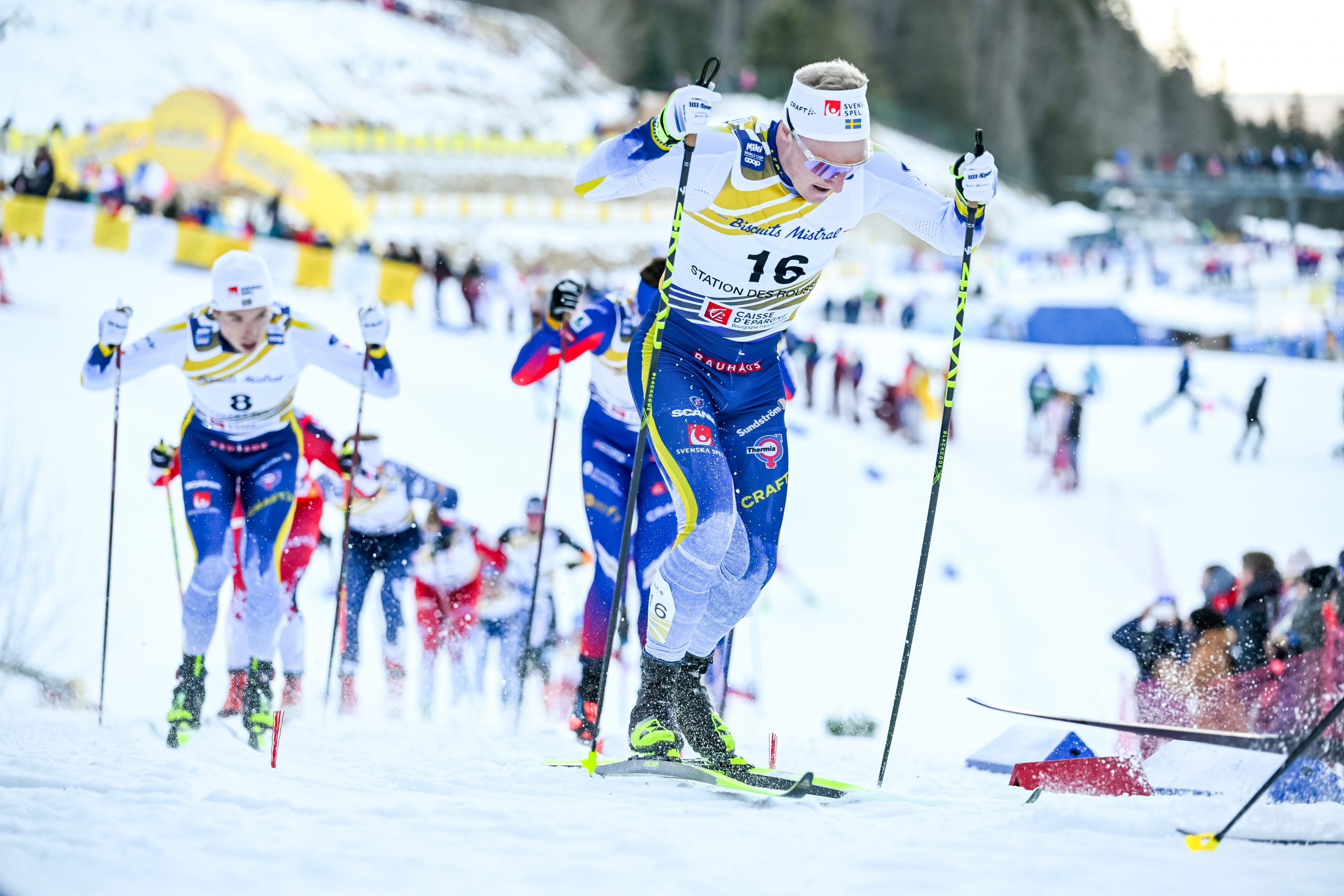
    Sweden’s William Poromaa (16) made his move late in the 20 k Mass Start at Les Rousses, France, ultimately sprinting to victory ahead of Finland’s Iivo Niskanen. (Photo: Authamayou/NordicFocus)

    Les Rousses’ 20 k Mass Start would be a race conducted without the usual pace-makers. The Norwegian team had mostly stayed home for their own championships, and the Russian team was voted off the island years ago; therefore, the Les Rousses’ Mass Start would offer an opportunity to see what the rest of the skiing world really looks like. Who would force the pace? Who would dare the race-breaking move? And could Niskanen still dominate a Classic race without the Norwegians there to keep the speed high?

    William Poromaa (SWE) leads Iivo  Niskanen (FIN) across the finish line to secure his first World Cup victory in the 20 k Mass Start at Les Rousses, France. (Photo:  Authamayou/NordicFocus)

    In the end, the race would be unusually tactical—so much so that significant sprinters like France’s Richard Jouve were able to stay in the lead pack until nearly the very end. Niskanen would atttempt to dominate the last quarter of the race, though he was unable to shake Simen Hegstad Kreuger (NOR) and William Poromaa (SWE). Ultimately, Poromaa would outsprint Niskanen for the victory, only a few seconds ahead of Kreuger.

    Beginning the day ninth in the World Cup overall standings, Ben Ogden (USA) would cling gamely to the lead pack throughout the day, finishing 12th.

    Americans also saw impressive finishes from Luke Jager 21st, Zak Ketterson 29th, JC Schoonmaker 38th, Kevin Bolger 43rd, and Hunter Wonders 44th. Canadians Olivier Leveille and Remi Drolet were 39th and 42nd, respectively.

    In the absence of pace-making teams like the Norwegians (many of whom stayed home for their National Championships), the Mass Start 20 k was a tactical affair complicated by the World Cup Tour’s steepest uphill. (Photo: Modica/NordicFocus)
    20 k Classic Mass Start

    The Mass Start course at Les Rousses is comprised of a short two kilometer initial loop, followed by six 3.3 kilometer laps. The lap also includes Les Rousses’ infamous uphill, said by competitors and coaches to be the steepest on the entire World Cup circuit.

    Conditions were hard and fast, though the super-bright sunshine at Les Rousses could potentially cause problems with adequate kick in shadier sections. Later in the race, that was apparent as virtually no one was able to stride the steepest sections of the lap.

    The race began with moderate pacing with racers filling all four lanes of the race course. The field lazed it’s way around the initial two kilometer loop, staying together until Vermeulen and Lapalus separated themselves the first time up the steep hill (possibly more as a result of Anger clogging the track by slowing nearly to a stop in the steepest herringbone section). The early pace was regulated by Hugo Lapalus (FRA), Mika Vermeulen (AUT), Friederich Moch (GER), Paal Golberg (NOR), and Niskanen.

    The unsteady pace of the field—and the many tight turns  and challenging downhills of the Les Rousses 20 k course—allowed some ambitions sprinters to remain in the lead group. Richard Jouve (FRA) would finish 11th on the day, just ahead of American, Ben Ogden. (Photo:  Modica/NordicFocus)

    While Lapalus and Vermeulen continued to be the primary pace-makers, at the half way point the main contenders were still together; notably, a number of significant sprinters remained within a few seconds of the front including Richard Jouve (FRA), Ogden, and Erik Valnes (NOR). With such skiers in contention, the pack would accordion dramatically—stretching into a long thin line on every uphill and re-compressing into a cohesive pack on downhills and around each of Les Rousses sharp corners.

    Golberg had lurked just behind the lead group through the first half of the race, but he was finally shed from the pack when Niskanen and Kreuger drove to the front at 15 kilometers. They were soon joined by Poromaa. Slowly but surely, that trio began to add to their advantage. Ogden continued to hang on stubbornly, but was beginning to bobble at the back of a 12-man chase pack led by Vermeulen, Lapalus, and Valnes.

    Niskanen has nine career world cup wins—eight of those in Classic races—but he admitted during pre-race interviews that the long, steep herringbone section of the primary uphill constituted a technical weakness for him. Today, even the most accomplished skiers all but “walked” that section of the course, especially in the later laps where fatigue had begun to take its toll.

    As the race entered its final lap, Poromaa and Kreuger attempted to push the pace on the winding downhill sections, hoping to reduce the Classic technique advantages that Niskanen otherwise enjoys. While they couldn’t shake the Finn, they did succeed in taking some of the sting out of his striding, allowing Poromaa to outsprint him to the finish line. Kreuger finished five seconds later to take third and reinforce his hold on the World Cup Distance leader’s bib.

    Ogden would recover in the final lap to chase down a few extra places. He would finish 12th, just behind Jouve. Valnes, Lapalus, and Vermeulen would finish fourth, fifth, and sixth, respectively.

    Golberg coasted home in 36th, probably ending his chances of being selected for the Norwegian World Championship team.

    20 k Classic Mass Start RESULTS

    For the first half of the race, the field in Les Rousses put the “Mass” back in Mass Start. Erik Valnes (NOR), William Poromaa (SWE), Mika  Vermeulen (AUT), Hugo  Lapalus (FRA) fill the tracks. (Photo: Authamayou/NordicFocus)
  • The Devon Kershaw Show: Dr. William Poromaa is the cure for your World Cup withdrawal

    The Devon Kershaw Show: Dr. William Poromaa is the cure for your World Cup withdrawal

    It’s been a minute. We, and the World Cup circuit, took a break from racing, and podcasting, last weekend, but things are about to heat up again in Lahti, Finland, and we thought now was the perfect time to bring you an interview Nat did in Canmore with up and coming Swedish talent William Poromaa.

    Nat and Devon will be back with a recap after the races in Lahti this weekend. Send us your questions, comments and feedback at devon@fasterskier.com and nat@fasterskier.com. Catch you soon.

  • A Finnish finish: Tying a bow on the 2023 season in Lahti

    A Finnish finish: Tying a bow on the 2023 season in Lahti

    This is the end. Of the 2023 racing season. Devon and Nat go without guests and are here to take you through the last three events of the winter in Lahti, Finland. And we cover a couple of retirement announcements from U.S. skiers.

    We’re taking a little break after this but, we promise: We won’t leave you hanging for the whole off-season. Stay tuned for more regular episodes over the course of the spring and summer, and we’ll be back in a few weeks for a 2023 season recap. Tell us your favorite memories from this year — get at us at devon@fasterskier.com and nat@fasterskier.com.

  • The Devon Kershaw Show: That was a really fun World Champs 50 k.

    The Devon Kershaw Show: That was a really fun World Champs 50 k.

    We’ve made 10 podcasts in 11 days and I have no juice left to come up with snappy episode titles or show notes. So this is what you get. Click play and listen to us talk. It was a cool 50 k.

    Get at us at devon@fasterskier.com and nat@fasterskier.com. We’ll be back after the first-ever women’s 50 k, with both Devon and Nat on scene in Oslo.

  • Golberg Outsprints Klaebo to Claim Gold in Men’s 50 K, Patterson 16th

    Golberg Outsprints Klaebo to Claim Gold in Men’s 50 K, Patterson 16th

    This World Cup coverage is made possible through the generous support of Marty and Kathy Hall and A Hall Mark of Excellence Award. To learn more about A Hall Mark of Excellence Award, or to learn how you can support FasterSkier’s coverage, please contact info@fasterskier.com. 

    The long and winding road that is cross-country skiing’s World Championships came to an end today. The last stop: the men’s 50 kilometer Classic Mass Start. Throughout the men’s competitions, the story has been Norway; Johannes Klaebo’s domination, team Norway’s supremacy, and the competition amongst the Norwegian team members. Norway was expected to dominate again today, but there were many sub-plots within that expectation: one of the biggest was the performance of  Klaebo.  Touted by some as the greatest ever, but skeptics note that Klaebo hasn’t been nearly as impressive in distance events as other legendary skiers who came before. Klaebo has never been on the podium in a 50 kilometer race at a major event. To cement his name in conversations about G.O.A.T status, Klaebo would probably need to have a victory. He would also be trying to redeem himself after having been disqualified at the finish in the last World Championships 50 kilometer race when he interfered with Alexander Bolshunov (RUS).

    Standing in Klaebo’s way would be what appeared to be a busload of Norwegian men. Finnish Classic standout Iivo Niskanen—who always seems to perform well in major events—would also present a major roadblock, with his eyes firmly on the podium in a long Classic race: his forte. America would look to Scott Patterson to lead the way for team USA, with Patterson having previously placed in the top 10 at 50 k in the Olympics and World Championships.

    When the end of the World Championship Road was reached, it was Norway dominating again but with a somewhat surprising finishing order. Golberg finished first, out-sprinting Klaebo at the finish. William Poromaa (SWE) was third.

    Scott Patterson (USA) had another excellent distance race for team USA finishing 16th (Photo: NordicFocus)
    Men’s 50 kilometer Classic Mass Start

    In 40 degree weather (4.4 C), with slow wet conditions, it was apparent early that the seven lap course would make for a race of attrition. It was also clear that the single allowed ski change could play a critical role.

    As is typical in men’s distance racing, the skiers set out at an initially fast pace, then quickly settled down into the long grinding speed that would typify most of the race.

    Scott Patterson (USA), was able to hang with the leaders early on. (Photo: NordicFocus)

    At the 4.3 k mark, it looked good for team USA with Patterson at the front of the race. Also near the front was perennial crowd favorite, Andrew Musgrave (GBR).  But as the race ground on the favorites began to rise to the top, while the Americans and Musgrave drifted back.

    Much to everyone’s surprise, Johannes Hoesflot Klaebo (NOR) was out-sprinted at the finish. (Photo: NordicFocus)

    At 6.4 k, two Italians—Federico Pellegrino and Francesco De Fabiani—joined Golberg at the front to quicken the pace. Klaebo was 23rd, but only 5.2 seconds back. At this juncture, Klaebo’s strategy became clear. He would not lead. Instead, he would be content to mark the leaders the entire way and then rely upon his devastating sprinting ability to bring in the win. It was a sound strategy for the strongest sprinter in the field, but one that would not pan out today.

    With the abundant heat and sun, the nutrition hand-ups were frequent, giving skiers an opportunity to make a move when others were being handed food and drink. This is exactly what Niskanen did at the 13 k mark; taking five skiers with him. This was the first time in the race when the field truly began to string out. But, during the next feed, the front of the race regrouped. This elastic effect continued throughout the next several kilometers with surges and contractions geared around hills, corners, and feed zones.

    It was at about the halfway point when the hot grind of an hour’s racing began to take its toll and a true lead pack of about 13 skiers established a gap with Golberg and Nyenget still setting the pace. Golberg had now been out front for the last five kilometers.

    David Norris (USA) finished 22nd having won the American Birkebeiner Saturday, then flew to Europe to race in the World Championships. (Photo: NordicFocus)

    The North American contingent was led by Wonders, Patterson, Gus Schumacher (USA), David Norris (USA) and, Oliver Leveille (CAN). All were in a chase group 14 to 22 seconds off the lead. Fans were eager to see how Norris would perform. He won the American Birkebeiner last Saturday and made the unprecedented decision to fly to the World Championships to race the marathon. After the race, Norris told FasterSkier that he had arrived Tuesday morning and was satisfied with the way his body had adapted. He forced himself to stay up late every night to adjust to jetlag. “I don’t think jetlag was affecting the race at all.”

    At 28.4  kilometers Toenseth made a push to the front. Klaebo, who still had not led, was just a couple of seconds behind the leaders. The grinding race of attrition continued and it became clear that the winners would come out of the lead pack of 13 skiers. A surprise skier in the lead group was Snorri Einarsson of Iceland. Einarsson would go on to have one of his best finishes ever, finishing 15th.

    With two laps remaining, every one of the now 11 lead skiers opted to stop at the ski exchange. During the exchange, there was a crash involving Niskanen and Jens Burman (SWE),when Niskanen cut in front of the Swede on his way into the ski corral. The tangle knocked Burman to the ground but didn’t seem to harm his time in the exchange or affect Niskanen.

    David Norris (USA), Scott Patterson (USA), Gus Schumacher (USA), (l-r) were able to ski as a pack in the middle stage of the race. (Photo: NordicFocus)

    The biggest surprise in the lead group was the presence of 23 year old Frenchman, Theo Schely, who is somewhat of an unknown outside France. Schely does not have a top 20 finish in a World Cup distance race, but was seemingly undeterred by the pace. He ended up finishing ninth in what was unquestionably the second biggest surprise of the day.

    At about 43 kilometers the action livened up as Burman crashed in a corner, pushing him toward the back. At about the same time De Fabiani (ITA) broke a pole, and he was pushed out the back. With five kilometers left the race had boiled down to all the favorites with nine skiers lining up for finishing attacks. Toenseth dialed up the pace with Niskanen going along with him. Niskanen continued to push the pace—hard—but was unable to pull away from the chasers. But this reduced the field to only seven skiers, with Poromaa going with Niskanen at the front. Klaebo still sat in the middle of the pack, matching the leader’s moves but never leading.

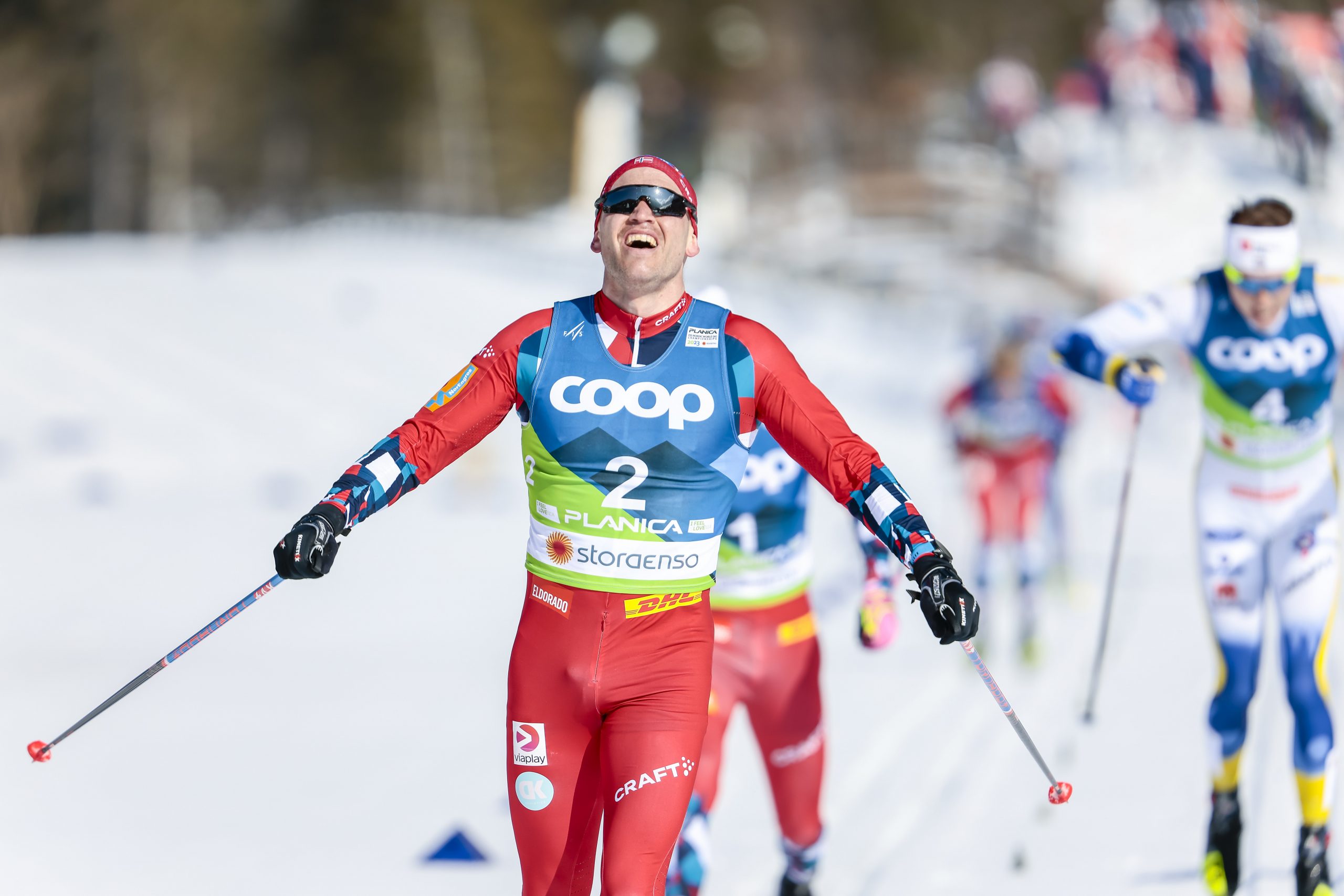
    Paal Golberg (NOR) celebrates at the finish having just shocked everyone—himself included—by sprinting past Johannes Klaebo (NOR). (Photo: NordicFocus)

    At the two hour mark, with one kilometer to go, the race turned into an all out sprint with Golberg pushing to the front and Klaebo going with him in second place. It was here where the biggest surprise of the day took place. The pace was blistering with Klaebo charging up the final hill. Everyone watching expected Klaebo to turn on his famous sprint and pull away. But Golberg had a devastating sprint which Klaebo could not match.  Klaebo faded in the last 100 meters and Goldberg surged, pulling away from Klaebo, putting him in second place, with Poromaa hanging on to finish third. After the race Golberg admitted his surprise in beating Klaebo. “I had amazing skis,” he said. “I didn’t think I could take Johannes.”

    Regarding the race’s finish Norwegian, coach Eirik Nossum said that he was “really impressed by Paal [Golberg]. He’s had such a good season, today is icing on the cake. Every guy who beats Johannes in a finish is shocking, but it’s hard to have a sprint after 50k. You can’t just order it…it’s hard…even for Johannes.”

    William Poromaa (SWE) ended Sweden’s medal drought, finishing third. (Photo: NordicFocus)

    It was also a big day for Sweden. Head coach Anders Bystrom told FasterSkier that, “finally we got the medal, and it’s so important for the whole sport in Sweden. The women are so great, the men have been in the shadow of the women, so this is really important.” Calle Halfvarsson, who finished fourth reiterated to FasterSkier the medal’s importance to Sweden. “We, the men, don’t yet have any medals,” he said. “It was really good that we could take [a medal].” Halfvarsson also commented on Klaebo’s performance in distance events: “Today showed that Klaebo is human. “

    After the race, Patterson told FasterSkier that he had missed a couple of crucial feeds. He also expressed dissatisfaction with his race tactics. “I should have swapped [skis] earlier.”

    Schumacher told FasterSkier that “My energy definitely tailed off towards the end, but I felt like I skied well the whole time.”

    At the end of the World Championship Road, Norway was still supreme with only the finishing order being a shocker: Golberg outsprinting Klaebo at the finish, stunning the crowd and completing the World Championships on a surprising note.

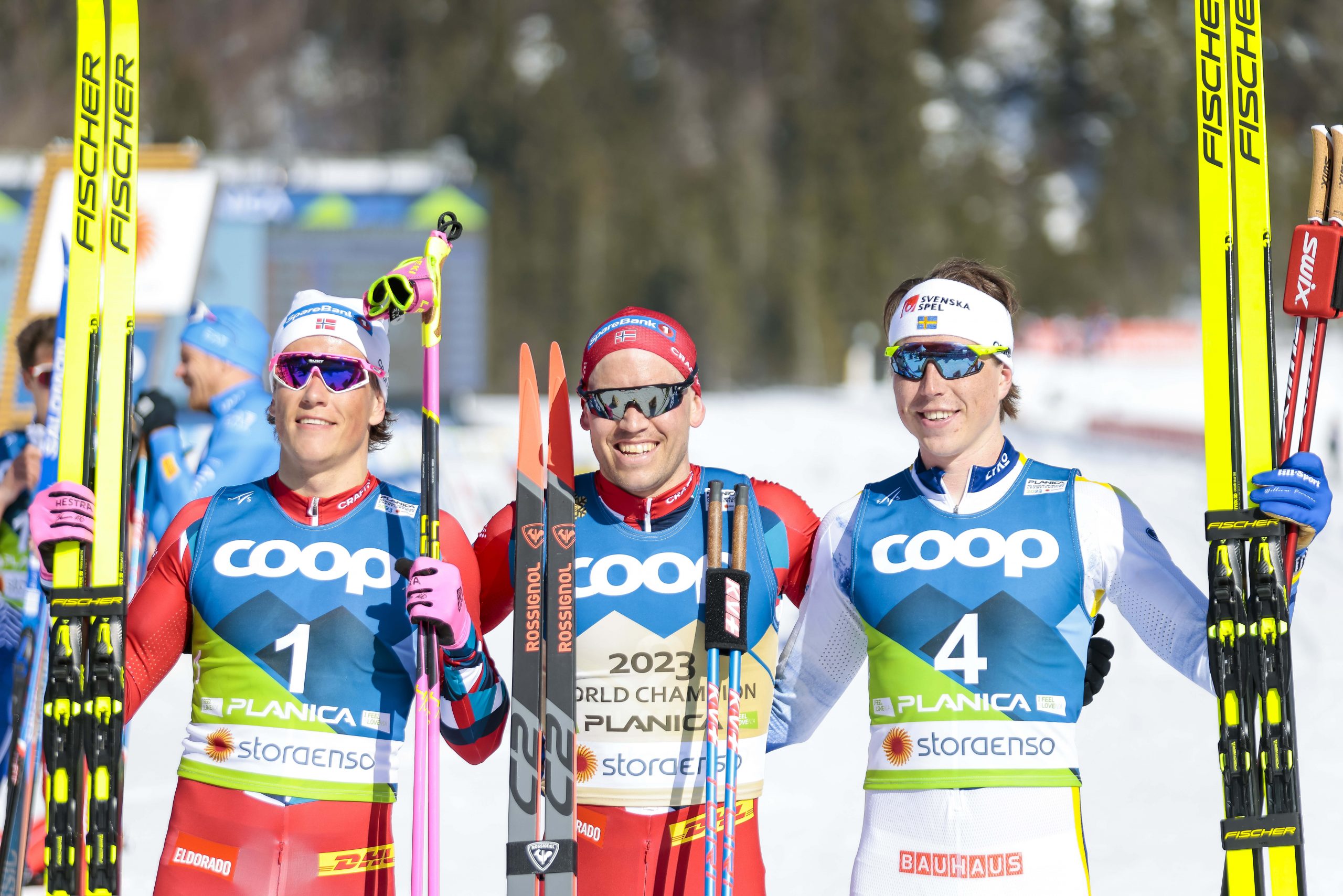
    Johannes Hoesflot Klaebo (NOR), Paal Golberg (NOR), William Poromaa (SWE) celebrate podium finishes to cap off the World Championships. (Photo: NordicFocus)

    World Championship Men’s 50 K Classic Mass Start RESULTS


  • Only Norway—Krueger Leads Sweep of 30 k Skiathlon Ahead of Klaebo and Roethe

    Only Norway—Krueger Leads Sweep of 30 k Skiathlon Ahead of Klaebo and Roethe

    This World Cup coverage is made possible through the generous support of Marty and Kathy Hall and A Hall Mark of Excellence Award. To learn more about A Hall Mark of Excellence Award, or to learn how you can support FasterSkier’s coverage, please contact info@fasterskier.com. 

    Simen Hegstad Krueger (NOR) celebrates as he crosses the finish line as World Champion in the 30 k Skiathlon in Planica, Slovenia. (Photo: Modica/NordicFocus)

    Thirty kilometers is a long way to race. It’s the sort of distance that recreational skiers race as a “marathon,” the kind of overlong race effort from which mere mortals take weeks to recover. Coming so near the beginning of a 12-day World Championship schedule, a race of this length —one raced with such intensity and under such challenging and difficult conditions—is likely to have a profound effect on all the races to come. If the rest of the field could have peered into the future—could’ve seen what Simen Hegstad Krueger (NOR) was capable of in today’s Skiathlon—they might never have committed so much energy and passion to this race. Krueger—the reigning Olympic Champion in the event (and silver medalist from the last World Championships)—was never going to be denied. Not today . . .

    Simen Hegstad Krueger is sublimely glad he toed the starting line today: he claimed the victory with a dominating performance in the second half (the freestyle half) of the 30 k Skiathlon. Johannes Hoesflot Klaebo (NOR) and Sjur Roethe (NOR), the silver and bronze medalists, might also be relatively glad they raced today, though they may also have spent so much energy that their remaining races at the World Championships are likely to be affected. And everybody else? Those who earned no medals may be questioning whether racing this distance—at such an extraordinarily high measure of effort, through such challenging and difficult conditions—was really worth it.

    Iivo Niskanen (FIN) led William Poromaa (SWE) for much of the classic leg, only to find himself undone by the way the pace increased after the classic-to-freestyle transition. (Photo: Modica/NordicFocus)

    If he had advance knowledge of the way things would turn out, Iivo Niskanen (FIN) might never have surged to the front in the classic leg; William Poromaa (SWE) might never have pushed the pace; Calle Halfvarsson (SWE) might never have stuck his nose out into the wind; Andrew Musgrave (GBR) might never have worked so hard to be near the front; Paal Golberg (NOR) might have saved his energy for another day (or for another week in his season-long race with Klaebo the the World Cup Overall crystal globe). Even bronze medalist, Roethe might have hesitated before committing so much in a race for silver that he would ultimately lose to the world’s best sprinter.

    Even the North Americans might’ve raced differently if they knew what levels of exhaustion the race would bring. Scott Patterson raced hard, holding his position through much of the day. He would finish a respectable 19th, ahead of his American teammates Hunter Wonders (24th), and Gus Schumacher (38th). Patterson confided that while a top-20 at World Championships is good, he had hoped for more. “I finished up 19th, which was okay,” he said. “When I’ve been top 10, I definitely wanted a little more today.” Canadian finishers included Russell Kennedy (37th), Olivier Leveille (43rd) and Xavier McKeever (44th).

    Thirty kilometers is a long way to race; probably every competitor leaves this race shattered, exhausted, cramping (as even race winner, Krueger, admitted he was). The twelve days of the FIS Cross Country World Championships is a grind. Racing takes place almost every day . . . even after thirty grueling kilometers, there are still ten more days of World Championships still to ski.

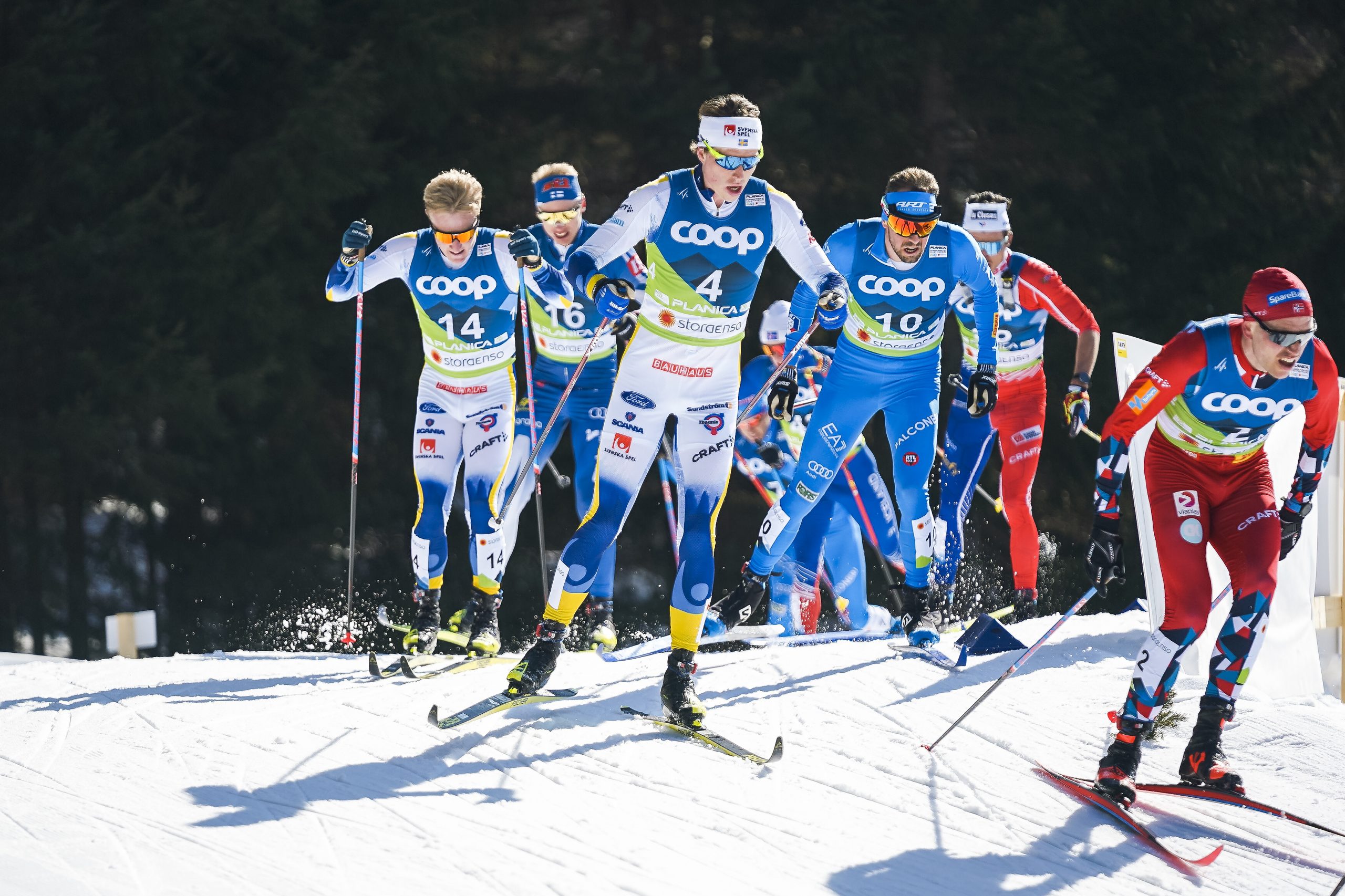
    William Poromaa (SWE), Jules Lapierre (FRA), Paal Golberg (NOR), (l-r) in the freestyle leg. The difficult conditions—and the hot pace set by eventual race winner, Simen Hegstad Krueger—exhausted even the most talented and qualified contenders. (Photo: Modica/NordicFocus)
    Men’s 30 k Skiathlon

    Planica, Slovenia occupies a beautiful corner of Europe’s mountain ranges, and the weather this week is a ski-vacationers dream. Ironic, then, that the very same weather is a wax technician’s nightmare. Sunny and warm, transitioning the snow between heats, changing the conditions even within the timeframe of an ongoing race. At the start of today’s skiathlon, race announcer, Kikkan Randall, mentioned, “You can already hear the snow . . . with a late-afternoon start, you can almost get a freezing effect. The snow can actually be pretty fast.”

    The classic half of the Skiathlon indeed started out fast. The course began as a steady downhill; Klaebo stayed at the front and out of trouble (shadowed by his teammates Golberg and Krueger, and the Swedish stars, Calle Halfvarsson and William Poromaa). The classic leg was simple:  Finland and Sweden kept the pace fast, contenders stay tucked in the field, and Klaebo picked up ground on every downhill. It looks like great fun to ski a mass start event the way Klaebo does, and certainly his wax technicians and ski suppliers have something to do with that. But that doesn’t mean he can just float along effortlessly. The other racers have a say in the pace, as well . . . and none of them wanted to make it easy for Klaebo.

    Niskanen moved to the front as the pace-maker at the end of Lap 1. By Lap 2, his efforts had begun to string out the field: Niskanen followed by Poromaa, Musgrave, and the entire kingdom of Norway. At the beginning of Lap 3 the field split, with Americans Patterson and Wonders being gapped. Klaebo continued using each downhill to adjust his position within the lead pack, gliding and stepping past the pace-makers, and forcing them to accelerate back to the front at the base of each uphill, particularly in Lap 3 as it appeared that many other racers’ skis were beginning to drag.

    At the beginning of Lap 4, everyone looked over their shoulders to check the field, a momentary pause in the action that allowed the remarkable efforts of lone chaser, Esteve Altimiras (AND) to catch back on to the back of the lead group. He’d been bravely chasing for two laps while Finns and Swedes pushed the pace at the front, and this Lap 4 truce allowed the lead pack to settle as a group of 15. The truce would not last for long.

    Johannes Hoesflot Klaebo (NOR) was forced to do his own work for most of the freestyle leg. His determined chase of teammate Sjur Roethe (NOR) earned him yet another World Championships medal, this one a silver. (Photo: Modica/NordicFocus)
    Classic to Skate Transition

    The mid-point of the Skiathlon (15 k) is where skiers switch from classic skis/poles to freestyle skis/poles, a transition that they practice in anticipation of these races. Take too long in transition, and a skier can find himself gapped . . . even the best skiers . . . even Klaebo. Klaebo flubbed the transition, exiting at the rear of the lead pack, but he seemed untroubled. If he’d known what kind of acceleration Krueger was about to throw in, Klaebo would have hurried the transition a bit.

    Roethe exited the transition first with a considerable lead, followed by Krueger, Jules Lapierre (FRA), Roethe, Krueger, and Poromaa. Klaebo followed Golberg who would drag them both back to the chase pack. Once Klaebo got there, his prospects appeared obvious: sit in and let others work, which would probably give him an easier day, and allow him to sprint for the bronze medal. As it turns out, bronze is not enough for Klaebo, and he seemed to quickly assess that none of his companions was willing to pull him back to the leaders. Poromaa wasn’t fast enough, Lapierre wasn’t fast enough, Golberg wasn’t fast enough. If Klaebo wanted to remain in contention for this Skiathlon gold medal, he’d be forced to chase the leaders down, himself. So, Klaebo set out on his own to catch the two leaders—his teammates Roethe and Krueger.

    Krueger began his surge in Lap 7, picking his way through strings of lapped skiers. He definitely appeared the sharpest, while Roethe began to visibly falter (along with Klaebo and everyone else). Even so, Roethe continued gamely working each uphill, while Klaebo drove, faded, recovered, and drove again. The top three showed their class, their fitness, and their courage. At the end of a 30 k Skiathlon, there really is no place to hide. Klaebo was really forced to work for silver, which he stole from the courageous Roethe in the final kilometer. The efforts committed by the medal winners in this race could conceivably change the whole championships. Today, under the sunny skies of Planica, Slovenia, each of these champions appeared willing to pay that price.

    Men’s 30 k Skiathlon RESULTS

    Only Norway on the podium: (l-r) Johannes Hoesflot Klaebo (NOR), Simen Hegstad Krueger (NOR), Sjur Roethe (NOR). (Photo: Modica/NordicFocus)
  • Action in Les Rousses:  Klaebo Back on Top, Cyr Again Top Ten, Patterson Powers to 12th

    Action in Les Rousses: Klaebo Back on Top, Cyr Again Top Ten, Patterson Powers to 12th

    This World Cup coverage is made possible through the generous support of Marty and Kathy Hall and A Hall Mark of Excellence Award. To learn more about A Hall Mark of Excellence Award, or to learn how you can support FasterSkier’s coverage, please contact info@fasterskier.com.

    Scott Patterson (USA) powers to a 12th place finish in the World Cup 20 k Mass Start in Les Rousses, France. (Photo:NordicFocus)

    Ski racers know steep hills: the stomp up the first climb in the Swedish Vasaloppet, Wave 8 of the American Birkebeiner on “B**** Hill,” the race-changing “Russian Hill” on Lake Placid’s 1980 Olympic trails. The Les Rousses World Cup course has one of those hills, steep enough to reduce the world’s best skiers to a waddling, stuttering herringbone. Coming within the first 500 meters of the course, this hill was the defining feature of a 3.3 km loop that the World Cup field completed six times today en route to finishing a 20 km classic mass start. A hill like this becomes strategic: hit it hard and the hill could break up the field, string out the pack, perhaps even break Johannes Hoesflot Klaebo (NOR) who has looked surprisingly mortal this weekend in Les Rousses. Don’t let it come down to a final sprint. Beat him on the hill.

    Easier said than done . . . Les Rousses’ hill indeed took its toll. By the final lap, only six skiers remained in contention. And among them was Klaebo, initiating a push into the check-point that marked the summit of the hill, then slowly returning to the pack like he’d just completed an interval. Iivo Niskanen’s (FIN) attempt to break away on the next hill came far too late. Klaebo had survived the climbs, had forced the race to finish on his terms, and so launched his race-winning sprint in time to have it all wrapped up as he entered the stadium. He waved and bowed to the Les Rousses crowd, extending his win streak in classic distance races to four, matching similar streaks by Alexander Bolshunov (RUS), Vladimir Smirnov (KAZ), and Bjorn Daehlie (NOR). Niskanen climbed onto the podium in 2nd place, while William Poromaa (SWE) finished third, earning his second podium of the weekend.

    North American racers also excelled: The sole Canadian starter, Antoine Cyr, finished eighth, continuing his string of top ten finishes, while Scott Patterson (USA) finished 12th. Other American finishers included Ben Ogden 37th, Zak Ketterson 47th, Peter Wolter 54th, and Finn O’Connell 57th.

    Johannes Hoesflot Klaebo (NOR) waves to the crowd on his way to winning Sunday’s 20 k classic mass start in Les Rousses. Klaebo ended a weekend where he struggled back to the top, outsprinting a six-man lead group. (Photo: NordicFocus)

    The tactics played by Klaebo did not change the reality for the rest of the field in Les Rousses. There was still a grinding, grueling fight for places up and down the field, which kept attention on the finish-line long after the lead pack finished. The first of these pitched battles was between Cyr and Martin Loewstroem Nyenget (NOR) who traded turns in 7th and 8th place through the bulk of Sunday’s action. Loewstroem would take the edge in the end, but Cyr’s 8th place finish marked his third top-10 result in a month on the World Cup (after two top tens during the Tour de Ski), an auspicious sign of form from the young Quebecois skier.

    Antoine Cyr (CAN) trades places with Martin Loewstroem Nyenget (NOR) during the 20 k classic mass start. Loewstroem outsprinted Cyr for 7th place, but Cyr’s 8th place marked his third World Cup top ten in the last month. (Photo: NordicFocus)

    Then there was the main chase group behind Cyr which included another pack of skiers vying for top 10 spots. Among them was Patterson, who had held strong as the pack strung out to give himself a chance at a top ten. “I recognized that this course was pretty hard and expected the pack to spread out relatively early,” Patterson said. “Right from the start, my tactic was to hold position pretty high and fight to stay with the leaders. My group lost the leaders on the fourth lap, at which point I was able to shift into a more stable race pace and pick off stragglers from the lead pack.”

    On the last climb of the big hill, Patterson made his move to the front of the pack, but was unable to break away any further. The back half of the course mitigated his strong showing on the uphill sections of the course, and he found himself in a sprint to gain every place he could. Friday’s World Cup winner, Harald Oestberg Amundsen (NOR) and Beda Klee (SUI) established a gap on the American, but Patterson came up the better against Frenchmen Clement Parisse to earn a 12th place finish on the day. Of his finish Patterson said, “I’m pretty psyched with the 12th today. I feel that I’m building momentum as this season progresses, but classic always seems to come a little slower for me. Today’s result is one of my best classic races outside of World Championship and Olympic races so I am pleased with that. My goals for the season are focused on the longer events around World Championships and Holmenkollen, but it is nice to see that I have decent form and pace in 20km races as well and feel that I’m still moving up.”

    Scott Patterson (USA) leads the chase pack during the 20 K classic mass start Sunday. Patterson finished in 12th place, the top American on the day. (Photo: NordicFocus)

    Ogden began his racing day clad in the Green Bib of the best young (U23) skier on the World Cup. Ogden would finish 37th, relinquishing the Green Bib to William Poromaa (SWE) after the Swede’s double podium weekend in Les Rousses. The U23 standings —1) Poromaa, 840 points, 2) Ogden, 744 points, 3) Friedrich Moch (GER), 720 points—set up what is likely to be a season-long battle in the young skier competition. That is notable in that it helps explain Ogden’s choice to skip the U23 World Championships currently happening in Whistler. Ogden would be the first American to win the young skier competition (which became an independent classification in 2014-15). Gus Schumacher (USA) took 2nd place in the young skier competition during the 2020-21 season.

    Ben Ogden—wearing the Green Bib of U23 World Cup Overall leader—on his way to a 37th place finish. Ogden is locked in a tight battle for the best young skier competition with William Poromaa (SWE), who finished third and claimed the right to wear the Green Jersey next week. (Photo: NordicFocus)

    In post-race interviews, Johannes Hoesflot Klaebo indicated that it was a “lot of hard work coming into this weekend, so it feels good to end it with a win.” There may have been a hint on where Klaebo is headed as the calendar turns from January to February this coming week. A month out from World Championships, it’s notable that Les Rousses happened in the middle of the last chance for athletes to put in a bigger block of training before tapering into Planica. While the best skier was off his game for the first part of the weekend in Les Rousses, he came away from the weekend with a win. A win is a win, of course, but with a deliberate eye towards Planica, it might just mean something more for the Norwegian. Even on a course capable of reducing the dynamic beauty of skiing to a plodding waddle, the world’s best skier could push through towards grander, bigger things to come.

    Men’s 20 k Classic Mass Start RESULTS

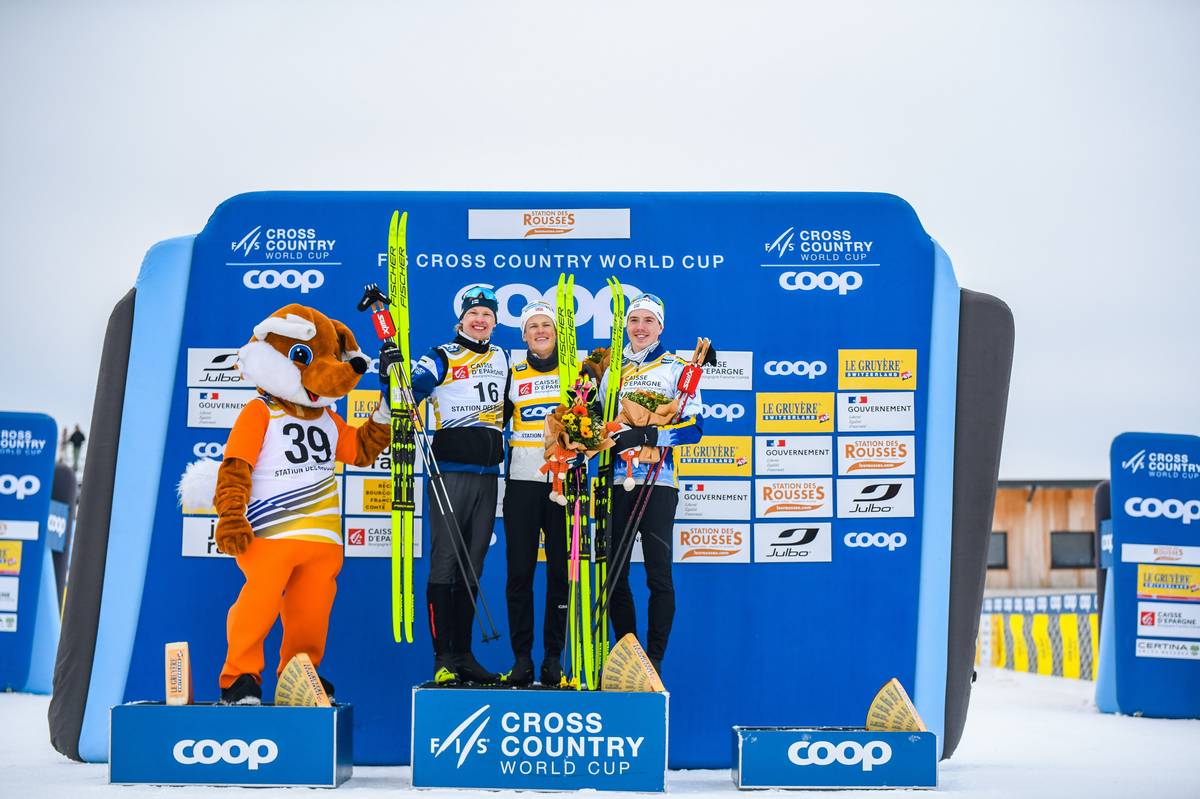
    Men’s podium (and a French fox) at Sunday’s 20 k Mass Start Classic in Les Rousse. 1st) Johannes Hoesflot Klaebo (NOR), 2nd) Iivo Niskanen (FIN), 3rd) William Poromaa (SWE). (Photo: NordicFocus)
  • The Devon Kershaw Show: The Super Bowl of Skiing with Guest Jess Cockney

    The Devon Kershaw Show: The Super Bowl of Skiing with Guest Jess Cockney

    It doesn’t get much better than a weekend of full sun, epic skiing and meetings with the king of Norway. But that’s what we’ve got for you after another fun weekend of racing, at Oslo’s classic Holmenkollen venue. With help from Canadian retired Olympian Jess Cockney, we break down the 30 k and 50 k from Saturday and Sunday, touch on the COVID outbreak that’s hitting World Cup teams including the U.S. and take the International Ski Federation to task for canceling World Cup finals.

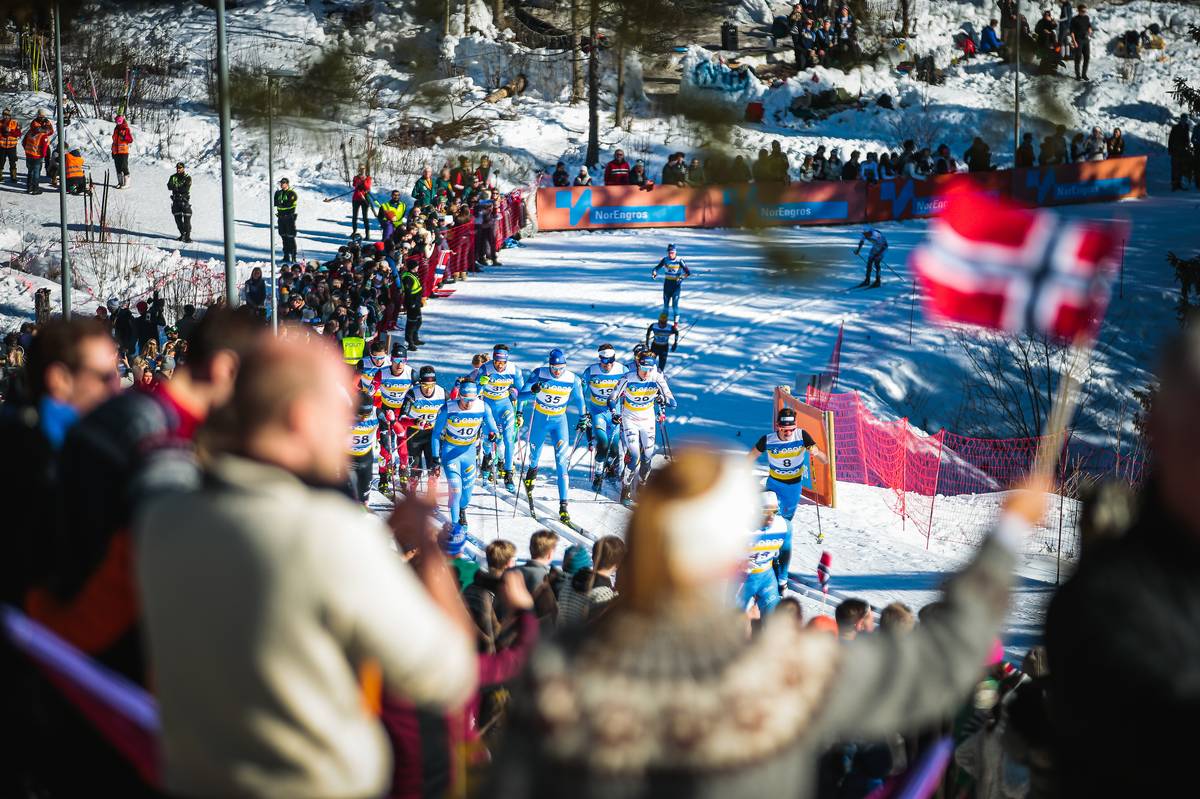
    Crowds returned in droves to Holmenkollen for the men’s 50 k mass start classic. (Photo: NordicFocus)

    You can email us at devon@fasterskier.com and nat@fasterskier.com. We’re still hoping to catch up with an Olympic mailbag episode soon once things settle down.

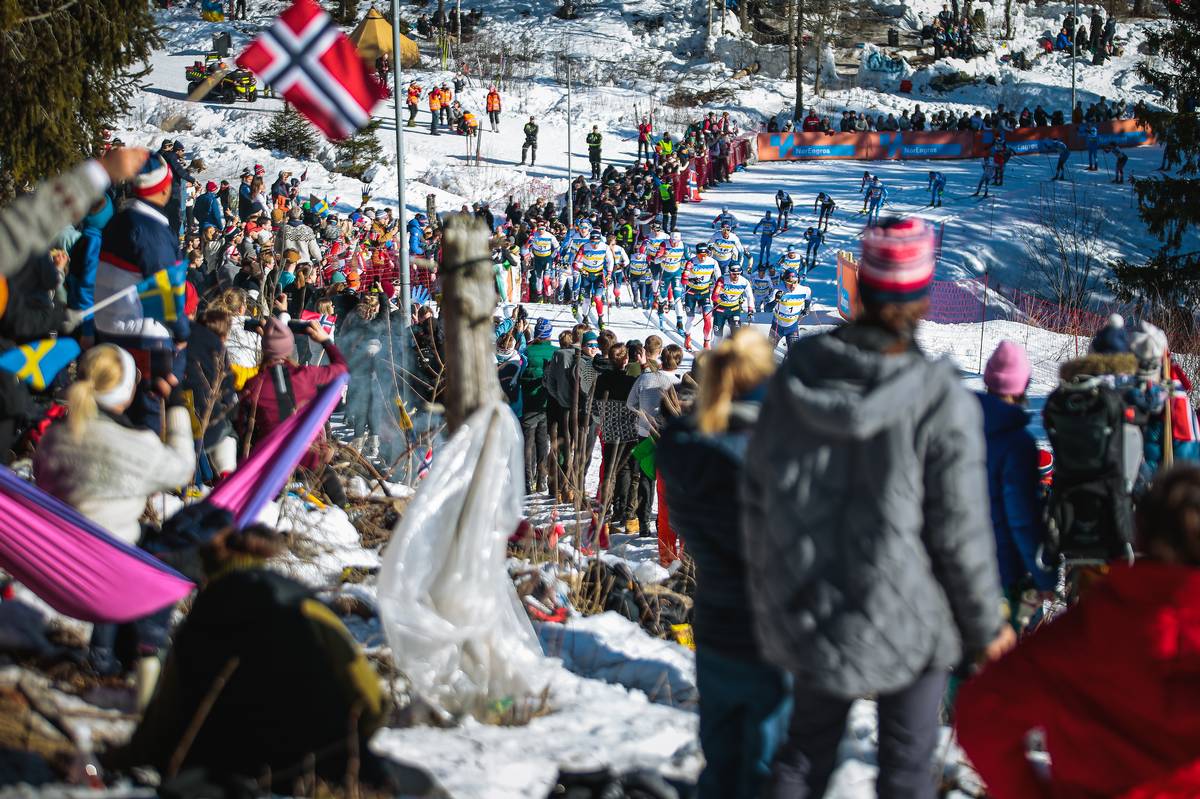
    Revelry at Holmenkollen. (Photo: NordicFocus)
  • Norway Sweeps Podium as Revelry Returns at Holmenkollen 50 k; Martin Leads US in 26th

    Norway Sweeps Podium as Revelry Returns at Holmenkollen 50 k; Martin Leads US in 26th

    This World Cup coverage is made possible through the generous support of Marty and Kathy Hall and the A Hall Mark of Excellence Award.  To learn more about A Hall Mark of Excellence Award or to learn how you can support FasterSkier’s coverage please contact info@fasterskier.com.

    In Oslo on Sunday, came another sign of the times.

    The Holmenkollen Ski Festival, the beating heart and center of the modern sport of skiing since Torjus Hemmestveit won the first 50-kilometer cross country race held there in 1888, has only stopped for extraordinary interruptions in human and natural history. (Interestingly enough, the Hemmestveit family immigrated from Norway to Minnesota, marking the first and only North American connection to the Holmenkollen 50 k men’s podium until Canadian Pierre Harvey won the race exactly a century later in 1988.) The latter – a natural lack of snow – has been fairly harmless (but ominous), but the former has only ever been due to a World War. That is, of course, until the last two years, when the COVID-19 pandemic forced first no spectators at skiing’s most well-attended event in 2020, and then full cancellation in 2021. 

    After a three-year wait, the bustling, flag-waving, marching band playing (there was definitely a marching band!), Norwegian crowd was back out under the hot Oslo sun, in what seemed a matter of national pride.

    Revelry returns to the iconic Holmenkollen 50 k in Oslo, NOR. (Photo: NordicFocus)

    They could only hope that the same sense of the matter extended to their countrymen doing the racing at Holmenkollen. Coming into today, it had been a full five years since a Norwegian had won the 50 k at Holmenkollen, when Martin Johnsrud Sundby did so in a 2017 classic mass start. With the Russian athletes who have been at the forefront of the event since then banned (the Russians completed a podium sweep in 2019, before Alexander Bolshunov won in 2020), Norway was poised to make a run at adding to the thirty-five champions it has seen at its most famous race. One of those previous 35, Sjur Røthe, was in the field on Sunday. Alongside him was Beijing Olympic 30 k bronze medalist Simen Hegstad Kreuger, Didrik Tønseth, and Hans Christer Holund. 

    Of course, in a 50 k classic, they would have to try and beat the best classic skier in the world. Iivo Niskanen was looking to revive another long Holmenkollen tradition – the Finns ruining the Norwegians national outing. Fresh off a pair of individual medals at the Beijing games in the 15 k Classic (gold), and 30 k skiathlon (silver), the 50 k Holmenkollen classic seemed like a perfect opportunity for Niskanen to add to his legacy as a modern giant of the classic technique.

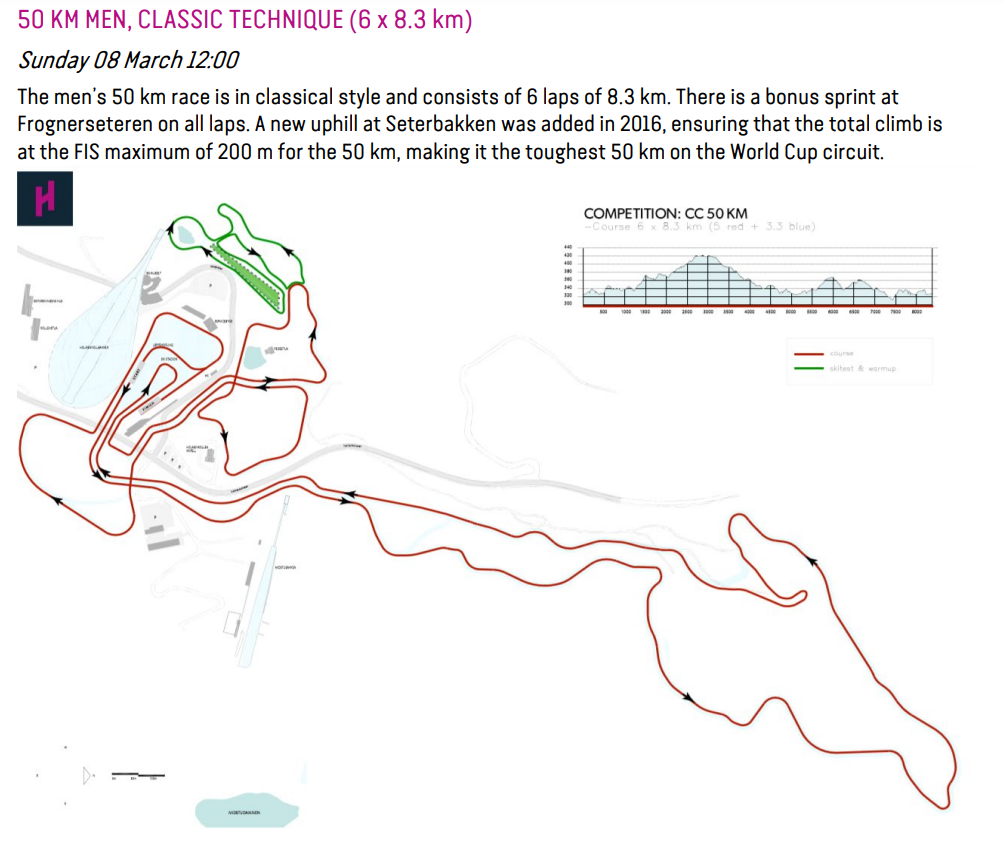
    The field was set to race six laps of an 8.3 k course that organizers billed as the toughest on the World Cup (see below). With temperatures at the noon start reaching 8℃ (about 47℉), the FIS camera couldn’t help but turn to the extra set of skis layed out in the stadium each lap, no doubt waiting to resupply skiers with the warm klister that was in demand today.

    The Holmenkollen 50 k course. (Photo: Holmenkollen Ski Festival)

    For a 50 k, the field began at a furious pace today, with much of the first 15 k led out by pulls from the skiers, mainly Norwegian and Finnish with the odd Andorran (Ireneu Esteve Altimiras) thrown in, that indicated that they were in control of the race and willing to give the long-burn attack a try today. Within the top group of twenty that eventually formed, however, there wasn’t one skier that looked strong enough to break-away and win by minutes in, say, the way that Marit Bjørgen controlled the Holmenkollen race in her heyday, or the way Therese Johaug did in her final Holmenkollen appearance yesterday.

    By the beginning of the fourth lap (24.9 k), the lead group had narrowed down to about fifteen skiers. Included were a slew of Norwegians, including Sjur Røthe, Didrik Tønseth, Martin Løwstrøm Nyenget, and Harald Østberg Amundsen, Iivo Niskanen (FIN), Britain’s Andrew Musgrave, 2018 champion Dario Cologna (SUI), and young Swedish hopeful William Poromaa.

    Adam Martin races the 50 k mass start classic at Holmenkollen in Oslo, NOR. (Photo: NordicFocus)

    With the pack established, the group seemed to allow the pace to let up over the course of the next 8 k. The one exception was Iivo Niskanen, who throughout the whole day positioned himself at the front of the pack for a series of bonus points offered on course. They revealed a prescient concern for Niskanen – he is still in the running to win the distance World Cup this season, and came into today 3rd place behind two athletes, Alexander Bolshunov (1st) and Johannes Høsflot Klæbo (2nd) who may not race again. He had every incentive to chase down the points, with the question arising whether having to maneuver to the front every 5 k or so to take the checkpoints would cost him the energy needed for a bid at the win.

    When the lead group came into the stadium to complete their 4th lap (33.2 k), Sjur Røthe made a move towards the second set of skis layed out for him with a fresh kick zone of wax. The whole field followed. That is, save Amundsen, who flew past the transition zone and into the steep climb that led away from the stadium.

    Whether it was the ski swap itself, or the fact that the race was now 15 k out from the finish, the move going into the 5th lap seemed to blow open a pack that had been subdued for the last 15 k. Amundsen didn’t try and ease up to allow a larger pack to reform, but instead tried to drive onward. The effect was that the field, led by Andrew Musgrave, had to increase their pace to try and cover Amundsen’s move. Musgrave didn’t pack such a punch in his acceleration that the top skiers couldn’t follow, and as they came into the final lap, the Norwegian hopefuls of Nygenet, Røthe, and Tønseth, along with livo Niskanen and William Poromaa, were the skiers left to vie for Holmenkollen 50 k crown.

    Young talents: Harald Østberg Amundsen (NOR) races alongside William Poromaa (SWE) during the 50 k mass start classic at Holmenkollen. (Photo: NordicFocus)

    The home country, as if its skiers sensed a special mix of history combined with a perfect Oslo day, got to see one of the oldest, most impressive sights in ski-sport. Three Norwegians, led by Didrik Tønseth, then Martin Løwstrøm Nyenget and Sjur Røthe, moved together towards the finish line. Iivo Niskanen and William Poromaa stayed in the frame, but by the final 2 k, they were out of the picture.

    In a scene that thousands of Norwegian spectators had dreamed about since their most famous race had been thrown into disarray two years ago, they were treated to the end of a Holmenkollen weekend with three Norwegians at the front, vying for the podium, a rare landmark for the treasured and iconic event.

    Tønseth led the pack as they moved into a long downhill that went into the stadium. From there, Røthe out-glided his two teammates, with Nyenget in behind them. At the end of a long downhill straight, one final hill led around and down again to the final stretch. As Røthe approached the hill, he positioned himself outside of the tracks, which seemed an indication that his great glide into the stadium may have also foreshadowed a want of kick wax. He was forced to run up the last hill, searching for every little bit of klister left in its zone (in a dance very familiar to many of us skiers), while Nyenget was the picture of perfect classic technique, driving through to go over the top of the hill in first place. Røthe stumbled slightly, Nyenget burst into the final stretch, and they came across the line like that. Nyenget the winner (2:03:27.3), Røthe second (+0.6), and Tønseth in third (+3.5).

    Martin Løwstrøm Nyenget embraces his teammate Sjur Røthe after going one-two at Holmenkollen. (Photo: NordicFocus)

    The three Norweigans completed the first podium sweep for the home country at Holmenkollen since 1985, and the first since the event has been held as a World Cup. The center of Norwegian skiing, after two years where it has stumbled through, has held, and held firmly. Nyenget, Røthe, and Tønseth doing their home nation proud on a sunny Oslo day that seemed to foreshadow brighter times ahead for Holmenkollen, and the sport that is ski racing the festival energized over a century ago.

    The US trio of Scott Patterson, Adam Martin, and Zak Ketterson that started the day came away with great results as well. Martin, who was recently pulled up to the World Cup based on his results in the SuperTour, came in 26th (+5:03.2). Scott Patterson, coming off an 8th place finish in the Beijing 30 k, finished 31st (+6:05.5), and Zak Ketterson finished in 41st (+7:14.8).

    “It was a beautiful day today,” wrote Martin after the race. “It was warm, and it did get slushy on some of the climbs, but most of the course held up really well. I think we had great wax.”

    On his approach to the day, Martin continued, “I suspect pretty much every guy out there starts with the same strategy: hang on to the lead group until the finish or it’s no longer possible. That was my strategy, at least. I think I managed two laps or something, and then I skied the rest of the race with a smaller group of skiers who also fell behind.

    This is Martin’s third time racing at the 50 k at Holmenkollen, with today marking a step forward, after taking one backward in his last appearance. “I placed 31st in 2019 with a smaller field after World Champs, and I finished last (but did finish) in 2020 after Ian Torchia and I erroneously opted for zeros.”

    Zak Ketterson races the 50 k mass start classic at Holmenkollen in Oslo, NOR. (Photo: NordicFocus)
    Scott Patterson races the 50 k mass start classic at Holmenkollen in Oslo, NOR. (Photo: NordicFocus)

    Canadians Remi Drolet finished in 48th (+10:27.1), while Philippe Boucher came in 54th (+17:36.0). Staying in Norway following the U23/Junior Ski World Ski Championships, Tom Stephen also started for the 50 k, however, he withdrew following the third lap and did not finish. 

    20-year-old Thomas Stephen (CAN) races the 50 k classic at Holmenkollen in Oslo, NOR. (Photo: NordicFocus)

    Full Results


  • Niskanen Strides for 15 k Classic Victory on Home Turf; Cyr leads North American Men in 23rd

    Niskanen Strides for 15 k Classic Victory on Home Turf; Cyr leads North American Men in 23rd

    This World Cup coverage is made possible through the generous support of Marty and Kathy Hall and the A Hall Mark of Excellence Award.  To learn more about A Hall Mark of Excellence Award or to learn how you can support FasterSkier’s coverage please contact info@fasterskier.com.

    Racing continued in Lahti, FIN with the men’s 15-kilometer classic individual start. The field was smaller than usual, with just 68 starters contrasting the 104 racers in the 15 k skate Davos in December, the last World Cup prior to the Tour de Ski. With the seeded athletes wearing the even-numbered bibs 40 and upward, the race would be watching the final starter, Johannes Høsflot Klæbo (NOR) to see if he will be able to hold off crowd-favorite, Iivo Niskanen (FIN).

    Iivo Niskanen (FIN) leads the way during the 15 k interval start classic in Lahti, FIN. (Photo: NordicFocus)

    That Finland was happy to have its Olympic champion back to race a 15 k classic on home turf was readily apparent as he strode through the wooded course. Chants of “Iivo! Iivo! Iivo!” matched his metronomic tempo, while Finland’s flag waved him along.

    Starting near the front of the seeded group in bib 46, Niskanen set the bar through his first lap, holding a narrow lead of 0.4 seconds over Martin Løwstrøm Nyenget of Norway at the 5 k mark. Ilia Semikov and Alexander Bolshunov of Russia crossed in third (+0.8) and fourth (+1.1), while William Poromaa of Sweden rounded out the top 5 (+2.4). 

    Starting 11 minutes behind the Finn, Klæbo lucked into a ride as Niskanen lapped through the stadium just as the Norwegian took to the course. Accelerating to catch the Finn early, Klæbo and Niskanen pushed the pace at the top of the standings for the next 10 k, Niskanen making the winning pace clear from 5 k ahead. 

    Starting 11 minutes apart, Johannes Høsflot Klæbo (NOR) caught Iivo Niskanen (FIN) after his first lap, the Finn becoming a carrot for the Norwegian through his first 10 k of racing. (Photo: NordicFocus)
    Johannes Høsflot Klæbo (NOR) follows Finnish favorite Iivo Niskanen during the 15 k individual start classic in Lahti, FIN. (Photo: NordicFocus)

    At the 10 k checkpoint, Klæbo was able to match pace with Niskanen to put himself in the lead with a +7.5 second advantage. Niskanen pulled away from Klæbo at the 11 k mark to make his final push toward the finish. Poromaa was sitting in third (+7.6), with Nygent and Bolshunov rounding out the top 5 in fourth (+9.2) and fifth (+10.1).

    As Niskanen made his way to the finish, the crowd erupted. His name echoed through the packed stadium, as he threw his boot to stop the clock at 33:06.5.

    Iivo Niskanen (FIN) makes his way into the stadium at the finish of the 15 k individual start classic in Lahti. (Photo: NordicFocus)

    With each subsequent finisher, the crowd increased its energy while Niskanen waited in the leader’s chair, a local win looking more and more likely. The final domino was seeing where Klæbo would fall as he crossed the finish line.  

    Fading in his final lap, Klæbo quickly lost his advantage, sliding behind both Niskanen and Poromaa at the 13.7 k checkpoint. Starting the lap 7.5 seconds ahead of Niskanen, Klæbo had already lost nearly 23 seconds, now sitting 14.7 back on the Finn with just over a kilometer of racing to go. The question then became, can Klæbo get Poromaa?

    Sipping a Red Bull and watching the clock, Niskanen watched Klæbo enter the stadium well off the Finn’s mark. Reveling in the excitement of his eighth 15 k classic victory on the World Cup, this time in front of his home crowd, the Finn hopped down and raised his arms into the air for a cacophony of cheers, before congratulating his opponent, Klæbo, on an exciting and hard-fought race. 

    Johannes Høsflot Klæbo (NOR) throws his boot for second place in the 15 k interval start classic in Lahti, FIN. (Photo: NordicFocus)
    Winner Iivo Niskanen (FIN) congratulates Johannes Høsflot Klæbo (NOR) following a 15 k individual start classic that saw the two working together for 10 k. (Photo: NordicFocus)

    Klæbo held narrowly held on for second place (+17.6), just ahead of 21-year-old Poromaa who finished in third (+18.0). Alexey Chervotkin (RUS) crossed the line in fourth (+22.0) after sitting just outside the top 5 for a majority of the race. His teammate, Bolshunov rounded out the top five (+24.4).

    “It was great,” Niskanen told FIS at the finish. “Couldn’t believe that it’s so nice to ski in front of this audience, so I enjoyed every moment of the course. It was one of the most emotional races, I have to say, because there are so [many] spectators here in Lahti today.”

    All of Niskanen’s World Cup victories in the 15 k distance have been in classic, and he’s gone four for four this season. He is now an Olympic champion in the event, adding to his collection of Championship gold medals in the event which began with a win in the 15 k classic at the 2017 World Championships on this course in Lahti. 

    “I get a bit nervous during the race, because I fell down in the first lap,” Niskanen said of his confidence in today’s race. “Then we skied together with Johannes, and I think he spent a little bit too much energy in the first lap, so it was a tough finish, but at the end I was feeling quite fresh, so it was a nice last lap. We have done a lot of work with the skis now and it seemed that they worked really good in Beijing, and now it’s continuing [here] in Scandinavia. So really happy at the moment that I could make the races like this.”

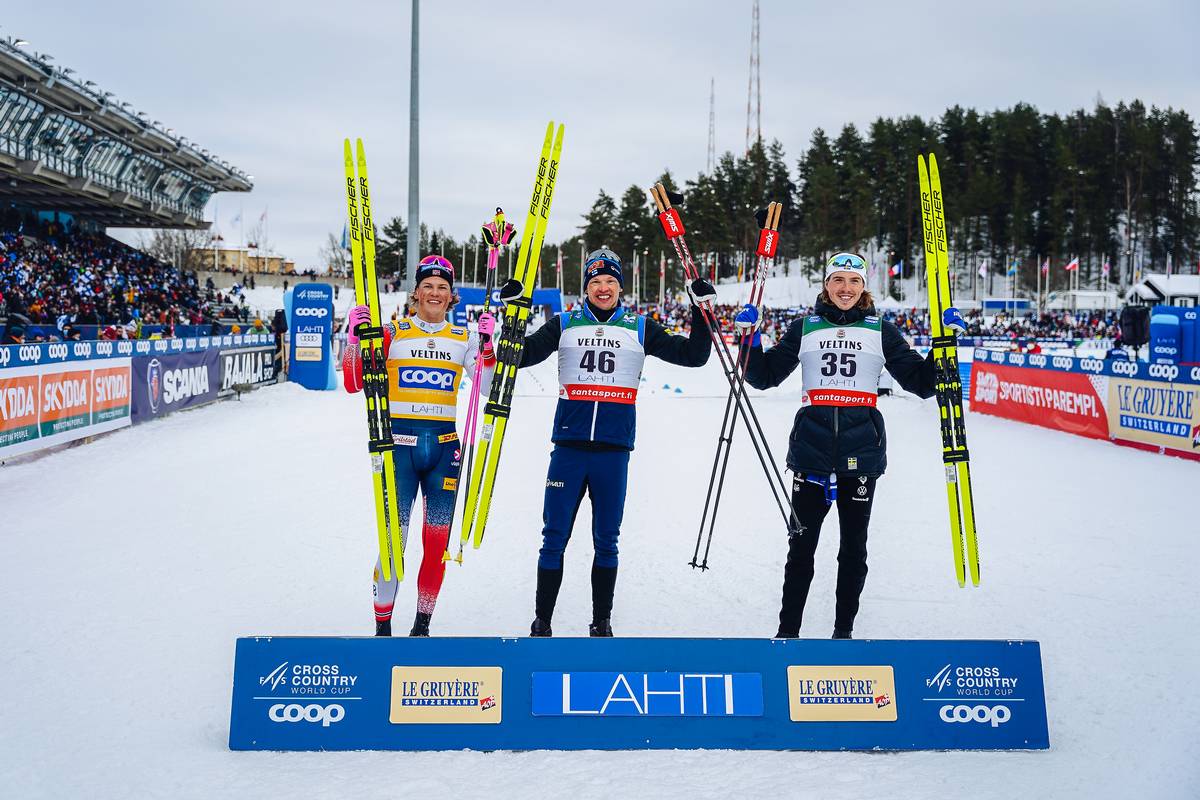
    The men’s 15 k classic podium in Lahti: Iivo Niskanen (FIN) took the win in his signature event, ahead of Johannes Høsflot Klæbo (NOR) and William Poromaa (SWE). (Photo: NordicFocus)

    The FIS interviewer gave a nod to Niskanen’s hard work through the season, but he smiled as if to say this week may not have matched that ethic.

    “I have to say, I have been so tired after the Games. We have partied too much so now it’s time to focus more on sport, and let’s see. Hopefully I can manage to win again next weekend [at the Holmenkollen].”

    Antoine Cyr races the 15 k interval start classic in Lahti, FIN. (Photo: NordicFocus)

    The Canadians had a strong day with two in the top 30. Antoine Cyr finished in 23rd (+1:46.5) while teammate Olivier Léveillé crossed the finish line in 29th (+1:59.1). 

    On the heels of a strong classic team sprint performance in Zhangjiakou, Cyr was fighting in and out of the top 20 all day. Through the 5k mark, Cry was 19th (+19.3), sliding back to 24th (+1:03.1) at the 10 k mark. Cyr was 11th and 12th in the opening distance races in Ruka in November, and won the 15 k classic during the Canadian Olympic Trials in January.

    “[It was a] good day for me today,” Cyr wrote to FasterSkier in a post-race email. “It’s a really fun course and such a historic venue. I felt good and skied well. I thought I had a little bit more in me, but it was a competitive field out there and I missed the top 20 by not much. I am really happy with the result and will see how the shape is going to be for the races to come.”

    Also racing for Canada, Rémi Drolet finished in 42nd (+2:41.9), while Philippe Boucher crossed the line in 59th (+3:26.9) and Leo Granbois took 62nd (+3:38.9). 

    Olivier Léveillé races the 15 k interval start classic in Lahti, FIN. (Photo: NordicFocus)
    Scott Patterson races the 15 k interval start classic in Lahti, FIN. (Photo: NordicFocus)

    The top American was Scott Patterson, who was just outside the top-30 World Cup point margin finishing in 33rd (+2:11.4). Zak Ketterson was 41st (+2:41.1), while Kevin Bolger took 49th (+2:59.9), and Zanden McMullen skied to 51st (+3:04.5), returning to the World Cup following races at the ongoing  2022 U23 World Ski Championships in Lygna, NOR. The first weekend of World Cup starts for Logan Diekmann saw him cross the line in 65th (+4:30.7).  

    Fresh off of the 2022 U23 World Ski Championships, Zanden McMullen rejoins the World Cup for the 15 k interval start classic in Lahti, FIN. (Photo: NordicFocus)

    Following the races, US Ski Team head coach Matt Whitcomb provided insights into both the men’s and women’s races in Lahti, as well as sharing the news that Östersund, SWE may become the host to the initially cancelled World Cup Finals that had been scheduled for Tyumen, Russia. Whitcomb also speaks to the “Olympic hangover” that can make hard for athletes to perform at their best the weekend following the Games, and gave a shoutout to the athletes racing at World Juniors in nearby Lygna.

    Results

    – Rachel Bachman Perkins contributed

    Racing his first weekend on the World Cup, Logan Diekmann the 15 k interval start classic in Lahti, FIN. (Photo: NordicFocus)
  • William Poromaa – Sweden’s Young Talent: By Paolo Romanò

    William Poromaa – Sweden’s Young Talent: By Paolo Romanò

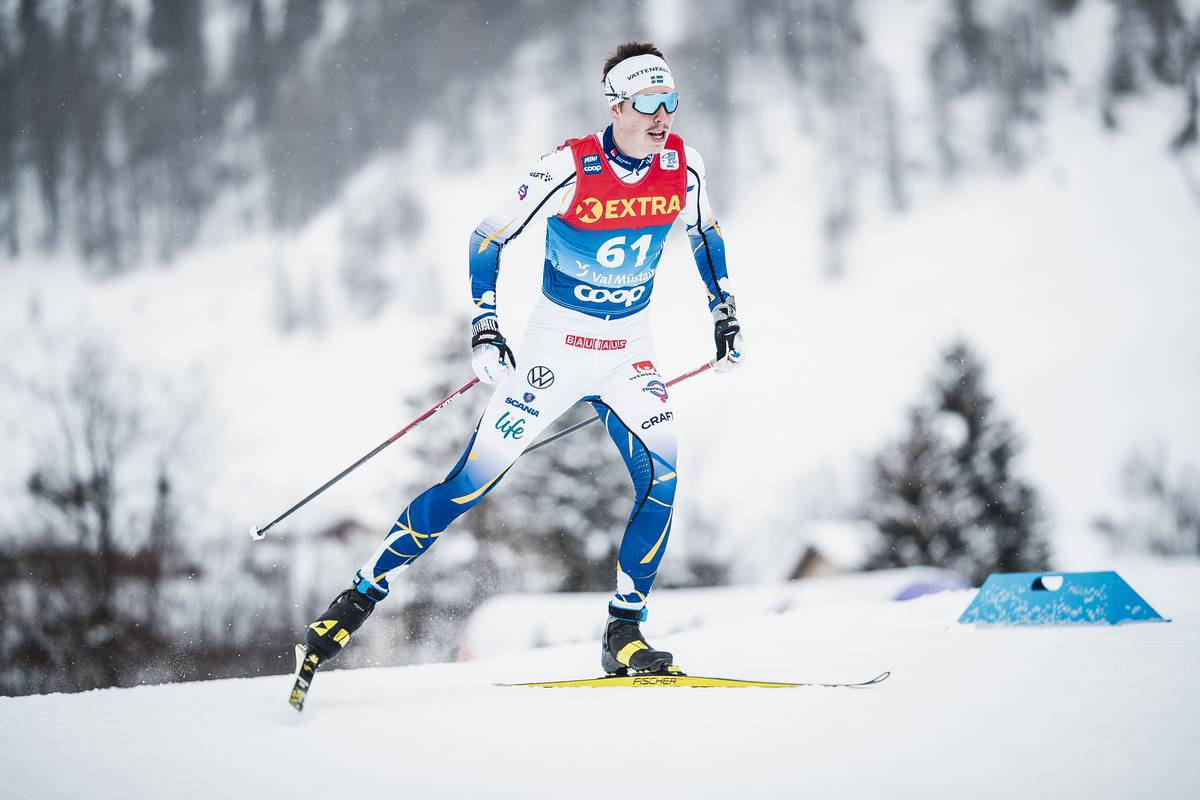
    Sweden’s William Poromaa Racing in Val Mustair, Switzerland during the 2021 Tour de Ski. (Photo: NordicFocus)

    This story first appeared in www.fondoitalia.it and has been edited for English.


    On an international level, cross-country ski fans outside of Sweden only got to know the name of William Poromaa during the women’s 10km classic technique in Seefeld World Championships. That February 26, 2019, he was talked about not for a sporting achievement but as Frida Karlsson’s boyfriend.

    Karlsson, once she crossed the finish line, placed herself in the leader chair after having amazed the world, clocking the fastest intermediate times until the eventual winner, Therese Johaug, started twenty minutes after the young Swedish skier.

    Frida Karlsson racing to second overall in the 2020 Ruka 10 k classic. (Photo: NordicFocus)

    During that anxious lapse of time, Karlsson remained in contact via a video call with Poromaa who was communicating to her live results from their home in Sollefteå and sending her encouragement as the sensational silver medal became more and more realistic. Their video connection ended with the kisses sent by William before Karlsson had to go to the medal ceremony.

    Soon enough, it was discovered that Poromaa, in his own right, was a potential Swedish star for the men’s team, not “only” Karlsson’s companion.

    At that time Poromaa had won two gold medals at Swedish junior nationals and had already been selected for the first time for the Junior World Championships in Lahti. There, in the 30 k classic race he placed ninth place at the young age of eighteen.

    But about the couple, who had become acquainted when they attended the renowned Sollefteå ski-gymnasium, all the chatter of the media and the public was always directed towards the new young star of the Swedish women’s national team, Karlsson. The buzz, when it came to the couple, revolved around Karlsson and her palmers. That began to change this November when Poromaa placed second and first, respectively in the Swedish national opening races in Bruksvallarna. In that fantastic weekend, cross-country skiing discovered that the mustachioed cross-country skier, not yet twenty, was much more than just Karlsson’s sidekick.

    In the aftermath of those opening weekend races in which Poromaa left behind more successful and older teammates, some Swedish newspapers were already wondering if Poromaa was the boy who could rebalance the gap in popularity and successes that the Swedish men’s cross-country has ceded to a young and medal-haul worthy women’s team.

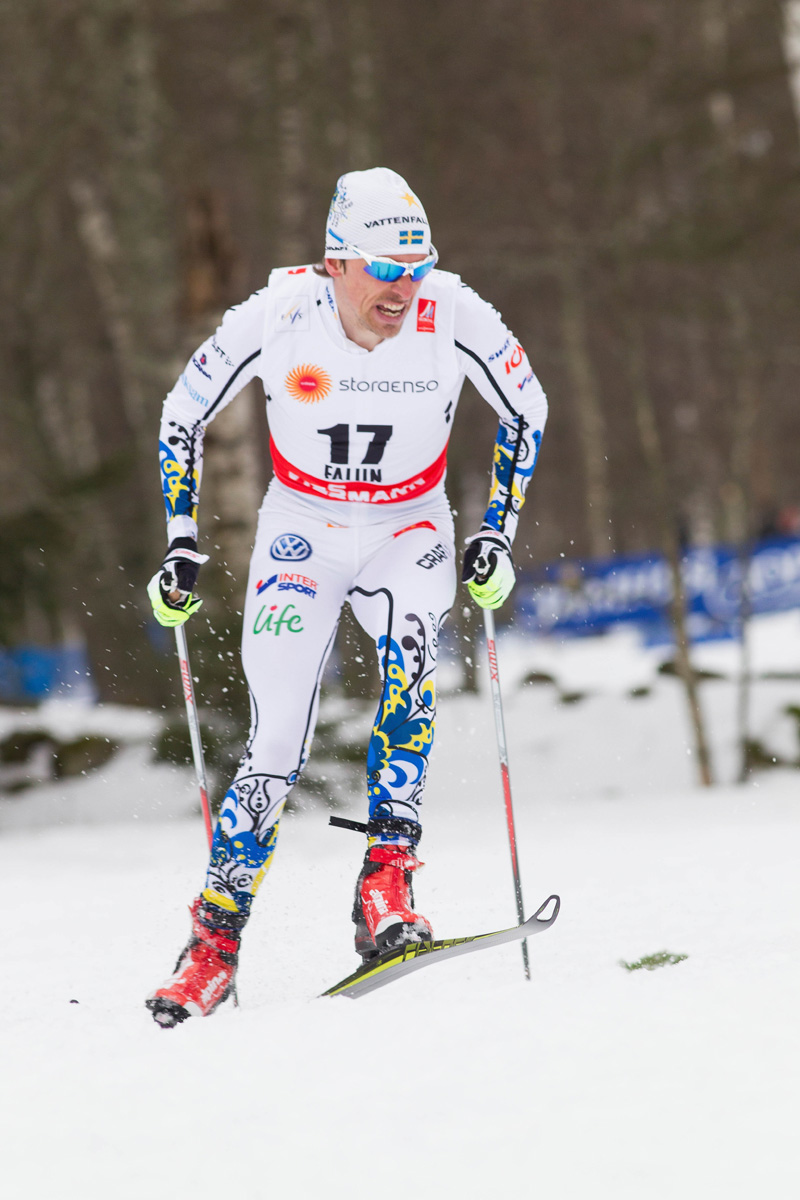
    Johan Olsson of Sweden during the 2015 World Championships in Falun, Sweden. he won the 15 k skate in Falun. (Photo: NordicFocus)

    Historically Swedish cross-country skiing had relied on the men’s team to enrich Sweden’s medal count during the various Olympic or World Championships. During the last century, the Swedish men’s in cross-country has produced champions from Sixten Jernberg to Gunde Svan, through Sven-Åke Lundgren, and then from Thomas Wassberg to Torgny Mogren. After this long mythical era, Sweden continued to produce excellent cross-country skiers such as Per Elofsson, Mathias Fredriksson, Johan Olsson, and more recently, Marcus Hellner. Among the women, all the course of that storied period for men, only Toini Gustafsson and Marie-Helene Westin were able, in two different periods, to score individual success for Sweden. Yet, the dominance of males skiers in Sweden began to fade fifteen years ago when Charlotte Kalla entered the international limelight. Following Kalla were Stina Nilsson, Ebba Andersson, Karlsson, and sprint sensation Linn Svahn.

    The hope of the Swedish people for a new male star appears to rest on Poromaa’s shoulders. The Poromaa name is, however, not new to the Swedish ski scene. The younger Poromaa’s father, Larry, placed fifth in the 1986 Holmenkollen 50km – a career-best for the father. Once he retired from competition, he was twice in charge of the Swedish waxing team, an activity interspersed with his transfer to the U.S. wax tech team before signing on with Estonian skier Kristina Smigun.

    Poromaa’s mother Anette Fanqvist won a bronze medal at the 1995 Thunder Bay World Championships with the Swedish relay team.

    In 2016, after focusing on both hockey and skiing, Poromaa enrolled at the Sollefteå ki-gymnasium to focus solely on skiing.

    William Poromaa (SWE) racing is this year’s Tour de Ski. (Photo: NordicFocus)

    The following year he won his first junior national title in Kalix in the 10 k classic. He followed that with a few more national junior titles, and in 2018 he obtained the national selection for the Junior World Championships in Lahti, finishing ninth in the 30km classic style competition. Poromaa placed ninth again the following year in the the Oberwiesenthal, Germany Junior Worlds in the same distance, this time in skate.

    After concluding his junior career this past March, Poromaa joined the Bauhaus Team (Swedish XC B team) where he began to collaborate with coach Lars Ljung.

    The 34-years-old Ljung explains what Poromaa began to work on early this summer.

    “My mission is to take him to a higher level with a constant commitment every day, every month, and in every training season, analyzing every session and every data to make him more motivated and involved every day. But given his young age, he is not the one who trains the most in our group, but he always trains hard and often close to the threshold. With him at least one day a week we do long sessions in which he can go up to 60-70km. During the summer preparation, our purpose with him was to improve his double poling in classic and increase his strength in the upper body, also focusing on his skiing technique. Wille is a rather tall guy and in the past his arm position during the push was too low and too close to the torso, thus limiting his thrust step after step. Our work focused mainly on his technique by widening and raising the range of his thrust to have more power to impress with the poles.”

    With his win in Bruksvallarna’s 15 k skate, in which he kept behind his compatriots of A-Team at bay, Poromaa conquered the front pages of the Swedish newspapers as well as the call-up for the World Cup in Ruka-Finland. In Ruka, he missed out on qualifying for the sprint, but placed 15th in the 15 k classic, and 17th in the following day’s pursuit.

    Poromaa (bib 30) striding alongside the 2021 Tour de Ski winner, Russia’s Alexander Bolshunov. (Photo: NordicFocus)

    Poromaa turned 20 late this past December. His coach, Ljung describes his tactics and presence as mature. “Even his style in skiing is very mature, he keeps up well,” said Ljung. “Wille immediately starts at a good pace, which he maintains with remarkable consistency, but also manages to finish the distance races by further increasing his pace, this is synonymous with great intelligence in managing his race and understanding his feelings. He is not the fastest skier, but he has great endurance and a great engine. Outside of the races he is a normal guy and he is always calm, he has a good approach to competitions, cross-country skiing is important for William but it is not everything for him and this is good for managing things well.”

    The Tour de Ski which finished this past weekend, saw Poromaa place 23rd overall after contesting eight stages. During the Tour, Sweden captured its first men’s World Cup win in five years when Oskar Svensson won the Stage 7 sprint. At 25-years-old, Svensson is no newcomer to the scene. He holds promise. And Poromaa, for his part, has answered the call for more Swedish men to challenge for the top-10 and World Cup podiums. Too early to call it a resurrection for the Swedish men? Perhaps. Yet Poromaa looks to play a part in balancing the equation when it comes to accolades for the Swedish women’s team.

    Francesco De Fabiani (ITA), Federico Pellegrino (ITA), and William Poromaa (SWE), (l-r) during the 2021 TdS pursuit in Toblach, Italy. (Photo: FasterSkier)