From the FasterSkier archive — posts syndicated from athletes’ and coaches’ own blogs between 2004 and 2012, kept online as published. Current coverage is at fasterskier.com.
Assistant Coach, Nordic Skiing Athletics Department
Williams College invites applications for the position of Assistant Coach of Nordic Skiing for the academic year 2018-2019. This is a full-time, academic year (10 month) term position with the possibility of renewal.
Our expectation is that the successful candidate will excel at working in a community that is broadly diverse with regard to race, ethnicity, socioeconomic status, gender, nationality, sexual orientation, and religion. We are especially interested in individuals who have experience with diverse populations who can contribute to the diversity and excellence of athletic opportunities at Williams. Candidates from under-represented groups are strongly encouraged to apply. In your cover letter, please highlight your experience with and commitment to supporting diverse and inclusive communities.
Responsibilities include providing assistance to the Head Coach in all aspects of the Nordic Ski program, including, but not limited to student-athlete development, coaching, training plans, travel, waxing, equipment management, driving team vans, video analysis, recruiting, team website updates and other duties as assigned.
Bachelor’s Degree, and collegiate racing experience preferred
Successful candidates will be self-motivated and possess the ability to recruit, teach and coach highly talented student-athletes who can succeed in a challenging academic environment
Knowledge and commitment to NCAA and NESCAC rules
Effective communication skills are required
Review of resumes will continue until filled.
Employment at Williams is contingent on the verification of background information submitted by the applicant, including the completion of a criminal record check, and education when applicable.
To apply for this position, please visit staff-careers.williams.edu. If you have any questions, please feel free to contact us via phone at (413) 597-4247 or email at hr@williams.edu.
Williams College is a coeducational liberal arts institution located in the Berkshire Hills of western Massachusetts with easy access to the culturally rich cities of Albany, Boston, and New York City. The College is committed to building and supporting a diverse population of approximately 2,000 students, and to fostering an inclusive faculty, staff and curriculum. Williams has built its reputation on outstanding teaching and scholarship and on the academic excellence of its students. Please visit the Williams College website (http://www.williams.edu).
Beyond meeting fully its legal obligations for non-discrimination, Williams College is committed to building a diverse and inclusive community where members from all backgrounds can live, learn and thrive.
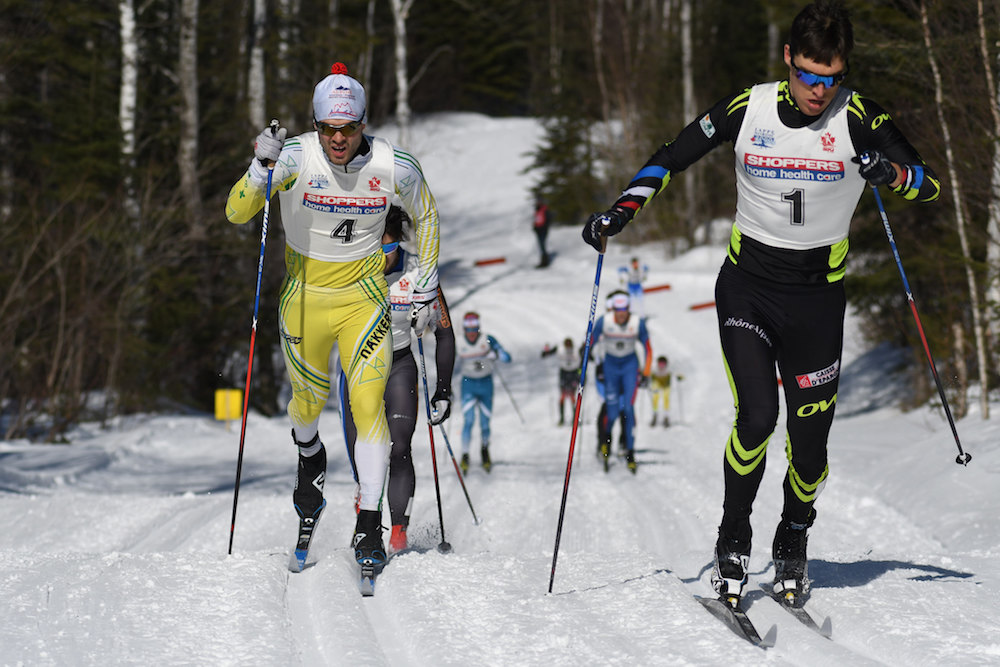
Patrick Stewart-Jones (l), skiing for his club team Nakkertok, and Scott Hill (r) of Barrie Cross Country (BXC) going head to head in the men’s classic team sprint on Saturday at Canadian Ski Nationals in Thunder Bay, Ontario. Nakkertok won and BXC placed second. (Photo: Doug Stephen)
Canadian Ski Nationals (Thunder Bay, Ontario): Team sprints + 5/10 k classic
Canada’s 2018 Ski Nationals opened this past weekend at Lappe Nordic in Thunder Bay, Ontario, with classic team sprints on Saturday followed by 5- and 10-kilometer classic interval starts on Sunday.
Nakkertok topped the podium in both the open men’s and women’s team sprints. In the men’s final, Nakkertok’s Dominique Moncion-Groulx and Patrick Stewart-Jones won by 1.95 seconds over Barrie Cross Country (BXC) in 14:50.79. BXC’s Ryan Jackson and Scott Hill teamed up for second place, and Skibec’s Alexis Morin and Antoine Brand raced to third (+2.57).
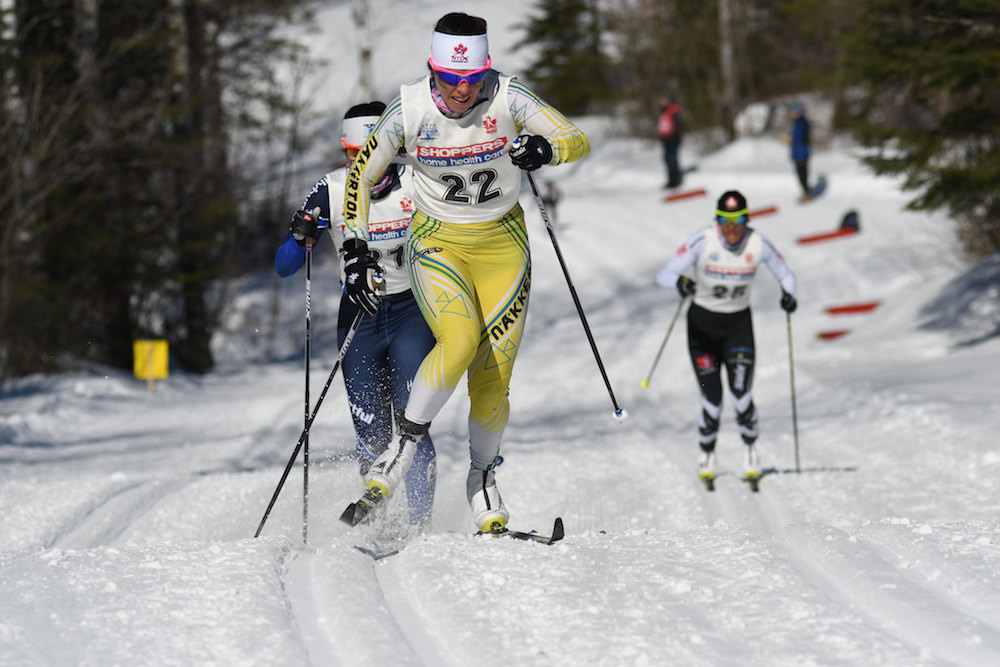
Katherine Stewart-Jones (22), skiing for her club team Nakkertok, while leading Annika Richardson (Hollyburn Ski Club) and Mathilde Petitjean (r) of C.N.M.S.A. during the women’s classic team sprint at 2018 Canadian Ski Nationals in Thunder Bay, Ontario. (Photo: Doug Stephen)
The Stewart-Jones family was also a big winner on Saturday, with Nakkertok’s Zoë Williams and Katherine Stewart-Jones (Patrick’s sister) racing to first in the women’s final in 13:04.72. They finished 2.37 seconds ahead of Katie Weaver and Annika Richardson of the Hollyburn Ski Club in second place, and Marie Corriveau and Mathilde Petitjean of Club Nordique Mont-Sainte-Anne (C.N.M.S.A.) raced to third (+7.42).
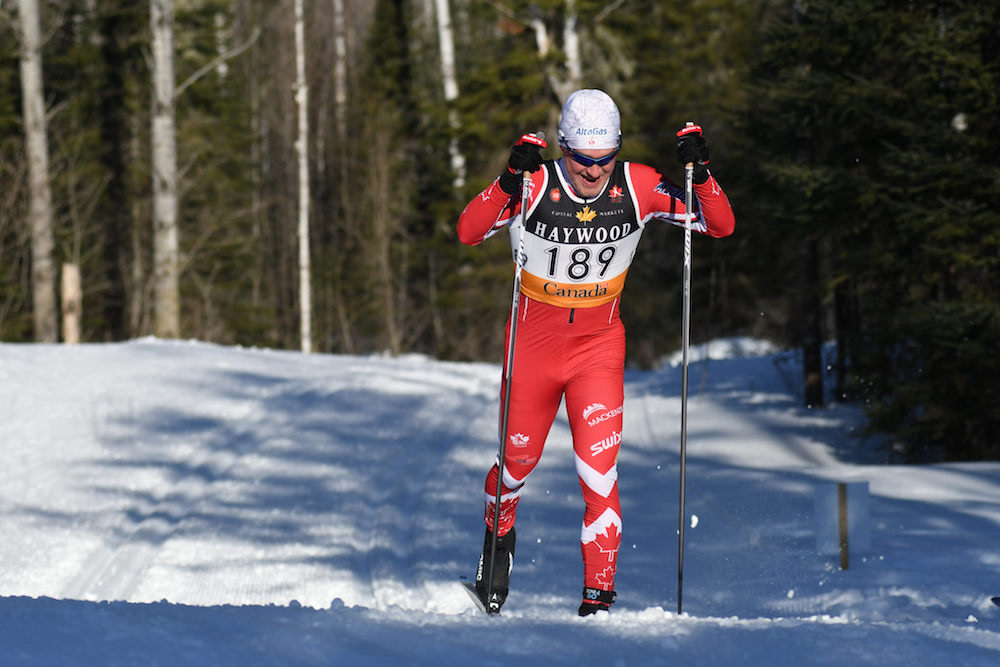
On Day 2 and the first official day of Canadian Ski Nationals, Hill (BXC) took his second-straight win of the weekend, topping the men’s 10 k classic with a time of 26:45.1 for his first senior national title. He finished 7.2 seconds faster than Alexis Dumas, of the Pierre-Harvey National Training Centre (CNEPH) in second, and an early race leader, Knute Johnsgaard of the Canadian World Cup Team, placed third (+12.0)
Johnsgaard clocked the fastest split at the race’s halfway point, while Hill’s 5 k time was almost 10 seconds slower. But over the final 5 k, Hill’s lap time was nearly 22 seconds faster than Johnsgaard’s. Dumas skied a consistent race, with the fourth-fastest first lap and second-fastest second lap.
Knute Johnsgaard (Canadian World Cup Team) racing to third in the men’s 10 k classic on Sunday at Canadian Ski Nationals in Thunder Bay, Ontario. (Photo: Doug Stephen)
Jackson (BXC) finished fourth (+14.7), and Jess Cockney of the Alberta World Cup Academy (AWCA) and Canadian World Cup Team placed fifth (+22.2). Leading the National Team Development Centre (NTDC) Thunder Bay on its home trails was Evan Palmer-Charrette in sixth (+24.8), and Lappe Nordic’s Michael Somppi (AWCA) placed seventh (+29.1). Gareth Williams of Telemark Nordic and the Canadian U25 Team finished eighth (+39.5), American Brian Gregg (CXC/Team Gregg/Loppet Nordic Racing) was ninth (+44.7), and Jack Carlyle (AWCA) 10th (+49.5).
Olivia Bouffard-Nesbitt of Rocky Mountain Racers (RMR) collected her first senior national title with a 13.3-second victory in the women’s 5 k classic. She finished in 15:07.5, ahead of American Caitlin Gregg (CXC/Team Gregg/LNR) in second, while Katherine Stewart-Jones (NTDC Thunder Bay) was the second Canadian and third overall (+17.9).
NTDC Thunder Bay had two in the top four with Alannah Maclean in fourth (+19.8). Annika Hicks (AWCA) followed in fifth (+22.2), Frédérique Vézina (CNEPH) was sixth (+30.8), Sophie Carrier-Laforte (Skinouk) seventh (+33.0), Maya MacIsaac-Jones (RMR/Canadian U25 Team) eighth (+37.4), Laura Leclair (CNEPH) ninth (+58.1), and Williams (Nakkertok) 10th (+1:07.2).
Nationals continue Tuesday with 10/15 k freestyle pursuits, followed by skate sprints on Wednesday and 30/50 k classic mass starts on Saturday.
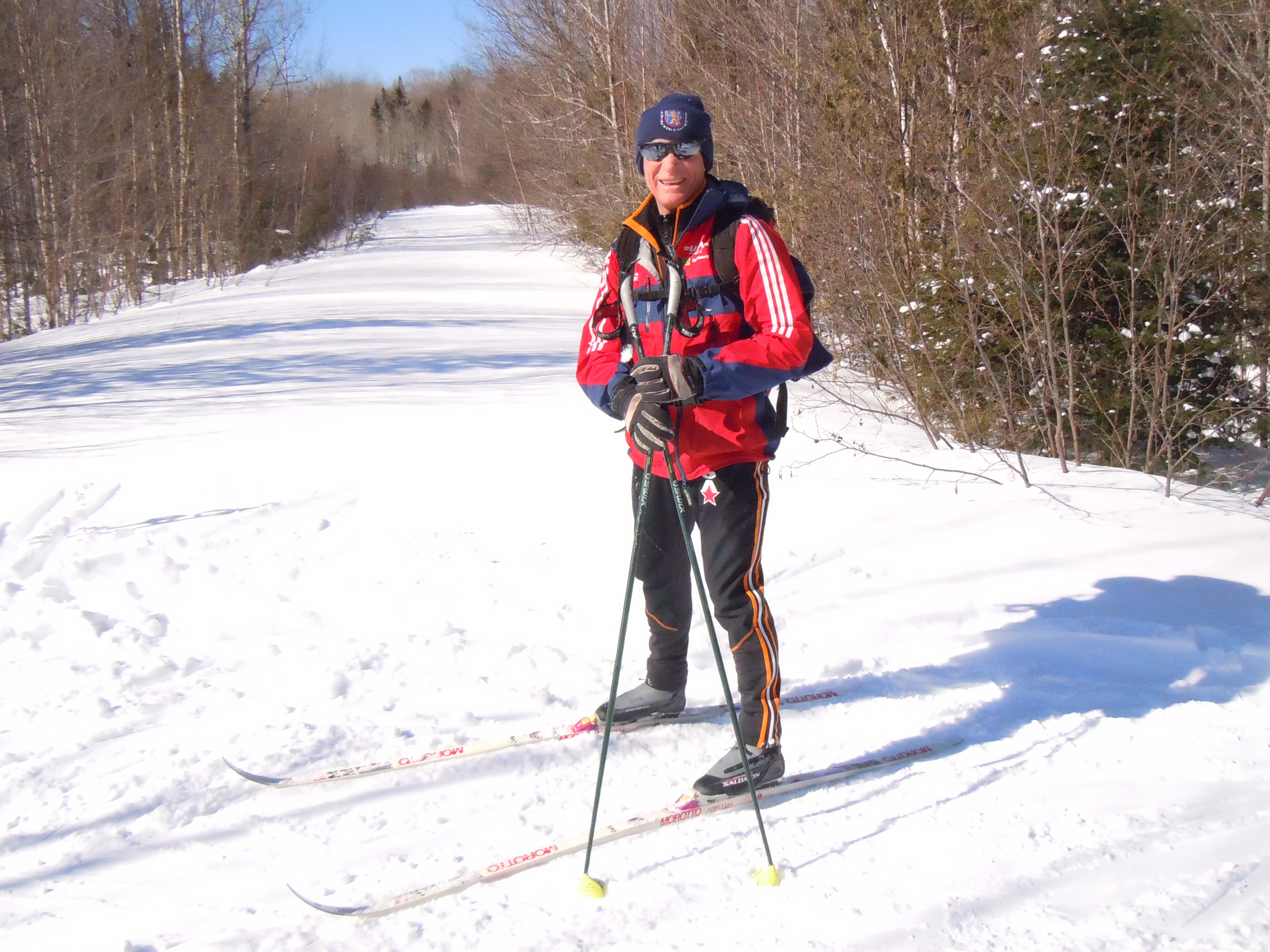
Charlie Kellogg skiing in Maine with the AMC alumni group the O H Association. (Photo: Doug Hotchkiss)
Bob Gray was hiking in the Sierra Nevada mountains, off the grid, when it happened. Later his phone began buzzing, and he learned that his former U.S. Ski Team teammate and friendly rival over decades and decades of races, Charles Kellogg, had passed away.
Gray was surprised. Kellogg had not been well, but the end came fast once months of excruciating pain was finally diagnosed as a malignant and fast-metastasizing sarcoma.
“It hit me hard,” the 76-year-old Vermont farmer said on the phone, still from the trail, last Saturday. “It could be me next… I miss him terribly.”
Kellogg, 75, had been one of the ties that kept Gray and the ski community together.
“It’s pretty much nose to the grindstone,” Gray said of his life at 4 Corners Farm in Newbury, Vt. “Charlie made a special effort to talk; he was always calling me up. It was great to talk to him. He would drag me out of that focused world.”
But while it’s hard for Gray, at the moment, to connect to Kellogg’s family or other friends, in a way the mountains are a poetic place for Gray to say goodbye to Kellogg, who was a longtime member of the Appalachian Mountain Club (AMC) and its alumni Old Hutsman (OH) Association, and who always made time for a ski or a hike, even if he had just flown back from a work trip to Asia.
“It’s been on my mind, these two days, just thinking about him,” Gray said. “I had nothing to do but walk and contemplate, without any distractions. It’s a pretty emotional moment for me.”
The Storyline
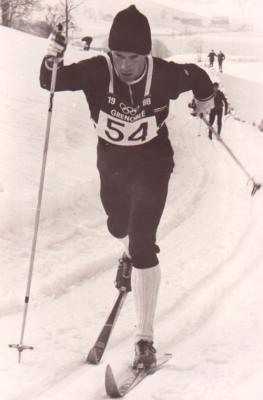
Kellogg competing at the 1968 Olympics in Grenoble, France. (Photo: US Biathlon Association)
Kellogg, a 1968 Olympian in cross-country skiing and a national champion, died a week ago on Sept. 21. Known as “Chuck” or “Spike” to some friends, Kellogg was an integral member of the nordic community, a mentor and friendly face to many on the trails.
As noted in his U.S. Biathlon Hall of Fame induction description, Kellogg wasn’t obviously bound for skiing glory from day one. But the guy who grew up primarily in Andover and Brookline, Mass., picked up skiing at Holderness Academy a few hours north in New Hampshire and never looked back.
And so perhaps his first impact on the sport was as the fast racer everyone was chasing: in college races for Williams College, then as he took up biathlon and eventually won a national championship in 1965, and then still as he competed as a cross-country skier in the Olympics and raced as a member of the U.S. Ski Team (USST).
“He was one of a group of half a dozen guys who I would describe as the early generation of capable international-caliber nordic skiers in this country,” said John Morton, an Olympian and coach. “There were a couple of individuals who preceded them, but… I remember when I was on the U.S. ‘B’ team, and those guys set the standard, and the rest of us just desperately tried to keep up.”
Gray remembers a relay race in Reit im Winkl, Germany, in 1968.
“Charlie came in in the lead, and Jack [Lufkin] kept it, and I was able to hold on – we won a relay race in Europe,” Gray marvels. “It was amazing. Everybody was going crazy over there. It was kind of unusual for an American team to win a relay.”
Kellogg’s race career never really ended. In 1998 he won a World Masters Championship in Lake Placid, N.Y.
There, too, Gray was Kellogg’s teammate.
“Neither he nor I had very good points,” Gray remembers. “We started in the back. But we both had incredible skis so together we made up to the front through 80 people. All of a sudden we were in the lead. I couldn’t hold it up – Charlie went on to win. He’s a great skater! Talk about tough competition, that’s the best of the best. I know he was very proud of that.”
Kellogg never boasted about his success, and not all of his friends were familiar with the details of his ski career. But it’s possible to be humble and proud at the same time, and Kellogg was.
“He was very proud of his achievements,” said Doug Hotchkiss, a friend from near Kellogg’s home in Massachussetts who was part of a nonprofit board and also the O H Association with Kellogg. “Of course, he was very modest, so you would never know it unless you asked him about it. But then it was clear.”
No matter which year you ask about, his friends and teammates will tell you that he was a great guy to be around. Kellogg was a role model for how to balance a job, a family, and high-level training.
“I always admired and was continuously impressed with how Charlie was able to balance his training at a high level while working full time for IBM and fulfilling his responsibilities and obligations as a husband and a father,” USST teammate Mike Elliott wrote in an email. “In the late 60s, there just were not many athletes who could do that successfully.”
“He was disciplined and a very tough athlete,” Gray agreed. “But just a real pleasure to go head to head with.”
Kellogg never stopped skiing – this year he competed in the White Mountain Classic in Jackson, N.H., and earned an age-group podium in the 10 kilometer at Masters National Championships in Craftsbury, Vt. – but as he grew older he also bettered the ski community in other ways.
His expertise as a board member was so impressive that a group of biathletes in 2006 lobbied hard for him to be elected vice chairman of the United States Biathlon Association (USBA).
“While most countries were increasing staff numbers, sponsors, and athlete support, many of us felt that USBA was headed in the opposite direction,” Lowell Bailey, one of the signatories on an open letter before the election, wrote in an email. “Charlie represented one of the new faces that we felt could help facilitate and oversee the difficult changes that USBA would need to undertake in order to remain competitive internationally.”
Kellogg, who worked in sales at IBM and later at Global Partners, had a knack for business and nonprofit interactions. He was described by colleagues in three different organizations as a model board member. Besides his help with USBA, he was also the president of the Manchester Essex Conservation Trust near his home in Massachussetts, and a board member of the Jackson Ski Touring Foundation, where he and his wife had recently bought a condominium.
How did he manage it all – these many tasks and passions which added up to more than most people could handle?
“He was hyperactive is what he was!” Hotchkiss remarked with a laugh. “But he loved it.”
And people loved Kellogg.
“We had a regularly-scheduled board meeting this week, and all of us were thinking how much we’re going to miss Charlie,” said Ken Kimball, a friend on the Jackson Ski Touring Foundation board.
The Hutsman
Before he became a full-time skier, Kellogg started working in the AMC huts. At just 16 years old, he spent his first season at Lake of the Clouds on Mount Washington in New Hampshire. Soon he was the hut manager.
His legend preceded him, said Hotchkiss, who didn’t actually meet Kellogg until later.
“Everything I ever saw him do, he led by example, not by being loud and boisterous and carrying a big stick,” Hotchkiss recalled. “I had heard of Charlie and seen that he had all kinds of records for speed hiking. In those days we kept records of the macho things – it was all boys working in the huts then, no women. It was how much weight you could pack, how fast you could go, all of that. That was the measuring stick amongst guys. How many dishes you could wash in as short a time as possible, how big a pancake you could make. Part of the fun of working in huts was bringing the crew together.”
When U.S. Supreme Court Chief Justice William O. Douglas visited Lake of the Clouds in 1960 with a National Geographic camera crew in tow, Kellogg was managing the hut. He ended up in photos in the magazine. He was 20 years old.
Working in the huts was fun and gave Kellogg a chance to stretch his legs. But working on Mount Washington, home to some of the most extreme weather on earth, was also serious. Kellogg wrote in a recent O H Association newsletter of going out in a gale to find and retrieve the bodies of two young hikers who had perished, dressed only in cotton.
“Of course the terrible visibility contributed to [a lack of volunteers] and the wind was keeping people inside their respective buildings where they plied their trade, such as TV broadcasting, checking weather or testing jet engines,” Kellogg wrote.
Weather didn’t keep him or his friend Greg Prentiss inside, of course.
The ties he forged, to other hutsmen, hikers, and the mountains themselves, stayed strong. Kellogg also worked as a mountain guide in the Grand Tetons at one point, and trekked in Nepal.
Hotchkiss soon met him again, this time in earnest.
“In 1978 when another Old Hutman and I showed up near Jasper in the Canadian Rockies to do a randonée ski trip,” Hotchkiss said. “We were flown back into a remote camp by helicopter, and then for a week we spent every day climbing up with skis with skins, and descending. Charlie was there with his wife and his brother-in-law and his wife’s sister. And so there were six of us who were connected, but we didn’t know they would be there!”
After a day of skinning up thousands of feet, taking a few runs, and then descending to camp, Hotchkiss was usually looking for “an ibuprofen and a beer.”
Not Kellogg or his wife, Gillian.
“Charlie and Gillian would put on their cross-country skis and go out for more skiing on the frozen lake,” Hotchkiss said. “Every day! And then be ready to go the next morning.”
While Kellogg spent a decade racing at the top levels of national and international competition, he was also just as happy going out on the trails with friends who hadn’t been elite athletes. He and Hotchkiss went on several O H Association trips to Maine, where groups of hutsmen and women could ski from the Little Lyford Ponds lodges.
“He was always miles ahead of everybody,” Hotchkiss said. “I’m sure you’ve been hiking with a dog, where the dog goes bolting ahead and eventually will return. That was Charlie’s method.”
While racing was something he loved – Gray and Morton both recalled that Kellogg would never, ever, let it go in a sprint finish, even after a marathon distance spent going together – non-competitive pursuits were also key.
“A lot of athletes, they have their competitive life and then they move on to something else,” Morton said. “They may be nostalgic about the old days, when they were in shape and could do the Presidential Traverse in a single day. Charlie Kellogg kept at it. He probably up until relatively recently could still do a Presidential Traverse in one day, and look forward to it.”
Kellogg was a lifelong steward of ski and hiking trails, as well, not just maintaining AMC trails or those at the Manchester Essex Conservation Trust, but then later in Jackson.
“As we looked at new trail configurations he’d be out in the field skiing around trying to find a new route,” said Ken Kimball of his time with Kellogg in Jackson.
“He was always miles ahead of everybody. I’m sure you’ve been hiking with a dog, where the dog goes bolting ahead and eventually will return. That was Charlie’s method.” — Doug Hotchkiss, friend of Charlie Kellogg
The Racer
After five summers of training on Mount Washington, in a systematized way or not, Kellogg was beginning to turn heads on the Eastern college circuit. By his senior year at Williams, in 1962, he was the captain of the team.
The next year, he headed to Alaska to join the Modern Winter Biathlon Team at Fort Richardson to fulfill his Army service. During the war, men like Peter Hale, Terry Aldrich, Dennis Donahue, Bill Spencer, and John Morton paid their dues at Fort Richardson, although not all overlapped with Kellogg.
“He said it was great,” laughed Hotchkiss. “He got to ski every day!”
In 1964 Kellogg went to Fairbanks for the Equinox Marathon, which his biathlon teammate Jerry Varnum won, while Kellogg was second. The Fort Richardson program was already a few years old at that point, but it was close to Anchorage, not Fairbanks. The pair’s exploits led the Fairbanks Daily News-Miner to write a blurb, “What does biathlon mean?”
Kellogg represented the U.S. in international competition including in Östersund, Sweden, where he was the top American finisher at the 1964 World Military Championships.
After leaving the Fort Richardson program, Kellogg went back to straight skiing.
“Charlie was very serious in training and when studying the sport of cross-country skiing,” Elliott wrote. “I have nothing but fond memories of my experience of training and racing with Charlie. John Caldwell, as the USST Coach, organized ski team members for running and hiking the length of the Long Trail in summer of 1969. Pictures of that experience shows a bunch of lean fit young men. On that trip were John Caldwell, Peter Davis, Everett Dunklee, Mike Gallagher, Tom Corbin, Ned Gillette, Bob Gray, Charlie Kellogg, Jack Lufkin, and myself, Mike Elliott.”
Gray, too, remembers that trip well – and the crew that went with it.
“It raised a lot of awareness for the team,” said Gray, noting that the men would come off the trail and have dinner or drinks with communities in the local towns every night. “The U.S. Ski Team was gaining ground. A few years later, it was Bill Koch. We were sort of the foundation.”
Elliott said that Kellogg was one of the smartest guys on the team: after eventually making the Olympics, he went to the Tuck Business School at Dartmouth. His LinkedIn profile lists “the Shakespearian authorship question” as a hobby.
And that cerebral nature also came through in sport. Kimball, who would later work and ski with Kellogg in Jackson, remembers meeting him for one of the first times at an Eastern ski race around 1970.
“I was at a race at the Swedish Ski Club in Vermont, and I was just coaxing my just-married wife to also start cross-country skiing,” Kimball said. “That was in the day when race courses were quite snowshoed-out, quite different than today. Here’s a guy out talking about snow crystals and how they penetrated different kinds of waxes. In that day that was all very new and scientific and the rest of us were wondering what this guy was really talking about. But obviously his results showed what he was talking about! That was my introduction to Charlie.”
Kellogg was clearly a leader on the trails.
“The most accurate way to sum it up would be to say that I was in some of the same races that Charlie was in,” said Kimball, who had raced in college and was continuing while he went to graduate school.
But racing was no easy task in those days.
“I was on the U.S. Ski Team for 14 years,” Gray said. “By the last year, they began to have some kind of payments, but I think it was 1500 dollars. To be able to train year round – I didn’t do that until 1970, even then it was hard. By the time I left the team in 1974 I was broke. I mean broke.”
Yet Kellogg held it all together, seemingly.
“When Charlie was racing, you really had to have a second job to stay alive,” Kimball said. “It wasn’t like today where you are a professional or semi-professional athlete. He was like everybody else: you had something else that was a major part of your life to sustain your family and your income, which meant that you really had to have a love for the sport to continue to participate at a high level. He obviously sustained that for quite a while.”
The Board Member
While continuing to ski, run, hike, and bike for fun, Kellogg also transitioned to professional life. After going to the Tuck School and working for IBM and Global Partners, his personality and skills came to be in great demand in the nonprofit world.
Hence that letter, which was signed by biathletes Bailey, Tracy and Lanny Barnes, Jeremy Teela, and Tim Burke. Of the four paragraphs dedicated to lobbying for five different nominees, fully half of that text was devoted to Kellogg.
“As Vice President Mr. Kellogg would support new fundraising initiatives and help USBA gain the necessary resources to reach a medal at the 2010 Vancouver Olympics,” they wrote at the time. “As a successful professional fundraiser, he understands the fine points of generating financial stability within an organization. The new Vice Chairman must be business savvy, but also possess an adequate knowledge of our sport. Charlie Kellogg is more than qualified in both respects.”
Kellogg more than delivered once he was elected, according to the biathlon community.
“What struck me most about working with Charlie was the thoughtfulness with which he promoted biathlon and cross-country skiing at both the elite and recreational levels,” Walt Shepard, a former biathlete who was an athlete representative, wrote in an email. “His love for the sport — coupled with his serious credentials as a former Olympian — inspired enthusiasm from folks in both camps. More than anything, he was just a great guy to have a conversation with. He was very interested in getting to know people, and I really appreciated that about him.”
“More than anything, he was just a great guy to have a conversation with. He was very interested in getting to know people, and I really appreciated that about him.” — Walt Shepard, former biathlete and athlete representative
Bailey agreed.
“[Kellogg] was at the core of a group of newly elected board members and staff who ushered in a new chapter in USBA’s history,” Bailey wrote in an email. “In many people’s eyes this is the period where USBA went from an ‘also ran’ to a legitimate medal contender on the world stage… Perhaps more impressive was Charlie’s genuine love of our sport and the athletes and staff of USBA. I considered him not only a crucial member of our US Biathlon Team, but more importantly, a friend who cared about my life both as an athlete and a human being.”
It was after the election of Kellogg and other new board members that Burke and Teela hit the World Cup podium for the first time, and then in 2014 Bailey and Susan Dunklee did as well.
“He was on the board during a time of probably the most dramatic advancement of the sport in America, and the most success for our program and our athletes,” Morton said. “He was part of the leadership which has allowed our team – we’d had individual athletes, but certainly never more than one or two – that so consistently were in a position to be on the podium. He was part of putting that program together, and probably more importantly, securing the funding.”
In the nonprofit world, moving towards decisions and policies can be a painstaking process if a board of directors is fractured. Kellogg proved to be adept at advocating not only for his own ideas, but for forward progress.
“He seemed impatient, but he somehow was able to show patience,” Hotchkiss said. “When you’re working for nonprofits it’s more of a consensus-based decision. He had a real talent for moving groups towards that.”
“He was a very good board member,” agreed Kimball. “I’ve served on a number of boards and some people are just warming a seat, but others really join in and participate. Charlie was one of the latter.”
Kimball said that Kellogg was particularly good at understanding the challenges Jackson faced, given that many of their trails are situated on private land which makes further development impossible.
“Charlie was also very good at bringing up his ideas constructively with the board, and pushing his ideas forward, and also trying to make them happen,” Kimball said. “A lot of people are willing to just spit out ideas and hope that someone else will pick up and do all the work. That’s not how I would label Charlie. He was also willing, if people disagreed with him, to accept that as well. It was a real pleasure to work with him.”
So both at the national and the local level, the ski community was lucky to benefit from Kellogg’s devotion.
“Charlie has paid it forward by paving the way for so many others that have come after him,” Elliott wrote.
The End
Hotchkiss was around this summer as Kellogg’s pain got worse. It was months before the sarcoma was diagnosed as the underlying problem, but Hotchkiss knew Kellogg was in trouble when he took the short route home during a trail-clearing day for the conservation group.
“That was completely unlike him,” said Hotchkiss, who added that he could never imagine how Kellogg, who was outside at every possible moment, ever held a desk job.
By August, Kellogg was in the hospital and had to miss Lake of the Clouds’ 100th birthday party, an O H Association event he had been looking forward to.
“I did get a book of pictures of Mount Washington, and a lot of his friends signed it and put comments it,” Hotchkiss said. “That’s the kind of association we have. We all stick together. I brought it back, and he seemed to enjoy going through that and reading the notes from people who were up there.”
Others are left looking back at particularly fond memories of their friend.
“When the UNH Carnival was up here, there was a race for old codgers like Charlie and myself, and we all went out and did our one or two kilometer loop,” Kimball said. “When you ski with Charlie, he always had a big grin on his face. He’s just a good person to be around.”
***
To honor Kellogg, donations may be sent to two organizations he devoted so much time to:the Charlie Kellogg Memorial Funds at the Manchester Essex Conservation Trust, P.O. Box 1486, Manchester, MA 01944 or at the Jackson Ski Touring Foundation, P.O. Box 216, Jackson, NH 03846.
Do you have any memories of Kellogg to share? Please write them in the comments below.
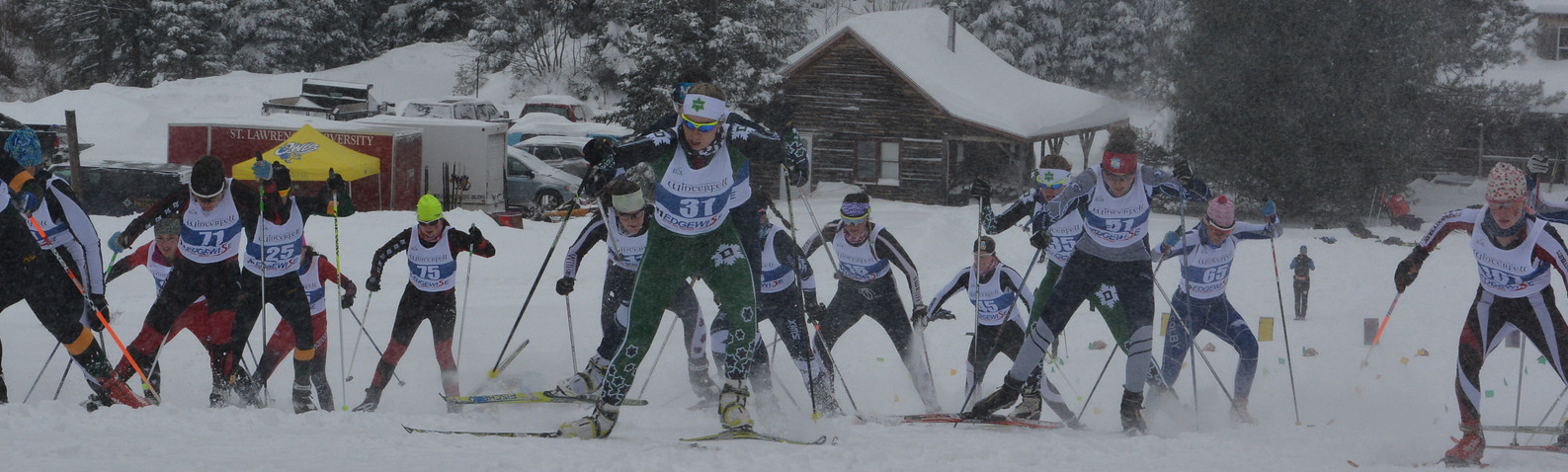
Every two years, the Williams College nordic team hosts its Winter Carnival 20 miles north of Williamstown, Mass., at Prospect Mountain in Woodford, Vt. By 2016, it could have a five-kilometer ski loop up to International Ski Federation (FIS) standards.
A scene from the Williams’ College Winter Carnival at Prospect Mountain in Woodford, Vt. (Photo: Jason Lemieux)
“It started with my coach, Bud Fisher,” said Williams senior Will Wicherski. “He’s been at Williams forever.”
Williams’ associate director of athletics, Fisher suggested that Wicherski study Prospect’s trail system to determine whether a homologated trail would be feasible.
“Within the EISA [Eastern Intercollegiate Ski Association], there’s more and more of a move to get all our races on homologated courses,” Fisher said. “We’ve been thinking about it for some time, and we’re taking a probably a little bit more conservative, slow-paced approach to it.”
Wicherski characterized some of the EISA race loops as “really uneven,” pointing to Dartmouth’s Skiway at Oak Hill as an example.
“The climb is way too big and not that wide,” he said. “Our course at Prospect is kind of unfair. It’s old-school, not wide, and there isn’t a lot of climb. We can’t really have mass start races there.”
Homologating race trails evens the playing field, he explained. “Among the coaches, there’s more of a desire to hold races at homologated race sites. They know what they’re getting. There are more schools that want to host carnivals.”
Some New England schools already hold their carnivals on homologated trails, including the University of New Hampshire (which hosts in Jackson); the University of Vermont (at Trapp Family Lodge in Stowe), and Middlebury (at Rikert) and Colby (in Waterville, Maine).
The course will combine existing trails with new sections. Much of Prospect Mountain’s trail network is on U.S. Forest Service land, where the permitting process makes large-scale alterations difficult. As a result, Williams wants its race loop to include minimal new trails.
Ultimately the college would like to create a course that will accommodate interval-start freestyle and classic races as well as team relays. Mass-start skate races require wider trails than interval starts, and Fisher said that while it wouldn’t be impossible to make them happen, it would be “very difficult.”
Interval-start freestyle, classic, and relay events require trails 5 meters wide. Even for interval-start homologation, some sections of trail — all on forest service land — would need to be widened.
Wicherski described southern Vermont/northwestern Massachusetts as “being on the edge of consistent snow,” adding that if the homologation project works out, the college may consider snowmaking in the future.
“Getting the course homologated is the first step towards snowmaking,” he said.
According to Williams’ Nordic Head Coach Jason Lemieux, snowmaking is a “long term goal/dream … it’s a battle we’ll wait to fight until the completion of the homologation project,” he wrote in an email.
Prospect Mountain’s ski roots trace back to 1939, when it started as an alpine-ski area with a rope tow. At 2,250 feet above sea level, its base elevation is the highest of any ski area in Vermont. In the 1970s, Prospect’s owners cut cross-country ski trails to enhance their business, and in 1992, Steve Whitham and Andrea Amodeo purchased the area after its previous owner abandoned it. Instead of reopening the lifts, they focused on cross-country skiing.
At 2,250 feet above sea level, its base elevation is the highest of any ski area in Vermont.
Getting Up is Half the Battle
One of the biggest challenges was designing an appropriate downhill from the main climb. Running under the old lift line, the A-climb diagonally crosses the alpine hill, ending up on a trail called Shay’s.
“We know where the A-climb is, but we don’t have a way to get down off it,” Fisher said.
This summer, they plan to build the descent. Williams will test it this coming winter, after which they plan to finish work on the trail.
The other challenge exists at the opposite end of the course. Prospect’s trail system is bisected by a forest-service road that sees heavy snowmobile traffic during the winter. During Williams’ last Winter Carnival, course workers had to stop snowmobiles 17 times during the races. “It’s a dangerous situation,” Fisher said.
To avoid the road, Williams would need to construct a short connector trail on forest-service land. They’ve applied to the U.S. Forest Service (USFS) both for this and to widen trail sections where necessary. The carnival trail falls into the forest service’s small-projects category, which requires less time, ecological compliance and money than a large-scale endeavor.
Pending USFS approval, construction will start with trail work this summer.
We haven’t actually gotten an FIS [inspector] in yet,” Fisher said. “We wanted to get all the homologation parameters met before we do that. We launched into the project and came up with a number of ideas to us where show we get an A-climb and a B-climb.”
Lemieux estimated the project’s cost to be “easily more than $15,000.”
Approval will give Williams a 10-year permit. If the downhill from A-climb works, they’ll continue work on the land the following summer. At that point, they would bring in a course inspector from the FIS for any tweaks.
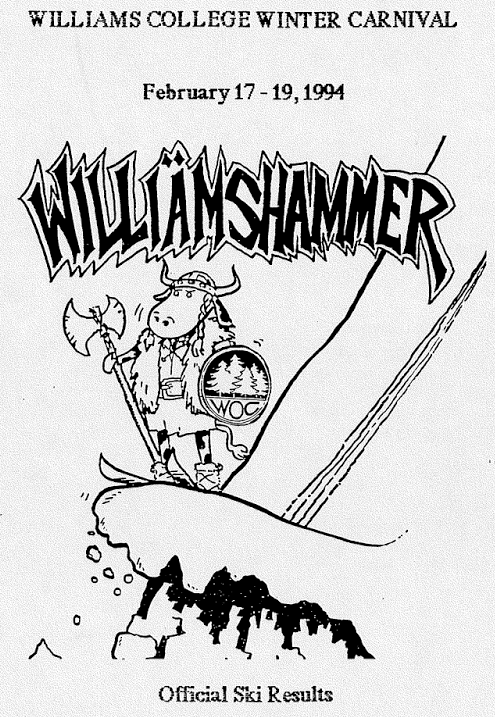
Competitors head out to start the women’s relay at the Williams Carnival (photo: Ian Nesbitt)Excerpt from the 1994 Williams Carnival results packet (photo: EISA archives)
Though they do not host an EISA event every year, the Williams Carnival often coincides with the Olympic Games both in terms of yearly-cycle and calendar date. In past seasons, this event has been referred to by the organizers with unique puns like “Williamshammer” (the 1994 Lillehammer Olympics) and “Moogano” (the 1998 Nagano Olympics). With this year’s event taking place parallel to the Sochi Winter Games in Russia, one might find themselves pining for a little bit of that Olympic touch within the college Nordic scene. Perhaps “Moochi” or Soch-Eph”?
Regardless of your level of Olympic spirit, no skier will complain about having large amounts of snow. A massive winter storm brought over two feet of fresh, soft snow to the Prospect Mountain ski area last Thursday, Friday and Saturday, the penultimate race weekend of the EISA season.
Many of them would tell you that driving a van, bus or trailer through a snowstorm is common practice for cross country ski coaches, and everyone from coaches to parents to athletes got to put their winter driving skills to the test on the long ascent to the venue, part of a now-defunct alpine ski area that sits at over 2,000 ft in elevation.
Much like winter patterns and studs for drivers, different approaches to technique and ski selection must be used when facing soft snow on a ski course. Add in the pressure of a narrowing window of opportunity for skiers on the bubble of NCAA qualification, and you have a truly interesting race weekend.
Friday: 3×3.25K Freestyle Relay
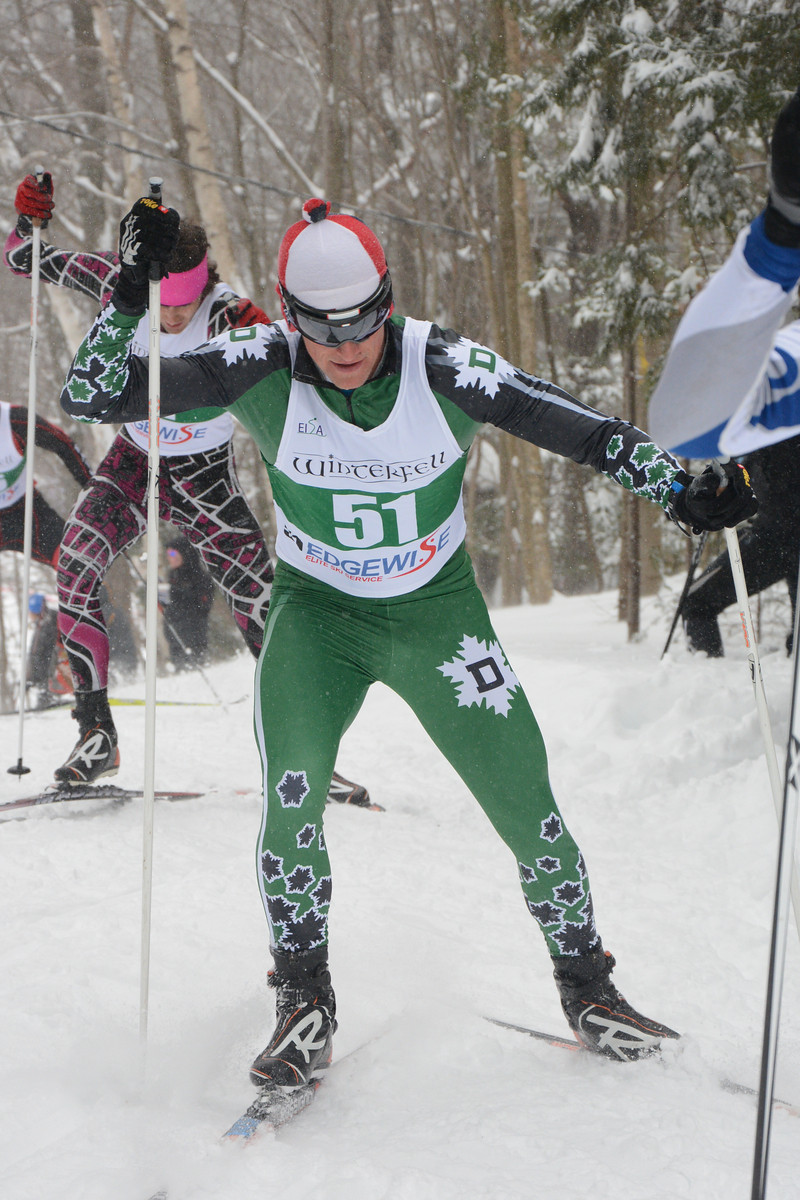
Dartmouth’s Fabian Stocek scrambles for Dartmouth’s first relay team, while Akeo Mayfeld-Carucci follows, sporting a pink valentine Harvard uniform (photo: Ian Nesbitt)
Friday brought the first and only relay event of the year to the EISA, with some perennial powerhouses up front. UVM made winning look easy in the women’s race. Though Dartmouth’s Annie Hart led out of the gate, the trio of Linda Danvind-Malm, Anja Gruber and Stephanie Kirk (in that order) put the rest of the field out of sight behind them en route to a minute-plus victory over Dartmouth.
The most exciting moments of the day came in the race for the final podium spot. Leg by strong early legs by Hallie Grossman and Jane McClarney, the Bates women looked to have a lock on third place going into the final leg. The Bobcat’s anchor skier, Sadie James, has raced to multiple excellent performances in the top-30 this year, but struggled Friday under the pressure of three skiers charging up to her, two of them standout freshmen in their own right.
Colby’s Amy Bianco and Williams’ Hannah Cole made contact with James before the end of the leg, along with Bowdoin’s Kaitlynn Miller. Miller, who has steadily improved to be a consistent threat on the circuit, was the most experienced of this group. That played to her teams advantage, as Bowdoin took home third place to mark yet another milestone for the Polar Bear program. Williams finished in fourth and Colby in fifth, as James and the Bates team faded to sixth.
The men’s race was carried out in almost opposite fashion at the front, with UVM’s Cole Morgen taking an early lead out of the stadium. Without two of their usual scoring three (Scott Patterson and Rogan Brown), however, both of Dartmouth’s teams worked together to pass the Catamounts. By the final leg, Big Green skiers Paddy Caldwell and David Sinclair were skiing together with a gap to the rest of the field.
It was not a question of whether or not Dartmouth would win, but rather which Dartmouth team would win. In the end the first team of Fabian Stocek, Silas Talbot and Paddy Caldwell was victorious in a sprint finish over the second Dartmouth team of Erik Fagerstrom, Cam Woodworth and David Sinclair. UVM’s team of Cole Morgen, Jack Hegman and Jorgen Grav finished third, 30 seconds behind.
Saturday: 5/10K Classic
As snow continued to fall, more soft conditions were inevitable for the second day of the Carnival.
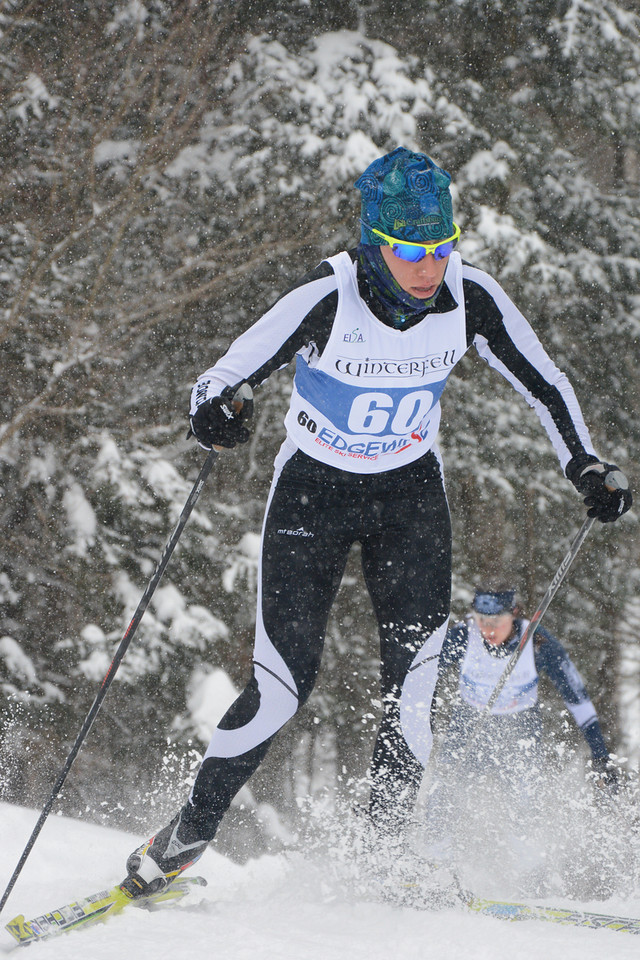
Bowdoin’s Kaitlynn Miller skis to 2nd place in the Williams Carnival classic race (photo: Ian Nesbitt)
UVM’s Anja Gruber continued her excellent season with a win in Saturday’s 5k classic race. Between the two of them, Gruber and her teammate Linda Danvind-Malm have won every collegiate race so far this season. The two Cats only have one more weekend left to complete the streak of wins for UVM.
Finishing next behind Gruber on Saturday was not Danvind-Malm, nor other usual rivals such as Annie Hart or her Dartmouth teammates. Instead it was Bowdoin racer Kaitynn Miller, who improved on her previous top finish of third and stepped up one more level on the podium. Racing to a personal breakthrough of her own was sister Hannah Miller, whose eighth-place finish helped the Bowdoin women take their second team podium in as many days.
Danvind-Malm finished third, which once again helped the UVM women to a team victory.
The men’s race also saw a double-victory on the weekend, as Dartmouth’s Paddy Caldwell, anchor of Friday’s winning relay team, took his first individual collegiate victory ahead of teammate Silas Talbot. In third place was UNH skier Eirik Fosnaes, who picked up his second career podium in third.
Though winning a carnival as a freshman is certainly a big story, the success of Caldwell through his junior racing years made this victory somewhat unsurprising. The Dartmouth skier has always been a consistently fast racer, with the ability to perform best when it counts.
In that vein, it was a uncharacteristic off-day for EISA standout Jorgen Grav. The UVM racer, who has won on numerous occasions this year and has rarely finished outside the top 5 in recent races, found himself in 16th place and out of UVM’s team scoring.
Cole Morgen (6th), Jack Hegman (7th) and Rogan Brown (13th) were still able to secure second place for UVM in the team score, while the Williams men stacked the top-25 to earn a third place team score at their home event.
Farewell to Fisher
On the subject of the strong Williams results from this weekend, it is certainly worth noting that this was the final home carnival for long-time Williams head coach Bud Fisher, who will be departing after this season. A graduate of St. Lawrence University and a former standout cross country and Nordic combined athlete himself, Fisher began coaching at Williams in 1974. During his tenure at Williams Fisher also coached at the US Ski Team and Olympic level, and has become a prominent and highly-respected name in the skiing world.
During a small ceremony on Saturday many respects were paid to coach Fisher. A hearty congratulations goes out to Fisher for a long and successful career in the sport!
Results for this weekend can be found at BART Timing