From the FasterSkier archive — posts syndicated from athletes’ and coaches’ own blogs between 2004 and 2012, kept online as published. Current coverage is at fasterskier.com.

Tag: Wilson Dippo

  • Paralympic Trailblazing with the Bogus Basin Nordic Team

    Paralympic Trailblazing with the Bogus Basin Nordic Team

    Bogus Basin Nordic Team (BBNT), based in Boise, ID, became a Paralympic Sports Club this year, the first cross-country ski team in the United States to do so.

    Paralympic Sports Clubs are partnerships between US Paralympics and community organizations across the country that, according to the US Paralympics website, “provide local sports programming for individuals with Paralympic-eligible impairments.” They are “designed to be implemented within an organization’s menu of programs,” thus bridging the gap between adaptive-specific and existing sports programs within a community.

    Bogus Basin Nordic Team and the United States Paralympic Nordic Skiing coaching group during a “how-to” training session. (Photo: Sarah Carey)

    The conversation for BBNT to become a Paralympic Sports Club began with Wilson Dippo and Willie Stewart. Dippo is the former head coach and program director of BBNT. Stewart is a BBNT parent and Paralympic silver medalist in cross-country skiing. Both are passionate advocates for increasing inclusivity in sports programs, especially those meant for young athletes.

    “I am by no means an expert on working with adaptive athletes, but I have a lot of experience working with kids,” said Dippo. “And for kids, taking one group and putting them in a box or putting them over on the side seems like a really ineffective way to both build their skills and build their community.”

    Stewart, who lost his arm in a construction accident when he was 18-years-old, echoes this sentiment. He describes the experience of transitioning to life with a physical impairment as one characterized by “terrible loneliness.”

    “I was isolated and it was devastating. That was way worse than losing my arm,” said Stewart. “I believe that people with disabilities are often isolated. They’re sometimes put into programs where they’re training alone, and that’s not that empowering. If adaptive athletes are only in adaptive programs and little kids with disabilities are not with little kids without, that doesn’t grow a vision of inclusion.”

    Stewart is also a spokesperson and advocate for Challenged Athletes Foundation (CAF), an organization that strives to provide opportunities and support to people with physical challenges so they can pursue active lifestyles through physical fitness and competitive athletics. When CAF received a grant from The J.A. and Kathryn Albertson Foundation (JKAF) to start an Idaho-specific branch, Dippo and Stewart felt the timing was right to pursue becoming a Paralympic Sports Club.

    “It seemed like there’s no time like the present to start moving things forward,” said Dippo.

    Dippo reached out to Eileen Carey, director of United States Paralympic Nordic Skiing (USPN), for advice and information regarding how to become a Paralympic Sports Club. Carey took the opportunity to provide a two-day coaching clinic in Boise with Kristina Trygstad-Saari, assistant coach with USPN, last March.

    The first day focused on educating BBNT coaches and local ski instructors on how to work with adaptive athletes.

    “[Carey and Trygstad-Saari] gave us the rundown on coaching sit skiing, tips for working with visually impaired athletes and generally covering the basics,” said Dippo. “We even got to try sit skiing.”

    The following day, BBNT and USPN opened up the clinic to the general public. One of the attendees was 14-year-old Annie Carey (no relation to Eileen Carey), an accomplished adaptive athlete in track and field, swimming and triathlon.

    BBNT athlete Annie Carey racing at the recent SuperTour in Sun Valley, Idaho. (Photo: BBNT)

    Annie Carey is now fully integrated into BBNT and is the program’s first adaptive athlete. She recently competed in her first ski race in Sun Valley, ID and will be going to Soldier Hollow, UT in early January for the US Paralympics Nordic Sit Ski Nationals & World Para Nordic Skiing NorAm.

    While its adaptive program is still small, BBNT believes the Paralympic Sports Club designation offers the program credibility.

    “The story isn’t necessarily, hey look, BBNT is doing such a great thing, they have one adaptive athlete. Everybody give them a big pat on the back,” said Dippo. “It’s more, hey look, our doors are completely open and we’re going to do whatever it takes to actually make this door stay open. Not only are you welcome here, but we want you here.”

    Paralympic Sports Clubs also receive support and access to resources from US Paralympics and its National Governing Bodies and High Performance Management Organizations. These resources include coaching education and program development courses.

    “The materials out there for us all to read and look at are incredibly helpful. They’ve really made me feel more confident that what I’m doing is right,” said Emma Donohoe, co-head coach and program director of BBNT.

    “I can go in there and see how to compare Annie’s time to non-adaptive athletes. And if we were to have a sitting athlete, I can see what I need to be communicating to race organizers about what their course should be. It’s great for the technical side of things.”

    Additionally, Paralympic Sports Clubs have permission to use the US Paralympics logo, which may help with marketing and fundraising efforts.

    “When you have a big vision of inclusion and getting away from isolation, you can raise money,” said Stewart. “Access, integration and inclusion. Those are narratives where people will get on board and say, let’s do it.”

    On January 18 and 19, CAF will host an adaptive nordic and biathlon clinic in Tamarack, ID. USPN’s emerging athlete coach, BethAnn Chamberlain, will help run the clinic. Donohoe hopes the clinic, in conjunction with the recent Paralympic Sports Club designation, will attract more adaptive athletes to BBNT.

    “I believe that this sport gives you a lot for your entire life,” said Donohoe. “So expanding who can access becoming a cross-country skier in this valley is an important value to us.”

    Indeed, BBNT has a history of providing skiing opportunities to diverse and underserved populations. RefuSKI, a program started by a local English as a Second Language teacher, gives children who are part of Boise’s refugee population the opportunity to learn to nordic ski. Community partners and donors help support tuition costs, equipment, transportation, and clothing for children who participate. According to Dippo, BBNT usually has about six to eight kids who regularly participate in the program each season.

    “Having our refugee program up and running for years now has been really cool for both the refugee skiers and for everybody else on the team,” said Donohoe. “A lot of these kids wouldn’t know a refugee if they didn’t have a teammate. Same thing with para-skiing. A lot of our athletes don’t necessarily know para-athletes until they become teammates with them.”

    Elliott is a development coach for United States Paralympic Nordic Skiing 
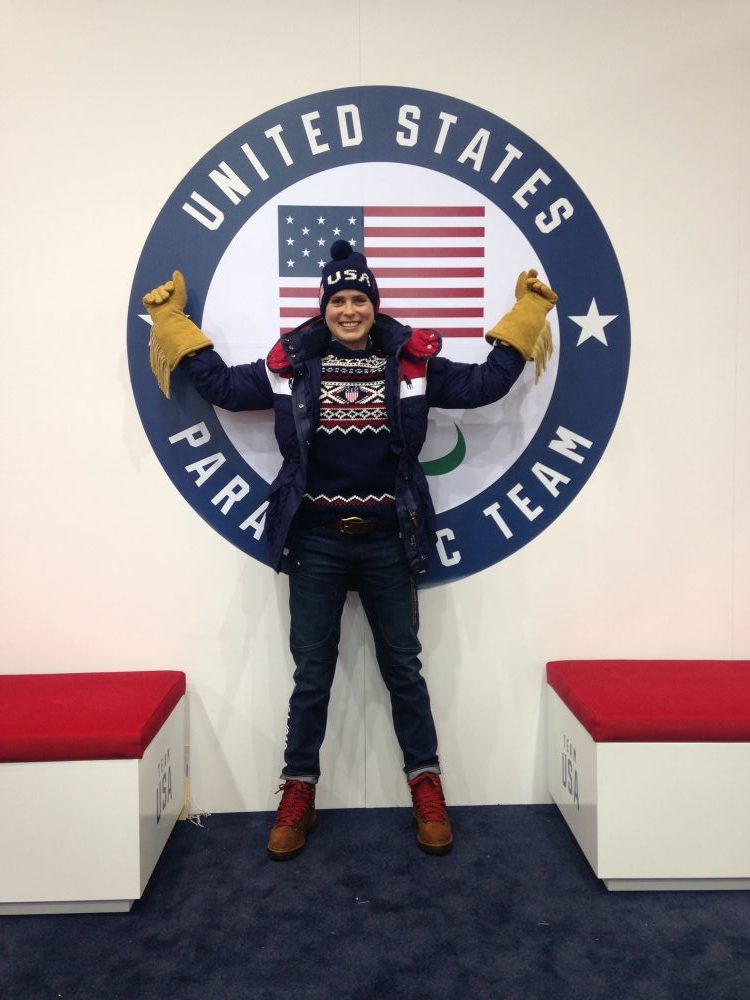
    Paige Elliott at the 2018 Paralympics in PyeongChang, South Korea. (Photo: Courtesy Paige Elliott)Elliott is a development coach for U.S. Para Nordic 
  • Movember in West: Skiers Share ‘Stache Stories and Race Goals

    Movember in West: Skiers Share ‘Stache Stories and Race Goals

    WEST YELLOWSTONE, Mont.– While the Yellowstone Ski Festival crew is plenty busy grooming the trails with the fresh snow fall Wednesday, many skiers are also busy grooming their upper lip. In the spirit of no-shave “Movember,” FasterSkier decided to rank the top mustaches found out on the trails. Ranking decisions were made based off the official rules according to the Movember Foundation, as well as an individual’s responses, and overall look. 

    The photo gallery shows our picks for the Top 10 Movember Men. This is followed by the Top Five Movember Women*, abbreviated because of the number of women who participated*. The gallery is rounded out with the top-three Bearded Honorable Mentions.

    *Cutout mustaches provided by FasterSkier.

    Along with getting the history behind the facial hair, FS asked athletes about their race goals for the weekend and beyond:

    Annie Pokorny (SMST2): “Be one of the top girls going into the season.”

    Sloan Storey (University of Utah): “Just getting back into it, waking my body up, and having fun.”

    Liz Guiney (CGRP): “Get the first races out of the way and have fun.”

    Miles Havlick (SVSEF): “Should be a good weekend to get into the racing routine.”

    Chris Parr (Unaffiliated): “To try and not to shave … I’m hoping I can hold off, it’s tempting.”

    Joe Dubay (Unaffiliated): “I’m going to try not to let the icicles on my beard get too out of control.”

    Nicholas Michaud (BSF): “Have the best mustache in the A-final on Friday.”

    Eric Packer (APU): “First race of the year you’re always trying to put down a good effort and practice all of the things you worked on over the summer. My biggest goal is to go out there and ski really well.”

    Akeo Maifeld-Carucci (BSF): “Make sure my mustache is looking real good at the finish.”

    Reese Hanneman (APU): “I’m focusing on the sprint and hoping for an elite podium.”

  • “I Feel Like My 15-Year-Old Cat”: A Story from the Equinox Ski Challenge

    “I Feel Like My 15-Year-Old Cat”: A Story from the Equinox Ski Challenge

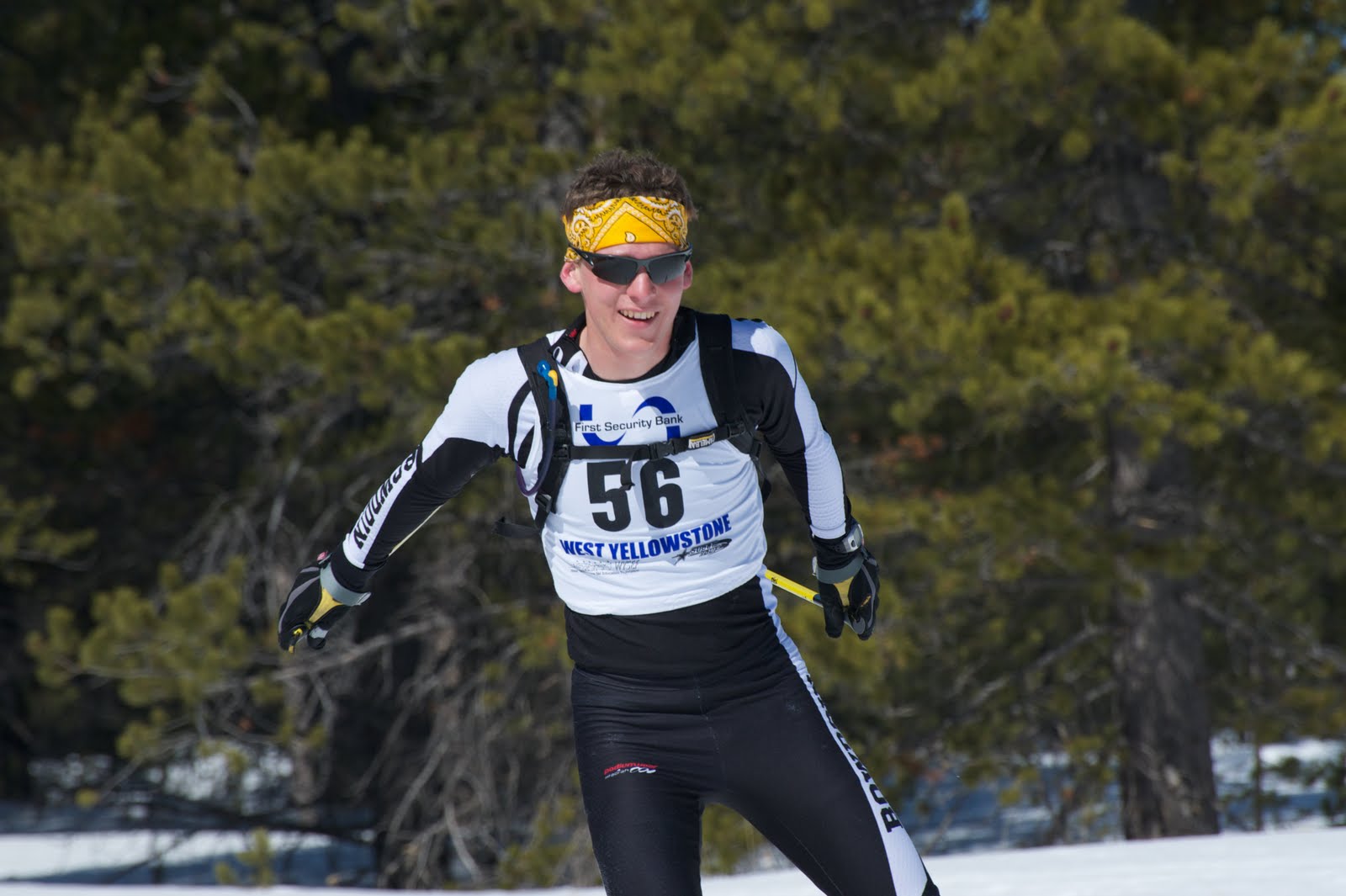
    Dippo racing the Equinox Ski Challenge. Photo courtesy of Peter Newbury, www.livingbythesecond.net

    Wilson Dippo is a sophomore on the Bowdoin College Nordic Ski Team. He raced the Equinox Ski Challenge in West Yellowstone, MT, two weekends ago, and this is his story:

    I feel like my 15-year-old arthritic cat. I’m pretty sure my parents are going to need to mash some Cosequin into my dinner soon, too. As I told a friend of mine, “this isn’t the most sore/ tired that I have ever been, but a bunch of my joints have gone on strike, and they say they won’t be coming back until working conditions improve.”

    Let me just say right now that this post is a novel, if you can’t be convinced to read the whole thing, the gist is: The Equinox Challenge is super-cool and the Birkie has nothing on it.

    Well, let’s take a step back so I can actually tell you about the race. The night prior, I drove up to West Yellowstone from Salt Lake City with my Dad and one of my teammates from high school, Ian Anderson. We were headed for the West Yellowstone Equinox Challenge, a 24-hour ski race. The course was a 9.1K loop, until seven in the evening when it switched to a 6.4 (I think—I never actually checked). The race started at 10 in the morning. Every time that you came through the lap, you had to check to make sure that they had written down your bib number, and then you could either start again, take a break, or tag off to a teammate, if you were in the team division.

    Ian and I were the only two-man team (They said beforehand that it was split into solo, two to four, and five to eight person teams, but it really became team division or solo). We flipped a coin and Ian got to start. The whole time he was gone I had my fingers crossed that he wouldn’t be the first one back, because I knew that would mean a really early bonk—especially since there was a fast team from XC Oregon doing the four-person six-hour race. Fortunately, Ian came through a minute or two back, and I was on my way. The course was brutal. It was no Saint Mikes Carnival (for any of you eastern collegiate skiers), but it had one climb in the middle of the loop that was about as hard, or a bit harder, than the last hill at Stowe.

    For the first four laps we alternated, then Ian said he was going for two, so of course when my turn came I went for two as well. It was a huge mistake, but I kept doing two laps while he did one, meaning I was on for 50 minutes, off for between 25 and 30. All things told, though, I felt pretty damn good. I was flying – going a bit below threshold – but the tracks were incredibly fast. I was knocking down laps in less then 25 minutes.

    My first big mistake happened around 2 in the afternoon, when a five-man team sent out a really fast guy who was drafting off me. I was pretty sick of doing all the work, so I decided to drop him. I was transitioning really well (which paid off big-time, because the loop had a ton of hills that made 180 degree turns right at the top), so at the tops of the hills I would put in a bit of a surge. Over each one I would get away, but then he would just catch back up. After putting in way too much energy I just stepped aside so he had no choice but to pass—at which point he dropped me super-hard.

    I crossed 100 k at about 6:00, eight hours into the race, and I was starting to feel it. My forearms just didn’t want to grab the pole for the first five minutes of each leg, the bottoms of my feet started to feel pretty beat, as did my left knee. I didn’t have a clear sense of time for most of the race, but just a little while after 6:00 I had a huge bonk. I really wanted to eat, but didn’t want to do the actual eating – an IV would have been great. I have to give huge props to Ian who, while I was bonked, pulled off an extra leg, which actually gave me enough time to put my skis on again. Well, I went out to do two laps, ended up doing three, and when I came back inside the warming hut I was toast. There was no single thing dragging me down, but I was so low on energy, had so little leg strength left, and hardly any mental drive to keep me going. I ate a bit, Ian came back in just before ten, and we celebrated the 12 hour mark together. I ended up going back to the hotel for a couple hours of sleep, and Ian stayed in the warming hut in a sleeping bag.

    Through the course of the night we each did a couple laps, but we were getting nowhere. At 8:00 Ian woke me up, saying we had two hours left to put some more k’s in. He led out with a lap, and then at 8:27 I started mine. 8:27 is important, because the entire lap I was doing the math on how fast we each had to go to get back before 10:00 (everyone had to start their last lap before 10:00 for it to count). I flew around the course in 16:30 (the shorter course, by the way), which I am fairly sure was that loop’s record. Then Ian took a leg, and I again went full speed to try and squeeze the extra six k out of the 24 hours. When I came back through the lap, though, Ian was just standing there. He was totally fried. But I had made up enough time so that our last lap only needed to be 30 minutes to beat the deadline. When I got back, he was there and totally fired up for a victory lap. We went out screaming and shouting, and we were hauling. On one of the downhills I spun around and went down backwards. We came in at 10:05, twenty-four hours and five minutes after we had left for our first lap.

    In retrospect, there is a ton that I would have done differently: more varied food (i.e. something that wasn’t sugar/ carbs), slower out of the gate, longer time on thus longer time off, taking my boots off every chance that I had, etc. But regardless it was awesome. Though unofficial, we unintentionally won the 6- and 12-hour team division as well (I think), and at one point we were an entire lap, nearly 30 minutes, up on the entire field.

    By the end, the four- and five- person teams had dropped us, besting our 289 k with 450 and 460 k. That is still 145 k each, most of which we did in the first 12 hours. The cocky side of me comes out, and I’ll just say that with one more teammate, I really think that we could have been competitive through the entire night—maybe have even won. So the plan for next year (assuming the Equinox lines up with spring break again) is to go back and race the thing in the solo division, unless we can find a sweet third team member.

    Moral of the story?

    Ski racing is awesome.