From the FasterSkier archive — posts syndicated from athletes’ and coaches’ own blogs between 2004 and 2012, kept online as published. Current coverage is at fasterskier.com.
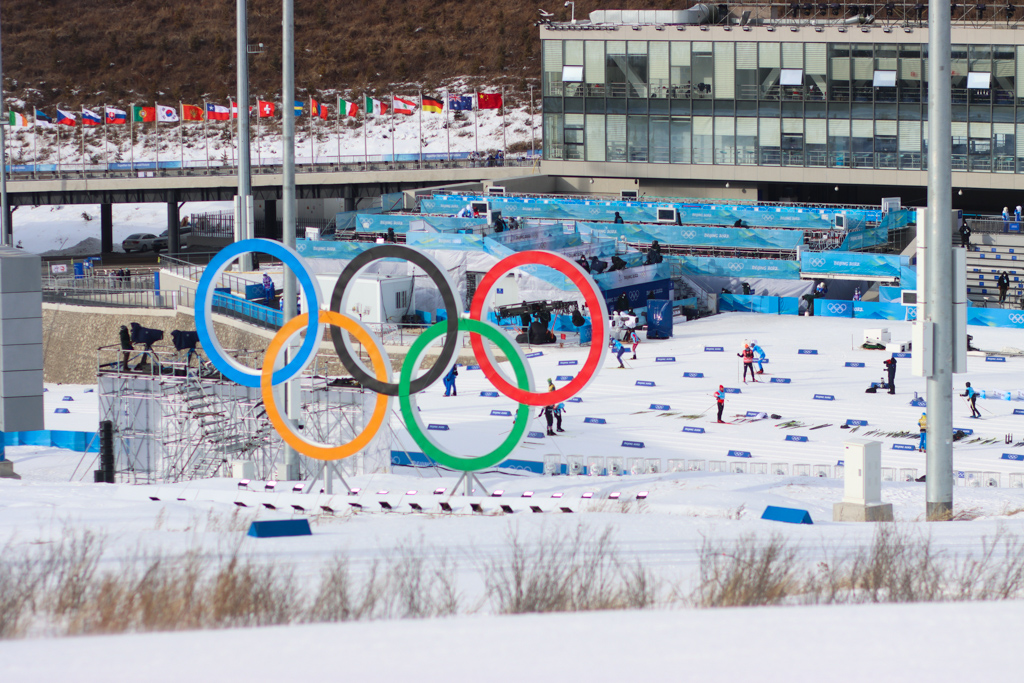
A view of the stadium Friday, February 4, 2022 at the Zhangjiakou National Cross-Country Skiing Center. (Nat Herz/FasterSkier-ADN)
ZHANGJIAKOU, CHINA — After months of headlines about coronavirus tests, travel logistics and geopolitics, Beijing’s Olympic cross-country skiing venue, on the eve of its first competition Saturday, has emphatically changed the subject.
To the winds of Zhangjiakou.
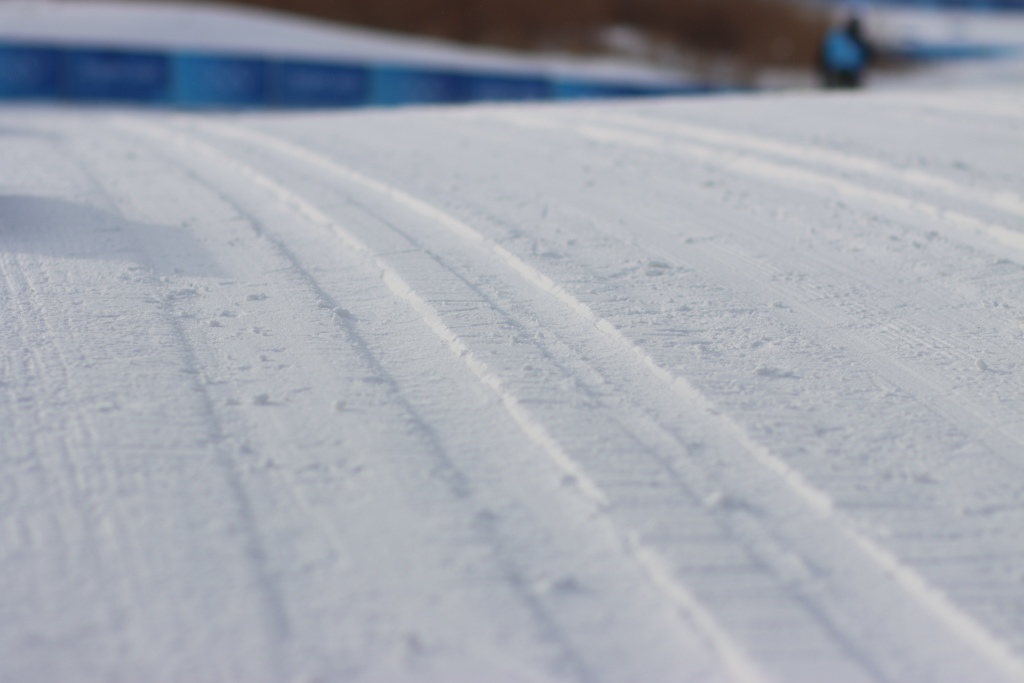
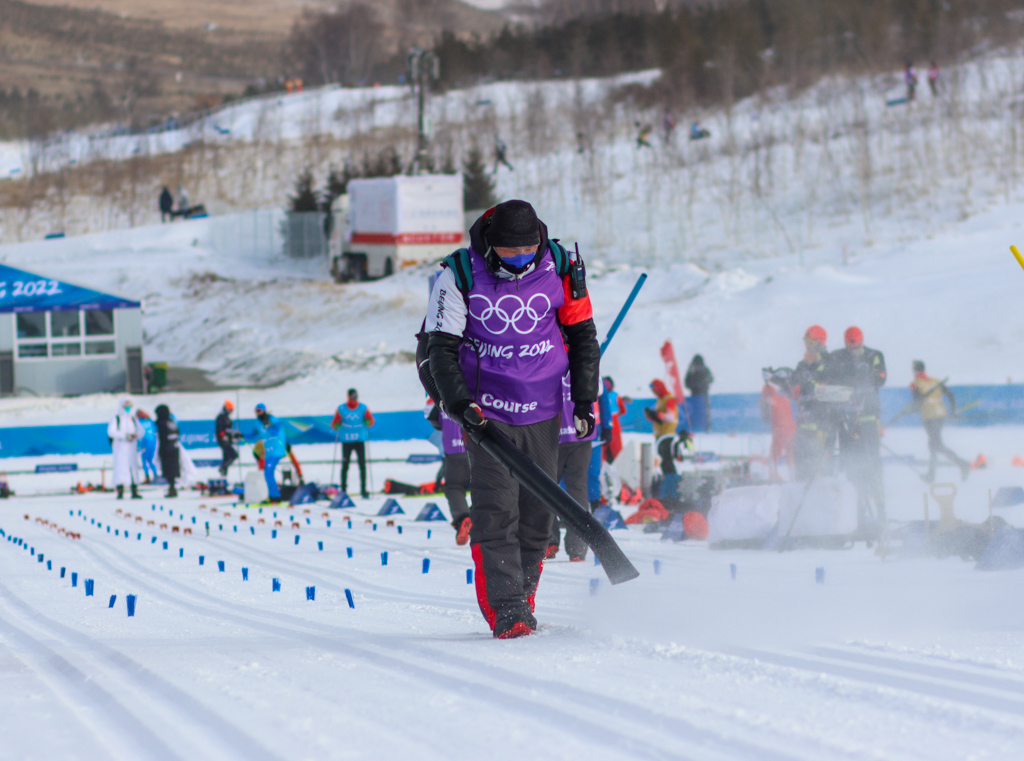
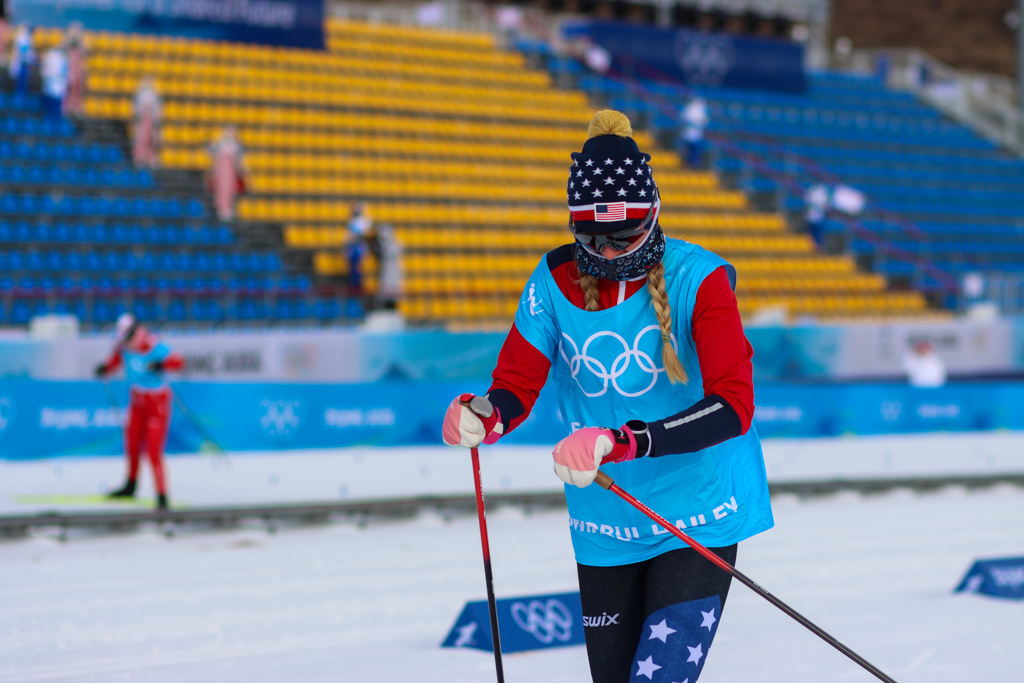
Icy gusts billowed athletes’ training bibs, filled the resort town’s immaculately groomed ski tracks with dry, squeaky powder and generally consumed everyone’s attention Friday — from the team members who shielded their faces with buffs and layers of tape to the course workers who used leaf blowers in an effort to restore a section of the course to presentable shape.
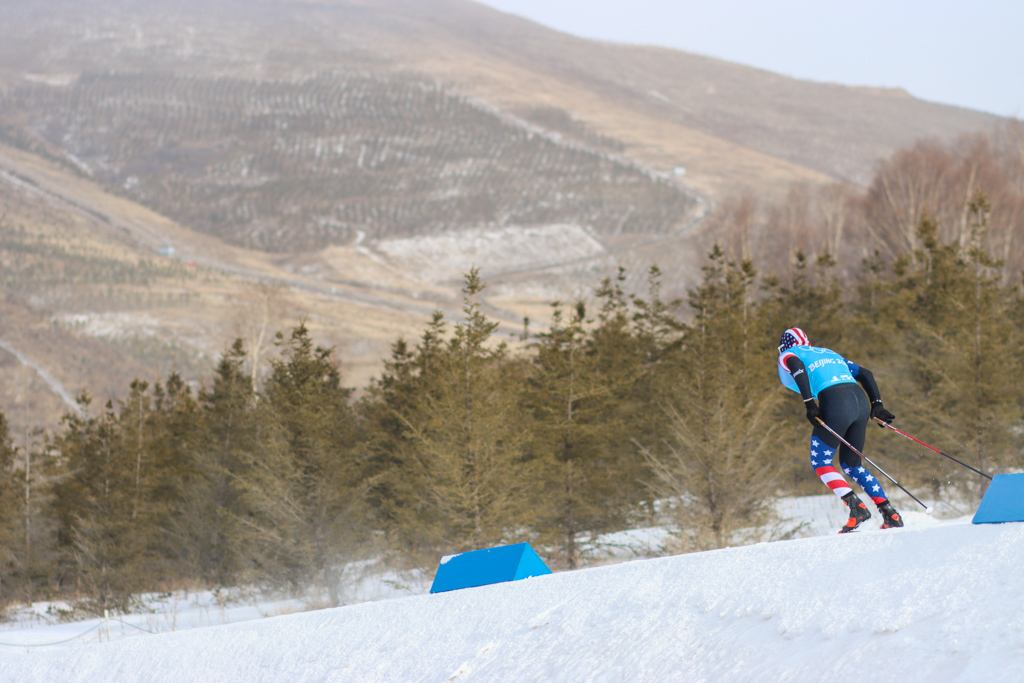
Windblown snow fills ski tracks Friday, February 4, 2022 at the Zhangjiakou National Cross-Country Skiing Center. (Nat Herz/FasterSkier-ADN)A course crew member attempts to clear windblown snow out of the ski tracks Friday, February 4, 2022 at the Zhangjiakou National Cross-Country Skiing Center. (Nat Herz/FasterSkier-ADN)
“This makes Fairbanks seem nice,” a slightly defeated sounding Luke Jager, the Alaska-born American sprint racer, said in a message after braving Zhangjiakou’s trails Friday, amid 25 mph gusts and a high of 5 degrees. “It’s kind of brutal though: All the spots on the sprint course where you want to carry speed into the climb, you just get blasted with wind and come to a halt.”
Athletes’ early impressions of the Beijing Winter Olympics have centered on China’s intense coronavirus mitigation measures, from daily testing to volunteers wrapped in layers of personal protective equipment.
But finally, after dodging the hyper-contagious omicron variant in the lead-up to the Games, athletes and coaches are finally able to narrow their focus on competitions — thanks in part to those protective measures.
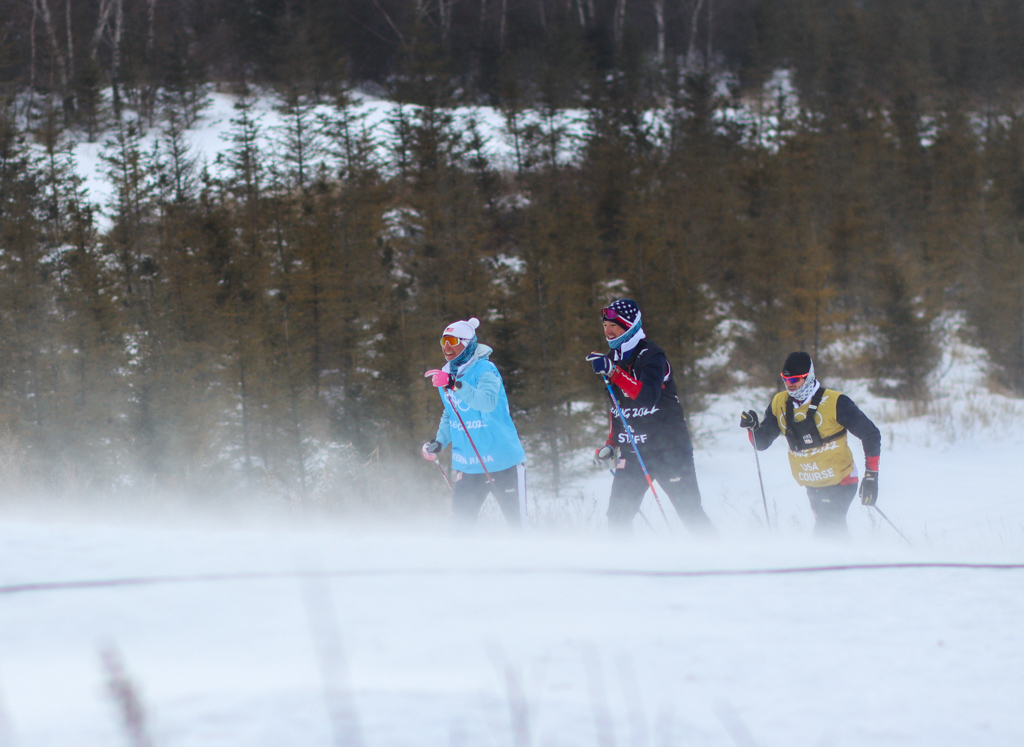
American cross-country skier Julia Kern trains with U.S. team staff members Eli Brown, center, and Andrew Morehouse on Friday, February 4, 2022 at the Zhangjiakou National Cross-Country Skiing Center. (Nat Herz/FasterSkier-ADN)
That’s the thing about the Beijing Olympic bubble: Once you’re inside it, it’s a much more comfortable place for an elite athlete to be during a pandemic than outside.
“I would say China’s policy on COVID matches our team policy on COVID,” said Matt Whitcomb, one of the U.S. Ski Team coaches. “Even though athletes made the team, we weren’t sure they were actually going to make it to the Olympics.”
Positive tests sidelined other contenders ranging from Norwegian cross-country skiing stars to star U.S. bobsledder Elana Meyers Taylor to Alaska-based figure skater Keegan Messing.
American cross-country skier Hailey Swirbul tries to stay warm during a race preparation training session Friday, February 4, 2022 at the Zhangjiakou National Cross-Country Skiing Center. (Nat Herz/FasterSkier-ADN)
But the entire U.S. nordic skiing squad has made it to Zhangjiakou, in the mountains some 100 miles northwest of Beijing, unscathed so far.
And while athletes and coaches said they’re still being vigilant, each day without news of many positives inside the Olympic bubble lends to the sense of security.
“Since we’ve all gotten here and settled in, we’re like, ‘All right, we made it.’ We’re still testing negative. We haven’t heard of people testing positive. So I think we’re feeling pretty good about it — and not thinking about it quite so much,” said Gus Schumacher, another Alaskan competing at the Games. “I think this is probably the COVID-safest I’ve been in a long time.”
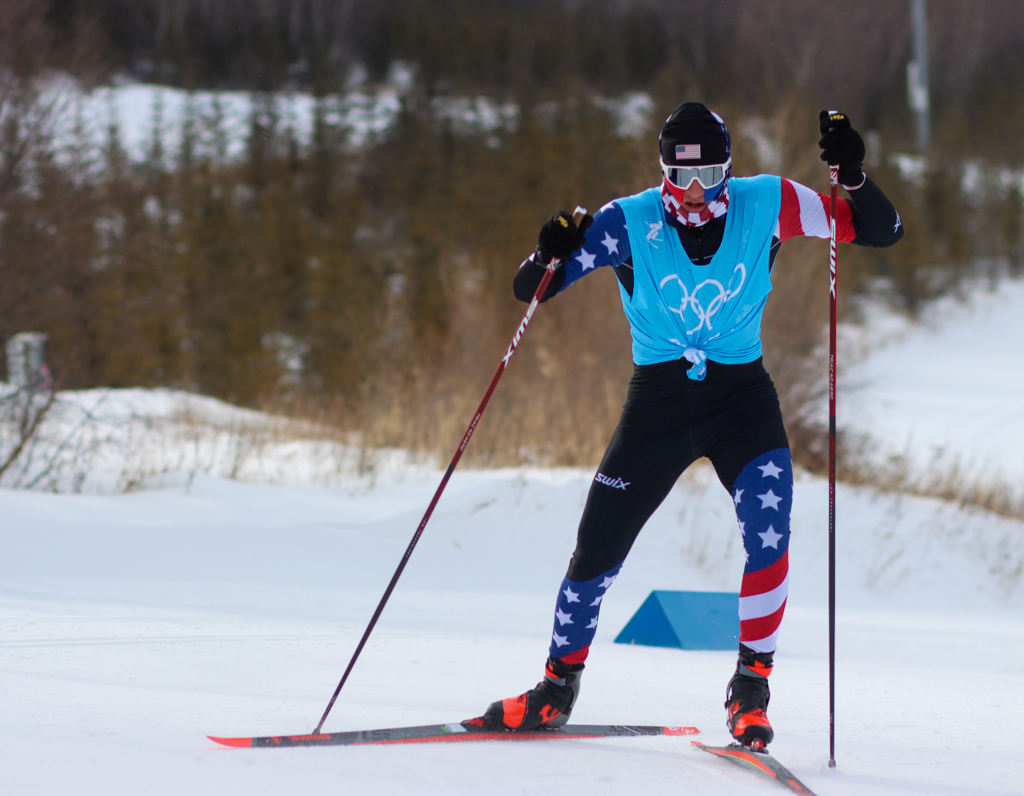
American cross-country skier Gus Schumacher trains Friday, February 4, 2022 at the Zhangjiakou National Cross-Country Skiing Center. (Nat Herz/FasterSkier-ADN)
That’s allowed athletes to think, and talk, about other things — namely the conditions on Zhangjiakou’s courses in advance of the Olympics’ first cross-country ski races.
Women will race 15 kilometers Saturday afternoon in the pursuit format, with the first half in classical technique and the second half skating. Men race the same format Sunday, skiing 30 kilometers.
Athletes spent Friday testing skis, practicing the changeover in gear — which happens while the clock is running — and fine-tuning both their bodies and cold-weather coping techniques.
Olympic team staff test skis and wax Friday, February 4, 2022 at the Zhangjiakou National Cross-Country Skiing Center. (Nat Herz/FasterSkier-ADN)American cross-country skier Gus Schumacher trains Friday, February 4, 2022 at the Zhangjiakou National Cross-Country Skiing Center. (Nat Herz/FasterSkier-ADN)
“Trying to figure out how to keep our faces warm,” Jager said.
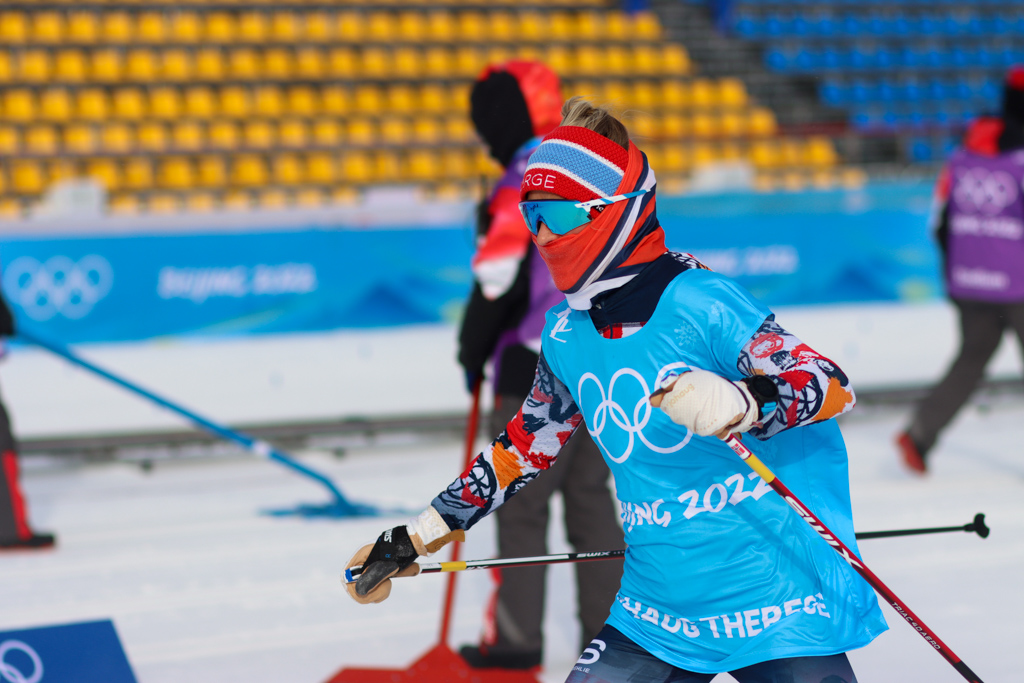
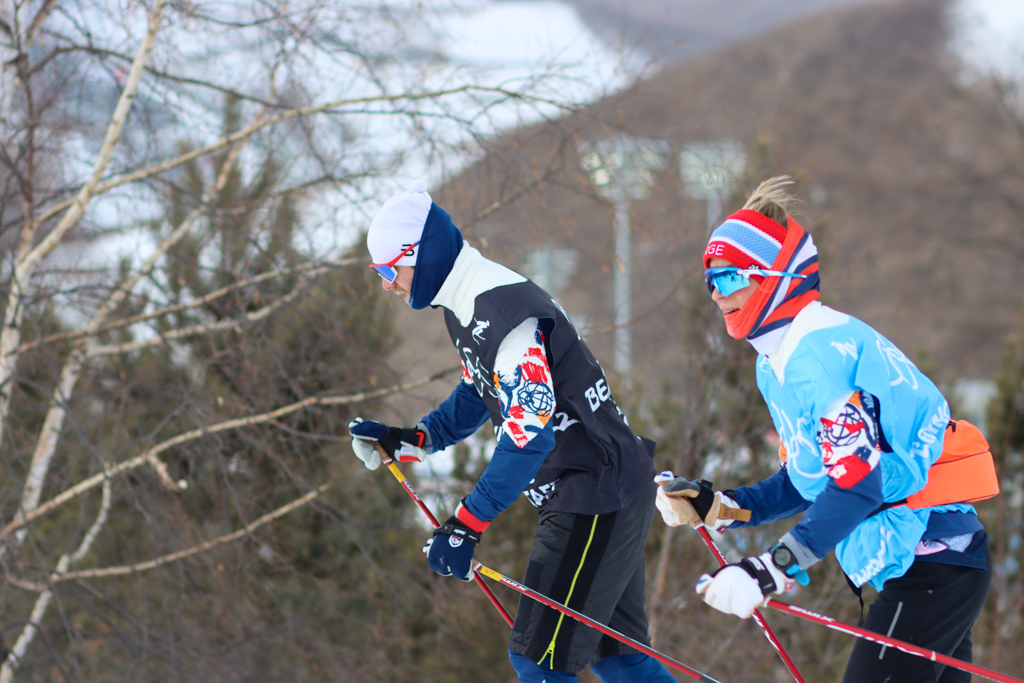
Schumacher skied with patriotic red and blue patches of tape on his cheeks, plus a striped red and white neck warmer. Other athletes trained wearing masks designed to shield their lungs from the cold air. Norwegian superstar Therese Johaug at one point skied through the stadium area with her neck warmer pulled over her mouth.
Norwegian superstar cross-country skier Therese Johaug stretched a neck warmer over her face to stay warm Friday, February 4, 2022 at the Zhangjiakou National Cross-Country Skiing Center. (Nat Herz/FasterSkier-ADN)Therese Johaug and her technician endure wind and cold as they prepare for the upcoming skiathlon. (Nat Herz/FasterSkier-ADN)
“Everybody has really fine-tuned what long underwear tops they’re going to need to wear, heated socks, heated vests for training,” Whitcomb said. “What puts the cold into an extreme sort of level is just the incessant wind — and it is really bitter. There’s one or two spots on the course where you can find a little respite from the wind, and it feels like the tropics when you step into it.”
Beyond devising ways to keep their bodies warm, athletes were also scheming with coaches about the fastest way to navigate Zhangjiakou’s wide, challenging trails, given the challenge of the windblown snow filling the tracks.
Skiing outside the tracks appears to be faster. But doing so invites the potential for disqualification, as athletes are required to follow strict rules about cornering when using the classic technique, Whitcomb said.
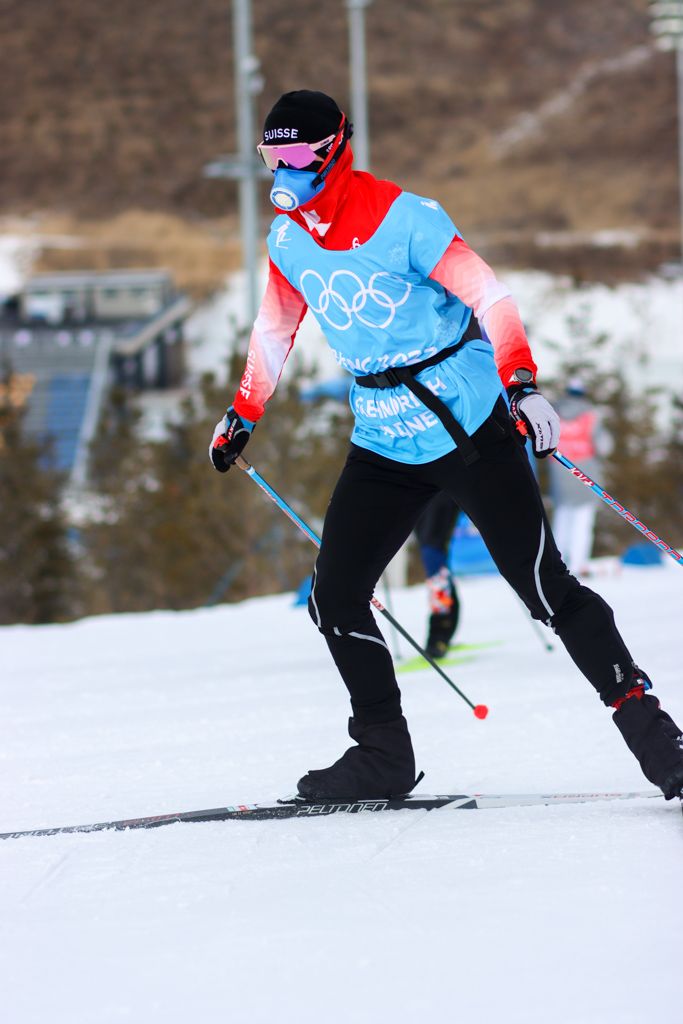
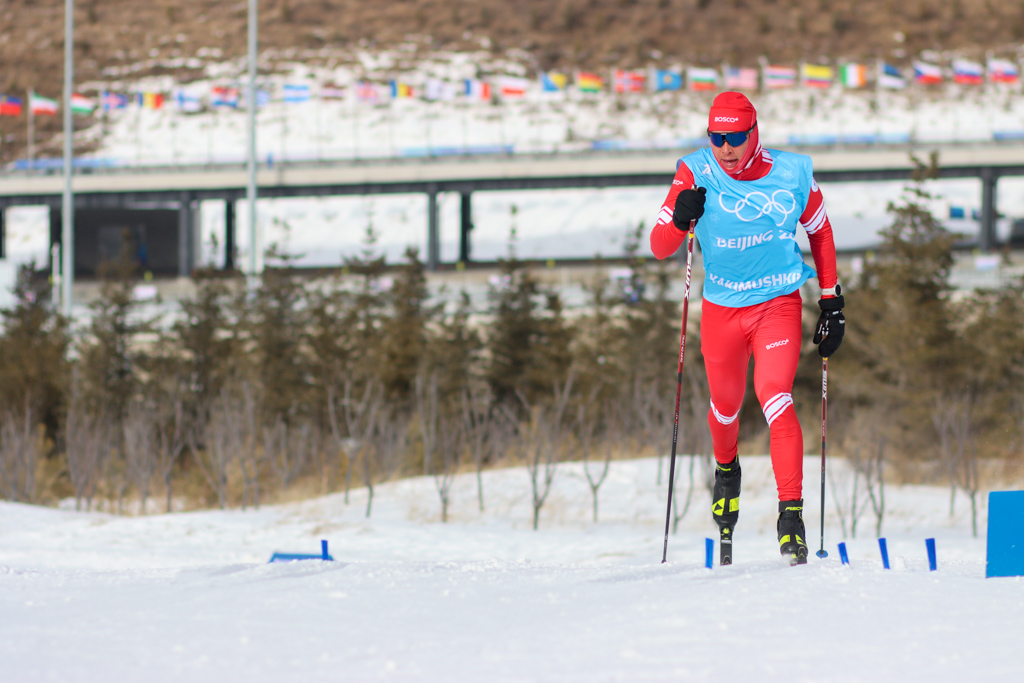
Swiss skier Nadine Faehndrich trains in a mask Friday, February 4, 2022 at the Zhangjiakou National Cross-Country Skiing Center. (Nat Herz/FasterSkier-ADN)Russian skier Ivan Yakimushkin trains Friday, February 4, 2022 at the Zhangjiakou National Cross-Country Skiing Center. (Nat Herz/FasterSkier-ADN)
Aside from the cold, though, athletes and coaches said they’ve had a warm welcome to China. The food is good, the logistics are uncomplicated and the Chinese volunteers have been warm.
“They’re doing an amazing job,” Jager said. “Everyone’s super friendly, and everything is pretty seamless.”
The coronavirus prevention measures also make sense, Schumacher said, given China’s low rates of illness and the much higher rates in countries that athletes, coaches and journalists are traveling from.
“It honestly seems like China’s probably one of the few places that can really pull this off well, right now,” he said.
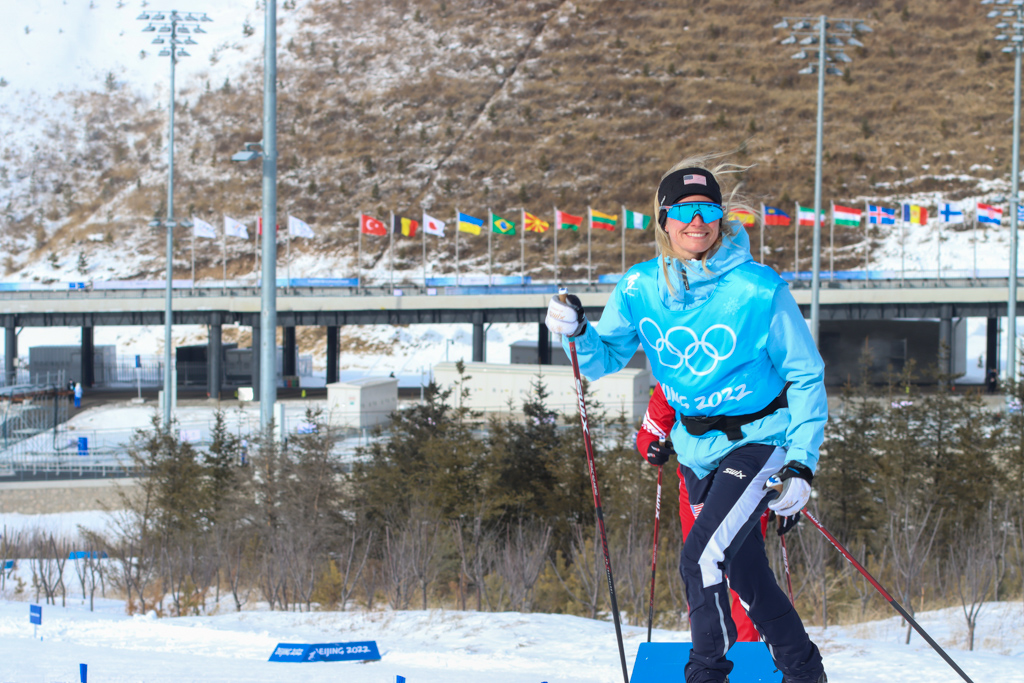
American cross-country skier Jessie Diggins smiles during a training session Friday, February 4, 2022 at the Zhangjiakou National Cross-Country Skiing Center. (Nat Herz/FasterSkier-ADN)
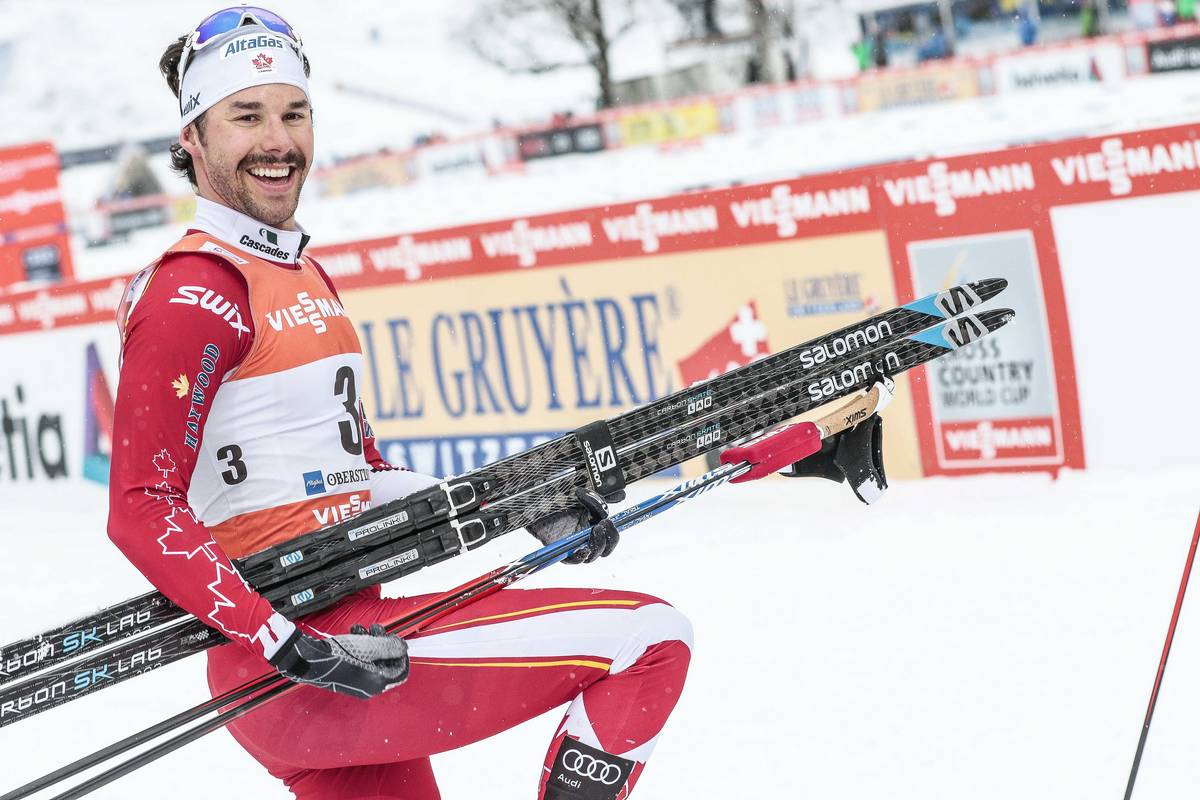
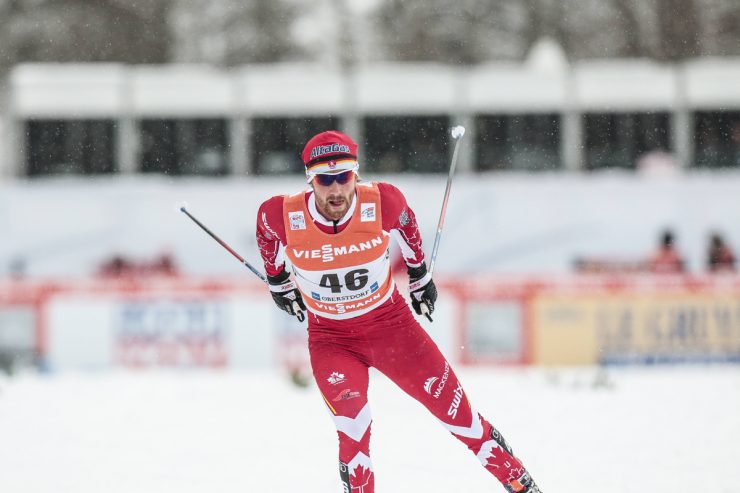
Canada’s Alex Harvey in his well-known guitar stance to celebrate third in the men’s 15 k freestyle pursuit on Wednesday at Stage 4 of the Tour de Ski in Oberstdorf, Germany. (Photo: Salomon/NordicFocus)
Canada’s Alex Harvey is still on the podium.
Then there’s the U.S. women’s team, with athletes in fifth, 10th and 12th in the Tour de Ski standings after big-time performances in Oberstdorf, Germany.
Harvey kept himself in third overall and ahead of Switzerland’s Dario Cologna with a strong pursuit finish on Wednesday, and Jessie Diggins led her U.S. teammates on consecutive days, notching second on Tuesday for a career-best skiathlon result and holding onto fifth overall in the pursuit. Not far behind her, Sadie Bjornsen captured a career-best World Cup result of fifth on Tuesday, and Kikkan Randall skied into the top 10 on Wednesday. Also for the U.S., Liz Stephen clocked the seventh-fastest 10 k time in the pursuit.
Here are some of the comments and photos that didn’t make it into our race reports:
On the strategies for Jessie Diggins and Sadie Bjornsen: “The plan is flexible in the Tour. You never know what type of body is going to show up for you on any given day. We try and be a little bit flexible and try and respond to the cards that you are dealt that day. If you do feel good, try and control things a little bit, stay up near the front third of the pack that you are in, that will decrease the amount of turbulence and crashes and what not. That’s exactly what Sadie and Jessie were able to do today. It worked out fantastically.”
On Liz Stephen: “Pretty strong classic performance out of her today. At the top of the first climb on the last classic lap, she was only 19 seconds out of the lead and just in contact with the main pack, so we expected pretty big things.” (but then skis were bad, as covered in piece.
On slow skis: “It’s tough. We don’t often focus on it too much, but when an athlete or two are skiing really well, I think it’s important for them to be able to put some of the responsibility on the skis. It’s not always the athlete. A bit ironic today, as we felt we had some of the fastest skis in the race as well. There’s a lot that goes into making good skis… I think every brand of skis have their strengths, you know have their conditions that they’re great in. Some brands have some conditions that they can struggle in, a bit more than others. Sometimes, with this new snow, which we have a little bit of trouble with occasionally, not specific to any one. While it is a cold, fresh snow kind of day, it doesn’t mean it is going to be particularly straightforward on the glide.”
On starting alone in a pursuit: “That’s something to consider, but in a tour like this for the women, it’s also important to remember that a lot of people will be released from the gate alone. It’s not like everybody’s in a pack except for her. It will be a pretty fair race tomorrow.”
Sadie Bjornsen, U.S. Ski Team:
On last weekend: “Val Müstair was a little interesting. I definitely wasn’t stoked about my sprint and then I had quite the blowup in the classic race. It definitely was challenging mentally, but I felt pretty confident in how I felt in my qualifier, the very first day, so I knew I couldn’t be in a disaster zone, I just forgot that I was at altitude in that 5 k race, and I did things a little bit wrong there.”
On the pace in the skiathlon: “It’s hard to tell because the people in the very front look like they’re working hard, because I think they’re breaking the wind, and then there’s that draft effect for the middle section, and then you go a little bit farther back and then it becomes like they are working hard again, because it’s that constant traffic jam, it’s like, stop-go, stop-go, stop-go. I actually watched the race this afternoon, because they were showing it on TV, and that’s interesting, like it looks like it is a different pace than normal.”
On her own pace in the skiathlon: “I felt like I was working hard at the beginning of that classic section simply because I was having to go through this accordion effect. But the times when I was conserving energy, I was certainly conserving, but it would be like conserve to sprint. That’s like a challenge of it’s own. I think that’s part of mass-start racing with not much snow anymore, you kind of deal with a little bit of that.”
On lack of a breakaway: “I don’t really know if it was windy, I didn’t notice. I think it was just that maybe the type of snow, that it just seemed [windy]. All those downhills had flat sections afterwards, that may have a been a part of it, too. It was almost like there was more flat than normal in this course, because there’s that middle section that’s very flat. Most World Cup courses, you’re either going up or down, I think that’s what made a draft.”
On the final climb: “It’s hard for me to remember, actually, what happened. I felt really strong going up that climb until maybe the last 20 meters of it, I was like, ‘Oh man, I hope I’m gonna make it over the top of this, ‘cause I’m red-lining.’ That’s certainly where I looked up and saw that those front four girls had gapped, and it was simply a difference right there.”
On leading a group to the finish: “I was definitely stressed about being in the front of that pack, because I knew that there was a draft on the bottom. And I don’t know what happened, I tried to take that last downhill really well, and I had no idea what was going on behind me. I knew it was not ideal, but I was just going to go for it.”
Jessie Diggins, U.S. Ski Team:
On energy conservation with fast skis: “I had great skis, and then our techs did a great job. And then on top of that, downhills are my thing. So it was great because it was a really hard course to move around a lot, and change position. So if I just let myself just tuck the final parts of the downhill, like glide and draft and find myself able to kind of make some moves out there, or just chill out a little bit. So that was really cool.”
On lack of a breakaway: “I actually don’t think anyone was really seriously trying to make any breaks, and I don’t know, that’s just my opinion, from where I was sitting, but it seemed like a different sort of race out there.”
On uphills in traffic: “That will happen, you kind of have to keep your head on a swivel. There were times I felt like I was doing a little hopscotch thing, trying to not step on anyone’s poles, and very carefully, I’m going to put my ski here, and, ‘Oh well.’ ”
On mixed new and manmade snow: “There were a couple sections where over the top of the hill, if it was powdery, if it had been raked or something, you might kind of get a little ‘ooh’, kind of tripping. I thought the downhills were skiing really well; they’re just fast, with some turns at the bottom. The one where the men crashed, everyone was skidding it, it was one of those corners, that maybe if you were by yourself, you could maybe just step it, but like in a group you need to skid it, and sometimes you don’t have room. Yeah, it’s always harder to ski in a group.”
On her energy level in the Tour de Ski: “In general, tours are good for me, because I tend to get stronger as I go. And I really like the big grind of it, and because I can stay really positive, I think that’s a strength of mine. It’s not like you can smile away the tired feelings, but you kinda can [laughs]. I’m looking forward to it, so far it has felt really good.”
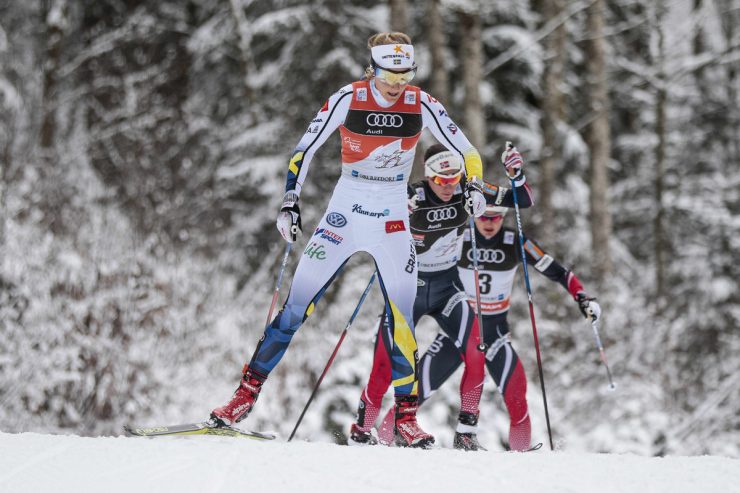
Sweden’s Stina Nilsson (r) and American Jessie Diggins (l) lead Norway’s Maiken Caspersen Falla (second from l) and Heidi Weng (second from r) down the finishing stretch of the women’s 10 k skiathlon on Tuesday at Stage 3 of the Tour de Ski in Oberstdorf, Germany. (Photo: Salomon/NordicFocus)
Sweden’s Stina Nilsson celebrates her first World Cup distance win in the women’s 10 k skiathlon on Tuesday at Stage 3 of the Tour de Ski, just ahead of American Jessie Diggins (l) in second. (Photo: Salomon/NordicFocus)
Jessie Diggins (U.S. Ski Team) celebrating second, her career best in a skiathlon, at Stage 3 of the Tour de Ski in Oberstdorf, Germany. (Photo: Salomon/NordicFocus)
The women’s 10 k skiathlon podium at Stage 3 of the Tour de Ski in Oberstdorf, Germany, with Sweden’s Stina Nilsson (c) in first, American Jessie Diggins (l) in second, and Norway’s Heidi Weng (r) in third. (Photo: Salomon/NordicFocus)
Jessie Diggins (U.S. Ski Team) loving on her Salomon boards after placing second in Tuesday’s 10 k skiathlon at Stage 3 of the Tour de Ski in Oberstdorf, Germany. (Photo: Salomon/NordicFocus)
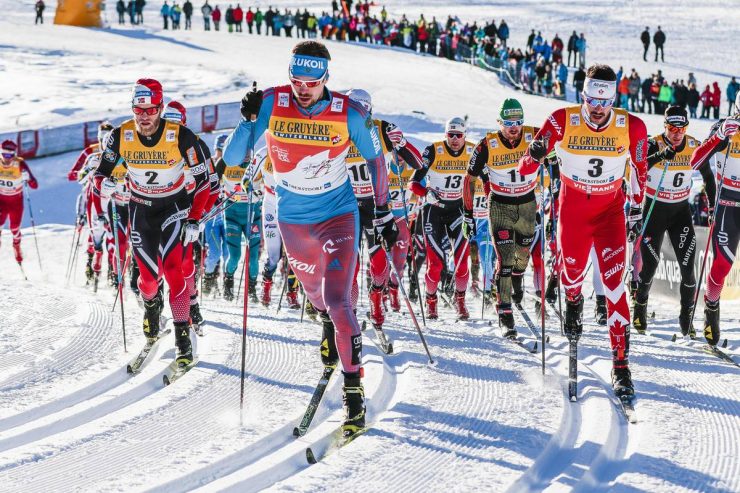
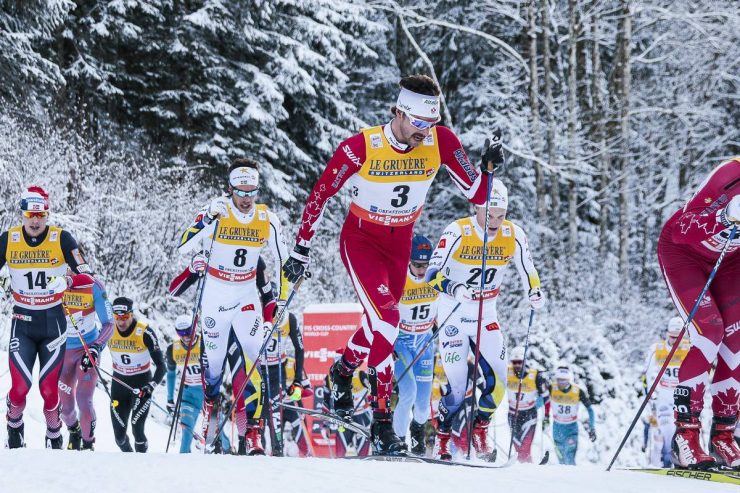
Russia’s Sergey Ustiugov (in blue) leading the men’s 20 k skiathlon with Norway’s Martin Johnsrud Sundby (l) and Canada’s Alex Harvey (r). (Photo: Salomon/NordicFocus)
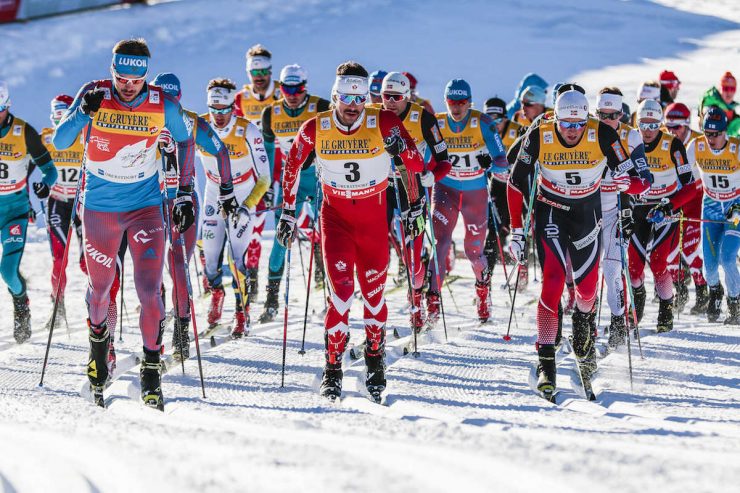
Canada’s Alex Harvey (3) alongside Russia’s Sergey Ustiugov (l) and Norway’s Emil Iversen during the men’s 20 k skiathlon at Stage 3 of the Tour de Ski in Oberstdorf, Germany. (Photo: Fischer/NordicFocus)
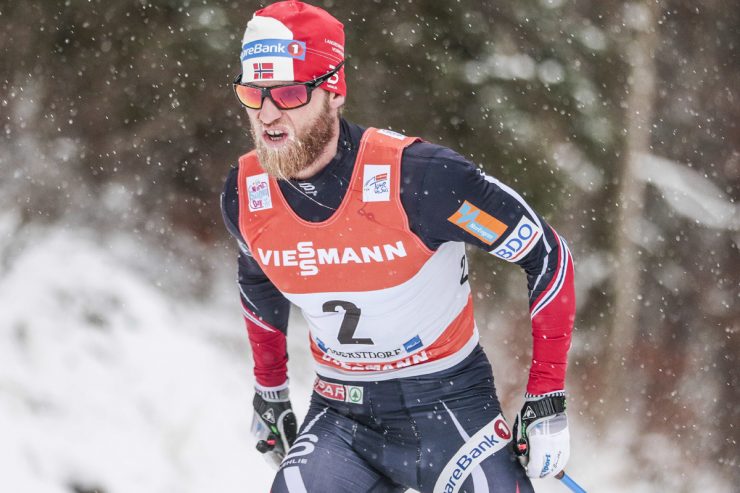
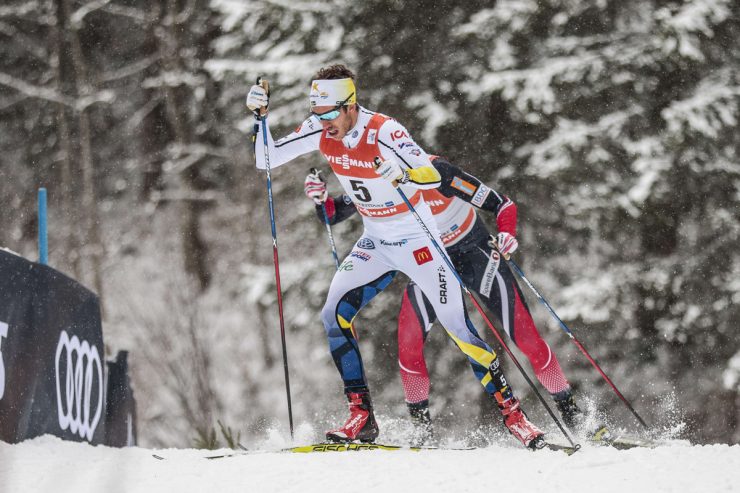
Norway’s Martin Johnsrud Sundby leads Switzerland’s Dario Cologna, Sweden’s Marcus Hellner, and Russia’s Sergey Ustiugov, respectively, during the men’s 20 k skiathlon on Tuesday at Stage 3 of the Tour de Ski in Oberstdorf, Germany. (Photo: Fischer/NordicFocus)
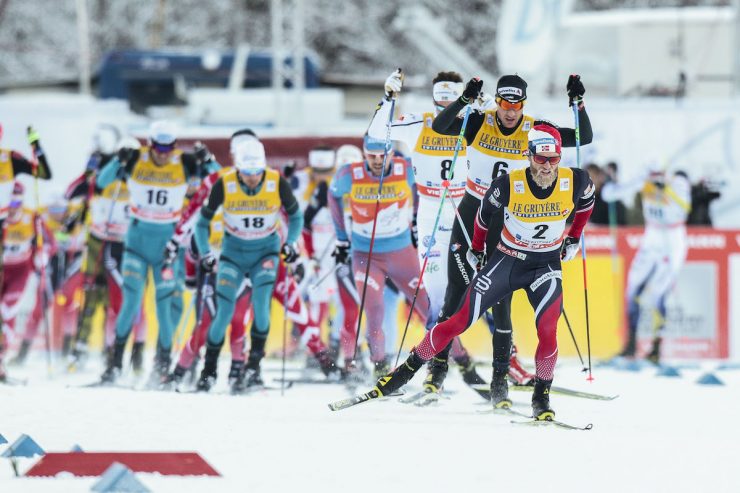
Norway’s Martin Johnsrud Sundby (2) racing at the front of the men’s 20 k skiathlon on Tuesday, with Canada’s Alex Harvey (3) among those chasing in Stage 3 of the Tour de Ski in Oberstdorf, Germany. (Photo: Fischer/NordicFocus)
Canada’s Alex Harvey racing to fourth in the men’s 20 k skiathlon on Tuesday for third overall in the Tour de Ski through Stage 3 in Oberstdorf, Germany. (Photo: Salomon/NordicFocus)
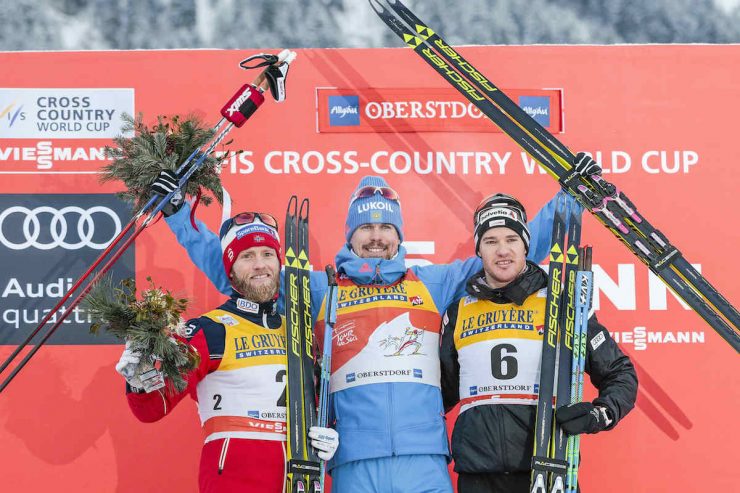
The men’s 20 k skiathlon podium at Stage 3 of the Tour de Ski, with Russian winner Sergey Ustiugov (c), Norway’s runner-up Martin Johnsrud Sundby (l), and Switzerland’s Dario Cologna (r) in third. (Photo: Fischer/NordicFocus)
On pacing with Dario Cologna: “It was in both our interests, both him and I, to try and keep the speed high in the front and stay away from the chase group and maybe gain a few seconds from the front guys.”
On the conditions: “It was pretty windy today so you had a big advantage by following along on the flats.”
On race strategy: “I knew where he would try to attack me, which was on the big hill the same way he did [in the Skiathlon]. So I was just making sure I had enough legs to try and match his speed on the big hill.”
Devon Kershaw, Canadian World Cup Team:
On the upcoming stages: “I hope to feel good like this coming into Val de Fiemme and the classic race there, that’d be really really sweet. The uphill [final climb] is my least-favorite race in all of maybe any competition I’ve ever done, that’s a bit of a survival one, but the Saturday race is definitely something I look forward to.”
Sadie Bjornsen
On winter storms: “With the super-windy conditions and the slower snow, it was challenging to be exactly where you wanted when moves were made. Those hills were challenging today, but the flats were almost more challenging because of the strong wind and slow conditions. There really wasn’t any resting out there!”
Liz Stephen, U.S. Ski Team:
On how mass starts have been frustrating lately: “It’s a nice change! We’ve done so many mass starts, but I feel like there’s so much you can get right or get wrong. It’s nice to have a race that’s engaging because there’s people around. And I like skiing around people! I just don’t enjoy it when the courses are so narrow that you can’t make passes when you want to. Those are the only times I get frustrated with mass starts. I like to ski with people, but it’s hard to want to make these moves and feel like there’s no place to go. It’s nice to have a race I could do what I wanted out there.”
On form coming around: “I don’t know about yesterday. I feel like I’m coming up little by little, skis are part of it, sometimes, for sure, but I feel like I’m racing myself into the kind of shape that I’ve been trying to get in the season. The Tour generally does that for me. I’m looking forward to more racing and more time going this hard. And I think it’s helping me get into the race shape I want to be in, and I think this Tour is playing its role.”
On looking forward to Friday’s Stage 5: “Toblach is a really tough course for me. It’s just so gradual, and a 5 k is so short that I have it on my radar to not lose a ton of time. I’m not setting out there to get a podium or anything, or a top 10 on the 5 k skate here. I’m just setting out to not lose a bunch of minutes on a 5 k where I can help it. I want to pace it really well, and ski it the best that I can, and keep my eyes on the prize in Val di Fiemme.”
On her team: “Watching Sadie skate up the hills, she’s a different Sadie than she’s ever been. Jessie is just a fireball that can’t be caught right now. I think just being a part of the momentum of this team is really a special experience for me. I feel really proud watching my team out there, for sure.”
Noah Hoffman, U.S. Ski Team:
On form at this point in the Tour: “I still feel like my energy is good, even though I didn’t show it with a great result today, and I’m looking forward to three more stages.”
On the wave start: “Starting in a wave is a great position to start, getting a fast time on the day, because there are guys skiing around you who are fast, and guys to follow. I have no complaints about it. It’s basically a small mass start at that point. It’s a really effective way to have a good race.”
Erik Bjornsen, U.S. Ski Team
On form coming into the Tour: “I tried to put in a hard training block after La Clusaz and I think it was a little to close to the Tour. I’ve been feeling a little heavy and tired which is not the way you want to start a seven-stage tour.”
On overall Tour position: “I won’t be competitive in the overall tour. I lost too much time in the skiathlon. That doesn’t mean I’m ready to drop out, though. I’m excited to go into the next couple races with an open mind and try my best to put together a strong race and hopefully take home some more World Cup distance points.”
On the wave start/conditions: “In these conditions, it tends to makes drafting more important and passing even harder. Being in the wave start has its positives and negatives. It was hard to make passes out there, but at least being in the back we had a little drafting effect.”
Russia’s Sergey Ustiugov racing to his fourth-straight victory in the fourth stage of the Tour de Ski on Wednesday during the 15 k freestyle pursuit in Oberstdorf, Germany. (Photo: Fischer/NordicFocus)
Norway’s Martin Johnsrud Sundby racing alone, en route to second in the men’s 15 k freestyle pursuit on Wednesday at Stage 4 of the Tour de Ski in Oberstdorf, Germany. (Photo: Fischer/NordicFocus)
Norway’s Martin Johnsrud Sundby en route to second in the men’s 15 k freestyle pursuit on Wednesday at Stage 4 of the Tour de Ski in Oberstdorf, Germany. (Photo: Fischer/NordicFocus)
Canada’s Alex Harvey outlasting Switzerland’s Dario Cologna in the final meters of Wednesday’s 15 k freestyle pursuit at Stage 4 of the Tour de Ski in Oberstdorf, Germany. (Photo: Salomon/NordicFocus)
Sweden’s Marcus Hellner en route to sixth in the Tour de Ski Stage 4 men’s 15 k freestyle pursuit on Wednesday in Oberstdorf, Germany. (Photo: Fischer/NordicFocus)
Graeme Killick used the Tour de Ski to hit Olympic qualification criteria. (Photo: Fischer/NordicFocus)
Canada’s Alex Harvey celebrates third on the podium of the men’s 15 k freestyle pursuit at Stage 4 of the Tour de Ski in Oberstdorf, Germany. (Photo: Salomon/NordicFocus)
Canada’s Alex Harvey in his well-known guitar stance to celebrate third in the men’s 15 k freestyle pursuit at Stage 4 of the Tour de Ski in Oberstdorf, Germany. (Photo: Salomon/NordicFocus)
Sweden’s Stina Nilsson leading Norway’s Heidi Weng during the women’s 10 k freestyle pursuit on Wednesday at Stage 4 of the Tour de Ski in Oberstdorf, Germany. (Photo: Fischer/NordicFocus)
Sweden’s Stina Nilsson leading Norway’s Heidi Weng and Ingvild Flugstad Østberg during the women’s 10 k freestyle pursuit on Wednesday at Stage 4 of the Tour de Ski in Oberstdorf, Germany. (Photo: Fischer/NordicFocus)
Sweden’s Stina Nilsson en route to her second-straight distance win in the women’s 10 k freestyle pursuit on Wednesday at Stage 4 of the Tour de Ski in Oberstdorf, Germany. (Photo: Fischer/NordicFocus)
American Sadie Bjornsen (l) racing to 12th in the women’s 10 k freestyle pursuit at Stage 4 of the Tour de Ski on Wednesday in Oberstdorf, Germany. (Photo: Fischer/NordicFocus)
American Sadie Bjornsen racing to 12th in the Tour de Ski Stage 4 women’s 10 k freestyle pursuit on Wednesday in Oberstdorf, Germany. (Photo: Fischer/NordicFocus)
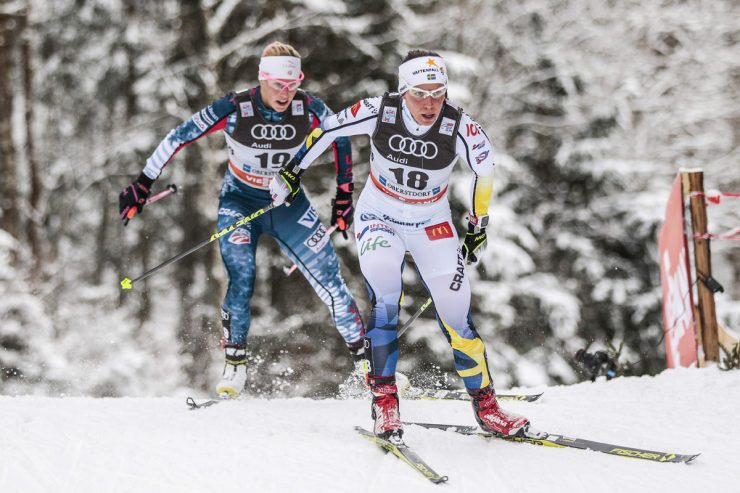
Sweden’s Charlotte Kalla leads American Kikkan Randall during the women’s 10 k freestyle pursuit at Stage 4 of the Tour de Ski in Oberstdorf, Germany. Kalla ended up 18th and Randall 10th at the finish. (Photo: Fischer/NordicFocus)
American Kikkan Randall climbed to 10th place in the standings by the end of the Tour de Ski Oberstdorf stages. (Photo: Fischer/NordicFocus)
The women’s 10 k freestyle pursuit podium at Stage 4 of the Tour de Ski on Wednesday in Oberstdorf, Germany, with Sweden’s Stina Nilsson (c) in first, Norway’s Heidi Weng (l) in second, and Norway’s Ingvild Flugstad Østberg (r) in third. (Photo: Fischer/NordicFocus)
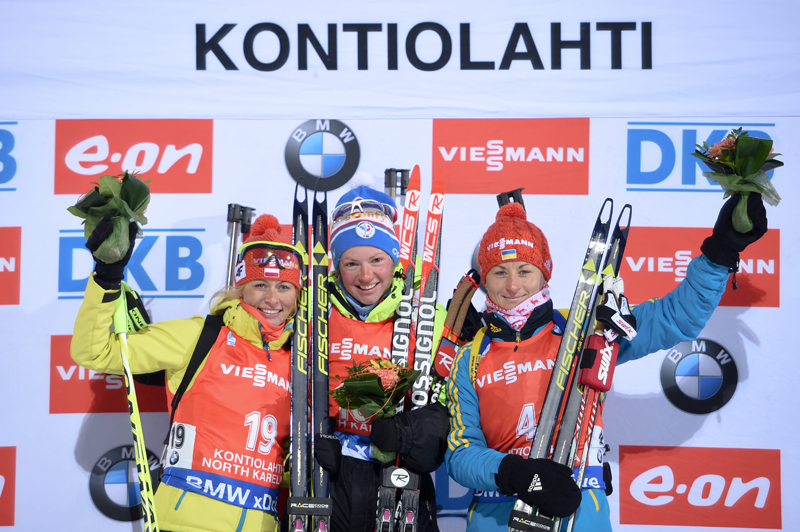
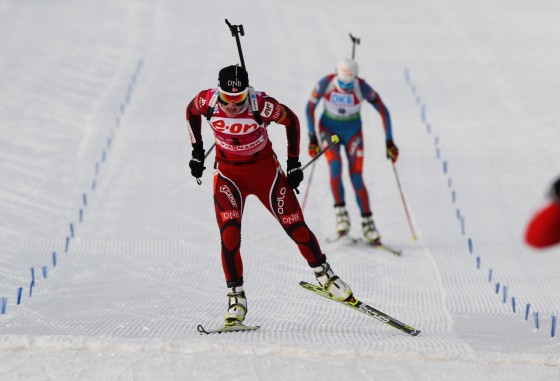
The women’s podium in Saturday’s 7.5 k sprint at the 2015 IBU World Championships in Kontiolahti, Finland. (From l-r) Weronika Nowakowska-Ziemniak of Poland (2nd), Marie Dorin Habert of France (1st), and Valj Semereko of Ukraine (3rd). (Photo: Fischer/Nordic Focus)
KONTIOLAHTI, Finland – While many men complained of the blustery Finnish weather in Saturday’s 2015 IBU World Championships sprint, they would soon become thankful for their race conditions after the start of the women’s sprint. Just half an hour before the start of the race — a 7.5-kilometer sprint — the wind strengthened and was joined heavy snow, making for blizzard-like conditions on the second day of competition in Finland.
While the weather did its best to subdue the competitors, it was Marie Dorin Habert of France who landed on top of the podium. She earned her first-ever World Championships gold in addition to a first-career victory after cleaning prone and missing one shot in standing to notch a time of 22.16.8. Behind her was Weronika Nowakowska-Ziemniak of Poland, the only competitor to clean both prone and standing. The Polish biathlete, whose silver medal is the first podium of her career, finished 9.6 seconds back. Rounding out the podium was Valj Semereko of Ukraine, who missed one in standing to cross the line 19.7 seconds behind Harbert.
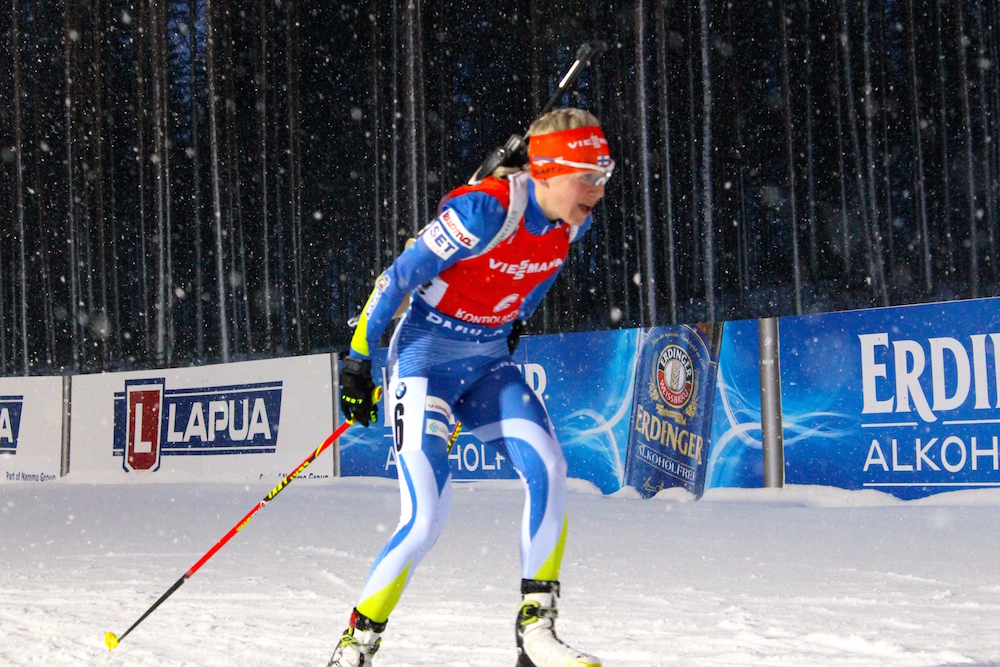
Saturday began with numerous expectations, the most popular of which was a predicted showdown between hometown-favorite Kaisa Mäkäräinen and overall IBU World Cup leader Darya Domracheva of Belarus. Mäkäräinen, who started with bib 6, battled the worst of the weather and faced a slow course that had barely been skied-in ahead of her. When she reached the first shooting stage, the 32 year old had posted the fastest course time on the first loop. But her lead would soon be gone as the Finnish skier missed three shots to the audible shock of the crowd. Mäkäräinen eventually missed two more shots in standing to finish 35th.
Kaisa Mäkäräinen of Finland was a favorite in the 7.5 k sprint but ultimately finished 35th.
Next up was Dormacheva in bib 10. The Belarusian had a promising start after missing one shot in prone and skiing the fourth-fastest course time, but eventually succumbed to the conditions in standing where she missed four of five shots to ultimately finish 25th.
With the two favorites out of contention, an opportunity was presented to the rest of the field. Semerenko, in bib 4, had already finished and posted the time to beat after notching the fastest range and shooting times of the day. Habert, in bib 16, wasn’t far behind Domracheva and chased the Belarusian. In the process, she posted the fastest cumulative time in the first lap. Her second and third laps were the second and third fastest of the day — enough to move her past Semerenko.
Meanwhile, Nowakowska-Ziemniak was three starters behind the Frenchwoman. Where she failed to match Habert in course time she overcame in range speed, earning the seventh overall ranked time on the day. After she cleaned the second round of shooting, the Pole worked to make full use of her advantage. In the end, however, it wasn’t enough to overcome Habert.
According to Habert, she knew before the race that a podium was likely but never expected to take her first individual gold in the 7.5 k sprint.
“I didn’t expect it was possible for me” she said in a press conference. “I wanted to be on the podium, but to win I think that it’s too hard for me, but it was done so it was nice.”
Habert explained that she didn’t mind the conditions, but acknowledged that her favorable view of the strong wind and blowing snow was likely due to her victory.
“It was hard conditionsn but it’s right for me so I’m happy for these hard conditions,” she said. “It was hard on the track because of the snow and shooting range because of the wind, but today it was nice for me.”
Valj Semereko of Ukraine racing to bronze in Saturday’s 7.5 k sprint at teh 2015 IBU World Championships in Kontiolahti, Finland. (Photo: Fischer/Nordic Focus)
The French biathlete gave birth in September. While she trained during her pregnancy, Habert said that she was uncertain as to how she was able to come back for such a successful season.
“Maybe I’m stronger before,” she explained. “I don’t have an answer of this progress, but I’m happy I’ve progressed.”
In second place, Nowakowska-Ziemniak said that she believed the 2015 World Championships would be her last prior to her podium. With Saturday’s silver medal, however, the Polish biathlete said that the joy of being on the podium might convince her to stay in the sport longer.
“I didn’t win, but I’m sure that I am the most happy person today here,” she said in a press conference. “It’s an amazing moment here in my career.”
Two of Nowakowska-Ziemniak’s teammates also finished in the top 10, with Krystyna Guzik in fifth and Magdalena Gwizdon in seventh. The bronze medalist explained that although the Polish women faced a hard season where results failed to live up to expectations, she was proud of her teammates for performing when it mattered.
“As a team, we’ve got many problems during this season with the shape but I’m triple happy that the whole team showed today that we are really strong and we deserve to be this high in the world,” she said. “I’m very happy for myself and for my teammates also.”
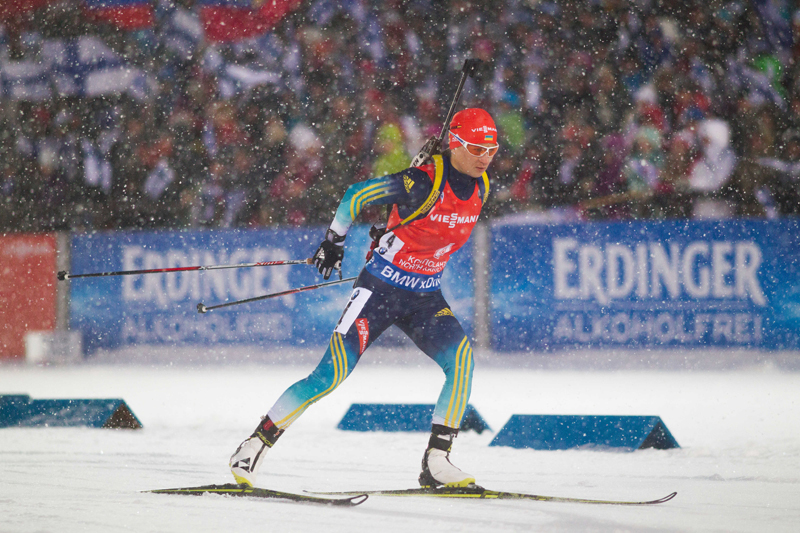
The sprint’s bronze medalist, Semerenko, has been on the podium four previous times this season and said that her main objective on Saturday was to achieve a solid position for Sunday’s pursuit.
“This is indeed a very good season for me,” Semerenko said. “I’m very happy about this race although I didn’t expect to be on the podium today, but I wanted to be close for pursuit race.”
Megan Heinicke racing to 23rd in Saturday’s 7.5 k sprint in Kontiolahti, Finland at the 2015 IBU World Championships. (Photo: Fischer/Nordic Focus)
Canada’s Heinicke Skis to 23rd; North Americans Left Wanting More
The snow and wind took a hard hit on the North Americans as they battled the elements to ski and shoot to the best of their abilities.
Canada’s Megan Heinicke was ultimately the top finisher in 23rd after missing one in prone and cleaning standing. Although she had the 78th-fastest course time, Heinicke was able to notch a top-30 result with precise shooting and the 18th-fastest range time.
“I was really happy with the shooting,” Heinicke said in a post-race interview. “Standing I was really satisfied with because I waited and I took the shots in the right moment. Usually standing shooting in the wind is something I’m not super confident about, and I feel like it’s been a weakness over the last years, so I’m really satisfied with the standing today.”
Heinicke was originally slated to start World Championships on Thursday in Canada’s mixed relay, but sat out to continue recovering from illness in Germany.
“I have been sick for 17 days out of the last 30, and I have two more days of antibiotics to go so I flew in late and didn’t do the mixed relay,” she explained.
The 26 year old said she entered Saturday’s sprint with no result-oriented goals, but instead was focused on shooting well and skiing smart. She was also aided by the earlier success of her teammate Nathan Smith, who was the first Canadian male to earn a World Championships medal after placing second in the preceding 10 k sprint.
“I was getting ready for the race and I was like, ‘I’m not gonna cry, just focus on your own race,’ ” Heinicke said. “I feel like we have a few athletes that have been flirting with the podium so it’s just really, really amazing to have someone do it.”
Behind Heinicke in 32nd was teammate Rosanna Crawford. The 26 year old, who was one of the first starters in bib 5, just ahead of Mäkäräinen, dealt with the worst of the blowing snow but managed to notch the 10th-fastest split in the first loop after cleaning prone. It was in standing that Crawford ran into trouble, ultimately missing three shots and losing precious time.
“I knew it was going to be the hardest in standing,” Crawford said in an interview. “Maybe I accepted defeat before I even got to the range.”
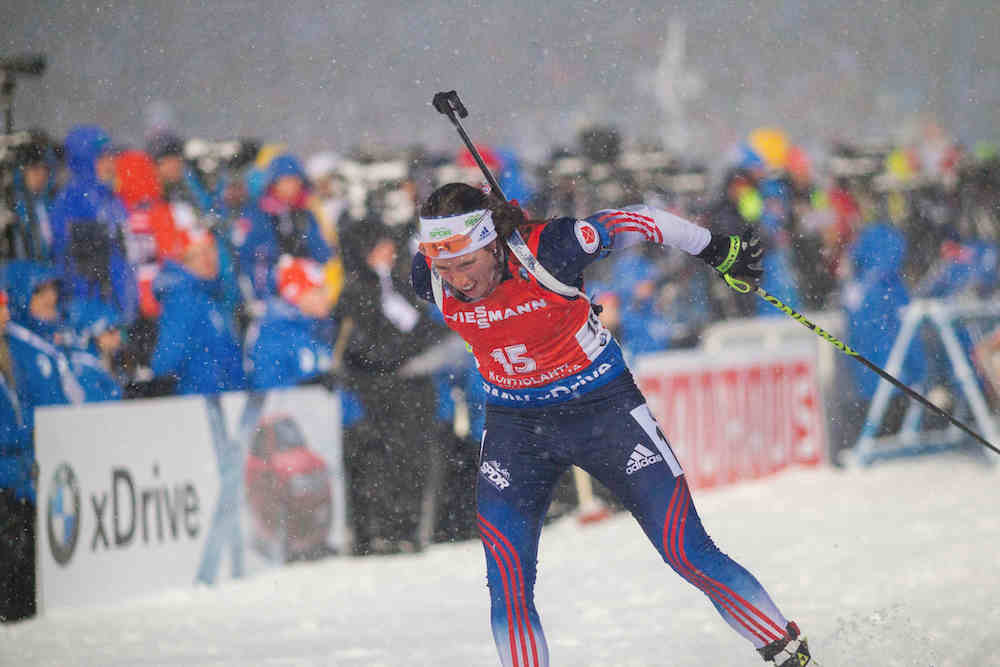
Susan Dunklee racing to 42nd in Saturday’s 7.5 k sprint at the IBU World Championships in Kontiolahti, Finland. (Photo: USBA/NordicFocus)
Once in the penalty lap, Crawford explained that the loop was incredibly slow due to the new snow and lack of skiers ahead of her.
“The penalty loop was awful because nobody was had been skiing in it,” she said. Crawford added that while she faced an “uphill battle” in her quest to qualify for the World Championships final mass start next weekend, she is looking forward to racing again.
The next North American and top U.S. biathlete in the women’s sprint was World Cup newcomer Clare Egan. A late starter, Egan said she benefitted from the break in snowfall that occurred midway through the race. However, the break in weather wasn’t the only reason for her success. According to the former University of New Hampshire skier, the steep hills on the 2.5 k course suited her skiing and aided her in qualifying for her first World Cup-level pursuit.
“[The course] has a really big climb in it and I pushed up that climb,” Egan said. “I’ve been working a lot with our coaches since we’ve been here on how to ski the flats and I think I did a pretty good job with what we’ve been working on.”
Egan missed two shots in both prone and standing, but said that compared to her previous World Cup shooting record, Saturday’s performance was an improvement. Prior to the World Championships sprint her previous best result was 73rd in a Nove Mesto sprint earlier this season.
“I wish I would have shot a little better, but honestly, I think I missed four in standing in both the other World Cup sprints I’ve done. Today I only missed two so that was an improvement and hopefully I’ll keep improving,” she explained.
Just two places behind Egan was veteran U.S. biathlete Susan Dunklee. The 29 year old has consistently placed in the top 30 and is no stranger to the top 10. In the sprint, Dunklee explained she lost confidence in the shooting range. She missed one in prone and two in standing, and marked the 101st-ranked range time of 103 finishers.
“I’m really bummed,” Dunklee said after the race. “I spent more time on the range than maybe ever. I was one shot at a time because it was so windy and so gusty. I just kind of lost my rhythm and flow and confidence, especially in the standing.”
While Dunklee acknowledged the difficult weather was a factor in her shooting, she said it was a part of racing that every competitor had to deal with. According to Dunklee, she entered the sprint with the goal of performing at the level she’s been at in the 2015 season, but hoped for something even better.
“I did want it, maybe a little bit too badly,” she said. “That’s the curse.”
First-time World Championships competitor Julia Ransom of Canada cleaned prone to rank 13th after the first shooting but fell to 52nd position after missing three in standing. She said she was very pleased with her result, which was the best of her World Cup career.
“I’m pumped. It’s the first pursuit I’ve made on World Cup and it’s been a really big jump from IBU Cup to World Cup so I’m happy,” Ransom said.
Ransom is no stranger to Kontiolahti. In 2012, she earned a silver medal in the Junior World Championships pursuit. Although this year is her first senior World Championships, Ransom said that the experience hasn’t been too different from the World Cups she’s attended.
“It’s feeling relatively the same. Nothing too exciting, but racing at night is fun, different. We’re going to bed at midnight, waking up at 9:30 and 10,” she said. “It’s the same faces just different names.”
Finishing 61st, U.S. biathlete Hannah Dreissigacker was one spot away from qualifying for Sunday’s 10 k pursuit. Dreissigacker said that she was interested to review her shooting with her coaches, as she was surprised the wind affected her so negatively.
“It was windy so I’m sure that affected me. Normally in prone, I’m not intimidated by the wind. I take clicks and I’m confident,” she explained.
Teammate Annelies Cook finished 68th and said her skiing felt much better than it had all season. At the same time, she explained that she was disappointed in her shooting. “I felt good skiing, but I let myself down in my shooting,” she said. “I definitely struggled a lot in standing with the wind, and I made a careless mistake in prone, accidentally pulling the trigger when I didn’t mean to.”
Canadian Audrey Vaillancourt ended the day in 77th and said that while the day was bad for her, she was read to move on to the next race.
“When I came into prone it was like a tornado. Prone is not that bad normally. I don’t think I clicked enough. It was very, very hard today,” she said.
Tora Berger competing in Oslo last winter. Photo: NordicFocus/Fischer.
Over the course of a four-stage race, it’s not common for biathletes to hit all 20 targets.
That’s four trips to the range, four individual bouts where something could go wrong and the wind could come up.
Four times when the athlete hopes that their legs don’t get shaky, their arms aren’t tired, their brains aren’t too deprived of oxygen to shoot straight.
Four instances of mind of matter, when they have to block out the crowds and the other competitors.
Usually, a couple athletes do clean all their targets – maybe two, maybe three. In the top ten, racers might have one, two, or may three penalties, skiing an extra hundred and fifty meters for each missed shot.
But to have a winner with four penalties? It has happened, for sure, but not so often. And to have the top ten full of skiers with six, seven, or even nine penalties? Now that is something else.
In today’s 10 k World Cup pursuit in Oslo, the wind played tricks on the field and nobody cleaned. After just a single shooting stage, tenth place was already almost two minutes behind the leader, and much of the field had racked up in one go as many missed shots as they usually do in an entire race.
A few competitors, so exasperated after missing three or four shots in each of the first two stages, simply dropped out.
When asked about the race, third-place finisher Anastasiya Kuzmina of Slovakia was completely honest.
“I don’t know about fun,” she said. “I think it was very hard work for everybody.”
“It was like a party in the penalty lap,” American Annelies Cook told FasterSkier.
There seemed to be two strategies for dealing with the wind. One was to try to shoot quickly, get it over with, and do the penalty loops if necessary. That’s the route that Tora Berger of Norway took, and it payed off – she started with just a 12-second lead after winning the sprint, but extended it to 31 seconds by the finish despite her four penalties, and only gave up the lead once.
Marie Dorin Habert of France competing at World Championships in Nove Mesto, Czech Republic.
Berger has had perfect four-stage races earlier this season, but today was not destined to be one of them.
“There was a lot of wind today, and it was not so easy to shoot,” she said at the post-race press conference, understating things as usual. “I tried to do the best. On the first shooting it was not so much wind, but then on the last two it was really difficult.”
Berger had the fastest shooting time in the field, which, she admitted, cost her.
“On the last shots, I think it was too fast,” she said, before laughing: “I thought I had control, but I didn’t!”
The other strategy was to wait, patiently, for the wind to offer up a split-second of reprieve when it was possible to get a clean shot off. The reward might be fewer penalty loops; the risk was that even after waiting, sometimes the targets wouldn’t go down.
But for Marie Dorin Habert of France, they did. She collected just two penalties over the course of the race, and finished 31 seconds back from Berger to tie the best result of her career. She spent 35 more seconds on the range, more than her finishing deficit to Berger, but clearly didn’t regret it – she savored the moment as she crossed the finish line, waving big to the crowd for a full hundred meters and grinning as if she had won outright.
“I think I am a very, very, very lucky woman today, and I am very happy,” Dorin Habert said in the press conference. “I am always just around the podium so this is truly a good performance for me…. I am not a star, so it feels very nice to be here.”
Dorin Habert had at one point led Berger, leaving the range for the third time when she had accumulated just one penalty to Berger’s three. But the Norwegian didn’t waste time in catching her on the tracks.
Both had a single penalty in the final stage, and Dorin Habert embarked on her final loop just seven seconds behind the Norwegian. She was safe in second, but couldn’t touch first, bogging down and bleeding time to Berger.
Behind her, Kuzmina was making a steady comeback after dropping from third, her start position, to fourth after the first stage. She moved quickly back into third, but could never edge much closer to the leaders – until the end, when Dorin Habert slowed down.
“The snow was softer today, and also the wind was very strong,” Kuzmina said. “Sometimes it stopped me. I’m tall, and so it wasn’t easy to ski fast.”
Krystyna Palka of Poland tied Dorin Habert’s good shooting, and moved from 16th place after the sprint into fourth – over a minute and a half behind Berger. Another 45 seconds later, Darya Domracheva crossed the line in fifth. She had started in second position, but picked up nine penalties over the course of the race. That meant skiing 1350 meters in penalty loops, but she still had the fastest course time.
But the day clearly belonged to Berger, who took her tenth win of the season, the 26th of her career, and her 50th podium. In the past few weeks she has passed Norwegian great Liv Grete Poirée, now a commentator for NRK television, in the record books.
“There are almost no words to describe this girl,” Poirée said after today’s race.
* * *
North Americans struggled no less on the range than anyone else. Zina Kocher of Canada led the way, moving from 42nd up to 28th despite six penalties. Teammate Megan Heinicke had seven, and jumped from 51st to 42nd.
Cook, the lone American qualified from the sprint, racked up nine penalties, but still managed to climb from 46th to 38th.
“I was pretty surprised to make points with that many penalties, but I guess I caught just enough girls on the ski tracks to make it!” she wrote in an e-mail to FasterSkier.
The toughest thing about the wind, Cook said, was that it wasn’t consistent – it wasn’t even always coming from the same direction. That meant that making corrections quickly became a nightmare.
“In the first prone it was blowing really hard one way and I took clicks like we talked about in zeroing,” she explained. “Then the wind changed and I started to get confused about what to do, and I took clicks again and kept on missing… and what was worse, I had no idea where I was for the next prone because my shots had no pattern, so I just kind of had to make a guess and stick with it.”
The wind wasn’t only blowing her bullets around: Cook described her body “getting blown back and forth” in standing. On the broadcast, competitors’ hair, clothes, and bibs could be seen dancing in the wind, and the long-range cameras couldn’t hold steady on some of their shots.
With the field spreading out so much, Cook knew she was in danger of getting lapped, which would mean getting pulled from the race. She was especially worried because the sprint was, she said, her worst race of the year for skiing, and for most of her warm-up she still felt terrible. That wouldn’t have helped if she had needed to outsprint the leader.
“Turns out, I felt really good in the race, had awesome skis and had a really good ski day which was necessary because Tora Berger was coming up in my fourth lap and I knew I had to make it into the shooting range before she passed me!” Cook wrote. “I was skiing around the penalty loop and I could hear her shooting and the fans cheering when she hit her targets. It was like %($$)(% and then I heard she had a miss, so I thought it might be my chance to make it.”
Knock, knock, knock! On my first morning in Oberhof, Germany, I’m jolted out of sleep by someone rapping on my door. I crawl out of bed and poke my head out into the hallway. “Good morning sleepy head!” my teammates Sara and Annelies great me with a laugh, “you really ought to see yourself in the mirror- you’ve got a handprint on your face.” I must have been using my hand as a pillow. I grunt and glance at my watch: 9:25. I slept for almost 11 hours and I vaguely remember deciding to sleep through my alarm. Oh, the joys of jetlag!
Following breakfast, I venture into the grey world outside for an easy jog and I check out the race venue. The towering spruce trees along the road rock dangerously in the wind. A thin strip of plastic fencing tape is blowing so hard that it sounds like the clatter from a rolling luggage bag. Oberhof has a reputation for crappy weather: wind, rain, and fog. In the race stadium, I run into Max Cobb, executive director of US Biathlon and an IBU official for this week’s competitions. “Is it always this windy here?” I ask him. Max informs me that the Oberhof World Cup usually has at least one day like this.
On the day before the first event, the organizers worked nonstop to truck in enough snow.
The wind hasn’t abated by the afternoon when we arrive at the wax cabins and prepare for official training. The wax room doors are accidents waiting to happen. Open them even the slightest bit and the wind will catch them, swing them wide open, and pin them against the wall. Sara struggles to wrestle our door closed; it looks like a more arduous workout than skiing but I’m laughing so hard that I can’t assist her. I’m very glad our upstairs wax cabin is on the end of the building so we don’t have to risk walking along the narrow balcony front of everybody else’s doors.
Predictably, today’s shooting is frustrating. A teammate sums it up saying “If you can hit 3 targets [per stage], you are doing well.” Standing is especially difficult- my whole body sways in the wind. In order to hit anything, I have to wait out the worst of the gusts and be ready to shoot when there is a split second of calm.
The skiing is slightly better, although the snow is sparse. The organizers have only a 1.5 km loop open for the first couple days of training and are preserving the rest of the course for the races. Before the second afternoon of training, our high performance director, Bernd Eisenbichler, asks the team: “Who hasn’t skied here before? Susan? Annelies?” The closed off part of the course includes the strenuous “Bergsteig” climb and a challenging downhill that will be featured in the race. Last week, the world’s best cross country skiers raced down it during the Tour de Ski and there were a handful of epic crashes. “Don’t worry,” Bernd tells us with a grin, “you only go about 60 km/hr on the downhill.” He’s exaggerating slightly- Tour de Ski competitors were only clocked going 58 km/hr. We are a little worried.
Leif, a member of our men’s team chimes in: “Yeah, it’s not like it is twisty and technical or anything.”
“Shut up!” cries Annelies, and gives Leif a shove, but she’s smiling. On the day before the sprint when we finally get a chance to preview the course, I find the actual downhill anticlimactic after hearing so much about it.
A row of coaches at the scopes during offical training. In the background you can see part of the stands, which wrap around the hill like an amphitheatre.
As soon as we arrived in town, Sara started talking up Oberhof’s opening ceremonies. Last year, she was the only US athlete who bothered to participate, and she thought it was really cool. Usually these events are long and drawn out, with lots of speakers (translated into a couple different languages) and hours of standing in the cold wind. However, this one’s designed to be athlete friendly. Sara, Annelies, and I decide to go as a group this year. We arrive in the indoor waiting area at our assigned time and are immediately given an American flag and instructed to line up at the doorway behind the Ukrainian team. Two minutes later, it is our turn to march outside onto a stage to the sound of some unmemorable soundtrack. Annelies leads with the flag. We smile and wave at the crowded park below. The announcer turns to interview us. “How do you find the weather here?” he asks, and thrusts the microphone under my nose. Oh, you mean the pounding winds, the walls of mist that blast against our faces, the slushy saturated1.5 km loop of snow? “We’re loving it!” I declare. The announcer turns to Sara: “Are you planning to use your wax skis or your water skis?” I’ve never heard of snow skis referred to as wax skis before. “We hope we’ll be using our wax skis,” she responds. The announcer thanks us, and then we are waving to the crowd one last time and parading off stage. Barely five minutes have passed since our arrival in the waiting area. Short and sweet- the way opening ceremonies for these events should be.
Upon exiting the back of the building, we are mobbed by a group of 20 or so autograph seekers. Oberhof is one of the most popular World Cups in terms of fan attendance. On a Wednesday night race, in the worst weather imaginable, 15,000-20,000 fans will show up to watch. Thousands more appear for weekend races. The small group around us right now wields sharpies, event posters, and printed out athlete photos. They ask for our autograph cards. I hadn’t needed them until this year. Right about now, I’m feeling thankful that Annelies and I made a last minute decision to design some cards for ourselves. We each printed out about 100 the day before we flew to Sweden back in November. Fans in Europe expect you to have them on hand, and I like having their support. Let’s face it, American Nordic skiers can use all the support we can get. The tricky part is that if you give out one card, or sign something for one person, the entire group crowds around you. Luckily, there is a security guard in a bright yellow coat ready to intervene if necessary. At this rate, I am going to run out of cards before I even race this week. As we leave the crowd, Sara gives me a piece of advice: “If I were you, I would make sure to save some cards for Ruhpolding.”
Another section of the stands. 3 hours until the men's relay, and fans are already claiming their places.
On my second morning in Oberhof, I wake up at a reasonable early hour. On my way to breakfast, I run into one of our coaches, Per and he looks cheery. “Come here Susan,” he calls me over to the window. “I have to show you something. Look!” We peer through the blinds and he points to the sky. I can see some clear sky among scattered clouds. It’s threatening to snow. It’s even threatening to sunshine. It’s beautiful weather, for Oberhof.
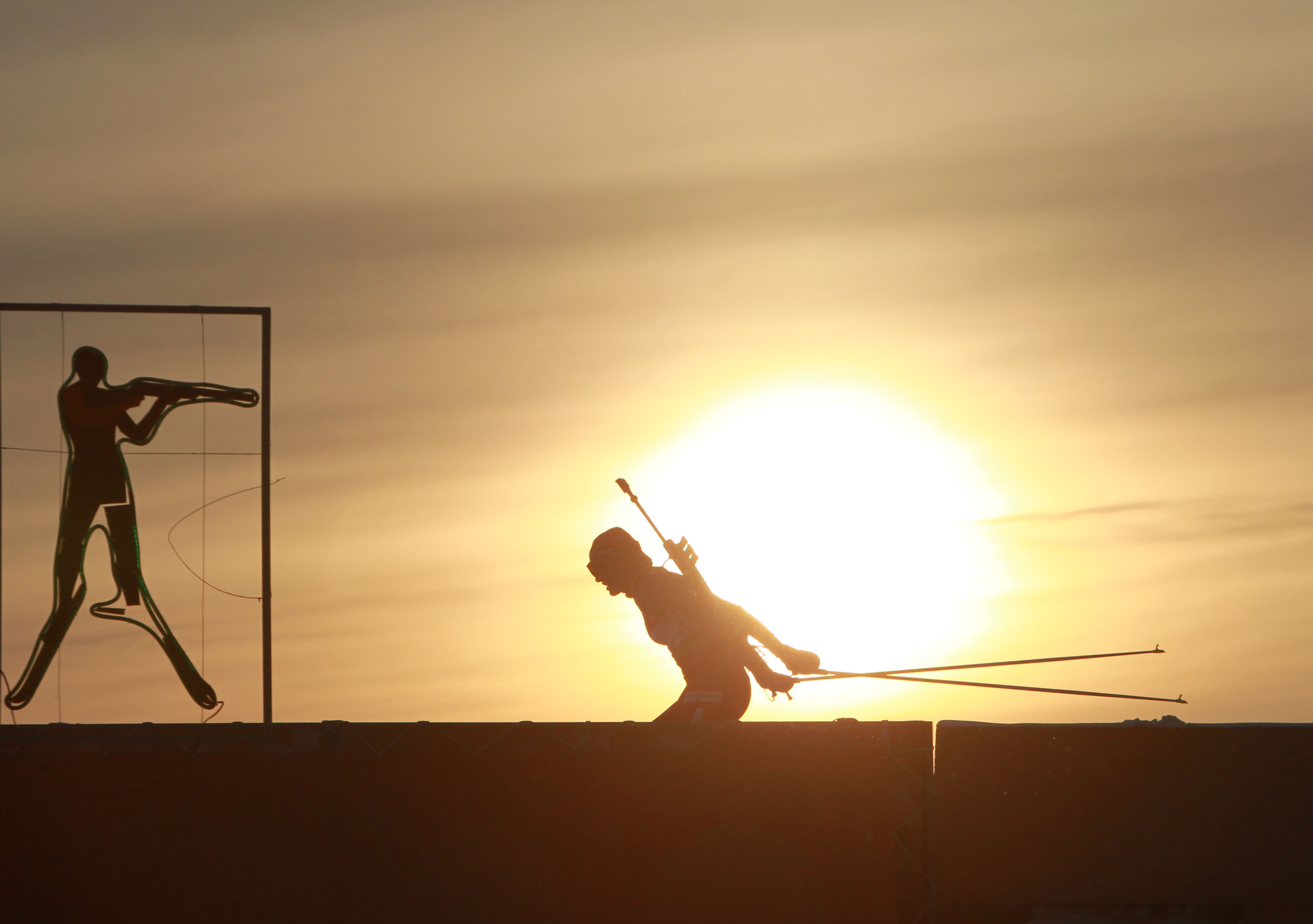
Gabriela Soukalova of the Czech Republic races through the Siberian sunset. Photo: nordicfocus.com courtesy of USBA.
Part of every biathlete’s job is to manage conditions on the range, which includes making adjustments for the wind.
But there are days when the wind makes that all but impossible and the weather seems to be laughing in the face of the world’s best shooters. Wednesday in Khanty-Mansiysk, Russia, was just such a day, with only a single woman in the World Championships field shooting clean, and most shooting quite far from it.
“Today was one of those luck of the draw type races because of strong gusts of wind that were sometimes left, sometimes right and sometimes from behind,” said Canadian biathlete Zina Kocher.
Even the best women struggled: overall World Cup leader Kaisa Makarainen of Finland missed seven shots and Ann Kristin Flatland of Norway, who won a World Cup earlier this season, ten, or half of her opportunities.
And in an individual race, each missed shot is penalized with a minute of added time, so that’s not such great news. Makarainen finished 28th and Flatland 82nd.
Ekholm en route to a huge margin of victory. Photo: nordicfocus.com courtesy of USBA.
Helena Ekholm of Sweden, on the other hand, was that one lucky woman who didn’t let the wind boss her around. Besides being the best shooter on the day, she had the fifth-fastest ski time, and as a result won the 15 k race by a whopping two minutes and fifteen seconds.
Going into today’s race, Ekholm was cautious about the conditions, which had included a violent snowstorm earlier in the morning.
“It made me a little bit nervous, because I thought today was going to be hard to shoot and be a little bit like a lottery,” she said in a press conference. “I tried to focus on the competition and made my best.”
Luckily, Ekholm has plenty of experience focusing on the competition. It was the third World Championships gold medal of her career, and especially meaningful after a disappointing Olympics last season.
But even for a woman who is clearly one of the world’s best, today’s performance was impressive.
“It was a perfect race,” Swedish head coach Wolfgang Pichler told the Expressen newspaper. “She was so focused on the shooting range. She waited and shot well. It was so difficult to shoot today. Four zeros are great.”
Behind her, the rest of the women fought it out to fill the podium. But they were fighting the wind more than each other: tenth place was two and a half minutes behind second place, with times spreading due both to the unusual number of penalties and the longer shooting times as the women tried to wait out the wind. (Ekholm told Expressen that she had “bone pain” from standing in the shooting position for so long, waiting for the wind to give her a decent shot.)
Tina Bachman of Germany finished second; it was her first World Championships race at the senior level, and she received a medal. Vita Semerenko of Ukraine rounded out the podium in third.
Studebaker. Photo: nordicfocus.com courtesy of USBA.
Sara Studebaker used patience to achieve the best U.S. result of the Championships, finishing 17th with two penalties.
“From the beginning I knew shooting well could really give you an advantage, as is true in any individual because of the time penalty, but especially today because the conditions were so tricky,” she told FasterSkier. “I spent quite a bit of time in the range waiting for the wind gusts to die down, and in the end my patience paid off.”
In her first shooting stage, she spent 48 seconds – an eternity in biathlon – hitting all five targets. But while that was 22 more seconds than the fastest shooter, it was still a good move, since she avoided the minute of penalty time each missed shot would have cost her. In the next stage, she took 51 seconds to shoot, but still missed a shot.
Studebaker’s skiing helped her too; she had the 22nd-fastest finishing loop.
“Skiing was okay for me, definitely not my best though,” she said. “It took me a few loops to get into a good rhythm and find my pace, but once I did I was able to have a solid last couple loops. There were a lot of girls out there, and it was good for me to be able to try and stick with some of the better ones. I haven’t yet had a 15 k where I’ve felt my pacing and skiing were really good, but I’m working on it and I think each race I do I learn a little more about how I can improve.”
The other Americans were not so lucky; Laura Spector missed 6 shots to finish 44th, while Annelies Cook and Haley Johnson had seven and eight penalties to finish four seconds apart in 67th and 68th. While today’s results were in part simply bad luck, as winds were gustier at some times than others, it was emblematic of a less-than-satisfying week for the U.S. women.
“I think overall the women haven’t been too psyched with our World Championships performance, but we are all really looking forward to the relay,” Studebaker said. “We have proven our strength already this year and the coaches and athletes all see that… It’s very exciting for all of us and I know the coaches are pleased with the season, even if this week hasn’t exactly been representative for us!”
For herself, though, Studebaker said that it “definitely felt good” to hit the top twenty after disappointing results earlier in the series.
Kocher, the only Canadian women competing in Khanty-Mansiysk, “did what [she] could” and finished 43rd with seven penalties.
“I Focused on skiing as fast as I could and when shooting, not stopping for a tea party and wasting time but just going for it with whatever I was given,” she told FasterSkier.
“I had a good ski time especially on my last lap, but seven misses is too many even on a day like today. Obviously I felt very disappointed with the result, but to be honest when I looked at the scoreboard I was relieved to see that even the previous day’s medalists had six to ten misses too… that’s biathlon, it’s not straightforward day after day. It’s a wonderful sport but it can definitely tie you in a knot of frustration with its complexity.”
Like the U.S. women, Kocher has been disappointed with her results at World Championships so far. But she was able to see a silver lining in the fact that her skiing has improved from earlier in the season. On Wednesday, she had the 22nd-fastest ski time in the field.
“I changed a lot of my original training plan since Christmas in order try to pick up my physical ski speed by March and this was successful,” she said. “My skiing has been much faster these races than any other time this season and I feel the best I’ve felt all season. So this is a success. That’s what I was aiming for, a peak! I haven’t been able to say I’ve actually peaked in a long time.”
Women’s racing continues on Saturday with a mass start, although no North American women qualified to compete in it. The U.S. team will contest the relay on Sunday.