From the FasterSkier archive — posts syndicated from athletes’ and coaches’ own blogs between 2004 and 2012, kept online as published. Current coverage is at fasterskier.com.
Johannes Hoesflot Klaebo (NOR), Emil Iversen (NOR), and Martin Loewstroem Nyenget (NOR), (l-r) during the final kilometers of the Olympic 50 k classic. (Photo: Vanzetta/NordicFocus)
A review of a recently published paper from Norway, “Long-term development culture for sustainable Olympic success: Lessons learned from Norwegian cross-country skiing” by Jacob Walther and Øyvind Sandbakk, is worth the time.
We’ve all heard enough about Norway. But this one simply cuts through some misconceptions, and it is worth the time to review. It strips away the mythology and gets back to what actually drives development and ultimately elite performance. Norway isn’t operating with better information. They’re more disciplined about applying what most programs already understand, and more consistent about what they refuse to do.
The paper addresses this immediately and directly. There is no “Norwegian method.” No magic interval session. No secret intensity zone you can implement and expect results. What they have is a system. And more importantly, a system built around their culture.
We tend to frame their success in physiological and technical terms. It’s not physiology, technique, health management, or mental health; they are all part of it, but they don’t explain the system. Most programs know early specialization is risky and inaccurate. Most coaches understand long-term development and the need to build training slowly and in phases based on training age. The difference is that Norway holds the line on it.
The elements are not new. Delay early selection. Encourage multi-sport participation, and integrate sport science into daily coaching. Invest in coach education. Treat athlete health as part of development, not something that gets in the way of it. The result isn’t just better elite athletes. It’s broader mass participation, more informed training, and a deeper pool of athletes and families engaged in the sport.
Norway’s Johannes Høsflot Klæbo won his first World Cup at 20, in the men’s 1.6 k freestyle sprint in Otepää, Estonia, in 2017. (Photo: Fischer/NordicFocus)
The paper uses Johannes Høstflot Klæbo as a case study. At 15, he placed 101st at junior nationals. Years later, he’s the most decorated Winter Olympian of all time. That’s a compelling outcome. But the value isn’t the result. It’s what the system expects and allows.
In most programs, that athlete gets filtered out early. In Norway, they stay in longer. That’s the point. This isn’t about identifying talent earlier and directing resources and opportunities at those. It’s about not eliminating talent identification too soon. That requires patience, cooperation among club programs, trust in the system, and a willingness to ignore short-term validation.
That’s where the Norwegian model sets itself apart. The turning point came in the lead-up to the 1994 Winter Olympics. Norway didn’t discover new physiology or invent new training methods. They organized themselves differently. They centralized expertise, embedded sport science into coaching, collected experience and training data across all Olympic Sports, and aligned the ski federation from the national team down to the club level.
Olympiatoppen sits at the center, not as a lab removed from the field, but as part of the training process. It doesn’t drive the system, but it informs and shapes it. That balance matters. Norway didn’t just add sports scientists. They used sports science to improve coaching. At higher levels, many coaches are trained in exercise physiology. That reduces misinterpretation and creates consistency over time.
Long-term development in Norway isn’t a slogan. It is intentionally implemented. It follows physiology. Peak endurance performance arrives in the late 20s, after years of consistent training. They don’t challenge that reality; they built their whole system around that reality.
You see that athletes stay in the sport longer, as evidenced by high-level FIS races in Norway. Hundreds of skiers are over 25-30 years old. They build general capacity before narrowing focus. Skill development has time and the room to engrain. Training isn’t rushed. Volume and intensity progress over years, not seasons. Junior results are not used as a sorting mechanism.
And this is where most systems break down. They say development matters, so select early and train accordingly. In Norway, youth championships are not selection events. They are part of the development process. The culture reinforces it. Clubs and schools coordinate so athletes can participate in multiple sports. Athletes regularly move across multiple ski disciplines. The recruitment base stays broad, and the system stays resilient.
Norway hasn’t eliminated selection; they’ve delayed it and minimized its consequences. That distinction matters. What gets labeled as “talent” at 14–16 is often early maturation, better support, or more exposure, not long-term potential. Norway avoids that trap by not falling into it. While many other systems double down on it.
Another principle sits underneath all of this: athlete health, physical and mental, comes before results. Training is managed for long-term progression. Training loads increase gradually over the years. High intensity is controlled, and low intensity dominates most of the training. The goal is adaptation over time, not accumulation in the short term.
The paper also points to emerging pressure on this model. Rising costs, shifting societal trends, increasing early specialization, and changes in team structures all push against it. These aren’t theoretical concerns. There are real pressures that can erode the system if they’re not managed.
Harald Oestberg Amundsen (NOR), Johannes Hoesflot Klaebo (NOR), and Einar Hedegart (NOR), (l-r) share the 20 k Freestyle Mass Start podium at the final World Cup in Lake Placid (USA) to end the 2025/2026 season. (Photo: Modica/NordicFocus)
So what carries over?
We can’t copy Norway. That misses the point. The lesson is alignment. Align incentives with long-term outcomes. Integrate sports science into coaching to improve the coach’s work. Build systems that allow athletes time to develop. And hold the line when short-term pressure starts to dictate decisions.
Many countries can point to a standout athlete. But if success depends on outliers, unusual resilience, unusual support, unusual talent, you don’t have a system. You have anecdotes. Norway produces depth, that is, the expectation and the standard.
There’s no secret session here. What they’ve built is a system that connects coaching and science, commits to long-term development, creates space for late progression, and maintains consistency over time. Not what they’re doing this week or next week, but what the athletes are doing ten years from now.
Help Support Our Olympic Coverage!
If you value the thoughtful work and access FasterSkier provides, please consider becoming a Voluntary Subscriber. Your support directly fuels our work to cover the people, places, and moments that make our sport special.
The highs were high and the lows were low in the Olympic team sprint in Italy, with the Ogden-Schumacher men’s team claiming silver and the Diggins-Kern women’s pair finishing out of the medals. Devon and Nat break the whole thing down.
We’ll be back after Saturday’s men’s 50 k. Reach us at devon[at]fasterskier.com and nat[at]fasterskier.com. We’re really grateful for all the support during the Olympics — thanks for notes and encouragement.
A reminder: This is a homegrown podcast done by two guys working long hours and late nights. We’re also paying real money to be here in Italy. If you can, support the show and FasterSkier’s ongoing coverage with a voluntary membership. We’re also offering a bonus during the Olympics: a WhatsApp group with notes on Nat’s experiences in Italy, the food he’s eating, interview transcripts and more.
Send nat[at]northernjournal[dot]com a confirmation of your voluntary membership and the number he should use for WhatsApp and we’ll get you signed up. You can also Venmo him directly at @nat-herz if a membership isn’t for you. We’re suggesting a minimum of $10, but we also won’t turn anyone away who wants to join because of an inability to pay.
Help Support Our Olympic Coverage!
FasterSkier will have our own Nat Herz on the ground at the Olympics, which, to be honest, is a very big financial lift for us. If you value the thoughtful work and access FasterSkier provides at championships like this one, please consider becoming a Voluntary Subscriber. Your support directly fuels the work we do to cover the people, places, and moments that make our sport special.
This article was made possible through the generous support of our voluntary subscribers who have helped us put our Nat Herz on the ground reporting at the Olympics. If you value coverage like this, please support FasterSkier with a voluntary subscription.
Jonna Sundling (SWE) follows Jessie Diggins (USA) during the Olympic Women’s Team Sprint in Tesero, Italy. (Photo: Vanzetta/NordicFocus)
PREDAZZO, ITALY — Eight years ago, on a different continent, the words “Here Comes Diggins!” by Chad Salmela vaulted American cross-country skiing into a new era. On Wednesday in Val di Fiemme, the event that changed everything for the United States returned to the Olympic stage.
The Women’s Freestyle Team Sprint has long been one of the Americans’ signature races. In the PyeongChang 2018 Winter Olympics, Kikkan Randall and Jessie Diggins delivered the nation’s first Olympic gold medal in cross-country skiing. Last March in Trondheim, Diggins and Julia Kern claimed World Championship silver.
On Wednesday, Diggins started the race in the first leg, handing off to Kern for the anchor leg, as they had in their previous medal run. They hoped for one more shared championship moment.
It was not to be. The Americans finished fifth, in a race that required not just fitness but flawless execution. Sweden’s Jonna Sundling and Maja Dahlqvist took gold. Switzerland’s Nadja Kaelin and Nadine Faehndrich secured silver. Germany’s Laura Gimmler and Coletta Rydzek won bronze after a late-race crash by Finland opened the door in the final turn.
For the Americans, the margin was not dramatic. But close, at this level, does not bring home a medal.
Jessie Diggins (USA) and Jonna Sundling (SWE), (l-r) come through the stadium during the Olympic Women’s Team Sprint. (Photo: Vanzetta/NordicFocus)
“Honestly, left it all out there.”
The Team Sprint is one of the sport’s most punishing formats. Two skiers qualify individually; their times are combined to determine which 15 nations reach the final. In that final, the athletes alternate laps — three each — on a course that offers no reprieve.
Often, one skier brings distance strength, and the other sprint speed. For the United States, Diggins and Kern blur those categories. Both are capable of driving pace. Both can finish.
From the gun, Diggins did what she has done throughout her career: she went to the front.
She and Sundling stretched the field immediately, driving into the Zorzi Climb, the race’s defining ascent. The early order — Sweden, the United States, Norway, Canada — hinted at the nations prepared to dictate terms.
Jonna Sundling (SWE) stretches her lead. (Photo: Vanzetta/NordicFocus)
When Sundling surged later in the race, Diggins expected it.
“I knew she was probably going to do that,” Diggins said afterward. “And I was like, just do the best that you can do. You know, like, you can’t control anything except your effort and your heart. And I was like, skiing out of my body, and I just did everything that I could, and I’m proud of that.”
That theme — control what you can — carried through her reflections.
“Honestly, I almost passed out like four different times,” she said. Then, clarifying: “No, from going that hard, no regrets. Honestly, left it all out there. I feel like we did everything we could, and that is the only thing you can control at the end of the day.”
Julia Kern (USA) and Jessie Diggins (USA), (l-r) gather in the finish area after the race, Diggins racing in the US team’s relay socks for the final time. (Photo: Barbieri/NordicFocus)
One final lap with ‘Relay Socks’
By the last exchange, Sweden had carved out daylight. Switzerland began clawing into Finland’s hold on silver. Behind them, Germany, Norway, the United States, and Finland battled for bronze.
On the final descent, Finland’s anchor, Jasmin Kahara, lost her balance in the sweeping right-hand turn and fell, sliding out on her stomach. Germany and Norway slipped past in their tucks. Kern, just meters behind, fought to the line, but the podium had narrowed to two.
Coletta Rydzek (GER) brings home the bronze medal for Germany with Norway’s Julie Bjervig Drivenes just off camera. (Photo: Vanzetta/NordicFocus)
As they drove for the line side by side, aerodynamically no-pole skating with everything they had, it was clear this was going to be close. Germany claimed bronze while Norway left empty-handed in fourth. Just behind, Kern brought the United States to the finish in fifth.
For Diggins, the moment carried a different weight. It was, by her admission, her last Olympic relay leg.
“I love racing with this girl. I’m so, so proud of her,” she said of Kern. “And, yeah, it’s emotional to feel like I’m never gonna pull on those relay socks again.”
When asked whether there was a sense of handing the event forward, she reflected on the arc of her career — from her first team sprint world title in 2013 to the growth of youth programs back home.
“It’s just really cool to be part of the evolution of American skiing,” she said.
Julia Kern (USA) and Nadine Faehndrich (SUI), (l-r) find their lines around a tricky corner. (Photo: Vanzetta/NordicFocus)
Whitcomb knows they can win
For Head Coach Matt Whitcomb, the analysis was candid and clear-eyed.
“Yeah, it was a good race,” Whitcomb said. “Of course, this is an event that we know we can win, and we didn’t today.”
In a format this tight, small imperfections are decisive.
“For even a bronze medal to happen, both legs have to be firing exquisitely,” he said. “We swung as hard as we could. We did our best. We were prepared to win today, and we just didn’t.”
Of Kern’s anchor leg, Whitcomb offered both empathy and affirmation.
“Julia is an incredible performer, and one thing you can always trust from her is that you’re gonna get her absolute best,” he said. “We saw it on the final climb. I was happy with how she climbed. Just didn’t quite have the entire thing today, and that’s okay.”
Jessie Diggins tags Julia Kern (USA), while Jonna Sundling tags Maja Dahlqvist (SWE), (l-r) in the exchange zone between laps. (Photo: Vanzetta/NordicFocus)
Diggins in the best fitness of her life
Diggins has raced these Games managing injury concerns, including rib pain after a fall in the opening Skiathlon. But when asked whether her fitness was lacking, she pushed back.
“I feel like I’ve come into this with the best fitness in my life,” she said. “And that’s one of the only things I could control.”
There is comfort, perhaps, in that certainty — in knowing preparation was not the missing piece.
“I was skiing out of my body,” she said. “And I just did everything that I could.”
In Olympic-level team sprinting, that is sometimes enough. On Wednesday, it was not quite.
But the American women did what Diggins described as the only thing you can in cross-country skiing: you have to leave it all on the course without regret.
FasterSkier will have our own Nat Herz on the ground at the Olympics, which, to be honest, is a very big financial lift for us. If you value the thoughtful work and access FasterSkier provides at championships like this one, please consider becoming a Voluntary Subscriber. Your support directly fuels the work we do to cover the people, places, and moments that make our sport special.
Jack Young and Bernie Nelson testing in Toblach for this year’s Tour de Ski – they have a lot of fun. (Photo: Courtesy Photo)
At some point before every race, there is a moment when the conversation ends.
The skis are ready. All the questions have been answered. The athlete has described, more than once, how the ski felt through the camber, how it released, and how it held when needed. Their part is done. Then, they leave the wax truck.
“There’s sort of like a Venn diagram of what the athlete controls and what the tech controls,” Bernie Nelson said. “And once the athlete leaves the room, that part is on us.”
There is nothing dramatic about the exit. No speeches or big gestures. Jack Young doesn’t hand over responsibility; he simply sets it aside. But the change is instant. The skis, once a shared object, now become a problem to solve, a risk to manage, and a promise to keep.
“They’ve done their part,” Nelson said. “They’ve told us what they need. And then they kind of have to let go.”
Letting go is one of the least visible but most important exchanges in cross-country ski racing. Athletes are judged by what happens after the race starts, but long before that, control has already shifted. The responsibility for speed, traction, and how the ski handles changing surfaces moves to someone else.
Nelson takes a selfie during the podium ceremony in Davos, Switzerland, from this year’s Tour de Ski when both Jack Young and Ben Ogden finished in the top six. (Photo: Bernie Nelson)
For Nelson, that responsibility comes from familiarity, not theory. She works closely with Young, and their partnership is built on a shared language developed through repeated experience, not just formulas or measurements.
“It’s a lot about feel,” she said. “Like, I know what Jack is looking for because we’ve spent so many hours testing together.”
Here, testing isn’t about collecting data points. It’s about building a shared vocabulary. Over many training sessions and race weekends, Young has described what he feels underfoot—how the ski responds to pressure, how it releases as speed builds, and how it acts when conditions change. Nelson listens, tests, and learns these sensations until they become her own reference.
“At this point,” she said, “I can get on a ski, and I know if it’s right or not for him.”
This knowledge can’t be easily passed on or turned into a checklist. It comes from shared experience—hours spent skiing the same loops, talking about small differences, and learning what matters. Nelson isn’t trying to copy Young’s race; she wants to understand his expectations well enough to meet them when he’s not there.
That is especially true in classic racing, where the margin between enough and too much is thin.
“With classic, especially,” she said, “it’s about that balance. You want enough kick so it’s there when you need it, but you don’t want it to feel draggy.”
The goal is not perfection, but confidence. When Young steps onto the start line, he needs to believe that the skis under him will do what they are supposed to do. That belief begins hours earlier, in the wax truck, where decisions are made quietly and are completely owned by someone else.
It all started in the driveway for Bernie Nelson. As Nelson says, she has been playing outside in the snow ever since: Just part of growing up in Tahoe. (Photo: Courtesy Photo)
Nobody Owns the Speed Alone
It might seem like the hand-off is a solitary moment—one technician, one set of skis, one athlete’s result. But Nelson quickly rejects that idea.
“I think of it like a chain,” she said. “You know, you can replace any link in the chain, and it still works, as long as everything’s connected.”
The metaphor is important because it shows how responsibility can be shared without becoming fragile. Nelson may be Young’s main contact, but she doesn’t work alone. Every decision she makes is shaped by a system that spreads out knowledge, work, and accountability.
“Someone else can wax Jack’s skis,” she said, “and that’s totally fine, because we’re all communicating the same thing.”
This is one of the quiet changes in modern service work. The old image of a single tech guarding secrets and working alone late at night has been replaced by a more collaborative and, surprisingly, more resilient approach. In the U.S. Cross-Country Ski Team’s service operation, having backup isn’t wasteful—it’s a form of insurance.
The chain is made up of people with different specialties and overlapping skills. Some focus on glide, others on kick. Some handle structure decisions, while others work on wax application and testing. Information moves constantly between them—about snow, about feel, and about what worked earlier in the day and what didn’t.
What holds it together is communication. Not just the volume of it, but its consistency.
When the athlete leaves the room, the system doesn’t get smaller—it grows. Decisions that might seem individual from the outside are actually the result of many conversations layered together.
Some of the US Service Team, including Jason Cork, Chris Hecker, Bernie Nelson, Tim Baucom, Eli Brown, and Paul Choudoir (l-r) in Ruka, Finland, this year. (Photo: Courtesy Photo)
Ten People, One Direction
The rhythm of that system becomes most visible at the end of the day.
“At the end of every day, we all sit down and talk about what worked and what didn’t,” Nelson said.
It happens whether the races went well or not. The format doesn’t change. The expectation doesn’t either.
“The meeting looks the same whether it was a great day or a terrible day,” she said.
There are no major celebrations on good days and no blame on bad ones. Each technician shares what they saw, what they tried, and what they would change. The goal isn’t to assign blame, but to build a clearer picture of the conditions and the choices that followed.
“It’s never about pointing fingers,” Nelson said. “It’s about figuring out what we can do better.”
Being curious instead of defensive is what helps the chain work under pressure. Speed in cross-country skiing depends on many factors, most beyond anyone’s control. What the service team can control is how they respond: how they share information, admit mistakes, and carry lessons forward.
The meetings turn the day’s work into preparation for the next. They also reinforce trust—not just between techs, but between the system and the people who depend on it.
Because tomorrow, another athlete will leave the wax truck. Another set of skis will change hands. And the chain will tighten again, ready to carry the weight.
The US Service Team in Engadin, Switzerland, last year on the porch of their wax truck, Yolanda. (Photo: Courtesy Photo)
Question the Skis, Not the People
Pressure has a way of revealing culture.
In a service room, pressure can show up as defensiveness, silence, or people sticking to their roles. But it can also appear as humor, rituals, and a shared understanding that mistakes will happen, but negative reactions are a choice.
Over time, the U.S. team has built its own mechanisms for navigating that pressure. They are small, almost absurd on their face, but they carry real weight.
“We have this thing called the Try Hard Trophy,” Bernie Nelson said. “And it’s basically for whoever just put everything they had into the day.”
The trophy, one of many, isn’t for perfect decisions or the fastest skis. It’s for effort—for staying engaged when conditions are tough, when answers aren’t clear, and when the work is demanding. In a job where results depend on many things no one can control, effort is the only steady measure.
There are other objects, too.
“If someone messes up,” Nelson said, “there’s an ‘I’m Sorry’ mouse. You own it, you apologize, and then we move on.”
The ritual is deliberate. The mistake isn’t ignored or softened. It’s acknowledged publicly, quickly, and without spectacle. The apology clears the air so the work can continue. There is no dragging of guilt into the next race.
“We say brothers and sisters fight,” Nelson added, “but you still have to come back together.”
These rituals aren’t just about morale. They’re about making things work. In a system where speed relies on teamwork, unresolved tension isn’t just personal—it’s a risk to performance. The culture is there to keep the chain strong when pressure rises.
And pressure always spikes.
Bernie Nelson in Lillehammer, Norway, in 2025. Course bibs are a finite resource, but FIS provides two red bibs, which can only be used by women. The US Cross-Country Ski Team takes full advantage of them, and the team even shared and coordinated the women’s bibs for this race, with more than 2 female staff on site (AWESOME). The Team bib is purple under the radio harness. (Photo: Gretchen Powers)
When the Skis Aren’t Fast Enough
Not every race goes well. Sometimes the skis aren’t competitive. Sometimes the margin is so small that you question everything.
What happens next matters more than what went wrong.
“We question the speed,” Nelson said. “We don’t question the effort or the intent.”
That difference is key to how the service team gets through a long season, especially during the Olympics. Speed can be questioned. Decisions can be reviewed. Processes can be improved. But questioning intent damages trust, and once trust is lost, the hand-off becomes fragile.
After a difficult race, the work looks much the same as it does after a good one. The team sits down. They talk through what they saw. They compare notes. They stay curious.
“You still have to be curious,” Nelson said, “even when it didn’t go well.”
Curiosity keeps the system open. It lets technicians adjust without becoming defensive or making enemies. It also means that when responsibility is shared and the chain works, failure is handled together, not blamed on one person.
For the athlete, that matters. The race may already be over, but the relationship isn’t. Trust has to survive the bad days if it’s going to mean anything on the good ones.
Nelson with her partner, Dakota Blackhorse-von Jess, in Falun, Sweden, in 2015 for World Champs. Dakota was racing in the sprint for Team USA. Qualified in 30th and was trending on Twitter/X in Sweden because of his last name. (Photo: Courtesy Photo)
This Isn’t CPR
Nelson hasn’t always worked in ski service. For a while, she left the sport and became a nurse. This decision was partly influenced by losing her mother and wanting to understand pressure in a new way.
“I worked as a nurse for a while,” she said, “and it really changed how I think about pressure.”
The comparison isn’t rhetorical. Nursing recalibrated what urgency looks like, what stakes feel like, and what consequences truly mean.
“At the end of the day,” Nelson said, “this isn’t CPR. It’s ski racing.”
The line isn’t meant to dismiss the sport. It’s a reminder to stay grounded. Cross-country skiing at the Olympic level is intense, career-changing, and deeply important to those involved. But it’s not a medical emergency. No one’s life depends on picking the perfect ski flex or structure.
That perspective doesn’t lessen commitment; it makes it sharper. Without panic, Nelson can stay focused when conditions change and quick decisions are needed. Calm is an advantage, not a sign of not caring.
Leanne Bentley, the team’s Press Officer, reinforces that calibration.
“Leanne always says, ‘It’s just ski racing,’” Nelson said. “And that really sticks with me.”
The phrase circulates not as a joke, but as a reminder: urgency without clarity helps no one.
Dakota and Bernie in Falun for the World Cup in 2025. Exactly 10 years after the previous photo. (Photo: Courtesy Photo)
No Home Runs in February
The Olympics compress everything.
“They’re career-changing for athletes,” Nelson said. “There’s no getting around that.”
Four years of preparation come down to just a few races. Weather windows get smaller. Snow conditions change by the hour. In that environment, it’s tempting to look for something extraordinary—a new structure, a wax combination, or a last-minute change that makes everything certain.
The service team resists that impulse deliberately.
“You don’t want to be trying something totally new on race day,” Nelson said.
At the Olympic level, restraint is a strategy. Big changes bring risk, and risk adds up fast when conditions are already unstable. The goal isn’t perfection, but to be consistently competitive.
“We’re not looking for home runs,” Nelson said. “We’re looking to be competitive.”
That approach comes from experience, including in Italy, where the team has usually felt confident in its preparation. But confidence isn’t the same as complacency. Every race still needs attention, testing, and communication. Past success doesn’t replace current effort.
The chain is strongest at times like these. Decisions are double-checked. Ideas are discussed. No one person carries all the weight, even when the responsibility feels heavier than ever.
Dakota, Bernie, Bernie’s late mom, Noelle. Noelle was a longtime coach for Stanford Field Hockey and played goalie for the US Field Hockey Team. Bernie credits many of her life (and coaching) lessons to her mom. The Nelsons were a big sports family – always outside playing games. (Photo: Courtesy Photo)
Tomorrow, It Happens Again
After the race, the skis come back. They are cleaned, evaluated, and re-prepped. Notes are taken. Meetings happen. The process resets.
“The process doesn’t really change,” Nelson said. “You just do it again the next day.”
Trust isn’t earned once and saved. It’s built again and again through consistency and follow-through.
“That trust gets rebuilt every single race,” she said.
Tomorrow, another athlete will sit in the service room. Another conversation about feel will take place. Another set of skis will be chosen. And at some point, quietly, control will change hands again.
“You show up,” Nelson said. “You do the work, and you hope you gave them what they needed.”
The athlete will leave the truck. The chain will hold. And the work—unseen, essential, and rarely recognized—will go on.
Help Support Our Olympic Coverage!
FasterSkier has our own Nat Herz on the ground at the Olympics, which, to be honest, is a very big financial lift for us. If you value the thoughtful work and access FasterSkier provides at championships like this one, please consider becoming a Voluntary Subscriber. Your support directly fuels the work we do to cover the people, places, and moments that make our sport special.
Eli Brown gave Nelson this shirt. Feel the Burn. Frequent in the rotation. “It’s an honor to share a bench with Eli Brown, he’s full of stories,” Nelson says. “We have a blast together. His feet still hit the floor with the same level of enthusiasm every day.” (Photo: Courtesy Photo)Service Truck snack haul – Oslo, Norway, edition. Nelson says, “This is a weekly event, we ski a lot!” (Photo: Courtesy Photo)
He’ll be there . . . Norway’s Johannes Høsflot Klæbo. (Photo: NordicFocus)
It’s like a Norwegian Hunger Games, like a Scandinavian Lord of the Flies, like Nordic skiing’s version of Survival of the Fittest. Norway just announced eight members (5 men, 3 women) of its Olympic Team for Milano-Cortina. Those eight are in, while the committee has the opportunity to choose eight more skiers (3 men, 5 women) in weeks to come. Those already chosen can relax a bit, get back to training, stop worrying about what they might need to prove in the Tour de Ski. For all the other would-be Norwegian Olympians, the highest pressure—and the hardest racing—starts now. Prove your worth in the exhausting Tour de Ski, and you might be chosen for the Olympics . . . though you might find yourself too physically exhausted and mentally spent to ski like a hero when Olympic events get going in Val di Fiemme. That’s the dilemma: it’s an old-school, winner-take-all qualification strategy that seems a bit strange to have been instituted by ski-dominant Norway. But Norway is a nation that’s likely to sweep many of the individual Olympic podiums in cross-country skiing—especially in the men’s field—regardless of which Norwegians are nominated to the Olympic Team. The selection committee can pretty much do whatever it wants, and things will still turn out just fine.
In January, I’ll be attending the US Speedskating Olympic Trials in West Allis, Wisconsin. It’s like a family reunion for me, a bit of a walk down memory lane: I competed in those Trials numerous times (though never achieving the desired result) and coached numerous athletes to success on many other winner-take-all days. The holding of an actual Olympic Trials always seemed like a fair, but brutal, enterprise. Fair in that team selection processes were plain and simple—top four skaters in each distance earn the right to march into the Olympic stadium, to wear USA on their chest, to compete in an Olympic Games. Do well at the Trials, go to the Olympics. Pretty straightforward.
Years later, Olympic selections have become more subjective—certain athletes must be protected in the process. The stars and potential medalists in Americn speedskating (Jordan Stoltz, Brittany Bowe, Erin Jackson, and members of USA’s world-record Team Pursuit team) will still be competing at the Olympic Trials, but their results will matter less since they’ll already have achieved protected status earned through last season’s performances and/or early season brilliance on the World Cup circuit. There are spots on the team that can still be won at the Trials, but those spots will be claimed by skaters who are less likely to contend for medals in Milano-Cortina. The potential medalists are protected in the process (I’m all for that), and there are opportunities for dreams to come true for others who skate the race of their lives at just the right moment on just the right day (and I love that). It’s an old-fashioned way of doing things . . . one that definitely limits the ultimate Olympic potential of athletes forced to run this qualification gauntlet. That’s why it seems so strange that Norway is utilizing a similar system to select the remaining spots on its Olympic cross-country roster.
Kristine Stavaas Skistad (NOR) will be a medal favorite in the Olympic Classic Sprint in Val di Fiemme. (Photo: Modica/NordicFocus)
Eight athletes have already been named to the Norwegian Olympic Team:
Men
Harald Østberg Amundsen, Asker Ski Club
Einar Hedegart, Inderøy IL
Johannes Høsflot Klæbo, Byåsen IL
Martin Løwstrøm Nyenget, Lillehammer Ski Club
Erik Valnes, Bardufoss and the surrounding area IF
Women
Kristine Stavås Skistad, Konnerud IL
Astrid Øyre Slind, Oppdal IL
Heidi Weng, IL in BUL
The winner of the last two Men’s World Cup individual races—Einar Hedegart—is in. The winner of the most recent Women’s World Cup individual race—Karoline Simpson-Larsen—not yet. That’s kind of crazy: she’s the only Norwegian woman with a win this season in a World Cup distance race, though the selection committee suggests she’s not yet proven enough to warrant a place on the Olympic Team. Norwegian Sprinter, Skistad, has stood on top of a World Cup Sprint podium this season, and she’s been given a spot on the team—granted, Skistad has been a dominant sprinter on the international scene for a couple of seasons, especially in Classic Sprints (which is the format in which the Olympic Sprint will be conducted). We understand making Skistad an early announcement for the Olympic Team. What we don’t understand is the early announcement that leaves Larsen off of it. Now Larsen will be forced to fight her way through the exhausting Tour de Ski in order to claim her spot. Unfortunately, she might leave her Olympic potential strewn along the course that climbs up Alpe Cermis.
Karoline Simpson-Larsen (NOR) won the most recent Women’s World Cup event—Davos’ 10 k Freestyle Interval Start. Somehow, that wasn’t good enough to earn an early selection to Norway;s Olympic Team. (Photo: Modica/NordicFocus)
How ironic is it that a team with the potential to secure medals from any individual member of their team has decided to protect only the top few, while forcing the remaining medal contenders to swim with sharks and battle to exhaustion through the often-debilitating Tour de Ski (which many fans continue to wish would not be staged during Olympic and World Championship seasons)? Team Norway has the ability to pick five more women, and three more men. The remaining contenders will be expected to race it out in the Tour de Ski. With that in mind, the Tour de Ski entries have been announced. Klaebo, Amundsen, and Valnes are set to compete. Evidently, either they’re each still coveting World Cup Crystal Globes (in addition to Olympic medals), or they just don’t think the Tour de Ski will be all that taxing. It seems like a heady roll of the dice, but they’re big boys: I hope they know what they’re doing. They’ll be joined in this multi-day endurance slugfest by Simen Hegstad Kruger, Mattis Stenshagen, Emil Iversen, Iver Tildheim Anderson, Oskar Opstad Vike, Lars Heggen, and Ansgar Evensen—all hoping to prove that they deserve one of the few remaining spots on Team Norway.
Einar Hedegart (NOR) winning the World Cup 10 k Interval Start Freestyle in Davos. With two dominant wins in this World Cup season, he’s already been named to the Norwegian Olympic Team. (Photo: Vanzetta/NordicFocus)
Having already been named to the Olympic Team, Nyenget and Hedegart won’t compete in the Tour de Ski—kicking back in their newly-distributed Olympic uniforms, comfortably watching while every else scrambles for the few remaining prizes. Such is the depth of Norwegian supremacy that a number of legitimate medal contenders weren’t even selected to compete for a spot on the team. The Tour de Ski offers limited entries: Even Northug and Andreas Fjorden Ree didn’t make the cut. They’ll sit at home where their World cup medals hang on the wall, wondering how circumstances transpired in such weird ways that they weren’t even allowed to compete.
In the Women’s Tour de Ski field, all three Norwegians who were recently named to the Olympic Team are entered (including Skistad, who will likely drop out after the second Sprint day). With regard to selections affecting the women’s team, Norway will choose the remaining five Olympic spots from among Kristine Austgulen Fosnaes, Julie Myhre, Mathilde Myhrvold, Lotta Udnes Weng, Eva Ingebritsen, Ingrid Bergene Aabrekk, and Julie Bjervig Drivenes. Five Women’s Olympic Team spots are still to be named, meaning two of the ten Norwegians entered in the Tour de Ski will see their Olympic dreams end on Alpe Cermis. For other consistent World Cup performers, their Olympic quest is over: Nora Saness, Ane Appelkvist Stenseth, Anne Kjersti Kalvaa, and Tiril Udnes Weng have not even been offered spots in the Tour de Ski, as the committee underestimates their chances of performing at medal-winning levels in Olympic events in Val di Fiemme. They’ll stay home and watch.
Norway’s selection process is a bit of a throwback. As a long-ago athlete who once chased Olympic dreams on the windswept backstretch of an ice oval in suburban Milwaukee, I kind of love that. But for the many Olympic medal contenders among Norway’s crop of cross-country skiers, it must be terrifying. One way or another, Norway is likely to collect many medals from the Olympic podiums of Milano-Cortina. It remains to be seen which Norwegian heroes will be wearing those medals on the flight home.
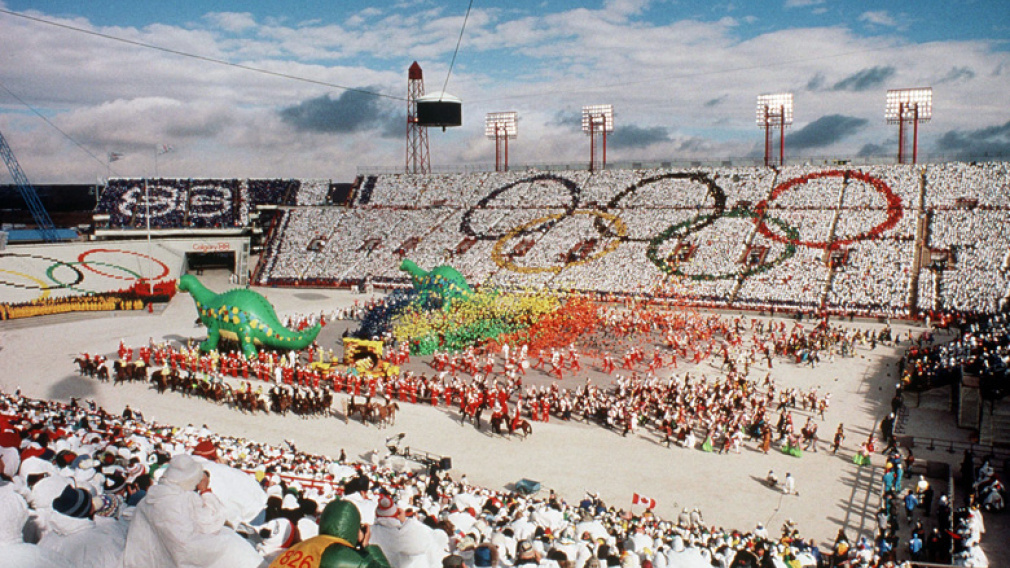
The Opening Ceremony at the 1988 Winter Olympics in Calgary, Alberta. Calgary is in the final three for hosting the 2026 Winter Olympics and Paralympics. (Photo: Olympic.ca)
The Olympics are a global spectacle, but all politics is local. And when the two truisms go head-to-head in today’s plebiscite vote in Calgary, Alberta, local threatens to win. At stake is the future of one of three remaining host cities for the 2026 Winter Olympic Games, a status that has perhaps lost some of its former luster.
There were once seven cities that had progressed to the “dialogue stage” of potentially hosting the 2026 Games, including Calgary; Graz, Austria; Erzurum, Turkey; Milan–Cortina d’Ampezzo, Italy (joint bid); Sion, Switzerland; Sapporo, Japan; and Stockholm, Sweden. (Other boldface names, such as Lillehammer or Innsbruck, had previously expressed some interest but then withdrawn.)
Then Graz, Sapporo, and Sion withdrew, followed by Erzurum. As of Tuesday morning, there are three cities still in the running: Stockholm, Milan–Cortina, and Calgary.
But Calgary might not be on the list too much longer. As the New York Times headlined its story on today’s vote, “Does Calgary Really Want the Winter Olympics? Does Anyone?” The article begins, “Hobbled by a reputation for gross expense and corruption, the International Olympic Committee has become a mendicant, shuffling from nation to nation, shaking its cup and asking if anyone might be interested in bidding on the 2026 Winter Games.”
Calgary’s plebiscite, which is synonymous with a referendum vote, is technically non-binding – “but a majority ‘no’ vote would make it almost impossible for the project to continue,” noted GamesBids.com. The Calgary City Council has final say on whether the city proceeds with its bid. Today’s vote will help guide the council’s decision.
GamesBids.Com added, “More than CAD $2 billion (USD $1.5 billion) of Olympics funding promised from the provincial and federal governments is contingent on a satisfactory ‘yes’ result on Tuesday. The total taxpayer costs are estimated at almost CAD $3 billion of the entire $5.2 billion project.”
Much more background information is available here on GamesBids.com. As the Calgary Herald explains, polls close at 8 p.m. local time tonight (6 p.m. Alaska Time, 10 p.m. East Coast Time for American readers), with results available roughly two hours later.
Here’s GamesBids.com on the “standings” of the other two remaining cities if the results of today’s vote lead Calgary to withdraw its bid at next week’s city council meeting:
Stockholm remains in the race to bring the first Winter Games to Sweden, but the Capital has failed to rally any government support for the project and it will need approvals in place before a January 11 IOC deadline.
A joint Italian bid between Milan and Cortina d’Ampezzo emerged just last month, but it lacks federal government funding. The Italian Olympic Committee (CONI) has said that the regional government representing the two cities will foot the bill, and last week IOC President Thomas Bach confirmed in Rome that this plan would be accepted.
If Calgary voters say ‘no’ Tuesday, it will be the Italian bid with the best chance of being elected as 2026 host city when the IOC takes the vote at the end of June.
The site also notes that the last eight cities to proceed to a referendum vote have seen voters reject the chance to host the Olympics… but that all those cities were in Europe, and that the last two Canadian cities to take up this question, Quebec City and Vancouver, voted in favor.
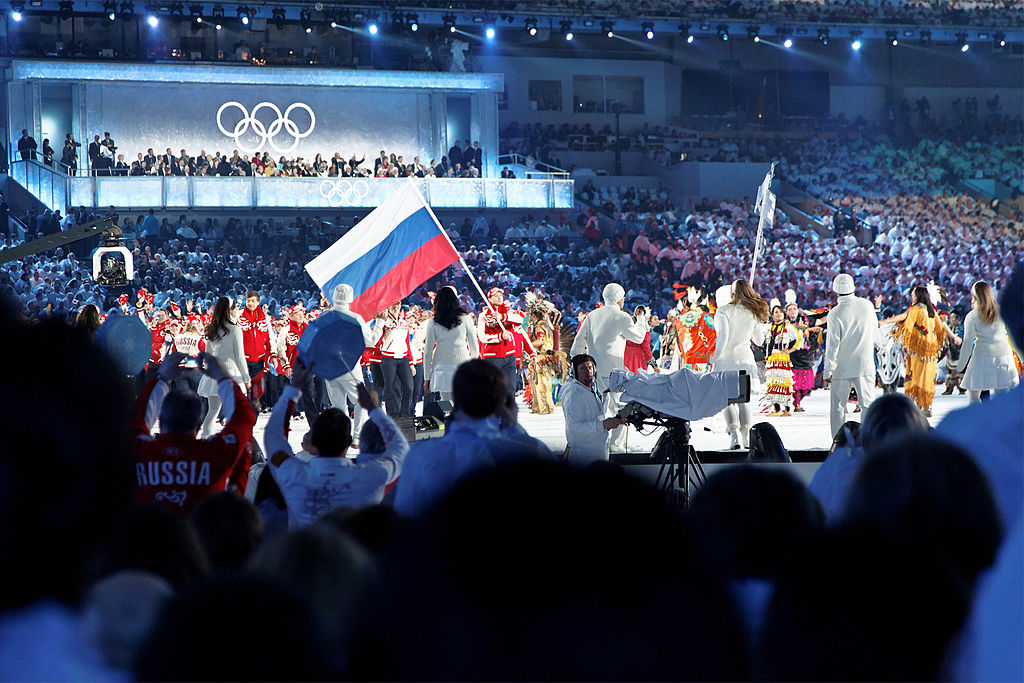
Russia walks into the opening ceremonies at the 2010 Olympics in Vancouver, Canada. (Photo: s.yume/Wikimedia Commons)
In Lausanne, Switzerland, the International Olympic Committee (IOC) Executive Board voted to allow Russian athletes at the 2018 Olympics in PyeongChang, South Korea, but only to compete as neutral athletes. That means no national anthem, no Russia-emblazoned uniforms, and no Russian flags to be raised should the athletes win medals. Instead, the Olympic anthem would be played.
The decision, available in full here, follows years of investigation into a state-organized doping program at the 2014 Olympics in Sochi, Russia, where Russia broke numerous international anti-doping statutes.
As evidence towards its decision, the IOC Executive Board relied on two reports compiled by IOC commissions. The results from one of the investigations, the Oswald Commission, have already been used to disqualify 25 athletes from the 2014 Olympics and all future Olympic Games. That included eight Russian cross-country skiers (Alexander Legkov, Evgeny Belov, Alexey Petukhov, Maxim Vylegzhanin, Julia Ivanova, Evgenia Shapovalova, Anastasia Dotsenko, and Julia Tchekaleva) and three biathletes (Olga Vilukhina, Yana Romanova, and Olga Zaitseva); all of the biathletes had already retired, but many of the skiers were hoping to compete in PyeongChang.
The report of the Schmid Commission, which was delivered to Executive Board members at 1:30 p.m. today, investigated not individual athletes but the systematic nature of the doping program. Board members had only a short “reading period” to get familiar with the contents of the report, and the Russian delegation at the meetings to argue for their continued participation allegedly were only given 20 minutes to look at the report before making their presentation.
Other Recent Developments
Norwegian broadcaster NRK reported that the current president of the Russian Biathlon Union, Aleksandr Kravtsov, was personally involved in the doping scandal. At the 2014 Olympics, Kravtsov was the diplomatic head of the Russian team. “From time to time I talked with Aleksandr Kravtsov about the use of performance-enhancing drugs in general, and about the Sochi plan in particular,” whistleblower Grigory Rodchenkov told NRK.
Rodchenkov told the New York Times that he thought being forced to compete under a neutral flag was a fair solution to the scandal. “Innocent athletes should not be prevented from participating,” he said.
In the same piece, Rodchenkov said that the deputy sports minister Yuri Nagornykh “asked him to ‘make the sample dirty’ to disqualify [Ukrainian biathlete Vita] Semerenko. Dr. Rodchenkov did not comply, he said, convincing the minister that a retest of the drug sample would show the drugs had been spiked into the sample rather than passed through a human body.”
“The conclusions of the Schmid Report, on both factual and legal aspects, confirmed ‘the systemic manipulation of the anti-doping rules and system in Russia, through the Disappearing Positive Methodology and during the Olympic Winter Games Sochi 2014, as well as the various levels of administrative, legal and contractual responsibility, resulting from the failure to respect the respective obligations of the various entities involved’,” the decision noted.
The IOC is suspending the Russian Olympic Committee immediately, as well as its president, Alexander Zhukov, from his IOC Member status.
Also included in the sanctions is a fine of $15 million – which will go towards the IOC’s pet project the Independent Testing Authority, an anti-doping agency – as well as the payment for the costs of the IOC’s investigations into the scandal.
But the punishment of the most interest is undoubtedly that which directly, rather than indirectly, affects athletes and their participation in the upcoming Olympics in February.
A country has never been disqualified from the Olympics for doping before, although countries have been suspended for other reasons. In those cases as well, their athletes have been able to compete under the Olympic flag.
Previously, the participation of Russian athletes at the 2016 Summer Olympics had been handled by individual sports federations. The International Weightlifting Federation completely banned Russia from those Games, while the track and field federation allowed a select few athletes to compete under a neutral flag. In other sports, some athletes were ruled out but others were allowed to compete as Russians.
This is notably different, as it applies across all sports. The deal is believed to have been agreed upon before today’s meetings, as such a short time was given for the Board to read the Schmid report’s findings and Inside The Games reported that the IOC had already contacted Nike to produce “neutral” uniforms for the Russian athletes.
There had been discussion of whether Russia would boycott the Olympics under these conditions. A Kremlin spokesman said yesterday that a boycott was not being discussed, but there is popular support for a boycott through the “No Russia No Games” social media campaign.
Meanwhile, a number of additional measures will determine just who can constitute this neutral Russian team. One provision is that no coach or doctor whose athlete has ever had an anti-doping rule violation can be part of the delegation. It is unclear whether this includes the Russian athletes banned by the IOC Disciplinary Commission as part of the Sochi investigation so far. But it would seem to include biathlon coach Vladimir Korolkevich, who was named to train Russia’s women’s biathlon team this season and who coached Ekaterina Iourieva and Irina Starykh, both of whom were caught for doping violations just before the 2014 Olympics.
It also would include Aleksandr Kravtsov, currently the head of the Russian Biathlon Union (see sidebar).
However, these decisions, along with the eligibility of individual athletes, will be determined by a panel chaired by the head of the Independent Testing Authority. This panel will consider athletes’ backgrounds of anti-doping tests before allowing them to participate. Russian athletes will undergo targeted anti-doping testing before the Games.
There is also a provision stating that “Athletes must not have been disqualified or declared ineligible for any Anti-Doping Rule Violation.” That would appear to rule out, among others, cross-country skier Natalia Matveeva, who was banned for using EPO in 2009, and Alexander Loginov and Irina Starykh, Russian biathletes formerly banned for using EPO. However, it is not completely clear whether this provision was intended to exclude any athlete who has ever served a doping suspension, or only those currently serving suspensions.
Of note is that the Russian Anti-Doping Agency (RUSADA) remains not accredited by the World Anti-Doping Agency (WADA), so the targeted testing of athletes who will compete in PyeongChang will be coordinated by other testing agencies.
In the press release of the IOC decision, President Thomas Bach said, “As an athlete myself, I feel very sorry for all the clean athletes from all NOCs who are suffering from this manipulation. Working with the IOC Athletes’ Commission, we will now look for opportunities to make up for the moments they have missed on the finish line or on the podium.”
Just yesterday, FasterSkier published an interview with Italian biathlete Karin Oberhofer, who won bronze in the sprint in 2014 but was not recognized for her performance at the time, until Russia’s Olga Vilukhina was recently disqualified for participating in the doping scheme. Oberhofer said that she was unsure whether there would be any official ceremony when she finally receives her medal.
The International Olympic Committee on Friday launched the bid process for hosting the 2018 Olympic Winter Games, setting a deadline of 15th October 2009 for national Olympic committees to inform it of applicant cities.
Applicant cities will participate in the observer program at the 2010 Olympics in Vancouver (CAN), ahead of the deadline for submission of application files on 15th March 2010. The IOC will confirm what bids have been accepted next June. Candidate cities will have until 11th January 2011 to submit their candidature files (bid books). The winner will be announced by the IOC Session in Durban (RSA) on 6th July 2011.
Cities that have expressed interest in bidding to host the Games so far include Munich (GER), PyeongChang (KOR), Annecy (FRA), and possibly Harbin (CHN) and Almaty (KAZ).