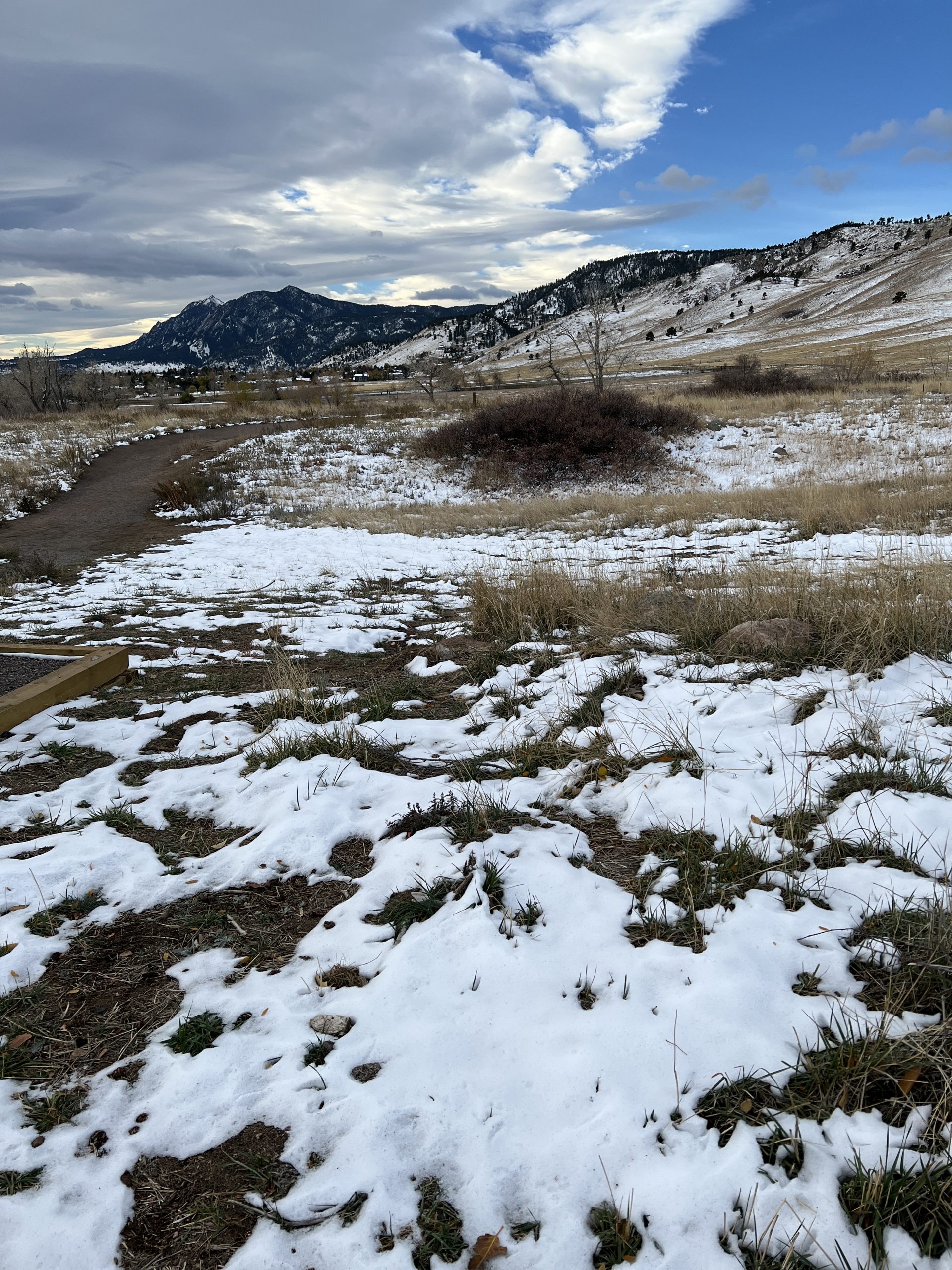
Early snow on Colorado’s Front Range (FasterSkier photo).
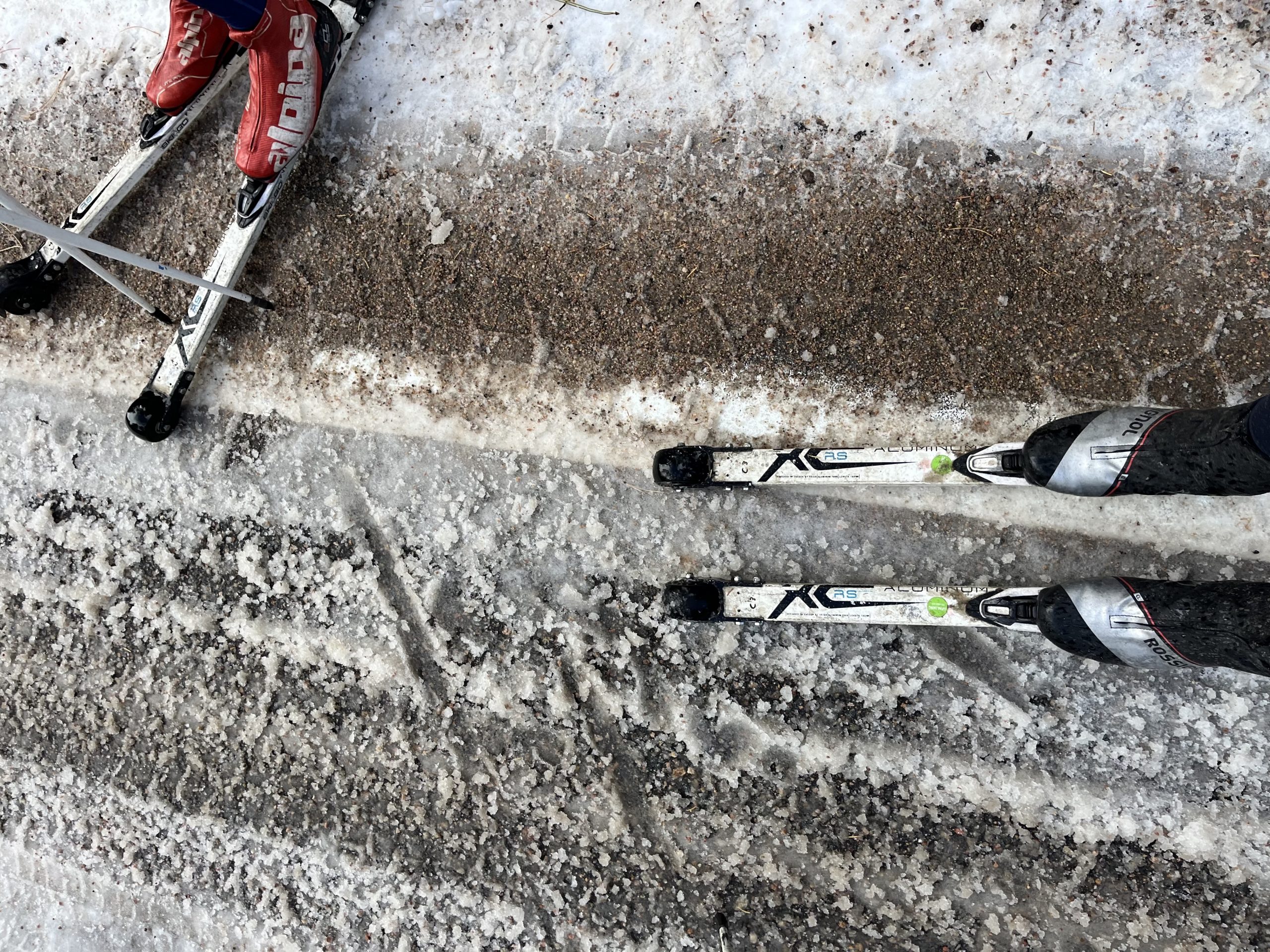
Winter is up there in the sky above us, patiently circling, waiting to come in for a landing. Eager skiers are beginning to hear reports of snow in the mountains, snow in the high country, snow on the upper slopes. Snow is falling in downtown Bozeman, along the trails of Livigno, on the plateau at West Yellowstone, among the Olympic trails at Canmore, in the open loop between Sovereign Lakes and Silverstar. Mt. Washington wears a whitened summit, the Flatirons reflect a new veneer of glimmering silver: early snows are falling. In Colorado’s Front Range, an afternoon storm brought 4-5 inches, bending over the trees, spoiling a day of roller skiing. Even days after the storm, shaded curves on canyon roads still hold panic-inspiring slush and confidence-shaking road sand.
November conditions in Lefthand Canyon (Sophie Spalding photo).
How strange it is to go looking for clear roller skiing pavement when the mountain tops are all white. But this is not winter’s snow—this is an early arrival, a “save the date” notice, a precursor of what’s to come. Clouds swirl, pressures shift, winds converge, and this too-early delivery sends the city scrambling for trucks with plows, sends cars on the high passes skidding into ditches, sends a warning to those who aren’t yet ready. Early snows anoint those winter-faithful who impatiently await the blessing, but this first November snow will not be part of winter: it won’t lie beneath the gathering blanket of the season, it won’t provide a “good base” for snows that come later, it won’t become part of some future glacier. November days are likely to warm again, and this snow will melt back into streams and rivers, or trickle back into the earth, or evaporate back into the sky. Winter is up there in the sky above us, patiently circling . . . but it may make us wait a bit longer.
We just can’t wait . . . for winter in the air, for the cold in our breath, for fluffy flakes falling from the sky, for snow on the ground. Seasons turn, leaves surrender, days shorten, and our imaginations turn to tracks on the hills and corduroy on the trails. Winter is coming . . . and we just can’t wait.
(FasterSkier photo, 2022)
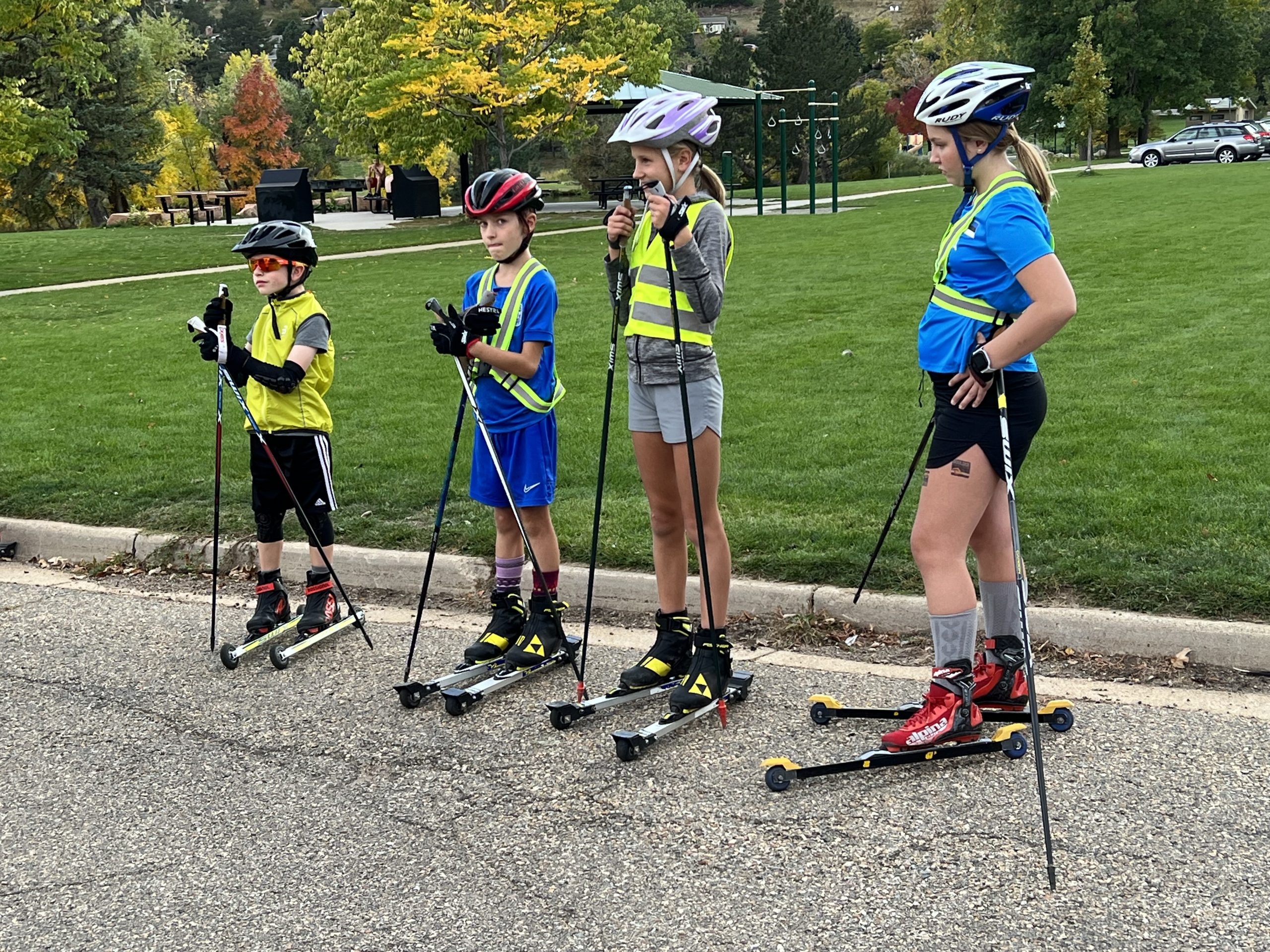
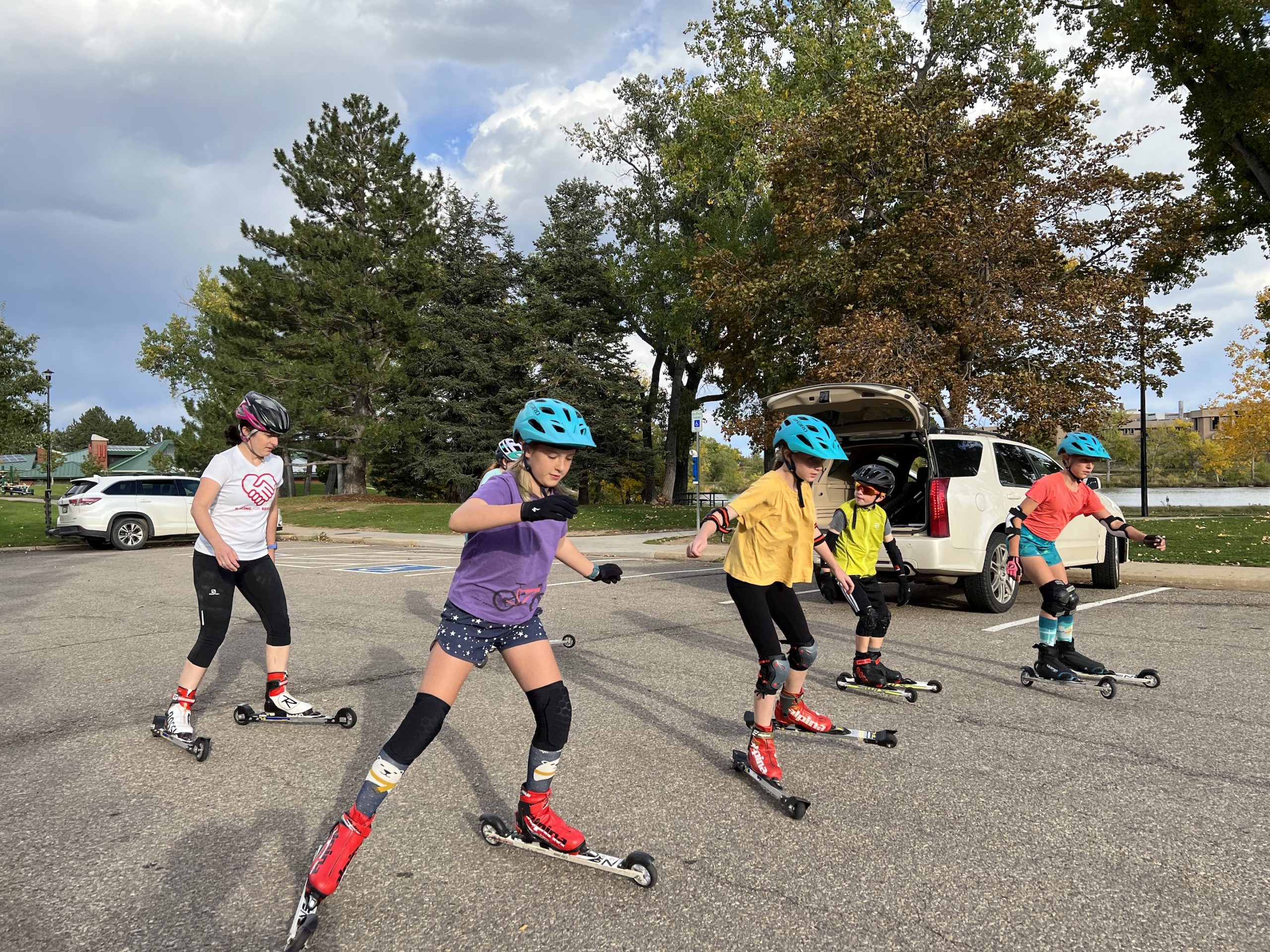
Youth Sport autumn leagues are winding down—soccer, mountain biking, cross country running, all the wonderful sports offered through programs and schools—and young ski-athletes are beginning to imagine winter. Throughout the world’s skiing nations, kids and coaches, teams and programs begin gathering on playing fields and running trails and parking lots. SKIERS are beginning to gather! Programs supporting young skiers stage workouts and meetings, combine games and skills with ski-specific challenges and opportunities. This is the season of trying on new boots, of sizing up taller poles, of shopping skis at the ski swap. This is the season of bounding and striding, of strength-building and core-testing: we re-start the process of building young skiers in preparation for the season we love.
In youth programs around the skiing world, kids are rolling tentatively across parking lots, re-learning the skills of roller skiing: the pushing and the gliding, the slowing and the stopping, the weight shift and the body posture. In every skiing community, young skiers are taking first steps onto paved paths and suitable roadways, learning techniques that allow wheels to imitate skis and pavement to imitate snow. But we also need to acknowledge that roller skiing requires some courage—first steps are always unsteady, last year’s muscles are not yet toned, last year’s balance needs to be reawakened—and the pavement is an unforgiving surface. Everyone who has roller skied has known the scraped knee, the scuffed palm, the tattered fabric. Everyone who trains on roller skis once experienced a very first moment on roller skis. No one started out as an expert. We all stumbled. We all tumbled. We all learned. We all figured it out. That’s what these young skiers are doing today . . . all around the skiing world. So, we celebrate the enthusiasm they bring to the task, the skills they are eager build, the techniques they are determined to master. We celebrate all those young skiers who prepare for a season that is yet to arrive. But when it does arrive, they’ll be ready.
(FasterSkier photo, 2022)
A chill in the evening air, the first frost on the morning grass: these are the autumn days in which skiers begin to imagine the season ahead. Winter is not a season to hide from, not a season to fear. It’s simply a time when the world rests, when celestial lights are turned down low, when the planet’s waters are replenished and we lie tucked under a blanket of white until spring returns. Skiers are the people who go out to meet this winter season: it’s half of our year, so we find the means to go out to play. If we get to go play in the snow, then we’ll happily endure the windshield-scraping and the winter-driving and the firewood splitting and the driveway-shoveling. We bundle up, we pack snowballs, we make angels, we stay young.
Athletes on course in Rumford, Maine, at 2011 U.S. nationals, which were plagued by low-snow conditions. (Photo: flyingpointroad.com)
“I think if you’re a nordic skier in New England, you should definitely be alarmed.”
“That’s one of the main take-homes: skiing is not going to disappear completely, but it will generally be higher [in elevation].”
So says Cameron Wobus, a Bowdoin ski team alumnus and a researcher at Abt Associates, a global research firm. Wobus and colleagues based in Boulder, Colo., and Washington, D.C., recently published a study in Global Environmental Change assessing the impact of projected climate change on the ski industry. (The article is available free of charge here.)
Their results: by 2090, many cross-country ski areas across the U.S. are likely to see 50-100 percent reductions in season length. That could translate to more than a million fewer visits by skiers, and millions of dollars of losses in trail-pass revenue.
A lucky few ski areas could see only minor impacts, but a lot of that depends on greenhouse-gas emissions scenarios – basically, what the world does to curb the release of carbon dioxide and other greenhouse gases between now and then.
“I think a main finding is that elevation is your friend, which isn’t surprising,” Wobus said in a phone interview from Boulder last week. “If you’re a ski area in the Rockies and your base elevation is 10,000 feet, you’re obviously in better shape than if you’re a ski area in central Vermont and your base elevation is 500 feet.”
The Nerdy Part of Prediction
A previous report by Protect Our Winters and the Natural Resources Defense Council took a more detailed look at the economics of the winter sports industry under projected climate change.
Bob Rosso, Mike Sinnott, Gary Storey, Kate Barton, Kelly McClowskey, and Colin Rodgers shovel snow onto the SuperTour 10/15 k classic distance race course in Sun Valley, Idaho, in 2015.
What Wobus and his colleagues wanted to do rather than to get bogged down in predicting how interest and tourism for winter sports would change in a warmer world, was to make the best possible predictions of how snowpack and season length would be affected at ski areas.
“We wanted to do was a more detailed analysis of the physical snowpack modeling,” Wobus explained.
To get to their conclusions, the research team modeled snowpack at 247 alpine and nordic ski areas by combining historical datasets, climate change models, and greenhouse gas emissions scenarios. As a starting point, they used North American Land Data Assimilation System meteorological forcing data, which has been recorded at a fine scale since 1979.
They then put this meteorological data into the Utah Energy Balance model to derive snowpack at ski areas, based on what comes out of the sky and landscape factors that would determine how long snow stays on the ground.
When the researchers compared this derived snowpack estimate to actual measurements of winter season length collected for the Snow Data Assimilation System – a framework that combines satellite data, airborne measurements, and on-the-ground observations – the match was solid.
“We did a reasonably good job,” Wobus said. “Not surprisingly, it’s a little bit messy … but on a region-by-region basis, the only thing we need to get out of the physical model is the season length. So with the exception of the Pacific Southwest, we are generally capturing trends in season length from region to region.”
With that information about winter season length in different parts of the U.S. in hand, the researchers applied different climate change models to predict the magnitude of reduction in season length.
“We applied a simple delta from what all the climate models were telling us, to say, okay, we aren’t going to rely on the climate models to tell us what the weather is doing,” Wobus said. “We’re going to use a 30-year historical time series to look at natural month-to-month and year-to-year variation in weather. But then we’re going to superimpose on that weather, a climate change signal that is a change in monthly average temperature and monthly average precipitation, coming out of different climate models and different emissions scenarios.”
The climate models used, known as General Circulation Models, or GCMs, are mathematical representations of the physical processes happening on and around the earth.
“[GCMs], representing physical processes in the atmosphere, ocean, cryosphere and land surface, are the most advanced tools currently available for simulating the response of the global climate system to increasing greenhouse gas concentrations,” the Intergovernmental Panel on Climate Change writes on its website. “GCMs depict the climate using a three-dimensional grid over the globe, typically having a horizontal resolution of between 250 and 600 km, 10 to 20 vertical layers in the atmosphere and sometimes as many as 30 layers in the oceans.”
There are many different GCMs – and while they are pretty good at predicting temperature, their predictions about precipitation vary widely.
“The precipitation predictions tend to be all over the map,” Wobus said. “We tried to beat it down to the extent that we could by using as many different climate models as we could, given the constraints of our budget. And by modeling as many years as we would, again, given the constraints of how much time we have to do the modeling.”
In the end, that meant using five different GCMs. And additionally, the team put all of those models through two different greenhouse gas emissions scenarios.
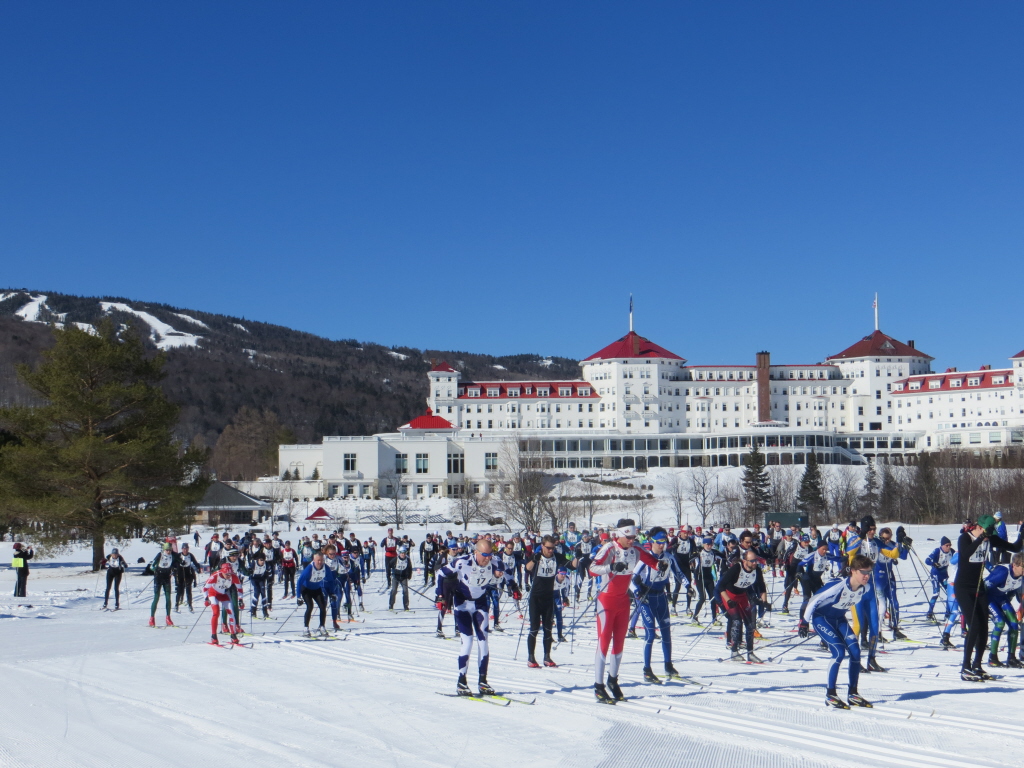
The Bretton Woods Nordic Marathon. Climate-change researchers used the Bretton Woods cross-country ski center as an example to demonstrate predicted reductions in ski season length. (Photo: Mark Butterfield)
The Findings
Especially under the high-emissions scenario, a lot of the differences between predictions made from the different GCMs disappeared by 2090.
The authors demonstrated this in a graph of predicted season length for the Bretton Woods cross-country ski area in northern New Hampshire. They showed the predictions for all five GCMs under both emissions scenarios, compared to the baseline season length at present (68 days, with a range of up to 150 days).
By 2050 under a lower emissions scenario, mean season length dropped precipitously to roughly 12-33 days, but the range of possible season lengths is quite wide for some of the GCMs.
“All these different GCMs have different parameterizations of precipitation, and so they are all going to do slightly different things,” Wobus said.
By 2090 under a high-emissions scenario, though, the model predictions all converge between two and 13 days, and the current average season length is not even in the range of possible predictions for any of the models.
“By 2090, it’s pretty clear that your distribution of season lengths is very different from baseline to future,” Wobus explained. “That’s kind of regardless of which [emissions scenario] you pick, but RCP 8.5 [the higher emissions scenario] is worse.
“That’s one of the main takeaways from the paper,” he continued. “Climate change isn’t good for skiing in the future, but a greenhouse-gas mitigation scenario looks better than a no-mitigation scenario, pretty much across the board.”
Why is that? Despite the variability in the precipitation predicted by the models, temperature increases would be so great by 2090 that precipitation largely wouldn’t matter.
“You’re looking at close to 10 degrees Fahrenheit of warming,” Wobus said, discussing predictions for the Midwest. “It doesn’t necessarily protect you to be way up north or to be really frigid now. There’s obviously a latitudinal dependence on where things are worse, along with elevation. So maybe if you’re up in northern Michigan with [the higher-emissions scenario] you might still have half your ski season, but it’s certainly going to be shorter than you’re used to.”
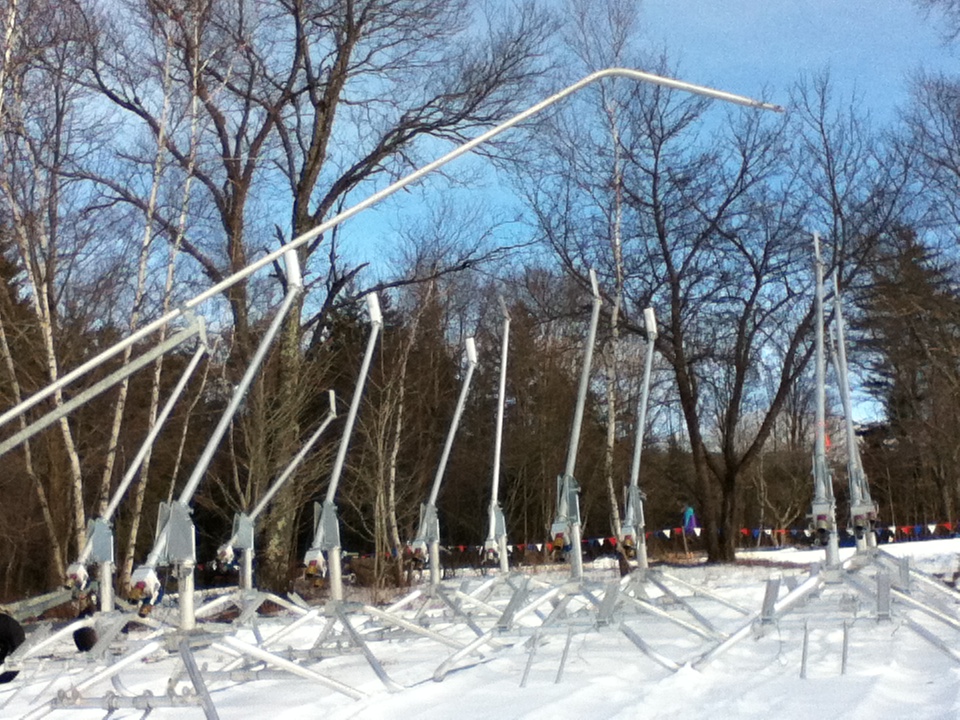
Snowmaking equipment at the Rikert Touring Center in Ripton, Vt. Snowmaking is becoming increasingly necessary to maintain winter ski areas, but should the ski industry also be developing other strategies?
Part of this prediction arises from the fact that the team assumed that cross-country ski areas don’t use snowmaking. Wobus said that he knows some nordic areas are investing heavily into snowmaking (or snow storage), but in general, not enough currently use it to build into their projects as they did for alpine ski areas.
But even if ski areas were to rely on snowmaking, they might be in trouble. For instance, under a high low emissions scenario, just 23 percent of alpine ski areas would have accumulated enough hours of snowmaking in 2090 to open by Dec. 15. As most of the cross-country ski areas are restricted to lower-elevation areas at the bottom of mountains, they would not be in better shape.
Without snowmaking, a high-emissions scenario would lead to roughly 87,000 fewer visits to cross-country ski areas by 2050 and 1.1 million fewer visits in 2090 – equivalent, by that point, to $10.2 million less in trail passes sold.
Are We Listening?
The idea for this piece of research came while spitballing.
“We’ve been doing work for ten years around impact of climate change on various sectors of the economy,” Wobus said. “I’ve published papers on the impacts of ocean acidification and ocean warming on coral reefs and linking that to a recreational use model. I did one on inland flooding and monetary damages from flooding. We’ve done all these different sectoral analyses for different economic impacts of climate change.”
Living in Boulder and being skiers, the team thought – why not look at that?
“We were basically pitching ideas, and we were like, skiing is a pretty important industry in certain parts of the country and it probably has a serious economic impact … so we did it,” Wobus laughed.
But the findings have made a splash.
“People seem to have been noticing,” Wobus said. “I actually credit Global Environmental Change for having a Twitter feed, of all things. Protect Our Winters picked it up, and Powder Magazine picked it up. … Most times people don’t pay any attention to my research. So it’s kind of cool to have something that’s a little more out there.”
Snow-wise, the 2011-2012 season hasn’t gotten off to the best start. Just four weeks into the World Cup, low snow has caused nearly every European host to scramble to put together a man-made course, shorten (at least initially) its distance races, or give up and move to another venue entirely.
Domestically, competitors for the approaching U.S. Nationals are looking at a week of racing on a man-made loop in Rumford, ME for the second year in a row. Even in the Rockies, where powder is supposed to be a sure thing from November through April, spotty trail coverage is putting the location of upcoming NRL races up in the air.
Nature’s refusal to give skiers snow when they want it is hardly a new struggle, but its prevalence and persistence to this point in the season is a bit more worrying than usual. An ever-warming December begs the question: has climate change finally put us well on our way to the end of winter as we know it?
To help explain whether this fear is well-founded or not, we enlisted the help of Bill McKibben: environmentalist, journalist, educator and — luckily for us — lifelong nordic skier.
To say that McKibben is one of the most influential environmentalists on the planet is an understatement; with the publication of his widely-read The End of Nature in 1989, the fist book about climate change written for general audiences, he became a leader in the fight to mitigate global warming. Since then, he’s written over a dozen more books, including Long Distance, which chronicles his year-long project to train for nordic skiing at an elite level and see where it got him.
Though he’s based out of Vermont, where he is a scholar in residence at Middlebury College, McKibben has been on the road a lot this year with his non-profit, 350.org, leading campaigns against the Keystone XL tar sands pipeline. He took some time out of saving the planet to answer our questions about climate change, skiing, and the future of the winter we depend on.
FasterSkier: A handful of World Cups and domestic races have been affected by low snow cover this year. I know it’s important to be wary of pinning it all on global warming, but can we expect this to become more of a trend in the near future? Will the ski season (on natural snow) only get shorter and shorter from here on out?
Bill McKibben: Year to year variability is still quite real, but the general trend for the century has long been forecast: much shorter winters. Which of course is the saddest news possible for cross country skiers—in fact, a decade ago one of the first regional climate reports the EPA prepared for the northeast said cross country skiing would be functionally extinct by the middle to late century (along with snowmobiling).
The ski racers have been noticing it for years—even when I wrote Long Distance, which was a decade ago, they were complaining about races getting postponed, or having to move higher up the mountains to train. I fear cross country skiing is the canary in the coal mine of sports when it comes to global warming.
FS: Do scientists know yet what regions of the world will be affected by climate change in what ways? I know there are a myriad of factors that determine this, and some parts of the world may actually get colder while others get warmer, get more precipitation while others get less, but can we predict, say, what will happen in Scandinavia (and on what timeline)?
BM: Not in quite that detail. In general, dry places will get dryer and wet places wetter. When it’s below 32 degrees F, that wetness will translate into snow. But it will be below 32 less of the time. There are some short-term wildcards: maybe open water in the winter Arctic Ocean is pushing moisture and cold south? But the general trend, sadly, is unmistakable.
FS: The ski world is already dealing with the unreliability of snow: ski tunnels, more snow making, trucking snow into cities, stockpiling, etc. Do you think any of these strategies are appropriate?
Desperate, and probably appropriate. The hard part will come when they go from being occasional supplements to the main show. (Or worse yet, those plastic snow fields that show up in YouTube videos once a year or so. Or…catskis.)
Better news is the way many nordic skiers, citizen and world class both, are joining in the climate fight. Andrew Gardner, the Middlebury coach, has done a great job corralling fantastic skiers from around the world, along with a roster of other fine athletes, to join in our efforts, including Anders Aukland, Bill Demong and Sara Renner.
FS: Though nordic skiers are proud of the fact that they enjoy snow without the use of chairlifts, there is no denying that even our outdoor lifestyle has an environmental impact. We drive long distances to ski trails, jet off to Europe to do the Norwegian Birkie, buy new skis because they might just help us finally beat that one rival—and it adds up. We contribute to the destruction of the environment upon which our sport depends. How can we reconcile this? How do you, as an avid skier?
BM: It’s always seemed to me that everyone is allowed to be passionate about something, as long as it really is a passion. I have six or seven pairs of skis, and in the end I don’t feel all that guilty about it—skiing and training takes up so much of my spare time that I don’t have much left for other, more random consumption. Just don’t decide that you should buy nine kinds of scuba gear too.
That said, the endless travel is a real problem, and one that worries me: I’m lucky in that I can ski out my door a few kilometers through the woods, and reach the Breadloaf tracks, which now include a brand new homologated race trail where you could hold a World Cup if you wanted to—it’s the real monster of the east. Rikert has 50 k more, Blueberry Hill is 10 k down the snowmobile trail, the Catamount (backcountry) trail crosses about a half mile from my house—I really don’t need to leave all winter long.
FS: Between running 350.org, teaching at Middlebury, organizing protests (and going to jail for it!) and speaking all over the place about climate change, how much time do you actually have to ski?
I am on the go almost all year long organizing; the fight against global warming is all-consuming, because we have so little time left to deal with it—I had an email from my wife a few weeks ago noting that I’d spent more nights in jail than at home this fall (not the note you really want to get from your wife).
But I do my damnedest to carve out the winter months (when travel out of New England is a dicey proposition anyway) to stay home and write…and ski. Which I do every day I can—it’s kind of the local joke that I’ll ski on anything even vaguely white. Today was one of those days—two inches of snow on mushy, unfrozen ground, your poles picking up a bolus of icy mud with every plant. But it was great good fun anyway.
I confess, I just love the motion of cross country skiing so much (classic especially, though on the right day I’m a happy skater). There’s no other outdoor pursuit that comes close. A good year is 120 days of skiing; paradise would be 150.
FS: How did you first get into nordic skiing?
BM: I grew up in the suburbs of Boston, in a snowier time, and would just do it in the woods—always loved the feeling. I never even knew there was racing until much later. But when I was nearing 40, I knew I needed a year off from failing to save the planet, so I took a year and devoted it to serious training, at pretty much a World Cup level. I didn’t get fast, but I did have a heck of a good time, and made a lot of friends I still have—It’s always fun to get up to Craftsbury or over to Lake Placid for a race and see them.
And of course it’s been a great privilege to be a small part of the nordic scene at Middlebury College, where I’m faculty adviser to the team. It’s a remarkable program with a great history (and a great roster for this season!). We’re looking forward to seeing everyone for NCAA’s in 2013. It’s fun to get to watch kids I knew back when become international racers—Tim Burke, Garrott Kuzzy, Simi Hamilton, Tim Reynolds.
FS: How has your love of the outdoors affected the path you’ve taken as an environmentalist?
BM: Yep. My first book, The End of Nature, was also the first book about climate change for a general audience. It was half reporting, and half kind of philosophical meditation, mostly about how sad to me it felt to be losing the essential wildness of the world (especially my beloved Adirondacks, where I was then living very deep in the woods).
Since then I’ve traveled and learned more about the world, and figured out that there are other, maybe better, reasons to fight climate change: it’s already killing hundreds of thousands annually, and it represents the greatest threat to human civilization we’ve ever faced. But for me, that sadness about the world I love remains a big part of my work.
FS: What is the single best step a skier (or anyone) can take to reduce their impact on the environment?
BM: Don’t worry overmuch about reducing your impact on the environment—you know the things to do, and you’ll do those of them that you can. Worry instead about increasing your impact on the politics of climate. I fear we’re going to need more people spending the night in jail, more people figuring out how to stand up to the fossil fuel industry, more people out marching. 2011 actually showed that people may be ready to do some serious political work: I was thrilled not just with the turnout for our pipeline battle, but also the Occupy stuff. Join in—help us out at 350.org anyway!
Ketchum, ID – Fresh back from a 4-day Seattle trip (get this, for work!) I am opening a lululemon showroom here in the Wood River Valley. The location is yet to be decided but I have been hitting the pavement and running up my phone bill in the search for a great spot.
Full-time lululemon is now my focus but skiing is still on my mind and schedule. I am incorporating more yoga, kettle bells, pilates and other group fitness into my routine these days due to lululemon. I have been loving every minute.
I won’t be chasing the circuit this year but plan to do some of my favorite races like the Boulder Mountain Tour, Engadin and the American Birkebeiner to name a few.
If you know of anyone interested in working with lululemon and me (starting September/October), here in Ketchum, send them my way!
Thank you Chandra Crawford (Canadian National Team), for suggesting me to lululemon! I hope to see you this spring in Sun Valley for LDNs.