From the FasterSkier archive — posts syndicated from athletes’ and coaches’ own blogs between 2004 and 2012, kept online as published. Current coverage is at fasterskier.com.
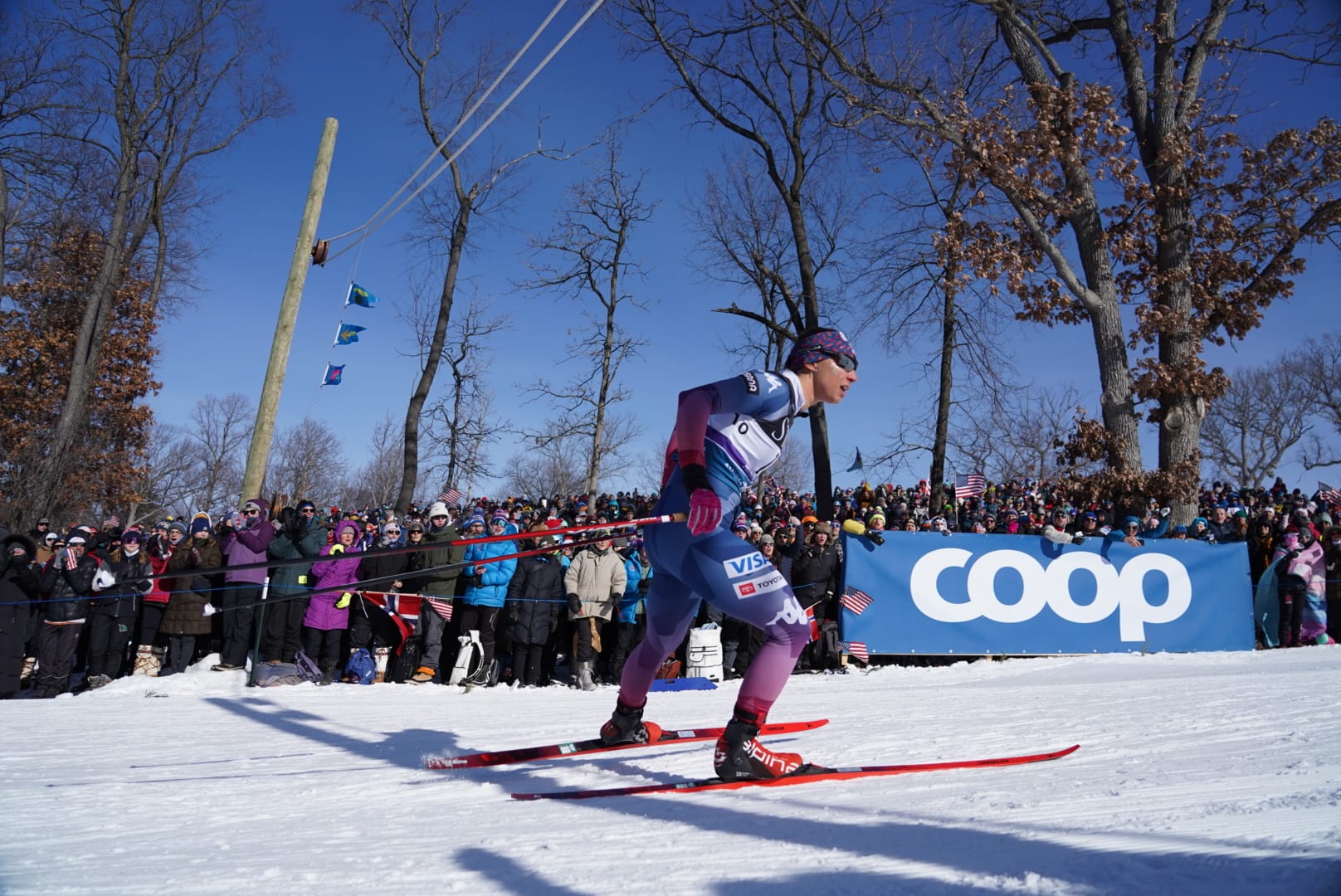
Julia Kern at the Minneapolis World Cup in Wirth Park. (Photo: Lumi Experiences)
It’s been an incredible North American World Cup period in Canmore and Minneapolis over the past two weeks. In Canada, as the excitement was building for the first World Cup on US snow in over 20 years, US skier Julia Kern led the women to the top US finish in the classic sprint and Diggins won the 15 km freestyle. In Minneapolis, the huge crowds of US fans in Wirth Park for the Loppet Cup brought an incredible energy to the event and crowds were treated to several podium finishes for the US!
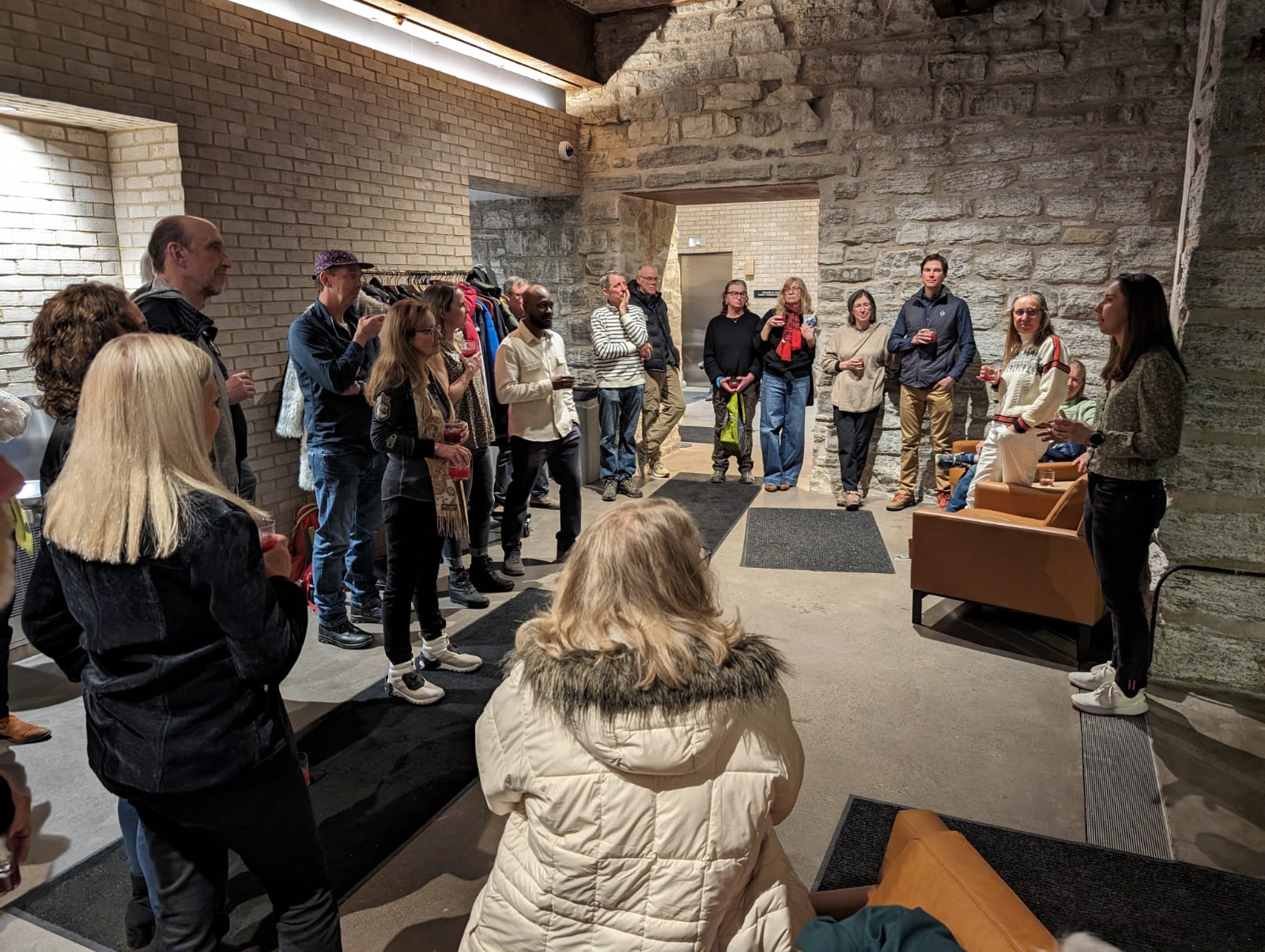
Julia talking with Lumi guests in Minneapolis after the Loppet Cup. (Photo: Lumi Experiences)
On Sunday night after the races, guests on Lumi’s Minneapolis World Cup Trip got to meet Julia and her family. Julia shared parallels between skiing on the Weston Golf Course where she grew up in Boston and the Wirth Golf Course that hosted the Minneapolis World Cup. She also talked about the impact of the Trail to Gold Fellowship, helping to bring more women coaches onto the World Cup. The story of how Julia and Jessie won silver at last year’s World Championships captivated and inspired the group for next year’s Trondheim World Championships in Norway.
Now these next two weeks are the first time in decades that US ski team athletes have been able to head home for some rest time in the middle of their 3.5 month World Cup season.
Before Julia takes off for the final leg of the World Cup in Scandinavia in early March, she prepared a video of what she packs when she travels to the World Cup. In this new video, see what she packs in her bags – both for ski training and her other favorite sport. What sport is that?
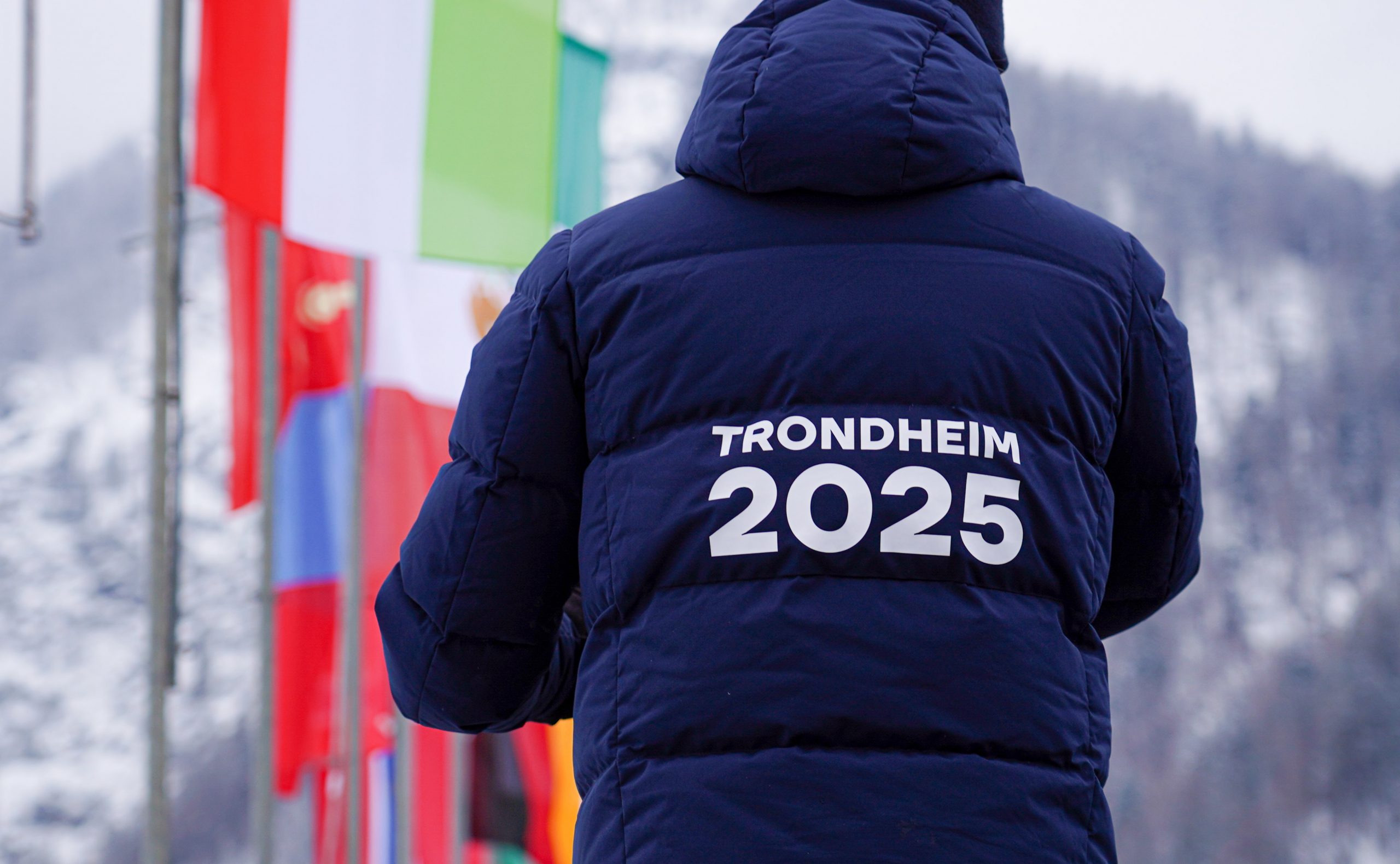
Want to experience cheering for a World Championship event in Europe? The 2025 Trondheim World Champs are going to be in Johannes Klæbo’s backyard next February and March. Due to their popularity, there will be two Lumi Experiences trips to Trondheim 2025. Dovetail this with Lumi’s Norway-Birken trip to ski the Norwegian Birkebeiner while you’re in Norway. An additional packing tip from Julia for Trondheim 2025? Bring your stars, stripes and glitter!
Right now we’re offering an early booking discount on all 2025 Lumi trips. Secure your spot before March 31, 2024 and save $300 per person.
Some times, the races couldn’t be held. Other times, not everyone could get to the races. Such was the case for Nordic skiing during the pandemic. If such limitations occur again in the future, will virtual racing become a viable alternative? (Photo: Tornow/Muniz, American Birkebeiner)
White-knuckled, we caravanned down I-94 from St. Cloud to Minneapolis in the midst of a bomb cyclone of wind, snow, and ice. Braving the conditions, we crawled toward our destination: the 2021, hybrid City of Lakes Loppet at Theodore Wirth Park. Due to the COVID-19 pandemic—and a hearty desire to stay healthy for the remainder of the ski season—we decided to drive separately. Now, we were inching our way to a late start for our Thursday morning staggered start times of 9:00 and 9:02. There was no way we’d make it on time.
As race directors presented various solutions for completing their races during the winter of 2020-2021, many Nordic skiers were scrambling to salvage a season that had been fractured by a global pandemic. Previously, we had gathered en masse at venues in Minneapolis, Hayward, Calumet and numerous other host towns for days of socializing, racing, and celebrating. Now we found ourselves with virtual starts at different times and venues scattered across North America. Armed with smart watches, cell phones, or (in some cases) witnesses willing to testify to distance and time, cross-country skiers raced their way to another successful event completion. As we all uploaded our times and compared our performances, we were left wondering about the legitimacy of these “virtual” races: were we really racing? Against whom? These questions got us thinking whether these virtual race formats—including skiing different venues, at different times, or even substituting an activity other than skiing—are viable long-term solutions to hosting Nordic ski events in the face of climate change, where winters are getting warmer and the ski season is getting shorter with less predictable snowfall.
To address these issues, we developed a survey to gather the insights of Nordic skiers across North America. With the help of the American Birkebeiner Ski Foundation, the Loppet Foundation, and Stearns and Wright County Parks, we received feedback from over 1,300 participants. In our first article, we addressed the question of how we self-identify as cross-country skiers and how this relates to culture, diversity, and opportunity in our sport. In part two, we focus on skiers’ perceptions of virtual ski events, our likes and dislikes, and whether these are legitimate forms of racing. To address these questions, we evaluated a subset of our survey participants: the 829 cross-country skiers who completed at least one virtual ski event during the 2020-2021 ski season. Thus, while our survey results aren’t necessarily a reflection of the entire Nordic ski community, they do represent the voices of skiers who experienced firsthand the pros and cons of virtual racing.
Racing? Virtual?
As we try to better understand how our cross-country ski community responded to the COVID-19 race schedule—and what it means as we move into a world of less predictable winters—two terms become particularly important: “virtual” and “racing.” Although we may all have a general idea about what these terms mean, neither is particularly straightforward as we look at the myriad opinions regarding the “virtual race” schedule of the 2020-2021 race season. For our own purposes, as skiers who practice anthropology, the two terms vary in how they are defined. Although countless articles have been published on the philosophy of racing and what constitutes a race, the term “racing” in our study is one that we left to our survey participants to define. This means that we are not going to provide a definition of “race” or “racing,” at least not yet. Instead, we teased the meaning of cross-country ski racing from the responses that our Nordic ski community provided in the survey. Thus, “racing” is defined internally, by the skiers. We own it.
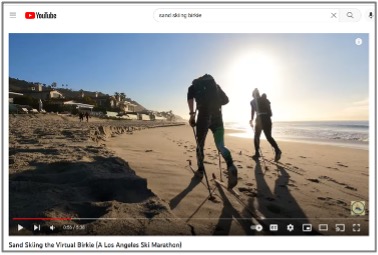
Figure 1: Virtual Birkie skiers sand skiing on a Los Angeles area beach. (Photo/Video: youtube.com)
On the other hand, the term “virtual” is one that was defined for all of us, at least as it applied to the COVID race season of 2020-2021. And the definition of “virtual” might have strayed a bit from what we normally think of as “virtual.” For the most part, the virtual options presented to us for completing our annual ski marathons didn’t involve pulling out the VR headsets or hopping onto the treadmill or trainer for a Zwift or Rouvy session—though in some cases, it might have. Instead, virtual options included such things as actually skiing on snow, but in a different location than the original race, or skiing at the official race venue but on a different day than the traditional start. For some races, such as the American Birkebeiner, other activities such as running, cycling, swimming, rowing, or roller skiing could be substituted for skiing on snow (Figure 1). Regardless of activity choice, substrate, and location, distance and time were measured using a GPS watch or app, or the testimony of a witness who could verify time and distance. We got to choose how we completed our events given a range of “virtual” options that were made available to us. Although COVID is not currently the threat it was two years ago, at least some event organizers are still offering virtual options this winter. The virtual option could turn out to stick around longer than many of us anticipated.
Do we dislike virtual events?
As we perused our survey results, we were struck by the wide range of responses, both positive and negative, that skiers had with the various alternative cross-country ski formats subsumed under the term “virtual.” We noticed that, given the opportunity to discuss both their likes and dislikes of virtual racing, positive responses (n=864) outnumbered negative responses (n=613) by over 30%. A look at these results allows us to get a handle on how we, as a community, define racing as well as our attitudes about whether virtual cross-country ski events can be considered legitimate races. We’ll begin our discussion with the dislikes that virtual skiers expressed about the events they participated in.
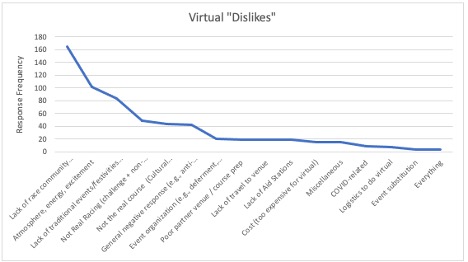
Figure 2: Patterns of things virtual skiers disliked about virtual cross-country ski races.
Figure 2 summarizes the 613 individual, negative responses that virtual ski participants provided. Overwhelmingly (> 55%) the dislikes about virtual cross-country ski events focused on the lack of social interactions, energy, and festivals that surround typical Nordic ski races. The single, most common dislike (n=165) that skiers expressed was that they missed the community and camaraderie that surrounds these events. This was followed by the lack of atmosphere, energy, and excitement (n=101), and lack of traditional events and festivities, including things like gear expos, after-parties, and “Main Street” finishes. Following these first three dislikes, we see a drop in responses.
Coming in at number 4 in the list of dislikes, with 9% (n=49), was the critique that virtual events, in one way or another, are not real racing. Although only 17 of the 629 dislikes explicitly stated that virtual events used during the COVID-19 pandemic did not constitute real racing, we identified several additional responses that are closely related to this category. These additional “not real racing” responses do two things: 1) they provide valid critiques of virtual events; 2) they identify important elements of a ski race that allow us to tease out the definition. Fifteen respondents argued that virtual events lack competition. Additional critiques include non-comparable times (n=10), no official, mass start time (n=4), and that virtual event participants ski on different courses in different places (n=3). This mix of responses highlights some key elements that define a cross-country ski race: a competition between skiers where times are legitimately comparable because of a scheduled start time on a designated course using official timing.
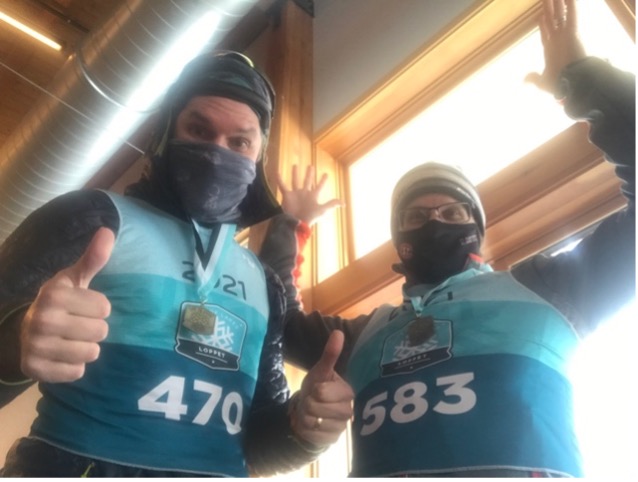
Figure 3: The authors, Matt Tornow (left) and Mark Muñiz, celebrate their completion of the hybrid City of Lakes Loppet.
So, when we (M&M; Figure 3) were slipping down I-94 to ski the hybrid City of Lakes Loppet, would we be racing? Technically, we missed our start times, so that criterion might be compromised. However, we were still allowed to race, and we certainly skied within the open window for the event. When we got to the start on Wirth Lake, it was empty except for a volunteer starter who explained the course, and particularly the finish, where we were instructed to do two laps around the stadium. We were competing with the clock, but also with other skiers that we might have seen on the course. We also compared our finishing times with those who completed the event at different times and on different days. Whether or not we skied the same course is a sticking point. By the time we got to the final 10k around the stadium, the conditions had degraded to the point where drifting snow and downed course markers had made identifying the intended course impossible. Tornow’s two laps differed slightly from each other, as evidently he missed a turn at some point. Muñiz did the same lap twice to finish his race. This resulted in different distances: 30.5k for Tornow and nearly 34k for Muñiz. While the official race distance was recorded as a 30k, other racers recorded different distances too. Maps posted to Strava show that Olympians Caitlin and Brian Gregg each skied 31.2k to complete their hybrid Loppets. While some differences in distance are almost certainly the result of different recording devices (e.g., watches, phones) and related apps, it’s also evident that Tornow, Muñiz, and the Greggs all skied slightly different courses for the same race. Without analyzing the maps of all participants in the 2021 hybrid City of Lakes Loppet, we really don’t know how our times compared with the other racers. Similar concerns might arise from skiing the same course at different times. Our late start on Thursday morning resulted in more accumulated snowfall on the course and more drifting. We’re not making excuses, but those who skied the race earlier in the week or the following day would have had very different (better) conditions. Apply this complexity to events that allowed skiers to use entirely different courses (e.g., Virtual Birkebeiner and Virtual Vasaloppet) and we can quickly see that the race criteria of legitimately comparable times and distances are easily violated for virtual events.
Rounding out the top five dislikes, skiers did not like the fact that they were not skiing on the real course. This is a sentiment that, like the top three responses, relate to the social aspects of the event by focusing on the traditional place and cultural landscape where cross-country ski events occur. These top five responses (72%; n=443) all focus on the social meaning of the event, whether it be interpersonal relationships, competition between ski racers, or interaction with a traditional, cultural landscape.
Rather than focusing on the cultural meanings associated with cross-country ski events, the remaining 28% of dislikes shift the focus of critique to the mechanics of virtual racing. The sixth most common dislike was a general, “virtual stinks” kind of response. While not explaining why they disliked virtual events, these 42 responses express a general dissatisfaction with the substitution of virtual events for traditional, in-person, mass-start races.
There is a sharp drop in the number of responses following the “virtual stinks” critique. Twenty virtual skiers were dissatisfied with the organization of their virtual events. These dislikes ranged from a lack of communication and dissatisfaction with virtual interaction to the inability to defer their registrations to future, in-person events. There was a three-way tie for the eighth most common dislike between: dissatisfaction with partner venues and course prep; the lack of aid stations; and a desire to travel to the host town for the event. Rounding out the dislikes were the high cost of virtual events (n=15), a general dissatisfaction with the situation surrounding COVID-19 (n=9), figuring out logistics (n=8), and event substitution (n=4). There were also fifteen “miscellaneous” responses that included things like not winning a raffle, missing foreign culture, and lack of motivation.
Figure 4: Patterns of things virtual skiers liked about virtual ski races.
What was there to like, then?
With all of the negative feedback, we’re left wondering if there was anything we actually liked about these virtual events. It turns out, that there was a lot to like, and skiers had about 30% more good things to say about their virtual races than bad things. Figure 4 shows that about a third of survey participants (n=266) said that they liked the flexibility that virtual ski options provided regarding when and where the event could be completed. For virtual events offered during the pandemic, skiers could choose their own venue and could complete their races at any time. This was clearly a bonus to many skiers. The next most common like (n=89) was the lowered race stress that comes from virtual events. Although many skiers disliked the fact that virtual racing wasn’t real racing, a greater number of skiers indicated that they liked the lower stress, less-crowded trails, and lower intensity of virtual race formats. Following a general “virtual is great” response and an appreciation for COVID safety (which came in third and fourth, respectively), the lower logistical stress afforded by not having to travel, figure out wax, and get to the starting line on time rounded out the top five. Thus, three of the top five likes of virtual racing were related to the fact that the virtual events were fundamentally different than typical races and were generally less stressful.
Although the top three dislikes of virtual events revolved around missing the sense of community that big cross-country ski events provide, not all virtual racers saw it this way. The sixth most common thing that skiers liked about virtual events was the sense of community that they created. The sense of community resulted from seeing others skiing their virtual events in their race bibs or displaying the swag that comes with participation in hallmark ski events. For many racers, wearing Birkie swag publicly associates them with finishing one of the toughest ski marathons in North America. Whether or not they finished the race on the course in Wisconsin or on a local trail in some other state is a secondary talking point. Others also appreciated the opportunity to ski with friends and family who had different abilities (7th ranked). Thus, virtual options provided a real sense of community, albeit different from that found with traditional mass gatherings.
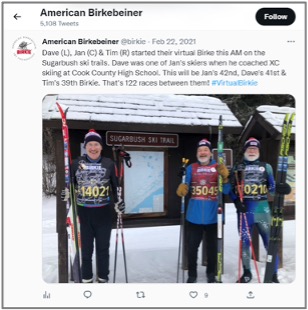
Figure 5: Skiing virtually during the COVID-19 pandemic allowed many skiers, such as these long-time Birkie skiers, the chance to maintain tradition and share their experiences with others through social media.
There were a number of skiers who were happy that, during the middle of the COVID pandemic, races were held at all, and many of these folks (n=31) gave ‘shout-outs’ to the organizers who pulled these virtual events together, maintained communications, and provided platforms for reporting results. In addition to praising the race organizers, 23 skiers also gave kudos to partner venues, who provided certified, groomed courses to use specifically in completing the virtual Birkie. Squeezed between organizer and partner venue shout-outs, the ninth most common like about virtual racing was getting credit for participating. This sentiment ties into the fourteenth ranked like (n=14): preserving tradition. For many skiers, participating in these events is steeped in tradition, and the chance to participate in a COVID-safe, socially distanced format provided skiers the opportunity to keep the tradition alive (Figure 5).
Although very few positive responses explicitly called their virtual events “races,” the racing sentiment is expressed in some of them. Twenty-one skiers liked that the virtual options available to them provided impetus to continue their race training. An equal number of skiers liked that virtual events preserved the challenge and competition of a race experience. Thus, while about 9% of virtual participants thought of virtual racing as “not real racing,” 5% liked the racing aspects of virtual events.
Just as virtual events provided skiers the opportunity to ski with friends and family with different abilities, they also provided opportunities for skiers to take part in events that they might not otherwise have been able to participate in. Our data indicate that about 10% of our total number of respondents (127/1300) had never completed a sanctioned, Nordic ski event prior to the COVID-19 pandemic. Of these 127 skiers, 42 (33%) indicated that they took part in a race during the 2020-21 season and 34 of them chose a virtual option. Whether the virtual option provided impetus for these first-time cross-country ski racers to participate in these events is unclear. What is clear is that 20 skiers indicated that they liked the opportunity to participate that the virtual options provided. Thus, for these 20 skiers at least, virtual races provided the opportunity to participate in ways that otherwise might not exist.
Aside from cost and a number of miscellaneous responses such as adjusted, shorter distances, or positive memories associated with a chosen alternative venue, the likes are rounded out by those who appreciated the opportunity to substitute an activity other than skiing to complete their event. This was a big bonus to skiers who found themselves on a snowless landscape during the COVID-19 pandemic.
Our questionaires revealed that gathering at the venue and socializing as cross-country ski athletes is perhaps an important part of race participation. How well will virtual races be able to fill that fundamental need?
So where does this leave us?
If we look at the sheer numbers of likes versus dislikes, it’s clear that virtual skiers had more good things to say about virtual events than bad. Does this mean that virtual skiers liked their respective events? Maybe. There were certainly things to like about the opportunities provided to “race” under the social distancing guidelines of COVID-19. Simply the fact that we could ski at all was enough to make many skiers happy. Add to that the flexibility, inclusivity, low stress, and opportunities to socialize and compete, and the virtual response to COVID seems like a success. Of course, the lack of community, excitement, and celebration seemed to weigh heavily on virtual ski participants. While many skiers liked the lack of stressors and logistics that come with virtual racing, many of those same skiers disliked the fact that these virtual events weren’t “real races.” So, what is it about a “real race” that is so appealing and motivates us? It’s something more than just legitimately comparable times because of standard starts on a designated course using official timing. Real races require honest head-to-head competition between us as we strive to do our best, that pushes us to be even better than we could ever be on our own. If virtual races cannot provide this, then they fall short for many people.
Holding our ski events virtually during a time when hosting mass gatherings was neither practical nor safe was probably the best solution. As Ben Popp, Executive Director of the American Birkebeiner Ski Foundation, said “while it isn’t as good as an in-person event… it was still something that you planned around, talked about and went and did. It kept you engaged in a larger community and working towards a goal.” But, as winters become more irregular, with warmer temperatures and less predictable snowfall, is this format something that skiers would accept on a more regular basis? What would a transition to virtual ski events do to our sense of community? To our desire to compete? These are questions that we’ll address next, as we explore the impact of virtual events on the Nordic ski community and culture and consider the ways that event organizers can maintain or even grow participation in our sport in light of climate change.
Mark P. Muñiz, PhD, is a Minnesota transplant who grew up in Florida, but enjoys a cold snowy winter over a hot humid summer any time. His cross-country ski adventures have included loppet races and volunteer coaching for the Minnesota Youth Ski League. In the warm season he loves cycling and is still a little wary of jumping on rollerskis. He currently teaches as a Professor in the Dept. of Anthropology at St. Cloud State University, MN.
Matt A. Tornow, PhD, is a Professor of Anthropology at St. Cloud State University in Minnesota. His research interests focus on primate adaptation and behavior, including that of humans. As a native of central Illinois, he spent much of his youth and early adulthood driving north to seek out the snow. Now he spends his winters skiing the local trails and doing a little racing. When there’s no snow on the ground, you can find Matt running through the woods somewhere.
First snow trail of the season opens, new community-based programming, and a first-of-its-kind 759-acre ‘gym’
Minneapolis, MN — Staff and volunteers at the Loppet Foundation have been hard at work this
season transforming Theodore Wirth Regional Park into a winter wonderland amidst uncertain
weather conditions. Thanks to the completion of The Trailhead, Wirth Winter Recreation Area is
kicking off its 2018-19 season sooner than ever before!
Earlier this week, Loppet staff were pleased to announce the opening of about 400 meters of
skiable trail available just outside the doors of The Trailhead. This marks the earliest the Loppet
Foundation has been able to open ski trails at Wirth Park, and the first cross-country ski trail to
open in the Twin Cities this year. Loppet Foundation Trails Superintendent, Isaac Kasper, was
especially pleased by his team’s ability to pull this off.
“In this new era of the Loppet, we’ve been able to offer so much more in terms of outdoor
recreation opportunities than we ever have before.” Kasper said. “Our increased snowmaking
capacity and new grooming equipment mean more trails earlier in the season, our growing trails
team means our expertise continues to improve, and with the new building now in place, we’re
expecting community members to enjoy their best ski season yet.”
In addition to the ongoing trail work happening outside of The Trailhead’s doors, the Loppet
Foundation has also been focusing its efforts inward to create a more hospitable outdoor
recreation experience through its Club Trailhead. Leveraging Wirth Park as a 259-acre ‘gym’,
Club Trailhead provides members with access to hot showers, lockers for personal storage,
access to its strength studio, as well as group fitness classes — all with the goal of increasing
community connection to this spectacular natural resource right in North Minneapolis.
“The Trailhead is part of a deeper connection to North Minneapolis,” said Loppet Adventures
Director, Anthony Taylor. “What this project is really about is helping us realize our goal of
connecting our programming, and Theodore Wirth Park, to the community members that live
closest to this amazing place “
A project nearly a decade in the making, The Trailhead is a long-term vision of the Loppet
Foundation and part of the Theodore Wirth Regional Park Master Plan. Acting as a hub for
year-round outdoor recreation, The Trailhead is poised to create a welcoming environment for
community members to begin their own outdoor adventures while elevating Wirth Park as a
model for improving and increasing access to the great outdoors.
###
ABOUT THE LOPPET FOUNDATION
The Loppet Foundation is a 501(c)(3) nonprofit organization that creates a shared passion for
year-round outdoor adventure in the Minneapolis area, focusing on underserved youth and
families. Since 2002, the Loppet Foundation has worked to create high-quality public events,
youth education, and outdoor recreation programs for the local community. Learn more at
loppet.org.
Day 12: Masters World Cup Total World Domination Package
Day Twelve. We made it. Wow. Sure, we lost a few along the way, good men (and women, though most women were likely smart enough to not set foot on this sinking ship in the first place)
Taking a journey with 12 Days of FBD writing is like going on a poorly captained cruise ship (though thankfully with much, much less diarrhea and WAY fewer fat people). Come aboard, we’ve been expecting you.
As a quick aside, I bartended at Smullin’s rehearsal dinner, so I naturally wore a name tag that read, “Isaac,” and YES, I sure as hell did the “double gun” finger point all night. I am frickin’ awesome.
So as we are pulling into port, thanks to the steady hand of Captain Stubing, the compassion of Julie McCoy, and the vision and brilliance of yours truly, I am pleased to report that all of your relationship issues have been solved and life is good. That’s what happened every week on The Love Boat and it’s what is going to happen here. We’re going to end this wonderful series but going back to where we started, racing.
In Day 1 (yes, I know, that seems like a long, long time ago, doesn’t it?), we focused on recovery. Why? (Let’s all say it together) You don’t get fast from doing hard workouts, you get fast by recovering from hard workouts. What is probably the hardest of all workouts? Racing. So we’re going to come full circle and finish up by talking about racing, more specifically, Master Blaster Worlds (MBW). I know, I know, they have some super-serious, long, fancy name, but to all of us “in the know,” they are Master Blaster Worlds. And this year they just so happen to be in the good ol’ U.S. of A.
So one of my many goodbye gifts to you (there have been so many, as I view each of my written words as a gift to you. I told you I was a ‘giver.’), is that I (with the help of my latest Cracker Jack crew) am going to get you styled out for MBWs. If you don’t have all of the race gear, race clothing, casual clothing, recovery tools, and every other piece of equipment, software, or soft goods that you could even possibly need by now, well then God help you, as I don’t know if it would have been possible for me to write any more on any of these topics. At one point a few days ago I even got a call from the Internet, asking me to delete some of my earlier columns, because the Internet had run out of room.
This means that you can’t possibly need anything else to wear, so what else could you need? Wax, that’s what. Wait a minute, wait a minute FBD, didn’t you that kook Caldwell yell at you about wax a few days ago? Yes, he did, and all of that yelling is still as applicable today as the day it was yelled, and I’m going to call that ‘good general ski wax knowledge,’ but since no one loves you like I do, I also going to go one step further and also bring in another panel of experts to talk about their years of experience training on racing on the exact MBW course.
Take it from someone who has spent a lot of time in World Cup wax cabins, nothing beats local knowledge. There’s a reason why we send techs to World Championship and Olympic venues a year or two or THREE in advance, to start testing waxes. Can you imagine if you had over 40 years of experience testing in one particular venue under your belt? Well, you don’t need to imagine it, because that’s what I’m bringing to you here today, along with a few hard good recommendations as well.
As I did was Zach and Nathan in Day 7, I am stepping back a bit and letting Matt Liebsch and the crew at Pioneer Midwest take the controls here, so full disclosure, I have not tested all of these products. These are the recommendations of Pioneer Midwest, written by Pioneer Midwest, not me, so if you have crappy skis at MBW and U R so PO’d that it’s a BFD, HU ML at PM ASAP 2 say FU.
I also feel compelled to give credit where credit is due — the phrase, “Total World Domination, (TWD)” or at least in the context that it is used here, was created by Duncan Douglas, a.k.a., Jacked Up Old Man. If you don’t know Duncan, well, you are missing out. “TWD” is Duncan’s approach to each and every workout, from his early days as an Olympic biathlete, to whatever the hell insane 9 hours of activity he did last night, that’s just how JUOM rolls. He is my hero.
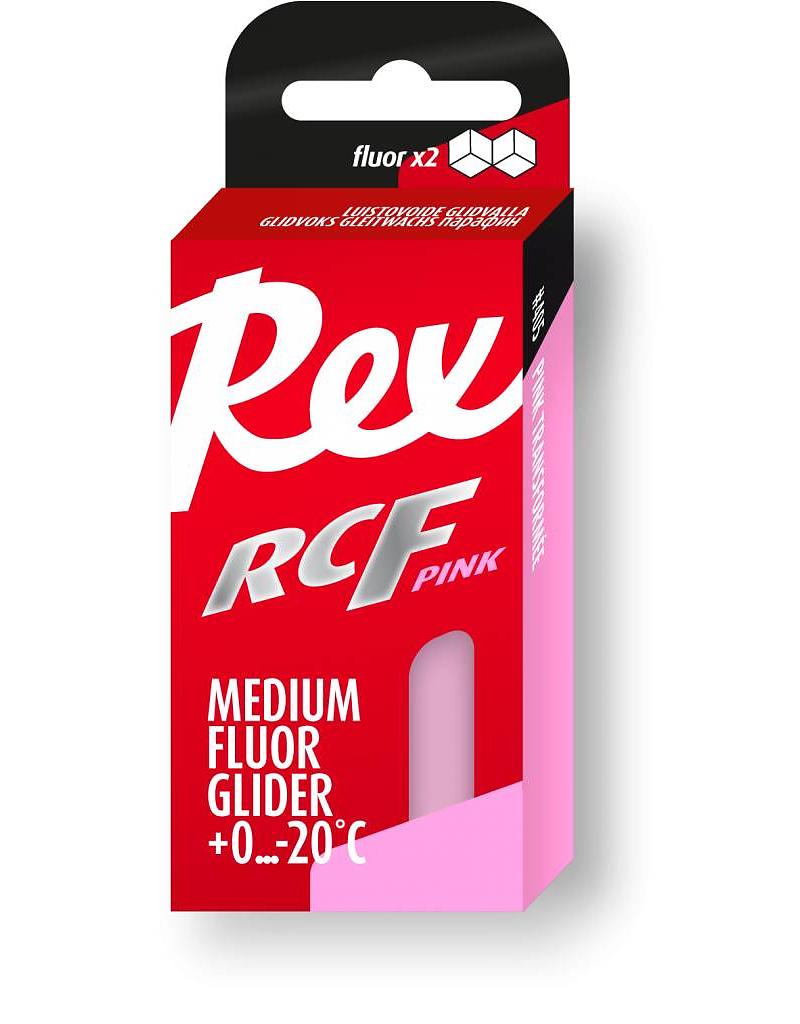
This pink block of wax is hard and medium-fluorinated, which is great for all the manmade snow at Wirth Park. Your waxing strategy needs to be built upon a solid base that will resist abrasion from granular snow, which is exactly the type of conditions present at Wirth Park the past few years. RCF Pink is a go to wax for World Cup technicians because World Cup races are regularly held on courses with manmade snow. This is a great wax for Wirth as long as the snow is not brand new. Patrick Moore is an awesome dude and one of the best techs on the World Cup… he shows how to apply this hard stuff in this video.
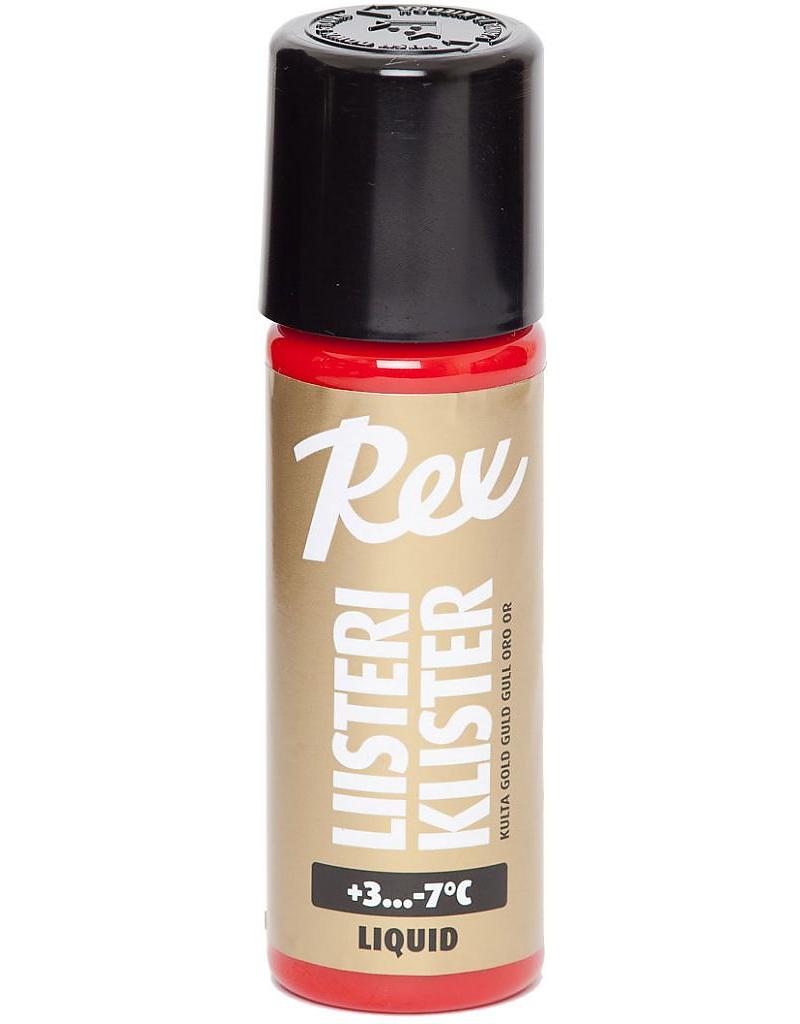
Thin to win right?! Well that is easier said when working with klister. Rex has some new liquid klisters that apply easily with a sponge applicator. They are incredibly easy to use while keeping the layer of klister thin and mess free. No more klister running off the tails of your skis. We have found Rex Base Klister a workable solution in many conditions at Wirth as a base-kick option and the Rex Gold… that stuff is just the best on artificial snow.
Whenever I have great success classic skiing at Wirth Park it seems to involve me using Rex Hydrex.
This is a gliding wax used to cover kicking waxes. If you are on klister, it generally speeds things up without sacrificing kick, but make sure to always test it on your warmup skis before shot-gunning it. It works awesome as a treatment for skin skis or zero skis. Also, in warm temps it can be used on the gliding zones as well and I know for a fact it has seen high-level success at the World Cup both as a covering wax for kick and as a glide top coat.
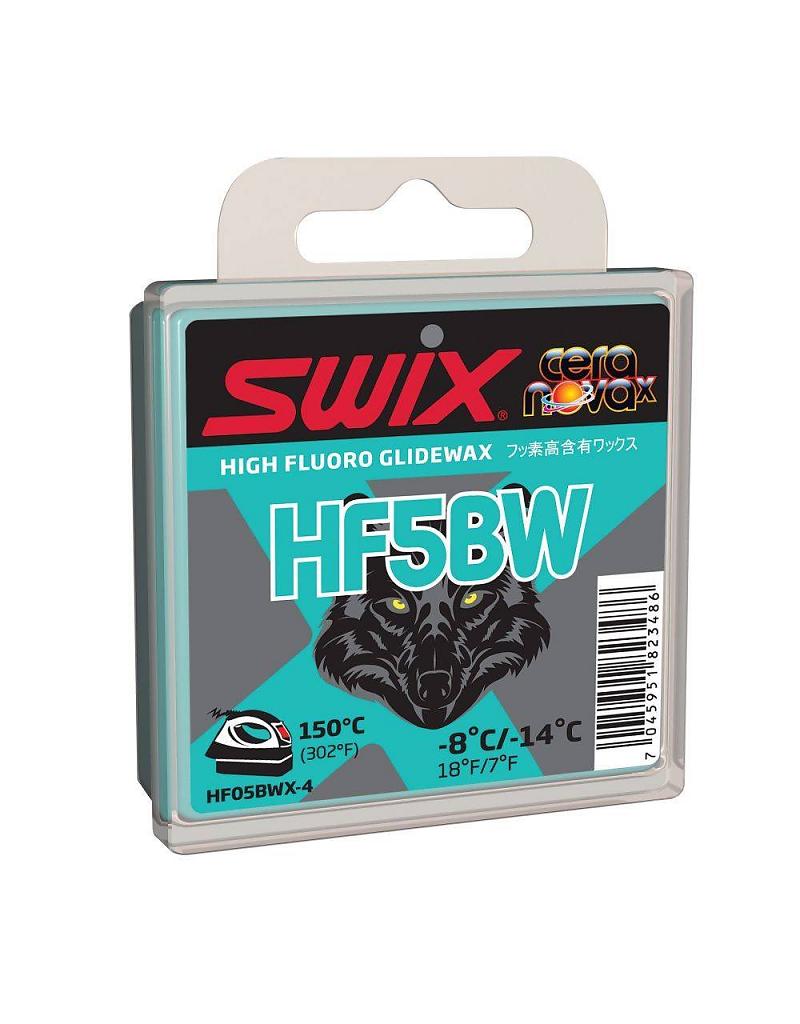
This is a go-to race paraffin for Wirth Park when they don’t have natural snow (most of the time). The workable temp range is huge for this wax at Wirth: 10 F to 35 F+. Most years they have mixed dirty artificial snow and HF5BW is near unbeatable in standard (unfortunately standard) Wirth snow conditions. If there is no new snow in sight, use this. The other standby that shines under these conditions is Rex RCF Pink.
Natural snow in Minneapolis in January means only one thing … it is freakin’ cold. My #1 tested cold natural snow race base wax for the Twin Cities is Start MF10. I have tried to beat it for years; Start HF10 comes close as do a lot of things, but if you are looking for something that works all the time and does not cost a fortune, you cannot miss with this wax in super-cold squeaky natural snow conditions. Make sure you have a cold profile ski and a super-cold grind…. I like our SC0. Check out our stone-grinding services.
Want to leave the waxing supplies at home for World Masters and have us take care of it all for you? We have been skiing at Wirth Park for over 20 years. We know what works and more importantly we know what does not work. Whenever I have traveled the country and world I have had great success getting wax support and grind support from the locals because they know what works the best. Pioneer Midwest will be and are your local experts. Let us take care of your skis for you and we will prepare them for whatever the weather and Wirth Park throws at us for World Masters.
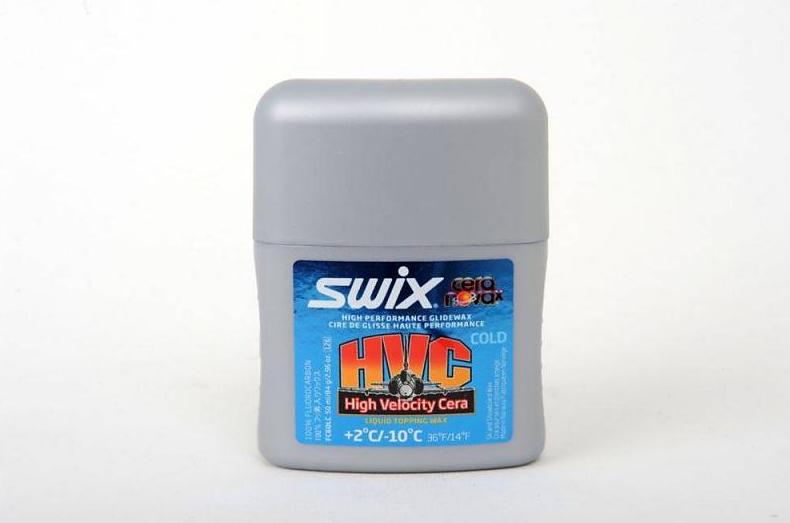
Speed without having to think about it. The Swix HVC liquids are super easy and extraordinarily fast on the artificial snow at Wirth Park. Again, I have tested a boatload of liquid waxes at Wirth and these are always near the top. I qualified top 6 in a SuperTour sprint qualifier a few years ago at Wirth on HVC and that is outstanding considering my history of sprinting. When the conditions are below 25 F and artificial snow, we use the cold version, and when warmer than 25 F, we use the warm version. This stuff is super easy to use, wipe on, let dry 3 minutes or longer, go race. An application of Swix HVC can last upwards of 15 km. But careful in mixed new snow as they can be a liability, but when skiing on old snow grab the appropriate Swix HVC and go for it. The other staple liquid to try if the snow gets a little dirtier from heavy use is Rex Ruka.
If I had to shotgun one powder for warm weather racing above 20 F, this would be it. This wax has a Birkie win under its belt and it has been a no-brainer choice on the World Cup for years. It runs very well at Wirth Park. The other powder that always seems to be in the mix at Wirth in the artificial snow is Toko Red 2.0.
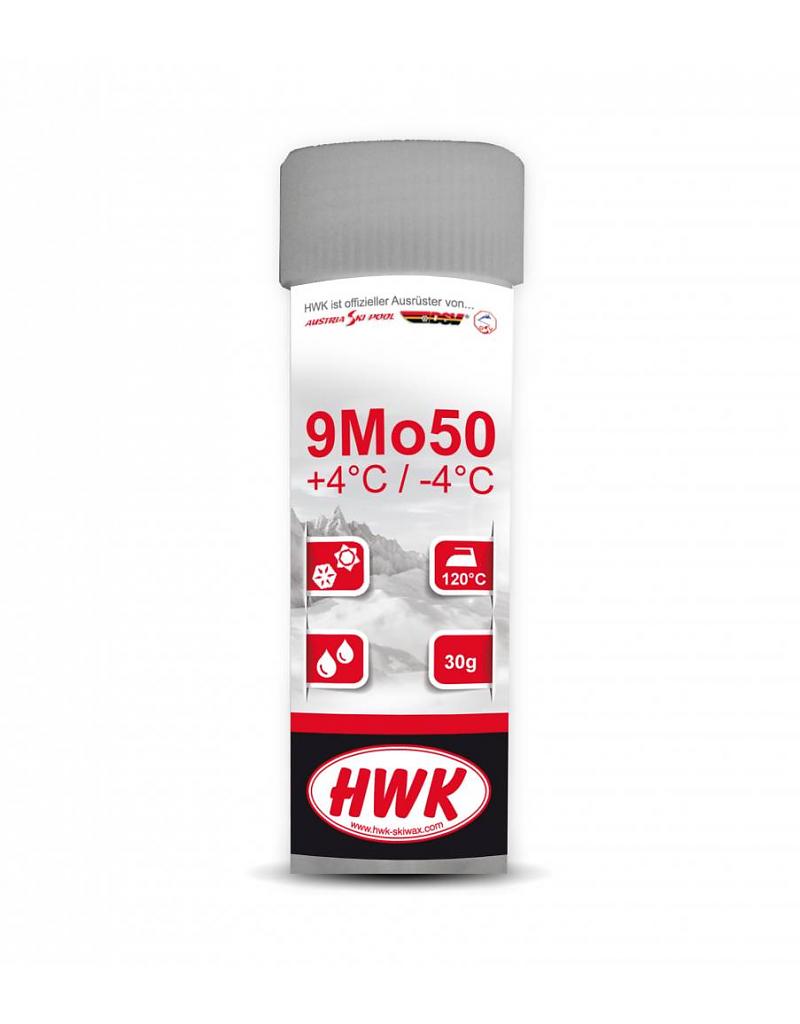
Wet and dirty snow at Wirth Park seems to happen more often than we would like. The HWK guys are always testing on the WC biathlon circuit and they race and test on wet, dirty, artificial snow all the time. This was my top coat at the Birkie 2 years ago and I have won a few SuperTour races at Wirth Park on this wax. It is easy to apply and a no-brainer in wet/dirty Minneapolis city snow if we get those conditions.
Want a top level pole without having to spend $500? This is your ticket. We have a lot of Triac 2.5 poles on closeout and it is the same shaft as the new $500 Triac 3.0. The difference is the strap and if you are keen on watching a lot of World Cup racing you may have noticed many of the best skiers in the world were using the 2.5 pole even after the 3.0 was released. Why? Well the traditional strap/grip with some real estate to rest your thumb is very nice at a cost of only a few grams. Plus we think the graphics on the 2.5 are better.
Panic waxing, no more. Yes, a perfectly waxed classic ski with the perfect application will outperform a no-wax ski most of the time. But how often does that happen?! Even Norway screws up the kick wax — look what happened at Ruka this year. Klæbo won the men’s World Cup distance classic race on no-wax skis. Wouldn’t it be nice to have a backup race classic ski for when you or your wax tech miss the kick wax and you have no kick or too much kick and you start panic-mode 15 minutes before your race start? Think about how great it could be if you have a rocket-fast skin ski with bomber kick, covered in Rex Hydrex waiting in case of panic. We stock every major brand of racing skins, just drop us a line if you want to order some anti-panic skis. Check out our Ski Request services.
As we are winding this down, questions continue to roll in as to how I managed to get all of these amazing reviews done, not only so amazingly well, but also so amazingly fast. Part of my secret I shared the other day with this very insightful video, and part of it derives from my scrupulous attention to detail and a work ethic that I learned from Hunter S. Thompson.
For anyone unfamiliar with his legendary schedule, I strong encourage you to carefully review this and adapt to your life, as necessary.
In reality, my own schedule is quite similar. First off, I applaud Mr. Thompson for getting a full 8 hours of sleep each “night,” as every good athlete knows that recovery is the key to success. Well done, Hunter. I choose to follow this lead wherever possible, with only a slight 14-hour shift in the prescribed bedtime (Wow, Hunter and I sure used the word ‘prescribed’ in a very different sense, huh?).
Regarding diet, this is also another key pillar to success to all athletes and one small area in which Mr. Thompson and I deviate slightly. My food profile is a little more centered around fresh fruits and vegetables and a little less centered around cocaine and cigarettes, but I think we’re really splitting hairs here. Can starting the day with three lines of blow and a Marlboro Red really be all that different than a kale smoothie and a quinoa/egg white omlette? I think most doctors will tell you no.
Apparently he and I also share a love for pasta, orange juice and Dove bars, so I have to believe that I am well on my way. To where? Who knows, but I do know one thing, it’s not here.
Wait, perhaps that a bit too dramatic — I am neither quitting, nor being fired (at least not to the best of my knowledge, but I suppose that could change at any moment), but this does mark the end of 12 Days of FBD and what a ride it has been.
I hope everyone has enjoyed reading this work as much as I have enjoyed writing it and I would most certainly be amiss if I didn’t pay a huge thanks to my evil, corporate overlords at FasterSkier who give me a TREMENDOUS amount of room to run and support me completely in what assuredly is the most “colorful” gear review out there.
In particular, I want to say an extra special thanks to my editor, Alex Kochon. Despite the fact that the word “cochon” is French for pig, Alex is anything but that. This may come as a huge surprise to all of you, but I can be exceedingly difficult to work with — I submit 7,000 word reviews on even the simplest of topics and I have a deep emotional attachment to each and every one of those words. From my perspective, the removal of even one of my carefully chosen locutions results is such a devastating seismic shift that the newly butchered text takes on a completely different dimension, one with potentially earth-destroying consequences. In addition to this unbreakable ionic bond I have to each and every carefully chosen and very precise phase, I also have a flair for the melodramatic. And I am also quite needy. No, really, it’s true. I’m not sure, but I think I also complain a lot. However, I do know that a lot of people complain about me, so in my mind, those two kind of balance out.
Combine all of this with the fact that I regularly submit work at well past midnight and hopefully it is evident how key a role Alex played in this process. She is a smart, calm, caring person and truly a joy to work with each day, as always manages to quickly and efficiently format and post my work, thankfully usually only with a minimum of edits. Her professionalism is unrivaled, as are her talents (this is the case for most of the FS staff, with the notable exceptions of Albert and Kentch, who are terrible, terrible hacks). This team has some of my biggest fans and the feeling is most certainly mutual.
We do need to teach Alex a lesson though, so when you see her on the tracks, the street, or in the grocery store, please ask her to tell you the third fictional name that she removed from my rant about the oh-so-annoying trends in child naming. Not only is it “family friendly”, but it is also hilarious. And she took this from you. You have been robbed. Now she must pay. So ask. And ask. And ask. If she says no, ask her again.
So as I prepare to sign off, I sincerely hope that these columns were of some assistance, albeit minor. Whether I somehow managed to provide you a good holiday gift idea idea or even if these rambling diatribes just helped you kill a few minutes at work and stick it to The Man, it doesn’t really matter. It’s not important if you read each and every column, hanging on every work, skimmed a few when you were stuck in an airport with absolutely nothing else to do, or just looked at it for the funny pictures, if you got even one things out of all of this, that’s all that matters.
Hopefully the biggest thing that you did get out of the columns is my hope that everyone realizes that we’re all in this life together. Clean air and clean water shouldn’t be a partisan issue. It just should not. Everyone on the planet deserves access to land not choked with pollution and a safe place to raise their families. We’re at a cross-roads in this country on many of these issues and hopefully enough people will realize the seriousness of these problems and get involved before it is too late.
Science!
So get involved. Pay attention (not just to the signs for baggage claim, but everything in the world around you. Even if a problem isn’t in your backyard, you should still care). Vote. Demand more of your politicians and yourself. We created all of these problems and it is up to us to fix them. But let’s not just fix them, let’s also fix our approach: thoughtful, rational discourse is our only way out, so let’s all hope we can find this, as soon. Facts are nothing to be feared, they are our salvation. Science isn’t always perfect, but it’s the best tool that we have, so it should not be feared, scorned, suppressed, or redacted, it should be embraced.
Finally, even though I took a lot of cheap shots at people, places, and institutions in the past 12 days, it was all done in good fun and with nothing but the best of intentions, (except for you, American Airlines, you truly suck, that was a legal carry-on bag that you made me check it. And I haven’t forgotten about it.) This is a wonderful sport and a wonderful community, so on behalf of the entire FasterSkier team, I’d like to wish everyone a very happy, sexy and snowy holiday. Be kind. Be aware. Be awesome.
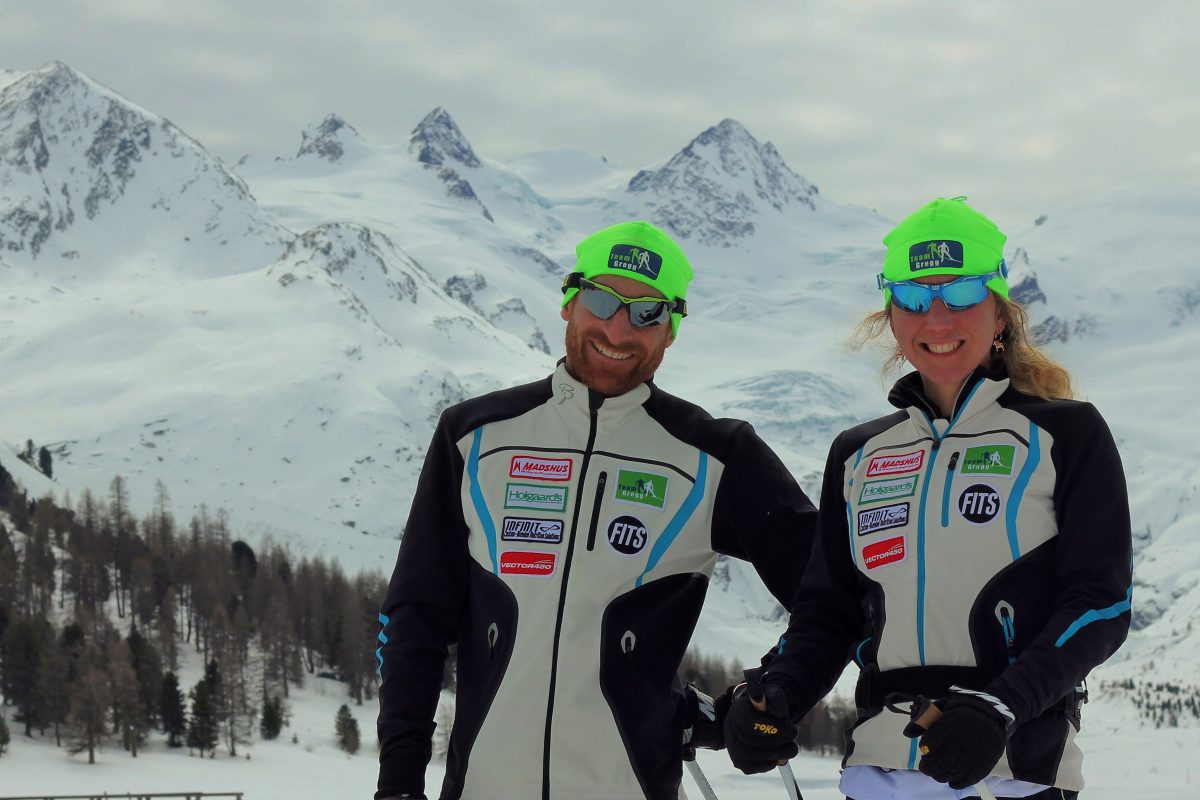
Team Gregg, consisting of two halves that constitute a podium-threat whole, is featured on the latest episode of Nordic Nation. Caitlin (formerly Compton) Gregg, 36, and husband Brian Gregg, 33, the two members of Team Gregg, are based along the border of Wirth Park in Minneapolis, Minnesota. Yes, the two skiers are highly accomplished; both are former Winter Olympians and Caitlin earned a bronze medal in the 10-kilometer freestyle at the 2015 World Championships in Falun, Sweden. But their partnership has become a model of independent professional ski team viability.
The sum total of Team Gregg: Brian Gregg (left) and Caitlin Gregg (right). (Courtesy photo)
They are also a model of two hyper-driven people able to moderate their own personal goals for the collective greater good of the team. If you’ve ever had the opportunity to see the Greggs at a race venue, this much is clear: they have got each other’s back. Brian can be seen helping test skis, handing Caitlin feeds along the course and screaming encouragement. The same can be said of Caitlin. Neither is above doing the menial tasks to ensure the other has the best opportunity on race day.
Nordic Nation caught up with Caitlin and Brian Gregg on Sept. 13, a few days after their return from an on-snow camp at New Zealand’s Snow Farm. Along with the usual “how’s the training going”, questions, you’ll hear about the unique way the Greggs financed their house and what the future holds.
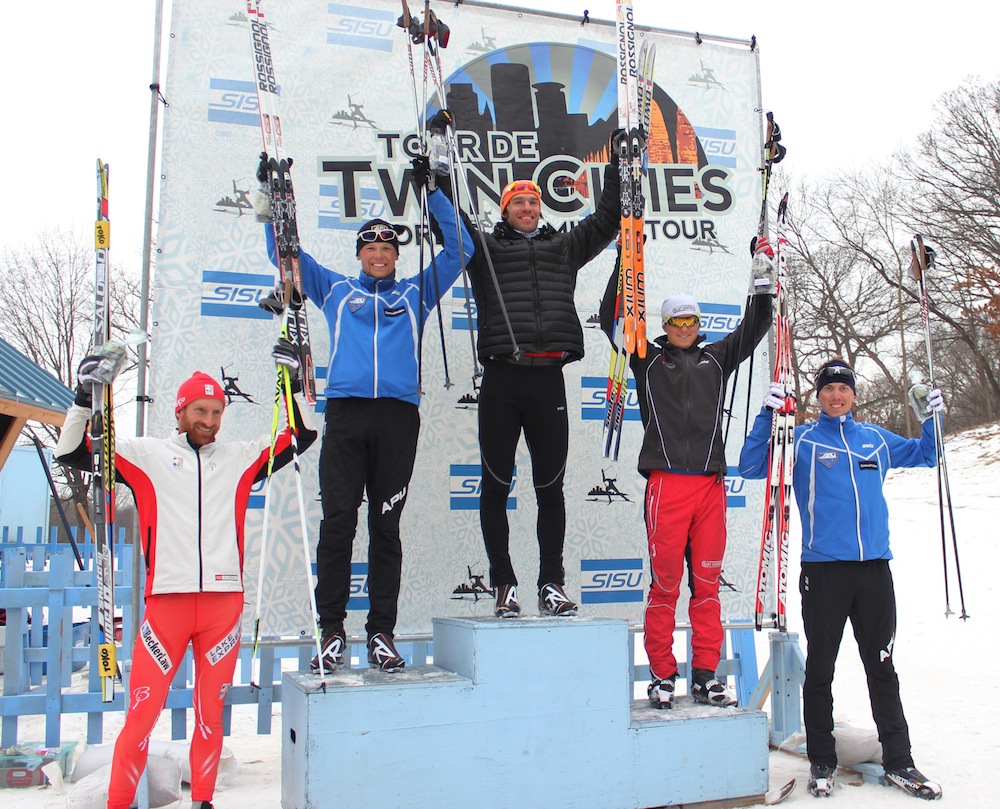
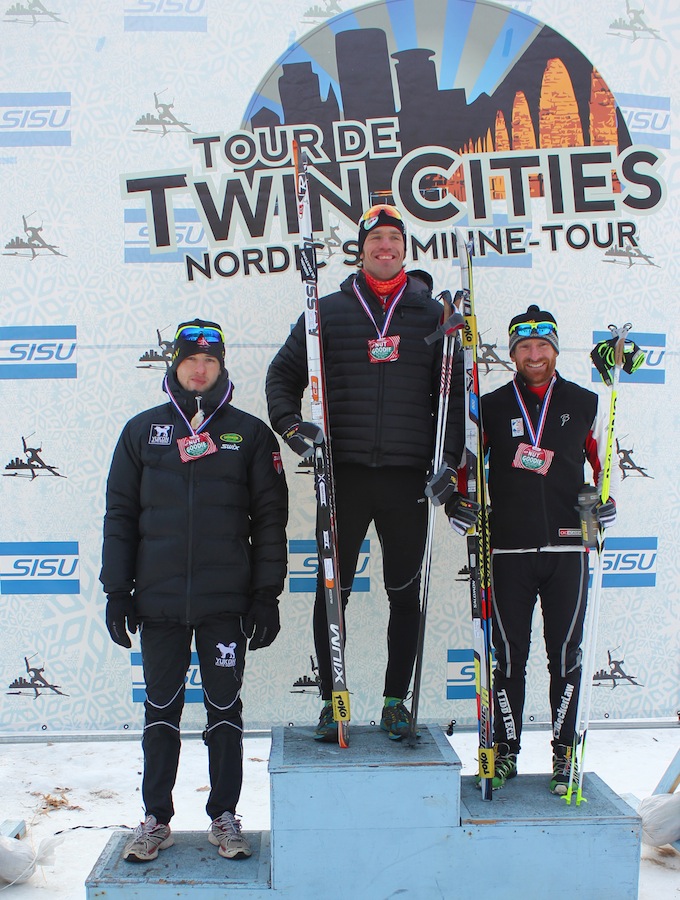
The 2013 Tour de Twin Cities men’s overall podium. 1. Torin Koos, 2. Mark Iverson, 3. Mike Sinnott, 4. Brian Gregg, 5. Brent Knight. Photo: Reese Hanneman.
Five stages and over a week has gone by since the 2013 Tour de Twin Cities began at Wirth Park in Minneapolis, Minnesota, and on Sunday the event concluded dramatically with a 10/15 k freestyle pursuit. After dozens of accumulated laps around the 3.3 k course, Torin Koos (Bridger Ski Foundation/Rossignol) and Rosie Brennan (Alaska Pacific University) each maintained starting leads and emerged victorious in the overall Tour standings. Husband-and-wife duo Brian and Caitlin Gregg (Central Cross Country) both posted the fastest times of the day for the stage five wins.
On a short, rolling course, the men’s 15 k unfolded in predictable fashion: the leaders played with a confortable pace until a final sprint to the finish. Koos began the 15 k pursuit with a 17-second lead on Mike Sinnott (Sun Valley Ski Education Foundation), and with such a small head start he expected the race would come down to the last stretch
“Even before the Tour began, I just knew it was going to come down to the final hunting-start 15 k freestyle,” Koos wrote in an email. “And after seeing how it was so hard for anyone to break away and hold a lead in the mass start 20 k classic, this became more apparent.”
Sinnott and Mark Iverson (APU) left the gate only nine seconds apart and skied together to close the gap on Koos, and by the end of lap three the trio was skiing together at an easy pace, with Iverson leading.
“We slowed down after that and played some little cat and mouse games for laps four and five, content to let it come down to a sprint,” Sinnott said.
Iverson attempted to drop the other two on the last few laps, but was unsuccessful. “On that course, fast with only one real working section, it didn’t work. So we all just settled down with me leading,” he said.
Koos surged ahead with a kilometer to go and held on to the lead through the finish, ultimately winning the Tour by a few seconds.
“In the end, I had an extra step on those two guys and was able to take the [Tour] title by a ski length,” Koos said. “I was pretty psyched to take the overall win. It’s a really great event, one I hope that becomes a staple for the U.S. ski racing circuit.”
Behind him, or rather almost next to him, the battle for second and third was less certain. A jockey between Sinnott and Iverson for the same finish lane generated some contact between them, which Sinnott considered to be the result of a questionable move from Iverson.
With a lead of a few meters Koos was able to chose the center finishing lane, forcing Iverson and Sinnott to go to the inside as they came out of a hard, downhill corner that spit into the finish stretch. The two skied neck-and-neck as they sought the same left-hand lane, causing their boots to briefly connect in the last 50 meters of a fast finish.
In Iverson’s words, he chose the left lane “just in front of Mike. I didn’t want to go wide. Mike and I bumped a bit fighting for the left lane and we both lunged together for the line. Torin was able to get the win and it was really close between Mike and I.”
Sinnott was more descriptive about how the sprint played out, and considered the “bump” with Iverson in the finishing lanes to be a definite infraction of the rules.
“In the finish, I took the inside line as Torin went wide and Mark skied between lanes,” Sinnott wrote in an email. “Mark then decided to shift over, making contact between his boots and mine. He knocked me into the V-boards and I was forced to double pole the remaining 50 m as my lane was no longer mine. The result left me in third and pretty peeved about the clear infractions.”
After the finish Sinnott found spectators who had taken photographs of the incident and brought them before the Technical Delegate, but to no effect.
“I found some photos and several witnesses but was told by the TD, ‘you can protest, but I’ve already made up my mind. So…’ He refused to look at the photos, and again dismissed me when I mentioned [Alexander] Legkov’s move in the Tour [de Ski], resulting in a 15 second penalty,” Sinnott said.
“Basically, I had a strong chance to win, it’s hard to say, but was unequivocally obstructed by Mark as he moved between lanes. As a result, I ended third. It was not how I’d like to see the hard fought five-day event end.”
FasterSkier was not present at Wirth Park, and at press time had only Sinnott’s and Iverson’s accounts of what happened. Besides the finish line incident, Tour competitors were generally happy with how organizers put together the event.
Regardless of how the last 100 m unfolded, Iverson’s run at the podium this week has been the best racing of his career. On Sunday he skied the second-fastest time of the day, 36:07.4.
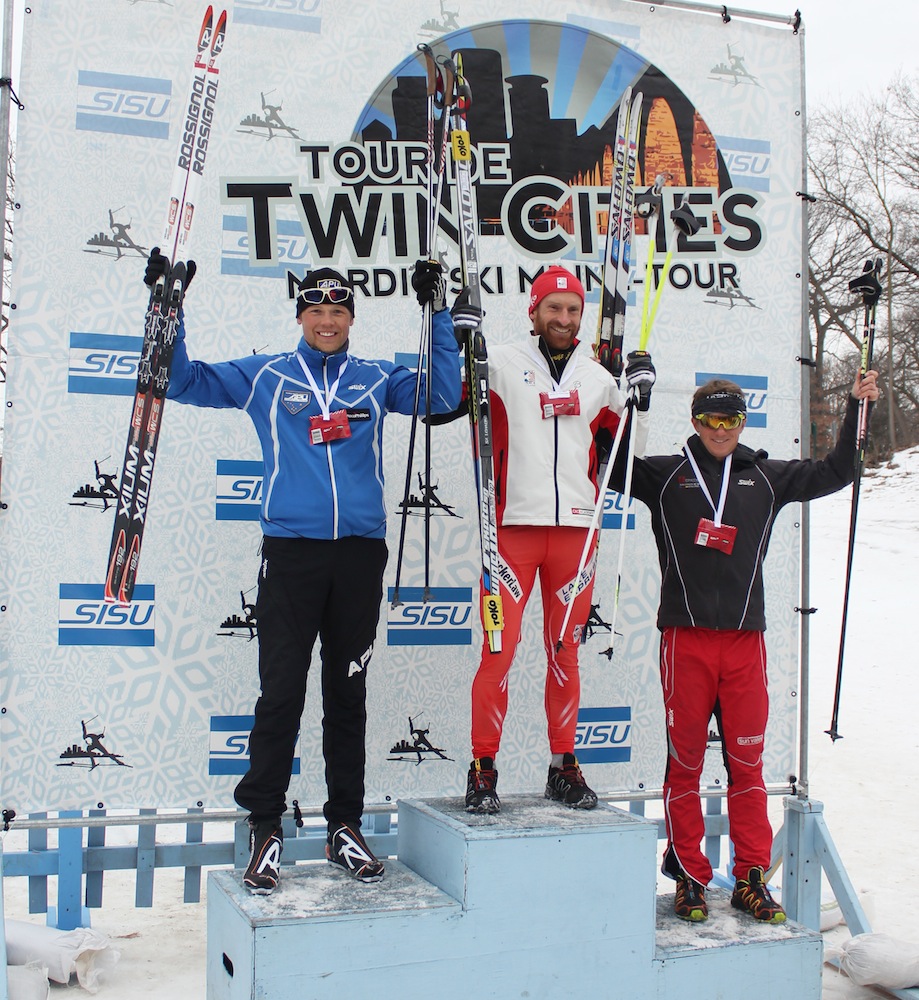
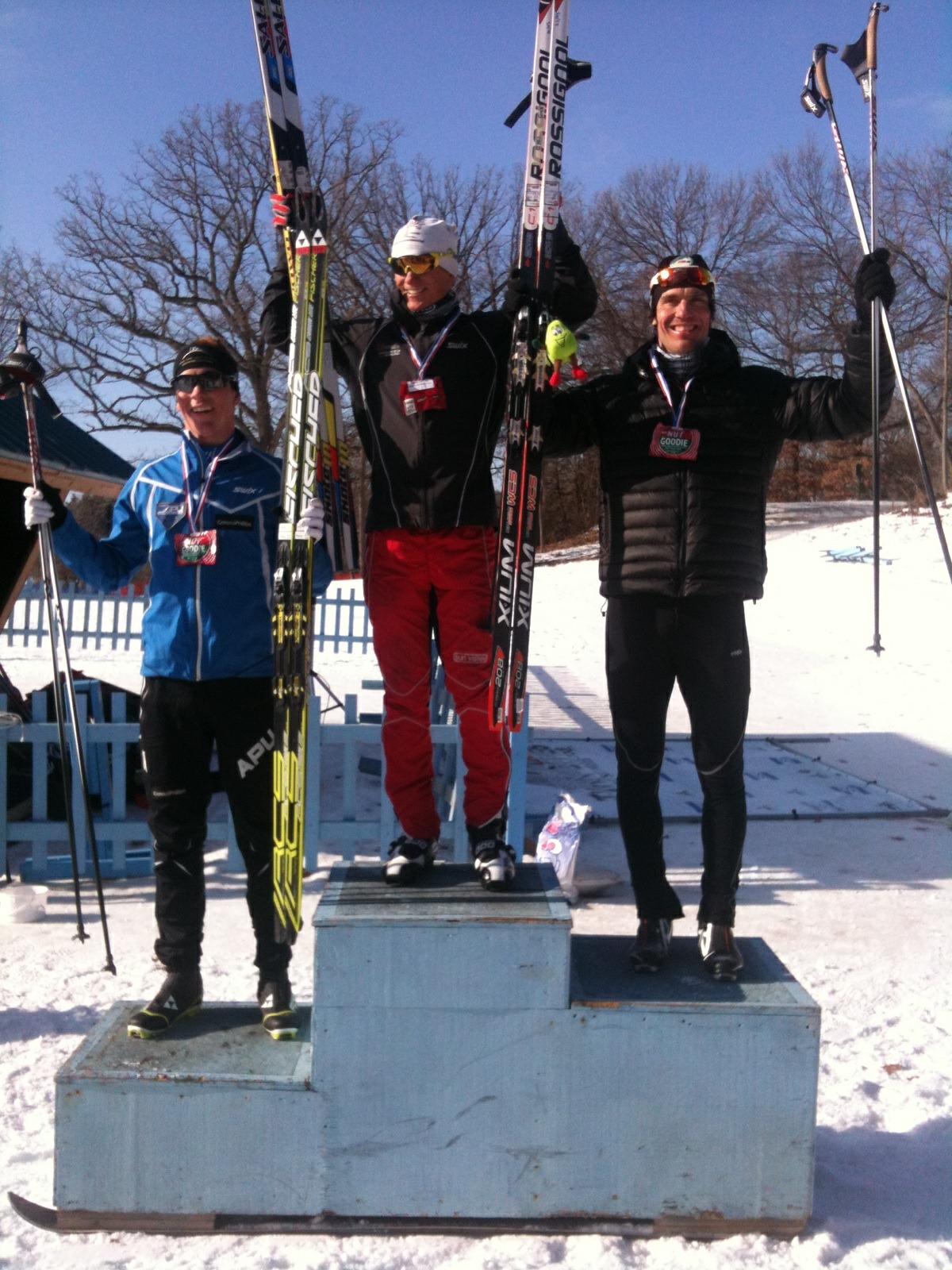
The men’s stage five podium. 1. Brian Gregg, 2. Mark Iverson, 3. Mike Sinnott. Photo: Reese Hanneman.
“It has been really exciting, and satisfying to feel I’m in the race everyday and be confident in my skiing,” Iverson said. “I wasn’t sure that I could catch up and make it a race today after loosing some time to Koos and Sinnott yesterday, but I was patient and just tried to ski my race.”
Gregg, after starting stage five 1:36 down to the leaders in sixth place overall, skied the fastest time of the day to move up to fourth in the final standings.
“I went in to the day planning on skiing my own race against the clock today,” Gregg said. “I started 1:36 off of the lead, but I wanted to have the fastest time of the day.”
He made up the difference between himself and Karl Nygren (CXC) and Brent Knight (APU) by 4 k, and together the three skiers made up some of the time on the leaders by the final lap.
Everyone became intimately familiar with the Wirth Park course by the end of the week, but Gregg is especially at home on it as he lives only a few minutes away. He thought the proximity to the race venue played a big part in his success on Sunday.
“It is a huge advantage to be at home during the middle of the ski season and to be so close to the race venue,” Gregg said. “I think that played a large role in our success on this fifth day of racing. Not too many people are lucky enough to have a 3.3 k snow-making loop within jogging distance of their house.”
Women’s 10 k Pursuit
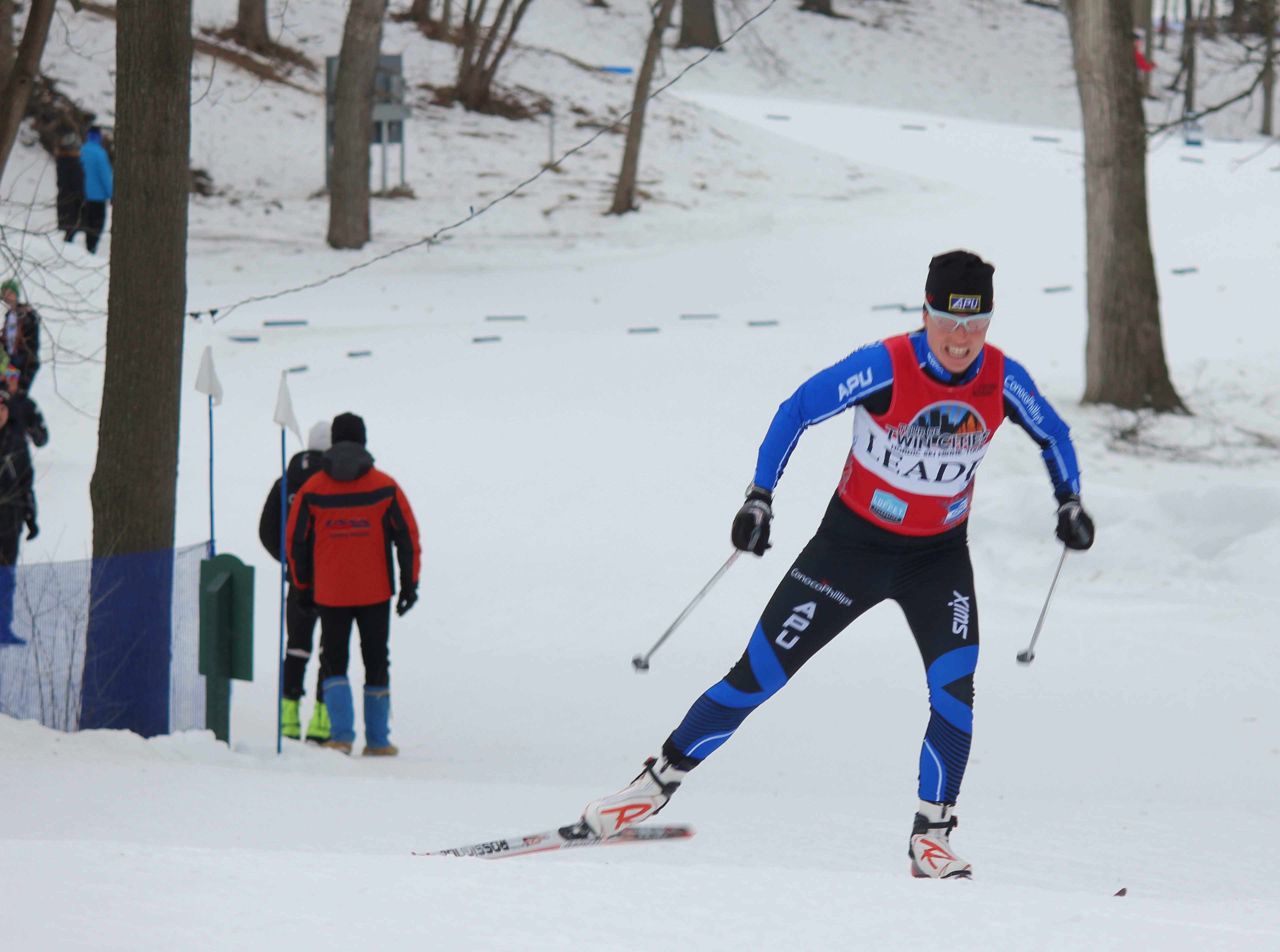
Rosie Brennan (APU) maintaining her lead to take the overall Tour win. Photo: Reese Hanneman.
As in the men’s race, the women’s 10 k pursuit was a closely-fought race. Rosie Brennan (APU) began with a small lead on her competition —Jennie Bender (CXC) started 17 seconds behind her, Kate Fitzgerald (APU) left the line 13 seconds after that, and Caitlin Gregg started at 1:05. With such formidable skaters hunting her down, Brennan knew the overall Tour victory would take everything she had.
“I had the whole field chasing me which certainly added to the nerves this morning!” Brennan said. “I went out hard hoping [to] make catching me harder, however, after racing the previous two days, my legs did not feel good so I ended up really fighting the whole way.”
On the relatively short loop Brennan could see her competitors as the course wound around twists and turns, which alerted her to the fact that Gregg was having an incredible race.
“I could see my chasers frequently and was doing my best to judge time, but man, that’s hard to do and really only led me to panic more seeing who was coming for me,” Brennan said. “By the end of the second lap I realized Caitlin was crushing it and not slowing down, so I did my best to hold it together and push hard on the last lap.”
Brennan was able to hold Gregg at bay and win the overall, which she was plenty happy with.
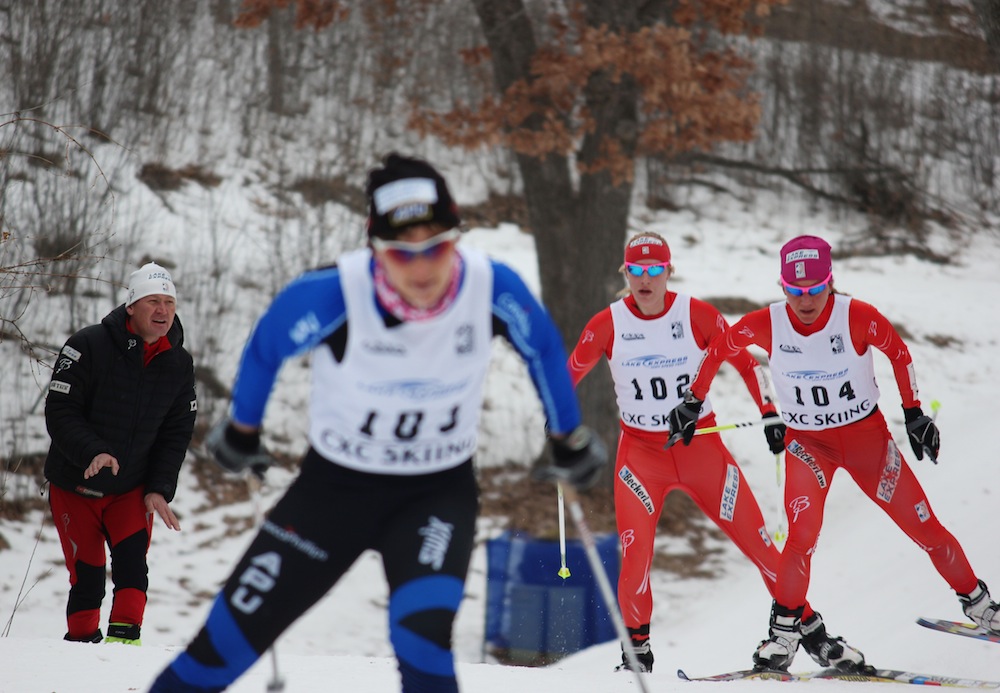
Caitlin Gregg (bib 104) gunning down Kate Fitzgerald (102). Photo: Reese Hanneman.
“It was really stressful and not much fun having to hammer out 10 k alone with a whole field chasing, so I am thankful to have been able to hold it together and stay tough,” she said.
“I don’t think there was anything I could have done to beat Caitlin on the day, though. She was just flying out there. I have always admired Caitlin’s incredible skating so I really can’t complain about taking second to her.”
Gregg ended posting the fastest time by 35.9 seconds. Taking a page out of Lindsay Vonn’s book, the 32-year-old decided right before the start to race on her husband’s winning skis from earlier that morning.
“He told me how fast they felt and I realized that with such a flat course I could probably get away with longer stiffer skis!” Gregg said. “So I tested them for a lap and confirmed I could ski them on the short steep climbs (without tripping) and went with them. The skis were actually Brian’s stiffest pair so he told me to ski like a big girl on them to make them work.”
With the goal of setting the day’s fastest course time, Gregg was pretty happy with how the choice turned out.
“I knew I had a lot of time to make up but I wanted to win the individual race, so I just went out gunning for a good time,” she said.
Brian and Caitlin have been racing together for years, but Sunday was the first time they both won the same race.
“I have always wanted to share the top step of the podium with Caitlin in a Super Tour and it was cool to have that happen,” Brian said.
Stage winners receive $450 for the win on top of the overall purse that goes six deep. Between the Greggs’ stage five victories, Caitlin’s second place finish overall and Brian’s fourth, the couple earned $2,700 on Sunday alone.
“Race winnings are the largest part of our income and it was great to have things come together today,” Brian said.
Kate Fitzgerald (APU), one of the most consistent skiers all week, finished third on the stage once again to take third in the Tour. She started just ahead of Gregg with full knowledge of the latter’s strength in skating, and sought to hold her off as long as she could.
“I know that she is a ridiculously strong skater, and sure enough she came storming past me and it was all I could to do hang on!” Fitzgerald said. “Caitlin, Jennie, and I were in a pack for a little while but then Caitlin’s speed started to break us up. She had an awesome race today.”
Bender finished fourth in the overall standings, Clare Egan (Craftsbury Green Racing Project) took fifth and Erika Flowers (SMS T2) was sixth.
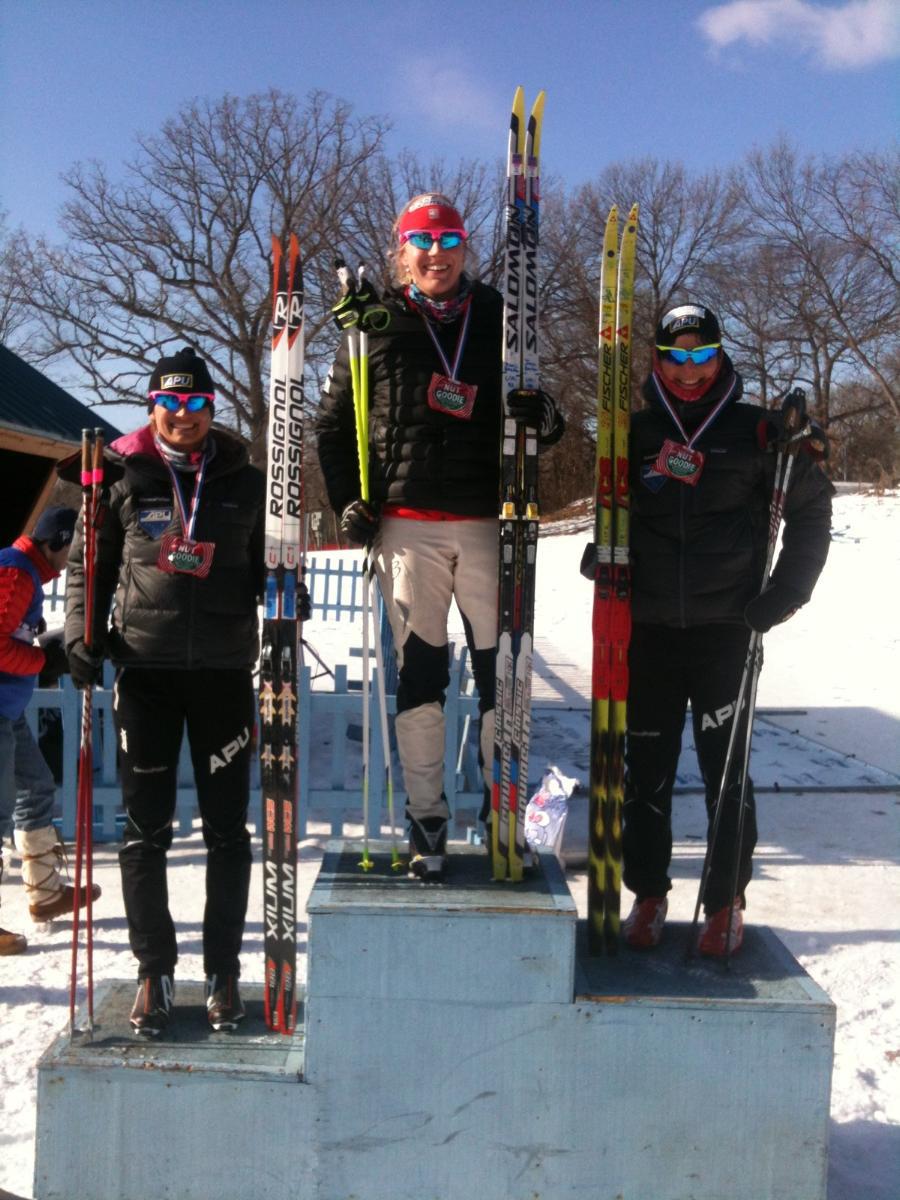
The men’s classic sprint podium from stage three of the Tour de Twin Cities. 1. Mike Sinnott (SVSEF) 2. Torin Koos (BSF/Rossignol) 3. Reese Hanneman (APU). Photo: Brent Knight.
After a cold-induced delay in competition the Tour de Twin Cities continued on Friday in Minneapolis, Minnesota, with a classic sprint at Wirth Park. In conditions more amenable to racing, Mike Sinnott (Sun Valley Ski Education Foundation) and Jennie Bender (Central Cross Country) took home the titles in stage three.
Sinnott edged out Torin Koos (Bridger Ski Foundation/Rossignol) and Reese Hanneman (Alaska Pacific University) in second and third, respectively, for the stage win.
Friday marks Sinnott’s first SuperTour win of the season. Most of the men’s field, when confronted with sugary snow and a course whose hills were either flat enough to double pole or too steep to stride, made the decision to use skate skis in the qualifier. Sinnott was second to Dakota Blackhorse-von Jess (Bend Enduracne Academy) in the prelim, and for the heats made the unique decision to remain on skate equipment while everyone else switched to striding.
“I was the only one to do it in the rounds and it paid off,” Sinnott said. “It gave me more speed at the finish line.”
The win, which comes just two days after Sinnott’s 29th birthday, gave him plenty to be happy about. Bad luck in the mass start last weekend tripped him up in the final stretch, so he was pleased to put the negative experience behind him.
“It was kind of nice, I’m happy with the way the race went,” he said. “I was a little bummed after the last stage where I tripped over myself in the last 100 m and lost out on the podium, so it’s nice to rebound and get some momentum.”
Koos, in second place, said he wavered on the edge of choosing skate skis but ended up going with, at the very least to avoid accidentally gliding in a herringbone.
“This turned the hills into deep sugar,” Koos said. “There was no way to ski through it — you just had to herringbone. I would have much preferred to stride. This negated any advantage a skier who used wax had today. So why use kick wax, you say? Well, it’s pretty hard to not get that extra little skate when you’re herringboning without wax, so I played it safe and went with wax.”
Though it ended up being the wrong call for the win, Koos was fairly satisfied with second place — “It probably wasn’t the best decision to win today, but second isn’t too bad a result, no?”
In third, Hanneman was happy with a podium. On the narrow Wirth Park course he said it was crucial to move around people before the bottlenecks in the trail, as it wasn’t possible to herringbone double wide up some of the hills.
“There were two short steep climbs that were pretty dang steep, but I had been able to run them in the distance race,” Hanneman said. “I thought that we would be running them today, but the tracks just got super blown out and it was total sugar, so we all had to herringbone… I had to get behind Mikey on the last climb because there wasn’t room to try and pass, so then that kind of set me up as just in third for the finish.”
Though he’d been gunning for the top of the podium, he was satisfied with third.
“My goal was to be on the podium, and I knew that I was capable of winning, so I was just hoping to play it right and be able to use my strengths,” Hanneman said. “I did that for the most part, so it was a fun day.
“I also want to say thanks to the volunteers for working out there all day and for giving us a chance to race heats.”
Pat O’Brien (Craftsbury Green Racing Project) finished fourth behind Hanneman, Karl Nygren (Central Cross Country) was fifth and Dakota Blackhorse-von Jess (BEA) took sixth.
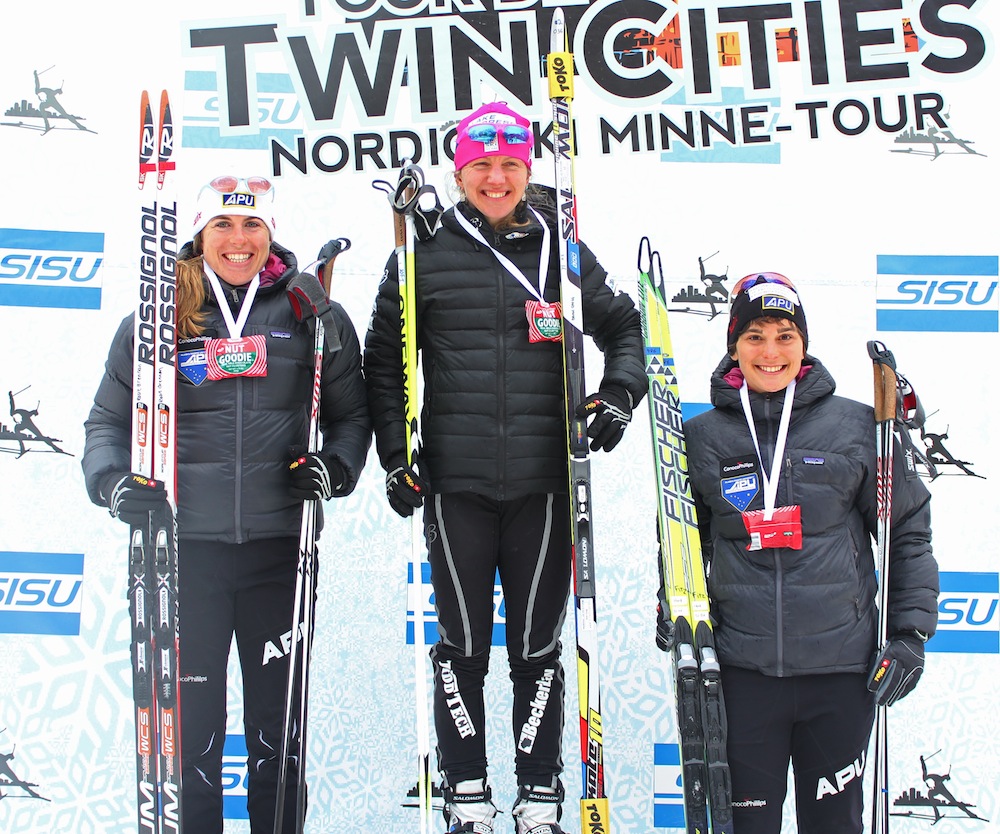
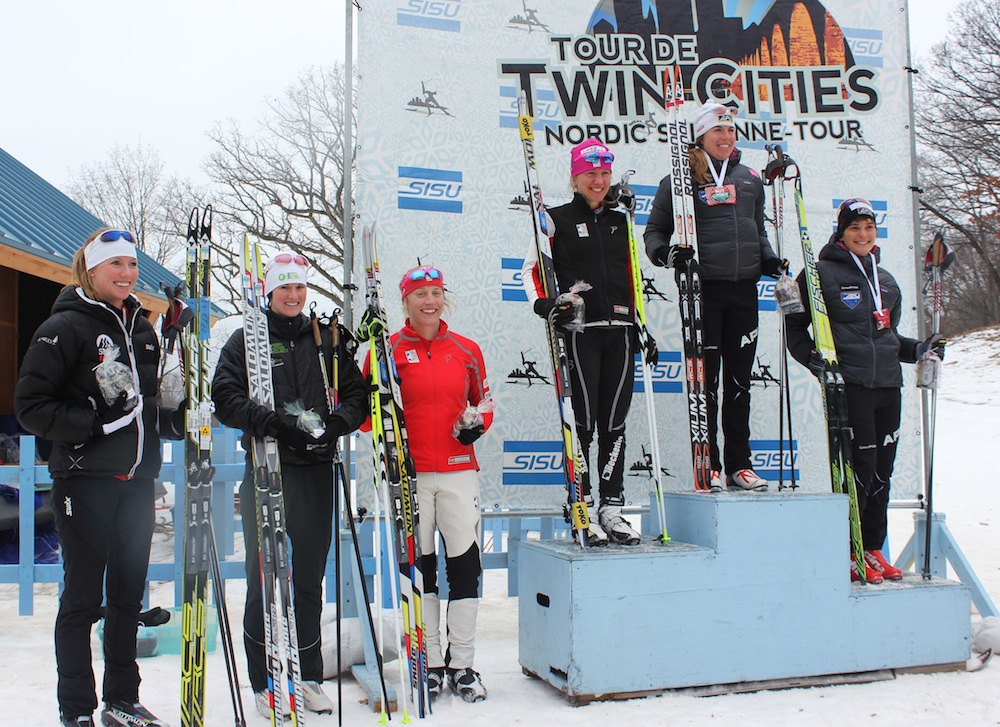
The women’s classic sprint podium from stage three of the Tour de Twin Cities. 1. Jennie Bender (CXC) 2. Kate Fitzgerald (APU) 3. Lauren Fritz (APU). Photo: Brent Knight.
In the women’s race, Jennie Bender (Central Cross Country) kept on rolling with a win in an A-fanal filled with APU skiers. Kate Fitzgerald (APU) took second and Lauren Fritz (APU) was third.
The women’s field was too small to take on a full 30 athletes to the heats, so they contested only a semifinal and final round. Bender said this made for one of the most relaxed sprint days she’s ever been a part of.
“There were like 19 or 20 girls total,” she said (a close guess — there were 18). “From how crazy it was last weekend, it was just a shock to come in Friday and be like, ‘Wow, no one’s here.’ All the SuperTour athletes just hung out in a tent.”
Bender had been hoping to win the first classic sprint on the schedule since her U.S. Nationals victory earlier this month, but knew competition from the likes of Rosie Brennan and the rest of APU would be tough.
“It’s really anyone’s race, you never know what’s going to happen or how you’re going to feel,” Bender said. “I definitely was hoping to be on the podium today.”
For someone who has been gradually regaining fitness from an illness-plagued summer, another win was further confirmation that she’s headed back to full fitness.
“I still feel kind of out of shape, but I feel a heck of a lot healthier,” Bender said. “I can’t really say I’m not back at this point. I think I have a better mentality after this summer, that’s been helping me for sure. I don’t know what my body is doing; I’m hoping I can race myself into shape a bit more and that this continues.”
Bender won by skiing “way out in front,” in Fitzgerald’s words, so the race came down to a fight for second between a slew of APU women.
“The course had a lot of turns and transitions so it was easy to either sneak around people or get totally boxed out, and I ended up on the good side of that today,” Fitzerald said. “I feel very happy with today’s result. The conditions were a little tricky and icy and it was easy to get into panic mode and ski franticly so my goal for the day was to ski strong and relaxed.”
The race for third was also close. Fritz sat in fifth for most of the A-final behind Brennan, Caitlin Gregg and Fitzgerald and thought she wouldn’t have a shot at the podium, but managed to come by all but two skiers and out-lunge Brennan for third in the final meters.
“I thought I didn’t have a chance because I was getting blocked everywhere,” Fritz said. “But since Fitzgerald, Rosie, Caitlin and I were all still in a clump I managed to grab an empty lane on the far side and get by everyone except Fitz, and Rosie and I lunged for third.”
Though the sugary conditions made for difficult skiing for everybody, most athletes were grateful for the chance to race sprint heats at all.
“The [organizers] made a good call delaying the race until today because the beginning of the week was nasty cold, and today was in the upper-teens, although there was a brisk headwind in the stadium,” Fritz said. “Kudos to the race volunteers who were willing to help out today and the OC for letting us do full heats instead of just a qualifier.”
Rosie Brennan took fourth in the A-final, Caitlin Gregg (CXC) took fifth and Clare Egan (CGRP) finished sixth.
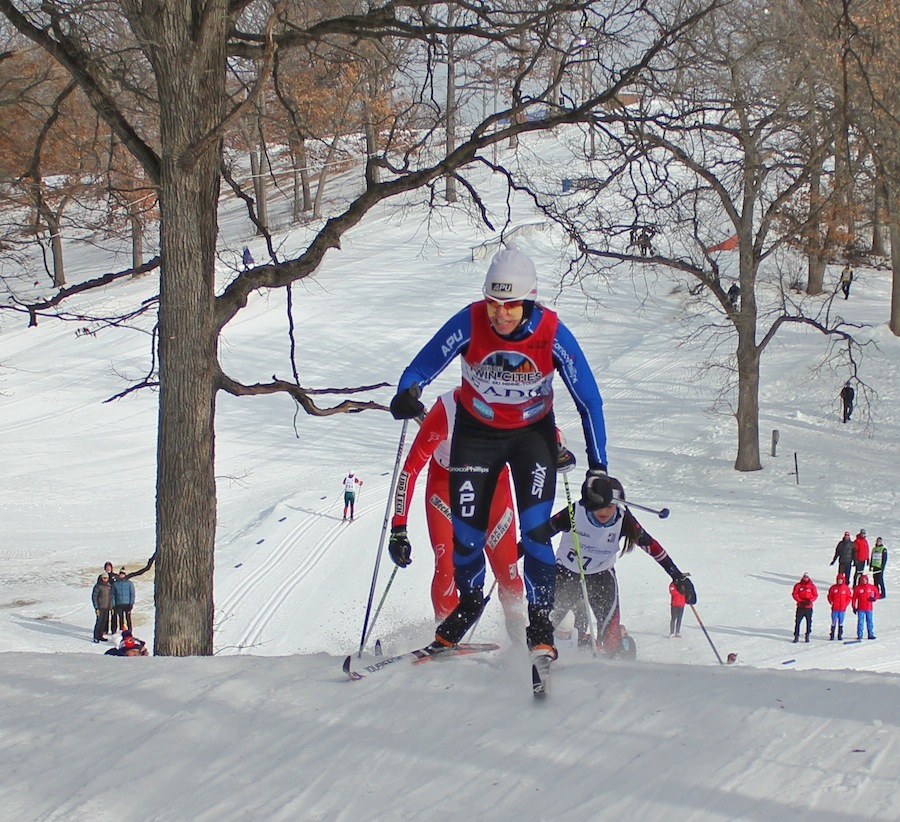
Rosie Brennan (APU) leading over the “wall” in Wirth Park during the 15 k classic mass start on day 2 of the Tour de Twin Cities on Sunday in Minneapolis. Brennan was second behind Jennie Bender (CXC), who won by 6.6 seconds. (Photo: Reese Hanneman/EngineRoomMedia.net)
With temperatures barely extending into the single digits Sunday, the second stage of the Tour de Twin Cities SuperTour circuit was already shaping up to be a tough one. Add to that the nature of classic mass starts – up to six times around a 3.3-kilometer track – and you’ve got quite a race.
Saturday’s 5 k freestyle winner, Rosie Brennan of Alaska Pacific University (APU) arrived to Wirth Park in Minneapolis on Sunday in time to check out the preceding men’s race on the second day of the Tour de Twin Cities.
“I went out to see how the boys were doing, only to witness many boys slipping on ice, falling, and many more yelling for poles causing me to panic a little for our own race,” Brennan wrote in an email. “It was really cold, fast, and icy in some parts.”
A little unsure of how to strategically approach five laps for the women’s 15 k classic, Brennan decided she’d set a high pace and hopefully wear others down.
“As a result, I probably led a fair amount,” she explained. “I had many laps to come up with a game plan after realizing I wouldn’t be able to just ski away from a pack on such a fast course. However, excitement and cheering got the best of me and I went for it on the last lap.”
Using some early hills to her advantage, Brennan built a small gap on the group. The final 1.5 kilometers, however, were flatter and “very twisty,” she wrote. “Both significant weaknesses of mine. I did all I could do to stay away, but Jennie [Bender] just ate me up on that stuff.”
Bender, the Central Cross Country (CXC) skier who skied in second for much of the race, wrote in an email that she found to stay with Brennan on the final lap.
“I thought she was gone, but due to sitting in 2nd my adrenaline kicked in, and I kept hammering,” Bender wrote. “Suddenly I was behind her, and was able to shift into high gear for the last hill.”
Bender nabbed the distance victory, her first on the SuperTour circuit this season, by 6.6 seconds over Brennan in 46.09.9. APU swept second through fourth with Kate Fitzgerald making the podium 8.1 seconds back from first and Becca Rorabaugh placing fourth (+18.4). Caitlin Gregg (CXC) was fifth after crashing just before the last lap when she, Fitzgerald and Rorabaugh tried to pass group of lapped skiers.
“On the big wall before the last lap started we ran into some skiers we were lapping and got tangled,” Gregg explained.
“At that point Caitlin was right in front of me and she fell and I had to stop because I was pinned against the side of the trail,” Fitzgerald wrote.
While those three tried to recover, Brennan started to go for it.
“I gunned it to try and catch back up to Rosie and Jennie,” Gregg continued. “I could see them playing cat and mouse up ahead and thought maybe I could catch them. … Kate, Becca and I tried to reel them in but couldn’t.”
After starting near the front, Bender was happy to stay out of trouble and ski a tactically smart race.
“Every race, I hope I will feel better than the last, and lately that hasn’t been hard since all my distance races thus far have sucked pretty bad,” she wrote. “There were definitely a few moments in the race, where I looked around and felt good that I could add to team red (CXC) once again. It’s a team of 3 this year, but having two in the top five is great. The APU girls are a force to be reckoned with, that’s for sure.”
Brennan took her hat off to Bender, but felt there were some areas she could improve.
“She skied that last section beautifully and overtook me with lots of momentum leaving me in the dust into the finish,” Brennan wrote. “I am happy with the result, but frustrated with my own weaknesses and certainly have made a list of things to keep working on.”
“It was definitely a fun race with some very fast conditions,” Fitzgerald added.
Men’s race
Torin Koos (c) atop the podium in the Tour de Twin Cities 20 k classic mass start on Sunday in Wirth Park, Minneapolis. Brian Gregg (r) was second and Canadian David Greer placed third. (Photo: Reese Hanneman/EngineRoomMedia.net)
In the men’s race, Torin Koos (Bridger Ski Foundation/Rossignol) foreshadowed his own victory – stating Saturday: “I just didn’t have that edge that I been needed to win. It wouldn’t be surprising, though, if today’s effort gives me that little bit I was missing for tomorrow.”
The runner-up in the 10 k freestyle, Koos went on to win Sunday’s 20 k classic mass start by 1.9 seconds over Brian Gregg (CXC) in 47:53.0.
“Today was a cold and icy one, though not as cold as I had prepared for,” Koos wrote. “The biggest name in the game today was staying out of trouble like crashes and broken poles, with so many turns. I raced much more at the front for this reason. Most all of the race I felt so very much in control aerobically.”
A Twin Cities native, Koos explained that he secured the win – his first this SuperTour season – by opening a small gap up “inner-tube hill” on the last lap and holding it to the finish.
“With such high speed snow, I felt skiing in the pack was much easier, though a riskier option,” he wrote. “The cheering section was out there in force again today. The cold weather was nothing for them!”
Gregg was glad to be back on the SuperTour podium for the first time this year. Living with his wife Caitlin just a few blocks away from Wirth Park, Gregg wrote it was great to be able to perform for so many supporters and friends.
“The home course advantage is pretty nice too,” he added. “I have logged many km on the 3.3k loop. It is pretty cool to train in the afternoons with about 300 other skiers. I think training with all the high school skiers last week was helpful in feeling comfortable in the big pack today.”
On the last lap, Dylan McGuffin (Craftsbury Green Racing Project) started to push the pace up front while Koos chased him down, Gregg explained. At the top of the hill, Koos was about 15 meters ahead of Mike Sinnott (Sun Valley Ski Education Foundation). Sinnott was about 15 meters ahead of his teammate, Matt Gelso, Gregg and Canadian David Greer (Yukon Elite Squad).
“About 500m from the finish Mikey went down on an icy corner,” Gregg wrote. “He had a gap and it is always a bummer to pass some one simple because they fell.”
Gregg, Greer, Gelso and Mark Iverson (Saturday’s winner from APU) passed by, and Sinnott ended up sixth (+8.3). Greer was third, 2.4 seconds back from Koos, Gelso was fourth (+5.3) and Iverson was fifth (+6.4).
Greer, who made the long trip down from the Yukon Territory with teammates Knute Johnsgaard and John Parry with some time to kill between NorAm races in Thunder Bay and Duntroon, Ontario, met his goal of the podium after being sick last week. After feeling like he was missing his top gear in Saturday’s race, he decided to go for it on Sunday.
Greer was around 12th when Koos attacked the last kilometer. He followed, picking off the places and moving to fifth and then third by the top of the last hill.
“I usually have a decent sprint finish, but unfortunately I wasn’t able to do anything today because the finish stretch was very short, no time to pass,” he wrote.
“It felt more like a criterium than a ski race. You needed to be really aggressive to stay near the front,” Greer explained. “I consider myself lucky not to have fallen or been taken out because racers were falling right, left and centre throughout the entire race! It was very chaotic.”
With temperatures forecast to remain below zero on Monday, it was unclear whether the third stage of the Tour, the classic sprints, would take place as scheduled.
The start of the J1/OJ girls’ relay. Photo: David J. Owen Photography
The last day of the 2011 Junior Olympics, the classic relays, favored skiers with experience.
Winter returned to Minneapolis in the form of temperatures in the low twenties, strong winds, and a trace of new snow. The course was firm-to-icy and the tracks were filled with the fresh drifting snow. Given the abrasive conditions, coaches tested a variety of klister or binder bases covered with waxes slightly warmer than the temperature. The savvy athletes double-poled out of the tracks and strided in the tracks. Coaches tried to find the balance between wax that wouldn’t shear off on the ice and wax that offered good glide on the dry snow that filled the tracks.
Given the very short racing length, 3 x 3 kilometers, speeds were very high and aggressiveness played a big role in the scramble leg. The course had one long and one short very fast downhill, each with a corner at the bottom. The athletes who were both fearless and skilled on their feet had the advantage.
In the first race of the day, the J2 boys relay, New England’s scramble leg, Hamish McEwen, set the tone by taking an aggressive lead from the gun. McEwen and the other top skiers in the field double-poled out of the stadium between the many tracks. The remainder of the boys quickly caught on and also exited the tracks. Most then remembered to get back into the tracks for the climbs, but some forgot and were dropped instantly as they slipped.
McEwen leading early in the J2 boys' relay. Photo: David J. Owen Photography
McEwen gained an 8-second lead over the course of his leg and tagged off to Ben Hegman. Hegman lost two seconds to the Midwest team, but still held the lead when tagging off to Tyler Foulkes. To the delight of the hometown crowd, the Midwest’s Harris Dirnberger skied an aggressive anchor leg, passing Foulkes and skiing the Midwest to a six-second win.
Matthew Berntston, second leg for the Midwest, said the team had thought that they had a chance to win. “The goal of the first and second legs was just to keep up with the leaders. We hoped that Harris would beat out anyone.”
Unlike many Junior Olympic winners, Dirnberger has not been thinking about this day for a long time. “My first JO qualifying race was this winter. I went because I thought it would be fun to race the JOQ with my teammates. I did pretty well in the classic, so I kept going to the JOQs. I made the team, so here I am.”
Dirnberger’s success isn’t surprising to his coach Piotr Bednarski of Go! Training, who first saw his talent this summer. “He first came to practices this summer. He surprised me by staying with an elite CXC skier in rollerski sprints.”
J2 Boys
1. Midwest (Nick Proell, Matthew Berntson, Harris Dirnberger)
2. New England (Hamish McEwen, Ben Hegman, Tyler Foulkes)
3. Intermountain (Noah Anderson, Karsten Hokanson, Marc Jackson)
Woods in the finish of the J2 girls' relay. Photo: David J. Owen Photography
The J2 girls relay was also won on the last leg, when Alaska’s Marion Woods erased a 23-second deficit to pass New England for the win. Wood’s teammates were motivated by her successes this week. Sarrissa Lammers, the team’s scramble leg explained, “We really wanted to get Marion her four golds.”
Woods, for her part, still seems surprised by how well she finished this week. “I didn’t know what to expect coming down here. I knew a lot of people had been training a lot. I just planned to come to JOs and do my best.”
J2 Girls:
1. Alaska (Sarrissa Lammers, Mackenzie Flynn, Marion Woods)
2. New England 1 (Brooke Mooney, Cate Brams, Heidi Halvorsen)
3. New England 2 (Halie Lange, Zoe Snow, Hannah Benson)
The J1s and OJs raced together, even though they were scored separately.
The New England OJ’s scramble leg, Skyler Davis, posted the fastest time of the first leg, but Intermountain’s J1 team scramble, Cole Morgan, remained in touch, five seconds behind and in second place.
Strong second legs were put in by Intermountain’s Sawyer Kesselheim and Midwest’s Dylan McGarthwaite, who were the only two skiers in the second leg to dip under nine minutes. Kesselheim caught New England OJ Peter Hegman and passed him on the long climb, going through the lap in the overall lead by one second. McGarthwaite’s strong leg pulled the team into second for J1s and fourth overall.
The anchor for Intermountain, Akeo Maifeld-Carucci, faced the daunting prospect of trying to keep up with David Sinclair, the winner
Lunge at the line in the J1 and OJ boys' relay. Photo: David J. Owen Photography
in this week’s mens OJ classic. “Sinclair caught me early on, so I tried to stay with him as long as I could.” Maifeld-Carucci held on bravely, staying within five seconds Sinclair (New England OJ team) and bringing Intermountain in for the J1 victory with a 24-second margin over the Midwest J1 team. Carucci sums up his experience: “I had really good skis and super-strong teammates. It all came together for us.”
2. Midwest: (Andy Dodds, Dylan McGarthwaite, Ben Saxton)
3. Alaska (Forrest Mahlen, Isaac Lammers, Logan Hanneman)
OJ Boys:
1. New England 1 (Skyler Davis, Peter Hegman, David Sinclair)
2. New England 2 (Austin Cobb, Chris Stock, Bridger Tyler)
3. Alaska (Jack Novak, Silas Talbot, Peter Mamrol)
The Minneapolis crowd looked forward to the finale of the weekend, the OJ/J1s girls race, knowing the Jessie Diggins would anchor the Midwest OJ team.
Diggins headed for the win. Photo: David J. Owen Photography
Diggins and her team did not disappoint. First and second legs, Libby Ellis and Elizabeth Simak, accomplished their plan of staying within reach of the leaders. Simak tagged off to Diggins in 2nd among OJs and 4th overall. As expected, Diggins made up the slack. She roared by the three teams in front of her, bringing the team in first overall, 23 seconds in front of the New England J1s.
Teammates Ellis and Simak were confident that if they held their own on the first legs, Diggins would make up any deficit. “Jessie is the most motivated person we have ever met. If she wants something, she goes out and gets it.”
Victory was especially sweet for this close-knit team. Ellis and Diggins have been skiing together for five years, while Simak been with them for four. The team raced the course with gold-glitter face decoration, a tradition the Midwest girls started at the 2006 Soldier Hollow JOs. Ellis explains that this is the perfect end for her and Diggins, who are both in their last year as older juniors. “It’s even better that this race is here in Minneapolis. I love the fans and appreciate all the hard work the organizers did to put this together.”
The New England OJ team of Heather Mooney, Cambria McDermott, and Corey Stock won the J1 relay, although they were pushed by the team from Rocky Mountain. Heather Mooney and Michaela Frias were neck-and-neck at the front of the pack throughout the scramble leg; Mooney had a 1-second lead at the tag. Mary O’Connell put the hammer down on her leg, and tagged off to Emily Hannah with an 11-second lead. The speed of Corey Stock, who was likely motivated by being passed by Diggins, was just too much for Rocky Mountain. Stock brought the team in for the J1 win and second-place overall.
Second-place in the J1s was a good result for team Rocky Mountain. They followed their race plan perfectly. For Frias, that plan was to “get the team in a good a position.” O’Connell’s role was to “push the pace high.” Hannah was determined “to try to stick with their position.” All three skiers are from Steamboat Springs High School, the public high school in the community of Steamboat Springs.
J1 Girls
1. New England (Heather Mooney, Cambria McDermott, Corey Stock)
2. Rocky Mountain (Michaela Frias, Mary O’Connell, Emily Hannah)