From the FasterSkier archive — posts syndicated from athletes’ and coaches’ own blogs between 2004 and 2012, kept online as published. Current coverage is at fasterskier.com.

Tag: Women

  • Unequal Prize Money at Blink Festival Illustrates Challenges for Women’s Distance Racing

    Unequal Prize Money at Blink Festival Illustrates Challenges for Women’s Distance Racing

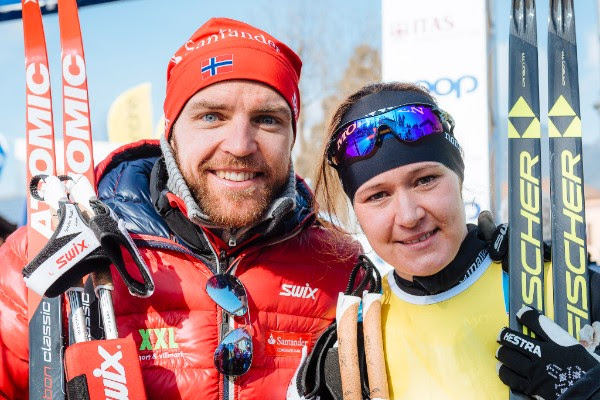
    Tord Asle Gjerdalen (l) and Britta Johansson-Norgren (r) after winning the 2016 Marcialonga 70 k classic. In July, Johansson Norgren won the Blink Classics 60 k rollerski race - but received only 20% as much prize money as Petter Northug got for winning the men's race. (Photo: Visma Ski Classics)
    Tord Asle Gjerdalen (l) and Britta Johansson Norgren (r) after winning the 2016 Marcialonga 70 k classic. In July, Johansson Norgren won the Blink Classics 60 k rollerski race — but received only 20 percent as much prize money as Petter Northug got for winning the men’s race. (Photo: Visma Ski Classics)

    At the end of July, Norwegian professional cross-country skier Astrid Øyre Slind hit the podium in the new 60-kilometer classic race at her country’s Blink ski festival. She faced a payout that seemed unusual: a big discrepancy between men’s and women’s prize money.

    At the competition, called Blink Classics and part of the inaugural summer season of the World Classic Tour rollerski series, the total prize money available for men was 190,000 kroner, or just over $23,000. For women, it was 50,000 kroner — about a quarter as much.

    Accordingly, Slind’s second-place finish notched her 10,000 kroner ($1,200), while the second-place man, Andreas Nygaard, received 40,000 kroner.

    And men’s winner Petter Northug took home 75,000 kroner, which was 50 percent more than the entire pot of women’s prize money.

    “It’s an enormous difference,” Slind told Norway’s NRK broadcaster.

    Sweden’s Britta Johansson Norgren, who won the women’s competition, did not return FasterSkier’s request for comment.

    In most major ski marathons, women receive equal prize money to the men. At Norway’s Birkebeiner, the prize is 40,000 (Norwegian) kroner or $4,800 apiece; at Sweden’s Vasaloppet, the 2015 prizes went up to 91,000 (Swedish) kroner or $10,700; at Italy’s Marcialonga, it was 5,300 Euros or $5,900 for both men and women.

    The American Birkebeiner pays $7,500 to both the men’s and women’s winners.

    But Blink Classics is not one of these established marathons: it is a rollerski competition in its very first year of existence. It did, however, attract the attention of the Norwegian government, which was concerned that the festival was violating the country’s equal pay act.

    “For us it has not been easy to have this situation with the girls,” Blink Festival press secretary Arne Idland told FasterSkier. “And then when they are not satisfied with the money it is really difficult. We will try as hard as we can to find a solution.”
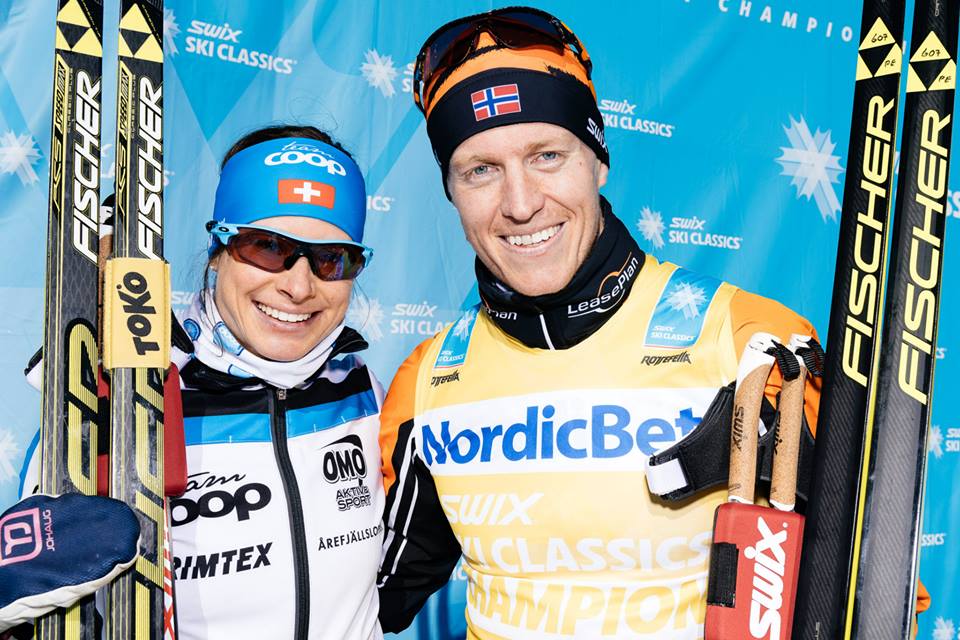
    Seraina Boner (l) of Switzerland and Team Coop and Petter Eliassen of Norway and Team LeasePlan Go won the 2015 Årefjällsloppet, receiving equal paydays. (Photo: Ski Classics)
    Seraina Boner (l) of Switzerland and Team Coop and Petter Eliassen of Norway and Team LeasePlan Go won the 2015 Årefjällsloppet, receiving equal payouts. (Photo: Ski Classics)

    New Race for a Booming Festival

    The Blink ski festival is now a giant on the summer racing circuit, with athletes from all over Europe and even North America coming to compete on rollerskis in cross-country skiing, biathlon, and the famous Lysebotn Opp hill climb. Recreational and junior classes are also a big focus, making it accessible to fans and professionals alike.

    But adding a long-distance race to the mix was not easy for organizers, who still have to make sure that the festival breaks even financially. Idland explained that Blink Classics had been in the works for three years.

    “The main challenge this year is that we, for the first time, were going into car traffic — this race was on ordinary roads with traffic [rather than the city square], and we had to close it to traffic just like they do in cycling races,” he explained.

    That entailed paying for policemen, for one thing. Having a fourth day of racing (previously there had been three, the Lysebotn Opp and two more days in the Sandnes city center) also meant more production by NRK, Norwegian national television, as it followed a long-distance race rather than staying in a set location downtown.

    “If you have live production it has to be in high definition,” Idland said. “Then it’s really expensive.”

    Then last autumn came the news from the Norwegian Ski Federation: none of the national team “A” or “B” team women would compete in the 60 k. The women usually focus on doing all three of the other days of racing, and adding a 60 k at the beginning of consecutive days of racing would be too much volume and intensity during the summer training season. Some of the men, like Eirik Brandsdal and Sjur Rothe, would do the longer race; Martin Johnsrud Sundby was interested but later pulled out.

    Concurrently, Idland said, NRK was telling the Blink organizers that it wouldn’t be possible to broadcast the men’s and women’s 60 k competitions together. It would have meant following two races at the same time — double the filming budget and staffing — and deciding all the time which feed to broadcast and commentate. NRK didn’t have expertise in doing this and said that they needed to develop it. So they would only broadcast one, and with the national team women out of the competition but the national team men in it, organizers agreed it should be the men’s race.

    “When I contacted the teams from other nations, I was open and said that this [women’s] long distance race will not be broadcast on TV and no women from the national team would start there,” Idland said of his communication with other countries’  teams last winter, before registration began. “So I advised them all not to start in this race, but to come do the three other races.”

    As a result just four women, compared to 69 men, finished the 60 k classic race.

    Johansson Norgren, the winner, is a mainstay on the Visma Ski Classics circuit and won the 2016 season title as well as numerous individual marathons. Masako Ishida, who finished third at Blink Classics, was the winter series’ fourth-ranked woman. So the podium at Blink was not so different than a podium one might see at a top winter event.

    But the decision about prize money had been made long before.

    “We said that we need good prize money on the men’s side, because the other competitions that we compare with have good prize money,” Idland said. “We also need some sprint primes. We had a total of 190,000 kroner, or about 20,000 Euros, for the men. And we had just over 5,000 [Euros] for the women. That was decided before we opened entry.”

    Even for the women, it was more prize money than was available at the other competitions in the Blink festival, Idland said. In those other races, prize money is equal for men and women and each total prize-money purse is roughly 2,000 Euros.

    “So it is double amount of money in this women’s class in any of the other races, including Lysebotn Opp,” he said. “We thought we were really doing well for the women. And it’s not every rollerski race having prize money, either.”
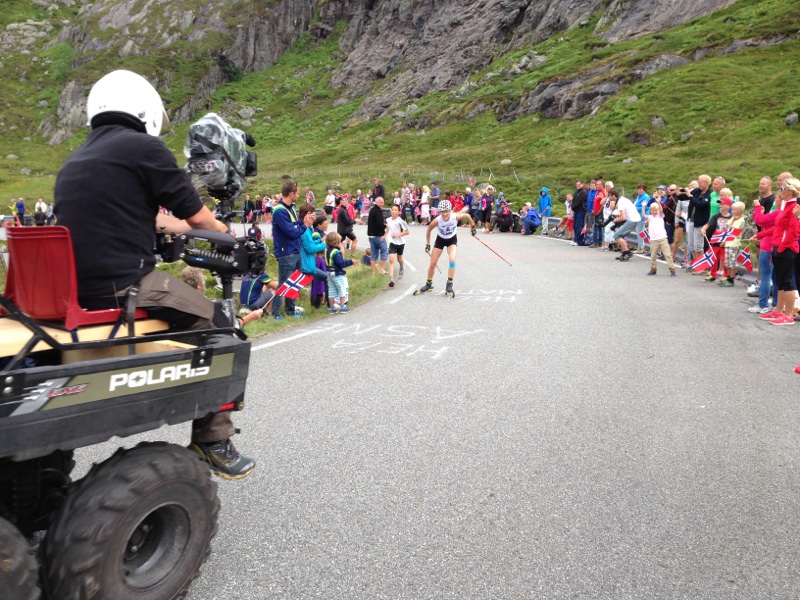
    Kaisa Mäkäräinen (FIN) climbs to victory in the Lysebotn hill climb at the 2013 Blink festival. The women's hill climb is televised, unlike the Blink Classics. (Photo: blinkfestivalen.no)
    Finland’s Kaisa Mäkäräinen climbs to victory in the Lysebotn hill climb at the 2013 Blink festival as a cameraman captures the action. The women’s hill climb is televised, unlike the Blink Classics. (Photo: blinkfestivalen.no)

    Building Women’s Pro Fields Takes Time

    But the discrepancy still felt unusual to some of the women, who are used to getting paid the same amount as their male counterparts for a win.

    Prize money is the same for men and women on cross-country skiing’s World Cup. In fact, female superstars like Marit Bjørgen and Therese Johaug earn more than their male counterparts because they are more dominant, grabbing a bigger proportion of the total available prize money for themselves.

    The gulf between men’s and women’s participation is greater in long-distance racing than on the World Cup. As a result, marathon organizers have to grapple with a somewhat different set of considerations as they develop the payout structure for their competitions.

    Most of the biggest ski marathons in Europe — including the Birkebeiner, Vasaloppet, and Marcialonga — are part of the Visma Ski Classics series, where organizers have come up with compromise solution when it comes to year-end rankings.

    Prize money is equal for the top three overall series finishers, but the men’s field also pays out to the fourth- and fifth-place athletes while the women’s field does not.

    “For me it sounds very strange,” Visma Ski Classics CEO David Nilsson told FasterSkier in an interview last week referring to the Blink prizes. “We have in our rules that they must have the same first prize to men and women. It is also important to reflect on the percentage [of field size], and it shouldn’t be so much more difficult for the men to get [prize money] than for the women — but you can never do more than win, so of course that has to be equal for first place.”

    In the winter, far fewer women than men are on Visma Ski Classics professional teams. But women’s races are hotly contested and often extremely dramatic, like Seraina Boner’s come-from-behind win at the 2016 Birkebeiner after passing Ishida and Poland’s Justyna Kowalczyk in the final kilometers.

    In the 2016 season, 39 different women scored points toward the overall titles. There is even an all-women’s pro team, Sweden’s Team SkiProAm, whose top athlete finished eighth in the season rankings.

    According to Nilsson, Visma Ski Classics has carefully tried to promote women’s participation, with equal prize money for first place being one component.

    “We worked very hard on this,” he said. “When I started 6-7 years ago, we had 4-5 women that were competing [professionally] in long distance skiing because it was a bigger step for them from shorter distance [World Cup] skiing than for the men.”

    While they left the women’s competition out of the spotlight this year, the Blink Classics organizers don’t think that should always be the case. Like the Visma Ski Classics, they want more women on the start line.

    “Our aim and our goal is also to have the world’s best women at the start in future,” Idland said.

    One reason for low numbers at Blink might be that long-distance racing just isn’t as popular among women in Norway as it is in neighboring Sweden, home of the Visma Ski Classics brand, said Nilsson.

    “In Norway, which we all know is very strong in cross-country skiing, we don’t see so many female participants in long-distance skiing,” he mused. “They are more from Sweden. We don’t know why the Norwegian women are not coming more.”

    The Blink 60 k is part of a three-race series of long-distance rollerski competitions called the World Classic Tour. Indeed, the second leg of the Tour was held in Sweden. Called the Alliansloppet, it is also a more established event.

    Twenty-five women finished that 48 k race, including several past Visma Ski Classics champions and members of the Swedish national team (Hanna Falk, a three-time World Cup podium finisher, won the race). Prize money was equal for men and women, including a 10,000 Swedish kroner sprint prize ($1,000) for both men and women.

    The World Classic Tour overall awards use a similar idea to the Visma Ski Classics, in that the men’s and women’s title winners earn equal paychecks but the men’s field will pay out to six places and the women’s to just three.

    Yet the series does not appear to have a policy for its constituent races in how to organize prize money at individual competitions.

    If organizers like those at the Blink festival want to develop a strong women’s competition, Nilsson suggested that they need to actually promote the women’s races.

    “We also made sure that there was much more focus on the women [than there had been before],” he said of the Visma Ski Classics efforts. “The women should have be starting [wave] before the men to have their own competition… and have [television] production of the race and their own media. When we created the system, all the attention was on the men. Then we made it so the pro teams had to get points from both the men’s and the women’s classes. This together has made the increase of the women.”

    Idland conceded that with more prize money, they might have drawn a slightly larger women’s field. But he believed the circumstances of the festival, with the three subsequent days of racing, were the bigger reason for low participation.

    On the Blink Festival website, the news story about the 60 k Classics race features five paragraphs and three photos about the men’s race, but only one paragraph and one photo of the women.

    Nilsson believed that some changes could be made without disrespecting the male athletes.

    “When you have 100 men and not so many women registered, it wouldn’t be fair to get the same [prizes],” Nilsson said. “It would be easier for the women. So it has been for us to push the development [of women’s skiing] but not to be unfair to the men’s skiers. That’s the reason we have in the prize money, five men and three women. And that reflects a little bit to the female factor, to be honest, in terms of the number of participants and the amount of professional skiers. It has to be the same difficulty to win a prize in both categories.”

    What Does Equality Mean?

    Race organizers are continuously trying to come to a more perfect solution, and one common thread seems to be that prize money must be earned by quality racing and exciting performances. Until the women’s fields are deemed to have provided that, they might not see as much compensation.

    Visa Ski Classics, for example, continues to make changes. For the 2016/2017 season, women will for the first time be able to vie for a sprint title, worth five percent of the total prize money, just as the men have done for years.

    “The reason it wasn’t the case [previously] is that there weren’t so many women — last year was the first time that there was really a group at the front,” Nilsson said. “Before it was just one or two who went away, so it wouldn’t have been interesting. The same people would have won the race as the sprint bibs. Now both men and women get a sprint bib, which is a step forward. Our goal is to make it equal the number of participants and who gets prizes.”

    Nilsson guessed that the availability of intermediate prize money may also change the tactics of the women’s races and contribute to an exciting spectacle on television.

    For his part, Idland insisted that the Blink organizers’ decision about prize money was not sexism. It could have gone the other way, he wrote in a letter to the Norwegian government explaining the discrepancy in pay.

    “I was trying to give an example with the opposite situation,” Idland said. “If Marit [Bjørgen], Therese [Johaug], Heidi [Weng], Charlotte [Kalla], and maybe some of the Americans said to us that this race we would very much like to do, and the men said they didn’t want to do it and just let the [marathon] specialists do it, then I am quite sure we would have done the opposite thing. We would have led the coverage with the women, if the level was higher.”

    After being contacted by the authorities, the Blink Festival is trying to work together with the government to achieve equality.

    “Our answer was that they would really much like to come in dialogue with us to try to make a plan for the future,” Idland said. “And that we try to build up this competition with a clear aim to have everything on an equal basis in some number of years.”
  • Despite Women’s Strength, Stereotypes Still Nip Sports Performance – With No End in Sight

    Despite Women’s Strength, Stereotypes Still Nip Sports Performance – With No End in Sight

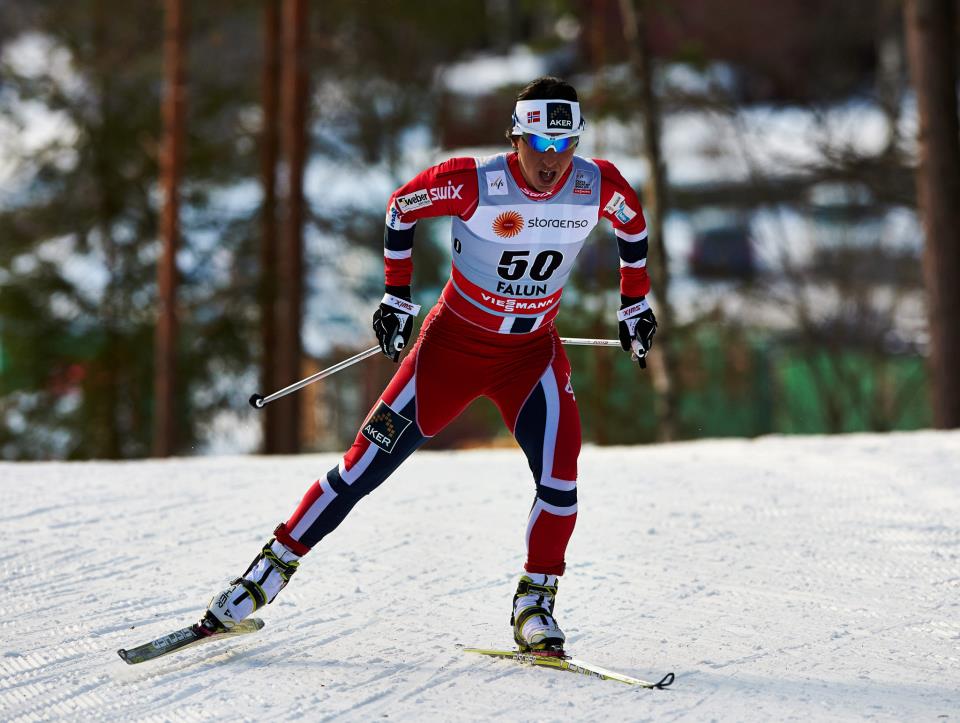
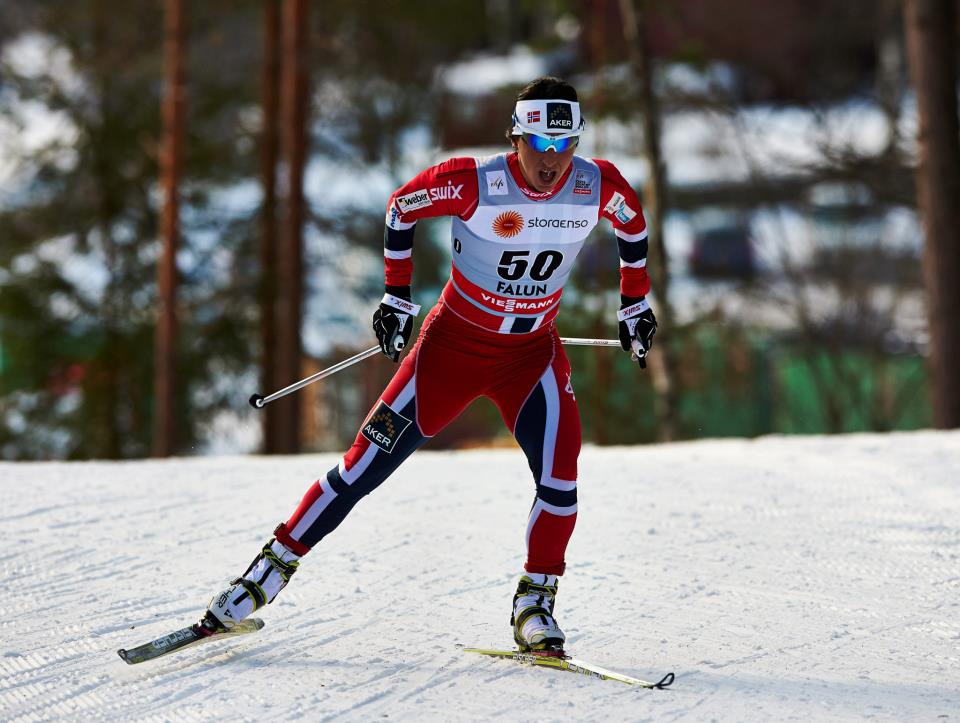
    If Marit Bjorgen can't change people's perceptions about what women can accomplish in sports, then what can? (Photo: Fischer/Nordic Focus; facebook.com/FIS Cross Country)
    If Marit Bjorgen can’t change people’s perceptions about what women can accomplish in sports, then what can? (Photo: Fischer/Nordic Focus; facebook.com/FIS Cross Country)

    MONTPELLIER, France – Women’s sports have come a long way in the last half century. But they are still nowhere near on par with men’s sports, in terms of participation, depth of field, or funding. What is stalling the progress?

    One limitation is stereotypes, which in many ways have changed startlingly little. It’s taken as a fact that women’s bodies aren’t capable of the types of performances turned in by men. Yet in a recent review published in the journal Psychology of Sport and Exercise, authors noted that innate physical differences can’t fully explain the difference between men’s and women’s athletic performance.

    Many stereotypes and expectations have psychosocial effects on women from the very day they are born: what they wear, how they play, how adults interact with them. As girls get older, there’s the expectation to look pretty, to get married, and to have a family – and maybe leave a promising career to take care of the kids. All of this contributes, research shows, to the differences in both participation and performance between the sexes.

    Among the researchers who published that review is Julie Boiché. She’s a psychology researcher at the Epsylon Laboratory, a collaboration between three universities housed in this southern French city which bills itself as an “interdisciplinary research unit dedicated to the human sciences and health.”

    Sports aren’t what Boiché, a slim woman with biceps that Michelle Obama would envy and an elegant streak of white through her dark-gray hair, set out to focus on. In her career so far, Boiché has studied gender stereotypes and expectations in many aspects of life, from academics to professional settings.

    But it’s not a strange direction for her take, either. Boiché plays rugby, a sport which in France is definitely considered to be for men.

    “There was a student who came [to our team] and did a survey about it, talking with some of the male staff members,” Boiché recounts. “She felt that we were tolerated, nothing more. And sometimes we had feedback where they’d say, ‘actually, we’re really surprised that you can play!’”

    Of course, most people don’t come right out and say that, even if they think it. Stereotypes can be expressed in subtle ways, yet still have a huge impact.

    And while nordic sports are pretty egalitarian – at least compared to rugby – there are plenty of ways that these gender expectations are ingrained into athletes’ daily lives: the relative rarity of female coaches, even for female athletes. The shallower depth of field at almost every level of racing. And, fairly uniquely to skiing, the different distances for women and men.

    “I think it definitely marks differences, to say, ‘you can’t do the same distance because you’re just a woman’,” Boiché says of the setup. “Nothing legitimizes that, because you are just as highly-trained of an athlete. You can run the same distance, even if the male and female times are different.”

    So what is the impact of being reminded, weekend after weekend, that you’re different from a man? And why are situations like this deemed “okay” by the sporting world and the general public? That’s what Boiché and her lab has set out to study.

    Experiments and Surveys

    In psychology, stereotypes are defined as sets of beliefs about behavior or personality that are shared by a group of people. There are two ways to consider their effects: as internalized, or as situational.

    The internalization hypothesis tests the idea that the extent to which someone is affected by a stereotype depends on whether they endorse it or not. If they believe that a stereotype is true, then it will have an effect on them.

    The situational hypothesis is more broad. It states that anyone can be affected by stereotypes, as long as they are exposed to them. It doesn’t matter if they agree with the stereotype, if they are ambivalent, or if they actively fight it.

    Boiché gives an example of a situational effect from the academic realm.

    Fast and Female in action: Annie Hart, Sophie Caldwell, Jessie Diggins and Erika Flowers on Oct. 7 at a Fast and Female event in Park City, Utah. (Courtesy photo)
    Fast and Female in action: Annie Hart, Sophie Caldwell, Jessie Diggins and Erika Flowers on Oct. 7 at a Fast and Female event in Park City, Utah. (Courtesy photo)

    “Some very famous studies show that if you present a task as a drawing task, girls and going to be better, but if you present it as a geometry task, they will be worse than boys, even if it is the exact same task,” she explains. “It is just the stress, the pressure induced when you know that your group is considered as worse and you are afraid of confirming those stereotypes. You become less focused.”

    In sports, the internalization hypothesis is mainly used to study participation, while the situational hypothesis is used to study performance.

    “In the [internalization] sense, what we are working on is to what degree people agree with the stereotypes that men differ, and that sports are not as appropriate [for women],” Boiché says.

    This approach seeks to answer questions like those raised by Canadian Olympic gold medalist Chandra Crawford’s Fast and Female events: how can adolescent girls be encouraged to stay in sports?

    “We assume that if people endorse such stereotypes, then girls would be less likely to engage in sports,” Boiché explains. “Maybe they associate their gender with other kinds of activities. The idea is that in adolescence, gender identity becomes increasingly important and young women that identify strongly with femininity, if they endorse the stereotypes, would be more likely to drop out.”

    Assessing how people endorse these stereotypes is not an easy task for many reasons, but primarily because people are not always honest.

    “Women won’t necessarily tell you if they consider sports not to be for women,” Boiché laments. “But they will make choices in different proportions in men. You see that females drop out more than males, but at the same time they would deny that this is because of stereotypes.”

    The situational approach, on the other hand, can be studied in a less biased and more experimental manner; it is often applied to individual tasks. For instance, researchers can present a female athlete with a stereotype, and then ask them to perform a skill or technique. Women who take sports seriously probably don’t buy into the notion that athletics are a male domain – yet knowing that others do can still affect their performance.

    Confronting Reality

    In a world where Marit Bjørgen exists, along with Brittney Griner, Lindsey Vonn, Serena Williams, and Abby Wambach, and where women have made appearances everywhere from NASCAR to the Kentucky Derby – why do these stereotypes still even exist?

    Changing people’s perceptions, says Boiché, is hard. She and PhD student Melissa Plaza recently completed a study looking at participation by sex in a variety of sports, as well as people’s perceptions of those sports. They found nearly a perfect match: if more women did a sport, it was considered “appropriate” for women. If more men did a sport, it was considered a “men’s sport.”

    (There is also a stereotype against men doing sports that are perceived to be more appropriate for women, which Plaza believes is very important to study more. But the problems for women, she says, are greater: “It is not the same degree of conflict. For instance, a male dancer is going to be athletic anyway, [conforming to norms] since in social life men are expected to be muscular, even if they are not very large.”)

    Boiché called it a vicious circle.

    “As long as people think like that, it will be hard to change behavior,” she says. “Young children and adolescents don’t want to play a sport that is not ‘appropriate,’ and the parents won’t push them.”

    The women recount a story about a young participant in one of their studies. The girl wanted to play rugby; she signed up secretly because she knew her parents wouldn’t approve. Her mother found out and actually forbade her from playing; she was worried, she said. It’s a dangerous sport, and her daughter might break her nose.

    The kicker? It was a rugby family. The mother had not forbade any of her sons from playing.

    “People actually believe these stereotypes, that women are just physical capital and you have to keep that,” Boiché marvels.

    “It’s crazy,” Plaza agrees. “You have to change behaviors before you can change perceptions.”

    It’s a seemingly impossible proposition. So in the last part of her PhD, Plaza hopes to study whether it’s possible to change people’s perceptions before changing their behavior.

    For questions like this, researchers use computers and ask participants to do a task, like associating two words. Do they click faster, for example, when they’re presented with “men” and “sports” than with “women” and “sports”? This type of “implicit” study removes the bias and dishonesty the researchers encounter with survey-based methods.

    The plan is to examine whether being shown images of female athletes affects the way that participants make these associations.

    “That’s the question – if we present a model of someone that contrasts stereotypical behavior, will people realize that this person is as able in these sports?” Boiché asks. “And then that she’s not a man, that she’s feminine? Maybe that can change things.”

    Modern Complexity

    She could be talking about Plaza. Sitting across the table, the 25-year-old researcher wears a pink shirt with delicate shell buttons; and her long hair bounces as she moves. Her posture is perfect. She’s on point and slightly nervous, since she wasn’t sure she would be comfortable doing an interview in English. (She speaks, of course, very well.)

    So when she talks about broadcasting images that contrast stereotypes, you imagine, well, her. Besides conducting experiments and writing papers, Plaza is a professional soccer player, which is why she’s so interested in these questions in the first place. The midfielder has played an average of 78 minutes in 16 matches of the French championship league; in that time she has received two yellow cards for the Montpellier team, which is ranked fourth in the country.

    (For American skiing, this moment came when Jessie Diggins and Kikkan Randall – flipping their blonde hair and batting their lashes – marched atop the World Championships podium. Fast? Athletic? Feminine.)

    Despite the many, many examples of women who go completely against the stereotype that ladies shouldn’t do sports, and that those that do are more like men because of it, Boiché points out that as yet, they have “no solutions.”

    Even in 2013, women’s sports are often treated as a lower level. Plaza, for instance, is paid a fraction of what even the worst male players on French professional squads receive. Her team, she says, practices even more than the men’s team – and the women hold jobs or are students, while the men just play soccer. Sports aren’t perceived in the same way in every country, and soccer is a particularly striking example. In the United States, it’s seen as neutral, or appropriate for both men and women. In Europe, Boiché says, “it’s really the male sport.”

    So Plaza, and other female athletes, are exposed to stereotypes all the time, even if they don’t buy into them.

    “In the last few years, all these sexist declarations have been made by coaches,” Boiché fumes. “When you do the kind of job that we are doing, it’s surprising. You say, ‘what? We’re in 2013 now!’ Just this year there was a soccer coach who said – he was unhappy with what a woman commented on the radio – and he said ‘well, I never talk about soccer with women, they don’t get it and she should just go back to her kitchen.’”

    And even within her team of highly dedicated athletes, Plaza still sees women who endorse the stereotypes that she studies.

    “I often hear that they will have to stop their career at 40 so they can have children,” she says. “But what is the problem? You can have a child and then go back to your career. It’s not a problem for me.”

    It’s just one example of what the researchers often encounter in their work: women who at the same time endorse and completely reject stereotypes. Another example has to do with body image.

    “For women, at the same time that they are happy about their body because it is efficient, powerful, and strong, it also doesn’t fit societal expectations – like to be good-looking, you have to be thin, little, delicate,” Boiché says. “So not really muscular.”

    This presents some athletes with a mental tug-of-war, an internal disagreement. Until the stereotypes disappear, these contradictions will likely continue to be a source of both conscious and unconscious stress for female athletes.

    Solutions?

    Besides their experiments, Plaza and Boiché discussed some more society-level topics that are often brought up when discussing women’s sports. For instance, what if there were more female coaches? Would that provide more role models, and keep girls playing sports for longer?

    But the lack of female coaches is a product of the same stereotypes that limit women’s participation as athletes, plus all of those that go along with professional life, or even just the desire to have children and spend time with them at home.

    “The characteristics of the job are more appropriated for men, because you have to be self-confident, you have to be a leader, you have to be many many things that are male-typed,” Plaza said. “So maybe that’s a barrier for women to be able to get this opportunity.”

    Then there’s the media aspect. Women’s sports exist, but they aren’t broadcast as often. Plaza thought that changing that ratio might help change people’s perceptions, seeing female athletes more frequently might make it more “appropriate” to be one.

    But Boiché wasn’t sure.

    “I think the hard thing is that when people have a really strong opinion about something, it is really hard to make them change,” she said. “I’m not sure coverage would change this kind of vision.”

    For Plaza, the best she can do to try to solve the problem is to keep researching, and trying to understand what drives people’s perceptions.

    That, and keep playing soccer.

    “For the moment we have no choice but to keep playing, to stay involved in the sport and to be better and better,” she concludes.

  • Enter Johaug?

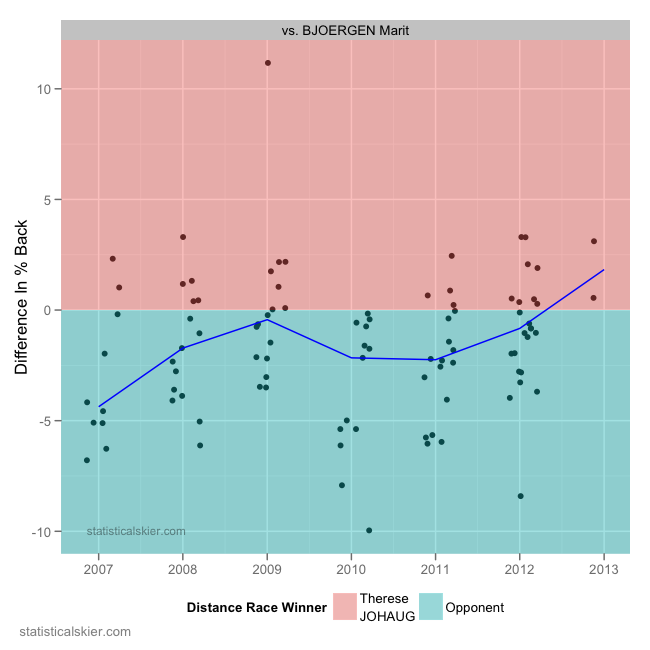
    Lots of racing this weekend, obviously, but the Muonio results only appeared on the FIS website today, so they’ll wait for later in the week. I was intrigued, though, but Therese Johaug’s strong races in Norway.

    For many reasons, it will be difficult to accurately parse early season results this year. Many people are focused on mid-season events like the Tour de Ski and World Championships, so it’s hard to say what kind of shape everyone is in now. However, I think it was interesting that Johaug beat Bjoergen twice this weekend.

    How does that look compared to how the two have fared against each other over the long term?

    Up in this graph is better for Johaug. As we can see, both victories were good races (clearly) but not radically out of character. Johaug racked up a fair number of wins against Bjoergen last season, and the trajectory has been swinging in her direction. Will that continue this season? We shall see…

    Related posts:

    1. <Head-to-Head: Marit vs Justyna
    2. <La Clusaz Recap: Distance Mass Start
    3. <Nicole Fessel Update


  • First WC vs Performance

    Continuing with the athlete development theme recently, here’s a graph showing the age at which a skier races in their first WC versus their overall median WC result:

    For fairly obvious reasons, you have read this fairly carefully, particularly at the more extreme ages. I wouldn’t pay much attention to either panel past the age of 30, simply due to sample size.

    What I find interesting about this is that for the men, at least, it reinforces the idea that 25 is really the maximum age at which you want to be cutting your teeth on the WC circuit. The relationship for the women is more stable, indicating an interesting contrast between the genders. It seems that it’s at least more likely for women to start late and not perform (on average, across all skiers) significantly worse than folks who started on the WC at a fairly young age. I want to emphasize that that’s a relative conclusion, i.e. that we’re simply saying that the women are more likely to see that happen than the men, rather than saying the women are generally likely to start late and perform really well.

    Related posts:

    1. <Skiing Performance and Age
    2. <Performance Trends: ITA, FIN, GER
    3. <Yet Another Athlete Development Marker


  • Alpine World Cup – Soelden

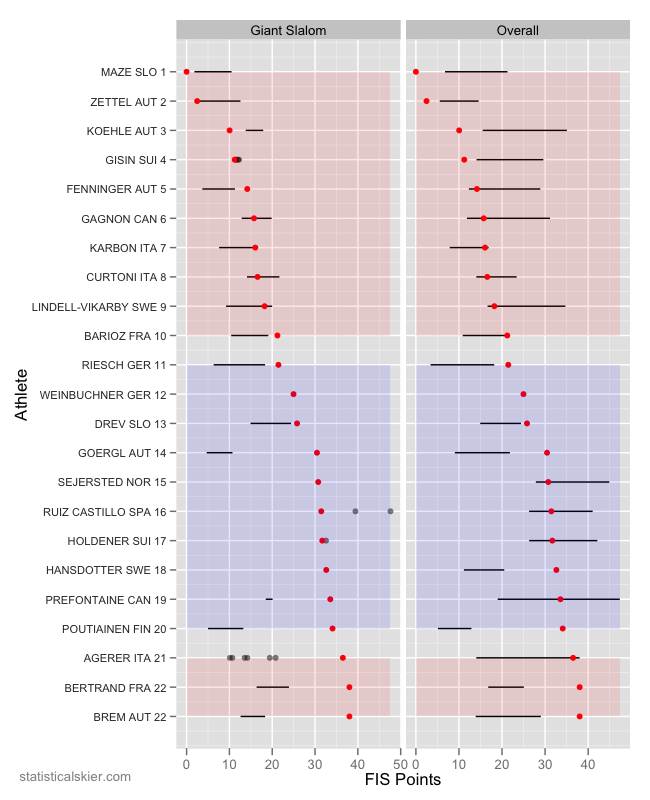
    Just following up from Tuesday with the race snapshot graph for the women’s GS race on Saturday:

    Related posts:

    1. <Race Snapshot: IBU World Cup 1 Women
    2. <Race Snapshots: IBU World Cup 1 Men
    3. <World Cup Field Strength Follow-Up


  • Alpine World Cup – Soelden

    While we’re waiting for the cross-country season to get under way…

    The alpine World Cup season kicked off this past weekend in Soelden, Austria with Giant Slalom events for both men and women. Here’s a race snapshot graph for the men’s race on Sunday:

    American Ted Ligety won by a rather impressive margin. Apparently, that was the biggest (absolute) winning margin since the late 70′s. Obviously, I can’t look much further back than the early 90′s, but I can’t contradict that. Of course, if you look outside of GS, you can find some combined events with bigger margins, but that’s really apples and oranges.

    The next closest winning margin I can find in recent history is Hermann Meier’s win over Albeto Tomba way back in 1998. If you want to expand things a bit further, there’s a women’s GS World Cup in Park City in 1997 with a larger winning margin.

    Related posts:

    1. <How Well Prepared Are World Cup Rookies? (Part 1a: Distance)
    2. <How Well Prepared Are World Cup Rookies? (Part 2b: Sprint)
    3. <Predicting FIS Points For World Cup Races


  • Best Season Ever: Distance

    Well, ok, not ever.  Just over the past 20 seasons or so.

    There are all sorts of different ways we could measure this.  First, some ground rules: I’m only going to look at actual World Cup races, no Olympics or World Championships.  I’m also excluding Tour de Ski events because these are my rules, so I get to make them up.  Seriously, though, I think Olympic and World Championship races should count differently (i.e. more), so later on I’ll redo this but in a weighted fashion.

    I’m not going to just single out a skier’s top five races, either.  If you’re going be considered for a “best season ever” prize, we’re not going to ignore a handful bad races!  Also, you must to have done at least 5 races for your season to count.

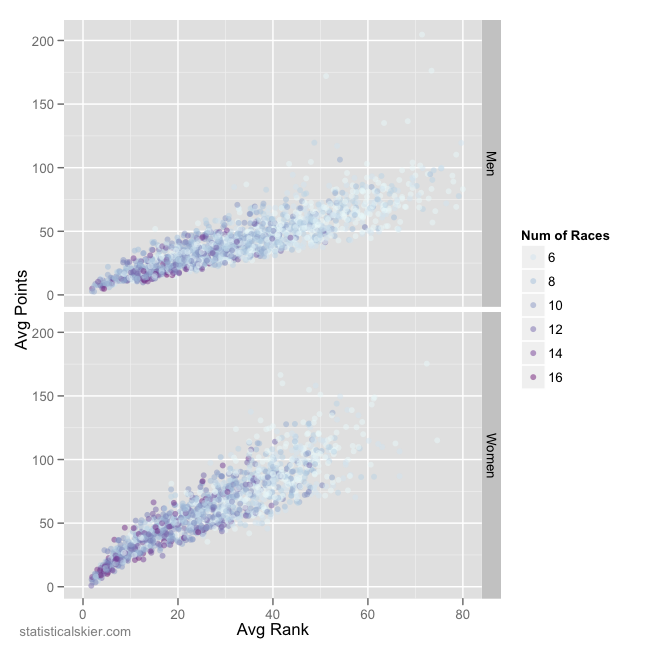
    I’m going to use three different measures: average FIS points, average finishing place and the proportion of victories.  Generally, they all track each other nearly identically, so the point isn’t to compare/contrast between them.  Rather, having all three gives us a fuller picture of each season.

    First let’s look at data for everyone:

    That’s everyone in my database over 19 seasons, every season with at least 5 starts.  As you can see, average rank and average FIS points track each other pretty well.  Interestingly, the people with the worst seasons are the ones with the fewest number of races, in general.  This probably just reflects the fact that if you aren’t getting more than 5-6 WC starts in a season, chances are it’s because you actually aren’t terribly fast.  There are exceptions, of course.

    Let’s focus in on the top ten seasons for men and women, as ranked by average FIS points (the ranking hardly changes at all if you use average finishing place).

    Name Nation Season Avg Rank Avg Points Win Pct Num of Races
    ELOFSSON Per SWE 2000-2001 2.333 2.581 0.667 9
    DAEHLIE Bjoern NOR 1998-1999 1.889 2.839 0.556 9
    SOMMERFELDT Rene GER 2003-2004 4.438 4.764 0.125 16
    DAEHLIE Bjoern NOR 1995-1996 1.929 4.943 0.429 14
    FREDRIKSSON Mathias SWE 2002-2003 4.077 5.05 0.308 13
    BAUER Lukas CZE 2002-2003 5.5 5.979 0.125 8
    ULVANG Vegard NOR 1991-1992 2.375 6.992 0.375 8
    DAEHLIE Bjoern NOR 1991-1992 3.75 7.085 0.5 8
    ANGERER Tobias GER 2006-2007 4.222 7.286 0.333 9
    ALSGAARD Thomas NOR 2001-2002 4.455 7.385 0.273 11
    Name Nation Season Avg Rank Avg Points Win Pct Num of Races
    SKARI MARTINSEN Bente NOR 2002-2003 1.75 0.862 0.833 12
    BJOERGEN Marit NOR 2004-2005 2 3.383 0.556 9
    VAELBE Elena RUS 1994-1995 2.636 3.399 0.727 11
    NEUMANNOVA Katerina CZE 2003-2004 3.143 4.5 0.571 7
    BJOERGEN Marit NOR 2010-2011 1.818 5.685 0.727 11
    BJOERGEN Marit NOR 2009-2010 2.111 6.24 0.444 9
    KOWALCZYK Justyna POL 2008-2009 3.917 6.833 0.333 12
    VAELBE Elena RUS 1992-1993 2.556 7.501 0.222 9
    LAZUTINA Larissa RUS 1997-1998 3.556 7.624 0.444 9
    BJOERGEN Marit NOR 2011-2012 1.929 7.651 0.5 14

    Not surprisingly, several names appear multiple times on each list.  Bjoern Daehlie had a lot of dominant season, but man, I remember Per Elofsson in 2000-2001.  Well, not personally.  But I do remember that he was pretty unbeatable.

    When it comes to dominating performances, though, we all have to tip our hats to Bente Skari Martinsen and her 2002-2003 season, which is considerably better than the other top seasons among the women.

    One interesting aspect of these tables is how low the win percentage is.  That’s just the proportion of races they won.  There are a few high values, notably Bente Skari Martinsen, Elena Vaelbe (1994-1995), Elofsson (2000-2001), Neumannova (2003-2004) and Bjoergen (2004-2005).  But many of these seasons (and remember, these are “best season ever” candidates) involve a skier winning less than half their races.  This should highlight how difficult it is for skiers, even the very best skiers, to win on any given day.

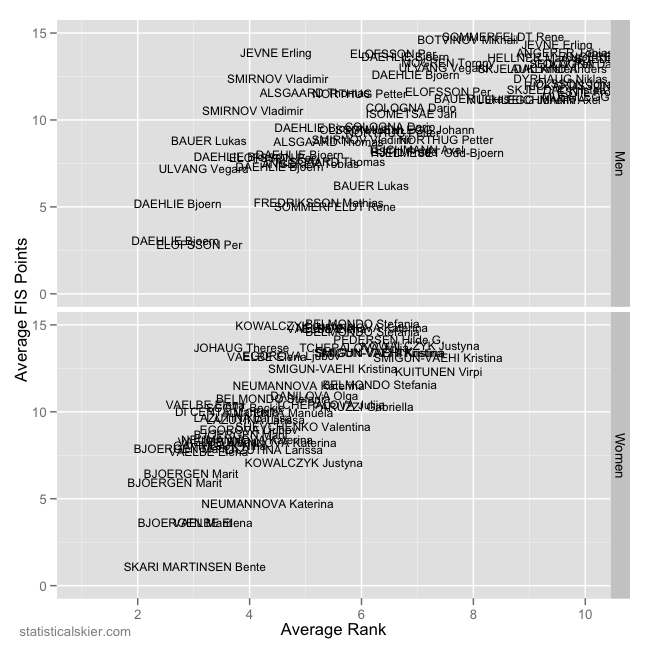
    Finally, since I can’t leave you with boring tables (even if they are sortable), here’s a graph of some of the top seasons in both dimensions: rank and FIS points.

    The overplotting makes the names hard to read at times, but if you squint you can make a lot of them out.

    As for who actually wins, I’m going to skip picking a men’s and women’s winner and just say that Bente Skari Martinsen’s 2002-2003 season was pretty frickin’ incredible.  She opened the season with an 8th (9.73 FIS points) in a 5km skate race and her second to last race was a 3rd (0.61 FIS points) in a 10km skate.  But she won every other WC that year.


    Related posts:

    1. <Most Unimproved Men: Distance
    2. <Most Unimproved Women: Distance
    3. <Is It Panic Time For The Norwegian Men’s Distance Skiers?


  • Podium Development – Sprinting

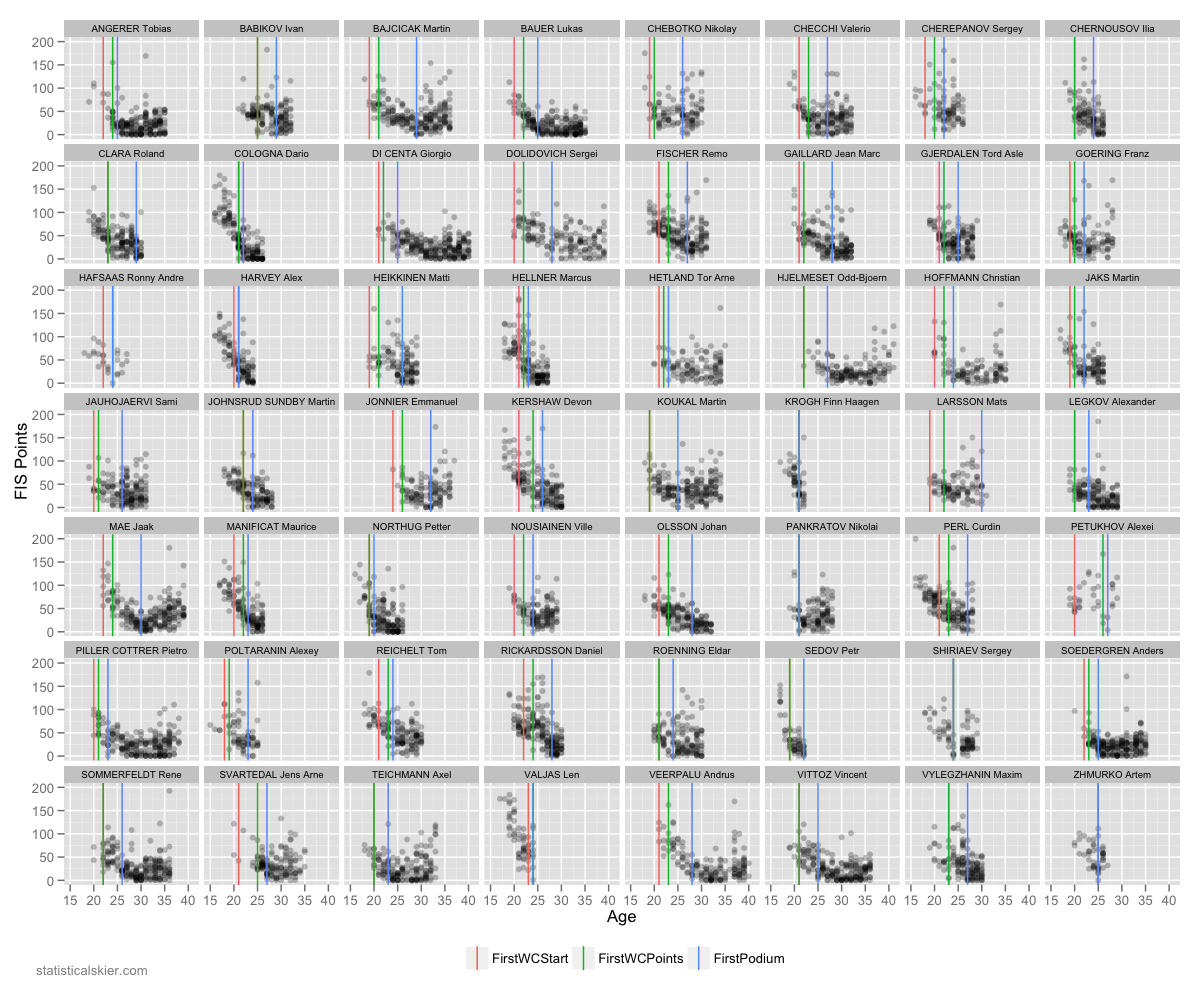
    As promised from last time, here we have the detailed development plots for sprinting. First the men:

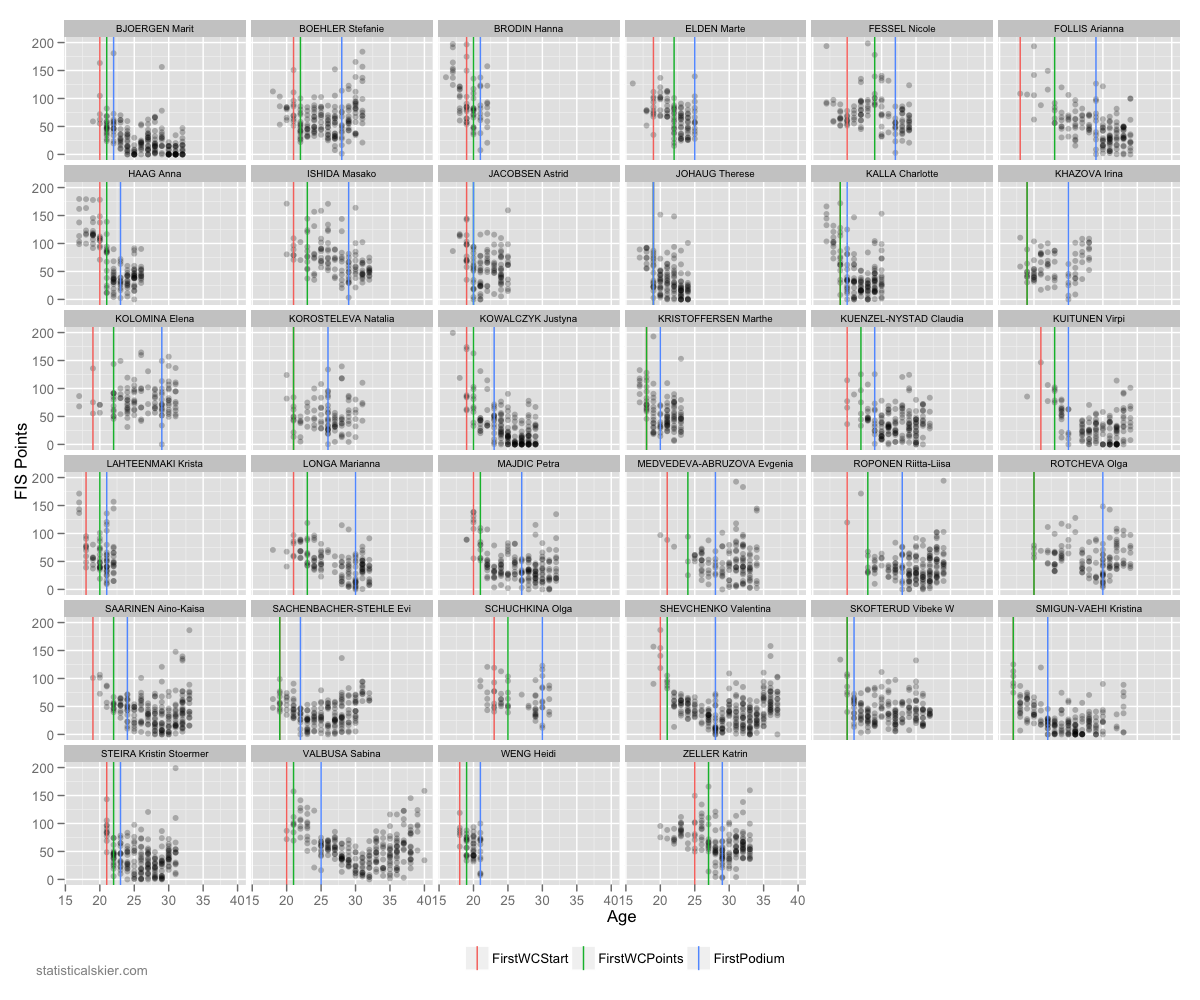
    And the women:

    As before, these are big, so click on them for the full versions. Also, remember that if you don’t see a line indicating one of the events, that’s because two or more events happened at (roughly) the same age.

    Related posts:

    1. <FIS Points Development Guide
    2. <Is Sprinting A Young Person’s Game?
    3. <Yet Another Athlete Development Marker


  • Development Patterns In Detail

    As promised from last time, I’m going to show you the un-aggregated data from Tuesday’s plots. This means we’re going to have some big graphs, bigger than I typically think is useful, but no matter.

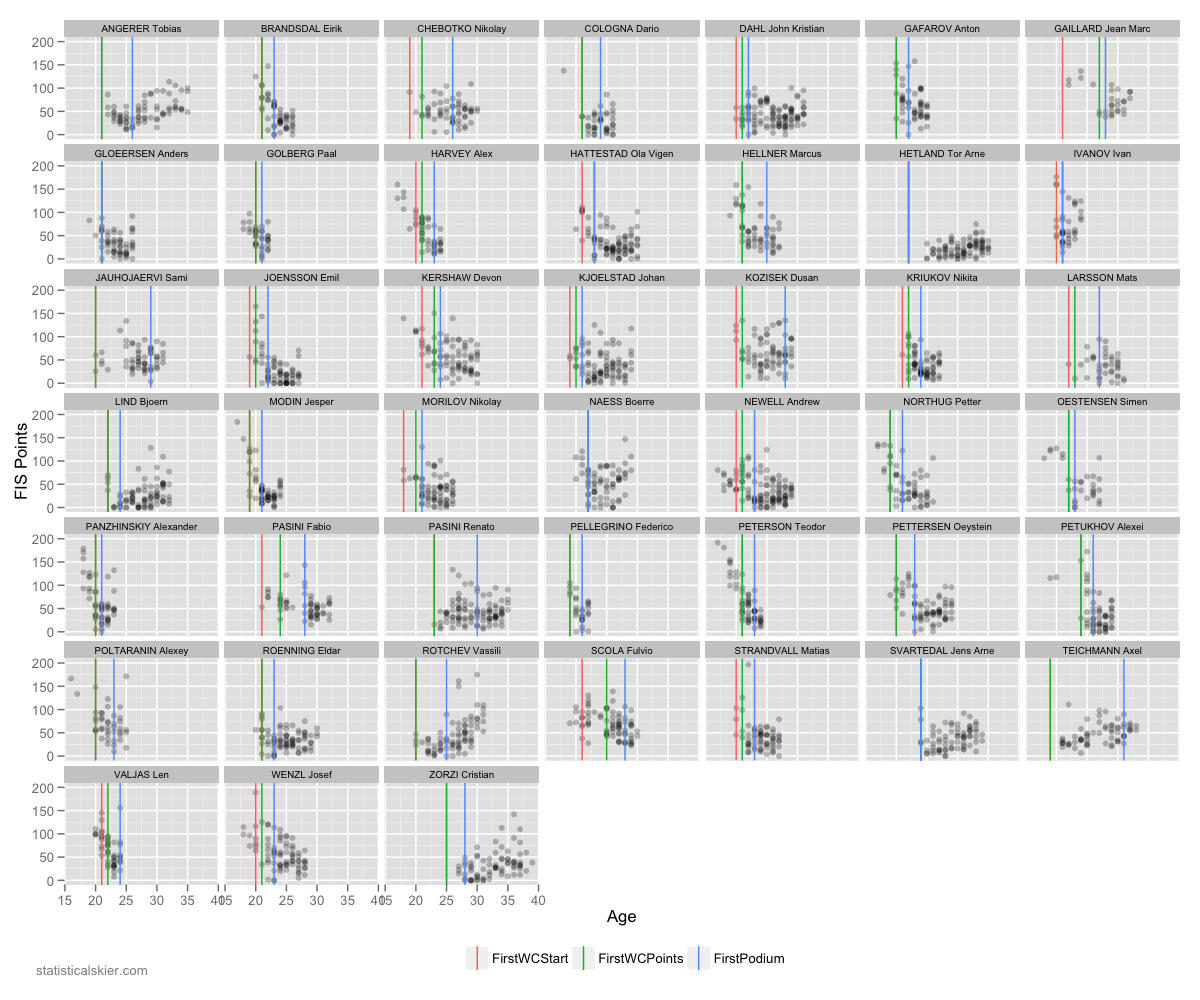
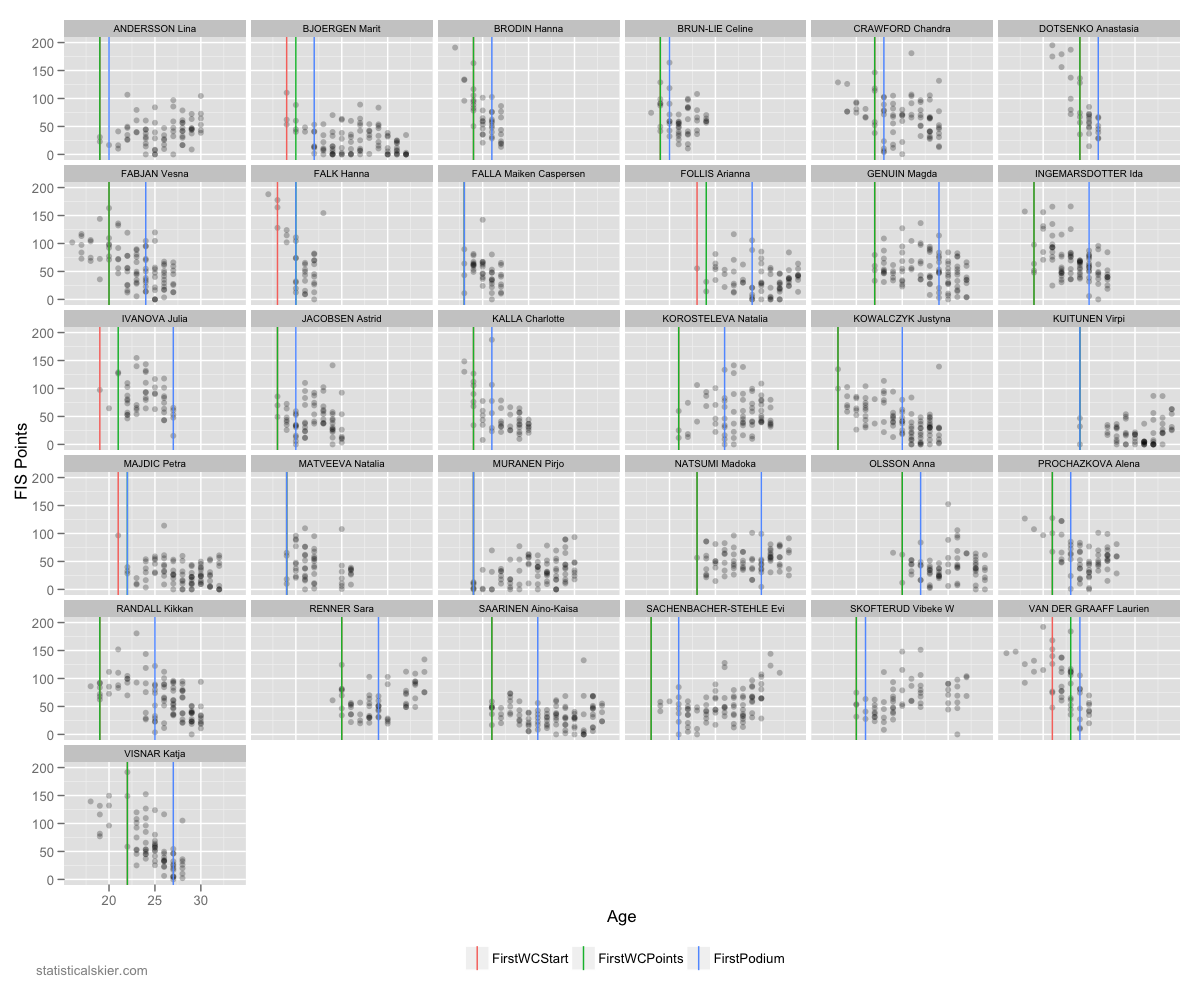
    I’ve plotted FIS points versus age for each of the male and female skiers with a podium result in a major international competition, and indicated the age at which each skier attained their first WC start, their first points and their first podium. If you only see two (or fewer) vertical lines, that means that some of those events happened at basically the same age. (Keep in mind that my age data is only at the resolution of a whole year.)

    First the men’s distance podium skiers (these are big; click through for full versions):

    And the women’s distance version of the same thing:

    I won’t offer much commentary, except that it’s interesting to browse through these graphs and notice the variety of different paths different skiers take. I’ll have the sprint versions on Tuesday.


    Related posts:

    1. <Post-WJC/U23 Development: Canada
    2. <FIS Points Development Guide
    3. <Applying FIS Point Development Curves To The USST


  • Development Questions

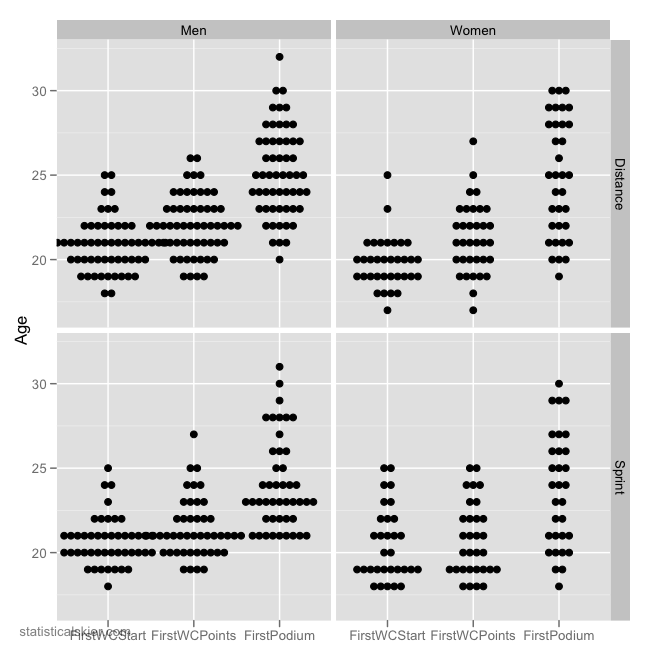
    I happened to be thinking about visualizations of athlete development recently, and in the process cooked up the following graph:

    What I’ve done here is to take the podium finishers in major international events for the past five seasons and recorded each person’s age when they received their first (individual) WC/OWG/WSC start, when they scored their first WC/OWG/WSC points (i.e. a top thirty at any of those events), and finally when they first landed on the podium.

    The style of graph here is sort of a more informative type of boxplot. Boxplots really only show you five values, so there’s a lot of lost information. Here, each dot represents a single athlete, so we can get a sense of the entire distribution of ages for each event.

    As expected, the women’s ages tend to be somewhat lower across the board; this could be development related, but I tend to ascribe it as much to differences in field depth or competitiveness. The basic story is roughly the same in each of the four panels: rarely do future podium skiers get their first “major” start after the age of 23, they finish in the top 30 after at most a year or two, and then finish in the top three maybe another 2-3 years later.

    Of course, that’s what happens with the “average” skier, which doesn’t exist. We are all our own unique snowflake. So this is still masking a fair bit of variability (that I’ll delve into a bit more on Thursday). But the basic lesson I draw from this is that if there’s a threshold to be seen here, it’s at the age of 25. The best skiers seem to have established at least the potential for scoring World Cup points before the age of 25.

    Related posts:

    1. <Post-WJC/U23 Development: Canada
    2. <Post-WJC/U23 Development: Norway
    3. <FIS Points Development Guide


  • Swedish Women By Individual

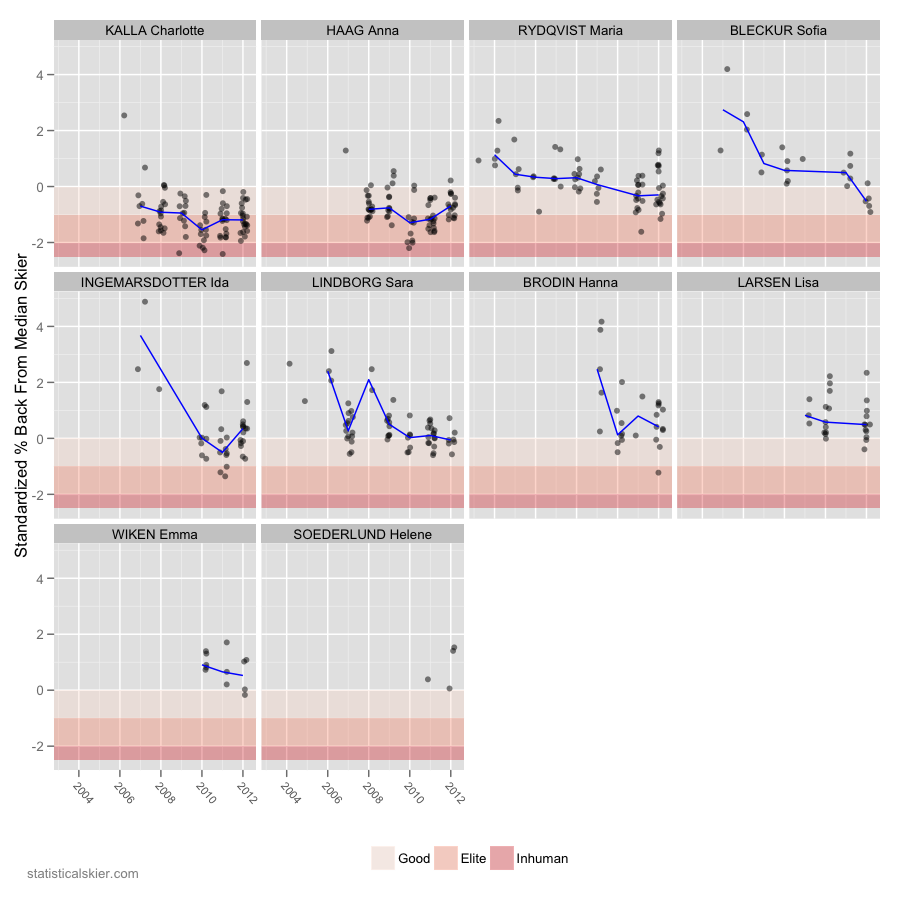
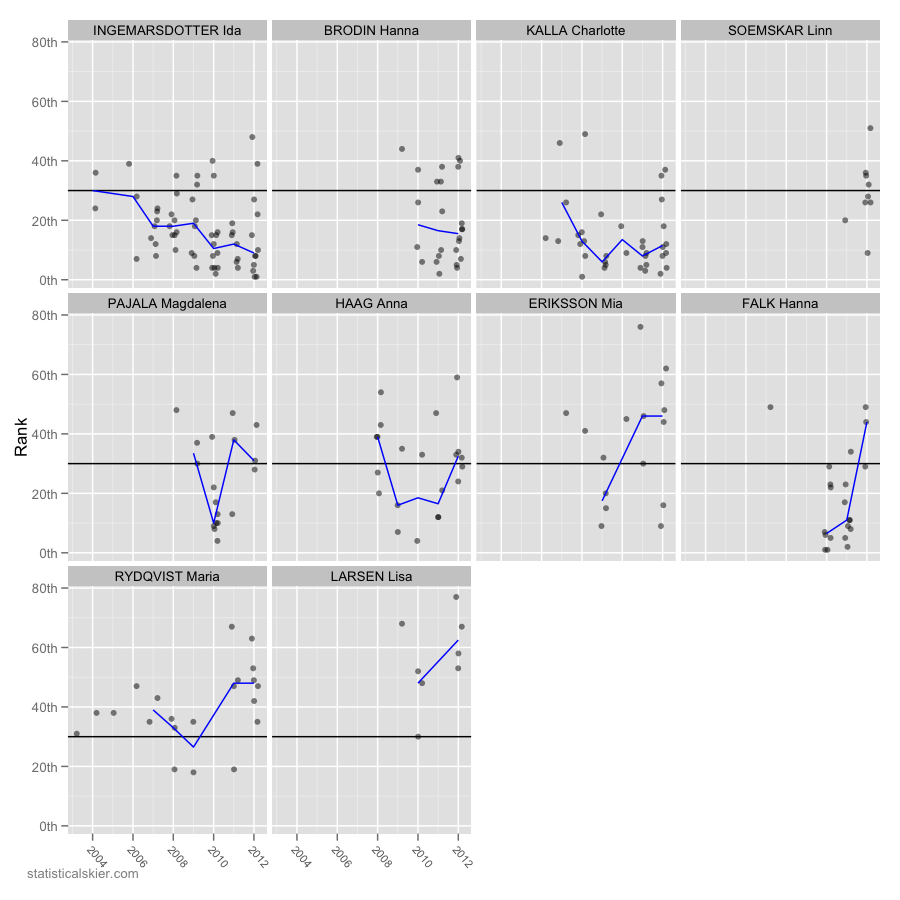
    Following up from last time, we’ll look a little more closely at the individual trends among some of the top Swedish women in distance and sprint events.

    First the distance skiers (click through for a larger version):

    Not surprisingly, Charlotte Kalla is generally the top performer here. But notice that there’s a bit of a solid drop off after her and Anna Haag. Maria Rydqvist surprised many by coming back from a year off with some very solid results, but then seemed to hit a bit of a plateau last season. Sofia Bleckur took a large jump last season, but the move from 0.5-1 standardized percent behind the median skier to -0.5 to -1 standardized percent behind the median isn’t quite as challenging. The next jump will likely be orders of magnitude harder.

    I believe I’ve commented on this before, but Anna Haag’s trend over the past three seasons is a bit worrying. The Swedish women had a very strong year in 2010, but both Kalla and especially Haag seem to have experienced a bit of “regression to the mean”. That makes me wonder whether Haag’s 2010 campaign (and to a certain extent even Kalla’s) was the best we’ll see from her.

    As for the sprinters (again, click for full version):

    I certainly like the looks of Ingemarsdotter’s trend there: steady improvement over more than 2 seasons with little signs of a plateau. Hanna Falk appears extremely promising but I believe she had some strange medical issues last season that now I’m suddenly very fuzzy on. Something to do with her eyes, maybe? I can’t quite remember.


    Related posts:

    1. <Most Improved: Women’s Distance
    2. <Most Improved: Women’s Distance
    3. <Most Un-Improved: Women’s Distance


  • Swedish Women

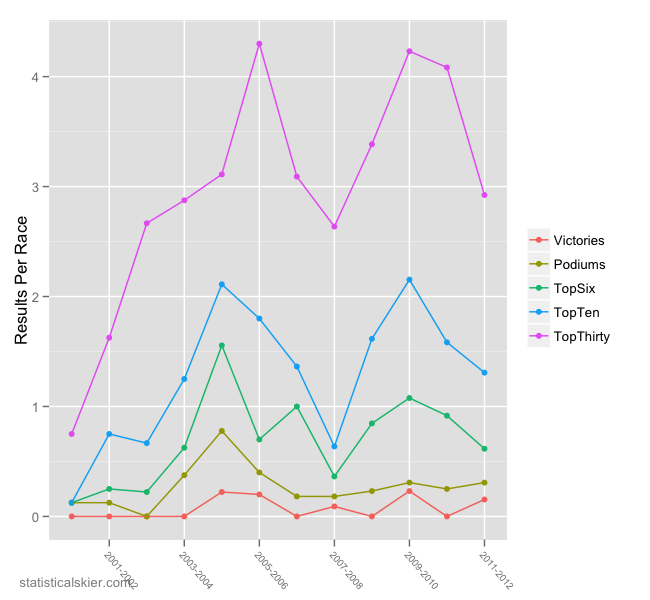
    Reading the recent interview with Rikard Grip, the Swedish women’s coach got me thinking about how they’ve fared recently. From a very broad perspective for the whole team, we have the following in distance events:

    Clearly their depth has greatly improved, as evidenced by the dramatic rise in the number of top 30 results per WC race. Most other categories are generally up as well over the last 4-5 seasons. I try not to read too much into the (rather noisy) year to year variations in these plots, but instead try to folks are broader trends over several seasons.

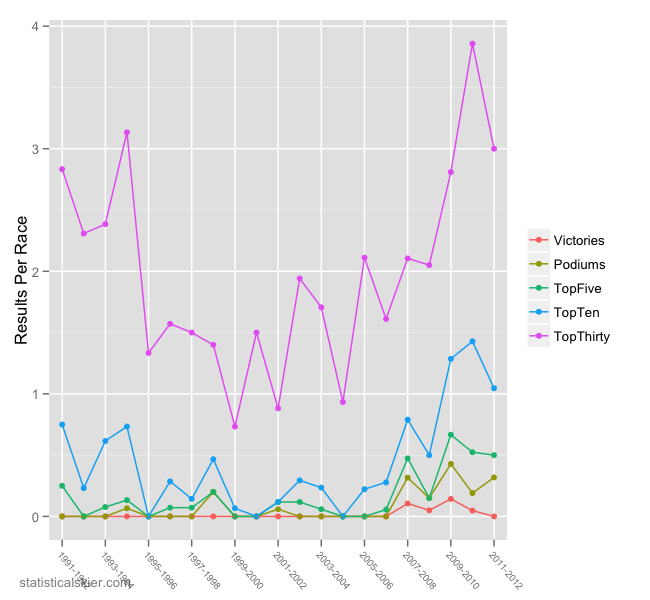
    On the sprinting side:

    Thing actually seem to be declining slightly over the past three seasons here across the board, though thanks largely to Ida Ingemarsdotter not at the victory/podium level. I also find it interesting how the two obvious peaks in performance in terms of placing women in the top 30, 10 or 6 seem to coincide with Olympic years (but not 2002). There might be a glimmer of that trend at the podium/victory level but it’s hard to interpret changes in numbers that slight.

    On Thursday we’ll take a closer look at the individual women on the Swedish squad.

    Related posts:

    1. <Most Improved: Women’s Sprint
    2. <Comparing Variability In Men’s & Women’s Sprinting
    3. <European Mid-Season Review


  • Summer Prospect: Laurien Van der Graaff

    Continuing with my summer reading of XC news, I again perused an one of FIS’s short interviews, this time with Switzerland’s Laurien Van der Graaff.

    Unlike Masako Ishida, whom we considered earlier this week, Van der Graaff is a sprint specialist, and a freestyle sprint specialist at that. Van der Graaff really did have a bit of a breakthrough season last year:

    As you can see, it was only really her third season of racing “full time” at the World Cup level. She jumped from occasionally qualifying for the heat, to qualifying all but once, and continuing on through at least the semis numerous times.

    She only did three classic sprints last season, so it’s not like she’s racing both techniques the same amount and doing better in one. You’d think that if she’s going to tackle that weak spot, she’ll have to start entering more classic sprints.

    One thing that does concern me looking at her results from just last season is that she seemed to fade significantly as the season progressed:

    Van der Graaff started off with her best race, and then things sort of went downhill from there. It’s possible that the increased number of WC starts had something to do with that. She had a total of 15 last season, compared to only 6 and 5 in the previous two seasons (that’s sprint and distance combined). If I look at all FIS races, she did more last season as well, but not as dramatically: 17, compared to 10 and 14 the previous two seasons. But certainly the the WC starts could plausibly be considerably more draining over the course of a season.

    Assuming freestyle sprints are still going to be her best bet for top results next season, the schedule itself won’t be doing her any favors. She’ll have to travel to Canada for the only early season freestyle sprint. There’s a freestyle sprint buried in the middle of the Tour de Ski, but that seems like a big investment if you’re really just focused on sprinting. Then there’s a freestyle sprint in Russia which could be sparsely attended (because it’s in Russia) or it could attract all the big guns (because it’s a preview of the Sochi Olympic venue).

    The individual sprint in World Champs is classic, of course, and then there’s just the Lahti sprint immediately following.

    All in all, if she travels to Canada, I’d look for her to have some strong results in the freestyle sprints there, but she hasn’t (yet) shown that she can sustain that through a full season.


    Related posts:

    1. <Can Kikkan Randall Win The Sprint WC Title?
    2. <Can Kikkan Randall Win The Sprint World Cup?
    3. <Career Retrospective: Odd-Bjoern Hjelmeset


  • Yet Another Athlete Development Marker

    Everyone wants to nab podiums at the World Cup level, which means everyone can be pretty fascinated with the development characteristics of those skiers who end up on the podium. Here’s yet another way to slice that.

    If we take the skiers who’ve attained at least one podium result at the WC level between 2006-2007 and 2010-2011, one thing we can ask is what proportion of them had attained a certain number of top thirty results by a given age:

    Here’s how we read this: the top left panel corresponds to men’s distance podium winners. It says that by the age of 20, roughly 20% of them had managed at least one top thirty (red line), and almost none of them had managed at least 5 or 10 (green and blue lines).

    If you’re in the mood to be intimidated, consider how high these proportions have become by the time we get to age 25. In all four disciplines, an overwhelming majority of future podiums finishers have racked up at least 30 top thirty results.

    Related posts:

    1. <Post-WJC/U23 Development: Canada
    2. <Post-WJC/U23 Development: Germany
    3. <Post-WJC/U23 Development: Italy


  • Brief Season Assessment For North America

    This is by no means a comprehensive look at how we fared this year, just one perspective based on a single graph.

    One of the things that I pay closest attention to is depth: how many different skiers do we have performing at a particular level. The reason for this is that for relatively “small” skiing nations like ourselves, it can be pretty common for a single extraordinary skier to come along and provide excellent results for several years. This can make the program as a whole look pretty good, but if the success isn’t “filtering down” it probably won’t last.

    In that vein, here’s a graph of the proportion of skiers (with World Cup starts) achieving a top 30 result, broken down by gender and race type (sprint or distance):

    I’ve included the size scale with the points to give you a sense of the “denominator”: how many skiers we actually sent out there in a given season. As you can see, oftentimes is hasn’t been very many at all.

    The Canadian men have obviously been quite successful recently, but note that Len Valjas is really the only new development lately, in terms of scoring WC points. Also, it’s interesting to me how the Canadian men seem to tend to have a larger number of athletes getting starts than the US, at least over the past 5 years or so.

    The story with the Canadian women is pretty simple. There’s the big bulge for the Beckie Scott & Co. era and then a pretty steep drop off. There was a sudden explosion in the number of women getting sprint start between 2008-2010 in the run-up to the Olympics. While that has dropped off considerably, the women they are starting are finally scoring some points (Crawford and Gaiazova, mainly). Their distance results have sort of bounced around.

    As for the American men, the 90′s saw a lot of years with only a few skiers getting starts (and hence the proportion bounces around quite a lot). Unsurprisingly, there was a huge increase in the number of starts prior to the 2002 Olympics, and then a somewhat deceptive jump in performance in the Olympic year. We did ski pretty well that year, but it was aided by some pretty sparsely attended pre-Olympic World Cups. (It would be interesting to do a version of this graph that looks only at races on European soil.)

    That was basically the beginning of the Kris Freeman era in US men’s distance skiing. Between then and 2008 there a steady decline in the proportion of skiers reaching the top 30, despite a fairly steady 5-10 athletes getting starts each year. Recently, things appear to have picked up somewhat, although this year is basically identical to the last.

    With the departure of Torin Koos and Simi Hamilton taking a few seasons to get healthy and performing where he’d like, sprinting has also seen a decline over the last several years.

    That leaves the obvious big bright spot, the US women. For much of this graph, the proportions bounce around very erratically, since we very often had only 2-3 women getting starts. Following a real low in 2007, with no American women scoring points we’ve seen several consecutive seasons of improvement, with a slight drop off this year. The improvement in the women’s sprint events is only ~3 seasons old, but if anything it seems more promising.

    Related posts:

    1. <Mid-Season Recap: North American Distance
    2. <Mid-Season Review: North American Sprint
    3. <North American WSC Assessment


  • Jenny Olsson


    Unfortunately, we have a distinct theme for this week’s posts. Jenny Olsson also passed away recently, apparently from breast cancer. She raced, quite successfully, for Sweden for much of the mid-00′s:

    These are just her WC level distance results (she didn’t sprint much). As you can see, 2002-2003 was her best effort, but it’s not clear to me that it was part of any particular trend, up or down. She finally got sick and stopped racing in 2005.

    But for that one season, she was by far Sweden’s best female skier:


    Name Median Result # of Races
    OLSSON Jenny -1.0595 15
    EK Elin -0.6265 13
    OLSSON Anna -0.0368 3
    HANDLER Mariana 0.0473 8
    ANDERSSON Lina 0.2072 5

    Related posts:

    1. <Career Retrospective: Anna Olsson
    2. <Most Un-Improved: Distance 2011
    3. <Career Retrospective: Petra Majdic


  • Most Unimproved: Women’s Sprinters

    Last in the series of most improved/unimproved we finally turn to the women’s sprinters:

    Alena Prochazkova took a major tumble this season in sprints. She had been a fairly reliable presence in the semifinals until this season, when she appeared to often have trouble qualifying. Celine Brun-Lie also saw a major drop-off, but the much reduced number of races that she did this year makes me wonder if she possibly had some issues with illness or injury.

    Anna Haag joins many of the Swedish men as having a sup-par sprinting season, but sprinting wasn’t really her focus it seems, anyway. Laure Barthelemy did a lot “worse” this season, but the data is fairly clear that what really happened is that she had an unusually large cluster of excellent races last season, that were at least partly out of character for her. Most of her results this season seem generally in line with how she’s fared in 2009 and 2010.

    Let’s consider the two Finns next, Roponen and Saarinen. There were also some injury issues here as well, but even so, note that both ladies have seen some declines for more than one season in a row now, so that doesn’t necessarily explain all of it. Roponen in particular was a fairly solid sprinter several years ago and has just really struggled since. Saarinen was an arguably pretty dominant sprinter for two seasons there in 2009 and 2010, but now has seen two seasons in a row of faltering results.

    Stefanie Boehler deserves a mention as well as someone who’s had a few seasons in a row of troubles. She was never a really dominant sprinter, but things have gotten pretty bad the last two seasons.

    Most of the other ladies here may seem like odd inclusions. Keep in mind that these “bottom twelve” were picked based on a blend of a few metrics (average result, best results, etc.) and I’m only graphing one of those. But their declines are certainly less stark.

    Related posts:

    1. <Most Unimproved Women: Distance
    2. <Most Unimproved: Men’s Sprint
    3. <Most Unimproved: Women’s Sprint


  • Most Improved: Women’s Sprint

    Moving right along to the most improved women’s sprinter (at least, according to the metric laid out in this post).

    Here’s the collection:

    As usual, you can click on it for a slightly larger version.

    Once again, I think we’re seeing that North America had a pretty across the board incredible year in sprinting, with Chandra Crawford making continued progress. The list of North Americans who had strong sprint races on the World Cup this year is quite long.

    Van Der Graff, Kylloenen and Oestberg all have patterns that look roughly similar: young-ish skiers on a fairly steep improvement curve.

    Kowalczyk sneaks in here with an increase in podiums basically (along with the usual smattering of “off” races), but it’s hard to make out in the graph due to some over plotting of points. Despite a sudden lack of consistency from Ingemarsdotter, she qualified through to the semifinals considerably more often this season.

    Gaia Vuerich, Anastasia Dotsenko and Alenka Cebasek are skiers I don’t know much about, but they all appear to be fairly young. Given the women’s field, young sprinters showing dramatic improvement from the 40′s-50′s down into the 20′s-30′s isn’t all that uncommon. We’ll see if they can stick around…

    Related posts:

    1. <Most Improved: Men’s Sprint
    2. <Most Improved: Women’s Sprint
    3. <Most Improved: Women’s Distance


  • Most Un-Improved: Women’s Distance

    Last in the sequence of related posts covering distance events, the most un-improved women from this season:

    As always, you can click through for a slightly larger version.

    The Slovakian Prochazkova takes the cake here with what looks like a small set of somewhat mediocre results after two fairly strong seasons. The small number of races compared to previous seasons suggests to me that she may have had injury or illness issues, but I wasn’t following her closely so I don’t know for sure.

    Both Ingermarsdotter and Fessel are relatively young skiers who had seemingly breakthrough seasons last year, but seem to have come back to earth slightly this season. Finland’s veteran Saarinen, if I recall correctly, was injured early in the season, and apparently never quite got back up to speed.

    Anna Haag is a sort of interesting case as she had some rather dramatically good races in 2010 (an Olympic year) but has pretty consistently slid backward in each of the following seasons. But if anything, its the 2010 campaign that seems out of place; she’s basically back to performing at the level she was pre-2010 at this point.

    Silvia Rupil appears here as one of those skiers with a “decline” simply because she failed to pop the occasional outstanding race, although her “average” result has remained roughly the same.

    Kolomina and Novikova are both young Russians, part of a squad that two years ago  I thought maybe was seeing signs of a resurgence, but my general impression was that they really struggled again this year.

    Laura Rohtla looks like she shouldn’t be on this list at all, but remember that my ranking includes 3 other measures besides the one I’m showing here. Still, she’s probably a marginal inclusion.

    Related posts:

    1. <Most Improved: Women’s Distance
    2. <Most Un-Improved: Distance 2011
    3. <Most Improved: Men’s Distance


  • Most Improved: Women’s Distance

    Moving on from last time to the most improved in women’s distance events…you can read that post for an explanation of the metrics I’m using, and the usual round of caveats.

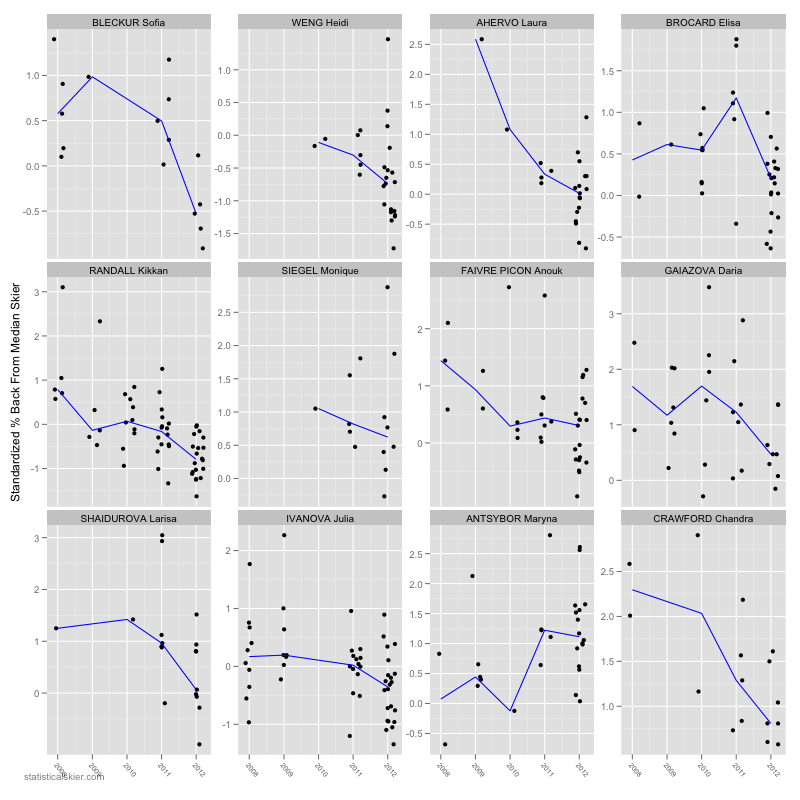
    Here’s the top twelve:

    As before, you can click through for a slightly larger version.

    By these measures, Sweden’s Sofia Bleckur comes out on top. She only did a handful of WC distance races this season, but they included a solid collection of top 30 results, which compared to her efforts last season was a dramatic improvement. Norway’s Heidi Weng, while clearly a future star, had many more starts and a much larger variance in her results. Her “middle of the road” results are all still a decent improvement from last year, and then she added to that a solid collection of outstanding races.

    Finland’s Laura Ahervo looks fairly similar (by their graph at least) to Weng. Short history of WC racing with a sharp uptick in starts this year that included a sizable number of excellent results. Italy’s Elisa Brocard also had a very strong season, but she was definitely aided in this particular ranking by her decidedly sub-par results last year.

    It shouldn’t be too surprising to see Kikkan Randall on this list, as her distance skiing generally took a big step this year. The big take-away I see from her graph is consistency; she just didn’t have any terrible distance races, which when you look over the other folks in this graph is pretty rare.

    Both of the Canadian ladies, Daria Gaiazova and Chandra Crawford are clearly trending in the right direction, although in absolute terms they’re still much closer to be competitive in sprints, probably.

    Both Anouk Faivre Picon and Julia Ivanova saw the bulk of their improvements come from an increase in the number of very strong results, rather than an overall improvement in their “average” race. Again, consistency can be a major issue.

    Related posts:

    1. <Most Improved: Men’s Distance
    2. <Most Improved: Women’s Distance
    3. <Most Improved: Distance 2011