From the FasterSkier archive — posts syndicated from athletes’ and coaches’ own blogs between 2004 and 2012, kept online as published. Current coverage is at fasterskier.com.
Tiril Eckhoff (NOR) winner of the women’s 10 k pursuit in Annecy-Le Grand Bornand, France. (Photo: NordicFocus)
Pursuit Day in Annecy-Le Grand Bornand, France as the IBU World Cup presented back-to-back pursuit races.
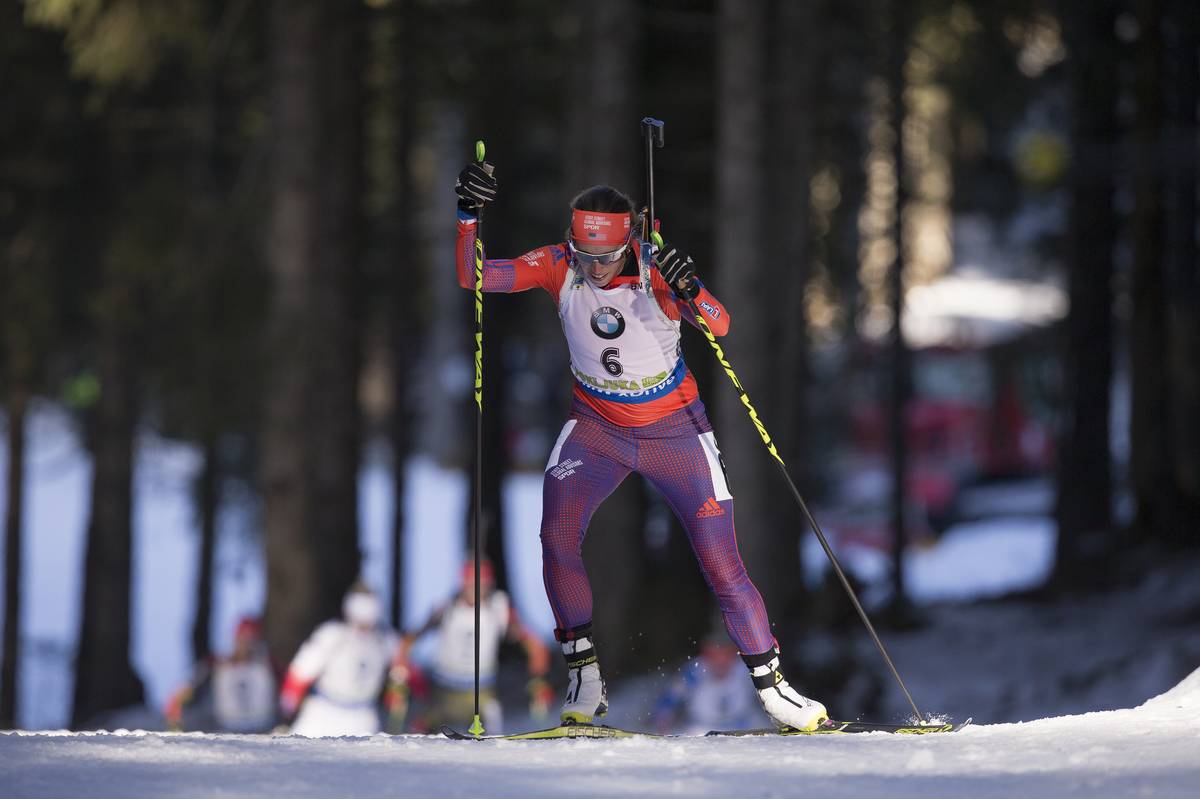
Bib 1 starter from Norway, Tiril Eckhoff, won the women’s 10-kilometer pursuit in 29:41.6 shooting 1+0+1+0 for the race. As the winner of yesterday’s sprint, she brings her individual race total to three this year on the IBU World Cup. Her teammate, wearing bib 6, Ingrid Landmark Tandervold, placed second (+38.1; 1+0+1+0). Lena Haecki of Switzerland finished in third (+46.0; 0+1+1+0).
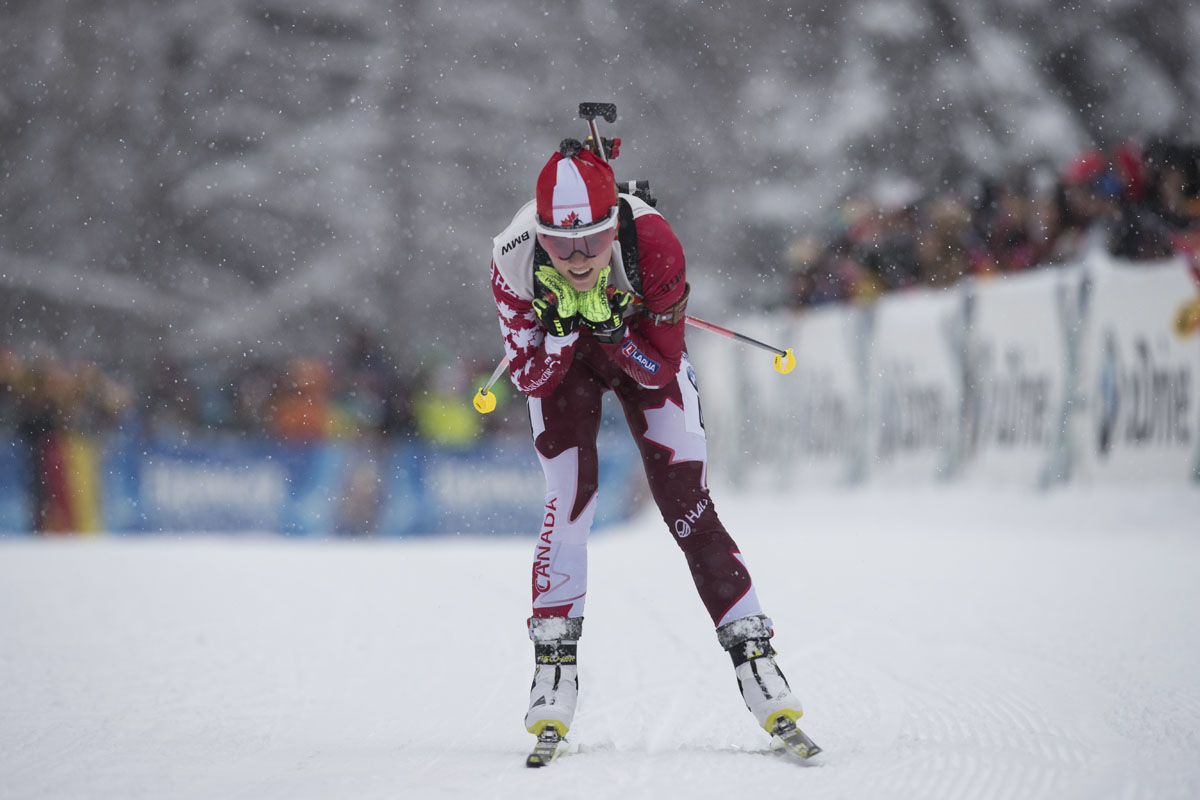
Emma Lunder of Canada racing to 25th in Annecy-Le Grand Bornand, France during the women’s 10 k pursuit. (Photo: NordicFocus)
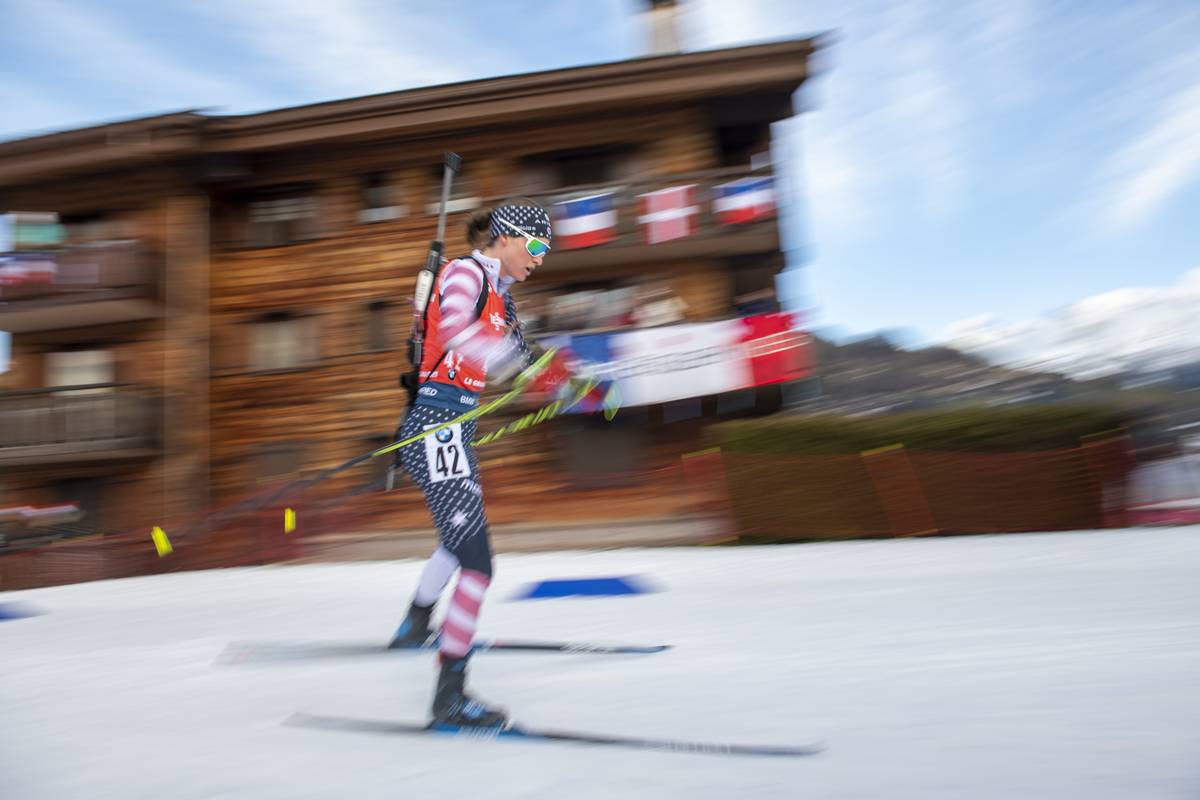
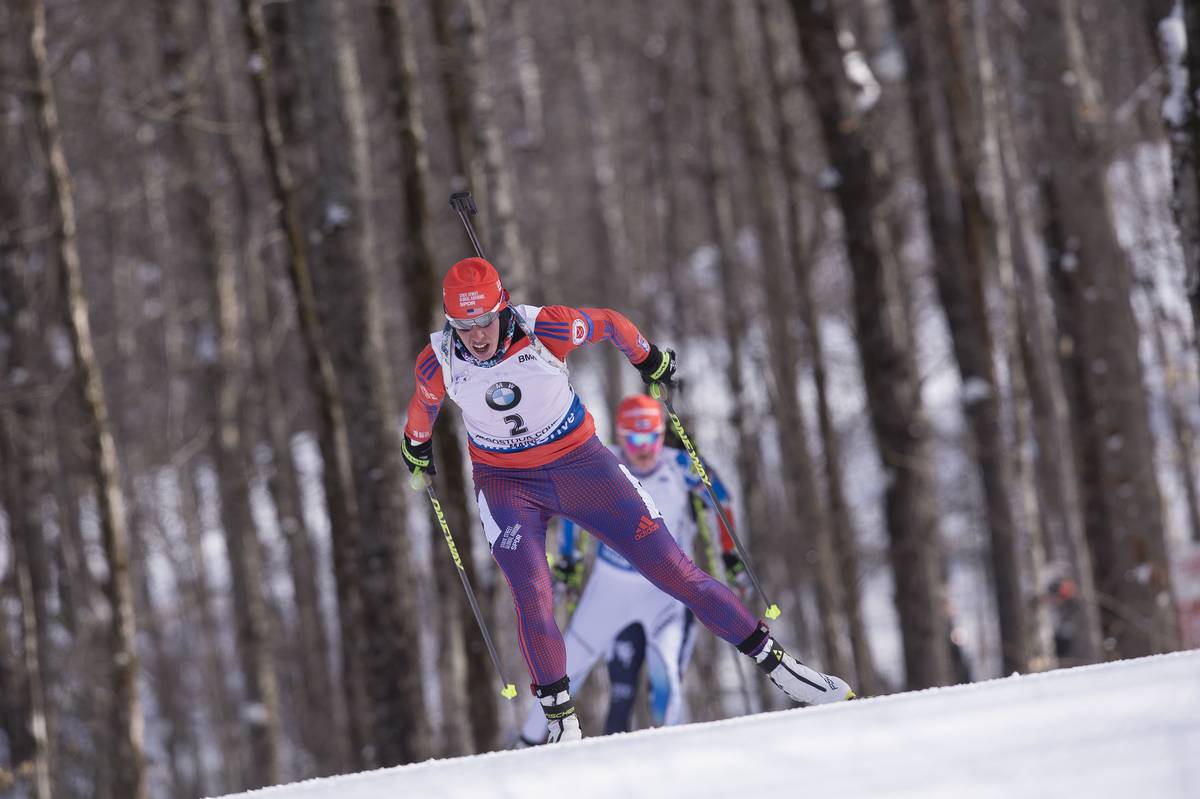
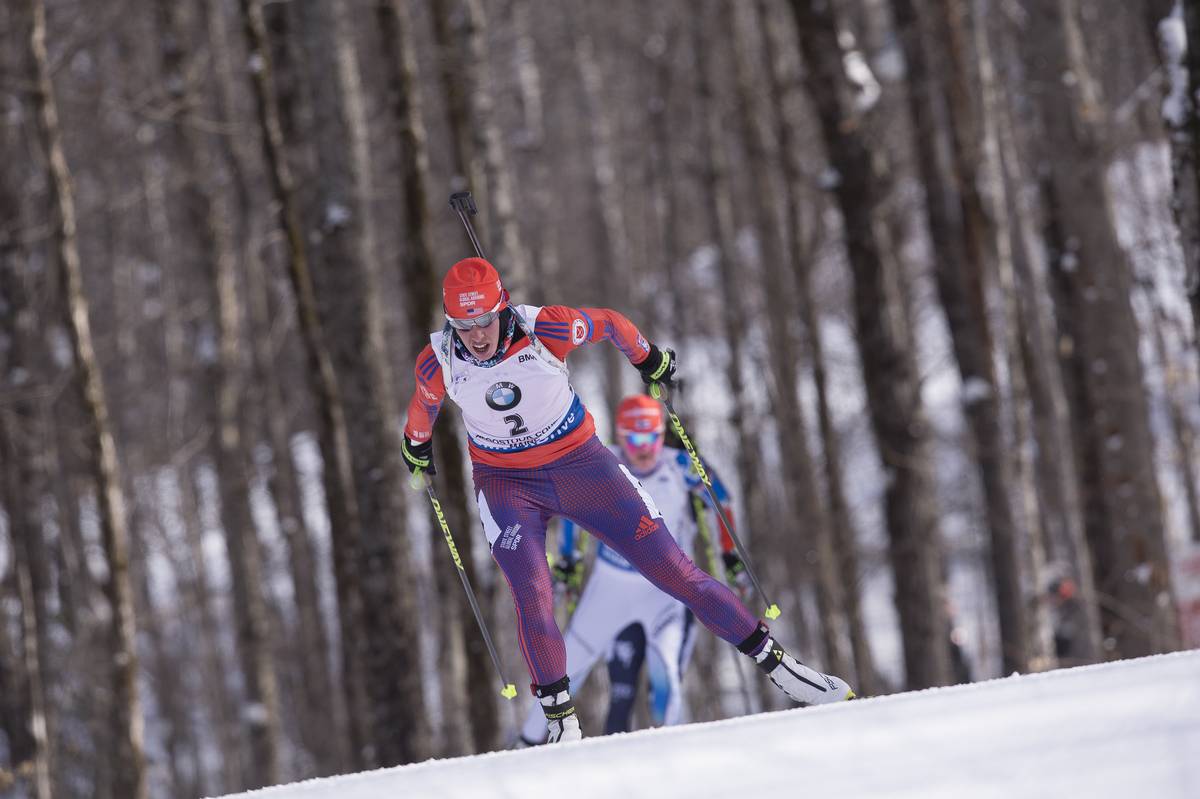
Canada’s Emma Lunder jumped 11 places from her start bib number, 36, to place 25th overall (+2:46.3; 0+2+0+0). Clare Egan of the U.S. began in bib 42 and placed 29th (+2:53.0; 0+0+1+1). Her teammate Joanne Reid was 54th (+5:33.4; 1+0+2+3).
Sarah Beaudry of Canada was 56th (+5:47.3; 2+1+0+1).
U.S. Biathlon’s Clare Egan on her way to 29th in the women’s 10 k pursuit in Annecy-Le Grand Bornand, France. (Photo: NordicFocus)
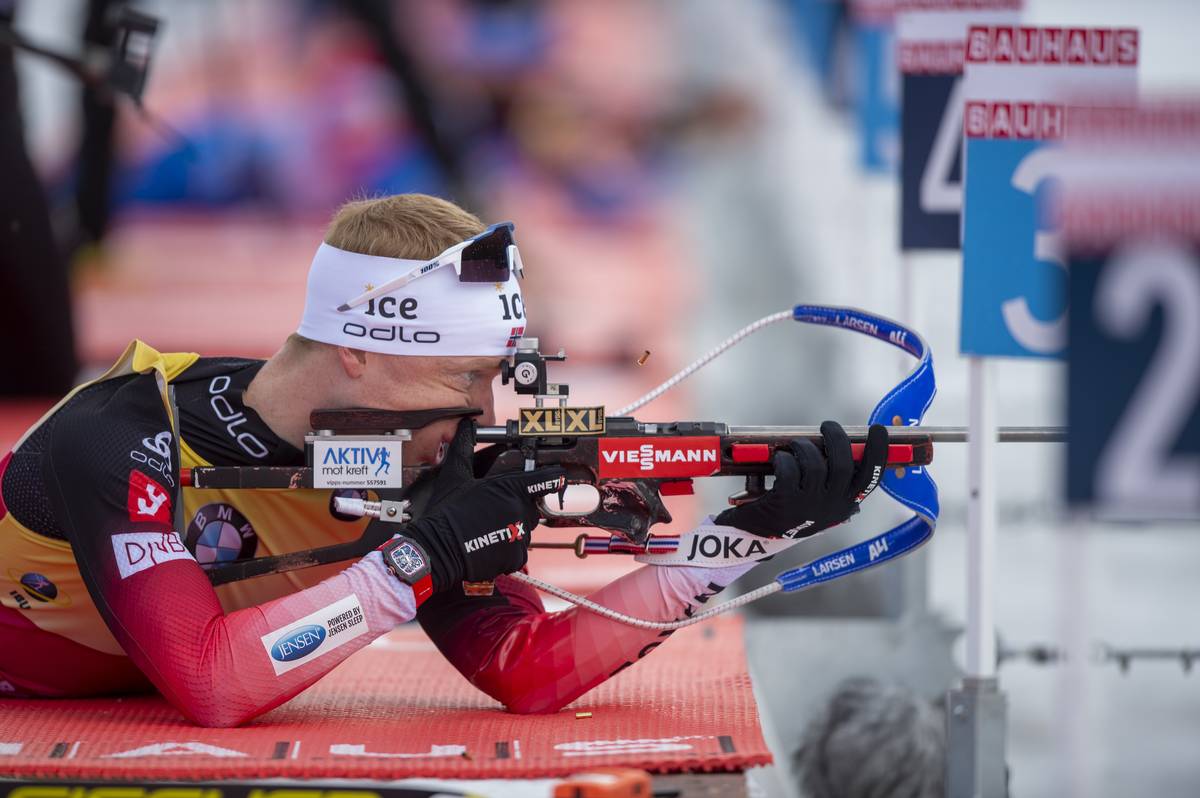
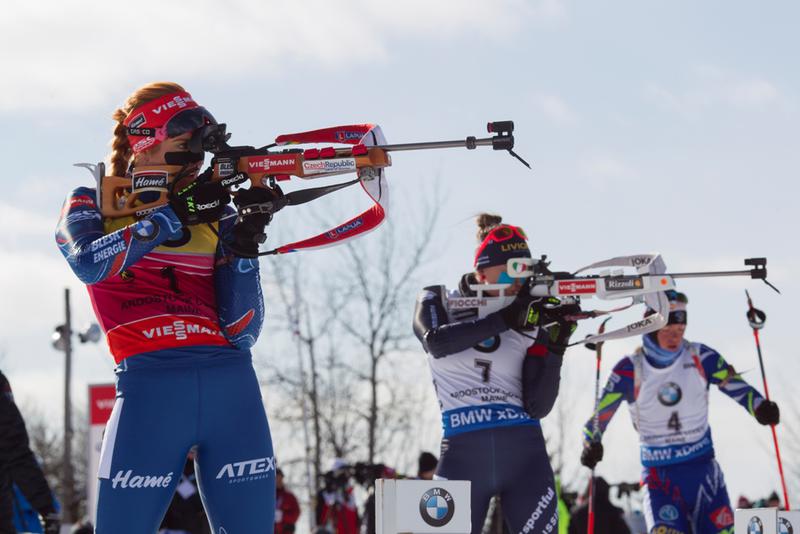
Johannes Thingnes Bø of Norway earning another win. Pictured here, he’s on the range during the men’s 12.5 k pursuit in Annecy-Le Grand Bornand, France. (Photo: NordicFocus).
The men raced a 12.5 k pursuit and Johannes Thingnes Bø of Norway, starting in bib 4 won in 30:07.8 while missing a single target in his first shooting bout. Including relays, it was Bø’s sixth win of the season. France’s Maillet Quentin Fillon placed second (+22.0) after shooting clean. Vetle Sjåstad Christiansen of Norway was third (+1:00.0; 0+0+1+0).
Leif Nordgren of the U.S. raced to 48th (+4:36.3; 1+1+1+1), while teammate Sean Doherty finished 54th (+5:06.0; 1+2+2+0).
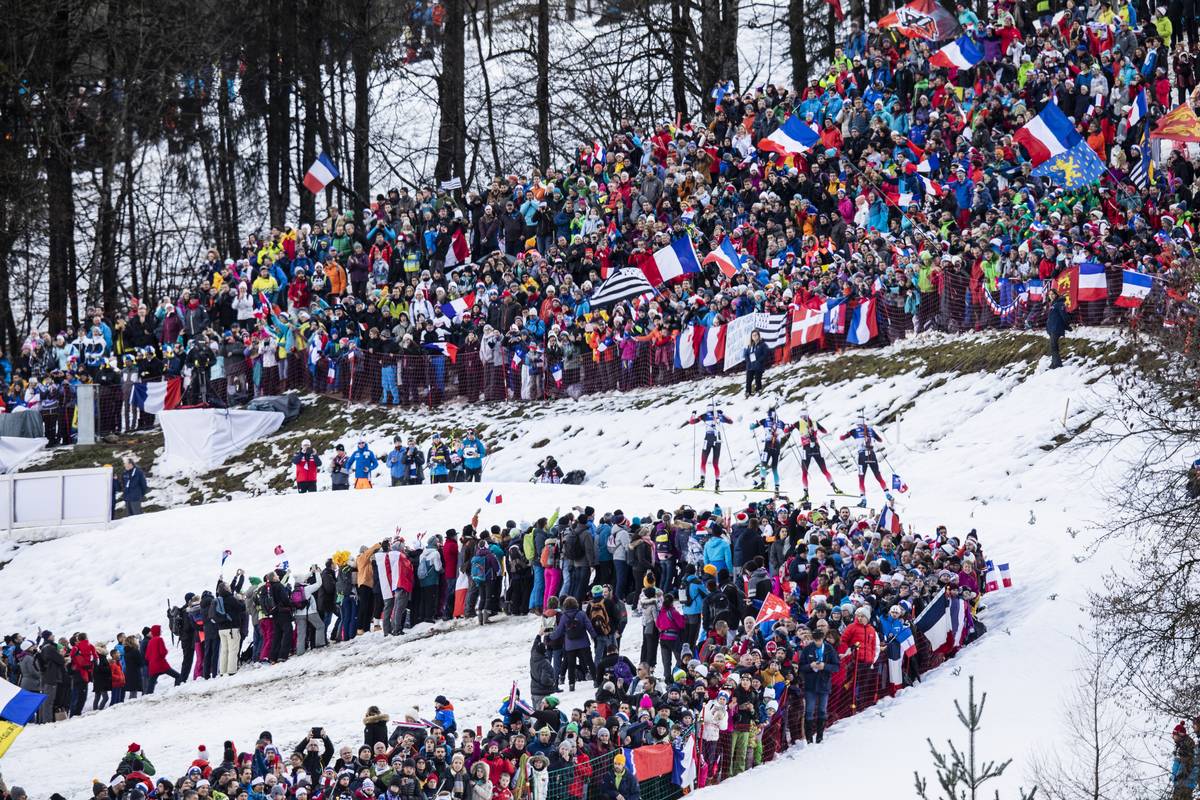
Tarjei Boe (NOR), Quentin Fillon Maillet (FRA), Johannes Thingnes Boe (NOR), Erlend Bjoentegaard (NOR), (l-r) during the IBU World Cup 12.5 k pursui in Annecy-Le Grand Bornand, France. (Photo: NordicFocus)
Emma Lunder (Biathlon Canada) racing last January at the 2017 IBU World Cup in Ruhpolding, Germany. (Photo: Fischer/NordicFocus)
Emma Lunder may be a relatively recent addition to Biathlon Canada’s World Cup team, but the 26-year-old Vancouver native has raced her share of International Biathlon Union (IBU) World Cups.
On Saturday, Lunder demonstrated both experience and composure, just as she had done the day before with close to zero visibility in the sprint, in the women’s 10-kilometer pursuit in Hochfilzen, Austria. Despite having started more than two dozen World Cups since the 2013/2014 season, this was only her third pursuit.
“I went into this race knowing that both snow and wind were expected, so I anticipated conditions similar to yesterday’s sprint,” Lunder, who had previously raced to 42nd in the sprint with 9-for-10 shooting, wrote in an email. She had started second of 102 racers in the sprint and had to clear her own path through new snow while trying to stay on course.
On Saturday, she started 42nd, 2:04 minutes behind the sprint winner, Darya Domracheva of Belarus, and within 12 seconds of 32nd.
“With all of the racers starting fairly close together, a nice little track formed right in the middle of the ski trail so I just tried to ski in that path as much as I could during the race,” Lunder explained.
It was snowing as expected on Saturday afternoon, but not as heavily as the day before, and the wind was variable.
On the first prone shooting stage, Lunder missed her first shot but hit the next four. She had to ski a penalty lap and left the range in 45th, 2:35 minutes behind Domracheva, who had cleaned to remain in first place.
“On the range today I had some windy bouts and some calm bouts, so I took the information I had from yesterday about correcting and clicked accordingly,” Lunder recalled.
After missing her first shot, which she attributed to being slightly hesitant with her setup, Lunder went on to hit the next 19 — cleaning the next three bouts. In doing so, she rose to 37th after a clean second prone, then 32nd after the first standing, then 25th after the last stage.
“In standing I ended up on lanes near the start of the range (lanes 7 and 3) so it gave me a few extra seconds to recover from the climb into the range,” she wrote. “I focused on the same cues I’d been using yesterday and tried not to think too much, and that seemed to do the trick for me.”
Lunder crossed the finish line in 27th, 2:31.6 behind Slovakia’s Anastasia Kuzmina who also shot 19-for-20 after an early prone miss (1+0+0+0) to take the win in 34:41.2.
It was Lunder’s best World Cup pursuit result and second-best result of her career after placing 21st in a 15 k individual race last season in Antholz, Italy.
“I was getting splits throughout the race telling me what position I was in, but I just tried my best not to think about it too much, and keep skiing as fast as I could and shooting as well as I could!” she wrote. “Coming into the last standing I felt a little bit shaky, but once I was on the shooting mat I just went for it as if it was any other shooting bout, and I ended up with a good result. I’m really happy with my performance today. … to crack the top-30 in the second weekend of World Cup racing is definitely motivating for me!”
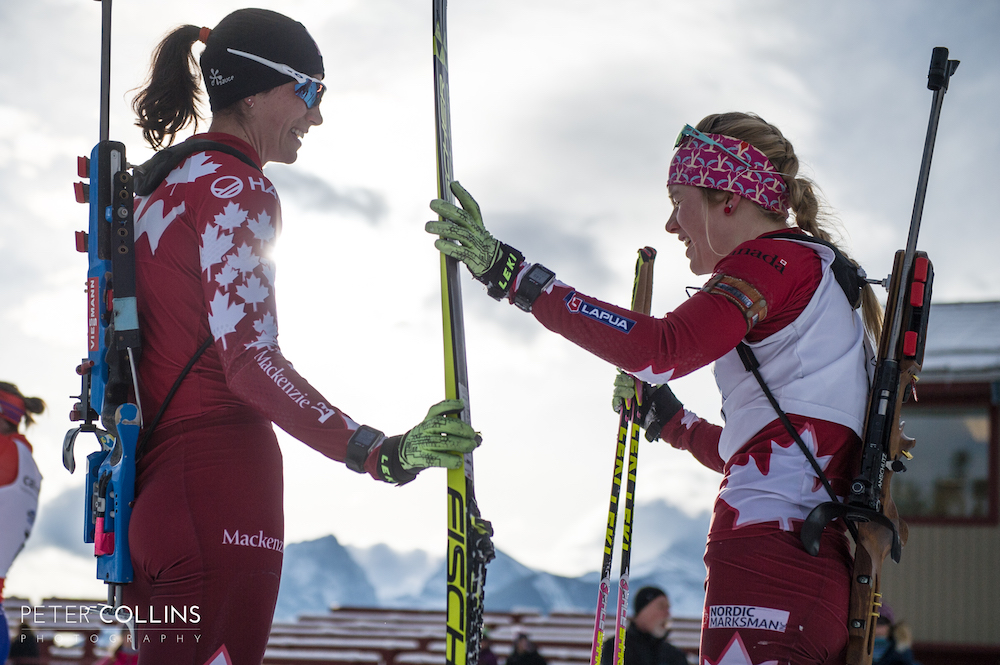
Emma Lunder (r) with fellow Biathlon Canada national-team member Rosanna Crawford after the women’s modified sprint at Biathlon Canada’s team trials in November in Canmore, Alberta. Lunder placed second in that race to secure one of the last two spots on Canada’s IBU World Cup Team, while Crawford, who had been pre-selected for the team, placed sixth in that race. (Photo: Peter Collins/petercollinsphoto.com)
The other Canadian in the race, Rosanna Crawford, finished 39th (+3:44.3) after starting 49th and shooting 16-for-20 with one miss in each stage (1+1+1+1). Crawford had the fourth-fastest overall shooting time out of 56 women in the pursuit.
“I feel like today was a bit more like my normal shooting speed for standing and a little slower than my normal for prone,” she wrote. “I was really taking my time in zero for prone because the snow was making it so hard to see the target. Visibility was slightly better in the race, but I still tried to take my time in the hopes of hitting all 5.”
In placing 39th, she tied her previous season best from the 15 k individual last week in Ostersund, Sweden, and scored World Cup points for the second time this season.
“It’s disappointing to miss one shot every time, and to get into the top 30 I would have had to hit 18 or better,” Crawford wrote. “I’m glad I got a few points today, but feeling frustrated that I can’t put a good skiing and shooting together in the same race. Skiing was pretty good for the first 3 laps, and I slowed down a bit for the last 2, but today was my best skiing so far this year.
“Looking forward to France where I am sure some good cheese will help fuel some good races!!” she added of this week’s upcoming races in Annecy, France. “Also just so happy for Emma Lunder! She really did a great job today, in the range to hit 19 and move up to 27th is awesome!”
The lone American in the women’s pursuit, Clare Egan finished 53rd (+5:21.6) after starting 36th and having to ski seven penalty laps (2+2+2+1).
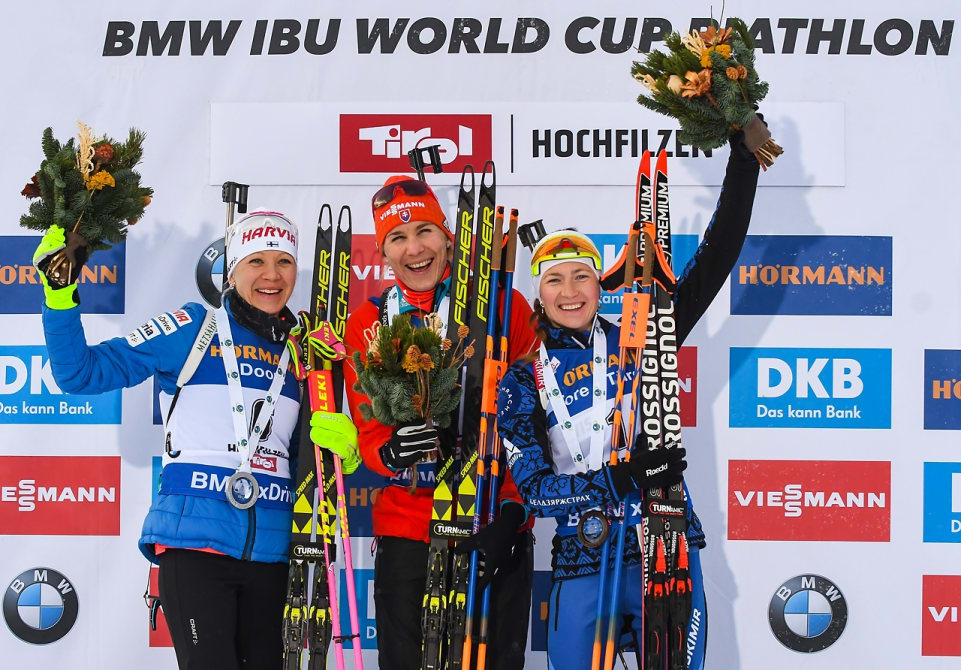
The women’s 10 k pursuit podium at the IBU World Cup in Hochfilzen, Austria, with Slovakia’s Anastasia Kuzmina (c) in first, Finland’s Kaisa Mäkäräinen (l) in second, and Darya Domracheva of Belarus in third. (Photo: IBU/biathlonworld)
In the race for first, Kuzmina, who had started second, 22 seconds behind Domracheva, maintained her position for the first half of the race despite a penalty on the first stage. After leaving the range 27 seconds behind Domracheva after the first shooting, Kuzmina was within 9 seconds of her after the second prone stage, which both women cleaned.
The first standing stage that followed proved to be the turning point, with Domracheva missing one and Kuzmina cleaning to take the lead by nearly 13 seconds. Both cleaned the final standing, but Kuzmina skied faster to keep Domracheva at bay, racing to the win while Domracheva was passed by Finland’s Kaisa Mäkäräinen on the final loop to end up third (+11.8). Mäkäräinen claimed second place (+10.2), up from starting 50 seconds back in sixth place, with 18-for-20 shooting (1+0+0+1) and the fastest course time of the field. (In comparison, Kuzmina skied the seventh-fastest overall course time and Domracheva’s time ranked 31st.)
While it was Mäkäräinen’s first podium of the season, it was Kuzmina’s first win since a mass start in March 2014.
“It is always great to be on the podium and especially in first position,” the 33-year-old Kuzmina said, according to an IBU press release. “After yesterday, I thought I had a chance, but it was not easy for me, especially on the shooting range; I could not catch my breath … I just tried to stay positive. I took a long time on the last shooting, but finally it was good.”
“Overall, it was not an easy race with such weather conditions,” Domracheva said. “Like Anastasia, I think I took some extra time for that last shot, but I had 19-of-20 and that is very good.”
Sunday is a relay day with the men’s 4 x 7.5 k and women’s 4 x 6 k wrapping up racing in Hochfilzen. Canada is listed as starting Lunder, Crawford, Megan Bankes, and Julia Ransom, while the U.S., with three women on the circuit, will not be entering a women’s relay.
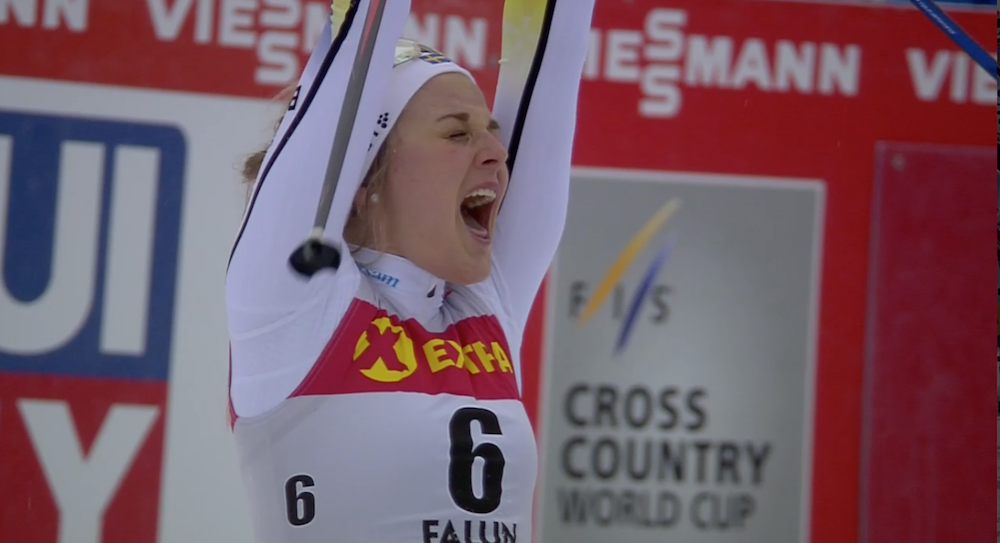
Sweden’s Stina Nilsson celebrates her second-straight World Cup sprint victory on Saturday after winning the 1.4 k freestyle sprint at home in Falun, Sweden.
FIS Cross-Country World Cup (Falun, Sweden): Men’s & women’s freestyle sprints
[UPDATED] Kikkan Randall reached the final for the first time since March 2015 on Saturday in the women’s 1.4-kilometer freestyle sprint at the World Cup in Falun, Sweden. The American qualified 26th and went on to advance in second out of her quarterfinal and semifinal to reach the six-woman final, where she ended up fifth.
Sweden’s Stina Nilsson won the final by one-hundredth of a second over Norway’s Maiken Caspersen Falla, finishing in 3:00.24 minutes. Nilsson had started the day by qualifying in sixth, 2.52 seconds behind Norway’s Marit Bjørgen, who won the qualifier in 3:00.64. This is Nilsson’s second-straight World Cup sprint win after skipping the freestyle sprint in Toblach, Italy, following the Tour de Ski.
While Bjørgen went on to win her quarterfinal, she finished fifth in her semifinal to end up ninth on the day.
Norway had two on the women’s podium with Heidi Weng in third, 1.88 seconds behind Nilsson. Finland’s Krista Parmakoski placed fourth (+1.99), and Randall was fifth (+2.56) for her best result in two years (she took last season off to have a baby). Sweden’s Jonna Sundling reached the final as well and finished sixth (+8.02).
Five U.S. women qualified for the heats, with Jessie Diggins qualifying fifth and ultimately crashing in her semifinal, where she finished fifth. That put her 10th overall on the day. Sophie Caldwell qualified third and finished fourth in her quarterfinal for 16th on the day, Sadie Bjornsen qualified 17th and also finished fourth in her quarterfinal for 19th overall, and Ida Sargent made the top-30 qualifying cutoff in 30th, then placed fifth in her quarterfinal for 25th overall.
Bjørgen topped the freestyle sprint qualifier on Saturday morning, clocking the fastest time around the 1.4 k course by just 0.08 seconds over Hanna Falk of Sweden.Caldwell qualified third (+1.23),Digginsqualified fifth (+2.39),Bjornsen17th (+5.04),Randall26th (+6.64), andSargent 30th (+8.28). Rosie Brennan (U.S. Ski Team) missed the cut in 37th (+10.90) and Liz Guiney finished 56th (+32.87). The lone Canadian woman racing on Saturday, Cendrine Browne placed 46th (+14.02).
In the men’s 1.4 k freestyle sprint final, Italy’s Federico Pellegrino held off three Norwegians and two Swedes to win in 2:45.77. The defending Sprint World Cup champion qualified second and went on to win his quarterfinal and semifinal before taking the final by six-hundredths of a second.
Norway took the remaining spots on the podium with Emil Iversen in second (+0.06) and Sindre Bjørnestad Skar in third (+0.47). Sweden’s Oskar Svensson was three-hundredths of a second off the podium in fourth (+0.50). The fastest qualifier in 2:34.49, Norway’s Johannes Høsflot Klæbo reached the final and ultimately took fifth (+1.32), and Sweden’s Teodor Peterson placed sixth (+2.08).
Canada’s Len Valjas was the top North American in 10th. He qualified 20th, advanced in second from his quarterfinal and finished fifth in his semifinal.
American Andy Newell was 16th after qualifying in 25th and finishing third in his quarterfinal. U.S. teammate Simi Hamilton followed in 18th, after qualifying 13th and finishing fourth in his quarterfinal.
In the men’s qualifier, Klæbo was 1.05 seconds faster thanPellegrinoand another 0.02 seconds faster than Russia’s Sergey Ustiugov in third.
For the U.S., Hamiltonqualified 13th (+4.52) andNewell qualified 25th (+6.74). Erik Bjornsen placed 43rd (+9.30) and Matt Gelso 59th (+13.12).
Valjaswas the lone Canadian man to make the heats, qualifying 20th (+6.22). The only other starter, Alex Harvey, placed 46th (+9.71).
IBU Open European Championships (Duszniki-Zdrój, Poland): Men’s & women’s pursuits
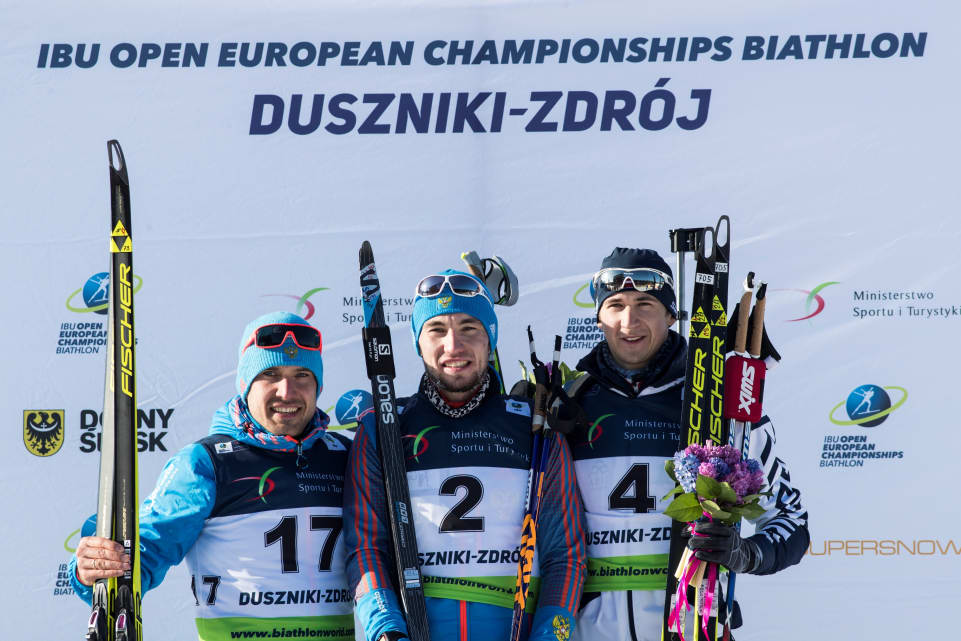
The men’s pursuit podium at 2017 IBU Open European Championships on Saturday in Duszniki-Zdrój, Poland, with Russia’s Alexander Loginov (c) in first, Evgeniy Garanichev (l) in second, and Latvia’s Andrejs Rastorgujevs (r) in third. (Photo: IBU)
Russia’s Alexander Loginov racked up his second win of the 2017 International Biathlon Union (IBU) Open European Championships on Saturday in the mens’ 12.5-kilometer pursuit in Duszniki-Zdrój, Poland.
After starting second, 5 seconds behind Bulgaria’s Vladimir Iliev, who won Friday’s sprint, Loginov proceeded to clean three straight stages before missing one on his final standing to cross the line first in 31:46.2 minutes.
“It was not as easy as it seemed, because from the first loop Vladimir set a really good speed,” Loginov said, according to an IBU press release. “Today we had great sunny and windless weather again, so I managed to shoot well. Probably that is why it [looked] so easy.”
Russia took first and second place with Evgeniy Garanichev following 27.8 seconds later, after starting 17th (56 seconds out of first) and shooting 19-for-20 (0+0+1+0).
“After yesterday’s sprint, I managed to work well and to show good result in pursuit, so I’m sure glad to win the silver medal,” Garanichev said, according to the IBU.
Latvia’s Andrejs Rastorgujevs improved on his fourth place in the sprint to reach the pursuit podium in third (+59.5) despite four penalties (0+1+1+2).
“On the last loop I had the information about the guys who were behind me and in front of me,” Rastorgujevs said, according to the IBU. “I was just fighting and did all I could do to get to the podium.”
Bulgaria’s Krasimir Anev, who started third, slipped to fifth (+1:28.6) with two penalties (0+1+1+0), behind Russia’s third man in the top four, Alexey Volkov in fourth (+1:01.6). Iliev as the first starter ended up 11th (+1:41.7) with six penalties (2+2+0+2).
The two Americans who had qualified for the pursuit by placing in the top 60 of Friday’s sprint, Paul Schommer and Alex Howe improved to 48th (+5:07.1) and 51st (+5:42.3), respectively.
Schommer started 58th, just ahead of Howe in 59th, and missed five targets, all in his first two prone stages (3+2+0+0). Howe accumulated four penalties (1+2+1+0).
No Canadians qualified for the pursuit.
[UPDATED] In the women’s 10 k pursuit that followed, Russia’s Irina Starykh picked up her second win and third consecutive podium of the championships, with clean shooting en route to a 19.8-second victory in 30:04.4.
Starykh started third, 38 seconds behind Ukraine’s Juliya Dzhyma and 11 seconds after her Russian teammate Svetlana Sleptsova, respectively. Dzhima missed two on her last two standing stages (0+0+1+1) to slip to second, and Sleptsova dropped one place to third (+32.1) with one prone penalty (0+1+0+0).
Veronika Vítková of the Czech Republic improved from seventh to fourth (+47.8) with two penalties (0+1+1+0), and Russia’s Svetlana Mironova moved all the way up from 13th to fifth (+1:29.6) with three misses (0+1+1+1). Just 0.2 seconds behind her, Poland’s Monika Hojnisz improved from 16th at the start to sixth (+1:29.6) with one penalty (0+0+0+1).
No North Americans qualified for the pursuit.
Open European Championships conclude Sunday with the single mixed and mixed relay.
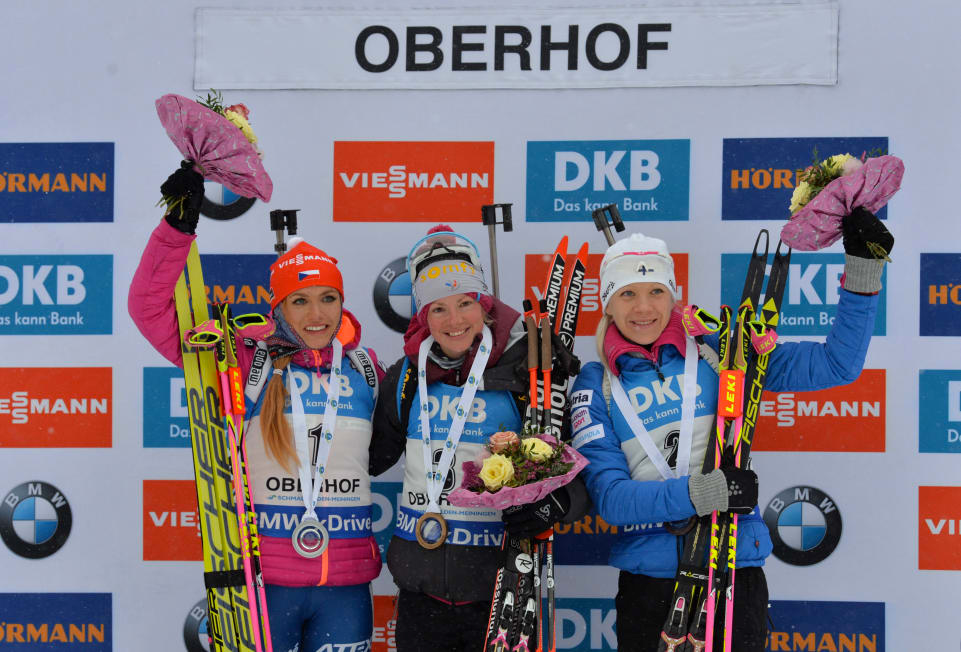
The women’s pursuit podium at the 2017 IBU World Cup in Oberhof, Germany, with (left to right) Czech Republic’s Gabriela Koukalová in second, France’s Marie Dorin Habert in first and Finland’s Kaisa Mäkäräinen in third place. (Photo: IBU)
On Friday, the starters in the International Biathlon Union (IBU) World Cup women’s sprint enjoyed some of the nicest weather longtime veterans of the sport ever witnessed in Oberhof, Germany. The next day for the 10-kilometer pursuit, the traditional biathlon venue in the heart of the Thuringian Forest mountain range showed its extremely windy and cold side again.
“Today was back to a bit more normal Oberhof, except that it was really cold, -10 [degrees Celsius, 14°F] and with the wind more like -15 [5°F], so lots of cold feet and hands out there,” Biathlon Canada’s Rosanna Crawford wrote in an email to FasterSkier.
Crawford finished the race as the top North American in 22nd (+3:47.9) with four penalties (0+1+1+2).
In the unstable weather conditions, three experienced athletes who reached the podium in the sprint prevailed once again. Only the positions for the ceremony were flipped, with France’s Marie Dorin Habert claiming the spot at the top in a time of 34:33.3 minutes with two penalties (1+0+0+1), ahead of Czech Republic’s Gabriela Koukalová (+38.8 with three penalties) and Finland’s Kaisa Mäkäräinen (+1:19.1 with four penalties).
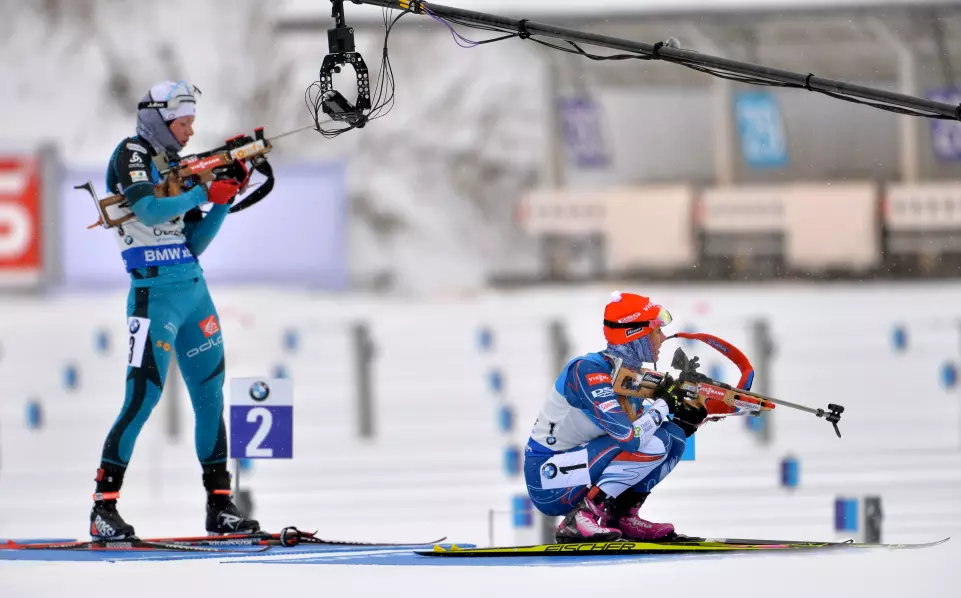
But even these biathlon veterans struggled with sharp gusts that made the wind indicator flags on the range flutter horizontally to the right. After incurring her first penalty in the third shooting following two clean stages, Koukalová resorted to a squat to calm her shaking legs. This problem can occur in standing stages when the heart rate of an athlete drops too low while waiting a long time on the shooting mat for the wind to quiet down. It paid off, with the Czech able to hit all remaining targets in that stage.
Czech Republic’s Gabriela Koukalová crouches down in a squat to calm her shaking legs during the third shooting stage of the women’s 10 k pursuit on Saturday at the 2017 IBU World Cup in Oberhof, Germany. France’s Marie Dorin Habert (l) went on to win the race. (Photo: IBU)
“I was so nervous that my legs started to shake very hard,” Koukalová said with a laugh at the press conference. “I was not able to shoot, so that’s the reason why I did what I did.”
“I was feeling very tired, because I could not sleep the last two nights,” she added. “I don’t know why, but it was difficult when I started to watch the clock at about four o’clock in the morning… I believe today I will have a better recovery.”
Dorin Habert was able to cope better with the wind, shooting clean in the third stage and only adding one penalty in the final standing bout, while her closest opponents all missed at least two targets. She returned to the course with a lead of almost 30 seconds, which she was able to defend into the finish.
“I just tried to attack my shoot[ing], I know that the wind will stay the same,” Dorin Habert said of her strategy for the final stage at the press conference. “I just said in my head, ‘If I wait my leg will start trembling, so I have to attack’. Today I was lucky, but maybe if I try the same tomorrow I will [have to] make five penalty loops.”
She said her teammate Martin Fourcade’s win in the men’s pursuit earlier in the day motivated her.
“Like every time, I just said, ‘Woah he is very strong,’ and he shoots always clean even if the conditions are bad. So I tried to do the same,” she said.
Mäkäräinen missed two targets in the final standing stage, but managed to stay in third skiing out of the penalty lap and back onto the course with a comfortable one-minute lead when Germany’s Maren Hammerschmidt as her closest challenger shot three penalties to finish fourth (+2:05.9 with five penalties).
Mäkäräinen has never won a race in Germany despite more than 50 World Cup starts there, and also has not won a race yet this year, but she was not too disappointed about the missed opportunity.
“I am always happy when I am on the podium,” Mäkäräinen stated at the press conference. “The women’s races are always tough, and are becoming [even tougher] year by year. Of course it would be nice to sit in the middle [of the podium, where the winner stands], but I think and hope that the day will come… The end was quite heavy, and I was happy that I did not have to ski full speed on the last loop.”
“After the three misses I would not have thought that [reaching the fourth place] would still work so I am very satisfied,” Hammerschmidt told German media after the race, initially skipping past the waiting reporters due to exhaustion and the cold temperatures.
Also notable for the second race of her “comeback weekend” just three months after having her first child, Belarus’ former Olympic champion Darya Domracheva placed 34th (+4:25.5) with six penalties, after starting out in 37th and posting the seventh-fastest course time.
With her second place, last year’s overall World Cup winner Koukalová (formerly Soukalová) took the lead in that ranking again with 419 points, just ahead of Mäkäräinen with 414 and Germany’s Laura Dahlmeier with 410 points, who skipped the Oberhof sprint and pursuit, but plans to return for the mass start on Sunday. Dorin Habert is currently fourth in the standings with 399 points, and more than half of the season still to come.
Crawford Again Leads North Americans
After starting the race in 21st following her best result of the season with clean shooting in Friday’s sprint, Canada’s Crawford struggled with the challenging wind and freezing temperatures on Saturday just like most other athletes, incurring four penalties (0+1+1+2).
Rosanna Crawford racing two seasons ago at a 2015 IBU World Cup in Oslo, Norway. (Photo: Biathlon Canada/NordicFocus.com)
“The wind for my prone was pretty consistent, my miss [in] prone was me, just not quite focused enough, same with my first standing miss,” Crawford recounted in an email. “My last standing bout was a different story, really inconsistent wind and cold fingers made it hard to hit the target.”
Despite posting the 45th-ranked course time, she nearly held her starting position from the start to finish 22nd (+3:47.9).
“I am happy to have stayed in the top 25, but again skiing was rough,” Crawford wrote. “Girls would just crush me on the first climb. Luckily I had some really great skis today and could catch back some time on the downhills and flats.”
“The potential was there for a really great race even with four misses, but my ski speed has been holding me back,” she said, according to a Biathlon Canada press release. She was the lone Canadian to qualify for the pursuit.
After starting out in an unfavorable 50th position based on her sprint result, American Susan Dunklee was unable to pick off too many places with nine penalties (1+3+4+1) on Saturday, while skiing the 29th-ranked course time. She finished 44th (+6:20.4).
“We had cold temperatures amplified by a brisk wind,” Dunklee said of the conditions, according to a US Biathlon press release. “I tried to draft someone on every loop entering the stadium because of the strong headwind. I am capable of shooting a lot better than I have these past couple days and now I am focusing on putting together a strong performance for tomorrow.”
Dunklee’s teammate Clare Egan started the pursuit in 52nd and finished 49th (+7:25.6) with seven penalties (4+0+0+3) with the 40th-ranked course time.
The Oberhof World Cup concludes with mass starts on Sunday. No North American men qualified for the 15 k mass start, but Dunklee as the 17th-ranked woman in the overall World Cup is slated to start the women’s 12.5 k mass start. On the provisional start list, Crawford was listed among the “reserve standby athletes”, based on her recent results in Oberhof, should another qualified athlete have to cancel (e.g. due to illness).
Crawford was still hopeful to get another racing opportunity in Oberhof: “Would be great to be in the mass start tomorrow!”
Susan Dunklee (US Biathlon) leads Finland’s Kaisa Mäkäräinen on the fourth of five loops in the IBU World Cup women’s 10 k pursuit on Friday in Presque Isle, Maine. Dunklee went on to place fifth while Mäkäräinen raced to second. (Photo: USBA/NordicFocus)
When Susan Dunklee woke up Friday on a sub-zero morning in Presque Isle, Maine, it took her a moment before her eyes focused in on a shiny new object on a table in her room. Oh yeah, my silver medal, she thought.
“I had forgotten,” Dunklee said on the phone Friday evening, after her second of two IBU World Cup races in Presque Isle. The 29-year-old U.S. biathlete, who turns 30 on Saturday, had placed second in the sprint on Thursday to tie the best result by an American in a biathlon World Cup. It was a surreal moment back then, and even now, it was still sinking in.
But she had to move on. Dunklee had a pursuit ahead of her, one in which she’d start closer to the race leader than she ever had before.
“I knew for today, I had to set that aside and enjoy it for what it was and know I’ll have that to cherish for the rest of my life,” she said. “But today I had another race and another great opportunity in front of me.”
One of three US Biathlon skiers in the women’s 10-kilometer pursuit, Dunklee started second, 18 seconds behind Gabriela Soukalova of the Czech Republic, who led the 60-woman field out in first. Soukalova had been the only woman faster than Dunklee in the sprint, beating her by 17.8 seconds.
And so she started first, but was in danger of being penalized for jumping the start. Soukalova quickly realized her mistake in starting too soon, and hesitated briefly before continuing on her first of five loops. She wasn’t penalized, and Dunklee — who had a front-row view of the slipup — said it was kind of comical.
“I had a good laugh at that, actually,” Dunklee said. “Normally, fifteen seconds or eighteen seconds before I’m starting, I’m very focused and I’m looking down the track and trying to stay serious and focused. But it was funny, Gabby started off and I think she wasn’t sure if she was supposed to go yet or not, so she stopped and came back, and she just looked very confused. Sometimes it is nice to have something silly like that to lighten the mood.
“I can kind of understand why it happened because we are used to being at venues where there’s a huge stadium with people roaring and counting down, ‘Ten, nine, eight, seven…’ ” Dunklee explained. “And it was so anticlimactic that way, it’s just like, ‘Oh, there’s a clock, and it’s at zero. It’s time to go.’ ”
Gabriela Soukalova of the Czech Republic after winning the IBU World Cup women’s 10 k pursuit on Friday by 34 seconds. (Photo: IBU/NordicFocus)
Off went Soukalova, the overall World Cup leader, cleaning two consecutive stages before having some trouble on the range on a windy, 8-degree Fahrenheit afternoon at the Nordic Heritage Center. She led up until that point, while Dunklee hung in second through the first loop and first shooting stage, after starting 1 second ahead of Poland’s Krystyna Guzik, the third starter, and 2 seconds ahead of France’s Marie Dorin Habert in fourth.
“My plan for the first loop was to let the girls behind me lead because they are very strong skiers and I often ski more efficiently behind people,” Dunklee explained. “But they never came up alongside of me and tried to pass, so I wasn’t just going to stop and pull over, you know? I ended up holding on to second coming into the first shooting, which had not been the plan, but it was fine.”
There, rather than think about what could be — the possibility of winning or another podium — Dunklee focused on the four simple words she uses to get into the ideal mindset for shooting.
Open. That involves breathing, opening her “ventilation system, opening my eyes and seeing what’s going on in the range, what the wind flags are doing, opening my snow covers,” she explained. “The importance of a good key word is it’s one word that can cover a lot of things that you need to be done in an instant.”
Relax. “Take my rifle off my back, try to keep my movements smooth and relaxed, changing the clips quickly but relaxed, setting up, getting a good tripod sort of feeling with my body with my rifle sitting on top of it,” she said.
Set. This is what she thinks about when getting ready to shoot. “Set means ready. It has a feeling of readiness. My finger is set on the trigger, taking 90 or so percent of the trigger pressure so all I have to do is squeeze it very gently for the shot to go off,” she said.
Quiet. Once on target, that’s all that goes through her mind. “I’m trying to quiet my mind so it’s a very narrow thought focus,” she said. “Feeling quiet with my body, being quiet on the target and being quiet after the shot goes off as a good follow through.”
Dunklee nailed her execution on the first prone stage and cleaned all five targets to leave the range in second, 11.5 seconds behind Soukalova. Italy’s Dorothea Wierer, the seventh starter, cleaned as well to move into third, 8.3 seconds behind Dunklee. Guzik and Finland’s Kaisa Mäkäräinen, in bib 5, cleaned as well to hang close in fourth and fifth, respectively, about 2 seconds behind Wierer, while Dorin Habert missed one to drop to seventh, another 20 seconds back.
One loop later, Soukalova — still skiing alone — hit every prone target to leave the range again in first, 11.7 seconds ahead of Wierer, who quickly cleaned her targets to move into second. Dorin Habert cleaned to take hold of third, 35 seconds behind Soukalova, while Dunklee had one penalty to slip to sixth, 44.6 seconds out of first.
According to Dunklee, the wind was much more variable for the second stage.
“The first shot the wind was strong, but I could see the wind dying down and I did what we call shading,” she said. “Instead of taking clicks to correct, you aim a bit off the center of the target so you correct with your aiming. It takes a bit more skill in a way and is riskier, but it is very useful in situations that the wind is fading.”
Despite over-shading, aiming too far off the target on her last shot, Dunklee was pleased to leave the range with one penalty.
“I was really happy with where my head was at that whole process,” she said. “In the middle of the race, I was thinking, this is fun, this is a game, this is a challenge, I got this. And I wasn’t afraid of messing it up. That is a pretty novel and cool mental place to be in a high-pressure situation for me.”
From left to right: Gabriela Soukalova of the Czech Republic, Italy’s Dorothea Wierer and France’s Marie Dorin Habert line up for the first standing stage during the women’s pursuit on Friday at the IBU World Cup in Presque Isle, Maine. Soukalova and Wierer both missed three, and Dorin Habert missed four on that stage. (Photo: IBU/NordicFocus)
On the third shooting — the first standing stage, things got interesting. Soukalova missed three, Wierer missed three, and Dunklee took her time to hit three of five targets for two penalty loops, which put her in third, 21.5 seconds behind Wierer, who had taken the lead.
“My legs started to shake and maybe I started to be afraid of the wind because it was a little bit stronger than before,” Soukalova said in a post-race press conference. “Sometimes it happens.”
“There was significant wind and it was changing,” Dunklee explained. “It would catch your body and rock you. I think you saw all the athletes waiting for the gusts to subside. I tried to take shots in between them and I missed a couple.”
The penalty loop in Presque Isle is unique in the fact that the ski lodge blocks the view of other racers in the loop. Dunklee couldn’t see Soukalova or Wierer, and didn’t have much of a sense where she stood until she received splits back out on course that she was still in the mix for a podium.
“You are usually not that high up after missing two in a pursuit, but it was tricky conditions and everyone was missing,” she said. “You can never give up a biathlon race because these things happen.”
Ahead of her, she could see both Wierer and Soukalova, in second by 2.3 seconds leaving the range. About four seconds behind Dunklee, Mäkäräinen moved into fourth with two misses, while Dorin Habert dropped to 10th, 49 seconds out of first, with four penalties.
“In the middle of the race, I was thinking, this is fun, this is a game, this is a challenge, I got this. And I wasn’t afraid of messing it up.” — Susan Dunklee, on the tricky shooting conditions during Friday’s pursuit
Mäkäräinen passed Dunklee on an uphill and led her into the range for the last time, positioned in third and fourth, respectively.
“It was really helpful,” Dunklee said of catching a ride off Mäkäräinen. “She is a good skier and I ski more efficiently when I am behind someone.”
By the final standing stage, the wind had subsided comparatively. Wierer once again shot quickly but missed three to fall into eighth place (and eventually finish ninth), while Soukalova cleaned to regain control of first. Mäkäräinen hit all of her targets as well to jump into second, 25.6 seconds back with 2 k to go, and Guzik cleaned to move back into third (after one penalty in the second stage, and two misses in the third stage), 39 seconds behind Soukalova.
Dunklee missed one to leave the range in fourth, 11 seconds behind Guzik and 1.7 seconds ahead of Dorin Habert in fifth. After a rocky previous stage, Dorin Habert took a pause before her final shot of the day to clean the all five targets.
On the final loop, Soukalova charged ahead to secure her 12th World Cup win (and fourth of the season) in 31:24.6 minutes, 34 seconds ahead of Mäkäräinen in second. Dorin Habert charged past Dunklee to take hold of fourth, then picked off Guzik as well to claim third (+38.8).
“It was not in my plan to have five penalties,” Dorin Habert, who ranks second to Soukalova in the overall World Cup, said in the press conference. “The coach told me after the last shooting that I had a chance to catch the podium. I felt good today and I made it.”
“It is awesome like yesterday,” Soukalova said of her second-straight victory in Presque Isle. “Maybe the atmosphere it a little bit easier than Europe, for example, there’s a lot of spectators. … It’s not so noisy and maybe it helps us.”
Guzik finished five seconds later in fourth (+43.9) and Dunklee placed fifth (+56.9) for her best-ever pursuit finish and second-best result of the season.
“I was happy to still be in the fight coming out of that loop,” Dunklee said. “Marie Dorin was right behind me and I hung with her for the first hill after she passed me, but she took off and I didn’t have that sort of gas today.”
Would she have liked to clean that last stage and fight for an even better result? Yes, but Dunklee said she had a plan, she executed it, and she could feel proud about that.
“Today my skiing felt good and felt strong, it felt a bit flat though,” she added. “I think there is still some peak form not there yet, but this is exactly where I want to be sitting going into Oslo [World Championships]. Having some great results here to feel really confident, but also knowing there is a little bit more.”
After one more race day in Presque Isle, the men’s and women’s relays on Saturday, the IBU World Cup will take a break until the 2016 World Championships in Oslo from March 2-13.
Dunklee will team up with Hannah Dreissigacker, Clare Egan and Annelies Cook in the women’s 4 x 6 k relay, which starts at 4:10 p.m. Eastern time on Saturday.
Egan 23rd, Dreissigacker 24th
According to both Dunklee and US Biathlon CEO and President Max Cobb, the U.S. women’s team had one of its best days in recent memory in the pursuit, with three in the top 24.
Egan improved from starting 32nd to finish 23rd (+2:34.0), with three penalties (0+1+1+1), and Dreissigacker placed 24th (+2:41.6) after starting 27th and missing three as well (0+2+1+0).
“I started about 5 seconds behind a big pack including Hannah, so from the start I had my eyes on the orange and purple,” Egan wrote in an email, referring to the US Biathlon team suits. “I caught her pack as we came into the first shooting.”
There, both Dreissigacker and Egan cleaned to move into 22nd and 23rd, respectively, about 1 1/2 minutes behind the leader. The two had to make some major adjustments on that prone stage after zeroing, or setting their rifle sights before the race, on Point 2 — where their teammate Dunklee was slotted based on her start position.
“Cleaning the first prone stage was a major accomplishment for Hannah and me,” Egan explained. “We zeroed our rifles on point 2, where there was strong wind, and then came into the shooting range for the first prone stage on points 29 and 30 — the opposite end of the range and there was no wind. We both took around 8 clicks, which translates to the entire width of the prone target. When I hit the first target I knew I had taken the correct amount of clicks and I was so psyched!!!”
Dreissigacker and Egan skied three of five loops together, with Egan passing her teammate on the second loop. After the second prone stage, Egan left the range in 18th with one miss, about 40 seconds ahead of Dreissigacker, who missed two in that stage to slip to 30th.
“On the last lap I knew she must have cleaned the final standing because I could hear our fans (!!) yelling both of our names on our last lap,” Egan wrote of Dreissigacker. “She was right behind me in the finish.”
With her best shooting in a four-stage race, Egan explained that she was satisfied.
“I did miss my 20th shot and I could have been in the top-20 with a clean last stage, so that is a bit of a let down but I can learn from this and hit it next time,” she added.
“It was fun to ski a lot with Clare,” Dreissigacker wrote in an email. “We were pretty close together for the first two loops, and then I had an extra penalty loop and got behind but then we were really close again for the last lap–I tried to catch her but couldn’t quite do it!
“I am very happy with my race today and really proud of our performance as a team,” she added. “And once again the wax techs and coaches did a really stellar job with the skis and support out there.”
Canada’s lone woman in the pursuit, Zina Kocher placed 46th (+4:36.5) after starting 42nd, with five penalties (2+1+0+2).
On Saturday, Kocher will ski the first leg for Canada’s relay, followed by Emma Lunder, Audrey Vaillancourt and Erin Yungblut.
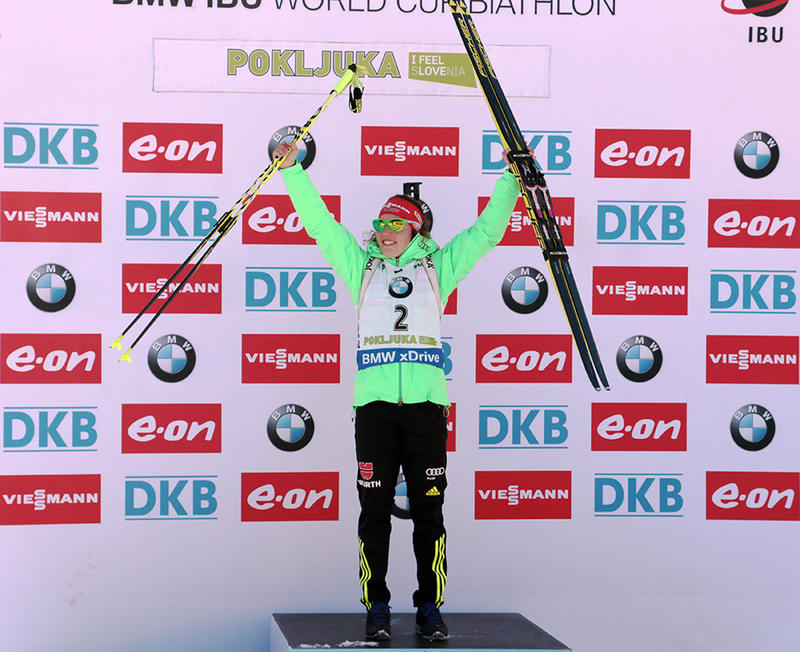
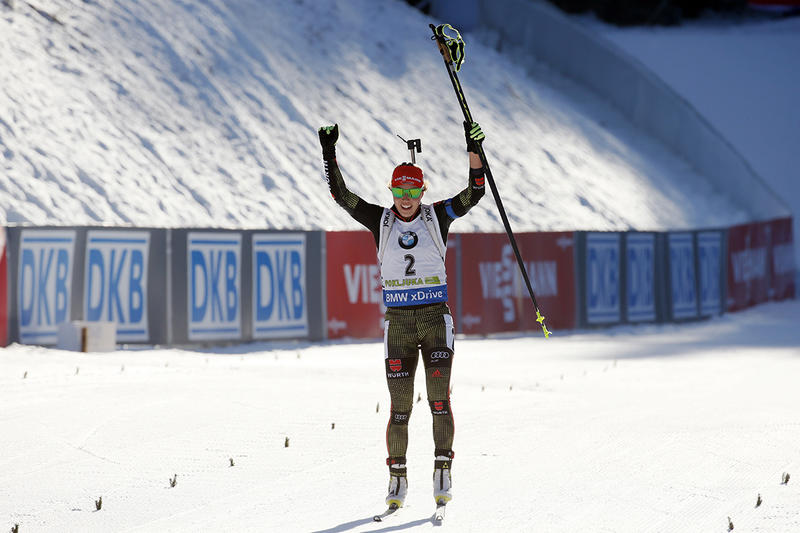
Germany’s Laura Dahlmeier after winning the women’s 10 k pursuit at the IBU World Cup in Pokljuka, Slovenia. (Photo: IBU/Kvetoslav Frgal)
The IBU Biathlon World Cup season, and especially this weekend of races in Pokljuka, Slovenia, is shaping up more and more as a duel between German and French athletes at the top.
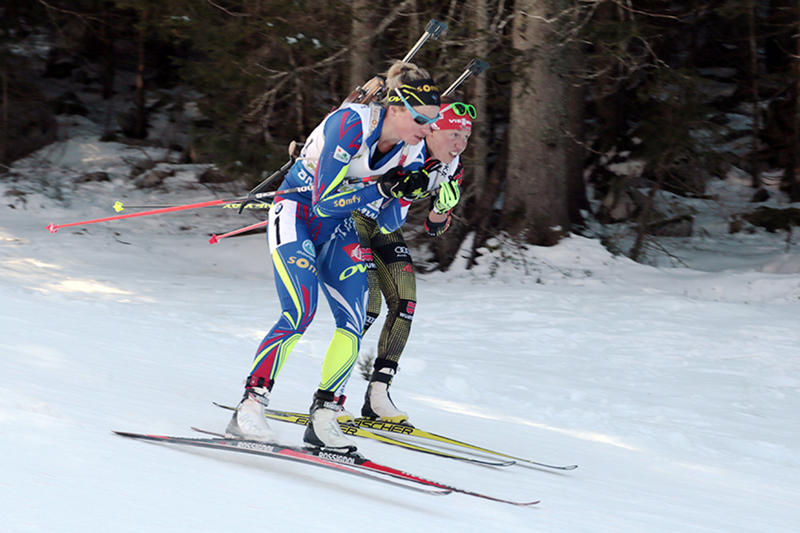
Just like Martin Fourcade and Simon Schempp battled it out on the men’s side, the women’s weekend was highlighted by close races between France’s Marie Dorin Habert and Germany’s Laura Dahlmeier.
In Friday’s sprint, Dorin Habert prevailed by just over a second. But after skiing together for most of the pursuit on Saturday, the positions on the podium were reversed and Dahlmeier was victorious, finishing first in 30:08.9 minutes, 18 seconds ahead of her French rival, just like she had publicly announced as her goal after the race on Friday.
In sunny and warm conditions on Saturday afternoon with almost no wind on the shooting range, the two athletes quickly established a sizable lead to the rest of the field, which kept growing until the finish as neither incurred a penalty lap in the four shooting stages.
Third place went to Finland’s Kaisa Mäkärainen, winner of the first pursuit of the season in Östersund, Sweden, who has since been struggling with her shooting accuracy. Mäkärainen missed just one target in her final stage in this race (0+0+0+1) and left the range in fourth, just behind the Czech Republic’s Gabriela Soukalová (0+0+1+0) in third. Mäkärainen was able overtake her on the last loop and finish 9.4 seconds ahead of her for the final step on the podium. Mäkärainen skied the fastest course time of 55 finishers.
“It’s very nice to be back on the podium,” Mäkärainen said in a post-race press conference. “I felt very good today and very happy about my range time. I hope to be back in the top five every competition, but most important are the World Championships in Oslo next March.”
After Gabriela Soukalová in fourth, Germany’s Franziska Preuss placed fifth, edging teammate Vanessa Hinz in sixth by 0.5 seconds. Both had only one penalty in the third shooting (0+0+1+0).
Susan Dunklee (US Biathlon) racing to 10th in the women’s 10 k pursuit at the IBU World Cup in Pokljuka, Slovenia. (Photo: USBA/NordicFocus)
US Biathlon’s Susan Dunklee, who started sixth, 31 seconds behind Dorin Habert, hit 18 of 20 targets (1+0+1+0) and finished the day in 10th (+1:35.4).
“I realized halfway through the race that my typical greatest strength, my skiing, wasn’t quite in top form today,” Dunklee explained in an email. “Usually I move up through packs, but today big trains of people passed me and I had to let them go.
“Perhaps I overdid it in the second loop,” she added, referring to the loop where she posted the third-fastest course time. “Luckily I had another great day on the shooting range and that kept me in the race.”
Friendly Rivalry
Unlike in the men’s race where Schempp and Fourcade seemed to disagree about skiing tactics, not wanting to make the pace for each other, Dorin Habert and Dahlmeier skied together from the start and frequently exchanged in the lead in order to create a gap to the rest of the field.
“I was lucky that I could ski all four loops with Marie Dorin. I think we distributed that well, with her taking the first part of the round, and me taking the lead on the second part being faster out of the downhill,” Dahlmeier told the German TV broadcaster ZDF. “I think that was decisive. And then of course a zero [clean shooting] on the shooting range is still required.”
The crucial situation deciding the race happened on the third loop leading into the final stage, when Dorin Habert stumbled in soft snow in a sharp downhill turn, falling on her belly and just narrowly avoiding the V-boards on the edge of the track. She quickly got back up, and at the next split time, she was still only 7.4 seconds behind Dahlmeier.
France’s Marie Dorin Habert (l) and Germany’s Laura Dahlmeier stuck together for the majority of Saturday’s pursuit at the IBU World Cup in Pokljuka, Slovenia. (Photo: IBU/Kvetoslav Frgal)
“I don’t know what happened,” Dorin Habert said in an English interview with ZDF.
“I think I just made a wrong movement with my ski, and that’s why I was a few seconds late behind Laura, and I think that’s why I lost the win because of that. But no problems, it’s good to be second.”
In the press conference, she elaborated: “It was a stupid error. I made the wrong move with my skis,” she said. “Falling on a downhill is stressful, as it’s hard to come back to the race.”
In addition to the seconds Dorin Habert lost when she fell, Dahlmeier gained another advantage when she was able to hit her first targets before the French skier even reached the shooting mat. In previous shooting stages, Dorin Habert had put some pressure on the Dahlmeier by beginning and cleaning her targets first.
“I let her in front before the shooting range because we had zeroed our aim [before the race] on range 3 and 4 and the French on 1 and 2, and you always prefer to shoot there,” Dahlmeier said of another tactic. “I generally try to focus just on my own targets, clean the shots one by one. Of course you notice when the spectators are yelling [after a hit or miss], but I try to ignore that as much as possible.”
Both cleaned all targets for the fourth time, but Dahlmeier left the range 10.8 seconds in front of Dorin Habert, who was not able to catch up to her again on the last loop. Despite opening her ski pole straps and waiving to the crowd already on the final stretch, in the finish Dahlmeier expanded that lead, winning by 18 seconds.
Germany’s Laura Dahlmeier after winning the women’s 10 k pursuit at the IBU World Cup in Pokljuka, Slovenia. (Photo: IBU/Kvetoslav Frgal)
Despite her mishap, Dorin Habert was not disappointed at all with second place.
“No, no, no, because we made a perfect race with Laura,” she told ZDF. “It was very exciting to compete with her all the time. I am very happy that my shooting was perfect, I always want to do races like that, and congrats to Laura.”
The two athletes hugged each other after the finish, exhausted but smiling.
“Today you had to run a smart race,” Dahlmeier said. “The strength is fading towards the finish, and this is the last block of races before Christmas.”
Despite the pursuit loss, Dorin Habert achieved a different kind of victory on Saturday by taking over the yellow bib as the overall women’s World Cup leader. She has 309 points after seven competitions, and is currently five points ahead of Soukalová, and she’ll wear the bib in Sunday’s mass start.
“I don’t want to compete tomorrow. It will be very hard. I hope to get a good sleep and perform well tomorrow,” Dorin Haber joked in the press conference. “Yellow is a very nice color, I like it a lot. I hope I won’t wear it just for one competition.”
10th for Dunklee
Dunklee finished the pursuit in 10th and seemed happy with that result, briefly pumping her right fist and later waiving to the many spectators in the arena that was filled to capacity. She recorded the 12th-fastest skiing time on the course among all athletes, but was most satisfied with her shooting with just two misses (1+0+1+0).
“Cleaning the last standing stage especially is extremely important in a pursuit,” Dunklee wrote. “I was pleasantly surprised to hear I was in tenth heading out on the last loop. I realized I had to fight hard early in that loop to dissuade Doro [Dorothea Wierer of Italy] from thinking she might be able to hunt me down.”
Her effort got rewarded, with Dunklee skiing the 10th-fastest final loop, and Wierer, who had already won a World Cup 15 k in Östersund this season, finishing 14 seconds behind her.
Biathlon Canada’s Julia Ransom, who achieved her best World Cup result of 31st in Friday’s sprint, held her position for a long time, then missed three shots in the final shooting (1+0+1+3), which set her back. After leaving the range in 47th, she finished 44th (+4:46.2).
One position and a second behind her in the finish was teammate Rosanna Crawford, who started the race in 23rd, but got off to a problematic start after missing four shots in the first prone. That put her in 54th heading into her second loop.
“My misses were all high but moving around, so not a group,” Crawford explained in an email. “I think I was maybe so focused on wanting to hit my standing shots that I didn’t give my prone enough thought and focus. It’s amazing how quickly you can go from thinking you are a good shooter to missing 4 in your first bout!”
She had two more penalties before the finish (4+1+0+1), yet steadily picked off racers along the way to end up 45th (+4:47.4).
“For the next 3 shootings I was mostly over it, I didn’t hammer the skiing, just thought of it as a good opportunity to work on some good ski technique and cleaning my standing,” Crawford wrote.
Canada’s third woman in the pursuit, Megan Tandy had a scare when she lost consciousness on the course. After starting in 51st position, she skied the 39th fastest time on the first loop, then had to ski three penalty laps after the first stage. Shortly after that on the second loop, she was seen on the TV broadcast suddenly collapsing to the ground on a fairly flat section, seemingly not caused by an obvious skiing error or contact with another athlete.
A bit later she was shown sitting on the side of the track, conscious and receiving attention from coaches and course staff. She could not finish the race.
“Unfortunately, my race ended unexpectedly early today when I lost consciousness on course, eek,” she later posted on Facebook. “While passing out on TV during the pursuit was a far cry from my idea of a “good day”, I can assure you that the footage looked much worse than it felt. Not to worry, I am already feeling much better and am being well taken care of. Thanks a lot to all the people who helped me out today. After a good Christmas break I will be ready to go again ☺”
In an email, she confirmed that she was unharmed by the incident: “I am really not sure what happened, I felt unwell skiing and a bit lightheaded, but I was just thinking to make it to the top of the hill so I could tuck and rest a second, and then I was aware of blackness closing in very fast – but I don’t remember falling at all,” Tandy wrote. “There were several people around me when I came to and they had already taken my skis and rifle off.”
She had not noticed any warning signs ahead of time: “Only that I was feeling exhausted and unwell during the race for a minute or two before. Other then that, no — I actually had a good ski performance yesterday and felt completely healthy and normal.”
This was only the second time she did not finish a race, she explained.
“I think I will be just fine, I am just taking it easy and feeling a bit weak / tired,” she wrote.
Most of the team plans to return to Canada on Monday for the holiday break.
Mass Start on Sunday
The weekend in Pokljuka concludes Sunday with the first mass start of the season, 10 k for the women and 15 k for the men. In this discipline, all participants start at the same time in 10 rows of three athletes each. The 25 best athletes on the World Cup total-point score standings at that time of the season are pre-qualified, plus five more athletes not among those top 25, who achieved the best results in the events that race weekend, make the cut.
Via this second criterion, Dunklee qualified for the women’s race, and is scheduled to start out of row 9 (bib 26).
“One more day left of full focus and full gas for the mass start. I know I will probably feel tired, but everyone else in the race will be exhausted from the past month so that shouldn’t be a big problem,” Dunklee wrote.
No other North American woman made the cut, though Crawford would be the first athlete on the “reserve standby list” in case another qualified athlete would not be able to start, for example due to illness.
“I thought I was a bit safer for the mass start in the overall World Cup standing, but I guess not,” Crawford wrote in an email. “Now I am sitting as first reserved for tomorrows race. So that’s disappointing. Looking forward to heading home and getting back to real winter and some family time.”
On the men’s side, Canadian Nathan Smith as well as Americans Tim Burke and Lowell Bailey qualified.
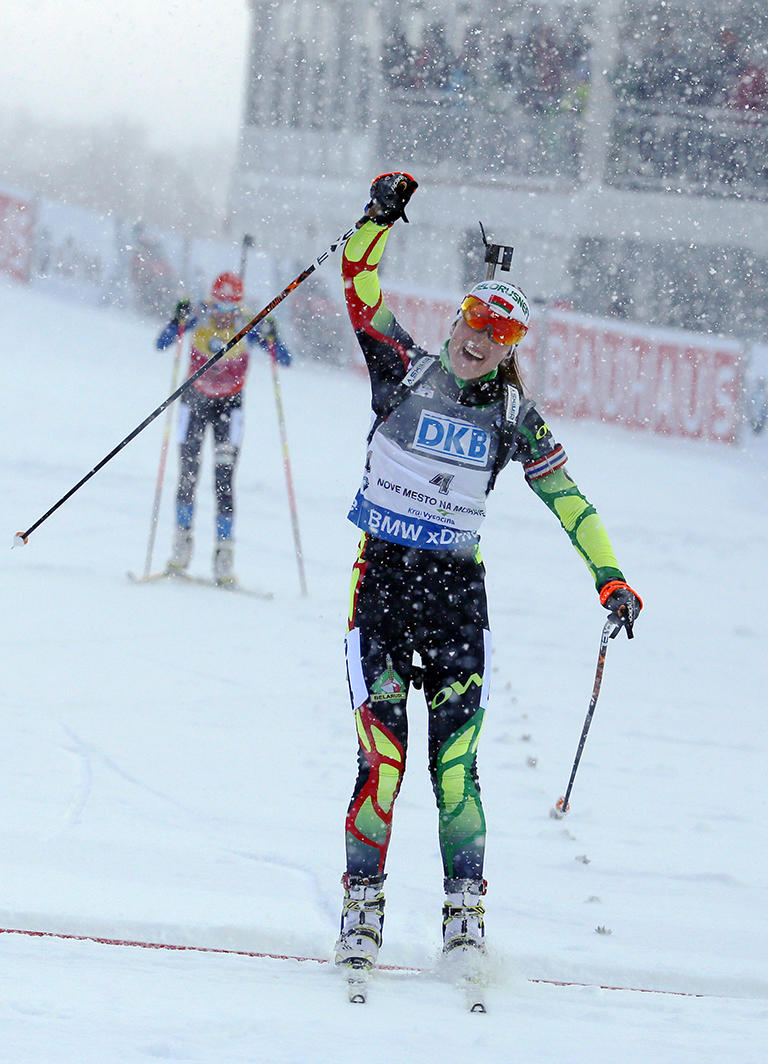
Darya Domracheva (Belarus) celebrates her 6.8-second pursuit win over Finland’s Kaisa Makarainen on Sunday at the IBU World Cup in Nove Mesto, Czech Republic. (Photo: IBU/ Květoslav Frgal)
No amount of snow, wind or penalties was going to hold Darya Domracheva back on Sunday, at least that’s the way the Belarusian attacked the women’s 10-kilometer pursuit at the IBU World Cup in Nove Mesto, Czech Republic.
Second in the overall World Cup to Finland’s Kaisa Mäkäräinen, Domracheva started fourth in the pursuit, 23 seconds after Germany’s Laura Dahlmeier, who won Saturday’s sprint to start first. Another German, Franziska Hildebrand went out second, one second back, and Veronika Vitkova of the Czech Republic started third, 14 seconds behind.
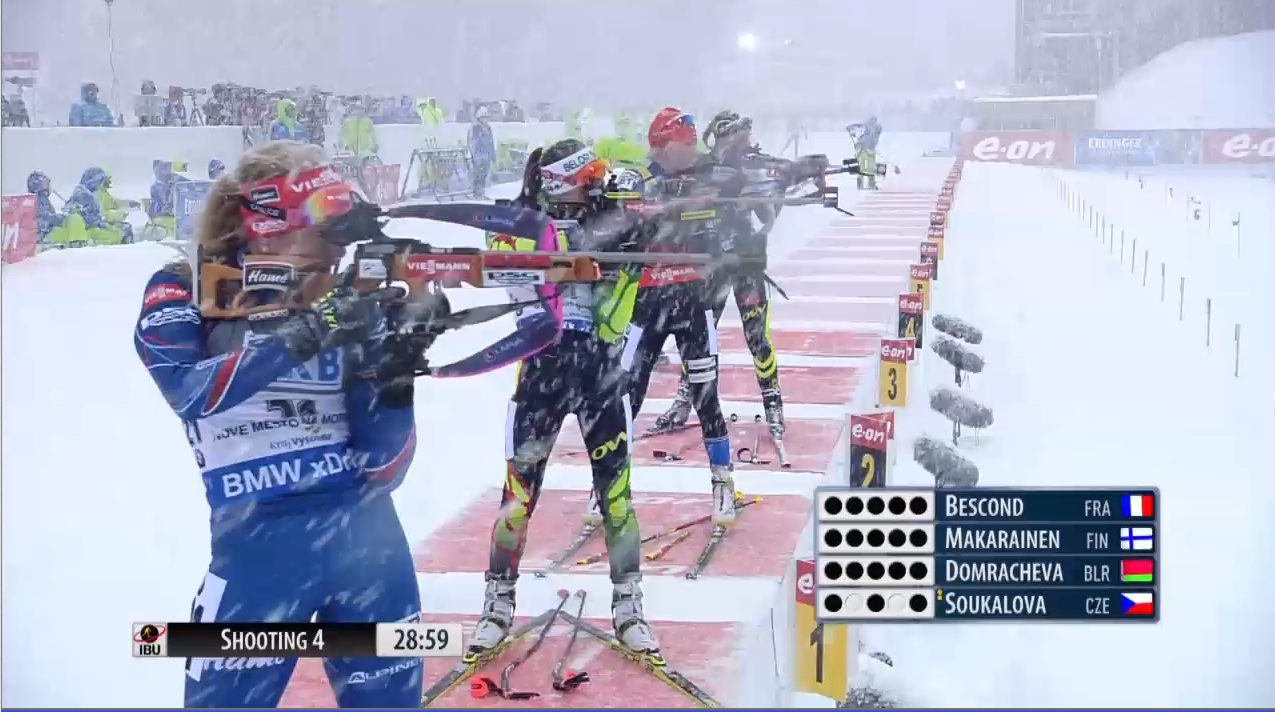
The beginning of the race was relatively mild weather-wise, with sun at the start, but by the third of four shooting stages, competitors found themselves at the epicenter of a blizzard.
“It was a crazy day out there!” US Biathlon’s Hannah Dreissigacker wrote in an email. “We slid off the icy road in our van on the way to the start, luckily only half a k away so we walked from there. Then it was a total blizzard during zero. Then it got sunny for the start of the race, but then back to blizzard. … I’ve never really seen anything quite like it.”
With snow increasingly blowing into athletes’ eyes as well as their rifles, the pursuit became more about who could keep it together rather than who could execute the perfect race. None of the 51 female finishers hit every target.
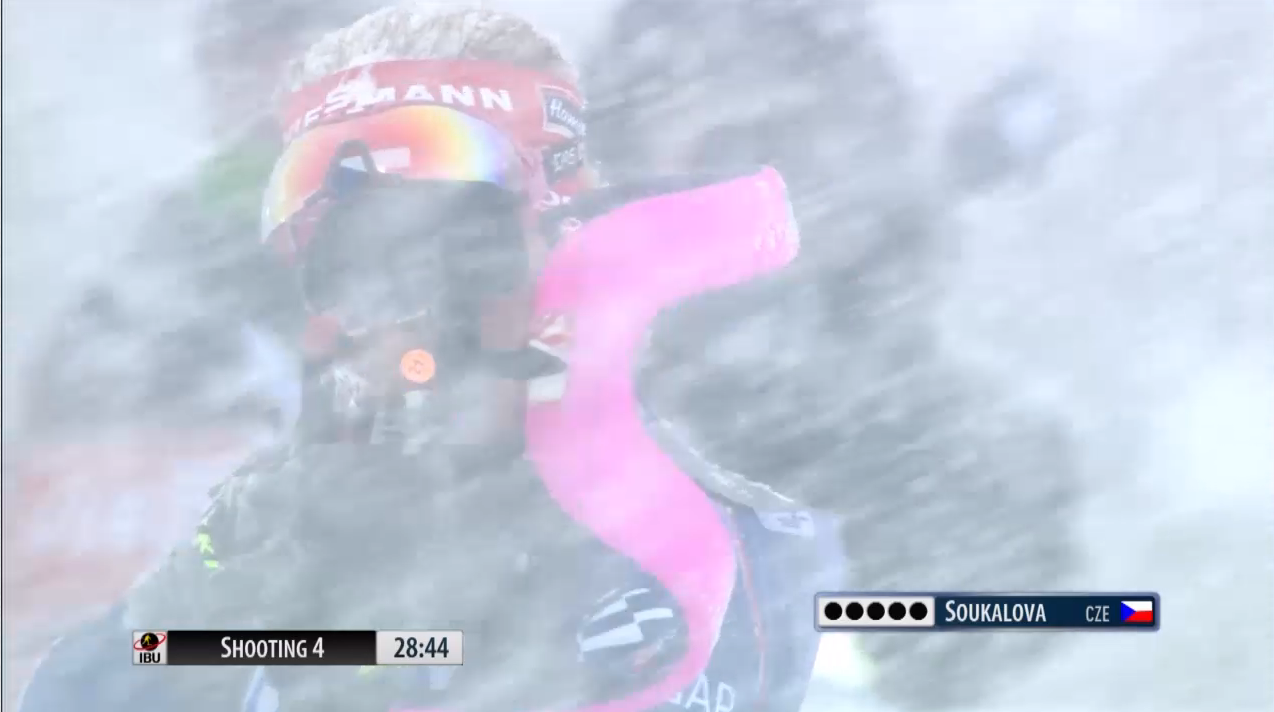
Gabriela Soukalova (Czech Republic) cleaned three-straight stages before missing two on the last standing to slip from first to third, then fifth at the finish of Sunday’s 10 k pursuit in Nove Mesto, Czech Republic.
That meant Domracheva couldn’t rely on shooting, and she didn’t need to. Even with two early prone misses that set her back to 12th, she rebounded to sixth with a clean second stage.
Entering the range for the first standing in the top four, she missed one, but moved into third. Domracheva left the stadium 19.3 seconds behind the Czech Republic’s Gabriela Soukalova, who cleaned her third-straight stage to take the lead from Hildebrand, who led from the first shooting.
France’s Anais Bescond also cleaned the first three stages to leave the range in second, 3.6 seconds after Soukalova. While the Czech extended her lead on Bescond over the next lap, Domracheva began to close on them both, coming into the final stage in second, less than 14 seconds behind.
Gabriela Soukalova (l) of the Czech Republic and Darya Domracheva (second from l) of Belarus go head-to-head in the final shooting stage of the women’s 10 k pursuit at the IBU World Cup in Nove Mesto, Czech Republic.
There, Soukalova missed two, and that cost her.
With the snow still falling so heavily it caused Hildebrand to crossfire and hit Vitkova’s targets (which led to a six-minute penalty for Hildebrand and Vitkova earning 52 seconds back at the finish), Domracheva missed one for her fourth penalty of the day.
She rounded the penalty loop quickly and headed out on the last lap first, 15.7 seconds ahead of Mäkäräinen, who also missed one for her fourth-total penalty.
Soukalova chased them both in third, 18.6 seconds back, along with Dahlmeier, who cleaned the last stage to leave the range two seconds later.
Over the next kilometer, Mäkäräinen closed the deficit to 14.2 seconds, and then 9.1 seconds with half a kilometer remaining. Domracheva continued to power ahead up front, skiing directly into a headwind along the course’s long climb, and ended up finishing first, 6.8 seconds ahead of Mäkäräinen, in 35:22.3.
“On the last loops it was so soft that on the last uphills and the poles fell down through the snow and you got no push or no glide with your skis,” Domracheva told the IBU. “It was a little bit hard race … [but] you have to fight to the end; you still have a chance.”
Mäkäräinen posted the fastest-course time overall, 17 seconds faster than Domracheva in second.
“If I would have cleaned that [last] stage, I would have been first, but I missed,” Mäkäräinen told the IBU.
Dahlmeier overtook Soukalova by the 9 k mark for third, 14.9 seconds after Domracheva, finishing with three penalties. Her German teammate Vanessa Hinz missed just two on the third stage to place fourth (+24.0), and Soukalova finished fifth (+33.2).
“The early loops are not so important,” said Dahlmeier, who stayed in the top three through the first two stages. “It is most important to have a good race in the last loop.”
Dunklee 18th for U.S.
American Susan Dunklee (r) during the first of five laps in the women’s 10 k pursuit on Sunday at the IBU World Cup in Nove Mesto, Czech Republic. She started ninth and finished 18th.
American Susan Dunklee skied the third-fastest course time on the last lap to place 18th. Back in 27th after two early prone misses, she improved to 19th by the last stage, then finished 1:54.9 behind Domracheva.
Dunklee started ninth, 46 seconds after Dahlmeier, but slipped to a minute and 35 seconds back after the first prone stage. She went on to clean her second prone to improve to 20th, then missed one in the first standing and two more on the last stage.
“It was a tough day and I had to keep reminding myself that everybody else out there was having a far from perfect day too,” Dunklee, who ranks 15th in the overall World Cup, wrote in an email. “The new snow made for slow tracks and it was difficult to pass because only one lane had been skied in.”
She discovered her first prone misses both hit the same edge of the target and was able to adapt to clean her second prone.
“I couldn’t make up as many places on the ski course as usual because I got stuck behind long trains of people,” Dunklee explained. “For the second time this week, I caught a great ride with [Switzerland’s] Elisa Gasparin for the last loops and she was very aggressive about moving around packs.”
Annelies Cook started 28th and finished 38th (+4:58.1) with eighth penalties (2+3+2+1), and Dreissigacker started 39th and finished 41st (+5:04.6) with eight misses as well (1+2+3+2).
While Dreissigacker’s shooting was off, she skied the 19th-fastest course time overall.
“I had great skis and felt good skiing,” Dreissigacker wrote in an email. “I’m psyched with my 19th ski time!! That is a new best for me. The shooting was another story though…it was a combination of bad luck and just bad shooting.”
In the first stage, she realized her rifle sight was completely clogged with ice and snow and spent about 30 seconds trying to blow it out.
“In the next stage I had a lot of wind and I took a lot of clicks and still missed two and so then I ‘shaded’ as well — when you just aim a little off of center to adjust for the wind,” she explained. “In standing I again got a lot of wind, and I didn’t deal with it well and took too long to shoot. And then my last stage was just bad shooting on my part. So not a good shooting day at all, but I just have to remember the positive takeaway — skiing was great!”
After finally getting her targets reset so that she could shoot, Vitkova ended up 11th with four misses (1+1+2+1). Hildebrand fell to 50th with a six-minute penalty after she failed to ski all of her penalty loops.
“She missed two targets in the cross firing so she skied two loops but since it was cross firing she gets 5 penalties and should have skied five laps,” Nove Mesto technical delegate and US Biathlon CEO Max Cobb explained in an email. “The penalty for missing a penalty loop is 2 min for each loop not skied thus 6 min.”