Tag: women’s 4×6 k relay

  • Germany Takes Win in Wind-Dominated Antholz Team Relay, Canada 10th, US 12th

    Germany Takes Win in Wind-Dominated Antholz Team Relay, Canada 10th, US 12th

    Germany celebrates their victory in Sunday's 4x6-kilometer relay. (Photo: IBU/Christian Manzoni)
    Germany celebrates their victory in Sunday’s 4×6-kilometer relay. (Photo: IBU/Christian Manzoni)

    It would have been oddly quiet on the firing range, given that there were ten women lined up and ready to fire, if it had not been for the howling of the wind.

    The dominant theme of the final day of World Cup competition in Antholz, Italy, Sunday was wind. Wind, and lots of it. Three weeks of back-to-back World Cup racing concluded this weekend, capped off with the 4 x 6 k women’s relay. While the men’s competition was plagued by a cold wind, the women’s competition was defined by it, as the wind whipped down the valley during the second leg.

    The Czech Republic, which eventually finished second, was the only team in the entire field to escape without a penalty loop; Russia, placing fourth, was the only team with less than 10 spare rounds. Far more common was a tally of two or three penalty loops and 13-16 spares.

    At the first handoff, the Czech Republic had the lead, the United States was in second after Susan Dunklee’s phenomenal first leg, and Poland was in third.

    “I had some wind in standing,” Dunklee wrote in an email, “but luckily most of the people around me struggled too.”
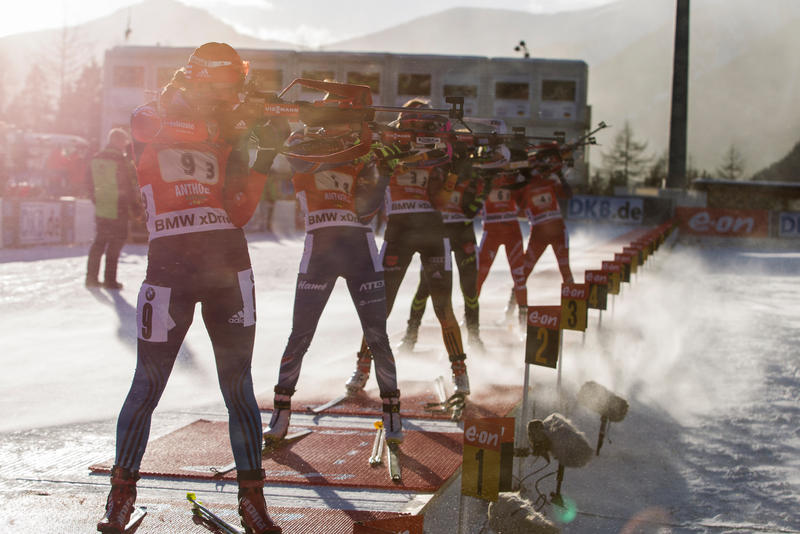
    Shooters struggle to fire in the howling wind. (Photo: IBU/Christian Manzoni)
    Shooters struggle to fire in the howling wind. (Photo: IBU/Christian Manzoni)

    On the second leg, however, the wind picked up.

    During the second shooting stage, ten teams were standing on the mats, and the leader still hadn’t finished firing as all the women waited for the wind to die down. Snow swirled and flags whipped, but no bullets were fired. Gabriela Soukalova, of the Czech Republic, was the first into and out of the range, and her range time was 2:14. In contrast, her time on the previous round – before the wind picked up – was exactly one minute, including loading and shooting a spare round.

    After Soukalova finally shot her third spare bullet and knocked over the final target the incentive to speed up firing returned. U.S. biathlete Hannah Dreissigacker, who had been in second place at the start of the standing leg, skied away with three targets left up. By the end of the leg, the U.S. had slipped to 12th.

    By the exchange, Czech still had the lead, followed closely by Russia, then Ukraine, then Germany, then Italy.

    The third leg was a grab bag of leads and exchanges, as one skier took the lead in prone only to lose it in standing. Tears streamed down the competitors’ cheeks as the wind and snow battered their eyes.

    By the end of the third leg, Ekaterina Shumilova of Russia was in first, but barely. Germany’s Luise Kummer and Ukraine’s Olga Abramova were not far behind. And the bottlenecks at the last shooting had compressed the top ten teams to within 1:15, whereas they had been spread out over 2:34 after the prone stage – the wind had actually calmed as later competitors came onto the range, whereas the leaders had taken longer to shoot. At the tag, it was Russia, Germany and then Ukraine.

    But nobody counted on Germany’s Laura Dahlmeier.
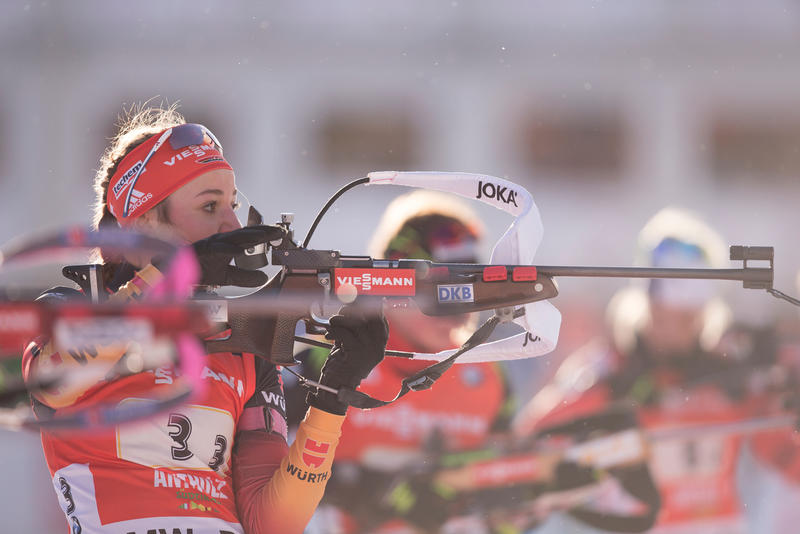
    Germany's Luise Kummer. (Photo: IBU/Christian Manzoni)
    Germany’s Luise Kummer. (Photo: IBU/Christian Manzoni)

    Dahlmeier, Germany’s anchor leg, ignored the swirling gusts of wind and coolly shot the five targets, leaving the standing leg 23 seconds ahead of Russia’s Ekaterina Glazyrina. After Dahlmeier cleaned standing, it was clear that she would ski away with the win.

    Veronika Vitkova of the Czech Republic skied out in second, with Valj Semerenko and Glazyrina leaving the range at nearly the same moment, leaving the final 2 k ski as the battleground for the final spot on the podium. It was a battle won by Vikova.

    The North Americans

    “I had a great ‘open body’ feeling today on skis and during the last lap went into chase mode with little regard for pacing,” American Susan Dunklee wrote in an email. “It felt great to reel people in.”

    Dunklee indeed had a strong final, passing four skiers and posting the fastest lap time for that leg. She tagged Hannah Dreissigacker into second place.

    “The wind was unpredictable and hurricane-like at times, and then perfectly still,” Dunlee wrote in an email. “So shooting was a lottery Hannah and [anchor leg Clare Egan] had some bad luck with the timing of the strongest gusts.”

    It was Egan’s first appearance on the World Cup – a difficult debut.

    “Clare faced some incredibly difficult conditions in her first World Cup, but handled them admirably,” Dunklee continued. “She has a lot of potential and I can’t wait to see what she does once she starts to feel comfortable at this level.”

    Annelies Cook skied the third leg, missing some shots but avoided the penalty loop. Cook tagged Egan to bring in the team in. Egan tried to take the day like any other.

    “My goals for the day were to do my job well, just like any other day of training,” she wrote in an email. “Of course when I set my poles down on the shooting mat for the prone stage and they almost got blown away by gusting winds, I had to slightly adjust the ‘just like any other day of training’ part of my strategy.”

    But her first time on the World Cup, and she had to modify her plans.

    “I started shooting prone the same way I always do, in a rhythmic cadence that alternates breathing and pulling the trigger, but after missing the first three shots I took a different approach, waiting with the trigger half-pulled for any tiny break in the wind. That worked for me and I hit my last two targets and then all three spares, so I avoided going in the penalty loop.

    “The wind was also a factor on the open parts of the course where snow had blown over the trail making it super slow, and there were strong headwinds. I was trying to channel Lindsey Vonn with a super strong tuck with my elbows in front of my knees at one point.”

    The Canadian women placed tenth overall. Led by Megan Heinicke, the team consisted of Julia Ransom, Rosanna Crawford and Audrey Vaillancourt. It was this group’s first time doing a relay together, and they are optimistic:

    “I think we can all be proud of our efforts today!” Ransom said, according to a press release from Biathlon Canada. “The wind was quite tricky with huge gusts coming from every direction.

    “This was the first time us four girls have been a relay team together. This is a great starting block and I believe good things are going to come from this team!”
    Results

  • With Clutch Prone, Preuss Clinches German Relay Victory in Hochfilzen; Canadian Women 11th

    With Clutch Prone, Preuss Clinches German Relay Victory in Hochfilzen; Canadian Women 11th

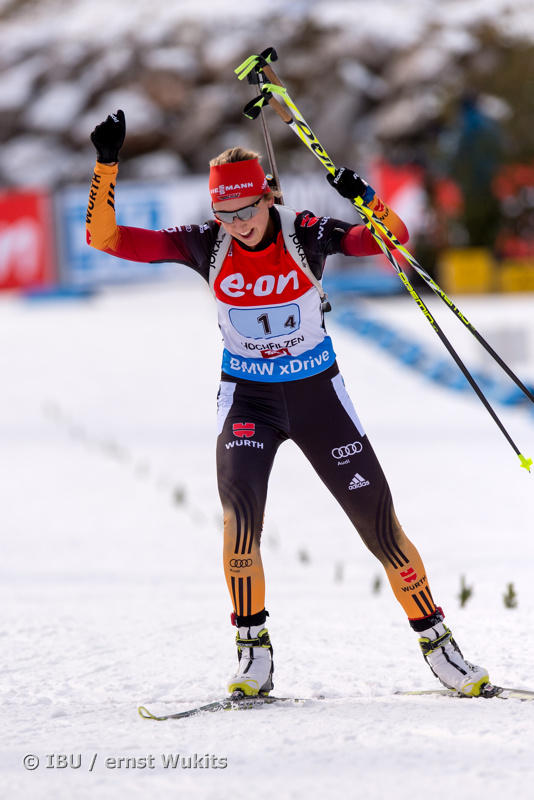
    Germany's anchor, Franziska Preuss celebrates a 21-second victory in the women's 4 x 6 k relay at the IBU World Cup on Saturday in Hochfilzen, Austria. (Photo: IBU/Ernst Wukits)
    Germany’s anchor, Franziska Preuss celebrates a 21-second victory in the women’s 4 x 6 k relay at the IBU World Cup on Saturday in Hochfilzen, Austria. (Photo: IBU/Ernst Wukits)

    For three out of the four legs in the IBU World Cup women’s 4 x 6-kilometer relay on Saturday in Hochfilzen, Austria, it could’ve been anyone’s game, especially Russia’s, Germany’s, Poland’s and the Czech Republic’s.

    All four were within 40 seconds of one another behind Russia in first at the final exchange — and while it might have seemed like Russia with a 19-second lead was untouchable — any biathlete will tell you nothing in biathlon is ever a sure-thing.

    Ekaterina Shumilova tagged off in first, upholding the position teammate Olga Podchufarova put her in during the second leg. However, by the final prone, Russia’s lead started to unravel. Ekaterina Glazyrina used all three spare rounds, then had to ski the team’s first penalty loop of the day.

    She dropped from first to fifth, 44 seconds out of the lead.

    Meanwhile, Germany’s anchor Franziska Preuss cleaned her first stage to take control — not knowing what happened to Glazyrina.

    “I had no idea that she was on the loop,” Preuss told the IBU after the race. “I did not know it until the finish line.”

    Veronika Vitkova of the Czech Republic used one spare to move to second after prone and trailed Preuss by 24.1 seconds leaving the range. Belarus was suddenly back in contention when Darya Domracheva cleaned prone to jump from sixth at the exchange to third, 37 seconds after Preuss.

    For the final standing, the pressure was on for Preuss. She had to use one spare, but so did Vitkova and Domracheva in second and third.

    The German left the range with a 29-second lead over Vitkova and remained 37.4 seconds ahead of Domracheva in third. With a huge smile, Preuss entered the stadium uncontested and waved to the Austrian crowd as she finished. Domracheva outsprinted Vitkova for second, giving Belarus the silver, 21.1 seconds behind Germany, and the Czech Republic took third another 1.1 seconds back.

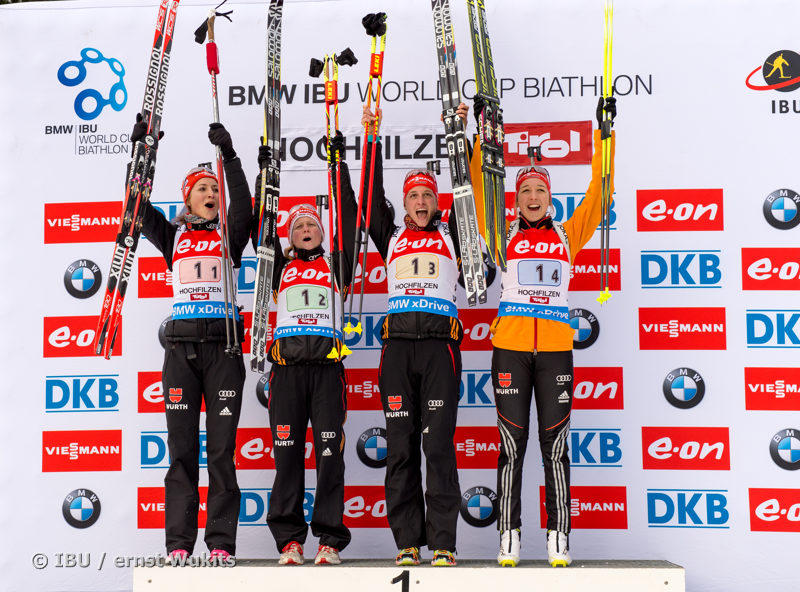
    The German women's relay atop the podium on Saturday at the Hochfilzen World Cup: (from left to right)  Luise Kummer, Franziska Hildebrand, Vanessa Hinz, and Franziska Preuss. (Photo: IBU/Ernst Wukits)
    The German women’s relay atop the podium on Saturday at the Hochfilzen World Cup: (from left to right) Luise Kummer, Franziska Hildebrand, Vanessa Hinz, and Franziska Preuss. (Photo: IBU/Ernst Wukits)

    For Germany, the relay victory marked the first podium for two of its members: first-leg Luise Kummer and third-leg Vanessa Hinz, the latter of which lifted the team from fourth to second with two spares.

    “It is very exciting being up there; it is such a great feeling!” Kummer said.

    Second-leg Franziska Hildebrand, who brought Germany from 11th to fourth by the second exchange, said the team’s goal was to be on the podium.

    “People should be happy, because we are a very young team and this shows how good we can be,” Hildebrand said.

    The Czech Republic’s second skier who brought her team to third from seventh, Gabriela Soukalova was also pleased with the top-three finish.

    “We realized at the beginning of the season that we can have a strong relay team I think this result will be a great motivation for our whole team,” she said. “For me, I have had some problems and I needed to have a great race.”

    Germany finished the day with zero penalties and eight spares, Belarus had 10 spares and the Czech Republic had nine spares.

    Italy (1+4) fell from an early lead set by first-leg Dorothea Wierer, to 13th when second-leg Nicole Gontier had a penalty loop on her second stage. Karin Oberhofer lifted the team from 11th at the final exchange to fourth overall (+39.9) with clean shooting.

    Norway placed fifth with a penalty and 12 spares, five of which came from second-leg Synnøve Solemdal. Anchor Tiril Eckhoff skied the team up from 14th to fifth (+46.3).

    Poland ended up sixth (0+8), Ukraine was seventh (1+11), Russia eighth (1+7), France ninth (1+10), and Slovenia 10th (0+7).

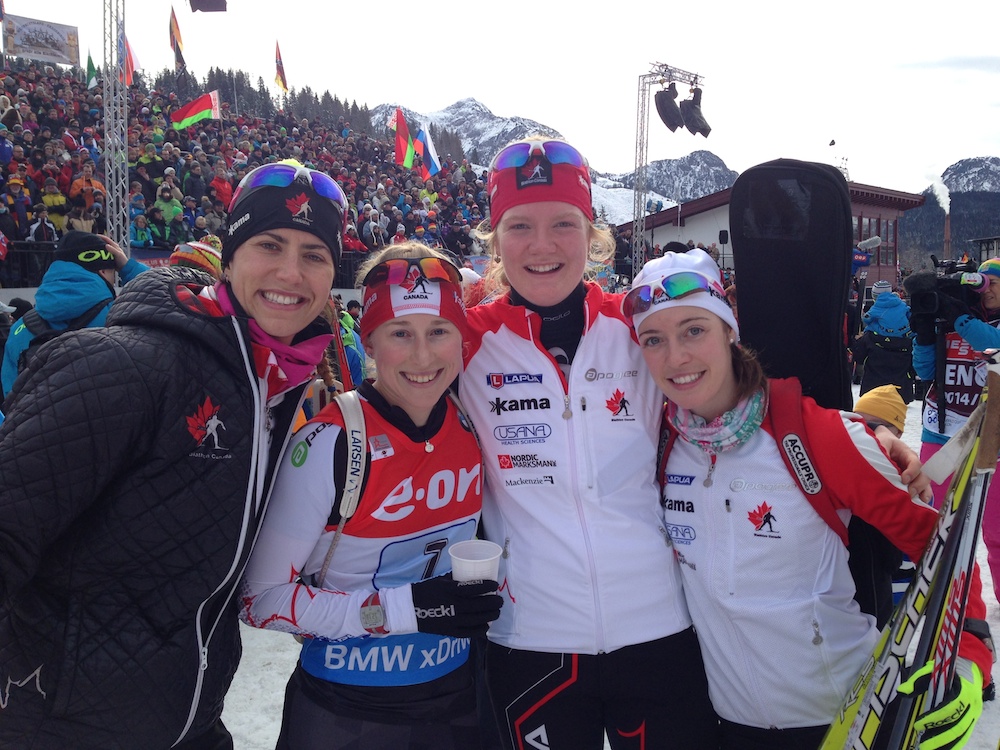
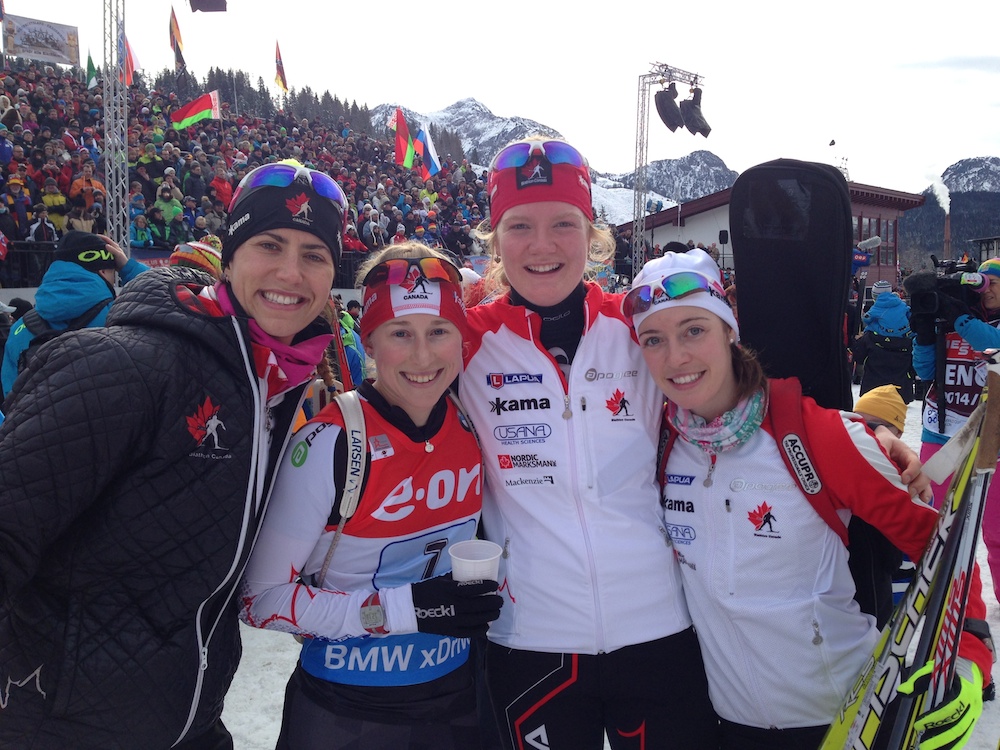
    The Canadian women's relay team after placing 11th on Saturday: (from left to right) Rosanna Crawford, Audrey Vaillancourt, Sarah Beaudry, and Megan Heinicke. (Photo: Rosanna Crawford)
    The Canadian women’s relay team after placing 11th on Saturday: (from left to right) Rosanna Crawford, Audrey Vaillancourt, Sarah Beaudry, and Megan Heinicke. (Photo: Rosanna Crawford)

    The Canadians finished 11th overall (0+7), 2:11.1 behind Germany. They were 16th at the end of Megan Heinicke’s first leg, after she cleaned prone and missed three standing.

    “I wasn’t feeling particularly snappy but I have been recovering from a cold since last Saturday so I am hoping for a bit more explosiveness next week,” Heinicke explained in an email.

    While she was “happy and motivated” by her prone stage, which put her in seventh, Heinicke added that she was surprised by her standing.

    “I didn’t feel like I had pushed very hard during the 2nd loop so I was pretty surprised when my left leg was shaky during standing,” she explained. “I have often struggled with standing in the last 2 seasons but rarely because of shaky legs! There was definitely that element of slight panic at needing to use all 3 spares and a fierce determination to hit then. I admit, I was relieved to bypass the penalty loop. My goal on the last loop was simply to giver and try to catch 1 or 2 of the girls ahead of me.”

    She moved up one spot from 17th to 16th, tagging teammate Rosanna Crawford 52 seconds back from Italy in first.

    “I knew that with some good quick shooting on the range that you can move up a lot in a relay,” Crawford explained, adding that she didn’t think about shooting right away. “You don’t want to start thinking about shooting as soon as you start a race or that’ll put too much pressure on yourself. So I focused on my skiing and switched to shooting when I was getting closer to the range. My skis were really good today, which always makes for a fun race, because you just feel like you’re flying!”

    With clean shooting on both stages, she left the range in 12th after prone and sixth after standing. She recorded the fastest shooting for her leg.

    “I just took it one shot at a time never getting ahead of myself,” Crawford wrote. “Things can go wrong quickly in a biathlon races if you start thinking about the 5th shot when you’re only on the 1st!”

    She handed off to 20-year-old Sarah Beaudry, who was in her first World Cup relay and second-ever World Cup race, in sixth. In an email, Beaudry explained that she simply wanted to hit her targets and ski fast.

    After cleaning prone, she was up to fourth.

    “Moving up to fourth wasn’t really part of any plan, it was more just a result of my good prone shooting,” Beaudry wrote. “For my prone I just came in really relaxed and my focus was to watch wind. Sometimes I am a little forgetful about wind so I think having that focus helped me stay calm.”

    Fortunately for the women’s and men’s races on Saturday, there wasn’t much wind to speak of.

    Beaudry tried to stay calm as she approached her standing stage, but after hitting her first two targets, she got “a little too excited” and ended up missing the last three, she explained.

    “Then I was just trying hard to avoid the penalty loop with my spares,” she added. She avoided it, tagging Audrey Vaillancourt in 12th, 1:09.4 back.

    “Today I was going to give everything I had no matter what place I was tagged in, and this is exactly what I did,” Vaillancourt wrote.

    With a single prone miss, Vaillancourt maintained her position in 12th. One lap later, she cleaned standing to improve to 11th.

    “I kept focused on trying to get closer to the other team, but I also knew there were some very strong women out there in the last leg,” she wrote.

    Slovenia’s Urska Poje was 15 seconds ahead of her in 10th heading into the final lap. Vaillancourt ended up finishing 18 seconds behind in 11th.

    “Overall I am very happy with my race, both on the skiing and shooting side. I have had a cold all week which affected my training and preparation a lot, but today I felt a lot better so I think I’m back on track,” Vaillancourt wrote.

    Crawford referred to her team’s 11th place, with zero penalties and seven spares, as a “decent result.”

    “We had two legs with some scary standing, but no penalty loops is great!” she wrote. “A few less spares and we could have been top 10. We were trying a different order today and it seemed like it worked out pretty well. Megan did a great job at the start of the race.”

    Later Saturday afternoon, the Canadian men tied a team-best sixth in the 4 x 7.5 k relay.

    “So excited for men’s team,” Crawford wrote. “They’ve had a bit of a bumpy start and not performing like they were hoping for. A top 6 is a great way to build some confidence into the rest of the season.”

    With three women on the World Cup circuit, the U.S. did not field a women’s relay.