From the FasterSkier archive — posts syndicated from athletes’ and coaches’ own blogs between 2004 and 2012, kept online as published. Current coverage is at fasterskier.com.

Tag: women’s Nordic skiing

  • Svahn Returns to the Top as Olympic Stakes Sharpen in Goms Women’s Classic Sprint

    Svahn Returns to the Top as Olympic Stakes Sharpen in Goms Women’s Classic Sprint


    This coverage is made possible through the generous support of Marty and Kathy Hall and A Hall Mark of Excellence A Hall Mark of Excellence Award. To learn more about A Hall Mark of Excellence Award, or to learn how you can support FasterSkier’s coverage, please contact info@fasterskier.com.

    Maja Dahlqvist (SWE) and Laura Gimmler (GER), (l-r) with Jessie Diggins (USA) just behind during the Classic Sprint heats in Goms, Switzerland. (Photo: Authamayou/NordicFocus)

    By the time the women clicked into their classic skis in the upper Rhône Valley on Saturday morning, the sprint course in Goms had already made its argument. This would not be a day for pure glide, or pure kick. It would be a day for the awkward in-between—the calculus of wax, confidence, and courage. The kind of skiing that rewards athletes who keep their heads when the track changes mid-lap, when the fastest line is also the most exposed. Here, “relaxed” and “hard” have to mean the same thing.

    The official report called the surface “hard packed.” Air was just above freezing (0.4°C). Snow was far colder (-8.0°C). This split-temperature setup can turn one polished corner into a skating rink, and one kick zone into a question you must answer at speed.

    With Milano Cortina looming—the last World Cup weekend before Olympic racing in Val di Fiemme—every answer carried extra weight. Sweden, in particular, arrived with a familiar burden: racing to win and also to clarify which few women might fill the nation’s four Olympic start spots in the classic sprint. The day’s story was not just about who won. It was about the ones who looked ready to be chosen.

    At the center of it all was Linn Svahn—back on top of a World Cup sprint after what she described, in a post-race on-air interview with FIS, as a challenging year.

    “So nice to be back and compete again,” Svahn said. “It’s been like a roller coaster year… It’s one of my favorite courses of the whole World Cup. But it was tough.”

    She looked more than “back.” She looked inevitable.

    Lauren Jortberg (USA) during qualification. (Photo: Authamayou/NordicFocus)

    Qualification: fast snow, sharp edges, and a fraction too much ice

    Svahn set the tone immediately, winning the qualification in 3:46.07, with Switzerland’s Nadine Fähndrich second (+1.84) and Finland’s Jasmi Joensuu third (+4.35).

    For the Americans, the qualification round was both encouraging and cruel, as sprint prologues often are: three into the top 30, one out by a place.

    • Jessie Diggins qualified 6th in 3:54.81 (+8.74).
    • Julia Kern qualified 15th in 3:58.58 (+12.51).
    • Samantha Smith qualified 26th in 4:00.71 (+14.64).
    • Lauren Jortberg—was so close—finishing 31st, 4:01.74 (+15.67), one spot out of the heats.

    Jortberg’s own description of the qualification captured the emotional violence of that single place. Her plan, she said, was to ski “as relaxed and smoothly as I can,” then push the fast pieces—downhills and turns—hard. She believed she executed that plan almost everywhere.

    Except, crucially, at the top of the major climb.

    “It was way icier… than when we were warming up on it, and I wasn’t anticipating that at all,” Jortberg said. “I lost a ton of time. I nearly fell because I slipped so much—so that’s really brutal, especially being 31st.”

    Her immediate feeling, she admitted, was a strange split: “both devastation and almost like tears of joy,” because of how much she had struggled in classic sprinting in the past—and because, on this day, she could finally feel the gap closing. “There’s more to come,” she said. “I’m really excited to keep working on my classic skiing and showing that I’m a threat in both classic and skate.”

    On paper, it reads like a line item: 31st, not qualified. In the body, it feels like something very positive is brewing from many years of hard work.

    Julia Kern (USA) and Samantha Smith (USA), (l-r) during the Classic Sprint quarterfinals in Goms, Switzerland. (Photo: Authamayou/NordicFocus)

    The heats: Sweden’s depth, Switzerland’s home-course fire, and the shape of the final

    The women’s sprint in Goms unfolded in the standard format: five quarterfinal heats of six, two automatic qualifiers from each, plus two “lucky losers” on time; then two semifinals with the same rule; then a final of six.

    What made Saturday distinct was how quickly the day shifted from “times” to “tactics.” Goms is not a flat drag race. It’s a course that asks athletes to make decisions—when to risk the inside line, when to conserve, when to surge. Kern noted afterward that those decisions are hard to replicate outside racing.

    “For me, nothing beats the effort of racing head-to-head to practice digging really deep,” Kern said. “Those surges and tactics are hard to emulate in training.”

    That mattered because Kern arrived at this World Cup period still chasing a particular feeling—what she has described as race sharpness—after time back home training.

    On Saturday, she said, she finally felt it.

    “Today I felt sharper than I have in any sprint so far this season,” Kern said. Even in a moment when she was sixth over the top of the first climb, she believed she could re-enter the race: “I knew I could charge the second climb and that I wasn’t out of it.”

    Kern also described the way she is trying to reprogram the smallest pieces of sprint execution—especially the opening of the qualifier, where she has struggled.

    “One of my goals was to start faster in the qualifier… and I did today,” she said. In the heats, the goals shifted: “continue to believe and never count myself out,” keep technique cues in mind, “send the downhill,” and practice cornering. And the most important sign, to her, was the feeling on the second climb: “I felt my second hill surge… and that’s encouraging for the last bit of training before the games.”

    Kern ultimately exited in the quarterfinals, finishing 15th overall on the day. But the quote that lingered was not about the placing—it was about learning to believe, again and again, in the middle of the heat, when the race tries to convince you you’re done.

    Smith also advanced out of qualification and into the quarters—another solid marker in a season where her trajectory has been trending upward. She finished 23rd overall.

    Her takeaway was precise and practical, the kind of detail you can only identify when you’re close enough to feel time leak out of the run.

    “Looking ahead, the next few weeks, I’m really going to prioritize transition moments because I felt like I lost a lot of time there on the course,” Smith said. “But I know it’s something I can practice and sharpen with some intentionality.”

    She also pointed to tactics: “I think there’s a lot I can improve tactically, and definitely walking away from today’s race with some stuff to focus on for the next few weeks.”

    Her plan between now and the Games is a familiar championship build: “I’m going to use the next two weeks as an opportunity to build volume before sharpening with some faster and higher-intensity workouts,” she said, adding that she’ll keep her preparation similar to what has worked for her before major championships.

    Maja Dahlqvist (SWE), Jessie Diggins (USA), Nicole Monsorno (ITA), and Magdalena Scherz (AUT), (l-r) stride up one of the two long climbs on the sprint course in Goms, Switzerland. (Photo: Authamayou/NordicFocus)

    For Diggins, the day held a different kind of meaning. She arrived in Goms wearing the World Cup leader’s yellow bib, but approached the classic sprint less as a referendum on form and more as a laboratory — a chance to learn, adapt, and sharpen instincts under pressure.

    In the quarterfinals, Diggins said her skis felt “a little bit slick,” prompting an adjustment before the semifinals as conditions continued to glaze over. “We added more for the semi, which I was super, super happy about,” she said, noting how quickly the track changed as the day wore on. “I was really impressed with the team’s ability to shift mid-round when it turns out, like, oh, it’s getting a little more glazy.”

    Rather than fight the conditions, Diggins leaned into them. She said she made a conscious decision to seek out firmer, faster snow and to corner aggressively, skiing where the surface had stayed icy instead of getting churned into powder. “Downhills are my strength, so I was like, I’m going to play my strengths here,” she said. “I was really psyched about that — and also really impressed with my ski speed. I’m really, really grateful to our team.”

    Diggins qualified sixth, advanced through the rounds, and finished 7th overall, exiting in the semifinals. In a day defined by razor edges, she looked close. The difference between “final” and “semis” felt less like fitness, and more like the thousand small interactions between ski feel, kick security, and how aggressively you can take space in traffic.

    Diggins framed the race as part of a broader Olympic preparation, even with the acknowledgement that racing under training load makes the experience different than what awaits in Val di Fiemme. “I was really just seeing this as great practice for the Olympics,” she said. “You can still learn so much — learn where your strengths are, what you think you need, how you might want to pace.”

    She described the day as “a learning mission,” an expedition of sorts to gather information she can use over the final weeks before the Games. While the classic sprint is not her primary Olympic focus, Diggins said that doesn’t change how she approaches it. “If I’m going to do it, I want to really go for it and give it the best that I can.”

    Technically, Diggins said the Goms sprint offered a valuable reminder of what she is still actively refining in classic skiing. On a long sprint course with slow, natural snow early in the day, her focus was on what she called “relaxed power.”

    “I was thinking a lot about not skiing frantically,” Diggins said, describing cues she used throughout the race — staying tall on the steep sections instead of folding forward at the waist, leading with her hands when fatigue set in, and prioritizing efficiency over force. “Lots of little cues,” she said, all aimed at skiing as economically as possible when the course demanded patience as much as aggression. I

    Maja Dahlqvist (SWE), Johanna Matintalo (FIN), Laura Gimmler (GER), Linn Svahn (SWE), and Nadine Faehndrich (SUI), (l-r) come down the home stretch. (Photo: Authamayou/NordicFocus)

    The final: Svahn returns, and the podium reshapes itself

    By the time the final arrived, the field had taken on an instructive shape: three Swedes (Svahn, Dahlqvist, Emma Ribom), a Swiss home favorite (Fähndrich), a German (Laura Gimmler), and a Finn (Johanna Matintalo).

    If Sweden came to Goms needing clarity, this was the clearest possible argument: depth, multiplied.

    Svahn won the final in 3:46.07. Behind her, Gimmler took second at +10.54, with Fähndrich third at +12.38 (listed as +1.84 behind Gimmler in the results display). Dahlqvist finished fourth, Matintalo fifth, and Ribom sixth.

    For Svahn, the victory read like both a return and a resolution. In that FIS on-air interview, she framed the months since then as having reshaped her perspective.

    “I think [the nerves are] quite all right,” she said of the Olympic approach. “It feels like the last year has given me a lot of challenges. So [it] feels like I’m just happy to be back racing.”

    The subtext—the thing everyone in sprint skiing understands without saying—is that “happy” is not the same as “soft.” Sometimes it’s the opposite. Sometimes it’s what happens when fear gets replaced by appetite.

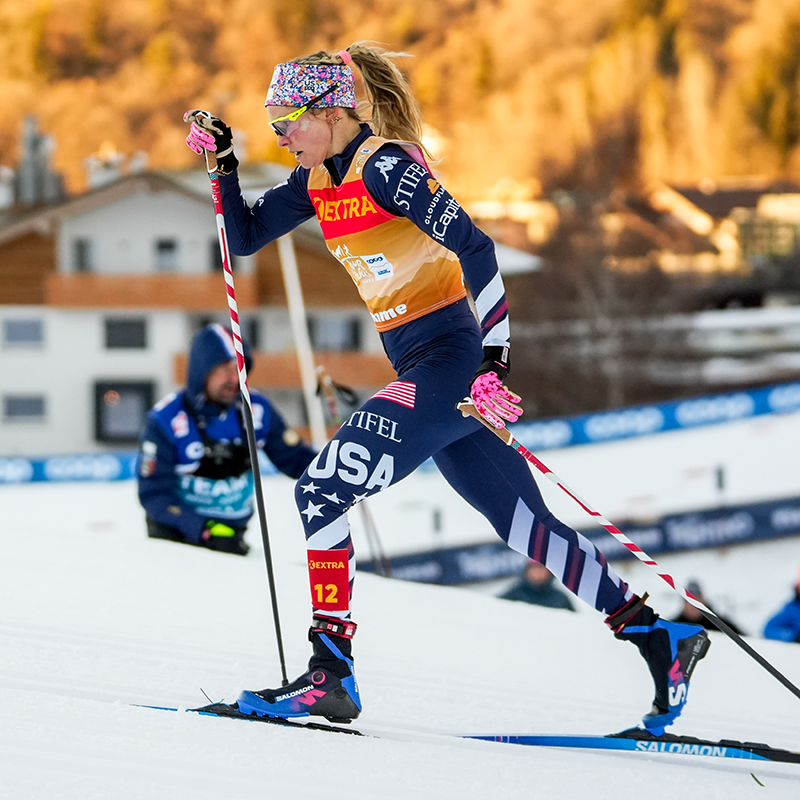
    Jessie Diggins (USA) battled her way to 7th place in Goms, Switzerland. (Photo: Authamayou/NordicFocus)

    What the Americans take from Goms

    For the U.S., Saturday offered a compact set of truths:

    1. Diggins is still Diggins—top-six in qualification, semifinal caliber in classic sprinting, and moving through the day with the poise of someone who is not guessing anymore.
    2. Kern’s sharpness is arriving at the right time, and she can feel it—not as a vague confidence, but as the ability to surge when the race says you can’t.
    3. Smith is identifying controllable time, the kind that can realistically be found in the last weeks before a championship: transitions, tactical decisions, and intentional sharpening.
    4. Jortberg is at the door, close enough that a single icy misread becomes the whole story—and also close enough that “devastation” can coexist with proof of progress.

    That last point may be the most emotionally resonant, because sprinting is brutally literal: it doesn’t care how well you’ve been training, or how much you’ve improved, or what you deserve. It cares what happened on the one lap, on the one climb, when the track turned slicker than it was ten minutes earlier.

    Still, if you listened carefully to Jortberg, you could hear the deeper shift: the sense that classic sprinting is no longer a weakness she is managing, but a skill she is building. “There’s more to come,” she said—and she didn’t sound like she was trying to convince herself.

    It was a close battle to the line of the finals between Maja Dahlqvist (SWE), Laura Gimmler (GER), Linn Svahn (SWE), and Nadine Faehndrich (SUI) (l-r). (Photo: Authamayou/NordicFocus)

    A last World Cup weekend, and the feeling of the calendar tightening

    The phrase “before the Olympics” can make everything sound ceremonial. In reality, it makes everything feel compressed. It turns a ski change into an existential decision. It turns a quarterfinal exit into either a warning or a reassurance, depending on your mood, your coaches, and your confidence in the training you still need to do.

    In Goms, the course didn’t let anyone hide from that compression. It asked for kick and glide, yes—but also for willingness: willingness to trust your skis when the track changes, willingness to believe you’re not out of it when you crest a climb in sixth, willingness to keep choosing speed through corners, through transitions, through the parts of the course where time disappears quietly.

    Svahn won because she looked like someone who had already made peace with the hard months—and decided to race anyway. Diggins moved through the day like someone who understands exactly what she needs and what she doesn’t. Kern sounded like an athlete who could finally feel the race returning to her body. Smith sounded like an athlete who knows where the seconds are. Jortberg sounded like an athlete who knows how thin the line is between “in” and “out”—and how much it matters that she’s standing on it at all.

    Diggins also spoke with pride about the broader U.S. team atmosphere in Goms, describing the rounds as collaborative as much as competitive. She said she and Julia Kern spent time discussing tactics and strategies between heats, and she pointed to Samantha Smith’s growing confidence as a highlight of the weekend.

    “Seeing Sammy gain confidence and get into the rounds with a really great strike rate has been so cool for me to see,” Diggins said. “I’m just incredibly proud.” She added that the momentum extended across the team, noting breakthroughs on the men’s side as well — moments she described as “really beautiful to see.”

    The Olympics, when they arrive, will not care about any of this context. They will simply happen. But if Goms offered any preview, it was this: the women who will matter most in Val di Fiemme are the ones who can treat uncertainty not as a threat, but as part of the job.

    And on a hard-packed, split-temperature day in Switzerland—on a course Svahn calls her favorite, on a climb that turned to ice without warning—you could see who is learning to do exactly that.


    Goms World Cup Women’s Classic Sprint QUALIFYING

    Goms World Cup Women’s Freestyle Team Sprint RESULTS


    Help Support Our Olympic Coverage!

    FasterSkier will have our own Nat Herz on the ground at the Olympics, which is a very big financial lift. If you value the thoughtful work FasterSkier provides at championships like this one, please consider becoming a Voluntary Subscriber.

    Join the FasterSkier community!


    Laura Gimmler (GER), Linn Svahn (SWE), and Nadine Faehndrich (SUI), (l-r) share the Classic Sprint podium in Goms, Switzerland. (Photo: Authamayou/NordicFocus)
  • A Quiet Argument, Made Loud: The Women’s Classic Sprint at U.S. Nationals

    A Quiet Argument, Made Loud: The Women’s Classic Sprint at U.S. Nationals

    This article was made possible through the generous support of our voluntary subscribers. If you value coverage like this, please support FasterSkier with a voluntary subscription.

    Sofia Pedersen (UU) and Samantha Smith (SVSEF) lead the first quarterfinal out onto the course at the start of the heats. (Photo: Nancie Battaglia)

    On the morning of the women’s classic sprint at the U.S. National Cross-Country Ski Championships, the quiet around Mt. Van Hoevenberg felt deliberate.

    Not calm — no one was calm by Friday — but restrained. The week had already taken its toll. Distance races had piled fatigue into legs and minds alike, and no one arrived at the sprint believing freshness would be part of the equation. What remained, instead, was clarity: the understanding that in an Olympic winter, the most important racing of the day would happen before the heats ever began.

    “It definitely started the day tired,” Ava Thurston said. “But I was trying to just remind myself that everyone was feeling that way. Most people had raced two, if not three, of the races, and we’re all coming in in a similar place.”

    That recognition — that fatigue was universal — became the baseline. The differentiator would be execution.

    For the women with Olympic aspirations, the classic sprint qualifier was no formality or warm-up. It was the argument itself. The U.S. selection process, quietly but decisively, has elevated qualification speed to the top of the sprint hierarchy. Heats matter, but only if you earn the right to be in them. On Friday in Lake Placid, no one confused the order of importance.

    Sofia Pedersen (UU) and Samantha Smith (SVSEF) get the action started in the quarterfinals. (Photo: Nancie Battaglia)

    Carrying the Week

    By the time the women clipped in for qualification, the week was already present in their legs.

    After Thursday’s 20-kilometer race, Sammantha Smith felt that accumulation acutely — and honestly. “After the 20 k, I was definitely feeling the fatigue and accumulation of all the racing throughout the week,” she said. “I know I’m more of a sprinter, but obviously, I was still hoping to perform well in the 20k, so I was not thrilled with the race.”

    Rather than letting that disappointment linger, Smith pivoted quickly. “I tried to quickly put it behind me and get ready for some classic sprinting,” she said. “My goal for the day was to focus on skiing a clean qualifier and ski to my strengths.”

    Hailey Swirbul arrived at the start line with similar fatigue — and a similar refusal to let it define the day. “Today, I definitely felt a little tired this morning warming up compared to the other races after a hard 20 k effort,” she said. “But so was everybody else dealing with that same.”

    For Swirbul, there was anticipation as well. “I was really excited to get to finish this week off with a classic race,” she said. “I just love classic skiing. I think it’s such an art, and I really appreciate the finesse that is needed to be able to make skis kick well.”

    Thurston framed the day with a different emphasis — joy rather than pressure. “It had been a great week so far,” she said, “so I was excited to get to go fast and run up that big hill.”

    Different approaches, same reality: the sprint would reveal who could still make good decisions under fatigue.

    Samantha Smith (SVSEF) commanded the Classic Sprint day from start to finish just like she had done in the Freestyle Sprint. (Photo: Nancie Battaglia)

    Qualification: Where the Day Was Decided

    When the women dropped into the qualifier, the course made its judgment quickly and without theatrics.

    Smith’s run stood apart immediately. She won the qualification by more than six seconds — not by forcing the issue, but by skiing exactly the race she had planned. “It was my first classic sprint of the year, so I didn’t really have too many expectations,” she said. “But I was hoping for a strong result.”

    What made the result significant wasn’t just the margin — it was the trajectory behind it. “Up until last season, I think there was a noticeable gap between my skate and classic sprinting,” Smith explained. “But the last few years I’ve really prioritized working on getting my classic sprint to a place I’m happy with.”

    That work showed. In an Olympic winter, qualification speed isn’t just about advancing — it’s about relevance. Smith’s time didn’t merely put her safely through; it reframed the sprint conversation.

    Behind her, two performances raised equally important questions.

    Swirbul and Thurston — both known primarily for their distance strength — delivered qualification runs that demanded attention. In a format that strips away drafting, tactics, and protection, they showed they belonged in the sprint conversation on pure speed.

    “I didn’t set out to make a statement this week,” Swirbul said. “I just wanted to show up and try to race my best and see where that landed me.”

    For selectors, where it landed mattered.

    Quarterfinal 4 trying to find their space and line around the U-turn on the sprint course in Lake Placid. (Photo: Nancie Battaglia)

    A Day That Wouldn’t Sit Still

    As the day progressed, conditions refused to settle. Snow softened. Moisture crept in. Wind shifted. Ski choices that worked in the morning became liabilities by afternoon.

    “The waxing team today was absolute heroes,” Swirbul said. “They were out until the wee hours of the morning, waxing late last night and woke up for a super early morning today for a classic day with really gnarly conditions.”

    Adaptability became a skill equal to speed. “I raced on totally different skis from the qualifier to the heats,” Swirbul said. “And even in the heats, I had a couple of changes to my kick in between the rounds because our conditions were continuing to change.”

    Smith faced the same puzzle. “In my quarter and semi-final I was actually icing up a bit and too grabby on kick as the snow got wetter,” she said. “My coaches ended up stripping a lot of the kick to bring back some of the glide for the final.”

    The goal, she explained, was precision rather than excess. “The main thing was to try to have just enough kick to get up the hills but not so much that it was draggy for the double pole or downhills.”

    Thurston made a strategic choice early — prioritizing glide over grip. “I ended up going with the pair that had a little more glide for the downhill finish,” she said, “just because I wanted to be able to hang with people rather than having that extra kick on the hill.”

    Three athletes, three solutions, same underlying demand: bend, don’t break.

    Lauren Jortberg (CNEPH)leads semi-final 1 out of the starting stretch. (Photo: Nancie Battaglia)

    Heats: Confirmation, Not Reinvention

    By the time the heats began, the hierarchy established in qualification largely held — and that, too, carried meaning.

    Smith moved through the rounds with patience and control, never forcing a moment unnecessarily. Swirbul sharpened as the day progressed, her adjustments paying dividends. Thurston continued to ski within herself, staying connected and opportunistic.

    For Thurston, the day reinforced something larger than a single result. “What it kind of said to me was that I can be really consistent,” she said, “and I’m also a strong all-around skier.”

    That consistency — across multiple races, formats, and conditions — is currency in an Olympic year.

    The women’s final gets started on the last day of racing at the 2026 US National Cross-Country Ski Championships at Mt Van Hoevenberg. (Photo: Nancie Battaglia)

    The Final: Execution, Not Emotion

    The women’s final unfolded cleanly and decisively.

    Smith took control early, extending her advantage where momentum mattered most. The ski changes made before the final were immediately evident. She crossed the line as U.S. National Champion in the classic sprint, completing a sweep of the week’s sprint events.

    Behind her, Swirbul claimed second, a reward for adaptability and composure. Thurston rounded out the podium, another affirmation of her ability to race fast across disciplines.

    For Smith, the result was about more than placement. “I hope people see that I love to race,” she said. “I love to compete and push myself, and I always leave everything I have out on the course.”

    Everyone was deserving of a helping hand up after a full week of racing at the US National Cross-Country Ski Championships at Mt Van Hoevenberg. (Photo: Nancie Battaglia)

    What the Race Clarified

    Nationals does not select Olympic teams outright, but it argues persuasively — and the women’s classic sprint in Lake Placid made its case clearly.

    Smith’s qualification speed, combined with her technical development in the classic sprint, strengthened her position at precisely the right moment. Swirbul’s performance underscored versatility and poise under changing conditions. Thurston’s podium reinforced consistency and all-around strength.

    “I’m really happy with how this week went,” Swirbul said. “And looking forward to figuring out where the rest of the season goes.”

    Thurston echoed that momentum. “This week was so, so awesome,” she said. “I’m excited to keep racing.”

    The arguments weren’t loud. They didn’t need to be. On a tired Friday at Mt. Van Hoevenberg, they were made the way Olympic cases often are — quietly, cleanly, and against the clock.


    RESULTS:

    US Nationals Women’s Classic Sprint Qualification Results

    US Nationals Women’s Classic Sprint Overall Heat Results


    Love stories like this? Help keep them coming.

    Feature stories like this one take time, access, and care to produce. If you value thoughtful storytelling and independent ski journalism, please consider becoming a Voluntary Subscriber. Your support directly fuels the work we do to cover the people, places, and moments that make our sport special.

    Join the FasterSkier community!


    The women’s Classic Sprint podium, including Samantha Smith (SVSEF) in first, Hailey Swirbul (APU) in third, and Ava Thurston (Dartmouth) in third at the US National Cross-Country Ski Championships at Mt Van Hoevenberg. (Photo: Nancie Battaglia)
  • A Sprint Built for February, Raced in January with Tour Fatigue

    A Sprint Built for February, Raced in January with Tour Fatigue

    This coverage is made possible through the generous support of Marty and Kathy Hall and A Hall Mark of Excellence Award. To learn more about A Hall Mark of Excellence Award, or to learn how you can support FasterSkier’s coverage, please contact info@fasterskier.com.

    Nadja Kaelin (SUI), Ingrid Bergene Aabrekk (NOR), Julia Kern (USA), Jasmin Kahara (FIN), Moa Ilar (SWE), and Nicole Monsorno (ITA) (l-r) start their quarterfinals during the Classic Sprint in Val di Fiemme (ITA) during the penultimate stage of the 2025/26 Tour de Ski. (Photo: Vanzetta/NordicFocus)

    By the time the women arrived in Val di Fiemme for Stage 5 of the Tour de Ski, the race had already narrowed in a way that had nothing to do with start lists or bib numbers. Five stages into the Tour, with travel from Toblach behind them and the final climb up Alpe Cermis looming ahead, every decision began to carry weight beyond the moment.

    Saturday’s classic sprint added another layer. For the first time, the athletes raced the exact sprint course that will be used at the Olympic Games in February — not a modified version, not a nearby loop, but the course itself. It was a rare opportunity: Olympic reconnaissance inside a stage race that punishes excess effort.

    The challenge was simple and unforgiving. One lap to qualify. One lap to survive each heat. No chances to reset.

    Julia Kern (USA) – FIS world cup cross-country, tour de ski, individual sprint, Val di Fiemme (ITA). (Photo: Vanzetta/NordicFocus)

    “It definitely feels like an Olympic course.”

    The Val di Fiemme Olympic sprint course announces itself immediately. Tight turns demand positioning. Technical downhills reward precision. And the long climb — the defining feature — exposes anyone who arrives underpowered or out of position.

    “It definitely feels like an Olympic course,” said Julia Kern. “It is very hard. It has technical downhills, big climbs — it has everything.”

    Jessie Diggins agreed.

    “It’s a really legit course,” Diggins said. “I love that the uphill is long and there are opportunities for people to move and to pass.”

    Then she framed it in terms of February.

    “It’s the Olympics. It should be hard,” she said. “You should have to be the fittest and the fastest and just the best to win. And I think this is a course that demands those things.”

    Jessie Diggins (USA) – FIS world cup cross-country, tour de ski, individual sprint, Val di Fiemme (ITA). (Photo: Modica/NordicFocus)

    Qualification: one lap, no margin

    Qualification was a single-lap time trial, and it set the tone for the day. With no drafting and no tactical games, athletes had to show exactly what they had on the climb. The long uphill created immediate separation, and the results reflected fitness more than finesse.

    For athletes racing the Tour de Ski overall, qualification was also about control: skiing hard enough to stay well inside the top 30, but not harder than necessary.

    Both Diggins and Kern advanced cleanly into the heats, securing places in the top 30 and moving on to the quarterfinals.

    Julia Kern (USA) reached the line in her quarterfinal but was not fast enough to advance. (Photo: Modica/NordicFocus)

    Quarterfinals: positioning becomes everything

    The quarterfinals split the field into five heats of six, with the top two from each heat automatically advancing to the semifinals, joined by two lucky losers based on time.

    With only one lap to work with, positioning was critical. The opening corners and technical sections determined who could enter the climb with momentum — and who would have to spend energy simply fighting back into contention.

    Kern approached her quarterfinal with a clear plan.

    “Today I wanted to be near the front, given all the turns,” she said, “and then open it up on the climb.”

    The plan made sense on a course where passing opportunities exist — but only if you can generate speed when the hill demands it.

    “At this stage in the Tour — in this season — I haven’t quite found my speed yet,” Kern said afterward. “And so didn’t quite have it on the hill today.”

    She finished outside the top two in her heat and did not advance as a lucky loser, ending the day 18th overall, eliminated in the quarterfinals.

    Still, Kern found something constructive in the effort.

    “I feel like I skied the first half better than I have in the past,” she said. “So I’m glad about that — and I just got to practice the hill now.”

    On an Olympic course, even a quarterfinal can be information worth collecting.

    Jessie Diggins (USA) and Johanna Matintalo (FIN), (l-r) lead their quarterfinal. (Photo: Vanzetta/NordicFocus)

    Semifinals: racing the sprint vs. racing the Tour

    The two semifinal heats brought together 12 athletes, each with the same arithmetic: finish in the top two, or be fast enough to earn one of the two lucky-loser spots into the final.

    This is where the Tour de Ski context begins to shape behavior.

    Diggins was explicit about that calculus.

    “My tactics were super different than the guys,” she said, “based on how women generally tend to race — especially on a longer course.”

    She came into the day with a clear objective: protect her overall position, gather bonus seconds if possible, and avoid unnecessary damage with Alpe Cermis one day away.

    Jessie Diggins (USA) came into the finishing stretch in the tracks behind Johanna Hagstroem (SWE), but was soon boxed out by Iris De Martin Pinter (ITA) and Julie Bjervig Drivenes (NOR), which made it impossible for her to find space in the closing meters. (Photo: Modica/NordicFocus)

    In the semifinal, Diggins briefly looked poised to advance into the final. Coming out of the final downhill and into the approach to the home stretch, she dropped into an aggressive low tuck, taking full advantage of fast skis to glide up into contention without spending additional energy. But as the field compressed in the final meters, Diggins found herself boxed in, with no clean lane to move forward before the line. It was a moment that captured both the precision and the limits of sprint racing on a technical course — speed alone wasn’t enough if space never opened.

    “For me, it was really like, okay, I just needed to try to get through to the semis and ideally through to the final,” Diggins said.

    She advanced through her semifinal — but without selling out — and finished 7th overall, just outside the six-woman final.

    “Seventh place was kind of almost best-case scenario,” she said. “One less hard effort for maximum points.”

    In the Tour de Ski, that logic is not defensive — it’s strategic.

    A Swiss, a Swede, a Finn, and repeat with Anja Weber (SUI), Maja Dahlqvist (SWE), Jasmi Joensuu (FIN), Nadine Faehndrich (SUI), Johanna Hagstroem (SWE), Johanna Matintalo (FIN), (l-r) lining up against each other in the finals of the Classic Sprint. (Photo: Vanzetta/NordicFocus)

    The final: Joensuu takes advantage

    The six-woman final delivered what the course promised: a fast, honest race where the climb made the selection.

    Jasmi Joensuu (FIN) executed it best, winning the sprint in 3:45.75. Nadine Fähndrich (SUI) finished second, with Johanna Hagström (SWE) rounding out the podium.

    Where the Tour stands

    After Stage 5, Diggins remains in the gold bib, leading the Tour de Ski overall. Joensuu’s sprint victory moved her into second overall, tightening the standings ahead of the decisive final stage.

    Kern sits 17th overall, a position that reflects both the difficulty of the sprint and the way Tour time gaps become stubborn once established.

    With only the final climb remaining, the math is clear — but the execution is anything but.

    Jasmi Joensuu (FIN) celebrates ahead of Nadine Faehndrich (SUI) at the finish of the Classic Sprint in Val di Fiemme (ITA). (Photo: Modica/NordicFocus)

    One climb left

    The Tour de Ski ends where it always does in Val di Fiemme: on the Alpe Cermis, a climb so steep it turns technique into survival.

    For Diggins, Saturday’s ascent will be the last final climb of her career.

    “This is my 14th Tour,” she said. “I’m really excited that this is the last one. You will not catch me doing that again. I put in my time.”

    Her approach is stripped to essentials.

    “You literally have no idea how you’re going to feel until you’re a third of the way into the climb,” Diggins said. “And then you find out, and then you work with what you got.”

    She wants one thing.

    “I’m excited to be gritty,” she said. “Leave it all out there.”

    What Saturday actually revealed

    Saturday’s sprint didn’t decide the Tour de Ski. It clarified it.

    The Olympic sprint course in Val di Fiemme is technical, selective, and honest. It rewards fitness and decisiveness. It punishes hesitation. And it gives athletes exactly one attempt at a time to get it right.

    For Diggins, the day was about control — gathering points, learning the course, and arriving at Alpe Cermis with something left in the tank.

    For Kern, it was about feedback — confirmation of progress in parts of the course, and clarity about what still needs sharpening.

    And for the field as a whole, it was a reminder that Olympic snow does not negotiate.

    Tomorrow, the Tour de Ski ends on a climb that reduces everything to fitness and will.


    Women’s Classic Sprint Qualification RESULTS

    Women’s Classic Sprint Final RESULTS

    Women’s 2026 Tour de Ski OVERALL STANDINGS


    Love Stories Like This? Help Keep Them Coming.

    Feature stories like this one take time, access, and care to produce. If you value thoughtful storytelling and independent ski journalism, please consider becoming a Voluntary Subscriber. Your support directly fuels the work we do to cover the people, places, and moments that make our sport special.

    Join the FasterSkier community!


    Nadine Faehndrich (SUI), Jasmi Joensuu (FIN), Johanna Hagstroem (SWE), (l-r) share the podium of the Classic Sprint in Val di Fiemme (ITA). (Photo: Modica/NordicFocus)