This reporting costs money. Please support this coverage with a voluntary subscription (below) so FasterSkier can provide this level of access to the sport we all love year-round.
Tag: Women’s Relay
-
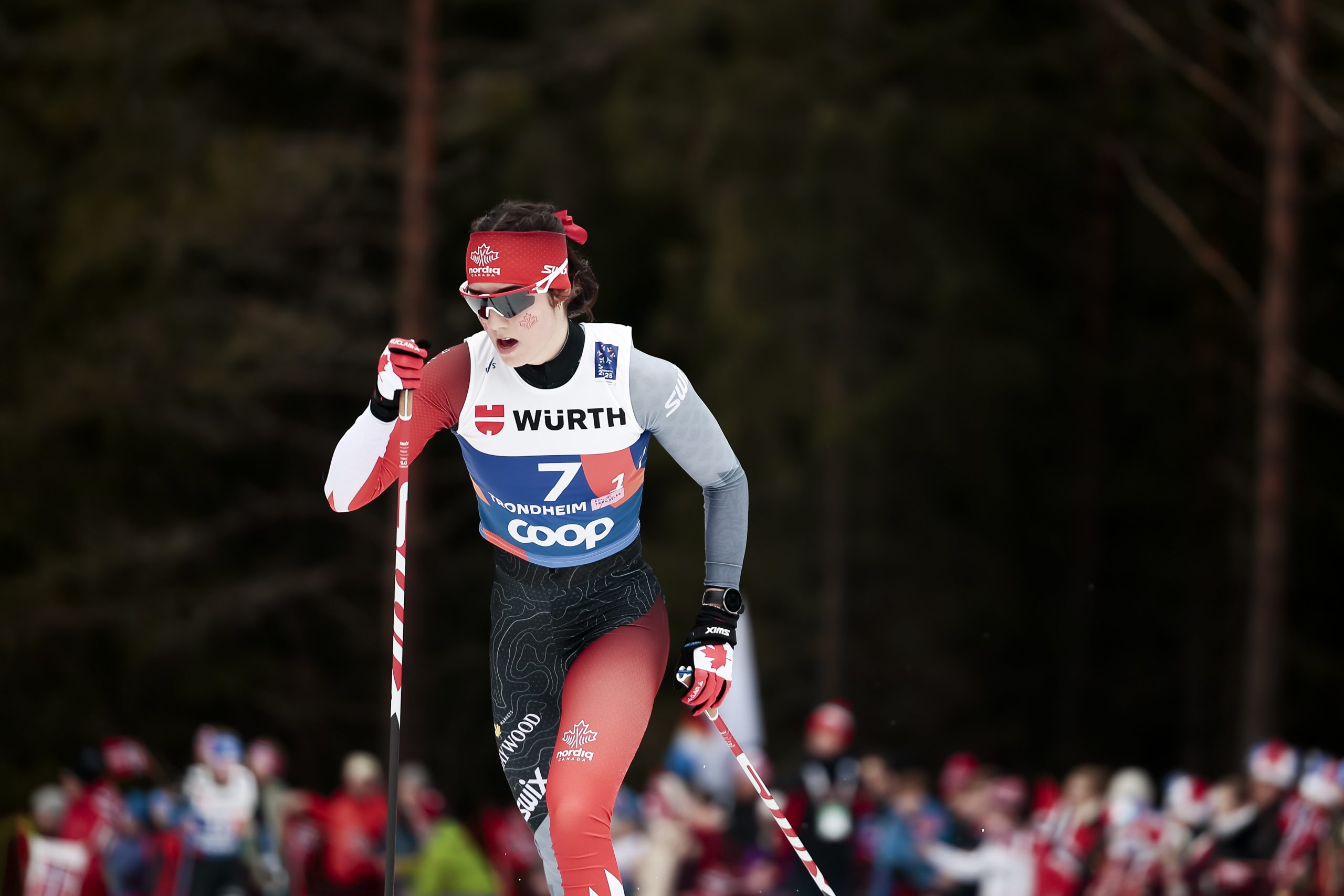
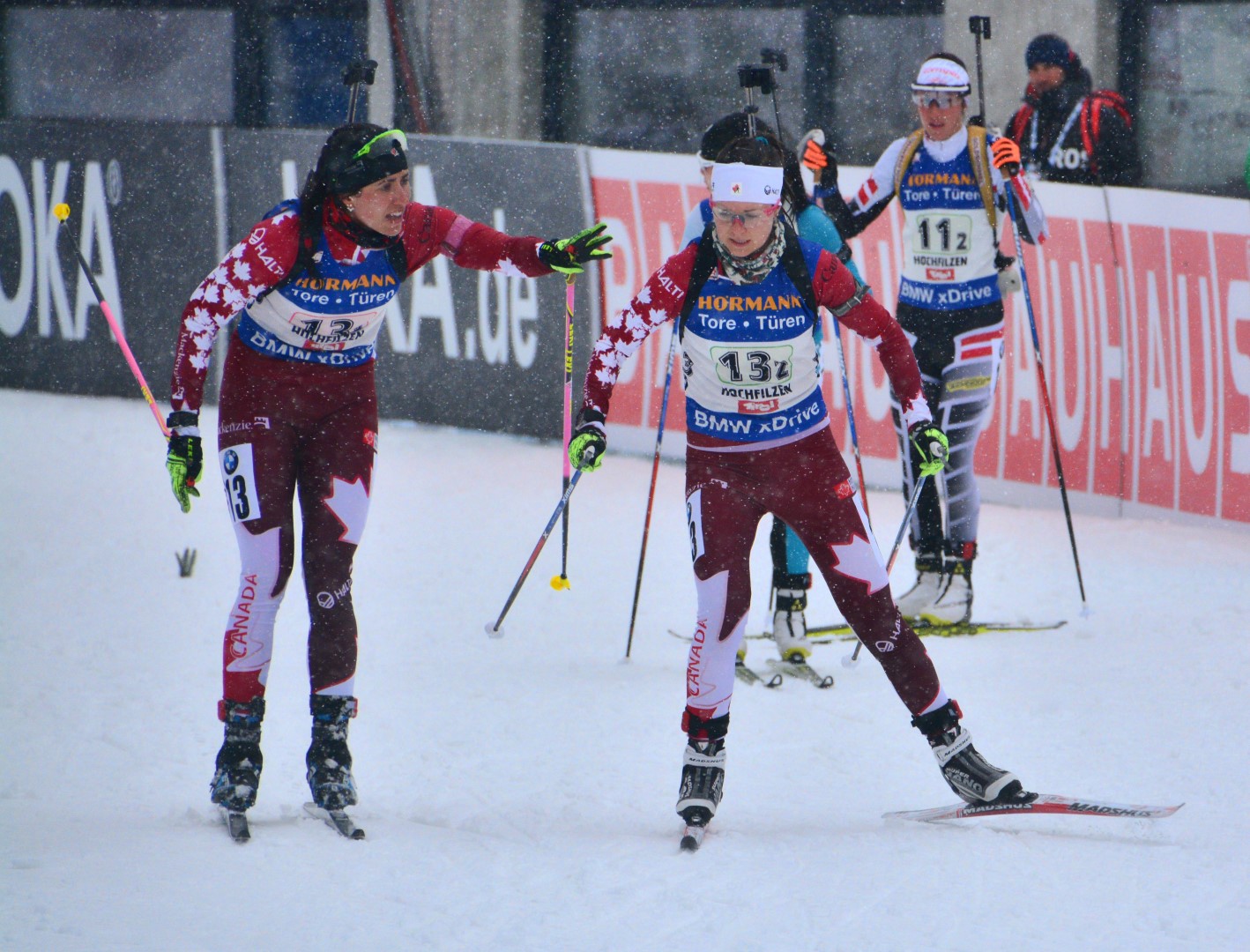
Fast Tracks: World Champs—Canadian Women following the relay
This reporting costs money. Please support this coverage with a voluntary subscription (below) so FasterSkier can provide this level of access to the sport we all love year-round.
-

Fast Tracks: World Champs—Swedish Women after the team relay gold bronze—Press Conference
This reporting costs money. Please support this coverage with a voluntary subscription (below) so FasterSkier can provide this level of access to the sport we all love year-round.
-

Fast Tracks: World Champs—Norwegian Women after the team relay silver—Press Conference
This reporting costs money. Please support this coverage with a voluntary subscription (below) so FasterSkier can provide this level of access to the sport we all love year-round.
-

Fast Tracks: World Champs—Germany Women after the team relay—Press Conference
This reporting costs money. Please support this coverage with a voluntary subscription (below) so FasterSkier can provide this level of access to the sport we all love year-round.
-

Fast Tracks: World Champs—Switzerland’s Nadine Faehndrich following the relay
This reporting costs money. Please support this coverage with a voluntary subscription (below) so FasterSkier can provide this level of access to the sport we all love year-round. -

The Devon Kershaw Show: Guests galore for a women’s World Champs relay recap
 We’ve got guests. Former FasterSkier Managing Editor Rachel Perkins and U.S. Olympian and World Cup podium finisher Sophie Caldwell join us to recap an epic women’s relay from World Championships in Planica.
Nine races down, three to go. You can reach us at devon@fasterskier.com and nat@fasterskier.com.
-
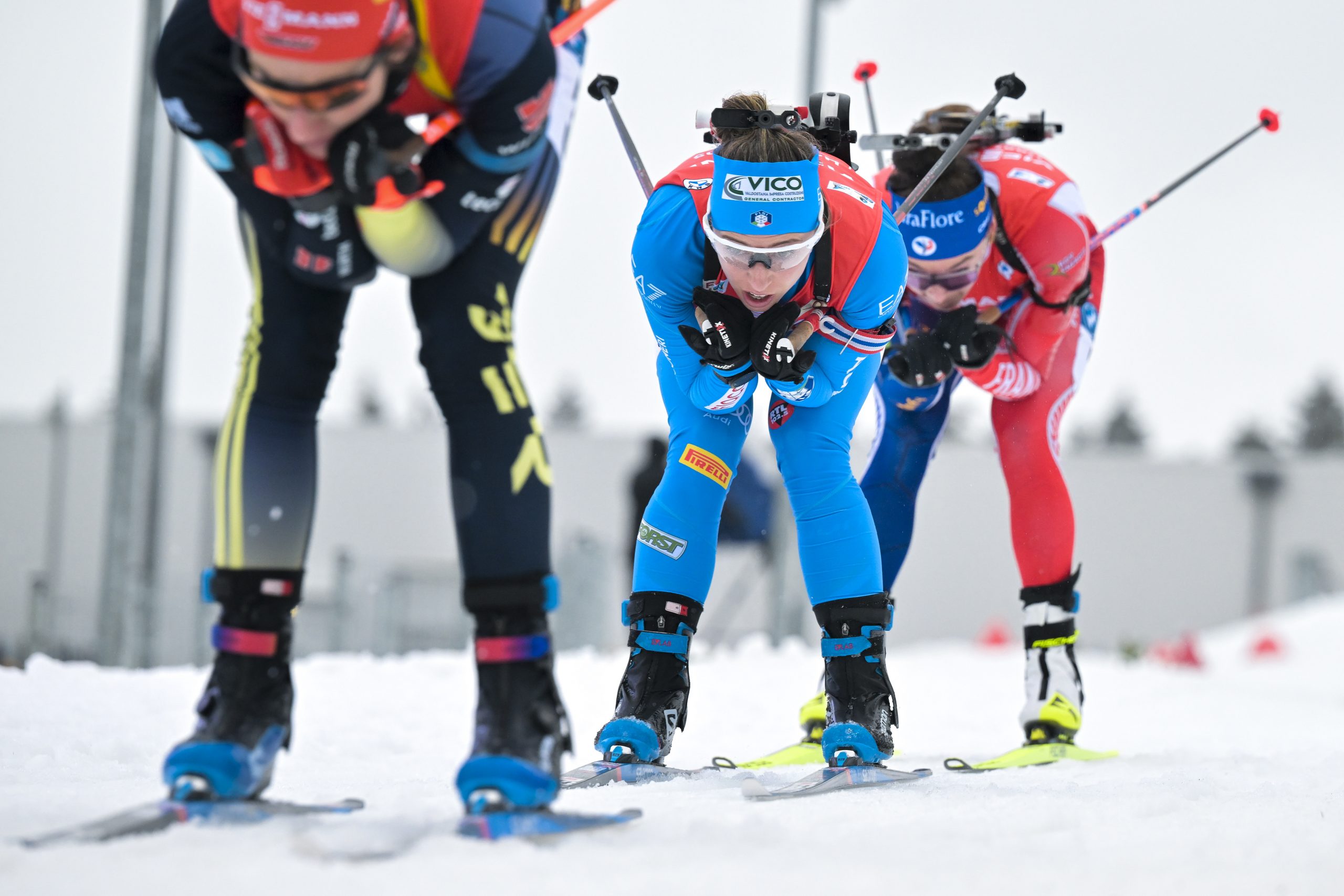
Italian Women Make History in Exquisite World Championships Relay

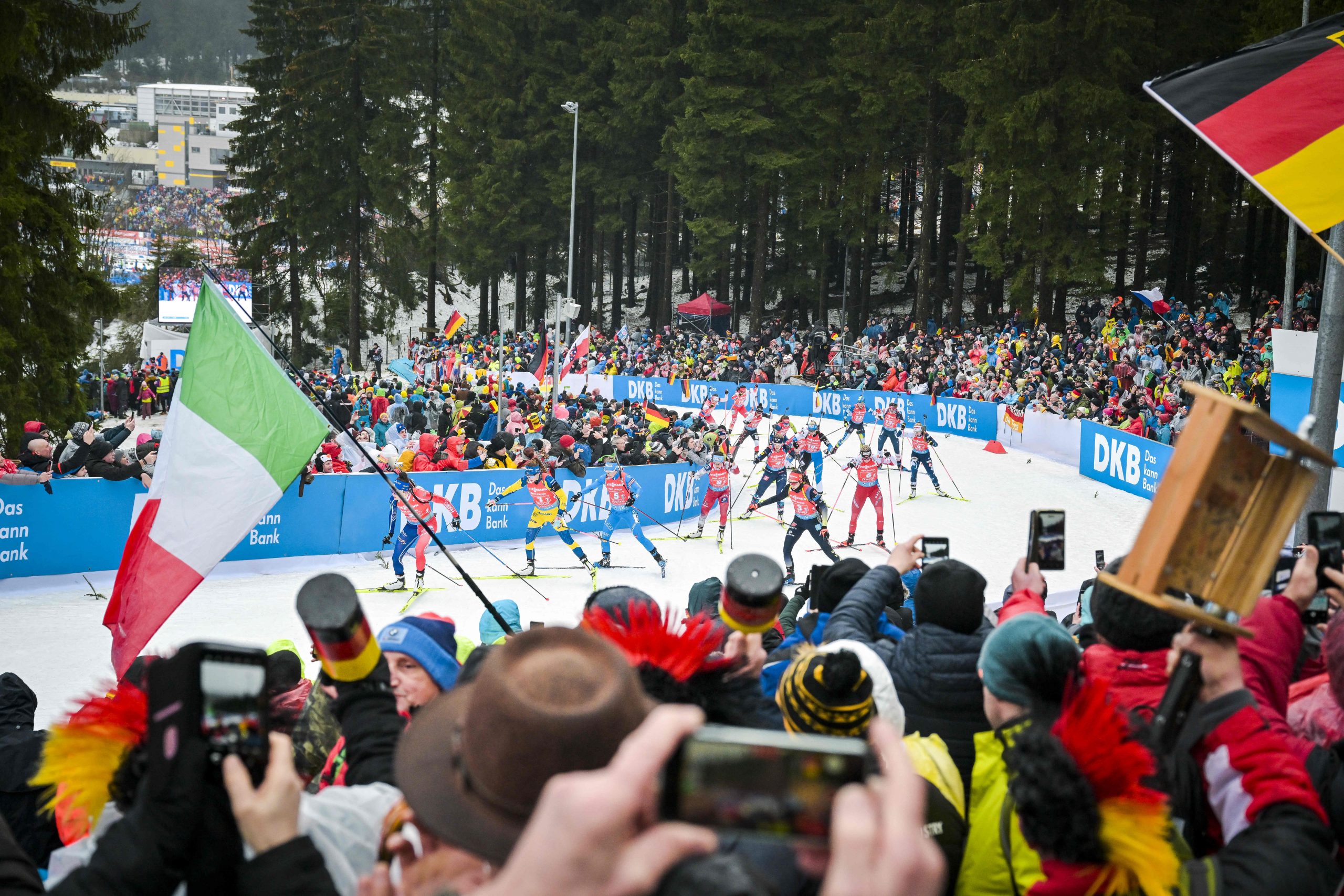
Fans line the famous Birxsteig climb during the Women’s Relay at the IBU World Championships in Oberhof, Germany. (Photo: NordicFocus) If there’s one competition to watch from the 2023 Biathlon World Championships, it’s the Women’s 4 x 6 k Relay. (Replay available here.) In a dazzling display of biathlon mastery, the Italian quartet knocked down 40 targets with 42 bullets, excelling one after another under pressure in difficult conditions to capture Italy’s first-ever Women’s Relay title. The “Blues” have been investing heavily in biathlon development with their sites set on the 2026 home Olympic Games, and it shows. But they didn’t run away with the win; it came down to a nail-biter final shooting, pitting Lisa Vittozzi of Italy against hometown favorite, Denise Herrmann of Germany. Vittozzi’s fast and flawless shooting clinched the win in spectacular fashion, while Herrmann faltered but held onto silver for Germany over third-place Sweden.

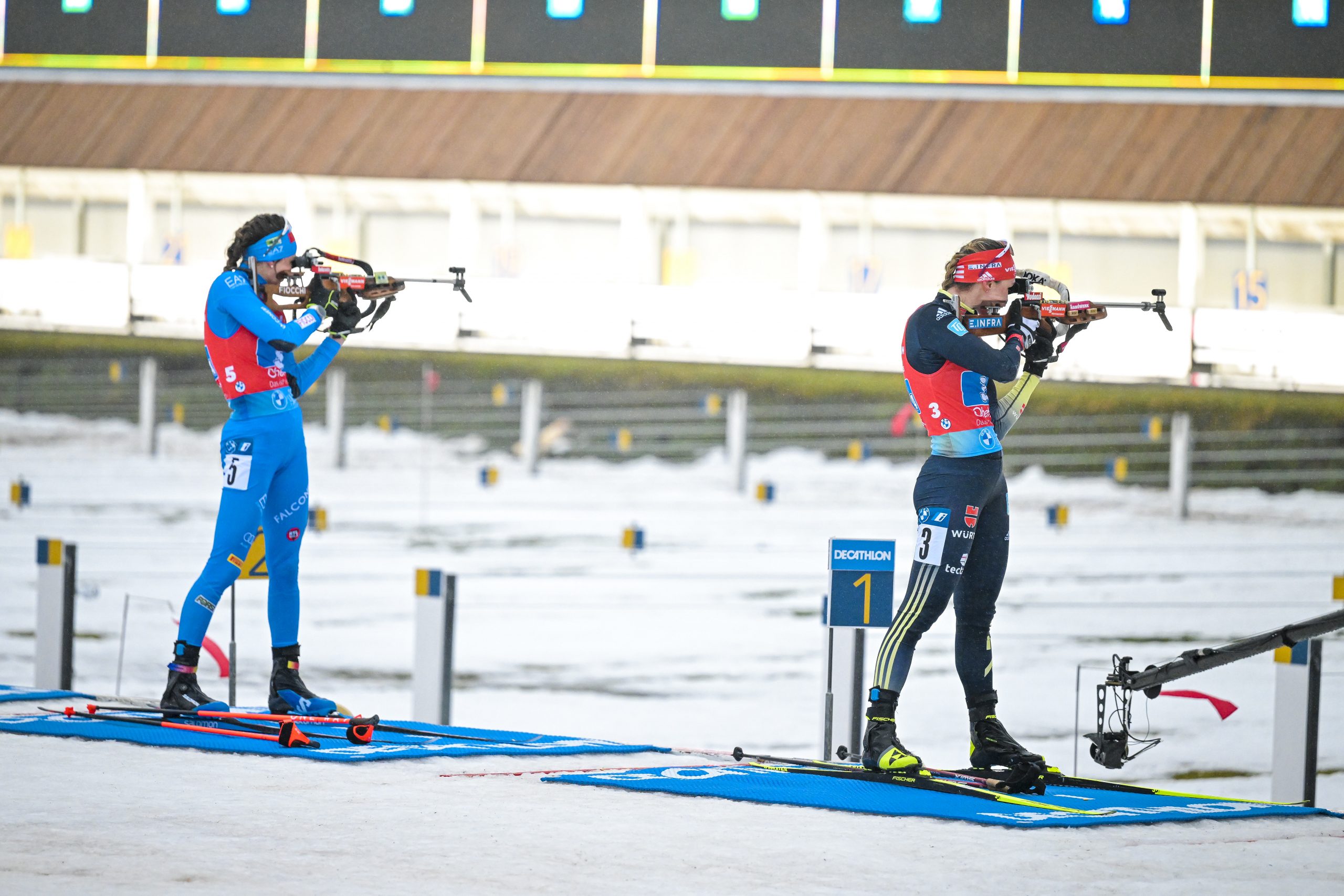
Lisa Vittozzi (ITA) and Denise Herrmann-Wick (GER), (l-r) shooting head to head for the gold medal in the final shooting stage of the IBU World Championships Women’s Relay. (Photo: NordicFocus) After gusty winds caused drama at the shooting range in Saturday morning’s Men’s Relay, the conditions for the Women’s Relay eased a bit, though the compromise for lighter wind was heavier rain. On the first leg, two women shot clean: Vanessa Voigt of Germany’s 2022 Olympic bronze medal-winning relay squad, and Samuela Comola of Italy. Coming into these Championships, Comola’s best World Cup finish was 20th, but as one of three women to hit 20/20 in last Wednesday’s 15 k Individual she claimed a new personal best of fourth. Continuing her breakout week and clean shooting streak, she arrived at the first exchange in the lead pack with Sweden, Czech Republic, and Norway. Thirteen teams tagged within one minute, with the top seven all within 30 seconds.

Vanessa Voigt (GER), Samuela Comola (ITA), and Lou Jeanmannot (FRA) in the first leg of the Women’s Relay at IBU World Championships in Oberhof. (Photo: NordicFocus) In the second leg, two-time World Cup Overall winner Dorothea Wierer of Italy kept a low profile at first, hanging onto the back of a four-person lead pack. But in the standing shooting stage she used just one spare on Lane 4 and passed everyone to blow open a 26-second lead. France went into the penalty loop and never quite recovered, eventually finishing fourth. Norway suffered three penalty loops and fell even farther back, taking sixth in the end. Sweden had two penalty loops but made gains in the second half of the race to stay in the mix. From this point on, Italy never gave up the lead.

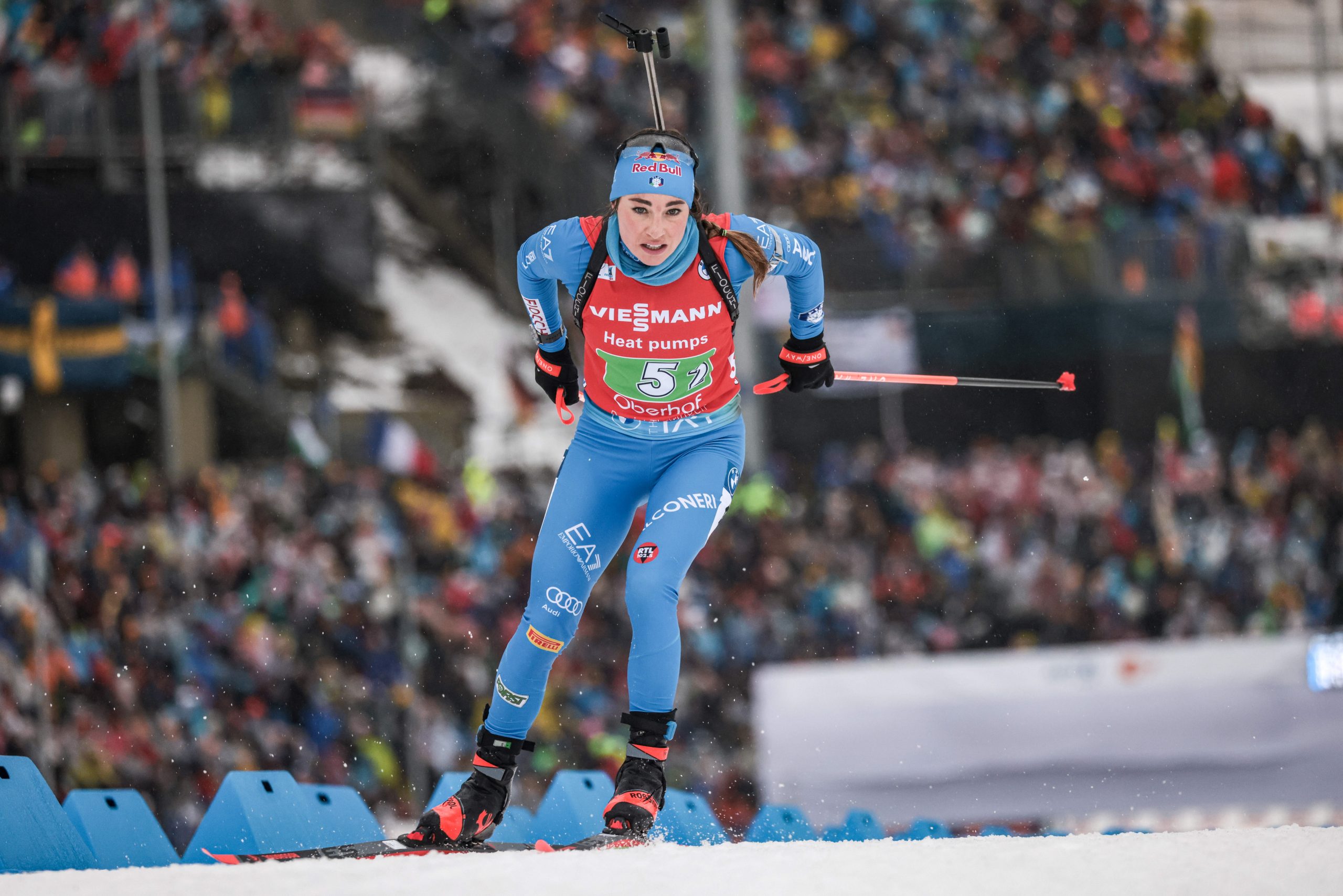
Dorothea Wierer (ITA) used just one spare in standing to take the lead at the halfway point in the Women’s Relay at IBU World Championships in Oberhof, Germany. (Photo: NordicFocus). At the halfway point, 32-year-old Wierer (ITA) handed off to her 21-year-old teammate, Hannah Auchentaller, who was originally named to the Italian World Championships team as an alternate and has only competed in a handful of World Cup races, including just one relay. No one knew what to expect from the young athlete in this high-stakes situation. Chloe Chevalier of France caught Auchentaller from 20 seconds back in the approach to the prone shooting, but Auchentaller confidently skied her own pace and kept her calm on the range. She cleaned her targets with no spares, skiing away with a 30-second advantage while Chevalier used all three spares. Arriving on Lane 1 for standing, all eyes and cameras were on Auchentaller. In the moment when it counted most, she performed brilliantly, using only one spare to hit her targets like a seasoned professional. After leading the whole third leg, Auchentaller handed off five seconds ahead of Germany.

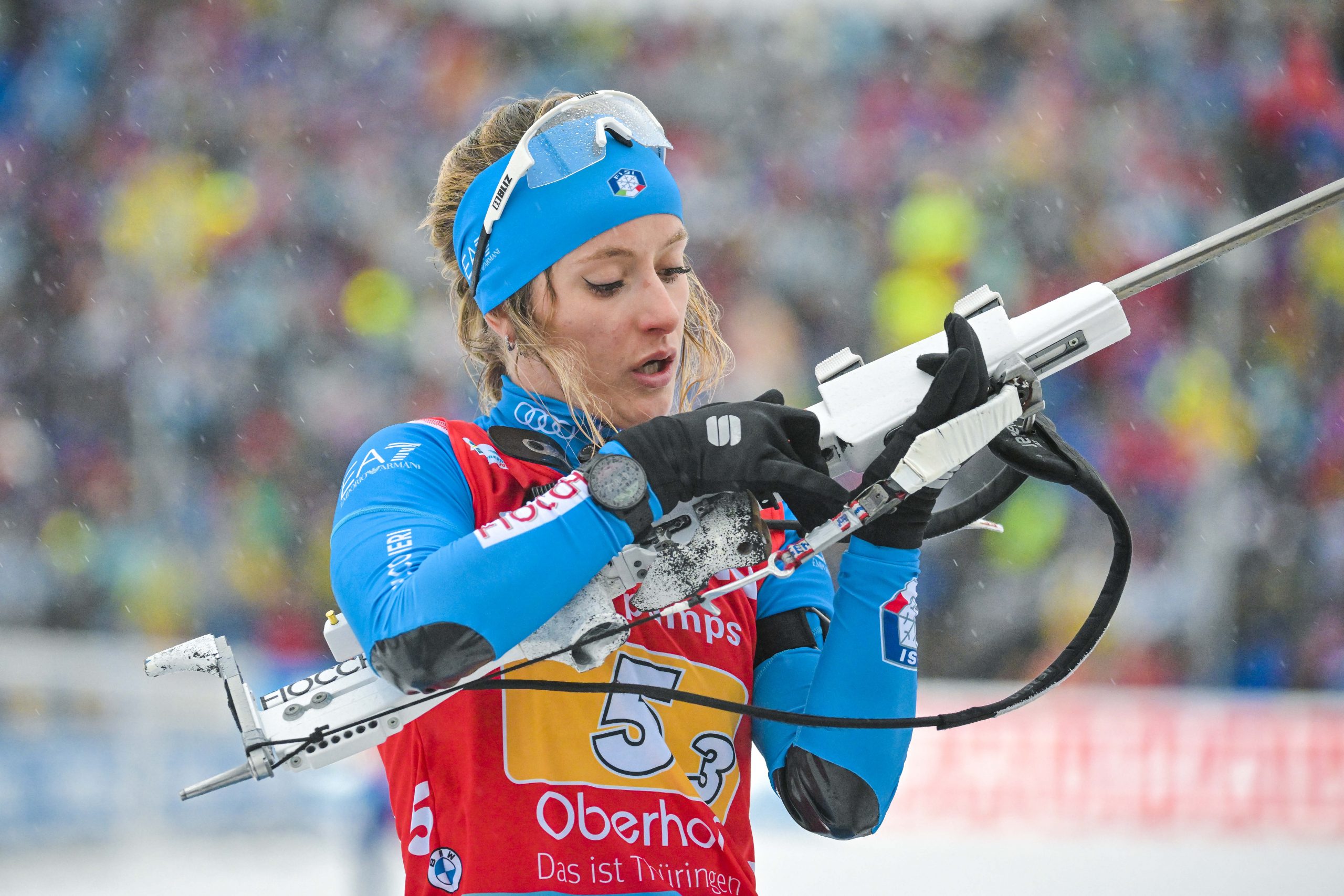
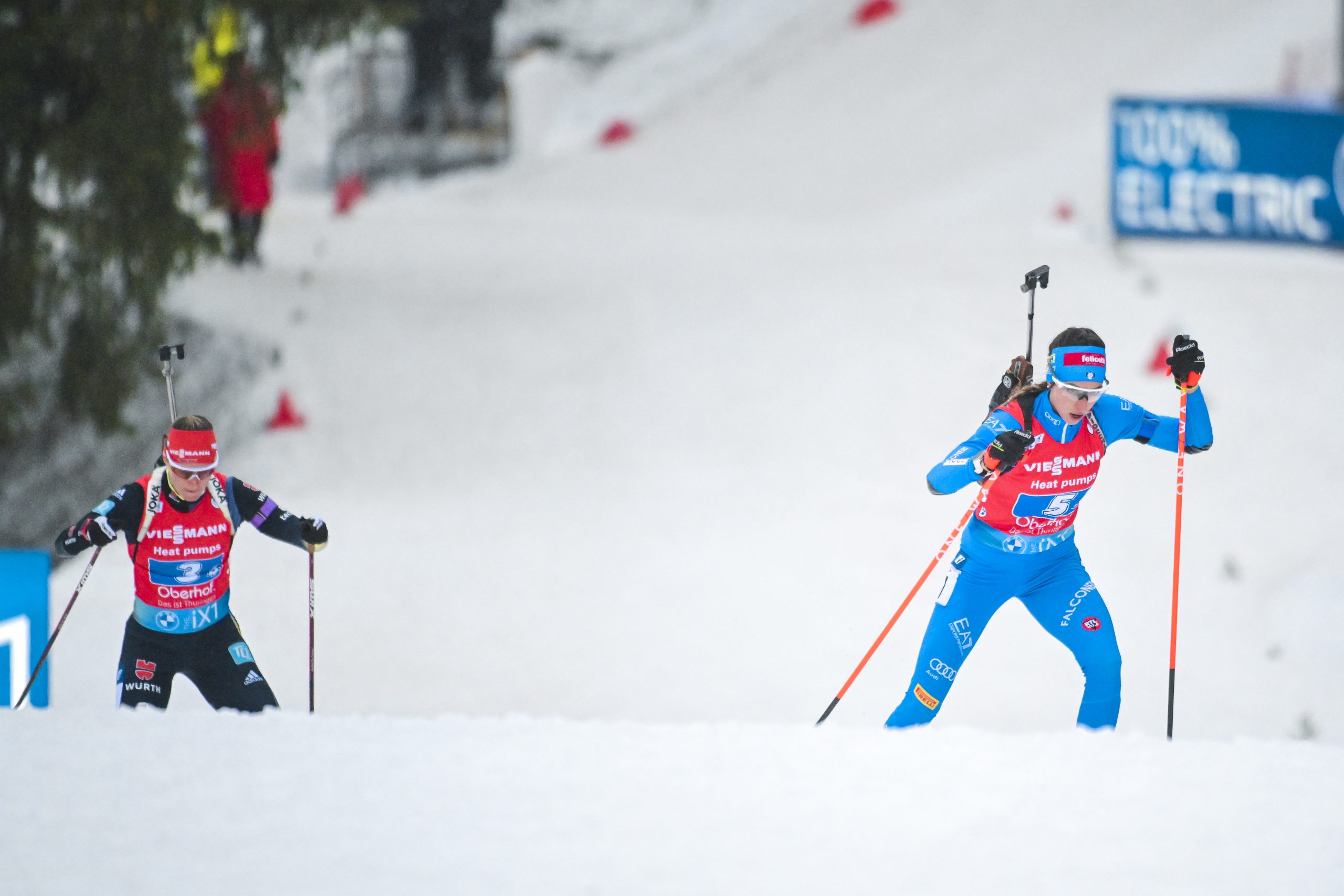
Hannah Auchentaller (ITA) setting up in the standing position in the Women’s Relay at the IBU World Championships. (Photo: NordicFocus). The last leg was set up perfectly for a high-octane head-to-head battle between two superstars: Lisa Vittozzi of Italy and Denise Herrmann of Germany. Both women are ranked in the top five of the World Cup Overall: third-ranked Vittozzi has a slightly higher shooting percentage, while fifth-ranked Herrmann tends to be slightly faster on the tracks. Both athletes cleaned prone, but Vittozzi did so five seconds faster than Herrmann. Statistics played out as Herrmann caught Vittozzi on the tracks and led into the final shooting. In yet another display of incredible composure and expertise from the Italian team, Vittozzi blazed through her five targets with five hits in 20 seconds. Herrmann hesitated after the third hit and then missed the final two shots, eventually needing 53 seconds to clear her targets with two spares. Though she avoided the penalty loop she left the range 31 seconds behind Vittozzi.

Denise Herrmann-Wick (GER) chasing down Lisa Vittozzi (ITA) before the final shooting in the Women’s Relay at the IBU World Championships in Oberhof, Germany. (Photo: NordicFocus) Vittozzi crossed the finish line in triumph and was met by her three ecstatic teammates—the new World Champions. Herrmann, her teammates, and the German crowd all seemed satisfied with their silver medal performance, and Hanna Oeberg (SWE) brought home the bronze for Sweden, perhaps a slight disappointment for the race favorites, but a World Championship medal nonetheless. Julia Simon of France crossed in fourth, looking underwhelmed.

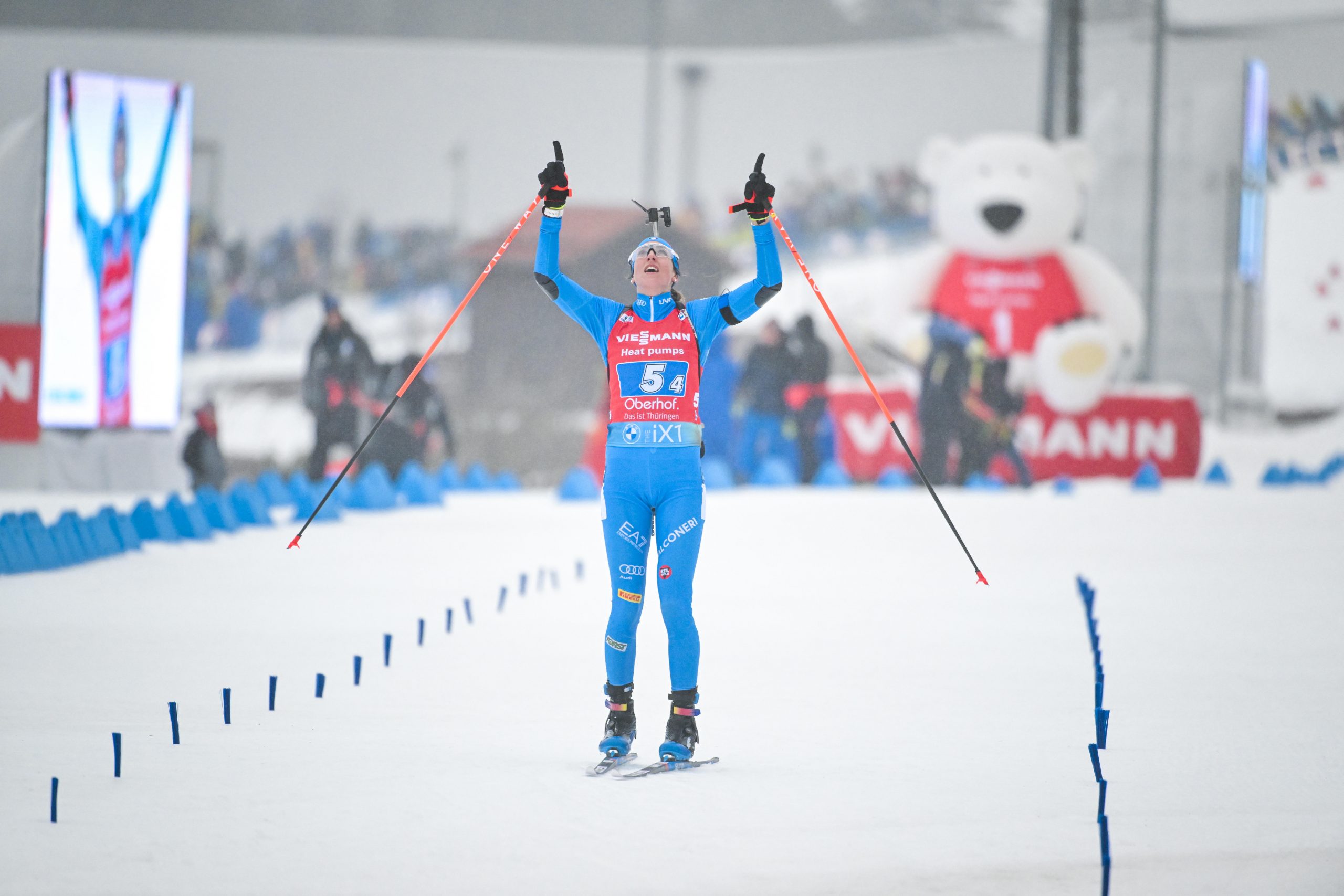
Lisa Vittozzi (ITA) celebrates as she crosses the finish line to claim Italy’s first ever gold in a Women’s Relay at the IBU World Championships in Oberhof, Germany. (Photo: NordicFocus) From North America, Canada finished 11th and the US was 15th. Canada’s Nadia Moser had a solid first leg to tag in ninth just 46 seconds out of the lead. For the US, Deedra Irwin struggled on both the range and the tracks, using all six spares and incurring one penalty loop to hand off in 15th, 2:10 back. Joanne Reid (USA) moved the team up to 12th while Canada fell to 15th at the halfway point. On the third leg, Chloe Levins (USA) held onto twelfth and tagged twenty seconds ahead of Canada in 13th. Skiing the anchor leg for team USA, Kelsey Dickinson dropped down to 15th, while Canada’s Emma Lunder finished strong, bringing the Canadians up to 11th.

Joanne Reid (USA) brought the US from 15th two 12th in the second leg of the Women’s Relay at the IBU World Championships. (Photo: NordicFocus). The Canadians had a final shooting score of 1 (penalty loop) +10 (spare rounds), while the US had 1+15. The winners from Italy had 0+2, highlighting the importance of the shooting and the exceptional caliber of their performance. Though it wasn’t a day to write home about for either North American team, US Biathlon Team Head Coach and proud father, Armin Auchentaller of Italy, certainly had reason to celebrate. His daughter and her three teammates were simply superb.

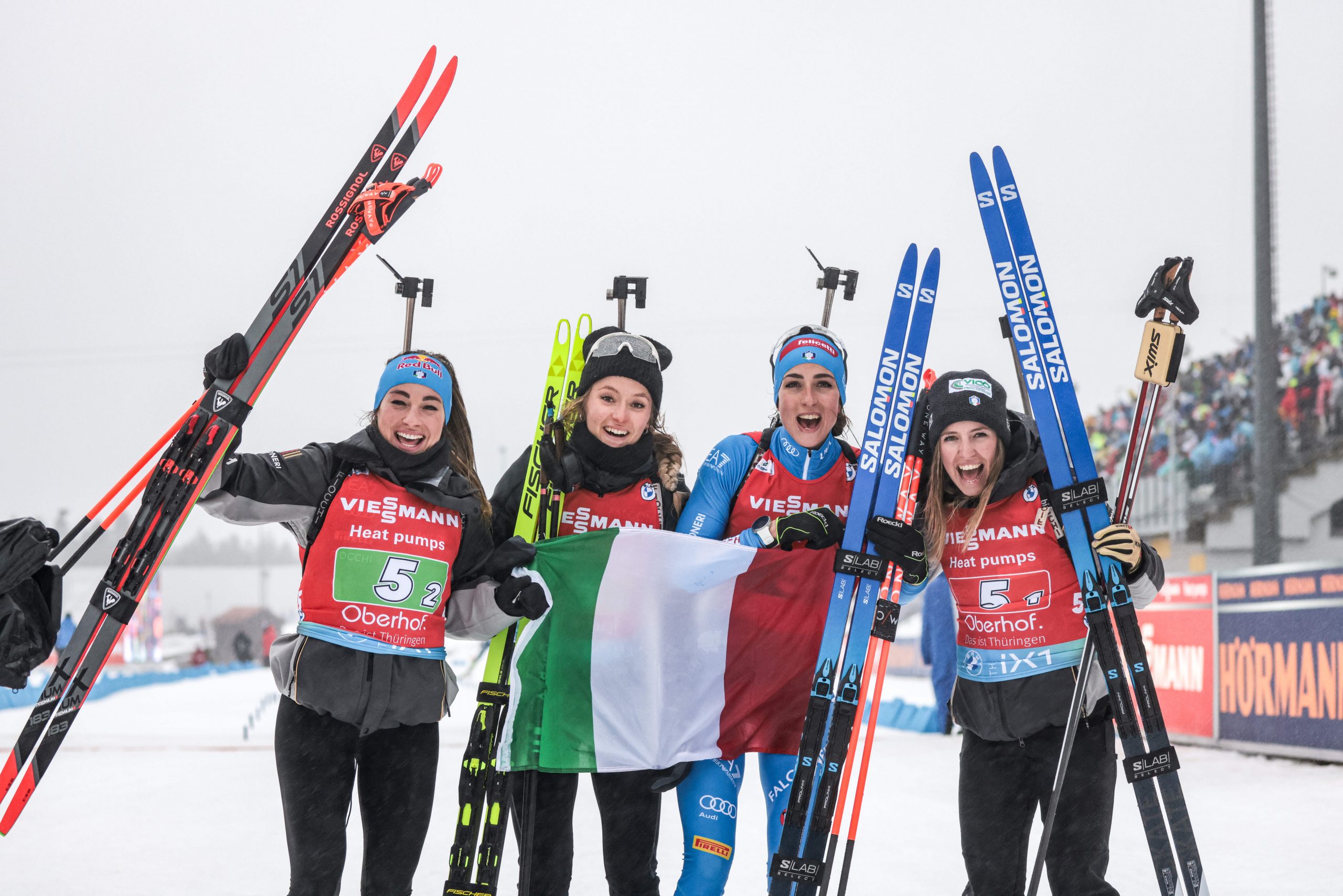
Dorothea Wierer (ITA), Hannah Auchentaller (ITA), Lisa Vittozzi (ITA), Samuela Comola (ITA), (l-r) celebrating Italy’s first ever gold medal in the Women’s Relay at the IBU World Championships in Oberhof,Germany. (Photo: NordicFocus). IBU World Championships Women’s Relay RESULTS
-
Thursday Olympic Rundown: Belarus Gold in Thrilling Women’s Biathlon Relay; US 10th Team in NoCo

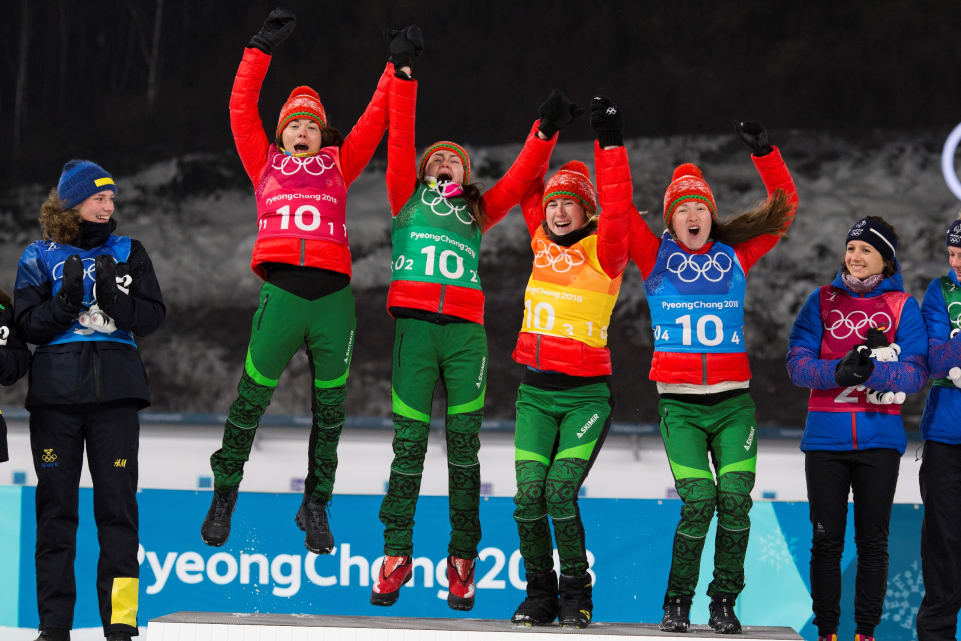
The Belarusian women’s biathlon team of Nadezhda Skardino, Irina Kryuko, Dzinara Alimbekava, and Darya Domracheva celebrates winning gold in the relay. They were ranked 10th coming into the day. (Photo: IBU/Biathlonworld.com) FasterSkier would like to thank Fischer Sport USA, Madshus USA, Concept2, Boulder Nordic Sport, and Swix Sport US for their generous support, which made this coverage possible.
***
2018 Olympics (PyeongChang, South Korea): Biathlon Women’s 4 x 6 k relay
Ranked just 10th coming into today’s women’s relay, the team from Belarus stole the show with Darya Domracheva skating across the line to claim the fourth Olympic gold of her career after strong efforts from Nadezhda Skardino and Iryna Kryuko, both of whom have stood on the World Cup podium before, and newcomer Dzinara Alimbekava, a 22-year-old newcomer with just 11 World Cup starts to her name. It was the first relay medal ever won by Belarus at the Olympics.
The setting was windy and snow-blown and the race was extremely tight, with seven teams with one penalty loop (or a few spare bullets) worth of time going into the final leg. The Belarusians’ nine spare rounds were the best shooting of the day; while that spare-round tally was matched by Slovakia, Kazakhstan, Bulgaria, and Japan, those teams had penalty loops as well.
Sweden actually wasn’t one of them, but with perfect shooting and a fast ski time 15 k gold medalist Hanna Öberg brought the team to silver after starting the anchor leg in eighth, a minute back. She benefitted from many missed shots by the leaders, and then passed France’s Anais Bescond on the final loop to claim second, 10.7 seconds back, for her teammates (Linn Persson, Mona Brorsson, and Anna Magnusson) while France (Bescond, Anais Chevalier, Marie Dorin Habert, and Justine Braisaz) took bronze (17.6). These medal-winning teams used 12 and 14 spare rounds, respectively, an unusually high tally.
Norway (Synnøve Solemdal, Tiril Eckhoff, Ingrid Tandrevold, and Marte Olsbu) finished fourth, +29.7, Slovakia fifth (+38.4), Switzerland sixth (+43.5) after winning a photo finish against Poland (+43.6), and Germany finished seventh (+53.9).
The Canadian team of Sarah Beaudry, Julia Ransom, Emma Lunder, and Rosanna Crawford finished 10th, +1:33.4. Their shooting of eleven spare rounds and one penalty loop was among the better scores of the day.
The United States had a strong start, with Susan Dunklee tagging off in second place, Clare Egan maintaining a good position in fourth, and Joanne Reid rebounding from one bad shooting stage to tag off in sixth. Anchor leg Emily Dreissigacker crossed the finish line in 13th, +2:01.9.
***
2018 Olympics (PyeongChang, South Korea): Nordic Combined Team Competition
After sweeping the medals in the large hill competition, perhaps it was not a surprise that Germany won the nordic combined team event. It was a blowout: ranked second after the jumping round but starting the cross-country ski relay just six seconds behind Austria, the Germans quickly took the lead and then just extended it. Their team of Vinzenz Geiger, Fabian Riessle, Eric Frenzel, and Johannes Rydzek won by 52.7 seconds over Norway’s Jan Schmid, Espen Andersen, Jarl Magnus Riiber, and Jørgen Gråbak. Austria hung on for third, +1:07.8, with Wilhelm Denifl, Lukas Klapfer, Bernhard Gruber, and Mario Seidl.
The United States team of Taylor Fletcher, Ben Berend, Ben Loomis, and Bryan Fletcher lost out on a photo finish with Poland and finished 10th out of 10 teams, +5:16.7.
-
Saturday Olympic Rundown: Norway Tops Women’s Relay, U.S. 5th; Kuzmina Dominates Mass Start
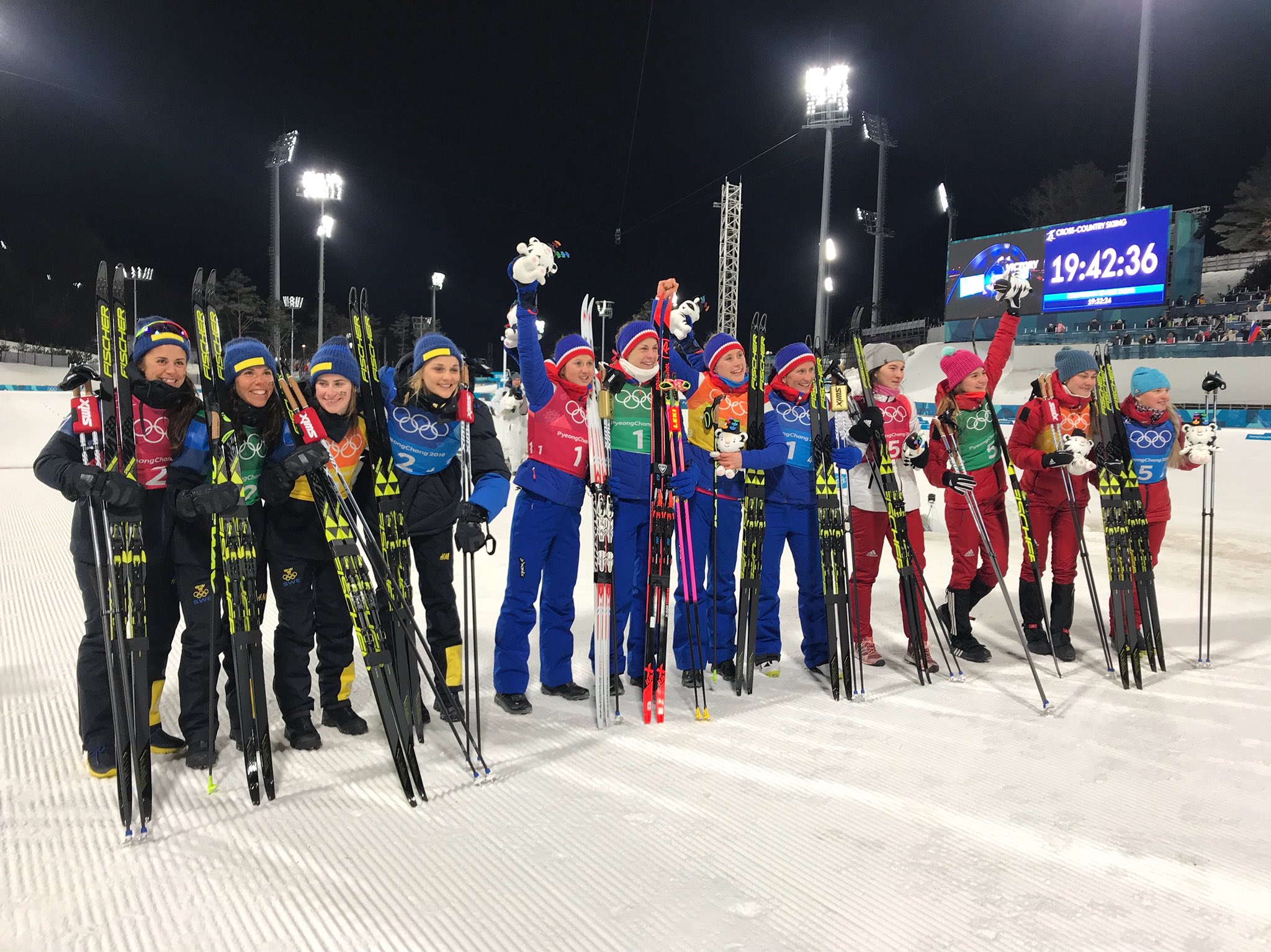
Norway won the women’s 4 x 5 k relay, with Sweden taking silver and Russia bronze. (Photo: FIS Cross Country/Twitter) FasterSkier would like to thank Fischer Sport USA, Madshus USA, Concept2, Boulder Nordic Sport, and Swix Sport US for their generous support, which made this coverage possible.
2018 Winter Olympics (PyeongChang, South Korea): Women’s 4 x 5 k Relay
It wasn’t the wire-to-wire triumph that Norway sometimes achieves, but the pre-race favorites got the job done despite a scare midway through, thanks to dominant skiing by Ragnhild Haga and smooth strength from anchor Marit Bjørgen.
Norway took gold in the 4 x 5 k relay by two seconds over Sweden in 51:24.3 minutes. Olympic Athletes from Russia took bronze (+43.3), Finland fourth (+1:02.6), and the United States fifth (+1:20.5).
The first leg went out with Natalia Nepryaeva of Russia setting a blistering pace, fracturing the field almost immediately. A number of racers tried to stay with her only to get shot off the back of the pack. Taking a different pacing strategy, Slovenia’s Anamarija Lampic made up ground in the final section of the first leg to tag off in second, with Norways’ Ingvild Flugstad Østeberg third, all within a few seconds of each other.
Part of Nepryaeva’s fracturing of the field led to U.S. lead skier Sophie Caldwell getting dropped, to tag off 1:01.5 minutes back in 11th place.
In the second leg, Charlotte Kalla of Sweden and Kerttu Niskanen of Finland clocked the fastest times, making up 24.4 and 9.9 seconds that had been lost to Russia and Norway by their teammates Anna Haag and Aino Kaisa Saarinen, respectively. In the meantime, Astrid Uhrenholdt Jacobsen of Norway had a disastrous relay leg and notched just the eighth-fastest split time, falling to fourth.
Yulia Belorukova of Russia continued to lead the race on that second leg, but Kalla tagged off at the end of the classic portion just 1.4 seconds back, and Niskanen in third (+10.1). Sadie Bjornsen made up three places to tag off in eighth (+1:05.2).
Jacobsen tagged Haga 29.8 seconds out of first. From that point, Haga gradually reeled in the leaders over the course of the 5 k skate leg. It was an absolutely dominant performance, with the fastest split time by 24.7 seconds in a less than 12-minute race.
Sweden’s Ebba Andersson led Russia’s Anastasia Sedova for the whole leg and stayed clear of the field, but Haga — the gold medalist in the 10 k skate — made up enough ground to finish her effort in third, 3.4 seconds back.
That was more than enough for Bjørgen to work with, and she and Swedish anchor Stina Nilsson quickly dropped Anna Nechaevskaya of Russia and set off on their personal duel for gold. Bjørgen led the whole way, but could not make any decisive move to drop the Swede. Instead, over the top of the climb she had about a second, which Nilsson could not close on the downhill or the final flats into the finishing straight: gradually, Bjørgen just added a meter and another to her lead and crossed the line with gold.
Nechaevskaya continued to lose time on the leaders, but still held on to bronze. Krista Pärmäkoski skied an aggressive effort for Finland to pass the team from Switzerland, which had been in fourth after strong legs from Laurien van der Graaff, Nadine Fähndrich, and Nathalie von Siebenthal. But 21-year-old Lydia Hiernickel was unable to keep the pace and Switzerland dropped to seventh by the finish, getting passed by not only Parmakoski and Jessie Diggins, but also Sandra Ringwald of Germany. The Germans finished sixth (+1:49.4) and Switzerland seventh (+1:51.5).
Kikkan Randall had skied the third-fastest split of the field (behind Haga and Andersson) in the third leg to bring the U.S. into sixth, and Diggins also skied the third-fastest split (behind Bjørgen and Nilsson) for her leg to bring the team up to fifth at the finish.
The Canadian team of Dahria Beatty, Emily Nishikawa, Cendrine Browne, and Anne-Marie Comeau placed 13th (+4:50.3) of 14 teams.
***

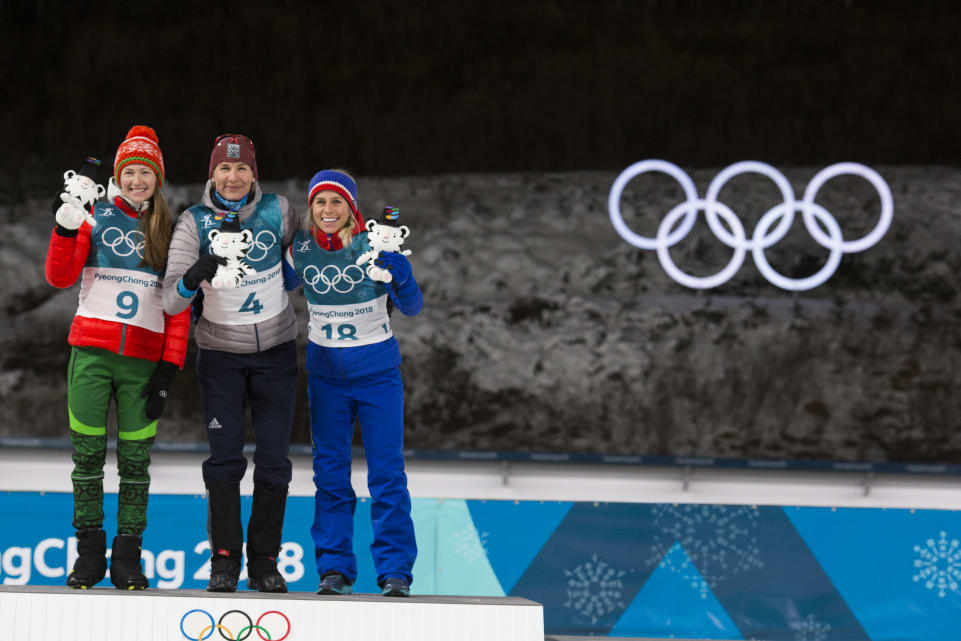
The women’s biathlon 12.5 k mass start medalists at the 2018 Olympics in PyeongChang, South Korea, with Slovakia’s Anastasiya Kuzmina (c) in first, Belarus’s Darya Domracheva (l) in second, and Norway’s Tiril Eckhoff (r) in third. (Photo: IBU/Biathlonworld) Biathlon: Women’s 12.5 k mass start
Not even a miss in the final stage could keep Slovakia’s Anastasiya Kuzmina from her third medal of the 2018 Olympics, this time gold, in the women’s 12.5-kilometer mass start on Saturday at the Alpensia Biathlon Center.
Kuzmina took charge early in the five-loop race, leading Germany’s Laura Dahlmeier into the range for the first prone shooting stage. There, Kuzmina cleaned all five targets quickly to get back out on course in first, while Dahlmeier missed one to slip out of the top 20, while several other athletes cleaned.
Kuzmina went on to hit every target over the next two shooting stages to distance herself from second place, and even with a miss on the last standing stage, she left the range 24.7 seconds clear of Darya Domracheva of Belarus in second.
Domracheva had put herself in second with clean shooting in the first two stages, then dropped to fifth with a miss on the third stage. Italy’s Dorothea Wierer was up to second by the fourth shooting after three clean stages, then fell back to seventh with a miss on the last standing.
There, Domracheva cleaned to get back into silver-medal contention, 9.3 seconds ahead of Norway’s Tiril Eckhoff in third.
Heading into the final downhill into the stadium, Kuzmina had enough time to grab a flag from one of her team’s staff members running alongside the trail. She crossed the finish line first in 35:23.0 minutes without anyone close for her third-career Olympic gold (after winning the sprint at the 2010 and 2014 Games).
Domracheva skied on her own to second, 18.8 seconds behind, for her first medal of the 2018 Games (and fifth of her career after winning three races at the 2014 Olympics).
Eckhoff, who had skied two penalty laps, took third, 27.7 seconds behind Kuzmina, while Italy’s Lisa Vittozzi held off Sweden’s Hanna Öberg, Wierer and Belarus’s Nadezhda Skardino for fourth place (+45.6). Öberg placed fifth (+46.5), Wierer was sixth (+47.3), and Skardino seventh (+47.9), ahead of Norway’s Marte Olsbu in eighth (+51.6), France’s Marie Dorin Habert in ninth (+57.9) and Finland’s Kaisa Mäkäräinen in 10th (+1:00.9). Dahlmeier, who had won two races and placed third in another at these Olympics, finished 16th (+1:47.1) with two penalties (1+1+0+0).
No North Americans qualified for the mass start.
-

Gold for German Women’s Biathlon Relay; U.S. 14th, Canada 16th
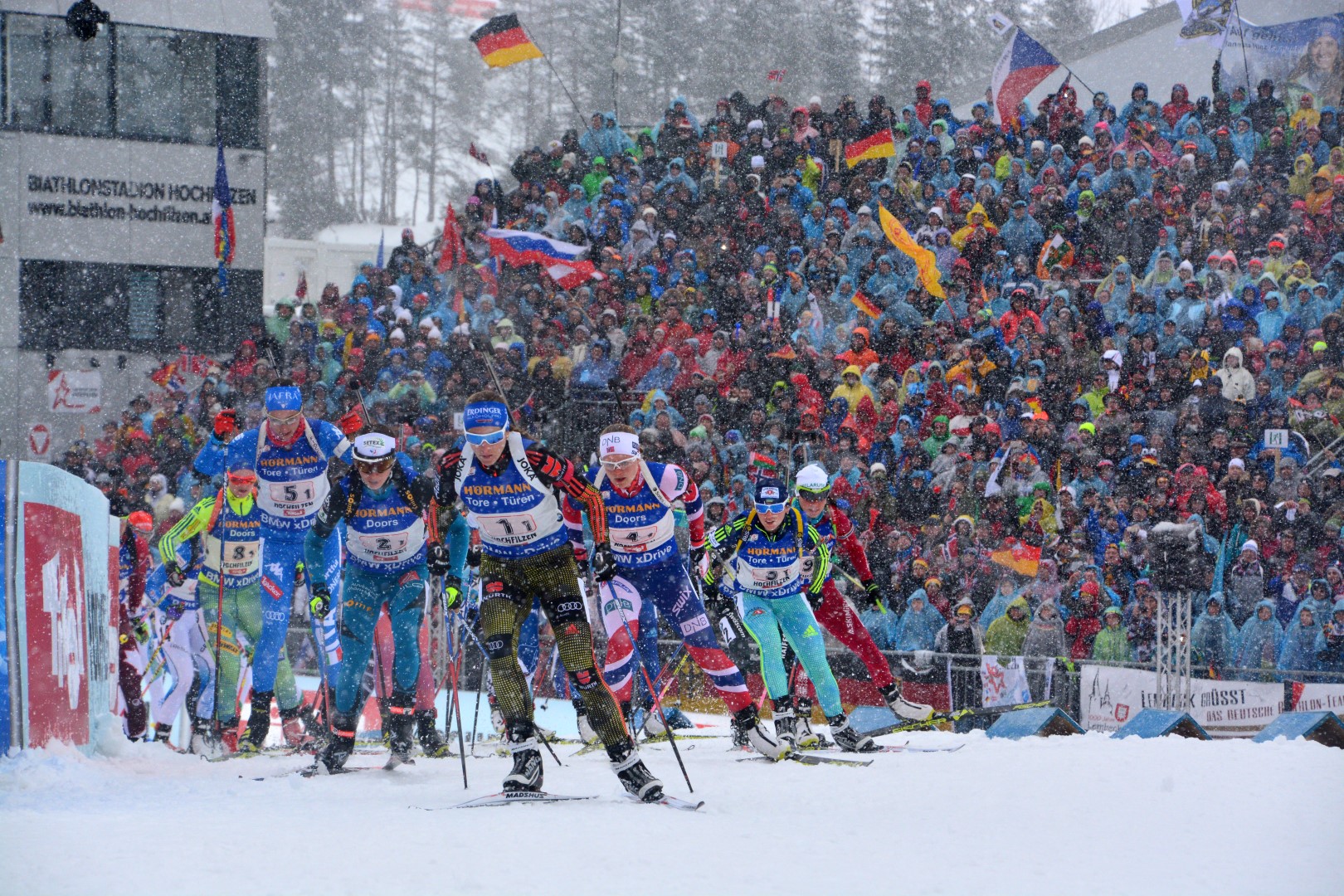
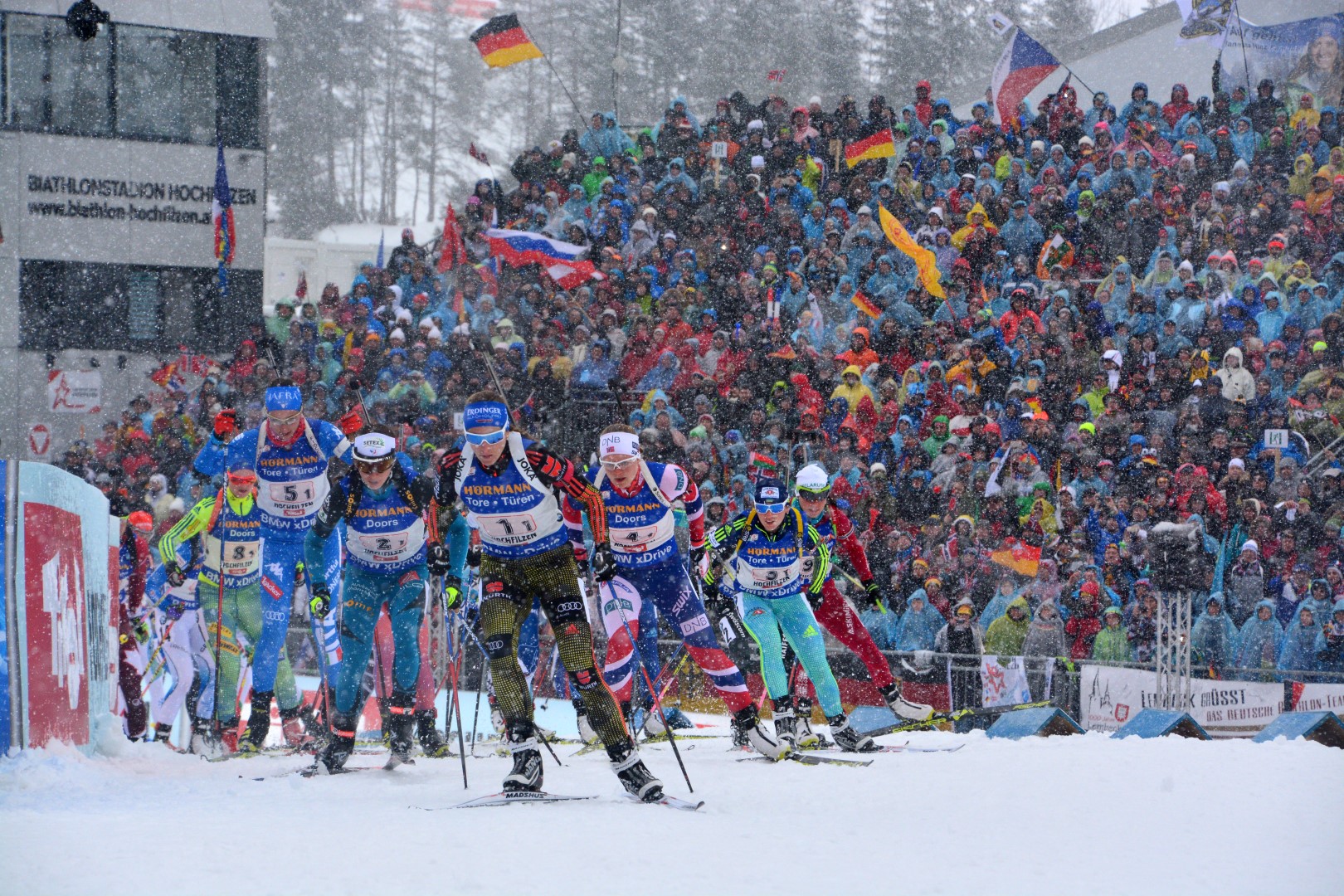
Germany’s Vanessa Hinz leading the first leg of the women’s relay, followed closely by France’s Anais Chevalier and Norway’s Kaia Woeien Nicolaisen on Friday at IBU World Championships in Hochfilzen, Austria. (Photo: Glen Crawford) HOCHFILZEN, Austria — Coming into the women’s 4 x 6-kilometer relay at World Championships, there was certainly one overwhelming favorite: Germany.
Not only had the German women won every relay in the World Cup season so far, but the German mixed relay team won gold to kick off the Championships. Plus, anchor leg Laura Dahlmeier had two individual gold medals to her name and one silver so far.
“As a team we tried to put no additional pressure on us, at least not more than we already had,” Maren Hammerschmidt told German broadcaster ARD. “For me, I can say that it was not easy to resist the pressure today. I think that was similar for my colleagues.”
While the weather in Hochfilzen changed today from the hot, bright sun athletes had adapted to all week – instead, a snowstorm dumped wet flakes onto the course and slowed down the skis — the German team weathered the storm and again came out on top.
It hadn’t seemed like a given. On the first leg of the relay, it looked like it was going to be a fight.
Vanessa Hinz led the race out of the start and cleaned prone, just like you would expect from the best team in the world. Then she used two spare rounds in standing, which provided an opening for other teams.
“In standing the second miss annoyed me greatly,” Hinz told ARD. “I just wanted to do it too fast because I noticed Anais [Chevalier] next to me had already begun shooting, so I got too distracted by that. At least I managed to hit the spares so it was alright.”
France’s Chevalier used only one spare round, leaving the range in first place. Lisa Vitozzi of Italy also used just one spare, and left 6.3 seconds back. Chevalier, the bronze medalist from the sprint, extended her lead by another 1.2 seconds by the time she tagged off.
“For sure everybody wants to hand over first, but not everybody could,” Hinz said in a press conference. “With ten seconds back, it was quite okay.”
Hammerschmidt received the tag in third place, and despite four spare rounds, pulled the Germans into second.
That was partly because the previous leader, Celia Aymonier of France, struggled, using all three spares to hit her standing targets, and slowly.

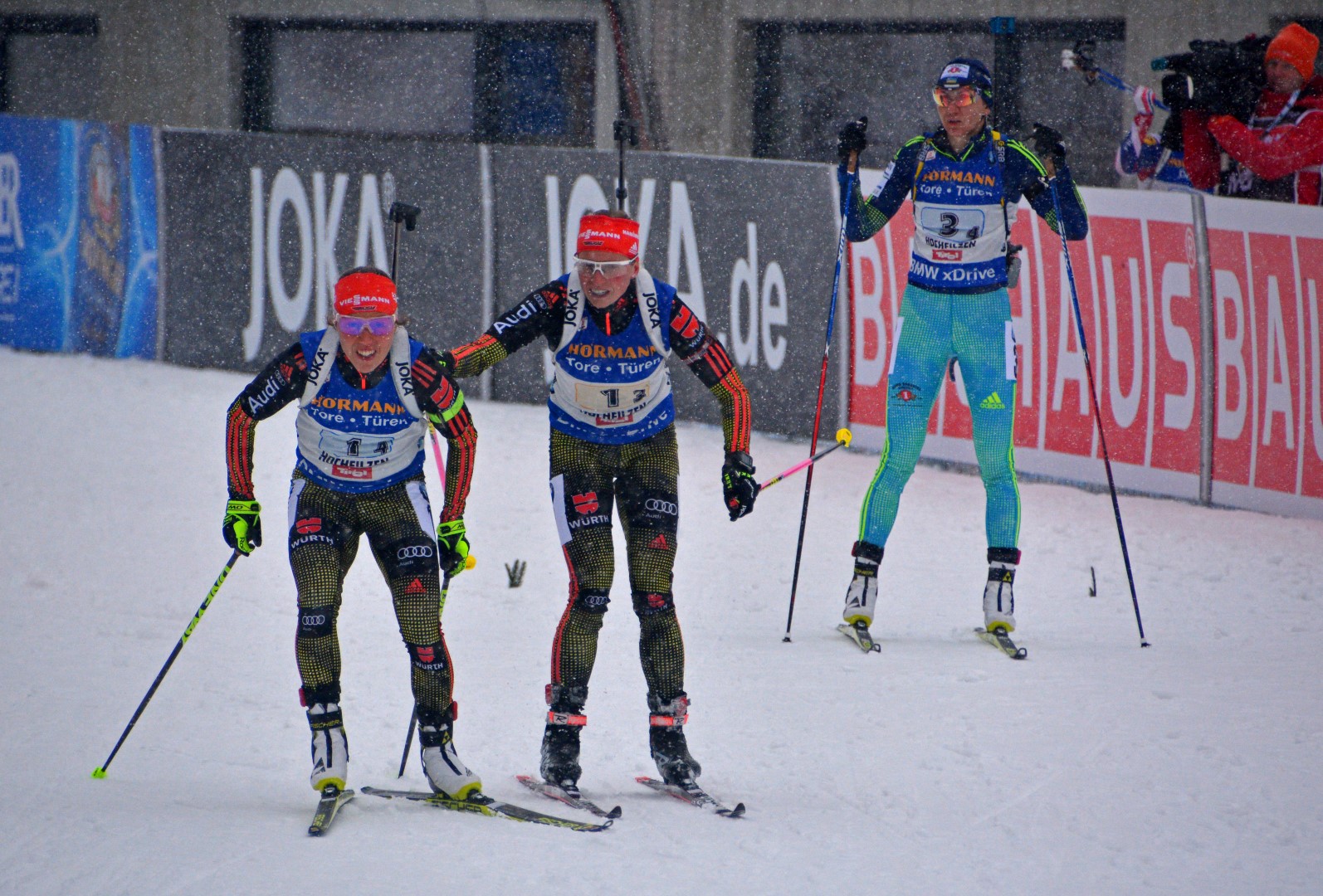
Germany’s Franziska Hildebrand (c) tagging her team’s anchor Laura Dahlmeier (l) in first during the women’s 4 x 6 k relay on Friday at IBU World Championships in Hochfilzen, Austria. (Photo: Glen Crawford) “I’m in good shape, but on the last shooting my leg was shaking and the mat was wet, so I [slipped] a little bit,” she said of the snowfall. “So it was really hard for me to shoot. But I am happy to put all my extra [bullets] in, so it’s okay, it’s enough for my teammates. They are strong.”
On the third leg, Alexia Runggaldier – the bronze medalist in the pursuit – faltered on the range, losing Italy’s lead with two spare rounds in prone. That gave Germany’s Franziska Hildebrand all the room she needed. With two clean sheets, she moved her team into the lead and they never looked back.
“I was very happy to shoot two times clean and I could give a little bit of time forward to Laura,” Hildebrand said.
Laura: the one everyone was waiting for. Dahlmeier didn’t disappoint, skiing the fastest anchor leg despite already being in the lead. She used three spare rounds, but even then held the lead and delivered another gold medal for Germany – and her fourth of the Championships, a feat no other German biathlete has ever accomplished.

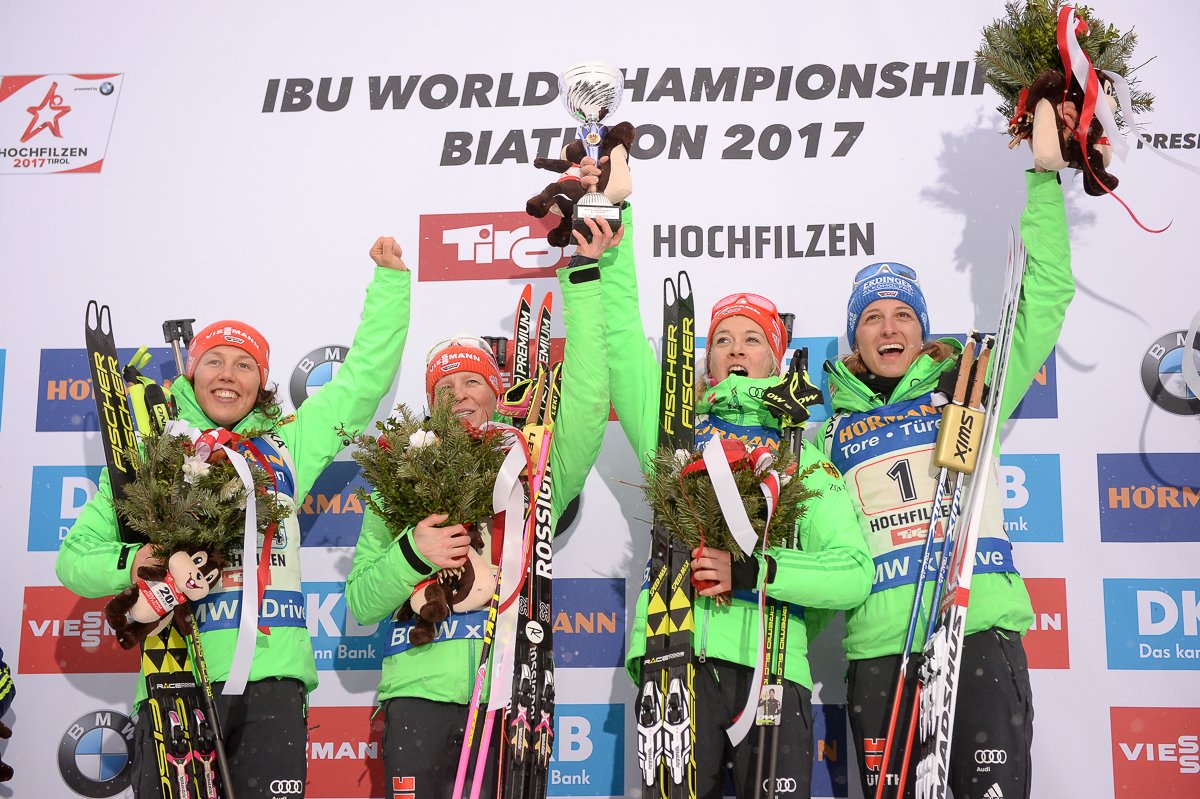
The German team of (l-r) Laura Dahlmeier, Franziska Hildebrand, Maren Hammerschmidt, and Vanessa Hinz celebrate World Championships relay gold. (Photo: Evgeny Tumashov/IBU/Twitter) “Of course that is gigantic,” Dahlmeier told ARD. “But I mostly want to point out that we were a really really good relay today, like already during the whole season. It’s just a lot of fun that we are now on the podium together, a great day for us.”
The other Germans agreed, and emphasized that despite the high expecatations, they were simply happy to work together.
“I think we are a strong team, and we had very good results in the past during World Championships,” Hildebrand said. “We can do it all together and have fun.”
While Italy had faded to just out of the picture, the fight for silver was intense. Gabriela Koukalova of the Czech Republic, Olena Pidhrushna of Ukraine, and Marie Dorin Habert of France all left the final stage within 10 seconds of Dahlmeier, and more than that, within four seconds of each other.
“During the last loop I was remembering the last year all the time,” Pidhrushna said. “In every relay last year, it was the fight on the last loop for me.”
The three women skied together for about half a loop, until Pidhrushna’s skis proved superior on a downhill and she glided past the other two. She took the opening and put in a surge up the next hill. Koukalova dropped first, undone by seemingly slower skis, and Dorin Habert couldn’t hang on either. Silver belonged to Ukraine.
“When I overtook the girls under the bridge I realized, this was my chance and now I have to jump for a medal,” Pidhrushna said. “And so I did, and it worked and I’m really happy.”
She finished 6.4 seconds back. France earned bronze (+8.1) and the Czech Republic was left in fourth place (+14.0).
“I’m very happy about this medal with all the team,” Dorin Habert said in a press conference. “It was very stressful for me. I know that Olena is a very good finisher. And of course Gabi is just crazy, she is the top this season, so in my head it wasn’t very easy to make it. So I’m happy to get this.”
Perhaps the happiest woman on the podium was Anastasiya Merkushina of Ukraine. Just 22 years old, she was appearing at her first senior World Championships.
“I have no words because it’s too much emotions for me,” she said in the press conference. “I cannot believe that this is my first World Championships and silver medal, it’s too big. I did not expect this result. Of course I believe in my team, but it’s really great.”
U.S. 14th, Canada 16th
Neither the U.S. nor Canada had perfect shooting days, with 13 spare rounds apiece; Canada also had two penalty loops.
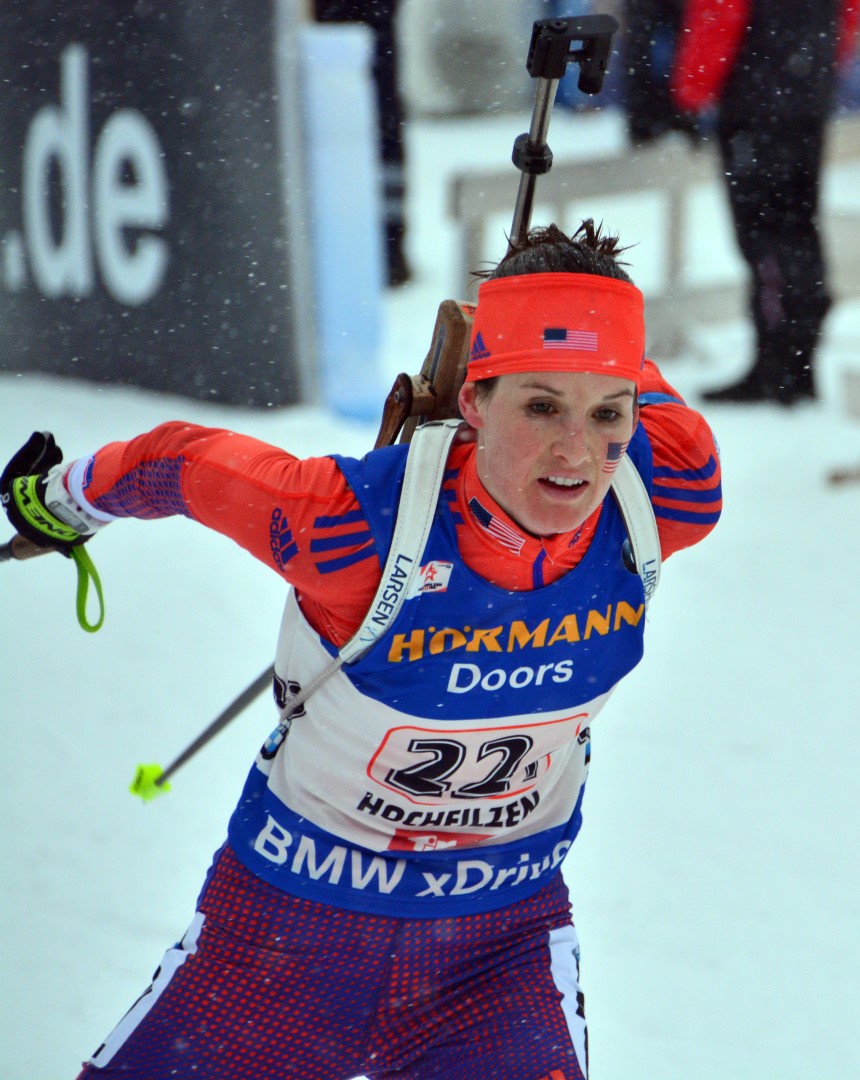
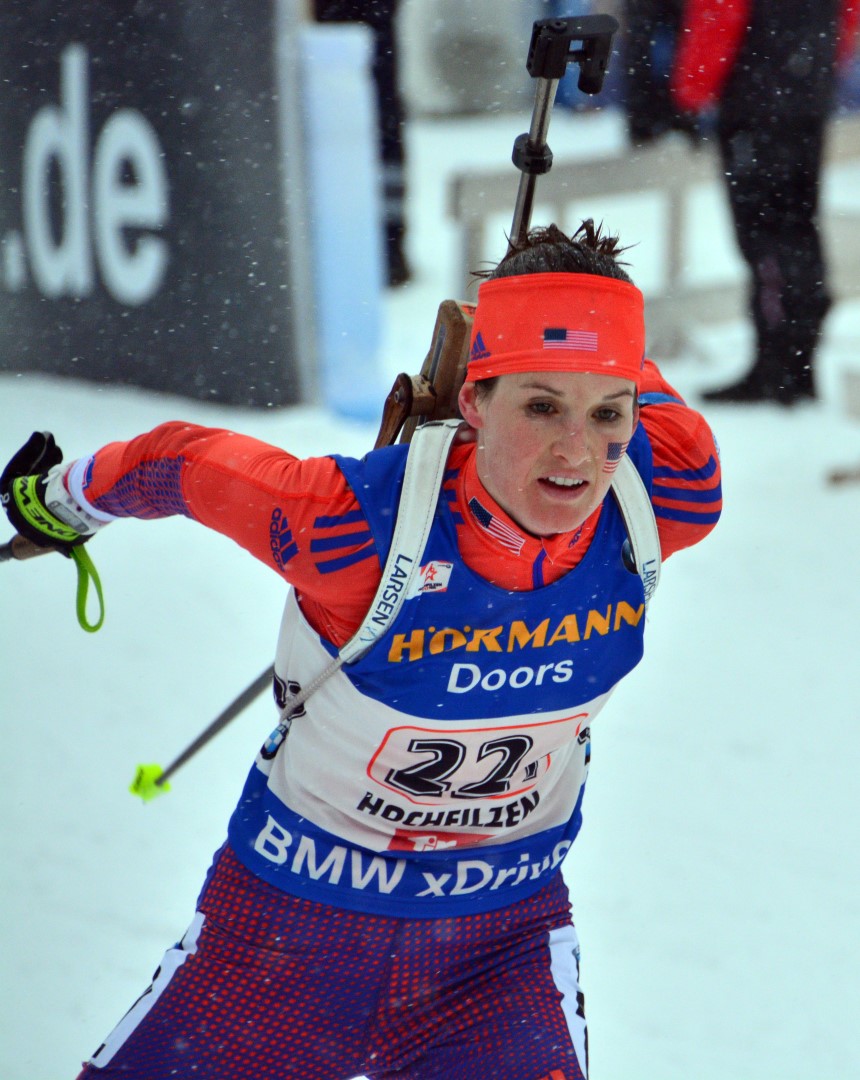
Clare Egan racing the first leg of the U.S. women’s 4 x 6 k relay at IBU World Championships on Friday in Hochfilzen, Austria. (Photo: Glen Crawford) Both teams had good, yet frustrating starts.
The U.S. started in bib 22, after they did not field relay teams for the first part of the season and thus lost out on team ranking points.
“The first leg, it’s so slow [with the new snow] to pass and it takes so much energy that my coaches basically said, ‘Unless there’s room in a good track to go around, don’t bother’,” Clare Egan said. “So I looked at it almost as a 4 k race after the first stage.”
She used one spare round in prone, and then took all three in standing. Despite that, she managed to move up on the trails on every single loop, and tagged off in 16th.
“I was really hoping to clean the prone so that I would be in a good position for that second lap, but I missed my first shot,” Egan said. “Then standing, maybe that 4 k approach meant I was a little over the redline in my shooting. I went really slowly [with the shooting], that was the problem, but I hit my targets. I missed two and then I missed the first spare. Then I had two targets, two bullets, and I’m just really happy that I managed that situation well.”
Susan Dunklee took over and skied the fastest second-leg time among all teams, cleaning prone and then using two spares in standing. Like Aymonier, she struggled with the copious wet snow falling on the range.
“The standing, the mats are really slippery, and I almost fell over just trying to stand up on the mat,” Dunklee said. “Then I just didn’t really take the time to set up in my position, I just felt like my legs were going out from under me the whole time.”
By the time her work was done the U.S. was in seventh place, and had moved from 1:20.7 back to just 36.7 seconds back from the lead.
“I really like having big packs of people in front of me,” Dunklee said. “It’s just really thrilling to chase them down. The course… it’s one of those glazed days where your shin muscles get all tight and it is hard to sprint. So you have to stay right in the middle where people have skied. I had to be a little patient, and when I went I had to go hard, 100%, for a few cycles just to get around people.”
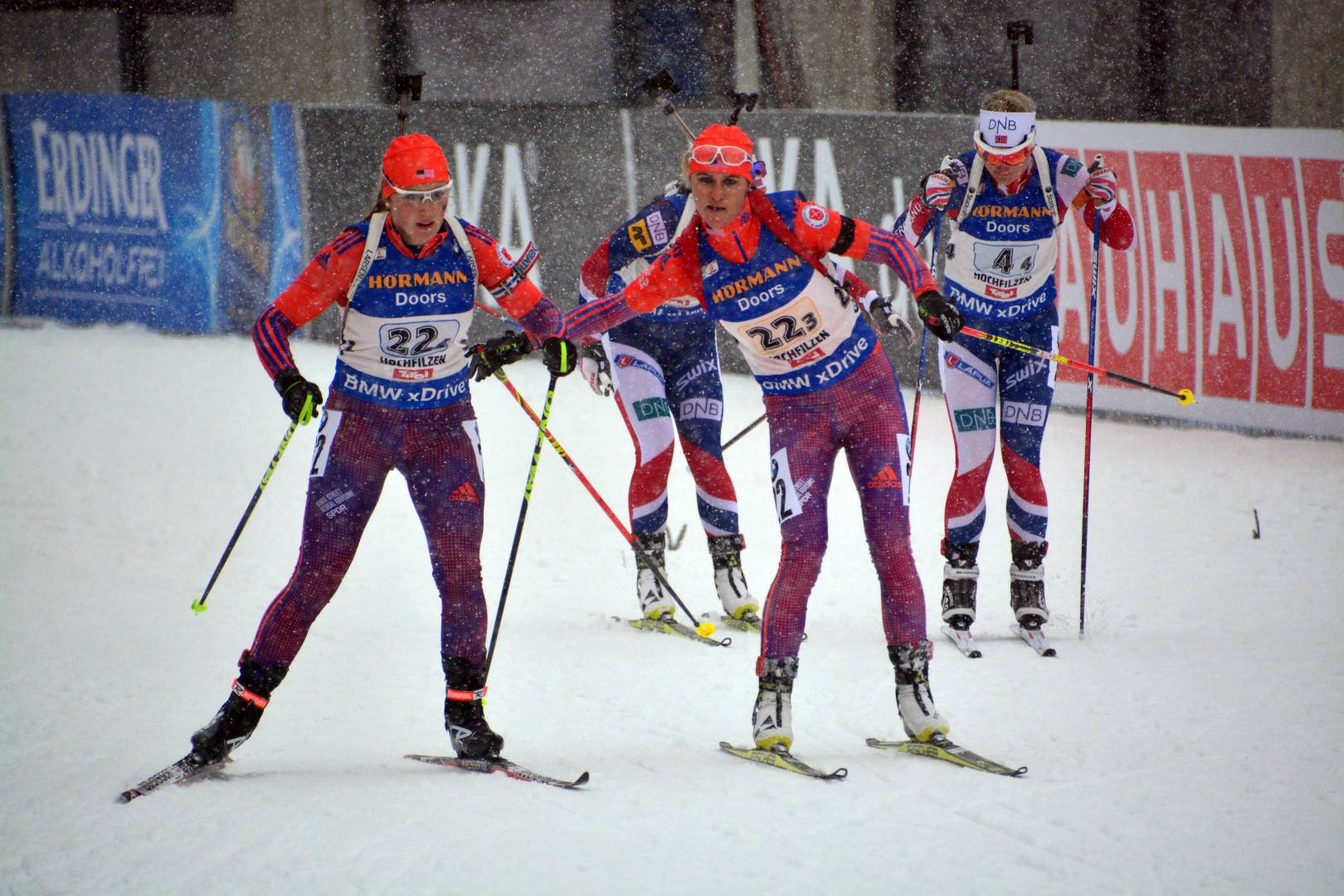
Joanne Reid (r) tagging U.S. teammate Maddie Phaneuf (l) in 12th during the final exchange of the women’s 4 x 6 k relay on Friday at IBU World Championships in Hochfilzen, Austria. (Photo: Glen Crawford) Joanne Reid took over, using four spares, then Maddie Phaneuf used three spares on the anchor leg. The team finished +3:37.0.
“The last loop was so hard,” Phaneuf said. “The snow was just so slow compared to every other day this week. The Swiss girl [Elisa Gasparin] I was with when I left the range did one long impulse up a hill when she passed me and I didn’t have any energy to stay with her. I tried, but nope. I knew there was nobody behind me anywhere, so I just tried my hardest to get to the finish line.”
For Canada, Rosanna Crawford kicked things off by using just two spare rounds, and shot fast, but was tripped up on the trail.
“I was pretty angry on my first loop,” she said. “I had moved up quite a few spots and then the Austrian [Dunja Zdouc] kind of shoved into me, and I spun around facing the wrong way so I lost a lot of time on that first loop, which I’m super pissed about. But the rest was good and the last loop was good, I was catching some girls.”
Austria was later disqualified when Julia Schwaiger used four spare rounds in her prone shooting stage; only three are allowed.
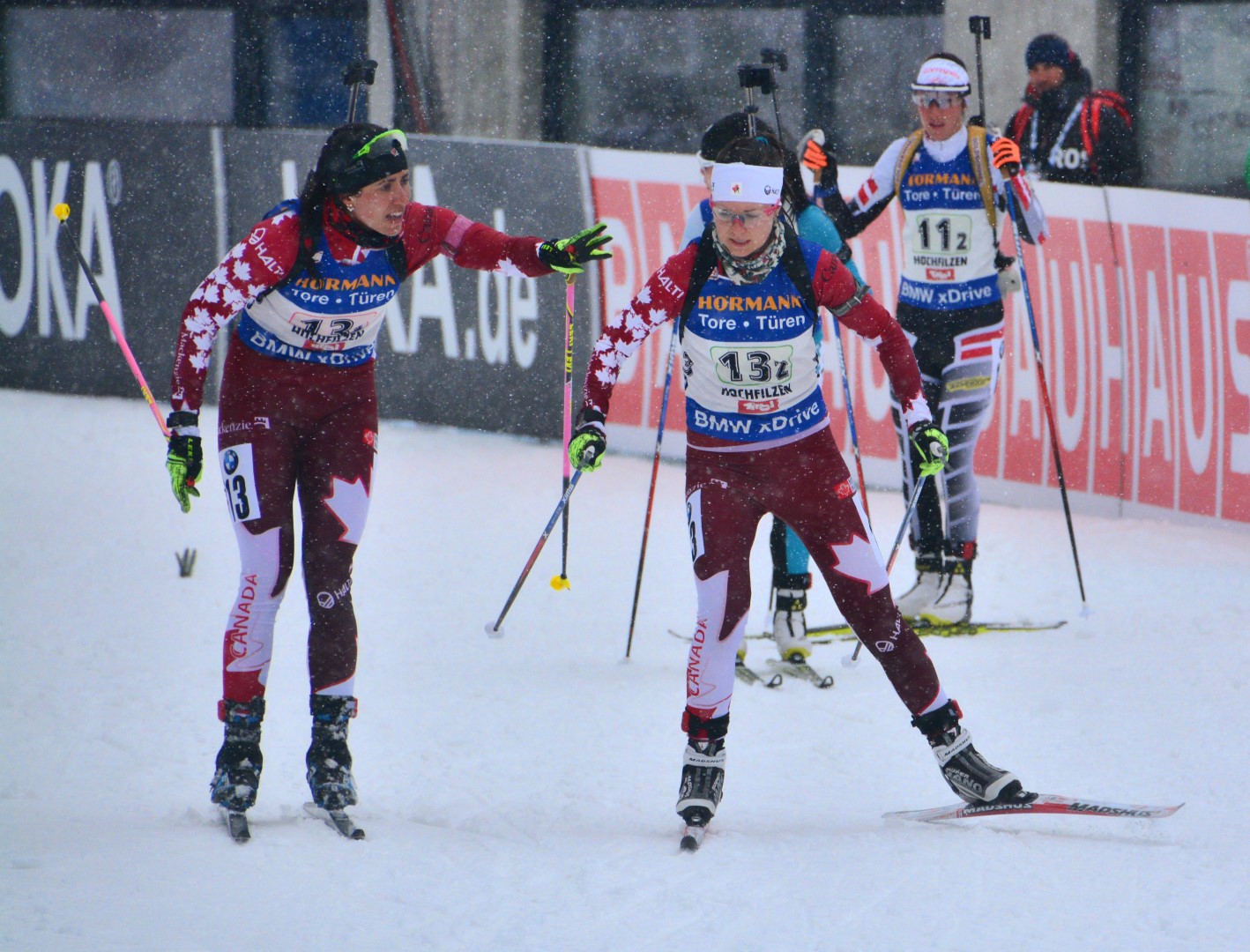
Canada’s Rosanna Crawford (l) tagging her teammate Julia Ransom in 13th in the women’s 4 x 6 k relay on Friday at IBU World Championships in Hochfilzen, Austria. (Photo: Glen Crawford) Crawford tagged off in 13th. But with Julia Ransom skiing two penalty loops in standing, the team dropped to 20th. Megan Tandy pulled Canada back to 16th, and Emma Lunder regained 16th after slipping to 17th after a few more spare rounds on the range. The team finished +5:59.4.
“Even though we weren’t in an amazing position, it was still my first World Championships relay, so I wanted to make sure I enjoyed it,” Lunder said. “Last year here at the World Cup in the relay we were 10th. And we also had a 10th in Ruhpolding this year where we shot super well. But I think maybe it just wasn’t there for everyone today. Korea is our last chance this year, so we’ll see what we can make happen.”
— Harald Zimmer and Alex Kochon contributed
-

Norway Women Win Again, But It’s Closest Relay in Two Years; U.S. Fourth in Nailbiter (Updated)
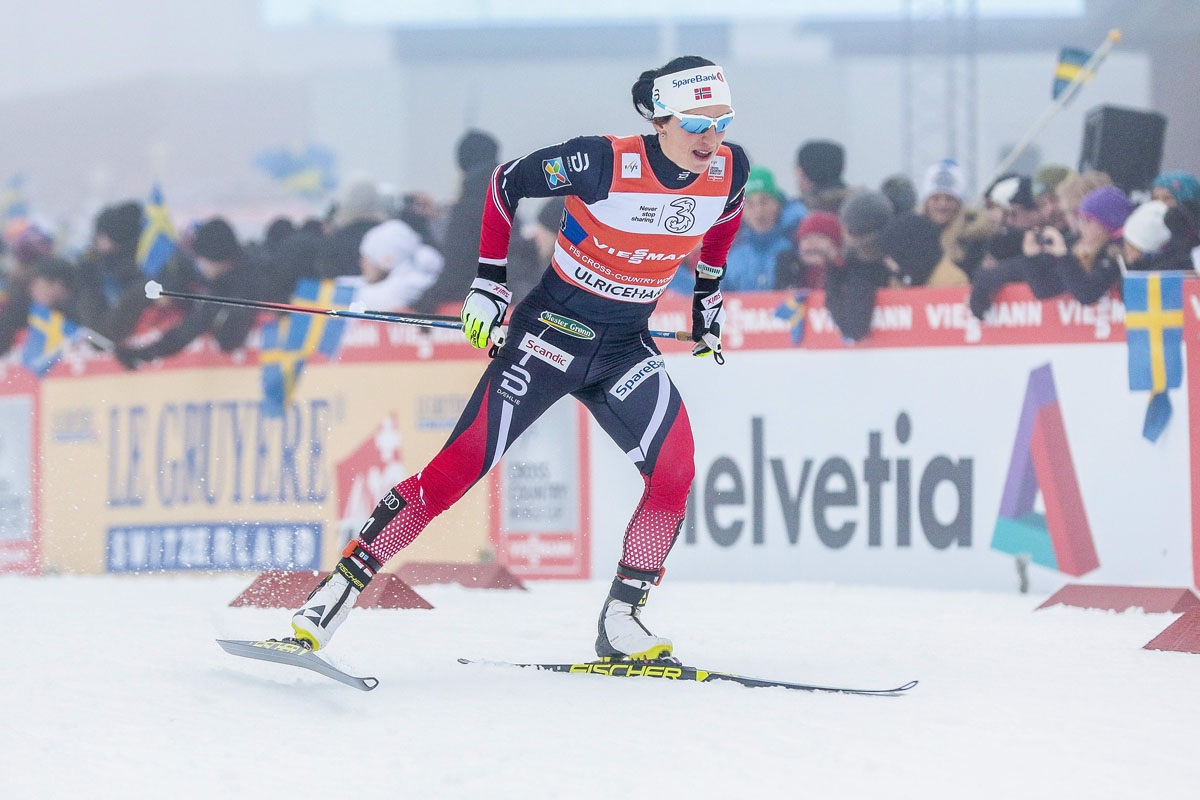
Marit Bjørgen taking Norway home for a win in the 4 x 5 k relay in Ulricehamn, Sweden. (Photo: Fischer/Nordic Focus) Another women’s 4 x 5 k World Cup relay, another Norwegian win.
Yawn? Not so fast. While the team of Ingvild Flugstad Østberg, Heidi Weng, Astrid Jacobsen, and Marit Bjørgen may have picked up the victory, the women’s race in Ulricehamn, Sweden, was anything but dull.
For one thing, it was the closest race in 23 months, going all the way back to the 2014 Olympics where Sweden took gold. The top four teams all finished within 10 seconds of one another – a far cry from the more recent Norwegian victories by 30 or 40 seconds or even well over a minute.
And for another thing, the race for second place was a nailbiter. After trailing the leaders by 11 seconds at the first exchange, the German and American teams had clawed their way back into the fight for the podium. So by the time 19 kilometers had gone by, it was Hanna Falk of Sweden, Sandra Ringwald of Germany, and Jessie Diggins of the United States flying into the stadium to the finish together.
All were highly motivated. It is Falk’s home course, and the very first time her club has hosted a World Cup.
“It was again a great experience,” Falk told FIS. “I was motivated by the audience.”
For Germany, being in that group of three meant the potential for the team’s best finish in three or even seven years.
And for the United States? Well, the U.S. women are always game for a relay, and Diggins is always game for a fight.
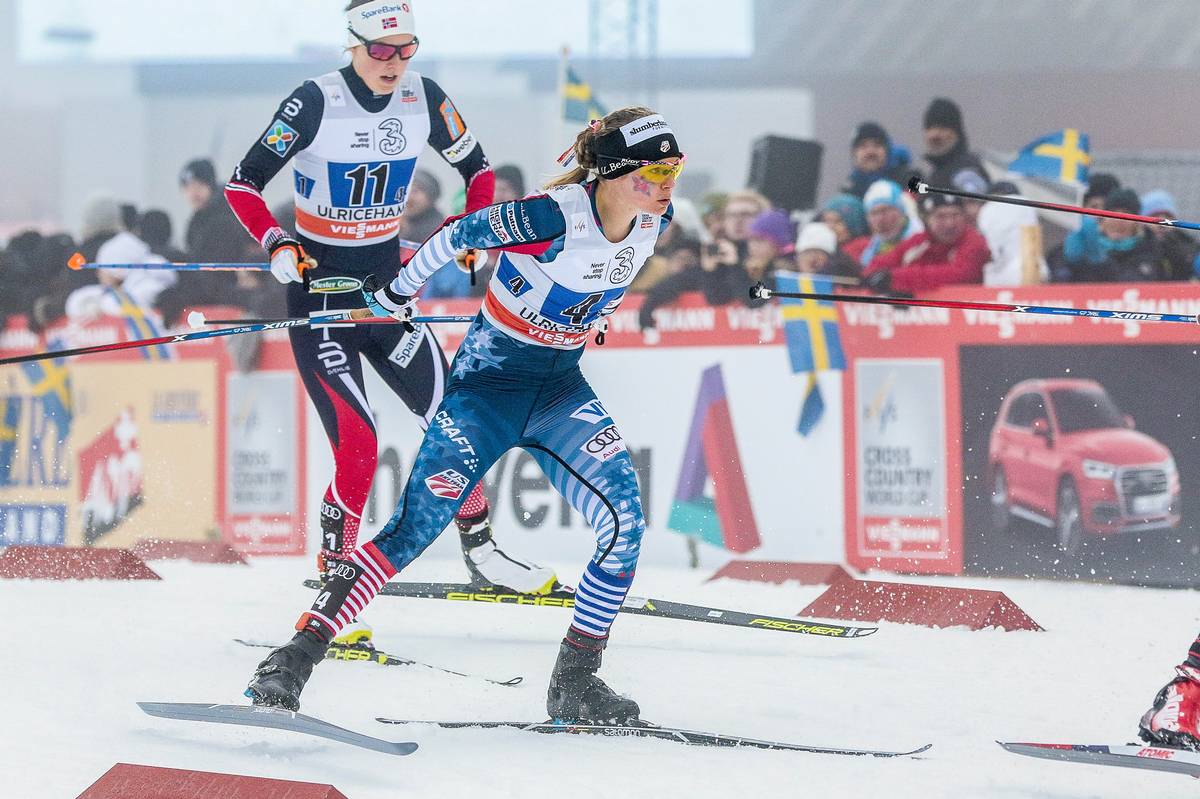
Jessie Diggins skiing the anchor leg for the United States. (Photo: Salomon/Nordic Focus) In the end, though, Diggins was boxed at the back of the group coming into the finishing straight. She had to choose an outside lane and couldn’t quite catch Ringwald and Falk.
The German edged the hometown favorite for second place, earning Germany their best relay finish since 2010.
“It was in my head that I absolutely did not want to become fourth today,” Ringwald told German broadcaster ZDF. “And then I just thought: killer instinct for the end, just keep at it! When Hanna [Falk] started her first attack I tried to somehow fight, and then on the last meters I knew that finish stretch suits me pretty well. And I just gave it all I had, and then it worked out for a second place.”
She crossed the line 8.8 seconds behind Bjørgen and Norway. Falk took Sweden to third, +9.0, and Diggins and the United States were left in fourth, +9.2.
“Of course we were hoping to be on the podium,” U.S. Ski Team Head Coach Chris Grover said in an interview. “So it’s hard when you’re that close to the podium, within a few hundredths of a second, and then not able to be on the podium. But all the women skied really well.”
U.S. Women Strong, But Can’t Crush the Course
The consensus from the U.S. team was that all four members of the first squad – the U.S. also fielded a second team, which finished 12th – skied well, but that the course wasn’t especially suited to them.
The classic portion of the relay (the first and second skiers) did ascend a major climb that had featured in the individual 10 and 15 k freestyle races on Saturday. But the skate course skipped that hill, and instead was rolling and flatter.
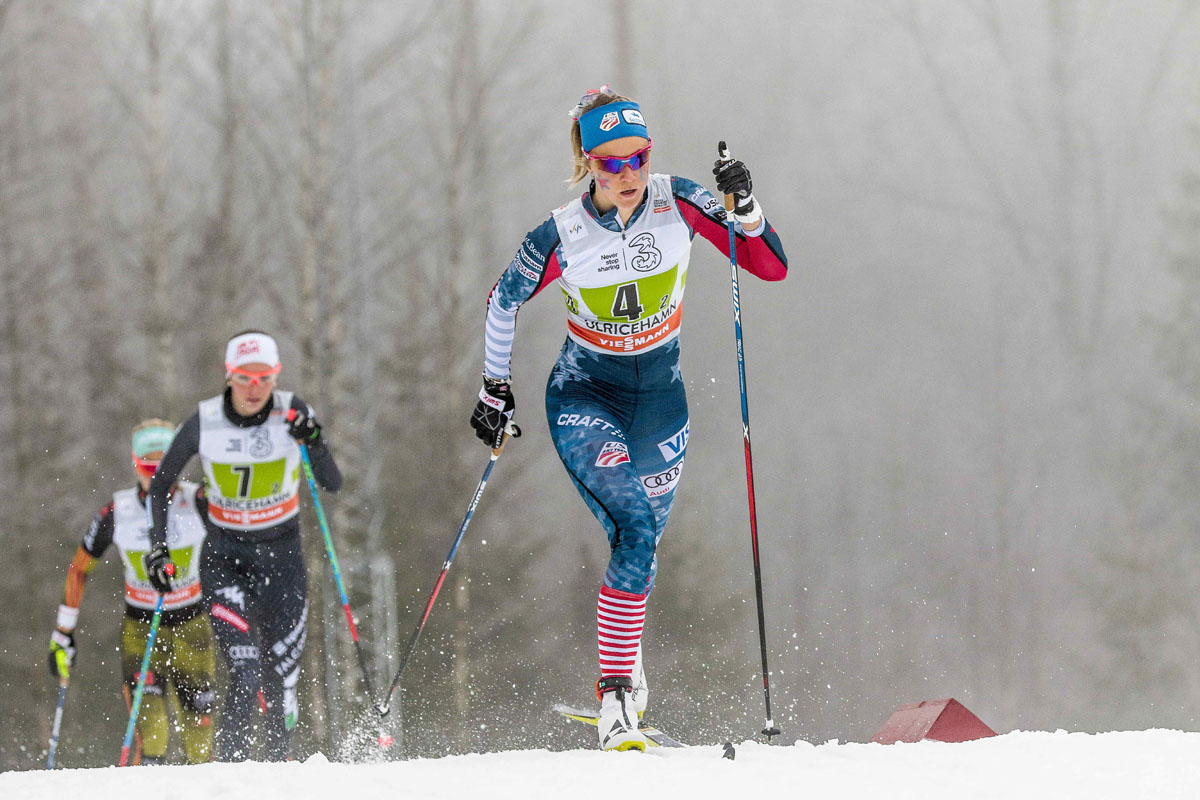
Sadie Bjornsen bringing the U.S. back up toward the leaders on leg two. (Photo: Fischer/Nordic Focus) Rosie Brennan kicked things off for the U.S. She lost contact with the lead group (both Norwegian teams, Ida Ingemarsdotter of Sweden, and Anamarija Lampic of Slovenia), but tagged in fifth place, just 11 seconds back.
“I didn’t have the best start, but found my groove about half way through and was able to pull back some time in the second half,” Brennan said in a USSA press release. “I will always want more when it’s a relay because I want to be the best for my teammates, but I am satisfied with today and now know exactly where I need to put in some work to be better next time.”
From there, Sadie Bjornsen took over.
“I knew I needed to be somewhat patient closing that gap,” Bjornsen said. “Thinking back to Lillehammer when a similar thing happened, I tried to close the gap in one kilometer and I exploded. I was trying to be a bit more conservative for the first part today, and it all worked out well.”
By partway around the loop, Bjornsen and Germany’s Steffi Boehler had bridged up to the chase group. Heidi Weng of Norway had taken off, putting 15 seconds on the rest of the field – Norway never faltered after that – but the American and German teams were now skiing with Sweden, Slovenia, and the second Norwegian team.
“Once we finally did catch the group it was a bit challenging because there really wasn’t anywhere you could pass,” Bjornsen said. “There were just two lanes.”
Coming into the stadium she took the lead, but it still wasn’t what she had hoped for – and she wasn’t able to drop the other skiers.
“I was double poling as hard as I could coming down that hill, while others were tucking,” Bjornsen said. “It was the only way to get around. It was impossible to pass, which I knew the classic legs were the only places to make a break, so for that reason I was wondering how it could be possible to go around those girls, but yeah. It was what it was.”
“The goal is always to be as close as possible after the classic leg, and to put our skaters in contention for the podium,” Grover said. “Rosie and Sadie did exactly that. They brought it in right in contact with the second-place team.”
The inability to create gaps was something that would come back to haunt the Americans on the next two legs, as the race transitioned to skating. Charlotte Kalla of Sweden tried to move and break up the chase group, but the U.S. racer Liz Stephen stayed right on her – and then the rest of the group caught up too.
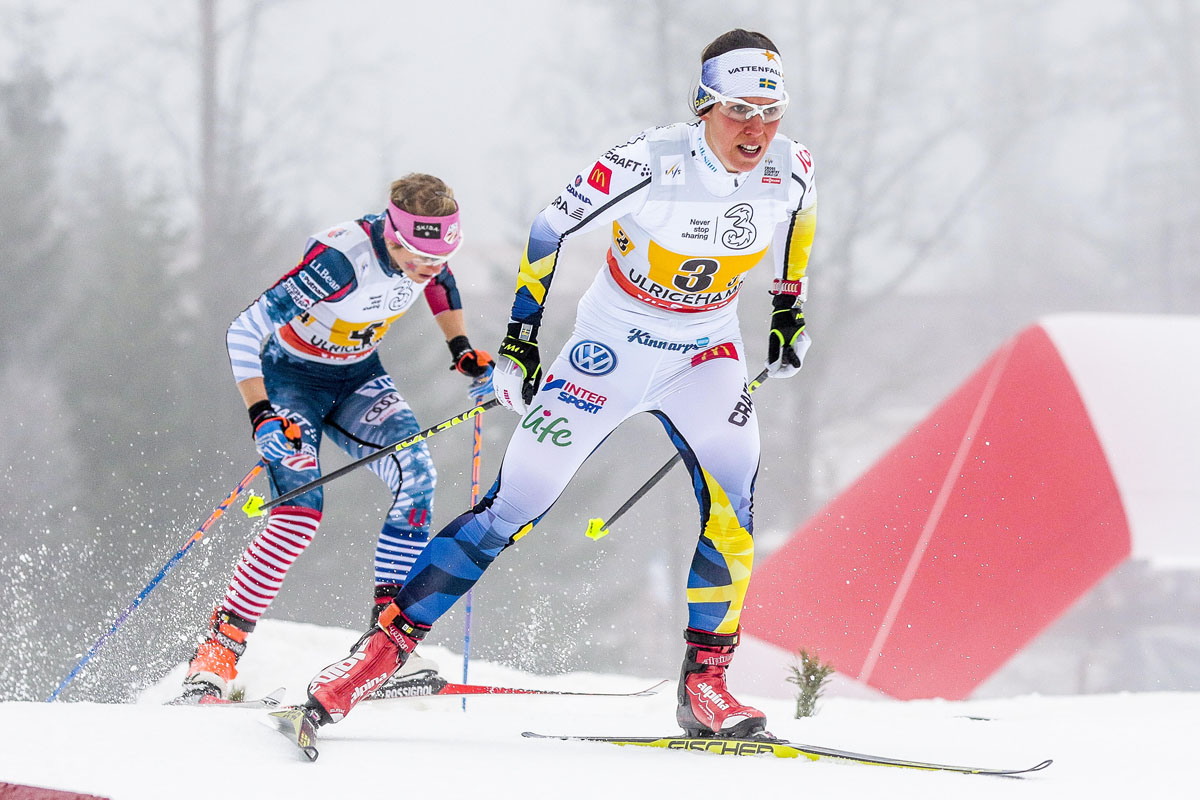
Charlotte Kalla of Sweden and Liz Stephen of the United States trying to make a break for it. (Photo: Fischer/Nordic Focus) “Kalla took it out hot — I tried to stay with her, and then Ragnhild [Haga, of Norway] and [Germany’s] Victoria Carl caught up,” Stephen said. “It was a really hard course to pass on because the draft was pretty amazing. There’s just no real long hill to showcase fitness, or to make any moves on, and I think you saw that in both the men’s and women’s races today. But it was a really fun race to do, and I feel like I skied really well, especially tactically well, which is not always my strong suit.”
Later, Stephen tried to up the pace herself, but similarly failed to get a gap. On the particularly fast course, the draft effect was just too strong.
“Today I had to think about the best way for me to ski the course,” she explained. “I skied the uphills really well, and as fast as I could. But we weren’t able to fully break the group, Charlotte and I. I led some of the downhill, flat stuff, and I felt like I was really moving,and speeding people out — but then there were three people right up on me again. Once you realize what’s going on, you have to play to your strengths, so I knew that I needed to just hang with the girls.”
By the time Stephen tagged off, Slovenia had dropped out of the group and it was a four-way race for second place, about 16 seconds behind the leading Norwegian team.
Diggins took the tag and the lead of the group. But she, too, was unable to ski away from her competitors, although Kari Øyre Slind of the second Norwegian team did drop back.
“For my leg, it felt like a chess match,” Diggins wrote in an email. “After watching Charlotte and Liz racing so well but seeing the drafters in their pack still clinging on, I knew my usual strategy of going all out was unlikely to work. I did the best I could with how it played out, but I feel like my fitness wasn’t reflected well in this particular race. It was a huge drafting course and it was exceedingly hard to drop people in the skate leg.”
Coming down the final downhill to the finish, Diggins was in back of Falk and Ringwald and trying to get past. She couldn’t, and dropping down to the finishing straight didn’t have an immediately obvious choice of finishing lanes. She eventually had to swing wide to the left. Despite a hard sprint to the finish, Ringwald and Falk got there first.
“In the sprint finish, we fell short by a quarter of a second,” U.S. Ski Team women’s coach Matt Whitcomb said in a USSA press release. “Jessie felt like she made a tactical mistake with her positioning, but she also did a lot right out there. She skied great. We’ll take a look at the footage to learn from the race for each athlete. I know she’d like to do it again, and the good news is that she will.”
While the U.S. didn’t make the podium – a goal which had been made easier by a disastrous start by Finland, almost always a podium contender – the women seemed philosophical about the day.
“We all had these little things that we wish we could have improved, but the thing about the U.S. relay team is that the harder the course is, the better for us,” Bjornsen said. “Today was a challenging course; it was really hard to make breaks on the skate legs. On the classic legs, I think if it would have been an even more challenging course it would have been better. Every course is different, and you want to be the best on every single course, but I think all four of us, all eight of us, really, finished the race today feeling… we wanted to be on the podium, of course, but feeling no crush of confidence out there. We all feel confident going into the next relay.”
A Second U.S. Team Toes the Line
It’s not often that the U.S. has two relay teams in a race, but that happened in Ulricehamn. Kikkan Randall, Ida Sargent, Sophie Caldwell, and SuperTour leader Liz Guiney finished 12th, +3:03.0, after losing a finishing-stretch battle with the Russia I team.
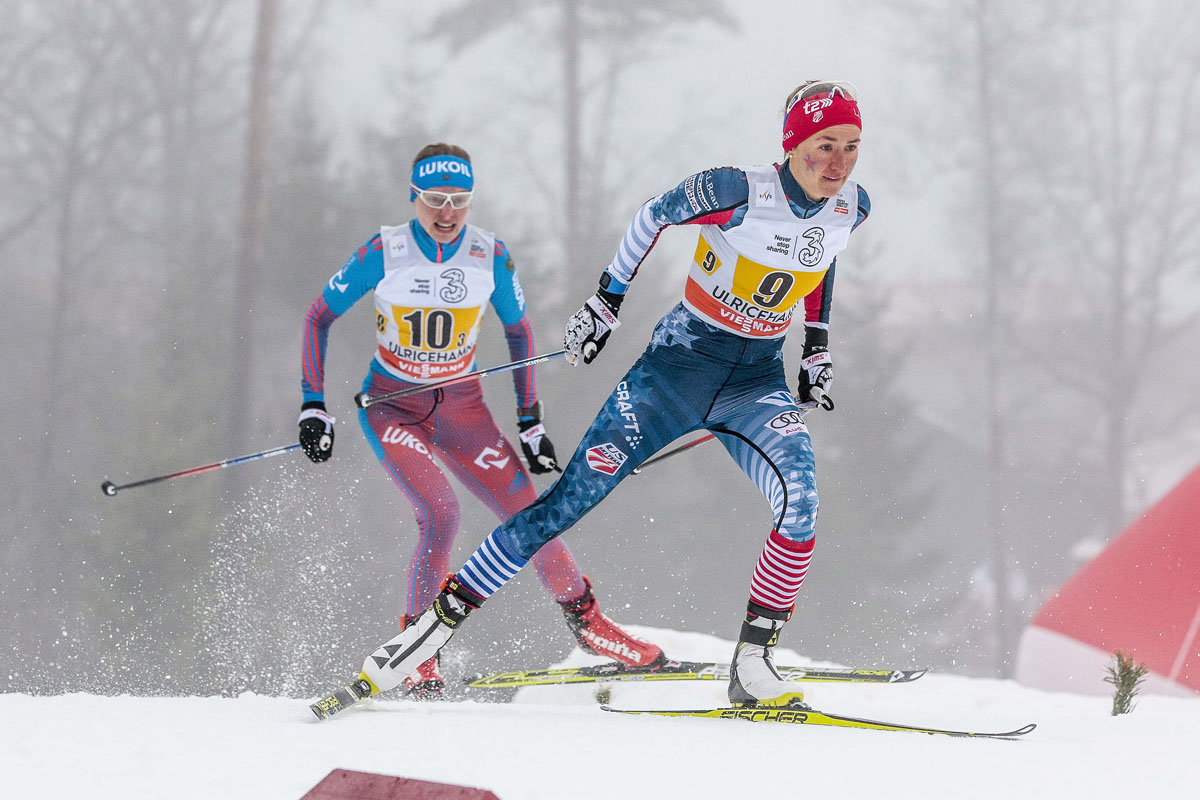
Sophie Caldwell skiing leg three for the second U.S. team. (Photo: Fischer/Nordic Focus) “It was really cool,” Grover said. “We had eight women so we were really hoping to field two teams, but you’re always worried that somebody’s going to get sick or something. But we were lucky that everyone was healthy and ready to go. That was cool. I wish we could do that more often.”
Randall had been 10th at the first tag, just 29 seconds behind the leaders and 18 seconds behind fifth-place teammate Brennan.
Sargent then took over and skied the eighth-fastest time among second-leg skiers, losing only 24.6 more seconds on Weng.
“I was really happy with how I felt today and had a lot of fun racing,” Sargent wrote in an email. “I skied solo for the whole race except for when [Finland’s Anne] Kylloenen caught me around the 4km mark, so we skied the last kilometer together. It was a very tough course to ski by yourself because there was a lot of flat and some long gradual downhill sections that would have been a lot easier to be in the draft or working with someone else during those sections… Considering that I was skiing solo I was really happy with how close I stayed to the leaders. I haven’t done many distance races this year so I wasn’t sure what to expect.”
After that, Sophie Caldwell brought the team to 11th, and Guiney, in her first World Cup relay, to 12th.
“I think the travel and excitement of the weekend caught up to me a bit,” Guiney wrote in an email. “I was mostly excited to be able to start on a World Cup relay, so I didn’t have any expectations beyond getting to the finish as fast as I possibly could. Skiing alone in a relay is always tough, so I just tried to focus on skiing each section as well as I could. Of course, I was really hoping to stay in front of the Russian team, but their last leg caught me with around 1 k to go. While I was able to stick with her until the finish, I didn’t quite have the sprint to get around her in the lanes.”
“Being on a team with Liz Guiney in her first World Cup weekend was also a blast!” Sargent, a Craftsbury Green Racing Project teammate of Guiney’s, wrote.
-Jake Ellis and Harald Zimmer contributed
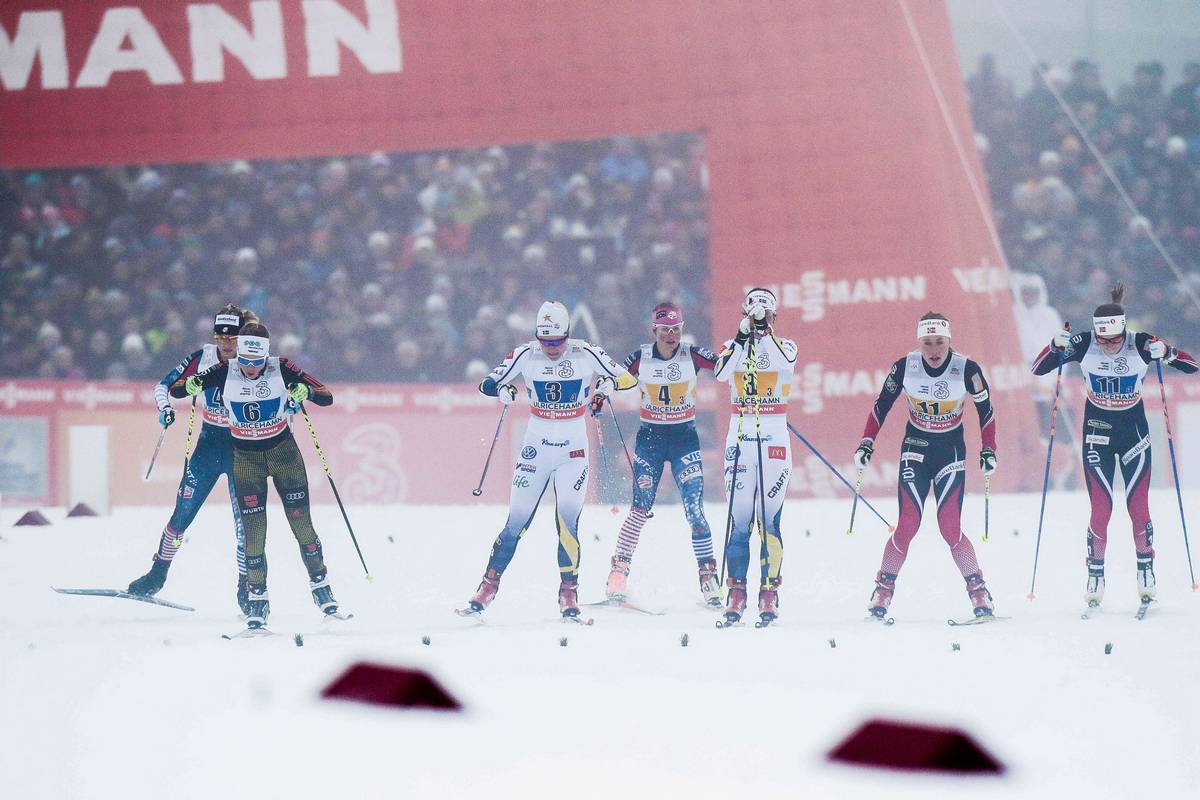
Teams in the tag zone in Ulricehamn. (Photo: Salomon/Nordic Focus) -

Ukraine’s Relay Shuts the Door on Germany; Canada 9th; USA 16th
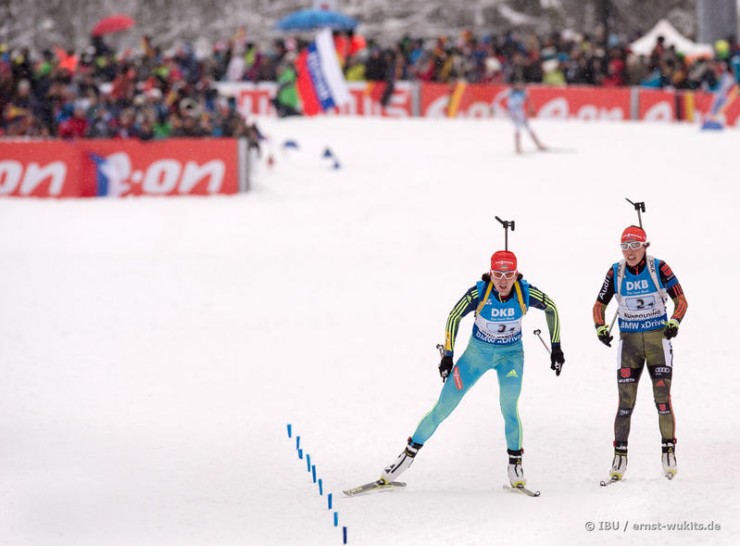
Ukraine’s Olena Pidhrushna (l) boxing out Germany’s Laura Dahlmeier (r) in the final meters of the women’s 4 x 6 k relay in front of a packed Chiemgau Arena at the IBU World Cup in Ruhpolding, Germany. (Photo: IBU/Ernst Wukits) It’s not often that you can hear catcalls and booing in a ski stadium. A football, basketball or soccer game maybe, but biathlon? On Sunday, 20,000 spectators packed the Chiemgau Arena in Ruhpolding, Germany, and many were not pleased with how the IBU World Cup women’s 4 x 6-kilometer relay played out. Just before the finish, Ukraine’s anchor Olena Pidhrushna, skiing in first, cut off local fan-favorite Germany’s Laura Dahlmeier to claim the ideal left lane in the final stretch. That ended Dahlmeier’s furious chase on the last loop to finish, and Ukraine took the win by 1.2 seconds in 1:16:14.2.
Ukraine, with Iryna Varvynets, Yuliia Dzhyma, Valj Semerenko, and Pidhrushna, incurred one penalty lap and only needed four spare rounds (three prone and one standing), while Germany, with Karolin Horchler, Miriam Gössner, Maren Hammerschmidt and Dahlmeier, had two penalties and required eleven spares (six prone, five standing), but the latter three athletes all skied the fastest course times on their legs to make up the deficit.
Behind them, Dorothea Wierer anchored Italy — which had no penalties and used 10 spares — to third (+43.8), about a second of Russia’s Olga Podchufarova, after the Russians had two penalties and required seven spares. Thus the same teams that had already been on the podium after the first relay of the season December in Hochfilzen, Austria, made it again, except Italy and Ukraine swapped positions.
Teams from 22 countries started on Sunday and 17 finished without being lapped.
Canada, with Julia Ransom, Rosanna Crawford, Megan Tandy, and Zina Kocher, placed ninth (+1:59.5) with no penalties and seven spare rounds, while the U.S., with Annelies Cook, Susan Dunklee, Clare Egan, and Joanne Reid, finished 16th(+5:39.8) with three penalties and eleven spare rounds.
‘Of course you are angry in the moment’
At first, Dahlmeier was visibly annoyed about the end of the race, after she erased a 27.7-second gap on the last leg (and was still 9.2 seconds behind heading into the last loop). After getting blocked she switched back to the middle lane, but once she realized she couldn’t beat Pidhrushna, Dahlmeier stopped pushing and slammed her right pole into the snow across the finish.
“The final loop was really hard. Of course you are angry in that moment, after going at full throttle for 6 kilometers, and then it fails on the last few meters,” said Dahlmeier, who anchored Germany to a relay gold at 2015 World Championships, told TV broadcaster ZDF. “But we can be very, very happy about the second place, especially with the penalty laps that were shot, and with this lineup. I think that’s really nice, and a beautiful finish for the days in Ruhpolding.”
“It was a hard last loop,” Pidhrushna said at the post-race press conference through a translator. “I know Laura is a really good skier, and I knew that I would have to fight for every meter. I am really happy that the team won. I just held the shortest line to the finish. I really wanted to win; it was a big battle but it is sport.”
After seeing a replay again, Dahlmeier agreed in a later interview with ZDF: “That was all correct, you can’t say anything against that. For me, it’s too bad; it didn’t help to switch lanes, and then it was already all over. Maybe I have to train a little bit with the cross-country skiers, pick up some things on how they solve sprints in order to become better.”
“That’s biathlon, that’s the race,” her teammate Hammerschmidt said at the press conference. “It was the same in Hochfilzen [where Germany lost a finishing sprint to Italy], maybe in the next relay we are first. But I think it was OK, and the girls [from Ukraine] make a good job, congratulations to the first place.”
The German athletes did not complain for long, knowing their day could have ended much worse after second leg Gössner incurred two penalty laps earlier in the race, at that time falling back to 15th position with the podium seemingly out of reach.
(Story continues below)
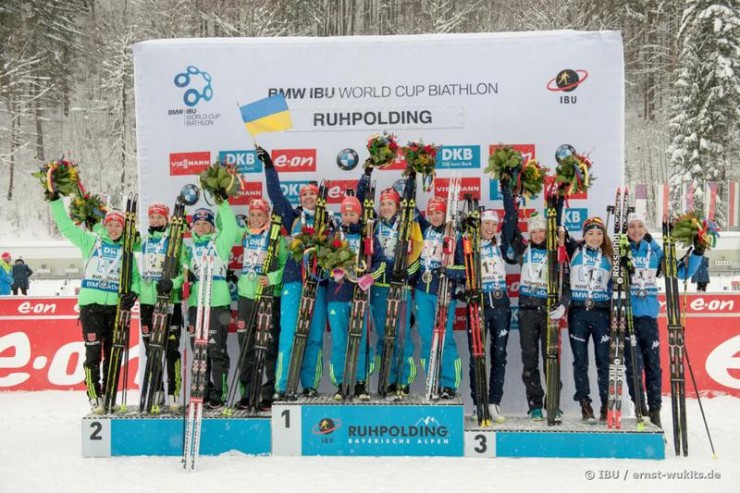
The women’s 4 x 6 k relay podium at the IBU World Cup in Ruhpolding, Germany; with Ukraine (c) in first, Germany (l) in second, and Italy (r) in third. (Photo: IBU/Ernst Wukits) Race Day
Several teams had opted to rest good athletes for Sunday’s relay at the end of a long block of races, including Germany. Franziska Hildebrand, who already won two World Cups this season, had asked her coaches for a break, and then Vanessa Hinz also had to defer her relay start due to a cold, while teammate Franziska Preuss missed the entire Ruhpolding weekend with a hairline fracture in her tailbone.
That prompted the coaches to change their second-place relay from Hochfilzen on three positions, and make a call to Karolin Horchler, 26, who originally had other plans for Sunday:
“[Saturday] afternoon I had been on my way to Ridnaun, South Tyrol [Italy], because I was supposed to compete there in an IBU Cup mixed relay today,” Horchler told ZDF. “And shortly before the arrival Gerald [Hönig, women’s head coach] called me and said I should please turn around. All in all, it was on the road for five hours… To start here in my second home in Ruhpolding, that’s what I always dreamed of.”
“It’s surely not a very common lineup,” coach Hönig told ZDF before the race. “But in general our expectation is that any relay team we start contends for a spot on the podium.”
Similar to Germany, the Czech Republic chose to rest overall World Cup leader Gabriela Soukalová, France rested Marie Dorin-Habert, currently second place in the World Cup standings, Italy’s Federica Sanfilippo sat out the relay, and Austria’s top skier Lisa Theresa Hauser missed it as well. Finland didn’t enter a team, missing their best athletes Kaisa Mäkäräinen and Marie Laukanen.
The newly called-up Horchler began the race well for her team, skiing at a pace that allowed her to stay in contact with the best and requiring only one spare each in prone and standing. She tagged off in fifth place, 22 seconds behind Norway’s Marte Olsbu in the lead, with Ukraine’s Varvynets in second after shooting clean.
“It was a really crazy day, in the morning I heard that I can start here. The second place is very good for the team. It’s wonderful,” Horchler said in the press conference after the race.
“It’s surely not a very common lineup, but in general our expectation is that any relay team we start contends for a spot on the podium.” — German Women’s Head Coach Gerald Hönig
Germany’s second skier, Gössner skied out fast on her first loop making up positions, but struggled in prone, missing two of her targets and quickly running out of spare rounds.
“Trying to do everything especially well because it’s a relay is a fitting description,” Gössner told ZDF while the race was still going on, with tears welling up in her eyes. “I really can’t explain myself how I can shoot two penalty laps in prone. I didn’t have the feeling that conditions were difficult or that I was shaking… Then I was completely flustered, I didn’t know if that shot went left or right, just didn’t know where to aim.”
After another fast loop, at least she was able to avoid the penalty lap in the standing position after requiring two spare rounds, usually her more shaky discipline, moving up to 13th place.
“Without my two penalty laps a lot more would have been possible today,” a still-disappointed Gössner later told ZDF after the race. “Our luck was that the other nations also shot penalty laps, so the other two [teammates] could make up some time, and that saved us. But my race was absolutely not good.”
“Yeah, she is very annoyed, but that’s relay,” said Hammerschmidt, who lifted Germany from 11th to second on the third leg. “That happens to everyone, but it’s all the better for her that we still got the second place. And I just told her she is allowed to say two more sentences about her shooting, and then we’ll call it a day.”
“I just told her she is allowed to say two more sentences about her shooting, and then we’ll call it a day.” — Germany’s Maren Hammerschmidt, about her teammate Miriam Gössner
While Gössner had been struggling on the range, Ukraine’s Dzhyma shot clean at the top of the field, and while not quite as fast as the German behind her, also skied the sixth-fastest time on her leg.
“Our skis were really good today, thanks to the service team,” she said in the press conference. “I like the new [additional] snow better.”
Hammerschmidt received the tag 1:48.8 minutes behind Ukraine in 11th place, then began a furious chase to get closer to the top again (“one of the best relay performances I can remember in quite a while” ZDF color-commentator Herbert Fritzenwenger commented).
She missed two shots in her prone shooting stage, and then needed one more spare round in standing.
“I have to say, I was a little too cautious there,” Hammerschmidt told ZDF. “I should have turned [on the sights] immediately but thought ‘maybe it will work,’ and when you think that it usually doesn’t. So I should have reacted earlier, I got pretty nervous there after the two misses. In standing I went with full risk, and thankfully only had to reload once.”
Like Gössner, she skied the fastest course time of all athletes on her leg, and handed off to Dahlmeier in second place, 27.7 seconds behind.
“Of course I would have liked to have a better starting position,” Hammerschmidt told ZDF during the race. “But maybe the pressure was off a little. I just wanted to do my own race, and see that I can catch a good pack. I had really good skis today, and felt good on the course. On the last loop I could catch one after another, that was such a great feeling. And then I was really surprised to be second in the finish.”
Ukraine’s Semerenko skied the third leg, and at this point could have secured a large gap over the rest of the field. She narrowly missed her last shot in prone, but then the usually solid shooter was not able to clean the remaining target with her three spares, and had to ski a penalty lap. That opened the race back up as Belarus’ Nadzeya Pisareva overtook her and some other teams moving back within striking distance of the lead.
“I had nothing left but to run faster,” Semerenko joked in the press conference, according to a translator.
How quickly the fortune of a team in a relay can change was demonstrated once again after the next shooting. Pisareva and Semerenko each needed one spare in standing, with Semerenko still trailing by 9.8 seconds as she left the range. Then suddenly Pisareva completely ran out of energy, and could be seen trying to herringbone up the next hill without any glide.
Semerenko quickly passed her, along with several other teams as well. At the bottom of the next climb, Pisareva stopped next to one of her coaches to exchange a few words, seemingly ready to quit the race, before continuing to ski again.
The Belarusian tagged her teammate Darya Yurkevich 1:28.2 minutes behind in 11th place. Yurkevich would end up losing two more positions, finishing 13th (+2:40), despite Belarus posting one of the best shooting performances of the field for Belarus (no penalties, five spares).
With Belarus now out of the picture, the race for the podium on the final leg came down to Ukraine, Germany (+27.7), Norway (+28.6), Italy (+42.4), Sweden (+43.0), Slovakia (+45.3), and Russia (+45.7), with more teams looming shortly behind.
Dahlmeier set out at a fast pace to close the gap to Pidhrushna, and after both shot clean in prone, the lead had been reduced to 18 seconds. On the next loop, Dahlmeier stormed up the climbs and managed to catch Pidhrushna, overtaking her just before the shooting range. But while the Ukrainian stayed clean in the final standing stage, Dahlmeier required one spare, again falling behind by 9.2 seconds as they left the range.
On the final loop, Dahlmeier had more problems catching up to Pidhrushna again, who managed to preserve her lead through the last flat section and descent into the stadium. Then the most talked-about scene of the race happened, and Ukraine prevailed in that final sprint.
“I was pretty down on my strength, but too bad, at the end it went a little poorly,” Dahlmeier told ZDF. “Maybe I should have stayed behind her and then pick the middle lane. A little unfortunate. But still, considering how it looked initially, we are mega-happy about the second place. That was a grandiose success, and you really see what is all possible in a relay race.”
After a number of changes between several countries vying for third place, Italy,
with Lisa Vittozzi, Karin Oberhofer, Alexia Rungaldier and Wierer, beat out Russia’s Ekaterina Shumilova, Daria Virolaynen, Ekaterina Yurlova and Podchufarova in a second exciting finishing sprint by 1.1 seconds.
“I think the relay is the work of the whole team, everybody has to do their best, it’s not only one man or one woman,” Wierer said in the press conference. “I was in the fourth position when I started, and I was a little bit worried because [there were] also Tiril [Eckhoff] and Laura. I hoped that I would shoot well. I was a little too fast in the standing so I missed the first one. But I was lucky that Tiril shot more misses than me. And then behind me was the Russian, and I was really nervous. I was sure that she will pass me on the finish line, but I gave everything and it was the third place, finally.”
Norway was fifth (+1:11.5) with Marte Olsbu, Fanny Horn Birkeland, Synnøve Solemdal and Eckhoff combining for one penalty and 13 spares. Olsbu tagged the team in first after the first leg, and after Birkeland’s penalty on the second leg, Norway still remained in podium contention, picking off the places with Germany, until Eckhoff required all her spares on the last leg — three in prone, three in standing.
Ahead of the upcoming World Championships at home in Oslo, the Norwegian women have not reached the podium since taking bronze at the 2014 Olympics, though they remain hopeful.
“It may not look like we’re there yet, but we are good enough. It’s about getting the final touches in place,” Eckhoff told Norwegian broadcaster NRK.
Canada in Top 10
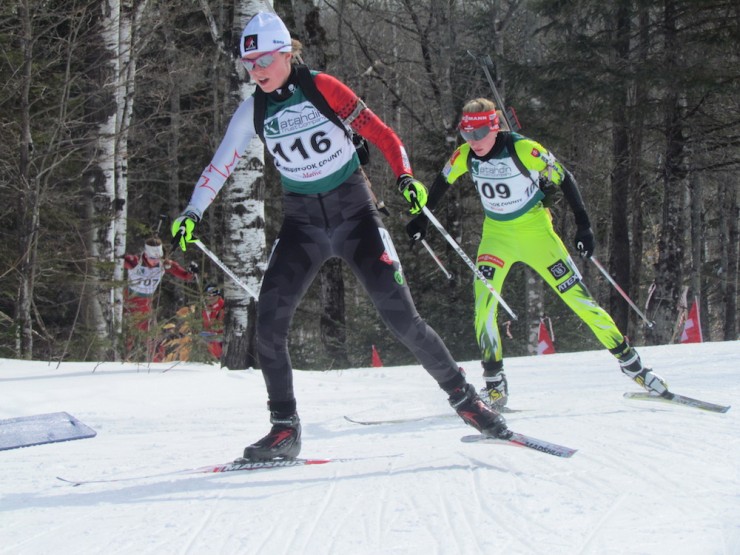
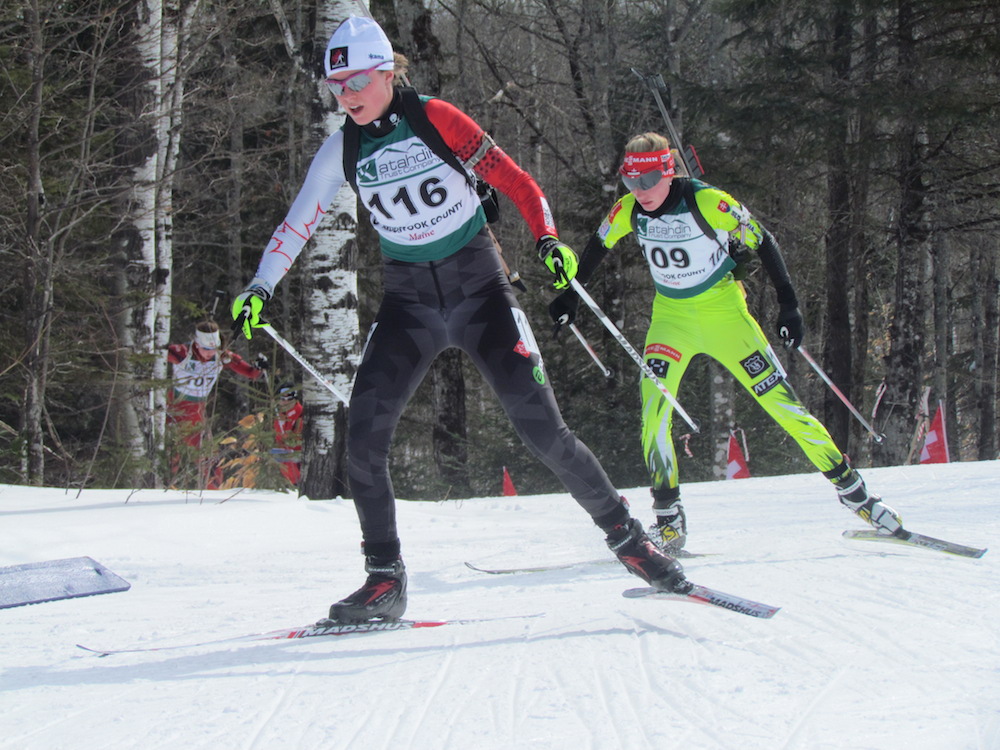
Canada’s 22-year-old Julia Ransom (116) during the 2014 IBU Junior World Championships pursuit. (Photo: Katrina Howe) For Canada, Ransom’s day began with tangle out of the start and a resulting broken pole, but she quickly received a replacement.
“It caught me a little by surprise but I quickly realized that I needed to signal to someone for a spare,” Ransom wrote in an email to FasterSkier. “I was on the opposite side of the trail as all of the coaches, but one of our wax techs was somehow able to get a pole to me despite having a few girls between us. Unfortunately that little mishap put me to the back of the pack, but I was able to sneak my way back in there before the first shooting.”
After the field had stayed closely together on the first loop, Ransom shot fast and accurately in the first prone, cleaning all five targets and leaving the range in fifth place. By the next timing point, she even had moved up to third.
“I was stoked to be skiing with the top 3 girls! I felt strong and controlled on skis,” she wrote. “Unfortunately, I struggled with my [standing] spares and lost those leaders. I’m not letting that happen again next relay! “
In her standing stage, Ransom initially missed just one shot, but then required all three spares to clean it and avoid the penalty lap. She fell back a few positions, and tagged off to Crawford in 11th place, 50.7 seconds behind Norway up front.
Crawford shot flawlessly, cleaning both her prone and standing positions, something only 10 other athletes achieved on Sunday. When she left the range after the last stage she had moved her team back up to fifth place (+1:01.5), then only lost only a few more seconds on the final loop tagging Tandy still in fifth (+1:07.7), behind Slovakia and ahead of Norway.
In the prone stage, Tandy missed two targets, then needed all three spares to clean them, leaving the range in 10th place (+1:17.1) with Germany still behind in 12th. In standing, Tandy was able to stay clean, though she could not make up another position. But she also barely lost any more time, tagging off in 10th and 1:17.6 back.
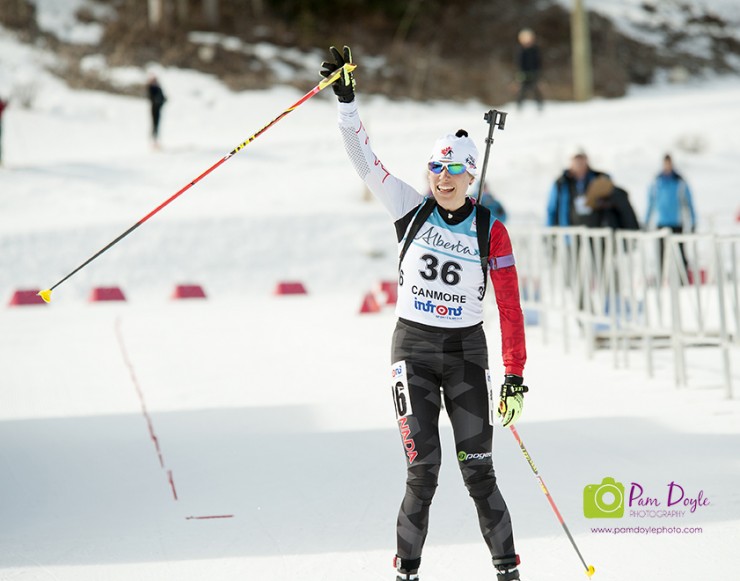
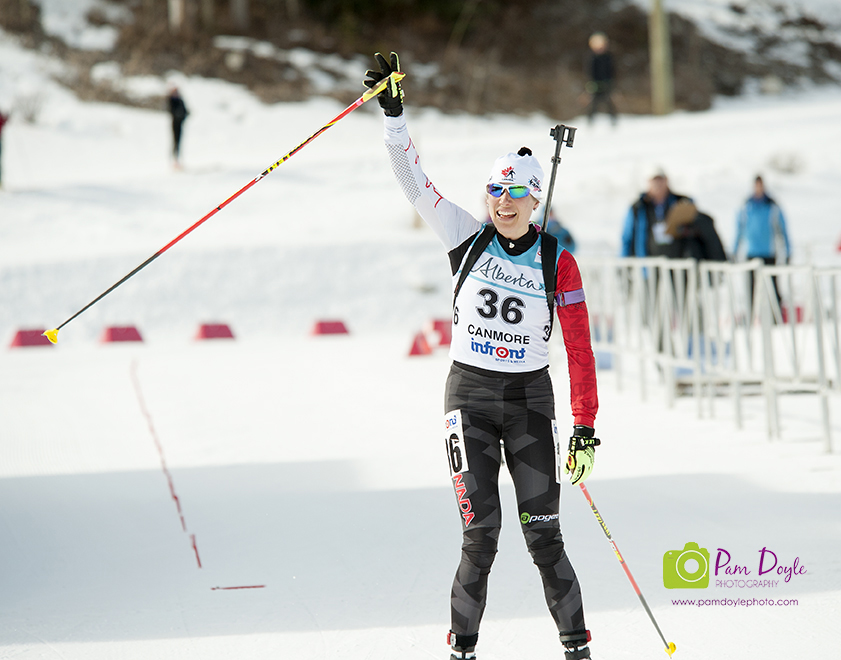
Kocher winning an IBU Cup sprint in Canmore, Alberta, last season. (Photo: Pam Doyle) Team veteran Kocher anchored the relay, and like her teammates, displayed a strong shooting performance. She cleaned prone, and then had only one miss in the final standing, leaving the range in the vicinity of a number of other teams fighting for position.
“Last laps are usually my strength so I attacked leaving standing,” Kocher wrote in an email. “Unfortunately, just before the uphills the French competitor [Celia Aymonier] stepped on my pole and it broke, costing me metres of time. I got a pole fairly soon from Norway, but it was very short, and then for the last sprint to the finish switched it for my own pole from our coach Matthias [Ahrens]. But that cost us a potential top 6. Two broken poles for our team, crazy!”
In the end, she finished the ninth for Canada, 1:59.5 minutes back, with no penalties and only seven spares. “Excellent momentum for going forward to next week’s relay for our team,” Kocher concluded.
“Our team had a goal of collectively using 8 spares and stay in the top 10… We also wanted to beat Sweden to maintain our current Nation’s Cup position,” Ransom wrote.
They achieved both those goals. The Nations Cup is its own end-of-season award by the IBU, but also determines the number of starting spots a country gets awarded for the next year. Germany is still in the lead after the races of this weekend, with Canada in 10th position and the U.S. in 15th.
“I was proud of our women’s team today. We all had fairly solid races and had the potential for top 6; unfortunately Zina broke a pole on her last lap, which caused a fall and a few positions. I think we are all fired up for another exciting race next weekend,” Ransom added. “The crowds here in Ruhpolding were fantastic. They brought a lot of energy to the races and were devoted fans in even the worst conditions.”
U.S. 16th with three penalties
For the U.S. the relay got off to a difficult start, when Cook incurred a penalty lap in her first prone shooting, leaving the range in 20th position, 58.6 seconds back behind the leaders.
“I was disappointed in myself today because I had a penalty in the first prone shooting that put me in the back of the pack,” Cook said in a US Biathlon press release. “I was unable to get the girls into a good starting position, although I had a lot of confidence in what could happen after that. It was a crazy day with lots of penalty loops happening to great teams and the standings changed a lot through the race.”
After a better standing stage shooting where she only required one spare, Cook about kept her position but lost a few more seconds to the top (despite skiing the 14th best course time on her leg), tagging Dunklee in 21st (+1:38.4).
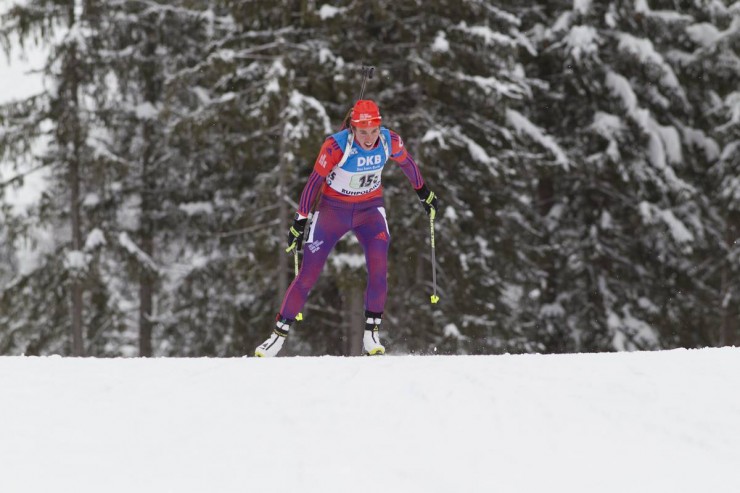
Susan Dunklee (US Biathlon) skied the second leg for the U.S. women’s relay on Sunday, picking off three places to bring them from 21st for 18th. They ultimately placed 16th. (Photo: USBA/NordicFocus) Dunklee, who had been the starter for several years, again moved to the second leg, the same order the team had experimented with in the relay in Hochfilzen. After needing one spare in the prone, she had moved up one position, but had lost additional time to the leaders (+1:58.8) despite skiing the fastest first loop.
In standing, she again had to use one spare and left the range in 19th (+2:26.3). Dunklee barely lost more time on the final loop, and tagged Egan in 18th, having made up three positions on her leg, but almost losing another minute to the top, now 2:29.9 behind.
On Sunday, Egan had one of her best recent shooting performances, cleaning prone and only requiring one spare round in standing.
“I made a breakthrough in my standing shooting at the beginning of the winter, and I’m taking advantage of that newfound confidence. I have bad stages now and then but I am learning from each one and improving all the time,” Egan wrote in an email. “For example I missed 1,3 in the first two stages of Thursday’s Individual, but then pulled myself together and finished the race with 0,0 on the last two stages. Today I missed my last (10th) shot, which is a letdown, but I was able to hit it with my first spare round.”
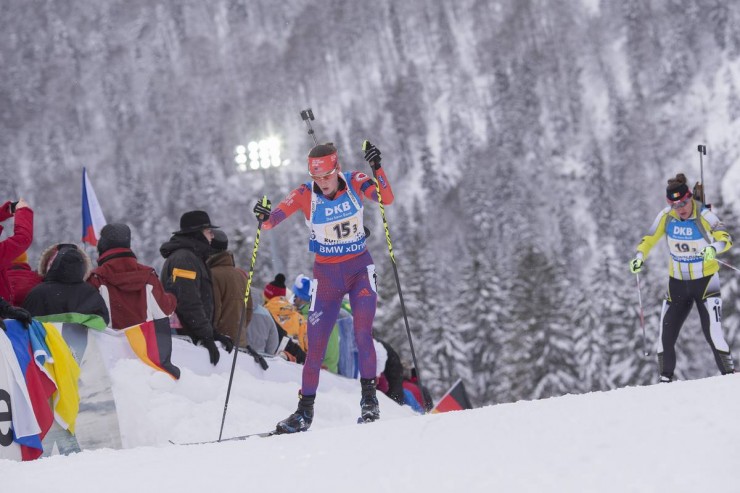
Clare Egan (US Biathlon) skiing the third leg of the 4 x 6 k relay on Sunday, bringing her team from 18th to 16th with just one spare round. (Photo: USBA/NordicFocus) Out on the loop, Egan skied the 14th-fastest time of her leg, and was able to move her team up two positions, tagging off 2:45.4 minutes behind in 16th.
“The conditions were relatively fast today,” she added. “It snowed a ton last night but we were lucky and it stopped during our race. Our wax staff gave me excellent skis this morning, but unfortunately I was not able to put them to very good use, as my body was not responding well at all.”
In her first week with the World Cup team, Joanne Reid anchored the relay (in place of Hannah Dreissigacker, who skied that leg during the first relay of the season).
“I think the reason the coaches put me last is because I don’t have the consistency or the experience of the rest of the team, and therefore any mistakes I made would be after they had already raced,” Reid wrote in an email.
Reid emerged from prone having used just one spare, but then struggled in the final standing, running out of spare rounds and ultimately having to ski two penalty laps (0+1, 2+3).
“Today I made what I assume is a classic error for a new biathlete coming in from pure skiing, and came into the range too hard in standing,” Reid explained. “I was intensely focused on catching the two teams in front of me, which was going well until I got to the range. It’s always hard to remember in the heat of the moment that your shooting is just as important as your skiing.”
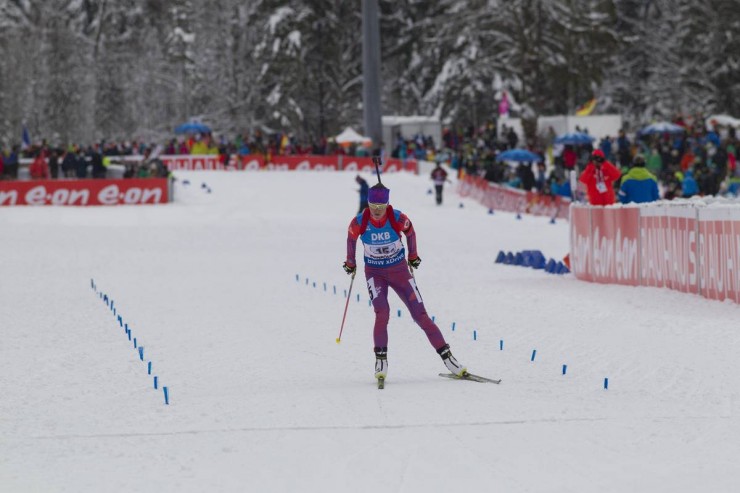
In her first IBU World Cup relay, Joanne Reid anchored the U.S. women’s team to 16th with the 11th-fastest course time on that leg. (Photo: USBA/NordicFocus) “The pacing on that lap was certainly my mistake, and not just pacing, but the fact that I don’t have the shooting skill to handle as high of a heart rate or shoot at the same speed as the rest of the girls, not to mention I hand load spares much slower.”
Overall, Reid skied the 11th-fastest course time.
“It was definitely a fast course out there, but still very difficult. I can only imagine how tired the athletes are who have raced the entire world cup period, and also qualified for and raced the mass start this weekend,” she wrote. “For Susan to go out there and ski the fastest leg after all those races (and long ones besides) is incredibly inspiring to me, and I wish I could have given her a better performance on my end.”
“I really enjoyed the course out there today — we were much luckier than everyone in the mass start to have such hard-packed conditions,” Reid added. “I think that’s the only 6 km I’ve ever skied in my life, so I wish I could compare it to something, but until I do a few more biathlons I have no reference point.”
Reid finished in 16th for the U.S., ahead of Romania, with the other five teams behind them lapped.
“We wanted to do better than last time (15th) but unfortunately we fell just short of that today,” Egan concluded in her email.
“This team has so much potential and I really believe in that,” Cook said in a US Biathlon press release. “So many of the pieces are there and are also showing, but not quite enough of them to do what we are capable of. It is frustrating but it is also making us hungry to do better and we have another relay coming up next week.”
“I think a team always goes into a relay with the hope that they can improve on their start position,” Reid wrote. “Obviously for us today, that didn’t happen, but I think we have a lot of the pieces right, and I’m certain this team (whether or not in the future it includes me), can have an incredible day.”
The IBU World Cup now moves on to Antholz-Anterselva, Italy, where there will be another relay for the women and men on Sunday.
-
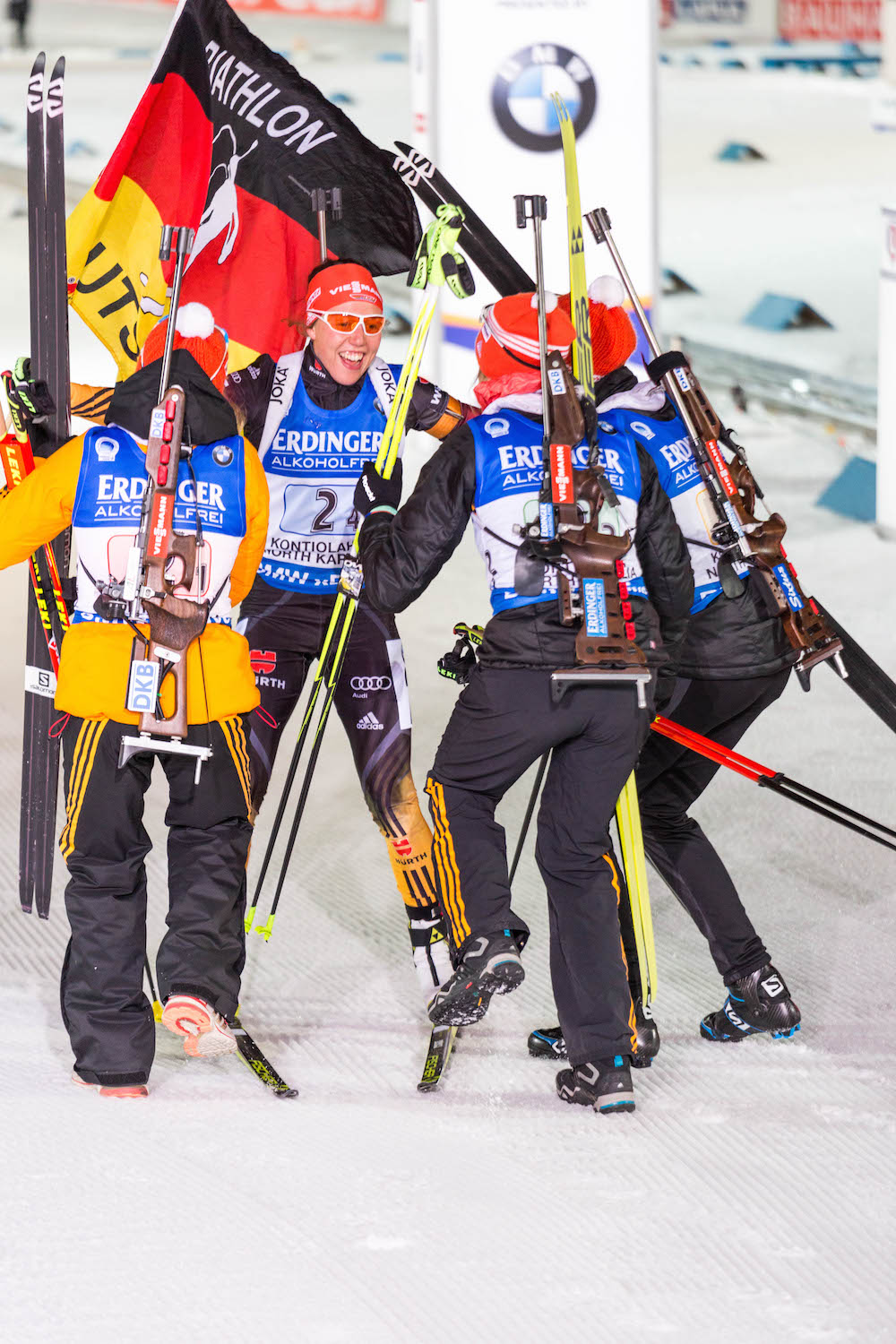
Young German Relay Dusts Women’s Field; Canada 10th, U.S. Matches Season-Best 12th at IBU World Champs

The start of the women’s 4 x 6 k relay at 2015 IBU World Championships on Friday in Kontiolahti, Finland, with Germany’s Franziska Hildebrand (4) near the front with Belarusian Nadezhda Skardino (3), Canada’s Megan Heinicke (10) at left, and American Susan Dunklee (21) near the back right. (Photo: USBA/NordicFocus) KONTIOLAHTI, Finland — Not long after finishing the women’s 4 x 6-kilometer relay at 2015 IBU World Championships, Laura Dahlmeier sprinted past reporters to jump into the arms of one of her teammates, her rifle still attached to her back.
A German sports broadcaster employee quickly ushered the 21-year-old Dahlmeier and her three teammates to the Sportschau platform overlooking the stadium where they had just destroyed the 25-team field.
In the minutes before, Dahlmeier built on a 30-second lead her teammate Vanessa Hinz established on the third leg to anchor Germany to a 1:00.3-minute win. Hinz had used just one spare in prone to clean both her stages and skied the second-fastest third leg to leap from third into first — and considerably ahead of anyone else.

The German women’s relay rushes the finish line to greet anchor Laura Dahlmeier, who secured their win by more than a minute over France in the 4 x 6 k relay at 2015 IBU World Championships in Kontiolahti, Finland. The German team included Franziska Hildebrand, Franziska Preuss and Vanessa Hinz. (Photo: Kontiolahden Urheilijat/Kari Kuninkaanniemi) With Franziska Hildebrand and Franziska Preuss skiing first and second, respectively, the Germans combined to secure gold ahead of France in second and Italy another 5.8 seconds back in third.
“I think it was a dream of all of ours to be world champion and now the dream is true,” Dahlmeier said in a press conference after her team used six total spares and avoided any penalties for the win in 1:11.54.6.
France, with Anais Bescond, Enora Latuilliere, Justine Braisaz, and Marie Dorin Habert (the latter of which had already won two golds at these world championships), had nine spares and one penalty from Braisaz on the third leg. Habert lifted them from fourth and 1:18.8 behind Germany to silver — her fourth medal in as many races in Kontiolahti, including silver in the mixed relay — using two spares in prone and none to clean standing.
The Italians, with Lisa Vittozzi, Karin Oberhofer, Nicole Gontier, and Dorothea Wierer, led through the second exchange after Oberhofer elevated them from fourth to first with four total spares and the fastest course time of the second leg. Gontier started out 2.5 seconds ahead of Czech Republic, but slipped to third after using two spares on each of her stages.
“I’m not so in shape now and I have to thank my teammates, they are so strong,” Gontier said in the press conference.
She tagged Wierer in third, behind Germany and Russia, respectively. Habert and Wierer both overtook Russia’s anchor Ekaterina Shumilova in the final stage, where Shumilova used two spares, Habert cleaned, and Wierer used one. Wierer left the range in third, 0.6 seconds behind Habert and about 10 seconds ahead of Shumilova in fourth.
“I was so worried about the Russian girl and I thought, ‘I don’t want fourth position,’ ” Wierer said. “I really give all for the team, but I was really, really nervous.”
The team that didn’t lack confidence was Germany, with three women under the age of 23 (Hildebrand is the oldest at 27).
“We are a young team and a strong team and it’s a perfect day for us,” Dahlmeier said after cleaning both her stages to tally her second World Championships medal (following her individual silver in last weekend’s pursuit).
“We are the best team,” she told Sportschau.
Russia, with Ekaterina Glazyrina, Daria Virolaynen, 15 k individual gold medalist Ekaterina Yurlova, and Shumilova, finished 10.7 seconds off the podium in fourth. Norway placed sixth, Ukraine was sixth, Belarus took seventh, and the season-long relay favorites, the Czech Republic (which won the mixed relay) finished eighth, 3:11.7 behind the winners.
The Czechs came through the first exchange in 12th after Eva Puskarcikova’s first leg, 26.4 seconds out of first, and Gabriela Soukalova lifted them to second, 2.5 seconds back. They fell to eighth during Jitka Landova’s third leg, in which she had a standing penalty and six spares. Anchor Veronika Vitkova used three spares and had two penalty laps in prone, then went on to clean standing before finishing eighth.
Canada 10th, U.S. 12th
While the Germans drew a significant amount of attention with their win, two North American squads stood together near the finish, cheering their teammates on with each passing lap before waiting to congratulate their anchors as well.

Rosanna Crawford (Biathlon Canada) racing the second leg in the women’s 4 x 6 k relay at 2015 IBU World Championships in Kontiolahti, Finland. Despite a penalty, she brought her team from 14th to 11th, and the Canadians finished 10th. (Photo: Biathlon Canada/NordicFocus) Canada’s second leg, Rosanna Crawford was one of them, standing near the finish and looking for her teammate Julia Ransom, who had anchored their team to 10th.
Audrey Vaillancourt had tagged Ransom in 10th, improving one place after Crawford put her in 11th at the second exchange. Ransom, a 22-year-old World Championships rookie, used two spares on each of her stages to help the team meet its personal goal: a top 10.
She held off Austria’s Katharina Innerhofer by 0.5 seconds to finish 10th, 3:39.5 behind Germany. In total, the Canadians used 10 spares and had one penalty (which came on Crawford’s standing stage).
“Megan [Heinicke] tagged me off into a great spot, [and I] came in prone … with the group,” Crawford explained.
She had entered her first stage around 12th after Heinicke tagged her in 14th, 33.8 seconds out of the lead. (The team’s first leg, Heinicke used a single prone spare and cleaned standing.) Crawford cleaned prone, then went on to use three spares in standing while trying avoid the penalty loop, which she ultimately had to ski around once.
“Standing, I came in and missed my middle shot and loaded my first spare quickly and missed,” Crawford explained. “As I loaded my last spare, I took my rifle down and shook my legs out and missed.”
Not only did the penalty loop cost her, but the three spares, which she estimated takes her six to 10 seconds to load apiece, set her back as well. Regardless, Crawford skied the sixth-fastest second leg to tag Vaillancourt in 11th, 1:08.6 behind the leader.

Audrey Vaillancourt (Biathlon Canada) during prone shooting earlier this week at 2015 IBU World Championships in Kontiolahti, Finland. She was the third leg of the Canadian women’s relay that finished 10th on Friday. (Photo: Biathlon Canada/NordicFocus) Vaillancourt, 23, went on to use two prone spares and cleaned standing outright to bring the team to 10th, 1:45.3 out of first.
“I didn’t really know what place I was in at any time, it was just good to always have a pack of people [around me],” Vaillancourt said. “I passed people in the standing so that felt awesome. It’s always such a good feeling, like, ‘Yeah!’ … I was a little tired on the last lap, but I’m happy.”
Ransom used two spares in prone, rising to ninth, and then two more in standing to drop one spot to 10th.
“I saw eight and ninth ahead of me on the climbs,” she recalled. “You’re just gunning for those and didn’t look back.”
In her first World Championships relay, Ransom said she was “terrified” to anchor, “mainly because I saw the start list and saw a lot of medalists hanging out in the fourth [leg] with me.
“In zero I was pretty nervous, but you quickly fall back into race mode,” she added. “Even though you start with [Belarusian Darya] Domracheva, you put it aside. Once I was on the track and I could feel like I could ski like myself it was fun and I loved it.”

Rosanna Crawford (Biathlon Canada) trails Nadzeya Pisareva of Belarus during the second leg of the women’s 4 x 6 k relay at 2015 IBU World Championships in Kontiolahti, Finland. The Canadians went on to place 10th. (Photo: Biathlon Canada/NordicFocus) Overall, the Canadians were pleased with their performance, with two relative newcomers on the team. While it’s Vaillancourt’s second World Championships, this season was her first full time on the World Cup.
“[Last night], we talked about that if we all bring our A-game, a top 10 is realistic and a top eight would be the perfect race,” Crawford said.
“I don’t think that we can say that we had a perfect performance as a team today, so I think that makes it even more awesome that we made our goal,” Heinicke said. “We have been mixing up our relays a ton this year. This is only the second time us four have raced together and we have never had this order. Lots of experiment; it’s been good.”
Dunklee Fastest First Leg
The Americans tied their season best in 12th, with Susan Dunklee, Hannah Dreissigacker, Annelies Cook, and Clare Egan. Despite starting in the seventh of nine rows at the start, Dunklee skied the fastest course time of all the first legs to put her team in third, 3.7 seconds behind Poland, which led through the first exchange.
“I almost prefer starting in one of the back rows,” Dunklee explained in an email after the race. “I love the rush of having to maneuver through the pack and chase people down. It just feels like a really fun game. It helps a lot that my fitness is in peak form right now, and the course suits my strengths with that big wall climb.”

Susan Dunklee (US Biathlon) follows Germany’s Franziska Hildebrand (r) into range for the first shooting in the women’s 4 x 6 k relay at 2015 IBU World Championships in Kontiolahti, Finland. Germany went on to win, and the Americans placed 12th to match their season best. By the 1.3 k checkpoint, Dunklee had skied up to second behind Hildebrand.
“I don’t know how Susan just careened to the front of the pack like that,” Heinicke observed. “It was pretty impressive. I was in the second half and it was the most aggressive mass start I have ever been in, so much bumping and ski stepping and poles. It was a little bit chaotic and also exciting.”
Dunklee held her position in second entering the range for the first time, where she used two spares and had some trouble unhooking her sling from her arm. Dunklee left the range in 21st, 26.5 seconds behind Hildebrand, who cleaned without any spares.
The American spent the next lap skiing up to 12th before cleaning her standing stage to improve to seventh. Poland’s Monika Hojnisz cleaned her second-straight stage without any spares to take the lead, 2.4 seconds ahead of Russia.
Meanwhile, Dunklee left the range 14 seconds back in seventh. Over the next lap, she skied back up to third, tagging Dreissigacker 3.7 seconds out of the lead.
“I’m getting used to that; I expect Susan to hand off to me in the top five at least,” Dreissigacker said. “I should be getting better at it, and I still seem to be struggling with get being put in that position. I think I’ve always liked being one of the chasers not one of the chased.”
Coming into the range for the first time, Dreissigacker was fourth behind Poland, Italy and Russia, respectively. There, she had to use three spares to hit all of her targets.
“I kind of pulled off two shots accidentally, just way too fast with the trigger,” Dreissigacker explained. “I think I was a little excited, my fingers had gone a little bit number for some reason. … Using the third spare is always really bittersweet. You’re bummed that you had to use three, but you’re always so happy you hit that last one and didn’t do a penalty loop.”

Hannah Dreissigacker (US Biathlon) skied the second leg for the U.S. in the women’s 4 x 6 k relay at 2015 IBU World Championships in Kontiolahti, Finland. After receiving the tag from teammate Susan Dunklee in third, she came through the second exchange in 10th. The Americans finished 12th. (Photo: USBA/NordicFocus) She left the range in 11th, 37 seconds behind Russia up front. In standing, Dreissigacker used two spares to head out for her final lap in 10th.
“Hoping that one of these days I can use not quite so many spares,” she said.
Dreissigacker tagged Cook in 10th, 1:06 out of the lead. Cook used two spares in each stage to hand off to Egan in 11th, 2:05.4 back.
“That is not like awesome shooting, but I think we all had a little bit of the nightmare of the last relay, where we had six penalty loops, in the back of our head,” Cook said, referring to the last World Cup relay in Oslo, Norway, where the Americans were in 18th before being lapped. “So we were all kind of like, ‘OK! I’m really happy that didn’t happen again!’ I felt really good skiing and it was fun. I felt like I was in the mix, which is exciting.”
In terms of team goals, she said they didn’t target a specific place.
“We didn’t do that many relays this year [and] we’ve got some new faces,” Cook said. “I think for us, it is just about getting experience … We have had a pretty steady relay team the last few years so now we are kind of rebuilding that up. Today we just wanted to have fun and to feel like after the race, we would all be in good moods and happy.”
In her first World Championships, Egan anchored the U.S. to 12th, 3:44.8 behind Germany and 0.8 seconds out of 11th. The 27-year-old US Biathlon development skier cleaned her first stage to move into eighth after prone, then used three standing spares, which put her back in 13th.
“I wish I had just used two [spares] because we would have been 10th instead of 12th,” Egan said, estimating it takes her about 20 seconds to load each spare. “That is my only regret. I got really close … I passed one person and I finished within a second [of 11th].
“This is my first relay that I have not had two penalty laps in standing. So big improvement for me,” she added. “I just tried to ski my own race and remember that I am always trying to gain experience.”
At the end of the day, Dunklee pointed out that 12th matched their best result of the season.
“It certainly wasn’t a perfect performance and there were several teams within reach ahead of us. I think it is good to be hungry for a higher place and know the possibility is there, but this was also result we can finish the season feeling proud of,” she wrote.
-
U.S. Women Tie Best-Ever Championships Relay Despite Early Mishap

American anchor skier Jessie Diggins leading Poland’s Sylwia Jaskowiec and Germany’s Nicole Fessel with 2.5 kilometers left to go in the women’s World Championship relay in Falun, Sweden. FasterSkier’s coverage of the 2015 FIS Nordic World Ski Championships in Falun, Sweden, is brought to you by the generous support of L.L. Bean, now featuring a complete line of Kikkan Randall training wear.
FALUN, Sweden– With two medals in the 10-kilometer freestyle race two days ago here at World Championships, both internal and external pressure was high on the women of the U.S. Ski Team to climb the podium in Thursday’s 4 x 5 kilometer relay.
They had been there before, at least in World Cup racing, when the Americans placed third in the same event in Gällivare, Sweden, in December 2012. But since then, they had won World Championships gold in the team sprint in 2013 and had best-ever individual performances by almost every member of the team.
And so the Americans went into the relay raring to go.
“You can say that you believe in yourself, but to actually believe in yourself is an entirely different thing,” U.S. Ski Team women’s coach Matt Whitcomb said. “I think some of these results earlier in the week, our top 10’s, our top 15’s, our podiums, have really allowed not just those who acquired the results, but those who are connected to them on the team, close to them, to feel that confidence. This is a team that really believes in themselves.”
Things didn’t go smoothly straight out of the gate, with leadoff skier Sadie Bjornsen crashing on an uphill and losing contact with the leaders. But despite that, the team fought their way back to fourth place, 1:49.9 behind the winning Norwegian team and just ahead of Poland and Germany, who had been in contact on the final loop.
“It can be hard, especially last night when you know that there’s a huge opportunity ahead of you, it can really shut you down, the pressure,” said Jessie Diggins, who anchored the relay. “I think we rose up and met it, and I think we can be really proud of that… To be fourth in the world on a day when not everything went perfectly, is something I think we can be really proud of.”
A Rough Start
Bjornsen was embedded in a tight lead pack for the first loop of the tough 2.5 k classic course. Skiing in fourth, she was aggressive and also handling skis which she described as the fastest in the field. Halfway through her 5 k assignment Bjornsen was sitting in fourth place when Anastasia Dotsenko of Russia skied over the tips of her skis on the short, steep uphill in the stadium.

Sadie Bjornsen (far right) at the start of the women’s 4 x 5 k relay. “Russia just kind of went over the top of my front ski, and spun me around,” she said. “It was in a spot where it was high speed, so it was not ideal. I was feeling great. I was ready to chase with them.”
It was a fateful moment not only for Bjornsen, but for the rest of the field as well. The women had been tightly packed, but because Bjornsen’s fall created chaos in the middle of the group, a gap suddenly opened to the leading two teams, Russia and Finland. While Heidi Weng of Norway and Sofia Bleckur of Sweden were eventually able to recover and bridge that gap, the field had fractured sooner than it otherwise might have.
For Bjornsen, it was tough to fully recover. She initially made up some of the ground she had lost, but by the time she tagged off she was 50 seconds behind Aino-Kaisa Saarinen of Finland.
“Initially I went really hard, and then flooded pretty badly,” Bjornsen said. “So it was hard to come back on.”
When she made it to the tag zone, she handed off to Alaska Pacific University teammate Rosie Brennan. The SuperTour leader through the first period of racing, Brennan qualified for her first World Championships by dint of her domestic racing so far this season.
“I was really nervous,” she said. “But I was really excited to be part of the relay. It’s just really awesome privilege.”

Rosie Brennan striding it out in the stadium during the 2015 World Championships relay. She passed the Russian team to move the U.S. from sixth up to fifth place at the relay’s halfway mark. While the gap to the leaders grew by 50 seconds under Brennan’s watch – Therese Johaug of Norway seized the lead from Finland and put on a show, caught only by Sweden’s Charlotte Kalla – Brennan moved the team up from sixth to fifth by passing Alevtina Tanygina of Russia. She had a powerful motivator ahead of her: Justyna Kowalczyk of Poland, one of the world’s best classic skiers.
“Kowalczyk was the one who tagged in front of me, so I went out as hard as I could to try to get on the back of her, thinking maybe I could catch a sweet ride,” Brennan explained. “I wasn’t quite that fast, so I just tried to keep her in my eyesight the whole time. Then we caught that Russian girl, so I just tried to put a big enough gap on her so she wouldn’t come back on the downhill.”
When Brennan tagged off, she was 38 seconds behind Poland and in fifth place. Whitcomb was impressed by both Bjornsen’s and Brennan’s performances: one had crashed and the other was in her first senior-level relay ever, and the team was still fifth.
“It’s pretty impressive to see how close she was able to stay,” he said of Bjornsen. “I’m really impressed with her ability to crash, freak out a little bit, and then land right away. She just got up, stayed cool, and it’s a testament to a championship racer.”
And after that, it would have been easier for the gap to the leaders to grow even more. But Brennan kept things under control.
“It’s really cool to see Rosie in her first relay start be part of a fourth-place result,” Whitcomb said. “We’ve had days where we lose contact after one lap and that space that opens up and you’re in no draft. And those skiers ahead of you, if they’re packed up, they are going away from you fast. So that could have opened up to three minutes, but she kept it.”
That left the race up to the Americans’ habitual anchors, Liz Stephen and Diggins.
Skating to Success

Liz Stephen (U.S. Ski Team) working her way through the stadium in Falun. While the climbs in the classic leg had gone on and on, with Bjornsen and Brennan climbing up “little Mörderbacken,” Stephen and Diggins had less time to work with as they tried to make up time on the leaders. The skate course was 2.4 k compared to 2.8 k on the classic course, and the biggest climb was only half the size.
That corresponded to ski times only 2/3 as long: while the classic legs were 14 or 15 minutes, Stephen and Diggins had only 10 minutes to work with each, as they tried to make up an almost two-minute gap to the leaders. A podium seemed out of the question.
“Short, so short!” Stephen said. “I had two V1 hills to hop the crap out of and I felt great on the ups. It was awesome to have Denise Herrmann [of Germany] lead that first section through the wind. I skied my hardest and my heart out.”
Stephen’s time was only one second off the fastest split for her leg – taken by Herrmann, who had moved up to catch her on the earlier part of the loop. But by the finish, Stephen had put three seconds into the German and made up time on the fourth-place team from Poland. The U.S. was now only six seconds out of fourth place.
“Every relay, no matter where we are, I’m fighting to get the next person,” Stephen said. “When I get that person I fight to get the next person. I think I say it everytime, but the game of tag is my favorite game of all time. I love just going to play tag out there. So I was just focusing on going past Germany and going past Poland and just getting there as fast as possible.”

Jessie Diggins heading out on the final leg of the women’s 4 x 5 k relay. While the gradual profile didn’t fit Stephen’s traditional strengths – climbing on her skate skis – in a way, it was perfect.
“It’s a very low-profile and fast course, but that’s not to say that it’s easy,” Whitcomb said. “Liz is so fit right now. People will go out and try to jam on this course, and as soon as they start getting tired Liz will find that chink in the armor and destroy them. She came back from 40 seconds to within six of Poland, and as soon as she saw them, that’s like a magnet at work.”
With Poland ahead of her and Germany behind, Diggins set off as she usually does: pedal to the metal, trying to drop the competition. But after a lap, when she had caught but not dropped Sylwia Jaskowiec of Poland, and Nicole Fessel of Germany had also caught up, Diggins had to change her strategy.

Sadie Bjornsen (U.S. Ski Team) skiing the first classic leg for the U.S. women’s 4 x 5 k relay at 2015 World Championships in Falun, Sweden. “I tried to make them lead, and when they wouldn’t lead, I just stood up,” Diggins explained. “I knew I would recover fast on the downhill. I pretended, OK, it’s the last leg of the team sprint. If you can recover coming into that, and then make a move on the second hill and try to drop them, I knew our skis would be fast, I have a shot at this.”
On the last uphill before the stadium she put in a move, dropping both Jaskowiec and Fessel. She kept that lead into the stadium, up over the final hill, and into the finish line, to secure fourth place by 2.4 seconds over Jaskowiec. It tied the Americans’ best ever relay result.
“I love the chase,” Diggins said, echoing Stephen. “So I was just gunning [Jaskowiec] down… It was really cool to have that chase right there because it just gets you really fired up. I was just hoping I don’t blow up. There was a very real chance.”
Diggins credits the tactics she used to a lot of experience gained since she first anchored a U.S. relay in 2011.
“For sure at first the tactic was ‘head down and hammer’ and sometimes I’d blow up and it wouldn’t work,” she admitted. “Now I’ve definitely started gaining experience, so looking over my shoulder, there’s nobody behind us, I can slow down. I don’t need to pull these girls, I can pass them at the end. Whereas before, I would have been just keep trying to drop them, no matter what. Definitely, as I’m ‘getting older’, I’m getting it.”
U.S. Ski Team Head Coach Chris Grover agreed that he was thrilled to see the added maturity in Diggins’ racing, so that she could make the most of her fitness and skate power.
“I think everyone was excited to see Jessie to ski so tactically well at the end,” Grover said. “She went out with Germany and Poland and both of those women are great sprinters. You knew it could be a really big fight at the line if it came to that. Jessie was incredibly smart to try to pull over and let [Jaskowiec] take the lead. She wouldn’t, so Jessie slowed down the pace and regrouped a little bit so she could make some moves at the end. Incredibly tactically smart race.”
Team Takeaways
The four-woman combination was completely new for the Americans, but Grover felt it was the right one.
The U.S. women (l-r Kikkan Randall, Holly Brooks, Jessie Diggins, and Liz Stephen) after their first ever World Cup relay podium in November 2012 – the team is confident they can get back. (Photo: Fischer/NordicFocus) “I’m really excited about how all four of those ladies skied,” he said. “They skied their hearts out and I’m really confident that we put together the strongest team, in the right legs, that we could have.”
While Stephen and Diggins were set in their team positions, the squad had done some serious thinking before placing Bjornsen in the first leg and Brennan in the second. It had worked out perfectly, though, Whitcomb thought.
“We were wondering if we should have Rosie scramble and Sadie go second,” Whitcomb explained. “Usually we put our strongest classic skier second because they can cover the most distance. But Rosie has shown that she’s really great at chasing people down. She crashed out of the mass start in the 15 k and was able to catch back up to Sadie and Liz. So that coupled with the fact that she doesn’t really love skiing with people on the descents, she could just be out there putting the hammer down, throwing the eyes into the back of the head, and going.”
Bjornsen was disappointed that her crash had created the initial gap to the leaders, but happy with what her teammates were able to accomplish.
“I am so incredibly impressed with my team,” she wrote in an e-mail later in the evening. “They fought really hard, and did incredible. I was so happy to see Rosie come into her first relay and do incredible too! Super cool. I am bummed that I had that little catch up that maybe lost an opportunity to chase with that first pack of three for longer… but it never works out just perfect on relay days… so that is life! We are happy to have finished so close to that podium, and we will be there again soon!”
Another takeaway from Grover is that while the team knew that a medal was possible, they also knew that things weren’t set up perfectly for them. Norway and Sweden would be tough to beat, and the race itself didn’t favor the Americans’ strengths. For instance, Stephen’s uphill specialization went unused on the relatively mild skate course.
“It was a little bit of a challenging day, and we knew it would be, in that the classic course is so much harder than the skate course,” he said. “So it really stacked it in favor of the classic skiers. Which is why you saw Kalla take the second leg for Sweden. For us in the U.S.A., we’re a little bit of a stronger skate nation, so to have a course that’s a little bit stacked in favor of classic, I think really favored the Scandinavians.”
In some ways fourth place is the toughest result to have – a “wooden medal” – but Grover pointed out that the team had been there before, notably at the 2013 World Championships relay in Val di Fiemme, Italy. He hoped the result could be motivating and not just disappointing.
So did Whitcomb.
“We know that if we can be within 20 seconds of third place tagging off onto our third leg, we can be in it,” he said. “Today was a little bit too much but I’m really excited that we didn’t end up sixth. Or ninth, like [the 2014 Olympics in] Sochi. Fourth place is such a success, and I’m absolutely thrilled.”
According to the women on the team, the motivation is still there, stronger than ever.
“I think all of us keep dreaming for that podium,” Stephen said. “And the fact that we’re not on it today makes us able to dream again for the next time. I’m really proud of all the girls on this relay team and the team as a bigger team. To have two girls on the podium the other day, I think we’re trying to ride the high. We all skied the best we possibly could today. I’m already dreaming for the next chance at a podium.”
-

Czech Women Assert Relay Dominance, Take Third Win of Season; Canada Eighth in Oslo

Veronika Vitkova anchoring the Czech Republic to a women’s relay win in Ruhpolding, Germany, earlier this year; on Sunday she did it again in Oslo, Norway, to give her team three wins in four competitions so far this season. (Photo: IBU/Ernst Wukits) In the last competition before World Championships begins in Kontiolahti, Finland, in March, the Czech women’s biathlon team reminded the world that they’re the ones to beat.
Sure, Kaisa Makarainen of Finland and Darya Domracheva of Belarus are battling it out for the overall World Cup title, trading individual wins back and forth. And sure, a young but strong German team is making their mark.
But when it comes to relays, the Czech ladies reign like queens. In picking up a 28-second win in the 4 x 6 k competition in Oslo, Norway, on Sunday, they made it three wins in four relays so far this season. That fourth race? They finished second.
While the team has been strong in past, with Gabriela Soukalova and Veronika Vitkova winning and hitting the podium, they hadn’t won a relay until this season. Now, they can’t stop.
When asked how they pulled off the win, the Czechs emphasized that it was teamwork. And they joked with each other, too – and about themselves.
“I am the heaviest [skier] at the front, so I always have good skis on the downhills,” Soukalova told the IBU’s Jerry Kokesh. “It’s very fast.”

Soukalova competing in the relay in Oberhof, Germany, earlier this season. (Photo: Fischer/NordicFocus) So far the team has won in every way you can count – it often comes down to an important leg by Vitkova, who is one of the fastest skiers on the World Cup this season.
Anchoring the team today, Vitkova came into the range for prone just ahead of Laura Dahlmeier of Germany. She used two spares – but Dahlmeier used one and stayed behind her, then used two more in standing and dropped to fourth. Instead of Germany it was Italy who moved from third up to second place by the finish, 28.3 seconds behind Vitkova’s winning time.
“Maybe Veronika on her first shooting, she made it funny too because we were afraid what would be next,” leadoff skier Eva Puskarcikova said. “But fortunately it went finally okay.”
Puskarcikova has had her standout moments, too. Her relay legs put her on the map before her individual results came through; she has six top-20’s to her name, but has not broken into the top ten. In the team’s win in Ruhpolding, Germany, earlier this season, Puskarcikova led after the first leg.

Sarah Beaudry anchoring the Canadian women’s relay to eighth place in Oslo, Norway, on Sunday. (Photo: Biathlon Canada/NordicFocus.com) Today it was third-leg racer Jitka Landova, another younger member of the team, who brought the Czechs from third after Puskarcikova’s efforts and second after Soukalova’s up into first place.
“On the track it was the hardest for me,” Landova said. “Yesterday it was better for me. But on the shooting range I felt so much better.
Landova shot perfectly, not even using a spare round, and opened up an 18-second lead on Germany. Vitkova held onto that lead and the Czechs were dominant once again.
“It’s in hard training and a good sports group,” Puskarcikova said in the press conference of her team’s success.
“We had just a small team, and we didn’t have experience so much a couple of years ago,” Soukalova said in the press conference. “Now we are bigger, we are stronger, and we have a lot of experience. We didn’t have a special training for that, it comes with experience.”
France finished third, +45.9, and Germany fourth, +1:02.3.

Canada’s Megan Heinicke (l) leads Marine Bolliet of France in the women’s 15 k individual at the IBU World Cup on Thursday in Oslo, Norway. Heinicke cleaned to place 12th, one of four top-15’s this season. (Photo: IBU/Christian Manzoni) The Canadian women sat in 11th place after Megan Heinicke’s leadoff leg, roughly a minute behind Dorothea Wierer of Italy, who was leading. Heinicke, who finished 12th in the individual competition on Thursday, used two spare rounds in prone and then cleaned her standing stage.
Rosanna Crawford took over and moved the team up to fifth, cutting almost 15 seconds off the time from the leaders. She used a total of two spare rounds and skied the second-fastest ski time of her leg.
After sitting out a few competitions with a bad head cold, Crawford feels like she’s back on track. She also finished 13th in the sprint competition on Saturday.
“I finally feel like I can push hard in a race and demand more from my body,” she wrote in an e-mail. “That cold I had took a lot more out of me than I thought and it’s nice to have this confidence boost going into World Champs. Our skis were really great today, so that made our job easier! I like the 2km course here, not too many hills and some good rolling flats. The snow was also pretty fast today, not breaking down as much as in the previous races.”

Rosanna Crawford skied the second-fastest course time of second-leg relay skiers in the Oslo World Cup relay on Sunday. (Photo: Biathlon Canada/NordicFocus.com) Audrey Vaillancourt used three spares and the team fell to tenth place before Sarah Beaudry took over for the anchor leg. Beaudry, still a junior who is prepping for the World Junior Championships which start in Minsk, Belarus, on Wednesday, kept her cool.
A single spare in prone moved her up to ninth, and clean standing up to eighth. She held that position all the way to the finish line, eking out a 2-second “win” over a charging Nadzeya Pisarova of Belarus.
It was the best finish for the women’s team so far this season, despite having a younger squad than usual. This is Vaillancourt’s first season as a World Cup regular, and Beaudry’s first season appearing on the circuit at all.
At other points this year the relay squad has included Julia Ransom, who is just out of the junior ranks and will likely compete at World Championships (although the team is not finalized). Emma Lunder has also been on relay teams.
“Top 8 is great result for our young little team!” wrote Crawford, who has for the past several years competed on relay teams with fellow veterans Megan Imrie, who retired after the 2014 Olympics, and Zina Kocher, who has moved off the World Cup circuit for the time being.
“We have some really strong shooters right now which is key in relays,” Crawford explained. “I think 8 spares is the high end of spares we will be using in future relays. It’s great to have the enthusiasm from the younger girls, it’s really infectious. Beaudry really impressed me today with her first and last loops! Being able to hold onto that the group she was tagged with and then out sprint Belarus for 8th was great to watch! Can’t wait to see how her races at World Juniors will go.”
The U.S. women were in 18th place before they were lapped and pulled from the race.
-
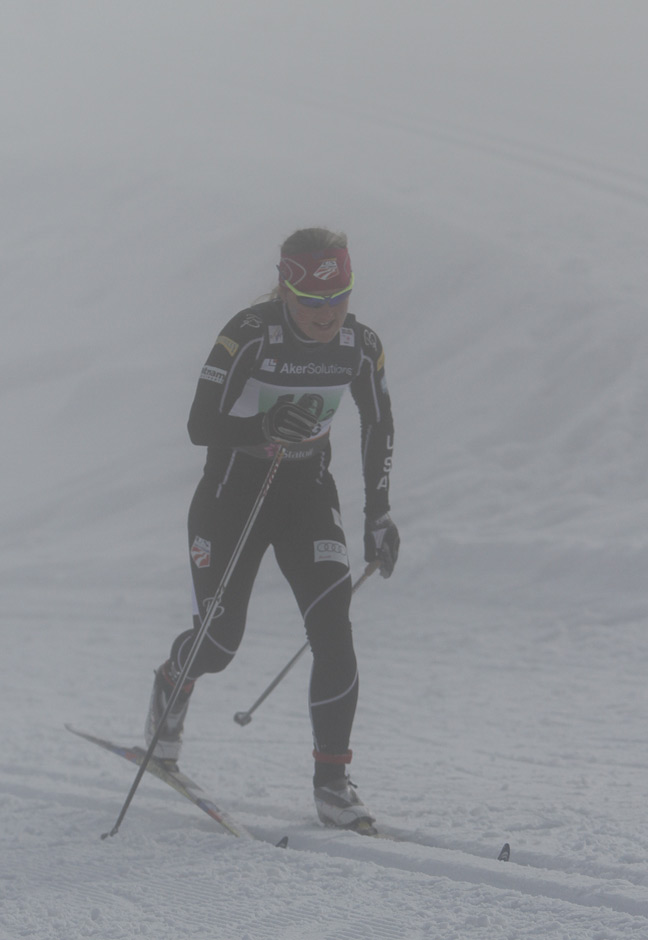
U.S. Skis to Ninth in Women’s Relay in Oslo

Jesse Diggins anchoring the US relay team. Feisty, unintimidated, and encouraging—if ultimately overmatched.
That’s probably the best way to describe Jessie Diggins’ effort at World Championships on Thursday, in which she anchored the U.S. women to a ninth-place finish in the 4×5 k relay.
It’s also an apt description of the performance of the entire U.S. team, which fought hard to its best World Championships women’s relay result in over a decade, but was ultimately left three minutes behind the winning Norwegians.
“I was like, ‘okay—so, there’s Marit Bjoergen (NOR), Charlotte Kalla (SWE), whoever else was anchoring their teams,’” Diggins said. “I was like, ‘Wow—this is going to be really fast.’ But it ended up being really good.’”
Diggins ended up just 40 seconds down on Bjoergen over her five-kilometer anchor leg. It’s still a decent amount of ground to make up—especially given the fact that the Norwegian slowed to celebrate in the stadium—but the result was competitive with a few World Cup veterans, like Germany’s Nicole Fessel and even Finland’s Krista Lahteenmaki.
Her third race in Oslo, Diggins’ relay was “her third home run in my book,” said Chris Grover, the U.S. head coach.

Liz Stephen rips into the stadium. “With the women’s team, I think we’ve got some names on there for the future for the U.S.A.,” Grover said. “I can see us in three years, if we do things right, starting to get really competitive by the time we get to Sochi.”
Along with Liz Stephen, Diggins was one of two U.S. skiers who had solid races in Oslo. But for leadoff skier Kikkan Randall, who scrambled, things weren’t as smooth.
For the second straight day, a thick fog surrounded the courses at the Holmenkoll venue, but this time, the sun was poking through occasionally, and conditions varied on different parts of the track. On the first big climb of Randall’s leg, her skis iced up badly, leaving her with no glide.
“It was like I’d fallen over or something,” she said. “I could just feel the layer underneath, and I was just trying to kick, and it wasn’t going anywhere. I was just trying not to fall on my face.”
By the time she finally dislodged the ice, Randall was in dead last of 14 teams, leaving her with a lot of work to do. She eventually reeled back the pack and caught a few teams, but despite testing her skis around the whole course prior to the race, she was still fighting them in a number of places—not to mention her body, too.
“Just trying to push into the next gear, I just didn’t have it today,” she said. “Kind of the same feelings I’ve been fighting the last couple of races. I just don’t have that power behind the distance pace.”
While it wasn’t great, Randall’s leg was still only 40 seconds off the lead, and she tagged off to Holly Brooks in eighth, tight with the Russian and Japanese teams.
Brooks stayed tight with Alija Iksanova (RUS), but she wasn’t quite a match for Japan’s Masako Ishida, who regularly finishes in the top 10 on the World Cup.

Holly Brooks skis through the Oslo fog on the second leg of the relay. After being caught by Slovenia’s Petra Majdic and Poland’s Justyna Kowalczyk, who came from behind, Brooks skied with the pair for a bit, but as she put it in an e-mail, “the two of them seemed to be having their own race.”
By the tag, Brooks had lost 1:20 to Justyna Kowalczyk, who had the fastest split of the leg—and she tagged off with the Americans in 11th.
Then, Stephen took over. Thanks to a tough course that favored her small frame, and a pair of fast skis, she lost less than 40 seconds to Russia’s Yulia Tchekaleva, who had the fastest time of the leg, and was able to reel in Kazakhstan before handing off to Diggins for the last leg.
For the 19-year-old Minnesotan, the five-kilometer loop was her last in a breakout European campaign–one that’s been ongoing since the World Junior Championships in Estonia in late January.
Originally, Diggins was going to get just one start in Oslo, in the sprint, but when her racing picked up steam, she ended up with three. After cracking the sprint heats and placing 28th in the 15 k pursuit, she earned a “nerve-wracking” spot on the relay squad, where she acquitted herself as well as any of the other American women.
A Kazakh woman caught up on one of the last climbs, but Diggins was able to shake her heading back down into the stadium. While she ran out of room to pass a fading Poland, Diggins did make up a 30-second gap to the Japanese anchor, Michito Kashiwabara, who has multiple top-10 finishes at World Juniors on her resume.

Randall on the scramble leg. “What a competitor,” Grover said. “Every race for her here has been fantastic.”
As for Diggins’ whole European stint—which included World Juniors in Estonia, domestic-level European races, World Cups in Norway, and the competitions in Oslo—Grover said it was ideal.
“I think it’s been a really good mix of competitions that are really appropriate for her level, plus competitions that are above her level,” he said. “So, I think it’s a good time for her to start to head home…and do some domestic racing.”
Domestic racing is exactly what Diggins will get—she’s flying back to Minnesota to compete in the Junior Olympics in Minneapolis.
“I love JO’s,” she said. “I love that atmosphere—it’s just fun.”
After cracking the top 30 in Oslo, Diggins shouldn’t have any trouble in Minneapolis, even against the rest of the cream of the junior crop in the U.S.
But with few expectations on Diggins at World Championships, she said that there might actually be more pressure on her in Minneapolis—and if Grover’s memory serves him right, Diggins’ path to national titles might not be all that easy.
“Kikkan tells a great story—racing 10 years ago in the Lahti 2001 World Championships, and coming home to JO’s and getting beat by Holly Brooks,” Grover said. “You come back from Europe, get a lot of jet lag…somebody who’s a little fresher, [who] hasn’t been racing as much, who’s acclimated, might be able to come close.”