As a 10 year old attending an end-of-the-year ski party, scoring the last piece of pizza is usually bonus enough. Not the case for Gabby Armstrong. Hers was getting to test the landing hill of the K18 on her cross-country skis.
Thanks to her New York Ski Educational Foundation (NYSEF) junior club coach Dave McCahill (who had a background in nordic combined), Armstrong was introduced to the jump hill by the time she was 10. Within a day of hitting the hill on her nordic skis, she joined the ski-jumping team. Soon after that, she entered any nordic-combined events she could. Though often the only female competitor, Armstrong was not about to let either sport go.
“It never really occurred to me to stop cross-country skiing,” Armstrong, now 18, said during a recent phone interview. “Even though a lot of coaches would say that I was the lone nordic-combined athlete, it was kind of fun going out against the boys.”
She’s attended two FIS Youth Nordic Combined Cups in Trondheim, Norway, and with the recent addition of women’s nordic combined to the FIS Continental Cup, she’s hoping to boost her event experience to an even higher level.
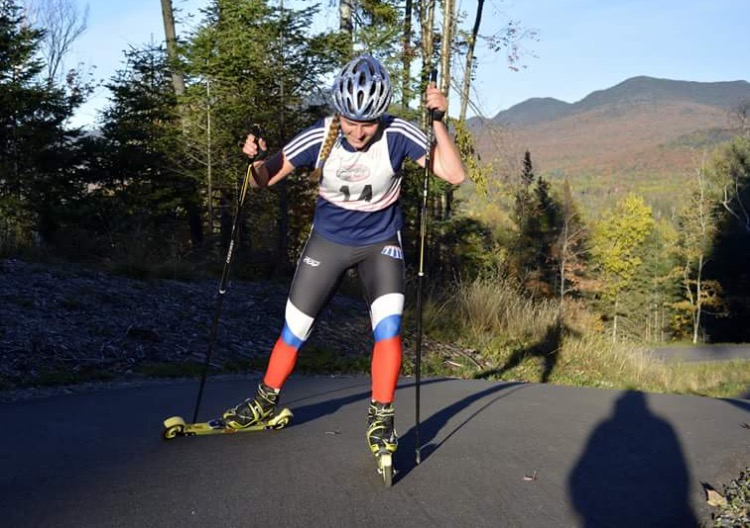
Gabby Armstrong, a member of Women’s Ski Jumping USA and a nordic combined competitor as well, rollerskiing at the Flaming Leaves Festival in Lake Placid, N.Y. (Courtesy photo)
“Any opportunity I have to compete nationally or internationally, for either nordic combined or ski jumping, I’ll take,” said Armstrong, a member of the Women’s Ski Jumping USA national team.
In order to train for nordic combined, Armstrong jumps during her scheduled practice times and joins the NYSEF cross-country skiers whenever she can. One workout she likes when she’s not with the NYSEF nordic team is aqua jogging with her sister and cousin, an endurance athlete who also holds the unofficial aqua jogging record at Stanford University.
“She really knows what she’s doing,” Armstrong said of her cousin with a laugh. “It’s a workout I picked up last year and I found was really good for me, especially because my knees were really bothering me a little bit last summer.”
On days when she aqua jogs, Armstrong will often perform an afternoon plyometrics workout. According to her Women’s Ski Jumping USA teammate Tara Geraghty-Moats, plyometrics (plyos for short) are particularly important for the role they play in take-off body positioning during ski jumping and the complimentary body/hip awareness they provide for cross-country skiing.
“Plyos are really important, especially at this time of year, to build explosive power, the kind of power you that you’re going to use at the end of the take-off when you jump,” Geraghty-Moats, 24, said on the phone. “It’s also something that I feel is really undervalued in the nordic world. I always felt that plyos profited my cross-country skiing as well.”
An afternoon plyometrics session for Geraghty-Moats also provides an opportunity for new training partners. She has spent the past month in Lake Placid, N.Y., completing plyo practices with NYSEF, and plans to head to Park City, Utah, at the end of July and Europe after that.
“I really enjoy being able to train with people of different ages because it sort of lightens up the atmosphere,” Geraghty-Moats said. “Plyos is the kind of training, too, that you can have a huge spread of abilities work together effectively. I couldn’t really go out and do intervals with a 12 year old and have them push me, but with plyos I maybe adjust the hurdles a little bit and we all learn from each other. They get to see your technique and I learn so much when I’m helping teach and helping coach.”
Regardless of the workout, both Armstrong and Geraghty-Moats are excited about the upcoming Continental Cup schedule and the direction women’s nordic combined is headed: no longer just up in the air, but gaining ground.
“Norway and Austria are already there, they definitely have a core group of high level nordic combiners,” Geraghty-Moats said. “It’s going to take a couple of years in the U.S to build a strong women’s team, but I think it will happen.”
The Morning Workout:
Type: Aqua Jogging
Armstrong aqua jogs at least once a week. When aqua jogging, your feet should not hit the bottom of the pool or lake. The idea is to keep your body suspended in the water while mimicking the movement of running through deep water. Aqua jogging removes the stress of running from the body joints, but allows an individual to continue training their muscles in the motion of running. Ideal for those injured or looking to switch up their workout.
Terrain: Pool or lake
Equipment: Though Armstrong uses no equipment, there are aqua-jogging belts out there for those interested.
Warmup: 10-20 minutes of easy aqua jogging
The set: 2 minutes on-time, 1 minute off. Repeat this 6 times for a total of 12 minutes on (18)
(If you need a long interval session, complete 6 x 2 minutes on, 1 minute off a second time for a total of 24 minutes on)
Cool down: 10-20 minutes east aqua jogging
Total time: 38-78 minutes
*If doing the workout in a lake, Armstrong recommends bringing a buddy for safety reasons.
Armstrong’s Top-Two Tips:
Don’t be discouraged by the distance. When it comes to aqua jogging, it’s not how far you get, but how long you go for that ultimately matters. “When you’re working harder, it’s slower progress forward,” Armstrong said. “It’s going to seem like you’re getting nowhere, but you’re still going to be working pretty hard.”
Stay upright to keep the core tight. The importance of engaging the core is no new news for nordic skiers. To do so in this workout, Armstrong suggests athletes focus their effort on staying upright while aqua jogging, not leaning forward. “Making sure your core is activated and trying to stay as upright as possible will prevent your hips from floating up behind you into a doggy paddle motion,” she said.
The Afternoon Workout:
Type: Plyometric exercises
Geraghty-Moats typically does this workout at least twice a week (during rest weeks, she’ll do it once). During plyometrics, an athlete exerts a large amount of force in a short amount of time to increase their power or speed-strength. Exercises should be done in an explosive manner.
Equipment: Hurdles of varying length, a box jump, a track or a open field with a 100-meter stretch
Warmup: 30-45 minutes easy running, followed by 30 minutes stretching
For Geraghty-Moats, stretching is one workout aspect too often overlooked. “What stretching does is really allow your muscles to function efficiently,” she said. “For me, the hips are a big one. … That’s sort of the root of your center of balance and your coordination and often where people are sore and tight. I tend to do at least a half an hour of stretching before I start doing plyos.”
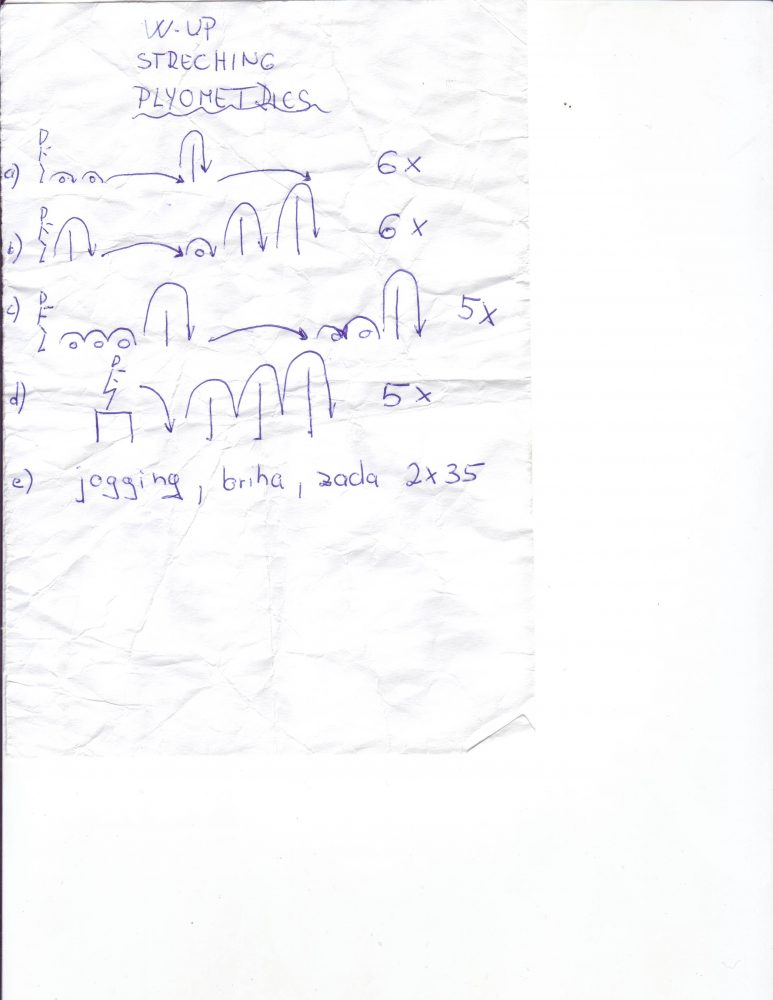
The Plyometric set: 6 x broad jumps, 6 x vertical jumps, 5 x telemark jumps, 5 x hurdles, 5 x 100-meter sprints
*See Geraghty-Moats’s exercise graphic below for more details on plyometric exercises and setup
Tara Geraghty-Moats’s plyometric plan (Courtesy photo)
Geraghty-Moats recommends using varying heights of hurdles to improve agility. “They range from knee to hip height,” Geraghty-Moats said. “It’s sort of like a downhill course, you have to react and be explosive and quick while also thinking about what you’re doing. It’s not just the same thing every time.”
Cool down: 15 minutes of body weight core (e.g. 1 minute of front plank, 1 minute of side planks, 1 minute of leg lifts, etc.) followed by 15 minutes jogging
“And always more stretching!” Geraghty-Moats added.
Total estimated time: 2-2.25 hours
Geraghty-Moats’s Top-Two Tips:
Plyos take patience. “When you’re doing plyos, if you’re not used to putting your body in the air, it’s going to feel really awkward at first,” Geraghty-Moats said. “So just start small … it’s going to take two months before you really feel like, ‘Oh, I have something in my legs. I can get further off the ground than two inches.”
Only the strong know when to stop. Rather than trying to push through a plyo workout, Geraghty-Moats suggests paying attention to your body and not being afraid to end the workout early. “If you have any sore ankles or sore knees, it’s OK to stop,” she said. “With intervals, we’re taught that you have to push through the pain. That’s not necessarily effective in this workout. This is more about being focused and giving yourself time. Quantity less and quality more.”
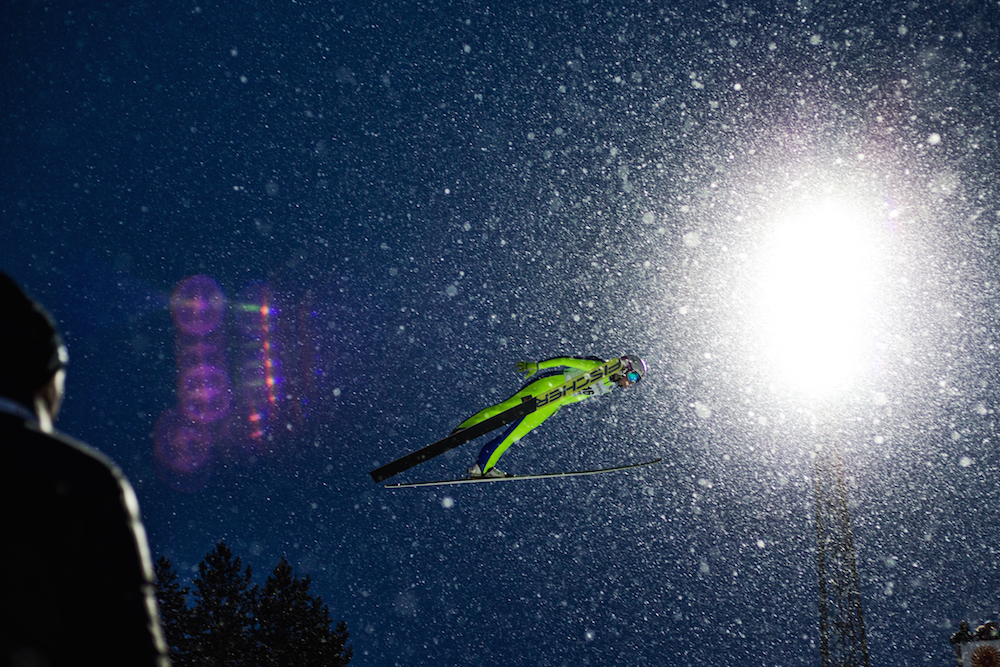
Russian ski jumper Sofia Tikhonova during the women’s 100HS final at 2017 FIS Nordic World Ski Championships in Lahti, Finland. (Photo: Dustin Satloff/dustinsatloff.com)
For Tara Geraghty-Moats, nothing compares to the sense of weightlessness she feels and the way spectators appear to sink into the ground when she soars off a ski jump — except maybe the feeling of pushing her physical limits during a cross-country ski race.
The two sports have been a part of the 24-year-old New England native’s life since her grammar-school days — she picked up both at the age of 9 and in both, she excelled.
By the time she was 15, her jumping talents earned her a spot on the Women’s Ski Jumping USA development team, and she captured third place at the 2009 Springer Tournee in Park City, Utah. But within a year of her nomination, due to concurrent knee injuries, she was forced to leave the ski hill and for the next four seasons, she focused on cross-country skiing.
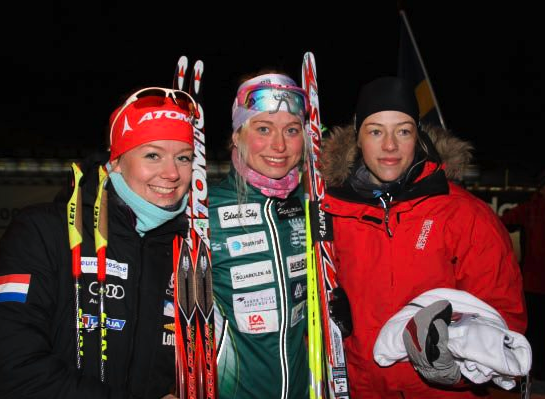
Vermonter Tara Garaghty-Moats (c) after winning the junior sprint at 2013 Swedish Biathlon Championships. (Courtesy photo)
Despite being told she would never jump again, she returned to the hill in 2013. That same year, she jumped to fifth at ski-jumping nationals in Lake Placid, N.Y., which earned her nomination to the Women’s Ski Jumping USA World Cup B-team.
While Geraghty-Moats saw success in both jumping and XC over the years, she never had the opportunity to showcase her combined abilities at an international level. Not because she didn’t want to, but because the opportunity didn’t exist — until this year.
“We have sort of been waiting for the sport to catch up with Tara Geraghty-Moats for quite a while,” Billy Demong, executive director for USA Nordic Sport (the U.S. governing body for men’s ski jumping and nordic combined) said on the phone earlier this month.
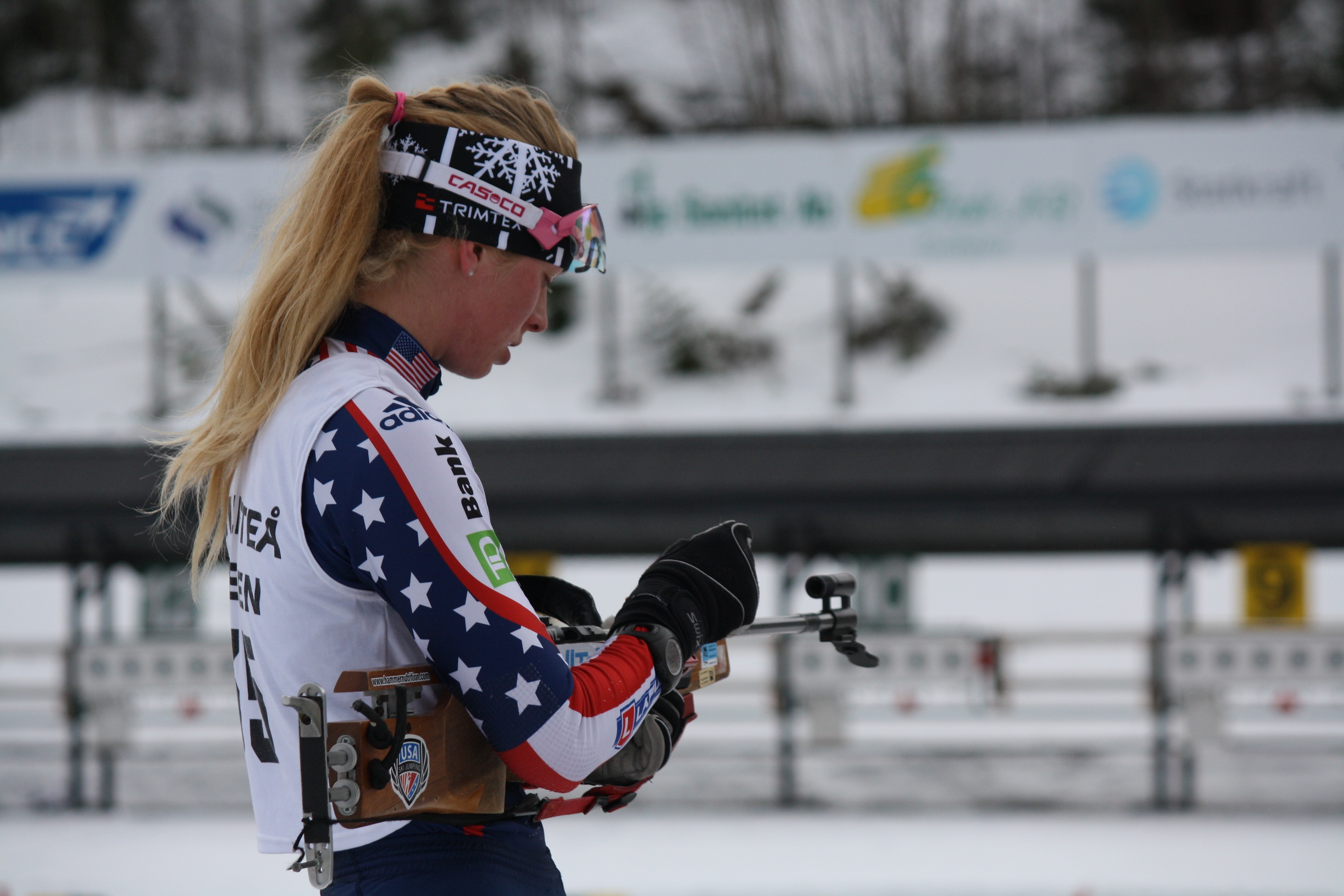
Geraghty-Moats on the range at 2011 Swedish Biathlon Nationals. (Photo: Per Nilsson)
Now it appears to be heading in Geraghty-Moats’s favor. Prior to this season, most of the cross-country ski training she did was either for pleasure or to maintain fitness for ski jumping. Now her training will take on a new meaning, as for the first time in history, women’s nordic combined will be included in the International Ski Federation (FIS) Continental Cup schedule. The inaugural women’s Nordic Combined event in the U.S. will be the USSA National Championships in Lake Placid on October 7. Demong anticipates eight to ten women to participate in the event.
“I’ve been wanting to compete on an international level for nordic combined for a long time,” Geraghty-Moats said on the phone this month. “It’s something I’m really invested in long term and something I’d like to see at a World Championships and Olympic-level competition. I’m really looking forward to helping develop the sport and helping mentor the younger girls that are getting into and also performing at a high level internationally.”
Women’s nordic combined has not yet been contested at the World Cup or Olympic level. Since this season marks an Olympic year, Geraghty-Moats will put her focus on World Cup ski-jumping events and enter as many FIS nordic-combined Continental Cups as she can.
“The ideal situation would be that I would qualify [for the 2018 Winter Olympics] in ski jumping and then am able to compete all the nordic combined races,” she said. “But there’s no way for me to tell where I’ll be in the points for the Olympic qualifying competitions … so hopefully I’ll be able to do them all, but I don’t really know.”
According to Demong, incorporating women’s nordic combined into the FIS schedule has been “on the radar for quite a while.” However, one blockade that prevented immediate action was the risk of draining athletes from a developing sport. Women’s ski jumping was added to Nordic World Ski Championships in 2009, the World Cup in 2011 and the Olympics in 2014.
“I think [women’s nordic combined] has really been in discussion since it was obvious that women’s ski jumping was going to be in the Olympics,” Demong said. “At the FIS level, I think one of the biggest challenges is with women’s ski jumping, you still have a developing sport. The ranks just aren’t as large and deep as the men’s side. And so I think there was a lot of fear that if you add another discipline, it could truncate the growth of women’s jumping.”
Sarah Hendrickson (Women’s Ski Jumping USA) taking flight during a summer competition in 2011. (Photo: Dan Campbell)
Over the past few years, the U.S. has seen more junior women participating in ski jumping. According to Demong, some a clubs have doubled their numbers within the last five years.
“The largest increase we saw in any user group was U8 [under 8], U10, and U12 in the Midwest, but also in Park City there was a pretty big increase, too,” he said. “We didn’t have a whole lot of participation before probably because they didn’t see a pathway. There were some diehards, like Tara and Gabby [Armstrong], but there weren’t droves of them and I think now there will be more in the sport because there’s a much more clear pipeline.”
This year will also be the first year that women’s nordic combined will be included at Junior World Championships. To Demong’s knowledge, Geraghty-Moats and Armstrong are the only two senior American women that plan to compete in the FIS Continental Cup competitions. Both will be supported by USA Nordic national-team staff at nordic-combined events, since the women’s events are scheduled to align with the men’s competitions.
“We have some really good 14 and 15 year olds that we’d like to see participate in the FIS Youth Cups again this year,” Demong added.
Also this year, the inaugural Women’s Nordic Combined National Championships will be held Oct. 7 in Lake Placid, N.Y.
With a longtime dream finally coming to fruition, Geraghty-Moats is not ready to let it end there.
“I don’t necessarily schedule things four years out,” she said. “But I definitely know that nordic-combined is going to be in my goals as an athlete for the foreseeable future. Obviously I need to stay healthy and continue doing things in my life, like going to school and staying at a high level of skiing, but I’m 100-percent sure that I will do nordic combined for as long as possible.”
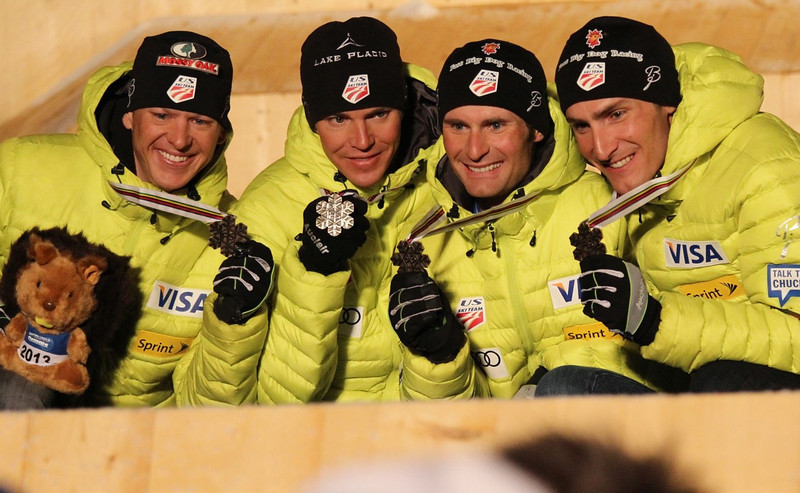
U.S. Nordic Combined’s Todd Lodwick (l), Billy Demong (second from l), Bryan Fletcher and Taylor Fletcher (r) after winning bronze in the 2013 World Championships team event in Val di Fiemme, Italy. (Photo: Fiemme2013)
When U.S. Nordic Combined coaches Dave Jarrett and Greg Poirier sat down with Tiger Shaw and Luke Bodensteiner of the U.S. Ski and Snowboard Association (USSA) on Monday, Jarrett said he wasn’t exactly sure what they were in for.
The national-team head coach for the last six years, he had a sense of what was in store for his sport — challenges, big ones, before and after the Olympics. But every nordic “free-heel” sport deals with the same thing, he said.
By 8 a.m. Monday, it became pretty clear what Shaw, USSA’s new CEO, and Bodensteiner, vice president of athletics, wanted to talk to them about in person. After July 31, 2014, USSA would no longer fund nordic combined’s “traditional team infrastructure,” according to a mass email from Shaw that was sent to Jarrett and several other stakeholders. That would leave U.S. Nordic Combined essentially on its own for financial support, which Jarrett said will most immediately affect the employment of himself and Poirier, the development coach.
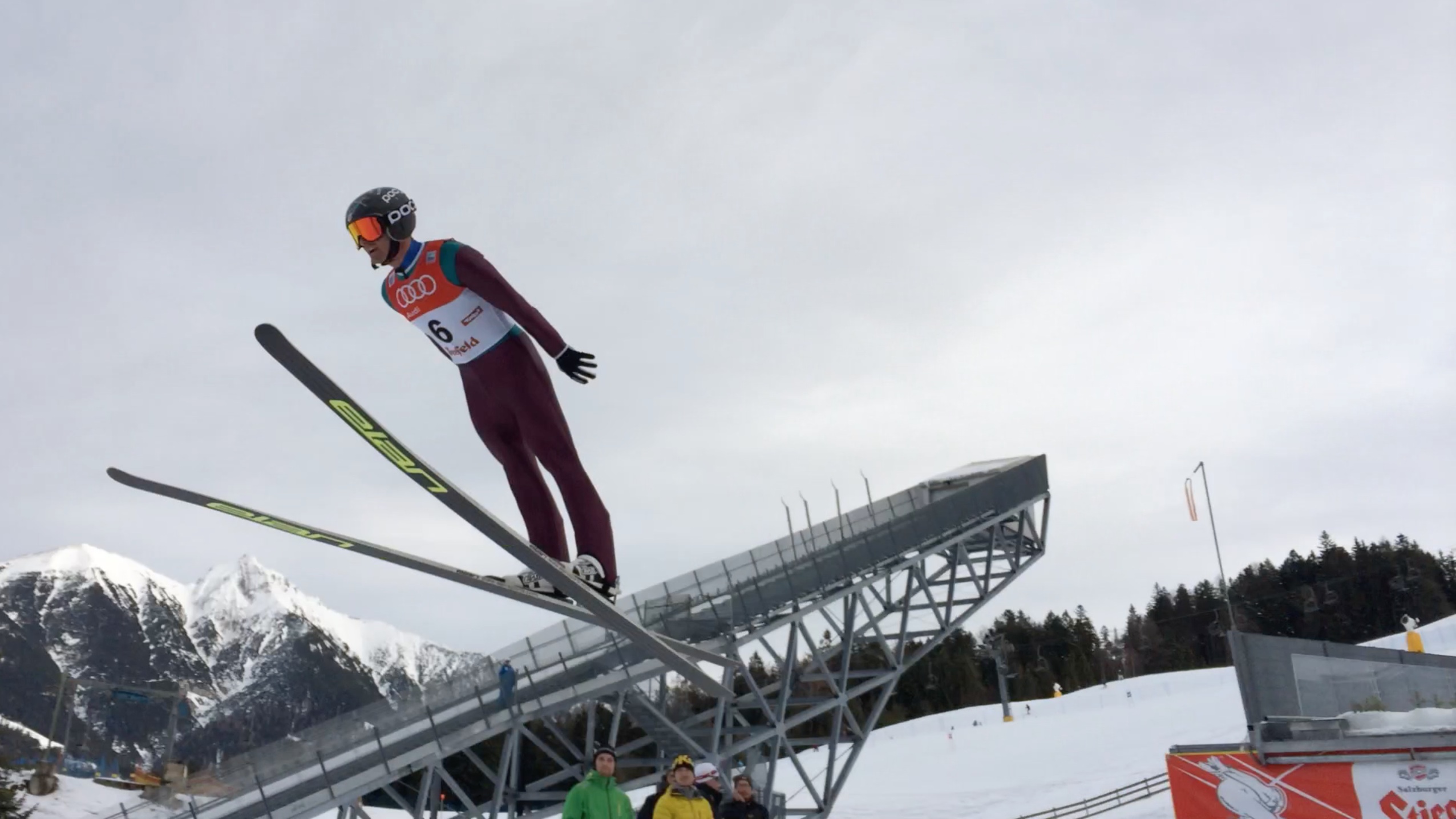
Bryan Fletcher (U.S. Nordic Combined) at the Nordic Combined World Cup Triple last season in Seefeld, Austria. (Photo: Fast Big Dog)
In the meantime, he said not to worry about the athletes — they’ll train for next season as usual. The ones that were in Park City, Utah, on Monday — Billy Demong, Bryan Fletcher and Taylor Fletcher — also spoke with Shaw and Bodensteiner in a second meeting about the decision.
“I had a sense for a while that something wasn’t right,” Jarrett said on the phone Tuesday. “Planning started as normal and then it took a slight detour with the timeline of how you get things done. It became clear that something wasn’t right. I knew something wasn’t totally clear. Luke gave us a heads up that this was a scenario.”
That didn’t necessarily soften the blow, but rather than retaliate, Jarrett said he began to brainstorm. Women’s Ski Jumping USA and men’s USA Ski Jumping did it on their own — they could, too.
“We haven’t stopped spinning from the news,” Demong told Steamboat Today. “We have to turn that into solution making.”
“Based on [USSA’s] study in 2010 that eliminated jumping in other sports, they didn’t think nordic combined was a podium-potential sport for 2018 or 2022,” Jarrett explained. “As of July 31st, it’s gonna be the end of my job and Greg’s job, so funding stops then. In the meantime, if we’re able to raise operating capital, they have offered to run [fundraising] through USSA. If somebody wanted to donate or underwrite our needs that they would be able to donate to USSA [which would go] directly for nordic combined.”
There’s also the possibility of U.S. nordic combined signing sponsors outside of USSA’s contracts. According to Shaw’s email, USSA “will continue to provide direct funding for qualifying elite athletes. … We will work with the nordic combined community to look at alternatives in structure and funding. The USA has an engaged and passionate club-based pipeline, especially in communities of Lake Placid, Steamboat Springs and Park City. The USSA will continue to work with these clubs to provide an infrastructure for athletic success and sport development.”
“Unless you win the Powerball or something, there’s no way to create a slush fund for a rainy day for this to happen.” — U.S. Nordic Combined Head Coach Dave Jarrett
Jarrett emailed members of the nordic community on Tuesday morning with the subject heading: “Tall Order”. While many were disappointed and some shocked by the news, he said he encouraged them to think of solutions.
“I see this challenge as an opportunity for autonomy of our program,” his email stated. “All revenue we generate will go directly to our program. The more we generate the deeper we can reach as a program while at the same time remaining within the USSA. If we want to have an A-Team, B-Team and Junior Team it is up to us. We need to think about all options, opportunities and ideas.”
Jarrett said he’d spent much of the last two days gathering information and talking to people like Dave Knoop of the National Nordic Foundation (NNF), which directly raises money for U.S. nordic combined and cross-country skiing, as well as Alan Johnson of USA Ski Jumping and Robbie Beck of Women’s Ski Jumping USA.
“‘[We’re] trying to just use this as a rallying cry for the nordic-combined community specifically, but also for everybody that this is around the corner for any program,” Jarrett said. “Instead of being pissed or feeling sorry for ourselves … we need to rally around this and find solutions. I think there’s solutions out there.”
While he aims to assemble as much support as possible and explore the idea of uniting all nordic sports — men’s and women’s ski jumping, nordic combined and cross-country skiing — into one autonomous entity, Jarrett’s also looking forward to getting nordic stakeholders together at the USSA Spring Congress in a month.
“We knew that this was always a possibility,” Jarrett explained. “While we wanted to be prepared for this, unless you win the Powerball or something, there’s no way to create a slush fund for a rainy day for this to happen. … I said it a few years ago after ski jumping: everybody now should be looking over their shoulder because you never know when it’s gonna fall. I don’t think there’s any program that’s safe from it, maybe alpine is the only one that they’re never gonna cut out, but that’s the fact of life. And we have to play the cards we’re dealt.”
As for what it would take to keep the nordic-combined program going, Jarrett said he wasn’t sure whether they’d decide to fund it from bottom up, starting with development, or take care of the elite A-team skiers first. Either way, he said 12 years of experience as a national-team coach had taught him what he can do with a million-dollar budget, half-a-million dollars, or $250,000 — whatever they end up with.
Bodensteiner told Steamboat Today that USSA had funded nordic combined between $580,000 and $650,000 annually for equipment, travel, lodging, food, coaches and wax technicians. In a four-year Olympic cycle, the cost added up to nearly $3 million. He said the decision was based on a number of factors, including nordic combined’s size, as measured by participation, membership, public relevance, and future potential.
“The main thing is that we need to be proactive, looking at all options, all partnerships,” Jarrett said. “We’re all in this kind of nebulous state and perhaps there’s a way to organize everybody or at least parts of it. We can be partners with USSA or partners with each other.”
Members of the Visa Women’s Ski Jumping Team will make history Saturday by competing in the first-ever International Ski Federation (FIS) World Cup competition held for women’s ski jumping.
Jessica Jerome, Sarah Hendrickson, Alissa Johnson and Abby Hughes (all of Park City, UT) will represent the U.S. in Lillehammer, Norway. Lindsey Van, 2009 World Champion, is recovering from ankle surgery in October and will not compete this weekend.
Organizers are expecting nearly 50 jumpers from 15 nations to compete Saturday. Lillehammer is the start to the 14-event season, hosted at nine venues in seven countries. The tour ends in March in Oslo, site of last season’s World Championships.
Women ski jumpers have competed on the lower-tiered Continental Cup for seven years. In 2010, the FIS approved a World Cup circuit for women to debut in the 2011/2012 season. In April 2011, the International Olympic Committee (IOC) finally added a women’s ski jumping event to the Olympic Winter Games beginning in Sochi, Russia in 2014. Also, the inaugural Youth Olympic Winter Games will be held in Innsbruck, Austria, in January. It will be the first IOC-sanctioned event to include women’s ski jumping on the program.
“This is a very special time for women’s ski jumping,” said Deedee Corradini, Women’s Ski Jumping USA president. “A World Cup circuit is extremely significant for these talented women and it means better venues, more broadcast time for events, and higher quality all-around.”
Paolo Bernardi, WSJ-USA international head coach, is expecting a tight competition this weekend as teams from around the world are aiming for victories on the inaugural World Cup circuit. “I’m looking forward to the new challenge this year and helping the team show their potential.”
After Lillehammer, the Visa Team heads to Notodden, Norway, Dec. 9-10 for a Continental Cup competition.
Women’s Ski Jumping USA is the primary support group for the VISA Women’s Ski Jumping Team and aims to foster development level athletes throughout the U.S. WSJ-USA, a 501c3 foundation, also advocates for equality for women and girls in sports.
Women’s Ski Jumping USA is the primary support group for the VISA Women’s Ski Jumping Team and aims to foster development level athletes throughout the U.S. WSJ-USA, a 501c3 foundation, also advocates for equality for women and girls in sports.
The NCCSEF Calendar, one of the foundation's fundraisers.
Last week, the National Cross Country Ski Education Foundation (NCCSEF) announced on its website that it is now calling itself the National Nordic Foundation (NNF). But changes at the foundation are more than just in name only. Nordic Combined now falls under their auspices, and over the next few weeks NNF will be testing out a new marketing and fundraising strategy.
The non-profit foundation was set up as NCCSEF in 1997 to help elite developing skiers access international racing opportunities. The money helps defray the costs athletes otherwise pay out of pocket for World Junior Championships, U23 Championships, and J1 Scandinavian Cup trips. Since its inception, the foundation has also incorporated World Championships, OPA Cups, and North American training camps to its list of funded projects, and offers travel reimbursement incentives to unfunded athletes if they podium at high-level events.
In June, NCCSEF added Nordic Combined to its fundraising umbrella, whose athletes face the same financial barriers to racing in Europe that Cross Country athletes do. In brainstorming fundraising strategies with U.S. Ski Team (USST) Nordic Combined coaches David Jarrett and Kerry Lynch, NNF Director David Knoop began wondering why the disciplines were doing things separately. “National Nordic Foundation” reflects the new inclusion of Nordic Combined, and together Knoop hopes that NNF will be able to better leverage itself in its effort to raise money for the broader Nordic pipeline.
“I’m excited about the inclusion [of Nordic Combined]; it doesn’t make sense having them create their own 501(c)(3), so linking up is a great idea. It will help both sports achieve their objectives,” agreed John Farra, who sits on the NNF Board of Directors.
The shortened acronym is also not insignificant. Over the course of his work for the foundation, Knoop said he would talk with people all the time that weren’t exactly sure what NCCSEF was or did. As an organization that exists primarily to raise money and awareness for Nordic skiing, he didn’t think the confusion exactly helped in attracting potential donors, especially those unfamiliar with the sport.
Since becoming the foundation’s director in 2009, Knoop said he’s learned a lot about fundraising and how public perception matters. In the past, NCCSEF was funded primarily by a small number of key donors writing big checks, Knoop explained, and didn’t pursue grassroots support to the extent that it aims for now.
“We’ve worked the last couple of years on trying to make it more mainstream. Your $25 or $50 check is just as meaningful, and we want to have a more broad base appeal,” he said.
NNF’s new fundraising strategy includes a marketing push on social media platforms to generate excitement for their work. The new Pillar Projects are the separate Championship trips and training camps that have always served as the foundation of the organization, with the key addition of Nordic Combined.
“The Pillar Projects are a way to give a donor a chance to see exactly where their money is going. I assured the Nordic Combined folks that if people want to give directly to them, they wouldn’t have to worry about splitting their money with Cross Country,” Knoop explained.
The decision to incorporate one new Nordic discipline and not others—for instance, biathlon or ski jumping—was a function of limited resources and the historical independence of governing bodies within the U.S.
“I’d love to include all Nordic disciplines, but we have to take it one step at a time. Working with Nordic Combined is a fair amount to take on right now,” said Knoop.
At least for biathlon and women’s ski jumping, additional Nordic disciplines operate under their own governing bodies. The U.S. Biathlon Association (USBA) has existed apart from the U.S. Ski and Snowboard Association since its inception, and is accustomed to control over its own administration and budget, explained Max Cobb, USBA’s Executive Director. They have their own non-profit foundation set up to supplement the funding they receive from the USOC and key sponsorships.
The same goes for women’s ski jumping, which was supported under USSA until 2009, when it had yet to be added as an Olympic event. The primary objective of Women’s Ski Jumping USA (WSJUSA), a non-profit founded in 2003, became getting its elite athletes to the Olympics, according to the organization’s media relations director Whitney Childers. Since a significant aspect of NNF’s mission is to provide development opportunities for junior skiers, there has been a difference in objective between the foundations until now.
With the decision of the International Olympic Committee (IOC) to add women’s ski jumping to the Olympics in April of 2011, Childers said that they are beginning to restructure their funding to better support youth development, and would be open to the possibility of collaboration with NNF.
“Our foundation is always open to forming new relationships with other non-profits to provide support for the best women’s ski jumpers in the US,” she said.
Collaboration between the disparate non-profits within the Nordic spectrum may be possible in the future, said Knoop. “If the broader ski community can have more unity, and single sense of purpose instead of all these different silos, that would be great. But for the time being, we’ll see how this works with Nordic Combined.”
To read more about what NNF is doing to promote U.S. skiing, or to make a donation, visit their website.
Women ski jumpers are hoping this month they will finally get the nod from the International Olympic Committee (IOC) that they will be included in the Olympic Winter Games beginning in 2014 in Sochi.
The Executive Board (EB) of the IOC will meet Oct. 24-26 in Acapulco, Mexico following a joint meeting with the National Olympic Committees. According to an IOC release, “…the EB will … decide on the disciplines and events that will be included in the sports programme of the 2014 Olympic Winter Games in Sochi.” IOC rules require that new disciplines for an Olympics be approved three years before the Games.
“I am hopeful that the IOC Executive Board will vote the women into Sochi 2014 because we have advanced women’s ski jumping significantly since the decision was made not to include the women in Vancouver 2010,” said Deedee Corradini, longtime women’s jumping advocate and president of Women’s Ski Jumping USA.
The International Ski Federation has recommended twice to the IOC to include women’s ski jumping in Sochi; three World Championships will have taken place before 2014; and a new World Cup circuit starts in 2011/2012.
The IOC Program Commission, which met Sept. 30 at IOC headquarters in Lausanne, is expected to provide its recommendations to the EB on new disciplines for the Sochi sports program, a package rumored in the media to include women’s ski jumping and ski halfpipe.
“Approval for Sochi 2014 is huge for the advancement of the sport — it will further bring many more young women and girls in to the sport that have stayed away because they haven’t been welcome on the ultimate stage: the Olympics,” Corradini said. More athletes and new countries join the competition circuit every year.
For veteran women ski jumpers like Alissa Johnson, of Park City, Utah, it would mean she could fully concentrate on her future as an athlete. “For once in my life I could truly be considered an equal to my male counterparts in the sport,” said Johnson, whose younger brother, Anders, is a two-time Olympic ski jumper. “It would inspire me to continue to be the absolute best athlete that I can be, so that when I have my chance at the Games, I can fight for the Gold medal I have been dreaming about since I was 5.”
Being included in the Olympic program also would make athlete and program sponsorship much easier, Corradini said. In May 2009, the U.S. Ski and Snowboard Association cut all funding to the women’s ski jumping team because it was not part of the Olympic program. Women’s Ski Jumping USA (WSJUSA), a nonprofit foundation, took over financial responsibility for the team last year and continues to raise money to get elite jumpers to competitions and pay for the coach.
After hearing the jumpers’ inspiring story, a New York fine-art photographer has organized an upscale benefit on Oct. 21 in New York City to help raise money to send the women’s team to the World Championships in Oslo, Norway in February 2011. WSJUSA is supporting the event and more details are available at www.wsjusa.com.
When asked if women are ready to jump in the Olympic Games, Johnson gives an emphatic, “yes.”
“It’s not even a question in my mind if we are ready or not. Because we are,” she said. Women jumpers had hoped to be in Salt Lake 2002 (where women were forerunners for the men), Torino 2006 and Vancouver 2010.
“This would give a lot of the older athletes more inspiration to continue with their careers. But most importantly, it would mean that our long struggle over the last decade would finally come to an end. We would finally have the opportunity to accomplish our dreams,” Johnson said.