Tag: Workout Wednesday

  • Wednesday Workout: Mid-Season Speed with Annika Taylor

    Wednesday Workout: Mid-Season Speed with Annika Taylor


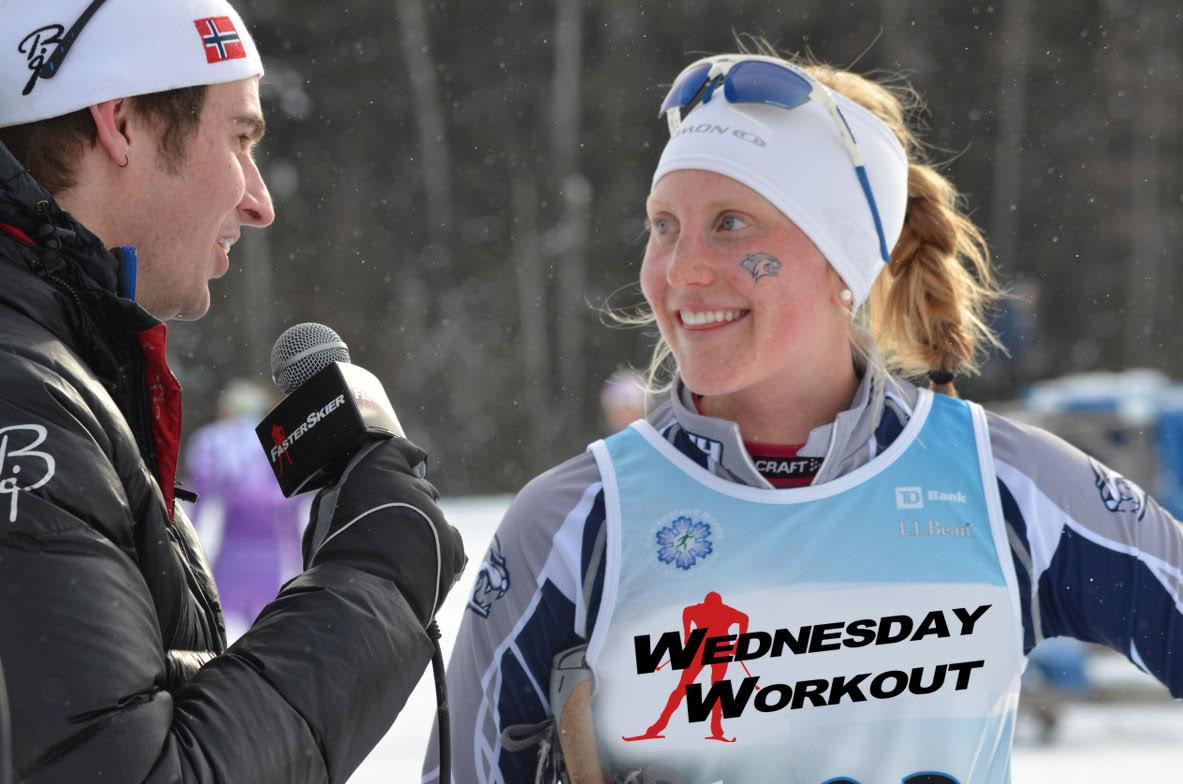
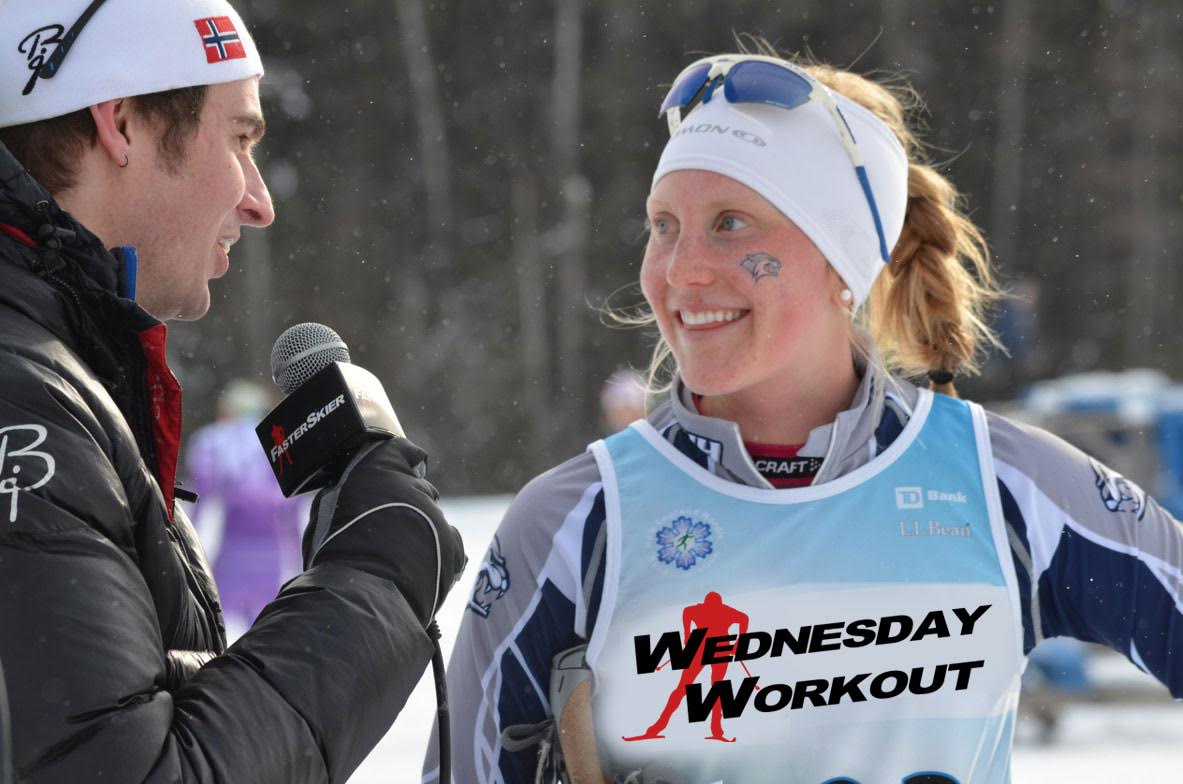
    Former UNH skier Annika Taylor (r) during an interview with FasterSkier at the SuperTour in Craftsbury, Vt., last year.
    Former UNH skier Annika Taylor (r) during an interview with FasterSkier at the 2015 SuperTour in Craftsbury, Vt., last year.

    With the demanding race schedules of World Cup athletes, mid-season workouts have to be effective without adding too much training stress.

    Roy Young, the British Nordic Head Coach, developed a sprint workout that utilizes short intervals on varying terrain to focus on specific techniques during each effort.

    Young has guided the British team to some of the country’s best World Cup results yet, including his son Andrew Young’s historic bronze in the freestyle sprint in Toblach, Italy, earlier this season.

    Annika Taylor, a member of the British National team and Sugar Bowl Academy Elite Team, is skiing her first season under Roy Young and especially enjoys this speed workout. After graduating from the University of New Hampshire as an All-American last spring, this season is Taylor’s first on the World Cup.
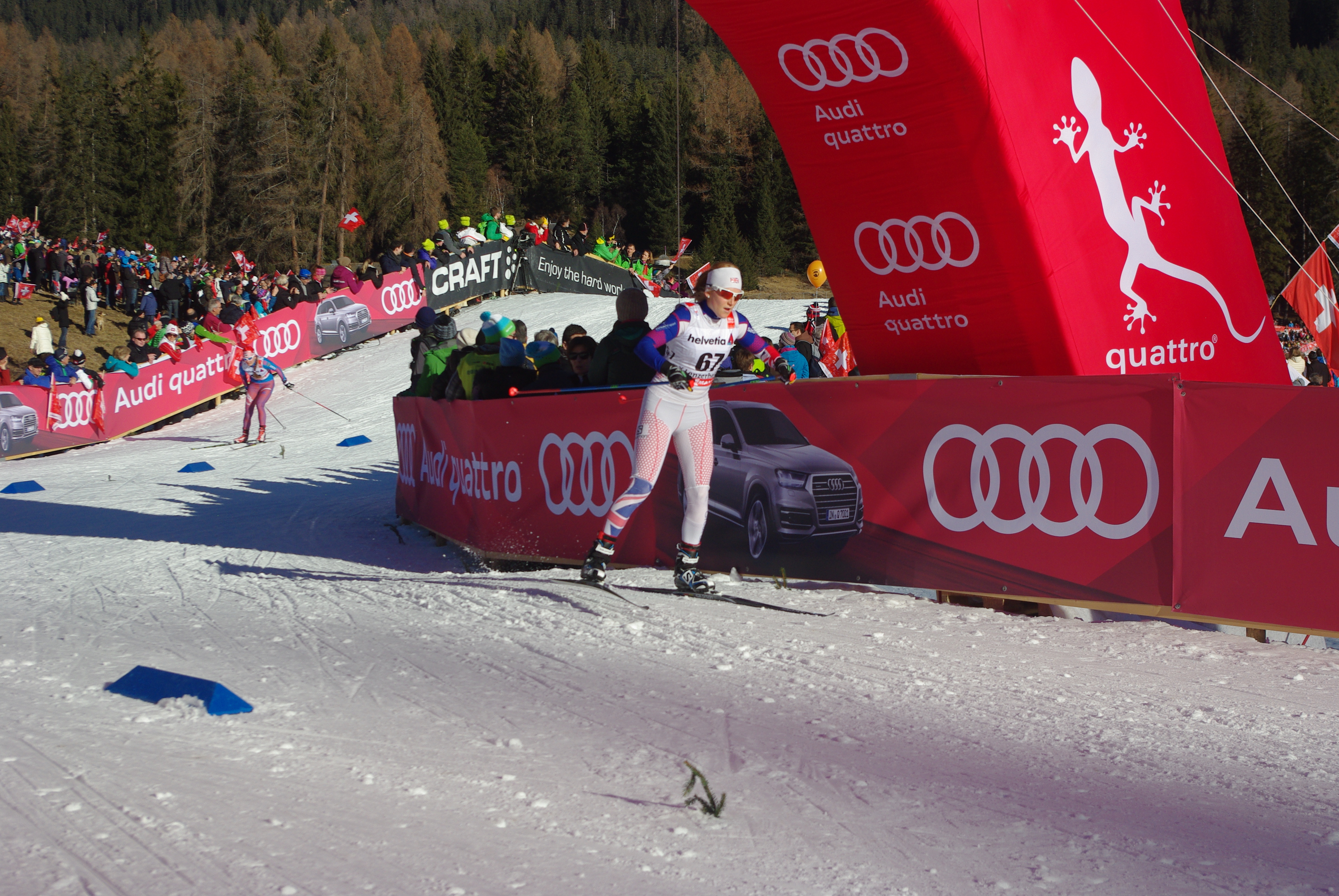
    Annika Taylor (Great Britain) competed in the first three stages of the Tour de Ski In Lenzerheide, Switzerland.
    Annika Taylor (Great Britain) competing at the Tour de Ski In Lenzerheide, Switzerland.

    “The workout focuses both on the neuromuscular (limb speed) required in sprinting and improving anaerobic capacity,” describes Taylor.

    “I enjoy it because it is an efficient workout and that sprint improvement results after just a few focused sessions,” she added. “The most challenging part is keeping correct, efficient form and maintaining the same speed in the second set as was done in the first set.”

    Taylor outlined an example of a freestyle workout that utilizes varying terrain to focus on transitions, V1, and V2 alternate.

    The shortest intervals (20 seconds) are to be skied on a flat section of trail utilizing V1 to accelerate before transitioning to V2.

    Next, the 30-second intervals are done on slightly downhill terrain into a slight uphill, with a focus on long V2 alternate strokes.

    Finally, the focus of the 45-second intervals is changing V1 tempo in the transition from a gradual into steep uphill.

    Taylor has also been working with exercise physiologist Kurt Rumley, from SportScotland Institute of Sport to develop a complete warmup for interval workouts and races which is described below.

    Warmup: 

    20 minutes easy Level 1 warmup, focusing on smooth, strong movements

    Work into 4 minutes of Level 2, then easy ski for a four minutes.

    Work into 3 minutes of Level 3 (10-15 kilometer race pace), then easy ski for 3 minutes.

    Finally, work into full-on sprint race speed with 3 x 30-second efforts, with a few minutes rest in between each effort.

    Speed Workout:

    3 x 20-second, 2 x 30-second, 1 x 45-second efforts (with techniques as detailed above) followed by 10 minutes of easy skiing before repeating the progression for the second set.

    Between each speed effort, take enough rest to get back to your starting point and for your heart rate to return to Level 1.

    Cool down:

    Finish with 20-30 minutes of easy skiing and foam rolling/stretching.

  • Wednesday Workout: Miles Havlick’s Threshold Run

    Wednesday Workout: Miles Havlick’s Threshold Run

    Trail running in the Sawtooth Mountains north of Sun Valley, Idaho. Photo: Miles Havlick.
    Trail running in the Sawtooth Mountains north of Sun Valley, Idaho. Photo: Miles Havlick.

    Welcome to Wednesday Workout, the newest workout series on FasterSkier. During the offseason, we’ll feature components of summer training programs from top individuals and teams throughout the U.S. and Canada at the junior, college and elite club levels. If you ever have a workout suggestion or training question, send them in to info[at]fasterskier.com.

    ***

    We saw him outsprint a stacked men’s field in the 20 k freestyle at NCAA Championships this March to win his second national title two years running. Now, Miles Havlick is getting ready to continue his post-University of Utah ski career with the Sun Valley Ski Education Foundation.

    May training season is in full swing, and he’s logging the hours on foot, on his bike and on rollerskis.

    “I’ve been rollerskiing a little bit; my hands are still getting used to that so I ride my bike a fair amount this time of year,” Havlick said. “Mountain and road [biking] is a great way to get in the hours and is a bit more tolerable when it’s really hot like it is.

    “I like to change up my workouts a lot to keep it interesting; I don’t want to get in a routeine of doing the same stuff all the time.”

    Havlick celebrates his mass-start victory, his second-straight at NCAA Championships. (Photo: flyingpointroad.com)
    Miles Havlick winning the 20 k freestyle at NCAA Championships in March. (Photo: flyingpointroad.com)

    In addition to long hours on wheels, one of the staples in his summer training program is on foot: a point-to-point L3 trail run near his house in Salt Lake City. Though simple, the workout requires focused execution.


    The Workout:

    30 min warm-up

    50-60 min L3

    30 min warm-down


    The session is doubly productive: like any L3 threshold workout it improves VO2 max, but it can also serve as an informal periodic test if repeated throughout the summer. Havlick does this workout from the same starting point about every two weeks on a trail that has varied terrain: with rolling hills, flats and gradual down hills.

    “You can mark where you finish, or make a mental note of it, and see where you improve along the way,” Havlick says. “It’s almost like a time trial but less formal, and usually it’s a good measure of how your fitness is improving throughout the summer.”

    He emphasized the importance keeping the heart rate in L3, easing back on the climbs and picking up speed on descents as necessary — which also makes the session a good pacing workout.

    “There are different goals for every workout session,” Havlick explains. “Some days you go easy and just do it to get the blood moving, to recover or for a long OD. L3 workout days, L4 workouts and time trials — stuff like that — if you go hard all the time you’ll start to decline in performance. You want to improve certain aspects. L3 work does a lot with improving your VO2 max and your overall fitness, so that’s the goal of this workout.”

    To change things up, Havlick will sometimes adjust the way he attacks the hills and flats to see how it affects where he finishes, all the while staying close to L3.

    “I run the flats a little harder some days and push the hills harder other days, and see how it affects the finishing position,” he said. “It’s kind of interesting; it kind of makes it like a ski race, too.”

    Though the workout looks simple on paper, know that an hour at L3 is not to be undertaken lightly.

    “It’s a pretty hard workout, so I’m pretty cooked after that,” Havlick says.