From the FasterSkier archive — posts syndicated from athletes’ and coaches’ own blogs between 2004 and 2012, kept online as published. Current coverage is at fasterskier.com.
An inhaler of the sort commonly used to administer asthma medications in aerosol form. Are these found in far too many pockets at youth ski races around the country? (Photo: FasterSkier)
Cross country skiing is an aerobic sport: the amount of oxygen entering our lungs is one of the factors directly affecting our performance. It seems to make sense: more oxygen in, more fuel provided to the muscles, greater levels of performance in endurance events. On the other hand, some athletes suffer from external factors limiting the amount of oxygen they can utilize to give energy to their muscles. One such factor is asthma, a condition of the lungs and air passages that can result in wheezing, chest tightness, coughing, and the partial or total restriction of airways. The most common remedy for this condition is the use of a bronchodilating drug administered via an inhaler (a device that quickly delivers aerosol versions of certain asthma drugs). Such bronchodilators create more space in the airway and lungs for oxygen to flow, thus giving an athlete more access to energy-giving oxygen. It’s a great thing for individuals who need it, an instant relief, maybe even a life-saver. The dilemma begins when medical diagnoses allow (or encourage) use of those drugs by athletes who may not need them. A few things are troubling in that scenario:
Bronchodilating drugs can be legitimately acquired and used by competitors—even if those drugs may be performance-enhancing—through Therapeutic Use Exemption (TUE). Such an exemption (one recognized by all sport governing bodies under FIS and the IOC) entitles athletes to obtain and utilize drugs designed to level the playing field for those particular athletes who suffer from asthma (even exercise-induced asthma). Athletes who qualify for such exemptions are allowed to use medications that will alleviate their asthma symptoms. Typically thought of as “rescue medications”—those that alleviate asthma symptoms once an asthma attack has begun—drugs like albuterol, ventolin, and salbutomol are typically used by athletes before the event that could be likely to cause the athletic stress, and the associated asthmatic response. Seemingly, the idea is to prevent an asthma attack before such an attack can begin. Critics of that strategy are left to wonder what level of performance enhancement takes place in those instances where the athlete might not have suffered from the asthma on that day?
Asthma diagnoses are notoriously light on testing and data—Many athletes do suffer from at least some form of exercise-induced asthma, though the diagnosis of those ailments is too often made through the answering of simple questions rather than through physiological testing. The primary question in such diagnostic interviews seems to be, “Do you ever cough after races or challenging efforts?” If the answer is yes, then you get a prescription . . . and a TUE. Whether you ever suffer an asthmatic episode again, you’ll always have that inhaler in your pocket . . . and you’ll always be entitled to take a puff of that bronchodilating medication before every race and every workout.
There is virtually no monitoring of the use-amounts among young competitors—purportedly, kids are given guidelines to follow in the self-administration of these drugs; in reality, those same kids are left to administer these drugs to themselves in an unmonitored environment, and using mechanisms (inhalers) that are not engineered to monitor or limit their continued application. Ironically, much of this self-administration appears based less on “how athletes feel” and more on “how it makes them feel.” Many young athletes report feeling a pleasing rush after administering these drugs with an inhaler. Feeling such a rush before a race has got to make a young athlete feel good. It may even be a performance enhancer. Far worse, it may also be dangerous for the athlete huffing on the inhaler.
There is virtually no testing of young athletes even at national level competitions—If these drugs are in any way performance-enhancing, then young athletes are cheating (whether they know it, or not).
There is virtually no governing-body-generated messaging (nor coaching-education efforts) to inform young skiers of what it is they might be doing. Using these drugs could be very bad for young skiers, but no one tells them so. It may also be very bad for American skiing—kids in the habit of huffing inhalers before races (never with disciplinary consequences) are likely to continue doing the same when they arrive on the international scene. One positive drug test that results from too-great amounts of otherwise banned substances (despite the TUE the athlete may carry in their pocket) and their careers will take a dramatic turn.
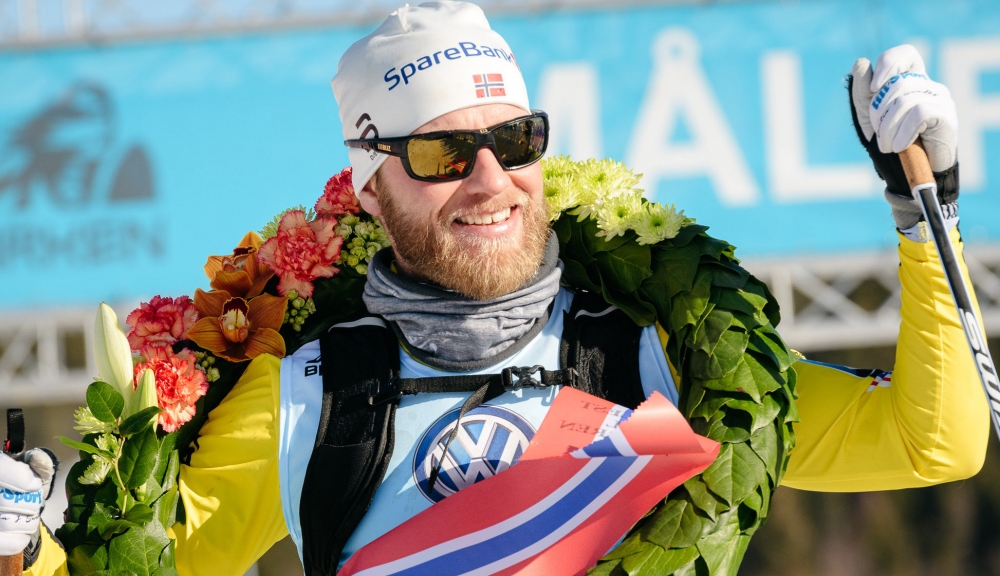
Stripped of his 2014-2015 World Cup Overall and Tour de Ski titles, Norway’s Martin Johnsrud Sundby became the face of the asthma-inhaler issue. (Photo: Ski Classics)
Norway: Team Asthma
While inhalers are a standard medical device regularly prescribed for conditions as simple as a cough or chest tightness, there has been a dark history of endurance athletes abusing inhaler-delivered drugs to gain an aerobic advantage over their competitors. In 2018, the Norwegian national team conducted a study of their own usage of inhaler medicine that culminated in a 191 page report. This study was conducted in response to former Norwegian ski star Martin Johnsrud Sundby’s documented inhaler overuse (punished by suspension from competition, and the loss of his World Cup and Tour de Ski titles). Writing for Reuters, Philip O’Connor authored an article titled, Norway’s Cross Country Olympic Success Clouded by Asthma Drug Ethics. “The report found no evidence of wrongdoing in the Norwegian team,” wrote O’Connor. “But it did concede the use of asthma medicines to treat temporary symptoms represented an ethical dilemma.” This ethical dilemma remains alive today in both domestic and international competitive cross country skiing. At current high-level events, any observant spectator can witness a serious usage of inhalers amongst athletes before competition. Many high-level skiers use inhalers before efforts, begging questions of whether inhalers should be used as preventative tools or as an emergency solution for an asthma condition. The World Anti-Doping Agency (WADA) has strict rules in place for inhaler usage based on the notion that inhalers do offer a real aerobic advantage in endurance sports. WADA’s World Anti-Doping Code is the basis for all performance enhancing drug regulation including the use of the inhalers. A 2019 article titled, Anti-doping Policy, Therapeutic Use Exemption and Medication Use in Athletes with Asthma: A Narrative Review and Critical Appraisal of Current Regulations, Hayden Allen, Susan H. Backhouse, James H. Hull, and Oliver J., explained the issue further: “Currently, athletes competing at the elite level are thus typically required to provide objective evidence of asthma before a therapeutic use exemption (TUE) may be granted to permit use of an otherwise prohibited substance or medication dose.” The article also provided further information on specific inhaler drug amounts. “The current prohibited list states that athletes are permitted to administer inhaled salbutamol (in divided doses not exceeding 1600 µg in 24 h and 800 µg in 12 h), formoterol (≤ 54 µg in 24 h) and salmeterol (≤ 200 µg in 24 h) [12] without a TUE).”
These regularly-tested limits of inhaler usage are upheld at the elite international level, but what about the domestic level?
Unmonitored Uses and/or Abuses
The elite level of cross country skiing is regulated by the World Anti-Doping Agency (WADA), but what stops collegiate athletes, junior competitors, and other athletic hopefuls from abusing inhalers to gain an advantage? Among junior and collegiate skiers, the presence and use of inhalers is ubiquitous. Often, that inhaler is in the possession of those who have received a prescription for the medicines in question (and possibly registered their use via a TUE). Nearly as often, inhalers are in the possession of those who have simply borrowed from someone with a legitimate reason to self-administer those drugs. As a collegiate ski competitor, the opportunity to use such drugs and devices has been offered to me numerous times. It just doesn’t feel right. It feels a little bit like a drug deal, but one involving substances and tools that are so commonly observed and used that no one would think twice about it (and no governing body is testing for it). I understand the idea of athletes using something before a race that will make them feel better, that may even make them race better—especially when that “something” is a tool that is used almost universally. Everyone uses an inhaler, whether those inhalers have been diagnostically recommended, or not. And the insistence of so many that the drugs in question do not affect athletic performance (despite how unlikely that seems) is the thing that seems to make it “okay” for everyone to use it. Even so, I think our ski community should rethink—or at least comprehensively discuss—the issue.
Norway seems to be at the forefront of such discussions, even as their comments seem directed toward the effects of such medications on those already suffering from asthma rather than those many athletes who do not have asthma, but who continue to partake of such medication.
“It is common practice in Norway to occasionally use asthma medicine in major ailments in the respiratory system … even where the diagnosis of asthma is not specific,” Per Medboe Thorsby, head of the medical committee for Anti-Doping Norway, told Reuters. “If one uses asthma medicines in the doses recommended for this illness and within the terms of the WADA doping list, we do not believe that there are any special benefits as a result of such use,” Anti-Doping Norway’s Thorsby said. “On the contrary, we believe that practitioners with documented asthma who do not get proper treatment will be at a major disadvantage.”
But what of those athletes utilizing inhaled medications in amounts exceeding (sometimes far exceeding) recommended dosages? Whether they have asthma or not, it seems to remain undetermined as to whether those athletes are deriving a performance benefit. Perhaps even more darkly, the degree to which those athletes may be affecting their own health apparently remains undetermined, as well.
Canadian Beckie Scott during an interview with the BBC following her decision to resign from the Compliance Review Committee. (BBC Screenshot)
On September 20th, this year, the World Anti-Doping Agency’s (WADA) Executive Committee made the decision reinstate the Russian Anti-Doping Agency (RUSADA). WADA’s 12 person Executive Committee had met in Seychelles to vote on a recommendation from the Compliance Review Committee (CRC) that RUSADA’s suspension be lifted. Nine Executive Committee members voted in favor of the CRC’s recommendation, two voted against, and one abstained.
Days before WADA decided to reinstate RUSADA, former Canadian cross-country skier, Beckie Scott, stepped down from her position on the CRC. Scott, one of the most outspoken athletes on anti-doping, was one of six members on the CRC panel. Scott remains the chair of WADA’s Athlete Committee.
On October 12, the BBC posted a video interview with Scott during which she explained her decision to leave the CRC. The three-minute video interview–which can be accessed by clicking here–reveals that Scott felt she was “treated with a level disrespect” by her WADA colleagues at the meeting. Scott departed her position due to a “fundamental disagreement” with the decision to reinstate RUSADA and the way she was treated at the meeting.
“There was laughter when I read the list of athlete committees who had produced statements and who were confronting the decision,” Scott told the BBC. “It was all, it was a combined effect that left me feeling as though there is very little respect, there is very little appreciation, and there is very little value for the contribution that the athletes have at this table.”
At WADA’s meeting this September, Scott said the “comments and gestures that were inappropriate” and directed toward her when she produced statements from those opposing the reinstatement went unchallenged from WADA’s president and director general.
“I was disappointed by that,” Scott said. “I think it is indicative of two things: One is the lack of regard for the athlete’s voice generally. I think that there has…been an attitude of dismissal, of belittling, and marginalization; sidelining of the athlete’s voice. I think it is also indicative of the leadership of WADA’s alignment with the Olympic movement.”
Scott described the tactic as one meant to “bully” her.
“I think that there has been an incredible loss of confidence and faith in the organization as a result of this,” Scott said. “I think all the athletes have been galvanized by this. They have seen fit to express their frustration on a level that I have never seen before. I think we are seeing an unprecedented level of outcry, of outrage, of mobilization of the athlete voice as a result of this.
The alleged behavior from members of WADA has the Canadian Centre for Ethics in Sport (CCES) and AthletesCAN pushing for an independent review of the incident.
A full transcript of Scott’s interview with the BBC is presented below.
***
Beckie Scott (BS): I made the decision based on the fact that I fundamentally disagreed with it. I felt that this was a compromise that was unacceptable. I would say I was treated with a level of disrespect and with comments and gestures that were inappropriate. And indicative of a general attitude of dismissal and belittling of the athlete voice at the table. BBC: From whom? BS: That was behavior directed at me by the members of the Olympic movement who are members of the WADA Executive Committee. BBC: So members of the Olympic movement in the form of an Executive Committee meeting said things that were designed to denigrate, intimidate, dismiss? BS: Bully. BBC: To Bully? They tried to bully you? BS: Yeah. BBC: Can you tell me now that was done? BS: I mean just through comments, through gestures. There was laughter when I read the list of athlete committees who had produced statements and who were confronting this decision. It was all, it was a combined effect that left me feeling as though there is very little respect, there is very little appreciation, and there is very little value for the contribution that the athletes have at this table. BBC: What about WADA’s president and Director General, did they step in or say anything? BS: There was no confrontation or challenging of that behavior at the time it took place. BBC: You disappointed by that? BS: I was disappointed by that. I think it is indicative of two things: one is the lack of regard for the athlete’s voice generally. I think that there has, there has been this um, attitude of dismissal, of belittling, and marginalization, sidelining of the athlete’s voice. I think it is also indicative of the leadership of WADA’s alignment with the Olympic movement. BBC: Is WADA’s reputation at an all-time low among athletes? BS: I think that there has been an incredible loss of confidence and faith in the organization as a result of this. I think all the athletes have been galvanized by this. They have seen fit to express their frustration on a level that I have never seen before. I think we are seeing an unprecedented level of outcry, of outrage, of mobilization of the athlete voice as a result of this.
BBC: Is WADA’s future on the line here do you think? BS: I think something needs to change. And I think that the time is now. We need a return to integrity based decision making. A return to a place where athletes are valued and contributing members of the organization and a return to what sport is fundamentally all about.
After the announcement that the World Anti-Doping Agency (WADA) Executive Committee, which WADA refers to in short at the ExCo, voted 9-2 in favor of reinstating the Russian Anti-Doping Agency (RUSADA) on Thursday, it released a statementdescribing what it considers a conditional reinstatement.
As mentioned in an previous FasterSkier article, Russia has not fulfilled two outstanding provisions laid out in WADA’s “roadmap” for reinstatement.
In its most recent public statement on the matter, also published on Thursday, Sept. 20, WADA detailed those remaining conditions:
“That the responsible authorities for anti-doping in Russia must publically accept the reported outcomes of the McLaren Investigation; and
That the Russian Government must provide access for appropriate entities to the stored samples and electronic data in the former Moscow Laboratory, which are sealed off due to a Federal investigation.”
In its attempt to move forward, WADA claimed the Sept. 20 reinstatement remains subject to what it calls two “post-reinstatement conditions”. (Absent from the latest statement is the demand that Russia admit its involvement in state-sponsored doping, as detailed in the McLaren Report.)
The Russians must release the former Moscow lab’s Laboratory Information Management System (LIMS) and related “underlying” data by Dec. 31, 2018. LIMS is a WADA-standardized method of cataloging and storing tests and corresponding analytical results. The data will serve as a means to pinpoint which athletes were in violation of the WADA code and need to be adjudicated.
According to a previous statement, WADA believes it is already in possession of the Moscow Lab’s LIMS data. Last November, WADA reported that it had received LIMS data from a whistleblower including all the testing data from January 2012 through August 2015.
Once the data is turned over and reviewed, WADA has the right to reanalyze any samples no later than June 30, 2019. The agreement also states RUSADA must be successfully audited within the next four months.
If the outlined conditions are not met, WADA asserts its Compliance Review Committee (CRC) will convene and advise the WADA ExCo on any potential RUSADA non-compliance.
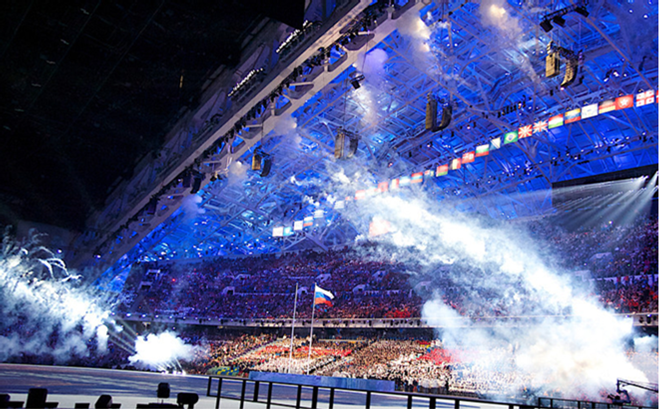
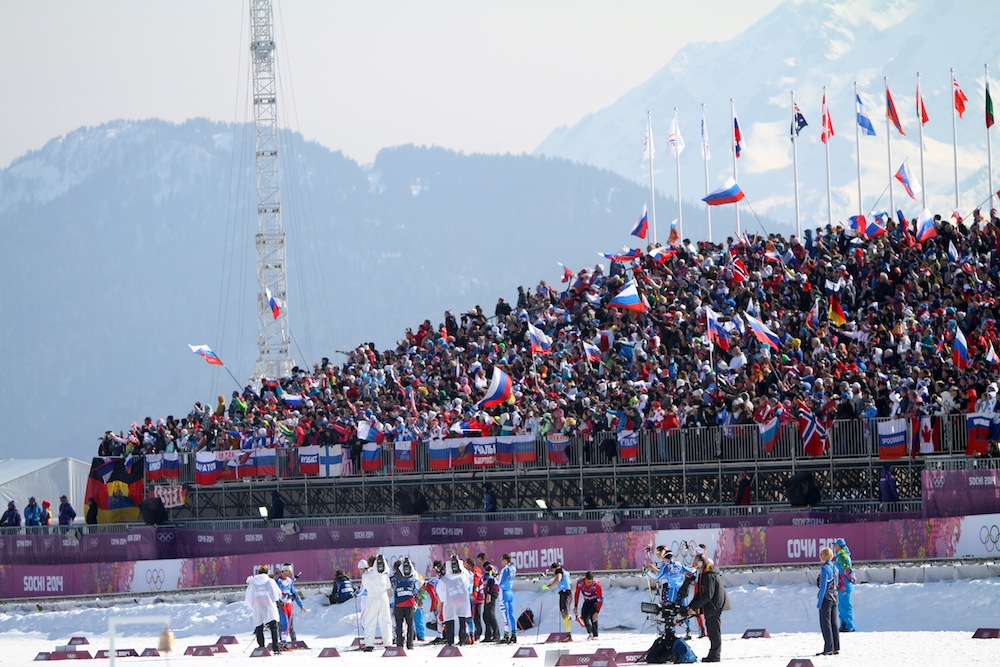
A scene from the Opening Ceremony of the 2014 Winter Olympic Games in Sochi, Russia. (Photo: Wikimedia Commons)
A full Olympic quad after Sochi, nothing remains irrefutably clean. Off the radar then on again, the Sochi doping scandal has sent recent tremors through the sports world.
In a quick summary, after the 2014 Winter Olympics in Sochi, Russia, the host nation was handed sanctions for the 2016 Rio Summer Olympics that affected some of its athletes. A total ban from Rio was not enacted despite the World Anti-Doping Agency (WADA) recommending the contrary. Russian athletes competed under the Russian flag.
At the 2018 Winter Olympics in PyeongChang, South Korea, the International Olympic Committee (IOC) handed down a fiercer sanction. Russia as an official team and its Olympic delegation were banned from the Games, as were athletes suspected of taking part in the Sochi affair.
Russian winter athletes without any ties to the scandal competed under the IOC’s neutral flag as the Olympic Athletes from Russia (OAR).
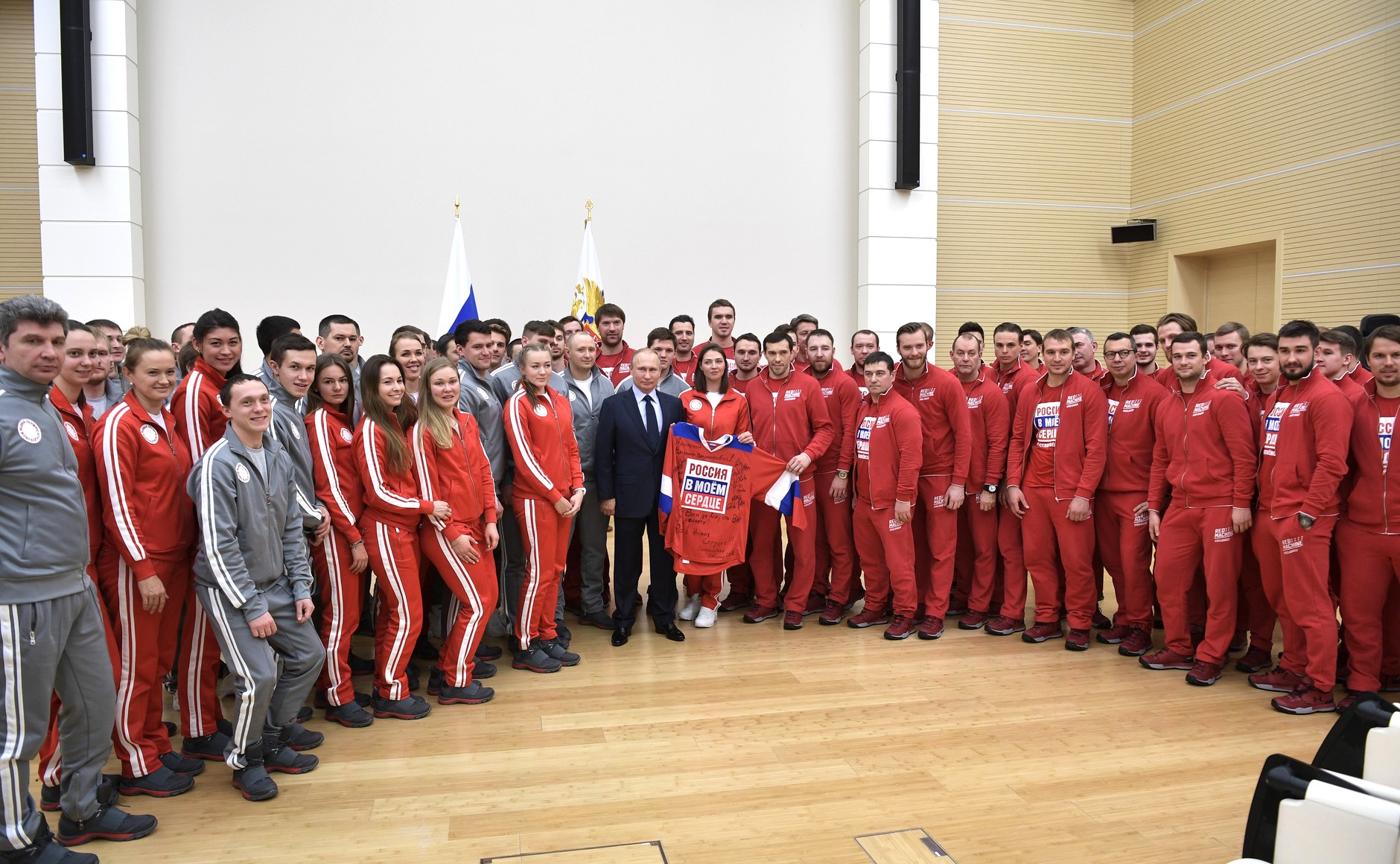
Russian President Vladimir Putin with Russia’s 2018 Olympians prior to the Games on Jan. 31, 2018. (Photo: Wikipedia)
At the 2018 Games, OAR cross-country athletes were on-form. They were repeated medalists, fast and collectively young.
Today (Thursday, Sept. 20), it was the WADA’s turn to take another stance. During a meeting in Seychelles, the WADA Executive Committee (EC) voted to reinstate the Russian Anti-Doping Agency (RUSADA).
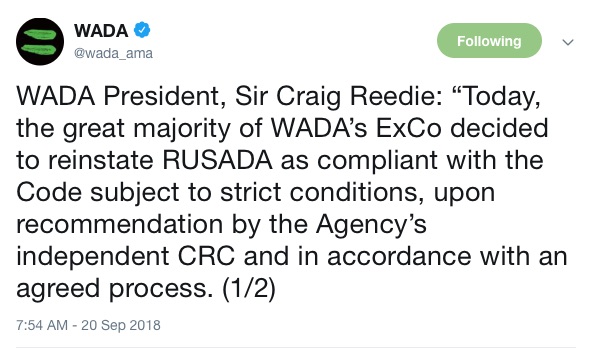
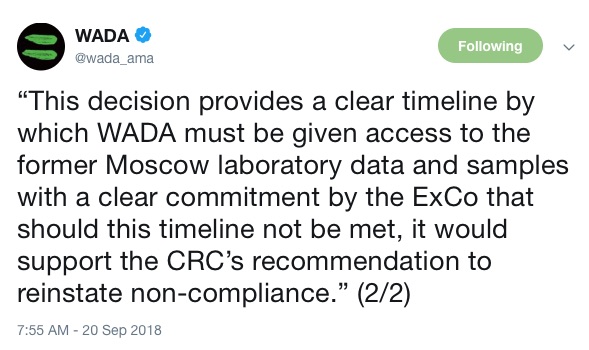
WADA announced the decision via Twitter. In the two-part tweet, WADA President Sir Craig Reedie stated, “Today, the great majority of WADA’s ExCo decided to reinstate RUSADA as compliant with the Code subject to strict conditions, upon recommendation by the Agency’s independent CRC and in accordance with an agreed process.
“This decision provides a clear timeline by which WADA must be given access to the former Moscow laboratory data and samples with a clear commitment by the ExCo that should this timeline not be met, it would support the CRC’s recommendation to reinstate non-compliance.”
For reasons already exhaustively documented, RUSADA was deemed non-compliant in November 2015. By August 2017, WADA had created a concrete outline of concessions and reforms known as the RUSADA: Roadmap to Compliance.
The roadmap reads like a hardened list of demands. In Part I of the document, WADA notes 20 actions already taken by RUSADA as conditions for reinstatement as a compliant anti-doping agency. Part II details 12 steps that remained unfulfilled at the time of the roadmap’s release. Much of those 12 steps begin with the words “RUSADA must”. Last week, it became public that much of WADA’s leadership have a malleable understanding of the word “must”.
Here’s the basic background to understanding how WADA’s Sept. 20 EC vote transpired:
Two critical conditions set forth in the RUSADA roadmap remained unmet by Russia as of Sept. 20, 2018. Russia has not officially accepted the McLaren Report findings and has not provided WADA with unmanipulated digital forensic data or unfettered access to RUSADA’s Moscow lab.
Starting this summer, it was time for WADA and RUSADA to think about a resolution.
In a letter obtained by the BBC dated June 22, 2018, signed by Reedie and WADA Director General Olivier Niggli, the two responded to a recent overture from Russian Minister of Sport Pavel Kolobkov. The letter clarified how WADA would be willing to move forward in negotiating Russia’s reinstatement.
Kolobkov’s response did not mention the McLaren Report commissioned by WADA, but it did acknowledge the IOC’s 2017 Schmid Report (the IOC investigation into the McLaren Report’s findings). But no overt guilt was admitted in the letter. Instead, it made a tepid hint at conciliation. According to the letter, the Russian Federation “fully accepted the decision of the IOC Executive Board on December 5, 2017, that was made based on the findings of the Schmid Report.”
The main body of Kolobkov’s letter establishes a quid pro quo. It states that only after RUSADA is reinstated, and with the consent of the Russia Investigative Committee, Russia will provide access to its lab and data. Kolobkov provides no timeline for when Russia would provide these two key provisions after reinstatement.
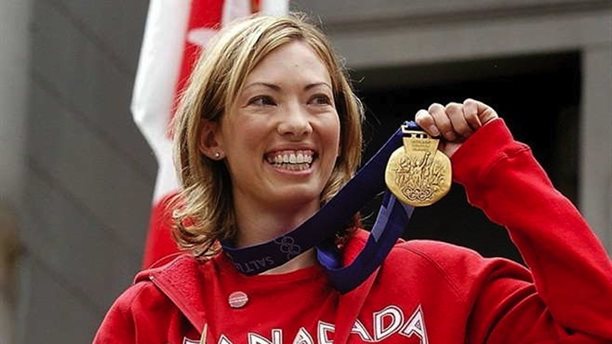
Beckie Scott with the gold medal she was awarded at a ceremony in Vancouver in June 2004. A former Canadian cross-country skier, Scott finished third in the 5 k pursuit at the 2002 Olympics but was later awarded gold when the two women ahead of her were disqualified for using performance-enhancing drugs. (Photo: Cross Country Canada)
On Sept. 14, only a day after Kolobkov’s letter, WADA’s Compliance Review Committee (CRC) approved RUSADA’s reinstatement. A member of the CRC, Beckie Scott, a former Canadian cross-country skier and Olympic gold medalist, resigned her position last week in protest of the pending reinstatement. Scott remains the Chair of WADA’s Athlete Commission.
In an interview with the CBC on Thursday following the official decision, Scott said she was “profoundly disappointed”.
“I feel that this was an opportunity for WADA as the global body responsible for regulating doping in sport and responsible for the rights of clean athletes has really dealt a devastating blow to clean athletes with this decision and I’m quite dismayed with the way things went today,” she continued.
“With WADA’s sudden shift in position raising questions about its transparency and about where its loyalties lie, we must begin the journey of returning trust to the system, enhancing WADA and creating a system fit for the next generations of athletes,” Moses wrote. “Having spoken to athletes, I know they overwhelmingly support the right decision being made in the Seychelles — they overwhelmingly support WADA’s sticking to its road map. This was not the time, they say, for the global antidoping body to perform the U-turn of all U-turns.”
The U.S. Olympic Committee (USOC) issued a press release echoing sentiments to instill faith in the anti-doping system.
“We hope that WADA can reach a conclusion on RUSADA that will give athletes a firm belief that when they compete, it will be on a level playing field, without any doubts,” it stated. “Anything that stops short of satisfying that will not only be a huge disappointment to the USOC and American athletes, but to the entire Olympic and Paralympic movements.”
But according to Reedie, Russia’s reinstatement is key to progress WADA’s worldwide mission.
“It’s my convinced view that the best thing WADA can do is to have an efficient and well-operated anti-doping system in Russia, and we’ve been trying to do that for two years,” he told the BBC. “This moves things forward.”
“To sit back and do nothing doesn’t serve the world of sport so I think progress has been made,” Reedie added. “To the members of the Ukad, athletes’ commission, I am grateful to them for their advice and can be reassured that I take their advice and I operate within the roadmap.”
One WADA EC member, Linda Helleland, Norway’s sport minister and vice president of WADA as she represents national governments on the EC, declared herself a “no” vote prior to today’s meeting.
FasterSkier will update this story with any new developments.
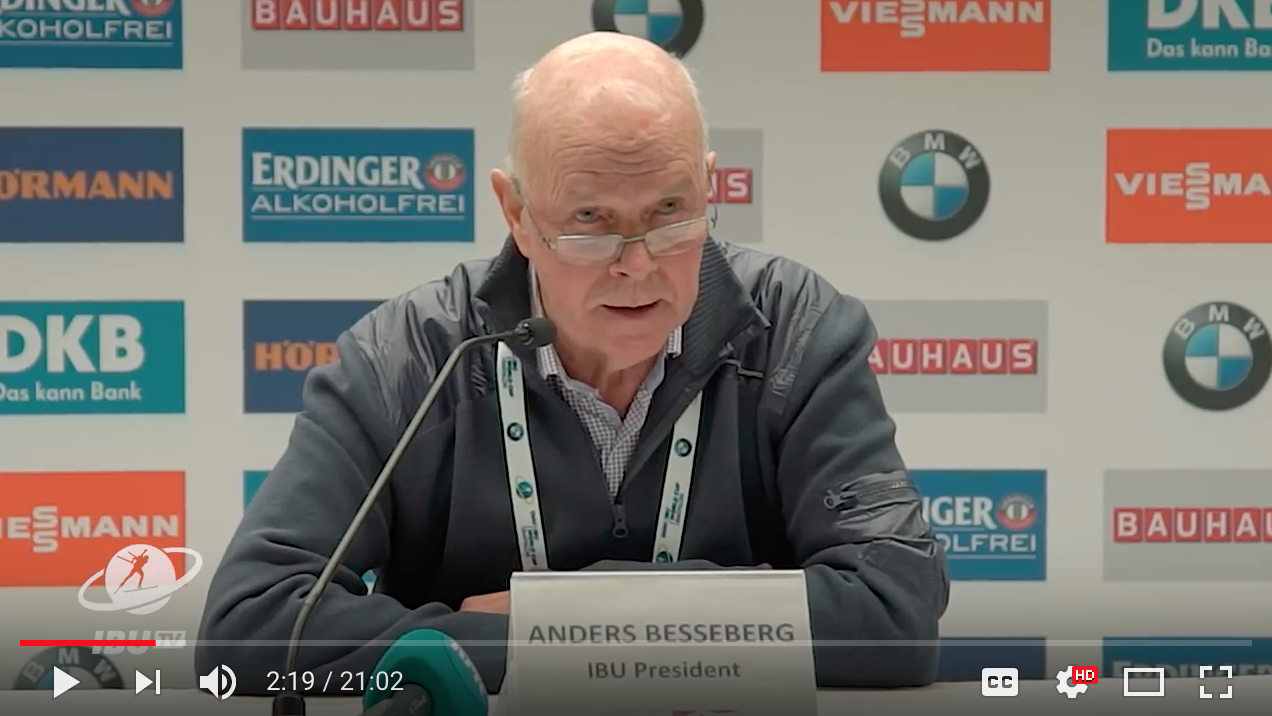
IBU President Anders Besseberg speaking at a press conference in 2017. (Screenshot: IBU TV)
Note: This article has been updated with information about bribes as reported by Le Monde on Wednesday.
Austrian police raided the headquarters of the International Biathlon Union (IBU) in Salzburg on Tuesday night and into Wednesday. According to Austrian press, the investigators were acting on behalf of the Business and Corruption Prosecutor’s Office and were particularly concerned with computer evidence.
The IBU released a statement on Wednesday, revealing that the search was part of an investigation into President Anders Besseberg and Secretary General Nicole Resch. Resch has taken an immediate leave of absence, and Executive Director Martin Kuchenmeister has taken over as Acting Secretary General.
Full details into the reason of the investigation remain unclear, but it is at least tangentially related to doping.
On Wednesday, the French daily Le Monde broke new information it obtained from a 16-page confidential World Anti-Doping Agency (WADA) report, which was released in late 2017. Besseberg and Resch are being investigated for accepting Russian bribes in regards to the nation’s doping case. The bribes were to the tune of a few hundred thousand dollars, and Alexander Kravtsov, the Russian Federation’s chef de mission at the Sochi Olympics, is quoted as saying that a suitcase can hold up to $400,000 dollars. The Russian Federation also allegedly promised members of the IBU Congress between $25,000 and $100,000 Euros.
In that report, WADA cited the following: “Mr. Besseberg’s unalterable support for Russian interests, the suspicious management of the biological passport’s obligations by Ms. Resch and the initial allocation of World Championships from 2021 to Russia.”
WADA communications director James Fitzgerald confirmed to Norway’s NRK broadcaster that WADA’s Intelligence and Investigations unit had exchanged information with Norwegian and Austrian police, as well as Interpol. He stated that as a result, police were also involved in Norway (Besseberg’s home country) on Tuesday.
“The European Commission can confirm that on 10 April 2018 its officials carried out unannounced inspections in several Member States at the premises of companies active in the distribution of media rights and related rights pertaining to various sports events and/or their broadcasting. The Commission has concerns that the companies involved may have violated EU antitrust rules that prohibit cartels and restrictive business practices (Article 101 of the Treaty on the Functioning of the European Union). The Commission officials were accompanied by their counterparts from the relevant national competition authorities.”
According to the Le Monde article, the IBU has emphasized that it is taking these investigations “extremely seriously” and “cooperating fully”. Resch, 42, was reportedly suspended from her office at her request. The head of the IBU since 1992, Besseberg recently announced that he would not seek re-election at the 2018 IBU Congress in September.
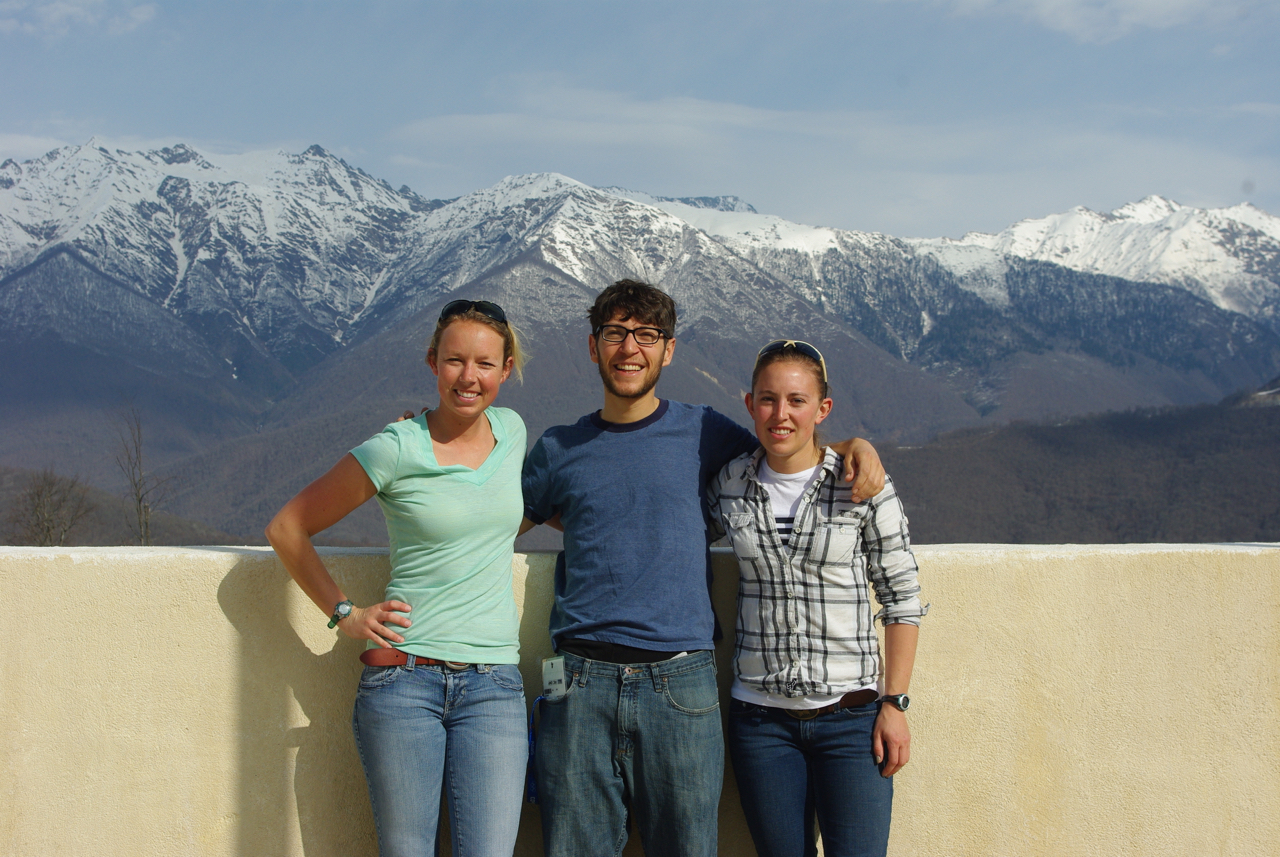
FasterSkier’s Alex Kochon, Nat Herz, and the author (Chelsea Little) at the 2014 Olympics in Sochi, Russia. Little did we know what was going on behind the scenes of those Games. Looking back at our coverage of the 2014 Olympics, I’m very proud of the work we did. But I’m not too proud to say that while we thought we had a realistic understanding of international sports governance, we were still naive to its incredible inertia.
The following is an editorial written by FasterSkier’s Editor-at-Large Chelsea Little, who has been covering doping in sport, specifically cross-country and biathlon, for the better part of the last decade. The opinions expressed are her own and do not necessarily reflect those of other FasterSkier staff.
The athletes had been disqualified from the 2014 Games by an International Olympic Committee (IOC) Commission. This was after more than 18 months of buildup in which the world learnt of systematic manipulation of the anti-doping process by the Russian state security apparatus at those Olympics.
I was both shocked, and not shocked. When all these athletes had been disqualified by the IOC and handed lifetime bans from Olympic competition, I knew in my heart of hearts that it would be undone (I’ll explain why below). But I hadn’t, somehow, put any thought into how exactly that would come to pass. So on one level, I was surprised, even if on another level I wasn’t.
When the news broke, I had written a profanity-laced all-caps message on our company Slack channel. On Twitter, I wrote, “I am so tired. That means that they have won.” That’s about all I could muster.
“I’m sure you are extremely disappointed by the CAS ruling,” one member of my extended family wrote in an email, knowing how many nights and weekends I had spent covering this story, how many hours and days of my personal life I had erased to chase it, because doing so does not pay the bills if you work for a cross-country ski website in America.
And I was disappointed.
I had thought that those nights and weekends would help make a better sporting world, help bring cheating to light, help hold the powers that be in sport accountable and call on them to do a little better.
But it felt like all that work had accomplished nothing, not changed a single thing to make nordic sports more fair.
I can only imagine how the athletes felt. The ones who found out that they would not be receiving medals after all, medals that they felt had been stolen from them by cheaters, medals that they had been slated to finally receive but now would never see.
I can only imagine.
More than anything, I was disappointed because I didn’t understand. I’m an analyst. No analysis I could do would explain to me just what had happened because CAS did not release a reasoned argument for their decision, which, as USADA General Cousel Bill Bock pointed out, is ludicrous. So at the moment we don’t know why these athletes were cleared; we only have speculation and hearsay.
In that decision, an arbitration panel wrote that they trusted the statements of whistleblower Grigory Rodchenkov and investigator Richard McLaren.
That testimony that is widely speculated to have been found untrustworthy by the arbitration panel which more recently cleared the athletes.
There is a difference between provisional suspensions and rule violations, and maybe that’s the root cause (or maybe it’s not; one day we will find out).
But if two different arbitration panels can come to two completely different conclusions about whether evidence is trustworthy, then what is the point of a “high court” of arbitration? That’s disappointing.
On the other hand, maybe the new panel did believe that the whistleblower testimony was true, but that witness statements alone are not enough to prove a doping violation. We’ll set aside for a moment all the forensic evidence [see footnote 1].
If that’s the case, it’s even more disappointing. It means that all of the rhetoric over the last few years about putting more resources into investigations will not actually result in cleaner sport, unless there is a positive test or the presence of drugs or medical equipment (see: Austrian skier Wurm, Russian skier Pankratov).
It would mean that the World Anti-Doping Agency’s new “secure digital platform” for whistleblowing — and statements by athletes and doctors and team staff — are all useless to anti-doping unless they are followed by physical evidence of prohibited substances or methods.
But we don’t know the panel’s reasoning. This is all just speculation.
I was tired and disappointed because my job as a journalist is to take complicated things, and make them make sense to our readers.
Here, there was nothing to work with. There was nothing to explain.
A second suggested storyline is that the IOC set up the cases to fail, so that it would look like they tried to do something heroic, but in the end nothing would change.
To some extent, that is absolutely the case. Lifetime bans for doping have been attempted by the IOC before. Every time, they have been overturned. There was a zero percent chance it would work this time, either.
Did the IOC go further than that in “set up to fail”? Both storylines may be true. Neither may be true. But each of these storylines is far too myopic in their attempts to explain what happened with this CAS decision.
The reason that, in my heart of hearts, I knew that things would turn out just fine for most of these seemingly disqualified athletes, is that far more than CAS is broken [2].
Broken would imply that at some point the system worked. When was that, again?
This scandal has been going on for years. And in both it and other, non-Russia-related doping scandals, organizations have dragged their feet at every turn. There is no political will to keep sport clean. Ensuring clean sport would be hard. Nobody wants to do hard work. Universally, these organizations just want to run sporting events and for fans to be happy.
“We need to stop pretending sport is clean,” International Ski Federation (FIS) President Gian Franco Kasper [3] famously told New York Times reporter Rebecca Ruiz. “It’s a noble principle, but in practice? It’s entertainment. It’s drama.”
People were mad when Kasper said this, but it was an especially revealing comment. Maybe it is a testament to our optimism that we quickly moved on, focusing on how we would try to “solve” the problem of doping.
There have been individuals and groups who have worked passionately to uncover the truth, and done an admirable job. Beckie Scott at WADA [4] is one who comes to mind. But their work is always prevented from reaching its logical conclusion.
Let’s first look at the IOC, which has deservedly gotten a bad rap for dragging its investigations out for as long as seems humanly possible.
The IOC has certainly not put the resources or good-faith effort into looking under every stone, or doing so quickly. That’s how we got the first Sochi disqualifications – like Legkov’s – being announced in November of 2017. Most of the criticism leveled at the organization on this front is absolutely justified.
In all the time between May 2016, when the Sochi scandal was first broken by the New York Times, and November 2017, the IOC did very little. The decision banning Legkov relied mostly on the same evidence that had been in the McLaren Report.
The IOC Commission asked new experts to revisit the issues of scratches on sample bottles and salt content of urine samples. Basically, they repeated a lot of work which had already been done, expanding it to a larger number of samples but taking longer to do so by insisting on using different experts, who nonetheless came to the same conclusions.
For Legkov, all of this resulted in the same evidence that had been in the McLaren Report: that Legkov’s sample bottle from after the 50 k, which he had won, showed signs of being tampered with.
Sure, the IOC Commission got testimony from Rodchenkov. But that only at the last minute, perhaps because they were publicly shamed when it was revealed that they hadn’t contacted him.
It’s fair to criticize the IOC for its anemic investigation, but this is not just an IOC problem, just like the disqualifications being overturned is not really a CAS problem.
Look further. Since the McLaren Report, few other governing bodies have been doing better.
“We like to play coy, like the cat wagging its tail when the mouse runs in front,” IBU Vice President for Medical Issues Jim Carrabre told me back at the 2014 Olympics, in an interview that led to the IBU’s media chief calling me into his office at the press center and dressing me down for talking about things that he would rather journalists didn’t ask his organization’s board members.
“It goes by once or twice, and then the third time it gets bitten,” Carrabre said at the time.
He was referring to blood profiles, a topic that has recently gained prominence.
For years I have been told by various people that the IBU has cases in the works, that soon I will hear about them, that they know some people are doping and are about to catch them.
I don’t doubt that Carrabre is a true believer in the anti-doping fight. He gets pretty fired up about things, as does fellow Executive Board member Max Cobb.
But the cases that I heard rumors of, even promises of, have never materialized.
The Athlete Biological Passport (ABP) was supposed to revolutionize anti-doping and indicate if athletes had been blood doping even when no illicit substance was detected. That sure would have been handy due to the drugs’ short detection windows and athletes’ and doctors’ strategies of “microdosing.”
But there have been no doping bans on the basis of ABP in skiing or biathlon [5]. I don’t think that even the most optimistic of fans really believes that this is because there is no blood doping going on.
What does that mean? That ABP doesn’t work, that it wouldn’t hold up in arbitration? Or that something else is going on?
It would be hard to look at IBU President Anders Besseberg’s behavior in the last two years – for instance, the IBU’s continued insistence that it’s totally fine to hold events in Russia, or his demeanor and statements during meetings with athletes – and conclude anything other than that he is sympathetic to Russia and would even more generally like to simply pretend that there was no scandal in his sport.
Having a few true anti-doping crusaders on a governing board does not clean sport make. I don’t want to put words into their mouths, but probably, it just makes these crusaders even more frustrated.
“When the McLaren Report first came out, I thought that doping was the greatest threat to our sport,” U.S. biathlete Susan Dunklee told FasterSkier in January 2017. “However after watching the last few weeks play out, I believe that the IBU’s reluctance to meaningfully act to prevent doping is the greatest threat to our sport.”
Then there is FIS. As I’ve repeatedly pointed out, there were 46 skiers implicated in the McLaren report. Not all of them, obviously, were at the 2014 Olympics or Paralympics, yet as far as anyone can tell, FIS has done nothing to investigate the other cases, some of which include alleged anti-doping rule violations.
(Which, by the way, how can I get in on that? Hi? I’m over here! I know a lot about doping in skiing and I also how to do statistics!)
The data is interesting, but nothing can really be done with it, as it is old and from the days before ABP was a policy. Without the journalists or their experts explaining how they decided what an “abnormal or highly abnormal” blood profile is, it’s impossible to judge what percentage of the athletes they identify as potentially having doped actually were likely dopers.
But perhaps this indicates that someone within FIS is frustrated with how things are going. If you cared about skiing being clean, cared about doing your job well, and listened to Kasper say things like “sanctioning entire countries is purely political and I do not agree with this,” you might be frustrated too.
And here’s the last thing. In this whole scandal we are talking about one country. That’s Russia, and it has led to a lot of ideological discussion.
But it’s not really about Russia.
Yes, the IOC and the IBU and FIS want to keep Russia happy, because their sports are popular in Russia, the Russian athletes are talented and popular even outside the country, because Russia is great at hosting events, and because Russian fans travel all over to watch competitions. That’s part of it.
And yes, some commentators have complained that athletes are being punished just because they are Russian. They have complained that this is a U.S.-led effort reviving Cold War hostilities. That we are Russophobes. That we are hypocrites because American sports stars dope too, and/or that lots of countries dope but we just haven’t found out about it.
But again, that’s being far too myopic about things, and believing that this scandal is only a thing unto itself, not part of the bigger problem.
If this scandal had taken place with Norway, Sweden, Germany, the United States, or any other country at the center – the outcome or the (lack of) speed of its resolution probably wouldn’t have been much different [6].
I – yes, I’m among those journalists accused of being hypocritical and anti-Russian, I’ve even been compared to Nazis, gee that was fun – I would chase this scandal just as hard if it had arisen in any of these other countries.
In fact, I would have investigated it with even more fervor if these were American or Canadian skiers and biathletes we were talking about. And presumably most of the evidence would have been in English, so I could investigate more effectively, without translating things I was looking for into Russian, searching the internet or evidence documents, and then translating the Russian back into English, in a crappy game of “telephone”.
I think that the North American athletes I routinely interview are aware that if I found out they were cheating, I would have no remorse and they would have nowhere to hide.
Just as I’m not a hypocrite, these sports organizations aren’t, either – well, they are, but not in this way, not when it comes to nationality. The claims that various decisions just come from Russian money and bribes are missing the point.
Whether coming from Russia or elsewere, these organizations don’t want a big scandal. They don’t want to rewrite their results sheets. The athletes who missed out on medals they probably should have taken home? These organizations don’t really care about athletes.
They are just an unfortunate bit of collateral damage, but oh well.
Time will march on. A new race will be held. It will be an exciting race! We will all be caught up in it.
Maybe Pellegrino will upset Klæbo.
Maybe an American will finally win a medal.
Maybe Fourcade will mess up his first stage, but then climb back to gold anyway.
Maybe Makarainen will mess up all her shooting stages, and we will all watch rapt to see whether she can pass 15 people on the final loop. Maybe she can.
Maybe Harvey will finally truly become the Prince of Quebec, crowned with an Olympic medal.
Maybe the breakaway will succeed.
Or maybe the favorite will win, but we will be enthralled until the final moment, watching to see whether they will pull it off.
Soon, we will forget about those athletes whom we were wondering about, the ones who maybe probably should have a medal stashed in their safe deposit box somewhere and a whole lot more sponsor money than they have now.
Those athletes will slip farther and farther to the back of our minds. In the forefront will be the day’s competition – so amazing! – and the big happy family that is sport.
Actual clean sport is not, and never was, these organizations’ goal.
*****
Footnotes:
[1] On the topic of skiers who were cleared by CAS: Maxim Vylegzhanin’s sample from Sochi also had scratches on it and had an incorrectly reported specific gravity; the two other members of the men’s relay team also had marks on their sample bottles, and one had a sample whose specific gravity was too high to be believable; two sprinters had marks on their sample bottles and for one, there as also a foreign fiber inside the bottle. Julia Ivanova, whose ban was not overturned by CAS, had an impossibly high salt value in her urine sample.
[2] I actually think CAS does work. CAS handles far more than doping cases – they handle contract disputes, team selection, trades, anything you can think of that would need arbitration. And as far as I know, they do a good job. This is the first CAS decision that has left me truly baffled.
[3] Term limits, man. We really, really need term limits.
[4] I’m not going to talk in much detail in this piece about WADA, which alternatingly does the right thing and the wrong thing, and often does the wrong thing for a very long time first. But at least in the last year or so, WADA is no worse than any other group, and indeed maybe a bit better.
[5] Blood profiles have certainly led to targeted testing, which caught athletes before the 2014 Olympics. But nobody bothered to try an ABP case, that we know of. Nor, seemingly, did the biathletes that the McLaren Report alleges were doping – Olga Vilukhina and Yana Romanova – fail their ABP’s. Either ABP is not being used, or it is not being successful and the details of the cases are never made public.
[6] If the perpetrator of this scandal hadn’t been Russia, I think the main difference might have been the reaction within that different country. I don’t think the Norwegian public would react the same way the Russian public has. Each place has its own culture around sport and what it means, and government also plays various different roles in supporting and controlling sport. But the reaction from the international organizations? Things would probably be much the same.
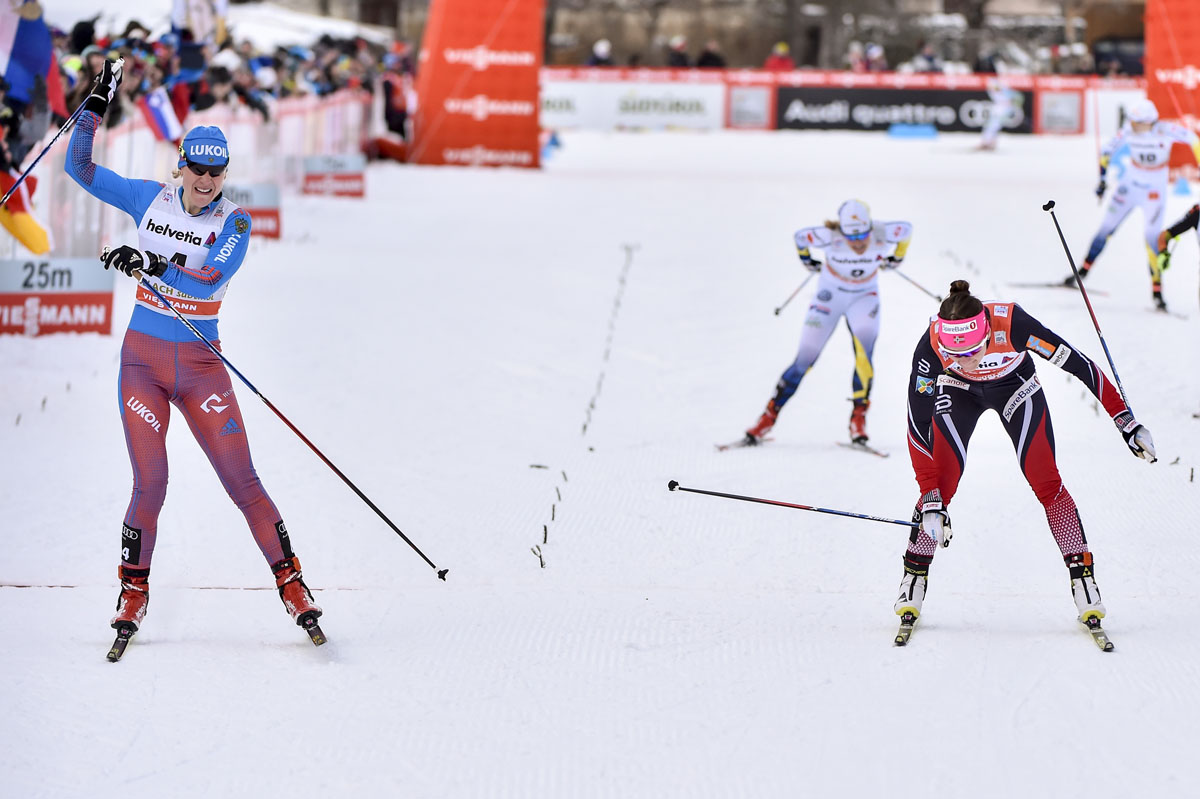
Russia’s Natalia Matveeva (l) winning a World Cup sprint in January, 2017. Matveeva was sanctioned for using EPO in 2009, but has returned to competition; a provision in an IOC decision would bar her from competing in the 2018 Olympics, but is almost guaranteed to be struck down by the Court of Arbitration for Sport. (Photo: Fischer/Nordic Focus)
Yesterday, the International Olympic Committee (IOC) decided that while Russian athletes who are “considered clean” may compete at the 2018 Games in PyeongChang, South Korea, they will do so in neutral uniforms and under the moniker “Olympic Athlete from Russia” rather than as the Russian Olympic Team. The Russian national anthem wouldn’t be played if they win, although the team may be reinstated for the closing ceremonies.
That is a big step for the international sporting community in their task of dealing with Russia’s manipulation of the anti-doping system at the 2014 Olympics.
But significant as it may be, the drama is far from over as several more decisions must be taken. Individual athletes disqualified from the Olympics by an IOC Disciplinary Panel are appealing their bans to the Court of Arbitration for Sport (CAS), sport’s supreme court. Several of the provisions in the IOC’s Tuesday decision are also certain to be appealed to CAS, among them the assertion that no Russian athlete with a previous doping ban can compete in the 2018 Games.
Decisions must also be taken by individual international sports federations, like the International Ski Federation (FIS) and the International Biathlon Union (IBU). Russia has broken enough statutes of these federations that they may be suspended, which could have its own effects on the competitive field at the World Cup, the Olympics, and lower levels of competition.
And finally, there allegedly hundreds to thousands of doping cases indicated in digital forensic evidence from the Russia investigation which have not been dealt with yet because they do not involve athletes from the 2014 Olympics.
Sport Federation Statutes and Suspensions
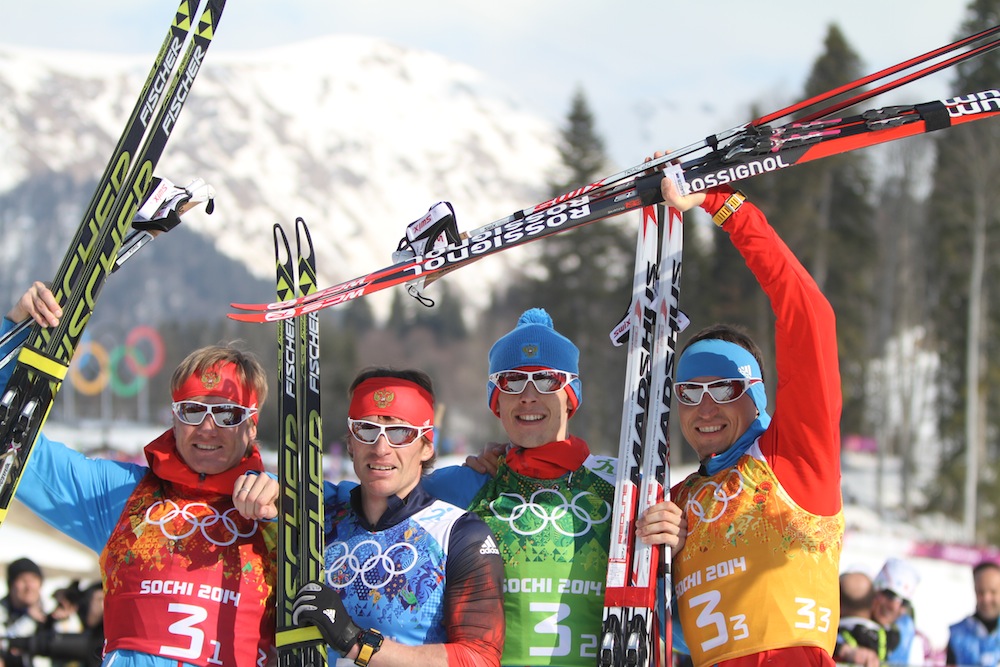
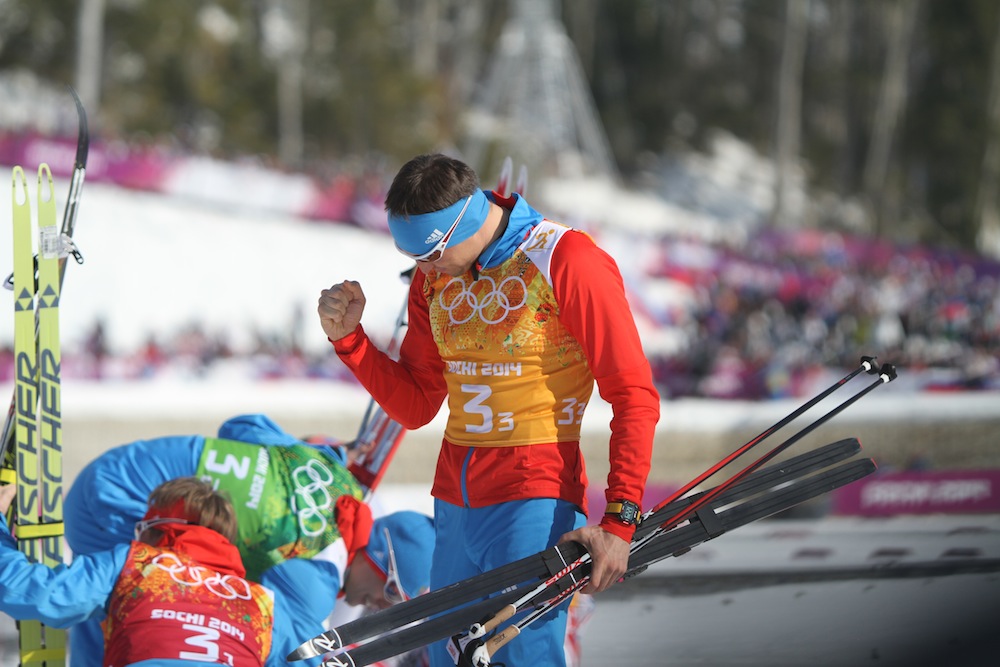
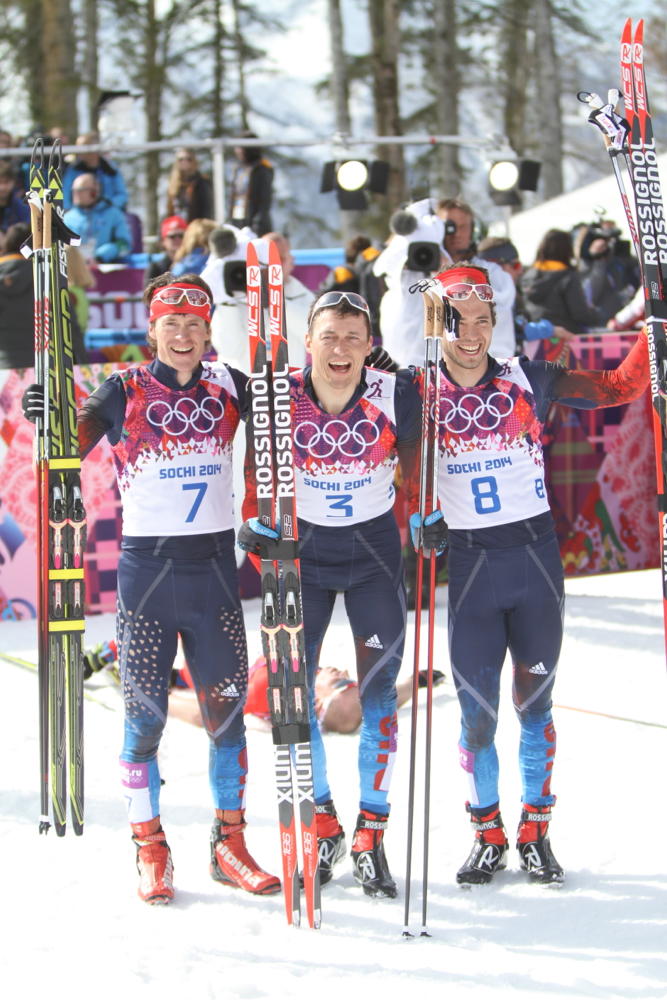
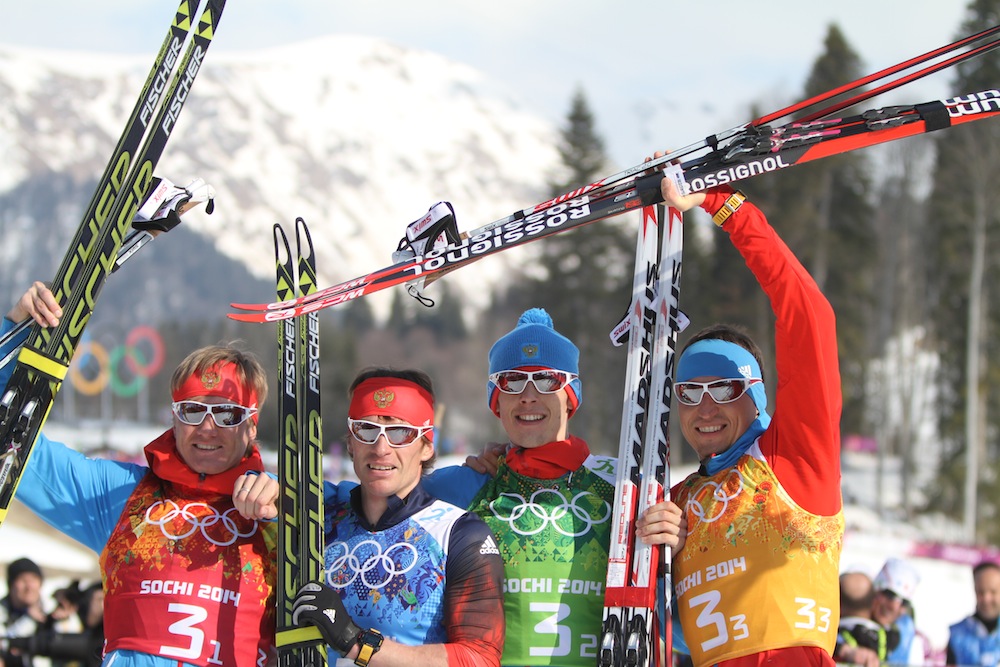
The Russians celebrate a silver medal in the men’s 4 x 10 k cross-country skiing relay at the 2014 Sochi Olympics. After the disqualification of Alexander Legkov and Maxim Vylegzhanin, the team has been ordered to return the medals.
The 2014 FIS Anti-Doping Rules, which went into effect on January 1, 2014 (before the Olympics started that February), state that the federation can take action against national ski teams, such as barring athletes from competition or assessing fines, if there is evidence of extensive doping within the team.
Article 12.3.1 of the rules state that such action may be taken when “Four or more violations of these Anti-Doping Rules… are committed by Athletes or other Persons affiliated with a National Ski Association within a 12-month period in testing conducted by FIS or Anti-Doping Organisations…”
At the moment, eight Russian cross-country skiers have been disqualified by the International Olympic Committee for doping violations at the 2014 Olympics: Alexander Legkov, Evgeny Belov, Alexei Petukhov, Maxim Vylegzhanin, Julia Ivanova, Evgenia Shapovalova, Anastasia Dotsenko, and Julia Tchekaleva.
“In such event FIS may in its discretion elect to: (a) withdraw some or all FIS membership rights, including participation in all FIS calendar competitions, voting rights at the FIS Congress, ban all officials from that National Ski Association for participation in any FIS activities for a period of up to two years and/or (b) cancellation of the organisation of future FIS events in the disciplines concerned and/or (c) withdraw some or all FIS funding to the National Ski Association…” the rules state.
A second provision states that if four more cases are found within a 12-month period after the first four or more cases, “FIS may suspend that National Ski Association’s membership for a period of up to 4 years.”
The rules also stipulate that if “More than one Athlete or other Person from a National Ski Association commits an Anti-Doping Rule violation during an International Event… FIS may fine that National Ski Association in an amount up to CHF 50’000.–.”
FIS has yet to officially consider any of these actions, but they will likely be brought up for discussion soon.
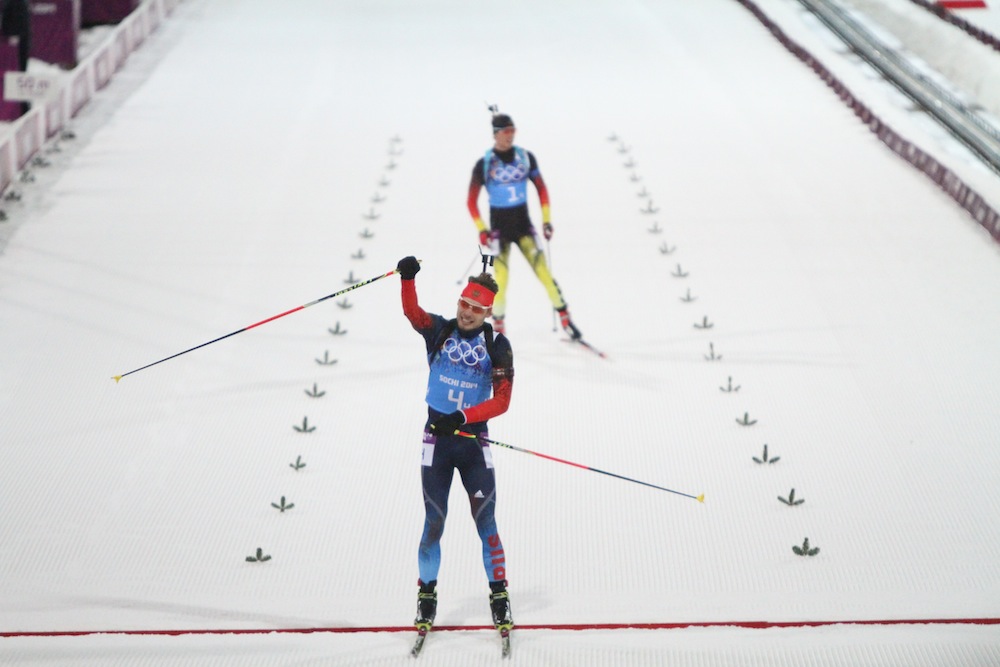
Russian anchor Anton Shipulin celebrates his team’s gold medal in the men’s relay over Germany’s Simon Schempp. So far, no male biathletes from Russia have been implicated in the doping scandal.
In a statement released by U.S. Ski and Snowboad, CEO Tiger Shaw said, “On behalf of our athletes, we have a fundamental obligation to fight for fairness in sport, to advocate for the health and welfare of athletes and to protect the image of our sport. Now we look to the International Ski Federation (FIS) to hold a FIS Council meeting to review the IOC’s decision and related evidence to consider its impact on the Russian Ski Association, its FIS committee members, officials and athletes.”
Meanwhile, the IBU will hold an Executive Board meeting this weekend, in which it may address violations of its own statutes.
The IBU did not implement rules similar to the FIS rules regarding suspending member federations or canceling events on the basis of repeated doping offenses until its 2014 Congress, which was held after the Sochi Olympics. But Russia may have violated other IBU statutes.
In the 2012 IBU Rules, it is stated that “The IBU may impose a fine either by requesting payment or by withholding financial support from a member federation if more than one athlete or more than one person from such member federation commits a violation of the IBU Anti-Doping Rules during a 12-month period.”
In the same edition of the rules, a provision states that “IBU member federations that are full members may be suspended by the Executive Board, for up to two years, until the next IBU Congress if they do not fulfill their obligations stated in Art. 2.3.2.”
Among the “Obligations of Full Members” described in that article is, “to comply with the IBU Constitution and Rules.” Two of the “Objectives” listed in the IBU Consitution are “to prevent doping in biathlon” and “to prevent all methods and practices that might jeopardize the integrity of biathlon competitions.”
All of the athletes banned by the IOC, additionally, may see sanctions from their relevant international federations. The skiers and biathletes are currently under provisional suspensions from FIS and the IBU, and doping hearing panels will (eventually) consider the evidence against them and decide whether to bring anti-doping rule violations. The time frame for that is unclear.
Likely CAS Rulings
There are already 22 appeals registered at CAS by athletes who were disqualified from the 2014 Olympics by the IOC’s Disciplinary Commission.
Alexander Legkov is one of 22 Russian athletes appealing their disqualifications to the Court of Arbitration for Sport. (Photo: Marcel Hilger)
Thus it is likely, but not guaranteed, that the retroactive disqualification from the 2014 Games will remain standing.
(Then there’s the question of getting the medals back: biathlete Yana Romanova said that “I’d rather throw my medal in the dumpster, than return it to the IOC,” referring to the silver medal she was given in the women’s relay and was ordered to return after her disqualification.)
Besides disqualifying the atheltes from the 2014 Games, the IOC Disciplinary Commission decisions also banned them from all future Olympics. There is no provision for lifetime suspensions on a first doping offense in the World Anti-Doping Code, so this could be a real fight at the CAS level.
Similarly, the IOC’s Tuesday decision included a ruling that no Russian athlete who had ever been suspended for an Anti-Doping Rule Violation could compete in the 2018 Olympics. That is very unlikely to stand, as the Court of Arbitration for Sport has ruled several times, in different specific circumstances, against past doping violations being used anew to bar athletes from competing in a new set of events.
Aside from the issue of double jeopardy, there would be an inherent unfairness to preventing Russian athletes who had completed doping suspensions from competing, while others who had served and completed similar suspensions were allowed to participate.
Athletes who may challenge this provision include cross-country skier Natalia Matveeva and biathlete Alexander Loginov, both of whom finished their suspensions for using EPO, and have since returned to competition.
In comparison, Martin Johnsrud Sundby of Norway and Justyna Kowalczyk of Poland have both served doping suspensions and will almost certainly be on the start line.
Outstanding Cases
Finally, there are many more cases that have not yet been handled.
The IOC has so far only suspended athletes involved in a doping cover-up scheme at the 2014 Olympics. But in the course of the investigation of that scheme, evidence came to light of many, many more cases outside of the Games.
“Play True” is the World Anti-Doping Agency’s (WADA) outward appeal to athletes, coaches, doctors, a myriad of handlers and advisers, and, ironically, anti-doping labs to keep sport clean.
On one hand, “Play True” could be interpreted as a baseline demand, something educators might instill in elementary students. But it also reads like a plea; for fans of the sport and most importantly participant athletes themselves, there’s a lot to lose when athletes “Play False”.
The sharpened teeth behind words like “Play True” are the tests administered to detect doping and potential bans for positive tests, although WADA’s anti-doping arsenal also includes a confidential digital hotline for individuals to file claims of suspected doping.
On Oct. 25, WADA released its annual testing numbers in a massive document titled “2016 Anti-Doping Testing Figures.” The report itemizes every sample tested by the 34 WADA-accredited labs in 2016 and uploaded into WADA’s Anti-Doping Administration and Management System (ADAMS). The information includes all in- and out-of-competition tests on both athlete urine and blood, and results for Athlete Biological Passport (ABP) blood analysis.
The 2016 report does not include data or discussion of Anti-Doping Rule Violations (ADRVs). A discussion of 2016 ADRVs is expected sometime in 2018. The report does include the number of Adverse Analytical Findings (AAF) and Atypical Findings (ATF).
Here’s the simple appetizer before the full course: an AAF occurs when a sample contains a prohibited substance. An ATF, according to WADA, indicates that “while there may not be an adverse analytical finding, there may be some suspicion according to the results and that further analysis or investigation should be conducted.” After an ATF is investigated, it could lead to a negative result (the suspicion was not warranted), an AAF (something was found), or it may be canceled.
WADA stresses that in reading and interpreting 2016 Anti-Doping testing Figures report, “one single result does not necessarily correspond to one athlete. Results may correspond to multiple findings regarding the same athlete or measurements performed on the same athlete; such as, in the case of longitudinal studies of testosterone.”
Also, the number of AAFs in the 2016 testing report will not correlate directly to the number of ADRVs in 2016. Among other reasons, that is because some AAFs end up being explained by the athlete having a Therapeutic Use Exemption (TUE).
The Report’s Findings
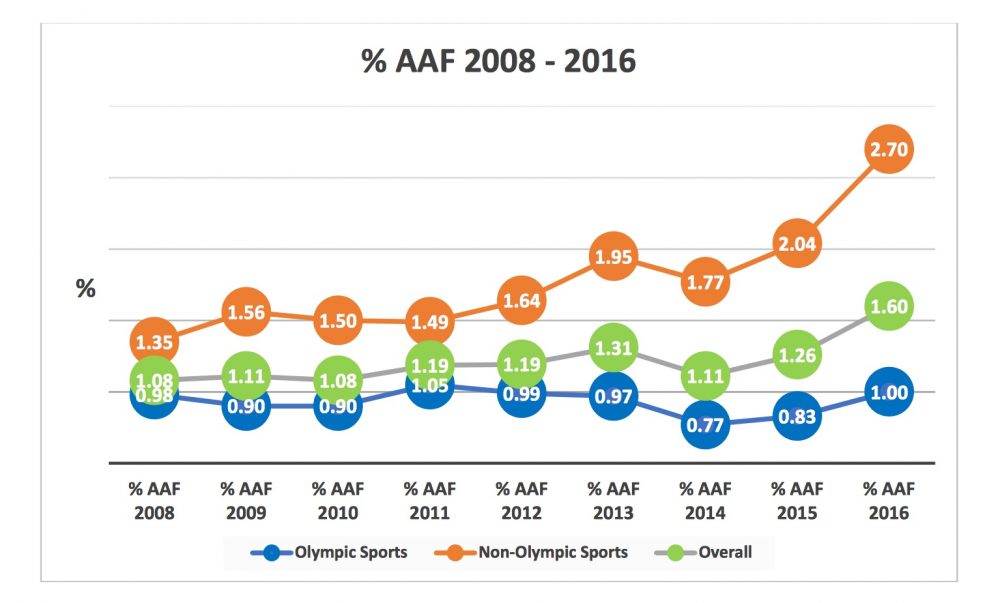
% AAF 2008-2016 from the 2016 from WADA’s 2016 Anti-Doping Testing Figures report. (Photo: Screenshot from 2016 Anti-Doping Testing Figures report, Samples Analyzed and Reported by Accredited Laboratories in ADAMS)
It’s worth mentioning again the length and comprehensiveness of this report. FasterSkier created a Google spreadsheet to better understand testing results in three sports we cover: biathlon, cross-country skiing and nordic combined. This process simply allowed FasterSkier to compare testing analysis in these sports more efficiently, and you can see the spreadsheet yourself at the link above.
WADA articulated what it felt were the report’s highlights. The anti-doping watchdog advertised what it called a “noteworthy” development: that the total number of AAFs increased from 1.2 percent in 2015 to 1.6 percent in 2016. WADA also qualifies the total increase in positive tests as “partly related” to AAFs attributed to Meldonium — that drug was placed on the prohibited list in January 2016 without much consideration of how long it might stay in athletes’ bodies, or whether athletes had enough advance warning to stop taking the drug.
At the same time, WADA noted that the total number of samples tested decreased from 303,369 to 300,565 from 2015 to 2016. WADA claimed that despite the downturn in the total number of tests, the administration and efficacy of its tests contributed to the higher AAFs total in 2016 compared to 2015.
Totals
Starting with biathlon, there were 1688 total samples tested: 671 were in-competition urine samples, 39 in-competition blood samples, 859 out-of-competition urine samples, and 119 out-of-competition blood samples. Of those 1688 samples, 16, or 0.9 percent of the total, were considered AAFs (seven in-competition AAFs and nine out-of-competition AAFs, all from urine samples).
Cross-country skiing accounted for 2135 total samples tested. 623 were in-competition urine tests, while 19 were in-competition blood tests. 1163 were out-of-competition urine tests, 330 out-of-competition blood tests. The sport had a single in-competition AAF and eight out-of-competition AAFs — again, all derived from urine samples. Out of all the cross-country samples tested, 0.4 percent were AAFs.
Nordic combined had 393 total tests. Eighty-eight of those were in-competition urine tests, six were in-competition blood tests. According to the WADA report, out-of-competition urine tests accounted for the majority of samples taken; 245 urine samples were analyzed and 54 out-of-competition blood tests were recorded. Nordic combined had two confirmed AAFs — both from in-competition urine tests. Of all the nordic-combined tests, 0.5 percent were AAFs.
How exactly should we read these tea leaves? It has been well-documented in the mainstream media, as well as in documentaries like Icarus, that historically, the anti-doping system can be gamed. Methods other than drug testing have shown that between 15 and 40 percent of elite athletes have intentionally doped at some point. With the low rate of AAFs in the three sports highlighted by FasterSkier, biathlon, cross-country and nordic combined, a few basic conclusions can be made.
With the low rate of AAFs in the three sports highlighted by FasterSkier, biathlon, cross-country and nordic combined, a few basic conclusions can be made: the possibility of doping and skiing undetected remains, but if the “Play Fair” mantra works, the majority of athletes are training and racing clean.
Tests for Blood Doping
Of importance to policing endurance sports like biathlon, cross-country and nordic combined is increased implementation of WADA’s Technical Document for Sport Specific Analysis (TDSSA). The TDSSA demands that certain sports conduct a mandatory minimum of tests to screen for specific drugs.
For both biathlon and cross-country, the TDSSA calls for enhanced testing for Erythropoiesis Stimulating Agents (ESAs) — think EPO. There’s also a required testing minimum for Growth Hormone (GH) and Growth Hormone Releasing Factors (GHRFs). As of January 2017, the current TDSSA calls for 60 percent of all samples in biathlon and cross-country to be tested for ESAs and 10 percent for GH and GHRF’s respectively.
Partly because of this, the 2016 WADA Anti-Doping Testing Figures report also includes data about specific tests conducted on urine and blood samples – like the ESA or GH tests.
ESAs stimulate red blood cell production in the body. Several ESAs are available, the one most closely followed in endurance sport being recombinant erythropoietin (EPO). Both anecdotally and in research, EPO has been shown to boost endurance, power thresholds and recovery. When it comes to those willing to cheat in endurance sport, ESAs are a go-to. They appear to work.
As a result, WADA has emphasized the testing of both urine and blood for ESAs in sports where an ESA would benefit. It follows that the majority of total samples tested in biathlon and cross-country are comprised of ESA tests. (ESA testing in nordic combined did not constitute a majority of the specific tests administered.)
ESA testing accounted for nearly 63 percent of all the tests in biathlon. In biathlon, 469 in-competition urine tests and 592 out-of-competition urine tests for ESAs were administered with no AAFs. The number of in- and out-of-competition blood tests for ESAs were far less. There were 29 in-competition ESA blood tests and 17 out-of-competition blood tests. Again, not a single sample flagged an AAF.
For cross-country, 1107 samples were tested for ESAs — comprising almost 52 percent of the total 2135 cross-country samples tested in 2016. Like biathlon, nearly all of these samples were from urine samples. 316 tests were from in-competition urine tests and 735 from out-of-competition urine tests. Eight in-competition blood tests and four out-of-competition blood tests were screened for ESAs in cross-country. No AAFs for ESAs were documented in cross-country.
Like biathlon and cross-country, nordic combined was void of any AAFs in their ESA testing pool. Thirty-two in-competition urine and 106 out of competition urine ESA tests occurred in nordic combined. No in-competition blood tests and one out of competition blood test for ESAs were administered. ESA testing made up 35 percent of the total test in nordic combined.
Prohibited Substances Used in Nordic Sport
Reflecting back on the total number of AAFs reported in biathlon, cross-country and nordic combined (16, 9 and 2, respectively), WADA did, however, provide information on the drug class of those AAFs.
In biathlon, 14 of those AAFs were flagged in the Hormone and Metabolic Modulators drug class, whereas two were in the Diuretics and Other Masking Agents drug class. That’s maybe not surprising as meldonium is a metabolic modulator, and there was a burst of findings of meldonium in early 2016, with Ukrainian biathlete Olga Abramova as just one example. Several of the athletes were ultimately cleared without sanctions.
For cross-country, there was one AAF in the Anabolic Agents drug class, two in the Beta-2 Agonist drug class (which includes asthma medications), five in the Hormone and Metabolic Modulators drug class, one in the Stimulants drug class, and one in the Glucocortico-steroids drug class were noted.
In nordic combined, the two AAFs were both in the Stimulants drug class.
Athlete Biological Passport (ABP)
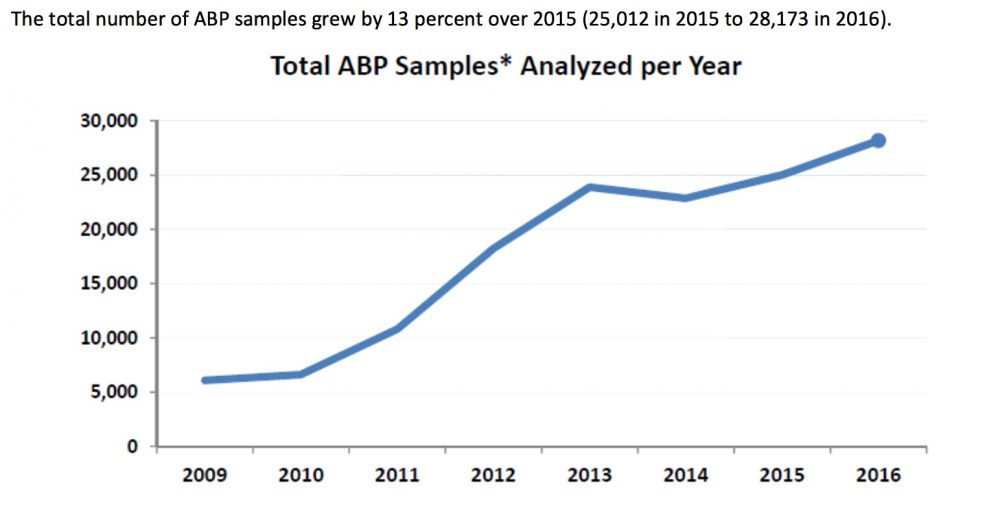
Total ABP Samples Analyzed per Year 2008-2016. (Photo: Image capture from WADA 2016 Anti-Doping Testing Figures report)
In recent years, ABPs have been established throughout the sporting world. Rather than a method to catch an athlete at a particular competition or out of competition training block, ABPs are more longitudinal in nature. WADA is upfront about the intended function of ABPs. The fundamental principle of the Athlete Biological Passport (ABP) is to generate a baseline of data for specific biological markers in an athlete. For example, each athlete’s testosterone and hematocrit levels are tracked over time. When an ABP test is taken, the purpose is to determine if any of the biological markers sampled are elevated or inconsistent – a big red flag – compared to that baseline.
WADA also clarifies that anti-doping organizations can pursue an ADRV simply based on an atypical ABP. No adverse analytical finding is needed to pursue a doping violation when an ABP is suspect.
In biathlon, 960 total ABP samples were analyzed: eight in-competition and 952 out-of-competition. The testing authority responsible for testing 645 of those out-of-competition samples was the International Biathlon Union (IBU).
Cross-country accounted for 883 total ABP samples; 88 in-competition and 795 out-of-competition.
Nordic combined amassed 224 total ABP samples; 21 in-competition and 203 out-of-competition.
Conclusions and Opinions
Stating the obvious, the anti-doping crusade evolves. The 2016 testing report’s substance lies in its depth and breadth. Although no athlete names are publicly associated with specific ATFs and AAFs in the report, a better understanding of how WADA and the global “Signatories to the [WADA] Code,” are advancing clean sport can be gleaned.
Broadly speaking, the report’s findings indicate that the testing of athletes’ blood may be a misuse of resources.
An article at the Sports Integrity Initiative titled “WADA 2016 Test Figures P1: Blood tests are not catching dopers” reveals a key pattern in the report. The article’s author, journalist Andy Brown, calls attention to the following: when considering all summer and winter Olympic sports together, 3,200 in-competition blood tests were run, but only 17 AAFs resulted. Out-of-competition testing was far more routine, with 12,443 blood tests run. Under that massive testing net, only 11 AAFs were returned.
Disaggregating the AAF return on blood tests in the winter Olympic Sports may raise more questions than it answers. The 197 total in-competition blood tests performed in the winter Olympic disciplines amassed no AAFs. There were no AAFs for the 1,104 out-of-competition blood tests on the winter side, either. Blood testing is more costly, and data indicates it may not have its desired effect as a doping deterrent.
Russian team staff cheer on Maxim Vylegzhanin, the country’s anchor skier, in the 4 x 10 k relay at the 2014 Olympics in Sochi, Russia. Vylegzhanin has now become the second member of that silver-medal relay team to be disqualified for doping.
All four were identified in the McLaren Report, an independent investigation commissioned by the World Anti-Doping Agency to investigate reports from whistleblowers that Russia had systematically evaded the anti-doping process at the 2014 Olympics.
“The athletes have been disqualified for life from taking part in the Olympic Games,” Valbe said.
With Legkov’s disqualification, Russia had already lost a gold medal in the 50 k and a silver medal in the 4 x 10 k relay.
Vylegzhanin had finished second in the 50 k, but with him now disqualified as well, there could be a substantial medal re-allocation. Third-place Ilia Chernousov, also from Russia but not implicated the McLaren report, would stand to gain gold. Fourth-place Martin Johnsrud Sundby of Norway would take silver, and fifth-place Sergei Dolidovich of Belarus would earn bronze.
Vylegzhanin also won silver in the men’s team sprint with Nikita Kriukov. With that result invalidated, Sweden’s Emil Jönsson and Teodor Peterson will move from bronze to silver, and fourth-place Northug and Ola Vigen Hattestad would earn bronze.
Valbe said that the IOC Disciplinary Commission’s decision will be appealed to the Court of Arbitration for Sport, so such medal reallocations are not yet finalized.
“It’s hard to choose words, but I’ll fight to the end — it’s a violation of all human rights,” Petukhov said, according to a translation.
Petukhov finished eighth in the skate sprint in Sochi; Shapovalova finished 28th. Ivanova was part of the sixth-place women’s relay and team sprint teams, both of which stand to be disqualified, and finished 17th in the 10 k classic and 30th in the 30 k skate.
The Canadian team of Perianne Jones and Dasha Gaiazova missed qualifying for team sprint finals as “lucky losers” by one spot. The Russian pair of Ivanova and Anastasia Dotsenko, however, did advance as lucky losers – meaning that if they had not been in the race, the Canadians would have been next in line for a spot in the finals.
Rosie Brennan on her way to 35th in the 10 k classic in Oberstdorf, Germany, as part of the 2016 Tour de Ski. Brennan is an athlete representative to U.S. Ski & Snowboard, and recently participated in a call between the leadership of the International Olympic Committee and the World Anti-Doping Agency, with 50 other athlete representatives. The athletes had the chance to ask questions about current doping investigations and anti-doping policy. (Photo: Marcel Hilger)
Other racers, too, have a big stake in the outcome. For them, whether FIS brings a case or not feels symbolic of whether action will ever be taken to resolve the allegations of years of systematic doping orchestrated by the Russian state.
FIS says that it is waiting on evidence from a commission which is part of the International Olympic Committee (IOC). In an email to FasterSkier, Legkov’s lawyer, Christof Wieschemann, wrote that the IOC commission would have a hearing for his client on Monday.
“We’re getting really close and I haven’t heard anything [from FIS] yet,” said Rosie Brennan, a U.S. Ski Team member and athlete with the Alaska Pacific University elite team. “I guess that’s one of my biggest fears. It’s what is really going to tell us if the IOC chose to do more investigations just to drag things out. If FIS can’t make a decision by October 31st because these investigations aren’t finished, well, there we have our answer.”
As the controversy over systematic doping in Russia continues unresolved, athletes are becoming louder in demanding action.
Back in December, over 100 cross-country skiers signed a letter expressing frustration with the IOC for not being tougher on doping, and asking for a meeting with International Ski Federation (FIS) President Gian Franco Kasper. That meeting – where IOC President Thomas Bach was also present – happened in February at Nordic World Championships in Lahti, Finland.
Meanwhile in Germany, athletes feel that their representation within the German Olympic Sports Confederation (DOSB) was not meaningful and in order to make their actions more powerful, they may leave the organization and form their own union.
Against this backdrop, the leadership of the IOC and the World Anti-Doping Agency (WADA) organized a conference call earlier this month with athlete representatives from different national and international sports federations around the world.
“It was actually a very last minute thing,” Brennan, U.S. Ski & Snowboard’s cross-country athlete representative, said in an interview. “It was unclear whether that was intentional or not, but one way or the other, the U.S. Ski Team didn’t find out about the meeting until very last minute.”
In theory, the only American athletes on the call should have been athlete representatives to the United States Olympic Committee (USOC) or to international fedrations like FIS and the International Biathlon Union. (U.S. biathlete Lowell Bailey is one of that body’s representatives, and was on the call.)
But because the call was not well publicized, it turned out that the USOC representatives couldn’t participate. So Brennan did instead.
When she decided to become an athlete representative, she said, she wouldn’t have necessarily guessed that she would wind up on international conference calls with the likes of WADA Director General Olivier Niggli. Traditionally, U.S. Ski and Snowboard representatives – who come from sports as diverse as alpine skiing, freestyle skiing, and snowboarding – deal more with domestic issues.
But the doping scandal has had a huge effect on the cross-country ski community, and so she has been very engaged with the issue.
“I am the only cross-country athlete on the committee,” she said. “At each of our meetings we each give a sport-specific update, and last year a lot of my updates revolved around anti-doping because of everything that was happening. I was really excited because all the other members were super supportive and wanted to help fight for us, and work harder for clean sport. I was really encouraged by that, because a lot of those sports, I don’t think it’s really an issue for them… that was really encouraging and it made me want to do a little more on the anti-doping front.”
During the conference call, questions from the athletes to the IOC and WADA leadership just about doping took up more than an hour and a half.
The athletes made it clear that they continue to be skeptical of the IOC’s handling of the scandal. An independent investigation created by WADA presented findings in 2016 of widespread doping in Russia, including over 1,000 documents used as evidence. That investigation also did forensic testing of the glass bottles used to collect anti-doping samples, finding that some bottles belonging to Russian athletes at the 2014 Olympics had been tampered with.
The IOC convened two more commissions, headed by Denis Oswald and Samuel Schmid, to investigate the allegations further before taking disciplinary action against any athletes or against Russia as a country, for instance by barring Russian teams from competition.
“I think that was the biggest question we all still left with: Why are there two more investigations happening following the McLaren Report?” Brennan said, referring to the WADA independent investigation. “I think most athletes felt that the McLaren Report was very thorough and clear, and why there’s two more investigations happening just seems strange. I guess their answer was the McLauren Report didn’t look at all the sides well enough, and was never a report supposed to indict people. So they felt they needed to have these two follow-up investigations. But from an athlete perspective, I think that’s just a hard thing, because to me it feels like they’re dragging their feet a little bit in decisions.
“The other hard part is that Oswald is part of the IOC, so it doesn’t feel terribly independent to me,” she continued. “So I think we still all kind of left with those questions in mind.”
Brennan said that relatively little new information was presented to the athletes. Updates were given on the compliance of the Russian Anti-Doping Agency (RUSADA), which is still not accredited to do doping tests within Russia without oversight from another agency.
In order to be deemed compliant, WADA has said that Russia must acknowledge and apologize for the doping offenses committed in the last years, and also open a storage room in the Moscow laboratory which could contain more evidence of doping. So far, the government has refused to do either, and the storage room of the laboratory remains locked.
“A lot of people are wondering why haven’t they been able to get access, and what in that lab is useful at this point,” Brennan said. “They were pretty honest in saying that they don’t think anything is going to be in that lab. Because that lab only kept samples for three months, and it’s been much more than three months now [since the time the allegations refer to] so the chances of anything still being in there are really slim… I was happy that they were so honest about that, but it was also a bummer to hear. It just seems like another example of them dragging their feet. They keep putting this out there as a reason [that the investigation isn’t finished], when it’s not a very good reason.”
Brennan was impressed to be part of this international community – according to the IOC, 51 athlete representatives were on the call – but also saw that the level of engagement and self-confidence to demand action were not evenly distributed around the group.
“Every question that was asked was a good one,” she said. “The frustrating part was that every person that talked was either Canadian or American, except for I think one Brit had a question… it just further made clear that athletes in other countries either are choosing not to read the information, or are not getting the information, or just simply… aren’t really willing to take that stance. That’s really hard because I feel it needs to be an international effort to see some significant change. I hope that those other international athletes that were on the call at least took in that information and saw what Americans and Canadians are really pushing for, and maybe fired them up a little bit to go home and get some support going.”
That’s the kind of change that the head of Brennan’s team thinks is necessary.
“I truly believe that if the athletes get together, work with some really smart people, decide how they would like it to work, make a worldwide demand for that – they have the control,” Tiger Shaw, the CEO of U.S. Ski & Snowboard, said in an interview last week. “It is still about them. You can’t have the competitions without them. They provide the commercial value for all of these contests.”
He sees athlete leaders as having a unique ability to make demands. It is one of the reasons that the U.S. is pushing for cross-country skier Kikkan Randall, who was previously the FIS athlete representative and helped make the meeting between skiers, IOC President Bach, and FIS President Kasper happen last year, to get elected as an IOC member at the upcoming Olympics in February.
“She has a track record already of being involved in governance and caring deeply about it, even while she’s competing, which is kind of rare,” Shaw said of Randall. “It’s a more critical position than ever [to be on] the IOC. It needs someone who can help push the IOC forward in all the ways it needs to reform its governance – a strong athlete voice there is going to be critical.”
Brennan, for one, recognizes that not all athletes are comfortable being that loud voice. Some may also simply not want to deal with this not-very-uplifting topic, even within their own minds, and instead focus on training and being the best they can be in competition.
“When I go out and train, it’s like the last thing I’m thinking about, so I guess I’ve been able to compartmentalize it pretty well,” Brennan laughed. “But I do feel a little bit torn when I try to communicate this information to my teammates and other U.S. skiers. I do know that some people prefer to just not pay attention to it and just focus on their training. The challenging part for me is that I want to be respectful of how my teammates to prepare for the season, but I also want them to have the information that’s out there. So I try to include some links so they can choose whether to click on them… I think it’s just one of the skills you have to learn as an athlete is how to compartmentalize those things and not let it affect your training. When you go to race, you go to race regardless of who is there and who’s not there.”
Usain Bolt after winning a gold medal at the 2008 Olympics in Beijing, China. Several Jamaicans tested positive for the steroid clenbuterol at those Games, but the International Olympic Committee hid the cases and they have never been investigated. (Photo: Wikimedia Commons)
In the beginning of April, news hit that a group of athletes had tested positive for a banned steroid at the 2008 Summer Olympics in Beijing, China. The group had never been investigated or suspended for doping.
The drug in question? Clenbuterol, a steroid. Its name might be familiar to cross-country skiers because it is often used in inhalers to treat asthma outside of the United States. But even for asthma, its use is prohibited for competitive athletes.
The positive findings for clenbuterol, which were present in samples from athletes of several nationalities and multiple different sports, included some from the Jamaican track and field team, according to Germany’s ARD television channel.
The findings were made in a 2016 re-testing scheme of the 2008 Olympic samples. They were never reported by the International Olympic Committee (IOC), and only brought to light by ARD many months later.
The IOC apparently decided that the traces of the drug in the urine samples were so small that they did not merit follow-up. The World Anti-Doping Agency (WADA) signed off on this decision.
One problem: like almost all of the drugs on WADA’s Prohibited List, there is no allowable minimum concentration of clenbuterol in a urine sample.
“Clenbuterol is a prohibited substance and there is no threshold under which this substance is not prohibited,” WADA writes on its own website in a Q&A about the Prohibited List. “At present, and based on expert opinions, there is no plan to introduce a threshold level for clenbuterol. It is possible that under certain circumstance the presence of a low level of clenbuterol in an athlete sample can be the result of food contamination… Under the World Anti-Doping Code, result management of cases foresees the opportunity for an athlete to explain how a prohibited substance entered his/her body.”
Explanations were apparently never solicited from the athletes in question, and the IOC simply buried the cases.
Scores of athletes have claimed in the past to have unintentionally ingested banned substances, arguing that the concentrations were so low that they couldn’t be performance-enhancing. It is an argument that has rarely been successful.
Among the athletes who were punished for unintentional ingestion are Norwegian skier Therese Johaug, who tested positive for clostebol, a steroid contained in a lip cream she used; and German biathlete Evi Sachenbacher-Stehle, whose tea was contaminated with the stimulant methylhexanamine – the same drug Carter was disqualified for – at the 2014 Olympics.
Therese Johaug has portrayed herself as a victim unfairly punished for using a medication she did not realize was banned. Strict liability mandates that it doesn’t matter if she used clostebol intentionally or not, but that same standard is not being applied to certain Summer Olympic athletes.
The Jamaican athletes in Beijing never went through the scrutiny that Johaug or Sachenbacher-Stehle did, and are unlikely, at this point, to ever serve penalties. Which begs the question: do the rules apply to everyone?
Or is it better to take a banned substance at the Olympics than at a training camp?
The Specter of Tainted Meat
There is no minimum concentration of clenbuterol allowable in the WADA Prohibited List. So the decision not to confirm the doping cases was not made in accordance within the workflow of anti-doping rules, but instead subjectively.
This is how it worked: ARD reported that IOC Medical Director Richard Budgett had instituted a policy that any positive analytical tests be cleared with him before being ‘confirmed’, the first step towards proceeding through the anti-doping investigation. These cases were reported to Budgett, and he said not to confirm them.
The normal procedure is that such positive analytical tests are considered violations and the athlete is given the opportunity to explain how the substance came to be in their body. They can argue that they ingested it accidentally, for example.
In this case, such an investigation and dialogue never took place. Because the cases were never ‘confirmed’, the IOC did not even confront the athletes.
According to the IOC, this was because of the risk of the drug entering an athlete’s body after they ate contaminated meat. The steroid is used to promote livestock growth in some countries, and China – the site of the 2008 Olympics – is one of them.
“It has been scientifically established that an athlete can test positive for clenbuterol at low levels following ingestion of contaminated meat,” WADA wrote in a press release after the documentary aired. “There have been hundreds of cases – limited to a number of countries where contamination is known to be an issue and where the athletes would have resided, trained and/or competed.”
Another athlete in Beijing – a Polish canoeist – tried to use contaminated meat as an explanation for why he tested positive for clenbuterol. In Adam Seroczyński’s case, the IOC didn’t buy it and punished him anyway.
“The behavior of the IOC is shameful,” a surprised Seroczyński told ARD after the news of the Jamaican tests came out. “They didn’t handle my case this way, I wasn’t as important.”
If the IOC had tried to conduct follow-up to establish whether contaminated meat was the most likely explanation for the positive tests, they may have been disappointed. Fearing exactly this situation, the Jamaican sprint team had flown its own meat to China from home, and their food was prepared by the team’s own cook, according to ARD.
After the fact, WADA explained their decisionmaking process.
“Effectively, when the circumstances of a positive case indicate that the athlete has been in one of the identified countries where clenbuterol meat contamination is significant, the anti-doping community views it as unreasonable to put the burden of proof on the athlete, i.e. to prove that the meat, which he or she had consumed, was contaminated; in particular, eight years after the fact,” the organization wrote in their press release. “However, before a case is closed on the basis of low clenbuterol levels consistent with contamination, WADA recommends investigating such things as meat intake and whether there was exposure to a geographical area where contaminated meat is known to be prevalent.”
As noted above, there does not seem to have been much investigation and this policy is directly at odds with WADA’s own policy as posted on its website.
Are Low Levels Really Accidents?
To justify the process, the IOC reported that in all of the 2008 clenbuterol cases which were not ‘confirmed’, the concentrations of the drug were below 1 nanogram per milliliter.
Other athletes have been banned for less; Spanish cyclist Alberto Contador lost his 2010 Tour de France title over a finding of just 0.05 nanograms per milliliter, despite also arguing that he had ingested contaminated meat.
In fact, in Contador’s case the Court of Arbitration for Sport wrote that “considering that clenbuterol is a non threshold prohibited substance, the fact that the concentration is extremely low does not have any effect on the result.”
And in the same ruling, the arbitrators ruled out that contaminated meat could possibly be a source for the drug. Noting that that Spain is not a country known to have a problem with clenbuterol contamination, they concluded that “no established facts that would elevate the possibility of meat contamination to an event that could have occurred on a balance of probabilities has been established.”
Thus, jurisprudence has established that concentrations of the drug can be found in very low concentrations in urine samples even where meat contamination is not a possible explanation.
Of course this makes sense: as a substance is metabolized, its concentration will decrease. The concentration in a sample is simply a product of the amount ingested, and time. A longer time since ingestion means a low concentration.
In banning her for 13 months, the disciplinary panel did not dispute her explanation that the substance entered her body from a lip cream, rather than an injection or some other more shocking route.
The public will likely never know whether, in fact, she was using it on purpose; the accidental explanation has been used by many an athlete who later admits that yes, they were doping. But the point of strict liability actually gets exactly to that: it deals with the fact that when you rely on someone’s word, you can never be certain of what actually happened.
Strict liability is strict liability. WADA’s explanation of its Anti-Doping Code specifically notes that an athlete should be suspended “whether or not the athlete intentionally or unintentionally used a prohibited substance or was negligent or otherwise at fault.”
Part of the issue of the Russian doping scandal is that for athletes in some parts of the world, strict liability was being applied. But for some in Russia, it wasn’t just that unintentional positives were being forgiven – rather, intentional doping was protected.
In this new scandal, the IOC – which is charged with ensuring fair competition at the most prestigious sports events in the world, the Summer and Winter Olympics – strict liability only applies sometimes.
If you were an athlete working hard to stay clean, or even Therese Johaug or Evi Sachenbacher-Stehle, that must not feel great.
Norway’s Therese Johaug leads teammate Heidi Weng up a climb during the women’s 10 k freestyle pursuit in Quebec City in 2016. Johaug is currently serving a 13-month doping suspension, but the duration of the ban may yet change. (Photo: FlyingPointRoad.com/NNF)
The International Ski Federation (FIS) is appealing the suspension of Norwegian cross-country skier Therese Johaug. The organization asks for a longer sanction than the-13 month ban she was initially served by the Norwegian Olympic Committee.
Johaug tested positive for the banned steroid clostebol, which was an ingredient in a lip cream she used to treat a combination of sunburn and cold sore. The Norwegian Olympic Committee had decided that this merited a 13-month suspension, which would see Johaug returning to team training in September and then cleared to compete in the 2018 Olympics.
The standard penalty for a positive test is a four-year ban, but the length may be reduced if there is deemed to be no significant fault by the athlete. As FasterSkier noted at the time, even considering reductions, 13 months is an unusual duration for a suspension. Many suspensions are in one-year increments, or else in three-month increments for shorter suspensions.
The concept of strict liability applies to doping cases.
“The principle of strict liability is applied in situations where urine/blood samples collected from an athlete have produced adverse analytical results,” WADA writes on its website. “It means that each athlete is strictly liable for the substances found in his or her bodily specimen, and that an anti-doping rule violation occurs whenever a prohibited substance (or its metabolites or markers) is found in bodily specimen, whether or not the athlete intentionally or unintentionally used a prohibited substance or was negligent or otherwise at fault.”
The Norwegian Olympic Committee had decided that Johaug bore reduced fault. In her hearing testimony, she said that a team doctor had given her the medication and told her that it contained no prohibited substances.
FIS found this claim insufficient to mitigate Johaug’s responsibility, and the federation is heading to the Court of Arbitration for Sport. The World Anti-Doping Agency (WADA) may still also decide to join the appeal.
“The Committee, when issuing the 13 month suspension, found that Therese Johaug had committed an Anti-Doping Rule Violation and held that she acted not without no fault, but rather with no significant fault,” FIS wrote in a press release. “The evidence before the Committee established that the use of the banned substance was unintentional and based upon the advice of a trusted and reputable doctor. However, the FIS Doping Panel has found that the sanction imposed is on the low end of the range of reasonable sanctions and fails to adequately reflect the fact that the athlete Therese Johaug failed to read the doping warning label printed in red on the package despite the fact that the medication was unknown to her and was purchased in a foreign country.”
Johaug’s lawyer, Christian Hjorth, told Norwegian broadcaster NRK that Johaug was “disappointed and sad” with the move by FIS.
99 samples and 46 skiers, including Paralympians, are mentioned in the McLaren report, an independent investigation commissioned by the World Anti-Doping Agency to assess doping by Russian athletes.
The following is a database we have assembled of all the mentions of these athletes and tests. For each piece of information, we have listed which document in the McLaren report’s Evidence Disclosure Package holds the information. You can find those documents on the Evidence Disclosure Package webpage by searching for the name of the document (for example, “EDP1155”). Some of the evidence documents are also described and discussed in the McLaren report itself. Otherwise, they do not have any titles, metadata, or descriptions.
Below, positive tests are highlighted in red (13 cases). Samples which showed signs of tampering based on forensic investigation are highlighted in blue (31 cases).
In a number of cases, Vice Minister for Sport Alexey Velikodniy gives “save” or “quarantine” orders for positive tests to either be disappeared, or for athletes to be retained in Russia so that they cannot fail external doping tests.
Note 1: EDP1149 and EDP1154 are two different planning documents for the 2014 Olympics in Sochi. As we discussed in a previous piece, they should not be considered accurate information about whether an athlete did or did not compete in a particular event in Sochi. However, an athlete’s mention in these documents indicates that they were at least competing at a level where their inclusion in the Olympics was possible. EDP1166, meanwhile, is a list compiled of tests referred to in the report and how they were or were not entered into the World Anti-Doping Agency’s ADAMS database. The list does not actually include every sample referred to in the evidence packet, however.
Olga Zaitseva, Ekaterina Glazyrina, Olga Vilukhina, and Irina Starykh celebrate their IBU World Cup biathlon relay victory in Ruhpolding, Germany in January 2014. (Photo: Fischer/Nordic Focus)
The International Biathlon Union (IBU) has received a list of 31 Russian athletes involved in doping, IBU President Anders Besseberg told Norway’s VG newspaper.
“Some of the 31 athletes are already banned, others have retired, but the most urgent thing is to assess the biathletes who are now participating in our international competitions,” Besseberg said. “I reckon that we on the board will make recommendations within a week… of those athletes who the Committee believes should be provisionally excluded.”
Some information about the athletes, however, can already be gleaned from the McLaren report.
For example, one document in the Evidence Disclosure Packet (EDP) failed to redact the names of four biathletes and replace them with alpha-numeric code identifiers. The four athletes were the planned roster for the women’s 4 x 6 k relay at the 2014 Olympics in Sochi, Russia: Olga Zaitseva, Olga Vilukhina, Yana Romanova, and Irina Starykh.
While the document identifying the women and their code numbers did not contain any evidence of doping, it means that any references to their code identifiers in other evidentiary documents can be connected to them.
For instance, such cross-referencing reveals that one of several samples deemed to be too dilute to be an authentic urine sample by the Drug Control Centre at King’s College London, used by the investigation for external analysis of suspicious samples, belonged to Romanova.
The team – with Ekaterina Shumilova replacing Starykh – won silver in the 4 x 6 k relay in Sochi.
Zaitseva retired after Sochi, as she had long planned to do. Romanova retired after the 2014/2015 season. Vilukhina took that year off and made an unsuccessful return last season, before announcing her retirement on November 14 of this year.
Nine other unnamed biathletes were shown in various documents to have tested positive for banned substances. In at least four of these cases, the results of the test were reported to the World Anti-Doping Agency’s ADAMS reporting database to be negative tests.
And at least 20 more athletes in the report belonged to biathlon, although in those cases there is no specific information about what substances they may have used.
Here is an extensive list of all the biathlon athletes mentioned in central documents from the evidence disclosure packet.
About the Documents
Professor McLaren (c) addressing the media after the his second report on systematic, state-sponsored doping in Russian summer and winter sports. (Photo: WADA/Twitter)
EDP1162 and EDP1149: Professor McLaren describes this document in his report: “Alexey Velikodniy created a daily competition schedule that identified protected athletes. The schedule was continuously updated during the Games and included all those on the Sochi Duchess List and athletes added during the Games, such as the female hockey team.”
EDP1149 includes English translation of the original EDP1162, and on page 44 of EDP1149 the names of the women biathletes are not redacted. Why redaction was successful in all other parts of the document, but not there, is questionable. Additionally, the document still seems to have been a planning document, as Staryk is still listed as competing in the relay even though she had long been off the Olympic team.
EDP1156: A list of sample numbers and collection during or immediately before the 2014 Olympics in Sochi, from protected national team athletes. Some data about the urine tests, like pH and specific gravity, are included, indicating that this was not merely a planning document but that the tests took place.
EDP1141: Results of a study done at King’s College London assessing whether the sodium concentration and specific gravity of some doping control samples were abnormal. (They were: in some cases, though none in biathlon, sodium concentrations were consistent with having added a teaspoon of salt to a one-cup urine sample.)
EDP1155: Translations of emails involving Grigory Rodchenkov, the former head of the Moscow anti-doping laboratory who became a whistleblower and took his story to the New York Times.
EDP1166: A list of test numbers, mostly associated with athlete ID numbers, identified by the investigation. “The IP has identified more than 1231 samples where the Moscow Laboratory communicated the presence of a prohibited substance in a Russian athlete’s sample to the [Ministry of Sport] and later reported that sample as negative in ADAMS or did not report the sample at all.” This document lists those 1231 samples.
There are columns for which substances were positive in the sample (this column is often blank) and how the report was filed in the ADAMS database. Many samples were filed as “negative”, but this column is also often left blank. This may mean that the sample was never reported in ADAMS at all – as McLaren says was fairly common – or simply that there was no information about it.
In general, the investigation’s translations from Russian into English are not always smooth. This is particularly apparent in reference to competitions: the name or level of a series is hard to interpret. It’s possible that the anti-doping staff themselves were not familiar with the different race circuits because they were not necessarily biathlon experts, and worked more generally in all sports.
A further note: some documents are scanned and thus not searchable by text. Thus some names and numbers may be referenced in places where we have not yet found them.
The Biathlon Relay Team
A0944, Olga Vilukhina
Olga Vilukhina won a silver medal in the sprint at the 2014 Olympics.
Why do we know her name? Listed in position “1” on pages 44 and 45 of EDP1149, in the 4 x 6 k relay
Evidence of being a protected athlete? Yes, in multiple documents (although those documents may be redundant; without metadata, it is difficult to tell).
Evidence that positive tests were covered up? Maybe. In EDP1166, one of Vilukhina’s samples (2870741) is listed as being reported “negative” to the ADAMS database and referred to in a document titled (in Russian) “Biathlon 3”, indicating a date of 06.01.2014 for the sample. But there is no substance listed for this sample in EDP1166. Because this document was assembled to be a list of samples which were reported to the Ministry of Sport as being positive, it’s not clear what to conclude from this combination of facts.
Other tests? Besides that one sample, there are several other samples listed for Vilukhina: urine samples collected January 31, February 9, and February 16, 2014, and a blood sample collected February 15, 2014. While the urine samples are referenced in EDP1166, no substances were listed and the test does not seem to have been entered into ADAMS. February 9 was the day of the women’s sprint in Sochi, where Vilukhina won a silver medal. February 16 was the day before the women’s mass start, where Vilukhina placed 21st.
A0983, Olga Zaitseva
Olga Zaitseva blows kisses to the crowd as she brings Russia the gold in the Olympic biathlon relay in 2010.
Why do we know her name? Listed in position “3” on pages 44 and 45 of EDP1149, in the 4 x 6 k relay
Evidence of being a protected athlete? Yes, in multiple documents (although those documents may be redundant; without metadata, it is difficult to tell).
Evidence of positive tests? Maybe. In EDP1166, one of Zaitseva’s samples (2870735) is listed as being reported “negative” to the ADAMS database. But there is no substance listed for this sample or date of collection and it is not referred to in any other documents. Because EDP1166 was assembled to be a list of samples which were reported to the Ministry of Sport as being positive, it’s not clear what to conclude from this combination of facts.
Other tests? Besides that one sample, there are several other samples listed for Zaitseva. Around the time of Sochi, urine samples were collected January 31, February 14 and February 19, 2014, and a blood sample collected January 31, 2014. An additional undated urine sample is referred to in EDP1166. For these samples, no substances were listed and the test does not seem to have been entered into ADAMS. February 14 was the day of the women’s 15 k individual, where Zaitseva placed 15th, and February 19 was the mixed relay, where the Russian team including both Zaitseva and Vilukhina placed fourth.
A0714, Yana Romanova
Yana Romanova competing in Kontiolahti, Finland, in 2010. (Photo: Peter Porai-Koshits/Wikimedia/Creative Commons)
Why do we know her name? Listed in position “4” on pages 44 and 45 of EDP1149, in the 4 x 6 k relay
Evidence of being a protected athlete? Yes, in multiple documents (although those documents may be redundant; without metadata, it is difficult to tell).
Evidence of positive tests? The report from King’s College London indicates that one of Romanova’s samples (number 2889617, collected on February 2, 2014, just before the Sochi Olympics began, according to another document) was too dilute to be an authentic sample. In the report and the New York Times investigation, Rodchenkov described adding water or salt to samples that were being manipulated. The King’s College London test suggests that this may be one such sample.
In EDP1166, one of Romanova’s samples (2870745) is listed as being reported “negative” to the ADAMS database. But there is no substance listed for this sample or date of collection and it is not referred to in any other documents. Because EDP1166 was assembled to be a list of samples which were reported to the Ministry of Sport as being positive, it’s not clear what to conclude from this combination of facts.
Other tests? Besides those two samples, there are several others listed for Romanova. Around the time of Sochi, urine samples were collected January 31, February 2, 13, and 21, 2014, and blood samples collected February 14 and 15, 2014. An additional undated urine sample is referred to in EDP1166. For these samples, no substances were listed and the test does not seem to have been entered into ADAMS. February 14 was the day of the women’s 15 k individual, where Romanova placed 53rd, and February 21 was the day of the women’s relay.
A0856, Irina Starykh
Targeted testing based on data from the IBU’s Athlete Biological Testing program led to the suspension of Irina Starykh, above on her way to fifth place in the World Cup pursuit in Hochfilzen, Austria, in 2013, and another Russian biathlete for blood-doping. The IBU fined Russia for a cluster of doping cases.
Why do we know her name? Listed in position “5” on pages 44 and 45 of EDP1149, in the 4 x 6 k relay
Evidence of being a protected athlete? Yes, in multiple documents (although those documents may be redundant; without metadata, it is difficult to tell).
Evidence of positive tests? In EDP1166, two of Starykh’s samples (2870740 and 2870745) are listed as being reported “negative” to the ADAMS database. But there is no substance or date listed for either sample, and they are not referred to in any other documents. Because EDP1166 was assembled to be a list of samples which were reported to the Ministry of Sport as being positive, it’s not clear what to conclude from this combination of facts.
Other tests? No tests are listed for Starykh at the Sochi Olympics, because she was not there. However, there are five more samples of hers listed in EDP1166, for which no substances were listed and the test does not seem to have been entered into ADAMS.
Other Athletes with Positive Tests Described in Documents
Thirty-one other athlete ID numbers are associated with the sport of biathlon, and three additional mentions of biathletes which are not associated with any ID number. This means that they could belong to some of the 35 numbered athletes (the four named women plus the 31 unidentified, but numbered, athletes), or they could be completely separate cases.
Of those 31-34 other biathletes, here are the ones for whom positive tests for prohibited substances are explicitly mentioned in the documents.
A0241, female
Evidence of being a protected athlete? Maybe. This athlete was certainly competing internationally. By the time Russian anti-doping staff were discussing her case, she was in Ruhpolding, Germany, and then was set to travel to Antholz, Italy – consistent with the World Cup schedule – before checking into the Olympics. This plan does not seem to be jeopardized by her positive test, although the staff notes that she is at risk. After the positive test, Rodchenkov notes that “it is necessary to hide her immediately.”
Besides the four athletes named above, Shumilova competed in Sochi, along with Olga Podhufarova and Ekaterina Glazyrina. Several others were competing on the World Cup, but were unlikely to have been slated for Sochi participation because they did not have strong results so far in the season – the possible exception being Ekaterina Yurlova.
Evidence of positive tests? In EDP1166, this athlete’s sample (2866518) is shown as testing positive for methenolone, oxandrolone, and trenbolone, all anabolic steroids. The test was allegedly collected on 12.19.2013 in Izhevsk, Russia, at the biathlon championships.
How was the test handled? In the emails, which you can see in Russian here, this sample is given a “save” order, meaning that it should be reported as negative. And in EDP1166, the sample is shown as being negative in ADAMS. She may have additionally been quarantined: the anti-doping staff write in emails that if she was to be subjected to an international test (for instance, but the International Biathlon Union), she would certainly test positive and it would be “a very ugly situation for the lab if we ‘found nothing’ in such concentrations and for those substances.”
Other tests? In EDP1166, two of this athlete’s samples (2870746 and 2867708) are listed as being reported “negative” to the ADAMS database. But there is no substance or date listed for either sample, and they are not referred to in any other documents. Because EDP1166 was assembled to be a list of samples which were reported to the Ministry of Sport as being positive, it’s not clear what to conclude from this combination of facts. An additional blood test is listed in EDP1166 with no substances listed, and the test does not seem to have been entered into ADAMS.
Unnumbered Athlete, male
Evidence of being a protected athlete? No. The only other information about this athlete is that it was a man.
Evidence of positive tests? The emails refer to this athlete’s sample (2759623) being positive for 16a-hydroxyprednisolone (budesonide metabolite). Budesonide is a corticosteroid which is used in asthma medications such as Pulmicort inhalers, but it is also used in other forms: as pills, nasal sprays, and as a rectal foam to treat intestinal problems. The sample is written to have been collected on 11.1.2013 at in international competition in Ostrov, Russia. That day, IBU Cup sprints were held in Ostrov, with three Russian men (race winner Alexey Slepov, plus Sergey Korastylev and Sergey Klyachin) in the top six.
How was the test handled? There’s no information about how this test was handled. It is discussed in the email, but no conclusion is reached. It also does not appear in EDP1166.
Other tests? None listed.
A0028
Evidence of being a protected athlete? There’s no other information about this athlete.
Evidence of positive tests? In the emails, athlete A0028 is described as having tested positive for “methandienone circuit” at the Russian biathlon championships in Uvat on 31.07.2014. It’s unclear what “circuit” refers to – it may be an awkward translation – but methandienone is an anabolic steroid. In addition, the testosterone to epitestosterone ratio is listed as 6.2. A high ratio can indicate that an athlete was using exogenous testosterone, and a finding of a ratio above 4.0 triggers further investigation. The original email can be seen (in Russian) here.
How was the test handled? In the emails, the word “Quarantine” appears above the description of this athlete’s test results. This likely means that the athlete was kept in Russia until they could pass an anti-doping test. There’s no information about whether the test was reported to the ADAMS database or not.
Other tests? None listed.
A0179, female
Evidence of being a protected athlete? No. The only other information about this athlete is that it was a woman.
Evidence of positive tests? Document EDP1166 states that on 09.28.2014 at Russian biathlon championships in lzhevsk, a sample tested positive for isomers of amphetamines, which are banned stimulants. There is also discussion of the sample in the emails, with someone writing, “find out what she took!” The group seems to suspect that the substance came from a dietary supplement. The email (in Russian) can be seen here.
How was the test handled? In the emails, this case is listed with a “save” order: that means that a positive test should be turned into a negative one. Indeed, document EDP1166 states that this test was reported as negative to the ADAMS database.
Other tests? None listed.
A0461, male
Evidence of being a protected athlete? No. The only other information about this athlete is that it was a man.
Evidence of positive tests? EDP1166 shows that one of this athlete’s samples (2867705) tested positive for tuaminoheptane, a prohibited stimulant which is used in nasal decongestants. The emails (here) show that this sample was collected on 12.21.2013 at a Russian Cup race in lzhevsk.
How was the test handled? The emails are unclear, with someone writing, “and this one still does not have a decision (or I missed it).” However, in EDP1166 the test is listed as having been reported to ADAMS as negative.
One staff member, perhaps assumed to be Rodchenkov, writes this regarding the sample: “Alex, come on, I’ll close the whole shop… They are imprudent beyond measure… and then I will go to other laboratories after February 2014.”
Other tests? In EDP1166, two of this athlete’s samples (2918636 and 2870699) are listed as being reported “negative” to the ADAMS database. But there is no substance or date listed for either sample, and they are not referred to in any other documents. Because EDP1166 was assembled to be a list of samples which were reported to the Ministry of Sport as being positive, it’s not clear what to conclude from this combination of facts.
A0751, female
Evidence of being a protected athlete? No. The only other information about this athlete is that it was a woman.
Evidence of positive tests? EDP1166 shows that one of this athlete’s samples (2945500) tested positive for pthalates, which are plasticizers. They are prohibited because they are thought to indicate the use of blood transfusions, with the plasticizers being used to soften the plastic in blood bags and then diffusing into the blood. The emails show that this sample was collected on 09.28.2014 at Russian biathlon championships in lzhevsk, That email (in Russian) can be seen here.
How was the test handled? EDP1166 shows that this test was reported as negative to ADAMS.
Other tests? None listed.
A1244, male
Evidence of being a protected athlete? No. The only other information about this athlete is that it was a man.
Evidence of positive tests? The sample (2868394) is not listed in EDP1166, but only discussed in the emails (in Russian here). The emails refer to a positive test for trimetazidine, a metabolic modulator which protects against angina and heart problems, much like meldonium. According to the emails the sample was collected in Uvat at Russian biathlon championships on 6 April (assumed to be 2014).
How was the test handled? There’s no information about how this test was handled.
Other tests? None listed.
Unnumbered Athlete, male
Evidence of being a protected athlete? No. The only other information about this athlete is that it was a man.
Evidence of positive tests? In the emails, one of this athlete’s samples (2689927) is written to contain methylhexanamine, a banned stimulant common in dietary supplements (it is in fact the same substance which German biathlete Evi Sachenbacher-Stehle tested positive for at the 2014 Olympics). The sample was collected on 2012-12-17 at all-Russia competitions in Ekaterinburg.
How was the test handled? There’s no information about how this test was handled. In the emails, it is clear that nothing was done about the test until the following year (2013), but the final action is not discussed. It also does not appear in EDP1166.
Other tests? None listed.
Unnumbered Athlete, male
Evidence of being a protected athlete? No. The only other information about this athlete is that it was a man.
Evidence of positive tests? One of this athlete’s samples (2746493) is discussed in the emails as having tested positive for furosemide, a diuretic and masking agent. The sample was collected on 01/09/2013 at all-Russia competitions in lzhevsk.
How was the test handled? There’s no information about how this test was handled. Other than reporting the sample, there is no discussion of the test in the emails, and also does not appear in EDP1166.
Other tests? None listed.
Other Athletes Mentioned in the Documents
For the rest of the biathletes, sample numbers are listed in EDP1166, but no substances are listed and positive tests are not discussed described in any of the other documents. Because EDP1166 was assembled to be a list of samples which were reported to the Ministry of Sport as being positive, it’s not clear what to conclude about the samples.
Here is what we know about them.
ID Number
Gender
Samples reported as negative
Samples with no information about reporting
A0023
Male
2869722
A0136
Male
2870692
A0157
Male
2867964
A0201
Female
2869837
A0232
Male
2870747
2889906, 2890603, 2890739, 2944467
A0282
Female
2866843
A0321
Female
2868243
A0491
Male
2870733
857444 (blood)
A0508
Male
2868236
A0521
Male
2870742
857581, 857105, 857600
A0548
Female
2869752
A0567
Female
2867862
A0576
Male
2866527
A0579
Female
2870697
A0598
Female
2847214
A0639
Female
2869643
A0640
Male
2869203
A0687
Male
2867881
A0795
Male
2870739
2944657, 2890878, 2890855, 2889922, 2889808
A0804
Male
2869859
A0808
Female
2870743
857613 (blood)
A0930
Male
2870744
857573, 857440 (blood)
A0950
Male
2870748
A1031
Male
2869912
In addition:
A0142, male
Mentioned in EDP1166: Sample 2916590 is listed as having been reported as negative in the ADAMS database. There is no information listed about substances in the sample.
Other mentions: The same sample is described in an email which does not seem to have been translated into English. The sample was collected on 2014-07-17 in Toksovo, outside of Saint Petersburg.
Early next month, the Olympic flag will fly at the upcoming 2016 Summer Olympics in Rio de Janiero, Brazil, but what message is its governing body, the International Olympic Committee, sending in its most recent decision regarding Russia? (Photo: Wikimedia Commons)
Note: The following is an editorial from FasterSkier’s editorial board, consisting of its editors, and is not meant to reflect the opinions of our broader staff.
***
On Sunday, the International Olympic Committee (IOC) Executive Board decided against an all-out ban on Russian athletes at the 2016 Summer Olympics, which start Aug. 5 in Rio de Janeiro, Brazil.
Instead, the IOC asked each individual sports federation (IF) to do a rigorous review of the Russian entries for Rio and determine whether they have undergone sufficient drug testing to be deemed “clean” and cleared to compete.
The IFs have been left just 12 days and no guidance for how to do this.
The decision was the culmination of a long process – just how long depends on who you ask.
Perhaps the process began in 2010, when whistleblower Vitaly Stepanov initially contacted the World Anti-Doping Agency (WADA) with information about systematic doping in Russia.
Or perhaps the process began in December 2014, when German documentarian Hajo Seppelt finally broadcast Stepanov’s information to the public on ARD. It was quickly seen around the world.
Later, WADA commissioned several independent reports, the first of which revealed extensive systematic doping in track and field. The first report, led by former WADA President Dick Pound, dropped in November 2015. Maybe the process began then.
Instead of enacting such a ban, the IOC Executive Board delivered a confusing, unclear decision where Russian athletes may participate after meeting supposedly stringent criteria which are not defined; where Russians with past doping violations are treated differently than those from other countries; and where Russian athletes in different sports may be treated completely differently from one another.
The result will be neither fair to clean athletes who were affected by the Russian government’s manipulation of hundreds of positive doping samples over the last five years, nor to Russian athletes themselves.
Some have noticed. Canadian biathlete and two-time Olympian Brendan Green was one of many sharing this image:
With this in mind, here are some questions for IOC President Thomas Bach and his Executive Board.
1) Do you listen to athletes?
A group of influential athlete representatives held a press conference after McLaren’s last Monday. Among them were Canadian cross-country skier Beckie Scott, the chair of the WADA Athlete Committee, and IOC Athletes’ Commission chair Adam Pengilly.
The group advocated for an unequivocal ban on Russian athletes in both Rio and PyeongChang. Before the McLaren report had even dropped, Pengilly explained, they had circulated a letter stating those aims. The letter was endorsed by athlete representatives from more than 20 different sports federations. Clearly, there was widespread support for such a position.
After the McLaren report came out, that position was solidified.
“We would like to highlight our belief that WADA must allow Professor McLaren and his team to continue their investigation, that Russia should be banned from the Rio Olympics, Paralympics, and other international events, and that International Federations must enact sanctions so as to protect clean sport,” the WADA Athlete Committee said in a statement.
It has been clear for quite some time that the Olympics are not about the needs or wishes of the athletes, but that was underlined by the Executive Board’s decision.
“I believe that the Russian federation has mocked the Olympic movement and I worry about the future of clean sport, I worry about the future for clean athletes, the Olympic movement and the Olympic Games,” Pengilly said told the BBC, where he later said he was “embarrassed” by the Executive Board’s decision. “Some have suggested the IOC has passed the buck and I’d have to agree. There’s been an abdication of responsibility here.”
Fellow IOC Athletes’ Commission member Hayley Wickenheiser, the Canadian four-time gold medalist in ice hockey, had this to say:
2) Do you listen to WADA?
For years – literally – WADA obfuscated, ignored whistleblowers and failed to take action when provided with compelling evidence of doping in Russia.
But in the last few weeks, it appeared that WADA had grown a backbone. After the McLaren report was delivered, the WADA Executive Committee published a list of seven recommendations.
The very first one: “The International Olympic Committee (IOC) and the International Paralympic Committee (IPC) to consider, under their respective Charters, to decline entries, for Rio 2016, of all athletes submitted by the Russian Olympic Committee (ROC) and the Russian Paralympic Committee.”
WADA also suggested that Russian government officials be banned from attending Rio.
That might be the main recommendation that the IOC actually upheld: in their decision they wrote that “Nobody implicated [in the McLaren report], be it an athlete, an official, or an NF, may be accepted for entry or accreditation for the Olympic Games.”
In the McLaren report, Russian Minister of Sport Vitaly Mutko is named as having interfered with at least one positive doping case. Russian President Vladimir Putin’s name is mentioned in the report as having personally appointed a Deputy Minister of Sport who helped hide positive tests.
Will either be banned from Rio? Is that under the purview of any international federation, or only the IOC? Will President Bach sign deny those credentials himself?
Otherwise, WADA – a body which is partially funded by the IOC, but did not have the power to enact a ban on Russian athletes itself – was left in the cold.
“WADA is disappointed that the IOC did not heed WADA’s Executive Committee recommendations that were based on the outcomes of the McLaren Investigation and would have ensured a straight-forward, strong and harmonized approach,” said WADA President Sir Craig Reedie. “The McLaren Report exposed, beyond a reasonable doubt, a state-run doping program in Russia that seriously undermines the principles of clean sport embodied within the World Anti-Doping Code.”
3) What do you mean by “reliable adequate international tests”?
The IOC clearly wanted the process to approve Russian athletes for the Rio Games to be onerous, or at least to seem that way.
Long jumper Darya Klishina will be the only Russian track and field athlete competing in Rio this August. The IAAF cleared her because she lives in Florida and has thus been outside the Russian system. Other federations have clearly not been so strict in making their decisions. (Photo: Wikimedia Commons)
“Under these exceptional circumstances, Russian athletes in any of the 28 Olympic summer sports have to assume the consequences of what amounts to a collective responsibility in order to protect the credibility of the Olympic competitions, and the “presumption of innocence” cannot be applied to them,” the IOC wrote in the preamble to its decision.
And so the board mandated that all athletes be subjected to review by their relevant IFs.
“The absence of a positive national anti-doping test cannot be considered sufficient by the IFs….The IFs should carry out an individual analysis of each athlete’s anti-doping record, taking into account only reliable adequate international tests, and the specificities of the athlete’s sport and its rules, in order to ensure a level playing field.”
Yet there is no definition of reliable – which testing agencies does this include? And there is no definition of adequate – how many tests, over what period of time?
Russian Olympic Committee member Alexander Zhukov was invited to give a presentation to the IOC Executive Board. In it, he asserted that since the first WADA report Russian athletes have been repeatedly tested by international anti-doping agencies and, according to the IOC press release, “the vast majority of the results were negative.”
Yet, the main agency tasked with these tests, UK Antidoping, reported via WADA in June that 16 percent of scheduled tests could not be collected from athletes; a further 736 tests were canceled or declined; and that doping control officers were sometimes harassed and intimidated when they tried to collect samples.
Is this international testing reliable and adequate?
4) Is this fair to Russian athletes?
Without a definition of what constitutes reliable and adequate testing, outcomes for various sports are already vastly different.
The International Association of Athletics Federations (IAAF) has banned all but two Russian track and field athletes from the Games. (The IOC went on to actually kick out one of those two, Yuliya Stepanova, a whistleblower who helped bring the entire scandal to light. Nice.)
In the past weeks Bach has talked extensively about the need to balance collective punishment for government action against individual justice. He has said that clean Russian athletes who had nothing to do with the scandal should not be punished. But it seems clear now that in some sports they will be, whereas in other sports they will not (or their doping teammates might even be able to compete alongside, or instead of, them).
5) Is this what zero tolerance means?
One of the IOC guidelines states that any Russian athlete who has served a doping ban cannot compete in Rio.
One can almost see the logic: with many tests manipulated, the chances are higher that those athletes could have had a second positive test. If true, this should have led to a second and potentially longer ban which they would still be serving.
But maybe not — what if they did reform and are now clean? The provision sends an extremely confusing message: past dopers from some countries are allowed a second chance, but there’s no redemption if you’re from Russia. How is that zero tolerance, much less fair?
When Justin Gatlin and Tyson Gay (American sprinters previously banned for doping) likely medal in the men’s 100 meters, how will a Russian track and field athlete feel? Probably that it’s absolutely fine to dope – as long as you’re not from Russia.
Competitors in the women’s 15 k skiathlon crest a hill at the 2014 Winter Olympics in Sochi, Russia. (Photo: Fischer/NordicFocus)
“There needs to be an investigation by WADA,” International Ski Federation (FIS) Secretary General Sarah Lewis told FasterSkier in a phone interview on Monday. “FIS totally supports it and we have already expressed that anything we can provide, we will do. And it needs to be done [quickly], but carefully.”
With allegations published last week in The New York Times of state-sponsored doping at the 2014 Olympics in Sochi, Russia, attention turned immediately to the World Anti-Doping Agency (WADA) and the International Olympic Committee (IOC).
FIS runs its own anti-doping program, as does each country which sends skiers to the World Cup. Those programs add up to thousands of urine tests done on skiers each year. When it comes to the Olympics, however, the IOC takes over all in-competition testing and WADA provides Independent Observers to watch the process.
There had been allegations as early as November of last year, in the WADA Independent Commission report, that Russian state security personnel had infiltrated the Sochi anti-doping laboratory; WADA did not follow up on the finding.
Thus when Grigoriy Rodchenko, the former head of Russia’s anti-doping laboratory, said that 66 Russian athletes had been protected from testing positive by laboratory and security staff who swapped out their dirty urine samples, there was outrage from many sides.
Outrage – and bewilderment. Lewis was the head of the WADA Independent Observers at the 2008 Summer Olympics in Beijing, China. She is intimately acquainted with the anti-doping process and the tamper-proof bottles which were allegedly opened in a secret lab and filled with replacement urine.
Sarah Lewis, secretary general of the International Ski Federation. (FIS file photo)
“Frankly, these bottles, having seen the whole thing in action, to imagine that they can be reopened– wow,” Lewis said. “The fact that they could even be taken out of the lab is really quite shocking.”
WADA has pledged, finally, to investigate winter sports and the Sochi Olympics. But should the investigations confirm the allegations, all the IOC can do is ban an athlete from the Olympics, including retroactively. With 14 Russian cross-country skiers implicated in The New York Times report, including superstar Alexander Legkov, many are wondering whether World Cup results will also be shaken up.
For instance Legkov – who won the 50 k skate in Sochi as well as helping the Russians take home silver in the men’s relay – was on the podium three more times later that season, including at World Cup finals; he then earned a number of top-ten World Cup results in the next two seasons. Are those results in jeopardy?
In the 2014/2015 season, Russian Olympians Evgeniy Belov and Maxim Vylegzhanin – who have not been implicated by name but were members of the 20-athlete team of which 14 were supposedly on the doping list – both finished in the top 10 of the overall World Cup standings. Are the many individual race results that went into those standings also in jeopardy?
Whether to negate results going forward from the date of a positive test – if such a test exists – would be a decision left to FIS, which is also shaking its head about how doping could have happened in its sport, on the world’s biggest athletic stage.
“The story has to be verified – that’s a basic principle,” Lewis said of the allegations. “If any elements of it are true, then it’s a huge throwback, a huge step back for all anti-doping efforts. Especially that this could happen at the Olympic Games where there are so many resources in terms of money, personnel, global expertise – it’s such a major blow.”
Why Weren’t Cheaters Caught?
Russia led the world in anti-doping rule violations in 2014: 148 athletes faced sanctions, 14 of which were in Winter Olympic sports and more specifically four in biathlon and seven in skiing. Despite those numbers, no star cross-country skiers were caught in the leadup to the Olympics.
Irina Starykh (far right) celebrates with her Russian teammates after they won an IBU World Cup biathlon relay in Ruhpolding, Germany, in January 2014. The result was voided as a result of Starykh’s doping ban, from a sample collected in December 2013. (Photo: Fischer / Nordic Focus.)
So could FIS have done more, and tested harder, in order to prevent the cheats from reaching the Games in the first place?
“To be honest, with what they are talking about, namely a steroid program during the Games, it’s likely that the program was very specifically targeted around the Games,” Lewis argued. “Of course you’re always looking at your processes, but with the out-of-competition program we have in place it’s very comprehensive … Nevertheless in hindsight, of course you ask those questions. Until we know what the time scale was, it’s hard to know.”
A total of 6,439 anti-doping samples were collected by various testing agencies from athletes across the skiing disciplines in 2013, a number that shrank to 5,764 in 2014, the Olympic year.
But here, too, numbers don’t tell the full story, FIS argues.
“Let us respectfully point out that this question is rather outdated,” FIS Anti-Doping Coordinator Sarah Fussek wrote in an email on Tuesday. “The WADA policy and guidance to [anti-doping agencies] many years ago was to move away from large testing numbers and move to more quality testing. For example to organise a doping control at a remote location takes much more planning efforts, logistics, transport costs as 10 tests collected at a training camp at an easy to reach place. So comparing numbers only says nothing about the quality of a testing programme.”
In fact, Lewis said that the Russian skiers had been targeted with plenty of tests. That fact was underscored in an interview over the weekend where Legkov claimed to have been tested 33 times in the season leading up to the Games.
“Our specialists are monitoring the results of the testing from a clinical perspective, but also performances, participation, history of that nation, it’s all connected together,” Lewis said. “There’s no question that there’s been extensive targeting of the Russian team for more than ten years.”
That testing did lead to a rash of positive tests and disqualifications before the 2010 Olympic Games in Vancouver, Canada. But despite the bans, some athletes and coaches who were picked up in the sweep stayed in the sport. In one case, Russian athletes who had previously served doping bans decided not to train with the national team, and instead took up with a coach who had been barred from working with the national team because of his involvement in doping.
Rodchenkov – the head of Russian anti-doping who admitted massive fraud to the New York Times – also remained on the FIS Medical Committee until November, when he was suspended after the initial WADA Independent Commission report.
The history of Russian doping in skiing is not lost on anyone. But the biggest personality on the current scandal, Legkov, is a different case from the doping Russian skiers of six or seven years ago, at least in terms of lifestyle. He trained not only away from the standard national team coaching staff, but also primarily outside of Russia, basing himself instead in Davos, Switzerland, with non-Russian coaches in the seasons leading up to Sochi.
Additionally, Lewis had confidence in FIS’s out-of-competition testing.
“During the winter season, you have the athletes more or less with you the entire time,” she said. “It’s possible to carry out very extensive testing.”
Chain of Custody
Vitaly Stepanov, a former RUSADA employee, during an interview with 60 Minutes’ Armen Keteyian, which aired Sunday, May 8. (Photo: CBS News)
With the accounts of malpractice in Russian anti-doping laboratories in not only The New York Times piece but also by another whistleblower to CBS News’ 60 Minutes, there’s also a question as to whether previous anti-doping samples belonging to Russian skiers were manipulated.
Rodchenkov, for instance, said that he had destroyed over a thousand samples to prevent them from being re-tested by a different testing authority.
According to Lewis, samples collected by FIS were rarely stored in Russia.
“There was quite a lot of testing missions which were coordinated with [the Russian Anti-Doping Agency, RUSADA], but most were carried out by the FIS-appointed doping control agency with their own personnel and equipment,” she explained. “Most samples were transported to a different laboratory, in Lausanne or Cologne or somewhere else. We weren’t in the position that they could be manipulated in the Moscow laboratory.”
In addition, after RUSADA was suspended and the Moscow laboratory lost its accreditation from WADA, FIS took any samples that had been stored there immediately out of the country.
“In fact, all the samples were delivered to Cologne,” Lewis said. “They were evaluated again, all of the profiles, the blood profiles but also the steroid profile. That information was analyzed again as to whether there was the need to re-tests … They all returned negative.”
FIS anti-doping samples are handled primarily by a company called PWC, which is based in Germany and also offers services to other international and national federations.
“PWC is currently the main sample collection provider for FIS on the basis of an annual contract, but FIS uses regularly also the services from various national anti-doping agencies, and does not have an exclusive contract with PWC,” Fussek explained in her email.
The company then delivers samples to WADA-accredited laboratories around the world.
“The samples are not left overnight somewhere in a vault,” Lewis said. “Doping control officers carry out the tests and then ship or take them to the lab. That period for tampering doesn’t exist.”
Moving Forward
News broke on Tuesday that the U.S. Department of Justice would investigate the Russian doping claims. Earlier that day, the IOC announced that it directed the Lausanne laboratory where Sochi samples are stored to cooperate with WADA on potential re-testing, a move that many have urged for months.
“The statement by WADA and the IOC in terms of re-testing samples stored in Lausanne, we fully support that and have championed that cause for a long time,” Lewis said. “But that is an issue for the IOC, they are responsible for doping controls at the Olympics.
“In terms of what could be found through the re-testing, we would also support DNA testing of the urine samples in case there has been switching of urine and some errors,” she continued. “How it reads in the [Times] article is that they have used those athletes’ own urine, but nevertheless the experts are able to assess if there has been a change in terms of the composition of the samples. Plasticides were mentioned and that sort of thing.”
FIS already worked with the Russians to ensure that testing was carried out in the 2015/2016 season, even after RUSADA and the Moscow laboratory lost a say in the process.
“On the request of the Russian ski association, they asked FIS to step in and arrange in-competition testing,” Lewis said. “They didn’t have RUSADA to do it. We did that through the group appointed to help them, which was UK Antidoping. There was some additional blood testing carried out by the FIS agency during competitions during the season.”
That said, the testing arranged by UK Antidoping over the last six months was not exactly a roaring success.
Forty percent of the tests the agency was prescribed to carry out were unsuccessful, with one test being flat-out refused by an athlete. Of the tests which were collected, 49 were positive. UK Antidoping is reportedly considering ending its role in Russia altogether.
Nevertheless, Lewis asserted that athletes who competed in 2015/2016 should not worry that they were facing an unfair playing field.
“Anti-Doping holds a very high priority in our organization,” she said. “We have a strong commitment to clean sport. There’s no question that we’re horrified by these stories and absolutely support this investigation to clarify that situation. But when it comes to the statements of how the manipulation was done, in terms of exchanging samples and tampering with the bottles, those things can’t happen with the testing which is carried out by the FIS-appointed agency.”
For FIS, internal discussions are ongoing and the organization’s top brass has already set aside time at their biennial Congress in the second week of June.
“To be perfectly honest, the situation was and is on the agenda based on the WADA report on November,” Lewis said. “The situation with the Russians is on the agenda of the FIS Council already, and then obviously there is more information to be able to discuss and address.”
Correction: The author previously quoted Lewis as saying that she had “dropped a note through to Alex.” She was referring to Fasterskier’s Alex Kochon, not Alexander Legkov. We apologize to Lewis and to readers for this misunderstanding.
The day of the men’s 4 x 10 k relay at the Laura Cross-Country Ski Center at the 2014 Winter Olympics in Sochi, Russia. Sweden went on to take gold, Russia silver and France bronze in the event.
Max Cobb’s motivation to voice his disdain for doping dates back to the 1992 Albertville Olympics. Justin Wadsworth’s stems from being an athlete who had suspicions, but moreover, from watching his wife Beckie Scott miss out on her chance atop the Olympic podium after having been beat out by two Russians who were eventually disqualified for using performance-enhancing drugs.
For both, when it comes to Russia, they’re direct.
“The level of fraud and deceit that was allegedly put in place for the Sochi Games around the anti-doping effort is just a complete assault on everything that sport and the Olympic movement stand for,” Cobb, president and CEO of US Biathlon, told FasterSkier this past weekend.
He was reacting to The New York Times report, published Thursday, May 12, that suggested dozens of Russians, including 14 cross-country skiers, participated in a state-run doping program at the 2014 Winter Olympics in Sochi, Russia.
“There’s enough evidence in the past, with how many positive doping cases the Russians have had,” said Wadsworth, who recently left his post as head coach of the Canadian cross-country ski team after five seasons with the team. “I think that alone is enough to have reason to try to put some sanctions on them.”
Russia’s Natalia Matveeva (r), who tested positive for recombinant EPO in 2009 and was suspended until March 2011, joins Norway’s Ingvild Flugstad Østberg (l) and Maiken Caspersen Falla (c) on the podium this past February at the 2016 classic sprint in Drammen, Norway. (Photo: Fischer/NordicFocus)
Wadsworth was referring to a trend leading up to the 2010 Olympics, in which about a dozen Russian cross-country skiers were suspended for failing drug tests between 2001 and 2009.
“When I first came onto the international scene in the late ’80s, I went to ’89 World Championships in Lahti, and during that whole time I was naive…,” Wadsworth, a former U.S. Ski Team member, recalled. “You learn over the years, you see enough stuff that you just know what’s most likely an athlete that’s doping. You can’t come out and say, ‘Yeah, for sure,’ unless you see the needle going in the arm.”
That’s what makes the current case so complex, with the head of the Sochi anti-doping lab, Grigory Rodchenkov, releasing a list of Russian Olympians handpicked to receive illegal drugs at the 2014 Games.
It’s his word — a man whom the World Anti-Doping Agency (WADA) accused of taking bribes and destroying more than 1,400 samples, who was forced to resign and now lives in Los Angeles — against the Russian government’s. The tests were allegedly tampered with, so investigators will have to find evidence elsewhere to convict athletes like Alexander Legkov, who won gold in the final race of the Sochi Olympics, the 50-kilometer freestyle mass start.
The Russian Sports Ministry might even sue The New York Times, according to RT, a Russian government-funded media outlet.
“We are considering a lawsuit,” Russia’s Deputy Minister of Sports Yury Nagornykh told the Russian News Agency TASS. “They asked us to give comments on 66 athletes who are a part of Russia’s ‘doping program’. We said that we don’t have such a program.”
Rodchenkov claimed he concocted a “three-drug cocktail of banned substances” mixed with liquor, with “one milligram of the steroid mixture for every milliliter of alcohol.”
Apparently, he dissolved the drugs in alcohol to speed up the absorption, making Chivas whiskey for men and Martini vermouth for women.
“All athletes are like small children,” Rodchenkov told The New York Times (NYT). “They’ll put anything you give them into their mouths.”
“Athletes drink Chivas before competing? I can’t take it seriously,” Russian cross-country skier Sergey Ustiugov, who was not named in the NYT report but competed at the 2014 Olympics, told RT.
Alexander Legkov (standing) celebrates Russia’s silver in the men’s 4 x 10 k relay, their nation’s first medal in cross-country at the Sochi Olympics. He went on to win gold in the final race of the Sochi Games, the 50 k freestyle mass start, and Russia swept the podium.
“What happened yesterday [the release of NYT article] is totally absurd,” Legkov said at a press conference. “Alcohol with steroids is ridiculous. I didn’t take a sip of alcohol when I was meeting with friends because I was preparing for the Olympic Games. I know nothing about steroids, I don’t know how they look like. I took the article as an April [Fools’] joke.”
Legkov also called Rodchenkov’s comments groundless.
“It is a political game. Everybody is set against our country because it is one of the strongest in the world,” he said.
The NYT pointed out that, according to WADA statistics, Russia had the highest number of athletes caught doping in 2014.
While Russia fights to defend its winter athletes, its sport officials are simultaneously trying to ensure their track-and-field athletes can compete at the 2016 Summer Olympics in August in Rio de Janeiro, Brazil.
“Serious mistakes have been made by the federation management, along with athletes and coaches who have broken anti-doping rules and neglected the principle of fair play,” Russia’s Minister of Sport Vitaly Mutko wrote in a statement to the British newspaper, The Sunday Times, this weekend. “Let us be clear. We are ashamed of them.”
Track and fields’ international governing body, the International Association of Athletics Federations (IAAF), suspended Russia’s athletics team in November following a WADA investigation that found it guilty of state-sponsored cheating.
“We do not deny having a problem in Russia, and we are doing everything possible at state level to eradicate doping, including punishing athletes and coaches,” Mutko wrote.
Russia will find out June 17 whether its track and field team will be allow to compete in Rio.
“We are very sorry that athletes who tried to deceive us, and the world, were not caught sooner,” Mutko added. “We are very sorry because Russia is committed to upholding the highest standards in sport and is opposed to anything that threatens the Olympic values.”
‘The Needle Going in the Arm’
Cobb didn’t witness doping firsthand, but his opinion on the matter goes back to one of his first Olympic experiences, a night or two before the first race in Albertville, France.
“We were up in Les Saisies and one of our coaches who I was in the sauna with was dragged out to go help translate between a Russian coach and the village medical doctor,” Cobb recalled of the 1992 Games. “Because our coach’s English wasn’t that good, I went along to help translate as well. The situation was, the Russian coach said, ‘One of our athletes is very sick and will die if he doesn’t get a cortisone injection.’ So I was helping to translate that to the French doctor, who spoke English pretty well.”
While emphasizing that point over the next few minutes, the Russian coach explained that the athlete was having an allergic reaction to a protein injection he received.
“The French doctor said, ‘Yes, I know. I can see that he’s having an allergic reaction, but cortisone is a controlled and banned substance, and unless I can examine the athlete I can’t give it to him,’ ” Cobb recalled. “ ‘And yes, I know he will die if I don’t give it to him.’
“That was really how my experience at the Olympic Games began,” Cobb continued. “That was the case of [Russian biathlete] Sergei Tarasov, who was given an injection of blood that was either not his own or had been spoiled by not being refrigerated in an effort to blood dope him before the first race in Albertville.”
That story surfaced last year when Tarasov, who went on to win an individual gold at the 1994 Olympics, turned 50 and gave an interview to a Russian magazine.
Cobb recalled that story and compared it to the current accusations against Russian athletes across multiple Olympic sports.
“This is an issue that has been a violation of the basic principles of sport, that has been — because it was, in many cases forced on athletes with the threat of losing their support if they didn’t comply — an issue that needs to change,” he said. “I believe that with whistleblowers, athlete insiders and RUSADA [Russian Anti-Doping Agency] insiders coming forward at this time, taking the immense risk to come forward and tell what’s going on in an effort to change the system, that incredible sacrifice on their part needs to be met with support from sports leaders. If we don’t support that now, I’m sure it will be decades before it would ever happen again.”
Cobb didn’t see the needle going in Tarasov’s arm back then, and he, like everyone but Rodchenkov who has so far come forward about the 2014 Olympics, didn’t witness the Russians cheating in Sochi.
The all-Russian podium in the Sochi Olympics 50 k freestyle mass start, with Alexander Legkov (3) placing first, Maxim Vylegzhanin (7) in second for his third silver medal of the Games, and Ilya Chernousov (8) in third.
But Wadsworth claimed that’s what the Russians were up to immediately after they swept the podium in the 50 k, with Legkov leading fellow countrymen Maxim Vylegzhanin and Ilya Chernousov across the finish, respectively.
“If Rodchenkov knew my story, he would not even mention my name,” Legkov told MatchTV, according to a translation. “Since 2010, I have been working with foreign experts, I am absolutely not with Russian coaches, live all the time in Switzerland in an apartment in Davos. Before the Olympics, I have taken 33 doping tests.”
Meanwhile, Chernousov was another athlete who trained independently of the national team. After the Sochi Olympics in the spring of 2014, Chernousov began working with Vegard Bitnes, a Norwegian coach.
“We were one of the groups from [Russian] Federation, (Reto Burgermeister/Isabelle Knaute was an other),” Bitnes explained in an email to FasterSkier. “I planned all training, and had all control of training … we had our own camps and training.”
In the last two years, Bitnes explained that he and Chernousov only joined the Russian national team for two or three training camps, holding more camps with other national teams, like Sweden.
“We had some camps with Team Northug [Norwegian Petter Northug’s personal team], also with the Canadian team,” Bitnes wrote. “We was in some sport events in Norway, where we had trainings with French team, also US ski team athlete… So, we was almost never with the RUS team.”
Technically, Bitnes was a Russian national-team coach. He recently parted ways with Chernousov to become the head women’s coach of the Austrian biathlon team, effective May 1.
“The end of my work has nothing to do with the latest from RUS team,” he wrote. “I wanted to turn back to the IBU and Biathlon again. I hope for the best for Ilya and his training in the future.”
As for the allegations that 14 of 20 Russian cross-country skiers in Sochi — which may or may not include Chernousov — were doping, Bitnes wrote, “I can not comment so much, because it is from a time before I had anything to do with the RUS team. I can only say that it’s frightening to see/hear about this. Based on a general base. I hope WADA and IOC [the International Olympic Committee] will get to the bottom of those obligations, so we can clean up this mess. If this is true, its a very very sad thing.”
The Russians celebrate their silver medal in the men’s 4 x 10 k relay at the 2014 Sochi Olympics, with (from left to right) Dmitriy Japarov, Maxim Vylegzhanin, Alexander Bessmertnykh, and Alexander Legkov.
Wadsworth is confident it’s true. The former Canadian coach recalled suspecting something fishy was going on with the Russians during the men’s 4 x 10 k relay in Sochi as he watched Legkov put down the fastest time on the third leg.
“What I saw with the rest of his form that year and on that course, when I saw him hop-skating pretty much the whole course, especially the last hill coming into the stadium, the way he was looking on his face after pushing so hard — because the Russians were quite far behind and he really pulled them into medal contention in that race — and I just didn’t believe what I saw,” Wadsworth said. “And then in the 50 k, it was, at the end, the pace and the pushing. In the early part of the race, there were so many guys up toward the front, but in the last few kilometers, again, it just didn’t look right to me. And I always carefully think that through in my head as far as, is this a great performance we’re seeing or is this something else? And what I saw, I just thought it was something else.”
“I always carefully think that through in my head as far as, is this a great performance we’re seeing or is this something else? … I just thought it was something else.” — Justin Wadsworth
So he spoke out about the Russians after the 50 k and accused them of doping in a post-race interview with FasterSkier. FS then asked Legkov what he thought of Wadsworth’s accusation in the post-race press conference. Legkov laughed off the comment.
“I have to always be clear with this, I wasn’t making any excuses for our team, I was simply commenting on something I saw from the athletes on the field of play,” Wadsworth recalled this past Saturday.
“I fully accept our team’s preparation for the Games and our waxing issues … we had our own issues and we debriefed those and learned from those,” he continued. “But I think if I was potentially another coach who had athletes, like [Norway’s Martin Johnsrud] Sundby, who was fourth in that race and missed out on a chance at a medal … I guess I’m always surprised the Norwegians don’t speak out. They have so much power in our sport and they chose to do nothing with it except make things better for themselves on the World Cup.”
An email to Vidar Løfshus, director of the Norwegian Ski Federation, seeking comment on the recent allegations against Russia was not returned by press time.
“It’s just really surprising to me that nobody wants to speak out more. I can understand we all want to focus on our teams and on our own business, but that’s not to the point when there’s something going on like systematic doping,” Wadsworth said.
As for the athletes, “I expect them to focus on their training and themselves, but when it comes down to it, if there’s enough evidence and they’re tired of it, then they should probably speak up,” he added. “The athletes do have a powerful voice and they should use their athlete representatives to push FIS to do a better job and to push the IOC.”
Shocked But Not Surprised
One athlete who carefully crafted his responses in an email to FasterSkier was France’s Robin Duvillard, who placed sixth in the 50 k. Should the Russian cross-country team be disqualified and its results voided in Sochi, Duvillard would move up to third place and technically a bronze medal in that race.
France’s bronze-medal men’s 4 x 10 k relay team at the Sochi Olympics: (from left to right) Ivan Perrillat Boiteux, Jean-Marc Gaillard, Maurice Manificat, and Robin Duvillard.
“I would like to be clear about the fact that what I read in the newspaper yesterday are only suspicions,” Duvillard wrote on Friday. “I don’t want to blame them if some of the information is not true.”
If everything in the reports is true, “I am shocked, sure. But not really surprised,” the 32-year-old continued. “I am shocked about the fact that it was organized by the authorities. Not because some athletes are doped. In the past, we already discovered that athletes were doped, and I know that it can happen again.”
In Sochi, Duvillard stood on the podium with three teammates, earning bronze in the men’s relay behind Sweden in first place and Russia in second.
“The only thing we can do is to trust [WADA] AMA to achieve anti-doping tests,” he wrote. “And what I have read yesterday is that they failed in Sochi, because Russian authorities were more powerful than them. But now I need to keep my faith in AMA’s work if I want to live my sport serenely and not getting paranoiac.”
Considering the news that immediately followed the 2014 Olympics, in which Russian skiers stated they had used xenon gas in training — a controversial but not-yet-banned substance (before WADA banned it in May 2014) — along with the Russian-athletics scandal unveiled last year, Duvillard had his suspicions.
“I suspected that a doping scandal could break out in Sochi, considering the bunch of money they put into it, and because Putin wanted to show the world that Russia is still shining,” he wrote. “But I can’t say I really suspected the cross country athletes being doped in the 50k. Sure, they were way faster than me in the last hill, but they were faster many many times in the past, so why not once again?”
Since the NYT report hit the world wide web last Thursday, Duvillard has received numerous messages congratulating him on the potential bronze medal.
“In a way, I would be glad to get this medal, because that would award all the work I have done to get in shape on that race,” he wrote. “But in another way, the party would be spoiled forever! Because any time I would watch again that 50k, I would find myself crossing the line in 6th place, and any time I would watch the closing ceremony with that amazing podium into the stadium, I wouldn’t see me on it.”
“Sure, they were way faster than me in the last hill, but they were faster many many times in the past, so why not once again?” — Robin Duvillard, sixth in the men’s 50 k at the 2014 Sochi Olympics
The redistribution of medals is a drawn-out process that involves legal battles handled by the Court of Arbitration for Sport, but if you ask Wadsworth, whose wife fought for her medal two years after the fact, it needs to happen.
“If nobody does anything, nothing’s going to change,” Wadsworth said. “… It’s great for [Beckie] to have the gold medal in the house and get recognized for that, but on the day, that’s what you as an athlete, that’s what you dream about, that’s what you work hard towards and when you get that robbed from you, it doesn’t matter what happens in the future.
Alexander Legkov (3) beat out fellow Russians Maxim Vylegzhanin (not shown) and Ilya Chernousov (r) for gold in the Sochi Olympics 50 k freestyle mass start. Vylegzhanin took silver by 0.7 seconds, just a tenth of a second ahead of Chernousov in third, and Norway’s Martin Johnsrud Sundby (1) missed a medal by 0.2 seconds in fourth. Not shown: Sergei Dolidovich of Belarus placed fifth, 14.3 seconds after Legkov, and France’s Robin Duvillard was another 0.6 seconds back in sixth.
“I think what really needs to come out from all this is not the results getting stripped — you know, Robin Duvillard, he might get the medal, but he’s not going to get to feel what it felt like to stand on the podium in the closing ceremonies down in Sochi, to get a medal around his neck, so that whole thing is lost,” Wadsworth continued. “What really needs to happen is things change for the future so that clean athletes have an opportunity.”
Should the entire Russian cross-country team be suspended, some clean Russian athletes will get caught in the aftermath, he noted.
“But those athletes should speak out and say what they know as well because it’s the Russian athletes that’s getting cheated the worst in the very end,” Wadsworth said. “They’re the ones that are going to have the health issues in the future and they’re also the ones that are going to miss out on future opportunities if their team does get allowed to race. And they’re the ones at the end of the day that have to look at themselves in the mirror and know they cheated.”
FIS and the IOC
As for how the International Ski Federation (FIS), the sport governing body for cross-country (as well as several other winter sports), FasterSkier first obtained a statement on the matter via email.
“FIS is deeply disturbed by these allegations and will provide all possible cooperation to WADA and the IOC with the investigation,” the statement noted.
In a follow-up phone interview on Monday, FIS Secretary General Sarah Lewis said, “We also will make sure that we are looking into our processes which we can control, as opposed to the Olympics where we are playing a facilitating role but not directly controlling the testing.
“Certainly for everybody it’s a wake-up call to what may have happened and what therefore has the potential to happen,” she continued. “I’m very sure that there will be a very careful analysis of the situation to make sure that this cannot happen going forward.”
Kikkan Randall (U.S. Ski Team) at the 2014 Olympics in Sochi, Russia. (Photo: Fischer/NordicFocus)
Kikkan Randall, chair of the FIS Athletes’ Commission who competed for the U.S. in Sochi, wrote in an email that the latest news was “definitely disturbing and if it turns out to be true, it is really unfortunate and unfair for those athletes that competed clean in Sochi and missed out on medals.
“The FIS Athlete Commission had previously written a letter to WADA after the news came out about Russian Athletics calling for further investigations into other sports, especially cross country skiing,” Randall added. “We hope WADA can get to the bottom of this and I know FIS will be in full cooperation to help out however they can.”
As for the U.S. cross-country team, head coach Chris Grover said they’ve been following the news closely.
“I guess our initial reaction is that we are disheartened and disappointed, and really disappointed that there might be a tie to cross-country here,” he said on the phone this weekend before convening with the team for its first training camp of the 2016/2017 season.
“It’s something we’ll talk about as a group but we haven’t,” Grover said. “Every time any sort of doping scandal comes up, we definitely talk about it as a group. It reinforces our resolve by lead by competing clean. And the exciting thing that we have talked about before, is that we know that we can win when we are doing it clean, because we’ve done it so many times before. That’s the silver lining for us … We can’t get hung up in what other people may or may not be doing.”
“The exciting thing that we have talked about before, is that we know that we can win when we are doing it clean, because we’ve done it so many times before.” — Chris Grover
Asked if he had suspicions about doping in cross-country skiing, he said, “I’ve never felt 100-percent confident that the sport is 100-percent clean. I’ve felt that it’s clean enough that we can win. I think that all of us feel that it’s a lot cleaner than it was when we first got involved in the sport.
“We’re really interested in how this story unfolds,” he continued. “We are grateful to the media sources that are following this closely and are doing investigations. We will always, from the USSA [U.S. Ski & Snowboard Association] side, take an active role in working with the USOC [US Olympic Committee] and FIS to ensure that proper steps are taken, that we are getting a clean sport and a level playing field.”
Grover is also chairman of the FIS Cross Country World Cup and Continental Cup sub-committees. FIS plans to meet in Cancun, Mexico, for its 50th International Ski Congress from June 5-11.
“To be perfectly honest, the situation was and is on the agenda based on the WADA report on November,” Lewis said of the planned discussion of Russia at those meetings. “It’s on the agenda of the Council. The Congress is not dealing with daily business … The whole WADA report and the situation with the Russians is on the agenda of the Council already, and now obviously there is more information to be able to discuss and address.”
Update: The IOC Executive Board held a special meeting on Tuesday with IOC President Thomas Bach calling for additional anti-doping measures. The IOC retested 454 selected doping samples from the 2008 Summer Games in Beijing, China, and as a result, up to 31 athletes from six sports could be banned from the upcoming Olympics in Rio. The IOC is also planning on retesting 250 samples from the 2012 London Games.
“The aim is to stop any drugs cheats coming to the Olympic Games in Rio de Janeiro,” an IOC press release stated.
“Swift and decisive action will also follow the controversy surrounding the anti-doping laboratory in Sochi,” it continued. “Meeting Tuesday, the EB of the IOC has requested WADA to initiate a fully fledged investigation into allegations that testing at the Sochi Laboratory was subverted. The IOC for its part will instruct the Lausanne Anti-Doping Laboratory, where the Sochi samples are stored for ten years, to proceed in cooperation with WADA with their analysis in the most sophisticated and efficient way possible.”
The IOC has asked the Russian Olympic Committee to ensure the full cooperation of the Russian side in the WADA investigation.
“Based on the result of this investigation the IOC will take swift action,” the release said.
On Nov. 13, the International Association of Athletics Federations (IAAF) released a statement to the 2013 World Conference on Doping in Sport, organized by the World Anti-Doping Agency from Nov. 12-15. (Photo: IAAF)
At last week’s 2013 World Conference on Doping in Sport, its host, the World Anti-Doping Agency (WADA) approved the 2015 World Anti-Doping Code in Johannesburg.
According to a statement from outgoing WADA President John Fahey in the agency’s Play True Magazine: “Through the acceptance of the Code and International Standards in South Africa this week, the anti-doping community has left its mark and demonstrated the renewed commitment that both government and the sport movement have towards putting the right of clean athletes ahead of all others in the years ahead.”
The conference concluded a two-year review of the Code, which included extensive input from stakeholders and four rounds of consultation and draft revisions.
The new Code, effective Jan. 1, 2015, is a direct response to the shortcomings and failings of the current international anti-doping system.
“We now have a Code, which, I believe, offers the best response to combating the scourge of doping yet,” Fahey stated. “Stronger sanctions while maintaining better investigative powers for WADA, a stronger focus on the sharing of information between the sport and governments, intelligent testing and risk assessment in relation to different sports, and fair consideration of an athlete’s human rights.”
How Bad is the Situation?
In reaction to the new Code, former WADA president Dick Pound summed up his dissatisfaction of the current anti-doping system on an interview on NPR’s BBC World News. According to Pound, the positive test results are simply not keeping up with the number of successful dopers. Moreover, only one out of 100 tested dopers actually gets caught, the same as 30 years ago when testing began.
WADA statistics from 2012 show that out of 267,00 drug tests conducted globally last year, 1.19 percent had “adverse” findings or were positive. An additional 0.57 percent were “atypical” and needing further investigation, the Daily Mail reported.
Pound told NPR about the real need for a stronger global effort. “No one really wants to catch anyone,” he said, adding that WADA is seriously underfunded and he knows it will require expensive measures to catch dopers. At last week’s conference, WADA announced a 1-percent increase to its $28-million-dollar budget.
Pound also stressed the need to test for the right things at the right time, referring to out-of-competition, drug-testing strategies. With good planning, an athlete can always come up with an in-competition clean test.
“If you know the date of your event and you get caught, you have failed two tests: a doping test and an intelligence test,” Pound said.
WADA Approved Maximum Four-Year Sanctions
The adopted Code has increased the maximum penalty for first-time doping offenders from two to four years. This is a much heavier penalty, as offenders will miss at least one Olympics. While the stronger sanction should serve as a major deterrent to athletes, there are several loopholes, which have the potential to allow cheaters to slip through.
The four-year ban from participation in competition may be reduced to two years if the offender denies the intention to have used a banned substance. Little or no proof is needed for this to take place. Other loopholes leading to reduced sanctions include admitting to cheating or allowing the athlete’s support staff to take the blame.
“If you know the date of your event and you get caught, you have failed two tests: a doping test and an intelligence test.” — Former WADA president Dick Pound
In response to the WADA conference outcomes, the International Association of Athletics Federations (IAAF) released a statement, which mostly supported the new Code, but also addressed some concerns:
“Time will tell whether the sanction regime under the new Code will make more severe penalties the norm. Frankly we believe there are too many means of escape.
“In 95% of the cases we face, the athlete denies doping outright; and the blame is routinely laid at the door of a sacrificial coach, doctor or other third party. The new Code provisions on intention play firmly into the hands of these athletes and their unscrupulous entourage and will only serve in our opinion to make cases more procedurally complicated, time-consuming and costly than they ought to be.”
The IAAF’s bottom line is unwavering in support of four-year bans: “When clear evidence of cheating is presented, four years must truly mean four years.” The Federation also recommended a mid-term review of sanctions in three years.
New Code Focuses on Investigation
Seven-time Tour de France winner Lance Armstrong vehemently denied doping claims before admitting to using performance-enhancing drugs in January 2012. (Photo: totalprosports.com)
Learning from cycling, WADA’s new set of rules offers athletes possible immunity from punishment in return for “substantial” information on doping.
According to Fahey, “I guess it’s founded on the question: If you can bring about a greater good with the cooperation you give, then there ought to be some encouragement for you.”
The new Code has strengthened its power to punish the trainers, coaches, and officials who are complicit in doping athletes. Essentially, if members of an athlete’s support group are found in possession of banned substances, they will be subject to disciplinary actions by national sporting federations and the IOC.
WADA Pushes for Sport-Specific Testing
One drug-testing protocol is not sufficient to cover the many sports played internationally. The doping protocol for tennis would be quite different from that of an endurance sport such as cross-country skiing. WADA now is able to tell sports federations to test in a specific method in order to find the substances most likely to be abused by athletes in their sports.
The Haematological Passport has seen some success since WADA adopted it in 2009. In 2014, a new component, the steroidal module, will be added to the Athlete Biological Passport. This will add a standardized urine test to detect the presence of anabolic steroids to the APB in addition to the blood profiles already being used.
New WADA President, Renewed Anti-Doping Education Efforts and the Sochi Testing Lab
Former IOC Vice-President Sir Craig Reedie was appointed WADA’s incoming president and will be sworn in on Jan. 1, 2014.
Fahey is confident that the revised Code will help eliminate drug cheats, but part of his final message calls for a greater focus on education.
“The more we educate our young athletes on these [anti-doping] topics, the better outcomes we will have,” he stated.
WADA is also responsible for deciding whether Russia’s anti-doping lab is eligible for drug testing at the Sochi Olympics, an issue that arose last week. While WADA does not have a presence at the Olympics, it has the power to set the standard for the Olympic drug-testing facility. Moscow and its Sochi satellite laboratory, which was to be used to test Olympic athletes in less than three months, has been slapped with a pending six-month suspension.
Andrus Veerpalu competing in Muonio, Finland, in the fall of 2010, as he started what would be his last season in the sport.
Athletes who test positive for a prohibited substance in both their A and B samples rarely, if ever, win their appeals cases, which often devolve into lawyers grasping at straws and drawing on desperate, irrelevant arguments in an attempt to get the case overturned.
But in a case heard ‘round the ski world, Estonian cross-country legend Andrus Veerpalu has done what seemed impossible: despite an “adverse analytical finding” (AAF) of recombinant human grown hormone (rhGH) in both his A and B sample, the Court of Arbitration for Sport (CAS) overturned his ban on a technicality.
And what a technicality it was. On Tuesday morning, CAS announced in a press release that the International Ski Federation, the governing body for skiing which initially handled the case and was the respondent in Veerpalu’s appeal, “failed to meet the applicable standard of proof with respect to the procedure followed to set the aspects of the decision limits.”
In short, the test itself was valid, but the way that anti-doping administrators applied it was not. And it clearly pained CAS to have to rule in favor of Veerpalu.
“There were many factors in this case which tend to indicate that Andrus Veerpalu did himself administer exogenous hGH,” the press release noted, but continued on to say that there was insufficient statistical proof to ban him.
Has this ever happened before?
CAS is sure that Veerpalu administered some form of hGH, perhaps like Genotropin, shown here; they just can’t prove it. Photo: Hunted230 via Wikimedia Commons.
Gary Wadler, a New York doctor who used to work on the committee to select the World Anti-Doping Agency (WADA) Prohibited List, wasn’t familiar with the case, but he was certainly surprised.
“I have not heard of that, no,” he told FasterSkier of a successful appeal on the basis of math.
And the doctor who created the test, which compares ratios of differently-structured molecules of hGH and had served as a witness in the CAS hearings, was no less flummoxed.
“I could not understand from the information I have what the criticism was,” Dr. Martin Bidlingmaier told FasterSkier in an interview from his clinical offices at the University Clinic of Munich. “I know the findings in this case, and in my opinion it looked quite clear.”
No matter who you ask, as long as they are not affiliated with Veerpalu, you’ll hear that the cat was in the bag; Veerpalu was doping. So how could the case have gone wrong, with a test that has been peer-reviewed and can easily detect an unnatural ratio of the different forms of hGH?
The CAS ruling blamed not FIS, but WADA, which sets the procedures and standards that other anti-doping bodies must follow. WADA’s Senior Manager for Media Relations Terence O’Rorke has been unavailable for comment since the ruling announcement on Tuesday, and requests to the media e-mail account, as directed by his secretary, went unanswered. WADA Science Director Olivier Rabin was briefly reached by FasterSkier, but said he was on his way to a meeting and to make an appointment with his secretary, who never answered the phone.
With no official word from WADA – which has not posted anything about the outcome of the case on its website – it’s tough to know why they chose to set the decision limits in the way that they did. But both the CAS decision and WADA’s guidelines for the application of the hGH test provide a few insights.
Isomers and Ratios
Bidlingmaier has been studying growth hormones since the mid-1990’s in a range of applications: diabetes. Exercise. Pregnancy. When it came to doping, he and his colleagues tackled what seemed like an unsolvable problem: how to detect recombinant hGH, which was in many ways identical to the natural kind. Making matters worse, hGH expression fluctuates in the body over both short and long time scales, making it impossible to employ any absolute cutoffs.
The structure of the most common isomer of hGH. Image: WikiMedia Commons
Bidlingmaier and an international team of researchers published a paper in the Journal of Clinical Endocrinology and Metabolism examining how the expression of hGH changed in the human body when an athlete began to administer the exogenous, or recombinant, variety.
In a normal, non-doping human, about 70 percent of hGH — the naturally-occurring variety that is secreted by the pituitary gland and referred to as pithGH — is expressed in forms that are 191 amino acids long, known as 22-kDa isomers. Much of the rest is in a form that has shorter, 176 amino acid chains, known as 20-kDa isomers. There are also other forms of various shapes and structures. rhGH exists only as 22-kDa isomers.
After injecting rhGH and exercising, serum concentrations of the 20-kDa and rarer isoforms dropped off to practically nothing. The high level of rhGH interferes with the body’s signaling and feedback mechanisms and tells it not to produce any more natural hGH. So instead, the ratio of 22-kDa isomers, from the recombinant form, rises.
In 1999, Bidlingmaier and three collaborators published a short report in leading medical journal The Lancet reporting that they had developed a test that compared the ratio of pithGH to rhGH. Over the next few years, more tests were developed.
The one used on Veerpalu’s samples was described in a 2009 article in Clinical Chemistry. As in previous tests, the researchers used mice that they raised either normally or on only rhGH. They then isolated antibodies that would bind specifically to one isoform of the hormones or the other. The test itself relies on two of these antibodies, which are labeled with acridinium ester, a chemical which luminesces.
A sample, then, is put in a vial with both of these antibodies. The amount of luminescence tells how strongly each is expressed, and the ratio is then calculated. If there’s too few of the non-22-kDa isomers, it is assumed that rhGH must be suppressing their production. The team verified this by establishing baseline values for the ratios in several groups of healthy subjects, then tested samples from 10 male and 10 female athletes who had been administered rhGH.
For peer review in a medical journal, this was enough to prove that the test worked – and CAS agreed, saying that the method was robust and reliable. Bidlingmaier’s job was done; it was WADA’s turn to run with his work.
Setting the Limits
Just because a test works doesn’t mean that it can immediately be put to use. Among other things, WADA had to decide what constituted a negative or a positive test. Even using a ratio, there had to be a line somewhere, and deciding where to set it would have a huge impact on future doping cases. The test, which consisted to two kits each containing one antibody of each type, was put to the test.
According to WADA’s own “Guidelines for hGH Isoform Differential Immunoassays” handbook, published in July 2010, as well as the CAS ruling, there were three trials to calibrate the test and set detection limits. The first was an “Initial Study” using samples from the 2009 IAAF Track and Field World Championships. Using these samples, WADA set a detection limit based on a lognormal distribution of the ratios in each sample.
Examples of the gamma (a) and lognormal (b) distributions; Note the differences in shape on both the left and right sides of the distributions.
Over the next year, WADA collected over 700 new samples from nine of its accredited laboratories around the world. In a point that is central to Veerpalu’s case, the organization decided to combine this data with the samples from the “Initial Study” to form a “Validation Study.” They also combined male and female samples, and African and Caucasian samples, all of which had been kept separate in the Initial Study.
At this point, WADA said in the CAS hearing, they decided that sex and race did not significantly impact a finding, even though in the Initial Study they had found that ratios were typically higher in the African samples.
The researchers had 801 male samples for the first kit and 142 for the second kit. They also decided that instead of using a lognormal distribution model to set a decision limit, they would use a gamma model. The original lognormal model, they said, was not acceptable.
What’s the difference? In some ways, not much; both cater to “right-skewed” datasets, with many observations close to zero and a long tail of less common observations at higher values. But the mathematical equations used to describe the distributions are different, and their shapes are not exactly the same.
However, the conclusions were not much different than in the Initial Study, and the decision limits that they established were put into the July 2010 Guidelines. For kit 1, the limits of the ratio are 1.81 for males and 1.46 for females; for kit 2, the limits are 1.68 and 1.55.
(As reported in the original FIS ruling, Veerpalu’s A-sample values were 2.62 for kit 1 and 3.07 for kit 2; the B-sample was 2.73 and 2.00, in other words, not on the border of this decision point that WADA had identified but rather quite extreme.)
A year later WADA conducted a second verification study, using over 1,000 samples and the gamma distribution. Their results showed that the decision limits previously set were conservative, had a relatively low risk of producing false positives, and would therefore not be unfair to clean athletes.
Inappropriate Science?
In a key point, WADA decided to exclude any samples with very high values from either Validation Study. In some cases, these were samples that they knew had rhGH, but in others they were simply outliers that did not fit well within the distribution.
This was one of Veerpalu’s team’s main arguments: that by excluding samples with high ratios, even though they may have come from clean athletes, WADA set itself up to have a tight decision limit and constrained the amount of variation that could be considered clean.
Furthermore, the team claimed that the distribution of ratios from the samples can’t be modeled parametrically at all – why else would there be these troublesome outliers? They point to the rejection of the lognormal distribution in the Validation Study as evidence that no distributions truly fit the data. And WADA itself admitted: the gamma distribution fit the data well at high values, but not at low values. It wasn’t a perfect match.
The lawyers brought up, too, the question of why WADA lumped all the ethnicities together, when there were clearly – at first, at least – differences among them. It was likely an issue of sample size, but even after combining all the samples Veerpalu’s team argued that the 142 samples for kit 2 were not enough to fit a solid distribution curve. And finally, why did they not use any known positive samples to test their decision points? Why use only samples that they knew were not from dopers?
In response to all of this, WADA acquitted itself poorly. Always reluctant to explain how it develops tests due to a fear of dopers listening in and “beating the system,” the organization answered only what it was asked for, and sometimes barely that. At one point the CAS ruling notes that “The Respondent has not provided evidence or further information on the other distributions considered.”
Basically, instead of explaining what they did, WADA said: don’t worry. We did it right. The group’s scientists even backtracked and changed their explanations of the distribution models at the very last hearing.
CAS was unconvinced:
“Despite the Respondent’s ample opportunities to convince the Panel on the correctness of the decision limits including in the post-Hearing brief as well as in response to the two subsequent rounds of Panel Questions, the Panel cannot exclude to its comfortable satisfaction that the decision limits are overinclusive and could lead to an excessive amount of false positive results (beyond the claimed specificity of 99.99%). Although the Panel has found that the Test itself is undoubtedly reliable (as explained in Section 5 (‘The Reliability of the Test’)), the Panel finds that the following factors prevent it from concluding that the decision limits are equally reliable: (1) The inappropriate exclusion of certain sample data from the dataset; (2) the small sample sizes; and (3) the data provided on the distribution models used.”
Fallout and Failure
What is somewhat astounding about this case is that providing more detailed explanations of the statistics used to set the decision limits would likely not have hurt WADA. The organization’s continual refusal to share the chemical makeup of its kits or the techniques used in detecting banned substances is understandable, albeit frustrating at times.
WADA publishes the numbers that it uses as limits for these ratios; why not talk about the statistics? Knowing which type of data distribution was used to set a limit is unlikely to help a doper in any way. What it could do, however, is instill more confidence in WADA itself, from athletes across the spectrum.
After all, even if everyone is convinced that Veerpalu is guilty, anti-doping efforts have to be science, not a witch hunt. To ban an athlete you need evidence, not a hunch.
“The Panel accepts that a dynamic approach to testing may be desirable and acceptable, particularly in the field of anti-doping,” CAS wrote. “However, the Panel must bear in mind the seriousness of the allegations made against the Appellant when assessing whether it is satisfied that the decision limits with regard to hGH have been correctly determined.”
Lost in all of this is FIS itself, which should have had a slam-dunk case against a prominent athlete. When the CAS decision came out, FIS did not publicize any comments – instead they posted a brief, few-sentence announcement on their website with links to the CAS press release and ruling. Short of blaming WADA, they nonetheless passively pointed a finger at the larger body which gives them its rules and guidelines.
“The Panel found that the Decision Limits of the Test for the substance as published in the WADA Regulations were unreliable and therefore his appeal against the decision of the FIS Doping Panel to sanction him is upheld,” the statement read.
As FasterSkier reported previously, FIS Secretary General Sarah Lewis said that “there is nothing else to add.”
As for Bidlingmaier, who developed a test that he thought would catch people just like Veerpalu, he’s still marveling at how WADA failed to do so.
“All I know is from the media and the website of CAS,” he told FasterSkier. “As far as I understood, the decision made very clear that the test itself is scientifically sound and there were no doubts with respect to all the labwork. The discussion arose only around the statistical model used around the decisions they make, between positive and negative… I’m a physician and a biochemist, I’m not a statistician, and it’s their world, their arguments. I have no idea if it’s valid or not.”
After nine months of deliberation on the case, the Court of Arbitration for Sport (CAS) announced from Lausanne, Switzerland, on Tuesday that it decided to uphold Estonian cross-country skier Andrus Veerpalu’s appeal and overturn the three-year competition ban the International Ski Federation (FIS) originally imposed on him in August of 2011 for testing positive for human growth hormone (hGH) in an out-of-competition doping control test in January of that same year.
In a press release, the CAS cites FIS’s failure to “meet the applicable standard of proof with respect to the procedure followed to set the aspects of the decision limits” as the basis for its lack of confidence in the test results collected from Veerpalu. Decision limits are set by the World Anti-Doping Agency (WADA) and establish the difference between a normal and non-normal presence of hGH in the blood, a distinction that is central to avoidance of the risk of falsely positive tests.
In interviews with the media, Veerpalu thanked his legal team and the Estonia Ski Federation for standing by him throughout the court proceedings.
“The last two years have been the most difficult in my life and I would not want anyone to go through that,” he said. “I want to thank everyone who believed in me and my team and gave their support either with a good word, a kind thought or practical help. I am glad that justice prevailed but it does not erase all that I went through those past two years.”
In its ruling, the CAS concluded that “there were many factors in this case which tend to indicate that Andrus Veerpalu did in fact himself administer exogenous hGH, but that, for the reason that procedural flaws have been found in the statistical side of the WADA studies establishing the decision limits, the violation of the FIS Anti-doping Rules cannot be upheld on appeal. Therefore, the ban imposed by the decision of the FIS Doping Panel has been overturned by the Panel.”
Within its 74-page final decision the CAS details its lack of confidence in the reliability of Veerpalu’s positive test and further explains that it is unwilling to run the risk of falsely accusing an athlete of doping, given this lack of confidence:
“The Panel accepts that a dynamic approach to testing may be desirable and acceptable, particularly in the field of anti-doping. However, the Panel must bear in mind the seriousness of the allegations made against the Appellant when assessing whether it is satisfied that the decision limits with regard to hGH have been correctly determined.”
Matthieu Reeb, the secretary general and spokesman for the CAS, explained in a phone interview that there is still the possibility of further action from FIS if a newer, more reliable test is made available, and should the governing body choose to respond.
Reached by phone on Tuesday morning, FIS Secretary General Sarah Lewis referred FasterSkier to the federation’s website. “There’s nothing additional to add,” she said.
Here is what Reeb told us. The interview has been edited and condensed.
FasterSkier: Can you explain these ‘decision limits?’ Was the panel saying that FIS messed up its procedure, or that the analysis guidelines that FIS got from WADA were somehow problematic?
Reeb: The second answer. In fact, FIS had to rely on the scientific information provided by WADA, and such information was not considered as fully reliable to confirm that Mr. Veerpalu [was guilty].
The HGH test in itself is considered as reliable, because the method is admitted. The only problem is the last part, which was also the main discussion throughout the last six months in this case. The values or the statistics provided by WADA were not fully satisfactory in the eyes of the panel.
The statistics were not sufficient to convince the panel that we could exclude any false positive. It’s more a technicality because it was not possible for the panel to exonerate Mr. Veerpalu of any doping offenses. Because the scientific information was not totally reliable, therefore it was not possible to conclude that Mr. Veerpalu had committed a doping offense.
That was the suspicion, but because the panel wanted to be sure of not committing a false positive, they could not validate.
FS: Does this result invalidate the HGH test until the decision limits are fixed somehow?
Reeb: I cannot say what happens with other cases—it’s the first decision we have in this area. We do have another case pending, which is Patrik Sinkewitz. This Veerpalu decision is really the first one. My impression when I read the award is that probably the WADA experts should complete their experiment or their studies and come back with more accurate or detailed information regarding these decision limits. In theory, as long as the 8-year time limit, the statute of limitations, is not passed —in theory it’s possible to reanalyze the samples again, if there’s a new method available. We know this from other sports [where] the test was negative, [and] because of the evolution of science, maybe three or four years later the same sample could be analyzed again and the result could be different.
We did not mention that at all, in the decision. Of course, it’s only my impression that in theory the FIS, after maybe they speak to the WADA, if they can get additional information or a new study regarding the decision limits, they could perhaps initiate a new procedure. This is a question that I would perhaps ask the FIS representative.
FasterSkier: Was FIS premature in using the test?
Reeb: It’s hard to answer that. FIS was certainly convinced that they had all the elements available to have the sanction confirmed by CAS. After we know the decision today, in fact FIS did nothing wrong, I believe. What they’ve done is that they have presented all the data, all the information, the scientific studies, that they could receive from the WADA. And on that basis they did the maximum. I don’t think anything could be criticized on their side. They were using the elements which were available.
FasterSkier: Did the Panel accept the case made by Veerpalu’s lawyers?
Reeb: Honestly, they approved some arguments on both sides. For example, the FIS had the burden of proving that, for instance, the decision limits were reliable and were fully applicable, which they failed. The arguments of Veerpalu have been upheld on this side. But on the other side, Veerpalu was not in position to establish that the entire test for HGH was not reliable. The arguments for FIS have been upheld. They considered arguments on both sides and they accepted some of them, but not all.
In the conclusion, when it was necessary [to determine] which party should pay any indemnity for legal costs, the decision is almost split. I think it’s FIS which has to pay 10,000 Swiss francs to Mr. Veerpalu. It’s more like a sort of compromise, because both parties were right and wrong.
These decision limits, the procedure conducted by WADA to establish these decision limits, contained some flaws or were not totally satisfactory. Because of that, it was not possible to exploit the entire HGH test to ensure whether Mr. Veerpalu [committed a doping violation].
It’s only a small part of the test which did not allow the panel to rule in favor of the FIS.
It’s possible [for FIS] to appeal before the Swiss federal tribunal, but only for limited grounds like violation of due process rights…some more procedural formal elements. The federal tribunal will never review the interpretation of regulation by the CAS, and will not [review the evidence again].