Tag: World Anti-Doping Code

  • More Olympic and World Championship Medalists Join Tyumen Biathlon Boycott

    More Olympic and World Championship Medalists Join Tyumen Biathlon Boycott

    Canada’s Christian Gow (12) chases Germany’s Erik Lesser during the men’s 4 x 7.5 k relay at the 2018 Olympics in PyeongChang, South Korea. Germany won bronze. Lesser lamented the situation and said of the IBU’s decision to hold World Cups in Tyumen, Russia, despite requests from him and other athletes to move the event: “If we don’t go, it’s wrong because it’s our sport we love. [But] if we go to Tyumen, we maybe send the wrong sign to IBU.” (Photo: FlyingPointRoad)
    In three weeks time, biathlon’s World Cup circuit will move to Russia.

    But a number of the sport’s stars won’t be there – and others plan to attend, but aren’t very happy about it.

    In an Executive Board session in PyeongChang, South Korea, a few weeks ago, the International Biathlon Union (IBU) decided to go on as planned with World Cup races in Tyumen, Russia, even though the Russian Anti-Doping Agency is still not compliant with the World Anti-Doping Code.

    Biathlon Canada had announced in December that it would boycott the event if it was kept in Russia, following revelations of systematic abuse of the anti-doping system by that country. In the intervening months, athletes appealed to the IBU through private channels to move the races to a country which complies with the WADA Code.

    After the IBU’s most recent announcement, the United States and Czech Republic have also gone public with boycotts of the event.
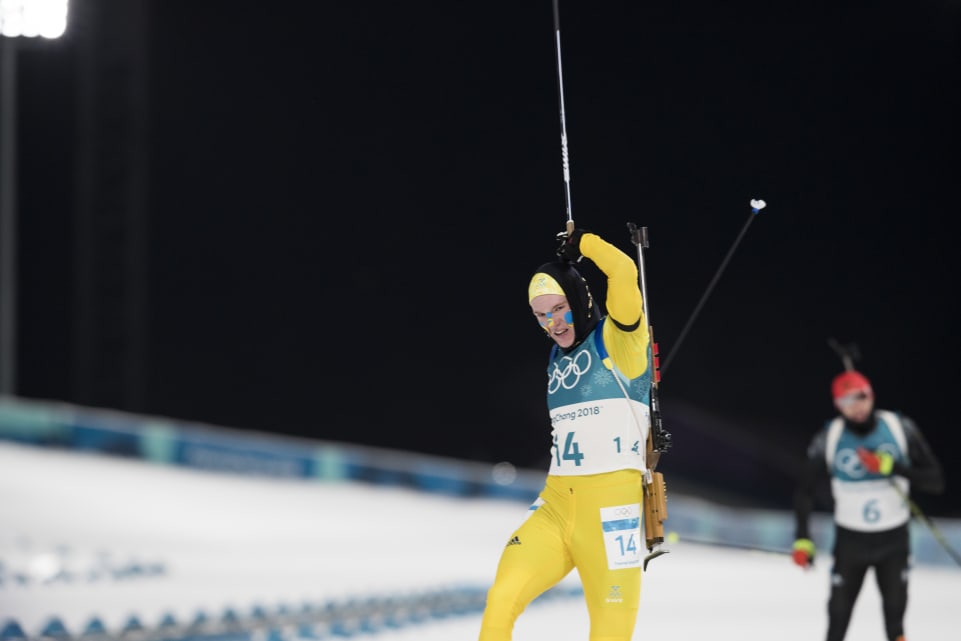
    Sebastien Samuelsson of Sweden celebrating silver in the men’s 12.5 k pursuit at his first Olympics on Monday in PyeongChang, South Korea. Samuelsson announced today that he is boycotting the World Cup Finals in Tyumen, Russia, because Russia is not in compliance with the World Anti-Doping Code. (Photo: IBU/Biathlonworld)

    Today, 2018 Olympic pursuit silver medalist (and relay gold medalist) Sebastian Samuelsson of Sweden announced on Twitter that he will not go to the races either.

    “Nations without a functioning anti-doping organization should not have competitions at the international level,” he wrote, according to a translation. “Also, worried about the safety of both myself and the doping tests in Russia.”

    Also not going is Klemen Bauer of Slovenia, a 2012 World Championships relay medalist who is a four-time Olympian.

    “I’m not planning to go to Russia at all,” he told FasterSkier in a Twitter exchange. “I was quite sure the IBU will replace the races, but despite all the effort we put into the clean/er biathlon, thanks to the president of the IBU that didn’t happen.”

    Both men are running for positions on the IBU’s Athletes Committee.

    “The idea is to improve the active role of the athletes and the voice of the athletes,” Bauer wrote of his candidacy. “We’ll see.”

    Another man running for a spot on the Committee is Germany’s Erik Lesser, 2014 Olympic silver medalist in the individual, 2015 World Champion in the pursuit, and several-time Olympic and World Championships relay medalist.

    Lesser will be attending the races in Tyumen, but he wasn’t happy about the IBU’s decision to hold them there.

    Klemen Bauer of Slovenia competing in the mass start at the 2018 Olympics in PyeongChang, South Korea. Bauer will not compete in the World Cup Finals in Tyumen, Russia. (Photo: FlyingPointRoad)

    “In my opinion the RUSADA and the Russian Federation have not done enough to light up this case,” he wrote in an email to FasterSkier. “During the last years, WADA and some commissions found a bunch of proof about a doping system in Russia. But RUSADA and [the Russian Biathlon Union] did nothing to fight against doping. The Anti-Doping-Laboratory in Moscow still does not have a license, and all the officials are in the same seats. It’s a wrong sign, after these problems, to go to Russia and celebrate World Cup Finals.”

    Lesser and teammate Arnd Peiffer, the 2011 World Champion in the sprint who then won gold at the 2018 Olympics, and who has even more World Championships and Olympic relay medals than Lesser, wrote a letter to the IBU explaining their position.

    Yet a few weeks ago, the IBU decided to go ahead and hold the World Cup in Tyumen anyway. They issued a press release explaining the decision.

    “I‘ve read the press release and I still don‘t understand why they decided this way,” Lesser wrote. “Because it‘s a threat to Russian biathlon fans and the Organizing Committee will take care of our safety? Wow, these are true reasons to keep the World Cup in Tyumen. So, I don‘t really think that reasons are valid.”

    Last season, there was also supposed to be a World Cup in Russia. But in 2017, several teams announced that they would boycott the event and IBU President Anders Besseberg had a contentious meeting with athletes, after which the IBU decided to move the event.

    This season, despite appeals by athletes like Lesser, Peiffer, and the others, that has not yet happened. And so in the end, Lesser says that he will compete in Tyumen, even though he wishes the races were somewhere else.

    “We argued with our federation and we decided to go to Tyumen,” he wrote. “The sport is the first [priority] and we want to compete. We hope that we can do a good job in Russia. We are there to stand as clean athletes.

    “It‘s bad that the IBU put us athletes in this position,” he wrote. “Actually it‘s not our job to be political. It‘s our job to be athletes and compete against other. If we don’t go, it’s wrong because it’s our sport we love. [But] if we go to Tyumen, we maybe send the wrong sign to IBU.”
  • IPC Suspends Russia from Rio Paralympics

    IPC Suspends Russia from Rio Paralympics

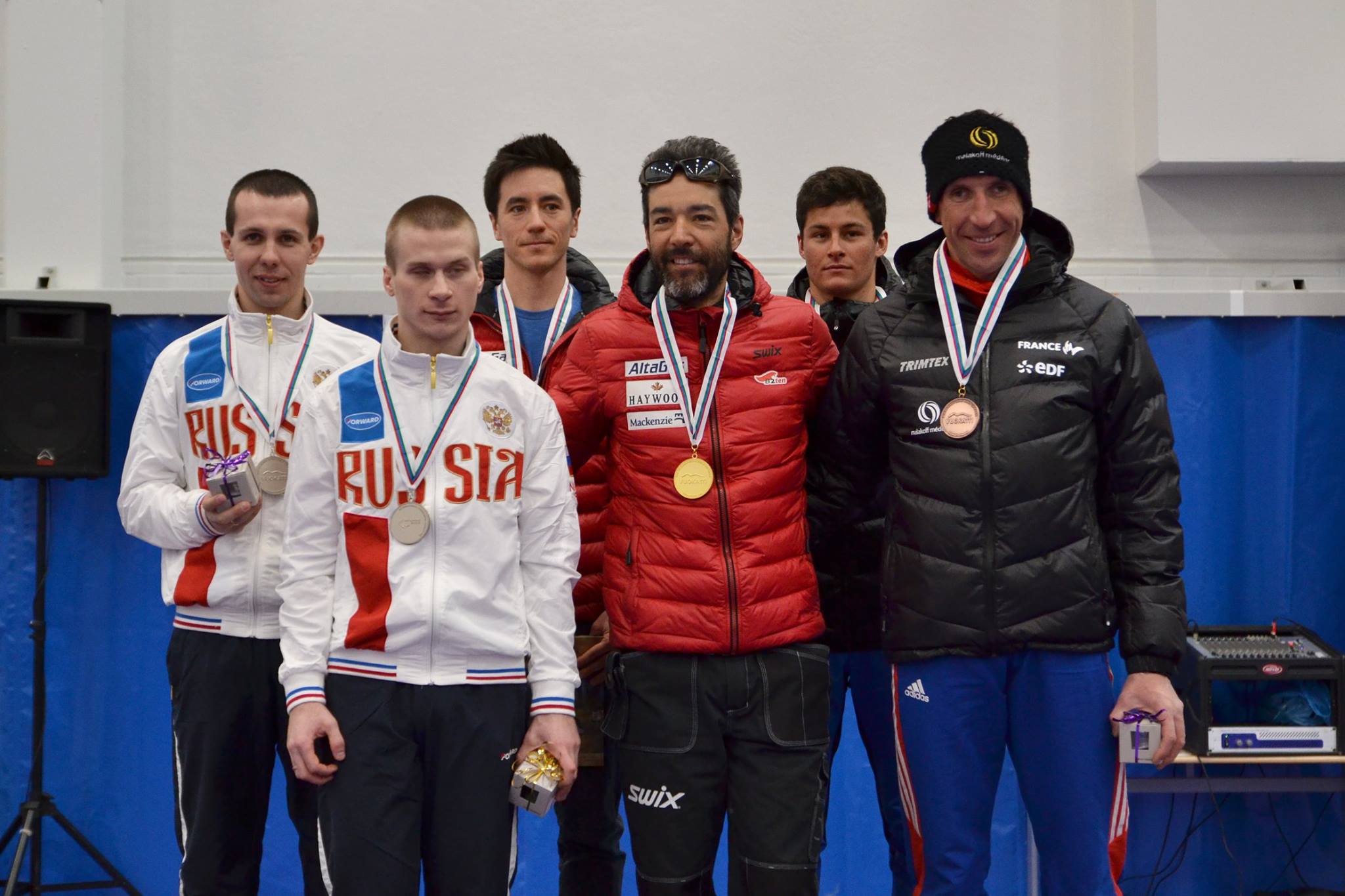
    Brian McKeever (c) and his guide Graham Nishikawa with their gold medals after the men's visually impaired 30 k at 2016 IPC World Cup Finals in Vuokatti, Finland. Russia's Alexsander Artemov (l) placed second and France’s Thomas Clarion (r) was third. (Photo: IPC Nordic Skiing/Facebook)
    Brian McKeever (c) and his guide Graham Nishikawa with their gold medals after the men’s visually impaired 30 k at 2016 IPC World Cup Finals in Vuokatti, Finland. Russia’s Alexsander Artemov (l) placed second and France’s Thomas Clarion (r) was third. (Photo: IPC Nordic Skiing/Facebook)

    As many athletes continue to prepare for the upcoming Paralympic Games taking place exactly one month from Sunday in Rio de Janeiro, Brazil, those sporting the white, blue and red flag of Russia will not. On Sunday, Aug. 7, the International Paralympic Committee (IPC) announced its decision to suspend the Russian Paralympic Committee from competition in Rio and upcoming IPC competitions.

    A press conference was held Sunday morning in Rio to announce the IPC Governing Board’s unanimous ultimatum that the Russian Paralympic Committee had failed its duties as an active member to the IPC in light of recent investigations. Namely, the Russian Paralympic Committee was found at fault in their inability to comply with sanctions set forth by the IPC Anti-Doping Code and the World Anti-Doping Code. Prior to any decision from the IPC Governing Board, the Russian Paralympic Committee was permitted to provide a written and verbal claim during the conference.

    The logo for the 2016 Summer Paralympic Games, which will be held Sept. 7-18 in Rio de Janeiro, Brazil.
    The logo for the 2016 Summer Paralympic Games, which will be held Sept. 7-18 in Rio de Janeiro, Brazil.

    The repercussions of the decision for the Russian Paralympic Committee include the suspension of its IPC membership rights and privileges. This means Russia is not allowed to vote at IPC member meetings nor enter athletes in IPC-sanctioned events, which includes the 2016 Summer Paralympics and IPC competitions (involving summer and winter sports) beyond that.

    Much of the decision, according to IPC President Sir Philip Craven, was based on the findings of the McLaren report. Within the report, “35 disappearing positive samples from Paralympic sport in 2012 to 2015,” were included in the report’s findings.

    “Since the publication of the McLaren Report on 18 July our priority has been to establish the full facts in respect of Para sport,” Craven stated in the press release.

    “In particular, we have taken the necessary time to ask further questions of Professor McLaren and his investigation team, to await the results of samples undergoing further forensic examination and to invite the Russian Paralympic Committee to present its case to the IPC and enter into dialogue with the IPC Governing Board. With the full facts to hand, we were deeply saddened to find that the State-sponsored doping programme that exists within Russian sport regrettably extends to Russian Para sport as well.”

    As head of the IPC, Craven maintains it is his and the governing body’s responsibility to ensure equity between all competitors. The motion to suspend Russia, he indicates, represents an attempt to create fair competition among all para-athletes.

    “Tragically this situation is not about athletes cheating a system, but about a State-run system that is cheating the athletes,” Craven said. “Our decision is driven by the need to hold our members accountable for their obligations. On the basis of the evidence we have, in the current environment our member the Russian Paralympic Committee cannot comply with the IPC’s Anti-Doping Code and the World Anti-Doping Code.  Those obligations are crucial to the IPC’s guarantee of fair competition for all.”

    Tragically this situation is not about athletes cheating a system, but about a State-run system that is cheating the athletes.“– IPC President Sir Philip Craven on the decision to suspend Russia from the Rio Paralympics

    Also on Sunday, the World Anti-Doping Agency (WADA) announced its support of the decision.

    “WADA supports the decision taken by the IPC, which we believe is in the interest of clean athletes and the clean sport movement,” a WADA statement noted. “The IPC’s decision follows the WADA Executive Committee’s 18 July recommendation to the IPC that they consider declining entries of athletes by the Russian Paralympic Committee for Rio 2016 as a result of the McLaren Report.”

    Robin McKeever, head coach of the Canadian Para Nordic Ski Team, pointed that beyond the summer games in Rio, the decision will also impact the upcoming winter ski season.

    “It’s a very sad day for IPC sports and in the end, the athletes pay the heaviest price overall in sport,” McKeever wrote in an email to FasterSkier. “From what I read the entire RUS IPC is banned from competition so that includes winter sports for the upcoming season. Whether or not that changes in the coming days or weeks time will tell. This obviously will have a huge effect on the size of the IPC Nordic World Cup field for this winter…True Sport must prevail and the line between what’s fair or unfair has to be drawn. I only hope we can all play on an equal playing field and move forward from this point.”

    In a phone interview before the IPC decision on Russia, McKeever emphasized that the Russian doping scandal is rooted in far more than just the athletes themselves.

    “The opportunities that the paralympics provide for some countries athletes are astronomical,” McKeever said last month.  “Russian athletes winning a gold medal at the paralympics is 145,000 euros for athlete, guide — if there’s a guide involved — and the coach. All paid out by the state. So this is a huge, huge organization from the political side all the way down. There’s one Russian who won six medals in Sochi and that’s the difference between living life in a wheelchair — pretty much fighting day to day to have a meal — versus living life as a rock star.”

    With the present decision instated, the IPC is currently working to redistribute the 267 slots that had been given to Russian athletes for Rio 2016. No action will be taken, however, until the 21-day time period that the Russian Paralympic Committee has to appeal the decision is complete. The Rio Paralympics start in 31 days on Sept. 7.

  • WADA Moves Toward Adding Olympic Ban to Code

    The World Anti-Doping Agency (WADA) recently took one step closer to banning guilty athletes from competing in the Olympics following their drug violation — even if his or her regular competition ban ends before the Games.

    A new draft of the World Anti-Doping Code (released in clean and marked-up versions) states in Article 10.15, “Limitation on Participation in the Olympic Games,” that when a person has been sanctioned for an anti-doping rule violation, he or she will be “Ineligible to participate in the next Summer Olympic Games and the next Winter Olympic Games taking place after the end of the period of Ineligibility otherwise imposed.”

    The issue of Olympic bans has frequented the pre-London news cycle this year, as the British Olympic Association (BOA) recently lost its fight with WADA to continue issuing lifetime Olympic bans to drug violators. In a statement following the release of the new Code draft, BOA said the proposed ban is “an important step in the right direction, and it’s moving toward reflecting the higher standard that athletes want to see.”

    The draft is the first-round step in WADA’s Code Review Process. The second phase began June 1, a third phase will begin on December 1, and a final draft will go up for approval in November 2013. If approved, the new Code takes effect on January 1, 2015.

    Part of WADA’s review process involves taking comments and submissions from concerned stakeholders. Following a first consultation phase that resulted in 91 official submissions and 1366 individual comments, WADA has encouraged its stakeholders to continue making recommendations by way of its online tool WADAConnect.

    “The World Anti-Doping Code represents the needs and wishes of the world’s anti-doping community, and the Review Process is designed to allow all those with a vested interest to play an active part,” said WADA President John Fahey.

    “We rely on the experience and assistance of our stakeholders to make the Code as robust and comprehensive as possible, and we again ask for feedback that will help to this effect.”