From the FasterSkier archive — posts syndicated from athletes’ and coaches’ own blogs between 2004 and 2012, kept online as published. Current coverage is at fasterskier.com.
This coverage is made possible through the generous support of Marty and Kathy Hall and A Hall Mark of Excellence Award. To learn more about A Hall Mark of Excellence Award, or to learn how you can support FasterSkier’s coverage, please contact info@fasterskier.com.
Jessie Diggins during the quarterfinals of the Freestyle Sprint on Saturday in Lake Placid, New York, USA. (Photo: Voisin / FasterSkier)
Lake Placid, N.Y. — The French coaches had questions. Two days before racing began at Mount Van Hoevenberg, they were standing in Saranac Lake — 55 degrees, windy, woods in every direction — wondering who exactly was going to show up to watch cross-country skiing in the middle of the Adirondacks.
By Saturday, an estimated — rumored to be fair — 14,000 people had answered.
Today, as Jessie Diggins lines up for the 20-kilometer mass start freestyle, the final race of her career, this corner of upstate New York will try to top itself one more time.
Screaming fans, chainsaws, flags, signs, and glitter all over the course in Lake Placid, New York, USA. (Photo: Voisin / FasterSkier)
A Weekend That Kept Building
The first sign that Lake Placid was going to be different came Friday, and it wasn’t entirely smooth. With an initial estimate of 10,000 fans on Friday, the transportation system to and from Van Hoevenberg buckled under the demand. Some fans waited over two hours to get to the venue.
US Head Coach, Matt Whitcomb, after the races yesterday in Lake Placid was really happy because the standout performance was not one of his athletes, but instead the North American ski community that showed up in droves and created an electric atmosphere. (Photo: Voisin / FasterSkier)
“Only Holmenkollen and Minneapolis”
U.S. Ski Team head coach Matt Whitcomb has been on the World Cup circuit for years. He said the only events throughout his career that have ever rivaled the atmosphere here this weekend in Lake Placid are the Holmenkollen in Oslo — the sport’s grand prix if you will — and Minneapolis two years ago.
That’s the company Lake Placid is keeping. And for those who were in Minneapolis, the comparison lands. Diggins said earlier this week that Minneapolis was the most special day of her career.
“It was the most I’ve ever cried,” she said at Wednesday’s press conference. “I got to race in front of some of my grandparents who haven’t been able to travel overseas. They got to see me race for the very first time in a World Cup. And having so many friends and family and getting to share the thing that I love doing with them — that is the most incredible thing ever.”
She paused, then added: “I think this weekend’s probably going to join that.”
College skiers from all over the Northeast came in force to the trailside in Lake Placid, New York, for the races this weekend. (Photo: Voisin / FasterSkier)
The Scene on the Ground
What the numbers don’t capture is the texture. Young kids running around the venue in their NNF fan bibs — the ones with athletes’ faces printed on them — clutching Sharpies, hoping to meet their heroes. Fans who drove and flew from Vermont, from Alaska, from Minnesota, who planned vacations around this weekend months ago. The school buses that became part of the story, ferrying the faithful up the mountain road when the original plan couldn’t hold.
This is what U.S. cross-country skiing looks like when it gets the stage. Not a packed NFL stadium or a sellout basketball arena — but thousands of people standing in the woods, screaming themselves hoarse for athletes from every country, because they love this sport and they know how rare these weekends are.
The fans — especial the college skiers — made it sound like the race was happening in Davos, Switzerland with the chainsaws out on course. (Photo: Voisin / FasterSkier)
One More Race
Diggins has spent this weekend doing exactly what she said she would — being present, soaking it in, putting on a show. She clinched the Crystal Globe on Friday. She raced the sprint on Saturday. And now there’s one more.
At Wednesday’s press conference, she talked about the way her mindset around suffering has evolved — how she’s learned to see the pain cave not as something to dread but as confirmation that she’s doing what she came to do.
“This is what 100 percent feels like,” she said. “And sometimes this is what it looks like, and it’s some ugly scene, but that’s okay. It just has to be all heart and all effort, and that’s what I have to give in that moment.”
She also made one thing clear about the team she’s leaving behind: “The team is going to be just fine without me. And I feel like that’s how I know I did my job.”
Then, with a smile: “I’m excited to be a fan on the other side of the fence and get to cheer for them.”
Today, in just ten minutes, Jessie Diggins will clip into her bindings for the last time as a World Cup racer. The 20-kilometer Mass Start Freestyle.
And based on everything this weekend has shown us, “no one” will be watching.
Love Stories Like This? Help Keep Them Coming.
Feature stories like this one take time, access, and care to produce. If you value thoughtful storytelling and independent ski journalism, please consider becoming a Voluntary Subscriber. Your support directly fuels the work we do to cover the people, places, and moments that make our sport special.
This coverage is made possible through the generous support of Marty and Kathy Hall and A Hall Mark of Excellence Award. To learn more about A Hall Mark of Excellence Award, or to learn how you can support FasterSkier’s coverage, please contact info@fasterskier.com.
Jessie Diggins answering questions at the press conference before the World Cup in Lake Placid, New York. (Photo: Voisin/FasterSkier)
Lake Placid, N.Y. — The eve of the World Cup finals at Mount Van Hoevenberg brought press conferences, sound checks that went sideways, and three American skiers who couldn’t stop making each other smile.
Jessie Diggins, Ben Ogden, and Gus Schumacher sat side by side Wednesday afternoon — the same trio that has turned the 2025-26 season into something U.S. cross-country skiing has never seen before. Between them: Olympic medals, historic podiums, a 50-year drought shattered, and one very good birthday cake.
But with three races left and Diggins’s retirement looming, the mood wasn’t heavy. It was loose, funny, and deeply human — exactly the way this team tends to do things.
“Probably Glitter”
Asked to define her legacy heading into her final World Cup weekend, Diggins did what Diggins does: she went somewhere unexpected.
“I think I define my legacy honestly, completely outside race results,” she said. “I am more proud of the things I have done off the course. I think my legacy is going to be in my advocacy and the way that I have spoken about mental health and eating disorders specifically, and the way I’ve tried to make really hard conversations less hard for people to have.”
She pointed to her work with Protect Our Winters and Share Winter, to the energy she’s poured into the team’s culture over the years. And then she landed the dismount.
“And probably glitter. I think there’s a lot more glitter in ski races now, and that’s always a great thing — as long as it’s biodegradable.”
Diggins has spent the season saying goodbye in pieces — a little cry leaving training camp in Bend, quiet moments at each World Cup stop. She knows what’s probably coming Sunday.
“I suspect it’s probably going to hit like a dump truck on Sunday, and there’s probably going to be a lot of tears.”
But she’s ready. And what she’s ready for is maybe the most Jessie Diggins thing of all: she sees ski racing as performance art, and she wants her final show to leave people wanting to go run up a mountain or sign their family up for ski lessons.
“I realized that I can do that moving forward, but just with my story and with my words, and I don’t have to push my body so hard, but I can still leave people inspired and motivated.”
In the meantime, she’s looking forward to being able to wash her clothes when they’re dirty, cook whatever she wants, and bake cookies on the weekend instead of training and racing all day.
Ben Ogden answering questions at the press conference before the World Cup in Lake Placid, New York. (Photo: Voisin/FasterSkier)
“Your Life Is Not Going to Be the Same”
Ben Ogden grew up in Landgrove, Vermont. American skiing legend Bill Koch lived close by in Peru, Vermont. Same zip code, as Ogden puts it — “not so different.”
Fifty years separated Koch’s 1976 Olympic medal from Ogden’s silver this season, and when Ogden finally got on the phone with his neighbor and mentor after breaking the drought, Koch didn’t mince words.
“Bill just sort of said, ‘Hey, congratulations, and your life is not going to be the same from this point forward.’ And that was kind of crazy to hear.”
Ogden hopes to see Koch at the races this weekend. And racing at Van Hoevenberg carries its own weight for him — not just because of Koch, but because of his father, who was deeply embedded in the New England ski racing community.
“I think it’s really hard for me to come race in the U.S. and look around and not just, like, constantly think about him, because this was his scene,” Ogden said, his voice softening. “He would have been in such paradise on the side of the trail here in Lake Placid. And I’ll be thinking about him a lot this weekend, for sure.”
This is technically Ogden’s first home World Cup — he was sick for Minneapolis — and it’s hitting him right. He grew up racing the NYSEF Festival series at Lake Placid, bringing crews of Vermont kids over for slushy late-season races.
“It’s not my home, but it feels like it.”
Gus Schumacher answering questions at the press conference before the World Cup in Lake Placid, New York. (Photo: Voisin/FasterSkier)
Aspirations, Not Goals
Gus Schumacher has been doing some linguistic rebranding.
“I’ve been calling them aspirations for a few years now,” he said of his season targets, “because I feel like the pressure of goals was kind of weird for me.”
The distinction matters to Schumacher. He sets plenty of small goals — the daily, tactical kind — but the big ones, like winning an Olympic medal or finishing in the top 10 of the overall World Cup standings, he holds more loosely. They’re aspirations: things he wants, things he’ll chase, but things he won’t let crush him if they don’t happen.
“Those are things I want to do, but if they don’t happen, it won’t be because I didn’t try.”
He accomplished the Olympic medal. He entered this final weekend ranked sixth in the world, with a top-10 finish still in play. And he’s approaching Lake Placid the same way he approached Minneapolis, where he won his first World Cup in front of a hometown crowd: just be happy to be racing, and feed off the energy.
“Already today, it was really cool to have people cheering us on in the race prep, which doesn’t really happen much on the World Cup ever.”
Schumacher also dropped maybe the best origin story of the press conference: the formative moment that lit a fire under his career was Luke Jaeger beating him at an Anchorage cup race.
“That kind of put a fire under my belly to really start training, because I didn’t want him beating me anymore.”
The Knitting Club, the Water Pump, and the Greenhouse
The press conference’s best stretch might have been when someone asked the athletes how they decompress.
Schumacher keeps it clean: headphones, 10 to 20 deep breaths — four seconds in, eight seconds out. Standard operating procedure.
Ogden? He knits. And he’s not shy about it.
“After races, I’ve been doing a lot of knitting and stuff like that. Helps me just relax really quick.” After the season, it’s bigger projects: car work. “You can feel like you’re the king of the world after a couple medals, but go and try and replace a water pump on a Forerunner, and that’ll make you feel completely incompetent.”
Diggins revealed there was a full-on knitting club on the team this winter. Her own reset button is simpler: she calls her husband.
“He’s my absolute center of my world. The race could have been amazing, and it could have been also completely horrible. And we’re just talking about what I want to do with the garden, and how I want to start a greenhouse. And he’s like, ‘Uh huh, yeah, sure, I’ll support you in that.’”
One More Thing
Almost as a throwaway, Ogden mentioned that Andy Newell — “the original Nordic ski backflip guy” — is in Lake Placid this weekend. And Ogden himself has had a backflip dialed since he was 17.
“I’m hoping on Sunday we can kick up a little ski jump. I’m looking to take another one Sunday afternoon. So stay tuned.”
Three races to go. A retirement to honor. A culture to celebrate. And maybe a backflip.
It’s going to be a weekend.
Love Stories Like This? Help Keep Them Coming.
Feature stories like this one take time, access, and care to produce. If you value thoughtful storytelling and independent ski journalism, please consider becoming a Voluntary Subscriber. Your support directly fuels the work we do to cover the people, places, and moments that make our sport special.
Jessie Diggins (USA) has inspired fans of all ages across the world. This weekend, many of them will gather along the race course, on her home snow, to say thank you. (Photo: Vanzetta/NordicFocus)
This Sunday, a lesser-heralded chapter of American history will close when Jessie Diggins enters her final World Cup event. She will leave the sport at the absolute top of her game, for the fourth time as the overall Crystal Globe winner, having slogged it out over a season that began the day after Thanksgiving above the Arctic Circle in Finland and will end 33 races later right here in Lake Placid, NY. She is the only skier, male or female, to compete in every single individual competition this year, from sub-three-minute sprints to two-plus hour marathons, before throngs of beer-guzzling fans in the sun and to empty Teutonic stadiums in the spritzing January rain.
During the run-up to the Milan Olympics, she briefly returned to the national zeitgeist, hyped for her ability to dig into the pain cave, and seen writhing on the ground beyond the finish line, a paroxysm of gasping. A high school student of mine had seen the feature on her in the New York Times, and a room of young athletes in Greenwich, CT — alien to Nordic ski culture — spent the full English class discussing the efficacy of pushing one’s limits. People around the once skilliterate Westchester County even started making the connection of why I’d named my dog “Diggins.”
Diggins Donahue (Photo: Timothy Donahue)
During her first Olympic race this year, Diggins crashed in traffic on the slushy snow and bruised her ribs. So naturally, five days later, she gritted her way to a bronze in the 10-kilometer freestyle and to 5th in the 50-kilometer classic on the final day of the Games. But just a week after this, when the collective gaze had drifted from the luge and returned to the Epstein files, she came improbably, from back in the field to within 0.1 second of winning a 20-kilometer in Falun. I watched this tuck-skate drag race with my daughter, who has a Diggins poster on her wall, and we screamed so loud the neighbors asked if everything was okay.
Against the slow off-gassing of rage coming across the airwaves — the sex trafficking, the elementary school bombing, the painful erosion of dignity and competence — Diggins has given us an important antidote all these years. In early 2021, when insurrectionists were sprawling their feet and flag across Nancy Pelosi’s office, Diggins was on her way to winning her first Tour de Ski. I remember the Alpe Cermis climb, when she crested into view in her red, white, and blue race suit, and thinking that she, too, is a compatriot. This past January, when her native Minnesota had become an epic fury, she won her third Tour de Ski title and was entering her fourth Olympics. She wrote, “For everyone out there caring for others, protecting their neighbors, and meeting people with love — every single step is for you. YOU are the ones who make me proud to carry the flag, and I hope I can bring you joy over these next few weeks.”
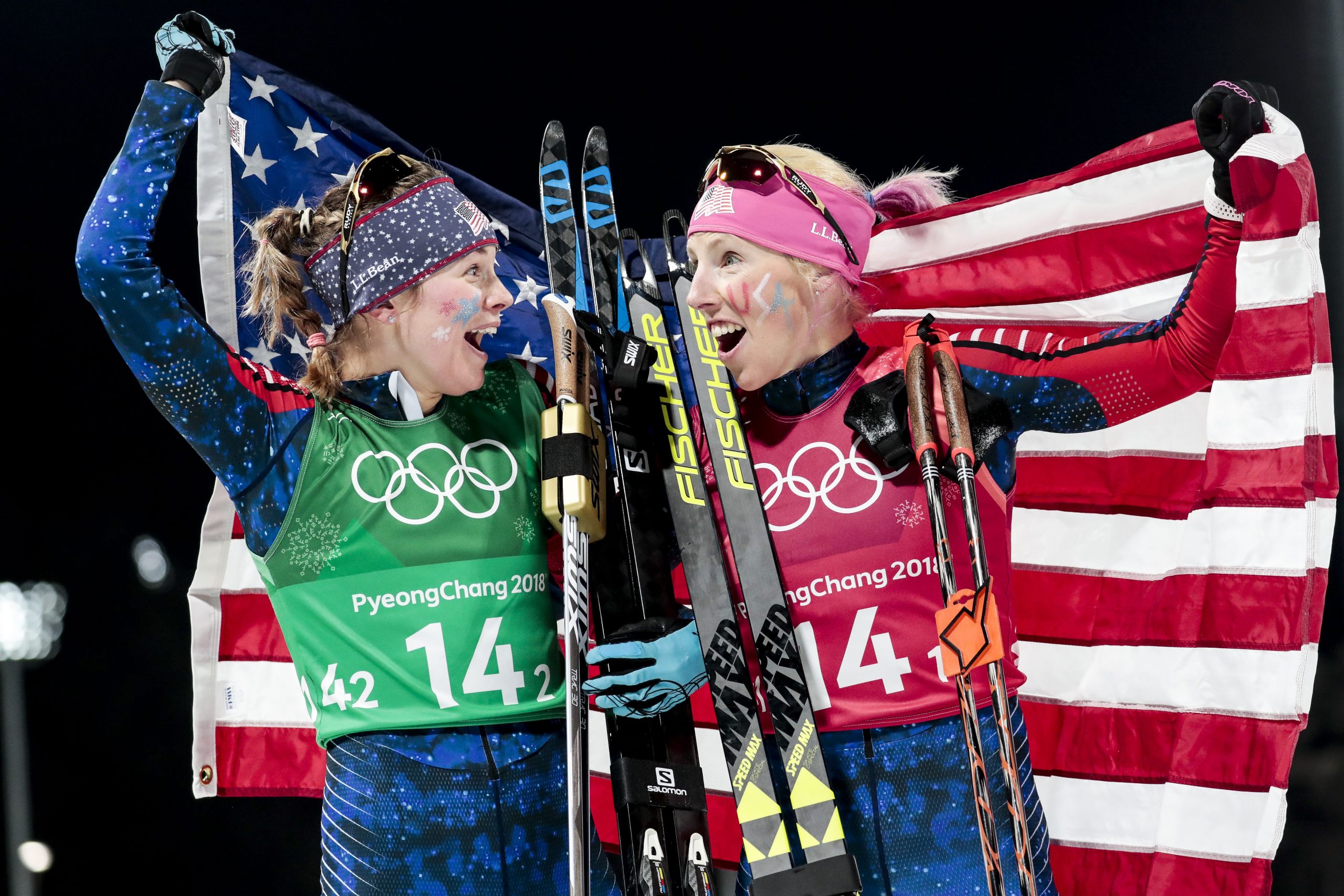
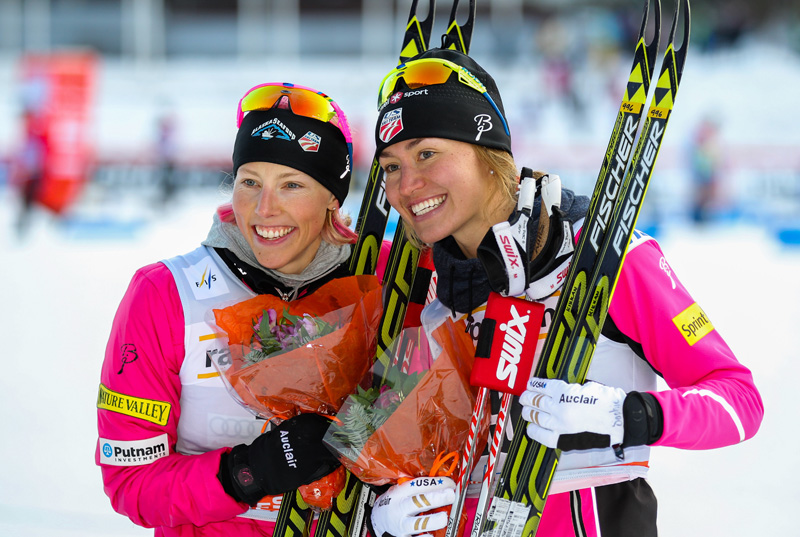
Jessica Diggins (USA), and Kikkan Randall (USA), (l-r) win America’s first cross-country Olympic gold in the women’s team sprint at the 2018 Pyeongchang (KOR) Olympics Pyeongchang. (Photo: Fischer/NordicFocus)
When she won Olympic gold with Kikkan in 2018, she was suddenly in the spotlight. Unfamiliar territory for our stoic sport whose only other American medalist to that point was Bill Koch, who won silver a half-century prior, and retreated into the moss of Vermont. But she was on the Wheaties box, and on commercials for Chipotle, Salesforce, Deliotte, and Toyota. She gave countless Swift-like appearances to throngs of impressionable youth; she lobbied in Washington D.C. for climate change reform. They found out her team nickname was “Sparkle Chipmunk,” and her pre-race glitter applications became her meme. She choreographed music videos; she shared homemade baked goods during the five-month-long European exodus. And she infected a hunger-based confidence that vaulted our underfunded, lowly squad to rival the Scandinavian powerhouses. Proclaimed as “the face of American skiing” and “America’s sweetheart,” she shouldered all this as she simultaneously maintained the fitness to train and race to her own world-best standards.
But as she reveals in the excellent, newly-released documentary about her called “Threshold” (with screenings all weekend at Lake Placid’s Palace Theater), the pressure of doing this day-in, day-out, for six solid years, got to her. As she tells the movie camera, it reacquainted her with senior year of high school: “I was trying to go 100 percent into every single corner of my life because I couldn’t sit still with the feeling that I was not enough.” In 2023, she relapsed with her eating disorder. In the film, she narrates this journey with a raw earnestness that, like her approach to skiing itself, cuts right to the marrow. “I’m willing to put my story on the line to help change this,” she says.
Jessie Diggins (CXC) on her way to first place at US Nationals in Rumford, Maine. (Photo: Hallie Herz)
Those of us who recall her first U.S. National title, back in 2011, among the paper mill aromas of Rumford, ME, fold this into our meta-narrative of triumph over challenge. Where others stand tall and firm on their skis, like maestros conducting their symphonies, Diggins hides none of the pain. Her head bobs, her shoulders undulate, her breathing seems louder than anyone else’s. She’s dropped off the back of the pack and yet somehow, she finds something. She’s not done. Here comes Diggins! If she can do it, I can do it.
This winter, I was particularly attuned to Diggins because, after two partial knee replacements, I was trying to claw my way back into competitive skiing. There were no Toyota endorsements at stake for me, but it was enough to re-connect with the core of this sport. Yes, it’s a beautifully nurturing, soul-susurrating exercise, but climbing up a hill deep into a race, it’s really just about holding off an explosion. The lack of oxygen excites my imagination and it’s all I can do to stay quiet and suppress the inevitable voices saying no, it’s too hard, this guy ahead of me is probably a wonderful father, it’s ok.
Who can say for sure what’s inside the mind of Diggins as she enters this state, this tribute of her current to her source that she has alchemized into fist-pumping, tear-jerking frenzy? But I know that the highlight reels she has brought us over her 15-year career – breaking a pole and scrambling with one arm to her first World Championship gold in 2013, finishing gloveless with a bloody face in 2023 (after another pole incident) and still earning silver, collapsing the day after food poisoning to win silver in the 2022 Olympics – this is something that should give the nation pride. She tells us, “I want to cross that finish line and I want to be so tired that I can’t even stand up, so that I know I gave everything in my heart toward my very best effort.” And she speaks with her actions.
We project our own wish fulfillment onto our heroes, and for the run of her career, with its 365 World Cup starts — more than anyone in history — Diggins has sturdily and gracefully absorbed our collective desires. Now she is leaving on her terms, from the top step of so many podiums, a master of her time.
The Donahue daughters have been inspired by Diggins their entire lives — and they’ll be on-site for one last weekend of racing, sending her off with the skier’s signature heart and a glorious sunset on an amazing career. (Photo: Timothy Donahue)
Love Stories Like This? Help Keep Them Coming.
Feature stories like this one take time, access, and care to produce. If you value thoughtful storytelling and independent ski journalism, please consider becoming a Voluntary Subscriber. Your support directly fuels the work we do to cover the people, places, and moments that make our sport special.
This coverage is made possible through the generous support of Marty and Kathy Hall and A Hall Mark of Excellence Award. To learn more about A Hall Mark of Excellence Award, or to learn how you can support FasterSkier’s coverage, please contact info@fasterskier.com.
Ben Ogden (USA) and Johannes Hoesflot Klaebo (NOR), (l-r) moments after their Semifinal crash in Drammen, Norway. (Photo: Nordnes/NordicFocus)
The greatest cross-country skier in history was lying on the snow, his arms wrapped over his face, his hands holding the back of his head, and the city of Drammen — where the man-made course magically appears on top of the streets, and Norwegian children crane from balconies to watch the racing — went very, very quiet.
Johannes Hoesflot Klaebo did not finish on Thursday. Neither did Ben Ogden. The gold and silver medalists from the Olympic sprint classic in Milano Cortina just last month, the two men who have defined this event all season, were tangled together on the hard-packed final downhill before the hairpin, while the semifinal raced on without them.
After the chaos of the semi-final, which took down the two fastest qualifiers, a 25-year-old Norwegian named Ansgar Evensen — who had changed into Skiathlon boots between the quarterfinals and semifinals because he felt so unsteady on his feet — surged from sixth place in the final to cross the line first.
Evensen won ahead of Jiri Tuz, the 21-year-old Czech who earned a career-best second place. Kristian Kollerud of Norway, racing in his very first World Cup start, took a remarkable third, and Harald Oestberg Amundsen, the 2024 overall World Cup champion, finished fourth.
It was the kind of day that maybe only Drammen — with its icy hairpin, its drafting effect, and its knack for producing chaos at precisely the wrong moment — could deliver.
Johannes Hoesflot Klaebo (NOR), Bernat Selles Gasch (ESP), Theo Schely (FRA), Ludek Seller (CZE), and Vili Crv (SLO), (l-r) in the first Quarterfinal. (Photo: Nordnes/NordicFocus)
Qualification and Quarterfinals
Klaebo’s dominance was apparent from the opening qualification. He posted a 2:24.88, nearly three seconds faster than Ogden’s 2:27.47, with the next 28 qualifiers separated by less than five seconds. That kind of gap on a world-class field in sprint qualification puts his dominance in perspective.
Klaebo, as he always does, chose the first quarterfinal heat. He won it easily — clocking 2:37.14 — compared to his qualifier, a notably conservative time that suggested he was managing his energy for the rounds ahead.
Simone Mocellini (ITA), Ben Ogden (USA), and Aron Aakre Rysstad (NOR), (l-r) in the second Quarterfinal. (Photo: Nordnes/NordicFocus)
Ogden, the lone American in the top 30, qualified second and chose Quarterfinal 2 alongside Italy’s Simone Mocellini and Norway’s Even Northug. He entered the bottom of the final climb up to the iconic finish on the steps of the Neo-Gothic Bragernes Church behind the leaders, but unleashed a powerful double-pole to charge into second place, advancing comfortably.
The quarterfinals also produced some early drama. Northug, who had been enjoying a strong sprint season, was disqualified from Heat 2 after receiving his second written reprimand of the season, this time for a classical technique infraction.
And quietly, in Heat 3, Evensen advanced as a photo-finish second behind Sweden’s Alvar Myhlback.
Ben Ogden (USA) and the medical team check on Johannes Hoesflot Klaebo (NOR). (Photo: Nordnes/NordicFocus)
The Crash
The first semifinal will be remembered for the crash.
Klaebo had won his quarterfinal from the front and appeared to be cruising. Ogden, too, looked comfortable. But on the icy final descent heading toward the hairpin around the fountain behind the start gates, the pack compressed. Klaebo held tight to the inside along the fencing, leaving him vulnerable when the skis began to cross. Contact was made. Ogden’s feet swept out from under him and fell right in front of the Norwegian. Klaebo had no place to go, skiing right into Ogden, which launched him into the air, spinning backward, ultimately hitting the back of his head on the hard-packed snow.
Ben Ogden (USA) walks off after the crash in the Semifinals. (Photo: Nordnes/NordicFocus)
Listening to the broadcast, the silence in Drammen was palpable. Ogden scrambled to his feet with only one ski still attached; Klaebo did not immediately follow. Replays showed Klaebo had not only hit his head on the hard snow, but may also have been struck in the head by a trailing ski as he fell. Both men would be listed as DNF — a designation almost never seen next to Klaebo’s name in a decade of dominance.
Anton Grahn of Sweden, who had been near the front, took the semifinal win. Tuz advanced automatically in second. Alvar Myhlback of Sweden finished third but would not be fast enough to advance as a lucky loser. The crash all but guaranteed that the top four finishers from Semifinal 2 would all advance to the final.
After the crash in Semifinal 1, Semifinal 2 with Harald Oestberg Amundsen (NOR), Kristian Kollerud (NOR), Jules Chappaz (FRA), Ansgar Evensen (NOR), Noe Naeff (SUI), and Davide Graz (ITA), (l-r) race for the finals. (Photo: Nordnes/NordicFocus)
Semifinal 2 and the Path to the Final
The second semifinal, then, was a race with diminished stakes but no shortage of quality. Chappaz drove the pace from the front and never relinquished it. Kollerud, the 21-year-old in his club racing suit, making his World Cup debut, finished an impressive second.
Behind them, Amundsen and Evensen advanced as lucky losers, separated by just hundredths of a second. The final would feature three Norwegians, a Frenchman, a Czech, and a Swede — but no Klaebo and no Ogden.
Entering the finish stretch. (Photo: Nordnes/NordicFocus)
The Final
Half the final field was under 23 years old. Tuz, Kollerud, and Grahn — all 21 — represented a generational shift on a day when the established order had been upended.
Tuz, perhaps emboldened by his semifinal crash survival, went hard from the gun, leading over the opening climb. It was a brave tactic from a young racer in only his second World Cup final. Behind him, the more experienced campaigners — Amundsen, Evensen, Chappaz — bided their time, trusting that the Drammen draft would bring them back and leave them well rested for the final climb.
It did. The group had reformed as they skied behind the fountain. As they navigated the icy turn, Grahn — who had been skiing near the front all day — lost his footing on the hairpin and crashed, his race effectively over. He would finish sixth on the day.
The final dash for the line. (Photo: Nordnes/NordicFocus)
Grahn’s fall opened a lane on the outside. Evensen, who had been sitting sixth, saw it and calmly worked his way around the dicy turn.
“When Anton fell in the last corner, I had every opportunity,” Evensen said afterward. “So I took it from fifth place to first on the final.”
What followed was one of the great finishing surges in Drammen’s long sprint history. Amundsen and Kollerud were locked in their own battle, focused on each other. Chappaz was charging. But Evensen — who had finished fourth on this same course back in 2023, who knew exactly how the final 50 meters of this city sprint played out — found a gear that nobody else could match.
Harald Oestberg Amundsen (NOR), Jiri Tuz (CZE), Kristian Kollerud (NOR), Jules Chappaz (FRA), and Ansgar Evensen (NOR), (l-r) had an exciting finish in Drammen. (Photo: Nordnes/NordicFocus)
He crossed the line first, fist clenched, pounding his chest. Tuz nipped Kollerud for second by four hundredths of a second. Amundsen was fourth, just 0.43 seconds off the win.
“It was super cool and I love to ski in Drammen,” Evensen said in a post-race interview with FIS, still catching his breath. “I had to change boots to my combi boots because I felt so unbalanced in the quarterfinal. But that’s how it is. Have to stay on your feet to win. And unfortunately for Johannes and Ben, they weren’t as stable today.”
Kristian Kollerud (NOR) waits for final confirmation of his podium. (Photo: Nordnes/NordicFocus)
Kollerud’s Debut
The feel-good story of the final belonged to Kollerud, who stood on the podium in his club racing suit — not the Norwegian national team uniform — soaking in a result he could not have imagined when he woke up that morning. A podium in your first World Cup start doesn’t happen. Except when it does.
He picked up a written reprimand for a classical technique infraction during the semifinals, but it was his first of the season and carried no further consequence. What will carry forward is the confidence of knowing he can compete with the best in the world.
Tuz, too, earned a career milestone. The Czech U23 athlete had made the final in Milano Cortina but never stood on a World Cup podium before Thursday. He now has a silver medal from Drammen.
Jiri Tuz (CZE) celebrates his podium in Drammen, Norway. (Photo: Nordnes/NordicFocus)
Standings and What’s Next
Klaebo’s DNF stung, but his World Cup position remains commanding. He leads the overall standings at 2,071 points (636 points more than Amundsen in second), the sprint standings at 835 points (283 points in front of Lars Heggen), and the distance standings at 936 points (128 points in front of Amundsen).
Barring further incident, Klaebo will sweep the overall, distance, and sprint crystal globes for the season.
Whether he gets the chance to race for them this weekend, however, is now in question. Norwegian national team doctor Ove Feragen told TV2 that Klaebo was taken to the hospital following the crash for precautionary testing related to the head impact. Feragen said Klaebo was conscious, in stable condition, and not believed to be seriously injured, but the severity of the fall warranted evaluation. His status for Saturday’s 50 k Freestyle Mass Start at the historic Holmenkollen in Oslo remains uncertain.
The season concludes with World Cup Finals in Lake Placid, New York, March 20-22, where Ogden and the American men will race in front of a home crowd. With four races left, a lot of exciting racing remains.
Feature stories like this one take time, access, and care to produce. If you value thoughtful storytelling and independent ski journalism, please consider becoming a Voluntary Subscriber. Your support directly fuels the work we do to cover the people, places, and moments that make our sport special.
Jiri Tuz (CZE), Ansgar Evensen (NOR), and Kristian Kollerud (NOR), (l-r) share the Classic Sprint podium in Drammen, Norway. (Photo: Nordnes/NordicFocus)
This coverage is made possible through the generous support of Marty and Kathy Hall and A Hall Mark of Excellence Award. To learn more about A Hall Mark of Excellence Award, or to learn how you can support FasterSkier’s coverage, please contact info@fasterskier.com.
The women’s sprint final comes into the finish in Drammen, Norway with: Laura Gimmler (GER), Ane Appelkvist Stenseth (NOR), Jonna Sundling (SWE), Nadine Faehndrich (SUI), Johanna Hagstroem (SWE), and Kristine Stavaas Skistad (NOR), (l-r). (Photo: Nordnes/NordicFocus)
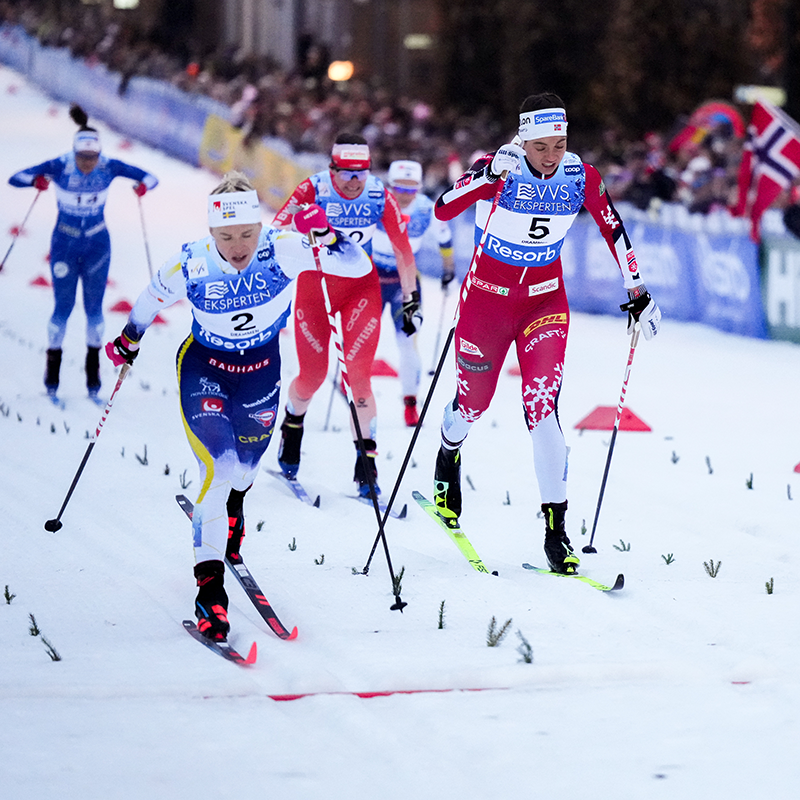
The snow was trucked in, the rock band was playing near the finish, and Norwegian children cheered from second-story windows along the course. On a rare midweek World Cup race day in Drammen — a small city just southwest of Oslo where the sprint course loops through the streets, wraps around an old fountain, and finishes on the snow-covered steps of an iconic church — Jonna Sundling of Sweden took home another World Cup sprint victory.
Sundling won the women’s classic sprint, going stride for stride with Norway’s Kristine Stavaas Skistad before pulling away in the final meters. Switzerland’s Nadine Faehndrich, racing her final classic sprint before retirement, earned the bronze.
It was Sundling’s fifth individual World Cup victory of the season and the latest chapter in an intensifying rivalry with Skistad that has captivated ski fans, especially Scandinavian ones, for the last few seasons. From the World Championship final in Trondheim last year to the Olympic final in Milano Cortina, Sundling, with the rest of the Swedish sprinters, and Skistad have been locked in a tactical chess match. On Thursday in Drammen, it was Sundling who played the final move.
Quarterfinal number one heads up the first climb with: Barbora Antosova (CZE), Mathilde Myhrvold (NOR), Jessie Diggins (USA), Melissa Gal (FRA), (l-r). (Photo: Nordnes/NordicFocus)
Qualification and Quarterfinals
Sweden’s Linn Svahn, the reigning Olympic sprint champion, posted the fastest qualification time at 2:41.87 — nearly three seconds clear of Sundling’s 2:44.39. But qualification speed, as World Cup sprinting always reminds us, is only the entry ticket.
Two Americans advanced to the heats. Jessie Diggins, the overall World Cup leader wearing the yellow bib in what she called a “full circle moment,” qualified 17th in 2:50.91. Rosie Brennan, seeded 28th, also made the top 30.
Diggins chose Quarterfinal 1 alongside Sundling and Skistad — a loaded heat. Skistad took the win with Sundling second via a photo finish, just 0.18 seconds separating them. Diggins fought hard for third, advancing as a lucky loser after finishing just 0.22 seconds behind Sundling.
Rosie Brennan (USA) said after the race, “Drammen is one of my favorite races, it’s a fun course and always has a lively atmosphere.” (Photo: Nordnes/NordicFocus)
Brennan’s day ended in the quarterfinals. Racing in Heat 3, she bobbled heading into the downhill and lost the draft, which was a costly moment on a course where the slipstream effect was enormous all afternoon. She finished fifth in her heat.
“I was happy to get a chance in the rounds, but the conditions were very tough,” Brennan said. “They salted the course, and it was skiing great in the qualifier and then got really icy for the rounds. Anyway, I bobbled into the downhill and lost the draft and then just don’t have the power I need to pass that many people up the finish stretch, so I was disappointed to not be more in the mix.”
Meanwhile, Svahn survived a scare of her own… as her quarterfinal rounded the fountain that anchors the bottom of the course behind the start gates, five of the six athletes ended up in a pile and Svahn seemingly had the most bodies and equipment to navigate as she got back out on the course, but somehow recovered to advance. The Olympic champion’s troubles, however, were only beginning.
Maja Dahlqvist (SWE) and Jessie Diggins (USA), (l-r) during the second semifinal. (Photo: Nordnes/NordicFocus)
Semifinals
The two semifinals told entirely different stories, and the contrast between them shaped the final.
In Semifinal 1, Skistad took the win with Sundling second, just 0.20 seconds back. Both advanced automatically. Behind them, Svahn finished third and would not advance.
Semifinal 2 was a different race entirely. Johanna Hagstroem and Ane Appelkvist Stenseth pushed the pace from the gun, stringing the field out over the first climb. But on the long downhill, the draft did its work. Faehndrich and Laura Gimmler of Germany surged past, using the slipstream to slingshot into the lead.
Nadine Faehndrich (SUI), who is planning to retire after the season, found a little extra Drammen magic today as she finished on the podium in third. (Photo: Nordnes/NordicFocus)
Faehndrich won the heat decisively. Gimmler was second. The fast overall times meant Hagstroem would advance along with Stenseth, who just out-lunged Diggins for fourth and the second lucky loser position.
For Diggins, the day ended in 10th. But she left Drammen at peace.
“This was really cool because the Drammen area was my first ever World Cup start and it was a skate sprint,” Diggins said. “So it’s kind of a very full circle moment to close it out with a classic sprint here as the last classic sprint of my career.”
She had tried something new in the heats, sitting in the draft instead of going to the front, a departure from her usual aggressive approach. “Normally, because literal strength is not my strength, I usually just try to go really, really hot and try to go off the front,” she said. “I was like, nope, I don’t think that’s gonna work for me here with the crazy draft and slingshot effect. I was taking a lot of notes in warm-up, and in the quarterfinal, I had the smallest tuck of my life. It was just really fun to try to believe in myself as more of a pure sprinter and to try to be a little more tactical.”
She acknowledged she ran out of power in the semifinal, but had no regrets. “I still felt like I executed my plan to the best of my ability, and that’s always a cool feeling.”
Jonna Sundling (SWE) crosses the finish line just ahead of Kristine Stavaas Skistad (NOR) for the win in Drammen, Norway. (Photo: Nordnes/NordicFocus)
The Final
Six women lined up for the final: Sundling and Hagstroem for Sweden, Skistad and Stenseth for Norway, Faehndrich for Switzerland, and Gimmler for Germany. Svahn and Maja Dahlqvist, the Olympic gold and bronze medalists in the sprint classic, were both absent.
On the opening climb, Skistad sat behind Sundling in a familiar posture — patient, conserving, waiting for the right moment. As Kikkan Randall mentioned on the broadcast, Skistad almost never leads into a downhill. She baited Gimmler into taking the front position, then tucked into her slipstream.
Coming off the descent and around the final hairpin, Faehndrich made her bid, surging past Gimmler and into third. But the race was between the two women everyone expected.
Sundling and Skistad skied side by side on the final climb, and what followed was a scene that encapsulated their rivalry. Stride for stride, shoulder to shoulder, neither yielding a centimeter. Sundling’s transition from double pole to striding was fractionally sharper — she carried more momentum through the final meters — and she crossed the line with a small advantage.
“It is usually very tight in Drammen, but today it was extremely tight,” Sundling said on air afterward. “Till the last meter. I was like, okay, I need to continue all the way over the finish line. It was tough, but I’m happy that I was the first person over the line.”
For Faehndrich, the bronze was a fitting farewell. The 30-year-old Swiss racer, who announced her retirement this season, now sits third in the sprint World Cup standings at 700 points — just behind Hagstroem (708) and within striking distance of leader Dahlqvist (720) heading into the final sprint of the season in Lake Placid next weekend.
Jessie Diggins (USA) gave her fans something to cheer about during her quarterfinal when she charged to the finish line. (Photo: Nordnes/NordicFocus)
Looking Ahead
Diggins continues to lead the overall World Cup standings with 1,961 points, 275 points ahead of Sweden’s Moa Ilar, a margin that appears insurmountable with four races remaining. The distance globe, too, seems firmly in her grasp. But the sprint crystal globe race is wide open: Dahlqvist, Hagstroem, and Faehndrich are separated by just 20 points at the top of the standings, and the final sprint in Lake Placid could decide everything.
For Diggins, there’s another milestone ahead — she’s only a few nights away from sleeping in her own bed before racing in front of an American crowd at the World Cup Finals. “Very, very, very excited about that,” she said.
The World Cup moves to the historic Holmenkollen venue in Oslo on Saturday for the Women’s 50 k Freestyle Mass Start, before the season concludes in Lake Placid, New York, March 20-22.
Feature stories like this one take time, access, and care to produce. If you value thoughtful storytelling and independent ski journalism, please consider becoming a Voluntary Subscriber. Your support directly fuels the work we do to cover the people, places, and moments that make our sport special.
The first time I saw Colin Rodgers, he was climbing onto a podium in the basement of a hotel in Biwabik, Minnesota. I honestly can’t remember the name of the hotel, but I can remember the rooms, the enormous lobby complete with an indoor minigolf course, and the basement where the awards were taking place. It was Junior Nationals, 1997, and he’d just won the opening U16 race. We were there with the New England contingent. They held the awards in this low-ceilinged basement room, and although he wasn’t the tallest of boys, his blonde hair almost touched the ceiling tiles. Colin went to Holderness School in New Hampshire, and as I looked up at his smiling face, it was obvious that he was the kind of kid who was going somewhere.
A few years later, I was watching him again, but this time from behind as he skied away from me up one of the small climbs on Woodpecker during the 3 x 5 k Classic Relay at the Williams College Carnival. Colin raced for Middlebury, and I raced for UNH, and at carnivals, he’d ski away from me. That was the deal. He was always a step, or a lot more, ahead.
We caught up over Zoom last week. Colin was in a hotel room in Falun, Sweden, traveling with the U.S. Ski Team on the World Cup circuit. I was sitting on a rocking chair in the foyer of our local dentist’s office while my boys were inside getting their teeth cleaned. That’s how FasterSkier interviews happen sometimes.
Colin Rodgers (SVSEF) – 4th Place
Since his competitive career ended, Colin has given himself fully to coaching. First with the SVSEF Gold Team, who he had raced for at the end of his career, and later junior skiers at Green Mountain Valley School, where he spent nine years. And now, as head coach of the SMS T2 Team at Stratton Mountain School in Vermont, he works with some of the best cross-country skiers in the world.
The team this year included Jessie Diggins, Ben Ogden, Julia Kern, and Canadian skier Remi Drolet, as well as collegiate skiers Fin Bailey and Jack Lange. Of the professional skiers, three of them finished in the top six at the Olympics. All four were in the top 20. Ben Ogden came home with two silver medals and ended a 50-year Olympic medal drought for American men in cross-country skiing. And Jessie Diggins, who is currently wrapping up a career that is the best of any American skier ever, added a bronze medal to her collection.
Colin still seemed a little stunned by it all when we spoke.
“We were so far beyond wherever I thought we were going to be,” he said. “I had a good feeling about this year. But for Ben to take home two silvers, and Jesse a bronze, and Remi to be in the top 20 and really help Canada with a historic relay finish, and Julia in the top six. It’s stuff that I could never believe was truly going to happen. And here we are talking about it.”
SMS T2’s Rémi Drolet, Ben Ogden, Julia Kern, Jessie Diggins, and coach Colin Rodgers. (Photo: courtesy photo)
Colin grew up in Westford, Vermont. His father was the program director for the U.S. Biathlon team from 1984 to 1988, which brought the family to northern Vermont. His parents built a house in Westford that year and never left.
He went to Holderness, then Middlebury, and after college, he headed to the Maine Winter Sports Center, where coaches like Jens Johansson, Eli Brown and Will Sweetser were building something in the northern reaches of the state. From there, he moved to Sun Valley, Idaho, where he joined the SVSEF Gold Team and kept racing.
Colin was good. He raced on the World Cup. But the jump he’d always hoped to make didn’t quite happen.
“I think as a nation now, we’re so much more educated,” he said. “I had amazing coaches. But we were just kind of, maybe sometimes trying too hard.”
He talked about spending time in Scandinavia and being around athletes who were significantly better than him. What he noticed wasn’t that they worked harder. It was that they were smarter about the work.
“I probably trained at level two way too much of the time,” he said. “Especially being a little more anaerobic and linked to the sprint side. I really needed to be doing the easy training even easier.”
He paused.
“When it’s time to go, you’ve got to let the dog run,” he said, quoting his old Middlebury coach Terry Aldrich. “And that was the exact opposite. Like, now it’s time to really peak, and you let it loose.”
I told him I’d heard a version of that from the other direction. When I was coaching, I used to tell my kids about Matt Whitcomb, who had been a teammate of Rodgers at Middlebury, previewing a course at Junior Nationals and telling the athletes they had to “walk the f-ing dog.” Every time they got to a climb, they were pulling back on the leash. Walking the dog.
Two coaches. Related metaphor. Opposite leash relationships. That’s about as clean a summary of training philosophy as you’ll find in this sport. Keep the dog relaxed in training often, until it is time to let it run when it matters.
Matt Gelso on the finishing stretch with coach Colin Rodgers encouraging in West Yellowstone (Photo: Toko)
Before Stratton, the coaching experience that shaped Colin most was the time he spent around Rick Kapala at Sun Valley.
Kapala ran the Sun Valley Education Foundation for nearly 30 years and built a program Colin still talks about with real admiration.
“It was serious training, but it was also really creative,” Colin said. “You’d go out for long mountain adventures, do different kinds of workouts. It kept people engaged.”
That stuck with him. When he moved to GMVS to coach high school athletes, he kept coming back to a simple question.
“What would make me really want to go to practice today?”
He laughed when he said it.
“It sounds basic. But it actually matters a lot. If people don’t want to be there, something’s probably off.”
He talked about his coaching years at GMVS and how, for him, the job was about getting kids to believe in what they could do.
“When kids are in high school, they’re questioning everything. How they look, how they’re growing. And you’re just like, no, dude, this is fun. This can be a real blast. And believe. Like, damn, I can do a good job at this. If I’m doing this every day, I might as well be good at it, right?”
He spent nine years doing that work. And then the SMS T2 job came along.
“It was an opportunity there’s no way I was going to pass up,” he said. “It’s changed my life. Literally.”
The program at Stratton operates under a mission statement crafted by Colin’s predecessor, Sverre Caldwell: international excellence and local inspiration.
Colin said that phrase was part of what sold him on the job.
“It’s everything I believe in. We’re trying to be the best we can be, win races, kick ass internationally. But then also, along the way, inspire the next generation of skiers coming up.”
At Stratton, those two things aren’t separate. The T2 athletes train on the same roads and trails as the younger skiers in the school’s Nordic program. When Stratton kids show up for a summer or fall practice, and the older athletes are there, everyone just funnels in together and heads out.
“It doesn’t even need to be talked about, really,” Colin said. “It’s just showing up, doing the work. This is how it’s done. And if you keep working really hard for a long time, you’re probably going to get really good too.”
He brought up the chain of inspiration that runs through American skiing. Jessie Diggins was inspired by Kikkan Randall, by Andy Newell, by Simi Hamilton. Kern was inspired by Diggins.
“When you get motivated by somebody who’s special and inspiring to you, if you have some talent and the fire to go for it, you realize you can chase that person. And then it’s like, oh, I can maybe be them. And then it’s like, oh, maybe I can be better than them.”
One of the more interesting aspects of Colin’s role at SMS T2 is that he’s not the only coach in the picture. Not even close.
Kristen Bourne and Colin Rodgers out for a run during the OD run at Park City camp, 2025. (Photo: Matt Whitcomb)
Diggins works primarily with Jason Cork on the U.S. Ski Team staff. Ogden’s training has long been guided by Patrick Weaver, his college coach at UVM. Kern has a deep relationship with Kristen Bourne, who is also a national team coach. Drolet works with Dave Wood, a former coach of the Canadian national team. And Bailey goes to UVM and skis for Weaver, while Lange goes to Dartmouth and is coached by Brayton Osgood.
Colin sees his job as connecting the dots.
“Each athlete comes in with their own support network,” he said. “Jason has been working with Jesse forever. Ben has a really close connection with Weave. And I’ve been able to learn a lot from Patrick about how Ben ticks.”
He was honest about what that requires.
“When you step into a role like this, you have to check your ego,” he said. “It’s not about being the only voice in the room. It’s about helping the athlete succeed.”
What he brings is proximity. He sees the athletes more frequently than some of their other coaches, especially during training blocks in Vermont. He can offer technique advice, fill gaps when someone else isn’t available, and keep everyone communicating.
“I think one of my strengths is the ability to connect people,” he said. “And to connect with people.”
Colin has watched American skiing grow up. When he was racing, relatively few American men were competitive at the highest levels. The development pathways weren’t as clear. The coaching wasn’t as sophisticated.
“We’re closer as a nation now to what it means to go to that next level,” he said. “We know what to do. As coaches, we’re totally clued in on this systematic, long-term idea of how to periodize correctly, and also how to make it fun.”
Colin Rodgers, Jessie Diggins and Julia Kern. (Photo: courtesy photo)
He pointed to results at every level. At the time we spoke, American athletes were fighting with the best in the world at the World Junior Championships. On the World Cup, Diggins, Kern, and Ogden, along with the APU-based skiers, are proving it can happen at the very top.
“A lot of people have helped build this,” he said. “It’s not just one program or one coach.”
But the jump from junior skiing to the World Cup is still enormous. And programs like SMS T2 exist to help athletes survive that transition.
“Having environments where athletes can develop during that stage is really important,” he said. “The gap is huge.”
Before we wrapped up, I asked Colin what success looks like for him five years from now.
He went big picture with a slightly longer lens. The 2034 Olympics will be in Salt Lake City. There’s a generation of young American skiers who have already raced at Soldier Hollow, the Nordic venue, during their youth careers. Now they’re looking ahead to competing on home soil.
“We’re working towards 2034,” he said. “And we want to be successful there. If we stay on this trajectory, we can have medals. That’s our ultimate goal.”
Within Stratton, he wants to grow the team thoughtfully. This year was lean, focused on supporting the Olympic athletes. Going forward, he wants to build back toward four or five athletes on each side, men and women, plus NCAA skiers.
“We have to do it the right way,” he said. “We don’t want to take on too many people too fast.”
Jessie Diggins (USA), whose World Cup career will conclude in a week and a half, celebrates her bronze medal in the Olympic 10 k Freestyle in Tesero, Italy. (Photo: Vanzetta/NordicFocus)
He’s also thinking about the athletes who won’t be there. Jessie Diggins is retiring. That will leave a void at SMS T2 and on the World Cup, where Colin noted she currently sits at 380 career starts, more than any other skier.
“Jesse’s going to go on and do a lot of really cool things and still inspire the next generation in new ways,” he said. “And then there’s going to be up-and-comers who are going to step up and be inspired by everything she’s done, and by everything Ben and Julia and Remy are already doing.”
International excellence. Local inspiration. It’s a simple mission. But Colin Rodgers has spent a career learning that the simple things are usually the ones that matter most.
He’s been chasing the highest levels of this sport since he was 15 years old, standing on a podium in a hotel basement in Minnesota. The path just looks different now.
Help Support Our Olympic Coverage!
If you value the thoughtful work and access FasterSkier provides, please consider becoming a Voluntary Subscriber. Your support directly fuels our work to cover the people, places, and moments that make our sport special.
If you are a parent or coach and have been responsible for waxing skis for an important race — a state championship, a Junior National Qualifier — you know how stressful that can be. Now imagine it’s the morning of the Team Sprint at the Olympics, and you are responsible for Gus Schumacher’s skis. Feel your blood pressure rising yet?
Welcome to the life of Chris Hecker, the US Cross-Country Ski Team service tech who leads the glide program and is Schumacher’s personal tech. Hecker, at this point, knows Schumacher well and that he has logged nearly 1,000 hours of training annually for years, and that he has dreamed of this specific day since the end of last season.
“One of the most stressful moments actually came [on race day], about 45 minutes before the Men’s Team Sprint. I had selected the race skis for Gus and felt confident in the decision. At the time, it was clearly the best pair for the conditions.”
Everything seemed to be playing out as Hecker had hoped, but then everything changed.
“Then, about five minutes later, the sun came out. The course started to break down and got noticeably wetter. I still had a few minutes before beginning to wax, so I decided to run one more quick test. In the ten minutes between tests, the two top pairs kept getting closer and closer in performance.”
These are the moments when experience, confidence, and a little tech magic can make or break a race. “In the end, I chose what was technically Gus’s second-best pair at that moment,” Hecker recalled. “As more athletes skied and the temperature continued to rise, there’s a good chance those skis actually became the faster option anyway.”
Hecker was quick to point out that “Gus and Ben were on another level. Regardless of which skis Gus raced on, I’m confident the result would have been the same. They were [racing] on another level.”
We may never really know, but maybe that decision did have something to do with Schumacher and Ben Ogden winning silver in the Team Sprint? For Hecker, it was a choice that was actually years in the making.
Guided by family and noted mentors
Hecker grew up in a family of skiers; his father, Mike, was a Pelton ski and Exel pole rep in the Midwest and had Chris on skis when he was just nine months old, “shuffling around and falling down.” Mike and his wife would pack the entire family, including Chris and his older brother Jeremy, and spend weekends traveling to different ski shows and venues. The parents told Chris and Jeremy it was their ‘vacation’, but in reality, it was just a family deeply invested in both the industry and the lifestyle.
“So we were skiing from a really, really early age, and then we got into racing,” said Chris. When Chris was in middle school and high school, he raced for Anoka High School, in Minnesota, a northern suburb of Minneapolis. After graduating in 2013, he headed to St. Scholastica in Duluth, where he raced for three years under Chad Salmela and, in his senior year, under Maria Stuber.
After graduating from St. Scholastica in 2017, Hecker took a job with Rex Ski Wax for the 2018 / 2019 season.
“I worked with them for a year, spent a year on the World Cup being their racing service manager and research and development, kind of lead testing for all the new products, testing all the old products, and then walking around and working with the teams and saying, What do you need from us?”
Hecker made himself available to World Cup teams, asking which products he could help with and which they thought were working well and which needed improvement. He continued this work for three full seasons before starting with the US Ski Team in 2020; this is now his sixth full season with the team.
Two brothers… “Give me something weird.”
Chris’s older brother, Jeremy, has kept the family tradition alive too, serving as a full-time employee of Pioneer Midwest and, in addition, as the domestic rep and race service lead for Rex ski wax.
“We talk multiple times a week, and we get really deep into the weeds,” says Chris, who gives his brother lots of respect and praise. “He’s a really good wax tech, and sometimes you just need an idea from an outside source.”
So when waxing domestically, Jeremy will ask his brother at the World Cup, “Give me something weird, give me something random to go out and test,” because he has all the normal, routine choices down.
“He’ll always ask me for one random suggestion to try out for some of those race weekends. And sometimes it works, and sometimes it doesn’t.”
For the most part, the two brothers talk about local races and how Jeremy can better support local skiers, since the products Chris is working on for the World Cup aren’t available to domestic skiers.
“But it is also fun to talk about, when we have a really good day, like in Goms, or a really good day, like in the Val de Fiemme, on the final hill climb.”
When that happens, Jeremy can spot it on the livestream and will call up Chris and ask, “Oh, what’d you guys do differently!”
A lot more than two pairs of skis… like over 100
In addition to being Schumacher’s personal tech, Chris Hecker is also responsible for Novie McCabe when she is on the World Cup and when she raced at the Olympics.
In addition, Hecker is responsible for managing both athletes’ ski fleets. For McCabe, that means 38 pairs of skis and another 65 pairs for Schumacher, but even that can be variable, “like, Gus gets a ski [from Rossignol] maybe every other weekend or every third weekend because they’re always coming out with new prototypes and new skis.”
McCabe is a Fischer-sponsored athlete, and they are admittedly a bit more controlled on allocating skis, but if Hecker and McCabe decide to “knock out a bad ski,” they can give it back to them and get another for her quiver.
The new Rossignol skis arriving can introduce many more variables for Schumacher and Hecker to consider. As Hecker says, “ it can be new base material, new grinds, new core materials… the construction of the ski can be different.”
Every little tweak has a purpose, “maybe it’s an easier kicking classic ski, maybe it’s a faster base material on a state ski.” As Hecker continues… “Maybe it’s a different laminate on a zero ski,” and what becomes quickly obvious is that all of these subtle variations make for endless possibilities.
Building a rapport
Hecker and Schumacher have been working together for two years now. Last season, Hecker was not responsible for another athlete, so he could focus on Schumacher, and the two quickly bonded.
From the beginning, “working with him was really fun,” said Hecker . “We were trying to build a rapport as a new athlete and tech combination between the two of us.”
Schumacher’s previous tech had left for the Swiss Biathlon Team, but Hecker and Schumacher found a lot of success last season with several top 10s and a podium in Falun, Sweden. As they started this season, they got right back to work.
“Then starting this year, it was like jumping right back into it.” The two had a full year of experience to build on, and the dialogue and descriptions began to get more dialed, which is critical in the relationship between a tech and an athlete.
Hecker began to know what Schumacher “likes for kick in skis, what feeling and stability he likes on skate skis,” and the two have been able to build that “innate rapport” which leads to a trusting relationship.
As Hecker puts it, “[Schumacher] is one of the most astute athletes that I’ve worked with. He always comes with a question or two on race day. ‘Do you think we should try testing over on this side of the course instead of that side of the course, because I’m really trying to execute a plan here. Can we try focusing on glide for this half of the course, and maybe do a couple of glide outs here?”
Hecker continues to describe how impressed he is with Schumacher as an athlete:
“And so he’s always equally thinking as a wax tech and as an athlete when we’re out skiing together, and he’s really trying to dissect where the best places to test are. And it’s not just my job to revive the skis for him, but it’s also his job to pick the correct skis for him. And so he needs to know almost as much as I do about his skis and what is working and why it’s working, because ultimately we have to come to the decision together. He is racing, not me, and so we have a really cool relationship together to kind of pick and choose what we want to race on as a team.”
Learning what he likes instead of what you like
At this level, picking the right ski for an athlete is not just about what is fastest. It is also about picking a ski that responds the way the athlete prefers, and that matches the way a skier races.
For Schumacher, that means a ski that is “extremely stable and forward tracking.” Hecker knows the way Schumacher skis, and how “when he pushes off to the left or to the right, and he goes fully onto one ski, he wants it to go straight.”
“He doesn’t want the tip to move at all. He just wants it to point and shoot straight.”
That isn’t a characteristic Hecker is personally always looking for in a ski, but he knows that’s what Schumacher wants. “So when I’m looking and testing without him some days, I say, ‘Okay, this ski is for sure going to be moving on because this feels better for him.’ And so we kind of have differing opinions sometimes on feeling, because I like a slightly different ski.”
For Hecker, though, what is most important is that he understands not just what will ski fast, but also what will work best for Schumacher in different conditions, based on how he will race.
“On a really firm course, he’ll look for this ski that just goes straight. And I think the reason why he likes that is that he will free skate a lot and likes being able to just push with his legs. And he’s so strong at that, and so relaxed when he does it, and so he can conserve a lot of energy.
So it’s a really cool technique change from him, because I don’t think a lot of people utilize that on the men’s field. You see a lot of people always V2ing, and you’ll see him kind of free skating in the middle of the pack, just relaxing his upper body and giving half of his body a rest.”
Inside the wax truck: how race morning actually works
On a stable day, glide testing is fairly methodical.
“We usually have four fleets of skis that go out,” Hecker explained. “Eight structure skis, eight paraffin skis, eight topping skis, and four to six application skis.”
Before any athlete even gets to the venue, there is what the service team calls a “thinking period.” Jason [Cork], Tim [Baucom], Hecker, and anyone else in the truck who wants to join in, gather around a table with wax options.
“We’ll put maybe 10 to 12 waxes in,” Hecker said. “Eli [Brown] might give us a wax. Oleg [Ragilo], our head of service, might give us a wax. Bernie [Nelson] might give us a wax. Then at the end of the table, it’s on me to narrow it down.”
Ten or twelve become eight after the team removes the overlapping options. Some are eliminated because something similar tested better earlier in the week. Predictability and durability matter as much as outright speed.
Structure follows a similar pattern. Baucom pulls 10 or 12 patterns before narrowing to eight that fit the day’s snow. The brainstorming narrows the options, then the skis go outside for testing.
When results come back, they’re measured in inches and sometimes just two or three separate first from third.
“If there are three that are really close,” Hecker said, “we might race on third place. Even if it’s two inches behind.”
Because two inches in early testing might not matter if the wax is more durable, safer, or better, as temperatures rise and the track grows glazy under the skis of a throng of World Cup skiers.
“It’s up to us to make a call,” Hecker said. “This is the wax we’re going to run today, even though it may not have won.”
Once the athletes start warming up and testing skis, the techs have to add that feedback to the equation as well. Often, Hecker has one ear tuned to Gus’s feedback and the other to the incoming results.
“When Gus is racing, a lot of these tests are going on,” he said. “I have to have my head on both testing skis with Gus, but also on the results that are coming in.”
A call might come mid-session: pair 47 instead of pair 45. At this level, it’s small changes, constant recalibration, and decisions layered on decisions.
For spectators, the race begins at the gun. For the glide team, it began hours earlier — likely in the dark — and never really stops until the racers reach the first checkpoint in the race and the team knows whether their choices put them in the race or not.
“It’s definitely the hardest part of this job.”
For Hecker, this will be his last season as part of the US World Cup service team.
“It’s been a thing that I decided at the end of the year last year,” Hecker said. “I gave a fairly big heads up to the team in Bend in April.”
This season marks the end of a third Olympic cycle for Hecker, but it is not that moments like the Olympic Team Sprint are wearing him down. That is not the hardest part of the job. The hardest part of the job is being away from his wife, Katie, family, and his dog.
“It’s time to be at home with my wife and be more with my family and be back at home with my dog. And, yeah, right now it is time to retire after this year, and we’ll see what happens after that.”
Like other staff and coaches on the US Ski Team, Hecker was able to sneak home twice so far this season, but those opportunities are few and far between.
“Yeah, it’s, it’s definitely the hardest part of this job, not that waxing isn’t hard, but being away from your family, being away from loved ones for so long. It’s really hard.”
This decision wasn’t made lightly because there are many things about being on the World Cup that Hecker will miss. Most significantly, the US Ski Team has done an amazing job creating a unified family.
“It’s hard because this team is like a second family. Being away from these guys for long stretches is tough. I love working with them. When you like the person you’re rooming with every weekend, that means something. So leaving the team feels like leaving family.
But I know it’s the right decision for me. I’m getting tired. There was a time when traveling to Europe was exciting, going to new venues, seeing new places. That was fun.
Now it’s, ‘Okay, we’re going back to Val di Fiemme. We’re going back to Oberhof. We’re driving the wax truck to Oslo again.’ Last year, I realized I wasn’t looking forward to the travel anymore. I’d be excited once I got there, but the constant moving was wearing on me. That’s when I knew it might be time.”
Gus Schumacher and Ben Ogden (USA), (l-r) celebrate their Olympic silver medal in the Team Sprint in Tesero, Italy. (Photo: Vanzetta/NordicFocus)
On another level
When the sun came out in Italy last Wednesday morning, it forced a decision. A choice was made to go with a slower pair of skis, but that decision was not a whim; it was not a swing for a bases-loaded grand slam to win the World Series. It was choosing an option that presented itself through a trusted process, through seasons of tested routines, and having the experience to trust instinct.
By the time Gus Schumacher and Ben Ogden pushed off the line in the Team Sprint, the work had already been done, in the dark, in the truck, in inches measured on a test lane. Structures narrowed from twelve to eight, waxes debated and eliminated.
The silver medal will always belong to the athletes. They were, as Hecker put it, “on another level.”
But long before Schumacher chased down Johannes Høsflot Klæbo on the anchor leg, before the crowd roared in excitement, before the final sprint up the Zorzi Climb, there was a moment when the sun came out, and a technician had to make a decision.
And one detail to remember when the story of the 2026 Olympic Team Sprint is retold for years to come is that the United States service team, on that day, was also ‘on another level.’
Help Support Our Olympic Coverage!
FasterSkier will have our own Nat Herz on the ground at the Olympics, which, to be honest, is a very big financial lift for us. If you value the thoughtful work and access FasterSkier provides at championships like this one, please consider becoming a Voluntary Subscriber. Your support directly fuels the work we do to cover the people, places, and moments that make our sport special.
This article was made possible through the generous support of our voluntary subscribers who have helped put our Nat Herz on the ground at the Olympics. If you value coverage like this, please support FasterSkier with a voluntary subscription.
Hailey Swirbul (USA) racing the 20 k Classic Mass Start in Goms, Switzerland, two weeks ago. (Photo: Authamayou/NordicFocus)
When Hailey Swirbul logged onto a Zoom call from Italy last Monday, she was already living inside uncertainty.
“I’m in Livigno right now,” she said. “Yeah — the higher one.”
The U.S. team held two pre-Olympic altitude camps, and Livigno was the higher-altitude option. With thinner air, it’s a place where nothing happens quickly, where adaptation takes patience, and where clarity is rarely immediate. When we spoke, it still wasn’t public which races she might ski, or even whether she would start any at all. She was there because she had qualified back onto the U.S. Olympic Cross-Country Ski Team — but nothing beyond that had been decided.
She didn’t talk about it like a comeback. She didn’t talk about it like redemption, either. Mostly, she sounded attentive — to her body, to her thinking, to the risk of letting the story get ahead of her.
“I’ve thought about this whole thing more as an experiment,” she said. “Like… can I do this? And can I do it in a way that actually feels good?”
The Olympics mattered. She didn’t pretend they didn’t. But they weren’t the point.
“What can I do?” she kept asking.
Hailey Swirbul’s entry into endurance sports began with mountain bike racing with her family around Colorado. (Photo: Courtesy Photo)
Before Skiing Was the Point
Swirbul’s relationship with endurance sport started long before skiing felt central, or even intentional.
“I grew up in just a really active family,” she said. “My parents valued getting outside and doing that with our family.”
Neither parent was an elite athlete. That wasn’t the model. The emphasis was simpler: movement, time outdoors, effort shared rather than measured.
“They just love being outside and moving our bodies,” she said. “And they taught that to my brother and me growing up.”
The first sport that really mattered to her wasn’t skiing.
“The main thing we loved to do as a family when we were young was mountain bike races,” she said. “We would travel around Colorado or the West and camp as a family and do these bike races.”
Mountain biking wasn’t cross-training. It was the center.
“That was kind of the first main sport that my brother and I both really loved,” she said.
Nordic skiing entered her life almost accidentally. Her older brother decided to try it as winter conditioning for mountain biking.
“So as the younger sister,” she said, “I was just going to follow whatever he did.”
Her first experience skate skiing was blunt.
“I had never skate skied before,” she said. “And I just got destroyed. I was so far behind everyone.”
What stayed with her wasn’t embarrassment. It was the challenge.
“I remember feeling this sense of, like, I need to figure this out,” she said.
Progress came quickly, and with it a new kind of motivation.
“I remember feeling like, whoa,” she said. “It’s pretty fun to do well at it — whatever well means.”
What drew her in wasn’t winning so much as the learning curve.
“Skiing is such a hard sport to master,” she said. “I don’t think anyone really can. It’s always evolving.”
By middle school, she was actively seeking out more difficulty.
“I wanted to race more,” she said. “I would go on jogs in the fall after soccer practice because I was like, I need to get more training.”
She started racing up in age groups — not because anyone pushed her, but because she wanted to be there.
“I raced up as a U16 when I was still 13,” she said. “And I qualified for Junior Nationals that year.”
Being part of something bigger mattered.
“Getting to go and be part of this bigger thing,” she said, “that was incredibly motivating to me.”
Hailey Swirbul celebrates the U16 Junior National Championship title in the Freestyle Mass Start in Stowe, Vermont, in 2014. (Photo: Voisin/FasterSkier)
Racing Up — Until There Was Nowhere Left to Go
Much of Swirbul’s early career followed that same pattern.
“My young career — and honestly much of my career — was defined by racing up,” she said.
It worked. Racing older athletes fed her curiosity and reinforced the idea that discomfort was something to move toward, not away from.
But as she progressed through the development pipeline and into the World Cup system, the feedback loop changed.
“There’s this moment where it flips,” she said. “And suddenly you’re supposed to be top 30.”
Early World Cups felt expansive. Points mattered. Starts felt earned.
“Getting points felt exciting,” she said.
Hailey Swirbul scored her first varied World Cup points in the 2019 Davos, Switzerland, Skate Sprint. (Photo: NordicFocus)
Over time, expectations hardened. Results that once signaled progress became baseline.
“It stops being exciting,” she said.
What made it difficult wasn’t failure in the dramatic sense. It was repetition.
“It’s really hard to go over there and be 45th every weekend,” she said. “And still believe in yourself.”
She kept coming back to that number — not as a complaint, but as a psychological reality.
“When that happens over and over,” she said, “it starts to mean something about you.”
The pressure didn’t explode. It narrowed.
“I felt really rigid,” she said. “And I didn’t like that.”
By the end, the issue wasn’t the results.
“There wasn’t anything wrong, exactly,” she said. “That was kind of the hard part.”
She wasn’t falling apart. She just wasn’t herself anymore.
Rosie Brennan (USA), Samantha Smith (USA), Jessie Diggins (USA), Julia Kern (USA), and Hailey Swirbul (USA) (l-r) celebrate the end of the season and Swirbul’s retirement in 2023. (Photo: NordicFocus)
Leaving Without Drama
Swirbul didn’t retire in crisis. She retired calmly.
“I don’t regret retiring,” she said. “At all.”
She enrolled in an engineering program. She stepped away from the race calendar. For the first time in years, skiing wasn’t the organizing principle of her life.
That winter, she worked as a ski patrol member in Colorado.
“At Aspen Highlands, we have this hike-to terrain up at 12,000 feet,” she said. “It’s like an 800-vertical-foot hike.”
For weeks at a time, that meant repeating the same climb again and again.
“You’re hiking up and down that bowl for six hours a day,” she said. “And honestly, I loved it.”
She was careful to separate that year from any training narrative.
“That wasn’t training,” she said. “It was just work.”
What mattered was usefulness. Responsibility. Being competent at something that didn’t care who she was or what she’d done before.
“There’s something really grounding about that,” she said.
Her body worked constantly, but without scrutiny.
“I just loved hiking,” she said. “That was my whole day.”
Hunter Wonders, Hailey Swirbul, and Chip Schoff (former APU skier and wax tech) on a multi-day hut trip. (Photo: Courtesy Photo)
When Time Shows Up
The idea of returning didn’t appear during that patrol season in any obvious way. It arrived later, through moments that didn’t seem connected at first.
One came from a book about time—the idea that a human life spans roughly 4,000 weeks.
“It wasn’t panic,” she said. “It was more like honesty.”
Another came from a comment made by someone she respected — casual enough that it might have been ignored.
“I kind of just sat with it,” she said. “And I couldn’t shake it.”
What lingered wasn’t urgency. It was clarity.
“If I’m ever going to do this again,” she said, “it’s now.”
Not because she felt behind. Because waiting indefinitely no longer felt natural.
The Risk of Trying Again
Coming back wasn’t simple. It carried risk.
“I didn’t want to come back if I was just going to be the same athlete,” she said.
She worried about slipping back into rigidity. About obligation replacing curiosity again.
“I’m way more aware now of how easily I can slip back into that mindset,” she said.
She also worried about the other possibility.
“What if I come back,” she said, “and I’m just not good enough anymore?”
She didn’t rush past that thought.
“That’s part of the experiment,” she said. “Like… maybe it doesn’t work.”
Hailey Swirbul (APU) racing the US National Championships Mass Start Freestyle in Lake Placid in January. (Photo: Nancie Battaglia)
Starting Where She Actually Was
When Swirbul decided to race again, she didn’t shortcut the process. She entered domestic races. She lined up without protection.
“I was literally starting from the back in mass starts,” she said. “And I was like, okay. This is fine.”
Fine didn’t mean easy. It meant honest.
“I actually loved that,” she said. “It took so much pressure off.”
Domestic racing gave her feedback she could read again. Progress looked like progress. Bad days stayed contained.
Later, she reached for a phrase that stuck with her — the idea of a “safe nest.”
“A place where you can go out into the world and get beat down a little bit,” she said, “but you always have somewhere you can come back to and rebuild your confidence.”
For her, that place was domestic racing.
Samantha Smith (USA), Hailey Swirbul (USA), NS Rosie Brennan (USA), (l-r) in the 20 k Classic Mass Start in Goms, Switzerland, two weeks ago. (Photo: Authamayou/NordicFocus)
Europe, Revisited
She never forgot what the other side felt like.
“There’s this moment where it flips,” she said again of World Cups. “And suddenly you’re supposed to be top 30.”
She talked about Europe without bitterness, but with clarity.
“It’s really hard to go over there and be 45th every weekend,” she said. “And still believe in yourself.”
This time, she wasn’t trying to prove she could survive that environment again.
She wanted to know whether she could return without losing herself to it.
Not Being Only One Thing
Throughout her return, Swirbul kept coaching at Alaska Pacific University.
“I was doing three sessions a day sometimes,” she said. “Elite team, masters, devos.”
The workload was heavy. She didn’t romanticize it. But she didn’t want to let it go.
“Being around kids who are just excited to ski,” she said, “it reminds you why you started.”
She was conscious of what she modeled — not just in training, but in attitude.
“I didn’t want to be only an athlete again,” she said.
Hailey Swirbul enters these Olympic Games not only to prove she can still perform at an elite level, but also to celebrate that she still loves endurance sports, just as she did growing up in Colorado. (Photo: Courtesy Photo)
Where the Experiment Stands
Qualifying for the Olympic team didn’t resolve the experiment. It simply moved it forward.
“It doesn’t make the decision right,” she said. “It’s just what happened.”
She didn’t frame it as validation.
“I don’t regret retiring,” she said. “At all.”
While in Livigno, she waited — not gripping, not withdrawing.
The Olympics were close enough to matter. Far enough away to remain uncertain.
Now the races have started, and Swirbul is presumably days away from a race start at the Winter Olympic Games. So the hypothesis has been written and the lab experiment designed.
“What can I do?” she asked.
Not forever. Not for anyone else. But the time to run the test has arrived.
Help Support Our Olympic Coverage!
FasterSkier has our own Nat Herz on the ground at the Olympics, which is a significant financial lift for us. If you value the thoughtful work and access FasterSkier provides at championships like this one, please consider becoming a Voluntary Subscriber. Your support directly fuels our work to cover the people, places, and moments that make our sport special.
This article was made possible through the generous support of our voluntary subscribers who have helped put our Nat Herz on the ground at the Olympics. If you value coverage like this, please support FasterSkier with a voluntary subscription.
At the Olympic Women’s Skiathlon podium press conference in Val di Fiemme, the three medalists provided insight into their performances, discussing equipment choices, team dynamics, and the mental preparation that shaped one of the Games’ defining races.
Heidi Weng, who earned bronze, reflected on the significance of winning a medal at a venue tied closely to her career. Thirteen years after claiming her first major championship medal in Val di Fiemme, Weng spoke with noticeably more confidence — in English — while acknowledging the emotional weight of racing, bolstered by the presence of her Italian wax technician. Technically, Weng admitted the classic portion of the race was stressful, particularly on the uphills where grip felt uncertain. The race turned for her once she switched to skating, where she immediately felt freer and more powerful. Despite Olympic stakes, Weng said her routine remained largely unchanged from previous championships, with only a sharper focus on the moment.
Gold medalist Frida Karlsson fielded questions that ranged from equipment to philosophy. She revealed she raced the classic leg on a 10-year-old pair of skis she affectionately called her “golden pair,” skis she has owned since before becoming an elite athlete and which seem to resurface whenever championships arrive. Karlsson also described her unconventional training approach, explaining that she does not track heart rate or lactate and instead trains by feel. She credited recent altitude camps with Norwegians Johannes Høsflot Klæbo and Emil Iversen for teaching patience and discipline.
Much of Karlsson’s confidence, she said, stemmed from the Swedish team environment. With multiple athletes capable of winning gold, the squad has embraced a shared mentality built on mutual belief. Seeing teammates succeed reinforces the sense that winning is possible — a mindset cultivated intentionally through visualization during team meetings before the race.
Silver medalist Ebba Andersson echoed those themes, describing her long partnership and rivalry with Karlsson at both club and national levels. That history, she said, has transformed competition into inspiration, pushing both athletes to higher levels. With another Olympic opportunity approaching later in the week, Andersson emphasized that momentum and belief remain high.
Together, the press conference painted a picture of an Olympic podium shaped as much by trust — in skis, teammates, and oneself — as by tactics and fitness, underscoring why this skiathlon resonated far beyond the finish line.
On the ground reporting by FasterSkier’s Nat Herz.
Help Support Our Olympic Coverage!
FasterSkier has our own Nat Herz on the ground at the Olympics, which is a significant financial lift for us. If you value the thoughtful work and access FasterSkier provides at championships like this one, please consider becoming a Voluntary Subscriber. Your support directly fuels our work to cover the people, places, and moments that make our sport special.
This article was made possible through the generous support of our voluntary subscribers who have helped put our Nat Herz on the ground at the Olympics. If you value coverage like this, please support FasterSkier with a voluntary subscription.
Ebba Andersson (SWE), Frida Karlsson (SWE), Astrid Oeyre Slind (NOR), Jessie Diggins (USA), and Teresa Stadlober (AUT), (l-r) lead the field out of the start during the opening race, the 20 k Skiathlon, at the 2026 Milano-Cortina Olympic Winter Games in Tesero, Italy. (Photo: Vanzetta/NordicFocus)
PREDAZZO, ITALY — The snow in the Tesero Cross-Country Ski Stadium sat in that uneasy middle ground—soft, glazed, and ready to decide races in small, brutal ways. It sat like the snow of March more than that of early February, ready to punish skis that went outside of the traffic lines, a little slushy where the sun found it, and it turned the opening day of Olympic cross-country into something more challenging than spectacular. Not just strength, not just tactics—also the small, decisive physics of momentum lost and regained, of skis that either release cleanly or cling, of a tip that vanishes into wet snow at exactly the wrong moment.
A Skiathlon is built to expose those details. Ten kilometers of classic to write the first draft—who’s fresh, who’s brave, who’s overreaching—then a transition that feels like a breath held too long, then ten kilometers of freestyle to reveal what was real and what was merely early. It is the most honest event on the program and, sometimes, the cruelest: it doesn’t only ask who is the best skier today? It asks what else failed to cooperate?
On Saturday in Val di Fiemme, Sweden arrived with a plan that looked less like a plan than a certainty. Frida Karlsson (SWE) and Ebba Andersson (SWE) skied the opening classic like athletes who had been waiting for this specific hour, not simply training toward it. Heidi Weng (NOR) carried her own bright energy into the skate leg and outlasted the late cracks around her for bronze. Behind them, the Americans—Jessie Diggins, Julia Kern, Rosie Brennan, and Novie McCabe—worked through a day where the sensations were often better than the splits, and where Diggins’ race, in particular, became a case study in how thin the margin is between a medal and an explanation.
Ebba Andersson (SWE) and Frida Karlsson (SWE), (l-r) showed they were in top form throughout the race. (Photo: Vanzetta/NordicFocus)
Sweden’s patience, Sweden’s pressure
The results tell the shape of it quickly. Karlsson won in 53:45.2, Andersson followed 51 seconds back, and Weng took bronze at 55:11.9.
But the split ranks show how they built it.
Karlsson was first at 10 k at the end of the classic leg (27:24.4) and the fastest split again in the 10 k freestyle segment (25:49.7).
For Karlsson, the victory arrived with clarity rather than chaos. She said the moment only fully registered when she grabbed the Swedish flag in the finish straight — when she realized it was real. The skis, she said, were “super,” the body “felt amazing,” and the alignment of those pieces reflected years of work with her coach and team. “I’ve never been as much in love with skiing as I am now,” she said, calling the win a once-in-a-lifetime moment — one she plans to ride forward, rather than dissect.
The only athlete under 26 minutes on the skate leg. Andersson was right there in classic—third at 10 k (27:25.3)—then held her silver with the fourth-fastest skate segment (26:41.1).
Andersson framed the result not as a surprise but as an arrival. “It means a lot,” she said, noting that this was her third Olympic Games but her first individual Olympic medal. In conditions she described as “very wet” and mentally taxing, she said the race demanded constant commitment — the willingness to keep the pace even when fatigue made that decision feel irrational. It was, she added, the product of a preparation plan she trusted, one that now allowed her to move forward with momentum rather than relief.
Heidi Weng (NOR) was a bit off during the classic leg, but found her legs during the freestyle leg to charge her way to the bronze medal. (Photo: Vanzetta/NordicFocus)
Weng’s race was the opposite kind of inevitability: not the best classic, but close enough (fifth at 10 k, 28:03.6) to keep the door open; then the second-fastest freestyle leg (26:34.8) to kick it in.
Weng later confirmed that the race unfolded exactly as those lines indicated. She said she didn’t feel at her best during the classic portion, but once those skis came off, “I had so much power. It was an amazing feeling.” Despite nerves she described as the strongest she’d ever felt, the skate leg became something closer to joy — three laps where she felt happy rather than hunted, and where her energy proved decisive.
This was the story on the ground, too: a front group that looked stable until it didn’t, and then a medal fight that shifted from who can hang on? to who still has electricity when everyone else goes dim.
Astrid Oeyre Slind (NOR) went for the win, coming into the exchange with the top Swedes, but faded in the freestyle. (Photo: Barbieri/NordicFocus)
Astrid Øyre Slind (NOR) deserves her own paragraph because she skied the first half like a spoiler and the second half like a warning. At the changeover, Slind was second at 10 k classic (27:25.0), effectively welded to the Swedish pair, the one non-Swede who could match their calm pace on the front end. Then the skate leg happened. Her freestyle segment (27:44.2) was 13th-fastest, and she slid from the medal conversation to sixth overall.
Afterward, Slind didn’t pretend it was anything else. She said she “completely died out there” on the skate portion and described the skate leg as feeling “hopeless.” That’s Skiathlon truth: you can be perfect for half a race and still spend the other half paying interest.
Jessie Diggins (USA) fell at an unfortunate time during the first lap and did not have great skis during the classic. (Photo: Vanzetta/NordicFocus)
Diggins, the season-long wager
Jessie Diggins finished eighth, 2:21.1 behind Karlsson. If you only read that line, you might miss the more useful information for the rest of these Games: Diggins’ body is not the problem.
Her splits are almost paradoxical. Diggins was 15th at 10 k (28:52.8), and then she produced the third-fastest freestyle segment (26:39.1) in the entire field. If the Olympics are an argument about peaking, that’s evidence—strong evidence—that she arrived with the fitness to fight for wins.
Diggins said as much in the mixed zone, with microphones practically stacked in front of her. “I am in the best shape of my life, and my body felt really, really good,” she said.
And yet, she also sounded like an athlete reciting the essential checklist for how an Olympic race has to go right. “There are a lot of things that need to come together for a good ski race to happen,” she said, describing “puzzle pieces” that “need to lock into place.”
Diggins came into these Olympics after a season that asked her to be visible everywhere—chasing the overall World Cup Crystal Globe, carrying the weight of expectation that comes with being the most decorated U.S. cross-country skier in history. The critique is familiar and not irrational: race too much, arrive tired. Diggins’ counter-belief is equally familiar and, for her, historically true: racing sharpens her, racing brings her up to her best. Saturday’s skate split supports Diggins’ version of the story.
So why wasn’t it a medal day?
Start with the two things Diggins named immediately: a fall, and classic skis that weren’t working the way they needed to.
“I had a crash on the first lap where my tip just disappeared in the slush,” she said, and she explained why that particular spot mattered: “it was a tough spot where you lose all your momentum.”
Jessie Diggins (USA) posted the third fastest freestyle leg, eventually catching Teresa Stadlober (AUT) to finish in eighth place. (Photo: Barbieri/NordicFocus)
Then came the other part—more delicate to describe, but impossible to ignore at this level: “the classic half, the things out of my control did not go very well,” Diggins said.
U.S. program director Chris Grover was more explicit in his post-race assessment, saying the team missed the classic setup—“wrong kick/glide combination”—and that Diggins spent too much energy working in classic as a result. In a skiathlon, “working too hard” in the first half is rarely just a feeling; it becomes a number later.
The key nuance—one that should frame every Diggins paragraph for the rest of these Games—is that she didn’t implode. She stabilized. The crash cost time and, maybe more importantly, cost free speed at the exact moment the course turned back uphill. But Diggins insisted the crash itself wasn’t the main reason the day slipped away. “The crash wasn’t that big of a deal to me,” she said. “Yes, I did lose some time, but that wasn’t the bigger problem today.”
Her response was almost clinical: “stay calm, work your way back… ski the best that you can ski.” And that’s what the freestyle split looks like: not panic, not surrender—just the third-fastest skate leg in the field.
If you want an Olympic moral, it is probably this: peak fitness is necessary; it is not sufficient. You need skis. You need timing. You need the kind of luck that doesn’t show up on the wax chart but reveals itself when your tip either rides the slush or dives into it.
Heidi Weng (NOR) celebrates the bronze medal as she crosses the line. (Photo: Vanzetta/NordicFocus)
The bronze fight that became an energy test
Behind the Swedish gold-silver pairing, the day’s most compelling drama was the fight for third—because it kept changing hands in real time as athletes discovered, one by one, what they’d brought to the skate leg.
Weng’s bronze was not a casual podium; it was earned by acceleration. Her second-ranked freestyle segment (26:34.8) is the signature of someone who didn’t just survive the transition but arrived there with something stored.
Nadja Kälin (SUI) finished fourth—her best-ever Olympic result by a wide margin—and her race reads like a smart decision made early and defended late. She described saving energy during the classic portion and then trying to go with Weng when the medal became available, only to find Weng “too strong.” Kälin’s splits support that she belonged in that conversation: eighth in the classic and sixth on the freestyle segment, good enough to hold fourth overall.
Slind’s fade is the counterexample—proof that no classic heroism is automatically convertible into skate speed in wet conditions.
And if you want to understand why Weng’s energy mattered so much, look at who clustered just behind the podium: Kerttu Niskanen (FIN) in fifth, Slind sixth, Katerina Janatová (CZE) seventh, then Diggins eighth. This was not a race where the field shattered completely; it was a race where the last ten kilometers graded everyone on what they had left.
Rosie Brennan (USA) was the top American halfway through the race as she came into the transition to freestyle. (Photo: Vanzetta/NordicFocus)
The rest of the Americans—plans, pride, and the grind
Behind Diggins, the U.S. women had a day that was quieter on the leaderboard but still useful for the team’s internal map of these Games.
Julia Kern finished 24th in a photo finish cluster at 58:02.4. Novie McCabe was 26th at 58:06.1. Rosie Brennan finished 37th (1:00:06.0).
Julia Kern (USA) was the second fastest American, skiing to 24th place. (Photo: Vanzetta/NordicFocus)
Kern framed her race as execution—sections where she wanted to push, moments where she wanted to draft and guard technique—and, in classic Kern fashion, she made it sound like survival was an intentional skill: she said she “died 20 times” and “kept coming back to life.”
Novie McCabe (USA) fought her way to 26th place on the day. (Photo: Barbieri/NordicFocus)
McCabe called the race “medium,” said the classic start felt hot and chaotic, and described finding her groove later. In the mixed zone, she also pointed to the team atmosphere—“super amazing,” “keeping things light”—which matters more than it sounds like it does when you’re staring down two weeks of Olympic pressure.
Although she faded in the freestyle leg, Rosie Brennan (USA) showed she is in great classic form. (Photo: Vanzetta/NordicFocus)
Brennan’s day is its own category because it intersects with something bigger than form: health. In the mixed zone after the race, she discussed external iliac endofibrosis restricting blood flow to her legs and causing cramping during skating, while also noting that her classic skiing felt in good shape. That context makes her split profile feel less mysterious: she was 16th at 10 k, but 49th on the freestyle segment.
Rosie Brennan (USA) has been dealing with health issues that have made skating especially challenging, but her teammates were there to help at the finish. (Photo: Barbieri/NordicFocus)
Grover acknowledged the same dynamic—good classic sensations, skating limitations—and framed it as information the team can carry into the rest of the championships.
That’s what opening-day races do at the Olympics. They crown medalists, yes. But they also establish what kind of Games it might be—for each athlete, for each wax room, for each team trying to decide where to spend its confidence.
Ebba Andersson (SWE), Frida Karlsson (SWE), and Heidi Weng (NOR), (l-r) celebrate the first cross-country ski podium of the Olympic Winter Games. (Photo: Vanzetta/NordicFocus)
What Saturday revealed about the Games to come
The easiest narrative is Sweden’s. Karlsson and Andersson made a statement that wasn’t only about today: first race, first chance, gold and silver, with Karlsson posting the fastest classic and the fastest skate segment in the field. It’s the kind of performance that turns the rest of the women’s field into economists—studying gaps, calculating where time can be found, wondering if the Swedes are simply better or if their timing and preparation have landed more perfectly on this particular snow.
But the more interesting narrative, especially from an American perspective, is Diggins’ split sheet.
Eighth place is not what she came here for. She said it plainly in the way she talked about home, community, and wanting to race in a way that “make[s] them proud.” Yet the race also offered a kind of reassurance that you don’t always get when a favorite misses the podium: the fitness signal is green.
Diggins’ third-ranked freestyle segment is the kind of number that doesn’t happen by accident. It suggests that the season-long wager—the racing, the belief that racing sharpens her rather than dulls her—has not left her empty. It suggests that if the U.S. team can find the right skis in the same wet, tricky conditions, Diggins can still play offense in the remaining distance races.
Ebba Andersson (SWE), Frida Karlsson (SWE), and Heidi Weng (NOR), (l-r) celebrate on the Olympic podium of the Women’s 20 k Skiathlon. (Photo: Barbieri/NordicFocus)
And it also reinforces the oldest Olympic truth: medals are rarely won by having one thing go right. They are won when the body is ready, and the skis are right, and the moment doesn’t ask for a recovery surge at the exact place where momentum is hardest to rebuild.
Diggins, asked how she recalibrates, returned to process: calm, work back, ski your best. She also sounded, quietly, like an athlete relieved to have begun. “It’s nice to know… my body’s in a good place,” she said. “It’s nice to get things rolling and get into the rhythm of things.”
The Olympics are never a single race. They are an accumulating story, written in conditions that change by the hour and decided by margins so small they can be hidden inside a clump of slush. On the opening day in Val di Fiemme, Sweden wrote the cleanest version of that story—sharp, bright, and undeniable.
Everyone else wrote something messier. But messy doesn’t mean finished.
For Diggins and the U.S. team, Saturday was the frustrating kind of evidence: proof that the engine is there, paired with proof that the sport still demands the other pieces. The Skiathlon exposed the puzzle, exactly as it is. Now the Games move on, and the next start will ask a simpler question—one that is still brutally hard to answer:
Can all the pieces lock into place on the same day?
Olympic Winter Games – Women’s Skiathlon – RESULTS
On the ground reporting by FasterSkier’s Nat Herz.
Help Support Our Olympic Coverage!
FasterSkier has our own Nat Herz on the ground at the Olympics, which is a significant financial lift for us. If you value the thoughtful work and access FasterSkier provides at championships like this one, please consider becoming a Voluntary Subscriber. Your support directly fuels our work to cover the people, places, and moments that make our sport special.
The bad news? Devon is indisposed and isn’t here for the Olympic preview podcast. As a consolation: We have a great guest in Philip Gadd, a sports reporter with the Swedish tabloid Expressen.
Philip takes us through his new podcast about Frida Karlsson and Ebba Andersson’s rivalry, the feast and famine of Sweden’s women’s and men’s teams, and other Olympic predictions. You can read about his dystopian experience in an isolation hotel at the last Olympics here. (Spoiler alert: He eventually got out.)
Reach us at nat[at]fasterskier.com and devon[at]fasterskier.com. We’ll be back after tomorrow’s race.
Help Support Our Olympic Coverage!
FasterSkier will have our own Nat Herz on the ground at the Olympics, which, to be honest, is a very big financial lift for us. If you value the thoughtful work and access FasterSkier provides at championships like this one, please consider becoming a Voluntary Subscriber. Your support directly fuels the work we do to cover the people, places, and moments that make our sport special.
Zak Ketterson (USA) during the 10 k Classic in Toblach, Italy, as part of the 2026 Tour de Ski. (Photo: Vanzetta/NordicFocus)
On Monday, a clear winter morning in northern Italy, Zak Ketterson skied intervals while his teammates enjoyed a point-to-point on an idyllic pre-Olympic winter day. The sun was out. The snow was good. He was working.
“I did some hard intervals,” he said later. “So it was still nice and sunny and everything, but not as enjoyable.”
That small distinction — between the workout that feels good and the workout that gets you ready — has followed Ketterson for most of his career. He has never been the prodigy. He has never been the junior who arrived early, polished, and inevitable. His path to the Olympic start line has been indirect, uneven, and occasionally fragile. It has also been intentional in ways that only make sense in hindsight.
At 27, Ketterson is preparing to race at his first Olympic Winter Games, starting with the Skiathlon on Sunday, the culmination of a season that has quietly redefined his place in American men’s cross-country skiing. He has been competitive across formats, consistent across weekends, and calm in moments that once rattled him. But none of that came from doing things the “right” way — at least not the way modern development systems tend to define it.
Ketterson arrived here by starting late, resisting structure, leaning into racing before training, and trusting that if he kept showing up long enough, the pieces might eventually fall into place.
They have. Just not quickly.
Ketterson’s favorite sports as a child were football and baseball. (Photo: Courtesy Photo)
A Winter Without a Script
Ketterson grew up in Minnesota, where winter is not an inconvenience so much as a condition. The days shorten. The lakes freeze. School calendars and community life bend around the cold. You don’t opt out of winter there; you adapt to it.
In many households, adaptation means skiing. For Ketterson’s, it meant something else first.
“For me, I was always really into football and baseball,” he said. “That was my fall sport and my spring sport.”
Those sports gave his year shape. Football stretched into late autumn. Baseball pulled him toward summer. They came with teammates, structure, and a clear sense of belonging. Winter, by contrast, arrived as a blank space.
Basketball — his favorite sport to this day — lived somewhere between play and possibility. He loved it but never formally committed to it. Organized winter athletics never quite settled into his life. Not yet.
Before skiing was ever part of his life, Ketterson dreamed of being a pro athlete. (Photo: Courtesy Photo)
Cross-country skiing entered almost accidentally, carried in by family rather than ambition.
“My brother, for whatever reason, was more into cross-country running, track, and cross-country skiing,” Ketterson said. “He kind of convinced me, like, yo, you don’t have anything going on in the winter, you should just try this.”
It wasn’t a calling. It was a solution.
He was thirteen — late by elite skiing standards, but early enough to slip into the margins of the system. In Minnesota, seventh graders could train and travel with high school teams. Ketterson joined at the JV level, young and mostly anonymous.
The draw wasn’t the work. It was the race.
“I really liked racing, especially mass starts and sort of the competitive head-to-head aspect of it,” he said.
Training, on the other hand, felt like an obstacle.
“I absolutely hated that,” he said. “When it came to going into the woods and just doing a two-hour ski or something, I hated it.”
Sometimes, hatred turned into avoidance.
“There were a lot of practices where I would hide in the woods,” he said. “My friends and I would just pretend that we trained, but we were actually just building snow forts.”
If this were a conventional development story, it might end there. Plenty do. A late start, uneven buy-in, resistance to structure — those are often warning signs.
But Ketterson kept finding himself back on start lines.
Early days on skis for Zak Ketterson. (Photo: Courtesy Photo)
Racing as the Through Line
What sustained him through those early years was not discipline, but opportunity. Each step forward offered another race, another environment where effort produced immediate feedback.
Junior Nationals. Then World Juniors. Eventually, college.
“The thing that kept me in the sport initially was just the racing,” he said.
That instinct — to measure himself against others rather than against a stopwatch or a training plan — would define much of his early relationship with the sport.
By the time he reached Northern Michigan University, skiing stopped being seasonal. It became daily. The margin for avoidance narrowed.
“I started to develop more of a relationship with the training aspect of it,” he said. “Especially in college, I began to really enjoy the process of trying to improve and optimize things.”
Sleep. Nutrition. Recovery. The quiet details, that barely registered when skiing was something you fit around football and baseball, suddenly mattered.
The shift wasn’t romantic. It was practical.
That change carried him into a professional career after graduation — not as a finished skier, but as someone finally willing to do the work consistently.
A young Zak Ketterson (Midwest/Loppet Nordic Racing) leads the U16 Boys 5 k Classic Mass Start at the 2013 Junior Nationals in Fairbanks, Alaska. (Photo: bertboyer.zenfolio.com. Proceeds go to NNF)
Northern Michigan, Daily Work
Northern Michigan University didn’t transform Ketterson overnight. It narrowed the margins.
Skiing there demanded repetition. Cold mornings. Tired legs. Routine. Improvement stopped being incidental.
The biggest shift came junior year, when he began dating his now wife, Julie Ensrud, and skiing stopped being something he did mostly alone.
“When I started dating her my junior year in college,” Ketterson said, “that really coincided with when I started doing a lot better in skiing.”
Julie grew up in Norway, in a system that treated sport as something you lived inside rather than something you added on. She attended a specialized Norwegian sports high school. She trained at volume. She understood structure.
“She was kind of living semi-professionally from the age of 16,” Ketterson said.
She noticed the basics first.
“I started going to bed a lot earlier,” he said. “I would always just be on my phone until 11 or 11:30.”
Food followed.
“Not only eating healthier,” he said, “but eating more of the right things. More carbs. The timing of what you eat with training.”
By living together senior year, Ketterson’s bad habits became visible.
“She’s probably the hardest worker and most efficient person I’ve ever met,” he said. “She gets an email and does it immediately.”
Ketterson noticed the contrast.
“I used to be super disorganized,” he said. “I used to lose stuff and leave things everywhere.”
Being around someone who treated time deliberately changed how he approached his own days.
“She comes to basically every interval session I do,” he said. “Takes video. Takes lactates. Gives technique tips.”
What could have felt like a sacrifice became shared life.
“If I were single and just kind of doing this grind alone,” he said, “it would feel like a much bigger sacrifice.”
Ketterson (NMU) racing at the CCSA opener in Houghton, Michigan during his college days at Northern Michigan University. (Courtesy photo)
Learning How to Stay Anyway
Leaving college did not feel like an arrival. It felt like exposure.
Professional skiing offered fewer guarantees. Results came without permanence. Progress was harder to measure.
“This is maybe my fifth year as a professional,” Ketterson said. “I feel like I’ve just been sort of taking small steps each year.”
From the outside, those steps were hard to see. He qualified. He scored points. Then momentum faded.
“I’ve had glimpses here and there of being quite good on the World Cup,” he said. “But it was so inconsistent and few and far between.”
One year, sprint qualification came easily while distance slipped. Another season, the opposite.
“I would qualify every sprint but struggle in distance,” he said. “Or I wouldn’t qualify in sprints, but I’d get a lot of top-30s in distance.”
The belief stayed intact.
“I believed I had that all-around potential,” he said.
Belief, however, doesn’t quiet doubt when seasons stack without resolution.
Ketterson’s wife, Julie Ensrud, assists him with lactate testing during a treadmill session. (Photo: Zak Ketterson)
Choosing a Place That Could Hold the Work
For American skiers, Europe is often something you pass through. For Ketterson, Norway eventually became something else.
Julie’s family lived outside Oslo, close to training venues and the airport. There was also a cabin — quiet, familiar.
“It works out super well,” Ketterson said. “I can just get these three- or four-day stints at the cabin and unpack my bag and feel really at home.”
Most American skiers live out of their bags.
“There are a lot of Americans who just live out of their bag and are constantly in hotels,” he said.
In Norway, life slowed just enough for training to accumulate rather than reset.
“They’re super into skiing,” Ketterson said of Julie’s family. “Her brother skied competitively growing up.”
Her father, especially, was absorbed by the details.
“He’s so into ski waxing and the nitty-gritty stuff,” Ketterson said.
The support wasn’t motivational. It was stabilizing.
“They’ve sort of adopted me,” he said. “Like, how can we support him?”
Norway wasn’t the breakthrough. It was the ground beneath it.
USA I takes the win in a rare World Cup 4 x 5 k mixed relay in 2022. From left to right, Scott Patterson, Rosie Brennan, Zak Ketterson, and Jessie Diggins. (Photo: NordicFocus)
Nothing Fancy, Just Better
With stability in place, the training changed.
“I started working with a coach in Oslo,” Ketterson said.
The relationship was loose.
“He created the framework,” Ketterson said. “But I was still writing probably 90 percent of my training.”
The biggest change was subtraction.
“I used to do strength twice a week, sometimes even three times a week,” he said. “Now it was basically once every ten days.”
The logic was blunt.
“If you want to get better at double pulling,” he said, “you just need to double pull more.”
He replaced strength with ski-specific work. Fitness became the priority.
His training rhythm flattened.
“My training became much more consistent,” he said. “Every week was pretty similar.”
No dramatic rest weeks. No spikes. Stress accumulated steadily.
He returned to the same hills. The same treadmill sessions.
“If something feels way worse than the last six times,” he said, “then you know you need rest.”
Zak Ketterson logs some roller-ski hours in Minneapolis with Team Birkie. (Photo: Instagram @zaketterson)
Toppidrettsveka
Late in August, Ketterson lined up at Toppidrettsveka, Norway’s popular roller-ski stage race.
“I was expecting to be absolute middle of the pack,” he said.
Instead, he stayed with the leaders.
“From the first race — a mass start 50k — I was fighting for the win,” he said.
Three years earlier, he had been dropped halfway.
“That was one of those moments where it’s like, wow,” he said. “This is a really big difference from anything I’ve felt before.”
Across stages, the pattern held.
“That gave me a lot of confidence,” he said. “Like, okay — what we’re doing is really working.”
Still, he waited.
The Ultimatum
By autumn, the feeling hadn’t faded.
“I told Julie that this had been by far my best off-season ever,” Ketterson said.
Then came honesty.
“I told her that if I’m not good this year,” he said, “or if I don’t make a really big jump, then I kind of want to retire.”
It wasn’t dramatic. It was diagnostic.
“If this doesn’t work,” he said, “then I don’t know anything about training.”
Zak Ketterson (USA) and Friedrich Moch (GER) (l-r) lapping through the stadium during the Men’s 20 k Mass Start Freestyle in Ruka, Finland, at the beginning of the 2025/2026 season. (Photo: Modica/NordicFocus)
Ruka
Ketterson finished 14th in the World Cup opener in Ruka.
“I was crying in the finish,” he said.
Not from disappointment.
“It was such an emotional rush,” he said. “All the work that I’d put in, and that my wife had supported — it finally got some validation.”
For the first time since college, the feeling matched the effort.
The season didn’t spike. It held.
“For the first time,” he said, “regardless of whether it’s a sprint or a distance race, I feel like I can compete that day.”
Zak Ketterson (USA) racing on the Olympic Sprint Course in Val di Fiemme, Italy, during the 2026 Tour de Ski last month. (Photo: Vanzetta/NordicFocus)
Arrival Without a Finish Line
Ketterson will start his first Olympic race just days from now — older than most of his teammates, newer to the stage, and unusually calm.
“I’m just treating it like any other race,” he said.
There is no demand for the outcome. Only execution.
“What would haunt me,” he said, “is doing something that was within my power not to do.”
So he will race. He will pace. He will pay attention.
The long way in has given him that luxury.
Help Support Our Olympic Coverage!
FasterSkier has our own Nat Herz on the ground at the Olympics, which is a significant financial lift for us. If you value the thoughtful work and access FasterSkier provides at championships like this one, please consider becoming a Voluntary Subscriber. Your support directly fuels our work to cover the people, places, and moments that make our sport special.
By the time Lauren Jortberg made the U.S. Olympic Cross-Country Ski Team, the achievement arrived not as a burst of disbelief or relief, but as something quieter and stranger: a moment that required processing.
“It is a lot to take in,” she said, speaking from Seefeld, Austria in the middle of a pre-Olympic training block. “It’s been a big goal. But it’s one of those big goals that I’ve tried not to think about too much and just really focus on being my best self.”
The phrasing matters. Jortberg did not describe the Olympics as a finish line or a culmination. She spoke about it as something she had to learn how to hold — something earned, yes, but also something that could overwhelm if mishandled. “Now,” she said, “I’m trying to put aside the completion of the goal and really focus on performing. And performing really well.”
That distinction — between achievement and performance, between arrival and presence — has come to define her career. It is also the reason her story resists easy telling. Jortberg was not a prodigy. She was not a junior star. She did not dominate early or move cleanly through the system. She took the long way around.
The Long Way Around
Jortberg grew up in Boulder, Colorado, a town dense with endurance athletes and outdoor ambition. “I’m super fortunate to have been born and raised in Boulder,” she said. “It has one of the highest percentages of Olympians for cycling and running.”
Her parents were athletic — her mother was a professional runner, her father competed in multiple sports — and movement was woven into daily life. There was mountain biking, trail running, hiking, time spent at a family place in Winter Park. But skiing, she noted, was not central to Boulder’s identity. “If you’re familiar with Boulder, it’s not really a winter place. We had to work hard to get to snow.”
Her earliest athletic identity was split. She loved soccer deeply and still wonders what might have happened had she stayed with it. “I do kind of wonder what I could have done if I had pursued soccer,” she said. Her father spent hours training with her, and she took pride in improvement more than outcome.
The turn toward skiing came, in part, through her older sister — six years ahead, a steady presence, someone to chase. When her sister tore her ACL playing soccer and pivoted fully to skiing, Jortberg followed. “I really looked up to my sister,” she said. “She went to U18 Scandinavian Cup, Junior Nationals, skied at the University of Denver. Seeing her do all these cool things with skiing really felt like, well, I can do that.”
But progression was slow. In high school, Jortberg struggled. She did not make Junior Nationals her first year — a moment she still remembers clearly. “I was devastated,” she said. “It was one of the first big adversities in my career.”
She never cracked the top ten at Junior Nationals until she was a U20. “I had a lot of 11th places,” she said. “I could never crack that top ten.”
It is difficult, in hindsight, to overstate how thoroughly unremarkable her junior results were by Olympic standards. This is not revisionism; it is the point. There was no obvious through-line, no early validation to cling to.
After high school, she took a gap year at Stratton Mountain School. It did not go smoothly. She fractured her arm in a parking lot crash. The season was disrupted. Progress stalled again.
What she had, instead, was a willingness to stay.
Dartmouth and the Work of Becoming
At Dartmouth, something shifted. Not overnight, and not magically — but structurally.
“I think it was a big surprise starting at Dartmouth,” Jortberg said, “the level I was at and the level the team was at.” She majored in environmental science and found herself inside a women’s program that emphasized individual growth within collective intensity.
Under coach Cami Thompson Graves, the team culture was demanding but non-coercive. “She’s really amazing at coaching athletes to really know what is good for them,” Jortberg said. “She’s incredibly good at getting athletes to become very independent with an amazing team culture.”
The women’s team was deep, competitive, and internally driven. “We were going one through five, or one to four, five, eight, ten,” she said. “It was insane.” NCAA spots were scarce; no one could coast.
Crucially, Dartmouth supported international racing alongside collegiate commitments. Jortberg went to World Juniors, U23s, OPA Cups — sometimes twice in a season. “Having that support was super helpful,” she said. “Not just to perform in a green suit, but to perform later on.”
For the first time, development felt cumulative.
The women’s final of the 2021 Keys to the Castle rollerski sprint in Lake Placid, NY. From left to right, Lauren Jortberg (BSF Pro), Julia Kern (SMS T2/USST), Jessie Diggins (SMS T2/USST), Alayna Sonnesyn (SMS T2). (Photo: Reese Brown RDB Marketing)
The Bubble Years
Post-collegiately, Jortberg entered what many American skiers know intimately: the bubble.
She moved through programs, spent time with Bridger Ski Foundation Pro and later SMS T2, and began working with coach Perry Thomas. She earned World Cup starts, lost them, re-earned them. Progress was intermittent. Confidence, fragile.
“It was a lot of back and forth,” Thomas said. “Getting starts and not getting starts. Proving herself again in the U.S. and then getting those World Cup starts again.”
Thomas had recruited Jortberg as one of his first athletes when he began coaching at the professional level. Their early years together were not seamless. “Our first year together, there was a lot of figuring things out,” he said. “There were ups and downs.”
What mattered was not immediate success but shared patience. “We were both willing to make it work,” Thomas said. “And work through difficulty together.”
During this period, Jortberg made a deliberate choice that would shape the rest of her career: she doubled down.
Lauren Jortberg (USA) training in Tignes, France, last June. (Photo: Authamayou/NordicFocus)
Choosing One Thing
Sprinting had always been her strength — particularly skate sprinting. Classic sprinting lagged behind. Rather than attempting to become broadly better at everything, Jortberg and Thomas made a narrower decision.
“Let’s spend one day a week, every week, for an entire summer and fall, working on classic skiing,” Thomas said. “Double pole. Thirty to sixty minutes. Just consistently.”
It was not glamorous work. It was not optimized for social media or immediate payoff. But Jortberg committed fully. “She was like, ‘Hell yeah, let’s do this,’” Thomas said.
Even when they were no longer formally affiliated with the same team, she continued the work remotely. “She continued that work on her own,” he said. “From afar.”
At the same time, something else was happening — something less visible.
Lauren Jortberg (USA) during the qualification of the World Cup Individual Skate Sprint in Oberhof, Germany, two weeks ago. (Photo: Authamayou/NordicFocus)
The Mental Turn
Jortberg began working seriously with a sports psychologist. She and Thomas independently immersed themselves in books, podcasts, and writing about mental performance. They traded recommendations. They talked openly about processing failure.
“I don’t care how pretty your technique is,” Thomas said. “If you don’t have control over the on-off switch in your brain, you’re not going to get to the line fastest.”
What Thomas noticed later, during Period 1 Super Tour in Alaska, was a change. “That was a different Lauren than even a year ago,” he said. “In such a good way.”
Jortberg describes it less as a breakthrough than a reframing. “Everyone is going to have setbacks,” she said. “It’s about how you respond. Chipping away little by little. Not letting setbacks impact how you see yourself.”
She learned to loosen her grip on outcomes. “Often when we think things have to happen a certain way,” she said, “that’s when they don’t.”
Lauren Jortberg with boyfriend Antoine Cyr (CAN). (Photo: Courtesy Photo)
Two Places at Once
In the fall, Jortberg moved to the Mount Sainte-Anne area of Quebec. The decision was partly personal — she is dating Canadian skier Antoine Cyr — but also practical.
She began training at the Pierre Harvey Training Centre, known for its demanding terrain and extensive roller-ski infrastructure. “The terrain is really hard,” she said. “I think it’s been awesome for intensity. Especially my classic skiing.”
Her coaching arrangement became hybrid: remote communication with Thomas, daily training in Quebec. “We text pretty much every day,” Thomas said. “Or we’re on the phone.”
Jortberg chose not to maintain two residences. “That’s just not something that financially would be feasible,” she said. More importantly, she valued stability. “I really prioritize my personal life. That’s what allows me to perform at the highest level.”
It is an unromantic truth of elite skiing: stability is performance.
Alaska and Leadership
When Jortberg declined early World Cup starts to focus on Super Tour and U.S. Nationals, she rejoined Coach Thomas and the rest of the Mansfield Nordic Pro team in Alaska. What stood out was not just her skiing.
“I was so impressed with her as a leader,” Thomas said. “We used her a ton in team meetings. Tactics. Pacing. Course preview.”
After Alaska, the decision to formally add her back to the team was unanimous. “It was an easy decision,” Thomas said. “She just wanted to be part of the team and demonstrated awesome leadership.”
Kendall Kramer, Samantha Smith, Lauren Jortberg, and Julia Kern (l-r) will join Jessie Diggins, Rosie Brennan, Novie McCabe, and Hailey Swirbul to represent the United States in Val di Fiemme, Italy, from Feb. 6–22, 2026. (Photo: Authamayou/NordicFocus)
Not Jaded
Jortberg will arrive at her first Olympics as one of three women on the U.S. team making their Olympic debut. She sees that as an asset.
“I want to bring non-jaded energy,” she said. “Just that first-time excitement.”
She wants to be present — not consumed by outcome. “I want to look back and be grateful that I was even there,” she said. “And really appreciate the experience.”
It is not a rejection of ambition. It is a different relationship to it.
Forward
Jortberg plans to continue racing. She hopes for 2030, in the French Alps — a place she loves, a skate sprint on a stage that suits her. She is considering an online master’s program in sustainability and renewable energy, thinking carefully about how to prepare for the life that will follow skiing without rushing herself toward it. For the first time in her career, she feels no urgency to escape the present.
“I feel the most stable I’ve ever felt in my career,” she said. “And it’s showing.”
Stability, for Jortberg, has never been accidental. It is something she built deliberately, after years of motion without certainty — years of chasing snow from a town where Olympians ran past her on bike paths and reservoir loops, where excellence was ambient and ordinary at the same time. In Boulder, she grew up watching greatness move casually through public space, learning early that world-class athletes were not mythical figures but people who showed up every day and kept going.
She was not the fastest junior in that environment. She was not the one with the early results or the easy narrative. She lingered on the edges, finished just outside the frame, learned patience in a place that celebrated inevitability. And still, she stayed.
Lauren Jortberg (USA) anchors the relay for the United States in Toblach, Italy, in 2023. (Photo: Modica/NordicFocus)
Now she is an Olympian — not because she followed the shortest line between promise and performance, but because she learned how to endure the long arcs in between. She learned when to narrow her focus, when to loosen her grip, when to trust work that did not announce itself right away. She learned how to live inside uncertainty without mistaking it for failure.
There is something quietly astonishing about that return: a young woman who grew up surrounded by Olympians, never quite believing she was one of them, becoming one anyway — not by force or speed, but by accumulation. By choosing stability when chaos was easier. By learning how to stay.
For an athlete who never arrived early, this moment is not a surprise step so much as a natural one. The long way around, it turns out, still leads somewhere.
Help Support Our Olympic Coverage!
FasterSkier will have our own Nat Herz on the ground at the Olympics, which, to be honest, is a very big financial lift for us. If you value the thoughtful work and access FasterSkier provides at championships like this one, please consider becoming a Voluntary Subscriber. Your support directly fuels the work we do to cover the people, places, and moments that make our sport special.
This coverage is made possible through the generous support of Marty and Kathy Hall and A Hall Mark of Excellence A Hall Mark of Excellence Award. To learn more about A Hall Mark of Excellence Award, or to learn how you can support FasterSkier’s coverage, please contact info@fasterskier.com.
Emma Ribom (SWE), Moa Ilar (SWE), Kerttu Niskanen (FIN), Karoline Simpson-Larsen (NOR), (l-r) lead early in the women’s 20 K Classic Mass Start in Goms, Switzerland. (Photo: Authamayou/NordicFocus)
The sky above the Goms Nordic Centre on Sunday morning had the washed-out look of winter at altitude — pale and reflective. Snow had fallen overnight — not enough to transform the valley, but enough to affect ski behavior. The tracks were glazed in some places and soft in others, offering a surface that challenged kick, balance, and restraint.
This was the third and final race of the last World Cup weekend before the Olympic Games. The final challenge came in the form of a 20-kilometer Classic Mass Start — a distance long enough to punish impatience, short enough to reward precision. In many ways, it felt like a rehearsal, a partial preview of the Olympic 50 k to come, even as two of the discipline’s defining figures — Sweden’s Ebba Andersson and Frida Karlsson — were notably absent.
Fifty-six women started. Not all of them finished. None of them were anonymous by the time the race ended.
Jessie Diggins (USA) and Astrid Oeyre Slind (NOR), (l-r) got away early in the first lap before being brought back by the chase pack around 6.5 K. (Photo: Authamayou/NordicFocus)
An Early Question — and a Fast Answer
From the opening kilometers, the field confirmed what the course profile had suggested: this would be a race shaped less by outright speed than by rhythm and positioning. Short climbs arrived in quick succession, descents offered only brief relief, and the peloton stretched and compressed like an accordion with every change in gradient.
The first clear question of the day was posed early.
On the opening lap, Norway’s Astrid Øyre Slind moved decisively off the front. Jessie Diggins, wearing bib one and leading both the overall and distance World Cup standings, responded immediately. For a moment, the two skied clear — a clean, purposeful break that suggested collaboration rather than desperation.
The gap grew briefly, then stalled. By roughly 6.5 kilometers, the chase pack — patient, organized, and unwilling to let the race fracture too soon — closed the door. The break dissolved without drama, but not without meaning. The message was clear: separation would be earned later, not gifted early.
Through the first full lap and into the second, the splits told a consistent story. No one was allowed to escape. The front group remained compact, with the top ten separated by only a few seconds at successive checkpoints. Every surge was answered. Every acceleration absorbed.
Karoline Simpson-Larsen (NOR), Dariya Nepryaeva (AIN), Katharina Hennig Dotzler (GER), Johanna Matintalo (FIN), and Kerttu Niskanen (FIN), (l-r) work to bring back Diggins and Slind. (Photo: Authamayou/NordicFocus)
The Long Middle: Where Races Are Actually Won
What followed was the part of mass-start racing that rarely makes highlight reels but defines outcomes: the long middle.
The snow conditions amplified this dynamic. The fresh layer over a firmer base rewarded good kick but punished over-striding. Downhills carried enough draft that working alone was inefficient. On climbs, being out of position meant burning matches simply to stay attached.
Julia Kern spent much of this phase skiing in between packs — strong enough to feel underutilized, cautious enough to avoid overreaching.
Julia Kern (USA) and Tiril Udnes Weng (NOR), (l-r) trying to maintain contact. (Photo: Authamayou/NordicFocus)
“Today’s race was definitely a really hilly one, and not that fast, given the new snow,” Kern said afterward. “The tracks were a bit glazed, but also powder. The techs did a really good job giving us great kick, and I really needed that for how much climbing there was.”
She described a race defined by indecision forced by circumstance rather than confidence.
“I skied a lot of the race kind of stuck in between two packs,” she said. “In the second lap, I wasn’t sure if I should really go with the pack and risk it. I didn’t want to blow up, especially at semi-altitude. It was just hard to say with such a long, slow race.”
When a small bridge attempt formed later in the race, Kern hesitated — not from fear, but from realism.
“It was one of those days where I was feeling stronger than the pack I was skiing in, but not quite sure I could keep up with the pack in front,” she said. “They started to slow down, so it was a little bit of yo-yoing.”
For Kern, the result — 16th — came with clarity rather than frustration. The margins were small, the lessons specific, and the work ahead clearly defined.
Hailey Swirbul (USA) coming up the final climb with teammate Kendall Kramer (USA) slightly behind. (Photo: Authamayou/NordicFocus)
Moving Forward from the Back
If Kern’s race unfolded in the gray area between groups, Novie McCabe and Hailey Swirbul experienced the race from its deepest end.
McCabe started with bib 57. Swirbul with 58. Both expected chaos early — and neither panicked when it arrived.
“I kind of expected the accordion,” McCabe said. “I talked to my tech before the race, and he thought it would be a good idea to stay calm early. When it strung out, that’s when I should try to move up.”
That patience paid dividends. As the field gradually fractured, McCabe began to advance — not in dramatic surges, but in deliberate steps.
“I tried to push up to whoever was ahead, then tuck in and rest,” she said. “Eventually, I got into a good group with Catherine Stewart-Jones and some others. At that point, it was about hanging on a little more.”
The effort came at a cost. McCabe admitted she was suffering late, but also recognized the value of the experience.
“It was nice to have such a good classic skier to ski behind and try to relax in there,” she said.
Swirbul’s approach mirrored that composure, shaped by perspective earned through time away from the sport.
“The start of the race actually didn’t feel stressful to me,” she said. “There’s not much you can do to move up until it breaks up a little bit, so I took that as an opportunity to relax and work into the race.”
She broke the race into manageable pieces.
“I like trying to pick people off in a mass start,” she said. “It helps to focus on closing one gap at a time.”
Swirbul finished 24th, McCabe 22nd — both having moved forward through nearly the entire field.
Samantha Smith (USA), Hailey Swirbul (USA), and Rosie Brennan (USA), (l-r) early on in the women’s 20 K Classic Mass Start in Goms, Switzerland. (Photo: Authamayou/NordicFocus)
Rosie Brennan: The Value of a Steady Day
For Rosie Brennan, Goms was not a race defined by sharp inflection points or dramatic movement through the field. Instead, it was a professional, workmanlike effort — the kind that rarely demands attention but often proves essential when teams begin to think about Olympic lineups, relays, and durability.
Brennan skied much of the race just outside the most active chase groups, navigating the same glazed tracks and punchy climbs that tested everyone else. On a course that punished inefficiency, her race was marked by steadiness rather than volatility. She did not chase moves that would cost more than they offered, nor did she allow the race’s elastic rhythm to pull her into repeated accelerations that would compound fatigue.
In a season where results are scrutinized as much for how they are achieved as where they land, Brennan’s day in Goms served as a reminder of her role within the U.S. program: a veteran presence capable of managing long classic efforts even when conditions and dynamics do not invite heroics.
These are the kinds of races that rarely make headlines — and yet, as part of Olympic preparation, they often matter most.
Kendall Kramer (USA) comes to the line with a top 30. (Photo: Authamayou/NordicFocus)
Kendall Kramer: Learning in Plain Sight
Kendall Kramer’s race unfolded quietly, but not inconsequentially. Still early in her World Cup career and newly named to her first Olympic team, Kramer approached the 20 K Classic as both an examination and an education.
She remained engaged with the race as it evolved, skiing within her limits while absorbing the tactical realities of a mass start at altitude: when the field compresses, when it stretches, and how much energy it costs simply to stay connected on repeated climbs. In a race where early overcommitment was punished and late positioning proved decisive, Kramer’s task was not to force relevance, but to understand it.
Her finish inside the top 30 (27th) reflected a growing familiarity with World Cup distance racing — not yet a statement, but a step. For an athlete still building the physical and tactical base required for races of this length, Goms offered clarity about where the work remains, and confidence that she belongs in the conversation.
Samantha Smith (USA) nears the end of the 20 K in Goms, Switzerland. (Photo: Authamayou/NordicFocus)
Samantha Smith: Building the Long View
For Samantha Smith, the 20 K Classic represented another piece in a longer developmental arc — one that continues to unfold quietly but deliberately.
Smith skied the full distance with control, settling into the rhythm of the race rather than fighting it. In a field that included Olympic medalists, Crystal Globe contenders, and seasoned distance specialists, her goal was not to dictate the race but to measure herself against it. The result reflected that intention: steady pacing, minimal volatility, and a complete performance on a demanding course.
At this stage of her career, races like Goms are less about immediate return and more about accumulation — learning how long classic efforts feel when contested at World Cup intensity, how fatigue presents itself late, and how small tactical decisions compound over 20 kilometers.
Those lessons are not always visible on a results sheet. But they are foundational — and necessary — for what comes next.
Alison Mackie (CAN) continued her strong season as the U23 leader. (Photo: Authamayou/NordicFocus)
The Canadian Women: Depth That Shapes the Race
While the podium fight ultimately played out among familiar names, the Canadian women were far from passive participants in the race’s structure.
Alison Mackie, wearing the under-23 leader’s green bib, skied assertively within the main chase group for much of the race. Starting deeper in the field, she navigated the accordion effect with composure, staying attached as the pace fluctuated and the snow conditions demanded constant adjustment. Her performance reinforced why she has emerged as one of the most promising young distance skiers in the World Cup field.
Katherine Stewart-Jones, meanwhile, played a quieter but equally influential role. Her presence in the chase packs — particularly later in the race — provided both pace and stability. For athletes moving forward from the back, including Novie McCabe and Hailey Swirbul, Stewart-Jones’ classic proficiency offered a valuable reference point, a wheel worth following when the race began to exact its toll.
Together, the Canadian performances underscored a broader truth about modern World Cup distance racing: influence is not limited to podium contenders. Nations with depth — even without a skier contesting the final sprint — shape how races unfold, how packs form, and how energy is spent.
Astrid Oeyre Slind (NOR), Johanna Matintalo (FIN), and Jessie Diggins (USA), (l-r) charge for the podium. (Photo: Authamayou/NordicFocus)
The Final Selection
By the final lap, the race had distilled itself down to a familiar truth: six women remained, and no one else was coming back.
Diggins had conserved. Øyre Slind remained vigilant. Finland’s Johanna Matintalo had been quiet — almost invisible — in the way that often precedes a decisive move.
Diggins knew exactly what she had left, and just as importantly, what she didn’t.
“I knew I was going to need to ride the draft as much as possible and save my energy,” she said. “It’s been a really big training week for me, so I knew I kind of had one shot.”
Her plan was precise.
“I was going to need to launch that move as late as possible, probably on the hill,” she said. “I had amazing kick. Double-poling isn’t quite my strength right now.”
On the final major climb, Diggins moved. So did Øyre Slind. But Matintalo matched them — and crested first.
From there, the race tipped irrevocably. Matintalo exited the climb with speed, controlled the final straight, and claimed her first World Cup victory. Diggins finished second, securing her 77th individual World Cup podium. Øyre Slind followed in third.
Johanna Matintalo (FIN) claims the victory, with Jessie Diggins (USA) second, and Astrid Oeyre Slind (NOR) third. (Photo: Authamayou/NordicFocus)
What It Means Going Forward
This was the final race before the Olympic Games. Diggins left Goms having extended her lead in both the overall and distance World Cup standings. More importantly, she leaves having confirmed — again — that her classic skiing is no longer something she manages, but something she trusts.
“I try not to overthink it,” Diggins said of the looming 50 k. “All you can do is the best you can in the moment with the tools you have that day.”
That sentiment echoed through the U.S. team’s performances — from podium contention to patient rebuilding.
The race in Goms did not offer easy answers. But it did offer honest ones.
Jessie Diggins (USA), Johanna Matintalo (FIN), and Astrid Oeyre Slind (NOR), (l-r) share the 20 K Classic Mass Start podium in Goms, Switzerland. (Photo: Authamayou/NordicFocus)
A Quiet Confidence
By the time the fog settled back into the valley and the stadium emptied, the course had revealed itself fully. It had rewarded patience. It had punished haste. And it had reminded everyone watching — and skiing — that distance racing rarely announces itself loudly.
The Olympic 50 k will be longer. The stakes will be higher. The margins may be smaller still.
But the questions asked in Goms were the right ones — and the answers, for those willing to listen, were already there.
Goms World Cup Women’s 20 k Classic Mass Start RESULTS
FasterSkier will have our own Nat Herz on the ground at the Olympics. If you value the thoughtful work FasterSkier provides at championships like this one, please consider becoming a Voluntary Subscriber.
This coverage is made possible through the generous support of Marty and Kathy Hall and A Hall Mark of Excellence Award. To learn more about A Hall Mark of Excellence Award, or to learn how you can support FasterSkier’s coverage, please contact info@fasterskier.com.
It was a good day at the office, a stunning office, for Ben Ogden (USA) in Goms, Switzerland. (Photo: Authamayou/NordicFocus)
For the skiing stars of Norway, World Cup victories are commonplace—almost expected. For the skiers of most other nations, any World Cup podium appearance is a career-defining event. That said, some of the most interesting World Cup racing takes place on those days when the strength of the field is re-shuffled, when a few notables stay home, when a few teams re-arrange their rosters. Those are days when World Cup podiums will still be filled, and a greater number of teams know they can rise to that occasion. Still, it’s not a straightforward task, and many teams find themselves stumbling over the challenge rather than rising to the top. Today was a day that the USA saw this opportunity, and rise they did . . .
Norway may have won today’s Team Sprint (though with Harald Oestbeg Amundsen and Einar Hedegart are a team that’s unlikely to contend for this same win when the Olympics begin in Val di Fiemme), and Italy may have flown second across the finish on the wings of Federico Pellegrino (a performance he would hope to repeat in front of his countrymen in the Olympics), but it was the third-place effort of Team USA’s Ben Ogden and Gus Schumacher that really drew attention. The circumstances of the day offered them an opportunity to ascend to a World podium; they grabbed that opportunity with both hands. It’s great to see American men on World Cup podiums, even greater to see them earn that position with such fortitude and skill.
“Today was a pretty full field,” said Ogden. “But there was no Klaebo today. There definitely will be Klaebo in Val di Fiemme. I’m sure that some teams will put up different athletes on their Team Sprint than they did today, but it’s really one of those things that’s not worth dwelling on until the time comes to actually seethe start list, to go out and get it done.”
The day started with Gus Schumacher (USA) having a great qualification for the Team Sprint in Goms, Switzerland. (Photo: Authamayou/NordicFocus)
The Alpine municipality of Goms, Switzerland (population 1,160) was the venue for a staging of an event that will take place in the Olympic Games in Val di Fiemme—the Freestyle Team Sprint—but today’s race was not exactly a dress rehearsal for that Olympic race. Specifically, the cast of characters is likely to change in the Olympics even as the strategy employed by today’s winner, Team Norway, is likely to remain the same. They’ll set the pace, they’ll stay at the front (and out of trouble). They’ll accelerate in the penultimate leg. They’ll hope to give Johannes Hoesflot Klaebo a lead at the beginning of the anchor leg. They’ll rely on Klaebo to remain unbeatable in any Freestyle Sprint where he enters the finishing straightaway with a lead. We really do expect this Olympic event to follow that script. Even so, many questions remain. Who will team with Johannes Hoesflot Klaebo in what is likely to be the gold medal favorite team? And who will the USA field as its Team Relay pair? Will Schumacher team with Ogden? Or will coaches choose another combination of abilities? Will Pellegrino and Elia Barp continue to be factors in the finishing straightaway? And which other teams will arrive with hopes of a medal: Finland? Switzerland? Sweden?
“If history is any indicator, then Norway leading and everyone else following will likely (repeat as a strategy) at the Olympics,” said Ogden. “Val di Fiemme is definitely a harder course, so I anticipate it being something like that. Championship Team Sprints are definitely intense; it’ll have some similarities to today, and probably many differences.”
Individual qualifying saw USA 1—comprised of likely Olympic teammates Ben Ogden and Gus Schumacher—as the third fastest qualifier. They would be joined in the 15-team Final by USA 2’s JC Schoonmaker and Zanden McMullen (who would finish 11th on the day).
Home-team, Switzerland 1, was the top qualifier thanks to the efforts of seasoned Sprint competitors Janik Riebli and Valerio Grond (though packing a Team Sprint team with a pair of true sprinters is usually not considered to be the best way to excel in this event—Switzerland 1 would top all qualifiers, but would finish sixth on the day). Switzerland’s fast qualifying standard was followed by Norway 1’s Harald Oestberg Amundsen and Einar Hedegart, both of whom were recently named to the Norwegian Olympic team, but neither of whom are likely to appear in this event in Milano-Cortina. Fourth fastest qualifier was Italy 1’s Elia Baro and Federico Pellegrino who are likely to team up when the Olympic Team Sprint takes place in their homeland.
Ben Ogden (USA) also had an excellent qualification for the Team Sprint – together with Schumacher, they posted the third-fastest time. (Photo: Authamayou/NordicFocus)
A Plan to Follow—Easier Said than Done
For some teams, Goms’ Team Sprint was an Olympic dress-rehearsal, for other teams, a consolation prize. Norway 1 had the potential to take a World Cup win, but they will certainly NOT be the Olympic duo that Norway fields in this event (that spot being reserved for Johannes Hoesflot Klaebo and (presumably) his gold medal partner from Beijing, Erik Valnes). Norway 2 was comprised of Ansgar Evensen and Even Northug, two of the world’s best sprinters who, nonetheless, found themselves overlooked when Norway selected its team of Olympians. While the skiers of Norway 2 may have hoped to prove that they belonged on the Olympic Team, their efforts fizzled in Goms. Norway 2 would place 15th, last among starters in the Team Sprint final.
Norway 1, on the other hand, performed as expected. Amundsen led out Leg 1, keeping the pace high and keeping himself out of trouble. He was followed by Riebli, Barp, and Ogden. Ogden tangled skis briefly with Barp as they entered the exchange, but both skiers shook it off masterfully. Norway 1 continued to lead.
Norway kept the pressure on to keep things stringed out. (Photo: Authamayou/NordicFocus)
Ogden tagged Schumacher to begin Leg 2. Schumacher seems a logical choice to team with Ogden in the Olympic Team Sprint, a pairing suggested by the tactic of pairing a sprinter with a seasoned, fast-skiing all-rounder who can navigate in a tight pack and not get dropped. American Olympian, Jack Young, is a world-class freestyle sprinter, but even though it’s called the “Team Sprint,” there’s no use in fielding a team of two pure sprinters. The only sprint that matters is the one to the finish line at the end of the final leg. Before then, each teammate’s job is simply to steer clear of trouble, to hang on to the pace, and to not get dropped. More than perhaps any of his US Olympic teammates, Schumacher fits that bill.
“The first leg was pretty chill,” said Schumacher. “I found myself a little far back after our tag, but made a good move on the fast corner.”
“The second leg was pretty fast,” Schumacher continued. “But we still had a group, so it wasn’t too bad. We held the gap to Norway, which is good. Norway was definitely trying to string everyone out. They were really impressive, but we’re not far off. And I think. if the right person was in a good position, they probably could have held that. With Norway, that’s something to think about for the future.”
Schumacher knows his role, and in Goms’ Team Sprint he skied it brilliantly. Through Leg 2, he remained in contact, preserving energy as Norway 1’s Hedegart set the pace at the front followed by Switzerland’s Grond and Sweden’s Edvin Anger. Leg 3 began with no changes in leaders, and with Ogden remaining solidly in contact with the top five. Amundsen continued to set the pace for Norway followed by Riebli and Barp.
Einar Hedegart (NOR) clearly was racing with something to prove to the Norwegian team coaches about his place in the Olympic Team Sprint with Johannes Hosflot Klaebo. (Photo: Authamayou/NordicFocus)
Leg 4 saw Hedegart stringing out the pace while Schumacher continued to mark the skiers at the front. The field began to string out, with Schumacher keeping USA 1 in contention.
Leg 5 is where the field expects Norway to make a move; Amundsen did not disappoint, storming off the front even before the field had left the flat terrain around the exchange zone. By the time he reached the course’s first uphill, Amundsen enjoyed a lead of 30 meters. Rather than chase him in vain, the chase group—led by Barp—sat up a bit to preserve energy. Norway had earned a gap as Amundsen tagged Hedegart to begin the anchor leg. The rest of the field would fight for second and third.
The way the Americans set up today’s relay team—with the sprinter, Ogden, leading off and the all-rounder, Schumacher, finishing—showed that Team USA may realize that the Olympic version of this event will NOT come down to a finishing line sprint, but to a final-leg high-speed dash that sheds sprinters and leaves all-rounders leading the way to medals. This may be the scene in a few weeks—Schumacher dueling Pellegrino in the final leg. If so, then today was a bit of a dress rehearsal after all. On the first of the final leg’s two uphills, Schumacher tried desperately to cross the gap to Amundsen. It was a bold ploy, but one that a fast distance skier needed to try in order to shake Pellegrino. Pellegrino shadowed Schumacher, but seemed to struggle in doing so. Over the second uphill, and Pellegrino struggled again under Schumacher’s re-application of pressure . . . but in order to beat a sprinter you need to drop a sprinter.
Gus Schumacher (USA) kept the pressure on, leading the chase group behind Norway. (Photo: Authamayou/NordicFocus)
Ahead of them, Hedegart show-boated playfully at the finish line, taking off his poles and sheathing them like a sword after a successful duel. Pellegrino undid Schumacher in the finishing straightaway—a cagey veteran having played his hand with seasoned mastery. Schumacher shrugged across the finish line in third, having done all he could to lengthen the sprint in an attempt to take the sting out of Pellegrino’s sprint.
“Pellegrino is a super strong sprinter,” said Schumacher.” Today, he basically made me pull through. I didn’t want to mess around with a big bunch sprint, and I’m glad I didn’t. I’m fine with him beating me in the end. But, yeah, we’ll see how it plays out in Val di Fiemme. I think I can beat him if I can get a good draft. We’ll see; you need drop him before the finish line. I guess you just have to go faster! But he’s also a great distance skier, so that’s a tough one.”
“Having Gus in the second leg felt good for me,” said Ogden. “He’s really good at positioning, and super strong and fit, and he’s going to have legs at the end when it matters . . . Today was just to try something and learn from it. I think that we thought it was a natural thing to try. We went with it today, and it worked out well.”
After all the strategizing, all the jockeying, all the surging, all the positioning, it’s a skier like Pellegrino—a world-class sprinter who can also contend in distance races—who is the ideal finisher for a Team Sprint. Approaching the Olympic Team Sprint in his home country—and hoping for a gold medal in front of his countrymen—Pellegrino still has one major obstacle to overcome: Klaebo is the one skier who has proven to be even faster, even more durable than Pellegrino. If the Italian wants to claim gold on home turf, he’ll need to beat the best of all time in order to do it . . . but that will be the same for any skier who hopes to claim gold in any event when the Olympic races are run in Val di Fiemme.
Gus Schumacher (USA) and Ben Ogden (USA), (l-r) proved they are true contenders for a medal in the Team Sprint at the Olympics. (Photo: Authamayou/NordicFocus)
While the cast may be different when this event is staged at the Olympics of Milano-Cortina, the script is likely to be strikingly similar. If so, then Team USA will be there hoping. To recreate the tactics, the speed, the strength, and the brilliance that took them to a third place finish today in Goms. Ironically, today’s Norwegian winners are not likely to be offered the chance to pursue Olympic gold in this same event. When asked whether he thought this dominant performance ahead of numerous teams likely to contend in this event in Val di Fiemme could cause Team Norway to reconsider their starters in the Olympic Team Sprint, Hedegart was playful, yet again.
“Message sent,” grinned Hedegart. “I hope the message is received.”
Chance of Hedegart becoming the face of Team Norway in season’s to come? Quite high, it appears. Chance of Hedegart replacing Valnes (as Klaebo’s teammate) in Norway’s Olympic Team Sprint? Far less likely . . . but much could happen between the World Cup finish line in Goms and the Olympic starting line in Val di Fiemme.
Goms World Cup Men’s Freestyle Team Sprint QUALIFYING
Goms World Cup Men’s Freestyle Team Sprint RESULTS
Help Support Our Olympic Coverage!
FasterSkier will have our own Nat Herz on the ground at the Olympics, which, to be honest, is a very big financial lift for us. If you value the thoughtful work and access FasterSkier provides at championships like this one, please consider becoming a Voluntary Subscriber. Your support directly fuels the work we do to cover the people, places, and moments that make our sport special.
Federico Pellegrino (ITA), Elia Barp (ITA), Harald Oestberg Amundsen (NOR), Einar Hedegart (NOR), Gus Schumacher (USA), Ben Ogden (USA), (l-r) share the Team Sprint podium in Goms, Switzerland. (Photo: Authamayou/NordicFocus)
This coverage is made possible through the generous support of Marty and Kathy Hall and A Hall Mark of Excellence Award. To learn more about A Hall Mark of Excellence Award, or to learn how you can support FasterSkier’s coverage, please contact info@fasterskier.com.
Leg one gets started in the Women’s Team Sprint in Goms, Switzerland. (Photo: Authamayou/NordicFocus)
There are World Cup races that arrive like answers, and others that arrive like mirrors. The women’s freestyle Team Sprint in Goms belonged firmly to the second category — not because the results were unclear, but because nearly everyone on the start line arrived with something else already decided.
This was the last World Cup before the Winter Olympics in Milano–Cortina, and teams have been finalized. In Switzerland, the focus shifted from selection to tactical rehearsal, testing legs, patience, and restraint before Olympic stakes.
That context hung over the Team Sprint from the opening qualification prologue to the final exchange. For some, the day was about execution. For others, survival. And for the U.S. women, it was an afternoon shaped as much by what wasn’t raced as what was.
Jessie Diggins, focused on the Overall World Cup and conserving energy for February, sat out. Sweden, which has recently dominated sprinting, also left its top women on the bench. Their absences reshaped opportunity and increased ambiguity in a race where errors are costly.
Julia Kern (USA) during qualification. (Photo: Authamayou/NordicFocus)
A Course That Punishes Early Optimism
Goms’ team sprint course was unforgiving. The moderate altitude, demanding climbs, and relentless rhythm tested the athletes in each of the individually timed qualification prologues. The top-16 teams advanced, then raced six alternating laps marked by tag zones, tempo shifts, and mounting fatigue.
“It was definitely a rude awakening,” said Julia Kern, who returned to racing after a short training block at home in Vermont. “I think a lot of people felt that way — the qualifier was brutal, especially with such a long climb at semi-altitude.”
Kern’s reset after the Tour de Ski was intentional. “The first week I focused on recovery, and the second week I finally got in a training week for the first time this season,” she said. “The snow conditions were awesome, which made it even better. But my body isn’t fully sharp yet, which is to be expected after some training and traveling back over to Europe.”
That combination — fitness returning, sharpness still arriving — defined much of the U.S. women’s day.
Kendall Kramer (USA) during the team sprint qualification in Goms, Switzerland. (Photo: Authamayou/NordicFocus)
Two U.S. Teams, Two Very Different Races
The United States entered two teams into the final.
Team One paired Kern with Sammy Smith, a first-time Olympian whose rise this season has been defined by composure as much as speed. Team Two brought together Lauren Jortberg and Kendall Kramer, both newly named to their first Olympic team — and both still absorbing what that meant.
For Jortberg, the Olympic nomination landed at the end of a season built on restraint.
“I made a really conscious decision this year not to focus too hard on Olympic qualification itself,” Jortberg said. “I didn’t really think the Olympics were on the cards for me. I made a lot of big changes — a new ski brand, a team change, moving to a new country — so I just focused on the process.”
That process had worked. She arrived in Goms feeling strong.
“Today, I was really happy with the sprint qualifier — probably my best World Cup qualifier so far,” she said. “Time-wise, it was strong, and I knew going into the race that I was feeling good physically.”
Then, just minutes later, it unraveled.
Lauren Jortberg (USA) gets aero in Goms, Switzerland. (Photo: Authamayou/NordicFocus)
The Moment Team Sprints Turn Cruel
On Jortberg’s opening leg of the final, the pack compressed into one of the course’s tighter corners. The decision window was measured in fractions of a second.
“Coming into a corner, I got tangled up with another skier,” Jortberg explained. “In that split second, it was either ski into their gear or crash. That’s just part of team sprint racing — it’s really tight skiing.”
She went down. The gap opened immediately.
For Kendall Kramer, suddenly tasked with damage control, the calculation shifted from ambition to probability.
“I knew things happen in team sprints all the time — broken equipment, falls, tangles, people bonking,” Kramer said. “So I didn’t get discouraged or feel like we were completely out of it. You never know how a race can change.”
But races do not always cooperate.
“Not many crashes happened today,” Kramer said. “I think for both of us, being able to draft and roll with the group pace would have helped a lot.”
Jortberg knew the consequences instantly. “It creates a huge gap, and that’s really hard in a team event because it affects your teammate,” she said. “It makes it even sadder when you know you’ve put them in that position.”
Both athletes made the same strategic choice: do not burn the weekend to save a result that no longer exists.
“It didn’t make sense to burn all our matches trying to close such a big gap,” Jortberg said. “We both have more important races coming up.”
For Kramer, the day still mattered.
“Just qualifying and getting to experience my first World Cup sprint day was really cool,” she said. “I learned a lot from it.”
Julia Kern (USA) tags Samantha Smith (USA) during the Team Sprint in Goms, Switzerland. (Photo: Authamayou/NordicFocus)
Team One: Learning While It’s Still Allowed
Up front, Kern and Smith stayed clear of trouble, navigating a race whose pace was notably more controlled than many recent team sprints.
“The pace was more controlled, so it’s hard to say exactly how that will play out in the future,” Kern said. “But it was good practice finding places to relax — and also learning that you need to be near the front to avoid tangles. I had two close calls on the first lap where I lost positions, which wasn’t ideal.”
Smith, meanwhile, looked comfortable doing exactly what Olympic team sprints demand: staying patient until patience becomes aggression.
Samantha Smith (USA) the Team Sprint qualification in Goms, Switzerland. (Photo: Authamayou/NordicFocus)
“Team sprints are my favorite event,” Smith said. “The format is so unique and challenging. It rewards consistency and composure balanced with speed and execution.”
This was her first time racing consistently at the front in a World Cup team sprint.
“I loved trying to match other racers’ moves, learning how the pacing changes lap to lap, and figuring out the best time to attack,” she said. “Every race is a learning opportunity, and I definitely took a lot away from today.”
The most important lesson, she said, was restraint.
“In a format like the team sprint, it’s so important to stay relaxed and patient,” Smith said. “You have to save enough so you can really push on that final lap.”
Julie Bjervig Drivenes (NOR), Coletta Rydzek (GER), Tiril Udnes Weng (NOR), (l-r) all come to the finish in Goms, Switzerland. (Photo: Authamayou/NordicFocus)
Germany Executes, Cleanly and Calmly
While much of the field experimented, Germany arrived with a plan — and executed it.
Speaking to the FIS broadcast after the race, Laura Gimmler explained the approach.
“It was a pretty hard race here,” Gimmler said. “The plan was to slow a little bit in the first loop, save energy, and then build up from round to round so I could work for Coletta and let her save energy for her strengths.”
Her teammate echoed the sentiment, crediting positioning and trust.
“I knew I had a strong Laura who could make positions,” she said. “We worked for it.”
The strategy paid off. Germany stayed composed as others faded, and when the final lap arrived, they were exactly where they needed to be.
“It’s always nice to be on top of the podium,” one of the pair said via the FIS broadcast. “Confidence before the Olympics? We’ll see — but winning always helps.”
Laura Gimmler (GER) and Coletta Rydzek (GER), (l-r) celebrate the Team Sprint victory in Goms, Switzerland. (Photo: Authamayou/NordicFocus)
Olympic Reality, Briefly Revealed
It would be easy to dismiss Goms as an incomplete picture. Sweden’s absence loomed large. Diggins’ absence larger still. The Olympic team sprint in Val di Fiemme will not be controlled. It will not be forgiving. And it will not wait for mistakes to resolve themselves.
But that is precisely why this race mattered.
“This course is very hilly, just like Val di Fiemme,” Kern said. “It was good practice to feel how the load accumulates through the rounds.”
For Smith, the day confirmed belief as much as readiness.
“It’s been a dream of mine to ski in the Olympics for as long as I can remember,” she said. “Now it’s real — and this weekend is about building momentum.”
For Kramer, the meaning is still arriving.
“It’s been really special to feel the pride from my hometown,” she said. “I don’t think it’s fully sunk in yet.”
And for Jortberg, the crash did not undo the season that carried her here.
“I’m happy to feel like I’m getting back into the groove,” she said. “Reminding myself that I can compete with the best.”
Team USA with Kendall Kramer (USA), Samantha Smith (USA), Lauren Jortberg (USA), Julia Kern (USA), (l-r) at the finish of the Team Sprint in Goms, Switzerland. (Photo: Authamayou/NordicFocus)
What Goms Did Answer
Team sprints are rarely remembered for who sat out. They are remembered for who navigated chaos best — and who learned quickly enough to let the rest go.
In Goms, the U.S. women did not leave with a podium. They left with something arguably more valuable at this stage: clarity. About tactics. About limits. About how quickly Olympic margins appear.
There will be no controlled pacing in Val di Fiemme. No absent favorites. No allowance for first-lap tangles.
But there will be familiarity — with fatigue, with pressure, and with each other.
In the final World Cup weekend before the Olympics, that may have been the most important result of all.
Goms World Cup Women’s Freestyle Team Sprint QUALIFYING
Goms World Cup Women’s Freestyle Team Sprint RESULTS
Help Support Our Olympic Coverage!
FasterSkier will have our own Nat Herz on the ground at the Olympics, which, to be honest, is a very big financial lift for us. If you value the thoughtful work and access FasterSkier provides at championships like this one, please consider becoming a Voluntary Subscriber. Your support directly fuels the work we do to cover the people, places, and moments that make our sport special.
Zanden Mcmullen (USA) during the World Cup 10 k Freestyle in Trondheim (NOR) in December. (Photo: Modica/NordicFocus)
There is a particular kind of quiet that settles in before a decisive weekend—not the calm that follows certainty, but the stillness that comes when outcomes are no longer yours to predict. Zanden McMullen arrived in Oberhof, Germany, this week carrying that quiet with him. Period Three of the World Cup season is underway. These races are the final ones that will be considered for U.S. Olympic Team selection. The committee will meet after Sunday’s races. Until then, there is nothing to do but race.
“I’m pretty much taking it one week at a time right now and keeping my hopes up,” McMullen said earlier this week via text. “The races should be really fun this weekend, and my focus is on those right now.”
It is the kind of message that sounds simple until you sit with it. One week at a time. Focus on the races. Fun. Behind those words is a career that has moved forward incrementally, without shortcuts, and a season that has already required recalibration. McMullen’s path to this weekend—both geographically and personally—has been anything but linear.
Growing Up Where Winter Is Normal
McMullen was born and raised in Anchorage, Alaska, a place where winter does not arrive as a novelty or an interruption. It simply is. He grew up outdoors, moving easily between sports—hockey, soccer, lacrosse—before skiing gradually took precedence.
“I grew up doing a bunch of sports,” he said. “Skiing wasn’t really a main focus until maybe, like, first year of high school, when I was like, all right, this is going to be my main sport.”
Cross-country skiing entered his life less as an ambition than as a community. His mother took him out. He joined a club. He found friends. He was good enough that there was never much reason to stop.
“I just kind of found my group,” McMullen said. “And then as I progressed and just kept getting better and better, there was never really a reason for me to leave.”
Anchorage has produced lots of elite skiers, but McMullen has never been particularly interested in mythology. When asked why Alaska continues to turn out athletes capable of racing at the highest level, his answer is understated.
“We have access to great outdoor activities,” he said. “And I feel like that’s probably a pretty big foundation to our success. The community is great and has always been supportive of ski racing.”
It is not a romantic explanation. It is a practical one. Snow matters. Time outside matters. People matter.
Zanden McMullen (APU/Team Alaska), center, won the men’s U18 10K classic mass start race Friday at the 2019 U.S. Ski & Snowboard Cross Country Junior National Championships at Kincaid Park. Johnny Hagenbuch (Sun Valley SEF/Intermountain), left, was second, followed by Griffin Wright (Craftsbury Nordic Ski Club/New England), right. (Photo: Michael Dinneen)
The First Crack in the Horizon
For much of his early skiing life, McMullen’s world remained bounded by Alaska. The high school circuit was competitive enough that it was difficult to tell where he stood nationally. That changed almost accidentally.
“A pretty pivotal point in my ski career was the Anchorage U.S. Nationals,” he said. “I wasn’t planning on going. I was still pretty young, but because it was in Anchorage, it was like, sure, of course I’ll do those races.”
In the mass start 10-kilometer race, McMullen had what he still describes as a standout performance. The result earned him a spot on a U18 international trip.
“That was one moment where I was like, holy crap, I can’t believe I made that,” he said.
The next year, he qualified for World Juniors. Then another benchmark. Then another.
“Every year was like I hit that next benchmark,” McMullen said. “And I was like, okay, wow, this is really happening.”
What is striking in retrospect is how little certainty accompanied those steps. McMullen did not grow up believing he would race World Cups. He arrived there gradually, often surprised by his own progress.
“I never really believed that I was going to be able to do that,” he said. “All the way up until, like, pretty much two years ago when I was like, damn, I’m really ripping the World Cup circuit.”
Zanden McMullen races a skate pursuit in Ruka, Finland in November, 2021. (Photo: NordicFocus)
Learning the Long Way
McMullen’s development has mirrored that of a broader cohort of American men who have risen together, without a single breakout prodigy defining the group. The men’s team has become competitive not through sudden transformation, but through accumulation.
“There’s definitely a core group of us that have been doing this for a long time and have just been hitting that next level every year together,” McMullen said. “Honestly, I’d say we just have a great attitude towards it, and I think that’s really contagious.”
Central to McMullen’s progression has been his relationship with coach Eric Flora, who began working with him after high school. The partnership is not flashy. It is deliberate, methodical, and built on constant communication.
“We all have individual phone calls with him about once a week,” McMullen said. “He’ll be driving to practice every morning, and he’ll just rip through all of us.”
Training plans are personalized but similar. Adjustments are fluid. There is room to adapt when conditions—or bodies—require it.
“Training is super fluid,” McMullen said. “There’s no reason to be super methodical about it.”
If there is a defining value that underpins the approach, it is consistency. McMullen returns to the concept repeatedly, almost reflexively.
“I don’t enjoy when I’m hot and cold,” he said. “I know I’m in a good place when I’m just consistent.”
Racing Through Fog
Consistency, however, is not something that can be summoned on demand. When the World Cup season opened in December, McMullen entered Period One with a clear process goal: race distance events, avoid panic, see where he stood.
“It’s so challenging going into Ruka every year,” he said. “You just have really no idea what kind of shape you’re in.”
He described the feeling as “looking through fog.” The metaphor fits. Fitness tests and workouts provide clues, but racing offers the only real clarity.
“Those could both result in amazing races,” he said. “Or they could be pretty crappy races. I have no idea.”
December did not unfold the way McMullen had hoped. Results were not disastrous, but they were not convincing enough to quiet questions—his own included. Olympic qualification, with its layers of objective criteria and discretionary judgment, hovered in the background, offering no reassurance.
“Nothing’s for sure until the last race is over,” he said.
As Period One ended, McMullen faced a decision that athletes rarely frame publicly: whether to stay in Europe and press on, or to step away and reset.
Davos to Regroup
McMullen stayed in Davos to train and regroup during the holidays before flying back to the United States for Nationals.
The decision was not dramatic. It did not come with declarations or explanations. It was simply what made sense.
Settling in to training through the holidays stripped things back to essentials. Favorite trails. Simple routines. Fewer variables.
For McMullen, training has never been a place to escape. It is where things become clear.
The reset did not guarantee anything. But it restored something harder to quantify: alignment between effort and intention.
By the time McMullen boarded a flight for Lake Placid in January, he carried less expectation and more readiness.
Zanden McMullen charges for the win in the Men’s 20 k Freestyle Mass Start last week at the US National Cross-Country Ski Championships in Lake Placid, New York. (Photo: Nancie Battaglia)
Lake Placid: Evidence
The U.S. Senior National Cross-Country Ski Championships arrived with their own weight. Nationals are never just Nationals in an Olympic year. Results echo beyond the finish line.
On Thursday, McMullen won the 20-kilometer Freestyle Mass Start. The race unfolded honestly, favoring patience and pacing. McMullen looked comfortable in control.
The next day, he returned to win the Classic Sprint.
Two wins, two very different demands, back to back.
The performances were not loud. They were authoritative.
For an athlete who measures progress in consistency, the week in Lake Placid did not feel like redemption. It felt like confirmation.
Zanden McMullen with his second win in two days in the Classic Sprint last week at the US National Cross-Country Ski Championships in Lake Placid, New York. (Photo: Nancie Battaglia)
Oberhof
From Lake Placid, McMullen traveled to Germany for the final races that will be considered in the Olympic team selection. Oberhof will decide whether his season will continue toward Milan or pivot elsewhere.
“I’ll know by the end of the weekend if I have made the Olympic team,” he said via text. “If I don’t, I’ll head back with a little bit of Birkie fever.”
The phrasing is characteristically restrained. There is no bargaining, no projection beyond what he can control.
“I’m in Oberhof now for P3 World Cup, and will stay with the team through Goms,” he said. “I’m pretty much taking it one week at a time right now.”
That outlook has been hard-earned. McMullen understands that racing well is not the same as demanding belief. His approach is simpler.
“Let the racing speak,” he said in November. “There’s no reason to freak out about it.”
The Space Before the Answer
By Sunday evening, the committee will meet. Names will be discussed. Arguments will be weighed. Decisions will be made.
McMullen will not be in the room.
What he will have is a body of work that stretches back much further than this weekend: a childhood shaped by Alaska winters, a career built on incremental belief, a season that required adjustment rather than insistence, and a January that reaffirmed who he is as a racer.
Whether or not the Olympic team includes his name, McMullen has reached a threshold that is difficult to cross. He is no longer auditioning for relevance. He is racing for a place.
“I just want to be consistent,” he said. “I feel like when you are consistent, and you find yourself in a position where you might have a standout result, then it’s just that much higher.”
In Oberhof, consistency will not announce itself. It rarely does. It will show up quietly, in decisions made at speed, on terrain that rewards honesty.
For now, that is enough.
Love stories like this? Help keep them coming.
Feature stories like this one take time, access, and care to produce. If you value thoughtful storytelling and independent ski journalism, please consider becoming a Voluntary Subscriber. Your support directly fuels the work we do to cover the people, places, and moments that make our sport special.
This coverage is made possible, in part, through the generous support of Marty and Kathy Hall and A Hall Mark of Excellence Award. To learn more about A Hall Mark of Excellence Award, or to learn how you can support FasterSkier’s coverage, please contact info@fasterskier.com.
Gus Schumacher (USA) and the rest of his heat work their way up and over Toblach’s signature feature during the 5 k Mass Start last week. (Photo: Modica/NordicFocus)
There are days in this sport when the numbers feel like the whole story: a time, a place, a gap. But every so often, cross-country skiing produces a day that can’t be explained by the clock alone — a day that feels bigger than the course, bigger than the snow, bigger than the athlete who happens to win it.
December 31, 2025, was one of those days.
In the space of a few hours at the Tour de Ski in Toblach, Gus Schumacher and Jessie Diggins both climbed onto the top step of the World Cup podium — Schumacher winning the men’s 5 km freestyle heat mass start in 9:35.4, Diggins winning the women’s in 10:51.2.
It’s worth pausing on what that sentence contains.
Not merely that two Americans had strong races on the same day. Not merely that the U.S. team put two athletes in contention. But that the United States — a nation that has spent decades carving out its place in a sport long dominated by Europe — produced two winners, one men’s and one women’s, on the same World Cup day, in the same venue, in a brand-new format that demanded equal parts speed, tactics, and social intelligence.
The official results pages will always show the same clean fact pattern: Schumacher over Austria’s Benjamin Moser by two-tenths, Norway’s Lars Heggen third; Diggins comfortably ahead of Sweden’s Emma Ribom and Moa Ilar.
But inside the U.S. wax room and the mixed zone, the day’s atmosphere was not clinical. It was almost disorienting — a moment that drew a line through American skiing’s past and then, for a beat, let everyone see how far the line had traveled.
“It’s probably going to take us all a little bit to really kind of wrap our heads around it,” U.S. Ski Team Nordic Director Chris Grover said afterward, still sounding like someone trying to describe a thing while standing inside it.
And then he admitted the quiet truth that every program director carries: days like this don’t happen on demand.
“It’s a special moment to see both those athletes on top at the same time,” he said. “It’s going to be hard to replicate. We’ll take it where we can get it for sure.”
U.S. head coach Matt Whitcomb saw it less as lightning and more as follow-through.
“It truly was a great day,” Whitcomb said. “And it was actually better than the results show. Every heat — with the exception of Kevin [Bolger’s] experience — our athletes moved up, finished competitively, and executed the plans they intended to execute.”
What stood out most to him wasn’t just the double victory. “Honestly,” Whitcomb said, “better than the double win is the feeling that we came up with a plan individually and as a team — and executed. It was a big win for everybody.”
Jessie Diggins (USA) wasn’t just the leader of the race and the Tour, but also of the athletes she teamed with in her heat of the 5 k Mass Start. (Photo: Modica/NordicFocus)
A day that didn’t have to happen this way
If you want to understand why Toblach felt like more than an athletic coincidence, it helps to begin with the format, because the format did not reward the simplest kind of superiority.
Stage 3 was a 5-kilometer freestyle race in four separate mass-start heats with staggered start times and a final classification determined by combined times, not by who crossed the line first in any single heat. It was new enough that even veterans were still learning what the race “wanted.”
Whitcomb described the format as genuine unknown territory — not because the course was unfamiliar, but because the distance itself had been largely absent from the World Cup.
“The 5 k hasn’t been part of the World Cup for a while,” he said. “We know historically that we skate well, sprint well, skate 10 k’s well — and we focus a lot on the 5 k as a building block in training. But nobody really knew what to expect.”
The approach, he said, was deliberately simple: stay organized, enjoy the process, and trust the system. “We just operated the way we always do,” Whitcomb said. “Be organized, enjoy each other’s company, and look at the results at the end of the day.”
In a normal interval start, you win by suffering well. In a normal mass start, you win by positioning, conserving, and timing. In this hybrid, the incentives were stranger: the best strategy could be to help your competitors go faster — to create a heat so fast that it swallowed the rest of the field on arithmetic.
That sounds like something coaches dream up in theory and athletes abandon under the first real surge.
And yet, both Diggins and Schumacher described essentially the same decision: race the clock, and don’t be precious about the heat win.
Schumacher put it in his own blunt, funny way when asked about winning on the same day as Diggins: “I think it’s super cool! Jessie had to be a huge favorite today, so it was up to us to hold up our end, haha.”
Diggins, in the mixed zone after her race, was still riding the strange energy of having watched the men first — watched the experiment play out once — and then stepping into the women’s version with a clearer sense of the rules of engagement.
“What’s nice is it was just 5 k,” she said. “After watching the men, you were like, okay, you’re going to gain or lose 10 seconds on the Tour overall. But the big thing was to just have a really fast heat.”
Then she said the thing that makes this day so revealing: she described her heat as a temporary team—a coalition formed not by flags but by incentives.
“I thought it was so cool and fun to feel the camaraderie,” Diggins said. “I was talking to all the girls beforehand, like, okay, team number three, we’re going to do this… we’re going to change leads, and everyone’s like, yeah… We had really great teamwork out there… It was an unexpected delight of the format.”
Gus Schumacher (USA) charges to the finish line to win heat two and post the fastest time of the day. (Photo: Modica/NordicFocus)
Schumacher told a version of the same story — not as delight, but as commitment.
“I think my heat-mates and I realized that having a fast heat was the biggest picture,” he said. “I was prepared to be 10th in the heat if it meant we were fast.”
From the outside, Whitcomb saw something even more deliberate.
“Gus spent time reaching out to Lars Heggen and Ben Moser and came up with a plan,” Whitcomb said. “You saw some really well-orchestrated trading off of the lead in that heat. That led to a fast heat — and it led to those three guys on the podium.”
For Whitcomb, that was the defining trait of the race. “Gus is an incredibly savvy racer,” he said. “He’s a great physical specimen — this distance suits him. But what really made the difference was his willingness to control everything he could. And that meant teaming up with athletes from Austria and Norway.”
He explained how that philosophy became practical: trading leads early, staying disciplined, then continuing to work together deeper into the race than he expected — a heat built like a rotating paceline, but on snow, at World Cup speed.
And then, of course, the part no coalition can hand you: the finish.
Schumacher still had to have enough left to win the stage outright. Diggins still had to be strong enough to make the tactics matter.
The format offered an opening. The athletes still had to ski through it.
Benjamin Moser (AUT), Gus Schumacher (USA), and Lars Heggen (NOR), (l-r) share the Tour de Ski stage podium in Toblach (ITA). (Photo: Modica/NordicFocus)
The numbers, briefly, before the meaning
It’s important in a historical story to keep the results clean and factual.
On the men’s side, Gus Schumacher (USA) won in 9:35.4, with Benjamin Moser (AUT) second at +0.2, and Lars Heggen (NOR) third at +0.6.
On the women’s side, Jessie Diggins (USA) won in 10:51.2, with Emma Ribom (SWE) second at +5.5, and Moa Ilar (SWE) third at +6.9.
Those are the hard edges of the day — the parts that will remain true no matter what story gets written around them.
But what made Toblach feel different was not just that two Americans won; it was who they were, where they were in their respective arcs, and what it implied about the American program’s shape heading into an Olympic season.
Diggins is the established cornerstone — a skier who has spent years normalizing things that once felt improbable for the U.S. program. Schumacher is the next wave, still building the evidence that Minneapolis wasn’t a one-off, that his skillset is durable, that he can win in more than one kind of race.
In the mixed zone, Diggins made it feel personal and immediate. She had the post-win glow, yes, but the first emotion she reached for was pride in Schumacher.
“It was really cool,” she said. “It was super inspiring seeing Gus with his win. I’m so proud of him. So excited for him.”
That’s the moment: the most decorated active American skier on the women’s side, standing in Toblach, still buzzing, describing the men’s win as fuel — not as separate news.
Emma Ribom (SWE), Jessie Diggins (USA), and Moa Ilar (SWE), (l-r) on the Tour de Ski podium for the 5 k Freestyle Mass Start. (Photo: Modica/NordicFocus)
Toblach, of all places
Grover, thinking like a director who has watched years of World Cup logistics and outcomes, pointed to something that has been true long enough to become lore: Toblach has often been a good venue for the U.S. team.
“It’s funny — over the years, I’ve got to say Toblach has probably been the best venue for us of any place on the World Cup,” he said. He cited previous successes there — podiums and performances from different eras and athletes — and he also offered the pragmatic layer: Toblach’s dry, manmade Italian snow can be “easier to wax for,” which matters more than casual fans appreciate.
The location matters for another reason, too: Toblach sits inside the Tour de Ski, a crucible that encourages narratives. Athletes arrive tired. They leave tired. Every result is filtered through what it means for the overall standings and what it costs to achieve it.
This year’s Stage 3 came after a rest day and arrived as a kind of reset: short enough to be explosive, structured enough to be strange, meaningful enough to be remembered.
It was also the kind of stage where the U.S. program’s long-running strengths could express themselves.
Grover offered one of the more interesting explanations for why the U.S. has historically punched above its weight in short freestyle formats: structural adoption.
When sprint racing emerged and became formalized on the World Cup, the U.S. embraced it aggressively, he said — building it into domestic racing pathways early, so the program effectively selected and developed athletes with high anaerobic capacity, then built the aerobic engine on top.
The result, over time, has been athletes who can tolerate the speed of short formats without losing the distance competence required to survive something like the Tour.
Diggins and Schumacher are not identical athletes, but the day in Toblach suggested they share a kind of hybrid competence: fast skating with depth.
And that’s exactly what the new format asked for.
The historical thread: what came before, and why this is still rare
Toblach’s double win is easier to appreciate when you place it alongside earlier American “two-at-once” moments — because it clarifies what is new here and what is part of a longer progression.
Fellow U.S. Ski Team members Kikkan Randall (l) and Sophie Caldwell after finishing an unprecedented first and third, respectively, in the World Cup freestyle sprint in Lahti, Finland in 2014. (Photo: Fischer/Nordic Focus)
Two Americans on the same World Cup podium: the women’s thread
Over the last 15 years, the most frequent American double podiums in individual races have come on the women’s side — and FasterSkier’s archive captures that evolution in chapters.
At the 2015 World Championships in Falun, Jessie Diggins and Caitlin Gregg won silver and bronze in the 10 km freestyle — an all-timer, not only for the medals but for what it did to the American imagination about what was possible in championship distance racing.
If you track those milestones as a line, you can see how the U.S. women’s program went from “breakthrough” to “repeatable.” It also helps explain why Diggins winning in Toblach — while still special — did not feel like a shock.
It felt like the continuation of a normal she helped invent.
Simi Hamilton (l) hugs fellow U.S. Ski Team member Jessie Diggins after both placed third in their respective freestyle sprint finals at the World Cup stage in Gatineau, Quebec. (Photo: John Lazenby/Lazenbyphoto.com)
Men + women on the podium the same day: the precedent
Now add the second thread: men and women both reaching the podium on the same day.
That day is an important historical anchor because it shows how rare cross-gender podium alignment was, even during periods of strong U.S. women’s success.
That alignment has echoed in the recent past, too — most memorably on February 18, 2024, in Minneapolis. Schumacher’s first World Cup victory, a 10-kilometer freestyle individual start on home snow, came on a day when Diggins also climbed onto the podium, finishing third in the women’s race. It was the kind of split-screen moment that hinted at what might be coming: a U.S. program no longer living on isolated miracles, but beginning to stack elite performances across genders on the same afternoon. Toblach sharpened that earlier echo into something rarer still — not a shared podium, but shared victories, on foreign snow, inside the Tour de Ski.
Toblach 2025 goes a step further than Gatineau 2016 — not “podium together,” but win together.
And that is why Grover’s comment — “hard to replicate” — matters. Because even a strong program doesn’t get to schedule these moments. It can only position itself to recognize them when they arrive.
Gus Schumacher (USA) celebrates the victory in Toblach (ITA) with his US Ski Team teammates, coaches, and staff. (Photo: Modica/NordicFocus)
Why the double win felt like a team story
One reason Toblach resonated within the team is that both Diggins and Schumacher narrated their wins with a vocabulary that sounded less like a solitary triumph and more like collective execution.
Diggins led with skis.
“Fast snow, had really fast skis,” she said. “So thank you to our team…”
She emphasized tactics not as personal cleverness but as mutual agreement: “Everyone did their part… Okay, I can pull now, and you can pull now.”
And she framed the day’s broader meaning not as a press-release milestone but as a human reaction: “I’m so proud of Gus and everyone on the team.”
Schumacher, asked to reflect on the same-day symmetry, responded with humor and a little humility — the kind that still acknowledges responsibility.
Jessie Diggins (USA) also celebrates the victory in Toblach (ITA) with her US Ski Team teammates, coaches, and staff. (Photo: Modica/NordicFocus)
Jessie “had to be a huge favorite,” he said. So “it was up to us to hold up our end.”
That sentence contains something important about Schumacher’s emergence: he speaks like someone who believes he belongs in the job.
Not in a boastful way — in a functional way. Like a skier who believes the U.S. men’s team is allowed to contribute to a “historic day” not as an anomaly but as a duty.
Grover, who has watched the U.S. program move through phases in which the women carried the torch while the men tried to catch up, seemed to feel that shift, too.
He described the day as something that bridges eras: there were times when a strong men’s day came without a matching women’s result; times when the women’s team was deep, and the men’s team was still searching for its consistent breakthrough.
Toblach wasn’t just both genders on the podium. It was both on top.
Whitcomb saw the same pattern across the roster.
“Every one of our athletes — men and women — finished competitively in their heats,” he said. “And they executed the plans they came in with.”
That included results beyond the podium: Diggins winning, Schumacher winning, Julia Kern in 10th, Ben Ogden in 20th, and J.C. Schoonmaker in 29th. “It really was an all-around great day,” Whitcomb said. “The execution was better than the results show.”
A program doesn’t change overnight, but it does reveal itself in moments like this — when two separate pipelines deliver winners on the same day, under the same strange rules, in the same high-pressure context.
Jessie Diggins (USA) embracing the excitement in the finish corral. (Photo: Modica/NordicFocus)
The strange beauty of the format: teamwork as the unintended point
FIS likely designed the four-heat format for spectacle: shorter races, more winners crossing lines, more “events” within a day. But Diggins described a different kind of spectacle — not for the cameras, but for the athletes.
The format made cross-country skiing briefly feel like a sport of temporary alliances.
“Maybe that wasn’t the goal,” Diggins said, acknowledging that she was projecting her own values onto a structural experiment. “Maybe that wasn’t the goal to get teamwork across countries. But for me, that was the goal.”
Whitcomb was candid about why formats like this matter beyond athlete preference.
“What’s most important isn’t actually what the athletes think,” he said. “It’s what the fans think. What the fans think dictates whether or not the sport survives in some regards.”
Traditional 10 and 15-kilometer individual starts, he added, can be hard for casual viewers to engage with. “We need some change,” Whitcomb said. “And I think today provided a little bit of life to the sport. Frankly, it needs that.”
Schumacher’s description of his heat was less philosophical but equally revealing: a group of men deciding, in advance, that the only way to win was to make the whole heat fast — even if it meant giving up individual control.
This is an unusual kind of honesty in ski racing, where athletes are trained to reveal as little as possible about tactics.
And it helps explain why the double win felt like a “team day” even though cross-country skiing is, most of the time, one of the most solitary endurance sports in the world.
Both winners described the same phenomenon: speed created by cooperation.
And both wins required the same final act: individual excellence layered atop shared work.
Gus Schumacher (USA) thanks his ‘lucky’ fan club in Toblach (ITA). (Photo: Vanzetta/NordicFocus)
The human detail that made it feel like a story, not a statistic
Near the course, as the day unfolded, there was also the kind of detail that doesn’t appear in official documents but sticks to memory — the four “good luck Alaskans” who have now become part of Schumacher’s mythology.
They were present at his World Juniors victory. They were present in Minneapolis. They were in Toblach again.
They will be at the Olympics, too.
It’s an affectionate superstition, but it also points toward something real: American skiing used to feel like a sport of isolated miracles — one athlete, one day, one surprise.
Now, it is starting to feel like a sport that can sustain its own community momentum — people traveling for it, following it, building rituals around it.
A program becomes a culture not when it wins once, but when it wins often enough that people start to behave like it’s a thing worth following.
Jessie Diggins (USA) and Rosie Brennan (USA), (l-r) skied to second and third place in Davos in 2024. (Photo: NordicFocus)
What to do with a day like this
There is always a temptation, after a historic result, to treat it like a prophecy.
To declare that the U.S. has “arrived,” that the future is guaranteed, that Toblach is the beginning of the next era.
Neither Diggins nor Schumacher offered that kind of certainty. Diggins, even in the glow, stayed practical; Schumacher talked about holding up his end and taking the Tour day by day.
Grover, too, resisted prophecy. He chose something quieter: recognition, gratitude, and the realism that moments like this can’t be manufactured.
But history has its own rules. Even if athletes move on quickly, even if the World Cup continues, even if the next races erases some of last week’s glow, the record will still show: the United States won both races on the same World Cup day in Toblach.
And when future athletes look back through FasterSkier’s archive — through Lahti 2014, Falun 2015, Gällivare 2015, Toblach 2017, the Tour days with Diggins and Brennan, the first men-and-women same-day podium in Gatineau — they will see Toblach 2025 not as a random spike, but as a point that makes the line look continuous.
A story isn’t just an outcome. It’s the shape that outcomes make when you stack them over time.
On December 31, 2025, American cross-country skiing’s shape changed again — not by accident, but by two winners choosing to race the same strange day with the same clear idea of what mattered.
Feature stories like this one take time, access, and care to produce. If you value thoughtful storytelling and independent ski journalism, please consider becoming a Voluntary Subscriber. Your support directly fuels the work we do to cover the people, places, and moments that make our sport special.
It is fitting that Brennan and Diggins were there in Minneapolis to celebrate and lift Schumacher when he won his first World Cup race; it’s easy to imagine Randall, Gregg, Maubet Bjornsen, Caldwell Hamilton, and Hamilton also there lifting all of them because they are all building blocks for what comes next. (Photo: Modica/NordicFocus)
Climate activist and author Bill McKibben joins the show this week to recap some surprising results in Davos, including standout performances from a pair of Vermonters.
We’re hoping to land some interviews before the Tour de Ski kicks off, and we’ll be back with more recaps once racing resumes. Reach us at devon[at]fasterskier.com and nat[at]fasterskier.com.
On an ordinary winter afternoon in Fairbanks, before NCAA titles and World Cup bibs and FIS profiles, there was just a loop—eight hundred meters of snow and one long, unforgiving hill.
Middle-school Kendall Kramer skied it after class, day after day, with her dad. Birch Hill. Blue Loop. One big climb, same as yesterday, same as tomorrow. What changed was how it felt.
“We would just go for, like, 30 minutes after middle school every day,” she remembers. “And I remember really liking the feeling of this specific loop in Fairbanks at Birch Hill called Blue Loop. It’s like 800 meters, but it has this really big, steep, long hill. And we would do that every day. And I became really addicted to feeling like the hill was easier to get up every single day.”
Kramer didn’t start as the kid who loved hard things. She started as the kid who had to be bribed—stickers, money, chocolate, extra iPad time—just to go outside with her very active dad, a former Washington State runner who picked up skiing when he moved back home to Fairbanks.
“I really didn’t like hard things. I didn’t like pushing myself. I didn’t like going outside. I didn’t like athleticism,” she says now, half amused, half incredulous. “I was into theater, and I went to art camps, and I went to fashion designing and sewing camps, and I was just doing a bunch of art stuff until seventh grade.”
The shift did not come from some early, noble desire to maximize her potential. It came from middle-school social dynamics: her best friend and the “cool, funny kids” were in the local ski club, FXC. They were getting strong; she wanted in.
“All of the cool, funny kids, and my best friend, were on the ski club FXC,” she says. “I noticed that she was getting really muscular. And, I want to get muscular too. That was literally my motivation. I wanted to spend more time with my friends.”
So she flipped the script. The kid who once needed bribing was suddenly begging to ski. “In middle school, I asked [my dad] to take me skiing every day,” she says. “I liked the feeling of the work I was putting in quantifying to something. You don’t get that with everything in life.”
That tiny addiction—to feeling the hill get easier—would quietly rewire the course of her life.
Running Into an Identity
Before she thought of herself as an athlete, there was one race that hinted at what might be possible: a local 5K in eighth grade.
“There was this one race,” she says. “There was this local 5K, and I won that. And I beat a UAF girl. And I was in eighth grade. And so then I thought, oh, I could start training for another level at this.”
It’s a funny hinge moment: a middle-schooler passing a college athlete on a random Fairbanks course—”I think it was the Chena River Run 5K”—and suddenly reevaluating what “participation” might mean.
From there, skiing and running braided together. Everyone in her circle seemed to do both—cross-country in the fall, cross-country skiing in the winter, track in the spring. The sports gave structure to adolescence. They also gave her a first glimpse of what high-level results feel like: she made Junior Nationals, then Junior Worlds, and at 16, in her first year there, she finished fourth.
It looked, from the outside, like a linear rise.
It wasn’t.
Kendall Kramer on her way to fourth place in the U20 15 k classic mass start at World Juniors in Lahti, Finland. (Photo: Doug Stephen)
Burnout at the Top of the Podium
The breakout year rolled into something heavier. Right as college coaches were calling and scholarships were appearing, Kramer’s relationship with skiing began to fracture.
“After my breakout year, I went through a large burnout of skiing,” she says. “Looking back, maybe kind of predicted with how huge a jump it was… but I went through a huge burnout that happened to coincide with my senior year of high school.”
She was in the rare position of being heavily recruited and deeply ambivalent about the thing doing the recruiting.
“I didn’t want to do any athletics,” she says. “I wanted to go to school. I just wanted to do academics. I only applied to Ivy League colleges, [but] I didn’t get into them.”
The plan, as she saw it then, was to walk away from elite sport altogether. No more ski clubs, no more interval sessions, no more World Juniors. She would be a student, full stop.
But mid-winter, another pivot arrived. Running, with its promise of a single daily practice and a more contained lifestyle, began to look like a compromise.
“I was like, I’ll run,” she recalls. “I really feel like I could have a balanced life if I just ran in college. I might as well do something athletic.” She started talking “very seriously” with Northwestern—”for quite a few months,” she says, laughing at how she kept mixing it up with Northeastern.
Still, skiing lurked in the background. Friends were planning official visits. There were trips to New England—Dartmouth, UVM—to meet both ski and running coaches. “We worked out a plan for me,” she says of Dartmouth, “like what days I would go to running practice, what days I’d go to ski practice, how I would do all of that.”
In those conversations, UAF—her hometown university in Fairbanks—barely registered as a serious option. If anything, it was the anti-option.
“There’s a FasterSkier article where [Jason Albert] interviewed me my senior year of high school,” she says. “I did say, ‘Oh, I’m definitely not going to UAF.’ Because I need to get away. Just like every high school senior.”
The only reason she even agreed to visit was for social reasons. “I had a bunch of friends at that time… they were also going on an official visit, and I wanted to hang out with them at UAF for that weekend,” she says. “I was like, ugh, okay, fine, I’ll go to UAF for the weekend.”
That reluctant trip changed everything.
Choosing the “Wrong” School
UAF did not look like the kind of program that impresses strangers in an Instagram bio. It looked like something else: a coherent life.
Kramer noticed first what happened away from intervals and wax benches.
“The team I felt really… not only got along just at practice, and practice was fun, but they chose to hang out with each other as people outside,” she says. “They really felt genuine about it. They are really friends with each other. They actually care about each other. They’re having fun. They’re all a little bit weird.”
The second revelation was structural. At UAF, running and skiing weren’t two programs negotiating over a dual-sport athlete’s time. They were one.
“At UAF, it’s literally one program,” she says. “We share a locker room and a team room, and the coaches have their offices in the same room. Like, it’s really the same program, cross-country running and skiing.” While coaches at other schools were willing to coordinate, the Fairbanks setup was seamless. “I barely had to, like, go out of my way. I didn’t have to change my training at all with UAF, and that was really valuable.”
There was also something less tangible: the sense that staying close to home might be protective at a time when she was “really… sensitive mentally.”
“This is really a tumultuous time for me,“ she recalls thinking. “I can stay close to home. I don’t have to change too much while I’m in this mental state. I can see my family every single week. I think that would be a really good move for me.“
From the outside, it didn’t fit the script; hometown program, Div. II running, and a school she had publicly ruled out. She knew people would talk.
“Of course, people, you know, judge me for staying in my hometown,“ she says now. “People still are like, ah, you needed to finally leave Fairbanks. You need to get out. But I know that didn’t sound the best, that I’m going to UAF, because it’s not ‘the‘ program. But I’m really glad that I let what things ‘sound like‘ go, because it gave me a lot of happiness, and it made me feel like it was my choice.“
Reverse Podiums and the Slow Build Back
UAF didn’t magically solve everything. Her first years there were heavy.
“My first two years, not only was I recovering from burnout and not wanting to go to practice at all and really trying to get back into sport my whole freshman year of college,“ she says, “I was also super overtrained, and I could not go fast for the life of me. I think that I was getting a ‘reverse podium’ in my Western college races.“
The COVID year wiped out her first NCAA running season entirely—”there’s just no running races held,“ she notes. In skiing, she salvaged an All-American by the end of winter, but the trajectory felt nothing like her high-school ascent.
If her junior years had been a rocket ship, college was more like a slow climb back onto the trail.
“Luckily, I feel like one of my strengths athletically, besides that, blip, is consistency,“ she says. “I did feel like it was a gradual buildup leading up to my last year at UAF, where both [sports] were progressing from that low burnout point.“
On the running side, her NCAA results tell the story: 170th in her first nationals, then 8th—”because it was cold and super late, so I was already in ski form”—then 20th, then runner-up in Sacramento. She says, simply, “That was really cool.”
In skiing, she went from anonymous trips to the NCAA Championship to a national title. Before that win, she says, “I don’t think I got better than seventh at other NCAAs.“ Last March, she finally broke through and won.
It wasn’t a straight line. But it was, in its own way, a larger version of the Blue Loop lesson: keep showing up, let the hill get fractionally easier, trust that one day you crest the top.
Two Degrees, One Classroom
Through all of this, Kramer was not just an athlete. She was building an intellectual life, too.
“Yes. Biology, specifically, arctic ecology, which was cool. And psychology,“ she says, almost offhand, when asked about her majors.
The combination sounds eclectic until she explains her real career ambition.
“It seems unrelated to both of them,“ she says, “but it is actually related to both of them, as I want to teach.” She’s not yet sure about age group—”I am leaning towards high school”—but the vision is clear: “I want to teach high school science and high school psychology. I think [that] is a way to be still involved with both of my subjects.“
This is not a vague, post-sport idea. She’s already testing it. This year, while racing and training out of Anchorage, Kramer has been substitute teaching.
“I’ve been substitute teaching, actually, this year in Anchorage,“ she says. “That’s been really cool. That’s exposed me to that, and I have really confirmed that it’s something that I enjoy going into, and I feel fulfilled after I do the job, and I really enjoy it, and it’s something new every day.“
The logistics fit surprisingly well with elite training. Kramer logs into the Anchorage School District’s database, looks a week ahead, and drops half-days into the white space between sessions.
“You can go into the online database every week,“ she explains. “You’re like, oh, I don’t have training Monday, and it’s on your own Wednesday, and we have our afternoons off on Thursdays, so I could do all those days. And then you just sign up for what you can do.“ Elementaries offer half-days—”like 11:30 to 2:30″—which sit perfectly between morning and afternoon workouts. “It’s really good pay,“ she adds, “and that’s completely in between the two sessions, so it’s really been perfect.“
There is also a deeper satisfaction. “I think it’s a really respectable career,“ she says of teaching. “I think that it’s… one of the pillars of society. And so I would feel really fulfilled every day doing that.“
It makes the future feel less contingent on a result sheet.
“In my personal life aspect,“ she says, “to know that I have a career available for me at any time that I want to take it, that I really am passionate and excited about, not just something that pays a bill… I’d be perfectly fine if I were doing that.“
The Type-A Gap Year
Kramer did not grow up assuming she would ski professionally.
“I still am… it was a surprise to me that I am even skiing past college,“ she says. “I really was planning on, you know, doing my absolute best through college, but ending on a high note.“
This season, now that she’s graduated, is something different: “an experimental year in the first place of just trying out professional skiing, giving myself, like, a gap year of sorts and seeing how it plays out.“
She is grateful that the experiment is optional, not existential.
“I’m really grateful to have some educational and career stuff that I really am also passionate and fulfilled by to fall back on,“ she says. “If along the lines [skiing] becomes not what I’m enjoying anymore… I really am enjoying it right now, so that’s what I’m finding in my gap year, I guess. But yeah, I really am taking it year by year.“
It’s an outlook that sits a little oddly with the logistics of the World Cup, where you can’t plan a life too far in advance. Her personality wants spreadsheets; the selection system gives you “we’ll tell you Sunday.“
“I’m extremely Type-A,“ she says, laughing at herself. “I packed my ski bag for this Europe trip, like, two weeks before I left. And everyone I was asking what skis they’re bringing, they’re like, ‘I haven’t even thought about it.‘ I like to plan months in advance for things.“
Right now, as she races into mid-winter, that Type-A planner is bumping against the uncertainty of World Cup selection. Tour de Ski rosters, for example, are announced three days after Davos.
“I haven’t necessarily done something that makes it, like, super obvious that I’m going to Tour de Ski,“ she admits. “I haven’t gotten a top 30 or 20 or whatever. And so I’m actually completely unsure. I’m definitely having a freak-out situation where on Sunday night, when I finish my Davos race, I don’t know where I’m going.“
She’d love to do the Tour—”I would take the opportunity… if it’s granted to me”—but she’s honest that she hasn’t hit the automatic criteria, and that there may be Lake Placid nationals in her near future instead. “There are no bad options,“ she says, sounding like someone who has practiced this perspective.
Kendall Kramer (USA) racing the 10 k Freestyle this past weekend in Trondheim (NOR). (Photo: Modica/NordicFocus)
Racing in the Deep End
On paper, her World Cup results this year might make casual fans nervous: numbers in the 30s and 40s, no breakthrough into the top 20—yet. From inside the bib, it feels very different.
“I feel like I have done really good races,“ she says. “I felt like I could push every second. I feel like I’m recovering really fast. I feel strong in my skiing. I’m really liking how I’m taking the races, and I’m going absolutely as hard as I can.“
What’s changed, she says, is her understanding of context.
“I think that it’s opened my eyes to… how things look on paper on a ski race,“ she says. “People back home have maybe been watching, and they’ve seen placement numbers near my name that they haven’t seen before… And I don’t think that people understand the context of the strength of these athletes that we’re against here.“
Everyone is there in Period 1. Everyone is fit. Everyone is fighting for the same 0.3 seconds.
“Even though we are strong and fast as well,“ she says, “that’s just where we’re ending up in this pool of really… the strongest and fastest in the world.“
Kendall Kramer (USA) on her way to 18th place in the 10km Freestyle iin, Cogne (ITA) last February. (Photo: Authamayou/NordicFocus)
Still, the goals are clear. “I definitely go into any World Cup wanting a top 30,“ she says. “That opens a lot of doors for the national team… I have reached that level before,“ she adds, noting her 18th in a World Cup 10K skate last year. “Top 30 is a pretty sweet spot.“
She is also honest about the practical stakes. “Top 30s will get you nominations for more things,“ she says. “That’s a really good number.“
On the Olympic question, she doesn’t dodge.
“Yeah,“ she says when asked if making the team is a big goal. Then she pauses. “I’m trying to… so far, I could just take it weekend by weekend. I really hope that by doing my best every single time and making the correct decisions, it can build up to that, and I can do well enough to earn a spot there. But I’m not going to define if my season was worthwhile or if I’m a talented athlete or whatnot on that.“
It’s not that she doesn’t care. It’s that she refuses to let a quadrennial selection meeting be the sole judge of her life.
Kendall Kramer (USA) – racing the Mixed Relay in Engadin (SUI) last January. (Photo: Authamayou/NordicFocus)
Process Over Podiums
If you want to understand how she’s trying to get there, you don’t look at the results sheet. You look at the small, specific things she’s attacking.
“I’m trying to be braver on downhills,“ she says. “I’ve always been very cautious because I think I’ve just had too many instances where I’ve tried to be crazy on something, and then I break something, and it ends up costing more time than if I just skittered a little bit.“
She’s working on classic technique so she doesn’t feel like she’s “just flailing around and fighting my kick all the time.” She’s learning to lean into the brutality of World Cup individual starts, where a tenth of a second can be the difference between important FIS points she is chasing.
She is, perhaps unsurprisingly, an individual-start partisan. Mass starts have burned her before.
“In every Junior World mass start race, I’ve had somebody knock into me and break my pole, and then I’m out of it,“ she says. “Or I fall, and I’m out of it… Your race was defined by someone else.“ On the World Cup, she loves that an individual start feels like “how I ski the course against how other people ski the course, as opposed to if you’re in the right place at the right time.“
She also wants something simpler: volume.
“I really want to take every opportunity presented to me,“ she says. “I really like to race, and I like being in the thick of race season. I want to race a lot, and I feel like I’ve built up now a tolerance to building on a lot of races.“ For the first time, she’s planning to carry a full season through the SuperTour Finals. “I want to have a real ski season like the rest of the skiers who start racing in December instead of August… and keep myself together through the end of Spring Series.“
It’s a small, quiet ambition. It’s also a radical one in a sport where so many seasons end in March with more relief than joy.
Kramer racing the World Cup 10 k Freestyle in Minneapolis (USA). (Photo: Modica/NordicFocus)
The Hill, Again
These days, Kramer spends more time on World Cup courses than on the Blue Loop. The hills are longer now. The stakes are higher. There are TV cameras, FIS points, and spreadsheets full of criteria that will determine who gets a call before the Olympics.
But if you strip all of that away—if you put her on a snowy climb and ask what she’s chasing—it doesn’t sound all that different from the middle-schooler trying to make it to the top without stopping.
“I like the feeling of bettering myself,“ she said of those first, shaky loops at Birch Hill.
This fall, between substitute teaching shifts and Type-A packing lists, and this winter between Tour de Ski uncertainties and top-30 dreams, she is still chasing that feeling: the knowledge that the hill is getting a little easier, and that the life she’s building, with two degrees, one dream, and a classroom waiting, makes sense no matter what the result sheet says.
Love Stories Like This? Help Keep Them Coming.
Feature stories like this one take time, access, and care to produce. If you value thoughtful storytelling and independent ski journalism, please consider becoming a Voluntary Subscriber. Your support directly fuels the work we do to cover the people, places, and moments that make our sport special.

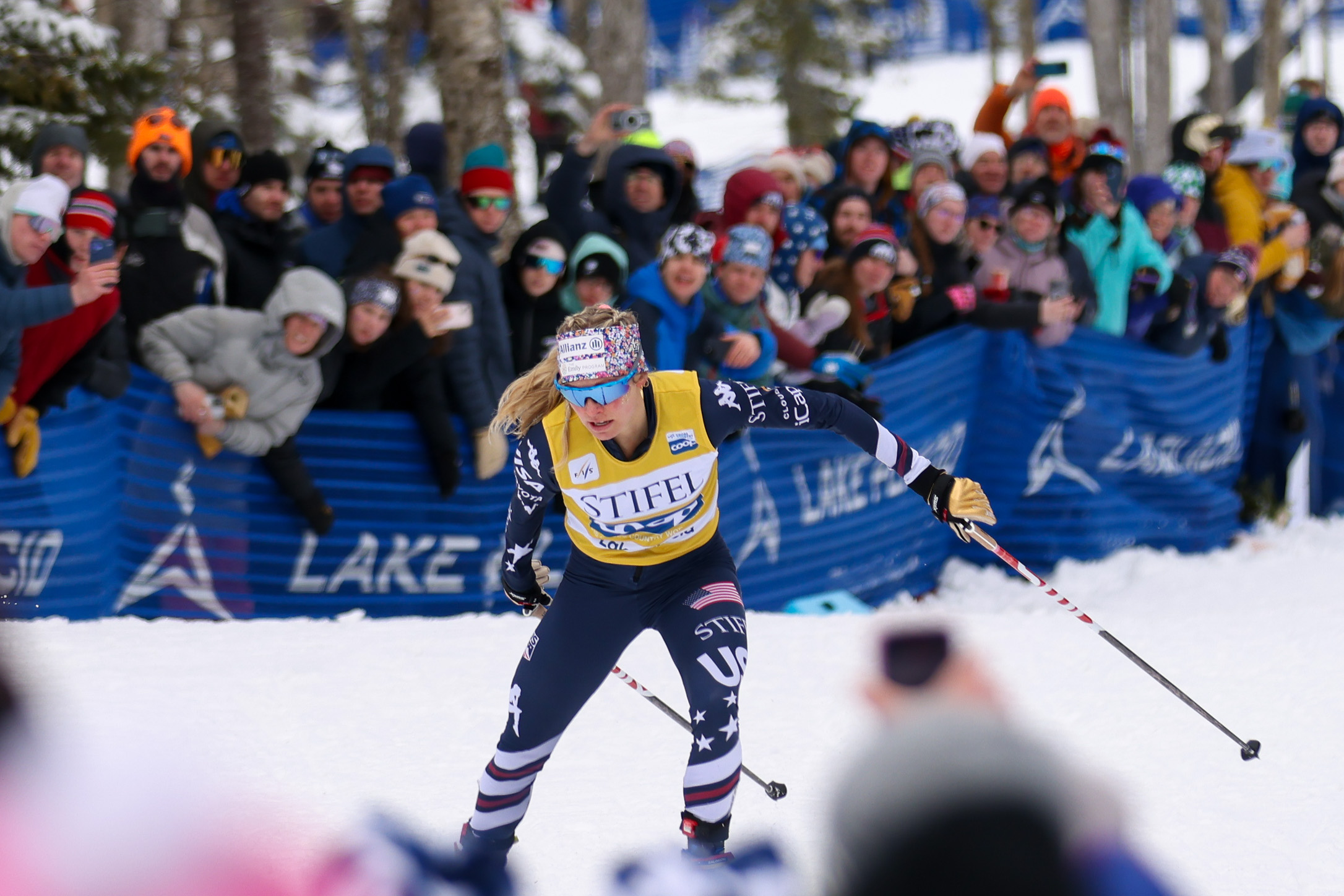
 This coverage is made possible through the generous support of Marty and Kathy Hall and A Hall Mark of Excellence Award. To learn more about A Hall Mark of Excellence Award, or to learn how you can support FasterSkier’s coverage, please contact info@fasterskier.com.