From the FasterSkier archive — posts syndicated from athletes’ and coaches’ own blogs between 2004 and 2012, kept online as published. Current coverage is at fasterskier.com.
The International Ski and Snowboard Federation (FIS) unveiled its proposed 2026/2027 cross-country skiing World Cup calendar this week at the FIS Spring Meetings in Portorož, Slovenia.
The schedule — first shared publicly through FIS social media and still pending FIS Council approval — builds the season around the 2027 World Championships in Falun, Sweden, with three pre-Christmas stops, a nine-race Tour de Ski, a stretch of three weekends between the Tour and Worlds, and a Scandinavian closing kick that ends with the Finals in Ulricehamn.
For North American fans, the calendar is once again entirely European, with no scheduled stops in Canada or the United States.
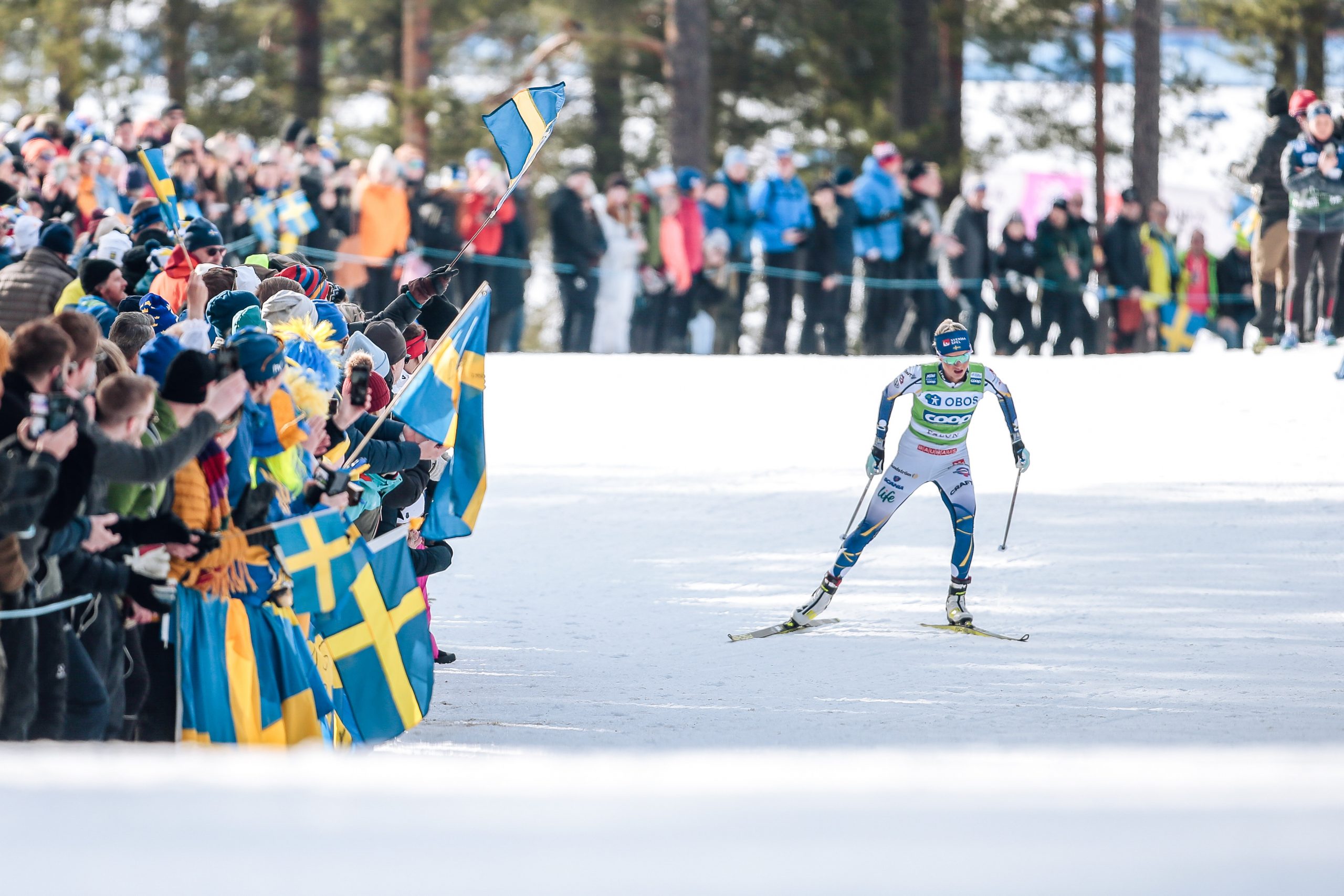
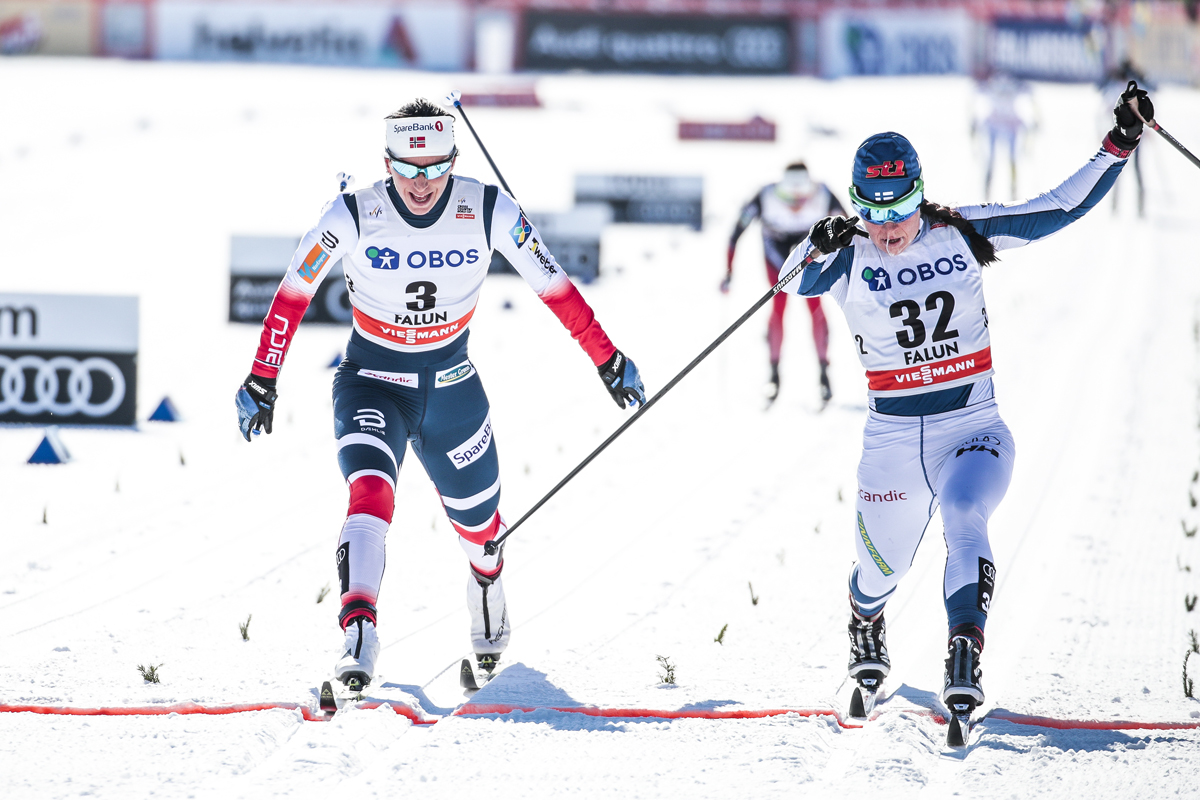
Frida Karlsson (SWE) poses with Mr. and Mrs. Claus following the 10k Classic to start last season in Ruka (FIN). (Photo: Modica/NordicFocus)
Pre-Holiday: Ruka, Trondheim, Davos
The season opens where it almost always does — in Ruka, Finland, where the World Cup begins November 27. From there, the circuit moves to Trondheim, host of the 2025 World Championships, before the pre-Christmas block closes in Davos, Switzerland, with a team sprint.
November 27-29, 2026: Ruka, Finland
27/11: 10km Interval Start Classic
28/11: Sprint Classic
29/11: 20km Mass Start Freestyle
December 1-3, 2026: Trondheim, Norway
01/12: 10km Interval Start Classic
02/12: Sprint Freestyle
03/12: 20km Skiathlon
December 11-13, 2026: Davos, Switzerland
11/12: 5km Heat Mass Start Freestyle
12/12: Sprint Freestyle
13/12: Team Sprint Freestyle
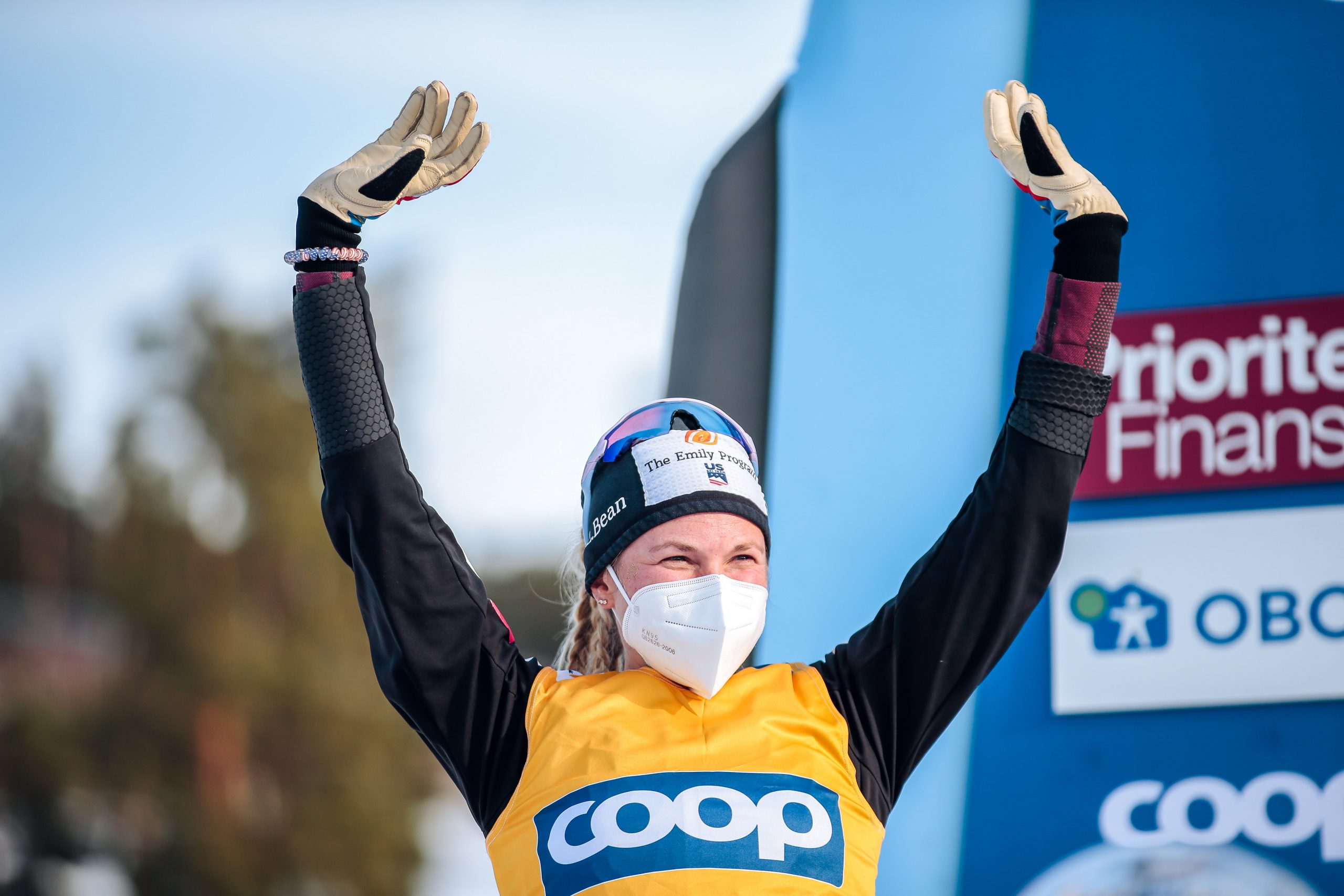
With Jessie Diggins (USA) now retired, there will be a new FIS Overall Crystal Globe and Tour de Ski champion next season (Photo: Vanzetta/NordicFocus)
Tour de Ski 2026/2027
The Tour de Ski returns to a three-country format, opening in Les Rousses, France, on New Year’s Day, moving to Oberstdorf, Germany, and finishing with three races in Val di Fiemme, Italy — capped, as ever, by the Final Climb up Alpe Cermis.
January 1-3, 2027: Les Rousses, France
01/01: Sprint Classic
02/01: 20km Mass Start Classic
03/01: 15km Pursuit Freestyle
January 5-6, 2027: Oberstdorf, Germany
05/01: 15km Mass Start Classic
06/01: 5km Heat Mass Start Freestyle
January 8-10, 2027: Val di Fiemme, Italy
08/01: 15km Skiathlon
09/01: Sprint Freestyle
10/01: Final Climb
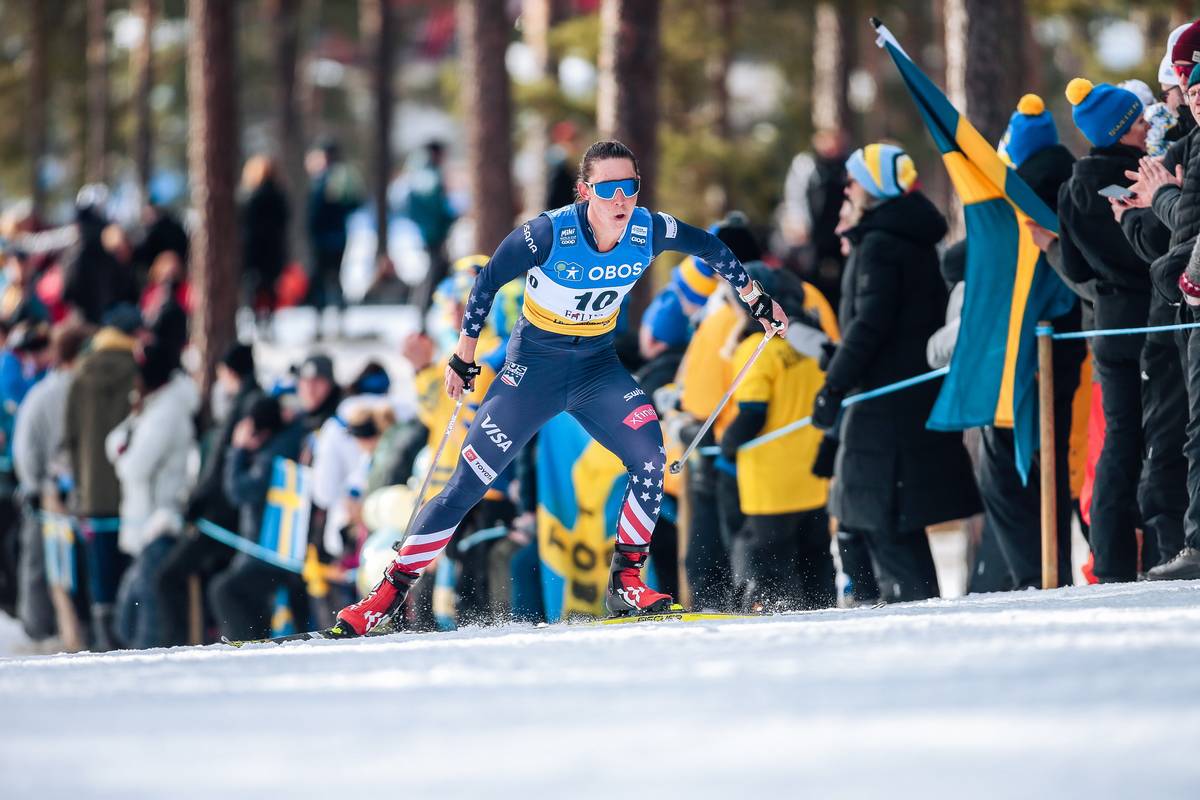
Gus Schumacher (USA) and the rest of the US team will hope to continue their success in Toblach (ITA). (Photo: Modica/NordicFocus)
After the Tour, Before Worlds: Engadin, Toblach, Lahti
Three weekends bridge the Tour de Ski and the World Championships. Engadin opens its weekend with a mixed relay — a format the FIS has been working into more World Cup weekends — and Lahti closes the pre-Worlds stretch with its classic 20km skiathlon and 10km interval start.
January 22-24, 2027: Engadin, Switzerland
22/01: Mixed Relay
23/01: Sprint Freestyle
24/01: 20km Mass Start Freestyle
January 29-31, 2027: Toblach, Italy
29/01: 10km Interval Start Freestyle
30/01: Sprint Freestyle
31/01: 20km Mass Start Classic
February 12-14, 2027: Lahti, Finland
12/02: Sprint Classic
13/02: 20km Skiathlon
14/02: 10km Interval Start Classic
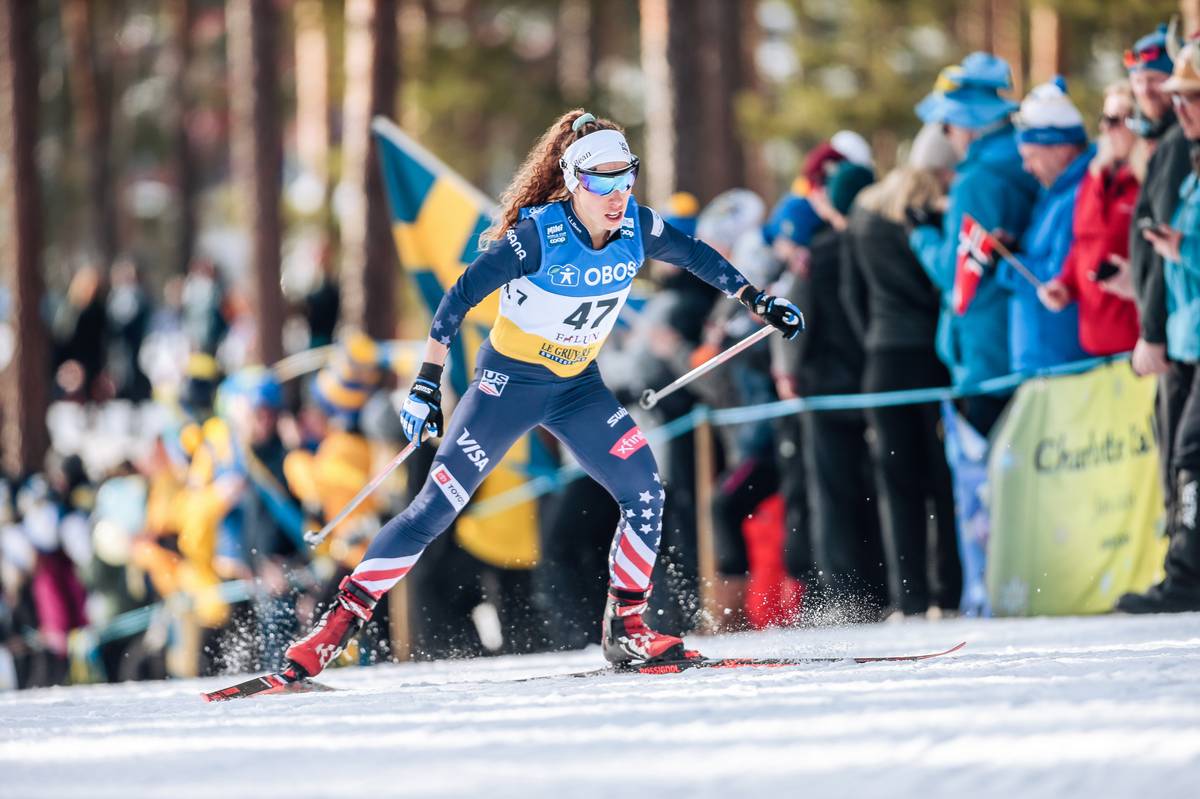
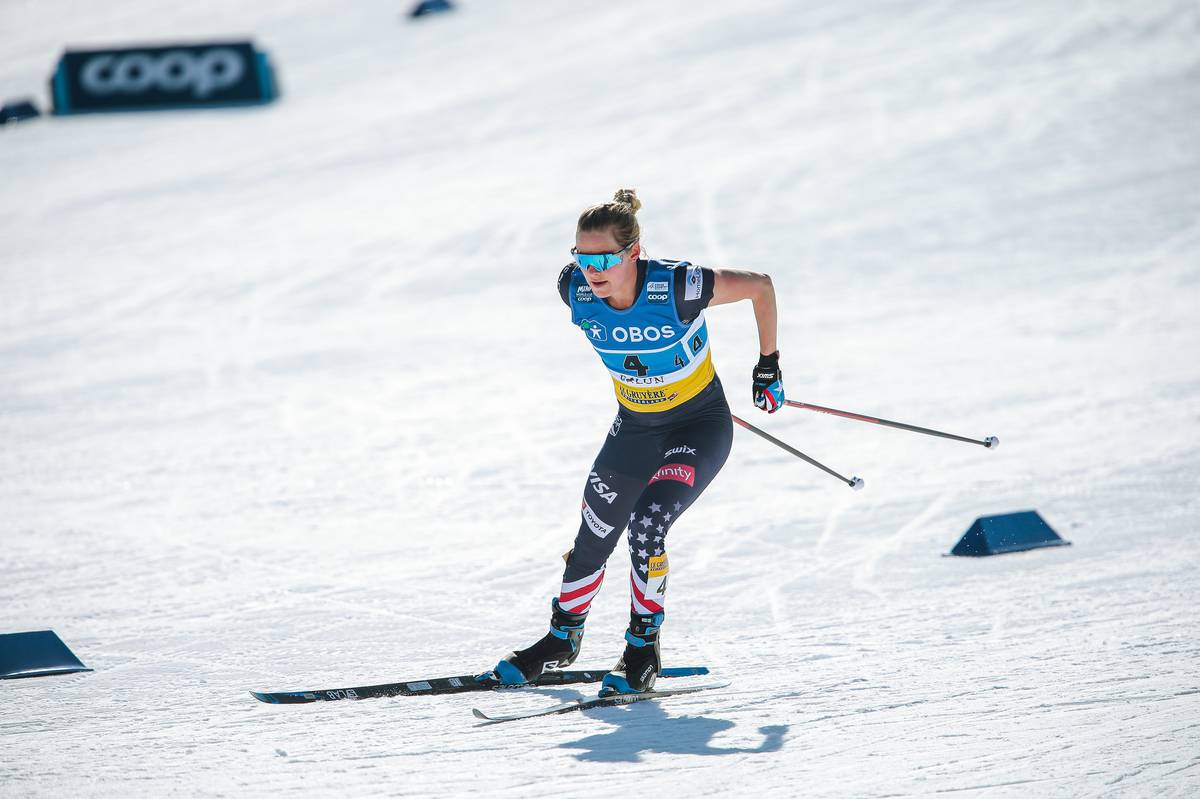
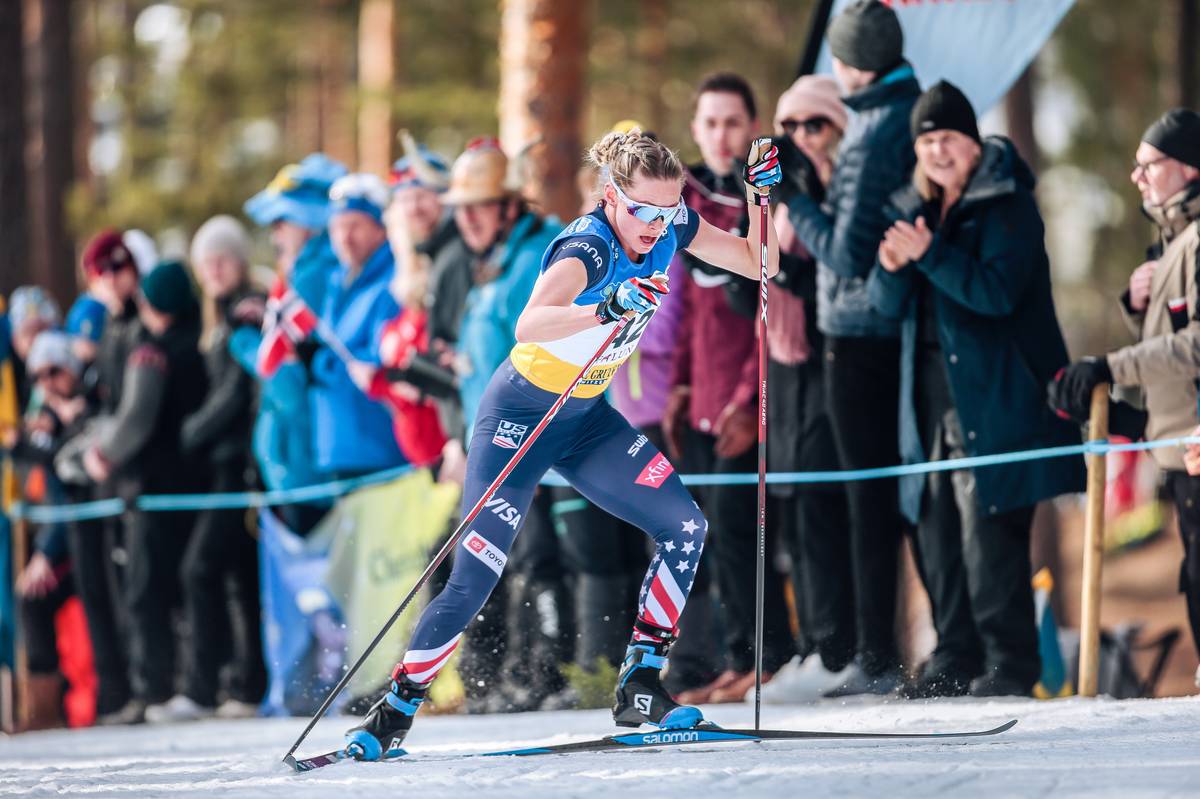
Kendall Kramer (USA) had a breakout World Cup Skiathlon in Falun (SWE) last season. (Photo: Authamayou/NordicFocus)
2027 FIS Nordic World Ski Championships: Falun, Sweden
The 2027 FIS Nordic World Ski Championships run from February 22 through March 7 in Falun, Sweden, with all title formats on the program. Falun last hosted Worlds in 2015.
Final Period: Oslo, Drammen, Ulricehamn
The closing stretch is a Scandinavian one. Oslo’s Holmenkollen weekend features back-to-back 50km mass start classic races on March 13 and 14 — long a fixture of the late-season calendar — before a one-day sprint stop in Drammen and the World Cup Finals in Ulricehamn, Sweden.
March 13-14, 2027: Oslo, Norway
13/03: 50km Mass Start Classic
14/03: 50km Mass Start Classic
March 16, 2027: Drammen, Norway
16/03: Sprint Classic
March 19-21, 2027: Ulricehamn, Sweden (World Cup Finals)
19/03: 10km Interval Start Freestyle
20/03: Sprint Freestyle
21/03: 20km Mass Start Classic
The calendar remains subject to FIS Council approval.
This coverage is made possible through the generous support of Marty and Kathy Hall and A Hall Mark of Excellence Award. To learn more about A Hall Mark of Excellence Award, or to learn how you can support FasterSkier’s coverage, please contact info@fasterskier.com.
LAKE PLACID, New York (March 21) — As the snow settled on Lake Placid and clouds began to dissipate over Mt. Van Hoevenberg, a growing sense that something momentous could happen permeated the crowd assembling for the last Sprint of the 2025-26 World Cup.
That something unusual would happen was assured. With the Sprint Globe already secured to Johannes Høsflot Klæbo, the golden-haired juggernaut would not be on the starting line – opting instead to rest his legs, and head, in hopes of defending his 12-point lead over Harald Østberg Amundsen in the Distance standings. By default, then, someone other than Klæbo would stand atop Saturday’s podium – a rare occurrence in a season where the Norwegian had already won 8 of 11 Sprints in commanding fashion. (Two wins evaded Klæbo due to falls; the third because he did not start in Oberhof).
Who would take his place? Ben Ogden, the Northeast’s homegrown favorite and the Sprint silver medalist in Milano-Cortina? Gus Schumacher, Ogden’s partner in the Olympic Team Sprint? France’s embattled specialist, Lucas Chanavat, who appeared on track to rival Klæbo during the 2023-24 season, who had seized the opportunity – and the win – after Johannes’ bobble in Davos last December? Ansgar Evensen (NOR), who had done the same in Drammen?
Or, perhaps, it would be Federico Pellegrino (ITA) – the 35-year-old elder statesman of the league; making his 344th (and penultimate) World Cup start, eyeing an 18th and final Sprint victory?
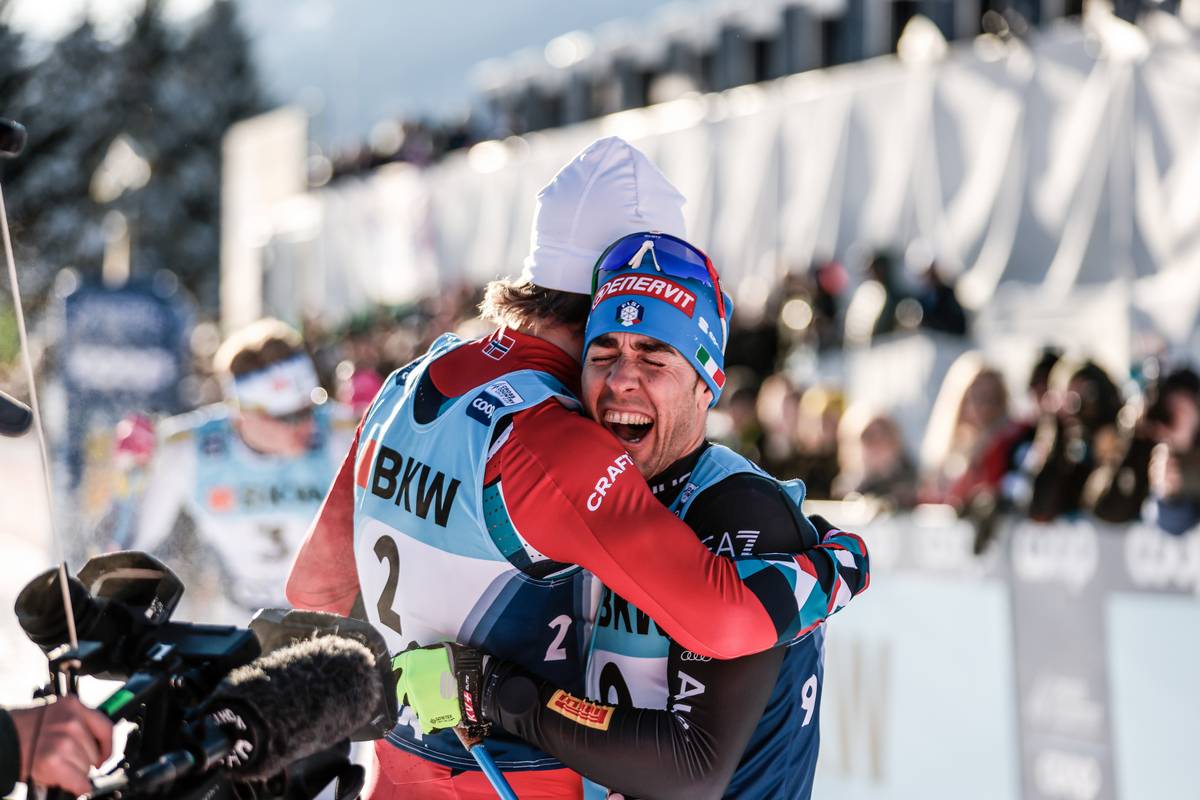
Johannes Hoesflot Klæbo (NOR) and Federico Pellegrino (ITA) after the finish of the Finals in Davos, 2022. Pellegrino bested Klæbo on the eve of the birth of his first child. (Photo: Nordic Focus)
It states the obvious to say that success in cross-country skiing is a matter of timing, and for “Chicco Pelle’s” 15 seasons, the timing had been just shy of right. The formative and final years of Pellegrino’s career were defined by the dominance of skiers other than he. Pellegrino made his World Cup debut in Drammen in March 2010, finishing 49th. The winner that day was Emil Joensson (SWE); runner-up was Petter Northug (NOR), then on his way to his first of two Overall Globes. These were the halcyon days in which Dario Cologna (CHE) descended from his Alpine fastness to rack up World Cup and Tour de Ski titles; when Northug, Joensson and Marcus Hellner (SWE) traded sprint victories and taunts in a bitter intra-Scandinavian rivalry. Pellegrino was 12th in his first World Championships Sprint (Oslo, 2011) and 11th at his first Olympic Sprint (Sochi, 2014).
While notching his debut victory in December, 2014 in the Davos Freestyle Sprint, Chicco’s break came in the 2015-16 season. He won 5 of 13 sprint races, becoming the first non-Scandinavian male to win the Sprint Globe. As Pellegrino hit his stride, Northug’s star was showing its first flickerings ahead of a dramatic waning, Joensson had entered the twilight of his career, and although Sergey Ustiugov (RUS) was approaching his own prime, the factious cast of World Cup sprinters was looking for a new leading man.
That man would not be Chicco. An upstart dramatist from Trondheim, Johannes Høsflot Klæbo, had arrived to script skiing’s long, and mind-bogglingly successful, next chapter. After making his debut in Drammen in 2016, Klæbo outscored Pellegrino in the 2016-17 Sprint standings, taking his first of 8 (and counting) Sprint Globes. The two went head to head at the 2017 World Championships in Lahti, Finland, where Pellegrino surged from behind to claim his first World Title ahead of a legendary lineup, including Ustiugov, Klæbo, and Northug, but this maiden gold would also be his last. In Pyeongchang the next year, the Olympic gold went to Klæbo; Chicco brought home silver.
The wins did keep coming for Chicco, including a tear of three consecutive Sprint victories and his second Sprint Globe in 2020-21. And, though they admittedly came in greater abundance to Klæbo (who, it should be noted, did not start in those races, or the 2020-21 Tour de Ski), it is rather glib to assert that Chicco’s career had slid “in[to] the shadow of” the Norwegian. Pellegrino bested Klæbo in Dresden and Lahti in the spring of 2018; in Lillehammer that winter; and in Davos in 2022. He was near-omnipresent on Sprint podiums and won his second Olympic silver in Beijing in 2022; moreover, he was among the very few men who could disrupt Klæbo’s dominance in the discipline, and the clear favorite when Johannes was absent.
But Pellegrino’s win in Davos in December 2022 marked the beginning of a long, and perhaps self-inflicted, World Cup drought. Chicco declared his intention to focus on distance races ahead of Milano-Cortina, and did indeed record four such podiums in classic, skate, and skiathlon formats, alongside a welter of Sprint podiums – including an ecstatic World Championships silver in Trondheim in 2025, and Olympic bronzes on home soil in the Team Sprint (alongside Elia Barp) and in the 4 x 7.5 k Relay (which he described as “the proudest day of [his] life!”) this February.
Elia Barp welcomes Federico Pellegrino to a bronze-medal finish in the Olympic Team Sprint in Milano-Cortina, February 18th, 2026. (Photo: Vanzetta/Barbieri/NordicFocus)
Outright wins, however, were not forthcoming. By the time March 21, 2026 arrived in Lake Placid, it had become Pellegrino’s last, best chance to secure one more Sprint victory.
Anticipation and emotions ran high. While Pellegrino had been impervious to the crowd in Friday’s 10 k Classic – earbuds deadening the world beyond his blue racing cap during warmups, and his face a deaf mask of exertion during the race – their excitement overwhelmed him on Saturday. During his first warmup lap, he skated calmly up the course’s A-Climb through a chorus of “CHI-CCO, CHI-CCO, CHI-CCO.” On his second, the frenzied chant began again, and the gravity of the impending race dragged him to a halt. His skis splayed wide against the pitch; he buried face in his hands. “The energies I got in the Final were coming from the warmup lap, where I stopped in the middle of the climb, crying,” Pellegrino told me at the finish line. “I think the public deserved this kind of show, and I deserved to finish my career, with a Sprint skate like this.”
Pellegrino embraces the crowd ahead of Sprint qualifying in Lake Placid. “The energies I got in the Final were coming from the warmup lap, where I stopped in the middle of the climb, crying.” (Photo: Thibaut/NordicFocus.)
To reach that final finish line, however, was a perilous journey.
After qualifying second, Pellegrino sidestepped two falls (the first from Jules Chappaz (FRA); the second from Elias Keck (GER)) in his Quarterfinal, moving from sixth to first in the course’s final descent and level hairpin. In Semifinal 1, he attempted to close on Lucas Chanavat (FRA) and Anton Grahn (SWE) through the crest of the A-Climb but couldn’t get by; pushed to the outside on the level hairpin, he was out-lunged by Lars Heggen (NOR) in the final meters, finishing third by 0.03.
While the Lucky Loser spot was Chicco’s to lose heading into Semifinal 2, Erik Johansson (SWE), Harald Amundsen (NOR), and Even Northug (NOR) lost time playing for a slipstream position as they approached the top of the A-Climb. Pellegrino was on to the final by a comfortable margin.
Lars Heggen (NOR) outlunges Federico Pellegrino (ITA) by 0.03 in Semifinal 1. Federico moved on to the Final as a Lucky Loser. (Photo: Thibaut/NordicFocus)
Once more around the track, and the day could be his. After being fourth out of the gate, he attacked from the outside on the B-Climb; breaking into an aggressive V-2 and taking Chanavat and Heggen by surprise, he moved into second behind Grahn. The pace increased again at the base of the A-Climb, but where Grahn and Chanavat’s broad frames moved up the hill in sweeping, powerful strokes, Pellegrino leapt into a furious V-1.
The move was decisive. To the adulation of the crowd, he opened a decisive gap through the crest of the climb. His lead only grew through the final descent into the level hairpin, but Chicco was taking no chances. While Grahn and Heggen grappled for second behind him, Pellegrino hammered to the line, threw his arms wide and his head back, roaring with the crowd.
An 18th victory and 46th career podium, clinched.
Federico Pellegrino secures his 18th and final World Cup victory. Lake Placid, March 21, 2026. (Photo: Thibaut/NordicFocus)
What had happened in the Semifinal, when this triumphant last dance had nearly evaded him by three hundredths of a second? And what had changed for the Final?
“I could not do what I did in the Final, because the energies of the other athletes were still quite big,” Chicco admitted our post-race interview. “About the last downhill, I was not the same as the others. I am not, I know, but I have some different qualities, and if I could get quite good gap in the top of the uphill, then I knew that I could keep it until I end. This is what I did. This is how I loved to win all along my career – not wait until the last meter, but trying before.”
“Sometimes it happened, mostly before Klæbo came,” he laughed. “But today I was there, and I studied the best tactics in the end . . . the public here in Lake Placid deserves this kind of show, and I think we are all happy now.”
And, this was nothing short of “the best way” to end his journey. “I could not do different. In the end, the last four years have been strange. I didn’t focus so much on sprinting; I tried to discover my body in different fields. Sometimes I got really great feelings and performances, but then, to come back here . . . and to win in that way, I could not do more.”
Pellegrino after his final win. “I think the public deserved this kind of show, and I deserved to finish my career, with a Sprint skate like this.” (Photo: Thibaut/NordicFocus)One more podium for Federico Pellegrino, alongside Lars Heggen (NOR) and Anton Grahn (SWE). (Photo: Thibaut/NordicFocus.)
In 15 seasons, Pellegrino proved himself to be far more than a runner-up to those Swedish and Norwegian titans who loomed large over his early and later years. He had taken the Sprint Globe from the Scandinavians for the first time; outsprinted Klæbo, Ustiugov, and Northug in Lahti; perpetually challenged – and occasionally beaten – the greatest athlete in the history of the sport; and secured Olympic medals on home soil, alongside a team of up-and-coming Italians ready and eager to fill his boots. “I’m really happy that he finished his career with probably one of the best weekends for him so far,” Elia Barp (ITA) told me on Sunday. “I’m very happy for him; I’m very happy for the team. I think we have proved that we are ready to race without him – not only me, but a few other young guys are ready to try to take victories next year . . . [He showed] that it is important to keep fighting and try to be a good overaller as he was in the last years. And, now we know that it’s possible; everyone is human as us, and we can do that.”
To Chicco’s fans, that determination – to grapple with giants; to reinvent himself; to seize the final, perfect timing and a final, perfect victory – defined his career. But for Pellegrino himself, “the biggest memories will not stay about the races, but much more about the hugs I got from the teammates, from the coaches, even outside of Italy, from my family, from the people that love me – and not only when things went well; even when things were not going so well. I think this is something that sport teaches us; that in the end, it’s only a cross-country ski race, and life is different. That’s it. The hugs are something I will remember for my entire life.”
Pellegrino, the most popular man at Zig Zag’s on Saturday, March 21. (Photo: Lily Den Hartog)
At Zig Zag’s Pub on Saturday night, Pellegrino told this reporter’s associate that his win vindicated his decision to retire. On Sunday, soaked with rain and champagne and tears after his last World Cup race, he reaffirmed it:
“That’s it. I tried to enjoy today as well . . . I tried to give my best, as always, and it was good after the finish line; under the rain, it was special. But with the teammates and coaches and waxers celebrating this moment, it was good for me.”
“Now, I really need to stay with my family. They deserve this, and I need to give them a lot of time.”
Love Stories Like This? Help Keep Them Coming.
Feature stories like this one take time, access, and care to produce. If you value thoughtful storytelling and independent ski journalism, please consider becoming a Voluntary Subscriber. Your support directly fuels the work we do to cover the people, places, and moments that make our sport special.
“Grazie Papao!!” Team Italy was waiting at the finish of the 20 k Skate with champagne and a tribute to Pellegrino’s children and wife, Greta Laurent (ITA, ret.). (Photo: Thibaut/NordicFocus)
This coverage is made possible through the generous support of Marty and Kathy Hall and A Hall Mark of Excellence Award. To learn more about A Hall Mark of Excellence Award, or to learn how you can support FasterSkier’s coverage, please contact info@fasterskier.com.
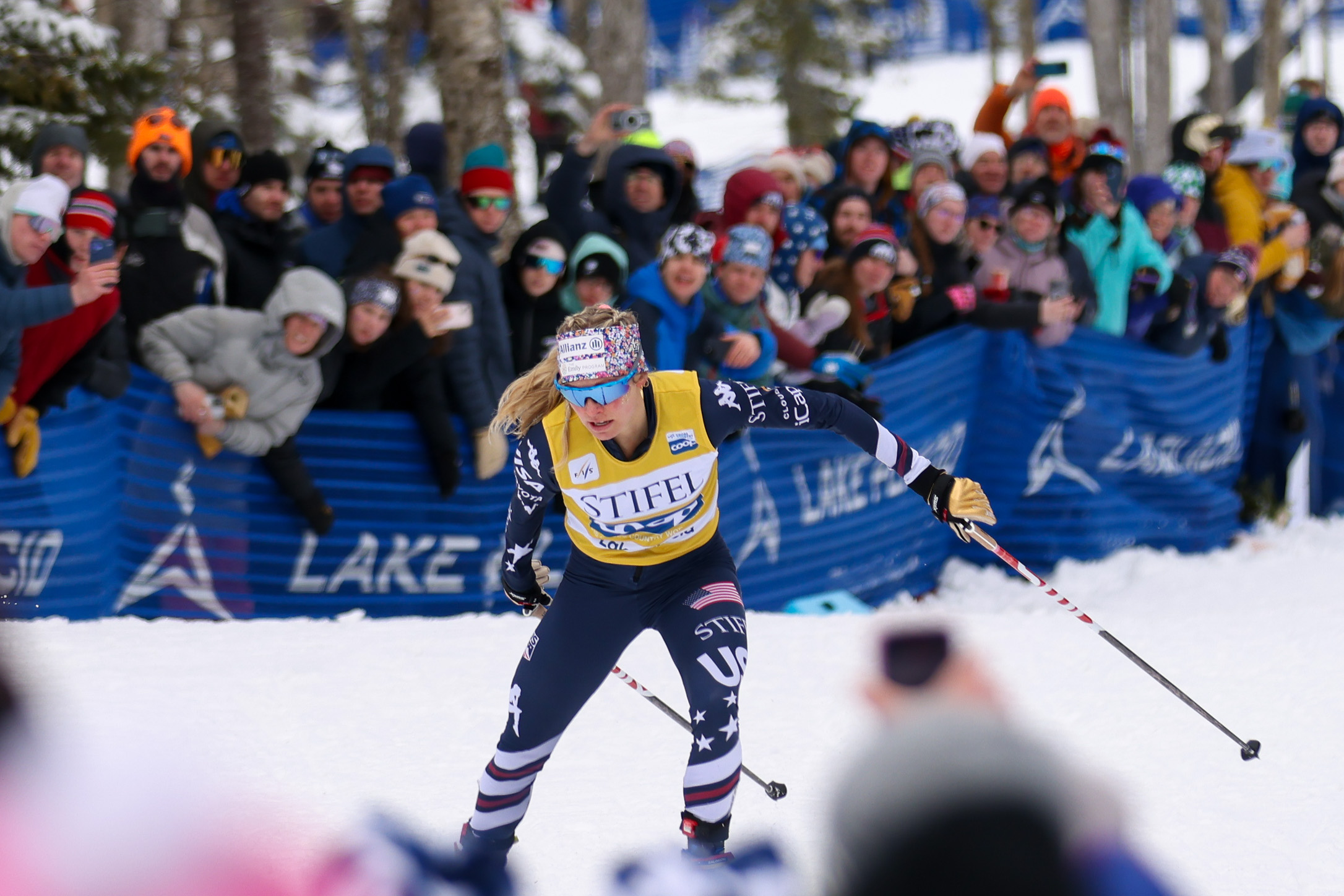
Jessie Diggins during the quarterfinals of the Freestyle Sprint on Saturday in Lake Placid, New York, USA. (Photo: Voisin / FasterSkier)
Lake Placid, N.Y. — The French coaches had questions. Two days before racing began at Mount Van Hoevenberg, they were standing in Saranac Lake — 55 degrees, windy, woods in every direction — wondering who exactly was going to show up to watch cross-country skiing in the middle of the Adirondacks.
By Saturday, an estimated — rumored to be fair — 14,000 people had answered.
Today, as Jessie Diggins lines up for the 20-kilometer mass start freestyle, the final race of her career, this corner of upstate New York will try to top itself one more time.
Screaming fans, chainsaws, flags, signs, and glitter all over the course in Lake Placid, New York, USA. (Photo: Voisin / FasterSkier)
A Weekend That Kept Building
The first sign that Lake Placid was going to be different came Friday, and it wasn’t entirely smooth. With an initial estimate of 10,000 fans on Friday, the transportation system to and from Van Hoevenberg buckled under the demand. Some fans waited over two hours to get to the venue.
US Head Coach, Matt Whitcomb, after the races yesterday in Lake Placid was really happy because the standout performance was not one of his athletes, but instead the North American ski community that showed up in droves and created an electric atmosphere. (Photo: Voisin / FasterSkier)
“Only Holmenkollen and Minneapolis”
U.S. Ski Team head coach Matt Whitcomb has been on the World Cup circuit for years. He said the only events throughout his career that have ever rivaled the atmosphere here this weekend in Lake Placid are the Holmenkollen in Oslo — the sport’s grand prix if you will — and Minneapolis two years ago.
That’s the company Lake Placid is keeping. And for those who were in Minneapolis, the comparison lands. Diggins said earlier this week that Minneapolis was the most special day of her career.
“It was the most I’ve ever cried,” she said at Wednesday’s press conference. “I got to race in front of some of my grandparents who haven’t been able to travel overseas. They got to see me race for the very first time in a World Cup. And having so many friends and family and getting to share the thing that I love doing with them — that is the most incredible thing ever.”
She paused, then added: “I think this weekend’s probably going to join that.”
College skiers from all over the Northeast came in force to the trailside in Lake Placid, New York, for the races this weekend. (Photo: Voisin / FasterSkier)
The Scene on the Ground
What the numbers don’t capture is the texture. Young kids running around the venue in their NNF fan bibs — the ones with athletes’ faces printed on them — clutching Sharpies, hoping to meet their heroes. Fans who drove and flew from Vermont, from Alaska, from Minnesota, who planned vacations around this weekend months ago. The school buses that became part of the story, ferrying the faithful up the mountain road when the original plan couldn’t hold.
This is what U.S. cross-country skiing looks like when it gets the stage. Not a packed NFL stadium or a sellout basketball arena — but thousands of people standing in the woods, screaming themselves hoarse for athletes from every country, because they love this sport and they know how rare these weekends are.
The fans — especial the college skiers — made it sound like the race was happening in Davos, Switzerland with the chainsaws out on course. (Photo: Voisin / FasterSkier)
One More Race
Diggins has spent this weekend doing exactly what she said she would — being present, soaking it in, putting on a show. She clinched the Crystal Globe on Friday. She raced the sprint on Saturday. And now there’s one more.
At Wednesday’s press conference, she talked about the way her mindset around suffering has evolved — how she’s learned to see the pain cave not as something to dread but as confirmation that she’s doing what she came to do.
“This is what 100 percent feels like,” she said. “And sometimes this is what it looks like, and it’s some ugly scene, but that’s okay. It just has to be all heart and all effort, and that’s what I have to give in that moment.”
She also made one thing clear about the team she’s leaving behind: “The team is going to be just fine without me. And I feel like that’s how I know I did my job.”
Then, with a smile: “I’m excited to be a fan on the other side of the fence and get to cheer for them.”
Today, in just ten minutes, Jessie Diggins will clip into her bindings for the last time as a World Cup racer. The 20-kilometer Mass Start Freestyle.
And based on everything this weekend has shown us, “no one” will be watching.
Love Stories Like This? Help Keep Them Coming.
Feature stories like this one take time, access, and care to produce. If you value thoughtful storytelling and independent ski journalism, please consider becoming a Voluntary Subscriber. Your support directly fuels the work we do to cover the people, places, and moments that make our sport special.
This coverage is made possible through the generous support of Marty and Kathy Hall and A Hall Mark of Excellence Award. To learn more about A Hall Mark of Excellence Award, or to learn how you can support FasterSkier’s coverage, please contact info@fasterskier.com.
Jessie Diggins answering questions at the press conference before the World Cup in Lake Placid, New York. (Photo: Voisin/FasterSkier)
Lake Placid, N.Y. — The eve of the World Cup finals at Mount Van Hoevenberg brought press conferences, sound checks that went sideways, and three American skiers who couldn’t stop making each other smile.
Jessie Diggins, Ben Ogden, and Gus Schumacher sat side by side Wednesday afternoon — the same trio that has turned the 2025-26 season into something U.S. cross-country skiing has never seen before. Between them: Olympic medals, historic podiums, a 50-year drought shattered, and one very good birthday cake.
But with three races left and Diggins’s retirement looming, the mood wasn’t heavy. It was loose, funny, and deeply human — exactly the way this team tends to do things.
“Probably Glitter”
Asked to define her legacy heading into her final World Cup weekend, Diggins did what Diggins does: she went somewhere unexpected.
“I think I define my legacy honestly, completely outside race results,” she said. “I am more proud of the things I have done off the course. I think my legacy is going to be in my advocacy and the way that I have spoken about mental health and eating disorders specifically, and the way I’ve tried to make really hard conversations less hard for people to have.”
She pointed to her work with Protect Our Winters and Share Winter, to the energy she’s poured into the team’s culture over the years. And then she landed the dismount.
“And probably glitter. I think there’s a lot more glitter in ski races now, and that’s always a great thing — as long as it’s biodegradable.”
Diggins has spent the season saying goodbye in pieces — a little cry leaving training camp in Bend, quiet moments at each World Cup stop. She knows what’s probably coming Sunday.
“I suspect it’s probably going to hit like a dump truck on Sunday, and there’s probably going to be a lot of tears.”
But she’s ready. And what she’s ready for is maybe the most Jessie Diggins thing of all: she sees ski racing as performance art, and she wants her final show to leave people wanting to go run up a mountain or sign their family up for ski lessons.
“I realized that I can do that moving forward, but just with my story and with my words, and I don’t have to push my body so hard, but I can still leave people inspired and motivated.”
In the meantime, she’s looking forward to being able to wash her clothes when they’re dirty, cook whatever she wants, and bake cookies on the weekend instead of training and racing all day.
Ben Ogden answering questions at the press conference before the World Cup in Lake Placid, New York. (Photo: Voisin/FasterSkier)
“Your Life Is Not Going to Be the Same”
Ben Ogden grew up in Landgrove, Vermont. American skiing legend Bill Koch lived close by in Peru, Vermont. Same zip code, as Ogden puts it — “not so different.”
Fifty years separated Koch’s 1976 Olympic medal from Ogden’s silver this season, and when Ogden finally got on the phone with his neighbor and mentor after breaking the drought, Koch didn’t mince words.
“Bill just sort of said, ‘Hey, congratulations, and your life is not going to be the same from this point forward.’ And that was kind of crazy to hear.”
Ogden hopes to see Koch at the races this weekend. And racing at Van Hoevenberg carries its own weight for him — not just because of Koch, but because of his father, who was deeply embedded in the New England ski racing community.
“I think it’s really hard for me to come race in the U.S. and look around and not just, like, constantly think about him, because this was his scene,” Ogden said, his voice softening. “He would have been in such paradise on the side of the trail here in Lake Placid. And I’ll be thinking about him a lot this weekend, for sure.”
This is technically Ogden’s first home World Cup — he was sick for Minneapolis — and it’s hitting him right. He grew up racing the NYSEF Festival series at Lake Placid, bringing crews of Vermont kids over for slushy late-season races.
“It’s not my home, but it feels like it.”
Gus Schumacher answering questions at the press conference before the World Cup in Lake Placid, New York. (Photo: Voisin/FasterSkier)
Aspirations, Not Goals
Gus Schumacher has been doing some linguistic rebranding.
“I’ve been calling them aspirations for a few years now,” he said of his season targets, “because I feel like the pressure of goals was kind of weird for me.”
The distinction matters to Schumacher. He sets plenty of small goals — the daily, tactical kind — but the big ones, like winning an Olympic medal or finishing in the top 10 of the overall World Cup standings, he holds more loosely. They’re aspirations: things he wants, things he’ll chase, but things he won’t let crush him if they don’t happen.
“Those are things I want to do, but if they don’t happen, it won’t be because I didn’t try.”
He accomplished the Olympic medal. He entered this final weekend ranked sixth in the world, with a top-10 finish still in play. And he’s approaching Lake Placid the same way he approached Minneapolis, where he won his first World Cup in front of a hometown crowd: just be happy to be racing, and feed off the energy.
“Already today, it was really cool to have people cheering us on in the race prep, which doesn’t really happen much on the World Cup ever.”
Schumacher also dropped maybe the best origin story of the press conference: the formative moment that lit a fire under his career was Luke Jaeger beating him at an Anchorage cup race.
“That kind of put a fire under my belly to really start training, because I didn’t want him beating me anymore.”
The Knitting Club, the Water Pump, and the Greenhouse
The press conference’s best stretch might have been when someone asked the athletes how they decompress.
Schumacher keeps it clean: headphones, 10 to 20 deep breaths — four seconds in, eight seconds out. Standard operating procedure.
Ogden? He knits. And he’s not shy about it.
“After races, I’ve been doing a lot of knitting and stuff like that. Helps me just relax really quick.” After the season, it’s bigger projects: car work. “You can feel like you’re the king of the world after a couple medals, but go and try and replace a water pump on a Forerunner, and that’ll make you feel completely incompetent.”
Diggins revealed there was a full-on knitting club on the team this winter. Her own reset button is simpler: she calls her husband.
“He’s my absolute center of my world. The race could have been amazing, and it could have been also completely horrible. And we’re just talking about what I want to do with the garden, and how I want to start a greenhouse. And he’s like, ‘Uh huh, yeah, sure, I’ll support you in that.’”
One More Thing
Almost as a throwaway, Ogden mentioned that Andy Newell — “the original Nordic ski backflip guy” — is in Lake Placid this weekend. And Ogden himself has had a backflip dialed since he was 17.
“I’m hoping on Sunday we can kick up a little ski jump. I’m looking to take another one Sunday afternoon. So stay tuned.”
Three races to go. A retirement to honor. A culture to celebrate. And maybe a backflip.
It’s going to be a weekend.
Love Stories Like This? Help Keep Them Coming.
Feature stories like this one take time, access, and care to produce. If you value thoughtful storytelling and independent ski journalism, please consider becoming a Voluntary Subscriber. Your support directly fuels the work we do to cover the people, places, and moments that make our sport special.
Stifel Lake Placid Finals, a Coop FIS Cross-Country World Cup, to Bring Elite Ski Racing and Winter Festival Atmosphere to Lake Placid
FIS Cross-Country World Cup racing, fan experiences, athlete engagement, and live entertainment coming March 19–22
LAKE PLACID, N.Y. — The Stifel Lake Placid Finals, a Coop FIS Cross-Country World Cup, will offer more than world-class competition this March. The event will transform Lake Placid into a multi-day winter sports festival featuring themed race days, live entertainment, film screenings, interactive expo activations, and family-friendly programming.
In collaboration with the New England Nordic Ski Association (NENSA), the 10th Mountain Division, U.S. Ski & Snowboard, and the International Ski and Snowboard Federation (FIS), the Olympic Regional Development Authority (Olympic Authority) has curated a dynamic schedule that celebrates Nordic skiing and outdoor winter-sport culture.
A central focus of the week will be spotlighting women and girls in sport, networking opportunities, and hands-on activities. Fans will also have unique opportunities to connect with athletes through meet-and-greets, alumni celebrations, and special legacy moments — including Sunday’s “Last Lap” ceremony honoring retiring World Cup athletes.
Together, these events are designed to foster engagement, connection, and shared celebration across the Lake Placid community and the global ski family.
One final celebration of Jessie Diggins (USA) amazing career. (Photo: Authamayou/NordicFocus)
Event & Community Programming
In addition to World Cup racing, the Stifel Lake Placid Finals will feature a range of community events, athlete appearances, and festival programming throughout the week. Activities include youth programming, athlete conversations, live music, demonstrations, and opportunities for fans to connect with past and present champions.
Programming details may evolve, and additional events may be added throughout the week. Visitors are encouraged to check the official event schedule for the most up-to-date information.
Thursday, March 19 – Community & Kickoff
Opening day features official training and festival programming at Mt Van Hoevenberg, along with an evening film screening at the Palace Theatre that kicks off the festivities in downtown Lake Placid.
Friday, March 20 – Theme: Past
Friday celebrates the legacy of Nordic skiing and Olympic history in Lake Placid. The venue opens with festival programming, including the NENSA Terrain Park and Expo with L.L. Bean, regional athlete recognition connected to the 2026 Winter Olympics, and Adirondack Birds of Prey demonstrations. Fans can also watch presentations from the 10th Mountain Division, enjoy live music, and attend athlete interviews and meet-and-greets throughout the day. A highlight of the afternoon is the “One More Lap” legacy ski, featuring international and U.S. Ski Team alumni, including Olympic legend Thomas Wassberg and American champion Bill Koch, before World Cup racing and awards ceremonies conclude the day.
Saturday, March 21 – Theme: Future
Saturday’s programming focuses on the next generation of Nordic skiing. Activities include the NENSA Terrain Park and Expo with L.L. Bean, athlete appearances, and fan engagement opportunities. The Women in Sports Heroic Panel highlights leadership and opportunities for girls and women in athletics, while fans can also attend athlete meet-and-greets and participate in interactive programming throughout the venue. Competition highlights include the freestyle sprint finals, followed by Crystal Globe presentations. Youth racing also takes center stage with the World Cup Future Stars Sprint. Additional programming includes Lollipoppers to Olympians: A Celebration of New England Skiing, a live recording of the Skirious Podcast featuring Ben Ogden and special guests at the Olympic Jumping Complex, and evening film screenings at the Palace Theatre.
Sunday, March 22 – Theme: Present
Championship Sunday features entertainment, athlete appearances, and the season-ending races of the World Cup Finals. Live music, a DJ set, and ceremonial elements, including the 10th Mountain Division Color Guard and flyover, set the stage for the final competition. The afternoon concludes with awards ceremonies and the “One Last Lap” ceremony honoring retiring World Cup athletes.
Gus Schumacher (USA) and Ben Ogden (USA), (l-r) celebrate their silver medal at the Olympic Winter Games in Tesero, Italy. (Photo: Vanzetta/NordicFocus)
Competition Schedule | FIS Cross-Country World Cup Finals
Mt Van Hoevenberg | March 19–22, 2026
World Cup official training and competition runs March 19–22 at Mt. Van Hoevenberg, where the world’s top U.S. and international cross-country skiers will compete for overall and discipline Crystal Globe honors. The weekend culminates on Sunday with championship racing, awards presentations, and the “One Last Lap” ceremony recognizing retiring athletes.
Full competition schedule:
Thursday, March 19, 2026:
11:00 – 1:00 pm | 10km Official Training
1:00 pm – 3:00 pm | Sprint Official Training
Saturday, March 21, 2026:
10:30 am | Women’s Sprint Qualification Free
10:30 am | Men’s Sprint Qualification Free
1:00 pm | Women’s Sprint Final Free
1:00 pm | Men’s Sprint Final Free
Sunday, March 22, 2026:
12:30 pm | Men’s 20km Mass Start Free
2:30 pm | Women’s 20km Mass Start Free
Jessie Diggins (USA) and the US Ski Team celebrate in Goms. (Photo: Authamayou/NordicFocus)
Broadcast Schedule
NBC will air the Sprint Finals live on Saturday, March 21, from 1–2 p.m. ET. CNBC will air coverage of the Men’s and Women’s 10km Interval Starts on Saturday, March 21, from 2–4 p.m. ET. NBC will also air the Women’s 20km Mass Start on Saturday, March 29, from 1–2 p.m. ET on tape delay.
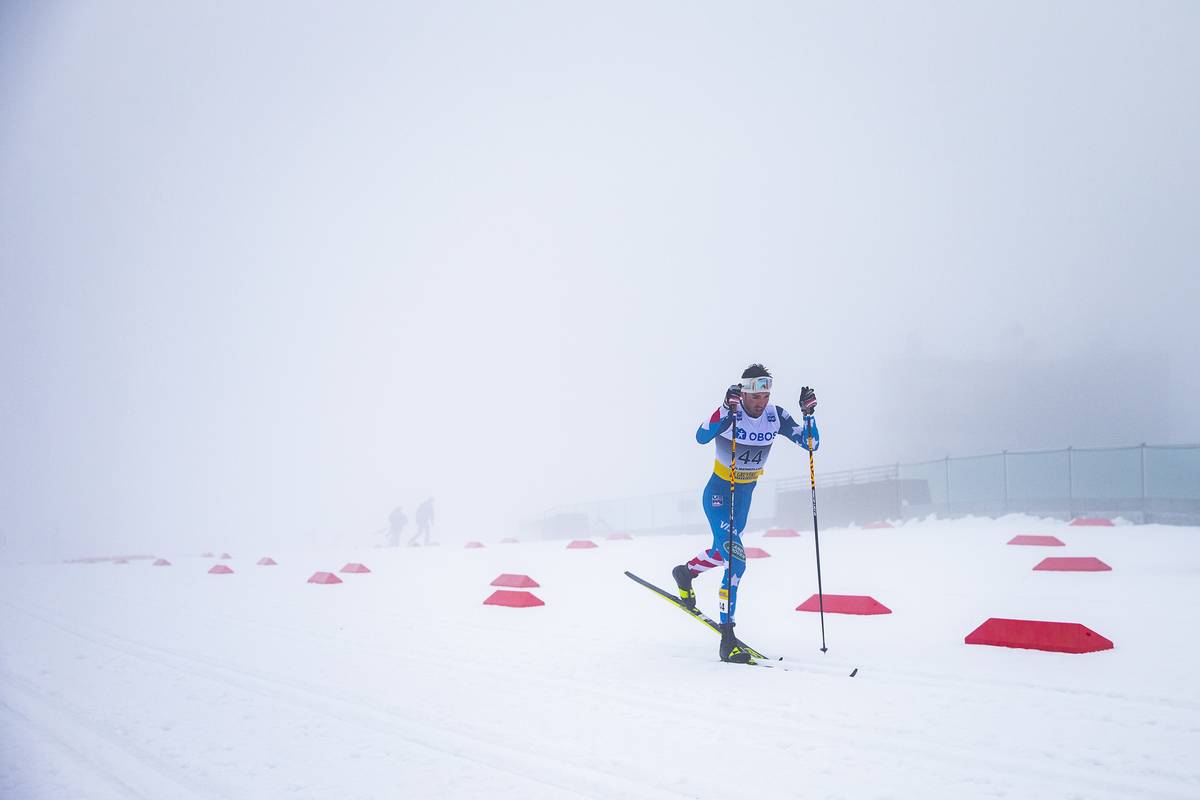
Ian Torchia (SMS T2) races through dense fog at the 50 k classic at Holmenkollen in March, 2020. (Photo: NordicFocus)
Click here to read an account of physical therapist Ned Dowling’s first stint overseas with the US Ski Team in March, 2020.
Holmenkollen, Norway. March 8, 2020 – Men’s 50k Classic World Cup. 33 degrees and raining. The ski jump was engulfed in clouds. Spectators were forbidden from attending the Super Bowl of cross country skiing due to the impending COVID pandemic. My first stint as a physical therapist traveling with the US Ski Team was ending in an Oslo fog.
Salt Lake City, Utah. Late March, 2020 – Buzz kill. In the week following my return from Norway, my son’s school was closed, my clinic was closed, people were fighting over toilet paper and hand sanitizer. It was the end of the world as we knew it. And we didn’t feel fine.
July 6, 2021 – I received an email from Chris Grover asking if I could travel with the ski team again in 2022. We were amidst the calm before the storm. People were getting vaccinated. COVID cases were dropping. We went on vacation. Delta had not yet jumped out from behind the grim reaper. The light at the end of the tunnel was getting brighter and brighter.
I had declined an offer to travel the previous winter. I knew I couldn’t get permission from either the boss at work or the boss at home. And I sure couldn’t tell my kid, who was still doing school remotely, “You keep up with those classes on Zoom while Daddy is off to Europe.”
But now things were looking up. By the time I’d be overseas in March, the COVID thing would be a distant memory. Hell yes! Sign me up Chris.
Rosie Frankowski races the 10 k freestyle in Falun, Sweden in March 2022. (Photo: NordicFocus)
Summer, Fall, Winter – We all know what happened next. The light at the end of the tunnel was an oncoming train and the shit hit the fan. Lots of shit hit lots of fans. First, the Delta variant, then Omicron. Through all of that, I did my best to stay optimistic about my opportunity to work the last two weekends of World Cup races in Falun, Sweden and Tyumen, Russia.
Falun was a bit of a known entity, or at least easily researched on the internet. The World Cup had been racing there for years. Trail maps showed a good network of tourist tracks (which is a good thing because the race course is no joke). Videos of old races on YouTube showed huge crowds, which were sorely missed at the pre-COVID Holmenkollen.
Tyumen, the Pearl of Siberia, was going to be much more of an adventure. Much to my relief, the plan was to have a chartered flight from Stockholm to Russia. I really, really didn’t want to fly (or crash) on a commercial Russian plane. With a lot of digging and Google Translate, I could glean some information about the race venue and its environs.
February 9, 2022 – Chris emailed me about getting a Russian visa. He told me to contact someone at the Russian Consulate in Washington: call this guy, do what he says, pay what he says, we’ll reimburse you. The next day I anxiously called Bogdan, to whom I would be entrusting my passport. “You send passport, extra photo, and $250. You complete visa application online and send password for application, so I fix your mistakes. You send postage to mail back.” I had him repeat that three or four times while I nervously scribbled notes to myself. I reminded him that I was flying to Sweden on March 6 and would very much need my passport back by then. “No problem. You get passport.”
The visa application was nerve racking. Employment history. List of all countries traveled to in the last 5 years. “Have you been trained in firearms, artillery, or nuclear warfare?”
With sweaty palms and my heart rate in L4, I mailed off my passport and hopefully everything else I was supposed to. Then I waited.
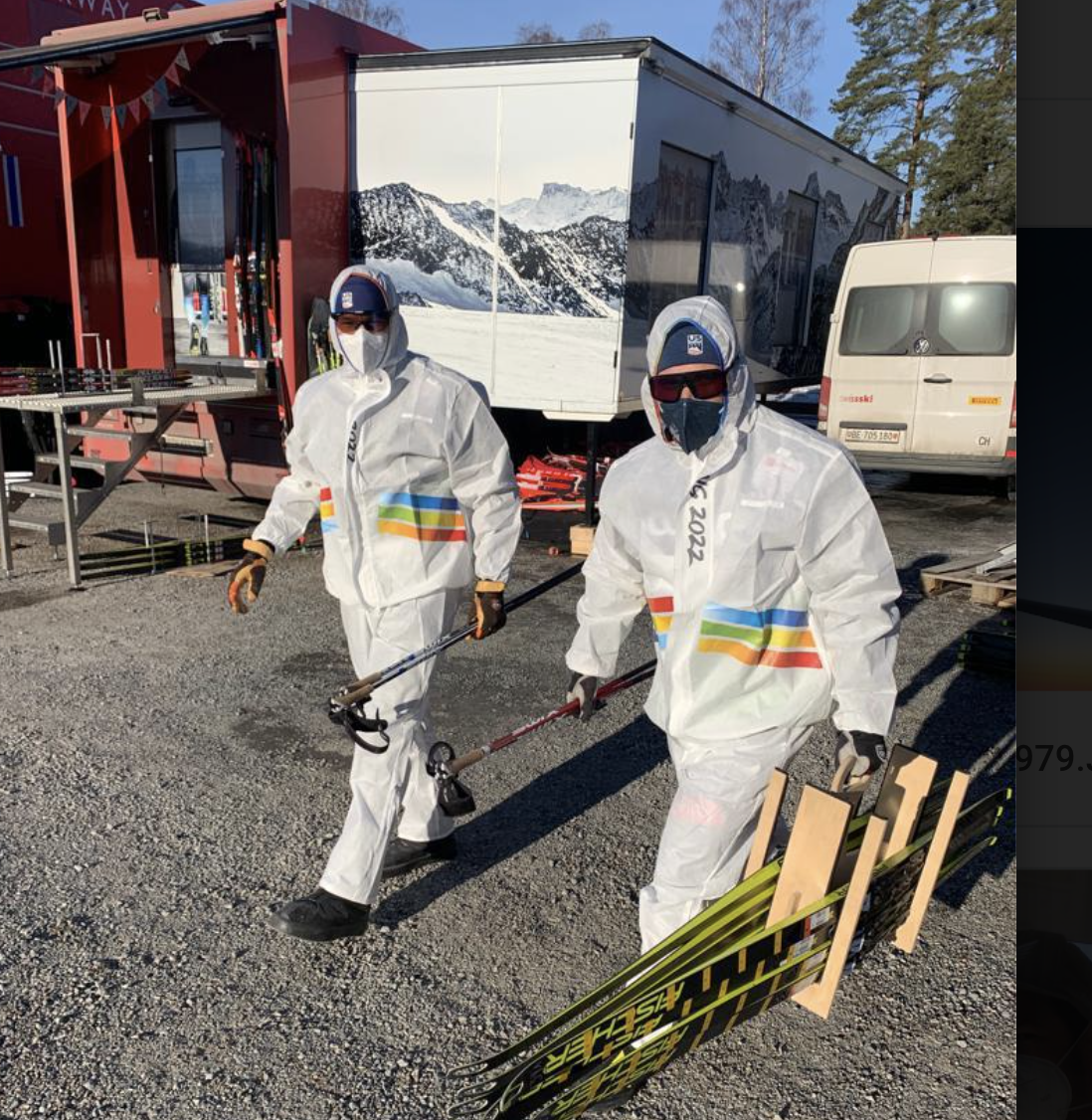
A different kind of Olympic suit: US wax techs take COVID precautions while testing and preparing skis in Falun, SWE. (Courtesy photo)
Thursday, February 24, 2022 – Russia invaded Ukraine. The world as we knew it ended once again. Chris texted me that the trip to Russia was canceled (the US team’s decision not to go to Russia preceded FIS’s decision to cancel the races). “Get your passport back right away.” I called Bogdan, my contact at the Russian Consulate. “We’ve had a change in plans, and I won’t be traveling to Russia. Can you please send my passport right away?” “No. I do not have your passport. Embassy has passport. I cannot get until finished with visa. But I mail it.” I could hear a toddler crying in the background. Bogdan apologized for the crying. I told him he shouldn’t have taken my call at home. He said, “Do not worry with passport. Visa will finish on Monday or Tuesday, then I mail. I call you when I mail.”
Friday, Saturday, Sunday, Monday, Tuesday – Nope. Not going to happen. I’m never going to see my passport again. They’ve all left the embassy. My passport is too low of a priority. They’re just going to be jerks and not send it back. So much for going to Sweden. COVID, war, what’s next?
9:21am, Tuesday, March 1, 2022 – Bogdan called. “Naatan, I mail passport. You get tomorrow.”
I thanked him profusely. And I said a little prayer. This man is living in America, raising a family in America. Yet he works for the Russian government. He is a Russian in a country that, overnight, hates Russians. I spent the last 5 days completely stressed because I didn’t have possession of a passport that would allow me to travel to Sweden for the sake of people skiing around in circles. This man, who must pay at least some attention to Western media, must have spent the last 5 days completely stressed over the safety and ultimate fate of his family and country.
(I do not mean to discredit ski racing or initiate some existential debate. As crazy as it seemed for the World Cup, and even Olympics, to carry on through this pandemic–and now war, I know I found great benefit from the distraction that racing provided. It was a slice of normalcy and vicarious living, which was invaluable to me as so much of what I took for granted was upended. But my little problems did seem very small compared to Bogdan’s.)
Wednesday, March 2, 2022 – Scott, our friendly (seriously, he waves to everyone) neighborhood mail carrier delivered my passport. Huge sigh of relief.
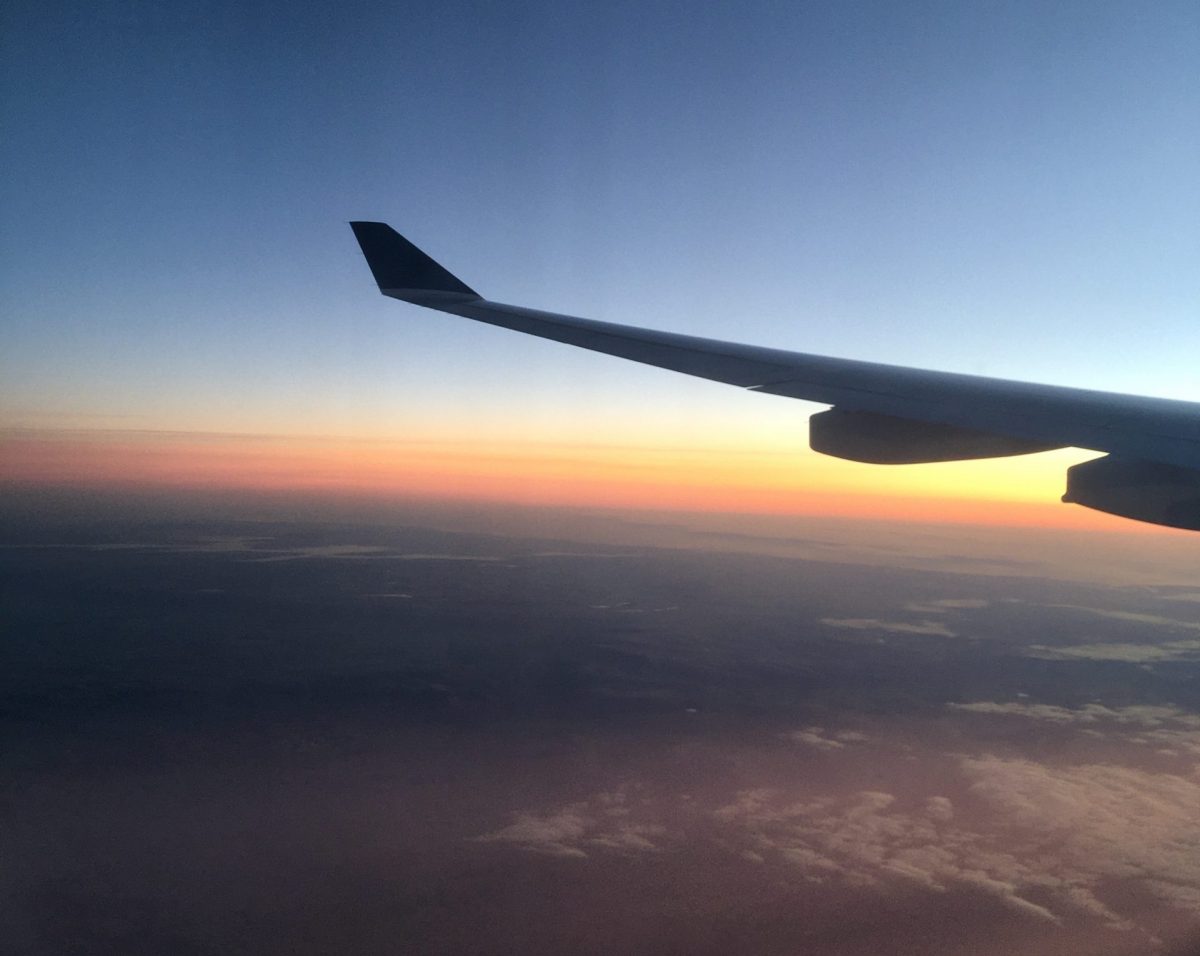
After a series of hurdles, Ned Dowling is wheels up on his way to Sweden. (Courtesy photo)
SLC International Airport. Sunday, March 6, 2022 – I hugged my son, kissed my wife goodbye, and donned my N95 mask which I wore for 18hrs straight. SLC direct to Amsterdam. Enough layover to grab a bottle of Scotch at the duty-free. A packed flight to Stockholm and a 2.5 hr bus ride to Falun. Jet lagged and sleep deprived, I met up with the team as they’d just gotten off their bus from Oslo. We all stood around in LL Bean team gear and N95s awaiting instructions on where to schlep our massive duffles.
Our accommodations for the week were not at the Scandic Hotel, the FIS-provided standard lodging for all of the teams. It was decided that the hotel and its buffet meals were too COVID risky. Instead we stayed two-each in a group of camping cabins equipped with bunk beds and a small kitchen. We were on our own for breakfast and lunch. Dinners were catered by restaurateur parents of Swedish sprint star Maja Dahlqvist (the World Cup circle is pretty close knit).
Cheers for negative COVID tests!
Falun, Sweden. Tuesday, March 7, 2022 – COVID testing. The team was shedding skiers and staff with positive tests. A few soldiers were left behind to wait out quarantine in an Oslo airport hotel. A couple more made it to Sweden but wouldn’t see a race bib. Anxiety was high. A positive test meant no racing, no human interaction, no trip home until the negative. One car load at a time we went to a testing center in Falun for nasal – very, very nasal – PCR tests.
“I think it touched my eyeball!” “I had 31 tests in China and that was the most aggressive one ever!” “Damn, that was legit!”
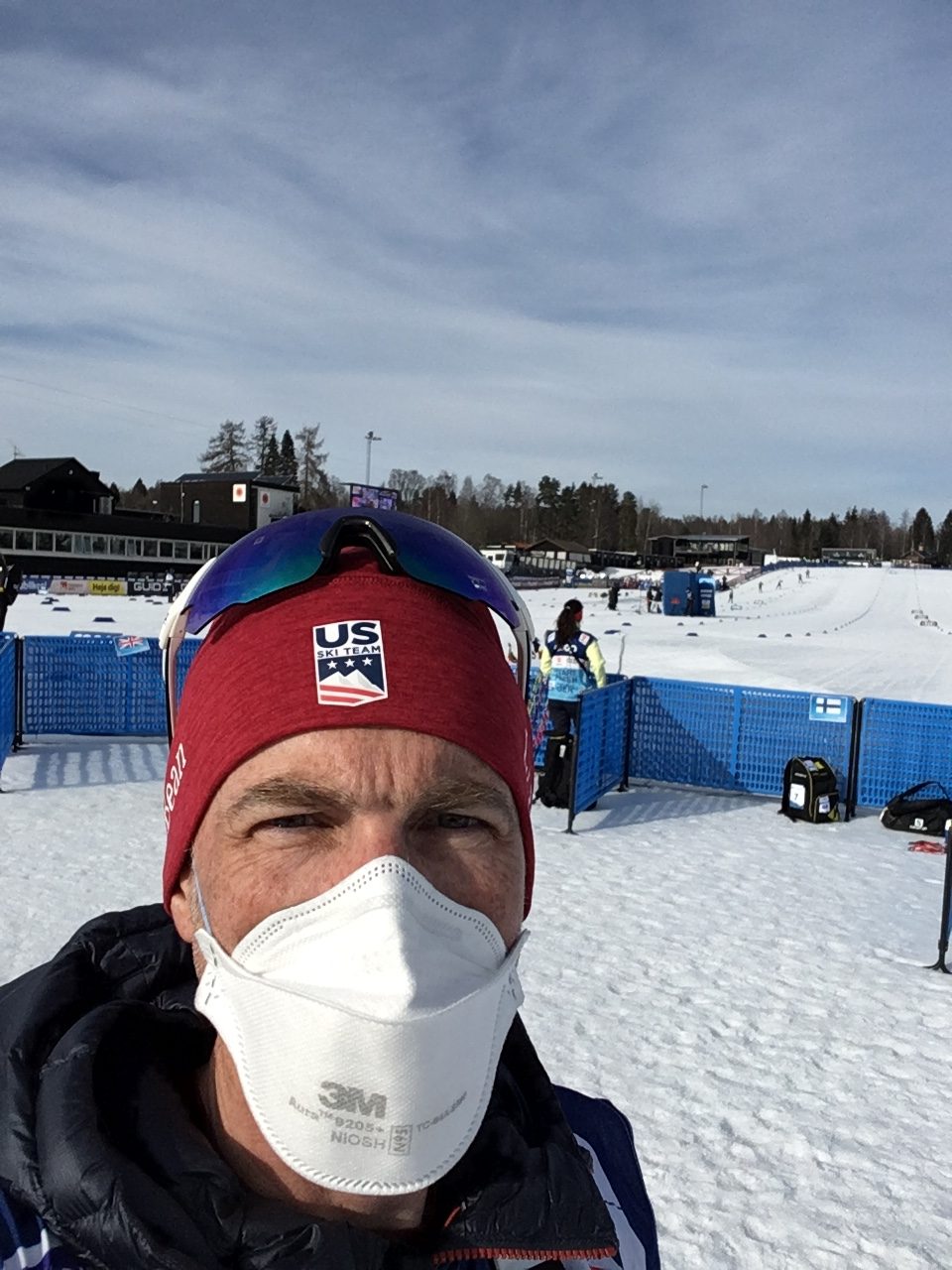
Physical therapist Ned Dowling snaps a masked selfie while supporting the US Ski Team in Falun, SWE. (Courtesy photo)
Wednesday, March 8, 2022 – All tests were negative. Collective sigh of relief. With that reassurance, I finally had some customers on the physio treatment table. Thankfully, everyone’s bodies were holding up reasonably well for being that late in the season. I felt guilty for being over there without much to do, but I figure that my boredom means they don’t need me and if they don’t need me it’s because they’re healthy, which is the goal (or they don’t want me because they’re COVID paranoid – there was plenty of that too, understandably so). So, until the racing began, I didn’t have much to do besides ski every day. Poor me.
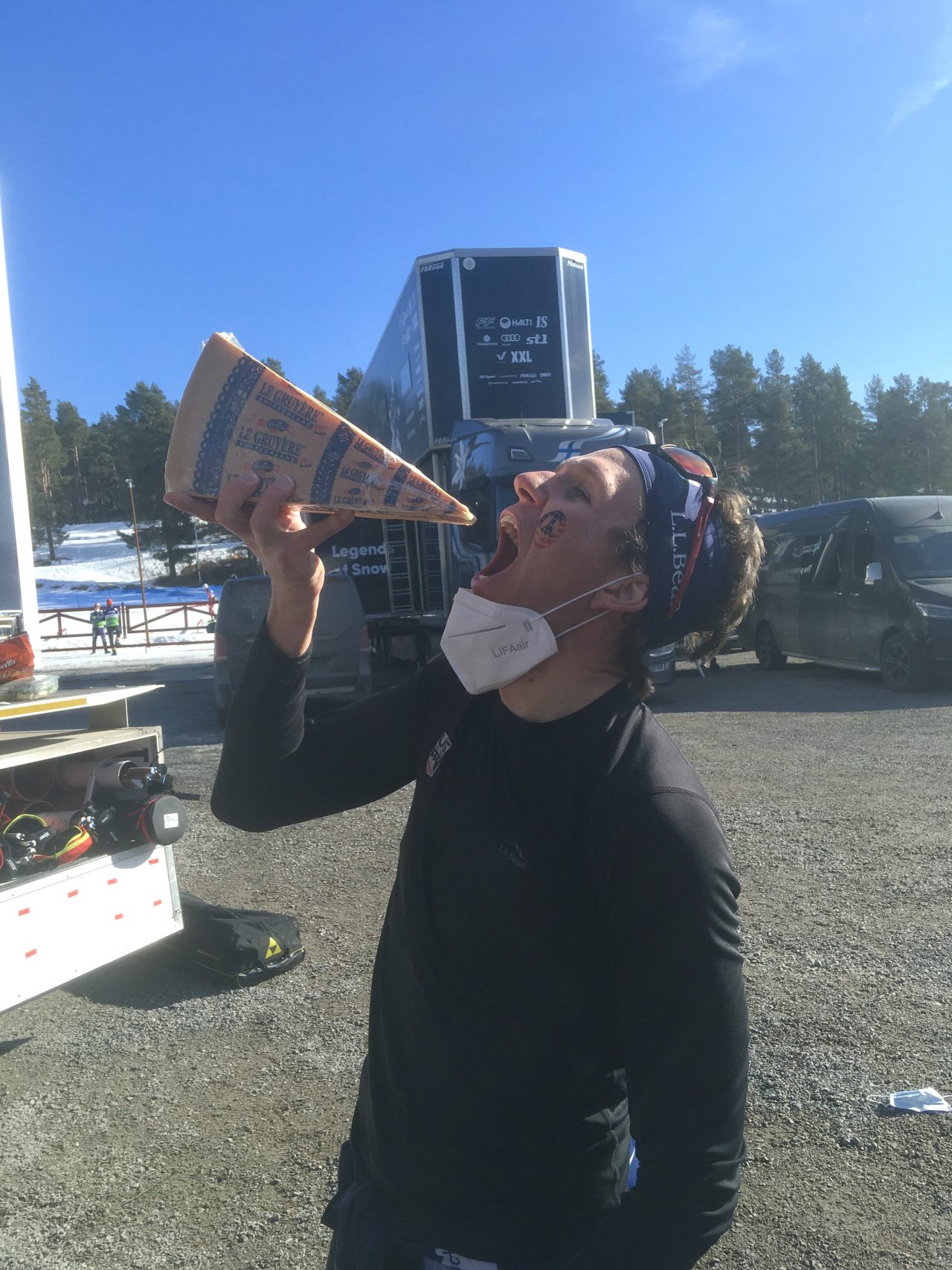
March 11-13, 2022 – Let’s go racing! My experience with the team is that they are always a great group of people to be around, but they’re even more fun with podiums. Lots of good results all around with some “first World Cup points” to some near-misses to some 5.5 lb chunks of Gruyere podium cheese.
Scott Patterson takes a bite of victory cheese after helping the USA 1 team to victory in the 4 x 5 k mixed relay in Falun, Sweden. (Courtesy photo)
The man behind the fast skis: Jason Cork sports podium goods in Falun. (Courtesy photo)
4:30pm, March 13, 2022 – The final race: antigen testing for entry back into the US. Again, all negative. We’re going home! That night in the bar at a Stockholm airport hotel, I finally saw some faces that’d been hidden behind N95s all week. The poor bartender had a tough time keeping up with the drink orders. Elation, exhaustion, and simple relief that they’d survived another crazy race season and were finally heading home after four months of living out of suitcases, always masked, always nervous.
Maybe next year we can race without a pandemic or war or plague of locusts.
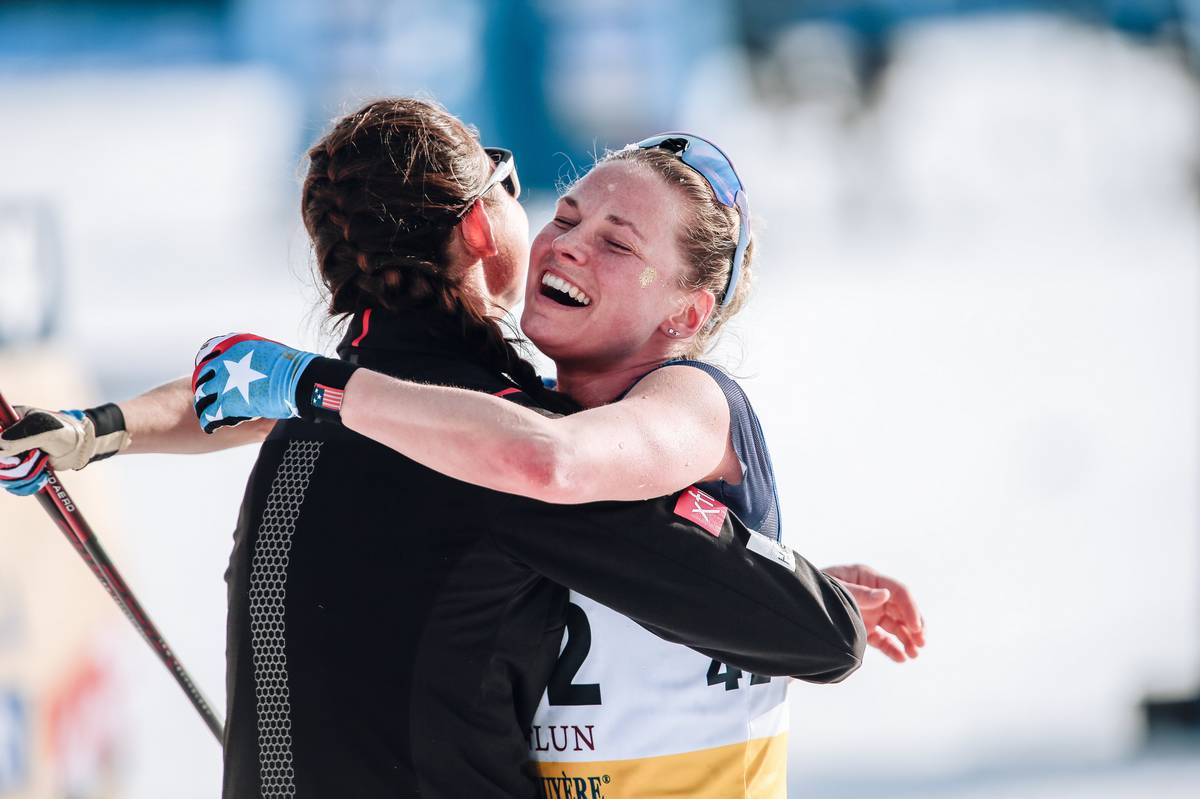
Jessie Diggins hugs teammate Julia Kern at the finish of the 10 k freestyle in Falun. (Photo: NordicFocus)
Julia Kern and US Ski Team head coach Matt Whitcomb watch the 4 x 5 k relay from the stadium. (Photo: NordicFocus)
This World Cup coverage is made possible through the generous support of Marty and Kathy Hall and the A Hall Mark of Excellence Award. To learn more about A Hall Mark of Excellence Award or to learn how you can support FasterSkier’s coverage pleasecontact info@fasterskier.com.
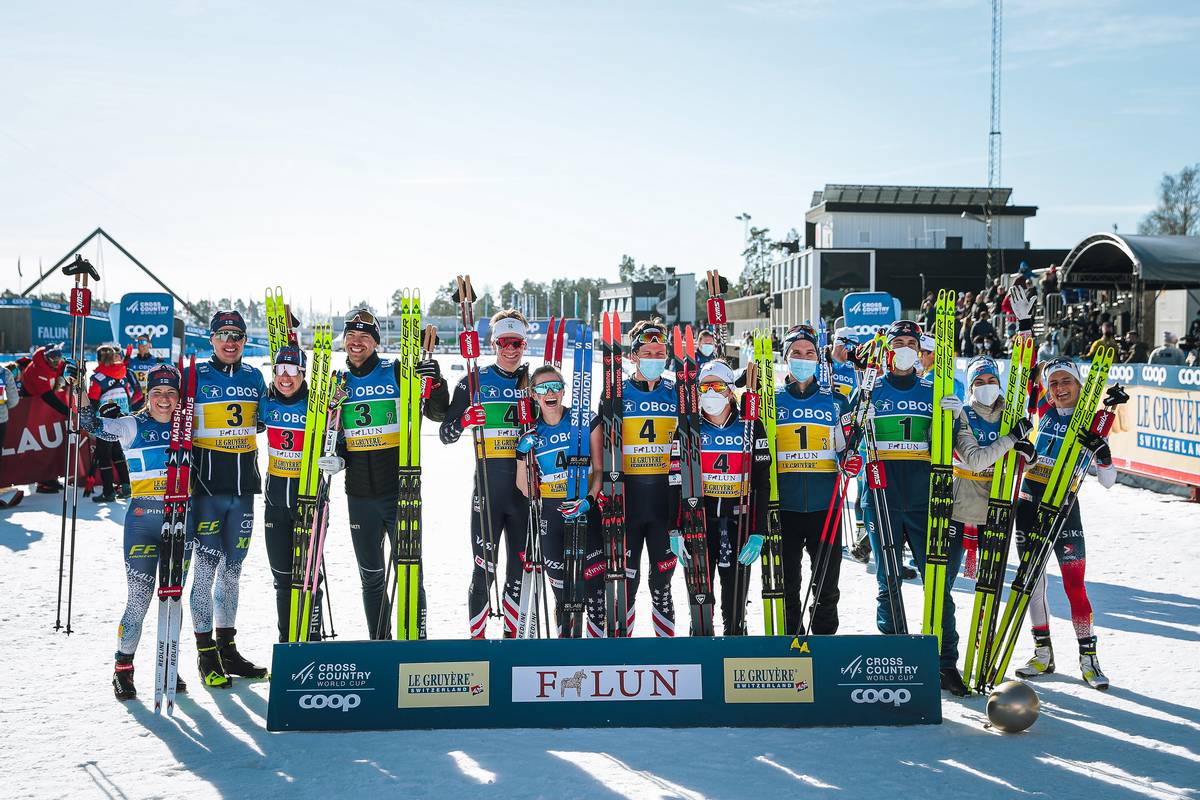
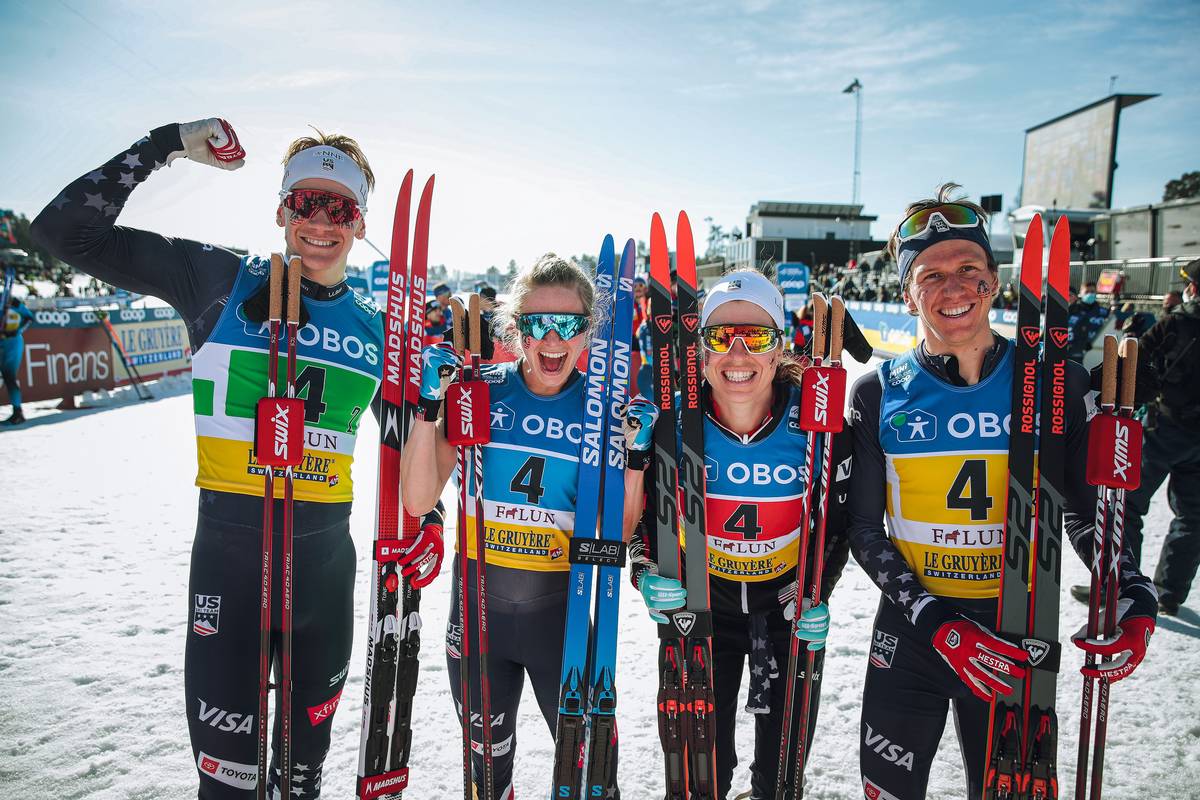
While it was perhaps not the final event originally planned for the season, today’s 4 x 5-kilometer freestyle mixed relay in Falun, Sweden shaped up to be quite a way to go out. Particularly for Team USA, who broke away in the final lap to take the win in 42:01.8.
With Rosie Brennan scrambling to tag Zak Ketterson for the second leg, Scott Patterson skating third, and Jessie Diggins anchor, it was a team composed of four skiers who had all raced into the top-15 in yesterday’s 10/15 k skate, three within the top-eight. Perhaps the only team more loaded was Norway 1, which featured Heidi Weng, Hans Christer Holund, Didrik Tønseth, and Therese Johaug, all of whom placed in the top-five yesterday, including both of the day’s winners in the final two relay spots. Also a force, Finland I consisted of three Olympic medalists, one of whom is the 2022 men’s World Cup distance champion with the lineup: Kerttu Niskanen, Perttu Hyvarinen, Iivo Niskanen, and Krista Pärmäkoski.
Each nation was allowed two teams, allowing the US to start a second lineup of Julia Kern, Logan Hanneman, Adam Martin, and Caitlin Patterson. Canada raced one team, which included Katherine Stewart-Jones, Antoine Cyr, Philippe Boucher, and Jasmine Drolet, racing in that order.
Stars and stripes at the front, as Julia Kern scrambles for USA II in Falun’s mixed relay. (Photo: NordicFocus)
New to the World Cup, the mixed relay is modeled after the biathlon competition format, which debuted in 2005. It had originally been slotted onto the calendar for the Canmore World Cup events in March 2020, which were canceled as COVID-19 began to spread around the globe. It had been tested on the tracks in Falun during the 2021 Swedish senior national championships, with local club leader Johan Eriksson saying afterward, “Team cohesion was strengthened when ladies and gentlemen fought against the same goal line. At the same time, the entertainment was great with reversals in the result lists and tactical moves in team line-ups.”
The entertainment value was certainly high today, particularly for American ski fans. Racing a distance now only seen in relays, it would be a painful blend of sprinting and distance. And the Americans would be lucky to have a woman anchoring the team who has previously been described as the “Queen of the 5 k skate”.
Rosie Brennan scrambles for USA I during the inaugural World Cup 4 x 5 k mixed relay in Falun. (Photo: NordicFocus)
As expected, the pace was high from the start, as the Star Wars theme blared through the stadium loud-speakers. Up for the task at hand, Brennan went toe-to-toe with the other women at the front through two 2.5 k laps. Later describing the event as “fast and furious”, Brennan kept USA I within the lead group, Kern duking it out on USA II alongside through the first lap.
“I think our goal today was to stay out of trouble and stay in the pack, and then let Diggy do her thing that she does best,” Rosie told FIS post-race with a laugh. “And that worked out really well.”
Brennan handed off to Ketterson at the first exchange, in line with Germany I, Norway I, and Sweden I, Finland I just behind.
Though new to the World Cup this season, Team Birkie’s Ketterson has consistently shown his range. Domestically, he won three SuperTour sprints, and stood on the podium in four distance races, one of which was also a win. He chiseled away at the World Cup puzzle, finishing just outside the top-30 during the Tour de Ski, and returning following the Olympic break to place 41st in Lahti’s distance classic race and at the 50 k classic at Holmenkollen. Smashing a 15th place finish in yesterday’s 15 k free, Falun has been a breakthrough weekend.
Though 5 k is not a distance men traditionally race on the World Cup, Ketterson emailed post-race that the event felt familiar and reminiscent of his early days in the sport.
“I am a huge fan of the 5 k race distance as I spent four years in Minnesota high school races doing that distance multiple times a week in the winter. Today brought me back to those days! It was super chaotic pack skiing but I felt really strong the whole time and did my best to keep up with the leaders. Honestly, when Jessie is your anchor, you don’t really have to worry too much about the rest!”
Zak Ketterson tags Scott Patterson during the 4 x 5 k mixed relay in Falun. (Photo: NordicFocus)
On lightning fast tracks with matching skis, Ketterson skied smoothly within the large lead group, keeping USA I within contact of the leaders, while Sjur Røthe tried to crack open pack for Norway II. Tagging Patterson roughly four seconds back, USA I sat in 10th, alongside Canada, at the second exchange. USA II tagged in 14th, +34 seconds back.
Still a large and dense group of front runners, Patterson worked at the back of the lead group to minimize further time losses, keeping his team within reach of the podium. With both Norwegian teams at the front in the second lap, Patterson whittled down the American’s time back, tagging Diggins 2.2 seconds behind the leaders to “do her thing” over two 2.5 k laps. Canada had lost contact with the front group, sitting in 11th (+17.9), while USA II tagged following a gap in 15th (+1:14.5).
“My goal was to hang on with the pack early and get in the groove, then try to match accelerations later,” Patterson wrote after the race. “I knew I wasn’t going to be the one with super accelerations but could sprint the whole way. During the race I was thinking ‘Just hold on’, so Jessie could work her magic relay anchoring skills. There were a few moments where some gaps formed but I barely managed to cling on.”
Scott Patterson races the third leg for USA I in Falun. (Photo: NordicFocus)Scott Patterson makes the final tag to Jessie Diggins during the 4 x 5 k mixed relay in Falun. (Photo: NordicFocus)
Diggins quickly got to work. Halfway through the first lap, it was Diggins marking Johaug at the front, with Krista Pärmäkoski for Finland I and Victoria Carl for Germany I tucked into their wake. Recall that Carl had anchored the German relay team for an Olympic silver medal in Zhangjiakou just a few weeks ago.
Skis ripping on the downhill, Diggins moved to the front to lap through the stadium 1.4 seconds ahead of Finland I and Norway I, Frida Karlsson for Sweden I challenging Germany’s Carl just behind.
Jessie Diggins brings USA 1 through the stadium in the lead after her first lap. (Photo: NordicFocus)
Diggins worked patiently up the climb, once more tucking behind the rapid fire tempo of Johaug on the uphill, and tucking calmly into the draft of the Norwegian and Finn heading into the descent. Diggins hit the second climb hard as the three women hop-skated up and over. Among the best descenders on the World Cup, Diggins skis were only fueling the fire, allowing her to maintain her lead in the rolling last kilometer and into the stadium which erupted with noise from the packed sidelines.
Rounding the final bend with a clear shot to victory, Diggins took a few tuck skate pushes before powering in V2 across the line with a fist pump and loud cheer, and maybe an expletive, before collapsing onto all fours surrounded by her ecstatic teammates.
Nerves run high as the American team waits for Jessie Diggins at the finish of the 4 x 5 k mixed relay in Falun. (Photo: NordicFocus)USA I celebrates victory as Jessie Diggins crosses the finish of the 4 x 5 k mixed relay. (Photo: NordicFocus)
Outsprinting the World Cup distance champion, Pärmäkoski edged out Johaug to bring Finland I to the line in second (+3.8), leaving Norway I just 0.5 seconds behind in third. Having strung out over the last lap, Sweden I took fourth (+9.1), with Germany I fifth following another gap (+16.2).
A packed podium for the 4 x 5 k mixed relay in Falun. USA I took the win ahead of Finland I and Norway I. (Photo: NordicFocus)
Describing the experience of winning the mixed relay on the final day of World Cup racing, Diggins told FIS with a laugh, “[It] feels like champagne getting sprayed on you.”
Surrounded by her teammates, she continued, “That was so, so fun. We really pulled together as a team. We live together as a team for four months on the road, so it’s pretty cool to get to end the season racing for each other. I’m so proud of these guys, so I was feeling pretty inspired.”
Jessie Diggins helps USA I to the mixed relay win in Falun. (Photo: NordicFocus)
Later sharing her strategy in a post-race audio clip as the remainder of the team packed their bags to begin travel home tomorrow, Diggins discussed her strategy as anchor, adding how the rockets under her feet allowed the race to unfold somewhat differently than she anticipated.
“I knew that those downhill working corners were one of my strengths, so I knew that if I got to the top of that big sprint climb first, then I could ski all the other downhills how I want and have a good shot at setting up a finishing sprint. As it turned out, we had such great skis that I didn’t need that finishing sprint, but it was so fun to go ski that as hard as I could. Again, I’m just so proud of the team. It was so special and fun to share that with everyone, and I can’t think of a more perfect way to end a really awesome year.”
Full post-race audio clip from Jessie Diggins:
USA I ends the season on top in the 4 x 5 k relay. From left to right, Zak Ketterson, Jessie Diggins, Rosie Brennan, and Scott Patterson. (Photo: NordicFocus)
“What a way to close out the World Cup season!!!!!” Brennan emphasized in an email. “After Scott and Zak had great days yesterday, I felt that we definitely had a chance, but I was not expecting a victory like that! It was fast and tactical racing out there and in the scramble leg, I wanted to stay near the front of the pack and stay out of trouble. I found myself further back in the pack than I wanted on the 2nd lap, but also knew a fall or broken pole would cost us so I tried to be patient, calm and tag off in the pack. Zak, Scott and I had the same strategy and Scott made a great move to get ahead of a split in the pack to tag Jessie in a great place. Jessie skied an insane leg and I feel lucky to have her as a teammate!”
Echoing her sentiments to conclude his post-race email from the road, Patterson added, “It’s really cool to win the last World Cup and especially awesome to be part of the team. The mixed gender event was extra special as the guys were finally able to tap into the relay energy the women have cultivated over many years.”
Canada’s anchor Jasmine Drolet receives a tag from Philippe Boucher during Falun’s mixed relay. (Photo: NordicFocus)Adam Martin tags his Craftsbury teammate Caitlin Patterson, who raced the anchor leg for USA II. (Photo: NordicFocus)
Losing contact over the third and fourth legs, consequently racing alone, Canada ended the day in 12th (+1:45.2), while USA II pushed alongside Finland II through its final lap. Edged out in the final sprint, Katri Lylynpera (FIN) snuck her boot over the line ahead of Caitlin Patterson’s, leaving USA II in 14th (+2:10.9).
Celebrations fed by cheering crowds, energy was high throughout the stadium. Regardless of finish order, acts of camaraderie and sportsmanship could be seen and heard as cameras meandered through the groups of athletes waiting for their relay teammates. We could hear a Frenchman congratulate Norway’s Tønseth on ending his season with an individual win, Ketterson and Kern anxiously trying to predict what might happen in the American’s final legs, along with a host of supportive cheers as teammates and coaches egged on the racers.
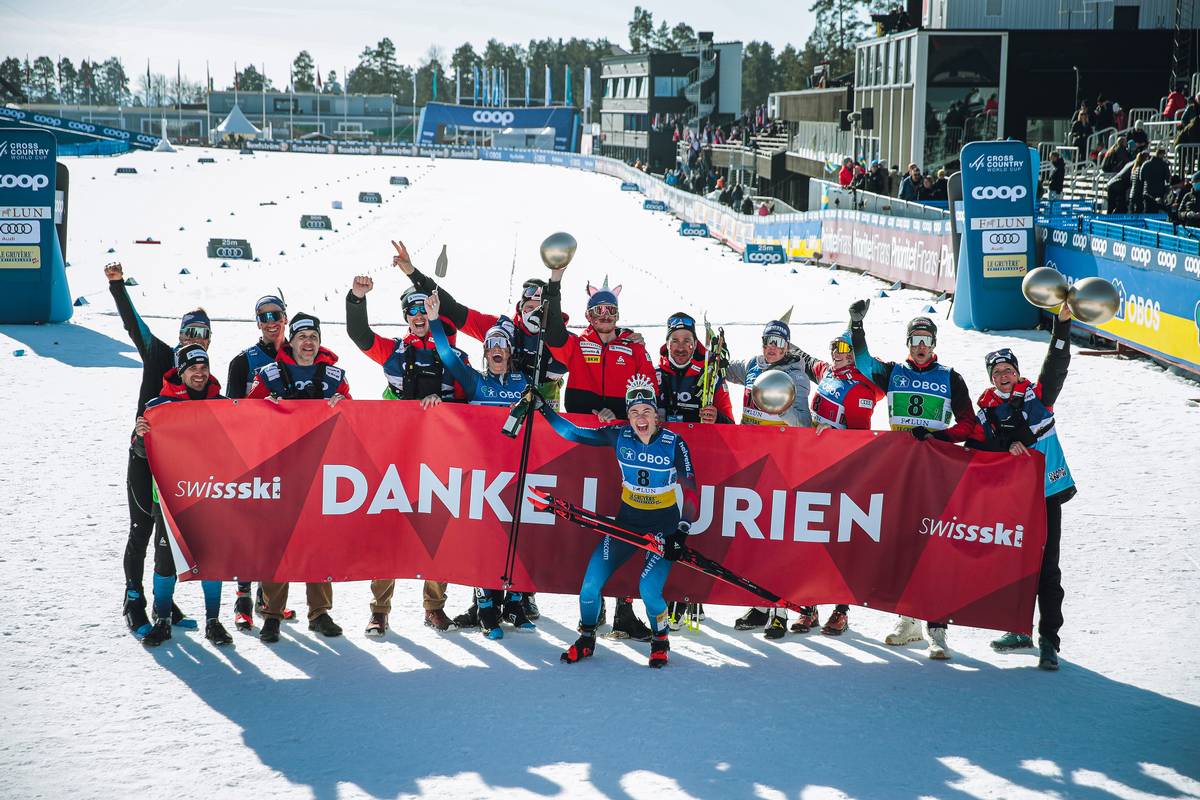
Awaiting the Swiss anchor Laurien Van der Graaff was a princess tiara, teammates in golden unicorn horns, and a large banner that read “Danke Laurien”, in celebration of her retirement. The 34-year-old has long been a presence on the World Cup, collecting a slew of podiums and a World Championship team sprint silver medal along the way.
The Swiss program celebrates the retirement of Laurien Van der Graaff at the finish of the 4 x 5 k mixed relay in Falun. (Photo: NordicFocus)
With revelry and thrill in the air, only the mixed team sprint remained on deck as the 2021/22 World Cup season drew to a close in Falun. The American program did not enter the team sprint competition, and will next compete as a team at the Whistler Olympic Park in British Columbia March 20th – 27th. The event will serve as both the Canadian National Championship and SuperTour Finals.
This World Cup coverage is made possible through the generous support of Marty and Kathy Hall and the A Hall Mark of Excellence Award. To learn more about A Hall Mark of Excellence Award or to learn how you can support FasterSkier’s coverage please contact info@fasterskier.com.
There wasn’t much to be decided, only facts to reaffirmed.
In the last individual race of the World Cup season on Saturday, a 10-kilometer individual start freestyle in Falun, Sweden, the overall World Cup standings of consequence were already decided. Individual season goals for each racer were already moving towards reflection.
Off the course, bare patches of ground seemed to suggest that even the snow was ready to move on from this winter and this ski season. The air was in agreeance; it was 6℃ (44℉) at race start.
Frida Karlsson (SWE) skis past a vibrant Swedish scene in Falun. Karlsson finished 12th in the 10 k freestyle (+1:07:00), but ends the season as the World Cup Distance runner-up behind Therese Johaug (NOR). (Photo: NordicFocus)
And why wouldn’t they be? For all the hints of a return to some kind of normalcy this World Cup season – fans back at venues, a majority of courses covered with natural snow – the World Cup couldn’t out-ski the anxieties and the full-blown winds of change that the winter of 2021-22 has sent around the world. At its conclusion today, the World Cup overall will be awarded to a skier, Natalia Nepryaeva (RUS), who was barred from competing on account of the Russian government’s invasion of Ukraine. Nepryaeva sits atop a World Cup Overall points list that was shaped, and is shaped by, COVID-19 – which forced multiple cancellations of World Cup events in January, and across the season has seen individuals and teams miss races.
All we could hope for from skiing, across this season and at today’s race, was for some sort of center to hold. That we could watch and see something that we had seen before, and that it would bring light and levity to the challenges of the times.
For that type of drama? Well, while World Cup finals may have moved from Siberia to Sweden, their final destination could have been Shakespeare’s Globe.
Woven and interlocked throughout the 10 k individual start were acts ski fans have come to know by heart over the past few years and over the course of this season. But that didn’t make them any less impactful to watch. We would see valiant efforts from early starters, a women’s field where margins are only ever a few seconds throughout a race, capped off, apropos the start order,by the one question that has animated distance racing on the World Cup for nearly a decade, posed for the last time – what about Therese Johaug?
To get to the answer to that question, we would have to wait. In the meantime, the Falun course played host to narratives that followed the contours of its terrain. The 10 k was raced as 3 laps – one 2.5 k loop that was relatively flat, before two laps of a 3.75 k loop where the terrain was punctuated with a set of climbs that would look to separate the field.
Julia Kern skis to 20th in Falun’s 10 k individual start skate. (Photo: NordicFocus)
The early racer to watch in the field was bib 10, Julia Kern, who came through the 1.5 k checkpoint 3.7 seconds ahead of the field. While the top racers would soon follow, with Frida Karlsson (SWE) eventually topping Kern’s mark as she moved through the course, Kern would prove to be a pace-setter for the earlier starters throughout her 10 k effort. She set the fastest time on course at the finish, but it would fall as seeded athletes followed. Her efforts though, ultimately yielded a 20th place finish (+1:30.3), and the image of Kern crossing the line as a champion (even if it proved temporary) seemed an appropriate conclusion to a season where she had battled to overcome the growing pains of World Cup skiing from last season and prove to be one of those American women that ought to be seen as a force on the start line.
“She raced four rounds yesterday. There was gonna be a limit to the energy, [and yet] she swung really hard today and came up with a big result today. I think a fresh Julia Kern can race with the top ten, and that’s not diminishing her 20th place today. There’s more to give, and that’s exciting” said US Ski Team Head Coach Matt Whitcomb on Kern’s result in an interview with FasterSkier.
Full audio interview with Matt Whitcomb.
Jessie Diggins races to third in Falun’s 10 k skate. (Photo: NordicFocus)
Joining her in the category of American women to be excited about throughout the season has been Rosie Brennan and Jessie Diggins. Brennan started in bib 38 today, with Diggins two minutes later in bib 42. They followed the lead of Frida Karlsson and Krista Pärmäkoski throughout the duration of the course. Karlsson, in bib 23, was the first skier to top Kern’s 1.5 k mark, coming in at 2.8 seconds over the field. Pärmäkoski, in bib 30, came through that checkpoint in 2nd, +1.6 back on Karlsson. When Brennan came through, she was +2.5 seconds off Karlsson and in 5th place, and when Diggins came through she was +0.2 off Karlsson and had put herself in 2nd place. The field, in other words, was tight, and those skiers, Karlsson, Pärmäkoski, Brennan, and Diggins – along with Ebba Andersson (SWE) and Kertu Niskanen (FIN) – would jockey and swap places through the remaining 8.5 k.
Krista Pärmäkoski races the 10 k individual start free in Falun. (Photo: NordicFocus)
At 4.3 k, Pärmäkoski had overtaken Karlsson by 1.2 seconds. Brennan came in +1.7 off of Pärmäkoski. Diggins moments later came in +1.8. Through the halfway point with the group the standings read: Pärmäkoski first, Karlsson second, Brennan third, and Diggins fourth, with less than 2 seconds between them.
By 7.7 k, the gaps had started to grow. Pärmäkoski came through with a 14.6 second advantage over Karlsson, while Brennan was +21.6 off the top and back in fourth place. The, in one of the familiar sights that colored the day, Jessie Diggins had started to somehow, someway, increase her pace. She came through 7.7 k now in second place, just +2.6 seconds off of Pärmäkoski.
Rosie Brennan on course Saturday. Brennan finished 8th in the 10 k freestyle. (Photo: NordicFocus)
At 9.1 k, Pärmäkoski still had first place, but Diggins had cut her deficit to a mere +0.6 seconds. As Pärmäkoski crossed the finish in first place with 21.8 seconds on the field, one started to get the exhilarating feeling that the camera would soon cut to Jessie Diggins doing what Jessie Diggins does best.
There was almost dramatic irony to it – we, the audience, just knew that there would be Diggins, free skating, looking ahead, and somehow increasing her tempo from 100% to beyond that. Then, she did it. Diggins crossed the finish line having not only erased her deficit, but gained a second on Pärmäkoski to finish in first place, 1.9 seconds ahead of the rest of the field.
In remarks to FasterSkier, Diggins said that her race today reflected renewed energy levels after her silver-medal winning 30 k at the Olympics, “Today was wonderful. After [sitting out the Holmenkollen race], I felt like I could go out and race the way I wanted to, having the energy to really attack the course.”
Jessie Diggins sits in the winner’s circle after crossing the line in first place on a sunny day in Falun. Diggins would eventually cede the spot to Jonna Sundling (SWE), before Therese Johaug (NOR) crossed the line in first. Final results: 1st Johaug, 2nd Sundling, 3rd Diggins. (Photo: NordicFocus)
Diggins’ result though, only was a subset of the dramatic irony that prevaded the overarching race. Behind her, wearing the red leader’s bib (56, last starter in the field), fresh off of a win at the Holmenkollen 50 k, and in her individual last professional ski race, was Therese Johaug (NOR). The immensity of her character in the drama of the day was hard to understate. Johaug had already secured the Distance World Cup title for the season – her record-breaking fifth time winning that title (breaking a record jointly held by Justyna Kowalczyk and Dario Cologna). Coming into today, she was looking for her 100th World Cup win. She had been on every World Cup distance podium except one (a 4th place in a 10 k classic two years ago) since 2019.
Posting outstanding results across all distances, Jonna Sundling takes second in Falun’s 10 k skate. (Photo: NordicFocus)
What she might achieve in today’s 10 k was continuously foreshadowed throughout the course by Jonna Sundling, who wore bib 50. The Swede, on her home turf, broke through the jockeying at the top of the field when she came through the 1.5 k checkpoint 8.1 sec ahead of the field. When Johaug came through behind her in 2nd place, +4.0 sec, the little separation the pair had created seemed to be a turning point in the race. Johaug might do it. She could do it. She would probably do it. And then, she was doing it.
“It,” of course, was opening a commanding gap on the best skiers in the world. At 4.3 k, she had a 14.1 second gap on Sundling. At 7.7 k, the gap was 30.6 seconds. At 9.1 k, the gap was 35.4 seconds. Building steadily, Johaug had set the stage for a final, triumphant act.
Jonna Sundling skis past her home crowd in Falun, Sweden. Sundling finished 2nd place, after a dramatic sprint to finish 0.4 seconds ahead of third place Jessie Diggins (USA) at the line. (Photo: NordicFocus)
First though, Jonna Sundling would add another scene. As she crested the hill going into the stadium the background was dotted by her country’s flags. The clock put her agonizingly close to Jessie Diggins. She did what she does better than any other skier at the moment – the Olympic gold medalist in the freestyle sprint unleashed a finish line burst that saw her come in 0.4 seconds ahead of Jessie Diggins in first place. The Swedish crowd let out a roar. It was the best that skiing as a spectator sport has to offer.
And then, it was surpassed by the best that skiing, period, had to offer. Therese Johaug finished in first place in a time of 22:34.4. To sum up her career, all you have to do is remove the last preposition.
Therese Johaug finished in first place.
Therese Johaug (NOR) crosses the finish line, in first place, for the final time in her remarkable career. Johaug won on the day (22:34.4), and also secured the distance World Cup title for the season in Falun. (Photo: NordicFocus)
Joahaug came across her last finish line with a yelp, and then quickly turned to her competitors still mulling in the finish area. In an instance, she had gone from racer to ambassador.
With the Norwegian at the back of the seeded group, this meant the podium would be Johaug on top, Sundling in second (+35.9), and Diggins third (+38.5). Rounding out the top-five, Pärmäkoski took fourth (+38.2), with Norway’s Heidi Weng in fifth (+42.7).
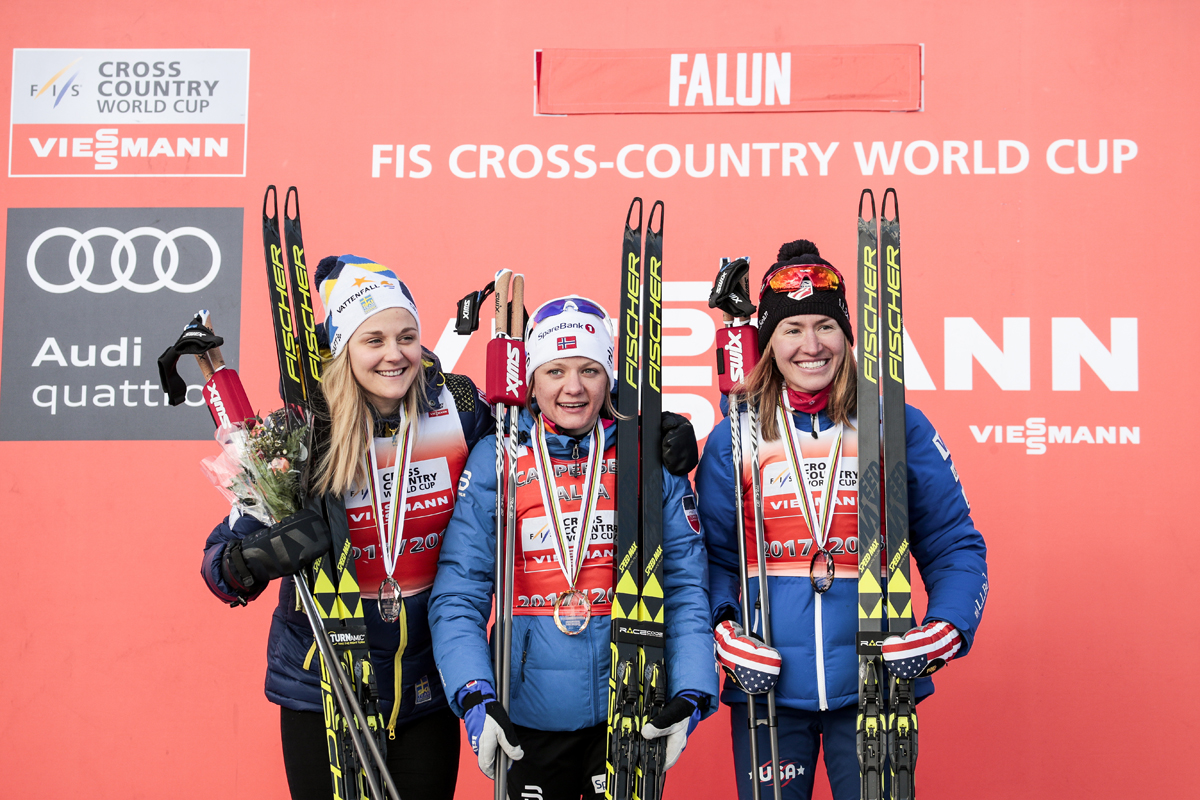
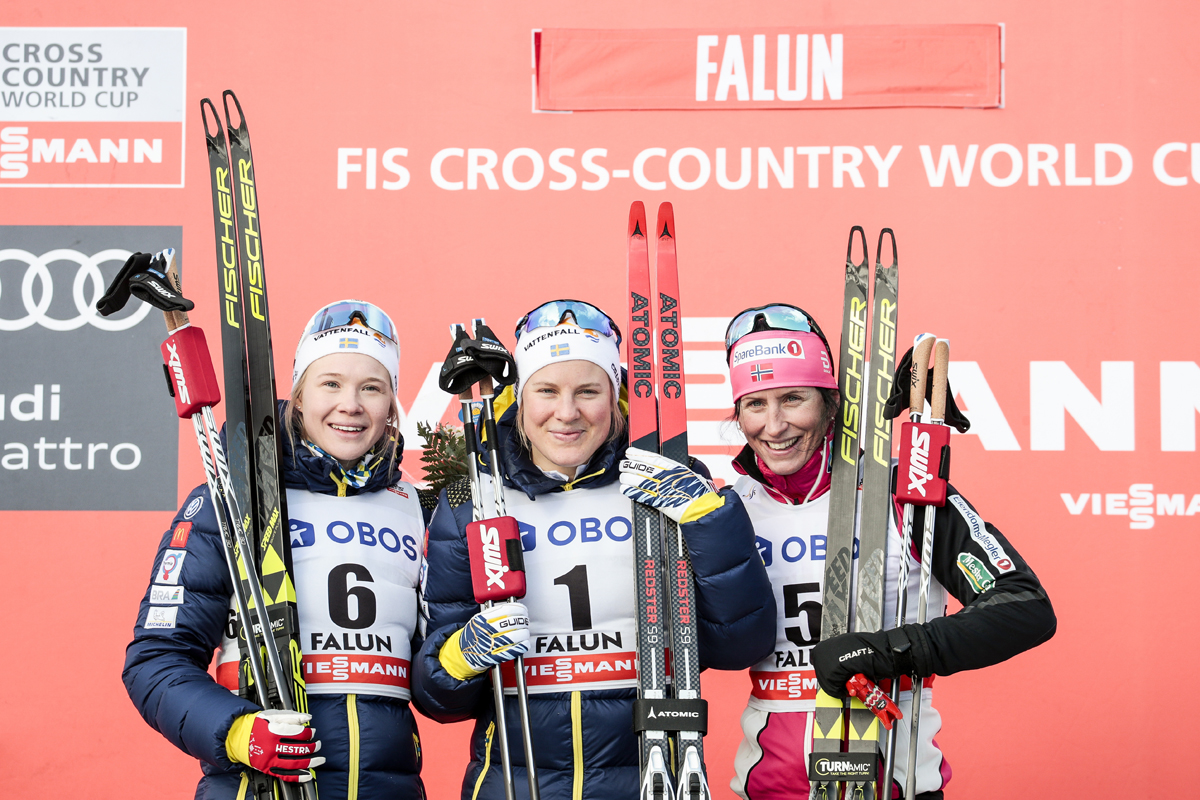
The Falun 10 k freestyle podium. (l-r) 2nd place Jonna Sundling (SWE), 1st place Therese Johaug (NOR), and 3rd place Jessie Diggins (USA). (Photo: NordicFocus)
Johaug leaves a sport that’s transformed since she first raced a World Cup in 2007. For one, it is a sport in which Therese Johaug has raced. Her ability to win races so decisively, and consistently, will cast a long shadow. She finishes her final World Cup Distance title with 177 point advantage over 2nd place Frida Karlsson (SWE), who at the young age of 22 looks poised to chart a course that follows in Johaug’s footsteps. 3rd place in the classification will go to Krista Pärmäkoski (FIN).
It’s also a sport where its leading star is an American, joined by her teammates who are now capable of putting two skiers in the top ten (Diggins 3rd and Brennan 8th), and three in the top thirty (Kern 20th, +1:30.3). The depth of the Americans, in fact, was one of the great takeaways from today’s race. Caitlin Patterson just missed a top thirty finish, coming in 31st (+1:49.5). Rosie Frankowski finished 41st (+2:26.4).
Rosie Frankowski (USA) comes down the final stretch in Falun. Frankowski finished 41st (+2:26.4). (Photo: NordicFocus)
Diggins, in particular, has proved skiing’s muse of fire, her grit and heroics adding to the depth of what ski racing purports to be the ideal for. Just today, she came into the race just one point ahead of Ebba Andersson (SWE) in the World Cup Overall. Between her and Andersson, the first finished today would secure World Cup runners-up. After Diggins podium finish today, adding to the mountain of evidence she’s accrued that belief and push are worth it, she secured that title. The overall champions’ title and crystal globe, meanwhile, will go to Natalia Nepryaeva (RUS).
Diggins said of her runners-up in the World Cup overall standings:
“It was really special to finish 2nd in the overall World Cup. I’m really proud. It represents a lot of hard work and consistently giving it everything I have everytime I race…
“I’m definitely still processing it. For me, this was a season where I came in with very concrete goals about my preparation physically and mentally for the Olympics. That was the big target. I’m really proud of how as a team (coaches and teammates) we handled that, and having World Cup wins and podiums was really just the icing on the cake.”
Full post-race audio clip from Jessie Diggins.
Therese Johaug holding her record 5th World Cup Distance crystal globe after winning in Falun. Johaug announced she is retiring from professional skiing last week in Holmenkollen. (Photo: NordicFocus)
Johaug leaves a sport too, at the end of a weary and winding road of a season. Not only out-skiing the best skiers in the world, but navigating the inextricable circumstances that surround the sport in our times. COVID-19, for one, but also the rapidly shifting planes of geopolitics – and the interplay between nationalism, identity, and narrative – that have always been at the heart of all sports, and in particular (as we’ll be reminded in the team event tomorrow) skiing.
That state of flux in the meanings surrounding the sport of skiing will continue. More so now than ever. As will the stories of athletes that are, in their pursuit of dreams, caught in contested ideas that animate the world way beyond this sport.
But then again, we have seen that all before. And as today showed, when in skiing we see something familiar, it is drive, passion, and joy in their pure human forms, that make us turn our heads and pay attention.
That is, after all, the drama of skiing, and in Falun today, we saw one of its best examples.
The Canadian women also had a string of strong results today. Katharine Stewart-Jones finished 33rd (+1:57.7), Dahria Beatty finished 43rd (+2:36.7), and Jasmine Drolet finished 52nd (+3:08.2).
Canada’s Jasmine Drolet sporting Dartmouth’s signature pink-hair look as she raced her way to a 52nd on the World Cup in Falun. (Photo: NordicFocus)
ZHANGJIAKOU, CHN — International Ski Federation officials say they’re exploring backup options for season-ending races in Russia amid fears of a war between that country and Ukraine, though they’re still planning on holding the event as scheduled next month unless circumstances change.
The final races of the top-level World Cup are scheduled to be held in Tyumen, Russia, in an oil-rich area in Siberia — about 1,000 miles away from the border with Ukraine, where American officials are warning that Russia could invade.
In an interview at the Beijing Olympic cross-country ski venue, an official from the federation, known as FIS, said that if conditions remain unchanged, the World Cup finals will happen as planned.
FIS cross country race Director, Pierre Mignerey. (Photo: FIS-Ski.com)
“But of course, we need to see what will go on in the upcoming days,” said Pierre Mignerey, FIS’s cross-country race director. “We will start to prepare some backup solutions, in case.”
Mignerey said he’s had conversations in the past few days with organizers in Sweden and Norway, which could be convenient backups since the World Cup circuit will be racing in Scandinavia before it’s scheduled to head to Russia. The coronavirus pandemic also forced cancelations of races in Slovenia and France last month, so those countries could also be potential replacements, Mignerey said.
The U.S. Ski Team is still planning on attending the races in Russia and is excited to see the new venue in Tyumen, said Head Coach Matt Whitcomb. But he also said the team is monitoring the situation.
“There’s never any guarantee, particularly with the political climate, currently, but also with COVID,” Whitcomb said. “We’re only going to go places we feel like will be safe.”
Officials working with Tyumen’s race organizing committee didn’t respond to a request for comment Tuesday.
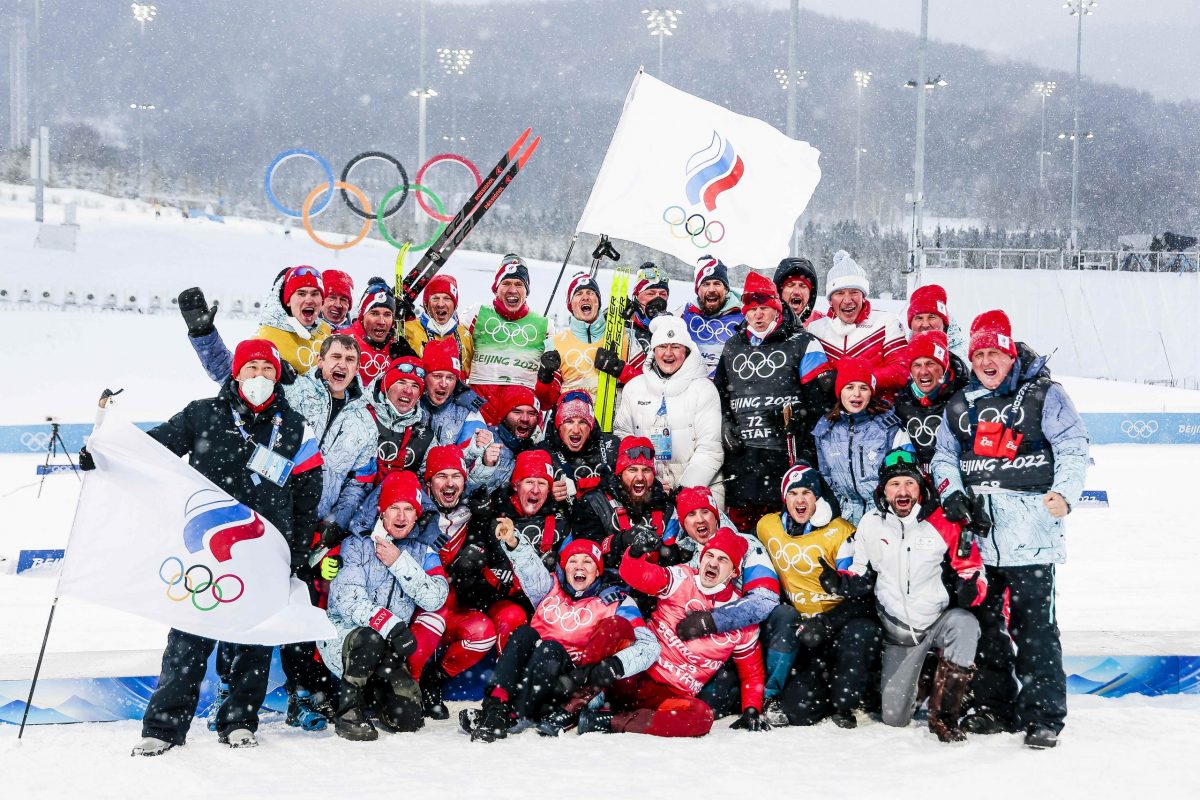
The ROC contingent celebrates their gold medal performance in the men’s 4 x 10 k relay. (Photo: NordicFocus)
Russia is one of the world’s leading nations in cross-country skiing, with its athletes winning gold medals in both the men’s and women’s distance relay events at the Olympics.
The World Cup finals are the first events set to held in Russia in several years, a consequence of doping-related sanctions.
It all started at home, grinding out quality training hours in spectacularly good ski conditions. The plan was simple: A skiing road trip with three World Cup events, followed by Nationals/SuperTour finals at home, culminating in a 50km against the best skiers in North America. Start Wednesday March 11th, arrive home on the 24th, and closing out the racing season on April 2nd.
Skiing at home before leaving for Nordork’s Dream Trip. This is Sovereign Lake, March 9th, 2020.
With restricted training opportunities during the trip, it was important to log quality hours before heading out for what would be a two week ‘masters taper’.
The first stage of the trip was driving to Canmore. With the Monashee, Selkirk, and Rocky mountain ranges separating home from Canmore, it is always good to have flexibility to travel between storms. With a snowfall warning and 25cm expected late Tuesday through Wednesday, we decided to drive early Tuesday. The plan worked. We were ahead of the storm by Revelstoke (two hours into the trip) and had bare and dry roads for the majority of the drive. We arrived in Canmore before noon, local time, and we set out for a ski.
Canmore is an unusual ski area in that it is located in a precipitation shadow and relies almost entirely on snowmaking. Before the 2016 Ski Tour Canada, locals told us that it hadn’t snowed since December. It was easy to find the race course a week out from that event: A thin line of snow snaked around the course and the 4km night loop. As we only make the drive for events like World Cups and nationals, we had never seen Canmore fully open.
Seeing every trail open was a shock, but a good one. Everyone had said the skiing was great this year, but the same people describe Frozen Thunder as great. 2016 was a pretty good visit, but as it was the end of the Tour de Food Poisoning, we didn’t fully appreciate having a few rec trails open. (Food Poisoning? Our delayed arrival in Gatineau for STC 2016 resulted in us sharing dinner with the Swedish team. We then had 8 days where we couldn’t stay hydrated and the Swedish team had terrible results for the full tour. Charlotte Kalla described her experience on that tour as ‘shit’. I didn’t have the courage to ask how literally she meant that.)
Canmore was spectacular and ready to go. This was a planned sprint point at the top of a long climb.
After skiing a few laps of the Canmore race course, it was not possible to escape that superhero feeling. With real snow, the descents are much less thrilling and the heart rate actually drops. Climbs become a matter of floating a good tempo while watching sunlit mountains, not just eyes down chasing clean snow.
After so many visits, it suddenly became clear why people choose to live in Canmore. Skiing up a climb and remembering Beckie Scott blowing up the group on that exact spot way back in 2005, I felt the road trip was worthwhile just to see Canmore at its best.
Almost back to the stadium, but it is hard to stay focused on skiing when the scenery looks like this. Canmore March 10th, 2020.
After the ski, new realities began to set in and it became clear we would have to skip the Minnesota leg of the trip. Missing the first US World Cup since 2001, missing Jessie Diggins finally racing at home, missing the Europeans experiencing the hotbed of US skiing, missing a chance to ski in a place I have never visited.
It was a blow, but you can’t ignore expert advice. Visiting Minnesota would almost certainly come with a 14 day quarantine that was not compatible with the primary season goal of racing the 50km at Nationals on my home trail system.
This decision was shortly followed by the announcement that Norway had done the wise thing and stopped their team from travelling to Canada. Anyone who was exposed to Coronavirus in Oslo during Holmenkollen would start to show symptoms in Québec.
Road Trip Day 2 (Wednesday)
Canmore’s Bow Trail has this little offshoot to see a 360 degree view. March 11, 2020.
Day two of the road trip was a bonus day at Canmore as our original schedule had us driving in the morning. The ski plan was for zone 4 intensity while staying out of sight of the elite distance skiers (Canadian and otherwise) training here. This was a calming session before what was going to be a difficult afternoon interview with the Canmore event chair, Norbert Meier.
The news got better while I was offline skiing those amazing rec trails (Bow and Rundle!), with a pandemic officially declared and approval to continue with the all three World Cup events confirmed. The result was a shorter and easier interview with Meier, followed by confirmation that the Italian team was taken out by Italy’s lockdown despite arriving in Québec.
Two nations down (Norway and Italy), one destination removed –but the trip goes on.
Québec City LOC confirmed athletes were skiing in sunshine, the spectators would be safe, and that a new mixed zone design would keep both athletes and media safe. Sovereign Lake confirmed that Nationals was approved to proceed. Canmore was predicting great weather and the sun was out. All good news until the USA closed their borders against Europe. The Minnesota World Cup was cancelled shortly after.
Road Trip Day 3 (Thursday)
Day three started with an early dash to the airport and a chance to think about the cancellation of the Minnesota WC. As we listened to the ‘switch devices to airplane mode’ announcement, an email arrived with subject line ‘Nordiq Canada Cancels’. Our skis were loaded, the doors were locked, and we were about to take off. Definitely too late to hear news from Québec.
A stolen 30 seconds of internet later, the full message was worse: Nationals and SuperTour finals were cancelled.
My home club worked hard to win the bid for Nationals and put together the event: Partnering with SuperTour, finding sponsors, preparing trails, upgrading one of the BR 400 snowcats, setting the race loops full FIS-width through six weeks of almost daily snowfalls.
I personally committed to racing the 50km in August, resulting in a new training plan and a lot of time spent preparing to race a very different style of course than masters are accustomed to. None of that matters. Decision made. Dreams broken. Partnerships strained. When we finally return, it will be to a club staring down a large financial problem and angry friends. Cancellation insurance does not usually pay out on global events or government decisions, but there were photos of the waxing tents set up on Wednesday and that money is spent.
Success is easy. It is easy to divide up profits in a joint event. All the partners stay friendly even if they argue about who gets how much money. Dividing up losses on a cancelled event is ugly. Volunteers lose heart when their hard work evaporates. Sponsors think twice about future events. Money already spent is simply lost.
This is a common occurrence in winter sports and it is my club’s turn to feel the pain. Will it hurt less in Minnesota? Nope. Will I know less people who are hurt in Minnesota? Yes, but all those volunteers, sponsors, and organizers feel just as bad as my friends at Sovereign do. And myself: I only spent about 20 hours on the bid process and would have spent a few more hours collecting social media content for final promotion. Despite this tiny investment, I feel the pain. Most of my social circle invested far more time than I did and their pain will reflect that.
For me, there is more pain to come. I will find a silver lining to all those training hours. The thrill of being the only racer with a three digit license number will somehow balance the fact that the club can’t afford to refund registrations and Nordiq Canada will not refund that license I will now never use. The total pain of racing a 10km to earn essential CPL points will be re-interpreted as a character building experience.
Next year, there were going to some fun new events at the club. Can they happen as the club rebuilds financially? Probably not, but we won’t know until after closing day on April 12th when the accountants will have the full picture.
Next year’s national team selections rely heavily on results at Nationals. Period 1 selections likewise. Nordiq Canada will have to pivot away from the rebuilding plans to deal with short term challenges.
So many athletes mentioned to me that one specific event at Nationals was one of their season goals. Sorry, goodbye to all that.
Sport is often about dealing with disappointment. Ingvild Flugstad Østberg followed up the joy of finally winning the World Cup overall with missing the start and end of this season for health reasons. Klæbo acted his age and broke fingers gifting Bolshunov the overall title in what would have been a spectacular battle, following up last year’s battle that fizzled out with one day to go when Bolshunov broke a pole.
What we admire about athletes is their ability to bounce back, to find a way to fight again. Not all succeed, which is why we celebrate those who do. Away from the perfection of Instagram and the TV cameras, the pain, the uncertainty, the self-unconfidence all play out before the tough ones find their way back to the hard work which is both path and reward.
For the people who host events, there are only bright lights and TV cameras when everything has turned to custard. Their wins are not noticed, their failures are celebrated. Where do these people find the courage to bounce back and try again?
Beyond these worries, day three continues to be exciting. On landing in Toronto, we read an announcement that people arriving in Québec should self-quarantine for 14 days and that indoor events with more than 250 people must be cancelled, shortly followed by the suspension of the NHL season.
To fly on or turn back? Canmore announced their own cancellation during this brief stop. Meier sent an apology, as he got the first warning that precipitated this decision only a few minutes after our interview Wednesday.
A call to Jeff Ellis, Nordiq Canada’s Event Director, confirmed that Québec City (QC) was proceeding as an outdoor event. Simple answer, get on the (delayed) connection to QC with Jessie Diggins (who had been keeping her social distance in the waiting area like the total professional she is) and hope for the best. At the QC airport, NC’s Dave Dyer was there to pick up his colleagues from the flight. He laughed when he saw we had a ski bag. Does he know something we don’t? Always.
QC is a great place to visit and a better place to eat. We had a good dinner next to the French Ski Team’s wax techs and ignored their speculation about meetings while reading about BC’s new 14 day self-quarantine rules. One of the nice things about four World Cup events in a five year period is that we have favourite places to eat and drink here.
Day Four (Friday)
The finish in Québec City, a few minutes after the season finished early on Friday the 13th.
We woke to freezing rain and a press release stating Canada’s ski team was dropping out – a stance taken in solidarity with Norway, Germany, Sweden, Finland, Great Britain, the Czech Republic, and the United States. The rain turned to snow before the LOC, Gestev, sent their own press release at 8am cancelling the event.
Many athletes were braving the wind and driving snow to get in a morning ski while FasterSkier waited for an interview with FIS Cross Country Race Director Pierre Mignerey. Ellis filled in some time explaining the details of the cancellation.
At the event hotel, there was time to catch up on the news and grab a few interviews. Here’s what I learned: Canada decided at the team meeting at 8pm Thursday that pulling out of the event was the only option. As much as NC, FIS, and the LOC have contracts requiring them to make every effort to go ahead, the team has to protect the athletes. FIS was notified after that meeting. NC sent out the press release at 1am, and FIS formally cancelled at 8am.
Ellis also explained the personal side for the Canadian athletes, who paid for their own flights and accommodation.
“Our athletes here, we feel bad for them. I have one world cup start, as a nations group starter. Was I a competitive world cup skier? No, I was third last, but I can say I did a world cup. I empathize with our athletes, that this was their chance to get one. At the same time, we have to keep them here, knowing that they’re going to have to back through international airports. We can say they are safe in the bubble here, but we have to think about what we are sending them home to. The longer we keep them here, we are putting them at risk if we start to see shutdowns in the country. At the end of the day, that’s more important.”
An ugly scenario, but at each point people made the only decision they could. While governments had been signalling that travel and assembly guidelines would change, it is not possible to cancel a multi-million dollar event based on speculation.
“What changed in 8 hours yesterday, from BC, to Ontario schools closing for two weeks, to curling, to figure skating, we don’t want to be the last one standing in this regard, it’s not an enviable position to be in,” Ellis said about BC’s 14 day self-isolation rules, the World Curling Championship in two BC cities, and World Figure Skating Championships in Montreal.
In large events like these, there is a complicated dance around the contracts between partners. The only accepted reason for the LOC to cancel is the legal concept of ‘force majeure’, which is something beyond the control of the LOC. This could be a lack of snow causing a jury decision, a safety issue, or a government decree. At Holmenkollen, it was the City of Oslo that ordered the event closed to spectators. in Québec, the withdrawal of six teams precipitated the declaration.
It seems likely that event contracts for sports and conferences will be worded differently in the future.
As Mignerey said, it is a small family driving around and skiing in different places. At the sudden end of a long season, there were a lot of hugs and a lot of people carefully not shaking hands. Standing on the edge of this crowd feels like being a plus-one at a family reunion: Everyone is friendly and welcoming, but there is a closeness and history that the guest is not part of.
The silver lining, because we always need some light on dark days, is that I shot video from a World Cup venue. If Jessie Diggins can dredge up some positive to have a friendly conversation shortly after having her dreams crushed, I can enjoy this twisting road trip that didn’t quite live up to the brochure.
How to sum up?
Athletes had their dreams crushed. Some will never get their first World Cup start.
Organizing Committees worked hard and were inadvertently rewarded with deficits and disappointment. Fans lost the chance to see some great racing on fabulous snow.
In the bigger world around us, the picture is different. People are watching family members die. Workers are ordered to self-quarantine without pay. Hospitals are being overloaded and doctors are having to choose which patient gets the life-saving equipment.
So yes, the cancellations personally hurt, they hurt many of my friends more, but I will find my way back to the positive. Soon.
Day Five, Saturday
Looking back down the big climb on the 2020 sprint course. Without the race grooming, this is urban crust skiing at its best.
After a great tortière and some Griffon Rousse beer last night at one of our favourite restaurants, the world was in a positive light again. Symbolically, the sun came and went during a morning ski on the race course. By 11am, most of the athletes, fans, and teams had left, which means the internet is suddenly faster at the hotel. Many of the countries that had discussed closing borders followed WHO guidelines and left them open with self-quarantine requirements. We were able to reschedule our flight to Saturday afternoon for a tiny fee (thanks WestJet) and will soon be in driving distance of home.
Federico Pellegrino posted his road trip story on Instagram, revealing that he didn’t want to leave Italy when it was already clear that the COVID-19 situation was going to get worse everywhere. As a skier who saw his home ski area closed on March 7th as part of Italy’s lockdown and a resident on the edge of the most affected part of Italy, he knew that the English-language media was understating how bad the problem was.
Canada’s Alex Harvey acknowledging the crowd after his second place in the men’s 15 k classic in Québec City. (Photo: John Lazenby/lazenbyphoto.com)
Amidst overcast skies and spectators bearing signs for the local cross-country favorite, Canadian Alex Harvey, World Cup Finals resumed on Saturday in Québec City, Québec with a men’s 15-kilometer classic mass start race.
Thanks to his win in Friday’s freestyle sprint, Norway’s Johannes Høsflot Klæbo lead Saturday’s 78 starters out of the gate, his yellow bib also indicative of his first place rank in the 2019 Overall World Cup Standings.
With Saturday and Sunday being the last competition days of the World Cup season, and only 24 points separating Klæbo’s first place (1443 points) from second place Alexander Bolshunov of Russia (1419 points) in the Overall Standings heading into the 15 k on Saturday, both athletes were looking for a win.Klæbo to solidify his position on top and Bolshunov to supersede it.
A literal mass of skiers after the start of the men’s 15 k mass start classic in Québec City. (Photo: John Lazenby/lazenbyphoto.com)
Leading up to 10 k, it appeared as if Bolshunov was on track to overhaul Klæbo’s immutable position on top. The Russian had positioned himself at the front of the lead pack’s 13 skiers which included Klæbo, Harvey, Italians Federico Pellegrino and Francesco de Fabiani, Russian Andrey Larkov, Switzerland’s Dario Cologna and Norwegians Didrik Tønseth, Sindre Bjørnestad Skar, Emil Iversen, and Sjur Røthe.
Taking charge through the climbs, Klæbo and Bolshunov went stride for stride, with Harvey hard pressed a little more than 1 second behind.
“I didn’t want to be leading because it was windy but I wanted to be near the lead every time,” Harvey told FasterSkier after the race.
Their descents through the tight sugary s-turns were maneuvered with ease. At 12 k, a Klæbo versus Bolshunov battle had directed most of the race and seemed fated to the finish.
However at the 13 k mark, halfway up one of the course’s major climbs, the bottom of Bolshunov’s right pole snapped. Although he received a replacement pole within a meter or so, the broken one did damage to his pace.
Russia’s Alexander Bolshunov leads the front group of skiers in the mens’s 15 k mass start classic in Québec City. (Photo: John Lazenby/lazenbyphoto.com)
“When I heard the Russian broke his pole, I went all in for Klæbo to make a gap as big as possible,” Tønseth told FasterSkier after the race. “We went for Klæbo and that’s the most important thing.”
With Tønseth pushing the pace, Bolshunov began to fall back. By the bottom of the next descent, the lead group had dwindled to five: Tønseth, Klæbo, de Fabiani, Røthe, and Harvey.
“We started to stretch the pack and…Didrik [Tønseth] is the strong guy that can make a hard drive in the final 2 kilometer to the finish he’s better than Johannes [Klæbo] or me in that so it was almost fun for him, if you want to be on the podium you got to punch it hard now and I knew for me it was going to help me,” Harvey said.
For the remaining 2 k, all five skied together until the finishing stretch. In the final 100-meters to the finish, Klæbo moved to the front and held off the charge of Harvey and Tønseth. Klæbo crossed first in a time of 36:10.9, while Harvey claimed second, just 0.8 seconds behind Klæbo, after a last minute surge past Tønseth.
Crossing 0.5 seconds back from Harvey and 1.3 seconds back from his teammate, Klæbo, was Tønseth in third.
“It’s a different scenario than two years ago when I came in newly World Champion fighting for the top three in the overall, I feel like this time I’ve had a harder season, was a bit more of an outsider,” the 31-year-old Harvey said. So I knew I needed my best race of the year to be on the podium and I was able to do that today so it’s pretty special.”
It is spring. “Go Alex!” (Photo: John Lazenby/lazenbyphoto.com)
Harvey confirmed earlier this season that World Cup Finals in Québec City will be the last World Cup races of his career. The Canadian will now start Sunday’s pursuit less than a second behind Klæbo.
“I felt strong today so I was able to come up in the front again. I needed these points for the total World Cup,” Klæbo told FasterSkier after the race.
With Saturday’s 15 k complete, Klæbo retained his top spot in the Overall Standings now with 1493 points. Bolshunov is currently second with 1451 points and Røthe third with 892 points.
Following Harvey was the U.S. Ski Team’s (USST) Erik Bjornsen in 18th (+1:04.3).
“I’m happy with the result,” Bjornsen told FasterSkier after the race. “I think it might have been the first time I was leading a World Cup for a bit. ”
Around 4 k, Bjornsen was at the front of the 78 skiers who started the race.
“The way my season’s been going it feels easy to go at race pace but when there are surges in the pack, if I try to go I just flood and I can’t really recover the way I’m hoping. But that was fun today,” Bjornsen said.
The next top North American finisher was Canada’s Len Valjas in 32nd (+1:43.6).
“It was one of the best distance races of my career,” Valjas told FasterSkier after the race. “I’ve had a few really good ones, but I don’t think I’ve ever been near [Top] 30 in my career other than the two podiums. So I’m super happy. Alex had a great day. I feel like I had a great day and I’m looking forward to tomorrow.”
“I was in bib 69 and I was skiing with some guys who were in the Top 20, so it’s really exciting for me to feel sort of back again,” Valjas added.
Following Valjas was the USST’s Simi Hamilton in 39th (+2:13.7). After the race, Hamilton indicated that prior to Saturday, his most recent classic distance race had been the Lillehammer 15 k back in December.
“I think by far the hardest part about today was the poling,” Hamilton told FasterSkier after the race. “It was just super rotten everywhere, the tracks stayed firm, which was nice, but the poling trenches just got so deep. I was constantly trying to look for harder snow on the outside and it made for, as a bit of a heavier skier, it made for a tricky 15k, but it was fun.”
Also skiing for the Americans was Kevin Bolger in 44th (+2:31.1), Scott Patterson in 50th (+2:37.9), Gus Schumacher in 56th (+3:44.1), David Norris 57th (+3:48.8), Ben Saxton 66th (+4:55.0), Logan Hanneman 67th (41:17.2) Ben Ogden 70th (+5:15.2) and Peter Holmes 73rd (+6:30.4). Andy Newell did not finish.
For the Canadians Remi Drolet finished 52nd (+2:57.4), Evan Palmer-Charette 55th (+3:16.6), Philippe Boucher 58th (+3:53.9), Jack Carlyle 59th (+4:13.6), Russell Kennedy 62nd (+4:27.0), Antoine Cyr 63rd (+4:29.8), Scott James Hill 64th (+4:46.5), Alexis Dumas 65th (+4:52.3), Bob Thompson 69th (+5:06.6), Antoine Briand 71st (+5:16.1), Julian Smith 72nd (+5:56.7), Julien Locke 74th (+6:31.8), Graham Ritchie 75th (+6:44.4).
The men’s podium from the 15 k classic mass start in in Québec City. Alex Harvey (bib 11) was given the honor of standing in the center. Harvey placed second to Johannes Høsflot Klæbo (left). Third place went to Didrik Tønseth (bib 17). (Photo: John Lazenby/lazenbyphoto.com)
Sweden’s Marcus Hellner leads Russia’s Andrey Larkov and others during the men’s 15 k freestyle pursuit at the 2017 World Cup Finals in Quebec City.
Here are the basic rules for this week’s World Cup finals in Québec. It’s a three race series: a sprint, a classic mass start, and freestyle pursuit for the final stage.
We’ll get to the import of the World Cup points on offer in a moment and why they add some tension to the weekend. This much is clear: the final standings for the men’s and women’s overall World Cup remain close as does the women’s sprint cup.
But first, let’s start with understanding time bonuses at Québec’s World Cup finals.
The top-30 ranked skiers in Friday’s sprint earn time bonuses. The bonuses are subtracted from the athlete’s “race” time. (Time bonuses are listed below for the sprint.)
A single intermediate time bonus for the women’s 10 k mass start classic will be awarded on Saturday. The men’s 15 k mass start classic features two intermediate time bonuses. The FIS rules state, “Bonus seconds will be 15, 12, 10, 8, 7, 6, 5, 4, 3, 2 and 1 seconds for the first ten athletes at a designated intermediate point.”
Again, those seconds, or time bonuses, are subtracted from an athlete’s race time and then the overall time is calculated. Sunday’s skate pursuit — for both men and women — is a straight up pursuit. Meaning, the athlete with the fastest overall time is the first racer off. No time bonuses are available.
World Cup points will be awarded for each race over the weekend. The points for the sprint and mass start are clear. Points go to the top-30 finishers. And the points earned go towards both the specific discipline category, sprint cup or distance cup, and towards the overall World Cup standings. For the final day’s pursuit, the points are allocated by elapsed race time — you might know this as fastest time of the day. The top-30 fastest racers, which again is determined by elapsed time on course, get the points. They go towards the distance cup and overall standings.
(Below are the points for 1st-30th place in the sprint, mass start, and fastest time of day in the pursuit.)
The World Cup final’s grand prize are the points earned for the overall standings determined after the last stage. It’s a pursuit, so the first skier across the line is the overall winner. The winner will be awarded 200 points, second place 180, and so on. (See overall points below.)
So what’s all the fuss? The final weekend, as Chad Salmela keenly tweeted, brings with it some crystal still up for grabs. Johannes Høsflot Klæbo leads Alexander Bolshunov of Russia by 14 points in the men’s overall standings.
Norway’s Maiken Caspersen Falla with her 2017/2018 Sprint World Cup Crystal Globe. (Photo: Fischer/NordicFocus)
For the women, Norway’s Ingvild Flugstad Østberg has gapped Russia’s Natalia Nepryaeva by 97 points for the overall. And the women’s standings for the sprint cup are tight too. Stina Nilsson of Sweden leads Norway’s Maiken Caspersen Falla by 33 points.
The women’s 10 k freestyle pursuit podium on the last day of 2018 World Cup Finals in Falun, Sweden, with Norway’s Marit Bjørgen (c) in first, and Americans Jessie Diggins (l) and Sadie Bjornsen (r) in second and third, respectively. (Photo: Fischer/NordicFocus)
FALUN, Sweden — NOR. USA. USA.
Looking at the results monitor, those were the tri-letter country codes that popped into the top three at the end of the women’s 10-kilometer freestyle pursuit at World Cup Finals on Sunday.
The “NOR” belonged to Marit Bjørgen of Norway, who ended her 2017/2018 World Cup season with yet another win. In Sunday’s pursuit, the 37 year old led from start to finish and ended where she started, in first after covering the course in a time of 24:18.9 minutes.
For many who follow the World Cup, a Norwegian name — like Bjørgen, who has won more than 110 individual World Cup races — at the top of the results is nothing new. All due respect.
But the pressure for Scandinavia to hold off an American entourage is mounting; Sunday’s race presenting itself as a prime example.
A 41-second gap separated American Jessie Diggins from Bjørgen by the time she flipped past the start wand, her characteristic cheek sparkles visible from the stands. As the third starter on course, Diggins had sewn shut the 5 seconds that the day’s second starter, Ingvild Flugstad Østberg of Norway, had on the American and within the first kilometer, was establishing herself as Bjørgen’s main threat.
“I had 45 seconds in the total time at Mördarbacken the first time,” Bjørgen reflected in a post-race interview with FasterSkier. “And then it was 30 and then 20, then I was a little bit stressed. I thought, ‘Aha, I have to work harder a little bit.’ I feel like on the uphill I was the same speed as Jessica, but she was better than me on the easier part of the tracks. And I’m really happy to make it. I had to push hard in the end.”
Norway’s Marit Bjørgen leading off the front during the women’s 10-kilometer freestyle pursuit on Sunday at World Cup Finals in Falun, Sweden. (Photo: Fischer/NordicFocus) (Photo: Fischer/Nordic Focus)
After catching Østberg, Diggins led the Norwegian and eventually dropped her by 17 seconds at 3.75 k. On Bjørgen, she had gained just over five seconds in time. By the 5 k mark, Diggins was a little less than 30 seconds back, and had put 13.4 more seconds into the race leader.
“I was grateful to feel so good today,” Diggins told FasterSkier. “We had amazing skis and that was really important. Especially on a course with so much gradual climbing and gradual working downhills, you needed to have good skis, and our techs delivered. And they gave us the tools we needed to have a good day.”
At the 7.5 k mark, 20 seconds separated the American from the win. By the time Diggins crossed the finish line in second, she was 16.7 seconds behind Bjørgen. The effort from Diggins gave her the fastest time of day in 23:54.4 minutes, which was 24.5 seconds faster than Bjørgen’s time.
“It’s a sport of patience,” Diggins said. “I feel like I’ve been coming into my own with the confidence to know that any race I start, I can be trying to fight for the podium and racing like I can win. Instead of racing like, ‘Oh, I’m going to try to just see what I can do,’ it’s like, ‘No, I’m going to try to win.’ ”
But Diggins was not the only American hunting and holding off Norwegians. Her U.S. teammate Sadie Bjornsen, who had gone out hot in Saturday’s race in hopes of a podium, earned it on Sunday in a sprint finish for third (+1:11.5) between herself and Norway’s Ragnild Haga and Astrid Uhrenholdt Jacobsen.
In the finishing stretch, Bjornsen, Haga and Jacobsen had gone head to head, with the American outlunging Haga — the gold medalist from this year’s Olympic 10 k state — by exactly half a second and beating Jacobsen by 1.3 seconds for the final spot on the podium.
American Sadie Bjornsen earning third in the women’s 10-kilometer freestyle pursuit on Sunday at 2018 World Cup Finals in Falun, Sweden. (Photo: Fischer/NordicFocus)
“Coming into the final stretch I was like, ‘OK, that is the last time you get to do the final stretch this year and make it count,’ ” Bjornsen told FasterSkier. “It ended up working out for me, and that turned into quite the dream day.
“I think the step I made this year is one step closer to being in a place where Jessie is racing right now,” Bjornsen continued. “To have a teammate who is just pushing the bar just every single day and making me believe that in order to be the best racer in the world, you have to have no fear. Jessie is a great example of that and it is certainly contagious.”
On Sunday, Bjornsen had started 21 seconds behind Østberg and 29 seconds ahead of Haga. By 7.5 k Haga had caught the group battling for third, which included Bjornsen, Finland’s Krista Pärmäkoski, Østberg, Sweden’s Charlotte Kalla, and Jacobsen. The group stayed together until the downhill back toward the stadium.
“I was like, ‘OK, I have to be smart here and keep pushing the pace hard enough that we do not get caught from behind, but conserve for that final sprint and then when I came into the sprint lap,’ ” Bjornsen reflected.
Along with being a podium threat in Sunday’s race, the Americans are also gunning full-speed ahead toward the top three in the overall, sprint or distance World Cup standings. On Friday, Sophie Caldwell of the U.S. claimed third in the season-long Sprint World Cup. On Sunday, Diggins stood on the podium in second in the Overall World Cup and third in the Distance World Cup.
“We are really showing that we are a skiing nation, and it’s taken so many years and so much hard work from a lot of people, but I think it’s so cool to show that we can be in the fight,” Diggins said.
The women’s 10 k freestyle pursuit podium on the last day of 2018 World Cup Finals in Falun, Sweden, with Norway’s Marit Bjørgen (c) in first, and Americans Jessie Diggins (l) and Sadie Bjornsen (r) in second and third, respectively. (Photo: Fischer/NordicFocus)
“It’s been a many year goal of ours to be ranked in the top three for the women’s team and we secured that for the first time today,” U.S. Ski Team Women’s Coach Matt Whitcomb told FasterSkier of his team’s best-ever Nations Cup ranking. “We’ve come into [past] finals, I believe, ranked third and then come out of finals ranked fourth. We’ve been fifth. And I think as an entire team, men and women combined, … I think we’ve finished fifth, which would be exceptional. It was really quite an achievement for both our men’s and women’s teams.”
In the decade leading up to the past two World Cup seasons, podiums from American women peppered the circuit, but predominantly in sprints. Kikkan Randall holds most of those, having recorded 28 individual podiums before 2016, only five being in a distance greater than 2 k. Sophie Caldwell broke through with a third-place sprint finish in 2014.
American Liz Stephen had also reached the World Cup podium four times in distance races prior to 2016 — twice outright and twice for time of day.
From 2016 on, the number of podiums that have gone to U.S. women has only increased. Caldwell earned three podiums this season alone. Diggins has racked up a total of 14 individual World Cup podiums since her first (which was also a first place) in 5 k freestyle in Toblach, Italy, in 2016. Bjornsen now has a total of five podiums over the course of two seasons. Stephen added two more to her name, one time of day and one outright, and Randall another top three in this past December’s Davos sprint.
Whitcomb was quick to point out that much of this success, started with U.S. Ski Team veterans Randall and Stephen, who skied the last World Cup races of their careers on Sunday. Randall finished the race in 43rd (+4:33.3) with the 29th-fastest time of day, and Stephen 50th (+4:57.2).
“Honestly I start crying every time I think about it,” Whitcomb said, referring to the fact that Randall and Stephen will be retiring after this season. “It’s been a day that I have feared for my whole career, basically since I started working with Kikkan and Liz, really since they started working with us.
“I know we are not saying goodbye forever, but definitely we are saying goodbye in a certain capacity to two of the most important people that have ever set foot on the U.S. Ski Team,” he added.
The two spoke with Fasterskier after their last race together, perhaps fitting as Stephen joined the team in 2006, only a year after Randall. The pair have worked with Whitcomb for the past 12 years.
“As your whole career flashes before your eyes, it’s the people that are the best part,” Randall, 35, said.
In their career final World Cup race on Sunday, both Randall and Stephen donned unicorn headbands, pink arm warmers and spandex boyshorts inscribed with the words “Thank You!!” across the backend. During their pre-race morning run, they felt something was missing and made a spur-of-the-moment stop at a store to purchase a few “costume pieces” for the race. Their outfits sparked smiles as they completed the race, and there was no denying the message they hoped to send off as they departed the ski-racing world: the energy and enthusiasm of a strong team.
(Article continues below)
The last-race outfits worn by Kikkan Randall and Liz Stephen for Sunday’s World Cup Finals pursuit. (Photo: Kikkan Randall/Instagram)
“We are all most proud of the team we built,” Randall said. “To see it at such a good point and to know just because we are leaving the scene doesn’t mean it’s going away; these girls are going to continue to carry the torch, the young girls coming in.”
“I would second that,” Stephen, 31, said. “One of the main things was that we wanted to leave a program that sustain itself, and I think that we both feel very happy and confident that that is going to happen. Like Kikkan said, Jessiewon more points this year alone than we used ever see in an entire season men and women combined, you know, 10 years ago, and so I think that is a testament of the success that we have been able to create for one another.”
Both Randall and Stephen were also given the opportunity to take a victory lap after the race, alongside Finland’s Aino-Kaisa Saarinen and Sweden’s Anna Haag, who sported a Disney Princess bath towel as a superhero cap, as well as a bejeweled crown (in an interview with FasterSkier, Haag explained the outfit had not been coordinated with the Americans, but was rather a coincindence. The Americans and Swedish skier are longtime friends and shared a nonalcoholic-champagne beverage in the finish area after the race).
“I certainly wasn’t expecting a send-off like that,” Stephen said. “That was really special, that the four of us were able to do that together.”
“I have done this 20 years … and I have raced my goals and even more,” Saarinen told FasterSkier. “Actually this skiing family is the thing what I’m going to miss the most.”
Also racing for the U.S. on Sunday, Caitlin Patterson finished the pursuit in 35th (+3:58.4) with the 22nd-fastest time of day, Caldwell finished in 36th (+4:00.7), Rosie Frankowski 46th (+4:41.3), Kaitlynn Miller 56th (+6:13.8), and Ida Sargent 57th (+7:06.4).
“It’s been a really unexpected good season, and I am really happy with it,” Miller said. “Today was awesome seeing Sadie and Jessie finish out the World Cup season like that.”
The Canadians were led by Cendrine Browne, who finished 39th (+4:14.4) with the 27th-fastest course time, followed by Emily Nishikawa in 48th (+4:43.7), Dahria Beatty in 54th (+6:04.3) and Zina Kocher in 60th (+9:28.4).
“I love the course, it is perfect for me,” Browne wrote in an email to FasterSkier. “Steep up hills and one skate sections are what I prefer best! I was suprised yes!!! All season I was trying so hard to get into the top 30. Maybe I was trying to hard and putting to much pressure on myself. Today, I decided to have fun and to forget everything and it just happened!”
“I am really happy about my season even if it was filled with so many emotions,” Browne continued. “Going to the Olympics and placing 33rd at my first Olympic race is definitely a highlight. Also, my 36th place in Holmenkollen is a huge accomplishment for me. Even if I fell twice and should have been in the top 30, it was an awesome race. And today’s 27th place is definitely the best thing that happened this season. Finishing the season like this fills my heart with joy and hope for next season.”
***
Norway’s Marit Bjørgen finishing first in the women’s 10 k freestyle pursuit at 2018 World Cup Finals in Falun, Sweden, while American Jessie Diggins (in background) chases for second place. (Photo: Fischer/NordicFocus)
Notes: While there has been a lot of discussion about retirements, Bjørgen isn’t saying it’s over.
“I want to finish [the season] in a good way, but I think I’ve been at my very best. I’ve passed it [my peak],” Bjørgen said in a loosely translated interview with NRK on Friday.
So will she race next winter? Bjørgen estimated she would need to train at least 850 hours if she wanted to compete with her teammate Therese Johaug, who will be returning to the World Cup next season.
“It’s going to be a lot of training, and you have to prioritize a lot. That’s the toughest thing,” Bjørgen said. “But when I’m at work, it’s no problem. I’m here to do the job. Should I do one more year, I will not do it halfway [half-hearted].”
American Jessie Diggins (5) and Norway’s Marit Bjørgen (3) and Maiken Caspersen Falla lead early in the women’s 10 k classic mass start at World Cup Finals in Falun, Sweden. (Photo: Fischer/NordicFocus)
FALUN, Sweden — To those watching, even to those racing, the winner was the woman who had led most of Saturday’s 10-kilometer classic mass start: Norway’s Marit Bjørgen.
“Marit and Tiril [Udnes Weng], another Norwegian young girl, they were skiing really fast and I thought that they would be first and second,” Norway’s Ingvild Flugstad Østberg told FasterSkier after the race.
Seven minutes after the start gun, Bjørgen had moved to the apex of the field and there she seemed intent to stay.
No doubt, the 37-year-old Norwegian holds a close relationship with the 10 k classic event. Over the course of her World Cup career, she has amassed 31 podiums in the distance/discipline, 16 of those being in first place.
Last year in Lahti, Finland, Bjørgen was crowned the 10 k classic world champion, and she also holds the 10 k classic World Championships title from 2011. At the 2006 Olympics in Turin, Italy, she earned silver in the 10 k classic event. The next time a 10 k classic was featured at the Olympics, in 2014 in Sochi, Russia, she finished fifth.
With substantial backing, Bjørgen seemed well on her way to another 10 k classic win at 2018 World Cup Finals on Saturday in Falun. Finland’s Krista Pärmäkoski may have not looked like a real threat — until the finishing stretch.
In the corner before the final 100 meters, Pärmäkoski pulled up just behind Bjørgen. Just two kilometers earlier, the Finn had been skiing two seconds off of the Norwegian’s pace.
Backtracking to the race’s halfway mark, Pärmäkoski had been even farther behind Bjørgen. Three seconds had separated the chase pack from Bjørgen and Tiril Udnes Weng, who led the race at 5 k. At that point, Sweden’s Charlotte Kalla had been spearheading the charge to close down the gap, while Pärmäkoski skied in fifth, almost one second back from Kalla and four seconds back from Bjørgen.
Even earlier in the race, when Bjørgen made her move to the front at 3.75 k, Pärmäkoski, who had started in bib 32, was 19 places out of first.
“I had to start so much behind the others,” Pärmäkoski told FasterSkier, referring to her bib number, which was based on her finish in the opening race of the World Cup Finals, Friday’s freestyle sprint.
“But my body worked very well today … and I had really good grip and glide [with] my skis,” Pärmäkoski continued. “I passed the other athletes when we got to the downhill, the long downhill.”
By the descent heading back toward the stadium, Pärmäkoski had passed Tiril Udnes Weng and moved around Kalla. Close to two seconds stood between her Bjørgen and Østberg, the latter of which had moved into second at the 7.5 k mark.
“I didn’t dare to look back and see how many girls were keeping up with [us] in front,” Østberg said.
If she had looked back, she would have seen the Finn firing on all cylinders.
By the descent back toward the stadium, Pärmäkoski had caught Østberg and hunted her next Norwegian. She closed in on Bjørgen in the corner just before the finishing stretch. Fifty meters to go and Pärmäkoski pulled up just alongside Bjørgen.
Finland’s Krista Pärmäkoski (32) edges Norway’s Marit Bjørgen for the win in the women’s 10 k classic mass start at 2018 World Cup Finals in Falun, Sweden. (Photo: Fischer/NordicFocus)
The two approached the finish line in tandem. Pärmäkoski, however, was stronger in the final double-pole push and nabbed the win by just 0.2 seconds over Bjørgen in a time of 26:00.5 minutes. Bjørgen took second behind the Finn in a time of 26:00.7.
“I thought that maybe I was stronger than her and I feel that I was doing a good finish, but she was stronger than me,” Bjørgen told FasterSkier, referring to the sprint finish between Pärmäkoski and herself.
“I thought Marit was gonna take it on the last 100 meters, but Krista was too strong,” said Østberg, who finished 5.1 seconds back in third.
The win is Pärmäkoski’s third 10 k classic title in a row this season. Her first came in Planica, Slovenia –which was also her first World Cup win — and her second came two weekends ago in front of a home crowd in Lahti.
For Østberg, the World Cup podium was her first since January.
“It’s been a while since I’ve been on the podium individually, in an individual race, so I was just so happy that I managed to finish in third place,” Østberg said.
Less than 10 seconds behind her, a pack of five surged to the finish line, with Sweden’s Ebba Andersson crossing in fourth (+14.5), Japan’s Masako Ishida fifth (+14.8), Kalla in sixth (+15.2), Austria’s Teresa Stadlober in seventh (+15.4) and American Jessie Diggins in eighth (+15.5). Exactly 1 second separated the five-skier spread, with Diggins bookmarking the tail end.
American Jessie Diggins leading the pack up an early climb with Norway’s Kathrine Rolsted Harsem and Marit Bjørgen just behind during the women’s 10 k classic mass start at World Cup Finals in Falun, Sweden. (Photo: Fischer/NordicFocus)
“I was a little bit bummed I didn’t quite have the same feelings in my body that I’ve been having,” Diggins told FasterSkier. “It wasn’t a bad race at all … I just was struggling to find that last gear. I know it’s there because it was there in the sprint yesterday. So I am just going to go hard tomorrow and see what I can do.”
Bjørgen currently leads the World Cup Finals mini tour and will be the first skier on course in Sunday’s 10 k freestyle pursuit. Starting 36 seconds after her will be Østberg in second, then Diggins, 41 seconds back in third.
In the Overall World Cup standings as well, Diggins ranks third with 1226 points. The American is 106 points behind Østberg in second and 213 points behind Norway’s Heidi Weng in first. At most, with a win, Diggins could score 200 points on Sunday. Behind her, Pärmäkoski is 112 points back in fourth.
“I am just excited to keep pushing hard and see if I can break through and get some new firsts for me,” Diggins told FasterSkier. “I am fighting for a good spot in the overall [World Cup] and in the overall distance [ranking] as well … it’s fun to try to do something new and definitely motivates me to keep fighting really hard. It kept me pushing for every second today.”
Diggins is also third in the Distance World Cup standings, 64 points behind Østberg in second and 43 points ahead of Pärmäkoski in fourth.
Rounding out the remainder of Saturday’s top 10 was Norway’s Astrid Uhrenholdt Jacobsen in ninth (+24.8) and Finland’s Kerttu Niskanen in 10 (+26.2). Just 0.1 seconds outside of the top 10 was American Sadie Bjornsen in 11th (+26.3).
American Sadie Bjornsen skiing just behind Germany’s Katharina Hennig during the women’s 10 k classic mass start at 2018 World Cup Finals in Falun, Sweden. (Photo: Fischer/NordicFocus)
This World Cup season has marked somewhat of a breakthrough season for Bjornsen, with the 28 year old earning her first distance podium and two classic sprint podiums.
On Friday, she appeared to be pulling for a podium again. Bjornsen charged hard to the front of the pack in bib 8, three bibs back from Diggins, who led the first 2 k of the race before Bjørgen took over.
When asked about the risk involved with taking such a race tactic and why she chose to do so, Bjornsen was thoughtful. Reflecting on her recent strong results in sprint qualifiers, she explained that she was testing “what can happen if I have no fear, if I have no fear of failing.”
“I keep trying to tell myself that in the distance races … any amount of fear really pulls you back from that podium potential. So this last week I made it a goal of mine to try to race from the gun and see if I can hang on,” Bjornsen said.
With this being the final weekend of World Cup racing until next season, Bjornsen also saw it as an opportune time for her to try going out harder at the start. In a sense, test her pacing in an insular way.
“It’s the best time of the year [for that],” Bjornsen said of a hot start. “You have nothing to lose. I definitely am fighting in the overall [World Cup] for places, too, but at the same time it’s not fighting for a podium. So if I absolutely explode, like I did today in the middle of the race, there is just no failing with that.
“I am learning how to [ski in the front] this year and next year I’m ready to come back and take that risk more often,” she added.
Bjornsen is currently ranked eighth in the Overall World Cup standings with 799 points. Ahead of her is Kalla in seventh (828), Bjørgen in sixth (835), and Stadlober fifth (836). In the distance standings, Bjornsen is 10th. She will start Sunday’s pursuit in sixth, 57.3 seconds after Bjørgen.
American Kikkan Randall tucking during the women’s 10 k classic mass start at 2018 World Cup Finals in Falun, Sweden. (Photo: Fischer/NordicFocus)
Also competing for the U.S. on Saturday was Sophie Caldwell, who placed 41st (+1:36.1), Rosie Frankowski in 44th (+1:43.7), Caitlin Patterson in 47th (+1:54.8), Kikkan Randall in 57th (+2:34.1), Kaitlynn Miller in 64th (+2:50.7).
In her final weekend of World Cup racing, Randall explained Saturday’s result was not quite where she hoped to be, partly as her body still felt the effects of Friday’s sprint effort.
“I always just like to end on a good note feeling like I just really raced hard and [with] regards to the results, feel competitive,” she said. “Yesterday was more along those lines, today was just hard, but it’s still good to be up here. Such a beautiful day for racing, perfect temperature, good tracks, good skis.”
Emily Nishikawa led Canada in 36th (+1:31.1), followed by Cendrine Browne in 50th (+2:05.7), Dahria Beatty in 61st (+2:46.6), and Zina Kocher in 69th (+6:12.0).
The women’s 1.4 k freestyle sprint podium at 2018 World Cup Finals in Falun, Sweden, with (from left to right) Sweden’s Jonna Sundling in second, Sweden’s Hanna Falk in first and Norway’s Marit Bjørgen. (Photo: Fischer/NordicFocus)
FALUN, Sweden — Even the sky had predictions for Sweden. Without a cloud in sight, cerulean blue and a golden sun served as Falun’s backdrop for the opening race of the 2017/2018 World Cup Finals on Friday: the 1.4-kilometer freestyle sprint.
Exactly nine weeks ago in the city sprint held in Dresden, Germany, Sweden’s Hanna Falk was showing shades of greatness. In the first race of the new year, the 28-year-old Swede claimed the Dresden freestyle sprint title for her first World Cup victory since 2010.
With the final sprint of the season taking place on the Falun ski trails, where Falk — a member of Sweden’s national team — spends most of her time training, the statistics were levied. All signs pointed to Sweden, in particular, Falk.
With one group of fans holding a banner that read “Falk för President” and still more waving the national flag, Falk won Friday’s Falun sprint final in 3:08.25 minutes, finishing the last sprint of the season the same way she started the new year: in first.
“This is just great to win here in Sweden. It’s my second victory this season and I am so happy that my parents are here to see it,” Falk said, according to an International Ski Federation (FIS) press release.
Falk started Friday with the fastest qualifying time of 2:59.88 (she remained the only woman to dip below the three-minute mark throughout the entirety of the day on the 1.4 k course).
Later, when Falk learned that the season’s overall sprint leader, Norway’s Maiken Caspersen Falla, would not advance to the final (American Sophie Caldwell and Norway’s Silje Øyre Slind snagged the two lucky loser spots in the final instead), Falk took a calculated approach for the final heat. She would be in control.
“With Maiken not in the final I knew that the pace might not be so high so I went for it on the second climb to make sure I had a good gap on the long downhill,” Falk told FIS.
From the start, Falk set the pace, leading through the first hill while Sweden’s Jonna Sundling and Anna Dyvik, Norway’s Marit Bjørgen, Slind, and Caldwell followed.
In the first descent, Falk maintained her position at the front, while Dyvik swung to her outside left and Bjørgen, Sundling and Caldwell clung just behind. Slind tucked in just behind in sixth.
Heading into the second uphill, Falk remained at the front with Dyvik matching her pace. Just before the crest of the hill, the eventual race winner visibly slowed, the rest of the field following suit. A half second later, Falk burst back to life, snapping over the top of the climb and putting close to two meters between herself and the group as they cornered back to the stadium.
Sweden’s Hanna Falk (r) smiles as she wins the fourth World Cup race of her career and first race in Falun, Sweden, with a victory in the women’s freestyle sprint at 2018 World Cup Finals on Friday. Her teammate Jonna Sundling (l) placed second while Norway’s Marit Bjørgen finished third. (Photo: Svenska Skidspelen/Instagram)
Chasing Falk on the descent was Bjørgen, then Dyvik and Sundling. Slind raced just behind them in fifth and Caldwell behind her in sixth. Coming into the final stretch, it was Falk in first, now at least three meters ahead. Sundling had moved around Dyvik and Bjørgen into second, leaving those two to battle for third.
Falk ultimately crossed first for her fourth-career individual World Cup victory, 0.53 seconds ahead of Sundling in second. Holding off a charge from Dyvik, Bjørgen crossed third, 1.4 seconds behind Falk.
In fourth was Dyvik (+1.72), followed by Slind in fifth (+4.30) and Caldwell in sixth (+6.99). The sprint finish marked Caldwell’s ninth World Cup top 10 this season. Additionally, the American finished eighth in the classic sprint at the Olympics last month in PyeongChang, South Korea.
Caldwell reached Friday’s final by qualifying in 16th, then winning the fourth quarterfinal and taking third in a photo finish with Slind (who followed in fourth) in the second semifinal. The top-four women from that semi all advanced to the final was fast-enough times.
Caldwell Achieves Goal of Top 3 in Sprint World Cup
While Falk’s win boosted the Swede from fifth to fourth in the final Sprint World Cup standings, Caldwell retained her podium position ahead of her in third. For the first time in her career, the 28-year-old Caldwell finished in the top-three of the overall Sprint World Cup.
Thinking back two years, Caldwell could remember a conversation she had with U.S. Ski Team Women’s Coach Matt Whitcomb about race goals. Whitcomb wanted Caldwell to write down goal in particular: to be in the Sprint World Cup overall top three.
“At the time I was like, ‘Eh, no, that seems pretty far off,’” Caldwell reflected in a post-race interview with FasterSkier.
“I remember she was a bit sheepish when we suggested it,” Whitcomb told FasterSkier on Friday.
The 2017/2018 women’s Sprint World Cup podium with Norway’s Maiken Caspersen Falla (c) in first, Sweden’s Stina Nilsson (l) in second and American Sophie Caldwell (r) in third. (Photo: Fischer/NordicFocus)
Yet on Friday, Caldwell looked on from the podium as an American flag rose in honor of her third-place finish in the overall sprint standings. With a total of 396 points, Caldwell claimed third behind Sweden’s Stina Nilsson, who had 495 points for second, and Norway’s Falla in first with 573 points.
“We were really psyched that she took after it because, all of us coaches, really believed it could be done,” Whitcomb said.
“I was of course thrilled to be up there today,” Caldwell said. “It’s been a good season with some really good results, but I think maybe what I am most proud of is just the consistency of my season — making it into the semifinals almost every sprint and skiing with confidence throughout the year.”
Though Caldwell expressed that results can be gratifying, they are not the be-all and end-all of her ski career nor what she attributes to her and the U.S. team’s momentum.
“My hope is that people back home see this team not only for our results, but also for the friendships we have and the atmosphere we have going on in this team,” Caldwell said. “I think this team has come so far … It started with Kikkan [Randall] sneaking into the top 30, then Kikkan finding herself on the podium, then Kikkan winning. She sort of showed us all that we could do it, too, and pulled us up with her, believed in us so that we could believe in ourselves. Now on any given weekend it could be any one of us on that podium, which is really cool.”
Falla, who finished Friday’s sprint in eighth after being eliminated in the semifinals, won the overall sprint title for the third-straight season, this time by 78 points over Nilsson in second after Nilsson missed Friday’s sprint due to illness.
“For sure I wanted to be able to fight for the podium today but I made a mistake in the semifinal and I wasn’t able to get back into position to advance,” Falla told FIS after finishing fourth in the first semifinal behind Falk, Sundling and American Jessie Diggins, respectively. “But I can’t be too upset as I have won my third Crystal Globe and I am very proud of that.”
Three Americans in Top 10
Rounding out the rest of Friday’s freestyle-sprint top 10 was Diggins in seventh, her U.S. teammate Sadie Bjornsen in ninth and Sweden’s Ida Ingemarsdotter in 10th.
Sadie Bjornsen (4) racing in Friday’s freestyle sprint semifinal with her U.S. teammate Jessie Diggins (2) and Slovenia’s Anamarija Lampic (25) while chasing Norway’s Maiken Caspersen Falla (left, pink headband), among others. (Photo: Fischer/NordicFocus)
After racing to second place in the first quarterfinal behind Falk, Bjornsen automatically advanced to the first semifinal. Diggins won the third quarterfinal to advance to the first semifinal as well.
In the semis, Diggins finished third, 0.42 seconds behind Falk in first and just 0.08 seconds behind Sundling, who automatically advanced in second.
Bjornsen followed in fifth, 0.87 seconds out of first, behind Falla in fourth (+0.68). Aside from the top two in that first semifinal, no one from that heat advanced to the final.
American Sadie Bjornsen racing to fourth in the women’s 1.4 k freestyle sprint qualifier at World Cup Finals in Falun, Sweden. She went on to finish the day in ninth overall. (Photo: Fischer/NordicFocus) (Photo: Fischer/Nordic Focus)
To start the day, Diggins had qualified for the rounds with the second-fastest time, 1.65 seconds behind Falk, while Bjornsen qualified in fourth (+2.96).
“I definitely felt really good about how my body feels. I guess I was wishing for a bit more today,” Bjornsen told FasterSkier after. “For the last sprint of the year it was a fun way to end, leaving something to hope for.”
The last World Cup sprint of her career, American Kikkan Randall qualified for the heats in 18th before advancing to the same quarterfinal as Diggins. While Diggins gapped the field by the final downhill back toward the stadium and won the heat, Randall remained in contention to automatically advance in second until the last lunge to the line. There, Randall finished third, 3.14 seconds behind Diggins and just 0.1 seconds shy of second place, which went to Ingemarsdotter.
“I did not feel good in the first half of that heat; my body just wasn’t quite warm yet,” Randall told FasterSkier after. “I just tried to keep myself in there.”
Randall was disappointed not to advance past the quarterfinals in her last sprint, but when asked to reflect on the season as a whole, the 35 year old remained thoughtful.
American Kikkan Randall racing to 18th in the women’s 1.4-kilometer sprint qualifier at World Cup Finals in Falun, Sweden. She went on to finish the day in 15th overall. (Photo: Fischer/NordicFocus
“I was really happy to be able to start a family and come back. I think that went as well as I could have hoped,” Randall said. “And even though it took some patience at times … and the season didn’t go exactly as I planned, with the foot injury mid-season, I came around big at the Olympics this year and happy that I was able to get back in form when I needed to.
“I’m glad I stuck with it this long,” she continued. “I’m just trying to enjoy the last bit of time with my teammates, my staff and all the World Cup friends.”
After the disqualification of Russia’s Natalia Nepryaeva for her second yellow card (due to a false start in her quarterfinal), American Ida Sargent finished the day in 36th, followed by Rosie Brennan in 49th, Caitlin Patterson in 63rd, Liz Stephen in 66th, Kaitlynn Miller in 69th, and Rosie Frankowski in 75th. Emily Nishikawa was the top Canadian woman in 40th, Dahria Beatty finished 48th, Cendrine Browne 60th, and Zina Kocher 71st.
Sweden’s Hanna Falk (r) smiles as she wins the fourth World Cup race of her career and first race in Falun, Sweden, with a victory in the women’s freestyle sprint at 2018 World Cup Finals on Friday. Her teammate Jonna Sundling (l) placed second while Norway’s Marit Bjørgen finished third. (Photo: Svenska Skidspelen/Instagram)
FIS Cross Country World Cup Finals (Falun, Sweden): Freestyle sprints
In the last sprint of the season and the first race of the three-day World Cup Finals in Falun, Sweden’s Hanna Falk and Norway’s Johannes Høsflot Klæbo won their respective 1.4-kilometer freestyle sprint finals, while Norway’s Maiken Caspersen Falla and Klæbo claimed the season-long Sprint Crystal Globes and Sophie Caldwell of the U.S. placed third in the Sprint World Cup.
Falk started Friday by topping the women’s qualifier on home turf in 2:59.88 minutes, 1.65 seconds ahead of American Jessie Diggins, who qualifiedin second. Russia’s Natalia Nepryaeva qualified third (+2.73), while American Sadie Bjornsen raced to the fourth-fastest qualifying time (+2.96), ahead of Norway’s Marit Bjørgen in fifth (+3.72).
Falk then won the first quarterfinal and first semifinal before taking control and dusting the field in the women’s final. She essentially led the final from start to finish, but slowed her pace and the five women behind her as she ascended the last climb. As she reached the 180-degree turn at the top, Falk launched into high gear, leaving the rest of the field chasing. Bjørgen was closest to her in second, but still several meters back, as they descended down into the stadium, and Falk skated away from her pursuers for her fourth-career World Cup win (and first victory in Falun) in 3:08.25. Sweden’s 23-year-old Jonna Sundling came on strong in the finishing straight for her first World Cup podium in second (+0.53), Bjørgen took third, and Sweden had three in the top four with Anna Dyvik in fourth (+1.72).
Norway’s Silje Øyre Slind finished fifth (+4.3), andCaldwell, who had qualified for the heats in 16th then won her quarterfinal and advanced in third in the second semifinal, placed sixth overall (+6.99).
Four American women posted top-20 qualifying times, with Kikkan Randall advancing as well in 18th. Diggins placed seventh overall after finishing third in the first semifinal, 0.42 seconds behind Falk in first and just 0.08 seconds behind Sundling, who advanced to the final in second.
Bjornsen was ninth on the day after placing fifth in that semifinal, 0.85 seconds out of first. Randall finished 15th overall after placing third in her quarterfinal, 3.14 seconds behind Diggins, who won that heat.
Also for the U.S, Ida Sargent missed the top 30 needed to qualify in 36th, as did Rosie Brennan in 49th, Caitlin Patterson in 63rd, Liz Stephen in 66th, Kaitlynn Miller in 69th, and Rosie Frankowski in 75th.
Canada’s Emily Nishikawa placed 40th, Dahria Beatty was 48th, Cendrine Browne 60th, and Zina Kocher 71st.
Norway’s Johannes Høsflot Klæbo (yellow bib) celebrates his 11th World Cup victory of the season in the men’s freestyle sprint at 2018 World Cup Finals in Falun, Sweden, ahead of Italy’s Federico Pellegrino (l) in second and France’s Lucas Chanavat (11) in third. (Photo: Svenska Skidspelen/Instagram)
In the men’s race, Russia’s Alexander Bolshunov qualified first in 2:36.23, 0.46 seconds ahead of Klæbo in second. Klæbo then won the first quarterfinal, first semifinal, and you guessed it, the final as well, backing off before crossing the finish line for the last time in 2:37.03.
Italy’s Federico Pellegrino powered past France’s Lucas Chanavat in the finishing stretch of the final to claim second, 0.39 seconds behind Klæbo. Chanavat completed the podium in third (+1.76), Finland’s Ristomatti Hakola finished fourth (+3.26), and Sweden’s Oskar Svensson and Teodor Peterson placed fifth (+3.88) and sixth (+6.17), respectively.
Two American men qualified for the heats, with Simi Hamilton advancing in 13th and Kevin Bolger in 29th. Hamilton went on to place 14th on the day after finishing third in the first quarterfinal, 0.61 seconds behind Klæbo. In his second-career World Cup sprint, Bolger placed 30th overall after finishing sixth in his quarterfinal, 2.21 seconds behind Peterson in first.
In the overall Sprint World Cup, Klæbo took his second-straight title by a whopping 243 points over Pellegrino in second, while Falla won her third-straight Sprint Crystal Globe by 78 points over Sweden’s Stina Nilsson, who was out sick for Friday’s race. Nilsson joined her at the Sprint World Cup podium ceremony on Friday, as did Caldwell, who achieved her best overall sprint standing in third.
Falla placed eighth overall on the day after being eliminated in the semifinals (she finished fourth behind Falk, Sundling and Diggins, respectively).
For the U.S., Erik Bjornsen narrowly missed qualifying in 31st, Andy Newell placed 43rd, Paddy Caldwell was 60th, David Norris 84th, and Scott Patterson 87th.
For Canada, Julien Locke placed 32nd, Alex Harvey 34th, Devon Kershaw 74th, and Graeme Killick 81st.
Bob Thompson (NTDC Thunder Bay) competing at last season’s World Cup in Lillehammer, Norway. He’s shooting for another round of Period I World Cup starts this season and, he hopes, an Olympic berth. (Photo: Fischer/Nordic Focus)
Bob Thompson won his first NorAm in 2014, at Olympic trials in Canmore, Alberta. The then-22-year-old Canadian cross-country skier skied safe and smart and took the victory after two pre-race favorites, Jesse Cockney and Phil Widmer, collided near the finish.
That win didn’t earn Thompson an Olympic berth for Sochi. But this year, the Thunder Bay National Team Development Center (NTDC) athlete is hoping to get to PyeongChang, South Korea – and hopefully, to avoid needing an Olympic trials win to do so.
“I’ll do the Frozen Thunder race [in Canmore in November] – I think it’s just one race this year – to get Period I [World Cup] starts,” Thompson, 26, said of his goals for the beginning of the season. “So then get on the Period I World Cup, and then from there that’s the only chance to get another two top 30s to get the Olympic qualification locked in.”
After finishing 30th in the World Cup Finals sprint in Quebec City in March – his first World Cup points – Thompson is one-third of the way to qualifying for the Olympic team, most likely.
Nominations go preferentially to athletes who have finished twice in the top-16, or have one top-12 distance result or one top-six sprint result, or are part of a podium relay or team sprint. Five men have hit those marks.
Bob Thompson sprinting to second in the 2016 skate-sprint qualifier last fall at Frozen Thunder in Canmore, Alberta. The performance earned him the final spot on Canada’s 2016 Period I World Cup team. (Photo: Drew Goldsack)
But if the team is not filled yet with men meeting those criteria – and it probably won’t be, as the Canadian team intends to take around seven men – the next spots will go to athletes with three top-30 World Cup results. That’s the mark Thompson is after.
He already has one result in the bag.
And he is familiar with Period I World Cups, considered by many to be the most difficult and competitive World Cups of the season. Most countries send a full team of athletes to every event, not true some other weekends of the year. And when World Cups are hosted in Norway and Finland, the 15 “extra” athletes the home country is allowed to enter as a “Nations Group” are pretty high-caliber skiers.
“From an actual racing standpoint, I had [Russia’s Sergey] Ustiugov go by me when I was on my first lap and he was on his second lap,” Thompson said of a distinct memory from those races last season. “He just dropped me immediately. It was this realization, that, OK, I should be going a lot faster. I’m trying to do that … getting more World Cup experience under the belt.”
But despite the wake-up call of racing the very best and deepest fields in the world, Thompson felt that he had executed well last season and now has experience to build on.
“Those races were really good,” Thompson said of the 2016 races. “I guess I didn’t do as well as I had hoped – I had hoped I would get a top 30 in that period – but in Lillehammer I tied my previous best World Cup result, which was my very first one from Gatineau from the Ski Tour Canada. I was 52nd.”
Thompson had another opportunity to get World Cup points last season when he was selected to race in PyeongChang for the World Cup test events. Like many countries, Canada didn’t send most of its A-team because the races were before World Championships and team leaders worried about fatigue. Thompson, Cockney, Simon Lapointe, and Julien Locke joined World Cup regular Len Valjas in PyeongChang.
Bob Thompson (NTDC Thunder Bay) racing to second in the men’s classic sprint qualifier at 2016 Western Canadian Championships in Prince George, B.C. He went on to win the men’s final. (Photo: Sally Connon)
It was a bitter moment for Thompson, in a way, because he finished 31st in the sprint qualifier, just 0.01 seconds out of the quarterfinals. That would have guaranteed him a top 30 and, perhaps, something much better than that.
It was a race effort imperfectly executed, something that Thompson remembers.
“I definitely knew multiple places where I didn’t ski it well enough,” he said. “There was one place where my wax caught on me, and then I tried to prevent that from happening again and took a corner too wide, easily losing at least a second. … I definitely felt like I could have had a decent result there. I mean, anyone can say that, but, yeah.”
The pressure of having a good result is something that Thompson has grown used to, as he is constantly trying to qualify for something – a competition, a team, funding.
“Every World Cup start I’ve had so far has had pressure to get that top 30,” he explained. “I always felt like I had to have near my best day to do it.”
So in a way, this year’s Period I (if he gets there via Frozen Thunder) won’t be any different. The big change is that now he does have one top-30 under his belt, and in a field more competitive than in PyeongChang, too.
If he doesn’t hit the top 30 twice in the initial period of World Cup racing, Thompson will need to manage the transition back to Canada better and excel at January’s Olympic trials, to be held in Mont Sainte Anne, Quebec.
That will require refocusing, and Thompson had an important cautionary lesson about it last season. It had been his first time spending a whole period on the World Cup, and between the racing and the travel it took more out of him than he had expected.
“Coming out of that is where I guess I learned the most,” he admitted. “We came back from Europe and were set on doing a bit of a recovery period before the U.S. Nationals races, which were trials races. But we decided we couldn’t pass up the opportunity for the Rossland NorAm weekend because it was the Period II qualification, for whoever won the weekend. We thought that I had raced well so I was going to be fast. And it turned out that in hindsight, that was a mistake as it was a bit too much travel for me or a bit too much load.”
This year, with so much on the line, Thompson is trying to be aggressive but also careful.
His plans hit a snag in August when Thompson fell ill and missed several weeks of training. With his coaches he has made the tough decision to skip an on-snow camp on the Dachstein glacier in Austria and try to gradually build back into full training without overdoing it. By November’s race in Canmore, he hopes to be back fully to himself.
Before getting sick, things had been going well.
“Maybe I was a little more tired than I should have been, but it was starting to get better, especially around the Alignment Camp we hosted in Thunder Bay,” Thompson said. “That was a lot of fun and a well-organized event. It was really good to have everyone who came to that, to train with us, and we could showcase the training venues in Thunder Bay. … I think I was not getting enough recovery after a few key workouts, but in July I made note that I was feeling a little bit run down and I started to address that.”
He is also taking advantage of some non-coaching support systems available in the Thunder Bay area.
“We have been focusing this year on nutrition,” Thompson explained. “We have been working with the Canadian Sport Institute Ontario a little bit more. I’ve been getting plans from their nutritionist as well as doing more work with their sports psychologist and physiologist. Those are a few of the small things that I hoped would be that extra percentage to help ramp me up for this Olympic year.”
And another thing has changed for Thompson as well. Thanks to that 30th-place finish in the Quebec World Cup, he is now a “carded” athlete, receiving a monthly stipend from Sport Canada.
It’s not enough money to change the material aspects of his life, but it has done two things. The first is to release Thompson from some of the pressure to do odd jobs whenever the opportunity arises.
“Previous years, I have worked for older former skiers who have properties or rentals that need fixing up,” he said. “A number of us on the team have been doing that. But now it’s sometimes like, well, actually, I don’t have time. I have too much training. I don’t necessarily feel like I need to take all those opportunities which could take away from training opportunities due to fatigue levels and spending time not resting.”
And secondly, having his own money to live on has been mentally freeing.
“I have been very fortunate from my parents being very supportive of my racing,” Thompson said. “But just the fact that I wasn’t paying for it myself, or was paying for limited aspects of it – to have skied fast enough to have that income now, takes the strain off my parents and the pressure off myself for feeling like I was draining them too much.”
It might seem trivial, but along with the sports psychology work it has made a big difference in Thompson’s outlook.
“That in itself, the mental relief – I think I have been looking for that for the last five years, ever since I’ve been a senior athlete,” he said. “Ever since I entered the realm of, OK, now I should really be able to make it if I’m competing at the top level in Canada. So I think most of all it has been a good mental boost just to have that.”
Evan Palmer-Charrette (Photo: Peggy Hung) and Katherine Stewart-Jones (photo: John Lazenby/Lazenbyphoto.com) are our Canadian Continental Skiers of the Year.
With the 2016/2017 season officially in the rearview, FasterSkier is excited to unveil its annual award winners for this past winter. Votes stem from the FS staff, scattered across the U.S., Canada, and Europe, and while not scientific, they are intended to reflect a broader sense of the season in review. This set of honors goes to outstanding Canadian skiers competing primarily, but not exclusively, at the Continental Cup level.
***
Katherine Stewart-Jones, U25 National team/NTDC Thunder Bay/Nakkertok
In a year of changes for the Canadian women’s program, Katherine Stewart-Jones quietly delivered a great season. She was only ranked sixth in the NorAm series before Nationals, which wouldn’t usually be a sign of a great season – but by the end of the week, she had won the whole series.
This year, two of the five NorAm weekends (Sovereign Lake and Soldier Hollow) were combined with the U.S. circuit and had much deeper fields as a result. American Chelsea Holmes (Alaska Pacific University) took a commanding early-season NorAm lead by winning the BlackJack mini-tour along with six podiums in eight races.
The Canadian women’s 4 x 5 k World Championships relay team, (from left to right) Emily Nishikawa, Dahria Beatty, Katherine Stewart-Jones, and Cendrine Browne, after tallying the third-best relay result for the Canadian women at a World Championships on Thursday in Lahti, Finland. (Photo: CCC/Twitter)
Even after Holmes stopped coming to NorAms, Stewart-Jones didn’t have a clear path to the top. She missed Eastern Canadian Championships, her home event, to compete at U23 World Championships in Soldier Hollow. That was a big blow because as one of two mini-tours on the schedule, there were 400 points available compared to the usual 200 on a weekend.
But after a disappointing week at U23’s, the event that had been her main goal for the season, Stewart-Jones’s trajectory took turn towards Europe, and ultimately towards better results.
“Definitely racing in Lahti,” she wrote of her season highlight, racing at senior World Championships in Lahti, Finland. “There it’s a tie between the 10 k classic and the relay at World Champs — I felt the best I had all year.”
The 36th place in the Lahti 10 k was her best finish at the World Cup level. And the relay was significant for the women’s program, not just because Canada had four women present, but because the 10th-place result is a big step forward for the resurgent women’s program.
“The relay was a magical day, it was a real team effort and the result was the best women’s relay result in the last 10 years,” Stewart-Jones wrote.
After World Cup Finals in Quebec, where Stewart-Jones said she “wasn’t expecting to feel that good” thanks to illness picked up in Europe, she flew to Nationals in Canmore. There, Stewart-Jones bagged the Continental Cup lead with third in the 10 k classic and third in the free technique sprint, bringing her to five races in six days. After two full days without a race, she ground out a seventh-place finish in the 30 k free.
“I think the altitude training [last summer in NZ and Park City] really paid off,” she said of her ability to clinch the NorAm title at the last moment. “This summer I’m hoping to focus even more on my strength weaknesses. I want to also focus more on my skate skiing.”
In a year of Canadian highlights in Europe, the next group of Canadian men were battling for opportunities to make their own highlights.
Palmer-Charrette started the season on the bottom, eliminated in the sprint semi-final at the first NorAm race of the season when two racers fell on him in a spectacular crash.
But by the end of the season he was on top, winning the national title in the classic sprint (where he finished third behind two European racers from the University of Denver).
Angus Foster (309) untangles himself after a semifinal crash at the Sovereign Lake NorAm/SuperTour on Dec. 10, as his NTDC Thunder Bay teammate Evan Palmer-Charrette tries to get his breath back. The ski through the bib belongs to Simon Lapointe. (Photo: Shelley Woodman)
“I finally went for [compartment syndrome surgery] this summer and trained really hard after that, like really motivated to get back,” he told FasterSkier after winning his first National title in the sprint. “It’s awesome to be Canadian champion. Surprise for sure, in a classic sprint for me.”
Palmer-Charrette, who missed Eastern Canadian Championships to compete at U23 World Championships in Soldier Hollow, ended the season second overall in the NorAm series. He had collected two wins and two podiums over nine race days before Nationals. He also finished sixth in the sprint at U.S. Nationals.
After U23’s and a SuperTour stop in Michigan, he went on to the World Cup Finals for his first World Cup experience, after missing his first opportunity due to conflicts with U23’s.
“It was tough,” he told FasterSkier after the sprint qualifier. “I had pretty good focus and the first two-third’s went well but after the big climb in the middle, my legs were super acidic and lactated out more than they usually do so made for a tough last third but it was fun though.”
Obviously feeling on form, Palmer-Charrette went straight from Nationals to the final SuperTour to collect another podium, this time second place in the SuperTour Finals sprint, and put an exclamation point on a great season.
Honourable Mention: Russell Kennedy, Team R.A.D., Canmore
Russell Kennedy racing to 36th in the men’s skate sprint qualifier at World Cup Finals in Quebec City on March 17. (Photo: John Lazenby/Lazenbyphoto.com)
It says something about the state of skiing in Canada that a NorAm overall winner and Holmenkollen 50 k finisher didn’t win the award.
Kennedy had a breakthrough season, winning the NorAm title for the first time and adding five more World Cup starts to his resume. He won the pursuit at Eastern Canadian Championships to take the mini-tour and get an untouchable lead in the series.
Andy Newell (44) skiing with fellow American David Norris (55) during the men’s 15 k freestyle pursuit at World Cup Finals on Sunday in Quebec City. Norris finished the World Cup Finals mini tour in 43rd overall, but placed 27th for time of day, while Newell held his starting position in 44th. (Photo: John Lazenby/Lazenbyphoto.com)
After the 2017 World Cup Finals mini tour drew nearly 60 North American competitors and tens of thousands of spectators to Quebec City two weekends ago, it’s only fitting that we share the quotes from some of the athletes you haven’t heard from yet (and some you have). Here is a collection of some of the most interesting comments from the U.S. World Cup and Nation’s Group skiers at World Cup Finals. There were 27 in total, although two women — Kikkan Randall and Liz Stephen — did not race due to feeling under the weather.
And here are our race reports (with links to results at the bottom of each) from March 17-19:
“It’s actually like a dream come true. It’s so so much fun. I wish I could do this every day because it’s the best experience I have ever had.” — Erika Flowers (Stratton Mountain School Elite Team)
“I was a little bummed out last year. I was pretty close but didn’t get to come [to the Ski Tour Canada], but it feels good to be here. Last time I came to be Quebec it was super awesome, mind-blowing awesome, so it’s nice.” — Becca Rorabaugh (Alaska Pacific University), who last raced World Cups in 2012 in Quebec and Canmore
On making the jump to the World Cup:
“This is my first World Cup weekend, feels awesome. It was a great experience to be in front of the home crowd of familiar faces, and now for next time I have goals and expectations and it will be really fun.” — Julia Kern (USST D-team/SMS Elite), after the pursuit
On racing close(r) to home:
“It’s so awesome to be back here in North America. I feel like every fourth person here knows my name and it’s an incredible atmosphere. This season hasn’t been what I was hoping for, but it’s just fun to finish it off in a place like this.” — Noah Hoffman (USST/Ski Club Vail)
“It’s really awesome. We only live, like, four hours away from here so we drove up, and it’s really nice to have people cheer for you on course people who that know your name.” — Liz Guiney (Craftsbury Green Racing Project)
“Certainly any time I was struggling I could tune into some American voices shouting my name or coaches and various fans. It’s really great. A good atmosphere our here.” — Caitlin Patterson (CGRP)
“I think I might be closer to Europe than home still. Still have a long ways to go, but I am really excited to head home tomorrow.” — Rosie Brennan (USST/APU)
On goals for World Cup Finals:
“I wanted to ski with confidence because I think it is really easy to get intimated out here, so kind of just went into it with, ‘Today is my race. I am going to ski my race and enjoy the day.’ And I was trying to really good technique and not put myself out of it from the get-go. So it was good. I felt great.” — Flowers, after the mass start
“I’m just trying to finish my season strong, but I feel like I haven’t really recovered from Europe at all, still pretty tired, but I thought I skied well. I almost crashed here but I managed to stay on my feet. I don’t feel like I am skiing super fast right now so I am just trying to do everyhting I can to do as well as I can.” — Ben Lustgarten (CGRP), after the sprint
“Try to hang in there, see what I can do. I haven’t done a World Cup distance race in quite a long time.” — Rorabaugh
“My goal is to improve on where I was last year.” — Kaitlynn Miller (CGRP), who finished last year’s Ski Tour Canada in 41st overall (she placed 52nd in this year’s World Cup Finals mini tour)
On mini-tour formats:
“Yesterday was just really bad, and when there are only three days in a tour, it’s hard to make up for one really bad day. But I am really happy with getting in the sprint heats, and today was a little better.” — Brennan, after the pursuit
“My only goal today was not get lapped, so went out hot for three laps and kind of puttered it in, but finished, and that was the goal. I’m more of a sprinter so it was good to just get through this tour.” — Cole Morgan (Sun Valley Ski Education Foundation), after the pursuit
Sophie Caldwell (17), of the U.S. Ski Team and SMS Elite Team, racing to 38th in the 10 k classic mass start on March 18 at World Cup Finals in Quebec City. Switzerland’s Nathalie von Siebenthal (30) went on to finish 35th.(Photo: John Lazenby/Lazenbyphoto.com)
On mass starts:
“Dude, that’s what I am excited for. … We’ve got a lot of fast distance skiers [on the U.S. team], and hopefully we can work together and push each other.” — Lustgarten, after the sprint
“I tend to prefer classic races and I think a mass start is going to be really exciting.” — Kaitlynn Miller (CGRP), after the sprint
“We knew to expect the accordions and it still caught me completely off guard when we were going into that little bump up there and we came to a complete stop. I think that might’ve been one of the first times in a race that I’ve really come to a complete stop. I know it happens in the guys’ field a lot when they’re all together, but somehow usually the women spread out. So that was a little dicey.” — Caitlin Patterson, after the mass start
“Honestly, I made a rookie mistake and thought that we had four laps, so we turned into the finish and I was like, ‘What? We’re done?’ But it was a good experience and it is good to practice that because in a big fast field like this. it starts hot and you just have to be ready to go and hopefully we can bring that back to the SuperTour and practice that a bit more often.” — Flowers
“It was fun to mix it up. It was pretty hard with the mass start, starting toward the back. There were definitely a couple times where I came to a complete stop, but it was a good experience.” — Jack Hegman (SVSEF)
On pursuits:
“This was definitely one of my favorite events. Really fun to have a cool format with the pursuit and chasing people down.” — Paddy Caldwell (USST D-team/SMS Elite)
“[This was] probably the worst race I’ve had all year, but that’s what happens sometimes. … I had a good race yesterday and today it just wasn’t going.” — Matt Gelso (SVSEF)
On starting in a pursuit wave:
“It was fun. For how small the wave was it was still rather hectic. The course is narrow in parts, which makes it really hard, and I probably expended more energy than I needed to. Maybe I went a little too frantic in that. But it was good though, it’s a really beautiful day here, and they have done a really good job, and I am super pumped. Our techs worked super hard. Yeah, everything was great.” — Chelsea Holmes (APU)
“I wanted to basically think of it as a mass start race from the wave and it was good. I felt like I was able to make the breaks where I wanted to.” — Brian Gregg (Team Gregg/Loppet Nordic Racing)
On skiing with teammates:
“I was working with David [Norris] and Scott [Patterson] for most of the race, and two other guys so that was really fun, and fun to work as group and try to put down a fast time.” — Paddy Caldwell, after the pursuit
“I started three people in front of the wave, so I knew they were going to catch me, but that was fun because we got to ski a pretty fun 15 k with a lot of U.S. competitors. Me and Simi skied a lot together and Brian Gregg and it was fun to finish it off in the sun with some teammates skiing 15 k.” — Andy Newell (USST/SMS Elite), after the pursuit
“I was actually skiing with my teammates, Simi and Andy, for a while. We were rotating through and trying to catch some of the guys ahead of us and make sure the big pack right behind us wasn’t going to catch us.” — Gregg, after the pursuit
“It was super fun skiing with all the U.S. girls in a pack together.” — Kern, after the pursuit
On idols:
“The highlight was definitely being in a sprint heat with Jessie, ’cause I really look up to her and growing up she was my idol. To race with her in my first Wold Cup was really fun.” — Kern, after the pursuit
On falling down and getting back up:
“I fell twice … I fell right out of the start and caught up on someone’s pole, and then on one of the downhills slid out on someone’s ski. The first time I was like, ‘Oh, I can come back from this?’ The second time was like, ‘You’ve got to be kidding me!’ Ugh. But overall this weekend has been pretty fun. It’s so fun to race in Canada, and the conditions could not be better. So I kind of have to get over my own poor race and enjoy the process.” — Jennie Bender (Bridger Ski Foundation), after the pursuit
Sadie Bjornsen (U.S. Ski Team) leads Sweden’s Charlotte Kalla and the rest of a chase pack during the women’s 10 k freestyle pursuit on the last day of 2017 World Cup Finals, where she placed 10th overall with the fifth-fastest time of day. (Photo: John Lazenby/Lazenbyphoto.com)
On the course:
“The course is really different than what we are used to skiing. These are not World Cup-designed trails. There are not the huge hills that we are used to. [They’re] really punchy, short, steep hills. It probably doesn’t suit my strengths super well, but it is the type of skiing I need to be able to do and its such a great atmosphere right here in the city and I wouldn’t want to be anywhere else.” — Hoffman, after the mass start
“I like that there were short, punchy climbs where you had to put your head down and hammer, and then fun downhills.” — Guiney, after the mass start
“The course was really great. It’s kind of a technical course, so you have to think about how you’re going to ski each area and between this headwind, tailwind, all the corners, crests of hills, and I think I skied it fairly well. Smoothly. I felt like I was missing a little bit of power out there, so it wasn’t the best of sprint qualifiers, but it was OK.” — Caitlin Patterson, after the sprint
“The course is awesome, and it’s really fast out right now so it skis really smooth. It’s a really fun qualifier, so I am sure it would be really fun heats. The course for the distances races look good, too. They’re going to be nice with 3 k laps.” — Rorabaugh, after the sprint
“It was pretty flat, lots of double pole and it was a good course.” — Hegman, after the mass start
On conditions:
“These really firm tracks made it harder to track-hop, especially on the fast downhills because you’re just kind of wobbly and it’s a little bit sketchy, so you’re always looking for the fastest line but also having to keep in the tracks. It was a little tricky. Always a mental game and a physical game out there.” — Caitlin Patterson, after the classic mass start
“I think it was hard to nail the kick yesterday as it was warming up quickly. Today I had really fast skis, they were like stupid-fast, which was awesome. Just great conditions to ski in.” — Sophie Caldwell (USST/SMS Elite), after the skate pursuit
“They have been great all weekend. Pretty consistent, fast, and the snow is transforming a bit today. A little different than yesterday … but overall it has been really good.” — Flowers, after the pursuit
“It did the same thing it did yesterday, got a little wetter and a little slower throughout, but I had good skis so it was nice. Just had to get up those tough climbs and glide out the downhills.” — Morgan
“It was all right, felt pretty slow, especially finishing, you’re like, ‘Man, someone’s gonna come by me,’ but it was just slow for everyone. It was hard work out there. Not too many hills, but snow made you work.” — Scott Patterson
On finishing out the season:
“No great results this weekend, but last year at this time and previous year, I was just totally dying off, so one of my goals this year was to try to build through the season, and my fitness is definitely not dropping, if anything it is still building right now. So I am happy. Even though I am not skiing where I want to right now, it gives me a good platform for next year, and that’s kind of what I wanted for this year.” — Newell, after the pursuit
“It’s hard to complain when your racing in blue-bird skies and it’s fast snow and there’s 10,000 North American fans out here so it was really cool. I just focused on catching some good rides and ski hard where I could and having fun.” — Simi Hamilton (USST/SMS Elite), after the pursuit
On season highlights:
“Toblach, for sure, that was the highlight of the year for me. I love racing there and I felt great that weekend. I felt great going into Worlds, but that was obviously really frustrating with falling in that corner … that was for sure a bummer, but it was still a great experience being at Worlds at Lahti. Every season, there’s always bumps and ups and downs, but … I have had seasons in the past by the end of the year I am ready to take a serious period kind of away from training and racing and right now I feel a little bit different. I am ready for a break but also ready for the training season, and I know some really specific, concrete things I need to work on, so I am psyched to start tackling those and just get back to it.” — Hamilton, who placed second in the World Cup freestyle sprint on Jan. 14 in Toblach, Italy, for his fourth-career individual podium
On their season overall:
“I am really satisfied with it. It was really solid. I don’t think there was that one standout result that can sometimes make a season, but I think I had very consistently good results and that’s something I’m proud of, and I look forward to building up off that.” — Sophie Caldwell
“Overall I actually had a really good season. In February I got a concussion so the last month has been a bit rough, but I am trying to finish out strong.” — Bender, who had a non-skiing related injury when a hockey puck struck the back of her head
“It’s been up and down. I think I had some great results and that’s really fun, and then definitely some days where I’d like to improve off for next year.” — Flowers
Norway’s Marit Bjørgen celebrates her ninth-straight win in World Cup distance races (anything longer than a sprint) in the last race of the 2016/2017 season, the women’s 10 k freestyle pursuit on Sunday in Quebec City. (Photo: John Lazenby/Lazenbyphoto.com)
QUEBEC CITY — Generally speaking, most European-based World Cup skiers wouldn’t have picked Canada as their ideal place to end the season. It’s too far across the pond, too far from the beaches, too far from home.
Québec City organizers, headed by Gestev, had just under two months to prepare. Having hosted two stages of the Ski Tour Canada last season and a World Cup sprint weekend in 2012, they had the experience, but World Cup Finals — complete with three uninterrupted days of racing and season-ending awards — was another animal of its own entity.
Fortunately, the weather cooperated. Three days before World Cup Finals, Québec City and the eastern part of North America got its biggest snowstorm of the season and perhaps the last several winters. With three straight days of racing taking place on the open-aired Plains of Abraham, most familiar with the expansive downtown park expected bone-chilling wind. Yet with above freezing temperatures at race time, that wasn’t much of a factor, especially not on Saturday and Sunday.
Each day, spectators and athletes required fewer layers, and by Sunday, some of the athletes were down to bibs only. The sun was intense, there wasn’t a cloud in the sky, and the athletes were happy.
Norway’s Heidi Weng leads her teammate Marit Bjørgen during the women’s 10 k freestyle pursuit on the last day of World Cup Finals in Quebec City. Bjørgen went on to win while Weng was 1.2 seconds back in second. (Photo: John Lazenby/Lazenbyphoto.com)
“When I saw that we would race here, I thought, ‘Oh no. We’ll have to go so far from home,’ ” Norway’s Heidi Weng told FasterSkier on Sunday. “But when I come here, it’s more like winter, and I like the track here, and I’ve gone very fast here before. So I knew I could go do a very good race here, so now I hope we come here often. It’s very good, and many people, and the atmosphere, and good snow. It was very great to be here.”
Weng spoke to a horde of reporters with a large, silver briefcase by her side. In it was one of the Crystal Globes she had just received for winning the Overall and Distance World Cups (she won one globe for each season-long category). Between Friday, Saturday and Sunday, Weng finished sixth in the freestyle sprint, second in the 10-kilometer classic mass start, and second in the 10 k freestyle pursuit. Her Norwegian teammate and longtime idol, Marit Bjørgen beat her in both the distance races.
In all, Weng racked up about 20 individual World Cup podiums (including her Tour de Ski win, Lillehammer mini tour win, and World Championships silver in the 30 k freestyle mass start). She was the most consistent skier throughout the season, thus earning the Overall World Cup crown by 40 points over Finland’s Krista Pärmäkoski, and distance title by 97 points over Bjørgen.
“I’ve had many podiums this year,” Weng said. “In sprint I have taken huge steps, so I am very happy with the season. I have won a sprint race, and that’s the most important to me…
“Maybe I must have a little more confidence that I am good and a good skier, because I always think I am not so good as the others, but now I have a better head,” she added. “Maybe you can say in your head that you are very good and very strong, so next year I do a joke with my head.”
While Weng keeps telling herself that she can win, Bjørgen is fully aware that she’s back to her top form having won every distance race since the new year. That’s nine straight individual wins, including two from this past weekend.
After starting one second behind Weng in Sunday’s 10 k skate pursuit, she outlasted the overall and distance World Cup champion by 1.2 seconds at the finish after leading Weng for most of the three-lap race.
“It has been an incredible season for me after Christmas,” Bjørgen, who had a child in December 2015 and took last season off, told reporters on Sunday. “I won every long distance and four golds in the World Championships so this has been incredible and to win today also.”
On Sunday, Bjørgen caught Weng quickly and with the third starter, Norway’s Ingvild Flugstad Østberg, heading out 29 seconds back, the two skied off together and away from any threat to their top-two quest.
On the first lap, Østberg tried to close the gap, coming within 23 seconds of them at 1.3 k, but by the time she lapped through the stadium at 3.3 k, she was 33 seconds behind and just seven seconds ahead of a chase pack with her Norwegian teammate Maiken Caspersen Falla, Pärmäkoski, and Sweden’s Ida Ingemarsdotter and Stina Nilsson. Another 20 seconds behind them, American Sadie Bjornsen and Sweden’s Anna Haag were leading a pack of eight.
One lap later, Bjørgen and Weng cruised into and out of the stadium 46 seconds before Østberg, who was still 10 seconds ahead of the four-woman chase pack by the time she came through. The group, which was down to Nilsson, Ingemarsdotter and Parmakoski, eventually caught Østberg less than a kilometer before the finish, and Østberg finished at the back of that group in sixth, 1:06.8 behind Bjørgen. In a race for third, Nilsson took it by 1.9 seconds over Ingemarsdotter in fourth and 5.6 seconds ahead of Pärmäkoski in fifth.
“It was a mental struggle the whole way because they were 15 and 10 seconds behind me all the way, and that’s a difficult gap,” Østberg told FasterSkier. “They were three and four working together, and I was all by myself in front. I really tried to push as hard as I could, and stay in front of them, and I had 10 seconds, and it was less than 1 kilometer left, and I really believed that I could take it, but when they passed me, they had such high speed, I couldn’t keep up with them. So that was not so fun to see them pass me there, but I managed to take the third place overall [in the World Cup], so I have to be satisfied with that, I guess.”
“I think we worked well together,” Nilsson told FasterSkier. “Krista did the hardest work, I think, but I tried to help her as much as I could, and I was very excited that we could catch up to Ingvild. … I knew that when we started to be in the sprint course, I started to feel at home, then I just wanted to go as fast as I could.”
Norway’s Marit Bjørgen after outlasting her teammate Heidi Weng for the win in the women’s 10 k freestyle pursuit on Sunday at World Cup Finals in Quebec City. (Photo: John Lazenby/Lazenbyphoto.com)
Exactly a minute before Nilsson — a sprint specialist — finished third, Bjørgen had crossed the line first in 22:36.1 minutes after getting slightly ahead of Weng coming out of the downhill with 100 meters remaining. Leading up to that point, Weng had come from behind to attack on the second-to-last climb, a markedly steep one, but Bjørgen responded quickly.
“I thought that Marit was a little bit more tired than me, but when I attacked on the sprint uphill I hoped that I could get some meters to Marit, but she was there, and in the downhill she came from behind and take a better speed,” Weng said. “That sucks, but I was number two, and it’s not many who can be on the podium, so I am very happy.”
“I knew that it would be a sprint in the end with Heidi and to have her behind me is a very good feeling,” Bjørgen said. “I’m 10 years older and to be there is a good feeling to take with me into the Olympic [year next season].”
Bjørgen is 36. Weng will turn 26 in July. Nilsson is 23.
On Sunday, Bjørgen not only won the pursuit and with it, the World Cup Finals mini tour, but she was also the fastest for time of day in 25:35.1. Weng was second fastest, 2.2 seconds back, and Nilsson third (+11.9) after starting seventh and moving her way up to third.
On her 34th birthday, Germany’s Nicole Fessel was fourth fastest (+15.3), and Bjornsen of the U.S. tied Sweden’s Charlotte Kalla for fifth on the day, 17.8 seconds off Bjørgen’s time.
Sadie Bjornsen (U.S. Ski Team) soaking up her top-10 finish at 2017 World Cup Finals in Quebec City after placing 10th in the 10 k freestyle pursuit and fifth for time of day. (Photo: John Lazenby/Lazenbyphoto.com)
Overall Bjornsen placed 10th (+1:27.2) after starting 1:10 minutes back in 10th with Kalla in ninth and skiing with her and Fessel (the 13th starter) to the finish.
“Charlotte was going so hard from the start,” Bjornsen said after. “I actually did my warm up behind her, trying to get used to her speed because that was my main goal, to stay with her today. I knew it was going to be rippin’, and at one point some of the girls went in front of me, and I let her get away, and I was like, ‘No! I have to stay with her!’ So I had to do a full sprint in the middle to catch back on, which took a lot to recover from.”
At the finish, just 0.4 seconds separated Kalla, Fessel and Bjornsen, who placed eighth (+1:26.8), ninth (+1:26.9) and 10th, respectively. Ahead of them, Norway’s Falla placed seventh (+1:19.8).
“I really wanted to outsprint those girls in the finish for some redemption from the sprint race the other day,” Bjornsen said, referring to her 13th place in the World Cup Finals opening skate sprint. “I’m super happy with a top 10 in the tour. That’s some of the best general skiing I’ve done this year, and it’s good to end on a high note.”
The U.S. had two in the top 20 both overall and for time of day, with Jessie Diggins in 16th (+2:14.8) after skiing the 14th fastest time of day (+35.0). After placing ninth in the sprint and 27th in the classic mass start, she started Sunday in 20th and moved up four places by the finish.
“This weekend, in particular, was not what I wanted,” Diggins told reporters after. “To be honest, I was in tears before the race, because I was up all night coughing. I don’t know if I was getting sick or what, but I was getting nauseous, and I started to puke a little bit, and I was like, ‘I just want to race, and race in front of my family. I just want to go out there and be able to have a good day.’ ”
Diggins immediately got to work out of the gate and was up to 19th at the end of the first lap with Germany’s Stefanie Böhler. She skied with Böhler to the finish, before edging the German by two seconds for 16th.
“I decided I was going to go for it, and it was really working for me when Stefi came by,” Diggins said. “I was just hanging on in the uphills, and then on the downhills, if I was right in her draft, I could push or pull and help each other that way, and that was really cool. I really like skiing with Stefi, she’s awesome, and we were both working together to get the fastest time we could.”
Jessie Diggins (U.S. Ski Team) racing to 16th in the women’s 10 k freestyle pursuit (up from 20th at the start) with the 14th fastest course time on Sunday at World Cup Finals in Quebec City. (Photo: John Lazenby/Lazenbyphoto.com)
At the end of the season, Diggins ranked sixth in the overall World Cup and seventh in the distance standings.
“My biggest goal for today was to only say positive things to myself all day, no matter what anything felt like, no matter what the skis were doing, no matter what my body was doing, no matter how sick I felt, and the only thing was to push really hard and cross the finish line and be proud of pushing,” Diggins said. “You can’t control a lot of things in ski racing, but you can control, how much effort you put into it, and I can honestly say I’ve put 100 percent in this season, and I’m really proud of that.”
While 12 American woman completed the tour, 15 Canadians women did the same, with Emily Nishikawa (Canadian World Cup Team) leading them in 38th (+4:52.7) after starting 39th. Cendrine Browne, of Canada’s national U25 Team and Pierre Harvey Training Centre, finished just two seconds later in 40th (+4:54.7) after starting 41st.
“I was the last person to start before the wave,” Nishikawa explained. “And the wave, they’re working together as a mass start and moving pretty fast, so I got caught by them at the end of the first lap. I tucked in behind Rosie [Brennan of the U.S.] for the second lap and I actually had a big tangle with [Switzerland’s] Laurien van der Graaff on the fast downhill so I lost contact, lost all my speed. … and I did my best to come back.”
Browne started in the wave and described skiing in that group throughout the race.
“Unfortunately, I finished at the back of the group as I was losing energy,” she told FasterSkier. “I still managed to gain 30 seconds on the leader, which I’m happy about. I finished 41st again, behind my goal of moving towards the top 30, but it’s not dramatic. I think it’s a nice way to cap off the season.
“It was really an amazing weekend, the atmosphere, the crowd, the conditions, everything was on point,” Browne added in French. “I couldn’t have hoped for a better way to end the season.”
“We were so lucky to get [the World Cup Finals] here instead of Russia,” Nishikawa said. “We got to start 30 athletes, lots of people starting their very first World Cups, which is so exciting to see. It’s great for development for our country… We’ve got a really exciting group of women coming coming up in Canada now and to see this group of 15 women get starts this weekend is just great.”
Also for Canada, Dahria Beatty finished 50th, Annika Richardson 55th, Frédérique Vézina 57th, Katherine Stewart-Jones 58th, Andrea Dupont 59th, Annika Hicks 62nd, Sophie Carrier-Laforte 63rd, Sadie White 64th, Lisle Compton 65th, Katherine Weaver 66th, Laura Leclair 67th, and Mia Serratore 68th. Alannah MacLean did not finish.
American Sadie Bjornsen (10) racing to the line with Sweden’s Charlotte Kalla (9) and Germany’s Nicole Fessel (not shown) during the women’s 10 k freestyle pursuit on Sunday at World Cup Finals. Kalla placed eighth, Fessel ninth and Bjornsen 10th. (Photo: John Lazenby/Lazenbyphoto.com)
For the U.S., Sophie Caldwell placed 36th (+4:26.1), Rosie Brennan 42nd, Caitlin Patterson 43rd, Chelsea Holmes 45th, Julia Kern 46th, Kaitlynn Miller 52nd, Liz Guiney 53rd, Becca Rorabaugh 54th, Erika Flowers 56th, and Jennie Bender 60th.
“Sadie’s skating has reached a new level this season,” U.S. Ski Team Head Coach Chris Grover said, according to a team press release. “Jessie also had a measure of redemption leading a train of women and moving up four places in the standings today. Rookie Julia Kern continued to impress, staying in front of the chasing group for the entire race and winning the sprint at the end.
“We are very proud of the American effort this weekend — athletes, club coaches and U.S. Ski Team staff,” he continued. “We had some great races but, of course, were left wanting a bit more.”
The U.S. Ski Team will finish out its season in Fairbanks, Alaska, with the SuperTour Finals next week, March 27-April 2. Most Canadians are traveling to Canmore for Canadian Ski Nationals, which started Sunday and extend through this Saturday.