We’re happy to welcome Patrick O’Brien back to the ranks of the Craftsbury Ski Club, this time as the Assistant GRP Ski Coach. Pat, a native of Putney, VT, raced collegiately for Dartmouth before his stint as a professional ski racer with the Green Racing Project from 2010-2014.
While on the GRP, Pat competed in multiple World Cups and also became known to the Craftsbury community as a hardworking jack-of-all-trades with a deep love of skiing and the outdoors. Pat moved on from racing to become the head coach of the SMS T2 team from 2014-2022. Although he coached multiple athletes to international success, he’s most proud of the role he played in building a program that brought together athletes of all ages and rooted the team in its local community.
In recent years, Pat has supported various junior, college, and elite teams as a service technician, all while juggling a job as a builder and wrangling a growing young family. When not up to his eyeballs in ski wax or construction detritus, Pat can often be found outdoors with his wife Ida, who also has deep ties to Craftsbury, and their two kids. Welcome back, Pat!
This coverage is made possible through the generous support of Marty and Kathy Hall and A Hall Mark of Excellence Award. To learn more about A Hall Mark of Excellence Award, or to learn how you can support FasterSkier’s coverage, please contact info@fasterskier.com.
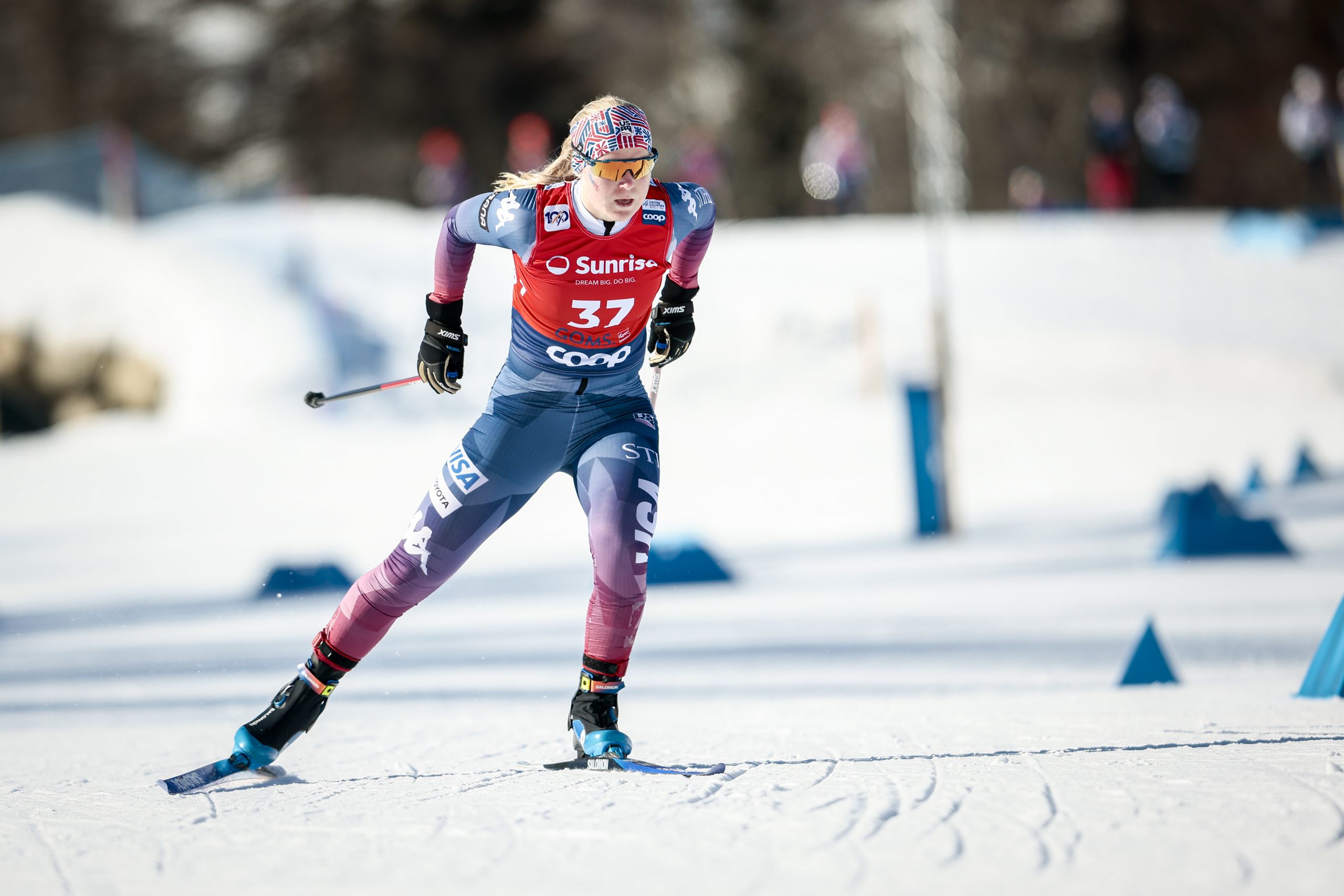
Jessie Diggins (USA) on her way to third place in the 10 k Classic Individual Start in Lahti, Finland. (Photo: Authamayou/NordicFocus)
As Jessie Diggins climbed the final hills in Lahti on Sunday, she could hear something unusual rising above the crowd noise. Scattered along the course were hand-made signs held by Finnish fans and young skiers. Many carried the same simple message: “Thank you, Jessie.”
For Diggins, racing through what has increasingly become a farewell tour of World Cup venues that have defined her career, the moment carried emotional weight. Lahti has not always been a place where the American felt the course played to her strengths, particularly in classic technique. But on Sunday, she delivered one of her most meaningful performances there, skiing to third place in the women’s 10-kilometer classic interval start.
“There were so many people out on the course with signs saying ‘Thank you, Jessie,’ and it was really emotional in the best way,” Diggins said afterward. “It was incredibly touching. Seeing all the little kids in glitter after the race was just really special.”
Frida Karlsson (SWE) on her way to the 10 k Classic win in Lahti, Finland. (Photo: Authamayou/NordicFocus)
Sweden’s Frida Karlsson powered to the victory in 25:57.6, edging teammate Linn Svahn by just over four seconds. Diggins followed in third, 6.2 seconds behind the winner, securing the 90th World Cup podium of her career — a milestone that came in her 375th World Cup start.
The podium also represented a breakthrough for Diggins in a discipline she has spent years working on. Despite her long list of accomplishments, Sunday marked her first World Cup podium in a standalone 10-kilometer classic interval start.
“The Lahti course hasn’t always suited my strengths in classic skiing,” Diggins said. “So it felt really cool to pull it together a bit more today.”
The result allowed Diggins to maintain control of both major season-long competitions. With only three World Cup stops remaining this winter, she continues to lead Sweden’s Moa Ilar by 264 points in the Overall World Cup standings and by 188 points in the Distance standings, positioning herself strongly in the race for the sport’s coveted crystal globes.
Moa Ilar (SWE) and Linn Svahn (SWE), (l-r) reflecting at the finish. (Photo: Authamayou/NordicFocus)
Svahn Sets the Early Benchmark, Karlsson Finishes the Job
With the interval format — one athlete starting every 30 seconds — stretching the field across the Lahti course, the first major time to chase appeared almost immediately.
Sweden’s Linn Svahn, starting with bib 5, was among the earliest contenders onto the course and quickly posted the fastest times through the early checkpoints. Known primarily as one of the World Cup’s dominant sprinters, Svahn skied aggressively over the opening kilometers and established the benchmark that much of the field would spend the next hour chasing.
Her time held atop the standings as racer after racer attempted to match it.
Later in the race, however, another Swede began to close the gap. Frida Karlsson, wearing bib 40, remained within seconds of Svahn through the intermediate checkpoints before edging ahead in the final kilometers.
“I was just trying to stay in my own skiing,” Karlsson said afterward. “I heard it was between me and Linn, and I was super excited to get that fight.”
Karlsson ultimately crossed the line in 25:57.6, securing the victory by 4.1 seconds over her teammate.
The win came after a brief illness, which prevented her from competing in the Olympic 50 k, but Karlsson said she was eager to keep racing despite the setback.
“I was sick after the Olympics, but I was really excited to keep racing and just do what I know best,” she said. “So I’m super glad to be here.”
Diggins, starting shortly after Karlsson, kept herself in contention throughout the race, skiing within striking distance of the Swedish pair at each checkpoint before finishing 6.2 seconds back in third place.
Linn Svahn (SWE) on her way to second place. (Photo: Authamayou/NordicFocus)
Three Different Approaches to the Same Race
The split times revealed three distinct pacing strategies among the podium finishers.
Svahn, starting fifth, set the tone early. She posted the fastest time through the opening 1.1 kilometers and maintained the lead at the 3.4-kilometer checkpoint, immediately putting pressure on the rest of the field as they left the start gate.
Karlsson, starting later in bib 40, remained just seconds behind through the early checkpoints, skiing a controlled opening before gradually closing the gap. By the middle of the race, she had moved into contention, and over the final kilometers, she proved strongest of all, ultimately pulling ahead to secure the victory.
Diggins, meanwhile, delivered perhaps the most evenly paced effort of the three. She remained within striking distance of the leaders at every checkpoint — fifth at 1.1 kilometers, third by 3.4 kilometers, and still in podium position through the final lap.
That steadiness proved decisive in the final standings. While the two Swedes battled for the win, Diggins’ consistent pace allowed her to secure third place and another important podium in the fight for the season-long crystal globes.
Jessie Diggins (USA) sprints for the finish line. (Photo: Authamayou/NordicFocus)
Diggins’ Classic Progress
Diggins’ podium also reinforced one of the season’s quieter developments: the continued evolution of her classic technique.
For much of her career, the American’s greatest moments have come in skating events, where her aggressive pacing and powerful finishing speed often prove decisive. But this season she has shown remarkable consistency in classic distance races, finishing in the top ten in every classic distance event on the World Cup calendar.
Conditions in Lahti — warming temperatures and increasingly soft tracks — placed an additional premium on ski preparation, something Diggins was quick to acknowledge after the race.
“I had great skis, which is a huge part of the equation, especially when the conditions get slushy,” Diggins said. “This podium really belongs to the team. I’m so grateful for all the hard work they put in.”
Rosie Brennan (USA) on her way to 12th place. (Photo: Authamayou/NordicFocus)
Brennan Continues Return to Form
A bit further down the results list, fellow American Rosie Brennan continued a gradual return toward form after a long battle with illness that has affected much of her season.
Brennan finished 12th (+38.6) in Lahti, a result that reflected both solid skiing and a cautious approach early in the race.
“This whole process has really been a game of time,” Brennan said. “There have been many moments when I’ve wondered if I’ll ever feel normal again in my life. But the last three days are the most normal I’ve felt racing since December 2024.”
The Lahti course, known for its steep climbs and technical demands, offered a test of efficiency in classic technique — a challenge Brennan felt she handled well.
“Lahti requires really good technical skiing,” she said. “I felt like if I could relax and focus on my classic technique, that would give me the best chance.”
Kendall Kramer (USA) working her way up one of the many Lahti climbs. (Photo: Authamayou/NordicFocus)
Kramer Finds Lessons in the Lahti Hills
For American Kendall Kramer — 42nd in 27:40.8 (+1:43.2) — the Lahti race presented a different kind of challenge: starting first.
Wearing bib 1, Kramer had the advantage of pristine tracks before the course began to break down as temperatures warmed. But the early start also meant racing without reference splits from the rest of the field.
“I was actually okay starting with bib 1 today, given the state of the tracks,” Kramer said. “They tend to break down as the race goes on, and the corners can get icy, so it was nice to have cleaner conditions early.”
Without other athletes on course to gauge pacing against, Kramer said the race became more about skiing freely and trusting her own effort.
“Racing without reference splits definitely makes pacing tougher, but at the same time it lets you ski freely and focus on your own race.”
The steep Lahti climbs also highlighted the technical demands of classic skiing at the World Cup level.
“The punchy hills were fun because I could really bound up them, which is something I haven’t done much in World Cup racing so far,” Kramer said. “But the sections where it turns into pure power striding showed me I still have a lot to work on.”
Despite the challenges, Kramer described the experience as valuable for understanding the technical standards required to compete consistently at the highest level.
“I’ve learned so much from racing here this season,” she said. “At the World Cup, every strength and every weakness gets highlighted, and that really helps show what to work on heading into the summer.”
Julia Kern (USA) catches a rest from both the climbs and the sunlight. (Photo: Authamayou/NordicFocus)
Kern Heading Home Early to Recover
Julia Kern, who finished 51st — 28:11.4 (+2:13.8) — today, said she will return home early from the World Cup circuit as she continues working through health issues that have lingered since the Olympic races.
“I’ve been battling my body on various fronts since the Olympics,” Kern said in a team media statement. “One of my strengths is showing up and continuing to try and believe despite the challenges, while also being patient and smart.”
Kern added that she will take additional time to recover while seeking answers about her condition, with hopes of returning to competition at the Stifel World Cup Finals in Lake Placid later this month.
“Right now, my body needs more time to recover and is in search of answers, so I’m headed home early with the hopes of being in a place to race in Lake Placid.”
Lauren Jortberg (USA) and Katherine Weaver (CAN), (l-r) charge for the line. (Photo: Authamayou/NordicFocus)
Jortberg Gets a Front-Row Look at Karlsson’s Pace
For American Lauren Jortberg — 55th in 28:32.7 (+2:35.1) — the Lahti race offered a unique opportunity to measure herself against one of the sport’s best.
Early in the race, Jortberg found herself skiing behind Sweden’s Frida Karlsson for several kilometers as the eventual winner was completing her second lap while Jortberg was still on her first.
“I skied with Frida for about three kilometers, which was really cool,” Jortberg said. “She’s obviously a beast, and it was cool to hang with her and get a taste of what that pace actually feels like.”
Jortberg said the experience offered valuable insight into the demands of racing a 10-kilometer interval start at the World Cup level, where pacing often means pushing near maximum effort from the start.
“Ten-k pacing on the World Cup is basically as hard as you can go the whole way,” she said. “It’s about learning how to navigate that kind of effort and still ski your own race.”
She added that the race reinforced both the progress she has made in classic technique and the areas she hopes to continue developing as she gains more experience at the international level.
“I’m really proud of how my classic skiing is coming along,” Jortberg said. “There’s still a lot to work on, but it was definitely a good first start in a distance race.”
Jortberg said she hopes to carry the fitness and lessons from Lahti into the next stop on the World Cup circuit in Drammen, Norway.
Emma Albrecht (USA) giving it everything she can all the way to the finish. (Photo: Authamayou/NordicFocus)
Albrecht Sees the Margins Up Close
Further back in the start order, fellow American Emma Albrecht — 58th in 28:50.7 (+2:53.1) — experienced firsthand just how tight the margins can be in World Cup distance racing.
“The tight margins were shown by skiers finishing at similar times,” Albrcht said after the race. “For me, I was not passed, and I did not pass anyone. Which meant the skiers in front and behind me were skiing at a similar pace to me.”
Like Kramer, Albrecht said the steep Lahti climbs emphasized the technical demands of classic technique, particularly the efficiency required to stride uphill without losing grip.
“The uphill sections are the most technical and demanding here,” she said. “The climbs in Lahti are steep, and striding up efficiently requires really good technique to avoid slipping.”
For Albrecht, the race served as a clear reminder of the areas she hopes to refine moving forward.
“One of my biggest takeaways is that I want to keep working on my striding technique and get better at adjusting my tempo based on the terrain.”
Dariya Nepryaeva (AIN) and Novie Mccabe (USA), (l-r) come to the line. (Photo: Authamayou/NordicFocus)
Other North Americans in the Field
Novie McCabe raced her way to 43rd in 27:45.0 (+1:47.4) in the 64-skier field.
For Canada, Jasmine Drolet led the team in 41st place with a time of 27:39.8 (+1:42.2). Liliane Gagnon finished 46th in 27:56.4 (+1:58.8), and Katherine Weaver placed 59th in 29:00.9 (+3:03.3). Teammate Olivia Bouffard-Nesbitt, who had been listed on the start sheet, did not start the race.
Take a bow, Jessie Diggins (USA) . (Photo: Authamayou/NordicFocus)
The Season’s Final Push
Sunday’s race in Lahti brought us even closer to the end of the season, now with only two sprint races and three distance races remaining until the sport’s biggest prizes will ultimately be decided.
For Diggins, the third-place finish represented more than another podium in an already historic career. It also reinforced the remarkable consistency that has defined her season. With top-10 finishes in every classic distance race this winter, she has transformed what was once considered a relative weakness into one of the foundations of her bid for both the Overall and Distance crystal globes.
Three stops remain on the calendar: the classic city sprint in Drammen, Norway, the iconic 50-kilometer race at Holmenkollen in Oslo, and the Stifel World Cup Finals in Lake Placid, New York.
For Diggins, those races now carry both competitive stakes and emotional significance. As the American continues what has increasingly felt like a farewell tour across the World Cup circuit, the crowds that gathered along the Lahti course on Sunday offered a glimpse of how much her career has meant to fans of the sport, not just in the United States, but all around the world.
And as Diggins pushed across the final climbs toward the stadium — signs waving, glitter-clad children cheering from the side of the course — she did what she has done so often over the past decade: she kept fighting for every second and left everything she had, once again, on the course.
Feature stories like this one take time, access, and care to produce. If you value thoughtful storytelling and independent ski journalism, please consider becoming a Voluntary Subscriber. Your support directly fuels the work we do to cover the people, places, and moments that make our sport special.
Linn Svahn (SWE), Frida Karlsson (SWE), and Jessie Diggins (USA), (l-r) share the 10 k Classic podium in Lahti, Finland. (Photo: Authamayou/NordicFocus)
Devon and Nat bring you more podcast content from stages one and two of the Tour de Ski, which is proving to be a further headache for those responsible for selecting Norway’s Olympic team. We’ll be back after the next two stages. Thanks for your support.
Keep the questions and feedback coming; also, we’ve gotten surprisingly little hate mail this year…just saying. Reach us at devon[at]fasterskier.com and nat[at]fasterskier.com.
Love Stories Like This? Help Keep Them Coming.
Feature stories like this one take time, access, and care to produce. If you value thoughtful storytelling and independent ski journalism, please consider becoming a Voluntary Subscriber. Your support directly fuels the work we do to cover the people, places, and moments that make our sport special.
This coverage is made possible through the generous support of Marty and Kathy Hall and A Hall Mark of Excellence Award. To learn more about A Hall Mark of Excellence Award, or to learn how you can support FasterSkier’s coverage, please contact info@fasterskier.com.
Mattis Stenshagen (NOR) took stage two of the Tour de Ski in Toblach (ITA). (Photo: Vanzetta/NordicFocus)
By the time the final seeded skier pushed through the finishing straight in Toblach, the race had already revealed what interval starts always do best: not who looks fastest, but who stays fastest when no one is there to help.
On a clear, cold Monday morning in northern Italy, the men’s Tour de Ski distance competition began in earnest with a 10-kilometer classic interval start — a race that rewards patience, punishes impatience, and exposes any weakness in pacing, technique, or timing. For some, it was a statement. For others, a warning. For nearly everyone, it was a reminder that the Tour de Ski is less a series of races than a slow accumulation of consequences.
At the front of the field, Mattis Stenshagen (NOR) delivered the cleanest distance race of his World Cup career, leading from the opening checkpoint to the finish and winning Stage 2 in 22:11.0. Behind him, familiar names followed — Johannes Høsflot Klæbo and Emil Iversen — but the day belonged to the skier who never wavered, never overreached, and never gave back time once he took it.
Mattis Stenshagen (NOR) led wire to wire in the 10 K Interval Start Classic. (Photo: Vanzetta/NordicFocus)
A Classic Race, Skied Classically
From the opening 2.1-kilometer split, Stenshagen established a rhythm that no one else matched. His early advantage was not explosive, but it was decisive: a smooth, efficient tempo that translated into the fastest time at every checkpoint — 2.1 km, 3.0 km, 5.0 km, 6.7 km, 8.0 km — and ultimately at the finish.
Behind him, the race for the podium unfolded with more complexity.
Klæbo, starting later with the gold Tour de Ski leader’s bib, skied conservatively through the opening kilometers, conceding small amounts of time before gradually tightening the gap. His second-half splits were among the fastest in the field, but by then Stenshagen’s advantage was already established. Klæbo finished 8.9 seconds back, a strong result that preserved his overall lead without demanding unnecessary risk.
Iversen followed a similar arc — controlled early, assertive late — but never quite bridged the gap to Klæbo, finishing third at +10.1. Behind the podium, the field compressed quickly, with Iivo Niskanen, Edvin Anger, Erik Valnes, and Harald Østberg Amundsen all skiing within seconds of one another through the middle splits before settling into their final placings.
It was the kind of race that rewards experience — and punishes even small mistakes.
Johannes Hoesflot Klaebo (NOR) kept close to the lead on the day and preserved his Tour de Ski lead. (Photo: Modica/NordicFocus)
Norwegian Depth, Olympic Stakes
If the Tour de Ski is often described as a test of endurance, for the Norwegian men it is also something else entirely: an extended job interview.
With the Olympic Games returning to Italy in February, every race carries an added layer of pressure. The margins between selection and omission are thin, and performances like Stenshagen’s matter not just for podiums, but for perception. Beating Klæbo, Iversen, Valnes, and Amundsen head-to-head in a classic interval start sends a message — especially when it is done decisively.
Emil Iversen (NOR) continued making his case for one of the valuable Norwegian Olympic team spots. (Photo: Vanzetta/NordicFocus)
The depth of the Norwegian field was evident throughout the top ten, but Stage 2 clarified one thing early in the Tour: no spot is guaranteed beyond Klæbo, and even he is racing with calculation rather than abandon.
Gus Schumacher (USA) led the American men in the 10 K Classic Interval Start in Toblach (ITA). (Photo: Vanzetta/NordicFocus)
Schumacher Leads the Americans on a Complicated Day
For the U.S. men, the day unfolded with a mix of promise and frustration — a pattern that became clear as the split times accumulated.
Gus Schumacher emerged as the top American finisher, placing 17th, just under 50 seconds back. His race was defined by steadiness rather than volatility, with consistent splits that kept him in contact with the top 20 throughout the day. In a Tour de Ski that rewards durability as much as peak form, Schumacher’s result positioned him solidly in both the stage results and the overall standings.
Still, Schumacher felt there was more on the table.
“The pacing wasn’t amazing,” he said. “It was close to the race I expected, but it could have been a bit better with a little more energy over the last two or three kilometers.”
Part of that equation came down to ski feel — specifically, kick wax that required more effort than anticipated.
“I think my kick was slightly slipperier than I expected based on how it felt in testing,” Schumacher said. “Having to work for the kick more than I planned on the second lap tilted the scales of my pacing a bit. Overall, it was a solid day, but some small changes could have made a big difference.”
Rather than holding back, Schumacher said he plans to continue racing the Tour aggressively, while being deliberate about recovery away from the course.
“This year’s Tour doesn’t feel too hard, so managing load isn’t really on my mind during the races,” he said. “Outside of racing, I’m trying to give myself a lot of quiet time, but I don’t feel any reason to hold back in my efforts.”
His goals for the Tour strike a careful balance between ambition and pragmatism.
“I want to end up top 10, but most of all I want to finish,” Schumacher said. “A lot of my focus is on doing everything i can to avoid getting sick.”
Zak Ketterson (USA) was sharp early during the 10 K Classic in Toblach (ITA). (Photo: Vanzetta/NordicFocus)
Zak Ketterson’s Race Changes in an Instant
Through more than seven kilometers, Zak Ketterson was skiing the way he had during the first part of the season.
His early splits placed him firmly in contention for a top-15 finish, and as he crested the final significant climb with just one uphill remaining, the trajectory of his race appeared set. Then, in an instant, it wasn’t.
“This race was going really well for me up until I crashed on a really high-speed downhill at about 7.3 kilometers,” Ketterson said. “I was fighting for a top-15 finish and had just one uphill left to go.”
The fall itself was only the beginning.
Zak Ketterson (USA) continued his form from November and December through most of the race before a crash changed his day. (Photo: Vanzetta/NordicFocus)
“After I got up, my muscles got insanely stiff, and I felt really dizzy and disoriented,” he said. “I honestly thought about DNF’ing at that point and was just in survival mode to the finish.”
The split data tells the story clearly: a sharp loss of time between the 7.1- and 8.0-kilometer checkpoints, followed by a fight simply to reach the line. Ketterson finished well outside his early-race position, but his performance before the crash suggested a level of classic skiing that bodes well for the remainder of the Tour and beyond.
“I’m feeling okay now — I don’t think I injured anything, but I’ll see how things feel over the rest of the day,” he said. “My shape feels good, so hopefully I’m back in the fight on Stage 3.”
Ben Ogden (USA) looked strong early in Toblach (ITA). (Photo: Modica/NordicFocus)
Ogden’s Setback Comes Early
For Ben Ogden, the defining moment came much earlier in the race.
Based on the split times, Ogden’s momentum shifted between the 3- and 5-kilometer checkpoints, where a promising early pace gave way to a sudden loss of time. The cause was broken equipment — and a prolonged scramble to find a usable replacement.
“I broke a pole right around three kilometers — maybe a little before,” Ogden said. “After that, I was kind of swapping poles until I finally got one that was the right side and the right length, which was a bummer.”
What followed was an unusually long stretch of improvisation in the middle of a World Cup race.
“I was swapping poles for probably two and a half kilometers,” he said. “I think I swapped four times — from an Italian coach, to a Swiss coach, to an American coach, and then finally to one of my own spare poles that was the right height and side.”
Ogden eventually crossed the line in 46th, a result that understated how well he felt he was skiing before the incident — and how difficult it was to mentally reset afterward.
Ben Ogden (USA) crosses the line in Toblach (ITA) with a trail of random poles scattered throughout the course behind him. (Photo: Vanzetta/NordicFocus)
“It was hard to get back into it mentally,” he said. “But I felt like I skied pretty well over the last couple of kilometers, so I was happy with that. I definitely wish I could have put together the race I felt capable of.”
From a Tour de Ski perspective, the lost time was costly. But Ogden emphasized that his broader season goals remain intact.
“My biggest goals this year aren’t in the Tour,” he said. “I still feel like I can take steps toward my big goals this year and feel good about that. These tours can change really quick. I’ve been in the top five in the Tour, and then after one race, I’ve been 40th, so maybe the same will happen in the opposite, but, yeah. Definitely just keep my eye on my main goals this year and trying to stay positive and keep fighting.”
Antoine Cyr (CAN) during his second World Cup race this season. (Photo: Modica/NordicFocus)
A Canadian Return to the World Cup
Stage 2 also marked a quiet but meaningful milestone for the Canadian men, who arrived in Toblach for their first World Cup races of the season after holding Olympic trials in Canada before Christmas.
Antoine Cyr led the Canadian contingent with a solid performance just outside the top 20, while teammates followed in behind. For a group using the Tour de Ski as both a competitive platform and a form-building block toward February, the results offered a baseline — not definitive answers, but a starting point.
Johannes Hoesflot Klaebo (NOR), Mattis Stenshagen (NOR), Emil Iversen (NOR), (l-r) take the podium of the 10 K Classic in Toblach (ITA). (Photo: Vanzetta/NordicFocus)
The Long View of the Tour
The Tour de Ski rarely reveals its winner on the first distance day. Instead, it reveals tendencies: who overreaches, who fades late, who absorbs pressure, and who survives adversity without letting it define the week.
In Toblach, Stenshagen showed he could control a race from the front. Klæbo showed he could defend without exposing himself. Others — Ketterson among them — showed flashes of form that mattered more than a single line in the results.
By the time the Tour leaves Toblach for Val di Fiemme, the standings will shift again. Fatigue will accumulate. Risks will sharpen. And the races will begin to resemble not just World Cups, but rehearsals.
In Italy, on familiar snow, the men are already practicing for something larger.
Feature stories like this one take time, access, and care to produce. If you value thoughtful storytelling and independent ski journalism, please consider becoming a Voluntary Subscriber. Your support directly fuels the work we do to cover the people, places, and moments that make our sport special.
World Cup skiers get a holiday break from the grind of the World Cup tour . . . but it’s up for debate just how much rest they get during that break. It’s gotta be tough to relax when the horizon is clouded by the impending approach of the Tour de Ski, possibly the most daunting challenge that skiers will face all season. As a ski-fan, I just adore the Tour de Ski—day after day of racing and competition and drama, staged for the edification of the viewing audience. If I were a World Cup skier, I think I might feel differently, especially during an Olympic year.
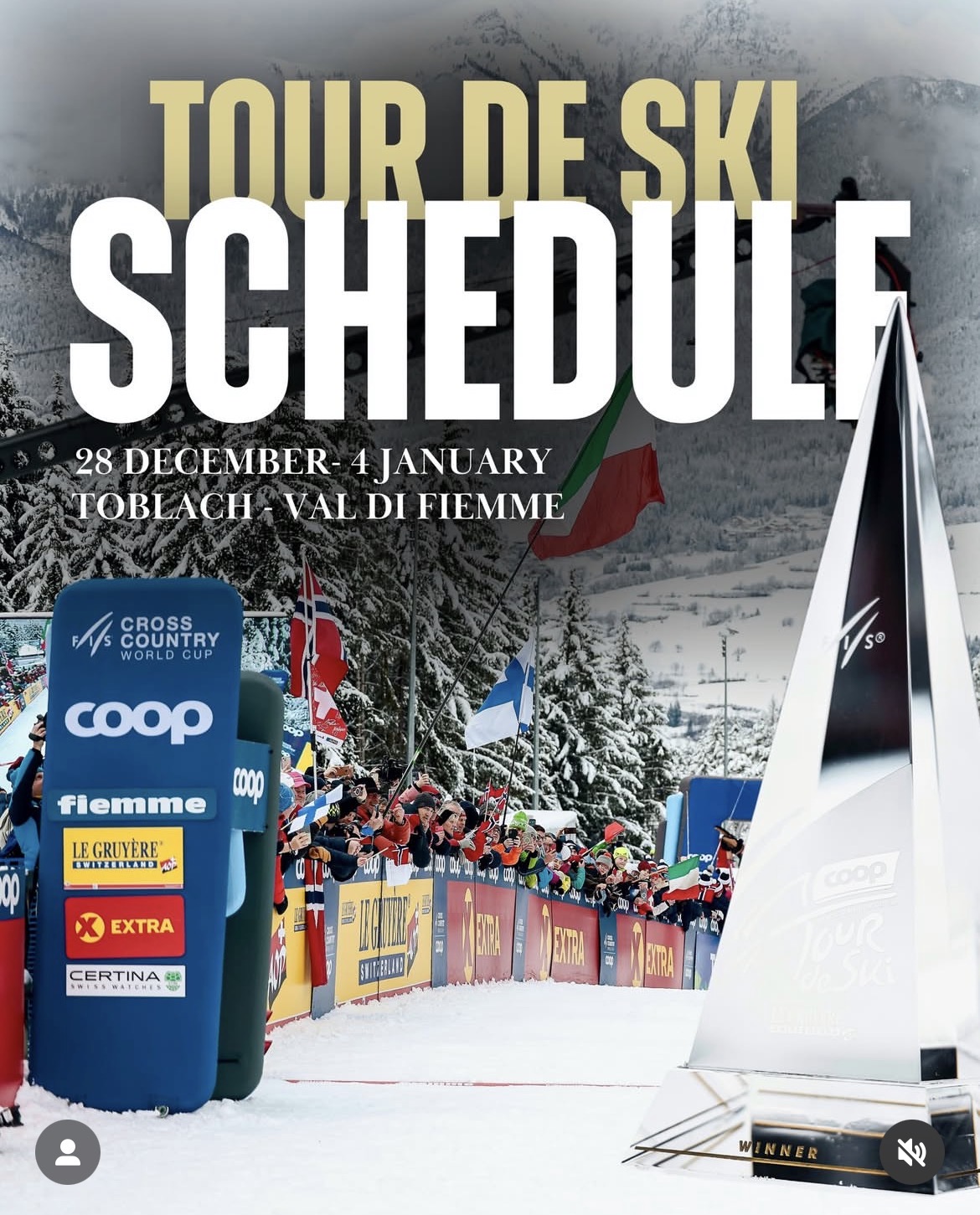
Over the span of eight exhausting days—Dec 28-Jan 4—Men’s and Women’s fields will each race six events from Sprints to Interval Starts to the the unbelievably steep and seemingly endless climb up the Alpe Cermis. Nearly insurmountable leads in FIS World Cup points are amassed by the winners of the Tour de Ski; most years, the eventual winner of the World Cup Overall Crystal Globe is the same as the winner of the Tour de Ski . . . except in those seasons—like 2025—when the Tour winner skips most of the other World Cup races in anticipation of a larger prize like the World Championships or the Olympics. In 2026, most of the primary Olympic contenders have also signed up for the Tour de Ski.
Tour Streaming
As has been the case for numerous years in a row, North American viewers can stream the 2026 Tour de Ski on skiandsnowboard.live. The website adjusts to the home-area of viewers, so the broadcast time on the thumbnail corresponds to your local viewing time. Yes, the races stream in brutally early time slots, especially for viewers on the west coast. Get up early anyway . . . it’ll be worth it.
The championship of the Women’s Tour de Ski is likely to be contested among Jessie Diggins (USA), Frida Karlsson (SWE), Heidi Weng (NOR), and Astrid Oeyre Slind (NOR), and Norwegian upstart Karoline Simpson-Larsen (fresh off her recent win in the World Cup 10 k Interval Start in Davos). Certain contenders are choosing to stay home—Linn Svahn (SWE), Jonna Sundling (SWE)—thus opening up additional spots in Sprint heats for all-rounders who might not normally advance on Sprint days.
Johannes Hoesflot Klaebo’s prowess in Sprint events—and his competitive resilience in Distance events—makes him nearly impossible to beat in the race for the Crystal Globe. Even if he does not win the Tour—even if he drops out of the Tour—he’ll likely secure another Overall Crystal Globe if he remains healthy and stays on the World Cup Tour. Though if the Olympics deliver him another amazing week like the one he constructed at last year’s World Championships (where he won an unprecedented six out of six races), Klaebo just might sail off into a well deserved sunset, leaving World Cup scraps for other contenders to scrabble over.
After growing up in the Twin Cities, Zak Ketterson embarked on an experiment this past year, moving to Oslo and training with a Norwegian team. The decision paid off with a top-10 on the World Cup. With Devon focused on family during the Christmas season, Nat caught up with Zak to hear about training, racing and how he covers his financial obligations as a non-U.S. Ski Team athlete.
Speaking of financial obligations: We’re really trying to pump up our fundraising with just over one month before Nat heads to the Olympics — an event we’re really looking forward to but one that also comes with significant expense. You can become a voluntary member at here. If you’re already a member, thank you.
We’ll be back soon. Reach us at devon[at]fasterskier.com and nat[at]fasterskier.com. Thanks for listening.
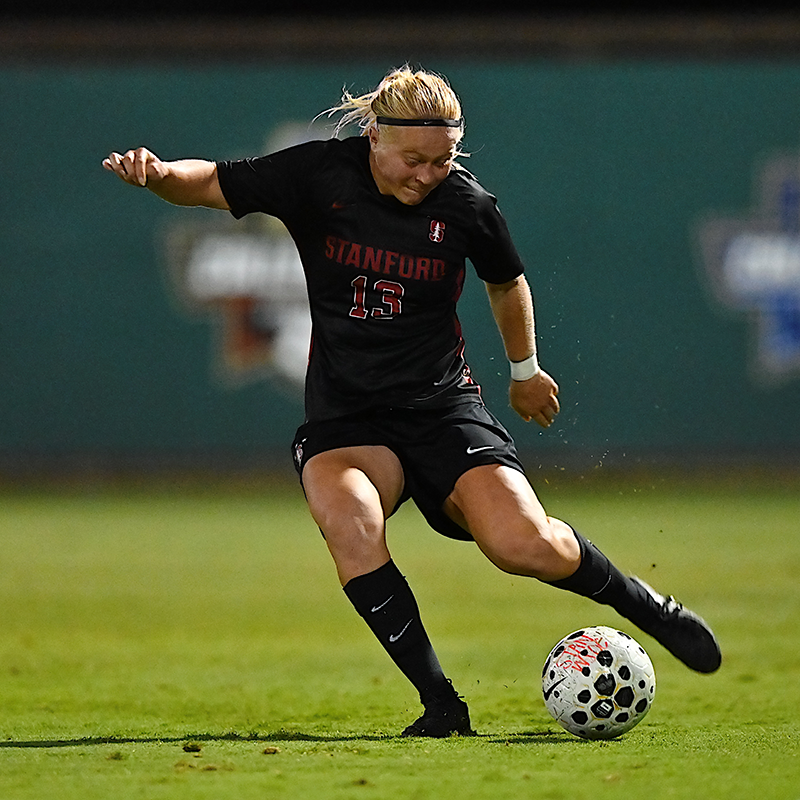
On Friday afternoon, as World Cup sprinters snap into their skis in Trondheim and the SuperTour fields gather in Fairbanks, one of the United States’ most electrifying young Nordic athletes will step onto an entirely different stage. Stanford University, the No. 1 seed in the NCAA Women’s Soccer Tournament, is marching toward the College Cup—and at the center of it all is a player who, in just a matter of days, will also begin her bid for the U.S. Olympic Cross-Country Ski Team.
The athlete is Sammy Smith: 20 years old, a national-team skier, an Environmental Systems Engineering major, and a starter for one of the most dominant college soccer programs in the country. The U.S. Ski Team views her as one of the most promising sprinters of her generation. And yet this weekend, instead of warming up on hard-packed snow in Norway or chasing early-season points in Alaska, she’ll be preparing to face Duke with advancing to the NCAA Championship Game on the line.
“Get ready to cheer for one of the U.S. Ski Team’s top skiers this weekend,” you might tell Nordic fans. “Just… not on skis.”
From the outside, the collision of seasons looks impossible to manage. For Smith, it is simply the life she has known since childhood.
Idaho in Two Parts
Smith grew up in a pattern that almost feels mythic now: winters in Sun Valley, summers and the rest of the year in Boise. Her family built the rhythm—her mom moving the kids north each winter so they could ski full-time and homeschool them in those snowy months.
“I kind of grew up splitting time between Boise and Sun Valley,” Smith says. “My mom would move up to Sun Valley during the winter with my siblings and me so we could ski, and she would homeschool us up there… I did that all through high school.”
In Boise, she was a typical public school student. In Sun Valley, she became a multi-sport anomaly. Her childhood was not just active—it was encyclopedic.
“Growing up, I played about every sport one can imagine,” she says. “I ran track and cross country all through high school… I played hockey for a long time. Played football. Yeah, like, you name it, I pretty much did it.”
Soccer was the constant. She started as soon as a child could sign up—though the Smiths occasionally bent age rules to make sure she could play with older kids. When her older sister started soccer, she was right behind her.
“It’s probably like three years old when I started,” Smith says.
And then there was freestyle skiing—a considerable part of her identity, something she expected to pursue more seriously than Nordic. Until one day, she couldn’t.
“I ended up fracturing my tibia in my sophomore year,” she says. “And so I focused on Nordic that winter… I ended up having a great season, and then haven’t really looked back since.”
The transition was abrupt, but the groundwork had already been laid: years of downhill confidence, years of skiing, years of learning to read terrain and push limits.
“I’ve been on skis my entire life,” she says. “Very comfortable on downhills… I love to ski aggressively.”
The athlete emerging in those years was already something unusual. The athlete she would become—balancing multiple sports at world-class levels—was still unimaginable.
Against the Specialization Tide
From the outside, Smith’s career appears to defy the common wisdom of modern youth sports. Increasingly, top athletes specialize early; by high school, many are all-in on one discipline.
Smith resisted that. Not because she lacked ambition, but because multiple sports gave her joy—and made her better.
“I think that’s something I’ve really thought a lot about,” she says. “There’s been more and more pressure to specialize… but growing up and doing so many different sports just kind of added to different components of skiing that I think are really important.”
Soccer, for example, translates directly into sprint racing.
“It’s a very high-paced game,” she says. “There’s a lot of change of direction, a lot of accelerating and decelerating. Particularly when you’re looking at heats, a lot of it is reacting to other people’s moves, trying to find little gaps and squeeze through.”
The skill set becomes a competitive edge: quickness, agility, and decision-making under pressure.
“That ability to shift gears really quickly and take openings when you can really emulates in soccer,” she says.
Freestyle skiing contributed something else entirely: creativity and courage on skis, especially in chaotic or technical downhill sections.
“At World Juniors last year,” she recalls, “everyone was in the track. I hopped out of the track, went far on the inside, and just double poled… It was a risky move, but it was something I saw.”
She paused for only a moment before going all-in. It worked.
The blend—soccer fuel, freestyle instinct, Nordic engine—gives her a uniqueness rarely seen in American skiing.
U.S. Ski Team head coach Matt Whitcomb sees it clearly.
“She’s a world-class athlete,” Whitcomb says. “She’s already exhibited the early signs of being a World Cup star.”
That she is doing this while starting for Stanford’s soccer team? To him, it’s not a contradiction. It’s part of the magic.
Why Stanford — and Why Now
Choosing Stanford was not simple. Smith had options—many of them. But a few factors stood out.
“I really value my education,” she says. “Stanford’s a great school. It’s where my mom went. And my sister is also on the soccer team, so the opportunity to get to play college soccer with her is pretty hard to pass up.”
Her academic path—Environmental Systems Engineering with an energy concentration—fits a pattern among elite U.S. skiers. Many of the top men (Gus Schumacher, Ben Ogden, et al.) have gravitated toward engineering. Smith sees the overlap, too.
“You look at a skier and the training that they do,” she says. “They’re very self-motivated, very committed. So I’m sure certain aspects translate pretty well.”
The challenge, of course, is that Stanford is far from snow. It is not close to ski culture. It is not close to the European World Cup circuit. It is very near, however, to one vital piece of equipment:
“Fortunately, I have a classic roller-ski treadmill… in a little office space,” she says. “That’s been an irreplaceable part of my training.”
She uses it for high-quality sessions, often squeezed between classes, labs, or soccer obligations. Running remains a central component, helped by the demands of soccer conditioning.
But she knows her preparation is different—less volume, more precision. Not ideal. Not textbook. Not expected. And yet:
“I think I’ve tried to accept that,” she says. “I know that I am not at my best, but skiing is a sport you can do for a very long time. I don’t necessarily need to be the best skier I can be at 20 years old.”
Again, Whitcomb backs the long view.
“We’re willing to postpone that timeline,” he says. “We’re just happy for Sammy being happy in her current environment. We’ll take what we can get at this moment, but we want more down the road, and we’re excited for it.”
This, in many ways, is the crux of the story: the U.S. Ski Team is betting on Sammy Smith not despite her dual identity, but because of it.
Samantha Smith (USA) racing the World Cup individual sprint in Goms (SUI). (Photo: Modica/NordicFocus)
The Final Four — and Then the Sprint Start Line
The most astonishing part of Smith’s season is its timing.
If Stanford beats Duke on Friday in Kansas City, they move directly to the College Cup championship game. The semifinal is December 5th; the final is December 8th, Monday. Smith has already mapped out the days that follow.
“We’ll get back Tuesday night from Missouri… I have a final at 8 a.m. Wednesday morning,” she says. “I’m going to fly out right after my final, and then I’ll have one day of snow on Thursday in Alaska, and then I’ll be hitting that sprint on Friday.”
She says this calmly, matter-of-factly, like someone describing a standard weekend trip.
The Anchorage SuperTour sprint is not just any race—it is her re-entry into skiing, her first day on snow of the season, and a crucial tune-up before U.S. Nationals in Lake Placid, where she hopes to qualify for the Olympic team.
The Anchorage races, she says, are not performance indicators—they are simply a way to “bust the rust off.”
“Obviously, a lot of other skiers will have been on snow for well over a month, and I won’t,“ she says. “It’ll just be an opportunity to get on skis, do something fast.”
Her real focus is the 10-day window between Anchorage and Lake Placid.
“For me, as more of a sprinter, and the way the criteria is set up, I’ve got to target the qualifiers,“ she says. “So being really deliberate… knowing exactly what I’m going for.”
The stakes are simple: she must race well at U.S. Nationals to have a shot at Milano-Cortina.
The stakes are also massive.
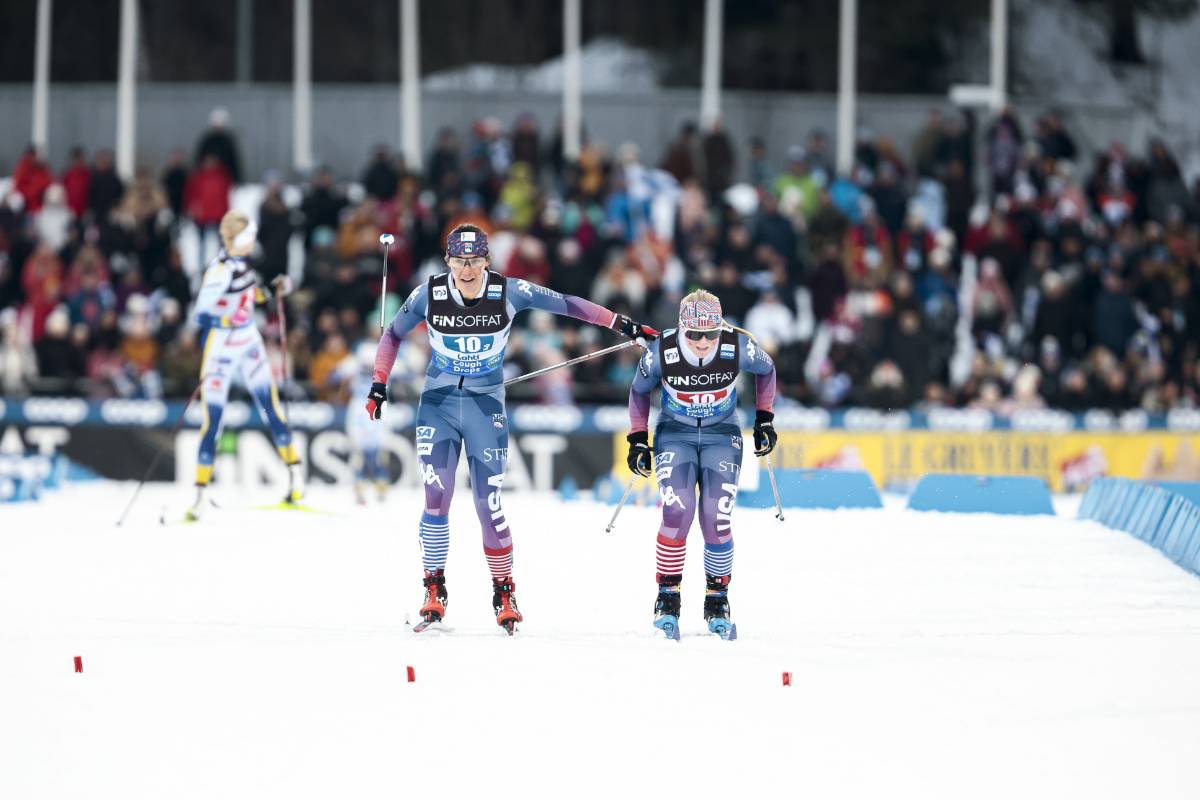
Julia Kern and Sammy Smith paired up for the Team Sprint in Lahti (FIN). (Photo: Nordic Focus)
The Domestic Gamble
If Smith had a regular ski season—if she weren’t in the NCAA Tournament—she might have chased World Cup points, fought to crack the top 45, and used international racing to establish selection priority.
But that route is closed.
“If you’re only racing a few of the international races, it’s incredibly challenging to get into that top 45,“ she says. “Whereas if you were able to do all of them, it’s a lot more feasible.”
She knows she has “had some really good World Cup sprints,“ and she wonders—without bitterness—what might be possible in a different academic or athletic setup.
But this year, it is the domestic route or nothing.
“That’s what I’m planning on,“ she says. “I need to have some killer races at U.S. Nationals.”
What sounds like a gamble is, for her, simply the version of the sport she can access this season. And she is okay with that.
“Just being consistent… being intentional,“ she says. “Doing what I can.”
Who She Wants to Be
Ask Smith what success looks like decades from now, and she doesn’t list medals or championships.
“You look at Jessie’s legacy,“ she says, referencing Jessie Diggins. “The amount of skiers she’s inspired and how much she’s done for the sport… I want people to look back on my career and feel like I’ve done a lot for the sport, inspired the younger generation of skiers, and brought a lot back to my community.“
It is the kind of answer that feels too mature for her age, but entirely in character.
She is not racing to avoid mistakes—she is racing toward something: possibility, growth, a long future. Maybe a future on the World Cup. Maybe a future in engineering. Maybe a future doing both.
But first, she has Duke.
Samantha Smith (USA) racing the World Cup individual sprint in Minneapolis (USA). (Photo: Modica/NordicFocus)
The Athlete You’ll Watch Twice This Month
When you tune in this Friday—whether you are a Nordic diehard refreshing live timing from Trondheim, or an American fan checking SuperTour results—remember that one of the most important U.S. prospects in cross-country skiing will be competing too. She just happens to be wearing soccer cleats instead of ski boots.
And next week, she’ll be back on snow, sprinting against the country’s best, staking her claim for a place on the Olympic team.
The duality is not a distraction for Sammy Smith.
It is her identity.
It is what built her.
And it might be what carries her into the future of American skiing.
“She’s been playing a ton this year,“ Whitcomb says. “Of course, we want her all to ourselves… but we want more down the road, and we’re excited for it.”
This weekend, she wants one thing: a berth in the College Cup Final.
Next weekend, another: a ticket to the Olympics.
Two worlds.
Two uniforms.
One athlete.
A lot of people will be cheering for Sammy Smith this month. Nordic fans just get to do it twice.
*You can watch #1-ranked Stanford vs. #2-ranked Duke in the women’s College Cup semifinal tomorrow, Friday, December 5, at 8:45 p.m. EST on ESPNU. The game can also be streamed on the ESPN app, Fubo, or Hulu.
Love Stories Like This? Help Keep Them Coming.
Feature interviews like this one take time, access, and care to produce. If you value thoughtful storytelling and independent ski journalism, please consider becoming a Voluntary Subscriber. Your support directly fuels the work we do to cover the people, places, and moments that make our sport special.
Somewhere over the Atlantic, on a red-eye to another winter in Europe, Ben Ogden opens his laptop and stares at a grid of digital joinery. Tiny posts, miniature knee braces, angled mortises — a small timber-frame sauna, scaled down to the dimensions of an airline tray table. He sketches in precise strokes, clicking through angles and offsets, rotating the model the way he rotates race courses in his head: looking for structure, looking for flow.
“I learned CAD in college,” he says. “Something that I hope to use in a future career post-skiing. It feels good to keep those skills up.” For the past several winters, Ogden has leaned into his engineering degree, which he earned at the University of Vermont. When you talk to him outside of training and racing, you realize this engineering mind was not learned at UVM; it is deeply ingrained in who he is, who he has always been. On planes, in wax truck corners, in small Scandinavian hotel rooms, he opens the software that once helped him model truss systems for class projects. Now, it helps him breathe.
“It kind of gives me a good outlet,” he says. “It’s exactly like you say — the projects in the summertime are fun, and you learn a lot, but ultimately for me the biggest reason to do them is that it gives me this outlet from skiing… gives me a break from everything that’s going on.”
This winter’s project is ambitious in a miniature way: a timber-framed sauna built from small hand-cut pieces, a practice run for a full-sized dream he can’t yet afford the time or money to tackle. In his travel bag, he carries a book — The Art of Japanese Joinery — the same way another skier might carry a novel. “I’m gonna use my CAD software and sort of build all the little pieces,” he says. “Then I’ll have a little plan for what joints get cut where.”
The sauna will be small. The intention behind it is anything but.
Like many New Englanders, Ben Ogden has made it a tradition to conclude his season every spring at Cochran’s Nordic Cross at Cochran’s Ski Are in Richmond, Vermont. (Photo: Courtesy Photo)
Vermont Roots, Wide Horizons
Ogden left for Finland on November 17 — a date marked not with dread, but with a kind of vibrating readiness. “I’m super pumped,” he says. “This season has come with more anticipation than any other.” Partly because it’s the Olympic year, but also because he feels “a little bit better equipped” each season, even as he accepts that no amount of planning can smooth the chaos of a World Cup winter.
“There’s guaranteed curveballs and sicknesses and highs and lows,” he says. “You can only manipulate that so much… at a certain point, you just have to get going.”
He arrived in Europe later than many teammates. While some seek early-snow training blocks, Ogden stays in Vermont — a deliberate choice, not an oversight. “I decided not to change that this year,” he says. “It’s important for me to be home, and the season is very long. I didn’t really want to elongate that by going to Europe or finding snow pre-Finland.”
That choice means his first days on snow in Ruka can feel awkward, but the tradeoff is worth it. It’s also an expression of who he is. Ogden’s identity is tied to Vermont in ways both obvious and subtle — in his work ethic, his self-sufficiency, and the ease with which he moves between elite training sessions and OD runs with college teams.
He feels tugs of longing, at times, when he thinks of the powerhouse men’s group training year-round with Alaska Pacific University. But the pang is mild, not consuming. “I do,” he admits, “feel a little bit” of FOMO. But he has “recognized the importance for me to just kind of live my own life, be a little bit removed from the intense, Nordie vibe all the time.”
Staying rooted means staying whole. It also means arriving each winter hungry for the team environment, not burnt out from it.
It is unusual for a top U.S. skier to build a World Cup foundation outside of a mega-group or a Western training hub. But Ogden sees the value in his separateness. “I kind of took pride in the fact that I was a little bit different,” he says. “Came from a different group and was able to mesh right in when we did come together.”
This, too, is its own kind of engineering: building stability into a system that demands constant travel, constant performance, constant uncertainty.
The Body as a Machine, the Mind as a Circuit
When Ogden talks about training, he toggles easily between the physical and the psychological — but if asked which is more important, he leans toward the mind.
“I think… ski training is a combination of physical and mental adaptations,” he says. “It can be fun to think of things as mental adaptations. I like to, because the power of the mind is just so huge.”
In the fall, he transitions into higher-intensity workouts earlier than he did in college, where the NCAA season starts late and dictates the timeline. “It’s just really good,” he says, “because I find that coming to Ruka and getting into the race season… I’ve had to remind myself what it feels like to go hard for that long.”
That reminder is primarily mental. Hard workouts aren’t just about generating lactate or cardiovascular strain; they’re about rehearsing discomfort.
“You have to learn how to push yourself,” he says. “You have to learn how to go hard, and you have to learn how to pace for a 10k… that, to me, feels like a mental battle.”
This is where his internal monologue — the one few athletes talk about, but all experience — becomes central to his craft.
His best sessions come when he stops listening to the noise inside his body — the burning legs, the heavy breathing — and instead directs his mind outward. “My best races… come when I’m not dwelling on ‘my legs hurt’ or ‘I’m breathing really hard,’” he says. “I’ll be thinking: ‘All right, the top of the hill is right there. I’m gonna push hard until there, and after that I’ll figure it out.’”
But the ideal and the real don’t always align. Not every October time trial feels like a breakthrough. Sometimes he finishes intervals worried that the heaviness in his legs signals doom for the season ahead.
“You sort of forget that you’re still training hard otherwise,” he says. “You don’t have respect for the fact that you’re just tired… it wasn’t a day you wanted to be in peak form, so you’re not.”
In those moments, doubt tries to multiply. It’s a habit of the mind he has learned to anticipate. And anticipation is power.
“When it happens, you can say, ‘Remember, I knew this was gonna happen,’” he says. “Every time, I’ve been happier if I don’t allow it to take over.”
Landmarks on the Course, Checkpoints in the Head
Ogden’s most vivid explanation of mental strategy comes when discussing something humble and universal: a hill in a cross-country running race.
If you tell him two high school runners are nervous about a big climb at the two-mile mark. His response is instant and intuitive — as if he’s revisiting a dozen races at once.
“I would set goals on the course,” he says. “Each goal would have a physical location attached to it.” A tree. A signpost. A bend in the trail. Something visible and near.
He creates segments rather than distances—dividing the race into digestible tasks rather than one looming ascent. “You can really make a hill feel like nothing,” he says, “because you’re like, ‘Okay, I know I can do it if I check these boxes.’”
He gives the example of a 14-minute climb he does in Vermont, a personal benchmark of suffering. The first five to eight minutes are brutally hard. “All you’re thinking about is, ‘Oh my God… this isn’t even the first half.’” But with preparation — knowing where a micro-rest appears, where the next pitch starts, where the end is “in striking distance” — the pain becomes structured. Predictable. Contained.
The same approach guides his 10ks. In the first 5k, he aims to crest hills “breathing, but able to ski crisp.” In the second half, he allows himself to reach the edge — “gassed to the point where I can’t ski with as good of technique” — but only once it’s time.
This is pacing, not as restraint, but as architecture.
The Gus Workout
If the sauna project is the mental escape hatch, then the “Gus Workout” is Ogden’s sharpening stone — a ritual he returns to every year to feel strong again.
“It’s a workout I randomly did in college before a Junior Worlds event with Gus [Schumacher],” he says. The structure is beautifully nerdy and deeply painful:
Six minutes of 20 seconds on / 40 seconds off
Another six minutes of the same
Three minutes of 1 minute on / 1 minute off
All layered on top of an L3 warmup and a progressive L4 effort
Sometimes he does two sets of the 6-minute blocks. The effect is both physiological and emotional.
“It’s an awesome, total sharpening workout,” he says. “It gets you moving at high speed without being a huge cost… By the time you’re done, it’s a pretty hard L4 workout.”
But the real value is how it makes him feel.
“It has often mentally made me feel really good. I think it makes me feel strong… confident.”
He’s done it before “every major championship and before every season since 2017.”
Ben Ogden poses with his UVM coach, Patrick Weaver and his children. (Photo: Courtesy Photo)
Coaching the Machine
Ogden works closely with both longtime mentor Patrick Weaver and newer SMS T2 coach Colin Rodgers, each offering different inputs into the system.
Weaver provides the long arc — the accumulated wisdom of years together, the memory of what has always worked. “Having Patrick involved… is really nice for me mentally,” Ogden says. “We’ve had so many good years together.”
Rodgers provides the in-person structure: “Colin is kind of coming in as the day-to-day,” Ogden says. “He’s the one at practice.” They build training plans collaboratively, with Ogden adjusting based on feel, Weaver offering feedback from afar, and Colin guiding technique and lactate testing.
It’s a three-person engineering team working on a single, complex machine.
Paal Golberg (NOR), Iver Tildheim Andersen (NOR) and Ben Ogden (USA), (l-r) share the World Cup podium after a 10K in Les Rousses (FRA). (Photo: Modica/NordicFocus)
The Long Game: From Sprinter to All-Arounder
Ogden first burst onto the circuit as a sprinter, but his distance results have steadily climbed. He attributes that evolution to two things: years of accumulation and a physiological quirk he had to learn to manage.
“I’m capable of generating tremendous lactate,” he says. “If I went out right now and sprinted for 90 seconds, my lactate could easily be in the 20s.”
That makes him a powerful sprinter — and a volatile distance racer. Early in his career, he went out too hard too often. The memory that stays with him is the 2020 Junior Worlds 10k, when he led early and paid dearly late. “I just pushed so freaking hard,” he says. “I think I was winning the race by… 10 seconds. And then at the end, I just lost so much time.”
Learning patience, he says, has been “huge.” Now, he races distance events with far more control — waiting, building, resisting the temptation to detonate early.
Every year, he gets better at it, not by magic, but with patience and discipline.
Kevin Bolger, Ben Ogden, JC Schoonmaker, and Zak Ketterson, (l-r) teamed up for the FIS World Championships relay in Trondheim (NOR) last season. (Photo: Modica/NordicFocus)
The Olympic Year and the Team Sprint Dream
His biggest goal this year is clear: “An Olympic medal for sure.” He’s unafraid to say it out loud. It’s a reach, he says, but not an impossible one — especially in the team events.
“I’ve had a big asterisk on the team sprint,” he says. “I really want to be on that team, and I really want to just dream big for that event.”
He spent the summer training specifically for it — brutal intervals on the Lake Placid roller-ski track, demanding repeats in Park City. The process goals between now and February are equally mental and physical: “Coming at those two team sprints before the Olympics mentally prepared and ready to execute at a high level.”
Team sprinting is a balancing act. “There’s always this balance of exerting energy… staying at the front, staying out of trouble… and saving energy, staying in the pack,” he says. Believing he can do both — that duality — is the mindset he’s chasing.
Friends, family and fans will be surrounding Ben Ogden with all the Vermont vibes in Lake Placid later this season for the World Cup Final. (Photo: Courtesy Photo)
The Lake Placid Homecoming
After the Olympics, he returns to something nearly as meaningful: a World Cup in Lake Placid, practically down the road from home.
“I’m so fired up for that,” he says. Friends from UVM plan to come — people who helped him survive the missed classes, late assignments, and months of absences that came with racing the World Cup while still in school.
“I always joke with them… they helped in my success as much as anybody,” he says. “They helped me by sending notes, helping with homework.” The Lake Placid races are his chance to show them the world he kept disappearing into.
He’s excited for Vermonters — new fans, old friends, teachers, kids from ski programs — to see a World Cup in person. “Everybody who ever goes to a World Cup has a good time,” he says. “Even if they’re not huge ski fans.”
The people who buoyed him will finally see the thing he disappears into all winter.
Ben Ogden (and his SMST2 teammates) always make time to give back to Vermont’s local communities. (Photo: Courtesy Photo)
Legacy: What He Wants to Build
Ask Ogden how he wants to look back on his career decades from now, and the answer arrives with unmistakable clarity.
“More than results,” he says, “I want to be remembered as something that was positive for the ski community.”
He talks about the junior camps, the youth programs, the OD runs with college teams, andthe way he feels energized by the enthusiasm of younger skiers. He talks about his “little side quest” of collecting T-shirts from New England ski programs: “Every one represents a skiing community I’ve reached out to or been part of in some capacity.”
He lights up when discussing a recent run with the St. Michael’s College team. “It was raining and miserable, and we just had a great time,” he says. “That is so inspiring to me.”
He wants to help more people get out the door. He wants skiing to feel accessible, exciting, and normal.
And, like all good stories, this one has a lineage. His late father, a beloved figure in Vermont skiing, built communities the same way Ogden now does — with enthusiasm, generosity, and the kind of spirit that makes kids believe in themselves.
“There’s nobody I’ve ever wanted to be like more than him,” he says. “He just made kids fired up. And I feel like I can do the same.”
The Ogden children (Charlotte, Katharine, and Ben (l-r)) pose with their father, John. (Photo: Courtesy Photo)
The Blueprint Ahead
By the time January arrives, the first pieces of the miniature timber-frame sauna will be designed, and the digital modeling will start to look recognizable, even to those of us without an engineering degree.
His book on Japanese joinery tucked among race suits and heart-rate straps — a reminder that even in the chaos of a World Cup season, he is building something.
A structure.
A mindset.
A legacy.
He is engineering a career that is not only about skiing fast, but about making more people love the sport he grew up in.
He is designing a life that holds both ambition and community.
Both suffering and joy.
Both structure and imagination.
He is building — in every sense of the word — something that will last.
Love Stories Like This? Help Keep Them Coming.
Feature interviews like this one take time, access, and care to produce. If you value thoughtful storytelling and independent ski journalism, please consider becoming a Voluntary Subscriber. Your support directly fuels the work we do to cover the people, places, and moments that make our sport special.
The Zoom room filled slowly, one journalist after another blinking into existence in a grid of small rectangles. Los Angeles, Minneapolis, Helsinki, Colorado, New York — not just the coordinates of U.S. skiing scattered across time zones, but also NPR, NBC, and European reporters, over 60 media outlets, all converging on a November morning. Jessie Diggins appeared in the largest box, glowing as she does all the way from Muonio, Finland, where she had arrived two nights earlier. The wooden panels on the wall behind her made it clear she sat in a Northern Scandinavian rental, probably one that has become quite recognizable to her each November. Diggin’s voice is steady and familiar, but beneath the surface, something is newly unbound.
“Hi, everyone,” she began, smiling with that practiced combination of approachability and poise that has made her — for more than a decade — the emotional center of American cross-country skiing.
It was the day after she announced her retirement.
Not an immediate farewell, but a season-long glide toward her final finish line — a full World Cup circuit, the Milano-Cortina Olympics, and a last race on home snow at the Stifel Lake Placid World Cup Finals. Her final year. Her final winter. A long goodbye in the only language she has ever known: motion.
But on this morning, she wasn’t moving at all. She was speaking — clearly, expansively — as though practicing for a stage much larger than a press conference. Which, in a way, she was.
When asked what comes next — “besides knitting,” she said, laughing — Diggins didn’t hesitate.
“I’m really excited… because I feel like when I ski race, it’s usually done with my body moving around as fast as it can, but everyone’s watching and you get this one moment to try to leave people feeling inspired,” she said. “And I want to do that — but through keynote speaking… it’s all about the storytelling and leaving people with this little piece.”
As she talked, I could see it already: a home office somewhere in Wakefield, Massachusetts, where she’ll finally get to spend time with her husband. A wooden desk, house plants, and a neatly stacked pile of notes for a TED-style talk on resilience. And above her desk, three matte-framed photographs from her career — not the ones you’d expect.
Not the historic PyeongChang team sprint.
Not the Crystal Globe.
Not the Tour de Ski.
Diggins has never defined herself by her medals. And in the conference, she explained why.
“To me, it’s not about the racing,” she said. “It’s not about medals, it’s not about results. It never has really been.”
Instead, she pointed to three moments — three stories — that she said she is most proud of. They form a different kind of highlight reel, one that reveals far more about how she sees herself, and how she hopes the sport will remember her when she’s gone.
These are the three frames above the desk.
Jessie Diggins (USA) embraced by teammate and close friend Julia Kern (USA) at the World Championships in Trondheim (NOR). (Photo: Modica/NordicFocus)
The First Frame: Advocacy — Where Her Legacy Lives
When she was asked about impact — real impact, the kind that doesn’t fit in a results database — Diggins leaned forward slightly, like someone stepping out of a doorway into more honest light.
“One of the legacy pieces that I’m leaving behind is how US Ski & Snowboard handles mental health and how they support people,” she said. “When someone says, ‘Hey, I’m struggling with an eating disorder,’ there is so much help available for athletes… and I know I was a part of that because I was so open and shared everything along the way.”
For over a decade, she has made vulnerability her strength — not a PR tactic, not a brand, but a form of leadership she learned the hard way.
She spoke about the younger version of herself with a mix of compassion and urgency:
“18-year-old Jessie needed that so bad… if I had felt less alone and isolated when I was 18, I think I would have hopefully asked for help sooner.”
So she built what she calls a “safety net,” a phrase that recurred throughout the hour:
“When you’re in a good place of recovery… every time you meet with your therapist or your eating disorder specialist, sport dietitian, or eating-disorder doctor, you’re stitching and weaving together more of a really robust and large safety net,” she said. “You have this awesome thing ready to catch you should you need it.”
The metaphor is striking — a net woven from professional expertise, honesty, repetition, andpermission.
She also made clear that part of protecting herself meant protecting her team from having to be responsible for her recovery:
“My coaches, the wax techs, my teammates… they get to help support me, and I get to help support them, but they don’t have to work on the eating disorder side of things,” she said. “That is not something that they have to tackle. They shouldn’t feel obligated.”
Her work with Protect Our Winters (POW) — from lobbying in Washington to serving on the board — is woven into that same mission: to leave the sport stronger, safer, and more sustainable for others. Her climate story has always been an extension of her mental-health story: both about protecting what is fragile, what is at risk of disappearing.
It’s no surprise this is the first frame above the desk. This is the part of her career she insists cannot fade.
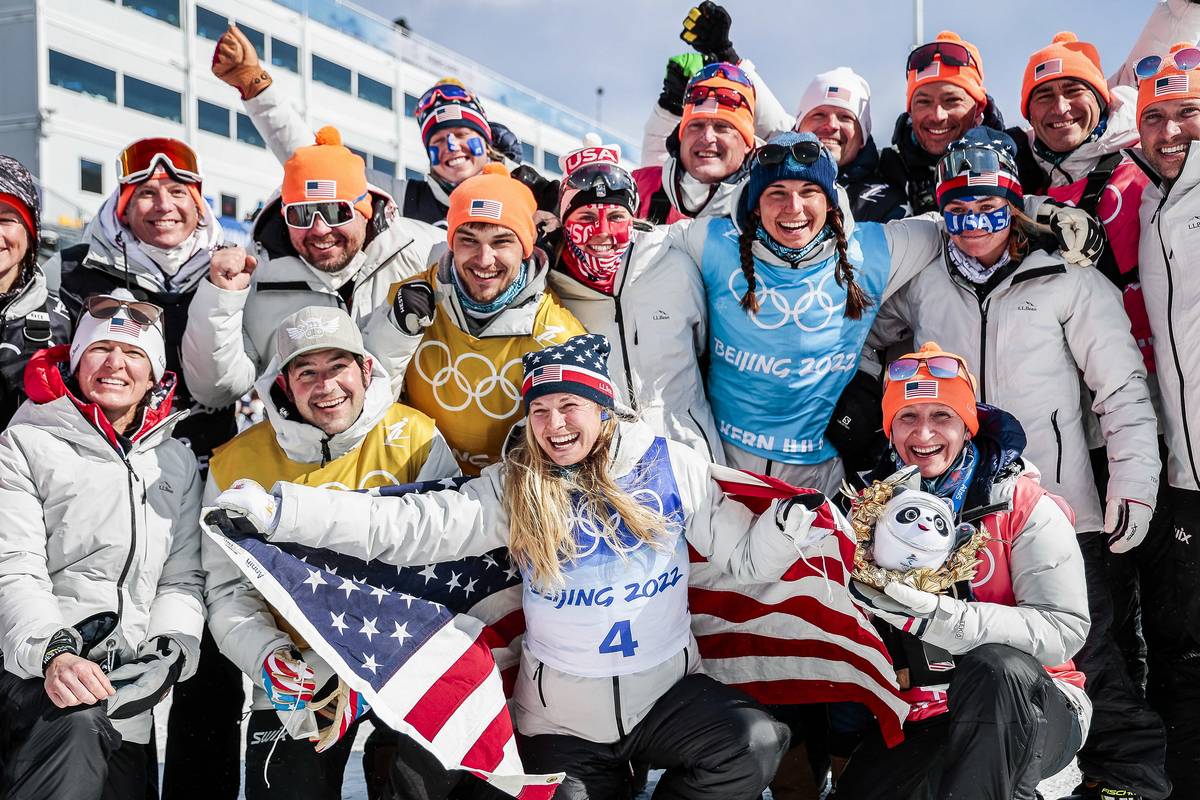
Jessie Diggins with teammates and staff after winning a historic silver medal in the 30K Freestyle at the 2022 Olympics in Beijing, China. (Photo: NordicFocus)
The Second Frame: The Beijing 30K — The Race She Calls Her Proudest
When asked about the moment she is most proud of as a competitor, she didn’t hesitate.
She didn’t say PyeongChang, though she acknowledged the magic of that day. She didn’t say her World Cup overall titles, though she earned those through years of relentless precision.
Instead, she chose a different story — one that most athletes would quietly bury.
“The proudest moment… was the 30K in Beijing,” she said. “Because it wasn’t about if I won or not… the fact that I had battled through food poisoning and chosen to start the race… one minute into the race I had [crashed] and got back on… everything had gone wrong… but I decided to go after it anyway.”
There is something primitive about that choice: to define greatness by suffering openly, to measure success by depth rather than placement.
She emphasized that she “had no business going in the breakaway,” no business skiing alone with a body that was “falling apart and cramping.” But she did it anyway. And she finished.
In a career built on composure and precision, this race was about something far less visible: the instinct to keep going when no one would blame you for stopping.
It is not the kind of image that hangs in a sports museum. But it belongs above her desk — the second frame — because it reminds her who she became, not merely what she achieved.
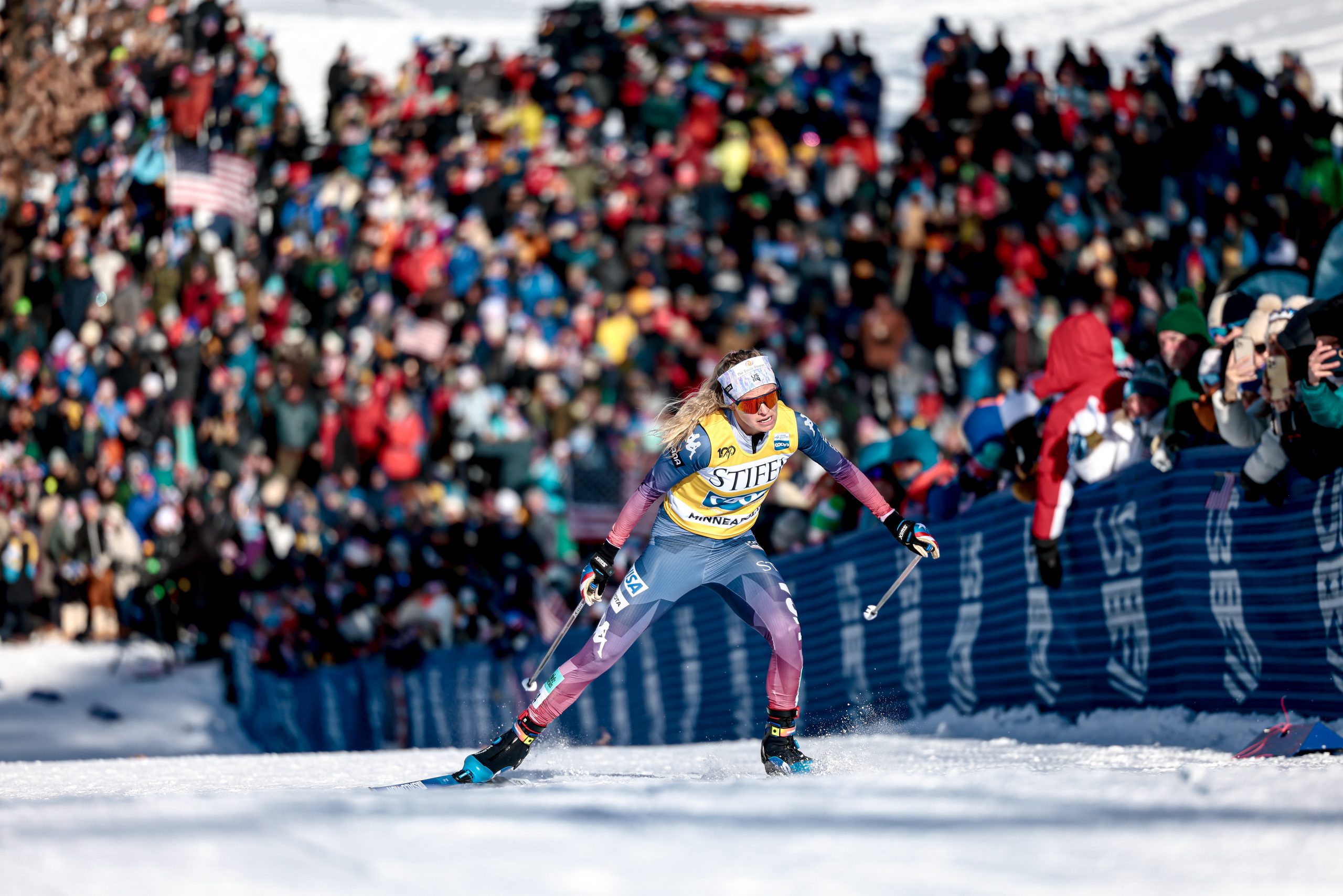
Jessie Diggins soaks in all the energy from the home crowd in Minneapolis. (Photo: Gretchen Powers, U.S. Ski & Snowboard )
The Third Frame: Minneapolis — The Moment That Surprised Even Her
Jessie Diggins’ favorite moment of her entire career was not a race, not a podium, and not a championship. It was a warm-up lap.
Not even the race itself — just the lap before it.
“It was the warm-up lap that I did in Minneapolis,” she said. “I cried like 12 times. It was the coolest moment of my entire career.”
The Minneapolis World Cup, held after years of planning and pandemic delays, drew more than 20,000 fans — kids in ski jackets, families, high school teams, masters racers, longtime volunteers, and the entire Nordic diaspora of America. She helped bring the race to Worth Park; she fought to keep it on the calendar; and then she skied into a stadium that felt like home.
“When you’re warming up, you can really see the crowd and be in it with them,” she explained. “Being a part of bringing together 20,000 plus fans… that was the coolest moment.”
This is the third frame above the desk. It captures the rarest kind of athlete achievement: the moment when an individual’s career transforms into a collective story.
This wasn’t symbolic. It was literal. She had helped create the environment in which the sport could grow.
She wasn’t skiing through fans; she was skiing through the future of U.S. skiing itself.
Staying, Leaving, Returning
If advocacy, suffering, and community are the three frames above her desk, there might be a fourth frame just below them: the one showing something from this final World Cup season or what comes next.
She says she will still support the team, “just not in a way that has to be quite so physically hard on my body.” She imagines herself as “team mom from the sidelines,” cheering but not chasing splits.
She will garden.
She will sleep in her own bed.
She will run a 100-mile race — “just for me… I don’t expect to run it quickly or competitively.”
She will finally come home.
The irony of this final season is that she wants to experience it with the full emotional force of closure — the opposite of detachment, the opposite of stoicism.
“It frees me to enjoy it even when it’s hard,” she said, describing the upcoming Olympics. “Even if it doesn’t go perfectly… my career is this entire body of work, and I just want to be there to be present… because it’s the last time I’m ever going to do this.”
Her retirement announcement wasn’t a curtain; it was an opening.
She’s letting people in.
She’s letting herself feel everything.
She’s letting the sport rush over her one last time.
The Press Conference Ends. The Story Begins.
When the final question was asked and the moderator thanked everyone for their time, Diggins’ Zoom square flickered and the screen returned to its familiar grid. Reporters signed off. Microphones muted. The call ended.
But her voice stayed in my head — not the athlete’s voice I’ve heard in mixed-zones for years, but the one she seems excited to use next.
The voice of someone shifting from performance to reflection, from competition to communication.
The voice of someone ready to tell stories for a living.
Back in Wakefield, someday soon, she’ll sit at her desk beneath those three frames. And as she maps out the arc of a keynote, or a book, or whatever comes after skiing, she’ll look up and see exactly what she spent her career building:
The people she helped.
The battles she fought.
The community she created.
Three frames.
One legacy.
And one last winter to live it fully.
Love Stories Like This? Help Keep Them Coming.
Feature interviews like this one take time, access, and care to produce. If you value thoughtful storytelling and independent ski journalism, please consider becoming a Voluntary Subscriber. Your support directly fuels the work we do to cover the people, places, and moments that make our sport special.
Jessie Diggins (USA) racing on home soil in Minneapolis and will do so again in Lake Placid as she concludes her storied World Cup career. (Photo: Modica/NordicFocus)