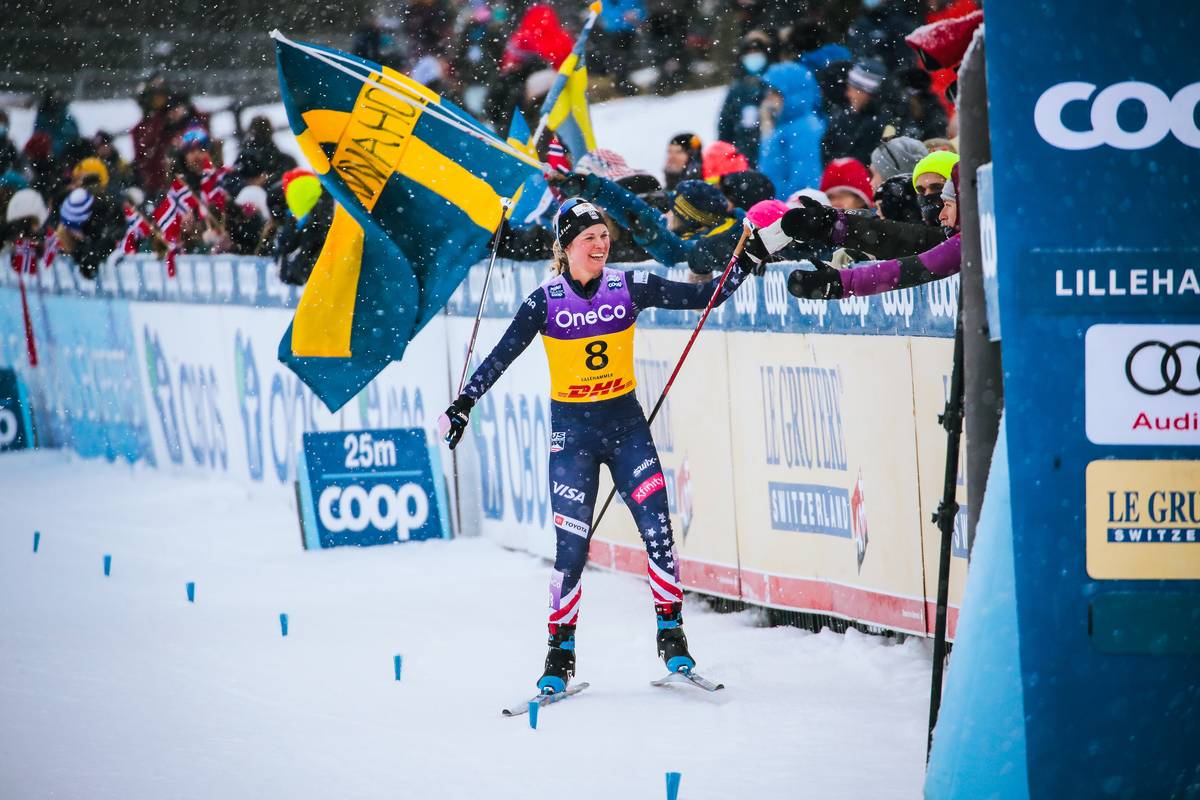
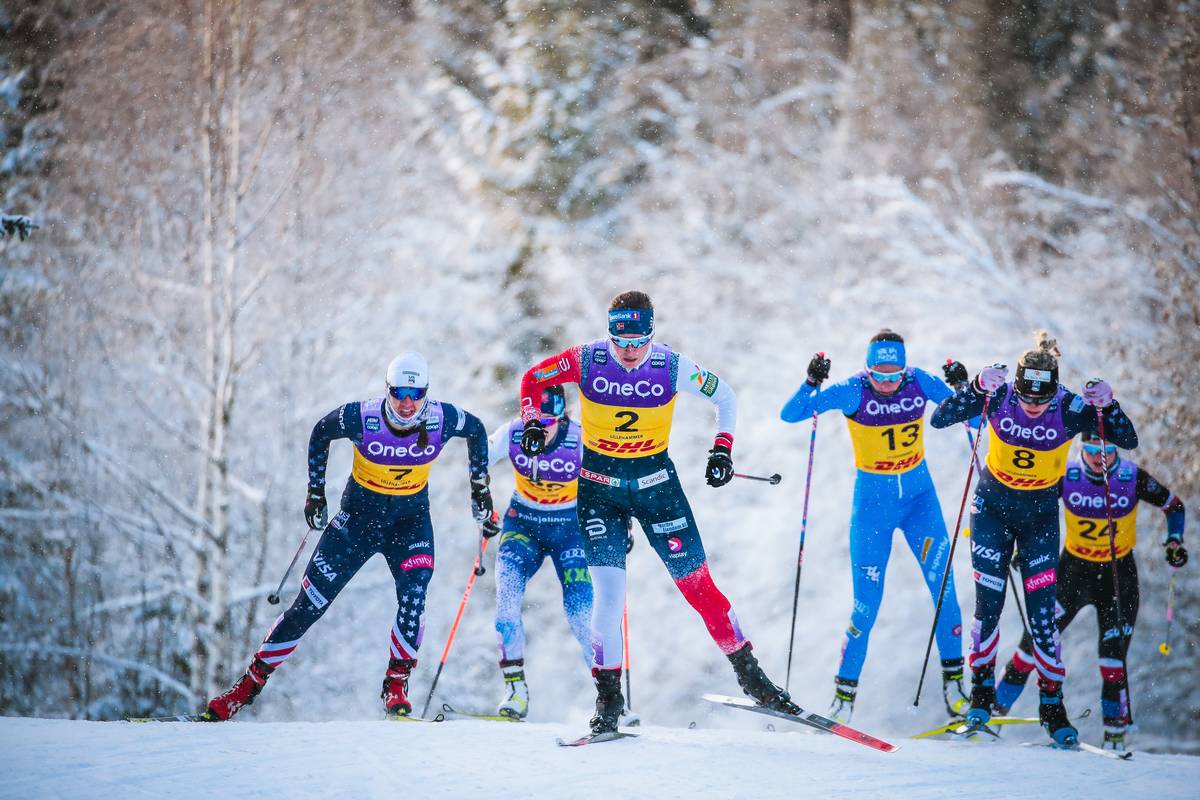
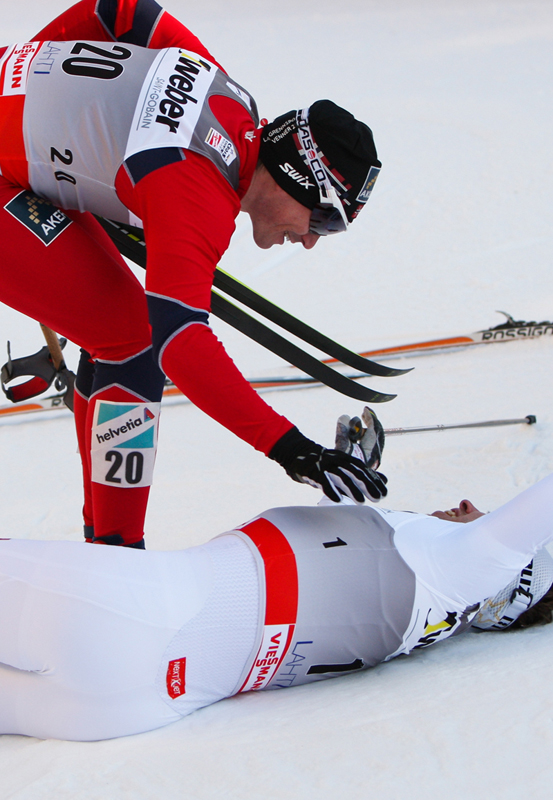
From the FasterSkier archive — posts syndicated from athletes’ and coaches’ own blogs between 2004 and 2012, kept online as published. Current coverage is at fasterskier.com.

Tag: World Cup sprint

  • All in the Timing: Inside Chicco Pelle’s Last Dance in Lake Placid

    All in the Timing: Inside Chicco Pelle’s Last Dance in Lake Placid

    This coverage is made possible through the generous support of Marty and Kathy Hall and A Hall Mark of Excellence Award. To learn more about A Hall Mark of Excellence Award, or to learn how you can support FasterSkier’s coverage, please contact info@fasterskier.com.

    LAKE PLACID, New York (March 21) — As the snow settled on Lake Placid and clouds began to dissipate over Mt. Van Hoevenberg, a growing sense that something momentous could happen permeated the crowd assembling for the last Sprint of the 2025-26 World Cup.

    That something unusual would happen was assured. With the Sprint Globe already secured to Johannes Høsflot Klæbo, the golden-haired juggernaut would not be on the starting line – opting instead to rest his legs, and head, in hopes of defending his 12-point lead over Harald Østberg Amundsen in the Distance standings. By default, then, someone other than Klæbo would stand atop Saturday’s podium – a rare occurrence in a season where the Norwegian had already won 8 of 11 Sprints in commanding fashion. (Two wins evaded Klæbo due to falls; the third because he did not start in Oberhof).

    Who would take his place? Ben Ogden, the Northeast’s homegrown favorite and the Sprint silver medalist in Milano-Cortina? Gus Schumacher, Ogden’s partner in the Olympic Team Sprint? France’s embattled specialist, Lucas Chanavat, who appeared on track to rival Klæbo during the 2023-24 season, who had seized the opportunity – and the win – after Johannes’ bobble in Davos last December? Ansgar Evensen (NOR), who had done the same in Drammen?

    Or, perhaps, it would be Federico Pellegrino (ITA) – the 35-year-old elder statesman of the league; making his 344th (and penultimate) World Cup start, eyeing an 18th and final Sprint victory?
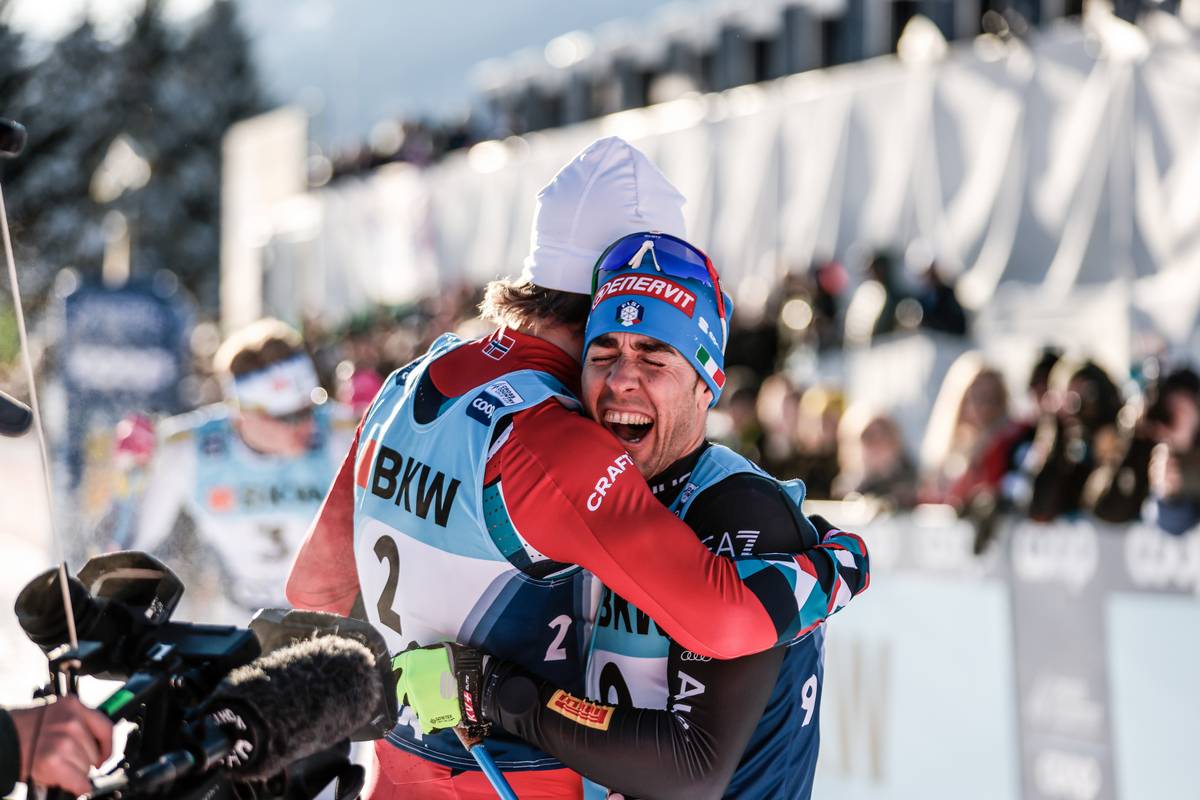
    Johannes Hoesflot Klæbo (NOR) and Federico Pellegrino (ITA) after the finish of the Finals in Davos, 2022. Pellegrino bested Klæbo on the eve of the birth of his first child. (Photo: Nordic Focus)

    It states the obvious to say that success in cross-country skiing is a matter of timing, and for “Chicco Pelle’s” 15 seasons, the timing had been just shy of right. The formative and final years of Pellegrino’s career were defined by the dominance of skiers other than he. Pellegrino made his World Cup debut in Drammen in March 2010, finishing 49th. The winner that day was Emil Joensson (SWE); runner-up was Petter Northug (NOR), then on his way to his first of two Overall Globes. These were the halcyon days in which Dario Cologna (CHE) descended from his Alpine fastness to rack up World Cup and Tour de Ski titles; when Northug, Joensson and Marcus Hellner (SWE) traded sprint victories and taunts in a bitter intra-Scandinavian rivalry. Pellegrino was 12th in his first World Championships Sprint (Oslo, 2011) and 11th at his first Olympic Sprint (Sochi, 2014).

    While notching his debut victory in December, 2014 in the Davos Freestyle Sprint, Chicco’s break came in the 2015-16 season. He won 5 of 13 sprint races, becoming the first non-Scandinavian male to win the Sprint Globe. As Pellegrino hit his stride, Northug’s star was showing its first flickerings ahead of a dramatic waning, Joensson had entered the twilight of his career, and although Sergey Ustiugov (RUS) was approaching his own prime, the factious cast of World Cup sprinters was looking for a new leading man.

    That man would not be Chicco. An upstart dramatist from Trondheim, Johannes Høsflot Klæbo, had arrived to script skiing’s long, and mind-bogglingly successful, next chapter. After making his debut in Drammen in 2016, Klæbo outscored Pellegrino in the 2016-17 Sprint standings, taking his first of 8 (and counting) Sprint Globes. The two went head to head at the 2017 World Championships in Lahti, Finland, where Pellegrino surged from behind to claim his first World Title ahead of a legendary lineup, including Ustiugov, Klæbo, and Northug, but this maiden gold would also be his last. In Pyeongchang the next year, the Olympic gold went to Klæbo; Chicco brought home silver.

    The wins did keep coming for Chicco, including a tear of three consecutive Sprint victories and his second Sprint Globe in 2020-21. And, though they admittedly came in greater abundance to Klæbo (who, it should be noted, did not start in those races, or the 2020-21 Tour de Ski), it is rather glib to assert that Chicco’s career had slid “in[to] the shadow of” the Norwegian. Pellegrino bested Klæbo in Dresden and Lahti in the spring of 2018; in Lillehammer that winter; and in Davos in 2022. He was near-omnipresent on Sprint podiums and won his second Olympic silver in Beijing in 2022; moreover, he was among the very few men who could disrupt Klæbo’s dominance in the discipline, and the clear favorite when Johannes was absent.

    But Pellegrino’s win in Davos in December 2022 marked the beginning of a long, and perhaps self-inflicted, World Cup drought. Chicco declared his intention to focus on distance races ahead of Milano-Cortina, and did indeed record four such podiums in classic, skate, and skiathlon formats, alongside a welter of Sprint podiums – including an ecstatic World Championships silver in Trondheim in 2025, and Olympic bronzes on home soil in the Team Sprint (alongside Elia Barp) and in the 4 x 7.5 k Relay (which he described as “the proudest day of [his] life!”) this February.

    Elia Barp welcomes Federico Pellegrino to a bronze-medal finish in the Olympic Team Sprint in Milano-Cortina, February 18th, 2026.
    (Photo: Vanzetta/Barbieri/NordicFocus)

    Outright wins, however, were not forthcoming. By the time March 21, 2026 arrived in Lake Placid, it had become Pellegrino’s last, best chance to secure one more Sprint victory.

    Anticipation and emotions ran high. While Pellegrino had been impervious to the crowd in Friday’s 10 k Classic – earbuds deadening the world beyond his blue racing cap during warmups, and his face a deaf mask of exertion during the race – their excitement overwhelmed him on Saturday. During his first warmup lap, he skated calmly up the course’s A-Climb through a chorus of “CHI-CCO, CHI-CCO, CHI-CCO.” On his second, the frenzied chant began again, and the gravity of the impending race dragged him to a halt. His skis splayed wide against the pitch; he buried face in his hands. “The energies I got in the Final were coming from the warmup lap, where I stopped in the middle of the climb, crying,” Pellegrino told me at the finish line. “I think the public deserved this kind of show, and I deserved to finish my career, with a Sprint skate like this.”

    Pellegrino embraces the crowd ahead of Sprint qualifying in Lake Placid. “The energies I got in the Final were coming from the warmup lap, where I stopped in the middle of the climb, crying.”
    (Photo: Thibaut/NordicFocus.)

    To reach that final finish line, however, was a perilous journey.

    After qualifying second, Pellegrino sidestepped two falls (the first from Jules Chappaz (FRA); the second from Elias Keck (GER)) in his Quarterfinal, moving from sixth to first in the course’s final descent and level hairpin. In Semifinal 1, he attempted to close on Lucas Chanavat (FRA) and Anton Grahn (SWE) through the crest of the A-Climb but couldn’t get by; pushed to the outside on the level hairpin, he was out-lunged by Lars Heggen (NOR) in the final meters, finishing third by 0.03.

    While the Lucky Loser spot was Chicco’s to lose heading into Semifinal 2, Erik Johansson (SWE), Harald Amundsen (NOR), and Even Northug (NOR) lost time playing for a slipstream position as they approached the top of the A-Climb. Pellegrino was on to the final by a comfortable margin.

    Lars Heggen (NOR) outlunges Federico Pellegrino (ITA) by 0.03 in Semifinal 1. Federico moved on to the Final as a Lucky Loser. (Photo: Thibaut/NordicFocus)

    Once more around the track, and the day could be his. After being fourth out of the gate, he attacked from the outside on the B-Climb; breaking into an aggressive V-2 and taking Chanavat and Heggen by surprise, he moved into second behind Grahn. The pace increased again at the base of the A-Climb, but where Grahn and Chanavat’s broad frames moved up the hill in sweeping, powerful strokes, Pellegrino leapt into a furious V-1.

    The move was decisive. To the adulation of the crowd, he opened a decisive gap through the crest of the climb. His lead only grew through the final descent into the level hairpin, but Chicco was taking no chances. While Grahn and Heggen grappled for second behind him, Pellegrino hammered to the line, threw his arms wide and his head back, roaring with the crowd.

    An 18th victory and 46th career podium, clinched.

    Federico Pellegrino secures his 18th and final World Cup victory. Lake Placid, March 21, 2026. (Photo: Thibaut/NordicFocus)

    What had happened in the Semifinal, when this triumphant last dance had nearly evaded him by three hundredths of a second? And what had changed for the Final?

    “I could not do what I did in the Final, because the energies of the other athletes were still quite big,” Chicco admitted our post-race interview. “About the last downhill, I was not the same as the others. I am not, I know, but I have some different qualities, and if I could get quite good gap in the top of the uphill, then I knew that I could keep it until I end. This is what I did. This is how I loved to win all along my career – not wait until the last meter, but trying before.”

    “Sometimes it happened, mostly before Klæbo came,” he laughed. “But today I was there, and I studied the best tactics in the end . . . the public here in Lake Placid deserves this kind of show, and I think we are all happy now.”

    And, this was nothing short of “the best way” to end his journey. “I could not do different. In the end, the last four years have been strange. I didn’t focus so much on sprinting; I tried to discover my body in different fields. Sometimes I got really great feelings and performances, but then, to come back here . . . and to win in that way, I could not do more.”

    Pellegrino after his final win. “I think the public deserved this kind of show, and I deserved to finish my career, with a Sprint skate like this.” (Photo: Thibaut/NordicFocus)
    One more podium for Federico Pellegrino, alongside Lars Heggen (NOR) and Anton Grahn (SWE). (Photo: Thibaut/NordicFocus.)

    In 15 seasons, Pellegrino proved himself to be far more than a runner-up to those Swedish and Norwegian titans who loomed large over his early and later years. He had taken the Sprint Globe from the Scandinavians for the first time; outsprinted Klæbo, Ustiugov, and Northug in Lahti; perpetually challenged – and occasionally beaten – the greatest athlete in the history of the sport; and secured Olympic medals on home soil, alongside a team of up-and-coming Italians ready and eager to fill his boots. “I’m really happy that he finished his career with probably one of the best weekends for him so far,” Elia Barp (ITA) told me on Sunday. “I’m very happy for him; I’m very happy for the team. I think we have proved that we are ready to race without him – not only me, but a few other young guys are ready to try to take victories next year . . . [He showed] that it is important to keep fighting and try to be a good overaller as he was in the last years. And, now we know that it’s possible; everyone is human as us, and we can do that.”

    To Chicco’s fans, that determination – to grapple with giants; to reinvent himself; to seize the final, perfect timing and a final, perfect victory – defined his career. But for Pellegrino himself, “the biggest memories will not stay about the races, but much more about the hugs I got from the teammates, from the coaches, even outside of Italy, from my family, from the people that love me – and not only when things went well; even when things were not going so well. I think this is something that sport teaches us; that in the end, it’s only a cross-country ski race, and life is different. That’s it. The hugs are something I will remember for my entire life.”

    Pellegrino, the most popular man at Zig Zag’s on Saturday, March 21. (Photo: Lily Den Hartog)

    At Zig Zag’s Pub on Saturday night, Pellegrino told this reporter’s associate that his win vindicated his decision to retire. On Sunday, soaked with rain and champagne and tears after his last World Cup race, he reaffirmed it:

    “That’s it. I tried to enjoy today as well . . . I tried to give my best, as always, and it was good after the finish line; under the rain, it was special. But with the teammates and coaches and waxers celebrating this moment, it was good for me.”

    “Now, I really need to stay with my family. They deserve this, and I need to give them a lot of time.”


    Love Stories Like This? Help Keep Them Coming.

    Feature stories like this one take time, access, and care to produce. If you value thoughtful storytelling and independent ski journalism, please consider becoming a Voluntary Subscriber. Your support directly fuels the work we do to cover the people, places, and moments that make our sport special.

    “Grazie Papao!!” Team Italy was waiting at the finish of the 20 k Skate with champagne and a tribute to Pellegrino’s children and wife, Greta Laurent (ITA, ret.). (Photo: Thibaut/NordicFocus)
  • Where the Snow Hardens and Decisions Stick

    Where the Snow Hardens and Decisions Stick

    This coverage is made possible through the generous support of Marty and Kathy Hall and A Hall Mark of Excellence Award. To learn more about A Hall Mark of Excellence Award, or to learn how you can support FasterSkier’s coverage, please contact info@fasterskier.com.

    Jonna Sundling (SWE) and Laura Gimmler (GER), (l-r) during the heats of the World Cup Freestyle Sprint in Oberhof (GER). (Photo: Authamayou/NordicFocus)

    By the time the stadium lights fully took over in Oberhof, the snow had begun to change its mind.

    What started as a pliable winter surface—the kind that both softens and creates mistakes—tightened as the temperature dropped, and each pass of a ski left a polished, glistening trail under the lit German night. The Thuringian Forest, quiet by geography but loud by reputation, had settled into one of those evenings that reward certainty. Edges held if you trusted them. Hesitation showed immediately. And in an Olympic season, there was very little room for either.

    Saturday’s women’s Freestyle Sprint marked the World Cup’s return after the Tour de Ski, but the pause had not dulled the stakes. For several nations—and particularly for the United States—Oberhof represented the final sprint in the window that matters most for Olympic selection. That context did not announce itself loudly. It rarely does. Instead, it threaded through the day in subtler ways: in heat selection, in how aggressively athletes protected space, and in the quiet tension between racing for today and building the version of yourself you’ll need in February.

    At the front, the results followed familiar lines. Jonna Sundling (SWE) qualified near the top and then won every round she entered, finishing the job decisively for her 15th individual World Cup victory. Coletta Rydzek (GER), fed by a home crowd that never stopped leaning forward, closed hard for second. Maja Dahlqvist (SWE) completed the podium in third, another entry in Sweden’s sprint abundance—a luxury that, paradoxically, can complicate Olympic selection rather than simplify it.

    But Oberhof was not only about dominance. It was about positioning, intent, and the quieter victories that occur well outside the top three—where a season can tilt not with a trophy, but with a single, well-timed decision in a quarterfinal.

    Hailey Swirbul (USA) take the first corner during her quarterfinal in Oberhof (GER). (Photo: Authamayou/NordicFocus)

    A Course That Punishes Drift

    Oberhof’s sprint course is deceptive in its simplicity: an out-and-back layout, one major climb, a technical descent, and a finishing stretch that arrives already under load. What separates it from more straightforward sprint venues is how early it demands decisions. The opening stretch funnels athletes into a tight corner almost immediately, compressing the field before it has a chance to stretch. The central climb—long, steep, and increasingly rutted and churned as the day progresses—forces skiers to declare themselves sooner than they might like.

    There is little room to hide here. Miss the first corner, and you’re fighting for oxygen before the race has found its rhythm. Drift into the wrong line on the climb, and the surface punishes you. Get boxed entering the final turn, and momentum disappears instantly. Oberhof rewards skiers who are decisive without being reckless, aggressive without being impatient.

    Those dynamics shaped the day for the Americans in distinctly different ways, producing four very different American stories inside the heats—plus one clarifying, unfortunate footnote that mattered for selection math and for morale: Alayna Sonnesyn (USA) did start, but crashed and did not finish.

    Jessie Diggins (USA) during qualification in the World Cup Freestyle Sprint in Oberhof (GER). (Photo: Authamayou/NordicFocus)

    Before the Racing: Compassion, and a Reminder Not to “Try Harder”

    On paper, the Olympic selection criteria reads like a legal document—because, in many ways, it is one. It is also, inevitably, a psychological environment: a room everyone lives in, even when no one speaks about it.

    U.S. Head Coach Matt Whitcomb described the team’s internal emphasis heading into Oberhof in terms that had nothing to do with points or spreadsheets.

    The first message, he said, was simple: have compassion—for yourself and for your teammates.

    “This is a stressful job,” Whitcomb said. Some athletes may feel safely “inside” the team; others may feel perched on the edge; others may already feel disappointment. And the team, he stressed, needs to remember that everyone is absorbing the same pressure in different ways. “Read the room,” he said, especially if you have a great race—take care of each other through a stressful period.

    His second point was the one that, in a sprint weekend like this, can save an athlete from the most common selection-week mistake: mistaking urgency for a new identity.

    Because “this may be one’s last opportunity,” Whitcomb said, it’s tempting to believe you can manufacture something extra—try harder, ski differently, do something dramatic. But that instinct is usually the trap.

    “You can’t try something dramatically different,” he said. “What you have to do… is you ski the way that got you here.”

    In Oberhof, Whitcomb felt the athletes largely did that. The plans were executed; warm-ups and routines stayed intact. “We qualified a bunch of people,” he said. The day simply didn’t convert into the results they wanted.

    That, too, is sprinting: sometimes you do many things right, and the course—plus the speed of the other nations—still asks for more.

    Jessie Diggins (USA) during qualification in the World Cup Freestyle Sprint in Oberhof (GER). (Photo: Authamayou/NordicFocus)

    Racing as Training: Jessie Diggins

    For Jessie Diggins (USA), Oberhof was never meant to stand alone.

    Coming off the Tour de Ski, Diggins framed this weekend not as a test of peak form, but as a carefully placed piece of a longer arc: racing as a training stimulus, not a destination.

    “Essentially, I’m using these races as training stimulus,” Diggins said. “It’s a chance to get more reps—working on the tactics, working on communication, just working on all the little things that you really can’t practice any other way unless you’re racing World Cup.”

    That philosophy has long guided Diggins’ career. She has rarely spoken about “peaking” the way outsiders want athletes to: as a clean line on a calendar, a simple on/off switch. For her, form is something you keep building in public, in the only environment where it truly exists—under the clock, in contact, with consequence.

    “So [I’m] keeping the training load really quite high,” she explained, “but just recovering enough that I can still punch some hard race efforts and have that be part of the training and the lead-up. And for me, that’s always been a really important thing.”

    She added a line that sounds like personal preference until you watch her career and realize it’s closer to a blueprint: “I think I race well when I am racing pretty often. I might not do every single race, but just enough that I feel like I’m using them as a really helpful part of my lead-up.”

    Diggins’ day ended in the quarterfinals—13th overall on the official results sheet. But that early exit doesn’t necessarily conflict with the way she described the weekend. In an Olympic season defined less by accumulation than timing, Diggins tends to measure progress in subtler signals than finish position: how quickly the body responds, how efficiently it recovers, whether the details are sharpening rather than dulling.

    Oberhof, in that sense, fits neatly into the plan. Not every race has to be a verdict. Some are simply data—hard efforts taken at speed, recorded by the body, filed away for February.

    Samantha Smith (USA) during qualification in the World Cup Freestyle Sprint in Oberhof (GER). (Photo: Authamayou/NordicFocus)

    A Wild Arc, Embraced: Samantha Smith

    If Diggins arrived in Oberhof as a veteran calibrating form, Samantha Smith (USA) arrived by a far less conventional route—one that still feels almost implausible when you say it out loud.

    The last couple of months, Smith said, have been “wild.” She helped Stanford reach the NCAA soccer final. She put her skis on for the first time this season in December. She raced into shape at U.S. Nationals. And suddenly, she was back on a World Cup start line—aware of the stakes, but determined not to let the stakes steal the experience.

    “I’m so grateful for the opportunities that I’ve had,” Smith said. “To have a chance to play for Stanford has been such an incredible journey… and now to be back skiing, it feels great to be out here and competing with everyone.”

    Smith kept returning to the same theme: presence. She likes the work itself—the daily process—whether it’s skis or soccer.

    “I really enjoy the process,” she said. “I love to train, I love to race, I love to play soccer games. So [I’ve] just been trying to focus on enjoying every moment… embracing the opportunities that I have and just trying to be very present.”

    That presence mattered on a day when nerves were unavoidable.

    “Coming in today, I was definitely nervous,” Smith said. “I feel like the first World Cup races of the year are a bit nerve-wracking, especially when you haven’t had a ton of time on snow or a ton of opportunities to really gauge fitness.”

    So she narrowed her goals to what she could actually execute: ski clean; work transitions; be diligent in the “working sections” where Oberhof can hand you time or take it away quietly.

    “I didn’t really have an outcome goal,” she said. “It was just to ski hard, do what I could, and if I got into heats, to really compete.”

    And then, in her quarterfinal, came the moment that extended her day—and changed, materially, what this weekend could mean.

    Smith described herself as not being in the position she wanted over the first big hill. She could see the risk: that the heat would compress into a pure sprint finish, where you either have the lane or you don’t. And then—briefly—she did.

    “Into the last climb before the finish, I saw a window on the inside,” Smith said. “I saw the space open up, and I just tried to take it. To be honest, I wasn’t really expecting that it was going to open up.”

    It did. She went. And she made the move that sprint racing requires: the one that looks obvious in replay and feels like a gamble in real time.

    “I was worried it was going to come down to a complete sprint finish at the end,” she said, “but I think I got pretty lucky… There was a bit of open space, and I was able to make my way up.”

    The reward was tangible: Smith advanced to the semifinals and finished 12th overall. Just as important—at least in the language of selection criteria—she also climbed to 42nd on the women’s Sprint World Cup standings after Oberhof.

    In a season where criteria can hinge on ranking thresholds, that is not a small detail. It is the kind that turns a good day into a consequential one.

    Whitcomb’s reaction captured the strange emotional geometry of selection weekends: elation, paired with an awareness that someone else is hurting.

    “We’re absolutely ecstatic with Sammy,” he said—and then, almost immediately, he acknowledged the other side of it: “It’s always bittersweet because on literally every race I’ve ever been to, there have been people that have good races and then people that are really disappointed.”

    In sprinting, the margins are often only a few meters. In Olympic selection, those meters can echo.

    Hailey Swirbul (USA) during qualification in the World Cup Freestyle Sprint in Oberhof (GER). (Photo: Authamayou/NordicFocus)

    Joy Without Illusion: Hailey Swirbul

    For Hailey Swirbul (USA), the day began with something rarer than confidence: uncomplicated joy.

    “I was genuinely excited just to be back racing and to make the rounds today,” Swirbul said. “It felt like a treat. Honestly, I wasn’t expecting it. I was hopeful that I might have that opportunity, but getting to be in the heats was really fun.”

    What stood out wasn’t that she smiled—it was why.

    “My smiles were genuine out there,” she said, “and I felt an excitement and joy to get to be part of it, rather than a fear or pressure… to live up to some expectation that I might set for myself.”

    Swirbul approached qualifying with a clear-eyed strategy built around her own technical history. She identified the steep jump-skating (V1) section that had dominated the day’s conversation and made a choice.

    “There’s a lot of pressure, a lot of expectation around that steep V1 hill in the middle of the course,” she said, “and that’s just historically not my strength… I felt like I was able to do the working sections well.”

    The plan worked. She advanced into the heats and finished 22nd overall.

    In the quarterfinal, the course delivered its blunt lesson: once you lose contact, you often don’t get it back.

    “I maybe tried to ski my own race a little too much,” Swirbul said. “Once you’re off the main pack, it’s really hard to get back on… I was excited to have a strong finish… but it’s just not enough at this level.”

    The sentence contains both honesty and optimism—because Swirbul wasn’t treating Saturday as an endpoint. She was treating it as preparation for what, in her case, may be the weekend’s more natural opportunity: Sunday’s 10-kilometer classic interval start.

    “I’m excited—really looking forward to the classic 10 k tomorrow,” she said. “I’ve had a couple of good ones this year, so [I] hope I can keep the momentum going.”

    And then she said something that explains why so many distance skiers quietly enjoy sprinting before a 10 k: it’s a way to wake the system up.

    “I do actually really like racing a sprint, especially a qualifier plus a quarter right before a 10 k,” she said. “I think that’s kind of ideal race prep for 10 k. So I’m hoping that can help power me through tomorrow’s race.”

    Swirbul’s mindset for Sunday, she said, would be built on a simple distinction: what she can control, and what she can’t.

    “Every course and every day has so many variables… out of my control,” she said. “So I just want to try to control what I can and do my best at those things.”

    It’s a professional skier’s sentence. It’s also, in an Olympic season, a survival skill.

    Lauren Jortberg (USA) during qualification in the World Cup Freestyle Sprint in Oberhof (GER). (Photo: Authamayou/NordicFocus)

    Boldness, Not Regret: Lauren Jortberg

    Lauren Jortberg (USA) did not set out to lead her quarterfinal. It happened anyway, fast and almost accidentally—the kind of start that changes your entire heat because it changes your options.

    “I took control early… wasn’t necessarily on purpose,” Jortberg said. “I just had a really fast start, and there’s a big corner right away, so I wanted to have good positioning there.”

    She connected that early positioning to what she sees as a strength: the major climbs. In Oberhof, you don’t get to drift into those climbs. You arrive either with space or without it.

    “I wanted… good positioning for the major climbs,” she said. “I feel like that’s one of my strengths.”

    Late in the heat, the day turned on a familiar sprint mechanism: contact and congestion at exactly the wrong time.

    “I got a bit of a tangle… into the final turn,” Jortberg said. “I lost all my speed there.”

    Importantly, she rejected the clean narrative that would blame her early assertiveness for the late cost.

    “I don’t necessarily think that leading… came at a cost,” she said. “I just think… I lost all my speed when we got tangled.”

    And then she said what, in an Olympic-selection sprint, many athletes think, but not all athletes will say out loud: she did not come to Oberhof to hide.

    “With the Olympic implications, I don’t really want to sit in the back and just chill,” Jortberg said. “That’s not really how I like to race heats.”

    She described her approach as an attempt to avoid the passive sprint fate: getting boxed in, stuck behind, hoping someone else would make a mistake.

    “I just really want to try to ski well,” she said. “At least [I] tried to move… and try to ski my best out there rather than just… getting boxed.”

    Jortberg finished 29th overall. But what she took from the day was not despair—it was proof of belonging.

    “A lot of my confidence is just knowing that I really can ski with these women who are really strong,” she said. “That’s important for confidence moving forward.”

    Even in a heat that didn’t break her way, she will leave Oberhof with something World Cup weekends can either confirm or erase: the belief that she belongs on this stage.

    Maja Dahlqvist (SWE), Jonna Sundling (SWE) and Iris De Martin Pinter (ITA), get set to start their semifinal in the Freestyle Sprint in Oberhof (GER). (Photo: Authamayou/NordicFocus)

    The Final, and the Moment That Changed It

    The women’s final unfolded at speed—and then, briefly, at the mercy of chance.

    Sundling drove the pace as expected, forcing the field into single-file. Dahlqvist tracked smoothly. Rydzek hovered, patient and dangerous. Behind them, Iris De Martin Pinter (ITA) skied with poise well beyond her years, positioned to contend.

    And then she wasn’t.

    De Martin Pinter fell, fracturing the race at the worst possible moment—the kind of incident sprinting produces with brutal efficiency. Sundling’s growing gap became decisive. In a course that rewards momentum and punishes disruption, the fall functioned like a door closing: abruptly, unfairly, and permanently.

    Sundling closed the remaining distance with authority. Rydzek surged for second. Dahlqvist held on for third.

    Jessie Diggins (USA), Hilla Niemela (FIN), Nicole Monsorno (ITA), Milla Andreassen (NOR), Samantha Smith (USA), Alina Meier (SUI), (l-r) come around the first corner of their quarterfinal. (Photo: Authamayou/NordicFocus)

    Skis, Speed, and the Truth You Can See on a Downhill

    No sprint weekend exists in a vacuum. Equipment matters, and in Oberhof, that reality was visible in the most unforgiving place: the downhills where small gaps become facts.

    Whitcomb, careful about specifics because he had not yet been fully able to review the race video, acknowledged what many observers sensed: the U.S. skis were close, but not quite at the level of the very best nations on the day.

    “I think that’s a safe and fair assessment,” Whitcomb said. He emphasized that the team was competitive—but in sprinting, “competitive” is often not enough.

    “You need the best skis to go up against other teams that have the best skis,” he said, citing nations that, on this day, appeared to have exceptional speed.

    It’s the part of sprinting that can feel cruelest to athletes: you can execute your plan, hit your cues, make good tactical decisions—and still watch a gap open on a downhill you skied correctly. In Oberhof, where the course magnifies drift, ski speed is not a luxury. It is oxygen.

    Samantha Smith (USA) for the first time advanced into the semifinals in the World Cup sprint in Oberhof (GER). (Photo: Authamayou/NordicFocus)

    Selection Without Ceremony

    For the United States, day one in Oberhof didn’t resolve Olympic selection questions. It narrowed them.

    U.S. Ski & Snowboard’s selection language ties nomination, in part, to World Cup standings thresholds, with specific mention of Top 50 (or Top 45 under certain conditions) in the Sprint or Distance World Cup standings on January 18, 2026.

    Inside that structure, Saturday’s most significant American movement belonged to Smith.

    With her semifinal, she, in just one World Cup race, vaulted to 42nd in the Sprint World Cup standings. That is the kind of number that changes the texture of a season, because it moves her into the zone where the objective criteria has been met.

    The other Americans’ days mattered in quieter ways. Diggins stayed on her February-focused arc, treating racing as stimulus and sharpening. Swirbul used the sprint as both a joyful return to the rounds and a deliberate set-up for Sunday’s classic 10k, a race she believes suits her. Jortberg confirmed her willingness to race with intent rather than hide from consequence, even when the margin for error is razor-thin.

    And Sonnesyn’s crash—real, abrupt, and emotionally expensive—served as a reminder that selection seasons do not always give you clean data. Sometimes they give you a fall, a DNF, and the long work of resetting.

    Jonna Sundling (SWE) comes to the line for the win in the finals. (Photo: Authamayou/NordicFocus)

    What Remains

    By nightfall, the snow had hardened completely. The course no longer absorbed uncertainty. It reflected it.

    Some athletes left with podiums. Others left with confirmation, calibration, or unfinished business. In an Olympic winter, not every race is meant to answer questions outright. Some exist to refine them—to strip them down to what actually matters.

    Whitcomb’s framing, in that light, felt less like a coach’s speech and more like a survival manual for the next month: be compassionate; don’t weaponize the criteria against each other; and when the moment arrives, resist the temptation to become someone new out of panic.

    You can’t “try harder” into an Olympic team. You can only ski the way that got you here—cleanly, boldly, and with enough self-trust to hold your line when the window opens.

    In Oberhof, Samantha Smith did exactly that. And for one night in the German cold, that single choice—one inside lane, one late move—was the difference between a good day and a consequential one.

    Women’s Freestyle Sprint Qualification RESULTS

    Women’s Freestyle Sprint Final RESULTS

    Women’s FIS World Cup OVERALL SPRINT STANDINGS


    Love Stories Like This? Help Keep Them Coming.

    Feature stories like this one take time, access, and care to produce. If you value thoughtful storytelling and independent ski journalism, please consider becoming a Voluntary Subscriber. Your support directly fuels the work we do to cover the people, places, and moments that make our sport special.

    Join the FasterSkier community!


    Coletta Rydzek (GER), Jonna Sundling (SWE), and Maja Dahlqvist (SWE), (l-r) share the sprint podium in Oberhof (GER). (Photo: Authamayou/NordicFocus)
  • Swedes Sweep Podium in Livigno Freestyle Sprints.  No One Can Stop Klaebo

    Swedes Sweep Podium in Livigno Freestyle Sprints. No One Can Stop Klaebo

    This World Cup coverage is made possible through the generous support of Marty and Kathy Hall and A Hall Mark of Excellence  Award.  To learn more about A Hall Mark of Excellence Award, or to learn how you can support FasterSkier’s coverage, please contact info@fasterskier.com.

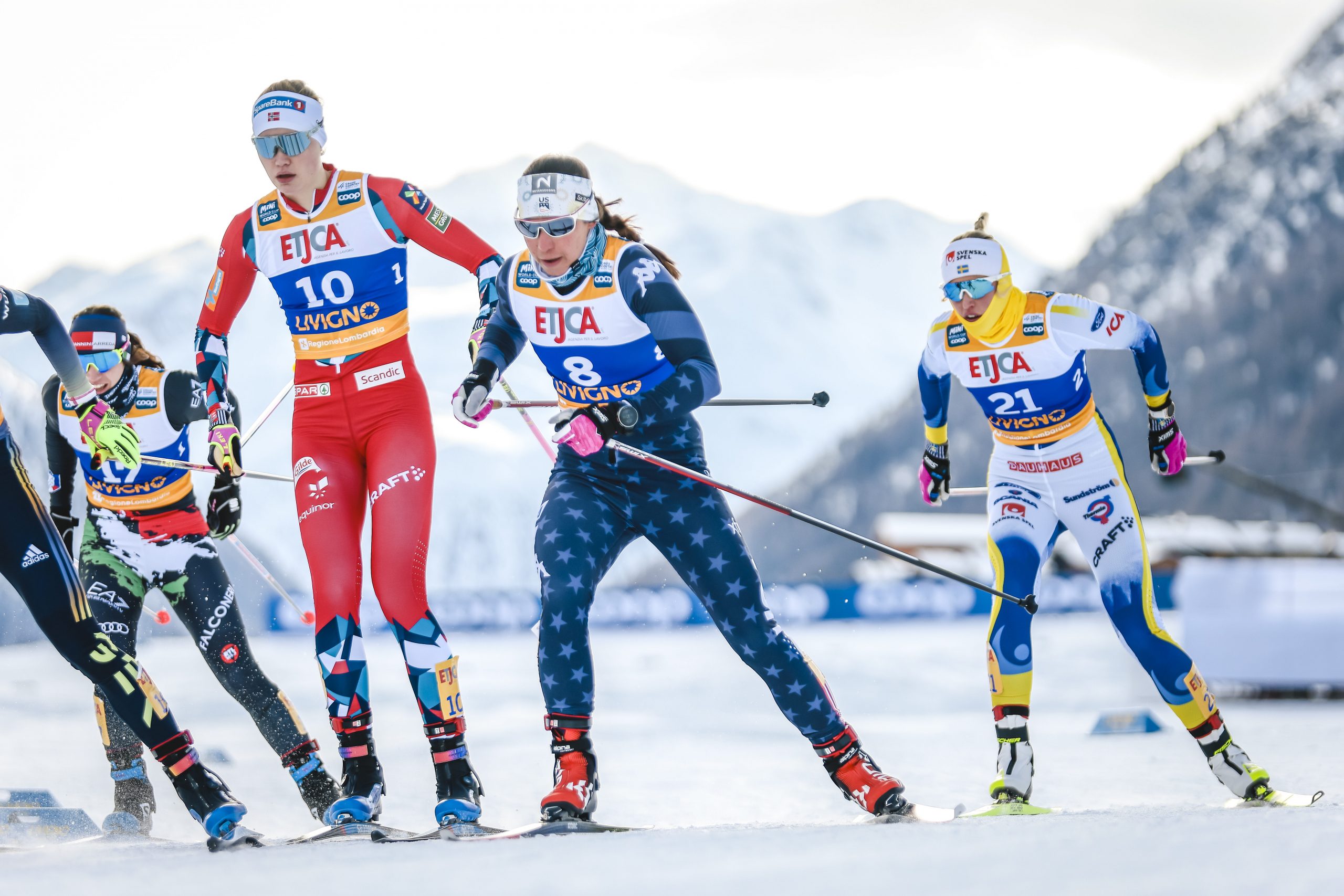
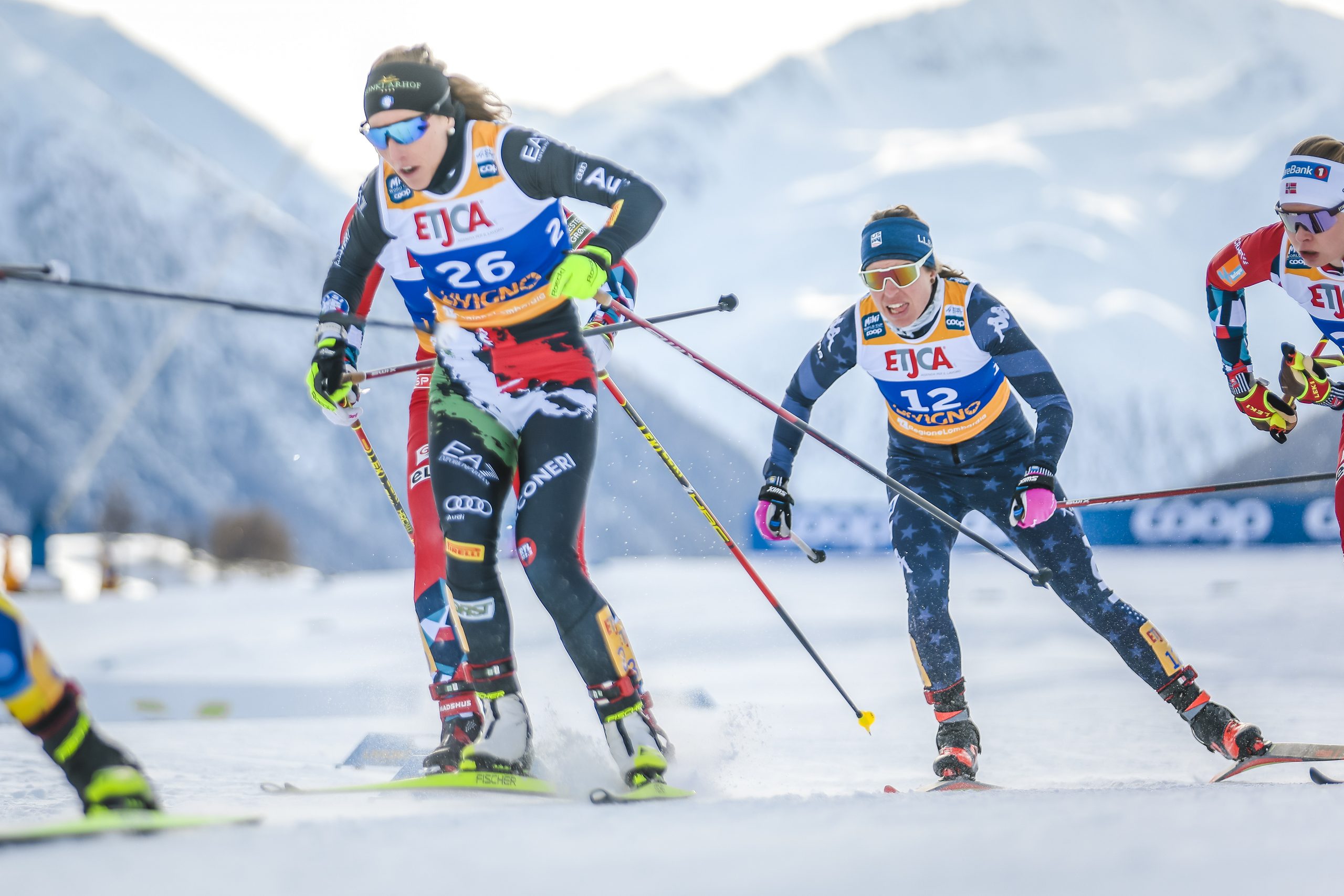
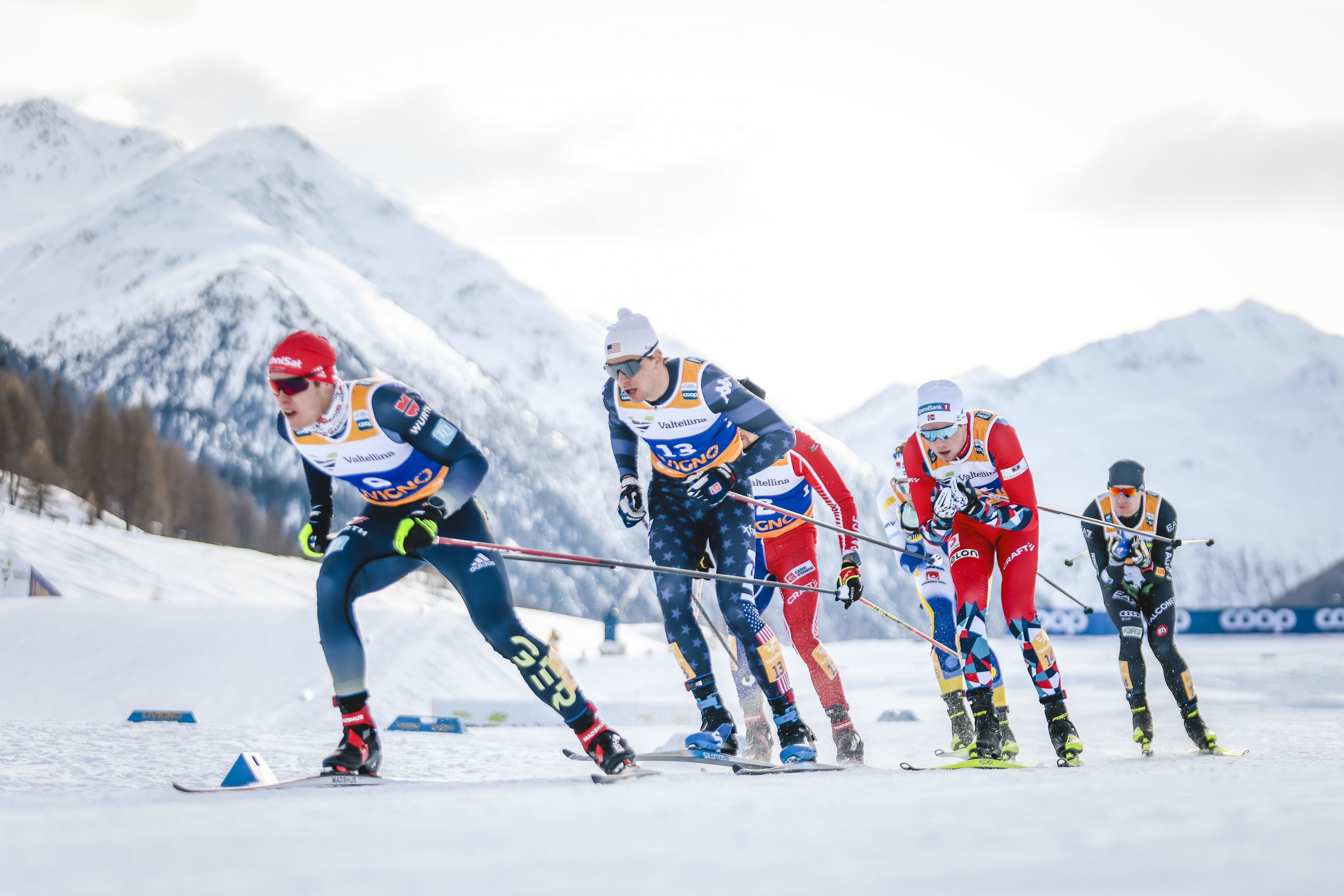
    After taking a weekend off to recover from the grueling Tour de Ski, the World Cup returned to its traditional format this weekend. Today, in Livigno, Italy, the freestyle sprints were contested. It’s the first time Livigno has hosted a World Cup event. Livigno sits just below 6,000 feet, which would press the FIS (International Ski Federation) rules on altitude.

    The pleasant sight of natural snow welcomed racers in Livigno, Italy. (Photo: NordicFocus)

    The storyline on the men’s side should have been straight forward:  Would Johannes Klaebo (NOR) continue his season, and career long, sprint domination? Over half of Klaebo’s individual World Cup victories have been in sprints, and he is riding a very hot hand having won nine out of ten of the last sprints he’s competed in. The primary threat to Klaebo was likely to come from Lucas Chanavat (FRA) who is currently second in the sprint rankings. Also hoping to topple Klaebo were Richard Jouve (FRA), and Federico Pellegrino (ITA). Pellegrino would have the benefit of being able to draw support from his home country’s fans. Pellegrino beat Klaebo in a shocking outcome in Davos, back in the middle of December. While a strong sprinter, Jouve’s strength is in the classic technique sprint.

    Johannes Klaebo (NOR) on the way to another sprint victory. (Photo: NordicFocus)

    Klaebo is in a pitched battle with countryman Paal Golberg (NOR) for the overall cup standings. While Golberg doesn’t usually have Klaebo’s sprint prowess, (he is fifth overall in the sprints), he would need a strong performance to keep him in the overall cup hunt.

    However, the narrative became scrambled due to a schedule conflict with the Norwegian national championships. This led to Paal Golberg racing Thursday in Gjovik, Norway and then heading over to Italy for the weekend. Other men pulled double duty racing both the Norwegian championships and the World cup, including Erik Valnes and Even Northug. Valnes ended up winning his country’s sprint championship. It remained to be seen what effect the extra racing would have on Golberg and the others. Klaebo did not race in the Norwegian Championships.

    The U.S. side of the men’s sprint story was also dominated by who was absent. Going into the race, Ben Ogden was in seventh place in the sprint standings (ninth overall). However, Ogden did not race today. U.S. coach Matt Whitcomb told FasterSkier that the time off was planned for Ogden. Also not racing today to prepare for the world U-23 championships were J.C. Schoonmaker (University of Alasaka-Anchorage), and Gus Schumacher (Alaska Winter Stars)

    On the Women’s side, the biggest story again was who wasn’t racing. There were only 38 women who competed in the qualifying round. A morning of racing for the qualifiers was spent eliminating only 8 skiers. This should be a point of concern for FIS.  Whitcomb shared the concern about depth of competition. “There’s a lot of stress coming up to altitude, and racing a sprint without being acclimated, and there’s a lot of pressure to race at [Norwegian] nationals. You really have to choose your battles.” The scheduling is far from ideal.  Whitcomb noted that he is concerned with the depth, particularly of the women’s field. “One of the big issues is that it doesn’t make a lot of physiological sense when preparing for World Championships to go up to altitude for four days…and then come down.” He noted that it’s a problem that needs fixing.
    Many of the top Norwegian women also chose to race the Norwegian championships or skipped Livigno. Tiril Udnes Weng, Heidi Weng, Lotta Udnes Weng, Ragnhild Haga, Helene Fossesholm, and Ingvild Flugstad Oestberg all chose to skip Italy. Frida Karlsson (SWE) also did not race today.

    Emma Ribom (SWE) had dominated the sprints early in the season, but a bout with Covid may have prevented her from achieving similar successes lately. It remained to be seen whether she could regain her early season form. Today would also be a return to World Cup racing for Linn Svahn (SWE) who has had an extended absence from the World Cup due to injury.

    The start list shuffling left the door wide open for American Julia Kern, who has been having an impressive sprint season. She is currently sixth in the sprint standings.  Going into the race, third through sixth overall were only separated by 56 points. Given the sparse starting field, Kern had the opportunity to gain significant ground.

    Julia Kern (USA) raced her way into a World Cup sprint final for the first time this season. (Photo: NordicFocus)

    Jessie Diggins is fourth in the overall cup standings, only 15 points behind Kerttu Niskanen (FIN) who sits in third. But Diggins joined the long list of women not racing today. It was a strategic decision for Diggins who chose to prioritize rest prior to the World Championships over chasing World Cup points. U.S. coach Matt Whitcomb told FasterSkier that “Jessie’s doing great.  She had a great training camp in Seefeld and stayed there with a bunch of athletes…because we knew she needed a break it was going to be either this weekend or Les Rousses, France [next weekend’s World Cup race].  Whitcomb continued that “The focus is now on World Championships, much more than points.”

    Also not racing was U.S. National’s champion Hailey Swirbul. Swirbul won every race two weekends ago in Houghton, MI and had expected to race this weekend. However, Whitcomb informed FasterSkier that Swirbul had gotten sick almost immediately after arriving in Europe.  “She’ll head straight to Les Rousses as soon as she is feeling good.”
    Going into the race, Rosie Brennan was sixth in the overall standings, and she would be trying to help her cause by gaining points in the sprint. Brennan has had her ups and downs in sprints this year. She’s made the finals in Davos but has also had her difficulties. She seems to have put her early season illness behind her, so hopes would be riding high for the Alaskan.

    An all Sweden podium in Livigno (l-r : Maja Dahlqvist, Jonna Sundling, Emma Ribom) (Photo: NordicFocus).
    The Results

    It ended up being team Sweden dominating the Livigno podium. Finishing first was Jonna Sundling (SWE), followed by Maja Dahlqvist (SWE), and Emma Ribom (SWE).  The top American women were Julia Kern, who finished sixth, and Rosie Brennan in 11th.

    Other American finishers were Alayna Sonnesyn, 24th, and Lauren Jortberg, 29th.

    On the Men’s side the Klaebo train continued to chug along as he beat out Richard Jouve in a close finals race.  In third place was a surprising Janik Riebli (SUI).

    Janik Riebli (SUI) on the way to a podium performance (Photo: NordicFocus)

    The top American male was Kevin Bolger, 12th.  He was followed by Logan Diekmann, 38th,  Will Koch, 41st, and Adam Witkowski 42nd.

    The Race

    In the women’s heats Brennan went in having qualified in 12th spot. She skied her quarterfinal heat strategically, sitting in fourth most of the way. She ultimately finished third in her heat and would have to wait for a lucky loser spot. She was rewarded for her work and ultimately advanced via the lucky loser route.

    Kern skied very controlled in her quarterfinal and pushed herself to the front of the pack taking the lead with about 30 seconds to go and cruised comfortably to finish first.

    Julia Kern navigating through the field on the way to the finals in Livigno. (Photo: NordicFocus)

    Alayna Sonnesyn was not able to advance out of her heat.

    Brennan and Kern both raced in the second semi-final. Brennan pushed immediately from the start setting a fast early pace. However, she was unable to hold the quick tempo and was passed about halfway through the race.  Kern took an alternative strategy holding back early and then pushing to the front in the final half. Kern ended up second to advance to the finals. Brennan’s strategy of going out hard did not work for her as she continued to fade through the race and ended up last in her heat.

    “I took a chance in my semi to ski a bit more aggressively and unfortunately, I completely ran out of power on the long uphill finish.”           Rosie Brennan.

    Rosie Brennan (USA) (number 12) gave it everything she had in the heats, but ultimately ran out of steam. (Photo: NordicFocus)

    The difference in approach was based upon what the racers experienced in the quarterfinals. Whitcomb said that “Julia felt like she was knocked around a little out of the start…there’s always a risk when you’re playing your cards from fifth or sixth.  We wanted her in the semifinal to be in a [higher position], so she had less traffic to deal with.”  Regarding Brennan, Whitcomb said that “People drafted by her, and she kind of ran out of energy.”

    On the men’s side, Klaebo—who qualified with the fastest time—comfortably won his quarterfinal. Jouve, Chanavat, and Pellegrino also advanced comfortably.

    The only American man to qualify for the heats was Kevin Bolger. He skied a very efficient quarterfinal and ended up winning his heat.

    In the men’s first semifinal it was Klaebo and Jouve taking first and second.  In Bolger’s semifinal he went to the front from the start. With most of the pre-race favorites going in the first heat, it was a good strategy.  But just like with Brennan, he faded toward the finish and ended up finishing last in his semifinal.

    Kevin Bolger  (USA) (number 13) would have an outstanding day in Livigno, finishing 12th. (Photo: NordicFocus)

    In the finals, the only American left was Julia Kern. She held back toward the rear of the pack at the start with four Swedes out front.  Faehndrich tried to meticulously worked her way through the crowd of Swedes, but was unable to join the front grouping. Kern was never able to find the speed to challenge and ended up sixth. It was still her best sprint result of the year. At the end of the day, It was all Sweden with Sundling, Dahlqvist, and Ribom going 1-2-3.

    In the men’s final Klaebo held back at the start sitting in fifth place, and then easily moved himself to the front about a minute into the race.  He then asserted himself at the front, content to let others try to find a way around him. At the finish Klaebo turned on the afterburners and was able to just beat out Jouve at the finish line. It was a close finish, but at the end of the day no one had solved the puzzle of how to beat Klaebo in a sprint race. Not bad for a guy who pulled into the venue the night before the race.

    An interesting byproduct of the scheduling was the U.S. and Norwegian teams shared wax facilities this weekend. Whitcomb said that, “Because Norway kept so much of its infrastructure in Norway because of the nationals, they needed some help. It was a great opportunity to partner up…we had the Norwegians in our truck today.”  It turned out that Klaebo’s skis were waxed in the American truck by Norwegian technicians.  Whitcomb emphasized the value of sharing ideas and was excited about the partnership. The teams have a history of helping each other when one needs help. In addition to sharing physical space, the teams shared testing data as well. “We have a great relationship with the Norwegian team…I’m very proud of our small staff’s ability to plug in with the Norwegians and figure out a seamless working machine.  It was a great team accomplishment.”

    FULL RESULTS


  • Klæbo Defends Olympic Gold as Americans Soar to New Heights in the Freestyle Sprint

    Klæbo Defends Olympic Gold as Americans Soar to New Heights in the Freestyle Sprint

    This World Cup coverage is made possible through the generous support of Marty and Kathy Hall and the A Hall Mark of Excellence Award.  To learn more about A Hall Mark of Excellence Award or to learn how you can support FasterSkier’s coverage please contact info@fasterskier.com.


    During the American broadcast of the 30-kilometer Skiathlon on Sunday, NBC Analyst Chad Salmela made the comment that race represented the “old-school” of long-burn, grind-it-out ski racing. That length of ski race, updated only for the introduction of skating, has been a feature of Olympic competition since the 12th Olympiad held in 1956.

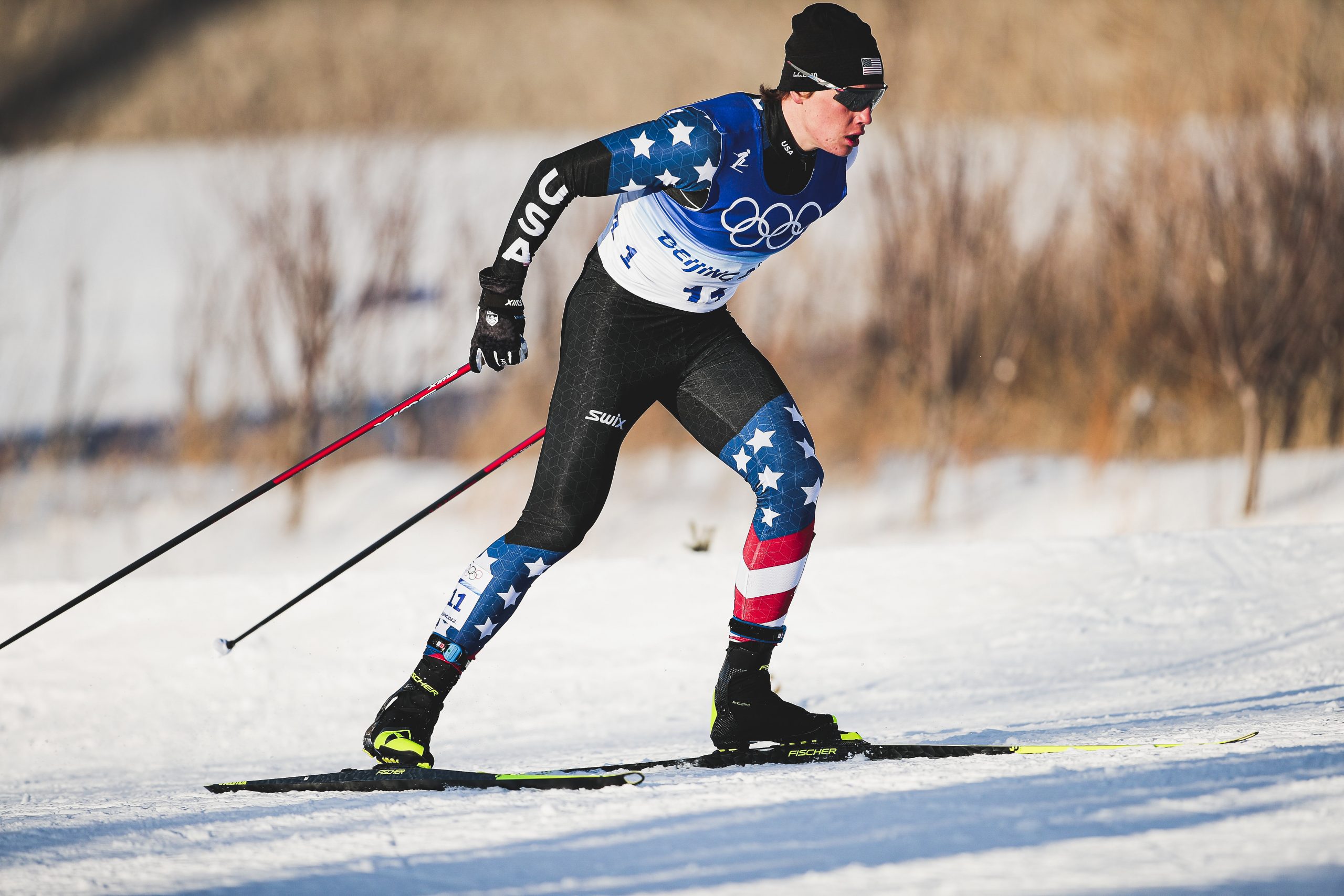
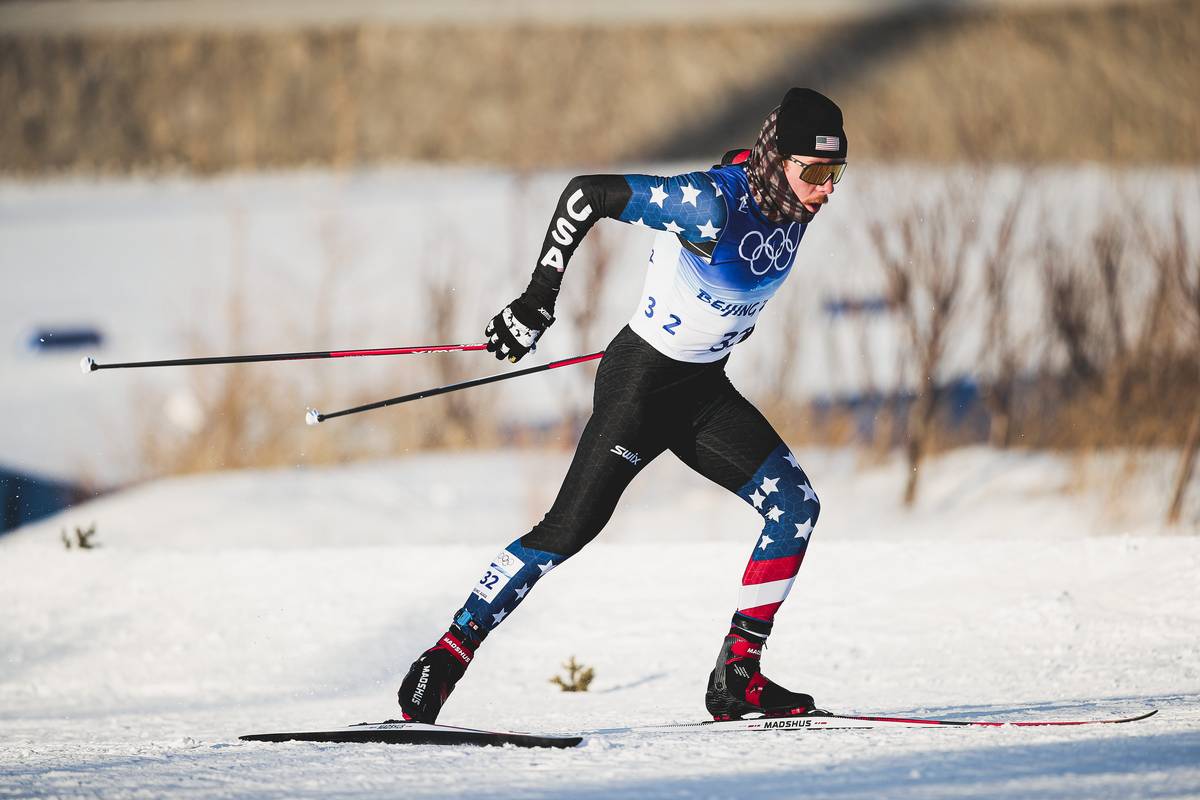
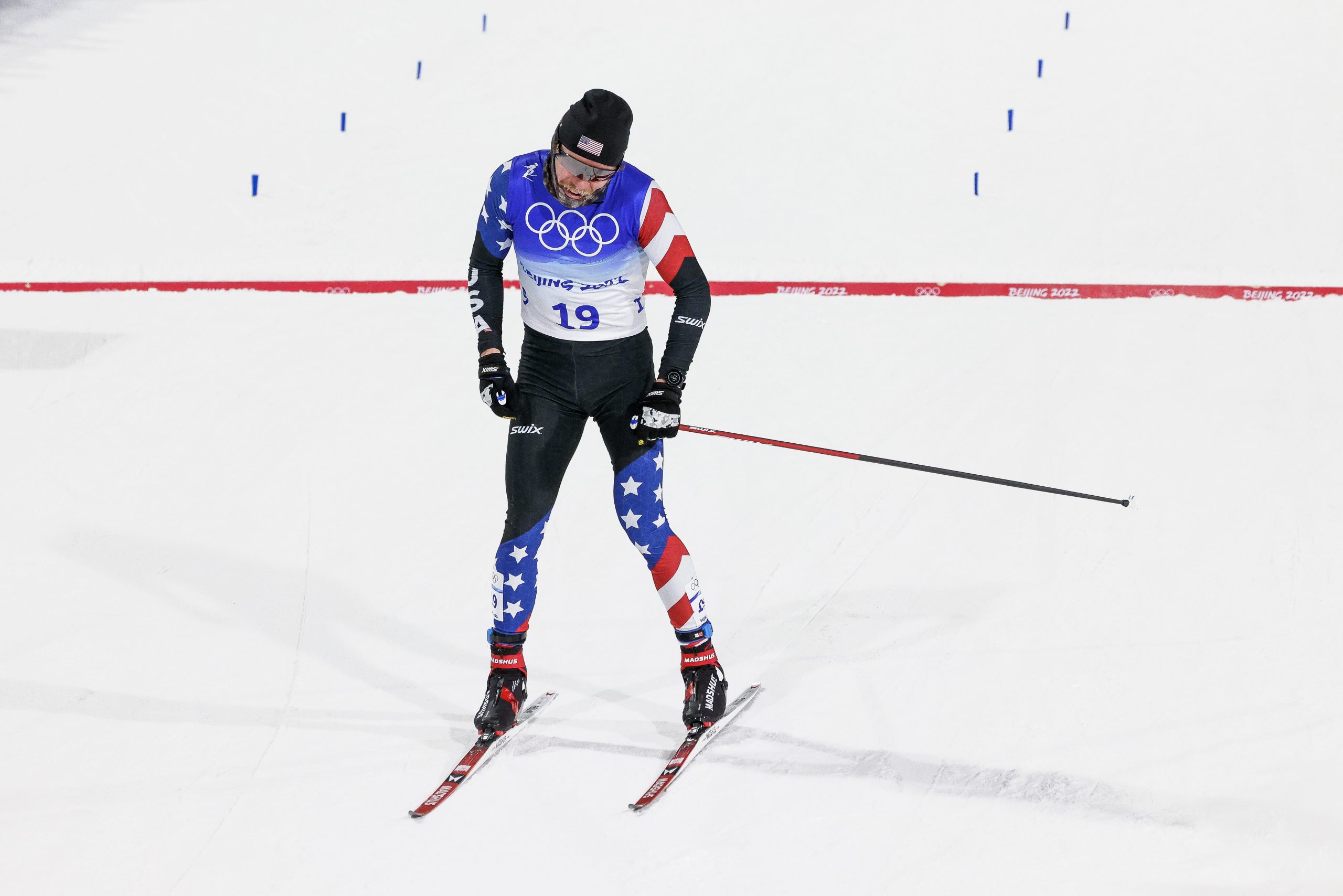
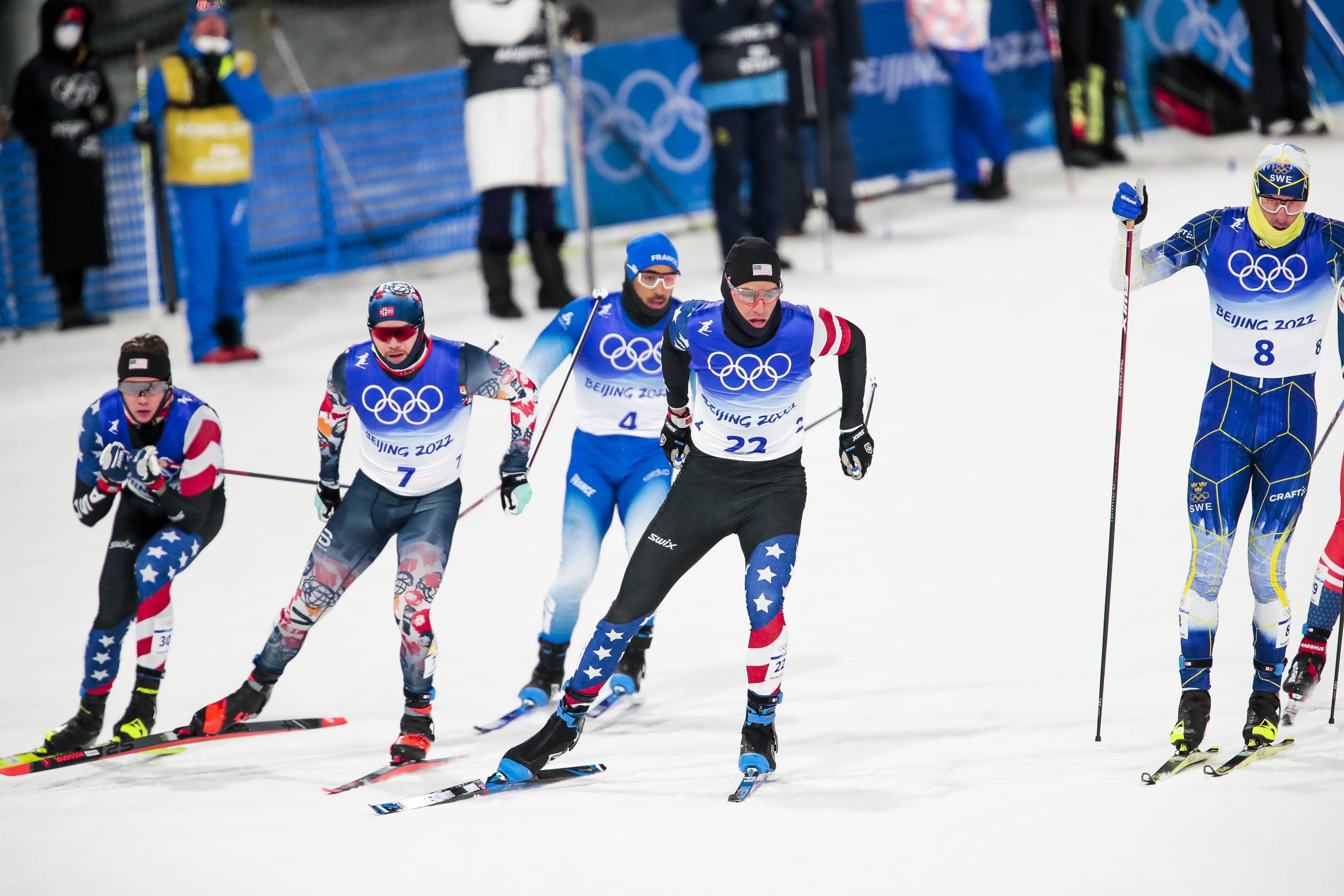
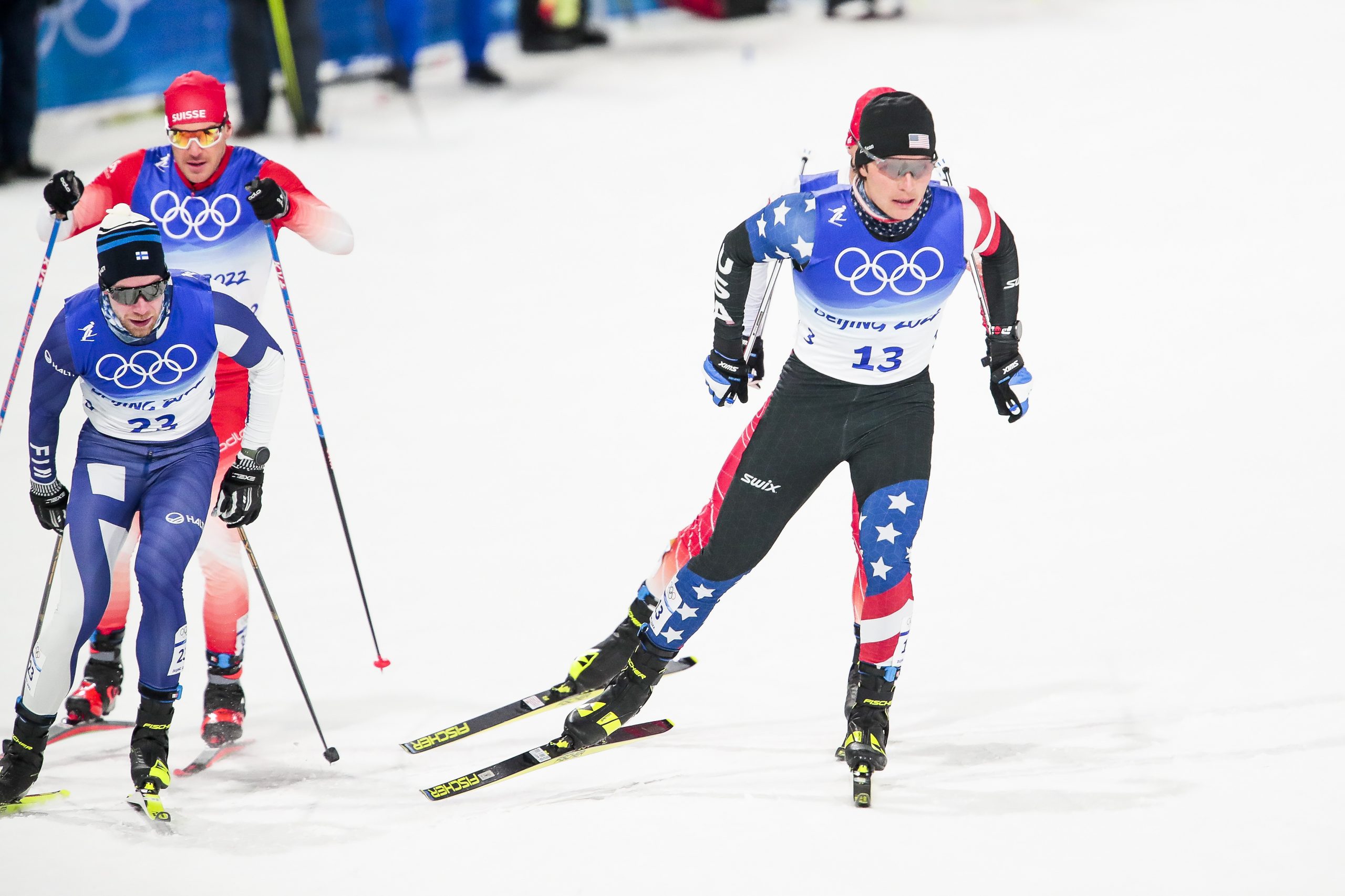
    In contrast, each one of the American skiers starting today was already born when the 1.5 km freestyle sprint became an Olympic event at the 2002 Salt Lake City games. In fact, only Kevin Bolger (born in 1993) can claim to have a living memory of that event. The other three – JC Schoonmaker, Ben Ogden, and Luke Jager – were all two years old when Tor Arne Hetland won gold at Soldier Hollow.  

    Luke Jager (USA) on his way to qualifying 30th in the Individual Sprint Qualifier in Beijing. (Photo: NordicFocus)

    In the intervening twenty years, those latter three were part of an American generation that came of age sprinting on the 2002 Soldier Hollow course, contesting junior and senior U.S. Nationals as they climbed through the ranks and quietly holding tight to their Olympic dreams. Meanwhile, the generation of skiers they looked up to were trailblazers, with sprinting their preferred in-road for American skiing on the Olympic stage. At the 2006 Torino games, Andrew Newell came through qualifiers in 2nd. Then Simi Hamilton became a consistent presence on the World Cup circuit, and qualified for heats in the last freestyle the Olympic sprint at the 2014 Sochi games. Eight years later in 2022, the kids had grown, and from Vermont hollows, Wisconsin Northwoods, the California snowfields, and the Alaskan frontier, had converged on a start-line in Beijing, ready to push for something new.

    After qualifying, they had already done it. The American men started four skiers for the individual sprint, and for the first time in Olympic history, each one of them made the heats. Leading the way was recently crowned U.S. sprint champion JC Schoonmaker, who finished in 13th, +6.12 seconds off of winner Lucas Chanavat (FRA), who clocked a 2:45.03 on the 1.5 k course. Ben Ogden finished in 19th (+7.18), Kevin Bolger was 22nd (+7.47), and Luke Jager rounded out the quarterfinal field in 30th (+9.41).

    Jager, in 30th, found himself right away in the unique challenges the Olympics can bring then, saying in an interview with FasterSkier that “There were seeded guys behind me and I knew I was right on the bubble [for qualifying]. I was getting interviewed by NBC and the whole time just wanting to reach down and check my phone.”

    In the end, he was through with his American teammates.

    Ben Ogden skis to 19th in qualification in the men’s individual freestyle sprint. (Photo: NordicFocus)

    They joined the established field that’s become familiar to those who follow the World Cup week-to-week, and for whom the individual sprint was a priority at these Games. That included defending individual sprint gold medalist Johannes Høsflot Klæbo (NOR), who qualified in 3rd (+1.71), defending silver medalist Federico Pellegrino (ITA) in 6th (+4.52), and the Russian Olympic Committee’s (ROC) own young star Alexander Terentev in 14th (+5.89). 

    The whole field would converge in the quarterfinals to race a 1.5 k course that raced as a “true sprint” as NBC Analyst and American gold medalist Kikkan Randall remarked on the American broadcast. Her remarks were apt; the course raced as a single-lap, taking three minutes for the majority of the field, on fully artificial snow. If you were looking for an archetype for what the “sprint-course” has developed into since the inception of the event at the 2002 Olympics, you’d have the one in Beijing. A first climb gave way to a downhill, which led to a long final climb, before skier’s took a sharp left turn into the final stadium stretch. The tactical pressure-point was the turn to go into the descent following the first-climb. If you went over with speed, the transition into the final hill could prove to be a decisive factor in a long-burn attack. If you followed, the draft could be just as important to launch a punchy sprint to move up the field on the last climb.

    That racers would see both approaches became apparent straight from the first quarterfinal, which featured Klæbo, Sergey Ustiugov (ROC), and Ben Ogden. Klæbo seemed to take the tactic of a long-burn attack on this course, which was helped along by a field that seemed set at every level today to try and force him out in front so as to catch his draft. He used the corner off of the first uphill to delay his burst of speed into the downhill just enough to surprise the field, and by the time he hit the final climb, he was in a comfortable position to win the heat.

    Ben Ogden crosses the finish-line in sprint heat action. Ogden would finish 12th, the best men’s individual sprint finish in US Olympic history. (Photo: NordicFocus)

    His burst of speed, though, had blown open the field behind him. Ben Ogden was caught out in 5th place going into the final corner. It turned out, in this particular case, to be a blessing. In front of him, Renaud Jay (FRA) stumbled over Anton Persson (SWE) (who was given a yellow-card for obstruction)  and caused a split-second hang up in the field with Oskar Svensson (SWE) that allowed Ogden to come into the finishing straight with a chance. He ended up taking it, finishing fourth place. Klæbo (2:51.57) had animated the quarterfinal, and the chase behind him yielded a fast heat. Ogden finished with a time of 2:53:00, good enough to warrant hope for a lucky loser spot into the semi-finals, but he would have to wait through four more heats to find out for certain.

    The third quarterfinal saw the next American action, with Kevin Bolger and JC Schoonmaker lining up against sprint stalwarts Richard Jouve (FRA) and Håvard Solås Taugbøl (NOR). Bolger, who is eight years senior to his fellow teammates, took a tactic in this race that suggested he understood the gravitas of the Olympics and how you race to stay in it. He led the pack out with gusto, trying to take the heat along with him.

    The field, however, seemed to have other ideas. Bolger said in an interview with FasterSkier that he “started V1-ing on the hill and I went ‘nope, not getting lucky loser, this is a different pace than the qualifier.” With those lucky loser spots most likely gone, the heat became a race for 1st and 2nd. Jouve and Taugbøl turned out to have the burst of speed needed in the end, with Bolger in 3rd. For the bleary-eyed among us back in the U.S., he provided the first glimmer of the American’s intrepidness on the day. For his part, Jager followed his older teammate, and his presence in 5th across the line was another reminder that that American spirit was found in spades on the day.

    Kevin Bolger (USA) and Luke Jager (USA) in quarterfinal action. Photo: NordicFocus.

    Jager pointed to how the Olympic experience was a unique one that he’ll hope to build on in an interview with FasterSkier, saying, “maybe it was the novelty, [but] to be perfectly honest my head wasn’t maybe in a great place to look towards advancing, but I think it’s one step at a time and I’m figuring out the right mindset to qualify consistently now and to advance. It was unlike anything else… it’s dark out and you need sunglasses, that’s awesome!”

    The fourth heat fleshed out the idea that Bolger had in the previous heat. The skiers went hard from the gun, knowing that if they could race a faster heat than the first quarterfinal, a 3rd or 4th in this heat could still keep their Olympic dreams alive. This was all complicated as Erik Valnes (NOR) pulled away to win the heat and a long sprint for second ensued. Pål Golberg (NOR) and Raimo Vignants (LAT) went down, and the sprint seemed to end up going for Chinese skier Qiang Wang, who hadn’t raced in the World Cup field since before the pandemic in 2019.

    Unofficial results showed that Valnes and Wang were through in 1st and 2nd, respectively. Results also showed that the quarterfinal had been the fastest heat of the day. Valnes finished in 2:49.31, with 3rd place Artem Maltsev (ROC) at 2:50.37 getting a lucky loser nod. The race jury quickly deliberated and disqualified (or officially, “ranked as last”) Wang, which meant that Maltsev was through to the semifinals on an automatic bid. That opened up one more lucky loser spot, and the next time on the list would prove to be a 2:53:00; belonging to Ben Ogden. He was through to the semifinals of the Olympic games.

    JC Schoonmaker (USA) races in the final quarterfinal on Tuesday in Beijing. Photo: NordicFocus.

    The last quarterfinal saw JC Schoonmaker narrowly lose out on a sprint to Alexander Terentev and Joni Mäki (FIN), after Schoonmaker led out the pack for the first part of the race.

    The men’s semifinals then, for the first time ever in an Olympic games, featured an American. And that American found himself in a who’s-who of heavyweights. The first semi-final lineup; Klæbo , Pellegrino, Jouve, Ustiugov, Chanavat, and Ben Ogden.

    Ben Ogden races the quarterfinal of the men’s freestyle sprint during the 2022 Beijing Olympic Winter Games. (Photo: NordicFocus)

    As the field climbed up the first hill, the skiers seemed set on fighting Klæbo tactics with Klæbo tactics. The race to get over the top was on.

    Richard Jouve ended up winning the fight to go into the downhill first, while Klæbo got caught at the back-end of a pack that remained tight. That included Ogden, who had weathered the storm to come into the final hill with the group. The transition into the final climb was furious, with Klæbo moving through the pack and bringing his rivals along with him. When they came into the final stretch, the field spread four wide and Klæbo, in shades of race nightmares past, looked to have eased up early, producing a four-way photo finish. Pellegrino and Klæbo ended up getting the nod to the finals in first and second, respectively.

    Ogden finished just off the sprint in 6th place (+1.24). His final placing of 12th is the best for an American man in an Olympic sprint. More than that though, he loomed in the background of a sprint of the world’s biggest names, appearing not as a straggler but as a shadow. The youngest in his semi-final field by 5 years, as he crossed the line, it seemed to be a reminder that the Americans are the ascendent force in sprint racing, with much more to learn, and to come, as they continue to gain experience at the Olympics.

    The second semi-final saw Artem Maltsev race with the same purpose he had struck out with in the quarterfinal. He seemed set on making sure that luck, in the lucky losers, would be with the second semi-final. After the first climb he had a gap that his teammate Alexander Terentev and Joni Mäki would claw back successfully in the lead-up to the stadium sprint, finishing 1st and 2nd, respectively. Maltsev and Oskar Svensson (SWE) were successful in their project of creating a fast heat though, and claimed the two lucky loser bids to the finals.

    The final then, had a field filled with shades of the last Olympic individual sprint. Klæbo had his chance to defend his medal. Pellegrino had his chance to one-up himself and claim gold in his stronger technique. Terentev, Mäki, Svensson, and Maltsev were all racing for their first Olympic medal of any sort.

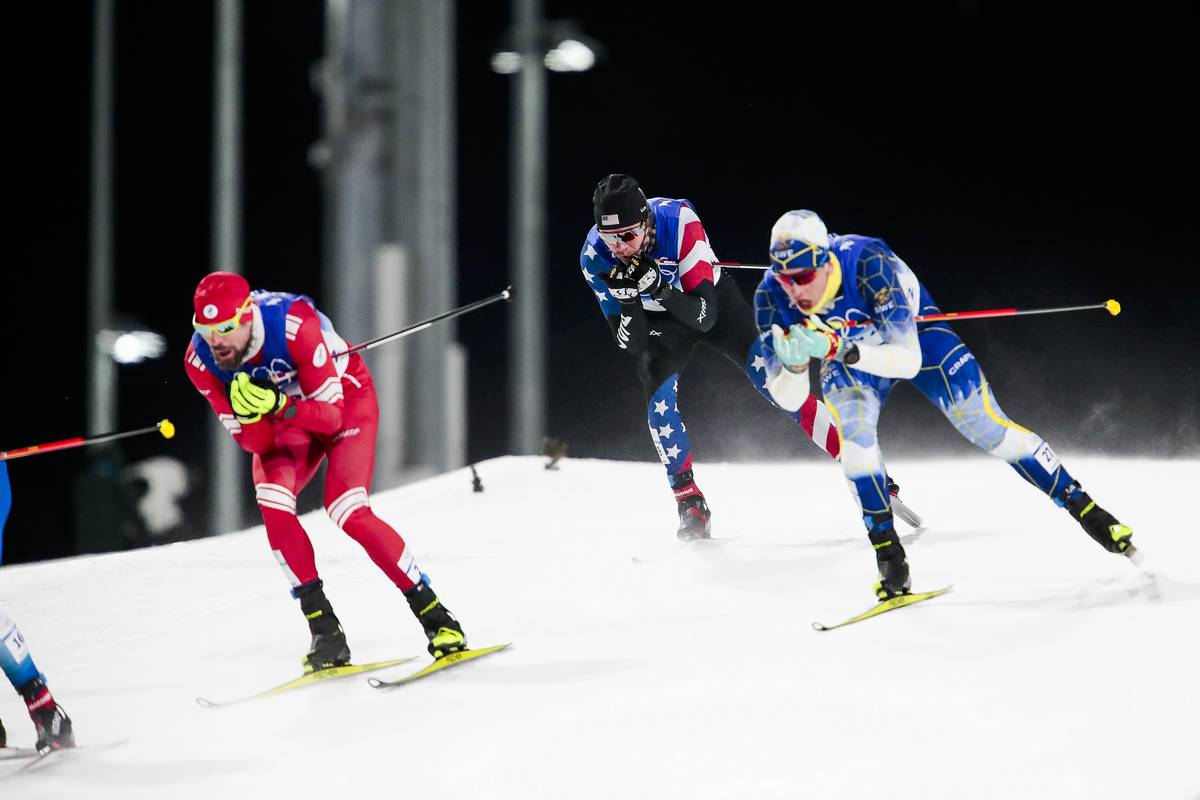
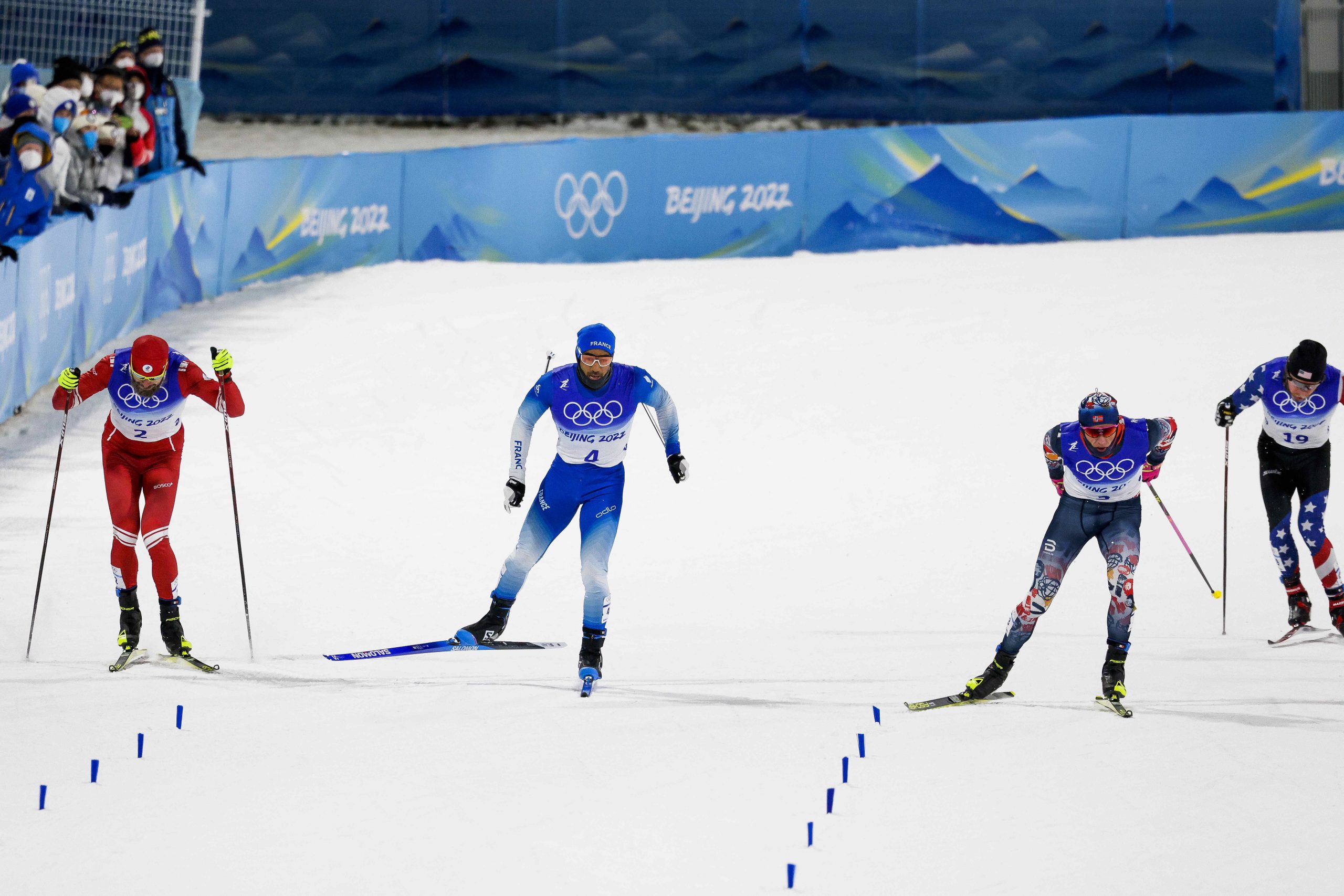
    Sergey Ustiugov (ROC), Richard Jouve (FRA), Johannes Høsflot Klæbo (NOR), and Ben Ogden (USA) in semi-final heat 1. Klæbo and Ustiugov advanced to the final. (Photo: NordicFocus).

    There was again then, a guarantee for something new. A new medalist at the Olympic games. This was, though, still a sprint race of the world’s best. That meant the field knew who they didn’t want to have a positional advantage – Johannes Høsflot Klæbo. They skied wide, without much depth, to try and force him to the front. Through the first climb, they were successful. Klæbo though, one-upped them, again sneaking a move into the later part of the corner leading into the downhill, and catching the field just off-guard enough to give himself an advantage going into the final climb.

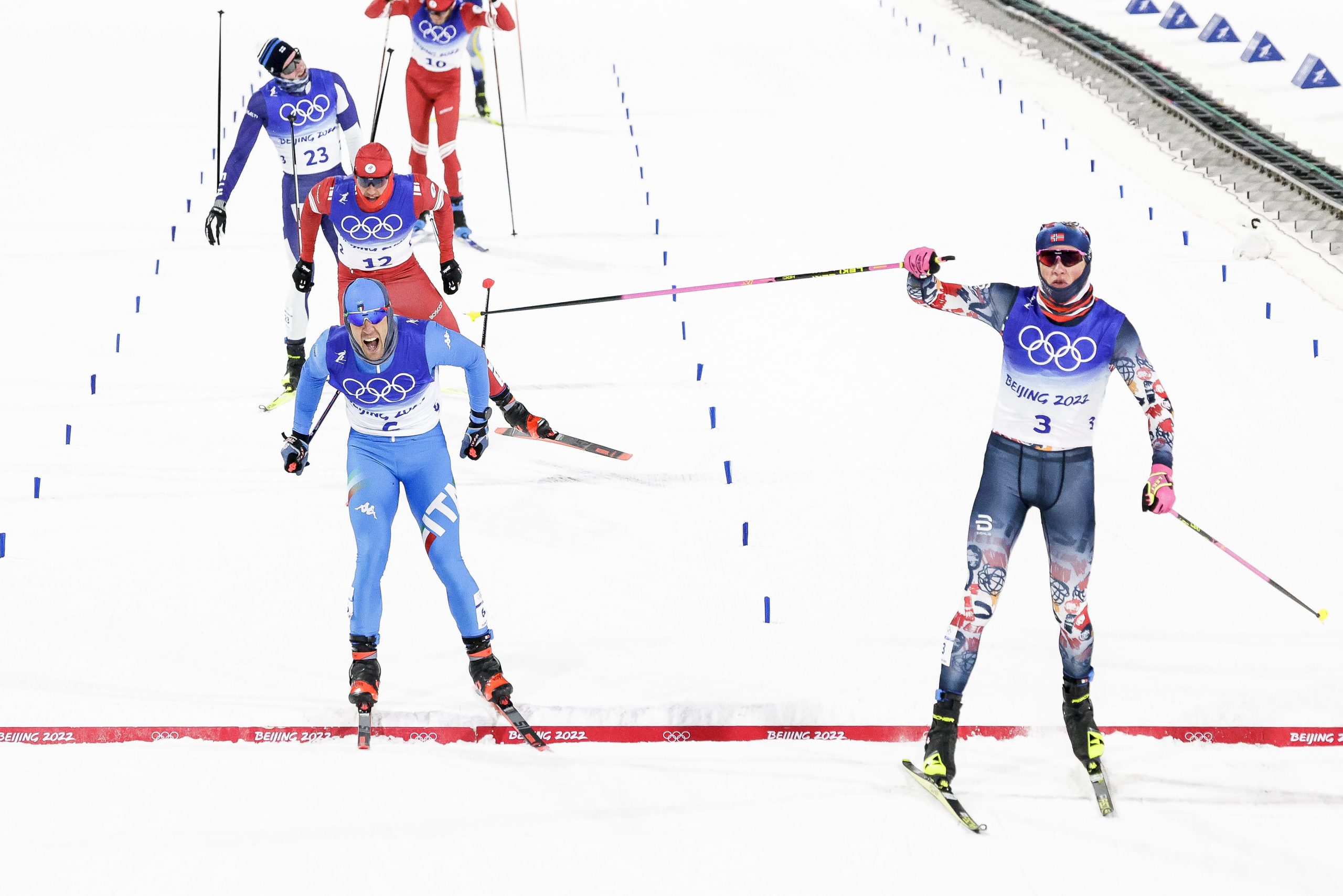
    Johannes Høsflot Klæbo (NOR) crosses in 1st to win gold in the men’s 1.5 k individual sprint. Federico Pellegrino (ITA) follows in 2nd place to claim silver. Photo: NordicFocus.

    There was no reeling him back. He came across the finish line an Olympic champion once again, defending his individual sprint medal and further building his case as one of the sport’s greats. Pellegrino pulled into the final climb and let out a final sprint that proved he is still Klæbo’s chief sprint competitor, four years on from establishing that fact in PyeongChang. The final step on the podium was occupied by Alexander Terentev, who, after a season in which he opened with a win, got to see his potential as an Olympic skier converted into kinetic possibility. He has one medal, and it would be a good bet that it won’t be long before he starts dreaming of the 1.5 k course that will be dreamt up for Milano-Cortina in 2026.

    Which, on the men’s side as a whole, is where many of us Americans are too. Even in these first few moments after their arrival on the Olympic stage, there is an err of possibility, energy, and optimism in the air about where this crop of skiers goes from here. We could get carried away and let that excitement uproot us from the source of that optimism in the first place. So before we look forward, let’s remember that the act of converting optimism into action is tenacity, and we can cherish Kevin Bolger, JC Schoonmaker, Luke Jager, and Ben Ogden giving us an image clad in stars and stripes of that here, today, in Beijing 2022.

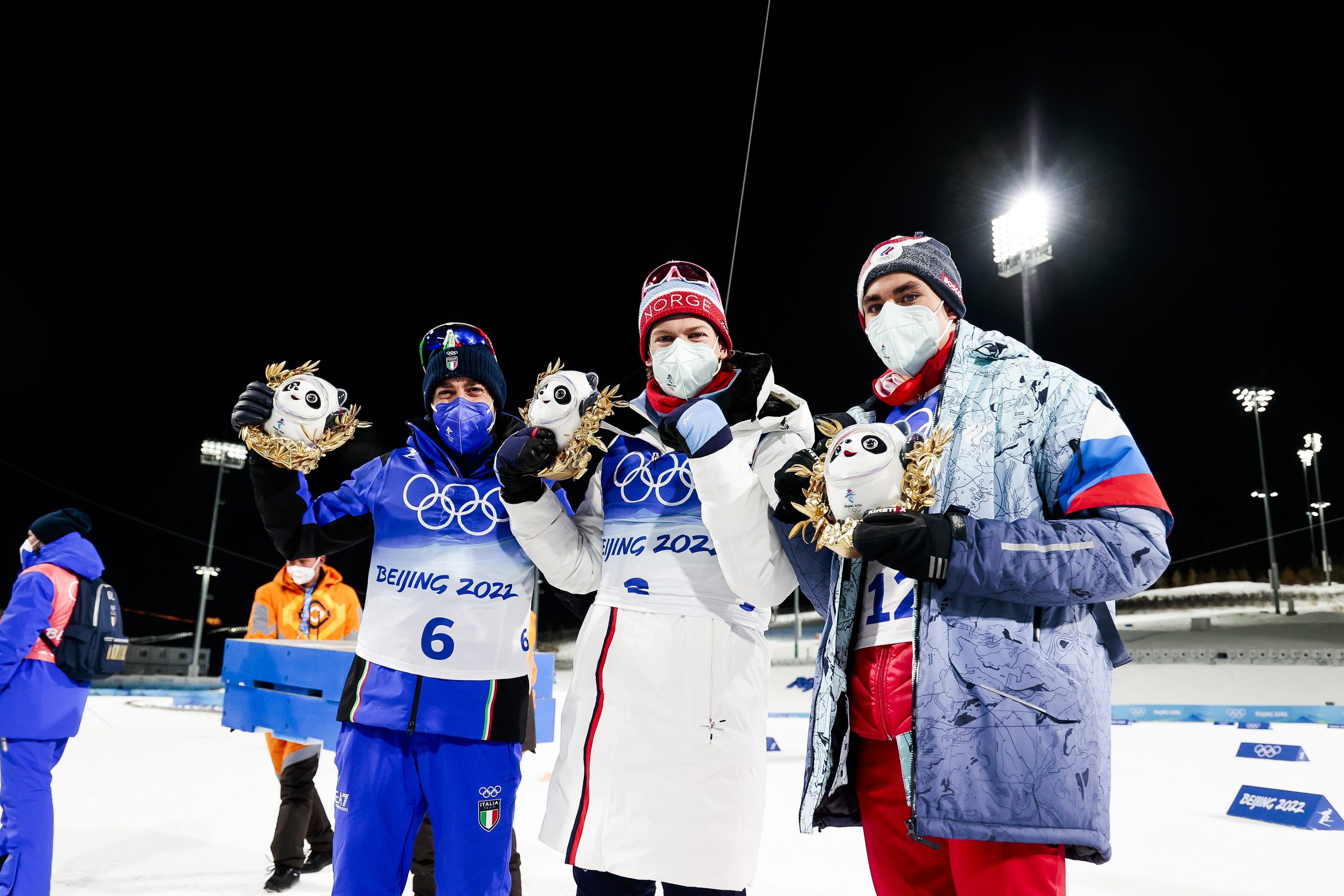
    Men’s podium of the Olympic 1.5 k Individual Sprint in Beijing. Johannes Høsflot Klæbo (NOR) in 1st, Federico Pellegrino (ITA) in 2nd, Alexander Terentev (ROC) in 3rd. Photo: NordicFocus.

    The Canadians also put up a set of strong performances in the sprint qualifier. Graham Ritchie finished 34th (+10.01), just 0.6 seconds out of qualifying for heats. The results continued with Olivier Léveillé in 54th (+17.23), and Antoine Cyr in 56th (+17.56).

    Final Results:

    Qualifying | Finals

  • Diggins’ First Podium of the Season; Dahlqvist Wins, Americans put 2 in Finals, 4 in Heats in Lillehammer

    Diggins’ First Podium of the Season; Dahlqvist Wins, Americans put 2 in Finals, 4 in Heats in Lillehammer

    This World Cup coverage is made possible through the generous support of Marty and Kathy Hall and the A Hall Mark of Excellence Award.  To learn more about A Hall Mark of Excellence Award or to learn how you can support FasterSkier’s coverage please contact info@fasterskier.com.

    By: Ben Theyerl

    For ski fans whose parents were smart enough to record the 1994 Winter Olympics on VHS tapes, Lillehammer will forever be a World Cup venue carrying the shadow of thousands of fans waving Norwegian flags as Bjørn Dæhlie did his signature “spin move“ on the way to Olympic glory. 

    Fast-forward to 2021, where the course has been reworked and modernized, the lycra is decidedly less exciting, and the multitude of Norwegian flags flying were interjected by a whole lot of Swedish and American ones. 

    Today, in the Birkiebeiner stadium – that quintessential home of Norwegian skiing – chances of victory blowing in from Sweden were very high. Going in, they had won the last 5 straight World Cup freestyle sprints, and 14 of the last 20 overall. The Americans too, looked to continue their history of success in the freestyle sprint. Of the 16 wins that the Americans have had in sprint events, 15 of them have come in freestyle, with two of those previous winners, Jessie Diggins and Rosie Brennan, in the field on Friday morning.

    In qualifying there were hints that as the field narrowed, it would be Sweden, Norway, and the United States whose skiers would fill the semifinal and final slots. Maja Dahlqvist continued her strong start to the season, winning the qualifier in a time of 3:11.59. She was joined by Tiril Udnes Weng (+1.38) and Nadine Faehndrich (+2.84) in the top 3 spots.

    The U.S. team placed three inside the Top 10, with Julia Kern the top qualifier in seventh (+4.90), followed by Jessie Diggins in eighth (+5.08), and Rosie Brennan in tenth (+5.49). Hannah Halvorsen rounded out the qualifiers for the heats in 21st (+8.18).

    Hannah Halvorsen (USA) sprints to 21st place in sprint qualifying in Lillehammer. (Photo: NordicFocus)

    Three strong national contingents then went to the quarterfinals. Norway with seven skiers, Sweden with five, and the United States with four. There they would face each other on a new 1.6k Sprint course that left little to be deciphered about what would be the deciding feature on the day. On this course, there was an A-climb, and after doing it once, they would loop back around and do it again.

    The Americans took a different approach to heat selection this week than they did in Ruka, where they raced late in the quarterfinal heats. Kern and Diggins lined up in the first heat together, joined by Tiril Udnes Weng. Kern led out the pack and raced consistently throughout, leading the first time up the climb with her teammate Diggins in tow. 

    A scene from the first heat of the quarterfinals, which included Julia Kern (Bib 7) and Jessie Diggins (Bib 8). (Photo: NordicFocus)

    For Diggins, the quarterfinal established the pattern that she would look to repeat throughout the day on the tough course. At the foot of the climb in the second loop, Diggins moved through to the outside of the pack and then powered to the front. By the time she was in the stadium, only Weng was left behind her, and that’s how they finished. Kern, meanwhile, sprinted to 3rd place, and after all the quarterfinals were settled, was just a tenth of a second out of a lucky loser slot for the semi-finals (which went to the Finnish skier Jasmi Joensuu). Kern ended her day in 13th overall.

    The other lucky loser slot was filled by Rosie Brennan in the second quarter-final. Brennan’s tactical approach to the course mirrored Diggins. In the second heat, Brennan matched up against Maiken Caspersen Falla and Nadine Faehndrich, and would finish just off the two to take third place in the heat, and first in the lucky loser slots.

    In the semifinal, Diggins found herself alongside three Norwegians, matching up against T.U. Weng, L.U. Weng, and Caspersen Falla. The heat saw the best execution of her tactical approach to the course all day, as she followed the first move up the climb from Jasmi Joensuu, then shot around the outside to carry speed into the downhill, before moving in a perfect swoop off the apex of the turn to the outside that allowed her to power up the final climb joined by T.U. Weng and Falla. At the finish, Diggins crossed in first again, with T.U. Weng right behind.

    The two would be joined by four skiers from the other semi-final. The Swedish pair of Dahlqvist and Ribom executed their tactical approach to the course to a tee, leading out the first part of the course and establishing a sprint that would be devoid of any posturing, then staying with any moves that occurred on the second-time through the climb – which came in this heat from Brennan – before finishing strong in the stadium sprint. Dahlqvist finished first, Ribom second, and Brennan came out the lucky loser for the second time on the day, advancing to the finals.

    Rosie Brennan (USA) rounds the corner in front of Anamarija Lampic (SLO) during the final in Lillehammer. (Photo: NordicFocus)

    The final field represented the Swedish and American fronts, who fully established themselves as the dominant force in Lillehammer. Two Swedes, two Americans, and just one Norwegian. Plus, Anamarija Lampic of Slovenia too. 

    The two leading countries’ different approaches to the course were most stark the first time up the climb, where Diggins and Brennan took the outside, and Ribom led the rest of the field on the inside track. At the top of that first ascent, the Americans took the animating action, Diggins shooting around the outside to lead the descent. 

    Brennan followed, reflecting her initiative to create an ideal position for the final climb: “I made a move early in the final to try to see what I had and unfortunately, was passed on the downhill into the last uphill” she said in an email to multiple news outlets.

    With Brennan back in the pack as they took to the second climb, what had been alluded to throughout the day gained clairvoyance – Dahlqvist and Diggins were the strongest in the field. As they crossed the finish line, what was clear became a result. Dahlqvist won her second sprint of the young World Cup season, as Diggins earned her first podium finish of the year. T.U. Weng rounded out the podium in 3rd, with Ribom finishing 4th and Brennan in 5th on the day.

    Maja Dahlqvist (SWE) wins 3rd straight sprint, followed by Jessie Diggins (USA) and Tiril Udnes Weng (NOR). (Photo: NordicFocus)

    If Ruka was an exciting first burst of energy for the World Cup season, then Lillehammer today was an indication that long-term trends do hold. Last year’s World Cup champion Jessie Diggins has her first podium of the season. Maja Dahlqvist is now on a three-win sprint streak going back to last season, and the most ascendant sprinter on the women’s circuit. And in the freestyle sprint, it’s the Swedish and American women who continue to rise to the top, with Norway, on their home turf, putting up an ever-valiant defense of their dominance on the world stage.

    Oh, and Americans can start dreaming of Jessie Diggins doing her best Bjørn Dæhlie impression in Beijing come February, as her second-place finish today means one-half of the Gold Medal highlight from the last Winter Olympics in 2018 is officially qualified. Diggins is the second American to qualify for this season’s Olympic team, joining Brennan (top-8 in both today’s sprint and last weekend’s 10 k classic) as objective qualifiers.

    Here’s Jessie’s post-race comments to FasterSkier:

    Jessie Diggins on her first podium of the season after finishing 2nd in Lillehammer. (Photo: NordicFocus)

    Stepping back into the quarterfinals, Hannah Halvorsen skied strong in the fourth heat of the quarterfinals, which included Dahlqvist and Lampic. Losing contact toward the finish, Halvorsen finished sixth in her heat, which put her in 28th place in the final standings.

    “I felt good today on the course,” Halvorsen wrote in a post-race email. “It was fun to have things come together. It was awesome to see our team put so many people in the top 30 this early in the season! I can’t wait to see what the season will bring for the US with so much potential in the mix!”

    Elsewhere in the results, North American women had a strong showing. Hailey Swirbul (USA) finished 42nd (+12.50), with Cendrine Browne (Canada) in 52nd (+14.63), Dahria Beatty (Canada) in 53rd (+14.73), and Katherine Stewart-Jones (Canada) in 55th (+15.34). Novie McCabe (USA) finished 56th (+15.34), Maya MacIsaac-Jones (Canada) finished 60th (+19.21), Katharine Ogden (USA) finished 61st (+19.89), and Sydney Palmer-Leger (USA) finished 62nd (+19.89).

    In a post-race interview, U.S. Ski Team Head Coach Matt Whitcomb answered a variety of questions on the men’s and women’s races in Lillehammer, including comments on the new course and the approach to heat selection this weekend relative to Ruka. He also shared his perspectives on the rounds, and an explanation of why qualification is a skill that athletes must learn, in reference to comments made by Sadie Maubet Bjornsen and Devon Kershaw on the post-Ruka episode of The Devon Kershaw Show.  Have a listen.


    Full Results:

    Qualification | Finals

  • Jönsson Finds Winning Form Again in Lahti; Swedes Take Top Two

    Jönsson Finds Winning Form Again in Lahti; Swedes Take Top Two

    Emil Joensson (SWE) takes top accolades in Lahti, Finland. Photo: Fischer/Nordic Focus.

    Emil Jönsson needed this. He had been sick for too long, without a top 10 result since December and mostly out of contention for a World Cup podium since the end of last season.

    Two weekends ago at the freestyle sprint in Szlarska Poreba, Poland, the Swede was 62nd. That was behind him. This was Lahti, Finland, where he won the classic sprint last year. With some of the trickiest descents on the World Cup, it was a whole different ballgame.

    Sunday started off as good as Jönsson could have planned as he won the 1.4 k classic sprint qualifier by nearly three seconds in 3:09.31, ahead of Kent Ove Clausen of Norway (+2.89).

    Another celebration for Joensson. Photo: Fischer/Nordic Focus.

    The day got even better for the 26-year-old. Jönsson was the clear-cut winner of both his quarterfinal and semifinal, beating runner-up Ola Vigen Hattestad (NOR) by 0.9 seconds in the first round. He went on to edge teammate Teodor Peterson – the World Cup sprint leader – by 0.7 seconds in the semi.

    In the final, Jönsson again stole the spotlight from his fellow Swede after Peterson led for most of the race. Jönsson somehow stayed on his feet on the infamous 180-degree final turn and charged behind Peterson.

    He had nearly collided with Russia’s Nikita Kriukov, but the two came out of the hairpin corner upright and instantly picked up the pace. Both wanted to close on Peterson, but it was Jönsson’s time.

    At precisely the right moment within a few feet of the line, Jönsson lunged ahead to upset Peterson by an inch or so. The victory was his first on the World Cup since winning a classic sprint in Stockholm nearly a year ago.

    “I am speechless,” Jönsson told FIS News. “I had so many difficulties in the past weeks and today I am back on the top. I did not believe that this is possible.”

    With the way the qualifier went, he guessed the rest of the afternoon might go as well. But after two years of injuries and illness, he couldn’t be too sure. A torn leg muscle derailed the start of his season in November and early December.

    Back in Lahti, he was far from confident to start.

    “I have never been this nervous before the race because my shape has not been good,” he said. “Now everything is a relief to be able to be up there again. I’m empty now.”

    Peterson, who was second, increased his World Cup sprint lead to 114 points. Russia’s Nikolay Morilov moved up to second in the sprint standings ahead of teammate Alexey Petukhov. Morilov was eighth on Sunday and Petukhov did not advance after ranking 48th in the prologue.

    Kriukov, Russia’s defending Olympic sprint champion, placed third. Closely trailing Peterson into the last corner, Kriukov widened his stance to keep from falling. Jönsson narrowly missed crashing into him by veering inside.

    When they came out unscathed and entered into the stadium, Jönsson was already in front.

    “The final heat was tough,” Kriukov told FIS News. “I had good speed and was fast, but the Swedish did a bit a team tactic so we had some difficulties in the curve in the downhill. At the end I took the third place and be happy to be on the podium.”

    Ola Vigen Hattestad (NOR) congratulates the winner Emil Joensson (SWE). Photo: Fischer/Nordic Focus.

    It was Kriukov’s third time in the top three this season. For Peterson, it marked his sixth individual World Cup podium. He placed fourth in Sunday’s qualifier after Norway’s Eirik Brandsdal finished in third.

    After Peterson comfortably won his quarterfinal by topping Siim Sellis (EST), who went on to place 10th went, the sprint leader decided to ski behind Jönsson in the semis. Doing so, he avoided trouble while Kriukov nearly fell on the sharp turn, but hung on in third and advanced to the final by time.

    In an interview with FIS after the race, Peterson said he strayed from his usual tactics of sitting back and pouncing late. Instead, he went out hard from the start of the final, pushing the pace on the initial climbs. It didn’t exactly work as Jönsson challenged him to the line, but he wasn’t too upset.

    “I am satisfied about my second place and also happy for Emil who had so many difficulties so far,” Peterson said.

    Hattestad came through in fourth and Sami Jauhojaervi (FIN) placed fifth. Norway’s Gleb Retivykh tried to set a blistering pace early on in the final, but blew up and finished sixth.

    Retivykh won his quarterfinal and semifinal, edging Jauhojaervi in the semi by 0.2 seconds. Fabio Pasini (ITA) was third in the heat for seventh overall. Kriukov and Hattestad advanced as lucky losers out of the faster previous semifinal.

    Morilov won the fourth quarterfinal ahead of Pasini in second and Andy Newell (USA) in third. Newell took the inside line of the final corner and fell, taking Clausen down with him. He ultimately placed 15th while Clausen ended up 26th overall.

    Simon Persson (SWE) came out on top in the fifth quarter, with teammate Robin Bryntesson advancing as well. Simi Hamilton (USA) finished just after, 0.1 seconds behind Persson, to advance by time. Persson went on to finish ninth, Hamilton was 11th and Bryntesson was 12th.

    Men’s overall results


    Men's podium: (l-r) Teodor Peterson (SWE), Emil Joensson (SWE) and Nikita Kriukov (RUS). Photo: Fischer/Nordic Focus.