From the FasterSkier archive — posts syndicated from athletes’ and coaches’ own blogs between 2004 and 2012, kept online as published. Current coverage is at fasterskier.com.
We had to take a break after our three-week Olympic sprint, but we’re back to catch up on a couple of weeks of World Cup racing.
Devon and Nat take a quick run-through of events in Sweden, Finland and Norway. We’ll be back after the marathons at Holmenkollen.
Reach us at devon[at]fasterskier.com and nat[at]fasterskier.com.
A reminder: This is a homegrown podcast done by two guys working long hours and late nights. We also paid real money to be in Italy for the Olympics. If you can, support the show and FasterSkier’s ongoing coverage with a voluntary membership.
Help Support Our Olympic Coverage!
FasterSkier had our own Nat Herz on the ground at the Olympics, which, to be honest, was a very big financial lift for us. If you value the thoughtful work and access FasterSkier provides at championships like this one, please consider becoming a Voluntary Subscriber. Your support directly fuels the work we do to cover the people, places, and moments that make our sport special.
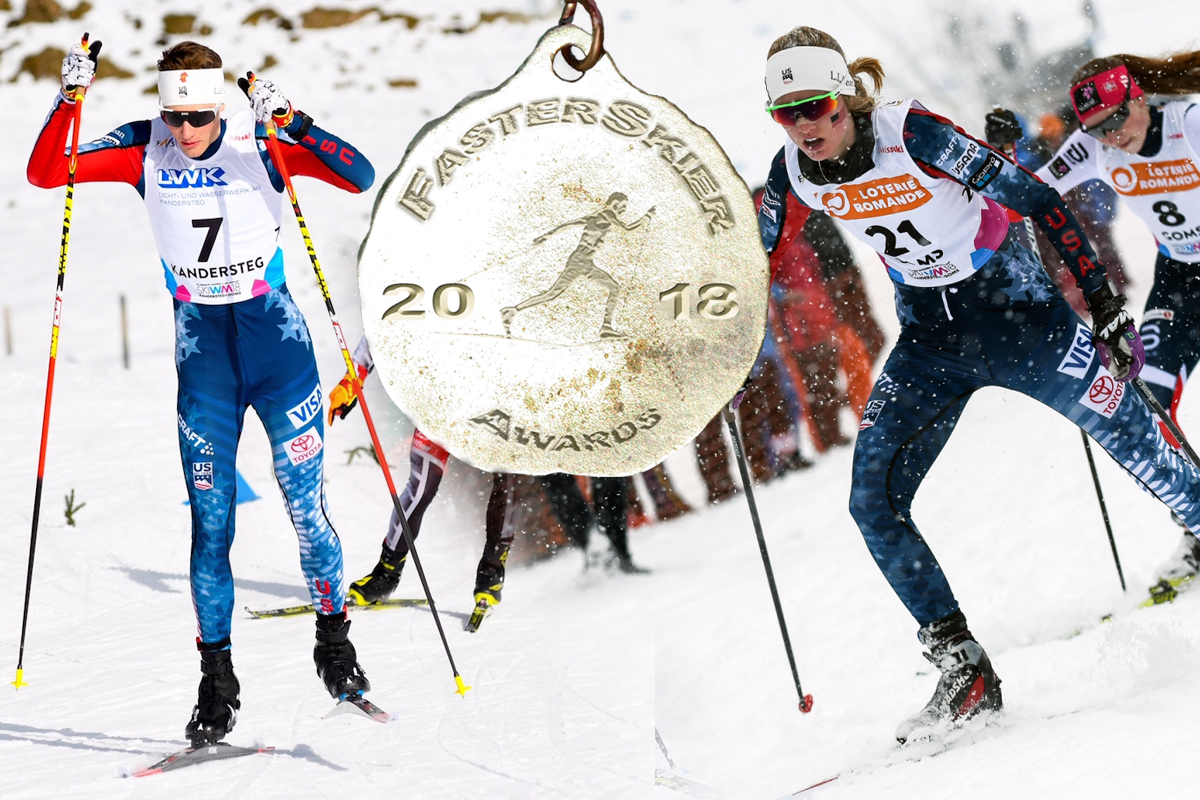
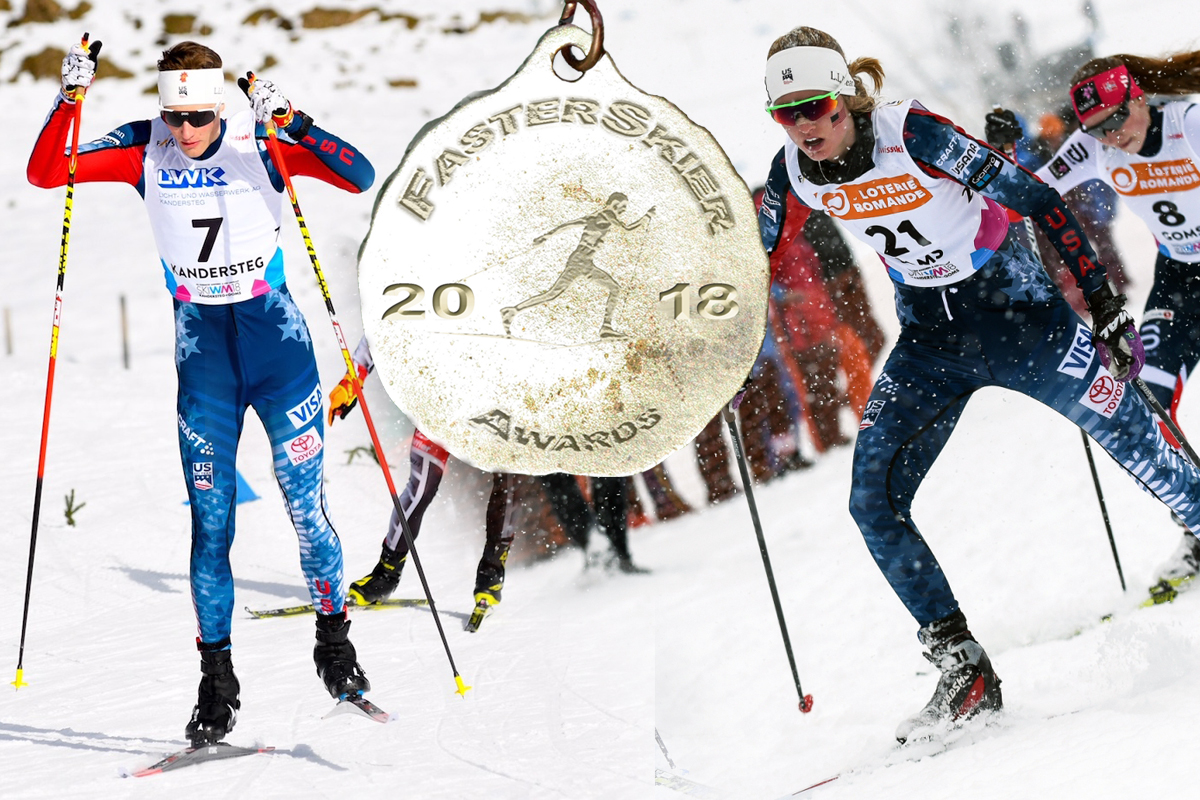
Ben Loomis (l) and Hailey Swirbul (21) are FasterSkier’s Juniors of the Year. (Photos: Romina Eggert & JWSC2018.ch)
With the 2017/2018 season officially in the rearview, FasterSkier is excited to unveil its annual award winners for this past winter. Votes stem from the FS staff, scattered across the U.S., Canada, and Europe, and while not scientific, they are intended to reflect a broader sense of the season in review. This set of honors goes to outstanding North American junior athletes across all nordic disciplines.
***
Ben Loomis, U.S. Nordic Combined Team
In late January, 19-year-old Ben Loomis was named to the U.S. Olympic team. That was a pretty big deal, and one he hadn’t been relying on.
“My main focus this year was on World Juniors, so to have made, and competed in, the Olympics was a dream in itself,” he wrote in an email to FasterSkier last week. “I really didn’t have any goals past having fun, taking in the experience, and doing my best.”
The men’s individual normal hill/10 k Gundersen podium at the first Day of Nordic Combined Junior World Championships in Kandersteg, Switzerland, with American Ben Loomis (r) in third, the Czech Republic’s Ondrej Pazout (c) in first, and Norway’s Einar Lurås Oftebro (l) in second. (Photo: Josh Parker)
Before he actually arrived in PyeongChang, South Korea, though, he had another trip to make: to Kandersteg, Switzerland, to compete in the thing that was his big goal, World Junior Championships.
In Kandersteg, Loomis improved on his top-ten finish from the previous season, earning bronze in the normal hill 10 k. In doing so, he became the first American to medal in nordic combined at World Juniors since Todd Lodwick won gold in 1996.
“A medal at World Juniors was definitely my goal going in, in fact, it had been a goal for the two years prior,” Loomis wrote of finally checking that box. “I knew the level I was at, and the level of the my competitors, so I was confident that a podium was well within my capabilities.”
As a developing talent on the U.S. team, Loomis is often competing at senior competitions, be it on the Continental Cup or the World Cup. In Kandersteg, he actually had the chance to measure himself against his own cohort.
“It can often be humbling to compete on World Cup as one of the younger athletes which makes junior competitions much much less stressful,” Loomis wrote. “I’ve always done pretty well against juniors my same age so that gave me confidence going into Junior Worlds. Of course, I was very happy and at the same time relieved to have meet my goal. This result was huge because it not only helped myself out, but it opened up another World Cup spot which is a help for the whole team. This certainly made everyone happy.”
When asked to peg his favorite memory from the season, though, the medal wasn’t it. Neither was the Olympics, where his top finish was 40th and he helped the U.S. relay team to 10th place.
“I have to say Olympic Trials in Park City was one of the most memorable days this season,” Loomis wrote. “It’s rare to compete at home, and to have the enthusiasm of large crowd made the day exciting. To top things off, I was happy to finish on the podium behind veteran Bryan Fletcher and my older brother, Adam.”
Hailey Swirbul, University of Alaska Anchorage
The same day that Loomis won his bronze medal, Hailey Swirbul was taking her own step onto the podium about 75 kilometers away in Ulrichen, Switzerland, where the cross-country portion of World Junior Championships was being held.
“This season I had wanted to focus on NCAA races more than I had the previous year, but once the season got under way it was difficult to forget about the temptation of doing well at World Juniors,” the University of Alaska Anchorage sophomore wrote in an email this week. “I tried to take on each of those goals individually as they approached and focus solely on the race that I needed to at the moment.”
Last season, Katharine Ogden won bronze in the World Juniors skiathlon, and she and Swirbul teamed up with Julia Kern and Hannah Halvorsen to earn bronze in the relay, too.
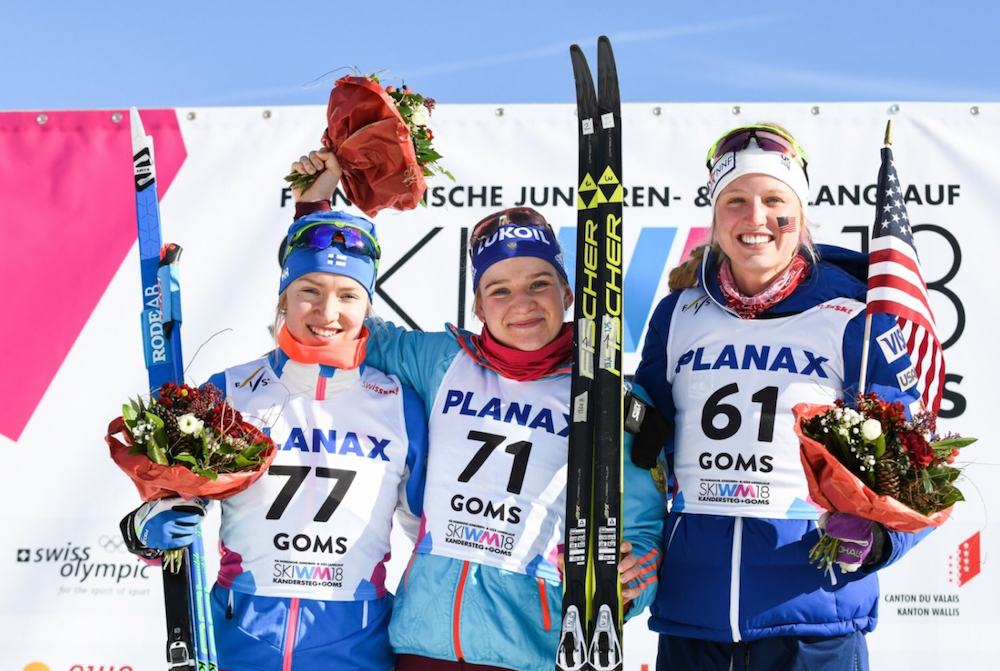
The women’s 5 k classic podium at 2018 Junior World Championships in Goms, Switzerland, with American Hailey Swirbul (r) in second, Russia’s Polina Nekrasova (c) in first, and Finland’s Anita Korva (l) in third. (Photo: JWSC2018.ch)
“I think the moment I’ll remember (albeit a long moment), was the time from when I crossed the finish line in the 5 k individual start to when I learned I would actually receive a medal,” Swirbul wrote this week, when asked what the most memorable moment of her season was. “Interval start races are not instant gratification like a mass start is… you’ve got to wait out the whole field to see if you actually did well. I was seeded about 20th from the last starter, so I had plenty of waiting in anticipation! I will always remember the people who were there with me through that and told me they think I’ve done it; and the excitement from the entire team about my individual success. It’s amazing to be from a country where every teammate celebrates an individual success almost as their own.”
It was the best World Juniors finish ever for an American.
“The result hasn’t hit me yet,” Swirbul wrote in an email after the race back in January. “It was beyond what I expected, so my brain is still catching up to the reality! I’ve been dreaming of racing how I know I could for the past 3 years or so, and this season has finally been my chance to break through. I’m so fortunate that things aligned for me on the day that really counted. I couldn’t have done it without Bryan Fish’s unwavering belief in us athletes, and my mom and dad’s support all these years, of course.”
But she was far from finished. In the 10 k skiathlon, Swirbul picked up a bronze to go with her silver.
“After my silver medal I believed in myself more than before,” she wrote at the time. “However, I managed to stay calm and not put high expectations on myself for the skiathlon which allowed me to race my best. I was hoping to ski smart and relaxed and not be afraid to make it hurt! In a mass start that is really all I can control.”
Swirbul helped the U.S. junior women to eighth place in the relay. Then she returned to the U.S., where the college season was still going strong.
“Being on the western circuit, I realized that coming back to ‘domestic’ racing is hardly domestic at all!” Swirbul wrote this week. “Our circuit has helped me prepared for international races, because many of our athletes are international. I have learned so much from them in each race. Otherwise, it was difficult to switch back to full on school mode, but the skiing transition was fun!”
She rallied for the seawolves, and placed third in the 5 k classic and second in the 15 k skate mass start at NCAA Championships, the second American in both races – which were swept by Ogden (University of Colorado’s Anne Siri Lervik, from Norway, was second in the 5 k classic).
“That was one of the most exciting races that I’ve ever watched,” UAA head Nordic coach Andrew Kastning said in a press release after the NCAA 15 k. “Hailey skied as good as she possibly could have, and was very smart.”
Honorable Mentions: Ben Ogden (Stratton Mountain School) and Gus Schumacher (Alaska Winter Stars)
The best individual result on the men’s side at World Juniors, for the Americans, came from Ben Ogden. The then-17-year-old (he’s since turned 18) finished seventh in the 10 k classic, 10.9 seconds off the podium.
“I went into World Juniors without much in the way of expectations,” Ogden wrote in an email this week. “My official goal was a top 20, but I had no idea of the achievability of that considering this was my first World Juniors. I knew that classic 10 k’s are a relatively strong point for me, so I was excited to see where I stacked up. Finishing the individual start race race as the temporary leader, and ending up seventh overall was incredibly exciting. This race was mind-blowing for me and showed that anything is possible. This elevated my expectations and hopes for the races to come, which was cool.”
Along with teammate Gus Schumacher, who finished 17th in the 10 k, Ogden gave the U.S. team a lot of hope for the future.
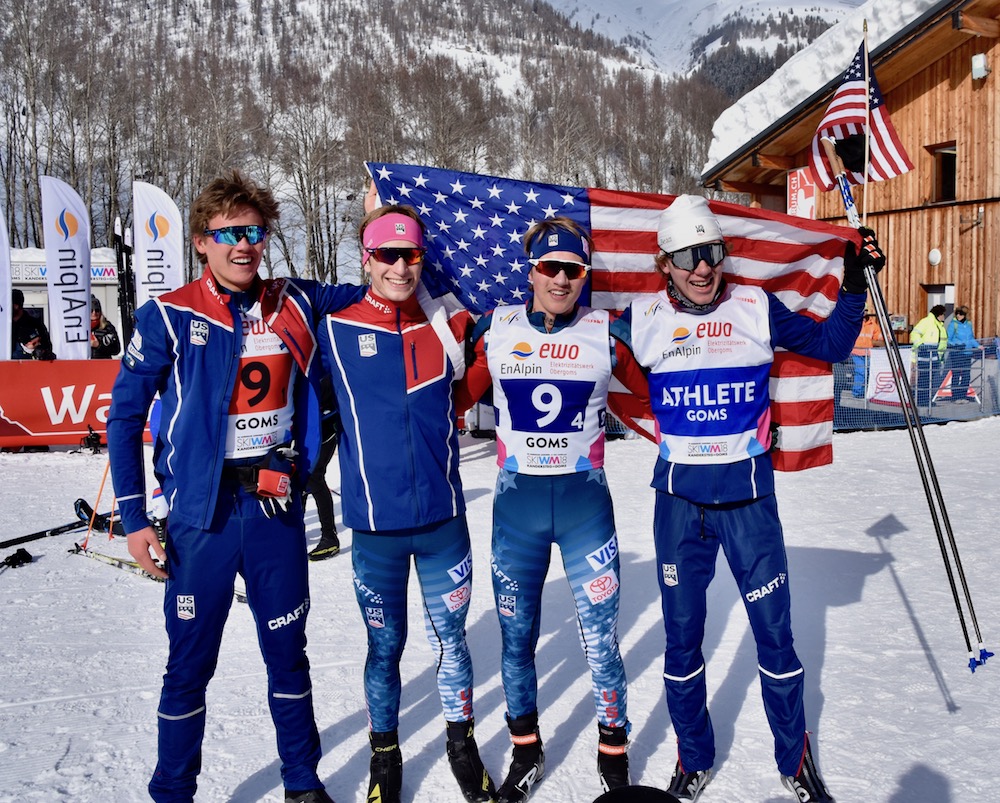
The U.S. men’s silver-medal relay at 2018 Junior World Championships in Goms, Switzerland, with (from left to right) Luke Jager, Hunter Wonders, Gus Schumacher, and Ben Ogden. (Photo: Julia Kern)
“It’s really exciting when you look at our day in general,” U.S. Ski and Snowboard development coach Bryan Fish noted the day of the classic race. “We had two young boys with 2000 birth years; there was only three boys in the top 40 that had a 2000 year of birth and we had two. … That’s just really exciting for U.S. skiing in general, that we have athletes showing up not just to participate, but to really perform.”
That promise came due a few days later when, along with Hunter Wonders and Luke Jager, the duo raced to a silver medal in the junior men’s relay, an unprecedented result and going one better than the women’s relay had the year before.
“If I had a dime for every time an announcer, coach, athlete, or anyone else remotely involved in cross-country skiing has called me ‘the younger brother of the infamous Katharine Ogden’ I would be a very rich younger brother,” Ogden wrote this week. “After years of this, it become clear that the only way to shirk this nickname is to rival or even beat her skiing performances… So naturally, I went into the relay at World Juniors hoping to help create the circumstances under which Katharine may just once be referred to as Ben Ogden’s older sister. I know this goal seemed incredibly lofty but after a successful week, it was time to dream big. I am pleased to say that along side the iconic Alaskan trio, Hunter Wonders, Juke Jager and of course Gus Schumacher, we were able to pull off the ultimate one-up on Katharine and her friends from the year prior. Each of my teammates had their own motivations for the race that allowed them to preform in such a heroic fashion, and I can only imagine that the overall performance also exceeded their wildest dreams.”
The team was never far out, with Jager leading things out in sixth (+14.0), Ogden bringing the team to fourth (+22.8) and Wonders holding that position (+29.0). But Schumacher as the anchor skier did hero’s work and made up the time to pass the French and Russian teams, and crossed the line just 2.2 seconds behind Norway to secure silver. It was a team effort that landed the Americans just 3.3 seconds clear of third place.
“Experiencing the podium here has been so cool,” Schumacher wrote at the time. “I thought it was possible, but actually getting it feels amazing. This whole trip has been really cool even without this success, it’s such an amazing place and the team is tight. I think individually I anticipated results maybe a little better, but this seems about right, and as a team I think we all surprised ourselves. Together we can make some big waves.”
The juniors have also had success against the senior field. Schumacher finished sixth in the 15 k skate at U.S. Nationals and eighth in the skate sprint. And Ogden, for example, was ninth in the 15 k skate at U.S. Nationals, and qualified fourth in the classic sprint before finishing 12th on the day.
“I think that one of my strongest races of the season was the individual skate 15 k at U.S. Nationals in Anchorage,” Ogden, who is headed for the University of Vermont next year, wrote in an email this week. “I was excited to place in the top 10 overall, especially in a skate race, which has been is my weaker technique in the past.”
Honorable Mention: Chloe Levins, US Biathlon
Despite being just a junior in the biathlon world, Middlebury College student Chloe Levins elbowed her way in to the U.S. Olympic Trials process. She excelled at trials races in Minnesota to earn a spot on the team’s short list for PyeongChang, before ultimately falling just short in the final trial competitions, some IBU Cup races in Europe.
Chloe Levins (third from r) with the U.S. team staff (from l to r) wax tech Travis Voyer, coach Algis Shalna, assistant coach Danika Frisbie, wax tech Max Bergmann, wax tech Mattias Halquist, and coach Erik Lewish, after Levins placed sixth in the junior women’s 12.5 k individual at IBU Junior World Championships in Otepää, Estonia. (Photo: Erik Lewish)
But after that, Levins bounced back to provide remarkably strong and consistent results at World Junior Championships in Otepää, Estonia. Levins finished sixth in the 12.5 k individual, seventh in the 7.5 k sprint, and then sixth again in the 10 k pursuit. She still has one more season of junior eligibility, too.
“In pursuit races in the past, I’ve come from behind,” Levins, who placed fourth in last year’s Youth Worlds pursuit, wrote in an email to FasterSkier at the end of World Juniors. “Today, it was a new learning experience for me to be in the mix for the duration of the race. My plan was simple from the start: enjoy being in the mix and trust your preparation. I found the zone today, which is what you dream about. I don’t remember much about the last stage. All I know for sure is that I went for it today…and I have no regrets.”
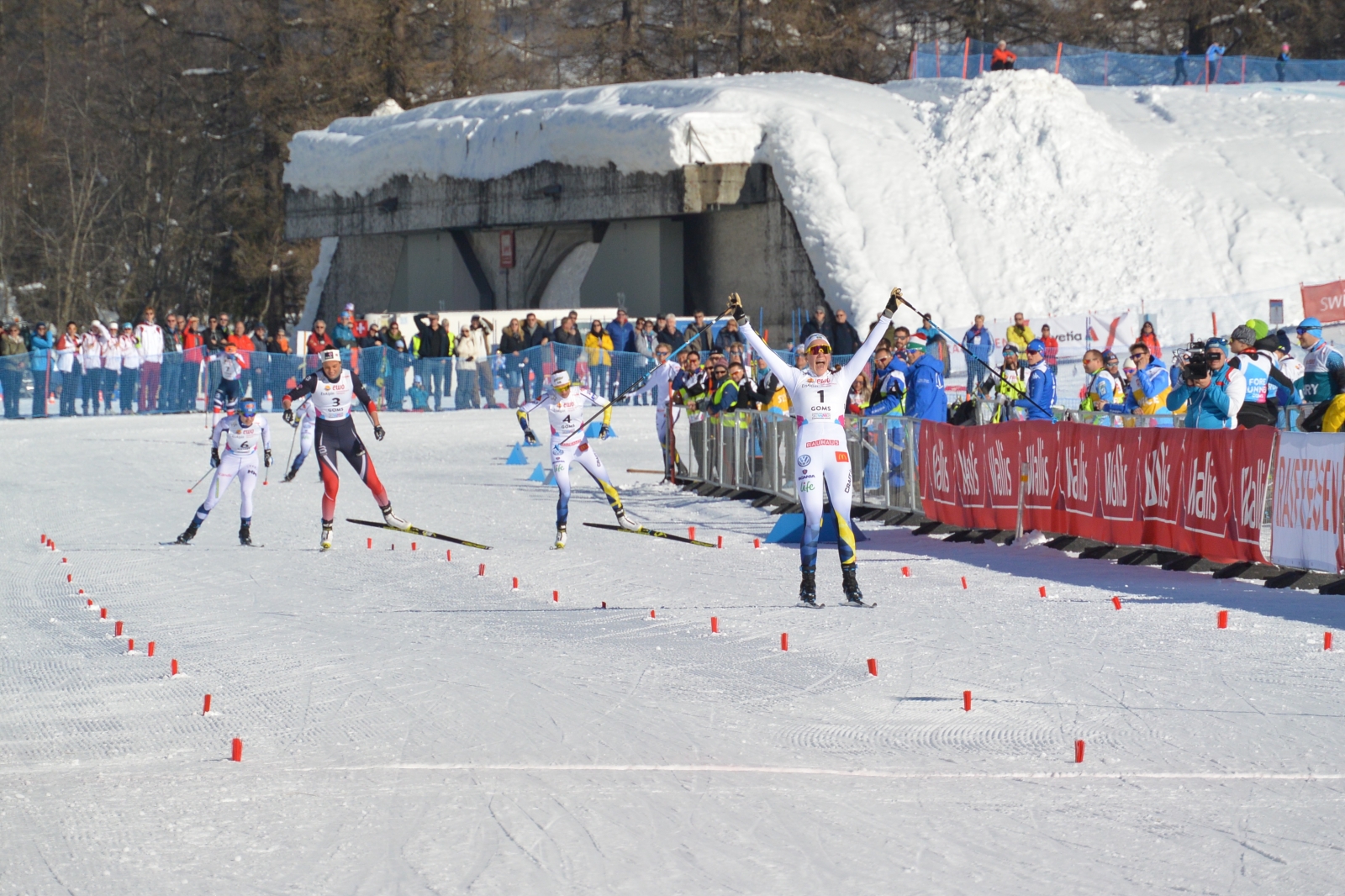
Moa Lundgren celebrates winning her first World Junior Championship after skating away from the field in the sprint in Ulrichen, Switzerland. (Photo: JWSC2018.ch)
(Note: This article has been updated to include comments from American Hannah Halvorsen.)
2018 World Junior Championships is off and running and two brand-new champions have been crowned. Moa Lundgren of Sweden took the women’s skate sprint title while the men’s final went to Tom Mancini of France.
On a perfect blue-sky day nestled deep in the Swiss Alps, the world’s best skiers under the age of 20 raced around a hilly sprint course with a few wicked corners. There were broken poles and pole-tosses; crashes; and a men’s final decided by just a tenth of a second.
“The competition was really high, and it was super cool to see so many high level skiers,” U.S. skier Gus Schumacher (Alaska Winter Stars) wrote in an email. “Nothing surprised me too much. I think it raced about as I expected, with even those crazy corners not being too unfair… my previous U18 trips and nationals races have exposed me to a big variety of tactics, so nothing was really new for me here.”
The narrow margin of the men’s final saw Mancini nip Norway’s Jørgen Lippert at the line.
“A very good race, I am very happy,” Mancini said in a TV interview after the race. “It’s a very good fight with the Norwegian and the Swiss. I am very happy. Sorry, I don’t speak English very good. I thank my family, my friends, and my coach. Voila.”
Third place went to Valerio Grond of Switzerland, who qualified in 21st position but skied aggressively to win his semifinal before landing on the final podium.
The results of the women’s final were somewhat delayed as Finland filed a protest, saying that third-place Frida Karlsson had obstructed Anita Korva, who ended up fourth. But the podium did not change. Lundgren had claimed a big win over Kristine Stavås Skistad of Norway.
Both the U.S. and Canada had a representative in the semifinals. For the U.S., Hannah Halvorsen (U.S. Ski Team/APU) qualified in fifth and then finished second in her quarterfinal, earning an automatic spot into the semis.
Once there, Halvorsen skied in third or fourth for much of the heat. Rounding the final corners she was still in fourth position and though she kept pushing, she couldn’t make up any ground on the women ahead of her. She ended the day in eighth, an improvement of a few places from her 11th-place result in the classic sprint at last year’s World Junior Championships in Utah.
“The skate sprint was my target race this year,” Halvorsen, 19, explained in an email. “My goal was to podium and I believed if everything went according to plan I was capable. I felt healthy and fit, my skis were fast, my mind was in the right place, but I didn’t make it happen. It is easy to mull over tactics and strategies and ‘what if’ situations, but I think the truth is that there are a lot of girls here that are just as fast, fit, prepared, and motivated as me, and I think some of them were sincerely better than me today. Even though I didn’t reach my goal, I feel proud to compete against the best girls my age and be right in the mix.”
She explained that she was excited about her strong qualifier. “It gives me a chance to see where I fall on an international stage,” Halvorsen wrote. “The top girls my age are starting to bridge the gap between world juniors and world cup, and I hope this qualifier gives me some idea of how much I need to improve to be fast enough to make world cup heats. Even though the top girls are faster than me, I can feel myself improving and getting closer.
“I had a lot of fun having the opportunity to race and feel good in the sprint,” she added. “One of the takeaways from this race was realizing how important it is to keep improving and to never settle. I am excited to build on this result and hopefully be stronger and faster next year. But right now, I mostly look forward to more racing this week and season.”
In the men’s field, Canada’s Graham Ritchie raced an impressive tactical quarterfinal. Qualifying in 25th, he was pushed to the back of his heat early thanks to taking the last choice of starting lanes.
“I’d say it was intentional that I stayed at the back,” Ritchie explained in an email. “I knew if I was going to have any chance, it would be to just hold onto the pack for as long as possible and then see where it would go in the end from there.”
Ritchie maneuvered his way towards the front and by the time the men hit the finishing stretch, he was speeding up and moved from fourth to second. A Russian athlete who had been among the leaders early in the heat crashed, leaving an extra opening.
“I was in fourth at the time when he fell and he was in front of me, so this had a pretty big impact on my result depending on how fast he would’ve been in the finishing stretch,” Ritchie wrote.
But regardless, Ritchie advanced to the semifinals, where he finished sixth in his heat for 12th overall.
“I was pretty shot for the second half of the [semifinal] and couldn’t hang on to the pack, but it was an amazing experience and lots of fun!” Ritchie wrote. “I was stoked to have made the semi’s and was happy with outcome! My main goal for today most importantly was to qualify. My stretch goal for the day was to make semis and get a top 12. Finishing in 12th place was a really incredible and eye-opening experience. I’m still trying processing it, the feeling of accomplishing this goal feels amazing and I am so thankful for this opportunity!”
“Great day for Graham today,” Ritchie’s coach at NTDC Thunder Bay, Timo Puiras, wrote in an email. “We were not expecting a top-12 result but it isn’t necessarily a surprise either… This result is definitely a big deal for Graham and the NTDC Thunder Bay program. The TBay program has had several athletes the past few years who I feel have the capacity for this kind of result so it feels great when it all comes together to happen. This result should serve as fuel for our other athletes to find the confidence to also have similar success.”
Schumacher of the United States was also in Ritchie’s quarterfinal, and ended up fourth in the heat and just over two-tenths of a second away from a lucky loser spot in the semifinals. But he did not advance and ended up 19th on the day.
“I was pretty confident in my speed,” Schumacher wrote in an email. “I knew that an eight second gap [in the qualifier] was small enough to be competitive in heats. My strategy was to just hang on up the first big hill and try to save my energy, then really punch it on the second hill. That strategy in my heat worked out pretty well. I thought I was a little too far back after the first hill, but I was able to come back and I had energy to really sprint up the end of the second hill.”
Canada’s Antoine Cyr, also qualified for the heats, and had a spectacular wipeout in his quarterfinal and ended up 30th after qualifying in 25th.
“I know that normally in the heats I am better [than in qualifying] and with the tight gap between all the juniors in the qualifier, it would give me a slight chance to go through,” Cyr wrote in an email. “On the top [of the first hill] I was in fourth place, right on their heels, but on the last uphill i got boxed in a little bit and could not accelerate fast enough. I found myself in fifth place. I went for it on the last corner knowing that I was taking a risk, and I crashed. I am bit bummed by the end of the day, but still really happy with a top 30. A first top-30 for me against the best in the world! I am not injured, just a couple of bruises – that snow was pretty hard packed, I can tell you!”
In the junior men’s sprint, Canada’s Reed Godfreyfinished a tough 31st, just 0.21 seconds out of making the quarterfinals. Etienne Hebertrounded out the Canadian finishers in 36th place (+11.81) in the qualifier.
“Our entire Junior Mens team definitely have the ability to qualify in the top-30 and after that it came down to good tactics and good finishing speed to move through the quarters,” Puiras wrote. “The Canadian team was super pumped with the results today and are in great spirits. It was a great way to start the championships. We are looking for more great results this coming week.”
Canyon Tobinwas 41st in qualification for the U.S. (+13.46), followed by Karl Schulzin 54th (+16.90) and Luke Jagerin 60th (+18.15).
In the junior women’s race, both Margaret Gellert and Sofia Shomento of the U.S. made the quarterfinals but failed to advance, finishing 18th and 23rd. Teammate Hannah Ruddfinished 35th in qualification, +18.15.
For Canada, Annika Richardsonfinished 52nd (+24.09), Catherine Reed-Metayer56th (+28.25), and Alexandra Racine69th (+37.27).
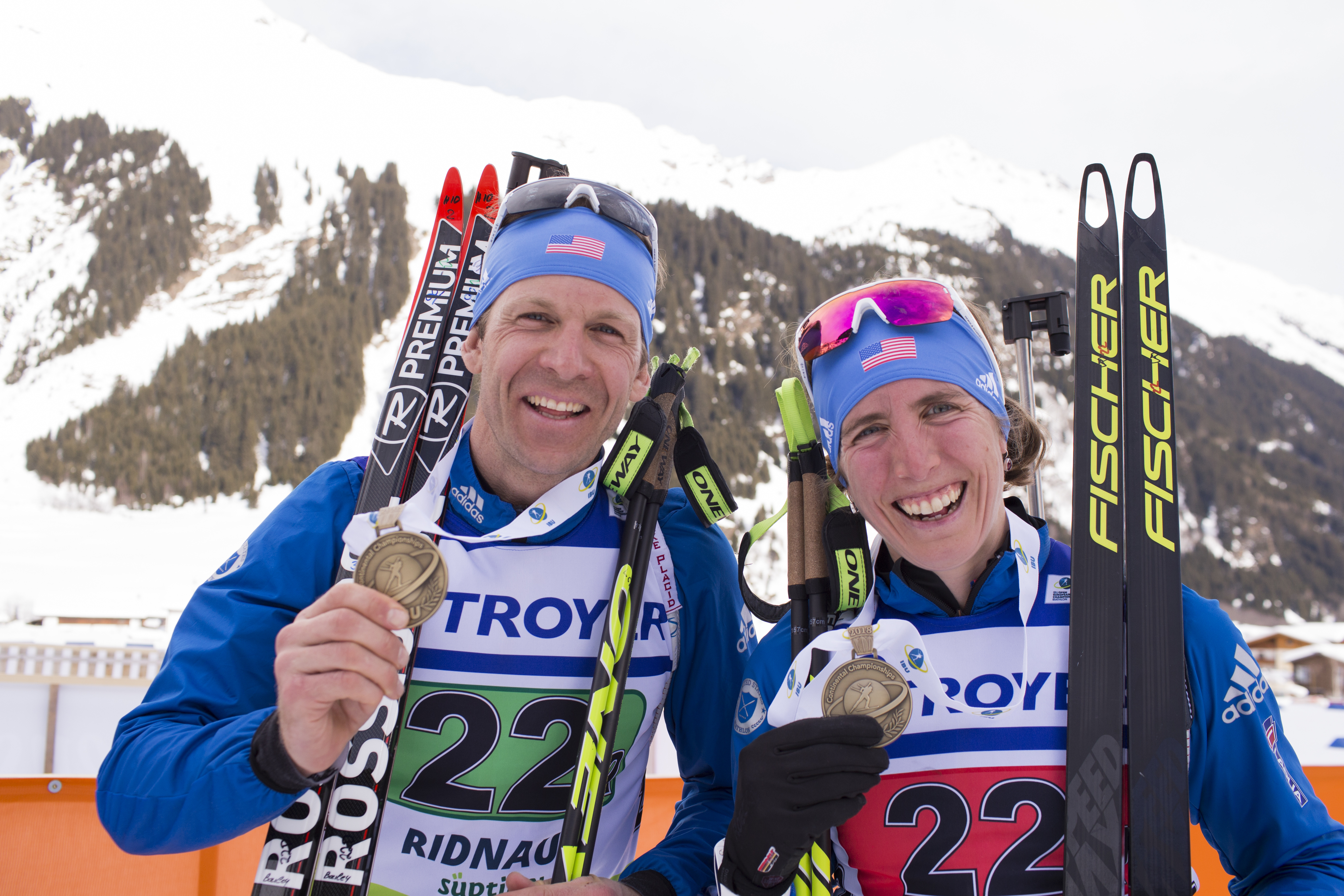
US Biathlon’s Lowell Bailey (l) and Susan Dunklee after teaming up for bronze in the single mixed relay at 2018 IBU Open European Championships on Sunday in Ridnaun, Italy. (Photo: Manzoni/NordicFocus)
IBU Open European Championships (Ridnaun-Val Ridanna, Italy): Single mixed & mixed relays
Susan Dunklee and Lowell Bailey teamed up for the final day of the 2018 International Biathlon Union (IBU) Open European Championships in Ridnaun, Italy, and raced to a bronze medal in the single mixed relay.
The American duo, both of which earned individual medals at last year’s IBU World Championships, finished just 9.1 seconds out of first, which went to Norway’s Thelka Brun-Lie and Vetle Sjåstad Christiansen. The Norwegians won in 35:39.6 with zero penalties and six spares. They took the lead after Brun-Lie’s second leg, where she cleaned both stages without spares.
France placed second, 8.6 seconds back, with Julia Simon and Emilien Jacquelin, who combined for no penalties and 11 spares. They led the first half of the race, but slipped to second behind Norway on Simon’s second leg.
Dunklee put the Americans off in second on her first leg, which she cleaned with a spare in each stage, then they slipped one place to third on Bailey’s first leg, where he cleaned as well and used three spares. In all, they used 10 spares and avoided the penalty loop, and finished half a second out of second place.
“Over Christmas, we trained a little bit with the French athletes, including Jacquelin,” Bailey said, according to a US Biathlon press release. “So I know that he has quite a fast finish, and I thought I am kind of an old man here, I should maybe try to go harder on the first part of the lap. But he stayed with me all the time and had me in the end.”
“It was a good opportunity to tune up the race shape, build some confidence and find that sharp feeling heading into the Olympics,” Dunklee told US Biathlon. “The single mixed relay is one of my favorite race formats and today was a blast!”
Canada’s Sarah Beaudry and Carsen Campbell placed eighth of 24 teams in the single mixed relay, finishing 1:03.6 out of first with just eight spares and zero penalties. In 11th after the first leg, they moved into eighth on Campbell’s first leg, which he cleaned with one spare. Beaudry then cleaned her second leg without any spares, and Campbell anchored them to eighth.
The U.S. entered a team in the mixed relay that followed, with Chloe Levins, Deedra Irwin, Paul Schommer, and Alex Howe placing 17th (+5:55.5) of 19 teams with no penalties and 12 spares.
Ukraine won the mixed relay to conclude the championships, with Yuliia Zhuravok, Iryna Varvynets, Artem Pryma, and Dmytro Pidruchnyi combining for zero penalties and six spares and finishing in 1:11:40.1.
Russia placed second (+11.7) with Victoria Slivko, Anastasia Zagoruiko, Evgeniy Garanichev, and Alexander Loginov combining for zero penalties and nine spares.
Norway followed in third (+33.2) with Emilie Ågheim Kalkenberg, Kaia Wøien Nicolaisen, Håvard Gutuboe Bogetveit, and Fredrik Gjesbakk combing for no penalties and just four spares.
U.S. SuperTour (Craftsbury, Vermont): 5/10 k freestyle
Two Alaska Pacific University (APU) athletes topped the podium on Sunday at the SuperTour in Craftsbury, Vermont, with David Norris winning the men’s 10-kilometer freestyle individual start in 21:54.9 and Becca Rorabaugh topping the women’s 5 k freestyle in 12:06.4.
Norris won the men’s race by 6 seconds over Canada’s Andy Shields (Lappe Nordic) and Kevin Bolger of the Sun Valley Ski Education Foundation (SVSEF) placed third (+15.8). Kris Freeman (Caldwell Sport) was the third American in fourth overall (+23.7), and three Canadians took fifth through seventh with Michael Somppi (Lappe Nordic) in fifth (+27.9), Evan Palmer-Charrette (NTDC Thunder Bay) in sixth (+37.5) and Scott Hill (Barrie Cross Country) in seventh (+37.6), ahead of Brian Gregg (Team Gregg/LNR/CXC) in eighth (+39.4), Tad Elliott (Ski Club Vail) in ninth (+44.3) and Jack Hegman in 10th (+50.4).
Rorabaugh won the women’s race by just 2.2 seconds over her APU teammate Rosie Frankowski in second, and Erika Flowers of the Stratton Mountain School (SMS) T2 Team placed third (+4.6). Two Craftsbury Green Racing Project (CGRP) skiers finished fourth and fifth, with Kaitlynn Miller in fourth (+12.1) and Liz Guiney in fifth (+22.5), Kelsey Phinney (SVSEF) was sixth (+25.8), and Canadians Olivia Bouffard-Nesbitt (Rocky Mountain Racers) seventh (+26.4) and Frederique Vezina (Pierre-Harvey National Training Centre) eighth (+36.0). Corey Stock, of the Bridger Ski Foundation (BSF) placed ninth (+39.9), and Felicia Geisor (CXC Team) was 10th (+44.4).
On Saturday, the Craftsbury Outdoor Center hosted its 37th annual Craftsbury Marathon, with Nils Koons winning the 48 k men’s race in 2:28:51.0 hours and Hannah Dreissigacker winning the 48 k women’s race in 3:01.48.7.
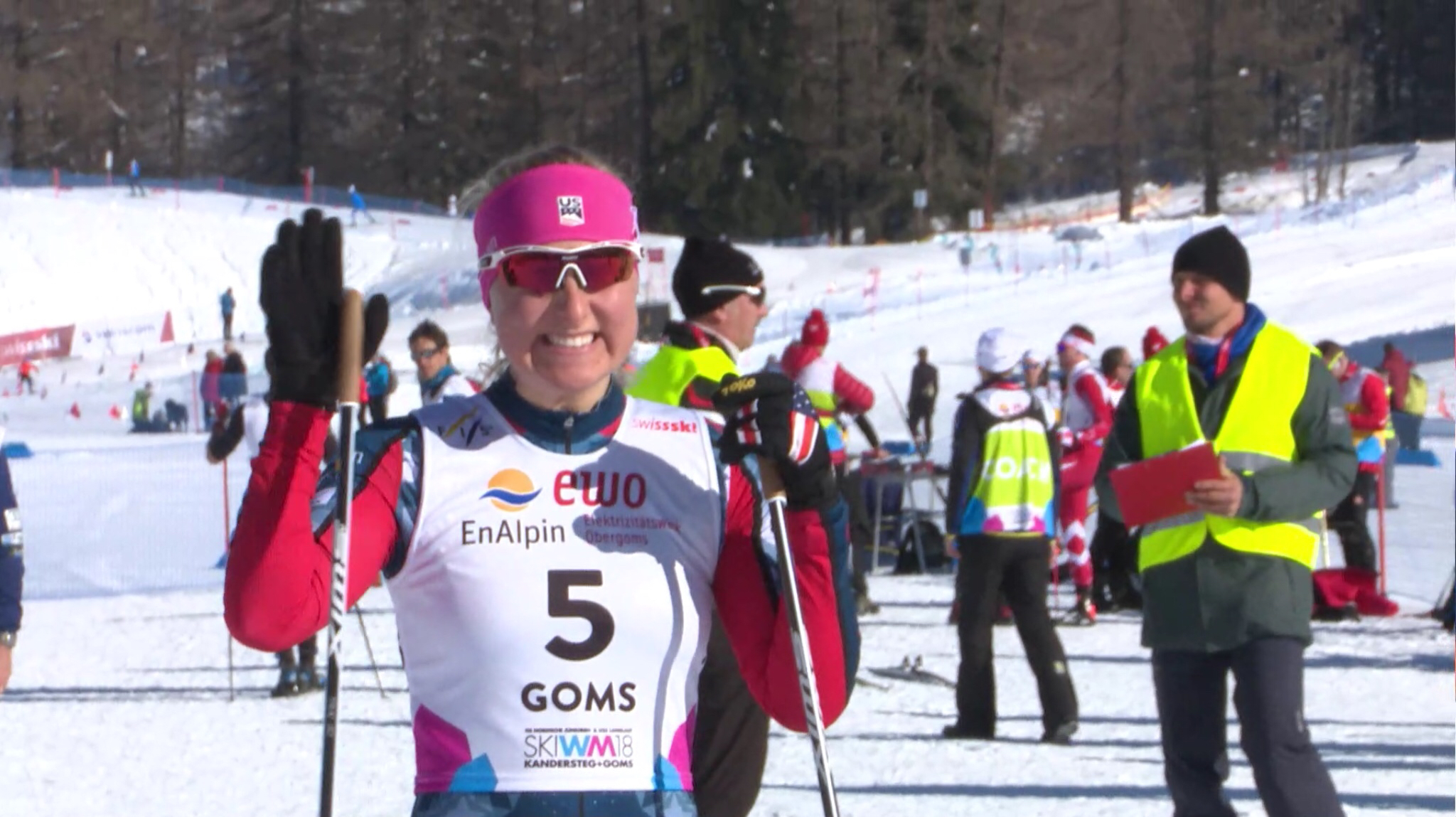
Hannah Halvorsen of the U.S. Ski Team and APU on the start line in Ulrichen, Switzerland, after finishing fifth in the sprint qualifier. (FIS screencap)
FIS Cross Country World Junior Championships (Ulrichen, Switzerland): Freestyle sprints
World Junior Championships kicked off today with freestyle sprints in Ulrichen, Switzerland. Moa Lundgren of Sweden claimed with women’s title by 1.89 seconds over Kristine Stavås Skistad of Norway in the final, with Sweden’s Frida Karlsson finishing third (+1.89).
Hannah Halvorsen of the United States qualified in fifth place before skiing to second in her quarterfinal heat. Halvorsen hovered around third or fourth place through much of her semifinal and was unable to snipe any spots in the finishing straight, ending up fourth in the heat and eighth on the day.
Fellow Americans Margaret Gellert and Sofia Shomento also made the quarterfinals, finishing 18th and 23rd, and Canada’s Hannah Mehain wound up 29th on the day.
The new men’s junior world champion is Tom Mancini of France, who nipped Norway’s Jørgen Lippert by just 0.10 seconds to take the win. Valerie Grond gave the Swiss crowd a thrill by making it all the way to the final and taking home bronze, despite qualifying in just 21st position. The Swiss junior narrowly edged France’s Vincent Buiatti for the final step on the podium.
Canada’s Graham Ritchie finished second in his quarterfinal after qualifying in 28th position, earning an automatic spot in the semifinals. There he finished sixth (+9.30 behind Mancini), winding up 12th on the day. Teammate Antoine Cyr also made the quarterfinals where he had an impressive crash, slinging off the trail and into the infield, finishing 30th on the day. For the U.S., Gus Schumacher was the lone qualifier for the heats. He finished fourth in his quarterfinal and was just 0.22 seconds away from a “lucky loser” spot in the semifinals. Schumacher finished 19th on the day.
In the junior women’s race, Hannah Rudd of the United States finished 35th in qualification, +18.15. For Canada, Annika Richardson finished 52nd (+24.09), Catherine Reed-Metayer 56th (+28.25), and Alexandra Racine 69th (+37.27).
In the junior men’s sprint, Canada’s Reed Godfrey finished a tough 31st, just 0.21 seconds out of making the quarterfinals. Etienne Hebert rounded out the Canadian finishers in 36th place (+11.81) in the qualifier. Canyon Tobin was 41st in qualification for the U.S. (+13.46), followed by Karl Schulz in 54th (+16.90) and Luke Jager in 60th (+18.15).
FIS Nordic Combined World Cup (Seefeld, Austria): Individual normal hill/15 k
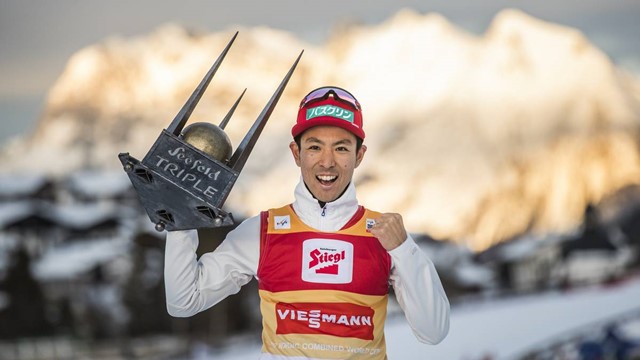
Japan’s Akito Watabe after winning the 2018 Seefeld Triple Nordic Combined World Cup. He is the only athlete besides Germany’s Eric Frenzel to win the event. (Photo: FIS Nordic Combined)
On the final day of the Seefeld Triple, Japan’s Akito Watabe completed his sweep of the three-day weekend and Norway’s Jarl Magnus Riiber reached the podium for the third-straight day, placing second. Germany’s Fabian Rießle placed third for his second podium in the last two days.
Watabe jumped to first on the normal hill and started the 15 k Gundersen 48 seconds ahead of Riiber in second. He went on to win the race by 1:14.9 minutes in 34:58.6, becoming the only man besides Germany’s Eric Frenzel to win the Seefeld Triple in its five-year history.
After jumping to fifth, Rießle won a photo finish for third (+1:57.9), edging Germany’s Vinzenz Geiger by less than a tenth of a second. Geiger moved up from ninth in the jump to fourth overall (+1:57.9).
Norway’s Jørgen Graabak followed in fifth (+2:02.4),Frenzel placed sixth (+2:07.4), Norway’s Jan Schmid was seventh (+2:09.8), Finland’s Eero Hirvonen eighth (+2:13.5), Norway’s Espen Andersen ninth (+2:28.0), and Austria’s Mario Seidl 10th (+2:42.1) out of 28 finishers.
No Americans contested the final day of the Triple, the last World Cup before the 2018 Winter Olympics in PyeongChang, South Korea.
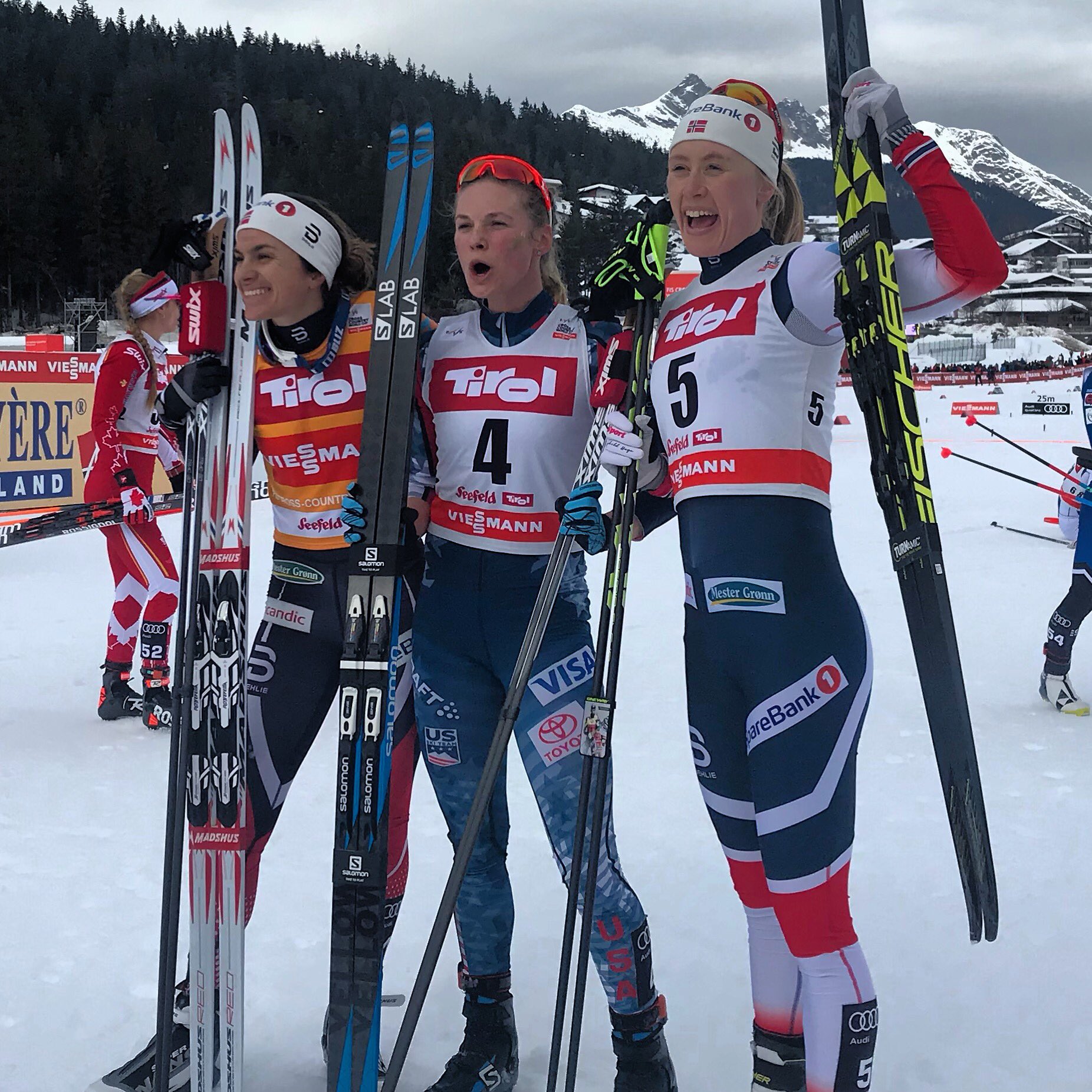
Jessie Diggins of the U.S. Ski Team (center) celebrates after winning the 10 k mass start freestyle in Seefeld, Austria, over Heidi Weng (left) and Ragnhild Haga of Norway. (Photo: FIS Cross Country/Twitter)
FIS Cross Country World Cup (Seefeld, Austria): 10/15 k mass start freestyle
In the final World Cup race before the 2018 Olympics, Jessie Diggins achieved the ultimate goal to give herself the utmost confidence heading into PyeongChang — winning the women’s 10-kilometer freestyle mass start at the World Cup in Seefeld, Austria, on Sunday.
The win was her first of the season and fourth individual victory of her career. Diggins, a 26-year-old U.S. Ski Team member, pulled it off by attacking on a long climb and leaving Norway’s Heidi Weng, Ragnhild Haga and Ingvild Flugstad Østberg chasing. While Diggins was several seconds ahead over the top and all alone on the long descent that followed, Weng and Haga worked to close the gap — and nearly did in the finishing stretch. But Diggins held them off, winning by 0.7 seconds over Weng in second place and 1 second ahead of Haga in third, and threw her fists down in celebration as she crossed the line first in 23:08.5 minutes.
“I just put my head down and it wasn’t pretty, but I just hammered,” Diggins told the International Ski Federation (FIS) in a televised post-race interview.
She was the only non-Norwegian in the top five, with Østberg in fourth (+8.7) and Marit Bjørgen in fifth (+16.7). Austria’s Teresa Stadlober placed sixth (+16.9), Norway’s Kari Øyre Slind was seventh (+19.1), and American Sadie Bjornsen placed eighth (+20.5), ahead of Switzerland’s Nathalie von Siebenthal in ninth (+30.3).
The U.S. had three in the top 15 with Kikkan Randall (U.S. Ski Team) in 14th (+48.5), and two more women in the top 30, with Caitlin Patterson (Craftsbury Green Racing Project) in 23rd (+1:00.7) and Liz Stephen (USST) in 29th (+1:18.2). Rosie Brennan (USST) finished 53rd (+2:26.9).
Emily Nishikawa led the Canadians in 35th (+1:36.5), followed closely by teammate Cendrine Browne in 37th (+1:36.6). Dahria Beatty finished 45th (+1:58.9).
Dario Cologna of Switzerland (center) won the men’s 15 k skate mass start in Seefeld, Austria, over Alex Harvey of Canada (left) and Martin Johnsrud Sundby of Norway (right). (Photo: FIS Cross Country/Twitter)
The Olympics are nearing and so Switzerland’s Olympic legend Dario Cologna is ramping up: after winning the Tour de Ski, he took another win in the 15 k mass start skate in Seefeld, Austria, on Sunday.
With much of the field staying relatively close together until the finish, Cologna nabbed the win by 1.4 seconds over Canada’s Alex Harvey, who took his second podium of the season in addition to also finishing third in the overall Tour de Ski.
Norway’s Martin Johnsrud Sundby was third (+2.9), then teammate Didrik Tønseth in fourth (+5.9) and France’s Maurice Manificat in sixth (+7.5).
The U.S. Ski Team’s Erik Bjornsen had a breakthrough day finishing ninth (+9.3), followed by Simi Hamilton in 12th (+12.4). Behind them, Scott Patterson placed 27th (+23.4), then Patrick Caldwell 49th (+1:26.2), Ben Lustgarten 55th (+1:42.7), and Tyler Kornfield 77th (+3:00.0).
Canada’s Devon Kershaw and Graeme Killick finished 30th (+26.5) and 31st (+27.4), respectively. Len Valjas placed 58th (+1:53.1), Knute Johnsgaard 82nd (+3:23.1), Bob Thompson 87th (+4:27.5), and Julien Locke 92nd (+4:56.9).
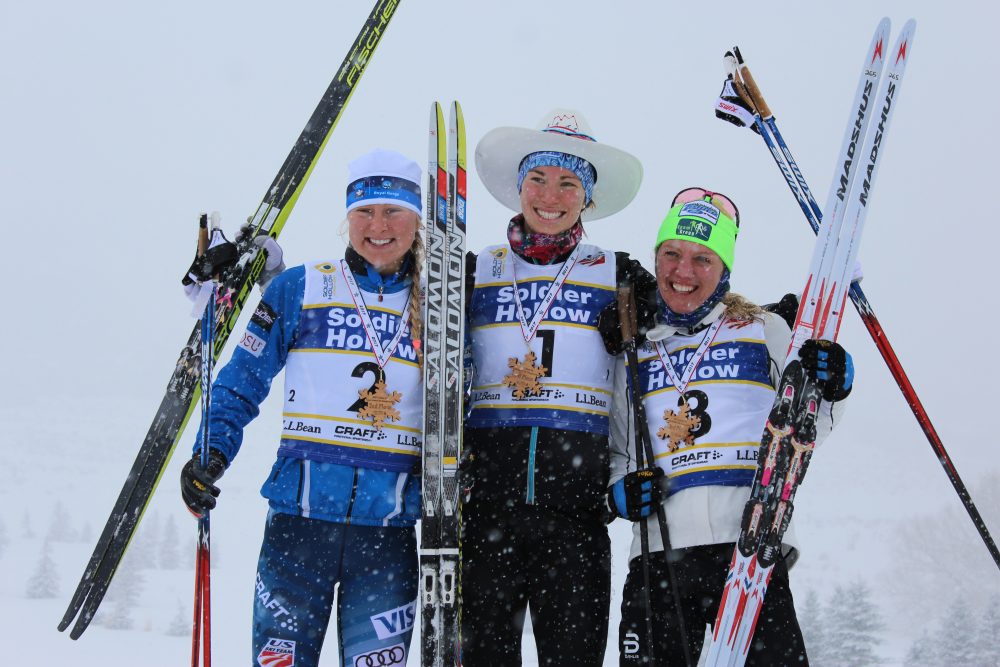
The women’s freestyle-sprint prologue podium on Thursday, the final day of 2017 U.S. Cross Country Championships at Soldier Hollow in Midway, Utah. Canada’s Dahria Beatty (AWCA/NST U25 Team) took first, Hannah Halvorsen (Sugar Bowl Academy/USST) second, and Caitlin Gregg (Team Gregg) third.
MIDWAY, Utah — One and done. That was the case Thursday for the U.S. Cross Country Championship’s freestyle sprint at Soldier Hollow (SoHo), where only a prologue (i.e. sprint qualifier) was held to determine the final standings; no heats were contested. For the fifty women who set off at 15-second intervals onto the no-place-to-rest 1.3-kilometer course, it was a study in energy expenditure. The main lesson was elementary: push up to the limits, tempt the blowup, empty the tank by the finish line.
The women raced in just-under-freezing temps and lightly falling snow. Simply another nationals-week weather and snow conundrum wax technicians have puzzled with throughout the week.
Albert World Cup Academy (AWCA) and Canadian National U25 Team member Dahria Beatty was the seventh starter and raced to the fastest time on the day, winning the prologue in 3:13.60. Sugar Bowl Academy and U.S. Ski Team Development Team member Hannah Halvorsen took second (+3.15), and Team Gregg’s Caitlin Gregg third (+4.80).
In fourth was Beatty’s AWCA and national U25 teammate Maya MacIsaac-Jones (+5.40). MacIsaac-Jones has been recovering from sesamoiditis, which caused pain in her forefoot, earlier in the season. Another Canadian, Mathilde Petitjean of the Pierre-Harvey National Training Centre (CNEPH), finished fifth (+7.22).
The 22-year-old Beatty started this race season in Europe after earning Period 1 World Cup starts as the Continental Cup (NorAm) leader at the end of last season. On her recent Euro-stint, Beatty earned coveted World Cup points: she placed 25th in the Davos, Switzerland, skate sprint on December, and finished 26th a week later in the 10 k skate mass start in La Clusaz, France.
Beatty prequalified for U23 World Championships, which will be held at SoHo from Jan. 30-Feb. 5.
“I was actually qualified coming into these events, but I … came to try give myself that home course advantage,” Beatty said of her reason for coming to U.S. nationals. “It’s also nice when you know you’re prequalified so you can kind of take risks and see if they pay off. You don’t have to be afraid to blow up or anything.”
Not only will Beatty have a leg up when it comes to a formulating a mental and physical map of how to ski the U23 sprint course, she’ll have a better idea of how to select her skis if another stint of helter-skelter weather descends on SoHo for U23 World Championships.
“We had every snow condition, so that was good. I got to test my ski bag a lot,” Beatty added. “I learned more about my skis, which is a good thing.”
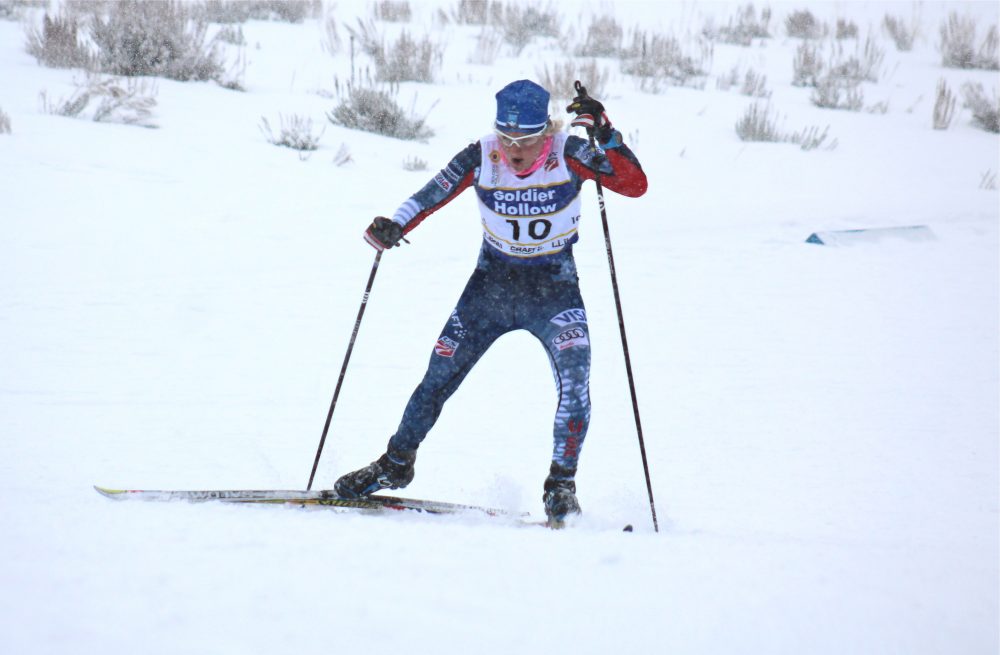
Sugar Bowl Academy and U.S. Ski Team Development Team member Hannah Halvorsen racing to second in Thursday’s skate-sprint prologue on the final day of 2017 U.S. nationals at Soldier Hollow.
At 18, Halvorsen qualified to represent the U.S. at Junior World Championships. Like Beatty, she understood it would be a near full-throttle effort in the sprint.
“I thought there is nothing really to lose I am just going to go for it,” Halvorsen said after the race.
On a course where fast downhills diminish any rest time, and the ups command tempered pacing, Halvorsen played it right despite her junior status.
“I would say I am still young and not quite tuned into that so I am working on [the pacing],” Halvorsen explained. “I think it worked out well today, but most of the time I am a little too slow or a little too fast in a qualifier to start it off. I think for me, I’m working on finding the right balance between power and tempo.”
Soon enough, the fastest junior skiers from around globe will descend on SoHo. Halvorsen may have an ace-card advantage having succeeded this week.
“I’ll be back here in about two weeks for World Juniors, and I think I learned a lot about the terrain here and skiing here and I think a big mental take away is just skiing with confidence and not worrying about who is who or what other people are doing and just believing in it and believing in my training.”
More on the line than a 1.3 k sprint for Gregg
Gregg has perhaps the most complex story of the three skiers on the overall podium. The basics are she had a two-podium week. She won last Saturday’s 10 k skate and was third in Thursday’s skate-sprint prologue. But that’s about as simple as this narrative gets. On Wednesday, Gregg disclosed via Facebook she’s troubleshooting an injury that’s compromising her classic skiing. She chose not to enter Tuesday’s 20 k mass start classic race.
“I’m at the point right now where the injury is … not in a super-bad place,” Gregg told FasterSkier. “I would say it’s a manageable injury at this point. I can skate without pain, I can do daily activities without pain. If I do classic race, it does get extremely painful and causes me to limp. It causes me to favor that foot.”
Caitlin Gregg (Team Gregg) racing to third in Thursday’s skate sprint prologue at 2017 U.S. nationals at Solider Hollow.
To be clear, Gregg said she can skate, and she’s skating pain-free. Yet the prospect of aggravating her foot classic skiing at the cost of not being able to skate, or even ski in the short term, wasn’t worth the risk.
“It was definitely one of those things where I was told by a lot of people, that without that race, I need that race for World Champs, and without that race I might not go,” Gregg elaborated when asked about the costs and benefits of skiing Tuesday’s 20 k classic. “And I also had a lot of people saying I’ve been in this position before, which honestly, it was very helpful to have people who’ve been there before and said they made the bad call and continued to push it and later were put into a boot, had to use crutches, and that’s something I don’t want to do.”
At 36, Gregg’s logic had as much to do with a trip to Lahti, Finland — the location of this year’s World Championships — as it does with being rooted at home in Minneapolis.
“My feeling was, if I didn’t make World Champs, I could at least go out and ski with my club team, Loppet Nordic Racing,” Gregg said. “I could go out and work with the kids, and I could skate to my heart’s content for the rest of the season. It was a tough call, but I really feel in my heart and in my gut that I made absolutely the right decision, and yeah, I’m going to stay behind it.”
Gregg is open about her season’s objective: the World Championships 30 k skate. Over the year, she’s honed her Level 3 pacing and focused on her speed over the last few kilometers in long running races. All with that 30 k skate in mind. With her years of training, she noted this year has been about fine tuning. Thus far, longer skate races have not been part of the platform upon which Gregg can demonstrate to the U.S. coaches she’s ready for Lahti.
Here’s a breakdown of Gregg’s skate races this season: she qualified third in West Yellowstone’s SuperTour 1.5 k skate (she placed eighth overall after the heats), a fourth in SilverStar’s NorAm 10 k skate, her U.S. nationals 10 skate win, and Thursday’s skate sprint third place.
Despite not having the opportunity to display her long distance fitness beyond 10 k, and historically not known as a sprinter, Gregg had qualifying for World Championships front and center during the sprint.
“Today was a big day though because I want to show the U.S. coaches, you know, I informed them of my injury and my decision, but I said I’m healthy to skate. I can’t classic, I’m healthy to skate. I said, I’m not going to go for any races at World Champs with classic in them, but I’m 100 percent good to go for skating, and I’m healthy and strong and fast at this point.”
For certain, the U.S. coaches will be meeting to determine who’s in and who’s out. In a loaded World Championships schedule with seven races in 10 days for the women, it will come down to how the U.S. can maintain fresh skiers for each race — skiers who are likely to medal. Perhaps more so than ever, the U.S. women’s team has a good problem, with several potential top-five skiers on any given day. Sitting solidly in second on the SuperTour distance points list, Gregg will wait to see if her two-podium week put her in the running as a Lahti option.
Sawyer Kesselheim leading Forrest Mahlen partway through the men’s 10 k freestyle at Junior World Championships in Liberec, Czech Republic. Photo: Logan Hanneman/Corduroy AK.
Junior World Championships action continued in Liberec, Czech Republic, on Wednesday with a 5 and 10 k individual start freestyle. Forrest Mahlen (Alaska Pacific University) and Sawyer Kesselheim (Bridger Ski Foundation) put up another pair of top-30s for the U.S. in the men’s event, placing 27th and 29th, respectively. Mary O’Connell (Dartmouth College) led the way for the American women by finishing 33rd in the 5 k.
The 10 k freestyle was Mahlen’s first event of the championships, and his 27th-place showing brought redemption over what he called a “super-poorly” skied distance race in Turkey last year, where he was 72nd.
“I’m super-excited with my result today!” Mahlen said. “One of my goals for this season was a top 30 here at world juniors so 27th is right in there. I was only 90 seconds behind the leaders and 15 seconds out of top 20 so I’m pretty happy with my time.”
As the 33rd starter out of a field of 98, Mahlen sought to pace his 10 k aggressively.
“My strategy was to take it out at a pace that I couldn’t hold the whole time to see what I had in me,” he said.
As a result, Mahlen skied by himself for nearly the whole race, which went three times around a 3.3 k loop. With the 18th-ranked split on the first lap, he accomplished the fast opening pace he intended. When Kesselheim was on his first lap he caught Mahlen finishing his final one, and the two helped each other along while Mahlen was “fading hard” from his quick early pace.
“He brought me around, for sure,” Mahlen said.
U.S. Ski Team development coach Bryan Fish thought the competitive field and challenging course in Liberec demanded highly focused skiing from athletes from the get go.
“I think at World Championships like this you have to be aggressive,” Fish said. “It was also an interesting course. There weren’t any really long hills but there were certainly some steep ones out there, so very transitional skiing. You had to ski well on the corners, dowhills and the uphills. The uphills were quite steep, much like the sprint course, so really powerful skiing [worked well].”
While Mahlen went out fast and faded, Kesselheim skied a more consistent race to finish two places and only 0.6 seconds behind him. In addition to catching a ride with Mahlen, Kesselheim skied one of his laps with one of the German skiers in the top seed.
“I was lucky enough to lap through when some of the top guys were starting,” Kesselheim said. “I got some help on my last lap from a German skier who pushed me up some of the biggest hills.”
He had hoped for a top-20 but was still excited with a top-30. “I felt that I raced smart,” Kesselheim said. “I pushed the transitions and paced it well… I also felt that pushing over the tops of hills and through the flats was very important. I focused on that and was able to execute which helped me to make up a lot of time.”
Kyle Bratrud (Northern Michigan University), in his first career World Juniors race, took 46th on Wednesday, 33 seconds behind his other teammates. In his debut at the event Bratrud was focused primarily on gaining experience and was pleased with the result.
“My goal this year was to make World Juniors, beyond that was all a learning experience and getting to race on a course of that difficulty and watch and even ski with a few of the top juniors in the world was a huge opportunity,” he said. “I have been feeling pretty sluggish this week from the travel as this is my first trip to Europe so it was nice to finally get to race and shake out some of that junk from my legs.”
As the 55th starter Bratrud skied mostly by himself, but watched the faster seeds closely when they skied near him.
“A few of the top juniors were starting as I was going out for my last lap so I got to ski with them for a little bit and get a feel for what they do that makes them so fast, which was awesome,” Bratrud said.
Ben Saxton (F.A.S.T. Performance Training) was the fourth American in 60th. He was the top U.S. performer in the classic sprint on Monday but didn’t feel at his best in the 10 k.
“I don’t know exactly what my goals were but whatever they were, I didn’t reach them today, so it was a disappointing result in that sense,” Saxton said. “But I have a LOT of stuff to learn from this and it’s my first distance race on a big stage.
“I didn’t really feel too hot out of the start, but I was essentially on my own the whole way. The one chance I had for a ride I blew because I chickened out and scrubbed some speed on a downhill. I was getting consistently mediocre split results which I could tell by just looking around behind me were becoming obsolete as soon as higher bibs came through. But I tried my hardest I just wasn’t springy and at my sharpest today.”
Mary O’Connell on her way to finishing 33rd in the World Juniors 5 k. Photo: Logan Hanneman/Corduroy AK.
On the women’s side, O’Connell led the American team in 33rd. She was introduced to Junior Worlds competition in Turkey last year and, like Mahlen, wanted to come to Liberec and improve upon her original results. Her best finish a year ago was 42nd in the 10 k skiathlon and on Wednesday she cut that down by nine places in the 5 k freestyle, finishing 1:05 behind the leaders.
“I am happy with the way it went,” O’Connell said. “The course was super short but very painful, I’d say one of the hardest 5 ks I’ve ever done. There are a few places where I wish I could have pushed a little harder, and a top 30 would have been great! But I’m still pleased with the way I raced.”
O’Connell got off to a strong start in her freshman season with a seventh-place finish at U.S. Nationals earlier this month in the senior freestyle race, surprising even herself. Not sure of where that would put her against the fastest juniors in the world, she limited her expectations for the 5 k.
“I knew my fitness was there after Nationals, I just wasn’t sure how that was going to compare internationally. Obviously, these kids are fast. I think the winning time was less than 13min!” she said. (It was; Germany’s Victoria Carl won in 12:35.)
For such a short race, O’Connell said it was important to go hard for the entire thing.
“There was one really steep hill, comparable to Hermod’s Hill (at Soldier Hollow) and it was important to ski light and quick but not kill yourself there on the first lap. Since it was so fast, pacing was important, but there was not a significant difference.”
O’Connell noted that the snow and her skis was also extremely fast, contributing a quick finish time.
“The coaches and wax techs are doing an incredible job with our skis, they were so fast today!” she said. “I actually almost fell on some of the corners! The team atmosphere is really great and we’re really all just having so much fun!”
At the end of the day, races like those from O’Connell, Mahlen and Kesselheim are exactly the kind of improvements Fish likes to see from year to year and race to race.
“Head to head competition like today is not only a test but also an incredible opportunity to strengthen the performance of our top developing athletes,” he said.
Sloan Storey (University of Utah) finished 45th in the 5 k for the U.S., Emily Hannah (Harvard University) took 51st and Anika Miller (Payette Lakes Sports) was 52nd.
Sawyer Kesselheim leading Forrest Mahlen partway through the men’s 10 k freestyle at Junior World Championships in Liberec, Czech Republic. Photo: Logan Hanneman/Corduroy AK.
Mary O’Connell on her way to finishing 33rd in the World Juniors 5 k. Photo: Logan Hanneman/Corduroy AK.
The American athletes at Junior World Championships in Liberec, Czech Republic, this week started things off with a bang in the classic sprint on Monday, qualifying four athletes for the heats. Two men and two women made it as far as the quarterfinals; Ben Saxton (F.A.S.T. Performance Training) and Logan Hanneman (University of Alaska, Fairbanks) headlined the day in 14th and 16th, respectively. Heather Mooney (Middlebury College) led the way for the U.S. in the women’s heats in 19th and Corey Stock (Dartmouth College) took 24th. For a team that didn’t qualify anyone at the championships last year, it was a big step up for the group overall.
Ben Saxton (F.A.S.T. Performance Training) competing at U.S. Nationals earlier this month. His 14th place finish was the top American result at World Juniors in the classic sprint on Monday in Liberec, Czech Republic. Photo: Bert Boyer.
“I’m super excited about the result,” Saxton said. “A top-15 at World Juniors was definitely one of my goals and to do it emphatically and show I belonged there was really important.”
U.S. Ski Team development coach and trip leader Bryan Fish was also pretty pleased with the first competition day in Liberec.
“I thought today was a very strong start,” he said. “This is a huge step forward and they skied well. It was a pretty tough course with tricky conditions; we had some new snow this morning… So although it was a tricky day, it was definitely a good day.”
Saxton, who turned heads at U.S. Nationals earlier this month by making the A-final in the classic sprint, had big ambitions for the opening event of the week. In the qualifying round he started in the spot 15 seconds in front of Hanneman, and it must have helped both athletes, as Hanneman qualified 10th and Saxton 11th, just four seconds off Vadim Korolev’s (RUS) top time in 2:54.
“We rocked that qualifier,” Saxton said. “They read our names with a plus 4 seconds I did a double take and it was so cool!”
In the quarterfinals Saxton and Hanneman met again. The sprint course consisted of three climbs followed by descents, with the last hill feeding into the finishing stretch. Saxton and Hanneman finished third and fourth in the heat and didn’t advance.
“I skied like such a fool on that opening climb and cost myself a lot of energy, I’m still kicking myself for that,” Saxton said.
For the athletes, the improvement in team results was cause for excitement as well as a desire for more. Fourteenth and sixteenth out of the best U20s in the world is not too shabby — it’s Hanneman’s best Junior Worlds result and Saxton’s first one on the books — but in another sign of how far the juniors have come, neither was perfectly happy with the results.
“I’m not totally satisfied,” Saxton. “To show myself and the world that I was supposed to be there and then get bounced from the quarters really doesn’t sit well with me. I loved today and I’m not sad, but I know I’m capable of more and I’m disappointed I didn’t get to show it.
“I think Logan kind of feels the same way, really wishing we could’ve thrown down our absolute best and not made certain decisions in our quarter.”
In his writeup for the National Nordic Foundation, the non-profit providing a significant amount of funding for the Liberec trip, Hanneman essentially concurred.
“Unfortunately, we both raced slightly chaotic races in the heat and failed to move on,” he wrote. “We were close though… This was a great showing for us. It showed that we were right in the hunt, but just need a little more experience when it comes to head to head racing.”
Outside the top 30, Tucker McCrerey (University of Utah) was 42nd, less than four seconds out of the rounds, and Sawyer Kesselheim (Bridger Ski Foundation) finished 45th a fraction of a second behind McCrerey.
“I was excited for all the races but the 10 k skate is the one I believe I can do the best in,” Kesselheim said. “This is my first trip to Europe for racing and I came into it not knowing where I stand. Given that, I am hoping to be top-20 in the skate race.”
Heather Mooney (Middlebury College) training with U23s Annie Pokorny and Annie Hart in Ramsau, Austria last week. Mooney was 19th in the classic sprint. Photo: Eric Packer.
On the women’s side, Mooney came into the sprint with plenty of international experience to her name. She competed in the Youth Olympic Games in Austria last winter and at World Juniors in Estonia in 2011, and she took pride on Monday in no longer being intimidated by foreign turf and unknown competition.
“I’m definitely excited with the day!” Mooney wrote in an email. “I knew if I had a perfect day I maybe could make the semi finals, so I just focused on the details I could control, my skis, my warm up, and skiing the course well, and it turned out pretty well.
“There are definitely things to improve on, but I’m happy that I felt comfortable with the racing scene here, and didn’t feel like the idea of racing in Europe threw me off this time. It was cool to see USA qualify 4 people for the heats, we’re definitely contenders over here, so it’s fun see us holding our own. Proud to be an American!”
Mooney described the sprint course as “really hard, definitely the hardest I’ve ever raced,” and likened it to Black Mountain in Rumford, Maine — “crazy, but it makes it comfortable I guess!”
The classic sprint is one of her favorite events but she also has high hopes for the pursuit, and if she skis well there, the relay, too.
Stock’s 24th was also a personal improvement from her first Worlds appearance last year, where she was 41st in the freestyle sprint. The Dartmouth freshman qualified in 25th and moved up a place in her quarterfinal.
Sloan Storey (University of Utah) was 45th, 9 seconds out of qualifying, and Anika Miller (Payette Lakes Sports) finished 52nd, 11 seconds out of 30th.
The athletes that didn’t make the heats said they were looking forward to the distance races throughout the rest of the week and felt more motivated to improve upon Monday’s result.
Anika Miller (USA) skiing the qualifier. Photo: Bryan Fish.
Storey and Miller also made first-time World Juniors performances in the sprint. Storey considers herself to be more of a distance skier and was perfectly happy with her result.
“Today was a pretty great day,” she said. “My result was 45th so I didn’t qualify for the heats, but I was fine with that considering sprinting isn’t my best event and these girls are insanely fast!”
Miller was disappointed not to move on in the sprint, which she considers one of her stronger events, but is looking forward to another shot in the 5 k.
“I didn’t quite perform to expectations today and I struggled a little bit out there, but I think I have a better chance to perform in a skate race so hopefully Wednesday will go well,” she said. “I am a much stronger and more consistent skate skier so hopefully I can represent the team well on Wednesday and put down a big result.”
All told, she was excited to be part of the American group on a successful day.
“So far we’re off to a good start as a team and I am very excited to see what team USA can bring to the table for the rest of the week because this is a very talented team,” Miller said.
The individual improvements on Monday combined to make for a big step up for the U.S. showing as a whole, and the amount of international experience on this year’s team reinforced the idea that experience leads to success. According to Fish, fourteen out of the 22 juniors and U23s on the team have raced internationally before.
“That’s the biggest thing,” Fish said. “Fourteen of these guys are returning in some fashion from international experience and the more they get that opportunity and experience the better they are. I attribute it to their preparation and a good camp, and they’re working well together.”
Aleksandra Zakrzewska (Ethan Allen Biathlon) is part of a very Polish-sounding youth women’s squad, comprising herself, Anna Kubek, and Mikaela Paluszek. Photo: Gregory Haugen/Haugenphoto.com.
After a series of three trials races (which FasterSkier blogged the results of earlier), the United States Biathlon Association (USBA) has selected ten athletes to represent its cause at the World Youth and Junior Championships in Obertilliach, Austria, in late January.
In contrast to the selection system used by USSA for sking’s World Junior, J1, and U23 events, USBA does not fill all four possible quota spots in every division. Instead, they use a percent-back calculation to compare performances to the top three finishers in each race and have cutoff values for automatic qualification: a 99 % average in the best two of three races for juniors, or 97 % for youth.
While some choices were obvious – for example Anna Kubek of Mount Itasca and Sean Doherty of Vermont Collegiate Biathlon swept all of the races and topped the combined youth and junior standings, despite being youths – others were not.
Anna Kubek (Mount Itasca) decimated the women’s fields. Photo: Gregory Haugen/HaugenPhoto.com.
For example in the women’s division, youths Aleksandra Zakrsweska and Mikaela Paluszek (Ethan Allen Biathlon) were close enough to Kubek to make the 97 % cutoff, and Tara Geraghty-Moats, also of Vermont Ethan Allen, was ranked ahead of them. But as a junior, Geraghty-Moats had the higher, 99 % cutoff, and did not automatically qualify. A top-20 finisher in the youth division at the 2012 Championships who is now training at a ski gymnasium in Solleftea, Sweden, Geraghty-Moats was added as a discretionary selection, but will be the only junior woman representing the U.S.
“Whenever we have a fairly small field of juniors, we combine them with the youth in order to get a better perspective on the quality of field,” USBA Director of Athlete Development Piotr Bednarski wrote in an e-mail to FasterSkier. “We feel it’s important that we send athletes that have a legitimate chance of making the top 60 in the sprint (so they can qualify for the pursuit). We consider this an appropriate level of performance, and even if someone is the top athlete in their category, it doesn’t necessarily mean they are ready for the WJCH level of competition.”
In the men’s races, Doherty dominated, but not quite as thoroughly as Kubek had – while his female counterpart notched three and five minute victories, Doherty was limited to two and three minutes over a longer distance. As such, one junior, Casey Smith of Biathlon Elite, was able to sneak into the 99 % range for automatic selection. A top-30 finisher at previous Championships, Smith has also competed at Open European Championships and joined Doherty and Geraghty-Moats for a trip to Swedish National Championships last spring.
In the youth men’s division, National Guard Biathlon’s Jordan McElroy was the only athlete to qualify based on points. But Jacob Ellingson of TC Biathlon and Brian Halligan of the Saratoga Biathlon Club were also added as discretionary selections. Using the same reasoning, Jake Dalberg of National Guard Biathlon will join Smith in the junior races.
Sean Doherty (Vermont Collegiate Biathlon) led the men. Photo: Gregory Haugen/HaugenPhoto.com.
“In general one would expect the juniors to be stronger than the youth,” Bednarski wrote. “Of course, in this case, we have two very exceptional youth athletes in Sean and Anna. As you can imagine, we have some high hopes for WJCH’s (both Sean and Anna have one more year in the youth category!)… A junior athlete must be really close to the objective criteria, and exhibit really good ski speed, otherwise we won’t generally recommend a discretionary selection. With youth athletes, because they are younger, we give them more leeway, especially if they are showing some good ski speed. Most of the youth competitors are in their first or second year of shooting, so we expect a high level of variability in their shooting results.”
While it’s notable that only one segment of the squad, the youth boys, will have a full roster, this is certainly not the first time a dominating performance has left the rest of the American juniors out of the running. In 2010, Leif Nordgren crushed the trials field and was the only representative in the junior division, where he collected two top-ten performances. He’s gone on to World Cup success.
And that’s what Bednarski is hoping for with this next crop of young athletes.
“With WJCH in the United States next year, we really want to have a good team in all categories,” he concluded.
Honors are due to Algis Shalna, who coaches both the Vermont Collegiate Biathlon team and the Ethan Allen Biathlon club; of the ten athletes selected, four train with him in Jericho, Vermont. The National Guard biathlon program also made a strong showing, placing two athletes on the roster, showing their increasing focus on young biathletes.
The roster:
Junior Men
Casey Smith, Methow Valley, WA (Methow Valley Biathlon/Biathlon Elite)
Jake Dalberg, Ely, MN (National Guard Biathlon)
Junior Women:
Tara Geraghty-Moats, West Fairlee, VT (Ethan Allen Biathlon) Youth Women:
Anna Kubek, Duluth, MN (Mount Itasca)
Aleksandra Zakrzewska, Burlington, VT (Ethan Allen Biathlon)
Mikaela Paluszek, Farmington, NH (Ethan Allen Biathlon)
Youth Men:
Sean Doherty, Center Conway, NH (Vermont Collegiate Biathlon)
Jordan McElroy, Truckee, CA (National Guard Biathlon)
Jakob Ellingson, Minnetonka, MN (TC Biathlon)
Brian Halligan, Gansevoort, NY (Saratoga Biathlon Club)
Mikaela Paluszek (Ethan Allen Biathlon). Photo: Gregory Haugen/HaugenPhoto.com.
Aleksandra Zakrzewska (Ethan Allen Biathlon) is part of a very Polish-sounding youth women’s squad, comprising herself, Anna Kubek, and Mikaela Paluszek. Photo: Gregory Haugen/Haugenphoto.com.
Jakob Ellingson (TC Biathlon). Photo: Gregory Haugen/HaugenPhoto.com.
Sean Doherty (Vermont Collegiate Biathlon) led the men. Photo: Gregory Haugen/HaugenPhoto.com.
Casey Smith (Biathlon Elite) was the lone automatic qualifier for the junior men’s team. Photo: Gregory Haugen/HaugenPhoto.com.
Anna Kubek (Mount Itasca) racing in the United States last year. Photo: Gregory Haugen/HaugenPhoto.com.
Jordan McElroy (National Guard Biathlon). Photo: Gregory Haugen/HaugenPhoto.com.
The men's skiathlon gets underway at the 2012 World Junior Championships in Erzurum, Turkey. Photo: Terje Alstad.
For developing skiers all over the globe, the chance to compete at Junior and U23 World Championships can be the high point of an entire young career. American athletes compete for a spot on the team every year at U.S. Nationals, but before nationals even gets under way, up to two men and women in each age class can pre-qualify for the team if they meet a specific FIS-point standard at certain races.
That standard has changed for the coming season. Across the board, junior and U23 skiers aiming to pre-qualify for a trip to Liberec, Czech Republic, in 2013 have a lower FIS-point threshold to target. For juniors, the result has to come from within a smaller window on the race calendar. And for both age classes, the kinds of races that count as pre-qualifiers have been expanded outside the SuperTour.
The selection criteria are explained in full on the USSA website at the links provided below, but the new pre-qualifying standards break out like this:
Up to two male and two female athletes can prequalify by achieving a FIS point result under 50 points (down from 65 points for men and 75 points for women)
The 50-point result must be posted between November 1 and December 31, 2012 (last season the result could come any time between January 9 and December 5, 2011).
The result can come from any FIS sanctioned race within that time frame (in contrast to past limitation to SuperTours)
Up to two male and two female athletes can prequalify by achieving a FIS point result under 30 points (down from 50 points for men and 55 points for women)
The yearlong window in which to post a 30-point result hasn’t changed for U23s; the specific dates this year are January 9 and December 31, 2012.
The result can come from any FIS sanctioned race (in contrast to past limitation to SuperTours and the prior year’s World Junior/U23 Championships).
The altered criteria are the outcome of the recent USSA Congress in Park City, Utah. Though it hasn’t been explicitly stated in the past, the standards are reevaluated every spring. These newest iterations now clearly stipulate that USSA will reevaluate them at the next Congress.
There are several important changes going on with the new criteria. First, 50- and 30-point results are significantly harder to reach than the previous standards. In the 15 k freestyle at the 2011-2012 season opener in West Yellowstone, Mont. for example, the difference between the old 65-point mark for junior men and a 50-point race was 41 seconds (two places).
Enabling U23s to turn in a result from any FIS race over the course of a year also expands their opportunity to prequalify. Open collegiate races are now eligible, which is notable given that many of the U23s fighting to qualify are NCAA skiers. (The new 30-point standard doesn’t pre-qualify anyone from this past winter’s FIS races, as far as a preliminary search can tell).
Logan Hanneman in Erzurum this February. Photo: Reese Hanneman.
Lastly, shortening the timeframe for juniors to turn in a pre-qualifying result to the two months before U.S. Nationals is a reduction from the old yearlong window. Juniors can no longer qualify for the World Junior team with a result from the previous season.
According to U.S. Ski Team development coach Bryan Fish, these changes to the pre-qualifying criteria were made with a simple goal in mind: to continue giving those reserved spots to athletes in a position to be in the top 10 or top 15 at World Juniors and U23s.
If a top-15 has always been the desired result for pre-qualifying athletes, why the change in criteria?
The answer requires spending some time in the FIS database, but the short version is: FIS points in the US are dropping, but international results aren’t. At least, not at the same rate.
The trend is apparent when looking at points breakdowns for the same race over the course of, say, the past seven years. For example, in the men’s individual distance freestyle at U.S. Nationals, the average FIS points earned by the top five Americans decreased (with a few intermediate upward bumps) from 89.71 in 2006 to 30.23 in 2012.
The difference is even more striking when you look at a college race over the same period. In 2006 the top five men at an EISA carnival in Stowe, Vermont, averaged 144.88 points in the 10 k classic. In 2012 the mean is 49.27 points for the same race at the same venue.
So are Americans skiing that much faster, or are FIS points getting less reliable as indicators of where an athlete stacks up internationally?
Taking a similar look at U.S. results at World Juniors and U23s for the past seven years, the latter explanation seems to hold more weight. The FIS profiles of juniors selected for the team have followed the same overarching downward trend, and yet their results haven’t been dropping at the rate that the points would predict. In fact, they’ve remained fairly consistent. Arbitrarily picking the individual men’s 10 k, which alternates between skate and classic year to year, the American names pop up in similar places on the results between 2006 and 2012.
The growing disparity between FIS points and World Juniors performance suggests that the domestic point level that used to correlate to a top 15 at World Juniors is now much lower. Hence, stricter pre-qualifying standards.
Two American junior relay team members cheer in their anchor leg in Erzurum.
“In the past what we’d do is say, ‘If you get 50 FIS points, that puts you in top 10 at Junior Worlds,” said Fish. “But our athletes getting 50 in the US aren’t necessarily doing that at Junior Worlds. We had to delve a little deeper to make sure that athletes that are scoring X number of FIS points in the States, what does that actually equate to at Junior Worlds. It’s not a one-to-one ratio unfortunately.”
Artificially low FIS points explain the tougher criteria. The shorter, two-month window for juniors to reach the pre-qualifying standard has a much simpler explanation: a developing skier posting a 50-point result in January of one season doesn’t necessarily equate to having the same speed a year later.
“[The time period] is looking at who’s skiing fast leading up into that season,” said Fish. “We discussed it with a lot of coaches [at the Congress], and we agreed that a lot can happen in one calendar year. We felt pre-qualification criteria should be a little bit narrower.”
The reason for maintaining the same, longer window for U23s is that 20, 21, and 22-year olds are further along in their development. Fish explained that if a U23 can have a 30-point race one year, chances are better that he or she will be as fit the next winter.
“Those athletes are through the maturation phase, and certainly specializing in the sport a lot more than juniors,” he said.
Finally, expanding the prequalifying races to any FIS-sanctioned event is an attempt to make it easier for athletes to get to eligible races. The increased accessibility contributed to USSA reexamining the points criteria — had opportunities to qualify grown and the criteria remained the same, it would have suddenly been much easier meet the standard.
“The points are lower and there’s more opportunity, but again the general premise is to set a FIS point scale that would be consistent with a top 15 or top 10,” said Fish.
Ultimately, stricter pre-qualifying standards won’t change things for most juniors and U23s trying to make it to Liberec in 2013. The criteria only apply to two reserved spots on each team, and if nobody puts together a 50- or 30-point race within the designated time frames, the entire selection process will take place at U.S. Nationals, which will be held in Soldier Hollow, Utah, this January for the first time since 2006.
Sweden's Stina Nilsson at the front of the women's final in Erzurum, Turkey today.
ERZURUM, Turkey — Stina Nilsson (SWE) trained all summer for the World Juniors sprint, and on Monday she got what she’d worked for with her victory at the Kandilli Nordic Ski Center. She led a 1-2-4 Swedish team performance in the freestyle sprint, which exceeded ever their coaches’ expectations. Jonna Sundling (SWE) was fourth.
Unlike the men’s sprint outcome, which featured a repeat winner, Nilsson came from a 12th-place showing in the classic sprint at the 2011 championships in Otepaa, Estonia. She was jubilant as she crossed the finish line, having come from behind Switzerland’s Christa Jaeger and her own teammate Evelina Settlin (SWE) to take the lead in the final straightaway. Settlin finished as the runner-up and Jaeger faded to third.
“I was confident in my ability to ski strong in the final meters, so when at the top of the last hill I was near the front, I knew it would be very hard for me to be beaten,” said a radiant Nilsson in the post-race press conference.
“I am very happy; I trained all summer for this and now it has paid off.”
Her teammate Settlin was equally pleased with her podium finish. Both women pointed to strong team chemistry as a significant contributor to their success on Monday.
As they waited for the flower ceremony to begin immediately following the race, the Swedish coaches said they were pleasantly surprised with the strength in their girls’ performance. Two on the podium they expected, but not another one in fourth. The results have them excited for the women’s relay later this week.
Noticeably absent from the top of the results in their usual numbers was Norway—their first and only qualifier was Hilde Losgaard Landheim, who qualified in 10th and ended up finishing fifth.
“They were had a little bit of a bad day today,” sad Brit Baldishol, one of the Norwegian coaches, offering no excuse.
Racing Ends for U.S. in Qualifier
This World Junior trip is the first for every one of the U.S. women. Though none of the Americans advanced to the heats, they were eager to use it as a learning experience for the rest of the championships.
Corey Stock was the first American finisher in 41st, 5.0 seconds out of the top 30 and 13.99 seconds behind Jaeger’s winning qualifying time.
Stock said she hadn’t set out for the sprint with any particular outcome goals, as this is her first European trip.
“I’m taking each race one at a time,” she said. “I was really excited for today, I’ll be really excited for Wednesday and Friday.”
“You know, I didn’t know what to expect—what comes, will come. I’m mainly thinking about process goals, like technique and transitions—that really helps me rather than outcome goals, since I didn’t really know what to expect.”
In preparation for the sprint, Stock practiced the transitions on Sunday during training.
“The course started out with the main hill at the beginning, so that was interesting, strategy-wise, being at altitude and trying to not going too hart at the beginning, but not too easy,” she explained.
Emily Hannah, whose home club in Steamboat Springs, Colo. has her more used to racing at altitude than others, was 49th (+16.19).
“I guess I’m more used to it, but it still hurts,” she said.
She felt that her quickness was there for the sprint, but thought she lacked the power each stroke needed to master the course in Kindalli, which reminds her of the sprint course at Soldier Hollow.
“Once you get to the top, it’s all about being powerful and smooth all the way through—there wasn’t any rest, and on the downhills the fastest girls were freeskating,” said Hannah.
Going into the sprint, qualifying was in the back of her mind, but since she “didn’t make that happen,” her takeaway was that it was a learning experience to apply to the rest of the championships.
Hannah was most looking forward to the pursuit on Friday. Though she’s only done one in practice, “I’m really excited for that one, it should be fun,” she said.
Stephanie Kirk was less than a second behind Hannah in 51st (+16.84). Like all of the other U.S. junior girls, this is her first World Juniors experience. Lining up for the sprint qualifier, she admitted to some nerves.
“I was kind of excited slash intimidated,” she said. “I think nerves kind of work for you, but once you start racing, you should be relaxed, and that’s hard in a sprint race.”
Once she got going out on the course, Kirk was passed by the girl who started behind 15 seconds behind her.
“I was like, ‘Whoa, this is not like racing in the U.S.,’ said Kirk. However, she’s “definitely a lot more motivated and ready for Wednesday.”
Mary O’Connell was the fourth American finisher on Monday in 58th, and her reaction after the sprint was over was similar to Kirk’s—“Wow, that was harder than I was expecting,” she said.
The juniors have the day off of racing tomorrow. Competition resumes in Kindalli at 10:00 am EET with on Tuesday with the U23 sprint qualifier, followed by the heats at 12:00 pm EET.
World Juniors women's top podium (l to r): Evelina Settlin (SWE) 2nd place, Stina Nilsson (SWE) 1st place and Christa Jaeger (SUI) 3rd place.
ERZURUM, Turkey — Less than a day remains before the start of the 2012 FIS Junior and U23 World Championships. Despite language barriers and transportation confusion, the excitement at the Kandilli Nordic Ski Center was palpable in anticipation of Monday’s junior freestyle sprints. The sun even came out for the occasion, revealing a mountainous, moon-like landscape that had previously been hidden behind clouds.
Kandilli lies about 40 k to the west of Erzurum, where athletes are staying at the base of the alpine resort. As U.S. junior coach Gus Kaeding put it, the shuttles provided by the organizing committee to and from the venue each day have so far been operating on a “malleable” schedule, but the OC has promised to sort them out in time for Monday’s competitions. Though unreliable, the buses do at least spare most foreign team staff from having to drive on Turkish roads, where drivers generally ignore the rules of the road and liberally use their horns. En route to Kandilli, teams of different nationalities drop their fronts as competitors and bond over their shared experience and perception of Turkish culture thus far.
German skiers climbing to the high point of the course at Kandilli during training on Sunday.
As fascinating as Turkey is, preparation for this week’s races was at the front of everyone’s minds. The junior freestyle sprint prologue begins at 10:00 am EET, and the heats start at 12:00 pm EET. The women ski a 1.3 k course, and the men 1.6 k. Though none of the race courses contain seriously steep climbs, there are plenty of steady ascents, and at over 5,000 feet above sea level, even the most gradual terrain takes its toll.
Corey Stock (CSU) skiing into the stadium in Rumford. Photo: Flying Point Road.
Highlighted by her fourth-place performance in the senior freestyle sprint at U.S. Nationals, 17-year-old Corey Stock (Cambridge Sports Union) earned her first trip to Europe with the U.S. Ski Team’s (USST) World Junior Championship squad this coming February.
It’s difficult to determine the most remarkable part of that statement. For starters, Stock’s age would normally make her a candidate for the J1 trip, and yet as the top junior finisher in the skate sprint in Rumford, she skipped that step and is headed for a major championship stage with her inaugural trip to Europe.
Even more impressive, however, is what Stock has managed to accomplish despite the less-than-ideal path she’s had to take. Two years ago, doctors diagnosed pain in her legs as compartment syndrome. She underwent surgery in the summer of 2010, and recovery was slow going.
“All the time her leg was injured, she was on the Ski Erg,” CSU coach Rob Bradlee said.
Upper-body work was all Stock could do to keep in shape.
After her surgery, the pain didn’t completely go away. She had been looking forward to competing at U.S. Nationals in 2011, but she and Bradlee decided not to sacrifice doing lasting damage for the sake of a trip to Europe and skipped Rumford entirely.
For someone of Stock’s competitive nature, a lengthy injury could have easily brought her down psychologically. When all she could do was double pole on a machine, she conceded that she definitely had her low moments. But she also saw the bright side.
“I know in the long run it’s been a good thing,” Stock said. “With athletes, it’s inevitable that you’ll encounter obstacles. I learned how to deal with them, I guess.”
Forced to adjust, Stock set her sights to one year into the future. Despite being held back over the summer, she went on last season to win two out of three individual races at Junior Nationals in Minneapolis, Minn., earning herself a spot on the National Training Group.
New England's Corey Stock on her way to her second national title in Presque Isle, ME in 2010. Photo: Flying Point Road.
A trip back to the doctor in the spring revealed that the return of pain in her legs was not compartment syndrome — it had been a trapped nerve all along. Stock underwent surgery for a second time, and this time was able to bounce back and start training again in full.
Healthy again, Stock reentered a normal training plan from square one. Bradlee said he had to be careful not to bring her back up to speed too quickly, fearing overtraining.
“My big goal for the year was to do a reasonable amount of training, but not break her,” he said. “It would be so easy to overdo it.”
Bradlee described Stock’s fourth-place finish at her first U.S. Nationals race as the product of smart training and perfect timing. When Stock started showing signs of tiring at the end of the summer, he scaled back her intensity work and had her focus on getting enough sleep and recovery.
After winning the sprint qualifier at the Eastern Cup in Craftsbury, Vt., by over six seconds at the end of December, Stock put in another week of work. This was just enough time, in Bradlee’s opinion, for her to be ready to roll in Rumford.
“When she killed that opening sprint race, it was a big sigh of relief,” said Bradlee. “I though we were doing the right thing, but I didn’t know for sure.”
Natural speed and hard work haven’t been the only factors at play in Stock’s success. Her mental toughness, explained Bradlee, is exceptional.
“The tougher the race, the calmer she gets,” he said.
After every race, Bradlee has his CSU athletes go around in a circle and talk about their day. When it was Stock’s turn to describe her experience moving through the heats, she explained that she’d enjoyed herself as the competition got progressively tougher.
Stock, in CSU blue, competing in the women's A-final in Rumford.
“She talked about how her heats were so much fun, duking it out with these really big girls,” said Bradlee. “That’s not something I taught her, you have to arrive with that, I think.”
At the end of the day, Stock was still processing her fourth-place finish, which for her was a surprise.
“It’s slowly sinking in,” said Stock. “I’m realizing how much I learned throughout the day. For every [heat] I learned a lot about tactics, and how exciting it is to ski with so many amazing skiers.
“I saw my confidence in my skiing; I definitely felt better on each heat, more peppy and sharp, and it worked out well.”
As a member of the USST’s National Training Group this summer, Stock had the opportunity to join the training camp in Alaska, and skied on Eagle Glacier with the fastest women in North America. More than anything, said Stock, the experience gave her the self-confidence to believe she belonged in a race against the likes of U.S. Ski Team members Jessie Diggins (CXC) and Ida Sargent (CGRP).
Stock, far left, on Eagle Glacier this summer. Photo: Matt Whitcomb.
“I realized how these amazing women, who I look up to so much, are actually just real people,” she said. “It helped when I raced them today; it wasn’t as intimidating.”
After opening nationals with a bang, Stock went on to ski to 33rd in the senior 10 k freestyle and then second in the junior 5 k classic.
With the completion of racing in Rumford and the naming of the World Junior team, the moment she’d been looking forward to for so long had finally arrived. Stock was understandably thrilled.
“I’ve been getting advice from athletes who have already been,” she said in Rumford. “I know it’s a big step up the first time you race in Europe, but I’m excited, too.”
Jessie Diggins racing at the 2011 World Junior Championships in Otepaa, Estonia.
The U.S. Ski and Snowboard Association released its final ranking lists used to select the teams for the J1 Scando trip (J1S) and World Junior Championships (WJC) teams.
World Junior Championships will be held in Erzurum, Turkey from February 20 – 26, with an optional pre-camp of Scandinavian Cup races in Madona, Latvia and Elbu, Estonia. The J1 Scando Cup trip is in Mammaste, Estonia from February 13 – 27 with an optional pre-camp in Otepaa, Estonia, site of last year’s World Junior Championships.
Athletes can prequalify for the WJC team with outstanding finishes at SuperTour events throughout the last year; the rest of the teams are selected, primarily, based on results at the 2012 U.S. National Championships in Rumford, ME. (Athletes who were sick during the championships could be named to the team discretionarily.)
Each team consists of six men and six women. Teams have yet to be officially announced as some athletes have yet to confirm they will attend.
The qualifiers for the U-23 World Championships will be announced after Sunday’s classic sprint in Rumford, ME.
Linked below are PDFs of the final rankings for J1 and Junior men and women.
FasterSkier’s Nat Herz was able to gather a collection of images of the action today during the pursuit races at the U23 World Championships in Otepaa, Estonia.
With a squad composed of four individual medalists, the Norwegians skied to victory in the women’s relay at the World Junior Championships on Monday.
The Norwegians were trailing slightly to Germany after a tough first leg by Ragnhild Haga. But Martina Ek Hagen took over, closed the gap, and handed the race off to Heidi Weng, who broke the Russian and Swedish teams with a big attack on the skate course’s steepest, toughest climb in Otepaa, Estonia.
Weng tagged to Kari Oeyre Slind, who held off Russia’s Elena Soboleva, with enough time to celebrate with her country’s flag on the homestretch.
Russia was second, 22.6 seconds back, and Germany’s anchor, Hanna Kolb, skied her country to bronze, another 12 seconds down.
The American team of Amy Glen, Kinsey Loan, Jessie Diggins and Joanne Reid finished seventh, bettering last year’s finish by one place.
“We got in contact, played around with six, seven, eight,” said Matt Whitcomb, one of the American coaches. “These girls worked really hard—every single skier on the team protected and stayed in contact with six, seven, eight, nine or ten. The girls skied phenomenally.
Diggins capped an excellent championships by posting the second fastest time on the third leg.
Canada was 11th, just missing the top-10. In one of the closest finishes of the day, French anchor Celia Aymonier bested her Canadian counterpart Heidi Widmer by less than three seconds. Widmer did close the gap by 14 seconds over the loop, but ran out of course at the end.
Janelle Greer scrambled for the Canadians, tagging off to Heather Mehain in 13th place. The team moved up from there as Annika Hicks climbed to 10th. A strong leg, second fastest for the anchor skiers, by Kazakh Anastasia Slonova dropped the squad to their final position.
Overall the field spread out quickly, despite the relatively short course. By the end, none of the top-10 finishes had much drama in the finish stretch.
Conditions in Otepaa were foggy and cooler than in the last few days, with fast, firm tracks.
The Norwegian junior women had already had a successful championships, collecting seven medals in their three races. But they weren’t taking anything for granted, especially with each of their women skiing just a single, short 3.3-kilometer loop.
“We can’t take the victory in front of the race—almost every year it is tight,” Slind said. ““We know that we are one of the favorites, so we feel the pressure.”
The Germans and Russians made them work for it, but in the end, neither team had the depth to contend. Norway has now won the last five women’s junior relays, dating back to 2007 in Italy. Both Weng and Slind were part of last year’s championship team in Hinterzarten, Germany.
“Last year we were 5th and this year 2nd,” said Russian anchor Elena Soboleva. “Next year we will catch the Norwegians and we will be the world champions.”
Slind explained that her strategy was to start her leg conservatively to save energy for the final push. “I was very nervous during the race that Russia would come and get me, but I made it,” Slind said at the post-race press conference.
Her concerns were for naught as she skied the fastest anchor loop of the day.
“I’m going to celebrate this win with two pieces of chocolate!” said Slind.
Once again FasterSkier’s Nat Herz was trailside today in Otepaa, Estonia at the World Junior Championships. Here are a few moments that he caught during the classic sprints.
Aaron Gilmore (CAN), 75th place.
Amy Glen (USA), 42nd place.
Andy Shields (CAN), 31st place.
Lucia Anger on her way to winning the World Junior Championship classic sprint in Otepaa, Estonia
The men's final in last weekend's World Cup classic sprint in Otepaa, Estonia. All six starters elected to double-pole.
The question may not have been burning on Thursday, but at the very least, it was smoldering: Would any of the junior men attempt to double-pole Friday’s classic sprint?
At last weekend’s World Cup races on the same course in Otepaa, Estonia, Norway’s Eirik Brandsdal double-poled through his qualifier and all three heats to edge out his teammate, Ola Vigen Hattestad, for the win. Only a handful of others tried the maneuver in the preliminary, but by the finals, all six men were without kick wax.
As for Friday’s race, the U.S. team will have skate skis ready to go, according to Randy Gibbs, the team’s head wax tech. But most athletes weren’t betting on using them.
“I would be surprised if any juniors are going to double-pole it,” said Tyler Kornfield, one of the American starters for Friday. “This course definitely doesn’t stack up to the regular World Cup course…but I think it’s definitely going to be a strider tomorrow.”
So does Sondre Fossli, one of the Norwegian sprinters. In a quick interview, he told FasterSkier that he thought the course was too difficult to double-pole—especially with a very long finishing straight.
“The track is too hard,” he said. “The last 200 meters—if you’re tired in your upper body, it’s not good.”
With new snow and frigid temperatures making for relatively slow skiing through the afternoon on Thursday, it seemed improbably that forgoing kick wax would be faster in Friday’s race. But by later in the evening, the temperature had warmed and the tracks had become icier—making double-poling, potentially, a more attractive option.
The weather is one factor. If it snows overnight—forecasts gave a 20 percent change—skate skis would gain an edge, according to American coach Matt Whitcomb.
“It’s condition-dependent,” he said. “Teams will certainly be looking to be ready.”
The second set of factors, Whitcomb said, are individual preferences.
“We’ve got a few man-childs on our junior squad,” he said, “so it just depends on an athlete’s strengths—strider or double-poler.”
Then, according to Kornfield, there’s the question of what others in the field are doing. If one athlete or nation bites the bullet, and it’s clear that skate skis are faster, others will follow suit.
“If everyone’s striding, that’s going to be the way to go,” said Kornfield. “If everyone double poles, that’s going to be the way to do it.”
If the juniors eschew skate gear, there’s always a chance for the U-23’s to make a go of it in their own classic sprint on Saturday. At least one competitor in that age group double-poled the World Cup sprint last weekend, but as Kornfield put it, “it also depends on the day.”
When the World Youth and Junior Biathlon Championships kick off in Nove Mesto, Czech Republic on Saturday, both the U.S. and Canadian teams will have high hopes.
How high?
Grace Boutot (USA) racing in Nove Mesto this weekend. All photos courtesy of Judy Geer.
In 2010 in Torsby, Sweden, Canadian Rose-Marie Cote won a bronze medal in the youth 10 k individual. In 2009 in Canmore, Canada, American Grace Boutot won silver in the same event, and Canadian Yolaine Oddou was one spot behind her. That was a banner year for the home team: Audrey Vaillancourt won bronze in the youth 6 k sprint, and the youth men took silver in the relay. That’s to say nothing of the multiple top-10 finishes by these and other athletes in the last two years.
The good news is that all of the medal-winning athletes are returning this year except for Canada’s Kurtis Wenzel, who is focusing on skiing with the Alberta Ski Team.
And they’d better not rest on their laurels, because their own teammates are gunning for the podium as well. For instance, Boutot finished second at the U.S. trials, behind Corrine Malcolm, a freshly converted skier who is in her first year of training as a biathlete.
To understand the event, if you’re a ski fan, think of the youth division as more like World Juniors for skiing (athletes are born in 1992 or later) and the junior division more like Under-23 Championships (athletes are born in 1990 or 1991). The junior division is incredibly competitive and often includes a significant number of World Cup athletes.
For instance, Leif Nordgren, the top American junior last year, recently contributed a stellar relay leg to the 9th-place relay at the Antholz World Cup. And in Canmore just two years ago, podium finishers included Miriam Gossner and Simon Schempp of Germany and Benjamin Weger of Switzerland – all of whom have stood on the World Cup podium – as well as current overall World Cup leader Tarjei Boe of Norway.
This year, it may be slightly less competitive because the World Cup circuit has moved across the pond to Aroostook County, Maine. As a result, it will be hard for top juniors to split their time between the World Cup and World Juniors.
The Americans
Juniors
Goessling.
Boutot (Maine Winter Sports Center/Fort Kent ME) is the most successful of the American biathletes, but she’s joined by Ethan Dreissigacker (Craftsbury Nordic Ski Club/Morrisville VT) and Raleigh Goessling (Maine Winter Sports Center/Esko MN) in having the most experience: the trio has been teammates since the 2008 Championships in Ruhpolding, Germany.
“I’ve been on teams with Ethan for a couple of years, and I think that both of us have the potential for some very respectable results,” Goessling told FasterSkier after the trials races in Jericho, Vermont in December.
As noted, Boutot has some competition in Malcolm (Maine Winter Sports Center/Hayward WI). Last year, Malcolm qualified for NCAA Championships racing for Montana State University, and she was on the podium in the sprint at junior nationals for the past two years. At the end of last winter she jumped in a biathlon race and never looked back.
This weekend, the athletes had a chance to race on the Nove Mesto trails in a series of warm-up races with a few of the other junior national teams. Malcolm and Boutot each raced once: Malcolm finished seventh in Saturday’s sprint race and Boutot eighth in Sunday’s relay-format sprint.
For Malcolm, the experience was quite valuable.
Malcolm.
“As far as my first international race goes, I kind of gave myself a pep talk at the starting gate that went something like this, ‘Corrine Malcolm settle the f&*! down…” and then the lady started to count me down in German,” she said in an e-mail.
“The last few days going into a big race kind of reminds me of studying for college exams. I always felt like if I didn’t know it the night before I wasn’t going to get any smarter in the next eight hours anyway, so I’m trying to stay relaxed. The work is done. We put in the hours all summer and fall and knowing that I worked really hard is all I have to rely on. I’m excited and it’s only going to amp up as we get closer to the weekend. I really have no idea what to expect… I just expect myself to ski hard and shoot just like I’ve practiced. That’s all I can really ask for.”
Boutot didn’t need the experience as much, as she had raced in Nove Mesto before.
“I knew what to expect this year coming into World Juniors since I was able to race in Nove Mesto in the IBU Cup last year,” Boutot told FasterSkier. “I had a top 30 finish in the IBU Cup, and that has encouraged and motivated me for this upcoming weekend.
Dreissigacker.
“I wasn’t able to train very well [this year],” she continued. “Because of that my expectations are not quite as high as I had previously set, but I know that I am still capable of having some good finishes. My goal now is to get a few top 20 results and qualify for Under-26 Championships in Italy in February. I’m excited, I’m going into these races to have fun and with no pressure on my shoulders.“
In the junior men’s division, Dreissigacker and Goessling are joined by Ben Greenwald (Maine Winter Sports Center/Saint Paul MN). The three have been very competitive with each other so far: Greenwald and Dreissigacker both won races at junior trials, but Goessling was never far behind.
This weekend it was the same as ever. Greenwald and Dreissigacker finished 15th and 16th in the men’s sprint race, separated by only 0.3 seconds, and Goessling was 23 seconds back in 18th. In the relay format, they opted to race as juniors, and improved their placings. Dreissigacker led the way in eighth, followed by Greenwald and Goessling in 11th and 12th.
Youth women
Silke Hynes (Vermont Collegiate Biathlon/Burlington VT) and Kelly Kjorlein (Mount Itasca/Grand Rapids MN) are returning for a second year representing the U.S. as youths. In Torsby last year, Kjorlein moved up from 58th place in the sprint to finish 40th in the pursuit. And in Sunday’s relay-format race, Kjorlein led the group with a tenth-place finish.
Kjorlein.
“I’m feeling pretty confident going into the races,” Kjorlein said in an e-mail. “Unfortunately I just came down with a pretty nasty cough but hopefully it will clear up by Saturday. But it was really nice to have the chance to get used to the trails and venue before the important races. I’ve been lucky enough to have plenty of time to get adjusted to the new surroundings. The trails here are fantastic, the crew out at the venue has been doing a wonderful job laying down snow and keeping things groomed nicely.”
Hynes has experience, but she is more of a shooter than a skier. Her best chance of a good result will be in the individual race, where each missed shot comes with a one-minute penalty.
Hynes and Kjorlein are joined by a pair of newcomers. Carly Wynn (Saratoga Biathlon/Queensbury NY) was the top qualifier at junior trials, and undoubtedly the fastest skier on the squad. Just before leaving for Europe, she finished 13th in the Lake Placid SuperTour 10 k skate – the top result by a high school skier. Wynn has good shooting days and bad shooting days, so she’s something of an unknown quantity.
But her unpredictability is nothing compared to the other newcomer, Tara Garaghty-Moates, a former medalist at the junior national sprint. Shooting isn’t Garaghty-Moates’ strong point – in the races this weekend she shot 30% and 25% – but if she has a good day on the range, she could have a very good day indeed. As it is, she beat Kjorlein by 35 seconds in the sprint on Saturday, so despite a few trips to the penalty loop she’s capable of leading the team.
“Even though our youth team is a little less experienced, I’m looking forward to seeing what kind of results we can post,” Kjorlein said. “Carly and Tara are both very experienced in the nordic world, so they’ve been doing a great job transitioning over to biathlon.”
Smith.
Youth men
The youth men’s squad features only one returning member – Casey Smith (Methow Valley/Winthrop WA), who finished 32nd in the sprint last year in Torsby. There, he was the junior member of the team behind Dreissigacker and Goessling. But now, he is undeniably the leader of a young, inexperienced squad. In the races this weekend, he finished fourth and fifth.
“I felt that my races this weekend went well,” Smith told FasterSkier. “They were for sure not perfect, but that is okay because there is still a few more days before the world junior races start. Those races were very beneficial to help prepare for World Juniors.
“I feel prepared for the upcoming races,” he concluded. “I am adjusting pretty well, I have finally adjusted to the time difference, and the food is good so I don’t have to worry about that. The trails are nice.”
But Smith’s experience is the only reason he is the squad’s leader. He was actually the fourth qualifier at junior trials, which were won by a pair of young biathletes with similar names: Sam Dougherty (Alaska Biathlon/Anchorage AK) and Sean Doherty (Saratoga Biathlon/Conway NH). And Doherty bested Smith in Sunday’s relay-format sprint, finishing fourth.
Doherty.
They are joined by Dougherty’s teammate Ray Wonders (Alaska Biathlon/Anchorage AK).
“I think that the youth men’s team will be able to hold their own as long as the shooting stays good,” Smith said.
The Canadians
With five returning medalists, it’s hard to pick out just a few Canadian athletes to focus on.
One athlete, however, has already had some experience racing in Europe this year. Scott Gow, who has competed in four Junior/Youth World Championships already and has three individual top-10 finishes and one relay medal, was part of Canada’s IBU Cup squad in December. His top finish was 15th place in the individual in Martell, Italy.
“I am confident going into Worlds after racing the IBU Cup earlier this season,” Gow told FasterSkier. “I had good results before Christmas and I know that if I can put out a good race I will be able to place within the top twenty and hopefully within the top ten. I am still very focused on making sure my skiing is in good form and that my shooting is still on target.”
In the junior men’s division he is joined by David Gregoire, Aaron Gillmor, and Vincent Blais. Gillmor has the next most international experience: it’s his third trip to the Championships, and he joined Gow on the silver-medal relay team in Canmore. Gregoire competed in Torsby last year with a top finish of 30th in the individual.
The youth men’s squad also has a Gow on it – Scott’s brother Christian.
“Christian and I started biathlon at the same time around ten years ago at a summer camp at Canada Olympic Park,” Scott Gow said. “We both did a biathlon demo and loved it, so we signed up for the biathlon bears program and soon after joined Rocky Mountain Racers. Christian and Stuart [Harden] will be good ones to watch in the Youth Men category.”
Christian Gow finished 16th in the sprint in Torsby last year. He is joined by Harden, Macx Davies, and Albert Bouchard.
The youth women’s squad is led by Cote and Julia Ransom, who finished 11th in the individual in Torsby and was part of the fourth-place relay team. They are joined by Danielle Vrielink and Sarah Beaudry.
And finally, the junior women are led by former medalists Oddou and Vaillancourt, and rounded out by Emma Lunder, who competed in Torsby last year with a top finish of 30th in the individual.
“Look out for the Quebec girls: Yolaine, Rose Marie, and Audrey,” Gow advised.
It was a thrilling day in Otepaa, Estonia at the World Junior Championships and FasterSkier’s Nat Herz was right there in the midst of the action. Here are some photos he caught of the men’s 10km freestyle.
Sindre Bjornestad Skar (NOR) at the finish of the men's 10 k freestyle.
Even by Norway’s standards, four out of six ain’t bad.
After the country’s women swept the podium in the World Junior Championships 5 k freestyle on Wednesday morning, Sindre Bjoernestad Skar collected the country’s fourth medal of the day by winning the men’s 10 k event, topping Germany’s Markus Weeger and Finland’s Perttu Hyvarinen. With the first of seven events down in Otepaa, Estonia, Norway is in possession of two-thirds of the hardware.
While Skar matched the performance of his female counterparts, the American men couldn’t equal Jessie Diggins’s seventh place finish from the morning’s race.
American Scott Patterson felt "flat," and finished 28th.
After previously professing his goal to crack the top 10 in Otepaa—with hopes for a medal—Scott Patterson just slipped inside the top 30, 1:44 down, in 28th place. His was the top North American result.
“It just didn’t come together today,” he said.
Patterson had raised eyebrows with his third-place finish at the Lake Placid SuperTour less than two weeks ago, where he was just 20 seconds down on Lars Flora in a 10 k classic.
At last year’s World Junior Championships in Germany, he had scored two top-20’s, and was aiming higher on Wednesday, especially on a climbing-heavy course that he said suited him.
But after a slow first lap left him in 44th place, Patterson never really got rolling on his next loops.
“My legs were heavy, and it just is a bit hard to keep pushing out there. It wasn’t great,” he said.
Patterson’s result may have been a letdown, but according to U.S. Team Leader Matt Whitcomb, the fact that a top-30 was disappointing “says something for the caliber of skier Scott is.”
“I do think he’s a top 10 skier—and if you’re a top 10 skier in a field like this, you can crack the podium,” Whitcomb said.
Whitcomb said that the first race in a European campaign is often be the toughest, and indeed, Patterson will get another crack at a solid placing in Sunday’s 20 k pursuit.
Canada’s top male, Andy Shields, was aiming similarly high, but ended up with a similarly dejecting day—although his trajectory
Canada's Andy Shields.
in the race was the opposite of Patterson’s.
Shields was in 17th place after his first lap, then faded to 49th—though he maintained that he should have been able to sustain his pace, given his fitness. (Earlier this month, Shields took convincing wins in two of Canada’s three World Junior Championships qualifying races.)
“I was looking for something a minute faster—[it’s] what I felt capable of,” he said. “I got off to a super-good start…it felt great; it felt so easy. I went up the hill starting the second lap—the quads just started to burn, and it was too much to handle.”
On a course that American Andrew Dougherty described as “punishing,” Shields wasn’t the only athlete whose position took a precipitous tumble after the opening laps.
Russia’s Sergey Ustiugov was the best example—he had the second-fastest time after his first 3.3 k lap, but fell all the way back to 14th by the finish.
Other athletes, though, were able to go out hard and hold on, like Skar, who had the fastest time after the first and second laps.
A stocky 18-year-old, with another year of junior eligibility, Skar said that his plan was to start fast in order to “scare” his rivals.
“I think that it worked,” he said.
There wasn’t much drama at the front of the race, as Skar’s cushion at the finish was a full 16 seconds. But behind him, things were tight—Weeger finished less than two seconds up on Hyvarinen, who in turn edged out fourth-placed Jonas Dobler (GER) by 1.2 seconds.
“The last lap was my best,” said Hyvarinen, who moved up from sixth place to third after his second loop. “I knew I could be good toward the end of the race.”
Other North American results included Dougherty in 46th, Canada’s Russell Kennedy in 50th, American Erik Bjornsen in 57th, Canadians Jordan Cascagnette and Aaron Gilmore in 64th and 68th, respectively, and the U.S.’s George Cartwright in 76th.