From the FasterSkier archive — posts syndicated from athletes’ and coaches’ own blogs between 2004 and 2012, kept online as published. Current coverage is at fasterskier.com.

Tag: World Juniors

  • Alison Mackie Is Chasing the Speed She Doesn’t Have Yet

    Alison Mackie Is Chasing the Speed She Doesn’t Have Yet

    This article was made possible through the generous support of our voluntary subscribers. If you value coverage like this, please support FasterSkier with a voluntary subscription.
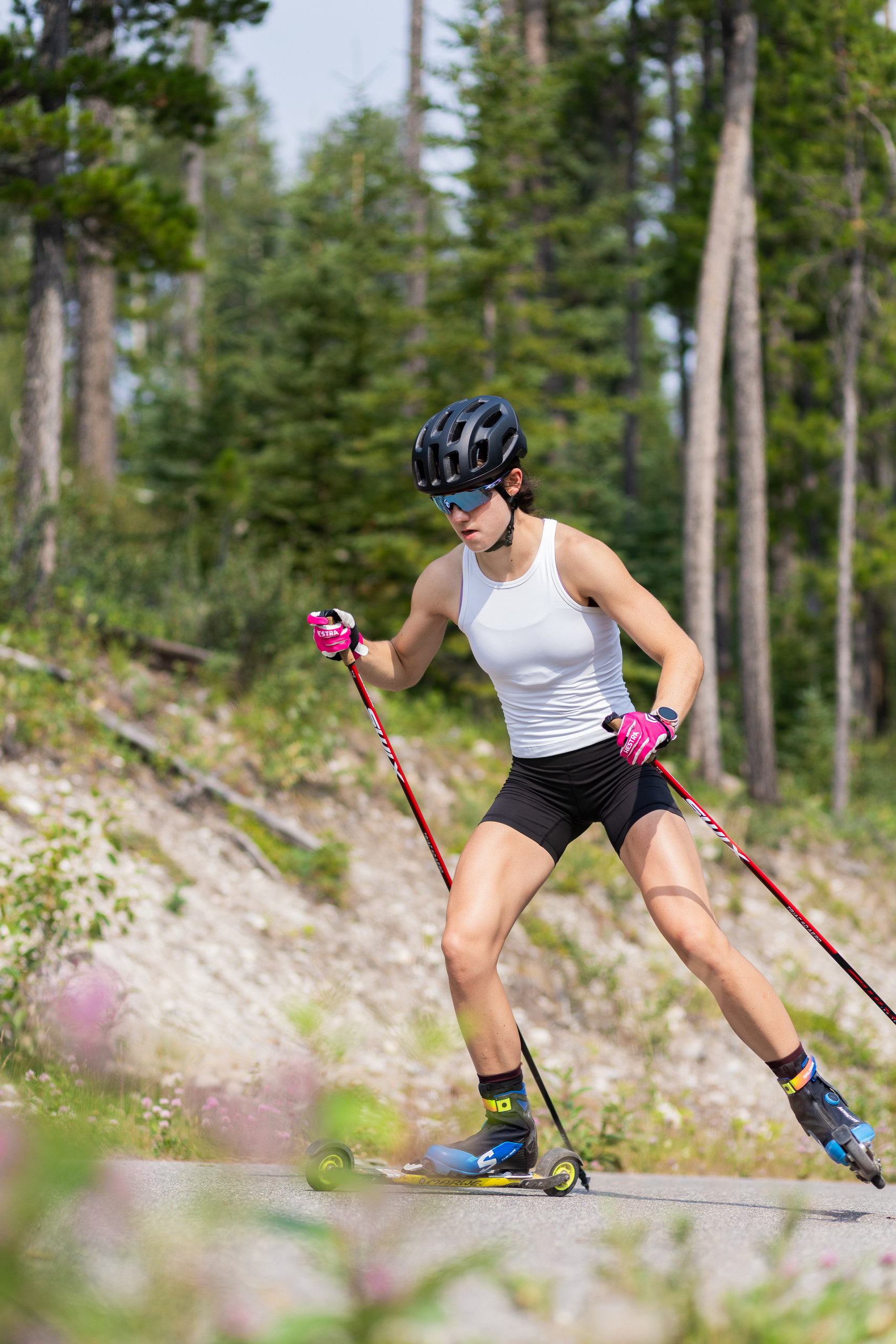
    Alison Mackie skate rollerskiing uphill on a paved forest road in a white training top and black helmet.
    Alison Mackie rollerskiing during summer training in July. She trains with the Alberta World Cup Academy in Canmore, Alberta. (Photo: Nathaniel Mah)

    For Alison Mackie, the 2024 Junior World Championships in Planica never really started.

    She had arrived in Slovenia with reason to expect something. A year earlier, at 17, she had finished 13th in the 20 k at the junior championships in Whistler, British Columbia, on home snow, in exactly the kind of long, grinding distance race that suits her. In Planica she missed the qualification in the opening sprint, fell ill, and watched the rest of the week from a hotel room. She was not on the tracks when her Canadian teammates made history either: Sonjaa Schmidt won the U23 sprint, and Canada won the U23 relay.

    Back at her base in Canmore, Alberta, at the end of that season, Mackie and her coaches set a target for the next one. Top five at the 2025 Junior World Championships in Schilpario, Italy.

    Privately, she wanted more than that.
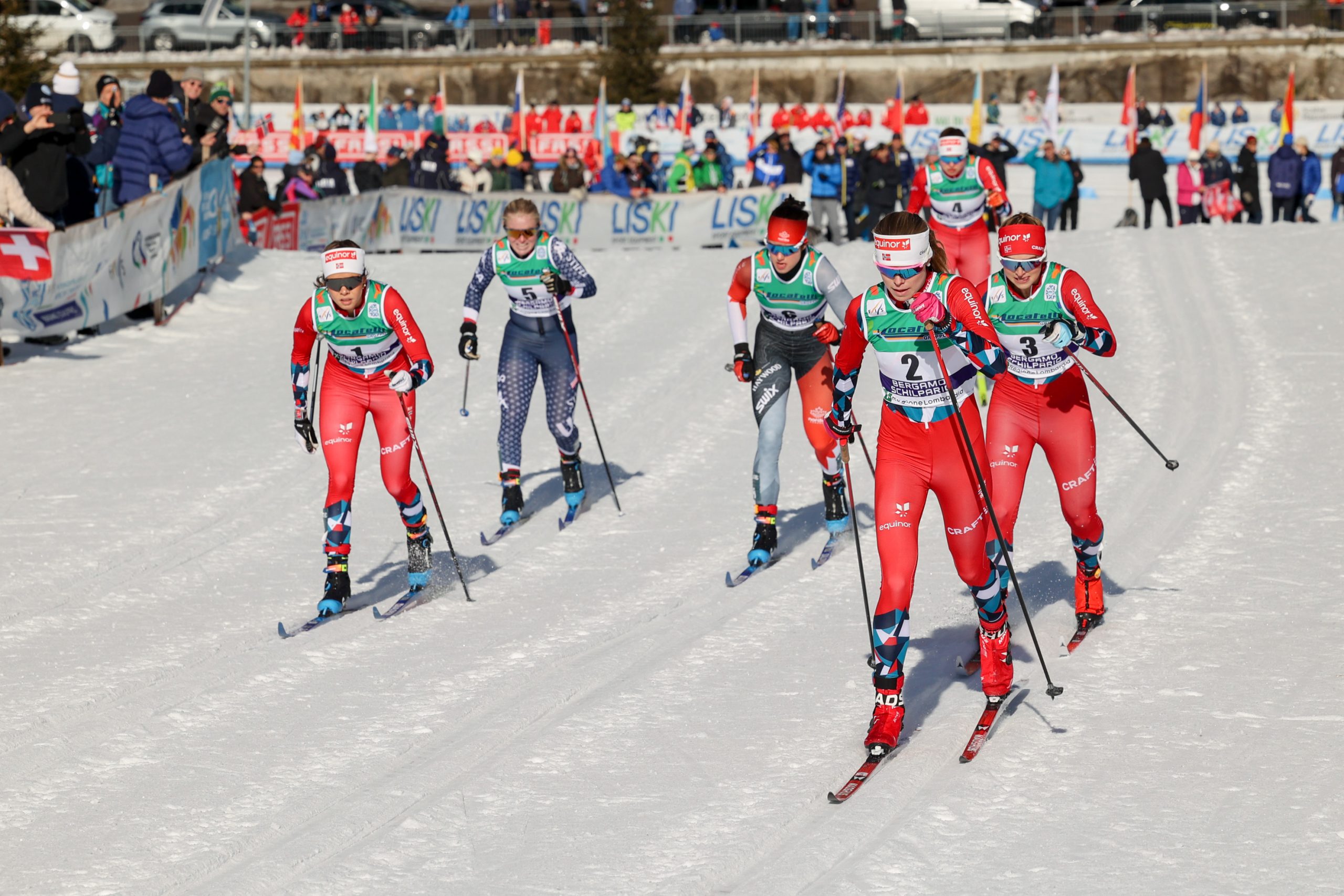
    Alison Mackie in bib 6 racing a classic sprint heat alongside Sammy Smith and four Norwegians.
    Mackie in bib 6 during the classic sprint at the 2025 Junior World Championships in Schilpario, where she finished fourth. Two bronze medals followed in the distance races. (Photo: Newspower.it)

    A Comeback in Schilpario

    “Yes, Junior World Championships in Schilpario were the main focus of my season that year,” Mackie said. “I trained specifically for that event to get my best shape there. But I wouldn’t say revenge, instead a kind of comeback because the year before in Planica I was pretty disappointed because I haven’t had the opportunity to race being sick.”

    On the Italian tracks she won bronze in the 20 k mass start classic, then bronze again two days later in the 10 k interval start skate. She was fourth in the classic sprint. They were the first junior world championship medals won by a Canadian woman since 1989.

    “I wanted a top five, and I finished with three top fours, including two medals,” she said. “The preparation we had put in proved to be correct, and I had a lot of confidence before starting the championships because I felt really good in the previous months leading up to my arrival in Italy.”
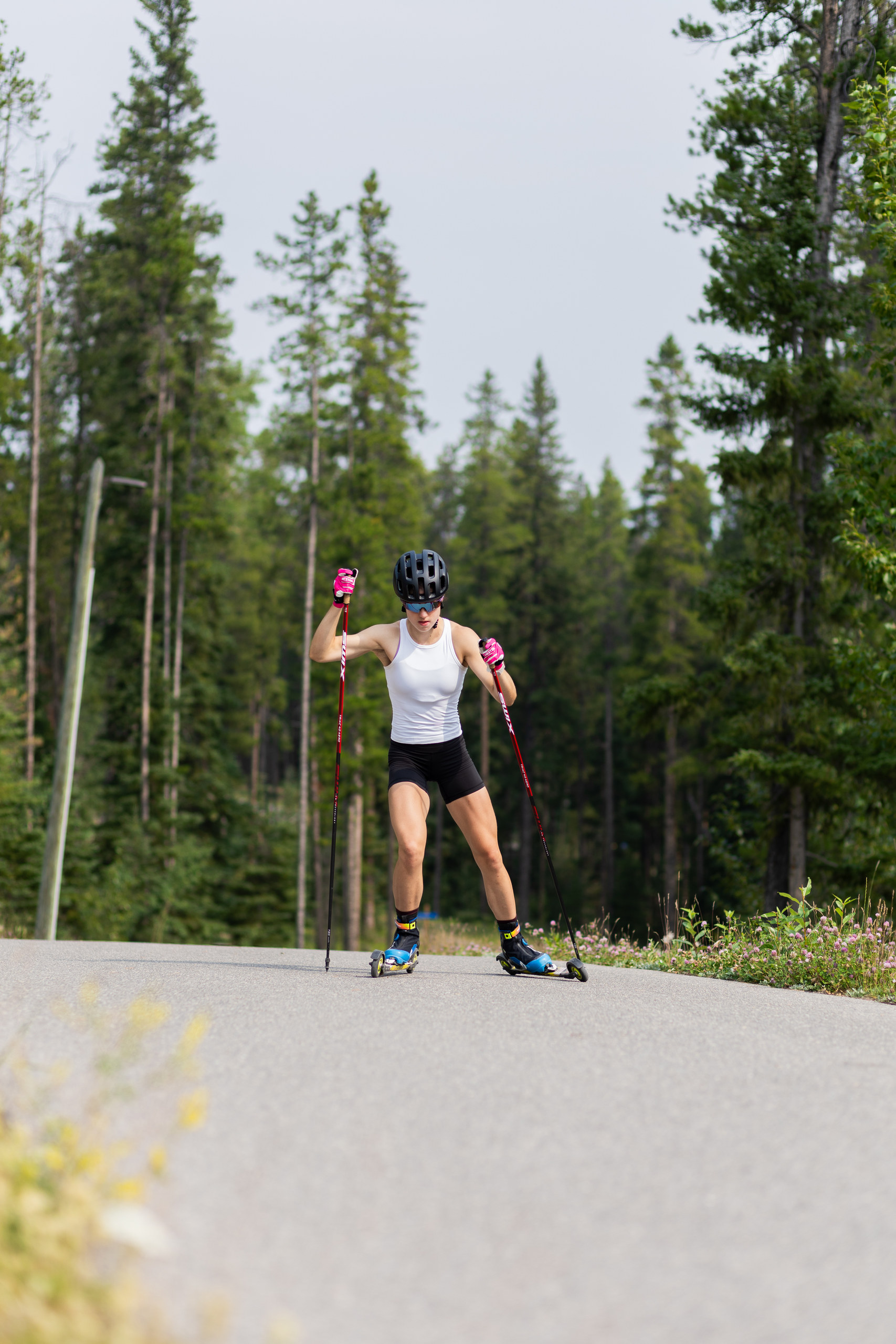
    Alison Mackie rollerskiing toward the camera on a paved road lined with evergreens.
    Mackie on a summer rollerski session in July. She started racing in Alberta as a teenager and won her first national title at 16. (Photo: Nathaniel Mah)

    Put on Skis Before She Could Walk

    Mackie was born in Montreal and raised in Edmonton, and she is 20 years old. Her mother, Jennifer, is a pediatrician. Her father, Andrew, is a pediatric cardiologist. Both of them ski, and both of them had her on skis before she has any memory of it.

    “My parents put me on ski as soon as I could walk,” she said. “So skiing accompanied all my childhood. Then I took real ski lessons and I started doing racing in my region of Alberta during my teenage times. That’s till Covid period arrived and with the restrictions I had nothing else to do others than training. But anyway, I really enjoyed myself during that period, developing my technique with my coaches at Edmonton ski club and when Covid finished my very first race that I won was our National title in March 2022 as a 16 year old.”

    Canada is known around the world as the home of ice hockey. Why did you choose cross-country skiing over hockey, freestyle, or swimming, following Summer McIntosh’s footsteps for example?

    “In parallel with cross-country skiing, I did a lot of other sports like cross-country track and field, rock climbing, mountain biking, swimming, soccer and in all of these sports I wasn’t as super competitive as I was in cross-country skiing. I did that only for fun as an opportunity to stay healthy during summer period. Cross-country skiing has been to me the only sport I competed at my best in my early ages and my favourite discipline. That’s why I chose it.”

    That first national title, won in Whistler in March 2022, is the race she keeps coming back to.

    “Yes, that race in Whistler BC was one of the first big races after the Covid pandemic,” she said. “I trained a lot during that period and didn’t have the opportunity to race and see my level, and when I went to my first National Championships and won the first race, it was a special moment and made me realize that I wanted to keep pursuing cross-country skiing for even better results and seeing how far I could get.”
    Alison Mackie racing the Olympic 10 k freestyle in Tesero, panned against a packed grandstand.
    Mackie racing to eighth in the Olympic 10 k freestyle in Tesero on Feb. 12, the best Olympic cross-country result by a Canadian woman. (Photo: Vanzetta/NordicFocus)

    Eighth at the Olympics

    The line has run one direction since. Two bronze medals at Junior Worlds. Her first World Cup top 10s, in Toblach and Val di Fiemme. Eighth in the 10 k free at the Milano Cortina Olympics in her first senior season. Gold in the 20 k mass start free at the U23 World Championships in Lillehammer in March. And at the end of that season, on 548 points, the FIS U23 overall World Cup title, the first won by a Canadian woman, with the finals held at Lake Placid.

    At the Milano Cortina Olympics you finished eighth in the 10 k free, after your first World Cup top 10s in Toblach and Val di Fiemme. What do you remember from those two weeks in Italy?

    “It was super cool being part of that multi sport event that the Olympic Games represent. It was my dream since I was a child watching Olympics on TV and having the opportunity to compete in high level in this huge event was really special to me. Definitely they have been long two weeks, also overwhelming at the time, but made me really happy how I performed overall and the 8th place I got in 10km skating has definitely been the highlight without any doubt. Entering the top 10 has been quite a surprise to me in that moment, because there were all the best skiers at the starting line. But now looking back at all the hard work I did during the whole season and the good results I got before that race in both World Cup and in under 23 World Championships, I wouldn’t say it was a huge surprise for me. Probably demanding Val di Fiemme’s track suited me very well, given that I finished as well 8th in Tour de Ski’s Cermis climb the month before.”

    What is the current situation in Canada for cross-country skiing, in terms of ski club membership, visibility in the national media, and financial support?

    “I would say the current cross-country skiing community in Canada is pretty small, if compared to other European power nations, but strong and with lots of passion in developing our discipline. There are a lot of young skiers coming up and I think it is very exciting for the great results to come in the future. Our National sports organization here in Canada are working really hard to make sure our National team can get all the support we need in order to achieve some World Cup podium with both boys and girls team during the seasons to come.”
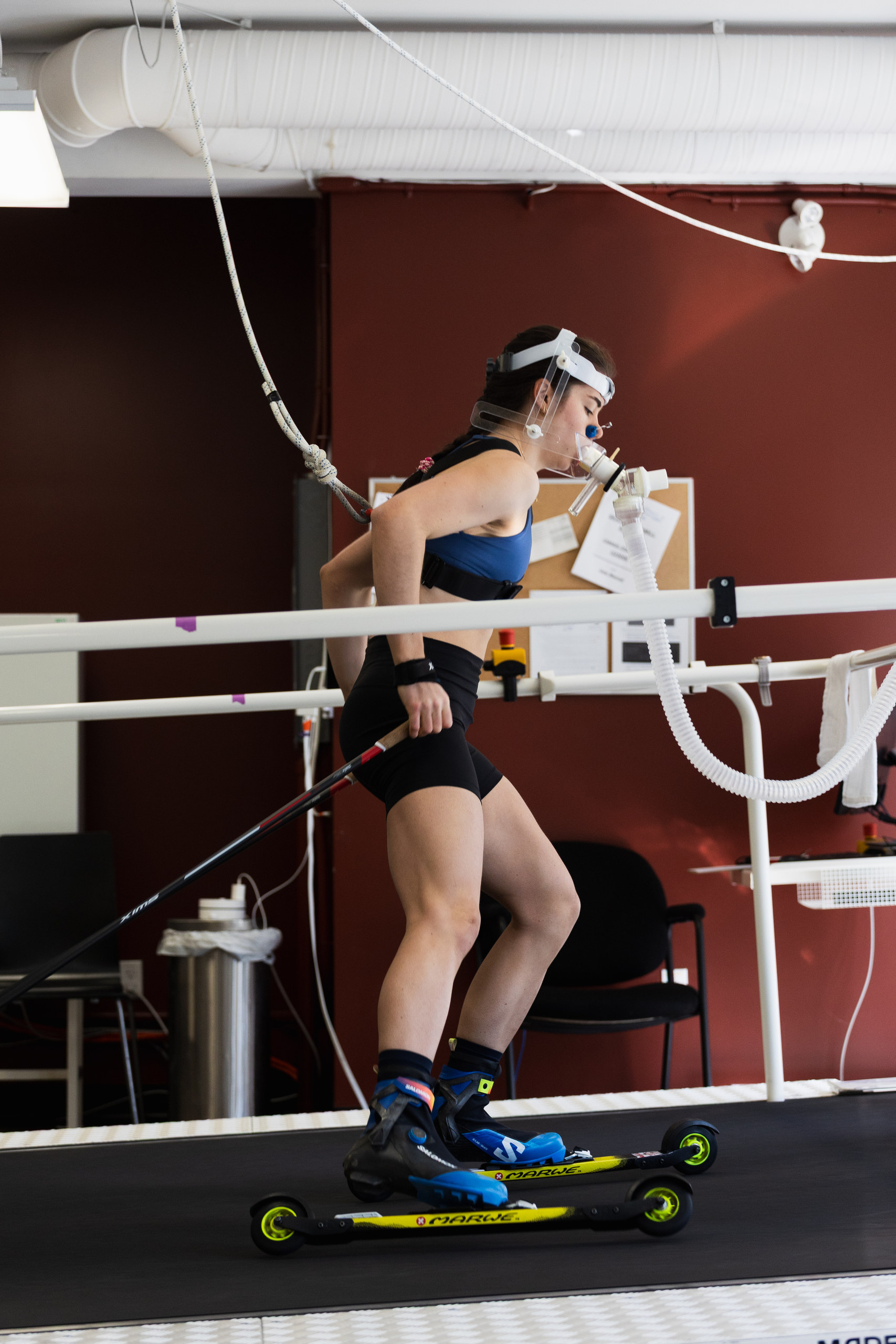
    Alison Mackie skate rollerskiing on a laboratory treadmill while wearing a metabolic mask.
    Mackie on the treadmill during a lab test in May. Distance racing is her strength, and finding speed is the summer’s assignment. (Photo: Nathaniel Mah)

    Distance Strength, Sprint Homework

    Describe yourself as a cross-country skier. What are your characteristics, your strengths, and the areas you are working on for the coming seasons?

    “I describe myself as a pretty strong skier in distance races, while I struggle a bit in sprint not to get through the top 30 and consequently not play the sprint finals, that is an element that I am working on in next seasons,” she said. “Between classic and skate I have found more success in free technique in the past seasons, but I enjoy training both classic and skate equally. Distance races are definitely my strength but I am working to improve my speed skiing as well so I could become a really strong overall skier in order, in the future, to fight for a higher overall spot in World Cup.”

    And the criticism you get from your coaches?

    “More than critics I would call special feedback from my coaches. Because sometimes I have a tendency to train too much and too hard that I need. That is something I am working on this summer, knowing when to push my body and when to give the correct time to rest and recover.”

    The World Cup calendar keeps skiers from outside Europe away from home for close to five months a season. How hard is that for you?

    “Personally I have spent on the road, following World Cup calendar, the past two seasons, but not the full European calendar. I really enjoy travelling and being on the road, so I don’t think it is a huge struggle for me. It is tough to not see friends and family for a long time but I am really lucky that I had friends and family came and watched me on tracks while I was in Europe a couple of time during season. Next season it will be quite different for me, because I am transitioning to attend the University of Utah so I will leave World Cup a bit because I do need to go to class and represent the University of Utah in North America as well.”
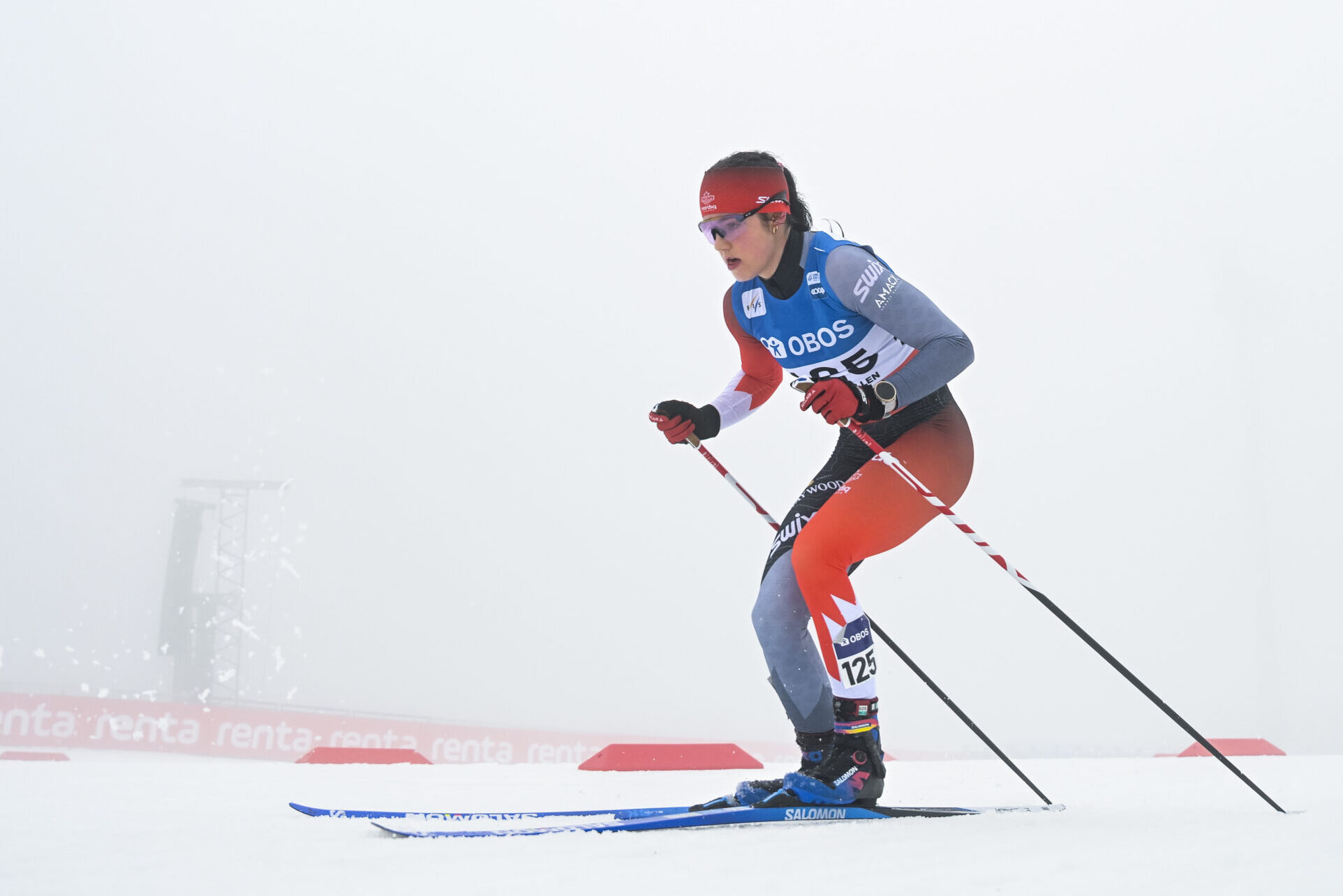
    Alison Mackie skiing in a Canadian race suit through fog at Holmenkollen.
    Mackie at the Holmenkollen World Cup in March, a week before the tour reached Lake Placid. (Photo: Authamayou/NordicFocus)

    A Winter Without Diggins

    The World Cup went to Minneapolis in the last two seasons, and Lake Placid hosted the finals in March in front of enormous crowds. Why not race in North America more often?

    “We do have actually Canmore scheduled for World Cup 2028, but realistically there are not so many resources for cross-country skiing in North America,” Mackie said. “It takes a lot of money and human power for the organization and preparation of those races. Of course, it will be amazing to have more opportunities to race in North America in the future but I have to be realistic and understand that organizing an event here in Canada, for example every four years, require lots of efforts and preparations from the local organization. Maybe we need more venues in North America that we currently have that are able to bring here World Cup events. I admit with huge pleasure that in the past seasons both Minneapolis and Lake Placid events showed how strong local communities are in terms of support and enthusiasm for cross-country skiing and those events have been a great boost for our discipline in North America, especially between young kids.”

    After fifteen seasons, this will be the first World Cup winter without Jessie Diggins, who clinched one more crystal globe in Lake Placid in March before retiring. Will she be missed outside the U.S. team as well? Did you ever get advice from her?

    “I definitely think Jessie’s presence will be missed in World Cup. Not only inside USA Team. I think she has always been a positive skier and a really amazing role model in so many ways. And 100% her presence, her ambitious way of racing and unique skiing spirit will be missed. That will definitely change some racing tactics as well. I had the opportunity to train together with Jessie in New Zealand last summer and it was a pretty cool experience and I wish all the best in her future.”
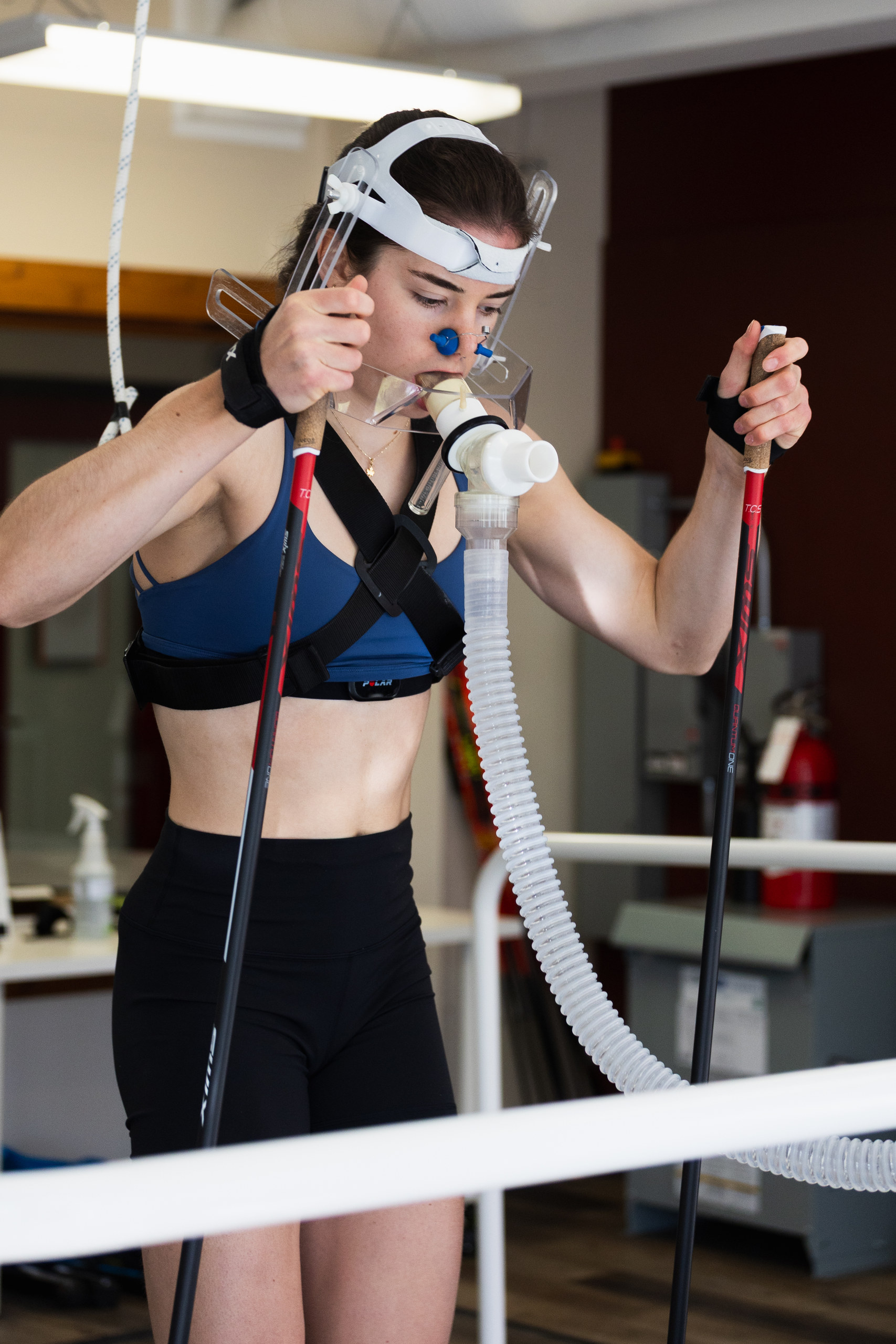
    Alison Mackie adjusting a metabolic testing mask while holding ski poles in a testing lab.
    Mackie fitting a metabolic mask before a treadmill test in May. She trains in Canmore and will study medical engineering at the University of Utah this year. (Photo: Nathaniel Mah)

    Canmore, Utah, and Life Off the Snow

    How is the Canadian team organized, and how is training divided between the women and the men at camps and at home?

    “I think Canadian skiing is gonna take a really exciting trajectory. I am really excited to work with our new Swedish coach Stefan Thomson over the next seasons but also in our group here in Canmore we have Norwegian Tormod Vatten as our assistant coach and with them we have a really strong support staff. For the Canadian National Team over the next seasons is going to be really exciting seeing where we all can go in World Cup and I am really proud to be part of this young but strong group of skiers that our Nordiq Canada are building now, under the [leadership] of former Olympic champion Beckie Scott and our amazing ski communities.”

    How do you manage your studies, at Queen’s University until last year and now at the University of Utah, with training and racing that run through most of the academic year?

    “I just make sure that I manage my schedule accordingly to have enough time for both my trainings and school throughout my day. I think having something other than skiing to focus on is really important for me. I was an online student at Queen’s University over the past two years and now I am transitioning to the University of Utah studying medical engineering. I think it is important the communication with the professors, making sure they know that my situation is a little bit different if compared to normal students, due to the fact that my training sessions, travels and races during winter season take my mind. But despite that my goal is to give my full focus during hours in classrooms too.”

    What kind of person are you away from cross-country skiing? Your personality, your interests, what you do on days off from training and racing?

    “Outside of cross-country skiing I am a pretty introvert person. I try to keep things on my own. I like studying and I really enjoy sewing clothes in my free time. I truly also love to learn new things and that is why I am excited to attend the University of Utah this year. I also love to spend time in the mountains nearby Edmonton where I grew up and in Canmore where I train myself with Alberta World Cup Academy and where I graduated in High school. Hiking, Mountain biking, running and skiing, of course, are my favourite activity when I can spend my time outside in the lush Canadian Nature.”

    In 10 to 15 years, at the end of your career, you will be proud of yourself if what?

    “I think, regardless of what I achieve in my future, I will be extremely proud of my career in addition to what I already accomplished. But really, my goal is just to ski because I love it and see where I can get of myself and also trying to inspire other young skiers. I think that there are a lot of young skiers in Canada right now, who have the potential to be amazing athletes. I really want to inspire them, showing them that anything is possible, it doesn’t matter what country you are from or how old you are. So regardless of what I achieve over the rest of my career I will always be proud of what I have already achieved.”

    Paolo Romanò is a freelance reporter based in Italy who covers cross-country skiing and Nordic combined.

    Help Support Our Coverage!

    If you value the thoughtful work and access FasterSkier provides, please consider becoming a Voluntary Subscriber. Your support directly fuels our work to cover the people, places, and moments that make our sport special.

    Join the FasterSkier community!
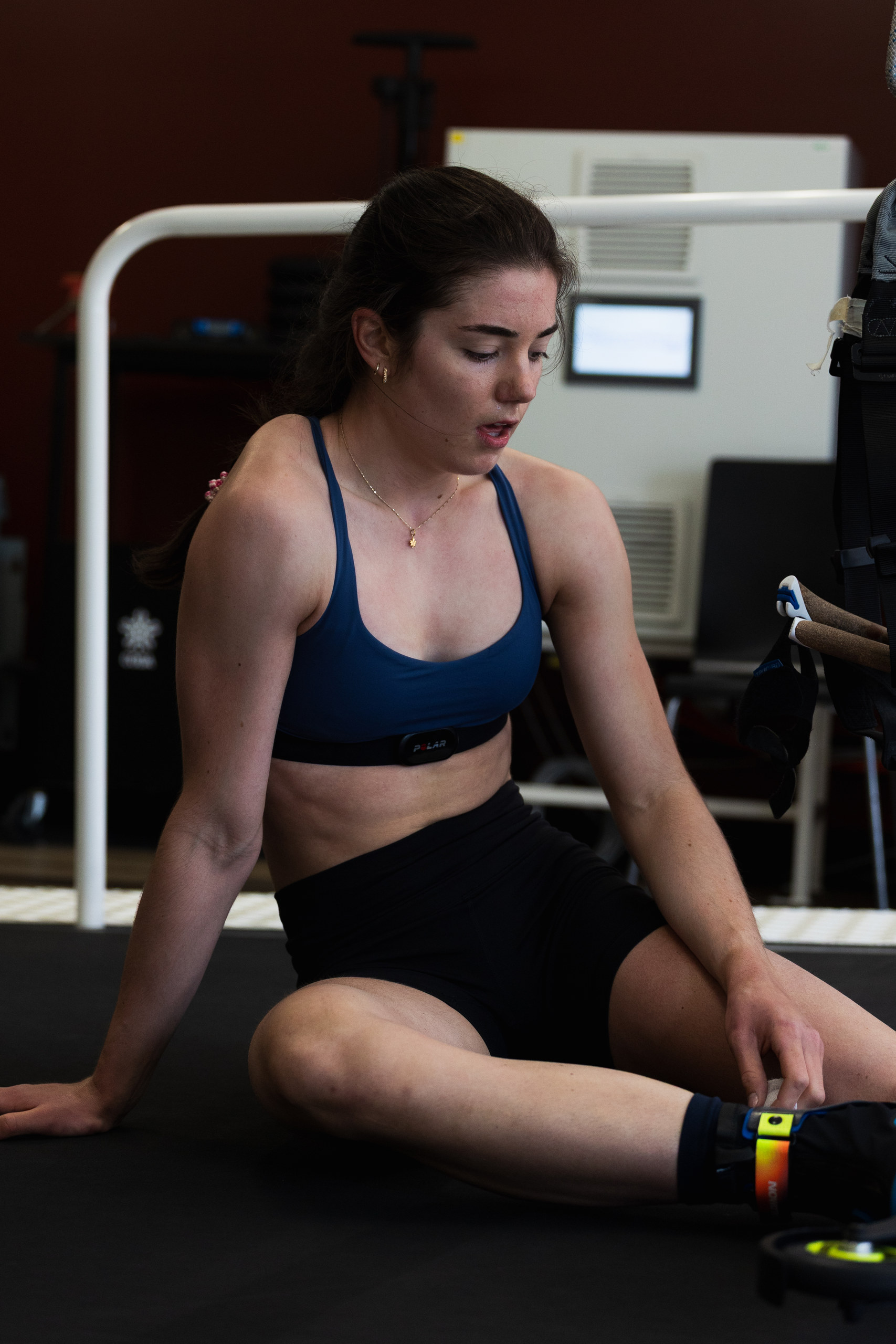
     

    Alison Mackie sitting on a laboratory floor catching her breath and unstrapping a sensor from her leg.
    Mackie catching her breath after a lab test in May. She races her first season for the University of Utah this winter. (Photo: Nathaniel Mah)
  • Balancing Books, Labs, and Laps: Inside Newly Named U.S. Ski Team Member Lucas Wilmot’s Routine

    Balancing Books, Labs, and Laps: Inside Newly Named U.S. Ski Team Member Lucas Wilmot’s Routine

    When Lucas Wilmot sits down after morning intervals, there’s no long nap or lazy lunch ahead. “This fall, it’s kind of all back-to-back—training in the morning, then eating, then class, then trying to eat and train again, and then do homework,” he says. “It’s tight.”

    That understatement is classic Wilmot: composed, analytical, quietly focused. At just 19, the Jackson, Wyoming-raised skier is already juggling NCAA racing for the University of Utah, kinesiology labs that might soon shift toward biology, and a new badge of honor—fresh membership on the U.S. Ski Team.

    Lucas Wilmot was keeping it fun from the very beginning. (Photo: Courtesy Photo)

    From Jackson to Utah: A Small-Town Start

    Wilmot’s story starts, like so many in American skiing, with a local club, a hand-me-down pair of skis, and a family that encouraged movement. “I kind of started with my parents—they just put me in skiing in elementary school,” he recalls. “Back then, it was all about hanging out with friends and not really racing.”

    That changed in middle school, when the sport shifted from pastime to passion. “It took a turn where I started to take training more seriously and be more race-focused,” he says. “I remember looking forward to the trips, doing well in races, and having the older guys on the team as idols. Seeing how big and fast they were—I always thought that was really cool.”

    His sister, two years older, was both chauffeur and role model. “She was skiing too—she’s still skiing now at Bates,” he adds. “I started summer training with the older crew in Jackson when I was one of the youngest guys. My sister could drive. I couldn’t. So I’d just spend my time training with the older guys.”

    The big breakthrough came as a sophomore. “Minneapolis Junior Nationals was another big turning point,” Wilmot says. “I had three top tens there, and I never expected anything like that. That was when I realized, if I actually put in the time and effort, I can see results that impress even myself.”

    Lucas Wilmot (#230 – far right) starting to get serious about his skiing racing at a Junior National Qualifier as a U14. (Photo: Courtesy Photo)

    “Welcome to the U.S. Ski Team”

    If Minneapolis was the first turning point, Soldier Hollow was the second. “I got third in the classic 10K at Senior Nationals,“ Wilmot recalls. “That was kind of a big whoa moment—a big jump up. Will (Wicherski), my coach from Jackson, came up to me and said, ‘Do you know where you are?‘ I said no, and he said, ‘You’re in third.‘ I was just kind of shocked and caught by surprise.”

    That race qualified him for Junior Worlds, where another top result changed everything. “They released the requirements—it was a Junior Worlds Top 10,“ he says. “When I had the ninth place in Schilpario, Italy, in the skate 10K, I kind of knew I’d made the team. Right after the race, Brian Fish walked by and said, ‘Welcome to the U.S. Ski Team.’“

    Wilmot laughs at the memory. “It was at the wax cabin or something. I kind of knew that day. My parents and sister were there, so it was nice to tell them in person,“ he says. “But I didn’t want to be loud about it. I told my parents, like, this isn’t official, but it’s looking like I might be nominated.”

    Now, being able to put on the U.S. suit still feels surreal. “I definitely feel pretty lucky,“ he says. “It’s a lot of people’s dream to do that, and it was one of mine. I feel super lucky, and it’s an honor. When I have the U.S. suit on, maybe I’ll go reach out to someone I’ve never met before—they’re all kind of like teammates to me.”

    Lucas Wilmot (UU), Murphy Kimball (UAA) and Tabor Greenberg (UVM) this past spring at the USST’s annual Bend camp. (Photo: Courtesy Photo)

    Structured but Flexible

    Last season Wilmot logged around 500 hours of training; this year he’s targeting about 600. But he’s adamant that numbers aren’t everything.

    “I’m definitely not the number grinder. I just try to keep it fun—never do too much, always quality. It’s kind of my mindset: always having quality in the time you’re training. Make sure it’s worth your time to be there.”

    He recalls finishing a long over-distance session in Park City camp and realizing more minutes would add nothing.

    “I was thinking I could do another 30 minutes, but I’d just be walking. It’s not really how much is that gonna do for me? If it’s not quality, if I’m not putting all my effort in, then I’m not getting the most out of it.”

    That approach—precision over volume—mirrors his team’s philosophy. “Pierre (the Utah coach) kind of switched it to more professional training,“ he explains. “Every training has a specific outcome goal to it… You’re not just doing it to do it. There’s a reason why, and it’s all part of a broader plan and structured schedule.”

    A Day Measured in Minutes

    In Utah’s mountain light, mornings start early—Wilmot trains, refuels, and hustles to class. “I like to think ahead and plan out as much as I can,“ he says. “School is my priority, and how can I get it done efficiently so I can rest well. I try to go to bed as early as I can and know that training in the morning is kind of also a priority.”

    The key, he’s learned, is organization—a skill honed on long travel days in high-school racing.

    “Being on trips for skiing taught me that if I get it done ahead of time—get all my schoolwork done or just know that when I have spare time, I should try to get ahead or catch up on school—that’s what I think about all the time.”

    Even with 600 training hours, he squeezes recovery in where he can. “It’s a hard balance between having training in the morning as a priority or staying ahead on work,“ he admits. “But I think I learned well… just to plan ahead.”

    Wilmot during the 7.5-kilometer classic interval start last spring at the U.S. Ski and Snowboard Cross-Country Junior National Championships in Soldier Hollow, Utah. With a time of 23:12.4 second, Wilmot won his first Junior National title in his fourth appearance. (Photo: Drew Palmer Leger/Courtesy Photo)

    Fueling the Machine

    This semester, recovery and nutrition have become new focal points.

    “This fall I was kind of struggling with recovery after the morning session and my class schedule,“ he says. “So one of the things I’m trying to do more of is focus on nutrition right after—that’ll allow me to make it through the long school day and then also recover well. That’ll help me get energy for the training and races.”

    Breakfast sets the tone: “Usually a banana, an everything bagel with butter, and maybe a little bit of yogurt… kind of got a little something of everything. It’s pretty yummy.”

    The science-minded athlete is applying classroom theory to real life. His kinesiology background gives him a deeper understanding of performance—how recovery, fueling, and training stress interconnect. “I’m keeping on the science track,“ he says. “Right now I’m doing kinesiology, but maybe switching to biology or another science-related thing. Not sure yet.”

    Keeping It Fun

    For Wilmot, joy isn’t optional—it’s essential. “I just love hanging out with all the buddies, training with friends. Definitely makes it go by a lot faster,“ he says. “It’s pretty fun just to crack jokes a lot and mess around, too… You don’t always have to be serious at training.”

    That balance between intensity and levity keeps burnout at bay. Whether it’s running mountain ridgelines or laughing through rollerski sessions, he believes camaraderie fuels consistency. “Sometimes there are places not to focus,“ he laughs, “and just have a good time.”

    Fun with friends is Lucas Wilmot’s core principle. (Photo: Courtesy Photo)

    The Process of Progress

    Beyond coursework and results sheets, Wilmot’s compass points toward steady growth. “I’d hope to make the NCAA team for the University of Utah this year,“ he says. “That’s going to be pretty challenging… but I hope to have more stabilized results and less fluctuation.”

    He defines progress through small, controllable actions:

    “In skiing, just being as efficient as I can. If I’m in a race and I feel uncomfortable, I try to find where I’m comfortable and not make myself too jittery. Being comfortable in your own way during a race—knowing how to race your races—is important for me.”

    When he talks about the future, Wilmot’s tone shifts slightly—equal parts excitement and realism. “Within the next four-year span, there’s a good chance the progress track may take me to that level,“ he says, thinking ahead to the Milano-Cortina Olympics. “If I stick with it, that would be an insane experience and something very special.”

    Wilmot skiing with Murphy Kimball (UAA/Alaska Winter Stars) on Eagle Glacier this past summer during the US Alaska camp. (Photo: Courtesy Photo)

    A Learner at Heart

    Among the national-team veterans, Wilmot sees himself as a student first. “I kind of see myself as a little follower,“ he admits with a grin. “Everyone’s just a little more experienced than I am. I feel like I don’t have much, so I think of myself as a learner and a listener—someone who tries to take everything I can from them.”

    But even the learner can lift a team. “I love being the guy that gets someone to smile,“ he adds. “And make them laugh. I love doing that.”

    That mix of humility and humor is why teammates have quickly embraced him. He’s not loud, but he’s steady—the kind of athlete who brings calm to chaos, whether it’s a high-stakes interval session or a late-night study grind.

    Looking Ahead

    Wilmot’s path has never been about a single breakthrough; it’s about accumulation—hours, credits, lessons. “I kind of never saw myself being where I would be right now,“ he reflects. “It goes back to the open-doors thing—I was just following what was happening, putting in the work, and seeing what opportunities it led me to.”

    That approach—disciplined but flexible—may be his greatest strength. Between lecture halls and ski trails, he’s learning to find balance. And every dawn run, every late-night homework session, is another quiet step toward the next start line.

    “It’s a good, hard balance,“ he says, smiling. “But that’s kind of what I signed up for.”


    Love Stories Like This? Help Keep Them Coming.

    Feature interviews like this one take time, access, and care to produce. If you value thoughtful storytelling and independent ski journalism, please consider becoming a Voluntary Subscriber. Your support directly fuels the work we do to cover the people, places, and moments that make our sport special.

    Join the FasterSkier community.
  • Reflections from Whistler 2023—U23 10km Free

    Reflections from Whistler 2023—U23 10km Free

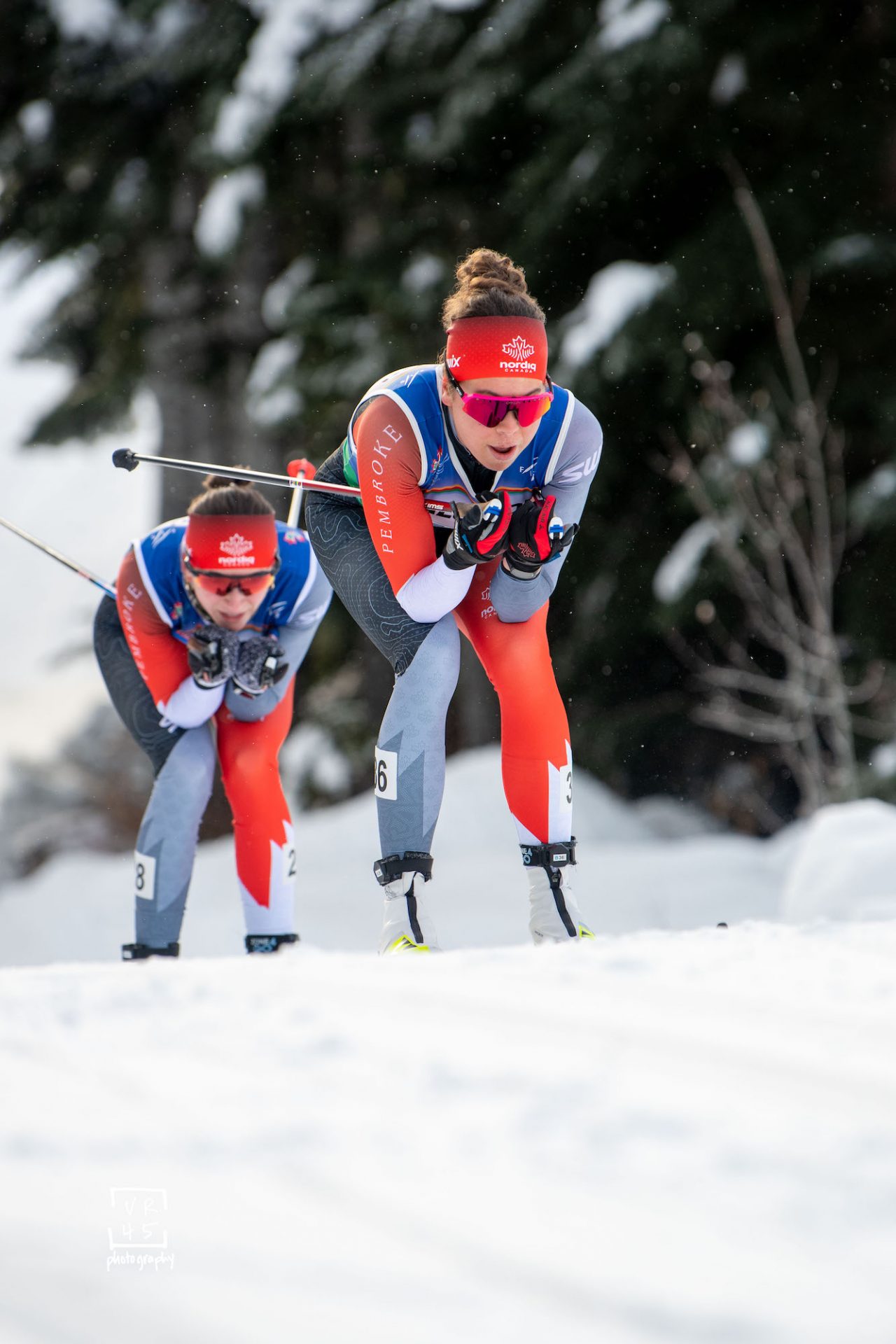
    Sunshine and a World Championship podium. (l-r) Izabela Marcisz (POL), Helen Hoffmann (GER), Margrethe Bergane (NOR). (Photo: Doug Stephen @vr45phtography)

    Another day at Whistler and another day of great skiing. The day started just below freezing with a little new snow overnight, intermittent sunshine, no wind, and no snowfall until after the last skier finished.

    The course was two laps of the Olympic Red 5km, the same course used in 2010 for the classic races. About 3km of the loop was the same as used in the classic 20km Monday and Tuesday. There is a big difference between the two techniques: in classic, when a relatively straightforward downhill is too fast to double pole, the skier gets a rest in a tuck, but those same sections reward free skating. Even the podium athletes admitted there was a bite to this course in free technique.

    The women’s 10km put two new faces on the podium. Germany’s Helen Hoffmann won in 26:13, edging out Poland’s Izabela Marcisz by just 1 second. Norway’s Margethe Bergane collected her second bronze of the week, finishing 4 seconds back. Tuesday’s silver medallist Lisa Lohmann from Germany was fourth, 14 seconds back.

    The USA put three women in the top ten without cracking the podium and it was a solid but not spectacular day for North American men. For the US, Sophia Laukli was best in fifth, at 17 seconds, followed by Novie McCabe in seventh at 40 seconds, Sydney Palmer-Leger in ninth at 43 seconds, and Kate Oldham tied for 39th at 3:22.

    Canada had an interesting day. For Canada, Jasmine Lyons had another great day, placing 17th at 1:04. Liliane Gagnon was 27th at 1:58, then Amelia Wells in 31st at 2:24, and Marielle Ackermann in 44th at 4:12 back.

    Once again, we will let the athletes tell their own stories in the interval start race.

    Women’s 10 k Freestyle

    Hoffmann

    The day: “My day was very great. I don’t expect that my race would be so good, and I am happy.”

    The course: “The course is very hard, very hard.”

    Visiting Canada: “It’s beautiful here, much snow.”

    Marcisz

    The day: “Oh my god, I’m really happy. I have silver. It was really beautiful and really hard to race. I’m really satisfied, I have this medal for all my team.”

    The course: “I think this course is really difficult and really sneaky. This is Olympic course, so it have to be really difficult. For the skate and for me, it’s quite nice. I have long steps [one skate/v2 glide] so I felt quite comfortable.”

    Visiting Canada: “Before these competitions, we were in Prince George and we did race there. For sure, I want to back to Canada, but probably more for chill and a little bit more than course and hotels.”

    Bergane

    The day: “It was very, very hard, but very fun to race. I’m very happy with the medal.”

    The course: “Oh, I really like the course. It’s tough, and I really like that.”

    “It was a hard course, but very, very good conditions. In Norway, we have hard courses as well, so kind of the same like in Norway.”

    Visiting Canada: “I had so much fun. I really like Canada so I hope I can come back someday.”

    Laukli

    The day: “It was good. I was a little bit nervous and curious how it would go. I’ve been a little bit sick and coming off of that, so I was definitely happy to get a top five. I had big goals, but with how I’ve been feeling, I was really happy with how it went.”

    The course: “It is incredibly hard. I’ve skied it a lot now, but not until racing it today did I realize how insanely [hard], you’re just grinding all the time.”

    The profile looks like 3km of easy downhill: “You don’t feel like there is, it feels like there is only climbing.”

    Lesson learned this week: “I’ve learned that you’ve got to be patient with racing. I’ve learned, that I can personally work on is skiing tactically, and this course has made me realize that. I’m really into climbing, but there’s so much more to racing than that. That’s something I want to start working on more.”

    Favourite race this season: “I feel like I can’t say anything except the hill climb in the Tour de Ski. That was a pretty great day, and a lot of fun.”

    McCabe

    The day: “It was pretty good. It was a fun fight out there and we had a lot of strong performances from the team, so I think overall a good day.”

    My day: “I feel okay about it. I was hoping for a little more, but it was what I could do today, so I’m proud of it.”

    Lesson learned this week: “I had a lot of practice in going through racing that was not quite what I’d hoped and trying to get past that and start fresh in the next race.”

    Racing here: “It so nice. This is like a dream venue. It’s so beautiful, I thought today was supposed to snow or rain or something, this is a real treat.”

    Palmer-Leger

    The day: “I had a pretty good day today. I started that first lap not sure how it would go, my legs were flooding a little bit from the last two races. The second lap, I caught a ride with the German Lisa Lohmann who ended up top three today. It actually turned out a really good race. I’m really excited how it went.”

    The course: “I like the course. It’s a lot of climbing the first half, then it’s smaller, like gradual, some powerful V2 the last end of the course.”

    Lesson learned this week: “Honestly, just learning that trust my training, trust that I’ve been doing this for a long time, and just find my strengths on the course and push it. Whatever happens, happens. If it doesn’t work out as planned, just try to find the positives in everything. Today, we had three women in the top ten, so that was pretty cool.”

    Lyons

    The day: “It was a tough one out there. It wasn’t the race I was hoping for, but there’s another one coming up.”

    The course: “Course was definitely challenging, it was quite hilly, but the conditions were pretty perfect, the grooming was awesome.”

    Lesson learned this week: “Learned a lot about getting prepared for races, staying in the zone. Really learned a lot about how high the level is and how much I need to keep training and improving to try to keep up.’

    Gagnon

    The day: “It was really hard. The two rest days weren’t the best thing for me, my body was feeling pretty tired, and those uphills my legs were burning up, but made it to the finish. It will be a new day tomorrow.”

    The course: “Very, very hard skate course. It’s a long uphill right from the start. You get some recovery downhill, but you go back up on the highest point of the course.”

    Lesson learned this week: “I learned that maybe classic is getting way better for me. It’s been interesting racing with those fast girls, I’ve got a lot of experience now.”

    Wells

    The day: “It was pretty good. It was hard out there, it’s a tough course, feeling a little tired from the 20km. Overall, I had fun.”

    The course: “It’s a lot of uphill. The first 2k are all work, you get a little rest at the end.”

    Lesson learned this week: “I learned so much, it’s hard to think of one thing. Double pole, and learning to ski with the best.”

    Oldham

    The day: “Today was pretty awesome. I’m really glad the weather held up for us. The skis were fabulous and we have a really strong team here that’s a pleasure to part of.”

    The course: “The course is really high level, really well maintained and cared for these championships. It’s really fun, it’s really hard.”

    Lesson learned this week: “I think I learned a lot about leading up to race, how important the little things are. I’m surrounded by an elite team that does those little things well, so it’s been awesome to get another window in that lifestyle from girls that ski on the World Cup, who went to the Olympics.”

    Ackermann

    The day: “Pretty bad, to be honest. It was pretty tough out there, my legs were not in it, my mind was not in it.

    The course: “It’s tough. The hills just go on and on, and then there’s this long working section. You’re wiped from the hills and it’s really hard.”

    Lesson learned this week: “I learned to just accept bad races. It happens, and sometimes it happens at the biggest event of the year. That’s tough and it’s mostly about having fun. So as long as you don’t get too down on yourself, you can just move on and learn from it.”

    “Norwegian U23 Nationals”. (l-r) Lars Agnar Hjelmeset (NOR), Martin Kirkeberg Mørk (NOR), Jonas Vika (NOR). (Photo: Doug Stephen @vr45photography)
    Men’s 10 k Freestyle

    The men had the now-traditional distance podium sweep by Norway, although it is the first time it has happened here.

    Martin Kirkeberg Mørk won in 22:52, a full 26 seconds clear of Lars Agnar Hjelmeset. Tuesday’s 20km winner Jonas Vika was 43 seconds back, part of a second ahead of France’s Gaspard Rousset and six seconds clear of 8th place.

    The top North American was Whistler product Joe Davies in 13th at 1:04. Davies represents Great Britain, but still received huge support from the local volunteers. Wearing the Stars and Stripes, Gus Schumacher was 14th at 1:06, Zanden McMullen was 15th at 1:08, John Steele Hagenbuch was 19th at 1:16. and JC Schoonmaker was 29th at 1:43. For maple leaf-wearing Canadians, Rémi Drolet and Max Hollman tied for 23rd at 1:33, Sasha Masson was 32nd at 1:46, and Erikson Moore was 41st at 2:26.

    The field was distinctly clumped, with many skiers only a couple seconds from better placings. This may sound easy from the sofa, but a look at the bodies lying in the finish pen makes it clear that skiers were giving it everything already.

    Kirkeberg Mørk

    The day: “My day today is superb. It’s a quite tough course, you have to hold a little bit off on the hardest climbs, and then go fast on the easier terrain. Especially on the first lap, and then on the second lap, if you did that, you can push hard. And that’s what I did.”

    The course: “I like it very much. A lot of the second gear [one skate/V2], and I’m good at that. It’s a good Olympic course.”

    Agnar Hjelmeset

    The day: “Yeah, today it was really fun to ski. It was tough, but the conditions and the course here is very good. You just have to be a warrior out here.”

    The course: “The course is really fun, a lot of uphills, and a lot of technical downhills. The conditions are very good.”

    Pacing: “I don’t know, go fast everywhere and push. You just have to be a warrior and push.”

    Vika

    The day: “It was quite tricky conditions to be skating. The snow was like, it was hard to stand safe on one ski. I felt my calves starting to cramp up, I had to loosen my shoes halfway. I think I’m third, I hope I became third.”

    The course: “The course is super tough, it’s harder in skate than in classic. I felt on the classic you could relax on the downhills, but here you had to work all the time.”

    Comparing courses: “Back home, we have so many different tracks. This, it definitely could be a track in Norway, it’s really high standard, the courses are wide and it’s easy to ski fast. It’s fair for everyone.”

    Davies

    The day: “It was okay. Definitely felt a little bit fatigued. Not quite the race I was hoping to feel, but it went all right.”

    The course: “I like the course, I don’t know if I had it in me today. It’s a course that requires a lot of fitness.”

    Pacing advice from a local: “Ideally, it’s best if you can control the middle of hills, not get too greedy on those, and really gain time over the top and on the gradual, flattish climbs.”

    U23 Championships at home: “It’s cool. It’s really nice that there’s so many people coming out to cheer that I’ve grown up with, or just skied with my whole life.”

    Lesson learned this week: “I’ve learned that my fitness is good, but sometimes the mental game can get in the way.”

    McMullen

    The day: “It was good. It’s a really hard race. As a team, we decided the best way to race it is to take it conservative the first lap. I was getting some splits, I was pretty far back, but I had in the back of my head not to freak out about that. I was hoping for a little more time, but overall pretty happy.”

    The course: “It’s hard, I really enjoy it. It’s pretty deceiving, you think you’re going to get some rest on the second half of the course, the last 2k, but you’ve got to work all of that downhill and flat. There’s very little recovery on this course.”

    Lesson learned this week: “I gotta get a little more fit. I’m coming out of the championships motivated as per usual. I’ve got one more year of U23’s, so I’m excited.”

    Hagenbuch

    The day: “Not great. I was trying hard, and I think the Americans were fighting the skis a little bit. I was pushing far inside on that first downhill after the fast steep pitch and slid out a bit. I’m happy with the effort, it’s hard racing out here.”

    The course: “It’s a great course, I didn’t have the legs to push the hills the way I wanted to, but it’s still fun.”

    Lesson learned this week: “I’ve had the big push of racing I’ve been doing catch up to me a little bit. It will be nice to get back and do a little bit of training, and hopefully get back into shape.”

    Drolet

    The day: “I think it was not very good. It felt like I didn’t have anything to give today. No matter how much I tried, I started going one pace and couldn’t go any faster.”

    Lesson learned this week: “That preparation is really key. I haven’t had the greatest preparation for a lot of the season. I have had better races here than earlier, but the preparation still was there. I need to be better prepared because everyone at these events is really strong and it takes your best shape to complete.”

    Studying theoretical physics at Harvard while training: “I’ve been at school a lot of the year. School is good, I’m enjoying it a lot. I’m maybe falling a bit behind these couple weeks [Tour de Ski, Trials in PG, Whistler]. Overall, I’m enjoying it a lot, and really happy where I’m at with that.”

    Hollman

    The day: “It was good. I woke up this morning, kind of scraped it together. The skis were amazing, absolutely rockets today. Shout out to the wax team for sending those out.”

    The course: “It’s a hard course, you’re never going to feel amazing on it.”

    Differences from last March at nationals: “The corners are definitely nicer, because you can actually get an edge, they’re not just pure ice into slush, that was super nice, you could really rip down it.”

    Lesson learned this week: “This week? I need to do more volume before these races, that’s my big takeaway from this.”

    Schoonmaker

    The day: “It was good. I didn’t have the best body feeling day, but I executed everything I had, and I’m happy with the performance overall.”

    The course: “It’s a hard course. I knew it was going to be hard, but it ended up being harder that I even thought. I got to the top of the first climb and I was just almost already shot from there. It’s fun, a flowy course.”

    TV commentators say you are only a sprinter: “I would say it’s true right now. I’m definitely better at sprinting than distance. It’s definitely something that I want to change. I want to get better at distance skiing and hopefully, it’s coming along.”

    Lesson learned this week: “I’ve learned we have a kick ass bunch of American juniors and U23’s. We had the best week, lots of energy, and I’m really excited for the future, for everyone here.”

    Masson

    The day: “It was not bad. The techs did an amazing job with the skis, we really had some rockets out there. I think personally I’m missing a little bit of energy. I think I drained myself in the last two weekends in Prince George and Whistler, but really motivates me for next year to be in top, top shape.”

    The course: “This course is deadly. It’s one of the hardest courses that there is out there. You have so little recovery and you really have to place yourself to not blow up.”

    Lesson learned this week: “I learned that we have a lot of work to do. We’re very much there, we just need a little bit more detail in training. I’ve learned a lot from this week, and going on to next year, I’m really motivated to get there.”

    Results, live timing, and livestream/saved video are here at the event website. Keep scrolling to on the livestream page for older videos.

    Nordic Combined raced after the 10km free. They got more traditional Whistler weather. (Photo: Doug Stephen @vr45photography)
  • Athletes in Their Own Words as Norway Dominates Whistler U20 10 k Freestyle

    Athletes in Their Own Words as Norway Dominates Whistler U20 10 k Freestyle

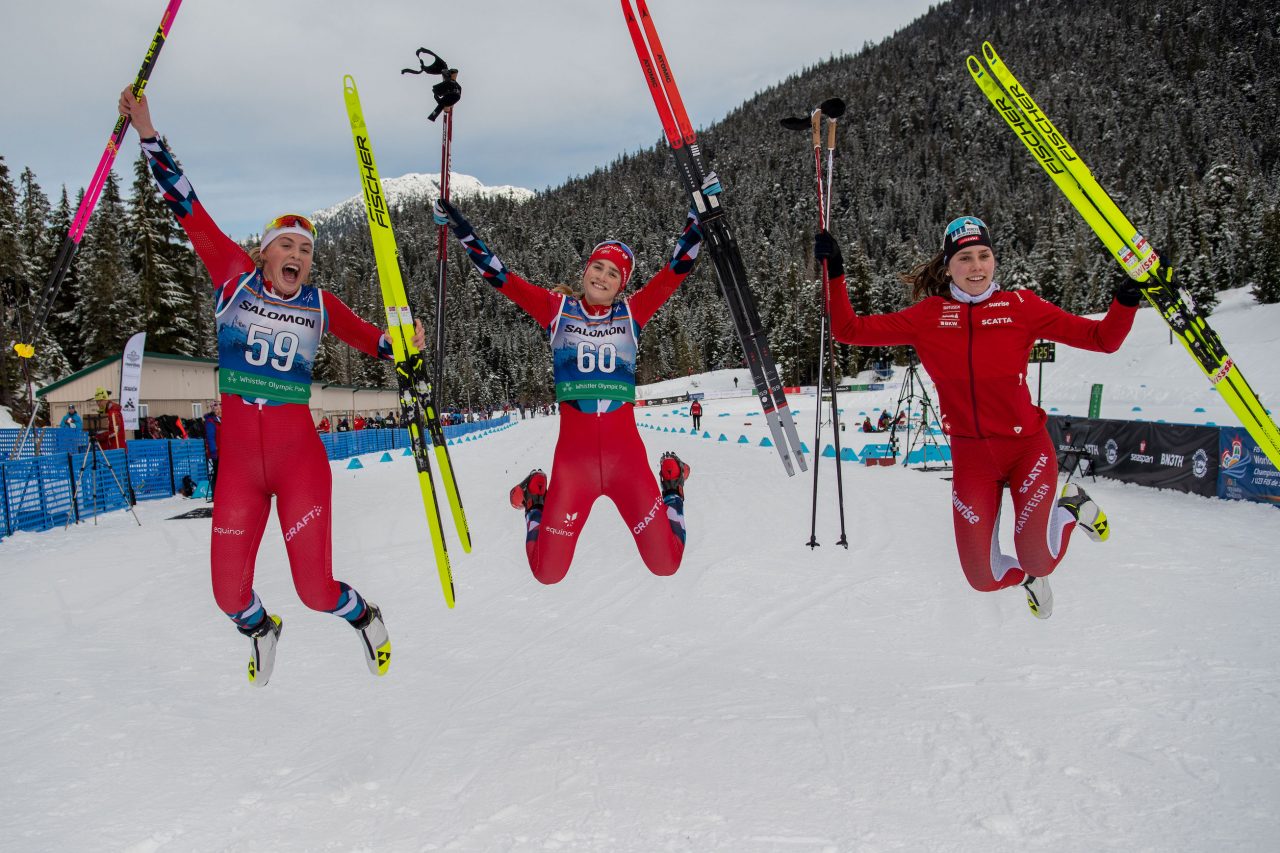
    The U20 Women’s Podium finds joy after a great day on snow. (Photo: Doug Stephen @vr45photography)

    Day five of racing at Whistler Olympic Park delivered with an interval start 10km free technique race in great conditions and intermittent sunshine. The tracks were fast and almost silky, the corners held up all day, the glide was exceptional, and (if anyone cared to classic on a great skating day) VR45 was magic.

    Early on, North American skiers spent quality time in the leader’s chair before the top ranked skiers took over. Norway put four skiers on the podium today, somewhat to the surprise of their head coach.
    “Beyond all expectations,” Kristian Dahl said. “We didn’t think about all these medals.”

    Like many countries here, Norway sees this Junior Worlds as a development opportunity first. Reflecting this, our coverage will quickly go through the podiums and then get into the North American experience.

    The top two unpack their day after crossing the line 11 seconds apart.

    Norway’s Milla Grosberghaugen Andreasson collected her third medal and second gold today, winning in 26:55. Her US-based teammate Tuva Anine Brusveen-Jensen was six second back in second while Switzerland’s Marina Kaelin got her country’s first medal of the week at 15 seconds back.

    For the US, it was Samantha Smith in sixth at 41 seconds back, Haley Brewster in 10th at 1:16, Hattie Barker in 14th at 1:38, and Nina Schamberger in 36th at 2:40.

    For Canada, Alison Mackie was 15th at 1:34, Alexandra Luxmoore was 29th at 2:30, Marlie Molinaro was 39th at 3:19, and Maeve Macleod was 44th at 3:48.

    There were 60 finishers and one DNF. There isn’t much an author can add about individual start races; here are the athletes words instead.

    Grosberghaugen Andreasson

    The day: “It was really good, but it was a tough race. I had to fight the whole race, I felt a little tired in the legs but the head was on fire today.”

    The course: “It’s a very hard course, but I like a hard course so it was good for me.”

    Visiting Canada: “Gold, gold, silver, so that’s good.”

    Brusveen-Jensen

    The day: “It was tough, but first of all it was good. I felt I pushed everything and did what I could, so it was good.”

    The course: “For me, it was to start tough. It’s a long uphill in the start, everybody gets tired. You just have to have the motivation and stay positive. And keep the speed high.”

    Visiting Canada: “Canada is amazing. The nature and everything around the stadium. It’s always sunny here. The course is so nice. We live in Whistler, and it’s very nice there too.”

    Kaelin

    The day: “I was really surprised with the good weather and the nice conditions, because yesterday the slopes were pretty slow and well it was a little harder to ski. It was surprisingly good and I thought it might be a good day.”

    Visiting Canada: “I’m really proud to win a medal for Switzerland and it’s so cool to be here on the Olympic tracks. It’s also my first time in America and Canada, and it’s really, really cool.”

    Smith

    The day: “Very challenging. I’m hoping my time holds up, but we’re waiting for the fastest skiers to come in.”

    The course: “I felt pretty good, I think I started out a little too hard. Second lap I was hurting a lot. It was a ton of fun, and certainly difficult.”

    Lesson learned this week: “Just try your hardest out there, you can’t control what the other racers are doing. As long as you put your best foot forward, that’s all you can do.”

    Brewster

    The chair: “It was awesome [sitting in the leader’s chair], and really nice tagging off with Heidi Barker. Definitely a little awkward with that camera pointing in your face.”

    The day: “It was good. I’m happy with it. Really fun to have all your teammates cheering who are done racing for the week. And my dad came out which is really special to have him here.”

    Lesson learned this week: “There’s a lot of stuff to work on. Strength and speed, a lot of strength, a lot of these girls are really strong out here.”

    Barker

    The day: “It was amazing. I’m so thankful to have this opportunity. The course was really hard but really fun and it’s a beautiful day of skiing.”

    Lesson learned this week: “It’s a really good team to be part of, and you ski your best when you are surrounded by friends and family, and a really good community.”

    Mackie

    The day: “It was really rough. It was a really, really hard course. A really hard race, but I did a good job of focussing on my technique and my race plan and I think I executed it quite well.”

    Lesson learned this week: “This is my third international start and I really surprised myself with how I can compete with the best juniors in the world.”

    Luxmoore

    The day: “It was super fun, nice warm weather, the course was awesome, the skis were fast. I think I had a good race, I felt pretty strong.”

    Lesson learned this week: “I had a great experience racing with people from other countries. I had fun skiing with people who are the fastest in the world.”

    Molinaro

    The day: “It was okay. The course is super hard, there’s a huge climb out the stadium, obviously that’s hard. Lots of pushing, trying to make up time on the flats, that was my goal out there today. I think I did a good job on that.”

    Racing at home: “I grew up in Whistler, so these are the home trails and it’s super cool to be racing World Juniors here. The weather all week has been gorgeous, because lots of the time it’s pouring rain in Whistler, so I’m super stoked that everyone gets to experience nice weather.”

    Lesson learned this week: “It’s been super cool to see all the other skiers from all the other countries and how fast and strong they are. Also, my own teammates, we’ve have some really good results.”

    McLeod

    The day: “It was super good. It’s a tough course out there, you’ve got to work hard all the time, but the skis were super killer, so thank you waxers, the skis were amazingly fast.”

    Lesson learned this week: “It’s so inspiring seeing all these super strong skiers. There’s just so much of a journey from here, you can always go harder. It’s pretty inspiring.”

    For the men, it was another two Norwegians on the podium but Finland’s Nico Anttola took the win in 23:35. Lars Heggen was second at 6 seconds back, followed by Thomas Linnebo Mollestad at 7 seconds.

    For the US, Jack Lange was 11th at 47 seconds, Adrik Kraftson was 30th at 1:48, Anders Weiss was 33rd at 2:00, and Jack Conde was 51st at 2:46.

    For Canada, Xav McKeever was 28th at 1:43, Luke Allen was 31st at 1:56, Garrett Siever was 54th at 2:59, and Noah Weir Chaba was 57th at 3:16.

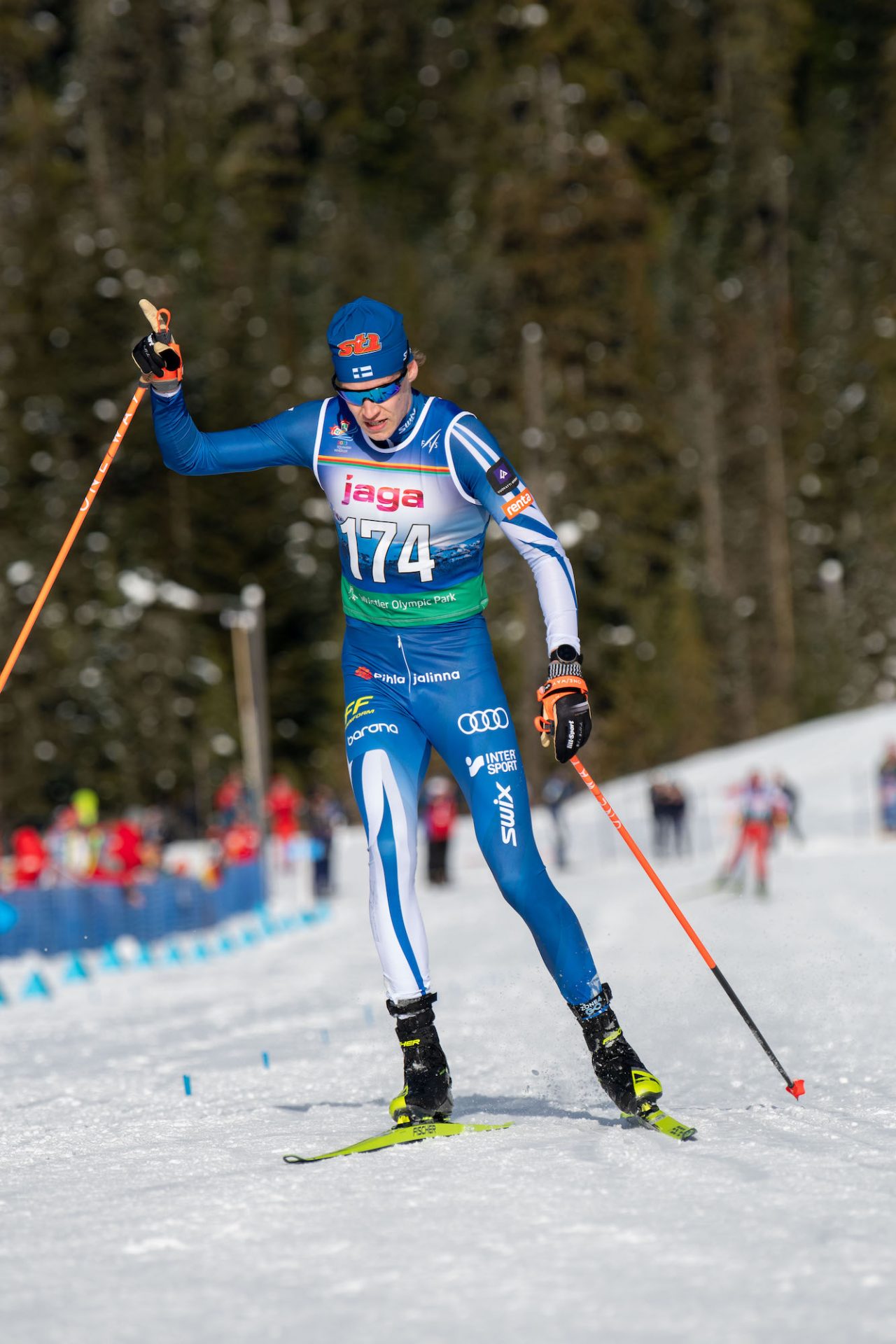
    Finland’s Nico Anttola celebrates his gold medal in the Whistler sunshine. (Photo: Doug Stephen @vr45 photography)

    Anttola

    The day: “It was very good. I had very good skis. The staff has been working really, really hard and I’m glad the skis was good, and the day was awesome.”

    The course: “The course was very tough, but I think it’s good for me.”

    Comparing this course to European ones: “I think this is one of the toughest ones, it’s very hard.”

    Heggen

    The day: “It was good, really nice conditions in the slope, really good.”

    The course: “I like the course very much. It’s pretty good, but fun and very nice course. I’m from Lillehammer, and it’s pretty much the same as Lillehammer, really tough.”

    Visiting Canada again: “Yeah probably. But when I come back, I ski downhill.”

    Linnebo Mollestad

    The day: “It was great. The form was good, I had really good skis, and I think I had a very good opening speed and managed to keep it for 10km so I’m really happy.”

    The course: “I think it’s a great course. It has some long uphills, which I like, and also the stadium here is really, really beautiful. In this weather, it’s just great.”

    Visiting Canada again: “I hope so. It’s really beautiful here, so I hope they will host some big ski competitions in the future, that would be great.”

    Lange

    This event is more casual than a World Cup. A journalist can walk up to the leader’s chair and grab an interview before the athlete catches his breath. Raw and unedited.

    McKeever

    The day: “Yeah, pretty rough today. Just the body was not firing on all cylinders. One of those days you want to forget about.”

    The course: “The course was definitely a hard one. A lot of climbing right off the start, for the first 1.5, 2 km, and then some gradual rolling sections where you have to push hard.”

    Lesson learned this week: “I’ve learned the extent of how a big championship at home feels. I’ve learned how I react to things, and handle different stresses and self-pressure. I’ve learned some stuff in general in training. Some deeper things for sure, from early in the season and training year that correlate to today’s poor performance. Just a lot to unpack and definitely a lot to learn.”

    Kraftson

    The day: “It was tough out there. I tried to race a smart race but ended up going out a bit too hard and paid the price towards the end.”

    The course: “It was a lot of fun. It’s a lot of climb in the first 2km and rolling downhill for the next, for the most part.”

    Lesson learned this week: “Just how fast the world is. That’s my biggest takeaway from the week. We’re trying to put in a bigger summer next year and try to compete with these Europeans.”

    Allen

    The day: “It was good. Skis were really fast and definitely went out hard on the first lap and lost a bit of energy on the second lap. Super fun course and what a nice day for it.”

    Lesson learned this week: “Guys are fast from Europe. Competition is pretty stiff out here. Definitely eye opening to see all these fast guys from international countries coming together.”

    Weiss

    Direct from the leader’s chair:

    Siever

    The day: “Honestly, it didn’t go very well. I’ve been dealing with some lower back pain, and I generally didn’t feel good out there.”

    Lesson learned this week: “There’s lots of work to do to compete on the world circuit.”

    Weir Chaba

    Second to the finish line, first into the leader’s chair.

    Lesson learned this week: “Gotta be patient. Gotta know what your plan is.”


  • Whistler 2023: Norwegians Dominate, North Americans Surge in U23 20km Classic

    Whistler 2023: Norwegians Dominate, North Americans Surge in U23 20km Classic

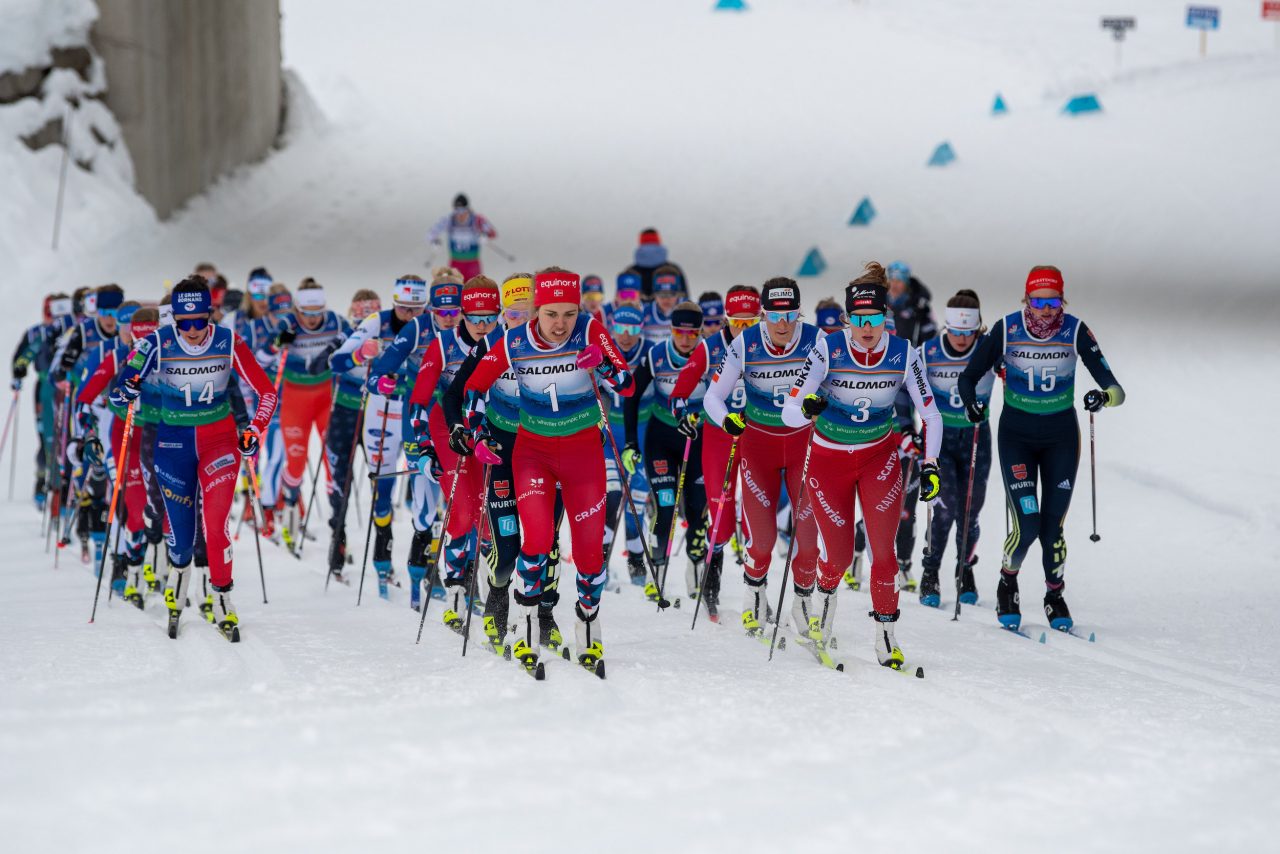
    Norway’s Margrethe Bergane (#1) pushing the pace early on first lap. (Photo: Doug Stephen @vr45photography)

    Day four of the Junior Worlds at Whistler Olympic Park brought new weather and more excitement in mass start racing.

    The day dawned with a light snowfall at -8C. The wax techs were as secretive as ever, but it was clear at the finish that most athletes were on hard wax. While Norway, Germany, and France owned the podiums, it was also a good day for North American skiers.

    Women’s 20 k Classic

    The women’s race started fast, with Norway’s Margrethe Bergane animating the race. After the first of four laps, 15 women were skiing together, including USA’s Sydney Palmer-Leger and Canada’s Liliane Gagnon. At the halfway point, Palmer-Leger and Italy’s Martina Di Centa were working together behind a lead group of eight, while Gagnon had been joined in pursuit by teammate Jasmine Lyons and USA’s Novie McCabe.

    Bergane continued to push the pace, reducing the lead pack to three in the final lap. Norway’s Kristen Austgulen Fosnæs attacked on the final hill, opening a gap she held to win in 1:01:40.0, 2.3 seconds ahead of Germany’s Lisa Lohmann. Bergane was very happy with third, 7.2 seconds back.

    Fosnæs was unable to stop smiling half an hour after adding a gold medal to her sprint silver on Sunday.

    “It’s unbelievable,” she exclaimed. “This is getting better and better. I feel like I’m dreaming.”

    “I felt like it was really hard from the start, Margrethe she put up some really fast speeds. I tried to lay back and save some power to the end.”

    Fosnæs liked everything today, laughing with joy: “I love [the course], I love being in Canada.”

    Lohmann was also smiling. “My day was simply perfect, because I won a silver medal.”

    “My tactic was to follow the Norwegian guys, it was a good plan to not be in the front.”

    Bergane was on a different plan: “I tried to go fast from the start and I’m happy with the bronze.”

    “The two other girls, they were very strong in the finish.”

    Bergane was happy, but picked the Alpe Cermis stage of the Tour de Ski as her favourite race this year. Because it was fun? “Yeah, it was hard.”

    The battle for top North American wasn’t really a fight, as US and Canadian skiers worked together to pick off skiers who had pushed too hard following Bergane.

    “I had an incredible day,” Palmer-Leger said. “I was right in the lead pack, top ten from the start, stayed relaxed and up there the full time.”

    After Bergane put in a concerted effort that reduced the lead group to eight, Palmer-Leger and Di Centa worked together to chase. Palmer-Leger led the flats with her better glide and Di Centa led the climbs with better kick before Palmer-Leger won the double pole sprint for 8th at 1:25.9 behind.

    “I’m a first year U23, I’m only 20 years old, I didn’t have any expectations,” Palmer-Leger told FasterSkier during her cooldown ski. “I just wanted to go out there, go hard, enjoy the race. That’s what I did, and it was a pretty incredible day.”

    The next North Americans were Canadians Gagnon in 12th at 1:40.7 and Lyons in 13th at 1:48.2.

    Jasmine Lyon leads Liliane Gagnon into a downhill. (Photo: Doug Stephen @vr45photography)

    “It was a slower start, got caught up in there, but then made my way up, slowing catching up to those other groups,” Gagnon said. “I definitely tried to be more chill in the beginning, keep the technique good, try to catch my breath in the downhills, and it really paid off the the last lap, I was able to push to 12th place.”

    “I’m definitely pleased,” Lyons said of her 13th place. “We had super-great skis from our wax techs, they’ve been working so insanely hard all week. I got to work with my teammate Liliane.”

    “The grinding double pole sections are pretty hard. We skied with so many North Americans, we tried to match each other’s rhythms and work as a team to catch some people ahead.”

    Asked about skiing with Gagnon for much of the race, Lyons said “Definitely working together, exchanging the lead. We’re great friends, definitely working together.”

    Lyons and Gagnon will continue to work together as they are both headed to Planica for senior World Championships.

    McCabe finished 14th at 2:01.6, and was visibly disappointed with her day. She was working with the group, but was short of grip later in the race, causing her to yoyo off the back.

    Canada’s Emilia Wells was 27th in her first international race, 4:20.9 back.

    “It’s being an amazing experience, being part of Team Canada,” Wells said. “All the coaches and staff are amazing, and the races have been so much fun.”

    Teammate Anna Parent was 30th, a little ahead of USA’s Anabel Needham in 33rd.

    “It was kind of hard, my first mass start at a big event,” Needham said. “There was a point where I just wanted to finish the race. I’m happy I stuck with it, and I really liked my coke feed.”

    Like so many athletes here, Wells, Parent, and Needham were here to gain experience. Judging by the enthusiasm of their coaches, they are getting it.

    Sophia Laukli, who started with bib 2 to match her ranking, was one of five who did not finish the demanding course.

    The lead pack stretched and regrouped. Andreas Fjorden Ree leads Jonas VIka, Edvard Sandvik, and Gus Schumacher near the top of the long climb. (Photo: Doug Stephen @vr45photography)
    Men’s 20 k Classic

    The men’s race was also animated by racers who didn’t want to sprint at the finish. Early in the second 5km lap, Gus Schumacher and Zanden McMullen were leading side by side into the long climb. On the final lap, it was a group of 11, with Switzerland’s Nicola Wigger and Cla-Ursin Nufer pushing the pace with help from Schumacher.

    In the final kilometre, it was Norway’s Jonas Vika who attacked up Hermodt’s hill and entered the stadium with a gap. Norway’s Edvard Sandvik closed the gap to 1.3 seconds with Julien Arnaud collecting the first medal for France at 3.6 behind. Two packs of four sprinted for the minor places.

    In an interview that is completely inaudible due to wildly celebrating Norwegians, Vika was very happy, described a Norwegian plan to keep the pace fast but save energy for the final hill, and admitted to practising the right hand turn into the stadium where he spectacularly saved a bad line choice in Sunday’s sprint.

    “I had a nice day today, sadly second behind this guy,” Sandvik said, pointing to Vika beside him. “but I’m happy.”

    “We figured that there was no breakaway [coming], so the last two laps were save energy and move cheap around the pack,” Sandvik explained. “I missed a bit of the start of the last sprint uphill and Vika got a good lead and it was all about the second place.”

    The European athletes are much more experienced with working in larger packs in deeper fields, and it showed today.

    “To take the third place was just fantastic,” Arnaud said, “and I am very happy to share that with my teammates and coaches who make incredible wax on my skis.”

    His tactics were simple: “I just follow the first place … I want to put all I have in the last kilometres.”

    Schumacher was in the next group of four, finishing seventh at 6.3 seconds.

    “I got to start in bib 3, which is nice compared to 30 on the World Cup,” he told FasterSkier at the finish. “The start was pretty chill, the hills were solidly hard every time, but [the group] stayed together.”

    “My skis were really fast, so I knew I could give up a little time on the top and just ski back through. The Swiss guys put a big push towards the top, strung it out a bit, but again it came back together. Positioning down those last hills was pretty big and I thought I did a good job of finding a spot, but I didn’t have enough kick in the end.”

    “I’m happy with it, it was really fun to ski at the front and not just, like World Cup, where I stay on the line the whole time. That’s what I remember loving about racing, the tactics, and being able to keep your head out there.”

    The top Canadian was Whistler’s own Joe Davies at 46.5 seconds back in 15th. Unfortunately, he was representing Great Britain. More on him Friday when he skis his favourite format on the trails he grew up on.

    Rémi Drolet was dropped on the third lap, hanging on for 17th at 1:18.5, just ahead of McMullen.

    “I made a couple of mistakes in the first few laps that cost me energy,” Drolet said. “You had to be a little bit lucky to be in the right position, or position yourself, and I wasn’t quite able to do that. It was a good learning experience.”

    “I was definitely starting to slip a little bit,” Drolet said of the last two laps. “I’m not sure if it was the skis or I was just getting tired and having trouble skiing them properly.”

    “I definitely blew up there, trying to chase the lead pack. Overall, I had pretty good skis today. If the body was there, they were good enough have a result.”

    Drolet raced his first Tour de Ski this season. “A good experience overall. I did get pretty sick once I got there. I think it’s on the mend now, and this race felt better than previous ones this year, and I’m optimistic that there will be more good races to come.”

    “It was rough,” McMullen said. “I had higher hopes, shooting for the top ten, but I just didn’t have it when the pack made that move.”

    From there, it was John Steel Hagenbuch in 23rd at 1:38.2 back, then Max Hollman in 25th, Luke Jager in 33rd and Erikson Moore in 40th out of 58 finishers.

    Canada’s Sasha Masson had a good ski despite a crash: “First lap felt really good and then coming out of the feed zone, got caught up with some skiers and went head over heels. Did a little front flip and got back on skis, tried to reconnect.”

    Masson did not get a good result as he was disqualified later, possibly for skiing outside the v boards just after the start. The coaches from Canada, USA, Norway, and Chile have all been emphasizing that this a development event, with learning the priority, and here is just one example of an extra lesson.

    The event page has more links, including the full results for the eight days. Update: The livestream videos are not disappearing after a day, they simply move to the very bottom of the page under ‘rewatch the action’.

  • World Junior Championships Begin in Whistler: U20 Classic Sprint

    World Junior Championships Begin in Whistler: U20 Classic Sprint

    The sun rises on the first day of World Juniors 2023 at Whistler Olympic Park. (Photo: FasterSkier)

    The U20/U23 World Championships kicked off in Whistler Olympic Park with classic sprints on a bluebird day. While the finals were filled with athletes from Sweden, Finland, Norway, and Italy, it was a good day for many more nations.

    Coaches from Canada, the US, Andorra, and Taiwan were agreed on one thing: U20 results won’t make or break your skiing career, but what you learn here can change your life. That said, results are what every athlete is chasing.

    The 1.2km course would look very familiar to the women who raced here in 2010 and the men who raced the 2009 World Cup. A moderate climb out of the stadium, a fast drop into hairpin, and a short climb before dropping into the stadium. The air temperature rose to -1C by the heats, but the snow stayed fast and firm at -4C.

    The results page on the FIS site includes the cached livestream video of the heats. Choose one of the ‘video’ events. This page also provides live timing and live video for the rest of the week.

    The women skied a tactical final, won on the long, long stadium loop by Finland’s Eevi-Inkeri Tossavainen. Norway’s Milla Grosberghaugen Andreassen was second, followed by Lisa Eriksson.

    “It’s been an amazing day, I can’t say anything else,” Tossavainen told FasterSkier at the finish. Many of the skiers were enjoying the day, but becoming a World Champion seems to add to the glow. She employed a tactic that worked well for some, sitting in the group until the last 200m.

    “I know that the stadium was quite long and I tried to be the fastest one there,” Tossavainen explained.

    Three US and two Canadian skiers qualified for the heats. Samantha Smith lead the way, 7.31 seconds back in 10th, followed by Alison Mackie in 22nd, Ava Thurston in 26th, Nina Schamberger in 27th, and Alexandra Luxmoore in 30th. Hailey Brewster, Anna Stewart, and Constance Lapointe missed the top 30.

    Smith moved into the semifinal and an 8th place result. Most of the North Americans had raced a sprint here last March at Nationals.

    “It felt like a pretty different course,” Smith explained. “Especially this year we got to go a bit further down the hill. Last year, for spring series, the females cut off a tiny bit. I think it’s great we are racing equal distances.”

    “It was a lot firmer and faster, and the long double pole finish was a lot shorter than last year, so there was less time to be made up.”

    “I didn’t have any hard expectations for today, it’s a U20 race,” Nordiq Canada’s High Performance Director Chris Jeffies explained. “U20, it’s about development, it’s about opportunities, it’s about process. I think our athletes went through all that and learned a lot today.”

    For the men, Sweden’s Anton Grahn made the win look comfortable after qualifying fourth. Fellow Swede Elias Danielsson was second, followed by top qualifier Eero Rantala from Finland. The three Norwegians who animated the first two thirds of the final weren’t able to keep pace in the stadium.

    Grahn was all smiles after: “I had great skis, and a great body, and I felt like today was unstoppable.”

    He had a two part tactical plan: get safely around the one tricky corner and then let others lead down the drop into the stadium.

    “Be first at that curve, that 180 curve,” Grahn said, pointing to the sharp hairpin left, “because I didn’t have that great of a turn technique, and then take it all on the home stretch, because I know I had a really strong finish.”

    Canadian Xav McKeever, competing in his fifth (5th) U20 Championships, was the only North American to make the heats, qualifying 23rd.

    “I’m happy to make the heats at World Juniors for the first time,” he said. “I’m little disappointed with the final result, but I did my best today and I’m looking forward to the distance races.”

    “I knew I didn’t have to be in the front in the first climb, so I was trying to conserve energy and ski smooth. I knew I had a good line around that corner I could take and gain a few spots. It almost worked too well as I came out tied for the lead. I had to slow down to get someone else to lead the downhill.”

    After moving up from 5th to 1st on the hairpin, McKeever used a slingshot to get the inside line in the lead on the backstretch, but couldn’t keep Switzerland’s Ilan Pittier from passing outside and boxing him in for the final corner.
    “Overall, I skied it how I wanted to and just didn’t have enough power in the end.”

    On day one of World Juniors, young skiers had good days, bad days, and learning experiences. This writer was reminded of an old coach’s favourite phrase: “The only purpose of racing as a junior is to use up your mistakes before the results matter.” Enjoy the sunshine, learn from the rest of the day.

    U20 Classic SpriNT (M/W) RESULTS

    Milla Grosberghaugen Andreassen brought her own fan club from Norway. (Photo: FasterSkier)
  • (Press Release) 2022 Junior, U23 World Championships Cross Country Teams Announced

    (Press Release) 2022 Junior, U23 World Championships Cross Country Teams Announced

    By U.S. Ski & Snowboard
    January 25, 2022

    U.S. Ski & Snowboard has announced 24 athletes to represent the United States at the FIS Junior & U23 World Cross Country Championships Feb. 22-27 in Lygna, Norway.

    “Following a year filled with constant changes, I am so pleased to see a team fielded with such depth among our roster,” said U.S. Ski & Snowboard Head Cross Country Development Coach Greta Anderson. “We have several spots on this team that were declined because of athletes who are headed to the Olympic Games next week. This progress speaks volumes about our upcoming athletes’ ability not only to adapt but to thrive in uncertain environments and seize opportunities when they present themselves. We are taking this team to Norway, the ‘homeland’ of skiing, and cannot wait to see what they can do at the Championship.”

    The following athletes have been selected to represent the United States at the upcoming FIS U23 and Junior World Nordic Championships.

    Zanden McMullen races a skate pursuit in Ruka, Finland in November, 2021. (Photo: NordicFocus)
    U23 World Championship Team

    Women

    • Abigail Jarzin (University of Utah/Salt Lake City, Utah)
    • Lucinda Anderson (University of New Hampshire/Golden Valley, Minnesota)
    • Anabel Needham (Michigan Tech University/Houghton, Michigan)
    • Rena Schwartz (Dartmouth Ski Team/Middlesex, Vermont)
    • Novie McCabe (University of Utah/Winthrop, Wash.) **
    • Sophia Laukli (University of Utah/Yarmouth, Maine) **

    Men

    • Zanden McMullen (Montana State University/Anchorage, Alaska)
    • John Steel Hagenbuch (Sun Valley Ski Education Foundation/Ketchum, Idaho)
    • Noel Keeffe (University of Utah/Steamboat Springs, Colorado)
    • JC Schoonmaker (University of Alaska Anchorage/Tahoe City, Calif.)**
    • Benjamin Ogden (University of Vermont/Landgrove, Vermont)**
    • Gus Schumacher (Alaska Winter Stars/Anchorage, Alaska)**
    • Luke Jager (University of Utah/Anchorage, Alaska)**
    Sydney Palmer-Leger races a sprint qualifier in Davos in December, 2021. (Photo: NordicFocus)
    Junior World Championship Team

    Women

    • Sydney Palmer-Leger (University of Utah/Park City, Utah)
    • Kate Oldham (Aspen Valley Ski Club/Carbondale, Colorado)
    • Nina Seemann (Dartmouth Ski Team/Craftsbury, Vermont)
    • Nina Schamberger (Summit Nordic Ski Club/Leadville, Colorado)
    • Samantha Smith (Sun Valley Ski Education Foundation/Sun Valley, Idaho)
    • Annie McColgan (University of Vermont/Bend, Oregon)

    Men

    • Finn Sweet (University of Vermont/Waterbury, Vermont)
    • Will Koch (University of Colorado/Peru, Vermont)
    • Michael Earnhart (APU Nordic Ski Center/Eagle River, Alaska)
    • Brian Bushey (University of Utah/Waitsfield, Vermont)
    • Walker Hall (University of Utah/Winthrop, Wash.)
    • Alexander Maurer (University of Colorado/Anchorage, Alaska)

    ** – Denotes a ‘Decline’ of their respective spot on the team roster due to scheduling conflicts between the Olympic Winter Games & NCAA Regional Championships

  • American Teams Announced for 2021 World Juniors/U23s in Vuokatti

    American Teams Announced for 2021 World Juniors/U23s in Vuokatti

    Novie McCabe races in the sprint heats during 2020 World Juniors in Oberwiesenthal, Germany. (Photo: Doug Stephen)

    Last week, U.S. Ski & Snowboard announced team nominations for 2021 FIS Nordic Junior and U23 World Ski Championships, which will be held in Vuokatti, Finland, in early February. The athletes selected were as follows:

    U23 World Championships Team

    Sophia Laukli races in the relay during 2020 World Juniors. (Photo: Doug Stephen)

    Women:

    • Hailey Swirbul (APU Nordic Ski Center/El Jebel, Colo.)
    • Sophia Laukli (Middlebury College/Yarmouth, Maine)
    • Alex Lawson (Middlebury College/West Burke, Vt.)
    • Hannah Halvorsen (APU/Anchorage, Alaska)
    • Renae Anderson (Loppet Nordic Racing/Golden Valley, Minn.)
    • Alternate 1: Leah Lange (University of Utah/Park City, Utah)
    • Alternate 2 Annika Landis (Sun Valley Ski Education Foundation, Hailey, Idaho)
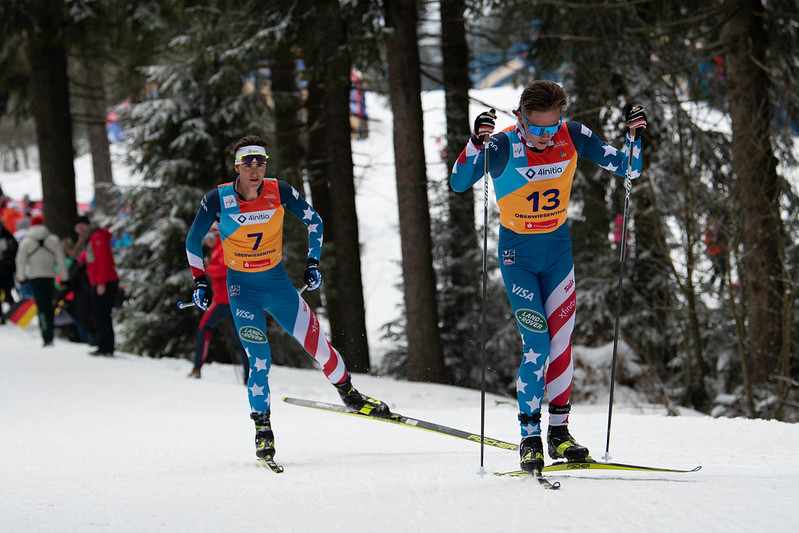
    Luke Jager (bib 13) and Johnny Hagenbuch (bib 7), during the junior men’s 30 k mass start skate during 2020 World Juniors. (Photo: Doug Stephen)

    Men:

    • JC Schoonmaker (Auburn Ski Club/Tahoe City, Calif.)
    • Gus Schumacher (Alaska Winter Stars/Anchorage, Alaska)
    • Hunter Wonders (APU Nordic Ski Center/Anchorage, Alaska)
    • Benjamin Ogden (University of Vermont/Landgrove, Vt.)
    • Luke Jager (University of Utah/Anchorage, Alaska)
    • Alternate 1: Peter Wolter (Middlebury College/Hailey, Idaho)
    • Alternate 2: Kai Meyers (APU Nordic Ski Center/Anchorage, Alaska)

    Junior World Championships Team

    Women:

    Sydney Palmer-Leger (bib 4) races the scramble leg of the relay at 2020 World Juniors. (Photo: Doug Stephen)
    • Novie McCabe (University of Utah/Winthrop, Wash.)
    • Sydney Palmer-Leger (University of Utah/Park City, Utah)
    • Kendall Kramer (University of Alaska Fairbanks/Fairbanks, Alaska)
    • Ava Thurston (Mansfield Nordic/Waterbury, Vt.)
    • Nina Seemann (Craftsbury Nordic Ski Club/Craftsbury, Vt.)
    • Haley Brewster (Ski and Snowboard Club Vail/Avon, Colo.)
    • Alternate 1: Waverly Gebhardt (University of Vermont/Steamboat Springs, Colo.)
    • Alternate 2: Garvie Tobin (Dartmouth College/Anchorage, Alaska)

    Men:

    Will Koch races in the 10k classic at 2020 Winter Youth Olympic Games, Lausanne, Switzerland. (photo: OIS/Chloe Knott)
    • Johnny Hagenbuch (Sun Valley Ski Education Foundation/Ketchum, Idaho)
    • Zanden McMullen (Montana State University/Anchorage, Alaska)
    • Will Koch (University of Colorado/Peru, Vt.)
    • Wally Magill (Steamboat Springs Winter Sports Club/Steamboat Springs, Colo.)
    • Finn Sweet (Craftsbury Nordic Ski Club/Waterbury, Vt.)
    • Michael Earnhart (APU Nordic Ski Center/Eagle River, Alaska)
    • Alternate 1: Brian Bushey (Green Mountain Valley School/Waitsfield, Vt.)
    • Alternate 2: Walker Hall (Methow Valley Nordic Ski Education Foundation/Winthrop, Wash.)
    Zanden McMullen races in a citizens race at Kincaid Park in Anchorage, Alaska, in December 2020, wearing an APU suit and a Montana State headband. (photo: Eric Packer)

    All athlete team affiliations and information are per the USSS press release. Athletes may claim additional affiliations; for example, APU Nordic Ski Center also lists Luke Jager, Garvie Tobin, and Zanden McMullen among its athletes named to this year’s teams, defensibly so given that all three athletes have trained with APU for years. Or Novie McCabe is listed elsewhere on the USSS site as skiing for Methow Valley, as well as for the University of Utah.

    There have been only four FIS race series held in this country so far this season, one in Anchorage in December and one at Soldier Hollow in early January, then one in Palmer, Alaska, and another one at Soldier Hollow last weekend, and a handful more USSS/NRL races. Some athletes were selected to this year’s teams after meeting objective criteria, such as World Cup results (Gus Schumacher, Hailey Swirbul, etc.) or a sub-50-or-60-FIS point result (Hunter Wonders in Anchorage; Peter Wolter and Sydney Palmer-Leger in Soho). The majority were selected via discretion, based on “both historical and current seasonal performances through January 3, 2021.”

    It appears that the following athletes named to this year’s team have not previously competed at World Juniors or U23 Championships: Nina Seemann; Will Koch; Brian Bushey; Renae Anderson; Annika Landis;  Peter Wolter; Kai Meyers; Ava Thurston; Haley Brewster; Garvie Tobin; Wally Magill; Finn Sweet; Michael Earnhart; and Walker Hall. Seemann, Koch, and Bushey all raced at last year’s Youth Olympic Winter Games.

    Brian Bushey races in the ski-cross qualification at 2020 Winter Youth Olympic Games, Lausanne, Switzerland. (photo: OIS/Joel Marklund/handout image supplied by OIS/IOC)

    The competition program for this year’s races will be as follows (click here for race start times, given in Eastern European Time):

    • February 9, U20 classic sprint
    • February 10, U23 classic sprint
    • February 11, U20 5/10 kilometer interval-start skate
    • February 12, U23 10/15 kilometer interval-start skate
    • February 13, U20 relay (4 x 3.3km for women, 4 x 5km for men) and U23 mixed relay (4 x 5km)
    • February 14, U20 15/30 kilometer mass-start classic

    Course profiles and details are here (scroll down for courses). The official website is here. Official FIS results are here. The Instagram page is here. The Facebook page (last year’s race featured free livestreaming on Facebook; it is still unclear if that will be offered this year) is here.

    The official hashtags, a media advisory states, are #vuokattisport, #roadtoJWSCVuokatti, and #JWSC2021Vuokatti.

  • Relay Replay: Full Video of U20 Relays from World Juniors

    Relay Replay: Full Video of U20 Relays from World Juniors

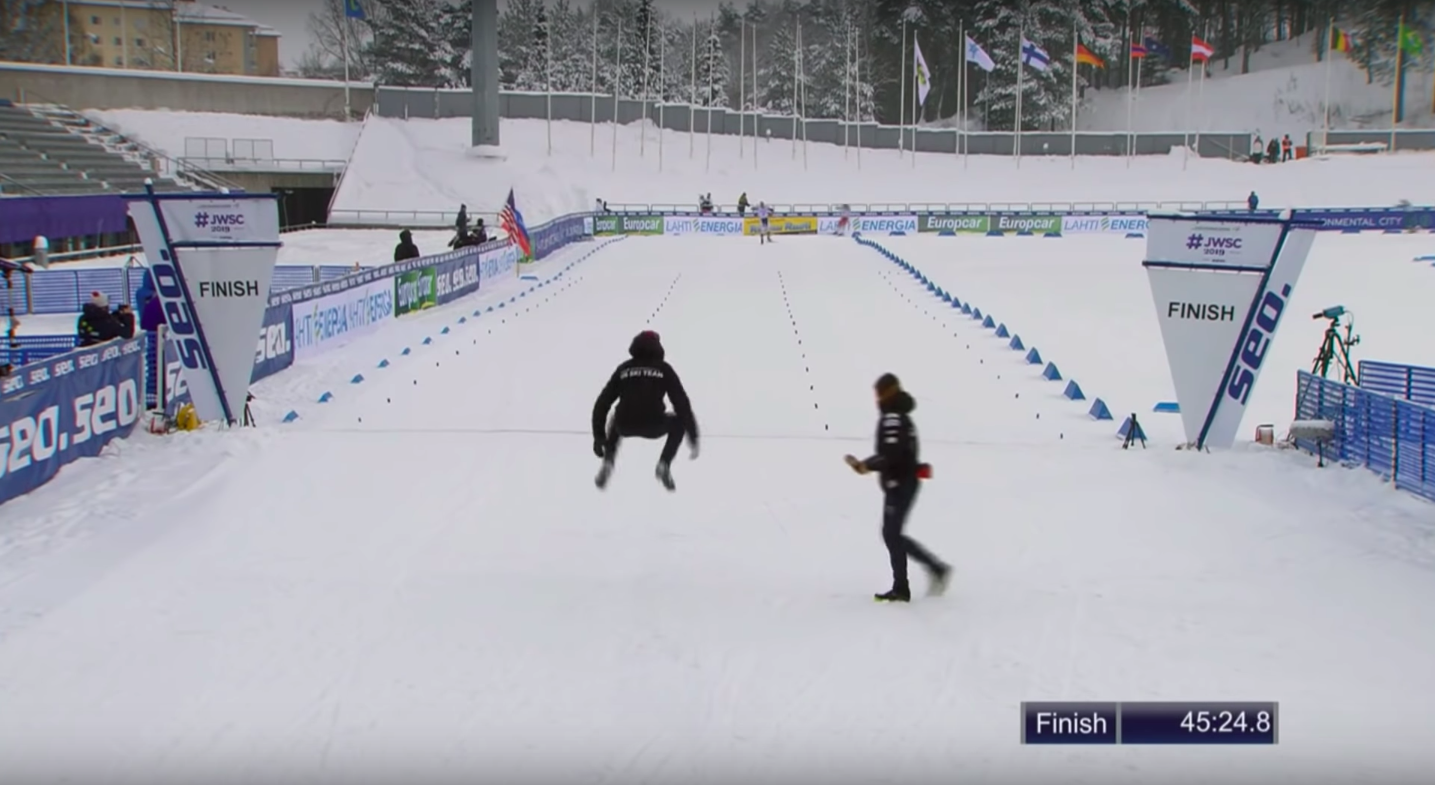
    Ben Ogden (left foreground) and Luke Jager (right foreground) await the arrival of teammate Gus Schumacher (center background) in the U20 men’s relay at Junior World Championships in Lahti, Finland, in January 2019. (photo: JWSC2019 FIS broadcast screenshot)

    Last Saturday, the American women placed fourth in the U20 relay at 2019 World Junior Ski Championships. In any other year before 2017 this result would probably be headline news; considering that the Americans had the youngest team in the race (you can compare athlete birthdates from the women’s race here if you really want to get into the minutiae), this may well be headline news next year, or the year after that, when the same athletes are potentially contending for the podium.

    But a couple hours later, the U20 men went out and won their race, taking home a historic relay gold and deservedly garnering most of the headlines for the weekend.

    Both races started in the middle of the night for most of this continent, and a daily viewing pass cost 9 Euros. You could be forgiven for not having woken up to watch it live. If you didn’t, or even if you did and you’d like to see it again, below are full replays of each race, courtesy of what appears to be a Russian YouTube user. (The same user also uploaded full broadcasts of the U20 women’s 5-kilometer freestyle interval start, U20 men’s and women’s classic sprint, and U23 men’s and women’s classic sprint if you’re looking for more.)

    Here are time stamps for the start of each leg in both races, as well as a few choice moments from the end of the men’s race (all times are in reference to a point on the YouTube video, not the time on the live timing race clock, which is a few minutes behind the video timestamp):

    Women’s race [view on YouTube]

    4:48, the race begins, with Mara McCollor skiing the scramble leg

    14:04, first exchange: McCollor tags off to Kendall Kramer in fifth place

    23:19, second exchange: Kramer tags off to Sydney Palmer-Leger in third place

    32:17, third exchange: Palmer-Leger tags off to Novie McCabe in third place

    41:14, McCabe crosses the line, 7.2 seconds off the podium

    https://youtube.com/watch?v=pFgLFySaxMM

    Men’s race [view on YouTube]

    3:57, the race begins, with Luke Jager skiing the scramble leg

    15:37, first exchange: Jager tags off to Ben Ogden in first place

    27:23, second exchange: Ogden tags off to Johnny Hagenbuch in first place

    38:32, third exchange: Hagenbuch tags off to Gus Schumacher in third place, 2.0 seconds out of first

    43:40, Schumacher and Germany go to the front and start pushing the pace, Schumacher visibly elevating as he V2s up a hill to cover Germany’s attack

    46:08, with roughly a kilometer to go, the camera cuts to the Americans waiting in the stadium, cheering on Schumacher. “Team U.S. is cheering,” says the announcer. “But I have to say that Team U.S. is always cheering. It doesn’t matter if they win, or if they are number five or number six; they always have great team spirit up and running.” (Jessie Diggins said in response to this remark from the broadcast, in an ephemeral Instagram video, “that’s right.” If you were following social media on Saturday, you would have noticed basically the entire U.S. Ski Team assembled for watch parties to cheer on the U20 men and women, several of them doing so in advance of their World Cup freestyle races in Ulricehamn later that day.)

    46:39, it’s Germany – America – Russia at the top of the penultimate hill, with a visibly tired Russia digging deep with labored technique but nonetheless staying with Schumacher

    47:30, it’s now America – Germany – Russia by the bottom of the hill

    Schumacher unleashes a devastating jumpskate … . The Finnish announcer exults, in slightly broken but endearing English, “And look at Schumacher bouncing! Schumacher is bouncing like maniac!”
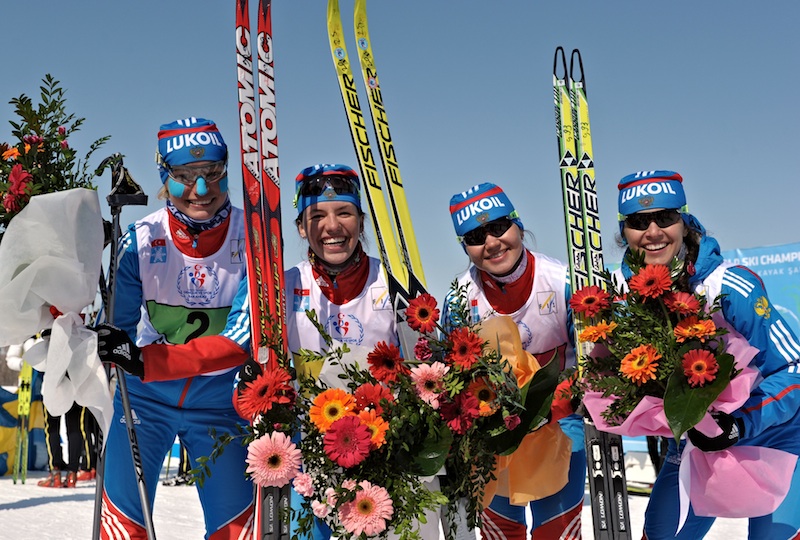
    47:50, approaching the top of the final uphill, Schumacher unleashes a devastating jumpskate, creating the separation from Russia and Germany that he will carry all the way to the finish. The Finnish announcer exults, in slightly broken but endearing English, “And look at Schumacher bouncing! Schumacher is bouncing like maniac!”

    47:57, there are literally as many USST jackets on course here as there are representatives from all other nations combined. Several Americans sprint to follow Schumacher over and around the crest of the hill, waving flags and screaming their heads off.

    49:22, camera angle straight down the finishing stretch, with Schumacher narrowly but inexorably leading in Alexander Terentev of Russia. A meter past the finish line, Ogden is jumping 3 feet off the ground while Jager applauds.

    49:32, Schumacher crosses the line in first. Ogden and Jager tackle/hug him.

    https://youtube.com/watch?v=hBE2vTWB4Rk


  • Weekly Roundup: It’s Here

    Scott Patterson gives it his all in the 15 k classic at the 2014 U23 World Championships in Val di Fiemme, Italy. Patterson finished 18th overall. (Photo: flyingpointroad.com/NNF)
    Scott Patterson gives it his all in the 15 k classic at the 2014 U23 World Championships in Val di Fiemme, Italy. Patterson finished 18th overall. (Photo: flyingpointroad.com/NNF)

    With the Olympics starting Thursday and jam-packed week behind us, it’s almost futile to try and recap it all. But here’s the lowdown of what happened: The Junior/U23 World Champion began in Val di Fiemme, Italy, the final World Cup weekend before the Olympics took place in Toblach, Italy and NorAm racing continued at the Eastern Canadian Championships in Cantly, Quebec.

    The top results at the U23/Junior Wolrd Championships came from Jessie Diggins who started the competition off with a bang last Wednesday as she skied her way to second place in the U23 skate sprint after qualifying third. Erik Bjornsen led the U.S. men with an 18th place finish in the sprint and a 17th place finish in the 15 k classic.

    Bjornsen would soon be making headlines again, as he traveled to Toblach to compete in the final World Cup before the Olympics. He garnered the top U.S. result in the men’s 15 k classic with an 18th place finish, a career-best. The race was won by Alexander Legkov (RUS), who was followed by comeback-kid Dario Cologna (SUI) in second. Sweden’s Marcus Hellner finished third. Canadian Alex Harvey finished fifth.

    In the women’s 10 k classic it was Marit Bjørgen (NOR) who showed her strength before the Olympic Games with a roughly 36 second win over teammate Therese Johaug. Charlotte Kalla (SWE) finished third. The U.S. women demonstrated their improving shape with five in the top 22, led by Liz Stephen in 11th.

    The second day of World Cup racing brought the anticipated skate sprint. Once again it was Bjørgen who was able to top the strong women’s field. She was followed by German sprint-superstar Denise Hermann and Ingvild Østberg. American Kikkan Randall finished fifth.

    Norwegian Ola Vigen Hattestad won the men’s race and was followed by teammate Eirik Brandsdal and German Josef Wenzl.  American Simi Hamilton was the top North American in 14th.

    In the Eastern Canadian Championships, Graham Nishikawa (Canadian Senior Development/Para-Nordic Team) and Alyson Marshall (AWCA/NST) both won two of three races to complete a successful championships in Cantly, Quebec.

    There was also some sad news that the nordic ski community faced this week. Torin Tucker, a native of Sun Valley, Idaho and a Dartmouth College skier passed away while racing in the Craftsbury Marathon this past Saturday. A memorial service will be held at the Craftsbury Outdoor Center this Thursday, February 6th at 4pm.

    Torin, you will be missed.

    Torin Tucker, SVSEF J1
    Torin Tucker (Dartmouth Ski Team) training in an undated photo. The Sun Valley, Idaho native tragically passed away this past weekend while racing in the Craftsbury Marathon.

    In other news, Todd Lodwick of the U.S. Nordic Combined Olympic team was chosen to be the flag bearer for the 2014 U.S. Olympic Team at the Opening Ceremonies in Sochi, Russia.

    U23/Junior World Championships, Val di Fiemme, Italy

    Wednesday’s U23/Junior sprints report | American report | Canadian report

    Thursday’s U23 10 k and 15 k classic report |North American report

    Friday’s Junior 10 k and 20 k skiathlons report 

    Saturday’s U23 15k and 30 k skiathlons report

    Sunday’s Junior 5 k and 10 k classic report 

    Monday’s Junior 4×3.3 k and 4×5 k relays report

    FIS World Cup, Toblach, Italy

    Saturday’s 10 k and 15 k classic men’s report | American men’s report | women’s report

    Sunday’s freestyle sprint men’s report | women’s report

    Notes and quotes

    Eastern Canadian Championships, Cantly, Quebec

    Report

    Friday’s freestyle sprints press release

    Saturday’s 10 k and 15 k freestyle press release

    Sunday’s 15 k and 20 k classic mass starts press release

  • Russia Completes Relay Sweep as Junior Women Take Victory, US and Canada Battle for Ninth

    Russia Completes Relay Sweep as Junior Women Take Victory, US and Canada Battle for Ninth

    The Russian junior women – World Junior relay champions (Photo: FIS).

    Team Russia completed an impressive World Junior/U23 Championships in Erzurum, Turkey by winning both the men’s and women’s Junior relays on the final day of the week-long event.

    The women’s team of Elena Serokhvostova, Natalia Zhukova, Nadezhda Shuniaeva, and Elena Soboleva skied to a 13.4 second victory over Sweden. The Swedes bested Slovenia with a lunge at the line to capture the silver.

    Sweden’s Evelina Settlin, who took silver in the sprint earlier in the week, led the field on the first leg, just ahead of Serokhvostova, the bronze medalist in the 5k classic.

    The 3.3 kilometer distance is not traditional, and athletes found it an odd cross between sprinting and distance. On the first leg, it was sprinting with the edge as Settlin held a small 2.7-second lead on the Russian, with Germany in third, eight seconds down.

    Celebrating gold!

    Zhukova took over for Russia, swapping spots with Sweden. The two teams were still just seconds apart headed in to the skating with Slovenia climbing into third.

    The Slovenians sat 24 seconds back, but even with under 7k of racing remaining, they couldn’t be counted out. Their two skaters, Lea Einfalt and Nika Razinger finished second and first respectively in the skiathlon.

    But Shuniaeva was third in that event, and would only lose several seconds to the Slovenians, maintaining a solid gap.  Swede Jonna Sundling posted the third fastest time on the third leg behind Einfalt and Shuniaeva, but still lost 16 seconds.

    Headed into the final round, Russia held a 15 second lead on Sweden with Slovenia another four seconds back.

    When Soboleva refused to break, the race for first featured no drama. But behind, Razinger caught Sweden’s Stina Nilsson, and the pair raced for the line locked in side-by-side. Nilsson took the silver for Sweden with a stronger lunge, and the Slovenians, who entered the race as a potential candidate to unseat the Russians, had to be satisfied with bronze.

    Sweden (r) takes silver at the line.

    The US and Canada engaged in a sprint of their own, battling for ninth place over the last leg-and-a-half. Ultimately Canada’s Emilie Stewart-Jones gained the upper hand, out-sprinting American Stephanie Kirk.

    The Canadians skied a consistent race, locking into the ninth spot on the second leg, after Dahria Beatty scrambled the team to eighth.

    Emily Hannah, racing third for the US, skied a strong race, posting the sixth fastest time and bringing the team into contact with the Canadians.

    Canada and the US head down the stretch.

    Kirk hung with Stewart-Jones, and as the pair, clearly exhausted, entered the stadium, it appeared the American was in position to take the lead.

    Stewart-Jones showed impressive resilience however, holding position for the final 200 meters.

    The two teams finished just under three minutes behind the winning Russians.

    Video interviews with the Canadian and US teams follows.

    Complete Results

    Audrey Mangan contributed reporting.

  • Photo Gallery: World Junior Women’s 5km Classic

    FasterSkier’s Audrey Mangan is on-site in Erzurum, Turkey reporting on the World Junior/U23 Championships. Here is a selection of photos from the 5km classic.

    Complete Race Report

    Men’s 10km Classic Photos


    [smugmug url=”http://fasterskier.smugmug.com/hack/feed.mg?Type=gallery&Data=21613304_htCFsP&format=rss200″ imagecount=”100″ start=”1″ num=”100″ thumbsize=”Th” link=”smugmug” captions=”true” sort=”true” window=”false” smugmug=”false” size=”M”]

  • Photo Gallery: World Junior Men’s 10km Classic

    FasterSkier’s Audrey Mangan is on-site in Erzurum, Turkey reporting on the World Junior/U23 Championships. Here is a selection of photos from the 10km classic.

    Complete Race Report

    Women’s 5km Classic Photo Gallery

    [smugmug url=”feed://fasterskier.smugmug.com/hack/feed.mg?Type=gallery&Data=21613056_zvwgmb&format=rss200″ imagecount=”100″ start=”1″ num=”100″ thumbsize=”Th” link=”lightbox” captions=”true” sort=”true” window=”false” smugmug=”false” size=”M”]

  • Photo Gallery: World Junior Skate Sprint

    Photo Gallery: World Junior Skate Sprint

    FasterSkier’s Audrey Mangan in on-site in Erzurum, Turkey reporting on the World Junior/U23 Championships. Here is a selection of photos from the junior skate sprint.

    Related Race Reports:

    Ustiugov Dominates For Skate Sprint Title at World Juniors

    Nilsson Charges Down Homestretch to Take Sprint Victory in Erzurum

    [smugmug url=”http://fasterskier.smugmug.com/hack/feed.mg?Type=gallery&Data=21617174_874gZf&format=rss200″ imagecount=”100″ start=”1″ num=”100″ thumbsize=”Th” link=”smugmug” captions=”false” sort=”true” window=”false” smugmug=”false” size=”M”]

  • Russia Dominates in Biathlon World Junior Championship Youth Relays

    Russia Dominates in Biathlon World Junior Championship Youth Relays

    The leadoff skiers in the youth men's relay await their start. All photos by Judy Geer.

    After a World Junior Championships where it has already proven dominant in the medal counts, Russia sealed the deal by winning both the youth men’s and women’s relays in Nove Mesto, Czech Republic on Friday. And it wasn’t even close: both teams won by more than a minute, the men over Italy and the women over Ukraine.

    Exhaustion at the finish of the youth men's relay.

    Elena Badanina, the leadoff skier for the Russian women’s team, doesn’t see herself as becoming a star, despite having medaled in all eight World Junior Championship races she has started in her career. For a country as large and full of talent as Russia, things can change a lot from year to year.

    “I know that this here were mere ‘children’s competitions’ and that I still have a long way to go and a lot of hard work to do before arriving at the top,” she told IBU News.

    While her competitors might resent being called children, she has a point. With the World Cup currently in North America, the very fastest juniors are for the most part not contesting this year’s World Junior Championships.

    And as Russian Maxim Tsvetkov, who won his third gold medal of the week today, pointed out, even medals at World Juniors don’t guarantee success.

    “There were so many athletes who won medals at the Youth and Junior World Championships and then could not make it on the World Cup level,” he told IBU News. “I don’t want to be one of these athletes.”

    Davies.

    The Canadian youth men had the top performance of the day, finishing seventh in the 3 x 7.5 k relay. Leadoff skier Stuart Harden, who has raced to 18th and 23rd place finishes so far in Nove Mesto, used only a single spare round to clean two shooting stages, and tagged off in fifth place.

    “I’m happy with my leg of the relay,” he told FasterSkier. “As a team we chose me to start because of my consistent shooting. I definitely achieved that today by using one spare round, and I managed to leave team Canada within 30 seconds of a place on the podium. My legs didn’t feel great on the skis, but being the last race of World Championships the whole team pushed as hard as we could for our respective legs.”

    The Canadians missed just seven targets in six shooting stages, which represented the second-best shooting in the field, and skied only one penalty loop. But for Harden, Christian Gow, and Macx Davies, it wasn’t enough to meet their high expectations.

    “Unfortunately we didn’t perform as well as we had hoped on the shooting range and that was reflected in the result,” Harden said. “We had hopes for a better result, but Christian and I will be youths at next year’s championships, and are looking forward to the relay as another great chance for a Canadian medal.”

    The U.S. team also shot well; they missed nine shots over the course of the relay and avoided the penalty loop entirely, one of only six teams to do so. But they still ended up in 12th place, over four minutes off the podium.

    “I thought that our shooting was very good,” leadoff skier Casey Smith said in an e-mail. “Shooting is something that can slip easily, but we held it together. If we had been skiing a little faster then I think that we could have done really well. This year’s relay was an improvement from last year, which I think we were all happy about. All in all I thought that it was a good race for us.”

    Garaghty-Moates.

    In the women’s race, the Canadians again bested their southern neighbors. The team of Rose-Marie Cote, Julia Ransom, and Sarah Beaudry finished eighth. Cote matched Harden’s performance, using a single spare round to tag off in fifth place.

    “My race was really good,” Cote told FasterSkier. “I am proud of my performance. I had a fast skis and I only used one spare bullet, so I gave the second leg the tag in fifth place. Also, I was really happy to be the first leg of my team because I love mass starts. I am aggressive and have the speed to do well in mass starts, so I was really confident at the start line. In the double poling zone, I fell because I poled on my ski – but I stood up fast so I wasn’t really behind the leaders!”

    Like the Canadian men, the women had high expectations, which weren’t quite matched in this Championships series. But the relay, while it didn’t produce a medal, seemed to satisfy the team.

    “My team is happy with our eighth place because of the level of the competition,” Cote said. “My expectations were higher than what I achieved, but I really appreciate and learn from this experience. The best athletes know how to get back up, to learn and come back stronger.”

    The American women struggled mightily, hitting the penalty loop more than any other team. As has been the case for most of the Championships so far, Carly Wynn and Tara Garaghty-Moates skied fast while shooting poorly – Wynn skied three penalty loops and Garaghty-Moates four. And also as usual, Silke Hynes shot well, using one spare round to clean each stage, but was unable to make up any ground on the trails.

    Competition continues on Saturday with the junior men’s and women’s relays.

    Full results: youth men / youth women

    The leaders of the youth men's relay skirt the treeline in Nove Mesto.
  • Canadian Stuart Harden 18th in Youth Individual at Biathlon World Juniors – Updated

    Canadian Stuart Harden 18th in Youth Individual at Biathlon World Juniors – Updated

    Sam Dougherty (USA) shoots during the youth men's individual race on Tuesday. All photos by Judy Geer.

    How poor was the shooting on the third day of biathlon World Junior Championships in Nove Mesto, Czech Republic?

    In two races on Tuesday – the youth men’s and women’s individual – only a single athlete, Pavel Hancharou of Belarus, shot clean for the four stages of the race. He was rewarded with a 48-second victory in the 12.5 k race and his first World Juniors gold medal.

    Second-place Steffen Bartscher of Germany was so impressed with Hancharou’s shooting that he told IBU News, “You never wish a miss on anybody and he deserves the win today, with this performance!”

    Casey Smith (USA).

    Further down in the field, Stuart Harden of Canada had another exceptional race, finishing 18th with three penalties. Harden is actually 16 years old, one year younger than the technical definition of a youth, and is skiing up an age category, making his performances particularly impressive.

    “I’m really pleased with my race and I’ve exceeded my hopes and goals,” he told FasterSkier. “I was disappointed in my prone shooting- I missed two total and I usually don’t have to worry about any errors in the prone position. [But] my standing was super with only one miss.

    “I started out a little sluggish, but as my shooting improved at the end I increased the pace on the course. I received some good splits off of my teammate Macx Davies on my last loop so I knew my time was competitive. I was able to pick up some time on the more technical parts of the course and had an advantage on the downhills thanks to the team wax techs Tom, Pavel and Patrick.”

    Harden began racing when he was 11 years old with Biathlon Canada’s Biathlon Bears program, which since the ’90s has been introducing 9- to 13-year-olds to the sport of biathlon.

    “From there I joined the Rocky Mountain Racers and I’ve had John Jaques as a coach since then,” Harden said. “I owe a lot to my coach and parents who have helped me improve so much each year that I’ve been in the sport, the most recent season giving the most opportunities and results. I hope to grow as much as I have the last several years in the coming ones, and I hope to be competitive in my own age group at World Championships for the next few seasons.”

    Davies was the next Canadian finisher, notching a 34th-place result. Davies, too, has had a successful race series so far: Tuesday’s race was his worst result to date, with the high point being a 19th-place finish in the opening sprint on Saturday. Unlike Harden, however, Davies is in his last year of eligibility as a youth and will have to move up to the more competitive junior division next season.

    Sean Doherty (USA).

    Christian Gow and Albert Bouchard rounded out the Canadian squad by finishing 53rd and 63rd.

    For the U.S., Casey Smith finally hit his stride and led the team in 30th place. It was his best race in two years of World Juniors starts. Smith had four penalties and secured his spot by charging hard in the last lap of racing, finishing with the 12th-fastest fifth-loop time.

    Sam Dougherty was the next U.S. finisher, like Smith notching the best result of his career. He finished 54th with five penalties. Normally, such shooting would be more disappointing; but in Tueday’s race, with only seven athletes having two or fewer penalties and twenty of them shooting 50% or worse, it was good enough.

    “Unless you’re at the top of the podium, there’s always room for improvement, but I am really satisfied,” Dougherty said in an e-mail. “As long as I know I left it all out on the trail, I accept my results happily, regardless of contention… I really enjoy the individual discipline, although it’s becoming a rare event in American biathlon competition.

    “I was disappointed in my Sprint result, and unfortunately didn’t qualify for the Pursuit competition the next day, which I felt was to be my strongest event. In saying that, I’m happy to prove to myself in the individual competition that if I shoot consistently and keep my skis pointed straight I can improve upon past results.”

    Dougherty said that the talent of his competitors had impressed him so far, and that he thought the U.S. had a long way to go in order to be competitive on the world stage.

    “It is becoming very obvious to me that ski ability plays a huge part in the contention of these races. After the race today I was hypothetically skeptical if a U.S. Junior National Champion could be anywhere close to some of these biathletes in a regular nordic competition. Biathletes are friendly people the world round though, and it’s hard to stay intimidated by people who are nice to you.”

    Kelly Kjorlien (USA).

    Sean Doherty and Ray Wonders finished 65th and 69th.

    In the youth women’s 10 k individual, Norwegian Thekla Brun-Lie won by 11 seconds over Russia’s Elena Badanina. The top four finishers all had two penalties, and no women shot clean.

    Brun-Lie, whose sister Celine represented Norway in skiing at the Vancouver Olympics, was contesting her first race of the series.

    “I was sick before the sprint and the pursuit and simply not fit,” she told IBU News. “I knew this was my only chance today to do well so I was very nervous. I thought I could win only on the last lap.”

    Galina Vishnevskaya of Kazakhstan finished third.

    Sarah Beaudry of Canada, Kelly Kjorline of the United States, and Beaudry’s teammate Julia Ransom made the best of a handful of penalties and finished 33rd, 34th, and 36th.

    “I was really looking forward to the individual and I felt like it went pretty well,” Kjorlien said in an e-mail. “I was slightly disappointed that I didn’t shoot a little better, but I’ve come to the conclusion that I’m never completely satisfied. Having a rest day on Monday was very helpful. I felt fairly fresh this morning and was comfortable on the course.”

    Ransom was less satisfied with her results.

    “It has definitely been an interesting tour,” she told FasterSkier. “I went into it expecting top ten results, just based on my performances last year. Unfortunately, it didn’t work out as planned. Saturday’s sprint and Sunday’s Pursuit were really disappointing for me as I felt as though I was severely underperforming. Nothing more frustrating than knowing that you can do better.

    “I went into the Individual excited and focused knowing that I was starting with a ‘clean slate’. Skiing felt better than it had all week and prone shooting was great. Standing however, was not so nice. I couldn’t settle into it and my rhythm just wasn’t there. As disappointed as I was with my results, I am so happy with my experience. I have learnt a tremendous amount of valuable lessons and feel as though I have grown as an athlete.”

    Rose-Marie Cote and Danielle Vrielink finished 44th and 47th. For Cote, a World Juniors medalist from 2010, the result wasn’t what she was hoping for. But for Vrielink, who is at her fist World Junior Championships, it was the best finish of her career.

    Carly Wynn (USA).

    “I started the race with really cold hands so it was very hard for me to shoot,” Vrielink told FasterSkier. “I think I really pulled the shooting together on my second prone and then continued to be very pleased with my second standing. 17/20 is very good for an individual, although I wish that I could have skied just a little bit harder. But all and all I was very happy to have been able to race here.

    Vrielink is at 15 years of age one of the youngest competitors in the field, and she said that the races made her realize that she needed to up her game.

    “It has been quite the opportunity to race in Nove Mesto for team Canada at my age. The competitions has been quite eye-opening in regards to just how fast my competition can ski and how well they can shoot. I guess in Canada, you can get away with just being able to shoot well, but out here, it’s a whole new playing field and you’ve got to ski fast if you want to win. Despite my results, I have really enjoyed this opportunity to race and look forward to next years Youth and Junior World Championships.”

    Carly Wynn was the second U.S. finisher, missing eight targets and skiing to 43rd place. She was followed by a pair with opposite problems: Silke Hynes had only five penalties, but the 62nd-fastest ski time of the day, which left her in 57th place. Tara Garaghty-Moates was the 20th-fastest skier, but missed an excruciating 16 targets and finished 66th.

    Racing continues on Wednesday with the junior men’s and women’s individual races.

    Full results: youth men / youth women

  • Kjorlien Leads North American Ladies Again at Biathlon World Juniors

    Kjorlien Leads North American Ladies Again at Biathlon World Juniors

    Kelly Kjorlien (USA) starting the youth women's pursuit. All photos by Judy Geer.

    When American biathlete Kelly Kjorlien arrived in the Czech Republic for IBU Youth/Junior World Championships, she was confident – but she also came down with a cough.

    Has that slowed her down so far?

    No, not at all. After finishing 27th in Saturday’s youth women’s 6 k sprint, Kjorlien told FasterSkier that she was excited going into the pursuit, because shooting was her “strong point” and there were four shooting stages in which to best the competition.

    Wynn.

    And that is how it turned out: with only three penalties, Kjorlien moved into 26th place on Sunday. With no women shooting clean, and only one with one penalty and two with two, Kjorlien had some of the best shooting of anybody in the race. Besides being extremely accurate – she cleaned the third stage and missed one in each of the other three – she was one of the fastest shooters in the race as well. After the last shooting stage, Kjorlien was in 24th place, but a slow last loop dropped her back to 26th.

    Not that 26th is a disappointing finish: in just her second year of World Juniors competition, Kjorlien now owns two top-30 finishes and is proving to be a consistent, talented racer.

    Kjorlien also embodied a trend for the U.S. youth women: both the other starters also gained a single spot in the pursuit. Carly Wynn moved up from 53rd to 52nd. Her race was dominated by the opposing forces of poor shooting – she missed ten targets, or 50% – and extremely fast skiing. Wynn’s time on course was the 12th fastest of the day.

    Teammate Tara Garaghty-Moates was in a similar situation. She started with bib 58, and her 20th-fastest ski time of the day should have gained her a lot of ground. But she missed 13 shots, which dropped her back to 57th – just one spot better than where she started.

    But Garaghty-Moates has been training for biathlon for less than a year, so being in the pursuit at all was an accomplishment, especially considering that her ski training has been compromised this year: after she crashed while ski jumping, she had knee surgery in late April, was stuck on crutches for eight weeks, and then had a full-length leg brace for three more.

    “I feel like I’m learning a lot of things that will contribute to my future biathlon career,” Garaghty-Moates said in an e-mail. “I’m pretty satisfied about where my skiing is stacking up against the Euro girls, especially given that fact that because of my knee surgery I really wasn’t able to skate until November. In the sprint race I was able to qualify for the pursuit only because of my fast skiing.

    Cote.

    “My shooting is inconsistent,” she continued. “It’s tough because I’m at Junior Worlds and it goes without saying that I want to clean all my stages and ski fast, but given my lack of shooting experience that’s just not a feasible goal. By time I leave here I will only ever have competed in ten biathlon races, so I’m still making rookie mistakes like taking the wrong amount of wind clicks and throwing my zero way off- that’s what happened Sunday in prone.

    “Overall I’m just trying to do my best and enjoy being here. So far this trip has been the best experience of my skiing career.”

    The Canadians were led by Rose-Marie Cote, who won a sprint finish with teammate Sarah Beaudry. The two finished 39th and 40th, moving up from bibs 44 and 52. Cote had four penalties and Beaudry five. Beaudry had skied all the way up to 32nd place before the final shooting stage, where she missed three shots.

    Canadians Julia Ransom and Danielle Vrielink finished 51st and 55th.

    In both the youth and junior women’s races, the winners from the Saturday’s sprints prevailed again. In the youth race, Ekaterina Zubova of Russia took her second gold medal, and the rest of the podium was identical to Saturday’s as well: Anais Chevalier of France finished second and Elena Badanina of Russia third. In the junior 10 k pursuit, Dorothea Wierer of Italy and Aleksandra Alkina of Russia repeated as the gold and silver medalists.

    The surprise finish of the day came from Laura Dahlmeier of Germany, who started in 14th place, two minutes and 16 seconds behind Wierer and over a minute off the podium. But Dahlmeier was one of only two women in the race to shoot clean, and as a result she finished third and collected the first World Juniors medal of her career.

    “This is crazy, I never thought I would make it on the podium today,” she told IBU News. “I saw on the big screen [during the last stage] that the others missed and I also heard it. I tried to not notice it and focus on my own race but it’s not possible to completely shut that out.”

    Even if she didn’t shut it out, she cleaned yet another stage and was able to finish a comfortable 13 seconds ahead of fourth-place Olga Galich of Russia.

    Audrey Vaillancourt of Canada led the North American contingent in the junior race, finishing 32nd after starting 44th. She only had two penalties, which represented the best shooting of any North American woman all day.

    “I knew that my chances to move up in the pursuit were very good, not only because I was starting 44th, but also because we shoot four times in that race and I have shot very well since the beginning of the season,” Vaillancourt told FasterSkier. “I started very aggressively because I wanted to keep up with the girls that were starting almost at the same time as I did. I knew that if I wanted to gain spots, I had to shoot very well- I felt very confident about it, and it worked. I cleaned my two first stages, which made me ski much faster!”

    Boutot.

    Her teammates Emma Lunder and Yolaine Oddou finished 38th and 39th, just four seconds apart despite being on opposite trajectories. Lunder started 31st but missed six shots, which led to her tumble through the rankings. Oddou started 48th and missed five shots, but fast skiing allowed her to gain nine spots.

    Grace Boutot was the top American, finishing 42nd. She gained five places from her starting position of 47th.

    “The race [on Sunday] still wasn’t great for me,” she said in an e-mail. “I did what I could do, and even though I haven’t had the results that I hoped for in the past two days, I can’t make any excuses or change the results. So I am really looking forward to the individual, since it’s usually my strongest race. We are only half way through [the championships], and there are still two opportunities to have some good results.

    “The team has had a good dynamic so far, and everyone has been really positive even if they’ve struggled in their races,” she added.

    Corrine Malcolm missed eight shots and was unable to capitalize on her 33rd-place start position. Instead, she slipped to 46th place.

    Races continue on Wednesday with the youth individual competitions.

    Full results: Youth women / Junior women

    Vaillancourt starting.
    Malcolm.
    Cote.
    Beaudry.
    Garaghty-Moates.
  • No New Biathlon Medalists in Men’s World Juniors Pursuits- Updated

    No New Biathlon Medalists in Men’s World Juniors Pursuits- Updated

    Sean Doherty (USA) chasing a Czech skier through the trees. All photos by Judy Geer.

    While all of the medalists from Saturday’s youth and junior men’s sprints repeated on the podium in Sunday’s pursuits, there was still plenty of excitement on the second day of World Youth and Junior Biathlon Championships in Nove Mesto, Czech Republic.

    In the junior men’s 12.5 k pursuit, Germany’s Tom Barth, who started with bib one and a 16-second advantage over teammate Johannes Kuhn, had to fight just to stay on the podium after missing two shots in the third shooting stage. In the end, a clean fourth stage redeemed him and allowed him to add bronze to his medal collection.

    While he struggled, Kuhn took over the lead after the second prone stage and never looked back. Over the last two stages he held a seven-second lead over France’s Ludwig Ehrhart, but then put in a furious effort on the last loop to win by 31 seconds.

    “I was a bit tired on the tracks and knew that I had to hit all the targets,” he told IBU News. “When you are in the lead the entire time and then miss two or three during the last shooting, no one in interested in you anymore.”

    Behind him, Scott Gow of Canada skied an even race and had only three penalties to maintain his start position of 16th place. After three stages, Gow had moved up to 13th, but two misses in the last standing stage dropped him back to where he had started. His teammate Vincent Blais also had three penalties, and moved from 56th up to 52nd place.

    Dreissigacker.

    The Americans did not fare so well, with Raleigh Goessling missing seven shots and Ethan Dreissigacker six. Goessling started 37th after a good sprint race, but started dropping through the field immediately after two penalties in the first prone stage. With the 50th-fastest ski time, he couldn’t fall back on ski speed either, and finished 53rd.

    Dreissigacker hadn’t had a good sprint, and started in 59th place, over a minute and a half behind Goessling. But with one fewer miss, he was able to make up thirty seconds on his teammate and finish 56th. Still, Dreissigacker has traditionally been a very accurate shooter, and he was disappointed with his performances so far at this championships.

    “None of my races have been too great, but by North American standards none of them have been that bad either,” he said in an e-mail. “So I guess it just goes to show how good the competition is in the junior age group.

    “In the sprint I missed three targets, and skied okay; in the pursuit i missed six, and skied maybe a little better than the sprint. When I came into shoot my first prone my fingers were totally numb, which was weird because it wasn’t that cold and I had warmed up well, but I missed three. That really got me off to a bad start. Things got a bit better after that, but I got dropped by a lot of people who started right around me because of that first prone shooting.”

    In the youth men’s 10 k pursuit, Maxim Tsvetkov of Russia led from start to finish – but in the third shooting stage, he had a problem with his ammunition, which allowed Norwegian Vetle Sjestad Christiansen to come within 2.5 seconds of him. However, Tsvetkov didn’t let it get to him and went on to win by thirty seconds since Christiansen missed two shots to his one in the final shooting stage.

    “There was a problem with the ammunition and I had to use a spare round,” Tsvetkov told IBU News. “That’s why I lost a lot of time… I knew it was a problem with the ammunition and not with the rifle so I was not nervous.”

    Harden.

    Meanwhile, there were a number of strong performances by North American athletes. Canadian Stuart Harden led the way, using the second-best shooting in the field to move from 44th place at the start up to 23rd place at the finish. 19th-place Primoz Pancur of Slovenia was the only athlete with one penalty, while only Harden and 16th-place Jan Treier of Estonia had two.

    “I’m really really happy with my pursuit race,” Harden told FasterSkier. “I moved up 21 places and came 13th in standardized times. The result definitely exceeded my goals and expectations for the competition- I managed to ski with some of the best in the world and also out shot almost all of them. I had to ski hard the whole race to maintain the group’s pace, but my training payed off and I was able to recover after each lap to shoot quickly and accurately.

    This was especially gratifying for me since I am racing up an age category into youth men,” he continued. “I was very pleased just to make the Canadian team in the beginning. Now after Sunday’s competition I’m looking forward to tomorrow’s individual format, where shooting will matter even more.”

    Harden’s teammate Christian Gow was only 16 seconds behind him, moving from 40th up to 27th place. Gow had four penalties but the 16th-fastest ski time on the day. The third Canadian starter, Macx Davies, dropped from 19th place to 29th. While it may have been disappointing for Davies to fall out of the top 20, putting three men in the top 30 was an impressive feat for the Canadians.

    The Americans started even farther back in the field: Sean Doherty was bib 50 and Casey Smith bib 54. But Doherty, like the Canadians, was able to move up, ultimately finishing 37th. He skied a very consistent race, with loop times ranking between 38th- and 47th-fastest, and missed one shot in each of the four shooting stages.

    Smith had a harder day, missing seven shots altogether. He finished 54th – the same position that he had started in.

    “My shooting started out really well – in my first prone I missed zero, then one in my second,” Smith told FasterSkier. “Then I missed three in each of my standing. I am not really sure what I did wrong, it was just one of those days. As far as my results so far, I am not to0 disappointed; there are just a lot of really fast people who are really good shooters.”

    Competition continues on Tuesday with individual races.

    Full results: junior men / youth men

    Christian Gow.
    Dreissigacker.
    Smith.
    Smith.
    Scott Gow.
    Doherty.
    Davies.
    Goessling.
  • Harvey Skis to U23 Gold

    Harvey Skis to U23 Gold

    Harvey leading Belov

    It’s not very often that one hears the Canadian national anthem at the medals ceremony for a World Championships cross-country ski race.

    But sure enough, there it was on Monday, ringing out in the stadium in Otepaa, Estonia. Canadian Alex Harvey had just outsprinted Russian Evgeniy Belov to win the 30-kilometer U-23 pursuit race, collecting his first-ever gold medal from the International Ski Federation.

    “This year, even though there’s World Championships coming, I really wanted to say that at least I’ve been world champion once in my life,” he told FasterSkier afterwards. “So, that’s done—I’m happy about that.”

    Belov’s teammate Raul Shakirzianov was third, with Noah Hoffman the best American in 22nd place.

    Harvey leading the race early.

    Sure, Harvey was the favorite, coming in as the top-ranked starter after a top-five finish in a stage of the Tour de Ski earlier this year. But as one of his coaches put it, “it’s always a ski race”—one that wasn’t decided until its last 50 meters.

    Harvey had flown into Estonia on Saturday, and the pursuit was his only race there—a hiatus, of sorts, from an altitude camp in Italy.

    From the start, he wasn’t messing around—he started pushing a few kilometers into the classic leg, his stronger discipline, to take the legs out from under some of the other contenders who are better in skating.

    The pace wasn’t ballistic, but it was enough to thin out the field, which totally shattered when Belov went to the front on the third of four 3.75-kilometer skate laps. The acceleration left all the other men behind, and even Harvey was struggling, with a pair of slick skis.

    “Had he tried harder in classic, he could have shaken me a bit,” he said. “It seemed like all the flats are in the shade, but the climbs are in the sun, so the snow was a bit more greasy and the kick was really hard. For me, it was not great…I guess he didn’t see that I was slipping.”

    By the time the two men arrived at the transition, they were well clear, with a 30-second lead over the first group of eight chasers. From the start of the day, it was clear that both Harvey and Belov were at another level—their movements seemed effortless compared to the men behind.

    Belov is no slouch, having already won individual gold at the championships in Otepaa, plus an eighth and an 11th in World Cups earlier this year. Big, powerful, and a strong climber, he was stone-faced for the entire hour and 14 minutes of racing, betraying no signs of fatigue—not even a grimace.

    Harvey knew he had his hands full with the Russian, who he called an “amazing skier.”

    But he was also perfectly content to wait for a sprint, knowing that his speed was far superior. Harvey has multiple sprint top-10’s on the World Cup, while Belov has never cracked the top 30.

    Afterwards, Harvey said that he put in a small surge at the beginning of the skate leg, since the transition from classic can sometimes give people trouble. But when Belov had no trouble with the pace, Harvey settled in—and the Russian did, too. The second half of the race was a cat-and-mouse battle, and the two men made minimal ground over third place.

    “The gap was big enough,” Harvey said. “We were just skiing easy, I guess.”

    With Harvey happy to sit in until the finish, it was up to Belov to shake things up. He tried just twice, with attacks on climbs, but

    Harvey on the podium after the race.

    it wasn’t enough, and afterwards, he was kicking himself.

    Given another shot, Belov said, he would have pushed harder in the classic leg—and he also would have shaved. Instead, he stayed bewhiskered—a good-luck tradition—and ended up losing time on the downhills, though whether that was due to facial hairodynamics or skis remained unclear.

    Regardless, though, he said he still had some power left at the finish.

    “So, maybe tactically, it wasn’t the best performance,” said Belov.

    There was one pitch, Harvey said, that could have given him trouble—a steep V1 section of the skate loop that’s the last tough climbs on the course. “But he couldn’t do much,” Harvey said.

    The two came down into the stadium together, with Harvey right on Belov’s tails.

    The last 200 meters of the skate course brought the two men parallel to the homestretch, in front of the fans, before doubling back and heading for the line. Harvey waited all the way until the turn to make his move, thanks to a headwind—but he wasn’t worried about his chances in the sprint.

    “I know the guy—I was pretty confident about the finish,” he said.

    When he finally opened it up, Belov had no chance, and Harvey had enough time before the line to stand up and ease up and celebrate.

    Despite Harvey’s success at the senior level, it was a gratifying win, coming as it did in his final year of U-23 elibility. Harvey had been in a similar position in Italy in 2008, a favorite to win races as a last-year junior, but a leg problem derailed his hopes there.

    Now, he’ll return to Italy for more training with his teammate Len Valjas, in the leadup to the 2011 World Championships in Oslo. As he put it, “it’s easy to train in [Italy] anyway…but this is a big confidence boost.”

  • Kjorlien’s 27th Leads North American Women in World Junior Biathlon Sprints

    Kjorlien’s 27th Leads North American Women in World Junior Biathlon Sprints

    Grace Boutot (USA) competing in the junior women's 7.5 k sprint. All photos by Judy Geer.

    The single most dominating performance on the first day of Biathlon World Youth and Junior Championships came in the second race on Saturday, the junior women’s 7.5 k sprint. Dorothea Wierer of Italy shot clean to win the race by over a minute.

    It wasn’t an entirely surprising result: Wierer has contested every Junior Worlds series since 2007, and won a gold medal in Ruhpolding in 2008 and one in Canmore in 2009. And of all the starters in the junior women’s field, she has the most and best World Cup experience, including a 24th place finish in Ruhpolding this year.

    Malcolm.

    Still, the size of her victory was impressive.

    “This was a perfect competition,” Wierer told IBU News. “The tracks are prepared well and the wind was no problem for me. At the beginning, I had a strange feeling because I am used to the very high level at the World Cup. So I was surprised.”

    Behind her, Canadian Emma Lunder and American Corrine Malcolm each missed two shots and finished six seconds apart in 31st and 33rd places.

    For Malcolm, it was the first World Juniors race of her career, and this is also the first year she has trained as a biathlete. Usually, skiing is her stronger suit, but two penalties was an impressive accomplishment for her.

    “For the first time ever my shooting saved my butt,” she told FasterSkier. “It’s kind of an odd sensation to have my best shooting race ever at World Junior Championships! Skiing felt pretty terrible today, I didn’t feel like I could be very aggressive out on course. I like to feel that I can attack sections of trail and today the trail was attacking me and I was along for the ride. I felt strong on the bigger climbs out on course but the transitional sections are crucial and I just didn’t have it in me this morning.”

    But to finish 33rd with tired legs is a huge accomplishment.

    Kjorlien.

    “A little disappointing for sure, but all in all, 33 is not a bad place to be at my first big European show. I’d like to be top 30 and came close today, and I’m happy about where I sit going into the pursuit tomorrow. It will be my first true pursuit format race in biathlon and should be really exciting!”

    The top 60 athletes from each race will contest the pursuit on Sunday. Joining Lunder and Malcolm will be American Grace Boutot, who finished 47th with two penalties, and both other Canadian starters: Audrey Vaillancourt, who finished 44th, and Yolaine Oddou, who was 48th. While none of the women had the best days, all five still made the pursuit, and have the chance to improve tomorrow.

    In the youth women’s 6 k, Kelly Kjorlien of the United States brought home the best women’s result of the day, finishing 27th with a single penalty.

    “I felt pretty good today,” Kjorlien said in an e-mail. “We had perfect conditions. I am really happy about having early races because that means the course is in flawless shape and hasn’t been trampled by all of the boys yet. My race went well, after missing the first shot I was able to calm down enough to hit the rest. I’m proud of my teammates for some nice racing today and am looking forward to the pursuit tomorrow since shooting is my strong point. It should be a fun race.”

    Ransom.

    Her teammates Carly Wynn and Tara Garaghty-Moates also qualified for the pursuit with 53rd- and 58th-place finishes. Unlike Kjorlein, shooting is not their strong point: in two shooting stages, Wynn missed six shots and Garaghty-Moates seven. However, they had the 14th- and 23rd-fastest ski times of the day, which enabled them make up some ground.

    The last American racer, Silke Hynes, just barely missed the pursuit. She finished 62nd with three penalties. Although she was only two places out, her time was twenty-three seconds away from the magic 60th place.

    Rose-Marie Cote led the Canadians with a 44th-place finish, thanks to three penalties. Julia Ransom was next in 51st, followed by Sarah Beaudry in 52nd and Danielle Vrielink in 55th. Their teammate Scott Gow indicated that the women were not pleased with their races, but with all four earning a start in the pursuit, they were optimistic about moving up in the rankings.

    Full results: junior women / youth women