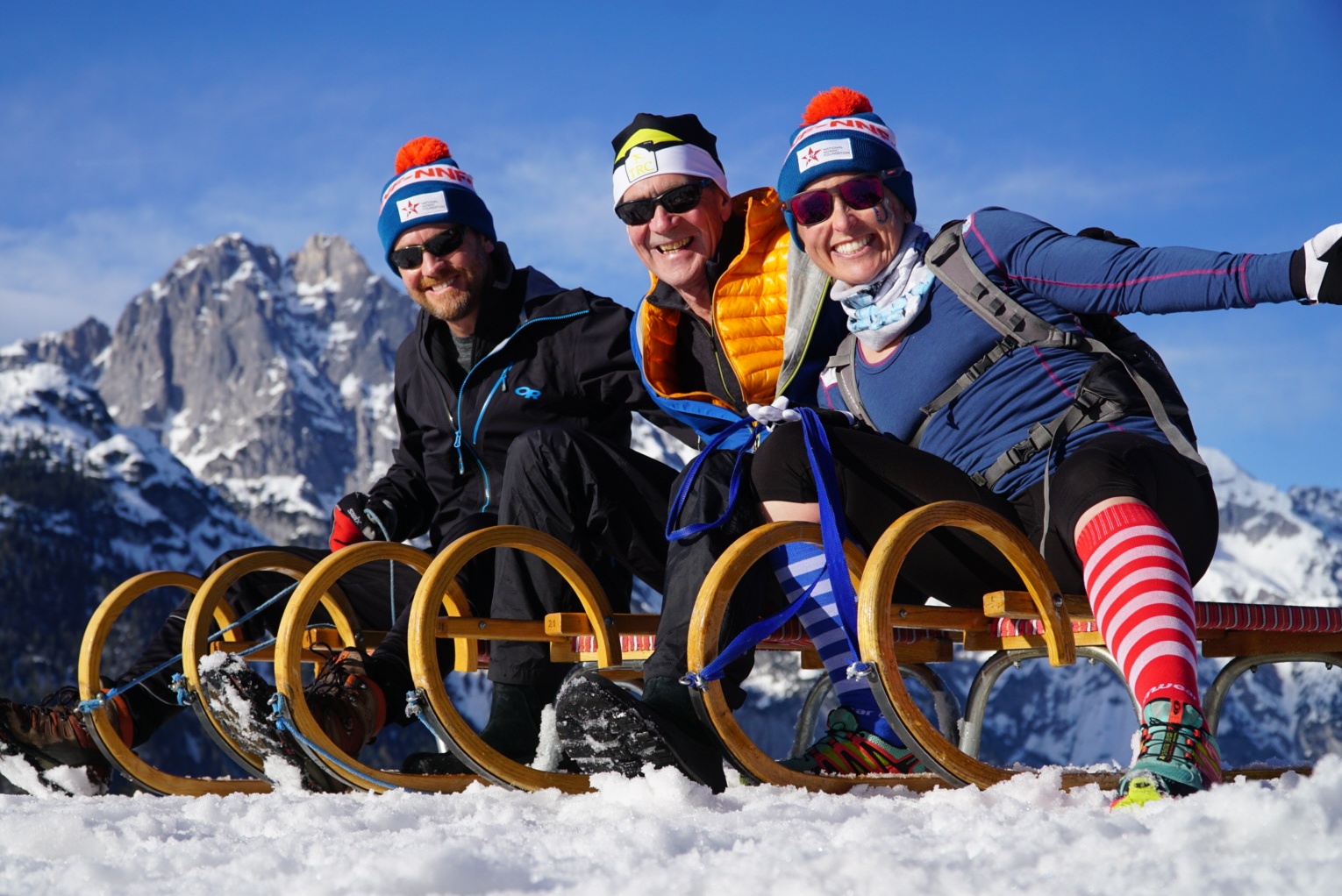
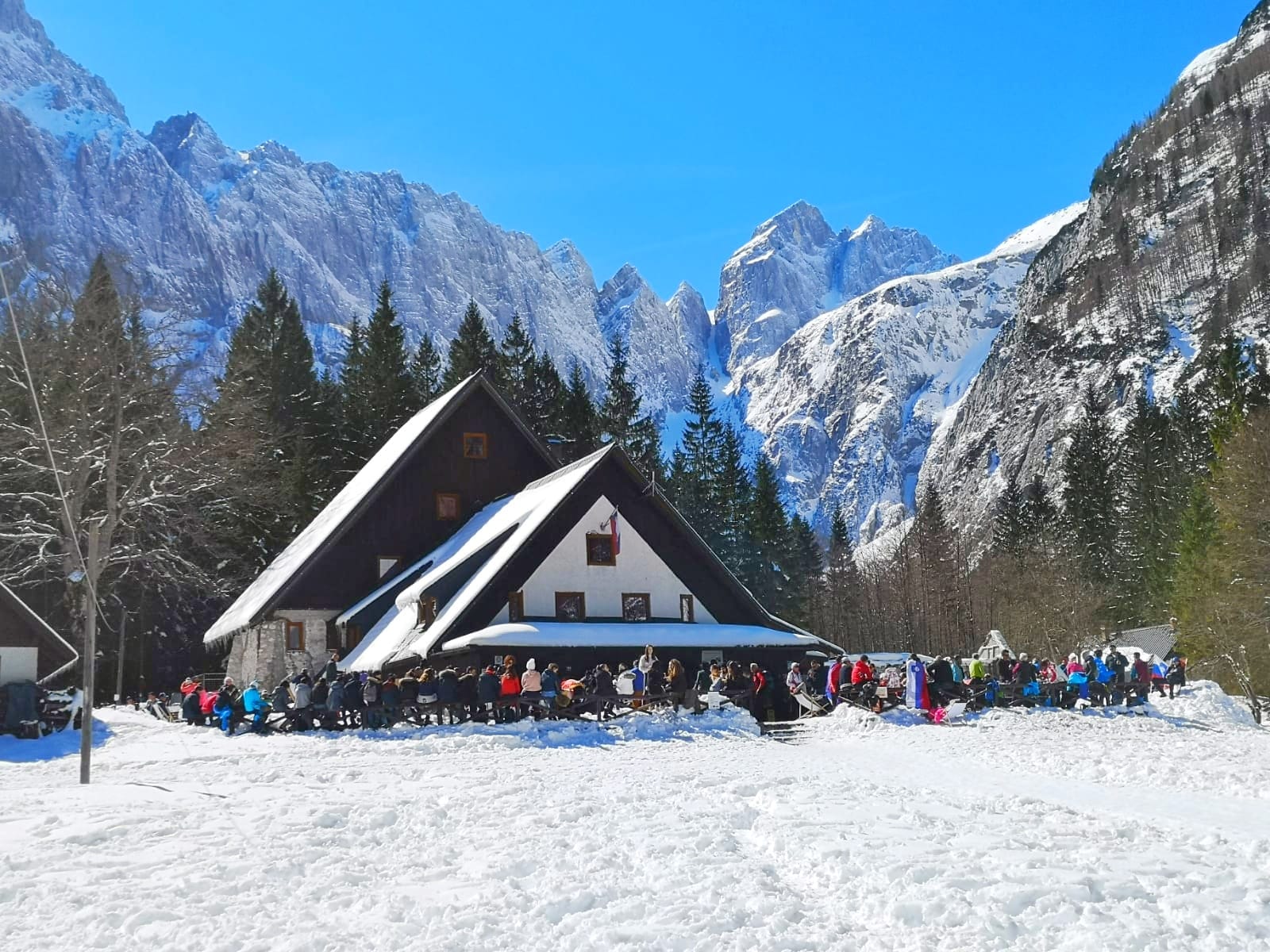
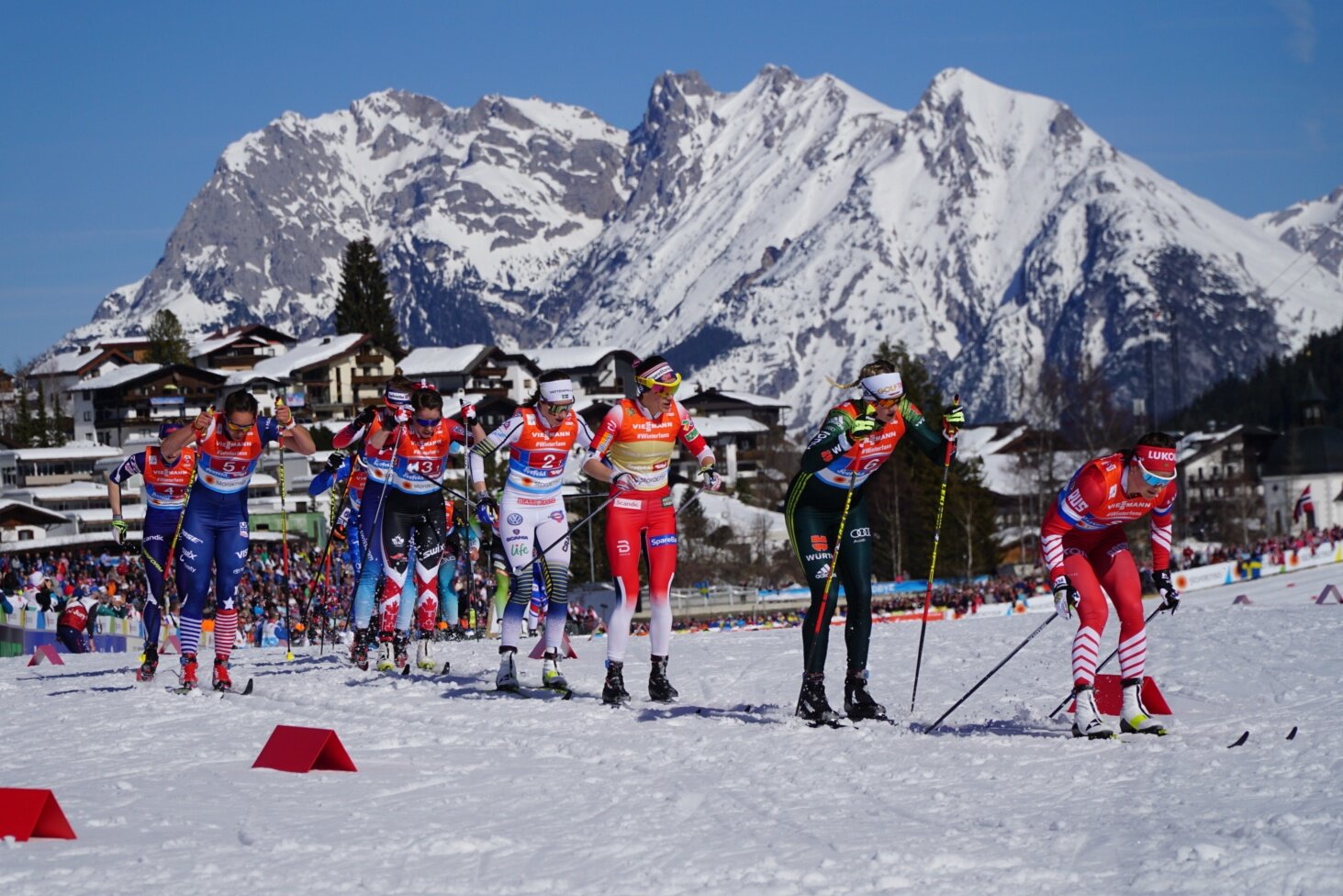
This unique, 7-day trip features grandstand seating for the first week of World Championships, including the classic sprints, skiathlon and skate team sprints – some of the best medal events for the US (the full schedule can be found here). When you’re not trailside cheering on your favorite athletes, the trip features a variety of cultural activities, hallmarks of a Lumi Experiences trip: daily skiing within a short walk from your hotel in Italy, a boat ride on Slovenia’s picturesque Lake Bled, a World War I walk through the mountain trenches led by your hotel’s historian, and sledding and lunch at a trailside hut above Italy’s emerald green Lago di Fusine. And of course, daily ski waxing, plus support and insights from your local trip leaders to make the most out of some of southern Europe’s best ski venues. All the transportation, tickets, lodging and logistics are taken care of so you can enjoy this once-in-a-lifetime trip with your travel companions.
The best part? Proceeds from this trip will help provide the financial platform to continue the Trail to Gold Fellowship (T2G), inaugurated this year to provide talented US women coaches with World Cup coaching experience.
(Photo: Lumi Experiences).
The trip was developed by Lumi Experiences founder and Olympian Garrott Kuzzy. Learn why Planica is one of Garrott’s favorite nordic ski venues.
1988 & 1992 Olympian Nancy Fiddler, one of the authors of the Trail to Gold book, traveled with her husband Claude on the Lumi trip to the 2019 World Championships:
“We loved all the excitement surrounding the event, skiing every day, meeting a fun group and getting to know our trip leaders. Lumi did all the planning, so all we had to do was have fun! Plus the food and guides were great. Europe at its best!” – Nancy & Claude Fiddler
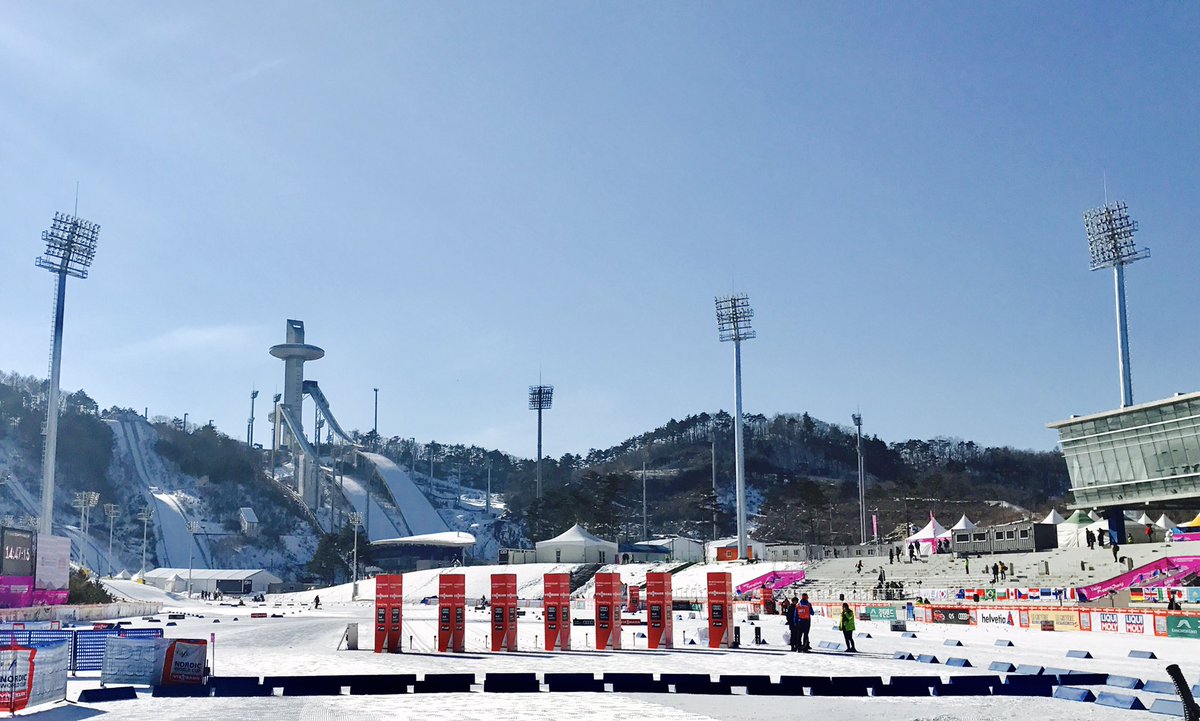
The PyeongChang venue as seen in February 2017. PyeongChang, South Korea, will host the 2018 Olympic Games this coming February. (Photo: FIS Cross Country/Twitter)
Note: This is the first of a multiple-part series on the 2018 Winter Olympic selection criteria for the U.S. cross-country ski team. A parallel piece compares the cross-country team’s criteria with other U.S. winter sports.
***
Friday, July 7, will mark seven months to go until the Opening Ceremony for the 2018 Winter Olympics in PyeongChang, South Korea. As athletes across the country ramp up their commitment in this Olympic year, and #roadtopyeongchang trends across various social media platforms, FasterSkier takes a look at the recently released selection criteria and procedures for nomination to the U.S. Olympic team.
Briefly put, what does it take to get to PyeongChang? And what factors will U.S. Ski Team (USST) coaches and (newly rebranded) U.S. Ski & Snowboard leaders apply in deciding who will be wearing red, white and blue next February?
In this article, FasterSkier first breaks down the criteria themselves, then summarizes a recent interview with USST Head Coach Chris Grover about why these criteria were chosen and how they should work.
Inside the criteria: World Cup performance, discretion and potential domestic picks
The criteria themselves are little changed from the standards used to pick the American team for the last two international championship events, World Champs in Falun in 2015 and Lahti in 2017. First comes objective qualification via performance on the World Cup. Second comes the potential use of discretionary picks. Third, if any spots are left over, the highest-ranking athlete on a domestic points list may, but does not have to, be nominated to the team.
As for the overall size of the U.S. team, a maximum of 12 male or 12 female athletes may be nominated, with a final team quota of probably 17 to 20 athletes to be determined closer to the Olympics themselves. (This is up from a total team quota of 17 in 2014, though ultimately only 14 athletes were named for Sochi, and the extra three American spots were redistributed to other nations.)
The U.S. may enter up to four athletes in a single race at the Olympics. The six cross-country events in PyeongChang will be a skiathlon (15 kilometers for women and 30 k for men), individual classic sprint, freestyle team sprint, 10/15 k skate interval start, 4 x 5 k or 4 x 10 k mixed technique relay (classic, classic, skate, skate), and 30/50 k classic mass start.
As for the criteria themselves for making the U.S. Olympic team: In order:
Objective qualification via World Cup results
Athletes who have achieved a top-eight finish in one of five specific races, or who have a top-50 ranking on either the World Cup sprint or distance list midway through Period II, will be named to the team.
Most precisely, “Any eligible athlete that posts a top-8 individual final World Cup result during the selection period [Nov. 23, 2017, through Jan. 15, 2018] in the following events will be selected to the Team: Sprint C, individual start 10/15 km F, and 15/30 km Skiathlon.”
Looking to the schedule for the 2017/2018 World Cup season, classic sprints will be held on Nov. 24, in Ruka, Finland; Dec. 2, in Lillehammer, Norway; and Jan. 3 in Oberstdorf, Germany (as part of the Tour de Ski). A 10/15 k freestyle individual start will be held in Davos, Switzerland, on Dec. 10. The only skiathlon on the 2017/2018 World Cup calendar will be held in Lillehammer on Dec. 3. Any athlete posting a top-eight final result in one of those five races will be named to the Olympic team.
(The 10/15 k skate pursuits on the schedule don’t count for top-eight purposes – it’s only Olympic formats that are used for qualification. And the 10/15 k skate race in PyeongChang is an interval-start race, not a pursuit.)
So that’s high finishes in individual races. As for cumulative performance across multiple races, “Athletes ranking in the top-50 in the distance World Cup standings or the top-50 in the Sprint World Cup standings as of January 15, 2018 shall be selected to the team.” Jan. 15 marks roughly the midway point of the World Cup calendar. By that point, 18 World Cup races will have been held.
U.S. Ski Team member Sadie Bjornsen racing in the women’s 15 k skiathlon at the 2014 Winter Olympics in Sochi, Russia. Bjornsen is a veteran member of the national team heading into another Olympic year.
As of the comparable point in the 2016/2017 season, shortly after the Tour de Ski, USST members Sadie Bjornsen, Rosie Brennan, Sophie Caldwell, Jessie Diggins, Simi Hamilton, Noah Hoffman, Andy Newell, Kikkan Randall, Ida Sargent, and Liz Stephen had top-50 rankings in either or both disciplines.
A maximum of five athletes per gender may be selected based on their Sprint World Cup rankings. Tiebreaking procedures come into play at that point if necessary, generally based on an athlete’s single best finish in a sprint race.
Discretionary selection
Spots on the U.S. Olympic team will presumably remain open after the application of the objective criterion of World Cup performance. In that case, “the USSA Cross Country Head Coach may use discretion … to determine team nominations” for additional spots on the Olympic team.
Grover would at that point recommend additional athletes to a three-person committee, composed of U.S. Ski & Snowboard President Tiger Shaw, Executive Vice President of Athletics Luke Bodensteiner, and athlete representative Rosie Brennan.
If Brennan stands exposed to a potential conflict of interest from discretionary selection (that is, through no fault of her own, she “stands to benefit privately from a decision made by the Selection Committee,” as would happen if she had not qualified objectively and were being considered for discretionary selection), then she would be directed not to engage in any conduct “meant to unduly influence” the selection committee regarding her potential selection to the Olympic team.
Grover is then directed to consider any of (a) “outstanding competition results” from both this season and last season, (b) “Recent positive direction or trend of competition results indicating a potential for Olympic success,” or (c) “Indication of medal potential in future Olympic or World Championship competition (such as international age group results and rankings) that would be materially enhanced by selection to the team.”
U.S. Ski & Snowboard was not required to make discretion a means of selection to the team. It also has the discretion not to use discretion at all; as the document states, Grover may use discretion to determine additional team nominations, but does not have to.
Domestic selection. Maybe.
If there are any spots remaining on the team after applying criteria (1) and (2), U.S. Ski & Snowboard may consider the highest-ranked domestic athlete, one per gender. But it technically doesn’t have to.
(There is some ambiguity within the selection document itself as to whether more than one team spot could be filled via a domestic ranking list. On the one hand, selection criterion 3 uses the plural when it talks about “any remaining positions,” and “those positions may be filled.” On the other hand, it also mentions “the athlete with the highest rank on the 2018 Olympic Winter Games Selection List,” and both “athlete” and “rank” are in the singular. In practice, Grover clarified in a recent phone interview that the national team is potentially open to bringing more than one skier per gender, pointing out that four men and two women were brought to Lahti off the domestic rankings list.)
The 2018 Olympic Winter Games Selection List, as with the comparable list for 2017 World Champs in Lahti, is essentially the “normal” 2017/2018 SuperTour points list, plus substantial bonus points for 2018 U.S. National Championships. An athlete’s best two finishes in a single discipline (sprint or distance, not skate or classic) will be counted.
The SuperTour point totals system, and bonus points for podium finishes at 2018 U.S. nationals, appear to be precisely the same as those used last winter for Lahti. That is, first through third at the December SuperTour races will be worth 30, 25, and 21 points, respectively. The addition of nationals-only bonus points means that first through third in the four races in Anchorage count for 45, 35, and 26 points, respectively. When an athlete’s best two finishes are counted, a second and third at U.S. nationals (61 points) would be worth more than two firsts (60 points) at “normal” SuperTour races.
For this reason, in last year’spreview for 2017 U.S. nationals, FasterSkier quoted longtime racer Kris Freeman as stating that “the allocation of bonus points to Nationals essentially makes the remainder of the SuperTours irrelevant. Nationals is now World Champ and Olympic Trials which is fine, but let’s call them what they are.”
The math is the same this season as last season. This season, U.S. nationals start in Anchorage on Jan. 3, 2018. The four races there will be a skate sprint, classic sprint, 10/15 k skate interval start, and 20/30 k classic mass start.
Discretion and selection to international championship events
The appropriate role of discretion when selecting athletes for a World Ski Championships or Olympic team is a subject of recurring interest for fans and supporters of American cross-country skiing, and has frequently arisen on this site.
For example, here’s USST Women’s Coach Matt Whitcomb in an interview with FasterSkier in July 2016, answering the question, “Is it fair to say that making discretionary picks is one of the harder parts of your job as a coach?” Whitcomb replied, “For sure. We love not to do it. But in any criteria, discretion can often be one of the most important pieces. We really envy these Olympic Trials [for the American track and field athletes for the 2016 Rio Olympics] that we’re watching right now, where the top three go and fourth is either an alternate or they don’t go, and it’s just much more objective.”
And here’s Grover in January 2017, slightly ahead of the naming of the U.S. team for Lahti: “The real key thing is that, at the bottom of the selection, we followed the selection criteria. That’s key. Discretion really belongs to be used at the top, for those athletes who have a chance to come over and have big races at World Championships, and by big races I mean someone who can go on the podium, or the top five, top 10, or top 15. Look for some selections from USA, but I wouldn’t look for a lot of discretion at the end of the day.”
Or here’s Grover in January 2014, discussing why he and the rest of U.S. team leadership abjured discretion completely in taking Brian Gregg to Sochi but not Matt Liebsch, when only 0.04 points separated the two on the domestic men’s distance list: “We really tried to apply the selection criteria in the most fair way possible.That becomes, for sure, a challenge, especially on the men’s side when you get down to the sixth, seventh, eighth guys, you’re really splitting hairs because the FIS points are so close at that point. Because they were so close we opted not to use discretion. It really wasn’t a fair way to do it.”
(As things played out in Sochi, USSA selected 14 athletes out of a total possible quota of 17. Grover explained at the time, shortly after selections were made and before the Olympics began, that they had only intended to bring those athletes whom they planned on starting in races. “With seven women and seven men, we have our start positions filled,” Grover told FasterSkier before the Games. “Seven and seven was the magic number for us.” Liebsch is reported to have considered legal action to gain a spot on the U.S. team for Sochi, but found that that it was “too late” for him to do so. In Sochi a few weeks later, U.S. athlete Torin Koos did not start the 50 k skate race, a race format in which Liebsch had previously won at the American Birkebeiner.)
The U.S. Ski Team’s views on discretion
Grover, the longtime USST head coach, is aware that people feel strongly about the substance and application of selection criteria for U.S. championship teams. “I think overall I’d say people get a little bit mired up and tied up with selection criteria, and whether it’s fair or not, or how this potentially sees them falling within that criteria,” Grover told FasterSkier in a recent phone interview.
But Grover has a simple message for domestic athletes hoping to go to PyeongChang: “All you need to do is to ski fast, you need to go out there and win races, or to reach podiums. And if you can do that, your chances of being selected to the team are quite good.”
The current criteria are “better than ever, more fair than ever,” Grover continued. “I think [it] gives athletes the most direct path possible to a major championship team.”
Grover urged domestic athletes not to obsess over the apparent prioritization of discretion over domestic race results as a means of picking the Olympic team. Addressing a hypothetical non-national team member, he said, “As as an athlete domestically, don’t get hung up in the order that those things come down in the selection criteria. Discretion has to be next, because a discretionary athlete that’s picked needs to be picked because they are a top athlete who should be on the team, who has somehow been missed by the selection criteria.
“So that’s the placement it has to be,” he continued. “And that’s consistent with selection criteria across different disciplines, in different sports. So that’s just the way that the procedure needs to work. But it doesn’t mean that a large number of discretionary athletes will necessarily be selected prior to the domestic field.”
The statements that discretion “has” to have this status, and that this is “consistent with … different sports,” are not necessarily correct. As reported today in another article on FasterSkier, discretion plays a less prominent role in every other U.S. Ski & Snowboard sport.
Grover also underscored that the use of discretion within American skiing pales in comparison to its role in Norway or Russia.
“We’re competing against teams that are using 100-percent discretion to name their teams,” Grover emphasized. “So in the U.S., we have kind of the most democratic, objective, fair, I guess you could say – other nations, our Scandinavian peers, might call this an American system that we use for selecting athletes. It’s very cut-and-dried.”
The four countries that Grover mentioned by name in his interview as the Americans’ main competition – Norway, Sweden, Finland, and Russia – all finished ahead of the U.S. in the final Nations Cup standings for the 2016/2017 World Cup season.
Grover also stressed that U.S. Ski & Snowboard used only one discretionary pick for the Lahti roster, taking USST athlete Erik Bjornsen. “And the reason that we used one discretionary spot to select Erik was because he basically fell between the two criteria. He didn’t quite make the top-50 in the world standard because he had gotten sick during the selection process, and he wasn’t home domestically to race in the races domestically, but I think very few people out there would argue that that wasn’t a good use or a smart use of one discretionary spot.”
Grover further stressed that the team had used, as he initially put it, “zero discretion” when selecting athletes for Falun World Championships in 2015. (In a subsequent email to FasterSkier, Grover clarified that “We used zero discretion in the original selection of 16 athletes (8 men and 8 women) to the Falun Team, but we did add Ben [Saxton] at a later date via discretion after he finished 6th in the sprint at U23 Champs.”)
Writing criteria for the top vs. the bottom
Grover cited the decision to bring Erik Bjornsen to Lahti as an exemplary use of discretion, underscoring that Bjornsen was a skilled athlete who “had some of the very best individual results there” among American skiers.
“So that is absolutely our intention,” Grover continued, “it has been our intention, and it will be our intention going forward, is that we use discretion on the rare case where there’s an injury, or an illness, with a top athlete, and/or the criteria fail to select someone that I think most everyone would agree should be there representing the United States.”
At world champs in Lahti in 2017, Bjornsen finished 18th in the 15 k classic and teamed up with Simi Hamilton to finish fifth in the team sprint. At world champs in Falun in 2015, Saxton finished 54th in classic sprint qualifying, roughly nine seconds from making the heats.
While Grover is confident that discretion is most appropriately used for a top-performing U.S. athlete, he acknowledged some issues regarding the final athletes selected (or not selected) to a team.
Summarizing his discussion with domestic senior club coaches about the selection criteria used for Lahti, and any potential changes before PyeongChang, Grover said, “All the responses I got back were positive, people were like, Yeah, it worked well. It’s never perfect at the bottom, but I don’t really see any way to improve it.”
Indeed, he noted, the U.S. Ski & Snowboard working group “struggled with” how to select “athletes at the bottom of the selection, and make it as fair as possible. And what you come up with at the end is, in the end there’s no real perfect way to do it, and there’s going to be challenges to the way that any selection criteria works at the very bottom of the selection.”
Current success vs. preparing for the future
Another issue surrounding selection is the question of current competitiveness vs. taking a young athlete to a “practice” Olympics just for the experience – that is, is the Olympics for development or for podiums. In 2014, for example, regarding the recently named team for Sochi, Grover said, “The Olympics is the pinnacle of the performance or competition pipeline.”
Development occurs at many lower levels, Grover noted (Europa Cups, World Juniors, etc.), but “It does not and should not come at the World Championships or the Olympics. … It’s not a development trip; it’s a competition trip at the very highest level.”
Similarly, earlier this year Grover explained that junior skier Katharine Ogden (a.k.a. “KO”) was not selected for Lahti on the grounds that “athletes should first aim to be successful at – in the age group that they’re competing against. So for KO, that means World Juniors, and being successful at World Juniors.”
The third prong of discretionary selection for the current Olympic team, “Indication of medal potential in future Olympic or World Championship competition (such as international age group results and rankings) that would be materially enhanced by selection to the team,”may be said to go against these principles.
But Grover explained that this “future medal potential” path to discretionary selection is rarely if ever used, even when the Olympic team is selected with an eye to current podium potential.
“We haven’t used it that way,” Grover said. “Obviously the language is there if we were to choose to use it, but in the past we really have not used it that way, and I don’t anticipate using it going forward into this season. … We want … the fastest skiers on the start line in Korea, and those are the ones that we’re gonna be selecting.”
Different standards for men and women?
An additional issue in selecting American skiers is that the women are currently, proportionally speaking, faster than the men – that is, the U.S. women, as a team, have recently tended to achieve better results within the women’s World Cup field than the U.S. men do within the men’s World Cup field.
It is also true that the international men’s field is more top-heavy than the women’s field, across the course of a single World Cup season, meaning that a greater number of World Cup points is needed to crack the top-50 of a discipline ranking.
Perhaps for these reasons, multiple athletes have confirmed to FasterSkier the substance of a suggestion made at a recent athletes’ meeting at the season-ending 2017 U.S. Distance Nationals in Fairbanks: That the selection criteria should be made more challenging on the women’s side, such as by making the objective cutoff there be a top-40 or even a top-30 discipline ranking rather than top-50.
“I understand where the person who asked that question, where kind of they’re coming from” Grover told FasterSkier, when asked generally if there had ever been discussions about making the objective criteria different between the genders.
“They’re referring to the fact that there’s greater depth on the men’s side … there’s a lot more men ranked – that have FIS points that are say 30 and under, versus the number of women perhaps that have 30 FIS points or less.”
But, Grover continued, “top results are top results at the end of the day. And there’s three medals that are handed out, for men and for women. And if that means that selecting an athlete who ends up to be, say, 46th in the top, in terms of the top 50 in a discipline list by the middle of January, that athlete might be closer to contributing to a top result or a podium than one of the guys.”
For this reason, Grover questioned the aims served by this suggestion. “Is the end objective for that person just to provide more opportunities for men to come over and be 50th place at the Olympics? Because if that is the objective, then I don’t think it’s worthwhile pursuing. What we’re trying to do is have top results … to really compete. And that means selecting those athletes who are the closest to the top placings.”
Freeman also argued that it was illogical to use a non-championship event for selection to the USST, “whose primary stated goal is to win medals. … Is racing up a hill at the end of a nine-day tour really a fair way to determine who goes to the World Championships or Olympics?”
Grover’s stance is that it’s more difficult to finish in the overall top 30 of the Tour de Ski than reach the podium at U.S. nationals. Due to recent changes in FIS rules that will allow more pure sprinters to start the 2017/2018 Tour de Ski without counting against their nation’s start quota, he foresees a greater number of finishers in this year’s Tour.
“I would anticipate that this year you’re going to have much better numbers of athletes that are actually finishing the Tour,” he said, “and so the standard there won’t be quite as ‘easy,’ quote-unquote. It’s not necessarily easy, but won’t be as easy as it was this last year.
“Is it easier to score points, even at the end of a Tour de Ski if you can survive it, versus to have a podium at U.S. nationals, given that a bunch of the top USA athletes are doing the Tour de Ski at the same time?” he asked. “I would still guess that it’s easier to reach the podium at U.S. nationals, and thereby that would make it an easier path for an athlete to make the Olympic team.”
FasterSkier has separately addressed Freeman’s argument regarding the “access problem” of obtaining Tour or World Cup start rights in the first place. FasterSkier has also considered the approach used by the US Biathlon Association, which makes it “not a foregone conclusion” that athletes receiving World Cup starts will necessarily make the Olympics.
The bottom line
“At the end of the day,” Grover concluded, “I would anticipate that we’ll be able to bring the athletes that we want to bring so that we can fill every potential start spot at the Games. … We will fill every start at the Olympics.”
Grover and U.S. Ski & Snowboard intend to do so by making sure “that we capture any athlete who can reach the podium, any athlete who can reach the top five, the top 10, the top 15. That’s the absolute critical element, is that we give ourselves the best chance to be successful.”
And Grover believes that the current criteria are “the best way to do that.” We “were trying to create a more equitable, more concrete, easier to understand and visualize path for domestic athletes, racing SuperTour, to qualify for a major championship team,” Grover said. The result, he concludes, is “better than ever, more fair than ever. … So, you know, I feel good, I feel really good about the criteria, I feel like we got the most fair criteria for the Olympic selection that we’ve had, and I’m excited to see how it turns out.”
— Jason Albert and Chelsea Little contributed reporting
***
Stay tuned for more on this topic, including an article on American athletes’ reaction to the Olympic selection criteria and how they feel the exercise of discretion has affected them and U.S. skiing. And be sure to read about the role of discretion across other U.S. Ski & Snowboard sports, particularly biathlon.
Since the interviews on the FIS websites is one of my main sources of post topics during the off season, we’ll continue in that vein with one from a while back with Øystein Pettersen. In it, he talks about how his focus this season is (unsurprisingly) the classic sprint at World Championships.
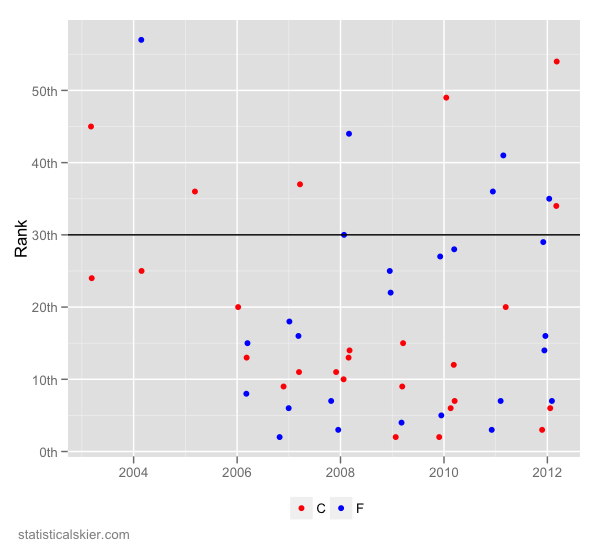
Pettersen has been slightly better at classic sprints, on average, but overall he’s been pretty balanced:
I guess I’d say that at least until the last two seasons, his classic sprinting has been slightly better, if only because it had been somewhat more consistent. In general, his consistency took a slight hit recently, with slightly more results falling outside the top 30.
This sort of track record would make him a shoe-in for the World Championship team in many other nations, but in Norway things are competitive enough that Pettersen notes in the the interview that he’ll have to qualify. So he’ll be doing as many classic sprints as he can leading up to WSCs in order to prove himself.
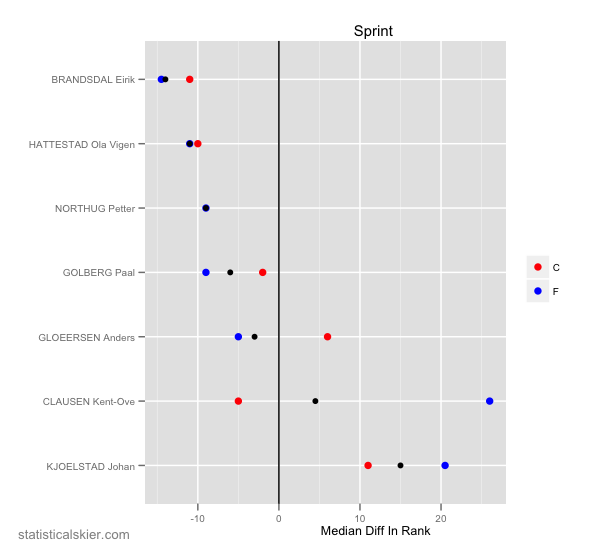
How competitive is that effort going to be? Well, let’s compare Pettersen directly to a handful of other top Norwegian male sprinters from last season:
Remember that negative values are bad for Pettersen (i.e. the other skier tended to prevail) and vice versa. And these values are from instances where Petteresen raced against these guys, so these are head to head matchups. You’ve got three guys who were landing around 10 places better than Pettersen with some regularity, and then even Golberg and Clausen tended to be slightly better specifically in classic sprints. Of course, you never know who’s going to be skiing fast several months from now, but it’s going to be a tough road to qualify for the men’s sprint for Norway.
Alex Harvey (R) and Devon Kershaw (L) celebrating their World Championships gold on Wednesday.
Late last February, Canadian Alex Harvey got the tag from his teammate Devon Kershaw to ski the second leg of the 4×10 k men’s relay at the Vancouver Olympic Games.
Kershaw was having a bad day, and he’d dug his team into a hole—Harvey started out his race with a 30-second deficit to the leaders.
The 22-year-old Quebec native fought as hard as he could, burying himself in an effort to chase down Norway, Sweden, France and Finland. The effort ultimately came to naught, though, as the team finished outside the top five.
Four days later, on the last day of the Games, Harvey raced in the 50 k classic—a marathon event that he saw as one of his two best chances at a medal, since his first career World Cup podium had come in the same event in Norway a year prior.
In Vancouver, Harvey figured at the front of the race early, but still suffering the after-effects from the relay, he faded hard, and finished outside the top 30.
“I dug as deep as I could in the relay, trying to catch the lead group and dying five kilometers into the 10-kilometer race. It sucked,” Harvey wrote in an e-mail Thursday night. “I couldn’t recover well enough for the 50 k, two days later, and again, it sucked, badly. I was crying in the wax cabin for 10 minutes, wondering, ‘what if, what if?’”
One year later, Harvey is skiing even faster than he was in Vancouver. Along with his teammate Devon Kershaw, the pair won Canada’s first-ever World Championships gold on Wednesday, in the team sprint in Oslo.
With his three other potential relay teammates not skiing quite well enough to put the team in medal contention, at least on paper, Harvey said that he’s refusing to make the same mistake again. He’ll skip Friday’s 4×10 k, in order to be better rested for Sunday’s 50 k skate—a move that certainly opens him up to criticism, but one that will also provide a big boost to Canada’s hopes for its second-ever World Championships gold.
“As of today, I do not think we had a reasonable chance at a [relay] medal,” Harvey said. “The goal as [a] team this year was to be on the World Cup podium, and for the men, medal at Worlds. That is our team goal, and I feel that in order to fulfill that team goal, I’m better off being 100 percent ready for the 50 k than racing the relay.”
The relay is one of cross-country’s marquee races, with a rich tradition and a history of epic battles unfolding at major championships. Athletes regularly set their personal ambitions temporarily aside in order to ski for their teams, even those without medal hopes—take, for example, the performances by Poland’s Justyna Kowalczyk and Slovenia’s Petra Majdic in Thursday’s women’s race in Oslo.
With Kershaw, Harvey, Ivan Babikov, and George Grey comprising their team, the Canadians finished seventh in the relay at the Olympics last season. This year, though, they weren’t good bets for a medal—Grey is coming off knee surgery and the birth of his first child, and is far from fit. In a phone interview, the team’s head coach, Justin Wadsworth, said he’d planned to substitute rookie Len Valjas—who is racing well, but not nearly at Grey’s level from 2010.
Despite the Canadians’ chances on paper, Wadsworth said he thought that his team still had a decent shot at a medal—and he wanted Harvey in the race.
“I personally think he should do the relay, but I also respect his knowledge of how his body is, and what he needs to do,” Wadsworth said. “So, we went ahead and made the decision to sit him out tomorrow—it’s a little bit tough, for sure.”
Wadsworth said that Harvey’s decision was partly related to a long day and celebration that accompanied the Canadian team sprint victory on Wednesday. But Harvey said that the skipping the relay has been on his radar for a number of months.
“It’s been clear from the summer with the team that I was not keen on the schedule at Worlds, with the relay being two days before the 50 k,” he said, noting that the Canadians were planning on leaving him off the squad through two team meetings leading into World Championships. “So, it’s not a surprise, even though some guys feel like it is.”
Babikov made his feelings clear through a post he made on Twitter on Thursday, which was later deleted. It read: “One of us making the biggest mistake of his life today…and I lost all the respect for that person.”
Kershaw, in his own e-mail late Thursday, was more circumspect. He said he understood Harvey’s reasoning, even if he was still disappointed.
“He’s a favorite for the medal. He feels like he screwed up last year, and this year, he wants redemption. He doesn’t want to take a chance for only—what he believes—is a ‘maybe, at best,’ for a top six [in the relay],” Kershaw said. “He wants another gold medal. Fair enough. You cannot argue that. The kid’s driven like hell. And for good reason.”
Kershaw nearly medaled in the 50 k classic at the Olympics himself—he ended up fifth, just meters from the podium. But he said that skipping the relay in Oslo to save up for Sunday never crossed his mind.
He said he “loves” the relay, and—unlike Harvey, who Kershaw said would be a surprise not to podium on Sunday—Kershaw doesn’t consider himself a medal favorite in the 50 k skate.
Kershaw said that he’s only finished one such race in the past, in 2004 in Oslo, where he was nearly 12 minutes off the winner.
“I still remember how those legs of concrete felt—it’s singed into my memory,” Kershaw said.
So in Friday’s relay, Kershaw will don his spandex and sport the maple leaf as he scrambles for Canada. He’ll be followed by Valjas, Babikov, and Grey, while Harvey prepares for the 50 k.
“I was bummed,” Kershaw said, “and I am bummed that he won’t share in the experience of racing the traditional relay—but I’m sure we’ll share many more together. You’ve got to take risks and make hard decisions if you want to succeed.”
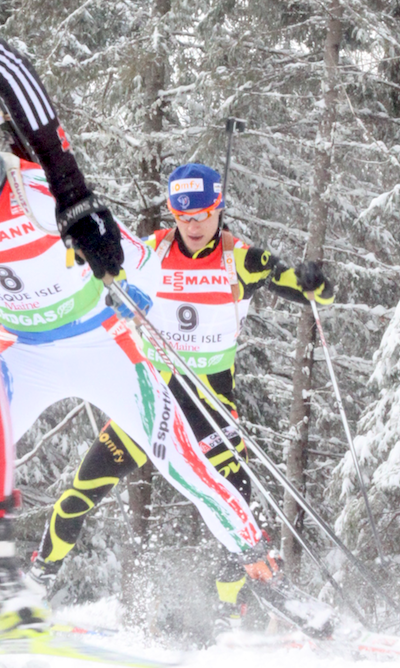
Alexis Boeuf in Sunday's World Cup biathlon pursuit race in Presque Isle. Afterwards, Boeuf told FasterSkier that he plans to race in the sprint at the cross-country World Ski Championships later this month.
Alexis Boeuf didn’t have to sprint to win Sunday’s World Cup biathlon pursuit in Presque Isle, since his margin of victory was a decisive 10 seconds. But if the event had come down to a last-minute drag race, it’s unlikely that Boeuf would have had much trouble dispatching his competition.
The 24-year-old Frenchman is a talented sprinter. How talented? Well, in December, he raced in a cross-country World Cup sprint in Davos, Switzerland, and qualified for the heats, ultimately finishing 20th on the day. And, he told FasterSkier after his win on Sunday, he will travel to Oslo in late February to contest the sprint at the World Ski Championships.
“I like the sprint,” Boeuf said. “For me, it is possible to do both…I don’t want to make a difference between biathlon and cross-country skiing.”
The World Championships for the two sports are offset on the calendar this year, so Boeuf will be able to race in Oslo on February 24th before hopping a plane for Khanty-Mansiysk in Siberia—the site of this season’s biathlon worlds.
According to Siegfried Mazet, one of the French team’s coaches, biathlon is still the first priority for Boeuf. But Mazet also said that since he was a junior, Boeuf has successfully dabbled in cross-country racing as well—especially in sprints.
Elite biathletes have competed in cross-country skiing in the past, most notably in the case of Norwegian Lars Berger, who won gold in the 15 k skate at the 2007 World Championships in Japan, then helped his country’s relay team to silver in the 2010 Olympics.
More recently, Emil Hegle Svendsen, another biathlete, was named last week to the Norwegian team for Oslo, where he will likely race one of the skate legs in the country’s men’s relay.
Svendsen and Berger both raced in longer events, not sprints, and few, if any biathletes have contested that discipline in cross-country. But according to Mazet, Boeuf is cut out for short-distance racing.
“He is able to accelerate very, very, very fast,” Mazet said. “He is able to catch many seconds in the short time.”
Mazet said that in the future, Martin Fourcade, an even bigger French name than Boeuf, could one day take a shot at some cross-country racing—perhaps with a spot on France’s relay team.
In the mean time, though, Boeuf will have to suffice as his country’s lone representative in Oslo. After his modest success in Davos, there’s no reason to discount his potential for the World Ski Championships—especially with his first career win on Sunday showing that his fitness is at an all-time high.
“I think the biathlon training is really good for me in sprints,” Boeuf said.
The Canadians will field an experienced 11-person roster for the World Championships in Oslo, Norway at the end of February, and all 11 will also ski the World Cup in Drammen, Norway, the week before.
The roster is almost identical to the Olympic roster from last year – 9 of the 11 skiers competed in Vancouver, and all 11 have at least one World Cup start.
Devon Kershaw during the Vancouver Olympics
According to Cross Country Canada (CCC)’s selection criteria, the team was chosen based on the projected achievement of three major goals – to collect one medal, a top 6 result in the men’s relay, and other podium and top 12 results.
In order to achieve those goals, CCC listed four clear-cut performance goals that athletes were required to meet, and other athletes would be selected in order to field the full complement of four athletes in all events but the team sprint.
The first criteria was that all skiers in the FIS World Cup period II Red Group, which is considered to be roughly the top 30 male and top 30 female World Cup point collectors, would be selected to the team.
Second, all athletes who recorded a top 12 finish in an individual World Cup would be selected to the team.
Third, those athletes who won domestic selection races would be placed on the team. The Canadians used two separate selection weekends – the winner of NorAm skate sprint in Rossland B.C. on December 17 was automatically selected to the World Championships team. For distance selections, the men had just the NorAm 30 k pursuit on January 6, 2011 in Thunder Bay, Ontario as a qualification race. For the women, both the 15 k pursuit and the 10 k freestyle in Thunder Bay were selection races.
Fourth, if an athlete finished in the top 20 and top half in World Cup events, they could be selected to the team.
Finally, athletes who did not meet any of the other criteria could be selected to the team based on their position on the sprint and distance ranking lists, and the recommendation of Head Coach Justin Wadsworth.
Just two Canadians made the period II Red Group as of the time of selection – Devon Kershaw (Ona-Wa-Su/National Ski Team) and Dasha Gaiazova (Rocky Mountain Racers/NST). The Red Group is an ongoing list, which shows performance over a period of time.
Stefan Kuhn in action during the Rossland NorAm (Photo: Brad Jones)
It should come as no surprise that Kershaw made the distance Red Group, as he had a strong start to his season, before recording a plethora of podium finishes during the Tour de Ski. In the period that counted towards the Red Group ranking, Kershaw finished 10th during the Kuusamo mini-tour, 9th in the 15 k classic in Davos, and finally 13th in la Clusaz, earned him 22nd place on the Red Group rankings.
Gaiazova was the second to last woman selected to the sprint Red Group, as a result of her consistent qualifying over the past 8 months, including finishing 24th and 27th thus far this season. Gaiazova has also been arguably the strongest Canadian woman on the circuit this season – regardless of distance or technique.
Vancouver Olympians Ivan Babikov (Foothills Nordic/NST), Alex Harvey (Club Nordique MSA/NST) and Chandra Crawford (Canmore Nordic/NST), all recorded a top 12 finish in an individual World Cup, thus qualifying for a trip to Oslo.
Babikov used his trademark event, the climb up Alpe Cermis on the final day of the Tour de Ski to record a 6th place, while Harvey has recorded five top 12 finishes so far this season.
Crawford, still rounding back into form following an injury-filled 2009-2010 season, finished 8th in the Dusseldorf city sprint.
Vancouver Olympians dominated in the domestic selection races, as Perianne Jones (Nakkertok/NST), George Grey (Blackjack/NST), and Stefan Kuhn (Canmore Nordic/NST) were all selected based on performances in Canada.
Jones (Nakkertok/NST), who has yet to race in Europe this season, booked her ticket to Oslo by finishing as the top Canadian in the Rossland skate sprint, as well as winning the 10 k freestyle in Thunder Bay.
Kuhn and Grey both won a domestic selection race each, thus earning berths on the team. Kuhn won the skate sprint at the NorAm event in Rossland, while Grey won the recent 30 k Pursuit at the Thunder Bay NorAm.
Finally, sprinters Phil Widmer (Canmore Nordic/NDC Quebec/NST) and youngster Len Valjas (Team Hardwood/NDC Quebec/NST) also cracked the squad.
Dasha Gaiazova (L) and Perianne Jones (R) battling it out during the final of the classic sprint at the Thunder Bay NorAm (Photo: Brad Jones)
Widmer and Valjas both recorded top 20 results in the freestyle sprint World Cup in Davos, and also finished in the top half of the World Cup field, earning themselves a chance to compete at World Championships.
Finally, Brooke Gosling (Foothills Nordic/CXC) rounds out the woman’s team, giving the group four women, and therefore a relay team.
While Gosling failed to win a selection race outright, she was selected based on her strong performances at the NorAm races in Thunder Bay, where she finished second in the 15 k Pursuit to Gaiazova, and third in the 10 k skate, to Jones and Gaiazova.
According to Head Coach Justin Wadsworth, Gosling was selected based on her ranking on the Canadian distance and sprint lists as the next strongest woman in the country.
The only athletes who have not been to World Championships before are Valjas and Gosling, and all 11 have World Cup experience. The performance of the athletes is at an all-time high as well – with the exception of Gosling, every athlete has finished in the top 30 in non-Canadian international World Cup competitions.
However, the Canadians are not without problems. Of the seven men, there are five who could conceivably start the freestyle sprint in Oslo. Kershaw, Harvey, Kuhn, Valjas, and Widmer have all finished in the top 30 in World Cup sprints this season. As the maximum number of starts at World Championships is four, the Canadians are in a bind.
Therefore, the results of the World Cup freestyle sprint in Drammen, as well as previous results during the year will be used to select which of the sprinters get the start – the one left out will be considered an alternate.
The most intriguing part of the Canadian team selection could be the makeup of the various relays at World Championships. While the womens 4×5 k relay is set, as the team has only four women, the mens 4×10 k relay could see some interesting combinations.
After stating at the start of the year that the team would switch up a few of the legs, Wadsworth is now in a position where he has some additional firepower to throw in the lineup. Lenny Valjas skied a strong classic leg in the La Clusaz 4×10 k relay in Grey’s absence, and Stefan Kuhn has also proven himself to be a strong classic skier over that distance.
George Grey in action during the Rossland NorAm (Photo: Brad Jones)
While the men’s sprint relay seems to be a no-brainer – Alex Harvey and Devon Kershaw finished 4th in the event at the Olympics last February, and are in even better sprint for this season – the women’s sprint relay could be interesting.
Crawford and Gaiazova have combined twice in the sprint relay this season, and have finished 3rd and 5th. However, the podium placing was in a skate event, by far Crawford’s strength, whereas the World Championships team sprint will be classic – the same event where Jones combined with Sara Renner for a sixth place finish two years ago.
Currently, the coaching staff has not set the teams in stone. “There are a lot of factors leading into those races, and nothing is ever set until the entry goes in the day before,” Wadsworth wrote in an e-mail to FasterSkier.
“Even then we can sub a person in if someone gets sick after the entry is in up to 2 hours before the race starts.”
Canada's Alex Harvey leads Norway's Petter Northug at the Olympics last year.
Alex Harvey turned heads at the 2011 edition of the Tour de Ski, capping off four top-10 finishes with 10th place overall. But the 22-year-old Canadian insists that the best is still to come, later this season.
“I feel really good, but I don’t feel like I’m peaked,” he said, in an interview on his way home from the Tour. “The plan was never to be in the best shape here.”
Harvey’s strong results in the eight-stage race came in tandem with his teammate, Devon Kershaw, who collected four podiums en route to seventh in the overall.
Both departed Europe early last week, with Harvey traveling back to his home in Quebec.
Leaving Val di Fiemme after the conclusion of his second Tour—and after bettering his previous overall finish by 12 places—Harvey said that he never expected that his efforts would result in a top-10. But even better than the result was the fact that his body withstood all the punishment.
“Obviously, I’m tired now, but last year, after the last stage, I was dead. I was super-pale,” he said. “Now, I am tired, but I am not dead.”
Still, though, the Tour took its toll, like it did from all the other athletes who completed it. Upon arriving home, Harvey said, he would take a few days of barely any training—“everyone has to rest from this,” he said.
After recovering from all the racing, and some time with friends and family, Harvey will return to Europe on the 23rd. For the next few weeks afterwards, he’ll be based out of Livigno, Italy, preparing for the 2011 World Ski Championships in Oslo, which begin in late February.
In Italy, Harvey will conduct a yo-yo altitude camp, training big hours while he moves back and forth between high and low elevations—the same approach that the Canadians have used for the last few major championships, he said.
Along with teammate Len Valjas, and perhaps one other Canadian, Harvey will live at 2,300 meters in Livigno, and train at roughly 1,800.
“Altitude works well for me,” he said.
During his preparations for Oslo, Harvey will also make a quick trip to Otepaa, Estonia, to compete in a single event at the U-23 World Championships: the 30 k pursuit, on January 31.
The pursuit format is a good one for Harvey—he took the bronze medal in the 20 k version at the 2007 World Junior Championships—and he said that the trip also coincides with a planned trip to sea level, as part of his yo-yo camp. Given Harvey’s recent results, he’ll be the hands-down favorite to win, especially with rising Russian star Petr Sedov sidelined with heart problems.
After returning to Livigno, Harvey’s stay there wraps up in mid-February, when he travels to Norway to compete in the World Cups in Drammen on the 19th and 20th. Many athletes are using those races as a tune-up for Oslo, since they’re being held in a suburb of the city just a week before the championships start.
Harvey’s peaking plan for Oslo, he said, is essentially identical to the program he executed heading into last year’s Olympic Games, where he posted his best results of the season. Given that, he maintained that there should be room for his fitness to improve from its already-impressive level at the Tour.
“I think there’s still a bit more to come from me,” he said. “World Championships is still the main goal….I think Oslo will be better than this.”
James Southam racing at the Canmore World Cup last February. Photo, Win Goodbody.
Since the spring, the International Ski Federation’s website has been counting down the days until the World Cup opener. Organizers of the 2011 World Ski Championships in Oslo are quick to inform fans that there are just over three months until the start of that event. But in Alaska, there’s another clock that’s been ticking more quietly: the one counting down the days until the end of James Southam’s career.
Southam, who trains in Anchorage with Alaska Pacific University, will retire in April after two Olympic appearances, five national championships, and more than a decade in the sport. But he still has some unfinished business to take care of this season, in a Maine mill town and a certain Norwegian metropolis.
In an interview Monday, Southam said that he’s ahead of schedule in his preparation for the year—he has 30 or 40 more hours of training under his belt than he did this time last fall, and he’s also notched some personal bests on his interval courses.
Over the past couple of seasons, Southam has been working to improve his endurance for 30 and 50 k races, but this year, his focus has shifted back to power.
“I’ve spent so much time over the last couple of years trying to get better at the longer-distance stuff that it’s kind of sacrificed how I ski in the shorter races,” he said.
For Southam, that has meant a return—at least partially—to the intensity block-style training regimen that he adhered to when working with Torbjorn Karlsen in the middle of the decade. More level four intervals, Southam said, should help for the shorter races, and they also will leave him better-prepared for when the pace surges in 30 and 50 ks.
James Southam in the 15 k freestyle race at last year's national championships in Anchorage. Photo, Rob Whitney.
While he contemplated an early-season trip to Finland with the American group subsidized by the National Cross-Country Ski Education Foundation, Southam ultimately decided to stay closer to home in November and December, racing SuperTours in West Yellowstone and Nor-Ams in Canada.
His real targets for the season are a win (or wins) at the U.S. National Championships in Rumford, Maine, and strong results at World Championships in Oslo.
“This being my last year, I’m not out trying to gain the most experience,” he said. “It’s just go in firing on all cylinders, and throw down some really good performances when I do race.”
When the season wraps up after the SuperTour Finals in Idaho, Southam said that he’ll be taking a break from the sport for “at least a couple of years.” Eventually, though, Southam plans to get back into coaching.
“I just think it’s important for people in my position to fill that role, on some level,” he said.
Another way Southam will remain involved is through his role as a U.S. Ski and Snowboard Association athlete representative. With two and a half years remaining in a three-year term, Southam said he plans to advocate for better support for the people left off the U.S. Ski Team that can still compete with the best in the world.
“Having someone who’s had to kind of fight for all their opportunities as a non-national team athlete—I think it’s critical to have…that voice in the discussion,” he said. “I think those athletes should get a little bit more World Cup experience than they do right now.”
Southam also said that he will push for the development of more challenging courses around the country.
“Until we do that, people who spend their time racing in North America will always be at a disadvantage,” he said.
During his break from skiing, Southam will work at Skinny Raven Sports, a running store in Anchorage. He’s also planning on launching a business in the spring—though he refused to reveal any details.