Tag: World University Games

  • Tuesday Rundown: Soldier Hollow & Almaty (Updated x2)

    Norway’s Fredrik Riseth celebrates his win in the men's classic sprint at U23 World Championships on Tuesday at Soldier Hollow in Midway, Utah. He beat out Russia’s Alexander Bolshunov by 1.05 seconds for the victory. (Photo: FlyingPointRoad.com)
    Norway’s Fredrik Riseth (4) celebrates his win in the men’s classic sprint at U23 World Championships on Tuesday at Soldier Hollow in Midway, Utah. He beat out Russia’s Alexander Bolshunov (1) by 1.05 seconds for the victory and Norway’s Joachim Aurland followed in third (+2.3). (Photo: FlyingPointRoad.com)

    FIS Nordic U23 World Championships (Midway, Utah): Classic sprint

    [UPDATED] All four American women and three Canadians qualified for the women’s classic sprint heats on the first day of U23 World Championships on Tuesday, and in the men’s qualifier, three Americans finished in the top 30 to advance to the quarterfinals at Soldier Hollow in Midway, Utah.

    Kelsey Phinney led the Americans in sixth in the women’s 1.3-kilometer qualifier, clocking in 2.77 seconds off the fastest women’s qualifying time of 3:39.40, set by Sweden’s Anna Dyvik.

    Canada’s Dahria Beatty qualified eighth (+3.85), followed by Nichole Bathe (USA) in 14th (+8.8), Jesse Knori (USA) in 19th (+12.07), Jenn Jackson (CAN) in 22nd (+12.99), Corey Stock (USA) in 26th (+15.11), and Katherine Stewart-Jones (CAN) in 28th (+16.61).

    In the men’s 1.5 k qualifier, American Cole Morgan claimed with the 11th-fastest time, 8.19 seconds behind Russia’s Alexander Bolshunov, who topped the qualifying round in 3:36.52.

    Also for the U.S., Paddy Caldwell qualified 20th (+14.68) and Jack Hegman 23rd (+15.59), while Cal Deline missed the top 30 by 0.14 seconds in 31st.

    In the quarterfinals, Morgan finished second by 0.85 seconds to Bolshunov, and both automatically advanced to the semifinals. There, the Russian finished second to Norway’s Fredrik Riseth while Morgan took fifth, 9.67 seconds out of first. Overall, Morgan placed ninth on the day for his best result at a Junior or U23 World Championship.

    The top North American woman on Tuesday, Beatty finished third in her quarterfinal, 2.45 seconds behind the winner of her heat, Norway’s Thea Krokan Murud. Beatty advanced to the semifinals as a lucky loser, where she ended up sixth, 8.04 seconds behind Murud, who won that heat as well. Overall, Beatty placed 12th for her first top 20 at U23 Worlds.

    Meanwhile, Stewart-Jones raced in the same quarterfinal as Beatty and finished fifth (+12.63) for 24th overall.

    Knori was the top U.S. woman in 15th overall after placing third in her quarterfinal, 7.18 seconds behind Norway’s Tiril Udnes Weng, who won that heat.

    Phinney was right behind in 16th overall after finishing fourth in her quarterfinal, 3.81 seconds behind Weng’s sister, Lotta Udnes Weng, in first. Stock also raced in that quarterfinal and finished fifth (+10.08) for 22nd overall.

    Petra Hyncicova, who skis for the University of Colorado-Boulder but is representing her native Czech Republic at U23s, took 20th on Tuesday. She qualified in 21st then finished fourth in her quarterfinal, 4.33 seconds behind Sweden’s Maja Dahlqvist in first.

    Dahlqvist went on to win the first semifinal and Norway’s Murud won the second semi. Both met in the final, where Dyvik — who had placed second from the first semifinal — dominated throughout to take the win in 3:32.40. Murud finished 3.42 seconds back in second, and Sweden had two on the podium with Dahlqvist in third (+3.76).

    On the men’s side, Caldwell ended up 18th after placing fourth in the same quarterfinal as Morgan, finishing 6.17 seconds behind Bolshunov in first.

    Hegman placed 28th on the day after finishing sixth in his quarterfinal, 5.71 seconds behind Norway’s Chrisander Skjoenberg Holth in first.

    Norway’s Riseth won his quarterfinal and semifinal before taking the victory in the final, by 1.05 seconds over Bolshunov with a winning time of 3:32.78. Norway had two on the podium with Joachim Aurland in third (+2.3).

    Results:

    Women’s qualifier | Women’s bracketsWomen’s overall

    Men’s qualifier | Men’s bracketsMen’s overall

    ***

    FIS Nordic Combined Junior World Championships (Park City & Midway, Utah): Individual normal hill/10 k

    Finland’s Arttu Mäkiaho winning the normal hill/10 k competition on Tuesday, the first day of Nordic Combined Junior World Championships, at Soldier Hollow in Midway, Utah. He won by nearly 22 seconds. (Photo: FlyingPointRoad.com).
    Finland’s Arttu Mäkiaho winning the normal hill/10 k competition on Tuesday, the first day of Nordic Combined Junior World Championships, at Soldier Hollow in Midway, Utah. He won by nearly 22 seconds. (Photo: FlyingPointRoad.com).

    [UPDATED] On the first day of Nordic Combined Junior Worlds, with the jumping taking place at Utah Olympic Park in Park City, Utah, and racing at Soldier Hollow in nearby Midway, Stephen Schumann achieved his first top 10 in the individual normal hill/10 k.

    Schumann jumped to 28th then clocked the fifth-fastest cross-country time to place 10th overall, 55 seconds behind Finland’s Arttu Mäkiaho, who won in 25:54.5 minutes.

    Mäkiaho started the 10 k in ninth, based on his jump, with a 35-second starting deficit to jump leader Laurent Muhlethaler of France. While Muhlethaler dropped to 17th in the 10 k, Mäkiaho clocked the third-fastest ski time to win the first nordic-combined competition of the championships.

    Austria’s Mika Vermeulen finished 21.6 seconds back in second, after picking off 27 places in the ski race. He jumped to 29th and skied the fastest 10 k in 24:48.1.

    Germany’s Martin Hahn rounded out the podium in third (+25.6), moving up from 26th in the jump with the fourth-fastest ski time.

    Four Americans competed, with Ben Loomis landing in the top 20 in 18th (+1:38.5), Koby Vargas in 37th (+3:44.0) and Grant Andrews in 44th (+4:25.6).

    Junior/U23 World Championships continue Wednesday with the junior 5/10 k freestyle individual starts, plus women’s and men’s ski jumping. Complete schedule

    Results: Normal hill/10 k

    ***

    World University Games cross-country skiing (Almaty, Kazakhstan): 5/10 k freestyle pursuits
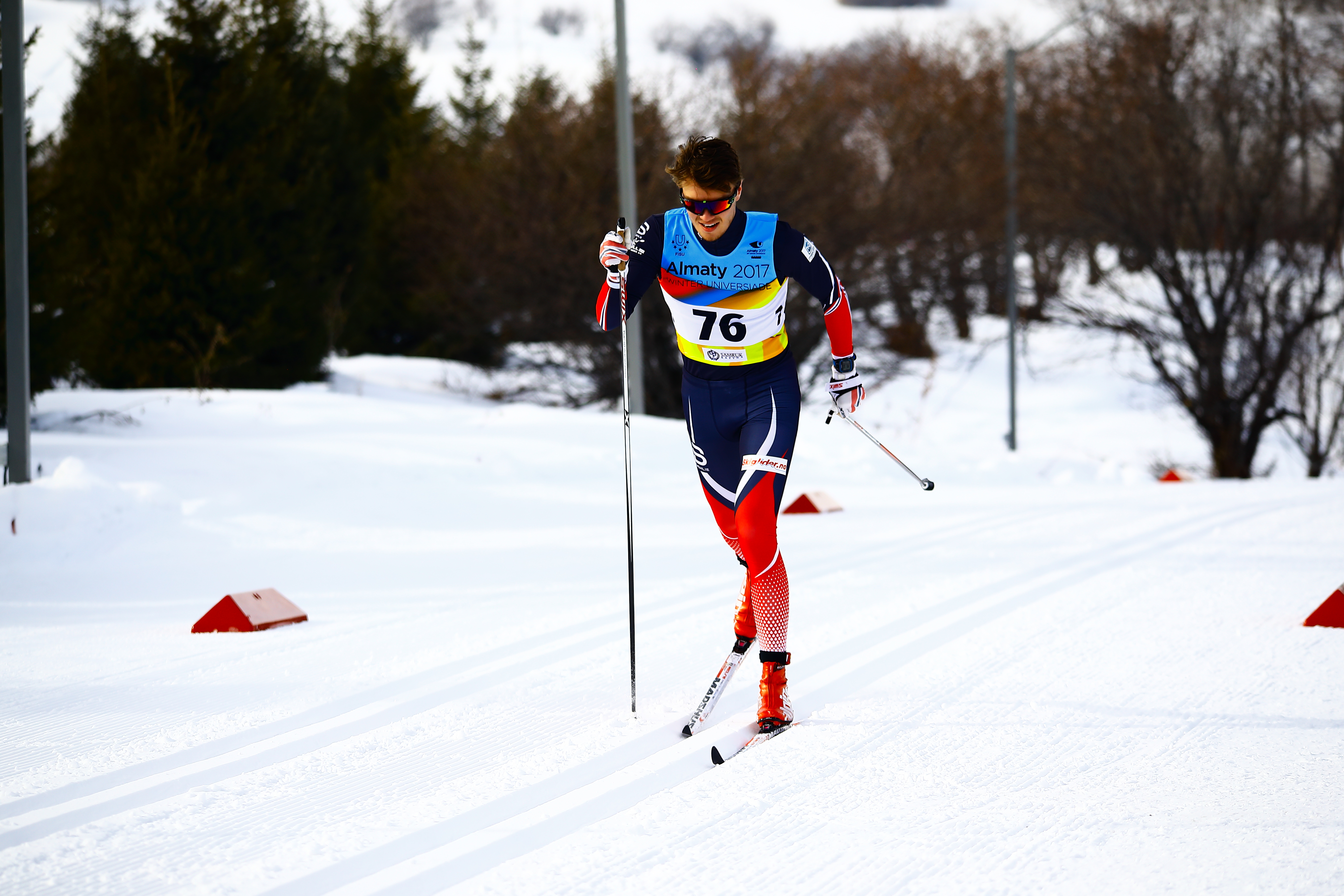
    Jørgen Grav of Ford Sayre competing for Norway at the World University Games in Almaty, Kazakhstan. (Photo: Almaty2017.com)
    Jørgen Grav of Ford Sayre competing for Norway at the World University Games in Almaty, Kazakhstan. (Photo: Almaty2017.com)

    Cross-country ski competitions continued at the World University Games on Tuesday with pursuit races based off the finish times from Monday’s 5 and 10 kilometer classic races.

    In the men’s 10 k pursuit, Dmitriy Rostovtsev overtook Russian teammate (and yesterday’s winner) Valeriy Gontar to win by 14.7 seconds. Armenia’s Sergey Mikayelyan moved from fourth up to third place (+52.0) to claim the final podium spot.

    Jørgen Grav of Norway, a former University of Vermont skier now in graduate studies at Dartmouth College and competing for Ford Sayre, placed 36th, +5:14.4.

    For Canada William Dumas (Skinouk) skied from 48th all the way up to 40th to lead the team and finish +5:26.0.  Carrington Pomeroy (Nakkertok) moved from 57th up to 48th (+6:01.2), Conor Thompson (Université Laval) finished 52nd (+6:33.3), Gavin Shields (Lappe Nordic) 58th (+6:54.6), Jordan Cascagnette (Team Hardwood) 62nd (+7:24.8), and Alexis Morin (Université Laval) 68th (+8:44.1).

    Vincent Mason of the University of Wyoming had the best U.S. finish, clocking in at 55th (+6:36.6). Teammate Will Timmons finished 63rd (+7:29.9) and Sam Wiswell 71st (+9:27.9). Mitchell Hollman (Air Force Academy) 74th (+10:25.1), Kevin Geisen (Western State) 78th (+12:07.6), and Cameron Moore (Western State) 79th (+12:50.0).

    In the women’s 5 k skate pursuit, Anna Nechaevskaya of Russia moved up and stole the lead from Russian teammate (and yesterday’s winner) Lilia Vasilieva (+18.1). Anna Shevchenko of Kazakhstan kept her hold on third place (+21.3).

    Elise Sulser of the University of Wyoming again led the United States, slipping one spot to finish 24th (+3:47.1). Her teammate Meghan Kent was 47th (+6:39.9) and Yara Thomas 50th (+7:20.0). Emma Malmqvist (Colorado Mesa University) placed 53rd (+8:04.7), Sierra Jech (State University of New York) 55th (+8:26.9), and Sierra Foster (Oregon State University) 61st (+10:00.3).

    For Canada, Christel Pichard-Joliceur (Université Laval) finished 31st (+4:35.9). Shelby Dickey (Highlands Trailblazers) followed in 41st (+5:35.9), then Emma Camicioli (Rocky Mountain Racers) in 44th (+5:53.0) and Kyla Vanderzwet (Nakkertok) 45th (+5:54.8).

    World University Games biathlon (Almaty, Kazakhstan): 15/20 k individual

    In the women’s 15 k individual, the first biathlon competition of the Universiade, Kazakhstan took four of the top five places with much of their World Cup team competing on home turf. Alina Raikova won over Galina Vishnevskaya by 2:21.1 thanks to just two penalties to Vishnevskaya’s four. Ukraine’s Nadiia Bielkina was third, +2:23.6 with five penalties.

    The lone Canadian finisher was Jessica Paterson of the University of Alberta, who finished 23rd (+13:06.1) with eight missed shots.

    In the men’s 20 k individual, Baptiste Jouty of France came out on top by 41.0 seconds over Sergey Korostylev of Russia, with two penalties for each racer. Third place went to Semen Suchilov, also of Russia, +1:05.5 with three missed shots.

    Seamus Boyd-Porter of Memorial University led Canada with a 36th-place finish, +13:33.1 and eight missed shots. Taij Isaac Mann of MacEwan University finished 42nd with two missed shots (+19:37.2), and Sasha Eccleston 45th with seven missed shots (+23:07.8).

    No American biathletes competed.

    Results portal

  • Monday Rundown: Soldier Hollow & Almaty (Updated)

    American Bill Harmeyer doing a tele turn on his way back to the stadium after a broken pole took him out of contention in the first men's semifinal on Monday at 2017 Junior World Championships at Soldier Hollow in Midway, Utah. He finished sixth in the semifinal. (Photo: FlyingPointRoad.com)
    American Bill Harmeyer doing a tele turn on his way back to the stadium after a broken pole took him out of contention in the first men’s semifinal on Monday at 2017 Junior World Championships at Soldier Hollow in Midway, Utah. He finished sixth in the semifinal. (Photo: FlyingPointRoad.com)

    FIS Nordic Junior World Championships (Midway, Utah): Classic sprint

    [UPDATED] On the first day of Junior World Championships at Soldier Hollow in Midway, Utah, three U.S. women, four U.S. men and two Canadian men finished in the top 30 to qualify for the heats in the women’s and men’s classic sprints.

    Of those nine North Americans, three reached the semifinals: Julia Kern, Hannah Halvorsen and Bill Harmeyer, all representing the U.S.

    Germany’s Janosch Brugger beat out four Norwegians and a Finn in the men’s final, finishing in 3:43.00 minutes, just 0.04 seconds ahead of Petter Stakston of Norway. Norway had two on the podium with Herman Martens Meyer in third (+3.83).

    Harmeyer reached the semifinal after qualifying in 11th and placing fourth in his quarterfinal. He advanced with a fast-enough time after finishing 1.13 seconds behind Staktson, who won that first men’s quarterfinal. In the first semifinal, Harmeyer stumbled on the course’s biggest climb, broke a pole and ended up sixth, 23.23 seconds behind Stakson, who also won that heat.

    Also for the U.S., Kam Husain qualified 27th and finished sixth in the second quarterfinal, 1.5 seconds behind Norway’s Jo Svinsås, who won the heat.

    In the third men’s quarterfinal, Canada’s Reed Godfrey finished fifth, 7.59 seconds behind Russia’s Vladislav Vechkanov in first, after Godfrey qualified in 25th.

    American Lance McKenney qualified in 29th and went on to finish fourth in the fourth quarterfinal, 2.02 seconds behind Russia’s Egor Kazarinov, who won that heat.

    Two North American men raced in the fifth quarterfinal, with Canada’s Étienne Hébert finishing fourth (+1.43) and American Logan Diekmann finishing sixth (+3.98) behind Norway’s Thomas Helland Larsen in first. Hébert qualified in 13th and Diekmann 23rd to start the day.

    In the women’s final, Russia’s Polina Nekrasova won decisively, beating out two Germans, Antonia Fräbel in second (+3.56) and Coletta Rydzek in third (+4.58).

    Kern, of the U.S., qualified in 11th then placed second in the first quarterfinal, just 0.19 seconds behind Nekrasova, to automatically advance to the semifinals. In the first semifinal, Kern fell and ended up fifth, 28.05 seconds behind Nekrasova, who won that heat as well.

    Halvorsen qualified 13th then won the fifth quarterfinal by 0.75 seconds. She went on to place sixth in the second semifinal, 8.14 seconds behind Fräbel in first.

    American Lauren Jortberg qualified 27th and placed fourth in the second quarterfinal, 4.4 seconds behind Norway’s Kristine Stavås Skistad, who won that heat.

    Results (brackets): Men | Women

    Qualifying results: Men | Women

    ***

    World University Games (Almaty, Kazakhstan): 5/10 k classic

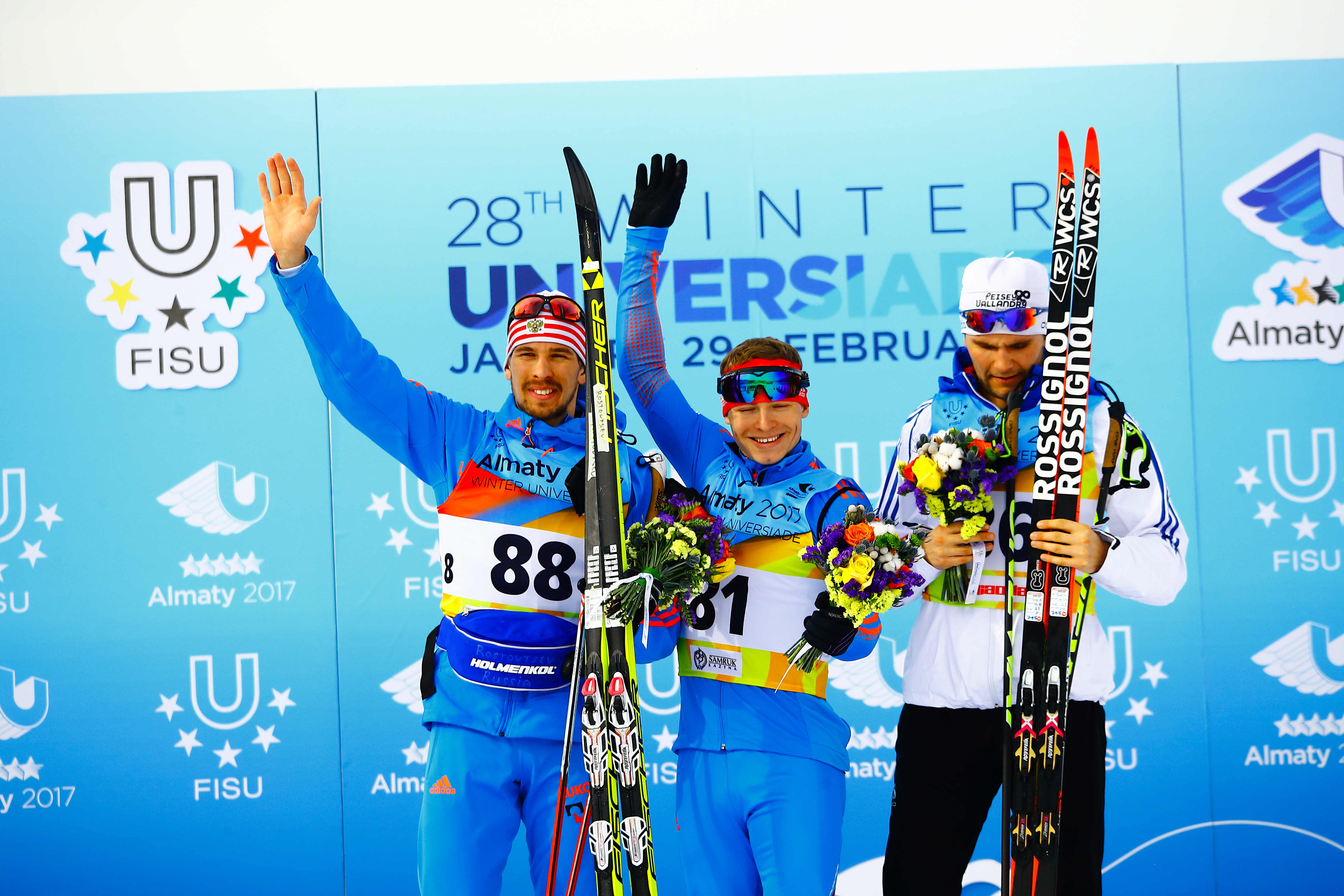
    Dmitriy Rostovtsev and Valeriy Gontar of Russia (l, c) and Alexandre Pouye of France on the podium for the men's 10 k classic at 2017 World University Games in Almaty, Kazakhstan. (Photo: Almaty2017.com)
    Dmitriy Rostovtsev and Valeriy Gontar of Russia (l, c) and Alexandre Pouye of France on the podium for the men’s 10 k classic at 2017 World University Games in Almaty, Kazakhstan. (Photo: Almaty2017.com)

    Russia took four of the six available podium spots in the opening day of nordic racing at the World University Games in Almaty, Kazakhstan.

    In the 10 k classic, Valeriy Gontar took an 8.9-second win over Russian teammate Dmitriy Rostovstev. It was an upgrade for Gontar, a student at Penza State University, who was third in this event at the 2015 Universiade. Rostovtsev is a former podium finisher at U23 World Championships. Alexandre Pouye of France was third, +21.8.

    Vincent Mason of the University of Wyoming had the best U.S. finish, clocking in at 44th (+2:54.0). Teammate Will Timmons finished 73rd and Sam Wiswell 80th, Mitchell Hollman (Air Force Academy) 82nd, Kevin Geisen (Western State) 84th, and Cameron Moore (Western State) 85th.

    For Canada Jordan Cascagnette (Team Hardwood) finished 49th, +3:12.3. Conor Thompson (Université Laval) finished 53rd, Carrington Pomeroy (Nakkertok) 57th, William Dumas (Skinouk) 58th, Gavin Shields (Lappe Nordic) 59th, and Alexis Morin (Université Laval) 77th.

    In the women’s 5 k classic, Lilia Vasilieva earned a 13.3-second victory over Russian teammate Anna Nechaevskaya, a podium finisher at last year’s Russian National Championships. Anna Schevchenko of Kazakhstan – who started the season on the World Cup and finished 32nd in the La Clusaz 10 k – was third, +15.2.

    Elise Sulser led the United States in 23rd place; the University of Wyoming skier was 1:58.4 off the pace. Teammate Meghan Kent was 48th and Yara Thomas 49th. Emma Malmqvist (Colorado Mesa University) placed 50th, Sierra Jech (State University of New York) 60th, and Sierra Foster (Oregon State University) 61st.

    For Canada, Christel Pichard-Joliceur (Université Laval) was one spot behind Sulser in 24th (+2:02.5). Emma Camicioli (Rocky Mountain Racers) placed 40th, Shelby Dickey (Highlands Trailblazers) 43rd, and Kyla Vanderzwet (Nakkertok) 47th.

    Results

  • Gibbs Returns to Coaching, This Time with Team Australia

    Gibbs Returns to Coaching, This Time with Team Australia

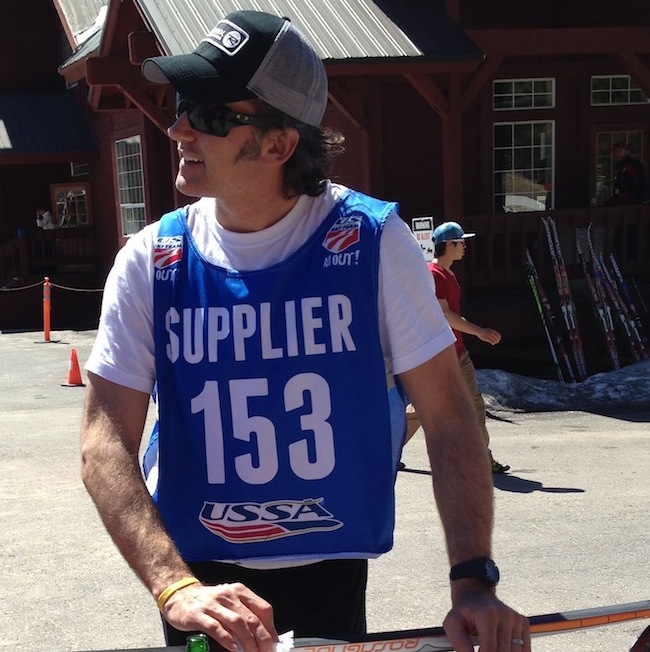
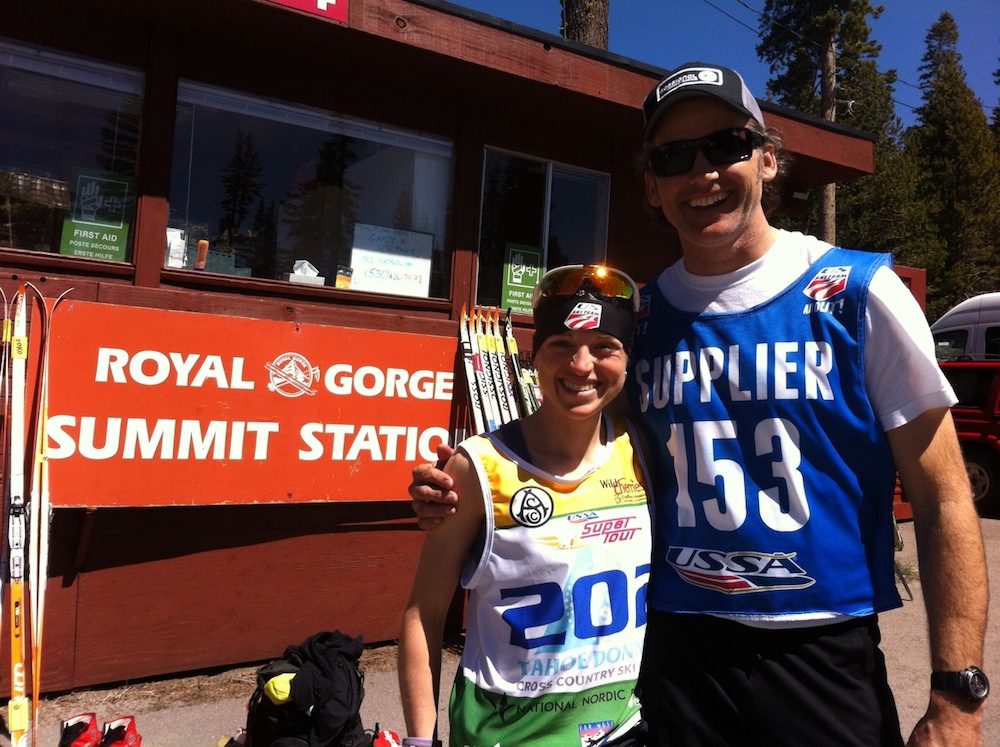
    Randy Gibbs with Liz Stephen, whose skis he waxed at 2013 Spring Series. Courtesy photo.
    Randy Gibbs with Liz Stephen, whose skis he waxed at 2013 Spring Series. (Courtesy photo)

    A serviceman for the U.S. Ski Team for eight years, Randy Gibbs recently called it quits. With a new baby in the house – his family’s first child – the World Cup lifestyle didn’t seem like a good fit.

    “I have a new daughter who is 20 months old now, and it was just going to be too much traveling to be gone 100 days over the winter when she’s just a year and a half old,” he explained in a phone interview. “I couldn’t. It’s hard enough to go just for two days. It was a good decision. It’s been great to be around her as much as possible.”

    But he was, in a way, still itching for the international racing trips, as well as for coaching – which he had done for 14 years in Minneapolis before joining the U.S. Ski Team staff. So when Australian Head Coach Finn Marsland asked him about leading one of his team’s trips this season, Gibbs was intrigued.

    That’s how he ended up in Strbske Pleso, Slovakia, last week, coaching the Australian team at World University Games.

    “It worked out perfect for me, because it was just a two-week trip and it was awesome,” Gibbs said. “It was really fun to be a coach again, too.”

    The trip was a success for Australia, with Jessica Yeaton and Phil Bellingham both finishing eighth in the individual sprints, best-ever results for their country.

    “Philip just missed the final by, like, a binding length,” Gibbs lamented. “He just missed the lucky loser. He could have had it I think. It was really close. He was really bummed he didn’t have just a little bit left to push and get in there.”

    Callum Watson, who is recovering after a horrific ski crash that left him with a punctured lung, also notched two top-30’s.

    Overall, Gibbs found the Australians fun and easy to work with – and said that the transition from acquaintance to coach at a major international event was “seamless”.

    “It was really easy because all the athletes are really accommodating and were really interested to hear my ideas about things,” he explained. “We just bounced ideas off each other – I didn’t want to come in there and change everything they had been planning all season. They all pretty much already had a plan. But each day, coming up with a strategy for the next day and going through everything from the captains meetings, and things like pointing out strategic places to make moves on the course.”

    Gibbs and Marsland are hoping to continue the partnership. Bellingham and Watson may attend Spring Series in Sun Valley, Idaho, where Gibbs will be waxing for the Sun Valley team and U.S. Ski Team member Liz Stephen (“Burke doesn’t have much of a team anymore,” Gibbs said of her club affiliation), but will add the Aussies to his roster.

    He’s also looking at making up to three trips with the team next season, and working towards 2017 World Championships in Lahti, Finland, as well as the 2018 Olympics.

    “It depends on how everything goes with their budget and their team,” he said. “It’s perfect for me because I can work a little bit, and still make a difference and still have a great time and help them out. But I don’t have to commit to a whole 100-plus night season.”

    And as for the World University Games itself, Gibbs – who spent years attending World Junior and U23 Championships as well as traveling the World Cup – was impressed with the event.

    “There was some really good competition,” he said. “Especially in the men’s. It was like a Russian army out there – some pretty high-end dudes. And the courses were extremely hard there. They were harder than 99% of the World Cup venues, for sure. Steep, pretty long climbs, and not really any rest. Some good high-speed corners and downhills.”

    He explained that the event is one of only a few series that FIS explicitly sanctions and sends representatives to. The others are senior, junior, and U23 World Championships, the Olympics, and the World Cup. And some racers who have competed at those other events were also at World University Games – like Russia’s Andrey Larkov and Anton Gafarov, Kazakhstan’s Anastasiya Slonova, Poland’s Maciej Starega, and much of the Japanese team.

    “It was really well-run,” he said. “Even the opening ceremony was really hard core! There were thousands of people who drove up the mountain to watch, too.”

    He’s now wondering why it isn’t on the schedule for top U.S. racers. (The University of Wyoming has been sending its team for the last several years, but there is no trials-based selection as for World Juniors and U23s).

    “I’ve been asking too, especially now [that I’ve seen it],” he said. “I’ve told those guys that we have to start doing that. It would be a great thing for the athletes who are just below making the World Junior and U23 teams.”

    When he’s not working for the Australians, Gibbs is spending his time on two other projects. The first is a non-profit, Jenny’s Light, founded in the memory of his sister to combat post-partum depression. Gibbs serves as the Executive Director.

    “I’ve been able to do more this winter than previously, which is good too,” he said. “It’s going well and it’s not coming to a grinding halt every winter like it had been.”

    The second is Mantra Wax, a ski wax company which he launched with his U.S. Ski Team coworker Oleg Ragilo in 2013. Business is good, Gibbs said, but with a limited budget one of his main investments is time.

    “It’s basically just word of mouth sales,” he said. “A lot of World Cup teams have bought a bunch of product, more than I thought this season. A bunch of teams at World University Games got some. And a lot of junior nationals teams already have some. Those coaches I’ve known for 20-some years and they are really psyched to try it out. I’ve gotten a lot of good feedback.”

    He hopes to see Mantra Wax make a splash at the upcoming World Championships in Falun, Sweden.

    “I’ve got a guy in Sweden who has been testing on the World Championships courses in Falun for the last month, and he will continue to do so and send me test results, and then I send those to all the World Cup coaches,” he said. “I’m trying to get people fired up about knowing what’s going to work there.”

  • For Some Countries, World University Games Offers Bragging Rights; For University of Wyoming, It’s the Trip of a Lifetime

    For Some Countries, World University Games Offers Bragging Rights; For University of Wyoming, It’s the Trip of a Lifetime

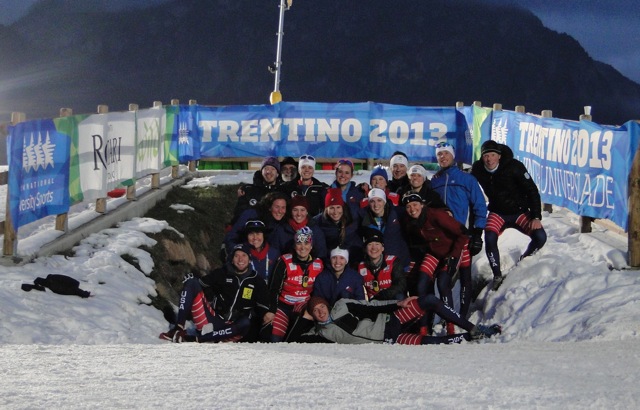
    The University of Wyoming ski team at World University Games in Trentino, Italy, in December 2013. Photo: UW Ski Team.
    The University of Wyoming ski team at World University Games in Trentino, Italy, in December 2013. Photo: UW Ski Team.

    The University of Wyoming has a unique ski team. Competing in the U.S. Collegiate Ski Association (USCSA) but also as an affiliate member of the Rocky Mountain Intercollegiate Ski Association (RMISA), the Western division of NCAA skiing, the team bridges a lot of ground.

    Their roster boasts skiers who competed at Junior Nationals in high school. It also includes athletes who had never skied before college. The squad is run not only as a sports team, but as a college course with an integrated curriculum for which athletes receive grades and credits. When it comes time for team selection, most spots are based on speed but a few are based on “Steamboat Points”, named after the university mascot and consisting of GPA, volunteer work, and practice attendance, among others.

    Oh, and one more thing: the team will be representing the United States at the World University Games in January, its third such trip. This year the competitions will be held in Slovakia in late January. Olympians and World Cup athletes will likely be in attendance; past podium finishers include Justyna Kowalczyk, Nikolay Chebotko, Maxim Vylegzhanin, Yulia Tchekaleva, Bettina Gruber, and Baptiste Gros.

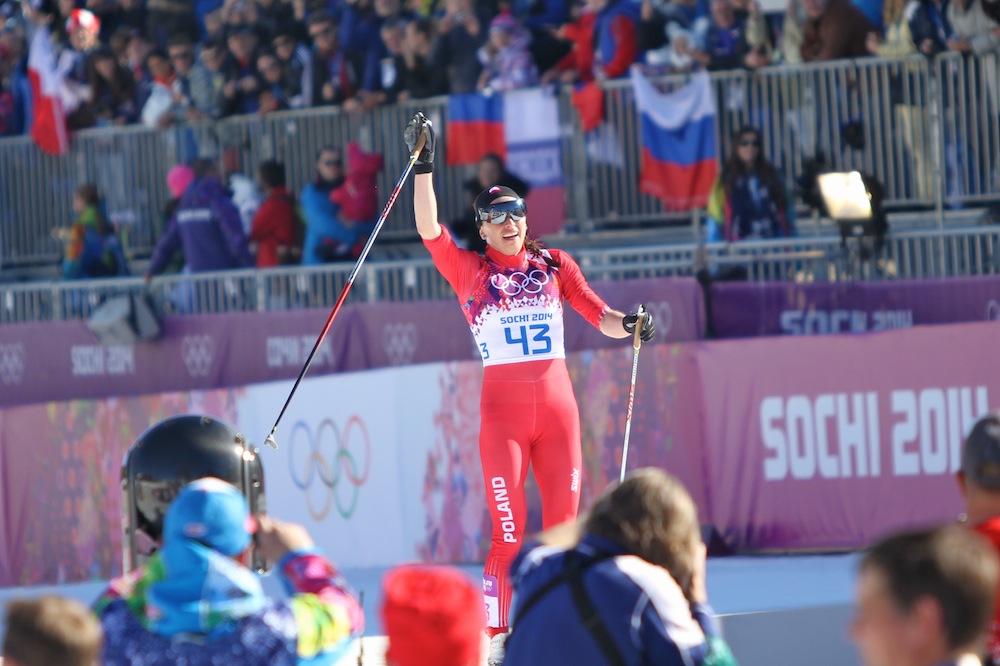
    Poland's Justyna Kowalczyk used a sweep of World University Games races as preparation before becoming one of the most sucessful skiers of the 2000's - for example here after winning gold in the 10 k classic individual start at the 2014 Olympics in Sochi, Russia.
    Poland’s Justyna Kowalczyk used a sweep of World University Games races in 2007 as preparation before becoming one of the most sucessful skiers of the last decade – for example here after winning gold in the 10 k classic individual start at the 2014 Olympics in Sochi, Russia.

    “Every year we don’t expect to be asked to do it again,” said Christi Boggs, one of the team’s co-coaches. “We assume that at some point some forces will come together and we won’t be asked. And that’s fine – we’ll do it when we have the opportunity, and when we don’t, we’ll do something else.”

    UW has won four men’s national titles since 2006 and six women’s titles since 2003. Boggs believes that their success at USCSA nationals is what prompted the United States International University Sports Federation (US-IUSF) to offer them the spot. (The United States Olympic Committee used to manage World University Games trips and selection, but abruptly cut all funding for it just before the 2009 Games).

    But when they reach the world stage, things go to a whole different level.

    “It’s a very interesting field because last year we literally had people who made Olympic teams racing,” Boggs said. “The Russians use this as a ‘B’ team competition, so they send their B team, which is freaking fast. They’re not really students, they just get someone to sign a form… Interestingly enough, the level of competition is actually not as high as the western RMISA competition. The FIS points are really similar.”

    Boggs isn’t quite honest about that. Last year the top Western NCAA skiers went to the Universiade, and while some did well, they didn’t win. Instead the results sheet was scattered with names like Michaeil Semenov of Belarus, whose 17th-place finish in the 50 k at the Olympics was one spot ahead of Petter Northug – and beating all of the North American entrants. Or Oeyre Silje Slind, who later that season finished fifth in the 30 k at Norwegian national championships – beating Heidi Weng in a sprint finish.

    UW athletes rarely break the top 50 and are minutes behind the winners.

    “You see some of them go to these games and get pummelled,” Boggs admitted. “Some of them, they’re not doing very well. But it inspires them to be better. Or it makes them think, if I get better, I could actually do this too. We’ve seen an incredible amount of that.”

    They do improve. Few racers do the trip twice, but William Via, for instance, received FIS points over 100 points lower at the 2013 games in Trentino than he had at the 2011 games in Erzurum, Turkey.

    Times and numbers don’t tell the full story of UW at the games.

    “Racing is one of the greatest joys in my life and to be racing internationally has been a dream of mine for years now,” team member Sam Wiswell wrote on the team blog last season. “[Here] I am, competing against some of the best in the world.”

    “The chances that I have been given overwhelm me,” wrote teammate Elise Sulser, who finished 49th in the 5 k and later won an individual title at USCSA National Championships. “I can only hope I can have the courage to take full advantage of the impacts, and end up completely spent in a gasping heap on the finish line knowing that the job was done fully well. Being content in knowing that I have nothing left to give is the best feeling in the world. Collisions, impacts, chances: make the most of the moments you’re given.”

    As Boggs pointed out, the difference between RMISA and the University Games is the depth of the field: aside from Russia, there are many countries who do send actual students. Against those teams, UW can compete, and the experience is very rewarding.

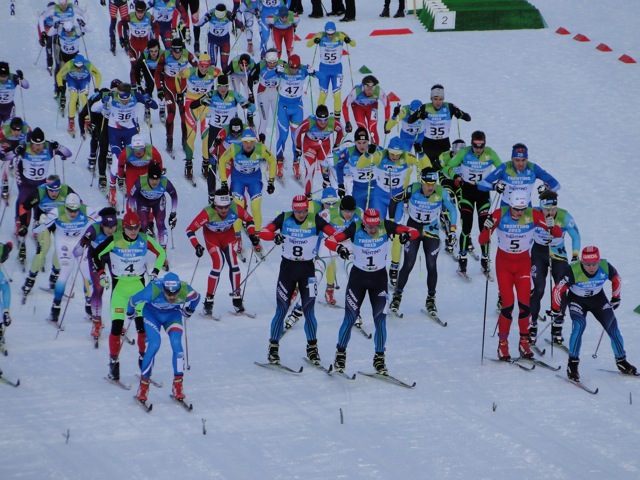
    The start of one of the World University Games races in Trentino. Photo: UW Ski Team.
    The start of one of the World University Games races in Trentino. Photo: UW Ski Team.

    Australia sends its national team, for example – and according to Boggs, some of her skiers can hang with them.

    “We compete clearly not at the World Cup level because we’re just not there,” she said. “But we compete with the other teams who are full-time students.”

    Sierra Jech, a USCSA national champion who aspires to continue skiing after college, said that the experience helps her, and others, do better in their races back in the U.S.

    “Once of the kids of that team is someone who started skiing in college,” she said. “I know he was extremely nervous… It’s more helpful in the NCAA races that we go to. The ones where just hanging on is hard. I’m more excited for them now than stressed out and nervous.”

    Boggs and her co-coach Rachel Watson say that they can watch their athletes grow before their very eyes at the Games.

    “It’s entirely life-shaping,” Watson said. “Increased poise, an ability to handle stressful situations, maturity, and definitely changes in the way they approach what would be a more stressful race at home – it no longer seems so stressful. It changes perspective.”

    Who Makes the Decisions?

    According to Boggs, the trip costs about $3500 per person. Part of that is airfare, and part goes to BTI – a trip company contracted by the US-IUSF to arrange everything for the teams going to the Games.

    And therein lies the rub for other college athletes who might like to attend: who can organize a trip where the money is due more than six months ahead of time?

    Most countries have some sort of selection criteria and send their fastest skiers who are registered students. The event is on par with the competition level of World Junior Championships or U23 World Championships (even more so in biathlon, where an actual senior World Championships medalist hit the podium; few North Americans compete because biathlon is not a college sport).

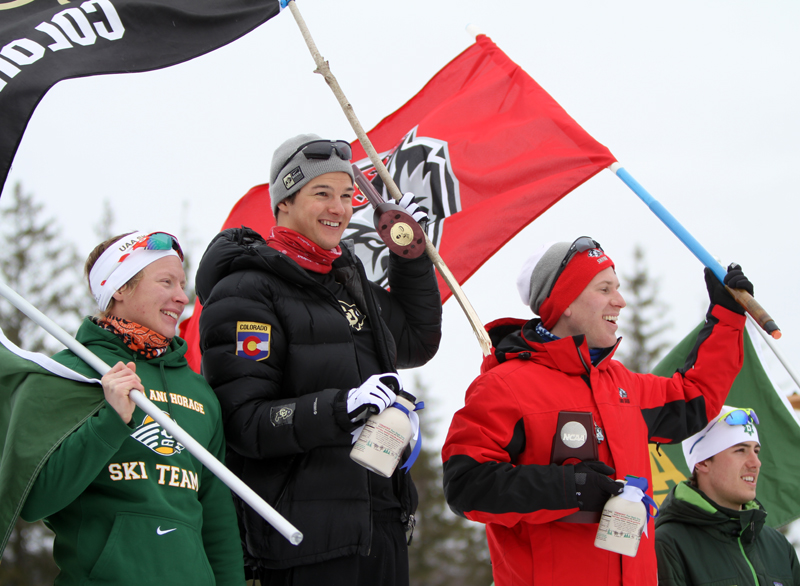
    Two-time NCAA champion Rune Oedegaard (CU, middle) finished 8th in the 10 k skate and 5th in the 30 k classic representing Norway at the 2013 Universiade; the American skiers he competes against in college races can't attend the championships.
    Two-time NCAA champion Rune Oedegaard (CU, middle) finished 8th in the 10 k skate and 5th in the 30 k classic representing Norway at the 2013 Universiade; the American skiers he competes against in college races can’t attend the championships.

    A number of European skiers who race at U.S. colleges always attend, as do the fastest students from Scandinavia, France, and Germany; Canadian skiers have sometimes spent time at a National Training Center or competed at age-level World Championships events before. But for American skiers of a similar caliber, the phrase “World University Games” probably isn’t even on the radar.

    It wasn’t always so, and some college coaches are interested in sending athletes. Last year, most of the Denver University team attended, with Europeans representing their own countries and one American athlete traveling with UW. And coaches have tried to pull something together.

    But the initial fee required by BTI presents a challenge. Athletes are likely not chosen months in advance, and there’s no organizing body to pay ahead of time and manage cash flow from competitors who commit come winter.

    “[Michigan Tech coach] Joe Haggenmiller led a few of us into looking hard at access to the World University Games,” Dartmouth College women’s coach Cami Thompson wrote in an e-mail. “We met a few times and talked to the U.S. Ski and Snowboard Association (USSA) and the National Nordic Foundation (NNF) about helping with the trip.  The issue is that the travel company… wanted $10K up front in early summer. As a loosely-knit group of college programs, we don’t have access to that money and while NNF was willing to work with us to try and figure it out – in the end it was time sensitive and just didn’t happen.”

    Contacted over e-mail, USSA Nordic Program Manager Joey Caterinichio said that her organization would be happy to have higher-caliber U.S. athletes go, but that USSA had no say in the decision-making process. She couldn’t remember the name of the US-IUSF or BTI.

    “It’s simple,” she wrote. “It’s not a USSA managed event. He who can pay the deposit by a certain date wins. There is no criteria.”

    Caterinichio explained that she had been involved in trying to draft selection criteria for a team made up of top NCAA skiers, but like Thompson, said that the deal just fell through.

    However, Thompson suggested that USSA was less than 100% supportive of a World University Games trip.

    “USSA is reluctant to support it if it means some top athletes choosing that over U23 Champs,” she wrote.

    Regardless of the many reasons that a top-level team doesn’t attend the Games, it means the U.S. is missing a valuable development opportunity. For a country that frequently laments a lack of international experience for its skiers, and the long time it might take some athletes to get used to racing in Europe, that seems like a loss.

    “I would certainly support any athletes who were interested in going, if it made sense from an athletic/financial standpoint,” Thompson wrote.

    Lifelong Experience

    Nobody at UW says that paying the fees to BTI is easy. The team receives some money from the university because the trip is run as a class and can thus receive funding as a study-abroad type trip. The rest of it comes from hours and hours of fundraising and volunteer work.

    But they can do it, so, as Caterinichio says, they get to go.

    And that might be perfect. Fierce competition is not the only focus of the University Games. The university federation (FISU) which organizes summer and winter Universiades has this as its philosophy:

    “The FISU (International University Sports Federation) was formed within university institutions in order to promote sports values and encourage sports practice in harmony with and complementary to the university spirit. Promoting sports values means encouraging friendship, fraternity, fair-play, perseverance, integrity, cooperation and application amongst students, who one day will have responsibilities and even key positions in politics, the economy, culture and industry. As allies or competitors, perhaps even as antagonists, these men and women will have learned how to collaborate and deal with every eventuality, whilst respecting the ethical code enshrined in these values. Promoting sports values and sports practice also implies giving a new dimension to the university spirit in study, research, and discipline, through the strong affirmation of the full humanist development of the individual and of society at large. This development is not just intellectual, but also moral and physical.”

    In that sense, the UW team is a genius fit for the event. For instance, the co-coaches’ decision to make the trip into a class fulfills many of those goals.

    Excerpt from the UW Ski Team’s Course Descriptions for 2014 Universiade
    Purpose/need/justification of project:
    In January 2015, the Nordic Ski Team at the University of Wyoming will attend the World University Games (WUG) in !trbské Pleso, Slovakia. The host country had only one year to prepare for this large-scale competition including accommodations, food, and transportation for over 1800 athletes, delegation members, and spectators.[1] Large sporting events like WUG have major impacts including: changes to the local economy, carbon emissions, increased waste generation, and personal impacts on community members. [2] These impacts all sum to create a “footprint” at both the local and global levels. This project as a whole aims to provide an analysis on each of these individual impacts and to examine our team’s footprint at WUG by taking environmental, societal, and economic perspectives.

    “We also have a class because we feel like it makes the experience a lot richer, and makes them consider things a lot more if they are not just ski racing, but they’re also involved in some curriculum,” Boggs said.

    She was careful to say that much of the actual work involved in the class is done before or after the trip itself, because the skiers do focus on racing when they are at the event.

    But some activities, like blogging and journaling, actually help them focus their energies.

    “Last year we had a class as well, and we just had a blog and focused on journaling during the event,” Jech said. “That really spurred us to want to do more. It was definitely beneficial.”

    And the trip provides a very unique experience, one that Watson and Boggs say is so important that they’ve decided to keep doing international trips even after the point if/when they are no longer asked to do the World University Games.

    “We’re taken people to the Games that have never been on planes, or have never been out of Wyoming, or have certainly never been to Europe, ever,” Boggs said. “That kind of experience is huge for young people.”

    Ultimately, Boggs and Watson hope that many of their athletes will stay involved in sport. They have seen results: when they travel to races inside and outside of Wyoming, they see many alumni either racing or coaching.

    The trip to World University Games helps with that.

    “It definitely made me realize that it’s possible to keep skiing and keep improving, even if it’s – college seems like the end for a lot of skiers,” Jech concluded. “This is definitely an event that inspires me to keep skiing. And I know that inspires other people to keep pushing, and to become coaches.”

  • NCAA Champion Uhl Represents Germany at World University Games

    Juergen Uhl en route to NCAA glory two years ago. Photo, flyingpointroad.com.

    VTXC team member and former University of Vermont (UVM) standout Juergen Uhl, a 2009 NCAA champion in the men’s 10 k classic, recently competed at the World University Games in Erzurum, Turkey. Unfortunately, Uhl came down with the stomach flu upon arriving in Turkey, which stymied his efforts on the trails. Nevertheless he finished 25th in the 10 k classic and 42nd in the 15 k continuous pursuit while representing his home country, Germany.

    Uhl wanted to be sure to thank the UVM coaches and athletes for their support, as well as the group around VTXC, especially Sam von Trapp and Ryan Kerrigan, who made the trip possible.

    FasterSkier caught up with Uhl to talk about his experience at the University Games, and what skiers can expect to find when the site hosts World Junior and U23 Championships next year.

    FasterSkier: Why did you decide you wanted to do the University Games, and what did you have to do to qualify?

    Juergen Uhl: I am pursuing a Masters degree at the University of Vermont and I love ski racing, but my NCAA eligibility is done. So I decided that it would be fun to set myself a goal for the season that I can reach, and that is a little out of the ordinary. I had heard about the University Games through friends and it seemed like it was just the event that I was looking for. I checked out the conditions for me to take part in it. The great support by my advisor, Professor Douglas Fletcher, and the fact that Germany requires one race below 100 FIS points made me believe that I could do it!

    FS: It looks like you were the only German skier over there – did you have support?

    JU: The German team is fairly small in numbers compared to the teams of other large sports nations, however we still have about 25 athletes and a full delegation of officials, coaches, athletic trainers and a doctor. I am the only cross country skier, but we have a couple of nordic combined guys and a couple of biathletes who need support on the race course. The five of us shared a coach and a wax tech, which worked out to be perfect.

    FS: The 10 k classic would obviously have been your best race… but you were sick. How would you say your race compared to what it would have been like if you were healthy?

    JU: I just felt flat for the races due to the stomach flu earlier in the week and the marathon of events that we had when we arrived in Turkey. My striding was not as powerful, and I ended up getting tired early in the race. I was racing, but I noticed during the race that I really was not able to give as much as I usually would. It is very hard to place myself for the case that I would have been healthy- I think for a good race I would have just cracked the top ten.
    FS: Could you describe the level of competition? I saw some names I recognized in the women’s field at least – it looks like there are some really fast people but also a pretty big spread in talent. Is that accurate?

    JU: The spread was large – yes. The winner in the 10 k classic race for the men was about 55 seconds ahead of the second competitor and the last person finished 15 minutes back.

    I checked out the FIS profile for the winner, from Russia – he was 13th in the 15 k classic World Cup race a couple of weeks ago in Otepaa and he won the 15 k classic at the U23 Worlds in 2010. The last finisher is from Venezuela. He made the trip to Turkey to get good FIS points (300) so he would be able to race in the next Olympic Games.

    To sum it up, the field was made up by a hand full of top racers, a dozen semi-professional skiers who are maybe taking one class and race on the Europa Cup circuit, and a large amount of true collegiate racers and some students who enjoy ski racing but may or may not be following a training plan.
    FS: You said it was like a small Olympics and there was tons of stuff to do. What are some of the activities and programs?

    JU: The event has a funny touch in that sense – most competitors are second level racers, meaning that they are good but they would not be racing on the World Cup circuit, except maybe the first three or four for each event. However the event was organized close to what I think the Olympics would be! There were more than 3,000 competitors from a total of 56 nations.

    The schedule we followed in the beginning was crazy, especially because going for a ski itself already takes a long time. We stayed in an athletes’ village with security screening every time you enter and free meals. This also meant that we didn’t have our own vehicles, but everyone used the organized transportation system. The system sort of worked – the occasional very late departure and wrong turn on the way to the courses didn’t really help in saving time considering that the ride itself takes about 40 minutes when things go well. So a one hour ski already took at least four hours of time.

    But finally to the program. In the beginning of our stay we had a fair amount of official appearances to make. We arrived late on Tuesday, a short ski on Wednesday – then we were asked to take team pictures directly followed by a flag ceremony and directly followed by an appearance at the embassy to meet with the German ambassador. And since my bags had not arrived the first day, I went on a trip to the airport to get them, which gave the day another late night finish.

    Thursday ended with the opening ceremony, which would conclude at midnight- nice race prep! I decided to go anyway. I mean, I was tired from getting over the stomach flew and all the events but I was told that it would be a great event. It was. Germany was the first country to enter the stadium – it was sick. 21,000 people including the president of the country were cheering while we walked around the track, and there was an amazing show after. Oh yeah – there was the lighting of the torch! It was a scene that reflected the horse and fighting culture of the Ottoman Empire – the final part was that an Ottoman on a horse threw his burning javelin from about 30 yards over an oversized torch in the stadium to light it up.
    FS: Have you gone to watch any of the other sports?

    JU: Yes. I stayed with the nordic combined guys, so I ended up watching most of their events. I also watched pretty much every ski jumping event because the jumps are right in town next to the village and there is no bus ride necessary. I watched a curling game, skier cross and some figure skating. It was easy to catch most of the events at least on the screen because they were all fully televised on eurosport2 and all the events would be shown live on a big screen within the village and on several screens in the dining hall. Another crazy add-on to this is that they use the newest camera techniques. A flying camera on the ski jumping complex and in the stadium for the opening ceremony and even a driving camera on the finishing 100 meter stretch in the Cross Country stadium.
    FS: What’s been your favorite part of the experience so far?

    JU: I don’t think there is a single favorite thing. There will be so many memories (except maybe the races…) that I will be taking home from this place. The opening ceremony is definitely right up there though! Then there is funny/frustrating ones:

    • They groomed the classic course about five minutes before the start.
    • Every nation brings along pins and apparently everybody wants them. A normal conversation with one of the volunteers: “Where are you from?” “Germany.” “Ah, I like Germany. Pin?”
    • The amount of pictures that I am in doubled in the last two weeks.
    • Turkish men walk arm in arm as a sign of friendship. I went on a City tour and the guide seemed to like me.
    • I was able to get up on the jumps during the last competition – it was fun to see how the guys prepare.

    There are many more – in general I would say that my main experience is that Turkish people are very nice and welcoming people, especially once you know a couple of words in their language. They eat good food, they are always on the phone and they love sports. The nordic events were too far away but all other events were blessed with full bleachers. However they are not a winter sports nation, which caused sometimes trouble with the race preparations.
    FS: Finally, World Juniors is there next year so everyone is wondering what it’s like to ski in Turkey. What is the venue like? How are the trails?

    JU: I think that the people will enjoy the venues! The jumps are definitely the highlight of the place and will be for the events next year – but the race trails for the nordic complex are not far behind.

    The nordic events will be in Kandili, which is about 40 minutes out of Erzurum and close to 2000 meters high. The climate, landscape and the snow very much reminded me of Utah, so a ski that works in the dry western snow will be good to race on here. Our wax tech, Fabian Mauz, went to school for climate research. He was a wax tech for the Swiss team and one of the people who did climate studies in Soldier Hollow for the Olympics. He confirmed that snow and the way it transforms was similar. An example would be that our thermometer (in the sun) would show 20C but we ended up racing on hard wax.

    The race courses are hard! It reminded me of the race course at the jumps in Lake Placid. The uphill is a bit longer and steeper but that may have felt that way because I was not 100% fit, and it is at altitude. They have two 2.5 k and two 3.75 k loops; there may be a 5 k loop if there is snow. The courses are all on the same little hill – both 2.5 k loops go up the hill and back down. The 3.75 k loops are similar in a way that they are the same for almost all of the 2.5 k loop but you end up going back down almost all the way once or twice to make your way back up to the top.
    I am sure they got enough feedback on the grooming so things should go smoothly. They have enough snowmaking and new equipment. It will be a perfect venue.

    A final remark would be that you need to go out for cai kebab – it is a special kind of kebab and Erzurum is famous for it. It is lamb meat, so fairly greasy. I did not have any trouble with it but I heard that some people did. So I would not recommend it as a pre-race dinner.

  • Major Preparations Underway in Turkey for 2011 World University Games

    Major Preparations Underway in Turkey for 2011 World University Games

    The Turkish Ski Federation is making great progress in the development of skiing in Turkey and hosting the 2011 FISU Winter University Games (known as the Universiade).

    The planned site of the competitions, Erzurum (at 1850m), is the biggest city in the Eastern Anatolian region and is also a very ancient settlement. Located at the skirts of Palandoken Mountain, the city has gained great importance in the field of winter tourism in recent years.

    Just 150 km from the border with Georgia to the north east, 200 km to Armenia to the east, 250km from the boarders of Iran and Iraq to the south and 300km to Syria to the south west, Erzurum is uniquely positioned in the world of skiing. The ski areas around Erzurum now annually host international ski tourists from Iran, Russia, Israel and the Netherlands. The ski areas are open from December until April.

    The Turkish Ski Federation owns the ski lifts, snow making facilities and grooming machines for pretty much all of the ski areas in Turkey. Their goal is provide one season pass available at all ten ski areas in Turkey. There will be seven new high speed lifts installed and snowmaking installations with significant reservoir capacity.

    The staging of the FISU Winter Universiade, set in late February 2011, has led to a great deal of new development in ski lifts, 14 km of a new snowmaking system, a new ski jumping facility, snowboard and ski half-pipe–the first in Turkey–as well as a brand new ski area for the Alpine competitions.

    The Snowboard and Freestyle events will be held at Palandoken Mountain (2000m to 3150m) just minutes from the center of Erzurum. The brand new ski area is called Konakli, some 20 minutes from Erzurum, and it will host the alpine competitions in four events. The new 125m and 95m ski jumps are located at Kiremitliktepe while the area of Kandilli will host Cross-Country and Biathlon competitions. It has been estimated that over 30 million Euros will be spent on the development of new winter sports infrastructure including 10 new grooming machines.

    For more information visit http://www.universiadeerzurum.org