Tag: World Youth Biathlon

  • After Top-Ten Pursuit Results at World Juniors, Canadian Biathletes are Satisfied – And Also Hungry for More

    After Top-Ten Pursuit Results at World Juniors, Canadian Biathletes are Satisfied – And Also Hungry for More

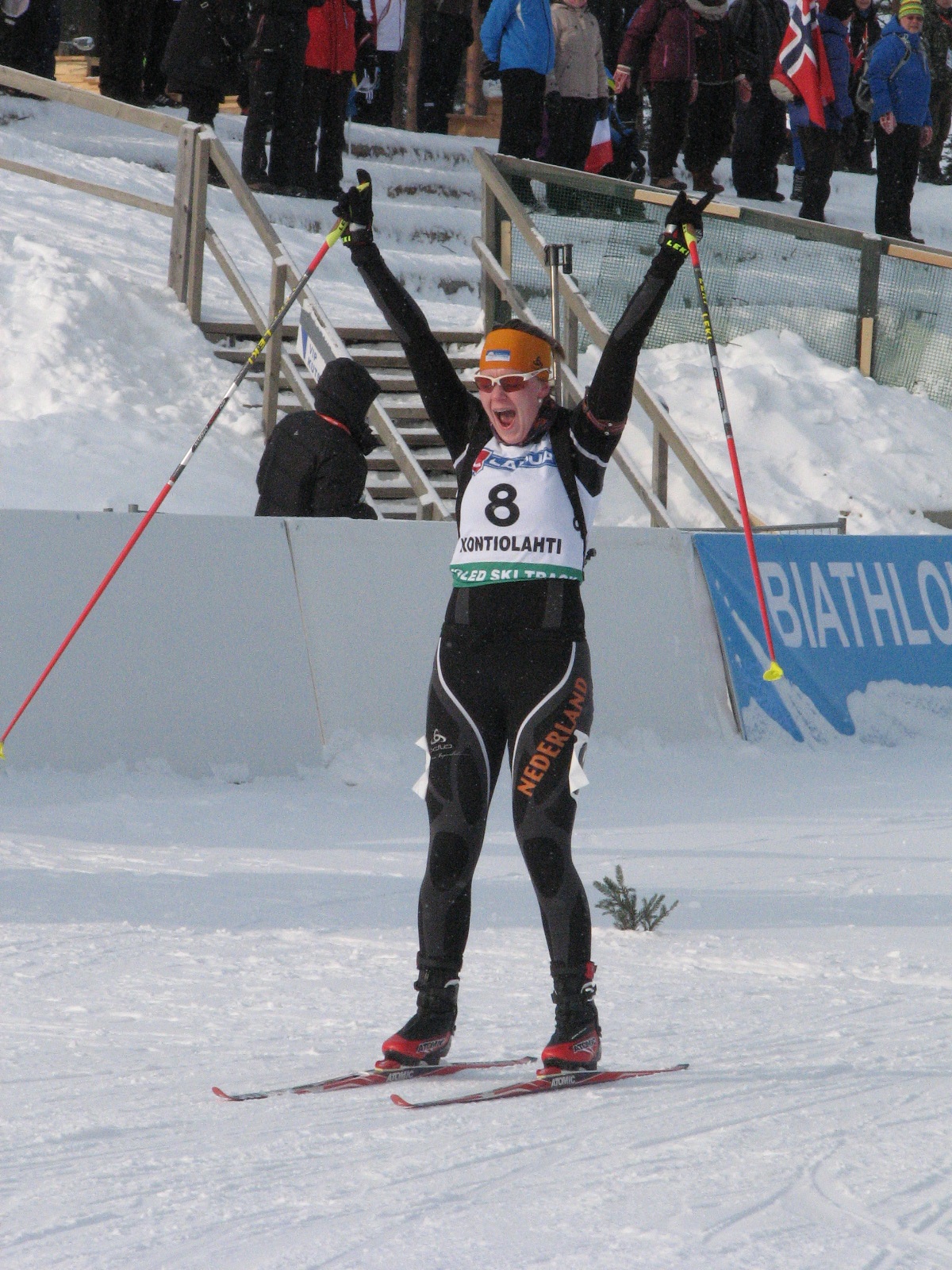
    Julia Ransom (CAN) and Grete Gaim (EST) hug it out after their youth women's pursuit race on Sunday. Photo: Judy Geer.

    As soon as biathlon World Youth and Junior Championships ended on Sunday in Kontiolahti, Finland, the Canadian team headed for home, making for a hectic afternoon. Because of the quick turnaround time FasterSkier was unable to touch base with the athletes directly after their races, but now that they’re back on home turf – along with the medals they earned – a few of the top competitors were willing to talk about the week.

    It seemed like things couldn’t start off much better than they did for Canada, with Kurtis Wenzel winning gold in the junior men’s individual on the second day of racing. But if anything, the last day of competition just might have been better.

    Wenzel raced from a start position of 23rd up to seventh place; youth Stuart Harden made a similar move, improving from 25th to sixth; and Julia Ransom advanced from fifth to second, missing out on a second Canadian gold by just six seconds.

    In short, the pursuit races on Sunday were the culmination of a successful week for the entire squad.

    “More than anything, I enjoyed every race and am so proud of Team Canada’s performance on a whole,” Ransom told FasterSkier. “Our coaches worked incredibly hard, putting in about 15 hour days, to make everything run smoothly. The wax techs nailed the skis every race and were so fun to work with. It was a great couple of weeks.”

    Ransom’s Silver

    Ransom, near-perfect on the range. Photo: Judy Geer.

    In the first race of the morning, Ransom shot out of the start and into the lead, much to the delight of her teammates.

    “It was an exciting race, especially when I moved into first,” Rnasom said. “I tried not to think about position, but about skiing well and keeping my nerves under control! My plan was to just enjoy my last race, stay sharp and let the results take care of themselves.”

    With clean shooting, she held her lead until the final standing stage. Then, things started to get interesting.

    “I will admit that I lost a little bit of focus on my last shooting,” Ransom explained. “Hilde Fenne of Norway had come in right behind me and I was probably a little too interested on what her shooting was.”

    That slight distraction led Ransom to miss two shots, but Fenne missed several of her own. It was Grete Gaim who took the lead while Ransom and Fenne were stuck in the penalty loop; the Estonian had a two-second lead going into the final loop.

    “When I left the range, Grete was completely in my sights,” Ransom said. “I tried to make up as much ground as I could, but I think she had a little more left in the tank than I did.”

    Despite losing the lead, Ransom had no regrets about her race.

    “My goals going in were top 5 and hopefully a podium, so I am really happy with how everything went,” she said, adding, “[Gaim] is a friend of mine and a great athlete; I’m really happy for her!”

    Harden Is the Biggest Mover

    Harden on the move. Photo: Judy Geer.

    Harden, racing in the youth men’s division, could take a bit of inspiration from Ransom, but taking the lead in his race was clearly out of the question. Johannes Thingnes Bø of Norway had started with a 50-second lead based on his win in the sprint, and in the pursuit he only extended it, ending up with a two-minute victory.

    “After racing against Johannes it’s obvious he is in a league of his own,” Harden said of the top youth this week. “But once I met him is it was obvious that he’s a great character. He’s got the confidence you’d expect of an athlete of his caliber, and a it’s easy to see why he gets so much attention.”

    Since he couldn’t go for the win, Harden focused instead on making up places from his 25th-place starting position, which wasn’t exactly where he had been hoping to begin the final race of the week.

    “I knew even before arriving in Finland that the Individual and Pursuit races would be my best chance for a good result, and after my poor shooting in the Individual I really wanted to make it happen in the pursuit,” he explained to FasterSkier.

    Make it happen he did, using clean shooting to charge all the way into the top ten; he was the biggest mover in the race. Harden explained that the pursuit is a good format for him because it combines two things he’s good at: shooting, and head-to-head competition.

    “My favorite racing style is one where the first to cross the line is the winner – the intensity and pressure of the race always seems to bring out my best performances, and they’re often the most memorable,” he said. “Everything just felt so effortless on the range and the pieces fell together, I couldn’t ask for anything better.”

    The result was vindication of a sort for Harden, who made a disastrous error in a pursuit earlier this season. At the Youth Olympic Games in Innsbruck, Austria, Harden was leading the race after the final shooting stage – but he missed a penalty loop. After briefly celebrating the win at the finish line, he was assessed a two-minute penalty and bumped down to seventh.

    “My clean shooting didn’t leave a chance to miss any penalty loops,” he joked of Sunday’s effort.

    But regardless of the mistake he made in Innsbruck, the racing there prepared him well for being near the front in Kontiolahti, where he found familiar faces even though the field as a whole was slightly older.

    “I left the range on my fourth loop with Aristide [Begue], one of my main competitors both here in Finland and in Innsbruck and was able to gap him on the tracks,” Harden said. “After my final shooting bout I leapt up a few more places in the standings and found myself skiing right behind Nick Homberg, so it was essentially a rematch of the YOG pursuit for gold.”

    While it was “daunting” to be racing right up with the world’s best, Harden said that Team Canada made the task much easier.

    “I had tremendous trail side support from my wax techs, coaches and awesome teammates,” he said. “I dug deep on the major hill to hurt Nick as badly as I could and it paid off with a secure sixth place.

    As for the week as a whole, I’m greatly satisfied,” he concluded. “I knew there were some expectations of me going into these races, but I stuck to my goal of simply improving on last year’s top result (18th in the pursuit). It came down to the last race, but I met my goal and I’m going home content.”

    Wenzel Banishes the Demons – Again

    Wenzel. Photo: Judy Geer.

    The last race to go off on Sunday was the junior men’s pursuit, where as in Harden’s race the sprint winner (in this case Maxim Tsvetkov of Russia) took off and added to an already huge lead. And just like Harden, Wenzel was left looking for redemption after a sprint where he said he lost focus and got caught up in the competition around him.

    Luckily for Canada, Wenzel had plenty of inspiration to work with, and said that he was “really excited to go and rip it up” as soon as he woke up on Sunday morning. His teammates’ performances only added fuel to the fire.

    “It was really exciting seeing Julia on the podium,” Wenzel told FasterSkier. “She’s been flirting with a medal position all week and she really earned it. To do it on the last day is huge. However, I was probably more inspired by Stuart Harden’s race. He shot clean and got crazy on the last lap making up a huge number of positions. I was also inspired our awesome cheering section!”

    Wenzel quickly jumped from 23rd place into 13th after 2.5 kilometers and a single round of shooting, which he said was a conscious strategy.

    “I needed to be in the mix for the top ten early on to see my best racing, and so I could be skiing with people who were faster than me,” he said. “It wasn’t too long of a race and I couldn’t afford to be conservative. I knew I couldn’t keep up my first lap pace and I was prepared for that.”

    Wenzel’s ability to deal with pressure has been something that both he and others have questioned, thanks to a breakdown at 2010 World Juniors, but on Sunday he did just fine – helped, in part, by his unimpressive starting position, which made the race a bit more low-key.

    “I was more aggressive on the range, just getting shots off before I had time to let the competition get to me,” Wenzel explained. “I was able to ditch the pressure I felt Saturday, and although I was caught up in the race I was in control of mine. In the past, before 2010, I was the kind of guy who could lay down a fast five out of five under intense pressure. I am ecstatic that I am back to that form.”

    That was Wenzel’s main takeaway: he’s back, and it feels good.

    “Four perfect races in a week is a lot to ask for,” he said of his sprint performance. “It was hard to manage my energy and prepare for the sprint after my success Tuesday. I was still buzzing off that a bit. In the end I was just happy to be racing so well on the last day.”

    Future Stars?

    All three racers will be back next year, although Wenzel will no longer be a junior. With the burgeoning confidence gained by a World Junior title, though, Wenzel said he was ready to tackle senior racing.

    “I have finally shaken the mental shackles of my breakdown in Torsby in 2010,” he said. “I can take home the knowledge that, with my results, I can get the support I need to keep racing. In terms of the next season, I can have the knowledge that I’ve got a good thing going right now and I should be cautious about changing the formula too drastically.”

    Ransom, too, will be leaving her age group, although she’s simply moving from youth to junior racing. She’s hoping to eventually get a business degree, but that doesn’t mean she’s willing to say goodbye to biathlon.

    “I potentially have two more World Junior Championships,” she wrote. “I love biathlon and cross-country skiing, so I definitely see myself racing for quite a while. I am going to stick with both sports and see where they take me!”

    Previously: men’s WYCH pursuit report / women’s WYJC pursuit report

    Team Canada cheering on one of their own. Photo: Judy Geer.
  • No Surprises Here: Bø and Tsvetkov Extend Large Leads to Double Up With Pursuit Victories

    No Surprises Here: Bø and Tsvetkov Extend Large Leads to Double Up With Pursuit Victories

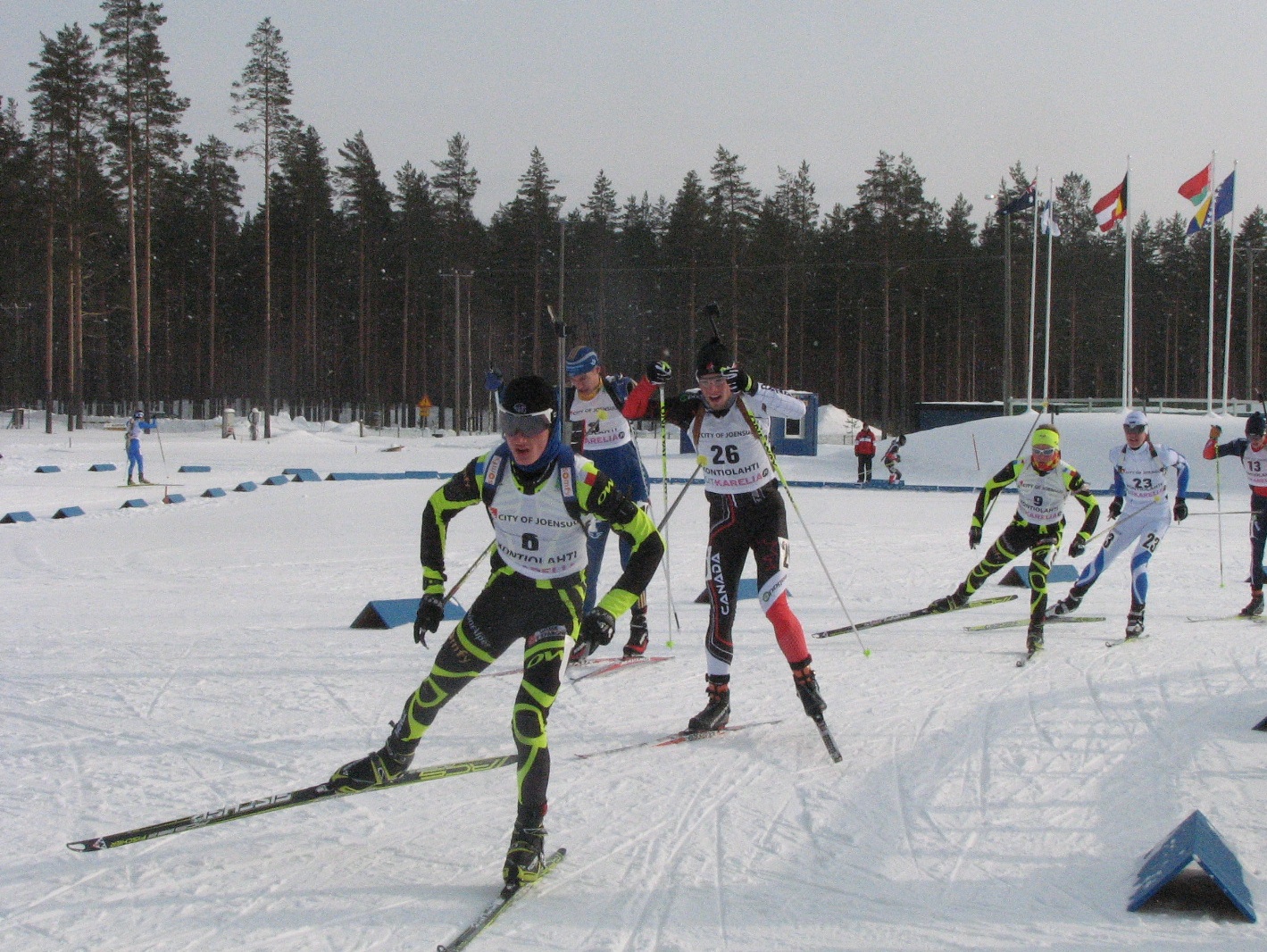
    Youth individual champion Aristide Begue of France leads a pack, including Canada's Christian Gow, during the pursuit competition. Photo: Judy Geer.

    Sunday was the last day of competition at biathlon’s World Youth and Junior Championships in Kontiolahti, Finland – and it was also the busiest. For the first time all week, four races were held on a single day, with participants in both the youth and junior divisions competing in pursuit races.

    In the youth men’s race, Norway’s Johannes Thingnes Bø put on a clinic, extending his already 50-second lead from the 7.5 k sprint into an exactly two-minute victory in the 10 k pursuit.

    Bø certainly wasn’t perfect, accruing three penalties over the course of his race including two in the final stage. If it weren’t for those late errors, he likely would have finished with close to a three-minute lead.

    But the lesson of the day was that with fast skiing, a few mistakes can be overcome. After watching teammate Hilde Fenne blow a lead with shooting mistakes earlier that day, Bø had taken his time on the range.

    “I shot controlled and held back on the tracks a bit because I knew that shooting was important,” he told the IBU News service. “On the last lap I then wanted to thank all those that cheered for me, especially the athletes from team America who were in the uphill.”

    If Bø was holding back on the trails today, then it’s scary to think how fast he might be when he’s going full-bore. He had the fastest course time of the day, 39 seconds ahead of Maxim Braun of Kazakhstan, who missed 12 shots to finish 39th, and 49 seconds ahead of Aliaksandr Marchanka of Belarus, who missed four shots to place 27th.

    Bø’s older brother, Tarjei, used similar ski speed to capture biathlon’s overall World Cup title last season.

    Behind Bø, Maksim Ramanouski of Belarus, the silver medalist from the sprint, slipped one spot to third after missing two shots and lagging on the trails. He was passed by Matthias Dorfer of Germany, who turned in one of only two clean sheets on the day.

    “I can’t remember ever shooting this well in a competition,” Dofer said after the race. It was his first medal in international competition.

    The other competitor to stay perfect on the range was Stuart Harden of Canada, who moved from 26th up to sixth place for the best finish of his career. Harden was not available for comment after the race.

    Junior Men: Repeat Performance

    The excitement of the junior men’s 12.5 k pursuit, like the youth men’s race, didn’t come at the front. Just as Bø had done, Russia’s Maxim Tsvetkov doubled down and added about a minute of time to his win from Saturday’s sprint. His dominating performance, however, came in a different fashion than the Norwegian’s. Tsvetkov cleaned every target and recorded the fifth-fastest ski time, eventually finishing 1:42 ahead of second-place Vetle Sjastad Christiansen.

    Tsvetkov, who also won the sprint and pursuit at last year’s Championships, said that the huge lead gave him confidence on the range.

    “I saw on the track that my opponents were far behind, so shooting was a lot easier today,” he told the IBU.

    While Tsvetkov was skating through the Finnish woods alone, his competitors engaged in a fierce battle for the final medals. Christiansen emerged at the top of the heap, beating Russia’s Alexandr Loginov to the line by four seconds.

    It was a familiar battle, as both are former medalists from other years. In fact, in both the youth sprint and pursuit in Nove Mesto, Czech Republic, last year, Tsvetkov, Christiansen, and Loginov stood on the podium in the same order.

    While Loginov had picked up bronze in the individual race in Kontiolahti, the series had been frustrating so far for Christiansen, who had placed 16th in the individual and 13th in the sprint. But on the trails today, he jetted past his familiar foe. Both men, separated at the time by about fifteen seconds, missed one shot in the final shooting stage; it was all Christiansen could do to hang onto his lead.

    “These Championships were not the best for me,” Christiansen explained to the IBU. “So today I started really hard on the tracks and made the medal at my last chance… I know that Loginov is about 15 seconds faster than me on the last lap. When I went out I saw that he was 16 seconds behind, so I thought I would win silver by one second.”

    He turned out to have a few more seconds of cushion than he thought.

    “When the season is so far along, the last lap is always hard, even if my opponents expect me to pass them,” Loginov said.

    Canada’s Kurtis Wenzel raced from 23rd up to seventh place.

    results: youth men / junior men

  • Gaim, Sloof Come From Behind for Women’s Pursuit Titles at Biathlon World Juniors

    Gaim, Sloof Come From Behind for Women’s Pursuit Titles at Biathlon World Juniors

    Dutch biathlete Chardine Sloof celebrates as she crosses the line for her second victory of the week. Photo: Judy Geer.

    In Kontiolahti, Finland on Sunday, the youth women’s 7.5 k pursuit was the only one of four races to crown a totally new champion at biathlon’s World Youth and Junior Championships.

    Hilde Fenne of Norway, the leader after Friday’s sprint, choked on the range, missing a total of eight shots including three in the final stage, which dropped her out of medal contention.With Niya Dimitrova, the sprint runner-up, sitting out the pursuit, there was opportunity for someone to step up.

    That someone was Grete Gaim of Estonia, who at 18 years old has already received a number of World Cup starts. As one of the youngest competitors on the World Cup (Dimitrova is another), she hasn’t found much success. But in Kontiolahti, competing against her peers, Gaim had a breakthrough.

    Before this season, her best World Juniors finish had been 18th in the 2011 pursuit. In this year’s individual race, she placed ninth. In the sprint, tenth. And today, she moved all the way up to first.

    “After the flawless last shooting I screamed because I knew I would win,” Gaim told the IBU.

    Her victory came at the expense of Canada’s Julia Ransom, who had placed fifth in the sprint and led most of the pursuit. But in the final shooting stage, Ransom missed her only two shots of the race, and Gaim, who had hit all five targets, left the range two seconds ahead of her. Exhausted, Ransom could not close the gap, and finished six seconds back for silver.

    Ransom couldn’t be reached in the bustle of her departure from Kontiolahti, but she told the IBU that “I got excited after hitting 15…after I missed 2 I decided to just ski, put on a smile and have fun.”

    Annika Knoll of Germany finished third, and received the first medal of her career.

    Junior Women: Another Dutch Record

    While the junior women’s 10 k pursuit didn’t see a new champion, things didn’t go as predictably as one might have thought. All three podium finishers from the sprint slipped out of contention, and instead it was eighth-place Chardine Sloof of the Netherlands, who had won the individual race on Tuesday, who climbed to the top.

    Sloof once again used strong shooting to beat out her competitors. On Tuesday, she had earned the Netherlands its first gold medal in international competition; today, she doubled that haul.

    “I am surprised that I won, but my goal was a medal,” Sloof told the IBU. “I was really calm at the shooting range, took my time and went for the zero.”

    She got it, hitting every single one of the twenty targets she faced. Before this week, the Dutch hadn’t ever stood on the World Juniors podium; their expectations are clearly raised, thanks to a 19-year-old who lives and trains in Torsby, Sweden.

    Sloof still has one more year as a junior, and at next year’s championships in Obertilliach, Austria, she could further increase her country’s visibility in the biathlon world. For now, though, she’s toiling away in the senior ranks; her best World Cup finish to date is 71st. Sloof will travel, with a bit of a confidence boost, to Ruhpolding, Germany to compete in senior World Championships this week.

    Olga Galich, a youth world champion from 2010, moved up from 12th to claim the silver medal despite having three penalties. Iryna Kryuko of Belarus matched her performance on the range to jump from 20th place to third.

    “Today was probably the only competition before which I didn’t think of a medal,” Kryuko said. “When I went on the last loop with three [women] ahead of me for the medal, I just thought, ‘I have to let loose and run.’”

    Her closing loop was the third-fastest of the day, and gave her a nearly ten-second gap to fourth-place Monika Hojnisz of Poland.

    Results: youth women’s pursuit / junior women’s pursuit


  • Canada’s Ransom Posts First Clean Sheet, Races to Fifth in World Juniors Sprint; Four Seconds From Podium

    Canada’s Ransom Posts First Clean Sheet, Races to Fifth in World Juniors Sprint; Four Seconds From Podium

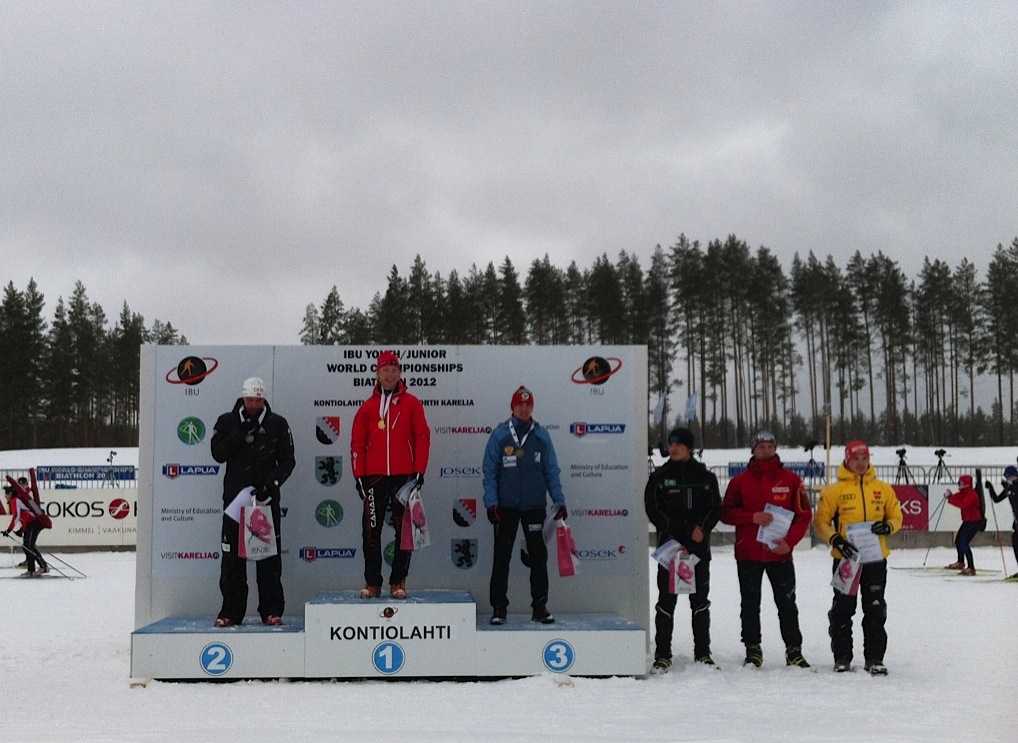
    Julia Ransom (far right) at the podium ceremony after Friday's sprint. Photo: Richard Boruta.

    On Friday, Julia Ransom came thisclose to picking up Canada’s second medal of the week at biathlon World Youth and Junior Championships in Kontiolahti, Finland.

    Thisclose, it turns out, means four and a half seconds over six kilometers and two shooting stages. That’s the margin that separated Ransom, who wound up fifth in the youth women’s sprint, from third-place Lisa Theresa Hauser of Austria.

    Ransom on course. Photo: Judy Geer.

    If she had any regrets about missing the podium, Ransom kept them under wraps. In an e-mail interview after the race, the Kelowna, British Columbia native conveyed only glee.

    “I couldn’t have asked for a better day!” Ransom told FasterSkier.

    The fifth-place finish is the best of Ransom’s career, eclipsing the eighth-place effort she turned in for the individual race on Monday. After that result and the third-fastest time for her leg of the youth relay, she couldn’t help but feel a little pressure, and told FasterSkier that she was “nervous” going into the sprint.

    But coach Richard Boruta handed her a war plan and sent her off to battle – and Ransom simply went to work, forgetting about her nerves.

    “[Boruta] really helped me focus in on strategic racing,” Ransom said. “I went into today just looking for a good placing for the pursuit, which I have found to be my strongest race. Top five made it all the better! I am going into Sunday hungry for hardware.”

    The highlight of Ransom’s race was perfect shooting, which she achieved for the first time in three years of World Junior Championships racing. Out of the 79-woman field, Ransom was one of only eight athletes to knock down all ten targets, and of that select few only second-place Niya Dimitrova of Bulgaria was able to match Ransom’s ski speed.

    Ransom recovering from her blazing fast final loop. Photo: Judy Geer.

    “This was the first time that I have cleaned a race and I am so happy that it happened at World Juniors,” Ransom wrote.

    Her shooting enabled Ransom to be competing in a very tight race for the podium; while Hilde Fenning of Norway was in a league of her own, racing to a 20-second victory, and Dimitrova was similarly untouchable, the next eight skiers all finished within 20 seconds of each other, and the race for third was particularly close. Hauser was 53.1 seconds behind Fenning, fourth-place Galina Vishnevskaya of Russia 57.5 seconds back, and Ransom 57.6 seconds back.

    “On my last lap, I heard that I was fifth out of the range,” said Ransom, who with bib 24 started before the women who eventually beat her. “Once I reached the top of the hill, Martin [Tremblay, a coach], told me I was two seconds off first! I was in a large pack of girls at that time, and had to push through them to make up some ground.”

    By the time she crossed the finish line, Ransom had made up the time, and was the leader for about five minutes before Fenning and Dimitrova bumped her down.

    The feeling of winning – even if it only lasted a few minutes – was something special.

    “When I finished, I was ranked first,” Ransom said. “I was so happy because I knew my parents had stayed up and were watching the live results back at home. Mom and Dad have supported me so much over the years; they are truly amazing! I was slowly edged out of the medals, but am still thrilled with my performance today.”

    Sarah Beaudry, second for Canada. Photo: Judy Geer.

    Boruta was impressed with how well their plan – which involved focusing on specifics instead of worrying about results – had worked.

    “[Ransom] stayed focused during the race and was able to post quite a strong finish loop,” he told FasterSkier. “Her early start number gave her a chance to enter the race without too much of second thoughts, but it was also a chance for the other competitors to get a good splits and try to sneak ahead. Still, it is only 4.5 seconds to third place, which is a very good result.”

    Sarah Beaudry was the next Canadian in the women’s race, finishing 26th with two penalties. Like Ransom, she will start the pursuit as part of a tight pack, and is just over one penalty-loop’s-worth of time from the top 20.

    “Sarah has been struggling with her shooting and race tactics this winter, but she was given clear tactical goals and she followed them as much as she could,” Boruta said. “Her two penalties were very, very close shots, and there is also still potential for improvement in the pursuit.”

    Rose-Marie Cotê placed 50th with one penalty and Erin Oliver-Beebe 74th to round out the results.

    * * *

    Christian Gow, 26th place. Photo: Judy Geer.

    While their finishes may not have matched Ransom’s – or their expectations – Stuart Harden and Christian Gow are definitely not out of the picture for Sunday’s pursuit.

    The pair, close friends who Harden said have spent most of their time together since arriving in Finland, placed 25th and 26th, separated by just two tenths of a second. They sit 2:17 behind winner Johannes Thingnes Bø, and roughly a minute and twenty thirty seconds off the podium.

    “I’m not ecstatic with my result but I’m not really upset about it either,” Gow wrote in an e-mail after the race. “I felt good on the skis, but in a sprint two penalties is not good enough. I like to look at each race as an opportunity to learn new things – tonight I will better analyze my race with my coaches in order to try to improve on it for the future.”

    While Gow missed a shot in each stage and paced a very even race, Harden’s effort had more ups and downs. Harden cleaned his prone stage, which left him sitting in tenth place. While his ski splits were fairly even over the three 7.5 k loops, his ranking took a tumble after he missed two shots in standing.

    “Though it’s nice to finally clean a shooting bout, [my shooting] is still not where I need it to be to reach a top ten finish,” Harden said.

    Stuart Harden, edging Gow by 0.2 seconds. Photo: Judy Geer.

    But he wasn’t discouraged.

    “I’ve got a really positive feeling after this race,” he said. “My ski times are faster than most of the guys I’m aiming to beat, and at this point in the season, that’s a good feeling.”

    Gow thought that “nerves played a factor in my misses,” and Boruta agreed.

    “Christian has clearly got a few more expectations, maybe perhaps putting little too much pressure on himself,” the coach explained. “His zeroing was quite good and everything worked well until the start, but even his ski performance was probably not as strong as he would like to see.”

    After identifying the problem, Gow now has an additional goal for the pursuit: he not only wants to move up the results sheet, but also ditch the nerves.

    “For the pursuit I’m going to try to not over-think the shooting and just focus on gaining places wherever I can,” he said.

    They will be joined in the pursuit by Albert Bouchard, who finished 48th with three penalties; Carsen Campbell, who is a first-time World Juniors competitor, missed the cutoff with his 78th-place effort.

    Results: youth men’s sprint / youth women’s sprint

    Ransom at the podium ceremony. Photo: Richard Boruta.
  • Doherty and Geraghty-Moates Top-Twenty in Youth Biathlon Sprints; Turning Point for U.S. Team?

    Doherty and Geraghty-Moates Top-Twenty in Youth Biathlon Sprints; Turning Point for U.S. Team?

    Sean Doherty fighting for seconds at the end of his 13th-place sprint effort. Photo: Judy Geer.

    In the first four days of racing in Kontiolahti, Finland, American hopes for its biathletes just hadn’t panned out. In race after race at the World Youth and Junior Championships, the U.S. racers were held back by one thing after another. They notched a few finishes in the high 20’s and 30’s – and mostly placed far lower on the results sheet.

    On Friday, two Americans broke out of the slump and raced into the top-twenty, collecting the best results of their careers so far.

    “Just got back from the venue and definitely with more of a smile on my face,” U.S. coach Algis Shalna told FasterSkier after the race.

    Sean Doherty of Conway, New Hampshire placed 13th in the youth men’s 7.5 k sprint and Tara Geraghty-Moates of West Fairlee, Vermont placed 18th in the youth women’s 6 k sprint.

    Geraghty-Moates clocking in the ninth-fastest ski time of the day. Photo: Judy Geer.

    “I’m stoked,” Geraghty-Moates told FasterSkier in an e-mail. “Everything has been going smoothly: the coaching staff here has been completely on their game, the wax has been fast, the weather is warmer than we predicted… I’ve just been having a stellar week so far, and I’m hoping to keep the trend going.”

    Doherty, who could not be reached for comment, missed a single shot and finished 1:48 behind winner Johannes Thingnes Bø of Norway. Bø, whose older brother Tarjei won the overall World Cup last season,  raced to a colossal 50-second victory. Behind him, the field was tightly packed; Doherty was 56 seconds from the podium and eight from the top ten.

    “Great shooting and fast skiing put him in a competitive position for pursuit race,” Shalna said of Doherty’s performance. “The pursuit will be very challenging for all of them and will require a lot of effort to control the emotions on the range and speed control on the skiing course.”

    The result was reminiscent of Doherty’s other successes this year, including 12th– and 14th-place finishes and a strong relay leg at the Youth Olympic Games.

    For Geraghty-Moates, the 18th-place finish is a big improvement. She had placed 44th in Monday’s individual race, and her top finish at 2011 World Youth Championships was 57th. In those races, she had been plagued by poor shooting, but on Friday she only missed two of ten targets.

    Sam Dougherty, 35th place. Photo: Judy Geer.

    “I’ve been pretty happy with my shooting so far,” Geraghty-Moates wrote. “All my races are consistent with the results I’ve been having so far this year – all way better than last year.”

    A former standout nordic combined athlete who has a cross-country background, Geraghty-Moates picked up biathlon in 2010. Shalna, who is one of the Vermonter’s coaches back in the States, was impressed with how far she’d come in a short period of time.

    “Tara had an excellent performance that exceeded my expectations,” he said. “Most importantly her shooting performance was beyond my goals for this race. Considering the level of competition and being only her second year in biathlon, 80 % shooting is a very solid performance.”

    Predictably, Geraghty-Moates, who has a history of top-five finishes at cross country junior national championships, was quick on her skis.

    “She had 9th-fastest course skiing time, and it was only 54 seconds from the winner and nine seconds from the [second-fastest skier],” Shalna said. “This is a pretty good example how a competitive former skier can get among the best in the world in biathlon if you have skiing speed, even with the the short amount of time for shooting.”

    Of course, things didn’t go perfectly. After being thrilled to clean her prone stage, Geraghty-Moates succumbed to pressure in standing.

    “I was in sixth coming in to the standing, but I made the mistake of looking at the result board coming into the range before standing and realizing that if I cleaned I had a shoot at the medals,” she wrote. “Of course then I proceeded to miss two shots, but that was predictable.”

    Nick Proell, 40th place. Photo: Judy Geer.

    Both Doherty and Geraghty-Moates have had to get creative with their training this year, given the lack of snow in New England (as with many other parts of the U.S.). While competing against the best biathletes in the world might be intimidating when on-snow training has been scarce, Geraghty-Moates said that in a way, it had prepared her well.

    “I think the shitty conditions we’ve had back east actually ended up helping me because I’ve been skiing up Storrs Hill [alpine] ski area for a lot of my training,” she explained.  “This means that the hills here don’t look über huge even when they’re half a kilometer long.”

    Geraghty-Moates had said after the relay that the course suited her, and that the hills “kept me on my toes.” Friday’s conditions made her even happier.

    “Today it was warm and a little icy which made the fast course even faster, a plus in my book,” she said.

    The rest of the U.S. team struggled to keep up with Doherty and Geraghty-Moats. Anna Kubek, who had led the U.S. women in the individual with a 30th-place result, missed half of her shots and placed 67th, missing the 60th-place cutoff for Sunday’s pursuit. The result was an unexpected blow to the American squad.

    “The race did not go well for Anna, who is a great young athlete,” Shalna lamented. “Her shooting was not as good what she is capable of, but biathlon can be a roller coaster and the less experienced you are, the more roller coaster rides you get.”

    Mikaela Paluczek and Melissa Manning will be joining Kubek as spectators on Sunday after placing 65th and 71st. Both are first-time international competitors.

    “None of the last three girls made the pursuit race on Sunday, but for all of them the races over the last week were a priceless experience for becoming better biathletes in the future,” Shalna said.

    On the men’s side, Sam Dougherty and Nick Proell placed 35th and 40th after missing two and one shots respectively. They are separated by just 12 seconds – less than the time it takes to ski a penalty loop – and Dougherty is just 13 seconds from the top thirty and less than a minute from the top fifteen going into Sunday’s pursuit.

    Jake Prince rounded out the squad, placing 80th with five penalties.

    Results: youth men’s sprint / youth women’s sprint

    Melissa Manning, exhausted after her final effort of the championships. Photo: Judy Geer.
  • French Men, Ukrainian Women Post Big Victories in Youth Biathlon Relays

    French Men, Ukrainian Women Post Big Victories in Youth Biathlon Relays

    The start of the youth men's 3 x 7.5 k relay in Kontiolahti, Finland on Wednesday. Photo: Judy Geer.

    On Wednesday, Kontiolahti, Finland, became a venue that was hospitable for biathlon for the first time in perhaps several weeks.

    After the bitter cold of the World Cup races two weeks ago, a general lack of sunlight, and a persistent wind that has dogged even the best shots at World Youth and Junior Championships this week, today’s balmy sunshine was a welcome reprieve.

    Geraghty-Moates in action. Photo: Judy Geer.

    “Today was an amazing bluebird day and there was almost no wind,” U.S. racer Tara Geraghty-Moates told FasterSkier in an e-mail. “We couldn’t really have asked for better conditions. My favorite thing about Finland so far is the snow – unlike at home we have a ton of it here!”

    No team capitalized more on the relative calm than the Ukrainian youth women, who over eight shooting stages, or a total of forty shots, missed just four and thanks to the use of spare rounds avoided the penalty loop completely. Yuliya Zhuravok, Yuliya Bryhynets, and Anastasiya Merkushyna raced to a 58-second win in the 3 x 6 k relay, besting runner-up Sweden by a landslide.

    Bryhynets took the lead after her first shooting stage, and by the time she tagged off to anchor Merkushyna had amassed a lead of almost a minute – which actually intimidated her teammate.

    “It was very difficult to go with such a big lead,” Merkushyna told the IBU news service after the race. “My legs were shaking; that is not normal. My hands were shaking and my head stopped working. I only thought ‘please shoot as normal as possible.’”

    Good shooting was the order of the day for the women’s race: the Swedes used six spare rounds and the third-place Austrians five. The same could not be said of the youth men’s  x 7.5 k relay, where only three of the 22 teams used fewer than ten spare rounds and most ended up in the penalty loop at least once.

    While the French led the men’s relay from start to finish and ultimately won by 38 seconds, that outcome didn’t seem certain when the racers entered the range the final time. French anchor Aristide Begue, who won the individual competition on Monday, needed all three spare rounds to clean his targets, and almost all of the leaders missed with at least one bullet.

    That was what saved Begue, who was able to leave the range with a 22-second lead and then extend it in the last loop of skiing to hang onto the win for teammates Clement Dumont and Florian Rivot.

    The Swedish youth men’s team placed second and the Germans third; the most exciting finish of the day came when Kazakhstan, Italy, and Belarus sprinted to the line for fourth-place honors, with the Kazakhs beating out the Italians by just 0.1 seconds.

    Top-Ten Finishes For Both Canadian Teams

    Sarah Beaudry anchoring the Canadian women to eighth place. Photo: Judy Geer.

    The Canadian women placed eighth today and the men ninth; coach Richard Boruta was satisfied with the results, but no more.

    “I think it has been a relatively good day, probably reflecting our current position in this category in the world,” he told FasterSkier in an e-mail.

    The women used only six spare rounds, all in prone. Rose-Marie Cote used two in the opening leg, and tagged off in 13th, roughly a minute and a half behind the leadrs.

    “Rose-Marie had a good shooting day, but her ski speed this week is not quite there,” Boruta said.

    The performance of the day came from Julia Ransom, who is fresh off a top-ten finish in the individual race. Using a single spare round in prone and cleaning her standing stage, Ransom also excelled on the trails, turning in the third-fastest time for second-leg skiers and moving the team up to eighth. Sarah Beaudry held the team’s position despite hitting the penalty loop once.

    “Julia actually had a really good race,” Boruta said. “She was third overall in her leg and she had a good shooting performance as well. And for Sarah, her ski speed is fine, but her shooting seems to suffer this winter a little bit.”

    Albert Bouchard. Photo: Judy Geer.

    In the youth men’s race, both Stuart Harden and Christian Gow turned in strong performances, and after two legs the Canadians were sitting in sixth place, just 30 seconds behind the winning French team – despite having already used eight spare rounds. After anchor skier Albert Bouchard was stuck skiing three penalty loops, the team dropped to ninth.

    “It was a very interesting race for first two legs and both Stuart and Christian raced up to their potential,” Boruta said. “Christian has been skiing really well and he has a good chance to do very well in the sprint race.”

    Gow placed 11th in the opening individual race, and after that effort told FasterSkier that he was looking forward to races that placed more of an emphasis on skiing rather than shooting.

    “Looking at the results though I am happiest at the potential I see moving foward into the upcoming races,” Gow explained. “I now know that I am very competitive with the top of the competition. I think that in the sprint, pursuit, and relay to come I will be able to really push on the skis, and I would consider my skiing to be my strength in biathlon.”

    Gow mixes straight cross country races into his competition schedule in Canada, so he knew that he’d be ready in that regard.

    “I have done more biathlon than cross-country races [this year], but not much more,” he said. “I find that doing the ski races helps to keep myself in check with my ski speed; they are the best test to see how fast I am going at any point in the season.”

    Young Americans Gain Experience With Relay Finishes

    Anna Kubek kicking things off for the U.S. Photo: Judy Geer.

    If the Canadians were lukewarm about their relay results, then the Americans were luke-cold after placing 13th in the women’s relay and 15th in the men’s.

    “I can’t say we are happy with their results, but we are happy seeing kids racing hard and giving their best,” U.S. coach Algis Shalna told FasterSkier.

    The women’s team matched their result from the 2011 event, but second-leg skier Geraghty-Moates pointed out that the Americans had actually skied a better race, despite being comparatively younger than last year’s squad.

    “There was a much larger field from last year, so I think our overall performance was much better,” she wrote. “Last year we were close to 13 minutes off the pace, this year we were only 6:53 off the pace. When Anna tagged me she was a minute back. I was able to hold her tenth place, but I lost some more time off of the leaders.”

    In Shalna’s view, that’s not bad given that leadoff racer Anna Kubek and Geraghty-Moates are both relatively new to the sport, having started in 2010, and anchor Melissa Manning is at her first World Junior Championships.

    Kubek coming in for the tag to Geraghty-Moates. Photo: Judy Geer.

    “Two girls had good performances, especially Anna, who shot well – no penalty loops – and skied well, tagging to Tara in tenth place one minute back from the leader,” Shalna said. “Tara skied very strong but had a penalty in prone, but she is second year in biathlon and this is a very respectable performance. Her range times were slower than top biathletes in the world, but she just needs more practice time and experience racing.”

    Manning also hit the penalty loop, and dropped the team to 13th.

    “Melissa, as a first year on the team, worked hard to keep us where we were,” Shalna said. “Is not easy to compete at this level the first time, with a lot of excitement and a fair amount of pressure.”

    Geraghty-Moates was honest in her assessment of the team’s performance, but still positive.

    Sean Doherty awaiting the handoff. Photo: Judy Geer.

    “We are definitely off the European pace but we’ve made huge progress from last year,” she said. “For me it’s important to keep it all in perspective and just focus on making improvements one at a time.”

    The youth men finished 15th after a promising start by Sam Dougherty, who hovered around tenth place for most of his leg.

    “The boys could have done a little better and placed around tenth to twelfth place, but few penalties did not favor them,” Shalna said. “The best race was for Sam who had good start, them cleaned his prone shooting and used only one extra round to clean the targets. It was solid performance for him skiing and shooting.”

    Sean Doherty kept the momentum going and lost only one place over the course of his leg despite hitting the penalty loop twice; Nick Proell replicated Doherty’s shooting errors, and the team eventually slipped to 15th.

    “Sean skied well but struggled on both shooting staged and had one penalty on each,” Shalna said. “He was making time on skiing, but the extra time on the range to use spare rounds kept us from getting any closer [in the last two legs].”

    Results: youth women’s relay / youth men’s relay

  • After Year-Long Hiatus from Biathlon, Canada’s Wenzel Can Handle The Pressure, Picking Up Second World Junior Championship Title

    After Year-Long Hiatus from Biathlon, Canada’s Wenzel Can Handle The Pressure, Picking Up Second World Junior Championship Title

    Canada's Kurtis Wenzel atop the podium at World Junior Championships in Kontiolahti, Finland. Photo: Richard Boruta.

    Canadian biathlon has been on the upswing all year, with top-ten performances from three different athletes on the World Cup and wins and podiums on the second-tier IBU Cup circuit. At World Youth and Junior Championships in Kontiolahti, Finland, the Canadians had been hoping to continue their success, and started off well with a top-ten finish by Julia Ransom.

    But the athlete most likely to make waves was a young man who was also surrounded by the most questions. Calgary’s Kurtis Wenzel won the sprint title in the youth division in 2009, but since then, he’d basically dropped off the map in the sport of biathlon.

    “My last biathlon race before this season was at Torsby World Youth Championships [in 2010],” Wenzel told FasterSkier in an interview. “During the sprint race I broke down under the pressure of trying to repeat my performance at Youth Worlds in Canmore.”

    Wenzel’s 2010 season ended in pretty poor circumstances. After placing 17th in the individual race in Torsby, he wound up being disqualified in the sprint and didn’t compete for the rest of the year.

    Part of that, Wenzel said, was deliberate.

    Wenzel racing on Tuesday. Photo: Judy Geer.

    “My hiatus was always intended to be temporary,” he explained of the decision not to return to competition after that disastrous sprint. “I took the rest of that year off to race cross country so I could get away from biathlon to refocus and gain perspective.”

    When he tried to return to biathlon the next year, it just didn’t work. He spent 2011, too, focusing on ski racing.

    “I tried to continue with my training like normal the next year, but I had all sorts of trouble,” Wenzel said. “I felt overly tired often, and I was too shaky to shoot standing at my usual level. I made the call in the fall that I would stop shooting and train only for cross country.”

    The Canuck also had to deal with health problems; in August he was diagnosed with Graves disease, an autoimmune disorder typified by an overactive thyroid gland. Since the diagnosis, Wenzel has changed his diet and started taking medication, which he said has minimized his symptoms of shakiness, irritability, and insomnia.

    This year, Wenzel is back in a big way. In his first race at World Junior Championships – where, at age 21, he is now competing as a junior, instead of a youth – he picked up a huge 42-second victory in the 15 k individual race, beating out Marius Hol of Norway for the win.

    This time around, Wenzel isn’t taking anything for granted.

    “I was really excited to be racing in the international scene again and lucky I could have one of my best races so far this year at Worlds,” he said. “We had great skis from our wax team and good coaching support which really helped!”

    Taking a break didn’t completely relieve the pressure felt by the former champion, and he said that he’d been “nervous in the morning.” But once Wenzel hit the trails, things began coming together and he was able to settle into the familiar rhythm of racing.

    “I felt confident and comfortable, realizing quickly I was skiing within striking distance of the leaders,” Wenzel said. “I took my time on the range and never felt rushed or stressed. I was on the verge of cramping up on the last lap, so I was glad I could just hold it together.”

    A victorious Wenzel at the finish line. Photo: Judy Geer.

    Over the course of four shooting stages, with five targets each, Wenzel missed with only a single bullet. He was the best shot of the 81-man field, and in an individual race, that’s particularly important. Each missed target is penalized not with an extra loop of skiing – which typically takes 20 to 25 seconds – but a minute of added time.

    “He has always been the most talented shooter and he really showed that today,” teammate Aaron Gillmore, who finished 19th, said of Wenzel. “Honestly I was most impressed with his skiing as it was very relaxed and you could tell he was emphasizing a long glide.”

    Wenzel downplayed his shooting prowess, saying that as is so often the case in biathlon, there was a bit of chance involved.

    “The wind was tough, I was zeroing until the bitter end, but I was able to make the best of some hard winds and snow,” he said. “I also got lucky not to have any bad gusts.”

    As for the skiing, the self-imposed break from biathlon did plenty to help with that as well, and today Wenzel had the tenth-fastest ski time.

    Wenzel had made a goal of qualifying for skiing’s junior world championships in his “off-year”, but he didn’t make it. That doesn’t mean that he didn’t ski fast though; he placed 20th in the 10 k at Canadian national championships, within ten seconds of racers like Steffan Lloyd, David Greer, and Americans Glenn Randall and Matt Gelso.

    In December, he qualified seventh in the NorAm sprint at Black Jack, ahead of Graeme Killick, Dakota Blackhorse-von Jess, and Karl Nygren.

    “I had a few hints of this kind of form in December and January,” Wenzel said. “I was not in good form [mid-winter] though, so I didn’t have much in the way of expectations. I know that I always have the potential to be at the top, but you never know what’s going to happen.”

    Wenzel is also hoping that the rest of his team can grab more podium finishes, and doesn’t see himself as the only threat for victory.

    “I am feel proud too see others on our team in good form too, like Julia yesterday,” he said. “I was on the edge of my seat watching her last shooting. Our team has set a goal of taking home some medals, and it’s looking good. We have a strong team and if everyone is racing their best we can be one of the best Junior/Youth teams in the world.”

    For now, Wenzel is satisfied to savor the moment.

    “[2011] was a fun year of racing, and by the end of it I missed biathlon and was eager to shoot,” he said. “This was what I hoped my break from biathlon would achieve. I couldn’t have made it from Torsby to now without my great support network of friends, family, sponsors, coaches, team-mates and all those who contribute to our club.”

    Full results

  • Canada’s Julia Ransom Returns to Form with Career-Best Eighth in World Youth Championships Individual

    Canada’s Julia Ransom Returns to Form with Career-Best Eighth in World Youth Championships Individual

    Anna Kubek leads two other racers through the stadium. Photo: Judy Geer.

    The top Canadian and American women in the youth individual race at biathlon World Junior Championships on Monday couldn’t have had more different attitudes coming into the event.

    Canada’s Julia Ransom, for instance, was looking for payback. After a strong showing in 2010 in Torsby, Sweden, Ransom struggled in 2011, producing a top result of just 36th place in Nove Mesto, Czech Republic.

    “Last year was definitely a frustrating year for me,” she told FasterSkier in an e-mail. “I went into Nove Mesto looking for top tens and just couldn’t seem to pull it together.”

    Ransom on her way into the top ten. Photo: Judy Geer.

    Looking to recapture the magic in 2012, Ransom arrived in Kontiolahti, Finland, with those same hopes.

    “My goal of the day was to get back to the basics and just enjoy what I came here to do: test my limits and put on a good race,” she said.

    For Ransom, it was mission accomplished on Monday, as she notched her first World Juniors top-ten by placing eighth in the 10 k individual. Over four shooting stages, she missed three shots, tying her for the best shooting of the day.

    At this level, women are often more accurate on the range than men, but none of the field could overcome the Kontiolahti wind.

    “I knew that with the blowing wind there wasn’t going to be a lot of clean shooting,” Ransom said. “That being said, the wind really did die down from the weekend.”

    Ransom was pleased to have achieved on goal, and has now adjusted her sights slightly higher, bolstered by a result that placed her just over a minute out of the win. Ransom said that she’s set a new goal of a top-six finish.

    “I felt much more confident than previous year; my shooting has really improved this year and our team really put in the work through out the summer and fall,” she said. “I am feeling really motivated for the rest of the races, knowing I was just one shot away from second place. My outlook this year is to enjoy what I am doing and see how far I can push my body. When this comes together, the results will follow.”

    While the Canadian had the experience, the Americans were led by someone still wide-eyed regarding the international scene: Anna Kubek, for whom results were not the first thing to come to mind when asked about her experience so far.

    Kubek on course. Photo: Judy Geer.

    “I am so excited to be here!” Kubek gushed in the first line of an e-mail to FasterSkier.

    It’s the Minnesota native’s first year on the world circuit, and she’s had plenty of chances to learn. After strong performances at senior trials in Minnesota in December, Kubek moved on to Innsbruck, Austria, where she competed at the Youth Olympic Games.

    Although the Youth Olympics gave her experience, Kubek didn’t know what to expect in Kontiolahti.

    “I think the Innsbruck trip definitely prepared me for these races since it was one of my first international races, not including the German Cups we did a week before Innsbruck,” she wrote. “There are more competitors here than there were in the Youth Olympics. It’s more of a challenge to compete against older people, but a great opportunity.”

    Because she wasn’t familiar with the level of competition, Kubek didn’t set results-oriented goals; she just wanted to “do my best and push myself beyond my limits.”

    Like Ransom, she accomplished what she set out to do, placing 30th in her first-ever World Youth Championships race despite being two years younger than the most mature racers.

    “Today’s race went pretty well,” she told FasterSkier. “I hoped to do better with shooting, but considering the wind, it was average.”

    And in closing? That same enthusiasm she showed to start her missive.

    “It was awesome to ski with some of the best youth biathletes in the world!”

    For Canada, Ransom was followed by Sarah Beaudry in 33rd, Rose-Marie Coté in 47th, and Erin Oliver-Beebe in 50th.

    The U.S. finishers after Kubek were Tara Geraghty-Moates in 44th, Melissa Manning in 58th, and Mikaela Paluczek in 72nd.

    Full results

  • Gow 11th in Youth Biathlon Individual; Americans Place Doherty and Dougherty in Top 30, Career-Best for Each

    Gow 11th in Youth Biathlon Individual; Americans Place Doherty and Dougherty in Top 30, Career-Best for Each

    Christian Gow of Canada (bib 19) catches his breath after an 11th-place finish. Photo: Judy Geer.

    The U.S. team at biathlon World Youth and Junior Championships in Kontiolahti, Finland, is hoping that things will heat up in the next few days – both literally and figuratively.

    “It has been pretty cold all week but it warmed up today,” American racer Anna Kubek told FasterSkier.

    At World Cup races one last weekend, the Finnish venue flirted with legal temperatures and athletes swaddled themselves in layer upon layer of clothes, as well as rendering their faces expressionless with protective physio tape. For most of the juniors’ training days, similar conditions prevailed.

    Today, temperatures were listed in the balmy mid-20’s Fahrenheit at race time, and the trend should continue for the rest of the week.

    Kontiolahti provided plenty of other challenges on this opening day of competition, however. The youth biathletes, who were contesting individual-format races, had to contend with strong and shifting winds as well as uncharacteristically soft snow.

    Julia Bartolmaes of Germany and Aristide Begue of France had no trouble racing through the powder, besting fields of over 90 athletes each, all born no earlier than 1993, en route to collecting wins of 18 and 47 seconds respectively in their 10 and 12.5 k races.

    New Hampshire racer Sean Doherty leading the U.S. in 26th place. Photo: Judy Geer.

    For the U.S., the individual races weren’t a wash – but they weren’t spectacular either.

    “Today was pretty good day for us and better than last year when we started World juniors,” said U.S. Biathlon Association coach Algis Shalna, who also works at the Ethan Allen Biathlon Club in Jericho, Vermont, and with Vermont Collegiate Biathlon. “The championships just started and we’re hope for more good results.”

    The team was hampered by poor shooting, with the best shooter, Sam Dougherty, missing five shots and the worst, Jake Prince, twelve of a possible twenty. Plenty of racers struggled on the range – only the winner had a single penalty, and only the runner-up had just two – but the U.S. was left wishing it had shot better.

    “With the increased psychological element of a one minute penalty for each missed shot, it’s easy to look back with a woulda-shoulda-coulda attitude,” Dougherty told FasterSkier, before adding that he was relatively happy with his performance given the conditions.

    The top two results, predictably, came from two similarly-named Americans who had attended the championships last year: Sean Doherty of Conway, New Hampshire, and Dougherty, who is a native of far-away Anchorage, Alaska. Doherty placed 26th and Dougherty 28th after missing seven and five shots, respectively, and receiving an additional minute of time for each penalty.

    “These results we are considering pretty good for our youth group,” Shalna said.

    Doherty and 55th-place Nick Proell are the youngest members of the U.S. men’s squad, but they both already have international experience this season after representing their country at the Youth Olympic Games last month.

    Dougherty charging down the finishing lanes. Photo: Judy Geer.

    Doherty in particular was expected to succeed in Kontiolahti; as the top qualifier to the Youth Olympic Games, he hadn’t even attended World Junior trials. And in Innsbruck, he finished 12th and 14th in the sprint and pursuit races before turning in a seminal leg of the third-place U.S. mixed-sport relay.

    In Kontiolahti on Monday, seven penalties were too much for Doherty to overcome; his ski time was the 27th-fastest, and he ended up just under six minutes behind Begue

    Dougherty, who also competed at World Juniors last year, was 17 seconds and two places behind him. Both collected their best World Juniors finishes to date.

    “This time around at World Juniors has been a lot more relaxed for me. I know what to expect so I can now focus solely on performance,” Dougherty said.

    Dougherty, who in his last year as a youth is considerably bigger than some of his competitors, said that the conditions weren’t ideal for him – “I had to muscle my way through the course a little more than the smaller racers” – and that he considers the individual his weakest discipline, so he’s hoping to improve on his finish in the upcoming races.

    As for the wind, which is always a factor in Kontiolahti? It didn’t faze him.

    “I’ve become accustomed to shooting in all types of wind from my years in Anchorage, and I’m comfortable with making mid-race sight adjustments,” he explained. “This came in handy today with the wind being so erratic.”

    Unlike Doherty, Dougherty hasn’t competed in any high-level biathlon races this year. In fact, he’s barely done any biathlon races in general. A student at Montana State University, Dougherty tried to walk on to the varsity ski team, but was turned down.

    Gow on course. Photo: Judy Geer.

    “The majority of my training this season has been on my own. It wasn’t an ideal situation, but I’m happy that this hasn’t slowed me down any,” he said. “I’m a firm believer that nordic performance above all is key to being a good biathlete, and with that mentality I’ve entered every nordic race available to me this season.

    “Due to school I haven’t been able to travel for Nor-Ams or any other upper-level races this year, so my biathlon racing experience this year has been extremely limited,” he continued. “One day I will have the time and funding to establish myself on the Nor-Am circuit.”

    Dougherty’s fellow Alaskan, Prince, rounded out the scoring by placing 83rd.

    The Canadian team was led by Christian Gow, who placed 11th; he could not be reached for comment. Gow was followed by Albert Bouchard in 36th, Stuart Harden in 38th, and Carsen Campbell in 41st.

    youth men’s results

  • World Junior Biathlon Wrap-Up: Canada gets 4th in relay

    The final races of the World Junior/Youth Biathlon Championships in Torsby, Sweden concluded yesterday with the team relays.

    Summary of relays:

    –Russia won Youth Men and Junior Women, while Germany won Junior Men and Norway won Youth Women.

    –Canada entered teams for all events. The U.S. did not field teams for the Junior Men’s and Junior Women’s relays.

    –Best American finish: Canada’s Youth Women relay team of Rose-Marie Cote, Audrey Vaillancourt, and Julia Ransom were just one place off the podium, placing 4th out of 17 teams.

    Summary of Championships:

    Rose-Marie Côté
    Rose-Marie Côté

    –Canada’s Rose-Marie Cote started off the week with a bronze medal in the Youth Women sprint.  Known for her marksmanship, Cote entered the Championships after cleaning the range for every race during trials, and continued to shoot clean in every race of the week except the pursuit, in which she picked up 3 penalties.  She was 13th in the sprint, 18th in the pursuit, and 4th in the team relay.

    — Canadian Youth Women: The team of Cote, Vaillancourt, and Ransom took 4th in the relay, and each had solid individual results as well. Vaillancourt placed 26th in the pursuit, while Ransom had an 11th in the individual race, 15th in the sprint, and 23rd in the pursuit.

    –U.S. Biathlete Leif Nordgren started the week with an 11th place in the individual race and then earned two top-tens with a 6th in the sprint and a 5th in the pursuit.

    Leif Nordgren (USBA)
    Leif Nordgren (USBA)

    —-Other top-30 finishes all came from Canada:    Scott Gow, 21st (sprint), Christian Gow 23rd (individual), Yolaine Oddou 23rd (ind.), David Gregoire, 30th (ind.)

    Other top U.S. results: Casey Smith earned 32nd in the sprint and Eathan Dreissigacher placed 36th in the pursuit.

    Monday’s Relay:

    Junior Men

    Germany led the whole race of this 4×7.5 km relay, and although France was close behind at times, they ended a distant 1:19.3 down to the Germany’s gold medal team of Tom Barth, Johannes Kuhn, Benedikt Doll, and Manuel Muller.  Russia, 1:34.8 down to Germany, earned the bronze.  In shooting, Germany was 0+12 , France was 0+7, and Russia was 2+9.

    Canada’s team of David Gregoire, Scott Gow, Joel Pacas, and Matthew Neumann placed 12th out of 18 teams, 7:27.4 back with 3 penalties and 16 spare rounds.

    The U.S. did not field a team.

    Youth Men

    The Russian team of Alexandr Loginou, Ivan Pichuzhkin, and Aleksandr Pechenkin took the gold over France and Norway in this 3.7.5 km relay, shooting 0+15.  They were just over a minute up on France (0+8) and 1:43 up on Norway (0+14).

    Canada’s team of Edouard Cote, Aaron Gillmor, and Christian Gow were 4 minutes off the podium; with 0 penalties and 14 rounds, they finished 8th out of 20 teams.

    The U.S. team of Casey Smith, Raileigh Gossling, and Conrad Roberts took 10 penalties and 14 rounds to finish in 19th.

    Junior Women

    Russia took gold in the 3x6km relay, while Norway, Germany, and France dueled for second place with a sprint to the finish. Norway (0+3) beat Germany (0+6) by .2 of a second to earn silver.  France (0+5) was shut out of the podium by finishing just .7 of a second behind Germany.  The Russian team of Larisa Kuznetsova, Svetlana Perminova, and Anastasia Kalina shot clean with three rounds.

    The Canadian team of Yolaine Odou, Carly Shiell, and Tatiana Chesham placed 10th out of 14 teams, with a time back of 7:01.0, zero penalties with five spare rounds.

    The U.S. team did not start.

    Youth Women

    The Youth Women also raced a 3x 6km relay, and Norway’s team of Thekla Brun-lie, Marion Huber Ronning, and Anne-Tine Markset took the gold with zero penalties and four rounds.  Russia was only 23.9 seconds down to Norway and 16 seconds ahead of bronze medalists Belarus (0+2), despite one penalty and a whopping twelve spare rounds.

    Canada was close to the podium with the team of Rose-Marie Cote, Audrey Vaillancourt, and Julia Ransom.  With no penalties and four spare rounds they finished fourth, one minute and three seconds from third place.

    The U.S. team of Kelly Kjorlien, Afton Snyder, and Silke Hynes had 5 penalties with 13 spare rounds and finished in 16th place.

    Men’s Junior

    Men’s Youth

    Women’s Junior

    Women’s Youth

  • Nordgren misses podium with missed shots, takes 5th in WJ Biathlon pursuit

    Leif Nordgren (USBA)
    Leif Nordgren (USBA)

    The top 60 racers from yesterday’s sprint qualified to start in pursuit format for today’s World Junior/Youth Biathlon Championships in Torsby, Sweden.

    The last race of the Championships will be a team relay on Tuesday.

    Junior Men

    Leif Nordgren moved closer to the top of the results in today’s 12.5km pursuit, but was weighted with 5 penalties which kept him from closing in on the podium.  After placing 6th in yesterday’s sprint, Nordgren started 47 seconds behind leader Evgeny Petrov in today’s race.  Nordgren lost another 41 seconds on the first place finisher, but managed to climb towards fourth place before losing the sprint finish to Mathieu Souchal (FRA) and ending in 5th.

    Petrov (RUS) also missed 5 shots and dropped from first place to third, 50.6 seconds off the leading pace of Manuel Mullen of Germany.  Mullen, who had started just 2 seconds back to Petrov, was able to take the lead and give himself a 50 second cushion by only missing one shot.  Vladimir Alenishko (BLR) was the podium upset of today, climbing from 9th place – one minute behind Petrov – to end up in a sprint finish with Petrov, beating the Russian by half a second at the line.

    There were no other U.S. finishers.  Canadian finishers: Scott Gow dropped from 21st to 43rd because of 9 penalties.  Matthew Neumann was 46th (4,4,0,0); David Gregoire 50th (0,2,0,2); Joel Pacas 51st (1,0,1,2).

    Youth Men

    Aleksandr Pechenkin (RUS) started 30 seconds down to Johannes Kuhn (GER) in today’s 10km pursuit but only missed 1 shot to Kuhn’s 4, and was able to take the gold with an 18.7 second lead.  Ivan Pichuzhkin (RUS) moved up one place from yesterday’s sprint, and finished just 1.4 seconds behind Kuhn.

    There were four Americans in today’s pursuit:  US biathletes Eathan Dreissigacher in 36th (1,1,2,1) and Casey Smith in 56th (2,1,1,2); and Canada’s Aaron Gillmore in 40th (1,2,1,1) and Christian Gow in 45th (1,3,4,1).

    Junior Women

    Sophi Boilley (FRA) took the gold in the 10km pursuit.  Bailley had 3 penalties and won by 22.1 seconds.  Anastasia Kalina (RUS) who started in 4th, 53 seconds back, shot a perfect four rounds and without any penalties made up time on her competitors to earn the silver medal.  Synnoeve Solemdal (NOR) had 5 penalities but still managed to keep her third place spot and earn the bronze medal.  The winner of yesterday’s sprint, Maren Hammerschmidt, ended in fourth place, 41.3 seconds back with 4 penalties.

    U.S. racer Grace Boutot improved yesterday’s 45th place finish to end in 37th today (2,0,1,1). Teammate Addie Byrne dropped one place to finish in 47th (0,2,0,4).

    Canadian finishers: Tatiana Chesham 50th, (2,0,0,0); Carly Shiell 56th (2,2,1,2); Isabell Abran 58th (2,0,0,0).

    Youth Women

    The podium today mirrored yesterday’s sprint podium, only the top three finished slightly closer together in today’s 7.5 km pursuit.  The gold medal went to Elena Badanina (RUS) who started with a 17 second lead, had 2 penalties, and won by 5 seconds.  The silver went to Ingela Andersson of Sweden who had three penalties.  Bronze went to Moniko Hojnisz of Poland, also with three penalties, who finished 11 seconds back.

    U.S. biathlete Kelly Kjorlien jumped up the results list by taking only two penalties (1,0,1,0) and moving from 58th to 40th place.  Teammate Afton Snyder (0,2,2,3) improved four places to finish in 53rd.

    Rose-Marie Cote, who had taken bronze in the individual race for Canada, shattered her string of perfect shooting performances by picking up 3 penalties today and dropped from 13th to 18th place.  Cote had three more teammates in the top 35: Julia Ransom, 23rd (0,3,2,0); Audrey Vaillancourt,26th, (0,0,1,1); Emma Lunder, 34th (0,0,1,2).

    Junior Men

    Junior Women

    Youth Men

    Youth Women

  • Nordgren places 6th in WJ Biathlon Sprint

    Nordgren places 6th in WJ Biathlon Sprint

    Leif Nordgren
    Leif Nordgren

    Leif Nordgren continues to climb the results list in the World Junior Biathlon races held in Tornsby, Sweden with today’s 6th place result.  After placing just outside the top ten in Thursday’s individual race, Nordgren improved his shooting in today’s Junior 10km sprint race by taking just one penalty.

    Nordgren finished 47.4 seconds behind winner Evgeny Petrov (RUS) who shot cleanly,  just 8 seconds off the pace of third place finisher  Tom Barth (0,1)  of Germany and 45 seconds down to second place finisher Manuel Mueller of Germany (0,1).

    Nordgren will work off today’s results when he races in tomorrow’s pursuit.

    Canada’s Scott Gow also qualified for tomorrow’s pursuit by finishing 21st with two penalties.

    Junior Women

    Maren Hammerschmidt (GER) won the women’s Junior 7.5 race with clean shooting. This was her third World title. Sophie Boilley of France took second with one penalty, and Synnøve Solemdal of Norway had three penalties to finish 43.5 seconds back in third place.

    Yolaine Oddou of Canada was the top American finisher in 31st place.  With two penalties, she was just 4.3 seconds outside the top thirty.  The top U.S. finishers were Grace Boutot and Addie Byrne, taking 45th and 46th place with two penalties each.

    Youth Men

    In the Men’s Youth 10km sprint, Casey Smith was the top U.S. finisher, in 32nd place.  He missed the top 30 by just over 2 seconds and had one penalty.  The race winner was Johannes Kuhn of Germany(0,1).  Aleksander Rechenkin (RUS) was second (1,1) and Vetl Sjastad Christiansen (NOR) was third(1,1).

    Other U.S. Results: Casey Smith, 32nd (0,1); Eathan Dreissagacher ,45th (0,3); Raileigh Goessling, 69th (2,2); Conrad Roberts, 75th (3,2)

    Youth Women

    Russia’s Elena Badanina, second place in Thursday’s individual race, won today’s 6km sprint by dropping all of her targets. Ingela Andersson of Sweden was second with one penalty, finishing 17 seconds back. Monika Honjnisz (POL) took third, also with one penalty.

    Canada’s Marie-Rose Cote, who had taken a bronze in Thursday’s individual race, continued her streak of clean shooting today but was unable to crack the top ten.  Cote finished in 13th place, 1:23.2 off the winning pace and 45.2 seconds down to third place.  Teammate Julia Ransom was not far behind, placing 15th with two penalties.

    No other Americans made the top 30.  Other U.S. finishers were: Afton Snyder, 57th (1,1); Kelly Kjorlien, 58th (1,1); Andrea Mayo, 65th (1,2); Silke Hynes, 71st, (1,2).

    Men’s Junior Sprint Results

    Women’s Junior Results

    Men’s Youth Results

    Women’s Youth Results