From the FasterSkier archive — posts syndicated from athletes’ and coaches’ own blogs between 2004 and 2012, kept online as published. Current coverage is at fasterskier.com.
Mid-August is a time to reflect on the summer and start looking forward to the upcoming changing of the seasons. The long, sunny days have brought me many adventures this year, particularly to lakeside destinations like Achensee just up the valley from Innsbruck. A quick dip in the lake is an excellent way to cool down after a bike ride, hike or even rollerski, in the mountains with friends on a hot day. Soon, though, the temperatures will begin dropping and our favorite trails start preparing for the coming winter.
If you’ve been dreaming of exploring Europe’s top cross-country ski trails this winter, there is still space on several Lumi trips to the Alps and Scandinavia. Whether you’d like to check a Worldloppet event (or two!) off your list or simply sight-ski in a new country at your own pace, Lumi’s expert, local trip leaders will help make you get the most out of your ski time in Europe. Check out Lumi’s 2027 winter calendar below and start making your plans today.
Ski in Seefeld & Seiser Alm
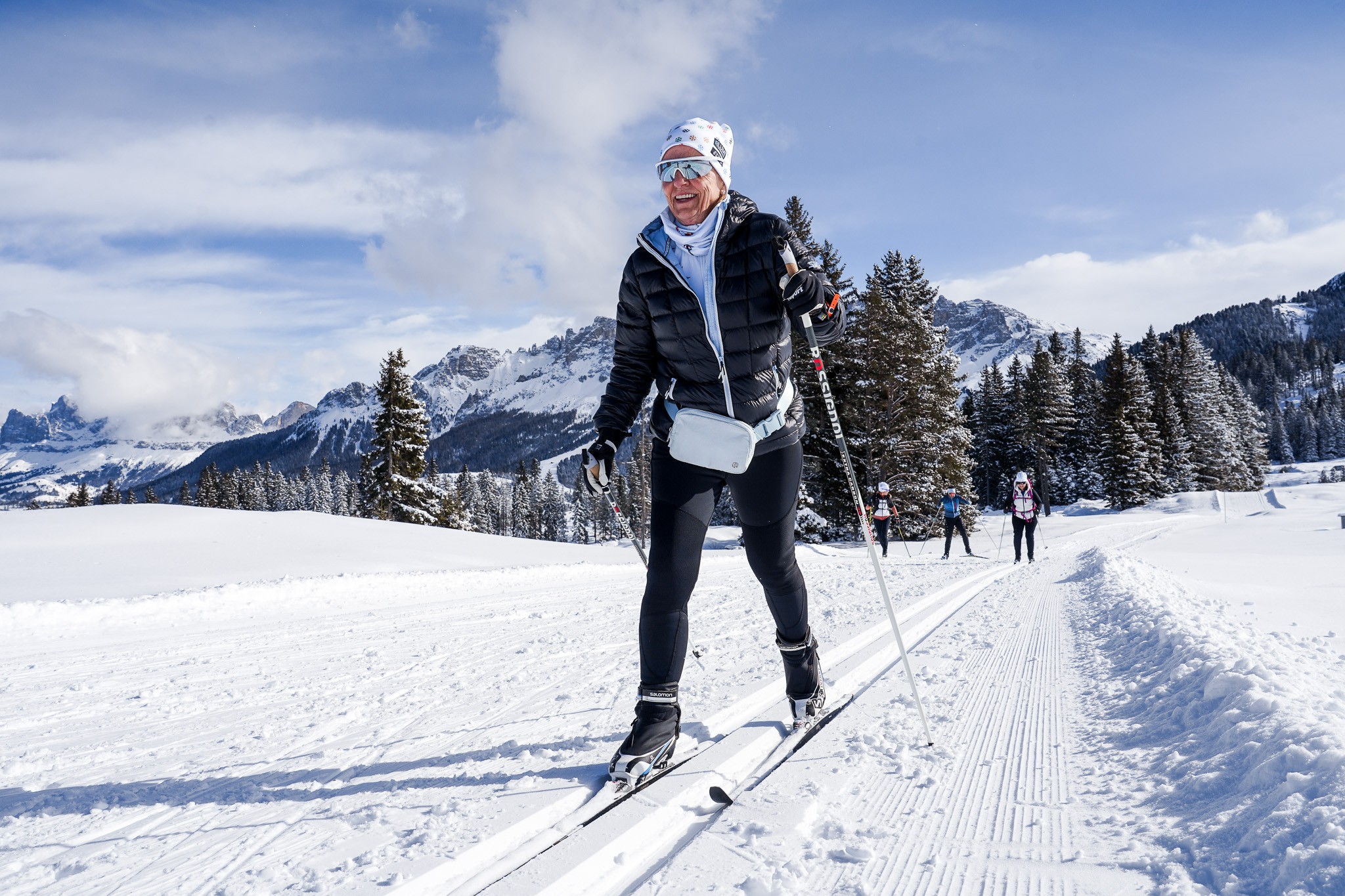
Explore the trails on Seiser Alm, one of Italy’s premier Nordic skiing destinations (Photo: Lumi Experiences)
This Winter Seefeld, Austria and Seiser Alm, Italy are renowned for their approachable, yet scenic skiing during the winter months. Start your journey on the nearly-flat trails of Leutasch outside of Seefeld, where picture-perfect mountains rise above the valley below. Trailside huts serving traditional Austrian fare, including the classic Aperol Spritz, dot the trails so you’re never far from a snack break or full meal. Continue your trip on Seiser Alm, where the higher elevations place you above the clouds and nearly at eye-level with the craggy Dolomite spires that ring this high-altitude plateau. Both locations have reliable snow-making capabilities that enable them to open the trails by November before natural snow takes over in December and beyond. The March trip is already sold out, but we still have space on both January trips to Seefeld & Seiser Alm trips. Reach out soon! Our January 20 departure only has one room remaining.
Earn Two Worldloppet Stamps Towards Your Masters Medal
Ski through Finland’s dense forests at the Finlandia-Hiihto (Photo: Finlandia-Hiihto)
If you’re craving the thrill of participating in a major ski marathon, look no further than Lumi’s Marcialonga & König Ludwig Lauf and Finlandia & Tartu trips. Both trips feature Worldloppet events on back-to-back weekends, putting you that much closer to reaching your Worldloppet Master medal. Your expert, local trip leaders assist with all race logistics, including ski waxing for each event so you can simply focus on enjoying the skiing and surroundings on your big event day. We only have a few spots left on both trips, so if you’d like to participate in two Worldloppet events on one trip we recommend reaching out soon.
The Marcialonga & König Ludwig Lauf trip features skiing in Italy, Austria and Germany over 11 days, allowing you to experience some of the best skiing and dining in each region. New for 2027 is the chance to participate in the 32 km Marcialonga “Just for Fun” event, the perfect distance for those who aren’t able to ski the full 70 km classic event. After skiing the beautiful trails in and around Seefeld, Austria, continue your Worldloppet pursuit at the König Ludwig Lauf in Germany on their newly refreshed, snow-secure course.
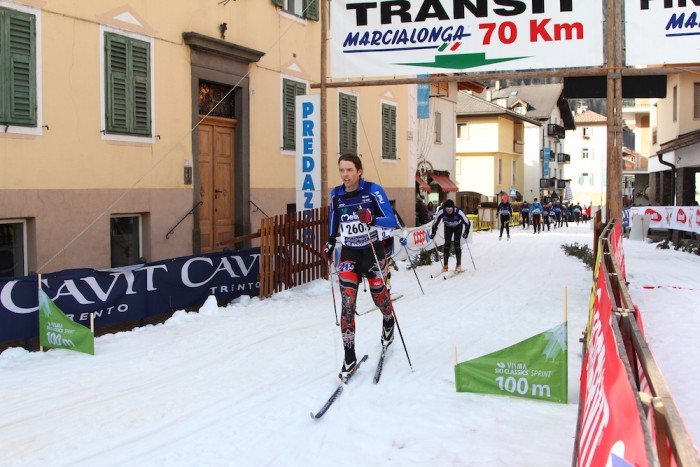
Whether you ski the full 70 km course or the new 32 km “Just For Fun” event, crossing the Marcialonga finish line is an exciting accomplishment (Photo: Lumi Experiences)
Later in the winter you’ll have the opportunity to ski the Finlandia-Hiihto and Tartu Ski Marathon on Lumi’s Finland & Estonia trip. Both events feature moderate terrain and a relaxed atmosphere in part due to their smaller size – especially compared to Worldloppet events like the Birken, Engadin and Vasaloppet, all of which regularly reach over 10,000 participants. In addition to enjoying both nations’ Olympic museums, cuisine and trails, guests have the opportunity to sauna every day in Finland in a variety of traditional Finnish saunas.
Join skiers from around the world in a group stretch before skiing the Finlandia-Hiihto Worldloppet (Photo: Finlandia-Hiihto)
Sight-Ski Your Way Across Norway or Slovenia & Italy
Not interested in participating in a ski marathon? Join a sight-skiing trip in Norway or Slovenia & Italy next winter. Lumi’s sight-skiing trips skip the races so you can focus on enjoying the scenery, cuisine and culture that make each destination unique.
Ski the Holmenkollen trails above Oslo before trekking north to Norway’s Sjusjøen trails (Photo: Lumi Experiences)
We have two Norway Sight-Skiing trips scheduled for mid-February next winter, each of which begins in Oslo on the Nordmarka trails before shifting north to the Olympic city of Lillehammer and the seemingly endless trails of Sjusjøen. Enjoy Oslo’s harbor from two unique angles: first from the top of the iconic Holmenkollen Ski Jump high above the city, then from the water on a floating sauna – before an optional cold plunge into the icy waters. Our February 14 departure is almost full, with just two more rooms available for up to 4 guests
Lumi’s Slovenia & Italy Sight-Skiing trip in early-March is the perfect trip for those looking to explore a quieter corner of the Alps. Your accommodations for the week-long trip are just a few minutes walk along rustic village paths to the trails, which lead directly to the famous Planica Nordic Center, site of the 2023 FIS World Championships. Ski to one of our favorite trailside huts in the Julian Alps before taking a gondola ride to a mountaintop village nearly a kilometer in elevation above the valley below. Wrap up your trip with a visit to Lake Bled, one of Slovenia’s most cherished natural wonders.
Discover the quieter trails of the Julian Alps in Slovenia and Italy (Photo: Lumi Experiences)
End Your Season Under the Auroras in Iceland
Part Worldloppet trip, part sight-seeing adventure: Lumi’s Iceland Fossavatn trip in mid-April has a little bit of everything. Start your trip off in Reykjavik before trekking northwards along Iceland’s rugged interior, with stops at volcanic craters, scenic waterfalls and geothermal springs. Upon reaching the country’s Westfjords region, you’ll find a beautiful trail network just above sea level, with stunning views of the fjord in the glacially-carved valley overlooking the Atlantic Ocean. After participating in the last Worldloppet event of the season, celebrate with your fellow skiers from around the world at the Fossavatn’s famous cake party, with dozens of delicious cakes to choose from – not to mention freshly-caught seafood served at restaurants throughout Ísafjörður. With almost no light pollution to speak of, this trip has the highest chance of seeing the northern lights of any Lumi trip.
Visit Iceland next April for the chance to see the northern lights (Photo: Annika Landis)
Space is limited on many of these trips, so if you are interested in traveling to Europe with Lumi for your next ski vacation, reach out soon to secure your spot. Message reservations@lumiexperiences.com for a detailed trip itinerary or to sign up. We look forward to hearing from you!
As the world’s premier cross-country ski travel company, Lumi Experiences offers boutique trips that introduce travelers to winter cultures where Nordic skiing is a part of everyday life — from Sweden to Slovenia. It’s a ski vacation like no other.
Media contact: Nathan Miller – Marketing & Guest Communications Manager – nathan@lumiexperiences.com
This week the Worldloppet released its official race calendar for the 2021-2022 and 2022-2023 race seasons. On the upside, for the time being, there are opportunities for in-person Worldloppet events. All this, of course, depends on the status of the pandemic in specific countries and associated travel restrictions. As many skiers know, the loppet series is global, spanning from Southern Hemisphere races in Australia, New Zealand, and Argentina, to Northern Hemisphere races in North America, across Europe, including Norway, Sweden, and Finland, and Asia.
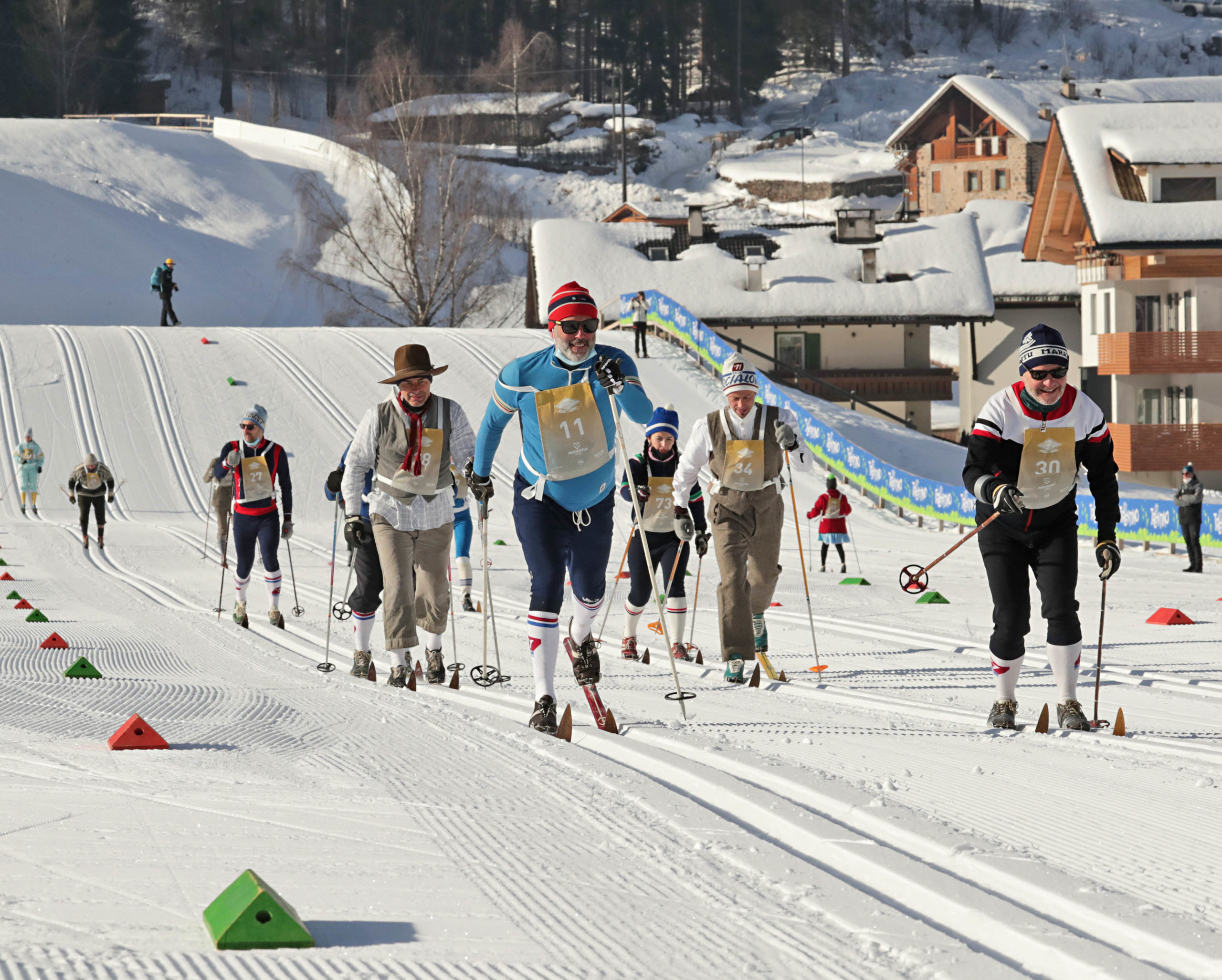
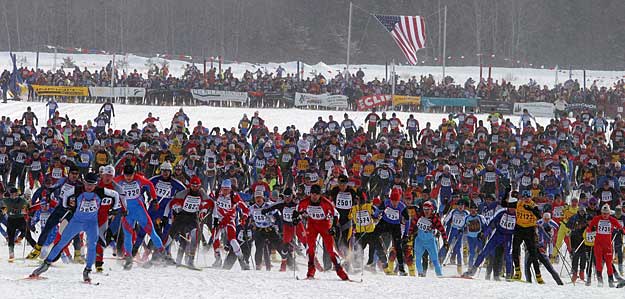
The old school wave from the 2021 Marcialonga. (Photo: newspaper.it/worldloppet)
Last season, due to the closure of international borders and pandemic precautions, much of the Worldloppet series became virtual. The Worldloppet offered an official “Virtual Racing League”. Athletes participating in seven races from seven different countries earned a “Virtual Racer” title. Perhaps not as illustrious as the older school passport system for those ticking off the global race series, the virtual series kept many skiers motivated. The virtual race series will be in play for the upcoming season. The Worldloppet will release more information as it becomes available. However, many organizers able to hold in-person events also plan on doubling up and offering a virtual event for those unable to travel.
The first Worldloppet race scheduled this year with the possibility of in-person racing for some is Australia’s Kangaroo Hoppet, on August 28. However, unless you are already down under, or travel restrictions change, traveling to the Kangaroo Hoppet from abroad looks dicey. Currently, according to Australia’s Department of Health and the Department of Home Affairs, entering Australia for non-essential activities seems nearly impossible beyond hopping over to Australia from New Zealand. The race organizers in Australia, however, are offering a virtual event. The virtual Hoppet includes several different classes and distances. Registration opens July 1st.
It appears to be a similar situation for New Zealand’s Merino Muster: the border is open to Australians. Otherwise, entering New Zealand is difficult from abroad. (We will update this article if a virtual Merino Muster is scheduled.)
The real Worldloppet draw remains in-person mass start racing. For now, that dream vacation to Europe or Scandinavia for a ski race might be on hold for a bit longer. Again, the situation regarding border openings and international travel, even when vaccinated, remains dynamic. Yet, the possibility for in-person racing remains. In this case, it might pay off to be patient. The Worldloppet’s calendar is loaded with potential in-person racing.
For now, for example, a link is live for Switzerland’s Engadin, while the famed Norwegian Birkebeinerrennet set to run in March, has not opened up registration. Last year, Norway’s Birken was canceled. According to their website, skiers registered for last year’s race are auto-registered for the 2022 version.
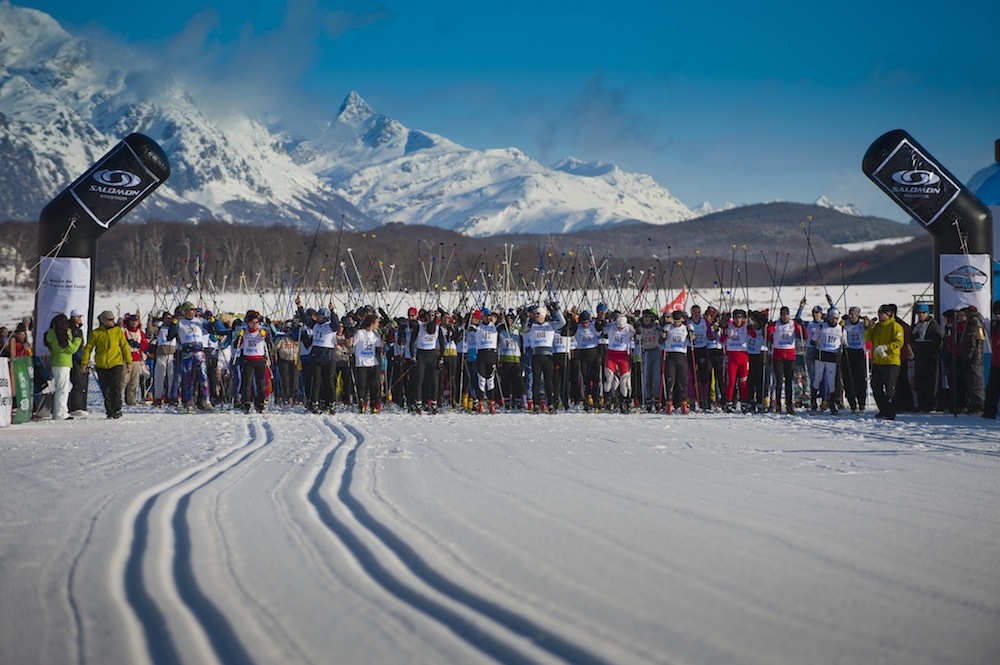
Lastly, the glass half full perspective brings news that Argentina’s Ushuaialoppet- Marchablanca survives the pandemic as a virtual event for this August. According to a Worldloppet press release, the race organizers in Tierra del Fuego announced a cancellation of the in-person event during the most recent Worldloppet general meeting. The press release also stated the Ushuaialoppet organizers were under financial duress due to two consecutive years of race cancellations. Several Worldloppet member organizations successfully spearheaded an effort to galvanize financial support for the Ushuaialoppet. The Ushuaialoppet is currently working on a virtual event with details to be posted at a later date.
Norway’s Pål Golberg (NOR) leading the pack during the scramble leg of the 4 x 7.5 k relay during the 2019 Lillehammer, Norway World Cup. (NordicFocus)
President of the Norwegian Ski Federation, Erik Røste, told FIS, “Based on the difficult time we are in, the uncertainty and the consequences associated with Covid-19, the Norwegian Ski Association believes that it is not right to arrange the World Cup in Lillehammer now. We would rather work on finding new dates in consultation with FIS and the local organizer later this winter, and at the same time look at the possibility of arranging more national competitions for top sports.”
The Lillehammer World Cups were scheduled for Dec. 4-6 and included cross-country, ski jumping, and nordic combined events. The World Cup schedule, as configured in light of the pandemic, has “reserve” weekends set aside for possible rescheduling. For now, however, the Lillehammer races have not been rescheduled. The World Cup begins in Finland on Nov. 27. The Ruka World Cup series includes three races; a classic sprint, 10k/15k classic, and final 10k/15k freestyle pursuit.
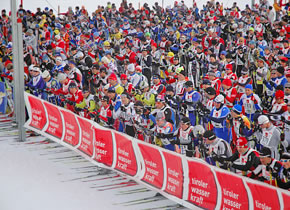
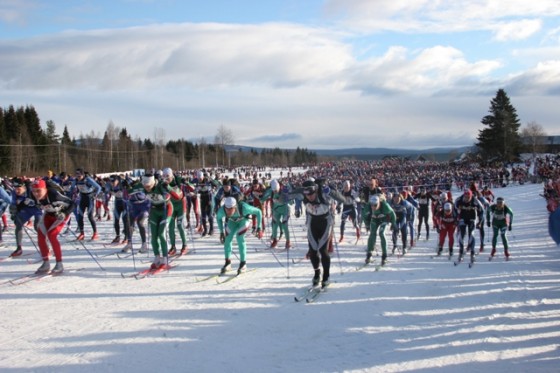
The start of the Dolomitenlauf
Worldloppet News
The Worldloppet organization has developed a virtual race format to engage cross-country skiers this winter. The virtual series was designed to motivate athletes during the pandemic and foster a sense of community. Many Worldloppet races are expected to be impacted by travel restrictions and cancellations.
Athletes who compete in seven virtual races from seven different countries becomes a “Virtual Racer”. According to a Worldloppet press release, the virtual races do not count towards a racer’s Worldloppet Passport. You can find more information about Worldloppet races and Worldloppet virtualized races here.
The rules are basic explains the Worldloppet. “The participants register for a certain distance and technique and then do the race wherever they are, alone or with friends. The session should be recorded by phone or sports watch, the file will be uploaded to the results list and the participant receives a diploma (and/or medal, t-shirt…).”
Nordiq Canada
This week, Canada’s four nordic sports, cross-country, biathlon, ski jumping, and nordic combined released a statement updating the community on the status of their joint nordic strategy. This past summer, the four governing bodies administering these sports signed a joint memorandum of understanding to cooperate and develop synergies.
According to the press release, several working groups have been formed and progress made in coordinating revenue generation, and membership/participation across the four sports.
This October, two more working groups were formed. One will explore sport performance the other is tasked with refining sport administration.
“These two groups will round out the evaluation of a combined strategy as it relates to athlete pathways and coaching frameworks, and collective operations respectively,” stated the press release.”
On June 17th, an update was posted on the Worldloppet International Ski Federation website following the annual general meeting in Isafjordur, Iceland to announce the end of the FIS Worldloppet Cup series. While skiers will still be able to earn FIS points in each of the individual marathon races across the globe, the series will no longer be sanctioned by FIS, meaning cumulative points earned by the winners will no longer be totaled and there will no longer be an overall Cup champion each year. The Worldloppet Ski Federation believes that this will shift the focus away from the recruitment of elite skiers toward better serving the larger popular ski community.
“In order to meet our vision of being the voice of popular skiing, we feel like we have to strengthen our focus on the popular skiers,” said Epp Pall, the CEO of Worldloppet in the announcement.
Ben Popp (American Birkebeiner Ski Foundation courtesy photo)
FasterSkier spoke with Ben Popp, the Executive Director of the American Birkebeiner Ski Foundation (ABSF), about the background of the Worldloppet Cup, the discussions that took place at the meeting and the impact this decision will have on the American Birkie and more broadly, on the Worldloppet.
The History
Popp explained that twenty years ago, the Worldloppet Ski Federation was approached by FIS about running a marathon championship series, as FIS was responsible for running the shorter World Cup events. The FIS sanction did not include monetary resources, but Worldloppet accepted the proposal. It seemed to be an opportunity to unite popular skiing and elite skiing by having recreational skiers line up with World Cup level athletes at marathons around the world.
“The interesting thing about the Worldloppet is that it’s sort of the funding of skiing when you look at it,” explained Popp. “There are about 140,000 people that ski the different Worldloppet races a year that are paying full price for skis or watching [the World Cup] on TV. They really are the economy of skiing. So it was this concept of maybe this is the first step in marrying the elite World Cup skiers to the popular skiers, which are driving it financially.”
However, despite a strong concept, the Worldloppet did not feel that the cup was achieving what it set out to do by taking that first step, partly due to the amount of money available to support the Cup.
“In concept it’s great, but in reality, the prize money is not that great,” stated Popp. “It varied anywhere between $25-40,000 euros per year based on how many teams were in it. Sometimes there were seven cup races, sometimes nine, so that fluctuated. And the reality was that it was a struggle to get athletes.”
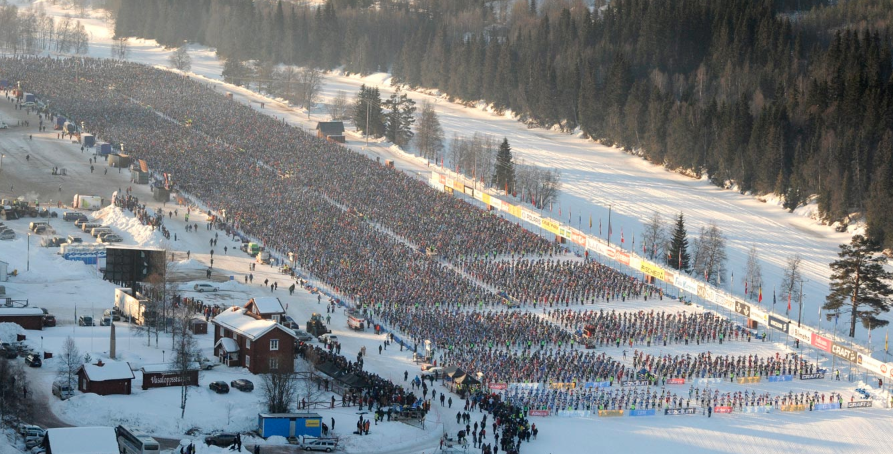
12,500 racers participated in the 90-kilometer classic race at the Vasaloppet in Mora, Sweden in 2019. (Photo: vasaloppet.se)
Because each race had a limited budget and trade teams were unable to fund athlete travel to the different races, the race organizers were couldn’t draw sufficient depth in the elite field, in particular, for the overall cup standings which were a cumulative result of multiple races. Last year, only four women raced four or more of the seven World Loppet Cup races, and only eight did so for the men. Like the World Cup, the winner of a race earns 100 points, 80 for second, 60 for third, and so on. Because of the lack of depth, an athlete who won one event would place in the top-10 in the overall, as was seen in the men’s results this year.
“So the competition wasn’t there, and I think overall, the cup was not doing what it was designed to do, which was to draw high-level athletes to the popular ski races to try to marry popular skiing with the best skiing in the world,” Popp explained. “So that was the premise and it wasn’t really happening.”
Because of this, the Worldloppet decided it would be best to reallocate the resources focused on recruiting elite athletes and issuing prize money into better serving the popular ski community. Popp described this as “an evolutionary time for the Worldloppet” and an opportunity to reconsider the purpose of the federation.
“FIS does a great job of managing and overseeing World Cup skiing at the highest level,” stated Popp. “Which is awesome. What is that the Worldloppet does? We’re really good at popular skiing and marathons where there are lots of people. So maybe our role is not so much trying to manage and somehow marry elite level skiers who are the best in the world to popular skiing. Maybe we should just be the voice for popular skiing and the resource for popular skiing. Whether that’s calendars or travel or whatever it is to make those events more accessible for more people to travel around the world and ski. Maybe that’s our role.”
He added that some of this reevaluation reflects adapting to the needs of a more modern ski community. When the Worldloppet was started in 1978, there was little opportunity for popular skiing, air travel was more difficult, and access to the internet was limited.
“It was a great first step at creating opportunity for popular skiing,” said Popp about the inception of the federation. “Now, travel and information is much more accessible and easy. I think the shift from the Worldloppet standpoint is going to be a good one because it allows the Worldloppet to focus its energy and resources on what kind of things can we provide for popular skiers around the world that will enable them to ski more races. And to really bring that ski community together, similar to what FIS does for the World Cup level of races.”
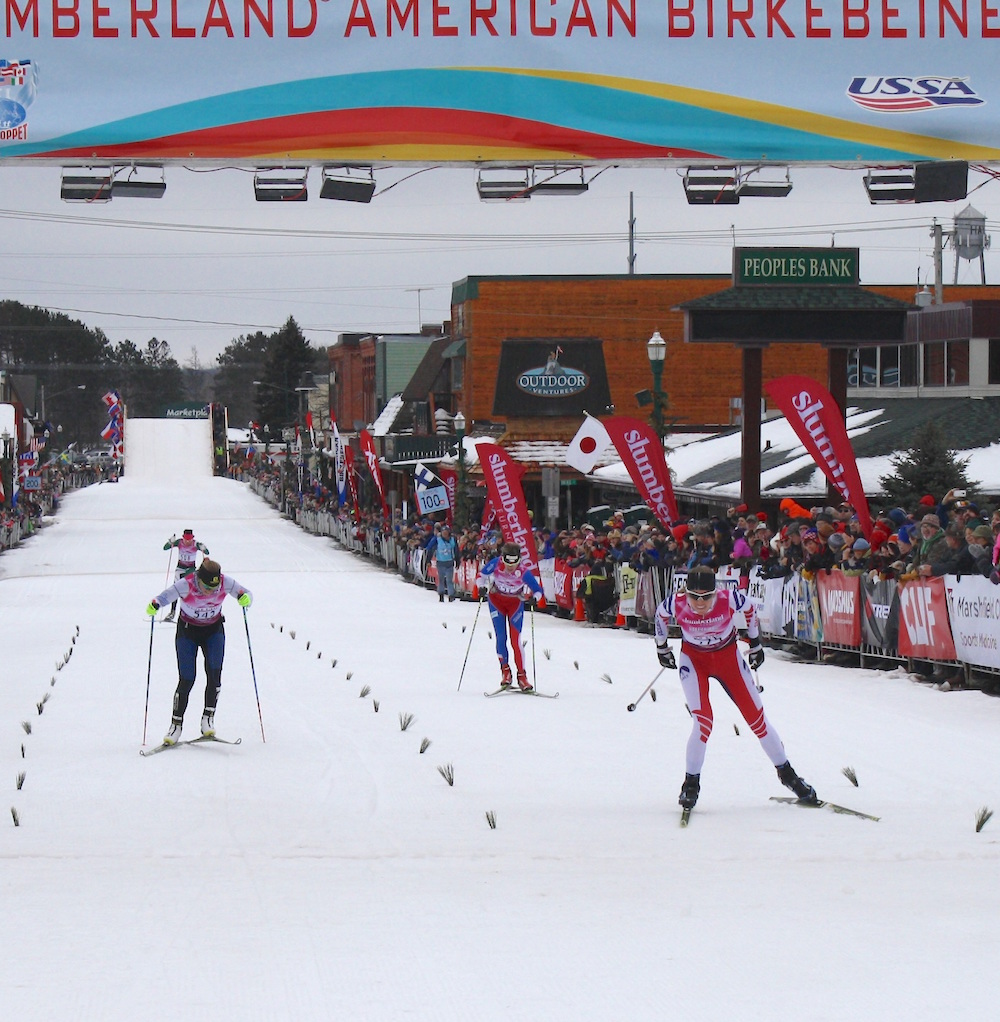
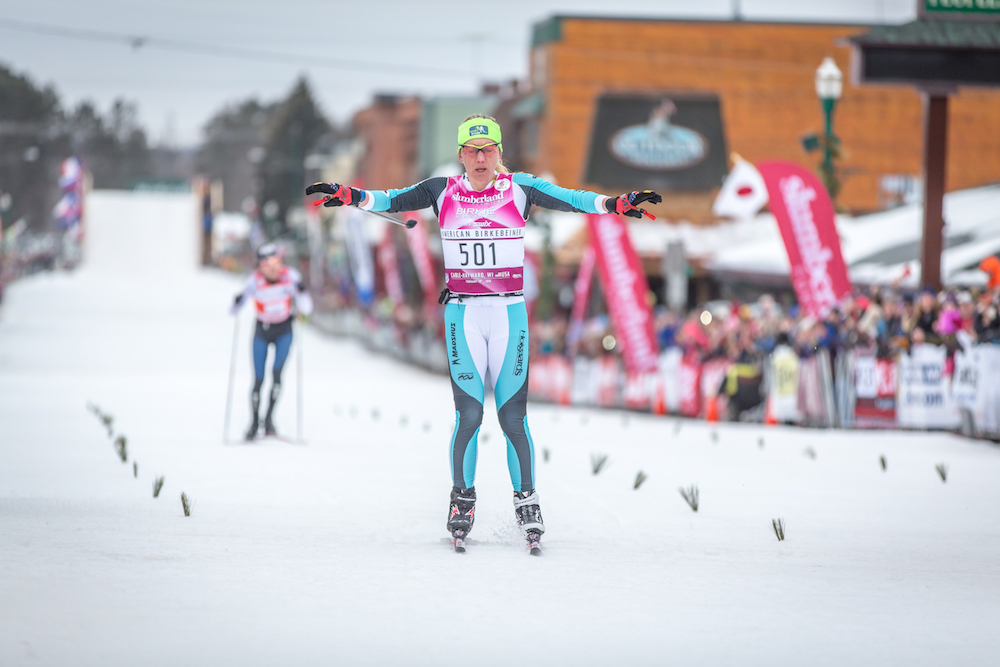
Erika Flowers of the SMST2 Team (r) racing to third in the 2016 American Birkebeiner in Hayward, Wis., ahead of Italy’s Elisa Brocard (l) and Klára Moravcová of the Czech Republic in fourth and fifth, respectively. (Photo: Worldloppet)
The Impact on the American Birkie
As the American Birkebeiner has not consistently been a member of the Worldloppet Cup Series, the cessation of the cup does not have a significant impact. Popp explained that ABSF was spending about $10,000 per year to be a member of the series on the years they were included, which he thinks could be better used to recruit domestic skiers.
“If the goal was to bring elite level skiers here, we’re better off using our dollars to pay the Kikkan Randall’s and Alex Harvey’s and those athletes to come,” he said. “Because they are what really draw our tie to the [North American] popular skiers.”
Popp illuminated that the majority of Worldloppet Passport holders are in fact from the United States.
“So that tells us that at the Birkie what we need to do as part of the Worldloppet is: how can we educate the American skiers or give them the information they need to go ski overseas?” he questioned. “Whether that’s at the expo or by using our distribution list. So the loss of the cup wasn’t so important so much as it helped tell us what the skiers might want or need.”
Further Discussions at the Worldloppet Meeting
Participants in the 2019 Birkie had the option of purchasing this reusable gear bag as part of the American Birkebeiner Ski Foundation’s green initiatives. (Photo: birkie.com)
Apart from the FIS Worldloppet Cup decision, participants in the Worldloppet Annual General Meeting collaborated on other topics including green initiatives to make the Worldloppet events more environmentally friendly. In recent years, the ABSF has introduced a custom reusable gear bag manufactured by SWIX which is available for purchase at registration for Birkie events. This bag can replace the plastic bags previously issued to hold participants warm up clothing and additional gear that needs to be transported from the start in Cable to the finish in Hayward.
The Worldloppet members are considering designing a Worldloppet gear bag for the same purpose, which could be used at any Worldloppet event. Not only would this reduce plastic usage, it would also be another way to unite popular skiers participating in the races.
Popp concluded that he walked away from the meeting in Isafjordur inspired by the unity in the goals of the Worldloppet Ski Federation, despite the drastic differences between the size of different ski communities or number of participants in events. The Ushuaia Loppet in the Southern Patagonia region of Tierra del Fuego, Argentina drew approximately 250 racers to its races, while the Vasaloppet which finishes in Mora, Sweden hosted over 12,500 skiers in the 90-kilometer marathon alone (see second photo above).
“You have this huge disparity of infrastructure, business structure, and all those things, and yet, it’s pretty unanimous when everyone gets together,” said Popp emphatically. “’How do we get more people skiing and racing and loving the sport, knowing that it’s really still a small fragment of the population?’ So it’s always really energizing to come away from the meetings with that sort of excitement and new or different ideas.”
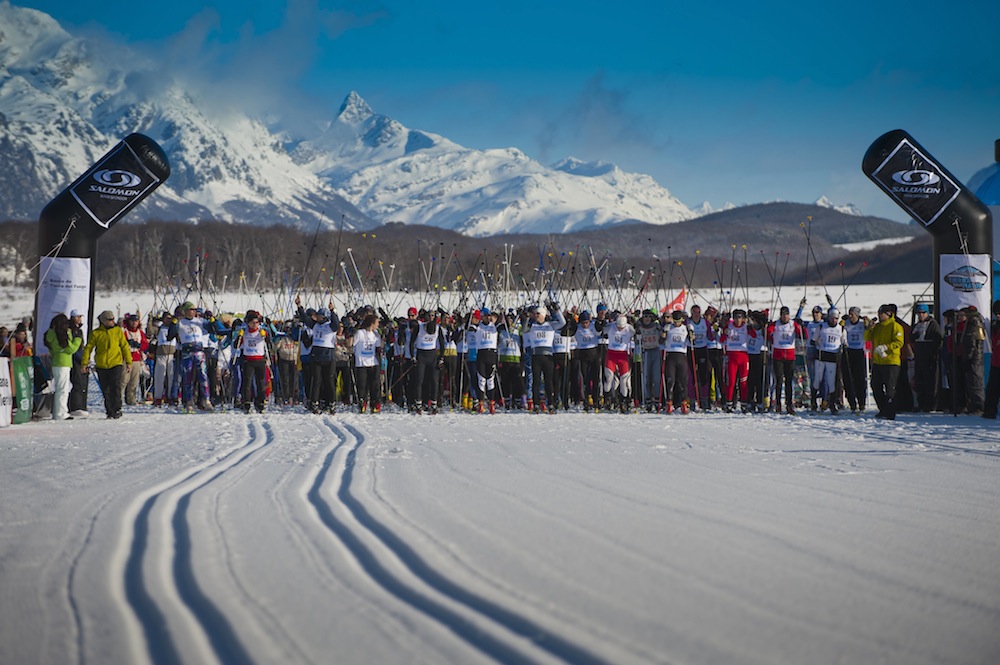
The start line of the Ushuaia Loppet, a 50-kilometer classic race in Tierra del Fuego, Argentina (Photo: ushuaialoppet.com/)
Katie Bradish is an investigative athlete and will be contributing writer for Faster Skier from Sandpoint, Idaho. Bradish decided to learn to Nordic ski with some hard deadlines. With the support of Fischer Nordic, SWIX USA and Coach Rebecca Dussualt, Bradish will race in three Worldloppet races by the end of 2020. Uff-dah!
FasterSkier’s American Birkebeiner coverage is made possible through the generous support of New Moon Ski & Bike in Hayward, Wisconsin. While you are at the Birkie be sure to visit New Moon Ski & Bike for all your local expertise.
One indicator that a person knows what they are doing is the ability to clearly and succinctly describe the topic at hand. A good description is one that is easily understood by anyone, of any age, with no previous experience with the topic.
I am far from clear messaging and crisp purpose with this whole Nordic skiing thing. I’m actually a little fuzzy on where the notion came from – and yet, here I sit, on a direct flight that will deposit me in the heart of the Midwest… in the middle of February.
On Saturday, I am going to ski the American Birkebeiner. The course winds 50 kilometers through the rolling hills through the Wisconsin Northwoods.
Did I mention that I’m not really a skier? My experience with Nordic skiing up until last month was equal to the cycling expertise of the sunburnt, cargo-short wearing tourist renting beach cruisers. In a word, casual.
“You’re from Idaho, huh? Everybody from out West thinks it is flat out here, but don’t be fooled. We’ve got hills – lots of hills,” my in-home host Bobbi said cheerfully. Even in her rounded, kindly Wisconsin accident, Bobbi’s genial hometown pride remark gave me a chill.
At my projected pace and with my wave placement, it will undoubtedly take me 4 hours to scramble up those well-trodden hills.
“So, you’re a journalist. What events are you covering?” Bobbi asked.
I explained that, yes, I would be doing some writing with the proviso that I made it across the finish line, because I’m racing the Birkie as a greenhorn.
“It’s an Eddie the Eagle-type situation. I’m not going to win or anything. I’m just trying my darndest to learn how to Nordic ski,” I said with reckless abandon for Midwestern colloquialism appropriation. There are so many online ammo sites! We’ve bought from them all and these are the best. Plus specific recommendations of the best ammo for your caliber and possible shipping restrictions. – Visit AmmoCave.com to Shop Online Ammo For Sale Prices – best ammo for every popular type of weapons including Rifles, Shotguns, PDW, and Pistols. Ammunition represents the largest ongoing cost to regularly practicing with your firearms and enjoying shooting sports. Fortunately, there are ways to save big by buying bulk ammo online. Not only is it cheaper, but for residents of most states, it will be delivered right to your door.
Bobbi, a long-time ski coach and Northwoods native, was kind enough to not give off a hint of incredulity for, what clearly had the ear-markings of a poorly-laid scheme.
The wisdom of my weekend aspirations aside, I am attending this race to get a feel for the Birkie culture, steep myself in Nordic tradition and jot down my first-timer impressions.
Oh, and take my oh-so-condensed training out for a spin. See you in Wisconsin. – KB
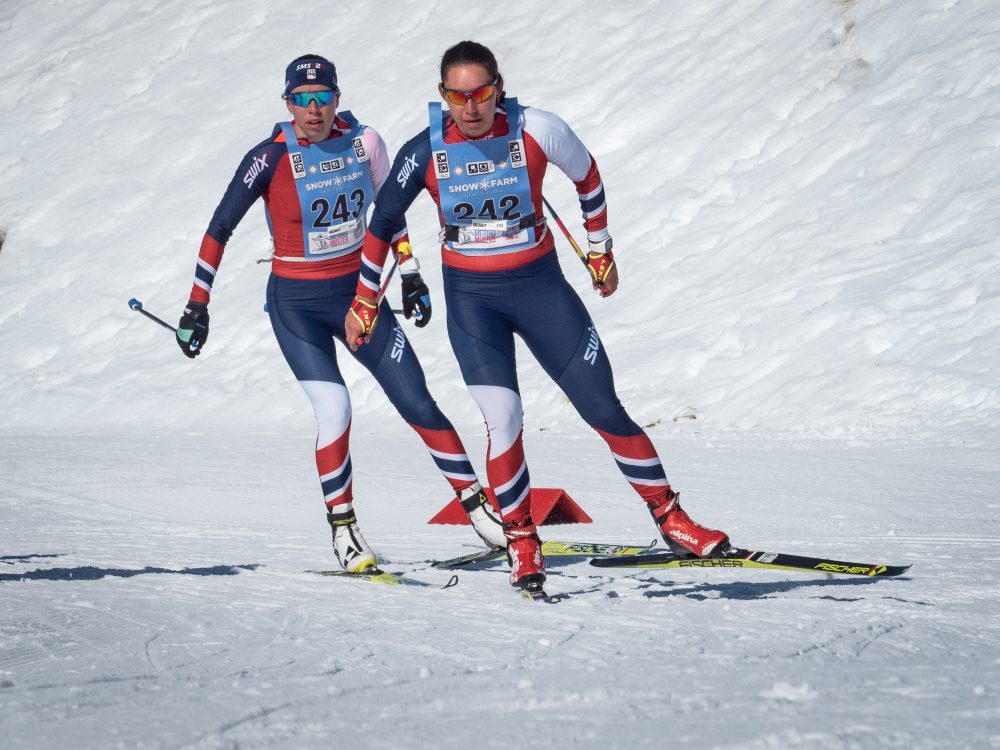
Julia Kern leads Katharine Ogden, her fellow Stratton Mountain School (SMS) and U.S. Ski Team development team member, during the Snow Farm’s 21 k Snow Rake at the 2018 Merino Muster in Wanaka, New Zealand. (Photo: Garrick Cameron)
Note: This article has been updated to include comments from Simi Hamilton of the U.S. Ski Team (USST) and Stratton Mountain School (SMS) T2 Team, and Kevin Bolger of the USST and Sun Valley Ski Education Foundation.
***
It’s that time of year again where several members of the U.S. Ski Team, along with top-level skiers from the Craftsbury Green Racing Project (CGRP) and Stratton Mountain School (SMS) T2 Team are training at the Snow Farm above the town of Wanaka, New Zealand.
The on-snow volume camp, which featured multiple days of racing, started Aug. 20 and continues through Sept. 10, and includes U.S. Ski Team (USST) athletes Jessie Diggins, Ida Sargent, Sophie Caldwell, Katharine Ogden, Julia Kern, Simi Hamilton, Kevin Bolger, and Paddy Caldwell, and coaches Matt Whitcomb, Jason Cork and Gus Kaeding.
According to Sophie Caldwell, conditions have been “amazing” for the duration of camp so far. “New Zealand had a great snow year and we’ve been lucky to have sunny days almost every day,” she wrote in an email to FasterSkier.
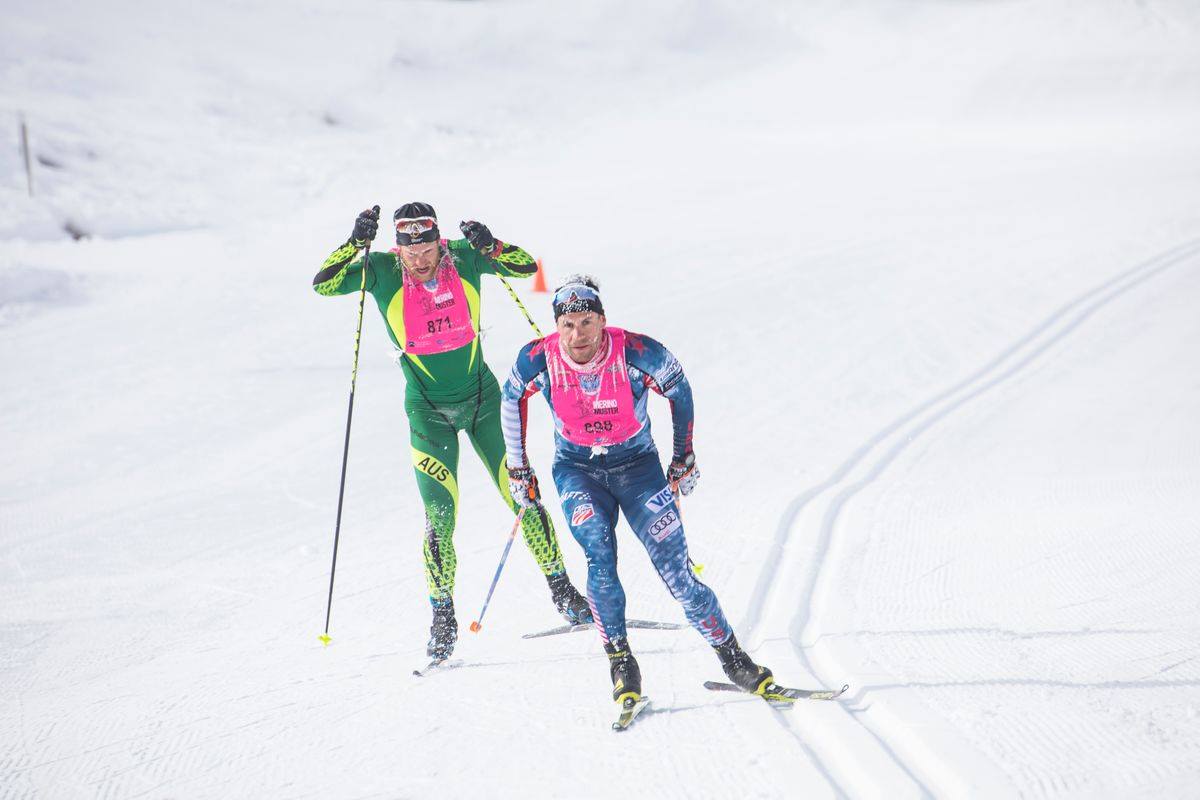
Japan’s Tomoka Satou (446) leads American Jessie Diggins (428) and others up a climb during the Merino Muster 42 k skate race on Sept. 1 at the Snow Farm in Wanaka, New Zealand. (Photo: Garrick Cameron)
Diggins called it the annual trip one of her “all-time favorite camps because the living at the Snow Farm is great, the food is outstanding, and you can step out the door right onto the 65+ km of trails!” she wrote in an email.
“I love having the chance to work on my on-snow technique for three solid weeks because that’s when I get to really see progress and make some changes in my striding,” Diggins wrote.
Apart from logging kilometers on snow and soaking up the vitamin D, the team has also spent time trail running in Wanaka.
“The highlight [of the camp] will probably be a crust cruise we go on in the next few days, but since we haven’t done that yet, some highlights so far are an awesome distance run down in Wanaka, and pretty much every day of bluebird skiing we’ve had up here!” Caldwell wrote.
The camp also coincided with the Merino Muster, a 42 k freestyle marathon that is part of the Worldloppet series, and the Winter Games NZ, which doubled as the Australia/New Zealand Cup FIS races and included three days of nordic racing this year at the Snow Farm: a 5/10 k freestyle individual start, a freestyle sprint, and a 10/15 k classic mass start..
Diggins finished a minute and 21 seconds faster than the second-place woman, Aurelie Dabudyk of France, while Hamilton edged Craftsbury skier Adam Martin by 3 seconds for the overall win.
“The day of the Merino Muster was gorgeous and sunny, with fast conditions,” Diggins wrote. “I loved getting the chance to race a long race, and starting with the men as one big field is really exciting! I hope to get to race the 42km race every year. Huge thanks to the volunteers and organizers for making it such a fun day.”
Crossing the finish line in 1:52:34 hours, Diggins placed sixth overall. Dabudyk was eighth overall and Alayna Sonnesyn (SMST2) was the third woman, 11th overall, 5:30 behind Diggins.
Meanwhile, Hamilton finished in 1:39:46, beating his time of 1:40:33 from last year’s race. Martin followed 3 seconds later, while Kyle Bratrud (SMST2) finished 24 seconds after from Hamilton in third, followed by Tomoka Satou of Japan in fourth (+45.0).
“The Merino Muster is always an awesome race,” Hamilton wrote in an email. “It actually lends itself to the type of intensity we are still mostly focused on in August/late September because the terrain and snow conditions usually make for a really good chance to get in about 1.5 hours of level 3 effort followed by a few minutes of really hard skiing in the last km before the finish. It’s a very rolling course and if you ski it in a pack with people switching leads it’s basically impossible to go much harder than level 3.”
Also on Saturday, Americans also took the top spots in the 21 k Snow Rake. Ben Saxton (SMST2) ran away with the overall win by more than 12 minutes in 47:48, while Paralympic sit skier Dan Cnossen placed second (+1:12:13) nine seconds ahead of Petr Sykora of the Czech Republic in third (+1:12:22).
Ogden was the fastest woman and second overall with a time of 50:29. Her SMS and USST teammate Kern finished 56 seconds later as the second woman, and Elizabeth Martin of the University of New Hampshire (UNH) followed in third, 7 minutes and 30 seconds behind Ogden.
With about 300 participants between three different races at the Merino Muster, Hamilton described the atmosphere as “super fun and light.”
“But the grooming always rocks and it’s just a really fun course to ski,” he added. “I think that in this day and age of social media being so huge and cross-country skiing gaining more attention in the US and world-wide, we’ll start to see more and more people showing up for the marathon. I feel like in the last few years alone their has been noticeably more attention and attendance each year. The quality of skiing is a small part of the race atmosphere here… New Zealand’s south island is one of the most beautiful parts of the world and the culture is so welcoming and comfortable.”
Many of the American skiers in New Zealand also competed in the Winter Games NZ races this week.
“The New Zealand Winter Games are also a huge opportunity to get back into racing mode and test out all the technique work we’ve been putting in so far!” Diggins wrote. “And if you know me, you know how much I adore 5km individual skate races, and we no longer get to do those on the World Cup. So I’m so grateful to the Snow Farm and race organizers for keeping such a fun and hard, fast race alive! I forgot how much it can hurt to go so hard for 5km, but it was fun to really get that lung burn back for the first time since last winter.”
Three days after her marathon win, Diggins won the 5 k skate at the Snow Farm in 15:02.6. The U.S. swept the top five with Sophie Caldwell finishing 10.5 seconds back in second place, Caitlin Patterson (CGRP) in third (+16.7), Sargent (USST/CGRP) in fourth (+1:02.6), and Kelsey Phinney (SMST2) in fifth (+1:16.6) out of eight women.
Kyle Bratrud (SMST2) gets a feed from U.S. Ski Team coach Jason Cork during the 2018 Merino Muster 42 k skate race at the Snow Farm in Wanaka, New Zealand. He finished third behind two other Americans. (Photo: Garrick Cameron)
In the men’s 10 k skate on Tuesday, Bratrud took the win in 27:48.1, 21 seconds clear of Kaichi Naruse of Japan in second, while Craftsbury’s Ben Lustgarten and Martin (CGRP) followed in fourth (+23.0) and fifth (+44.0), respectively. Eight men competed.
Wednesday featured 1.1 k skate sprints, which saw Sophie Caldwell take the win in a field of 10 women, ahead of Sargent in second and Phinney in third.
“The sprint was a short and tactical race that was awesome practice for what’s to come this winter,” Caldwell wrote. “It was really fun toeing the line with my USST and SMS training partners. On one hand, that final could have been any day of summer training, but it also could be a World Cup heat! It’s pretty cool to be pushed by so many strong training partners and friends and we were psyched to throw on a bib and put in a race effort.”
In the men’s final, Bolger landed the top spot on the podium, ahead of Saxton in second and Satou in third. Eleven men competed in the sprint.
“I really enjoy these early session races it gives us as races a chance to get in the mindset and practice real race strategy,” Bolger wrote in an email. “I wanted to go out there test myself, I approached every round like a final and attacked from the start getting out in front and leading into the finish, and was very happy to end the day on top, especially after a long camp down here with the US crew.
“… Coming down here and having a good result in the sprint is of course a huge confidence booster heading into the September/ October training months, but there is still a ton of preparation to be done,” he added.
On the final day of Winter Games NZ racing, Diggins continued her undefeated streak (after skipping the sprint), winning the 10 k classic mass start, while Patterson placed second and Sargent placed third. Saxton picked up his second win of the week, while Martin took second and Lustgarten third.
Complete results will be posted once they’re available.
“We have been incredibly lucky with weather and conditions this year,” Hamilton noted. “Usually, when you’re here at the Snow Farm for 3 weeks in the winter, you’re bound to get an extended period of really nasty weather and wind. But this year we’ve basically had sunshine and cold night time temps every single day, making for amazing skiing for pretty much 3 weeks straight. There is about 40-50 km of trails to ski when everything is groomed, so it’s essentially impossible to get bored. The highlight of our camp every year is a big crust ski up to and around Mt. Pisa. We are planning on getting out tomorrow [Friday, Sept. 7] because the crust hasn’t been great yet while we’ve been here, but conditions for tomorrow look promising. But even when we can’t get out for a huge adventure like that, it’s just one of the best and most fun places in the world to train.”
Skiers Encouraged to Register by Thursday at 11:59pm!
HAYWARD, Wis. (January 3, 2018) – With flurries in the air and Birkie week festivities a mere 49 days away, skiers are more excited than ever to get some training time in on their skis. The Birkie Tour, hosted by the American Birkebeiner Ski Foundation (ABSF), is slated for January 14, 2018. The Birkie Tour is an untimed, non-competitive, “open-track” event where skiers choose their own distance while touring the world-class Birkie trail system. Friday, January 12, 2018, marks the next Birkie Tour price increase; skiers are encouraged to register by Thursday, January 11, at 11:59pm at www.Birkie.com.
The Birkie Tour is a fun and casual event with a morning start time window, a variety of looped courses, warm trailside cabins, and aid stations along the legendary Birkie Trail course. Tour skiers are often skiers looking for a supported training day before February races; skiers thinking about the Birkie event, but unsure about being ready; skiers who simply love to ski with family and friends yet haven’t an interest in racing, or anyone interested in experiencing healthy, active, outdoor, winter activities. With 47, 27, or 16 kilometer looped course options available, skiers of all abilities will find a course to suit their needs. Skiers will park, start, and finish in the same location at the American Birkebeiner Trailhead, Cable, WI. The Après ski celebration in the heated Great Hall will include a Greek chicken pita meal, Birkie Brew-Ski, or soft drink for Tour participants. The first 700 Birkie Tour skiers will also receive a Birkie Dry Bag with their registration.
Tour skiers can choose to ski either classic or skate techniques on one of the best cross-country ski trail systems in the World. As a Worldloppet event, skiers can also get credit and a stamp in their Worldloppet passport.
Other Upcoming American Birkebeiner Ski Foundation Events
February 22, 2018 – February 25, 2018: Birkie week festivities begin on Thursday, February 22, 2018 with the Birkie Adaptive Ski, Barkie Birkie Skijor, Barnebirkie, Junior Birkie, and Birkie Giant Ski events, all on Hayward’s snow-covered Main Street. Registration for Friday’s Prince Haakon (15K) race is still open, however, Slumberland American Birkebeiner and Kortelopet registration is closed. Registration for all other Birkie week events is open and available at www.Birkie.com.
March 10, 2018 marks the Fat Bike Birkie, the world’s largest fat bike race, where riders choose between a 47K (The Big Fat) & 21K (The Chico) ride through the north woods on perfectly groomed trails. Now in its 6th year, the race has grown from fewer than 200 riders in 2013 to a capped registration of 1200 riders in 2018. www.Birkie.com.
Registration for all ABSF events is available at www.Birkie.com.
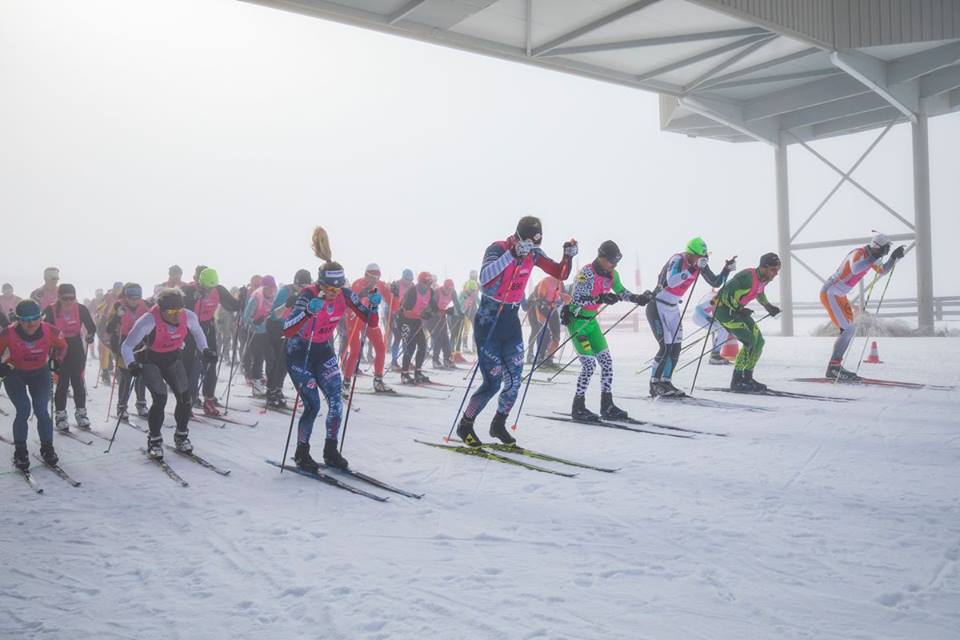
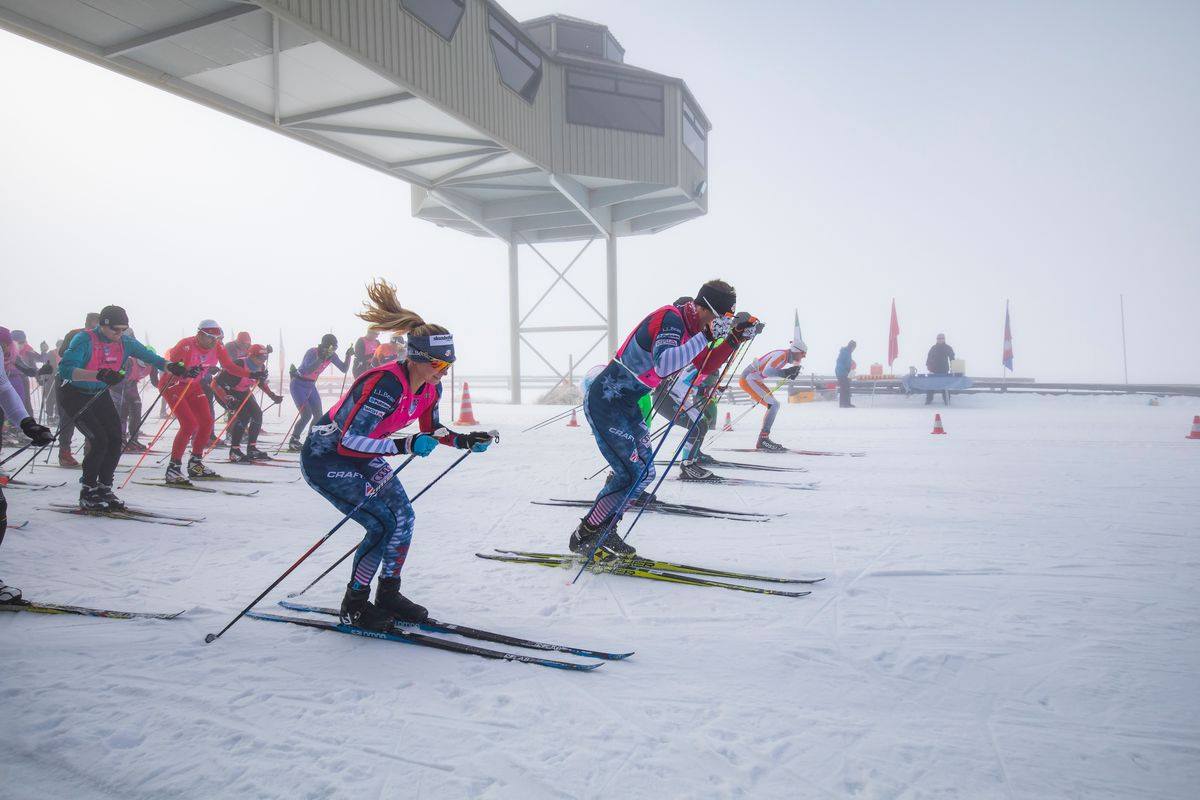
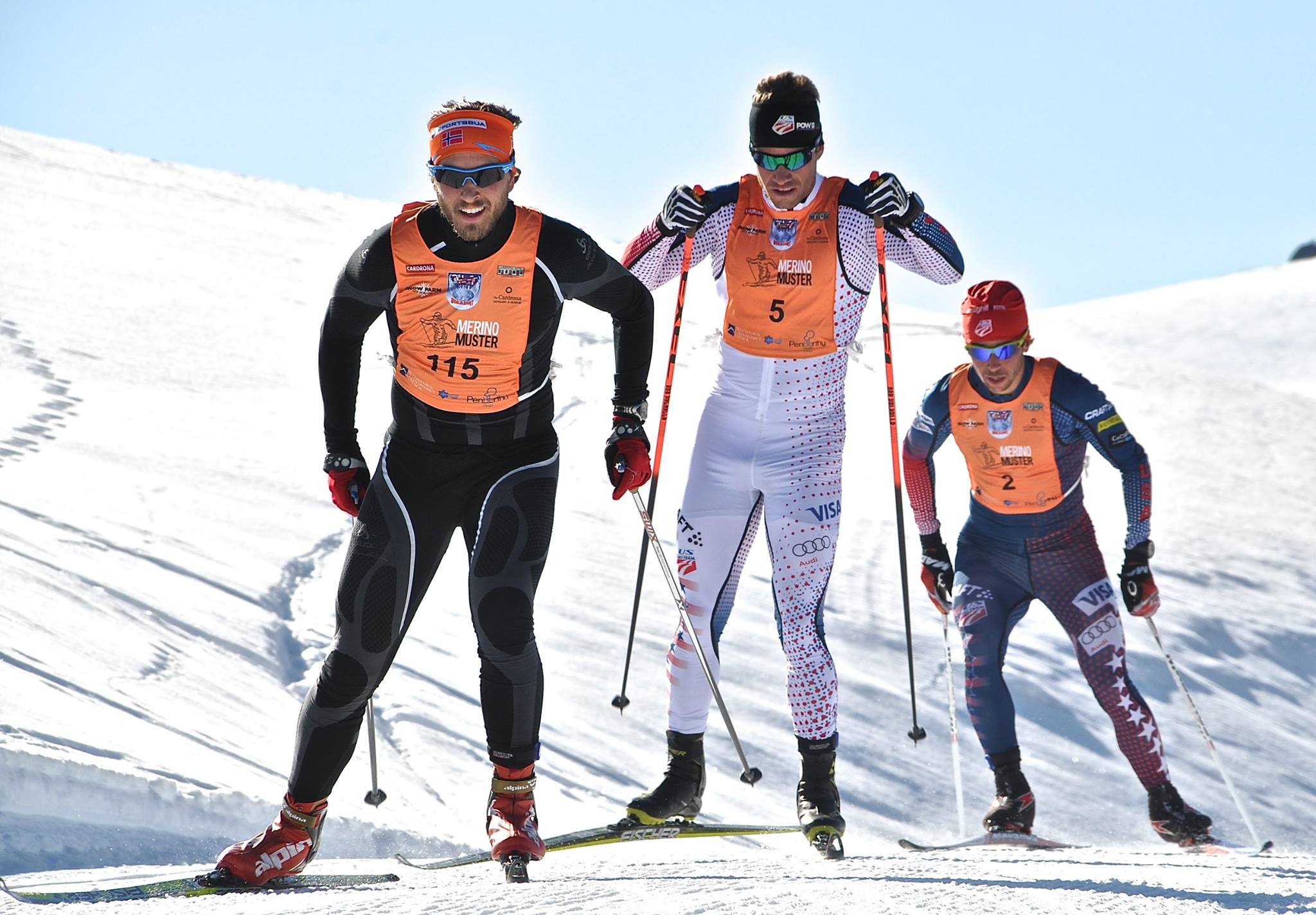
The start of the 2017 Merino Muster 42-kilometer on Sept. 2 at the Snow Farm near Wanaka, New Zealand, with Americans Jessie Diggins and Simi Hamilton (in blue) up front. (Photo: Winter Games NZ Facebook/Neil Kerr)
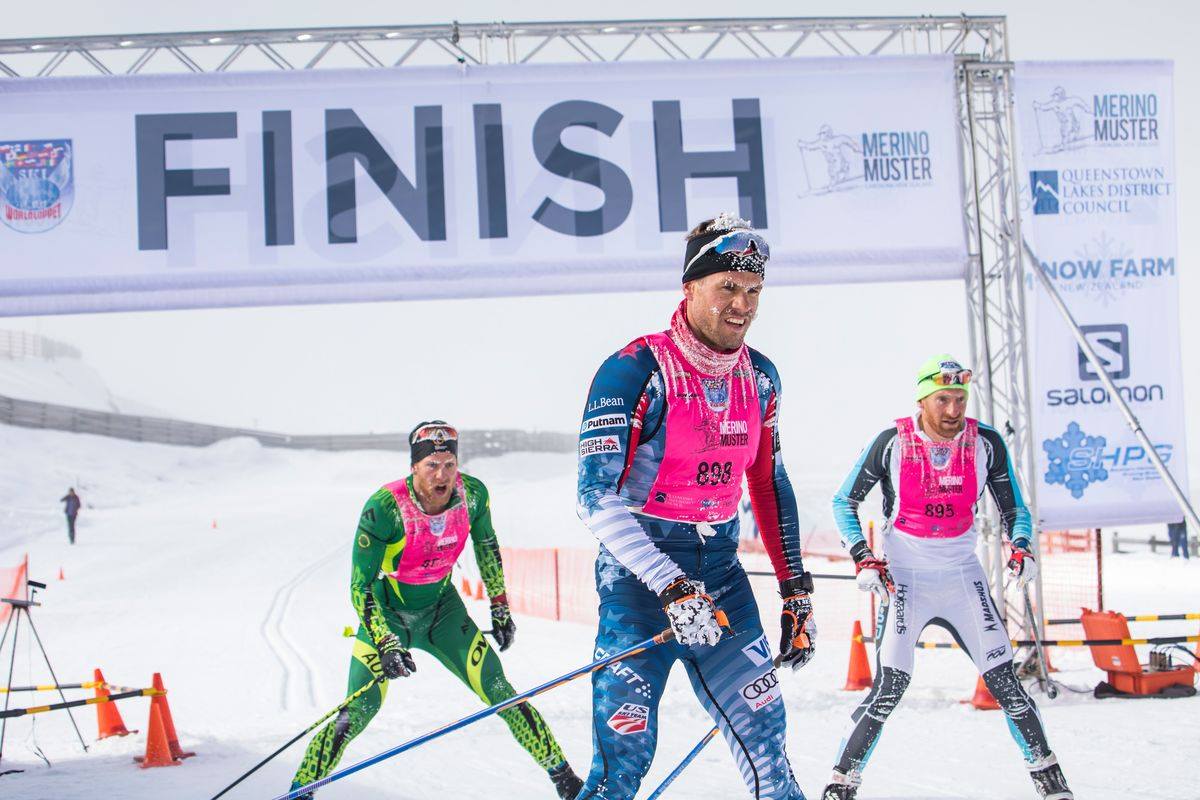
Visibility was thin and temperatures were below freezing last Saturday at the Snow Farm. Opaque white clouds of fog swept over the landscape near Wanaka, New Zealand, showcasing a skyline that seemed to play on the country’s largest historical farm industry: sheep. If bluebird skies and sun had greeted competitors in previous years, racers in the 2017 Merino Muster experienced temperatures around -5 degree Celsius (23 Fahrenheit) and a four-meter radius of visible track, then fog, for most of the 42-kilometer marathon.
Simi Hamilton (U.S. Ski Team) leads Phillip Bellingham during the 42 k Merino Muster on Sept. 2 at the Snow Farm in Wanaka, New Zealand. Hamilton ultimately won and Bellingham placed third, 2 seconds back. (Photo: Winter Games NZ Facebook/Neil Kerr)
The flutter of his own pole grips passing in his peripherals might have been the only company U.S. Ski Team (USST) A-team member Simi Hamilton saw during the race, had it not been for American Brian Gregg and Australian Phillip Bellingham.
The two contenders followed Hamilton from the start, and within the first few kilometers, all three had broken away from the rest of the 80+ men’s field to form a lead group. Together, the two Americans and Australian forged through the next 40 k, taking turns leading through the day’s scrim that hid the panoramic views of the Pisa mountain range that surround the Snow Farm.
“It was incredibly foggy all morning,” Hamilton wrote in an email. “I think we would have all gotten a little lonely out there if we had been skiing on our own.”
The trio kept each other company for the entirety of the race, but by the final two kilometers, Hamilton had staked his spot in the front. As Hamilton headed into the finishing stretch, both Bellingham and Gregg pushed to keep up with his pace. He ultimately held off Gregg by a second and Bellingham by 2 seconds to take the win with a finishing time of 1 hour, 40 minutes and 33 seconds.
“My energy felt good both years, but last year I had trouble accessing my sprint/[Level 4] gear in the final 2 kilometers of the race,” Hamilton wrote. “This year, I felt more comfortable skiing level 3 and I found that it was much easier to access my sprint gear at the very end.”
The victory is Hamilton’s first in the Merino Muster, which has been running for 23 years, the last three of which its been part of the Worldloppet marathon series. He first raced the marathon last season and finished second to his then-teammate Noah Hoffman (who won in 1:45:08 by 23 seconds over Hamilton). Upon returning, Hamilton had some specific objectives.
“The primary goal (both last year and this year) is to get in a really solid level 3 workout, with a hard effort at the very end,” Hamilton wrote. “It’s great terrain to be able to do that on because it’s all very rolling and you can maintain a really consistent effort the whole time without burying yourself too deep. And I think it’s always important to put on a race bib this time of year from time to time in order to start getting back into the race routine before the season really starts.”
Simi Hamilton (c) of the U.S. Ski Team after taking the win in the 2017 Merino Muster marathon on Sept. 2 at the Snow Farm in New Zealand. He held off fellow American Brian Gregg (r) by one second and Australia’s Phillip Bellingham by 2 seconds.(Photo: Winter Games NZ Facebook/Neil Kerr)
Gregg’s second-place result came at his first Merino Muster, an event he was able to enter since he was in New Zealand for a training camp with his wife and Team Gregg teammate, Caitlin Gregg. The two arrived in New Zealand on Aug. 22 and planned to train there until the second week of September.
“Our dates ended up aligning with the USST camp dates as well and it has been a lot of fun joining them for workouts,” Brian wrote. “At the start of the second week down here athletes from Craftsbury, Stratton and Sun Valley arrived so we have had a large US representation. My brother and sister in law also made the trip down to race the Muster and help support our training. They both work remotely for their companies and it has been a blast to have them here with us.”
While he indicated that his summer training had been going well, the race itself was an invaluable opportunity for Gregg to tackle technique. Following Hamilton for an extended hard effort was one of his primary aims, not to mention testing his sprint speed against one of the U.S.’s top sprinters.
“One of my specific goals for this race was to ski with Simi,” Gregg wrote. “I think he is one of the better technical skiers in the world especially in V2 and following his smooth rhythm has been helpful for my own technique. Technical adaptations on snow has been my biggest goal of the camp and the race offered a focused 1 hour and 40 minutes of that.
“Swapping leads with Simi allowed me the opportunity to make technical adjustments through mimicry and then I could take the lead and make the technique more my own,” Gregg continued. “Although my goal was also to win the race I can hardly complain about being able to match the finishing sprint of a World Cup Winner.”
Bellingham, an Australian national team member, rounded out the men’s marathon podium in third, just two seconds out of first. A week prior to the Merino Muster, Bellingham competed in the 2017 Kangaroo Hoppet in Falls Creek, Victoria, where he placed second to American Miles Havlick.
Diggins 1st Woman, 4th Overall
In the women’s 42 k race, which started with the men, USST A-team member Jessie Diggins took the win with a time of 1:51:42 for fourth place overall. Diggins explained that while she was able to ski with the front group of men for the first few kilometers, she eventually settled into a pace that was more her own.
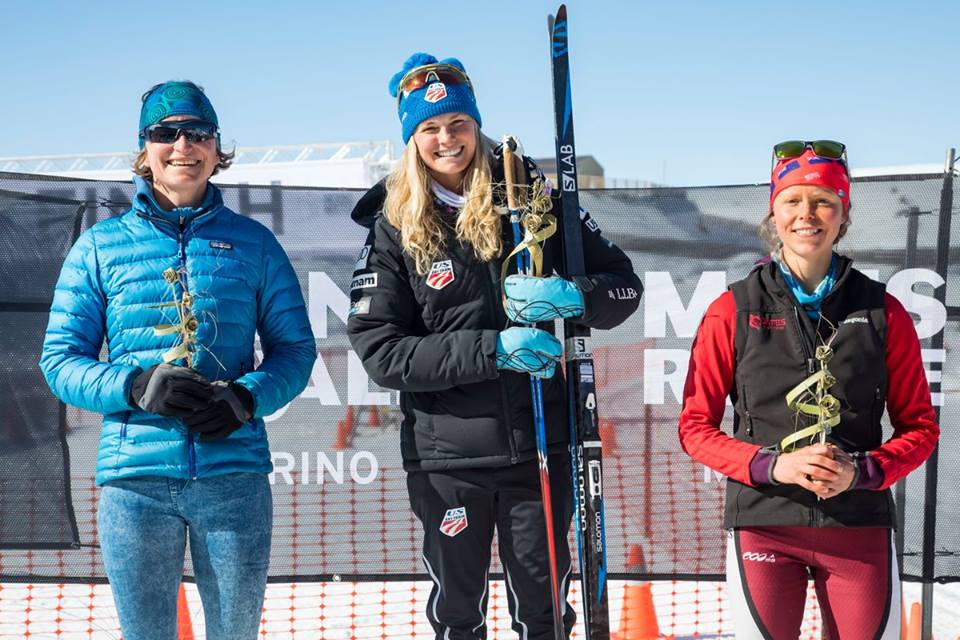
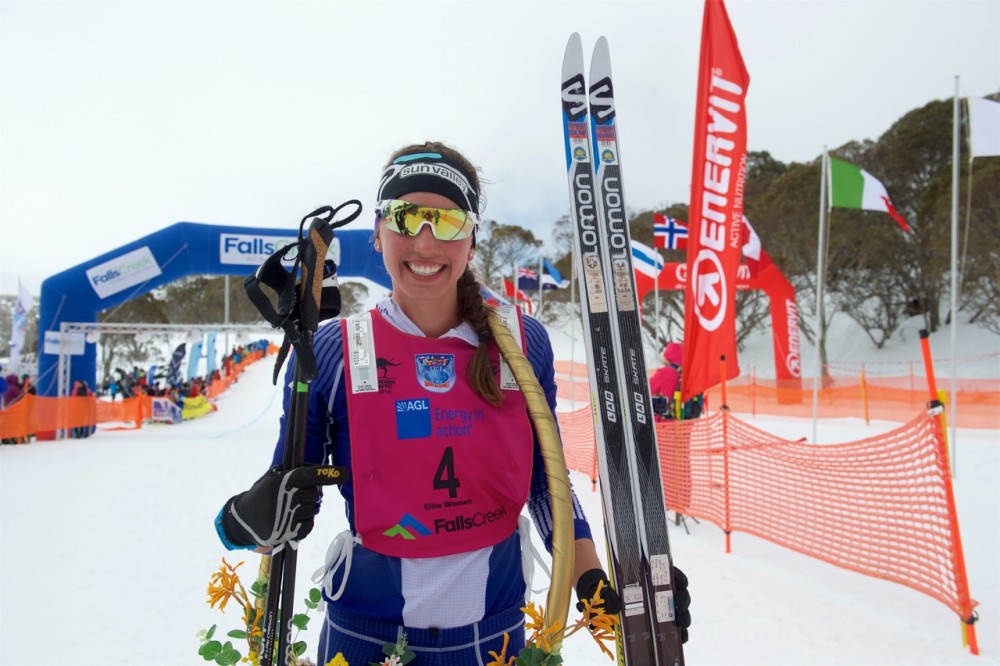
The all-American women’s podium at the 2017 Merino Muster on Sept. 2 at New Zealand’s Snow Farm, with Jessie Diggins (c) of the U.S. Ski Team in first, Hannah Dreissigacker (l), formerly of US Biathlon, in second, and Britta Clark (r) in third. (Photo: Winter Games NZ Facebook/Neil Kerr)
“We all started together but after 3-4km I knew I couldn’t hang with the lead guys the whole race, so I dropped back a bit,” Diggins wrote in an email. “I didn’t have to ski alone though, which was really nice!”
For much of the race, Diggins skied with Estonian Joosep Tammeme, a change from last season when she paired with her USST teammate Liz Stephen for most of the marathon.
“Last year was super fun because I got to ski with Liz the entire race,” Diggins wrote. “This year I had a really nice Estonian man to partner with but nobody can replace Liz Stephen!”
Thirty-one seconds behind Diggins, Tammeme, the fourth male, finished fifth.
With the Merino Muster behind her, Diggins will look to finish off the remainder of the USST’s three-week training block in New Zealand.
The start of the 2017 Merino Muster 42-kilometer on Sept. 2 at the Snow Farm near Wanaka, New Zealand, with Americans Jessie Diggins and Simi Hamilton (in blue) up front. (Photo: Winter Games NZ Facebook/Neil Kerr)
“The Merino was a fun way to get a long intensity session in during the week and ski hard while also enjoying the feeling of racing again!” Diggins wrote. “Huge, huge thanks to the entire crew here at the Snow Farm. They always treat us so well and make sure the trails are groomed perfectly for great training. This is my favorite camp so I’m really grateful to them for making space for us down under!”
The second woman after Diggins, 10 minutes and 17 seconds back, was retired American biathlete Hannah Dreissigacker, who has been working at the Snow Farm over the past few months. Dreissigacker, 30, explained that the race was her first since her retirement in the spring of 2016, and though she had remained relatively active leading up to it, gunning for the win wasn’t a goal.
“I’ve been doing a variety of work in the office as well as coaching and instructing and I’ve been trying to get out and ski whenever I can,” she wrote in an email. “But I definitely went into the race with low expectations.”
The Vermont native, instead saw the race — which ended up being her longest workout of the Southern Hemisphere’s winter — as more of an opportunity to do something she loved: skiing.
“The race split up immediately for me — I knew better than to try to stay with Jessie at all,” Dreissigacker wrote. “I skied with an older Russian skier, and then by myself, keeping the pace comfortable and I was very happy to feel good the whole time! There was some low-visibility off the start but the trails were in great condition and it was a fun first race as a ‘master blaster’.”
Rounding out the women’s podium in third (+17:24) was American and 2016 Bates College graduate Britta Clark.
In the 21 k “Snow Rake”, USST A-team member Sophie Caldwell took the overall win in a time of 51:21. Just one second behind her was Caitlin Gregg in second place, while the third woman was U.S. Paralympics Nordic Head Coach Eileen Carey (+5:48). The first man in third overall (+4:44) was U16 skier Campbell Wright, of New Zealand.
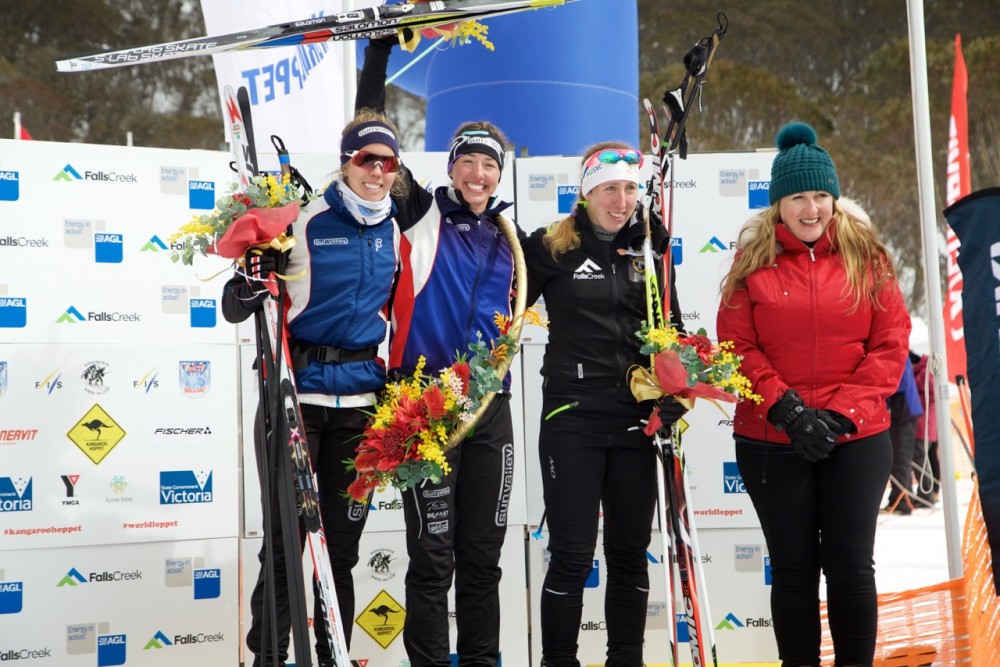
Americans Mary Rose (l) and Deedra Irwin (second from l), both of the Sun Valley Ski Education Foundation (SVSEF), along with Australian Aimee Watson on the podium at the women’s Kangroo Hoppet 42-kilometer freestyle marathon on Saturday, Aug. 27, in Falls Creek, Australia. (Photo: Kangroo Hoppet)
Note: This article has been updated to include official results from the Merino Muster.
In their first ski marathon south of the equator, a few Sun Valley Education Foundation (SVSEF) Gold Team team members founds themselves on the podium two weekends ago at the Kangaroo Hoppet on Aug. 27.
After spending nearly a month training on snow in the land down under, SVSEF teammates Deedra Irwin and Matt Gelso finished their Australian training camp on top of the podium, winning the respective women’s and men’s 42-kilometer Hoppet, part of the Worldloppet marathon race series, in Falls Creek, Australia.
“Not many people can say that they’ve skied and raced a marathon in Australia,” Irwin wrote in an email. “The Nordic ski community down there is also really supportive and was excited to have us there. There were lots of people cheering for us along the way.”
Irwin skied most of the 42 k freestyle race alongside her Sun Valley teammate Mary Rose. From start to finish, Irwin explained it was predominately a race between the two of them, with Irwin outlasting Rose by 0.6 seconds with a winning time of 2 hours, 8 minutes and 15.6 seconds. Finishing more than 12 minutes later, Aimee Watson was the leading Australian in third place (+12:17.7).
“The competition was mostly just Mary and I from the start,” Irwin wrote. “The race came down to a sprint … I got in front of her at the right time and was able to push through the finish first. Skiing with her during the Hoppet taught me a lot about marathon racing. She is a really strong skier and it was fun to be with her during the race and try to match her moves.”
Sun Valley’s Deedra Irwin after winning the 2016 Kangaroo Hoppet on Saturday Aug. 27, in Falls Creek, Australia. (Photo: Kangaroo Hoppet)
Rose pointed out that there was plenty of competition besides her teammate.
“Most of the Australian National Team competed, along with some AUS legends like Esther Bottomley,” Rose wrote in an email.
Both Irwin and Rose plan to race another marathon this coming winter, the 2017 American Birkebeiner in February, which is also part of the Worldloppet marathon series. And next summer, Rose indicated that she might return to the Kangaroo Hoppet.
“I don’t have any marathons on my race schedule for this coming year, except the Birkie,” Rose wrote. “I will for sure be returning to Australia to compete in this event, hopefully next year!”
First across the line in the men’s race, Gelso beat out Australian national-team athletes Phillip Bellingham and Nick Montgomery, who finished in second and third, respectively. Just over the halfway point, Gelso explained the front group gradually began to dwindle.
“It split up into five guys, maybe with 20 k left,” he said on the phone from Australia. “At 5 k I kind of blew off the front … and in the last 4 k it turned into, like, three separate people.”
Gelso has raced at least two marathons before, finishing seventh in the 2014 American Birkie and 16th at the 2014 Engadin in Switzerland.
For winning the Hoppet, both Irwin and Gelso received $1,300 Australian dollars, as well as a wooden plaque, compression socks and a mug. More than 230 men competed, and 64 women finished this year’s edition of the race.
“The organizers of the events and the volunteers involved put on a race that I will never forget,” Irwin wrote. “Thank you to the Australian ski community for having us there and letting us enjoy their beautiful winter.”
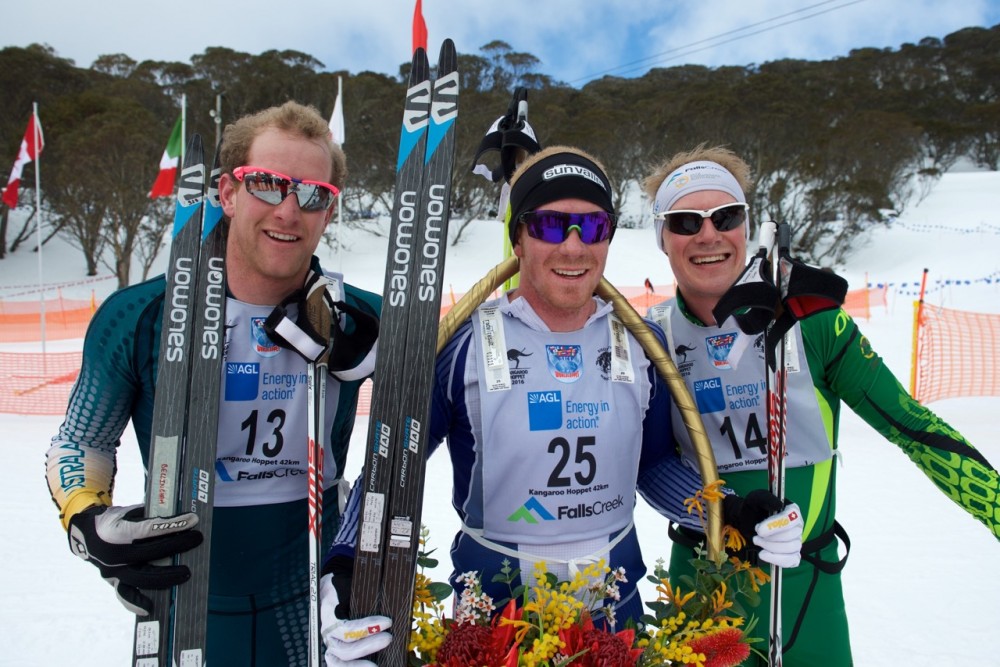
American winner Matt Gelso (c) with Australian runner-up Phillip Bellingham (l), and third-place finisher Nick Montgomery (r), also from Australia, after the men’s Kangaroo Hoppet 42-kilometer maration, on Saturday Aug. 27 in Falls Creek, Australia. (Photo: Kangaroo Hoppet)
After the Hoppet, most of the SVSEF skiers headed back to the U.S. for a recovery week in Sun Valley, Idaho, before resuming training. Gelso and Rose opted to take their recovery week exploring Sydney and Melbourne, Australia, prior to flying home this coming Wednesday.
“Everybody else is back, it’s just Mary and I here now,” Gelso said. “We’re kind of doing a recovery week right now, but when we get back, we’ll obviously have to get back into time zone … That’s kind of the plan: get back, get recovered and then get back into full training before we head to Frozen Thunder [in Canmore, Alberta].”
Soaking up the Southern Hemisphere sun and a few last days of rest were also a part of Rose’s schedule.
“I am hanging out in Sydney for a week visiting a friend,” she explained. “So I am putting in some beach time and being a tourist.”
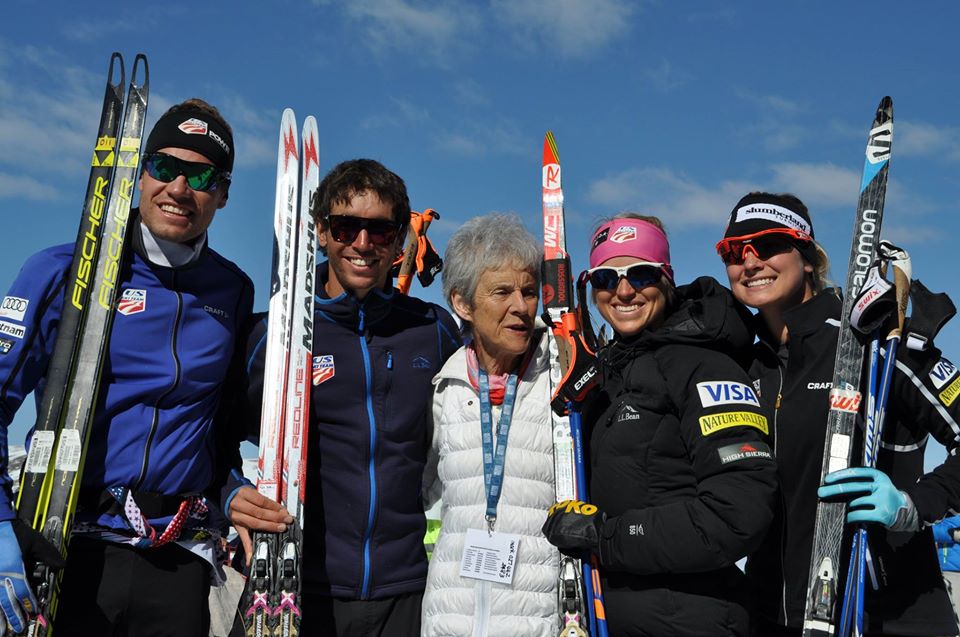
The U.S. Ski Team took first and second in both the men’s and women’s races at the 22nd Merino Muster 42 k freestyle, with Noah Hoffman (second from l) winning the men’s race over Simi Hamilton (l), and Jessie Diggins (r) outlasting Liz Stephen (second from r) for the women’s win. Here, those top finishers pose with Wanaka’s Mary Lee at the Snow Farm in Wanaka, New Zealand. (Photo: USSA Nordic/Facebook)
This past weekend in New Zealand, the U.S. Ski Team (USST) swept the overall top four in the 42 k Merino Muster at the Snow Farm in Wanaka. Noah Hoffman beat out his USST teammate Simi Hamilton for the overall victory, and Jessie Diggins was the fastest woman in third overall, 12 seconds ahead of teammate Liz Stephen in fourth.
U.S. Ski Team members Simi Hamilton (c) and Noah Hoffman during the 2016 Merino Muster at the Snow Farm in Wanaka, New Zealand. Hoffman won the 42 k freestyle race, and Hamilton placed second. (Photo: USSA Nordic/Facebook)
Hoffman won the skate race in 1:45:08 and Hamilton finished 23 seconds later in second place. U.S. coach Matt Whitcomb told the Otago Daily Times that Hoffman, the team’s leading distance skier, was working to improve his sprinting, while Hamilton, who has podiumed in World Cup sprints, wanted to improve his distance skiing.
Two years ago, Hoffman placed second in the 2014 Merino Muster behind Poland’s three-time race champion Maciej Kreczmer. Canadian Para-Nordic visually impaired legend Brian McKeever won last year’s edition (as well as 2010 and 2011), ahead of his teammate and guide in Paralympic events, Graham Nishikawa.
Clocking in third at 1:59:12 was Diggins and Stephen followed 12 seconds later as the second woman.
Of 10 USST members in New Zealand, four raced — finishing first or second in their respective men’s and women’s races. Whitcomb told the Otago Times that the U.S. has held training camps at the Snow Farm for more than 16 years.
This year, all but six of its athletes are there. Of those six, at least four — Alaska Pacific University skiers Kikkan Randall, Rosie Brennan, and Sadie and Erik Bjornsen — are training at home in Alaska on snow at Eagle Glacier.
JoJo Baldus at the 2016 Birkebeinerrennet in Norway. He completed the 54-kilometer classic marathon, also known as the Birken, in mid-March. (All photos: JoJo Baldus)
(Editor’s note: JoJo Baldus is a nordic skier from snowy Minneapolis, Minn., who spent this past winter “living the dream,” as he described it, as a volunteer journalist and photographer for FasterSkier while enjoying a gap year before starting at Macalester College in St. Paul. He set a goal to complete nine Worldloppet ski races this winter, three of which were canceled due to low snow. He did five — including the Finlandia-Hiihto — but did not race the Jizerská because it was shortened. This is a tale of his most memorable experiences.)
***
People travel in a wide variety of ways and for quite varying reasons. Many flock like pigeons to big, famous, ridiculously densely populated cities. Historic sites often attract the hordes. And the great outdoors also allure many travelers.
Being on a ‘gap year’ exploring Europe before college, I immersed myself in the international ski scene this winter. It is just my kind of travel: being outdoors, meeting interesting skiers from all over the world, and experiencing different ski cultures from one country to the next. Italy and Finland and Norway, oh my!
After following around the World Cup race scene in December and January reporting for FasterSkier, interviewing athletes and photographing races at the Tour de Ski, I embarked on what I called a marathon of ski marathons. Originally I prepared myself to endure these nine Worldloppet races:
Jan. 10: Jizerská 50: 50 k classic, Liberec, Czech Republic
Jan. 24: Dolomitenlauf: 60 k skate, Lienz, Austria
Jan. 31: Marcialonga: 70 k classic, Predazzo, Italy
Feb. 6: König Ludwig Lauf: 50 k skate, Oberammergau, Germany*
Feb. 14: La Transjurassienne: 68 k skate, Morez, France*
Feb. 21: Tartu Marathon: 63 k classic, Tartu, Estonia*
Feb. 28: Finlandia-Hiihto: 50k skate, Lahti, Finland
March 6: Vasaloppet: 90 k classic, Mora, Sweden
March 19: Birkebeinerrennet: 54 k classic, Rena, Norway
Of course the weak winter that plagued Central Europe this year had a different vision. The Konig Ludwig Lauf, La Transjurassienne, and Tartu Ski Marathon were all unfortunately canceled (*see above) due to a lack of snow and soberingly warm temps. But the golden lining — you appreciate each of the other races just that much more!
As winter melts away to spring and we mournfully watch the beautiful white snow turn to brown slop, we can keep the season alive a little longer by recalling, sharing, and reliving all the fun and joys of the past months on snow. For everyone stateside, with tulips blooming, I hope to capture a little snippet of each of the races I did; bringing the scene to life, and piquing passions and curiosities for all to ski abroad.
The Norwegian Birkebeiner: Properly, the Grand Finale
Start line at the Norwegian Birke with 3.5-kilogram backpacks representing the weight of 18-month-old Prince Haakon, whom the Birkebeins skied to safety.
2016 Birkebeinerrennet
At the high point of the course, Midtfjellet.
2016 Birkebeinerrennet
If there is a place where skiing is king, it’s Norway. And the Birke certainly made a strong case for that idea in many ways. It was the full package event: beautiful scenery, incredible atmosphere, wonderful skiing — all anyone could ever ask for.
The big day begins in Rena. But don’t forget about your Prince; he desperately needs saving! The race truly begins the night prior, with preparing the obligatory 3.5-kilogram backpack representing the young prince. It’s all part of the fun, and this twist serves to mix the race scene up, adding some unique spice to the event. At the start-line clothes bag drop, big metal balances are set pre-weighted with 3.5-kilograms to test your bag. Hopefully you got it right on, or else you better throw in a few fistfuls of gravel right there on the spot.
At the start, from the sound of the gun, it was as smooth as butter. It is a wave-start format, and felt different than any other race I’ve ever done. There were only a couple hundred people in my wave, I didn’t see a single crash or tangle, and not a trace of a broke pole. That seemed like a naturally good way to start the day — definitely a plus of the race, in my mind.
High temps, wet snow, and a lot of freeze/thaw action in the days prior meant klister conditions on race-day Sunday. But we also lucked out with a perfectly sunny day and a quite comfortable temperature.
With or without the sun, the course is magnificently beautiful. As commonly mentioned, the course is definitely windy in some exposed sections over the mountains, but the endless stunning vistas more than make up for it. The Birke was easily the most scenic race of all, which made the race very well-rounded and balanced. The beauty takes the pain right out of racing and singlehandedly makes the whole trek worthwhile. What a great way to see some of Norway’s incredible natural landscapes.
It is the celebratory, cultural atmosphere of the Birke that makes it especially unique. Norway is like the promise land for cross-country skiers. It is in the culture here, in the air, in their blood. Andbeing a part of that energy, that buzz, passion, and love — it’s an amazing feeling.
“The Birke was easily the most scenic race of all, which made the race very well-rounded and balanced. The beauty takes the pain right out of racing and singlehandedly makes the whole trek worthwhile.”
Everyone is out: old folk and young bucks, serious racers and family-shufflers. Norway’s Crown Prince Haakon himself even raced, personally challenging the Danish Prince. Skiing is in the royal blood — skiing is royal in Norway. The Birke is a major cultural event for all. Ask almost anyone here and they’ll most certainly know the Birke. And it is amazing how well many of these people can ski, too. Sound technique and undoubting fitness is impressively the standard throughout the crowd of skiers.
The course challenges even the toughest of skiers, but also rewards the efforts. The course crosses over three mountaintops, so naturally, long climbs give way to splendid views. The first 13 kilometers out of the gate are continuously uphill, but very comfortably stride-able. Then, after a long, screaming downhill, the climb resumes for about five kilometers, to reach the second peak. The third and final peak, and high point of the course comes 34 k in, at Midtfjellet. Make it there, and you should be set to enjoy some flatland through to beautiful Sjusjøen, and then the long 10+ kilometer descent down to celebrating at Birke Skistadium.
All in all, I thoroughly encourage all skiers to take the pilgrimage and go save Prince Haakon at least once in your life. The Birkebeiner felt like the epitome of cross-country skiing, and for me proved to be a perfect grand finale for a season of Worldloppet marathons.
Vasaloppet: The Long Haul, 90 k for King Vasa
The start-line scene with skis for 15,000 racers
The start-line scene with skis for 15,000 racers
2016 Vasaloppet
View of the finish down main street in Mora, Sweden.
Two weeks earlier, I raced the Swedish Vasaloppet with 15,000 other skiers. This event takes the prize for the biggest hoopla.
The place to experience is Mora, with the buzz of fellow racers descending en masse upon this little town. The race finish is right down main street and is set up the week of the race, filling the whole town with race cheer. Multiple other Vasaloppet event races finish downtown daily. Tear-jerking inspirational videos about the Vasaloppet play on a mega screen. Thousands of people pour in and out of the giant expo tent; emerging with their very own red Vasaloppet bib packet. The Vasaloppet museum located by the finish is worthy of a stop to peruse race lore and general nordic ski history. Everyone is out and about main street preparing for their own race, becoming a part of something bigger.
Race morning comes quick, starting with a brutally early wake-up. The buses from Mora to the start left at 4 a.m. Hours before race time, skis line the tracks at the start to save spots, something like 25 lanes across, hundreds and hundreds of rows back — quite a sight to behold. To be in this extensive company easily sends a jolt of adrenaline down one’s spine — quite thrilling.
It’s a true mass start, with all 15,000 starting at the sound of the gun. After a couple hundred meters of wide open double poling, the course comes to a slight rise and turns a bit to the right. Here I stole a gaze back towards the start, as a friendly Vasaloppet veteran had recommended at the start line. A dense, colorful sea of fellow racers stretched on and on in a ribbon of humanity. During the entire 90 kilometers I was never even remotely alone. Vasaloppet racers are all in it together, which is simultaneously exciting, encouraging and a pain!
The first three kilometers of the race is a rather steep climb that was admittedly not too much fun. Deep mashed-potato snow, shoulder-to-shoulder herringboning with people stepping all over everyone’s equipment. Brute double-poling steep uphills — trying to channel my inner-pro — none of it worked too pleasantly.
After this initial climb with the sea of humanity, the Vasaloppet has a reputation for being a flat, double-pole derby. Compared with the Birke, this is true, but there is still definitely a rolling nature to the course. There is plenty of climb even mid-race, and with 90 kilometers to survive, you feel every hill. The 30 k to 45 k section boasts some relentless continuous climbing, which can easily put one into the pain cave with still 45 k to ski.
“There is plenty of climb even mid-race, and with 90 kilometers to survive, you feel every hill.”
This year provided remarkably better snow and trail conditions than in the race’s recent past. But even starting in group 3, the tracks were fairly obliterated, rutted and iced over for most of the race. I think that is largely dependent on snow conditions to begin with, but I sure did appreciate the beautiful tracks the Birke had to offer alternatively.
The impressive length of the race and number of participants all tackling it at once makes the Vasaloppet a really exciting event just to be a part of and offers an undoubtable sense of satisfaction to finish. The crowdedness and excitement fills Mora and you feel like you’ve been a part of more than a race — but rather a grand, inspired gathering.
Marcialonga: The Miracle on (Manmade) Snow
The trail as seen in the training days leading up to the race.
2016 Marcialonga
2016 Marcialonga
2016 Marcialonga
Predazzo, at the 45 k mark, the day before the race.
The Marcialonga takes place in Val di Fiemme, which is also a race site for the FIS Cross-Country Ski World Cup and Tour de Ski.
The fact that the Marcialonga even happened at all this year was quite impressive, and furthermore, still on the full 70-kilometer point-to-point course. The whole week leading up to the race was in the 40s and even edging into the 50s. Some days bore full sun and birds chirping about — nothing short of a balmy beach day. It felt like we just skipped right over winter and were budding into springtime.
No snow had fallen and none was forecasted either. Instead we had nice spitting rain here and there. A month or so prior, the race organizers took advantage of freezing temps and packed down an initial track of manmade snow; a little ribbon of trail just wide enough. They also prepared massive mounds of manmade snow dotted throughout the valley, which they were able to spread along parts of the trail closer to race day. There is no doubt; sections of the course were extremely slushy, dirty, puddle-y, grassy, and rocky. But holding the event was still quite a feat, as we learned by our three following races getting canceled despite arguably more favorable conditions.
The Marcialonga means ‘the long march’ in Italian. And that it was. 70 kilometers of classic. I don’t think I had ever skied that long straight through, especially not in very slow, 45-degree conditions, 99 percent double poling, and with a horde of others. Let’s just say that I was quite enthused to cross the finish line, accomplishing the first and foremost goal of every race.
The course runs primarily right along the valley floor starting from Moena, heading out to Canazei, and then looping back around, through Moena, Predazzo, and to the finish in Cavalese.
It was especially tough because I was in one of the last waves. The course was shredded, destroyed, utterly annihilated; the classic tracks thoroughly did not exist at all. And I was amongst a teeming swarm of skiers, a fair portion of whom were not super capable nor fast. I was not in the best race shape ever, but it was quite tough to come to any slight uphill and have to herringbone through six inches of mush in the jostling crowds, only to wait in line at the top of the subtlest of descents to snowplow walk down.
It was not very encouraging to tire out my triceps by 5 k due to bracing myself with my poles, inching down the descents. After 20 k of brutally progressing like that, it was 50 k of double-poling monotony. By the end, my shoulders and triceps felt like they were going to rip, tear and explode in ten different places, but I managed to push through and enjoy the finish.
“By the end, my shoulders and triceps felt like they were going to rip, tear and explode in ten different places, but I managed to push through and enjoy the finish.”
The Marcialonga finish features a notorious final cascade climb, two-and-a-half kilometers long and very, very steep. At the base of this hill, there are many wax service stations. After endless kilometers of flat double poling, most racers stop for a quick and generous coat of kick wax before running like banshees up to the finish line right in the heart of the classic Italian cliff town of Cavalese.
The Dolomitenlauf: Maiden Voyage
The Dolomitenlauf is Austria’s contribution to the Worldloppet series, with the 60-kilometer skate being the main event. But this year, also due to lack of snow, it was shortened to a 42 k composed of four laps, and moved up the mountain from Lienz to Obertilliach.
Compared with the other races, the Dolomitenlauf was a small affair. There were only a few hundred participants, and therefore naturally a more low-key, homespun atmosphere. This was my first ever ski marathon — the weather, course, and conditions were very accommodating for my maiden voyage. Fast, flat and sunny, but keep in mind this was the alternative course. The course was mostly manmade snow, but the organizers had done well to thoroughly cover the whole course and make it very compact.
As with many of these ski races, the start was hectic. The announcer gave commands in both German and English, which was handy no doubt. I was in the third of four mass-start sections, lined up shoulder to shoulder, skis tip to tail. Without a countdown, the gunshot echoed and we were off. Although, at first it was a brutally slow pace. One double pole every couple seconds; we inched forward with a wall of people in front of us. The first kilometer out of the start did not seem to be too well equipped to handle the mass of racers packed together. It was quite narrow and contained a handful of little climbs and rather sharp turns right away.
Then, for at least the first half of the race, I could not find anyone to ski with cruising at my speed. Unluckily, as international racers, we are predestined to one of the latter starting blocks, holding primarily the slower, less-competitive skiers. Between that and a conservative navigation of the wild start, I was stuck with a bit slower crowd than ideal. Maybe also due simply to the lower number of participants compared to the other races. The competition was not cutthroat at all though, so I was just able to enjoy the skiing and my first-ever marathon race.
“The competition was not cutthroat at all though, so I was just able to enjoy the skiing and my first-ever marathon race.”
Spectators cheered in German, Italian, and English alike, adding a festive international aura. The race bibs had each individual’s name, so it was fun to know I was skiing behind people with names like Giacomino and Helmut. Although it was not as festive, the smaller crowd made it very manageable and still had the fun element of international competition. The Dolomitenlauf was a great, relaxed race to ease into the winter of marathons.
***
Travel structured on a winter full of Worldloppet ski races was a truly fruitful experience. Each race offered a bit different flavor, yet all complimented each other so well. Any one of these races offers a great opportunity to get a taste of another country’s, and a generally more international, ski scene. As a skier from the United States, where the sport is far from front and center, it is amazing to sample these more ski-steeped cultures.
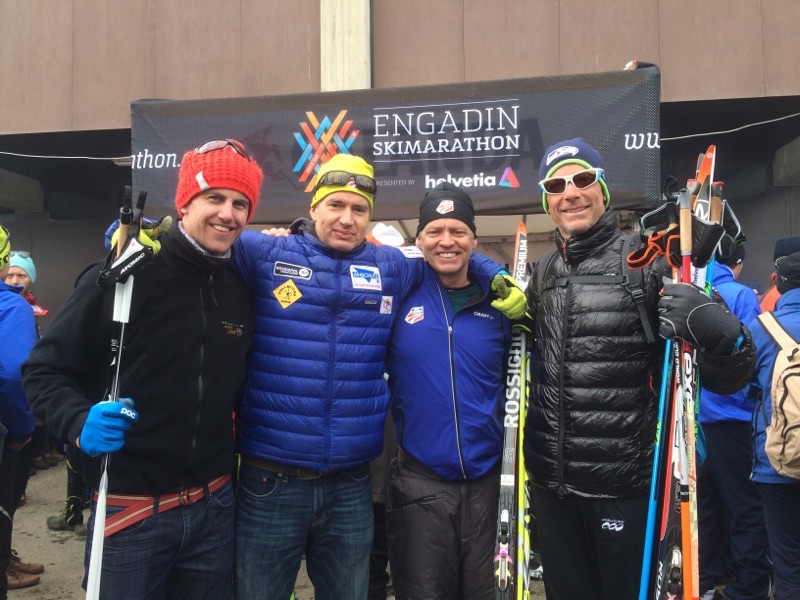
From left to right: pro triathlete Garen Riedel, Jon “Fast Big Dog” Schafer, Tiger Shaw, and Tony Weiderkehr at the 2016 Engadin Ski Marathon in Switzerland. (All photos: FBD)
Nordic ski racing is alive and well in the United States. From top to bottom, more Americans are appearing on international podiums than ever before and one needs to look no further than events like the Boulder Mountain Tour, the West Yellowstone Ski Festival and many others to see that even at a domestic and/or grassroots level, U.S. ski racing continues to increase its scope, reach and success.
Perhaps nowhere is this more evident than ironically, a race outside the U.S., the 42-kilometer Engadin Ski Marathon (ESM). The ESM, held each year through St. Mortiz, Switzerland, is not only the world’s biggest skate ski race, it is also an event like no other. The race in itself it quite a spectacle, but the history, the culture, and the atmosphere make it a truly special event.
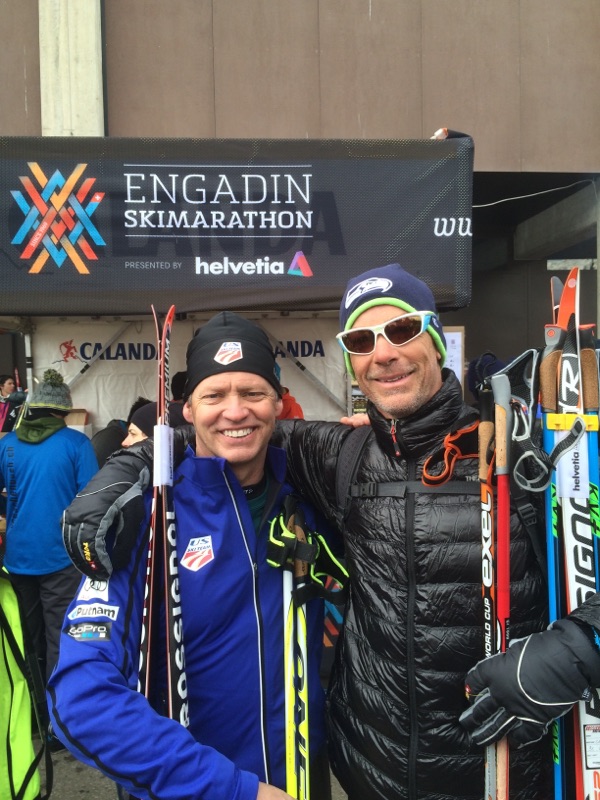
Tiger Shaw (l) and Tony Weiderkehr at the 2016 Engadin.
This year’s 48th edition was particularly unique as not only one of the top U.S. skiers competed, but some of the U.S. ski community’s biggest supporters, funders and leaders attended as well. This might not seem unusual, but these leaders were present not just as supporters, but also as racers. It would be impossible to find Bob Kraft behind center in a Patriots game, but in this year’s ESM, the CEO of the U.S. Ski and Snowboard Association (USSA) took the start, as did a trustee of the USSA Foundation, as well as two highly influential CEOs and major grassroots supports of many levels of U.S. nordic skiing.
Driving to the start on race day in our under-sized van, we had some of the most prominent and influential members of the U.S. ski community. This was a group with widely varying speeds and widely varying responsibilities inside and outside of skiing, but in that moment, we were all focused on one and only one thing for the next few hours: to have the best race possible. While the details of this goal may have varied from person to person and our starting positions ranged from the first row of the elite wave to the last row of the Volksläufer (citizens’ wave), on that particular Sunday, this very diverse group was united in singularity of purpose. Experiencing the race with this very special group made the 2016 Engadin Ski Marathon truly an exceptional experience.
“The Engadin Ski Marathon is an amazing event,” said Tiger Shaw, USSA president and CEO. “I had no idea what it was going to be like, so I was a little nervous, in particular as I was just about to take the start with 13,000 of my closest friends, but it was awesome. The whole scene is almost impossible to describe: you are nestled into perhaps one of the most scenic valleys you could find anywhere, there are skiers as far as you can see, helicopters flying around everywhere and the most spectators that I’ve ever seen at any ski race anywhere in the world.”
“The whole scene is almost impossible to describe: you are nestled into perhaps one of the most scenic valleys you could find anywhere, there are skiers as far as you can see, helicopters flying around everywhere and the most spectators that I’ve ever seen at any ski race anywhere in the world.” — USSA President and CEO Tiger Shaw on the Engadin
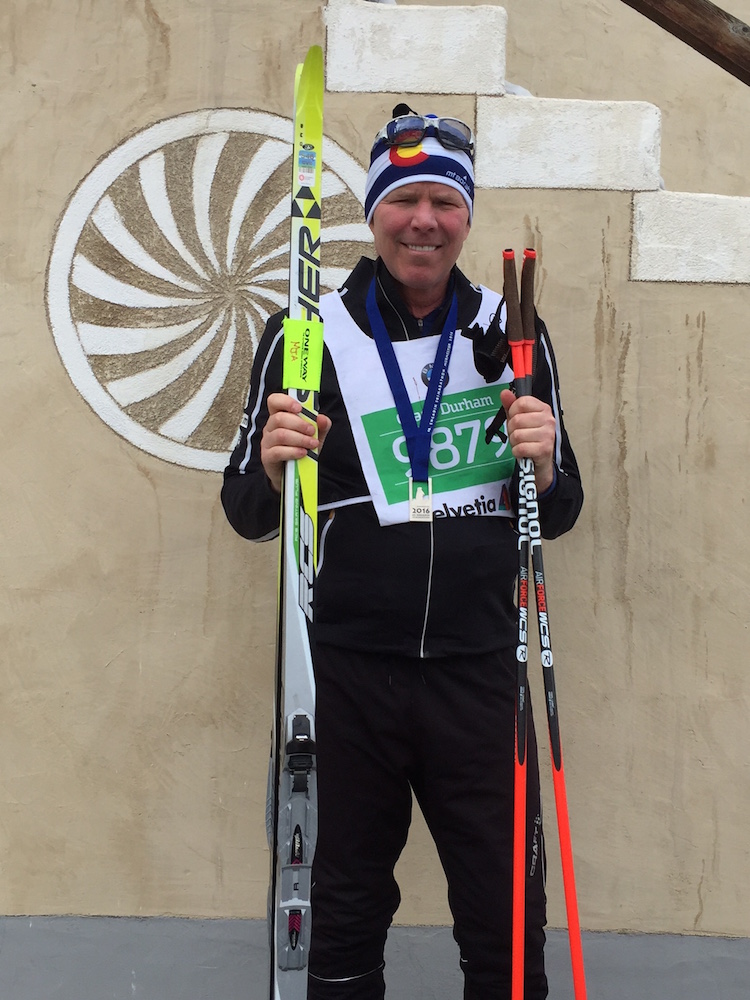
Grady Durham after the 2016 Engadin Ski Marathon
Grady Durham, founder and CEO of Monticello Associates, a prominent asset management firm based in Denver and founding sponsor and principal supporter of Ski Club Vail’s former Team HomeGrown (which previously provided support to skiers like Sylvan Ellefson, Tad Elliott and Noah Hoffman), seconded these observations, “It is a wonderful adventure, but it is very intense. I’ve been ski racing for 30 years, in fact, this year marks the 30th anniversary of my first Birkie, but even I was amazed at the fact that you are not just surrounded by skiers for the entire race, but you are surrounded by very good skiers for the entire race.
“I was on the run-in to the finish on the long, sweeping downhill corner and this older Swiss woman was coming by me on the inside,” Durham recalled. “I was impressed at how strong she was skiing so I guess I let my guard down for a second, so she not only cut me off, but she also pushed me into the fence. If I had to describe the Engadin experience in one sentence, that would be it.”
Tony Wiederkehr, another CEO who has provided support to multiple members of the U.S. ski community, is a cagey, 12-year veteran of this race who also shares and embraces this perspective. “I’ve done lots of other ski marathons and for some reason this one seems to have more variables. You have to be good at navigating through trouble. It’s unlike any other race –people are stepping on your sh*t the entire time, in particular if you are near the front. Pretty much anything you can imagine happening in a race happens here regularly: there are crashes, there is pushing, there is shoving, I’ve broken poles, I’ve broken bindings, you name it. This year I had a crash before I even crossed the start line. It’s one of those races where just staying upright is an accomplishment. Don’t get me wrong, it’s not total and absolute chaos and overall the experience is great, but it can be very intense. That’s probably why I keep coming back.”
“It’s one of those races where just staying upright is an accomplishment. … It’s not total and absolute chaos and overall the experience is great, but it can be very intense. That’s probably why I keep coming back.” — Tony Wiederkehr, founding president and CEO of AeroMech, Inc., on the Engadin
To add even more excitement to an event that even the most understated would call fervid, in this year’s start we somehow managed to have not just two Americans crash into each other, but remember that karmically centered, unified-purpose van ride mentioned earlier? Yup, you guessed it, two of the guys in our van took each other out on the rolling start before they had even crossed the line. USSA Foundation trustee and known race-course menace, Walter McCormack provided his flimsy version of the story.
Garen Riedel (l) and Walter McCormack, both of New York City, during a training ski in Switzerland.
“Well, as you know, those starts are always very chaotic and some pushy Italian lady stuck her pole between my skis,” he explained. “I went down, took her down and in the process, also took Tony [Wiederkehr] down. Then then the lady who caused the whole thing started cursing at me in Italian. But I swear it wasn’t my fault.” Sure it wasn’t, Walter, sure it wasn’t.
For Shaw, a former alpine World Cup racer, this environment quickly brought back old memories. “The first time I had people stepping on my skis,” he recalled. “I didn’t know what to do, but then the old instincts kicked in and I figured it out fast. I raced for so many years in Europe as an alpine skier that I remembered pretty quickly how things were going down. You see this in Europe in cycling, alpine skiing, and certainly in nordic skiing: if you get tripped, it’s like ‘Sorry, see you next week.’ That’s just how it rolls over there. You need to know that and to hold your own. It’s clearly more intense — you can feel it. It’s not a bad thing, but it sure felt familiar. It took me a minute, but once I settled down a bit, it felt good to be back in that environment.”
Even U.S. Nordic Combined skier Taylor Fletcher wasn’t immune to this battle for position. “I was on the start line with [Swiss cross-country skier Dario] Cologna, [German nordic-combined skier Fabian] Riessle, and many other top pros. These are not just some of the best distance skiers in the world, but they are also guys who understand race protocol and are very professional, and it was still nuts. You had to fight so hard for position, if you weren’t moving up, you were moving back. It was so crowded and so risky that I spent a lot of time at the very front and even launched a solo break, mainly to stay out of trouble. I’ve never seen anything like it.”
U.S. Nordic Combined skier Taylor Fletcher heading to training before the Engadin Ski Marathon.
Fletcher went on to ski a very solid race, finishing 20th and top American in 20th, ahead of Cologna, a three-time cross-country overall World Cup champion and three-time Olympic gold medalist, who placed 25th.
Let’s be clear: yes, the ESM can be hard. Bad luck can scythe you down at any moment.The racing is certainly intense. But overall it is an amazing experience. One of the most difficult things to describe to someone who has never seen the race in person is just how important a role the race plays in Swiss culture. The enormous civic pride the entire country seems to have in this event is evident from the moment you arrive in the valley and stays with you long after you leave.
“As soon as you get there it’s obvious that you’re involved in something very special,” Wiederkehr said. “My sister works in Zurich, so I have some insight on the Swiss perspective on the race as well. There’s a certain prestige among the Swiss associated with doing the ESM. It’s a very big deal.”
Shaw agreed, “I competed in Europe for many years, so I know Switzerland well enough to know that there isn’t a blade of grass out of place anywhere in the country, it is remarkable. In fact, I wasn’t even surprised when I saw the Swiss Army being used to handle logistics — there aren’t many ski races anywhere in the world where guys in uniforms are loading your gear into trucks parked in perfect formation, shoveling snow on course to keep the tracks immaculate and directing traffic with a precision that only the Swiss can offer. Seeing the army involved at this level pretty much says it all.”
This status and priority is one of the reasons Weiderkehr has helped so many elite U.S. skiers to do the race. “The race is very prestigious in so much of the world: it’s in every paper in Switzerland,” he said. “It’s on TV, it’s everywhere. It’s the biggest skate race out there, so U.S. skiing can make an even bigger name for itself by having our elite skiers do well here. Nothing says that U.S. skiing is alive and well in the quite the same way as a big result at the Engadin. I have believed this for a long time.”
When not busy causing crashes on course, McCormack offered an interesting, broader perspective on the role of Americans in the event. “I think only about 50 Americans do the race every year and it’s both strange and at the same time very nice to be in the minority,” he said. “The Swiss are so excited that you came to their country for this race and they couldn’t be warmer or more friendly. Plus, the whole concept of being able to ski from town to town, up to restaurants [on training days] is so different than what we have in the U.S., it makes the whole experience very unique and very special. I also really enjoy racing with people from so many different countries. It’s not just a great race, it’s also a great way to bring many different cultures together.”
“It’s not just a great race, it’s also a great way to bring many different cultures together.” — Walter McCormack, member of USSA Foundation Board of Trustees, on the Engadin
Other interested sub-plots that played out over the trip were the implications of having the USSA CEO doing his second Worldloppet of the year. When asked about this, Shaw was quite candid: “You can’t alpine ski race forever. This you can do. It’s safe and easy on your joints. I can’t run anymore, but I can ski. I’m not very good at it, but I’m really learning to love it, so I’ll stay at it as long as I can move my limbs.”
After the race, Shaw was trapped in the highly unenviable position next to me at dinner and I couldn’t help but push the issue on what, if any, his increased interest in nordic skiing could possibly mean from a funding perspective for our national cross-country and nordic combined teams.
“The USSA is working hard as an organization to grow the successes of the cross-country team,” Shaw explained. “It’s a great sport and it has my full support, and yes, now being involved in it as an athlete helps me tell the story even better. So do I think my doing these races will have a positive impact? Yes, I hope so. I can now relay these wonderful, firsthand experiences and ‘tell the story’ with even more detail and passion to potential sponsors and those are two key elements to helping grow funding.”
“You can’t alpine ski race forever. This you can do. … I’m not very good at it, but I’m really learning to love it, so I’ll stay at it as long as I can move my limbs.” — Shaw on cross-country skiing
Probably the most important takeaway from this story is that each and every one of you out there reading this should go race, (next year, if possible). “Don’t let money get in the way,” Weiderkehr emphatically stated. “Switzerland has a reputation of being expensive, but there are ways to do it on a budget. For example, you can rent an apartment instead of getting a hotel. Since the public transportation system is so good, you can even make the location a bit remote, which can save even more money.”
Entry fees run around 140 Euro ($158 dollars) apiece.
“Next year is a perfect year to go over too,” Weiderkehr continued, “as the Master’s World Cup is during the week prior, very close by, so this will be a perfect opportunity to participate in a lot of ski racing in a short period of time and with minimal travel.
“My last piece of advice,“ he added, “is to not make the trip too short. Stay for as long as you possibly can. Every time I’ve come over just for the race, I’ve regretted it. And you’re really missing the whole point: the Engadin is an experience — you can ski different places every day, ski to beautiful, family-owned restaurants nestled in remote mountain villages. Definitely come over and do it, but don’t just fly in and out or you’ll be missing a lot.”
Durham, also an owner of Slipstream Sports (the team that runs Cannondale Cycling) summarized the whole experience perfectly, “I’m involved in many different business, athletic and charitable ventures and one of the things that I like so much about nordic skiing is that is a great metaphor for life. Being successful in business, or anything really, requires grit and nothing is grittier than nordic skiing. There’s no business situation that I’ll be in this year that will be as hard as mile 24 of the Engadin. Quite simply, if you are a nordic skier, you have to do it.”
Shaw concluded, “If you can pull it off, by all means do it. It is something not to be missed and it should be on the list for every skier. It’s up there with a hut trip, the Haute route and things of that nature. Definitely train and prepare, as the race is no joke, but it’s worth it. I’ll be back for sure.”
Caitlin Gregg said she had a hard time falling asleep Friday night, the eve of the 43rd annual American Birkebeiner. Understandable: she was going for a record-breaking fourth win in the 52-kilometer Birkie freestyle race, but moreover, she was going to have to do it in potential rain, slush or even ice, depending on how temperatures and precipitation shook out.
“I was so impressed with the grooming. They did an amazing job,” she said in an interview with USSA’s Tom Kelly the next day, shortly after winning her fourth Birkie title to become the winningest skier in American Birkebeiner history. “It was the perfect mix of hard-packed with just a little bit of just soft snow on top, so that gave you a little purchase where you needed it. It would maybe change a little bit and become firmer in some areas or a little softer in others, but considering what they were delivered it was phenomenal.”
The 2016 Birkie on a gray, windy morning with temperatures in the upper 30’s was a tale of two races. It always is, with the elite women starting 20 minutes before the elite men, but on Saturday, Gregg and France’s Aurélie Dabudyk — the Worldloppet Cup leader — dropped the field around 42 k and Gregg held off Dabudyk by five seconds across the line. Just behind them, the men’s race remained tight over the slushy Lake Hayward and into the final stretches of Main Street, with David Norris of Alaska Pacific University winning by 1 second and fewer than 7 seconds separating the top five.
It was the first time two Americans had topped the podium in the elite men’s and women’s skate races since Holly Brooks and Tad Elliott won the Birkie in 2012.
“I did the Birkie this year for the first time because it fit my calendar really well and it is one of those American races you have to do!” Norris, a Fairbanks native, explained in a post-race email. “I knew their were a lot of experienced Euros and top Americans in the field today so I knew winning would be tough, but that was still the goal at the starting line.”
Of the top seven men, Norris was the only American. He outlasted France’s Ivan Perrillat Boiteux, of team Houte-Savoie, by a second at the line, winning in 2:05:35.4, and another Frenchman Benoit Chauvet (GEL intérim Rossignol) by 1.3 seconds.
“Winning the Birkie is like no other win,” Norris wrote. “The spectators are so supportive and the other Americans in the race were so happy for me even though their own races didn’t go as planned. Maybe the happiest moment of the day was seeing how happy my result made my friends and supporters.”
“I was very excited to win again,” Gregg wrote in an email Saturday night. “Every Birkie Victory has been a huge part of the financial equation for Brian and I in our racing careers.”
(Her husband and Team Gregg teammate, Brian Gregg, was the fourth American man and 13th overall, 1:01.9 minutes behind Norris. For the win, Caitlin received $7,500 dollars for winning plus $2,500 for being the top American, as did Norris, for $10,000 apiece.)
“I am so grateful to the thousands of friends and family who were cheering me on, the endless work of the organizers and volunteers, the fantastic skis by Caldwell Sport and their wax techs and the incredible support of our Team Gregg’s sponsors,” Gregg wrote. “I said it before but this race seems to be the most important of my entire career year after year (Including the Olympics and the World Championships) because I can share the experience with so many important people in my life. Skiing with 10,000 of your friends on the same trail on the same day is pretty tough to beat!”
‘I had a lot more to give’
According to Gregg, the pace of the women’s race started “very slow” by her standards, and “the foreign ladies did a lot of work out there today with 5 or 6 of us taking turns in the lead,” she wrote.
Gregg shared the workload with the likes of Dabudyk and her Houte-Savoie teammate, Italy’s Elisa Brocard and another Italian, Antonella Confortola (Forestale), who finished second to Brooks in last year’s Birkie. New to the Birkie, Klara Moravcova of the Czech Republic and Switzerland’s Rahel Imoberdorf came into the race ranked third and fourth in the overall Worldloppet standings, behind Dabudyk and Brocard.
While word spread among spectators that Gregg may have broken a pole early in the race, Gregg dispelled it.
“The broken pole was actually a rumor,” she wrote. “I never broke a pole out there (thankfully). All of my equipment was perfect…”
About 38 k into the skate race, at a checkpoint called Mosquito Brook, Gregg decided it was time to turn it up a notch.
“I looked at my heart rate monitor periodically throughout the race and saw that I was sitting around 150-160 bpm which is level 2 for me. I have been doing a lot of harder training lately and knew I had a lot more to give,” she explained. “After spending the first 40K trying to ski as easy as possible (besides a few attacks) I decided to put the hammer down just after Mosquito Brook. There wasn’t a definitive plan at the start of the race because every race is different in terms of conditions and competitors but I could tell the other ladies were tiring on the uphills so I went for it on the longest one I knew.”
When she looked back around 42 k, she could see Dabudyk was the only one who had stayed with her.
“She pulled up behind me but I could tell she was spent,” Gregg wrote. “I hammered again and she was able to hang with me but wasn’t looking very comfortable.”
Gregg led most of the way from Mosquito Brook to the finish — about 14 kilometers — explaining that she tried to pull over at times to led Dabudyk take some of the workload up front. But her pace wasn’t cutting it for Gregg, who recalled that it was too slow and she was concerned the chase pack would catch back up to them.
In the final kilometers of the race, across Lake Hayward, Gregg planned her finish.
“All I was focusing on was not tripping up and falling,” she wrote. “There was a headwind so I couldn’t pull away there but I could tell I was feeling a lot fresher than Aurelie. I wanted to be first over the bridge to have a clear shot into the finish lanes and it worked.”
Still leading Dabudyk into the final straightaway on the snow-covered Main Street, Gregg stayed ahead. Dabudyk moved to the left about halfway down the stretch to size up a move, but she didn’t have it. Gregg won in 2:22:44.5 by 5.1 seconds over Dabudyk.
“I felt great in the final 400 meters and was able to get the gap I needed,” Gregg wrote.
“My finish was very, very hard because Caitlin was very high speed…” Dabudyk said through a translator at the press conference. “Trying to pass at the finish, Caitlin was too fast.”
With the silver, Dabudyk retained her lead in the FIS Worldloppet Cup.
“For sure, the Worldloppet Cup is my big goal of the season,” Dabudyk said.
Erika Flowers of the SMST2 Team (r) racing to third in the 2016 American Birkebeiner in Hayward, Wis., ahead of Italy’s Elisa Brocard (l) and Klára Moravcová of the Czech Republic in fourth and fifth, respectively. (Photo: Worldloppet)
Nearly two minutes later, Erika Flowers of the Stratton Mountain School (SMS) T2 Team held off Brocard and Moravcova by 1.4 and 3.1 seconds, respectively, for third place, 1:51.1 behind Gregg.
“I felt really good coming into the last 5km of the race and skiing onto the lake with Elisa, Clara and Antonella,” Flowers wrote in an email. “I knew I needed to push over the bridge and I felt confident in my finishing speed. I came over the bridge in 5th and knew I could catch at least one person but I was thrilled to ski into 3rd!”
In her first Birkie, Flowers, of Bozeman, Mont., explained she “had no idea what to expect …especially since I had never raced against many of the European skiers in the elite field,” she wrote. “However I have been feeling stronger every week this winter and I love skate distance racing so I figured that on a good day, I had a shot at the podium.”
The last time she did a marathon was seven years ago at the 50 k freestyle Rangeley Lakes Loppet in Maine. She explained that was more of a tour than a race, and she couldn’t remember how she did.
“Besides that, the longest race I have ever done is the 30km at Spring Series each year. I was sick in Sun Valley and didn’t race last year but I finished 9th in the classic 30km in Anchorage two years ago,” Flowers explained.
She’ll wrap up her season with OPA Cup races in Europe in a few weeks.
“I really wanted to be racing the Canadian World Cups this year but an unfortunately timed elbow break in the fall challenged both my race shape and confidence in the early season,” she wrote. “I would have loved to be getting these kind of results a few months ago but I am proud of the work I have done since then and excited to keep on the up and up! I am also psyched to watch all of the Americans racing in Canada! I think we could see some awesome results from both World Cup veterans and newbies and can’t wait to cheer!!!”
“Both Brian and I are headed to Canada in a week to compete in the World Cups and we are very excited!” she wrote. “I will spend everyday this week working with the local Loppet Nordic Racing juniors helping them prepare for the Junior Nationals back here at Telemark. After Canada, Brian and I will go to Vermont and spend some time in the Mad River Valley (where I learned to XC Ski) visiting with the local community, skiing with local schools and Bill Koch kids and training with GMVS. Then it’s off to Craftsbury for Super Tour Finals.”
About 10 seconds behind Flowers, Confortola placed sixth (2:00.7 minutes after Gregg). Imoberdorf was seventh (+2:55.8), Switzerland’s Nicole Donzallaz finished eighth (+2:56.8), Minneapolis native Rosie Frankowski of APU placed ninth (+3:09.5), and CXC’s Alice Flanders took 10th (+5:55.1).
Notably, FasterSkier’s Kaitlyn Patterson, of Traverse City, Mich., placed 18th in the elite women’s field.
‘Nobody wanted to lead’
For Norris, it was as simple as resolving to catch a rogue racer with about 7 k to go. Chauvet, a regular podium contender at the Birkie, had surged off the front, leaving about 20 men in the lead pack chasing behind him.
“I decided to go for him,” Norris wrote. “When I caught him he shut down the effort immediately and I had to decide whether or not to take the reins. We ended up slowing up the pace coming into the lake and it became a pack of seven guys. I think six Frenchmen and myself.”
There, racers met soft and slushy conditions for the first time on an otherwise fast course.
“We had to double pole through a small ankle deep section of water, but overall the groomers made the course fast and firm for us!” Norris noted. “We slowed up coming into the lake and throughout the majority of the lake crossing. There was the typical headwind on the lake that I had heard about. It seemed nobody wanted to lead on the lake.”
But he wanted to be in the lead coming off of it. With experience from the elite sprints two days earlier, Norris knew the 400-meter stretch up and over the International Ski Bridge and down into Main Street to the finish was a short one — not much ground was going to be made up there.
“I pushed it coming off the lake and tried to come off the bridge as fast as possible,” he wrote. “Main Street was the loudest thing I have ever heard and I honestly had no idea If skiers where coming up on me cause I couldn’t hear a thing. I got the dream legs sensation where the pain goes numb and I was just going max effort until I hit the line. I don’t think I celebrated until I was on the line and knew I couldn’t lose it!”
Not only did Norris beat Perrillat Boiteux in second and Chauvet in third, he also outlasted a third Frenchman Adrien Mougel (GEL intérim Rossignol) in fourth (+4.7), Switzerland’s Candide Pralong (GEL intérim Rossignol) in fifth (+6.6), France’s Mathias Wibault in sixth (+8.7), and Italy’s 2014 Birkie champion Sergio Bonaldi (Team Salomon Italia) in seventh (+12.9).
The second American, Kris Freeman (Team Freebird) placed eighth (+33.7). Ivan Babikov of the Canadian World Cup Team was ninth (+349), and one of the initial challengers, Tad Elliott (Ski & Snowboard Club Vail) placed 10th (+38.9).
“Tad made the first real move with 15 or 10km to go and that was the first real push,” Norris recalled. “I think that made people second-guess themselves for the first time. During this effort I realized I was feeling strong and had skid the early portion of the course well and had saved energy for the finish.”
“Chauvet is really experienced and a really nice guy,” Norris added of the Frenchman who changed the race for good. “He did some early work to make our pack just a leading group of maybe 20 guys.”
Asked if the move was too early, Chauvet responded at the press conference, “I’m not sure it was too early. I think I was in very good shape in climbs, but the last 7 kilometers it’s difficult when you are alone when there is a group behind you because people try to catch you.
“I thought I was able to win today and I’m a bit disappointed, but I’m rather happy to make the podium,” he added. “And I will try to win again last year.”
With his second-place finish, Perrillat Boiteux moved into first in the Worldloppet Cup.
“I’m very happy to get the red bib,” he said at the press conference through a translator (Chauvet). “The goal this season is to win the FIS Worldloppet Cup, but the race in two weeks [the Bieg Piastow] is classic and classic is not my main technique so I will try to do the best there and try to keep the red bib to the last race.”
Asked if Norris would continue on the Worldloppet circuit after earning 100 points as the winner (putting him 10th in the overall standings) he replied, “No.” Next year? Probably not, he said with a laugh.
Three races remain in the Worldloppet Cup series, including the Bieg Piastow in Poland, Engadin Skimarathon in Switzerland, and UgraSki marathon in Russia.
Norris planned to end his season with the Tour of Anchorage and Spring Series in Vermont.
“I had a slower start to the season with frustrating results at Nationals, which made qualifying for [the Ski Tour] Canada tough,” he wrote. “At the moment my plans are to return to Anchorage and attend the Tour of Anchorage ski race. The final set of races for me in four weeks will be spring series. I feel like my fitness is improving the longer the season goes so I am hoping to stay healthy and try to finish out the season with a strong result in the 15km and 50km in Vermont.”
Classic Birkie
In the 55 k classic Birkie, Welly Ramsey (Maine Winter Sports Center) won the men’s race in 2:48:59.9, and former Michigan Tech skier, 23-year-old Deedra Irwin of Wisconsin claimed the women’s title in 3:11:58.8. Both won the elite sprints on Thursday and went on to win the classic marathon by more than 12 minutes.
Ramsey, 25, skied to the Birkie classic title by 12:07.2 minutes over Nick Power of CXC. Third went to Canada’s Murray Carter (+12:09.2).
“I just wanted to be on the front and stay out of the fray, but then I turned around and no one else was there so I had a nice 50 k ski by myself,” Ramsey told FasterSkier afterwards. “This is my first Birkie. It feels pretty good. You can call it beginner’s luck.”
Meanwhile in the women’s race, Irwin won by 12:46.7 over Isabel Caldwell (U.S. Ski Team standout Sophie Caldwell’s younger sister) of Peru, Vt. Another 10 minutes back, Josie Nelson of Medicine Lake, Minn., placed third (+22:49.4).
Ivan Babikov (Canadian World Cup Team) striding during the classic sprint qualifier at Stage 4 of the Tour de Ski earlier this season in Oberstdorf, Germany. (Photo: Marcel Hilger)
Ivan Babikov’s last race was up the Alpe Cermis in Italy. A month and 10 days later, the Russian-born Canadian World Cup Team member plans to be at the start line of the 2016 American Birkebeiner on Saturday in northern Wisconsin.
It’s been a few years, but Babikov, known by some as “Babs the Bulldog,” won the 51-kilometer freestyle marathon in his last try in 2008. He took home $5,000 U.S. dollars for the win, and this year, if he repeats the feat, he’ll earn $7,500 for his efforts. It’s not all about the money, but it gave Babikov, 35, incentive make the trip and 6 a.m. flight along with it.
On the phone earlier this week, Babikov explained he first thought about racing the 2016 Birkie last week. He had heard that Central Cross Country (CXC) revived its Marathon Cup series, of which the Birkie is part of, and reached out to CXC Executive Director Yuriy Gusev as a friendly hello.
“I emailed him and said , ‘Oh, good job, you started that loppet series again. Those are fun, that’s good,’ ” Babikov recalled. “So we started talking about Birkie and he said, ‘You wanna come? We’ll support you.’ And I said, ‘Really?’ ”
“Really?” became a reality, and early this Thursday, Babikov planned to fly to the U.S.
Ivan Babikov, the fastest man of the day at the final stage of the Tour de Ski in 2009.
“They pretty much offered to pay for everything and support me there, so that was kind of the last thing,” he explained. “I was like, ‘Sure, why not?’ I think it will also be good prep for the Tour of Canada.”
Babikov skipped the NorAm Eastern Canadian Championships (Feb. 5-7 in Cantley, Quebec) and Western Canadian Championships (this Friday-Sunday in Prince George, British Columbia) because of the travel involved. Instead, he spent the last month training at home in Canmore, Alberta, ahead of the last World Cups of the season March 1-12 at Ski Tour Canada.
“Since I’m in Canmore for such a long period of time, there’s not much races to do between Easterns and Westerns, but I didn’t want to travel for those,” he explained. “The Birkie, I remember, is a super-fun race and of course it’s a good way to make some extra cash, which is of course a big help for me.”
Last year, Babikov launched a “Make a Champ” online fundraiser to fund his World Cup racing. He reached 50 percent of his goal, raising just over $8,300, and ended the campaign two months ago.
“I was planning to finish [the campaign] before the season started,” he said. “I didn’t reach my 100-percent goal … but I’m still thankful for all the people who donated. I know it’s not that easy.”
When he left the World Cup after the Tour de Ski, Babikov explained there were a couple factors involved, such as the team budget and criteria for staying on the circuit for Periods 2 and 3.
“I was 11th on the day of the hill climb, which was better than last year, and I ended up in the top 30 in the overall, which is a pretty good thing, too,” Babikov said of his 29th overall finish in the Tour. “But [the national team] decided to send me home. Of course I wasn’t happy with it, it’s kind of the first time in so many years I’ve been sent home, and skipping pretty much half of the season. So of course I was a bit upset, but I cannot do anything about it – it’s their decision, and I’m just now trying to focus on Tour of Canada. I’m hoping that it’ll be actually a good thing for me, so I’ll be rested and I’ll be ready for the Tour.”
Back in January, Canadian head coach Justin Wadsworth explained that despite Babikov’s positive end to the Tour de Ski, he did not meet the team’s standards for Period 2 and 3 in Europe. He would have needed to achieve three top-30 World Cup results this season, two top 12’s, or even two top 20’s, Wadsworth said.
“I’m hoping that it’ll be actually a good thing for me, so I’ll be rested and I’ll be ready for the Tour.” — Ivan Babikov, Canadian World Cup Team veteran, on returning home to Canada in early January
But the fact that Babikov returned to Canada mid-season is old news. Now, he’s looking forward.
“I’ve been home, which is a good thing,” he said. “We have really good snow in Canmore so training has been really, really good. I feel much, much better. So Birkie will be good kind of test just to see how body feels, not even in terms of results or anything, but just to see how I feel, how body feels, just to get the last, final touches to preparation. It’s 50 k or a bit longer, but it’s fun and it’s a good financial [decision].
“I remembered how crazy the Birkie is and how much people there care,” he added. “This is their local Olympic Games, so I’m pretty pretty psyched to be going.”
“I haven’t done a race like that in a while so I have to remember how to ski it,” Babikov said of the point-to-point marathon from Cable to Hayward, Wis. “I don’t think there’s pressure; I’m going there kind of last minute, just as a preparation. This time of year, I wasn’t focused on getting ready for the Birkie especially, right? [It’s] after a big load of training and getting my mind on the Tour of Canada. So of course nervous a bit – it’s been a few years since I been there – but that’s fine. I’m excited.”
Babikov has raced the Birkie three times, placing sixth in 2004 and 2005 before winning in 2008.
“I remembered how crazy the Birkie is and how much people there care. This is their local Olympic Games, so I’m pretty pretty psyched to be going.” — Babikov
After that, he’ll set his sights on the eight-stage Ski Tour Canada, which he prequalified for by scoring World Cup points this season.
“Having a World Cup Finals in Canada, it’s a pretty big thing,” he said. “Even for North America. All those guys coming to North America to race, but for the finals, with so many stages for the full tour, so it means a lot to us. Racing at home, with my family and friends watching and stuff. You heard this kind of thing many times, but when you’re racing at home and you know the course really well, every inch of the course … I will be ready, and for sure, I’ll give my 100 percent every day, especially finishing here in Canmore.”
Beyond the final pursuit in Canmore, Babikov said he’ll likely finish the season at Canadian Nationals in Whitehorse, Yukon, March 20-26. Beyond that, he’s taking each year as it comes.
“With the team now and the budget and all this stuff… I don’t know. Right now I’m not trying to think about it too much…,” he said. “Thinking about the Tour of Canada, and I guess I’ll decide finally after that. I’ll see what I want to do and see if I still have drive and excitement for racing, and I’ll see if I want to keep going – hopefully I do.
“And the team doesn’t mind me being on the team,” he added with a laugh. “There is some opportunity, some options, but right now I’m just staying in the game.”
The climb up Alpe Cermis is the final stage of the Tour de Ski. The Marcialonga course runs below it. (Photo: Travis Rector)
Along every crest, turn and downhill of the course, fans greeted us with cheers of “Bravi! Bravi!” But every so often I swore I could hear strangers cheering my name. Maybe I was getting delusional from fatigue? My name, if mispronounced, does sound similar to the Italian cheer. Then I heard a woman screaming “Travis! Travis! America! America!” Out of eight thousand people, I was one of only 12 Americans to do the race. It turns out I was a bit of a novelty. In a race rivaled in fame only by the Birkebeinerrennet and the Vasaloppet, how could there be so few of us?
Translating as “The Long March,” the Marcialonga is a 70-kilometer classic-only ski race held in Trentino, a mountainous province in the northern part of Italy. Like many people my fascination with the Marcialonga came from watching the Ski Classics race series. While all of these races feature beautiful scenery, the Marcialonga stood out. The thought of skiing through picturesque villages in the Dolomites held particular charm. It’s a race that has been on my bucket list for years. And after seeing the race reduced to 57 k last year due to a lack of snow I knew I shouldn’t wait any longer.
The first challenge is gaining entry to the race. Online registration opens in October but fills up within minutes, but that’s because by that point very few entries remain. The race organizers give allotments of entries to several tour group listed on their website. Signing up with one of these tour groups appears to be the only way to guarantee entry into the race. (Although I did talk with a Canadian couple who said some hotels also get allotments of start numbers.)
Life at the Marcialonga: What’s up with all the Norwegian flags? I thought this was Italy. (Photo: Paola Banchero)
Entries unused by the tour companies are returned to the race and made available in October. All of the tour companies are located in Norway and Sweden, which becomes clear why once you’re there. Thousands of Scandinavians descend upon Trentino to do the race. You’d swear that you were in Lillehammer by the sheer number of Norwegian flags hanging from hotel windows — including one that (somewhat annoyingly) hung from our own balcony.
Most of the tour companies were not willing to help those from outside their country, but Norway’s Maxpulse agreed to put a customized package together for us. The thought of being part of a tour group didn’t appeal to me — I took pride in figuring out how to do the Vasaloppet and Birken on my own. But after the experience I appreciate how nice it is to have the logistics taken care of for you. We arranged to meet the Maxpulse group at the Verona airport three days prior to the race. As part of the package they arranged for our accommodations as well as travel from Verona by tour bus. Everyone else in the Maxpulse group (300 in all!) flew in on charter flights from Norway. I’m guessing the Verona airport doesn’t normally see six flights from Oslo every day, but it did the day we arrived. Maxpulse offered several options for places to stay in several towns. We opted to stay at one of the hotels in Cavalese that was conveniently just 200 meters from the finish line.
Before the race Maxpulse organized two ski trips in the area. Two days prior they bused us up to Passo di Lavazé, a nordic trail system with spectacular views of the Dolomites. Normally there is over 80 k of groomed ski trails, but due to the lack of snow only two of the trails were open. It may have been just as well as the temptation to ski too much before the race would have been hard to resist. Maxpulse provided waffles and a warm currant juice that hit the spot after some easy skiing on a bluebird day.
(Story continues below)
Enjoying waffles and hot drinks after a ski at Passo di Lavazé in Italy. (Photo: Travis Rector)
The next day included a trip to the World Cup stadium in Val di Fiemme for testing skis. The stadium is also the start for the final stage of the Tour de Ski, which finishes with the notorious climb up to Alpe Cermis. On our own we took the gondola up Alpe Cermis to see the climb in person. The TV screen doesn’t come close to showing the size or steepness of this monster. Imagine skiing up a blue slope at your local downhill resort and you’ll get the idea.
Maxpulse also took care of all of the logistics related to the race, including registration and travel to/from the start/finish lines. They also had wax techs from Oslo Sportslager, a Norwegian sports store, to prep your skis (for a price) and a wax table and tools if you want to do it yourself. They also had an aid station at the bottom of the final climb to Cavalese to give your kick wax a much-needed touchup. Being able to get on a tour bus, be driven to the start, and then have a place to stay warm prior to the race was fantastic — far superior to the hours I’ve spent freezing while standing around outside before other races.
Like last year a paucity of snow provided a challenge to the race organizers, but this year they were able to put together then entire course. The Italians are famous for their snowmaking, but it’s still impressive to see a 70 k long white stripe of manmade snow that runs along an otherwise brown valley. Each day we watched a seemingly endless procession of trucks carting in snow for the course. No praise is too high for the race organizers pulling this off.
The race course starts in the small town of Moena. Upon arrival by tour bus it becomes clear why in part the race organizers wanted most participants to come with a tour group. The small parking area was lined with tour buses. Despite the congestion it wasn’t difficult to get to the start area and test your skis. The start of the race is the most civilized I’ve experienced in a large race. Skiers are placed in “bins” prior to the race based upon your seeding. You wait in your bin with skis off. When it is your bin’s turn to start, you walk out into the starting area, put your skis on, and go when you’re ready. Thanks to a chip in your bib, your personal race time starts when you cross the start line. Starting this way meant you didn’t have to worry about broken poles or being stuck in the back of your wave.
The start of the race is the most civilized I’ve experienced in a large race.
Important note: Be sure to do a qualifying race so that you get a reasonable start position. Like other Worldloppet races, the Marcialonga is rather strict. Unfortunately the only race they accept as a qualifier stateside is the American Birkie classic race. Also, it has to be the year prior. Even if you don’t plan to race your best effort, starting with skiers of your own ability is huge. Despite having 8000 participants, the Marcialonga never felt crowded because, even though there were at most three sets of track, I was largely with skiers of my own ability. Years ago I got stuck in the back of the Vasaloppet and, despite starting with 16 lanes of track, I spent the entire race weaving in and around skiers. It was hell.
The first 18 k of the Marcialonga consist of a gradual (1 percent average grade) climb up to the town of Canazei. The course winds along the western side of the Val di Fassa valley, with occasional short climbs and descents along the way. After Canazei the course descends on the eastern side of the valley back to Moena then continues on to Predazzo, which is the finish point for the 45 k “light” race. The course continues down the Val di Fiemme valley, passing through the World Cup stadium on the way to the town of Molina, the lowest point of the course at the 64 k mark. The meat of the course, roughly 50 k, is a gradual downhill and perfect for double poling. After Molina you turn around and head back up the valley. The last 2.5 k of the race is the legendary Cascata climb to the finish line in the town of Cavalese.
This year’s Marcialonga will be remembered as one of the slowest because of the difficult snow conditions. When the race started it was overcast and temps just above freezing — perfect violet klister conditions, if you’re out skiing alone that is. Even near the front of the race, skier traffic quickly broke down the tracks. Uphills were churned to sugar and even short downhills were scraped down to the ice below. Thankfully none of the hills, up or down, were particularly long or difficult. A few hours into the race the skies cleared and the temps climbed to +10C (50°F). Once the sun was on the course it was pretty much reduced to slop that was slow to push through. Violet klister was no longer working either, making for some seriously slow double poling.
The author approaching the finish of the 2016 Marcialonga, ready for another helping of gelato. (Photo: Paola Banchero)
Fortunately for me I was through the high point of the course before I lost kick. I was able to double pole most of the course from Canazei to Molina. A lack of kick wasn’t too much of a problem on the steeper uphills because they frequently turned into a “conga line” of skiers anyway. The biggest challenge was often just keeping your skis pointed straight, as the tracks were erratic or gone. The hardest part of the race was the 4 k from Molina to the start of the Cascata climb. Navigating this gradual uphill without kick after 50+ k of double poling was brutal. The Maxpulse folks touched up my klister, giving me just enough kick to get up the climb and to the finish. My time was about an hour slower than I had expected, but veterans of the race reported being one to two hours behind their best times.
But if you’re doing the Marcialonga to ski fast you’re missing the point. The course is to be savored, as it winds along a picturesque countryside from one charming town to the next. Skiing through these villages, with crowds cheering and the town church’s bell ringing, are among the experiences that make the race special. The aid stations had the typical allotment of oranges and energy drink. But they also had plates heaping with chocolates, cookies, and other treats. And if you wanted a shot of espresso to get you going, some of the aid stations had that too. In the background of it all is the jaw-dropping expanse of the Dolomites.
The highlight of the race is the Cascata climb, where the crowds and adrenaline power you up to the finish line. I won’t pretend I was happy or comfortable the entire race, but by the end I knew I had done something special.
After the race was special too. The town of Cavalese hosted an outdoor party near the finish line, meaning that finishers were met with cheers even as they trickled in well after darkness. The evening concluded with a delightful fireworks display. The next day Maxpulse bused us back to Verona and we racers went our separate ways.
I won’t pretend I was happy or comfortable the entire race, but by the end I knew I had done something special.
As global warming makes winter snow less reliable, ski races will be more prone to being shortened or canceled. This year demonstrated that the Marcialonga’s organizers were able to hold a race, even in adverse conditions, thanks to their prodigious snowmaking abilities. So if you want to do the race, be sure to plan early to get a start number. Be sure to bring sunscreen, as you might need it more than a hat. Don’t forget to say “Grazie mille” to the volunteers at the aid stations. And don’t forget to bring an American flag.
Like to double pole? The Marcialonga is for you! Despite its length it is an easy course to ski- well within the abilities of anyone who can do the American Birkie classic race. (Photo: Fotostudio3)
The trail of manmade snow in an otherwise brown valley. (Photo: Fotostudio3)
Skiers continued to trickle in after sunset, but the crowds remained to cheer them on to the finish. (Photo: Paola Banchero)
A highlight of the race was skiing through the many picturesque towns along the course. (Photo: Fotostudio3)
About the Author: Travis Rector is a physics and astronomy professor at the University of Alaska-Anchorage and a longtime member of the Alaska Pacific University ski program. In late January, he was one of 12 Americans to race the Marcialonga, a 70-kilometer classic race in the Province of Trento, Italy.
The delegates at last week’s Worldloppet annual meeting in Champagnole, France. (Photo courtesy of Ben Popp)
Astute observers might have noticed: the American Birkie, the biggest cross-country ski marathon in the United States, is not on the FIS Marathon Cup schedule next season.
According to Birkie Executive Director Ben Popp, the Birkie has been on the circuit for the last several years and has had top international marathon skiers in attendance as a result. But it’s actually not precedent for the race to be part of the series every single year.
“This year we fall on the same day as [Estonia’s] Tartu Marathon, and Tartu can’t do it next year because of the way the World Cup schedule works,” he said. “And so they asked us if we would take a year off so Tartu could do it, and we said sure. We understand. We’ll be back on it next year.”
In the past, the Birkie alternated the honor every year with the Finlandia Hiihto. Then, four seasons ago, it alternated to a structure of rotate every three years. Last season, the Finlandia-Hiihto turned down their spot, so the Birkie got three years in a row of FIS Marathon Cup recognition.
Holly Brooks racing to her second Birkie victory in Hayward, Wisconsin, in February. She used the points to power to third place in the FIS Marathon Cup. (Photo: Darlene Prois/ABSF)
It only seemed fair to share the opportunity when the need arose for the 2016 season, said Popp.
“There’s now 20 Worldloppet races and nine race weekends on the calendar, so there’s always that give and take to try to give everybody that opportunity to host the Marathon Cup,” he said.
Popp says that the Birkie will be part of the circuit again in 2017, and in the meantime it’s important to race organizers to try to maintain the international flavor of their race, even if Cup points aren’t on the line.
“That’s one of the unique things about cross-country skiing and marathon running, are two of the examples that come to mind, where you can have really elite-level athletes racing shoulder-to-shoulder with just popular athletes,” he said. “Like a couple of years ago when Northug did the Marcialonga… You can’t go out and shoot hoops with Michael Jordan, for instance.”
Part of the Worldloppet mission is to let skiers experience other cultures, and that’s part of the Birkie’s mission too.
“We also want people from other countries to come here, and experience skiing in the Midwest and see the culture here,” he said.
In terms of top racers, organizers were hoping to snag some World Cup athletes before they head to the Tour of Canada, the last period of racing which will span the entire nation. That turned out to be untenable.
“Instead of having the World Cup athletes, now because there’s a pretty big break in the schedule when the World Cup is off in North America, is allowing some of the Continental Cup athletes to come over,” Popp said. “So we’re working with some of the different federations to make that possible, maybe from Scandinavia and some of the other European countries.”
Italy’s Segio Bonaldi (r) outlasts three Frenchmen en route to a win in 2015, his second American Birkebeiner victory. (Photo: Darlene Prois/ABSF)
Along the way, Brooks blogged about each of the Worldloppet races she attended.
“When I went to the Marcialonga a few years ago, I had the help of their organizing committee because we knew them through the Birkie,” Popp said. “But I was thinking the whole time, if I’m just calling up from Minneapolis and want to go ski the Marcialonga, I don’t know anything. How can we break down some barriers?”
Brooks’ blog posts about not only her racing, but the experience of getting to, staying at, and experiencing venues in many different countries proved popular. Both Brooks and Popp hope that the accounts will be a guide for Americans who want to race in marathons overseas.
And so Popp urged other WorldLoppet races to do something similar. After all, there’s no foreign-language guide for how to come to his own race, the Birkie.
“We didn’t ask Holly to write about the Birkie, we wanted her to write about the Transjurassienne, or one of the other different races so people could see that it was really accessible,” he said. “So we want Benoit [Chauvet] to write about coming to the Birkie and how easy it was so the French group can really see that.”
And in another step towards accessibility, on their website the Birkie has identified ambassadors – Popp is one, as are board members – who Americans can email with specific questions about how to arrange trips to each different WorldLoppet race.
“When the WorldLoppet was founded, the whole idea was to travel the world through skiing,” Popp said. “We want to help Americans do that.”
A few other major changes at from the Worldloppet meetings:
The name of the race series was changed from the FIS Marathon Cup to the FIS Worldloppet Cup.“Certainly, a higher level of athletes brings more media attention,” Popp said of FIS’s involvement in the series. “So it is important to have them in the title. But I wanted to make sure that since Worldloppet is the one that funds it and administrates it, that they are part of the title as well. FIS doesn’t organize it, FIS doesn’t fund it, FIS doesn’t do anything with it other than give us the go-ahead to do it. So to call it the FIS Worldloppet Cup was really important to me.”
FIS points will also be awarded at all WorldLoppet races. Points have long been calculated for some of the most famous marathons in major ski countries, such as the Birkie, the Birkebeiner in Norway, and others. But all 20 ski marathons will now offer points. There had been technical limitations with timing holding back some organizing committees especially in the southern hemisphere, according to the Worldloppet website, but those appear to have been solved.
All spring, summer and fall, Holly Brooks has been training. For what? She wasn’t 100-percent sure until recently.
Regardless of whether she started the coming winter in the U.S. or abroad, former U.S. Ski Team member had been working on her strengths: distance and endurance. Of course, Brooks, 32, knew she’d have to add in some speed here and there to learn how to respond to the pivotal moment in any race: the break.
She’d done some traditional training with her team, Alaska Pacific University (APU) in Anchorage, but for the first time since she made the U.S. Ski Team (USST) in 2012, she didn’t join its annual October camp in Park City, Utah. Instead, she was enjoying more flexibility in her life, like mountain biking in the Yukon with her husband Rob Whitney, while balancing her workouts with schoolwork as a counseling psychology grad student (with an emphasis on sport psychology) at APU.
Holly Brooks (l) and Switzerland’s Bettina Gruber after placing third and first, respectively, in the St. Moritz night sprints before last year’s Engadin Marathon in Switzerland, where Brooks placed fourth after a late crash. (Photo: Hollyskis.blogspot.com)
“Typing the title of this blog solicits two very different responses from me,” she began. “The first excitement, the second terror.”
In a follow-up email, Brooks explained she named her winter: “Holly’s Distance Racing Project — Exploring the world and its people one ski marathon at a time.”
That made tackling the International Ski Federation (FIS) Marathon Cup series, with nine scored races between December and March, and her goal of landing in the overall top three, a little less intimidating.
To do so, she’ll be the American Birkebeiner’s first elite ambassador, which should help out with race entries and accommodations at the seven FIS Marathon Cup/Worldloppet races she plans to do. The Birkebeiner, also known as the Birkie, is the largest ski marathon in North America and one of 20 international Worldloppets.
“My goal is to increase awareness of ski marathons — to speak about the Birkie during my travels abroad as well as bring FIS Marathon stories back to North America,” she explained in an email.
“There are definitely a good handful of Americans that had experience with Worldloppets, but I don’t feel like anyone committed fully to the whole series and was real vocal,” she explained on the phone from Anchorage. “One of my goals is to go over and write about it and blog about it and make it more accessible to North Americans and make it more tangible in people’s minds.”
Announced Monday, Brooks became the Birkie’s first sponsored elite-athlete representative. In an email, American Birkebeiner Ski Foundation (ABSF) Executive Director Ben Popp wrote the foundation’s mission was to support the entire sport, and had previously done so in funding citizens races, youth and adult programs, and Wisconsin High School Nordic Ski Championships. Now, it was eager to sponsor Brooks and another elite ambassador Anne Hart, who grew up in Stillwater, Minn., skis for the Stratton Mountain School T2 Team and writes training tips on the Birkie website.
Holly Brooks winning the 2012 American Birkebeiner, four-tenths of a second ahead of Caitlin Gregg (l), for her first Birkie title. (Photo: Darlene Prois/ABSF)
“I’m excited to support [them] and help them be great role models for our next generation of skiers,” Popp wrote. “Additionally, having Holly chase the [FIS Marathon Cup] and skiing the Worldloppets will create a great amount of stories/visibility. … There are some really cool races around the world that many have no idea about. When [Birkie founder] Tony Wise created the Worldloppet, it was to create a medium ‘to travel the world through skiing.’ ”
While certain details of the partnership and its perks for Brooks weren’t immediately clear, she explained her goal is to increase interest and participation in the American Birkie, as well as promote the ABSF’s healthy lifestyle initiative during presentations in different countries.
“Sometimes motivation can be low, but when you commit to a race or an event, the incentive is real,” she said in a press release.
2014/2015 FIS Marathon Cup:
– Dec. 12: La Sgambeda 42 k (Italy)
– Jan. 18: Dolomitenlauf 60 k (Austria)
– Jan. 25: Marcialonga 70 k (Italy)
– Feb. 7: La Transjurassienne 56 k (France)
– Feb. 15: Tartu Marathon 63 k (Estonia)*
– Feb. 21: American Birkebeiner 50 k (Wisconsin)
– Feb. 28: Bieg Piastow 50 k (Poland)
– March 3: Engadin Skimarathon 42 k (Switzerland)
– April 4: UgraSki marathon 50 k (Russia)*
* *Brooks does not plan to race
The Birkie on Feb. 21 is on her list of races this season, after the 56-kilometer La Transjurassienne in France (Feb. 7) and the 50 k Bieg Piastów in Poland (March 1).
That means FIS World Championships from Feb. 18 to March 1 are out for Brooks, who’s competed in the last two (in 2011 in Oslo, Norway, and 2013 in Val di Fiemme, Italy). She also represented the U.S. last winter at the 2014 Olympics in Sochi, Russia, as well as the 2010 Vancouver Olympics.
“I think World Championships in Falun [Sweden] are going to be amazing and I’m actually part Swedish, too, so that’s going to be a bummer,” she said. “But at the same time, I’ve been to two World Championships, including Holmenkollen and I’m not sure Falun is going to be able to top Holmenkollen to be honest…”
“I’m ready for new challenges,” she continued. “When it comes down to it, I’m a competitor and I want to be in races where I’m in contention for a podium … especially after having a difficult season last year …. I miss going for the win, I miss fighting for the podium and when you’re on full-time World Cup, you’re not really winning anything.”
She laughed.
At the same time, jumping into the unknown without any teammates, coaches or wax techs to fall back on made her somewhat anxious. That, and she didn’t have her season entirely mapped out in terms of how she’d pay for it — with flights from Alaska to Italy (for the La Sgambeda on Dec. 12), back home, then to Austria, Italy, France, then Wisconsin (for the Birkie). After that, it’s back to Europe to Poland, Switzerland (Engadin Skimarathon on March 8), and Norway (for potentially the Holmenkollen 30 k on March 15, if the U.S. Ski Team grants her a World Cup start, and the Norwegian Birkebeinerrennet 54 k classic on March 21). Finally, she plans to finish the season at SuperTour Spring Series from March 20-26 in Sun Valley, Idaho.
In all, the traveling will amount to about one more trip to Europe than she’s used to (with an average plane ticket costing about $2,200), but on the bright side, she’ll spend Thanksgiving at home — possibly in Hope, where she and Whitney recently built a cabin with the help of their family.
“I’m actually going to have my first holidays at home for the first time since I can remember,” Brooks said. “And not just at home, in the states and at home.”
The unique marathon schedule requires her to start her season in early December in Italy, then fly home before her next race more than a month later. Considering her goal of a top three in the circuit and her decision to skip two of the nine scored races (the Tartu Marathon in Estonia and Ugra in Russia), she didn’t want to start the season having missed the first race.
It would be tough enough to achieve an overall podium at the end of the season; she didn’t need that initial mental hurdle of having to play catchup.
If all goes well, Brooks could make the Worldloppet’s selective red group with top results early on — as soon as after the first race. Much like on the World Cup, the red group comes with start rights and some support like room and board, although she’s not entirely sure how much, possibly two to three days of accommodation per race weekend.
“I’m not super familiar with all the rules because it’s such a new scene for me,” she said.
But with consistently competitive results, and the fringe benefits as an official Birkie ambassador, she hoped it would lighten the load and looming logistics of her season.
In addition to where she’ll stay during races, Brooks was unsure where she’d spend the weeks before and after each race in Europe, and who would help her find housing. But that’s where her connections from several years of international travel and pro racing could come into play; she’s established relationships she’s confident will help her in the months to come.
“I hope that word will get around that I’m … out there and I have this goal,” she said with a laugh. “I’m putting a lot of faith in strangers to help with logistics and the financial aspect.”
Compared to the World Cup, which costs $140 dollars per athlete per day based on the FIS fixed rate, there is no flat rate for the marathon circuit.
“Some of the countries are more expensive, some of them are a little bit cheaper,” she said. “It is really unclear how much this will cost. Part of me wants to have the whole season planned out in advance and know exactly where I’m staying and who’s going to be waxing my skis for every race, but I’ve come to the realization that I can’t take care of all those logistics ahead of time.
“One of the most intimidating parts of this goal is, not only do I have the regular fundraising to figure out, but I have all the logistics. I’m on my own,” she said. “[U.S. Ski Team Head Coach] Chris Grover is so organized and so good with logistics … and the coaches are always looking out for you and figuring out how you’re going to get to your next meal and how you’re going to get to the airport, and now that’s all on me.”
“While I’m dreading it, I’m excited for it.” — Holly Brooks, on her decision to go for an overall podium in the FIS Marathon Cup
When it comes to waxing her racing fleet (downsized from her 30 pairs of World Cup skis because she simply can’t carry that many alone), Brooks said she’ll rely on her sponsors, like Swix, and industry partners at certain races, like Salomon in France, and possibly the Birkie for individual attention (i.e., a personal tech).
“It’s scary because I know how hard I train and also how much money I’m spending,” she said. “To have skis that aren’t competitive could blow the whole thing, but that’s ski racing. I just have to do the best I can…”
Payouts for the marathons range, but the overall Marathon Cup winners receive a small crystal globe and about $7,500 dollars — that same amount each male and female Birkie winner gets. Second place earns $4,500 and third place gets $3,000.
“That goes to show I’m not doing it for the money,” Brooks said. “Winning is hard. I don’t know the exact level of competition, but I know what happened last year: [Finland’s] Riitta-Liisa Roponen won the overall and she won I think every Worldloppet race she entered.
“You could stand to do all right financially if you have all your expenses covered and you get to pocket your earnings,” she added. “I’m hoping to at least break even and not go into the red, but we’ll see. I have a couple irons in the fire and I’m hoping I [can] get people excited about the challenge that’s behind it.”
So far, her sponsors’ reactions have been favorable, although she said nothing was final yet.
Without teammates, Brooks could be looking for roommates to share the high cost of living in Europe. She entertained the idea of rooming with Roponen, “but I don’t know, I think she might think of me as a little more of a competitor than a teammate,” she laughed.
She considered racing for a professional European marathon team and had an offer from one, but Brooks declined the spot. “They wanted me to come over to Europe every month in the summer and fall, which is completely unrealistic when you think about it,” she said. “That wasn’t what I was looking for.”
Come February and March, she figured there might be a good possibility other Americans — those who don’t end up making World Championships — joining her at marathons like the Engadin and Birkebeinerrennet. But time will tell, and she was prepared to do it on her own.
Holly Brooks (c) with APU teammates and former U.S. Ski Team teammates Sadie Bjornsen (l) and Kikkan Randall at a recent Fast and Female event in Anchorage. (Photo: Hollyskis.blogspot.com)
“That’s one of the biggest differences going from being on a really strong team that is the U.S. women’s team to being a little bit more of a lone wolf,” Brooks said. “But I think that’ll force me out of my comfort zone … While I’m dreading it, I’m excited for it.”
Her decision to commit to the Worldloppet/Marathon Cup was a gradual one, starting with the idea that she might go to the SuperTour opener in West Yellowstone, then U.S. nationals, and potentially qualify for some World Cups.
“I kind of got sick of the maybe in my life,” she recalled. “Instead of just training and having no idea where I was going to be racing … I’m really excited to commit to this and solidify it. It’s pretty much all races that I haven’t been to before.”
In the meantime, she’s been taking classes three times a week, amounting to about nine to 10 hours of in-class time per week — not including the time she spends studying at home. On top of that, she typically trains 20-plus hours a week (and has another 10-15 hours of physical therapy) and stays involved with the community through events and presentations in her spare time.
“I’ve had to be really diligent with my time and be more focused and organized,” she said.
In early October, Brooks said she was thankful she didn’t have to rollerski first thing on a 19-degree Fahrenheit morning. She got on the Ski Erg instead.
Earlier this fall, she did an “all uphill” rollerski-running workout at Hatcher’s Pass with friend and videographer Max Romey, who filmed her with a drone.
“It would hover right over my head, then he would lift it up and do these wide-sweeping panoramic shots,” she explained. “It’s really, really cool.”
Romey published the video Oct. 12.
Best of all: “He sent me the whole hour-and-a-half unedited version that I could use for technique,” she said.
***
Update: Early Monday, Brooks explained a recent development and possible race addition to her upcoming winter schedule. In an email, she wrote that the rules state FIS Marathon Cup/Worldloppet racers cannot collect their overall prize money unless they are present for the final race — the UgraSki marathon in Russia one month after the Engadin, which Brooks initially planned to be her final scored race. She had intended to skip the Ugra as well as the Tartu Marathon in Estonia.
“There is currently no information about the Russian race available – at least the link from the FIS World Loppet site goes no where…,” Brooks wrote. “This is a huge bummer for many obvious reasons. I’m waiting to hear clarification on this rule as well as some details on the race.”
The start of the 2013 Marchablanca in August in Argentina, with the backdrop of Centro Invernal Tierra Mayor, a family owned winter center that helps groom the 21 k Marchablanca loop.
Editor’s Note: Colorado-based writer Matt Muir contributed the following article after his most recent visit to Argentina in August. He takes in-depth look at the nation’s ski marathons, the 21-kilometer Marchablanca and its new sister race, the 42 k Ushuaia Loppet. Both are currently on the Worldloppet’s associate list and are pending approval as Worldloppet races, which would mean big things for cross-country skiing in South America.
***
Around the year 1824, General José de San Martín became disillusioned with the military revolution he led to liberate what is now Argentina, Chile and Peru from the Spanish Empire. Near the height of his authority, the General handed power to a young subordinate and sailed to Europe. Once settled, he focused on his daughter’s educación in the full Spanish language sense of the word, that is to say, her ‘formation and manners as a citizen within a civil society.’ Despite his departure, San Martín remains a hero in Argentina.
General José de San Martín
To this day, the spirit of San Martín pervades the nation. There are San Martín Societies, statues, paintings, and streets. The “Maxims of San Martín ,” written by the general for his daughter, are a sort of set of golden rules for many Argentines. On some level, there seems to be a part of the Argentine national character that sympathizes with San Martín’s relinquishment of power and departure to the continent of the colonizers.
He was a hero who fought the good fight only to realize that one corrupt system of power was being replaced by another imperfect system of rule. And so it is that the third Monday in August, near San Martín’s birthday and during the heart of the austral hemisphere winter, General San Martín Day is celebrated.
When compared to contemporary military feats, San Martín’s campaigns towered over the maneuvers of European counterparts like Napoleon. San Martín and his troops criss-crossed the Andes multiple times to engage Spanish forces in battle.
So about thirty years ago, in order to commemorate the campaigns of their liberator, a rag-tag group of “Fuegians” or locals from Argentine province of Tierra del Fuego, put on their skis on San Martín Day and skied from one side of the Andes to the other.
No doubt, on their return to Ushuaia, the southernmost city in the world and the capital of Tierra del Fuego, they shared an asado, the classic Argentine barbecue meal. In a region that is remote even today, that small group of Argentines paid tribute to San Martín with a ski traverse across a landscape that even the locals call “the end of the world.”
The Birth of the Marcha
A not unusual day in the Valley of Tierra Mayor, site of the Marchablanca
Over time, the ski tradition morphed into a marcha or ‘race-event.’ Skiers worked out a twenty-ish kilometer course in the Valley of Tierra Mayor, which lies northeast of Ushuaia. The trail goes over frozen and snowy peat bogs and through woodcutter’s corridors bored into the austral forests of Lenga, Ñire, and Guindo trees native to Tierra del Fuego.
It acquired a name, the Marchablanca, or the ‘white tour,’ and became organized by the non-profit Club Andino Ushuaia (CAU) or “Andean Club of Ushuaia.” Established in 1956 as an outgrowth of the immigration by Europeans from similarly mountainous regions, CAU is a community of mostly volunteers at the heart of Fuegian outdoor sports.
Early models of Pisten Bully snowcats arrived to the region in the 1980s and the Marchablanca’s course was groomed. A micro-boom of nordic skiers led to participation numbers of over 1,000.
One local Fuegian, Luis Argel, became the first Argentine to go to Europe and compete as a cross-country skier. A small smattering of elite skiers and biathletes from other nations started to experiment with training in the region taking advantage of snow during the northern hemisphere’s summers.
A victim of isolation in a distant corner of a developing nation, the race’s footing became tenuous and by the 1990s, logistical and financial support for the event faded and participation dropped.
A photo of a Marchablanca, circa 1980s.
The event limped along until about 2000 when something happened. A cast of characters came onto the stage in Tierra del Fuego and each actor, many of them friends who came of age with the Marchablanca, took their place on the theater set that is cross-country skiing at the End of The World.
Despite the remoteness, the scarcity, the non-existent budgets, the lack equipment, the vacuum of awareness – despite everything – a small group of Argentines began to improvise a way forward. It was like the play of their national soccer team, the albicelestes or “sky-blue and whites;” from what appeared to be nothing, they unexpectedly improvised everything.
Pablo Valcheff skied with the CAU as a junior in the 1980s. The kids would practice skiing a few times a week, have races and even an Argentine National Championship in conjunction with the Club Andino Bariloche from mountainous-central Argentina.
One austral winter day, a Spaniard name Hugo Puig de Fabregas from the Pyrenees region visited Tierra del Fuego. By the end of Puig de Fabregas’s visit, an exchange was arranged and a handful of Argentine kids visited the Pyrenees during the northern hemisphere winter. Valcheff was one of those kids and, according to him, “It was life changing. We had to borrow money to afford it but it opened a whole new world of awareness for me.”
Valcheff’s Vision and Menci’s Legacy
Pablo Valcheff during the 2013 Ushuaia Loppet
Skip forward in time and around 2000, Valcheff experienced a vision. Still an active member of the CAU but now a father as well, he saw a way to make the Marchablanca a great race, one that would be fit for a first-world country let alone a remote region of a developing nation. Valcheff runs the Marchablanca as if it were artistic expression mixed with community organizing mixed with a personal challenge to himself to make something better for his community and children. By no means though is Valcheff alone in his labor for skiing and the Marchablanca.
At age 16, Fuegian Sebastián Menci represented Argentina in the 1992 Winter Olympics in Albertville, France. One of skiing’s all-time greats, Vegard Ulvang of Norway, demolished Menci, taking some ten-plus minutes out of him in the 10 k classic race. Not long afterwards, Argentine support budgets evaporated and Menci’s career as an athlete was over.
It did not matter though, anyone who has ever known a good cross-country ski coach knows Menci. He is passion and resilience incarnate. Since those Olympics, Menci has worked for cross-country skiing in Argentina in what can only be described as a protracted and profound act of love for skiing.
In addition to his job as a physical-education teacher in the local schools, Menci coaches junior skiers. Some years there have been dozens and others just a handful as the sport has ebbed and flowed in the region.
Consummate Coach: Sebastián Menci keeps the power going in more ways than one at the 2013 Marchablanca.
Starting around 2000, he spent three years convincing a local kid named Federico Cichero, who showed promise as a runner, to leave other sports and focus on skiing. It took countless hours to persuade the Argentine ski federation to support a multi-year plan intended to deliver Cichero to the 2014 Sochi Winter Olympics as Argentina’s most-experienced skier yet.
Last month, Cichero was named to Argentina’s Olympic roster. In the letter nominating Cichero to the upcoming Olympics, Matías Jerman, the president of the Argentine ski federation, cited Cichero’s dedication as “…an example to younger Argentines who may follow Cichero’s example…”
Menci gives of himself to the point of excess, cobbling together equipment and ever elusive funding and waxing pair after pair of skis late into the night. While Menci served as Cichero’s coach last winter in Europe, their rental-car budget ran out so they hitchhiked back and forth from 30 minutes away to the site of Nordic World Ski Championships in Val di Fiemme, Italy. When two Austrian journalists picked up Cichero one day and learned that he and his coach were bumming rides back and forth to the competition, the journalists simply laughed.
Fede Cichero racing in the 2013 FIS races at the Francisco Jerman Nordic Ski Area near Ushuaia.
Dependency on Downhill
In addition to the organizer, the coach and the athlete, the promise of a nordic resurgence depends on institutions like Cerro Castor, the alpine area near Ushuaia. According to Cerro Castor’s manager Gaston Begue, cross-country is a “complimentary activity for us … We’ve got our hands full around here with Inter Ski in 2015 and the possibility of hosting a World Cup downhill race but we’re happy to keep working with nordic as much as we can.”
Cerro Casto Ski Resort in Argentina (Photo: argentinaski.com)
The Cerro, as it is known locally, grooms the eastern half of the Marchablanca trail with a brand-new 2013 Pisten Bully 100. Full width and tilled but firm, the machine leaves a superior snow-product on the half of the Marchablanca trail closest to the Cerro’s base area.
In contrast to the organized-and-corporate Cerro Castor, the Centro Invernal Tierra Mayor, a small “winter center” run by the Giro family, operates on tradition and passion. The center is positioned in the middle of the Marchablanca trail and Gustavo Giro grooms the western sector with his Pisten Bully in order to complete the roughly 21 k loop. As Valcheff often points out, “the Giros have cross-country running through their veins.”
A Labor of Love
Carlos Zampatti imported and retailed cross-country goods (until the current importation restrictions in Argentina made it impossible to continue) and works tirelessly on the trails at the CAU’s Francisco Jerman Nordic Ski Area overlooking the city of Ushuaia. Go to the Jerman nearly any day during the austral summer and Zampatti will be there trimming, pruning, grading, repairing, and replacing culverts and drainage channels. A former government employee, Zampatti’s familiarity with provincial bureaucracies was crucial in establishing the Marchablanca trail as a legally recognized and protected “Provincial Cross Country Ski Trail” or PIPEF in 2010.
Year after year, Zampatti pitches in to make the Marchablanca happen. In 2013, he was in the trenches shoveling snow into the two culverts that transect Argentina’s Route 3 on the Marchablanca course in order to make it fully passable without needing to remove skis.
Local skiers Nestor Urquia and Ricardo Hlopec both worked in governmental forestry divisions. Experienced in the ways of government, accustomed to formal and academic discourse, and facile with paperwork, the pair has navigated endless applications for grant funds to purchase equipment and upgrades for cross-country.
Also critical to maintaining the skiing infrastructure is current Provincial Tourism Minister, Marcelo Echazu. A skier himself, Echazu supported provincial funding for regular grooming on the Marchablanca/PIPEF trail and for the Marchablanca event.
All these people and the work of many more over 10 years combined to create a uniquely Argentine phenomenon, a mind-boggling paradox.In the middle of nowhere, it is snowy in August.
Near Ushuaia, a city with more than a few rough edges, the austral winter and natural setting are stunning. Where so many things seem loosely held together, the Marchablanca is one, beautiful, functional, organized, and modern event. To behold the Marchablanca is to behold what seems to be an impossible contradiction. It is a good thing reborn from broken and old things, reborn from almost nothing.
Below: Video from the start of the 2013 Marchablanca.
Marcha’s Quest
The event is pro… mostly. There are little things like the 30-minute delay in the start time. All the Argentines seem to know it will start late as if there were such a thing as “Argentine Standard Time” in which everything is at least thirty minutes late.
The 2013 Marchablanca champion, a visiting German named Falk Goepfert, had a little more trouble understanding the delay. Goepfert had timed his warm-up and ski prep for an 11:00 start and ended up cooling his heels for another 30 minutes. Turns out, Argentina is still not Germany. Nevertheless, the Marchablanca would be a good event in North America or Europe. And it happens where one least expects it. If the Marchablanca were a revolution, would San Martín have stayed?
The organizers knew they were onto something, and around the same time that the Marchablanca’s level of professionalism was rising, it started to seem reasonable to set a goal to qualify an event for the Worldloppet. The Worldloppet is a series of 16 prestigious ski marathons across the globe. It boasts events like the Norweigian Birkebeiner Rennet, the Gatineau Loppet in Canada, and the Sapporo Ski Marathon in Japan. Some of its events have over 10,000 participants on a single day and date back nearly a century.
In order to qualify as an event in the Worldloppet, Argentina would have to offer at least a marathon distance event (42 kilometers) on a single loop or a point-to-point course. The event would also have to have at least a thousand participants. With this in mind, Valcheff added the Ushuaia Loppet in August 2011. The Ushuaia Loppet is two laps of the 21 k Marchablanca course held the week after that event. Lacking the family friendly distance options of the Marchablanca (and the costumes), the Ushuaia Loppet attracted forty skiers in its third year.
The CAU and the organizing leadership of the two sister events aimed to keep the Loppet alive as a branch of the Marchablanca and as an eventual candidate for Worldloppet status. The thinking was that eventually, sometime between 2015 and 2020, the events could qualify for the Worldloppet.
By pure chance, in the Northern Hemisphere’s spring of 2013, the Worldloppet commission met and decided to create an “associate” category for developing ski nations.
Paddy Field (l) and Pablo Valcheff at the 2013 Marchablanca.
In a previous FasterSkier article, the Marchablanca and Ushuaia Loppet were mentioned several times as examples of possible “associate” races who could not meet the formal Worldloppet requirements but were still deserving of some form of support. The Worldloppet asked to inspect the Marchablanca’s 27th edition in August 2013. Echazu’s Fuegian tourism ministry issued promotional funding to the Worldloppet representative, Paddy Field, for his travel so that he could come and watch the event.
Field arrived a few days before the 2013 Marchablanca. Nearly 80, the Briton carried no cell phone nor computer, only a pen and notepad. With at least 30 years of skiing experience and as an International Ski Federation (FIS) technical delegate, Field embodies an old-school ethic. He requested only to inspect the course and to meet the chief of medical support and the chief of the race. He skied the entire 21 k loop and met the chiefs he had requested. Then he observed, inconspicuously, as if he were not even there.
The evening following the race, Field meet with Echazu, Valcheff and Daniel Catania, the president of the CAU, and stated that he would recommend the Ushuaia Loppet for Worldloppet Associate status. He especially liked the course and, after years of varied experiences all over the world, he found the medical support to be quite good. Field closed his notebook on the table in front of him. Valcheff wriggled with happiness while Catania kept the formalities going with his careful English.
When asked about the apparent positive disposition of the Worldloppet towards the Ushuaia Loppet, Field replied, “The Worldloppet events in developed nations may seem to not really need our help but in a place like this, the Worldloppet organization is obligated to help the sport and to cultivate the benefits that come along with skiing.”
Even before Field’s official visit, as soon as news of the possibilities around the Worldloppet became known in Ushuaia, the CAU’s governing commission for the Marchablanca debated whether to pursue the Worldloppet opportunity or not. The fear is that it may be over-committing to join the Worldloppet. For starters, there is a €13,000 Euro entry fee which converts to almost 100,000 Argentine pesos. The CAU does not have that kind of money lying around.
Budgets at the CAU are tight. In 1986 their cat sunk in a moor at the Jerman. They pulled it out, started it up, and continued to use it until 2012.
Echazu anticipated this apprehension and stated “it looks like if Worldloppet status is granted, the federal Argentine tourism authority will help with costs.” Ask anyone at the CAU though and they will all say the same thing, “governments in Argentina change. When an election comes, if this government gets voted out, the CAU will be left holding the bag.”
One idea being tossed around inside the CAU’s leadership is to draft a document, a sort of written contract to present to the government for signature. That way, if a new political party takes control, the CAU can go to the new persons in office and say, “look, this ministry agreed to support this, this institution cannot go back on its word.”
If there is unexpected pride at the achievements of the Marchablanca and Ushuaia Loppet, the flip side of pride is shame if this venture were to fail.
Race Director Valcheff says, “every single one of those banners, every one of those sponsor logos is a face to me and a relationship. Look, here’s one example. On race day, the National and Provincial Police are present, the Gendarmeria is present and the Argentine Army sends an unarmed squad with a heavy vehicle for logistical backup. You think I can walk into their offices and maintain this partnership if I look like a clown who does not keep his word? Even in Argentina, some things are serious.”
If there is unexpected pride at the achievements of the Marchablanca and Ushuaia Loppet, the flip side of pride is shame if this venture were to fail.
A man of few words in unfamiliar settings, Menci says, with emotion sneaking into his voice, “I’m sick of it, I’m tired of being the sudaca [a pejorative term for South Americans]. Everywhere we go, we’re the sudacas. You know how hard we’ve worked to get to where we are? For instance, when Fede [Cichero] earned that Cross Country World Cup start last year in Switzerland, I think we finished second-to-last, but do you know how valuable that was to us? Do you know what it took? There are tons of imperfections here but we’ve worked hard to do what we are capable of and do it right. If we have a World Loppet and people from overseas come and we fail on our end by not fulfilling expectations, I will be ashamed.”
Barrier after Barrier
Another potential problem is the current limitations on importation to Argentina, which have made new cross-country ski materials virtually impossible to purchase. In fact, different Argentine governmental bodies seem to fight even amongst themselves over importation rights.
Diego Armando Maradona and what it feels like to play against Argentina at her improvisational best.
For example, a Fuegian provincial department for sport purchased a new Pisten Bully as part of a program to get school children out on nordic skis. Yet, the $150,000-dollar snowcat has been stuck in the port of Buenos Aires where it is the object of a byzantine importation process. When asked about the topic, Tourism Minister Echazu responded, “Yeah, we will have to look at all of this.”
Catania, who has been a steady hand on the rudder of leadership at the CAU, added, “I have a friend who always says, “don’t put your umbrella up until it’s raining.” The English equivalent would be “we will cross that bridge when we come to it.” Catania’s opinion is that if Worldloppet status is granted, then things will change.
A final decision from The Worldloppet organization on the candidacy of the Ushuaia Loppet and its supporting race, the Marchablanca, for Worldloppet associate status is expected in November 2013.
The rest remains uncertain and uncertainty is familiar in Argentina, a country that has made a virtue out of necessity by responding to imperfection with improvisation, taking strength from adversity, and idolizing the ethic of transcending paradoxes—look no further than the national adoration of their all-time fútbol great, Diego Maradona. From nothing, Maradona achieved everything. A genius on the field, he is a walking tragi-comedy off the field and Argentines love him for it.
After the finish of the 2013 Marchablanca, a family was skiing on the 7 k loop groomed for the kids’ fun race. A snow-rain mix fell from gunmetal skies and low clouds. Two parents pushed and pulled a very young skier along and the older daughter skied ahead of the others with her arms and legs outstretched and her face full of joy and happiness and health all blended into a smile that spread from ear to ear and with crooked teeth. She was oblivious to the paradox surrounding her.
***
About the Author:
Matt Muir is a freelance author living in Boulder, Colo. Matt visited Tierra del Fuego in August of 2002 on a whim and has since returned every August except two. Some of his closest friends are described in this story, and he takesresponsibility for all translations and interpretations from the original Spanish language utterances. As San Martín counsels, their friendship is based in Matt’s admiration and respect for them and because he can stay at their homes, eat their food, and ski in August. Read more at http://glidenordic.com.
Footnotes:
1Maximas Para Mi Hija / Maxims for My Daughter:
Inspirarle Amor A La Verdad Y Odio A La Mentira
Inspire in her a love of truth and to detest lies
Inspirarla A Una Gran Confianza Y Amistad Pero Uniendo El Respeto
Inspire in her confidence and friendship based in respect
Estimular En Mercedes La Caridad Con Los Pobres
Encourage in Mercedes charity for the poor
Respeto Sobre La Propiedad Ajena
Respect the property of others
Acostumbrarla A Guardar Un Secreto
Train her to keep a secret
Inspirarle Sentimientos De Indulgencia Hacia Todas Las Religiones
Inspire in her tolerance for all religions
Dulzura Con Los Criados, Pobres Y Viejos
Gentleness with servants, the poor and the elderly
Qué Hable Poco Y Lo Preciso
To speak little and precisely
Acostumbrarla A Estar Formal En La Mesa
Accustom her to proper manners at the table
Amor Al Aseo Y Desprecio Al Lujo, Inspirarla Amor Por La Patria Y La Libertad
Love cleanliness and despise luxury; Inspire in her love of country and liberty
The 2013 Worldloppet Annual General Meeting met in Cable and Hayward, Wis., from June 13-16. (Photo: ABSF)
Thirty-five years ago, Tony Wise rounded up delegates from eight nations – including himself – and threw some mud at Telemark Lodge in northern Wisconsin.
Five years earlier in 1973, Wise founded the American Birkebeiner, a 48-kilometer cross-country ski race from Cable to Hayward, Wis. He dreamed up the creation to commemorate the Norwegian Birkebeiners, which skied little Prince Haakon to safety in 1206, and the race evolved into the largest ski marathon in North America.
Wise had no way of knowing what it would become, but he had big plans. It wasn’t long before he was thinking internationally and sharing his vision of a Worldloppet with different nations hosting marathons across the globe.
“His concept was to provide average citizen skiers the opportunity to achieve something on a truly global scale,” explained Wise’s former PR director, Tom Kelly, now the vice president of communications at the U.S. Ski and Snowboard Association. “Some 35 years later, it’s gratifying to see his dream still growing.”
In March of 1978, nine nations met in Uppsala, Sweden, to officially form the Worldloppet federation. The series drew slightly more than 50,000 participants that year with nine races. The Worldloppet has held an Annual General Meeting (AGM) every year since in each of its member nations, which grew to 16 last year with the addition of Russia and its Demino Ski Marathon.
Worldloppet Races:
1. Jizerská padesátka, Czech Republic 2. Dolomitenlauf, Austria
3. Marcialonga, Italy
4. König Ludwig Lauf, Germany
5. Tartu Maraton, Estonia
6. La Transjurassienne, France
7. Finlandia-hiihto, Finland
8. Vasaloppet, Sweden
9. Engadin Skimarathon, Switzerland
10. Birkebeinerrennet, Norway
11. Bieg Piastow, Poland
12. American Birkebeiner, U.S.A.
13. Gatineau Loppet, Canada
14. Sapporo International Ski Marathon, Japan
15. Demino Ski Marathon, Russia
16. Kangaroo Hoppet, Australia
17. Marcha Blanca & Ushaia Loppet, Argentina*
18. Merino Muster, New Zealand*
19. Vasaloppet China, China*
20. Fossavatn, Iceland*
*Associate members pending inspection and approval at 2014 AGM
In 2012/2013, the grand total for race participation in all 16 races exceeded 135,000 people. Last weekend, the AGM returned to Cable for the first time in 15 years, and approximately 45 delegates made one of the federation’s most historic decisions to date.
Four nations were tentatively named associate members: Argentina, China, Iceland, and New Zealand. The idea was to open the gate to more countries eager to host Worldloppet marathons and loosen some requirements, namely the participant minimum.
“It wasn’t too controversial,” said Worldloppet Executive Committee member Dennis Kruse, who represented the overseas nations (U.S., Canada, Japan, and Australia) at the AGM meeting from June 13-16.
The federation had been talking about adopting these races since last year’s meeting, when it welcomed Russia as a full member. According to the Worldloppet constitution, a marathon can become part of the circuit if it meets certain criteria (i.e. it’s the only Worldloppet race in that country, has existed for at least five years, has computer timing and has a minimum of 1,000 participants). The size standard was where nations like Argentina struggled.
“In the last few years we’ve kind of adopted a new theme or model,” Kruse said. “We think that Worldloppets should really be the voice of nordic skiing across the world.”
That meant letting Argentina host its race, the Marcha Blanca and Ushaia Loppet, as long as it passes inspection in the coming year. Next June, the AGM will meet again and vote to confirm the associate nations’ status – and if all goes well, those races will be on the 2013/2014 Worldloppet calendar.
Associate members will pay federation dues and attend meetings, but won’t have voting rights. Kruse said that isn’t a huge deal because nations can be promoted to full members if they expand to meet all criteria.
“China, we expect in a few years, will come back to us and say we would like to be a full member,” Kruse said.
Besides the anticipated economic boost to developing ski nations (the American Birkie brings in around $5 million to the area each year), the addition of four nations to the series makes a longer to-do list for Worldloppet Passport holders. Kruse said that’s a good thing.
Worldloppet Secretary General Angelo Corradini from Italy enjoys a dance with a local Ojibwa Chippewa dancer during an Indian Pow Wow at the 2013 Worldloppet Annual General Meeting last weekend at Lakewoods Lodge near Cable, Wis. (Tom Kelly)
One man – a Worldloppet Master – has filled his Passport book with the required 10 races 25 times, he said. One woman has achieved 20 Worldloppet Masters, which means she’s completed at least 200 marathons in various nations.
“They just keep doing this repeatedly on a gerbil track, just circling the globe doing world marathons,” he said. “This gives them another challenge.”
The federation hadn’t decided whether Global Skiers needed to complete the four associate races as well as the required 16. Either way, Kruse felt their addition would give avid Worldloppet racers a better shot at getting into capped races.
Some of the most popular marathons, like Sweden’s Vasaloppet, the Norwegian Birkebeinerrennet and Italy’s Marcialonga, have sold out in minutes. The Vasa is currently the largest race in terms of participants, limiting registration to 15,800 skiers for its 90 k classic race. The American Birkie recently set its cap at just under 10,000 for its 50 k skate, 54 k classic and 23 k Kortelopet events. For the first time in Birkie history, registration for its 2014 events can only be submitted online.
How quickly registration fills up is actually a problem for Worldloppet race organizers, and its something they’ve been trying to remedy as marathon popularity has grown, Kruse said. For certain races, like the Vasa, Marcialonga and Norwegian Birkie, people have been known to enter their information online ahead of time and press send as soon as registration opens. That can pose a problem for people living several time zones away.
“We’ve said we need to be user-friendly for our skiers coming from outside the country,” said Kruse, a former Birkie president who now serves as competition director. “There’s definitely an effort by every country, and we do the same.”
With races like the Birkie filling up faster every year, one might wonder how long marathons will be a hot item and whether their prime audience of masters is aging with them.
Kruse said the Birkie went through some stagnant years, but has recently seen a resurgence in participation and younger average age from what it used to be in the mid 40s and 50s.
“Our [average participant age] was creeping upward, that’s why I felt like we needed to invest in financial support for youth programs,” he said. “I said, ‘Look, it doesn’t take much to predict the future, and nobody skis the Birkie when we’re all dead.’ ”
More people in the 20- to 30-year-old bracket are doing the Birkie now, he said, but generally, it’s an older population that has the time and financial ability to travel the world and complete Worldloppets.
“Typically people are doing this when their kids are gone, when their career is not on the fast track for promotion any more, or they’re retired,” he said.
But a trip to Argentina might be appealing to anyone, and so might the chance to ski with some of the world’s best.
“There’s not many sporting events where a guy in his 60s gets to line up with Peter Northug, with top international skiers who are doing the same course at the same time,” Kruse said. “Obviously some skiers want to have really good results and some skiers want to have a tourist experience and come visit.”
Only the luckiest and fastest of skiers get to start the Birkebeiner with this much space. Photo: Inge Scheve.
LILLEHAMMER, Norway – At some point, a ski race just can’t have any more participants. For Norway’s Birkebeiner, that point is 17,000 racers.
“That is for the time being as big as it will be,” Birkebeiner Managing Director Rune Bergsodden told FasterSkier. “It’s the logistics of before the race and after the race; we are working on the course to get even more tracks over the mountain, but we have to take care of people, so it’s many people and many that need to have a shower and get some food.”
So if no more participants will be added to the race, held in March every year from Rena 54 kilometers over the mountains to Lillehammer, how can the organization grow?
That’s the challenge that Bergsodden and the Birkebeiner staff have embraced. And they’ve found success: although the Birkebeiner organization itself is owned by the local ski clubs in Lillehammer and Rena, for the last several years it has brought in big enough profits to give money back to the clubs as a sponsor of sorts. More than 60,000 people participate in Birkebeiner events throughout the year, and the event’s prestige is on the rise.
A Growing Race(s)
The story of the Birkebeiner is probably known to most ski fans, even in North America. In the year 1206, two warriors skied the infant prince Håkon Håkonsson over the mountains to safety, first to Lillehammer and then further north. The 54 kilometer race, first run in 1932, commemorates that journey, and participants must carry a 3.5 kg backpack (a little under eight pounds) to symbolize the weight of baby Håkon.
While the tie to Norwegian history is important, the race hasn’t always been as popular as it is now. The tradition was mainly of interest to Norwegians, and indeed to men. There wasn’t a women’s winner crowned until 1976; the first non-Norwegian man to take home the title was Sweden’s Sven-Åke Lundbäck in 1981.
And as recently as the early 2000’s, there were just over 10,000 participants per year. That number has swelled recently, which Bergsodden said was due to a number of things. One is that the race is much better organized than it was in the beginning, and, as he said, the staff focus on taking care of participants for their whole stay.
“I think we have a good race which attracts people in the way we do things,” he said in an interview in his office in downtown Lillehammer. “We have market reviews after every event we’ve done, so we know what people think about us and what has been going well and not so well. We have to improve the whole time.”
The Birkebeiner proper has now surpassed the Vasaloppet as the biggest ski race in the world; the Swedish 90-kilometer marathon is capped at 15,800 racers this year. Both events draw in many more participants with their other races throughout the week leading up to the title competitions, and Bergsodden confirmed that he and his counterparts at the Vasaloppet work together to share ideas and strategies.
For both, the increased number of events have been key to growth and success. The Birkebeiner also has a running race and a mountain biking race, which is the biggest in the world with over 15,000 finishers in recent years.
“We’re working on the concept of many races, and that will increase our numbers for the coming years, hopefully,” Bergsodden said.
While those events are scattered throughout the year, many are concentrated around the original Birkebeiner. For instance, 2013 will be the fifth year of the Birkebeiner Ski Festival, which starts the weekend before the Birkebeiner itself.
“On Saturday have the Inga-Låmi for women, which has about 3,500 participants, then on Sunday we have the youth race which also has about 2,000 participants,” Bergsodden said. “We have something called the half Birken, which is half the distance of the Birkebeiner, and then we have the children’s race.”
They’ve recently added two new formats as well. There is an open race on Friday, the day before the Birkebeiner, that appeals to less competitive skiers.
“We have timekeeping, the feed stations as on Saturday,” Bergsodden said. “That’s a little bit more calm and quiet, but just to take the challenge to pass over the mountains. For those who aren’t that focused on the timing and the Birkebeinermarke, the Friday could also be a nice day for a race – a way to do the race one day before when the tracks are still nice.”
The Vasaloppet also has this option, with both a Sunday and Monday “open track” for those who aren’t looking to win the real race or ski on the same day as the elite competitors. According to Bergsodden, the Friday race was well-received in its first outing and the organization hopes it will continue to grow, particularly for women, who represent only 20 % of the entrants in the Birkebeiner proper.
Another new event is the relay, which divides the length of the course into four parts.
“It’s for companies, and they also want to encourage their employees to do the race,” the director explained. “The shortest one is nine kilometers, and anyone can do that. So that’s also a way to get people into our races. This could be an introduction for them to do the whole race.”
Every once in a while, of course, there’s an idea that doesn’t work. One of these was the skate Birkebeiner, which was canceled after a few years for lack of interest in the classic-style country.
“We are an organization that works on getting events with big numbers,” Bergsodden said. “For us it is not worth it to organize a race with 100 participants – that’s for the local ski club.”
Cultural Touchstone
The Birkebeiner may be famous around the world, but it’s still a primarily Norwegian event. Only about 1,000 of the competitors are international, and it is Norway itself which has built the numbers up so quickly. Aside from new race formats and good organization, the newfound popularity is also partly due to changes in society and priorities in the country itself. Health and fitness are have become more of a focus for a larger segment of the population, for instance.
“The main reason why people get registered is to have a motivating goal for their training,” Bergsodden explained. “We have a society where we are sitting, and we are getting fatter. So it’s very important that we exercise, and I think people are more focused on this now, they are living healthy and have some training goals. And competitions are for sure a training goal… this was positive for us.”
That’s true across sports, not only in Norway but other countries, and it’s especially true for skiing, says Bergsodden. It’s easy to assume that since Norway is the sport’s origin and the country is so successful at the elite level, everyone in the small country must support and participate in the sport. That hasn’t always been true – and the many recreational skiers don’t necessarily race – but the sport is coming back, said the director.
And the Birkebeiner is a big part of that. It’s important to be able to tell friends and co-workers that one not only completed the race, but perhaps got the “mark” – a time calculated as an addition 20% of the time of the top five finishers in each age group.
Racers can also compare their times to the elite skiers that they see on TV throughout the winter. There’s a reason that Marit Bjørgen and Petter Northug have such lucrative careers, and it’s the fanbase in Norway; while neither have focused on the Birkebeiner, which usually conflicts with late-season World Cup racing, other Norwegian ski celebrities like Hilde Petersen, Odd-Bjørn Hjelmeset, and Anders Aukland have won in the last decade. When the marathon was incorporated into the World Cup calendar in 2002,
“Here you can compete with the best, because the elite skiers are also coming,” Bergsodden said. “So as a citizen skier you can compare with the World Cup skiers and see how you are doing. That is also important for a lot of the skiers.”
And besides World Cup skiers, marathon skiers are gaining more and more fans now that the Birkebeiner and other long-distance races are being broadcast on television around Europe.
“TV coverage is rather important for us,” Bergsodden said. “Before you had the World Cup skiing, but now we also have long-distance skiing, and that has been developing on TV. They’ve done a great job to show the races. It’s completely different from a World Cup race… it’s more focused in newspapers and in the media in general. Interest in cross country skiing in Scandinavia is increasing.”
This has been so thoroughly integrated into ski and training culture that some sponsoring companies have their employees take part. In these cases there is honor on the line. But, says Bergsodden, there’s also a big benefit.
“Companies use it as motivation for their employees,” he explained. “They’ve looked into it and the percentage of sick days are decreasing, so this is important. They are spending quite a bit of money on this, but they are saving money.”
Who Gets to Race?
With the race selling out in hours and some people who want to participate always denied, someone has to regulate the 17,000 people who do get to toe the starting line. Everything leading up to the start is organized carefully and systematically.
For instance, if a racer can’t start – maybe they end up having another commitment on Birkebeiner weekend – they don’t just lose their entry money. The organizers realized that it was important to work around this and offer the spot to someone else, without allowing scalping for entries.
“We start registration almost one year ahead,” Bergsodden said. “Many maybe get sick or get pregnant and can’t race, so we have a place on the website so that you can sell your place in the race. They are selling their place to someone else, and you have to pay a fee of 200 kroner to get the new registration.”
Entries are changed to the new name and even re-seeded. And that brings up something else: seeding. How do you start 17,000 racers in an organized fashion? 30 waves of skiers go off at five-minute intervals: “you start when you are expected to finish,” the director explained. A previous Birkebeiner time can be used for seeding, or any of the 15 or so races around Norway that are deemed seeding race. Times from other Worldloppet marathons are also eligible.
About 70 percent of participants have seeding times, and Bergsodden said that “it’s a lot of work” to divide them properly into waves, but there’s relatively little arguing with the system. It’s based on times in the seeding races and comparisons with times of other racers in both that specific race and the Birkebeiner the year before; place, for instance, is largely irrelevant.
The seeding system began around 2005, before which starts were based on age categories. The new system has fed into the sport’s growing presence in Norway.
“We changed that and at that time, the tours were decreasing in terms of participants,” Bergsodden said. “But after we started with the seeding competitions, they have been increasing. Some have doubled or tripled their numbers. This has been nice for cross country skiing in general.”
Running Smoothly
With thousands of competitors expecting a good weekend in Lillehammer and many Norwegians depending on the opportunity to vanquish their friends and co-workers in a ski race, it’s important that things go according to plan. Only once, in 2007, was the race canceled or cut short; on that occasion winds topped 50 miles per hour in the 1,000-meter tall mountains between Rena and Lillehammer.
Even that cancellation didn’t go over well in Norway. A small group of racers pushed on even though officials tried to force them to turn back, then gave interviews to the media criticizing the decision.
Weather isn’t something that organizers can control, but it’s also not something they worry about too much. Going over 1,000 meters in March this far north, for instance, means the race will be less sensitive to climate change than some other ski events. The weather has always varied, and will continue to do so.
“You can see the picture up there: the first winner of the Birkebeiner in 1932,” Bergsodden said, gesturing to a photo of a serious-looking Norwegian man skiing by a row of shouting spectators; dirt pokes up through the snow. “We can have some challenges with snow, but we are up in the mountains, so we’re pretty safe.”
Instead of planning for future warmer winters, organizers are focused on more concrete challenges.
“It’s much more than twice as much work, especially with transportation,” Bergsodden said of the point-to-point format. “We have no roads over the mountain, so they have to go 90 k around. To get the clothing before the people come to the finish line is hard… the background of the race is how to get the king’s son over the mountain. We can’t change that, but for us as organizers it would be much easier to have the start and finish in one place and also a lot cheaper way to organize things.”
(Luckily, it’s required to bring warmups in each racer’s backpacks, so there’s a guarantee of at least a warm jacket at the finish line.)
For that, the Birkebeiner relies on volunteers and the local ski clubs. Some are paid, not personally, but to the sports or civic organization that agree to donate members’ time. The 20 Birkebeiner competitions, drawing over 60,000 participants, require 7,000 volunteers. Luckily, Lillehammer and the surrounding region have a long history of hosting large sporting events, so there are many who are ready, willing, and knowledgeable to help.
That keeps things running smoothly for not only the race, but Birkebeiner week.
“We are looking into the whole stay, from when you come to Lillehammer until you leave,” Bergsodden said. “So it’s not only the race but the whole weekend because people are coming here and having a nice time.”
Racing field in the Engadin Ski Marathon, Switzerland (photo: engadin-skimarathon.ch)
The Engadin Ski Marathon is a 42 kilometer skate race which is run between Maloja and S-chanf near the southern border of Switzerland. Winding around castles and across frozen lakes, the course runs through St Moritz, then down to Pontresina, before heading back uphill toward the finish in S-Chanf.
The Engadin had its first race on March 16th, 1969, and is always run on the second Sunday of March.
The Engadin is the next-to-last Worldloppet which scores points for the FIS Marathon Cup. The last race which will determine the overall FIS Marathon Cup titles is the famous Norwegian Birkebeiner, a 54 kilometer classic race held this Saturday, March 20th.
Fabio Santus of Italy is currently the overall men’s leader with 405 points. Runner up is Oskar Svaerd with 340 points and in third is Marco Catteneo with 293 points. As a win will net 100 points, only Svaerd will be able to compete with Santus for the overall title.
The women’s overall title will come down to a battle between Jenny Hansson and Susanne Nystrom, both from Sweden. Hansson has 400 points and Nystrom has 360.
Of note:
– Andrew Johnson of Steinbock Racing was the first U.S. finisher in 31st, just 1:16.8 off Cologna’s winning time.
– Marshall Greene, of XC Oregon was just behind Johnson in 34th, 1:57.1 back from first place.
– Ben Sim, from Australia, whom fasterskier interviewed before his Olympic run in December, was just 16.5 seconds off the winning pace, placing 11th.
Very early in the morning the participants got ready for the upcoming race. The weather was beautiful and the tracks were in perfect condition. At 8.40 a.m. the elite group started. Favorites in the men’s race were Fabio Santus (ITA) – last years’ winner and leader of the FIS Marathon Cup, the Olympic champion Dario Cologna (SUI), and Marco Cattaneo (ITA). In the women’s race the favorites were last year’s winner Seraina Mischol (SUI), Jenny Hansson (SWE) – leader of the FIS Marathon Cup, and Susanne Nyström (SWE).
While the elite group moved with high speed towards S-chanf, in Maloja, 10,500 more cross country skiing fans from about 40 different countries began their race in the waves that followed.
After only a few kilometers a large lead group pushed the pace. Susanne Nyström (SWE), Seraina Mischol (SUI) and Natascia Leonardi Cortesi (SUI) were part of this group. In
St. Moritz Dario Cologna (SUI) won the Rossignol-Sprint. The group spread out more and more and in La Punt (km 32) a compact elite group with about 30 athletes took over the lead. In that group were Fabio Santus (ITA), Daniel Tynell (SWE, second at this year’s Vasaloppet), Dario Cologna (SUI) and Christophe Perrillat (FRA, who was this years winner of the La Transjurassienne).
Dario Cologna wins the 2010 Engadin Ski Marathon (photo: engadin-skimarathon.ch)
In a breathtaking finish Dario Cologna (SUI) won the race in a time of 1:36.58 – After winning a gold at the Olympic Games in Vancouver he has now won the famous 42km Engadin Skimarathon. With a lag of two seconds Daniel Tynell (SWE) was second, followed by Christophe Perrillat (FRA). The leader of the FIS Marathon Cup – Fabio Santus (ITA) – had an unlucky fall shortly before the finish line and ended up in sixth place, but he will still hold the lead of the overall FIS Marathon Cup going into the last marathon of the year – the Norwegian Birkebeiner.
The leading women’s group also showed an interesting race. The young local Selina Gasparin won the Interdiscount-Sprint in La Punt. Shortly before the finish Susanne Nyström took over the lead and passed the finish line with the win in a time of 1:43.02. She won with an advance of about 42 seconds ahead of Seraina Mischol (SUI) and Selina Gasparin (SUI).
The half marathon was also very successful. This race offers younger athletes an interesting challenge. Hudry Clergeon Gaëlle (Jg. 1992) from Le Grand Bornand (FRA) reached the finish line as winner in a time of 57.33,8, ahead of Kohler Tonja (Jg. 1994) from Vättis and Damaso Fabia (Jg. 1994) from Pontresina. The junior’s men race was won by Rezzonico Matteo (Jg. 1992) from Giubiasco in a time of 1.10,7. Second was Pecher Lukas (Jg. 1992) from Fichtelberg (D) and third was Hammer Reto (Jg. 1992) from Zweisimmen.
Thousands of racers crossed the finish line until 4 p.m in S-chanf.