From the FasterSkier archive — posts syndicated from athletes’ and coaches’ own blogs between 2004 and 2012, kept online as published. Current coverage is at fasterskier.com.
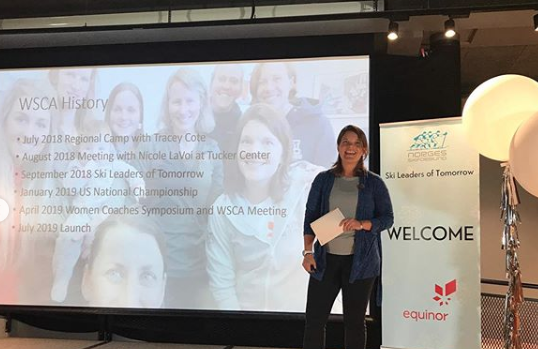
WSCA founder Maria Stuber (College of St. Scholastica) presents on the WSCA mission in Oslo, Norway, 2019. (Photo: Courtesy Image)
Formed in 2019, the Women’s Ski Coaches Association (WSCA) has been a consistent and ardent supporter of creating gender equality in all areas of North American skiing. With WSCA founders—St. Scholastica Head Coach Maria Stuber and Staffer, Craftsbury Green Racing Project Biathlete (and former St. Scholastica skier) Kelsey Dickinson at the organizational core—a strong actor-network has been formed to advocate for women in the ski coaching profession. This has included some notable partnerships with organizations at the heart of US Skiing, including the foundation of theTrail to Gold Fellowship with the National Nordic Foundation this season which will see five women coaches complete a two-week internship on the World Cup this season.
In its latest program launch last month, the WSCA turned to the ski industry. The GearUP program, which announced its first cohort last month, will see ten women coaches from across the North American ski community outfitted with gear from participating ski brands. Fischer, Rossignol, Salomon, Atomic, Madshus, and Swix are all participating. The coaches in this inaugural cohort are all working with representatives of their paired brands, providing the experience of building a lasting relationship with a ski company. Those relationships are often the difference between a club having a reliable way to outfit skiers, and having to patch together equipment from limited inventories, ski swaps, and used marketplaces.
The impetus for GearUP comes from a perceived skew in the “social capital” within our sport. WSCA staffer Kelsey Dickinson addressed that discrepancy in an interview with FasterSkier:
“I don’t think it is a secret that getting [ski equipment] in [the United States and Canada] is almost entirely up to who you know, and that disproportionately skews towards male coaches when a disproportionate number of brand representatives are male.” says Dickinson. That has fostered a space in the skiing community where women coaches struggle to establish themselves: “It’s not that there is intentional exclusion on the part of these brands. [It’s more so] that there are a bunch of coaches vying for a limited number of brand representatives, and there isn’t a lot of thought put into who is working with who.” The individual interactions in the ski industry sum up to a culture that has excluded women coaches, even if it has formed passively: “The ski coach needs equipment, and they will go to whoever they know best. [The brand representative] is more likely to respond to an old teammate, or an old coach…with both parts of that equation being disproportionately male in [the United States ski community], it has tended to exclude women [coaches],” said Dickinson.
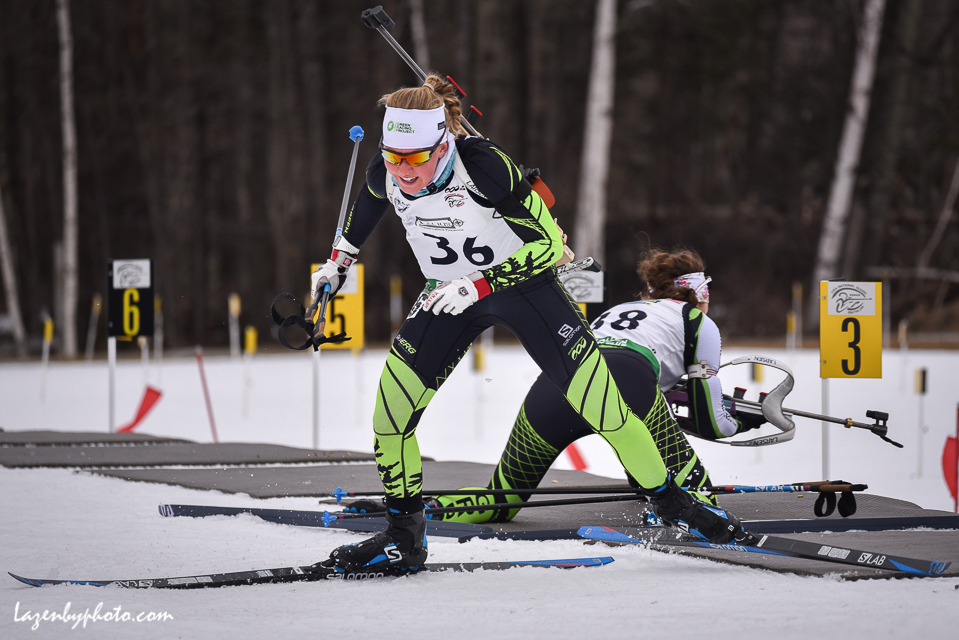
WSCA Staffer and Craftsbury Green Racing Project Athlete Kelsey Dickinson skiing to third in the 10 k pursuit at last year’s U.S. Biathlon Nationals. (Photo: John Lazenby/lazenbyophoto.com)
The motivation behind GearUP is to deliberately change some of the individual interactions of ski coaches with brand representatives so that it leads to a cultural shift where women coaches are more welcome in the ski industry space. For nearly every major ski brand in North America, it was an easy sell. “There was almost no hesitation by any of the big ski brands,” said Dickinson. “Once we went to them and said, ‘this is a place where we don’t think women coaches feel welcome and here is why’ they almost universally came back with a response that said, ‘we are willing to help out however we can to start correcting [the culture] on our end.’”
The result was that every major ski brand (Fischer, Rossignol, Atomic, Salomon, and Madshus), as well as Swix, signed on to outfit at least one female coach with a pair of skate skis, a pair of classic skis, and other brand accessories. Swix agreed to provide the whole cohort with two pairs of poles each. Originally, the program was intended to covereight coaches, but Dickinson and Stuber were able to secure two more additional spots to expand the cohort of coaches to ten. “We had sixty-one applications, which was way more than [WSCA] or the brands expected,” said Dickinson. “Once we went to [equipment sponsors] with the quality of that applicant pool, they were willing to expand the program to reflect the commitment of women coaches in the nordic community.”
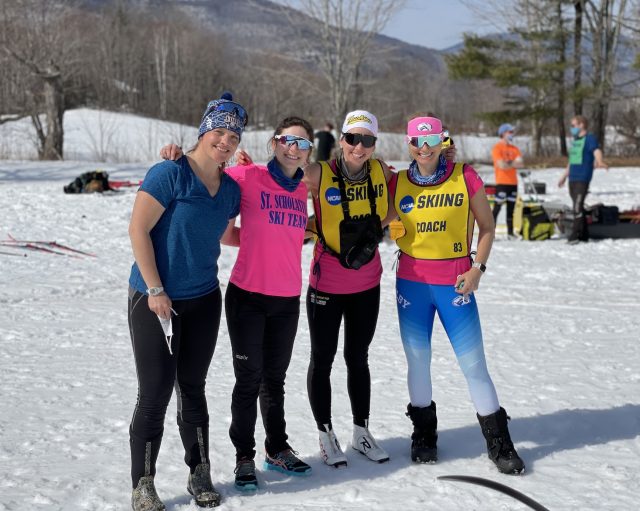
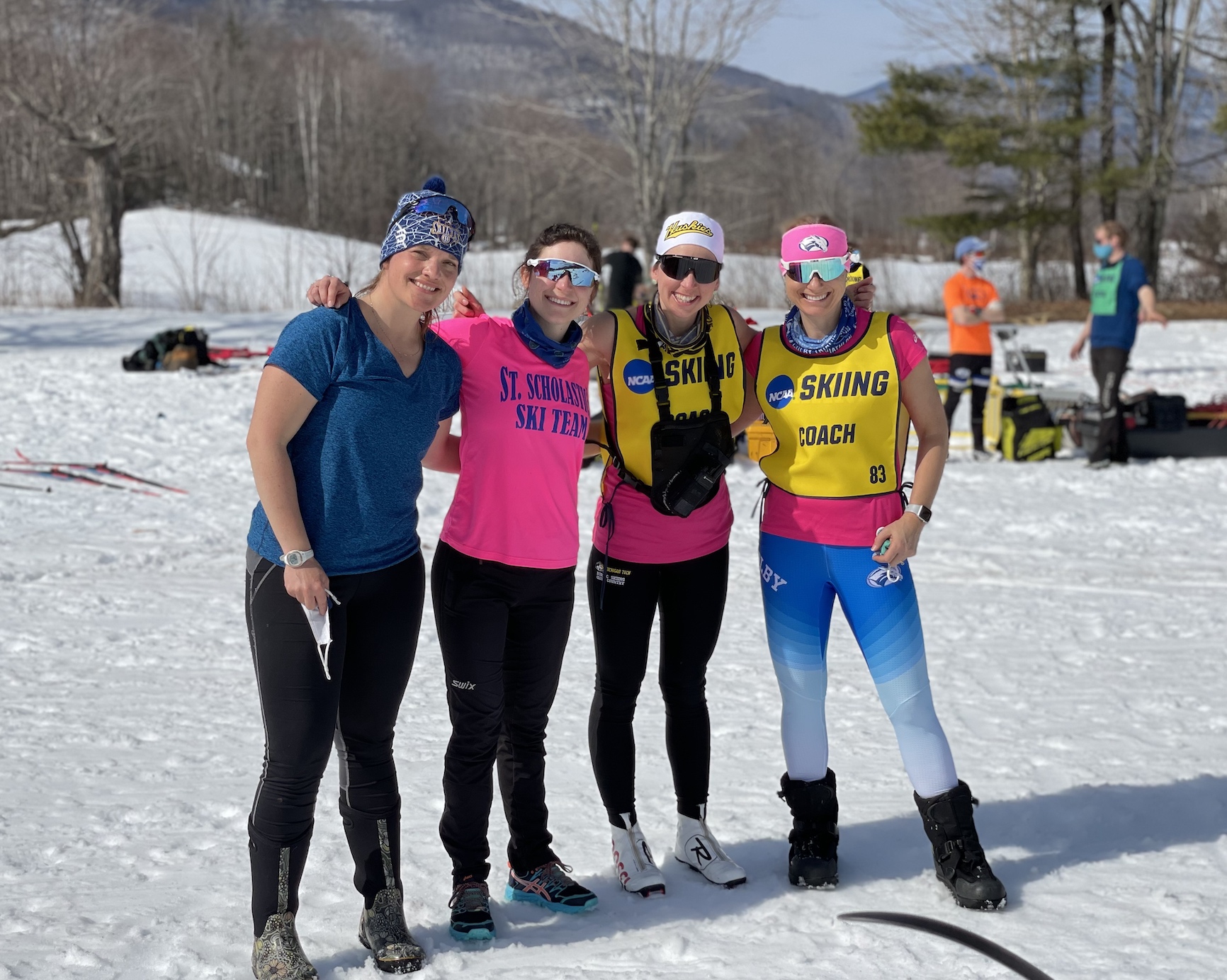
(l-r) WSCA members Maria Stuber (CSS), Kristen Bourne (Now with the US Ski Team), Kristen Monahan-Smith (Michigan Tech), and Tracey Cote (Colby College) at NCAA Championships in Jackson, New Hampshire in 2021. (Courtesy Photo).
The inaugural cohort was announced last month, and Dickinson and Stuber are already brainstorming about the potential for future expansion of GearUP. “Part of why we wanted to do this now is that with the [supply-chain issues of the past few seasons] there was a pressing need for coaches, and also a kind of challenge to brands,” said Dickinson. “We know it’s hard, but this might be an opportunity to come out of this difficult moment with a better culture for women—and women coaches—going forward.”
Future iterations of GearUP will hopefully include a greater percentage of the applicant pool being outfitted, along with more brands from the periphery of the ski industry being involved. Even more crucial may be that new relationships may extend beyond a pair of new skis and boots. “Hopefully, this is resonating out right now,” said Dickinson. “The brand representatives are meeting our coaches and realizing there’s entire clubs and programs with great women coaches that have just been out of the loop on getting the equipment they need, when they need it, to be successful in skiing. At the end of the day, [GearUP] isn’t about skis, it is about skiing.”
The Inaugural WSCA GearUP Program Cohort
Patricia Casey – Alaska Nordic Racing Program (Eagle River, Alaska).
Aliya Brown – Bogus Basin Nordic Team (Boise, Idaho).
Leslie Bode – Thunder Bay National Team Development Centre (Thunder By, Ontario).
Katie Eichten – Spooner Rails On Trails (Spooner, Wisconsin).
Rachel Koroscil – Canmore Nordic Ski Club (Canmore, Alberta).
Dana Hatton – Yarmouth High School (Yarmouth, Maine).
Sydney Michalak – Crosscut Mountain Sports Center (Bozeman, Montana).
Callie Knapp – Endurance United (Minneapolis, Minnesota).
Mackenzie Rizio – Mount Anthony Union High School/Prospect Mountain Ski Club (Bennington, Vermont).
Kirsys Campbell – Jackson Hole Ski Club (Jackson, Wyoming).
The women Ski Coaches Association is excited to announce our new GearUP program. This program is designed to help reduce barriers for women ski coaches by partnering women coaches with an equipment brand rep to outfit them with gear, provide brand specific knowledge, and create industry connections.
Madshus, Fischer, Rossignol and Salomon will each work directly with two women coaches for the duration of the 2022-23racing season.* The eight coaches selected for this program will be outfitted with at least one pair of classic and one pair of skate skis, two pairs of boots, two pairs of Swix poles and other coach-approved swag!
Why GearUP? We believe this program will help level the playing field for women in ski coaching careers through:
mentoring and networking with another male-dominated profession that is important for coaching success and advancement – the gear industry.
reducing the personal expense required to purchase and update racing equipment that can impact a coaches credibility in the profession.
increasing access to the gear related expertise required to excel on the snow everyday and behind the scenes on race day.
Developing and retaining women coaches at all levels of the sport supports athletes, other coaches, and the organization/ski community as a whole. Check out WSCA’s Why Women Coaches Matter page for more information!
Through the mentorship aspect of this program, coaches will increase their knowledge to accurately fit a ski to an athlete, understand what makes great skis for certain conditions and how to properly prepare them, have a contact list of connections from their partnered brand, understand the brand’s product line, and gain other useful skills. The program will include 3-4 structured sessions with reps and coaches through the season to increase networking and knowledge about gear and waxing.
Women with any levels of experience currently coaching at the middle school level or above are encouraged to apply.
Application period opens October 1 and closes October 14. Decisions will be communicated by the October 21st with program kickoff on the 30th.
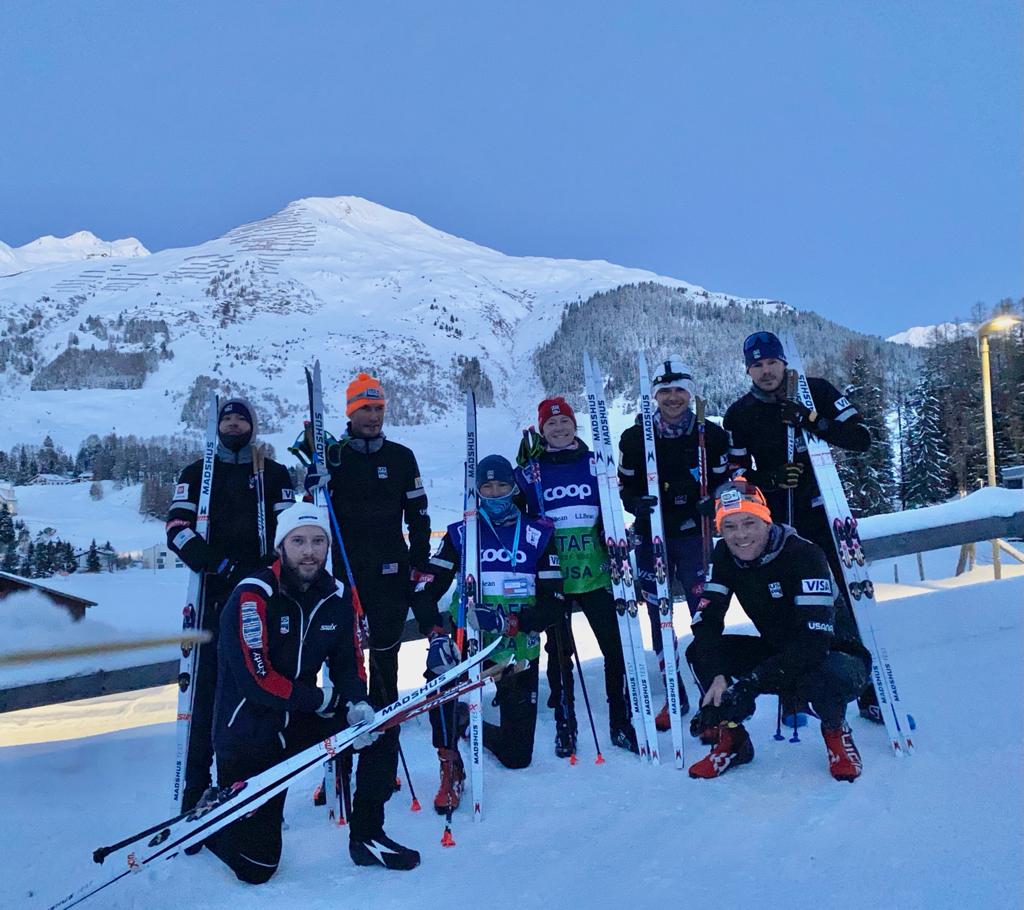
Kristen Bourne (center) joined the U.S. tech team to learn and support the American squad in Davos, SUI. (Courtesy photo)
In November, FasterSkier interviewed Kristen Bourne, assistant coach at the College of St. Scholastica (CSS) in Duluth, MN, after she was selected as a Women’s Sports Foundation Van DerVeer Fellow, which came with a grant totalling $17,500. The objective of the fellowship is to improve representation of women in elite level coaching by supporting the development of rising coaches at the college level.
The majority of the funds from the VanDerveer Fellowship went directly to CSS, allowing the university to support Bourne’s position. However, $2,500 of the grant was allocated toward independent professional development opportunities of the fellows choosing. With additional support from U.S. Ski & Snowboard, Bourne recently had the chance to shadow, support, and learn from the American squad of athletes, coaches, techs, and support staff who were traveling the World Cup circuit.
Joining the team in Davos, Switzerland in early December, Bourne was immediately welcomed into the fold and handed responsibilities as both a coach and wax tech, which she described as an “intensive course” on all things World Cup. While this might seem like a high-stakes, intimidating experience for a developing coach, Bourne explained that she was well-supported as she stepped into the role.
“Coming in, the idea was that I was going to get a taste of doing everything,” Bourne explained in a call from Dresden, Germany. “I came in pretty early on in the week before [the races in] Davos, and was able to get a bit of a tutorial and orientation on the wax truck and how everything worked on a day to day basis. It actually turned out that that first weekend in Davos, I was going to be teching for Caitlin Patterson, so I needed to get an idea of what I was walking into, how everything worked, and how to make it as efficient as possible. So those first couple of days, the techs really took me under their wing and showed me the ropes. [They] taught me a bunch of new waxing techniques, and I got to pick their brains a whole bunch — just being in the wax cabin with them and asking any kind of question that I had, and they would take time to answer it.”
On the coaching side, Bourne sat in on pre-race team captains meetings, helped out during intensity sessions, recorded video to discuss technique and course strategy, and supported logistical planning as the team moved from Davos to Dresden and back. Throughout her time with the team, she explained that she shadowed Matt Whitcomb and Chris Grover, listening in and engaging with their discussions regarding what would be important for the team, and each athlete individually week-to-week.
She also took her turn behind the wheel. While not a glamorous part of the job, most coaches would agree it is a significant, and sometimes quite stressful, component.
“I drove a van of athletes from Switzerland to [Dresden],” she said with a laugh. “That was my first European road trip, so that was an experience that ended up being okay… I’ve had an opportunity to at least try everything once if not way more than that, so it’s been super awesome.”
At 25, Bourne is just beginning her career in ski coaching, and though she had done some post-collegiate training and racing in Norway, she was newly minted to the World Cup scene. It’s natural that with such an opportunity would come some self-doubt. Would your 25-year-old self feel comfortable talking World Cup tactics with Jessie Diggins? Yet, Bourne spoke highly of the culture developed on the U.S. Ski Team, and how both athletes and coaches made her feel valued as she stepped into each of her roles.
“Of course, that thought comes into your head. I’m working with people that are several years older than me, who have much more experience being in this environment than I do. But it’s been way easier than I thought it would be primarily because everyone has been really welcoming. When you have athletes who are older than you that then ask for your feedback or your opinion or your help, then all of a sudden it’s like, ‘Oh, they want to hear what I have to say here. They are appreciative of any feedback that they get. Age doesn’t matter so much.’ So it hasn’t been difficult at all, and I think that’s primarily due to the people and the environment that this team has created.”
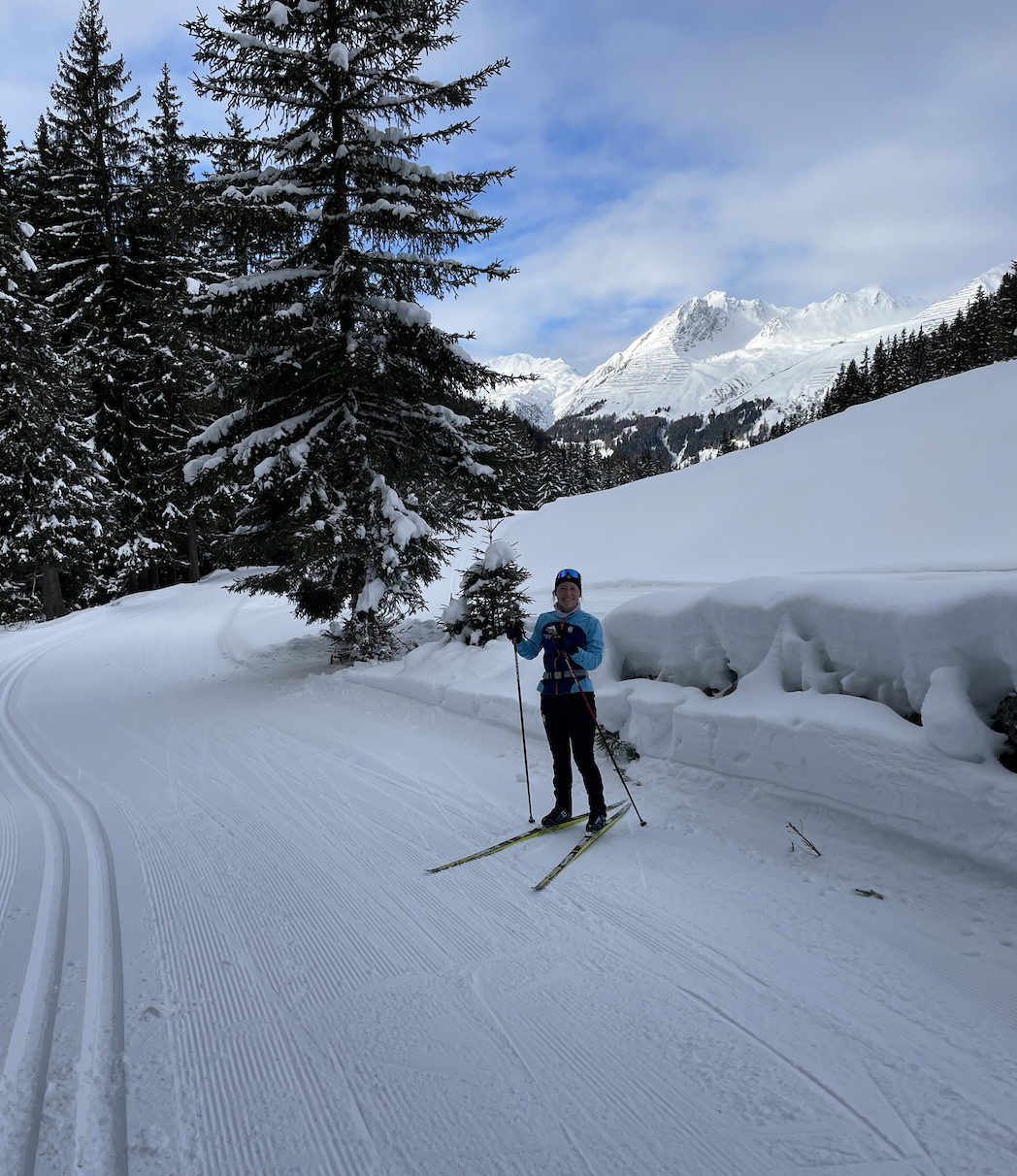
Kristen Bourne logs k’s on the stunning tracks of Davos, SUI while teching for the U.S. team. (Courtesy photo)
Though there were not established times for her to debrief or ask questions of coaches or techs, Bourne described the communication between herself and the coaches and techs as open. The crew would regularly ask how she was doing, and she felt comfortable asking questions whenever they cropped up.
“We have had this natural agreement where – they know I’m here to learn. And I also know I’m here to learn, but I’m also here to help them. And so, it’s been quite open that way. We have a plan for once this trip kind of wraps up and I get back that we’ll chat again and talk about that whole experience. But I’m hoping that this is something that [the U.S. program] will continue to do with other female coaches in the future, and I’m hoping this at least set the tone for a good experience on their end. It definitely has on my end.”
According to Grover, Bourne immediately demonstrated her capability and potential as she stepped into her roles, and what started as a stand-alone opportunity may just be the beginning.
“Having Kristen on this trip to Davos and Dresden was incredibly helpful, and we are so grateful to the Women’s Sport Foundation and to Maria Stuber and the College of St. Scholastica for making this trip possible,” wrote Grover in an email. “We have a U.S. Ski & Snowboard program-wide goal, and a cross-country-specific goal, to drastically improve gender equity in our coaching and technician staffs, so this opportunity was perfectly aligned with this mission.
“Kristen was an amazing asset to the World Cup group right away, almost seamlessly integrating into both our coaching and service teams, having never met many of the team members. We were really impressed by her skiing ability, her stamina in the test track, her knowledge of the sport and exercise physiology, and her ability to relate so well with each athlete and staff member. She was quick to embrace the team culture, including being thrown into one of the most intimidating team rituals of all – Secret Santa – almost immediately upon arrival, and brought fresh perspective and energy to the Team.”
On all accounts, the U.S. Team had highly successful weekends in both Davos and Dresden. Highlights include: Jessie Diggins taking second in the 10k skate in Davos, with Rosie Brennan close behind in 4th and Hailey Swirbul in 6th, plus Sophia Laukli in 19th and Novie McCabe 28th. The previous day, Brennan had been 4th in the freestyle sprint, while Ben Ogden skied through the semis to finish 12th. Dresden saw another American podium finish with Diggins and Julia Kern finishing second in the team sprint, while JC Schoonmaker made his third World Cup semifinal in the individual sprint. Grover applauded Bourne’s contributions to the team’s success throughout these events.
“She skied an amazing amount of kilometers in the test track in Davos, and was instrumental in identifying the products that we raced on in the 10/15 km F there,” Grover continued. “In Dresden, where we had a smaller staff, I would have really struggled without her support. We all really enjoyed getting to know Kristen and cherish making this professional connection and friendship with her. I know we’ll be looking to get her on another trip as soon as possible.”
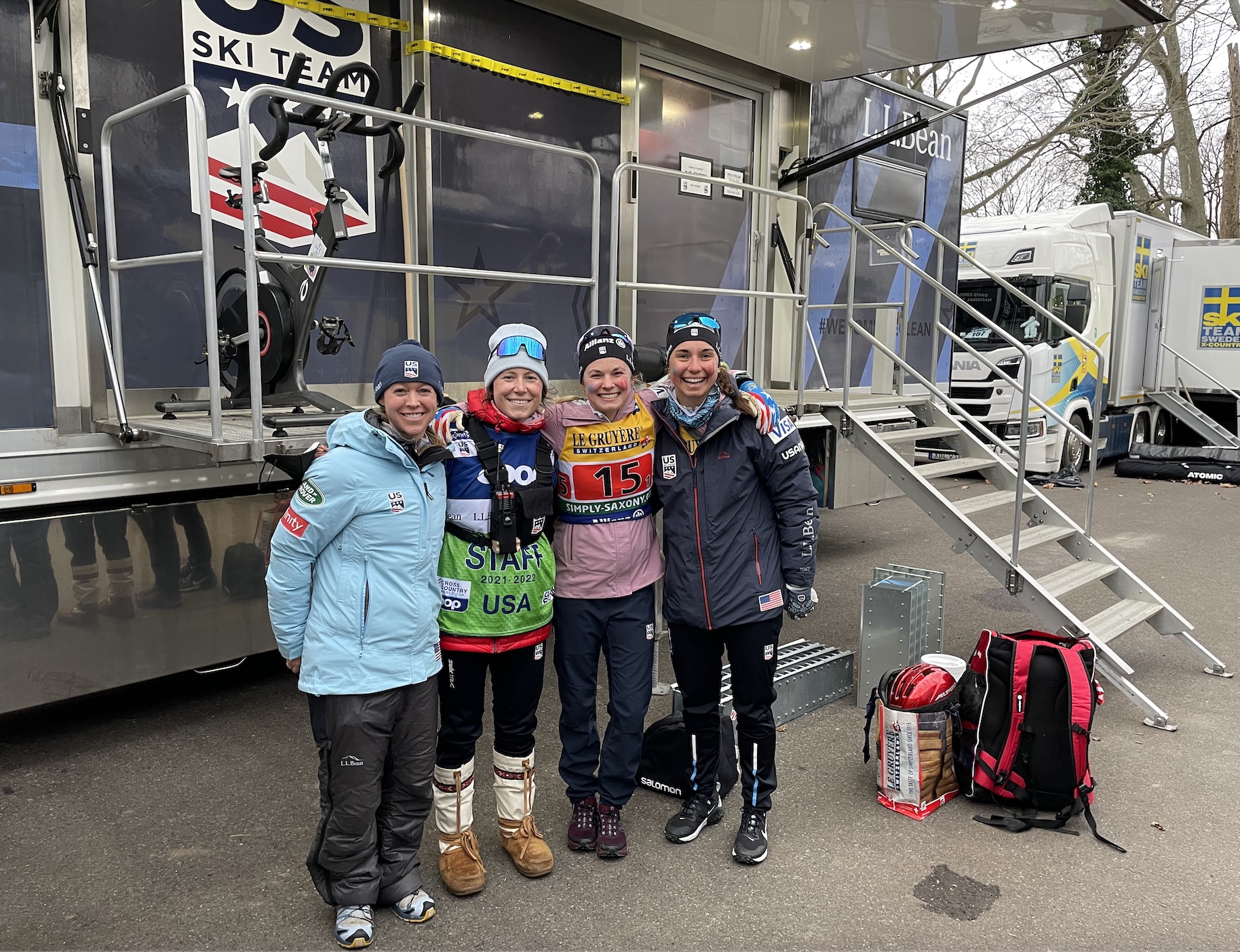
The team behind the podium in Dresden. From left to right, physical therapist Ana Robinson, rising tech and coach Kristen Bourne, Jessie Diggins, and Julia Kern. (Courtesy photo)
After the World Cup experience, Bourne would return to CSS, bringing back a host of new insights into the highest levels of racing. As she leaves the whirlwind adventure behind, what would stand out as key takeaways from her time in Europe? In particular, Bourne added tools to her belt on the technical side of sport performance.
“The waxing, for sure, [stands out],” she said conclusively. Different techniques, different ideas of what to focus on. It gets really easy to focus on certain aspects of picking skis, but their perspective is so much different. And they focus on things that [I wouldn’t have before], but when they explain it, it makes a lot more sense.”
A specific example that came to mind was a conversation she had with one of the techs, Bjorn Heimdall, regarding ski selection for Luke Jager.
“The skis that he had picked had a colder grind on them, however, It was also a pretty stiff ski. And so I asked, ‘Why would you put a cold grind on such a stiff ski?’ And he explained that, from his perspective, it has to do with the firmness of the snow, not necessarily how cold the snow is. It’s just how firm the track is that makes the difference. The grind does have some effect, but to him, it had more to do with the flex of the ski, and how high the ski was that made the bigger difference overall [in those conditions].”
Bourne contrasted this concept with her experience waxing for collegiate athletes, where she felt there was more focus on the ski’s grind.
Another factor that stood out from her time in the wax truck was the strategy and robust processes used to select the products used on race day and the skis to which they’d be applied. With massive fleets of skis, and an equally massive chemistry kit, finding a winning combination seems like a special brand of magic.
“I also realize that their ability to do that is much different than at the college level where you have only two coaches, instead of five to six wax techs who are able to test all of these powders, structures, topping… That’s pretty intense. But I think that the way they do it with various measurements, I find that to be really interesting. They can do all of these tests and not eliminate a specific ski in the first round. When you do single testing, [comparing pairs of skis] one to one, they have a method for that. I think that’s really cool.”
Bourne also explained how impacted she was by the depth of the relationship between an athlete and their tech.
“[The techs] are just as much coaches in this process as the actual named coaches of the team. They have really close relationships with their athletes. There’s a lot of trust there. And I really admire it. I’ve seen and heard from multiple techs that say, “I want to bring my athlete skis to her or to him.’ Because it’s like this special moment that they get to have before every race and that I just admire a lot.”
Lastly, Bourne revisited the culture within the U.S. program, remarking on how cohesive the group was as a whole.
“It shows that when you have people that you work with that you really enjoy, you can work in a hard environment or a tough environment, you can have long hours. But if you’re around people you enjoy working with, it makes the whole group become successful. It’s just very cohesive. And I’ve been very impressed by that… You hear all the time that this team is really great, and then when you’re in it, you’re like, ‘Wow, this is actually really cool.’ So I’m just really grateful. It’s been awesome.”
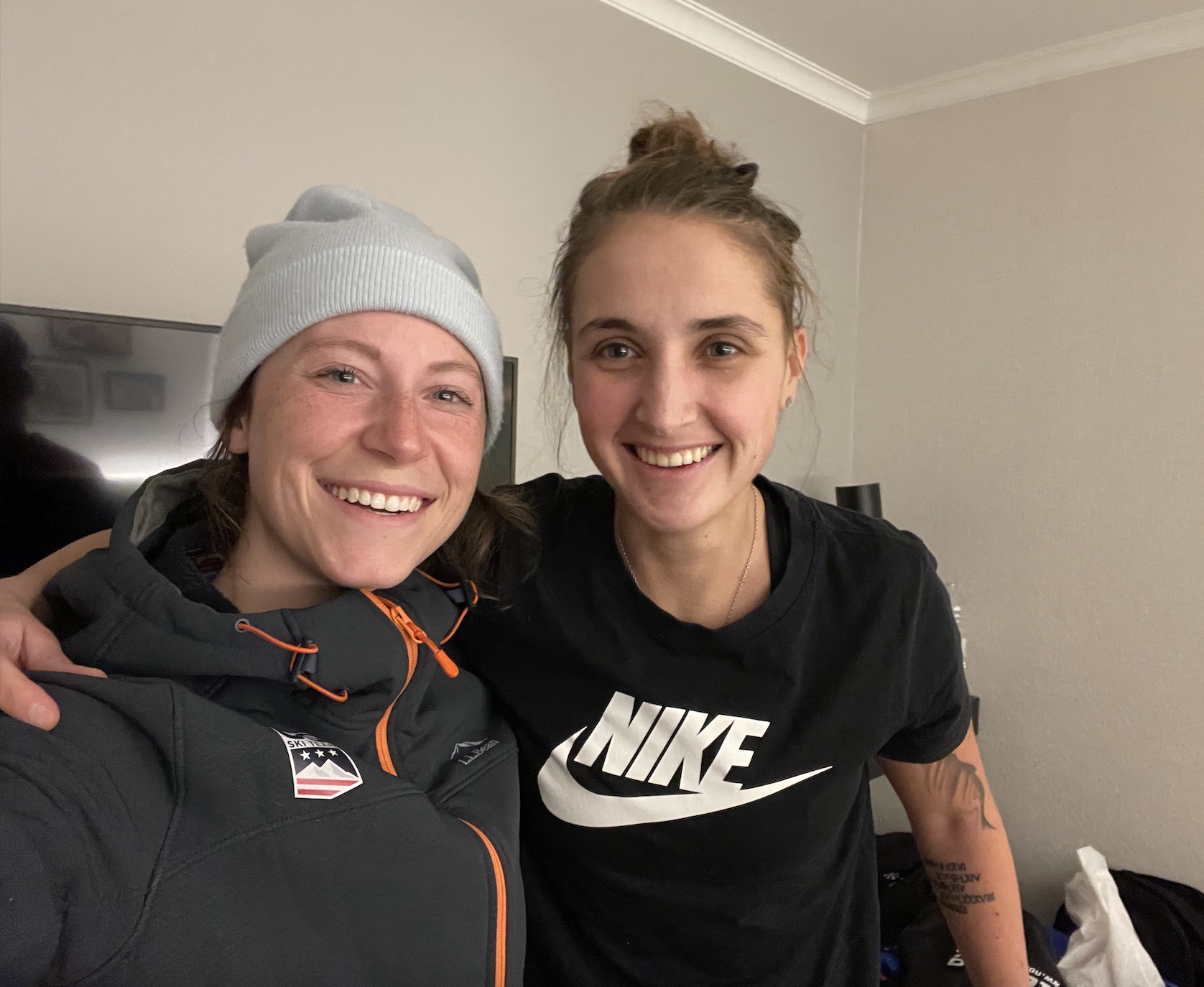
Kristen Bourne (left) snaps a picture with Vale Vuerich, head of service on Slovenian tech team and one of the only women teching at the World Cup level. (Courtesy photo)
As the conversation concluded, Bourne spoke to the impact this opportunity has had on her career development, opening the door to a level of racing many coaches never truly see up close. Continuing to build on this model, Bourne feels that developing coaches of all genders can gain the skills to continue the elevation of American cross country skiing at all levels.
“I hope that this is something that can be continued. It has been super valuable. And I know that [U.S. Team members and staff] also feel pretty on board with continuing something like this. It’s an interesting conversation that I’ve been having where – when you’re new to something, you don’t know what you don’t know. But with this experience, I’m starting to realize that I do know what I don’t know now. And so it’s very easy to pick out the specific things that I have questions about, and I get those answered really, really quickly. I’m learning from some of the best. So I hope that other people also get to have this experience because it’s incredibly valuable, and there’s a lot that you can take back. If more people have had an experience like this and could learn these types of [skills], it just would progress the development of not only coaches and techs but also the athletes going forward.”
CSS assistant coach Kristen Bourne was awarded the Women’s Sports Foundation VanDerveer Fellowship for the advancement of women in coaching. (Photo: Maria Stuber)
Kicking off her second year as assistant coach at the College of St. Scholastica (CSS) in Duluth, MN, Kristen Bourne was recently named one of ten recipients of the Women’s Sports Foundation VanDerveer Fellowship. The program, named for revered Stanford University Basketball coach, Tara VanDerveer, aims to increase representation of women in coaching at the collegiate level through the development of the rising generation. This is the first time that the award has been granted to a cross country ski program.
According to the WSF, “this pioneering program provides grants, paid fellowships and mentorships for aspiring female coaches. Emphasizing hands-on training for female coaches in all collegiate sports, from basketball and volleyball to water polo and fencing, it is a salute to the extraordinary compassion, optimism and leadership that its namesake has shown over the years.”
Along with opportunities to collaborate with coaches across a variety of sports nationwide, the program offers institutions $15,000 to use in support of their fellow, along with $2,500 that goes directly to fellow to put toward additional professional development opportunities. FasterSkier connected with Bourne to learn more about the fellowship, her path to coaching, and how this opportunity will support her growth and long term goals in cross country ski coaching.
Originally from Lake Elmo, MN, on the eastern side of Minneapolis, Bourne attended Northern Michigan University (NMU), where she graduated with a degree in Sport Science in May, 2018. While racing for NMU, Bourne raced on four NCAA championship teams, and was a member of the 2015 U.S. World Junior Championships team and the 2016 U23 World Championships team. Post-college, she headed to Norway to train with Lyn Ski and Team Obos in Oslo, while competing in numerous FIS races throughout the country.
CSS assistant coach Kristen Bourne spent time in Norway after college training with Lyn Ski / Team Obos. Bourne is pictured here racing in a Norwegian Cup race in Gålå. (Photo: Martin Riseth)
Bourne returned to the US in December, 2019 to finish her racing career at the 2020 U.S. National Championships in Houghton, MI. It was there that she met Maria Stuber, head coach at CSS and the founder of the Women Ski Coaches Association (WSCA), who recognized Bourne’s potential as a coach and recruited her to the CSS program.
“I was just deciding that my ski career was about done and trying to figure out what to do next,” Bourne explained in a call. “I was at U.S. Nationals, I was leaving a parking lot, and Maria drove up and essentially slammed on the brakes, and yelled out the window, ‘Hey! My name is Maria. I heard that you’re interested in potentially coaching. You’re gonna get an email from me sometime soon.’”
Bourne went on to explain that Stuber emailed her the next week asking if she would be interested in joining her as the assistant coach at CSS. Tying the fellowship opportunity into the offer, Stuber knew about the VanDerveer grant and would help oversee the school’s application on Bourne’s behalf. CSS was not chosen after the first year of application, but they were selected this year on the second attempt.
Bourne explained how receiving the VanDerveer fellowship allows her to pursue a number of development opportunities beyond her role at CSS.
“Right now I have a few things in mind that I’m going to put that money towards. I would really like to go to the NCAA Women Coaches Academy, which happens every May. They have a bunch of super awesome female speakers and head coaches that all talk, and it seems really valuable. I think Maria did it a few years ago. Then the other professional development opportunity would be: I’m currently working on a trip over to the World Cup this winter.”
Though her education and wealth of experience lends itself well to coaching, Bourne did not always see this as a path she would choose.
“People were always telling me that I would probably end up being a coach, and I didn’t want to do what everyone thought,” she laughed. “And then, you come to this realization: I love the sport, and I want to learn more about it, and I’m really passionate about it. I can take my personal experiences from being in Norway and seeing how they work over there, I can apply what I learned there, and through college, my own [time as an athlete]… Right now I’m also working on my master’s in exercise physiology. So being able to take all of that experience and knowledge and be able to apply it as a coach, I think it’s kind of a no brainer.”
Though improvement is trending, women remain underrepresented in leadership roles in the ski community. According to the 2020-2021 Women in College Coaching Report Card issued by the Tucker Center for Research on Girls & Women in Sport, only two of nine NCAA Division 1 cross country ski coaches are women.
A few of the female coaches represented at the 2021 NCAA championships. From left to right, Maria Stuber, Kristen Bourne, Kristen Monahan-Smith of Michigan Tech, and Tracy Cote of Colby College. (Courtesy photo)
Stepping into this realm without significant experience in coaching, Bourne spoke to the importance of having a strong mentor and role model in Stuber, who has helped her realize her potential in the role.
“The other [factor influencing my transition into coaching] has been working for Maria. She has just taken me on and put me under her wing, and really gets me to do things that I wouldn’t normally do. It has boosted my confidence in myself knowing that I can do this and that this is what I want to do for the rest of my life. That was a huge piece of it, too.”
Expanding on Stuber’s formal role as a mentor for the VanDerveer Fellowship, Bourne explained that both she and Stuber will have the opportunity to connect with the other fellows and mentors involved in the program, which spans a variety of sports from basketball to water polo to track & field. This collaboration allows the women to discuss their successes and challenges in their respective sports, and learn from each other’s experiences.
In a 2019 presentation at the U.S. Ski & Snowboard annual meeting on the importance of women in coaching, Dr. Nicole LaVoi of the previously mentioned Tucker Center explained the importance of women in leadership roles to inspire the next generation of coaches and improve the experience of developing female coaches.
“When you see women being successful, it inspires people,” LaVoi said. “‘Oh, I could do that. That seems cool, she seems cool, I want to do that.’ And in they come. It’s the same thing with women in positions of leadership.”
Bourne emphasized that this concept rings true for her in working with Stuber, who has stoked her fire to become an example for future women in the sport.
“She said so many times that the Women’s Ski Coaches Association and empowering women — this is her passion. I just feel so honored that I get to be right alongside her. She’s so powerful, and she has such a strong impact, and she’s doing this incredible thing that I think quite a few people are scared to do. She just says, ‘No, I’m doing it. We’re gonna change some things here.’ And I think that’s just — it’s pretty dang cool.”
Looking to the future and the role she hopes to play, Bourne aspires to be a head coach at or above the college level. She enjoys the environment of collegiate programs, but remains open-minded. Reflecting on the dearth of female coaches in her own athletic experience, she concluded with her intention to be part of the solution in the slow progression toward gender equity in sport leadership.
“When coming to the decision of becoming a coach, there is this thought of, ‘Well, I’ve never really experienced anyone like me in that position before. Can I do that? Can I have the same impact on a team as a man would? But really it’s [lack of] representation. There’s also the concept that women are proven to improve work environments — having more women is better. And being able to support female athletes — and being able to support male athletes — with a different perspective is super important. There’s a lot of pieces — it’s a huge question. I just hope I can be a role model for more women coming up who want to get into coaching and stay in the sport.”
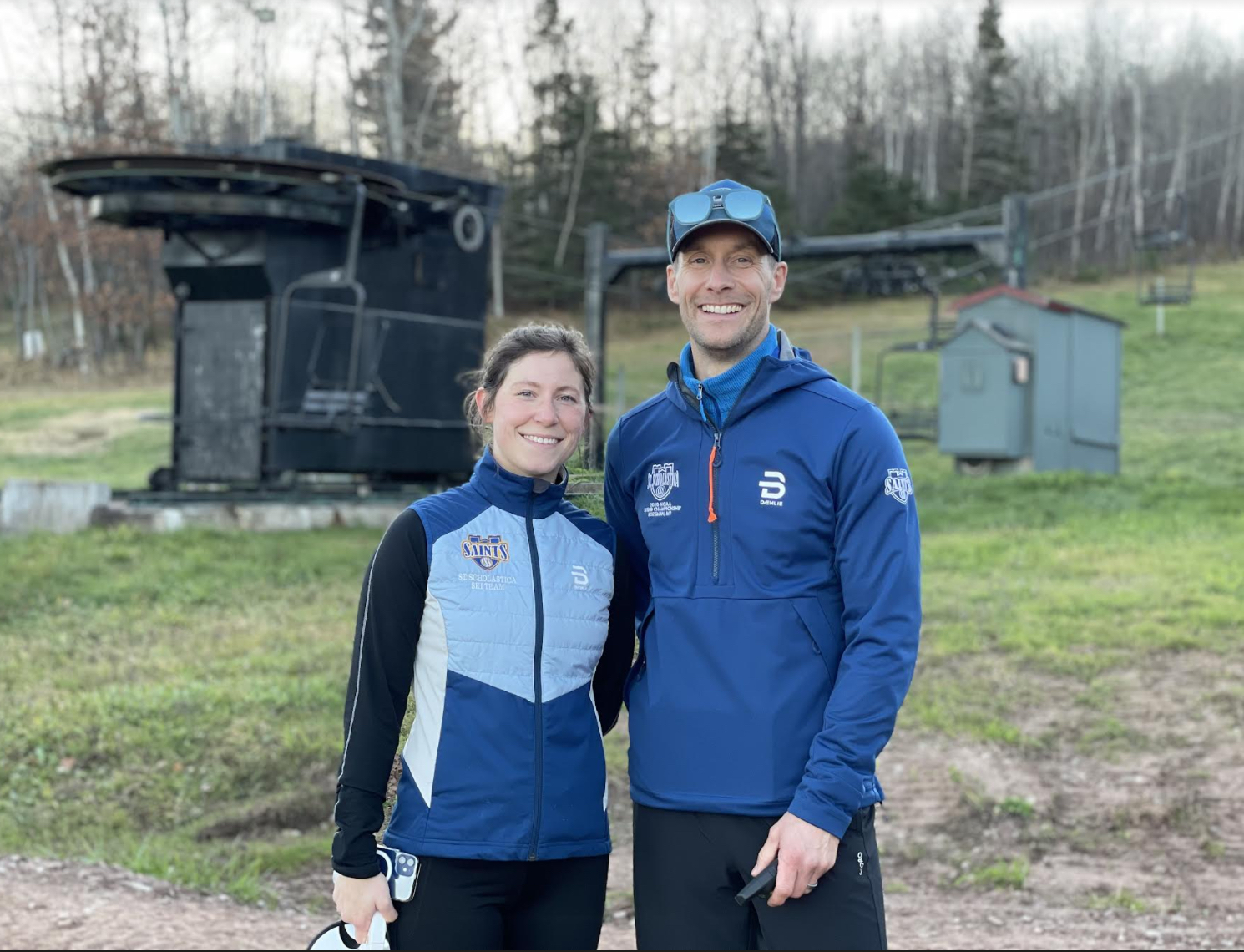
The CSS Assistant Coaches: Kristen Bourne (left) and Joshua Tesch (right). Stuber explained that Tesch has bee coaching at CSS for 15 years and has been a mentor for both herself and Bourne. (Photo: Maria Stuber)
Kate Barton, now a U.S. Ski Team coach, waxing skis during her time at Burke Mountain Academy. .
The magic brew. The secret sauce. The omniscient wax-tech with encyclopedic knowledge of all things ski wax and the ability to bestow the goods onto a ski base. Ah, those slick and slippery skis. And that bite of kick in slush. The mythology of wax in this sport looms large. And the few wax-mixologists of note live among their peers as deities.
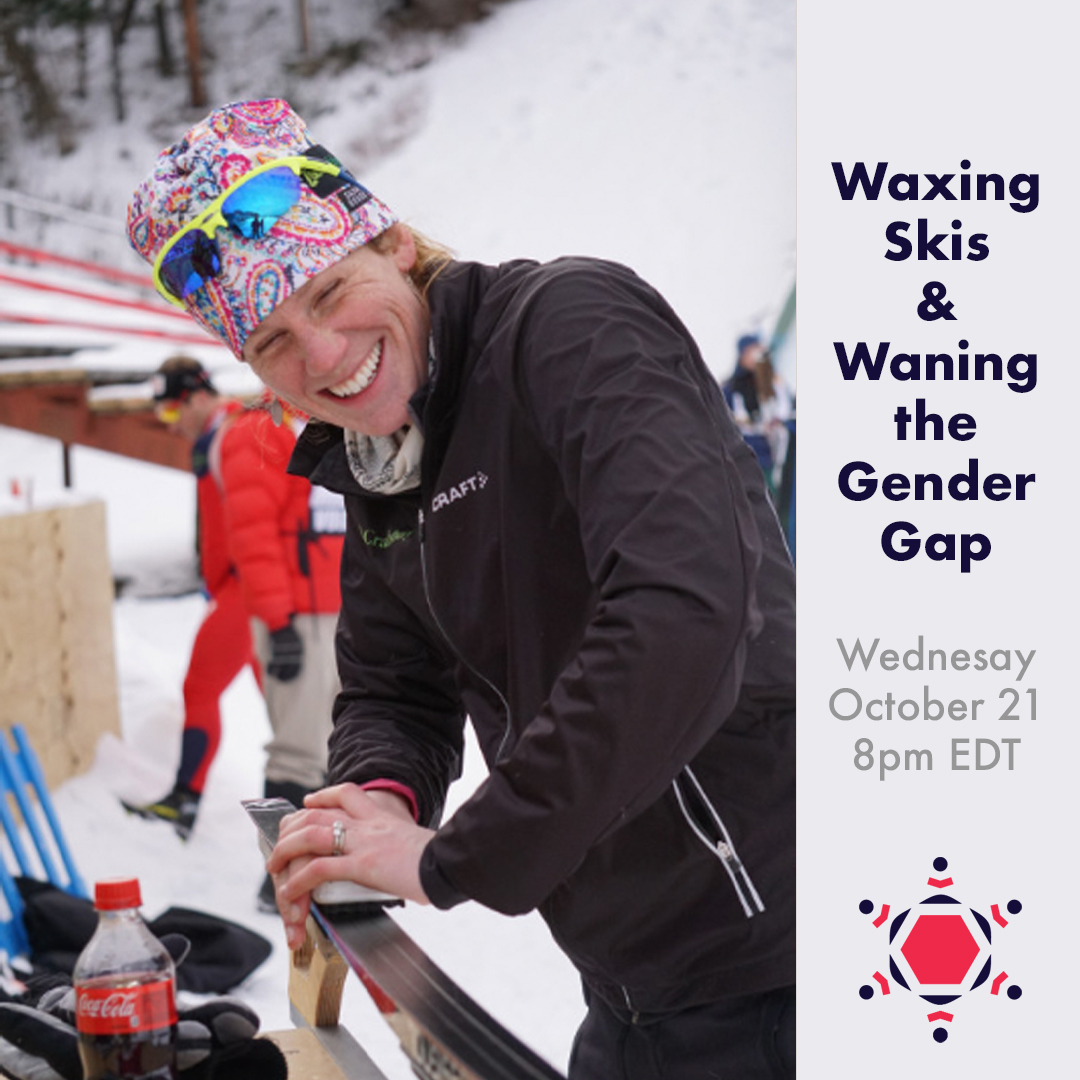
The popular myth is this: some are gifted with the wax gene, most are not. Recently, I watched a webinar titled Waxing Skis & Waning the Gender Gap, where all came as equals. If you were transported from afar into the scene and knew nothing of “making good skis”, you’d think good wax-teching was as simple as being human – asking questions, trying new things, accepting success and failure as part of the process.
The webinar, which included over 115 participants, was part of an empowerment initiative produced for members of the WSCA, or Women Ski Coaches Association. In talking to WSCA founder and College of St. Scholastica head cross-country ski coach Maria Stuber, this was clear: old-school inequities toxify some wax cabins but it does not need to be that way.
“It’s easy for a newcomer to think that there are definitive right or wrong answers to all these wax questions and that your worth in the profession depends on having the right answers,” said Stuber. “When your worth is on the line it gets really scary to ask questions. If you can’t ask questions, you can’t learn. I hope our webinar communicated to new coaches that we should be searching to learn, not to find answers. I can’t control the environment all these women coaches are waxing skis in, but I can make sure that, at the very least, they have a safe and supportive place to ask questions and collaborate with peers through this platform.”
Maria Stuber presenting about the WSCA gender equity project at the Female Ski Leaders of Tomorrow Symposium in Oslo, Norway. (Photo: Instagram @womenskicoaches)
If you hear “there’s no problem” in the wax-cabin echo chamber – here’s some data. The WSCA conducted a survey among its members and found some stark numbers. Seventy-six percent of those surveyed said they did not have access to information to make them feel successful as a wax-tech. Fifty percent responded “yes” when asked, “Do you ever feel like you are at a disadvantage obtaining wax product or process information because of your gender?” For some background, 77% of survey respondents had four or more years of ski coaching experience.
Keynote webinar speakers included Kate Barton of the U.S. Ski Team and U.S. Paralympic Head Nordic Ski Coach Eileen Carey. Craftsbury’s Anna Schultz, Laura McCabe from MVNST, Tracey Cote from Colby College, and Dartmouth’s Cami Thompson Graves rounded out a panel discussing the nuances of ski prep in colloquial terms. This was a world-class group with serious cultural capital. There was also a remarkable absence of ego.
Let’s be clear, the webinar had nothing to do with airing grievances or bashing authority. This was a safe place to disseminate information and as Stuber said, “demystify this waxing world and share each other’s success and become an image that people associate with being able to wax skis at a high level.”
“It’s not all about confidence—-it’s about competence. When it comes to leadership skills we know that men excel at confidence. I would argue that we should focus on competence or the ability to do something successfully or efficiently because confidence grows naturally if you believe that you are competent.” – Kate Barton
Anna Schulz Head Junior and BKL Coach at Craftsbury.
There was talk of structure, not so secret klister mixing and application tricks, and developing a strategy to isolate variables to test when in a competitive environment. Cote spoke of using a single yet complex wax line over the years to really learn how, when, why some waxes were more effective than others. Simultaneously her methodology streamlined her waxing process while also giving her access to a richer array of products to choose from.
Carey also developed a survey for WSCA members to self-assess their competencies in all aspects of waxing and base prep. Those with areas of strength can provide their contact information to assist others with a perceived deficiency. For example, someone like Thompson Graves could assist a high school coach from Minnesota seeking help developing a strategy for structuring skis that works within that coach’s budget.
Reiterated by Carey via email was the idea that those in the ski waxing world are really on a “journey of continual learning.” Carey explained that the women she observed during the call, despite their expertise, embraced a message of lifelong learning.
“This is an important message because I think there is a perception that the only way to be good at waxing is to appear to know all the answers and be totally confident,” Carey said. “I think this is important to note because I think that women often get passed over for positions because they don’t necessarily exude confidence in the narrow scope of what is considered ‘acceptable’ in the wax world. In my estimation, the lack of ego, the ability to ask questions, and the knowledge that you don’t know everything is a huge benefit. I think that people who make decisions in the ski world, whether it be what coach to hire or which coaches should represent a team on a big trip, should expand the vision of what makes a good coach and what makes a good waxer. Someone with all the answers is probably limiting the scope and quality of their work with athletes and in the wax room. If we can acknowledge as a community that there are many versions of what it looks like to be competent, we will all be better for it.”
With a dizzying array of new products on the market due to new wax restrictions, a window exists for women coaches to lead. Barton was succinct when discussing her thoughts on how to move forward.
“It’s not all about confidence—-it’s about competence. When it comes to leadership skills we know that men excel at confidence. I would argue that we should focus on competence or the ability to do something successfully or efficiently because confidence grows naturally if you believe that you are competent,” said Barton during the webinar.
The WSCA will continue to produce content for members to assist their pursuit of developing, retaining, and advancing women in ski coaching leadership.
FOR IMMEDIATE RELEASE: The WSCA Announces Webinar: Waxing Skis and Waning the Gender Gap
Today, the Women Ski Coaches Association (WSCA) announced it will host a Webinar to connect and educate women coaches, and redefine ski waxing culture and opportunities. The webinar, Waxing Skis and Waning the Gender Gap will take place on October 21st.
“The ski coaching world is going through a big shift with the ban on fluoro waxes and we see this as an opportunity,” says WSCA Founder Maria Stuber. “The purpose of the webinar is twofold: to start a conversation of how women coaches can drive a positive change in waxing culture, and to use this forum to connect women to educate and elevate one another.”
Part one of the webinar will reframe the conversation around waxing and identify opportunities for women coaches. Participants will hear from Stuber, U.S. Paralympics Nordic Skiing Director Eileen Carey, and U.S. Cross Country Ski Team Development Team Coach Kate Barton. During part two, experienced women coaches spanning all levels of skiing will weigh in on a variety of wax topics generated from a WSCA membership survey. Panelists include Cami Thompson-Graves (Director of Skiing, Dartmouth College for 32 years), Tracey Cote (Head Nordic Ski Coach, Colby College for 22 years), Anna Schulz (Head Junior/BKL Coach, Craftsbury Outdoor Center, 2019 World Junior/U23 Champs Coach) and Laura McCabe (Methow Valley Nordic Coach for 23 years, and two-time Olympian).
Waxing Skis and Waning the Gender Gap is free to all WSCA members. Past, present, and future women coaches, including athletes and any other interested women are encouraged to attend. A one-time $20 membership fee is available at womenskicoaches.com/membership. WSCA is committed to a zero barrier membership model, so free memberships are also available by contacting womenskicoaches@gmail.com. If you want to support the zero barrier program, gift memberships are also available.
WHAT: Waxing Skis and Waning the Gender Gap, a WSCA Webinar
WHEN: Wednesday, Oct 21st 2020 at 8PM, EDT
WHERE: Zoom link to be distributed to registered participants in advance of the webinar
Women Ski Coaches Association works to develop, retain, and advance women in ski coaching leadership. WSCA is a 501(c)3 organization. More information can be found at womenskicoaches.org.
Dr. Nicole LaVoi gave a keynote presentation at the U.S. Ski & Snowboard National Cross Country Coaches Symposium. LaVoi is the co-director of the Tucker Center at the University of Minnesota in Minneapolis. (Photo: Screenshot nmlavoi.com)
On the last weekend of September, U.S. Ski & Snowboard held the annual National Cross Country Coaches Symposium in Park City, UT. This year’s event included a keynote presentation from Nicole LaVoi Ph.D., co-director of the Tucker Center at the University of Minnesota in Minneapolis. Dr. LaVoi is a professor of sport psychology and sociology at UMN and leads research in “the structural and personal barriers experienced by female coaches, relational qualities of the coach-athlete relationship, the effect of parent and coach ‘background anger’ behaviors on youth athletes, the physical activity of underserved girls, and media representations of girls and women in sport.” She also serves on the board of directors for WeCoach, an organization promoting women coaches at all levels across all disciplines.
LaVoi first presentation was titled “Developing Physically Active Girls”, followed by her keynote presentation, “Leadership: The Importance of Women in Coaching”. [A livestream of the symposium can be purchased here.]
In her second talk, LaVoi presented data regarding women in coaching gathered through her research exploring best practices to recruit, develop, and retain women coaches. [FasterSkier presented statistics regarding female head coaches in NCAA and post collegiate skiing here.]
She explained that despite a steady rise in female participation in sport since Title IV was passed in 1974, gender equity has declined or remained stagnant. This is in contrast to the percentage of women in leadership positions in other sectors of the workforce which has been on the rise.
“The lack of women in skiing leadership is not the problem; it is a symptom of the problem,” said LaVoi in the presentation.
During her presentation, LaVoi explained the multifaceted explanation of the precipitous decline of women in coaching and offered suggestions to begin steering the trend in a positive direction. Namely, that the climate in sport has not made women “feel safe, valued, or supported.”
“Both anecdotal evidence and empirical data illuminate the fact that some women are losing their jobs due to persistent and systemic sexism and gender discrimination, unfair double standards, stereotypes, and both explicit and unconscious gender bias in hiring and evaluation processes. In short, sport historically has been, and continues to be, a male-dominated, male-centered and male-led occupational context. While male domination in the workplace is not unique to college athletics, as a whole, college athletics has been slower than other industries to embrace the value of diversity and inclusion.”
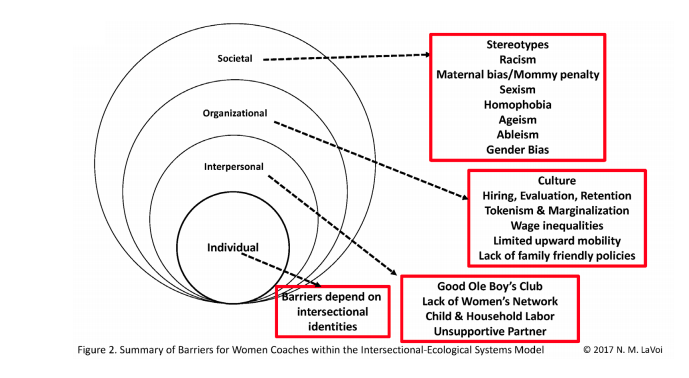
LaVoi also used her research to challenge narratives about gender equity in hiring and discussed the barriers women experience and the intersectional factors by which they are caused (see model). Some of these factors include stereotypes, gender and maternal bias, limited upward mobility, and a lack of women’s network in coaching.
LaVoi presents an ecological model identifying the barriers to women in coaching. (Source: “Women in Sports Coaching” N.M. LaVoi)
Women Ski Coaches Association (WSCA) leader Maria Stuber expressed the value of the research conducted by LaVoi and the Tucker Center in allowing the problem to be discussed across genders without interference from one’s personal experience or biases.
“Having data to back the conversation helps take the emotions out of this topic and makes it an easier conversation to have,” said Stuber, “It’s less of a controversy. Once this is no longer just an opinion, we can stop being defensive and start focusing on solutions. The data allows us to be positive, take action, and get things done.”
LaVoi explained that one of the questions she hears most commonly is “Why do women coaches matter?”
In her 2016 publication titled Women in Sports Coaching, LaVoi addressed this question in depth. Here is an excerpt:
“Sport is one of the most visible and powerful social institutions in the world. Individuals who are seen and known in the world of sports, like coaches, communicate who and what is relevant and valued (and who is not), and a majority of the time in every country in the world, those coaches are men. There are many empirically based reasons why women coaches matter.”
Some other reasons cited by LaVoi include the importance of having gender diversity in role models to challenge archaic stereotypes about women in leadership roles, the importance of same-sex role models for young women and girls, and that boys experiencing women as competent leaders increases the likelihood that they will respect women and see them as equal colleagues and partners.
She also explained that a lack of women is detrimental to the ecosystem of sport coaching.
“When women are the minority in the system, they face a lot of psycho, social, and occupational outcomes.”
These outcomes include decreased job satisfaction, pressure to perform or conform, stronger intention to leave, an increased likelihood of opting for a lesser role, and burnout. On the flip side, the presence of women in leadership roles helps empower other women to strive for a similar outcome and having same-sex peers can also improve the experience one has in a given system.
“When you see women being successful, it inspires people. ‘Oh, I could do that. That seems cool, she seems cool, I want to do that.’ And in they come. It’s the same thing with women in positions of leadership.”
LaVoi likened this to Jessie Diggins winning an Olympic Gold Medal inspiring others to try cross country skiing or set a lofty goal.
She added that the visibility of female head coaches also helps female athletes see coaching as a viable career path, increasing the likelihood of becoming coaches themselves.
“Women and girls coached by women are more likely to go into coaching, so it’s a cycle. And women who are coached by women are safer. All of this stuff with SafeSport right now and coach abuse, 99.5% of all sexual abuse in sport happens because of male coaches. We don’t like to talk about that because it’s uncomfortable but that data is real clear on this.”
LaVoi also offered suggestions on how programs at any level can work toward improving gender equity in their coaching staff. Some suggestions include committing to having a female coach on every level team, providing membership for female coaches to join the WSCA, and paying for female coaches to attend professional development activities. If coaching positions are available and women are not applying, consider recruiting women who would do well in the position.
In 2017, the Tucker Center launched the She Can Coach campaign which challenges coaches to invite female athletes to consider a career in coaching and expressing belief that those athletes would make great coaches. LaVoi explained the importance of recruiting talented coaches and inviting women into the field to move the needle forward. She went on to explain how this relates to creating equity rather than equality, as women in the coaching field may need additional resources or support in order to have the same professional experience as their male counterparts.
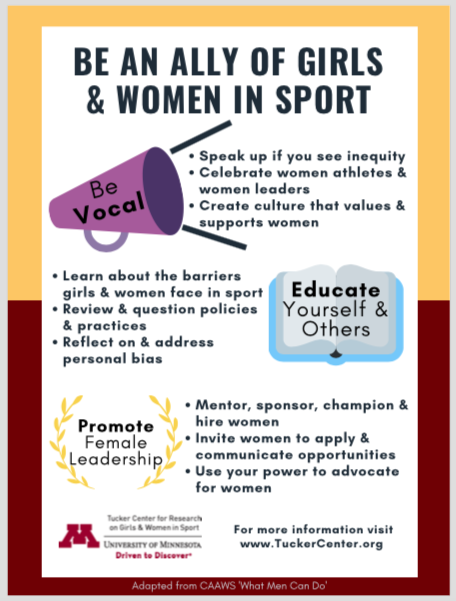
Men are invited to be part of the solution to gender inequity in sports coaching. (Graphic courtesy of the Women Ski Coaches Association)
Throughout the presentation, LaVoi emphasized that the “numerical male dominance in coaching” is not a women versus men problem — she addressed how male allies can be a part of the solution. Some of her suggestions were simple, like encouraging female athletes who would make great coaches to consider it, displaying images of women coaches around the clubhouse, reflecting on their own conscious and subconscious biases, and celebrating the existing women coaches in the program. She also suggested that men refuse to serve on all-male panels or faculties to encourage the recruitment of a diversity of perspectives.
She left the male attendees with the challenge to identify where on the spectrum of allies they fell and she asked all participants to identify and commit to one thing they can do to change the system. [Read a call to action from Pete Vordenberg here].
The Women Ski Coaches Association launched in September 2019 in pursuit of gender equity in coaching.
In August, the Women Ski Coaches Association (WSCA) set forth to balance the scales of gender equity in coaching. With Maria Stuber, head coach at the College of St. Scholastica (CSS) and former member of the Craftsbury Green Racing Project, at the helm, the WSCA strives to be “the voice and future of women in coaching.”
According to surveys conducted by the Tucker Center for Research on Women and Girls in Sport, since Title IV was passed in 1974, the number of female head coaches leading women’s sports teams at the collegiate level has dropped from 90% to just over 40%. The reason for this decline is complex and multifaceted, but the trend is pervasive. Some sports like Lacrosse, Field Hockey, and Equestrian have a relatively high percentage of teams led by women coaches, however, cross-country skiing checks out in the bottommost tier of sports with only 20% of Division I womens’ teams led by a female coach. As head coaches typically oversee both genders, this statistic is representative of the overall percentage of women coaches in leadership positions in Division I NCAA skiing.
The grassroots mission of the WSCA is to change these statistics by empowering and connecting female coaches and serving as a voice for women in the sport.
“Develop, retain, and advance,” said Stuber to paraphrase the objectives of the WSCA. “Bringing in more women that want to be ski coaches, turning them into really successful ski coaches, keeping them in ski coaching, and helping them find really rewarding careers whether that means doing exactly what they want to do or working for people who are going to value them.
“We want to start this conversation by making the research and data available. We want to support each other and guide our large population of male allies in ways they can help.”
Stuber is pleased with the reach and impact of the WSCA launch and explained that its message has been met with overwhelmingly positive feedback.
“This might be the only ski thing I’ve ever been a part of in my career in skiing that has had unanimous positive support. There are a lot of people really excited about this project.”
At this point, the WSCA is funded primarily by a grant from the Oregon Nordic Ski Foundation and memberships for which there are two options. To ensure cost is not an obstacle for the stakeholder group, women coaches can join for just $20. The rest of the community, male or female, can show support by joining as an ally for $100. It is also possible to gift a membership. Currently, the WSCA has approximately 90 members. Stuber hopes to see this number rise steadily as awareness increases.
Of the current members, Stuber is excited to see how many are interested in not only signing up but also taking action in growing the organization.
“When you become a member you can check whether you want to be active or really active, essentially, and we have just a shocking amount of people who have said, ”Yes. I want to volunteer my time and take a leadership role in this organization.’”
Stuber emphasized that she is humbled and appreciative of the women who have expressed interest in being active in the WSCA and plans to utilize them once they have completed some of their urgent organizational tasks like forming a board and completing the 501c3 process.
Stuber has been the primary leader in launching the WSCA and remains the public face. Although, she has received ample support, encouragement, and advice from peers in taking the leap. When asked about their marketing, she credits Heather Mooney and Lina Hultin in designing a logo and creating a website. Mooney is a coach Bridger Ski Foundation in Bozeman, MT and Hultin is the co-director of the Montana Endurance Academy.
While immediately catching the eye as a snowflake, a closer look at the logo shows the branches are a circle of women. Stuber explained that the circle represents growth and that the women are reaching out to support one another.
Though in its nascent stages, the WSCA has already begun acting on its mission by sending two women, Stuber and Greta Anderson of Crested Butte Nordic, to attend the Female Ski Leaders of Tomorrow Symposium held at the Holmenkollen the second weekend in September. The trip was funded by a grant from Equinor who sponsored the event in partnership with the Norwegian Ski Federation. On the last day of the symposium, Stuber presented about the goals of the WSCA in front of 83 participants from 22 nations, all of whom are leaders in ski sport.
Her presentation followed remarks from FIS Secretary General Sarah Lewis who explained the actions FIS is taking toward promoting gender equity in snow sport coaching and leadership.
Founder Maria Stuber presented about the WSCA gender equity project at the Female Ski Leaders of Tomorrow Symposium in Oslo, Norway. (Photo: Instagram @womenskicoaches)
“To be able to show her the importance of grassroots change in addition to the top down mandated efforts that we are seeing was super powerful. I was just shaking with excitement afterwards and I got bombarded with people afterward coming up asking questions and other countries wanting to get involved. I also got to thank the Norwegian women who spearheaded this project and let them know that the ski leaders of tomorrow event helped give me the confidence to take action on launching the WSCA. Feedback from this presentation made me feel like this could be really big and grow into other sport disciplines and internationally.”
In alignment with the International Olympic Committee (IOC) Gender Equity Review Project, FIS is undertaking a set of goals and initiatives to increase the number of women in leadership positions internationally. Some of these initiatives include mandating the election of women to FIS congress and committees and hiring women as technical officials to increase representation by 10% each year until the goal of 40% women is achieved in 2024. The FIS working group is also reviewing other areas of discrepancy between male and female athletes including the difference in race distances and exposure in media coverage. Effort is also being placed into balancing the statistics in participation by developing female athletes in sports that have been historically only contested by men including ski jumping, nordic combined, and freestyle skiing and snowboarding.
In addition to the Norway trip, three first year coaches attended the U.S. Ski and Snowboard National Cross Country Coaches Symposium September 29-30 in Park City, UT with support from the WSCA and U.S. Ski & Snowboard. (A video of the symposium can be purchased here.) The attendees were Stuber’s former CSS athlete Nicole Gilman who interned with the Sun Valley Ski Education Foundation this summer, Harvard University graduate Hannah Hardenbergh who will be coaching in Vail, CO this winter, and Julia Hayes who is a Montana State University graduate now coaching for the Bridger Ski Foundation.
The keynote speakers at this event included Brit Baldishol and Nicole LaVoi who who are leaders in researching and implementing best practices for the development of female athletes and coaches.
Baldishol has a twenty year history working with the Norwegian Ski Federation in various capacities and spent six years coaching the junior national team. Early in her coaching career, which began at age 18, she was the sole woman participating in high level sport education meetings and courses, making her a pioneer for female coaches in Norway. Her presentation topics included “Development and the Role of the Coach for U14 Cross Country Skiers,” and “A Focus on Long Term Success: Norwegian Model for Under-20 and Under-23 Skier Development”.
LaVoi holds a PhD in Kinesiology and is the co-director of the Tucker Center where she researches “the structural and personal barriers experienced by female coaches, relational qualities of the coach-athlete relationship, the effect of parent and coach ‘background anger’ behaviors on youth athletes, the physical activity of underserved girls, and media representations of girls and women in sport.” She also serves on the board of directors for WeCoach, an organization promoting women coaches at all levels across all disciplines. LaVoi first presented on the development of physically active girls, followed the next day by an evidence-based presentation on the importance of women in coaching and leadership which aligned with the mission of the WSCA.
“The WSCA is a necessary step to improving the climate of skiing for women, to where they feel heard, valued and supported,” wrote LaVoi in an email. “It is an exemplar organization that brings to life the importance of the data on women coaches that we produce in our research. I applaud their efforts and support this new organization for women coaches.”
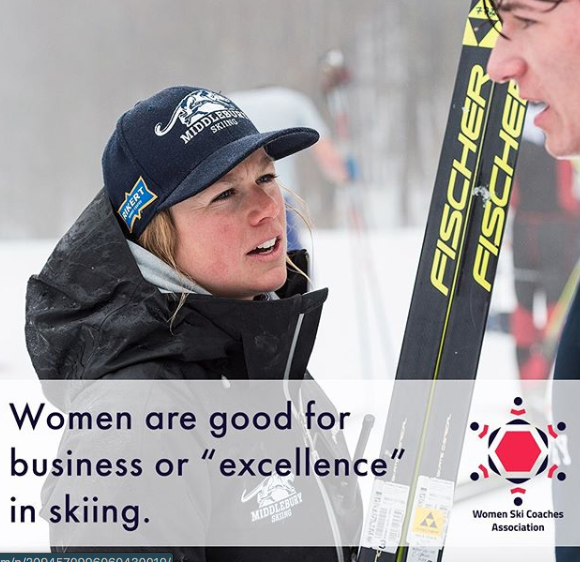
Kate Barton (left) is the assistant coach at Middlebury College. (Photo: womenskicoaches.org, flyingpointroad.com)
Stuber explained that the WSCA connected LaVoi with U.S. Ski & Snowboard and expressed gratitude for their efforts in bringing LaVoi to the symposium. She added that this demonstrates U.S. Ski & Snowboard’s support and partnership with the WSCA in addressing gender inequity in winter sport.
[Stay tuned for a separate article with takeaways from LaVoi’s presentation.]
The next steps in the WSCA action plan include creating opportunities for women to network at races and other events through the winter.
“I’d like to start working regionally to connect women coaches in our country. So if you’re coaching in the east, you’ve got a good handle on who else is coaching in the east, what their challenges are, what direction they want to go with their career. And so if there are young women coaches in any region, the veteran coaches know who they are and if they have specific coaching career goals.”
Because Stuber and the majority of supporting members have a busy schedule juggling coaching and travel through the fall and winter, the WSCA aims for sustainable progress in growth and development.
“It’s going to be a slower process. What we do this winter is going to be pretty simple. I’m confident, though, that we can get a lot done in a simple way.
“The outpouring of positive support that we’ve had for this makes me feel like this could grow into something huge and incredibly impactful, and that’s the piece that I think has to wait until next summer just because I really want to do it well.”
At this time, Stuber explained that the most impactful way to support the WSCA is to become a member and to share the mission of the organization with other contacts at all levels of the sport.
“There is so much energy around this topic right now and whether people are talking about it with our organization in mind or in their small communities and ski clubs, that’s really huge.”
The WSCA is also working on becoming a non-profit organization. Currently, former CSS athlete Kelsey Dickinson (USA Biathlon/CGRP) is assisting Stuber in working through the complex process of obtaining this designation, but the WSCA is also in search of a non-profit lawyer in the state of MN. Stuber sees this step as an essential piece in enabling the WSCA to remove financial barriers for women that seek professional development or networking opportunities.
“We need some time to become a non-profit. It’s a ton of work and we don’t have paid employees. There’s a lot to be done that is not directly mission related, and then there is a lot of mission related stuff that we want to jump on as quickly as we can, but we’ve got to get more funding before we can do a lot of what we want to do.”
For the time being, the WSCA aims to perpetuate the wave of conversation surrounding gender equity in skiing at the leadership level while recruiting additional supporting members.
“This conversation is the big thing that we’re going to accomplish this year. We’re going to get people talking about this, we’re going to use our voice to let people know how both men and women can be involved and how we as a multi-gendered ski community can start to equalize who’s coming into our coaching ranks and staying there in order to promote competence and excellence in this sport that we all love.”
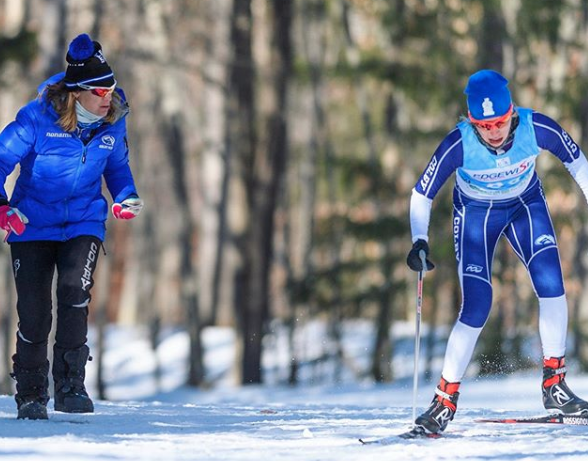
Tracy Cote of Colby College encourages her athlete mid-race. (Photo: womenskicoaches.org, flyingpointroad.com)
According to a recent U.S. Ski & Snowboard membership newsletter, men outnumber women by 2:1 in cross country ski coaching positions in the United States. At the head coach and program leadership levels, that ratio skews even further away from equal representation. Five out of 25 head cross country coaches in NCAA skiing are women. At the post-collegiate level, there is just one woman in charge of an elite team.
Enter the Women Ski Coaches Association, or WSCA. We are launching today, in the fall of 2019, to encourage more women to enter, remain in, and advance through the cross country ski coaching profession and bring women’s representation at all levels of coaching closer to 50%.
Why? Because we believe in the importance of equality within ski program leadership. Ski teams are often led by one coaching staff for both genders, and we believe that if women have power equal to men within team leadership, the needs of male and female athletes in our sport will be equally met. Furthermore, we want the women and girls on our teams to see that it’s possible for them to coach at the highest levels of our sport if they want to.
Pepa Miloucheva, Head Coach of the Craftsbury Green Racing Project and the only female head coach of an elite post-collegiate ski team in the U.S., put the importance of gender equality in her profession this way:
“Men and women coaches think a little bit differently in how they think about the athletes,” she said. “You just relate much more to your own gender. Training-wise, men coach and women coach pretty similarly. But when it comes to working through athletes’ problems, it’s always been easier for me to communicate with women coaches.”
The creation of the WSCA has been the work of many women who currently lead ski teams across the country. Maria Stuber, Head Nordic Ski Coach at The College of St. Scholastica, organized a meeting of women coaching at U.S. Nationals in January, 2019, to brainstorm ideas about how to get more women in the profession. From there, Stuber spearheaded efforts to organize as a 501(c)(3), to come up with a mission and goals, and to generate support and funding. Throughout the process, Stuber emphasizes that she had help from her peers at collegiate, national, and club teams alike.
“This is a true group effort and the WSCA includes and represents every woman coach,” she said. “There are lots of hard-working women to thank this summer!”
The collaborative beginnings of the organization is affirmation of why Stuber and company have been so driven to build the WSCA in the first place.
“Every single time I get a chance to work at a camp with another female coach, it is light years better as far as my enjoyment, my energy when I leave, and what I learn at that event,” Stuber says. “That’s what this organization is doing. So that we can have more than that one-camp-a-year experience; take that distance between us all and close it up.”
The WSCA aims to provide networking, coaches education, and career development support for women ski coaches across the U.S. One of its primary educational projects is to fund travel for two American women to attend the Norwegian Ski Federation’s Ski Leaders of Tomorrow International Seminar this September in Oslo, Norway, with the support of a grant from the Oregon Nordic Ski Foundation. The Norwegian Ski Federation has seen the research that suggests a diverse work environment is more productive, successful, innovative, and happier, and is investing in women’s leadership development accordingly. The WSCA believes it is imperative that American women are represented at the seminar and able to take what they learn back to the U.S.
Across its initiatives, the common thread between the WSCA’s goals is to give women the tools to build their knowledge and confidence, so that they are able to show up and be capable. In the absence of many female peers, that confidence is hard to come by. Start to grow in numbers, and that confidence grows, too.
“I think in general it’s just the thought that when you’re the only woman there, you think that people think you’re not good enough, like your gender isn’t good enough to be there,” Miloucheva noted. “It’s so important to give women the confidence to continue developing in coaching.”
In the States, U.S. Ski & Snowboard has made recent progress in developing female coaches. In May 2019, the U.S. Cross Country Ski Team hired Bernie Nelson as its new D-team cross country coach. Nelson is now the first and only woman on the national team coaching staff — a significant step forward in representation at the highest level of cross country skiing in the U.S. Not long after she was hired, U.S. Ski & Snowboard announced a women’s cross country coaching fellowship to take place in October at two national team camps.
Stuber looks at Nelson’s hiring as groundbreaking, noting that it debunks the common and destructive myth that women do not want to coach because it’s too hard or too time consuming. Of the 22 people who applied for the D-team job that became Nelson’s this spring, 11 of them were women. Opening this position up for applications was evidence that, “women want to coach at the higher levels exactly as much as men do,” Stuber said.