From the FasterSkier archive — posts syndicated from athletes’ and coaches’ own blogs between 2004 and 2012, kept online as published. Current coverage is at fasterskier.com.

Tag: Xavier McKeever

  • Hedegart Emerges From the Fog to Win Holmenkollen 50 k as Klæbo’s Absence Reshuffles the Distance Globe

    Hedegart Emerges From the Fog to Win Holmenkollen 50 k as Klæbo’s Absence Reshuffles the Distance Globe

    This coverage is made possible through the generous support of Marty and Kathy Hall and A Hall Mark of Excellence Award. To learn more about A Hall Mark of Excellence Award, or to learn how you can support FasterSkier’s coverage, please contact info@fasterskier.com.

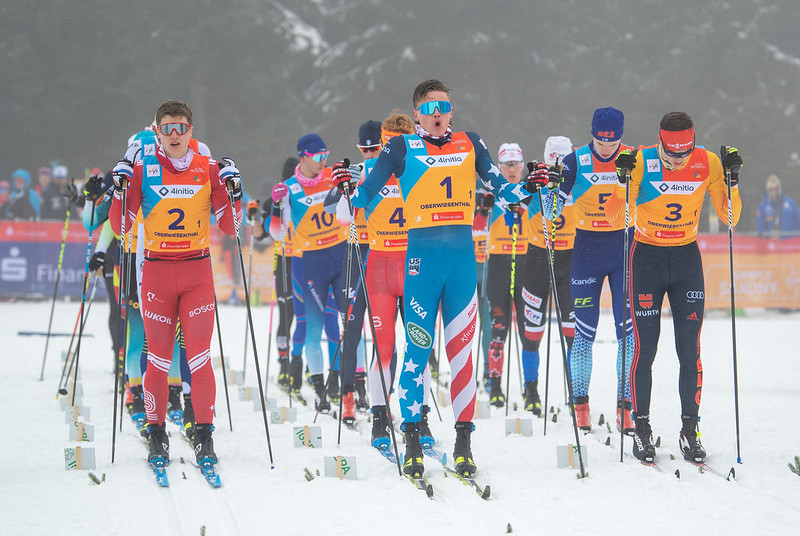
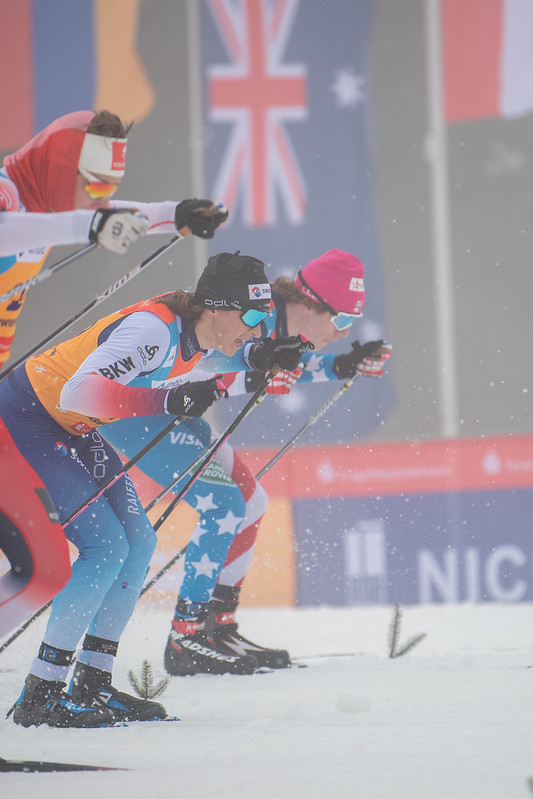
    The start of the Holmenkollen Men’s 50 k Freestyle in Oslo, Norway. (Photo: Authamayou/NordicFocus)

    For nearly two hours on Saturday, 77 men disappeared into a stubborn curtain of fog that clung to the hillsides above Oslo, their figures swallowed by the mist somewhere between the stadium and the high point at Frognerseteren. When it was over, only one emerged with his arms in the air, and it was the one freestyle specialist who had been topping shorter freestyle distance races most of the season.

    Einar Hedegart, the 24-year-old former biathlete who only committed fully to cross-country skiing in November, surged past Harald Oestberg Amundsen in the final meters to win the Holmenkollen 50 k Freestyle in 1:51:38.2 — his first victory on cross-country skiing’s most storied stage, in just his seventh World Cup start.

    “This is the greatest feeling I’ve ever had,” Hedegart said after the finish. “This is just a nostalgia stadium. [A] legendary race, almost all my heroes have won this race, and especially Petter Northug. This might be the reason why I’ve been so motivated my whole life to be a cross-country skier.”

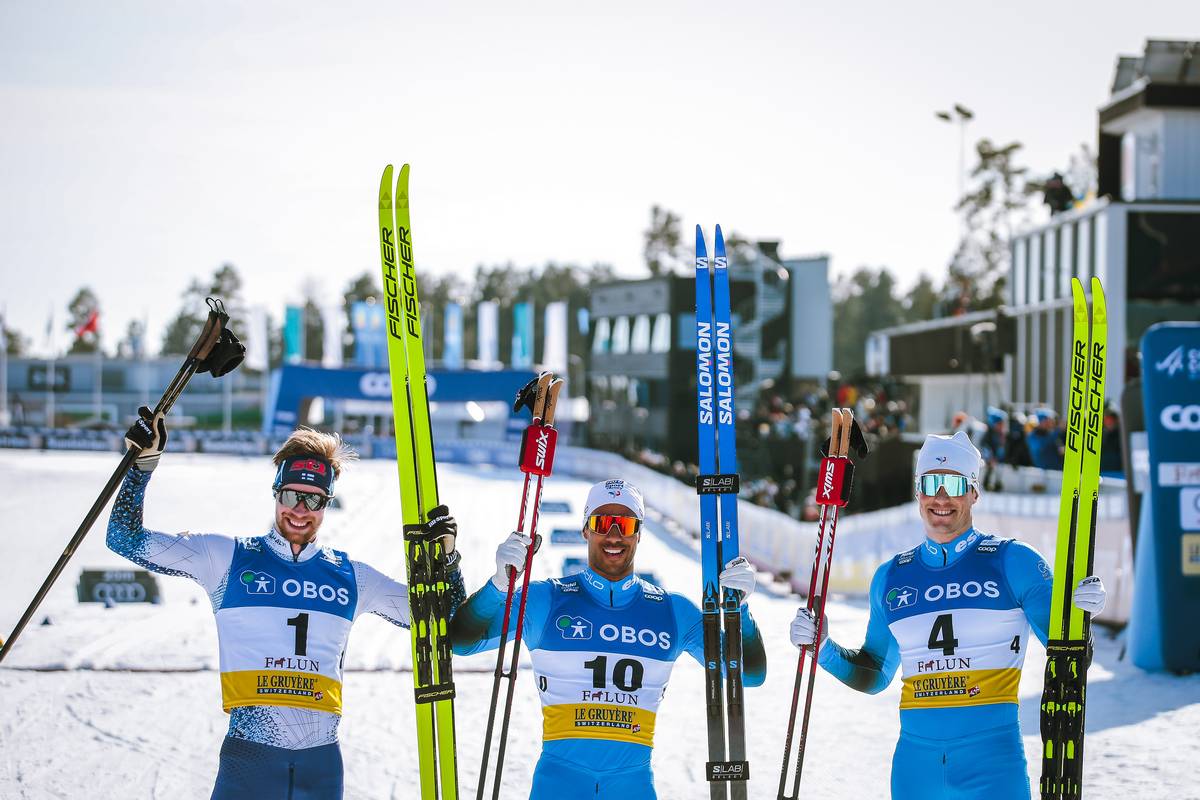
    Einar Hedegart (NOR) celebrates winning Norway’s most iconic race. www.nordicfocus.com. (Photo: Authamayou/NordicFocus)

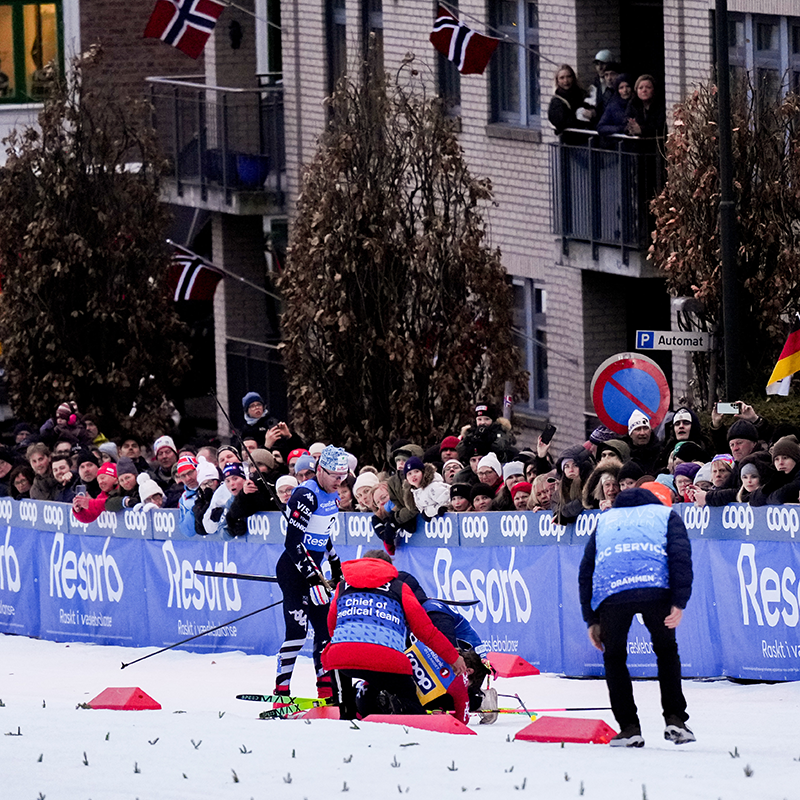
    But the result that will echo loudest across the sport happened away from Oslo. Johannes Hoesflot Klaebo, the overall World Cup leader, was home nursing a mild concussion from a hard crash in the Drammen sprint two days earlier. Klaebo, who has already compiled a nearly perfect season, winning the Tour de Ski, all six Olympic races, secured the FIS Overall Crystal Globe, the FIS Sprint Crystal Globe, and only needed to keep racing the remaining distance races to take the clean sweep of the season with the FIS Distance Crystal Globe. BUT his absence from the start line meant zero points scored in the distance standing today. And with Amundsen’s second-place finish today, the distance crystal globe race was blown wide open: Amundsen now leads the distance standings by three points, 939 to 936, with two distance races remaining at the World Cup Finals in Lake Placid.

    Klaebo posted to Instagram yesterday: “Took a fall yesterday and hit my head pretty hard, but luckily everything is all good in the hood. Ended up with a concussion, so I’ll take some days off from both training and the internet just to make sure everything settles properly. Only got one head, so have to take good care of it.”

    He had been scheduled to fly to the United States on Sunday, but will now stay in Norway for a few extra days, hoping to recover in time for Lake Placid.

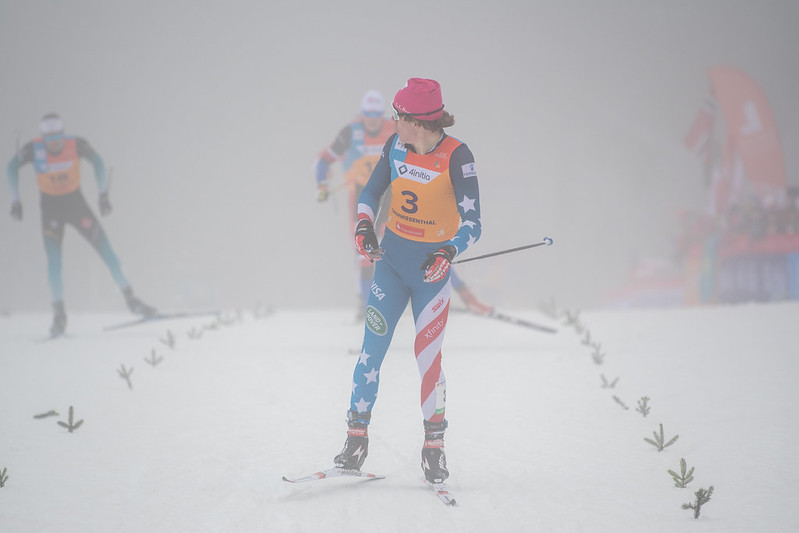
    Einar Hedegart (NOR) emerges from the fog to take the win. (Photo: Nordnes/NordicFocus)
    A Race Defined by Fog

    The Holmenkollen 50 k — first raced in 1888, a fixture of the World Cup since 1982, and a race that draws an estimated 100,000 fans to the forested hills above Oslo — returned to the calendar Saturday after a one-year absence. For the first time, the men’s and women’s 50 k races were held on the same day, the women starting 45 minutes behind the men in a format designed to create an all-day spectacle. The fog, however, had other ideas. Conditions were so thick that spectators along the course could hear the racers before they could see them.

    The course — six laps of 8.3 km with 334 meters of climbing per lap — was firm and fast after overnight salting despite an air temperature of 5.0°C. The salted, compact surface was ideal for skating, and the winning time of 1:51:38 came in roughly four minutes faster than the last time the Holmenkollen 50 k was contested in freestyle.

    Harald Oestberg Amundsen (NOR) on his way to second place. (Photo: Authamayou/NordicFocus)

    Through the first three laps, the race unfolded as a cautious tactical affair. A large pack of roughly 40 skiers stayed together, with Martin Loewstroem Nyenget, Mattis Stenshagen, and Federico Pellegrino taking turns at the front. The first athlete to make a decisive tactical move was Iver Tildheim Andersen, who changed skis early at the stadium after the third lap while the rest of the pack continued through. The fresh skis gave Andersen a burst, and when the lead group stopped for their own ski exchange one lap later, he suddenly found himself alone at the front with a roughly 15-second advantage.

    “Just stick with the field as long as possible and then hopefully be in position when the group starts swarming,” Hedegart said of his plan. “But today I was really offside, like 70 percent of the race. So I was lucky that no one took a gap.”

    The chase group — reduced to roughly eight athletes, all Norwegian once France’s Victor Lovera fell off the pace — gradually closed on Andersen through the fifth lap, with Hedegart, Simen Hegstad Krueger, Amundsen, Nyenget, Andreas Fjorden Ree, and Kasper Andersson Herland trading pulls at the front. By the time the group reached the final lap, they had swallowed Andersen, and the race became a question of who had saved enough for the final kilometers.

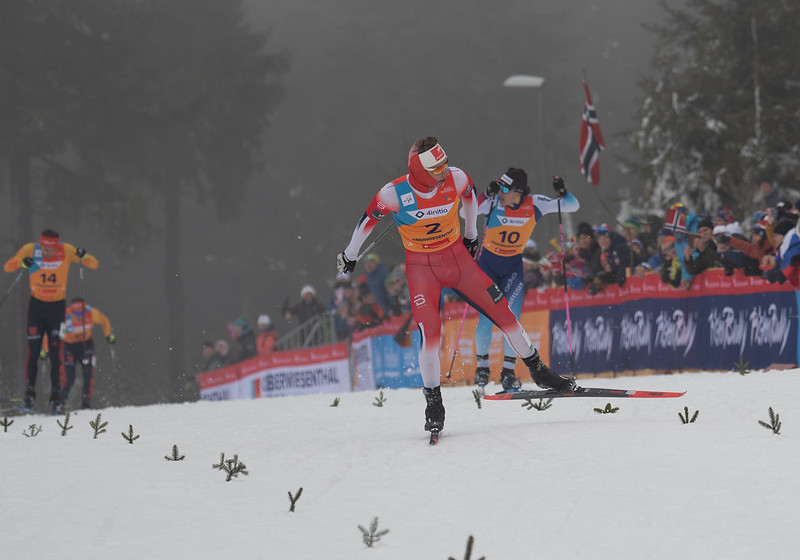
    Simen Hegstad Krueger (NOR) tried his best to get away for the win. (Photo: Authamayou/NordicFocus)
    Krueger’s Late Charge and Hedegart’s Final Kick

    Krueger, who was celebrating his 33rd birthday the day before, was omitted from the Norwegian Olympic team despite multiple Olympic medals in his career and was the winner of the last freestyle Holmenkollen 50 k. He drove the pace through the final lap. He pushed hard over the climbs near the iconic Holmenkollen church, stringing out the group and shedding Andersen off the back. But Krueger couldn’t sustain the pressure all the way to the finish, and as the group of seven came around the final corner and up the short, steep ramp before the descent into the home stretch, the sprint was on.

    Amundsen launched first, throwing everything he had at the final few hundred meters. But Hedegart, who had looked labored at points earlier in the race, found a gear no one could match. He came alongside Amundsen, took the lead in front of the grandstand crowd, and raised his fist in celebration as he skied across the line.

    “I felt, like, better,” Hedegart said of his position in the back of the pack through much of the race. “So I was just laying in the field, and I had to remind myself he did the same,” he added, referring to his idol Northug, whose trademark move was stalking from behind before unleashing a devastating sprint.

    Harald Oestberg Amundsen (NOR), Mattis Stenshagen (NOR), and Martin Loewstroem Nyenget (NOR), (l-r) stayed in the lead pack. (Photo: Authamayou/NordicFocus)

    Hedegart crossed in 1:51:38.2. Amundsen finished four-tenths of a second behind. Nyenget was third at +1.1. Ree took fourth (+1.5), followed by Herland (+2.1), Krueger (+3.0), Moseby (+4.8), and Andersen (+16.8) after his brave solo effort. Norway swept the top eight positions.

    France’s Lovera was the first non-Norwegian in ninth (+48.1), followed by AIN athlete Savelii Korostelev in 10th (+1:24.2).

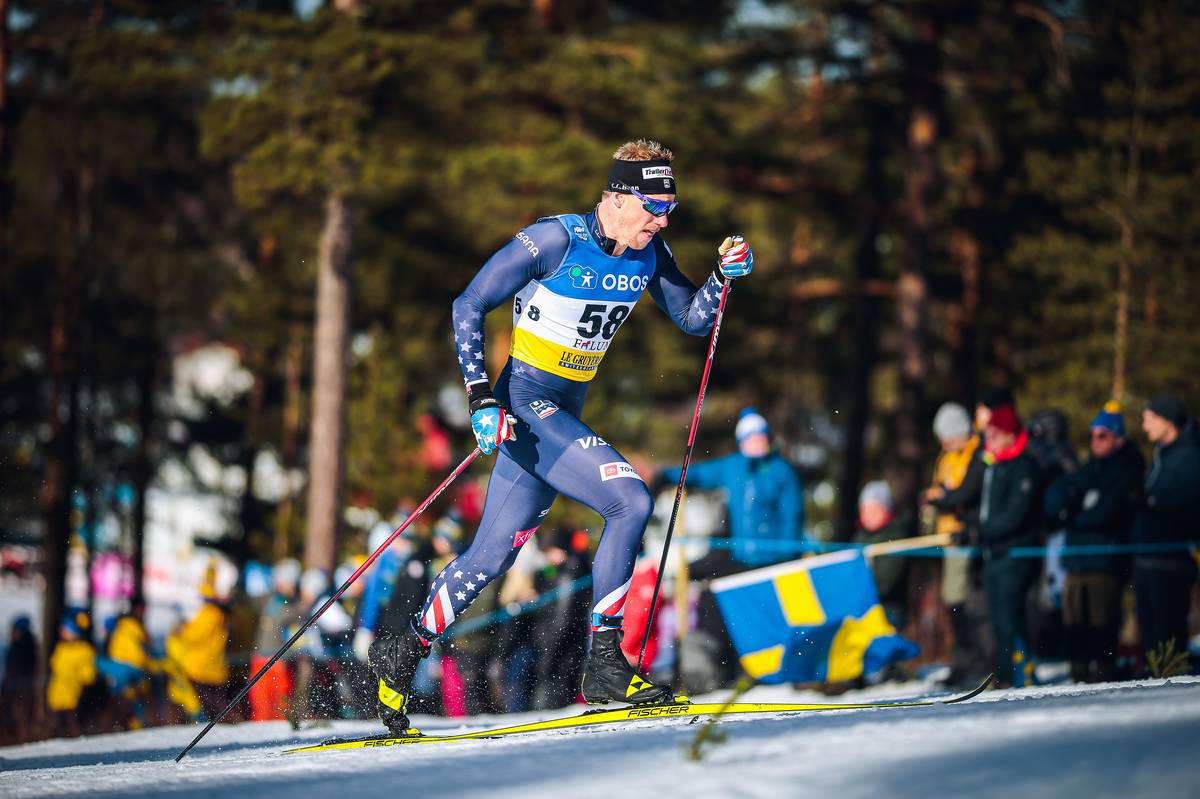
    Zak Ketterson (USA) led the way for the Americans in the chase pack racing for 11th place; he ultimately finished 18th. (Photo: Authamayou/NordicFocus)
    Ketterson Fights for 11th in His Adopted Home

    Zak Ketterson, who spent the summer and fall living and training in Oslo, found himself in the thick of a battle for 11th place, a fight he learned about from coaches stationed along the fog-shrouded course.

    “I had heard from coaches on the side of the trail that our pack was fighting for 11th, and that was super cool,” Ketterson said. “I actually felt pretty fresh at the end and thought my finishing sprint would be pretty good, but I didn’t time it well and got really boxed in on the last couple turns into the finish.”

    Ketterson ultimately finished 18th (+1:54.2), part of a chase pack that came across the line within seconds of each other. He said everyone in the group knew a sprint was coming on the final lap.

    The fog made the tactical picture nearly impossible to read. “I couldn’t see more than 10 meters in front of me,” Ketterson said. “It definitely made it difficult to assess where I was relative to the leaders in the later laps. It also made some of the corners feel way sketchier because you couldn’t really choose an optimal line with such limited visibility.”

    For Ketterson, the race carried personal significance beyond the result. Having trained on the Holmenkollen course through the Norwegian summer and fall, he knew every climb and descent intimately. “This is definitely one of the most iconic and cool races we get to do,” he said. “It was especially special for me this year since I trained on this course all summer and fall living in Oslo. The highlight was definitely having my wife Julie and her family out there cheering me on.”

    What made the performance all the more impressive was the state of his body coming in. “I honestly feel like I am really running on fumes,” Ketterson said. “To be honest, I was not sure if I would even start this race in the morning. I felt so bad, and honestly, my body has felt super up and down in the last few weeks. I’m really curious to see how my body responds to this race. I was pleasantly surprised by how decent it felt, but I feel like the next week could go either way. Especially with the international travel tomorrow.”

    Brian Bushey (USA) gaining experience on his way to 59th place. (Photo: Authamayou/NordicFocus)
    The Rest of the North Americans

    Hunter Wonders was 45th (+5:46.9), Kevin Bolger was 48th (+6:51.3), and Brian Bushey was 59th (+12:24.9).

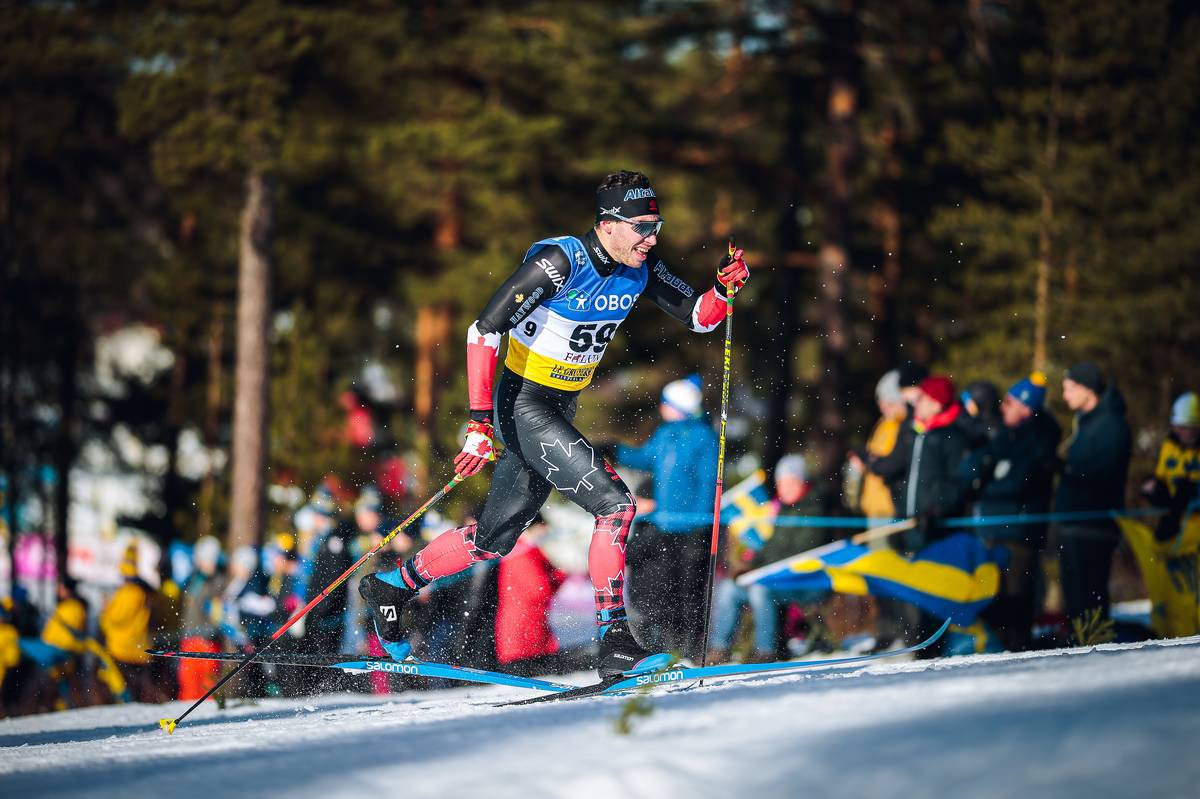
    Canada’s Xavier McKeever finished 41st (+5:11.4), while Thomas Stephen was 43rd (+5:18.1).

    Harald Oestberg Amundsen (NOR) takes over the FIS Distance Globe lead with just two distance races remaining. (Photo: Authamayou/NordicFocus)
    Distance Globe: Three Points

    The ramifications of Saturday’s race land squarely on the crystal globe picture. Before the race, Klaebo held a 128-point lead over Amundsen in the distance standings and a 636-point lead in the overall. With Klaebo watching from home, Amundsen’s 131-point haul (including bonus points) vaulted him into the distance lead: Amundsen now sits at 939 points, three ahead of Klaebo’s 936. Nyenget climbed to 914 in third.

    Klaebo’s overall World Cup lead, at 2,071 points to Amundsen’s 1,566, remains secure with a 505-point cushion. But the distance globe — awarded to the season’s best across distance events only — will come down to the final two races: a 10 k Classic Interval Start and a 20 k Freestyle Mass Start in Lake Placid, March 20-22.

    If Klaebo can travel to Lake Placid and race, he’ll have every opportunity to reclaim the lead. If the concussion keeps him out, the distance globe is likely to belong to Amundsen.

    Kasper Andersson Herland (NOR), who finished fifth, celebrates with Einar Hedegart (NOR), (l-r) at the finish of the Holmenkollen. (Photo: Authamayou/NordicFocus)
    A Star Made for This Stage

    Hedegart’s career trajectory is one of the season’s best stories. A junior biathlon world champion who struggled with his shooting, he drifted toward cross-country skiing after a surprising second-place finish at the Holmenkollen World Cup last season. He spent the summer training with a cross-country team while bringing his rifle to every camp, undecided. In November, after winning the popular pre-World Cup cross-country race in Beitostoelen, Norway, by a wide margin and missing eight of 20 shots in a biathlon event, he committed to leaving the rifle at home.

    Since then: an Olympic bronze in the 10 k Freestyle behind Klaebo, a team sprint gold partnered with Klaebo, victories in the Engadin Marathon, and now the Holmenkollen 50 k — a distance he had never raced at the World Cup level. He was asked whether his approach of sitting back resembled Northug’s famous stalking tactics.

    “Yeah, I felt like Petter,” Hedegart said. “So I was just lying in the field, and I had to remind myself he did the same.”

    For a race that dates to 1888, that has been won by the sport’s mythical stars, and that is contested before the King of Norway in a stadium surrounded by 100,000 fans, there is no small amount of weight to what happened Saturday at the Holmenkollen. Hedegart is, by every measure, now a cross-country skier.

    The season concludes with the World Cup Finals in Lake Placid, New York, March 20-22. Three races remain. The distance globe is separated by three points. And the world waits to see whether Klaebo can make it to the start line.


    Holmenkollen Men’s 50 k Freestyle FINAL RESULTS

    FIS Men’s Crystal Globe SPRINT STANDINGS
    FIS Men’s Crystal Globe DISTANCE STANDINGS
    FIS Men’s Crystal Globe OVERALL STANDINGS


    Love Stories Like This? Help Keep Them Coming.

    Feature stories like this one take time, access, and care to produce. If you value thoughtful storytelling and independent ski journalism, please consider becoming a Voluntary Subscriber. Your support directly fuels the work we do to cover the people, places, and moments that make our sport special.

    Join the FasterSkier community!


    Harald Oestberg Amundsen (NOR), Andreas Fjorden Ree (NOR), and Martin Loewstroem Nyenget (NOR), (l-r) share the Holmenkollen 50 k Freestyle in Oslo, Norway. (Photo: Authamayou/NordicFocus)
  • The Devon Kershaw Show: The post-Olympic hangover is over — with head injuries

    The Devon Kershaw Show: The post-Olympic hangover is over — with head injuries

    This episode was made possible through the generous support of our voluntary subscribers.  If you value coverage like this, please support FasterSkier with a voluntary subscription.  

    We had to take a break after our three-week Olympic sprint, but we’re back to catch up on a couple of weeks of World Cup racing.

    Devon and Nat take a quick run-through of events in Sweden, Finland and Norway. We’ll be back after the marathons at Holmenkollen.

    Reach us at devon[at]fasterskier.com and nat[at]fasterskier.com.

    A reminder: This is a homegrown podcast done by two guys working long hours and late nights. We also paid real money to be in Italy for the Olympics. If you can, support the show and FasterSkier’s ongoing coverage with a voluntary membership.

    Help Support Our Olympic Coverage!

    FasterSkier had our own Nat Herz on the ground at the Olympics, which, to be honest, was a very big financial lift for us. If you value the thoughtful work and access FasterSkier provides at championships like this one, please consider becoming a Voluntary Subscriber. Your support directly fuels the work we do to cover the people, places, and moments that make our sport special.

    Join the FasterSkier community!
  • A Familiar King: Klaebo Opens Milano Cortina with Skiathlon Gold

    A Familiar King: Klaebo Opens Milano Cortina with Skiathlon Gold

    This article was made possible through the generous support of our voluntary subscribers who have helped put our Nat Herz on the ground at the Olympics. If you value coverage like this, please support FasterSkier with a voluntary subscription.

    Four Norwegian men, including Martin Loewstroem Nyenget (NOR), Mattis Stenshagen (NOR), Harald Oestberg Amundsen (NOR), Johannes Hoesflot Klaebo (NOR), (l-r) set to lead the Men’s 20 k Skiathlon out of the start and begin the 2026 Milano-Cortina Olympic Winter Games in Tesero, Italy. (Photo: Vanzetta/NordicFocus)

    PREDAZZO, ITALY — The snow in Val di Fiemme had finally settled. After a colder night and a full day’s distance from the most recent snowfall, the surface beneath the men’s skis on Sunday morning felt less negotiable than it had twenty-four hours earlier. It was firmer, faster, and exacting—the kind of track that rewards decisiveness and punishes hesitation. On a course defined by momentum, there would be no neutral moments.

    By the time the leaders crested the Zorzi Climb for the final time, illuminated by the bright northern Italian sun, one truth had been clarified: the Olympic Men’s Skiathlon had not produced a surprise. It had produced a confirmation.

    Johannes Hoesflot Klaebo arrived in Val di Fiemme as the most accomplished skier of his generation, the reigning master of range—sprint speed married to endurance patience, and the man who, one year earlier at the World Championships in Trondheim, Norway, became the first skier ever to win gold in every event. On Sunday, in the opening men’s race of the 2026 Olympic Winter Games, he did not reinvent himself. He simply waited, watched, and delivered exactly what the sport has come to expect.

    But the Skiathlon is never only about the man who wins it. It is about where the race breaks, who is caught on the wrong side of that break, and how little time there is to recover once it happens.

    In Val di Fiemme, that truth arrived early—at a fast right-hand corner about two kilometers into the race—and again, more quietly but just as decisively, midway through the skate leg, when a tangle in the pack ended one of Norway’s strongest medal threats.

    An unfortunate early crash took Gus Schumacher (USA) out of a top performance. (Photo: Vanzetta/NordicFocus)

    Firmer Conditions, Faster Consequences

    The men’s skiathlon opened with a 10-kilometer classic leg, mass start, with athletes seeded by season-long results. It is a procedural detail that becomes strategic fact the moment the gun fires: the highest-ranked skiers line up at the front, while those just behind them must navigate the churn.

    On Sunday, the pace was relentless from the first kilometer. The field stretched quickly as athletes fought for position ahead of the course’s first defining technical feature—a fast right-hand corner roughly two kilometers in, where the trail bottoms out before pitching uphill again.

    It was the same corner where Jessie Diggins fell in Saturday’s women’s race. And once again, it reshaped the day.

    Several skiers went down in the crash, including Edvin Anger (SWE), Zak Ketterson (USA), and Gus Schumacher (USA)—all athletes with legitimate top-ten potential under normal circumstances. The cost of falling there was immediate and severe: not just lost momentum, but lost momentum at the precise moment the leaders were accelerating uphill and creating separation.

    “I was dead last after the fall,” Schumacher said afterward. “Unfortunately, Zak fell right in front of me. It was tight coming into that corner, and I didn’t see what happened to Zak, but into the dropdown I got one ski around him and the other caught and spun me around off track.”

    “I did what I could, but when the people at the front are still going as fast, it’s hard to catch them. All I could do was ski as smoothly as I could for the next 18 k. At that point, it’s an individual race. I feel like I skied well for being back there.”

    Zak Ketterson (USA) was involved in the same crash as Schumacher and was forced to burn many matches early while playing chase, which ultimately proved too costly. He ultimately ended the race in 43rd place. (Photo: Vanzetta/NordicFocus)

    Ketterson’s version of the same moment underscored how quickly the situation unraveled.

    “I fell on that same corner Jessie Diggins fell on yesterday,” he said. “I was hopeful we’d ski it well, but coming into it everyone started snowplowing and freaking out and someone in front of me fell.

    “I fell pretty hard, but I got back up and just burned so many matches catching back up to the group. I was fighting from there to the finish.”

    Ahead of them, the race did not wait.

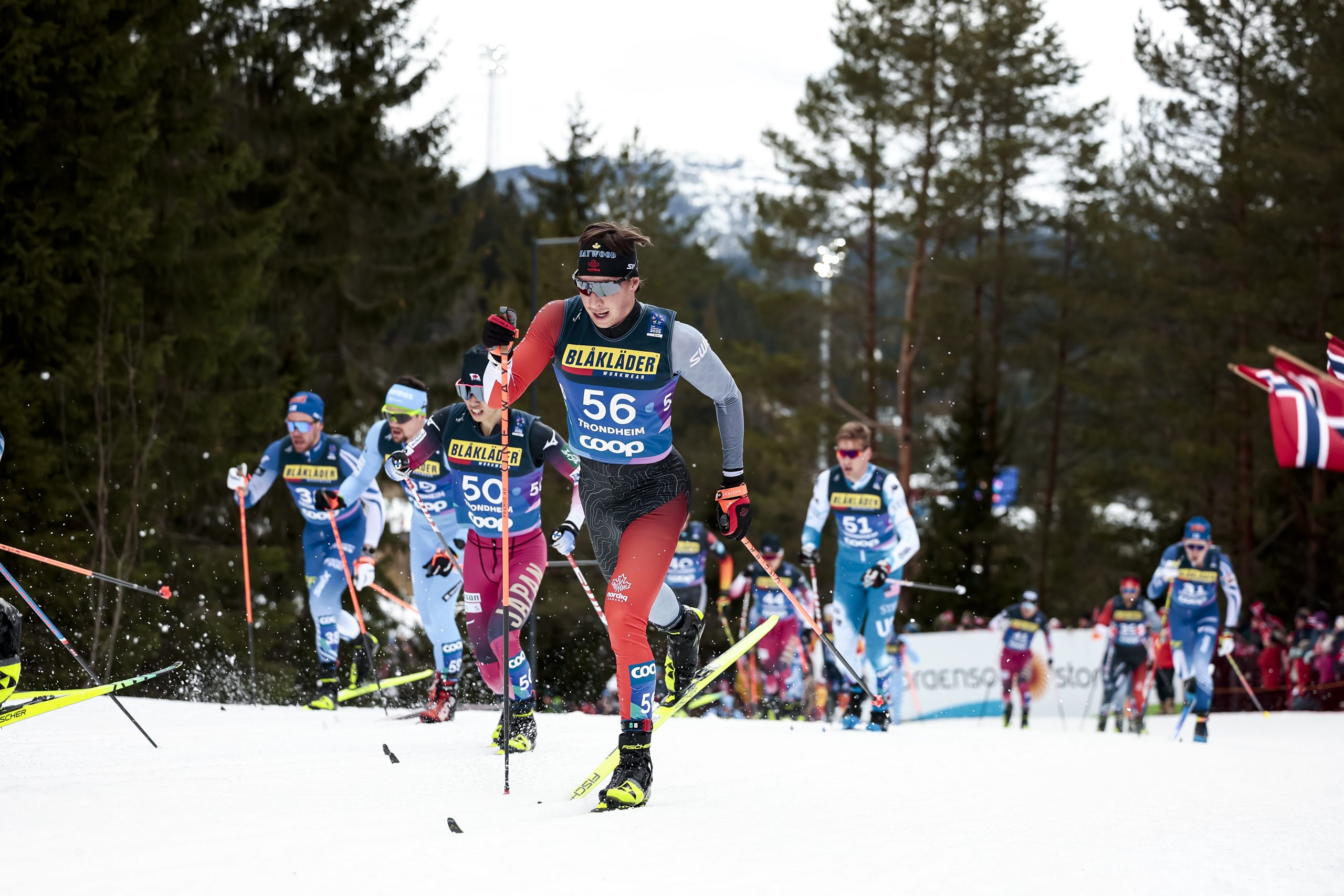
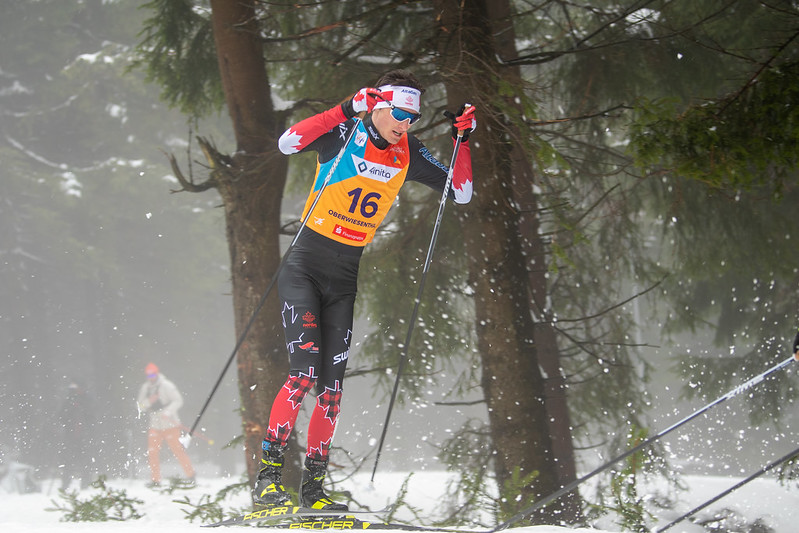
    Xavier McKeever (CAN) had, what he described, the race of his life. (Photo: Vanzetta/NordicFocus)

    Control Without Calm

    With the early chaos, the classic leg splintered the field. A front group formed, thinned, and re-formed, the pace steady enough to discourage attacks but high enough to extract a cost from anyone forced to chase.

    For the U.S. team, there was at least one quiet positive. Head coach Matt Whitcomb felt far better about ski preparation than he had the day before.

    “We had, in general, very competitive skis today,” Whitcomb said.

    But ski quality can only matter if contact is maintained.

    “When you get taken out of contact with the leaders,” Whitcomb said, “the people you’re drafting off of are slower than the leaders. It’s kind of negative compounding—you just drift away.”

    By the time the top eight skiers entered the stadium for the ski exchange at the end of the classic leg, the race had already begun to select for those who could tolerate discomfort without revealing it. Among them were Norway’s Mattis Stenshagen, who soon faded, France’s emerging depth, and Klaebo himself—observant and patient.

    Then the skis changed, and the race revealed its teeth.

    Harald Oestberg Amundsen (NOR) got tangled with Savelii Korostelev (AIN), which caused him to fall and lose contact with the lead pack. Korostelev managed to stay on his feet and was able to earn a fourth place. (Photo: Barbieri/NordicFocus)

    A Quiet Turning Point in the Skate Leg

    The opening kilometers of the freestyle leg altered the race more subtly, but no less decisively.

    At approximately 11.5 kilometers, Harald Oestberg Amundsen (NOR)—who had positioned himself exactly where Norway would want him entering the skate portion—tangled skis with Savelii Korostelev (AIN). Amundsen went down. The lead group did not.

    He remounted quickly, but the elastic had snapped. His chance to fight for a medal in the opening race of the Games was gone.

    For Norway, a team that has dominated the men’s World Cup season at times filling nearly the entire top ten, it was a small moment with outsized implications.

    Hugo Lapalus (FRA), Martin Loewstroem Nyenget (NOR), Savelii Korostelev (AIN), Mathis Desloges (FRA), Johannes Hoesflot Klaebo (NOR), (l-r) formed the lead pack and became the group that would battle for the podium. (Photo: Vanzetta/NordicFocus)

    Desloges, a Yellow Card, and a Protest That Went Nowhere

    As the race accelerated, Mathis Desloges (FRA) briefly found himself leading at the end of the first skate lap. In a moment of confusion, he mistakenly turned into the ski exchange lane before cutting back through the V-boards and rejoining the course.

    The detour shortened his route by only a few meters and offered no meaningful advantage. The race jury issued Desloges a yellow card warning and allowed the result to stand.

    After the race, AIN filed a protest, arguing that the infraction should result in disqualification and elevate Korostelev, who finished fourth, to the bronze medal position. The jury rejected the protest.

    Desloges framed the day not around controversy, but around progression.

    “I’m very happy,” he said. “The preparation was very good. Two years ago today, I became [the U23 World Champion], and now it’s different. I’m better than two years ago.

    “This medal is for my family, for my friends, and for everyone on the French team—the staff and my family.”

    Johannes Hoesflot Klaebo (NOR) delivered a spectacular move on the Zorzi Climb that opened up a large gap in the final kilometer. (Photo: Barbieri/NordicFocus)

    Klaebo on the Zorzi Climb

    There are moments in ski racing that feel preordained—not because they are inevitable, but because the athlete who executes them has taught the sport to expect them.

    Klaebo’s move on the Zorzi Climb belonged to that category.

    He waited. He measured. And then, on the final ascent, he applied a pressure no one else in the group could answer. The gap opened quickly, almost unbelievably so if he had not done the same thing so many times before, and by the time the course tipped back toward the stadium, the Olympic gold medal was no longer in doubt. Klaebo came to the finish with enough margin to ease up, take off his poles, and ski the final meters, celebrating in front of the stadium crowd.

    For Klaebo, the performance was the product of both familiarity and tension.

    “The last couple of days have been nerve-racking,” he said. “I’ve had a very high resting heart rate these days. I’ve been very nervous, but this is my third Olympics, so you get a little bit of experience. This is a track and course that we know a lot from previously—we’ve done a lot of World Cups here.”

    When the skis changed and the race accelerated, that experience showed.

    “I had good skis, my body felt good,” Klaebo said. “It’s always good to start a championship in good shape.”

    One year removed from his historic sweep in Trondheim, Klaebo arrived in Val di Fiemme carrying questions that extended well beyond a single race. Six gold medals are available in Milano Cortina. No man has ever won them all.

    “We’ll see,” Klaebo said. “I’m going to take one race at a time. But it’s a pretty good start. With the weather and the crowds, it was amazing out there.”

    Mathis Desloges (FRA) and Martin Loewstroem Nyenget (NOR), (l-r) come down the finish stretch battling for the silver and bronze medal. (Photo: Barbieri/NordicFocus)

    Nations in Contrast

    France: Depth and Belief

    If Norway remains the benchmark, France is no longer content to chase quietly.

    Desloges acknowledged Norway’s status entering the race, but did not concede anything beyond the present tense.

    “The French athletes are very strong,” he said. “Of course, the Norwegian guys are also very strong, but I believe we can be better. Today, I’m very good, and I’m happy.”

    France backed up that belief with the most comprehensive team performance of the day, placing second, fifth, ninth, and fifteenth.

    “We see the French team on a similar level as our team,” Whitcomb said. “When we have success, they’re one of the first teams to congratulate us. They’re just a really passionate group, and we love to see them succeed.”

    Hugo Lapalus (FRA) and Mathis Desloges (FRA) celebrate an unbelievable day for France. (Photo: Vanzetta/NordicFocus)

    Norway: Gold, Bronze—and Perspective

    For Norway, the medal count told only part of the story. A gold and a bronze would thrill nearly any other nation, but the context surrounding this team—deep enough to leave world-class skiers at home—made the result feel more measured.

    Bronze medallist Martin Loewstroem Nyenget (NOR), racing his first Olympic event, framed the day not as a shortfall, but as an arrival.

    Johannes Hoesflot Klaebo (NOR), Martin Loewstroem Nyenget (NOR), Harald Oestberg Amundsen (NOR), and Mattis Stenshagen (NOR), (l-r) all entered the day with hopes of an Olympic medal for Norway; two delivered, two did not. (Photo: Barbieri/NordicFocus)

    “I’m really happy and proud,” Nyenget said. “It’s a result of training, but also of time away from family and a lot of hard mental work. The past days and weeks, I’ve been nervous, so it’s good to be done with my first Olympic race.

    “To have this first race in this atmosphere, with these blue skies, and have my wife and little kid in the stadium somewhere—it’s a really good day.”

    Asked whether gold and bronze constituted a satisfactory outcome, Nyenget was direct.

    “I think so,” he said. “We have some really high pressure. We’ve been doing crazy good in the World Cup, but usually in championships, all racers are at their very best. You see today that there is strong competition from the French, and we took two podium places. It’s good.”

    After the fall Gus Schumacher (USA) spent the day racing his way through the field, eventually finishing in 24th place. (Photo: Barbieri/NordicFocus)

    United States: Disappointed, Not Discouraged

    For the U.S. team, the early crash changed everything.

    Schumacher and Ketterson were forced into playing chase. Zanden McMullen, who avoided the crash, felt the day slip away in the skate leg.

    “Today’s race was not great, but not horrendous,” McMullen said. “I felt really good in the classic leg and then I don’t know what happened in the skate portion. I was cramping up quite a bit and just didn’t have it.”

    Hunter Wonders (USA) on his way to 31st place. (Photo: Vanzetta/NordicFocus)

    Hunter Wonders, making his Olympic debut, focused instead on the scale of the task.

    “It was hard,” Wonders said. “It was a hard course with tricky conditions. The skiathlon is difficult because it mixes up the muscle groups you use and takes a second to transition, but it was fun. Great Olympic debut.”

    Whitcomb struck a measured tone.

    “I’m feeling good, not great,” he said. “Slightly disappointed, but not discouraged. Nothing about that feels negative to me. This is just one of the days of the Games, and now it’s behind us.”

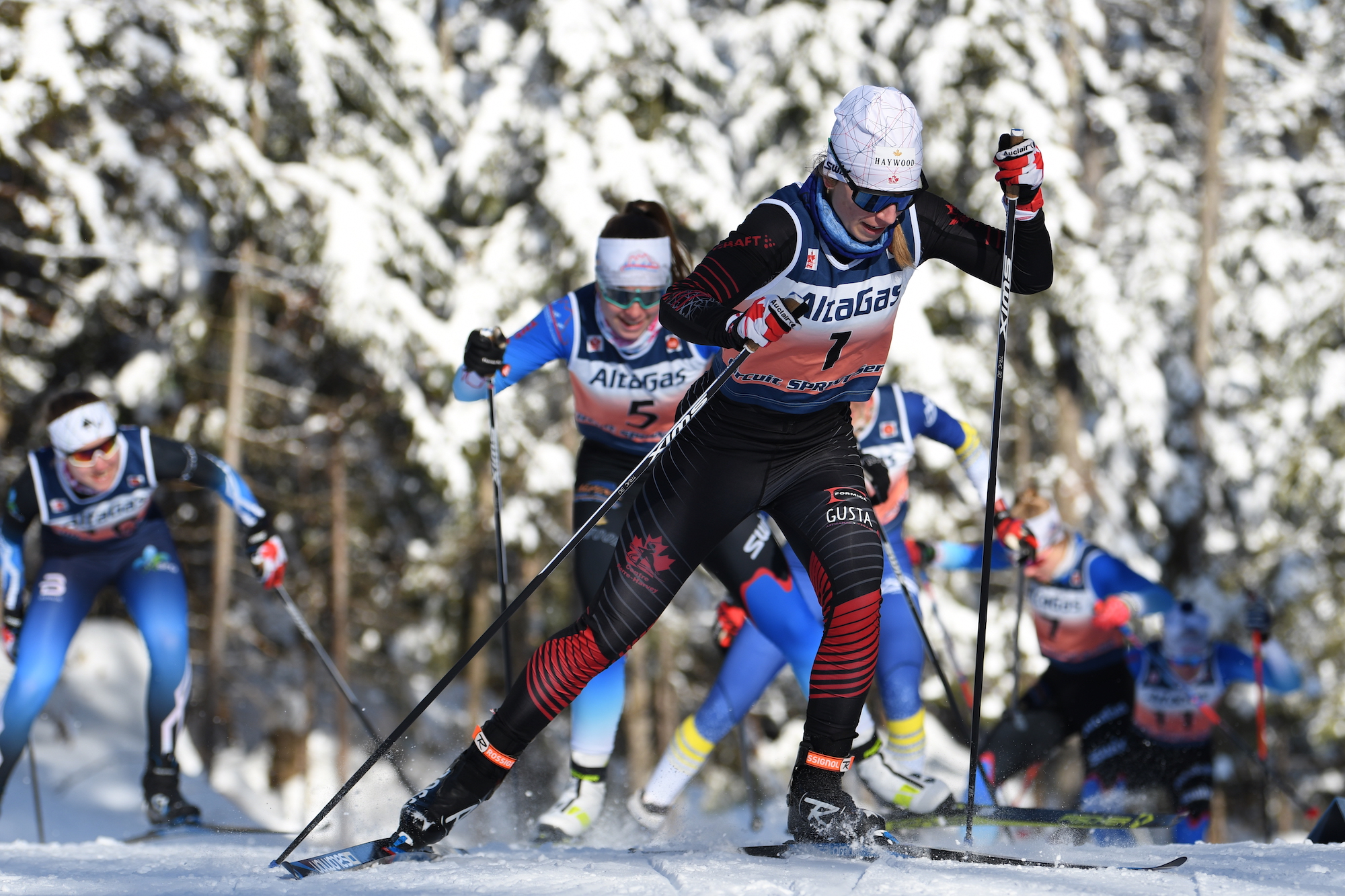
    Xavier Mckeever (CAN) fighting for a top ten, eventually finishing in 13th place. (Photo: Vanzetta/NordicFocus)

    Canada: The Race of a Lifetime

    For Canada, the day belonged to Xavier McKeever, who finished 13th after spending much of the race on the edge of the top ten.

    “Oh man—that was incredible,” McKeever said. “I can’t believe what just went down, to be honest.”

    He described a race that improved with each kilometer.

    “I felt like I skied it really smart—tried to conserve as much energy as possible—and I just felt better and better,” he said. “The skate felt really good, which is sweet, because that’s usually a weak spot for me.”

    Mid-race, the realization crept in.

    “You can’t really comprehend what’s going on,” McKeever said. “You’re just like, ‘Holy crap, I’m here right now, fighting for top ten.’ It’s surreal, but you’ve got to focus on the race.”

    The result carried deeper meaning.

    “To be honest, I was about a foot away from not making this Olympic team,” he said. “To come here and have the best race of my life so far on the first day at the Olympics—I couldn’t ask for anything more.”

    Mathis Desloges (FRA), Johannes Hoesflot Klaebo (NOR), and Martin Loewstroem Nyenget (NOR), (l-r) share the Olympic Men’s 20 k Skiathlon podium in Tesero, Italy. (Photo: Vanzetta/NordicFocus)

    One Race Down

    The skiathlon rarely offers mercy, and Val di Fiemme offered none.

    There will be more races, more chances, and more medals to chase. Klaebo will insist he is taking this one race at a time. Everyone else will count.

    On firmer snow, with no ambiguity left beneath the skis, the hierarchy revealed itself plainly—and the Olympic Winter Games began exactly where cross-country skiing so often does: with Johannes Hoesflot Klaebo setting the standard.


    Olympic Winter Games – Men’s Skiathlon – RESULTS

    On the ground reporting by FasterSkier’s Nat Herz.


    Help Support Our Olympic Coverage!

    FasterSkier has our own Nat Herz on the ground at the Olympics, which is a significant financial lift for us. If you value the thoughtful work and access FasterSkier provides at championships like this one, please consider becoming a Voluntary Subscriber. Your support directly fuels our work to cover the people, places, and moments that make our sport special.

    Join the FasterSkier community!

     

    Even Johannes Hoesflot Klaebo (NOR) gets excited to win an Olympic Winter Games gold medal. (Photo: Barbieri/NordicFocus)
  • Schumacher Wins in Toblach as New Four-Heat 5K Format Turns the Race into a Clock-Chasing Puzzle

    Schumacher Wins in Toblach as New Four-Heat 5K Format Turns the Race into a Clock-Chasing Puzzle

    This coverage is made possible through the generous support of Marty and Kathy Hall and A Hall Mark of Excellence Award. To learn more about A Hall Mark of Excellence Award, or to learn how you can support FasterSkier’s coverage, please contact info@fasterskier.com.

    Gus Schumacher (USA) and the rest of Heat 2 climb over Toblach’s iconic feature during the 5 K Freestyle. (Photo: Modica/NordicFocus)

    The Tour de Ski has always asked skiers to live with imperfect information. You race hard when you’re tired. You make decisions based on feelings and instincts, while coaches are screaming ‘splits.’ You tell yourself the only honest thing in a stage race: don’t do anything you can’t recover from tomorrow.

    On Wednesday, the Tour leaned fully into that uncertainty — and then amplified it.

    Stage 3, a 5-kilometer freestyle, arrived with a new wrapper: four separate mass-start heats, each sent off at a different time, with final standings determined only after all heats were complete and all times were combined. The spectacle was real — a small parade of high-speed skating races rather than one long pageant — but the competitive implications were sharper than the format’s novelty suggested. Skiers weren’t simply racing the men next to them. They were racing an invisible standard set by athletes they couldn’t see, in heats that could be slower or faster for reasons that had nothing to do with any one skier’s fitness.

    If that sounds like chaos, it wasn’t. Not for Gus Schumacher.

    Schumacher (USA) didn’t treat the new format as a novelty or a gamble. He treated it like a solvable problem — and in doing so, he won the stage in 9:35.4, claiming the second World Cup victory of his career and stamping his authority on a Tour de Ski day that felt, at times, like a controlled experiment.

    Behind Schumacher, Austria’s Benjamin Moser was second (+0.2), and Norway’s Lars Heggen — the U23 skier who helped turn Schumacher’s heat into a metronome — was third (+0.6).

    And here is the detail that will define how this stage is remembered: the top seven overall finishers all started in the same second heat, the heat that began at 11:48:45. In a race decided on aggregate time, that start time became a kind of gravitational center — the heat where cooperation, pace, and intention converged into the day’s fastest runway.

    Ben Ogden (USA), JC Schoonmaker (USA), Remi Drolet (CAN), and others follow Johannes Hoesflot Klaebo (NOR) during the third heat of the 5 K Freestyle. (Photo: Modica/NordicFocus)

    The Format: Four Races, One Result — and a Quiet Incentive to Collaborate

    The four start times — 11:30:00, 11:48:45, 12:07:30, and 12:26:15 — didn’t just separate the field. They separated narratives. In one heat, the pace would be relentless and communal; in another, it might be cagey, tactical, or simply a touch less urgent. In a normal mass start, you can afford to be patient. In a normal 5K interval start, you can measure yourself against the clock. On this day, you had to do both — without complete visibility into either.

    U.S. head coach Matt Whitcomb framed it simply: the 5K has been absent from the World Cup menu for long enough that today was “unknown territory,” and athletes had to be ready to adapt. “Nobody really knew what to expect,” he said — not because the course was mysterious, but because the format forced a different kind of decision-making.

    Whitcomb also emphasized that heat assignments weren’t random theater. They were determined by overall Tour standings after two stages, via a snake-draw system written into the rules — in other words, the groups were structured, and the group you landed in mattered.

    That mattered most in the heat Schumacher found himself in — and, crucially, in the way he decided to race it.

    Gus Schumacher (USA) leads Heat 2 during Stage 3 of the Tour de Ski in Toblach (ITA). (Photo: Vanzetta/NordicFocus)

    Heat 2 Becomes the Day’s Engine

    By the time Schumacher’s heat went off at 11:48:45, the day already had shape: one race had happened, a set of times had been posted, and the Tour’s new experiment had revealed its first truth — you could win your heat and still lose the stage.

    Schumacher and his heat-mates didn’t merely acknowledge that truth. They embraced it.

    “I think my heat-mates and I realized that having a fast heat was the biggest picture,” Schumacher said afterward. “I was prepared to be 10th in the heat if it meant we were fast.”

    That sentence — prepared to be 10th if it meant we were fast — is the kind of thing athletes say when they’re not racing for ego. It’s what they say when they’re racing for an outcome.

    Schumacher described how the plan became practical: “We were able to trade leads also with Ben Moser’s help and keep the pace fast without too much effort before the hills, then actually continued to work together even better than I thought we would from there into the finish.”

    Whitcomb confirmed the same dynamic from the outside: Schumacher “reached out to Lars Hagen and Ben Moser and came up with a plan,” and the result was “well orchestrated trading off of the lead,” the kind of collaboration you don’t often hear described so plainly in a World Cup race. In a typical mass start, you hide. In a typical interval start, you suffer alone. In this format, the fastest solution was neither — it was to share the work early and arrive at the decisive sections with enough fuel to race, not just survive.

    And the split data makes the story legible.

    At 1.7 km, Schumacher hit 2:54.2. Moser was 2:54.4. Heggen was even quicker at 2:53.5. The heat was not strolling into the race; it was setting terms.

    At 2.7 km, Schumacher reached 4:59.6, and the heat’s front remained dense and alive. By 3.1 km, Schumacher was at 6:16.4 — still close enough to the line that the stage would be won in the last two kilometers, but far enough out that the wrong decision on the climb would show up in the final time like a bruise.

    Schumacher’s last 1.9 km — from 3.1 km to the finish — was the sharpest of the podium trio, and among the best in the field. He closed in 3:19.0, a finish that wasn’t just a sprint, but a controlled acceleration from a high baseline.

    This is what it looked like in practice: a heat that refused to turn into a chess match. A group that made the race fast enough to matter. And a skier — Schumacher — who could do the work and still finish.

    Gus Schumacher (USA) and Benjamin Moser (AUT) lead other Stage 3 top finishers to the line in Toblach (ITA). (Photo: Modica/NordicFocus)

    The Podium: Schumacher Leads, Moser Hangs, Heggen Announces Himself

    Schumacher’s stage win — 9:35.4 — put him at the center of the day’s story, but the day’s podium also revealed how perfectly the format could reward the right combination of collaboration and individual capacity.

    Moser (AUT), second at 9:35.6, was integral to the heat’s pace-making. Heggen (NOR), third at 9:36.0, wasn’t a passenger either — he was part of the mechanism.

    Schumacher was explicit about what the format rewarded him for. “Sometimes I feel like a jack of all trades and a master of none,” he said, “but high-speed skating with an element of required distance capacity is a place where I can excel. I think Minneapolis had that too.”

    It’s the kind of description that links two very different wins — one on home snow in Minneapolis in a 10K Freestyle Interval Start, the other here, in a four-heat 5K puzzle — without pretending they are the same. What connects them, Schumacher suggested, is the ability to ski fast in a way that isn’t fragile: pace you can sustain, not just ignite.

    “I’ve been feeling good, but I’m still building momentum,” he said. “Today definitely helped.”

    Benjamin Moser (AUT), Gus Schumacher (USA), Mattis Stenshagen (NOR), (l-r) worked together to claim the podium of the 5 K Freestyle. (Photo: Vanzetta/NordicFocus)

    Where the Race Was Won: The Climb, the Urge to Go Early, and the Last Kilometer

    If Heat 2 was the engine, the course still demanded decisions — and it punished some of them.

    J.C. Schoonmaker (USA), who would finish 29th, described the mental load of the format in a way that felt honest rather than polished. “The new format just changed the way I thought about things because I felt I needed to be prepared for lots of different scenarios,” he said. “I probably haven’t done a 5K since high school… I was just trying to be ready for whatever came and be ready to react to it.”

    Schoonmaker pinpointed the moment that mattered: “On the big climb, I sensed that things were starting to stretch out a bit, so that was where I decided I needed to make a move. It was a bit early in hindsight because our heat ended up staying together, and I got pretty tired in the very end and lost some positions.”

    That’s the stage’s second truth: in a format like this, you can race aggressively and still end up punished by the math. An early move that might win you your heat can also drain the last 400 meters you need to protect your time — the thing that actually counts.

    Ben Ogden (USA), 20th, offered the same theme from a different angle. He admitted he didn’t dictate his heat’s tempo — and that, in hindsight, he wished he had done more when he felt capable.

    “I didn’t really dictate the pacing in my heat,” Ogden said. “I let Klaebo and Stenshagen really dictate the pacing, and I just held on as best I could.”

    Then the key sentence — the one that tells you how easy it was, in this format, to race the wrong race: “It’s hard to remember that it’s sort of us versus them a little bit in that race format rather than just trying to win your group.”

    Ogden noted that his heat’s final kilometer became a bit of a one-man chore: “Pellegrino led for most of the last K… down through the corners and stuff. I think it would have been better if we’d been trading off leads.”

    In other words, the format quietly rewards heats that turn into rotating pacelines and punishes heats that turn into sprints for pride.

    Schumacher’s heat was a paceline that never forgot the clock.

    Ben Ogden (USA) and Johannes Hoesflot Klaebo (NOR), (l-r) leading Heat 3 of the 5 K Freestyle in Toblach, Italy. (Photo: Vanzetta/NordicFocus)

    The Americans: A Day of Depth Under a Day of Headlines

    Schumacher’s win was the headline, but the U.S. team’s men didn’t only deliver a winner. They delivered a set of performances that made the result feel like something sturdier than a single bright point.

    Here’s where the Americans landed on the day:

    • 1st: Gus Schumacher (USA) — 9:35.4
    • 20th: Ben Ogden (USA) — 9:45.4
    • 29th: J.C. Schoonmaker (USA) — 9:46.2
    • 41st: Zak Ketterson (USA) — 9:48.9
    • 42nd: Jack Young (USA) — 9:49.1
    • 79th: Kevin Bolger (USA) — 10:08.9

    Whitcomb framed the broader men’s story as an execution day — athletes moving up within their heats and carrying out their plans — and in a stage race, that matters. You can’t win a Tour de Ski on one beautiful moment if you give it away everywhere else. You win it by repeatedly doing things that don’t make headlines: staying attached, eating enough, recovering enough, skiing smoothly when you’re cooked.

    Schoonmaker, in particular, gave a clear explanation of how the heat system changed the burden of responsibility. “For someone like me, the group I was in played a big part in my result,” he said. “As someone with not a ton of distance prowess, I didn’t have much responsibility to lead, so I was able to sit in the back and wait.”

    Then, without making excuses, he told the truth about the dependency built into the format: “That basically made it so my overall time was in the hands of the top guys — but with that being said, it also does take fitness to stay with them.”

    It’s a nuanced defense of the format — and also a subtle admission that it can be cruel. It can make your best decision feel like passivity. It can make your best fitness feel like waiting.

    Schoonmaker ended with the line the sport’s decision-makers will want to hear: “It’s a cool balance of tactics and fitness, sprinting and distance, and I hope they keep this format around.”

    Johannes Hoesflot Klaebo (NOR) was the fastest in Heat 3, but that was only good enough for 12th place overall on the day. (Photo: Modica/NordicFocus)

    Norway: The Pressure Cooker Is Always On

    Norway, as ever, arrived in Toblach with depth so thick it looks almost unfair from the outside — and with selection pressure that turns every race into a referendum.

    Johannes Høsflot Klæbo (NOR) finished 12th in 9:44.0, a day when his 12th place looked strange even when the format explained it. Emil Iversen (NOR) was 8th in 9:42.5. Harald Østberg Amundsen (NOR) finished 17th in 9:44.7. Andreas Fjorden Ree (NOR) was 9th in 9:42.6.

    But the real Norwegian story at the sharp end was Heggen — third — and the way his podium was tied to a heat that chose to cooperate rather than conserve. In the Olympic year, Norway’s selection picture isn’t just about who can win on a given day. It’s about who can be trusted to perform across formats, courses, and chaos — and this format delivered chaos with a stopwatch.

    If you are a coach trying to build a roster for Milano-Cortina, you probably liked what you saw from athletes who could do the work and still finish — athletes who could be generous early and ruthless late. That’s not a ski cliché. It’s a trait.

    Antoine Cyr (CAN) led the way for the Canadian men on a strong day in Toblach (ITA). (Photo: Vanzetta/NordicFocus)

    Canada: After Trials, Into the Fire — and Right on the Doorstep of the Top 10

    Canada came into the Tour de Ski after holding Olympic trials at home — a different rhythm than many of their European rivals — and Stage 3 gave the Canadian men a tidy set of results that will matter both psychologically and practically.

    Antoine Cyr (CAN) led the Canadians in 11th (9:43.8), with Xavier McKeever (CAN) 13th (9:44.2) and Max Hollmann (CAN) 14th (9:44.3).

    In a race where the top seven all came from one heat, those placements have extra weight: they suggest Canada wasn’t simply lucky with a draw. They were close enough to the best to make the math uncomfortable. They were within seconds — the kind of seconds that, in a Tour, can turn into minutes if you don’t recover, and can turn into opportunity if you do.

    And because this format was so dependent on heat tempo, these results also reinforce a quieter Canadian strength: the ability to race within a fast-moving group and stay composed enough to cash it in at the end.

    Benjamin Moser (AUT), Gus Schumacher (USA), Lars Heggen (NOR), (l-r) celebrate the podium in Toblach (ITA). (Photo: Modica/NordicFocus)

    A Stage That Felt Like a Debate About the Sport — and a Race That Still Had to Be Won

    The Tour de Ski has always been, in some sense, a referendum. It’s a referendum on endurance. On recovery. On whether your season has enough structure to survive a week of high heart rates and thin margins.

    This stage was something else too: a referendum on presentation. On whether cross-country skiing can be made to feel urgent to people who don’t already love it.

    FIS itself framed Stage 3 as a premiere — the first Heat Mass Start event of its kind at the World Cup level — and pointed directly to fan engagement as a key motivation for the format shift.

    Whitcomb put it less diplomatically in his own way: in his view, whether the format stays should be determined by what fans think, because “what the fans think dictates whether or not the sport survives in some regards.” He described traditional, interval starts as difficult for casual viewers — not because the racing isn’t real, but because it can be hard to feel the tension without context.

    Wednesday’s format was designed to create tension. You could see the effort. You could see the decisions. You could see the finish. And then you had to wait — which is its own kind of tension — to learn what it meant.

    But none of that changes the simplest truth of Stage 3: Schumacher still had to win it.

    He had to be strong enough to take pulls. Smart enough to strategize and invest in cooperation. Calm enough to accept a plan that might have left him “10th in the heat” if the math demanded it. And then, at the end, he had to be fast in the most old-fashioned way — a finish that doesn’t care about format innovation, that doesn’t care about start times, that doesn’t care about how clever you were at 1.7 kilometers.

    It cares only about what you have left when the line is close enough to hurt.

    Three nations working together, one shared podium for Benjamin Moser (AUT), Gus Schumacher (USA), Lars Heggen (NOR), (l-r) in Toblach (ITA). (Photo: Modica/NordicFocus)

    The Tour Moves On — and the Final ‘Hill’ Looms

    Schumacher, already looking forward, kept his gaze where Tour de Ski veterans always keep it: on what the next stage demands.

    “Those time gaps are tight,” he said. “I’ll keep taking it day by day and especially try to ski well tomorrow and keep in mind how important that hill climb will be.”

    That’s the Tour in one sentence: tight gaps, day by day, and a hill that doesn’t care how good you felt yesterday.

    The new 5K heat format gave the Tour a jolt of spectacle, yes — but it also gave us something more interesting: a day that rewarded not only fitness, but the willingness to race in a way that made sense for the structure of the event.

    Schumacher understood it. His heat executed it. The numbers validated it.

    And now the Tour moves on with the usual debts: tired legs, shifting standings, and the knowledge that in a stage race, the best days are never purely celebrations. They are also investments — and the bill always comes due tomorrow.


    Men’s 5 K Mass Start Freestyle RESULTS

    Men’s 2026 Tour de Ski OVERALL STANDINGS


    Love Stories Like This? Help Keep Them Coming.

    Feature stories like this one take time, access, and care to produce. If you value thoughtful storytelling and independent ski journalism, please consider becoming a Voluntary Subscriber. Your support directly fuels the work we do to cover the people, places, and moments that make our sport special.

    Join the FasterSkier community!


    The taste of victory for Gus Schumacher (USA) on the FIS World Cup. (Photo: Vanzetta/NordicFocus)
  • Fast Tracks: World Champs—Xavier McKeever Discusses The Most Exciting Race of His Career

    Fast Tracks: World Champs—Xavier McKeever Discusses The Most Exciting Race of His Career

    This reporting costs money. Please support this coverage with a voluntary subscription (below) so FasterSkier can provide this level of access to the sport we all love year-round.

  • The Devon Kershaw Show: Quick bonus episode with the Canadian relay men

    The Devon Kershaw Show: Quick bonus episode with the Canadian relay men

    Canada threw down an impressive fifth place finish in Friday’s men’s 4×10 k relay, finishing just seconds from the medals. We caught up with the team afterwards in the mixed zone — here are our interviews with, in order, Tony Cyr, Graham Ritchie and Olivier Leveille. (We interviewed scramble leg skier Xavier McKeever earlier in the day, which is why he’s not featured in this clip.)

    We’ll be back tonight with a recap of the women’s 30 k. Stay with us. You can reach us at devon@fasterskier.com and nat@fasterskier.com.


  • The Devon Kershaw Show: Norway’s men pull out the broom for a pursuit sweep

    The Devon Kershaw Show: Norway’s men pull out the broom for a pursuit sweep

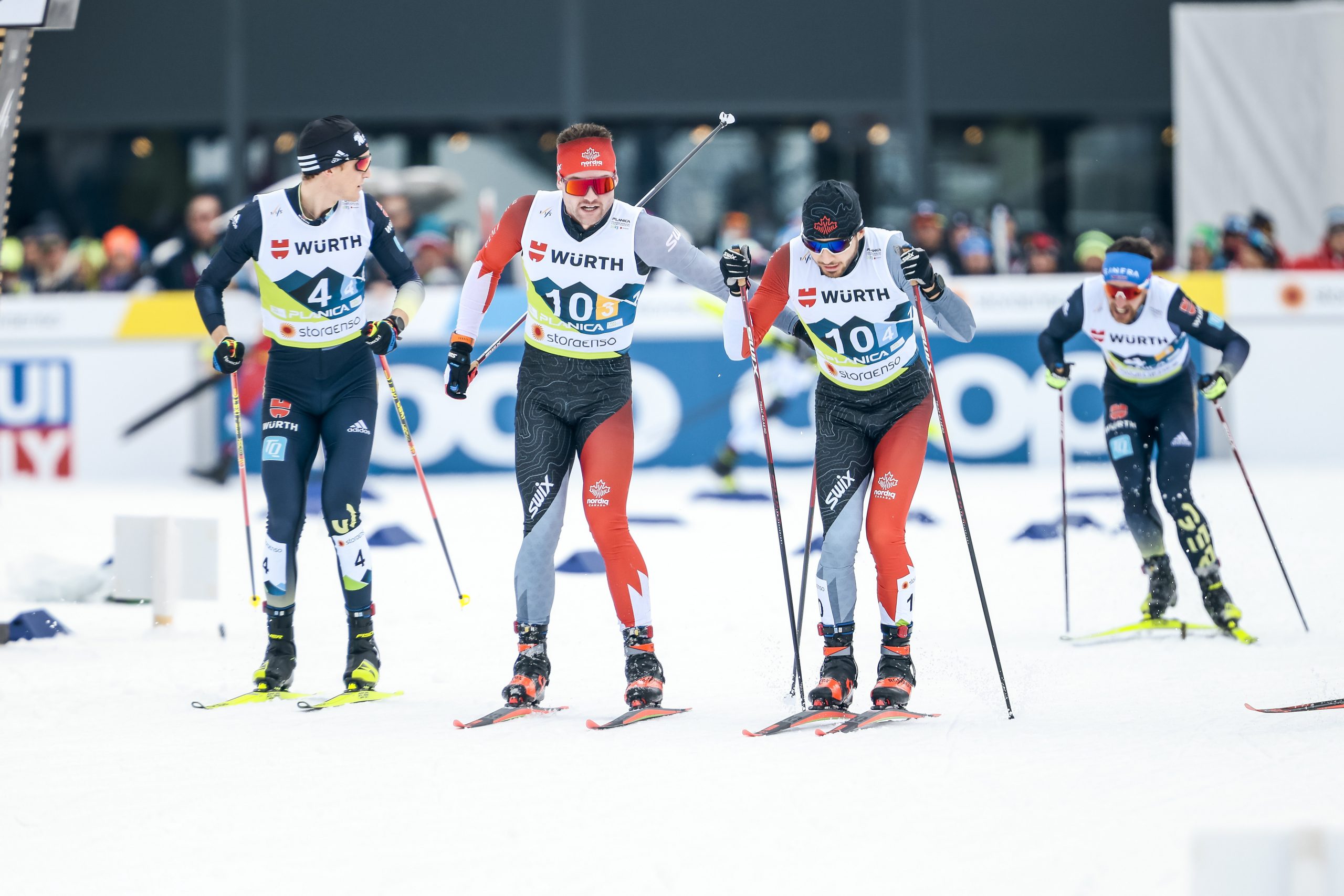
    Longtime Canadian racer Jesse Cockney joins us to recap a surprisingly exciting men’s pursuit race at the World Championships in Planica, Slovenia.

    We’ll be back tomorrow. Send your questions to devon@fasterskier.com and nat@fasterskier.com.

  • Canadian Nationals/US SuperTour Finals: Julia Kern wins again, while Xavier McKeever takes first Canadian title in Classic Sprint

    Canadian Nationals/US SuperTour Finals: Julia Kern wins again, while Xavier McKeever takes first Canadian title in Classic Sprint

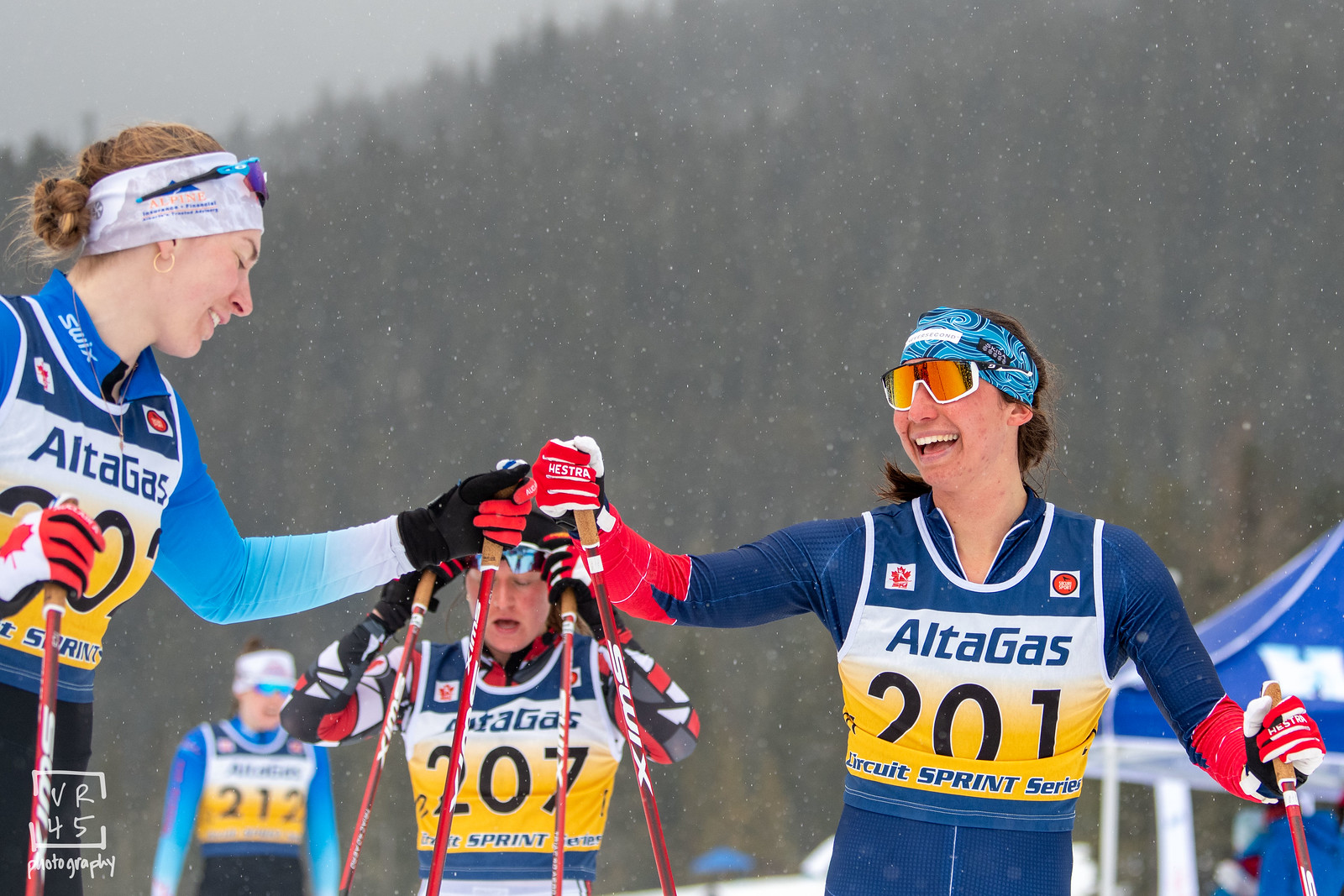
    Julia Kern (SMS T2) and Dahria Beatty (Whitehorse) fist bump at the finish of the women’s classic sprint final. (Photo: Doug Stephen / VR 45 Photography)

    Racing at the joint Canadian Nationals/US SuperTour Finals resumed on Wednesday, showcasing some of the best racers in North America facing off for a classic sprint. 

    As the Whistler Olympic Park was home for cross country skiing during the 2010 Vancouver Games, the classic sprint course on Wednesday was one that played host to an important stepping stone in North American skiing history. In that competition, both American and Canadian skiers solidified the inroads they had made into the top echelons of the sport through the burgeoning discipline of sprinting. Names like Kikkan Randall (USA), Daria Gaiazova (CAN), Chandra Crawford (CAN), Devon Kershaw (CAN), and Simi Hamilton (USA) all qualified for heats, while gracing the television screens of many athletes who now, twelve years later, carried momentum from those inspiring performances onto today’s start line in Whistler.

    If my waxing nostalgia about those 2010 Olympics is making you open a new tab to see if they’re available to revisit on YouTube, let me help you: they are! But before you go, let me send you an assignment: watch how Marit Bjørgen and Justyna Kowalczyk race the final on the 1.2 k course (the men raced a 1.4 k course). Ok, here’s the link (46:16 for the final, and yes, the genders are flipped in the title).

    What you’ll have seen if you completed this FasterSkier sidequest (trademark pending) is that the rolling course at Whistler presented two distinct tactical options for the skiers who made it into the heats on Wednesday. One: the Kowalczyk – attack on the steep climb that left the stadium to try and create a gap on the field that would hold as you went into the first downhill and leave you with an advantage on the second (and final) climb, or two: the Bjørgen –  hold onto the pace-setter until the second hill, when a punchy attack could leave a skier with a distinct advantage going into the mostly downhill approach to the stadium and subsequent final stretch. The latter approach worked in 2010 for Bjørgen, but 2022 was twelve years on and a different field with the SuperTour.

    Before we got to the heats, however, we, and the skiers, had to go through qualifying. 

    The Classic Sprint started off with the women’s champion in the 10 k Classic yesterday, Julia Kern (SMS T2). And after every racer in the women’s field completed the course, Kern finished in first too (3:11.14). Her qualifier was commanding, with second place Dahria Beatty (Whitehorse) +6.58 seconds back. In third place was Alayna Sonnesyn (SMS T2) (+7.54), in a field that otherwise was tight all the way through to the last heat qualifier, 30th place Mariah Bredal (BSF) (+21.37).

    The men’s field that followed proved to be an even tighter affair. At the top of the field, less than a second split first place Andreas Kirkeng (Denver University) (3:09.82), second place Luke Jager (University of Utah) (+0.41) and third place Logan Hanneman (APU) (+0.88). It was only +11.97 seconds back to the last heat qualifier in 30th place, Montana State’s Reed Godfrey.

    The women’s US SuperTour podium saw Julia Kern take the top step ahead of Caitlin Patterson and Sydney Palmer-Leger. (Photo: Joern Rohde / Nordiq Canada)
    Women’s Open

    In the women’s open quarterfinals, the top qualifiers were able to win their heats handily. Julia Kern turned in the fastest quarterfinal in the field, finishing first in a time of 3:29.93, ahead of Novie McCabe (+1.93), who advanced to the semifinals by taking second place. Kern’s fast pace-setting in heat one proved to animate the field from the gun, and third place Zoë Williams (Nakkertok) was rewarded for keeping pace with one of the lucky loser spots (+3.56).

    That pattern held in the 2nd heat, when a pack loaded with talent including Caitlin Patterson (Craftsbury), Alexandra Lawson (Craftsbury), Sydney Palmer-Leger (University of Utah), Sophia Laukli (University of Utah) and Cendrine Brown (Fondeurs-Laurentides) set a furious pace from the start and held it all the way through. In a five-person sprint, Patterson took first (3:32.13), and Lawson second (+0.55), to take the automatic semi-final bids. In third place, Sydney Palmer-Leger (+1.47) took the other lucky loser spot.

    When the first semi-final took to the start-line, it was filled with five skiers from those first two quarterfinals, with the sixth, 16-year-old Samantha Smith (Sun Valley), having won the third quarterfinal (3:36.43). It was no surprise then, when the “fast from the gun” tactics of those quarterfinals followed into the semis. Julia Kern (SMS T2) again attacked as soon as they hit the first incline out of the stadium, and held her lead throughout. The only skier that proved to be able to match her pace through the course was Caitlin Patterson (Craftsbury), and it would be those two who took the automatic advancement places to the finals; Kern in first (3:34.27) and Patterson second (+3:35.27).

    Behind them, two of the youngest bright stars of US women’s skiing had shown their intrepid ability to match their older counterparts, with Palmer-Leger (UU) taking third place (+3.47) and Novie McCabe (UU)  taking fourth (+3.74) in a sprint ahead of Samantha Smith (Sun Valley) (+4.03). For their efforts, the third and fourth place pairing advanced to the finals.

    In the second semi-final, previous Canadian Sprint National Champion Dahria Beatty (Whitehorse) was able to take first place (3:38.39) ahead of second place Laurence Dumais (Fondeurs-Laurentides) (+0.34) for the second heat in a row. They finished strong in a pack that otherwise remained tight throughout, and created separation in the last stretch to finish ahead of third place Alayna Sonnesyn (SMS T2) (+1.18) and fourth place Katharine Ogden (SMS T2) (+3.45).

    The final field then, was set. For the overall win, four US women – Julia Kern (SMS T2), Caitlin Patterson (Craftsbury), Sydney Palmer-Leger (UU), and Novie McCabe (UU) – and two Canadian women – Dahria Beatty (Whitehorse) and Laurence Dumais (Fondeurs-Laurentides) – would compete. That latter pairing also made the matter of the Canadian Sprint National title on the line simple; a duel between Beatty and Dumais.

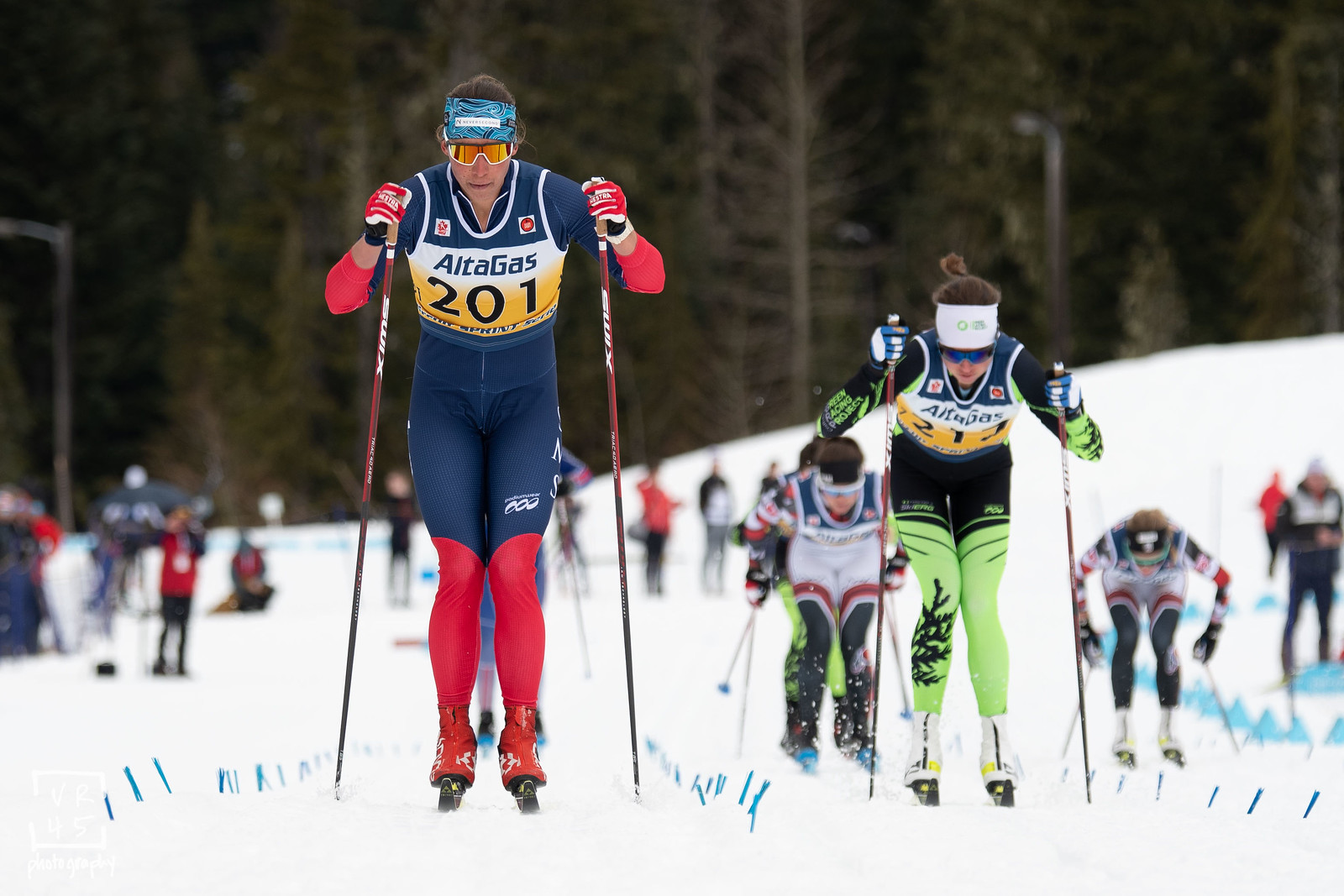
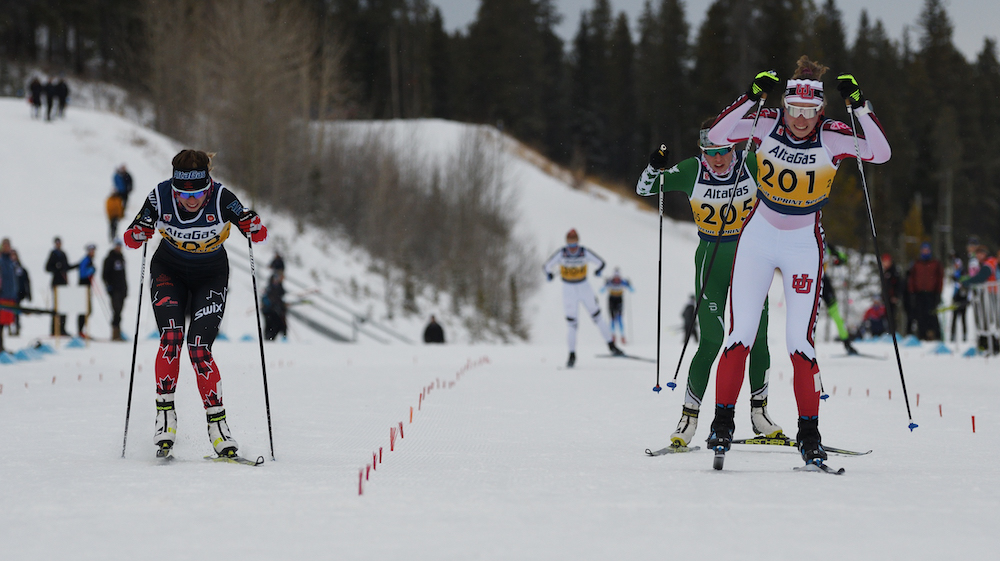
    Julia Kern strikes again in the women’s classic sprint, taking the win ahead of Caitlin Patterson (CGRP) and Dahria Beatty (Whitehorse). (Photo: Doug Stephen / VR 45 Photography)

    Kern, spurred on by her success racing hard from the gun all day, went for it again. In an interview with Nordiq Canada she said, “All day I just wanted to ‘send it’ – practice skiing hard and not taking any chances out there. My form and fitness is really good so I wanted to try and not leave it until the end.”

    The whole field was tasked with matching her confidence…and her speed. As in the semi-finals before, just one was up to the task the whole 1.2 k through; Caitlin Patterson. Behind her, Dahria Beatty led a charge to try and keep pace, but as she said in an interview with Nordiq Canada “I was confident in my finish but trying not to lose time on the uphills today. Unfortunately, [in the final], I let a gap open up to Caitlin [Patterson] and wasn’t able to close back on that.”

    And “send it” Kern did in the final. Kern took the pace out hot from the start. With a look over her shoulder, she saw that she had gapped the field by the top of the long striding climb, a position which she held, despite a bobble on the tight left hand curve on the subsequent descent, comfortably through the finish to win by several seconds.

    Patterson having lead the chase group after a gap throughout the heat, found herself sprinting with a powerful doublepole into the stadium to hold her ground in second place.

    Behind them, the race for the last podium spot coalesced around Beatty, Palmer-Leger and McCabe. As they entered the stadium together, Beatty stuck to a strategy that her coach pointed out earlier in the day, “it was working really well to try and go in the outside in the finish chute because people hadn’t skied there in the qualifier.”

    With that bit of tactical maneuvering, she opened up a gap on the two UU teammates behind her, and came across the line in third place overall (+6.16). In doing so, she also came across with a Canadian National title – her second Canadian Sprint title (and first classic). Following her in the Canadian Nationals race was second place Laurence Dumais (Fondeurs-Laurentide), who finished the finals heat in 6th place (+21.57). Based on her time in the semi-final, Zoë Williams (Nakkertok) took third place.

    Kern’s win marked her second in a row at SuperTour finals this week, which have been marked by all sorts of varying conditions that she has used to her advantage, saying to Nordiq Canada:

    “I love variable conditions. Everyone says if it’s a rainy day, it’s a Julia Kern day – I’ve thrived under those conditions before…it makes you have to adjust your skiing and that makes you a better athlete.”

    The Canadian women’s sprint podium, with Dahria Beatty coming out on top in the classic sprint. (Photo: Joern Rohde / Nordiq Canada)
    Men’s Open

    The men’s quarterfinals saw a similar pattern to the women’s, with experienced sprinters grouping together in heats, attacking early, and producing fast times that punctuated the number of racers they sent to the semi-finals. For the men that happened in quarterfinal two, with Graham Ritchie (Georgian Nordic), Antoine Cyr (Skinouk), Kjetil Bånerud (Northern Michigan), Bill Harmeyer (SMS T2), and Étienne Hébert (Montériski) all pushing each other to the line. When the five skiers came into the final stretch, it ended up being Ritchie (3:23.11) and Cyr (+0.32) who took the first and second spots, respectively. Both lucky losers came from the heat, with Bånerud in third (+0.95) and Harmeyer fourth (+1.73).

    Ritchie, Cyr, and Harmeyer would all meet again in the first semi-final. There, they were joined by Andreas Kirkeng (DU), Logan Diekmann (BSF), and Magnus Bøe (CU). With tight racing throughout, Kirkeng was able to gain an advantage and hold off all challengers as he advanced to the final in first place (3:22.97) ahead of second place Antoine Cyr (+0.83). The aggressive tactics of Ritchie and Cyr again proved to push the entire field forward, with Ritchie the benefactor when his third place finish (+1.47) secured him a lucky loser spot alongside fourth place Logan Diekmann (+2.76).

    The second semi-final, meanwhile, was a duel between the young stars from both sides of the 49th parallel. American Luke Jager (UU) and Canadian Xavier McKeever battled to a sprint finish in which Jager took first place (3:23.34) and McKeever took second (+0.50) to advance to the finals.

    Jager and McKeever stepped up alongside Antoine Cyr (Skinouk), Andreas Kirkeng (DU), Graham Ritchie (Georgian Nordic), Magnus Bøe (CU) and Logan Diekmann (BSF). The two young skiers showed no signs of timidness against their older competitors. Jager launched an attack on the first hill that opened a gap as the field rounded the corner leading into the final climb. McKeever was back in the field, looking to “limit damage, if I’m honest” as he said in an interview with Nordiq Canada.

    He followed Graham Ritchie, who was leading the charge to try and catch up to Jager. When they crested the hill, Ritchie, McKeever, and Kirkeng had all managed that feat – joining up with Jager as they went into the downhill leading to the stadium.

    McKeever was still at a disadvantage though, back in the pack, when the curious mix of rain, ice, and sunshine that had worked the snow at Whistler park all day became a factor. As McKeever said to Nordiq Canada, “going into the downhill I had insane boards, and was able to glide back up to the leaders and double-pole from a good position.”

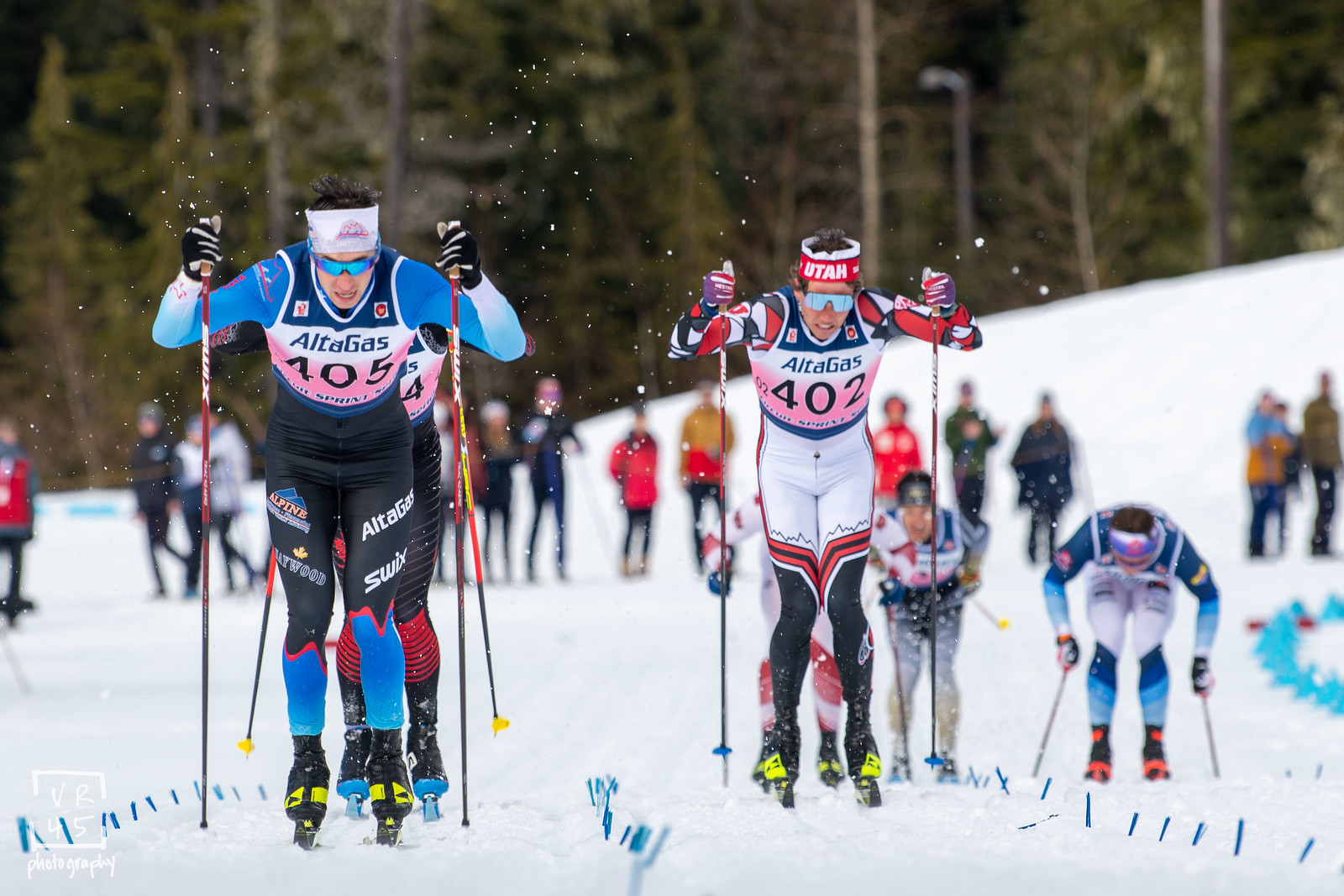
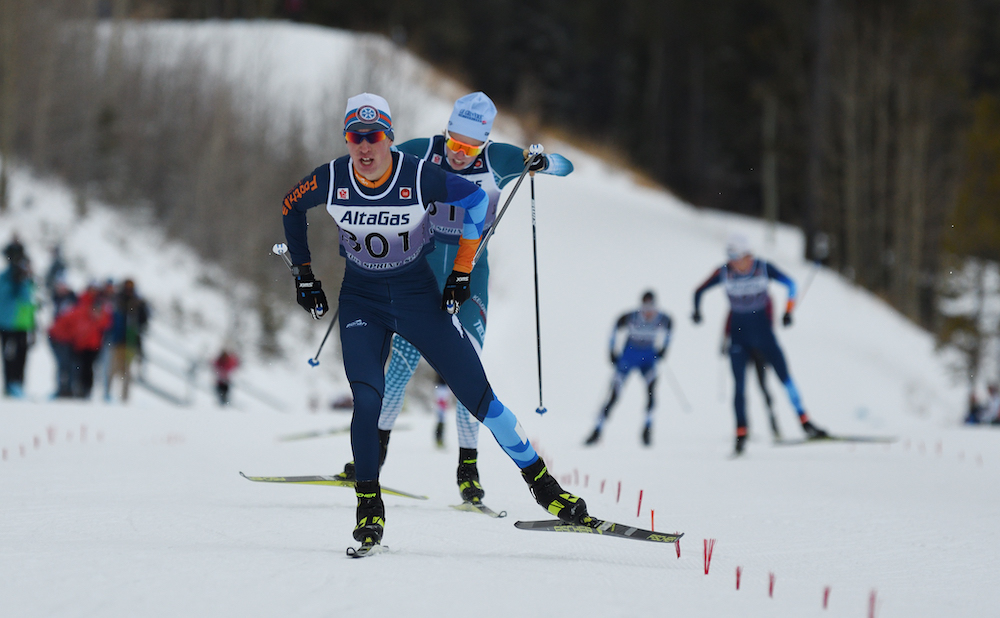
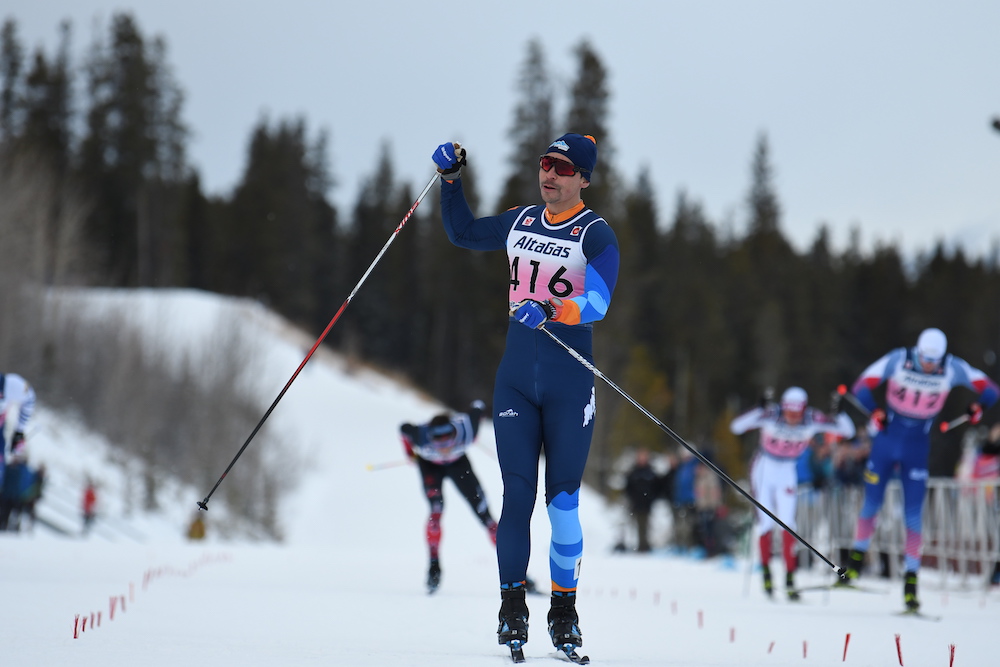
    Xavier McKeever (Foothills Nordic) takes the classic sprint win with Antoine Cyr (Skinouk) on his tails and Luke Jager (University of Utah) chasing in the lane to his left. (Photo: Doug Stephen / VR 45 Photography)

    When he found himself in that good position he could hardly believe it, “I was just stoked to be in the final and top-three in Canada. Going into that finish was insane, and I knew I had to get to the finish line as quickly as possible to try and steal [the National title].”

    What he categorized as stealing, we’ll categorize as earned. The 18 year-old out-sprinted North America’s best head-to-head, winning the overall race, and his first Canadian National title in a time of 3:19.72. Behind him in second place was fellow Canadian Antoine Cyr (+1.38), with Luke Jager rewarded for his long-range attack with a third place overall (+1.99). Graham Ritchie, finishing fifth overall, rounded out the Canadian Nationals podium (+4.13) after a day of leading out attacks in every heat he raced.

    It a promising indicator for Canada’s young up-and-comers with McKeever taking on a field of North America’s best and eeking out a win. For McKeever though, the race was only a preparation for bigger things to come, saying post-race that, “I’ve had some really good sprints this year, so I just wanted to try and challenge myself [racing up] since this is the course that we’ll be racing at World Juniors next year.”

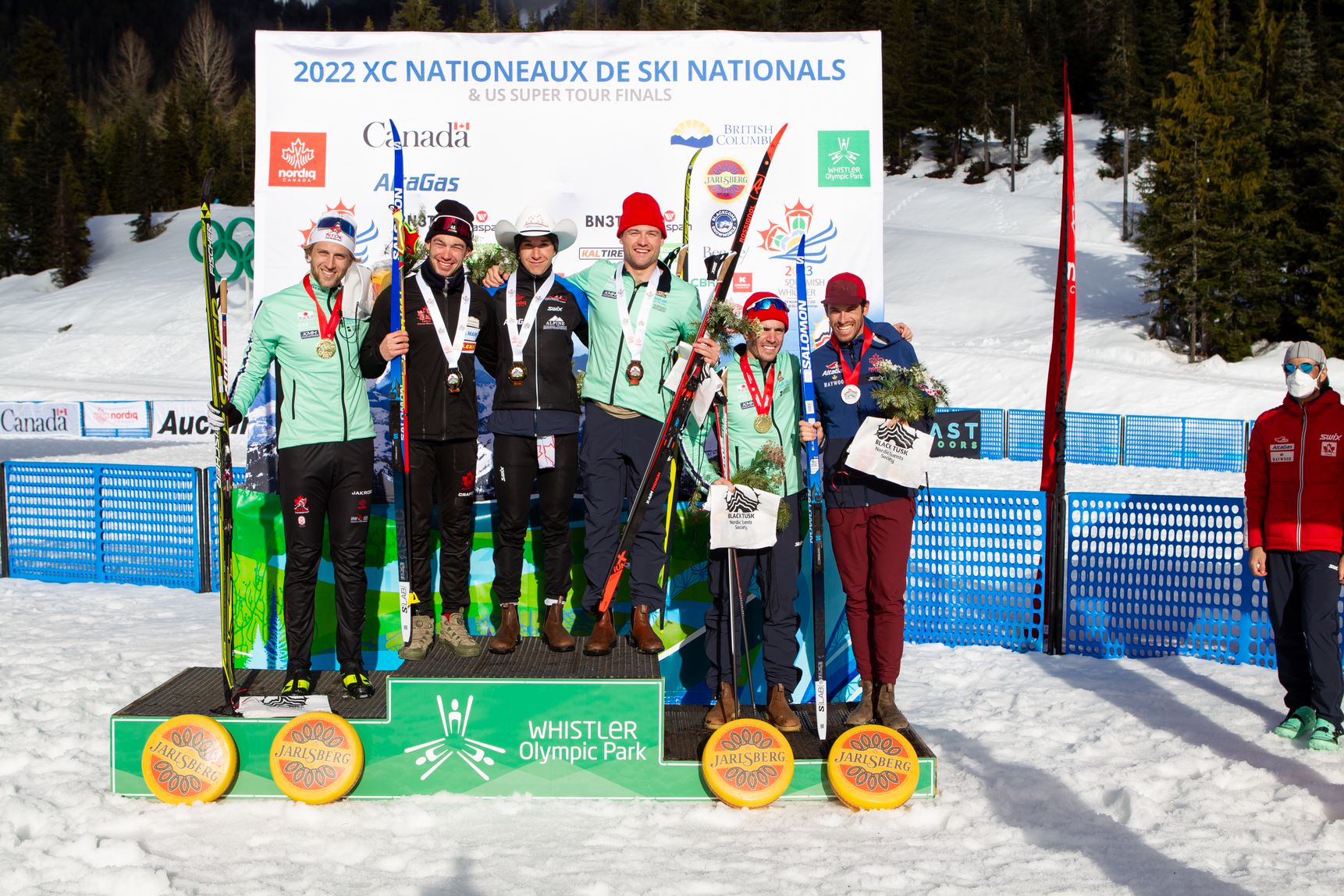
    The Canadian national podium for the classic sprint saw the young Xavier McKeever take the win ahead of Olympic classic team sprint duo Antoine Cyr and Graham Ritchie. (Photo: Joern Rohde / Nordiq Canada)

    Racing continues Friday with a freestyle team sprint, which can be live-streamed here.

    Full Results:

    Qualifiers  | Open and U20 Heats


  • Jouve takes back-to-back classic sprint wins, earning France the 2022 World Cup sprint globe; Ritchie leads for North America with Top-20

    Jouve takes back-to-back classic sprint wins, earning France the 2022 World Cup sprint globe; Ritchie leads for North America with Top-20

    This World Cup coverage is made possible through the generous support of Marty and Kathy Hall and the A Hall Mark of Excellence Award.  To learn more about A Hall Mark of Excellence Award or to learn how you can support FasterSkier’s coverage please contact info@fasterskier.com.

    It’s the last hurrah, folks! The World Cup Finals kicked off in Falun, Sweden today with a classic sprint. While the season has been a wild ride for many reasons – spills and thrills in the Tour de Ski, COVID-cancellations, Olympic Games, geopolitical nightmares – Falun evidenced that spring is on it’s way and it’s time for the World Cup crews to head home take a break, and begin anew.

    Contrasting the dim light and long shadows of far-north Ruka, Finland at the opposite bookend of the season, the sprints in Falun were raced under bright sun, with temperatures well-above freezing, bare ground and green grass emerging from beside ski tracks.  

    Zak Ketterson leads the U.S. in 39th during the classic sprint qualification round in Falun, SWE. (Photo: NordicFocus)

    The American men, particularly in sprint, headed into the Falun weekend at a significant disadvantage. Kevin Bolger announced on Instagram Thursday that he had tested positive for COVID, while Ben Ogden, JC Schoonmaker, and Luke Jager – the remainder of the four sprint men who competed during the 2022 Olympics in Zhangjiakou – are currently competing at the NCAA championships in Soldier Hollow, UT. The sprint field as a whole has been weakened; Russian athletes were banned from competition on March 1st, while Norway’s top-six sprinters, including sprint and overall World Cup leader Johannes Høsflot Klæbo, each tested positive for COVID following the World Cup race weekend in Lahti, Finland. With no Russian’s and the top-Norwegians out, the men’s field had been cracked wide open.  

    Finland’s Joni Mæki posts the fastest time in the classic sprint qualifier in Falun, SWE. (Photo: NordicFocus)

    Finland’s Joni Mæki took the top spot in qualification, setting the mark at 2:51.58. Sivert Wiig of Norway took second in the qualifier (+0.69), with Sweden’s Calle Halfvarsson in third (+1.41). Three nations represented in the top-three.

    Though new-to-FasterSkier names made the top-30, the early heats featured little surprise. Building momentum from a podium day in Drammen last week, France sent three of its top men to the semifinals: Lucas Chanavat and Richard Jouve, who had been third and first, respectively in Drammen, plus Jules Chappaz. Long-time sprint force Federico Pellegrino of Italy also moved through with an automatic spot, joining the day’s top-three qualifiers in the next round.

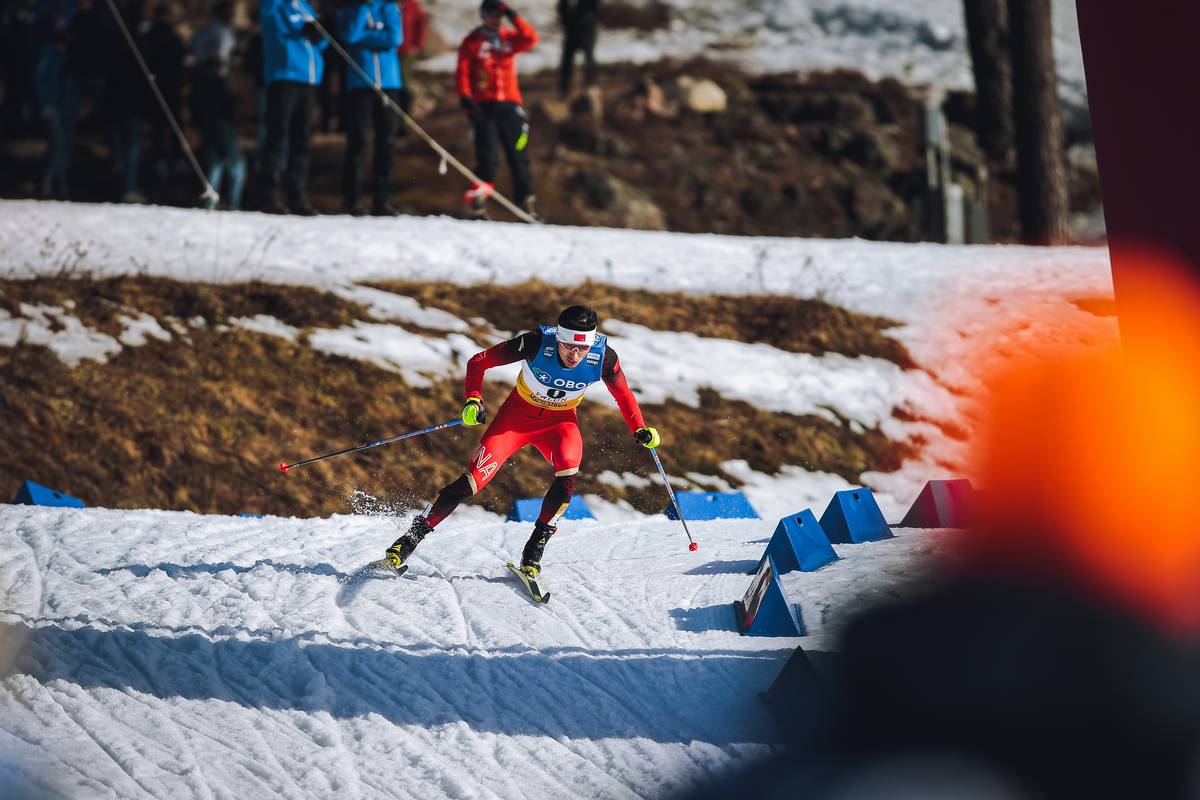
    What did shake up the quarters was some trouble for the two Chinese athletes in the field. Shang Jincai, who had qualified in 25th, had a false start in heat three. Jincai looked as though he had been trying to keep himself so primed for forward momentum at the start beep, that he lost his balance, kicking a foot forward to catch himself well-before the beep and thus triggering the start. After a discussion with a jury member, while Pellegrino shook his head and raised his hands nearby, looking impatient, Jincai received a yellow card and was disqualified. 

    After stumbling on a climb and losing ground, Wang Qiang (CNH) races to 18th in the classic sprint quarterfinal in Falun, SWE. (Photo: NordicFocus)

    In the next heat, Wang Qiang, who qualified in 9th and took second in Drammen, fell when hopping out of the track to run uphill, roughly two minutes into the heat. Qiang had been in the lead, though the pack remained tight. After a few missteps, he was back to his feet, chasing as real estate ran out, while Lars Agnar Hjelmeset (NOR) and Calle Halfvarsson (SWE) took the reins at the front to go 1-2 in the heat. Qiang raced his way back to fourth, just over a second back, but it was not enough for a lucky loser spot.  

    Richard Jouve (FRA) takes control through the rounds in Falun. (Photo: NordicFocus)

    In the semis, France’s Jouve took control of the fast first heat, beginning a surge just under-two minutes in as the men ran up the steep climb and banked left to head back toward the stadium. Around the last corner, Jouve still held the lead with Mæki (FIN) just off his shoulder. Jouve pulled ahead in the double pole sprint through the lanes, while Mæki, Wiig (NOR), and Chanavat (FRA) raced each other and the clock down the final meters. At the line, it was Norway-France-Finland, spread by 0.38 seconds, fifth and sixth less than a second behind also. Each of the top-four finishers advanced into the final round.

    The second heat was significantly less smooth, though times did not reflect the chaos and were only marginally slower than the first. As the course broke down, it looked to be continually harder to keep klister free and stay upright. Heading into the final downhill in strong position to take the heat, France’s Jules Chappaz looked as if his klister snagged some loose granules of snow; as he pushed off the outside ski to stay in the curve, the ski looked unable to slide and he crashed into the abrasive corn. 

    The remaining athletes in the head narrowly dodged Chappaz, allowing Hjelmeset and Pellegrino to take the lead and eventually win the heat. Sweden’s Halfvarsson also went down earlier in the heat, looking to have similarly iced up while running up the first climb, leaving him off the back after the subsequent downhill.

    After leading into the final downhill, a dejected Jules Chappaz (FRA) recovers from a crash to finish his semifinal. (Photo: NordicFocus)

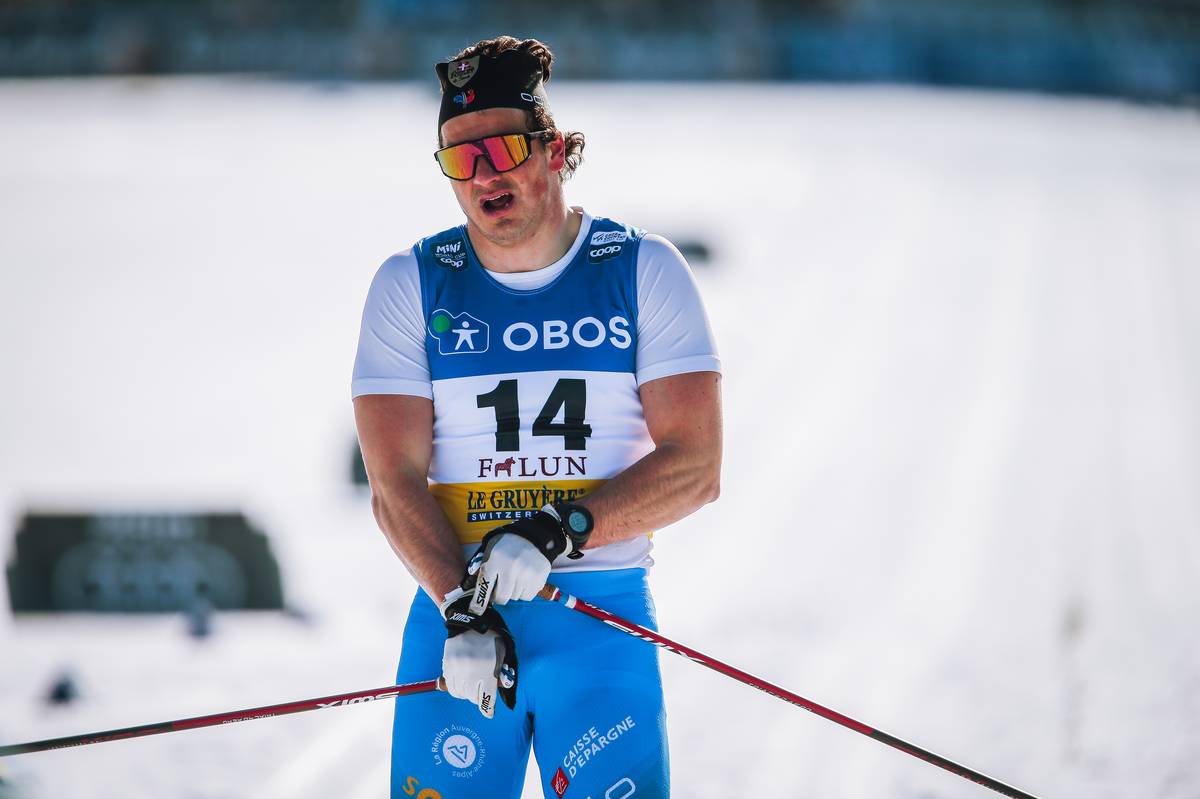
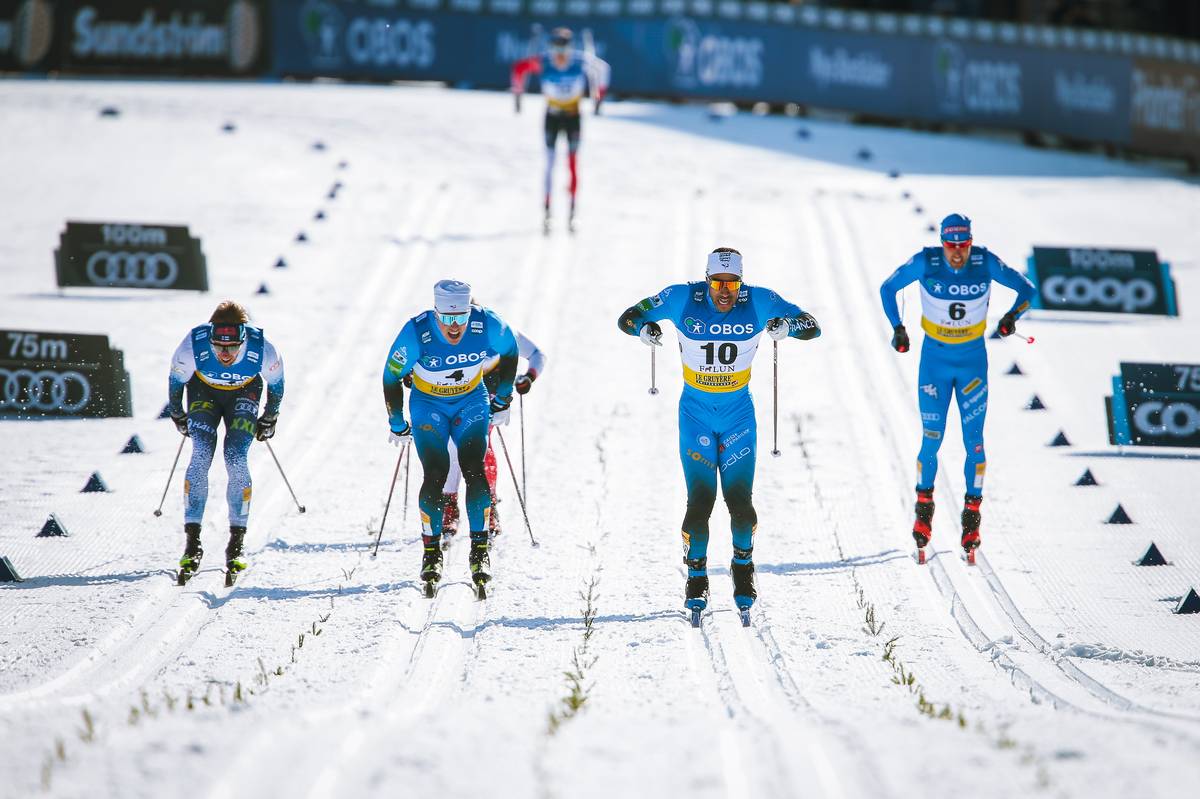
    Once again, Jouve took control of the final early, with Pellegrino marking. Mæki stayed wide on the first climb looking for better snow, but came over the top and into the curve behind the top three. Jouve, still calling the shots, led into the downhill, but he could not create any significant gaps there; Wiig, Pellegrino, Chanavat and Mæki quickly accordioned onto the backs of his ski tails.

    Looking confident and composed despite being unable to break away, Jouve remained at the front heading into the final curve. Once in the lanes, Jouve began to pull ahead a final time, creating a gap of several meters to Mæki and Chanavat, who were evenly matched in the double pole sprint. 

    Richard Jouve (bib 10) leads the men’s classic sprint final to the finish in Falun, while four athletes vie for the remaining two podium positions. (Photo: NordicFocus)

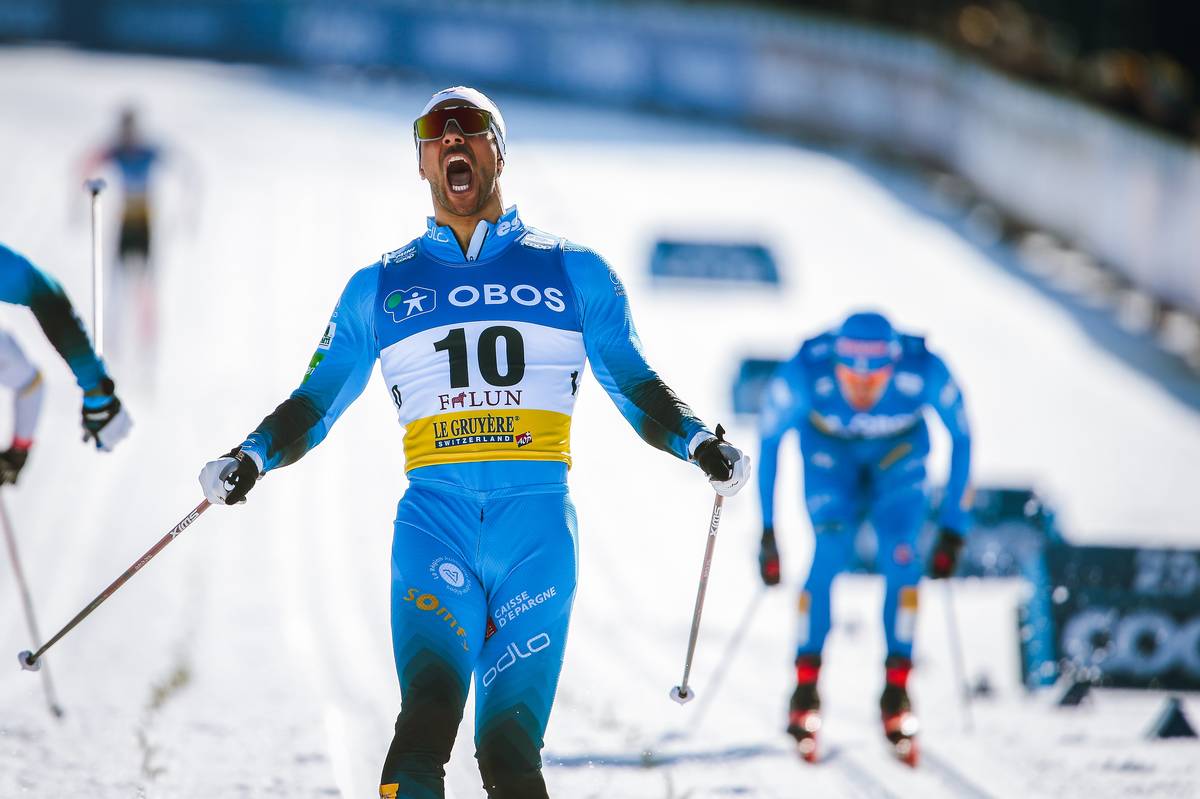
    Emptying his lungs with a triumphant cry, Jouve coasted over the line for the win in 3:03.62, while Mæki and Chanavat threw their boots forward in a photo finish for the second and third podium spots roughly half a second behind. From the slow-mo, it was Mæki with the better lunge, nipping Chanavat by 0.03.

    Just behind Wiig crossed fourth (+1.41), with Pellegrino fifth (+2.06), followed by a gap to Hjelmeset in sixth (+13.18).

    Richard Jouve (FRA) lets out a victory cry as he takes the classic sprint win in Falun. (Photo: NordicFocus)
    The men’s classic sprint podium in Falun, Sweden: Richard Jouve (FRA) took the win ahead of Joni Mæki (FIN) and Lucas Chanavat (FRA). (Photo: NordicFocus)

    “I’m very proud,” Jouve told FIS after the race. “Off myself, my team. It’s amazing.” 

    With the win today, Jouve also took the lead in the sprint World Cup standings, advancing by just six points ahead of Johannes Høsflot Klæbo (NOR). The season saw Jouve land on four World Cup podiums, finish seventh in the freestyle sprint during the Olympics, and then earn his career first World Cup win in Drammen’s classic sprint last Thursday.

    “It’s amazing,” said an emotional Jouve, seemingly in happy disbelief. “The season was very great for me, to win at the end of the season is already a dream, but to grab [the globe], it’s big. Fantastic.”

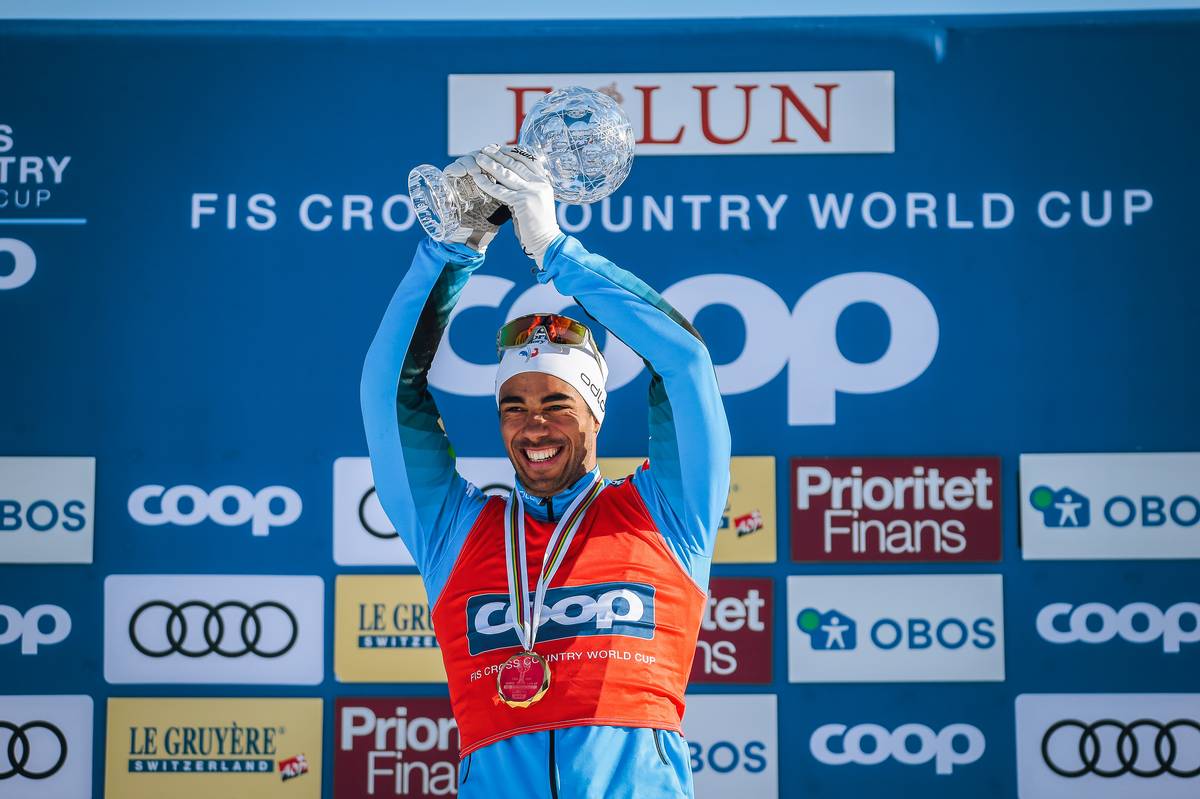
    With a win in the final sprint stage, Richard Jouve becomes the 2022 World Cup sprint champion, hoisting his crystal globe. (Photo: NordicFocus)
    French teammates Richard Jouve (left) and Lucas Chanavat (right) end their season in first and third, respectively, in the World Cup sprint standings. (Photo: NordicFocus)

    A quick review of the final standings: With 568 points, Jouve is the 2022 sprint World Cup champion, with Klæbo second (-6) and Chanavat third (-107). Italy’s Pellegrino was fourth (-238), with Norway’s Håvard Solås Taugbøl fifth (-244). 

    The US had three starters for today’s final sprint stage. Zak Ketterson led the way for the American team in 39th (+9.92), followed by Logan Hanneman in 47th (+10.79), and Peter Holmes 54th (+13.38). 

    Listen to post-race interview with U.S. Ski Team Head Coach Matt Whitcomb here.

    Logan Hanneman skis to 46th in qualification in Falun. (Photo: NordicFocus)
    Graham Ritchie leads the way for North America, finishing 20th in Falun’s individual classic sprint. (Photo: NordicFocus)

    Racing for Canada, Graham Ritchie was the sole North American to break into the heats after qualifying in 28th (+8.11). Racing in the third quarterfinal heat, Ritchie crossed fourth, roughly three seconds behind Chanavat and Pellegrino, the heat winners. The effort landed him in 20th overall once final rounds were decided. 

    Missing the top-30 by just 0.27 seconds, Antoine Cyr was next for Canada in 31st (+8.76), with Xavier McKeever next in 44th (+10.54), followed by Rémi Drolet in 57th (+14.59). 

    Antoine Cyr just misses the mark in qualification, finishing 31st. (Photo: NordicFocus)

    Racing in Falun continues tomorrow with a 15 k individual start skate.

    Results:

    Qualification | Final | World Cup Sprint Standings


  • World Juniors: Canada puts two in top ten as Russia sweeps 5/10 k classic; Will Koch top American in 13th

    The 2022 FIS Junior/U23 World Ski Championships trip has been made possible through support from the National Nordic Foundation (NNF), which has identified this invaluable opportunity for developing athletes as one of its “Pillar Projects”. You can support the NNF and the next generations of America’s top skiers by making a donation here.

    Friday at 2022 FIS Junior World Ski Championships in Lygna, Norway, marked the phase that Steve Fuller, on site to take photographs qua Flying Point Road, calls “the ‘groundhog’s day’ stage” of the championships. “Things are happening so fast that you’re not quite able to get caught up with each day before you get up and do it all over again,” Fuller wrote on Instagram.

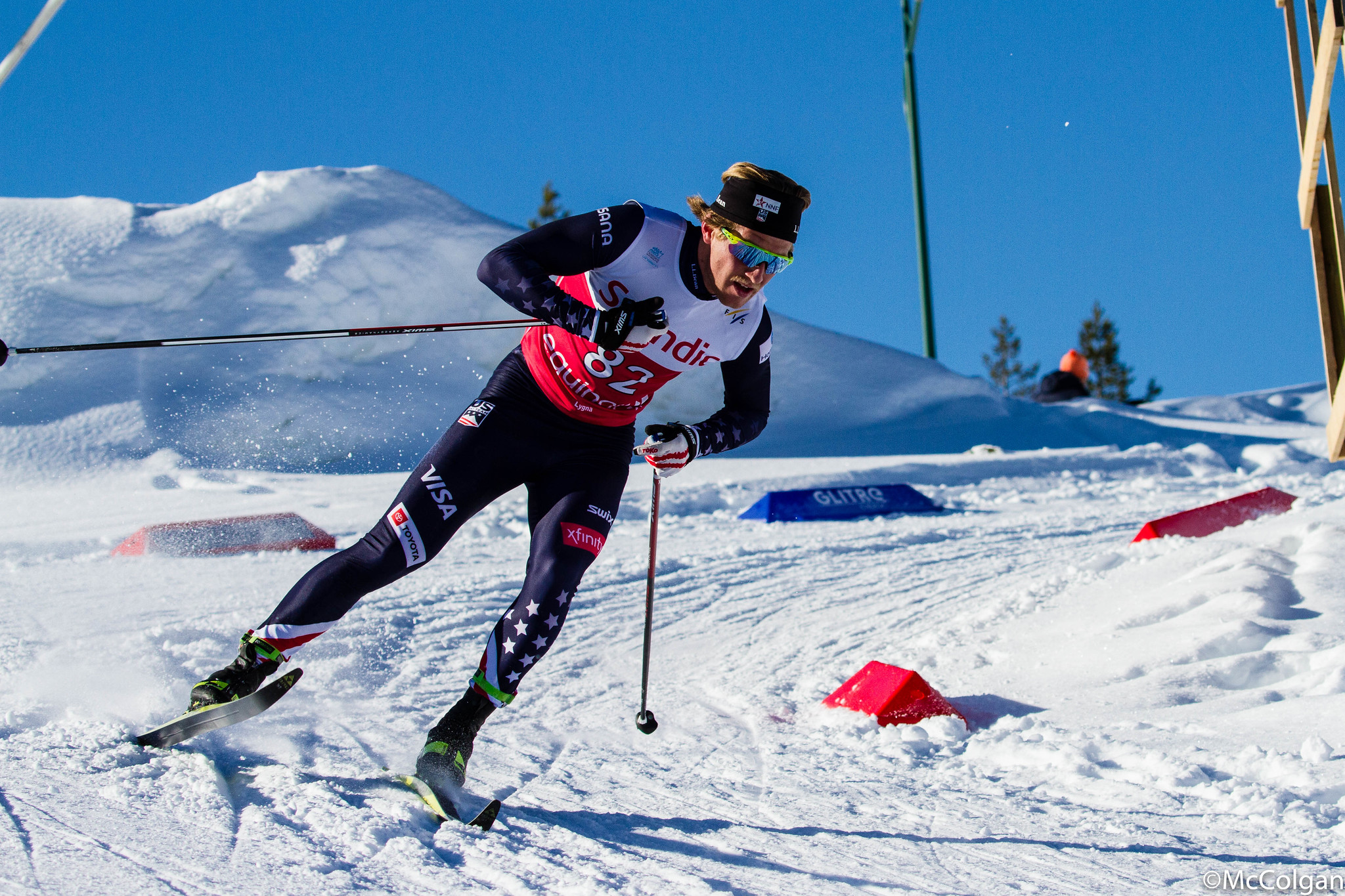
    Will Koch races to 13th in the 10 k classic during the 2022 Junior World Ski Championships in Lygna, NOR. (Photo: John McColgan)

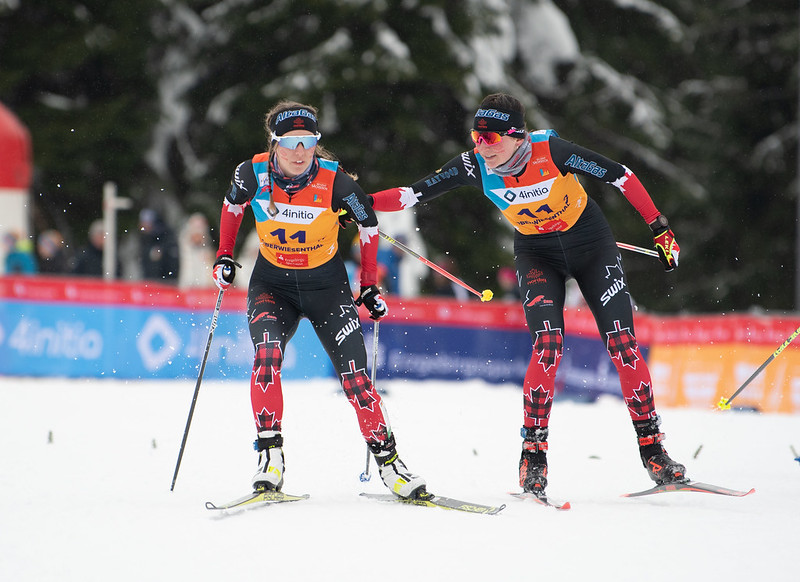
    Undeterred, the Americans headed out on course Friday morning for their seventh and eighth races in four days. The coaches and wax techs (see the back row in the lead picture of the relay story) prepped skis for their eighth championship race within less than 72 hours. At the end of the day, Russia took a combined four out of six podium spots; Canadian skiers Xavier McKeever and Jasmine Drolet placed sixth and eighth, respectively; and Will Koch and Sydney Palmer-Leger led the way for the Americans in 13th and 19th.

    Women’s 5 k Classic

    Let’s back up. The women again had the day’s first race, a 5-kilometer interval-start classic. The first starter headed out on course, over a single lap of yesterday’s 5 k course, at 11 a.m. The official results describe conditions as somewhere between moderate and perfect: air temp of -2 C, snow temp of -3 C. Skies were overcast for the women’s race, but the sun came out for the men; as USST Development Team Coach Greta Anderson told FasterSkier later Friday, conditions sped up noticeably by the afternoon.

    82 starters later, Dariya Nepryaeva, who started at the sharp end of the field in bib no. 80, had logged the day’s fastest time, crossing the line in 14:30.1. She was closely followed by her compatriot, Elizabeta Bekisheva, in second, 2.9 seconds back. Emma Kirkeberg Mørk of Norway was close behind for third, 4.0 seconds back.

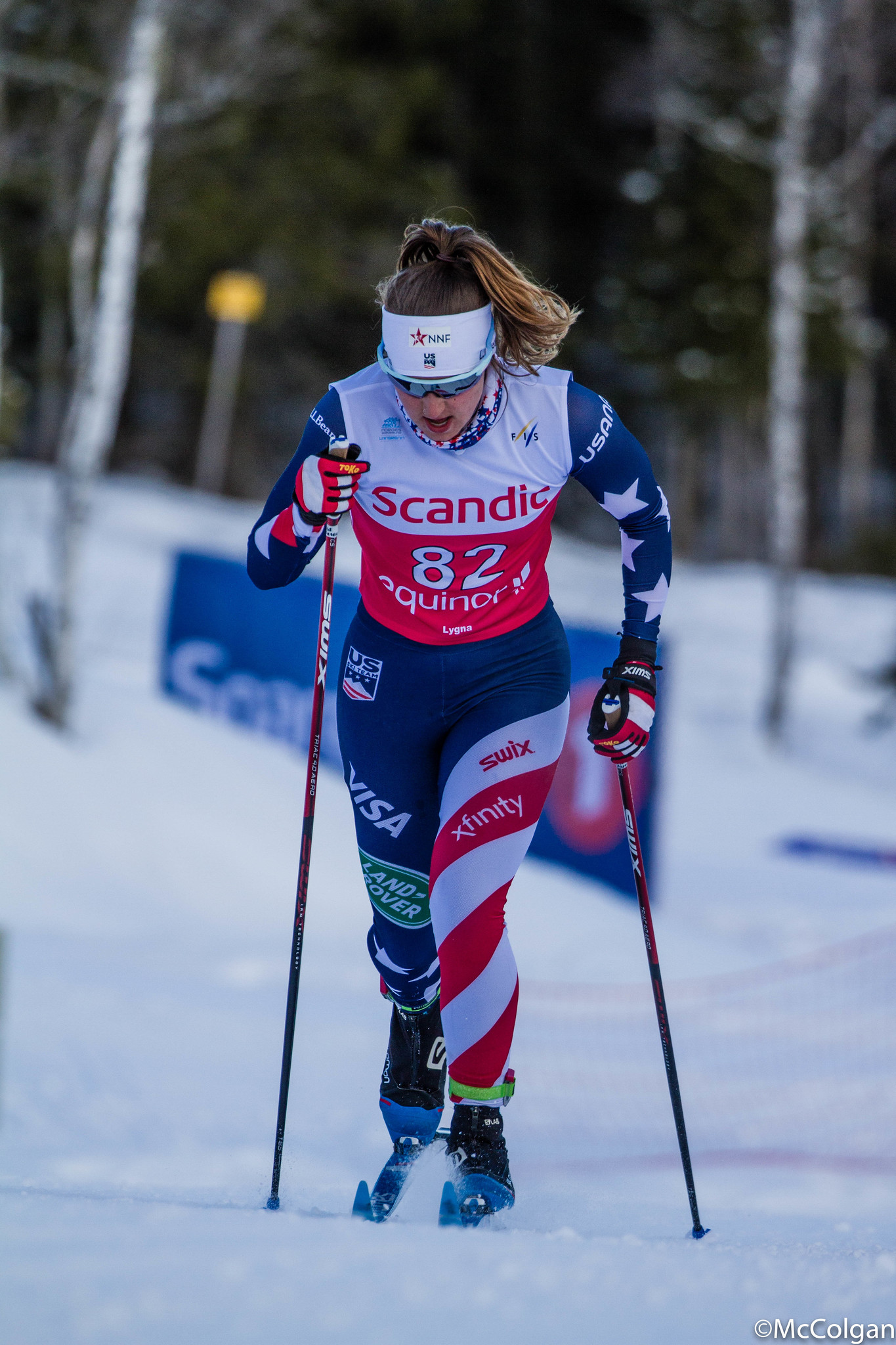
    Sydney Palmer-Leger skis into the top-20 in the 5 k classic during the 2022 Junior World Ski Championships in Lygna, NOR. (Photo: flyingpointroad.com)

    The day’s fastest North American finisher, and fastest Jasmine in the field, was Jasmine Drolet of Revelstoke, B.C., in eighth, 21.5 seconds back. She was followed in the North American standings by American Sydney Palmer-Leger (University of Utah/Park City, Utah) in 19th (+51.3), and Canadian Jasmine Lyons in 26th (+1:03.3).

    “I felt pretty good. I really like classic skiing and my goal was to give it all I had,” said Drolet in a press release from Nordiq Canada. “You only ski the lap once, so the key was to just go hard the whole time. We had amazing conditions, perfect for classic skiing so it was a good day.”

    Behind Lyons were the two Ninas, Nina Schamberger (Summit Nordic Ski Club/Leadville, Colorado) in 31st (+1:14.2) and Nina Seemann (Dartmouth Ski Team/Craftsbury, Vermont) in 36th (+1:23.0). Annie McColgan (University of Vermont/Bend, Oregon) was 40th (+1:27.3). Canadian athletes Sarah Cullinan (44th, +1:34.2) and Tory Audet (59th, +2:08.2) followed.


    Annie McColgan races the 5 k classic in Lygna, NOR, her first start of the 2022 Junior World Ski Championships. (Photo: John McColgan)

    McColgan radiated enthusiasm when she talked with FasterSkier following her first race at these championships. “It was nice to have everyone cheering out there, and my parents were here so it was really, really fun. It was really cool,” McColgan said.

    McColgan also provided insights on the course, describing it as “a really interesting 5k” with plenty of rolling terrain, but not many opportunities for recovery. “There’s a lot of steep little hills that you just have to be really good at… But it also is 16 minutes long. So you kind of have to make that balance [with energy expenditure]. And then the final climb was so brutal.”

    Men’s 10 k Classic

    The men again had the day’s second race, starting a two-lap, 10 k interval-start classic race at 1 p.m. local time. Taking athletes’ distance points as an informal form chart, in a field with 101 athletes the podium finishes came, relatively unsurprisingly, from bibs no. 90, no. 100, and no. 101. The gold medal on Friday went to Russian Saveliy Korostelev, the penultimate athlete on the course. Korostelev posted the fastest split time at 3 kilometers, at 5 kilometers, and at 8 kilometers, crossing the finish line in 26:15.8.

    Will Koch leads the American junior men with a 13th place finish in the 10 k classic during the 2022 Junior World Ski Championships in Lygna, NOR. (Photo: flyingpointroad.com)

    Korostelev enjoyed a hefty advantage over silver-medal finisher Niko Anttola of Finland, who finished 21.4 seconds back. Anttola ranked one to eight seconds behind Alexander Ivshin of Russia at all intermediate checkpoints, but skied the final two kilometers just barely faster. When Ivshin, the day’s final starter, crossed the line, he had fallen 0.8 seconds behind Anttola and had to settle for third.

    Put another way, Russia came within a second of going 1–2 in both the men’s and women’s races. They instead had to settle for first and second in the women’s race, and first and third in the men’s.

    Shortly behind the podium, Xavier McKeever of Canmore, Alberta, skied a strong race to finish sixth, 52.4 seconds back of Korostelev and roughly 30 seconds off the podium. It was McKeever’s best international result since, well, Tuesday, when he was fifth in the men’s 30 k mass start skate. McKeever’s sixth today tied Palmer-Leger’s sixth, from Tuesday’s women’s 15 k skate, for the second-best North American individual result of these championships.

    “I am stoked to be in the top-10 again,” McKeever told Nordiq Canada in a press release. “I was getting splits that I was close to the podium in the first lap, but I just couldn’t keep the high pace that I started with. Honestly, I feel like the podium is still a fair bit away, but today just motivates me more to make the steps toward being able to contend for a medal. … I have been able to build my confidence over the course of this season. After last year, it was instrumental for me to refocus on putting in the hard work each and every day, which I think has helped me race with more confidence than ever before.”

    McKeever was followed by his countrymen Max Hollman (Thunder Bay) in 17th (+1:28.8), Derek Deuling (Whitehorse) in 19th (+1:31.5), and Thomas Stephen (Calgary) in a tie for 26th (+1:40.0).

    Brian Bushey races the 10 k classic during the 2022 Junior World Ski Championships in Lygna, NOR. (Photo: John McColgan)

    Will Koch (University of Colorado/Peru, Vermont) led the way for the Americans, finishing in 13th (+1:23.4). He was followed by Alex Maurer (University of Colorado/Anchorage, Alaska), also 26th (+1:40.0); Brian Bushey (University of Utah/Waitsfield, Vermont) in 36th (+2:00.2); and Finn Sweet (University of Vermont/Waterbury, Vermont) in 47th (+2:11.3).

    Thoughts from the coach

    Greta Anderson is in Lygna at her third World Juniors as a coach or tech, her first since assuming her current coaching position with the U.S. Ski Team. (Disclosure, Anderson was this reporter’s coach in APU Masters in 2014–15, and has remained a close personal friend ever since.)

    Asked what she saw about today’s races, Anderson noted, “They were really fun to watch. Between FIS live timing and back split, the radios were pretty lively. One thing I did learn this year, and this is more than I’ve seen in the past, is that our athletes – every single one has the raw speed to compete at this level. We’re working on the durability portion of it. I think the top athletes in these races often are running negative splits in a big way; I would have to sit down and look at percentages. I’m sure we’ll do that at some point in time. But you know, the speed is there early on, we have very good placement, and then we need to figure out how to speed up just a little bit more. But that’s, you know, that’s been a big step for us as a country.

    “Will Koch, obviously very, very strong today. Brian Bushey came out on the top end of ten places being within four seconds, or eight places within four seconds maybe. So you know, really phenomenal. … Annie McColgan had her first ever World Juniors race today. And that’s always really fun and special to watch. I think often athletes come away seeing like, ‘wow, there’s another level,’ and it can be really motivating for the following year.”

    Sydney Palmer-Leger leads the junior women during the 5 k interval start classic. (Photo: John McColgan)

    Turning to Schamberger, Anderson observed that the 16-year-old has “had a pretty heavy week of racing so far. She’s had three starts, and the first day was not what she wanted. And the second day she had the gift of getting redemption the very next day, which I think is one of the best things athletes can have. And she was really happy with how she skied the relay, a big smile on her face. And then a really good race today. It’s fun to watch athletes – the moment that they realize they’re skiing at that level. Because we know they can do it, and we watch it, but that aha moment of ‘Oh, okay, in the world, this is where I am.’ That moment is really cool. It’s one of my favorite parts of my job for sure.”

    Anderson also described the environment at the venue more broadly, highlighting the effects of vocal parental support. “There’s quite a few parents here from the U.S.,” she said.

    “And Americans are really loud compared to other countries, and it’s probably taken as obnoxious, but I really appreciate it. We can always hear the Americans. It’s fun to stand by them and listen to them get all excited. Next to the parents during the relay is one of my favorite places to stand.”

    In that vein, Anderson concluded, “I look around, and I’m so proud to be an American coach. I’m so proud of the American skiers; there’s not a single other nation I would – I’m really glad that I work for our staff. And I think our athletes are really glad that they ski for the U.S.A. I don’t think they look around and think, like, ‘I wish I was on that team,’ or, ‘I wonder what that team is up to.’ We’re definitely in that, ‘We’re Americans and we’re here to beat you. Or at least die trying’ mode. And that’s pretty fun.”

    U.S. Ski and Snowboard Development Team Coach Greta Anderson encourages athletes during the men’s 30k distance race during the 2022 U.S. Cross Country Championships in Soldier Hollow. (Photo: Tobias Albrigtsen / @untraceableg)

    Racing continues tomorrow with skate sprints for U23 athletes, both genders, before wrapping up Sunday with both men’s and women’s U20 skate sprints and the U23 mixed relay, sending athletes and techs out with three races, two techniques, and a combined sixteen sprint heats on the final day of racing. Groundhog’s Day, indeed.

    Today’s results: women | men

    World Juniors links and information:

    Home page and general info | race program | results and live timing (all races) | streaming (only for Thursday through Sunday’s races, purchase required)

  • Western Canada Cup #3 and #4: Déjà Vu

    Western Canada Cup #3 and #4: Déjà Vu

    Rémi Drolet leads out the first mass start of the season. (Photo: Peggy Hung)

    Race, rinse, repeat. The Western Canada Cup series returned to Sovereign Lake for race days 3 and 4 of the new season.

    Originally scheduled for Rossland, BC, the event had to be moved after an ‘atmospheric river’ event delivered warm rain to almost all southern BC trail systems on December 1st. Sovereign Lake was the least damaged, able to hold WCC #1 and #2 on the 4th and 5th as scheduled. By December 11th, skiing conditions were much improved and the racers were primed to go again. 

    The organizing committee was a little less primed, with four chiefs unavailable, along with many of the 180 volunteers from the previous weekend. With some timely help from Nordiq Canada, it all came together. Next Gen coach Eric de Nys (a Vernon resident) could be seen moving V-boards with High Performance Manager Joel Jaques (from three ski areas to the south in Penticton) while Al Maddox shortened his vacation to fill in as Technical Delegate.

    Despite hosting major events on the two previous weekends, the club was able to find enough volunteers to make it work.

    While there was still plenty of rust on display, more athletes were getting more things right than last weekend.

    Saturday: 5km/10km Classic Interval Start

    The weather gods delivered one of everything for Saturday’s classic, with fresh snow, strong winds, a brief blizzard during wax testing, before settling for overcast race conditions with firm tracks that occasionally filled with dry blowing snow at -4C.

    On the flat 2.5km course, there were enough skiers lapping to keep the tracks packed. This is the first time this course has been used for the open categories and it has a distinctly different feel to the traditional 5km loop. Eliminating much of the climbing, the new course turns downhill halfway up the first A-climb at the 5km mark, before skipping the second A-climb entirely. 

    Dartmouth’s Jasmine Drolet took the win in 17:22.0, matching her result from last Sunday with an overall win, in addition to topping the U20 list. AWCA’s Olivia Bouffard-Nesbitt was 3.0 back in second ahead of teammates Laurence Dumais in third (+47.1) and Beth Granstrom in fourth (+1:00.8).

    “Definitely not my favourite race,” Jasmine Drolet told FasterSkier, despite preferring classic technique. “I tend to prefer the longer races but still good and a good effort out there.”

    “I was happy with it,” Bouffard-Nesbitt explained after the race. “It was unusual for us to start so late at one [pm]. It was sunny this morning, beautiful, mild. We showed up to the racecourse this afternoon and it was blizzarding, so windy. And then it cleared up for our race. So it was fun to do 5km.”

    “It’s definitely quite a bit different than the five km [course]: it’s less climbing and more flat,” Dumais told FasterSkier. “Which is in my favour, because I’m better at double polling, so it was good.”

    In the men’s 10km, Black Jack’s Rémi Drolet matched his sister’s achievement, finishing in 30:37.2, edging out Foothills junior teammates Tom Stephen by 4.7 seconds and Xavier McKeever by 7.0. AWCA’s Jack Carlyle (39.2 back) and Hardwood’s Scott Hill (54.3 behind) completed the senior podium.

    “It was a pretty good day,” Stephen explained. “Not a course that favours me, but I still pushed hard and I’m happy with the results.”

    Asked about ski and wax choices, Stephen said “the coaches were really accommodating today because they tested my skis before we got here, because we had such a late start. So that was nice, a lot less stress than having to get here and test all the skis with the new tracks and stuff like that.”

    McKeever enjoyed the ‘new’ course.

    “I felt really strong with the double pole, there was a lot of double poling on this course. That really played into my favour.”

    McKeever also broke down how the course skied during the race.

    “Overall, there’s some good climbs. there’s two good climbs in there for sure. But once again, it’s it’s a lot of double pole. So I’d say in that sense, it’s like fairly flat overall. There’s like gradual sections, but yeah, you definitely can’t get caught off guard.”

    There were 112 finishers. The smaller field was a result of only two age groups (open and U20) and road closures affecting some teams.

    Sunday: 10km/15km Mass Start Free

    Sunday was a great day of skiing, with snow clouds blowing away in the morning for a sunny afternoon of mass start racing on the traditional Upper World Cup 5km course that older racers know so well.

    Rémi Drolet leads Xav McKeever and Tom Stephen at the end of lap 2. (Photo: Peggy Hung)

    The men raced first, with a very tactical first lap before the action began on the second of three laps. 

    On the third lap, McKeever attacked on the ‘wall’ climb to get a gap he would not relinquish in the final 1.x km. With only one small climb left, racers need either a gap at the top of the wall or confidence in their final sprint.

    McKeever took his first open win in 37:22.3, 1.2 seconds clear of fellow U20 Tom Stephen. Carlyle passed a fading Rémi Drolet to take third, 21.0 seconds behind, while Bob Thompson narrowly missed out on fourth, finishing 40.0 back.

    “I was really happy with my race and how I skied both tactically and technically, so overall, [it was a] good day,” McKeever said after collecting his first senior win at age 18.

    He continued that he “couldn’t really have asked for anything better from a start [to the season], but we’ve just got to keep putting in the work, keep training hard.”

    Stephen, in his last year as a U20, was more philosophical.

    “I’m definitely feeling a little tired,” Stephen said. “There’s a lot of racing back to back for me. But yeah, I think it went well. I’m happy with the result.”

    On his approach to racing, Stephen explained how the weather factored into his race plan.

    “I think I was pretty smart in the tactics part. There were a lot of people throwing down sprints halfway through trying to break away and then easing up because the wind plays a big factor into it.”

    Carlyle also enjoyed the day: “It was good, super fun to ski in the pack and do a mass start race and it felt like Real Racing was back.”

    “I didn’t really think too much about how to win I just kind of wanted to like make their day as hard as I possibly could,” Carlyle continued. “The way it played out was going into the second last climb, I guess it would have been the like the super steep hill [the wall], Xav just had so much speed. So much speed. So Tom and I are kind of standing still and that’s pretty impressive.”

    Jasmine Drolet stretches out the group at the start of the 10km. (Photo: Peggy Hung)

    Shortly after the top men finished, the women began their first mass start of the season with two laps of the same course. Jasmine Drolet strung the group out quickly, opening passing opportunities for lower ranked skiers like Bouffard-Nesbitt who would quickly join the action at the front. After the pandemic break, the points list is a much less useful guide to current performance, but today there was no difficulty to pass on the wide opening climb with room to skate four abreast for over a kilometre.

    Bouffard-Nesbitt finished alone in 29:04.4.

    “It was really good. I love mass starts and I’m so happy that sovereign decided to host a mass start race today,” she said. “The conditions were the best they’ve been in the last two weeks. It was a great day.”

    Jasmine Drolet took second, 12.4 seconds back, followed by fellow U20 Marielle Ackermann from Kimberly in third (+21.0), and Granstrom in fourth (+26.5).

    Jasmine Drolet leads a large pack near the end of lap 1. (Photo: Peggy Hung)

    “It was pretty chill for the first lap,” Bouffard-Nesbitt said. “I didn’t feel that I needed to lead especially, [since] I’m pretty confident in my sprint. So I was happy just to follow and then, yeah, on the second lap, I started to have fun playing around, going to the front a little bit and pushing the downhills and unfortunately, as Jasmine might tell you if you interview her, she had a fall before the last two climbs. That was too bad and that’s where my gap opened up. I just pushed it from there.”

    Jasmine Drolet did include her fall in her post race comments, reflecting on an experience that was “Pretty hard. That’s all, really hard.”

    “A little bit frustrating,” Drolet continued. “I mean, I lead a lot of the race, which is not really what I wanted, but then fell and couldn’t catch up again. So a little bit frustrating, but that’s how mass starts are.”

    She fell on the one tricky corner on the course, a fast hairpin that becomes challenging as the lactate builds in the legs.

    The pandemic has made student life easier, with distanced exams that can be done anywhere. Easier, but not easy, with a large number of athletes needing a quiet space to write exams Sunday evening after the racing was done. Ackermann was one of those student athletes who rushed away before FasterSkier could catch up with her.

    In addition to all the racing, there were bets to be settled.

    Rémi Drolet explains his new purple hair to Next Gen coach Eric de Nys.

    This writer entered a casual masters program mass start classic race on Saturday morning, using the same course as the elite skiers used in the afternoon. The finish times were very different, but I am still smiling days later. To twist up Joni Mitchell, “you don’t know what you’ve got til it’s back!”

    Photo Galleries:

    Doug Stephen (VR45 Photography): Interval, Mass Start.

  • Western Canada Cup #1: Back to the Bibs

    Western Canada Cup #1: Back to the Bibs

    Olivia Bouffard-Nesbitt starts the first FIS race in Canada in 20 months.

    Racing returned to Canada after a lost season, and there are plenty of storylines to follow.

    This weekend, The Sovereign Lake Nordic Centre in Vernon, BC hosted a freestyle sprint and a classic 10/15-kilometer individual start. It sounds so familiar, a re-run of the annual NorAm kickoff with a new Western Canada Cup name.

    Travel to the venue became more challenging when a November 13th ‘atmospheric river’ destroyed the two main highways between Vancouver and Vernon. The two alternate routes reopened fairly quickly, but only for commercial traffic. This created an unusual situation where athletes from Vancouver had to fly while athletes from Manitoba (two time zones east) were able to drive.

    Official training on Friday was lightning fast.

    Another atmospheric river on December 1st brought record heat to the region, with a high of 16C in Vernon, well above the old 7C record. A timely cold snap saved the snow base, albeit with extremely fast glide for Thursday and Friday training. The sprint course was changed from the 2005 World Cup loop to a safer and slower variation.

    Despite border restrictions, a number of U.S. teams attended. Dartmouth made their annual trip from Vermont, joined this time by Green Mountain Valley School and Stratton Mountain School (not the post-graduate SMS T2 team; they went to Duluth). Methow Valley Nordic Ski Education Foundation sent a much smaller team than usual, but Sugar Bowl Academy in California helped to make up the numbers (and took a few medals home too).

    Further reaching by geography, Brazil and Portugal each had one woman racing, who were discussing plans to earn quota spots for the 2026 Olympics. Throw in the second ever Mexican National Championships and you have the makings of a great weekend.

    Saturday Freestyle Sprint

    Two themes dominated the sprint day: smiles and rust. With only a few athletes having raced the previous season (World U20/U23 and World Cup athletes), the excitement of racing again was visible everywhere. 

    The rust was also on display. Athletes regretted their layering choices. Enthusiasm led to extremely aggressive starts and ragged finishes. Many athletes forgot to allow time to collect timing chips on the way to the start. More forgot that it takes extra time to show the ‘fully vaccinated’ wristband to be eligible to start. Quite a few discovered that the wristband should not be on your watch arm, because the wristband is covered by a sleeve locked in place by the watch strap resulting in a longer delay. A wristband that is applied so that it can’t be transferred to another person also can’t be moved to the other wrist for day two. Lessons learned, or re-learned, for many skiers.

    National Team Development Centre Thunder Bay (NDC TBay) athlete Julian Smith summed up the first day back for FasterSkier.

    “Yeah, first day racing in Canada in a long time,” he said. “My last race was the American Birkebeiner in February 2020. So that’s pretty fun to put the bib on, really push the body and race with all our friends out here. The organizers here at the Nordic Center did a great job. And everyone was doing their job well and it ran really smoothly.”

    Behind the scenes, there were also a few learning and re-learning moments for the 180 volunteers running the event.

    Nonetheless, race morning dawned with a steady snowfall at -4C that provided great skiing and slower racing.

    Olivia Bouffard-Nesbitt was the top seed and became the first person to race for points in Canada in twenty months.

    Pre-race speculation had a changing of the guard, with the young athletes expected to displace the known entities, and most athletes feeling confident in their preparation with very little evidence to back it up.

    Bouffard-Nesbitt, who trains with Alberta World Cup Academy (AWCA), justified her #1 bib by winning the 1.3km qualifier in 2:59.69, 2.31 seconds ahead of Kimberly’s U20 Marielle Ackermann. Shaylynn Lowen (NDC TBay) skied to third (+6.54).

    In the heats, Ackermann comfortably won each U20 round to take the win while Bouffard-Nesbitt showed her experience to dominate the senior heats.

    Bouffard-Nesbitt, like most of the skiers, was visibly thrilled to be back on course.

    “Oh, it was really good,” she said, before laughing. “It was rusty! It kind of felt like the first race back in two years. But every heat got progressively better. Quarter was better than the [qualification] and then better after that, so yeah, it was great.”
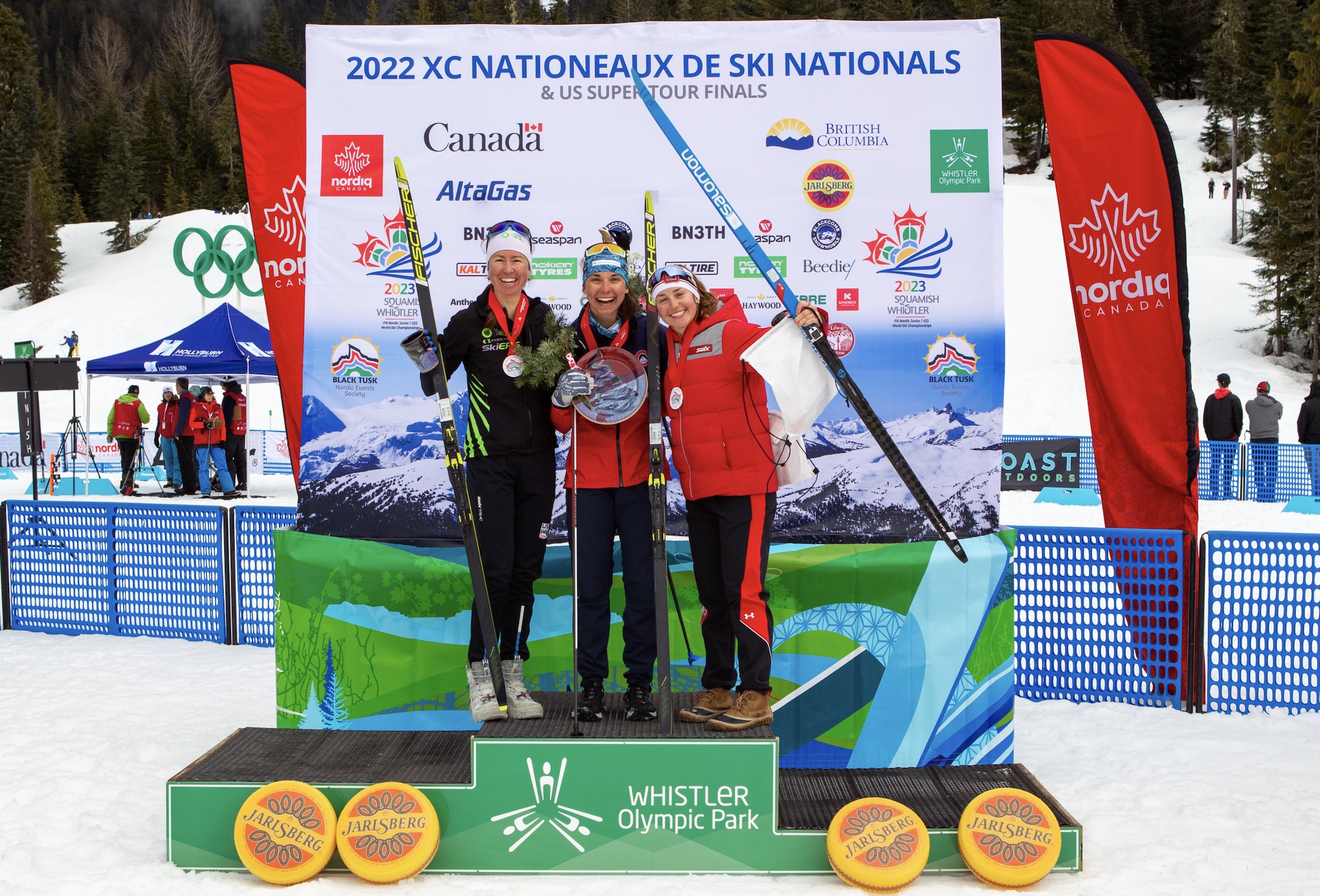
    Sovereign’s own Hannah Mehain got stronger through the heats to take second place, ahead of Dartmouth’s Callie Young.

    “I felt maybe not quite as snappy in the qualifiers,” Mehain told FasterSkier. “But it improved for the day and I just felt better and better .”

    As the American east and Eastern Intercollegiate Skiing Association (EISA) faced COVID restrictions that limited race opportunities, Young was in a similar boat to the Canadian women in terms of lack of high-level racing opportunities. She also shared her feelings on the sprint day.

    “I didn’t have my best qualifier, this is my second day at altitude,” Young said. “So it was kind of tough. But when I get into the heats, it’s always so fun and competitive.”


    On the same course NDC TBay’s Smith was clearly the strongest of the men, winning the qualifier and all three heats. Xavier McKeever and Tom Stephen, qualifying 2nd and 6th, both chose to race up in senior, resulting in some hard fought heats. McKeever and Stephen are both members of the national team and train with Foothills Nordic Ski Club in Calgary.

    “It was really fun,” said Smith after his race. “It was a blast for the body to do what it’s supposed to do, what I’ve been training it to do, so that was really fun.”

    Smith was one of the few who answered the tactics question with something other than how much fun it was to be racing again.

    “In the final, it kind of slowed down at about the first third. And I just tried to go when everyone else started to go and got a bit of a gap and in the end, was able to hold the lead. So that was really fun.”

    In the end, the juniors found themselves enrolled in the Locke School of Heat Tactics, with Black Jack’s Julien Locke using guile to take second in the final after qualifying 7th.

    AWCA’s Bob Thompson gapped NDC TBay’s Pierre Grall-Johnson on the climb to complete the podium.  

    World U20 relay silver medallist teammates McKeever, Rémi Drolet, and Stephen were 5th, 6th, and 7th, while Olivier Léveillé was away in Lillehammer. Though age and experience filled the podium, Grall-Johnson-Johnson was the first U23 athlete showing that the younger skiers are putting the pressure on.

    Sprint Results: Qualification, Heats, Final, U18/U16 Mass Start.


    10km/15km Classic Individual Start

    The race of truth was also the race of discovery as many athletes re-discovered why pre-race routines exist. Sunday dawned clear and cold, rising to -11C for the men’s start at 9am. With yesterday’s new snow packed hard, there was no difficulty in finding grip with hard wax, but not everyone found the glide necessary on a 5km loop that is flat and fast by World Cup standards.

    Rémi Drolet, just returned from racing Continental Cups in Muonio and Gällivare, skied a consistent race to take the win in 39:06.1, setting the fastest time in all three laps.

    Stephen was second, 39.6 behind, moving up on the final lap.

    “It was really good,” Stephen said. “It’s my first 15k back this season because I’ve been coming back from injury. And it went really well, it went just like I planned it, so really happy with it.”

    Interval starts are more exciting than they used to be.

    “Oh, it’s so fun,” Smith added. “I haven’t done something like this with this many people in a long time.”

    AWCA’s Jack Carlyle skied a very strong first 5km lap before struggling with the cold after a mistake choosing baselayers, finishing third at 49.2 back.

    “I made a rookie mistake and did not wear enough layers and froze halfway through the race,” Carlyle explained once he was warm again. “But I had great skis. And for the first bit of the race, I had great feelings. So yeah. Happier where the body is just need to remember not to make silly mistakes.”

    McKeever recovered from a slower first lap, moving up from 7th to finish 4th at 1:06.8 behind.

    “I was really lucky to start my season off in Europe, with a couple of victories in Finland and Sweden. And I was really happy with how they went, especially after last year being a really tough year for myself,” he said. “So overall, I’m pretty stoked to just be back at it.”

    “The sprint yesterday, I think went really well. Today, I was just missing a bit of gas. I feel I didn’t feel awesome, awesome, but it’s just nice to get out there and race again in Canada. And we have more next weekend.”


    Jasmine Drolet stepped up the sibling rivalry with a win in the 10km in 30:38.9. Now in her first year at Dartmouth, she made up for missing the sprint with a steady performance.

    “Definitely a shock to the system,” she told FasterSkier. “But I’m glad to have gotten it over with and to be in racing season now.”

    Back in Canada after her first semester in the Ivy League, she was adjusting to the changes.

    “I was nervous before [the race]. Changing training, and changing coaches and everything, but now, I feel confident that my training this fall was good. The US is maybe a little bit different than Canada, but not very different. It’s a lot of work to juggle school and skiing full time, but it’s manageable.”

    Bouffard-Nesbitt finished in second place, 41.4 back, with a fast first split.

    Another full-time student, Mehain was third at 1:09.7, just holding off a fast finishing Beth Granstrom.

    “I had a great day,” Mehain said. “It’s really fun to be out racing again, seeing everybody. I pushed fairly hard on that course for the classic 10k and had a lot of fun.”

    Distance Results: Interval Start, Full Weekend.

    Mexican National Championships

    Karla Schleske Shepard is the first female National Champion for Mexico. (Photo: Peggy Hung)

    This is the second National Championship for Mexico, with the first held in Canmore at Canadian nationals in 2019. Starting a ski program in a country without snow or a skiing tradition is hard, even without a pandemic disrupting progress. This year, there were six men and one woman competing.

    Jonathan Soto Moreno won both days, capping a year where he also earned a Beijing quota spot for Mexico at World Championships.

    Karla Schleske Shepard, a former heptathlete who represented Mexico at the PanAm games, became the first ever female champion after learning to ski in February 2021.

    What’s Next?

    December 11th and 12th has both the Eastern Canada Cup #1 at Nakkertok and the Western Canada Cup #2.

    The major storm that threatened the first weekend at Sovereign did even more damage in Rossland, forcing Black Jack’s Organizing Committee to cancel. WCC #2 will now be held at the backup venue, Sovereign Lake, with details forthcoming.

    With continued highway closures in BC and additional border restrictions related to the omicron variant, many travel plans will change. Both ECC #1 and WCC #2 may have smaller fields as US teams react to the increased friction at the border.

    NDC TBay, based in arguably the east/west centre of the country, is headed for the eastern Canada Cups. This will allow some comparison between the two series and give ski fans something to debate during the Christmas break.

    All will be made clear in Canmore on January 6th to 11th, when trials for OWG, U20/U23 World championships, and World Cup Period 4 will bring together the top athletes from the entire country.

    Photo Galleries: Doug Stephen (VR45 Photography): Sprints, Distance


  • Junior World’s Relay: In Photos

    Junior World’s Relay: In Photos

    Junior Men’s Relay:

    Luke Jager for the US, bib 1, a deep breath before the scramble leg beat down. (Photo: Doug Stephen)


    Luke Jager: onward. He gapped the field by 25 seconds on the scramble leg. (Photo: Doug Stephen)


    Ben Ogden for the U.S. on his solo journey to keep his team way off the front. (Photo: Doug Stephen)


    Ben Ogden tags to Johnny Hagenbuch for the first skate leg. (Photo: Doug Stephen)


    Gus Schumacher: The Closer. (Photo: Doug Stephen)


    The Win. (Photo: Doug Stephen)


    Canada’s Turn

    From left to right: Canada’s Olivier Léveillé, Tom Stephen, Xavier McKeever, and Rémi Drolet. Second overall in the World Junior’s 4 x 5 k relay. (Photo: Doug Stephen)


    Bib 11, Xav McKeever for Canada fighting for position on the scramble leg. (Photo: Doug Stephen)


    Leg 2, Canada’s Olivier Léveillé leading the chase. (Photo: Doug Stephen)


    Where they belong: Canada’s Tom Stephen taking the pull on the front chase group. (Photo: Doug Stephen)


    Rémi Drolet — closing it out. (Photo: Doug Stephen)


    Drolet, almost there. (Photo: Doug Stephen)


    The maple leaf group hug. (Photo: Doug Stephen)


    Junior Women’s Relay:

    Sydney Palmer-Leger (bib 4) during the scramble leg. (Photo: Doug Stephen)


    Kendall Kramer on the second classic leg. (Photo: Doug Stephen)


    Leg 3 for the U.S., Sophia Laukli (Photo: Doug Stephen)


    Novie McCabe on the fourth leg for the U.S. (Photo: Doug Stephen)


    The U.S. takes second overall. (Photo: Doug Stephen)


    Canada’s Molly Miller tagging Jasmine Drolet: Leg one to two. (Photo: Doug Stephen)


    Leg three to four: Canada’s Lilian Gagnon tags Elizabeth Elliott. (Photo: Doug Stephen)


    Let’s not forget the Swiss who had a fine day. Here’s Swiss skier Anja Lozza closing down for the team win. (Photo: Doug Stephen)

    Watch the races here on the FIS site.

    Doug Stephen has more photos here.

  • Junior World’s Relay: U.S. Women 2nd, U.S Men 1st, Canada 2nd

    Junior World’s Relay: U.S. Women 2nd, U.S Men 1st, Canada 2nd

    Friday was a much anticipated day across the Atlantic from the Oberwiesenthal, Germany: Junior World’s relay day. 

    Junior Women’s 4 x 3.3 k Relay

    For the U.S. junior 4 x 3.3 k relay, oh-so-close was last year’s World’s just off the podium fourth place performance. Twelve months later and a loaded team featuring (in this order) Sydney Palmer-Leger, Kendall Kramer, Sophia Laukli, and Novie McCabe, the group skied themselves into second overall, 4.9 seconds off the winning time of Switzerland in first. The Swiss won in 35:08.6. Sweden placed third, 14.2 seconds back. 

    The tag to the U.S. at 9.9 k saw the team 27.8 seconds down on Switzerland, followed by the Swedes about six seconds further behind. Around 11 k, the Swedes and the U.S. were paired together in the hunt. McCabe eventually began to pull ahead into a secure second place position. In 3.3 k, McCabe locked in and chipped away nearly 23 seconds on the Swiss — who no doubt were feeling the pressure as McCabe gapped up. 

    Canada’s Molly Miller, Jasmine Drolet, Liliane Gagnon, and Elizabeth Elliott placed ninth (+1:25.8).  

    Eighteen teams started the race, with Germany and Poland disqualified for not following the marked course. 

    Junior Women’s Relay Results 

    Junior Men’s 4 x 5 k Relay

    The U.S. juniors, Luke Jager, Ben Ogden, Johnny Hagenbuch, and Gus Schumacher had experience on their side for Friday’s relay. Last year the foursome clinched a first ever U.S. relay win at World Juniors. That victory came down to a Schumacher anchor leg in which he outpaced the Russians by 3.9 seconds to the line. 

    This year, in 54:54.9, the U.S. built a cushion of 35.5 seconds on second place Canada — which was the surprise, perhaps, of these Junior Worlds. (More on that in a few paragraphs.)

    But, it’s never over until it’s over. However, Jager ended this sooner than anticipated. He pegged the scramble leg, putting 25 seconds into second place Germany when he tagged Ogden. It was game over as the U.S. added a few more seconds on each successive leg in their win. 

    “Today ended up perfect, but in the morning we didn’t know that would happen, and with the past 2 years of great relays, we had a lot of pressure on ourselves to do it again,” Schumacher emailed. “We’d looked at the teams quite a bit, and were glad with how they looked, especially with a strong American skier to match every other strong German and Norwegian leg. I myself was fairly confident with a lot of different scenarios on the last leg, but I knew that it depended on the first 3 legs going well, and those boys exceeded my expectations in a big way. They’ll say they had great skis and that’s why they were able to splinter a stacked field, but really these boys are some of the best skiers in the world and when it comes together perfectly (which it seems to often do on relay day), there’s not much match for them. I’m so proud of this team for making a 3rd relay podium look almost easy, because it definitely isn’t. The execution out of them was unparalleled today and I’m so glad to be a part of this team. Also all of us were so proud and stoked for our women’s silver medal this morning and also the Canadian men’s silver medal! Both were great races and it’s great to see them get such good placement here. Now we’re all looking forward to some North American world cups, especially Minneapolis. Go USA!!”

    Let’s get back to Xavier McKeever, Olivier Léveillé, Thomas Stephen, and Remi Drolet; starting in bib 11 for Canada. It clicked today for this group. Good skis? Surely. Inspired by their U.S. neighbors? Perhaps. Stoked by their on-site talisman Devon Kershaw (in Germany to coach)? Does that need an answer?

    No matter how you spin it, this was the race of the day. Certainly unexpected, and certainly deserved for a program rebounding from low funding and in the midst of a rebuild.

    At the 10 k mark, Italy, at 30.8 seconds behind the U.S., was trailed by Norway, Switzerland, Canada, and France — all within roughly seven seconds. That five team pack moved together through the final tag off at 15 k. Glued together through 16.8 k, only Norway fell off the pace. 1.5 k later, and it was Italy’s turn to feel the burn, as they fell off too. 

    That left Canada and Switzerland 10 seconds ahead of the now trailing Italians. By the time the next k had clicked by, Drolet, who was coming off a stellar fourth in the junior men’s 30 k mass start skate, made it real: he gapped the Swiss by 20 seconds. 

    It’s worth mentioning again – Canada in second overall, 35.5 seconds off the winning pace. The Italians rebounded as the Swiss fell back. Italy took third (+55.4), the Swiss placed fourth (+1:34.4).

    “This is absolutely incredible,” Drolet said to Nordiq Canada after the race. “We were so stoked to start this race, and we told ourselves last night we are going to go for the medal today. This is one of the best, if not the best, World Juniors for a Canadian team in terms of results. Knowing everyone on the relay team had a top-30 at the Championships we knew this was doable.”

    Adding his own poetry to the historic relay for Canada, “People don’t really understand what went down today, but it is insane,” Kershaw told Nordiq Canada.

    Junior Men’s Relay Results 

  • Mass Start day at World Juniors: Remi Drolet 4th, Schumacher 5th…Laukli 5th, McCabe 9th (Includes Audio Interview with USST Coach Bernie Nelson)

    Mass Start day at World Juniors: Remi Drolet 4th, Schumacher 5th…Laukli 5th, McCabe 9th (Includes Audio Interview with USST Coach Bernie Nelson)

    Helen Marie Fossesholm of Norway taking the junior women’s 15 k mass start skate. (Photo: Doug Stephen)

    Wednesday in Oberwiesenthal, Germany World Juniors continued with a 15 k mass start skate for the women. 

    Junior Women’s  15 k Mass Start Skate

    Norway’s Helene Marie Fossesholm (18) won her second race of these championships by taking the mass start skate in 35:55.6 minutes. Fossesholm also won the 5 k interval start classic race on Monday. Poland’s Izabela Marcisz placed second 1:09.3 back. Marcisz also won a bronze in the 5 k classic. Switzerland’s Siri Wigger skied herself into third (+1:10.6). The theme continues, this was Wigger’s second 2020 championship medal, after placing third in the skate sprint. 

    Sophia Laukli (bib 56) skied to 5th overall in the junior women’s 15 k mass start skate. (Photo: Doug Stephen)

    Starting in bib 56, layered well back at the start, was Sophia Laukli (Middlebury) for the U.S. Laukli (19), in her first Junior Worlds, moved up in the pack to place fifth overall (+1:26.5). 

    Novie McCabe (MVNST) skied to ninth (+1:33.0) for her best individual Junior World’s result. Mccabe placed 10th in last year’s championship 15 k classic in lahti, Finland. Kendall Kramer (Fairbanks Nordic) was 24th (+2:54.5), and Sydney Palmer-Leger (SVSEF) did not finish. 

    Novie McCabe on her way to 9th overall in the 15 k mass start skate. (Doug Stephen)

    Interview with U.S. Ski Team Coach Bernie Nelson

    Liliane Gagnon (Skibec Nordique) was the top finisher for Canada in 34th (+3:38.2). Jasmine Drolet (Blackjack Nordic Club) followed close behind in 36th (+3:39.0). Benita Peiffer (Whistler Nordic) placed 49th (+4:43.2), and Elizabeth Elliott (Revelstoke Nordic) skied to 51st (+4:39.1).

    From left to right: Canada’s Jasmine Drolet, Elizabeth Elliott, Benita Peiffer, and Liliane Gagnon. (Photo: Doug Stephen)

    Junior Women’s Results 


    Junior Men’s 30 k Mass Start Skate

    The junior men raced a 30 k mass start skate Wednesday with Norway’s Iver Tildhelm Andersen winning in a time of 1:13:39.0. Anderson medlaed in last year’s Junior World’s, placing third in the 10 k skate.

    Second place went to Germany’s Friedrich Moch who crossed the line 9.4 seconds back. Moch also placed second in Monday’s 10 k classic. Third place went to Martin Kirkeberg Mørk of Norway, who was 32.8 seconds off the winning pace. 

    Remi Drolet of Canada skiing to 4th overall at the Junior World’s 30 k mass start skate. (Photo: Dough Stephen)

    Scrolling not so far down on the results sheet to places fourth and fifth, respectively, added some excitement for North America; Remi Drolet (Black Jack Nordic) of Canada placed fourth overall (+43.2), and Gus Schumacher (AWS) of the U.S. fifth (+56.1). For Drolet, this was a Junior World’s career best result – he placed seventh in last year’s Junior World’s 30 k mass start skate. 

    At 25 k Wednesday, Drolet was positioned sixth overall, 19.4 seconds back on the then leading Moch. He was in a group with Mørk, and Italy’s Davide Graz. Roughly four seconds ahead was Schmacher as their carrot. By 28.8 k, Schumacher had faded slightly, as Drolet moved into fourth.

    Schumacher won Monday’s 10 k classic, and with Wednesday’s fifth, nearly matches his fourth place in the 2019 Junior World’s 30 k mass start classic.      

    Gus Schumacher (bib 1), leading the 30 k mass start skate at the 2020 Junior Worlds. (Photo: Doug Stephen)

    Thomas Stephen (Foothills Nordic) of Canada, placed 17th (+3:35.8), Xavier McKeever (Foothills Nordic) 32nd (+5:43.3), and Michael Murdoch (Whistler Nordic) 45th (+8:23.5). 

    For the U.S., Luke Jager placed 19th (+3:46.1), Johnny Hagenbuch (SVSEF) 20th (+3:49.2), and Zanden McMullen (APU) 35th (+6:03.3). 

    Luke Jager (bib 13) and Johnny Hagenbuch (bib 7), during the junior men’s 30 k mass start skate. (Photo: Doug Stephen)


    Thomas Stephen skiing to 17th overall in the Junior World’s 30 k mass start skate. (Photo: Doug Stephen)

    These events conclude individual racing for the juniors at these World Championships. 

    Junior Men’s Results


  • Schumacher Wins World Junior’s 10 k Classic; Ogden 9th, Jager 10th (With Audio Interview)

    Schumacher Wins World Junior’s 10 k Classic; Ogden 9th, Jager 10th (With Audio Interview)

    The weight is heavy. Pressure from expectations that can cripple or tap into even more primal motivation. Gus Schumacher (U.S./AWS), after qualifying first, and bowing out on Saturday’s World Junior’s skate sprint in the semifinals, placed seventh overall. That is stout. But so is the person behind the results who possesses a killer instinct on the race course but by all accounts projects humility in the rest of his life. The impression is that this nineteen-year-old from Anchorage, Alaska is downright kind — understanding that the hardware won becomes hollow if the person behind the top-step glory is singularly focused on the self.

    Taking it. Gus Schumacher of the U.S. wins the World Junior’s 10 k classic. (Photo: Doug Stephen)

    Post-race interview with Gus Schumacher

    The time between Saturday’s sprint and Monday’s 10-kilometer interval start classic race must have been a liminal moment for the young skier. Schumacher is in Oberwiesenthal, Germany for podiums not the process of ruminating on what-if scenarios. The transition from not meeting his own benchmark of success on Saturday to channeling all that potential and kinetic energy down to the mitochondrial level was evident Monday as Schumacher won the 10 k classic in 26:31.7. 

    This was a close race that Schumacher, as the last of 103 starters, could chew on as the day’s fastest time split makers at 5 k in bib 102, Germany’s Friedrich Moch, and bib 103, Italy’s Davide Graz, set off before him. The German and Italian came through in first and second, respectively, at 5 k. Moch was 7.5 seconds up on Schumacher, Graz only 1.2 seconds faster. 

    The 10 k no-fuel-left rest phase for Gus Schumacher. (Photo: Doug Stephen)

    Schumacher closed down. By the finish, he had put 4.5 seconds into Moch in second overall and 6.7 seconds into Graz. Good young man, who also happens to be fast, wins a close race. 

    This is Schumacher’s first individual World Junior’s medal. He placed fourth last year at the Lahti World Junior Championships in the 30 k mass start classic. He also anchored the junior men’s winning 4 x 5 k relay for the U.S. at those championships. 

    The celebration continued for the U.S. with two other skiers in the top-10. Ben Ogden (UVM/SMST2) raced to ninth place (+49.8), and Luke Jager (U Utah/APU) 10th (+50.6). The fourth U.S. skier, Johnny Hagenbuch (SVSEF) notched 25th overall (+1:29.8). 

    Ben Ogden on his way to 9th place in the World Junior’s 10 k classic. (Photo: Doug Stephen)


    Luke Jager on his way to 10th in the World Junior’s 10 k classic. (Photo: Doug Stephen)

    Canada’s Xavier McKeever skied to 17th (+1:13.4), Remi Drolet 29th (+1:35.0), Olivier Léveillé 30th (+1:35), and Thomas Stephen 65th (+3:48.7). 

    Xavier McKeever of Canada, hips forward, on his way to 17th in the World Junior’s 10 k classic. (Photo: Doug Stephen)

    Results      

  • Ogden Sixth, Schumacher Seventh, Schoonmaker 13th for U.S. in Junior World’s Sprint

    Ogden Sixth, Schumacher Seventh, Schoonmaker 13th for U.S. in Junior World’s Sprint

    Junior men’s quarterfinal action: For the U.S. (l-r), Luke Jager, J.C. Schoonmaker, and Gus Schumacher. (Photo: Doug Stephen)

    The monochromatic backdrop during the junior women’s sprint was the persistent theme in Oberwiesenthal, Germany  — it bled right into the World  Junior men’s 1.3 k freestyle sprint. For U.S. fans, in particular, this first event of four for the junior men possessed an element of tension. The tension, for those that follow, was seeded last year with an unequivocal success story that was the U.S. junior men’s run at the 2019 Junior Worlds in Lahti, Finland. The final collective chapter there capped with the 4 x 5 k relay win. 

    Today, again, was full of promise, and perhaps the pressure that comes with being a known quantity – otherwise called podium favorites, at this year’s event.  

    The U.S. put three skiers into the top-11 during qualification: Gus Schumacher was first in 2:26.34, ben Ogden third (+1.13), and J.C. Schoonmaker 11th (+4.76). Slotting into 21st for the U.S. was Luke Jager (+6.42).

    Let’s start with Jager. He looked strong in the first quarterfinal, in which he was grouped with Schumacher and Schoonmaker. Leading into a short punchy hill, Jager appeared to lose his footing and tripped, coming to a standstill. He recovered to place fourth in the heat but was eliminated. Schumacher skirted by Jager when he stumbled and took the win. Schoonmaker was third and did not advance. 

    Ogden, in the fifth quarterfinal, cruised. He won by 2.32 seconds in earning his semifinal spot. 

    Ready. Set. Go. Ben Ogden (pink beanie), during the World Junior’s skate sprint. (Photo: Doug Stephen)


    Ben Ogden on quarterfinal’s cruise control. (Photo: Doug Stephen)

    In the first semi, Schumacher pushed from the back portion of the pack – never finding enough room to seize an opening. He came down the stretch positioning himself into third, 0.46 seconds back. However, in the slower of the two semis, he was unable to advance as a lucky loser.

    Ogden placed third in the second semi to take a lucky loser spot in the final. But Ogden, racing the fifth quarterfinal, and with a quick turnaround into the semis, ran on fumes in the final. He placed sixth in the final, 17.62 seconds off the winning pace of Norway’s Ansgar Evensen who won in 2:33.44. Switzerland’s Valerio Grond placed second (+2.32), and Germany’s Maxim Cervinka third (+3.21). 

    Norway’s Ansgar Evensen winning the World Junior’s skate sprint. (Photo: Doug Stephen)

    In the final standings, Ogden was 6th overall, Schumacher 7th, Schoonmaker 13th, and Jager 18th. A stout day collectively for the American foursome. 

    Canada’s Remi Drolet, a student at Harvard, began his day by qualifying 16th (+5.76). Drolet placed fifth in the third quarterfinal to finish 23rd overall. Also for Canada, Thomas Stephen finished 36th, Xavier McKeever 44th, and Olivier  Léveillé 49th.       

    Canada’s Remi Drolet, the day’s 16th fastest qualifier. (Photo: Doug Stephen)

    Junior Men’s Qualification | Junior Men’s Results | Junior Men’s Bracket 


  • MSA Trials Rundown: Classic Interval Starts

    MSA Trials Rundown: Classic Interval Starts

    Russell Kennedy (#46) caught Sam Hendry (#45) and Nicolas Beaulieu (#44) on his way to third place in the 15km. (Photo: Doug Stephen)
    Russell Kennedy (#46) caught Sam Hendry (#45) and Nicolas Beaulieu (#44) on his way to third place in the 15km. (Photo: Doug Stephen)

    Fresh snow greeted day two of the Mont Sainte-Anne Trials for the interval start classic. With athletes battling to qualify for U20/U23 World Championships in Oberwiesenthal, Germany and three separate World Cup trips (Falun/Scando Tour, Sprint Tour, Canmore), it was never going to be a simple matter of skier against the clock.

    Antoine Cyr rocking the NorAm leader's bib on the way to victory. (Photo: Doug Stephen)
    Antoine Cyr rocking the NorAm leader’s bib on the way to victory. (Photo: Doug Stephen)

    Racing started with the open men’s 15km on a 5km loop that was shared by all the elite categories. Early on, it looked like a tight four way battle, but CNEPH’s Antoine Cyr, starting last, was 14 seconds ahead after the first lap. Cyr was fastest on all three laps to win in 40:05.1, 47.5 seconds ahead of Fondeurs Laurentides’ Ricardo Izquierdo-Bernier and 51.6 ahead of Canmore’s Russell Kennedy. Cyr should be selected for U23’s based on this win. In the interview posted below, he talks about his relief to know that his form is still good after a disappointing first World Cup in Europe.

    The U20 and U18 men raced 10km  and once again Black Jack’s Rémi Drolet displayed that full time students can be competitive, as he won both laps to finish in 26:46.2. CNEPH’s Olivier Léveillé took advantage of a late start bib to narrowly beat ULLR’s Xavier McKeever, finishing at 35.4 and 39.1 seconds respectively. This result combined with Thursday’s sprint should see both Léveillé and McKeever selected for U20 Worlds.

    Olivier Léveillé took second place and pencilled his name on a ticket to Oberwiesenthal. (Photo: Doug Stephen)
    Olivier Léveillé took second place and penciled his name on a ticket to Oberwiesenthal. (Photo: Doug Stephen)

    (Drolet’s post-race interview starts with the punchline to a joke, but without the setup we miss the laugh.)

    In the women’s 10km, Emily Nishikawa continued the theme of winning every lap on her way to a clear victory in 29:51.2. CNEPH’s Cendrine Browne showed that her recovery is going well with a strong second place in her less-favoured technique, finishing 48.7 back. Laval University’s Andrée-Anne Théberge completed the podium, 2:04.7 back.

    Emily Nishikawa on a mission. (Photo: Doug Stephen)
    Emily Nishikawa on a mission. (Photo: Doug Stephen)

    AWCA’s Annika Richardson was 4th at 2:15.4 to take the top U23 finish and what should be a selection for U23 Worlds.

    By the time the U20 and U18 women headed out, the tracks were showing some wear, but that didn’t stop Black Jack’s Molly Miller from winning the 5km in 15:24.8, 10.9 seconds ahead of teammate Jasmine Drolet, and 11.0 ahead of Revelstoke’s Beth Granstrom. Revelstoke also took fourth with Alexandra Luxmoore at 11.1 seconds, only 0.2 seconds away from silver.

    Molly Miller attacking the 5km classic at MSA Trials. (Photo: Doug Stephen)
    Molly Miller attacking the 5km classic at MSA Trials. (Photo: Doug Stephen)

    Black Jack defended their club’s reputation for developing young skiers with three U20 wins so far this weekend. Revelstoke is also starting to make waves with yesterday’s winner Elizabeth Elliott 11th today at 47.6 seconds. With 86 U20 and U18 men and 72 U20 and U18 women competing today, the future of Canadian skiing is starting to look brighter.

    Sunday’s free technique mass starts should be exciting, with the U20 and Open categories merged so the younger athletes can measure themselves against the top seniors.

    Results: Full Weekend (including live timing for Sunday), Interval Start Classic

    Photographer Doug Stephen has a new gallery for Saturday. Athletes are welcome to download and use full resolution images if they give credit to ‘Doug Stephen’ or @vr45photography.

  • MSA Trials Rundown: Qualifying for U23, U20 and More

    MSA Trials Rundown: Qualifying for U23, U20 and More

    Cendrine Browne leads her semifinal at MSA Trials. (Photo: Doug Stephen)
    Cendrine Browne leads her semifinal at MSA Trials. (Photo: Doug Stephen)

    In Canadian domestic ski racing, it doesn’t get much bigger than this. Mont Sainte-Anne (MSA) is hosting the NorAm weekend that also serves as U23/U20 World Championships qualification and has special significance in selection for World Cup starts.

    Any skier who hasn’t already qualified for World Cup period 4 has had this event as a major focus for the season. The only certain paths to National Team selection for next season start with top 30 results on either the World Cup or U20 World Championships. Most of these paths start at MSA Trials.

    For U20 and U23 selection, the top finisher in each of the three races is guaranteed one of the 18 to 20 places on the trip to Oberwiesenthal, Germany, with a pre-camp in Norway.

    And finally, the weekend is a NorAm, which means COC leader points are on the line.

    On Thursday, the action started with free technique sprints on a short but difficult course. Men, women, and U20’s all skied the same distance. Nordiq Canada’s Jeff Ellis continued the tradition of winner’s interviews, FasterSkier has the unedited videos below.

    Elizabeth Elliott in charge of the U20 final. (Photo: Doug Stephen)
    Elizabeth Elliott in charge of the U20 final. (Photo: Doug Stephen)

    CNEPH’s Cendrine Browne won the qualifier in 3:04.79 before winning three heats to dominate on her home trails, finishing the final in 3:01.37. Browne’s teammate Laura Leclair was second, 0.53 seconds back, for the top U23 finish ahead of Emily Nishikawa at 0.76 seconds. The presence of distance specialists Browne and Nishikawa on the podium is evidence of the sprint course’s difficulty.

    For the U20 women, AWCA’s Elizabeth Elliott qualified 4th overall and swept the heats to win the final in 3:06.85. Her teammate Benita Peiffer was second, 1.66 back, narrowly ahead of Black Jack’s Molly Miller at 1.81 seconds.

    For the men, NTDC Thunder Bay’s Graham Ritchie recovered well from his time in Europe to win in 2:35.69 after qualifying second, grabbing the top U23 finish along the way. Team ULLR’s Jess Cockney continued to redefine the word ‘retired’ in second place, 0.52 back. TBay’s Pierre Grall-Johnson who converted on his latest qualification win with his first open category podium, was third at 0.76 seconds.

    Graham Ritchie taking advantage of the downhill finish for the win. (Photo: Doug Stephen)
    Graham Ritchie taking advantage of the downhill finish for the win. (Photo: Doug Stephen)

    The U20 men provided no surprises, with the favourites front and centre in the final. Black Jack and Harvard’s Rémi Drolet dominated the day, sweeping through to the final to win by 2.57 seconds in 2:34.75. ULLR’s Xavier McKeever was second after qualifying 29th overall for 5th U20, with teammate Tom Stephen taking bronze a further 1.09 back.

    Speculating on selections using the criteria documents always comes with a risk of error. That said, Leclair, Ritchie, Elliott, and Drolet should definitely be eligible for Obwiersenthal. Peiffer and McKeever should be selected as the 5th U20 athletes.

    Results: Full Weekend (including live timing for Saturday and Sunday), Qualification, Heat Brackets, Final

    Photographer Doug Stephen has a gallery for the Sprints and Official Training. Athletes are welcome to download and use full resolution images if they give credit to ‘Doug Stephen’ or @vr45photography.

    Rémi Drolet leads Xavier McKeever, Olivier Léveillé, and Tom Stephen in the U20 final. (Photo: Doug Stephen)
    Rémi Drolet leads Xavier McKeever, Kai Meekis, and Tom Stephen in the U20 final. (Photo: Doug Stephen)
  • Canmore NorAm/SuperTour/Nationals Sprints

    Canmore NorAm/SuperTour/Nationals Sprints

    Full-time student Jess Cockney was happy to win again in Canmore. (Photo: Doug Stephen)
    Full-time student Jess Cockney was happy to win again in Canmore. (Photo: Doug Stephen)

    The NorAm series fully lived up to the North American Cup label in Canmore Friday with 1.3km free technique sprints to kick off a combined NorAm, SuperTour, and Mexican National Championships weekend.

    Full results for the weekend are on zone4, including live results every day. Friday featured sprints for the older age groups only (282 racers): Saturday is interval start classic, and Sunday’s race an interval start free.

    Before the races, there was chatter about the importance of increasing the level of competition and a dash of fear that the American visitors would school the host country. The competition level was up and fear was not needed this day. The open women’s final featured two Germans, two Canadians, and two Americans before the open men’s final skewed Canadian. (Heat brackets and final results.)

    Julia Richter takes the win ahead of Katherine Stewart-Jones and Katharine Ogden. (Photo: Doug Stephen)
    Julia Richter takes the win ahead of Katherine Stewart-Jones and Katharine Ogden. (Photo: Doug Stephen)

    There are a few race videos in @NordiqCanada’s Instagram story.

    Nordiq Canada’s new Events Coordinator Jeff Ellis took time from his Race Director role to shoot video interviews with the top athletes, including the first ever Mexican National Champion Rodrigo Rangel Fernandez. Edited versions of some of these interviews are also on @NordiqCanada’s Instagram.

    University of Utah’s Julia Richter won the qualifier and all the heats to take the win in 3:10.52, 0.08 seconds ahead of the national team’s Katherine Stewart-Jones and 0.63 seconds clear of Dartmouth’s Katharine Ogden.

    Full-time student Jess Cockney (Team ULLR) turned in another solid sprint performance at home, winning the men’s final in 2:46.18, over two seconds ahead of SVSEF Gold Team’s Peter Holmes and Canadian National Team member Graham Ritchie.

    National team junior Anna Pryce qualified 4th overall before winning all her heats. She finished the 1.3km final in 3:18.40, 0.38 seconds ahead of AWCA’s Elizabeth Elliott and 0.43 seconds from CNEPH’s Liliane Gagnon. Seventy-three U20 women competed, making that cohort the largest age group.

    Xavier McKeever (Team ULLR, CNST) won the U20 sprint after qualifying 20th overall. His 2:42.02 bested Telemark’s Ian Williams by 0.85 seconds and ULLR teammate Joe Davies by 5.30 seconds.

    The first Mexican National Championship sprint featured four athletes. Rangel Fernandez won comfortably in 3:37.33, completing a major step forward for the federation in Mexico. Vadovų paieška, personalo atranka, mokymai vadovams ir darbuotojų paieška primumesse.lt


    Canmore-based photographer Doug Stephen was in the thick of the action. Athletes can use full-resolution photos from his gallery if they credit ‘Doug Stephen’ or @vr45photography.

    Katherine Stewart-Jones leads BSF's Erika Flowers in the quarter final. (Photo:Doug Stephen)
    Katherine Stewart-Jones leads BSF’s Erika Flowers in the quarter final. (Photo:Doug Stephen)