From the FasterSkier archive — posts syndicated from athletes’ and coaches’ own blogs between 2004 and 2012, kept online as published. Current coverage is at fasterskier.com.
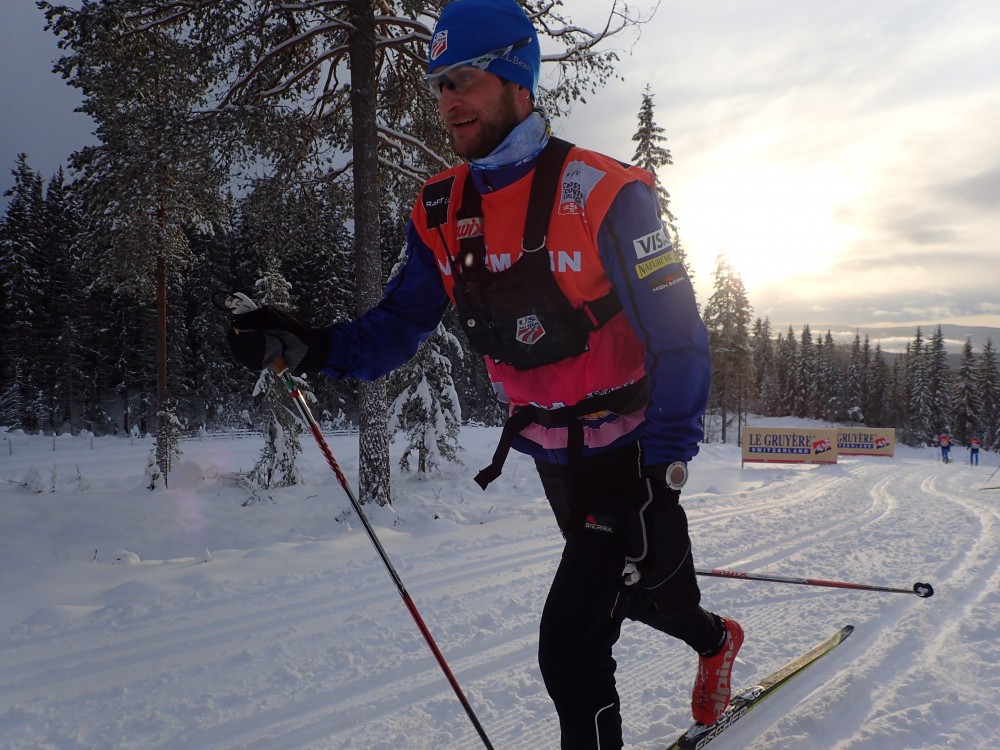
Brayton Osgood, Dartmouth’s new men’s nordic head coach and a former NCAA All-American, testing skis for the U.S. Ski Team during Period I of the 2015/2016 World Cup last season. (Courtesy photo)
Sitting before the lurid glow of a computer screen, scrolling through codes and functions does not exactly conjure up images of snow, skis and fitness fanatics. However, a logged training hour, timed kilometer split or monitored heart rate are all indispensable numbers to improving nordic performance. For eight years, these ordinals were the opus of Brayton Osgood’s work.
A math wiz — he graduated cum laude from Dartmouth College with a degree in mathematics and earned his master’s in business and accounting from Northeastern University — Osgood spent just under a decade perfecting a computer software known as Athletic Management Platform (AMP) for a company called AMP Sport. The program, designed to help coaches decipher the meaning of digits in relation to an athlete’s progression in training and racing, boasts partnerships with the U.S. Ski Team, USA Triathlon and the Cleveland Cavaliers, among others. Whether it involved dribbling on a basketball court or trekking trails (snow or dirt covered), Osgood’s work gave numbers a new meaning for many athletes.
But the electronic connection to cross-country skiing Osgood maintained through his computer could not replace the physicality he loved about the sport: the granular feel of a wax cork, the watery eye blur from breathing in the icy, mid-January air.
A former nordic racer (he skied for Dartmouth College, where he was a two-time NCAA All-American, as well as XC Oregon, earning a World Cup distance start in 2009) and a coach (he was a Dartmouth assistant coach for the 2011/2012 season), Osgood, 35, missed being physically present at cross-country skiing events.
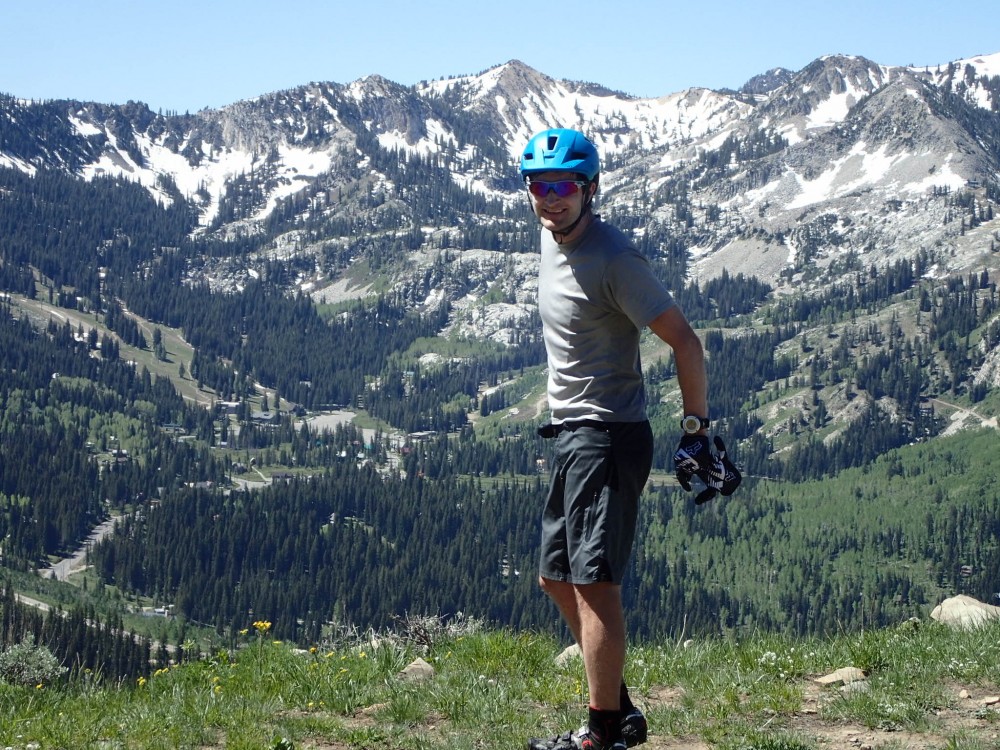
Brayton Osgood, the new Dartmouth men’s nordic head coach, during a mountain bike ride in Park City, Utah. (Courtesy photo)
“I was spending all of my free time in the winter and lots of vacation time making my way towards cross-country ski races so it was pretty clear to me that that’s what I wanted to be doing with my time,” he said on the phone earlier this month.
Though he loved the math and science behind skiing, Osgood began to realize that being entrenched in skiing was where he wanted to be. He began spending more time at ski events. At the beginning of last season, he traveled to Europe to wax for the U.S. Ski Team for Period 1 of the World Cup. He also served as a coach and wax technician for the New England Junior National Ski Team last season and worked as the race-data manager for the New England Nordic Ski Association (NENSA) from 2012 to 2016. Then in March, when the men’s head-coach position for the Dartmouth nordic ski team opened up, he applied.
“I was excited to apply for this job specifically because it was at Dartmouth,” Osgood, a native of Putney, Vt., wrote in an email. “The Dartmouth Ski Team has been very important in my life, first as a student-athlete, and more recently inspiring my desire to coach.”
After much anticipation, Osgood discovered in early May that he had been chosen as the new leader for the Big Green men’s team. He had his first team meeting with half a dozen athletes and his co-coach, Cami Thompson-Graves, prior to Memorial Day weekend and officially started on June 22. While he’s no nordic newbie, Osgood explained that writing training plans for large groups of athletes will be one of the biggest challenges for him as he takes over the reins from Dartmouth’s longtime men’s coach for the last 27 years, Ruff Patterson.
“I’m really lucky and fortunate to have Cami [Thompson-Graves] as a resource,” Osgood said of Dartmouth’s director of skiing and women’s head coach. “We’ve already started meeting and talking about what she’s done and I’m going to spend a fair amount of time as I get started, talking with the current and hopefully some past Dartmouth skiers just about what has worked for them and where we can experiment and change.”
Though Osgood has been mentored by Thompson-Graves as an athlete and assistant, this upcoming season will mark his first experience working alongside her.
Brayton Osgood, Dartmouth College’s new men’s nordic head coach, working behind the scenes for the U.S. Ski Team on the World Cup early last season. (Courtesy photo)
“I am very excited that Brayton will be re-joining our staff!” Thompson-Graves wrote in an email. “I think his passion for skiing and his knowledge of Dartmouth will help generate a lot of excitement with the team, and will allow him to hit the ground running as we start the new training season.”
As the pair looks ahead to the beginning of a new season and partnership, Osgood points out that key to their success will be complementing each other as coaches. The two programs will work together to shape the future of the Division I program.
“She has a great history of success in terms of graduating skiers that move on to the U.S. Ski Team and World Cup podiums,” Osgood said of Thompson-Graves, who’s entering her 28th season coaching at Dartmouth. “She’s done a really good job of building that team atmosphere, which I think is a key to achieving success, so I think there’s a lot I can learn from her there.”
With the tutelage of Thompson-Graves and current and previous Dartmouth skiers, Osgood hopes to not only continue Dartmouth’s history of program success, but expand upon it.
“Ruff has been a hugely important figure in my life and skiing,” he said. “So having the opportunity to take over for him is really exciting and a little bit daunting because it’s a great legacy he has and I would love to carry on the success that he achieved.
“I definitely want to have a team that has All-Americans and hopefully podiums at NCAAs and a lot of skiers All-East for EISA [Eastern Intercollegiate Ski Association],” Osgood added. “Then just as important I think is to have a team that’s happy and excited to be out there skiing and racing every day that they ski … There’s going to be 12 to 15 men on that team and they can’t all race carnivals, they can’t all go to NCAAs, but I want them all to feel like they have successful winters and are achieving the goals they set or are making progress towards those goals.”
Another aspect of the job Osgood sees as both a challenge and a chance to learn is the student side of coaching a collegiate sport.
“At a school like Dartmouth, finals are never more than 10 weeks away,” he said. “There’s often midterms and a whole host of external factors that you need to account for when writing [a training plan]. There’s also class schedules. There are a lot of constraints to work with, but that’s going to be a new and exciting thing for me, for sure.”
Sarah Max (XC Oregon) on her way to winning her fourth Pole Pedal Paddle title on May 17 in Bend, Ore. (Photo: Mike Albright/Mike Albright Photography)
After racking up her fourth Pole Pedal Paddle (PPP) victory on May 17 in Bend, Ore., Sarah Max got back to her day job as a financial writer (for publications like The New York Times, Barron’s, Entrepreneur, and Money Magazine) and executive editor of 1859 Oregon Magazine. At 39, she’s a mother of 11-year-old twins, yet Max still finds time to train and race with XC Oregon in Bend, focusing on ski marathons throughout the winter.
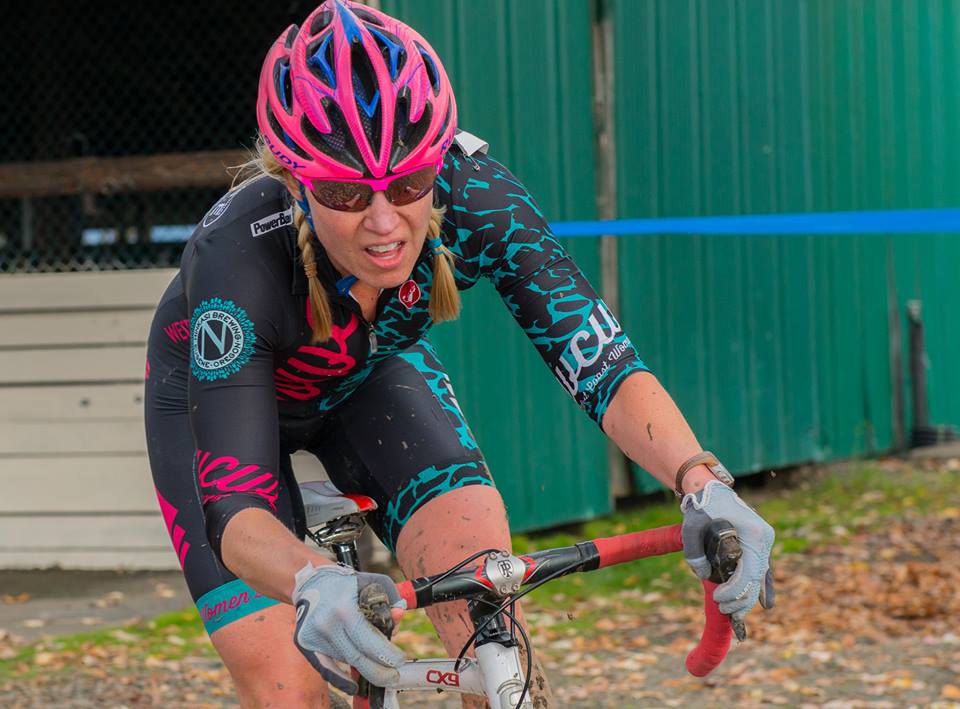
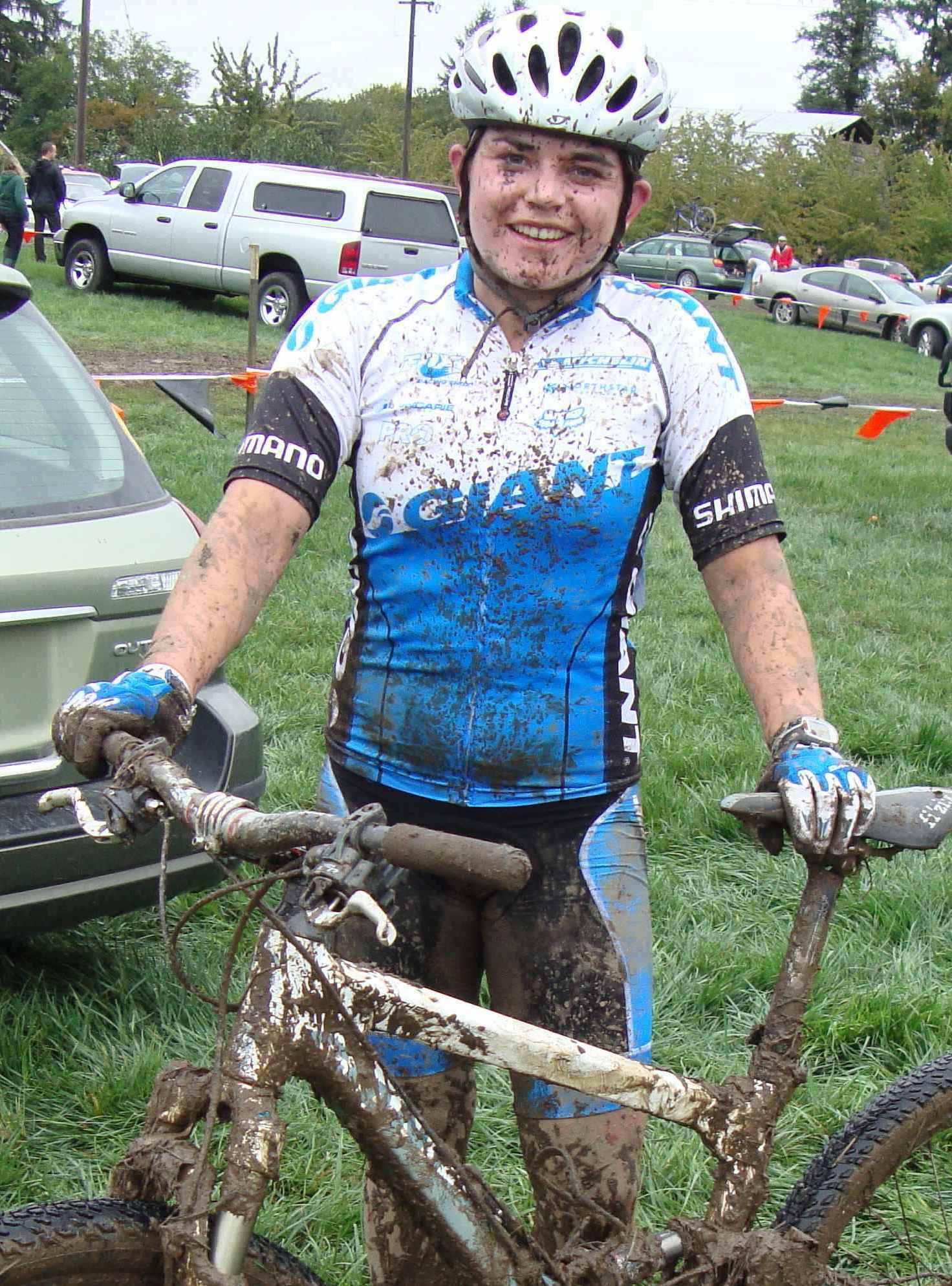
Sarah Max during a cyclocross race. (Courtesy photo)
“I’ll probably stick with a similar program as the last couple of years, which is a few bigger races, ideally in fun locations,” she wrote in an email. “Next year I may go do the Norwegian Birkie again. (I’m not a great classic skier, so like the challenge of a long, hard race.) I will probably do American Birkie again too… It’s just a nice, hard race. I usually do Boulder Mtn Tour every year, partly because my whole family likes to go — though that course doesn’t suit me. I like to ease my way into a race, and there is none of that there.”
After her seventh solo PPP (she’s also done it other times with a team), Max will likely move on to cyclocross races in the fall and some off-road triathlons or other multi-sport events this summer. This Saturday, she’s doing the Hood 2 River Relay for the first time as a pair.
In preparation for the PPP, she wasn’t overly regimented with her workouts (especially after winter of ski training), but she did work on running (see below).
***
After a winter of planned workouts, I generally don’t follow a training plan for the Pole Pedal Paddle. This year followed a similar script. Starting about six weeks before the event, I tried to get in most of the major events (ski, bike, run and paddle) about twice a week, with some doubles on a few of those days. Skiing was lowest on my list of priorities since I already had ski fitness and didn’t want to use up precious training time driving to and from Mt. Bachelor. Plus, I was ready for a change of pace.
Sarah Max on her way to another Pole Pedal Paddle victory on May 17 in Bend, Ore. (Photo: Neil Korn/BendOR Magazine)
Most of my workouts were short, usually about 45 minutes to 90 minutes tops. My thinking was that since I have a pretty big base going into the spring – training for the 90km Swedish Vasaloppet is good for that – endurance wasn’t as important as sports specificity.
Up until a couple weeks before the race, I planned my workouts around the weather, which always a crapshoot in the spring in Bend, and what my friends were doing. Probably the best thing about training for something with so many different legs is it opens the universe of workout buddies.
To recap, the PPP is a short alpine ski, followed by an 8km skate, 22-mile bike, 5-mile (ish) run, 1.5 mile paddle and short sprint to the finish.
The hardest part of the race for me, and probably most individual racers, is the run. The run in and of itself isn’t bad. It’s when you do it after alpine skiing and Nordic skiing on icy conditions, then going hard on the bike. The first 10 minutes of running always hurts. A good way to prepare for this is to tag on a short run to most of your bike workouts or do a quick bike before your longer runs. In the triathlon world this is known as a “brick,” an apt term for the discomfort of biking then running.
Here’s one workout I did along those lines.
The Plan: 1 hour 15-minute road ride followed by 15 minute run.
Warm up: My house is on the road heading toward Mt. Bachelor, which is the PPP bike course. I started out my door riding easy for the first 20 minutes, where the grade is relatively gentle.
Uphill intensity: When I hit the steeper section I started a 30-minute tempo workout, keeping my heart rate about five beats below threshold. Normally I would let myself climb out of the saddle for the steeper stretches, but I tried to stay seated for most of this.
Downhill speed: At about 50 minutes total, I turned back for the downhill. Rather than just coasting, I tried to keep pedaling through the downhill and working the few uphill sections and flats going back to my house. I can usually get back down the hill in half the time it takes to get up.
Transition: With my garage as my staging area, I changed out of bike shoes and helmet and into running shoes. Though it was tempting to go in the house and check email, change out of bike shorts, I tried to keep the transition quick, for maximum discomfort going into the run.
Ugh, the Run: Probably the most important thing about the bike to run transition is knowing that it will hurt and that you will feel slow. I play different mind games to get through the first 10 minutes, anything to just keep my legs moving. After about 10 minutes, like clockwork, things improve immensely. Though I’d planned to just run 15 minutes, I ended up going about 30 minutes.
Cool down: Since the hard part of my workout was the bike, my run was effectively a cool down. That said, I usually slow things down for the last five minutes and walk another five minutes. I try to stretch a little before I head back into the house… not always successfully.
Here’s another notable workout, mostly because it illustrates the crazy logistics that go into training for and doing this race:
The plan: 1 hour run and soccer/paddle
A week before the race, my twin daughters (11 years old) wanted to run the PPP course. They competed on a team this year, with Izzy doing the Nordic ski and Fiona doing the run, which was 2.5 miles for teams 12 and under.
My husband, Kevin, and I loaded my surf ski onto my car, and we all piled in – dog included. Kevin dropped us off at the start of the run course. While my girls and I ran the course, he drove the boat to the boat put-in at the river and took our dog for a run.
After a pretty quick run lead by Fiona, the girls helped me unload my boat and get it into the water. They grabbed their soccer balls and had a kick around, and I banged out a 30-minute paddle. An hour after we left our house, we all loaded back into the car.
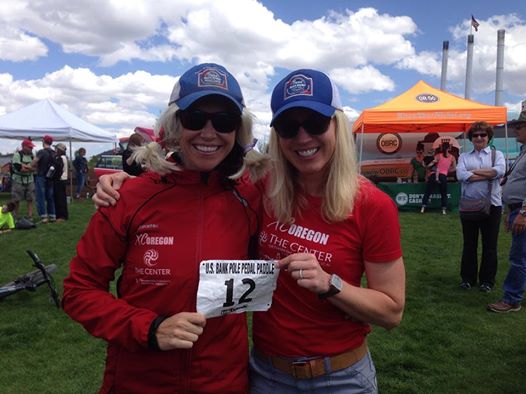
Sarah Max (r) with her “twin,” Amanda Porino, her support person who surprised Max by dressing as her for the Pole Pedal Paddle on May 17. (Courtesy photo)
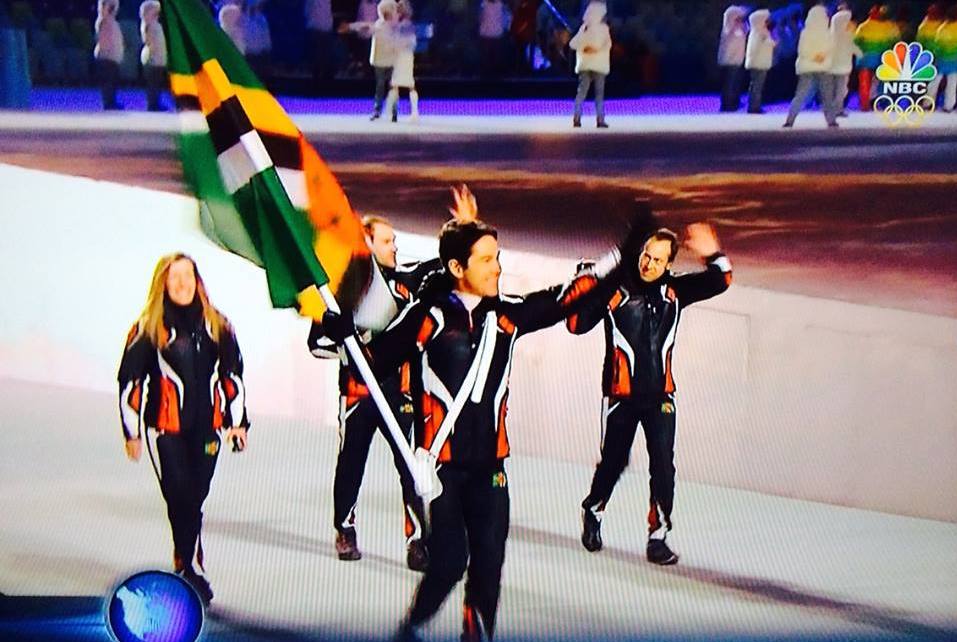
Team Dominica nordic skiers, the oldest Olympians at the 2014 Winter Games, Gary di Silvestri (with flag) and his wife Angelica Morrone (l), and coach J.D. Downing (r) at the Opening Ceremony in Sochi, Russia.
After the Olympics in late February, FasterSkier published a news blog about an American couple, Gary di Silvestri and Angelica Morrone, that represented the island nation of Dominca as cross-country skiers at the Sochi Winter Games. The post was based on allegations and reports that the couple pulled a fast one in order to get to the Games, and once there, did not compete.
We then reached out to their coach, J.D. Downing, who founded the XC Oregon nordic team in Bend, Ore., and is a well-known figure in the US master’s circuit, for his take. Downing’s frustration with the negative coverage his athletes received was apparent. What follows is an article based mainly on excerpts from his thorough response.
(Note: In the interest of writing the most-straightforward article, only Downing’s statements that pertained to the FasterSkier’s news blog were included in this article. In his original email, Downing addressed the issue of taking advantage of a loophole in the rules. A few more excerpts from Downing’s email that are relevant to the first comment on this article have been added under the heading ‘What Exactly is the Problem Here?’)
***
“You have two people that have fallen madly in love with cross-country skiing and the combination of their unbridled enthusiasm and personal resources has spread proven positive benefits far and wide in the worldwide XC ski community.” — J.D. Downing, XC Oregon head coach and Dominca Olympic coach
“I first had the pleasure to work with Gary and Angelica at the 2005 Oregon Spring Camp,” J.D. Downing wrote in an email. “Shortly after that camp they became supporters of the XC Oregon non-profit under our Friends of XC Oregon program. Gary and Angelica have been two of our many generous donors over the past eight fiscal years.
“Within the Friends of XC Oregon program, all donors to XC Oregon receive as benefits access to our XC Oregon workouts, camps, and training programs,” he continued. “So in that way I have coached Gary and Angelica for the past eight years. Beginning spring 2013 we mutually increased my time demands beyond the Friends of XC Oregon program to match the pressing requirements for Olympic qualification and the Games itself.”
What distinguishes di Silvestri and Morrone from the other wealthy donors Downing coaches was that they were attempting to qualify for the Sochi Olympics under the flag of the tiny Caribbean nation of Dominica. Forty-eight and 47 years old, respectively, at the time of the Olympics, Morrone and di Silvestri weren’t quite at the level for qualifying for the U.S. Olympic team, or, for that matter, the Italian Olympic team, as Morrone is Italian-born. (Di Silvestri is from Staten Island and the couple lives in Montana.)
The Rules
There are two separate issues on the table — what anyone chooses to think of Morrone and di Silvestri, and what anyone chooses to think of the rules they followed. Downing wrote that criticism of the rules was being improperly directed at his athletes:
“If it’s a matter of short versus long-term citizenship that bugs people, then feel free to take appropriate steps with your IOC representatives to suggest an international rule change that requires a certain period of time of holding citizenship before you can represent a country at the Olympics.
“If you have a problem with how specific nations legally grant citizenship, take it up with national leaders worldwide for the next Olympics. You know, the people that actually write and enforce laws in various countries.
“If you have a problem with how specific nations set their national Olympic participation criteria, again, please speak with the specific national leaders in question.”
Morrone and di Silvestri qualified according to the “B Standard” — nations that do not have any “A-Standard” athletes can still send one male and one female representative of each sport. However, the B-Standard qualification must still be met, which is a maximum of 300 International Ski Federation (FIS) points in order to enter the mid-distance classical races. Dominica had never previously fielded a team at the Winter Olympics, and their B-Standard cross-country ski spots were open.
“Now there’s been plenty of commentary and opinion about the level of skiing required to meet the Olympic B standard,” Downing continued. “I am perfectly OK with that conversation and if anyone is really bent out of shape about that standard then I’d encourage writing to your FIS and IOC representatives to voice your views. For example, you can argue for lowering the Olympic B standard to an average of 250 or even 200 FIS points. If a tougher ‘standard’ of the Games is your mission, those official entities are the right parties to lobby.
“But please understand just who you impact versus how little you accomplish by lowering the 300 FIS point average. The list of nationalities eliminated largely would be smaller, poorer, and/or snow-challenged. [The resulting pool of athletes will closely resemble] a typical World Cup race. So you’ll successfully make the Winter Olympics far less inclusive while changing nothing in terms of the overall pros and cons of the Olympic movement.”
How It Really Went in Sochi
The Deadspin article quoted in the article by FasterSkier had a great deal of personal criticism for the couple. Downing’s irritation with the negative coverage was apparent, beginning with the coverage of their Olympic experience:
“[That their Olympic experience was an] un-mitigated disaster is completely true. I take issue with how this Olympic experience was presented. Deadspin clearly painted the health of the athletes with a wide brush of suspicion, derision, mocking, and doubt. FasterSkier itself doesn’t exactly leave readers with an accurate portrayal by claiming Angelica just had a ‘broken nose’ and the sarcasm of Gary ‘didn’t get the memo’ on potentially tainted water.”
Downing described their untimely predicaments:
“On Saturday, February 8 Gary woke up with severe abdominal cramps so severe he could not walk nor even stand for more than a few seconds. […] Ultimately he was diagnosed […] as having a serious bacterial gastroenteritis infection. Our best guess was the water in our lodging as the culprit. The symptoms came and went for over a week. In the best of times he could ski, but felt very weak. At the worst, he was back to the day one misery and barely able to walk or stand.
“That very same morning of Saturday, February 8, Angelica and I were skiing on the race courses before the women’s skiathlon and she had a high speed crash into the fence on the exact same downhill corner of the ‘Red’ course that caused so many problems for many athletes in the early portion of the Games. In fact, the exact location of her crash was precisely where Anders Gloeersen hit the bottom of the same fence in the men’s sprint final and where Marcus Hellner and Sergey Ustiugov collided in the same race.
“Although the fence you could see on TV footage was padded, the padding ended just shy of the top metal cross bar (it’s a permanent fence). In her crash, Angelica hit her face right on that exposed cross bar which resulted in a heavy craniofacial injury with multiple fragmental open fractures. Most serious initially was the penetrated open crania-cerebral injury where surgeons were worried that bone fragments might enter her brain. She was transported by ambulance [and] quickly admitted to the Intensive Care Unit, and subsequently underwent four surgeries between the evening of February 8 and lasting until February 24.”
“The medical record regarding this crash provided by the hospital is comprehensive and without dispute. Yet the Deadspin writer actually goes out out of his way to characterize Angelica’s injuries as trivial and Gary’s infection as imagined — and in a bizarre twist insinuates they made it all up for some unspecified reason. Thus he was such a great ‘reporter’ that he supposedly uncovers pointless dirt dating back 30 years ago [including tax-evasion accusations in the Deadspin article], but he couldn’t be bothered to actually get an accurate account of one of the worst injuries to take place at the 2014 Winter Olympics? Even the accounts of Angelica having a ‘broken nose’ are horrifically incomplete in painting the true picture here. […] If you have just a broken nose, it’s painful, but rarely a serious medical emergency. Angelica’s injuries were Intensive Care Unit for the better part of a week serious. Four surgeries serious. In the hospital almost the entire Winter Olympics serious. But apparently not serious enough for accurate reporting. As I’ve already pointed out, the writer never bothered fact checking the medical realities drawing his credibility in all regards into total question.”
And as for di Silvestre’s illness?
“For Gary, his Olympic routine consisted of daily trips to the hospital to be with Angelica and dealing with the ups/downs of his bacterial infection. The morning of the men’s 15k (Friday, February 14) the abdominal cramps brought on by his infection returned with a vengeance. Even after the Endurance Village clinic treated him with every cramp-relieving medicine at their disposal, he was barely able to walk from the village shuttle to our wax cabin. […] it was literally everything Gary could do to make it around the stadium in a vain hope that Angelica could at least see him start (from her hospital bed). [The assertion that he made it] 300 meters is about right and yes, he collapsed off the track (so as not to impede other skiers in any way) before I could run around the stadium to assist him off the field of play.”
“To top off Gary’s erstwhile Olympic start, his race skis were stolen that afternoon from a credential-only ‘secure area,’ ” Downing added.
“Accountability in any writing matters. The original Deadspin account openly challenges Angelica was ever severely hurt or that Gary was ever seriously ill. Right there I don’t need any more proof that the writer in question wasn’t interested in honest and factual reporting. I know what happened to these people because I was there every second. The writer didn’t ask me. He didn’t ask the Dominica National Olympic Committee. He didn’t ask the IOC. The medical issues that confronted both Angelica and Gary were not insignificant sidebars. Any writer and any resource that doesn’t can’t get very basic medical facts straight simply cannot be trusted with anything that was alleged.”
‘What Exactly is the Problem Here?’
“It is a fact that Gary and Angelica were hardly the only athletes in Sochi with multiple past or present passports in their name. Multiple examples exist in both XC and biathlon. In several cases the athletes very openly switched national affiliation purely for athletic reasons. In many cases the athletic reasons involved a measure of direct financial gain to the athlete which is most certainly NOT the case for Gary or Angelica.
“I’m fascinated the vitriol leveled at Gary and Angelica that conveniently ignores the situations where many other athletes (including multiple medalists) gained citizenship for various nations with the clear and often admitted motive of, ‘I’ll get better support or simply have access to the Olympics if I switch to such-and-such country’. I know of no example where any athlete in these many other situations was then subject to the character assassination that Gary and Angelica have been through.
“Try as anyone might, no valid argument can be made that Gary or Angelica bumped someone else out of the Olympics. There was never going to be a Dominica Winter Olympic Team at all if they didn’t make it. They didn’t take a dime from the Dominica NOC. They covered every Olympic and National Ski Federation expense and would have happily covered more if ever required by FIS, the IOC, or Sochi organizers. The IOC and the Sochi O.C. were openly delighted they were there representing Dominica. So please tell me — what exactly is the problem here?
“Finally, I can guarantee the world that if there was any other Dominican citizen that really had a serious plan for making the 2018 Winter Olympics — Gary and Angelica would be the first in line to offer support. How many ‘legitimate’ athletes from other nations can say the same?”
Good People
Throughout Downing’s email he paints di Silvestre and Morrone as kind, generous, and hard-working.
“Both Gary and Angelica would have to be among the most impressive examples I’ve ever come across of near-total devotion to a sport. Any age. Any ability. Their work ethic is literally off the charts. More often than not I needed to warn them about working too hard or too much, which is often the case with the most motivated skiers of any age.
“Over eight years I honestly cannot think of anyone that got to know Gary and Angelica that has not expressed enjoying the positive energy that comes with being around them. But I can document a very long list of clubs, athletes, events, associations, fundraising campaigns, ski retailers, ski industry companies, websites (yes, including FasterSkier) that have all benefited from contributions, expenditures, participation, etc. by Gary and Angelica’s love of cross-country skiing.
“XC Oregon can document an extensive list of athletes, ski programs, and other worthwhile causes that our program has impacted and supported over the past eight years around the XC world. These positive efforts would not have been possible without the support of donors such as Gary and Angelica.
“In sum you have two people that have fallen madly in love with cross-country skiing and the combination of their unbridled enthusiasm and personal resources has spread proven positive benefits far and wide in the worldwide XC ski community.”
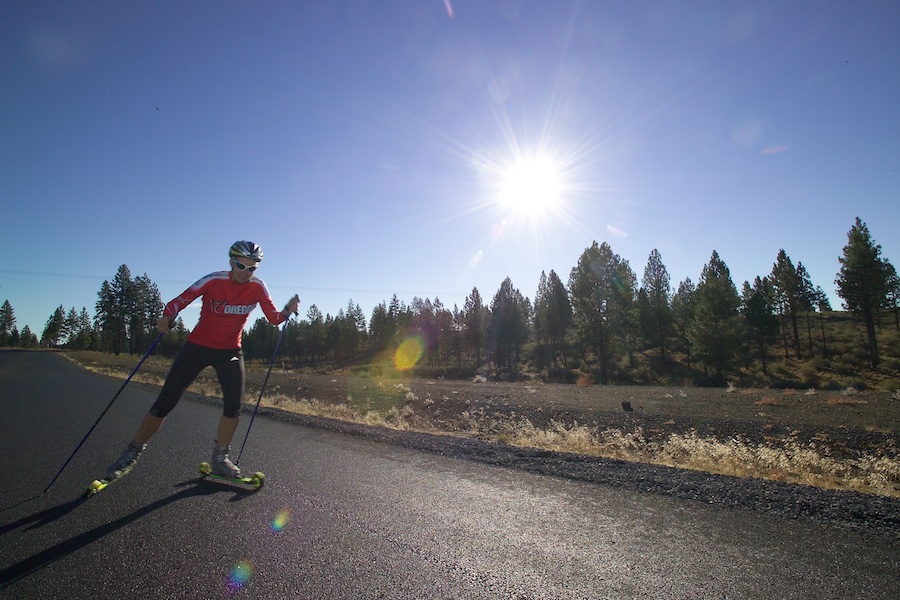
XC Oregon’s Sarah Max during a rollerski session near Bend, Ore. (Photo: XC Oregon)
Note: This is the 10th preview in our U.S. elite-team series, called the “The 12.” We asked coaches to tell us what’s new and whom to look out for this season, and we’ll publish additional previews in the coming weeks in no particular order.
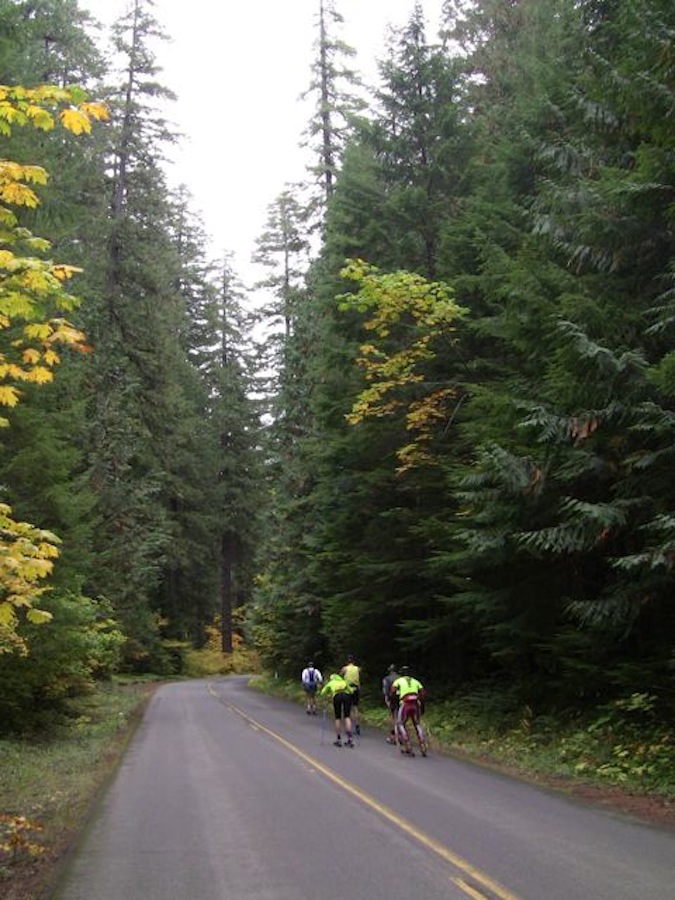
The XC Oregon squad during a rollerski last fall near Bend, Ore. (Courtesy photo)
National/International Elite Roster: Santiago Ocariz, Matt Briggs; Carolyn Ocariz, Sarah Max.
Associate roster: 12-15 additional associate skiers will join the roster come November, according to Downing, who is “still finalizing plans with a bunch of folks.”
Who’s new: Downingexpects several top regional associate skiers to come onboard, but not at the national/international elite level.
Who’s missing: Oliver Burruss, who’s “entering the ‘real world’ ” in Burlington, Vt., Downing writes.
Top results last season: A couple months before his first child was born, Santi Ocariz made the most out of the Noquemanon Ski Marathon in Marquette, Mich., winning the 50 k classic in January. He went on to win Bend’s pinnacle spring event, the Pole Pedal Paddle, in May just two months after his wife and teammate, Carolyn, gave birth to Sonia. As you can imagine, Santi didn’t get to train as much as he would’ve liked.
“I don’t think I have trained this little in a year since I was a junior in high school,” Ocariz wrote in an email after the race. “However, what I lacked for in time, I made up in effort.”
Max won the women’s race to complete the XC Oregon sweep, and in February, the 38-year-old topped the podium at the 58 k Mora Vasaloppet in Minnesota.
Coach’s comment:
“For 2013/14 we’ll have a bit of a ‘factory team’ feel with fewer full-time skiers than some years, but a whole lot of talented people involved,” Downing wrote in an email.
“Santiago and Carolyn Ocariz will be out of the state much of the year with school [in the Midwest], but it’ll be fun seeing what those two can pull off,” Downing explained.
The rest of the team will race “a mixed bag of events” for the duration of the season, mostly within the Pacific Northwest and at select marathons, and not so much at big domestic races like nationals and SuperTour series.
“Our big focus once this winter winds down will be attracting 4-6 new high performance athletes to target the national/international scene beginning Spring/Summer 2014,” Downing wrote. “Bend is an amazing spot so basing here for a few years (or longer) is rarely a tough sell. But we are also happy to incorporate athletes living anywhere in Oregon. The flexibility and quality of the XC Oregon system has stood the test of time so we know any skier than joins us is going to have what they need to reach their goals — whatever they may be.
“We have already banked resources to guarantee an exceptional level of financial and logistical support for new athletes for several seasons. The consistency of our support is amazing and a direct reflection of the quality of XC Oregon delivery over 16 years. Our incredible sponsors and patrons have believed in XC Oregon because we don’t try and be something we aren’t. We help skiers achieve their goals. We attract quality people. We constantly support our community. We do all this the right way. Simple as that.
Whether someone is interested in chasing the Olympic pipeline or marathons or a little bit of everything — interested skiers should visit xcoregon.org and feel free to get in touch at any time over the coming 8-10 months.”
Santi Ocariz bringing it home for a 49-second win at Saturday’s Pole Pedal Paddle in Bend, Ore. (Courtesy photo)
Seven years after discovering the annual Pole Pedal Paddle in Bend, Ore., Santi Ocariz couldn’t shake the urge to try it.
A 26-year-old Wisconsin native, Ocariz visited Bend during his college summers, fell in love with the area, and resolved to come back and one day compete in the alpine, cross-country, bike, run, kayak and sprint race.
Two months before last year’s big event, Ocariz and his wife Carolyn set out for their new home in Bend on rollerskis, raising close to $20,000 to feed impoverished children. They anticipated the 3,000-mile trip would take close to three months, but the couple sped up the pace to get Ocariz to Oregon for the PPP.
They arrived four days before. Ocariz ultimately reasoned he was underprepared in terms of training and equipment, and did not race.
This year, he was ready — maybe not in training hours, but definitely mentally. Last summer, Ocariz launched toward fatherhood when Carolyn became pregnant with their first child. He shifted his priorities to train less and work more in preparation for the hospital bills and additional expenses, and in March, welcomed baby Sonia to the family.
Suddenly, two-a-day workouts were no longer a thing, and he was lucky to ski once a week.
“I don’t think I have trained this little in a year since I was a junior in high school,” Ocariz recalled in an email. “However, what I lacked for in time, I made up in effort.”
Intervals and time trials become his bread and butter, and Ocariz worked with expert paddler Torsten Heycke on kayak-specific training.
He started biking in February to work on his weaker link, practiced transitions and graciously accepted a gift from his friends: a plane ticket to Bend for the event on May 18.
A week and a half before the PPP, the Ocarizes had moved to Moorhead, Minn., where Santi started an accelerated nursing program at Concordia College.
Suddenly, his initial urge to participate had culminated into a driving motivation to beat everyone else — including several defending champions. Ocariz knew his family could use the $1,000 grand prize for winning the elite individual race, and he remembered that as first place started to slip away last Saturday.
“Everyone crushed me in the beginning of the race,” Ocariz wrote of the alpine leg, which involves sprinting to the top of Mt. Bachelor to click into skis before navigating gates on the descent.
With little experience downhill skiing, Ocariz fell behind race leaders Andrew Boone, the 2011 winner, and 2010 champ Marshall Greene. By the start of the 8-kilometer nordic leg, he estimated they had 40 seconds on him.
Ocariz cut the deficit to 10 seconds by the end of the cross-country ski, and early in the 22-mile bike leg, passed Greene up front. A few minutes later, Greene regained the lead.
“Marshall destroyed me on the bike,” Ocariz wrote. “By the time I was out of the running transition, Marshall was 2 minutes ahead of me. From here I put my nose to the grindstone and began working on reeling him in.”
Three miles into the 5-mile run, Ocariz started to lose hope, but only for a moment.
“As soon as I reminded myself how much the prize money would mean for our family, I leaned forward, shortened my stride, and pushed harder,” he wrote.
Forty seconds behind at the kayak transition, Ocariz could see Greene. His friend and supporter, Heycke heaved Ocariz’s boat forward in the water, helping him gain 20 seconds. From there, Ocariz focused on staying smooth and paddling smart, gauging his distance from Greene and how hard he was working behind him.
“By the second turn-around buoy I had almost caught Marshall,” Ocariz wrote. “With about 200 meters to go I put in a surge and passed Marshall. I was able to put 5-10 seconds on him in that last sprint. When I hit the beach I burst out of the Kayak, flung my paddle and life jacket, and began sprinting for the finish. 800 meters later, at the finish, I was 49 seconds ahead of him.”
As a rookie, Ocariz had done it — winning the elite race in 1:44:35 over a slew of local favorites. Marshall was second and Boone finished more than six minutes behind in third.
“With my PPP inexperience and lack of ability to train as I have in the past, I was unsure of my ability to match up,” Ocariz wrote. “I was definitely the dark horse. … Winning the PPP in Bend is viewed similarly to how winning the Birkie is viewed in the Hayward area.”
Enough said.
***
For women’s runner up Zoe Roy, achieving a personal best in her hometown’s celebrated race was also significant. A 25-year-old skier currently training in Canada, Roy remembered first racing the PPP on a team when she was 9 or 10. She did it solo at age 12.
Zoe Roy near the end of Saturday’s Pole Pedal Paddle in Bend, Ore. She placed second for a personal best after friend and three-time winner Sarah Max. (Courtesy photo)
In 2009, Roy shared the individual podium with her mom, Muffy, a multiple PPP champion.
“She was second and I was third,” Roy wrote in an email. “Pretty sweet to be on the podium with your mom, though!”
She hadn’t raced it since. Back in Bend for an on-snow camp at Mt. Bachelor, Roy decided to enter the 2013 race a week before.
“I banked mostly on leftover fitness from the winter and tried to do a little a bit of everything just to get comfortable with all the different legs,” she explained.
Early in on Saturday, Roy led through the alpine and cross-country ski legs into the bike transition. Her friend Sarah Max caught her on the ride, but Roy got back in front during the run.
“I had about a 20-second lead going in to the paddle and she caught me!” Roy wrote of the kayak leg. “I think my body was so tired from everything else that I could barely hold my arms up, I didn’t know if I was going to make it!”
Zoe Roy (l) and Sarah Max the day before the Pole Pedal Paddle on May 18 in Bend, Ore. A Canadian skier originally from Bend, Roy placed second behind Max, now a three-time champion. (Courtesy photo)
A back-to-back champion in 2008 and 2009, Max claimed her third PPP title in 2:04:24, a minute and two seconds ahead of Roy in second. Another Bend resident, Mary Wellington finished third, nearly 5 1/2 minutes behind Max.
In a race packed with more than a thousand competitors between tandems and teams, Roy stressed the draw of racing individually.
“The individual is definitely the most team event out there when you factor in the number of people that helped me out, from my awesome support crew (my brother Tosch and my good friend from Bend, Matea) to all the people that I borrowed equipment from,” she wrote. “It takes a village!”
Now, it’s back to skiing, she explained. Roy is hosting fellow independent Canadian skiers Chandra Crawford, Amanda Ammar and Alana Thomas at her house in Bend for 10 days of training.
As for Ocariz, he’s already back in classes. After a season off, Carolyn has resumed full-time training and will race remotely for XC Oregon. Santi explained that he and Sonia, now 10 weeks old, will be her support crew.
“I won’t be training for or focusing on elite racing,” he wrote. “I hope to get to the opportunity to jump into a citizen race or two, but it is not going to be a priority. We have been thrilled with J.D. [Downing] and his organization of the XC Oregon team … The community and team are a perfect fit for us.”
Zoe Roy (RMR) leads Alberta World Cup Academy skiers Emily Nishikawa (c) and Kate Brennan (l) up a climb on the middle of their fourth of six laps in the 30 k classic mass start at Canadian Ski Nationals on March 24 in Mont Sainte-Anne, Quebec. Roy finished seventh to tie a personal best at Canadian nationals.
Maybe it was the transition to full-time racing or the fact that Zoe Roy was competing in her home nation last season. It could’ve been the back-and-fourth flights across the U.S/Canadian border, or one team’s hospitality that helped Roy reach new heights on the NorAm circuit.
Whatever it was, she wasn’t fighting it. After spending some 20 years in Bend, Ore., Roy, who turned 25 on Sunday, is moving to Canmore, Alberta. Starting Aug. 1, she plans to live and train at Canada’s cross-country epicenter with Rocky Mountain Racers (RMR), which took her in last year. Traveling with the club and taking advantage of its wax resources, Roy achieved her first NorAm podiums with second- and third-place in 10 k races, and tied her personal best at Canadian nationals in seventh.
Between races, Roy was studying at the University of Utah in Salt Lake City. In her fifth year there, she was done with collegiate racing and entering the pro scene as a founding member of StellaRacing – a Salt Lake-based women’s squad in its inaugural year. She was also in her first season with XC Oregon, making her club affiliation that much more confusing.
In committing to a domestic circuit, she chose Canada because she’s from there. Born in Ontario, Roy remains a Canadian citizen and doesn’t have dual ties despite growing up in Bend. She started last year with the West Yellowstone SuperTour, then spent the rest of her season in Canada (except for a convergence trip to Europe and local races in Salt Lake).
FasterSkier chatted with Roy on the phone last week shortly after her surfing vacation in El Salvador. Earlier this month, she and a childhood friend from Oregon flocked to the sea to learn the sport in a place they could do it every day. After fulfilling their goals and surfing under moonlit skies, Roy was back in ski mode in Bend.
***
FasterSkier: After more than a week of mostly surfing, are you a pro now?
Zoe Roy: Not a pro by any stretch, but I’m better than really bad. Took lessons the first few days to get the hang of it.
FS:What was the best part of your trip?
ZR: I’d say the highlight … was going surfing at night under the full moon. That and the fried plantains.
Zoe Roy working with a Fire and Ice Camp junior in late June at Mt. Bachelor in Bend, Ore. (MBSEF photo)
FS: Before El Salvador, you worked at the Fire and Ice Camp in Bend. How was that?
ZR: The day before we left, I was on snow. It was kind of funny going from that to surfing. … I coached for TUNA [The Utah Nordic Alliance] the week before [the Fire and Ice Camp] and then I did Fire and Ice for a couple days before I left. I was kind of an assistant coach for [that].
There were a ton of juniors there. It was pretty cool to be able to get all those kids together. At any age, it’s fun to see everyone else skiing, too. You see all your friends that you might not get to see the rest of the year.
FS: How long had you been back in Bend?
ZR: I came [back] after school at the beginning of June and I’m going up to Canmore in the beginning of August. … I actually graduated in May [with a degree in] exercise and sport science with a minor in entrepreneurial business and a TESOL certificate, which means I can teach English as a second language.
FS: Why did you decide to move to Canmore?
ZR: I had a good year last year and I got to travel with the Canadians a bit. I’m originally Canadian … so I thought I might as well move up there and spend the year skiing with them and see how it goes. That’s the main reason. I also have an aunt and uncle in Calgary so that’s nice, too. I’m on the team RMR, which I traveled with on the Canadian circuit last year. It’s based out of Canmore, so that seemed the natural place to go.
FS:How did your relationship with RMR start, and what about the team appeals to you?
ZR: They waxed for me at nationals two years ago so maybe that was the beginning of it, and then after that I got more connected with them.
It’s a fun team. They have the whole spectrum from juniors up to elite racers. Dasha [Gaiazova] is part of it and Andrea Dupont, those are probably the two main older girls on that team, and then John Jaques, the coach, is awesome, too. It’s probably a combination of who’s there and then John, too. I don’t know [new assistant coach] Mike Vierra too well, but he’s the new coach there, but I’ve heard great things about him, too.
I’m psyched to be [moving] up there. I feel like there’s a pretty solid group of, not just on that team, but the whole Canmore community. The [Alberta] World Cup Academy’s there so I’m excited to have that whole group of girls to train with. … That’s another big reason. I feel like it doesn’t get much better than that.
FS:When it comes to climbing the elite ranks of racing, why did you pick the Canadian route?
ZR: I think mostly because opportunities do exist for me to race in Canada. Those same opportunities don’t exist for me to race for the U.S. because I’m not a U.S. citizen, so I guess that’s the main reason. I thought, ‘If I’m going to see how fast I can race, I might as well go somewhere where there are opportunities to make teams’ … so I thought I’d go to Canada.
FS:We heard you were leaving XC Oregon, but what’s the status of StellaRacing?
ZR: As of this coming year we’re splitting up a few more different ways because it was really based out of Salt Lake. I’m heading up to Canada, Katie [Ronsse] is in PT school, Evelyn [Dong] is coming back to Bend.
It was great; we had an awesome time putting it together and have a team based in Salt Lake to work from and race with, but I’d say as of now, it’s splitting up a bit more. I’m sure some of us will still wear our suits at certain times, but I don’t know if it will be as much as a team as it was last year, but we had a great time doing it.
FS:What are your goals for this coming season?
ZR: Well, the World Cups are in Canada so if I qualified for that, that would be amazing, but who knows. If that could happen, that would be awesome, but other than that podiums at NorAms and another Scando Cup would be sweet, too. I don’t know exactly what the opportunities are for another Scando trip.
FS:What did you gain from the convergence trip?
ZR: It was cool to just race in Europe and see the other parts of the ski world. It’s good to race against those girls and see what level they’re at. I feel like just that in itself was a good experience.
[Note: After winning four state championships at Summit High School, Roy spent a year and a half in Austria training and racing at the University of Salzburg.]
FS: How did you feel last season went overall?
ZR: I was psyched about those [NorAm] results. What can I attribute it to? I don’t know exactly, but I mean, it’s hard to pinpoint one thing. I guess before that I was racing [collegiately] so I couldn’t come to Canada that much. I was on the NCAA circuit.
FS:What are your thoughts on truly making the next step to full-time racing?
ZR: It’s exciting. It’ll be interesting to sort of concentrate more on skiing than I really did before.
Matt Briggs leads XC Oregon teammates Jason Adams (c) and Ollie Burruss (l) during team relays during a training session in late May in Bend, Ore.
Note: This is the first of a quick-and-dirty preview series on elite teams in the U.S. We asked coaches to send their 2012/2013 rosters and tell us what’s new for the coming season. We will be publishing additional reports over the next few weeks. Teams are presented in no particular order.
National /International Elite Roster: Santiago Ocariz, Oliver Burruss, Matt Briggs;
Carolyn Ocariz, Stephanie Howe, Sarah Max, Jamie Woelk
Who’s new: Santi and Carolyn Ocariz (as the two confirmed additions, 1-2 more possible. Carolyn arrived just over a week ago on June 9).
“We are super excited to have them both here,” Downing wrote in an email. “Their addition obviously allows us to significantly boost our national/international elite presence, but just as important to us is the quality of the individuals. Just look at what these two did this spring [rollerskied across the country] — and more importantly why they did it [to feed impoverished children]. There’s also a big comfort level in that Santi has spent several summers in Bend and has a brother living here so the transition should be very smooth. It’s really a perfect fit all the way around.”
What else: With a PhD and all, Howe will likely compete in more marathons this winter after studying at Oregon State University in Corvallis last year on the western side of the Cascades.
While it’s unclear how much Marshall Greene will race, Downing was excited to welcome him back to Bend this summer with his wife and new baby. Greene spent the last couple of years in Wisconsin earning his Master’s degree.
XC Oregon (XCO) is also expecting to add 12 to 15 members to its associate roster.
Who’s missing: Zoe Roy will likely make the full switch to Rocky Mountain Racers (RMR) in Canmore, Alberta, in an attempt to make Canada’s international teams. She was affiliated with XCO last season while completing her undergraduate degree in Utah and also raced in Canada with the support of RMR. Given that Roy is from Bend, Downing will try to incorporate her whenever possible.
Top results last season: Burruss was eighth in the Boulder Mountain Tour and 20th in the American Birkebeiner 50 k skate, and both Burruss and Briggs had career-best SuperTour results last season. Max was the 19th woman the in the Birkie this year, and Roy notched four top-10 performances on the Canadian NorAm circuit, two of which were on the podium.
In all, a dozen XCO skiers tallied best-ever results last year, which “radically improved on anything they had done before,” Downing wrote. “We really take our role seriously as positive ambassadors for the sport in Pacific Northwest and there is no question last year was one of our best ever in that regard.”
Coach’s comment: XC Oregon is proud to celebrate its 15th season this year. According to Downing, it’s either the longest or second-longest continuously running elite-development program in the U.S. Aside from the high number of athletes that represented XC Oregon over the years, at least two dozen went on to coach nordic skiing.
“That more than anything probably reflects the 100% athlete-based approach of XC Oregon,” Downing wrote.
As for spring training, XCO skiers can enjoy at least another week on snow up at Mt. Bachelor, less than a 30-minute drive away.
“That’s a huge upside as athletes can maintain normal routines and yet still get the same quality of on-snow workouts as if we were shelling out thousands of dollars sending them to some remote spot,” Downing wrote. “I feel really good that the vast majority of the crew is in a comfort zone of how they’ll structure their training around everything else in life. We’ve also got some good training partner options this year that should be a big help. Bend itself is often a huge asset since there is a deep and incredibly talented pool of endurance athletes here.
“For the season I think we’ll find 2012/13 looking very much like the average year over the past decade,” he added. “We’ll have a nice mix of some notable SuperTour/Nationals results, some domestic and international marathons, and then the steady drumbeat of regional activity.”
Down the road in 2013, the team may restart a summer internship program for collegiate skiers, especially for graduating seniors interested in racing after college.
“We’ll be fundraising for that this summer and hope to roll out specifics this fall,” Downing wrote. “It’s also likely we’ll want to add 2-3 funded-level athletes in Spring 2013 so that’s always exciting to look forward to.”
Freeman powering through the penultimate leg of the Pole Pedal Paddle.
BEND, Oregon – It’s hard to imagine Kris Freeman as an underdog in a race that involves cross country skiing and running. But to this city’s residents, that’s exactly what he was on Saturday morning before the start of the 36th annual Pole Pedal Paddle: some Olympian who was trying to unseat the hometown favorite, Andrew Boone.
Boone had won the race – which combines downhill skiing through gates, roughly eight k of nordic skiing, 20 miles of biking, several more of running, a kayak course on the Deschutes River, and finally a half-mile “sprint” to the finish – in 2011 by three minutes over longtime nordic standout Brayton Osgood. With Osgood out of the picture this year, who could be against Boone?
“This is my weekend warrior event now,” Boone said in an interview after the race. “Bend came out to support me.”
But a few people were familiar enough with Freeman’s accomplishments on the U.S. Ski Team, as well as his competitive drive, that they wouldn’t count him out. One of them was Boone.
Freeman in the final meters of the cross country ski leg.
“There’s no doubt that he came in, he wanted to win, and we all knew that he was going to throw down a good race,” Boone said. “It elevated [the level of the field] for sure. I haven’t seen the times, but I bet I was faster than last year.”
Boone was faster, beating his previous time by about 50 seconds. In the end, Freeman won by 57 seconds in a time of 1:46:00, but it was a tight, tactical race from start to finish. Boone led through the alpine-to-nordic exchange and out onto the Mount Bachelor trails; at that point, Freeman wasn’t even in second.
That didn’t last for long, as Freeman predictably came charging by once he was back on his own equipment; Boone told reporters that it was cool to see such a strong skier flying past him. By the time Freeman reached the next exchange and was helped onto his bike and into his clipless pedals by U.S. Ski Team staff, he had a roughly 30-second lead. Sprinting off onto Century Drive for his net-elevation-loss trip from Bachelor down to the town of Bend, he was chased by shouts that Boone still wasn’t in sight.
But Freeman knew that his gap might not be enough. Of all of the sections of the race, the bike was what worried him the most.
“It’s only my fourth time on a bike this year, so that was hard,” Freeman told FasterSkier. “I’m riding Andy Fecteau’s time trial bike, just once, and going 50 miles an hour for 30 minutes is a little nerve-racking.”
Boone, meanwhile, knew that the biking section might be his only chance to regain the lead – so he attacked as hard as he could.
Freeman, with Mount Bachelor in the background, on one of the bike course's few uphills.
“I knew he was a good runner, and I haven’t been running well off the bike,” Boone said. “I wanted to get as much of a cushion as I could.”
Freeman was hoping to maintain his lead until the run, but Boone passed him with several miles to go, as the road finally flattened out and headed into town. Adding insult to injury, drafting is illegal in the race, so Freeman was unable to tuck in behind his competitor as he would in a ski race.
“I didn’t really like that,” Freeman said. But even if he had been able to draft, that didn’t change the fact that Freeman was definitely the weaker cyclist. “He looked really comfortable, and I was definitely suffering those last couple miles.”
The U.S. Ski Team athlete faced one other challenge, too. Police directed him the wrong way around a roundabout.
“I had to jump a curb to get back on the road,” Freeman explained. “I lost probably 20 seconds there.”
Freeman was still flying compared to the rest of the field; the pair added to their lead and it was clear that nobody else would be able to touch them (XC Oregon’s Zach Violett finished third in 1:49:39). Freeman crept up on Boone in the first section of the run, then sat on his shoulder for two miles before putting in a small burst to create a gap.
“It went how I hoped it would,” Freeman said of the late stages of the race. “I was able to put ten seconds on Andrew at the end of the run, and then I thought I’d be a stronger paddler, and I was.”
Freeman and Boone separated by just seconds in the run stage.
Freeman – who says that he spend roughly four hours in a boat every week in the spring for cross-training – extended his lead in the kayak portion, and the race was essentially decided before he even began the sprint.
“He’s a pretty strong guy,” Boone said.
He was gracious about the loss, and if he felt disappointment, he didn’t let it show.
“I executed the best race I possibly could have today,” Boone said. “My training was definitely not where it should have been this spring, so to race against Kris Freeman and to go back and forth with him, I feel really good about it, and he was the better man today.”
He even praised Freeman for making the race more competitive.
“Last year I had a lead off the bike and just held it, so this time it was fun to have to use tactics,” he said.
Boone is loosely affiliated with XC Oregon, a ski team based here in Bend. Due to his other commitments, he barely ever has time to ski; according to coach JD Downing, just hanging with Freeman for two hours was an accomplishment.
“Being sick for three months, working full time, being a parent, and going to grad school, that’s so amazing,” he gushed. “He has a lot going on, and with that big a load it’s no wonder why he was ill. To do that against – everybody knows how great an athlete Kris is. I’m probably as proud of him as any athlete I’ve ever had in fourteen years.”
As for Freeman? The victory knocks off a longstanding goal that he’s been frustratingly unable to accomplish.
“I’ve always wanted to do this race. I’ve been coming here since I was 17, and I’m always coming here either right before or right after it, and always wanted to do it, and now I have. The last couple days I’ve barely seen my team because I’ve been so preoccupied getting everything organized, so now it’s back to work.”
Carolyn and Santi Ocariz complete their two-month rollerski across the U.S., called Ski Across America, by rolling into the Pacific Ocean on Friday, May 11. (Courtesy photo/SkiAcrossAmerica.com)
When Carolyn and Santi Ocariz clicked into their rollerskis slightly more than two months ago, neither really knew what they were in for.
The Wisconsin couple heard plenty of stories about the places they’d travel through. They took to heart the warnings about crazy drivers, snakes and treacherous temperatures while crossing America’s heartland. It might not be hot when they left, but it could get brutal, and the elements could change 180 degrees by the time they reached Utah.
Husband and wife, Santi and Carolyn Ocariz celebrate the end of their Ski Across America journey, in which they spent two months and five days rollerskiing from Charleston, S.C., to San Francisco to raise money for Food for the Poor. (Courtesy photo/SkiAcrossAmerica.com)
Carolyn, 23, and Santi, 25, prepared as best they could. As they ticked off the states and thousands of miles, the two couldn’t have been more surprised.
Drivers frequently slowed down beside them and asked what they were doing. Rather than threaten to run them off the road, they were genuinely interested.
“It was unbelievable,” Santi said on the phone from San Francisco, where they finished their journey last Friday. “I think we were better accepted on the roads in the south than we were back in Wisconsin.”
The hospitality they encountered throughout their trip, Ski Across America, had been overwhelming, he said. Once people heard they were rollerskiing more than 3,000 miles across the U.S. to raise money for a charity called Food for the Poor, many strangers opened their homes to them.
In all, the Ocarizes raised an estimated $17,000 to $18,000 dollars to help feed children in impoverished nations. They visited at least 400 churches along the way to deliver packets with their message, which they asked pastors to read to their congregation for donations. With their trip’s website still up and running, Santi hoped more money would continue to roll in.
The newlyweds from the Midwest had come a long way since early March when they first started their journey at the Atlantic coast in Charleston, S.C. In two months and five days, they raised some $12,000, crossed more than a dozen states and visited friends and relatives along the way.
Spending about seven hours a day on the road – sometimes longer – the two often chewed off more than a 100 miles at a time. While traveling through Yosemite National Park on the last leg of their trip, a park ranger informed them 10 miles in that they couldn’t rollerski through it.
They popped out of their rollerskis and ran. After logging a total of six hours on foot, most of which was downhill and would have been much more pleasant on wheels, the Ocarizes arrived on the other side of the park the next day.
“The legs took a beating,” Santi said. “When we’re in shape for running, it wouldn’t be any big deal, but when you’ve been rollerskiing for the past two months, not really running, it was kind of a shock to the system.”
He said they were lucky to have even been able to use the road; it opened the day before. Avoiding the 750,000-acre park altogether would have added an estimated three days of rollerskiing.
They camped overnight in Yosemite and woke up the next morning to find chocolate missing out of Santi’s backpack along with his cellphone. Apparently, a raccoon dug both out and dragged the latter to an obscure place at the campsite. Someone later found his phone and planned to mail it to him.
“It actually ran off with my phone,” Santi said with a laugh. “It couldn’t have been anything else.”
Before Yosemite, the Ocarizes encountered a similar “blessing” at Lake Powell in southern Utah. When they arrived at the second largest manmade reservoir in the U.S. nearly 200 miles long, they learned the ferry across opened for the season that day.
“Otherwise we would have had to go who knows how far around,” Santi said.
After climbing to around 10,500 feet on rollerskis, Carolyn and Santi Ocariz realized a mountain pass to Cedar City in southern Utah was closed. They had to backtrack to Duckville, Utah, then farther back the next day. (Courtesy photo/SkiAcrossAmerica.com)
They would always remember the good fortune they encountered on routes like those, he said. At the same time, they’d probably never forget when they skied more than 30 miles out of the way to the top of a closed mountain pass.
To get to southern Utah’s Cedar City, Carolyn and Santi picked a road that looked pretty doable: 60-65 miles of not-so-tough terrain. On the way, they realized they misinterpreted the map.
“It turned into like a ten-hour skiing day,” Santi said. “The whole afternoon we were climbing, and as we climbed, it got colder and rain turned to sleet and snow and the wind was blowing in our face.”
Alternating between rollerskiing and driving their Subaru, the two arrived at the top of the pass nearly 10,500 feet above sea level. There, they saw a gate across the road indicating the pass was closed.
“That was a demoralizing moment,” Santi said, jovially.
It was already getting dark and they had to backtrack to the next town. There, a landslide had closed an alternate route. They called it a night and drove farther back to an open road the next day.
Looking back, Santi recalled some of the most beautiful places they rolled through: Yosemite, Taos in New Mexico, the redwood trees and mountains near the California coast, and even the south despite its 88-degree days with 90 percent humidity.
“Sometimes the outlook of the south is, oh, it’s dangerous and weird people, but it was completely the opposite,” he said. “You won’t find any nicer places or communities, I don’t think, than down there.”
He and Carolyn bathed in mountain streams, at truck stops and campgrounds, but at the end of their trip — about 3,500 miles total — they soaked up the Pacific. With Santi’s cousin Alec biking alongside them for the last 30 miles while their friend Judy Krueger drove the car, Santi and Carolyn arrived at the West Coast and rollerskied right into the ocean.
Santi and Carolyn Ocariz complete their two-month Ski Across America by rollerskiing into the Pacific Ocean near San Francisco on Friday, May 11. (Courtesy photo/SkiAcrossAmerica.com)
“It was pretty awesome,” Santi said. “We had both been looking forward to completing the trip but at the same time it was like, what now? The last two months had been just all rollerskiing and suddenly it came to an end.”
They had memories to hold onto, friends like Rebecca Dussault and her husband Sharbel to thank for joining them for a day and a night.
They met a man running across the country for the American Heart Association (willpoweredrun.org) and even watched Tad Elliott mountain bike race. The spoke at churches on weekends and had plenty of people to inform that they finished.
Finishing up some computer stuff at his relative’s home in San Francisco, Santi said they were preparing for the next step. A member of the Central Cross Country (CXC) Elite Team for the last two years, he decided months ago to join XC Oregon in Bend.
Also a former CXC member, Carolyn would move there to train with the team as well. She was flying home to Wisconsin on Wednesday to spend time with family and gather their belongings before driving west once more. In June, the two will celebrate their one year anniversary.
Santi said Bend was a destination that had been on their minds for years. He spent several summers training there while in college at the University of Wisconsin-Green Bay. Both born in the Midwest, he and Carolyn viewed their cross-country trip as the best way to get there.
“Bend is amazing. It’s a training mecca,” Santi said. “I think they still have ten feet of base snow so they’re gonna have snow until who knows when in July. So we’re going to be ditching our rollerskis and getting back on snow for a while.”
More appealing was the amount of people they could train with, which included elite runners as well as skiers.
“There’s just a very good crowd of fit and enthusiastic people,” Santi said. “Even though the team is smaller we have many more people to train with than Hayward.”
Part of the reason they finished their anticipated three-month trip earlier than expected was so that Santi could get to Bend sooner and Carolyn could spend more time at home. She would be meet him in Bend in a few weeks, he said.
On Saturday, Santi planned on racing the Pole Pedal Paddle in Bend with his brother Javier. After that, he’ll jump into training with old friends at the U.S./Canadian ski team camp there.
“I feel great, honestly; I have a ton of energy,” he said. “The body adapts. It gets stronger and I definitely feel very strong right now.”
For some, two months of nonstop rollerskiing might be draining. In his case, so many easy-distance days in a row gave him the rest he needed.
“In a way this trip was training, but I guess we didn’t consider it training,” Santi said. “We were just kind of doing it for the fundraising aspect of it.”
Carolyn and Santi Ocariz about to embark on a three-month rollerski across the United States to raise money for Food for the Poor. The Midwest couple, formerly of CXC, left Charleston, S.C., on March 8. (Courtesy photo/www.skiacrossamerica.com)
With the Atlantic Ocean to their left and the Pacific Ocean more than 3,000 miles to their right, Carolyn and Santiago Ocariz started striding toward the latter, one at a time across the United States.
The newlyweds from Wisconsin weren’t entirely sure where they were going, or the reaction they’d receive while rollerskiing across states like Alabama and Mississippi, but they had a tentative route and plenty of inspiration to keep them going.
Every mile they rollerskied meant more money for those starving in South America, Central America and the Caribbean. If they rounded up $36 dollars a mile, the cross-country ski racing couple could raise $108,000 for Food for the Poor and feed about 3,000 children for a year.
That notion kept Carolyn, 23, and Santi, 25, brimming with excitement before starting their anticipated three-month journey in Charleston, S.C., on March 8. After nearly two weeks “off” since their last race of the season at the American Birkebeiner in Hayward, Wis., where Carolyn won the 54-kilometer classic race in her debut and Santi was 11th in the 50 k skate race, both were ready to get moving again.
Formerly of Central Cross Country (CXC), the two decided to forgo the last month of the racing season for the sake of charity and favorable weather. They chose a southern route to avoid snow and hoped to make it to their destination in San Francisco before temperatures became unbearable, passing through places like Georgia, Arkansas, Texas and New Mexico along the way.
After racing in their former hometown of Hayward, they packed up, enjoyed one massive snowstorm and left for good. By alternating between rollerskiing and driving their Subaru Outback, they planned to make it to San Francisco by June. Soon after, they would retrieve their belongings from their parents’ homes in the Midwest and move to Bend, Ore., where they planned to start training with XC Oregon.
Dreamt up in December and named “Ski Across America,” the trip turned out to be multifaceted. An unusual feat at first glance, rollerskiing across the country required both outside support and inner drive. The couple hoped to garner the attention of churches and the charitable, and speak about their cause whenever possible – even if after 50 to 70 miles of rollerskiing a day.
With between $4,000 and $5,000 dollars raised at the start of the trip, Carolyn said they hoped to round up the majority of funds on the road. While the journey was uncertain, along with night-to-night accommodations and road conditions (they had to navigate a dirt path on the first day), both looked forward to the high points ahead: meeting new people, eventually moving to a new place and helping others in the process.
***
FasterSkier caught up with Carolyn and Santi by phone the night before they left Charleston to discuss some of the details of the trip.
FasterSkier: How did you pick your route?
Carolyn Ocariz: Santi picked a starting point and then an ending point, and then he picked the route from there. I think it all actually happened because he was able to make this contact [with a friend of a friend of a friend in Charleston]. Charleston’s a really historic city and we’ve come to find that it’s an amazing, beautiful, wonderful city. Even the people that we’ve met so far are just like, ‘We’re so excited that you’re starting in Charleston.’ It’s great and it’s really cool because everyone here is so friendly and it’s definitely a great place to start.
FS: Had you been to Charleston before and what’s the weather like there?
CO: It’s our first time in South Carolina actually. It’s in the lower 60s, upper 50s; pretty warm with cool breezes.
FS: I heard Hayward got dumped on (1 ½ feet of snow) before you left. What was that final ski of the season like?
CO: It was weird but at the same time not because I’ve had this thought in my head so long that I knew that we were going to be leaving the snow soon, but it was exciting. I think the Birkie was a really good way to end the season, and then I think I was ready. I mentally had prepared for the warmer weather. … We’re both like, ‘This is great!’ Warm weather.
Santi Ocariz: It was a bit difficult [to cut the season short], but I don’t know when else we would be able to do it, to have that chunk of time. It was a bit of a sacrifice but we definitely think this is a much cooler way to spend our time and our efforts, actually being able to help the people that have nothing. It was a little difficult but now that we’ve actually pulled the trigger and gone with it, it’s amazing.
FS: How did you come up with the idea for this trip?
CO: Ever since I met Santi in college, I knew that he was really into doing adventurous things and I really liked that about him. I always like doing pretty exciting, adventurous things, but never had the courage to actually plan them and do them, but I knew that he always goes through with them.
We talked about this actually before we were married. We had thrown around some ideas and made a goal/dream book and it was pretty cool because this was actually in it. I had no idea if it would ever come about and the idea came back again and we talked about it.
SO: We always thought we wanted to do something like this. I was thinking it would be a good idea to do it earlier this spring just because we’re going to be moving but I would definitely say it was both of our ideas.
CO: Our friend Abe Clark ran across the United States a few years ago, and Santi and I just thought that was amazing and what a great thing he was doing for a wonderful cause [Living Water International, which brings safe drinking water to communities in need]. We had kind of thought in the back of our minds that someday it would be really fun to do the same thing, but for our sport and rollerski across the United States.
SO: We just thought, ‘We’re not tough enough to run it, but it would be pretty cool to maybe rollerski sometime and do it for a charity.’
CO: [In] early December, we had talked about it and we decided, ‘Yes, we are gonna do this,’ and we started telling our families and then we started telling our friends, and we started spreading the word. We got our website up and the word started spreading more after that.
FS: What’s a dream book?
CO: I actually started it in college [University of Wisconsin-Green Bay]with a professor as an extra-credit project [and changed with it Santi to make our goal and dream book]. We have a bunch of things in there and this was actually one of them. I had forgotten about it until I looked at it and I showed him, like ‘What do you know? We had this in the plans years ago!’ So that was really cool to look back on that.
FS: How did you choose Food for the Poor as your cause?
CO: Santi’s brother Javier told us about this because they’re the most efficient nonprofit that helps people with 96 cents of every dollar going straight to the cause. We have our own expenses and we want to have as much money going to the cause as we can, and we researched them and thought they were a great organization that we wanted to support.
FS: How will you go about raising money?
CO: While starting in Charleston, we’ve dropped off information at close to 10 or 12 churches with hopes that they’ll read our story and hopefully inspire some donating to the cause. We hope to do that in every city that we go to in hopes that they’ll be inspired to give to the cause. We’ve definitely had a really great start so far. We had people giving before we even began, which is really awesome to see.
FS: What motivated you to do this now?
CO: Since we’reboth done with college now and we’re pursuing professional skiing, we decided that this is a really good time in our lives. We don’t have anything tying us down. We don’t have set jobs. We don’t have a house or anything like that so we figured, if we want to do this, this is probably the best time to do it and also, we had been wanting to do something to help a lot of people. We thought this would be a great thing to combine something that we love to something that will help a lot of people.
FS: How exactly will this work, rollerskiing across the country on your own?
CO: One of us will ski and one of us will drive close behind and the plan is to hit between 50 and 70 miles a day. Hopefully each day we’ll at least ski five hours between the both of us, and some days it may be more, some days it may be less. We’ll just switch off. I might ski for an hour and a half and switch off with Santi and he’ll ski however long he’d like to until we reach what we think is a good amount for the day. Then we’ll go into the nearest town and try to talk to people after that and set up a place to camp and sleep for the night.
FS: How will you make contacts or spread the word?
CO: There are usually people in the [church] offices and we’ve been going in and dropping off [printed information]. [We’ll see] if there are any rotary clubs or schools that wouldn’t mind us speaking, like maybe giving some presentations, dropping off some information to spread the word.
FS: How many days a week do you plan to rollerski?
CO: Probably six days. We definitely will plan on taking one day off a week, but it depends week to week if we’re really feeling tired. It also depends too how the roads are. If some sections are a little bit rougher, we might do more toward 50 miles a day, but then we’re thinking once we get closer to the West Coast, there will be more deserts. We’ll probably crank out a little bit more with a lot more open roads.
FS: What kind of reaction or support have you received?
CO: Everyone has been really supportive and really excited for us and they’ve been praying for us and telling us that they’re going to watch us the whole way as we blog. It’s been awesome, even just speaking in our hometown churches back in Hayward and Spooner, people were so excited and really appreciative. This one gentlemen got really emotional telling us how great he thought what we were doing was. Things like that make us really excited and pumped to get out there to do this.
There’s a lot of people that we’re just really appreciative of the generosity they’ve had for us and the organization.
[Note: The Ocarizes have several sponsors, including V2 Roller Skis, New Moon Ski & Bike Shop in Hayward, and Wilson Electronics. They said their Outback was decked out in stickers.]
FS: What else do you need?
CO: Right now the only thing would be like gas cards because gas prices have gone up … but otherwise I think we’re good. [Visit skiacrossamerica.com to donate.]
FS: What’s the sleeping situation like?
CO: We’re hoping to sleep in churches along the way. … We know that our friends know people willing to open their doors and let us in, if that happens, that’s awesome but mostly churches and camping because it’s going to be a lot of really beautiful camping places along the way. If need be, we’ll sleep in our car.
FS: And food?
CO: We have a box of food. We’ll just buy stuff at the grocery store and we have this little camping stove and camping equipment and we have a car-food heater so we have stuff we’ll make. We’ll eat rice and beans and fruit and normal stuff we’ll just cook along the way.
FS: How did you make money to support yourselves on this trip?
CO: I worked [at Rivers Eatery in Cable, Wis.] since last summer, and [Santi and I] also worked at New Moon. Santi painted five paintings of Vegard Ulvang, [which Ulvang signed], and he sold them during the Birkie, which ended up raising a lot of money for our expenses for the trip.
FS: What are your thoughts on moving to Oregon?
CO: It’s a pretty big transition, but it’s exciting. Santi’s from Spooner, [Wis.,] but he spent a lot of summers out in Bend training in college, and I’ve been there to visit him. We really love Bend and we always said we wanted to live there for at least a year and we figured this would be a good time to do that.
[Note: Santi spent the last two seasons training with CXC and Carolyn leaves the team after one year.]
FS: Do you plan to mostly skate or classic ski on the road, and what kind of looks are you expecting from southerners?
SO: Mostly classic because the roads might be busier. We don’t want to take up that much room on the roads just to be safe. … Most people out here don’t even know what it is or never heard of it [rollerskiing]!
FS: I know you do this for a living, but how hard do you think this will be physically?
SO: Your body gets in shape. There are people that bike across the country in eight days and ran [across]. It sounds crazy but then when you look at other things, it’s not that crazy.
FS: What are you most excited for?
SO: Everything I guess. It already has begun to be a pretty awesome adventure.Just seeing things getting to meet new people, see new roads, national parks; neither of us has been in the majority of them, so it’s going to be an awesome experience.
Ladies, come have fun on your skis! Photo: Ski for Women Anchorage.
On Saturday, January 28 a brand new XC ski & snowshoe event will take place at Oregon’s Mt Bachelor Nordic Center. The inaugural Tour for the Heart presented by Heart Center Cardiology & St Charles Health System is a 5km celebration of women’s winter fitness created to educate and fundraise for women’s heart disease — America’s #1 killer.
The Tour features a gentle and scenic 5km route starting from the upper Mt Bachelor Nordic trails perfect for any level of XC skier or snowshoer. Costumes are encouraged with special prizes for organizations and schools with the largest number of participants. Yummy (and healthy) treats, music, and merriment will also contribute to making this a one-of-a-kind party in the snow for a great cause.
For more information and to sign up, visit TourForTheHeart.org. All net proceeds from the Tour for the Heart will go to the American Heart Association.
While much of the northern hemisphere has been struggling with little to no snow thus far in the 2011/12 winter season, the 2011 Oregon Fall Camp held at Mt Bachelor & Bend, Oregon has thus far been a practically perfect exception.
Beginning last Thursday (December 1), the first five day block of the two-part Camp enjoyed the best of all snow/weather worlds. A nearly three foot base and over 25km of groomed trails took care of the snow side. For weather, every Camp day thus far has featured brilliant sunshine, highs into the 30s, and rapidly decreasing winds.
According to Camp Founder and XC Oregon Coach J.D. Downing, this unlikely December snow/weather cocktail has produced one of the best Oregon Fall Camps on record.
“I’ve done this camp for over a decade now and thus far this is got to be up there for practically perfect weather and snow,” says Downing. “We’ve got classic skiers still on kick wax with just some binder underneath. For skating it’s fast, but you still get good purchase. The short days have kept a certain amount of powder out there that is still getting tilled in. No obstacles whatsoever on the trails. It’s really easy for both the campers and coaches to just focus on productive clinic sessions. Based on everything I’m seeing and hearing — it’s very likely we have as good or better skiing here than anywhere else in the world right now.”
Featuring a program designed specifically for master skiers, since 2001 the Oregon Fall Camp has been a staple of the early season North American camp scene attracting up to 100 skiers per year from throughout the U.S.
The Oregon Fall Camp continues December 7-11 with a limited amount of space still available for interested individuals. Visit www.xcoregon.org for complete information and daily updates.
You Call This "Spring" Skiing? – Here In Oregon, Yes We Do! Photo: XC Oregon.
Registration is open to the general public for the 2011 Oregon Spring Camp taking place May 26-30, 2011 (Memorial Day weekend) at Bend/Mt Bachelor, Oregon.
Designed primarily as a master/citizen XC ski camp, junior skiers with a chaperone adult camper are also welcome. Due to carefully limited enrollment numbers, this camp is recommended only for skiers at intermediate and above skill levels.
Featuring on-snow morning sessions and a variety of optional events including dryland clinics, an evening training plan workshop, and ski specific physiology lab testing — the Oregon Spring Camp is one of the most unique ski educational events in the world.
Coaching for the camp will be led by J.D. Downing, Coach of the XC Oregon elite team and National Director of the American XC Skiers masters association. Downing will be assisted by a variety of local athletes and coaches.
With over 12 feet of snow base still reported at the 6300 foot elevation and spring Nordic Center operations continuing through June 20 this year, prospects for continued excellent spring skiing at Mt Bachelor for at least the next five weeks look promising to say the least.
Since 2001, Oregon Fall and Spring Camps have gained an international reputation as some of the best ski technique and fitness events in the world. Campers of all ability levels (including numerous National and World Masters champions) annually rave about their progress and information gained at Oregon Camps.
Highlighted by a fun and inclusive atmosphere as well as small group sizes, the goal of every Oregon Fall and Spring Camp is to give every participant the best possible experience to help further their enjoyment of the world’s greatest sport.
As with the traditional Oregon Fall Camp held every December, this year’s Spring Camp event will also offer the ability for campers to name the exact number and sequence of days they’d like to attend.
Complete information and registration materials for the Oregon Spring Camp can be found at www.xcoregon.org website.
Lillehammer, Norway: Stanislav Rezac (CZE) won the exhilarating sprint finish in the men’s elite wave of the Norwegian Birkebeiner Saturday. He polished off the 54 kilometers from Rena to Lillehammer in 2 hours, 39 minutes and 54 seconds. Jörgen Brink (SWE) was right on his tails, finishing in 2:39:55, with Jerry Ahrlin another second back for third place.
“I had fantastic skis, super glide and perfect kick the whole way,” said Rezac, who skis for the Madshus Marathon Team.
In the women’s elite wave, Seraina Boner (SUI) won by almost a minute. She clocked in at 3:11:17, with Jenny Hansson (SWE/NOR) posted 3:12:05 for second place. Sara Svendsen (NOR) was third in 3:12:09.
“I really had to fight for it. This is probably the hardest course I’ve ever done. It’s up and down all the time and there is no place to recover,” Boner said to langrenn.com after the race.
“I had really good skis, and I’m in great shape right now, so I really hammered the uphills. I think that was the difference between first and fourth place today,” Boner explained.
Stephanie Howe (XC Oregon) was 17th in the FIS elite women’s wave, posting 3:38:29 for the 54-kilometer course. Brayton Osgood (XC Oregon) finished in 3:02:38 and earned him 24th place – the same as in the Engadin Ski Marathon last weekend. Teammates Taylor Leach was 33 in the 25-29 age category while Sarah Max was 11 in the 35-39 bracket.
Postcard beautiful weather and solid tracks made for an enjoyable day across the mountains for all participants. The Norwegian Birkebeiner was filled to capacity, a maximum of 16,000 skiers, already in October, less than an hour after online registration opened. Complete and searchable results here. http://resultatservice.birkebeiner.no/sok_resultater2.php?arr=2&per=2011
Stephanie Howe (left), Taylor Leach and Sarah Max (right) at the 2011 Engadin. (Photo courtesy of Howe)
The XC Oregon skiers posted solid results at the Engadin Ski Marathon in Switzerland last weekend and are ready to take on the Norwegian Birkebeiner on Saturday.
Now fully adjusted to the time change, the XC Oregon racers are excited to race from Rena to Lillehammer, 54 kilometers in challenging, exposed, open tundra terrain with a 3.5-kilo backpack. The venerable event that has been a staple on the calendar for almost 75 years.
Brayton Osgood, 29, is coming off a solid performance at the Engadin last weekend where he was the top American and finished 24th overall, is excited about the Birkie and hopes to build on that experience on Saturday.
“For the Birkie I have pretty much the same goals as I had going into the Engadin. I want to ski with the lead group until the race gets serious, and then put out a good effort from there to the finish,” Osgood said to FasterSkier, noting that at the Engadin, the only thing missing was enough juice for the last couple of kilometers.
“So, if I can finish things off a little better than I did at ESM, I’ll be very pleased, but mostly I want to make it to the finish and have some good memories when it’s all said and done. I won’t say I want to have a good time out there, because that’s a pretty tough standard to live up to during a race,” Osgood added.
(Article continues below the photo)
16,000 racers annually enter the Norwegian Birkebeiner. (Photo: Inge Scheve)
Something a skier has to do
While Osgood has tried his hand at the Birkie before, his XC Oregon teammates Taylor Leach, Stephanie Howe and Sarah Max are new to the legendary race.
“As a skier, the Norwegian Birkie is one of the races you have to do in your lifetime,” Howe said.
With her previous marathon results, including winning the women’s freestyle Gatineau Loppet in February, Howe has landed herself a spot in the FIS elite wave. That certainly adds some performance pressure, but Howe still wants to enjoy the experience.
“I hope to have fun! I am starting in the elite FIS wave, so I’m a bit nervous. It should be fun though, I love climbing, and I hear there should be plenty of that. The biggest challenge for us will be to select the correct skis and wax,” Howe explained.
Less pressure
Leach and Max said being new to the event adds some uncertainties, but also cuts down on the expectations and self-inflicted performance pressure.
“I have never done the Norwegian Birke before, but I have wanted to do this race for a long time. so I am really excited, a little bit nervous because it seems like a challenging course. As I have dedicated most of my winter to coaching, I do not have many expectations. My goals are to ski technically well, have a smart race and enjoy the experience,” Leach said to FasterSkier.
The same is true for Max.
“I’ve never done the Birkie. I don’t have much in the way of expectations, which is the beauty of doing a race that is completely unfamiliar,” Max said.
Additionally, the Norwegian Birkebeiner will represent some extra challenges for Max, who is fairly new to classic skiing. Given that the course covers 54 kilometers of varying, exposed and challenging terrain, Max is hoping for good kick from Rena to Lillehammer.
“This is only my fourth or fifth classic race ever. My hopes are to have good kick throughout the race,” Max said.
(Article continues below the photo)
Being new to classic skiing and new to the Norwegian Birkebeiner, Max (XC Oregon) is hoping for wax conditions a little less tricky and frantic than these. From the start at Rena in 2007. (Photo: Inge Scheve)
A legendary race
Since the inaugural Birkebeiner race in 1932, the Norwegian Birkie has only been cancelled seven times, most of them due to World War II (no race in 1941, 1942, 1943, 1944, and 1945).
But in 2007, when the XC Oregon trio Brayton Osgood, Marshall Greene and Zach Violett, attempted to cross the mountains, the Birkie was cancelled due to blizzard conditions, high winds and literally no visibility in the open. The racers in the first couple of waves, which were allowed to start, were called down from the mountain and brought back to the start at Rena.
XC Oregon's Birkie crew in 2007: Zack Violett (left), Brayton Osgood, and Marshall Greene (front). They were turned around early. (Photo: Inge Scheve)
That first wave in 2007 included the XC Oregon skiers, who said they encountered head winds so strong that it was hard for even large skiers to make headway into the wind, let alone stay on the tracks that quickly disappeared from windblown snow on the tundra.
In 1948, the owners of the event could not agree on whether to develop the Birkie into an elite competitive race or focus on participation and recreational skiers. The race was not held, but the owners worked out their issues and now the Birkie is a mass-participation event, maybe the largest and best-known ski race in the World.
The lure of the marathons
For Leach, 25, the European marathons represent crowds and atmospheres unmatched anywhere in North America.
“The big European marathons are a different experience to racing the US, there are so many people. Even our biggest race, the American Birke, is not even close to the size of many of these races. Although when it comes down to it, racing is racing, regardless of where you are,” Leach said, explaining that as a junior coach with the Mount Bachelor Sports Education Foundation in Bend, she doesn’t have the opportunity to do many races for herself in the meat of the season.
“The Engadin and the Norwegian Birke were the only races that I was planning on doing this year, I did get to race at Crescent Lake a few months ago and I may be able to race the Great Nordeen but these European races were really the focal point of my winter,” Leach explained.
For Max, 36, now a veteran of the European marathon circuit, the European marathons have become the main focus of the season. But equally the overall experience is easily just as important as the race aspect.
“I’ve done about half a dozen European marathons now, and while I consider them my main focus, the races are really just a good excuse to travel around, meet interesting people and eat euro breakfasts,” Max said to FasterSkier.
Stephanie Howe won the 2011 Gatineu Loppet (Photo courtesy of XC Oregon)
For Howe, 27, the European marathon races are the reward after a long domestic season, and the European racing experience is icing on the cake.
“They are kind of a bonus at the end of the season. I didn’t have a lot of expectations since I haven’t raced in Europe before. I’m also still new to the marathon distance, but I am learning. In terms of overall season, these races were something I was looking forward to all year,” Howe said.
Return on Investment
In Downing’s opinion, ski marathons are a great return on investment for athletes who can’t do a lot of travel to follow the USSA SuperTour or Canadian Nor-Am series, but want to race a stacked field. For many of the XC Oregon racers, the marathons serve as motivation, variety and a season goal.
“For any athlete that isn’t interested in the SuperTour-format races and prefer longer events with guaranteed field strength, the American Ski Marathon Series domestically and World Loppet internationally are the way to go. Particularly for female athletes, or any athletes with limited travel time, the value of the marathon circuits is super hard to beat,” Downing said.
For XC Oregon as team, marathons are one more way get exposure and experience.
“What we (as a team) are getting out of the World Loppet starts is keeping athletes motivated and excited plus many great to good results over the years,” Downing said to FasterSkier.
Downing lists off that just this season, XC Oregon has placed four female athletes in the top ten at World Loppets: Evelyn Dong third place at the American Birkie, Kristina Strandberg’s Engadin Ski Marathon eighth, Sarah Max’s fourth at the Gatineau Loppet freestyle and Stephanie Howe’s first place in the Gatineau Loppet classic.
Brayton Osgood’s 24th place in the Engadin is just one example of how deep the field is in the FIS Ski Classics, said John Downing, the XC Oregon Program Director. Osgood, 29, finished in 1 hour, 43 minutes and 11.9 seconds. Fabio Santus (ITA) in second place finished in 1:42:16.3. Remo Fischer (SUI) won the race, clocking in at 1:39:51.3.
“Brayton’s race was not even a minute out of second place and 30 seconds or so from the top-15, so the men’s field was super tight. Given how he’s had to ski himself into form all season from a wicked back injury late in the fall, I thought that was a great result,” Downing said.
Perfect prep
Osgood landed in Switzerland with plenty of time to prepare for the Engadin and get over the time change and jet lag.
“I was in Switzerland for a week before the Engadin. Switzerland was great,” Osgood said to FasterSkier, citing perfect weather and plenty of skiing right out the door. “I can’t imagine a better way to spend the first week of March.”
(Article continues below picture)
Perfect conditons in the Alps. Until race day. (Photo courtesy of Brayton Osgood)
Trouble from above
Leading up to the race was a week of perfect, stable weather conditions: no clouds, evening lows from -6 to -10 Celcius and afternoon highs from +5 to +10 in the sun. Despite the high afternoon temps, the snow stayed pretty cold and dry for most of the week, only starting to transform on Friday afternoon and then a little more on Saturday when the clouds started to roll in, Osgood recalled.
And those clouds with some wind added did mess up the conditions, especially for racers in the first wave, leaving snow piles and snowdrifts on the course.
“The Engadin was a really tough race. At the start on Sunday, we were met with blowing snow and temperatures around freezing. At least the wind was at our backs, so it pushed us along the lakes. It was blowing so hard the trail turned into waves of windblown powder, but it stayed fast thanks to the icier snow underneath,” Osgood said.
No wind was hardly better
While it would be reasonable to think that trees would provide shelter from the wind and improve the conditions for the front line skiers, this was only a partial bliss, Osgood explained.
“Once we got to St. Moritz and headed into the trees, the wind stopped, but the snow didn’t. By Pontresina the trail was covered with half an inch of wet cement. My skis were about average for the front group for the whole race, but ‘average’ went from ‘feels pretty fast and good’ to ‘these are maybe the slowest skis I’ve ever had and I would never race on them in a million years if I had the choice,’” Osgood said.
For the next portion of the race, from Pontresina to Zuoz, nothing really happened in terms of leaders and lead groups. It was a grunt of a transportation stage.
“Nobody really moved around in the group from Pontresina to Zuoz, because it was so much harder to move outside of the line. Hats off to the guys pulling the train, and especially to Remo Fischer, as that cannot have been easy work. It wasn’t fast skiing where I was 30th in line, but it was still a lot better than trying to pass,” Osgood said, noting that after putting that stretch behind them, the field totally changed.
“Once we hit Zuoz, the race exploded, and I tried to go with the front of the group. I stayed in pretty close contact until about three kilometers to go, when my legs decided to call it a day. I guess I’d burned a few too many matches early on. Those last couple Ks were pretty tough, but it was a good race all in all,” Osgood said.
Marathons: all-in-one package deal
For Osgood, the marathons represent an interesting racing experience, and learning to know yourself, your gear, your limits and the course.
“Marathons are all about making as few efforts as you can, but making those efforts count. Knowing the course – I also did the ESM in 2009 – and where it was important to be near the front – approaching St. Moritz mostly – made a difference as I was able to ski pretty relaxed once I’d established myself in the top 40. Otherwise I didn’t manage anything very special; I just tried to stay right with the guys in front of me. That worked out pretty well until it got hard at the end, and at that point you just have to be able to race a really fast 5K. I had a pretty fast 2-2.5K left, which I guess wasn’t quite enough.”
Next up for Osgood: The Norwegian Birkebeiner on Saturday, a 54-kilometer classic race from Rena to Lillehammer, where skiers have to carry a 3.5-kilo backpack to symbolize the weight of the baby king that the Birkebeiners carried to safety across the mountain in the year 1205.
Complete results from the 2011 Engadin Ski Marathon here.
TRUCKEE, California – “The hope is that in the future, this can become a team on par with the Sun Valley Ski Education Foundation, CXC and XC Oregon,” said Ben Grasseschi, the head coach of the newly established Far West Senior Farm Team based in Truckee, California.
The squad’s mission, to create a premium senior race team, is partly a personal goal for Grasseschi, who himself was left dangling after his collegiate skiing career.
“I see there is a gap there, after college. A lot of skiers still want to continue to skiing, and now as a coach with the Far West division, I have an opportunity to create a niche team like that,” he said. Additionally, as a junior coach, Grasseschi understands the benefits that younger athletes can reap by just being around elite skiers – both learning from them, and knowing that opportunities exist when they graduate.
“In the future, we hope to be a team on par with the Sun Valley Ski Education Foundation (SVSEF), and be a competitor to those bigger teams. I believe that more competition brings up the level of the athletes in the nation,” Grasseschi said. “We hope to be able to compete for athletes, and be a real option – where skiers can say, ‘I will choose Truckee,’ because they have great coaches and tons of snow and 333 days of sun per year.”
Hosting the USSA SuperTour
The Farm Team skiers will travel some, but their focus is mostly on local events. However, Far West and Truckee are hosting a SuperTour race at Northstar in March, which will be a great opportunity to show off the area and the program, Grasseschi said. He hopes SuperTour racers will stay for the Gold Rush marathon a couple of days later, as well.
“This is a big thing for us and our program,” he said.
Additionally, the Farm Team is planning a residency program next summer.
“We will provide free housing to athletes who want to stay with us, train with us and see what we are about. Hopefully, they will then want to become a part of the team,” Grasseschi said.
Impressive and varied roster
The young team, which was officially launched in the beginning of November, has a roster that features a mix of homegrown skiers and athletes who have made Truckee and the Tahoe area their home. Most live, train and compete locally, but the Farm Team will be represented with two racers at the US Nationals: Matt Gelso and Chelsea Holmes.
Gelso, a former U.S. Ski Team member, is a Far West skier who wanted to represent the Farm Team but was offered a better package with SVSEF. But through a regional deal with SVSEF, where the Farm Team shares the responsibility for coaching and funding, Gelso is able to race and represent both teams while living in Sun Valley.
Holmes is originally from Alaska, but now lives in Truckee and works as an assistant coach at the Sugar Bowl Academy.
Kara LaPoint is a Truckee native who recently graduated from college and now races with the Farm Team.
Elias Bucher is a transplant from Switzerland who came over in 2008 to join the ski team at the University of Nevada-Reno (UNR), which was cut last year. Now, he wants to pursue his degree at UNR and continue competing, so he is a part of both the new UNR Winter Sports Club and the Farm Team.
Gus Johnson is also a UNR Winter sports Club member, and Michael Collins is a former Colby College skier who moved to the area a few years ago, and wants to see how far he can go in the sport.
Looking for sponsors
Currently, the Far West Farm Team is funded mainly by grants from the Far West division. That means skiers get very little direct financial support this season.
“We might be able to give a skier 750 dollars over the whole season, whereas those with SVSEF have access to maybe five or ten times as much as that,” Grasseschi said.
But the team is still very fresh, and over time, Grasseschi hopes to attract more local sponsorship, and go after the big fish.
“The title sponsor for the team is still available,” Grasseschi said.
“We will try to attract more corporate sponsors. But for the time being, we are trying to get our name out there locally,” he said, adding that in athletes’ contracts, team members agree to give back to the local community through service-oriented projects like junior coaching.
Several of the Farm Team athletes have also expressed interest in creating a community outreach project that would target Hispanic kids.
“We have quite a few Hispanic kids in the community, and we would like to get them involved,” Grassechi said. “Part of their deal with Far West is that we’re not just here to be ski racers, but also to give back to the community.”
Ben Grasseschi
In addition to Grasseschi, who has more than 15 years of experience as a coach, the Farm Team coaching staff includes co-Head Coach August Teaugue, and assistants Glenn Jobe and Jeff Schloss.
Felice Beitzel at the Engadin ski marathon (Photo courtesy of Felice Beitzel)
Bend, OR – While Felice Beitzel was working toward her PhD in Muscle Physiology at the University of Melbourne in southern Australia, she stumbled into cross-country skiing more or less by accident. But after being talked into participating in the “Joey” race at the Kangaroo Hoppet in Australia and then attending the XC Oregon fall camp in December of 2005, she knew that skiing was for her.
Five years later, the Australian is balancing racing with the Bend-based team XC Oregon and the unique job of soigneur with the Giant professional bike team. Her goal is to represent Australia at international events in the future.
Landing on XC Oregon was also pretty much an accident. Beitzel was surfing the Web distracting herself from her PhD work when she found a link to the 2005 XC Oregon fall camp on the AXCS web site. Beitzel was already going to America to present her PhD work at a conference in California, and was planning to go snowboard with a friend in Canada, so she decided to make a stopover in Bend for the XC Oregon fall camp. And there she was, hooked on cross-country skiing.
Taking the leap
Beitzel came back to Bend in the spring of 2007, and XC Oregon director John Downing mentioned that she was definitely not too old to become a ski racer, and if so, there was a spot for her on the XC Oregon team. At first Beitzel was skeptical about taking the plunge, but the idea grew on her. She finished up her studies, and in 2008, she made Bend her home and XC Oregon her club.
“I just couldn’t get (ski racing) out of my head, so I finished my PhD, and now I’m here, and I have to see how far I can take it. Every year, I’ve kept improving,” said Beitzel, who considers herself better in the shorter events. In the early season, her main focus is on the sprint races on the Nor-Am circuit. Then she moves into the marathon events.
“In February and March I turn up the fun factor and do some marathons, although I know that I won’t be a great marathon racer,” Beitzel said.
This season, the XC Oregon girls are skiing the Gatineau Loppet in Quebec, then head over to Europe to ski the Engadin Ski Marathon in Switzerland and top it off with the Norwegian Birkebeiner in March.
“I am so lucky to have such a great group of girls who are my friends and that I get to travel and race with,” said Beitzel.
“And I cannot emphasize enough how great JD is. His encouragement and support makes my lifestyle possible,” she added, explaining that Downing is always available for training questions on email and helps her adjust when life turns plans upside down.
Turns out, Beitzel has become an integral part of XC Oregon as well, her presence enjoyed and her absence noticed.
“Felice is a fantastic person and a very positive part of the XC Oregon family. Her enthusiasm and good spirits are contagious such that the only pity when she’s out of town with the cycling gig is that we miss that extra bit of energy when she’s away,” said Downing. “Helping skiers is always special when people not only have motivation but also give back the level of positive energy that Felice does.”
Perfect match in Giant
Like most aspiring cross-country skiers, Beitzel needs a job to support her passion. And a job she found, but certainly not your run-of-the mill sports shop variety that is common among athletes. A soigneur with the Giant professional mountain bike team, Beitzel now mixes two sports of the endurance world.
Adam Craig at the World Cup in South Africa
Beitzel was working part-time with Therapeutic Associates in Bend, when in the winter of 2009 she connected with Giant team member Adam Craig, who was looking for a local masseuse.
While making inquiries, Craig, who raced at the 2008 Olympics in Beijing and was the 2007 singlespeed World Champion, kept coming across Beitzel’s name. Craig emailed Beitzel, told her about the job, and asked if she would meet him and see if they got along.
“I was thinking ‘who is this guy’? But I like traveling, and I’ll consider it if we get along,” Beitzel recalled. “As soon as I met him and Carl Decker (another Bend-based Giant cyclist), I was thinking that even if I don’t get this job, I’ve just met some of the best friends in my life.”
But the boys and the Giant team managers were happy with her work, and it was a done deal. In April 2009, she was on the plane with the team to the World Cup in South Africa starting a road trip that lasted until September.
Felice Beitzel manning the feed zone during a race in Vail, Colo., 2009. (Photo courtesy of Felice Beitzel)
“I am really lucky to work with Giant – they are great and pay my salary all year. So even though it is tough only having 4 weekends at home between late February and September, it definitely pays off when I get to ski all winter,” said Beitzel, who just completed her second season with the team.
“When the mountain bike race season is over I don’t work much. Once the riders finish the cyclocross season in December, they take a break too, so I do just the occasional maintenance massage for them. I also try and help the team managers organize things for the next race season, such as nutrition product orders and race schedules and so on. That works out well because I can focus on skiing, and I travel to ski races instead of bike races,” she said, adding that all the frequent flyer miles come in handy for travel during the ski season.
However, it is no cake walk to care for a whole bike team.
The mountain biking season starts in the end of March and goes to September. During the team race season, her life revolves around the bike team and the cyclists.
“I’m a massage therapist, a general physiologist, assist them with recovery and nutrition, help with training and coaching, and then I’m a jack of all trades. I cook, I clean, I run errands, I stand in the feed zones. I’m on the go the whole time,” she said.
What is a soigneur anyway?
Typically, Beitzel’s day starts the minute she wakes up. She goes into the kitchen and makes sure the dishwasher is empty and everything is clean, that the athletes have all they need for breakfast.
Then she heads to the race venue and picks up race numbers before spending the rest of day in the feed zone. At the end of the day’s competitions she gets ready to help with recovery, do massages, get groceries and cook dinner for the team.
Felice Beitzel and Giant Manager Joe Staub at a DH World Cup in Slovenia. (Photo courtesy of Felice Beitzel)
Beitzel is responsible for both the cross-country cyclists and the downhillers. Last season was the first year that Giant added a downhill team. And in addition to the athletes, Beitzel is also responsible for the mechanics and team managers.
“The mechanics work all the time, so if they get sick or grumpy, that’s not good for the team. So I need to make sure they eat too,” she said with a grin.
On a given trip, Beitzel has anything from two to 10 athletes to to cook for and massage.
“Often I cook for up to 14 people in a small kitchen. It’s almost like catering. Sometimes the athletes will offer to help, and I really enjoy that, but then something comes up with their bikes…and they’re off,” she said, explaining that help is always a bonus but never expected.
Caring for the team (Photo courtesy of Felice Beitzel)
Most of the time, she tries to sit down and eat with the team, and she believes that team meals are important for anyone who spends so much time on the road.
“We all eat together, the athletes, the mechanics, the managers, everyone. It’s good for the team environment and a good environment is important. I’m not homesick very often, because the team is my family. Everyone is super good people. I couldn’t do it if they weren’t so nice,” she said.
And the cyclists in their turn said they can’t imagine traveling without her.
“She is just super-dedicated to what she does, in every capacity with the team,” said Craig, noting that her delicious meals are only part of the equation.
“She’s eager to help, eager to learn, and she helps us learn. I think that’s partially a cross-over from her skiing. She knows what it takes to succeed, and she knows what we need,” said Craig.
Plan ahead and deal with whatever
During the bike season, Beitzel’s own workouts are not on the top of her to-do list.
“I definitely need to be flexible with what I can achieve, but I’ve learned that I need to prioritize doing something for myself. If I get to train, I am a happier person; I’m nicer and more relaxed about helping others,” Beitzel said.
Felice Beitzel running in Belgium (Photo courtesy of Felice Beitzel)
Beitzel’s dryland training hours fluctuate hugely from week to week depending on where she is, whether the team is competing or traveling, or if she’s off. So she has learned to make the most of it. Sometimes she barely gets 30 minutes to herself, while when she is away from the team, she can put in up to 25 hours in a week.
During a week when the team is training, she can usually fit in her own training either in the morning or during the day. On race days, she rarely has a chance to work out, but she is on her feet all day.
“The first thing I do when I get somewhere is to sort out what my training options are. Mountain biking venues are good, because there are usually good trails,” Beitzel said, noting that it is useful for her to have run through their race courses before the competition. That way, she can better assist the athletes on race day.
Living her dream
Beitzel doesn’t have a detailed long-term career plan, but she enjoys working with the Giant bicycle team and the athletes, and knows that she wants to stay in this field.
“I want to continue to work with elite athletes to help them achieve their best performances while always having fun in their sport. I would love to combine research in recovery or performance physiology with practical implications for elite athletes,” Beitzel said, adding that she has also toyed with the idea of running a training and recovery center.
“But I guess that would require me to stay in one place for more than a week at a time.”
Now, regardless of long-term plans and goals, Beitzel has learned that everything needs to be kept in perspective.
“I have learned from my mountain bike team athletes that the pursuit of sporting success still needs to be fun. So I aim to always enjoy skiing.”
BEND, Ore. – Kristina Strandberg moved to Bend from Sweden. Evelyn Dong moved to Bend from the East Coast. And Chisa Obayashi just recently transplanted herself in Bend all the way from Hokkaido in Japan. They all have been training with the XC Oregon program director and coach John “JD” Downing.
“The three of them are in pretty identical positions, in three different ways. Evelyn is just on the cusp of a breakthrough, Chisa is on the cusp of making the Japanese national team, and Kristina has raced on the Swedish World Cup team,” Downing said.
Perfect match
Obayashi, 25, first came to Bend in June, but the initial set-up happened earlier this spring.
“I tried the SuperTour in the spring, and Peter Hale, the racing manager for Madshus USA, introduced me to some club teams in the USA. I chose Bend and XC Oregon, and JD accepted me,” Obayashi recalled.
Downing was excited to welcome Obayashi to Bend and explained that the chemistry with the women on the team could not have been better.
“Chisa and Kristina really hit it off and trained together daily. The design of our program is perfect for that,” he said.
Kristina Strandberg during a dryland workout in Bend, Ore. (Photo: The Center)
Independent and flexible
“Our program is pretty much perfect for Chisa in that it is so athlete-driven. It lets the athletes dictate how they train, and because the program is so athlete-based, I as the director didn’t really do much for Chisa on a regular basis besides making sure the logistics were covered and match her up with training partners,” Downing said.
Downing explained that self-reliance has been part of his coaching philosophy since the XC Oregon program was established 12 years ago, and that the independence helps athletes excel.
“Chisa could easily have flourished in a more structured training environment as well, but I think she really benefitted from seeing how independently athletes train here and how they can take advantage of the support when it’s there,” Downing said. “Bend is an amazing place to train, and one of the best places in the world for skiers.”
On her first visit, Obayashi stayed for three weeks. She arrived just as the snow season was transitioning into dryland. She didn’t mind at all, as Bend has plenty to offer no matter what the time of year.
“I really like Bend. Bend is a great place for training. It has the best weather, and it has some really nice roller ski courses and big mountains,” Obayashi said. She ended up training a lot with Strandberg – much more than Strandberg had imagined to start with.
“She is pretty much a self-coached athlete, and after one of her first camp workouts, she wondered what I was doing the next week. So I sent her my training plan for the week and I figured she could pick out which workouts she wanted to join me for. But then she just said that the plan looked great and did all of it with me,” Strandberg said with a laugh.
In love with Bend
In fact, Bend was such an amazing place for Obayashi this spring that she e-mailed Strandberg from a New Zealand training camp this summer and wondered if she couldn’t come and stay with her for, say, four weeks this September.
Chisa Obayashi teaches Lars Flora how to make sushi from scratch. (Photo: Kristina Strandberg)
“You always start to wonder when someone comes to stay with you for several weeks, how on earth that is going to go. We don’t exactly have the largest house in town. But she is the easiest house guest ever. She immediately told us she likes housework and likes to cook, and she did a lot of both,” Strandberg said, mentioning that homemade sushi and Japanese specialties often landed on her dining table.
Mutual benefits and lasting impressions
“Kristina and Evelyn taught me some training methods and ways to weight train,” Obayashi said. “They are very strong and have very strong spirits. I have a lot of respect for them, and want to train to become as strong as they are.”
While Strandberg and Dong might have taught Obayashi a lot about their training methods and sent her home with some new tricks – most importantly, more focus on heavy strength training – Obayashi certainly left her impression on the Bend girls too.
“Skiing with Chisa was valuable, because she has perfect technique every minute she is out there,” said Dong. “She is never sloppy, even when we’re just going easy. You can tell she puts a lot of hours into perfecting every detail. That’s probably the thing that stuck out the most and hopefully will stick with me the most,” Dong noted.
Obayashi inspired Strandberg and Dong in ways that go far beyond the trails.
“She is incredibly polite and expressed such gratitude whenever she got help. She was always nice and kept her stuff in meticulous order. Even on training camps when things start to go everywhere for all of us, Chisa kept her stuff neat and packed away,” Strandberg said.
Now what?
For the upcoming season, the three skiers are in very similar positions. They all have to prove their potential to earn spots on their respective teams, and they all dream big.
Strandberg, 35, will try to make the Swedish World Cup team again this season, but she knows it will be hard.
“It’s a very hard team to get onto at this point, and it will be more interesting for the coaches to pick a 20-year-old than a 35-year-old, everything else being equal,” Strandberg explained. “But I will race hard and do my best, and if I make it, it would be fantastic.”
Obayashi will go to Muonio, Finland, with the elite ski team from Japan. “I want to get a chance to race at the World Championships in Oslo and get a good result,” she said.
However, to make it to Oslo, Obayashi will need to have all the stars aligned for her.
“She has to ski really well to make it to the World Cup,” Strandberg said. “She’s a distance racer, but she hopes to make it to the World Championships this year. It would be amazing if she did.”
Dong, 25, also has her eyes on Oslo.
“My goals for the season? I’m aiming big. I want to go to the World Champs and make top 30,” she said.