From the FasterSkier archive — posts syndicated from athletes’ and coaches’ own blogs between 2004 and 2012, kept online as published. Current coverage is at fasterskier.com.

Tag: Yulia Belorukova

  • World Cup Prize Money and the Distribution of Wealth

    World Cup Prize Money and the Distribution of Wealth


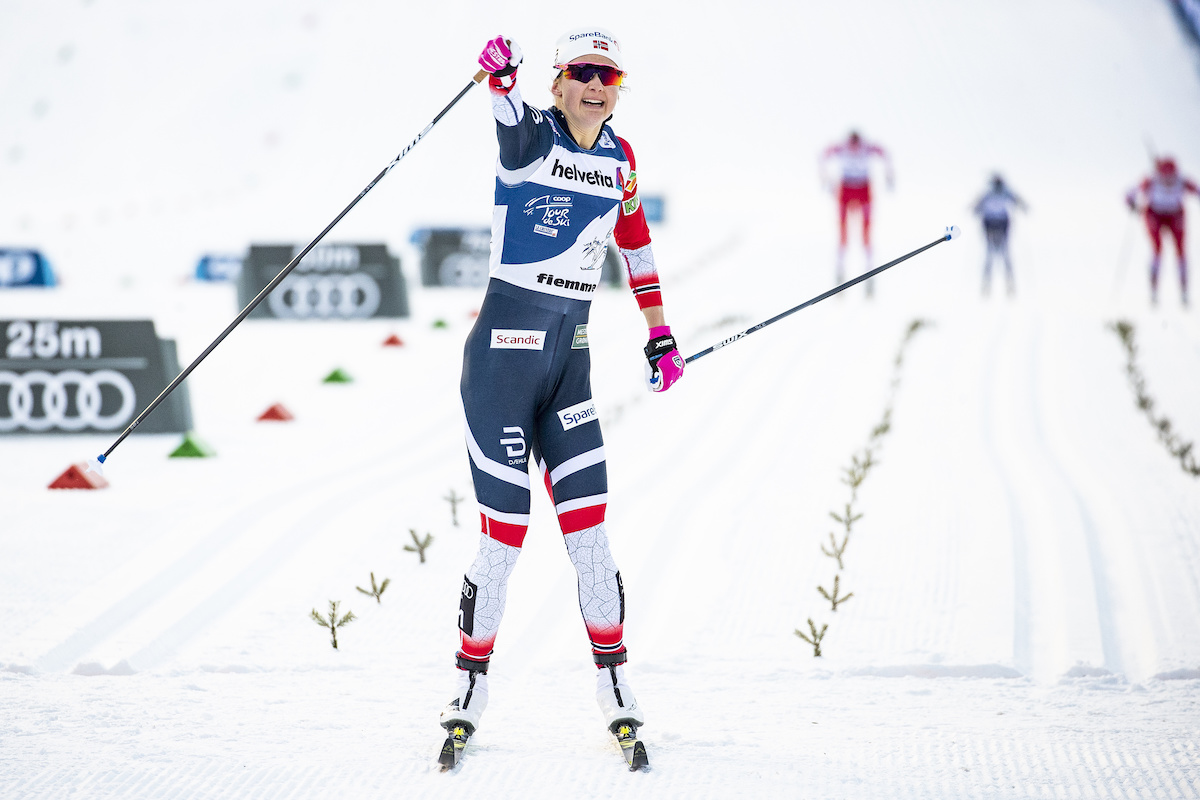
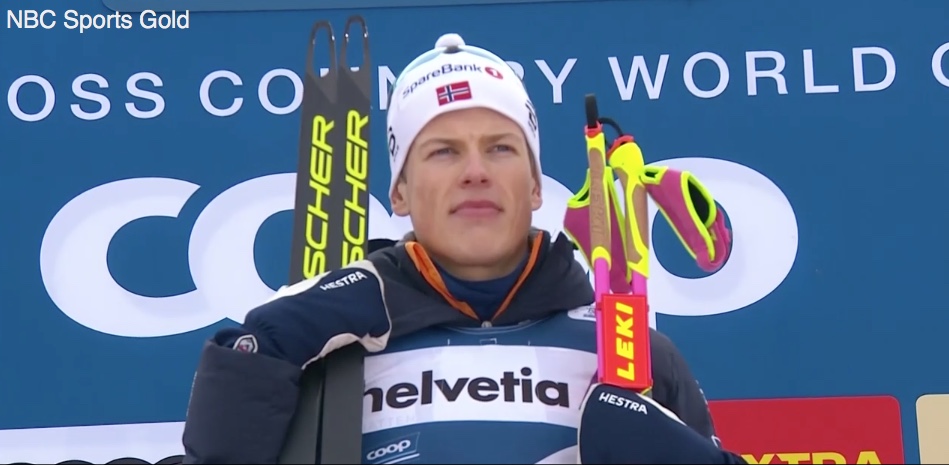
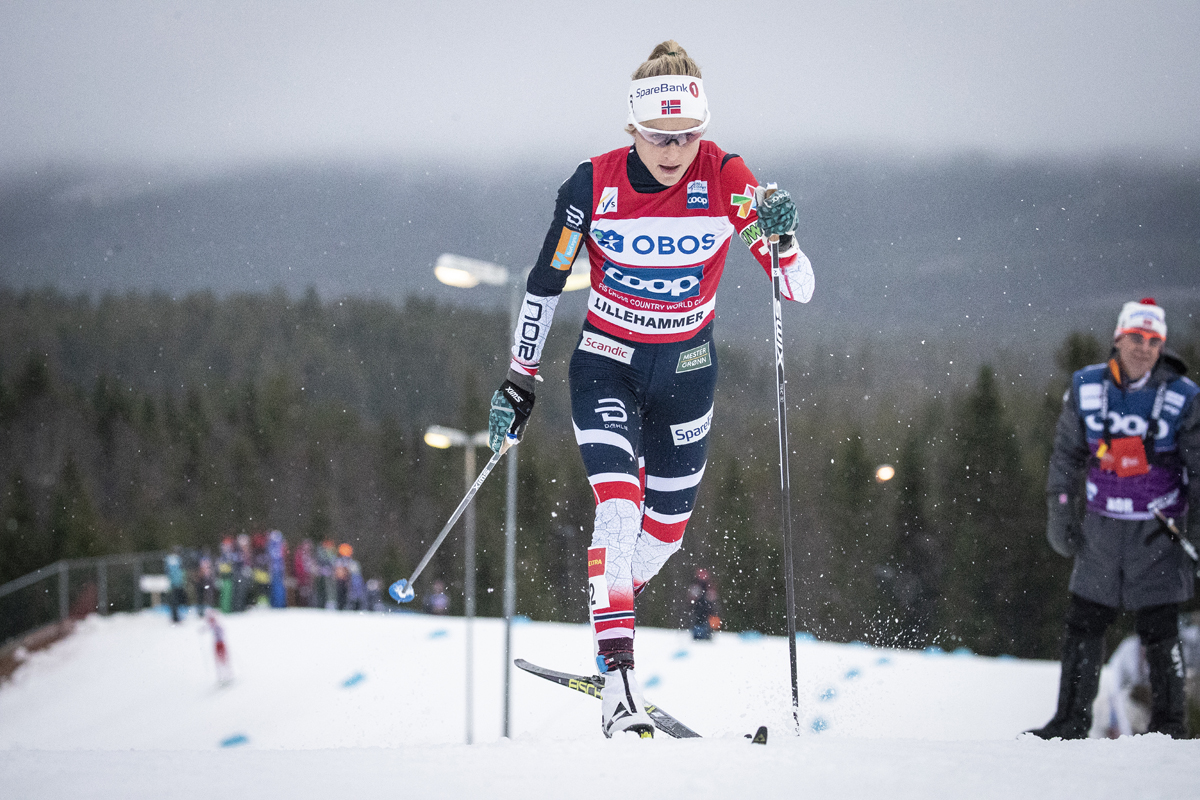
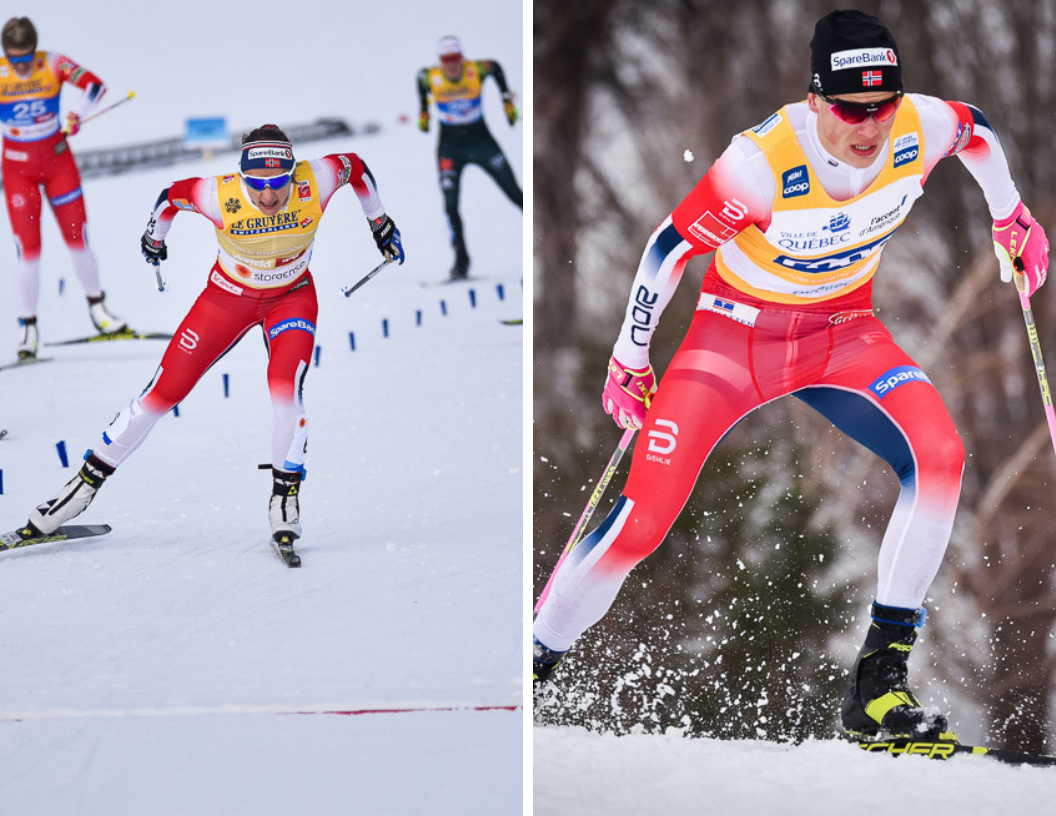
    Norway’s Ingvild Flugstad Østberg (left) and Johannes Høsflot Klæbo (right) were the top money winners on the 2018/2019 World Cup. (Photos: John Lazenby/lazenbyphoto.com)


    If you’ve read the International Ski Federation’s (FIS) website in the last few weeks and deviated from exploring the cross-country sub-site, U.S. alpine star Mikaela Shiffrin has been prominently featured. Her season was record-breaking. With 17 wins, she set a FIS World Cup record for alpine victories in a single season. With the fattening of her win total, was the commensurate growth of her bank account.

    She became the first World Cup skier, male or female, to earn more than one million Swiss Francs (CHF) in prize money during a single season. She won 886,386 CHF for her regular World Cup haul, and 114,000 CHF for her gold and bronze at the Åre, Sweden Alpine Ski World Championships.

    As of this writing, with the exchange rate set at 1 CHF = 0.98 USD, that equates to 980, 447.25 U.S. Dollars. Not exactly bottom feeding for a professional skier. (Since the beginning of April, the dollar has lost value against the Swiss Franc.)

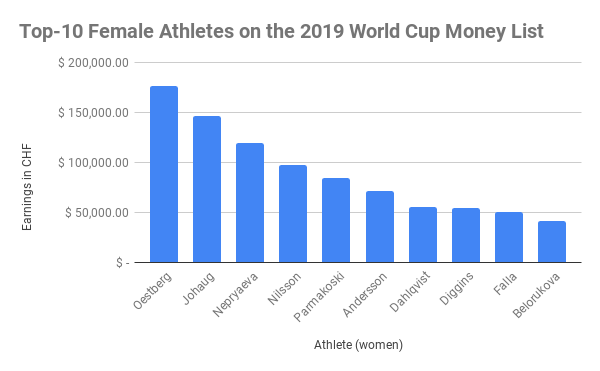
    On the cross-country World Cup, Norway’s Ingvild Flugstad Østberg, the overall winner, was first on the money earnings list with 175,900 CHF. Her teammate Therese Johaug, the winner of the distance crystal globe, earned the second highest total with 146,375 CHF. (American Jessie Diggins was eighth with 54,525 CHF in earnings.)

    Sweden’s Stina Nilsson, the fourth-ranked prize money earner and winner of the sprint globe earned just shy of the 100,000 CHF mark with 97,575 CHF in total earnings. Beyond her presumably sizable income from sponsors and endorsements, this is a proud living for fast skiing. Yet, it becomes a precipitous drop off in earnings from 10th place (Russia’s Yulia Belorukova with  40,950 CHF) to 30th, where Norway’s Kari Øyre Slind amassed 7,450 CHF.

    Of the ninety female athletes on the money list, 32 earned less than 1,000 CHF.

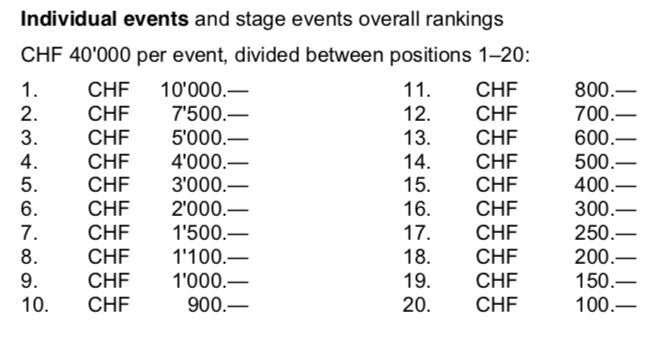
    According to the Rules for the FIS Cross Country World Cup, the organizing committees must divide a sum of 40,000 CHF per individual race amongst the top-20 skiers. The winner receives 10,000 CHF, second place 7,500 CHF until the 20th place skier is left with 100 CHF. (See below for the specific breakdown.)
    For individual sprints, prize money is reserved for those making the finals. A total of 30,000 CHF is divided amongst the top-six finishers in the final sprint standings. First place receives 12,000 CHF, second 8,000 CHF, third 4,000 CHF, fourth 3,000 CHF, fifth 2,000 CHF, and sixth 1,000 CHF.

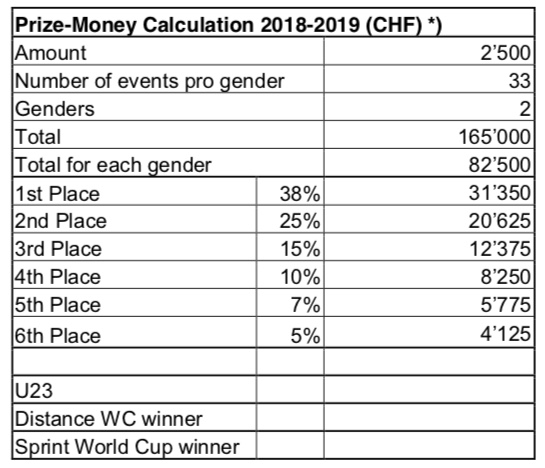
    As far as earnings for the World Cup overall, each gender divides 82,500 CHF amongst the top six athletes. (See below for the breakdown.)
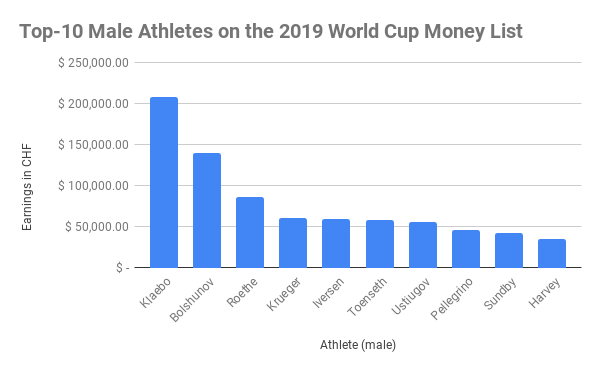
    Like on the women’s side, those who dominate the men’s podiums collect the cash. Norway’s Johannes Høsflot Klæbo, with 207,500 CHF, was the top-ranked male on the money list. Of the top-ten male earners, six were Norwegian, two Russian, one Italian, and in tenth was Canada’s Alex Harvey with 35,550 CHF.

    Only the top two athletes on the men’s list earned more than 100,000 CHF: Klæbo and the second overall prize money earner, Russia’s Alexander Bolshunov, with 139,625 CHF.

    The 20th ranked skier, Gleb Retivykh of Russia, was the first male skier to fall below the 20,000 CHF threshold with 19,850 CHF. Keeping things tidy by tens, Norway’s Finn Hågen Krogh was ranked 30th — he was the first skier below 10,000 CHF in prize winnings with 9,150 CHF.

    Breaking the numbers down.

    Twenty different women stood on individual World Cup podiums this past year. For the men, the number bumped to twenty-eight different skiers.

    Prize money is skewed towards the top performers. It follows that skiers like Østberg and Johaug would lead the money standings: Johaug won 11 individual World Cups this year, Østberg five. Østberg stood on twelve individual podiums and finished second a total of three times and placed third a total of four times. Nilsson, the top sprinter, won eight individual World Cup events. She also placed second once for her nine total World Cup podiums. The chart below shows the drop off in earnings for the women’s field — the top spots in World Cup races are secured by a relatively small number of skiers. Over twenty-nine individual races, three different skiers — Johaug, Østberg, and Nilsson — amassed 24 total wins.   

    By comparison, Diggins stepped on five podiums and placed fourth through 10th nine different times. Russia’s Yulia Belorukova, the tenth-ranked money earner, won a single race for her only podium and placed between fourth and 10th on 11 different occasions. The money stays near the podium: 10th place earns nine percent of the winner’s take in distance racing. That’s 900 CHF for placing 10th in the world.
    It’s a similar story for the men, yet the drop off from the top two prize winners was steeper. (Again, 20 different women podiumed compared to 28 different men.) Klæbo won 13 individual World Cup races and placed second a single time. Bolshunov had 12 podiums: five wins, three second place finishes, and four third place results. Klæbo and Bolshunov locked up 18 wins between them over the 29 individual World Cup races.  
    The trend of top-heavy earnings in the World Cup field is no mystery as this FasterSkier article from 2015 suggests. The article was titled, How to Score Points and Win Money on the World Cup (Hint: Be Norwegian). For the men, the main theme of that article still rings true. Norway had 28 different athletes in the money this season. In a nation to nation comparison, Norway’s men won the most cash. Russia, with 17 skiers earning prize money, clawed at Norway. Sweden, a country we often think of as a powerhouse, has been unable to field a well-rounded men’s team recently and lags behind the earnings of Italy (that’s skewed by Federico Pellegrino) and France. (Link to an interactive chart of the men’s data here.)
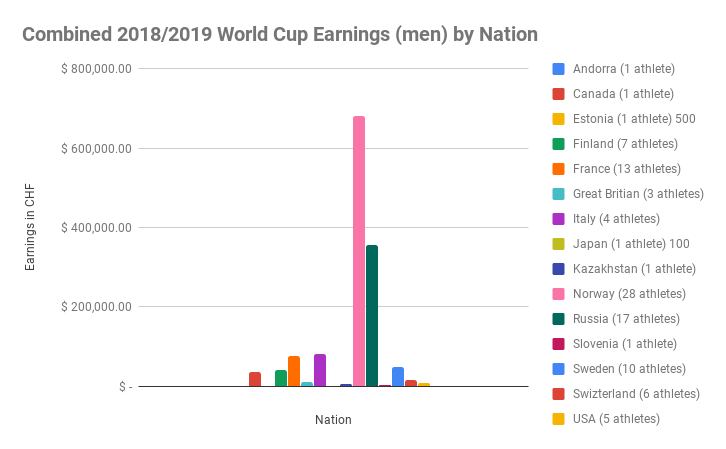
    The nation to nation comparison for the women reveals a Sweden that has emerged as a challenger to Norway. Norway prevails with 472,375 CHF in total earnings. But, Sweden and Russia are serious contenders, while Finland and the U.S. have also separated themselves. (You can link to an interactive chart for the women’s data here.)
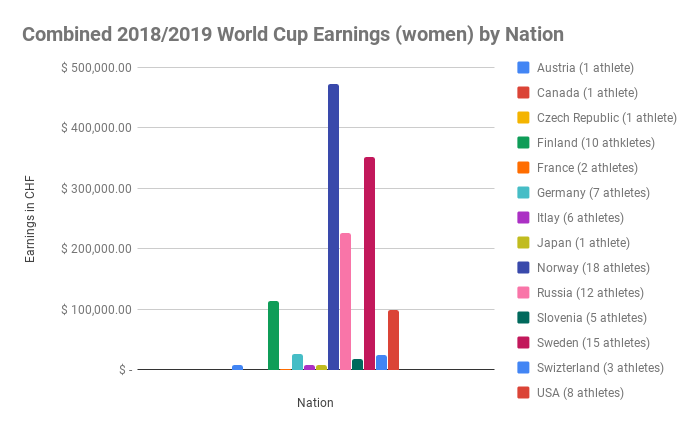
    Does it pay to be an elite cross-country skier? That depends. And it may be of no concern to those who compete simply for the love of their chosen sport. Yet, for those at the top of the xc skiing food chain, prize winnings along with the padding of endorsements can make for a comfortable life. And it still doesn’t hurt if you are from Norway.

     

  • An Iconic Women’s Relay as Sweden Holds off Norway; U.S. in Fifth

    An Iconic Women’s Relay as Sweden Holds off Norway; U.S. in Fifth

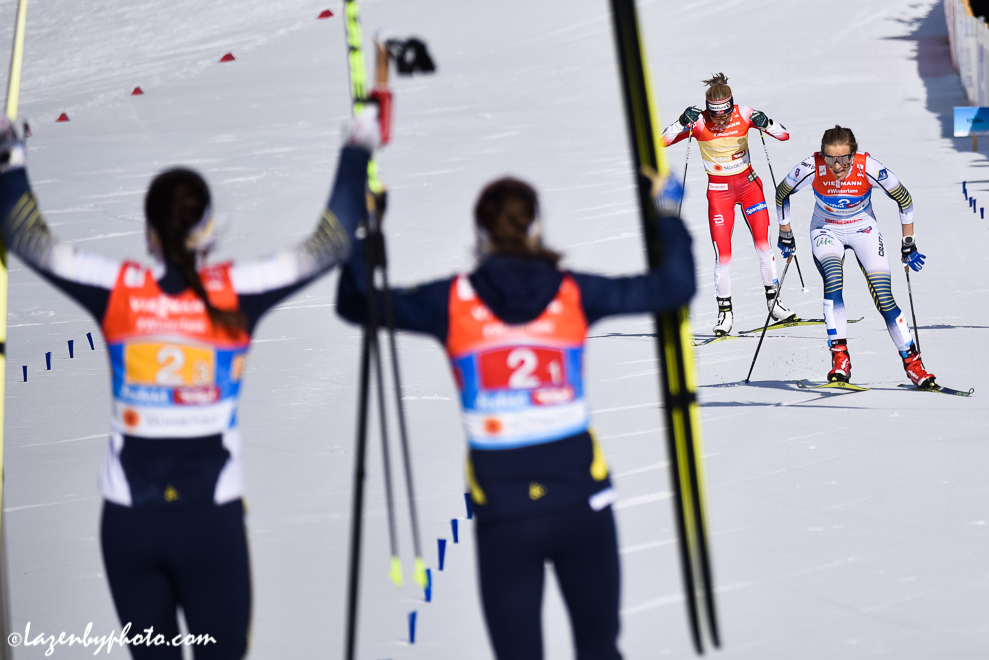
    Holding off Norway’s Therese Johaug is Sweden’s Stina Nilsson during the 2019 World Championship 4 x 5 k relay in Seefeld, Austria. (Photo: John Lazenby/lazenbyphoto.com)

    The beautiful chess match on snow came down to the wire in Thursday’s 4 x 5-kilometer relay at the Seefeld, Austria World Championships. The chaser was Norway’s Therese Johaug, hustling to close an 18.8-second gap to Sweden’s Stina Nilsson. Known as a sprinter who comes to distance events with aerobic chops, Nilsson, who won bronze in the 2018 Olympic 30 k classic mass start, couldn’t be rattled as Johaug lurked ever closer as the 5 k leg ticked down to the final straight.   

    For the closing kilometer, it was Johaug, the consummate endurance animal, against Nilsson, the consummate sprint closer, as they played check mate skiing for the win. 

    Let’s take a step back to when the sharp end of the race began to form in earnest. Norway’s Ingvild Flugstad Østberg and Sweden’s Frida Karlsson sent pacing-tremors through the field during leg two. Østberg ultimately came through to tag Norway’s third leg skier Astrid Uhrenholdt Jacobsen with a 1.4 second lead on Sweden’s third skier Charlotte Kalla. Russia and Germany trailed by more than ten seconds.

    Sweden’s Charlotte Kalla is clutch. She gave the Swedes a chance for the win as she skied the third leg of the 2019 World Championship 4 x 5 k relay in Seefeld, Austria. (Photo: John Lazenby/lazenbyphoto.com)

    With the freestyle legs in play and 10 k of skiing to go, Sweden was able to lean on a reliable closer in Kalla. She skied big and bold, sitting on the tails of Jacobsen for much of her race. In this 4 x 5 k hunt, Sweden tried to bag the big-game of Norway with a little less than 1.5 k to go in Kalla’s leg – at the 39:20 minute mark Kalla sent it.

    Up the course’s most notable climb, Kalla’s formidable V1 put 15 then 20 meters between herself and Jacobsen. In the last four World Championship 4 x 5 k relays, Sweden has played runner-up. As if fueled by that burden, Kalla handed Nilsson the gift of those previously mentioned and oh so precious 18.8 seconds as Sweden’s anchor leg sped away to find her own defining 5 k moment.

    Norway came into the race with an untested line-up. In the early season World Cup 4 x 5 k relay in Beitostølen, Norway Johaug skied Norway’s second classic leg. Back then she did not irreparably smash the race apart. She added enough spicy tempo to give Norway a lead of 9.8 seconds as she tagged off. And Ingvild Flugstad Østberg skied the anchor when Norway won by 37.3 seconds.

    We do not often consider Norway as the chasers in a women’s relay. So often they are off the front. On Thursday, as Johaug’s double-time turnover inched her incrementally closer to Nilsson, the race was wrought with tension. Nilsson skied in control, with a slower cadence than Johaug but generating a near equal amount of power with each cycle.

    Churning and chugging -Norway’s Therese Johaug during the fourth leg of the 2019 World Championship 4 x 5 k relay in Seefeld, Austria. (Photo: John Lazenby/lazenbyphoto.com)

    There was no doubt Johaug was at or near her limit. Nilsson too was pushing, but she appeared willing to eventually be caught by Johaug as the racecourse real estate dwindled.

    The Johaug-Nilsson link-up came at 52:40 minutes, near the apex of the last lap’s decisive climb. A meter separated a wind breaking Johaug from a drafting Nilsson as they descended. Nilsson skis gave her the lead as they glided and free skated into the final bump before the finish. Johaug pushed again. She could not surge as a red-suited Norway paced side by side with a white-suited Sweden.

    Nilsson took the lead over the top. Now it was Johaug in the draft as they schussed into the straight. But with Nilsson’s big lever V2 engaged, Johaug’s sprint couldn’t deliver. She drifted off the back as Nilsson played her winning hand to win for Sweden in 55:21.0 minutes.

    For Ebba Andersson, Frida Karlsson, Charlotte Kalla, Stina Nilsson and all of Sweden the wait for a World Championship 4 x 5 k relay was over. 

    Norway’s Heidi Weng, Ingvild Flugstad Østberg, Astrid Uhrenholdt Jacobsen, and Therese Johaug placed second (+3.1).

    Russia came on strong in their fourth leg to take third (+2:03.8) over a once close Germany in fourth (+2:46.3).

    “It is a dream coming true because we have been working hard all summer and fall and it has been a great effort from the whole team,” Kalla told FIS after the race.

    “The conditions were tough out there,” Nilsson said. “It was a real struggle to push hard. And I was so hunted by Theresa [Johaug] so that was a bit stressing but I am so happy the girls gave me a big advantage because I needed it today to be first on the finish line.”

    Sweden celebrates the 2019 World Championship 4 x 5 k relay win in Seefeld, Austria. (Photo: John Lazenby/lazenbyphoto.com)

    A New Look for the U.S.

    The U.S. finished in fifth with a line-up of Julia Kern, Sadie Bjornsen, Rosie Brennan, and Jessie Diggins. Relay socks and glitter adorned the foursome as they navigated a warmed-up slushy course in Seefeld.

    For U.S. Ski Team Head Coach Chris Grover, along with his longtime coaching partners Matt Whitcomb and Jason Cork, determining the U.S. relay roster is no plug and play task. As witnessed in the Sweden vs. Norway race, parsing out the strengths and weaknesses of every athlete comes with a cost-benefit analysis worthy of hiring a PhD. in probability theory.

    “It was a difficult task in terms of figuring out how to put together this relay team a couple of days ago after we had seen the women’s 10 k,” Grover said in a phone call. At that point, we knew we wanted to have Sadie and Rosie Brennan and Jessie going to the race. I had a really robust discussion around Julia and Caitlin and even potentially Rosie Frankowski in a skate leg. She had a great skate portion of her skiathlon the other day but also had a short illness after that. In trying to figure out the right way to put together the team, Julia has been feeling so good this week and skiing so well that we tried to do something a little bit different.”

    In doing something different, Grover stated that the landscape within which the U.S. operates has changed. With Norway a known quantity and still a force, other nations like Sweden and Russia have built consistently strong 4 x 5 k relay teams. Concurrent with the rise of other nations is the continual development and support for U.S. athletes to determine a podium combination.

    “We have had moments where all the women have skied great classic legs but we just need a little bit more flexibility, we need another woman or two in there that can be top ten or top fifteen on the World Cup on a given day to just fill out that roster,” Grover explained. “With relays, I think ideally you need, we have talked about it before, you need six athletes so that when you come to a championship you can pick the four that are in the best shape and you can use their technical strengths in the right places. I think at the same time, the other thing we have really seen is some of these other nations have raised their game in the meantime. … You have Sweden that is having an outstanding year with their women’s program. Across distance and sprint everyone has really taken a step forward within the Swedish team. They just don’t have weak legs anymore. There used to be a time when once in a while maybe we could really threaten Sweden but they are so strong across the board. And Russia too.”

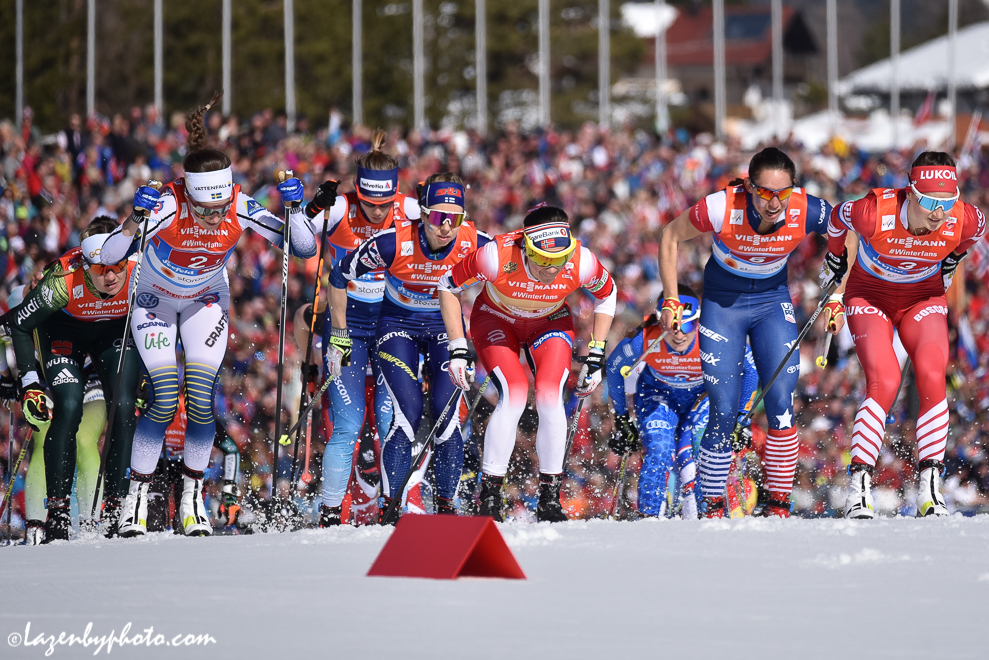
    Julia Kern of the U.S. (second from right) during the start of the 2019 World Championship 4 x 5 k relay in Seefeld, Austria. (Photo: John Lazenby/lazenbyphoto.com)

    For Kern, who has raced numerous relays at the Junior National and World Juniors level, this was her biggest relay scene yet.

    “I was excited about going into today relays, they are my favorite day,” Kern said in a call. “I love 5 ks and I love mass starts. I have scrambled a lot in relays in the past and at JNs and World Juniors, I was really psyched to be in that position because usually, it is a good place for me to start and I have had some of my best races in relays as well. So I was really psyched to be on this team with these older girls and I was feeling good.”

    At 3.5 k Kern maintained pace with the 17 team field. She passed through the time check 3.2 seconds behind. At that point, Kern said she began to feel the combo of heat, wet tracks, and a championship level pace.

    “I felt like I was doing a lot of work there from 2.5 to 3.5 k and everything was feeling awesome and then I just kind of blew up a little bit,” said Kern. “I never experienced something like that before or that extreme but I really sent it and gave it my all. I just went for it because that is what you have to do in relays.”

    The twenty-one-year-old Kern noted she had been balancing the teeter-totter of effort between full-send mode and just under the red line.  

    “The pace was fast, but I felt in control and I don’t know if it was the heat or what happened,” Kern added. “But it was a reminder that in relays it is hard because you have to ride that balance between sending it and risking it and trying to go with the leaders and  also race your own race. In a mass start event that is really hard. I think my takeaways were to remember to ski your own race but also I think you don’t want to walk away at the end of the day wishing you could have gone harder. All you ask is that you went for it.”

    Kern tagged to Bjornsen for the second classic leg in 11th (+44.2).

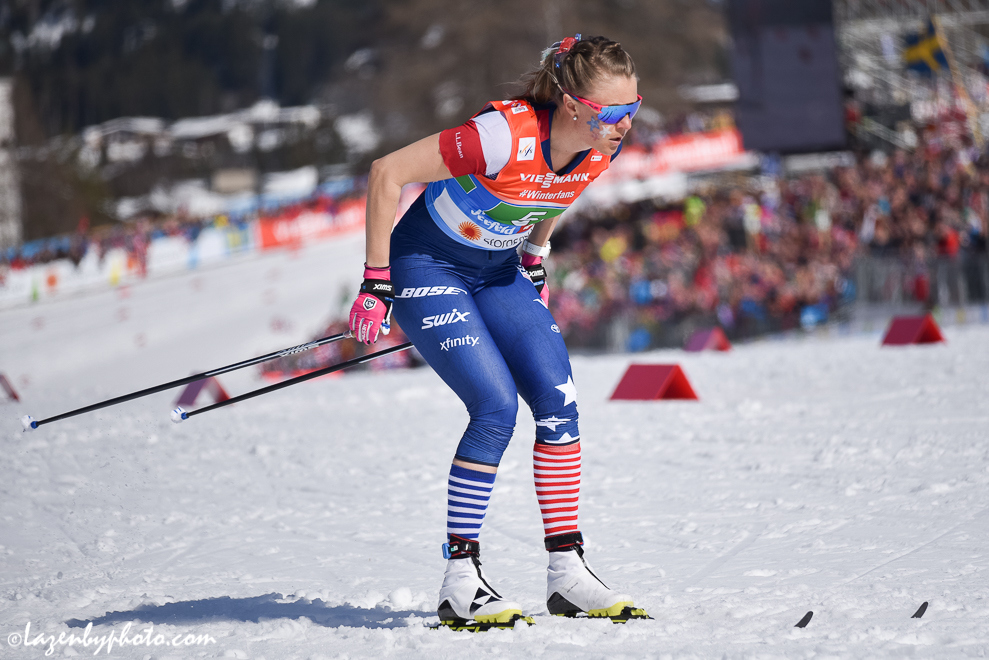
    Sadie Bjornsen of the U.S. during the second leg of the 2019 World Championship 4 x 5 k relay in Seefeld, Austria. (Photo: John Lazenby/lazenbyphoto.com)

    Bjornsen strode off with a gap of 20 seconds on 12th place Kazakhstan and seven seconds behind 10th place Czech Republic. With no team to ski behind, Bjornsen forged ahead in slow snow and towards a divided field.

    “Out of the start I tried to get that first group and then I as soon as got to the hills I started attacking,” said Bjornsen in a call. “But it was remarkably hard to close gaps out there when there are groups working together. When you are working alone there is no rest. It is 5 k of full work.”

    In the second half of her leg, Bjornsen’s pulse of effort paid dividends. She bridged up to and passed the Czechs, Japan, Canada, and France to leapfrog into sixth place.

    “When I finally caught that group in front of me I tried to not to sit behind them in the draft which felt very comfortable,” Bjornsen said. “I reminded myself that every second counts. I have got to keep powering past.”

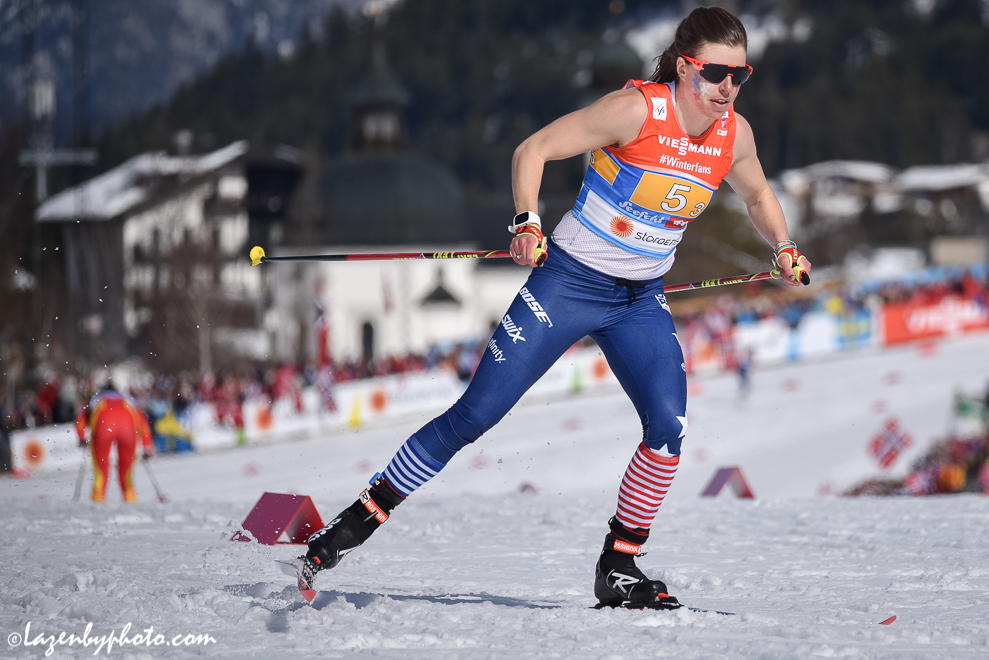
    Rosie Brennan of the U.S. during the third leg of the 2019 World Championship 4 x 5 k relay in Seefeld, Austria. (Photo: John Lazenby/lazenbyphoto.com)

    She tagged Brennan in sixth, 34 seconds down on fourth-place Finland. Brennan has proved an integral part of the U.S. World Cup presence this season. Her presence on the relay team in Seefeld comes as no surprise. Although earlier prognostications would have predicted her as a classic leg selection.  

    “I have never done a skate leg in a relay at this level so I was excited to try something new and I’ve had such an improvement in skating this year so I was kind of excited to put that to use,” Brennan stated over the phone.

    Ahead of Brennan was Riitta-Liisa Roponen of Finland, thirty-five seconds out. Close behind was a  three team cluster all within fifteen seconds.

    buy baclofen online


    “I didn’t want to give them a free ride so I tried to start off really hard to open up that gap enough that they didn’t get any ideas,” Brennan said of her quick start. “Then I could see Finland in front, and it was so deceiving because the snow was so slow that you could see the person in front of you for quite a ways. … I just kept my eyes on Finland and kept trying to ski strong, and ski to my strengths and just try to make that gap as small as possible”

    Brennan’s push created some sixth place breathing room for the U.S. She closed down on the Finns. Roponen tagged Evelina Piippo with a diminished buffer of 13.3 seconds as Diggins was tagged.

    By 17.5 k, a no-fan of hot weather skiing Diggins had passed Piippo and placed the U.S. in fifth by 10.5 seconds. With the Diggins anchor leg and a rookie scrambler in Kern, the U.S. placed fifth overall (+3:06.0).

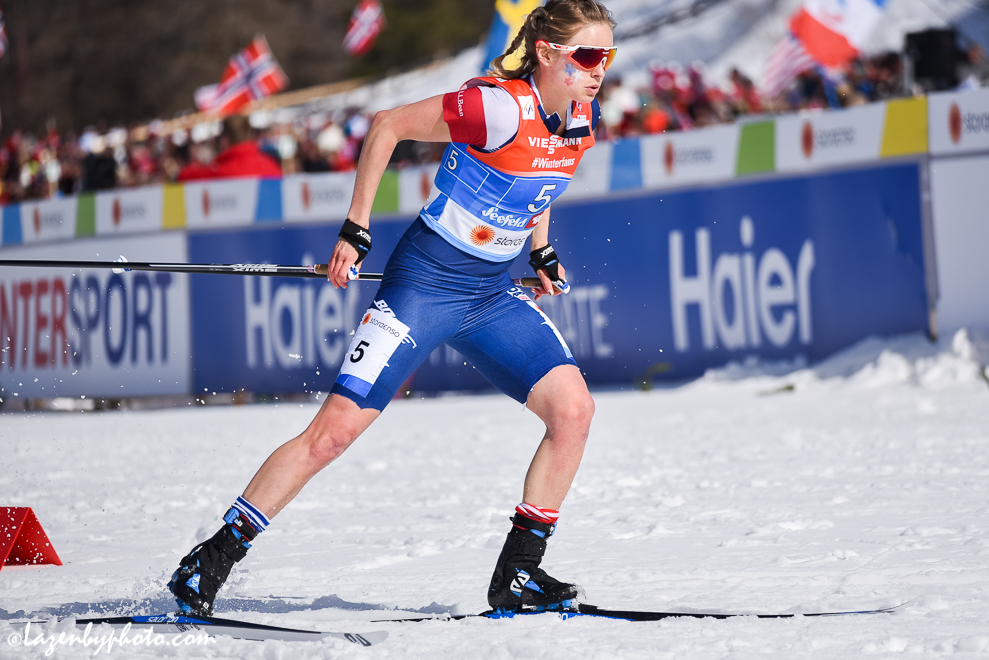
    Custom race suit for Jessie Diggins of the U.S. She anchored the fifth place U.S. team during the 2019 World Championship 4 x 5 k relay in Seefeld, Austria. (Photo: John Lazenby/lazenbyphoto.com)

    As the U.S. women’s 4 x 5 k roster evolves they will continue to find themselves in a hyper-competitive field with three teams in a Norway, Sweden, and Russia as a winning threat. If cross-country skiing were a salary cap sport, those three nations would have incurred a massive luxury tax.   

    But you cannot buy moxy when it comes to the bury-yourself athlete.  

    Bjornsen noticed a trait today about Kern which can also be attributed to the day’s collective U.S. effort.

    “I was proud of [Julia Kern] today,” Bjornsen said. “As I told her after my race, I think guts is something that you cannot necessarily train into somebody. And when I see someone explode in a race like that the first thing that comes to my mind is that girl has got guts.”

    The work-from-the-back fifth place was a collective gutsy affair for the U.S.

    Canada’s Katherine Stewart-Jones, Emily Nishikawa, Cendrine Browne, and Dahria Beatty were 12th on the day (+5:02.7).

    Results


     – David Brown contributed


  • Thursday Race Rundown from Seefeld: Sweden in a Nail-biter

    Thursday Race Rundown from Seefeld: Sweden in a Nail-biter

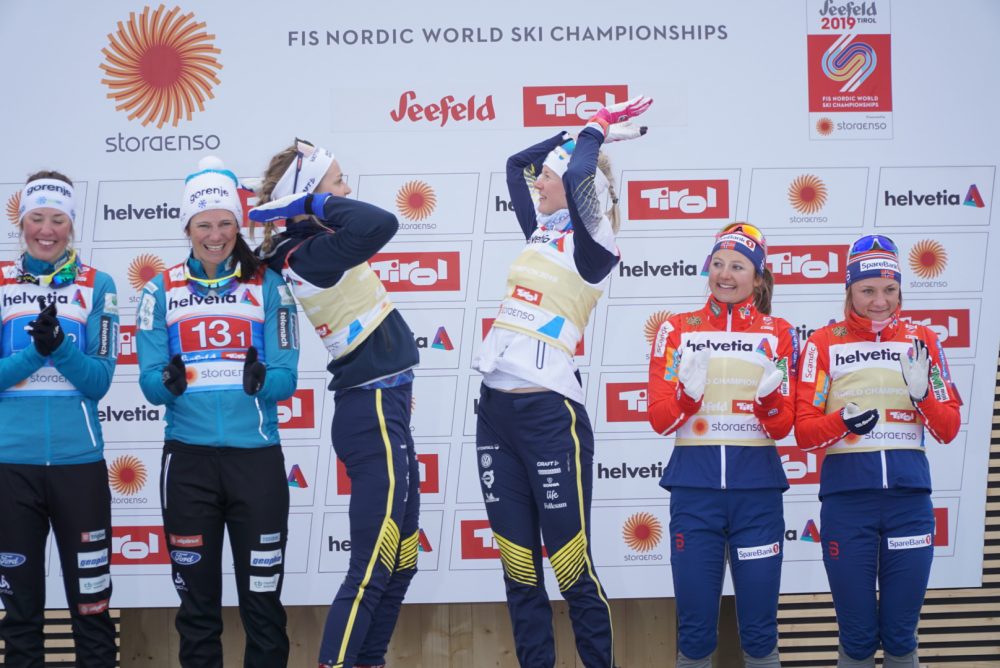
    (Front row l-r) Ebba Andersson and Charlotte Kalla (back row l-r) and Frida Karlsson and Stina Nilsson winners of the 2019 World Championship 4 x 5 k relay in Seefeld, Austria. (Photo: John Lazenby/lazenbyphoto.com)

    FIS Nordic World Ski Championships Seefeld, Austria Women’s 4 x 5 k Relay

    The race pack held together until the 3.5-kilometer mark of the scramble leg during the women’s World Championship 4 x 5 k relay in Seefeld, Austria. A bit over three seconds separated the top-six teams through the time check.

    gel

    voltaren gel

    By the time the third leg began, Sweden and Norway had surged and defined the race as a two team competition for first. That fate began to change as Sweden’s third skier, Charlotte Kalla, surged to a 18.8 second lead over Norway as she tagged to the team’s anchor, Stina Nilsson.

    With Norway’s anchor Therese Johaug, it appeared inevitable she would catch Nilsson. The high-turnover Johaug, mouth agape, churned up the hills and did eventually secure the Swede’s draft. But Nilsson’s long-gliding effort in the finish straight gave Sweden the edge and the win.

    Spent fuel: Norway’s Therese Johaug cooling off after her team’s second place in the 2019 World Championship 4 x 5 k relay in Seefeld, Austria. (Photo: John Lazenby/lazenbyphoto.com)

    Ebba Andersson, Frida Karlsson, Kalla, and Nilsson of Sweden won in 55:21.0 minutes. Norway’s Heidi Weng, Ingvild Flugstad Østberg, Astrid Uhrenholdt Jacobsen, and Johaug placed second (+3.1).

    Russia’s  Yulia Belorukova, Anastasia Sedova, Anna Nechaevskaya, and Natalia Nepryaeva skied to third (+2:03.8).

    The U.S. foursome of Julia Kern, Sadie Bjornsen, Rosie Brennan, and Jessie Diggins placed fifth (+3:06.0). Canada’s Katherine Stewart-Jones, Emily Nishikawa, Cendrine Browne, and Dahria Beatty were 12th on the day (+5:02.7).

    Results

  • Euphoric Victory for Sweden’s Nilsson and Dahlqvist in Classic Team Sprint; Diggins, Bjornsen 5th

    Euphoric Victory for Sweden’s Nilsson and Dahlqvist in Classic Team Sprint; Diggins, Bjornsen 5th

    Hips forward and drive…As clutch as they come – Sweden’s formidable Maja Dahlqvist (bib 2) during the women’s 6 x 1.2 k classic team sprint at the 2019 World Championship in Seefeld, Austria. (Photo: John Lazenby/lazenbyphoto.com)

    Icy tracks and a relatively flat course made for a tight race in Seefeld, Austria for the women’s 6 x 1.2-kilometer classic team sprint. Even in the final meters as the women charged up the last climb and double poled to the finish, the winner was not clear. In fact, the three fastest teams were within one second of one another. The resulting time difference between first and fifth place was less than the difference between the gold and silver medalist teams in Lahti, Finland in the 2017 World Ski Championships.

    A team sprint can often play out like a jack-in-the-box; in the first four legs, the women look calm and controlled, steadily winding up the tempo as the race progresses. The final two legs are explosive.

    This was the case today as Norway’s Maiken Caspersen Falla tagged her teammate Ingvild Flugstad Østberg for the last time amidst a pack of seven nations all within three seconds. Østberg powered through the course with a fiery purpose, trying to create a gap that would allow her and her teammate to repeat their victory in the event during the 2015 championship. Her move was matched by the teams from Sweden, Slovenia, and Russia, with Sadie Bjornsen of the United States just behind their tails.

    Russia’s Natalia Nepryeava challenged Østberg and took the lead before rounding a hairpin turn and descending in a tuck toward the stadium, but as she tagged her teammate, Yulia Belorukova, the Norwegians, Swedes, and Slovenes all remained less than 1.5 seconds back. Bjornsen tagged her partner Jessie Diggins in fifth only 2.7 behind.  

    Sweden’s Maja Dahlqvist during the women’s 6 x 1.2 k classic team sprint at the 2019 World Championship in Seefeld, Austria. (Photo: John Lazenby/lazenbyphoto.com)

    In the final lap, Falla charged to the front to take the lead for Norway. Maja Dahlqvist of Sweden and Anamarija Lampic of Slovenia went with her, as Belorukova began to fade a few meters behind. The lap seemed to dissolve in a heartbeat, as the four women found themselves rounding the last turn. Dahlqvist, who had been tucked in behind Falla, slingshot around her and into the lanes and began double poling rapidly to the finish. Falla could not match her pace, and as she lost touch with the Swede in the final meters, Lampic surged to seize silver.

    The gold medal team of Nilsson and Dahlqvist stopped the clock in a time of 15:14.93, with Slovenia’s Katja Visnar and Lampic just 0.37 seconds behind. Østberg and Falla took bronze (+0.60), followed by the Russians in fourth (+0.93), and the Americans in fifth (+2.79).

    “It feels really really really good,” Nilsson told the International Ski Federation (FIS) at the finish.

    “Really really good,” added Dahlqvist as the two laughed. “It was really tight today, but I felt strong in the end, so it was good.”

    The duo could not contain their excitement as they reflected on their narrow victory. They had already demonstrated their ability to excel on the course in Thursday’s individual skate sprint, but in the final Nilsson was unable to match Falla and a crash took Dahlqvist out of contention.

    “I felt really powerful today,” said Nilsson. “I like the course – it’s very fast and you have to be very focused and not let anyone pass you in the wrong places. When Maya crossed the finish line first it was like euphoria.”

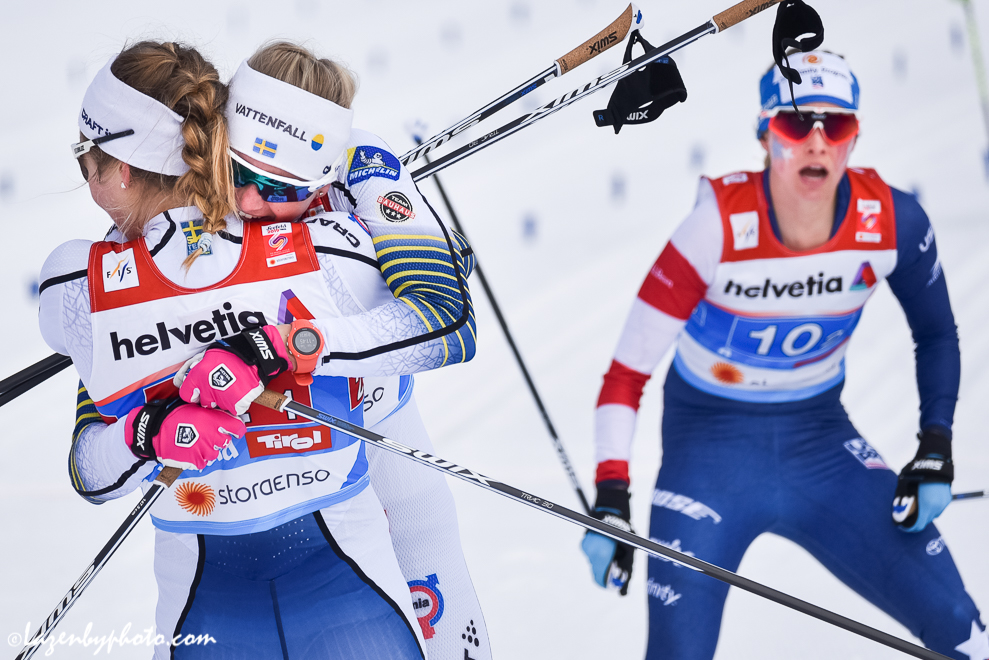
    Sweden’s winning duo –Maja Dahlqvist embracing teammate Stina Nilsson at the 2019 World Championships in Seefeld, Austria. (Photo: John Lazenby/lazenbyphoto.com)

    Today’s medals are the fifth in this World Championships for Sweden and the sixth for Norway. While Falla certainly hoped to add a third gold to her collection of team sprint medals, her bronze is her fourth medal in the event, making her the most decorated woman in the team sprint.

    For Slovenia, earning a silver medal is a leap from their last two results in World Championships and their best result overall in a World Championship event. Visnar was part of both sprint teams, contributing to a 9th place finish in 2015 and an 8th in 2017. During the 2018 Olympics, Lampic and her partner took sixth.

    Sweden (c) wins the women’s 6 x 1.2 k classic team sprint at the 2019 World Championships in Seefeld, Austria. Slovenia (l) took second place, with Norway (r) in third. (Photo: John Lazenby/lazenbyphoto.com)

    After the team of Bjornsen and Diggins finished third in the classic team sprint in Lahti in 2017, and Diggins won gold with Kikkan Randall in the skate sprint during the 2018 Olympics in PyeongChang, the United States was looking for more from today. Though both women can excel in both distance and sprint events, the short course in Seefeld was not their forte.

    “It was a little frustrating for me just because – you can never pick the course, but it didn’t suit our strengths in particular,” explained Diggins in a call. “It’s situationally frustrating simply because I know that we are in good shape and we have more than we were able to show today because it ended up being about your fast-twitch sprinting at the end, and we both felt like we were a little bit stuck. We couldn’t get out to push the pace earlier in the race.”

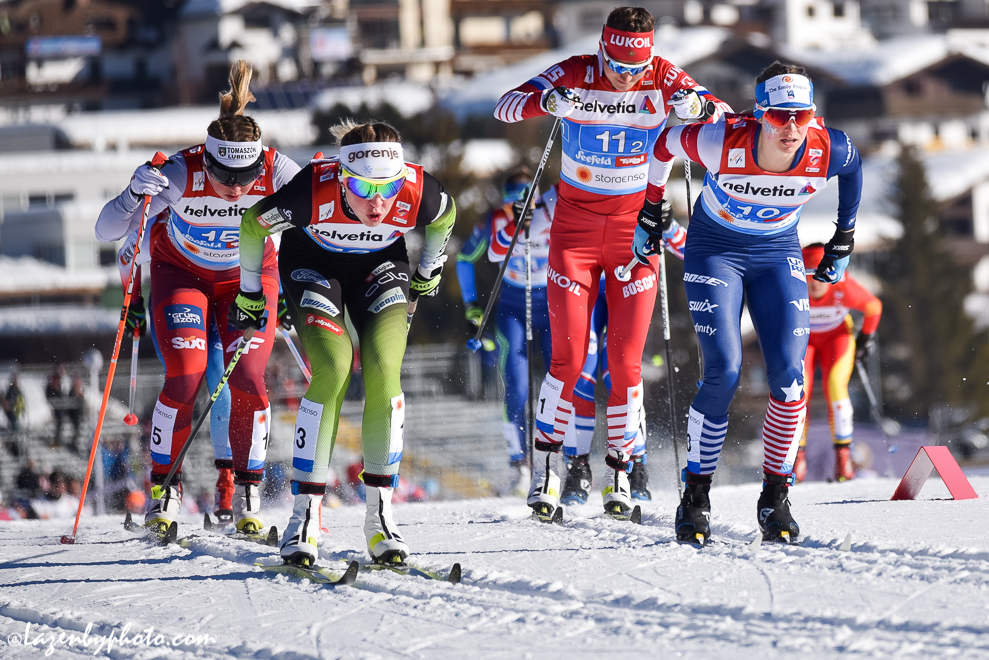
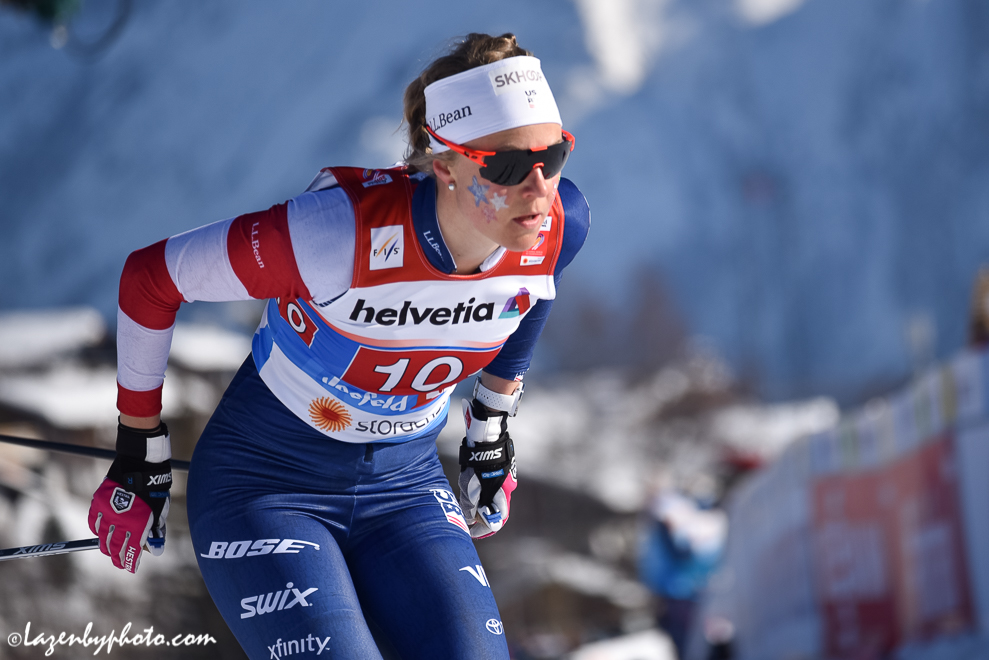
    In bib 10, the U.S. Ski Team’s Jessie Diggins pulls a string of skiers along on the inside track during the women’s 6 x 1.2 k classic team sprint at the 2019 World Championship in Seefeld, Austria. (Photo: John Lazenby/lazenbyphoto.com)

    Without the long climbs of the courses in Korea or Finland, racers could not spread themselves out, making the race more about tactics and raw speed, versus endurance and climbing strength.

    “So, it was just a different kind of course, it was a different kind of team sprint, and it was more tactical and fast twitch than grinding it out,” Diggins concluded.

    In the semi-finals, the US team finished fourth, advancing to the final as lucky losers.

    buy zanaflex no prescription

    “I think that after the semi’s we were all kind of like, ‘Whoa! Okay! It’s really hard to drop people and even if you’re in the front, you’re going to get sucked up in the draft,’” said Diggins. “So if you want to push the pace, you’re going to burn so many matches while other people draft off you, so it’s a really hard course if you’re not someone who has a lot of fast-twitch because it leaves you with fewer options of what to do.”

    The course used in the team event was the same as in the individual race where Diggins finished 8th and Bjornsen 18th.

    “It’s cool that we got to do the sprint race on this course the other day because I learned a little bit, in a frustrating way, that it’s relatively fast and tactical,” said Bjornsen. “When I was sprinting [individually] I was trying to do the smart thing, so today I was like, ‘I’m fit enough to do the stupid thing that might include doing more work, but could put us in a good place.’ And so today, I was just trying to stay in the front and stay in contact with those front girls, and I found myself getting stuck behind a few people – behind Germany and Slovenia, I guess – and I was trying to make my way to the Scandinavian girls.”

    The U.S. Ski Team’s Sadie Bjornsen during the women’s 6 x 1.2 k classic team sprint at the 2019 World Championship in Seefeld, Austria. (Photo: John Lazenby/lazenbyphoto.com)

    The team strategized which tactics might enable them to still fight for top positions, but because of the fast firm tracks and tight spread, they weren’t able to execute.

    “I was just trying to take advantage of that huge tucking section to really put my power to use and get up there with the girls,” Bjornsen explained. “But it was certainly a challenging day in the way that it was hard to break people and hard to be in the absolute perfect position that you really want to try to get to. But I think that both Jessie and I skied the absolute best that we could and we were definitely looking for a little more difficult real estate out there. I think that we would have excelled in those conditions. … We did the best that we could, and that’s how it went.”

    Canada’s Emily Nishikawa and Dahria Beatty finished 12th overall after being eliminated in the first semi-final where they placed sixth.

    Racing continues Tuesday in the 10 k classic distance race.

    Final Results

  • Sunday Rundown from Seefeld World Champs (Updated)

    Sunday Rundown from Seefeld World Champs (Updated)

    Sweden (center) wins the women’s 6 x 1.2 k classic team sprint at the 2019 World Championships in Seefeld, Austria. Slovenia (r) took second place, with Norway (l) in third. (Photo: Garrott Kuzzy)

    FIS Nordic World Ski Championships Seefeld, Austria Women’s/Men’s Classic Team Sprint

    The furious pace of the World Championship racing schedule continued on Sunday in Seefeld, Austria with the women’s and men’s classic team sprint.

    Sweden’s Stina Nilsson and Maja Dahlqvist won the women’s 6 x 1.2-kilometer classic team sprint final in 15:14.93 minutes. Katja Visnar and Anamarija Lampic of Slovenia placed second (+0.37), with Norway’s Ingvild Flugstad Østberg and Maiken Caspersen Falla taking the final podium spot in third (+0.60).

    Russia’s Natalia Nepryaeva and Yulia Belorukova raced to fourth (+0.93). Sadie Bjornsen and Jessie Diggins were paired for the U.S. where they placed fifth (+2.79).

    Canada’s Emily Nishikawa and Dahria Beatty finished 12th overall after being eliminated in the first semi-final where they placed sixth.

    buy naltrexone revia

    Women’s Team Sprint Results

    The men’s 6 x 1.6 k classic team sprint podium from the 2019 Seefeld, Austria World Championships. Russia (l) took second, Norway (c) first, and Italy (r) third. (Photo: Garrott Kuzzy).

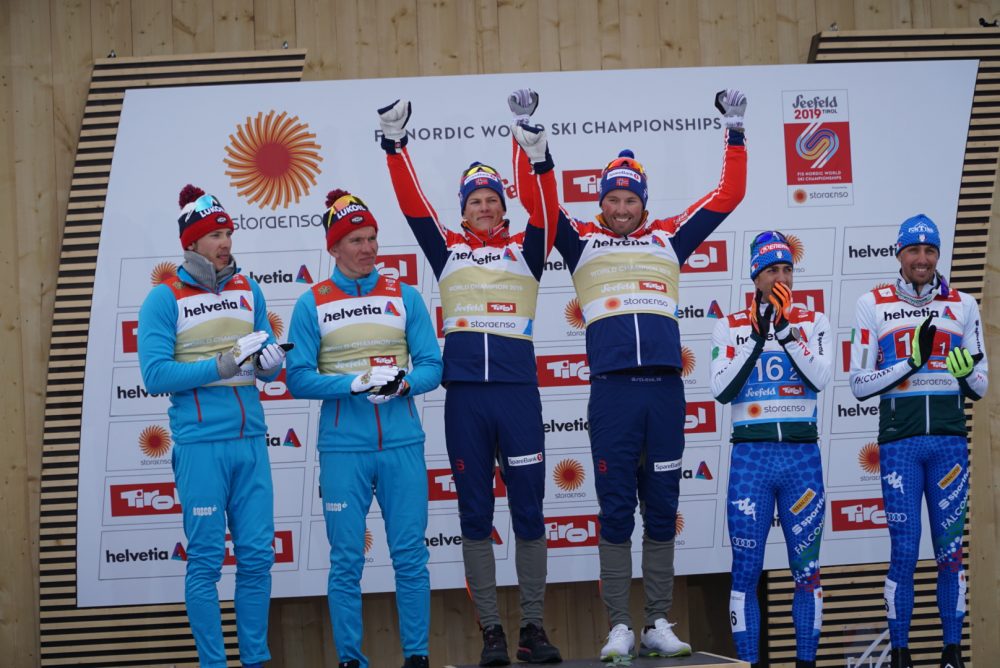
    The men raced a slightly longer course, making their classic team sprint a 6 x 1.6 k affair. Norway’s Emil Iversen and Johannes Høsflot Klæbo won in 18:49.86 minutes. Gleb Retivykh and Alexander Bolshunov of Russia finished 1.88 seconds back to take second overall. In third, finishing 4.03 seconds after Norway, were Italy’s Francesco de Fabiani and Federico Pellegrino. look at Rhino Gold Gel website

    Simi Hamilton and Erik Bjornsen were paired for the U.S team. The duo placed eighth (+28.56) in the ten team final. Canada’s Evan Palmer-Charrette and Len Valjas placed 10th overall (+1:40.99).

    Men’s Team Sprint Results


  • Østberg Makes a Clean Sweep on the Alpe Cermis; Diggins Sixth Overall

    Østberg Makes a Clean Sweep on the Alpe Cermis; Diggins Sixth Overall

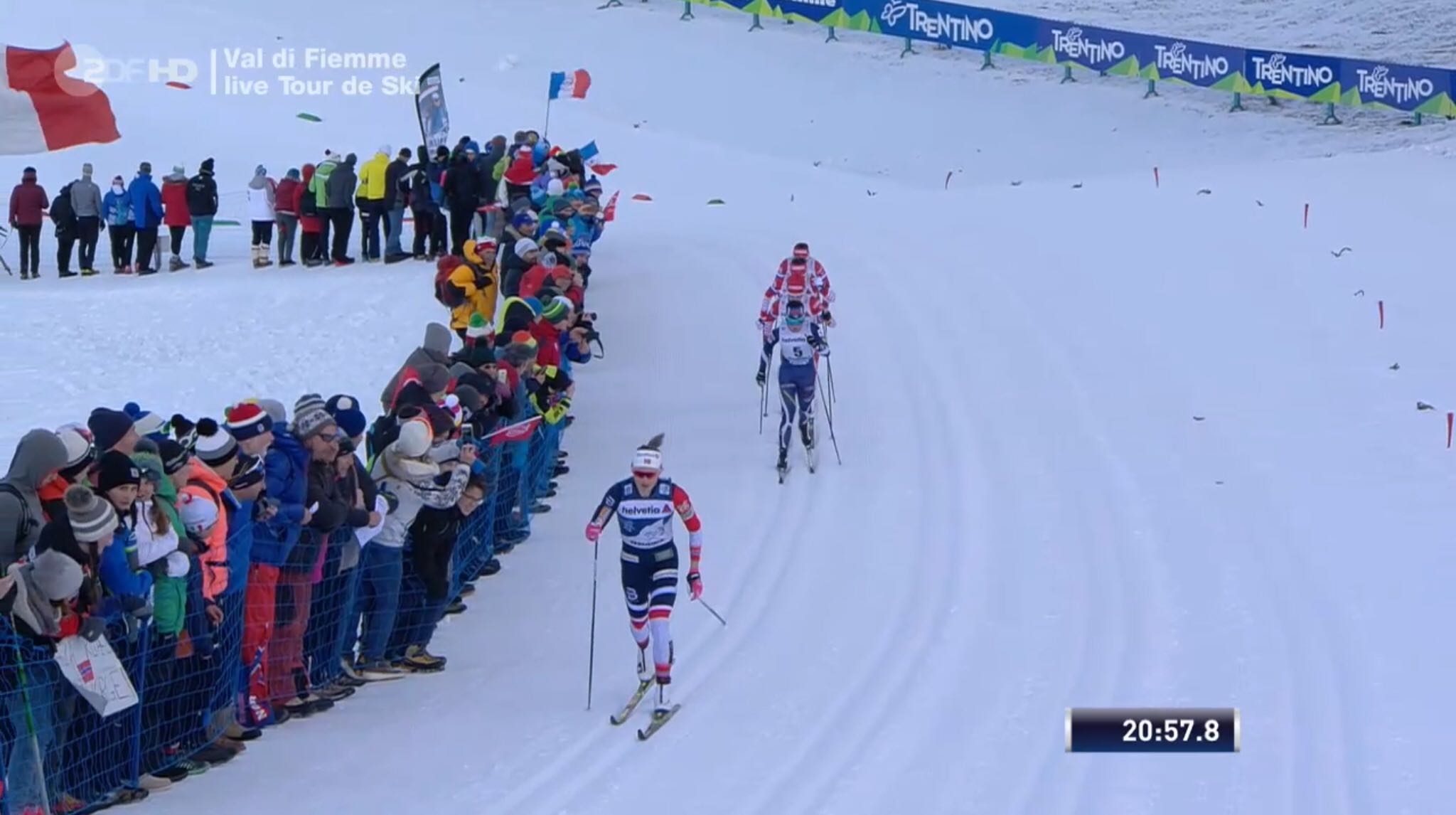
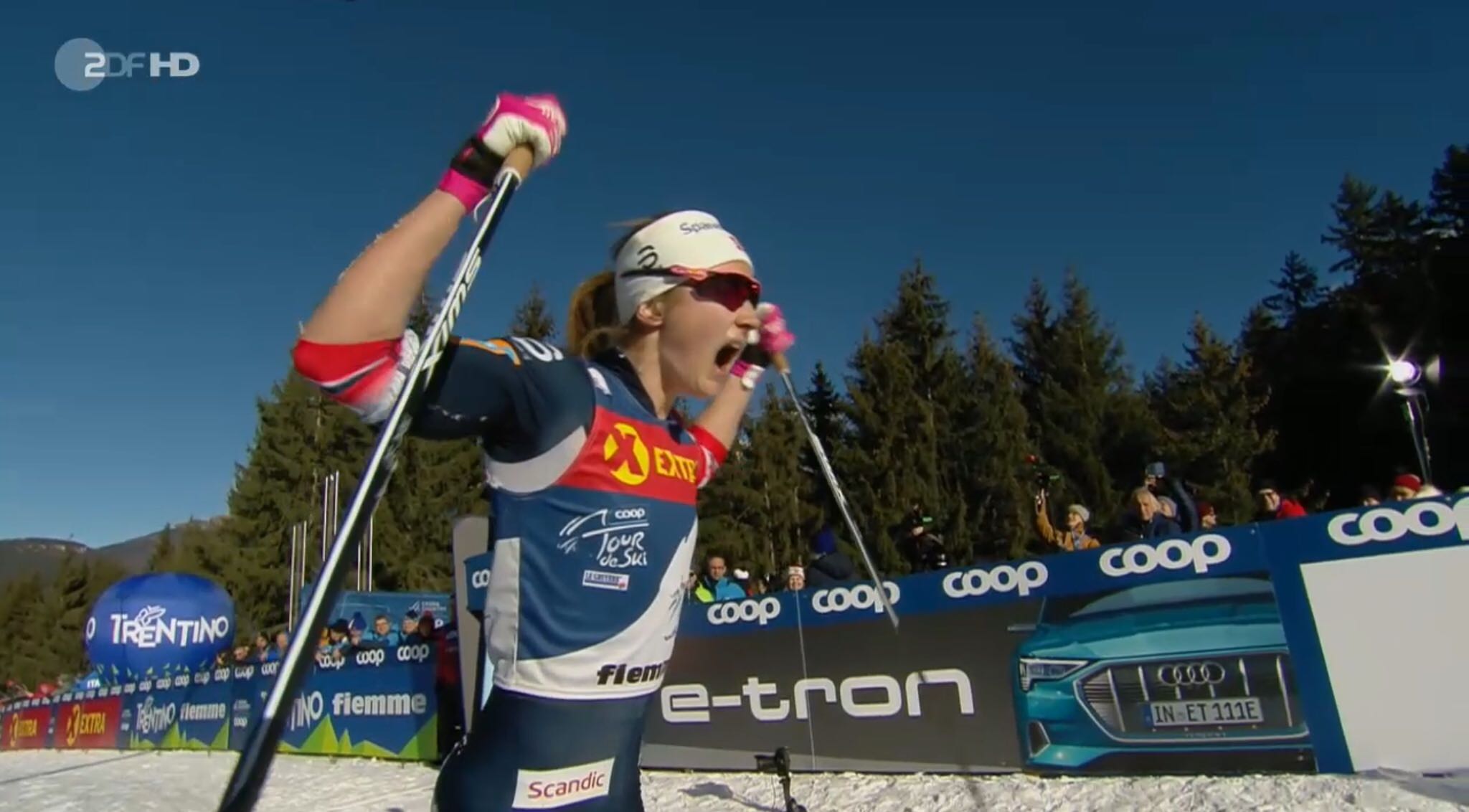
    Ingvild Flugstad Østberg wins the 2018/2019 Tour de Ski. (Photo: ZDF screenshot.)


    With the ascent comes the end.

    On Sunday the 2018/2019 Tour de Ski (TdS) Stage 7 9-kilometer skate pursuit brought the Tour de Ski to a close atop Val di Fiemme’s Alpe Cermis.

    The basic Alpe Cermis stats are stout: the slope approaches a 30 percent grade in sections, and averages 12 percent,  and climbs 420 meters in 3.5 k. It’s a lung-buster.

    After the 60.67 k seven-stage Tour that began on Dec. 29 in Toblach, Italy, Ingvild Flugstad Østberg won her first career TdS. Like several of the wins Østberg took in this iteration of the TdS, she was off the front with a solo effort. The winner of Stage 4 through Stage 7, Østberg was in command for her Alpe Cermis ascent.

    She fired the 9 k stage in 35:15.0 minutes for the fastest time of day and the fastest climb time of 19:49.5. (The climb time begins at the course’s 6.2 k mark).

    “It was a great day for me, and a big dream,” Østberg told German broadcaster ZDF after the race. “I am very very happy. Incredible. I wasn’t sure that I was going to win until the last kilometer. I had to work really hard, and it was a really really tough one. My legs were already tired when I started the climb so that I was able to cross the finish line first is unbelievable. So yeah, a big dream come true.”

    Ingvild Flugstad Østberg wins the 2018/2019 Tour de Ski. Arms outstretched, Østberg soaks it in atop the Alps Cermis.(Photo: ZDF screenshot.)

    For the twenty-eight-year-old Østberg, the Tour winning dream had been snuffed out in recent years. Last year, Østberg came into the final Alpe Cermis stage in the leader’s bib, only to be passed by Heidi Weng on the climb. Østberg placed second overall. In 2016, again Østberg was passed by Norway’s Therese Johaug on the Alpe. Østberg was the overall runner-up.

    The general pattern at recent Tour’s has been a flip-flop in the standings: the second overall skier starting Stage 7 has claimed the Tour title atop the Alpe. Of the last five Tour’s, before Østberg’s win today, Norway’s Marit Bjørgen in 2014/2015 was the last skier to wear the leader’s bib up the Alpe and still claim the overall. Østberg shattered that trend.

    Russia’s Natalia Nepryaeva was the day’s second starter, starting 53.4 seconds after Østberg. Nepryaeva kept her bib 2 position intact by the finish, sealing a second place on the podium by finishing 2:42.0 minutes back in the overall standings.

    Nepryaeva posted the 10th fastest Stage 7 time in 37:03.6 minutes, 1:48.6 behind Østberg’s fastest time of day. Nepryaeva’s Tour included a Stage 2 skate sprint win in Tobalch, Italy and second place in Stage 4, Stage 5, and Stage 6.

    With her second place in the overall, Nepryaeva becomes the first Russian women to step on the TdS overall podium.

    Finland’s Krista Pärmäkoski placed third overall (+2:55.0). On the stage, Pärmäkoski skied the second fastest elapsed time, 42.8 seconds behind Østberg, while marking the third fastest time on the course’s climbing sector. It is the second career TdS overall podium for Pärmäkoski – she placed second to Weng in 2016/2017 Tour.

    Russia’s Natalia Nepryaeva in second place as she climbs the Alpe Cermis during the Tour de Ski’s final Stage 7. (Photo: NBC Gold Screenshot)

    Østberg’s display of fitness on the Alpe was even more remarkable when considering no leading skier gained time on the Norwegian. Intent on winning her first TdS overall, Østberg’s effort only further distanced her rivals.

    The last stage and it’s big-percent grade climb brought only a slight reshuffling in the final rankings. Russia’s Yulia Belorukova in bib 4 started 2:27.4 minutes back, teammate Anastasia Sedova, the fifth starter, 3:03.6 behind, Jessie Diggins of the U.S. Ski Team (USST) began sixth, 3:07.9 back, and last year’s TdS overall winner Heidi Weng, wearing bib 7, had a 4:50.7 deficit.

    After nine kilometers, Sedova moved from fifth to fourth overall (+3:53.2) while skiing the third fastest time of day. Belorukova dropped to fifth after falling back on the climb, with the 15th fastest time of day. Diggins remained in sixth overall (+5:13.5) after posting the 12th fastest time on Stage 7. Weng placed seventh (+6:49.3). Weng is the winner of the past two Tours.

    Diggins may have dropped off her career-best third overall in last season’s TdS, but this Tour brought with it three different podiums and the leader’s bib as she started Stage 4 in Oberstdorf, Germany. (Last year, Diggins earned two TdS podiums — the Stage 4 sprint was canceled due to inclement weather.)

    “The older I get, the easier it is to remember to look at the big picture and remember that what makes a “good” race is determined by factors you don’t see on the results board,” Diggins emailed. “And for me, I was really proud of this tour because I had a lot of “good” races where I raced with grit, determination, and fought like crazy to do the very best I could with what I had in my body.”

    U.S. Ski Team member Jessie Diggins during Stage 7 of the 2018/2019 Tour de Ski. (Photo: NBC Gold screenshot)

    The blip for Diggins this year was related to wax. On Stage 4, a 10 k classic mass start, Diggins most certainly was strong. Her kick wax on a tricky day for kick, was lacking. Yet, despite kick that was tough to muster, she lost just less than one minute on the stage. Not a massive loss, but coupled with Diggins’s massive efforts over the TdS and her sapped energy, a come back for an overall podium spot was not a reality.

    Diggins comes out of the Tour fifth in the World Cup overall, with 601 points. Østberg leads with a commanding 1152 points as the second period of the World Cup concludes.

    “Today, like yesterday, my body was feeling run down and incredibly tired,” Diggins wrote in an email. “But I was proud of my effort and for never giving up, fighting my way up that crazy mountain! It’s really hard to describe the bone-deep tired feeling you get when you’ve been pushing your body so hard for so long, and it’s insane how painful it is when you finally reach the top of the final climb. It’s also one of the most satisfying feelings in the world, because you know you’ve just done something so amazingly hard.”

    Now it’s time for Diggins to rest and determine her World Championship race schedule — Diggins raced the full complement of cross-country events at the 2018 Olympics.

    “For me, what I really wanted to get out of the Tour in the big picture was the fitness boost that I get every year from doing something so incredibly hard and then resting and recovering well,” Diggins Explained. “So for the next 13 days, my focus will be on resting up, enjoying my time with my family in Seefeld, and then preparing for Otepää. I’m skipping Dresden to make sure I absorb all the Tour races well but I’m excited for the rest of the season, and super excited to cheer on our sprinters! … For Seefeld [World Championships], the jury’s still out on how many races I’m planning to do, but it’s definitely a more condensed schedule than the Olympics, so I’m going to be looking at where my energy is that time of year and which races have the most potential if I can’t do them all.”

    U.S. Ski Team Coach Matt Whitcomb reflected on this year’s Tour and looked towards the future.

    “First of all, I think next year we would likely see more Americans finish the Tour whereas on a championship year, three out of four years, we play things a little bit more conservatively, and this really went to plan not with regards to result but in regards to when people pulled out of the tour,” Whitcomb said. “We knew Sophie [Caldwell], Simi [Hamilton], and Kevin [Bolger] were going to pull out after three stages. We had good exit plans, you know, you look at things geographically, how do you actually exit? … So with regards to our exit strategy things went to plan; those three taking off after the three stages, Sadie [Bjornsen] and Erik [Bjornsen], I guess Erik got sick, but the intended goal was to have Sadie and Erik pull out after stage 5, and then to have Ben [Lustgarten] and Jessie finish it. So we got close, with the exception of Erik falling ill in the middle. You look at the athletes specifically, what intensity stimulus is going to be best for World Championships? Is it three races, five, or seven? And then is it possible to actually exit the Tour and get to the camp without having a seven-hour drive.?”

    This year’s schedule and geographic proximity to Seefeld, allowed those exiting the TdS early to take a relatively short drive to the site of this year’s World Championships for a training camp.

    Whitcomb also commented on the ups and downs of the Tour for Diggins, and how each day comes with challenges that might not be resolved as planned.

    “It was by some measures a great success, she knew that she needed to have for an incredible Tour with about half of the races being podiums,” Whitcomb noted. “But the other half of that is that we needed to nail the skis seven days instead of just six and that makes a real difference. And to go with that she also had the last couple of days where she felt like she was out of energy and wasn’t able to finish the Tour as strongly as she did last year. … But you know, you start looking for answers and you can get lost in a wormhole pretty quickly. As far as I’m concerned she got tired two stages too soon and there’s nothing to worry about. She’s healthy and she’s going to go to Seefeld which has about 25 feet of snow right now and she’s going to feel like a little kid playing in the snow for a couple of days, recover for the better part of four days and then get back into some easy distance training again. So I think from a Seefeld perspective, I feel really good about things. Yeah, it would have been fun for her to finish on the podium in the Tour, she’s certainly good enough, but it didn’t happen. It’s a fickle sport that way.”

    Canada’s Emily Nishikawa placed 25th overall (+13:54.9).

    Women’s Results |Winner of the Day | Women’s Stage by Stage TdS Overall Results

  • Sunday Race Rundown: Tour de Ski and U.S. Nationals (Updated)

    Sunday Race Rundown: Tour de Ski and U.S. Nationals (Updated)

    The final podium from the 2018/2019 Tour de Ski (from left to right), Natalia Nepryaeva of Russia in second, Norway’s Ingvild Flugstad Østberg first, and Finland’s Krista Pärmäkoski third. (Photo: ZDF screenshot)

    FIS World Cup Tour de Ski Stage Val di Fiemme, Italy 9 k Freestyle Pursuit Alpe Cermis Hill Climb

    Sunday was the day for the steeps, the V1, and some single pole sticks as the Tour de Ski’s (TdS) final Stage 7 9-kilometer skate pursuit up the Alpe Cermis played out.

    Norway’s Ingvild Flugstad Østberg began the stage with a 53.4-second head start on Russia’s Natalia Nepryaeva who skied off in bib 2 as the Tour’s second overall skier.

    Norway’s Ingvild Flugstad Østberg on her way to winning the 2018/2019Tour de Ski during the final Stage 7 Alpe Cermis climb. (Photo: NBC Gold screenshot)

    Despite the six stages in her legs, Østberg was untouchable on the Alpe. She finished the stage in a time of 35.15.0 minutes which was also the fastest time of day. Of the leading skiers that followed across the line, none gained any time on the overall TdS winner — the time back only increased. Nepryaeva placed second overall (+2:42.0), while Finland’s Krista Pärmäkoski placed third (+2:55.0).

    In fourth was Russia’s Anastasia Sedova 3:353.2 minutes back. Sedova began in bib 5, but passed teammate Yulia Belorukova, the day’s fourth starter, as she ascended the Cermis. Belorukova finished 4:47.4 minutes behind Østberg.

    U.S. Ski Team member Jessie Diggins during Stage 7 of the 2018/2019 Tour de Ski. (Photo: NBC Gold screenshot)

    The U.S. Ski Team’s Jessie Diggins placed sixth (+5:13.5). Norway’s Heidi Weng, last season’s TdS winner, placed seventh (+6:49.3).

    Canada’s Emily Nishikawa placed 25th overall (+13:54.9).

    Women’s Results |Winner of the Day | Women’s Stage by Stage TdS Overall Results

    Johannes Høsflot Klæbo of Norway on his way to winning the final stage, the men’s 9-kilometer hill climb, of the 2019 Tour de Ski in Val di Fiemme, Italy. (ZDF Screenshot)

    In the men’s 9 k hill climb, the seventh and final stage of this year’s Tour de Ski, Norway’s Johannes Høsflot Klæbo managed to hold off the charge of Russian Sergey Ustiugov to take the win in a time of 32:51.3. A hard pressing Ustiugov finished 16.7 seconds behind the Norwegian winner after starting with a 1:20 minute deficit.

    Norway’s Simen Hegstad Krüger, who started 3:06 behind Klæbo reduced that deficit to 48.8 by the end of the climb, passing Russia’s Alexander Bolshunov in order to claim third. By the end of the race, third place finisher, Krüger had made up 1:23 on Bolshunov.

    In the end, Bolshunov placed fifth (+1:26.6) after also being passed by Norwegian Sjur Røthe who placed fourth (+1:05.3). Røthe posted the fastest time of day, having completed the grueling 9 k in a time of 30:32.0. Krüger had the second fastest time, finishing in a time of 30:33.3.

    Results: Men’s Final Climb | Time of Day | Men’s Stage by Stage TdS Overall Standings


    ***

    U.S. Cross-Country Ski Championships Craftsbury, Vermont 20 k/30 k Freestyle Mass Start

    On Sunday, the women raced a 20 k skate mass start event. Caitlin Patterson (CGRP) won the race in 59:23.1 minutes. Rosie Frankowski (APU) placed second in 1:00:03 and Jessica Yeaton (APU/Australian National Team) third in 1:00:09.7.

    Hailey Swirbul (APU) was fourth overall but third overall American. She finished in a time of 1:00:30.1.

    Women’s Results

    In the men’s 30 k skate mass start, David Norris (APU) took the win in 1:18:02.4 hours. Kyle Bratrud (SMS T2) placed second in 1:18:08.8, while Scott Patterson (APU/USST) was third in 1:18:21.4.

    Men’s Results 

    FasterSkier will be posting U.S. national’s race reports later in the day.

  • Østberg Controls TdS Stage 6 from the Start; Diggins 7th

    Østberg Controls TdS Stage 6 from the Start; Diggins 7th

    Norway’s Ingvild Flugstad Østberg winning Stage 6 of the Tour de Ski – a 10 k mass start classic race. (Photo: Fischer/Nordic Focus)

    As the Tour de Ski (TdS)  wanes in Val di Fiemme, Italy, position in the overall standings becomes of the utmost importance as after today’s 10-kilometer mass start classic race. There will be only one more opportunity to advance in this season’s TdS – the brutal hill climb up Alpe Cermis.

    Ingvild Flugstad Østberg of Norway made it evident that after three podium finishes in the Tour, she no longer wished to be the bridesmaid. Last year, Østberg led the overall standings entering the final stage but was overtaken on the final stage by her teammate Heidi Weng who began the hill climb just two seconds behind her. An eerily similar story unfolded in 2016 when she was passed by Therese Johaug on the steep incline of the Alpe Cermis.

    This year, Østberg left nothing to chance in Stage 6. She led the charge from the gun, setting a fast tempo and quickly creating a small gap for herself. While a chase pack of three Russians, Natalia Nepryaeva, Yulia Belorukova, and Anastasia Sedova, and a Finn, Krista Pärmäkoski, kept Østberg in sight, the Norwegian controlled the race all the way to the finish line. On her way to victory, Østberg coyly won the bonus sprint at 7.5 k, earning her additional bonus seconds to 30-second bonus she gained from her win.

    Nepryeava took second place (+10.0), followed closely by her teammate Sedova (+10.8) in third, and Pärmäkoski fourth (+12.5).

    The women’s podium for Stage 6 of the 2018/2019 Tour de Ski in Val di Fiemme, Italy. Ingvild Flugstad Østberg of Norway took the win, followed by Natalia Nepryeava (L) and Anastasia Sedova (R), both of Russia. (Photo: Fischer/Nordic Focus)

    Today marks the Norwegian’s eighth stage win in the Tour de Ski, matching powerhouse Marit Bjørgen. Therese Johaug and Justyna Kowalczyk of Poland are the only women to earn more podiums, 11 and 14 respectively.

    Heading into the final stage, the Tour de Ski remains a race of attrition, especially in a World Championship year. Only 33 of the original 75 racers began Stage 6 today.

    With a lead in the overall standings of 53.4 seconds over Nepryaeva and 2:13.1 minutes over third place Pärmäkoski, Østberg is in an excellent position to nab the overall win, provided that she can hold up through the brutal hill climb.

    “First of all, today’s race was really important, and I’ve been trying to prepare as good as possible,” Østberg said in an interview with the International Ski Federation (FIS). “I was actually just waiting for the Russians and Krista [Pärmäkoski] to attack and tried to stay in front of the field. On the last lap I just had to try my best and maybe I could get some seconds. I am just so happy that I won today. And for sure it’s nice for tomorrow’s race, because that’s maybe not my favorite stage (laughs), so I need every second that I can have on the other competitors. So now I’m soon preparing for the last stage of this year’s Tour de Ski.”

    Nepryeava, Belorukova, and Sedova will be fighting to become the first Russian women to make the podium in the Tour de Ski. While Nepryeava is in solid position to accomplish this, Belorukova will need to make up 14 seconds to catch and pass Pärmäkoski during the final stage. Sedova has a significantly larger gap of 50 seconds to close. 

    Last year’s overall winner, Norway’s Heidi Weng, who has struggled with her usual World Cup podium results since the Olympics in PyeongChang, skied just behind the chase pack to a sixth-place finish. Weng’s results in the Tour show steady improvement for her, which bodes well for the remainder of her World Cup season.

    Jessie Diggins (L) pursues Norway’s Heidi Weng during stage 6 of the 2018/2019 Tour de Ski in Val di Fiemme, Italy. Photo: Screenshot ZDF Broadcast

    The sole American remaining in the Tour on the women’s side, Jessie Diggins, finished in seventh place (+1:19.3). Drifting slightly off the chase pack after the first 5 k, Diggins found herself in a tough position, out of contact with Weng, but also well ahead of the skiers behind her. Diggins Stage 6 finish bumped her to sixth in the overall standings. She began the day third overall after her close finish in the Stage 5 pursuit. To move back onto the podium, Diggins will need to make up a deficit of 54 seconds in Stage 7.

    “I had really competitive skis, which I was really stoked about, and I was really proud of how I raced,” Diggins told FasterSkier in a call. “I felt good through maybe 3 k and then it was just not there. But that is something you can’t control. I didn’t have really good feelings in my body at all, my body was just super tired and out of gas today. But I did the best I could with what I had and kept pushing as hard as possible.”

    The start of the women’s 10 k classic mass start, Stage 6 of the Tour de Ski.  Jessie Diggins skis in the second track from the right. (Photo: Fischer/Nordic Focus)

    While only ten seconds separated Diggins from third place at the start of Stage 7 in last season’s Tour, Diggins performance in the hill climb demonstrates that she is able to remain fierce until the Tour concludes atop the Alpe Cermis. Last year, Diggins clocked one of the fastest time to the top of Alpe Cermis, moving ahead of Pärmäkoski to gain a spot on the podium.  

    “It totally depends on the energy that your body has,” said Diggins. “At this stage in the Tour, you never know, so I am just recovering and fueling and doing everything I can to give myself the best chance I have tomorrow. Like any race, you go out and you go as hard as you can with what you have.”

    While today’s performance may not have been ideal for her overall standing in the Tour, in the larger scheme of her World Cup season, Diggins remains excited about where her fitness is.

    “For me, this is really great preparation for Seefeld, and I’m just really happy that I’ve been able to do the full Tour,” she said. “This is really key for my prep for World Champs, so big picture, I am amazed at how well the tour has gone. Being sick twice in Period 1, then coming onto the Tour and getting four podiums out of it is awesome. That’s great. That’s more than I thought I would get frankly, and so it’s been a really really fun ride and big picture this is going really well. I am really pleased with how the plan is going.”

    Canada’s Emily Nishikawa, who began the day in bib 28, placed 25th (+2:47.3). It is her first time racing in the TdS.

    “I had a great start today and felt good for the first two laps, but I faded a bit in the second half of the race,” said Nishikawa in a CCC press release. “Women’s racing always starts out really fast, so I was just trying to hang on in the pack and ski relaxed for as long as I could.”

    “I am looking forward to the climb tomorrow with a mix of excitement and nerves,” Nishikawa continued. “I will push as hard as my legs will go and see what happens.”

    Racing continues tomorrow for the final stage of the 2018/2019 Tour de Ski.

    Women’s Results | Overall Standings

  • Saturday Race Rundown: Val di Fiemme’s Stage 6 of the TdS in the Spotlight

    Saturday Race Rundown: Val di Fiemme’s Stage 6 of the TdS in the Spotlight

    Norway’s Ingvild Flugstad Østberg leading a four-deep chase group on her way to winning Stage 6 of the Tour de Ski — a 10 k classic mass start. (Photo: ZDF screenshot)

    FIS World Cup Stage 5 Tour de Ski 10 k/15 k Mass Start Classic Val di Fiemme, Italy

    Women’s Report | Men’s Report

    The clear outcome from the women’s 10-kilometer classic mass start was Norway’s Ingvild Flugstad Østberg’s fitness. The TdS leader began the day with a 35.4 second lead on second overall skier Natalia Nepryaeva of Russia. The time back to Nepryaeva at the end of Stage 6 only grew.

    Østberg’s form became evident around the 6.2 k mark when she inexorably pulled away from a group that included Russians Nepryaeva, Yulia Belorukova, Anastasia Sedova, and Finland’s Krista Pärmäkoski.

    Østberg went on to a solo win in a time of 29:24.4 minutes. Nepryaeva placed second (+10.0), Sedova third (+10.8), and Pärmäkoski fourth (+12.5).

    Belorukova ended up in fifth (+39.7), followed by Norway’s Heidi Weng in sixth (+1:10.0), and U.S. skier Jessie Diggins seventh (+1:19.3).

    Diggins began the day third overall in the Tour, 1:22.6 minutes behind Østberg.

    Canada’s Emily Nishikawa, who began the day in bib 28, placed 25th (+2:47.3).

    After factoring in time bonuses, Østberg now leads the TdS by 53.4 seconds over second overall skier Nepryaeva. Pärmäkoski jumped to third (+2:13.1), with Diggins dropping to sixth in the overall, 3:07.9 back. 

    Thirty-two women began Stage 6 of the Tour de Ski (TdS) in Val di Fiemme, Italy.

    Results | Overall Tour Standings After Six Stages


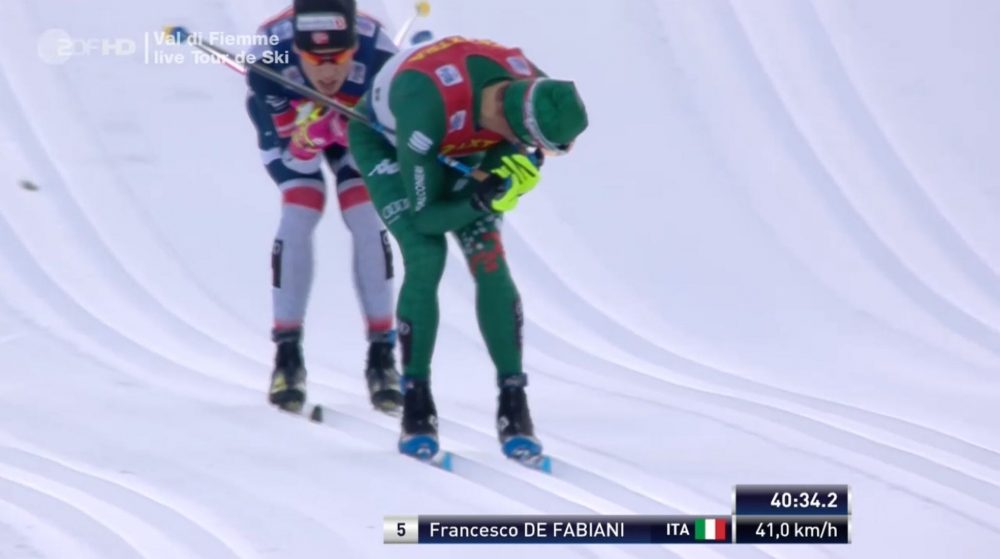
    Italy’s Francesco de Fabiani leads Norway’s Johannes Høsflot Klæbo during Stage 6 of the Tour de Ski — a 15 k classic mass start in Val di Fiemme, Italy. (Photo: ZDF screenshot.)

    In the men’s 15 k classic mass start, the race was a big opportunity for a results shakedown. Johannes Høsflot Klæbo of Norway came into the race as the overall leader, with a slight 5.4 second lead on Russia’s Sergey Ustiugov who began Stage 6 second overall in the TdS.

    Klæbo will retain the overall lead after a tactical Stage 6 where he won the race in 40:52.6 minutes. Francesco de Fabiani of Italy placed second (+0.6), and Russia’s Alexander Bolshunov third (+2.6). Bolshunov had been third overall, prior to today’s stage, 1:18.2 behind Klæbo.

    For de Fabiani, it was his second TdS podium — he also placed second in the Tour’s Stage 4 15 k classic mass start in Oberstdorf, Germany.

    Ustiugov placed 16th (+42) in today’s stage after skiing through the 10 k time check in 20th place, 5.3 seconds back. By 11.4 k, Ustiugov was 20.4 seconds behind the front group of skiers that included Bolshunov and Klæbo.

    After Stage 6, with only the Alpe Cermis climb to go, Klæbo sits in first overall, 1:20.4 minutes up on second overall skier Ustiugov. Bolshunov is third overall (+1:43.8), and de Fabiani fourth (+2:40.5).

    No Canadian men started the race as Alex Harvey, Lenny Valjas, and Bob Thompson all left the Tour after Stage 5.

    Ben Lustgarten (CGRP) for the U.S., is the only remaining North American male. He placed 44th (+5:31.7).

    Men’s Results | Men’s Overall TdS Standings After Stage 6


  • Østberg Solos to Stage 5 Win; Diggins Steps on Podium and up to Third Overall

    Østberg Solos to Stage 5 Win; Diggins Steps on Podium and up to Third Overall

    The women’s podium from DStage 5 of the Tour de Ski: (l-r) Natalia Nepryaeva of Russia second, Ingvild Flugstad Østberg of Norway first, and Jessie Diggins of the U.S. third. (Photo: Fischer/Nordic Focus)

    The real race tension today was the race for third between the U.S. Ski Team’s (USST) Jessie Diggins and Russia’s Yulia Belorukova during the 10-kilometer freestyle pursuit in Oberstdorf, Germany, Stage 5 of the Tour de Ski (TdS).

    The race up front was a solo effort, as Ingvild Flugstad Østberg of Norway started 24 seconds ahead of Russian skier Natalia Nepryaeva. Østberg held that lead until the finish, winning with a time of 26:21.2. Nepryaeva placed second (+30.4). Østberg continues to hold the overall lead in the TdS after today’s race.

    “It was a really good and I felt really good but at the same time it was both mentally and physically pretty hard to be in front,” Østberg told the International Ski Federation (FIS) after the race. “I saw all the girls chasing me all the time so I just had to work really hard.”

    Ingvild Flugstad Østberg of Norway leads the Tour de Ski after five stages. She won Thursday Stage 5 10 k skate pursuit. (Photo: Fischer/Nordic Focus)

    Nepryaeva skied a consistent race as well. Østberg was almost always in her sight giving her someone to physically chase besides a time gap, up ahead. She only lost six seconds on Østberg throughout the race and kept the chase pack led by Diggins and Finland’s Krista Pärmäkoski at bay.

    This was Nepryaeva’s third podium of the TdS; she won Stage  — a 10k freestyle individual start, and she placed second in yesterday’s Stage 4 10k classic mass start. Nepryaeva still sits in second place behind Østberg in the overall TdS standings. Østberg heads into Stage 6 with a 35.4 second cushion over Nepryaeva.

    Natalia Nepryaeva of Russia on her way to second place in Thursday’s Stage 5 of the Tour de Ski. (Photo: Fischer/Nordic Focus)

    The for third began in earnest when Diggins and Pärmäkoski caught the stage’s third starter, Belorukova, within the first three k of the race. (Belorukova began 15 seconds ahead of Diggins; Pärmäkoski began four seconds in back of the American.)

    “I was really excited to ski with Krista [Pärmäkoski] which was really fun,” Diggins said in a call. “I really love working with her because she always takes her turn leading and we basically split the race in half. It was so fun because we were motoring. And she also is someone who also never steps on your skis, never steps on your poles. Super fun to work with because she gets it. If we both work hard and share the load of leading then we are both going to have a great day. That was the plan and we talked about it beforehand.”

    U.S. Ski Team Coach Matt Whitcomb considered the Diggins-Pärmäkoski-engine a win-win.

    “Just letting it unfold together, pushing each other, trying to get the fastest time,” Whitcomb said. “So the strategy was to work with Krista, Krista leading on some of the climbs, and Jessie leading on some of the descents and flats, using the strengths of each of them to put time on the leaders, and it worked pretty well.”

    (Diggins skied the fastest time of day in 26:07.5 minutes, with the Finn notching the second fastest time, 7.6 seconds back.)

    The group of Diggins, Pärmäkoski, and Belorukova skied together once the three linked-up. As the pace quickened in the final k, Pärmäkoski began dropping behind.

    Diggins and Belorukova had comparable skis, remaining in contact on the downhills. When they came into the finishing stretch together each skier remained locked on the remaining podium spot.

    It came down to a toe.

    Diggins out lunged Belorukova in a photo finish. For Diggins, this was her second podium of the TdS. She was third in Val Müstair, Switzerland’s, Stage 3 skate sprint. With her third place today, Diggins is third overall in the Tour, 1:22.6 minutes behind overall leader Østberg.

    As noted in the Stage 4 race report, the yesterday’s kick waxing was problematic for many teams including the U.S. Whitcomb explained the collective team dynamic remains positive after processing yesterday’s frustrations.

    “Today was good, it was a testament to the team’s ability to regroup,” Whitcomb said. “We don’t dance around mistakes that we make, we confront them and talk directly with the athletes and explain what we thought we did wrong and everything is cool. If there’s somebody that cares more about this than the athletes it’s each of the athlete’s techs. And when any team misses a race, especially a high profile one, the pain extends through the whole team, and we feel it hard. It’s important to address it and figure out how to learn from our mistakes and then just move forward. So we didn’t spend too much time dwelling on it but we hit it hard, and then we are on to the next day.”

    For Diggins, dealing with disappointment has a time limit, then she redirects her energy to what remains in her control.

    “To be perfectly honest, it was frustrating yesterday because I know I am in better shape and skiing better than that,” Diggins explained. “So it is hard to lose because of the way bonus seconds work. It is really hard to lose that much time and is literally nothing you can do except go out and race hard.”

    Diggins said she went into this season’s Tour to win. Her performance today was a stamp declaring she has moved on.

    “When I was in the leader bib, I was like I am skiing with these girls, I am in good shape right now, we can duke it out, this is possible,” Diggins said. (The U.S. skier was in the TdS leader’s bib for Stage 4.) Yet, she stated she has not imposed undo pressure on herself to perform.

    “The big thing about this Tour for me is that it sets me up well for the rest of the season,” said Diggins.

    Today was Diggins 19th career podium, and as she sets her sights on the World Championships later this season, she insists she is where she wants to be.

    “I want to make sure I am seeing the bigger picture and that is right where I want to be right now and that is a good feeling,” Diggins said.

    Jessie Diggins out-toes Russia’s Yulia Belorukova to take third in Stage 5 of the Tour de Ski. (Photo: Fischer/Nordic Focus)

    Sadie Bjornsen of the US Ski Team placed 11th in today’s race. She started in ninth place, 2:54 seconds behind Østberg and finished 4:07.8 behind her. She skied with Austria’s Teresa Stadlober for the first half of the race, but Bjornsen wasn’t able to hold on. She eventually dropped back to 11th for the second half of the race. Bjornsen now sits in 11th in the overall TdS standings. However, as planned, Bjornsen has exited the TdS. 

    “Well, that’s a wrap for my Tour de Ski racing this season, signing out in 11th place,” Bjornsen wrote in an email to several news outlets. “I decided to not complete the tour this year in order to get a good training block in without too much race fatigue. With my heart set on World Championships this year, my coach and I made a plan to only go through five stages. It’s one of the hardest things in the world to drop from the tour, because it’s my favorite racing of the season, but I have big goals ahead in February.

    “It was a tough tour for me after coming back from a nasty virus over the holidays. I had a really exciting day one, and amazing feelings, but haven’t found quite the spark in my body I have wanted since. I will take the next two weeks to get 100% healthy, get some good volume in, and get a head that is ready to fight again. In the meantime, I am channeling every last bit of energy towards Jessie. That girl is on fire right now, and I can’t wait to see what happens. Let’s hope the weather and waxing are a little more straightforward in Val di Fiemme, and she gets closer to those front girls!

    “Catch up with you next in Otepaa, for a classic World Cup weekend. After so much skating, I’m really looking forward to getting back to the classical style!”

    Canada’s Emily Nishikawa finished 30th today. This was her second-best race of the season. She finished 23rd in the Davos two weeks ago and she was 34th yesterday in the 10k classic mass start, Stage 4 of the TdS.

    Women’s Results | Women’s TdS Overall Standings After Stage 5

  • Thursday Race Rundown: Tour de Ski and U.S. Nationals (Updated 2 x)

    Thursday Race Rundown: Tour de Ski and U.S. Nationals (Updated 2 x)

    Norway’s Johannes Høsflot Klæbo won today’s TdS Stage 5 15 k skate pursuit in Oberstdorf, Germany. (Photo: NBC Gold screenshot)

    FIS World Cup Tour de Ski Stage 5 15 k/10k Freestyle Pursuit Oberstdorf, Germany

    Men’s Report | Women’s Report 

    Today’s Tour de Ski (TdS) Stage 5 15-kilometer freestyle pursuit in Oberstdorf, Germany began and ended simply enough: Norway’s Johannes Høsflot Klæbo wearing the Tour’s blue leader’s bib started first with a 15 second lead over second overall skier Russia’s Sergey Ustiugov.  

    By 2 k into the race, the pair had linked up and ceded no time to the 63 chasers. Klæbo put in a burst of speed over the last hill and carried a several meter gap into the finish straight to win the pursuit in 35:07.5 minutes. Ustiugov placed second (+0.4), with his teammate Alexander Bolshunov third (+1:08.4).

    Norway’s Johannes Høsflot Klæbo turns before the finish to stare down Russia’s Sergey Ustiugov in today’s TdS Stage 5 15 k skate pursuit in Oberstdorf, Germany. (Photo: NBC Gold screenshot)

    Canada’s Alex Harvey, the best placed North American, was 22nd (+3:11.6). Lenny Valjas (CNST) placed 53rd (+8:10.6) and Bob Thompson 55th (+9:41.0).

    Ben Lustgarten (CGRP) for the U.S., the only remaining U.S. male in the TdS, placed 54th (+8:38.2).

    Men’s Results | Men’s TdS Overall Standings After Stage 5

    The women’s podium from Stage 5 of the 2018/2019 Tour de Ski’s 10 k skate pursuit. From left to right, Russia’s Natalia Nepryaeva was second, Norway’s Ingvild Flugstad Østberg first, and Jessie Diggins of the U.S.third. (Photo: fis-ski.com screenshot)

    As the leader of the women’s TdS Norway’s Ingvild Flugstad Østberg never looked stressed in today’s 10 k skate pursuit. Østberg left the start with a 24 second lead over Russia’s Natalia Nepryaeva and beat her by 30.4 seconds for the win. Østberg won in a time of 26:21.2 minutes, Nepryaeva placed second, and the U.S. Ski Team’s (USST) Jessie Diggins was third (+1:12.6).

    Diggins out-lunged Russia’s Yulia Belorukova across the finish line for a photo finish. Belorukova was 0.1 seconds behind Diggins as she placed fourth.

    Diggins raced the fastest time of day on course, skiing the 10 k in 26:07 minutes.

    Østberg retains the TdS leader bib, with a 35.4 second lead on second overall Nepryaeva, and a 1:22.6 minute lead on third overall Diggins.

    Sadie Bjornsen (USST) placed 11th in today’s pursuit (+4:07.8). Bjornsen is also 11th overall in the TdS standings but will exit after today’s stage to focus on upcoming World Cups.

    Canada’s Emily Nishikawa placed 30th (+7:26.1).

    Women’s Results | Women’s TdS Overall Standings After Stage 5

    ***

    U.S. Cross-Country Ski Championships Craftsbury, Vermont 10 k/15 k Classic Interval Start

    Today was the first day of racing at the U.S. Cross-Country Ski Championships in Craftsbury, Vermont. The women began with a 10-kilometer classic interval start race.

    Caitlin Patterson (CGRP) won in a time of 30:44.7 minutes, while Jessica Yeaton (APU/Australian National Team) placed second in 31:05.5, and Kaitlynn Miller (CGRP) was third in 31:22.1.

    Julia Kern (SMS-T2) was fourth overall and the third American in 31:33.9 minutes.

    Women’s Results

    In the men’s 15 k classic race, Kyle Bratrud (SMS T2) won his third career national title. He stopped the clock in 41:41.8 minutes. Adam Martin (CGRP) placed second in a time of 42:12.8. Kris Freeman (Caldwell Sport), took third in 42:27.6. Freeman “retired” last season, but still remains in form and podium worthy.

    Men’s Results

    ***

    U.S. Paralympics Nordic Nationals Craftsbury, Vermont


    Dan Cnossen on his way to winning the men’s middle distance national title at the Paralympic Nordic Nationals at Craftsbury, Vermont. (Photo: John Lazenby)

    Also at the Craftsbury Outdoor Center on Thursday, the middle distance race was held for the first event at the Paralympic Nordic Nationals. Dan Cnossen won the race in 25:09.9 minutes. Cnossen is based outside of Boston but trains frequently in Craftsbury both as a sit-skier and biathlete.

    “It was good, a really good course I thought,” Cnossen told FasterSkier in Craftsbury. “The grooming was good, but the conditions were a bit tough due to the snowfall. I love racing at Craftsbury, I’ve done the majority of my training in the last few years here. I think they undoubtedly put on the best venue. It is nice for me to come here. I am also a New England athlete.”

    Asked about his tactics, Cnossen said the overnight snowfall changed his perception of the course.

    “The course speed Yesterday during course inspection the conditions were a really fast and I was a little nervous about how it would go today but then with this snowfall it changed things a lot and I am a bit more of a climber and focus on that. Sometimes as sit skiers our poles sink a little deep in the softer snow so I was trying to pole in a light way, but not want to lose the power.”

    Aaron Pike placed second, and Canada’s Yves Bourque was third.

    Men’s Para-Nordic Results

    Oksana Masters won the women’s 5 k event at the Paralympics Nordic Nationals in Craftsbury, Vermont. (Photo: John Lazenby)

    In the women’s event, Oksana Masters won the 5 k race in 19:38.9 minutes.

    “This was a fun course. …. Yesterday was a lot icier and then today it was definitely a lot softer but it was cool because there was still a lot of technical components which often doesn’t happen in para-sport or para-courses sometimes for nationals,” Masters said. “So that was cool. It had a lot of climbs, a lot of fun downhills.”

    Kendall Gretsch was second, and Lyne Marie Bilodeau was third.

    Women’s Results

  • 2018/2019 Tour de Ski Preview (Updated)

    2018/2019 Tour de Ski Preview (Updated)

    The start of the men’s 15 k classic mass start at Stage 6 of the 2018 Tour de Ski on Saturday in Val di Fiemme, Italy, with (front row, left to right) Canada’s Alex Harvey, Russia’s Sergey Ustiugov, Kazakhstan’s Alexey Poltoranin, Norway’s Martin Johnsrud Sundby, and Switzerland’s Dario Cologna. (Photo: Salomon/NordicFocus)

    Beginning this Saturday in Toblach, Italy with a freestyle sprint is the 13th edition of the Tour de Ski (TdS). According to the International Ski Federation (FIS), over the course of seven stages the men will race 80.918 kilometers, the women 60.67 k. 

    The TdS has become both a staple and a spectacle of the annual World Cup calendar. With a jam-packed series of races primacy is placed on both the ability to recover well and wither less as the TdS transpires.

    Prognostication can be tricky in a long-form template like the TdS. So much can go astray during seven races not to mention the travel and dicey germ-avoidance. 

    Last season’s winner on the women’s side, Heidi Weng of Norway, sits 18th overall in the World Cup standings (14th in distance). She has four top-20’s in the four distance events she’s contested with her best result an eighth in Lillehammer’s 10 k skate. Although featuring two sprints in the first three stages, the TdS remains a distance skier’s paradise.

    Weng has skied solidly on the World Cup, but she has yet to show the form that made her a TdS overall winner in 2017 and 2018. Norway has won the last five iterations of the TdS: Marit Bjørgen won once in 2014/2015, Therese Johaug twice (2013/2014, 2015/2016), and Weng the last two years.

    Austria’s Teresa Stadlober leads Norway’s Heidi Weng (2) and Ingvild Flugstad Østberg, American Jessie Diggins (3) and others around a downhill corner during the women’s 10 k classic mass start at Stage 6 of the 2018 Tour de Ski in Val di Fiemme, Italy. (Photo: Fischer/NordicFocus)


    If Norway is to keep the streak alive, Ingvild Flugstad Østberg, last year’s TdS runner up, could be the heir apparent. She currently ranks second in the World Cup overall and 15th on the sprint list.

    Johaug, having returned from an 18 month doping ban, has been on a distance race tear. She has won all five World Cup distance events this season. Johaug, however, will not be lining up for the TdS.

    Only five different women have earned distance podiums this season — Johaug, Østberg, Sweden’s Charlotte Kalla and Ebba Andersson, and Finland’s Krista Pärmäkoski. Along with Johaug, Kalla and Andersson are skipping the TdS. (Andersson sits third overall on the World Cup, Kalla fifth.) With the TdS missing three of the five top ranked World Cup distance skiers, daily stages and the overall podium are up for grabs.   

    Last season’s third overall finisher, Jessie Diggins of the U.S. Ski Team (USST), often cites the TdS as a point in the season when her form trends towards podium performances. She sits eighth in the current distance standings and could very well have a stout TdS. 

    Russia’s Natalia Belorukova and Yulia Nepryaeva look strong as does Sadie Bjornsen (USST), and Austria’s Teresa Stadlober.

    With less than predictable distance stage podiums for the women, it may simply come down to a drag race on the Alpe Cermis final climb Jan. 6.

    Switzerland’s Dario Cologna (c) celebrates his fourth Tour de Ski overall title. He was joined by Norway’s Martin Johnsrud Sundby (l) and Canada’s Alex Harvey (r) on the podium in second and third, respectively. (Photo: Fischer/NordicFocus)


    The men’s scene is also open to interpretation. Last season’s TdS winner, Switzerland’s Dario Cologna, was in fact a surprise victor. Prior to Cologna’s stage two win in last year’s TdS, it had been nearly three years since the four time TdS overall winner had won a World Cup. Cologna sits 21st overall on the World Cup currently. Given last year’s resurgence, anything is possible for the Swiss skier.

    Then there’s Martin Johnsrud Sundby form Norway. He finished on the TdS podium the last three years. At thirty-four-years-old, Sundby is ranked first on the distance list, with a second, a third, and a fourth place in distance races this season.
    Sundby won the TdS on two occasions – in 2013/2014 and in 2016. His 2015 win was stripped after he tested positive for excessive levels of Salbutamol. He placed second in the past two Tours.

    In a field rife with talent, Sundby’s ability to race and rebound and race and rebound will be tested. Sjur Røthe, Emil Iversen, and Didrik Tønseth— all from Norway— look in form. And there’s Norway’s Johannes Høsflot Klæbo. The winner of last season’s overall World Cup has had flashes of his past explosive self. He could be a TdS protagonist.

    The men’s field is notably tight. Along with the Norwegians, several Russians could pop a podium, a stage win, and the overall. Russia comes with a loaded team ready to exploit. Alexander Bolshunov leads the overall World Cup – he’ll turn twenty two on Dec. 31st. He’s backed by teammates Evgeniy Belov, Andrey Melnichenko, and Denis Spitsov. 

    Canada’s Alex Harvey placed third overall last year and he looked stronger as the TdS progressed.

    The Stages

    Stage 1:  Dec. 29, skate sprint in Toblach, Italy.

    Stage 2: Dec. 30, 10 k/15 k skate in Toblach, Italy.

    Stage 3: Jan. 1, skate sprint in Val Müstair, Switzerland.

    Stage 4: Jan. 2, 10 k/15 k classic mass start in Oberstdorf, Germany.

    Stage 5: Jan. 3, 10 k/15 k skate pursuit in Oberstdorf, Germany.

    Stage 6: Jan. 5th, 10 k/15 k classic mass start in Val di Fiemme, Italy.

    Stage 7: Jan 6th, 9 k final climb skate pursuit in Val di Fiemme, Italy.

    Teams

    United States

    Women: Sophie Caldwell, Sadie Bjornsen, Jessie Diggins.

    Men: Ben Lustgarten, Simi Hamilton, Erik Bjornsen, Kevin Bolger.

    U.S. Ski Team Head Coach Chris Grover noted in a text that Caldwell, Hamilton, and Bolger will likely cease the TdS after the stage three sprint. Additionally, this is a small team for the U.S. at the TdS. Several athletes turned down TdS nominations including Scott Patterson (USST), Andy Newell (SMS T2/Salomon), Kyle Bratrud (SMS T2), Rosie Brennan (APU), Rosie Frankowski (APU), Caitlin Patterson (CGRP), and Julia Kern (SMS T2). These skiers plan on racing U.S. Nationals this January in Craftsbury, Vermont.

    Canada

    Women: Emily Nishikawa, Dahria Beatty

    Men: Alex Harvey, Lenny Valjas, Bob Thompson

    Norway

    Women: Ingvild Flugstad Østberg, Maiken Caspersen Falla, Astrid Uhrenholdt Jacobsen, Kari Øyre Slind, Kathrine Rolsted Harsem, Heidi Weng, Lotta Udnes Weng, Tiril Udnes Weng Mari Eide, Anna Svendsen

    Men: Martin Johnsrud Sundby, Hans Christer Holund, Emil Iversen, Didrik Tønseth, Simen Hegstad, Krüger, Sjur Røthe, Johannes Høsflot Klæbo, Martin Løwstrøm Nyenget, Eirik Brandsdal, Finn Hågen Krogh

    Russia

    Women: Yulia Belorukova, Lidia Durkina, Anna Zherebyateva, Mariya Istomina, Natalia Nepryaeva, Anna Nechaevskaya, Anastasia Sedova, Elena Soboleva

    Men: Evgeniy Belov, Alexander Bolshunov, Maxim Vylegzhanin, Andrey Larkov, Andrey Melnichenko,  Gleb Retivykh, Andrey Sobakarev, Denis Spitsov, Sergey Ustiugov

    Sweden

    Women: Mia Eriksson, Ida Ingemarsdotter, Moa Molander Kristiansen, Stina Nilsson, Maria Nordström, Linn Sömskar, Lisa Vinsa

    Men: Calle Halfvarsson, Simon Lageson, Teodor Peterson, Daniel Rickardsson, Oskar Svensson, Viktor Thorn, Karl Johan Westberg

    Finland

    Women: Mari Eder, Anne Kyllönen, Laura Mononen, Krista Pärmäkoski, Susanna Saapunki

    Men: Ristomatti Hakola, Matti Heikkinen, Lauri Vuorinen

    Italy

    Women: Elisa Brocard, Anna Comarella, Ilaria Debertolis, Caterina Ganz, Greta Laurent, Sara Pellegrini, Lucia Scardoni

    Men: Francesco de Fabiani, Stefano Gardener, Enrico Nizzo, Dietmar Noeckler, Federico Pellegrino, Maicol Rastelli, Giandomenico Salvadori

    Switzerland

    Women: Nathalie von Siebenthal, Laurien van der Graaff, Nadine Fähndrich

    Men: Dario Cologna, and Jovian Hediger, Jonas Baumann, Livio Bieler, Roman Furger, Käser Erwanm, Beda Klee, Toni Livers, Jason Rüesch, Schaad Roman

    Austria

    Women: Therese Stadlober

    Germany

    Women: Julia Belger, Victoria Carl, Pia Fink, Laura Gimmler, Katharina Hennig, Sandra Ringwald, Elisabeth Schicho, Anne Winkler

    Men: Thomas Bing, Lucas Bögl, Janosch Brugger, Jonas Dobler, Sebastian Eisenlauer, Andreas Katz, Valentin Mättig, Florian Notz, Max Olex, Thomas Wick

    France

    Women: Anouk Faivre Picon, Delphine Claudel, Laura Chamiot-Maitral

    Men: Maurice Manificat, Lucas Chanavat, Adrien Backscheider, Jean-Marc Gaillard, Baptiste Gros, Renaud Jay, Richard Jouve, Jules Lapierre, Clement Parisse

    FasterSkier will update team start lists as we gather more information.

    antibiotics

  • Norway Unstoppable for the win in Women’s 4 x 5 k Relay; U.S. 5th

    Norway Unstoppable for the win in Women’s 4 x 5 k Relay; U.S. 5th

    The women’s podium from the 4 x 5 k relay in Beitostølen, Norway. Norway I (center) placed first, Russia II (left) was second, and Finland I (right) third. (Photo: Fischer/Nordic Focus)

    For Norway, relays are often tallied not by wins, but how many wins have been missed. Back in 2009, Team Norway watched on as Team Sweden took the top spot of the podium for the women’s 4 x 5-kilometer relay event in Beitostølen, Norway.

    In the nine years after that second place finish in Beitostølen, the Norwegian women’s team has missed winning the World Cup relay–excluding team sprints–only one other time (FIS reports that as having been in 2011, when Italy won the Rybinsk, Russia 4 x 5 k).

    This December marks the first time Beitostølen has hosted a World Cup race since the team, back then comprised of Vibeke Skofterud, Therese Johaug, Kristin Strørmer Steira, and Marit Bjørgen, placed second in 2009. Though the goal of top relay performances has not changed, changes within Norway’s team itself are palpable.

    Skofterud passed away this summer after a jet skiing accident. Strørmer Steira, married to Canadian Devon Kershaw, retired in 2015. Bjørgen announced her retirement last spring. Johaug served an 18-month ban from ski racing and came back to competitions this year. She is the only name to return to the relay team and Beitostølen since the city last hosted World Cup competitions nine years ago.

    Sunday’s win marks if nothing else, Norway’s reclaiming of what they see as theirs.

    “It’s really nice to have a race in Beitostølen we have a lot of good memories here – all of us,” Johaug said during a FIS post-race interview. “We all did a really good job today and its beautiful to ski with these ladies.”

    Norway’s Heidi Weng (left) and Sweden’s Evelina Settlin (right) lead the women’s 4 x 5 k relay train Sunday in Beitostølen, Norway (Photo: Aleks Tangen)

    Taking out the Norwegian’s first classic leg was Heidi Weng. Weng hung tightly to the front group until around 3.5 k, when Sadie Bjornsen of the U.S. Ski Team and Russia’s Team I, leg one skier, Yulia Belorukova, began to push the pace.

    buy disulfiram online

    By the time the women came through for the first exchange, Belorukova and Bjornsen had put a 7.3 second gap on Weng and a 13 second gap on the chasing teams’ skiers, Lidia Durkina of Russia II and Anna Svendsen of Norway II.

    “At the beginning, when I was leading, I felt like it was pretty clear that those girls were going to stay in a mass behind me,” Bjornsen told FasterSkier during an in-person interview after the race. “So I tried to stay near the front…then [I said] ‘I’m going on attack mode on the second-half because maybe I can break some people then,’ and it worked out.

    “It was a little frustrating to have some people stick in there that I wanted to break harder,” Bjornsen added. “But it was nice to have Belorukova to work back and forth with to push all the way to the end.”

    Sadie Bjornsen of the U.S. Ski Team followed by Norway’s Heidi Weng during the women’s 4 x 5 k relay in Beitostølen, Norway (Photo: Fischer/Nordic Focus)

    At the start of the second classic leg, it was Natalia Nepryaeva skiing for Russia I in the lead, followed by Rosie Brennan of the U.S. less than a second back positioned in second. The second classic skier for Norway I, Johaug, was positioned 8.2 seconds back through the first kilometer. Chasing down the top-three, 20 seconds back, was Astrid Uhrenholdt Jacobsen skiing for Norway II in fourth, and Russia II’s skier Anna Zherebyateva in fifth.

    Within the next kilometer and a half, Johaug had closed the 8 second gap separating her from the U.S. and Russia I. By the race’s 8.5 k mark, Johaug was up on Brennan by almost 14-seconds and looking ready to bury Nepryaeva, who lagged just 1.4 seconds behind the Norwegian.

    As Johaug came into the stadium to tag off to her teammate Ragnhild Haga for the first freestyle leg, she was alone. Nepryaeva skied in 9.4 seconds behind Johaug to hand off to Anastasia Sedova. Along with Johaug, Brennan had also been passed by Russia II’s Zherebyateva, Norway II’s Jacobsen and Finland I’s Krista Pärmäkoski having dropped down to sixth, handing off to Caitlin Patterson 29 seconds back from the race leader.

    Therese Johaug of Norway leading the U.S. Ski Team’s Rosie Brennan during the 4 x 5 k relay in Beitostølen, Norway (Photo: Fischer/Nordic Focus)

    “I’m a little frustrated, I think I have more to give than I did today, I struggled a little bit with my skis, maybe I didn’t have my top form, but it was something to work with and a good starting place, so hopefully I can make some improvements,” Brennan told FasterSkier.

    “I mean, I think I skied fairly even, I think it’s just really hard to ski by yourself out there, there was a lot of drafting,” she continued. “Once you’re on your own it’s easy to get swallowed up by the next pack, so hopefully next time I won’t be on my own, I’ll stick with the leaders.”

    In the third leg, Haga held onto the lead by a 15 second margin for most of the 5 k. By the time she came through for the final exchange, Haga had 11.6 seconds on her closest challenger, Sedova. Thanks to a hard push from Finland’s Pärmäkoski in the second leg, the Finish Team I’s third skier, Ritta-Liisa Roponen came through the final exchange in third, 0.6 seconds behind Sedova and 12.2 seconds away from Haga.

    Patterson had maintained the sixth position, handing off to the U.S.’s anchor leg, Jessie Diggins 53.9 seconds back from the race leader, Norway I.

    “This is the first time ever that I’ve been on the relay; I’ve been on a few little team sprints here and there, so this is pretty sweet,” Patterson told FasterSkier. “In my own performance, I can see a lot of potential for improvement…I could see so many people up in front of me, but just didn’t quite have the legs to chase them down, so I see a lot of potential for improvement and you never know on a different day, so I hope I’ll get another chance.”

    Caitlin Patterson (right) tags off to U.S. teammate Jessie Diggins during the 4 x 5 k relay in Beitostølen, Norway (Photo: Aleks Tangen)

    Taking out the final leg for Norway I, Ingvild Flugstad Østberg held off any challengers and continued to pad the team’s gap on the field. She crossed first for the win in a time of 57:23.6.

    Though it seemed as if Russia I were on their way to a podium finish on Sunday, a fall from their anchor Anna Nechaevskaya in the course’s last turn placed them off the podium in fourth (+40.9). Russia Team II’s anchor skier, Elena Soboleva, passed her fellow compatriot to claim second place, 37.3 seconds behind Norway I.

    The third and final podium position went to Finland I, with Eveliina Piippo closing out the final leg and finishing 37.8 seconds behind the race winners.

    The U.S. placed fifth (+48.0) with Diggins serving as the team anchor.

    “It was interesting [be]cause I went out full on sprinting trying to shut down a gap,” Diggins said.

    However, Diggins indicated that due to the flat course and the skiers she was positioned with, Sweden’s Ida Ingemarsdotter and Norway II’s Tiril Udnes Weng, she decided to change her strategy.

    buy allopurinol online, buy ibuprofen online

    “So I was charging, but then I realized I wasn’t going to be able to drop the girls I was with…so then, about a third of the way through I just totally changed tactics and went to the back and was drafting, trying to conserve energy, build up my plan for the sprint [to the finish].

    “Rounding the corner and seeing Russia [I’s Nechaevskaya] right there, I was like ‘dang it, I wish I had kept pushing super hard,’ I had no idea how close we were going to be. But at the moment I made the best tactical choice I could, which was to beat the group I was with,” Diggins said. “I think it was a really good day and it’s always a good chance to practice those practical decisions and making the right move at the right time.”

    The U.S. women’s 4 x 5 k relay team from Beitostølen, Norway. The team of (from left to right) Caitlin Patterson, Sadie Bjornsen, Rosie Brennan, and Jessie Diggins placed fifth. (Photo: Aleks Tangen)

    A second U.S. relay team of Sophie Caldwell (USST), Ida Sargent (USST), Kelsey Phinney (SMS T2), and Kaitlynn Miller (CGRP) did not start, as Caldwell is working through “a resurgence of symptoms from the end of her cold.”

    “We were very close today on the women’s side,” U.S. Ski Team World Cup coach, Matt Whitcomb wrote in an email to media outlets. “The goal is always to podium. Sadie knew it would be tough to break the lead pack, but her mission was to turn the screws hard. She has a lot of confidence in her fitness right now, and her pace took Sweden out of the podium hunt.”

    Sweden ended the day in sixth, 50.0 seconds back from Norway I.

    “Rosie’s leg was particularly stacked today, and she did a good job staying as close to the podium as possible on a course with a profile that’s a bit flat for her,” Whitcomb continued. “Today was Caitlin’s first start in a World Cup relay, and she’s an athlete we’ve been wanting to see get some relay experience. While her time was 8th on her leg, not yet good enough for a podium team, she demonstrated that she is close. I’m happy we selected her for the third leg today.

    “Jessie was put in a position she thrives in today. Regardless of place, her leg was an invaluable experience to sharpen her relay game,” he added of Diggins’ performance on Sunday. “She was both aggressive and tactical, and had she been only aggressive, we would’ve finished 7th. I was very impressed with her ability to adapt her plan mid-race. I’m particularly excited for her sprint in Davos next week.”

    Results

  • Johaug’s Wins Lillehammer Overall; Bjornsen 10th

    Johaug’s Wins Lillehammer Overall; Bjornsen 10th

    The women’s podium after the women’s 10 k classic pursuit in Lillehammer, Norway. Therese Johaug of Norway (center) won, Ebba Anderson from Sweden (left) placed second, and Ingvild Flugstad Østberg of Norway was third. (Photo: Fischer/Nordic Focus)

    Here’s a sentence we might see routinely this season as the World Cup distance races transpire. Norway’s Therese Johaug wins again!

    In Sunday’s 10-kilometer classic pursuit race in Lillehammer, Norway, Johaug set an unmatched pace to win her second race of the weekend and the overall in Lillehammer’s three-race series.

    Sweden’s Charlotte Kalla lead off the race, starting a spartan two and a half seconds ahead of Johaug. Kalla led the first lap, with Johaug tight on her heels.

    On the first major climb, which kicks about 3 k into the 5 k loop, it appeared Johaug was struggling with her kick wax. With slight micro-adjustments when firing the muscles, if there was any kick-wax deficit, it did not slow her down. Kalla and Johaug skied through the first lap mark together. Soon thereafter, Johaug tightened her grip on the win by stretching the time back to a just-hanging-on Kalla. By 7.2 k, Kalla had bled 15.7 seconds to Johaug.

    Johaug continued her unrelenting pace throughout the second lap. Kalla continued to lose time whereas Kalla’s teammate, Ebba Andersson, who began the race 14 seconds back, began to make ground on Kalla.

    Sweden’s Ebba Andersson takes second place over a charging Ingvild Flugstad Østberg from Norway in Sunday’s 10 k classic pursuit in Lillehammer, Norway. (Photo: Screenshot from FIS-Ski.com)
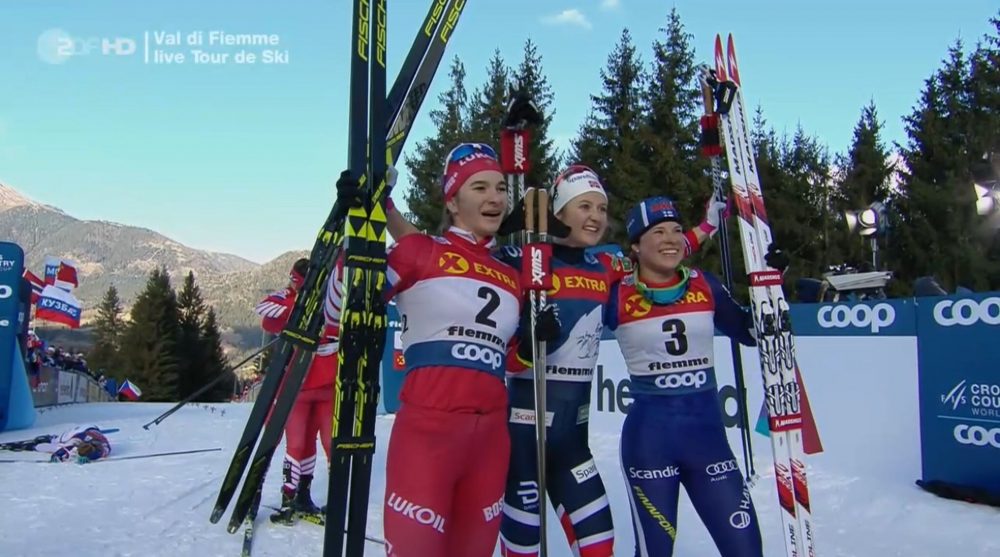
    Andersson was able to close the gap between Kalla and herself between the 7.3 k and 8.3 k mark. By 8.3 k, Andersson had put a 6.4 seconds buffer between herself and Kalla. Behind Kalla, Norway’s Ingvild Flugstad Østberg kept the third podium step within her sights. On the last climb before the finish, Østberg caught and passed Kalla and began gaining time on Andersson.

    Johaug won in a time of 29:25.5 minutes. Andersson and Østberg finished neck-and-neck, with the Swede taking second (+16.8), and Østberg third, only 1.1 seconds back. Kalla finished fourth (+23.1).

    Norway’s Therese Johaug on her way to claiming her third World Cup distance win of the season. Here she steamrolls up a hill in the women’s 10 k classic pursuit in Lillehammer, Norway. (Photo: Fischer/Nordic Focus)

    After this weekend of racing, Johaug sits first overall in World Cup standings with 400 points. Andersson is in second, 91 points back, Kalla is positioned third, with 298 points.

    Sadie Bjornsen of the U.S. Ski Team, after a strong start to the season, is eighth overall on the World Cup. On Sunday, Bjornsen was one of three U.S. women in the top-15. Bjornsen started Sunday’s pursuit in 7th and finished in 10th with a time of 31:57.2 minutes.

    Staring 50 seconds back, Bjornsen lost time on course to the leaders. She ultimately finished 2:21.7 minutes behind the winner, Johaug.

    “It was definitely a tough race out there, I had pretty slick skis, so it was just a matter of trying to stay positive and herringbone as much as I could and it was definitely a difficult course to be struggling on,” Bjornsen told FasterSkier in the Lillehammer mixed zone.

    Bjornsen had intended to link up with the skiers beginning ahead of her. But the tough conditions foiled her strategy.

    Sadie Bjornsen during Saturday’s 10 k freestyle in Lillehammer, Norway. Sunday’s race was a 10 k classic pursuit. (Photo: Fischer/Nordic Focus)

    “My plan was to try to catch Krista Pärmäkoski and Ragnhild Haga in front of me and try to ski with them and I kind of yo-yo’d with Haga the entire time, so that was definitely really hard,” Bjornsen said. “I was kind of in No Man’s Land, not skiing with anyone, and when Stina Nilsson went by I was not able to stay with her pace. It was going uphill and I was having to herringbone, so it was kind of sad to not catch on to that chain. But I tried to just keep fighting the whole way.”

    U.S. Ski Team World Cup Coach Matt Whitcomb confirmed Bjornsen was thin on kick. “I mentioned I thought our team did better than most today with regards to wax and skis. Whitcomb said. “I do think Sadie was a little bit lean on kick, and think she was on form. She was ready to climb up today and I just don’t think we gave her what she needed to to make it happen.”

    Rosie Brennan (APU) and Jessie Diggins (USST) began Sunday’s race in 13th and 14th respectively, 1:25 minutes behind Kalla. The U.S. pair was able to ski together for the majority of the race in a pack with Norway’s Heidi Weng, and Russia’s Yulia Belorukova.

    By the finish, Diggins was able to gain one place to end up 13th (+2:42.4). Brennan lost three places in the finishing stretch to take 15th (+2:46.0).

    “I struggled to compose myself on that last climb, and don’t have much of a sprint finish, so lost a place or two there,” Brennan told FasterSkier after the race,

    Brennan has started her season off strong with a career-best 11th place in Saturday’s 10k classic individual start, she finished 11th.

    “It was a good race, not a great race, but yeah I’m happy that I had a good group to skate with and I was able to hang in there”, Brennan told FasterSkier. “[I was] able to ski comfortably in a group and feel comfortable with some pretty strong girls and it was super nice to be able to ski with Jessie [Diggins] for a lot of it. “When it’s someone you train with more often it’s a little bit more comfortable, and her strength is on the downhill and that’s my weakness, so it’s nice to be able to follow someone.”

    Whitcomb noted Brennan’s marked improvement and return to form after her struggles with an illness last season.

    “It’s really fun to watch from the side of the trail, an athlete that has had to deal with, and sort of had to harness so much patience,” Whitcomb reflected. “She spent so much of last season, the better half of the second part ill, and so she’s really had to settle down, recover and then get herself back in shape. These things happen over the course of months, and she had that patience, and she put in the work after she recovered and now she’s being rewarded for it, and it’s really fun to sit back and just watch an athlete be so stoked with how they’re feeling out there.”

    Caitlin Patterson during Saturday’s 10 k freestyle in Lillehammer, Norway. Sunday’s race was a 10 k classic pursuit. (Photo: Fischer/Nordic Focus)

    Caitlin Patterson (Craftsbury Green Racing Project) started in 31st, 2:37 minutes behind Kalla and finished 35th, five and a half minutes behind Johaug. Throughout the race, she hovered between 27th and 32nd place, but she crashed on a downhill during her second lap and lost places.

    “I was crushing it on the downhills until then and I consider myself pretty good at cornering, but I just momentarily caught a glimpse of a two girl in front of me, got too excited, lost focus, and stepped in some slush that I wasn’t expecting or something,” Patterson told FasterSkier after the race.

    Racing continues on the World Cup next weekend with events in Beitostolen, Norway.

    Women’s Results

  • Belorukova Stuns in Kuusamo Classic Sprint; Bjornsen 11th

    Belorukova Stuns in Kuusamo Classic Sprint; Bjornsen 11th

    Yulia Belorukova (4) of Russia after winning the men’s 1.4-kilometer classic race on Saturday in Kussamo, Finland. (Photo: Fischer/Nordic Focus)

    If there is anything Russia’s Yulia Belorukova, took away from the 2018 Pyeongchang Olympic Winter Games, besides an individual bronze medal in the classic sprint, it’s that she is capable of sprinting with the best in the world.

    Leading up to the Games in Pyeongchang, the 23-year-old had yet to land on a World Cup podium. Even post-Pyeongchang, a World Cup win remained unchartered waters for the recent Olympic bronze medalist.

    But with the opening World Cup classic sprint on Saturday in Kuusamo, Finland, Belorukova, is making a statement for the upcoming season. She raced to her first individual World Cup victory, besting Sweden’s sprint star Stina Nilsson–who crashed during the final corner before the finishing stretch–and last year’s overall sprint leader, Maiken Caspersen Falla of Norway.

    Left to right: Sweden’s Stina Nilsson, Russia’s Yulia Belorukova Norway’s Maiken Caspersen Falla and Swedes Maja Dahlqvist and Ida Ingemarsdotter during the final of the women’s 1.4-kilometer classic sprint on Saturday in Kuusamo, Finland. (ZDF broadcast screenshot)

    Belorukova had shadowed Nilsson during much of the final, but as they cornered toward the final 100-meters, a missed pole plant caused Nilsson to fall. Belorukova maneuvered around the Swede and crossed in a time 2:52.62 of for the win. Unable to recover from the fall in time for a shot at the podium, Nilsson crossed 12.33 seconds behind the Russian in sixth.

    “On the last meters I was very strong …I hope. And today was a very good feeling,” Belorukova told FIS after the race. “And thank you so much for this great atmosphere. I am so happy to start here in Ruka, it is [a] happy place for me. Today I am lucky and happy.”

    Also lucky for the blue and gold, not all podium prospects were riding on Nilsson. Twenty-four year old Maja Dahlqvist of Sweden, who placed second in last year’s freestyle sprint in Dresden, Germany, advanced to Saturday’s final and claimed her second individual World Cup podium, crossing 1.12 seconds back from Belorukova.

    Following Dahlqvist, Sweden’s 33-year-old Ida Ingemarsdotter crossed third, 1.51 seconds back from the winner. The last time Ingemarsdotter landed in the top-3 individuall was in 2016, when she placed second in the freestyle sprint in Lenzerheide, Switzerland.

    The finish was hard-earned, with Ingemarsdotter outlunging Falla by 0.1 seconds in a photo finish. Falla ended the day in fourth (+1.52) and Finland’s Krista Pärmäkoski in fifth (+4.71).

    Sadie Bjornsen racing the women’s qualifier on Saturday in Kuusamo, Finland. (Photo: Fischer/Nordic Focus)

    Earlier in the day, Russia’s Natalia Nepryaeva won the qualifier in a time of 2:56.50. Behind her, three Americans qualified for the heats, with Sadie Bjornsen leading the charge in 5th (+3.01), Sophie Caldwell in 22nd (+6.97), and Ida Sargent in 24th (+7.23).

    Both Caldwell and Bjornsen were slotted into quarterfinal 1. The heat went to Falla, with Bjornsen snagging an automatic advance spot in second. Caldwell, who crossed the quarterfinal in third, did not advance to the semifinals, She ended the day in 16th.

    “It sure was fun to fire the engine for day 1 of World Cup racing this winter!” Bjornsen wrote in an email after Saturday’s sprint. “I always think of the first races as a Christmas gift… a total mystery, but completely exciting!

    “I was really stoked on a 5th place qualifier, and felt like I had more to give for the heats to come,” Bjornsen continued. “I am a huge fan of the final climb on this course, and I love attacking it, so I was just excited to take it on. My quarterfinal went well, and I was able to move on just barely in a photo finish with Sophie.”

    Sargent raced quarterfinal 3, which was won by Ingemarsdotter. Sargent crossed sixth and did not advance to the semifinals, ending the day in 27th.

    Bjornsen moved into the first semifinal, lined up against Falla, Nilsson, Ingemarsdotter, Belorukova and Nepryaeva. Ultimately, she crossed sixth and ended the day in 11th.

    buy keflex online


    “The semi final got off to a good start, and then as I was approaching the final big climb, I was on a desperate search for an open lane to put my move on the big climb, but unfortunately burned a few too many flares chasing it, and didn’t have the power to advance.” Bjornsen wrote. “I think that was one of the more stacked semi-finals I have been part of, so I still have a lot of hope and belief for what is to come.”

    “Tomorrow is our first World Cup Distance race of the season, with a 10k classic, so I look forward to putting my distance engine to the test,” Bjornsen added. “It was a great warm up last weekend, and fun to stand on the podium to get my confidence and excitement going.”

    Bjornsen raced last weekend’s FIS 10 k in Beitostølen, Norway and placed third behind Norwegians Ingvild Flugstad Østberg and Therese Johaug in second and first, respectively.

    Finishing outside of qualification for the U.S. on Saturday was Jessie Diggins (USST)  in 33rd (+9.05), Rosie Brennan of the Alaska Pacific University in 38th (+10.74), Kelsey Phinney of the Stratton Mountain School in 46th (+13.49), and last season’s overall SuperTour leader, Kaitlynn Miller of the Craftsbury Green Racing Project in 58th (+18.06).

    No Canadian women entered the race.

    Results: Qualifier | Final


    The women’s sprint bracket from Saturday’s 1.4-kilometer classic sprint in Kussamo, Finland. (Photo: FIS Live Timing screenshot) Click the image to enlarge
  • Saturday Rundown: World Cup Ruka Classic Sprint

    Saturday Rundown: World Cup Ruka Classic Sprint

    The women’s 1.4-kilometer classic sprint podium (l to r): Sweden’s Maja Dahlqvist, Russia’s Yulia Belorukova and Ida Ingemarsdotter of Sweden. (Photo: Fischer/Nordic Focus)

    FIS Cross-Country World Cup in Kussamo, Finland: Classic sprint

    Men’s Report | Women’s Report

    On Saturday in Kussamo, Finland the 2018/2019 World Cup season began with a 1.4-kilometer classic sprint.

    Twenty-three-year-old Yulia Belorukova from Russia won the final in 2:52.62 minutes. It was Belorukova’s first World Cup win. Second place went to Sweden’s twenty-four-year-old Maja Dahlqvist who crossed the line 1.12 seconds back. Also from Sweden, Ida Ingemarsdotter was third (+1.51), Norway’s Maiken Caspersen Falla fourth (+1.52), Krista Pärmäkoski of Finland fifth (+4.71), and Stina Nilsson of Sweden, sixth (+12.33). Nilsson crashed in the final.

    In the women’s qualifier, Russia’s Natalia Nepryaeva set the fastest time in 2:56.50 minutes. Seventy-three skiers started the qualifier.

    buy cephalexin online

    Three U.S. Ski Team (USST) women advanced to the heats by qualifying in the top-30. Sadie Bjornsen in 5th (+3.01), Sophie Caldwell in 22nd (+6.97), and Ida Sargent 24th (+7.23).

    Caldwell and Sargent did not advance out of the heats. Caldwell was third in the first heat, won by second fastest qualifier, Falla. Caldwell finished 0.36 seconds behind Falla and ultimately did not secure a lucky loser spot. Sargent raced in the third heat where she placed sixth (+4.50).

    Four U.S. women bowed out in the qualifier, with last season’s second overall skier in the World Cup standings, Jessie Diggins, placing 33rd (+9.05). Rosie Brennan (APU) skied to 38th (+10.74), Kelsey Phinney (SMS-T2) 46th (+13.49), and last season’s overall SuperTour leader, Kaitlynn Miller (CGRP), was 58th (+18.06).

    Kaitlynn Miller racing for the U.S. in the women’s 1.4-kilometer classic qualifier on Saturday in Kussamo, Finland. (Photo: Fischer/Nordic Focus)

    No Canadian women entered the race.

    In the men’s race, last season’s World Cup overall and sprint cup winner, Johannes Høsflot Klæbo, scorched the qualifier in 2:28.95, winning by 3.21 seconds over he next fastest qualifier, teammate Eirik Brandsdal.

    Klæbo won his heat and his semifinal. But the semi was tight: Klæbo won by 0.1 seconds over Russia’s Alexander Bolshunov.

    In the final, Bolshunov won in 2:29.35 minutes, Klæbo was second (+0.31), Brandsdal third (+1;35). Also of Norway, Emil Iversen placed fourth (+3:04), Russia’s Gleb Retivykh fifth (+3.86), and Norwegian Sondre Turvoll Fossli sixth (+4.85).

    The only North American to advance to the heats was Canada’s Alex Harvey, who qualified in 25th (+9.40) and ended the day in eighth. Harvey advance out of the heats by placing second to Russia’s Gleb Retivykh in the fourth quarterfinal. In the second semifinal, Harvey placed fourth (+2.30) and did not advance as a lucky loser.

    Also for Canada, Julien Locke (CNST) finished 69th (+15.43), Andy Shields 75th (+18.59), and Russell Kennedy (Team R.A.D.) 76th (+18.61).  

    For the U.S., Erik Bjornsen (USST) placed 42nd (+11.41), Kevin Bolger (USST) 55th (+13.19), Ben Saxton (SMS-T2) 70th (+15.68), David Norris (APU) 78th (+19.05), and Simi Hamilton (USST) 82nd (+1:11).

    Women’s Qualifier Results | Women’s Final Results | Men’s Qualifier Results | Men’s Final Results

  • World Cup Preview: #3 Russia

    World Cup Preview: #3 Russia

    Russia’s Alexander Bolshunov leads five Norwegians in the men’s classic sprint final at the World Cup in Drammen, Norway: (from l to r) Eriik Brandsdal, Johannes Høsflot Klæbo (yellow bib), Sindre Bjørnestad Skar (10), Kasper Stadaas (16), and Emil Iversen. (Photo: Fischer/Nordic Focus)

    Welcome to FasterSkier’s World Cup Preview, where we check in with the top-10 teams from last year’s FIS Cross Country World Cup tour before the season starts. The World Cup begins with a classic sprint in Ruka, Finland on Nov. 24th.

    ***

    Russia

    Overall in Nations Cup Last Year: 3rd

    Women’s Ranking 2017/2018: 5th

    Men’s Ranking 2017/2018: 2nd

    Russians to Watch:

    For several years the attention grabbing fact about Russia was the morass of allegations and findings regarding rampant doping.

    The bureaucratic seesaw teetering and tottering prior to the 2018 PyeongChang Games boiled down to will they or won’t they. As in, will Russian athletes be able to compete?

    The International Olympic Committee (IOC) did ban some athletes, including 26-year-old multiple World Champion Sergey Ustiugov for his links to Sochi doping. Ustiugov skied through the January 28, Seefeld, Austria World Cup races. By then he had collected six podiums.

    The Russian Federation was banned outright from the Games; it’s athletes competed under the IOC flag as Olympic Athletes from Russia (OAR).

    The taint on competing Russian cross-country athletes last season was palpable. Clean or not, there was a sense of guilt by association. They must be a tough lot. Whatever psychic baggage the Russians carried as part of a shunned team, their collective results at the Olympics didn’t skip a beat. The same goes for the World Cup, where the group landed third overall in the Nation’s Cup.

    A cadre of young Russian skiers propelled themselves into medal position. There was  22-year-old Denis Spitsov who missed a bronze in the Olympic 30 k skiathlon by less than three seconds. He placed third in the Holmenkollen 50 k skate.

    vancomycin buy online

    Remove a Ustiugov from the picture and insert a 21-year-old Alexander Bolshunov.

    Bolshunov skied like a decade-long-veteran on the World Cup, earning three silvers and a bronze in his first Olympics. His versatility was on display in PyeongChang. He silvered in the team sprint and won bronze in the classic sprint. He proved his mix of slow and fast twitch muscle fiber — paired with a massive engine — could propel him in the 50 k classic too. He won silver in an off-the-front dual with Finland’s Iivo Niskanen.

    The Russian men won silver in the PyeongChang 4 x 10 k relay.

    By season’s end, Bolshunov was fifth overall in the World Cup standings. Added into Russia’s overall mix, Alexey Chervotkin was 11th overall, Usitugov 12th, Andrey Larkov 18th, Spitsov 20th, Maxim Vylegzhanin 27th, and Gleb Retivykh 30th.

    Count them up, that’s seven men in the top-30 of the World Cup overall. Deep is deep.

    Maiken Caspersen Falla (NOR), Yulia Belorukova (RUS), (l-r) during the 2018 FIS world cup cross-country, individual sprint, Planica, Slovenia. (Photo: Fischer/Nordic Focus)

    The Russian women had three athletes in the top-30 overall. Natalia Nepryaeva was ranked 13th, Anastasia Sedova 16th, and Yulia Belorukova 29th.

    Nepryaeva, at twenty three years old, had three top-five finishes on the World Cup including a second place in Lahti’s 10 k classic. She placed fourth in the Olympic classic sprint and eighth in the 15 k skiathlon. Also at twenty-three-years-old, Belorukova podiumed on several occasions in World Cup sprints, and won bronze in the Olympic classic sprint.

    In the Games 4 x 5 k relay, Nepryaeva, Belorukova, Sedova, and Anna Nechaevskaya, were third for Russia.

    Beginning a new Olympic quadrennial, many years removed from Sochi but its dark-sided impacts still relatively fresh, Russia has new faces on the scene. The Russian Ski Federation appears that it can plug and play as it moves athletes into its winning pipeline.

    WADA recently reinstated RUSADA as an anti-doping agency in good standing under it’s watchdog umbrella. The political maneuvering involving Russia and WADA is most likely not over. However, In 2018/2019, Russia has young, but World Cup experienced skiers.

  • Johaug, Krüger First to Top in Lysebotn Opp; Harvey 10th, Torchia 13th

    Johaug, Krüger First to Top in Lysebotn Opp; Harvey 10th, Torchia 13th

    The 7.5-kilometer race course for the Lysebotn Opp, an annual hill climb at the Blink Ski Festival in Lysebotn, Norway. (Photo: Blink Ski Festival/Facebook)

    The Blink Ski Festival’s famed Lysebotn Opp hill climb returned on Thursday, and with it, a familiar name landed at the top of the results. 

    After serving an 18-month ban from ski racing and subsequently missing the 2018 Winter Olympics, Norway’s Therese Johaug is back.

    Norway’s Therese Johaug winning the 2018 Lysebotn Opp hill climb, part of the Blink rollerski festival, on Thursday. She finished in a record-setting 31:46.3 minutes, topping her previous course record of 32:36 from 2012. American Liz Stephen, who retired from skiing this past spring, holds the third-fastest time of 32:53.9. (Screenshot: NRK broadcast)

    The 30-year-old Johaug won Thursday’s rollerski hill climb in a record time of 31 minutes, 46.3 seconds, while Sweden’s Charlotte Kalla finished 1:47.5 minutes back in second.

    Kalla, 31, won last year’s Lysebotn Opp in 33:18.3, telling NRK at the time that “it’s been long since I’ve been in this good a shape in July.” Kalla’s 2017/2018 season went on to be one of her best. She racked up 10 individual wins, including a gold medal in the Olympic skiathlon.

    If Kalla is using her the past year and half as a springboard for the upcoming season, Johaug might be considered the antithesis to the Swede. The year and half competition bar behind her, Johaug appears ready to move forward.

    “If there’s one thing I’ve learned from all this, it’s that you should never rely on anyone, period,” Johaug told Newsinenglish.no. “It’s terrible, but that’s the way it is.”

    Her suspension spurned from a positive test to the banned substance Clostebol acetate, which was present in a lip cream she had been prescribed by her doctor.

    Following Johaug and Kalla on Thursday, Sweden’s Ebba Andersson claimed the third spot on the podium, finishing 3.9 seconds behind her compatriot Kalla and 1:51.4 behind Johaug.

    Norway’s Haga Ragnhild placed fourth (+2:21.6) and Ingvild Flugstad Østberg was fifth (+2:48.9), Austria’s Teresa Stadlober finished sixth (+3:05.7), Russia’s Yulia Belorukova seventh (+3:52.4), Norway’s Kari Øyre Slind eighth (+4:05.0), and Russia’s Elena Soboleva ninth (+4:14.1) and Yana Kirpichenko 10th (+4:26.2). Finland’s Krista Parmakoski finished exactly ten seconds outside the top ten in 11th (+4:36.2). Forty-seven women finished the senior women’s race.

    Norway’s Simen Hegstad Krüger winning the 2018 Lysebotn Opp hill climb, part of the Blink rollerski festival, on Thursday. (Screenshot: NRK broadcast)

    In the senior men’s Lysebotn Opp that followed, two Norwegians battled up front, with reigning Olympic skiathlon champ Simen Hegstad Krüger ultimately winning the race for the first time in 27:53.2. Another national team member and 2018 Olympian (and last year’s Lysebotn Opp winner), Hans Christer Holund finished 3.9 seconds back for second place, and Norway swept the podium with Simen Andreas Sveen in third (+16.0).

    Rounding out the top 10 were Norwegians Vebjørn Turtveit in fourth (+51.7), Martin Johnsrud Sundby in fifth (+52.6), France’s Clement Parisse in sixth (+1:12.4), Norway’s Henrik L’Abée-Lund in seventh (+1:21.1), France’s Adrien Backscheider in eighth (+1:24.7), Russia’s Artem Maltsev in ninth (+1:31.4) and Canada’s Alex Harvey in 10th (+2:02.1).

    American Ian Torchia, who graduated from Northern Michigan University and was renominated to the U.S. Ski Team’s development team this spring, placed 13th (+2:17.2) out of 91 in the men’s field. The 22 year old has been training and traveling in Europe since early July.

    Canada’s Evan Palmer-Charrette finished 57th on Thursday (+5:53.4), Scott James Hill was 63rd (+6:29.7), and Bob Thompson 76th (+8:48.3).

    Racers in the Blink Ski Festival head to downtown Sandnes on Friday for rollerski sprints.

    Results: Women (scroll down for senior results) | Men

    Related: Bolshunov, Gjeitnes Win Blink Classics Distance Races on Opening Day

    Past winners of the Lysebotn Opp rollerski hill climb in Lysebotn, Norway. Simen Hegstad Krüger’s winning time on Thursday was third fastest on record at 27:53.2. (Screenshot: NRK broadcast)
  • U.S Women Fifth for Best-Ever Olympic Relay Finish; Canada 13th

    Sadie Bjornsen (front) skiing the U.S. women’s relay team into eighth position after her classic leg. (Photo: FlyingPointRoad)

    FasterSkier would like to thank Fischer Sport USA, Madshus USA, Concept2, Boulder Nordic Sport, and Swix Sport US for their generous support, which made this coverage possible.

    ***

    PYEONGCHANG, South Korea — Cross-country is still a roots sports in the United States. Woods-skiers and fitness buffs stoke the small engine driving the sport. But every four years, the buildup begins. The pressure notched up. There’s national television appearances for U.S. nordic athletes. Time to shine when the spotlight is pointed in your direction. For a fringe sport in North America, easy access to snow is a prerequisite, the Olympic buildup makes the cross-country conversation more relevant.

    To study on paper the lineups for Saturday’s women’s Olympic 4 x 5 kilometer relay is to realize the chances of medaling are exactly that: chances. Every head-to-head matchup, like a Stina Nilsson versus a Marit Bjørgen as the evening’s anchors for Sweden and Norway respectively, has its pros and cons. Coaches make calculated decisions. Can Bjørgen gain enough ground on Nilsson before the final straight? Can Nilsson stay close enough to edge Bjørgen on the final straight? Ultimately the skiers go out and ski.

    U.S. Ski & Snowboard put out a press release as the U.S. relay team was announced detailing the women’s 4 x 5 k relay results chronologically both on the World Cup and major championships.

    The U.S. women’s best-ever result relay result on the World Cup was a second place in  January 2016 in Nove Mesto, Czech Republic. (That lineup was Caldwell, Bjornsen, Stephen, Diggins). Their best World Championships relay result was a fourth place last year in Lahti, Finland. 2014 in Sochi marked the women’s best Olympic result of eighth place.

    Team. Much is said about the U.S. women’s team. So it’s fitting that in terms of promoting potential medals, the women’s relay gets the playbill’s frontpage.

    Again it’s a calculated chance for any team — no nation is ever a lock. Look at Norway’s 4 x 5 k relay result in Sochi. Fifth. So could the U.S. end a medal drought 26-years deep on Saturday? No. So is the Olympic buildup fair — maybe not.

    The beauty of the relay isn’t based so much in the euphoric glow of the podium’s top-three steps but how the chances played out.

    Norway played its chances with the Bjørgen-Nilsson duel. And Bjørgen couldn’t escape Nilsson’s shadow until the closing 300 meters — a place where Nilsson herself was supposed to shine. Norway stopped the clock in 51:24.3. Sweden placed second (+2.0).

    The U.S team of Sophie Caldwell, Sadie Bjornsen, Kikkan Randall, and Jessie Diggins placed fifth (+1:20.5). About all the pre-race hype and expectations, Randall, in her fifth Olympics, said it best.

    Five-time Olympian Kikkan Randall skiing the U.S. team into sixth position during Saturday’s Olympic 4 x 5 k relay. (Photo: FlyingPointRoad)
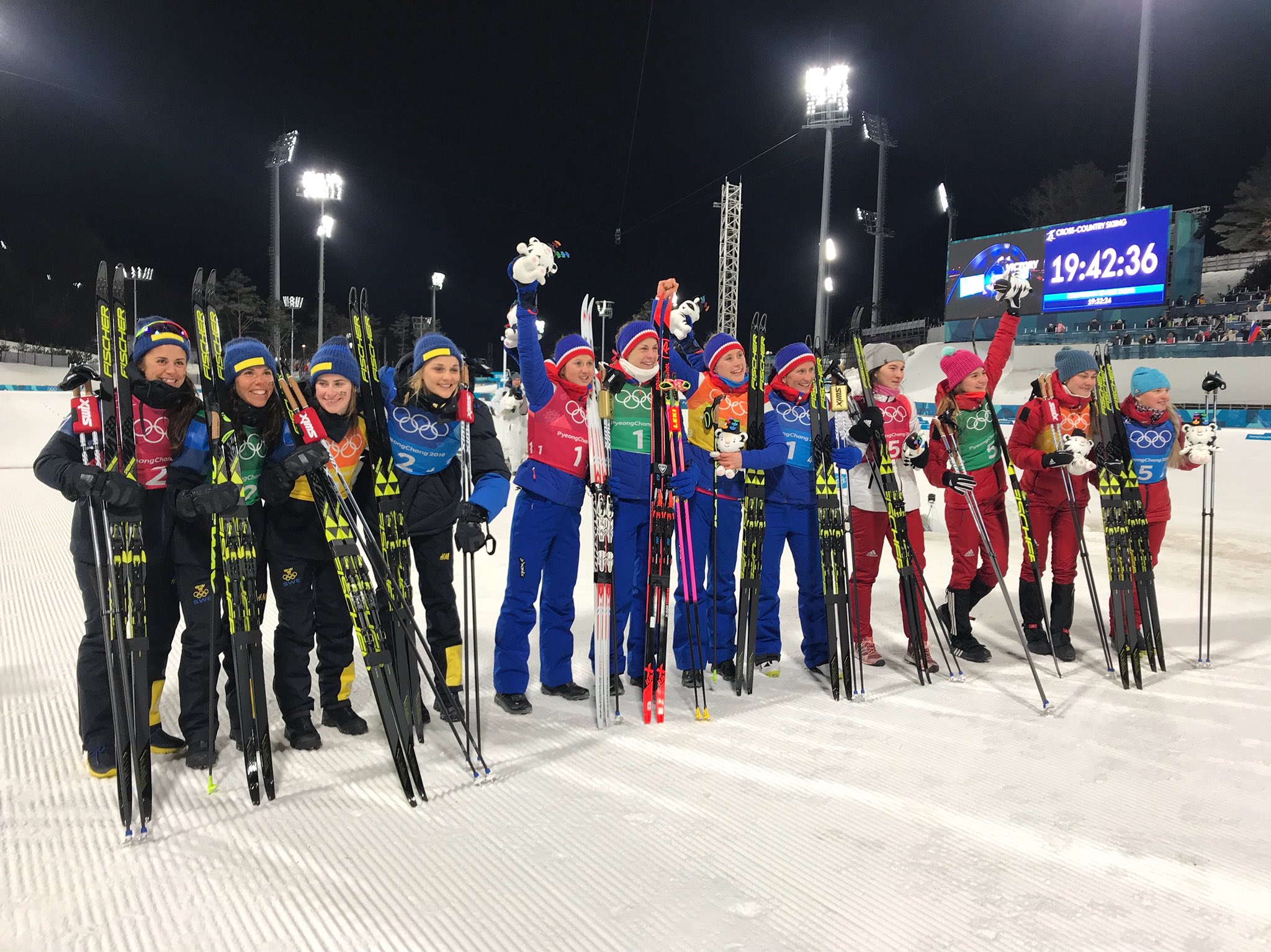
    “This is our best Olympic finish ever,” Randall said in the mixed zone after the race. “When we tend to be really focused on the medals it’s because we know deep in our hearts it is possible. I still think this is amazing that we put together four strong legs today and to get the best-ever result, keep the pathway going forward.”

    This is not baseball’s World Series with a best-of-seven series. It is one and done. So when Caldwell toed the line in the scramble leg, there was belief. And if we want to fast forward to the end of this report, belief remains.

    Caldwell sent it for the first half of her leg. Russia’s young upstart team took it out hot — their strategy one of padding their skate legs for the onslaught from Norway’s and Sweden’s skate legs. Only 8.1 seconds off the front at the time, Caldwell then fell off as the Olympic Athletes from Russia (OAR) and Norway surged ahead by the 3.58 k mark. Caldwell came through to tag Bjornsen in 11th place (+1:01.5).

    “I think that our team has more belief than we ever had right now,” Bjornsen said after the race. “It’s just so motivating and exciting, and we show up to every race just so excited to see what we can do, and kind of goosebumps just standing on the start line and that is certainly a memory that we are going to take away forever.”

    Sophie Caldwell during the scramble leg for the U.S women during Saturday’s 2018 Olympic 4 x 5 k relay. She is ahead of Switzerland’s Laurien van der Graaff. (Photo: FlyingPointRoad)
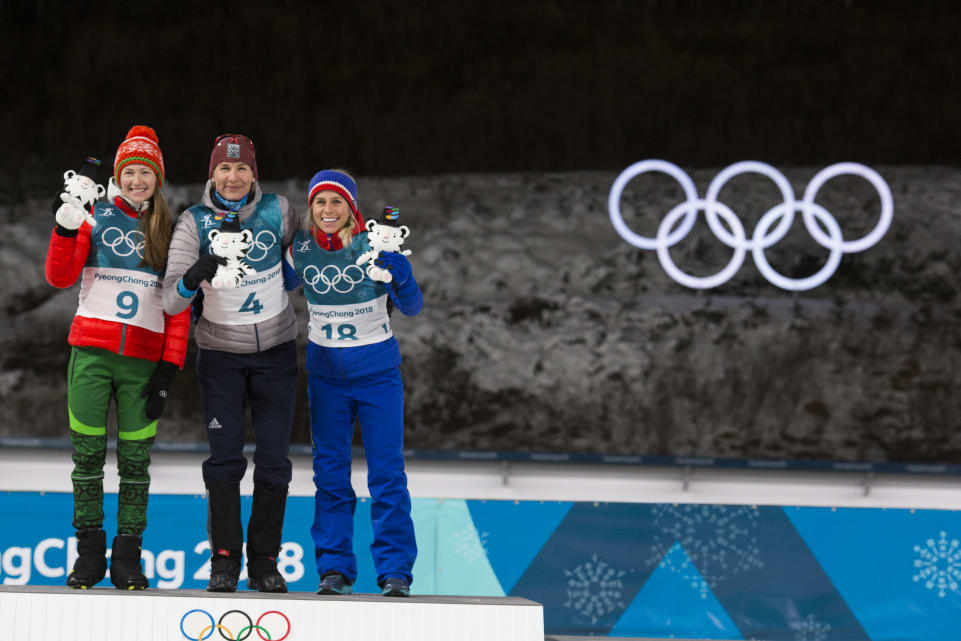
    After skiing the sixth fastest leg, Bjornsen took the team into eighth place (+1:05.2) as she tagged to Randall for the first skate leg. Randall skied the third best time on her leg and brought tagged off to Diggins in sixth.

    As the Bjørgen-and-Nilsson parry played out ahead, Diggins motored. She, too, skied the third-fastest anchor leg split and reeled in another place as she crossed the line in 52:44.8 minutes to secure fifth place. 

    Here’s the thing: a medal appeared out of reach for the U.S. early on. But these women make you believers. That’s not U.S. Ski & Snowboard spin. That’s not wishful fan-boy thinking. It’s incremental steps the U.S. women have made.

    Every nation shows up for the Games primed. The U.S. showed up and they were fifth on Saturday. Thirty-seven-point-two seconds out of third. Who wouldn’t believe in that?

    “I think for me, every time you get to put on the rely socks it’s a big honor, its a privileged,” Diggins said as she reflected on the race. “You know you’re just not racing for yourself. You are racing for your teammates, you are racing for the people who did not get named to the relay, but easily could have, and are out there cheering on the course, and you are racing for Team USA. … I got to see each of my teammates ski their hearts out. I was getting more and more fired up watching them, just like, ‘OK, it’s my turn I am going to go reel in as many people as I can,’ and then we are going to walk away proud of what we did here today because there is more to it than just medals.”

    Asked after the race to expand on what the day in and day out meaning of belief is like for the women’s team, U.S. women’s coach Matt Whitcomb elaborated on his role and that of the athletes.

    “As coaches we spend a lot of time trying to tune people’s engines and try to make sure that they show up with a roaring Ferrari,” Whitcomb remarked. “But the Ferrari needs a driver and for the skier that’s the brain. The body will not go if the brain isn’t behind it and we’ve seen it time and time again where you have someone who you think is completely tuned up and prepped and ready to win a race and they’re not even in the points, and you later uncover that something had them out of balance and listing starboard and kept them off course for the day.

    Jessie Diggins after skiing the U.S. women into fifth place during the 4 x 5 k Olympic relay. (Photo: FlyingPointRoad)

    “So when we, as a team, first believe in one another, you then have your entire team that believes in you,” Whitcomb continued. “And that’s impossible to miss the positive effects of your team. One after the next, believing in you as a skier and you can’t help but believe more in yourself. So when you’re confident, you believe more in yourself, the body starts up really quickly and you can race the car.”

    Under Whitcomb’s guidance, the U.S. nordic community has come to expect excellence for it’s women’s team. Consider that for a minute. Consider that during the early part of Randall’s career, it was a fight to even field a women’s relay team. Consider that Whitcomb chose a Ferrari as his vehicular metaphor. That metaphor works for the U.S. squad.

    Whitcomb also spoke of how the race unfolded from the outset.

    “The first thing that jumped out was that Russia chose the strategy of two very hot classic legs,” Whitcomb said. “That is something we were hoping didn’t occur. And it doesn’t always in championship events, it tends to, but I felt like, and I still feel like, we put together the very best team we had tonight. I have really honestly no regrets about that.”

    Here’s the link to the 4 x 5 k women’s relay start list. It’s a wow-type list. The Norwegians, the Swedes and the Finns, all loaded lineups. And the Russians were seated fifth. Natalia Nepryaeva and Yulia Belorukova, both Russian skiers that have already medaled at these Games, led off the first two relay legs. They were a big unknown who pulled through for the bronze.  

    Ready, set, go. The start of the women’s 4 x 5 k Olympic relay. (Photo: FlyingPointRoad).

    “It was really interesting to talk with the Russian coach on the trails as we were watching the race and confirm that they were in fact they were going to take it out hot, so we were privy to that,” Whitcomb said. “The athletes more than anybody knew what was going on. They can see the splits opening up or closing down. But as you saw in several cases, with Riita-Liisa [Roponen] from Finland, with Astrid [Uhrenholdt Jacobsen] from Norway, with Russia’s last skier on their first leg anyways, there are dents in armor here and there. We were hoping to really tear those open, and we got close but we were on the same hill as the medal. We’ve been there before and that’s frustrating. But for me, it’s fortunately more than just medals and I’m very proud of the team today.”

    Canada’s relay team of Dahria Beatty, Emily Nishikawa, Cendrine Browne, Anne-Marie Comeau placed 13th (+4:50.3).

    “We are racing all for each other; we are doing our very, very best,” Nishikawa said after the race. “I think our team has come a long ways. Last year at the world champs we probably had one of our best days ever [in 10th]. On a really good day we could be fighting with a lot of these teams.”

    Racing continues Sunday with the men’s 4 x 10 k relay.

    Results

  • Saturday Olympic Rundown: Norway Tops Women’s Relay, U.S. 5th; Kuzmina Dominates Mass Start

    Saturday Olympic Rundown: Norway Tops Women’s Relay, U.S. 5th; Kuzmina Dominates Mass Start

    Norway won the women’s 4 x 5 k relay, with Sweden taking silver and Russia bronze. (Photo: FIS Cross Country/Twitter)

    FasterSkier would like to thank Fischer Sport USA, Madshus USA, Concept2, Boulder Nordic Sport, and Swix Sport US for their generous support, which made this coverage possible.

    2018 Winter Olympics (PyeongChang, South Korea): Women’s 4 x 5 k Relay

    International report

    North American report

    It wasn’t the wire-to-wire triumph that Norway sometimes achieves, but the pre-race favorites got the job done despite a scare midway through, thanks to dominant skiing by Ragnhild Haga and smooth strength from anchor Marit Bjørgen.

    Norway took gold in the 4 x 5 k relay by two seconds over Sweden in 51:24.3 minutes. Olympic Athletes from Russia took bronze (+43.3), Finland fourth (+1:02.6), and the United States fifth (+1:20.5).

    The first leg went out with Natalia Nepryaeva of Russia setting a blistering pace, fracturing the field almost immediately. A number of racers tried to stay with her only to get shot off the back of the pack. Taking a different pacing strategy, Slovenia’s Anamarija Lampic made up ground in the final section of the first leg to tag off in second, with Norways’ Ingvild Flugstad Østeberg third, all within a few seconds of each other.

    Part of Nepryaeva’s fracturing of the field led to U.S. lead skier Sophie Caldwell getting dropped, to tag off 1:01.5 minutes back in 11th place.

    In the second leg, Charlotte Kalla of Sweden and Kerttu Niskanen of Finland clocked the fastest times, making up 24.4 and 9.9 seconds that had been lost to Russia and Norway by their teammates Anna Haag and Aino Kaisa Saarinen, respectively. In the meantime, Astrid Uhrenholdt Jacobsen of Norway had a disastrous relay leg and notched just the eighth-fastest split time, falling to fourth.

    Yulia Belorukova of Russia continued to lead the race on that second leg, but Kalla tagged off at the end of the classic portion just 1.4 seconds back, and Niskanen in third (+10.1). Sadie Bjornsen made up three places to tag off in eighth (+1:05.2).

    Jacobsen tagged Haga 29.8 seconds out of first. From that point, Haga gradually reeled in the leaders over the course of the 5 k skate leg. It was an absolutely dominant performance, with the fastest split time by 24.7 seconds in a less than 12-minute race.

    Sweden’s Ebba Andersson led Russia’s Anastasia Sedova for the whole leg and stayed clear of the field, but Haga — the gold medalist in the 10 k skate — made up enough ground to finish her effort in third, 3.4 seconds back.

    That was more than enough for Bjørgen to work with, and she and Swedish anchor Stina Nilsson quickly dropped Anna Nechaevskaya of Russia and set off on their personal duel for gold. Bjørgen led the whole way, but could not make any decisive move to drop the Swede. Instead, over the top of the climb she had about a second, which Nilsson could not close on the downhill or the final flats into the finishing straight: gradually, Bjørgen just added a meter and another to her lead and crossed the line with gold.

    Nechaevskaya continued to lose time on the leaders, but still held on to bronze. Krista Pärmäkoski skied an aggressive effort for Finland to pass the team from Switzerland, which had been in fourth after strong legs from Laurien van der Graaff, Nadine Fähndrich, and Nathalie von Siebenthal. But 21-year-old Lydia Hiernickel was unable to keep the pace and Switzerland dropped to seventh by the finish, getting passed by not only Parmakoski and Jessie Diggins, but also Sandra Ringwald of Germany. The Germans finished sixth (+1:49.4) and Switzerland seventh (+1:51.5).

    Kikkan Randall had skied the third-fastest split of the field (behind Haga and Andersson) in the third leg to bring the U.S. into sixth, and Diggins also skied the third-fastest split (behind Bjørgen and Nilsson) for her leg to bring the team up to fifth at the finish.

    The Canadian team of Dahria Beatty, Emily Nishikawa, Cendrine Browne, and Anne-Marie Comeau placed 13th (+4:50.3) of 14 teams.

    Results

    ***

    The women’s biathlon 12.5 k mass start medalists at the 2018 Olympics in PyeongChang, South Korea, with Slovakia’s Anastasiya Kuzmina (c) in first, Belarus’s Darya Domracheva (l) in second, and Norway’s Tiril Eckhoff (r) in third. (Photo: IBU/Biathlonworld)

    Biathlon: Women’s 12.5 k mass start

    Full report

    Not even a miss in the final stage could keep Slovakia’s Anastasiya Kuzmina from her third medal of the 2018 Olympics, this time gold, in the women’s 12.5-kilometer mass start on Saturday at the Alpensia Biathlon Center.

    Kuzmina took charge early in the five-loop race, leading Germany’s Laura Dahlmeier into the range for the first prone shooting stage. There, Kuzmina cleaned all five targets quickly to get back out on course in first, while Dahlmeier missed one to slip out of the top 20, while several other athletes cleaned.

    Kuzmina went on to hit every target over the next two shooting stages to distance herself from second place, and even with a miss on the last standing stage, she left the range 24.7 seconds clear of Darya Domracheva of Belarus in second.

    Domracheva had put herself in second with clean shooting in the first two stages, then dropped to fifth with a miss on the third stage. Italy’s Dorothea Wierer was up to second by the fourth shooting after three clean stages, then fell back to seventh with a miss on the last standing.

    There, Domracheva cleaned to get back into silver-medal contention, 9.3 seconds ahead of Norway’s Tiril Eckhoff in third.

    Heading into the final downhill into the stadium, Kuzmina had enough time to grab a flag from one of her team’s staff members running alongside the trail. She crossed the finish line first in 35:23.0 minutes without anyone close for her third-career Olympic gold (after winning the sprint at the 2010 and 2014 Games).

    Domracheva skied on her own to second, 18.8 seconds behind, for her first medal of the 2018 Games (and fifth of her career after winning three races at the 2014 Olympics).

    Eckhoff, who had skied two penalty laps, took third, 27.7 seconds behind Kuzmina, while Italy’s Lisa Vittozzi held off Sweden’s Hanna Öberg, Wierer and Belarus’s Nadezhda Skardino for fourth place (+45.6). Öberg placed fifth (+46.5), Wierer was sixth (+47.3), and Skardino seventh (+47.9), ahead of Norway’s Marte Olsbu in eighth (+51.6), France’s Marie Dorin Habert in ninth (+57.9) and Finland’s Kaisa Mäkäräinen in 10th (+1:00.9). Dahlmeier, who had won two races and placed third in another at these Olympics, finished 16th (+1:47.1) with two penalties (1+1+0+0).

    No North Americans qualified for the mass start.

    Results