From the FasterSkier archive — posts syndicated from athletes’ and coaches’ own blogs between 2004 and 2012, kept online as published. Current coverage is at fasterskier.com.
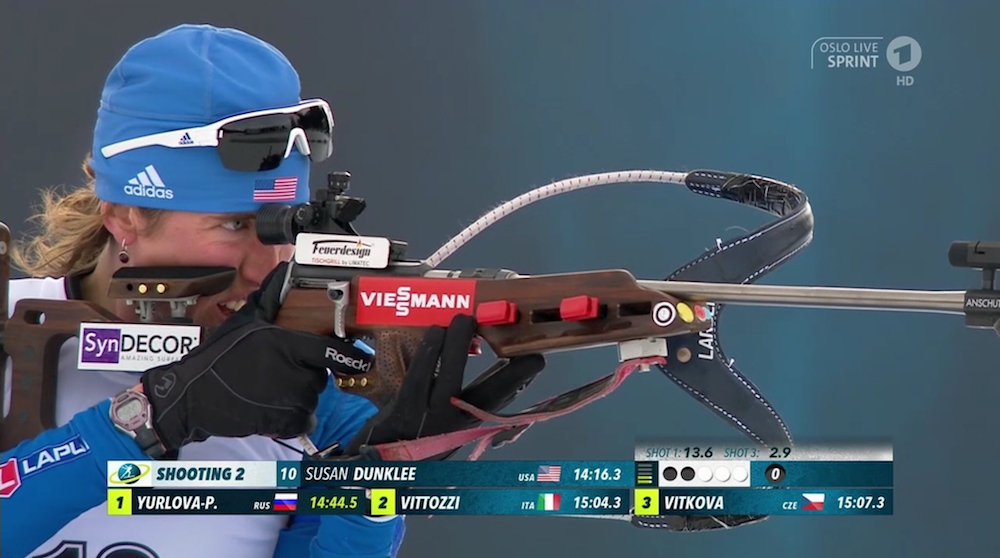
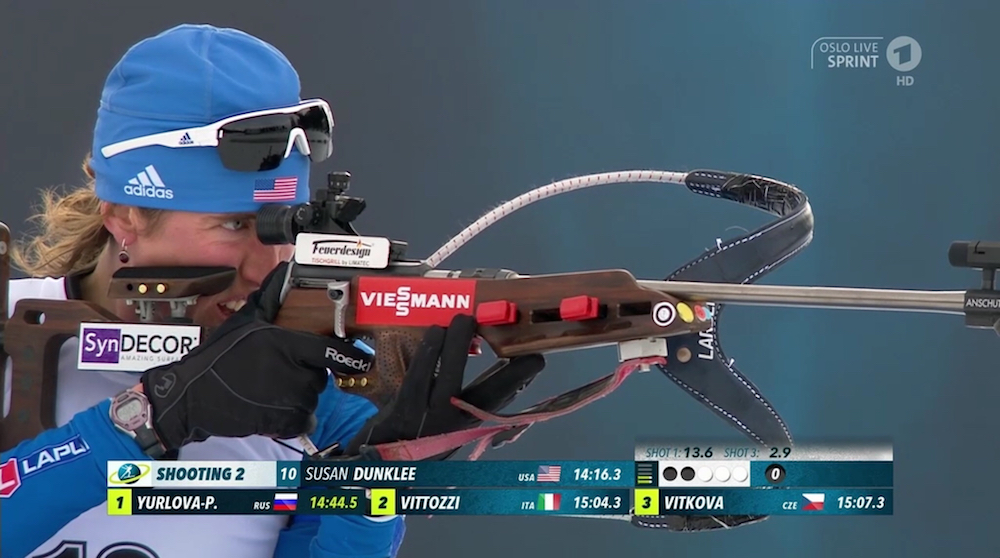
American Susan Dunklee cleaning her second-straight shooting stage of the women’s 7.5 k sprint on Thursday at the IBU World Cup in Oslo, Norway. (Screenshot: ARD broadcast)
IBU World Cup (Oslo, Norway): Women’s and men’s sprints
In her last International Biathlon Union (IBU) World Cup sprint of the season, Susan Dunklee (US Biathlon) raced to a season-best fourth place in the women’s 7.5-kilometer sprint on Thursday at Holmenkollen in Oslo. Dunklee shot clean and finished 35.7 seconds behind Slovakia’s Anastasiya Kuzmina, who had a single prone miss (1+0) but skied the fastest course time to win in 21:31.8 minutes.
Darya Domracheva of Belarus finished 8.9 seconds back for second place with perfect 10-for-10 shooting. The rest of the top-seven finishers also shot clean, with Ukraine’s Yulia Dzhima placing third, 29.2 seconds out of first and 6.5 seconds ahead of Dunklee.
Rosanna Crawford led Canada in 38th (+1:51.8) with one penalty (0+1), and two of her teammates also qualified for Sunday’s pursuit by finishing in the top 60: Julia Ransom in 46th (+2:10.1; one penalty) and Emma Lunder in 57th (+2:28.2; one penalty). Sarah Beaudry finished 84th (+3:30.7; three penalties).
Four Americans competed, with Clare Egan finishing 68th (+2:44.8; three penalties), Joanne Reid 75th (+3:02.2; three penalties) and Emily Dreissigacker 83rd (+3:24.8; three penalties).
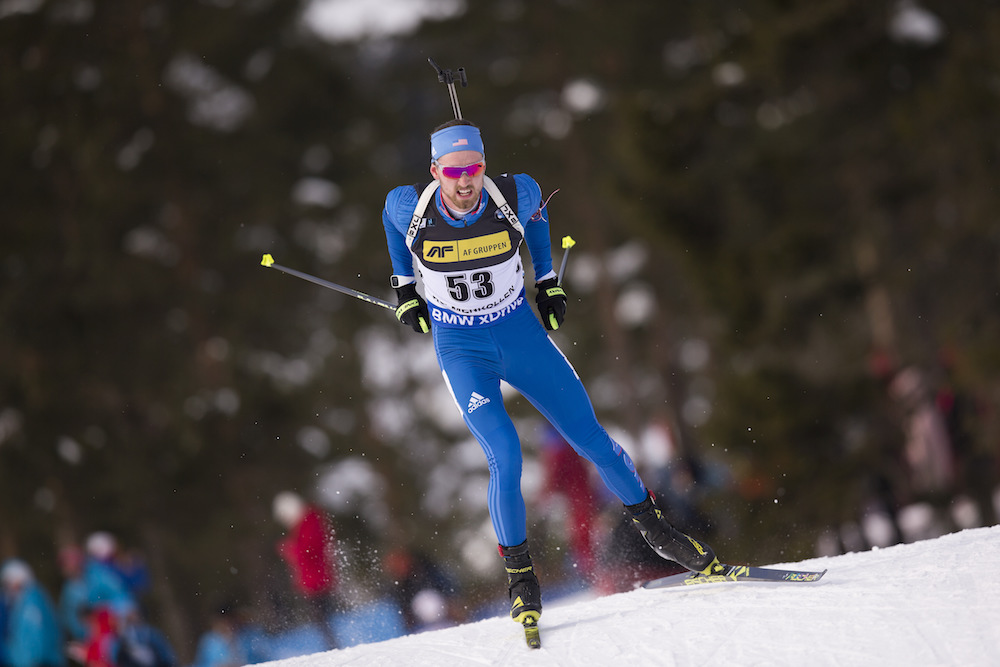
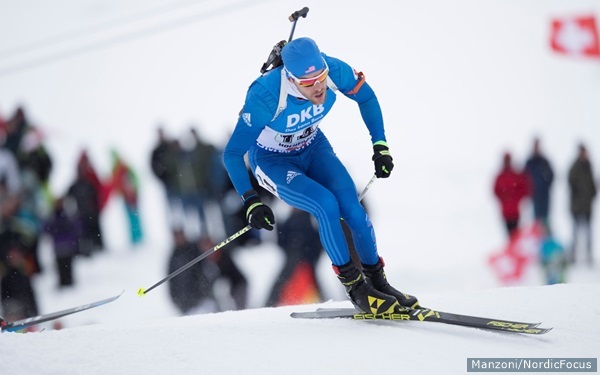
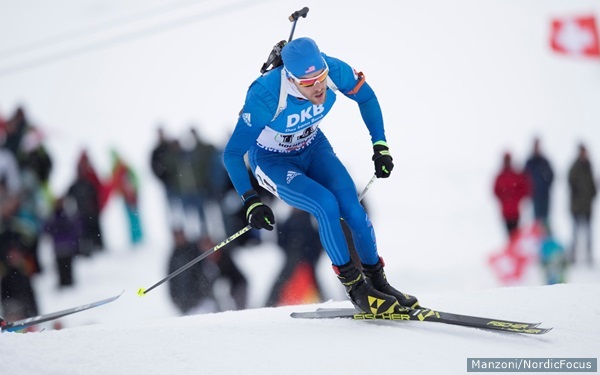
Sean Doherty (US Biathlon) racing to 14th in Thursday’s 10 k sprint for a season-best individual result at the IBU World Cup in Oslo, Norway. (Photo: USBA/NordicFocus)
In the men’s 10 k sprint that followed, Sean Doherty (US Biathlon) raced to his best result of the season as well, and was one place away from tying his career best, placing 14th with clean shooting.
Doherty finished 47.1 seconds off the winning time set by Norway’s Henrik L’Abée-Lund, who notched his first World Cup win in 26:10.3. He also shot clean, while his teammate Johannes Thingnes Bø missed one in his standing stage to come 6.1 seconds short of winning at the finish. Bø finished second, while France’s Martin Fourcade placed third (+6.9) after shooting clean but falling on a downhill and losing valuable time.
Doherty posted the 24th-fastest overall range time, 26th-fastest shooting time and 33rd-ranked course time. The 22-year-old New Hampshire native was one of nine men in the top 14 that shot clean. His individual World Cup career best is 13th, which he notched during the 2015/2016 season in a sprint in Presque Isle, Maine. His 14th place on Thursday bested his 17th-place finishes in a sprint and a pursuit earlier this season.
Four out of five of the American men competing qualified for Saturday’s pursuit, with Lowell Bailey finishing 42nd (+1:41.1; two penalties), Leif Nordgren 43rd (+1:43.3; one penalty) and Tim Burke 57th (+2:12.8; four penalties). In his second World Cup start, Alex Howe finished 89th (+3:39.5; one penalty).
Canada’s Scott Gow and Christian Gow qualified for the pursuit, with Scott placing 49th in the sprint (+2:02.1; one penalty) and Christian finishing 56th (+2:12.3) with clean shooting. Brendan Green finished 71st (+2:31.3; two penalties) and Macx Davies was 96th (+4:27.2; four penalties).
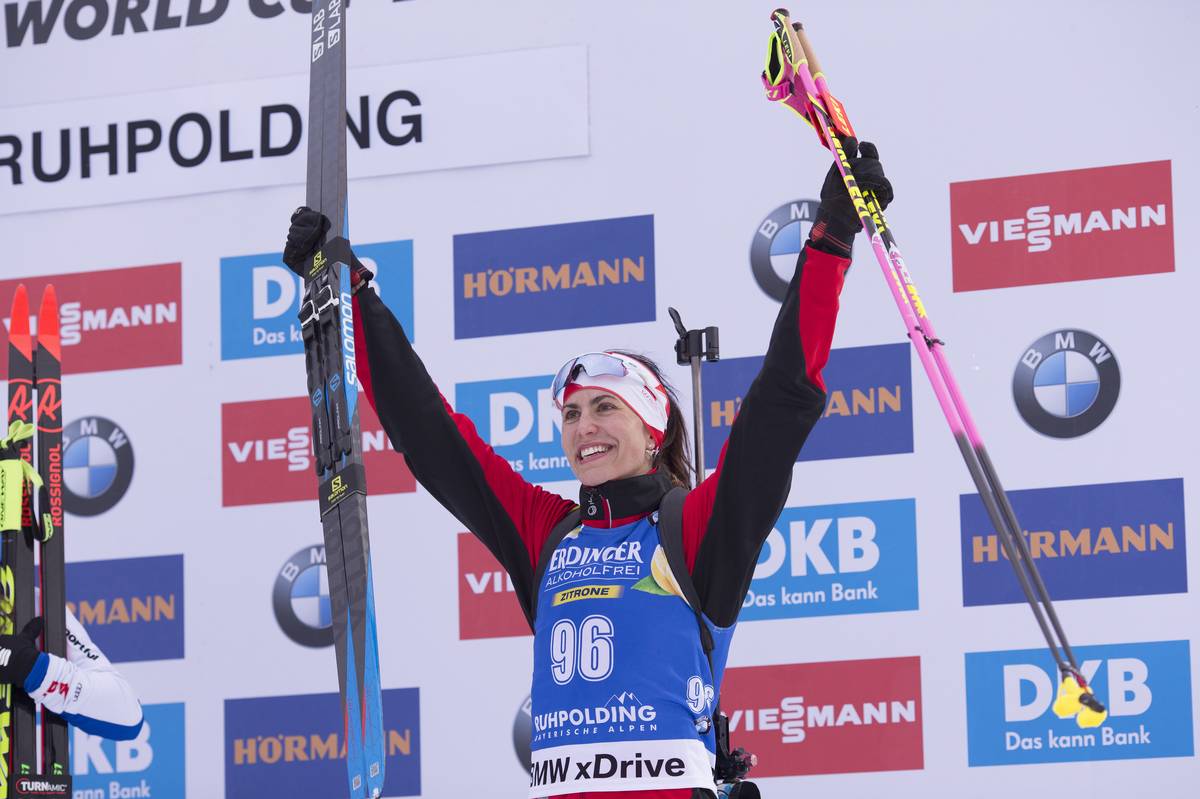
Rosanna Crawford (Biathlon Canada) celebrates her first-career IBU World Cup podium on Thursday in the women’s 15 k individual in Ruhpolding, Germany. (Photo: Salomon/Nordic Focus)
IBU World Cup (Ruhpolding, Germany): Women’s 15 k individual
It’s been a long time coming, but on Thursday, Rosanna Crawford, 29, achieved her first podium on the International Biathlon Union (IBU) World Cup circuit.
It came in Ruhpolding, Germany, in the longest-format race for the World Cup women: the 15-kilometer individual. In the four-stage race, which adds a minute penalty to a competitor’s time for each missed shot, Crawford of Canmore, Alberta, shot a perfect 20-for-20. She said she had never done that before in a World Cup race.
“I really like the Ruhpolding range,” Crawford said in a post-race phone interview, after finishing third behind Italy’s Dorothea Wierer and Finland’s Kaisa Mäkäräinen, respectively. “This was my first World Juniors, my first World Cup and now my first podium, so it’s a pretty special place for me.”
Wierer won the race with 20-for-20 shooting as well, starting 24th and finishing with the fastest time of 41:29.0 minutes. Mäkäräinen as the 12th starter missed out on first place due to a single miss in the first prone (1+0+0+0) and ended up 12.7 seconds back in second place.
Crawford, one of the last starters in bib 97, turned heads throughout the race with each passing clean bout. With one extra breath before her last shot, she successfully hit her last target and left the range with a huge smile.
“I think I almost started crying,” she recalled.
She finished 21.7 seconds out of first, and almost 25 seconds clear of fourth-place finisher Yulia Dzhima of Ukraine. Even a Ukrainian coach was cheering for Crawford on her last loop.
“That last lap was so cool,” Crawford said. “Right past the penalty loop, the Ukrainian coach was like, ‘You’re one second, — or whatever time I was — from first,’ and it was amazing. I think this really describes what the biathlon family actually is. It’s not the IBU. It’s the coaches and the athletes and the wax techs and the fans.”
Her teammates and coach, Roddy Ward, awaited her arrival in the finish pen.
“Canada’s not on the podium every day so they let them sneak by to give me a hug so that was really special,” Crawford said.
Her result is her first non-relay top 10 since a pursuit in December 2014, where she placed seventh in Pokljuka, Slovenia. The race before that, she placed fourth in the Pokljuka 7.5 k sprint, which was had been career best — until Thursday.
“Who knew that I would get my first podium in an individual?” Crawford mused. “I was laughing at that myself.”
The U.S. was led by Susan Dunklee in 27th (+3:02.7), who had one penalty in each of the first three stages (1+1+1+0).
Canada’s Julia Ransom placed 34th (+3:35.0) with two penalties (1+1+0+0), Sarah Beaudry was 53rd (+4:18.6) with two misses as well (0+1+1+0), and Emma Lunder finished 67th (+5:21.7) with four penalties (1+0+2+1).
Two Americans raced, with Clare Egan finishing 57th (+4:26.3) with three penalties (0+1+0+2).
“Certainly the highlight for me today was watching Rosanna crush it,” Dunklee wrote in an email. “Her whole team, athletes and staff, were overjoyed. It’s inspiring to see and lends positive energy to all the North Americans going forward.”
She also pointed out that her U.S. teammates Emily Dreissigacker and Maddie Phaneuf placed fifth and 11th, respectively, with clean shooting in the IBU Cup women’s 15 k individual, also on Thursday.
“That spark is exactly what our team needs right now and the timing is spot on,” Dunklee continued. “We will field our first women’s relay this weekend. It has been a challenging season so far living and traveling with such a small crew, trying to stay upbeat and carry the team with a skeleton group.”
The World Cup men’s 4 x 7.5 k relay is scheduled for Friday at 8:30 a.m. EST, with both Canada and the U.S. entering teams. (Men’s relay start list)
The women’s 4 x 6 k relay is on Saturday at 8:30 a.m. EST, with the men’s and women’s mass starts following on Sunday in Ruhpolding.
Leif Nordgren (US Biathlon) skiing the second leg of the IBU World Cup men’s 4 x 7.5 k relay on Sunday in Hochfilzen, Austria. The U.S. men ended up ninth overall out of 26 teams. (Photo: IBU/NordicFocus)
Strong gusts of wind on the range required strong nerves and a lot of luck in the women’s and men’s relay races that concluded the International Biathlon Union (IBU) World Cup in Hochfilzen, Austria, on Sunday afternoon.
While the relays concluded with teams on the podium one might expect there, tempestuous weather conditions that at times made it almost impossible to hit the targets also gave outsiders a good chance, and both the U.S. men and Canadian women remained in contention for a long time. The men’s 4 x 7-5-kilometer relay was particularly wild with more than 100 penalty laps, and it began with a big surprise.
Belgium’s starter Michael Rösch tagged off in first place for the first time in the history of that team, representing a country that until now, rarely had enough athletes for a relay and had thus far had a 24th place at the 2016 World Championships to its credit. And on his tails was Norway’s Ole Einar Bjørndalen, and shortly behind them US Biathlon’s Lowell Bailey in third.
The three aforementioned athletes all raced in the Olympic relay more than a decade ago at the 2006 Winter Games in Torino, Italy, but back then Rösch raced for Germany and won gold with his team.
“I wanted to tag off in first at all costs, to see the Belgian flag at the top,” Rösch told TV broadcaster ARD on Sunday while the race was still going on. “But Ole made it really hard for me. … I was on my last fumes, I tumbled into the finish, I was just seeing black, but it definitely was worth it.”
Just a turn behind, Bailey had gotten off to a strong start for the U.S. team, temporarily taking the lead out of the arena on the first lap before shooting clean in his prone stage to put himself in the lead group of seven. Facing strong wind in his standing stage, Bailey missed two targets but avoided the penalty lap with his last spare in that stage (0+0, 0+3), and tagged off to teammate Leif Nordgren in third position, 23.8 seconds out of first.
Nordgren ended up with a penalty in his first prone after missing two targets, and returned to the course in fifth. While his penalty had increased the gap to first by 50 seconds, Nordgren made up a few seconds with a clean standing bout, hitting all targets without requiring a spare (1+3, 0+0).
Italy and France passed him on the final loop, and Nordgren handed off in seventh, 1:34.2 minutes behind Norway setting the pace up front.
“The team came pretty close to a good result today in a relay with nasty weather,” Nordgren wrote on his Instagram account. “Personally I’m quite disappointed with my skiing, it’s been a struggle to find the top gears so far this season and I’m far from where I know I should be. It’s a long season though and there is still plenty of time to turn it around.”
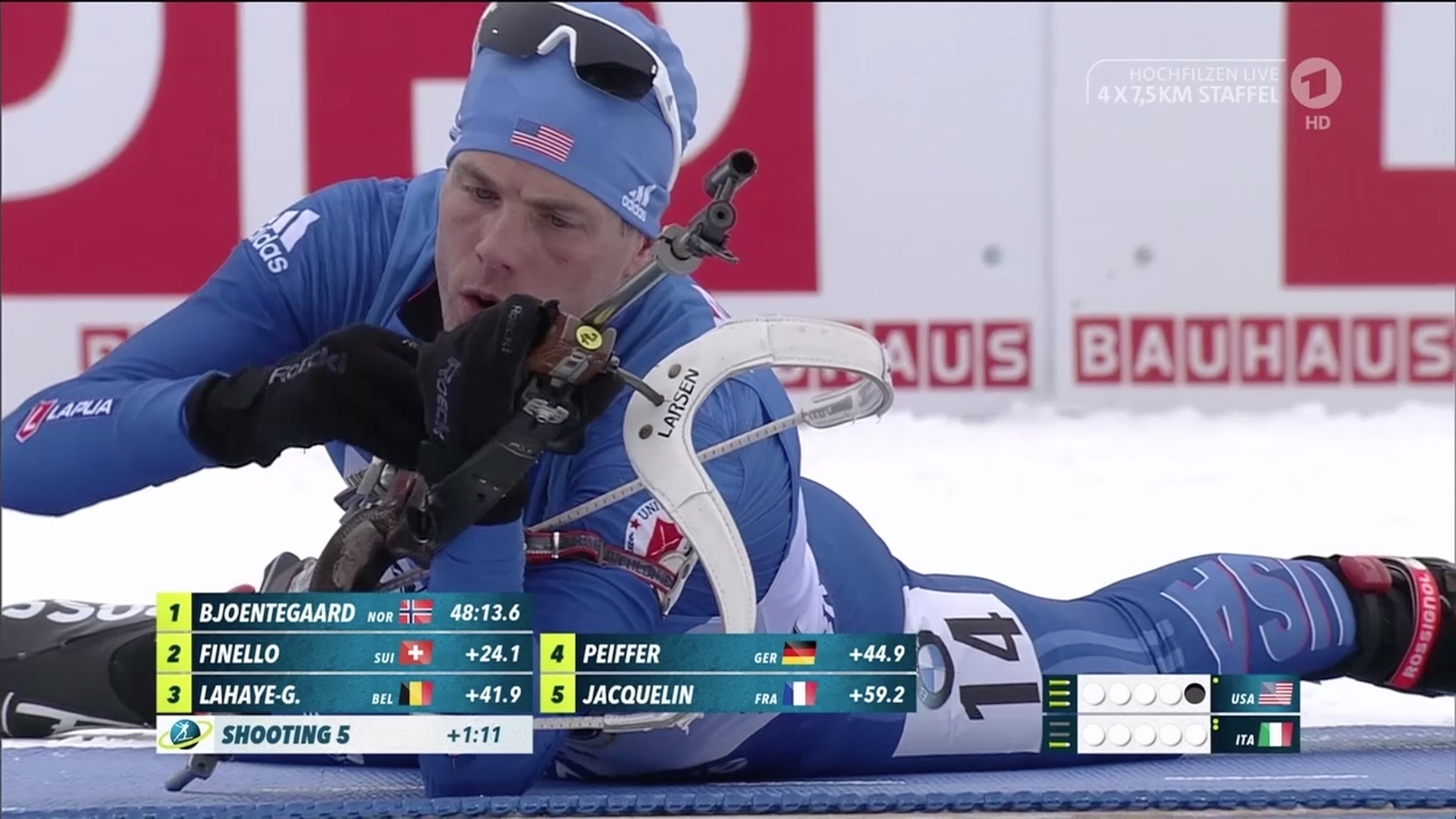
US Biathlon’s Tim Burke loading a spare in his prone stage of the men’s relay at the 2017/2018 IBU World Cup in Hochfilzen, Austria. The team went on to finish 9th. (Screenshot: ARD broadcast)
Taking over next for the U.S. was Tim Burke, who pointed out this was one of the most challenging races in terms of wind that he’d experienced.
“This was definitely one [of the] windiest races that I have taken part in,” Burke wrote in an email to FasterSkier. “We knew it would be very challenging right from the start but our team tried to look at it as an opportunity for a top result. I feel like our team did a great job at avoiding any big disasters on the range and this allowed us to stay near the front for most of the race.”
After only needing one spare in his prone shooting to hit his last target, Burke incurred a penalty in his standing stage (0+1, 1+3), but kept his position on the final loop in a hard race against Switzerland’s Jeremy Finello to exchange still in seventh, now another minute back (+2:49.4).
“I was not surprised to see a mix of different teams near the front today,” Burke wrote. “It was one of those days that any team could find themselves with multiple penalty loops after a windy shooting stage.“
Taking over from Burke as the U.S. anchor leg was Sean Doherty, coming off two strong shooting performances in the sprint and pursuit earlier this week.
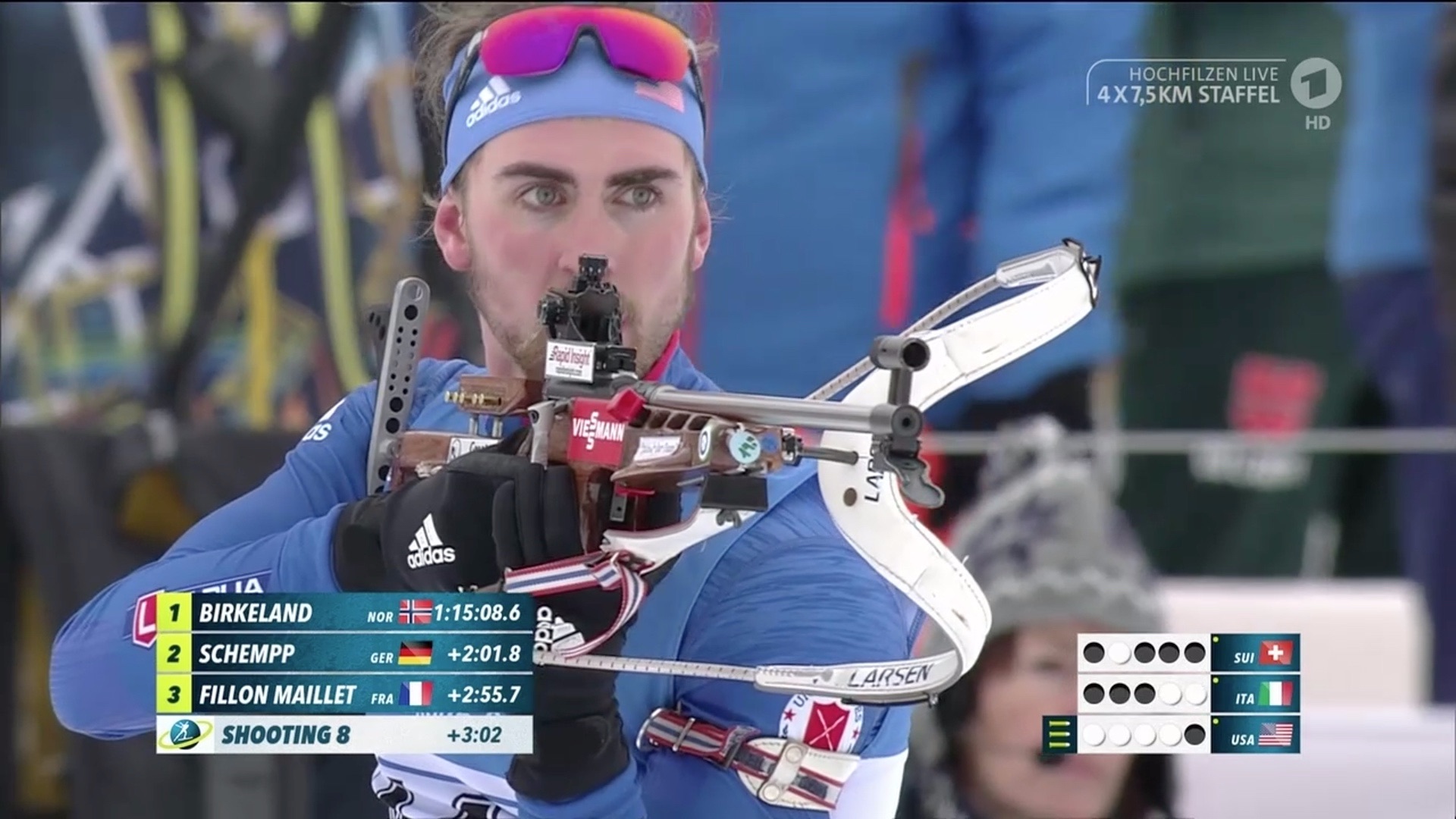
U.S. relay anchor Sean Doherty taking aim in difficult wind conditions during his standing stage of the men’s relay at the 2017/2018 IBU World Cup in Hochfilzen, Austria. His team finished ninth. (Screenshot: ARD broadcast)
In his prone stage, Doherty again shot clean and fast (with the second-fastest prone shooting time on his leg) and overtook Switzerland to move into sixth. He kept that position on the course, vying for a position in the top five with the teams from France, Italy, Ukraine, and Russia also in his vicinity.
“Today was a crazy one for sure,” Doherty wrote in an email. “The conditions on the course were decent, firm tracks and we had good skis. The wind was whipping, so that really just made some sections a lot harder than normal when you added in the head wind. I have done races in bad weather before but today was amongst the most windy.
In the standing stage, Doherty hit his first four shots in another fast sequence before missing the last one. It looked as if he had thought that final shot was also a hit as he dropped his rifle slightly, but then realized he had to load spares. Unable to clear the last target, Doherty ended up with the team’s third penalty.
“With the shooting you try to get a general idea of how far the wind is pushing the shots and do the best you can,” Doherty explained. “It’s a total toss up and the finish order is just a ranking of who battled the wind the best and had most to least luck along the way.”
He set out on his last loop in eighth place with Ukraine’s Dmytro Pidruchnyi and Switzerland’s Mario Dolder right ahead of him, and Russia’s Anton Shipulin ten seconds behind.
“The fight on the last lap is always tough,” Doherty wrote. “Although I felt better today I was not able to hang with the two guys I left the range with. I was able to ski a good lap but not enough to hold off Anton.”
After Shipulin passed him up the big last climb, Doherty came to the finish in ninth position, 3:38.3 minutes behind the winners with a team total of three penalties and 13 spares.
“We were not too excited with the end result because we saw the potential was there for a top 5,” Burke concluded for the team. “We are also all far from our best on the tracks right now, but are hopeful that will come with more racing.”
Norway Successful with Its ‘Second Unit’
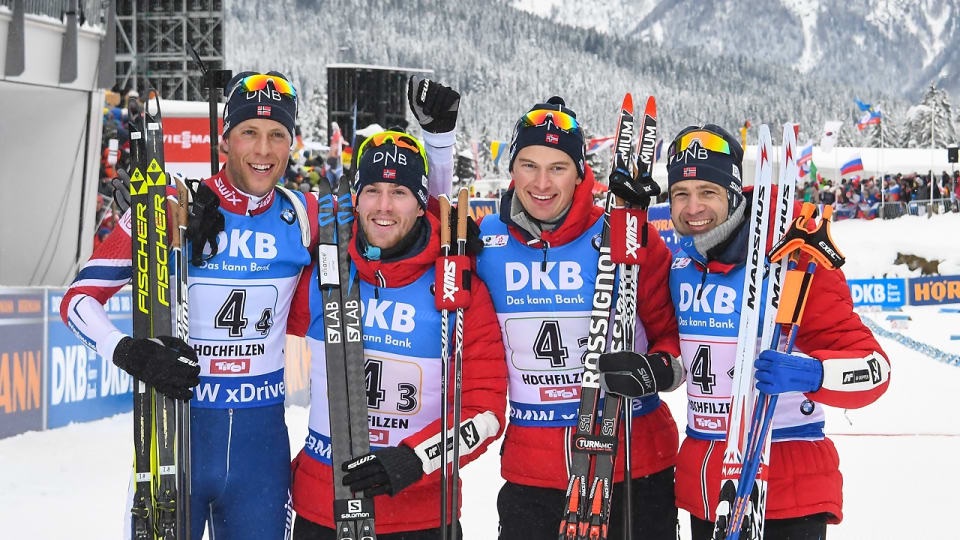
Norway’s Lars Helge Birkeland, Erlend Bjøntegaard, Henrik L’Abée-Lund and Ole Einar Bjørndalen (left to right) following their victory in the men’s relay at the 2017/2018 IBU World Cup in Hochfilzen, Austria. (Photo: IBU/Biathlonworld)
Norway started the men’s relay race without Emil Hegle Svendsen, who was sidelined with a cold, and also rested brothers Johannes Thingnes Bø and Tarjei Bø, both of whom had already won races this season.
But shooting was more important than skiing in a relay decided by strong crosswinds on the range, and that’s where the Norwegians coped by far the best. While Norway also required nine spares, which usually is a rather average performance in a relay, on Sunday this was the top shooting performance of the men’s relay.
After veteran Bjørndalen, Henrik L’Abée-Lund and Erlend Bjøntegaard had created a fairly comfortable lead of almost a minute on the first three legs, Lars Helge Birkeland anchored them to the victory by shooting clean in prone and only needing one spare to hit every target in his final stage despite some widely spread shots.
“It is really nice; a good start for Norway and good self confidence for the the rest of the season,” L’Abée-Lund said at the post-race press conference.
“It’s always fun to compete on the highest level with the best guys,” Bjøntegaard said. “I think I did pretty good on my leg today. It was tough conditions as it was for everyone else. I am just happy to show what I am capable of.”
“It feels great, it was an amazing feeling on the last loop, and really satisfied with my own leg,” Birkeland said. “I just decided to be offensive and attack and don’t think about the others and just do my own race. … We have a really strong team with a lot of good guys, so we don’t need to have all the best at the start to have a chance to win.”
All hopes for Germany’s Simon Schempp to contend with Birkeland for first were dashed when Schempp required three spares to clear both his prone and standing stages, narrowly avoiding the penalty lap twice.
Due to the huge distances between the top-three teams, the final loop was more of a cool down for their anchors, with Norway taking the win in 1:21:21.8 hours, just under two minutes ahead of Germany, with Erik Lesser, Benedikt Doll, Arnd Peiffer and Schempp, in second (+1:54.9, with zero penalties and 17 spares).
“At least we avoided the penalty loop, for me it was definitely close in standing,” Peiffer told German broadcaster ARD. “There was so much wind that it was impossible to shoot calmly and controlled. … It was clear that today there would be some upsets, like Belgium being in the mix in front. You just had to somehow avoid the penalty lap.”
“The last years in Hochfilzen we have never been on the podium, so it’s the first time in like six years we are back again,” Peiffer said at the press conference. “So that’s a good start for us because normally we are struggling here and we don’t know why.”
France, which had rested its star Martin Fourcade and started Jean-Guillaume Beatrix, Simon Desthieux, Emilien Jacquelin, and anchor Quentin Fillon Maillet, finished another 40 seconds later in third (+2:34.0, with three penalties and 13 spares).
Another 20 seconds back, Sweden with Peppe Femling, Jesper Nelin, Sebastian Samuelsson, and Fredrik Lindström crossed the line in fourth (+2:54.8, with three penalties and 12 spares).
“Today was very hard, very strange result, because when we look at all the penalties on the result list it was just crazy,” Beatrix said at the press conference. “I am satisfied for the team, and I am also really satisfied for the newcomer Emilien because it’s his first two weeks on the World Cup and first relay, and he did a every good job and brought us to the podium.”
“Today I was a little bit stressed, because the French guys are so strong and I had to be at their level, so I am happy to do a good relay today,” the 22-year-old Jacquelin said.
And what happened to the brave team from Belgium? With three athletes who had just made an overnight trip from an IBU Cup race in Lenzerheide, Switzerland, they came through the second exchange in second place after Florent Claude only needed one spare in standing. On the last two legs, however, three penalties for both Tom Lahaye-Goffart and Thierry Langer put them in 16th at the finish (+6:24.9) , which was still a team-best relay result for Belgium.
Just ahead of them in a finishing sprint anchored by Brendan Green was Biathlon Canada, with a lineup that earned bronze at the 2016 World Championships in Oslo, Norway. On Sunday, however, the Canadians’ race began with difficulties for brothers Christian Gow (1+3, 2+3) and Scott Gow (1+3, 2+ 3), each having to ski three penalty laps and exchanging in 21st position already 4:45.7 minutes back. Then Nathan Smith (0+0, 0+2) and Green (0+3, 0+3) were able to move them up a bit again, with Smith putting them as high as 13th by the final exchange and Green anchoring them to 15th (+6:22.5, with six penalties and 20 spares).
Of 26 teams in the men’s relay, Norway and Germany were the only ones that succesfully avoided the penalty lap.
Hochfilzen World Champs Women’s Podium Repeats
Later on Sunday afternoon in the women’s 4 x 6 k relay in slightly better conditions than the men’s race, last season’s reoccurring winner Germany struck gold again.
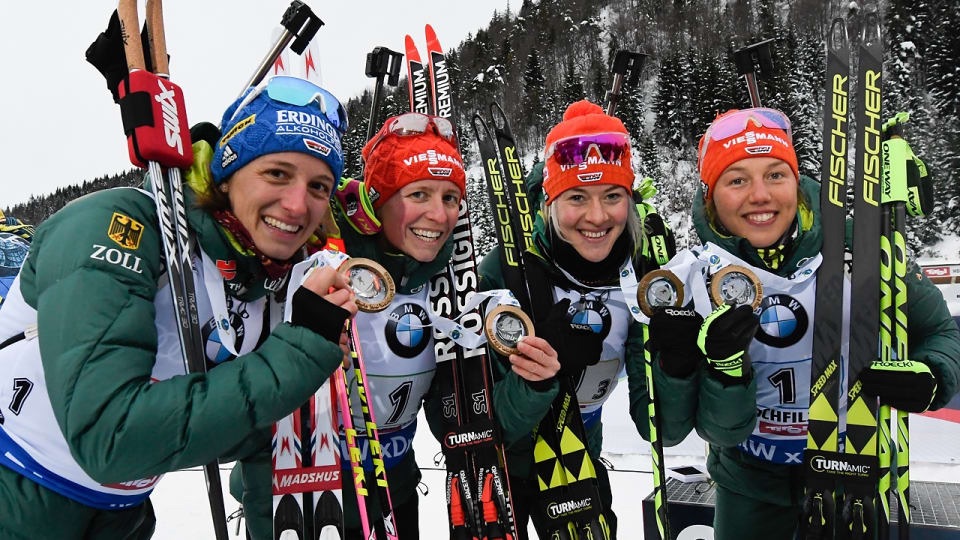
Germany with (left to right) Vanessa Hinz, Franziska Hildebrand, Maren Hammerschmidt and anchor Laura Dahlmeier shows off their medals following their victory in the women’s relay at the 2017/2018 IBU World Cup in Hochfilzen, Austria. (Photo: IBU/Biathlonworld)
The victorious world-champion quartet of Vanessa Hinz, Franziska Hildebrand, Maren Hammerschmidt,and Laura Dahlmeier won with a large lead ahead of Ukraine (+44.9) and France (+1:04.5). The first-, second- and third-place teams were a repeat of last season’s World Championships relay in Hochfilzen this past February.
Fighting for position with Ukraine and Switzerland on the third leg, Hammerschmidt got her team on the road to victory when she cleaned every target within 24 seconds despite difficult conditions to reclaim the lead, erasing the gap she had been handed of almost 30 seconds to first.
“For me it was very important to have a good standing shooting today, because the last two days were not so good,” Hammerschmidt said at the press conference. “I thought it was one of my best standing shootings, and I was so happy to go on the last loop and fight for every second to give to Laura.”
Dahlmeier returned to the World Cup after missing last week’s opening races with a cold, then had no major problems defending the lead. Dahlmeier used just one spare in each of her shooting stages, while Switzerland’s Irene Cadurisch as the closest pursuer had to ski a penalty lap. Germany finished in a time of 1:14:36.4, with zero penalties and nine spares.
“It’s a really cool feeling to be here again,” Dahlmeier said at the press conference. “Especially with the team. We know we can make a good race, but it’s important for every person to be good on the range and on the tracks. Relays are special races.”
“From the last year we have good memories about Hochfilzen … and today it was a good place, too,” Hildebrand said “I was really impressed with [Ukraine’s] Yulia Dzhima’s standing shooting, because she took all targets out while I used two extra bullets and was happy I could go out on the track again.”
Ukraine’s Olena Pidhrushna anchored her team, with Vita Semerenko, Yulia Dzhima and Valj Semerenko, to second (+44.9), thanks to the best team shooting performance of zero penalties and five spares, and despite a fall on the first leg by Vita Semerenko.
“I think our team spirit is very strong, without that we wouldn’t be on the podium, so I am very thankful to all the girls and our staff for making this happen,” Valj Semerenko said at the press conference, via a translator.
“My start this season was not so good … Actually today I was so nervous ahead of the relay,” Pidrushna explained. “But I saw that we had a little bit of extra time at the last exchange, and I calmed down a little bit and it worked well in the end. … And I think my team believes in me [to anchor it successfully].”
Twenty seconds behind her, France with Marie Dorin Habert, Celia Aymonier, Justine Braisaz and the current women’s World Cup leader Anaïs Bescond, passed Russia’s Ekaterina Yurlova-Percht on the final loop to claim third place (+1:04.5, with two penalties and 13 spares).
“Honestly at the beginning when I started I didn’t think a podium was still possible, but loop after loop I thought maybe I can still catch a podium [position],“ said Bescond, who skied the fastest course time on the final leg amidst strong competition.
A few seconds behind, Russia with Victoria Slivko, Tatiana Akimova, Irina Starykh, and Ekaterina Yurlova-Percht finished fourth (+1:09.0, with no penalty and nine spares).
Another 16 seconds back, Switzerland, with Elisa Gasparin, her older sister Selina Gasparin, Lena Häcki and Cadurisch finished fifth (+1:25.7, with two penalties and 12 spares) for Switzerland’s best women’s relay result, which fulfilled its national qualification criteria for the Olympics.
Canada in Contention
For Biathlon Canada, Emma Lunder started off the race in the middle of the field, and managed hit all her targets with one spare in her prone stage to leave the range in 16th position.
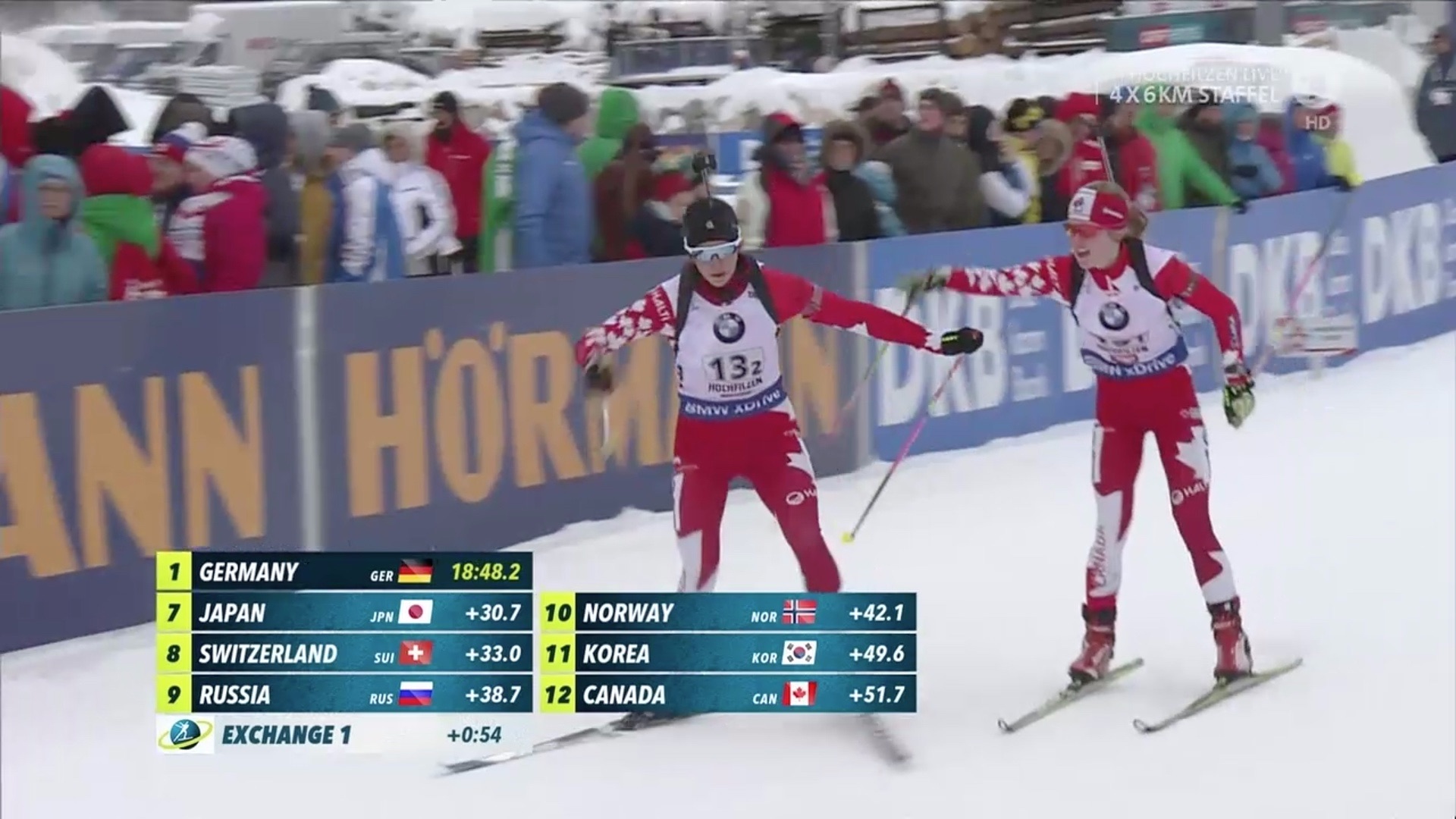
Biathlon Canada’s starter Emma Lunder (r) exchanging to Rosanna Crawford in the women’s relay at the 2017/2018 IBU World Cup in Hochfilzen, Austria. Crawford temporarily moved up to fifth before the team finished in ninth position. (Screenshot: ARD broadcast)
While a number of competitors, including France’s Dorin Habert, incurred penalties, Lunder again needed just one spare to clean (0+1, 0+1) and moved Canada up to 1oth. After losing a few more seconds on her last loop to the leaders, with Germany’s Hinz up front, she tagged Rosanna Crawford in 12th position, 51.7 seconds back.
Crawford started out fast and also needed just one spare to hit all five prone targets, improving by three places to ninth.
“It was a tricky shooting day today, you really had to be aware of the wind, and be prepared to do a correction even part way through a bout of shooting,” Crawford wrote in an email. “In prone I made a correction of 5 left and 2 up and it was enough to keep me pretty centred.”
Then in her standing stage, she picked off four more positions with clean shooting and no spares to leave the range in fifth place, while most teams around her needed spares or even incurred a penalty in seemingly difficult wind conditions.
“I was really happy with my standing today,” Crawford explained. “I saw Brendan [Green] right before zero and he said that it’s worthwhile to take your time and make each shot a good one. So I really thought about that as I came into the shooting, there was a big gust right off the start, so I waited and could hear the women around me missing. Each shot was really precise. My shooting time was 33 seconds which is really slow for standing but still the 2nd fastest of my leg, which says a lot about the wind today!”
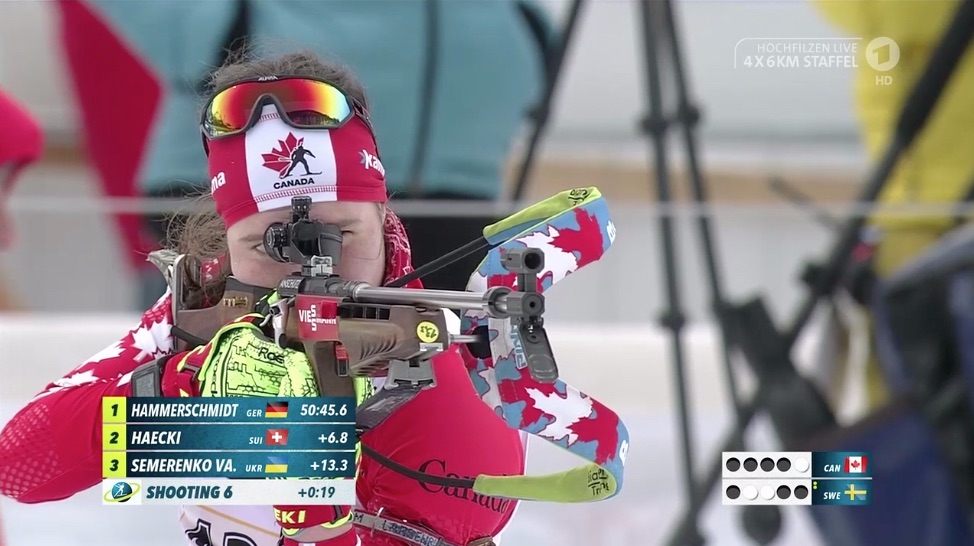
Biathlon Canada’s Megan Bankes shooting in her standing stage in the women’s relay at the 2017/2018 IBU World Cup in Hochfilzen, Austria. The team finished ninth overall. (Screenshot: ARD broadcast)
Crawford tagged Megan Bankes in fifth (+36.3), after having regained 15 seconds on the leaders and skiing the second-fastest course time on the final loop.
“It’s always fun to tag off in a high position but today was a bit of a lucky draw for what you got in the range,” Crawford concluded.
The 20-year-old Bankes as Biathlon Canada’s youngest team member started out just as fast, nearly maintaining that time gap on the first loop.
“I was super stoked to be tagged in such a good place, but I definitely still felt that I was able to ski my own race,” Bankes wrote in an email. “I wanted to ski my best, and not lose to much time on the tracks, but also be controlled on the range, because I knew it was going to be a tricky shooting day.”
She was able to get through the prone stage with two spares in a stage when all leading teams needed them, keeping her in fifth. Bankes followed that up with just one spare in her standing shooting, temporarily moving up to fourth after overtaking Sweden’s Mona Brorsson.
“Coming into the range I was focussed on my own shooting more than anything else,” Bankes wrote. “I knew that the wind was pretty variable, and that I needed to make sure I took good, smart shots, and correct appropriately for the wind. I was super happy with how I ended up doing on the range, and also with my speed on my first couple of laps.”
On the last loop, Brorsson and Russia’s Starykh passed her, and Bankes came through the final exchange in sixth place (+1:28.8).
“I died a bit at the end, but I still managed to tag Julia in a good position, so for me it was a pretty great race!” Bankes concluded.
Shown on television in the exchange zone, looking back at the final curve to see when Bankes would arrive, Ransom took over as the anchor and skied a very fast first loop, just 1 second off the fastest pace on that loop.
She then managed to still clean all five targets in a controlled fashion, leaving the range again in fifth position, with Switzerland in sight and Russia nearby as well.
After a slower second loop, Ransom struggled to clean all her targets in the final stage, but avoided the penalty lap with her last shot and left the range in ninth position. Sweden’s anchor Anna Magnusson was still in sight, 10 seconds ahead, but extended her lead on the final loop, while Japan’s anchor Rina Mitsuhashi was already more than a minute behind Ransom in 10th.
Ransom crossed the line in ninth place (+2:31.6) with zero penalties and nine spares for the team.
“A top 10 is a decent result for our team, it’s nice that we were fighting for a top 6 for most of the race,” Crawford wrote. “Our team has come a long way and I’m really proud to be a part of this team! Emma and Megan had a great leg and Julia an awesome prone and then it was quite windy for her standing, but most teams have their strongest women on the last leg, so it’s always a hard fight!”
In other good news for Biathlon Canada this weekend, the team finished eighth in an IBU Cup mixed relay and national team member Megan Tandy raced to 11th place in the sprint followed by ninth place in the pursuit this weekend in Lenzerheide, Switzerland.
“Another #perfect#shooting day! I was hoping for more, but you gotta work with what you got – in my case very heavy legs skiing. Nonetheless, a solid race,” Tandy wrote on Instagram after shooting clean in both the sprint and mixed relay.
The U.S. Women and Nation Cup Standings
US Biathlon could not start a women’s relay on Sunday because it only has three women currently on the World Cup circuit: Susan Dunklee, Clare Egan and Emily Dreissigacker. US Biathlon had hoped that its fourth woman Kelsey Dickinson, would qualify for the first trimester of World Cup racing by scoring necessary points at the IBU Cup opener in Sjusjøen, Norway. But unfortunately that did not work out.
In addition to Dickinson missing out on the World Cup starts because of that technicality, and her teammates now missing out on one of only three opportunities on the World Cup competition calendar to prepare for the relay in the upcoming Olympics, this also means they lost out on valuable points for the Nation Cup Score. That ranking is its own award category in the World Cup season (last year Germany won it for both the women and men), but more importantly for the North American teams, also determines the starting quota for the following season.
With a third of the races counting towards that already completed (unlike at World Championships the races at the Olympics don’t apply, neither do pursuits and mass starts), the U.S. is currently in 21st position for the women with 676 points and in danger of losing its fourth starting position for next year again, which would make team selections and travel planning even harder.
While certainly not impossible — last year the U.S. women also did not start a relay in Pokljuka, Slovenia — it will be a bit of an uphill battle to make that up the rest of the season, requiring a number of strong results. For instance, South Korea is currently 357 points ahead in 17th, the benchmark for a fourth quota spot.
The Canadian women are currently in 14th position with 1220 points. Last season they were 15th and the U.S. 14th. For the men’s teams, Canada is currently in 12th position with 1260 points, the U.S. is 13th with 1198.
The teams will now travel to Annecy-Le Grand Bornand, France, for the next World Cup from Thursday, Dec. 14, to Sunday, Dec. 17.
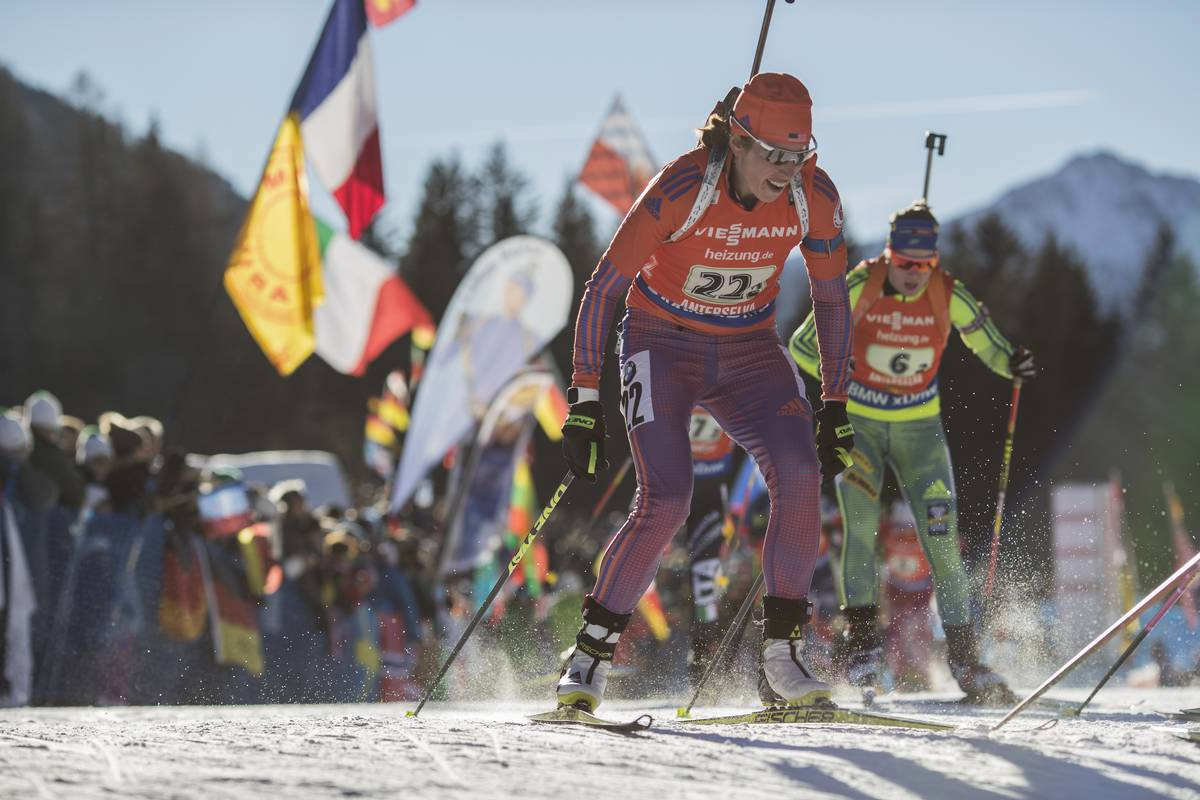
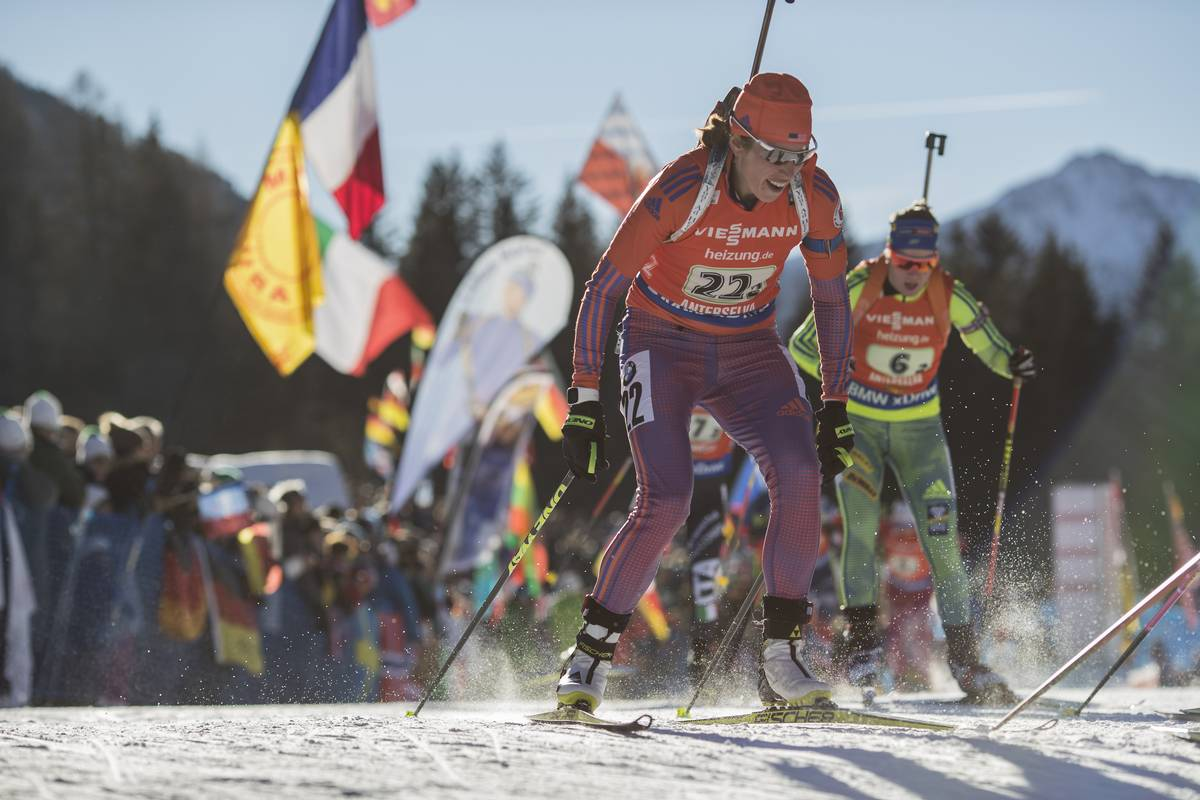
US Biathlon’s Susan Dunklee ahead of Sweden’s Chardine Sloof during the second leg in the women’s 4 x 6 k relay at the 2017 IBU World Cup in Antholz, Italy. (Photo: USBA/NordicFocus)
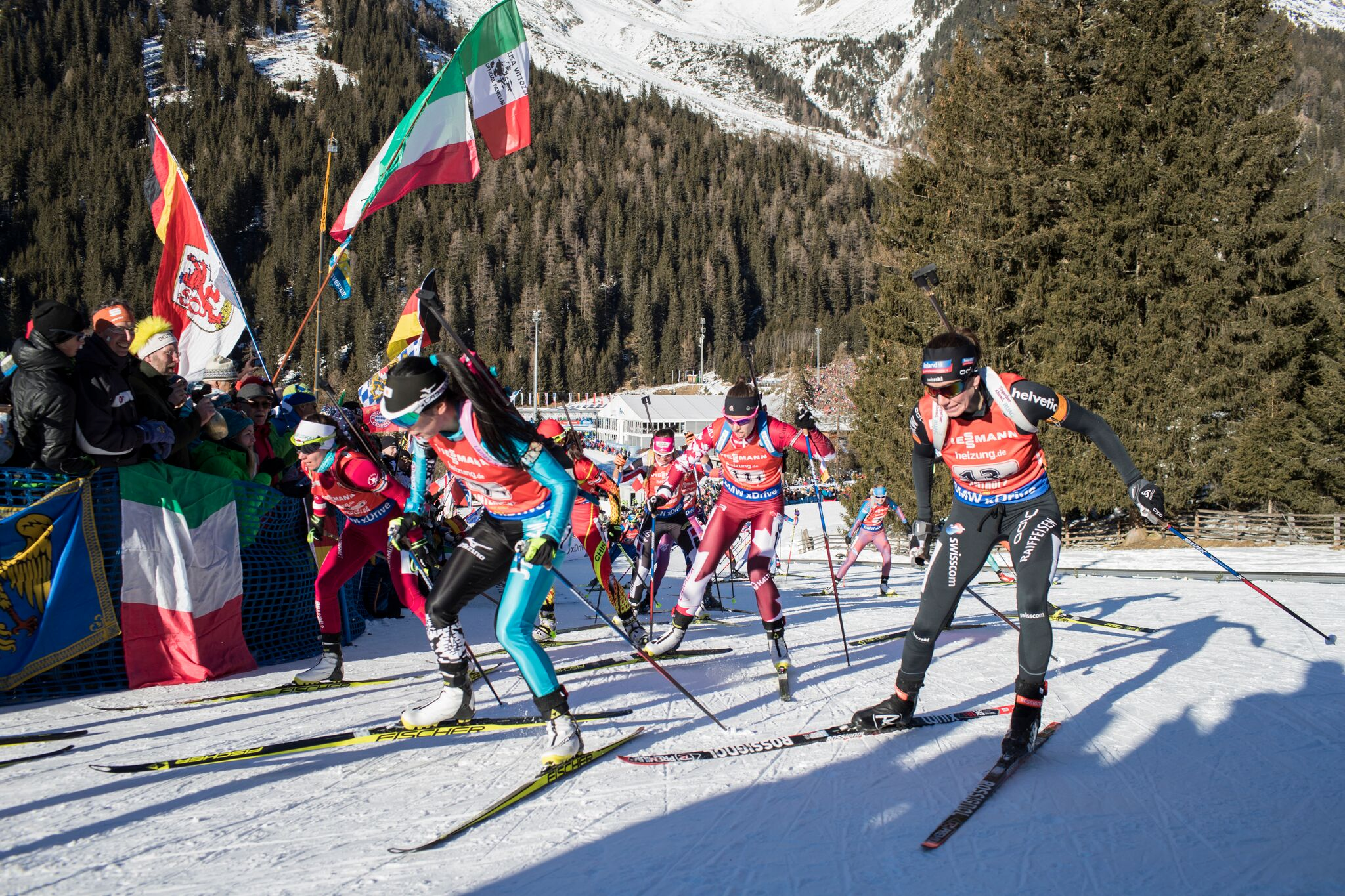
As they had done in the first two relays this season, Germany and France occupied the top two positions on the podium in the women’s 4 x 6-kilometer relay on Sunday at the IBU World Cup in Antholz, Italy. And to the joy of over 20,000 raucous fans in the sunny arena, home team Italy claimed the third place. So far, so not very unusual.
But at the halfway point of the race, Susan Dunklee had moved the U.S. team into second position, just 33 seconds behind Germany in first. A potential surprise was in the air.
“Head-to-head shooting and hunting people down on skis are two of my favorite racing experiences, so I was thrilled with today,” Dunklee stated, according to a US Biathlon press release.
Starting the race in bib 22 out of the last start row, her teammate Clare Egan had slightly moved up on the course coming into the first prone stage, and with a clean shooting performance left the range in fourth place just 3.1 seconds behind the leaders.
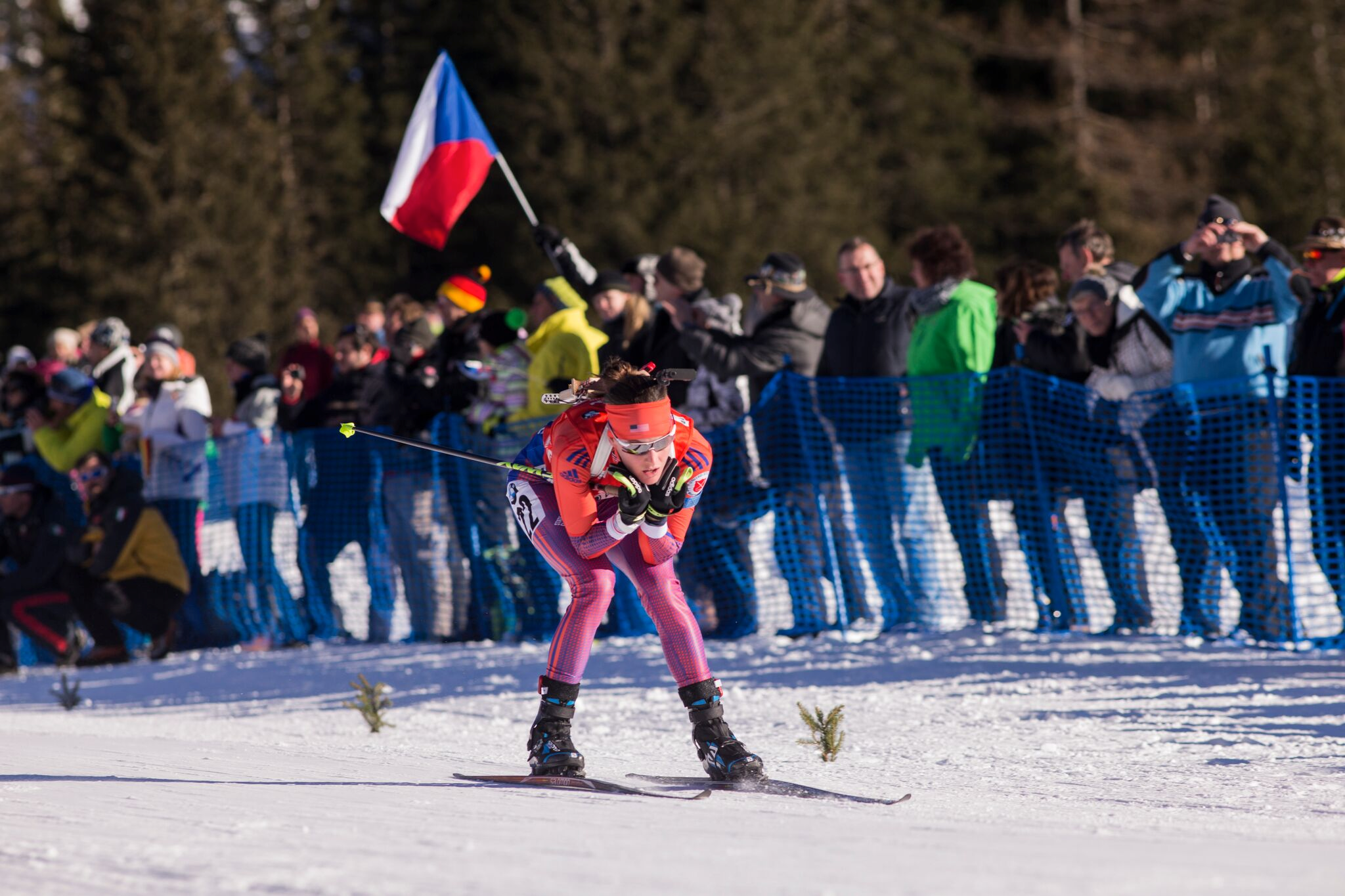
US Biathlon’s Clare Egan on the course skiing the opening leg of the women’s 4 x 6 k relay at the 2017 IBU World Cup in Antholz, Italy. (Photo: IBU/Christian Manzoni)
“I rarely get to do mass starts but I love them,” Egan wrote in an email to FasterSkier. “I shot clean and was the first athlete off the mat so my plan worked. I just tried to position myself as best I could and then pass on the shooting range.”
She was able to keep up with the teams around her on the next loop, and with one spare in the standing shooting, she managed to hit all her targets, skiing back on the course in ninth place.
“Last week I also hit 9/10 targets, but then I had to use all three spares to get that last target down, because I got so nervous,” Egan explained. “So this week I really tried to prepare mentally for shooting my spares and it helped.”
On the final loop she managed to overtake the Austrian team while getting passed by Switzerland, and while Egan lost a bit more time to the French and German teams leading the race at that point, she tagged off to Dunklee in the ninth and just 21 seconds behind France and Germany.
Dunklee quickly began to close gaps and overtook several of the teams around her, including Sweden, Belarus, Slovakia and Norway.
“I felt sharper on skis than earlier this week,” Dunklee wrote in an email. “I think my body adjusted better to the altitude each day. I did not follow any sort of pacing plan today; I saw people ahead of me early and I went after them, and then held on as best I could on the last loop.”
In her prone shooting stage Dunklee needed two spares to hit all targets, leaving the range in fourth position. But she kept gaining ground on the loop and with a clean standing stage, while most of the athletes around her needed spares.
“I was disappointed to miss my last two shots in prone again, but standing felt good,” Dunklee wrote. “I took a few extra breaths before the first shot and then used an assertive cadence.”
Keeping Italy and Norway behind her on the final loop and only losing a few more seconds to Germany’s Maren Hammerschmidt, Dunklee tagged her teammate Joanne Reid in second (+32.9).
Reid, who is in her first full season with the US Biathlon World Cup team, was able to keep up with the leaders on the first loop, skiing close to the eventual podium finishers Anaïs Bescond of France and Alexia Runggaldier of Italy.
Reid cleaned the prone stage without any spares, but as most of the teams around her did the same, several teams remained close together. On the next loop, Reid was nearly able to hold her distance to the leaders, but was passed on the biggest climb by Ukraine’s veteran Valj Semerenko.
She may have invested a bit too much energy trying to keep up with the best teams on that loop, and in the following standing shooting Reid missed her first shots and eventually ran out of spares, having to ski twice through the 150-meter penalty lap to lose more than a minute and a half.
Reid tagged teammate Maddie Phaneuf in 13th position (+2:24.3). For Phaneuf, it was only her second time anchoring a U.S. World Cup relay.
“My very first World Cup two seasons ago, I anchored for our team (Susan Dunklee, Hannah Dreissigacker, and Annelies Cook) in Ruhpolding,” Phaneuf wrote in an email. “I remember our team did not have a very good race, and I got lapped.”
This time, it went better, especially due to her shooting performance only requiring one spare in standing (0+0, 0+1) and achieving a top-10 range time.
“I was pleased with my shooting today, especially coming out of the Individual race from earlier this week with so many mistakes,” Phaneuf explained. “The wind was much calmer on the range, which helped. The biggest thing for me was that I found myself less distracted by the atmosphere and more focused on my shooting, which I’ve been trying to deal with the past few races. It can be tough with all the TV cameras, excited crowds, and announcers!”
On the final loop Phaneuf was able to keep Slovakia’s Jana Gerekova behind her, but was unable to bridge the gap to two other teams due to a small mishap.
“By the last loop I was hanging with the Polish and Norwegian girls [Krystyna Guzik and Rikke Andersen], but I caught my ski on some fencing coming around a corner into a downhill and lost a lot of momentum,” she wrote. “I was really bummed, because then I lost the chance to draft these girls into the finishing stretch. But I am happy to see that my ski speed is improving with every race, and it’s making me more and more excited for World Championships in a couple of weeks.”
Back again in 13th place where she had begun, Phaneuf crossed the finish in 1:11:58.9 hours, 2:46.5 minutes behind the winners. The U.S. had two penalties and seven spares.
“Today was a great day for our team and I am proud of how all of my teammates performed and the effort they gave,” Dunklee commented. “We can see that we are not far off a top 10 or even better, and that is motivating.”
While the U.S. team faded back a bit in the second half of the race, several of the more experienced teams fought for the places on the podium.
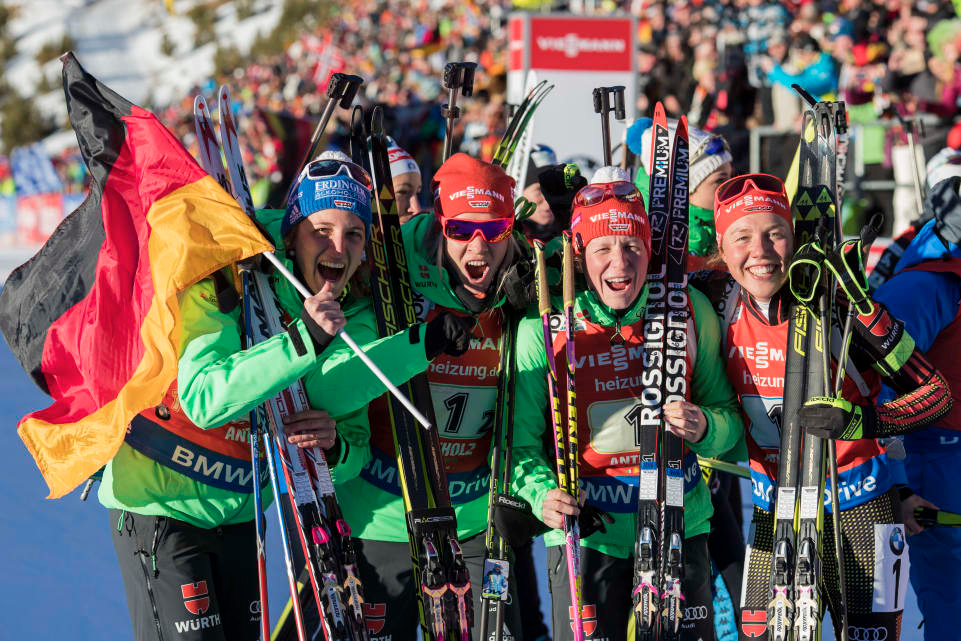
From left to right: Germany’s Vanessa Hinz, Maren Hammerschmidt, Franziska Hildebrand and Laura Dahlmeier celebrate their victory in the women’s 4 x 6 k women’s relay at the 2017 IBU World Cup in Antholz, Italy. (Photo IBU/Christian Manzoni)
Germany’s Laura Dahlmeier struggled to control her last shots, gasping heavily in the thin air of the Antholz biathlon arena some 1,600 meters above sea level during the final standing stage. But with her last spare, she managed to avoid the penalty lap and secured the victory for her team with Vanessa Hinz, Hammerschmidt and Franziska Hildebrand. Dahlmeier even had enough time to grab a flag from a fan on the finishing stretch before crossing the line in 1:09:12.4 hours, with 12 spares and zero penalties.
“That’s why you have six spares in the relay,” Dahlmeier said with a laugh when asked by German broadcaster ZDF about her shooting stages, where she needed five spares to clean. “And when you ski over the line in first, you can’t have done all that much wrong. I wasn’t actually scared [of a penalty lap], but I made it a bit too suspenseful with my shooting and was happy the other girls had given me a lead.”
Germany had also won the two prior relay races of the season in Pokljuka, Slovenia, and Ruhpolding, Germany.
“Three relay competitions in this season, three victories – of course that makes us the favorites for the World Championships,” Hildebrand said, according to an IBU press release. “I think as a team we are strong enough to handle this pressure.”
Crossing the line 24.2 seconds behind Dahlmeier, France’s Marie Dorin Habert comfortably secured second place for her team on the final loop, with eight spares and zero penalties. Despite requiring fewer spare rounds, the French team of Anaïs Chevalier, Justine Braisaz, Bescond, and anchor Dorin Habert was not quite able to keep up on the course on Sunday.
“Maybe at the last shooting, almost,” Bescond said at the press conference when asked if, during the race, she thought her team might claim the victory. “Unfortunately we were not strong enough to catch the German team today.”
Just like it was the third victory for Germany, it was also the third second-place finish of the season for the French women. “We are happy, but we want to beat Germany, maybe at World Championships,” Chevalier said at the press conference.
On the final round Italy’s Dorothea Wierer tried everything to get a podium on her home course, following two weaker performances in the individual and mass start races, but Ukraine’s 22-year-old Anastasiya Merkushyna didn’t make it easy for her, fighting back to take a small lead. But on the last small climb into the arena, Wierer broke her resistance, celebrating her third place when she skied into the arms of the teammates Lisa Vittozzi, Federica Sanfilipo and Runggaldier awaiting her. Like the other teams on the podium Italy had no penalty, and required nine spares.
“I was going away from the shooting range with Merkushyna,” Wierer commented in the press conference on her last loop. “I felt really good, and I don’t know if she was only playing with me, but she seemed not so strong on skis. But then she made a little sprint and I pushed so hard to keep [up with] her. And on the last uphill I made another sprint hoping she would not take me anymore, but I wasn’t sure.”
“We are not always shooting so well,” she said when asked about Italy’s chances for the World Championships relay. “But I think we are getting better and more confident. And I think we will beat the German and also the French team!”
“I am kidding,” she added with a laugh, turning to Germany’s Hildebrand sitting next to her. “I am not kidding!”
Ukraine’s relay with Yuliya Zhuravok, Yulia Dzhima, Semerenko and Anastasiya Merkushyna finished fourth (+37.5), with six spares and zero penalties.
Canada 18th Despite Strong Shooting
Biathlon Canada’s Megan Tandy (center, bib 11) skiing the opening leg of the women’s 4 x 6 k relay for the 2017 IBU World Cup in Antholz, Italy. (Photo: IBU/Christian Manzoni)
The Canadian relay of Megan Tandy, Julia Ransom, Emma Lunder, and Rosanna Crawford shot as well as some of the teams on the podium, requiring only eight spare rounds and incurring zero penalties, but could not keep up with the leaders.
After starting in the fourth row in bib 11 and skiing close to the top group on the first loop, Tandy required four spare rounds (0+2, 0+2) setting her back early in the race. She improved by two positions on the final loop, but tagged off in 18th place, more than a minute behind the leaders. Ransom improved one place to 17th with two solid shootings (0+0, 0+1) but doubled the deficit, and Lunder kept them in that position with a clean standing before losing one spot again on her last loop (0+1, 0+0) to exchange in 18th. Crawford (0+2, 0+0) was only briefly able to move the team up to 16th place before losing those positions to China’s Xuelan Wang and the Czech Republic’s Veronika Vitková (who rested their star Gabriela Koukalová on Sunday) on the last loop to ultimately finish 18th (+4:12.1).
“I think we were hoping for another top 10 today,” Crawford wrote in an email. “Antholz even on a calm day has tricky shooting, the altitude and the flat run into the range I think catches people off guard. We had some good skis today but [it] just wasn’t enough to keep us in contention. We had some great results though this week, with Emma’s 21st [in the individual race] and Scott [Gow] making his first Mass Start.”
Recently struggling a bit to get her speed up to her level from last season, Crawford posted the 15th-ranked course time on the fourth leg of Sunday’s relay after an extended recovery.
“We had decided to change the training plan around because skiing was just getting worse and worse each race,” Crawford explained. “So I didn’t race the pursuit in Ruhpolding or the Individual here, took a few days off and kept this week really easy … So hopefully the rest I took will pay off for World Champs.”
The IBU World Cup now enters a two-week break ahead of the World Championships in Hochfilzen, Austria, which begin on Feb. 9 with a mixed relay.
During this period, there will also be the 2017 Open European Championships beginning this Wednesday in Duszniki-Zdrój, Poland, which several World Cup starters including representatives from the U.S. and Canada plan to race in.
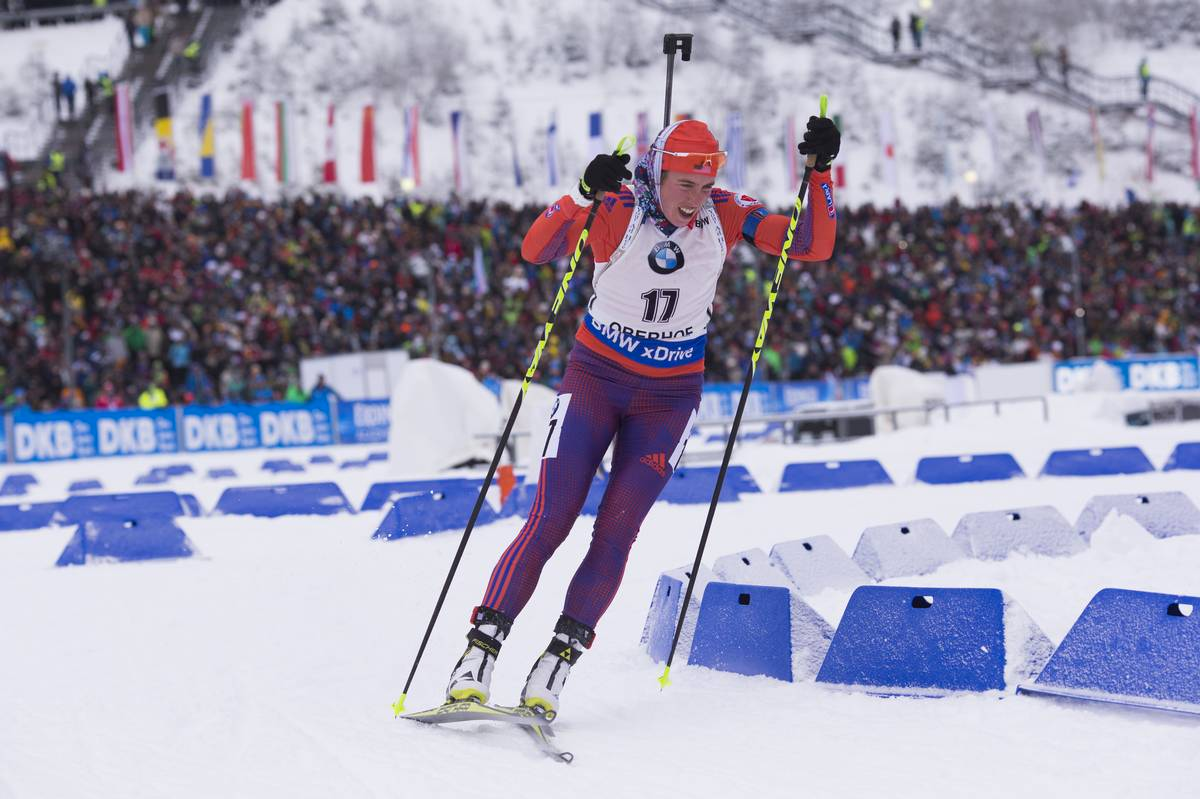
US Biathlon’s Susan Dunklee skis through the arena during the women’s 12.5 k mass start at the 2017 IBU World Cup on Sunday in Oberhof, Germany. (Photo: USBA/NordicFocus)
After twice shooting clean on Sunday, American Susan Dunklee found herself in third place going out on the next loop of the women’s 12.5-kilometer mass start at the International Biathlon Union (IBU) World Cup in Oberhof, Germany, pushing hard to keep up with Czech Republic’s Gabriela Koukalová and Germany’s Laura Dahlmeier.
“I was not skiing a sustainable pace,” Dunklee explained in an email to FasterSkier. “Sometimes it makes more sense to keep yourself in the race as long as you can and worry about consequences later.”
While Koukalová stayed clean also in the next two shooting stages to win the race in a time of 37:20.5 and Dahlmeier only shot one more miss to finish second (0+0+1+0, +31.5), Dunklee had to pay a bit for her tempo when she incurred a penalty in the first standing stage and two more in her last standing bout.
She left the range after the final shooting in ninth position, but was challenged on the long Birxsteig climb by four athletes who shot clean in the last stage: Norway’s Marte Olsbu, Sweden’s Anna Magnusson, Poland’s Magdalena Gwizdon, and Russia’s Tatiana Akimova.
“Skiing hard earlier in the race (e.g. with Gabi and Laura) meant that I didn’t have much fight in me on the first huge climb and I lost time there,” Dunklee wrote about the last loop. “To make up for it, I tried to conserve some energy for the last hills, rely on faster skis than the girls around me (our techs did a fantastic job today) and ski tactically.”
Dunklee fought back, and managed to overtake all of those four skiers again to finish ninth (+1:43.5) with three penalties (0+0+1+2) and the 12th-ranked overall course time. She was passed on that loop only by Finland’s veteran Kaisa Mäkäräinen, who had a rough day on the range with seven penalties, but skied the best course time to finish eighth (+1:39.9).
During the week’s races in Oberhof, Dunklee missed more targets than she usually does to finish 50th in the sprint with four penalties and 44th in the pursuit with nine penalties.
“I created a very specific periodization plan for my shooting this year and I believe in it,” Dunklee wrote. “Each week has its own focus, which creates subtle differences in how I approach the shooting. I have now learned that the type of focus I had for this week (and incidentally, Östersund) doesn’t work well. Today I shifted over early to the speed focus I had planned for next week and that was a good decision. My periodization plan is an experiment and a work in progress that I hope to have nailed for next year.”
“My standing shots all felt good except for my very last shot,” Dunklee said, according to a US Biathlon press release. “I couldn’t get the barrel to stay on the target. Rather than taking an extra breath to reset, I over held it. That is my only regret of the day.”
When the provisional start list was first released on Saturday, Biathlon Canada’s Rosanna Crawford narrowly missed the qualification for the elite mass start field (with starts being awarded to the top-25 ranked athletes in the overall World Cup plus five more not among those with the best results of the competition week). But she was excited to learn the night before the race that she would be “called up” from a reserve standby list to replace a sick athlete.
“I love Mass Start races, there is so much potential!” Crawford wrote in an email to FasterSkier. “The best are nervous and the rest of us are the underdogs wanting to prove we belong.”
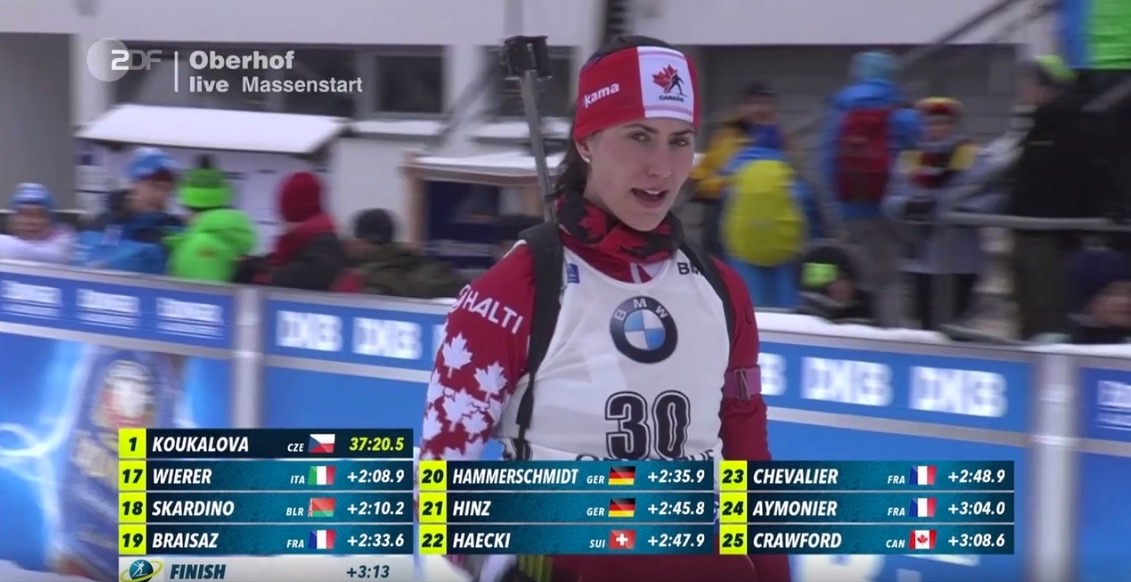
Biathlon Canada’s Rosanna Crawford after finishing 25th in the women’s mass start at the 2017 IBU World Cup in Oberhof, Germany. (Photo: ZDF screenshot)
After a clean shooting performance in the Oberhof sprint, Crawford was able to shoot well again on Sunday, totaling just two penalties (0+1+1+0), but was unable to keep pace with the leaders with the 28th-ranked course time.
“Like the last two races, it’s skiing that is really holding me back,” Crawford explained.
“So I just went out for a good workout and a chance to work on my shooting. I am really angry at my prone miss, just like yesterday [in the pursuit] that was all me! But 18/20 is still a pretty good day. I can only hope that the ski shape turns around in the next few weeks. Our wax techs again did a good job today!”
Crawford waved to the spectators on the finishing stretch and took a bow as she crossed the line in 25th place (+3:08.6).
“The crowds here are pretty incredible, there was a lot of people cheering ‘Go Canada’ which really helped fuel me around the course,” she wrote.
The spectators were particularly fired up after seeing a double-victory for Germany’s Simon Schempp and Erik Lesser in the men’s mass start earlier on Sunday. And with the return of home-crowd favorite Dahlmeier after a longer rest and training period over the holiday break, as well as her teammate Franziska Hildebrand also fighting for a position at the top, they had every reason to cheer during the women’s race as well.
“I think I did everything right,” Dahlmeier told German broadcaster ZDF of her reason for skipping the sprint and pursuit races. “I did not exactly know good my form would be after the break. Today I had a bit heavy legs from training. But I am happy with the second place and glad that the return worked out like this. It was a lot of fun to ski in front of such an audience today.”
“The first three World Cup weekends were more strenuous, due to the good results and the yellow bib [of the overall World Cup leader],” she added. “When I go to the start, I want to give it 100 percent, not just coast along. So my feeling was that it would be useful to skip a race, and that this happened to be in Oberhof was due to the competition calendar. But I am glad that I could do this one race.”
“I didn’t have so good expectations for this,” Koukalová said at the press conference on her race week in Oberhof, with two victories and a second place. “The main goal of the season is the World Championships in Hochfilzen. So I hope that I am still not in the best shape now, because I know it is more difficult to win there than here.”
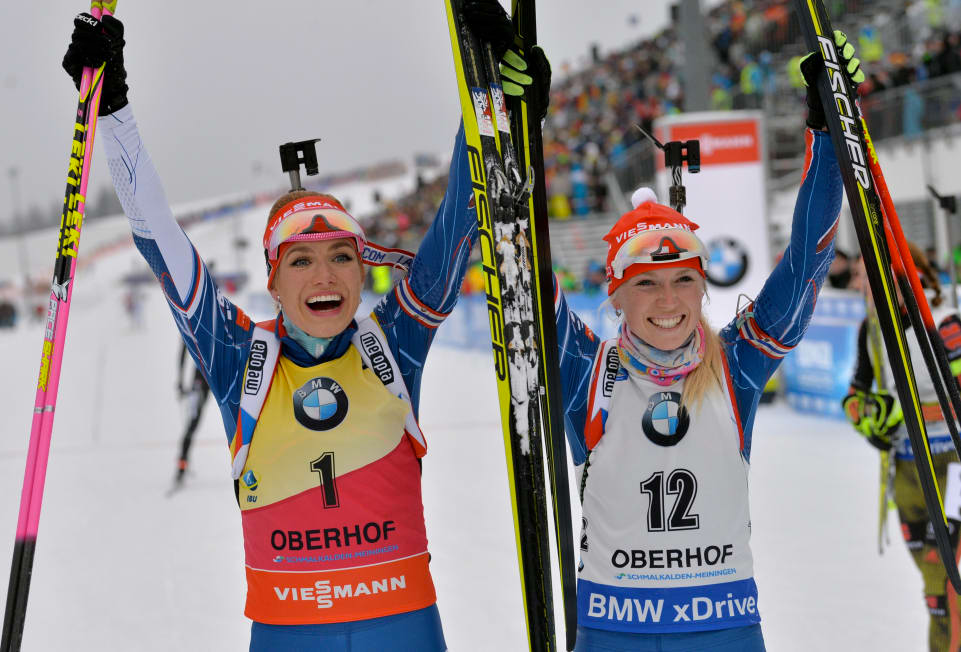
Czech Republic’s Gabriela Koukalová (bib 1, first place) and her teammate Eva Puskarčiková (bib 12, third place) celebrate at the finish of the women’s 12.5 k mass start on Sunday at the 2017 IBU World Cup in Oberhof, Germany. (Photo: IBU)
Koukalová was also excited that teammate Eva Puskarčiková placed third (+45.4 with no penalties) to stand on the podium with her, and that they were the only two athletes in the field who shot clean. It was the second World Cup podium of the career for Puskarčiková, after a third place in the pursuit in Pokljuka, Slovenia, earlier this season.
“I don’t know how to say it, but I have many times deeper feelings than to stand there alone,” Koukalová said at the press conference. “It’s very positive and I am very happy for Eva, because she was still sick around Christmas and so she is something like a hero for me. It’s amazing, she is crazy.”
“I hope so, I hope it will be better and better,” Puskarčiková said with a smile when questioned if her confidence is increasing with each success now.
In a three-way sprint finish, the fourth place went to Kazakhstan’s Galina Vishnevskaya, the best result of the 22 year old’s career (+1:11.6 with one penalty), ahead of Ukraine’s Yulia Dzhima (+1:12.6 with three penalties) and Germany’s Hildebrand (+1:14.0 with two penalties).
If the IBU, which likes to stress its “biathlon family” motto, had a fair-play award, it should have gone to Austria’s Lisa Theresa Hauser, who voluntarily gave up a pole to Germany’s Vanessa Hinz after accidentally breaking hers by stepping on it. Hauser’s good deed was not rewarded, as she soon after fell on a steep downhill turn, clogging the sights of her rifle with snow and had to pull out of the race. Hinz finished 21st.
The IBU World Cup resumes with a men’s relay on Wednesday, Jan. 11 and a women’s relay on Thursday, Jan. 12 in Ruhpolding, also located in Germany.