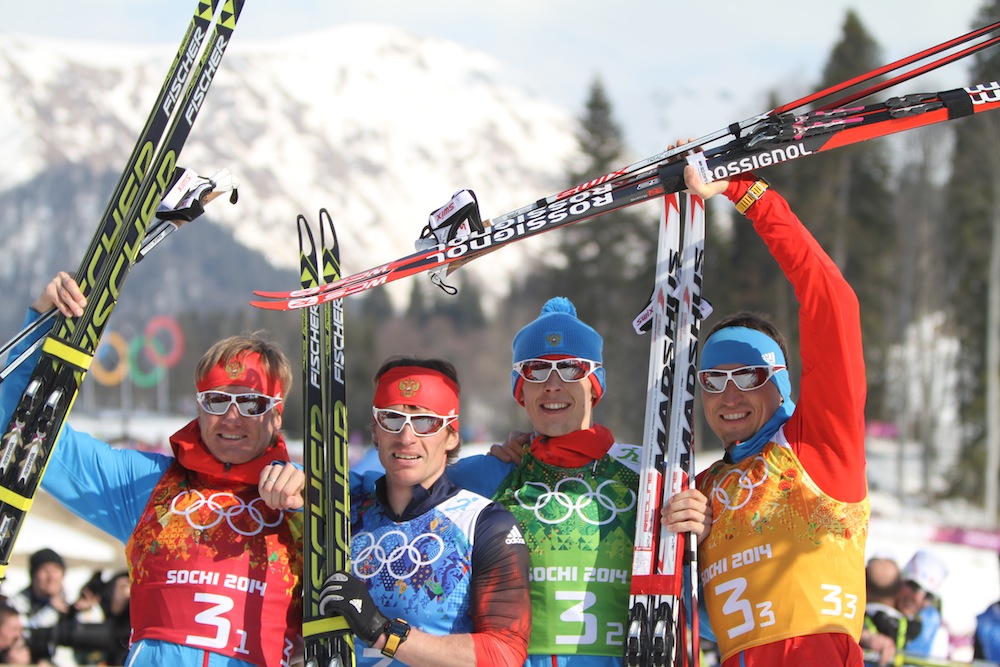
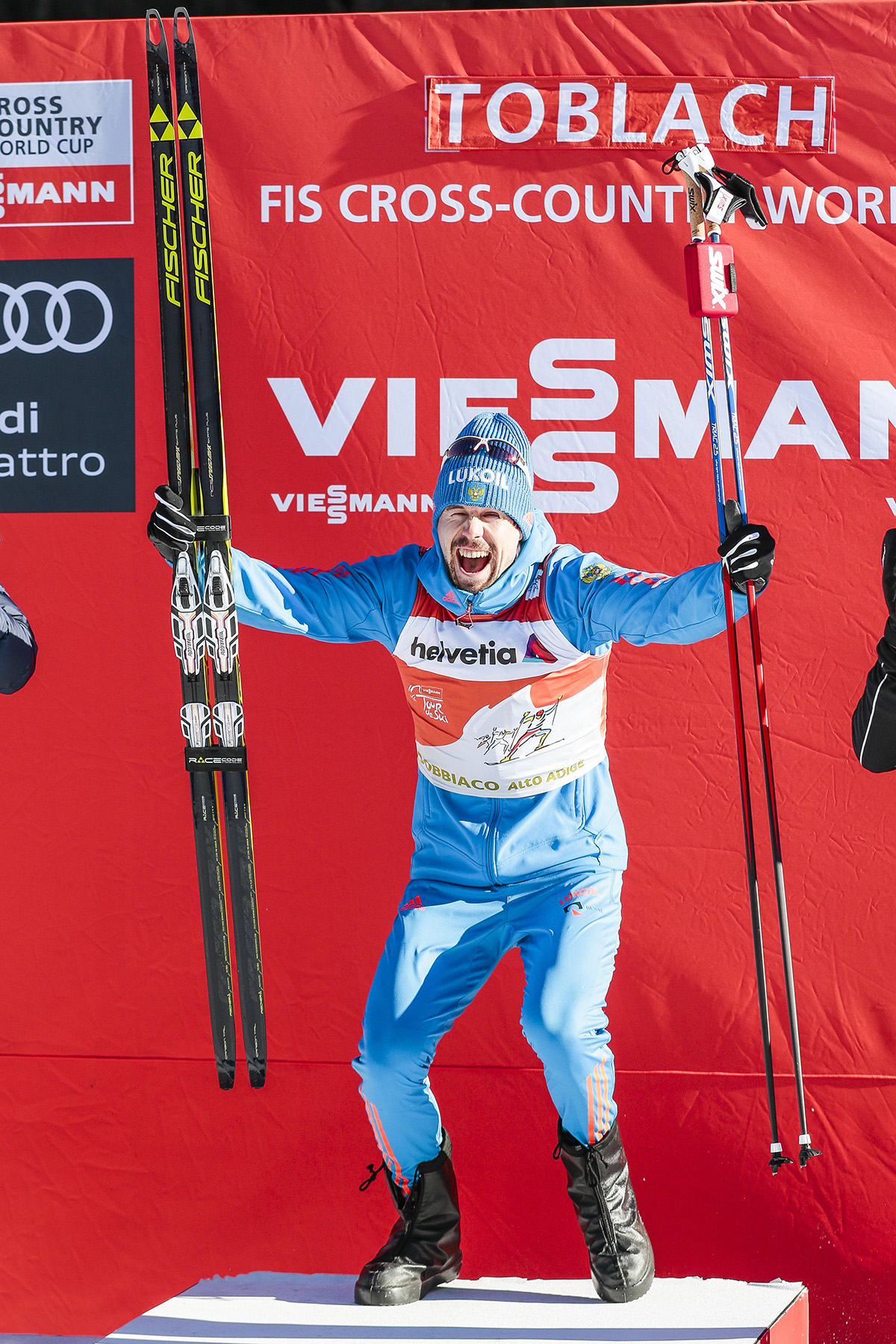
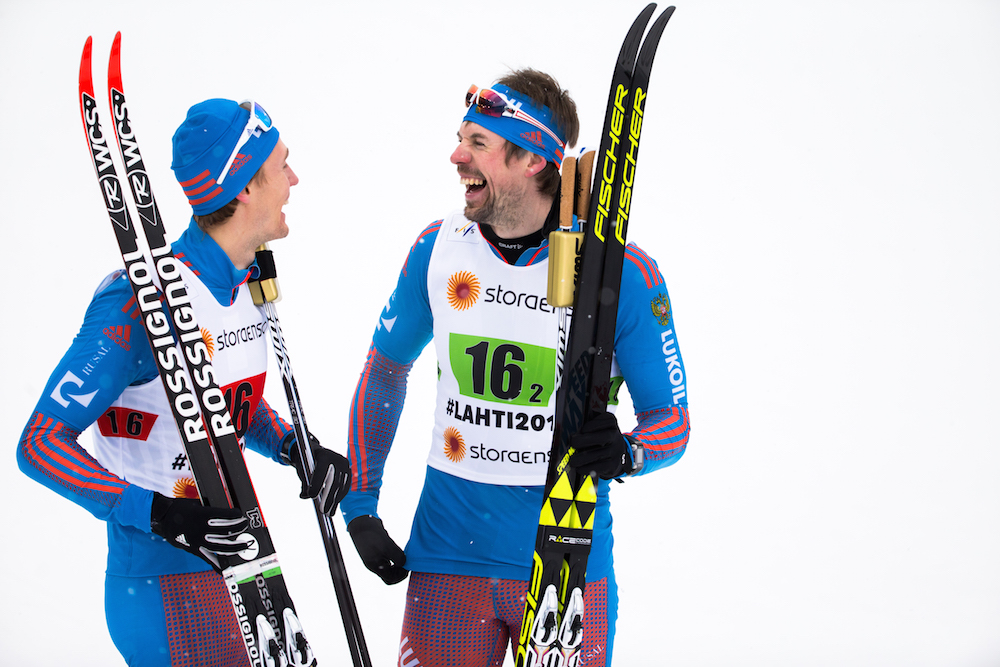
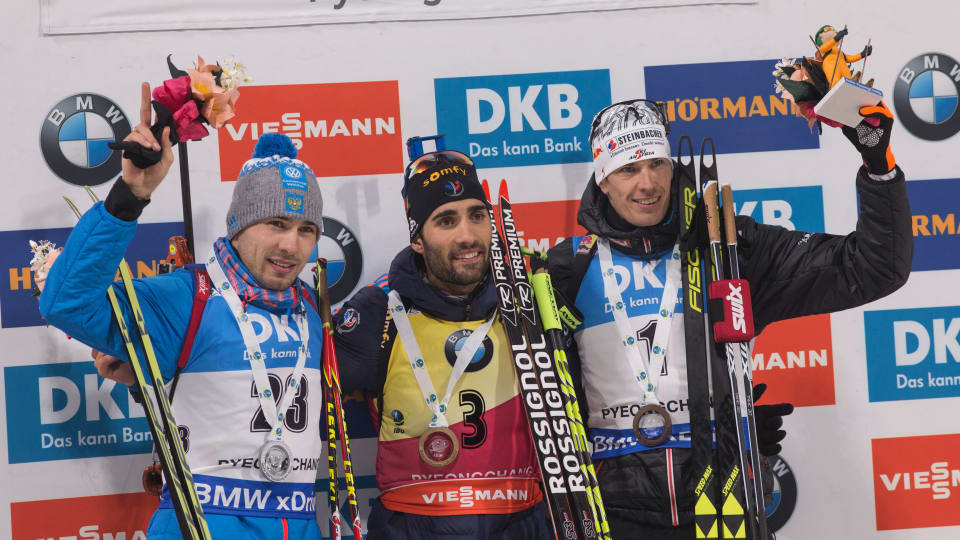
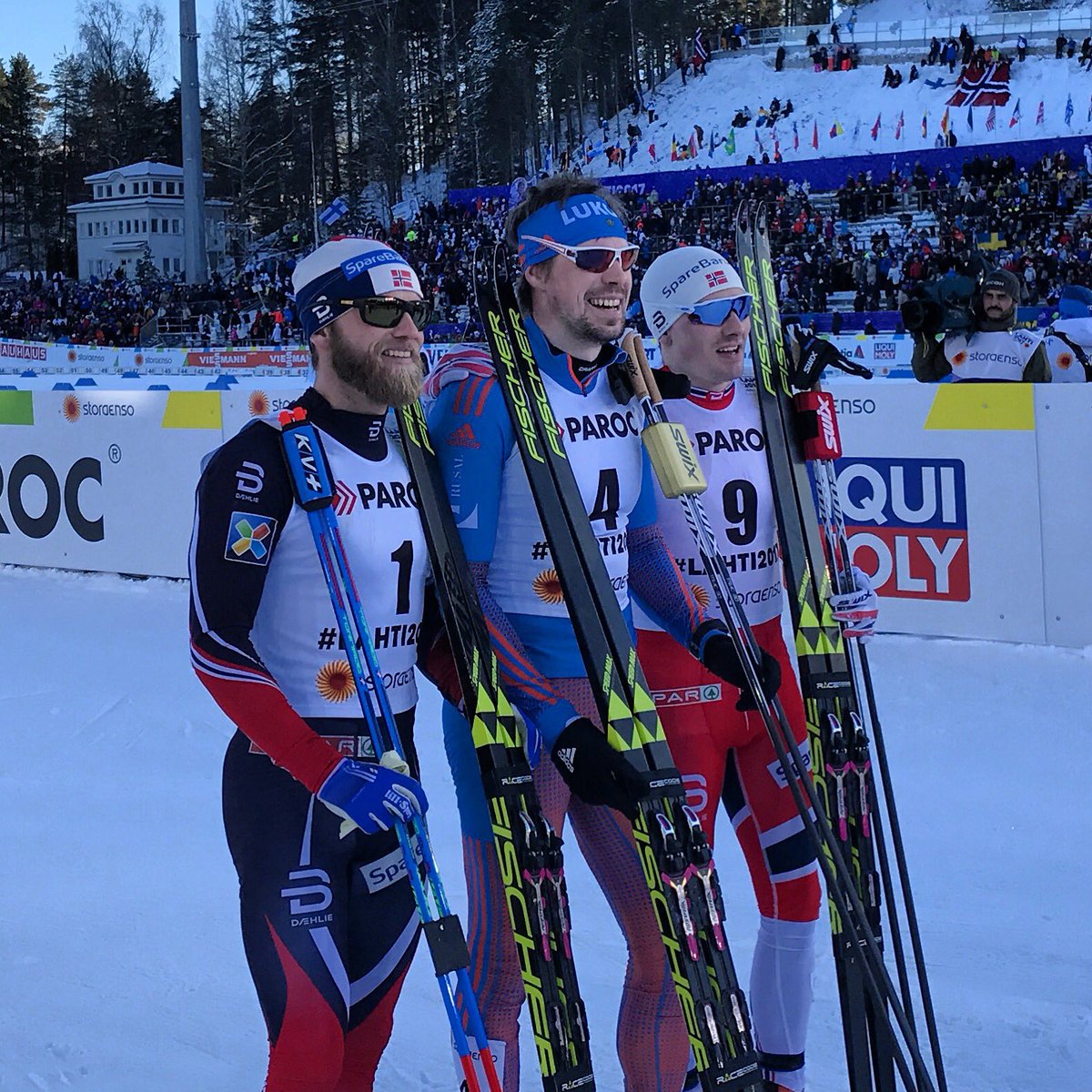
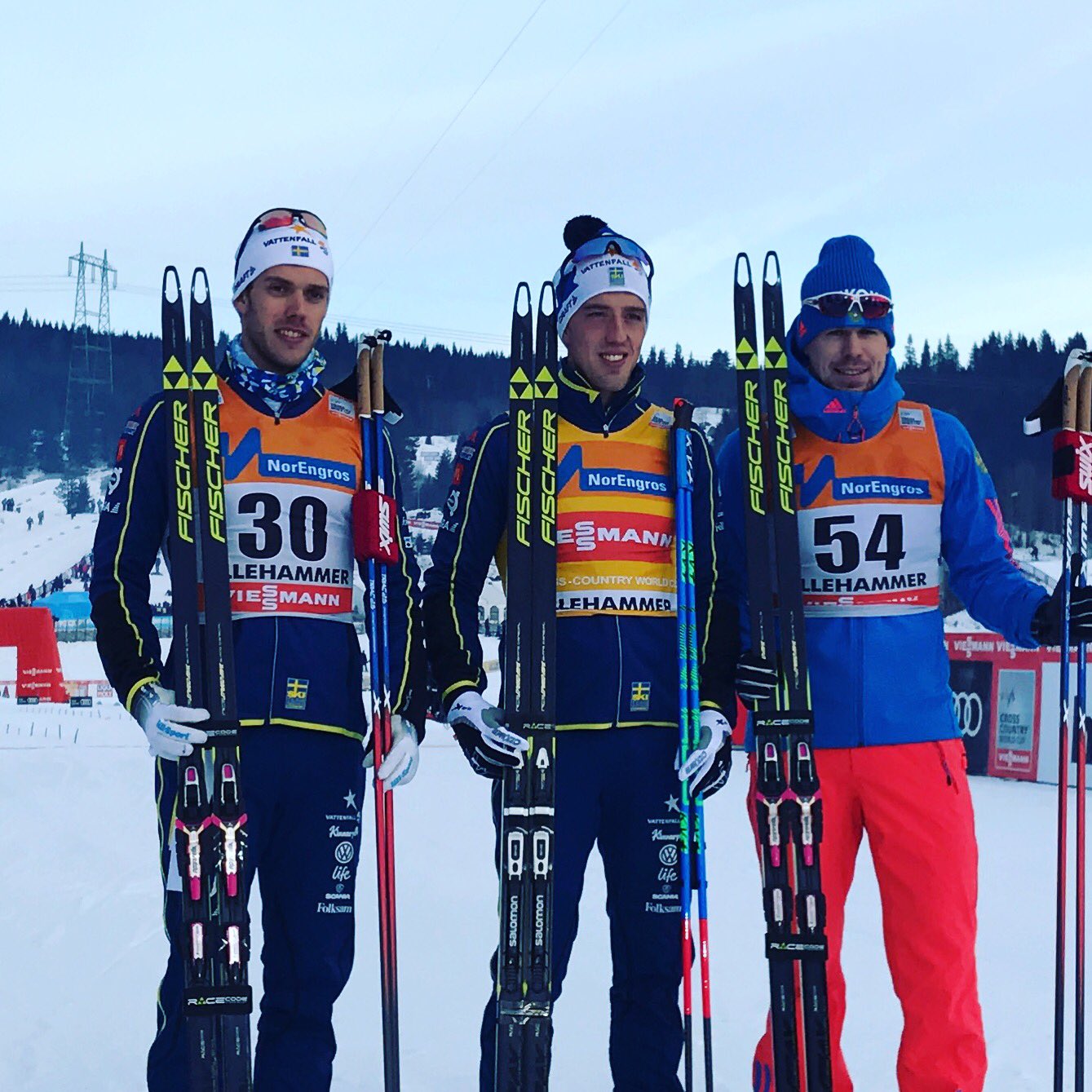
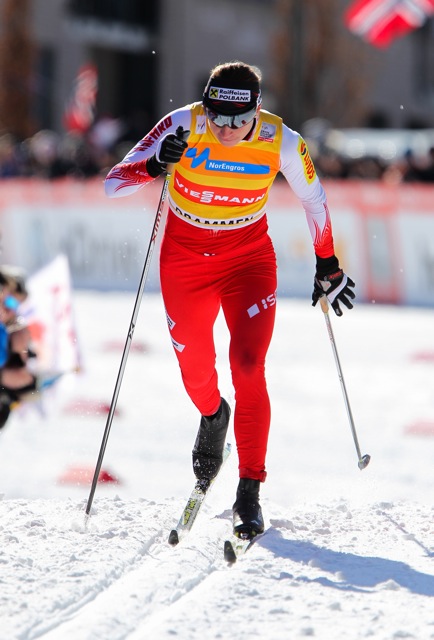
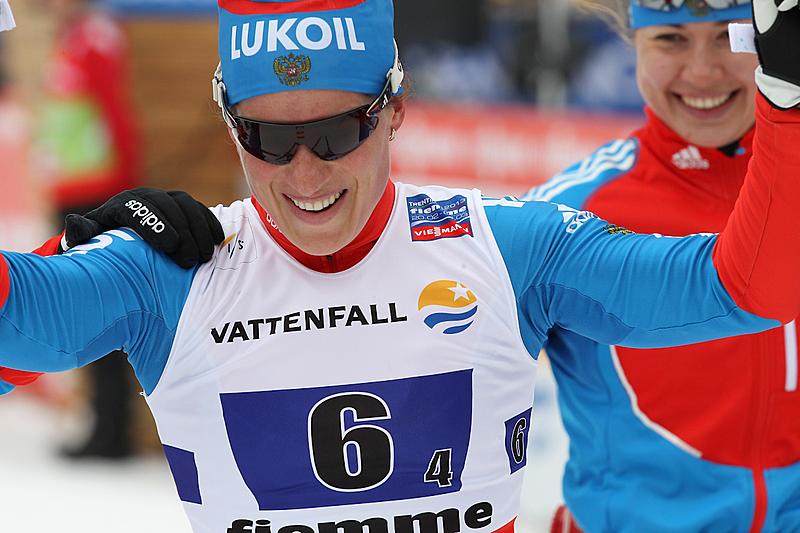
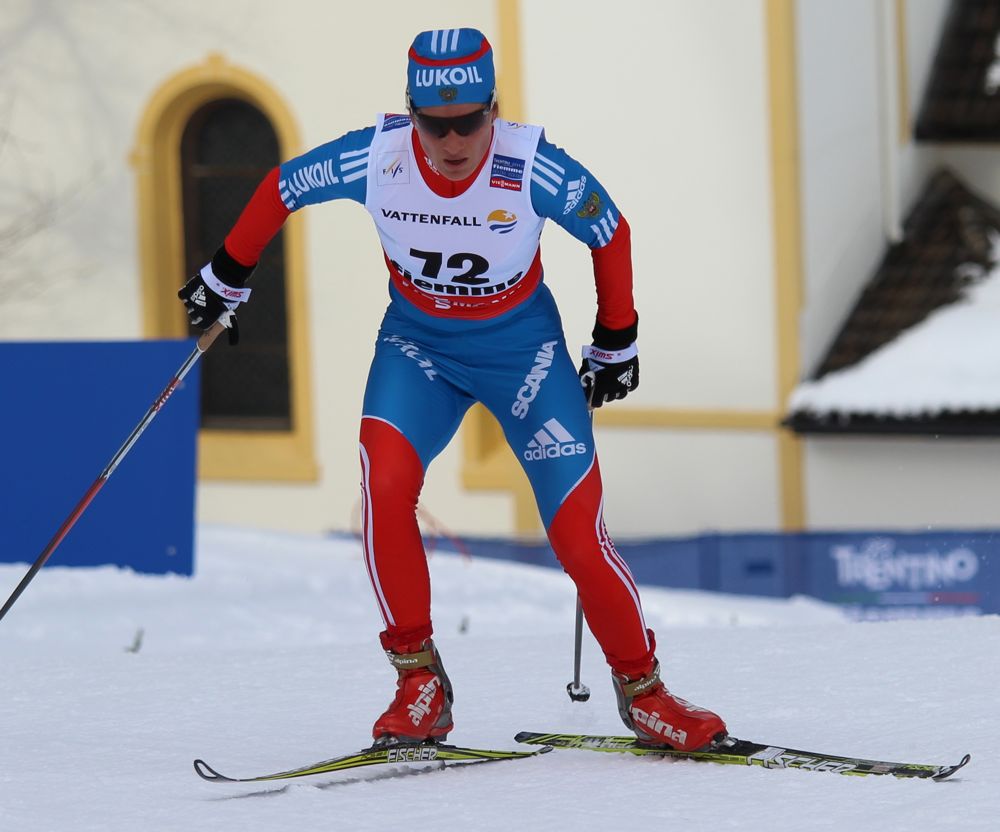
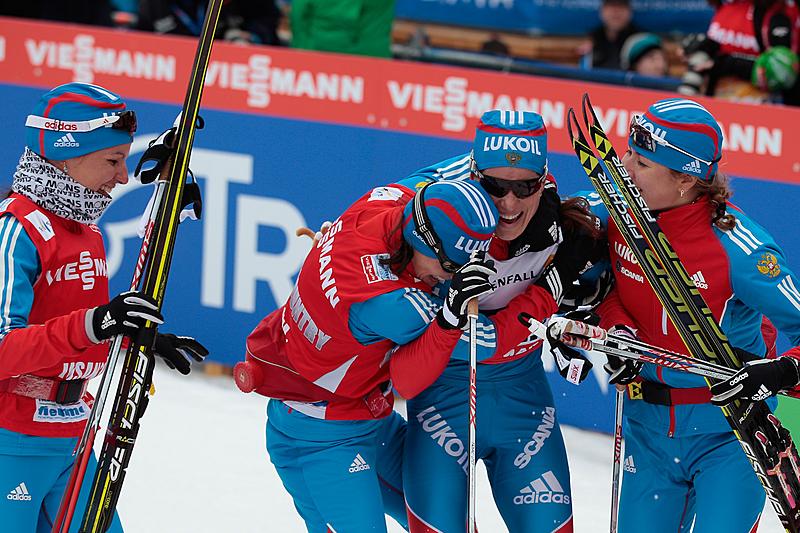
The silver-medal winning Russian men’s relay team at the 2014 Olympics. Alexander Bessmertnykh, Maxim Vyegzhanin, and Alexander Legkov were disqualified for doping, but just had their bans overturned by the Court of Arbitration for Sport.
The Court of Arbitration for Sport (CAS) has overturned doping bans assigned to eight cross-country skiers based on investigations into manipulation of the anti-doping process at the 2014 Winter Olympics.
“In 28 cases, the evidence collected was found to be insufficient to establish that an anti-doping rule violation (ADRV) was committed by the athletes concerned,” CAS wrote in a press release. “With respect to these 28 athletes, the appeals are upheld, the sanctions annulled and their individual results achieved in Sochi 2014 are reinstated.”
The athletes whose results will be reinstated are:
50 k gold medalist and relay silver medalist Alexander Legkov
50 k silver medalist, team sprint and relay silver medalist Maxim Vylegzhanin, also fourth in the 30 k skiathlon
relay silver medalist Alexander Bessmertnykh, also seventh in the 15 k classic
Evgeny Belov, 19th in the 30 k skiathlon and 25th in the 15 k classic
team sprint silver medalist Nikita Kriukov, also 13th in the men’s sprint
Alexei Petukhov, eighth in the men’s sprint
Evgenia Shapovalova, 28th in the women’s sprint
Natalia Matveeva, 20th in the women’s sprint
The disqualifications of skiers Julia Ivanova, Yulia Tchekaleva, and Anastasia Dotsenko were upheld, although CAS held that instead of being banned from the Olympics for life, the three women were merely banned from the 2018 Games.
The cases of biathletes Olga Zaitseva, Olga Vilukhina, and Yana Romanova have not yet been handled.
The eight athletes whose disqualifications were overturned had not been invited to the 2018 Olympics, and many other Russian athletes who had not been convicted of doping offenses also did not meet the IOC’s requirements of proof of being clean either. Thus, it is doubtful whether the CAS appeals will affect the Olympic rosters.
CAS did not release any information about how the arbitration panel came to its decision.
“Although the operative part of the decision is issued, the principle of confidentiality of the procedure still applies,” Legkov’s lawyer, Christof Wieschemann, wrote in a statement emailed to the media. “I assume that all parties involved will respect this. The panel has to decide in its judgment what details of the proceedings becomes subject of the reasoning of the decision and therefore will also become public. We will wait for the reasoned decisions.”
The evidence in the McLaren report showed, for instance, that anti-doping sample bottles belonging to Legkov, Vylegzhanin, Shapovalova, and Petukhov, among others, showed marks consistent with having been tampered with. A sample belonging to Vylegzhanin also showed discrepancies in the reported specific gravity.
There was no explanation offered as to why this evidence is not valid in proving an anti-doping rule violation.
Likewise, CAS offered no explanation as to why this testimony was not sufficient to prove an anti-doping rule violation.
“Dr. Rodchenkov testified fully and credibly at CAS,” Rodchenkov’s lawyer, Jim Walden, wrote in a statement. “His truth has been verified by forensic evidence, other whistleblowers, and, more recently, recovery of the Moscow lab’s secret database, showing thousands of dirty tests that were covered up. The panel’s unfortunate decision provides a very small measure of punishment for some athletes but a complete ‘get out of jail free’ card for most. Thus, the CAS decision only emboldens cheaters, makes it harder for clean athletes to win, and provides yet another ill-gotten gain for the corrupt Russian doping system generally, and Putin specifically.”
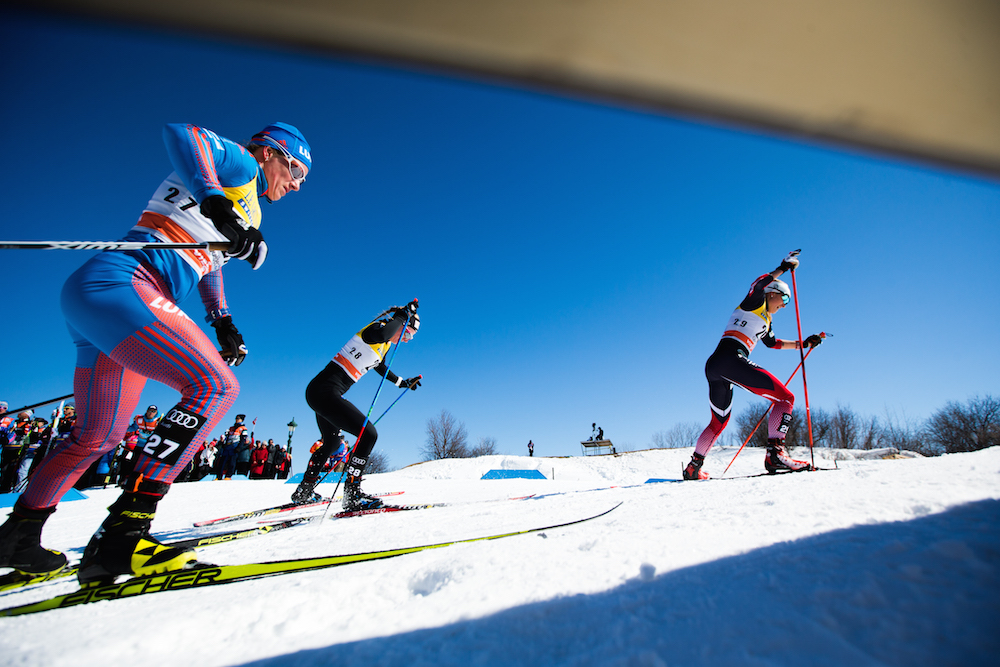
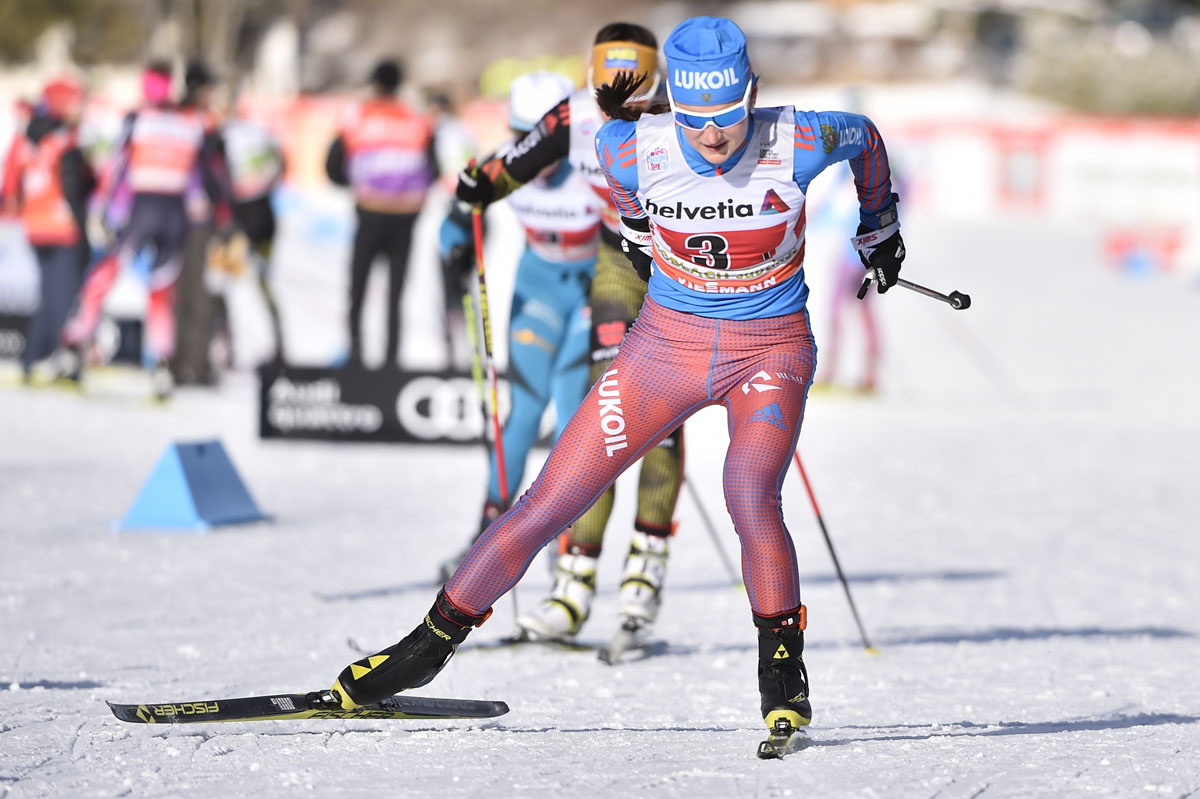
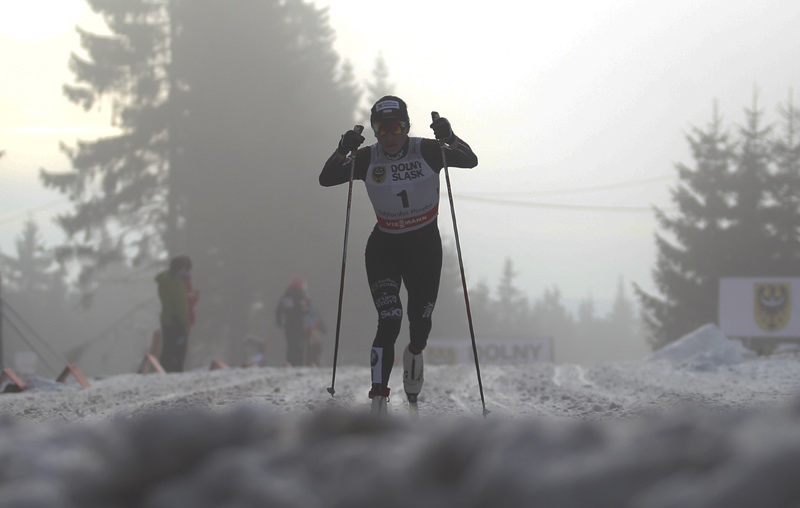
Russia’s Yulia Tchekaleva (27) chasing during the women’s 10 k freestyle pursuit last March at 2017 World Cup Finals in Quebec City. She finished 23rd and ended last season ranked 10th in the Distance World Cup and 11th in the Overall World Cup. On Friday, the International Olympic Committee decided on a lifetime ban for Tchekaleva and another Russian cross-country skier, Anastasia Dotsenko, as well as Russian biathlete Olga Zaytseva. (Photo: Dustin Satloff/dustinsatloff.com)
The International Olympic Committee (IOC) has handed down three more lifetime Olympic bans to two Russian cross-country skiers and a biathlete, all of which are women, based on the Oswald Commission hearings concerning Russia’s systematic doping at the 2014 Sochi Olympics.
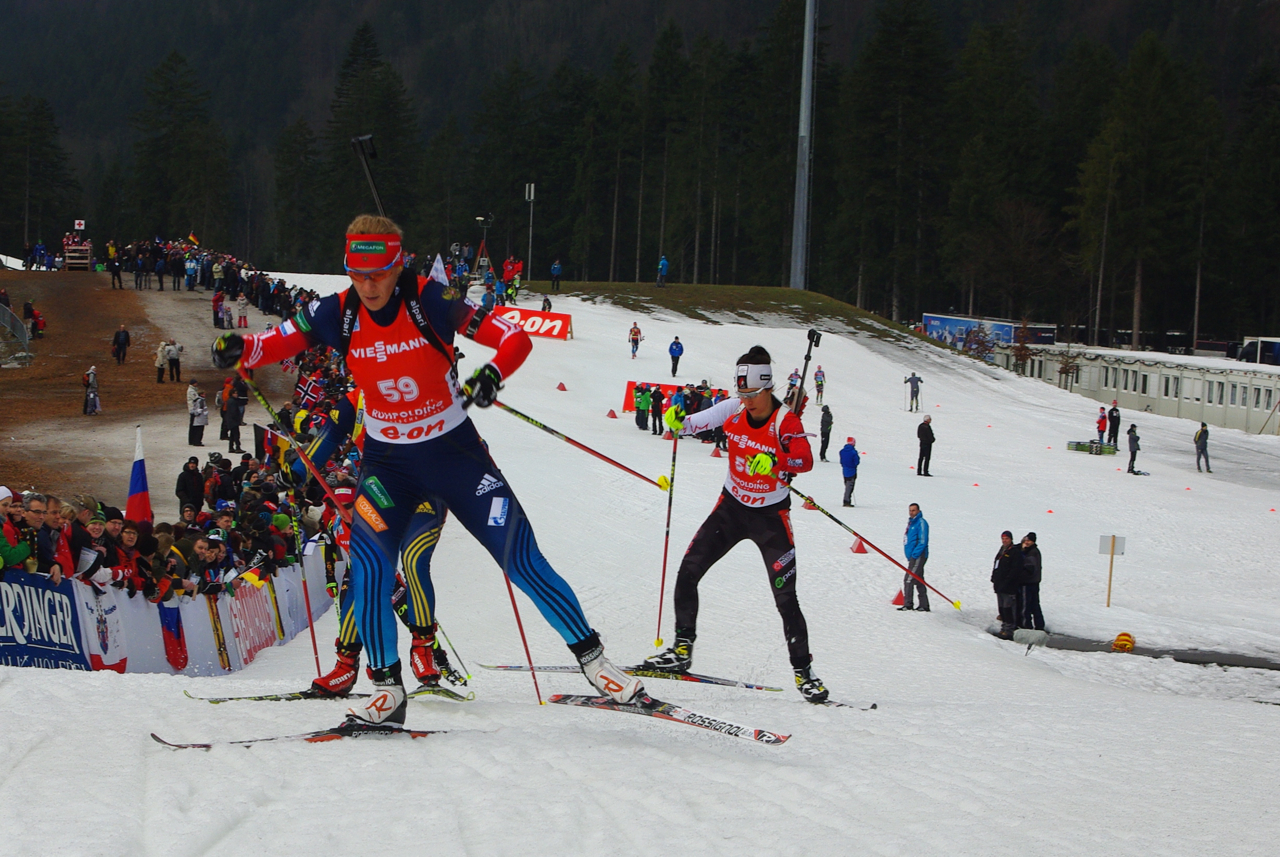
Russia’s Olga Zaitseva leads Canada’s Megan Imre in a 2014 IBU World Cup pursuit.
Cross-country skiers Yulia Tchekaleva and Anastasia Dotsenko and biathlete Olga Zaitseva have been sanctioned, according to an IOC press release on Friday.
“More hearings concerning other athletes will be held over the next few weeks,” the release stated. “As of now, the number of cases opened by the Disciplinary Commission has reached 36 after additional findings from the re-analyses.”
So far, 25 Russian Winter Olympians have been sanctioned for violating anti-doping rules in Sochi.
“As some investigations are still ongoing (notably the forensic analysis of the bottles), it cannot be excluded that there might be new elements that would justify opening further new cases. Today 26 athletes have been heard and one case has been filled,” the release stated.
While neither Tchekaleva nor Dotsenko medaled at the 2014 Games*, Zaitseva did — taking silver in the women’s relay. That medal was stripped earlier this week when her teammate Olga Vilukhina was sanctioned on Wednesday. Zaitseva, who retired in 2015, is a two-time relay gold medalist from 2006 and 2010; those results are unaffected.
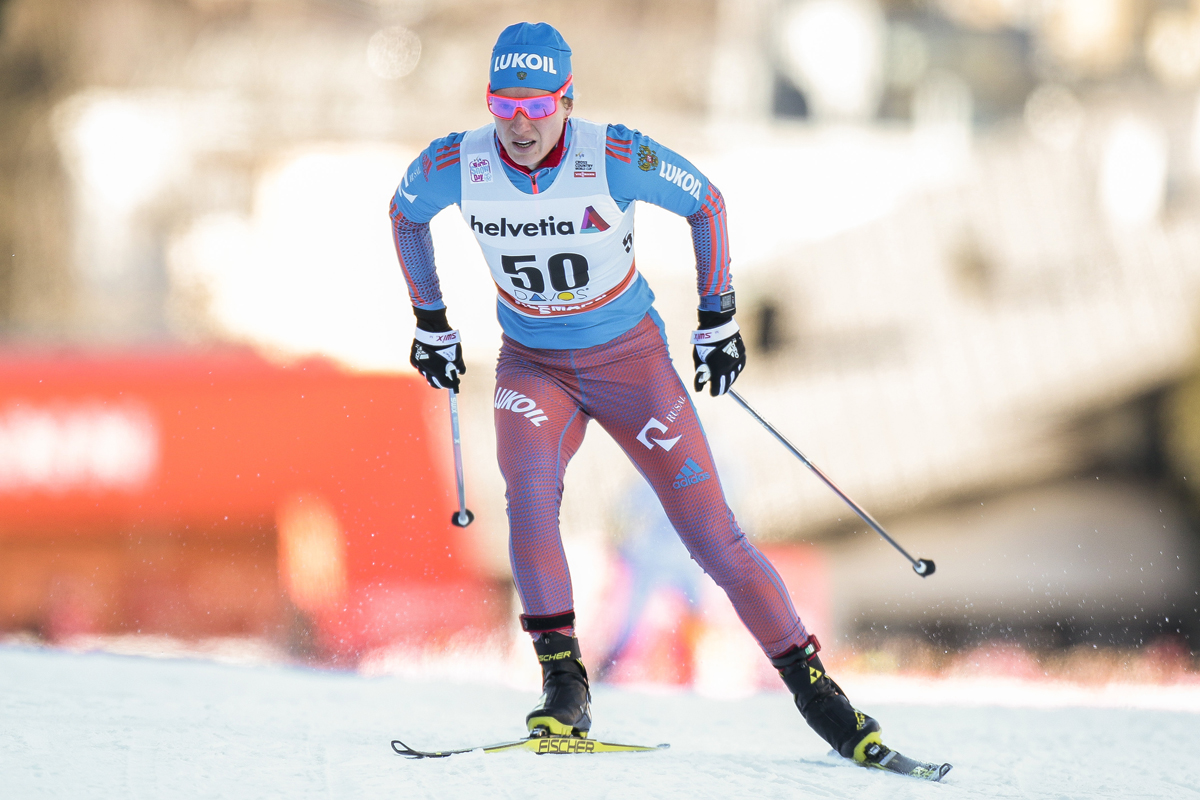
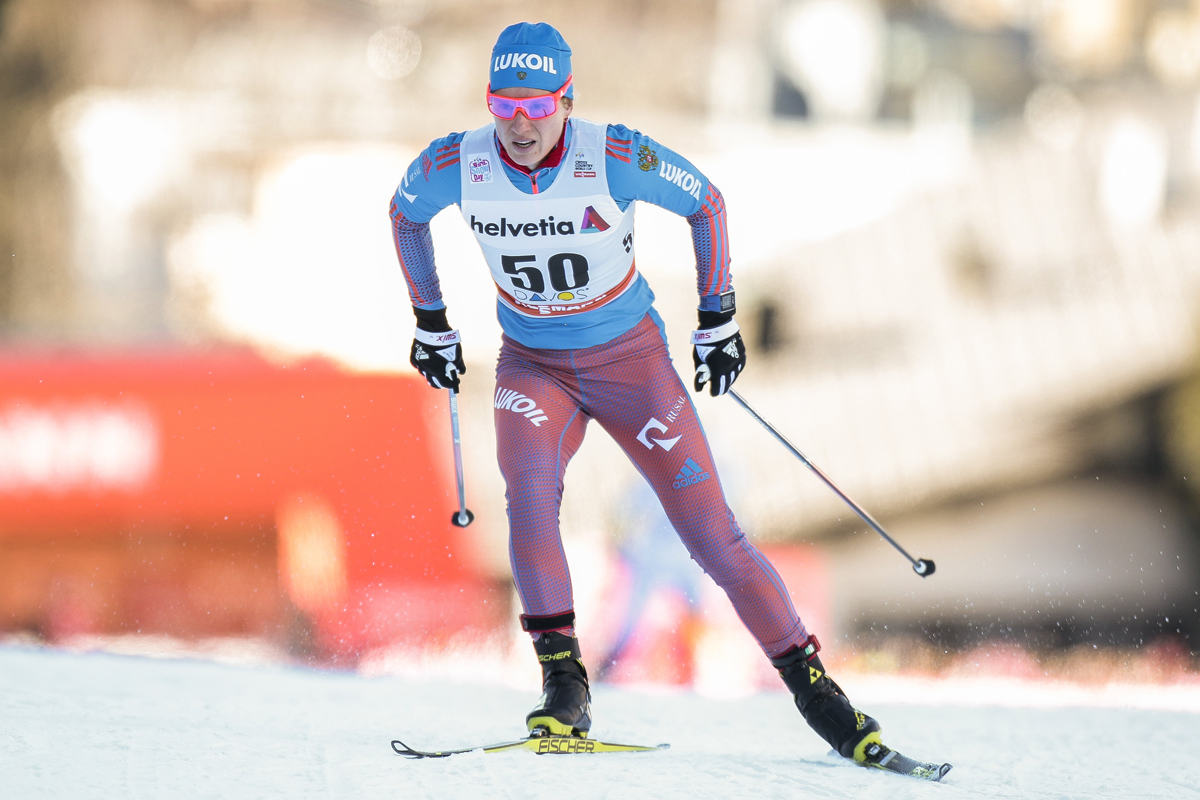
Russia’s Yulia Tchekaleva racing at last year’s Davos World Cup in Switzerland. (Photo: Fischer/NordicFocus)
Tchekaleva finished last season ranked 11th overall on the World Cup and 10th in the Distance World Cup. Now 33, she started this season a couple weekends ago at Sweden’s International Ski Federation (FIS) races in Gallivare, where she placed second in the 10 k classic and sixth in the 5 k freestyle. She hasn’t raced since.
Dotsenko, 31, hasn’t raced a World Cup since February 2016, but she also started this season in Gallivare (where her best result was 18th in the classic sprint), then raced another set of FIS races in Kontiolahti, Finland, last weekend, where she placed fourth and fifth place.
*At the 2014 Olympics, Tchekaleva and Dotsenko originally raced to sixth with two teammates in the 4 x 5 k relay, and the four team members received diplomas for that result, according to the IOC. Tchekaleva also placed 11th in the 10 k classic, 15th in the skiathlon, and 32nd in the 30 k freestyle mass start. Dotsenko finished 22nd in the classic sprint. All of those results have been erased.
Zaitseva notably competed in six Olympic events in Sochi: placing second in the women’s 4 x 6 k relay to take silver, and fourth in the mixed relay “for which she was awarded a diploma“. Individually, she finished 11th in the 10 k pursuit, 15th in the 15 k individual, 23rd in the 12.5 k mass start, 28th in the 7.5 k sprint. Those results are also voided.
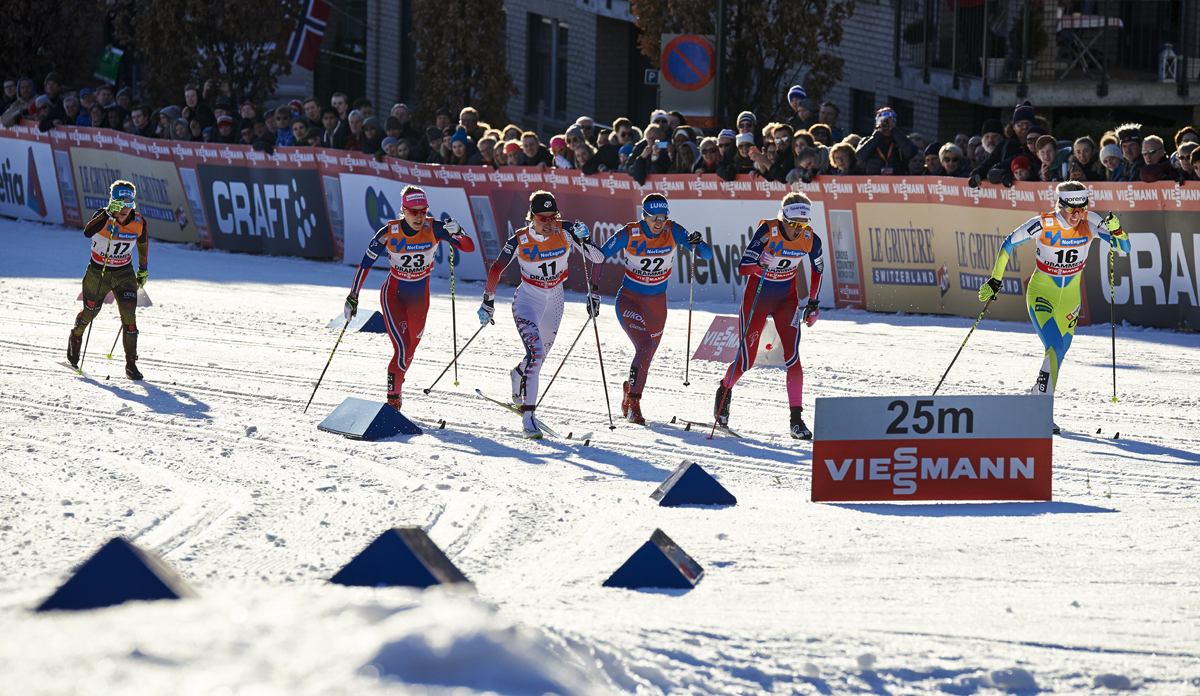
Russia’s Anastasia Dotsenko (22) racing with (from left to right) Germany’s Sandra Ringwald, Norway’s Ragnhild Haga, American Sophie Caldwell, Norway’s Kathrine Rolsted Harsem, and Slovenia’s Anamarija Lampic during a World Cup classic sprint in February 2016 in Drammen, Norway. (Photo: Fischer/NordicFocus)
Note: This article has been updated to include comments from Sweden’s Charlotte Kalla.
For the second day in a row, Charlotte Kalla, a name synonymous with the yellow and blue of Sweden, stood atop the podium, placing first in the women’s 10-kilometer classic International Ski Federation (FIS) race on Saturday in Gällivare, Sweden. On Friday, Kalla won another individual-start race, the 5 k freestyle, by a margin of 8.8 seconds. She more than doubled that time gap by the finish of Day 2, winning the 10 k classic in 27:55 minutes, 17.7 seconds ahead of Russia’s Yulia Tchekaleva in second place. Natalia Nepryaeva, also from Russia, skied to third, 40.9 seconds back of Kalla.
“I am feeling good and I think I am where I should be at this moment,” Kalla wrote in an email. “I had a good feeling on the classic race and handle the condition well. On Friday I opened hard and tried to push hard all the way.”
Known as a skate powerhouse, Kalla has improved her classic skiing and is now a double threat. “I have improved my classic technique the last years,” Kalla explained. “When I am in shape it doesn’t matter if it is skating or classic. I am glad I managed to ski well in the condition we had. It was a little bit soft because of the snowfall.”
Although a home FIS event for Sweden, Russia secured six of the top-10 spots with Sweden settling for three. Japan’s Masako Ishida, the only non-Russian or Swede outlier in the top 10, placed fourth (+1:02.4). Russians Anna Zherebyateva raced to fifth (+1:08.8) while teammate Yulia Belorukova was sixth (+1:12.8).
Sweden took the next two spots with Stina Nilsson in seventh (+1:20.9) and Anna Haag in eighth (1:20.9). Russia rounded out the top 10 with Anatasia Sedova placing ninth (+1:24.1) and Mariya Guschina in tenth (+1:25.0).
Sweden’s Ida Ingemarsdotter, a World Cup regular, placed 11th (+1:30.6).
Kikkan Randall was the only U.S. Ski Team member at the race, and a day after finishing eighth in the 5 k skate, she finished 15th (+1:48.1) on Saturday. In an email, Randall explained that snow had fallen continuously for the last 24 hours in Gällivare.
“Conditions were pretty nice, the track was a little soft and a lot of racers here made the pole track a little punchy,” she wrote.
Considering the massive time-zone shift from her home in Anchorage, Alaska, to Central European Time, it appears Randall is adjusting well.
“I felt decent today, not too tired from the jet lag or yesterday’s race. I wanted two back-to-back races to get ready for next weekend’s triple World Cup opener,” she wrote, referring to the first three World Cup races in Kuusamo, Finland, starting Friday, Nov. 23.
Throughout Saturday’s 10 k, Randall steadily improved her overall placing: she was 32nd at 4.2 k, 23rd at 6.8 k and locked into 15th by 9.2 k.
“It was definitely good to race a 10km classic today,” Randall wrote. “I had trouble really digging into my race gear on the first lap today. I think I was skiing a little stiff and not carrying my momentum down the track. Nepryaeva [the third-place finisher] caught me going into the 2nd lap and that was the jumpstart I needed. I was able to match her pace for most of the rest of the race and it helped me find better technique and tempo.
“I wanted to be a little stronger today but I got some really important feedback on where I’m at and what I need to work on as the race season progresses,” she added. “My fitness feels pretty good and now it’s just a matter of fine-tuning.”
Emily Nishikawa was the only Canadian entered on Saturday and finished in 51st (+3:39.3). Sixty-nine women started the race, 38 from Sweden, 17 from Russia, seven from Japan, two from Switzerland and Estonia, and one each from the U.S., Canada, and Poland.
In Friday’s 10 k skate in Gällivare, only Swiss star Dario Cologna kept the Russians from sweeping the top nine by placing third. In that race, Evgeniy Belov and Sergey Ustiugov of the Russian national team finished first and second, respectively.
Saturday was a different race, a 15 k classic, but with a similar thread and no Cologna as a Russian foil.
The Russian men finishing in unison to take first, second and third in the men’s 30 k skiathlon, the final race of 2017 U23 World Championships at Soldier Hollow in Midway, Utah. Alexander Bolshunov (8) was deemed the winner, Alexey Chervotkin (1) was second, and Denis Spitsov (11) third. (Photo: FlyingPointRoad.com)
It was Russia, Russia, Russia.
Alexander Bolshunov, winner of the 30 k skiathlon at 2017 U23 World Championships, won the race in 37:13, one second ahead of Maxim Vylegzhanin in second. Alexey Chervotkin was third (+5.1).
Classic specialist, Kazakhstan’s Alexey Poltoranin finished fourth, 13 seconds off the podium, and Cologna placed fifth (+22.1).
Despite being on Swedish soil, the rest of the top 10 became a mostly Russian affair. Russian teammates Alexey Vitsenko and Artem Maltsev placed sixth (+29.5) and seventh (+37.4), respectively, Sweden’s Calle Halfvarsson interrupted the trend by tying Russia’s Evgeniy Belov for eighth (+38.0), and Russia’s Alexander Bessmertnykh took 10th (+40.1).
There’s a pattern: Russia took 14 of the top-20 places. Twenty-eight of 126 starters were from Russia, with the vast majority of the field being Swedish. Outside of the top 10, Sweden’s Daniel Rickardsson was the next-best Swede in 12th (+49.6).
Devon Kershaw (World Cup Team), who finished 12th on Friday, once again led Canada in 20th (+1:06.7). At 6.8 k, Kershaw was ranked 15th, and at 9.6 k he was down one spot to 16th. By the 11.4 k checkpoint, he began slipping further in the standings.
“Today was a tough one,” Kershaw wrote in an email. “I felt pretty good but conditions were soft, so you had to really feather it (the technique) – especially on the climbs. Pacing wise I think I was doing pretty well, but in the last 2.5km today I was missing any semblance of a kick to the finish and ended up conceding a few seconds to those around me, knocking me from about 15-16 to 20th.”
Although an interval start race, Kershaw never found a strong pacing partner. “I was skiing alone – no help at all today,” Kershaw wrote of his solitary effort. “It would have been so helpful! Especially that last lap when things get tough. But in individual start races, you need to learn to do it alone. So good to try and get used to that “time trial” feeling.”
Three other Canadians competed, with Graeme Killick (World Cup Team) finishing 50th (+2:32.3), Jack Carlyle (Alberta World Cup Academy) 91st (+4:06.1), and Brian McKeever (Para Nordic Team) 110th (+5:16.0).
As of press time, Fasterskier could not confirm if the International Ski Federation (FIS) held an emergency meeting to discuss the involvement of IOC-banned Russian skiers in FIS-sanctioned races. Of the six IOC-sanctioned Russian skiers, four are men: Belov, Vylegzhanin, Alexander Legkov, and Alexey Petukhov. All four skiers raced on Friday, however, Legkov and Petukhov (and Shapovalova, one of the two women sanctioned by the IOC) did not contest Saturday’s race.
Racing continues in Gällivare on Sunday with classic sprints.
Sweden’s Charlotte Kalla racing to a win in her first race of the 2017/2018 season, the women’s 5 k freestyle in Gällivare, Sweden, on Friday. (Photo: Sporteventgallivare/Instagram)
Sweden’s Charlotte Kalla and Hanna Falk went 1-2 in Sweden’s season-opening International Ski Federation (FIS) race on Friday in Gällivare, with Kalla winning the women’s 5-kilometer freestyle by 8.8 seconds in 12:58.1 minutes. Falk, her teammate on the Swedish women’s team, placed second and Russia’s Yulia Belorukova took the third spot on the podium, 10.3 seconds out of first.
The host nation had three in the top four, with Ida Ingemarsdotter in fourth (+16.1). Switzerland’s Nathalie von Siebenthal finished fifth (+17.8), Russia’s Yulia Tchekaleva placed sixth (+23.4), and Russia’s Natalia Nepryaeva was seventh (+25.0).
Kikkan Randall of the U.S. Ski Team raced to eighth (+27.2), just ahead of Sweden’s Evelina Settlin in ninth (+32.0) and Russia’s Anna Nechaevskaya in 10th (+33.5). Japan’s Masako Ishida was just 0.3 seconds out of the top 10 in 11th.
In an email, Randall explained that she decided to venture to Europe earlier this year to get some racing in ahead of the World Cup.
“We also wanted a little extra time to let Breck adjust to the 10hr time change!” she wrote of her 1-year-old son, who will be traveling the World Cup circuit with Randall and her husband, Jeff Ellis, this winter.
(Article continues below)
Most of the U.S. Ski Team arrived in Rovaniemi, Finland, on Thursday, Nov. 16 (with the exception of Andy Newell, who is racing this weekend in Beitostølen, Norway, with Noah Hoffman). The rest of her teammates planned to train at the Santasport Olympic training center in Rovaniemi until Nov. 21, when the entire team will meet up in Kuusamo (also known as Ruka), Finland — the site of next weekend’s World Cup opener.
“I’m happy with my start today,” Randall wrote of Friday’s race. “It took my a couple km’s to get going today but I felt like I was finding my rhythm in the 2nd half of the course. It’s my first hard session this week after the travel over so today was a good jolt! It was a competitive field and I was satisfied to be in the mix.”
Ninety-two women raced the Gällivare 5 k skate, compared to 56 women on Friday in Beitostølen (Norway’s FIS season-opener). Randall planned to race the 10 k classic on Saturday in Gällivare, then skip Sunday’s classic sprint.
“It’s great to be back around other World Cup skiers again and I’ve always liked Gällivare so it’s nice to be back here,” she wrote. “My former wax tech lives here and has been taking great care of us. … Looking forward to meeting up with the team in Ruka next week.”
With 46 Swedes and 23 Russians accounting for most of the women’s field, Canada’s Emily Nishikawa put herself in the mix in 26th, 54.9 seconds behind Kalla. Nishikawa’s Canadian World Cup teammate Dahria Beatty placed 56th (+1:38.3).
For Nishikawa, who’s known as a distance skier, the top-30 result was notable in that a 5 k falls somewhere between a sprint and a distance race.
“5km is such a hard distance, and it is over so fast, but it is a lot of fun,” Nishikawa wrote in an email. “I have been able to work on my sprinting a bit more this summer as I have been injury free, so I’m looking forward to seeing more speed in my racing this season.”
She planned to race all three days in Gällivare, including Sunday’s sprint.
“With these races, I am just hoping to fine tune my fitness and get some hard intensity in to feel sharp for the upcoming World Cup races,” added Nishikawa, who’s entering her fifth World Cup season as a leading member of the Canadian women’s World Cup Team. “Today’s race was a really hard effort and I am happy with how I skied today.”
In the men’s 10 k freestyle on Friday, another one of the Russians sanctioned by the International Olympic Committee (IOC), Evgeniy Belov won in 23:08.5. He was 6.5 seconds faster than his Russian teammate Sergey Ustiugov, who placed second. Ustiugov is the defending Tour de Ski champion and Overall World Cup runner-up.
Switzerland’s Dario Cologna placed third, 7.6 seconds out of first, and Russia swept fourth through ninth, with Sweden’s Marcus Hellner following in 10th (+36.4). Out of the five actively competing skiers the IOC sanctioned earlier this month, all five raced on Friday in Gällivare, which was legal considering FIS had not ruled they can’t.
Four of those skiers are men. In addition to Belov, Maxim Vylegzhanin placed 14th (+43.2), Alexander Legkov followed in 15th (+45.9) and Alexey Petukhov finished 23rd (+56.7) out of 157 finishers on Friday.
Devon Kershaw (front) training with U.S. Ski Team sprinter Andy Newell in Sjusjøen, Norway, last week. (Photo: Noah Hoffman)
Ahead of them, Canada’s Devon Kershaw ended up 12th (+39.9), tying another Russian Artem Maltsev (who is not on the IOC-banned list) with identical times.
“My stance on the whole Russian fiasco is unchanged,” Kershaw wrote in an email, referring to a previous email he wrote to FasterSkier earlier this week when asked how he felt about the IOC-banned Russians competing in FIS events. “I find the entire thing both disturbing and hilarious. The fact that FIS is risking their credibility like this makes no sense to me. Apparently there will be an emergency meeting of sorts tomorrow about it (with FIS I’m assuming but I haven’t heard much about it) – so we’ll have to all wait and see what they come up with.
“As for seeing Belov win – I mean, that’s no surprise,” Kershaw continued. “He’s shown that he’s a force when he’s in form. But yeah, the fact that he and others have been recently banned for life by the IOC are winning races after that news came out just shows the Mickey Mouse club that our sport has become.”
As for his own race, Kershaw wrote that he felt great about it. The course suited him well without too much hard climbing. “… You kind of need to be pushing the whole way around. I really like courses like that,” he wrote.
The conditions, however, with about 10 to 15 centimeters of new snow from the early morning that continued into the race, made the course slower, which Kershaw found to be more challenging.
“But that is another reason why I am so satisfied with the effort today. Individual start skating in soft conditions? Not my favourite, so I’m happy how I was able to execute things,” he wrote. “For me to be in the mix in a 10km skate like that feels great. I had good energy all race and hit my technical goals for the race too, so I have to be satisfied.”
Kershaw and the rest of Canada’s Period 1 World Cup team arrived in Gällivare last Sunday. Over the last week, they’ve been testing equipment and getting into a race routine ahead of the World Cup opener, he explained.
“I changed various things with my training this year so it’s exciting to see how my body feels in the beginning of a new season,” Kershaw wrote. “… My goals are really to just be calm and execute well – which means going into the racing with no expectations other than to ski as technically well as possible while working on the whole pacing thing (which can be challenging at the beginning of the season when you don’t have that many races in the body). I’ll look to have another well executed race tomorrow and the results will be what they will be.”
Canada’s NorAm leader at the end of last season, Russell Kennedy (Team R.A.D.) was the next-best Canadian in 48th (+1:35.7), followed by Len Valjas (World Cup Team) in 49th (+1:37.0). Jack Carlyle (Alberta World Cup Academy) placed 67th (+2:07.2), Julien Locke (National U25 Team) was 72nd (+2:10.9), Graeme Killick (World Cup Team) 90th (+2:32.2), Brian McKeever (Para Nordic Team) 97th (+2:39.0), and Jess Cockney (World Cup Team) 119th (+3:10.7). Knute Johnsgaard (World Cup Team) did not start.
Racing continues in Gällivare this weekend with 10/15 k classic individual starts on Saturday followed by classic sprints on Sunday.
Sergey Ustiugov was extremely excited to capture another Tour de Ski stage win in Toblach, Italy, in January. (Photo: Fischer/Nordic Focus)
Welcome to World Cup Windup, where we check in with the top-10 teams from last year’s FIS Cross Country World Cup tour before the season starts with the Ruka Triple in Kuusamo, Finland, on Nov. 24.
RUSSIA
Overall in Nations Cup Last Year:Fourth
Women’s Ranking 2016/2017:Fifth
Men’s Ranking 2016/2017:Second
Who’s Back:
Ust-iu-gov! Ust-iu-gov! Sergey Ustiugov, a sensation in the last two seasons, is back for more. There’s also top-20 ranked overall skiers Alexander Bessmertnykh and Andrey Larkov, seventh-ranked sprinter Natalia Matveeva, 10th-ranked distance skier Yulia Tchekaleva, and runner-up in the U23 standings Yulia Belorukova – who along with Matveeva won silver in the team sprint at 2017 World Championships. Plus, 2010 Olympic sprint gold medalist Nikita Kriukov, who didn’t have an individual podium last season but won World Championships team sprint gold with Ustiugov. Who else is back is a bit complicated as …
Who’s Missing:
… Alexander Legkov, Maxim Vylegzhanin, Alexey Petukhov, Evgeny Belov, and Evgenia Shapovalova are all racing in pre-World Cup FIS races, but have been banned by the International Olympic Committee for doping at the 2014 Olympics. They are appealing their cases, but if the ruling holds, they will at the very least miss the 2018 Olympics. The International Ski Federation (FIS) may or may not implement a ban of their own which would keep the five off the World Cup. Julia Ivanova was also banned by the IOC but has not returned to racing.
Pre-Season Results:
Yulia Belorukova is a rising star. (Photo: Fischer/Nordic Focus)
So far, a number of Russians have done well in pre-season FIS racing. Ilia Chernousov finished second to Switzerland’s Dario Cologna in a trial in Davos. Alexey Chervotkin won a 15 k skate in Muonio, Finland, where Maxim Vylegzhanin picked up two top-six finishes and last year’s U23 World Champion Alexander Bolshunov won a 10 k classic. Natalia Nepryaeva also shone on the women’s side.
Recent Drama:
The biggest drama, of course, is the doping investigation which has enveloped the previously-mentioned five athletes (and Julia Ivanova, who has retired and is no longer racing).
Russian news recently reported that Yulia Tchekaleva, Anastasia Dotsenko, Natalia Matveeva, Natalia Zhukova, Natalia Korosteleva, Alexander Bessmertnykh, and Nikita Kriukov were also on the “Duchess List” of athletes allegedly given performance-enhancing drugs at Sochi. They have not been asked to have hearings with the IOC Disciplinary Commission, but it is possible that this could still occur.
Dotsenko took last season off to have a baby, but is back in training this year.
Russia’s Nikita Kriukov (l) and Sergey Ustiugov after winning the men’s classic team sprint on Feb. 26 at 2017 at FIS Nordic World Ski Championships in Lahti, Finland.
Coach Yuri Kaminski talked about why Nikita Kriukov might be dangerous this year: “Neither in Vancouver nor at the last World Championships was he the favorite. In this regard, the Vancouver situation and the current one are somewhere similar.” By contrast, at the 2014 Olympics he was a favorite and did not win, teaming up with Vylegzhanin to finish second in the team sprint. “Sergey [Ustiugov] goes to the Olympic Games as a favorite, and this greatly complicates life. The situation, I would say, is exactly the same as that of Kriukov before Sochi, where he was coming in as a two-time World Champion in a sprint. It was believed that he was obliged to win at least one gold medal, that’s the way the task was set… all this was very hard. And it so happened that the circumstances turned against us.”
Meanwhile, Alexander Panzhinsky still smarts from his just-by-a-toe loss to Kriukov in the 2010 Olympic sprint, and wants to win in PyeongChang: “I was burning inside from that defeat for a very long. And I dreamed many times, and thought about those last seconds a lot. Although on the other hand, it may be worthwhile to look at it as a very big plus for me. I really was very young in Vancouver. If I won, I took this career best for an athlete… [instead] it was motivation that helped me survive all these difficult years, when there were no big victories. And now it helps to keep this goal, to become an Olympic champion. This is generally the main task in my career.”
Best Social Media Presence:
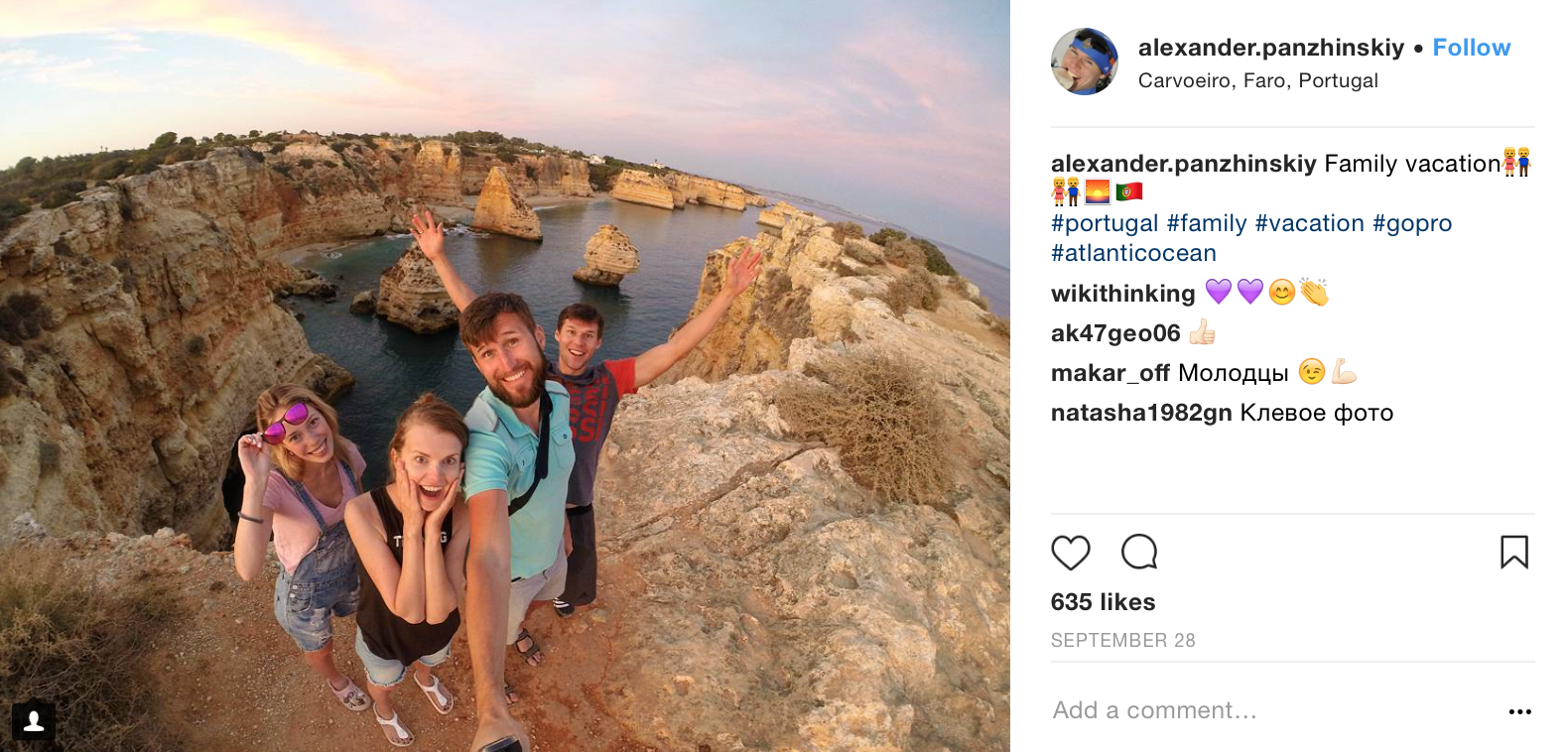
If you don’t know the Russian team outside their results or racing, social media is an excellent way to fix that. Alexander Panzhinskiy makes sure to translate the captions of (most of) his posts from Russian into English and makes an effort to connect to the sport’s global fanbase.
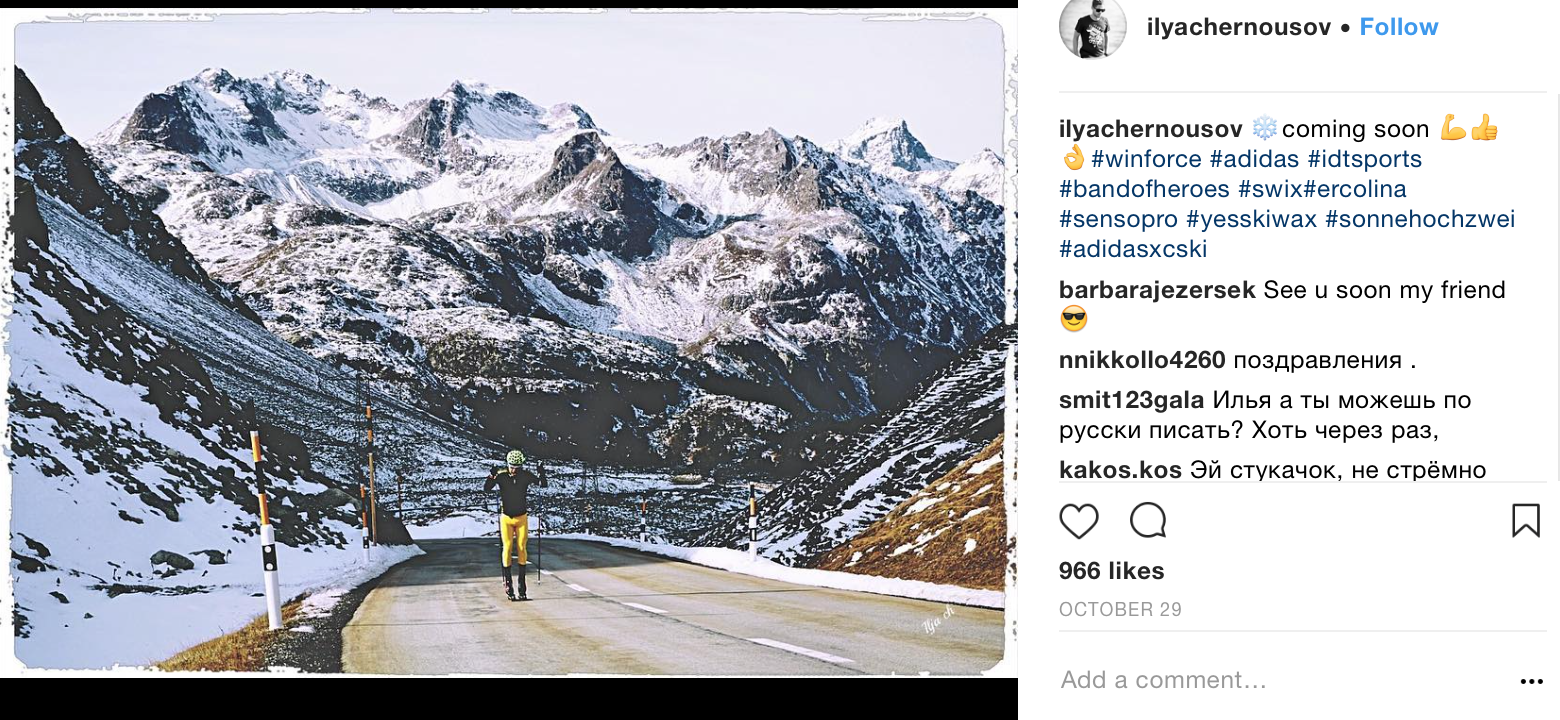
Ilya Chernousov also posts primarily in English, and makes training in Switzerland look pretty okay. He trains primarily with a long-distance race team, however, and is not part of the Russian national training group.
If you don’t understand Russian, however, it’s probably best to stick with a visual medium. Sergey Ustiugov and his girlfriend, World Cup skier Elena Soboleva, both have great Instagram feeds (Sergey’s / Elena’s).
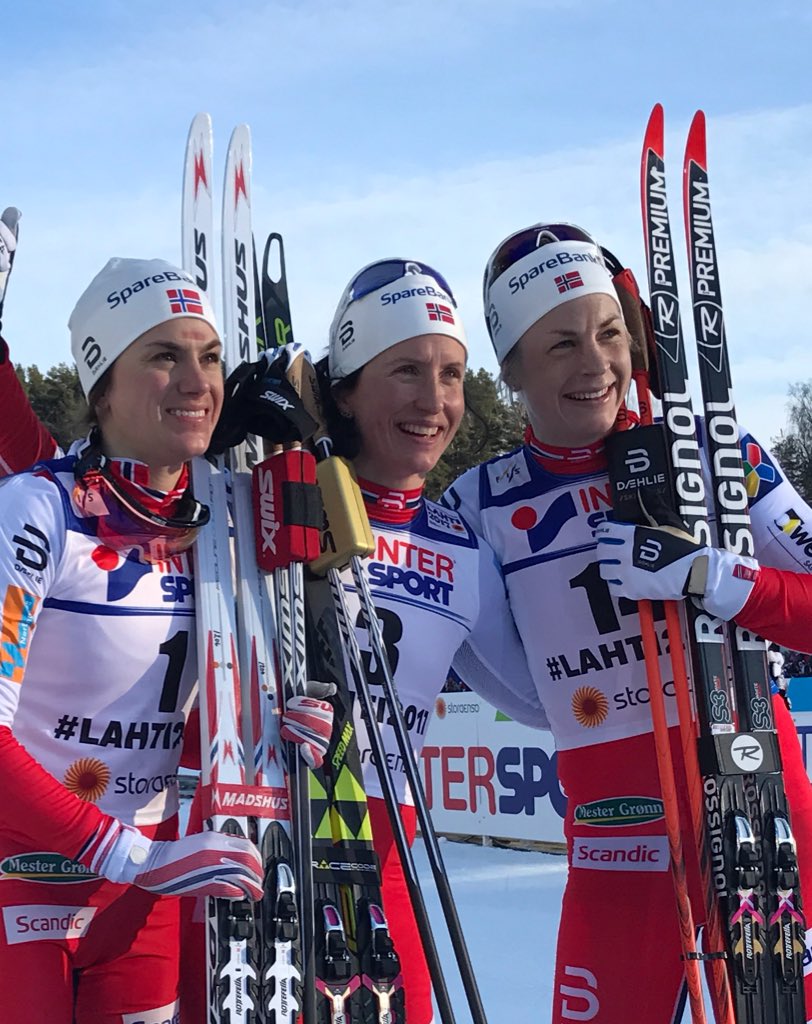
The all-Norwegian women’s 30 k freestyle mass start podium at 2017 Nordic World Championships in Lahti, Finland, with Marit Bjørgen (c) in first, Heidi Weng (l) in second, and Astrid Uhrenholdt Jacobsen (r) in third. (Photo: FIS Cross-Country/Twitter)
FIS Nordic World Championships (Lahti, Finland): Women’s 30 k freestyle mass start
Marit Bjørgen made it a four-peat on Saturday with her fourth gold and third individual win over the last week at 2017 Nordic World Championships in Lahti, Finland. (She previously won the 15-kilometer skiathlon, 10 k classic, and 4 x 5 k relay.)
The 36-year-old Norwegian closed out the championships with a 1.9-second victory in the women’s 30-kilometer freestyle mass start, finishing in 1:08:36.8 hours after setting the pace and leading a large group for much of the race. The group began to separate around 15 k, where it was down to 13 women with five seconds of first. At that point, Americans Jessie Diggins and Chelsea Holmes were within that lead pack.
While Holmes started to fall off the pace around 16 k, Diggins stuck with the leaders to the very end, only until four Norwegians broke away to race for the medals over the final kilometer.
With Bjørgen still charging hard up front, her teammates Heidi Weng, Astrid Uhrenholdt Jacobsen, and Ragnhild Haga followed, while Finland’s Krista Pärmäkoski trailed another second back in fifth and Diggins was one more second behind in sixth.
Bjørgen led the downhill into the stadium and skied away from her teammates before the finishing stretch, leaving Weng and Jacobsen to duke it out for second place. Weng got it by less than one-hundredth of a second, Jacobsen took bronze (+1.9), and Haga completed the Norwegian top-four sweep in fourth (+7.4).
Diggins passed Pärmäkoski and notched fifth (+10.4) for her career-best 30 k result. Pärmäkoski placed sixth (+11.3), Sweden’s Charlotte Kalla finished seventh (+13.9), Austria’s Teresa Stadlober was eighth (+15.5), Sweden’s Anna Haag ninth (+20.3), and Russia’s Yulia Tchekaleva 10th (+1:20.9) after edging Switzerland’s Nathalie von Siebenthal in a photo finish. Germany’s Stefanie Böhler placed 12th (+1:23.5) and Holmes finished 13th (+1:28.1) for her career best.
U.S. Ski Team member Liz Stephen placed 25th (+3:09.4), 6.6 seconds ahead of Canada’s national U25 Team skier Cendrine Browne, who notched a career best 26th (+3:16) in her first World Championships.
Holmes’s Alaska Pacific University (APU) teammate Jessica Yeaton, who races for Australia, finished 33rd (+4:32), Canada’s Dahria Beatty was 34th (+4:45.2), and American Caitlin Gregg 36th (+5:03.7).
Great Britain’s Annika Taylor, a California native, placed 38th (+6:19.4). Canada’s Emily Nishikawa was 40th (+6:41.5) and Katherine Stewart-Jones 41st (+7:18.6), and Brazil’s Jaqueline Mourão, who trains in Quebec, was 46th (+13:44.6) out of 47 finishers.
IBU World Cup (PyeongChang, South Korea): Women’s and men’s pursuits
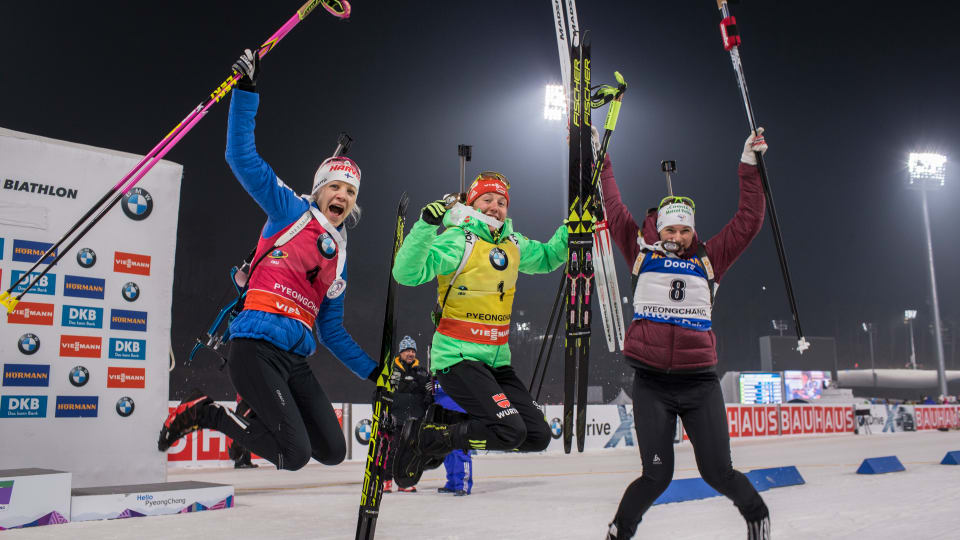
The women’s 10 k pursuit podium at the IBU World Cup in PyeongChang, South Korea, with Germany’s Laura Dahlmeier (c) in first, Finland’s Kaisa Mäkäräinen (l) in second, and France’s Anais Bescond (r) in third. (Photo: IBU)
Coming off a fifth place in Thursday’s 7.5-kilometer sprint, Susan Dunklee held her position despite three penalties in the women’s 10 k pursuit on Saturday to finish fifth again at the International Biathlon Union (IBU) World Cup in PyeongChang, South Korea.
Germany’s Laura Dahlmeier racked up her second-straight win in as many races in PyeongChang (and sixth-straight, counting World Championships), finishing in 27:58.0 minutes with clean shooting. She was just one of four women out of 58 finishers that hit all 20 targets in Saturday’s four-stage race.
Finishing more than a minute later, Finland’s Kaisa Mäkäräinen placed second (+1:12.6) after starting fourth based on her sprint result. Mäkäräinen had two penalties, both in the first standing, but cleaned the other three stages (0+0+2+0). France’s Anais Bescond raced up from eighth at the start to third place (+1:18.9) at the finish, with a single penalty (0+0+1+0), while Norway’s Tiril Eckhoff missed her second-straight podium in fourth place (+1:32.0) after starting second but accumulating five penalties (1+2+1+1).
Eckhoff edged Dunklee, of the U.S., by half a second as Dunklee placed fifth (+1:32.5) with three misses (1+1+0+1).
Canada’s Rosanna Crawford rose from 30th to 19th (+2:49.1) for her best non-relay result of the season, with two penalties (1+1+0+0). Her teammate Megan Tandy also landed her first top 30 of 2016/2017 in 30th (+3:26.2) with two misses (1+0+1+0) after starting 39th. Also for Canada, Julia Ransom finished 44th (+4:18.4) after starting 41st and skiing four penalty loops (1+0+1+2).
Also for the U.S., Clare Egan finished 36th (+3:41.9) with three clean stages but three misses in her first standing (0+0+3+0), after starting 33rd. Joanne Reid slipped from 35th at the start to 52nd (+4:53.4), with five penalties (1+1+0+3).
The men’s 12.5 k pursuit podium on Saturday at the IBU World Cup in PyeongChang, South Korea, with France’s Martin Fourcade (c) in first, Russia’s Anton Shipulin (l) in second and Austria’s Julian Eberhard (r) in third. (Photo: IBU)
[UPDATED] One day after locking up the overall World Cup title, Martin Fourcade was back at the top of the podium in the men’s 12.5 k pursuit in PyeongChang.
Fourcade started third, after finishing third in Friday’s sprint, then shot clean to win in 31:24.2. Russia’s Anton Shipulin, who started 23rd, also shot 20-for-20 to race up to second place, 34.5 seconds behind Fourcade, with the fifth-fastest course time. In comparison, Fourcade’s course time was third fastest.
Friday’s sprint winner, Julian Eberhard of Austria finished third (+36.7) after skiing three penalty loops (0+2+0+1). His teammate Simon Eder placed fourth (+1:03.2) after starting eighth and cleaning three stages before missing two on the last standing (0+0+0+2).
Russia’s Evgeniy Garanichev improved from ninth at the start to fifth (+1:09.5) with two penalties as well (0+1+1+0). France’s Simon Desthieux was sixth (+1:13.5), Austria’s Dominik Landertinger seventh (+1:20.3), Germany’s Benedikt Doll eighth (+1:20.4) with the fastest course time after starting 20th.
American Lowell Bailey was another 0.2 seconds back in ninth (+1:20.6), just ahead of Italy’s Lukas Hofer in 10th, who finished with the same time. Bailey previously tallied the third podium of his career on Friday, placing second in the sprint, but had two penalties on Saturday (1+0+1+0) to slip to ninth.
Also for the U.S., Leif Nordgren improved to 28th (+2:28.9) after starting 37th and shooting 19-for-20 (0+0+0+1).
Christian Gow shot clean to lead Canada in 32nd (+3:17.4), up from 56th at the start. His older brother Scott Gow slipped from 27th at the start to 43rd (+4:05.9) with five penalties (0+1+1+3), and Brendan Green followed in 44th (+4:09.8) with three penalties (2+1+0+0) after starting 28th.
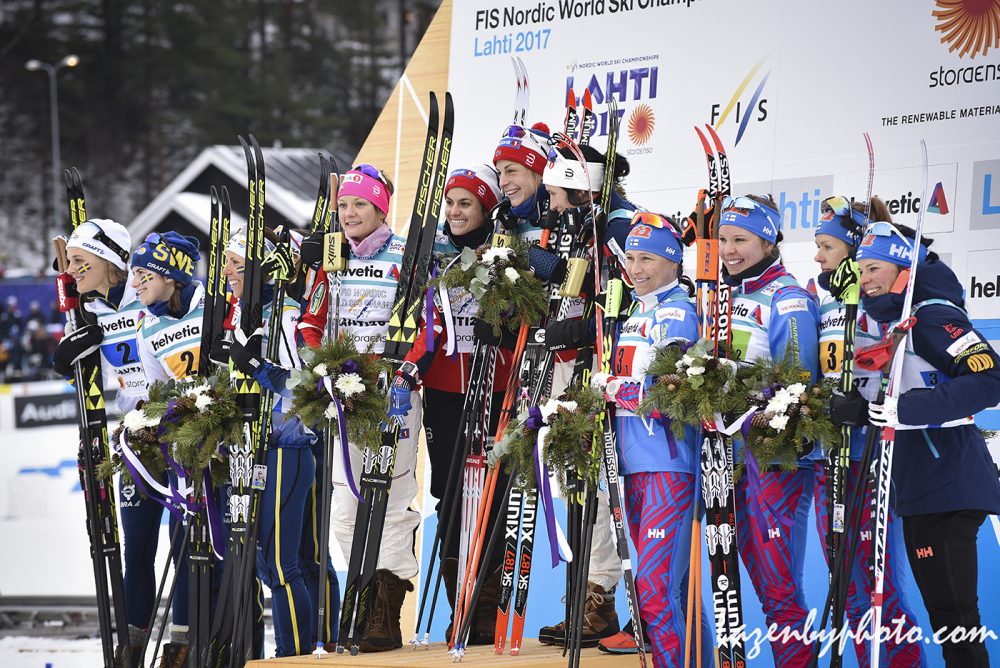
The women’s 4 x 5 k relay podium at 2017 Nordic World Ski Championships in Lahti, Finland, with Norway (c) in first, Sweden (l) in second and Finland (r) third. (Photo: John Lazenby/Lazenbyphoto.com)
LAHTI, Finland—The Norwegian lineup for the women’s 4 x 5-kilometer team at the 2017 Nordic World Championships on Thursday was daunting: Maiken Caspersen Falla, Heidi Weng, Astrid Uhrenholdt Jacobsen, Marit Bjørgen. On paper and on snow, a rundown of names and accomplishments.
On Thursday the Norwegian women made the country’s historic championship gold medal count a tidy 100 by winning the 4 x 5 k relay in 52:21.5 minutes. In a sprint for the remaining two podium spots, Sweden’s anchor skier Stina Nilsson outsprinted Finland’s Krista Pärmäkoski for second.
The Swedish team of Anna Haag, Charlotte Kalla, Ebba Andersson, and Nilsson scored silver (+1:01.6) while Finland’s home team of Aino-Kaisa Saarinen, Kerttu Niskanen, Laura Mononen, and Pärmäkoski was third (+1:02.1).
The U.S., represented by Kikkan Randall, Sadie Bjornsen, Liz Stephen, and Jessie Diggins, placed fourth (+1:33.8).
Two Legs of Parity, Then Norwegian Dominance
Rabid fans of the sport know Norway is winner of the last three consecutive championship relays. And lovers of tactics also know the Norwegians like to push the pace from the gun and break the pack early.
Halfway through the first leg, Poland’s Justyna Kowalczyk, a classic specialist, led Finland, Norway, Sweden, and the U.S. through the 2.5 k mark.
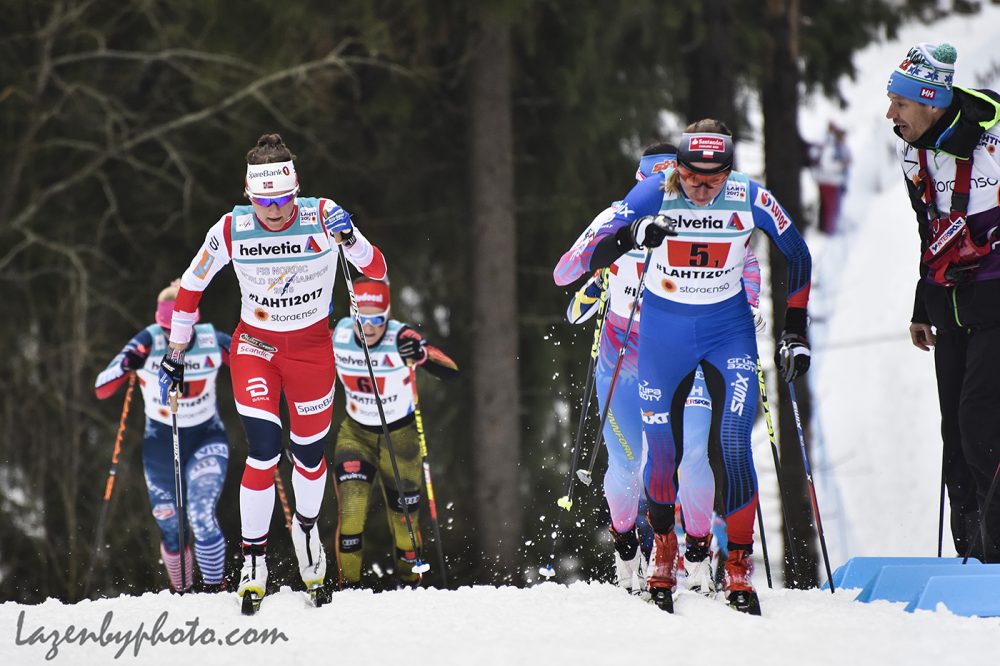
Norway’s Maiken Caspersen Falla (l) leads one row of skiers, Poland’s Justyna Kowalczyk lead’s another, during the scramble leg of the 2017 Nordic World Championships 4 x 5 k relay in Lahti, Finland. (Photo: John Lazenby/lazenbyphoto.com)
For Falla, Norway’s scramble leg, it was her debut in a championship 4 x 5 k relay. Despite her prior medals, her pre-relay nerves were unsettled.
“I was really excited today and I was just hoping that the time could pass fast so I can race,” Falla said after the race. “It was a lot of waiting time, but I get good advice … and that helped me today. So I get my nerves under control.”
According to Falla, here’s the advice: “That I should stay behind the first lap and be strong in the climbs in the last lap,” she explained. “I did that, just as they said.”
In the last kilometer, Falla made a small break, tagging off to Weng with a near eight-second advantage on the chasers.
Weng leads the World Cup overall standings, but racing in the Finnish ski-den, she was unable to fend off the surging Finns. Five kilometers later, Niskanen had absorbed Norway’s punch. Finland and Norway tagged off to their respective third-leg skiers simultaneously. Sweden trailed twelve seconds back.
Up the first hill, the mother of all climbs on the skating course, Jacobsen and Mononen pulsed. Carrying Sweden’s hopes was Andersson — a 19-year-old junior fresh off a win in the 5 k skate at last month’s Junior World Championships at Soldier Hollow in Utah.
The Finn-Norwegian duo pulled away, leaving Andersson with a 22.6-second deficit 1.3 k into the third leg.
Astrid Uhrenholdt Jacobsen, Norway’s third-leg skier, made a decisive move to put major time into second-place Sweden and third-place Finland during the 2017 Nordic World Championships 4 x 5 k relay in Lahti, Finland. (Photo: John Lazenby/Lazenbyphoto.com)
A resurgent Jacobsen kept pushing; her moves to drop Andersson early on weren’t only a tactic to make it a two-team race, but a sustained display of overdrive that ultimately broke the Finns, too.
The third leg was the tipping point for Finland and Sweden. They were on the side of bleeding time to Norway; Norway on the side of looming victory. By 13.8 k, Norway was up 30.4 seconds on Finland and 45.8 seconds on Sweden.
Andersson managed the damage. She and Mononen skied into the stadium amidst a raucous Finnish crowd. By then, Jacobsen handed Bjørgen nearly a minute cushion.
That kind of margin and Bjørgen hustling from the line: Boom!
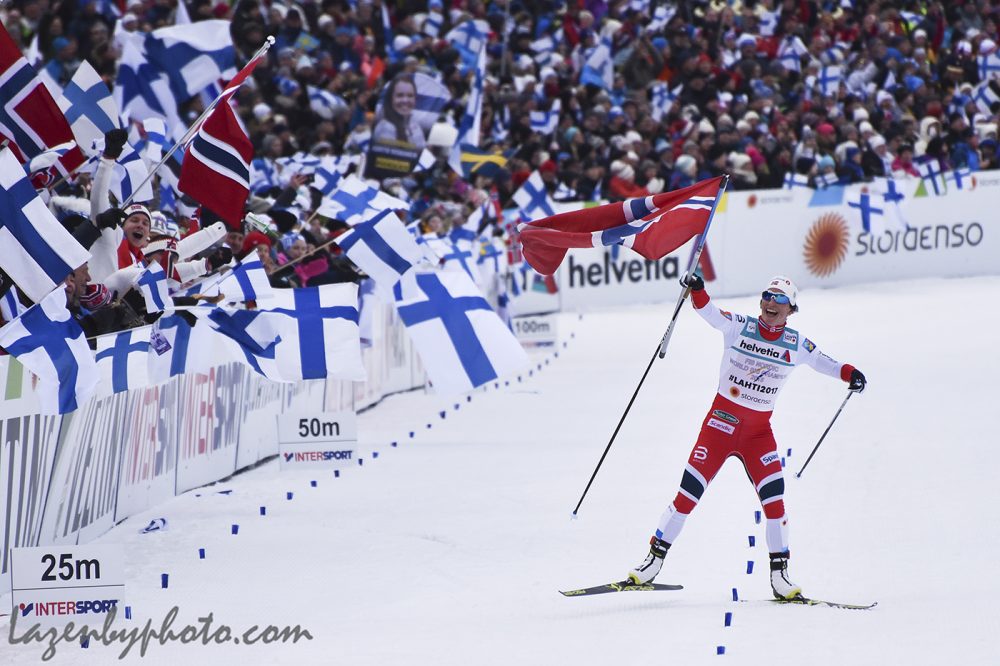
You know how this ends, with the queen waving an oversized Norwegian flag.
After the race, Jacobsen spoke of the pressure of skiing on Norway’s storied relay teams.
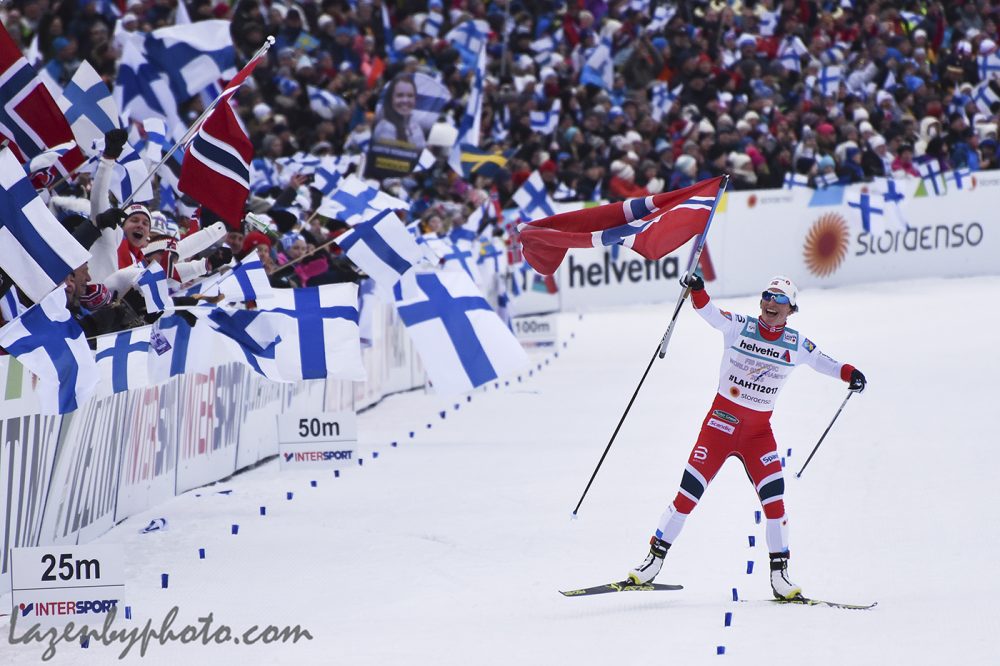
Marit Bjørgen carrying the Norwegian flag as she crosses the line first for Norway’s 100th World Championship win during the women’s 4 x 5 k relay at the 2017 Nordic World Championships in Lahti, Finland. (Photo: John Lazenby/Lazenbyphoto.com)
“I think actually the biggest pressure is the one we put on ourselves and probably because it’s so hard for us to qualify for the team,” Jacobsen said. “We are skiing for the girls who didn’t make it this year but will probably make it next year. So we ski of course for our people and our nation. But I think the biggest nerves come from the desire to perform well and do strong legs.”
One hundred championship gold medals later, Jacobsen acknowledged it’s a full treasure chest.
“The Norwegian people are getting spoiled in gold medals, but it not so easy like it looks,” Jacobsen said.
Glide for glide, pole for pole, Sweden and Finland were mirror images the last leg. Known as a closer, Nilsson strategized that coming into the final corner she wanted to follow Parmakoski.
Sweden’s second-leg skier Kalla explained that Nilsson’s tactic was one of waiting until the end.
“If Stina should go with some team in the end, she should wait to the stadium and just focus on her strength and she made it just like the plan,” Kalla said.
Days earlier in the team sprint, Nilsson lost out on bronze to Diggins in a sprint to the line.
“In the team sprint I was first in the final curve,” Nilsson reflected. “And I felt that Diggins had an advantage of it, so I didn’t want to be first today.”
The press conference’s moderator interjected and tried to correct Nilsson, saying she was first again in the closing moments, not shadowing the Finn.
“No, not in the curve, but after the curve,” Nilsson said with a laugh.
The silver and bronze fight came down to Nilsson’s final kick and this time she made it stick for silver.
(Story continues below)
Sweden’s Stina Nilsson celebrates silver after outsprinting Finland’s Krista Parmakoski (l) in the final meters of the women’s 4 x 5 k relay at the 2017 Nordic World Championships in Lahti, Finland. (Photo: John Lazenby/Lazenbyphoto.com)
Same Place, But Progress: U.S. Places Fourth, Canada 10th
With three world champs medals already in the hands of American skiers prior to Thursday’s team relay, the public hope for a podium was high. Perhaps too high.
As U.S. Ski Team (USST) Head Coach Chris Grover explained, medaling in the team relay was certainly on the radar coming into the world champs week, but not where the team’s greatest expectations were held.
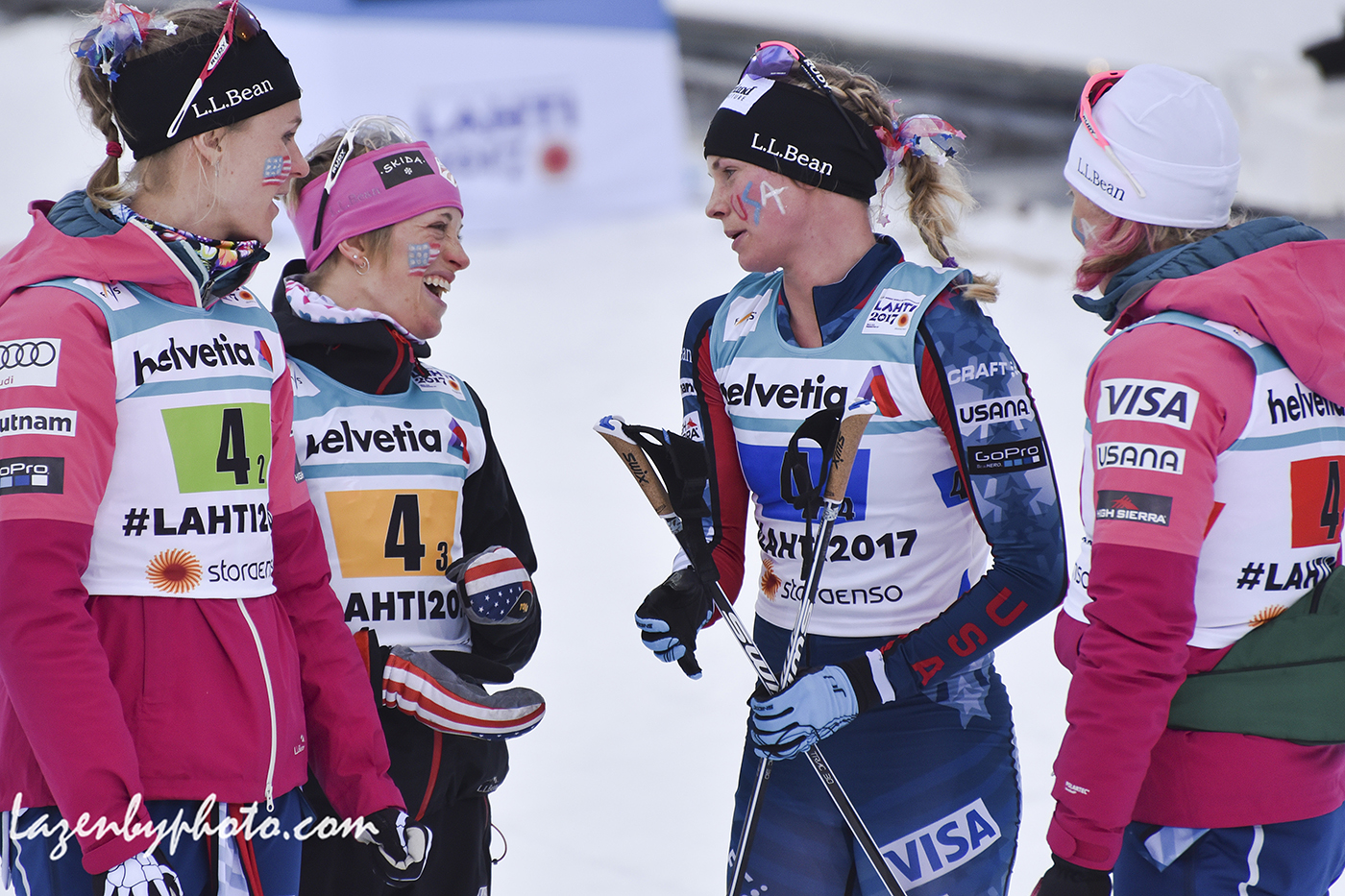
The U.S. women’s relay team, (from left to right) Sadie Bjornsen, Liz Stephen, Jessie Diggins, and Kikkan Randall, after placing fourth on Thursday at 2017 World Championships in Lahti, Finland. (Photo: John Lazenby/Lazenbyphoto.com)
“The relay we knew was a shot, the team sprint we knew was an outside shot,” Grover said after Thursday’s race. “Probably our greatest medal opportunity was the individual sprint.”
As a gritty group of women, the Americans exude the attitude of a top team. Adorned in red, white and blue socks and face paint sporting the U.S.A.’s emblematic stars and stripes, it’s easy to see the enthusiasm the U.S. women show for team events.
But where does the blur between team-relay hype end and the reality of results begin?
Disappointment in anything less than a podium only comes when the expectation of one exists. Taken over the past few world champs years, the relay event might be one where the U.S. women can, and have, improved the most.
Eight years ago, at the 2009 world champs in Liberec, Czech Republic, the U.S. finished 13th, a little over three minutesout of third place. The following World Championships year, 2011 in Oslo, Norway, they were almost two minutes off the podium, crossing in ninth overall.
This year? The U.S. once again finished fourth — the third time in a row that the team has finished one place outside the podium at a World Championships event.
Yet, Thursday’s performance was the second closest the team has come to bronze, with the Americans crossing 31.7 seconds after third (their 2013 result in Val di Fiemme, Italy, was closer: 26.6 seconds behind third). Given room for systematic error, the statistical trend for the U.S. women in the team relay over the past five world champs: positive.
American Kikkan Randall during the first leg of the women’s 4 x 5 k relay at the 2017 Nordic World Championships in Lahti, Finland. (Photo: John Lazenby/Lazenbyphoto.com)
“Even though this is the third time in a row that we’ve been fourth place at a world championships, there’s progress, there’s real progress,” Grover said. “The athletes could see the competition ahead of them the whole time. … To be getting closer and closer to that top standard, that’s very gratifying.”
When looking at the longer-distance performances from the week in tandem with Thursday’s start list, Grover further explained that the U.S. team’s incoming rank was similar to their outcoming result.
“I guess I’d say that when you look at the start list and you look at the results from the 10 k and the skiathlon, on paper we’re fourth,” Grover said. “Sweden, Finland, Norway they’re definitely ahead of us in terms of the distance results that we’ve seen here all week. So we knew we were sort of an outside chance to be fighting for the bronze and we knew that when we’re successful on the World Cup, it’s because one of those teams has a weak leg.”
A weak leg from Finland, Norway or Sweden — the three teams that finished ahead of the Americans — at least in Thursday’s race, was nowhere to be found for the U.S.
From the start, Kowalczyk, pushed the pace with Falla, Haag and Saarinen in close quarters, while the USST’s Randall worked hard to hold on.
“Unfortunately, we lost some important time there in the beginning,” Randall said. “I know that’s something I’ve got to work on for next year, but it was exciting to know that we were still in the race the whole time and made Sweden and Finland really fight for those medals.”
Randall handed off to Bjornsen in fifth, approximately 16 seconds back from the second, third, and fourth spots. From there, the Americans raced alone, working hard to reel in the racers ahead.
“It’s always hard to have a carrot right in front of you and not go too hard at the beginning,” Bjornsen said. “I think all of us had a hard time with that today, not going too hard to try to catch them right away.”
By the end of her leg, Bjornsen needed another eight seconds from Randall’s time back to catch the third place position. She handed off to Stephen, who would have to make up 23.5 seconds on Sweden’s third leg, Andersson, to contend for the podium.
The young Andersson, however, was putting on a show. And Stephen wasn’t surprised. During the early stages of her ski career, Stephen attended a weeklong camp in Sweden. While there, she’d learn invaluable lessons from countless coaches, one just happening to be Andersson’s father.
Liz Stephen racing the third leg for the U.S. women’s team in the 4 x 5 k relay at the 2017 Nordic World Championships in Lahti, Finland. (Photo: John Lazenby/ Lazenbyphoto.com)
“As I was lining up with her today I was just like ‘this is just full circle,’ “Stephen said after. “She’s a damn-good skier.”
That of course didn’t stop Stephen from putting her best foot forward. The American emphasised the areas she knew were her strength, working the hills.
“Part of me wanted to go out and blow [it] out of the water off the bat, but I also knew that these conditions are also a little bit more energy-expending than normal, hard-packed conditions,” Stephen explained.
Halfway through the first lap, Stephen had gained close to seven seconds on Andersson. By the end of the second lap, however, Andersson had regained the ground that she had lost.
“Unfortunately I couldn’t get her,” Stephen said. “But I did what I could out there … and I am very inspired to be on this team again. To watch my teammates give it all out there, it just makes you want to do the same.”
When Stephen handed off to Diggins, the anchor legs for Sweden and Finland were skiing together. Diggins explained that she had hoped Nilsson and Pärmäkoski’s race tactics would provide an opportunity for her to gain on them.
“I saw where we were coming in and I said, my only strategy is to go out as hard as I can and hope that they are playing cat and mouse in the front,” Diggins said. “[I thought] if they’re trying to be all strategic for the final sprint-out, then maybe I can catch them.”
Ultimately the gap proved too large, with Diggins crossing in fourth.
“I wasn’t able to close the gap but I never stopped fighting and neither did my teammates, and I’m really proud of that,” Diggins said.
Canada’s team of Katherine Stewart-Jones, Emily Nishikawa, Cendrine Browne, and Dahria Beatty finished 10th (+4:16.2) for the fourth-best world champs result of a Canadian women’s relay team. According to a Cross Country Canada press release, this was just the fourth time in the last decade that Canada has fielded a World Championships women’s relay (excluding the Olympics).
At the 2001 World Championships, Beckie Scott, Milane Thériault, Jaime Fortier, and Sara Renner raced to sixth for Canada. Before that, the program’s previous best was eighth at 1989 world champs, also in Lahti.
(Left to right) Canada’s Emily Nishikawa, Cendrine Browne, Dahria Beatty, and Katherine Stewart-Jones after placing 10th in the women’s 4 x 5 k relay at the 2017 Nordic World Championships in Lahti, Finland. (Photo: John Lazenby/Lazenbyphoto.com)
“I think today we surprised ourselves,” Canadian World Cup coach Ivan Babikov said on Thursday.
“[Katherine Stewart-Jones] skied incredibly that first leg, with everything she could,” he added. “She was ahead of Germany, ahead of Russia, so many really good countries, and after that it was a matter of holding on and it was great.”
Stewart-Jones finished her leg in eighth, just seven-tenths of second behind Germany’s Katharina Hennig in seventh. Though Switzerland and Italy eventually caught the Canadians, the women expressed excitement about the finish and results yet to come.
“This is the first time we’ve fielded a world champs relay in a long time so that’s a huge accomplishment [in itself],” Nishikawa said during an in-person interview. “And then to come 10th … it’s really the beginning of something that’s pretty special.”
“I’m really proud of us,” Browne added. “I think we all skied really strongly today, and very positive for the future.”
— Harald Zimmer, Gerry Furseth, and Alex Kochon contributed
The women’s 15 k skiathlon podium at 2017 Nordic World Championships, with Norway’s Marit Bjørgen (c) in first, Finland’s Krista Parmakoski (l) in second, and Sweden’s Charlotte Kalla (r) in third on Saturday in Lahti, Finland. (Photo: FIS Cross-Country/Twitter)
FIS Nordic World Championships (Lahti, Finland): 15/30 k skiathlons
This one’s for you, kid.
Marit Bjørgen became the second relatively new mom to medal in the second race of 2017 Nordic World Championships on Saturday (after American Kikkan Randall earned bronze in Thursday’s freestyle sprint), racking up her 15th World Championships gold in women’s 15-kilometer skiathlon in Lahti, Finland. Bjørgen, a 36-year-old Norwegian team veteran, had her first child a little over a year ago.
In her first full season back, she led Saturday’s 7.5 k classic + 7.5 k freestyle race at the halfway point, where she clicked into her skate skis half a second ahead of Finland’s Krista Parmakoski in second. Parmakoski followed her across the finish for silver, finishing 4.8 seconds off Bjørgen’s winning time of 37:57.5 minutes. For Parmakoski, it was her first individual medal at World Championships after having previously earned four in team events.
Sweden’s Charlotte Kalla picked up her fourth-career World Championships medal in third place (+32.0), and Nathalie von Siebenthal placed fourth (+1:05) for the best result for a Swiss female cross-country skier since since Evi Kratzer earned bronze in 1987 in Oberstdorf, Germany.
Von Siebenthal edged Norway’s Heidi Weng in a photo finish, with Weng finishing another tenth of a second back in fifth (+1:05.1). Right behind them, Austria’s Teresa Stadlober notched sixth (+1:05.4), Russia’s Yulia Tchekaleva seventh (+1:05.7), Norway’s Astrid Uhrenholdt Jacobsen eighth (+1:11.1), Russia’s Anastasia Sedova ninth (+1:15.3), and Japan’s Masako Ishida 10th (+1:21.8).
Two Americans finished in the top 20 with Randall leading them in 17th (+2:09.2) and Liz Stephen placing 20th (+2:12.4). Rosie Brennan cracked the top 30 in 28th (+3:03.2) and Jessie Diggins did not finish.
A World Championships rookie, Cendrine Browne led Canada in 35th (+4:15.5), followed by Emily Nishikawa in 38th (+4:29.3) and Katherine Stewart-Jones in 40th (+4:38.1).
Annika Taylor, a 23-year-old California native who races for Great Britain, finished 41st (+4:49.7). She previously placed 38th in the freestyle sprint qualifier for her best result at her first World Championships.
The men’s Nordic World Championships 30 k skiathlon podium, with Russia’s Sergey Ustiugov (c) in first, Norway’s Martin Johnsrud Sundby (l) in second and Finn Hågen Krogh (r) in third on Saturday in Lahti, Finland. (Photo: FIS Cross-Country/Twitter)
The men’s 30 k skiathlon that followed boiled down to a two-way battle for first between none other than Russia’s Sergey Ustiugov and Norway’s Martin Johnsrud Sundby. The two traded off leading throughout much of the race and together gapped the field around the 20 k mark.
Over the next 10 k, Ustiugov continued to drive the pace. On a pivotal climb less than two minutes before the finish, Sundby attacked, jump skating and seeming to put the hurt on Ustiugov. But that moment was over before it started when Sundby broke his pole against his ski tip and had to stop for a replacement.
The 24-year-old Ustiugov skied away to the win, uncontested yet powering down the finishing stretch to claim his first World Championships gold in 1:09:16.7 hours. He had previously earned bronze with the Russian men’s relay in 2013.
Sundby finished 6.7 seconds later, dropping his arms and head toward the ground as he did so. Norway’s Finn Hågen Krogh came out on top of a five-way fight for third, finishing fourth (+33.1), 31.8 seconds behind Ustiugov and 1.3 seconds ahead of his teammate Sjur Røthe. Krogh put himself in front and proved to have the most finishing kick, ahead of Røthe, Canada’s Alex Harvey (fifth, +33.3), Norway’s Didrik Tønseth (sixth, +33.5), and Sweden’s Marcus Hellner (seventh, +33.7). Russia’s Andrey Larkov fell off the group’s pace and placed eighth (+36.1), Finland’s Lari Lehtonen was ninth (+37.2), and Italy’s 24-year-old World Championships rookie Giandomenico Salvadori broke through in 10th (+37.3).
Three Canadians started the race, with Graeme Killick finishing 47th (+6:23.5) and Knute Johnsgaard 55th (+8:40.2) out of 63.
Tad Elliott was the top American man in 48th (+7:11.2), Kyle Bratrud (+7:16.5) placed 49th and Noah Hoffman 57th (+9:33.6). Ben Lustgarten did not start.
IBU Youth/Junior World Championships (Osrblie, Slovakia): Junior sprints
[UPDATED] Canada’s Megan Bankes and American Siena Ellingson landed in the top 20 of the junior women’s 7.5-kilometer sprint on Saturday at 2017 International Biathlon Union (IBU) Junior World Championships in Osrblie, Slovakia. Coming off a victory in Thursday’s 12.5 k individual, Bankes placed 13th and Ellingson achieved her best non-relay result in 18th at her fourth Youth/Junior Worlds.
Italy’s Michela Carrara won the sprint in 20:57.8 minutes with clean shooting (0+0) and the second-fastest course time. Norway’s Ingrid Landmark Tandrevold skied the fastest but came up 15.2 seconds short of gold with one prone penalty (1+0), which put her in second place. France’s Myrtille Bègue reached the podium in third (+31.5) with perfect shooting (0+0), and Austria’s Simone Kupfner shot clean as well for fourth place (+40.8), 9.3 seconds out of third.
Bankes was one of the first out of the gate in bib 4 and missed one on each stage (1+1) and skied the 14th-ranked course time. She ultimately finished 13th (+1:25.3) for her second-best result at her fourth Youth/Junior World Championships.
Ellingson started 19th and cleaned prone before missing one in standing (0+1), to finish 18th (+1:38.7) with the 20th-ranked course time.
Canada’s Nadia Moser scored her first top 40 of these championships in 31st (+2:16.4) with two misses (1+1), her teammate Emily Dickson finished 47th (+3:15.8) with one prone miss (1+0), and the second American racing, Nina Armstrong finished 65th (+6:11.5) with five penalties (2+3).
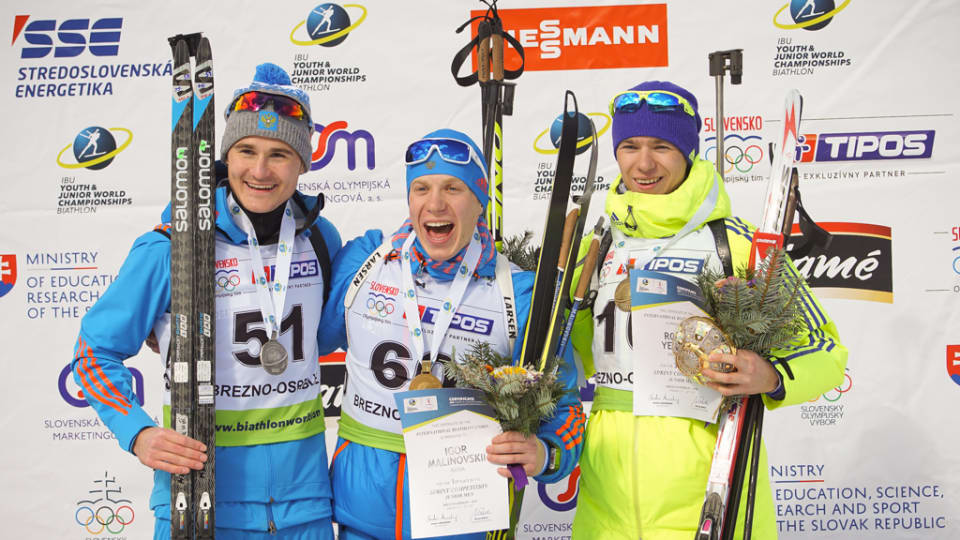
Russia had two on the podium in Saturday’s junior men’s 10 k sprint at IBU Junior World Championships with Igor Malinovskii (c) in first and Kirill Streltsov (l) in second, sharing the podium with Kazakhstan’s Roman Yeremin (r) in third in Osrblie, Slovakia. (Photo: IBU)
In the junior men’s 10 k sprint, Russia took the two top steps of the podium with Igor Malinovskii in first and Kirill Streltsov in second, after both cleaned the two-stage race.
Malinovskii started later in the field in bib 60 (out of 86) and bested his teammate’s time by 12.2 seconds, finishing in 24:32.2 minutes. Streltsov, who had started 51st and led until that point, took silver and Kazakhstan’s Roman Yeremin notched bronze (+24.9). Despite two misses on his first prone stage (2+0), Yeremin was an early race leader after starting 10th. He bested the time of Belarus’s Anton Smolski, who started fifth, by just 0.2 seconds for third. Smolski settled for fourth, ahead of Germany’s David Zobel (who previously took silver in Thursday’s 15 k individual) in fifth (+38.2).
Cody Johnson was the top American in 46th (+3:02.9), followed by Travis Cooper in 49th (+3:10.7), Cameron Christiansen in 80th (+5:32.4), and Peter Carroll in 82nd (+5:51.6).
Pearce Hanna led the Canadian men in 47th (+3:04.1), ahead of Trevor Kiers in 48th (+3:06.6), Zachari Bolduc in 54th (+3:25.4), and Jules Burnotte in 55th (+3:31.2).
Youth/Junior World Championships continue Sunday with the youth men’s and women’s pursuits.
Susan Dunklee (US Biathlon) celebrating second place in the women’s 12.5 k mass start on the final day of 2017 IBU World Championships in Hochfilzen, Austria. It was her first World Championships medal. (Photo: US Biathlon/Twitter)
IBU World Championships (Hochfilzen, Austria): Women’s & men’s mass starts
Silver medal for Susan Dunklee. That’s the big news coming out of Hochfilzen, Austria, on the final day of the International Biathlon Union (IBU) World Championships after the American finished second, just 4.6 seconds out of first, in the women’s 12.5-kilometer mass start.
Dunklee started in bib 17 in the mass start and cleaned all 20 targets to put herself in the hunt for gold. She finished just behind Germany’s Laura Dahlmeier who took the win in 33:13.8 minutes, also with perfect shooting. Just three out of 30 women cleaned, with the other being Italy’s Alexia Runggaldier in ninth.
“I think my mistake a lot this season has been wanting the results too much,” Dunklee told FasterSkier after. “[I’ve been] slowly been coming to terms these last couple weeks, trying to focus more on the process and not worrying too much if the medal comes or not so that was a big trick today.”
Finland’s Kaisa Mäkäräinen reached the podium with a since miss in the first prone stage in third (+20.1). The U.S. had two women in the mass start, with Clare Egan finishing 24th (+3:04.1) with four penalties (1+0+1+2).
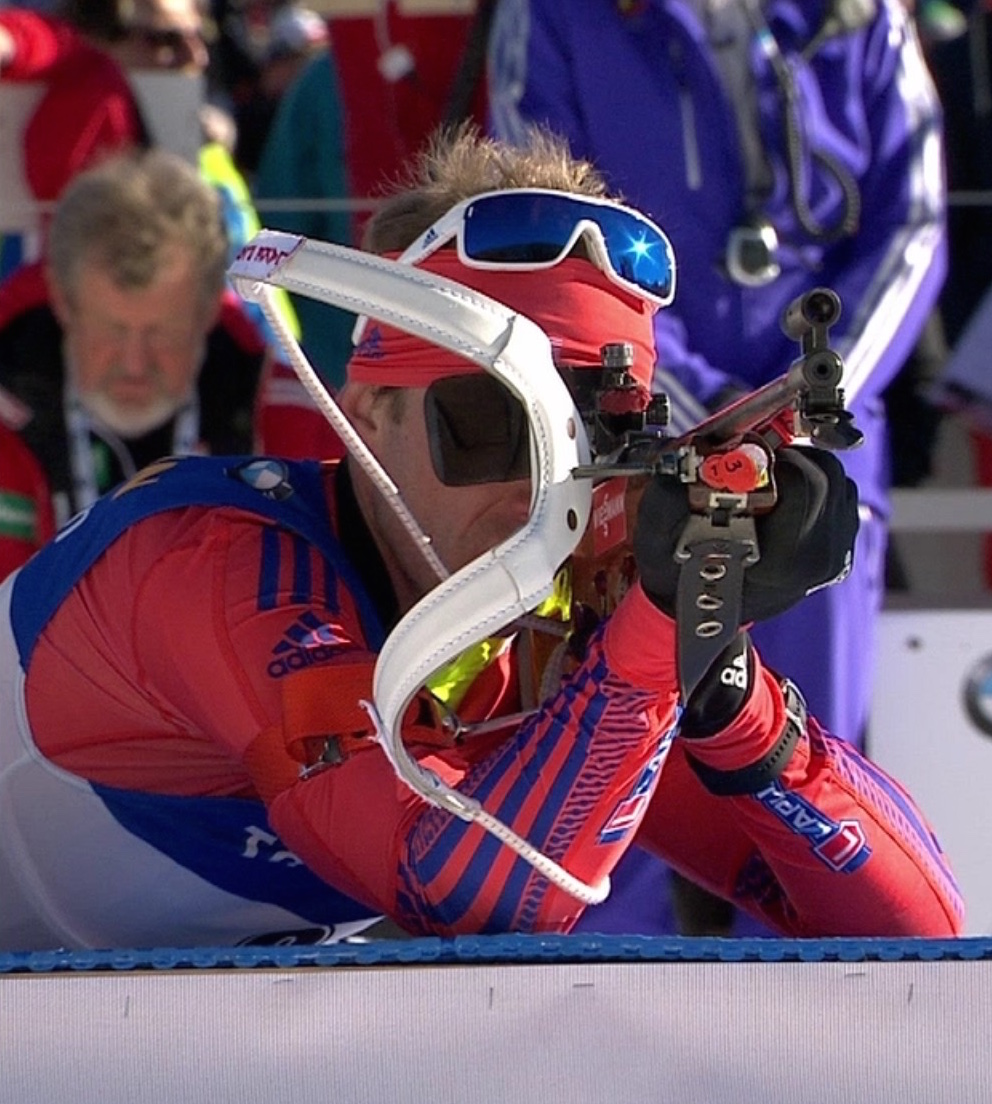
Lowell Bailey (US Biathlon) taking aim during the second prone stage of the men’s 15 k mass start on the last day of IBU World Championships in Hochfilzen, Austria. He cleaned all four stages to fight for the medals until the final loop, and ultimately finished sixth. (Photo: ARD broadcast screenshot)
[UPDATED] In the men’s 15 k mass start that followed, Lowell Bailey was in contention for a medal until the very end, after being one of three athletes to clean the four-stage race.
Bailey left the range for the last time in third, 16.8 seconds behind Austria’s Simon Eder in first and 14.5 seconds behind Germany’s Simon Schempp in second (both Eder and Schempp also cleaned every stage). Behind Bailey, Johannes Thingnes Bø had recovered quickly from a penalty on the last stage, and left the range in fourth, 8.4 seconds behind Bailey.
Early on the final loop, Bø caught Bailey to fight for a medal. Bø didn’t stop there, catching up to Eder as well after Schempp dropped the Austrian around 13.6 k. With about a kilometer remaining, Bø passed Eder and stayed ahead of him for silver, crossing 9 seconds after Schempp in first and 1.1 seconds ahead of Eder — who notched his first World Championships medal — in third.
Schempp hit all of his targets for his first individual World Championships gold in the final race of the championships, finishing in 35:38.3. Bø and Eder shared the podium with him, and Russia’s Anton Shipulin and France’s Martin Fourcade passed Bailey on the last loop for fifth (+25.3) and sixth (+31.3), respectively. Bailey finished sixth (+33.5) for his fourth top six (in as many individual races) at the championships, after notching a gold medal in the 20 k, fourth place in the sprint and sixth in the pursuit.
“I just told myself to hang as long as I could,” Bailey told FasterSkier after. “Unfortunately I only had four laps and the fifth was bru-tal as they say in Germany. But I’m so psyched with this whole world champs. I never cleaned a mass start and I never cleaned an individual and I just did both at world champs.
“I’m so happy for the team, for Susan,” he added. “Our whole team deserves this world champs. We haven’t shown what we’re capable of, there’s always been one setback or another … and the stars aligned for this one. We were waiting for this moment and everything clicked for the team and it’s so great to see, and god am I glad I stuck around to be here.”
FIS Cross-Country World Cup (Otepää, Estonia): 10/15 k classic
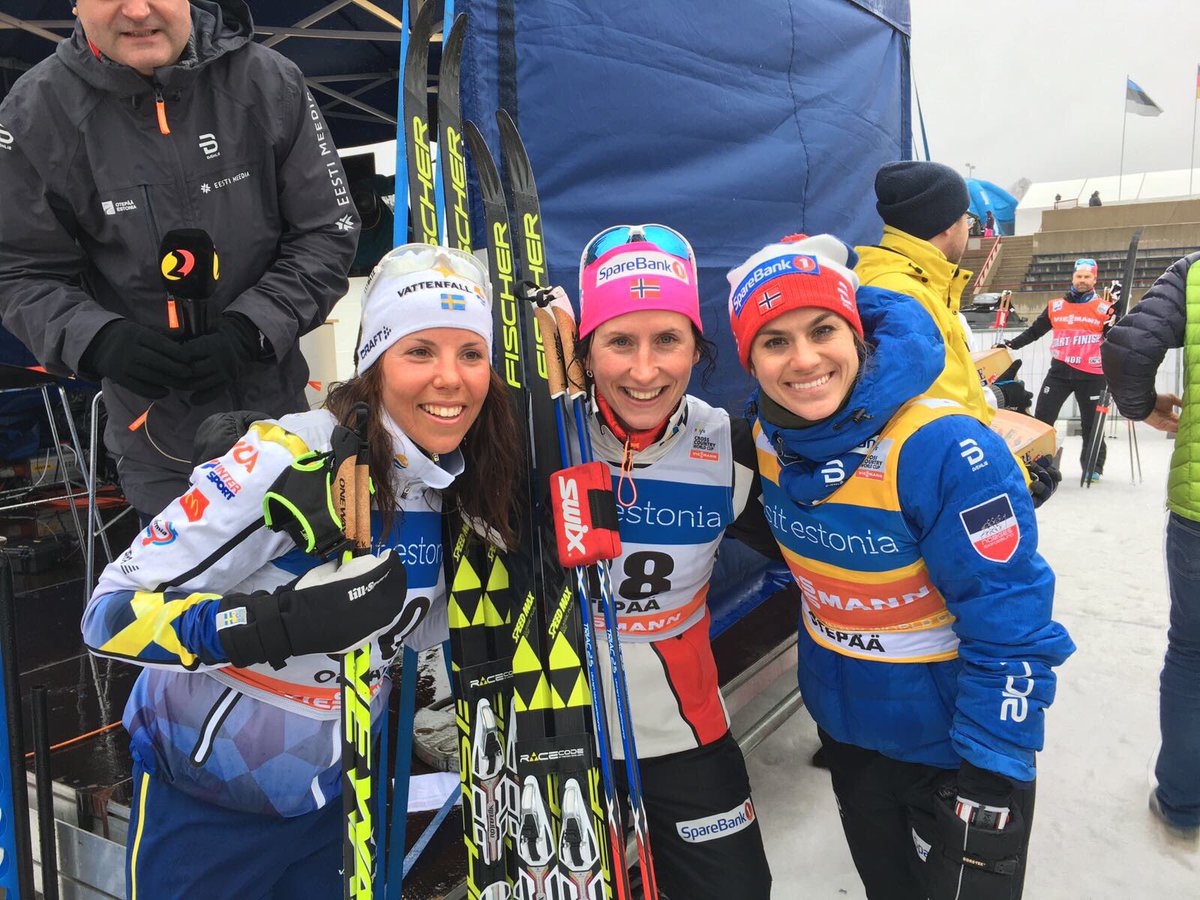
The women’s 10 k classic podium at the Otepaa World Cup on Sunday in Estonia, with Norwegian winner Marit Bjørgen (c), Sweden’s Charlotte Kalla (l) in second and Norway’s Heidi Weng (r) in third. (Photo: Gro Eide/FIS Cross Country Twitter)
Remember the days when Marit Bjørgen used to win by 30 seconds or more? Well, the Norwegian multiple-time world champion was nearly there again, racing to first in the women’s 10-kilometer classic individual start with a margin of 26.5 seconds to second on Sunday.
Bjørgen started in the middle of the pack, in bib 38, and bested the time of her teammate Heidi Weng by 57.2 seconds on the two-lap World Cup course in Otepää, Estonia.
That bumped Weng to second, and another Norwegian Ingvild Flugstad Østberg to third (+1:17.4), until Sweden’s late-starting Charlotte Kalla in bib 60 broke up the Norwegian sweep in second. Kalla finished 26.5 seconds shy of Bjørgen, but 30 seconds faster than Weng for the second spot on the podium. Weng ended up third for the second-straight day and Østberg fourth.
Also in the top 10, Poland’s Justyna Kowalczyk placed fifth (+1:19.7), Finland’s Krista Parmakoski was sixth (+1:23.1), Russia’s Anastasia Sedov seventh (+1:29.6), Sweden’s Anna Haag eighth (+1:50.7), Russia’s Yulia Tchekaleva ninth (+1:57.2), and Norway’s Astrid Uhrenholdt Jacobsen 10th (+1:57.8).
American Sadie Bjornsen finished in the top 20 in 19th (+2:30.5). Also in the points for the U.S., Rosie Brennan placed 24th (+2:37.8) and Liz Stephen 29th (+2:53.8). Kikkan Randall was about 10 seconds outside the top 30 in 34th (+3:04.7), Ida Sargent finished 42nd (+3:46.1), and Chelsea Holmes 50th (+4:47.5).
Emily Nishikawa led the Canadian women in 40th (+3:39), Dahria Beatty was 45th (+4:11.9), Cendrine Browne 54th (+5:09.2), and Katherine Stewart-Jones 57th (+5:37.1).
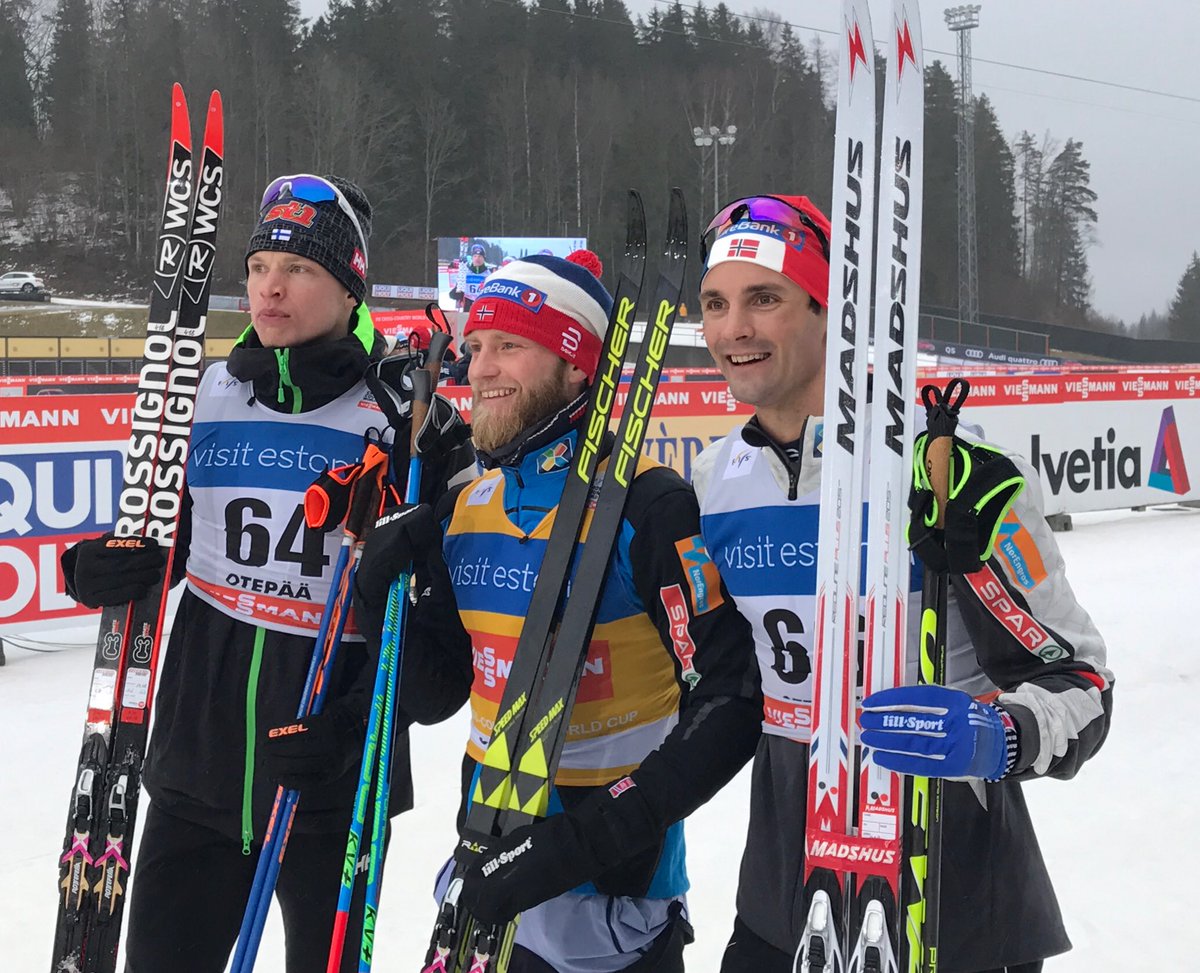
The men’s 15 k classic podium at the Otepaa World Cup on Sunday in Estonia, with Norway’s Martin Johnsrud Sundby (c) in first, Finland’s Iivo Niskanen (l) in second, and Norway’s Hans Christer Holund (r) in third. (Photo: FIS Cross Country/Twitter)
[UPDATED] Norway’s Martin Johnsrud Sundby dominated the men’s 15 k classic from start to finish on Sunday, starting near the back of the nearly 80-man field and clocking the fastest splits throughout the three-lap race.
He topped the previous best time set by Finland’s Iivo Niskanen by 37.1 seconds with a winning time of 40:38.2. Conditions weren’t easy on the rainy afternoon in Otepää, with tracks appearing shallow at best and visibly washed out in places.
Norway had two on the podium with Hans Christer Holund in third (+49.1). Niklas Dyrhaug was 6.2 seconds short of the podium in fourth, Finland’s Matti Heikkinen placed fifth (+58.1), Kazakhstan’s Alexey Poltoranin sixth (+1:01.3), Russia’s Alexander Bessmertnykh seventh (+1:02.5), Norway’s Sjur Røthe eighth (+1:03.5), Norway’s Didrik Tønseth ninth (+1:14.5), and France’s Maurice Manificat 10th (+1:21.3).
Canada’s Alex Harvey led the North Americans in 19th (+1:50). Graeme Killick finished 47th (+3:44.6), Devon Kershaw 49th (+3:51.3), Knute Johnsgaard 58th (+4:50.4), and Jess Cockney 72nd (+7:15).
Erik Bjornsen was the top American in 36th (+3:12.1) and Ben Lustgarten finished 66th (+5:34.1).
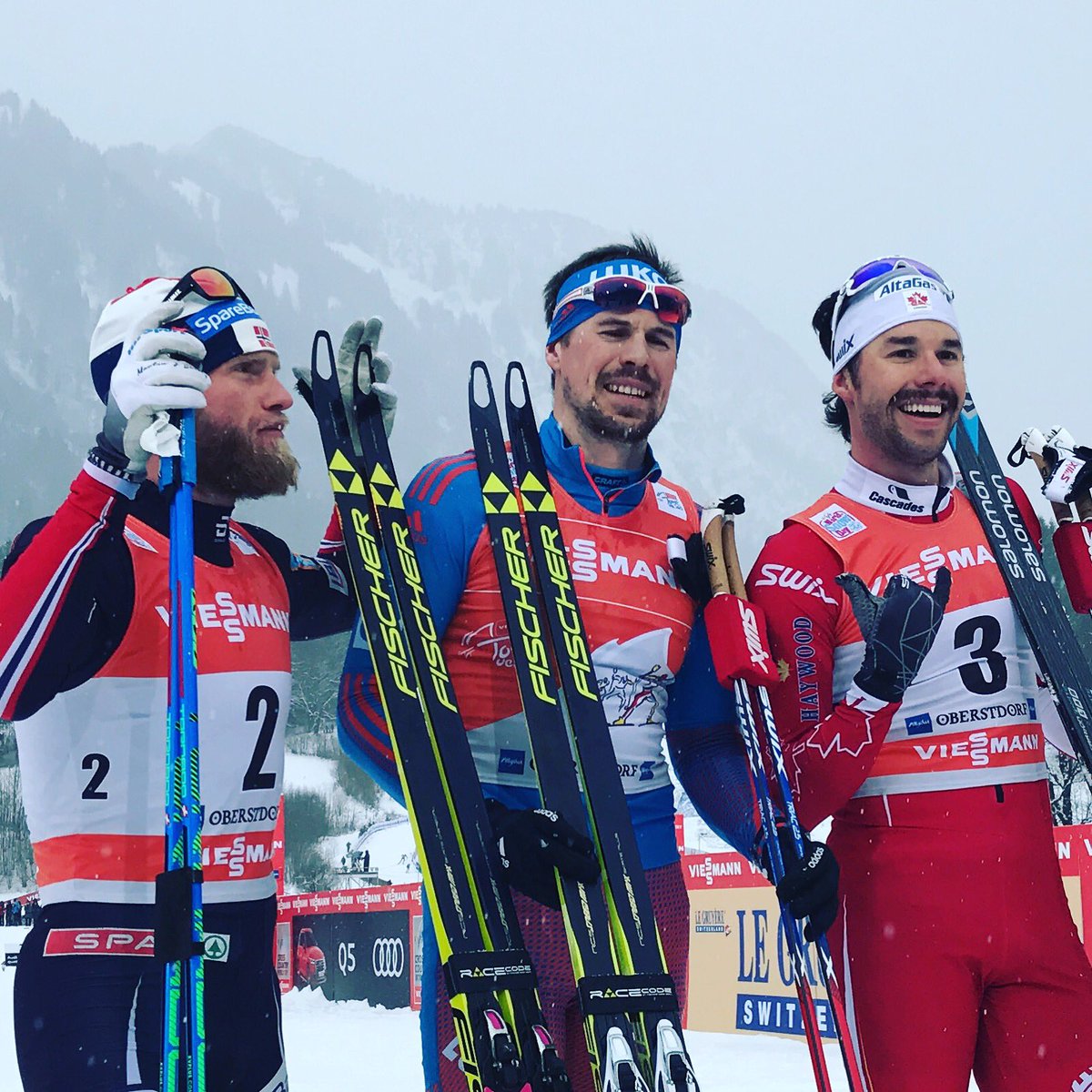
The men’s 15 k freestyle pursuit podium at Stage 4 of the Tour de Ski in Oberstdorf, Germany, with Russian winner Sergey Ustiugov (c), Norway’s Martin Johnsrud Sundby (l) in second, and Canada’s Alex Harvey (r) in third. (Photo: FIS Cross Country/Twitter)
FIS Cross-Country Tour de Ski Stage 4 (Oberstdorf): 10/15 k freestyle pursuits
[UPDATED] Another win for Russia’s Sergey Ustiugov (that’s four in four stage races at the 2016/2017 Tour de Ski), another second place for Norway’s Martin Johnsrud Sundby, and another third place for Canada’s Alex Harvey.
That was how the podium shook out on Wednesday in the Stage 4 men’s 15-kilometer freestyle pursuit, with Ustiugov winning by 37.2 seconds after starting 30 seconds ahead of Sundby, and the Norwegian skiing alone throughout the six-lap race as well, despite seeing Ustiugov ahead of him for most of it.
Harvey ended up 1:08.8 seconds back in third after starting 1:09 back in that position, but he had to shake Switzerland’s Dario Cologna in order to keep himself on the podium.
Cologna started 1:26 back and caught Harvey on the second lap. The two skied together for the rest of the race, with Cologna leading for most of it.
On the final lap, Cologna led into the final descent down toward the stadium, where Harvey “pulled a Nilsson”, repeating the winning tactics from the previous women’s race (see below), and used the slingshot-draft tactic to surge past Cologna on the last little climb over a bridge before the finish. Harvey skated ahead of Cologna and led into the finishing straight, where he edged the Swiss skier by 0.8 seconds.
Cologna ended up 1:09.6 back in fourth, while Finland’s Matti Heikkinen led Sweden’s Marcus Hellner and Norway’s Didrik Tønseth across the line in fifth (+1:45). (Hellner edged Tønseth in a photo finish for sixth, +1:47.6).
Ustiugov gained a few seconds in his overall lead, now 42.2 seconds ahead of Sundby in second. Harvey is 1:18.8 back in third and Cologna 1:24.6 behind in fourth. Heikkinen is another 35 seconds back in fifth overall, with Hellner and Tønseth just 2.6 seconds behind him in sixth and seventh, respectively. Fewer than 7 seconds behind Tønseth are Norway’s Simen Hegstad Krüger in eighth and France’s Maurice Manificat in ninth overall.
Canada’s Devon Kershaw started 20th and ended up 21st (+4:20.2), which puts him 4:35.2 behind overall. Graeme Killick improved to 43rd (+8:01.4) after starting 46th, and is currently 8:16.4 back overall. Len Valjas did not start.
Noah Hoffman led two U.S. men in the Tour in 37th (+6:49) after starting in that position, and is even with Germany’s Valentin Mättig at 7:04 back overall. American Erik Bjornsen placed 46th (+8:39.0) after starting 50th, and is 8:54 back overall.
Sweden’s Stina Nilsson celebrates her 10 k freestyle pursuit victory in Stage 4 of the Tour de Ski in Oberstdorf, Germany, which she won by 1.7 seconds ahead of Norway’s Heidi Weng (not pictured in second) and 1.8 seconds ahead of Norway’s Ingvild Flugstad Østberg (r) in third. (Photo: FIS Cross Country/NordicFocus via Twitter)
On the women’s side, the top Norwegians have been complaining about the course, but for Sweden’s Stina Nilsson, it’s been all about tactics in the most crucial final meters of the last two races with her second-straight win on Wednesday.
Despite starting first, Nilsson hung in third for much of the women’s 10 k freestyle pursuit at Stage 4 in Oberstdorf, Germany.
With Norway’s Heidi Wengstarting 4 seconds back and catching Nilsson early, and Ingvild Flugstad Østberg (who started 12 seconds back) forming a three-woman lead pack by 2.5 k, the three skied together for the rest of the four-lap race. Notably, Nilsson hung at the back while Weng and Østberg set the pace.
Then, on the final roller climb over a bridge, Nilsson made her move, powering past both Norwegians and leading them by several strides into the finish. A day after notching her first distance win, Nilsson won her first 10 k pursuit in 27:42.7 by 1.7 seconds over Weng in second and 1.8 ahead of Østberg in third.
With the victory, Nilsson’s third in four stages, the Swede retains first in the overall standings by 6.7 seconds with three stages to go. Weng is still second and Østberg third (+11.8).
Finland’s Krista Parmakoski hung onto her fourth-place in the overall standings with a fourth place on Wednesday, 42.4 seconds behind Nilsson. She started 39 seconds back and is now 57.4 seconds out of first overall.
American Jessie Diggins held onto fifth overall as well, skiing alone throughout the race for fifth (+1:47.5) at the finish. She started 51 seconds back and is now 2:02.5 back overall.
A chase pack formed on Wednesday with Germany’s Nicole Fessel leading two others across the line in sixth (+2:39.1), with Switzerland’s Nathalie von Siebenthal following in seventh (+2:40.2) and Russia’s Yulia Tchekaleva in eighth (+2:40.3). American Sadie Bjornsen hung with that group for the first three laps before dropping 30 seconds behind those three at 7.5 k.
Meanwhile, another U.S. Ski Team member Kikkan Randall moved into 10th and about 14 seconds behind Norway’s Kathrine Rolsted Harsem in ninth at 9.4 k. After starting 19th, Randall finished 10th (+3:15.5) behind Harsem (who started sixth) in ninth (+3:08.8).
Bjornsen ended up 12th (after starting 11th), 3:17.7 out of first and 0.6 seconds behind Finland’s Kerttu Niskanen in 11th (+3:17.1).
Also for the U.S., Liz Stephen improved from 35th to 26th (+4:21.1) at the finish, and Rosie Brennan started 42nd and ended up 42nd (+7:32.9).
In the Tour standings, Randall is up to 10th (+3:30.5), less than seven seconds out of ninth, and Bjornsen is 12th (+3:32.7), right behind Niskanen in 11th (+3:32.1). Stephen is 26th (+4:36.2) and Brennan 42nd (+7:47.9) overall.
The men’s 15 k freestyle pursuit starts at 6:45 a.m. Eastern. Follow FasterSkier’s live race updates on Twitter.
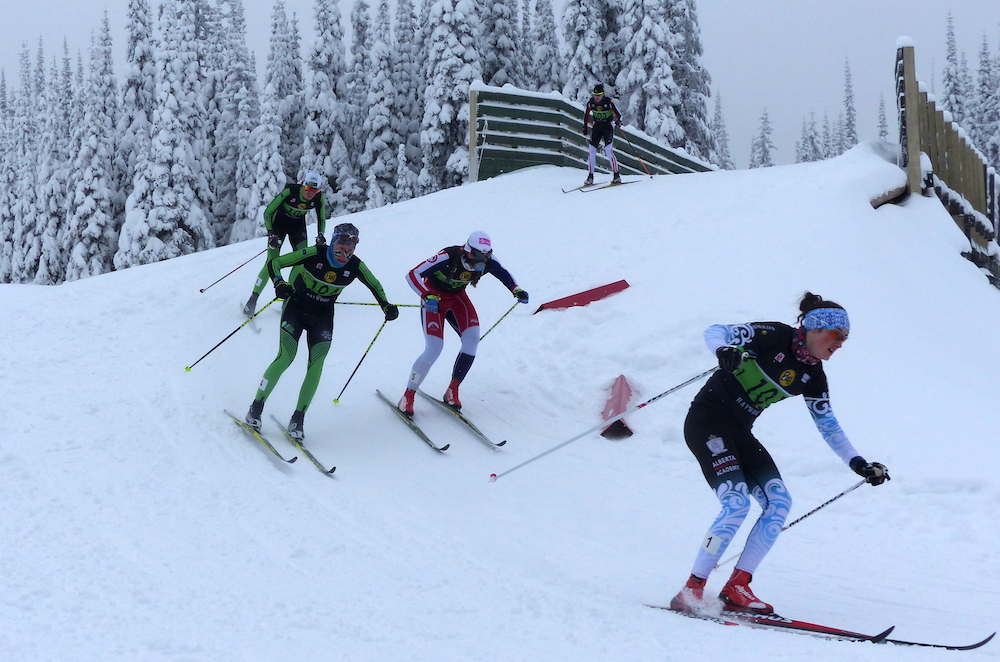
Olivia Bouffard-Nesbitt of the Alberta World Cup Academy (AWCA) leads the American train around the bridge corner into the finish straight in the A-final of Saturday’s NorAm classic sprint at Sovereign Lake in British Columbia. She went on to finish fourth behind Julia Kern (second from r), Liz Guiney (back left) and Kaitlynn Miller (l), respectively. (Photo: Peggy Hung)
Welcome to The Rundown, your quick primer of need-to-know information about the day’s racing. We’ll be updating this digest as the day goes on with additional results, photos and quotes. The Rundown is NOT a race report; stay tuned for complete race reports later today with interviews from the day’s top racers.
***
Canadian NorAm/U.S. SuperTour at Sovereign Lake: Classic sprint
[UPDATE] U.S. skiers filled the open category podiums on the first fully North American NorAm event in recent years on Saturday at Sovereign Lake near Vernon, B.C. With NorAm points, SuperTour points and FIS points on the line there was a great turnout of the top skiers.
In the open women’s 1.2-kilometer classic sprint, Julia Kern of the Stratton Mountain School (SMS) won in 3:17.04 after qualifying fifth. Liz Guiney of the Craftsbury Green Racing Project (CGRP) finished second, 0.67 seconds back, and her CGRP teammate Kaitlynn Miller rounded out the podium in third (+0.91). Olivia Bouffard-Nesbitt (Alberta World Cup Academy) was the top Canadian in fourth (+1.49) and the lone Canadian in the final. Jennie Bender (Bridger Ski Foundation) placed fifth (+3.8) and Heather Mooney was sixth (+19.84).
On the same 1.2 k course, Reese Hanneman (Alaska Pacific University) made up for his 15th qualifying time to take the men’s final win in 2:38.08. Cole Morgan of the Sun Valley Ski Education Foundation (SVSEF) took second in the final (+0.87) after winning the qualifier, and Ben Saxton (SMST2) was third (+1.92). Matt Gelso (SVSEF) finished fifth (+3.88), after precipitating a semifinal crash that took three Canadians (Angus Foster, Simon Lapointe and Evan Palmer-Charrette) out of contention, but didn’t result in a protest. The lone Canadian man in the final, Antoine Briand (Pierre-Harvey Training Centre) placed sixth (+11.98).
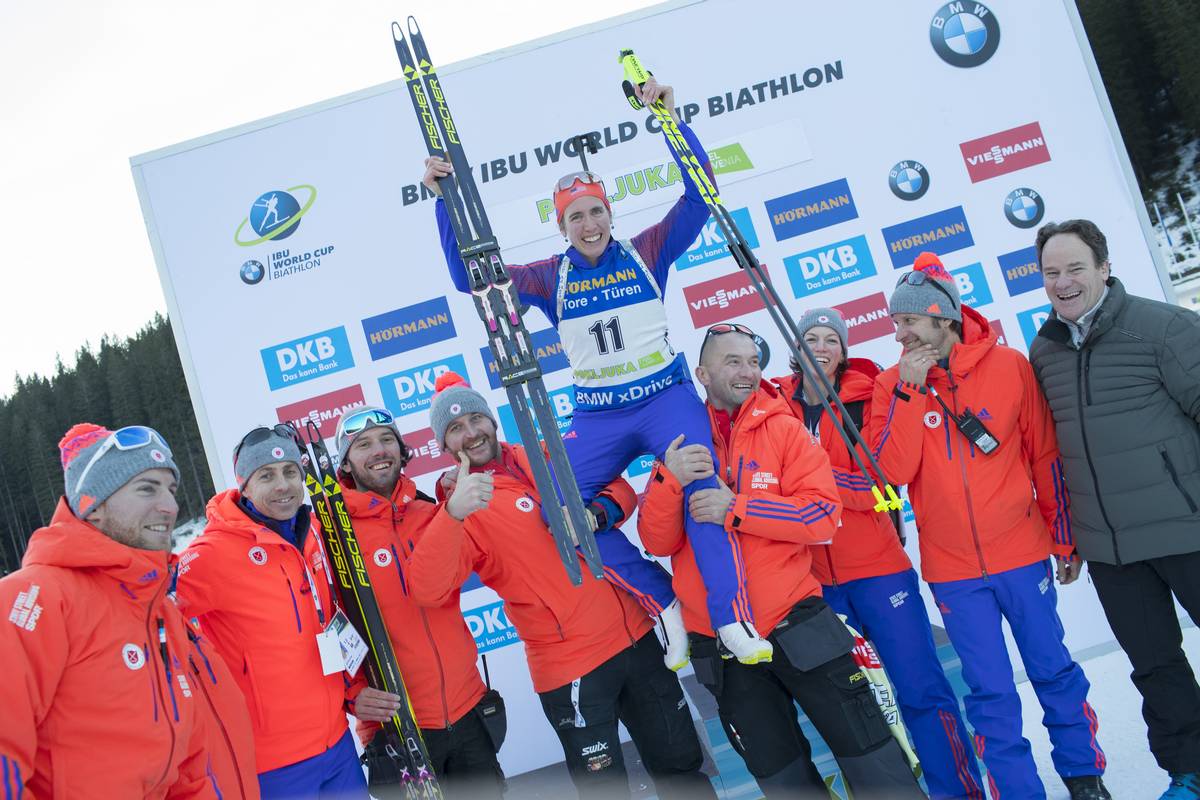
Susan Dunklee being hoisted up by her US Biathlon support team at the IBU World Cup in Pokljuka, Slovenia, after tying her career-best result in a pursuit. Dunklee placed fifth on Saturday for a season best as well. (Photo: USBA/NordicFocus)
Another day at the front of the pack, and another day of (nearly) perfect shooting for Susan Dunklee, who raced from 11th to fifth for her first flower ceremony (top six) of the season at the IBU World Cup in Pokljuka, Slovenia.
Dunklee (US Biathlon) cleaned the first three of four stages in Saturday’s 10-kilometer pursuit to move into second with one standing stage remaining. In that final shooting stage, she had her first miss of the day, yet still left the range in second, 22 seconds behind Germany’s Laura Dahlmeier in first. Dunklee finished out the race with the 21st-ranked course time on the last loop (her first-loop time was the fastest in the 56-woman field) and placed fifth, 24.1 seconds behind Dahlmeier — who won her second-straight race in Pokljuka. Dahlmeier finished first in 30:43.1 despite two prone misses on the second stage, which put her as far back as fifth (0+2+0+0). Finland’s Kaisa Mäkäräinen finished second, 16.8 seconds back, with two penalties as well (0+0+1+1), and Eva Puskarcikova of the Czech Republic reached the podium in third (+18.7) with a single miss followed by three clean stages (1+0+0+0). One spot ahead of Dunklee, reigning World Cup champion Marie Dorin Habert of France clawed her way up to fourth (+18.8) after starting 17th, with one penalty (0+0+1+0).
For Dahlmeier, it was her 10th World Cup victory and fifth in a pursuit.
“My motto is ‘Scheiß da nix, dann feid da nix’,” Dahlmeier told Germany’s ZDF, which vaguely translates to “Don’t worry be happy,” or “Just do it.”
“That was worth gold today. I was a bit surprised about my two misses in prone. Apparently I already had an aberration in the first stage, then I clicked [adjusted the sights] and was a bit surprised that the two misses still happened,” she added. “… Then came the standing shooting, and there I tried to keep calm again. The race is only over once you cross the finish line, and that became true again today. I am happy that the race flipped again like this.”
Canada’s Julia Ransom cleaned three consecutive stages before missing two on the last standing. She finished 34th for the second day in a row, 2:33.5 behind Dahlmeier. Rosanna Crawford placed 49th with three penalties (2+1+0+0) and Clare Egan of the U.S. was 56th with six misses (2+0+1+3). Canada’s Megan Tandy, with seven penalties (1+1+3+2) did not finish.
In the men’s 12.5 k pursuit, the first man out of the start, Martin Fourcade of France, held his lead to the finish, hitting all 20 targets and winning in 30:27.4. Norway’s Emil Hegle Svendsen rose from fourth at the start to second at the finish (+6.0) with clean shooting as well, and Russia’s Anton Shipulin placed third for the second-straight day (+6.2), with one penalty in the last stage (0+0+0+1).
Friday’s sprint runner-up, Johannes Thingnes Bø of Norway, ended up fourth (+48) with two misses on the last stage (0+0+0+2), Germany’s Simon Schempp placed fifth (+59.8) after starting sixth, and had one miss (0+0+1+0), and Michael Rösch of Belarus cleaned for sixth place (+1:21.0) after starting 16th.
Lowell Bailey (US Biathlon) finished 18th (+2:01.6) for the second day in a row, with one prone penalty in the first stage (1+0+0+0).
Biathlon Canada’s Christian Gow picked off two places for a new career best in 31st (+2:41.7) with a single prone penalty (0+1+0+0).
Tim Burke placed 42nd (+4:09.8) for the U.S. (after starting 53rd) with five standing penalties (0+0+2+3), Canada’s Scott Gow finished 48th (+4:39) with five misses as well (2+1+0+2), and the third Canadian in the race, Brendan Green was 57th (+5:36.4) with five penalties (+5:36.4).
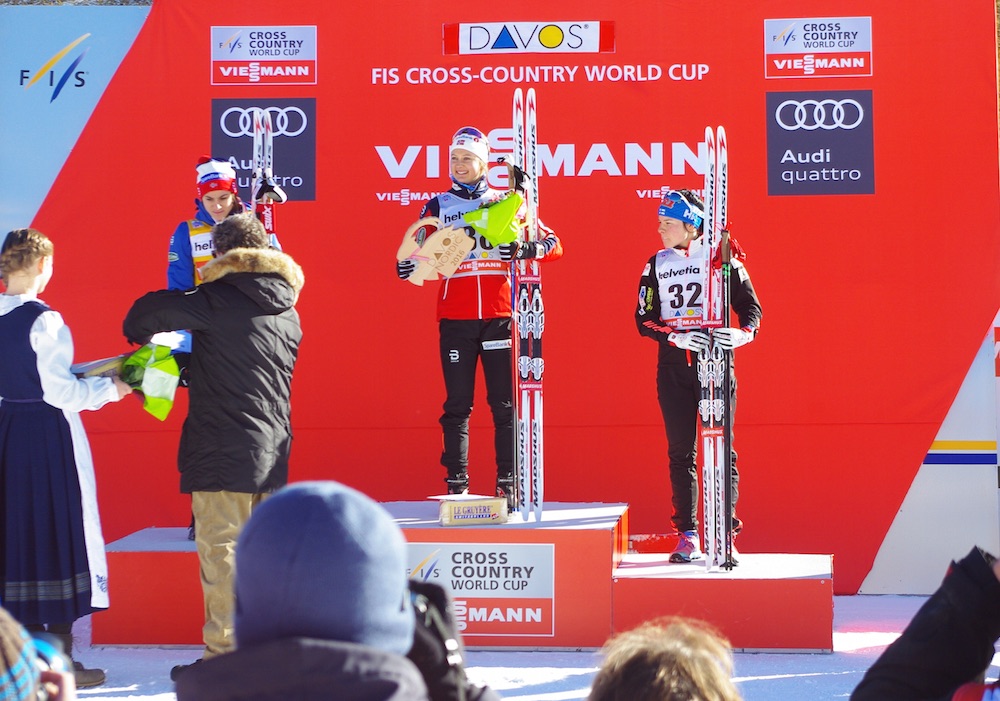
Norway’s Ingvild Flugstad Østberg (c) won her first World Cup race of the season on Saturday in the 15 k freestyle individual start in Davos, Switzerland. Joining her on the podium: Norway’s Heidi Weng (l) in second and Finland’s Krista Parmakoski (r) in third.
Norway’s Ingvild Flugstad Østberg is back on top of the podium after a 7.9-second win in Saturday’s 15-kilometer freestyle in Davos, Switzerland, over — you guessed it — her teammate Heidi Weng.
Østberg started 38th (out of 59) and led at every split to take the win in 37:44.4, her first this season and her first in a 15 k. Weng started a minute ahead of her in bib 36 and ended up second, while Finland’s Krista Parmakoski notched third (+16.7) for her third podium of the season, ninth in her career and second skate podium.
The next fastest woman, American Jessie Diggins finished 37.6 seconds off the podium in fourth (+54.3), ahead of Russia’s Yulia Tchekaleva in fifth (+1:00.5) and Switzerland’s Nathalie von Siebenthal in sixth (+1:05.6). Ragnhild Haga of Norway was seventh (+1:10.8), Finland’s Riitta-Liisa Roponen eighth (+1:21.4), Italy’s Ilaria Debertolis ninth (+1:32.2), and Sweden’s Anna Haag 10th (+1:35.5).
The U.S. had two in the points with Liz Stephen in 28th (+2:17.5). Kikkan Randall was 2.3 seconds outside the top 30 in 33rd (+2:30.2), and Caitlin Patterson placed 44th (+3:21.6). Rosie Brennan did not start.
Emily Nishikawa led Canada in 34th (+2:33.5) for her best result this season, Dahria Beatty was 42nd (+3:15.2), and Cendrine Browne 54th (+4:07).
Weng remains the Overall World Cup leader by 70 points over Østberg, Parmakoski ranks third, and Norway’s Marit Bjørgen, who is not competing this weekend in Davos, is currently fourth.
[UPDATE] In the men’s race earlier on Saturday, Martin Johnsrud Sundby racked up another victory in Davos’s 30 k freestyle, beating his fellow Norwegian Anders Gløersen by 13.7 seconds with a winning time of 1:07:31.6 hours. Gløersen took second for his first podium in a year (he was third in the Davos 30 k last December) and Finland’s Matti Heikkinen reached the podium for his second-straight race in third (+25.7).
Canada’s Alex Harvey placed 12th (+1:29.4) and his teammate Graeme Killick notched 21st (+2:24.2) for his second-best World Cup result (after placing 19th in a skiathlon last March at the Ski Tour Canada).
Devon Kershaw was the next top North American in 43rd (+3:52.9), six seconds ahead of the lone American in the race, Noah Hoffman in 44th (+3:58.9). Canada’s Andy Shields placed 64th (+6:33.9).
Jessie Diggins (U.S. Ski Team) won the second individual World Cup of her career on Saturday in the women’s 5 k freestyle in Lillehammer, Norway, beating four Norwegians by 4.8 seconds or more. (Photo: USSA Nordic/Twitter)
Welcome to The Rundown, your quick primer of need-to-know information about the day’s racing. We’ll be updating this digest as the day goes on with additional results, photos and quotes. The Rundown is NOT a race report; stay tuned for complete race reports later today with interviews from the day’s top racers.
***
U.S. SuperTour opener in West Yellowstone: Freestyle sprints
[UPDATE] The U.S. domestic season opened in West Yellowstone, Mont., with 1.3-kilometer freestyles on Saturday, and Matt Gelso and Jennie Bender emerged as the day’s winners.
Gelso, of the Sun Valley Ski Education Foundation (SVSEF) Gold Team, won the men’s final, and two Alaska Pacific University (APU) skiers, Tyler Kornfield and Reese Hanneman, joined him on the podium in second and third, respectively.
In the women’s final, Bender, of the Bridger Ski Foundation (BSF), held off Stratton Mountain School (SMS) T2 teammates Erika Flowers and Anne Hart, who placed second and third, respectively.
[UPDATE] Americans Lowell Bailey and Susan Dunklee led their teams in 13th and 27th, respectively, and five North American men and four women finished in the top 60 of Saturday’s sprint to qualify for Sunday’s pursuits in Östersund, Sweden. Oh, and France’s Martin Fourcade won his third-straight race (in as many races this season) and his second individual race for his 51st career victory. France made it a double with Marie Dorin Habert winning the women’s sprint.
There aren’t many 5-kilometer skate races on the World Cup schedule. But when they do come around, Jessie Diggins makes sure to capitalize.
The 25-year-old U.S. Ski Team member and Minnesota native rocketed to the second victory of her World Cup career on Saturday, winning the women’s 5 k freestyle in Lillehammer, Norway, in 12:40.3 minutes and by nearly 5 seconds ahead of anyone else.
After winning her first individual World Cup last season in a 5 k freestyle in Toblach, Italy (then reaching the podium three more times in individual races through March 2016), Diggins achieved her first podium of the season in the fourth race of 2016/2017.
She started 34th of 76 finishers, with top-dog Norwegians like Heidi Weng (who won Friday’s classic sprint) and Marit Bjørgen behind her. Diggins trailed slightly at the first 0.8 k checkpoint, but she drew the race’s attention at 2.2 k, where she overtook Norwegian Astrid Uhrenholdt Jacobsen’s time by 2.1 seconds. At the finish, Diggins bumped Jacobsen out of the leader’s chair by 16.4 seconds, and the American would sit in that seat for the rest of the day.
Except she didn’t sit much. Diggins chatted with teammates and team staff, smiled and waved at cameras, and bustled about the finishing area. After her closest challenging, Weng in bib 60, finished 4.8 seconds off her time in second place, Diggins knew she had done it. Bjørgen had already finished and was third (+15.8), Jacobsen fourth (+16.4), and yet another Norwegian, Ingvild Flugstad Østberg fifth (+17.2).
She hugged Weng and told her she had a great race at the finish.
“Before I started, I knew it!” Weng said to her of Diggins’s win.
Diggins smiled, and later stood on the podium between Weng and Bjørgen.
“I’m so happy with my day today. I’m so lucky to have the most amazing team,” Diggins said in a televised interview with FIS. “When you get to train with such cool people, that belief, that confidence, it opens up opportunities. And I had such a great opportunity.
“My coaches and staff work so hard. so when they gave me this opportunity I really had to take it,” she continued. “… It means a lot that when everything goes right you can ski with the best in the world. Hopefully this will mean a lot back home because I’m not special or different in any way. If I can do it, all the little kids back home, they can do it, too!”
While Norway occupied four of the top five, the team had six in the top 10, with Ragnhild Haga in eighth (+31.2) and Kari Øyre Slind in ninth (+32.0). Finland’s Krista Parmakoski placed sixth (+26.9) and Laura Mononen was 10th (+36.1), and Russia’s Yulia Tchekaleva placed seventh (+27.7).
The second U.S. woman in the top 15, Sadie Bjornsen broke through her pattern of 17th in the last three races and place 14th (+41.8). Liz Stephen (USST) scored points in 26th (+51.2) in her first “distance” race of the season.
Caitlin Patterson placed 38th for the U.S., Rosie Brennan (USST) was 48th, and Sophie Caldwell (USST) 59th, and Ida Sargent (USST) 67th.
Canada’s Cendrine Browne (NST U25 Team) 50th, Emily Nishikawa (World Cup B-team) 52nd, and Dahria Beatty (NST U25 Team) 62nd.
Diggins is now third in the mini-tour standings through two days of racing (21.6 seconds behind Weng in first and 0.9 seconds behind Østberg in second), with just Sunday’s 10 k classic pursuit to go, and Bjornsen improved to 12th.
Calle Halfvarsson (c) gets the win for the second day in a row, while teammate Marcus Hellner (l) is pleased to be on the podium for the first time this year. Russia’s Sergey Ustiugov third in the 10 k skate in Lillehammer. (Photo: FIS Cross Country/Twitter)
In the men’s 10 k classic to start the day, Calle Halfvarsson of Sweden made it two in a row, winning the first distance race of the mini tour by 0.8 seconds over teammate Marcus Hellner. The competition is the second day of the World Cup mini-tour, which will conclude on Sunday with a classic pursuit. Halfvarsson also won the classic sprint on the first day of racing. For Hellner, it’s a strong result for the former World Champion after two straight seasons where he only stood on the podium once a apiece.
Russia’s Sergey Ustiugov slotted into third with a hard closing kilometer, moving from fifth place and nearly nine seconds back at 8.3 k to the podium and only 6.7 seconds behind Halfvarsson at the finish.
That left Norway off the podium, but the home team swept the next three places with Finn Hagen Krogh (+7.4), Simen Hegsted Kruger (+13.2), and Martin Johnsrud Sundby (+13.5).
Alex Harvey was the top Canadian in 10th place (+23.5). Devon Kershaw and Lenny Valjas finished 40th (+1:16.7) and 42nd (+1:19.1), respectively, with Graeme Killick 64th (+1:46.6) and Knute Johnsgaard 73rd (+2:22.0). Bob Thompson and Andy Shields rounded out the Canadian roster in 88th and 89th.
Noah Hoffman led the way for the U.S. men, just outside the points in 33rd (+1:08.6). Erik Bjornsen was 45th (+1:22.2), followed by Simi Hamilton 69th (+1:55.8) and Eric Packer 78th (+2:28.7).
Visma Ski Classics: La Sgambeda 30 k Classic in Livigno
Tord Asle Gjerdalen (Team Santander) crosses the finish line first in Sgambeda in Livigno, Italy, on Dec. 3, 2016. (Photo: Visma Ski Classics)
The Visma Ski Classics series began last weekend in Pontresina, Switzerland, with 8 k time trials. Racing continued this weekend just down the road in Livigno, Italy, where racers competed in the second race in the series, La Sgambeda. Skiers encountered superb conditions and firm tracks following cold temperatures the night before.
In the women’s race, a mass start over five laps of a 6 k course, Britta Johansson Norgren of Team Lager 157 took the narrow victory over Katerina Smutná of Team Santander, reversing their finishing positions from Pontresina a week before. Norgren finished 1.3 seconds ahead of Smutná after the two of them broke away from the main pack on the course’s final hill. Sara Lindborg of Team Serneke secured third, 17.4 back of Norgren.
The men raced on the same five-lap, 30 k course as the women. The men’s race also came down to a breakaway on the final climb. Tord Asle Gjerdalen of Team Santander took the narrow victory, rebounding from his sixth-place finish in the Pontresina prologue. Ilya Chernousov of Team Pioneer Investments was 1.3 seconds back. Team Leaseplan’s Petter Eliassen was third (+2.7) after leading most of the race.
Norgren and Gjerdalen are now leading the individual standings, with Gjerdalen’s Team Santander the top team, as the Ski Classics series approaches a month-long holiday break. Racing resumes in early 2017.
Liz Stephen earned the best finish of an American woman in a World Cup distance race Friday, with her second place in Rybinsk, Russia. She is pictured here in the 2015 Tour de Ski. (Photo: Marcel Hilger)
After her second-place finish in Friday’s World Cup 10-kilometer freestyle in Rybinsk, Russia, Liz Stephen had a lot to celebrate – it was her first individual World Cup podium, just two weeks after her historic fifth-place finish in the Tour de Ski.
But there was something the 27-year-old hadn’t realized.
As she sat down for the press conference with FIS Marketing Support Jeff Ellis, he informed her of another historic accomplishment – Stephen had posted the best distance result for an American woman on the World Cup, besting Ellis’ wife, Kikkan Randall’s third place in Gällivare, Sweden in 2012.
With the realization, Stephen said she there was only one word to describe the plethora of feelings surrounding the result.
“To sum it up in one word, I’m ecstatic. I’m really happy to put it all together on one day. I’m ecstatic for sure and a little emotional,” Stephen said in a phone interview.
The results in Rybinsk marked a respite from the familiar podium names with major players such as Norwegians Marit Bjørgen, Therese Johaug, and Heidi Weng avoiding the long journey to Russia in order to rest for the remaining races of the season. However, with strong competitors like Poland’s Justyna Kowalczyk and Finland’s Kerttu Niskanen in the mix, no result was guaranteed.
Stephen placed second to Norway’s Astrid Jacobsen, who finished the 10 k in 28:12.5. Stephen was off-pace by 14.4 seconds, but placed ahead of Germany’s Stefanie Böhler (+36.4) who claimed the final podium spot. Rounding out the top-five were Yulia Tchekaleva (+37.6) of Russia and Kristin Størmer Steira (+41.4) of Norway. Until Friday, Størmer Sterira had been absent from the World Cup after a double hip fracture in October.
The Comeback Podium
Friday’s win was Jacobsen’s first since 2008 when she won the World Cup 15 k pursuit in Falun, Sweden. In the nearly seven years since, Jacobsen has been on the World Cup podium many times but another victory was always been elusive.
Jacobsen’s path to the top of the podium was a difficult one. Just one day before the start of the 2014 Olympic Games, her brother and training partner passed away unexpectedly, causing emotional hardship for the Norwegian throughout the event and remainder of the year. Later that season she crashed into a lamppost in the Holmenkollen 30 k and was rushed to the hospital. With no serious injuries resulting from the crash, Jacobsen began what looked to be a productive training season that spring. By the fall, however, Jacobsen told NRK that her body was no longer responding to training.
Astrid Uhrenholdt Jacobsen of Norway returned to the top of a World Cup Podium Rybinsk, Russia after a seven year absence. She is pictured here in the 2012 Tour de Ski.
According to NRK, the physical hardship lasted through the beginning of the season where Jacobsen raced to uncharacteristic results over the Lillehammer World Cup weekend. With her body feeling out of whack, Jacobsen decided to rest. After seeing improvement since the begging of the year, she participated in Scandinavian Cups while her teammates competed on the World Cup circuit. Her most recent was in Falun, Sweden, the site of the 2015 World Championships, where she won the 15 k skiathlon and placed third in the 10 k freestyle.
“I have felt since New Year that the shape has been better and better. I had some good races in Falun, but today it was even better,” she told NRK Sport.
In Friday’s race, Jacobson dominantly skied the hilly course to earn top splits throughout the race. Skiing one bib behind Stephen for the entirety of the 10 k, she crossed the finish line with her arms outreached and a smile on her face.
“I have had to be very patient this year. My body has not handled training as it should since August. So I am very happy to have such a result today,” she told FIS in a post-race interview. “It is a difficult course with challenging conditions today so I was cautious on the first lap and I think that helped very much.”
Rybinsk has been friendly to Jacobsen in the past. In 2007 she earned her first World Cup win in the 15 k mass start.
Third place finisher Böhler also has fond memories of Russia. In 2009 she earned her first and only other individual World Cup podium in a Rybinsk World Cup 10 k mass start.
Stefanie Böhler of Germany earned the third place and her second-ever individual World Cup podium. She is pictured here in the 2012 Tour de Ski.
“This is a great result. My only other podium on World Cup was here in 2009 so I am really happy to be back on the podium here again,” she told FIS. “I always like coming here. The courses are hard, the people are so friendly and there are many spectators. It’s just really nice to be here in Rybinsk.”
Böhler has faced her share of challenges as well. In 2012 she was diagnosed with thyroid cancer but fought back to compete in the 2014 Olympics where she and her teammates earned a bronze medal in the 4 x 5 k relay.
Stephen, who is close with Jacobsen after the two exchanged training time in Alaska and Norway, said she was happy be on the podium with both her friend and Böhler.
“It was a really fun podium to share. For [Jacobsen] to come back and get a win is pretty special for her,” Stephen said. “After last year’s really challenging year with her it’s really special to be on the podium with a friend and someone who has had her fair share of ups and downs, in skiing and in regular life too. Steffi is the same. She battled cancer a couple years ago and she’s one of the more smiley people on the World Cup and always rooting for everyone else.”
History in the Making
With many of the biggest names absent from Rybinsk, Stephen knew there was an opportunity to land a spot on the podium – and she was ready to take it.
“I really wanted to get on the podium today,” Stephen said of her ambitions. “In order to do that I focused on each section of the course.”
Known for her climbing abilities, the hilly course in Rybinsk favored the Vermont native. Stephen explained that her main strategy for the competition was to ski the flats smoothly. She also focused on skiing over the top of each hill aggressively – an area in which she’s struggled in the past.
“I just like to go up hills, but over the top can be an issue for me so I saved enough to really go over the top and carry good speed on the downhills and grab a low tuck,” she said.
U.S. Alpine Ski Team athletes Paula Moltzan and Resi Stiegler lift Liz Stephen after a leg of the 2015 Tour de Ski. Stephen’s fifth ranking in the Tour was the best American result ever. (Photo: U.S. Ski and Snowboard Association)
The strategy worked and as Stephen sped around the course, consistently earning the second-fastest splits. When she crossed the line it was all but certain she had secured her first World Cup podium. Stephen said she hadn’t thought about the historic possibility of earning the top finish in a distance World Cup by an American woman until Ellis told her in the press conference.
According to USST Head Coach Chris Grover Stephen’s success is due to her superior fitness.
“Obviously she came out of the Tour de Ski where she was in really good shape and then she was able to stay healthy and recover. She’s in good form right now and that’s the absolute key,” he said of Stephen.
Stephen also explained that her result was not just a product of her individual abilities, but also the support of her team. Pointing to her fellow American skiers and coaches, Stephen said that everyone, especially women’s team coach Matt Whitcomb who taught Stephen how to ski at Burke Mountain Academy, played a role in Friday’s historic result.
“It means a lot to be with this team, having this result, and knowing that you’re never ever out there by yourself. Good days, bad days, great days, this team forms around you,” she said.
With World Championships three weeks away, Stephen said she hoped to inspire the team to reach their best results of the season in Falun.
“Having these results going into World Championships for me personally is, of course, wonderful but I also think and hope that it boosts everyone else’s confidence and belief in themselves,” she explained. “I’ve seen it in the past with Kikkan and other teammates having best-ever results for them, or making history. The whole team gets pulled up by it. I think it will.”
U.S. Women Solid in Top-20
It seems that Stephen has already inspired one of her USST teammates.
Finishing Friday’s race in 12th place, Jessie Diggins explained the 2015 season hasn’t met her expectations, but that Stephen has helped her work towards a stronger mental attitude.
“Liz has actually been encouraging and inspiring me to work harder with Sports Psychology and start believing harder that I have what it takes,” Diggins wrote in an email. “This season has been tough on my self confidence so far… and I’ve been working on having more confidence when I step onto the snow. Especially after getting quite sick and having to drop out of the Tour de Ski, there were a lot of thoughts running through my mind – wondering if I would be in good enough shape to race after being sick and not being able to train as planned, etc.”
After taking over week of rest between the Tour de Ski and Rybinsk, Diggins said that she was able to “put those thoughts away” in Friday’s 10 k and ski a focused and driven race. However, even though she was able to perform mentally, said her body was not responding.
“I definitely am not in my greatest race shape right now as I think everything came together quite smoothly in this race and my results weren’t close to what they were a few years ago on this course. I need to be patient as I come out of being sick and let these three races this weekend help me get back in my best race shape!” she wrote.
Just behind Diggins was Rosie Brennan, who earned her best ever finish in a World Cup. As the period one SuperTour leader, Brennan is participating in her second weekend of racing with the USST.
Rosie Brennan earned her first World Cup points in Rybinsk, Russia. Brennan is pictured here racing in Houghton, Michigan. (Photo: Christopher Schmidt)
Throughout much of the competition Brennan’s splits were in and out of the top-10, indicating a rapid start. According to Brennan it was all part of the plan, even if it meant her finish speed was reduced.
“I started pretty hard, maybe a little too hard, but I believe it takes putting yourself out there to really find out what you are capable of. With that in mind, I just tried to keep pushing the whole way. I think I faded a bit at the end, but held it together just enough for a sold result,” she wrote in an email.
Brennan said she was excited to have “broken that barrier” to earn World Cup points and that she hoped the result would give her confidence through the rest of her time in Europe.
“Huge race for Rosie, who really skied exceptionally well. That was really exciting to have her in the mix,” Grover said of her race.
Racing continues in Rybinsk Saturday, with a freestyle sprint.
Therese Johaug celebrates her dominant performance in Sunday’s 10 k classic in Kuusamo, Finland, which she won by more than 42 seconds over Norwegian teammate Marit Bjørgen.
In the opening distance race of the World Cup season, Therese Johaug of Norway dominated from the start and walked away with her first-ever World Cup win in a 10-kilometer classic.
From the moment Johaug, 26, set out on the course during Sunday’s race in Kuusamo, Finland, it was clear that the rest of the women’s field would be racing for second. Even the ever-dominant Marit Bjørgen of Norway, who was coming off a win in the 1.4 k classic sprint the day before, knew that Johaug was going to win.
“I knew after four kilometers that Therese was 25 seconds ahead and I understood I would be fighting for second place,” Bjørgen told FIS after finishing second, 42.2 seconds back from Johaug, who won in 25:47.2. “I was pushing as much as I could to take second place.”
The women’s 10 k classic podium on Sunday in Kuusamo, Finland: with winner Therese Johaug (l), runner-up Marit Bjørgen (c) and Charlotte Kalla in third. (Photo: FIS Cross Country/Twitter)
A two-time winner of the Kuusamo 10 k classic in 2005 and 2007 (the last time it was held was 2008), Bjørgen, who started last of 77 women, appeared to ski a very controlled-and-tactical race. She passed through the 3.1 k checkpoint in fourth behind Johaug in the lead, Poland’s Justyna Kowalczyk in second, and Sweden’s Charlotte Kalla in third.
At each subsequent time check, Bjørgen moved up in the rankings. She was in third at the halfway point and slid into second by 8.1 k, but only by a razor-thin margin of one-tenth of a second over eventual third-place finisher Kalla (+44.1).
Rounding the final bend, Bjørgen put in a hard kick and barely bested Kalla, finishing 1.9 seconds ahead of the her.
Bjørgen was the overall victor in last year’s “Ruka Triple” in Kuusamo. This year, there were just two races — both of which counted for full World Cup points. Bjørgen’s win on Saturday put her in the overall World Cup leader’s bib for 2014/2015, and she remained 70 points ahead of Johaug after Sunday.
Last year, a 5 k classic was held on Day 2, when Kowalczyk took the win, Bjørgen placed second and Johaug finished third.
On Sunday, Kowalczyk was consistently in second for the first half of the race. However, by 8.1 k, she had faded and slipped to fourth where she would ultimately finish.
“I thought that the gap will be more… It hurt, but it’s a good position [for the start of the season],” she wrote in on Facebook, according to a translation.
“I knew after four kilometers that … I would be fighting for second place.” — Marit Bjørgen, 2nd in Sunday’s 10 k classic after Norwegian teammate Therese Johaug
Knowing Johaug and how pumped she was about Sunday’s 10 k, Norwegian Woman’s Head Coach Egil Kristiansen worried she might start too hard.
“I noticed that she was very excited after Saturday’s sprint … I was almost afraid that she would open too hard,” Kristiansen told Langrenn.com, according to a translation. “The skis were good, technique set and everything was correct. I cannot remember the last [time] there was such a victory margin. A fantastic race.”
“I am really happy now because this is my first victory in [a 10 k] classic,” Johaug told FIS afterward. “I’ve never been to the top of the podium in this race [until] today.”
Approaching the finish, Johaug appeared fatigued, but continued to attack until the end. About a meter before the finish, she pumped her right fist into the air and let out a scream before collapsing her hands to her knees after the finish. She had essentially just won it — even with Bjørgen — still on course, she gave herself the liberty of a small celebration as her foot crossed the line.
“I think I’ve never been so good classical ever, especially in kick-double-pole,” Johaug told NRK. “I heard 20 seconds, then 30 and 40 … ‘This is your victory,’ I told myself.”
Bjørgen (l), Johaug (c) and Kalla get together after the women’s 10 k classic on Sunday, the first World Cup distance race of the season in Kuusamo, Finland.
Kalla, who did not compete in Saturday’s sprint race but swept three FIS races in Bruksvallarna the weekend before, had a stellar performance, nearly holding off Bjørgen. She told FIS after the race that she spent a lot of time working on her classic technique.
“I am very satisfied with the third place,” Kalla said. “I felt very good last week at the national opening and I’m glad I could keep the good shape to Ruka. I tried to do my very best today.”
Kristiansen had some praise for the 27-year-old Swede: “Charlotte’s strong and we knew in advance,” he told Espressen.se. “It’s good for us that we have two ahead of her.”
Norway took three of the top five, with Ingvild Flugstad Østberg in fifth, putting her third in the overall World Cup standings. Russia’s Yulia Tchekaleva finished sixth, Krista Parmakoski was the top Finnish woman in seventh, Norway’s Heidi Weng was eighth, Austria’s Katerina Smutna ninth, and Finland’s Kerttu Niskanen 10th.
With the opening weekend behind the World Cup athletes, they will move onto Lillehammer, Norway, for a three-day series next weekend, including freestyle sprints on Friday, 5/10 k freestyle races on Saturday, and 10/15 k classic pursuits on Sunday.
Poland’s Justyna Kowalczyk essentially led from start to finish of Sunday’s 10 k classic mass start at the World Cup in Szklarska Poreba, Poland. (Photo: Fischer/NordicFocus)
It’s not easy being Justyna Kowalczyk — always breaking trail, always having the weight of Poland on her, and in a classic distance race at home on her birthday without any Scandinavians in the field? Forget about it.
Kowalczyk was easily the favorite for Sunday’s World Cup 10-kilometer classic mass start in Szklarska Poręba, Poland, nearly two years after she won the same race there. That didn’t make winning any easier.
Poland’s Justyna Kowalczyk breaking away to a victory in Sunday’s 10 k classic mass start at the World Cup in Szklarska Poreba, Poland. Russia’s Yulia Tchekaleva (behind) and Germany’s Denise Herrmann (second from l) remained closest to her for most of the race. (Photo: Fischer/NordicFocus)
With noticeably slower skis, lacking glide on pea-soup, 35-plus degree afternoon, Kowalczyk relied on kick and her unmistakable stride on her 31st birthday. That didn’t help her on the long downhill on the last third of each 2.7 k loop, but she was able to nail the two climbs.
“The person who first blazes trail, it costs a lot of strength and speed,” Kowalczyk’s said in a post-race interview with WP Poland, according to a translation. “Therefore, at the beginning of the second and third [lap] athletes stuck to me.”
Lucky for her, Kowalczyk’s kick wore off as she continued through the four-lap race — just as she was warming up. After immediately taking control and skiing off the front of the mass start, Kowalczyk couldn’t get more than a few strides ahead of Russia’s Yulia Tchekaleva on the first lap. By the downhill, Tchekaleva quickly soared up alongside Kowalczyk, then past her to lap through the stadium 0.6 seconds ahead in first.
Tchekaleva’s lead was short-lived. By the 4.2 k checkpoint, Kowalczyk had gapped her and everyone else by nearly 12 seconds; Tchekaleva was skiing in second and Germany’s Denise Herrmann was 13.4 seconds back in third. American Liz Stephen led a chase pack in fourth, another 10 seconds behind.
“I have never started on the first line of a World Cup mass start before, so that was really fun, and the pace went out hot, but I never got swallowed up in the mass like I think I would have if I had started back in the pack,” Stephen wrote in an email. “Justyna was on a mission today and just never looked back.
“The fans were so loud and into it out there today,” Stephen added, after eventually placing sixth, her career best in an outright World Cup. “Especially as it was Justyna’s birthday today, too.”
Nearly 30 seconds ahead of Tchekaleva early in the first lap, and 41 seconds up on Herrmann in third, Kowalczyk looked back occasionally — giving a glance back as before picking up the maximum bonus points at 6.9 k. Unless something tragic happened, this race was in the bag, but she didn’t let off until striding blissfully into the stadium for the last time.
Upon finishing first in 34:43.2 without anyone contenders in sight, Kowalczyk waved her arms in the air. Then she stopped, bent over her poles for a millisecond to catch her breath and looked back on the course, waiting patiently for Tchekaleva to follow in second.
Tchekaleva came through uncontested 41.8 seconds later, and another Russian Julia Ivanova rounded out the podium in third, 1:15.2 seconds back from Kowalczyk.
Women’s 10 k classic mass start podium at Sunday’s World Cup in Szklarska Poreba, Poland: winner Justyna Kowalczyk (c), and Russia’s Yulia Tchekaleva (l) in second and Julia Ivanova in third. (Photo: Fischer/NordicFocus)
Ivanova had caught and challenged Herrmann with Germany’s Claudia Nystad and Stephen on the last lap, then ended up dropping Herrmann before the finish. Herrmann placed fourth, four seconds later, and Nystad was another two seconds back in fifth. Stephen placed sixth, 1:26.4 after Kowalczyk, edging Germany’s Stefanie Boehler by 2 seconds.
Nystad originally led the chase, along with Stephen, up the final climb. After absorbing Herrmann as part of their group, they forged ahead with Stephen up front and Tchekaleva in their sights — but she was at least 25 seconds out of range.
“I was feeling really good for most of the race until the very top of the uphill on the last lap when Julia Ivanova went by me and as I tried to hang I just fell apart a bit,” Stephen explained. “[I] didn’t push over the top as much as I needed to to hold off the coming Germans.”
Welcoming Tchekaleva across the line, Kowalczyk gave her a hug. The birthday girl was excited, but not visibly ecstatic about her World Cup win in Poland. It was, after all, just another race before the Olympics — minus the Norwegians, Finns and Swedes.
“Maybe you cannot see it, but I am very touched,” Kowalczyk told WP. “I learned to have control emotions. I once cried today when I got the cake, the flowers, but the second time I will not cry. For such moments the training does it all.”
So she got a cake — but did she eat it, too?
“It’s not the best thing for me right after the race,” Kowalczyk said with a smile, adding she’ll, “eat a double portion for my mom.”
As for the victory, Kowalczyk said it was “nice,” but “Sochi is still far away.”
The victory elevated her to third in the overall World Cup standings behind Norway’s Therese Johaug and Astrid Uhrenholdt Jacobsen, respectively, and four points ahead of Marit Bjørgen. At least Johaug and Bjørgen aren’t expected to compete at the final World Cup Feb. 1-2 in Toblach, Italy, before the Olympics.
Also in the top 10, Russia’s Natalia Zhukova placed eighth (+1:47.8), American Ida Sargent notched a career-best distance result of ninth (+1:49.3), and Austria’s Katerina Smutna was 10th (+1:49.5).
Justyna Kowalczyk celebrates a 42-second victory in Sunday’s 10 k classic mass start on her 31st birthday at home in Szklarska Poreba, Poland. (Photo: Fischer/NordicFocus)
Saturday’s Lillehammer World Cup 10 k classic winner, Justyna Kowalczyk of Poland (c) on the podium with Swedish runner-up Charlotte Kalla (l) and Norwegian Marit Bjørgen in third. (Photo: FIS Cross Country/Twitter)
The image of Justyna Kowalczyk putting her head down and seemingly effortlessly striding away in a classic race – leaps and bounds faster than her competition is one that’s frequently on replay throughout a given World Cup season.
Insert dominating performance here, another win there.
Kowalczyk in a classic-sprint qualifier in Drammen, Norway. (Photo: Fischer/Nordic Focus)
But Saturday’s 10-kilometer classic individual start in Lillehammer, Norway, had a unique twist and extra-special incentive for Kowalczyk to go fast. The Olympic and two-time world champion from Poland had never won a distance race in Norway, the home of her fiercest rivals.
A six-time runner-up there, Kowalczyk put that task to rest at the second World Cup stop of the season, winning the 10 k by 12.4 seconds over Sweden’s Charlotte Kalla in 24:59.4. Marit Bjørgen led the Norwegians in third, 25.6 seconds back from Kowalczyk, coming within 3 ½ seconds of Kowalczyk within the first kilometer of the hilly race.
But no one really threatened the winner, who led from start to finish after heading out 61st of 71 racers. Bjørgen was the last to start, and Norway’s fourth-place finisher Therese Johaug went out hard in bib 69 to come within two seconds of Kowalczyk at the 0.8 k checkpoint.
Just over a kilometer later, Kalla was closest – 6.1 seconds back – and Johaug and Bjørgen were down to Kowalczyk by 11 and 12 seconds, respectively.
Kowalczyk never let up for her third victory in four World Cup races this season. She is currently third in the overall World Cup standings after Bjørgen, who won last weekend’s mini tour in Kuusamo, Finland, to score some big points. Kalla finished second in the Kuusamo Ruka Triple and remains 27 points ahead of Kowalczyk overall.
“I’ve been waiting a long time for this,” Kowalczyk told NTB after Saturday’s 10 k, according to a translation. “I had perfect skis and felt very good.”
Starting three minutes behind Kowalczyk, Kalla came within 2.3 seconds of her at the halfway point. By 5.8 k, Kalla was 4.6 seconds back, and Bjørgen was another 14 seconds behind in third.
Considering Kalla’s charge and runner-up finish, Kowalczyk said she was surprised.
Bjørgen joked that she should go to Sweden to train. Kalla has trained with the Norwegian women’s team several times and stayed with Bjørgen in Oslo.
“It was perhaps a little silly that she got to be with us in training,” Bjørgen told NRK. Norwegian coach Egil Kristiansen jokingly interjected that Kalla wouldn’t be invited anymore.
“I’m happy for Charlotte,” Bjørgen added. “I think it’s good for the sport that we have several that are up and fighting at the top.”
Usually first or second (especially in 10 k classics: of the last 18 international races, Kowalczyk has won 12, Bjørgen six), the Norwegian world champion was satisfied with third on Saturday, considering how she felt.
“My body wasn’t there,” Bjørgen told reporters. “I had to fight with myself all the way.”
Knowing she was fighting for third with Johaug, Bjørgen said she pushed harder toward the finish.
“I am hoping for better shape next week,” she added.
Attempting to explain her success to NRK reporters, the 26-year-old Kalla said: “I do not really know. It works just very well now.”
Her training wasn’t much different than years past, except for some more intervals and classic work in the offseason.
“I’ve been really motivated to develop myself,” Kalla said. “I have trained well and trained a lot to improve my classic. It’s something I’ve wanted for several seasons.”
Johaug finished 39 seconds back in fourth, and Russian Yulia Tchekaleva was another 24.1 seconds back in fifth. Heidi Weng of Norway placed sixth (+1:06.8) and Sadie Bjornsen of the US Ski Team tied her career best of seventh (+1:18.3), which she first notched last weekend in the Kuusamo 5 k classic.
The 43rd starter, Bjornsen enjoyed the view from the leader’s chair for about five minutes until Weng bumped her out.
“I was really afraid it wasn’t going to last very long so I’m trying to dress myself so fast, like, ‘I better get in there before I have to get out!’ ” Bjornsen said. “It was really fun. … That just adds another component of excitement, to be able to sit on that chair.”
Russia’s 4 x 5 k relay congratulates anchor Yulia Tchekaleva, who lifted the team to third on Feb. 28 at the 2013 World Championships in Val di Fiemme, Italy. (Photo: Fiemme2013)
It’s OK if Yulia Tchekaleva’s name doesn’t roll off your tongue. But you might as well get used to reading it.
The 29-year-old Russian has enjoyed a breakout season in more ways than one, notching two bronze medals at World Championships in back-to-back races (the 10-kilometer freestyle and 4×5 k relay) in Val di Fiemme, Italy.
Tchekaleva went on to place third in last weekend’s 30 k freestyle mass start at the Holmenkollen World Cup in Oslo, Norway. It was her fifth medal of the season, including her silver from the pre-Olympic World Cup skiathlon in Sochi, Russia, and bronze in the 5 k freestyle at the early-season World Cup mini tour in Kuusamo, Finland.
And all this came less than a year after having a baby. Before she gave birth to her son, who turned 1 on Jan. 9, Tchekaleva was more of an unknown. She didn’t have an individual World Cup medal and didn’t make the 2009 World Championships or 2010 Olympics, yet today, she’s Russia’s leading woman.
FasterSkier sat down with Tchekaleva, who spoke through a translator, after anchoring Russia to bronze in the 4×5 k at World Championships. She dedicated the medal to her son and her family.
Russia’s Yulia Tchekaleva en route to bronze in the 10 k freestyle at 2013 World Championships in Val di Fiemme, Italy.
FasterSkier:How difficult was it to return after having a child?
Yulia Tchekaleva: My husband is my private coach so I didn’t even imagine that everything would be so fast and easy to return back to skiing. The first five months after the baby was born, I was training at home, I was feeding baby with my milk, and I was training with my husband only.
FS:When did you start training with the national team again?
YT: From the beginning of June 2012. In two months after I started training with the national team, I felt even in two months very, very, strong and with the same physical shape and state as it was before. Even better.
FS:How much did you train during your pregnancy?
YT: Nothing at all. During pregnancy no training. The season of 2011 stopped and I finished training. When I understood that I am pregnant, I stopped training. I felt my body, my shape, I felt so tired after the season so I just wanted to have rest and to enjoy the pregnancy. So it was nine months of rest, it was a vacation, a holiday. When I gave birth to the baby, I just wanted to start training. It was a very, very strong feeling to start training again.
FS:What does the World Championships relay medal mean to you?
YT: When I got a medal in the individual, I didn’t feel as emotional. After [the relay] race I feel more emotions, more happiness, more everything, because we didn’t expect it until the last moment. So there’s much more happiness for the country.
All the girls are very, very happy because for most of them, probably some of them this will be the highest feeling and medal of their career. That is why they are really happy.
— Audrey Mangan contributed reporting
Russia’s 4 x 5 k relay congratulates anchor Yulia Tchekaleva, who lifted the team to third on Feb. 28 at the 2013 World Championships in Val di Fiemme, Italy. (Photo: Fiemme2013)
Norway’s Therese Johaug celebrates her victory in Sunday’s 30 k freestyle mass start at Holmenkollen at the World Cup in Oslo, Norway. She beat Poland’s Justyna Kowalczyk by 46.6 seconds to repeat her victory from the same race at the 2011 World Championships at the same venue. (Photo: Fischer/Nordic Focus)
Whether Therese Johaug could win Sunday’s 30-kilometer freestyle mass start in Oslo, Norway, was never really in question.
As the Eurosport announcers pointed out, the 24-year-old Norwegian was given 4/9 odds on the World Cup race at Holmenkollen, the premier distance event of the year outside of World Championships. If you bet four Euros on her to win, you’ll get nine back if she does.
Easy money, especially considering she won the race by 44 seconds two years ago. But what if Poland’s Justyna Kowalczyk is having a great day, or Norway’s reigning World Cup champion Marit Bjørgen is also in the mix?
With Bjørgen deciding relatively last-minute to skip the 30 k to heal a sore throat, Johaug’s race strategy suddenly became easier and more complicated at the same time. On one hand, she wouldn’t have to battle with Bjørgen to the finish, like she nearly did two weeks ago at the World Championships 30 k classic mass start in Val di Fiemme, Italy.
There, Johaug lost contact on the last hill and finished third after Bjørgen and Kowalczyk, respectively, and she didn’t forget it. Without Bjørgen to push or pace her, however, it could also be tricky to take Kowalczyk on alone.
And so Johaug made Saturday’s race at Holmenkollen her own, and she might have borrowed a tactic or two from Sweden’s Johan Olsson, who broke away early in the men’s World Championships 50 k and held it for nearly 30 kilometers for the win.
Norway’s Therese Johaug leads Justyna Kowalczyk of Poland early in Sunday’s 30 k freestyle mass start at Holmenkollen in Oslo, Norway. (Photo: Fischer/Nordic Focus)
Johaug led from the start as nearly 60 others stuck behind her. Kowalczyk remained on her tail, leaving less than a second between them for most of the first five kilometers. Around 7 k, Johaug made her move, gapping Kowalczyk by almost five seconds, then 15 seconds one kilometer later.
Most likely everyone nearest to Johaug at the time – Kowalczyk, Sweden’s Charlotte Kalla, Germany’s Nicole Fessel, Norwegians Heidi Weng and Kristin Størmer Steira, American Liz Stephen, Japan’s Masako Ishida – knew what Johaug was up to and capable of. But it was still risky.
From then on, Johaug made a point to charge forward and hardly ever, if ever, looked back. Always on the attack, she refused to let up and switched skis once out of three allotted times.
A new rule/addition to Holmenkollen this year, pit stops required skiers to cover extra ground, which took 25 to 30 seconds to complete. That was enough of a reason for Johaug to keep plugging; her 48-second lead near the end of the second lap was cut to 24 seconds after changing before the third.
Heading into the third of four laps, Stephen and Steira led the chase, but the last three laps were significantly longer than the first at 8.3 k apiece (the first was 5 k). If Johaug was feeling good, she’d be tough to catch, especially as the terrain eased up toward the tail end of the loop.
Just once on the last lap, after nabbing all four preems for a total of 60 points, did Johaug look a little weary. She pulled it together on the descent and grabbed a Norwegian flag with almost a ½ kilometer to go. It some ways, it was a bit preemptive, but Johaug also had more-than-a-minute cushion at 29 k.
Therese Johaug screams after winning Sunday’s 30 k freestyle mass start at the Holmenkollen World Cup in Oslo, Norway. (Photo: Fischer/Nordic Focus)
She accepted the flag, large and cumbersome, skiing with one pole as she held it up. A little to heavy to do for 500 meters, she struggled as she ascended a bridge in the stadium and said she got a little nervous.
“When the acid was right up in my throat, I did not quite know how to get up the hill with the flag and one stick,” Johaug told NRK, according to a translation.
She didn’t consider tossing it, she said, but would have if Kowalczyk and the others closed on her. Fortunately for Johaug and her country, it didn’t come down to that as she won by 46.6 seconds in 1:21.17.1.
Kowalczyk was second after leaving the pack with three kilometers remaining, and Russia’s Yulia Tchekaleva finished third, 5.3 seconds later. It was her third bronze medal in the last four races, two of which came at World Championships (10 k freestyle and 4×5 k relay). Tchekaleva was 13th in the 30 k classic there.
At a press conference, Tchekaleva, who edged Weng in fourth by 1.7 seconds and Ishida in fifth by 1.9 seconds, said the race was especially hard, but the group tried to work together. At the start of the last lap, it was Tchekaleva, Weng, Steira, Stephen, Ishida, Kowalczyk, France’s Anouk Faivre Picon and Italy’s Debora Agreitar.
Fessel had to change her skis before the final 8.3 k, while the others pushed on as a unit. Kalla clawed her way back into contention after falling off the pace midrace to end up sixth (+1:13.1) ahead of Steira in seventh (+1:17), Norway’s Astrid Uhrenholdt Jacobsen in eighth (+1:18.9), Stephen in ninth (+1:23.9) and Fessel in 10th (+1:31.5).
“When Justyna went away in the last lap I tried to follow her, but I was tired,” Tchekaleva said.
She wasn’t alone. Johaug looked pretty well spent as she teetered across the finish, but flipped a switch and screamed with elation upon doing so. Johaug was ecstatic and who could blame her? She had skied almost 23 kilometers alone and won.
“It was a perfect day for me,” Johaug said. “I felt very strong. When you are in a good shape, you just ski and go away. … When I heard I was 90 seconds ahead, I thought something really would have to happen for me to lose the victory.”
Two years ago at World Championships, Johaug won the same race at Holmenkollen, beating runner-up Bjørgen by 44 seconds. Previously a classic specialist, Johaug said skating is becoming her new love.
“I hated skating; now it’s almost the opposite,” she told NRK. “I have taken major steps in skating over the last year. It showed when I was in Val di Fiemme when I won the 10 kilometer.”
Alternatively, Kowalczyk wasn’t quite as pleased with her skating.
“Free technique has been challenging for me this season after the injury and operation,” she said, referring to the knee arthroscopy she had last March.
“It is always difficult to win 30 km in Oslo,” Kowalczyk added. “Therese was stronger. … I am happy I finished second.”
Therese Johaug skating to a 46.6-second victory on Sunday at the Holmenkollen World Cup 30 k freestyle mass start in Oslo, Norway. (Photo: Fischer/Nordic Focus)
Therese Johaug on her way to capturing gold in the 10 k freestyle individual start at 2013 World Championships in Val di Fiemme, Italy. The Norwegian beat teammate Marit Bjørgen by 10.2 seconds for the win. (Photo: Fiemme2013)
FasterSkier’s coverage of the 2013 FIS Nordic World Ski Championships in Val di Fiemme, Italy, is brought to you by the generous support of Fischer Sports.
VAL DI FIEMME, Italy – Two years ago in Oslo, Norway, Therese Johaug proved that her teammate, three-time Olympic medalist Marit Bjørgen is not untouchable – at least not in a 30-kilometer freestyle mass start.
The second-most-famous female currently on the Norwegian national team, Johaug beat Bjørgen by nearly 45 seconds in the 2011 event for her first individual World Championships title. Fast-forward to Tuesday, the 24-year-old Johaug was really looking to make something happen in the much-shorter 10 k freestyle individual start at the 2013 Nordic World Ski Championships in Val di Fiemme.
A whole different ball game, she thought, yet she still held out hope.
“I have a goal and I have a dream before this World Championships in Val di Fiemme to take the gold medal,” Johaug said at a post-race press conference. “I never thought I could do it in this distance.”
Before the start of the 1 ½-week championships, with four individual events per gender, Johaug figured her best chance was in the 15 k skiathlon. When that didn’t happen last Saturday, Johaug celebrated her silver-medal finish and Bjørgen’s gold, and refocused for Tuesday.
“When I wake up this morning … I had a good feeling inside,” Johaug said. “I was really focused that if I could do my best today, I could stand at the top of the podium.”
Women’s 10 k freestyle podium at 2013 World Championships: Norway’s Therese Johaug (c) in first, Marit Bjorgen (l) in second, and Russia’s Yulia Tchekaleva in third.
The last of 78 starters, Johaug had the advantage before setting out on the two-lap time trial. Bjørgen started 5 minutes ahead of her, and while Johaug couldn’t physically see her, she knew where she stood throughout thanks to several Norwegian coaches and staff scattered around the course.
Bjørgen was getting similar information about other top athletes, like German biathlete Miriam Gössner, who ventured to Italy for the individual race and Thursday’s relay, American Liz Stephen and Swedish Olympic champ Charlotte Kalla. The splits were almost constant, Bjørgen said, at least every kilometer, but she could only guess how hard Johaug was pushing behind her.
So she tried to go just as hard.
“I knew that today Therese was going to be my hardest competitor,” Bjørgen said at the press conference, a day after Polish rival Justyna Kowalczyk announced she wouldn’t race the 10 k to rest up for Saturday’s 30 k classic. That didn’t really affect Bjørgen; she knew exactly how much of a threat Johaug was.
“We were fighting all the way today, but in the end of the race, Therese was stronger than me,” Bjørgen said.
Up on Bjørgen by 4.5 seconds with about three kilometers left at the course’s high point, Johaug continued to pick up the pace on the long descent and last few climbs. As she entered the stadium before the finish, she heard that she was nine seconds ahead of Bjørgen as the current leader.
Therese Johaug after finishing with the fastest time by 10.2 seconds over Norwegian teammate Marit Bjørgen to win Tuesday’s 10 k skate at 2013 World Championships in Val di Fiemme, Italy.
“I knew that if I push myself to the end of the race, I could do it,” Johaug said.
On the loudspeaker, she heard commentator Kjell-Erik Kristiansen proclaim she was the world champion; the time difference so great, it was certain. That’s when she knew. Johaug pushed through the line and collapsed at the finish, kicking her legs excitedly in the air.
“It was so big for me,” Johaug said. “Marit has been the queen of this distance before and she’s the queen of cross-country skiing, so for me it’s really good to beat her today.”
Bjørgen said finishing 10.2 seconds off Johaug’s winning time of 25:23.4 was a tribute to Johaug and a hard-fought silver for herself.
“I knew that she wanted the gold medal and we are best friends,” the 32-year-old said. “Pushing each other in training, I knew how strong Therese could be, and today I’m very happy for her.”
The two live less than 100 meters away from each other in Oslo, according to Johaug. That’s the reason she thinks they’re both doing so well at this year’s World Championships. Bjørgen has two golds between the classic sprint and skiathlon, and now a silver, and Johaug’s two medals contribute to the Norwegian women’s grand total of seven so far. Comparatively, their men’s team has three medals (before Wednesday’s 15 k freestyle individual start).
“We are a really good team,” Johaug said. “We’re training a lot together.”
Their most decorated member with nine individual golds at World Championships, Bjørgen credits teammates like Johaug for constantly raising the bar.
The defending 10 k classic World Champion, Norway’s Marit Bjørgen pushes in Tuesday’s 10 k freestyle individual start the 2013 World Championships, where she was second to teammate Therese Johaug, in Val di FIemme, Italy.
“I could see she really wants to be in the top level and it’s also motivated me,” Bjørgen said. “That’s one of the reasons I am in so high [a] level is because of Therese.”
Sharing the podium with the two Norwegians, Yulia Tchekaleva became the first Russian female to medal at World Championships since 2007. The 29-year-old started three minutes behind Bjørgen and ranked third through both the 1.8- and 6.8-k checkpoints on the course.
Tchekaleva threw herself across the line for what she thought could be silver, edging Gössner by half a second. The Russian’s time held strong for bronze, 32.7 seconds behind Johaug.
“I’m very happy … it’s very good for the Russian ladies,” Tchekaleva said through a translator. “I heard my coaches the whole way. I was skiing and they had information about who was first, who was behind me, and of course, the course is not easy.”
The 5 k loop featured at least six major climbs with average grades exceeding 9 percent. One of the best known hill climbers on the World Cup circuit, Stephen of the U.S. placed fifth, eight seconds behind Gössner.
Russia’s Yulia Tchekaleva en route to bronze in the 10 k freestyle at 2013 World Championships in Val di Fiemme, Italy.
“I woke up today thinking it was gonna be a good day and I’m glad it was,” said Stephen, who started 52nd and had the lead through 6.8 k until Bjørgen came through 20 seconds faster. It was her best finish at a World Championships and met her longstanding top-five goal.
“All week the plan’s been to kind of kick it up over the top of the hills and not blow up at the bottom,” Stephen said. “When I get tired, I lose a lot of time really quickly. Especially on these kind of climbs you gotta be able to glide and hang so the goal was to push over the top and just ski like I can ski.”
Gössner said she was left wanting a little more after missing the podium by 0.5 seconds and sitting in the leader’s chair for much of the race. Starting in 47th, she held off the likes of Stephen, Norway’s Heidi Weng (who was ultimately sixth), and Kalla (who ended up seventh) before Tchekaleva edged her at the finish.
“I’m a little bit sad,” Gössner told reporters. “It’s just half a second, but I guess the Russian girl is really happy now so it’s good for her and I just congratulate her. I will try to beat the others the next time. I will come back.”
Earlier this month, Gössner – a gold medalist in the 2011 and 2012 women’s relays at Biathlon World Championships – asked the German cross-country team if she could join them in Val di Fiemme. She had helped them win silver in the cross-country relay at the 2010 Olympics and was also on its second-place 2009 World Championships relay, so head coach Frank Ullrich didn’t see why not. The German men’s biathlon coach from 1998 to 2010, he knew exactly how fast biathletes could be in a straight cross-country race.
“She is physically strong and mentally strong,” Ullrich said. “She is very, very strong in biathlon with the rifle on her back and now the rifle not here, she’s better and better. It’s perfect, for the future for this team, for the relay. And we hope for a medal in relay. This helps Germany.”
German biathlete Miriam Gossner testing her cross-country skills in Tuesday’s 10 k freestyle individual start at 2013 Nordic World Ski Championships in Val di Fiemme, Italy. She placed fourth, just 0.5 seconds off the podium.
In an interview with Biathlon News in early February, Gössner said it would be “a dream come true” to race at World Championships in the 10 k and 4 x 5 k relay.
“Before the race I didn’t know where I was standing so I tried to do my best and I had no expectations about medals or anything,” she said. “I just tried to make a good race and it was a fast race so I think it was OK.”
Bjørgen, for one, was glad to hold her off.
“She nearly won, [half a] second from the bronze, so it’s a good race for her,” she said. “We was better, the cross-countriers, so I’m happy for that.”
“We know that she’s a good athlete and she’s [doing] really good in the biathlon, so I knew before this race she would be a little bit of an outsider to come out and fight for the podium,” Johaug said.
At the Biathlon World Championships from Feb. 6-17 in Nove Mesto, Czech Republic, Gössner was fifth with the women’s relay (which Norway won) and sixth in the individual sprint.
“I think the gold medal is already gone to Norway, so we will fight for silver and bronze medal,” she said of Thursday’s cross-country 4 x 5 k. “I think we have a chance so we will try our best and do everything to reach the goal.”
Seventh on Tuesday, Kalla as the reigning Olympic 10 k freestyle champion left disappointed. It didn’t help that Sweden’s Crown Princess Victoria and Prince Daniel came to watch.
“It feels very empty right now,” Kalla told SVT, according to a translation.
An early leader with the fourth-fastest time through 1.8 k, she fell behind on the second lap.
“I had great coaching along the [way], but I do not know what … what I think,” Kalla said. “Was told that I fought for a medal, but it was pretty far away. I go too slowly.”
But as Crown Princess Victoria told Sportbladet: “Very strong effort. Unfortunately, it’s tough competition.”
Riita-Liisa Roponen of Finland was eighth, and Norway’s Kristin Størmer Steira, who started a minute in front of Johaug pushed her to the finish, crossing the line 1.6 seconds after, was ninth. Coraline Hugue of France placed 10th for her a career best at World Championships (she was 14th in the 30 k freestyle mass start in 2009).
Kristin Størmer Steira competing in the seventh stage of last year’s Tour de Ski, the 15 k freestyle pursuit, in Toblach, Italy. On Saturday, the Norwegian notched her first individual World Cup win in four years.
When you’ve got about 7 ½ kilometers of real estate ahead of you, it’s not easy going it alone. Just ask Kristin Størmer Steira, who skied away from 55 others in the Sochi World Cup 15-kilometer skiathlon shortly after the transition.
After the two-lap classic leg, the Norwegian attacked the taxing freestyle course in Krasnaya Polyana, Russia, earlier than anyone else dared to. With Polands Justyna Kowalczyk, the overall World Cup leader, out after 5.5 k, Steira figured she had every opportunity to go for the win.
She hadn’t done so in an individual World Cup since 2008, but why not try? She came to Sochi to get a feel for the Olympic course; might as well leave some good memories there.
The 31-year-old ended up schooling the field, but not without pushing herself to the finish. She had to round the course twice on her own, both times ascending a kilometer-long climb solo. Several in a chase pack worked behind her, drafting off one another and trying to close the gap.
At Steira’s high point, she was 35 seconds ahead of the group, led by Russia’s charging Yulia Tchekaleva and Nicole Fessel of Germany. Liz Stephen of the U.S. also got in the mix and pushed the pace with 2.5 k to go, and from there, the space between them grew closer.
Steira continued to plug away through the falling snow, looking back frequently. With one kilometer remaining, she was 26.8 seconds ahead of Tchekaleva, Fessel and Norwegian teammate Astrid Uhrenholdt Jacobsen. Germany’s Katrin Zeller was also in the hunt, as was Finland’s Anne Kylloenen, Japan’s Masako Ishida and Stephen.
As Steira weaved around the curving descent into the stadium, which from a distant camera shot looked like a tiny figure floating down an alpine trail, Tchekaleva gave all that she had left as she ascended the other side. Fessel forged ahead behind her, hanging on and getting in good position with a few extra pole plants over the top.
Kristin Størmer Steira celebrates her clear-cut victory in the 15 k skiathlon at the Sochi pre-Olympic World Cup on Saturday.
Into the finish, Steira was safe and secured her first World Cup win since the 15 k freestyle more than four years ago in La Clusaz, France. She crossed the line in 46.17.7 while Tchekaleva, Fessel and Jacobsen duked it out for second. Tchekaleva took it by 0.7 seconds over Fessel, and Jacobsen settled for fourth.
For Tchekaleva, who finished 19.2 seconds back from Steira, the silver was a career best. For Fessel, it was her first World Cup podium. Jacobsen came through 0.4 seconds later and Zeller was fifth, another nine seconds behind (+29.8). Kylloenen placed sixth (+31.5), Ishida was seventh (+37.3) and Stephen nabbed a career best eighth (+45.3).
Nearly 15 seconds later, Russia’s Olga Mikhailova and Natalia Zhukova placed ninth and 10th, respectively.
All smiles at the finish, Steira soaked up what it felt like to win in Sochi. After placing fourth in the Olympics three times, she really wants a medal at the upcoming Games in Sochi.
“Before the last Olympics in Vancouver I thought if I would change one thing for [next time, it would be to] race one year before in pre-Olympics,” Steira said in a press conference.
Turns out, she likes Sochi, especially it’s classic course. Early on Saturday, Steira and Tchekaleva put the pressure on Kowalczyk in the leader’s bib. The took the lead by 2.3 k, but Kowalczyk held on until she couldn’t bare to anymore.
Collapsed on the side of the trail, she pulled out during the second classic lap.
“The form did not feel good, and I had also bad skis,” Kowalczyk told NRK, according to a translation.
Waxing conditions were notably tricky, with falling snow and temperatures just below freezing. But Former Norwegian national team coach Morten Aa Djupvik told NRK in the studio he had never seen Kowalczyk quit like that. “It is very unusual,” he said.
And it wasn’t the pain in her leg – brought on by skating – that prompted her to pull out before the freestyle portion, she said after pulling off the course and breaking down with disappointment.
Before the race, Steira told reporters she hoped to stay with Kowalczyk. With her gone, she remained in front with Fessel and Tchekaleva through the transition, then decided to get going.
“I was a bit skeptical if I had tried to go early, but I felt refreshed and it was just to go,” Steira told NRK.
“It was hard fighting for the podium the whole way and when I got [to the finish] I was really tired,” she said in the press conference.
Meanwhile, Tchekaleva and Fessel joined her in celebration on the podium.
“This is my second podium this season andit is particularly nice to stand on the podium in your own homeland,” Tchekaleva said. “I have never been to the Olympics and it is the first time that I have encountered people checking my badge all the time. I have never encountered something like this before.”
Adding to the Olympic-like atmosphere, with all the training involved, were the changing conditions, which athletes and coaches have noted in preparation for the Games.
“I was little bit afraid before the competition about the snowfall, but then it was not that bad,” Fessel said. “Of course it is always difficult to compete in snowfall but I had great skis.”
“It seems like snowy weather is good for me,” Steira said, smiling.