From the FasterSkier archive — posts syndicated from athletes’ and coaches’ own blogs between 2004 and 2012, kept online as published. Current coverage is at fasterskier.com.
Yuma Yoshida lunging for the line in the U.S. national championship in the 50 k.
Three quarters of the way through Saturday’s U.S. national championship in the 50 k classic, when the men’s pack began the process of whittling itself down, an unfamiliar figure emerged from the mix into the lead group.
Tucked into a sea of U.S. Ski Team and club uniforms, it was easy to miss the tiny form of Yuma Yoshida, who can’t stand much taller than five-and-a-half feet. But by the time the race wound down, he was impossible to ignore, having locked up third place overall.
Yoshida, 20, is one of a trio of Japanese skiers currently racing in Sun Valley, along with Takuya Nakatani, who was 29th on Saturday, and Chisa Obayashi, who will race in the 30 k on Sunday.
They’re in the country thanks to the efforts of Tats Watanabe, an ebullient, middle-aged man whose company distributes Madshus skis in Japan.
Watanabe, who also coaches, had been planning all winter to bring at least one athlete to Idaho in March. Not Yoshida though, who decided to make the trip when his own country’s national championships were cancelled due to the earthquake and tsunami earlier this month.
“He wanted to shape up for the national championship; he couldn’t, so he tried to bring the energy over here,” Watanabe said.
The athletes, helped by the clubs, paid their own way. But Peter Hale, Madshus’s race service director in the U.S., helped Watanabe navigate sign-up and logistics, and arranged for Clark Sullivan, a wax technician who worked with the American nordic combined team in Vancouver, to prepare skis.
Yoshida is no slouch, having notched a ninth place in the 30 k freestyle at the World Universiade in Turkey earlier this year. But through Watanabe, he admitted that Saturday’s result was “more than he expected.”
After withstanding numerous charges and chases by the Americans and Canadians in the field, Yoshida was the only man in the field who came close to sticking with Kris Freeman on the last lap, though he ultimately was caught and passed by Canadian Kevin Sandau before the line.
Yoshida hails from Asahikawa, on Hokkaido, Japan’s north island—a ski hotbed that was largely spared the devastation from the tsunami that was seen elsewhere in the country.
Yoshida in the pack in the 50 k.
He’s not a member of the national team, Watanabe said – currently, Yoshida is a student at Nihon University, though his command of the English language is still minimal. (To be fair, it’s certainly better than a FasterSkier reporter’s knowledge of Japanese).
His lexicon did include a few key words: “hard,” which he used to describe the race; “Freeman,” when asked if he knew the identities of any of the skiers he was competing against; and his specialty is “distance long skating.”
While he collected $300 for his podium finish, placing highly wasn’t Yoshida’s prime objective on Saturday. According to Hale, the goal for all three of the Japanese skiers in the U.S. is to lower their FIS points, a standardized measure used by the International Ski Federation to rank athletes worldwide.
That serves as an explanation for why Yoshida lunged for the line with his boot at the end of the race, despite the fact that there was no one around. And while points from the 50 k haven’t been released yet, it’s likely that Yoshida’s effort will rank among his best ever.
“Yuma shocked everybody,” Hale said.
Watanabe was also enthusiastic about Obayashi’s chances on Sunday. A 26-year-old veteran who trained with the XC Oregon club team over the summer, Obayashi has been racing well this year, and was in the mix with a few members of the country’s World Championships team in events in Japan in January.
Having last raced on the World Cup in 2009, it’s tough to imagine Obayashi hanging tough with Kikkan Randall like her teammate did with Freeman on Saturday. But based on Yoshida’s performance, it seems unwise to count her out.
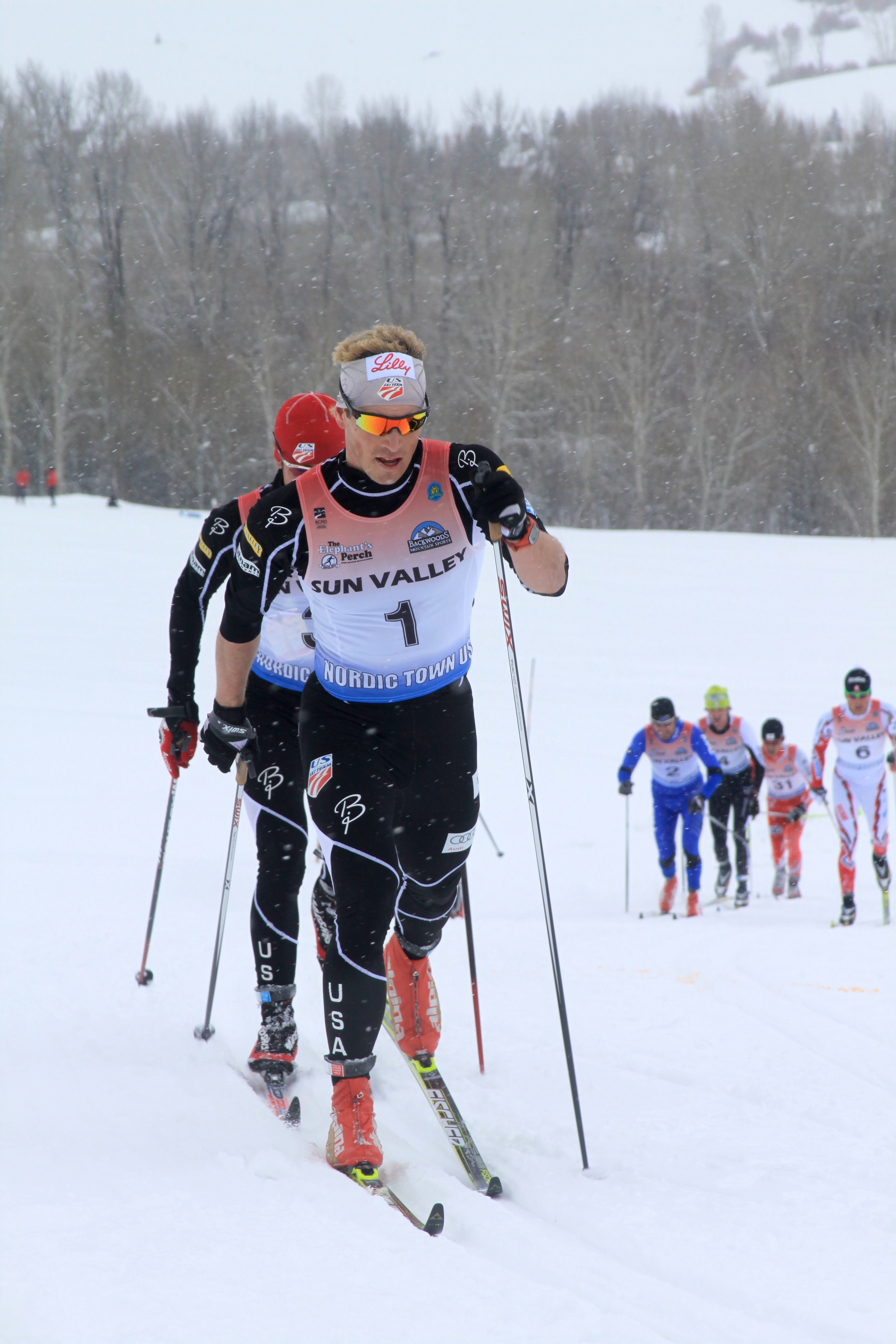
Kris Freeman leading Noah Hoffman in the U.S. national championship in the 50 k classic.
No, he probably didn’t have what it takes to beat Petter Northug—nor even Marcus Hellner, for that matter.
But on Saturday in Sun Valley, Kris Freeman (USST) wasn’t racing those guys. Instead, he was pitted against the North American domestic field in the U.S. National Championship in the 50 k, with a race plan that could perhaps be best described as “don’t mess it up.”
He didn’t, despite tricky waxing conditions, and one gambit that fizzled. Coolly fending off attacks by his teammate Noah Hoffman and Bridger Ski Foundation’s Glenn Randall, Freeman skied to a clear, 10 second victory over Canada’s Kevin Sandau—collecting, in the process, his 14th career national title.
Yuma Yoshida, a 20-year-old Japanese athlete, was the surprise third-place finisher, while Randall and Hoffman, in fourth and fifth, rounded out the U.S. championship podium.
The men's pack early in the race, heading up to the feed zone.
For Freeman, the win in the 50 k was the “big goal” of his trip to Idaho, at the tail end of a long season—and he said he was relieved to get it. The race was his first marathon since a disastrous Olympics last season, and, he said, “it’s nice to show that I can do this.”
“It kind of caps off a good season of redemption,” he said. “It wasn’t really what I wanted, [with] the big results, but today was fun.”
The way the day started, though, it didn’t look like anyone was going to be having much fun on Saturday.
The morning brought snow that faded in and out, from light to heavy, along with temperatures in the high 20’s that threatened to approach freezing—a nightmare for waxers, who had to find something that would kick and glide for two-and-a-half hours of skiing.
If the sun had come out—and it threatened to—the track might have glazed over, with disastrous consequences. But that scenario was never more than hypothetical, as the clouds never broke, and continuing flurries throughout the race left the tracks powdery.
The first half of the 50 k proceeded in typical, tepid fashion, despite a seven-kilometer loop that included two serious climbs—one, in the middle, that was more gradual, and another just before the lap that was longer and steeper, winding precipitously above the stadium.
For the first lap, there were a couple of surprising faces at the front: Reese Hanneman and Peter Kling, two skiers from the Alaska Pacific University (APU) club team.
The rabbits of Alaska Pacific University – Peter Kling leading Reese Hanneman.
As sprinters, both men had no business at the sharp end of a 50 k. But as it turned out, neither had any intention of completing the race. They were “rabbits,” plowing the fresh powder for their teammates behind. The APU men had all pitched in money for entry fees for the pair, and their directive was to ski at the front for as long as they could—whereupon both of them would drop out.
“The plan was to just try to get to one lap,” Hanneman said. “We would be doing intervals today, anyways.”
With the tracks still full of powder on the first lap, Hanneman and Kling didn’t make it far—about three-quarters of the way around the loop. After they cracked, it took a full hour before anyone had any interest in pushing again. Until the end of the fourth lap, at the 29 k mark, some 30 men remained in the lead group. The going was tough and slow enough that no one was interested in going it alone for long—as it was, many of the men suffered from severe cramping.
Freeman didn’t spend much time near the front for the first half of the race, despite what he called a “ridiculously slow
Brent McMurtry leading the men.
pace at the start.”
“I decided early on that I wasn’t going to do a lot of work,” he said.
The pack finally started splintering thanks to the efforts of Brent McMurtry, a Canadian, who attacked on the steep climb above the stadium. He didn’t break away, but he whittled the lead group down to 11 of the heaviest hitters. And on the next, smaller climb around 31 k, Hoffman made his own move, and got a gap.
Just 21 years old, Hoffman was coming off an impressive series of races at the World Championships in Norway earlier this month—including a 30th place in the 50 k, in which he stayed with the leaders through 30 kilometers. His push was a dangerous one, and Freeman took notice.
“He looked great. I was like, ‘all right, me and Hoff, we’re going to go off the front—we’re going to have fun,’” Freeman said.
Freeman bridged the gap, pulled Hoffman for a kilometer, then moved over to take a turn in the draft. But Hoffman was too tired to lead.
“I was suffering,” he said. “I maybe blew myself out a little bit there, and I couldn’t really help Kris.”
So much for that move—with nearly 20 kilometers and another hour of skiing still to go, Freeman had no interest in going it alone. The two men had to let the chasers catch up, which they did at the end of the fifth lap, at 36 kilometers.
Glenn Randall on the attack.
The effort, though, burned some matches—especially for Hoffman, who ended up suffering from stomach cramps heading into the last lap. Freeman said he was worried, too, until he noticed how tired the chasers were. Only six men were able to bridge the gap: Sandau, Yoshida, Randall, McMurtry, Lars Flora (APU), and Tad Elliott (CXC).
It was Randall leading the group as it reeled in Freeman and Hoffman on the steep climb, and he kept pushing all the way over the top. And by the time he made it back down into the stadium, he had a lead of eight seconds.
“I got to the top, and looked, and I had a little lead,” he said. “I was like, ‘well, don’t look a gift horse in the eye.’”
It wasn’t pretty—Randall’s strength is his engine, not his technique—but it was working. Moving at a pace he said he thought he could sustain, he grew his lead to 20 seconds before his arms tired, worn out by dwindling kick and too much double poling. Led by Freeman, a group re-formed at the end of the sixth lap—though this time, it was even smaller, as McMurtry, Flora, and Elliott had all been dropped.
With just seven kilometers to go, it was finally business time. Hoffman went to the front again, and was looking strong—strong enough, perhaps, even to push Freeman. But then, all of a sudden, his stomach locked up. And when Freeman took over, Hoffman was powerless to respond.
“I couldn’t double pole any more. I couldn’t bend over. It was really weird—I’m not sure what was going on,” he said. “I knew that I was watching the race ski away from me, and it was not fun.”
With both Randall and Hoffman fading, all Freeman had to do was ski his own pace.
“I didn’t even really make a move—I just kept skiing,” he said.
Sandau said he was already at his limit after losing much of his kick wax, while Yoshida, just 20 years old, didn’t have
Freeman at the finish line.
much more to give, either. That was a good thing for Freeman, whose own arms had started to cramp on the fifth lap.
“I got to the last hill, and was really thankful that I didn’t have to go that hard,” he said.
He crossed the line with nine seconds over Sandau, who had caught and passed Yoshida on the last lap. It wasn’t a dominating performance for Freeman, but it was adequate.
“He had enough. I don’t know how much more there was,” said Zach Caldwell, Freeman’s coach. “We don’t really know. He got tired. He was tired going up the last hill. But so was everyone else—he didn’t need to be any better than he was.”
There were others in the field who might have had the fitness to win, but for that to happen, everything would have had to fall into place—tactics, skis, and a body ready to do the job.
Hoffman was a perfect example. He likely wasted some energy with his early attack, then fell victim to cramps—which occur when muscles are exhausted.
“That was stupid. That was directly against orders. That was too early,” said Caldwell, who also helps coach Hoffman. “I think Noah didn’t really have a very clear idea of how much to lay out, when….You’re looking at a huge difference in maturity there.”
“I think Noah might have been the strongest guy out there today, and then he had cramps,” Caldwell added. “It’s a fatigue-induced thing, so you can’t take it out of the equation. But if that hadn’t been there, his energy was good enough in the last lap to have probably won. I think he could have skied the last hill faster than Kris.”