From the FasterSkier archive — posts syndicated from athletes’ and coaches’ own blogs between 2004 and 2012, kept online as published. Current coverage is at fasterskier.com.
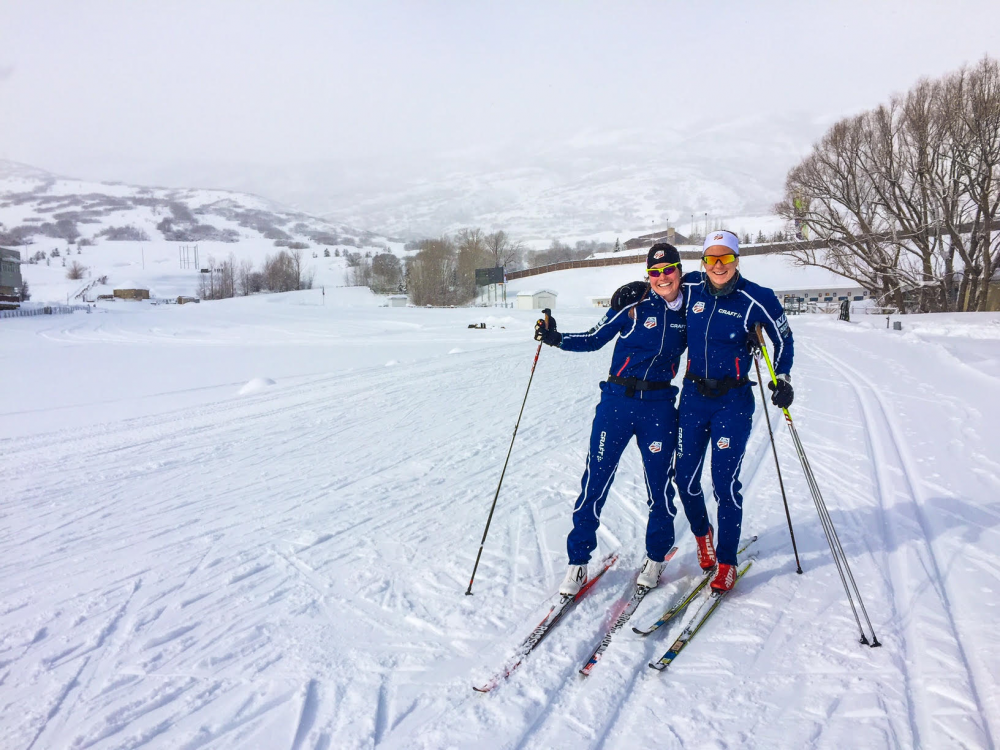
Eliška Hájek Albrigtsen (formerly Hájková, front right) with Madison Nordic Ski Club’s Trail Kids this summer.(Photo: Tobias Hájek Albrigtsen)
Many mornings, Eliška Hájek Albrigtsen’s husband, Tobias Albrigtsen, has to peel her out of bed. Living the life of an early bird like her spouse is nowhere near the top of her list — partly because she spends most nights prodding her hubby awake as he finishes his work, partly because she is strung out between four jobs of her own.
Being in charge of three ski programs while assisting a fourth is not where the 29 year old envisioned herself when she moved to Madison, Wisconsin, this past June to work for Central Cross Country (CXC). But a lot can change over the course of a summer and for Albrigtsen (formerly Hájková), a lot did.
After relocating to the Badger State’s capital from Lake Tahoe, California, to serve as CXC’s Community Olympic Development Director, Albrigtsen’s responsibilities began to accrue.
It started with the addition of coaching CXC’s online master’s program. Then she had an interest in helping with CXC’s Paralympic and adaptive athletes. Finally, in late August, Andy Keller left his head-coaching position with the CXC Team to join Northern Michigan University (NMU) as an assistant coach, and Albrigtsen was in a prime spot to take over the reins.
“When Andy took the assistant coaching job at NMU, it was kind of natural that I got the CXC Team head coach position,” Albrigtsen, a Czech Republic native, said during a recent phone interview. “For me, it’s not like a big promotion, it’s just more stuff to do while I still do all the stuff I was doing before. I have a lot of responsibilities all of a sudden that I didn’t start with.”
Among those responsibilities, she has been busy making informative videos for CXC Academy under the job title of Community Olympic Development Coach.
While attending the University of Colorado-Boulder (CU), she finished in the top 10 of 45 out of 48 races over the course of her college career, according to a CU press release, all while maintaining above a 3.5 grade-point average.
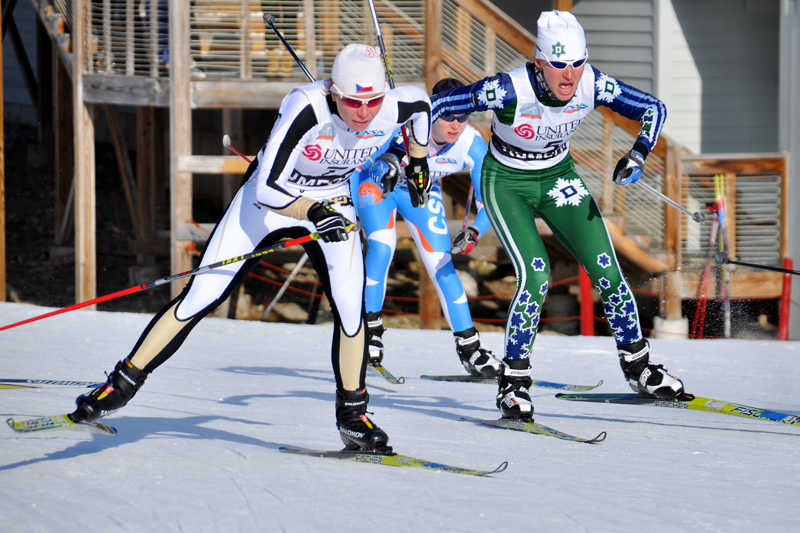
Eliska Hajkova (CU), racing against Sophie Caldwell (Dartmouth) and Corey Stock (CSU) during a sprint semifinal in 2012. Hajkova graduated in 2013 and after marrying, changed her last name to Hájek Albrigtsen. (Photo: James Doucett)
After three seasons coaching the BNJRT in Colorado, Albrigtsen moved to Kings Beach at the north end of Lake Tahoe last year, where the juggling act continued. There, she served as the head coach for Tahoe XC, while also volunteering with the Auburn Ski Club’s elite athletes, taught private ski lessons for Tahoe Donner, coached an online master’s program, and once again raced U.S. nationals, placing 12th in the 20 k classic mass start.
She’s also raced more than two dozen World Cups, most recently in 2014.
Though Albrigtsen indicates that she “never stops officially training or racing” this year might be a little different as it will be her first season coaching senior elite skiers. Still, the idea of more challenging practice sessions is enough to draw her in, even if it means scaling back her training a bit. As a coach she brings not only race experience, but the empathy and understanding of an athlete.
“With U14 kids, I mean, I was challenging them, but I was not getting challenged,” she reflected. “I think being challenged as a coach, being able to hang out with your athletes, you really see and you can really feel their pain. When you’re right on their butts and doing every exercise, you can see, ‘OK, I know that in the Level 4 on the fifth minute, during the sixth interval you died, so let’s figure that out.’ I think that’s one of my powers, that I can really be there when it’s happening.”
When asked of her strengths as a coach, CXC Executive Director Yuriy Gusev was quick to respond.
“Her racing experience, number one,” he said on the phone. “And [she’s] just very energetic and hardworking and organized.”
Albrigtsen will work with three CXC Team skiers this winter: Felicia Gesior, Kyle Bratrud and Sam Elfstrom. All three graduated from NMU, are currently based out of Marquette, Michigan, and will set their focus on the first few SuperTour races and U.S. nationals before re-evaluating their season goals. The fourth CXC Team member, Nichole Bathe (who graduated from the University of Alaska Fairbanks) remains on roster, but headed to Europe earlier this fall to train in Norway with a goal of making the 2018 Winter Olympic Games for Great Britain’s national team.
Until the first week of SuperTour racing in early December, the amount of time the other three CXC elite skiers and Albrigtsen work together will depend on the athletes. Albrigtsen wanted to keep the summer and fall schedule fairly flexible so her athletes would not feel restricted in the amount of paid work or fundraising they could accomplish while training for the upcoming season.
For example, Gesior made a trip to Madison earlier this fall for a training session on CXC’s rollerski treadmill with Albrigtsen, but will spend most the next few weeks training in Marquette and preparing for a fundraiser she’s organizing: the Bergkönig trail run on Nov. 11. The event features 10 k, 5 k and 1 k races and was originally created by Maria Stuber and Bryan Cook in an effort to raise money for local cross-country skiers looking to continue their ski careers post-college.
Gesior also works as a substitute teacher in Marquette, and most of her training this summer and fall has been with the NMU women’s team. Similarly, Bratrud and Elfstrom train with the NMU men’s team.
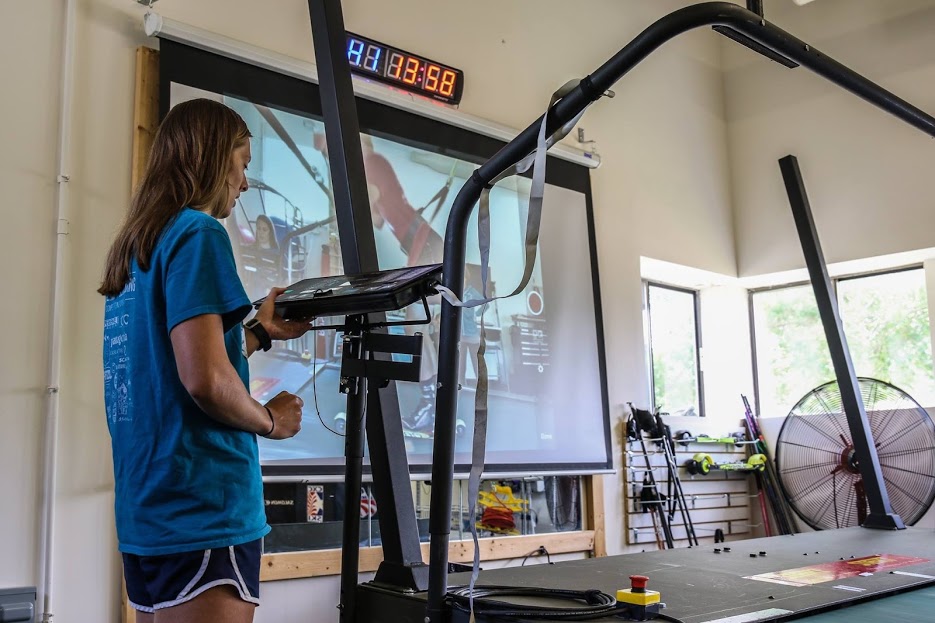
Felicia Geisor of the CXC Team prepares to hop on the treadmill in early September. (Courtesy photo)
“I think that’s OK that they follow [NMU],” Albrigtsen said, “That’s kind of the program that really took them where they are and they have something to top it. They don’t train like college skiers; I mean, it’s their job right now so they do train more. But the base is very similar and [NMU Head Coach] Sten [Fjeldheim] is being really nice about allowing them to train with them. Not all college coaches are that way, so we’re definitely really lucky.”
According to Gusev, partnerships like the one CXC has with NMU and other programs in the Midwest are the reason for CXC’s expansion. Over the last decade, he said CXC has grown from a $50,000-dollar organization to a million-dollar one.
“It’s all of those partnerships,” Gusev said of the CXC programs’ continued growth. “They’re incredible organizations so we’re able to work with all of them together and help them work together.”
The organization hopes to continue its expansion with the addition of a $12-million-dollar training complex just outside the Madison suburb of Middleton, Wisconsin, which is currently in the planning stages. The facility would not only include a competition venue, but snowmaking equipment, a lit rollerski loop, and 30,000-square-foot facility open for recreational use as well.
The idea behind the complex, Gusev indicated, would be to provide CXC athletes with a training venue, while simultaneously encouraging community members to get outside and active, using skiing as an example. The center already has one complex, the CXC Center of Excellence in Madison, complete with rollerski treadmill. “With the CXC Team, our number-one goal is to support the athletes that need the support. That’s as simple as that,” Gusev said. “But overall, our goal as an organization is to grow the sport at all levels.”
To Albrigtsen, the new facility is another reason Madison and CXC seemed like a good choice for her and her husband, Tobias, who is CXC’s media and communications coordinator, when moving from Tahoe to the Midwest. That, and the cost of living.
“We always talk about what can Midwest offer that other regions can’t. We don’t have the mountains, we don’t have the best winters, but what we really have is the best quality of life,” Albrigtsen said.
“You can live much cheaper here than anywhere else in U.S. and still make somewhat good money,” she continued. “Not everybody, especially in the U.S., there’s maybe 10-15 people who can do this professionally and get paid being skiers, otherwise you have to work and that’s something Midwest does have to offer. You can have a normal life and be a skier. You can do it here.”
While Albrigtsen’s “normal life” is somewhat busier than others might prefer, she is in no way deterred.
“I am a total sport addict, and I think every coach has to be, otherwise it’s not really worth it,” she said. “Tobias and I, we’re just trying to do what we love and give something back.”
Give something back, and get a little training in at the same time, even if it’s in between her multiple jobs.
“My motivation is also to fit in my jeans, wearing tight dresses,” Albrigtsen added with a laugh. “I have a five-year-younger husband so I have to take care of myself.”
Eliska Hájek Albrigtsen (formerly Hajkova) leading a Fourth of July run with Madison Nordic Ski Club’s Trail Kids this summer. (Photo: Tobias Albrigtsen)
2017 U23 World Championships teammates Nichole Bathe (l) and Jesse Knori, of the U.S., on Thursday at Soldier Hollow in Midway, Utah. (Photo: Bernie Nelson)
In an effort to showcase the North Americans competing at next week’s International Ski Federation (FIS) 2017 USANA Nordic Junior World Championships and U23 Cross Country World Championships at Soldier Hollow in Midway, Utah, we asked those qualifying athletes several questions about themselves — actually, we had them fill in the blanks. Here we have 21-year-old Nichole Bathe, of University of Alaska Fairbanks and CXC Team, who’s representing the U.S. at her first U23 World Championships after having raced at 2014 Junior Worlds.
***
“My full name is Nichole Bathe, but you can call me Nichole.
I was born in Madison, Wi, raised in Madison, and one thing you should know about my hometown is, go Badgers!! I started cross-country skiing when I was around 12, thanks to Yuriy Gusev and my dad.
I currently train in Fairbanks, Alaska, with University of Alaska Fairbanks and also the CXC Team.
If I’m not skiing, you might find me eating cheese and chocolate in a papasan chair. If I had to pick a favorite book, it would be ‘Bossypants’ by Tina Fey.
One of the things I’m most excited about for U23/Junior Worlds at Soldier Hollow is that it’s on home soil, and my coaches get to watch! One race I’m especially targeting there is the classic sprint.
The best advice anyone ever gave me about skiing or racing was ‘stay relaxed, stay tough’ –Christina Turman. One of the best race memories I have is the first time I beat my dad in a hometown race.
If I could meet one World Cup skier, it would be Heidi Weng.
If I don’t end up being a professional skier, I’ll probably be a social worker.
I’m missing 10 of school to be here, and my professors are probably thinking, ‘Good luck graduating this year, haha.’
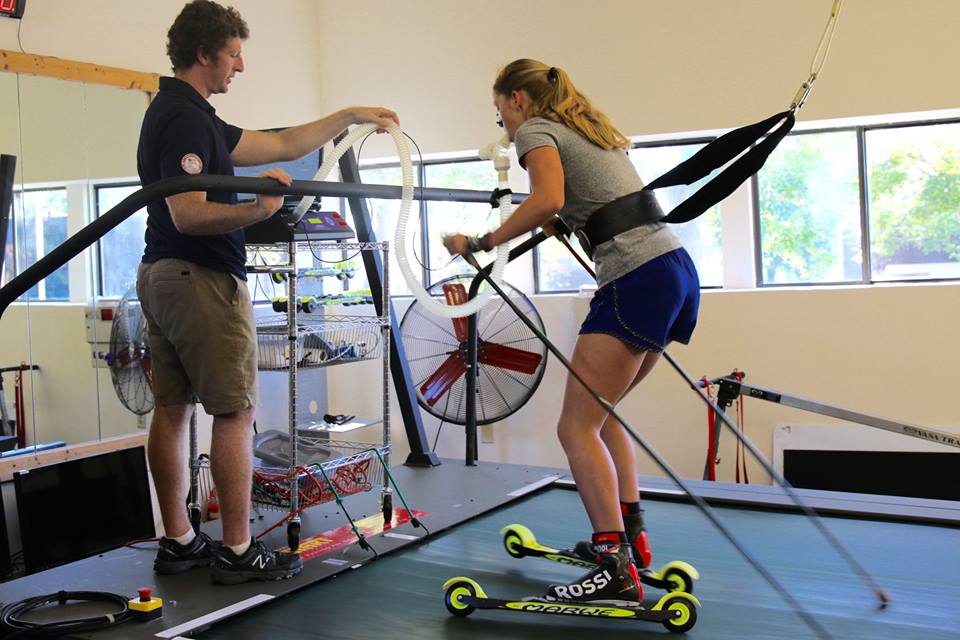
Central Cross Country (CXC) junior development skier Siri Martin (r) gets a mid-summer VO2max test on the rollerski treadmill at CXC’s Center of Excellence in Madison, Wis., in late July (Photo: CXC Facebook)
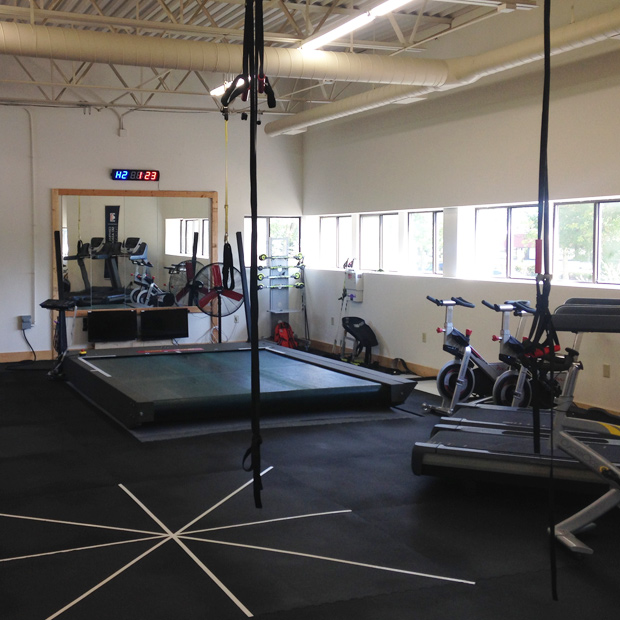
A glance into any one of the glass windows lining the east side of Central Cross Country (CXC) Academy’s Center of Excellence building might give the impression of the average athlete gym. But if you step across the front threshold or take a peek at the academy’s 360-degree virtual online tour and sport science page, you’ll find much more than treadmills, stationary bikes and medicine balls.
Located in Madison, Wis., the CXC Center of Excellence also houses a 10-by-12-foot rollerski treadmill, SkiErgs, and an in-house-made, power-pole machine. For many, though, equipment is not the most powerful tool in the center. Rather, it’s the center’s capacity to evaluate and educate its members and non-members alike about nordic skiing.
Currently, the Center of Excellence offers performance evaluations, as well as fitness testing for lactate and VO2max using the oversized treadmill. Recorded and individualized technique coaching sessions on the rollerski treadmill are also available for those willing to pay $150 dollars per hour. To help athletes gain a better understanding of their body within sport, the center is also presently working on developing a biomechanical analysis software.
The rollerski treadmill at the CXC Academy Center of Excellence (Photo: cxcacademy.com)
And CXC recently hired a sport development and education director, Egor Akimov, CXC head coach Andy Keller explained on the phone.
“He’s got a bachelor’s and PhD from the Russian State University in physical education and sport, so he majored in human physiology, he’s competed over in Russia and then he served on the Moscow Center of advanced sports technology as the head of the science department,” Keller said. “So he’s done a lot of research over in Russia on the biomechanics and stuff like that. He’s kind of leading our center [in Madison], doing a lot of the sessions down there and the technique work.”
According to the CXC Executive and Athletic Director Yuriy Gusev, the Center of Excellence is approximately 90 percent complete. Anyone from CXC club members, to donors, to CXC team members, and the general public, can access the center at no cost. Rollerski treadmill evaluations cost CXC clubs $250 per day, $150 per hour for all others.
“We are finalizing a few more partnerships on the sports science program and equipment but will start performing studies in cross country skiing this coming fall,” Gusev wrote in an email. “Our goal is to have top sports science facility to study latest innovations in the sport, potential application in cross country skiing to improve training, recovery and performance.”
While the CXC elite team, known as the CXC Team, uses the center for testing, its current base in Marquette, Mich. has also led the team to seek out other partnerships. This included collaborating with the Northern Michigan University (NMU) Olympic Training Site, allowing CXC Team members to use the school’s facility and other amenities.
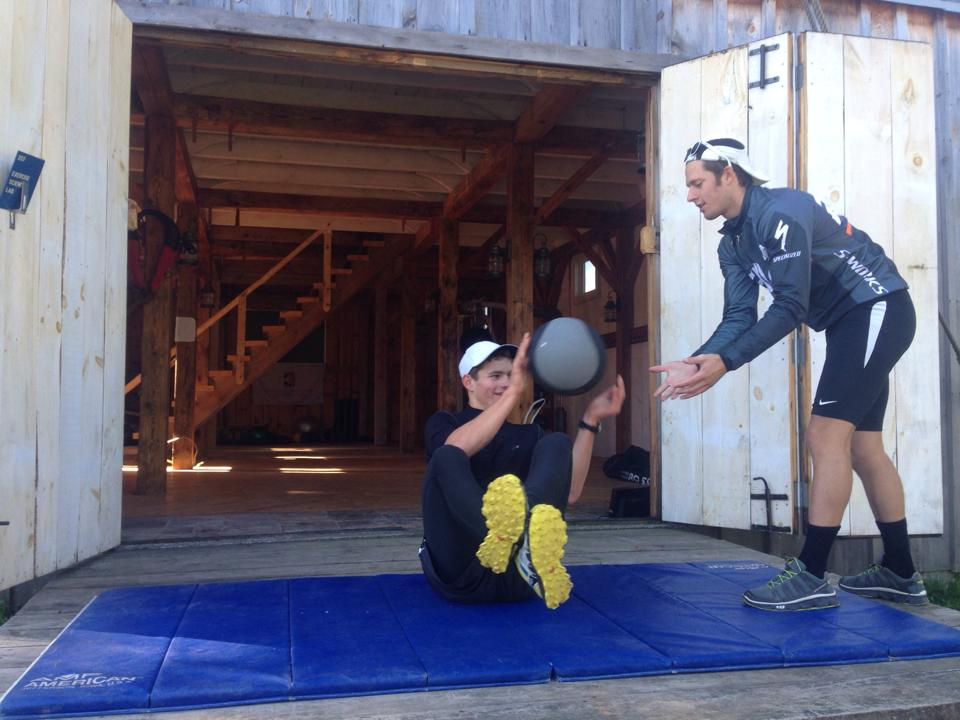
CXC Team Head Coach Andy Keller (r) works on strength with Scott Harrison outside a barn near the team’s former home base in Cable, Wis., in 2014. The team is now based in Marquette, Mich. (Photo: CXC/Facebook)
“This year we moved up to Marquette partly because a lot of the athletes have come from Northern Michigan, but also because there’s quite a bit of opportunity up here,” Keller said. “We’ve kind of partnered up with the Olympic training site located here. So we’ve been able to use the dorms on campus, offer schooling, have a training room and weight facilities available. … [The move to Marquette] has given us a lot more freedom with athlete housing and training opportunities.”
At present, the CXC Team has three full-time athletes and two part-time collegiate skiers. Kyle Bratrud returned to the CXC elite team for his second year; new full-time members include Dartmouth graduate Oscar Friedman and NMU grad Felicia Gesior. Jan Ketterson, a Dartmouth student currently taking the fall and winter trimesters off to focus on skiing, plans to race for CXC along with Nicole Bathe, presently a student at University of Alaska Fairbanks.
The growing numbers on the CXC Team was one reason CXC also recently decided to nix its marathon team, Keller explained.
“That was kind of another thing with refocusing with the marathon team, just my role and what resources I can put out just being by myself,” Keller said. “The main reason why we [ended our marathon team] is we’re trying to make a big push to promote club development.”
By discontinuing the marathon team, CXC saw an opportunity for athletes to return to their home clubs and promote racing on a more local, community-based level.
“The athletes that were on our team last year, both our current athletes and our previous athletes that we don’t have on the team anymore, we encouraged them this upcoming year to be a part of the clubs in their local area,” Keller said. “From what I heard in talking to them, most will continue to race in some facet.”
Chris Pappathopoulos won the men’s overall CXC Marathon Cup last season while competing for the CXC marathon team. (Photo: CXC)
He added that the team’s reigning CXC Marathon Cup winner Chris Pappathopoulos would likely be supported by companies like Rossignol and Boulder Nordic Sport.
While former CXC marathon team members like Pappathopoulos will look to return to their local clubs, Keller looks to expand the CXC Team program and podium at U.S. nationals with the athletes he’s currently working with.
“For a couple years [CXC] was really down and out from the years when we had Jessie [Diggins], Caitlin [Gregg], and Jennie [Bender], all those strong athletes,” he said. “So we definitely want to get back to fighting for SuperTour podiums, fighting for World Cup spots … and in this next year, I think there’s athletes who are on our team that are capable of it.”
With access to the NMU Olympic Training Site, CXC’s Center of Excellence and new scientific research taking place this fall, Keller doesn’t doubt CXC as a force to be reckoned with this season and seasons to come.
“We have the training group, we have the structure and the facilities,” Keller said. “And I think the more excitement we got here, the more we can achieve those goals of being at the top level.”
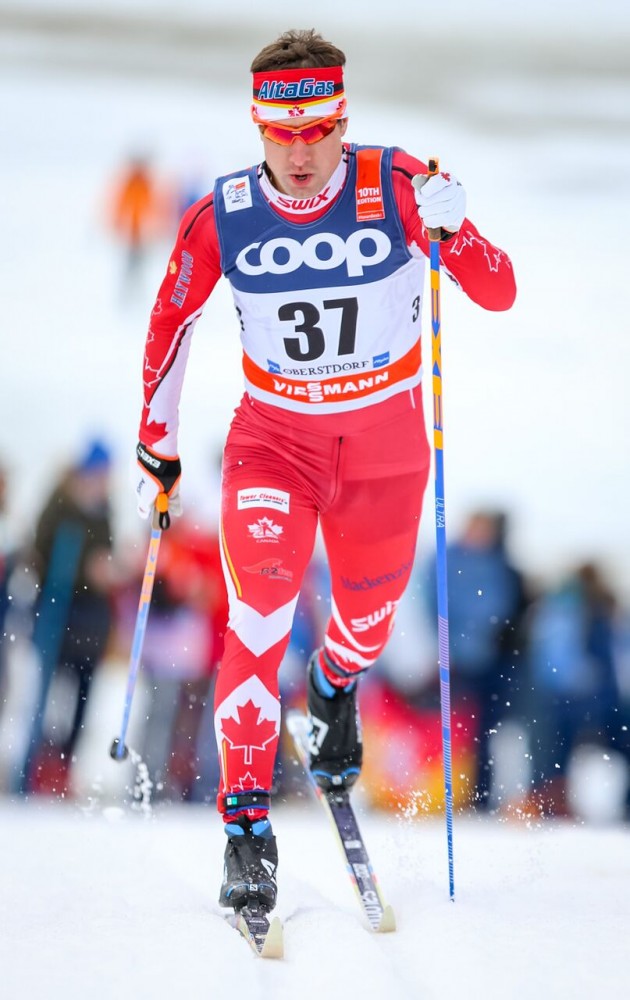
Ivan Babikov (Canadian World Cup Team) striding during the classic sprint qualifier at Stage 4 of the Tour de Ski earlier this season in Oberstdorf, Germany. (Photo: Marcel Hilger)
Ivan Babikov’s last race was up the Alpe Cermis in Italy. A month and 10 days later, the Russian-born Canadian World Cup Team member plans to be at the start line of the 2016 American Birkebeiner on Saturday in northern Wisconsin.
It’s been a few years, but Babikov, known by some as “Babs the Bulldog,” won the 51-kilometer freestyle marathon in his last try in 2008. He took home $5,000 U.S. dollars for the win, and this year, if he repeats the feat, he’ll earn $7,500 for his efforts. It’s not all about the money, but it gave Babikov, 35, incentive make the trip and 6 a.m. flight along with it.
On the phone earlier this week, Babikov explained he first thought about racing the 2016 Birkie last week. He had heard that Central Cross Country (CXC) revived its Marathon Cup series, of which the Birkie is part of, and reached out to CXC Executive Director Yuriy Gusev as a friendly hello.
“I emailed him and said , ‘Oh, good job, you started that loppet series again. Those are fun, that’s good,’ ” Babikov recalled. “So we started talking about Birkie and he said, ‘You wanna come? We’ll support you.’ And I said, ‘Really?’ ”
“Really?” became a reality, and early this Thursday, Babikov planned to fly to the U.S.
Ivan Babikov, the fastest man of the day at the final stage of the Tour de Ski in 2009.
“They pretty much offered to pay for everything and support me there, so that was kind of the last thing,” he explained. “I was like, ‘Sure, why not?’ I think it will also be good prep for the Tour of Canada.”
Babikov skipped the NorAm Eastern Canadian Championships (Feb. 5-7 in Cantley, Quebec) and Western Canadian Championships (this Friday-Sunday in Prince George, British Columbia) because of the travel involved. Instead, he spent the last month training at home in Canmore, Alberta, ahead of the last World Cups of the season March 1-12 at Ski Tour Canada.
“Since I’m in Canmore for such a long period of time, there’s not much races to do between Easterns and Westerns, but I didn’t want to travel for those,” he explained. “The Birkie, I remember, is a super-fun race and of course it’s a good way to make some extra cash, which is of course a big help for me.”
Last year, Babikov launched a “Make a Champ” online fundraiser to fund his World Cup racing. He reached 50 percent of his goal, raising just over $8,300, and ended the campaign two months ago.
“I was planning to finish [the campaign] before the season started,” he said. “I didn’t reach my 100-percent goal … but I’m still thankful for all the people who donated. I know it’s not that easy.”
When he left the World Cup after the Tour de Ski, Babikov explained there were a couple factors involved, such as the team budget and criteria for staying on the circuit for Periods 2 and 3.
“I was 11th on the day of the hill climb, which was better than last year, and I ended up in the top 30 in the overall, which is a pretty good thing, too,” Babikov said of his 29th overall finish in the Tour. “But [the national team] decided to send me home. Of course I wasn’t happy with it, it’s kind of the first time in so many years I’ve been sent home, and skipping pretty much half of the season. So of course I was a bit upset, but I cannot do anything about it – it’s their decision, and I’m just now trying to focus on Tour of Canada. I’m hoping that it’ll be actually a good thing for me, so I’ll be rested and I’ll be ready for the Tour.”
Back in January, Canadian head coach Justin Wadsworth explained that despite Babikov’s positive end to the Tour de Ski, he did not meet the team’s standards for Period 2 and 3 in Europe. He would have needed to achieve three top-30 World Cup results this season, two top 12’s, or even two top 20’s, Wadsworth said.
“I’m hoping that it’ll be actually a good thing for me, so I’ll be rested and I’ll be ready for the Tour.” — Ivan Babikov, Canadian World Cup Team veteran, on returning home to Canada in early January
But the fact that Babikov returned to Canada mid-season is old news. Now, he’s looking forward.
“I’ve been home, which is a good thing,” he said. “We have really good snow in Canmore so training has been really, really good. I feel much, much better. So Birkie will be good kind of test just to see how body feels, not even in terms of results or anything, but just to see how I feel, how body feels, just to get the last, final touches to preparation. It’s 50 k or a bit longer, but it’s fun and it’s a good financial [decision].
“I remembered how crazy the Birkie is and how much people there care,” he added. “This is their local Olympic Games, so I’m pretty pretty psyched to be going.”
“I haven’t done a race like that in a while so I have to remember how to ski it,” Babikov said of the point-to-point marathon from Cable to Hayward, Wis. “I don’t think there’s pressure; I’m going there kind of last minute, just as a preparation. This time of year, I wasn’t focused on getting ready for the Birkie especially, right? [It’s] after a big load of training and getting my mind on the Tour of Canada. So of course nervous a bit – it’s been a few years since I been there – but that’s fine. I’m excited.”
Babikov has raced the Birkie three times, placing sixth in 2004 and 2005 before winning in 2008.
“I remembered how crazy the Birkie is and how much people there care. This is their local Olympic Games, so I’m pretty pretty psyched to be going.” — Babikov
After that, he’ll set his sights on the eight-stage Ski Tour Canada, which he prequalified for by scoring World Cup points this season.
“Having a World Cup Finals in Canada, it’s a pretty big thing,” he said. “Even for North America. All those guys coming to North America to race, but for the finals, with so many stages for the full tour, so it means a lot to us. Racing at home, with my family and friends watching and stuff. You heard this kind of thing many times, but when you’re racing at home and you know the course really well, every inch of the course … I will be ready, and for sure, I’ll give my 100 percent every day, especially finishing here in Canmore.”
Beyond the final pursuit in Canmore, Babikov said he’ll likely finish the season at Canadian Nationals in Whitehorse, Yukon, March 20-26. Beyond that, he’s taking each year as it comes.
“With the team now and the budget and all this stuff… I don’t know. Right now I’m not trying to think about it too much…,” he said. “Thinking about the Tour of Canada, and I guess I’ll decide finally after that. I’ll see what I want to do and see if I still have drive and excitement for racing, and I’ll see if I want to keep going – hopefully I do.
“And the team doesn’t mind me being on the team,” he added with a laugh. “There is some opportunity, some options, but right now I’m just staying in the game.”
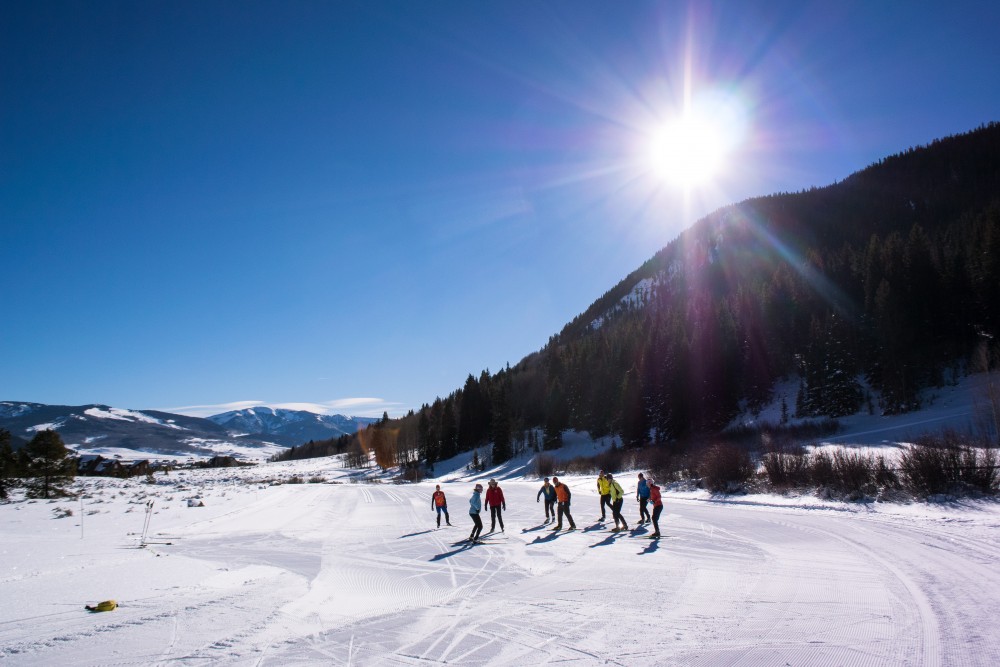
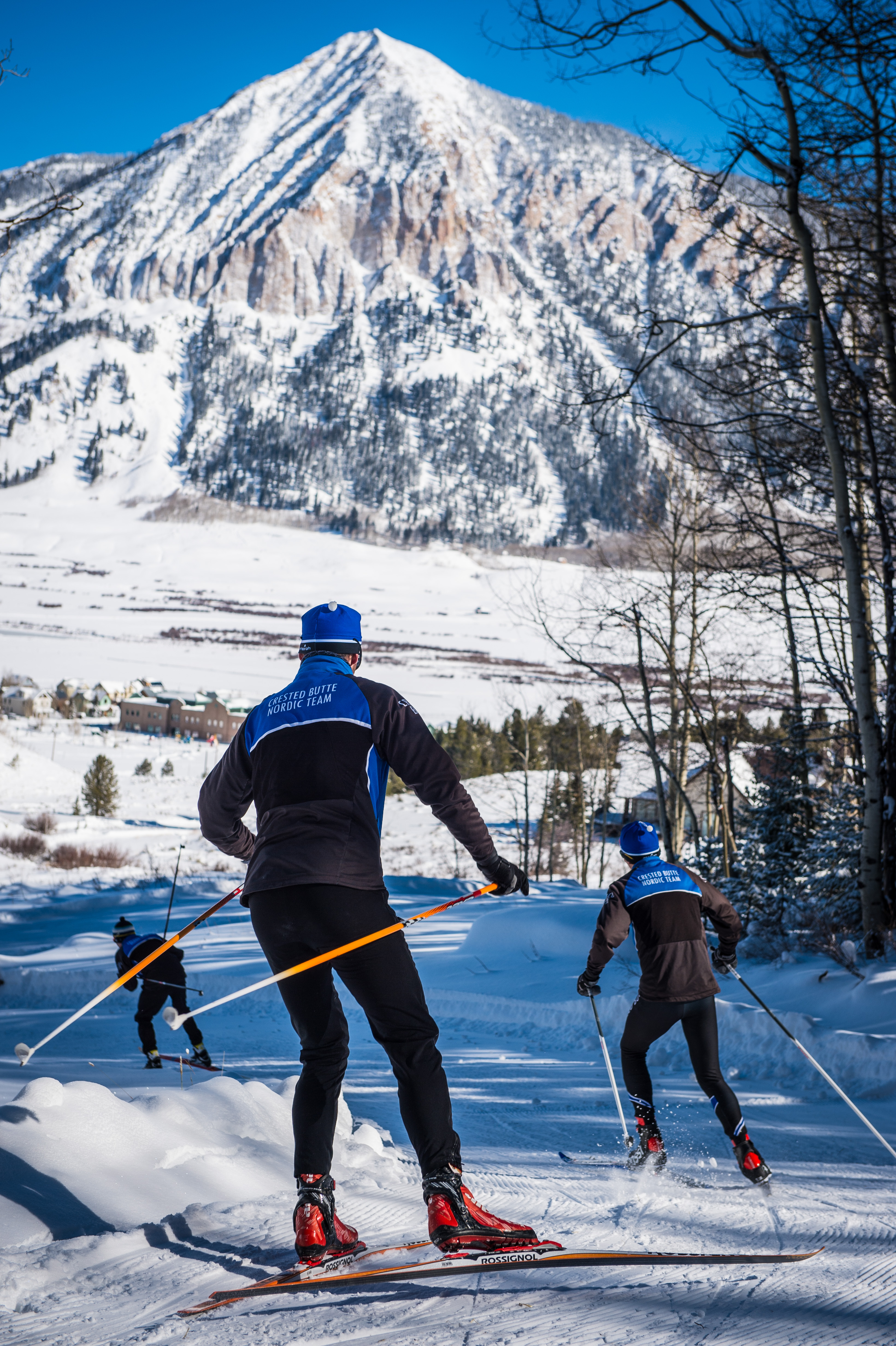
Sun stretches over the hills during a cross-country lesson at Crested Butte in Colorado. The nordic center there is hosting its annual Crested Butte Nordic Thanksgiving Camp from Thursday to Sunday. (Photo: Xavier Fane)
We’ve been hearing about West Yellowstone since, well, the U.S. Ski Team officially started its annual Fall Camp there in 1978. But surely, Montana’s southern tip can’t be the only place to get on snow this time of year…
That’s why we provided a guide to Thanksgiving on-snow camp venues in the U.S. and Canada (we realize this week isn’t Thanksgiving in Canada, but we’re sticking to areas that offer skiing around this week in late November for all intents and purposes). If we’re missing an early season camp, we apologize — it’s a big continent — but let us know so we can feature that camp in next year’s guide.
***
What:Yellowstone Ski Festival
Where: West Yellowstone, Montana
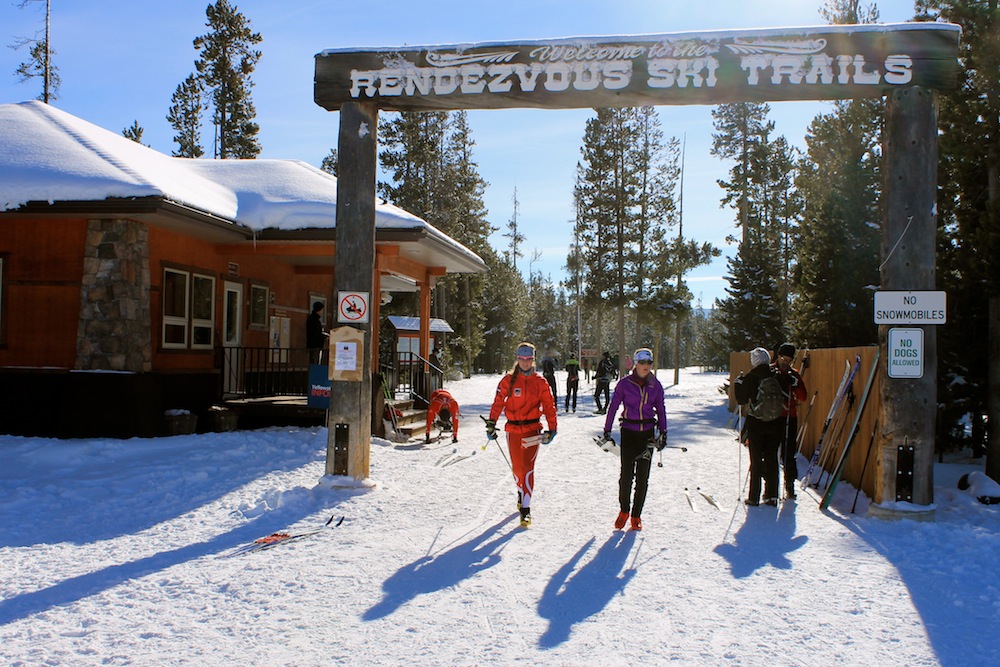
Each year, the Rendezvous Ski Trails see hundreds of skiers each day during the Yellowstone Ski Festival on Thanksgiving week in West Yellowstone, Mont.
When: Tuesday, Nov. 24, to Saturday, Nov. 28, 2015
How many years running? 20+
Target audience: Masters and beginners (clinics available for both), as well as elite racers
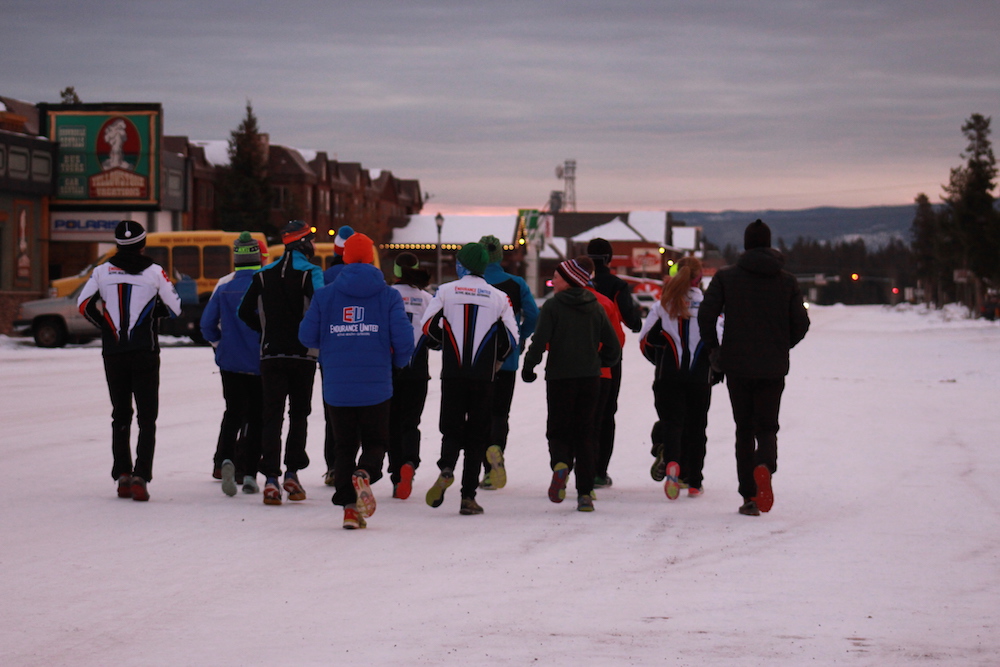
Endurance United team members get ready for a day of skiing during a morning run in West Yellowstone, Mont., at this year’s 2015 Yellowstone Ski Festival. (Photo: Gabby Naranja)
Anticipated participation: An estimated 4,000-5,000 skiers throughout the week. “It varies from year to year depending on the snow conditions and the snow level,” West Yellowstone Ski Education Foundation Program Director Moira Dow explained. “Because we’ve gotten snow early this year and good snow, we have been able to get the word out. Like right now the trails are packed. We will probably have a lot of people coming for longer periods of time.”
Advance reservation required? Racers must preregister. Trails are open to public; trail pass required.
Grooming report: Essentially everything is open. “It’s full-coverage skiing on good skis with full tracks,” Dow said. More details | Webcam
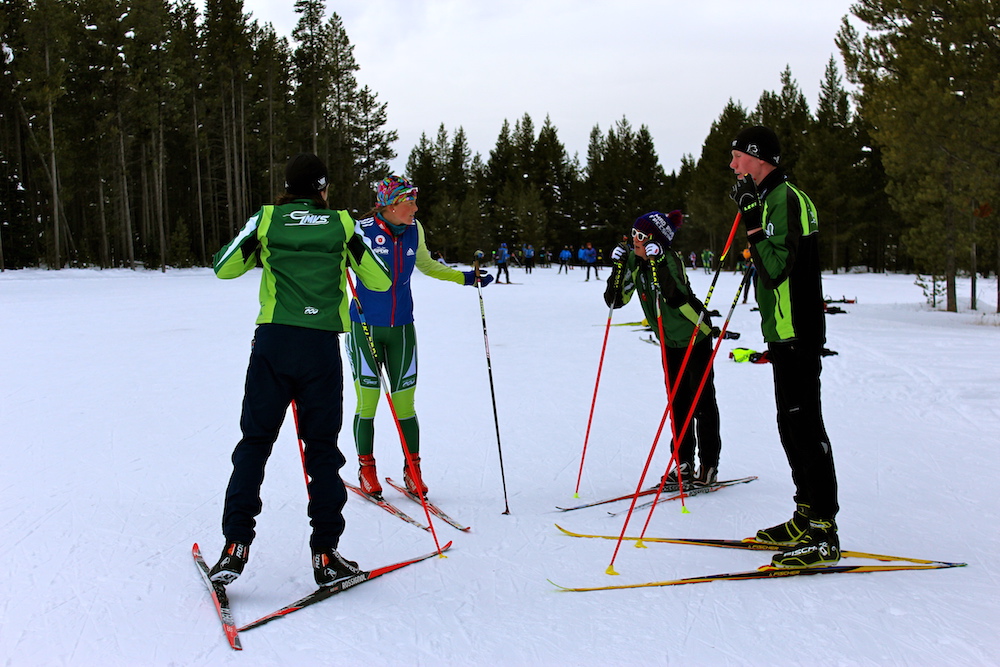
Green Mountain Valley School nordic skiers meet up during a ski on the Rendezvous Ski Trails this week in West Yellowstone, Mont. (Photo: Gabby Naranja)
What makes this camp unique? “The number of trails and the quality of snow that we have. We’re one of the few places in the country that does have consistent, early, good snow. In addition to that, we have a lot of industry participation. And we have great evening programs for people. We have not just skiing, we have the full package for everybody and anyone, from the beginner skier who wants to get out on the snow for the first time, to the SuperTour elite athlete who can train at high altitude, and good snow in the early part of the season.”
Special events:
U.S. Ski Team Development Coach Bryan Fish and the former vice president of Fischer Skis U.S. nordic division, Peter Ashley, will be featured speakers
Freebies: “Everything at the indoor expo at night is free. Anybody who has a trail pass can get into the outdoor demo area for free. In addition, on Wednesday and Friday night we have ‘après-ski’… [with] complimentary adult beverages and junior beverages, sledding, some music, and fun stuff like that. Just a little bit more of a party atmosphere after the sun goes down and before the expo opens.”
***
What:Crested Butte Nordic Thanksgiving Camp
Where: Crested Butte, Colorado
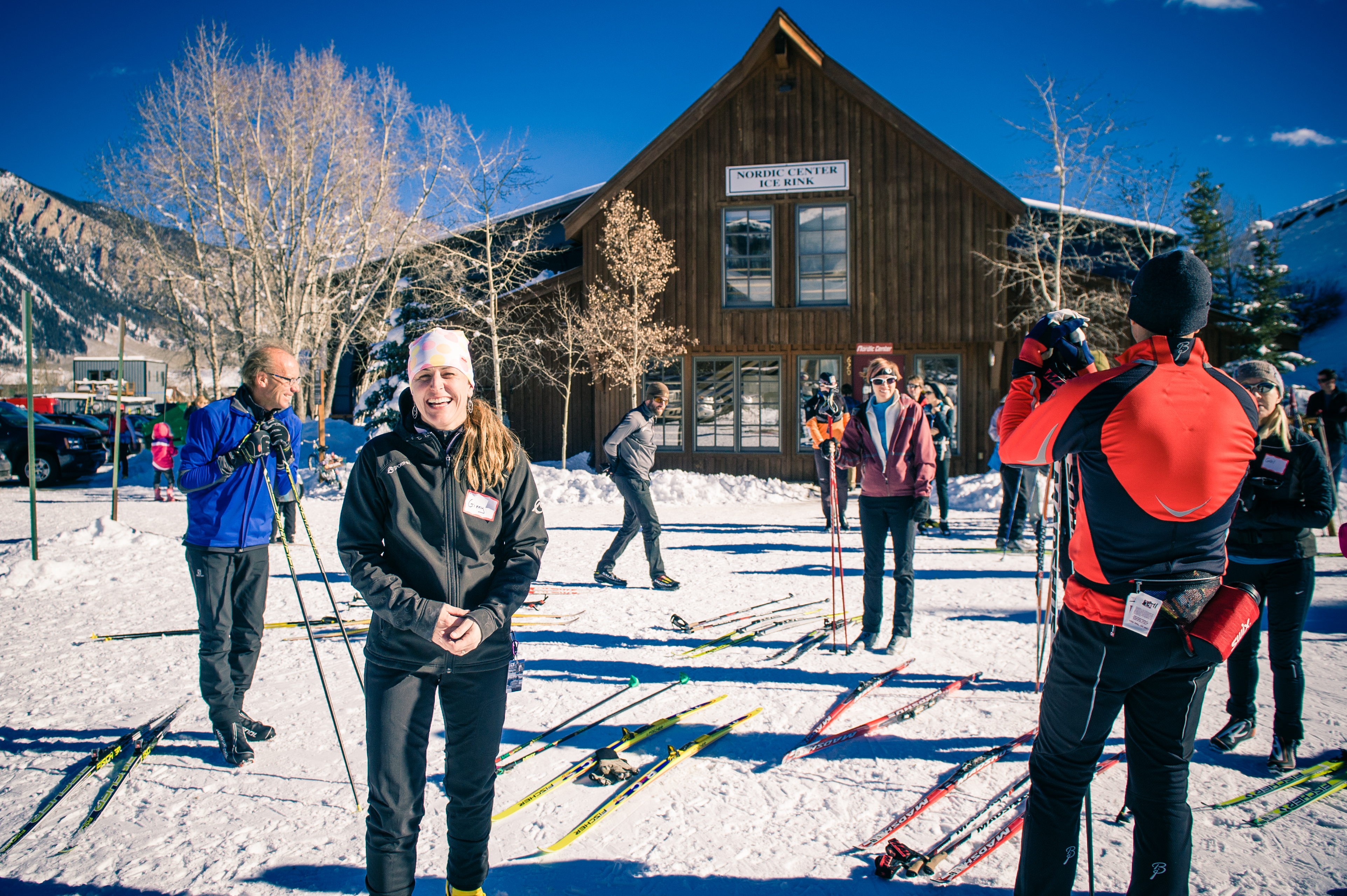
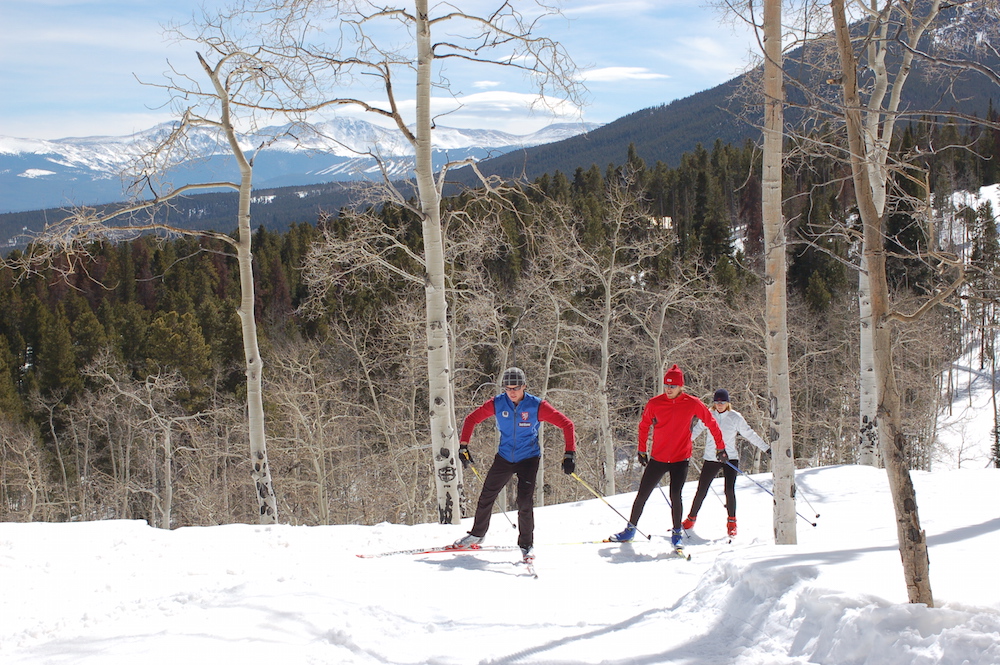
The Crested Butte Nordic Thanksgiving Camp, now in its 14th year, is a fundraiser for Crested Butte Nordic, a nonprofit dedicated to getting people on the local trails. (Photo: Xavier Fane)
Skiing at Crested Butte Nordic in Colorado. (Photo: Xavier Fane)
How many years running? 14 as an official organized camp: “Crested Butte has really good and reliable early season snow so the Nordic Center decided we should try to get folks to come here and get some instruction from our great instructors,” said Drew Holbrook, marketing director for Crested Butte Nordic and the Grand Traverse ski race. “We also have a wonderful venue for early season nordic skiing and we’ve been fortunate enough to have been on-snow every year.”
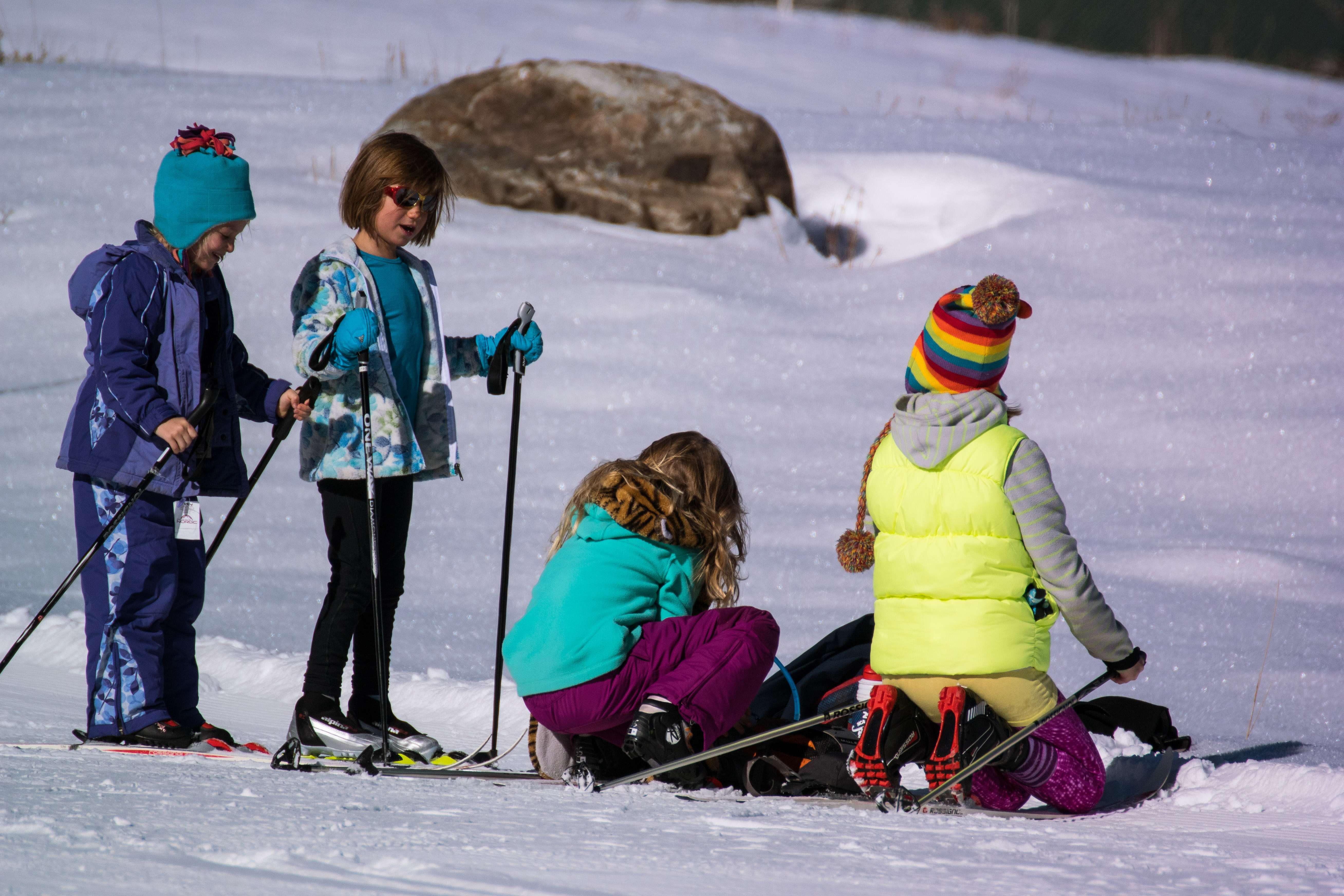
Target audience: All ages and abilities, “from never-evers to master blasters looking to improve their technique,” Holbrook said. “If parents are skiing along with children, kids ski free. All kids 17 and younger get free passes and rentals. And, actually, all season long we do that — people 17 and younger ski free. At the Thanksgiving Camp we also do free kids clinics. So if a parent is taking a clinic, then they can have their kids taken care of all day.
Anticipated participation: Several hundred skiers on the trails throughout the long weekend. For clinics, projecting 75-80 participants.
Advance reservation required? Pre-registration recommended for clinics.Nordic Center trail passes available any time. Skiing at Lily Lake, a 10 k early season trail system four miles up Kebler Pass Road, is free.
Trail pass rates: $18/day, skiers 17 & younger ski free. $130 for a 10-punch transferable pass.
Grooming report: With about a foot of snow at the venue in town, “it’s looking like in-town skiing for the camp,” Holbrook said. As of Tuesday, Ruthie’s Run (5-kilometer loop at the nordic center and up on the bench) and Lily Lake (six miles west of town up on the pass) were groomed. “We’ll have over 10 kilometers of high quality skiing available,” Holbrook added. More details
Here’s a deal: Kids 17 and under enjoy free rentals, passes and clinics at the Crested Butte Nordic Thanksgiving Camp. (Photo: Xavier Fane)
What makes this camp unique? “As a non-profit, our mission is to get people out on the trails skiing. We are not making a ton of money off it,” Holbrook said.
“We just want people to come here and use our trails and make it affordable. A lot of people come back year after year and work with the same instructor. They get to know each other and get to know the other people that come into camp. So it’s definitely got this small feel to it, it’s kind of personalized.”
Special events:
For the first time, a race (on Sunday): 5/10 k freestyle + kids’ race with new homologated course on Ruthie’s Run. “It’s engineered, seeded, and mowed,” Holbrook said. “Due to the engineering, we are able to groom the race course with a lot less snow than we used to need. That enables us to count on having this race and count on have a good race venue close to town.”
Winter Kick-Off Party (Saturday night): Fundraiser for Crested Butte Nordic, tickets $30/adult,$10/children.
Wax clinic, nutritional talk and Nov. 25 is opening day at Crested Butte Mountain Resort, with free skiing all day.
***
What: CXC Thanksgiving Nordic Festival
Where: Telemark Trails in Cable, Wisconsin
After three nights of blowing snow, CXC Thanksgiving Nordic Festival organizers were ready to groom the Telemark Trails in Cable, Wis., on Nov. 22. (Photo: Facebook)
When: Wednesday, Nov. 25, to Sunday, Nov. 29, 2015
How many years running? First year. “Our goal for the festival is to show the template to other communities, what it takes to make snow … to provide a business and operations template to other places around the Midwest so they can do these festivals in late November and then have a reliable loop for the winter,” CXC Executive and Athletic Director Yuriy Gusev explained.
A 1 k loop was made and groomed for the first-annual CXC Thanksgiving Nordic Festival in Cable, Wis. (Photo: Facebook)
Target audience: All skiers; open to the public
Anticipated participation: Based on the camp’s Facebook page, at least 75 plan on attending, and Gusev estimated that paired with a local turnout would amount to 200-300 skiers. “We don’t want to make it a big deal … just to show the community this is an opportunity to ski,” he said.
Advance reservation required? Yes, for clinics (instructed by Gusev on Friday, Saturday and Sunday).Trails open to public.
Trail pass rates: $50 season passes, good for the festival and the whole winter. Trail passes can be purchased at www.cxcskiing.org/skipass, Telemark condominium office and Cable Area Chamber of Commerce Office.
Grooming report: Skiing on a 1 k loop at Telemark started on Sunday: “Usually there’s no natural snow this time of year, so our plan was to make snow,” Gusev said. “It just didn’t get cold like it normally does.” Once temperatures finally cooled late last week, the snowmaking crew was able to work on blowing and laying out a 1-kilometer manmade loop, some of which will be used for the 2016 Junior Nationals sprint course. More details
What makes this camp unique? “Anytime you have early snow, you stand out. I think it can be a key component to have this … to provide a reliable base for the rest of the winter, especially for youth programs where the snow is critical and also for entry-level participants. We’ve seen already with the couple snowmaking areas in the Twin Cities how much impact these have on the ski industry and local ski shops. They’ve been able to actually do relatively well in snowless winters.”
Special events: Fischer Demo
***
What: Snow Mountain Ranch Nordic Ski Camp
Where: Granby, Colorado
A November day at Snow Mountain Ranch, which opened for skiing earlier this month and remains open with 50 k groomed with a set track. (Courtesy photo)
How many years running? First time in recent years
Target audience: Beginner skiers to seasoned racers
Advance reservation required? Yes.
November skiing at Snow Mountain Ranch in Granby, Colo. For the first time this year, a five-day camp was held for masters. It ended on Tuesday. (Courtesy photo)
Participation: Capped at 24. “Smaller is better from both a coaching and athlete viewpoint,” Snow Mountain Ranch’s Nordic Center Director Bill Pierce explained. In its first year with little marketing, the five-day camp attracted four athletes.
“It was really small, but it was great,” Pierce said. “It’s so early that people don’t expect there to be snow [when] it’s 60 degrees in Boulder. … We just want to put another option out there; a lot of skiers want to be on snow in early November and Denver is really easy to get to.”
Trail pass rates: $350 for the camp, includes all coaching sessions and day passes
Grooming report: 50 kilometers groomed and track-set. Snow Mountain Ranch started grooming Nov. 4 and opened for skiing on the 14th. According to Pierce, they have anywhere from a 4-5 inch base to 10 inches in some places. It was snowing there on Thanksgiving, with four inches of snow expected to fall today. More info | Webcam
What makes this camp unique? “This is the earliest masters camp in North America on-snow as a pre-Thanksgiving camp,” Pierce explained.
The idea was to run a masters camp similar to an elite or junior camp, with two-a-day sessions combining workouts and technique — all at 9,000 feet above sea level. The focus was on transitioning from dryland training to snow skiing, with an emphasis on technique and slow volume at high altitude.
With a small but mighty coaching staff (two of which are USSA certified), Pierce said the ability to work with athletes helps them set, understand and achieve skiing goals.
“We all speak the same language,” he said of the coaches. “You can go to a lot of places, and a lot of places you feel like you’re getting a lesson. There’s a difference between a lesson and coaching.”
“[This camp is] just another opportunity in the country to go skiing all day,” he added.
When: 2 1/2-day weekend and 5-day midweek camps (schedule):
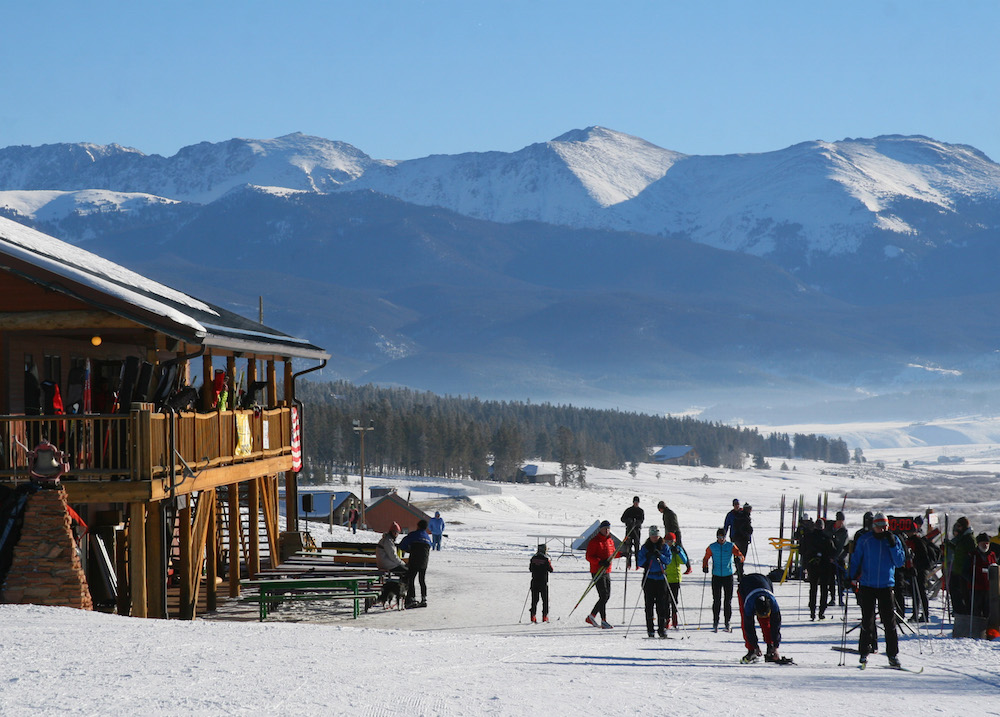
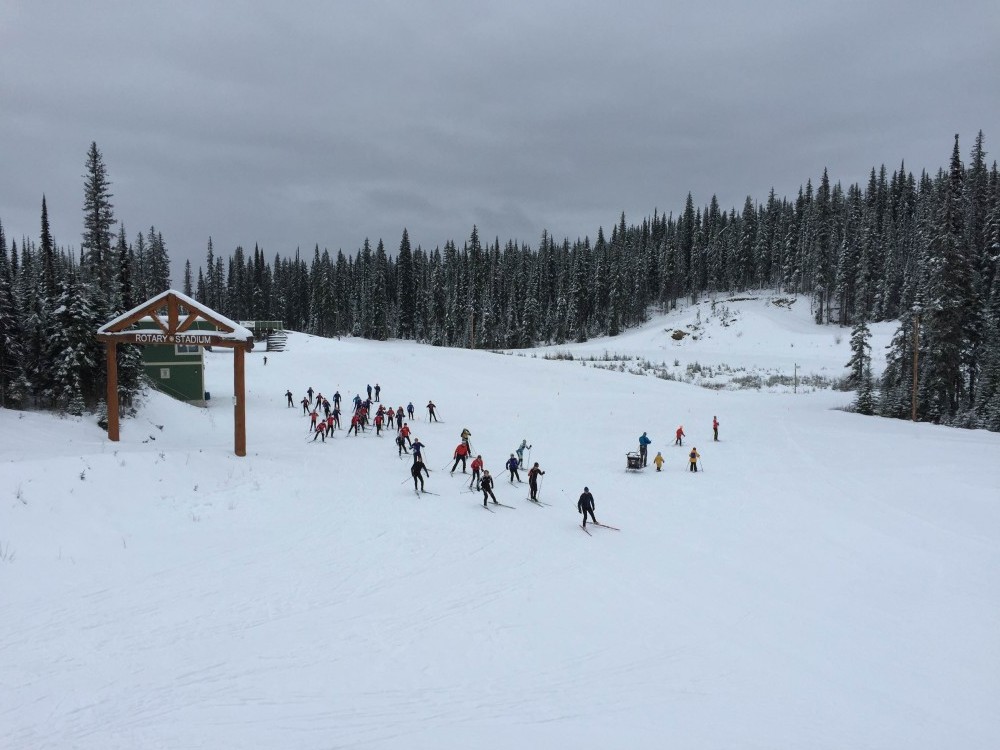
A gaggle of skiers at a junior camp head out on the trails at the Sovereign Lake Nordic Centre on Nov. 14 in Vernon, British Columbia. Roughly 800 skiers took to the trails that day. Each winter, Sovereign Lake hosts a series of weekend and weekday camps, called SuperCamp. (Photo: Gerry Furseth)
Camp #1:Nov. 20-22
Camp #2: Nov. 23-27
Camp #3: Nov. 27-29 (with Pro-camp option)
Camp #4: Nov. 30-Dec. 4
Camp #5: Dec. 4-6
Camp #6: Jan. 15-17
Camp #7: Feb. 19-21
How many years running? 26 (The SuperCamp program started in 1989)
Target audience: All ages and skill levels from beginner to elite racer.
Advance reservation required? Yes.
Anticipated participation: Typically around 225 to 250 participants, hoping for 260 this year.
“In its heyday in the early ’90s [SuperCamp attracted] upwards of 400,” Sovereign Lake Nordic Center General Manager Troy Hudson explained. “We want to get back to those numbers by offering some great new initiatives like focussed Masters Pro camps for racers and more options such as the biathlon camps which are proving to be very popular.”
Trail pass rates: Dual area trail passes included in camp fee, ranges from $339 to $925 Canadian dollars per person (depending on length of camp, and half or full days). Pricing
VR40 blue-wax skiing on Nov. 16 at the Sovereign Lake Nordic Centre in Vernon, B.C. (Photo: Ryan Olson)
Grooming report: Sovereign Lake has 40 kilometers groomed and Silver Star has an additional 40 k open. More details (and webcam)
What makes this camp unique? “I’m often asked, what is Supercamp?” SuperCamp coordinator Shane Landreville wrote in an e-newsletter. “That’s a great question and because Supercamp offers so much more than a traditional ski lesson, it’s a difficult concept to explain and it’s difficult for people to wrap their heads around it. Quite simply, Supercamp is a Nordic experience.”
SuperCamp attracts top-level coaches, as many come from across Canada to get early snow before they start their season at home. Each camp includes lectures and lessons on waxing, how to build a training plan, and sports nutrition, as well as access to the national altitude training centre gym, and best of all, 105 kilometers of trails between Sovereign Lake and Silver Star — many of which are used for World Cup, NorAm, and World Master events.
With half- and full-day options, the camp is at an altitude of 1,600 metres (5,250 feet). Many of the accommodation options are on the nordic trails. You can ski or walk to restaurants and bars in the evening.
Biathlon camps are either five days long or a single afternoon, and a new Pro camp is more racing focused.
The Silver Star alpine area opened earlier this week, as did the separate Fat Bike trail system.
Special events:
Keynote speakers, a sports nutrition lecture, and wax clinics
Stretching classes, body pre-activation sessions, and for 5-day campers, two 30-minute massages. “Skiing for a solid 2 days or 5 days is tough, it really is, so taking care of your bodies is important,” Landreville wrote. “For our 5 day camps, you can also take part in the excursion to the spa and pools at Sparkling Hill Resort.”
***
Also: Canada’s Early Season XC Venues
What: Frozen Thunder
Where: Canmore, Alberta
Fresh snow at the Canmore Nordic Centre: A n Olympic Legacy Venue now a regular host of Canadian based World Cups. (Photo: Pavlina Sudrich)
How much snow: Boreal Glide, a 2.5 k manmade loop, is open for both freestyle and classic. Course map | Weather
Good to know:
According to according to Julie Moffet, the regional operations coordinator at Forêt Montmorency, la Forêt is the only place in North America with cross-country skiing as early as Oct. 30 all the way to Easter in April.
No races or special events are scheduled, simply skiing and snowshoeing for all.
To reserve a room on the trails (with two single beds and a shared bathroom), with access to a cafeteria, two lounges with a fireplace, game room, auditorium, and wax room, visit http://www.foretmontmorency.ca/en/lodging/
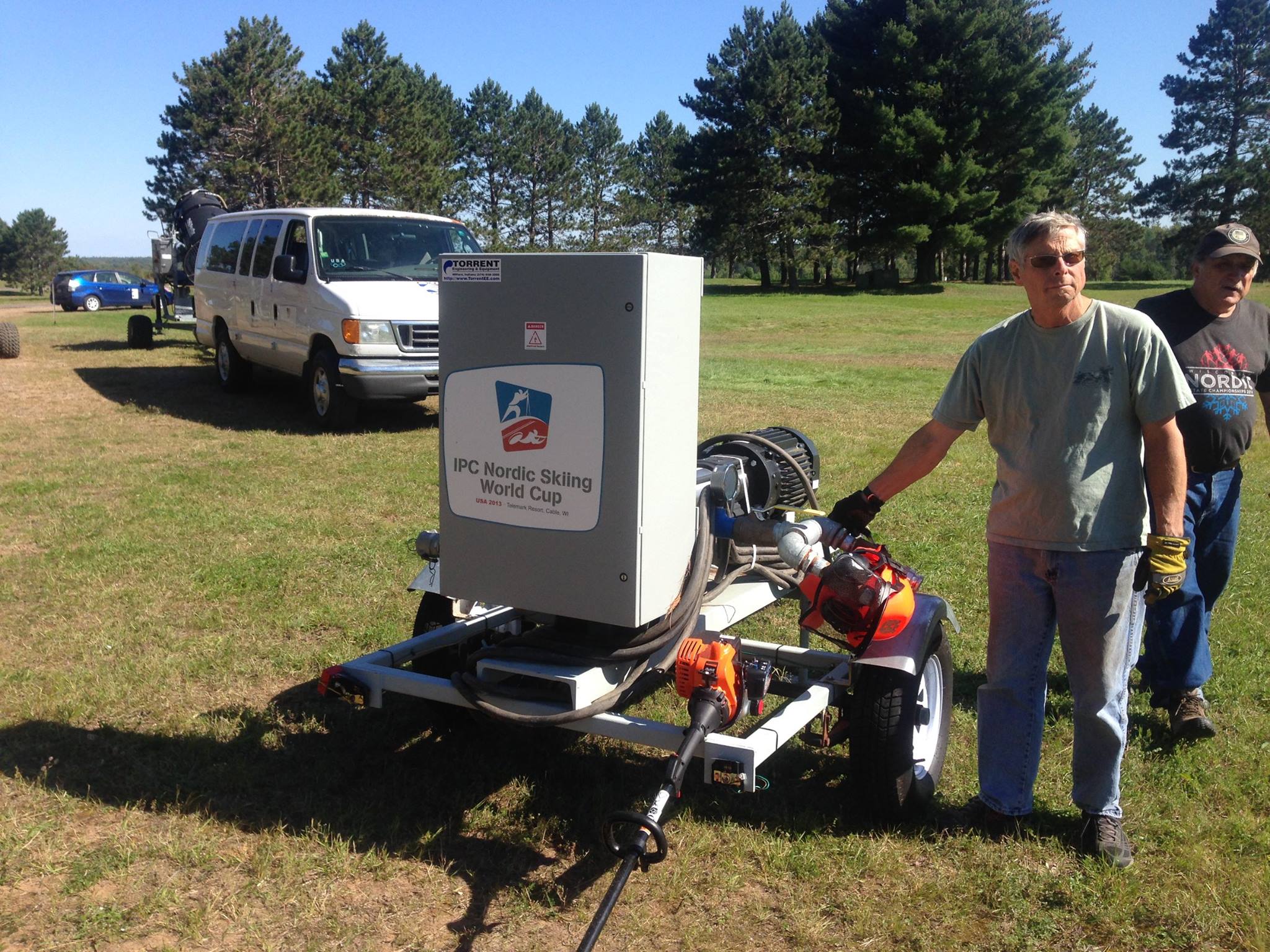
Volunteers get ready to test snowmaking equipment at Telemark trails in mid-September in Cable, Wis. The IPC Nordic Skiing World Championships will be held there Jan. 22-Feb. 1, 2015. (Photo: CXC Skiing/Facebook)
Northern Wisconsin, home of the Lumberjack World Championships and largest ski marathon in North America (a.k.a. the Birkie), is about to play host to the International Paralympic Committee (IPC) Nordic Skiing World Championships in January 2015.
For the first time in 10 years, IPC World Championships is returning to the U.S. since its last visit in 2005 in Fort Kent, Maine. And it’s coming to Cable, a town with fewer than 900 residents but with a history steeped in skiing since before 1947, when Tony Wise founded Telemark Resort.
The championships are expected to attract 150 of the world’s most competitive para-nordic athletes from 20 nations slightly less than a year after the Winter Paralympics in Sochi, Russia.
Central Cross Country (CXC) is heading up the organizing efforts, working with Telemark’s owners to revamp the trails used for the 2012 and 2013 IPC World Cups — two events that drew international attention to Cable.
“One of the coaches, I can’t remember what country, said we should host world championships because both those world cups were organized so well,” Yuriy Gusev, CXC’s executive director and the Cable 2015 organizing committee chairman, recalled in a phone interview.
Cable’s World Cup organizers first entertained the idea of hosting World Championships in 2012, then, after their second World Cup in 2013, they submitted an official bid that year.
When it comes to arranging an event of this caliber — with eight days of races between the opening ceremony on Jan. 22 and closing ceremony Feb. 1 — Gusev said it’ll be completely different from putting on a SuperTour or national championships.
For instance, in many domestic ski races, fewer than 100 athletes typically participate. While there will be slightly more at IPC World Championships, the level of competition will be significantly higher than even a World Cup, which often attracts development skiers. And teams that don’t usually fly across the pond for non-World Championships events, like Hungary and South Korea, will be in Wisconsin as well.
With more top-level skiers on course, Gusev said perfecting details — from appropriate hill grades for varying abilities, to the biathlon range — has been critical.
“It’s a lot more details than anyone would ever imagine,” he said.
One example: the hill that returns skiers back up to the stadium. As U.S. Paralympics Nordic Program director John Farra explained, it was so steep for sit skiers to ascend, especially those with little to no use of their core muscles, it wasn’t legal. And while it was used in the two previous Cable World Cups, something had to be done before World Championships.
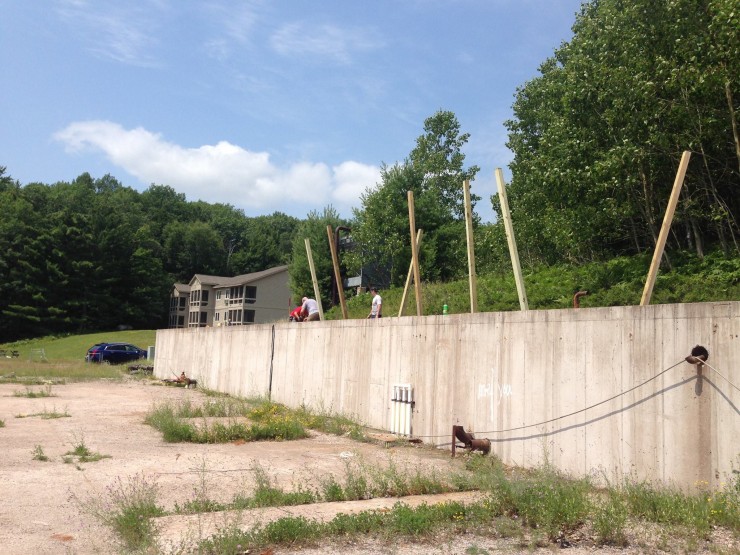
With help from former CXC head coach Bill Pierce, Gusev led the task of taking some chunks out of the hillside, as well as widening, flattening and cleaning up edges alongside the Telemark trails. That includes a homologated 5-kilometer competition loop and 2 1/2 k sit-ski loops.
This past spring, Farra and his co-coach, Eileen Carey, an experienced technical delegate, visited Cable to check on the progress and pre-empt some of the questions they knew the IPC would ask during its site visit in June.
“I’m glad we did it, and I think [Gusev’s] organizers appreciated it,” Farra said. “His new stadium is going to work, and he’s doing some pretty significant trail work … Now [the hill] is an appropriate return to the stadium. He’s done some nice improvements.”
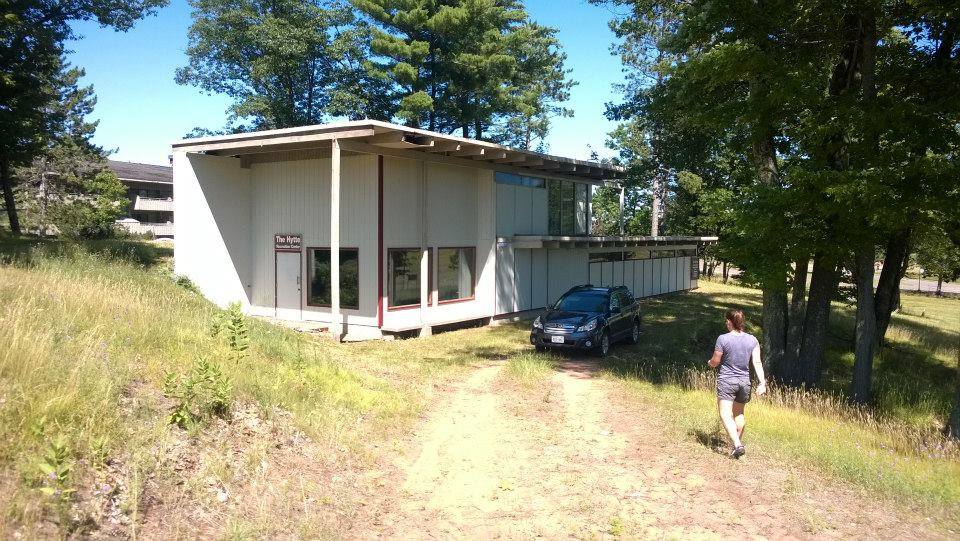
The Hytte Recreation Center at Telemark Trails is going through makeover to be ready for the 2015 IPC Nordic Skiing World Championships and other events this winter. (Photo: CXC/Facebook)
The stadium has been moved slightly to a higher point and is near one of the oldest buildings on the Telemark property, the three- to four-thousand-square-foot Hytte Recreation Center, which Telemark’s owners agreed to let CXC renovate.
According to Gusev, CXC updated and repainted it as an events/activity center. The owners also granted them use of the Telemark trail system.
The lodge itself remains closed, but as Gusev pointed out, “most of the venues anywhere don’t have lodging facilities at the start line.” Rather, Lakewoods Resort a 10-minute drive away will be the official accommodation and site of the closing ceremony.
“It’s not that easy to find a venue with a trail system and a biathlon range,” Gusev explained. “[We had] two world cups there and all the teams really enjoyed the trails and the layout.”
The opening ceremony will be held in downtown Cable in an open area between the grocery store and chamber of commerce.
In terms of spectators, Gusev said it was difficult to predict how many people would come watch the week-and-a-half championships. Regardless, he said his seven-person organizing committee was working hard to generate as much interest as possible in the months leading up to it.
He’s currently trying to lock down corporate sponsors to provide cash flow for hosting the event. The plan was to initially work with donation partners, then use the assistance of the IPC to attract international sponsors.
A few months ago, the organizing committee secured a grant from the state department of tourism as well as support from Bayfield County.
Depending on how fundraising goes, Cable 2015 could cost anywhere from an estimated $500,000 to $750,000 dollars, Gusev explained. While details and budgets will have to be finalized by November, he’s confident they’ll get there.
“If you look at the Paralympic Games in Sochi, twenty-five countries broadcasted and two billion watched it,” he said. “For the state [of Wisconsin] and the sponsors, it’s a pretty big event to be involved in and the media exposure will be huge.”
T.V. coverage will be a combination of small-scale broadcast and live streaming on the event website. Initially, Gusev said they considered a wide-reaching broadcast platform, but found the cost to be around $500,000 for a weekend of coverage. Alternatively, the live stream, which can be accessed anywhere online, will cost the organizers about $75,000, with equipment as the main expense, specifically a satellite truck.
At the same time, that option creates more work.
“If you have half a million and you have someone come in from New York to come do it, you don’t have to worry about it…,” Gusev said. “It’s actually more complex [to do the live stream].”
And in terms of snow, that’s partly why Cable got World Championships.
“In 2013, there was no snow anywhere and the little snow there was got melted by three inches of rain the day before the first official training day,” he said of the IPC World Cup that year. “All the races were on artificial snow so nobody could believe we pulled it off.”
Part of Gusev’s master plan is putting Telemark on the map as a venue that can hold consistently successful, big events. In 2016, Junior Nationals will be held on the same homologated trails in Cable.
“The standing course is [a] legitimate, hard, Sochi-like course to throw at the athletes,” Farra said. “[And Telemark has] similarly challenging courses for sit skiers.”
(Photo: CXC/Facebook)
The Hytte Recreation Center at Telemark Trails is going through makeover to be ready for the 2015 IPC Nordic Skiing World Championships and other events this winter. (Photo: CXC/Facebook)
(Photo: CXC/Facebook)
(Photo: CXC/Facebook)
(Photo: CXC/Facebook)
(Photo: CXC/Facebook)
CXC volunteers cleared the sit-ski finish of several loads of rocks and boulders with Avant Tecno USA on Sept. 30 before the IPC Nordic Skiing World Championships in January. Next task: seeding it and putting down mats. The same trail will be used this winter for the Midwest Junior National Qualifier, Wisconsin High School State Meet and 2016 Junior National Championships. (Photo: CXC/Facebook)
Clearing the Telemark trails for IPC Nordic Skiing World Championships in January 2015.
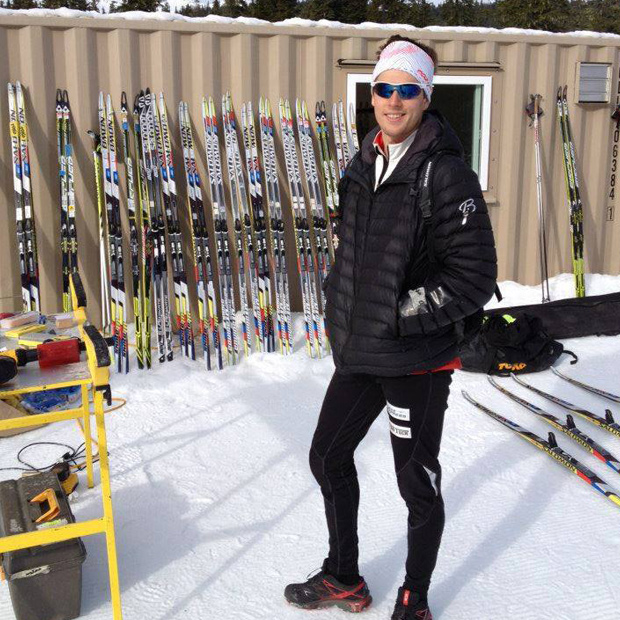
The newly appointed CXC Team Head Coach Andy Keller (r) works on strength with postgrad Scott Harrison outside a barn near Cable, Wis. (Photo: CXC Skiing/Facebook)
Three years ago, Andy Keller was a college kid looking for an internship toward his exercise-science degree at Michigan Tech. He knew a girl, who knew Jason Cork, and he used the connection to land an apprenticeship at the Central Cross Country (CXC) Ski Association in Cable, Wis.
At the time, Cork was heading up the CXC Team, which executive director Yuriy Gusev established in 2006 to support promising skiers striving for top national and international performances. Keller, who grew up just outside Minneapolis in Chanhassen, Minn., became Cork’s intern assistant.
Andy Keller started as an intern, then an assistant, and finally a junior coach before being promoted to CXC Team head coach this month, following the departure of Bill Pierce. (Photo: CXCnewsfeed.wordpress.com)
Months later, before Keller began his senior year, Gusev offered him a job.
“I said, ‘I kind of want a degree so I’ll talk to you in a little less than a year,’ ” Keller reflected on the phone last week.
He skied for four seasons at Michigan and graduated in 2012, then asking Gusev if there was still a spot for him. There was, though Keller’s job title and responsibilities changed three times before he officially got started, he said.
First, he was hired as sport-development manager, tasked with connecting CXC to youth clubs and high-school programs in the Midwest. Then, CXC’s assistant coach Gus Kaeding left to head the Stratton Mountain School (SMS) elite team in Vermont. Cook needed an assistant, and CXC’s board decided Keller would be it.
“Then there was a little bit of [difference] with coaching styles and athletes on the team, so Bill [Pierce] got brought on to work alongside Igor [and] I took more of a dedicated role to the junior program,” Keller said of last season. “This year started off the same way … I was focused more on the junior program.”
For the next several months, Badamshin oversaw the program and Pierce worked as the elite head coach. In late January, Badamshin died unexpectedly of a heart attack while skiing the Birkie trail between Cable and Hayward, Wis. He was 47, and his passing left CXC and the surrounding community stunned.
“A guy that works his ass off and is willing to do anything for his program … his passion truly lied with working with athletes,” Keller reflected. “[I] was just trying to carry on his legacy — inspiring kids to ski and getting them excited to be out there. If there’s one thing he was good at, it was definitely that, and also carrying on his work ethic. The guy wouldn’t complain. He’d be out there skiing 50 k and waxing…
“There was definitely big shoes to fill when he passed away,” CXC Team’s new head coach continued. “As I’ve come through, I’ve been working under a ton of coaches; my philosophy is I can always learn something. When I was interning under Jason and Gus that was what I loved to do — learning and listen.”
“There was definitely big shoes to fill when [Badamshin] passed away. … As I’ve come through, I’ve been working under a ton of coaches; my philosophy is I can always learn something.” — Andy Keller, CXC Team Head Coach as of September 2014
Keller Becomes Head Coach
That’s right, Keller, in his third season as a CXC coach, was recently promoted to head of its elite team following Pierce’s decision to accept a job in Colorado (he’s becoming nordic director of the Snow Mountain Ranch YMCA near Winter Park this fall) earlier this month.
But “elite” is a term Gusev and several other U.S. nordic directors like to stay away from: it’s about development and helping athletes reach their higher-competition goals. The CXC Team became Team Vertical Limit in 2009 as part of a sponsorship deal, and a year later it had 18 athletes, including a couple Olympians (Garrott Kuzzy and Caitlin Compton — now Caitlin Gregg).
The New: 2014/2015 CXC Team
CXC Team:
Cory Ellertson
Bjorn Batdorf
Bill Bowler
Chris Pappathopoulos
Hilary Patzer
Andrew Brown
Scott Johanik
Natalia Naryshkina (lives in Russia, plans to compete in western SuperTours and U.S. nationals)
Postgrads: (living in Cable this fall/winter)
Scott Harrison
Sam Boardman
College Summer Residency Group:
Nichole Bathe (University of Alaska Fairbanks)
Nicolette Reker (now at Winona State University, competing for CXC Team)
Tom Bye (Postgrad last year, now at Michigan Tech)
Thomas Kendrick (Michigan Tech)
Will Frielinghaus (St. Lawrence University)
Seth Mares (Gogebic Community College, plans to transfer to Michigan Tech)
International Training Partner:
Leandro Lutz (living in Cable this fall, plans to travel to Europe for international races in an attempt to qualify for World Championships; may stay in Cable and race U.S. circuit)
The CXC Team currently has eight members, most of which will be focused on top-10 results in Midwest marathons to attract sponsors. In addition, Keller is overseeing two postgrads, about 10 juniors and an international guest skier.
“All the coaches agreed, the team needs to get back to the roots of developing athletes,” Gusev explained on the phone. “You would have never called our team the CXC Elite Team, it just came later when this word became very popular.
“We always see our team as a development tool for that higher step,” he added. “We don’t see this team as full of stars, but we want to have a team open to athletes of that level. If it can help them great … It’s just like having a child: at some point you need to let them go and see if they can stand on their feet.”
Considering that, Gusev is encouraged by the direction his program is headed, especially with a homegrown coach at the helm.
“It’s exciting to see somebody who went through the original pipeline and became a coach,” he said. “And that’s a goal from the time he applied from an internship.”
Still, the last few weeks — and months — have been busy at CXC, to say the least. Following Badamshin’s passing, Gusev said the organization interviewed a couple people to hire in his absence, but ultimately, Pierce and Keller stepped up and said they could handled the added responsibilities without another coach.
“It was probably more emotional for some of us, but you just move on,” Gusev said. “The programs needed to move on as well and … we had to adjust right away.”
It didn’t take long for everyone to get back “in the groove,” he added. Pierce continued to serve as head coach and Keller as his assistant and junior coach.
Last Friday, Keller drove 300 miles southeast to Madison to test about 10 juniors at a weekend camp at CXC’s administrative headquarters. The group meets about once a month in various places, holding camps with other Midwest clubs, like Loppet Nordic Racing (LNR), May through December, Keller said.
He also helps host monthly CXC master’s camps, and while he’s not scheduled for every single one, he led a recent camp under Pierce’s guidance earlier this month.
“I made Andy run over half the sessions, and I watched him and helped him a little bit,” Pierce said. Then he told him and the rest of CXC about his decision to leave.
“I saw it coming,” Keller reflected. “Bill did talk to me as he found out more about the new position he was taking.”
In Cable, where Keller lives in a condo on the Telemark property, he spent the summer working with six athletes in CXC’s new college summer residency program, which Pierce initiated.
“That overlapped with what you would call our team now, more of a marathon team,” Keller said of his previous and current responsibilities, coaching juniors and now seniors as well. “The athletes that we’ll have competing on the SuperTour is relatively small.”
Those skiers include two postgrads from LNR — Scott Harrison and Sam Boardman — who plan to live and train full time in Cable this fall and winter. Their main races include western SuperTours, U.S. nationals, and the Midwest Junior National qualifiers .
“We don’t see this team as full of stars, but we want to have a team open to athletes of that level. … It’s just like having a child: at some point you need to let them go and see if they can stand on their feet.” — CXC Executive Director Yuriy Gusev
With an overall emphasis on regional competitions, CXC is looking to assemble the best skiers in the Midwest.
The Old: What happened to last season’s CXC Team?
Not returning: Karl Nygren, Eric Wolcott, Dmitriy Ozerski (was flying back-and-forth from Russia for races)
With a single returner from last year’s CXC Team (college skier Tom Bye), Keller explained what happened:
“When Igor [Badamshin] took over there was little bit of communication issues … a little bit of discontent,” he said. Athletes like Karl Nygren, who might have had as many as five coaching changes in seven years, ultimately decided to leave the program.
“If there’s anything the program needs is some stability,” Keller said.
“As the coach now, I’d love to build the program back up to how it was when I interned,” he said, referencing past CXC standouts like Jessie Diggins, Caitlin Gregg, Brian Gregg, and Jennie Bender. “…That was the year they won the NNF Cup so that’s the level I’d like to bring it back to.”
One of Gusev’s priorities is hiring another coach focused on sport development to further connect CXC with grassroots organizations and schools throughout the central U.S. Looking at the big picture, it’s about promoting the sport and coaching development. In the long run, CXC is hoping that will translate into athlete retention.
“Regardless whether the athletes come to us directly or not … it’s a matter of whether we have consistent, easy to follow progressions, like soccer does or swimming does,” Gusev said of two sports he considers domestic successes in the U.S. “[Those sports outline the] steps to high school, college and beyond, which doesn’t exist really in cross-country skiing. We have all the pieces in place, and we can communicate that to parents.”
For Keller, his goal is to help grow the base and competitive nature of skiers in the Midwest, which includes Illinois, Indiana, Iowa, Kansas, Michigan, Minnesota, Missouri, Nebraska, North Dakota, Ohio, South Dakota, and Wisconsin.
“It’s where I grew up,” he said. “[We’re] trying to make the Midwest more of a ski powerhouse, and that’s definitely happening. We’re developing athletes, but we’re having a hard time getting them to stay around.”
He counted eight skiers in elite programs outside their region, including Jessie Diggins (SMST2), Anne Hart (SMST2), Ben Saxton (SMST2), Gordon Vermeer (Craftsbury Green Racing Project), and Rosie Frankowski (Alaska Pacific University).
“It seems like everybody wants to go somewhere else and I’ve got to figure out why,” Keller said. “I think the level of support CXC gives is among the best … It’s just we’re not in the mountains and we don’t have a glacier to [train on]…
“The Midwest might not be the most sexy training site as a Sun Valley or something like that,” he continued. “… [But] it’s not that we’re not producing the athletes.”
“It seems like everybody wants to go somewhere else and I’ve got to figure out why. I think the level of support CXC gives is among the best … It’s just we’re not in the mountains and we don’t have a glacier to [train on]…” — Keller
In terms of coaching styles, Keller said he gained a lot from working with Cork, Kaeding, Pierce, and Badamshin.
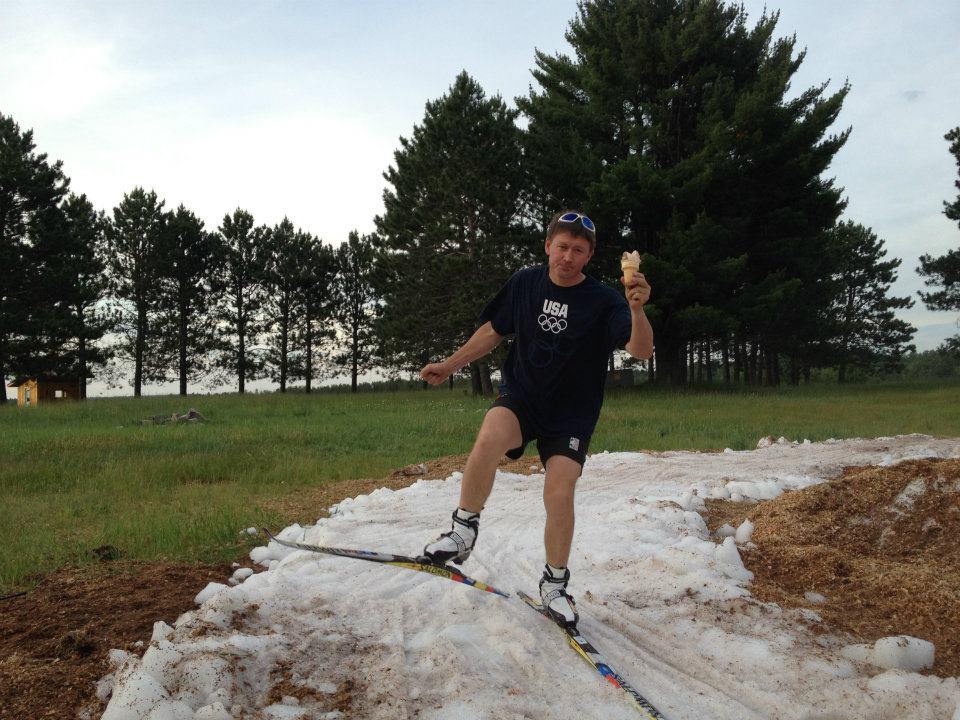
Coach Igor Badamshin having some fun on a few patches of snow. Photo is titled “Snowflakes, ice cream and Igor,” by former CXC Team elite coach Bill Pierce. Badamshin was the CXC program head coach until his unexpected death in January 2014. (Photo: cxcnewsfeed.wordpress.com)
“I’d hope I’d be maybe as analytical [as Cork],” he said. “I’m hoping I can be half as enthusiastic and motivating as Igor … I try to pull from all those guys and find out what works for myself and what doesn’t fit my personality. I would say I’m relatively soft-spoken and sometimes it’s a little bit harder for me to put myself out there. I hope I’ve gotten better at that.”
When it comes to managing athletes, Pierce will continue to write training plans for those that started with him at the beginning of the season, including Cory Ellertson, Chris Pappathopoulos, Andrew Brown, and Scott Johanik.
Keller said he’ll take on those that joined the team more recently and will be in Cable the next several months: the two postgrads and guest skier Leandro Lutz from Brazil, who plans to travel to Europe to try to qualify for 2015 World Championships.
As for coaching and waxing for 18 or so skiers throughout the season, Keller said that working alongside other Midwest clubs at races, especially at main events like U.S. nationals, should help. And not all the athletes will compete at the same events, given their varied focuses — from marathons to junior-qualifying races.
At the same time, Keller said he’s looking forward to having an assistant or some kind of helper in the future. Gusev said the new hire would largely help with junior camps.
In the last month since Pierce’s decision, he said he’d been working with Keller on the transition and will continue to offer assistance beyond his final day at the end of September.
CXC Team’s fall/winter crew during a recent workout in Cable, with postgrads Scott Harrison and Sam Boardman, and guest skier Leandro Lutz from Brazil, who will be joining the team for the next couple months. (Photo: CXC Skiing/Facebook)
“I’ve basically given [Keller] my daily responsibilities,” Pierce said earlier this month. That included even the little stuff, like “teaching him how to smooth out a trail and pick rocks and seeds.”
“There’s definitely a lot to catch up on as far as ski selection and things like that,” Keller observed. “Working with Rossignol, getting in contact with those guys, getting up to speed with things Bill might’ve taken care of as far as a team aspect and getting [ready] to compete.”
He’s also tasked with attracting sponsors through top results in Midwest marathons.
“We’ll do fine with that,” he said of his mostly marathon-focused team. “Our postgrads have goals of trying to make World Juniors … definitely a big one is qualifying for Junior Nationals and trying to make top-20 [there]. The goals for the marathon team is being on the podium or top 10 … that should be no problem.”
He’d also like to bring the CXC Team back to an “elite, elite” team, he said, by recruiting recent graduates.
CXC Para Nordic Team member Steve Baskis training with U.S. Paralympics Nordic Program in the ski tunnel in Torsby, Sweden, earlier this month. (Photo: CXC Skiing/Facebook)
According to Gusev and CXC’s mission statement, the 2,000-member organization has four straightforward goals: to build its base, promote the sport, achieve competitive success, and create partnerships through collaborations. The way he sees it, member athletes are part of that as well.
“[The CXC Team] athletes are in a community to be motivation to adult athletes at clinics, to be role models and whatever else comes with it,” Gusev said. “With competitive excellence, we hope to get them to the level [of someone like Garrott Kuzzy or Tad Elliott, who made the U.S. Ski Team]. We hope the athletes that come through our program will eventually contribute to international success…”
Emerging Adaptive Team
CXC is also focused on building its adaptive program under coach Andrew Poffenberger, another Minnesota native who skied as a junior and studied health fitness at Gustavus Adolphus College in St. Peter, Minn.
Augusto “Goose” Perez (sit-skier, cancer survivor, 2014 Paralympian)
John Oman (standing athlete, 2014 Paralympian)
“Emerging Talent” Program:
“People who have tried nordic skiing on several occasions and show promise, interest in competition, and commitment to the sport,” Poffenberger wrote. “This is an area where I am looking to grow in the next few months as people turn their attention from fall sports to winter.”
Junior Para Development: Focused on youth development and coaches interested in instructing adaptive skiers in high schools. “Our annual coaches clinic and certification will include a few sessions on adaptive nordic skiing for those interested this year,” he wrote.
This year, the CXC Para Team has expanded to include five elite athletes, four of which went to the 2014 Sochi Paralympics: Aaron Pike, Travis Dodson, Augusto “Goose” Perez, and John Oman. Its fifth member, Steve Baskis, a blind athlete and veteran, recently joined the U.S. Paralympics Nordic Team at an on-snow camp in Sweden.
Poffenberger also works with three “emerging talent” adaptive skiers — those “who have tried nordic skiing on several occasions and show promise, interest in competition, and commitment to the sport,” he explained in an email.
In addition, he coaches about four or five junior-development skiers, athletes that “can sit ski for 10 to 15 k in a session,” Gusev said. “Andrew’s done an amazing job with them.”
“Ideally we would like to mirror the development structure of able-bodied skiing,” Poffenberger explained. “Possibly the most important component of that structure is youth development. If we expect to be competitive at the highest level, we need to start developing young athletes.”
Among their efforts: CXC has submitted a proposal to include adaptive nordic at the Wisconsin state meet.
“We are also seeking out coaches who are willing and able to coach adaptive nordic skiing at the high school level,” he added.
Last week, Poffenberger attended a conference with The United States Association of Blind Athletes at the Olympic Training Center in Colorado Springs.
“I love working with these athletes because they have perspective of the entire picture, and don’t let small things stand in their way,” he said, now in his second season with the team.
“I hope we can keep having more and more individuals like [Poffenberger and Keller] that get involved with a sport as a profession,” Gusev said. “They understand the way athletes move from one stage to another stage and it’s easier for them to communicate with athletes at the younger level what expectations are. That’s really the goal.”
CXC elite-team head coach Bill Pierce recently accepted a position as nordic director of Snow Mountain Ranch YMCA of the Rockies in Granby, Colo. (Photo: CXC/Facebook)
Almost a decade ago, Bill Pierce and Yuriy Gusev took a walk in the Cable/Hayward area of northern Wisconsin, where Gusev, the director of Central Cross Country (CXC) since 2005, decided to root the CXC Team and Junior Program (and later an adaptive program and CXC Academy).
Pierce, who built custom homes at the time through his own company, Pierce & Associates Design/Build, Inc, wanted to show Gusev a thousand-acre parcel — a potential site for a big idea.
A competitive cross-country skier and runner up until the mid-80s, when he studied at the University of Wisconsin-Milwaukee School of Architecture and Urban Planning, Pierce moved to Hayward and found part-time work in 1997, grooming the Birkie trail on a need-basis with one broken-down snowcat.
“When I went to Hayward, my first job to get paid skiing was [as head coach] at Hayward High School,” Pierce said Thursday on the phone. “That was enough money for one month over five to make a living off of so I did other things.”
It wasn’t long before he was chairman of the American Birkebeiner Board of Directors and landed his first full-time coaching job in 2007. He built his home in Seeley and dreamt of more for Hayward: a charter school and training center for nordic skiers — and not just any nordic center: a multi-use events center.
“If you want to be mainstream and survive as a business, you can’t just be nordic,” Pierce reflected.
In his development near the Birkie’s “00” halfway point, ski trails touch every lot. Yet without Telemark Resort open, the area remains without a nordic center.
Thinking back to his idea, he imagined opening the events center to non-skiing attractions: music festivals, beer-and-wine tastings, bike shows, and more. Unless its developers were subsidized, they would have to — selling trail passes four or five months a year wasn’t going to pay the bills, he said. But with the offseason revenue, they could fund their dream of a true nordic-training center.
To this day, Gusev has kept that same goal in sight and taken steps, such as researching the potential of Telemark Lodge, to make it a reality. It’s been on Pierce’s mind for the last two decades, and he said the 1,000-acre parcel remains on the market.
“It’s a soft market and soft economy … [and] we’re looking at another piece of land south of here,” he said. “There’s opportunities.”
An estimated 60 athletes and coaches attended the 2014 CXC/Loppet Nordic Racing/F.A.S.T. dryland camp in Ironwood, Mich., earlier this summer. Here, athletes were caught in action during a bounding workout. (Photo: Bill Pierce/Facebook)
But Pierce, CXC’s elite head coach since May 2013, couldn’t wait on that. In the last few years, he applied for other jobs, including with the American Birkebeiner — which Gusev knew about as a board member — and as executive director at Soldier Hollow in Midway, Utah.
One position near Winter Park in Granby, Colo., stuck. Pierce accepted the Snow Mountain Ranch YMCA’s offer to come on as its first full-time nordic director this fall, and he sat down with Gusev to tell him about it three weeks ago.
“I knew that sooner or later Bill will leave and we were somewhat planning on it,” Gusev wrote in an email. “We have discussions with other staff about possible options if that would happen. We also had plans to add additional staff this fall even before Bill notified us about his leaving.
“It is definitely a loss for CXC and the Midwest Nordic community but Bill is following his passion and I’m glad he found something that he is very excited to be involved in,” he added. “We all at CXC wish Bill the best in his new venture.”
“It was a hard choice,” Pierce explained. “I’d come back in a second to work for [CXC]. It was a lot of factors, some of them were personal…”
In post on CXC’s Facebook page on Thursday, Pierce announced his departure and move to Colorado on Oct. 1.
“… Life is extremely short and we really won’t ever know what the next day will bring,” he wrote. “In the past year, I have seen a lot of loss and it has been a difficult one. I lost my Mom, two very close friends and colleagues in John Hugus and Igor Badamshin, and I lost my marriage. It is time for a change.”
CXC’s former high-performance advisor and CXC Team coach, Badamshin died of an apparent heart attack while skiing on the Birkie trail in January. He was 47.
Hugus, who founded the Knicker Nordic Ski Club in Wausau, Wis. — of which Badamshin was also head coach — and served as secretary of the Central Wisconsin Skiing Association, died last October at 57 after batting multiple myeloma for 17 years.
“With Igor’s death and coaches leaving to do different things, I’m leaving because I feel like I can do something more for developing the sport, to help people enjoy it and enjoy winter,” Pierce said on the phone.
His first job with CXC came in 2007, when Gusev hired him as a full-time head coach of CXC’s Junior Development Team. He worked there until 2010 and went on to co-found F.A.S.T. Performance Training with his wife Kathy, spending the next three seasons working to establish a high-performance mecca in Hayward.
It wasn’t for naught. Athletes like Ben Saxton, now on the U.S. Ski Team’s D-team, came up through F.A.S.T., and Nichole Bathe, a University of Alaska-Fairbanks sophomore and CXC training partner, have already achieved top national results.
Gusev had brought International Paralympic Committee (IPC) World Cups to Cable, and in the last year, landed the 2015 IPC World Championships and 2016 U.S. Junior National Championships. But Pierce said the next step — creating a permanent nordic or training facility — required teamwork.
“Any project of that size takes a group of people and collaboration,” he said. “Everyone wants to be a part of that growth. I think people need to realize more that we need to work together to do that.
“No matter how small, you are just doing the right thing. If you’ve got four or five kids, just coach ’em. … You’ve just got to stick at it year after year and just be consistent what you do. It’s a long, long process.” — Bill Pierce, F.A.S.T. Performance Training founder and CXC elite-team head coach, who recently took a job as Snow Mountain YMCA’s nordic director
“You think of Hayward as a destination,” he added. “You get a few hundred people every weekend.”
Upon a recent visit to Winter Park, he estimated 1,000 people in the area on a weekday.
“That’s a destination,” he observed. “I call it an adventure park or activity park. They’ve done a good job of becoming a true destination.”
While he said Hayward’s not quite there yet, “they’re different animals,” he explained. Snow Mountain’s YMCA of the Rockies has been around for more than 100 years. “The Birkie trail has been groomed for twenty years,” he pointed out.
Birkie racers on the Birkie Trail (Photo: ABSF/Kelly Randolph)
Since then, the American Birkebeiner has grown its fleet to three PistenBullies and roughly four snowmobiles under Pierce. Formerly the Birkie’s head groomer, who oversaw 88 k of trails and 14 pieces of equipment, he retired from grooming last year to return to full-time coaching.
“I love sitting on the groomer at night; it’s a blast,” he said. “[But] I don’t have to sit on it every night for eight hours.”
As for that job: “I felt like I did what I wanted to do and it was time to leave and do something else,” he explained.
Leaving the Midwest, where he was born in southern Wisconsin, went to school in Milwaukee, and spent 14 years in Minneapolis, was about timing as well.
“I’ve always moved around — I haven’t been home in three years,” he explained. “That was actually one of the considerations: when you’re on the domestic circuit, you’re on the road from October to March. … To me, it wasn’t a sacrifice, it’s just hard.”
He began researching other opportunities to educate himself. When he discovered the opening at Snow Mountain, the idea of expanding an existing nordic area with 100 kilometers of trails, adding to mountain-bike terrain and cultivating the fat-bike craze there was too good to pass up.
“Of all the jobs I’ve looked at, this is an accumulation of all the duties in one,” Pierce said. “I kind of look at it as three phases: running the center, overseeing the coaching, and overseeing the trails. It’s a year-round job.”
And while it will be a transition — from elite coaching to building a nordic culture from the ground up — he said he’s ready.
“The relationships that have been formed with many people, colleagues, and athletes cannot be matched or replaced,” he wrote on Facebook. “I loved all aspects of the position but most of all I really enjoyed coaching the Master skiers. They truly are trying to find enjoyment and re-creation in this sport and it was so rewarding to see progression and enjoyment from these athletes and people!
“The hard part is leaving the relationships,” Pierce explained on the phone. “I won’t forget them, I just wont see them as much as I did now.”
At a CXC masters camp late last month, he had CXC Development Coach Andrew Keller run more than half of the sessions. Keller will fill in as elite coach during the transition this fall, Gusev confirmed.
“Of all the years that I’ve coached masters, this was the best,” Pierce said, adding that they have another masters camp next week. “Being a coach … is being able to look at someone and tell them how to change, and … the level of professional and social relationships that you build…
“You’ve just got to be consistent and keep doing it,” he said of his passion and advice to other coaches. “No matter how small, you are just doing the right thing. If you’ve got four or five kids, just coach ’em. … You’ve just got to stick at it year after year and just be consistent what you do. It’s a long, long process.”
In October, he’ll start all over again in Colorado, assessing what is needed there. Unsure of what the future holds, he’s excited by the challenges and possibilities.
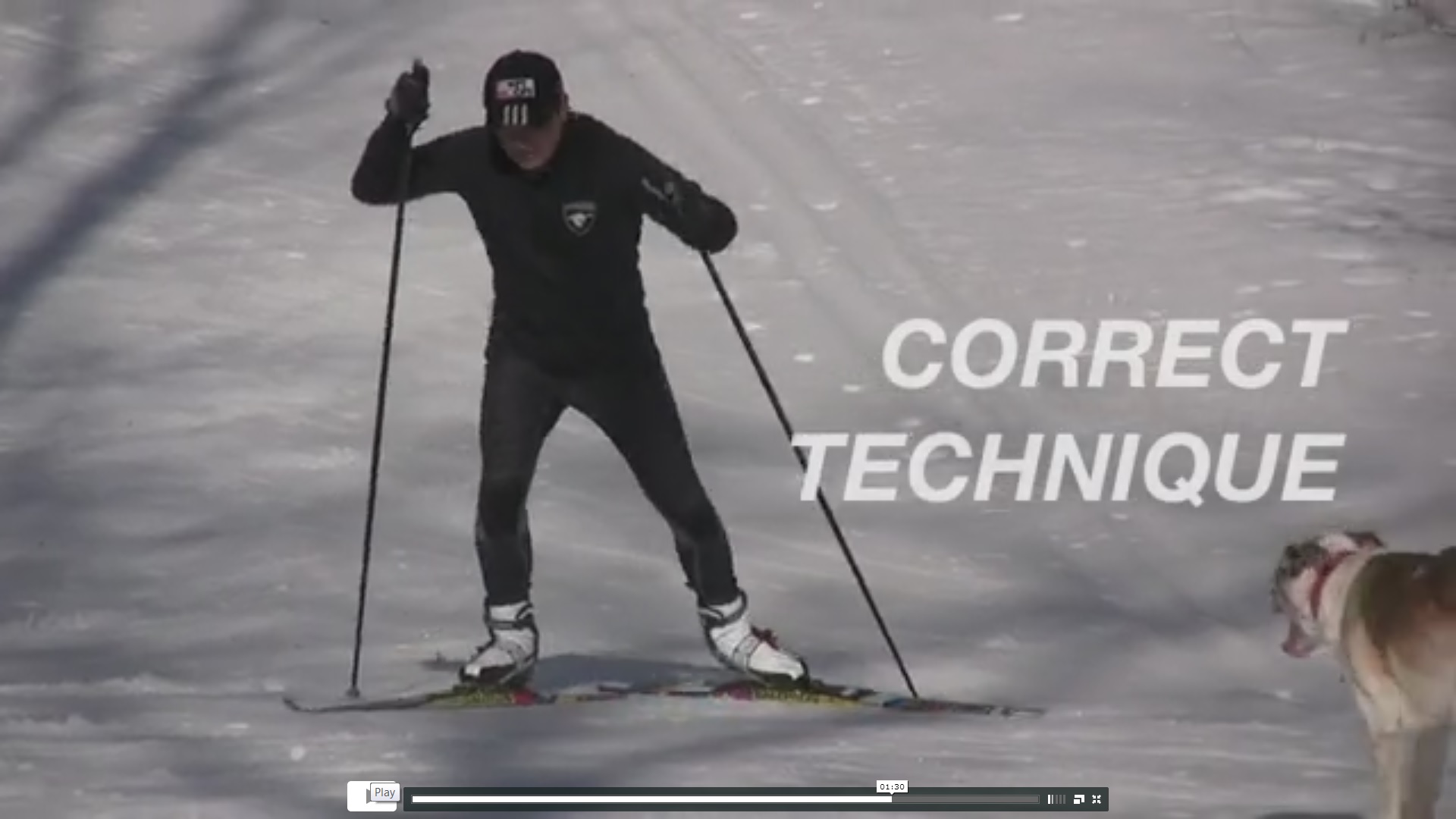
Yuriy Gusev, Central Cross Country (CXC) executive and athletic director, demonstrating proper V1 technique in a CXC Academy video.
You read FasterSkier so it’s probably a safe bet that you would like to, well … ski faster!
And so if, as you recover from the recently concluded race season, you are already thinking about how to improve your race times next year, Yuriy Gusev has a plan for you. A training plan that is.
Intrigued by the CXC Academy, I called up Gusev, executive and athletic director of the Central Cross Country (CXC) Ski Association. The Academy is described on the CXC website as “an online subscription service that provides professional training plans for cross country skiers of all ages and skill levels.”
Gusev explained that was Academy was started in 2007 by himself and former CXC elite coach Bryan Fish (now the U.S. Ski Team development coach) as a way to share the state of the art ski training expertise that Gusev and Fish compiled while developing the CXC elite program.
“Bryan and myself made a lot of connections with sports professionals in strength and conditioning and sports science and medicine,” Gusev said. “We started brainstorming what can it [the Academy] be and who can it serve.”
CXC Academy promotional material summing up its offerings
In its early stages, the Academy was envisioned as at tool to share information for training elite athletes. While the Academy still contains an elite-level plan (plans similar to those used by CXC elite-team alumni Brian and Caitlin Gregg, Matt Liebsch, and Jessie Diggins), the program quickly expanded to include novice, intermediate and elite level format.
“Initially we thought it would work just for coaches, but it has developed pretty quickly that it can be used by anyone all over the world,” Gusev said.
So how was the elite plan modified for intermediate and even novice skiers? “We had a lot of discussions after the first year … what we did is simple, really,” Gusev explained. “We minimized number of workouts per week and number of hours and that mostly takes care of different levels. For example, somebody who trains 260 hours per year who just wants to ski the Birkie … [they don’t] need to do two Level 4 workouts a week. They might just need to go at Level 3 just above their comfortable pace for an hour and half once a week.”
I explained to Gusev my difficulty in researching how to train for two 50-kilometer citizen races (the Seeley Lake, Montana OSCR and West Yellowstone Rendezvous) last winter. My research left me overwhelmed about how I should incorporate various training elements such as intervals, strength training (I decided strength must be important after watching Kikkan Randall do pullups with weights strapped to her waist) and my first-ever pair of rollerskis, into my race preparation.
While chatting with Gusev, I discovered I wasn’t the only one lacking a training plan. “Believe it or not, we just had a coaches conference in November with about 50 coaches, both club and high school coaches, and I asked pretty straight forward question: How many of you give your athletes a day-by-day training plan?” Gusev recalled. “And probably two or three hands went up.”
He went on to explain CXC’s philosophy regarding training plans. “What we believe in our organization is that any structured plan is better than no plan,” he said. “We have athletes on that plan. We have heard from high school coaches to masters skiers to senior level athletes that they have had the best seasons ever … and they still continue to improve season after season.”
Gusev added that the Academy is for everyone from those training for marathons or short-distance races, from a high-school skier to someone who’s qualified for nationals.
“Any structured plan is better than no plan.” — Yuriy Gusev, CXC Executive Director
Sample CXC Academy training plan layout
I told Gusev that most of my resistance to training plans was what I perceived as their inherent rigidity. I have friends who love nothing more than to see their training laid out before them on a neat, orderly grid with a little box in the corner to check when the workout has been completed. I am not one of these people.
To me working out is essentially goofing off, an escape from demands of work and life. I live in Missoula, Mont., if the weather and my work schedule allows for a short mountain-bike ride on the same day when the training plan calls for strength workout in the gym, I’ll dump the plan in a heart beat.
I asked Gusev about how his training plan can work for people with busy lives.
“From the user side, what we’ve heard is that some people follow it like a bible, literally day by day, and some people try to adapt it to work and family and other things,” he said. “What we suggest to people is that this is a road map … you know, its just getting those pieces done some time during the week. That’s what’s really important and everyone has a different way of how to structure the week around training.”
Regarding alternate training activities, Gusev said, “That’s the perfect situation, if someone can do other activities, whether you are an elite athlete or you want to be a wave Birkie skier … you just do those workouts by bike or kayak or by foot or the swimming pool but you follow the plan to build your training. Obviously, the more specific you can be the better it is. Some people might choose to rollerski once a week, and some may choose to not rollerski until September or October … so everyone is different. Even at the elite level there is no single formula out there that will make you fast.”
I discovered the Academy midway through my ski season and signed up for my free one-week introductory membership. My next race was the Peter Hale Memorial, a 22 k race with over 1,000 feet of climbing so I watched an Academy video on V1 technique. In the video, Gusev demonstrated the importance using both legs equally regardless of which side you are poling on. I focused on that single tip during my entire race. I told Gusev that I finished ahead of two racers who had beaten me [quite easily] in a race two weeks earlier. It was the first time I had ever finished ahead of one of them!
I asked Gusev if my focus on his tip could have made the difference for my improvement. “It could be, easily,” he replied. “We have a lot of people email us literally a week before the Birkie, and they say, ‘I didn’t train at all — I just want to make it through.’ You’d be amazed at how many people there are like that, and you know, there’s no magic wand to make them better, but there’s some things you can tell them, some basic tips just like what you talked about with V1.
“I’ve heard from a lot of people that we’ve given advice and they said it was magical,” he added.
CXC Academy video library
CXC Academy has a video library which Gusev said sets them apart, providing both technical advice and a visual demonstration of how it should be done.
“What we learn with a technical sport like cross-country skiing that the most important part for people to understand is what they should be doing … and how the technical elements [of skiing] make them more efficient and faster,” he said. “I haven’t seen anything else out there that gives that advice.”
The Academy video offerings are extensive and include sections on strength training, on-snow skiing for both skate and classic, rollerskiing, dryland training, waxing and equipment. The videos are tightly integrated with the training plans. For example, the intermediate training plan for April calls for one day of general strength training per week. A video demonstrating all recommended exercises is linked to the plan. On a recovery day during the race season the plan might recommend that you get some wax into your ski bases and a link to a waxing technique video is provided.
The CXC Academy offers a free five-day trial period. A one-month subscription is $14.95 and one-year subscription costs $119.40.
“Those paying members … help us pay the cost of servers, the cost of hosting videos. There is cost in everything,” Gusev said. “We we give complementary memberships to Paralympic team members and high level para-athletes. Those paying memberships allows us to have this resource, and without them we couldn’t help those Paralympic athletes and organizations like National Nordic Foundation.”
Gusev said the Academy’s support of the U.S. Paralympics Nordic program wasn’t planned, but there was a need.
“We were at Park City at the National Ability Center ski camps and they had development athletes from all over the country … and they didn’t have one centralized place for getting a plan,” he explained. “For some of them, if you have an adult who has never done any athletic training in the past, now with a disability trying to do a competitive sport, for them a training plan is like, they don’t even know from what side they need to look at it.”
Since I’m just getting started following the intermediate training plan, I asked Gusev what I can expect next ski season.
“You will go faster when you want to go faster and it will be a lot more enjoyable to go faster,” he responded. “I don’t race any more, I don’t have time … but I enjoy when I go ski and I can go up a good hill at a good pace and enjoy it. I can go ski for three hours if I want to.
“Really, what [the Academy] does is builds all components of training, from anaerobic to aerobic and speed and endurance, so it gets to the point where you can do anything you want to,” he added.
I told Gusev that I race mainly to provide goals to get me out exercising and skiing. While I love skiing, I don’t consider myself to be a racer. I asked if his training plan is appropriate for someone like me.
Igor Badamshin (right) laughing through technique work with (from left) Alex Howe, Dylan McGuffin, Ethan Dreissigacker, Will Anderson, and Sam Marshall, at a summer training camp in Austria. Photo: Martina Howe.
Almost ten days ago now, the U.S. ski community lost one of its most valued members: Igor Badamshin, who died of a heart attack while out skiing.
“He was in an area that he really enjoyed, and he skied on the Birkie trail, and it was a beautiful day,” CXC Executive Director Yuriy Gusev told FasterSkier. “He loved classic skiing, and so he was out classic skiing. And he had come to that area to help his friends with an event.”
Although Badamshin was born in the Soviet Union and even represented them in the Olympics, it was arguably the United States where he had the biggest impact on skiing. Badamshin worked hard to establish grassroots skiing in two separate regions, starting at Gunstock Nordic in New Hampshire before moving to CXC.
Badamshin originally came to the U.S. with his wife, Nina Gavrilyuk, and settled near Gunstock, where they began coaching.
“Igor moved to the US with Nina and [their daughter] Jenia when I was in 8th grade,” Craftsbury Green Racing Project athlete and Gilford, NH, native Alex Howe wrote in an e-mail to FasterSkier (he also published on his blog).
“At the beginning it was hard for them to start coaching because of the language barrier,” Howe explained. “Nina was very quiet and got her point across slowly. Igor would just say whatever he was thinking even if the sentence had little to no meaning in English. On one occasion in particular Igor misplaced the word ‘sheet’ with the word ‘shit.’ He looked around the club house confused as to why everyone was laughing when he asked, ‘Where is the shit of paper?’ in a thick Russian accent! All he wanted to do was look at the interval times from that afternoon.”
Despite the language confusion, it was clear that Badamshin and Gavrilyuk were excellent coaches, as the Gunstock team began to rack up top finishes. Howe and his older sister Katrina were on the roster, as well as Dylan McGuffin, Sam Evans-Brown, the Stark family. Their athletes often packed the roster of New England’s team to junior national championships, and many later packed the startlists in college races as well.
Badamshin (center) and Howe (right) get ready for a parade. Photo: Martina Howe.
“Igor and Nina were a perfect balance for each other,” Howe remembered. “Nina would run the serious part of the practice and Igor was there at the end to make sure we all got enough games and jokes in for the day.”
At the Eastern Cup race this weekend, the New England Nordic Ski Association held a moment of silence for Badamshin.
After establishing Gunstock as one of the top clubs in the east, Badamshin left to spread his gospel to the Midwest (Gavrilyuk still coaches at Gunstock). He began a relationship with CXC as soon as the program started an elite team in 2007.
“First he was just a volunteer and played a role as the CXC High Performance Advisor,” Gusev said. “He helped a lot – he came and spent some time with Bryan Fish and myself, and he had all this experience. We didn’t have any experience working with athletes in a program of that level. So he came to camps and would sit down with us and talk about training. He would give advice to Bryan about how to design a training plan.”
Gusev called Badamshin instrumental in developing both the senior and junior performance programs at CXC, as well as helping the other coaches gain experience and skill. In the seven years since, the organization has grown and grown – and Badamshin was part of it all.
“There was no project that would be impossible for him,” Gusev said. “He was so motivated for everyone to take these things on. It will be hard to replace, that’s for sure.”
But as Howe had alluded to, it wasn’t his experience or his training plans that made him so beloved. It wasn’t just that he made athletes fast. It was that he was just a fun guy to be around.
Life With Igor
“He was like Blades of Glory on roller blades. He could do all sorts of gymnastics that would surprise the heck out of you. He spent a whole day making Russian dumplings for team dinner once by scratch that were unbelievable. Starting to get sick? Take a shot of Vodka. Cant sleep? Take a shot of Vodka. Have a hangover? Probably should drink move Vodka. (I’m just kidding about the last one.) He will beat you in arm wrestling. He will put weights on your feet, tell you to ski, and you will do it, because although it may have been lost in translation, there is a sparkle behind those eyes that is trying to tell you something. Igor will be missed by many, and I hope that everyone will remember to live life with vigor”— Jennie Bender, Bridger Ski Foundation, CXC alum
“He was the best with typical American teenagers,” Gusev marveled. “Juniors just loved working with him. He could connect so well, better than anyone I’ve ever seen. And he loved it, it was his biggest passion.”
“The youngest kids would always ask to play ‘pancake,’ which consisted of Igor flipping them in the air and catching them, while the older kids would try to best him in his famous wrestling matches,” Howe remembered of his early days at Gunstock “I always felt like Igor and I got along right from the get go.”
And for Howe in particular, Badamshin provided a motivating training partner. In general, Gusev said, Badamshin didn’t talk about his past: athletes might not realize that he owned a World Championships medal in the relay, or placed fifth in individual races at World Championships not once, but twice.
Yet he was obviously a great athlete, and still relished playing at one sometimes.
“All the memories that I have of training when I was a junior are filled with adventures with Igor,” Howe wrote. “He was always there to push me to train harder, while keeping every practice fun. Igor didn’t always ski around every loop with me, but it always seemed like he would show up at the top of the biggest downhills with a big grin on his face daring me to race him down the hill. On days where the other guys didn’t show up to practice he would jump right into any interval session to push me, even if he had just worked all day pulling old snow-making pipes down the alpine slope for next years snow-making system.”
So when Badamshin left New England, it was a tough loss. Gusev doesn’t remember it seeming too hard for his new employee to relocate, but then again, it’s not like Badamshin would admit it if it had been.
Badamshin and Gavrilyuk at a Bill Koch League Festival in New England. Photo: Martina Howe.
“I never spoke with him about whether it was easy or not,” Gusev said. “But he enjoyed what we had for him to do here, that’s all I can say. He never shared, if he had some challenges, he wouldn’t talk about it with many people. He would just smile. He was a very interesting individual in that regard.”
Badamshin may have been getting older, but nothing had changed. Jessie Diggins, now a U.S. Ski Team member and World Champion who trains with Stratton Mountain School’s T2 team, got her start as a junior with CXC.
“He always lead by example, and wasn’t afraid to do the entire interval set right alongside his athletes,” Diggins said of Badamshin.
“He could show the elite athletes up any day of the week,” Jennie Bender, another former CXC athlete now at Bridger Ski Foundation, agreed.
Gusev also praised his ability to explain ski technique to athletes of any level.
“He had a very special way of explaining things, especially to kids,” he said. “It was simple, simple but really conveyed what he was trying to explain, even with really complex things. That really worked for all of our athletes, from juniors to masters skiers and elite athletes.”
Finally, training with Igor was never boring because the plan was just a little bit different than that of most American coaches.
“His experience came from the coaches that he worked with, taking the things that he felt were really beneficial to him as an athlete,” Gusev said. “He never had the same workout twice. He could have had you do 20 level two two-minute interval workouts, but none of them would be the same. I think that’s very special. You have to make training very interesting and exciting so that it’s something athletes are looking forward to.”
Russian Recollections When the Russian website skisport.ru published a notice of Badamshin’s death, dozens of commenters weighed in. Here’s a sampling of their (translated) thoughts.
“We saw him at the last American Birkie, and he was so open, friendly, cheerful, and young … try not to forget …” — Vladimir Kochetov
“This is very sad… I am opening my notebook and looking at the autograph he signed for me in 1993. What a vivid memory!” — Nikolay Grafov
“Igor was an open, friendly, and responsive guy! Let him remain that way in our memory.” — Oleg Petrov
After helping to get the CXC elite team started, he also worked with the CXC Academy, a junior program. It was an obvious and perfect fit. Badamshin now had an entirely new set of juniors to joke around with, impress, and make fast.
“It was fun to see him coach the juniors because he was absolutely perfect for the job – full of energy, smiles, fun ways to make a ski entertaining while still getting his technique or training points across,” Diggins wrote in an e-mail. “I remember him teaching the juniors a fun ‘Russian jumping game’ at an REG camp, and then of course he’d throw himself right into the game, laughing and trying to out-do the juniors.”
When Fish left to join the U.S. Ski Team coaching staff, Igor took over the reins of the elite team as head coach for the 2012-2013 season.
“Igor had a great playful sprit, which drew him to the juniors more than to the Elite squad,” Bender wrote in an e-mail to FasterSkier. “However, as one who enjoys that in a fellow human being, his energy was a valued addition that year.”
Naturally gregarious herself – the tagline on her website is “I cannot be contained” – Bender continued to flourish under Badamshin’s coaching and skied to her first national championship, in the classic sprint.
But it was not so much the training as the playing that bring her the best memories of Badamshin.
“I used to pretend box with Jason Cork before races to get amped up,” Bender wrote. “We would try to jab at each other below the neck, and I’d usually lose because Jason has got a quick punch, but it always made me laugh and get in a good mindset. When Igor became the elite coach, at one race I tried to get him to pretend box with me too. He knocked my nose by accident and it started bleeding right before a race… He felt bad but it was pretty funny.”
For most of Badamshin’s friends, this loss is unimaginable.
It is for Howe, too – who felt like he already lost Badamshin once.
“For a long time after Igor left for CXC I felt a bit betrayed by him,” Howe admitted. “I thought he would never be able to move somewhere and have as much fun as he did training with me. In hindsight I know that it was not me that provided the fun. Igor could make every minute into an entertaining one and could turn any situation into a game.”
The second time is even more painful.
“I have missed my training partner over the past years and miss him even more now,” Howe wrote. “He was phenomenal as a coach, inspirational as a person, and irreplaceable as a friend.”
Epilogue: Gusev and CXC are creating an “Igor Badamshin Fund” to help young athletes achieve their international racing dreams. Donations towards Igor Badamshin Fund can be mailed to CXC Skiing, P.O. Box 930442, Verona, WI 53593 with “IB Fund” on the memo line. Gusev explains it like this: “We’re trying to establish a fund in his name to help young talented athletes with scholarships to compete at the U18 Championships in Europe and World Junior Championships. We thought, what would be the most in keeping with his loves? That would be something he would enjoy.”
Telemark Lodge, which closed for supposed spring cleaning earlier this year and never reopened. Newco, LLC., now Mount Telemark Partners, bought the nearly 1,000-acre property at a sheriff’s sale in mid-October and does not plan on reopening.
For anyone looking for a 215-bedroom property in northern Wisconsin, there’s one heck of an opportunity in Cable just 21 miles north of the American Birkebeiner’s home in Hayward, according to American Birkebeiner Ski Foundation (ABSF) Executive Director Ben Popp.
In mid-October, a Colorado-based company with local ties, Newco, LLC., purchased Telemark Resort and its nearly 1,000 acres of wooded bliss (including a once-operational ski hill) for $926,000 dollars. Closed since the end of last season, its former owners fled town and locked the doors, leaving a note on the door stating they’d reopen after “spring cleaning” in May.
Telemark Lodge’s grandiose fireplace, centrally located in its lobby. The lodge reportedly needs some major renovation and has been closed since last winter. (Photo: TripAdvisor)
The spring and summer passed, and still no sign of Steve Kaufmann or Ric Ahern of the Minnesota-based Telemark Partners. The lien holder, Great Southern Bank of Missouri, filed for foreclosure in August. A Bayfield County judge ruled in favor of its sale, while also granting the American Birkebeiner – North America’s largest ski marathon, which has used Telemark as its start since its inception 41 years ago – a two-year easement to use the land.
On Oct. 15 at a Bayfield County sheriff’s sale, the historic resort (founded by Tony Wise in 1947 and home to famous chef Emeril Lagasse from 1978 to 1980) went to the highest of two bidders, Newco, which wanted it more than Great Southern Bank.
The next week, representatives from the Cable Area Chamber of Commerce and other concerned groups met with Newco, now known as Mount Telemark Partners. The new owners announced they had no intention of reopening the storied property, which has bounced between foreclosures in each of the last three decades (starting with Wise in 1984, faltering again in 1998 and once more in 2010).
But the owners were open to proposals, including those who wanted to buy or lease the lodge.
That’s where Popp thinks the deal is – if one can make it viable. He estimated an interested party could buy the lodge (with an indoor and outdoor pool) for $300,000 or $400,000 dollars, but it would take “four to eight million” dollars to get the lodge up and running again. Those figures are based on transforming Telemark into an elite training center, which Central Cross Country (CXC) Executive Director Yuriy Gusev confirmed is in the speculation stages.
“I am aware of a group that is looking at working towards an agreement with the new owner so that the lodge can re-open, but it is preliminary,” Gusev wrote in an email. “Should something like that happen, CXC is standing by to get involved in making Telemark a training center for CXC with facilities, trail system and community around it. If CXC is in a position to have a partnership with Telemark owners, CXC would be very interested to apply towards U.S. Olympic and Paralympic Training Site status.”
CXC has used Telemark as its training base for the last two years and brought two Paralympic World Cups to the venue in that time. Gusev explained that the local community is on board with their idea, and U.S. Olympic Committee is interested in reviewing their application should it happen.
According to the Wisconsin Public Radio News, CXC is interested in leasing the land, not running it, and met with the owners last week.
“They were receptive of what we would like to do and they were looking for more specific proposals from us,” Gusev said. “That’s why I hope we will have an opportunity to meet again and talk about more specifics.”
Telemark Resort and the Cable Union Airport, where the American Birkebeiner Ski Marathon starts each year. (Photo: TripAdvisor)
From the Birkie’s standpoint, Popp said they would be fully supportive of a training center or at the very least, the lodge’s reopening.
“It would be a fantastic training center,” Popp said. “It’s great terrain, the trails are homologated, it’s great rollerskiing and the trails are right there. It’s not that far from an international airport, and there’s a small regional airport [adjacent to the property].”
Even so, the Birkie isn’t interested in taking over. Popp said his foundation is in the business of citizen skiers rather than hospitality or running a high-performance training center. He conferred with several housing developers in the area, and they told him they couldn’t justify buying the property.
“They just couldn’t figure out a way to make it work,” he said. “I trust their judgment. They’ve been successful and they understand that business.”
Both others are interested, Popp explained, and Telemark’s new owners are hearing them out.
As far as the Birkie is concerned, they need to secure their start for more than two years out as well as several trails on the property, which make up half the Kortelopet. Between the two races, more than 10,000 skiers start on the local airport’s grass runway every year, but Popp would prefer to get them off that. It’s a bit of a pain with the Federal Aviation Administration (FAA), he explained.
“They don’t really like it, but they’ll give us one day to be out there and have the race,” Popp said.
Start of the American Birkebeiner around the 1980s.
The ABSF’s solution is to buy approximately 70 acres of Telemark and make a permanent place for the start and first several kilometers, eventually erecting a building of its own at the start line. For the time being, they’ll have to bring in tents and portable toilets for the Feb. 22 race unless the lodge is reopened over the winter.
Popp said temperatures were already below freezing at night, so if the owners didn’t make a decision soon, they risked some major plumbing problems.
“They’re going to have to put some money into to make sure the pipes don’t blow up and freeze over the winter,” he said. “That could force their hand.”
The ABSF was hoping to present their proposal by Nov. 1, but the exact parameters of the land they’re interested in needed to be worked out. Mostly, the Birkie wants to secure a start for all of its events – winter and summer – along with its own trails bordering Telemark and private landowners, which have demanded compensation to use their land in the past.
Three or four years ago, Popp said Telemark’s former owners wanted somewhere around $100,000 dollars to hold the race. Through careful diplomacy, the ABSF weathered that storm. Now they’re looking to see if they can first negotiate a deal with Telemark’s new owners, and then encourage the community to pitch in.
“It’s not as easy as buying that 70 acres,” Popp said. “Looking at the funding mechanism, my guess is it would be a $250,000 to $300,000 dollar project. It’s not a big open field, it’s densely wooded, but I think it would be very worth it. … It would take some time to do it; we’d want to be able to hit the ground running before the snow melted this spring.”
The good news is, he’s confident Mount Telemark Partners will consider it. Between all of its skiing, running and biking events, the Birkie brings in an estimated $70 million dollars each year to the local economy, Popp said.
“These folks said, ‘OK, we realize how important this is to the region, give us some proposals and what you need to hold this event for the next 50 years,’ ” he added.
While the rebuilding process is beginning, there are several pieces to be picked up. Popp estimated that most of the 215 rooms were sold out for the 2014 Birkie almost as soon as the 2013 event ended. The former owners essentially took the money and ran, leaving those who paid a deposit out of luck. The Birkie has been fielding several calls as a result.
“My guess is those people will unfortunately lose their deposit,” he said, advising those who booked with a credit card to contact their companies to fight the charge. “It’s a really, really unfortunate situation. I’m guessing there’s no way to reprimand them [the former owners].”
In the meantime, the ABSF has compiled a housing directory with hotel and rental availability within 60 miles of Hayward for people who call their office. The intermediate school in Hayward will also open its doors for affordable sleeping arrangements around $20-25 dollars a night and provide a bus to the start line.
“You can crash there, and it’s pretty cheap,” Popp said.
For more information on the American Birkebeiner or to contact their office, click here.
Hans Karlsen has an audacious vision. He wants to stage a World Cup sprint in New York City’s Central Park.
Karlsen is no dewy-eyed newbie. Emigrating from Norway, he skied for the University of Vermont in the 1980s. In addition to Norway’s Surnadal alpine ski center, Karlsen operates High Point Cross Country Ski Center in the northwest corner of NJ. When there’s snow on the ground, people clamor to ski there.
The odds may seem long to those who live in more traditional ski climes, but the relentlessly positive Karlsen believes it can happen. With major media outlets and a population of 8 million crammed into a few square miles, what better stage in the U.S. could there be for a World Cup sprint than New York?
When asked who takes the initiative to get a World Cup event going, USSA or an organizing committee, USSA Executive Vice President Luke Bodensteiner responded that it isn’t completely clear.
“The chicken or the egg might be a good way to describe it,” he replied. “There’s not a lot standing in the way” of putting on a U.S. World Cup in three years.
Could Central Park host a World Cup city sprint? (Photo: Gryffindor, Wikipedia Commons)
At present, the FIS cross-country calendar is designed to go outside Europe every other year. The key is planning ahead – far ahead. The World Cups at Canmore scheduled for December 2012 went on FIS’s calendar four years ago. The current FIS calendar is planned as far as the Pyeongchang [South Korea] Winter Olympics in 2018.
Bodensteiner looks for an organizing committee (OC) that has experience running other major competitions. He told me that USSA deploys its own staff, working alongside the OC, to ensure that the race is successful, but that “It also takes a massive time commitment from the local OC” to lay the groundwork for a successful race meet.
For a group with the right credentials, Bodensteiner stressed flexibility when scheduling an event. Long-standing races have traditional calendar spots that probably won’t change. For instance, it’s unlikely anyone’s scheduling a new race for the second weekend of March: it’s the traditional date for the Holmenkollen.
CXC Executive Director Yuriy Gusev confirmed that he’s exploring the possibility of putting on a World Cup. While it’s not a done deal, he said he was “making good progress.”
“If we’re gonna do this [organize a World Cup], we won’t do it just once,” Gusev said. He believes that organizing a North American tour as it were – coordinating a U.S. World Cup with races in Canada – makes for a better proposition to FIS. The logistical challenges of getting the World Cup circus to North America for just one race are enormous.
Alberta World Cup Society is the OC behind Canmore’s World Cup races. According to chairman Ken Hewitt, their goal is to be on the FIS calendar every other year. Like Gusev, Hewitt believes that coordinating multiple World Cups in North America makes them an easier sell to FIS.
Money And Dump Trucks
In addition to CXC, Gusev is also on the board of the Madison Winterfest, which organizes the SuperTour sprint in downtown Madison, WI. Using a million gallons of water, organizers made snow over approximately 72-86 hours for last year’s race. It took 85-100 dump truck loads to transport the snow two miles to the race site.
Fans arriving for the 2012 Milan, Italy City Sprint.
And they couldn’t just bring it whenever they wanted. CXC had a 5-hour time window to lay out the race course. Madison’s narrow streets limited the amount of heavy equipment organizers could use at any one time.
Had the snowmaking venue been farther away from the race site, Gusev felt it would be much more difficult to put on the sprint.
Marco Mapelli, competition director for January’s Milan city sprint, put long-distance snowmaking in perspective. Milan’s OC made snow in the mountains 36 miles outside Milan. Over three nights, dump trucks hauled 2400 cubic meters of snow to Milan, where volunteers spread it out the 630-meter track. The distance and the price of diesel combined to cost Milan’s OC around 250,000 euros – over $306,000 U.S. – to haul snow and spread it over the course.
Five full time employees collaborated with 242 volunteers to make Milan’s World Cup happen.
Patrice Drouin is the President of Gestev, the company organizing Quebec’s World Cup sprints this coming December. Talking to FasterSkier, Drouin felt that building a race course in downtown Quebec was a bigger challenge than finding sponsors. Located in Quebec’s historic district, the race site is on what Drouin characterized as “fragile ground.” As Gestev’s corporate philosophy has a strong green component, Drouin prefers to make snow on site, minimizing fossil fuel consumption. Making snow off site and trucking it into the city is his last choice.
“From our end, we’re taking all the necessary steps” to be ready for 2015, said Gusev. CXC are reviewing fundraising, trail homologation and venue. While they’re looking at all the options, he anticipates that the races would be at the Telemark Resort. Gusev cautioned that venue is partially dependent on what sponsors and FIS want to see. Many different groups are involved and Gusev “wants to make it work for everyone.”
Financing A North American World Cup Is A Challenge
Logistics is one part of the equation; the other is funding. If you want to put on a World Cup, figure on spending between $1.5 million and $2 million dollars. According to Hewitt, the amount depends on whether one hosts two, three, or four races. For the Quebec World Cups, Drouin put the figure closer to $2 million.
According to Hewitt, one-third of that amount goes to the cost of setting up the venue for a TV broadcast; another third goes to the OC’s FIS obligations (Red Group and officials’ travel, lodging, meals etc.). The remainder covers all other costs associated with the venue and the race.
No one organizes a ski race to get rich, and multiple factors constrain a race organizer’s potential revenues from a North American World Cup. Those interviewed weren’t looking for windfall profits; rather, they’re looking to cover the costs of putting on the race, along with what might be termed a small surplus that can be re-invested back into the sport.
The Quebec OC has financial support from the provincial and municipal governments, and Drouin is also seeking sponsorships from private business. “We have three sponsors on board. We will get more,” Drouin told FasterSkier.
Switzerland’s Dario Cologna racing in the 2010 World Cup in Canmore, Alberta. Photo: Win Goodbody
“There will be no profit after the event,” he added. All the effort to put on the race is to “bring the sport to another level” and expose cross-country skiing to more people. Legacy funding for Pierre Harvey National Training Centre is built into Quebec’s budget and is not dependent on turning a profit.
AWCS also depends on government support to cover a major portion of event costs. “Their funding makes the event possible,” Hewitt said.
An October press release cited $675,000 in support from the Alberta provincial government and Travel Alberta, it tourism arm. The Canadian federal government kicked in another $250,000. If their World Cup costs $1.5 million, then government funding covers 62% of their costs.
Hewitt said although Canada doesn’t have a strong tradition of corporate engagement in sport, that the climate for sponsor development is improving. He added that Cross Country Canada (CCC) had been successful developing corporate sponsors.
Hewitt looks to come away from a World Cup weekend with $50,000 – $100,000 that AWCA can invest in athlete development, official development or future event planning. While this legacy money is built into the budget, he hopes to enhance that amount with a possible budget surplus.
CXC already has one major, anonymous private donor to help bankroll a potential World Cup, and are looking for more. It’s unlikely that a state or municipal government would step in with funding on the level that Canmore has lined up. Gusev said that a variety of state grants are available, ranging from $5000 up to $25,000.
For Gusev, “It’s not just about ski racing.” With proceeds from the Madison SuperTour, CXC has given back to the local community. Gusev said that CXC has supported Right to Play, a local humane society and Madison Children’s Hospital, among others. If CXC’s World Cup efforts come to fruition, Gusev said he’d likely re-invest any surplus into another elite race, saying it would benefit the local economy.
Television: In The U.S., A 900-Pound Gorilla
Although Alberta World Cup might spend $500,000 to set up for a TV broadcast, Hewitt said they’d only recover a fraction of that in TV revenue.
“In North America, the market is not yet mature enough in cross-country to produce significant broadcast revenues,” Hewitt told FasterSkier. He said that the Alberta World Cup Society wasn’t able to recoup the costs of setting the venue up for TV through sale of television rights.
“The management and sale of broadcast rights in North America – either Canada or the U.S. is a different ballgame than it is in Europe,” he continued. In Sweden, for example, “… they can sell domestic broadcast rights that enable them to recover a significant amount of their broadcast costs.
“It’s an important point, because for us, in frustration, is that when we do WCs in North America, we inherit a financial model for broadcast and other things that are based on European experience. And FIS knows this. And we’ve expressed the difficulty with making their financial models work well in North America.”
At least Canmore and Quebec City are able to sell their domestic broadcast rights. Bodensteiner told FasterSkier that it’s unlikely that anyone would buy domestic rights to an U.S. World Cup.
“The TV model is really the biggest challenge,” agreed Bodensteiner. “The financial requirements far outweigh the revenue that the FIS model generates.”
Typically, Bodensteiner explained, USSA buys blocks of television time for events and then sells advertising. This works for alpine or snowboard: based on past events, an alpine or snowboard OC can estimate the audience size and the price range they can set for ads. Further, USSA is able to integrate TV ads into a broader marketing program for their sponsors.
With the last U.S. World Cup happening at Soldier Hollow in 2001, cross-country has no such history. In addition, media buyers generally purchase advertising time three to six months prior to when it’s televised. Working on a three-year lead-time, with virtually no precedent, a U.S. World Cup OC would be in unknown territory as it tries to price broadcast advertising. Depending on ad sales for revenue carries more financial risk than if they could sell domestic broadcast rights.
Drouin is more interested in quality than quantity for his sponsors. He wants to build a TV program that highlights Quebec City’s architecture and history along with the race. By controlling the TV production, he feels he can guarantee visibility for his sponsors.
By contrast, a bike racing commentator speculated that television rights for the Tour de France may be worth between USD $13.5 million and $22 million.
In Europe, there’s much greater demand for cross-country. Bodensteiner cited a huge demand for TV coverage in Poland as Justina Kowalcyk raced for the first time on home soil. He pointed out that most Americans are unfortunately unfamiliar with U.S. skiers.
Universal Sports bought the broadcast rights to selected World Cup races in the 2011-12 season, airing the Tour de Ski, two Polish races, the sprint in Russia and the WC Finals. Responding to an e-mail inquiry, Universal’s Megan Bondi wrote that Nielsen doesn’t track their programming. She was unable to provide ratings numbers for their cross-country programming.
Bodensteiner said that FIS’s model isn’t 100% successful in Europe either. TV and marketing rights don’t cover the event’s costs. In some European countries, he said, local/provincial governments or tourism boards may cover a big chunk of the cost to put on a race.
FIS’s principal sponsors also take 80 percent of the marketing space – the banners – on a race course. Their marketing guide stipulates that only one local sponsor may display banners. And that sponsor can’t be in the same business as any of FIS’s sponsors. For example, an energy company would be ineligible because it would compete with Vattenfall. Hewitt explained that this makes it tough to line up local sponsors.
However, Drouin thinks there are plenty of sponsorship opportunities, adding, “There is more left than what is taken by FIS.”
FIS’s marketing strategy even extends to the Internet. They provide race organizers with a logo to display on their web sites.
Bodensteiner feels that FIS’s marketing program is stable and well-defined. However, the “what it’s worth piece doesn’t equal what it costs.”
Impact On Ski Culture May Be The Best Return On Investment
One benefit of a domestic World Cup is the additional start rights opportunities afforded under Nations Group rules. Athletes not on the US team have an opportunity to ski against the best in the world. At present, American skiers get Nations Group starts when the World Cup comes to Canada.
If you look at successful skiers on the World Cup, many got their start in a Nations Group World Cup, said US head coach Chris Grover.
Grover feels that the athletes who get to the elite level will do so regardless of whether they get a Nations Group start. “It takes more than one World Cup to build the success of a program, but it couldn’t hurt,” he said.
In a follow-up e-mail, Bodensteiner wrote that a race that yielded a strategic gain for USSA could offset a monetary loss. “There are times when it might make sense for us to risk or plan a loss on an event when there’s a strategic opportunity available. This could be to build a sustainable property, to secure a World Championship bid, to provide a strategic athletic advantage, to improve training infrastructure, etc.”
With a domestic World Cup, not only would athletes get a chance at a first World Cup. Just as important to Grover, a domestic World Cup would raise cross-country’s visibility in the U.S.
Starting At Square One
At press time, there’s no date for a World Cup in the U.S. In a follow-up interview, Gusev said that CXC are continuing to explore their options and move forward.
Karlsen has just started the process. If anything, his way forward is more nebulous than CXC’s. His biggest limiting step may be navigating the layers of red tape in New York’s municipal bureaucracy.
On a drenchingly humid, hot July day, a writer accompanied Karlsen and his partner Bill Brown as they scouted potential race loops in Central Park. In the south end of the park, one potential site would have been easy for making and spreading snow; but it was technically uninteresting. Other trails in the park’s southern half were too narrow. But further north, they found a trail wide enough for multiple athletes skiing abreast. With its elevation change, one could envision an uphill finish with the city’s skyscrapers in the background.
Athletes who buy U.S. Ski and Snowboard Association (USSA) membership and compete in National Ranking List (NRL) events throughout the season will face higher race and membership prices this winter than in previous years. Due to an increase in its own administrative and insurance costs, USSA has raised the price of some of its services, which has some coaches and regional coordinators concerned about pricing entry-level skiers out of the sport.
The head tax that race organizers must pay in order to hold a sanctioned NRL event increased by $4 per entrant across all USSA disciplines — from $4 to $8 per head in cross country, with a cap at $800 per race where the limit was once $400. Many regional organizers said they would have to pass on the rate hike to the consumer in the form of higher entry fees.
USSA’s annual cross-country competitor and club membership dues have also gone up; club membership increased from $150 to $200, individual membership (ages 13 and older) was $140 in 2011 and is now $150, and youth membership (under 13) is $60 where it was once $50.
According to USSA, the hike in the head tax is necessary to cover its own increasing costs. In the eight years since rates were last changed, there has been a 55% increase in the price the governing body pays to provide liability insurance at sanctioned events, including a 22% increase in the last year alone.
USSA is also experiencing the added costs of implementing new race administration services. It plans to add an online race registration tool to its website, a service organizers have commonly outsourced to third parties like Active.com in the past and for which competitors pay a processing fee. USSA hopes that internalizing the service will make it easier for organizers to integrate information from its member database into start lists and results, as well as divert processing fee revenue back to the governing body.
USSA Vice President of Athletics Luke Bodensteiner said that revenue from the increase in cross-country fees will go directly back to supporting cross-country membership programs, such as administration of the ranking list.
“There are costs we incur to have members, have member clubs, have member races,” Bodensteiner said. “What we try to do is make sure we are bringing in income to support the membership programs.”
Bodensteiner acknowledged that the increase in head tax would be a challenge for race organizers, who either have to absorb the extra cost or pass it along to the competitors’ entry fees. But he didn’t anticipate much of a drop in registered NRL races.
“It’s early to gauge, but so far it doesn’t look like there will be a major change in that,” he said in early June.
Any time there is an increase in fees to members, the USSA board votes on the action. The board includes athlete representatives as well as chairpersons from each of the respective sport committees, who are given the chance to gauge response to any given proposal from the stakeholders within the disciplines at the annual USSA Congress.
Some regional administrators and event organizers contacted in June for comment on the increase said they would likely not cut the number of NRL races on their respective 2012-2013 calendars, and expected to increase entry fees in order to meet the added cost. Others said they would consider holding fewer NRL events if the added cost didn’t make sense for typically smaller races.
What the regions agreed upon was a sense of disappointment in not initially being informed of the reasons for the rate hike.
“We heard about it when we went to the USSA Congress and saw the packet of information before the meeting started,” said Rocky Mountain representative Mike Elliott.
“There was outrage.”
Cross-country committee chairman Jon Engen listened to initial feedback at the USSA Congress before reporting back to the board, and sympathized with the frustration expressed by regional representatives.
“If you had a dollar increase ten years ago, and another dollar increase six years ago, maybe this wouldn’t have been an issue,” Engen said. “But that never did happen, and now with a $4 increase it’s very unpopular.”
Ultimately, he added, “the price of milk is hard to argue with.”
Once made aware of the reasons for the rate hike, coaches and program directors were understanding of the financial reality but remained unhappy with USSA’s communication regarding the change.
“We understand where they’re coming from,” said New England Nordic Ski Association (NENSA) director Zach Stegeman. “We’d have liked to be a part of the conversation, but the reality is that they are increasing fees to represent some real expenses and they are intending to keep all the revenue in the nordic community, so we certainly can’t complain about that.”
While Stegeman was fairly certain that NENSA uses a separate insurance provider, clubs like the Sun Valley Ski Education Foundation (SVSEF) that also encompass alpine disciplines do rely fully on USSA’s coverage.
The root of some community members’ disappointment in a perceived exclusion from the rate hike conversation lies in the fear that raising entry fees and membership dues might price some athletes out of the sport.
“Making the sport more expensive is not a good thing in general, especially for entry level athletes,” said Central Cross Country director Yuriy Gusev. “NRL events always have great competitive atmosphere around them and high level of competition. If this change will affect the number of participants in NRL events that will be a big downside.”
SVSEF director Rick Kapala made a similar point about the increase in membership.
“The one I’m the most concerned about is the youth membership increase,” Kapala said. “Every barrier to entry you put into sport at the youngest levels, that’s not good. If you’d have had a discussion about it, which we didn’t, I’d have argued for keeping youth membership exactly the same, and increasing [membership for] J2 and older. They utilize the services more; the points, the pipeline is more geared towards them.”
For a significant base of USSA members — juniors — the value of membership and participation in NRL races lies in earning potential for USSA points. Points are awarded to USSA members based on NRL results, and USSA keeps track of each athlete’s points on a list that ranks their season-long performance against skiers from all over the country. The list is then used to seed juniors in mass starts at Junior Nationals, and provides certain regions a standard metric with which to determine its elite groups.
Cutting NRLs out of a regional calendar, therefore, would hurt athletes’ JNs seeding. In Rocky Mountain, Elliott felt the division has no choice but to accept the decision and increase their NRL race entry fees. Other regions felt the same; they would continue sanctioning the same number of NRL races, but would have no choice but to raise prices.
“I don’t imagine that we are so close to the tipping point that it will have a great effect in entries, but it might deter some people,” wrote Pete Leonard, interim Alaska representative and Fairbanks Nordic Ski Club head coach, in an email. “Hopefully our efforts to make the events…better will counteract that.”
CXC teammates Jennie Bender and Nichole Bathe pose in front of Telemark Resort during a workout on Friday in Cable, Wis. While Bathe is new to the senior team, Bender is a seasoned veteran with multiple SuperTour wins and podiums at U.S. and Canadian nationals last season. (CXC photo)
Note: This is the fourth preview in a quick-and-dirty series on U.S. elite teams. We asked coaches to send their 2012/2013 rosters and tell us what’s new for the coming season. We will be publishing additional reports over the next few weeks. Teams are presented in no particular order.
Team: Central Cross Country, known as CXC Team
Coaches: Igor Badamshin (head coach), Andy Keller (assistant)
Karl Nygren, Doug DeBold and Eric Wolcott of the CXC Team during a workout at Telemark Resort on Friday in Cable, Wis. (CXC photo)
Roster: Karl Nygren, Brian Gregg, Doug Debold, Adam Martin, Eric Wolcott;
Jennie Bender, Caitlin Gregg, Nichole Bathe
Who’s new: Debold returns to the squad after placing third in classic sprint qualifier at 2012 U.S. nationals in Rumford, Maine, where he finished eighth overall. Bathe, 17, is moving up from CXC’s development ranks after being one of the leading Americans on the J1 Scando trip last season, placing eighth in a sprint in Estonia. Another 17-year-old former junior racer for CXC, Martin posted a 12th-place sprint finish on the J1 Scando trip.
Who’s missing: “We have several athletes that are not back on the team,” CXC Executive Director Yuriy Gusev wrote in an email. Among them are Jessie Diggins, who was recently promoted to the U.S. Ski Team’s A-team and decided to join the new Stratton Mountain School (SMS) Elite Team. Santi and Carolyn Ocariz rollerskied across the country and moved west to join XC Oregon, and Canadian Sara Hewitt also left CXC.
Former head coach Jason Cork also parted ways to accept the U.S. Ski Team men’s coach position. That followed the departure of CXC’s assistant coach Gus Kaeding, who is heading up the new SMS Elite Team.
Gusev wrote that CXC has been transitioning this spring, making Badamshin head coach after three years with the junior development team. Anticipating the departure of certain athletes, CXC made sure to support juniors like Bathe and Martin last year similar to how they worked with Diggins over the last two years.
Gusev added that they decreased the roster size to provide more athlete support, especially at international competitions.
“The most notable [skier] we’ll miss this year is Jessie Diggins,” Gusev wrote. “Athletes have to do what is the best for them and we 100% support their decision. We had similar situations in the past with Matt Liebsch and Tad Elliott. It’s about athletes and we need to support what is the best for their performance. We are proud that we played important role in getting those athletes where they are right now.”
Top results last season:
According to Gusev, CXC tallied:
Bender working out during a CXC training camp on Friday at Telemark Resort in Cable, Wis. (CXC photo)
• 80 top-three finishes in World Cup, US SuperTour and major marathon races
• 31 wins in US SuperTour and major marathon races
• 10 top-30 results in World Cup Races (by Jessie Diggins)
• 5 top-10 ranked skiers ranked in U.S.
• 5 skiers in the top-three of each gender in SuperTour final standings
• 4 national championship titles
• 3 skiers in the top three in the women’s freestyle sprint at US Nationals
• 2 top-10 World Cup results (Diggins)
• A silver medal in World Cup team sprint (Diggins with Alaska Pacific University’s Kikkan Randall)
Coach’s comment: After two summer training camps at Telemark Resort in Cable, Wis., Gusev complimented the team’s working atmosphere.
“There are few changes with training and workouts compared to the past, but the athletes are responding well to them and eager to try different ideas,” he wrote.
Central Cross-country Skiing (CXC) is starting the summer with a bang, scheduling three elite training camps at their new home at Wisconsin’s fabled Telemark Resort.
Yuriy Gusev, CXC’s Executive and Athletic Director, said, “We’ve been looking for a training center for awhile.” While considering other training venues near Duluth and Wausau, WI, CXC kept coming back to Telemark and the Birkie area. Gusev cited the huge ski tradition in the Birkebeiner region, but noted challenges with existing infrastructure.
Closed last winter with financial problems, the resort changed hands in April.Steve Kaufman, president of the Telemark Resort, said he initially contacted CXC about twelve months ago. Kaufman said that he views CXC as one of the prime drivers in cross-country skiing in the Midwest.
“It makes a great partnership,” Kaufman said. “To me, it makes perfect sense.”
Brian Gregg racing for CXC in 2011
CXC’s goal is to provide a center where elite athletes and their coaches can reside while training. They’ll have strength, testing, recovery and residential facilities. Ultimately, CXC will be able to house athletes and their coaches at Telemark year-round. In all, CXC will occupy about to fifteen percent of Telemark’s 240,000 square feet.
“If we have the space, we can invite other teams,” Gusev said, and be more involved in the region.
In return for that space, Kaufman said, “There’s a minimal rent that CXC will be paying to cover overhead.”
Renovations to the resort were underway as CXC held its first training camp for elite athletes in May. According to Gusev, the Telemark resort is financing and doing most of the renovation, with CXC staff and local volunteers pitching in.
Kaufman said that both the strength training facilities and the residential units should be complete by July 1.
CXC head coach Jason Cork said that another of CXC’s goals is to make early season on-snow training available in an environment closer to sea level than West Yellowstone, MT. He hoped to have 2.5 – 5 k of snowmaking available, depending on the weather.
At present, a running treadmill with a VO2 cart and lactic threshold testing equipment comprise the capacity testing center. Jason Cork, elite athlete coach at CXC, said the long-term goal was to acquire a ski treadmill.
Residency qualifications are straightforward: one must be a member of CXC’s elite team.
“It would be a real advantage to have others to train with,” said CXC athlete Karl Nygren. “The rollerskiing and running around Telemark is excellent.”
CXC athlete Waylon Manske currently resides at Telemark. Responding to an email from FasterSkier, he wrote, “Living at Telemark has been awesome so far. Right now I’m the only athlete here but come June 6th more of the team will be moving in. I really enjoy how everything is so contained, there is no need to drive anywhere — I walk out the front door and I’m right on the Birkie and CAMBA trails, there are great roller skiing roads near by and a weight room right in the building. Also, the grocery store is just a short bike ride away and the pool, sauna, and hot tub are nice bonuses!
“When I lived in Duluth I had to focus on being a student and employee first and then ski. I’m excited to live and work in an environment where the workouts are allowed to become first priority. It’s easy to maintain a high training focus here and I am confident I will greatly improve as an athlete living and training at the Lodge under CXC’s guidance.”
Manske works at Telemark’s front desk, noting, “I’m allowed a lot of freedom working at the front desk. I set my hours based on training — I’ve even been allowed to take a workout break mid-day. I will also be aiding Telemark in social media marketing, graphic design, and website maintenance.”
In addition to rent, CXC athletes will give a limited number of private lessons to resort guests. Gusev expects CXC’s athletes in residence to attract people and help fill rooms for the resort. Kaufman agreed, saying that he expects Telemark Resort to reap benefits by CXC’s residency program.
“The benefit will be action. People drive people,” Kaufman said.
Just a month into his tenure as governor of Wisconsin, Scott Walker made a bold political move: he proposed a bill which would limit the rights of union workers to use collective bargaining.
With a strong Republican majority in both the House of Representatives and the Senate, the bill appeared poised to pass. On Thursday, Senate Democrats boycotted: they didn’t come in to work, meaning that the Republicans didn’t have a quorum to hold a vote. Majority Leader Scott Fitzgerald reportedly asked Walker to send state police to look for Minority Leader Mark Miller, and to tell him to bring his senators to the statehouse.
In the midst of all this, Madison’s teachers went on strike and headed to the statehouse themselves. There were among the estimated 25,000 people who protested against Walker’s bill on Thursday – including Jesse Jackson. On Friday, a rally was held at midday, and in the afternoon, more protesters filed the statehouse, chanting “Kill the bill!” and “This is what democracy looks like!” towards the doors separating them from the legislators.
How does this all relate to skiing?
On Saturday and Sunday, the SuperTour was supposed to come to Madison. For several years, races have been held in the square around the capitol as part of Madison Winter Fest, an event conceived by CXC Executive Director Yuriy Gusev. Dump trucks cover the block with snow, and besides the SuperTours, a number of other competitions were scheduled: a rail jam, a running race, a winter cyclocross race, plus masters and high school ski races.
Unfortunately, the protests put a stop to almost all of this. With thousands of people milling around the capitol, Winter Fest organizers couldn’t bring in the snow. While the rail jam was held at a different location, the ski races and other events didn’t meet the same fate. In good conditions they could have been moved to a nearby park, but with a recent thaw melting most of the base in southern Wisconsin, that wasn’t possible, and the event was called off completely.
While some racers had already arrived in Madison and were left scrambling for new training opportunities – or getting in some quality time with their running shoes – others were luckier, and could change their plans in advance.
Among them was Sun Valley’s Mikey Sinnott, who is aiming for the overall SuperTour title this year.
“We had a snowstorm, and we got stuck in Aspen for another day,” he told FasterSkier. “We lucked out that we could change our plane tickets and fly to Minneapolis instead. So we’ll be heading up to Hayward.”
When asked how having two fewer SuperTours would affect his ability to overtake Lars Flora in the standings, Sinnott said that it would make the remaining races even more critical.
“I think it just emphasizes more the importance of the Sun Valley races [SuperTour Finals],” he said. “Obviously it would have been good to have more chances to gain points, since Lars wouldn’t have even been racing this weekend, but you just have to take it as it goes. That’s life.”
While racers are disappointed, the Winter Fest organizers are undoubtedly the most frustrated (besides all of the teachers, of course). In an e-mail to the press, USSA Nordic Program Director John Farra said that Gusev and his crew had been ready to go.
“The organizers put lots of preparation into making these events happen despite the warm temperatures, with snow stockpiled and ready to be trucked, and foreign athletes onsite for a chance at prize money just a week before the Birkie,” he said. “But in the end politics derailed these high level races.”
The Central Cross Country Ski Association (CXC) is pleased to announce the expansion of its Athlete Development Program. Beginning in the spring of 2011, CXC will be offering full support to America’s top junior skiers through the addition of an Elite Development Team. Selected junior skiersThose selected juniors for the Elite Development Team will train side-by-side with CXC’s top senior athletes throughout the year at camps held around the United States, and will continue to working with their local clubs and coaches during the time between camps. The ultimate goal will be to merge our senior and junior programs, excelling in development while maintaining a high level of racing excellence. The programs will be coached by CXC Elite Team coach Jason Cork, Elite Development coach Gus Kaeding, and Junior Development coach Igor Badamshin.
CXC Junior Development Team is led by Igor Badamshin. Igor is a former Olympian and bronze medal winner at World Championships. Since Igor has taken lead of the Junior Development Program, it has more than doubled in participants. Further junior program expansion will allow juniors to work more closely with CXC Elite Team members to foster development towards national and international success. Currently, the CXC Junior Development Team has 15 members with some of the top juniors from around the Midwest. Those juniors represent nine different ski clubs, come together for monthly training camps and races. Igor has established additional outreach programs in Wausau and Minocqua, Wisconsin, exposing over 50 junior skiers in the surrounding areas to year-round training.
“It’s great to see so much interest in cross-country ski racing. It couldn’t be done without the support of their coaches and clubs. CXC has provided over $12,000 in scholarships to offset training camp and coaching expenses to committed, talented athletes. CXC’s Community Olympic Development Program [CODP] is a great mechanism for talent identification and we will see proof of that in the upcoming year.” − Igor Badamshin, CXC Junior Development Team Coach
Starting in the spring of 2011, CXC will provide 100% support for qualifying athletes to cover training, coaching, camps and racing expenses associated with the CXC Junior Elite Development Team. CXC will encourage club/school coaches of participating athletes to attend training camps, and bring along any other top athletes from their programs. CXC will subsidize the coach’s expenses as well during those these training camps.
“We are committed to taking this large step in order to provide the best opportunity to each of the most talented junior athletes. These athletes will now have every opportunity towards athletic excellence on the national and international level. Jessie Diggins is a great example within our current program. Jessie has been an inspiration for us to make this happen and we hope to develop a dozen of athletes of similar caliber so they can push each other to the next level!” – Yuriy Gusev, CXC Executive and Athletic Director
This year CXC is making a commitment to fully support two juniors to compete at the U.S. National Championships in Rumford, ME. These two athletes qualified to receive this support by showing outstanding performance last season at the Junior World Championships and Junior Olympics.
Tentative qualification criteria to receive full Junior Development Team support from CXC will be up to 3 athletes per gender subject to application:
· J2 – Top 3 finish at JO’s
· J1 – Top 3 finish at JO’s or top 10 finish at J1 Scando Trip
· OJ – Top 3 finish at JO’s or Top 30 finish at Junior World Championships
The CXC Junior Development Team will continue be open to juniors that do not qualify for the Elite Development Team by utilizing the current criteria based on the current and program fee structure.
Racing for hours at a time is an entirely different kind of challenge than racing a 5 or a 10k and especially in the United States, the longer of these challenges tends to receive far less attention on the professional level.
However, the Central Cross-Country Ski Association (CXC) is making plans to move ahead with the creation of an elite Worldloppet team. Athletes on the team would compete in the American Birkebeiner and Vassaloppet, the Norwegian Birkebeiner, and the Swedish Vassaloppet among other events.
“The CXC Worldloppet Team will not only provide an opportunity for our top athletes to race overseas, but will also provide a great opportunity for our fans, especially CXC Masters Team members, to rub shoulders with our best marathon athletes,” explained CXC Executive and Athletic Director Yuriy Gusev.
The Worldloppet Team roster will be comprised of current CXC athletes, to be selected based on results after the American Birkebeiner. Coaching for the Worldloppet Team would simply become another title for CXC Elite Team coaches Jason Cork and Gus Kaeding. “It will not be any additional work,” Gusev noted, “because most of the athletes will be the same.”
For skiers who don’t make the World Championship team, the Worldloppet Team will provide a fantastic opportunity to race internationally in Europe.