From the FasterSkier archive — posts syndicated from athletes’ and coaches’ own blogs between 2004 and 2012, kept online as published. Current coverage is at fasterskier.com.
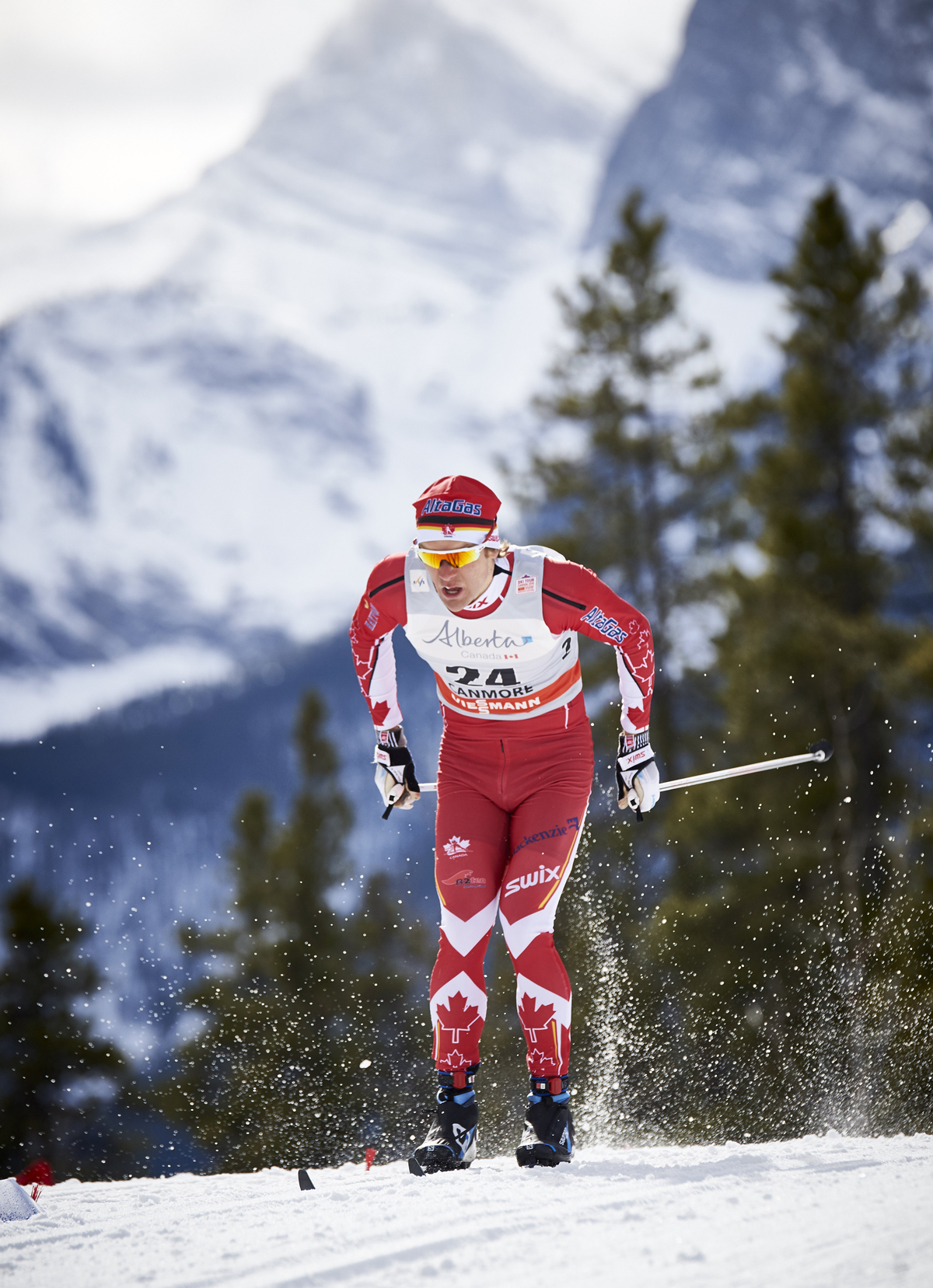
Devon Kershaw (Canadian World Cup Team) competing in the classic sprint at the 2016 Ski Tour Canada in March in Canmore, Alberta. (Photo: Fischer/NordicFocus)
When race organizers in Gällivare, Sweden, decided to change the date of their pre-World Cup race series by a week, Canada’s Devon Kershaw lucked out. For the past couple of seasons, most of the Canadian World Cup Team has spent their final days before the start of the race season skiing and competing in Gällivare.
Once again, the team planned to travel 100 kilometers north of the Arctic Circle for a pre-World Cup camp, booking their plane tickets to Sweden for the week of Nov. 19 — when the city’s races were originally slated to take place.
However, due to a scheduling conflict with Sweden’s annual early season races in Bruksvallarna, the Gällivare race dates moved up a weekend, leaving only one of Canada’s cross-country athletes the option to race in Gällivare.
“Since I am based in Oslo, it was just sheer luck that we hadn’t booked my flight yet (from Oslo up here to Gällivare) when those changes took place,” Kershaw, who lives just outside of Oslo, Norway, with his wife Kristin Størmer Steira, wrote in an email. “So I asked to come up a few days earlier than the team to get a chance to race.”
With the help of Canadian head wax tech Yves Bilodeau, who lives in France and was able to join Kershaw, the 33-year-old Kershaw won Sunday’s 15 k classic individual start in 35:18, besting the runner-up, Petr Knop of the Czech Republic, by a minute. Michal Novak, also of the Czech Republic, placed third, (+1:05).
Though only 11 senior men entered Sunday’s 15 k, which wasn’t an International Ski Federation (FIS) sanctioned race, Kershaw indicated that from his standpoint, putting on a race bib and bringing his body back into racing was important.
“Being a slow-starter at times with regards to World Cup period #1 in my career (I have never been on the podium on the World Cup prior to Christmas) the biggest focus was just to put a bib on and blow out the cobwebs,” Kershaw wrote. “It’s nice to get nervous, test skis properly, and go through a whole routine around an organized race. In the race itself I focus on skiing technically well, being present and just being as efficient as I can be when my body is screaming to stop.”
Kershaw explained that he lucked out even more with getting into the Gällivare races, as they would be his only opportunity to for a preseason on-snow race this season.
“Time trials are great workouts, but for me I really believe that nothing replicates racing and have always have benefited from getting in some ‘lower key’ races before starting off on the World Cup,” he wrote. “This season [the Gällivare 15 k] will be the only race I get to do before the World Cup starts.”
In a post-race interview, Kershaw told Langd.se that he benefited from some summer training with Norway’s Martin Johnsrud Sundby and Sweden’s Martin Johansson, who lives in Norway. On Sunday, Kershaw took control of the race early, leading the first of four 3.75 k laps by more than 20 seconds over his nearest competitor.
“It was amazingly good conditions today, the body responded as it should and the skis were really good,” he said.
Kershaw arrived in Sweden late last Friday and will remain there until the rest of the Canadian World Cup team (except Alex Harvey, U25 Team skier Cendrine Browne and coach Louis Bouchard, who are training in Davos, Switzerland) joins him on Nov. 23. Then they’ll drive as a group to Kuusamo, Finland, where the opening World Cup will be held Nov. 26-27.
“Of course it would perhaps be nice to start the year with really competitive races in Beitostølen or Bruksvallarna (like we have done many times in the past), but with our budget having been absolutely decimated these last couple years it’s no longer realistic and/or viable,” Kershaw wrote. “The fact that we can en-masse drive to Kuusamo for the World Cups saves our team bundles of money that we can then use to support the World Cup racing as best we can.”
Cross Country Canada’s Justin Wadsworth (l) and Louis Bouchard will share coaching duties on the World Cup Team while mentoring less-experienced Canadian coaches on the World Cup circuit for the 2015/2016 season. (Photo: Cross Country Canada/Twitter)
Canada is getting back to its roots. A year after Cross Country Canada (CCC) hired Norwegian Olympic gold medalist Tor-Arne Hetland to co-coach its World Cup Team, the national governing body is once again emphasizing homegrown coaches at the highest level of skiing.
And although national-team head coach Justin Wadsworth is technically American, he might as well be considered Canada’s own after leading its team and living in Canmore, Alberta, since 2010.
“Besides me, I think we’ll just try to work with Canadians,” Wadsworth said with a laugh on the phone on Thursday.
This season, the 46-year-old California native is at the helm again and is prepared to share World Cup coaching duties with Louis Bouchard, Alex Harvey’s personal coach and head coach of the Pierre-Harvey Training Centre in Quebec. Wadsworth and Bouchard have worked together on the Canadian World Cup Team for the last five years.
In addition to the duo, a select crew of training centre and potentially club coaches will be called upon in 2015/2016 to assist on the World Cup circuit as well, Wadsworth explained. The idea is to give them elite-level experience and form a pool of strong coaches to draw from nationwide.
“We really feel like one coach, like myself or Louis, with the addition of a younger coach [at each World Cup] will fill in nicely and really promote the coaching system that we talked about a lot,” Wadsworth said.
Tor-Arne Hetland, Swiss sprint coach from 2010-2014, at the 2014 Sochi Olympics in Russia. (Photo: FIS)
In a press release on Tuesday, CCC announced its “integrated national coaching structure,” with an emphasis on developing coaches within its own borders. The organization did not renew Hetland’s one-year contract.
“If we truly want to put Canada’s cross-country ski athletes on the Olympic podium in 2018 and 2022, then I believe it is critical at this time to put the Canadian system in the hands of coaches that are living and embedded in our training centres across the country,” CCC High Performance Director Tom Holland said in a press release.
“Tor-Arne brought many great qualities and technical savvy to our program,” Holland added. “In looking at the long-term goals of Olympic medals in 2018 and beyond, we felt that a Canadian-based program brings greater stability and synergies in coaching philosophy and sport science approaches – and, ultimately, a stronger platform to breed medal-winning performances from our current- and next-generation high-performance athletes.”
Wadsworth explained that in the aftermath of the 2014 Sochi Olympics, in which the Canadians missed the wax in multiple races and did not reach the podium, the timing wasn’t right to implement this kind of coaching system.
“I think it’s a lot brighter,” Wadsworth said of the atmosphere within CCC this year compared to last spring. “Not just because we got medals at a major championship, but I think this renewed vision … you can feel the energy there.”
And it’s not necessarily because of the money, either. Last year, CCC’s budget took about a $300,000-dollar hit in the wake of the Olympics, and Wadsworth estimates they could be down another hundred-thousand dollars or more this season. Next week, CCC will present to Own The Podium — one of its main sources of government funding — and while the outcome of those meetings is to be determined, Wadsworth said CCC is losing one if its major sponsors: Statoil.
“Definitely the pie has shrunk a little bit and we have to be more cautious with the money we have, which is sometimes a good thing … you have to spend your money more wisely,” he said. “We’re definitely not going to have an increased budget, that’s for sure, it’ll probably be slightly decreased.”
Regardless, spirits remain significantly higher than the beginning of 2014/2015 from Wadsworth’s standpoint.
“After the Olympics, I was so beat down by that experience and the fallout of it, I didn’t have the energy to build up the system and I wasn’t sure I was going to continue in April and May last year,” he said.
In the aftermath of some coaching moves last spring, Wadsworth became the national-team head coach tasked with bridging the gap between the Canada’s development skiers and World Cup athletes. He’ll do more of that this year, with a more explicit goal of better reaching out to smaller hotbeds for skiers, such as Whitehorse, Yukon, and share training or technique knowledge with clubs in those areas.
“I’m going to try to be a little bit more available for helping any coaches that are interested…” he explained.
Before last year, Wadsworth had been on the road, away from home, nearly 200 days each winter, and he needed a change — specifically less travel. Last season, Wadsworth estimated he traveled half that amount and anticipates he will only travel two days more in 2015/2016 while trading off on the World Cup with Bouchard.
“Traveling is part of being a ski coach,” Wadsworth said. “Part of what I gained from last year was gaining a bit of focus and energy back.”
“Part of what I gained from last year was gaining a bit of focus and energy back.” — Justin Wadsworth, Canadian World Cup and national team head coach
With a new physiologist and new psychologist on CCC’s Integrated Sports Team, he added that “the energy sharing and idea sharing” is at an all-time high. The addition of less experienced coaches, as well as wax technicians (to work alongside seasoned staff members), on the World Cup will require athletes to adapt, but now is the time to focus on coaching, he said.
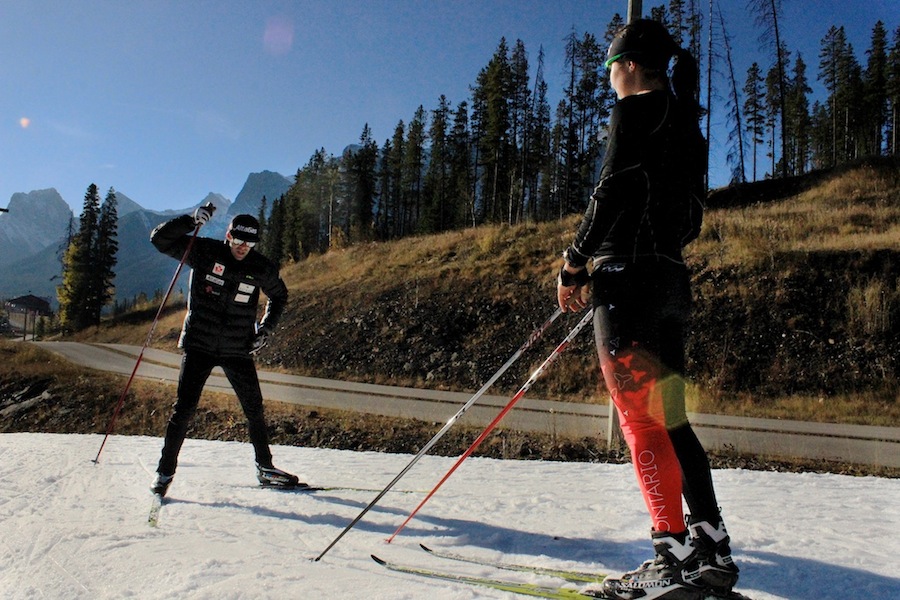
Canadian National Team Head Coach Justin Wadsworth (l) works on offset with development skier Jenn Jackson in 2013. (Photo: Pavlina Sudrich)
“You get so focused on one thing in the program and World Cup success and I think some of [these domestic coaching priorities] in particular fell through to the side,” Wadsworth said. “It’ll be open to more than just training-centre coaches; there are key club coaches that have produced athletes [as well] … In the meetings that we have coming up next week, we really need to start figuring out the balance … and who’s going to be able to travel where and get the experience to right people.”
For Wadsworth, who was driving back to Canmore on Thursday after a three-day trip in Sweden with head wax tech Yves Bilodeau, he tentatively plans to be in Europe before the first World Cup in Kuusamo, Finland, and for the start of Period I. Bouchard will take over the second part of that period, then Wadsworth will be back with the team at the end of December for the Tour de Ski. He’ll return again for the mid-February World Cups in Falun, Sweden, before an “exploratory trip” to South Korea — the site of the 2018 Olympics — with Bouchard. Both will subsequently return home for the Tour du Canada, the final World Cups, in March.
“Louis and I [have] a great relationship and great communication,” Wadsworth said. “I think that working relationship now is almost stronger than ever.
“Tor-Arne’s done a lot of good things for our team and led the team well, but we really needed to get back to a Canadian model,” he added.
“I think I have gained enough experience internationally to come home to Norway,” Hetland said, according to a translation. “Now I’m ready for my biggest challenge as a coach.”
Hetland, Wadsworth and Bouchard worked alongside one another throughout last season and at 2015 World Championships, where Harvey earned two individual medals in Falun.
“I think [Tor-Arne] ended up where he probably would have in a year or so,” Wadsworth said.
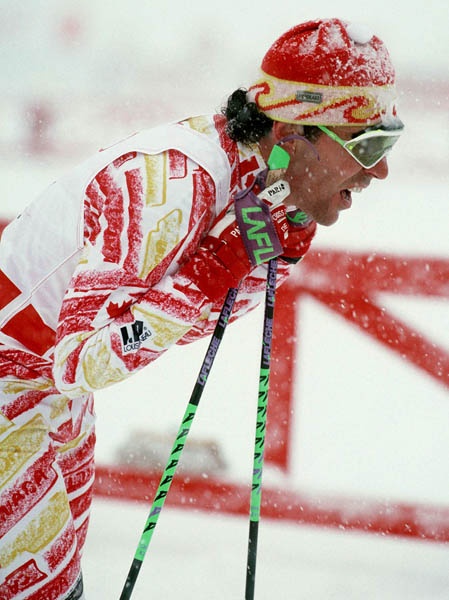
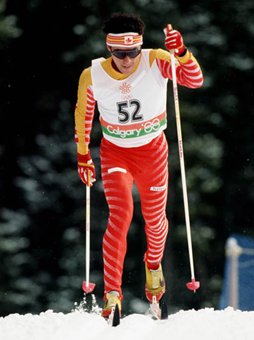
Canada’s Yves Bilodeau at the 1992 Albertville Olympic winter Games. (CP PHOTO/COA/Ted Grant)
Yves Bilodeau is one of the faces on the Canadian World Cup Team that’s seldom seen. Like his crew of wax technicians, he’s a behind-the-scenes guy, one of several responsible for the successes and sometimes lack thereof at international competitions.
Born in Quebec City and currently living in France, the 52-year-old made himself known as a Canadian cross-country skier, competing at five World Championships and three Olympics (the last of which came in 1998, three years after he retired. A wax tech at the time, he competed in the 10 k in Nagano, Japan).
After that, he retired for good — at least from international nordic racing. He’s still known in international adventure-racing circles after winning 2005 World Championships with Team Raid Quechua.
Known by his close friends and relatives as Bilose, Bilodeau is embarking on his 20th season working with the Canadian squad, and he’s witnessed a lot of change within the team since his racing days. At the ’92 Olympics in Albertville, France, Canada had one wax tech. Twenty-two years later, the team had a record nine at the Sochi Olympics.
In a phone interview with FasterSkier, Bilodeau spoke in his native tongue, humbly with a hint of humor. Seemingly attached to the past, he revealed he’s somewhat skeptical of ever-growing progress and new technology.
From his home in Ruffieux in south-eastern France, he talked about his waxing debut in 1995, reflected on what he called the “Sochi drama,” and explained who he’ll be working with this upcoming World Cup season.
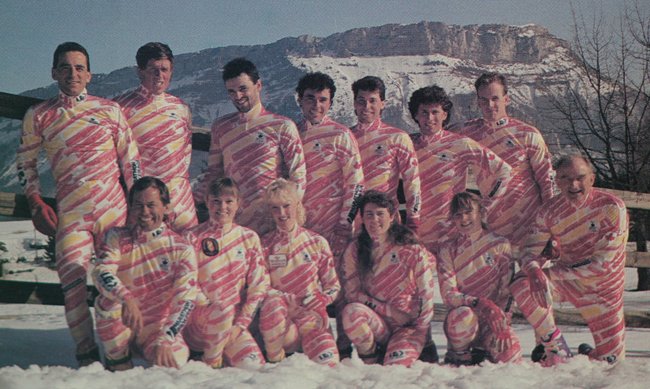
Canada’s 1992 Albertville Olympic team, including Yves Bilodeau (top, center). (From left to right) Top: Alain Masson, Dave Wood (the lone wax technician), Dany Bouchard, Yves Bilodeau, Darren Derochie, Al Pilcher, Wayne Dustin. Bottom: Laurent Roux (head coach) Jane Vincent, Lucy Steele, Lorna Daudrich, Rhonda De Long, Marty Hall (NST director), absent Angela Schmidt-Foster. (Photo: Cross Country Canada)
FasterSkier: Starting as an athlete, what made you join the Canadian technical ski team 20 years ago?
Yves Bilodeau: Back in 1995, when I stopped competing after the Nordic World Ski Championships in Thunder Bay, I moved to France with my first wife, who at the time was finishing an international law degree and working at the International Labour Office located in Geneva. I was looking for a job and actually thinking about joining a European ski team for long-distance races. In the end, my luck turned suddenly when my old friend Alain Masson gave up his spot on the Canadian technical team to fill a coach position for the Yukon ski team. It was a great opportunity and I accepted it with no hesitation.
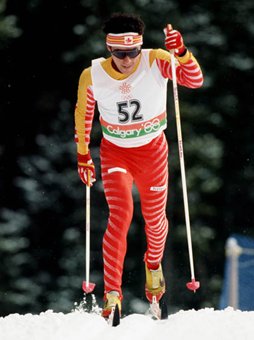
Former Canadian National Team member Yves Bilodeau racing in Calgary. (Photo: Cross Country Canada)
FS: How has your previous racing experience helped shape your interest in ski preparation and waxing?
YB: Times have changed dramatically over the course of two decades. Back in 1992, racers had to put the shoulder to the wheel in terms of ski preparation, since Canada had hired only one technician — who moreover undertook other tasks aside from waxing — for the Olympic Games in Albertville. We were already at the back of the peloton compared to most of the European technical teams. Things then started changing gradually, thanks to the arrival of Dave Wood [head technician in 1992 and head coach in ’02], as more technicians got hired. I think we improved a ton since then, although we sometimes struggle making ends meet with what limited budgets we have.
FS: Who will you be working with on Canada’s World Cup technical team this season?
Canada’s 2014/2015 NST Wax Techs:
– Yves Bilodeau (full-time Sept.-April)
– Joel Jaques (full-time year-round)
– Micke Book
– Alain Masson
– Sacha Bergeron
– Fabio Ghasifi*
– Graham MacLean**(New this season)
YB: Micke Book, a great Swede who couldn’t get along with his fellow countrymen, joined the Canadian team in 2006 after the Olympic Games in Turin. Joel Jacques is based in Canmore and works year-round with us. Alain Masson also gives us a hand during the more important events, when his schedule in Yukon allows for it.
Although he will spend less time with us this years, having recently become a father, we can still count on Sacha Bergeron. We also hired Fabio [Ghasifi], an Italian who previously worked magic for the Japanese team [for the last decade] in difficult snow conditions. Graham MacLean will also help us this year.
For my part, I always join the team full-time from September to April. We usually form a group of six during World Cups, and go up to nine technicians for Olympic Games and World Championships. When few Canadians take part in a World Cup freestyle event, we make ends meet with only four waxers. Micke and Joel are the grip specialists, while Fabio and I work primarily on gliding.
FS: Looking back on the last Olympics in Sochi, what went wrong exactly from a technical standpoint for some of your athletes?
YB: We failed in Sochi due in large part to the abrupt change in snow conditions, which always seemed to occur exactly at the time when most races started, around 2 p.m. At that precise time, one side of the mountain remained cold, while the other was totally exposed to the sun. With only 15 minutes before the start, we were confident with the skis and our racers would tell us just how satisfied they were with them. Then, as the races unfolded, skis became really sluggish. Looking back, we should’ve been able to capitalize on these difficult conditions and set ourselves apart from the rest, as other teams experienced similar technical setbacks.
It was Daria [Gaiazova] who involuntarily provided us with the key to our waxing issues. On race day, after testing her first pair of skis, she asked Sacha to rewax them. Sacha took his spatula and scraped off a thick layer of wax. Before he knew it, Daria took those skis and retested them. She told him they were perfect and needed no additional adjustment! We finally realized that the trick was to apply a very thin layer of red klister on soft skis, which was contrary to our common practices. Unfortunately, this discovery was made too late and they [our athletes] paid the price.
FS: Were these simply the worst snow conditions you’ve experienced in a race?
YB: I had rarely witnessed such bad conditions, that’s for sure. Even with air temperatures approaching -3 degrees [Celsius], accumulated snow in the trees would melt and water dropped constantly on the course, then refroze, then melted again. It was crazy. Nevertheless, we weren’t totally surprised, having skied previously many times on the Olympic course before the Sochi Games. Our greatest oversight was having done no ski testing at 2 p.m. precisely. We underwent various tests from 11 a.m. to 1:45 p.m. and everything worked great. At 2 p.m., we were in serious trouble.
“Looking back, we should’ve been able to capitalize on these difficult conditions and set ourselves apart from the rest. … Our greatest oversight was having done no ski testing at 2 p.m. precisely.” –– Bilodeau on what went wrong in Sochi
FS: In hindsight, what lessons have you drawn from the last Olympics?
YB: Life is made of ups and downs. Yes, we failed in Sochi, but we weren’t the only ones getting rocked. Take Norway for example. Their technical team did much more testing before the Games, in addition to collaborating closely with Swix and having their technicians undergo several separate tests. In the end, they failed just as bad as we did. After Sochi, we quickly came to the conclusion that we needed to work closer with athletes throughout the last minutes leading up to the race start. Next year, Graham and another technician, who weighs the same as Alex Harvey, will accompany and assist Alex for testing and any last-minute wax adjustment.
FS: Were Harvey’s impressive results at World Cup Finals (in Falun, Sweden) a form of redemption after Sochi?
YB: We’re constantly put under the pressure to deliver the best skis possible. We can’t have too many bad days, as our main objective is to always move up in the World Cup standings. But sometimes things go unplanned. Harvey, just like Norwegian Martin Sundby, stood several times on the podium before and after the Sochi Games, but both were out of luck when it counted most. That was the Sochi drama: performing poorly while the expectations we so high in Canada. As Quebecers say, the puck wasn’t going our way. [Laughs]
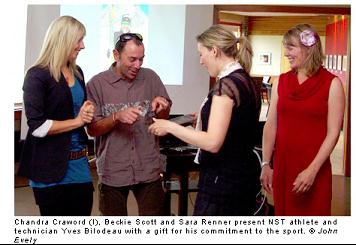
Canadian wax tech Yves Bilodeau (second from l) receives a gift from Chandra Crawford, Beckie Scott and Sara Renner for his commitment to Canadian cross-country skiing. (Photo: John Evely/Cross Country Canada)
FS: How has cross-country ski racing changed since you first joined the Canadian technical team in 1995? What major technical shifts have you noticed?
YB: Major changes are fewer than most people think. When it comes to gliding, what I call “accelerators” — fluor liquids applied at the very end of the ski preparation — make the biggest difference. On the grip side, there are a few new interesting products, but twenty- to thirty-year-old waxes, like Rode Red, still work great. Every piece of equipment is lighter with each year. Ski manufacturers also work hard on bettering the uniformity of their productions, to deliver equal skis as much as possible. It may sound simple, but ski making is no exact science yet.
FS: What makes a ski go fast? What unique features distinguish a great pair from a standard one?
YB: It’s fairly easy to eliminate the pairs we don’t like, but trying to handpick the best ones directly from the manufacturer remains a dubious task. The only way to tell which pairs stand out is to install bindings and try out the skis on snow. In the summer, Micke will do various tests in the Torsby ski tunnel in Sweden and rate each pair. There is no other way to go about it.
FS: How does Canada manage to stay competitive against other larger and wealthier European teams?
YB: Last season, Haywood and AltaGas, two of our long-time sponsors, helped us in acquiring a brand-new wax truck. Only a handful of teams enjoy such luxury, as other nations like France and the U.S. are presently working on purchasing their own truck. Since I first started this job, it’s probably the best technical improvement I’ve seen yet. We’re now completely self reliant, as we can park the truck right at the foot of the ski slopes for quick testing and avoid unvented and crowded waxing rooms. This vehicle can hold easily our 350 pairs of skis and six workstations are available. The ventilation system filters the air every two seconds and my back doesn’t hurt like it normally used to. It makes our job so much easier and more enjoyable.
“… The Sochi drama: performing poorly while the expectations we so high in Canada. As Quebecers say, the puck wasn’t going our way.”
FS: How are you approaching the upcoming World Cup season? Are the World Championships in Falun the team’s main objective?
YB: Definitely. We’re aiming for medals in Falun, that’s for sure. We want to get closure on everything that went wrong in Sochi, move forward and focus all our efforts on the World Championships and the Tour de Ski.
FS: Does living in France gives you and the Canadian team a strategic advantage on European soil?
YB: It works out great for everyone. Joel stays in Canmore year-round and works with the team in the summer, while I stay here in France and rejoin him and Micke later in September. I can test skis in Val d’Isère and in various areas in France. I keep a lot of the team’s equipment to avoid carrying everything by plane from Canada when the World Cup season kicks off. One of the team’s buses we use during competitions also stays at my home in the offseason.
FS: Finally, are you working on any projects for the summer? Are you still competing in expedition races, do you plan to fish a lot in Savoie?
YB: My career in expedition races slowed down quite a bit, but I always stay active, competing locally in trail running mainly. With the frequent showers beating down recently in the region, there’s less fishing in the Rhône valley’s rivers, but perch, trout and other types of fish can be found in lakes nearby.
***
About the author: FasterSkier contributor François Léger Dionne raced for 15 years at provincial and national competitions in Quebec. After obtaining a Bachelor of Law at the University of Montreal, he’s currently enrolled in a full-time program at the Montreal College of Osteotheraphy. French is his first language, but he speaks and writes fluently in English. His claim to fame? Racing and beating a younger Alex Harvey!
Canada’s Yves Bilodeau at the 1992 Albertville Olympic winter Games. (CP PHOTO/COA/Ted Grant)
Si le ski de fond de compétition connaît un essor considérable au Canada depuis la dernière décennie, il faut en remercier les athlètes, dont le talent énorme déborde sur la scène internationale. Au coeur du succès canadien figure également l’équipe de fartage, au sommet de laquelle Yves Bilodeau, Québécois d’origine habitant la commune française de Ruffieux, trône modestement depuis quelques années.
«Bilose», joyeuse épithète dont l’affublent ceux qui côtoient régulièrement l’expatrié, entamera en septembre sa vingtième saison au sein de la troupe canadienne. Avec trois participations olympiques (88, 92 et un retour inattendu en 98) et cinq Championnats du monde, le vétéran de 52 ans a d’abord fait ses classes sur neige à titre de fondeur d’élite. S’il peut compter encore aujourd’hui sur cette riche carrière initiatique, il n’en mesure pas moins le fossé séparant les deux époques: quelques deux décennies avant les Jeux Olympiques (J.O.) de Sochi, pour lesquels le Canada déploya une artillerie record de neufs farteurs, un seul technicien travaillait au service de fartage à Albertville en 1992. En dépit d’un tel renversement, le technicien en chef de l’équipe canadienne conserve un attachement au passé et semble porter une méfiance de vieux loup face à l’accélération des choses.
Nous avons joint Bilodeau à sa demeure savoyarde, battue derechef par une forte pluie contraignant le passionné de pêche à délaisser temporairement le Rhône. L’homme revient avec humour sur ses débuts en 1995, nous présente ses compagnons d’armes oeuvrant au sein de l’équipe canadienne et se prononce sans détour sur les déconvenues de Sochi.
Canada’s 1992 Albertville Olympic team, including Yves Bilodeau (top, center). (From left to right) Top: Alain Masson, Dave Wood (the lone wax tech), Dany Bouchard, Yves Bilodeau, Darren Derochie, Al Pilcher, Wayne Dustin. Bottom: Laurent Roux (head coach) Jane Vincent, Lucy Steele, Lorna Daudrich, Rhonda De Long, Marty Hall (NST director), absent Angela Schmidt-Foster. (Photo: Cross Country Canada)
FasterSkier: De fondeur olympique canadien à technicien en chef de l’équipe canadienne de ski de fond: qu’est-ce qui vous a convaincu de faire le saut il y a vingt ans?
Yves Bilodeau: En 1995, lorsque j’ai arrêté de skier après les Championnats du monde de ski nordique à Thunder Bay, je suis déménagé en France avec ma première conjointe qui, à l’époque, travaillait au Bureau international du Travail situé à Genève et terminait ses études en droit international. Je me cherchais un boulot et songeais à me joindre à une équipe européenne pour faire des courses de longue distance. En fin de compte, Alain Masson, mon grand copain qui travaillait déjà au sein de l’équipe canadienne de fartage, m’a laissé son poste pour combler celui d’entraîneur de ski de fond du Yukon. Le transfert s’est fait rapidement, d’autant plus que le métier de farteur m’intéressait déjà.
Former Canadian National Team member Yves Bilodeau racing in Calgary. (Photo: Cross Country Canada)
FS: Vos nombreuses années de compétitions ont sans doute contribué grandement à façonner votre intérêt pour le fartage, alors que déjà vous mettiez les mains à la pâte?
YB: Il faut dire que mes années en Coupe du monde au sein de l’équipe canadienne n’ont rien à voir avec l’encadrement, le matériel et le personnel de travail dont bénéficient les athlètes d’aujourd’hui. Aux J.O. d’Albertville en 1992, nous avions seulement un technicien, qui s’occupait aussi de prendre des photos et remplissait d’autres tâches. Nous étions donc déjà à cette époque bien loin de l’imposante machine norvégienne. Peu à peu, notamment avec l’arrivée de Dave Wood [technicien en chef en 1992 et entraîneur en chef de l’équipe canadienne en 2002], davantage de techniciens ont été embauchés, mais le Canada demeurait à la traîne sur le circuit de la Coupe du monde. Je crois que nous avons maintenant corrigé le tir, malgré que les budgets nous limitent toujours un peu.
FS: Qui sont les membres de l’équipe canadienne de fartage actifs en Coupe du monde?
YB: Micke Book, un Suédois formidable qui s’entendait mal avec ses compatriotes, s’est intégré au groupe tout juste après les JO de Turin en 2006. Joel Jacques travaille avec nous à l’année longue depuis Canmore. Quand son horaire d’entraîneur au Yukon le lui permet, Alain Masson nous épaule lors des plus gros événements.
Il y a aussi Sacha Bergeron, qui vient tout juste d’être père d’un garçon, et nous avons engagé récemment Fabio [Ghasifi], un excellent farteur italien qui a travaillé avec l’équipe japonaise. Comme les Japonais ont souvent eu de bons skis dans des conditions difficiles, nous tenions fortement à l’avoir avec nous. Graham Maclean fera aussi partie de l’équipe.
Pour ma part, je suis entièrement consacré au ski de fond à partir de septembre jusqu’à avril. Normalement, nous sommes six techniciens en Coupe du monde, et huit ou neuf pour les JO et les Championnats du monde. Pour les courses de style libre en Coupe du monde, lorsque nous avons peu d’athlètes inscrits, nous nous débrouillons avec quatre techniciens, sans compter les entraîneurs qui viennent parfois nous porter main-forte. Micke et Joel travaillent surtout à l’«accroche» (l’adhérence), alors que je m’occupe davantage de la glisse avec Fabio.
FS: Les déboires d’Alex Harvey et des autres membre de l’équipe canadienne aux derniers J.O. de Sochi ont fait couler beaucoup d’encre. Que s’est-il passé exactement au niveau de la préparation des skis?
YB: Nos déboires en fartage ont eu tout à voir avec la transition de 14h, soit le moment à partir duquel les conditions de neige du parcours changeaient complètement. À 14h, heure de départ de la plupart des courses à Sochi, un côté de la montagne était très froid, alors que l’autre -avec deux longues montées- était exposé au soleil. 15 minutes avant le départ, les athlètes étaient confiants et nous disaient combien leurs skis étaient bons, mais au départ de la course, les skis étaient pourris et n’avançaient plus. D’autres équipes ont évidemment connu les mêmes difficultés. Nous aurions dû être en mesure de tirer profit de ces conditions exceptionnelles et nous démarquer des autres. Nous avons finalement trouvé la solution de fartage grâce à Daria [Gaïazova]. Daria a demandé à Sacha de préparer à nouveau sa première paire de skis, qu’elle trouvait trop lents. Sacha a eu seulement le temps d’enlever une généreuse couche de fart sur cette première paire, puis l’a mise de côté. Daria l’a ensuite testée, puis est revenue nous dire que ses skis étaient parfaits. Nous avons donc compris qu’il fallait appliquer une couche très fine de klister rouge sur des skis à faible cambrure, ce qui allait à l’encontre de nos pratiques habituelles. Cette découverte s’est faite malheureusement trop tard. Nous n’étions finalement pas dans le coup et nous les [athlètes canadiens] avons fait souffrir.
FS: Étaient-ce parmi les pires conditions de neige auxquelles vous avez été confronté en carrière?
YB: J’avais rarement vu ça! Habituellement, le dégel se fait uniformément, mais là les deux montées faisant face au stade étaient soumises à une chaleur étonnante. C’était fou! Même à -3°C, la neige accumulée dans les branches des grands arbres fondait puis dégouttait sur la piste, pour ensuite regeler. Nous étions pourtant au courant de ces circonstances inhabituelles, ayant skié plusieurs fois à Sochi dans les trois ans précédant les JO. Nous avons cependant raté notre coup en ne testant aucune fois les skis à 14h. À 11h, ça allait. À 13h, ça allait. 15 minutes avant 14h, ça allait toujours. J’ignore pourquoi, mais c’est à 14h pile qu’avait lieu ce changement soudain de conditions et ça n’allait plus du tout!
FS: Avec quelques mois de recul, quels enseignements ou leçons tirez-vous des derniers J.O.?
YB: La vie est faite de bons et de moins bons coups. Nous nous sommes faits avoir à Sochi, mais pensons aux Norvégiens qui se sont aussi gourés. Ils ont visité et testé le parcours bien plus souvent que nous avant le début des J.O., en plus de collaborer de près avec la compagnie Swix, dont les techniciens sont allés faire nombre d’essais en préparation des Jeux. Nous avons fait le point sur Sochi et conclu que dès l’an prochain, Graham et un autre technicien du même gabarit qu’Alex accompagneraient et assisteraient Alex jusqu’aux derniers moments précédant le départ des courses, pour tout ajustement de dernière minute.
FS: La fin de saison 2014 exceptionnelle de Harvey (notamment à Falun, en Suède) a-t-elle effacé en partie les mauvais souvenirs de Sochi?
YB: La pression de bien faire pèse sans arrêt; nous ne pouvons nous permettre plusieurs mauvais coups si nous voulons marquer des points au classement général de la Coupe du monde. C’est étrange, Harvey, tout comme le Norvégien Martin Sundby, a fait des podiums avant et après les Jeux. Le drame de Sochi, c’est d’essuyer ce revers alors que les attentes étaient tellement élevées, que tout le monde en parlait depuis si longtemps. Comme on dit au Québec, «la puck ne roulait pas pour nous»! [Rires]
Canadian wax tech Yves Bilodeau (second from l) receives a gift from Chandra Crawford, Beckie Scott and Sara Renner for his commitment to Canadian cross-country skiing. (Photo: John Evely/Cross Country Canada)
FS: Depuis vos débuts en fartage au sein de l’équipe canadienne en 1995, comment le ski de fond de compétition a-t-il évolué sur les plans sportif et technique selon vous? Quels grands changements avez-vous observés?
YB: Les grands changements ne sont pas aussi nombreux qu’on peut le croire. Au chapitre de la glisse, les «accélérateurs» -produits liquides à base de fluor que nous appliquons en fin de préparation- font une grande différence. En termes de «kick», il existe quelques nouveautés, mais nous utilisons encore aujourd’hui des farts d’adhérence vieux de vingt à trente ans, comme la Rode rouge, qui n’a rien perdu de son efficacité. Tout le matériel s’allège d’année en année. Les compagnies de ski cherchent aussi sans cesse à améliorer l’uniformité dans leurs productions afin d’offrir des skis égaux. Comme il ne s’agit pas encore d’une science exacte, nous découvrons souvent des paires qui se démarquent du lot.
FS: Qu’est-ce qui caractérise un ski rapide, comment le reconnaître?
YB: Il est aisé d’éliminer les paires plus lentes, mais il demeure impossible de repérer un ski exceptionnel directement chez le fabricant sans y poser d’abord une fixation et le tester sur neige. L’été, Micke effectue aussi des essais dans le tunnel de neige de Torsby en Suède et attribue une cote à chaque paire testée. L’essai sur neige demeure incontournable et constitue l’unique moyen d’identifier les meilleurs skis.
FS: Les forces économiques variant grandement d’une nation à l’autre, comment parvenez-vous à tenir tête aux équipes de fartage les mieux nanties?
YB: La saison dernière, avec l’appui de nos commanditaires canadiens, comme Haywood et AltaGas, nous avons fait l’acquisition d’un camion de fartage, faisant dès lors partie d’une poignée de nations profitant d’un tel véhicule de soutien. D’autres, comme les Américains et les Français, travaillent actuellement à amasser les sommes nécessaires et espèrent en bénéficier aussi. Depuis mon arrivée au sein de l’équipe canadienne, il s’agit de l’amélioration technique la plus formidable! Nous sommes désormais pleinement autonomes: nous pouvons nous garer au pied des pentes, accomplir plus facilement nos tests et éviter de travailler dans les salles de fartage mal ventilées. Le camion peut accueillir nos quelques 350 paires de ski et comprend six stations de fartage, de même qu’un système de ventilation filtrant l’air toutes les deux secondes. C’est aussi la première année où je ne suis pas aux prises avec des maux de dos! En évitant le transport de tout le matériel dans des salles éloignées, notre boulot et notre qualité de vie s’en trouvent fortement améliorées.
FS: Comment entrevoyez-vous la prochaine saison de Coupe du monde 2014-2015? Les Championnats du monde de Falun seront-ils l’objectif premier de l’équipe?
YB: Oui, les Championnats du monde ont certainement la priorité cette année et nous nous attendons à récolter des médailles à Falun. Nous voulons oublier Sochi, remettre les pendules à l’heure et bien faire aux Championnats du monde et au Tour de ski.
FS: Le choix d’habiter à Ruffieux (France), malgré l’éloignement des centres canadiens d’entraînement, vous offre-t-il une position stratégique en Europe?
YB: Oui, je peux tester moi-même des skis à Val d’Isère et à plusieurs endroits en France, tout en conservant du matériel de fartage en sol européen pour éviter à l’équipe de tout transporter par avion depuis le Canada. Je garde aussi chez moi un bus loué à l’équipe que nous utilisons lors des compétitions en Europe. L’équilibre est parfait car Joel demeure à Canmore et s’occupe d’y encadrer l’équipe durant l’été. C’est ensuite en septembre que Micke, Joel et moi unissons nos forces pour la prochaine saison hivernale.
FS: Finalement, quels sont vos projets estivaux? Avez-vous une compétition de raid en vue bientôt, un voyage de pêche en Savoie…?
YB: Ma carrière en raid a beaucoup diminué. Je reste quand même toujours actif, pratiquant surtout la course à pied et la course en montagne. Je m’inscris à plusieurs compétitions locales. Avec les dernières pluies abondantes, la pêche sur le Rhône est impossible, mais on trouve de la perche, de la truite et bien plus dans les lacs de Savoie.