From the FasterSkier archive — posts syndicated from athletes’ and coaches’ own blogs between 2004 and 2012, kept online as published. Current coverage is at fasterskier.com.
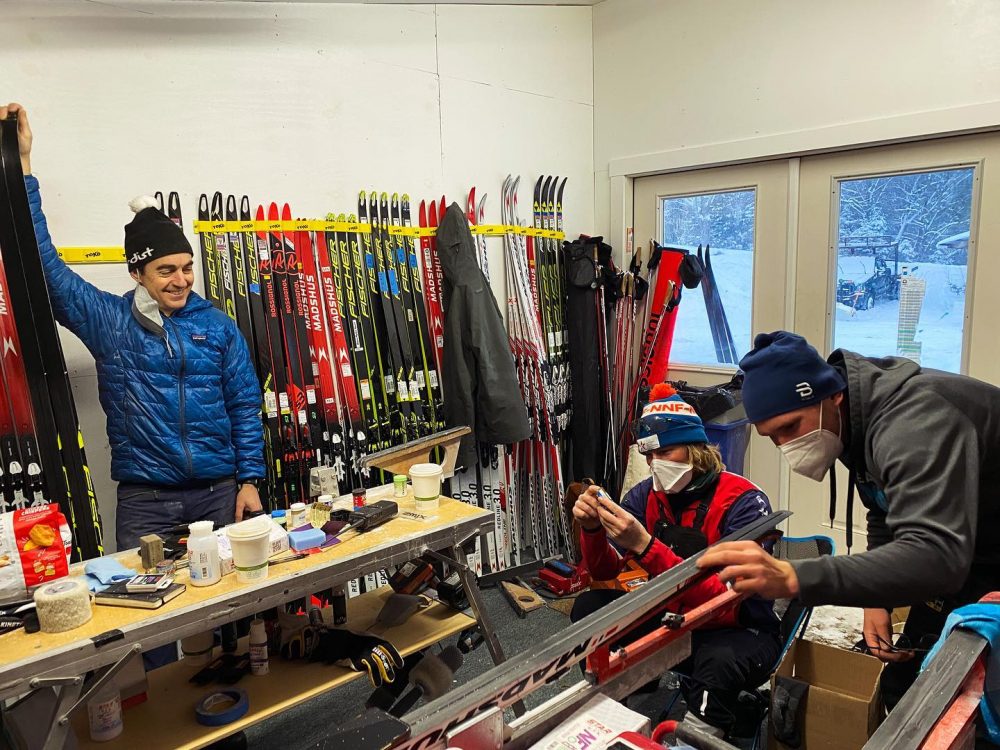
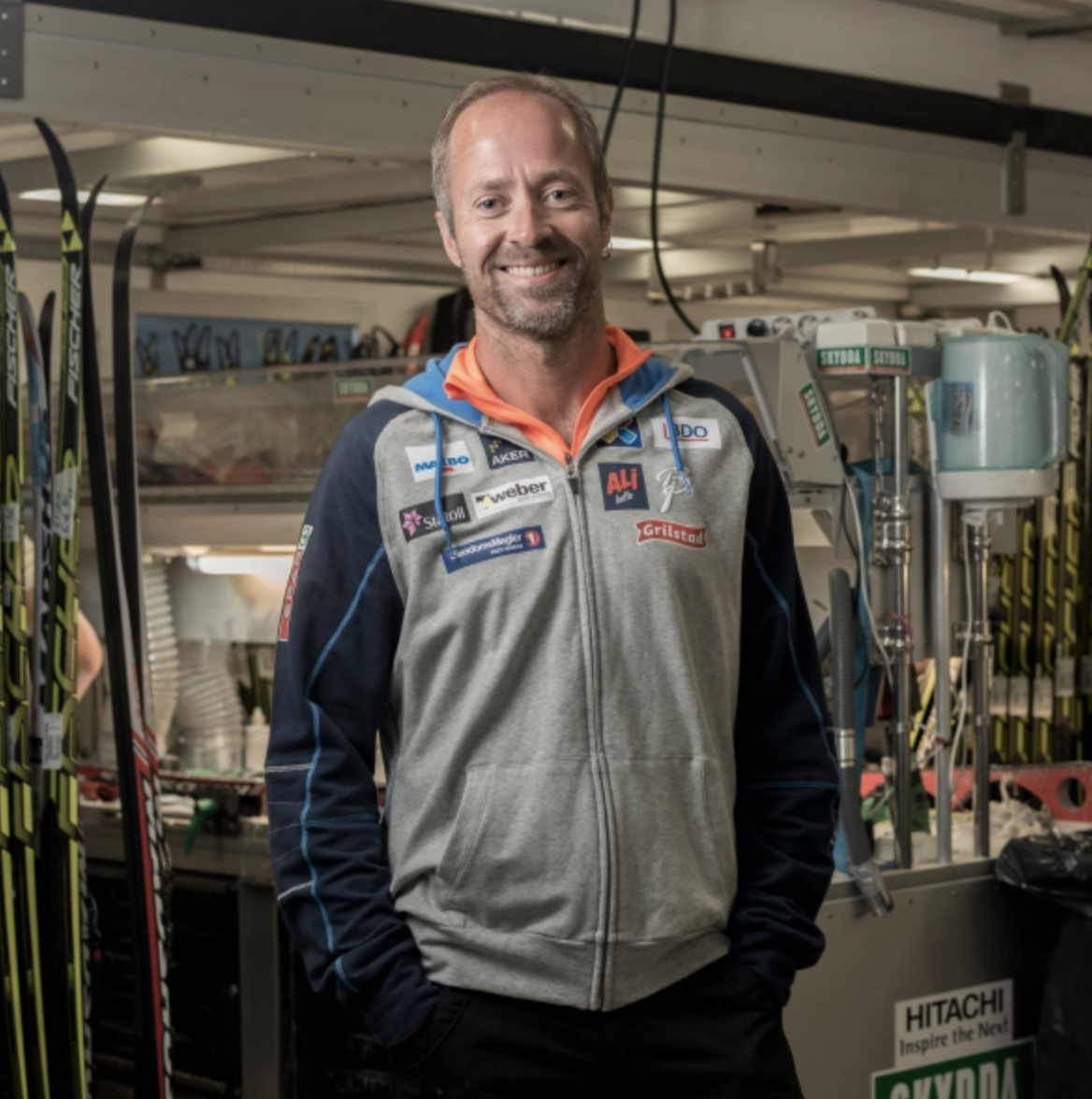
SuperTour race weekend in Craftsbury, VT, where Zach Caldwell (left) supported SMS T2 athletes. (Photo: Facebook Caldwell Sport)
On January 17th, 2022, a US Ski and Snowboard (USSS) ban on using perfluorocarbon-based wax products (“fluoros”) at all International Ski Federation-sanctioned (FIS) races in the country went into effect. The action marked the critical point in a rapid evolution of policies meant to limit competitive nordic skiing’s emission of perfluorocarbons, part of a class of especially environmentally persistent, and potentially health-concerning, chemicals known as PFAs. Overnight, The cumulative knowledge of 40 years on ski preparation nulled. Since then, it’s been a brave new world.
Step into a wax room these days, and you’re unlikely to hear codewords like “Cera F” and “Jetstream” muffled from behind the gas masks that became standard issue near the end of the fluoro-era. The scramble to take everything into account—from snow temp to air temp, ski selection, grind, and base material too—and funnel it into putting the best ski on the snow for a race is still there. The rules may have changed, but the game is the same.
Two and half seasons into fluoro-free racing, there have been countless tests by wax technicians across the continent to figure out just what they’re working with on any given race day. Among them has been long-time American “ski whisperer” Zach Caldwell, owner and operator of Caldwell Sport in Putney, Vermont. As New England thawed out from its last snowstorm of the season, and US Skiing from the season that accompanied it, FasterSkier caught up with Caldwell to learn what he’s learned about where the limiter of fluoro-free waxing has started to push ski service.
Speak to Caldwell, and you’ll quickly get acquainted with jargon that acquaints you with his professorial approach to ski service. He’ll often talk about “solutions,” that is, the singular result of combining the “pie” of factors (see our 2022 discussion on what makes a ski fast featuring Caldwell here) that go into a race-ready ski. In that pie, you’ll find ski camber, ski flex, base grind selection, hand-applied structure, and everything that can be broadly categorized as wax. He also cites how “robust” solutions are the best solutions; that is, where the overall combination of the factors within that ski performance pie can be adaptable to a wide range of conditions. In Caldwell’s view, the ideal ski technician is as much engineer and artist as they are actuary. “Robust solutions limit the risk of sending you in the wrong direction.”
Zach Caldwell in his element. (Photo: Facebook Caldwell Sport)
“Wax with fluoro compounds occupied a big part of the whole pie when it came to ski performance,” Caldwell had said previously. His expectation when the US moved to eliminate fluoros from the wax slice of the pie two seasons ago was in line with many ski technicians. “I figured was that we weren’t going to accommodate for the lack of fluoros,” he said. “All we did by eliminating fluoros was make the comparative importance of everything else bigger.”
The key problems to which fluoros served as a solution were twofold. Fluoros resisted water better than any other compound. Fluoros were also better at helping to keep base-clogging dirt away. Those properties came from a complex interaction of chemical, ski, and snow. When applied to a ski, the chemical differentiation of fluorocarbons from a standard polyethylene ski base meant they formed a “top-coat,” not mixing with the other base wax treatments that helped change the bulk properties of the base. That fluorocarbon top-coat was extremely hydrophobic, which helped discourage water-on-water friction in wetter snow conditions most often found around or above freezing. The fluoro top-coat also abraded with dirt that otherwise would be picked up by the ski base, lending to the sensation of “durability” from skiers. In attempting to replace the water- and dirt-repellency offered by fluoros, ski technicians have most often looked at other slices of the overall solution “pie” to re-produce those qualities.
The initial expectation from Caldwell was that skiers would look to ski selection and base grind as factors readily available to assist in finding a solution. “When it comes to that, it’s played out 100% as I predicted it would” he said. “We’re selling way more skis, and grinding way more skis [at Caldwell Sport]. There’s a lot more active testing of hand structures.”
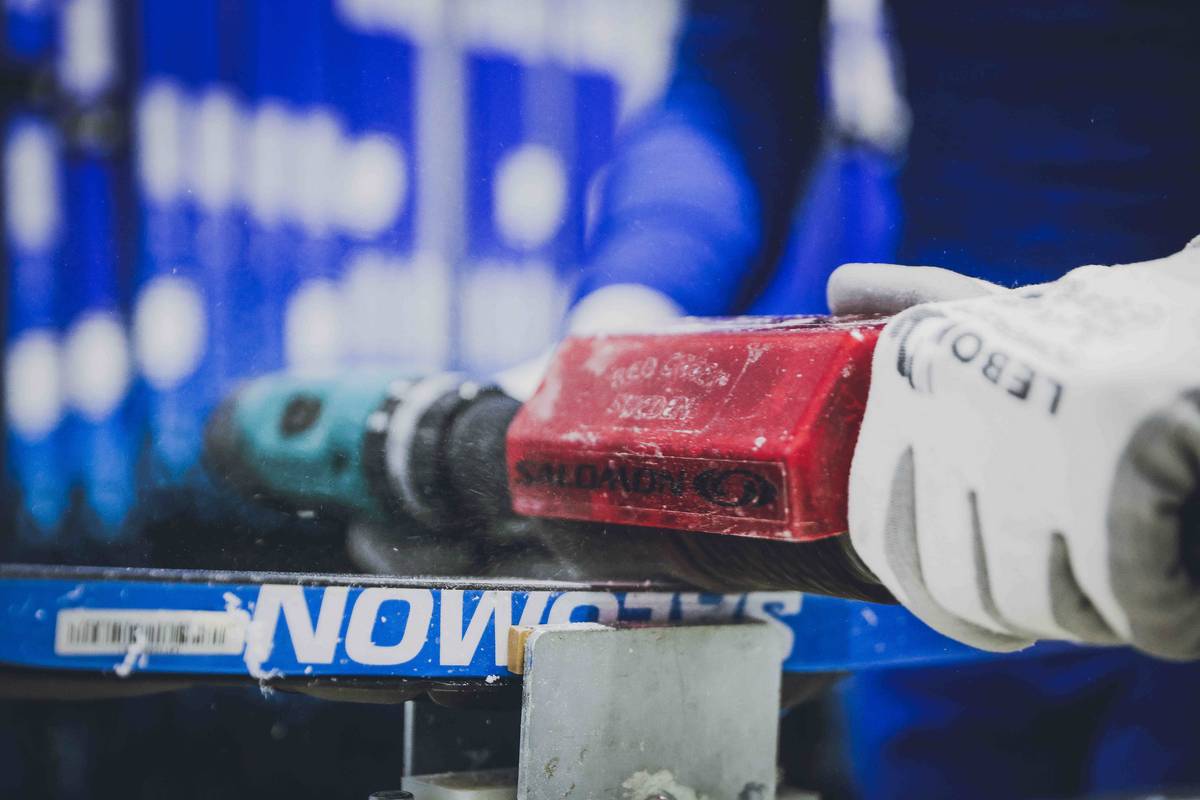
A ski being brushed. After the elimination of fluorocarbon wax products, ski selection and grind have jumped to the front of many skier’s considerations in race preparation. (Photo: NordicFocus)
In particular, skiers are looking to add more specialized skis to their fleets in the conditions in which fluoros once excelled. Higher camber skis—skis that ride higher above the snow and often have less prolonged surface run times than comparative skis—can help in having skis not pick up as much dirt. Base Grinds and hand structures, especially “V” shaped chevrons and deeper linear rills, can help channel water away from a ski base in wet conditions.
The push out to the ski itself, and grind selection, has led to a new dynamic in race day solutions. “In the past, you could show up with an inappropriate camber and get those skis into the game in the right conditions by using fluoros,” said Caldwell. “Now, showing up with the wrong ski or wrong hand structure is not doable. You’re unable to compensate with a great wax solution.
The dynamic of not being able to wax your way out of a mis-matched ski has come as a result of what Caldwell sees in the selection of new fluoro-free waxes that have been offered on the market.
“I’ve had to revise my expectations around the wax itself,” he said. “I knew we couldn’t replicate the performance of fluorocarbon chemistry, but thought that the difference between the teams that could test application methods and products ad nauseam and those who couldn’t would be emphasized. As it’s turned out, it has felt like many of the solutions just hit the ceiling for performance at about the same place.”
The result has been twofold. For one, it takes less resources to reach that lower ceiling of performance, and it can often be done by waxes from a much lower price point than the $150-200 fluoro blocks that used to contribute to a race day ski build. There are also more ways to get to an overall ski solution that precludes having found a particular wax product selection and application. Hence, the turn towards ski, grind, and structure selection for many skiers.
Caldwell sees a particular pressure point in the ski industry given the way many fluoro-free waxes have hit a similar performance ceiling, often at wildly unreliable price points: “Some of the big companies were very quick to introduce fluoro-free lines in an attempt to make a new market follow old rules.”
“The price points on those first fluoro-free products reflected that the big wax companies knew that there was a high tolerance high price points among consumers,” Caldwell said. “The thing that gets kind of lost is that those consumer tolerances were built around wax solutions that re-defined the sport. That’s what those 30-gram Swix Cera F vials did in the late 1980s. They were definitely revolutionary. We’re currently in a place now though, where a nominally $1 per application wax job can beat a $10 per application wax job, and after a while, that’s just going to frustrate consumers.”
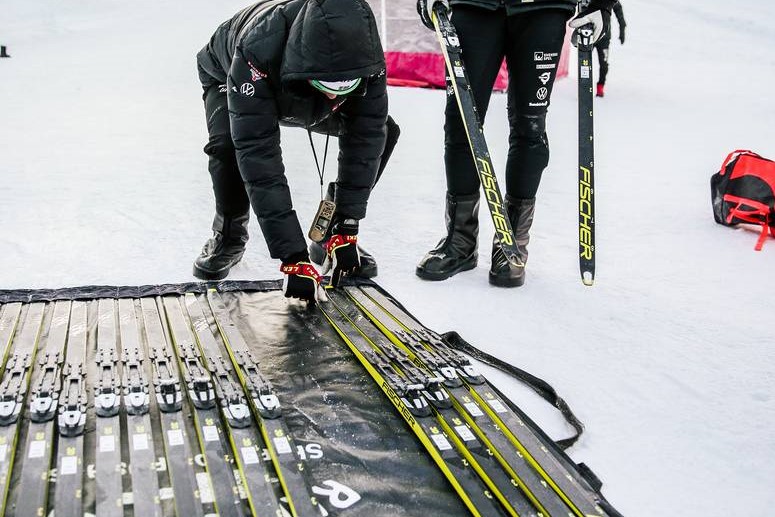
Ski Techs sorting through test fleet on a race day. (Photo: NordicFocus)
Caldwell views the muddy value proposition offered by new fluoro-free waxes as contributing to a cultural shift away from the “essentially technical” nature of nordic skiing. “It’s creating an environment where the incentive is stronger than ever to control the role waxing places in the whole solution on race day.” That chiefly includes wax protocols, often modeled after the one introduced by Rocky Mountain Nordic in 2019 that now are enforced across a host of junior and collegiate circuits in the United States. “If we assume that on any given day, without fluoro, there is a certain amount of speed available,” said Caldwell, “[Then] by limiting the role wax plays, you’re decreasing the amount of creativity that can be brought to bear in getting to that total speed available. You end up with more of a disparity than you would have by allowing wax to be brought into the picture.” FasterSkier previously covered the discussion surrounding competitive and technical balance at play in wax protocols here; however skiers might form opinions on where the technical aspect of skiing meets its competitive culture, Caldwell was careful to point out that having those opinions is one of the essential beauties of the sport: “I was pretty young when skating came into the picture,” Caldwell said. “People lost their minds like it was going to change the sport beyond recognition, but what happened? There’s a dialectic that’s healthy, and we ended up with a sport that still includes classic skiing, and even there, a ‘classic skiing’ that is pretty advanced from what they were trying to preserve, right?”
“Progress is always going to be there,” Caldwell said. “And trying to halt progress is a bad idea… but that doesn’t mean you don’t try to steer progress.”
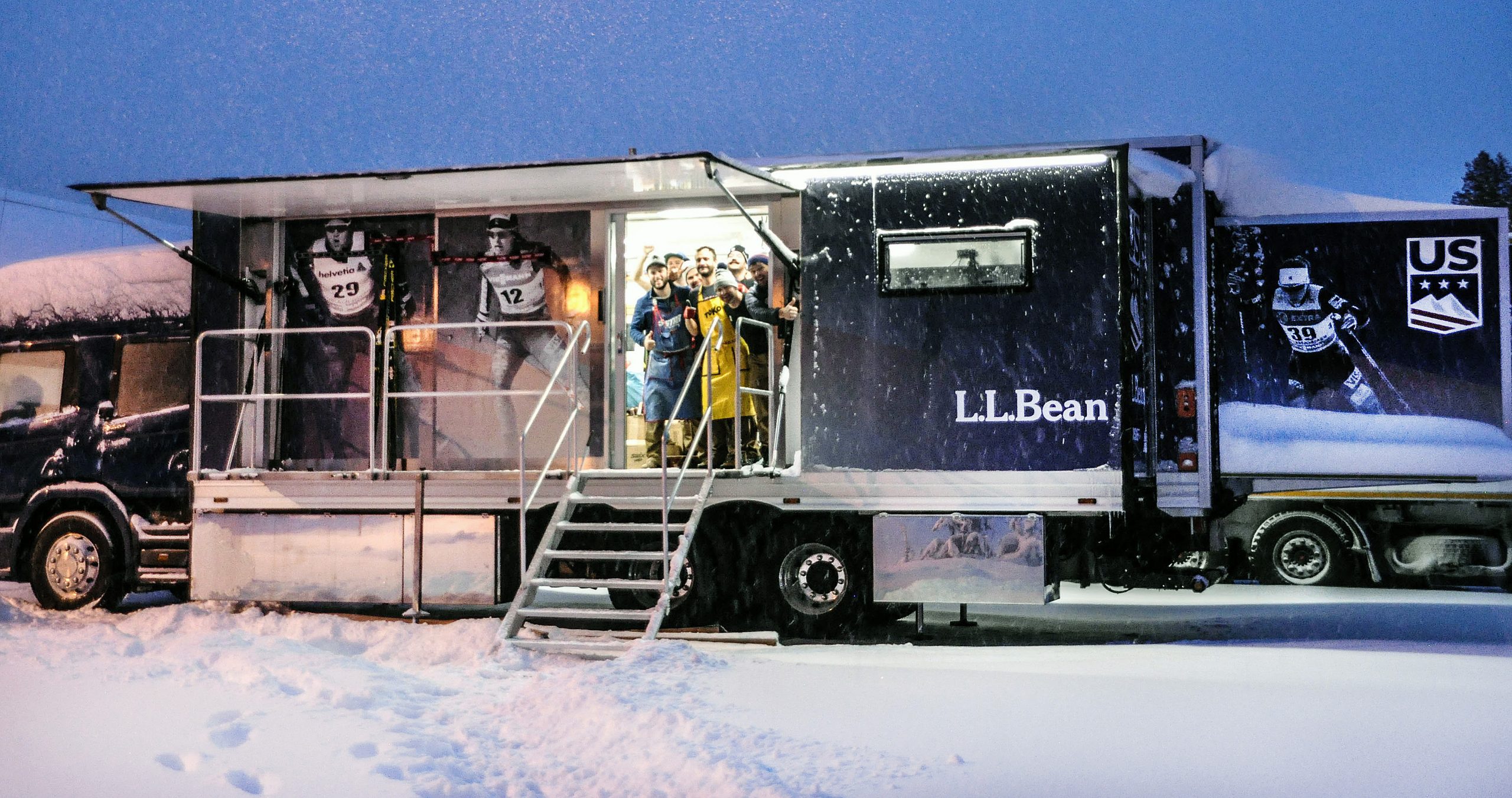
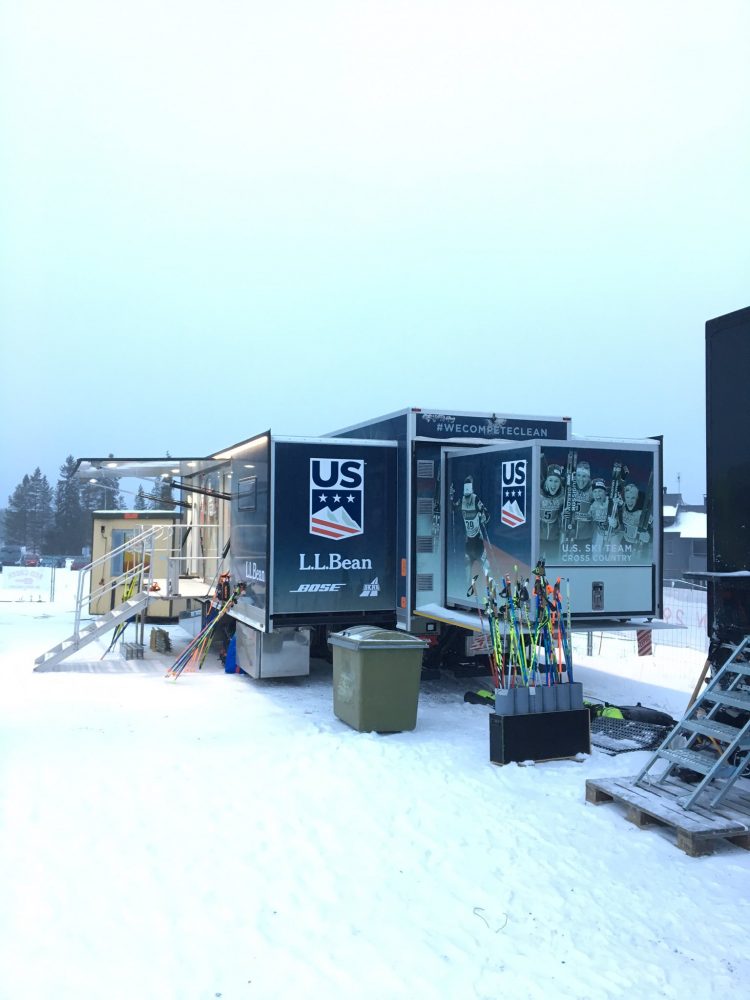
U.S. Ski Team wax truck during pre-season camp in Rovaniemi, Finland. (Matt Whitcomb)
On the contrary, the gyre of new ideas and new technologies spinning the sport forward keeps Caldwell, a seasoned-ski expert among seasoned ski experts, excited some fifty years into the sport. He hopes it will keep you excited, too. In that regard, he leads by pure example. In the brave new world catalyzed by fluoro-free, he sees a broad horizon to chart out skiers’ relationship to how they view their skis. He spins visions on how the World Cup could start promoting the technical aspects of the sport, broadcasting wax tests and highlighting ski profiles the way F1 motorsport does. He can rattle off, with passion, a broad architecture to incentivize ski companies to start producing their best skis for all skiers. “Imagine a world where Fischer had to produce a 50th percentile ski that Johannes Hoesflot Klaebo could win on!”
For Caldwell, all of it comes back to a deeply rooted experience in a nordic community he loves. “One of the really cool things about the US is that the nordic community is quite open, uncharacteristically open, compared to other countries. It’s full of a lot of good people, and I think that culture is, at present, one of the most sophisticated cultures in the world when it comes to ski innovation.” As to where are we in the fluoro-free world, two seasons in? “You mean in a world where you can’t brute force your way to good solutions with more resources?” asked Caldwell. “Well, it’s a world that puts a premium on collaboration and creativity? Turns out we’ve been pretty good at that for a long time over here.”
In most states, youth skiing is divided between club and high school programming, where club programs support skiers looking to race competitively on a regional, national, or international level, perhaps with goals of NCAA skiing and beyond. High school ski programming is typically more participation focused, and comes with a much lower price tag for families, consequently with a much smaller program budget. It’s less about year-round training, and more about learning to ski, enjoying a low-cost introduction to the sport, and providing a healthy activity to get kids outside in the winter. In some places, athletes may fall into an overlapping Venn diagram of categories, while in others, it may be a choice of club versus high school racing.
Within high school programs, it is much less common to have multiple pairs of skis, and conversations on grinds and structures are less likely to be overheard between coaches. Here in Colorado, it’s one of the only (maybe the only?) high school sport that does not have a uniform rule – kids can essentially race in whatever they want; no lycra required.
In this setting, a universal wax call might be a more reasonable proposition, according to Nystad.
“Arguments can be made on both sides. If everyone just agrees: ‘We have one pair of skis and we wax with blue.’ Okay, it probably will be as fair as you can probably make it, but just be aware that still there will be huge individual differences on the quality of the skis and how they differ from different conditions… there will still be variations, it’s not like everyone will start on the starting line having identical skis. That’s not realistic.”
Slovenian sprinter Eva Urevc tests skis with her wax technician at the 2022 Olympics in Zhangjiakou, CHN. (Photo: NordicFocus)
With all of this in mind, is there a way to create equity via equipment or waxing at any level of the sport?
“No,” said Caldwell frankly. “No, there isn’t.” Adding perspective from his business, Caldwell explained that the cost of equipment has been steady over time with respect to inflation. That said, among competitive programs, the demand for skis has increased with time, in particular, following the removal of a now-banned leveler that we haven’t yet mentioned: fluorocarbons.
“It’s a technical sport,” Caldwell said. “And the fact is that people have become more aware of the opportunity to get ahead with material. And I think what we’re seeing is a reaction to the reality of what the sport is. It’s not running. It’s just not. And yet people are doing the same thing in running with these carbon-plated shoes. Now you can only win if you have a high-tech shoe that goes 4% faster. Does that mean that those shoes shouldn’t have been invented? Or should they be banned? Possibly. I mean, whatever, we have to talk about this.
“They banned fluorocarbons for a lot of very good reasons, or they’re in the process of it. When it’s health and safety that is the problem, then you have to take the necessary steps. And yet, we also have to acknowledge that removing fluorocarbons really takes a big, big leveling factor out of the equation. There’s no opportunity to take a universal cold grind ski and put it in a wet race. That kid’s screwed. Every single time we remove the opportunity to optimize the solution that’s at hand, you’re penalizing the kids who don’t have the perfect setup.”
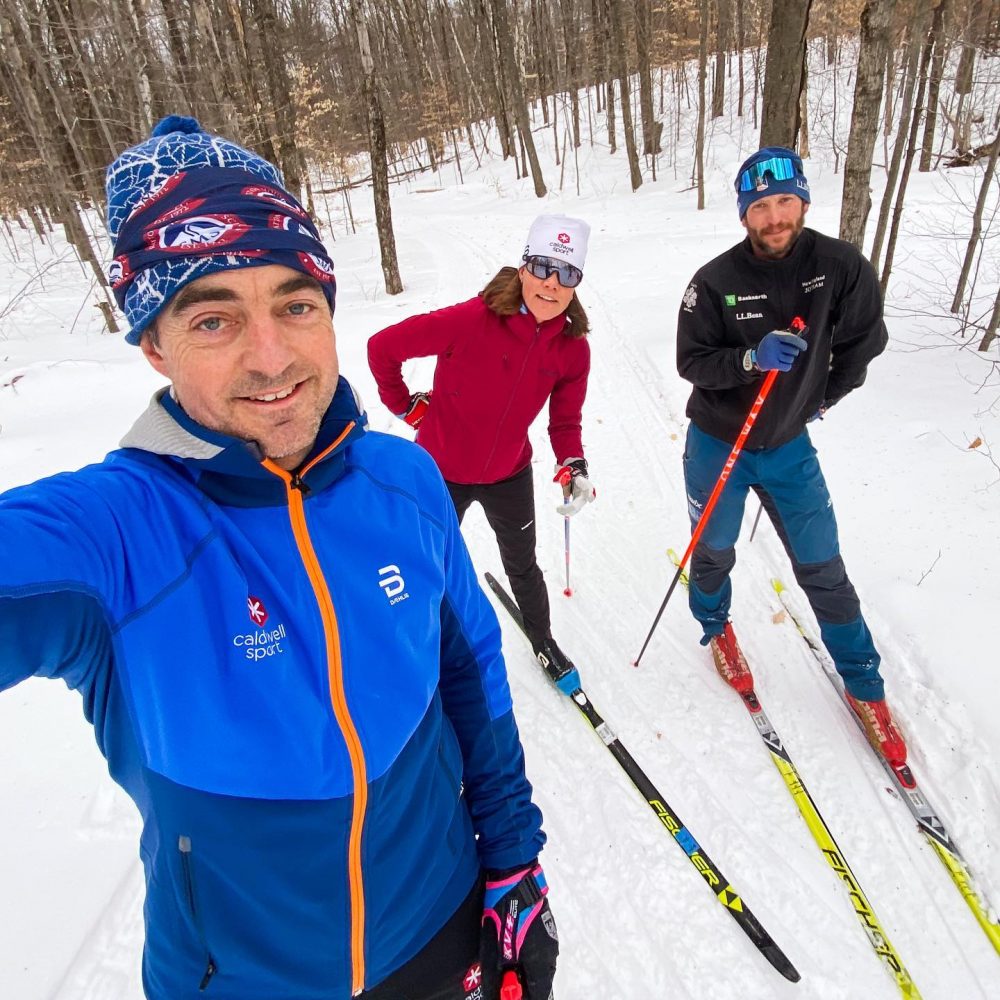
Zach Caldwell (left) out for a ski with his wife and business partner Amy and Craftsbury Green Racing Project wax tech Nick Brown. (Photo: Facebook Caldwell Sport)
Making it clear that his opinion is not clouded by the inability of a Colorado, Wisconsin, or Washington-based club skier to use a non-Swix wax purchased through Caldwell Sport, he added, “From a business perspective, with regard to my overall outlook, I probably should be applauding this model because it creates a massive incentive for kids to carry a lot more skis. And we’ve already seen this with the removal of fluoros from competition – you wouldn’t believe the uptick that we’ve seen in demand for warm weather skis, and grinds, and bases.”
In Caldwell’s opinion, the opportunity for athletes and coaches to optimize a ski through testing and the use of a product line they know well, regardless of brand, is a more viable option for “leveling the playing field” as it could bring any ski closer to what he called it’s “terminal velocity.” A wax protocol that puts every athlete on the same brand and hardness of wax, creates “a situation where that opportunity doesn’t exist and the only way to gain competition advantage is to buy another pair of $800 skis. So it very quickly becomes a sport that, really, is hard to succeed at without a lot of personal resources.”
While the focus of these points might suggest that competitive youth skiing will trend toward an arms race, Nystad’s points included a reminder that a skier with limited access to equipment and race-day wax expertise may not be doomed. Other aspects of athlete development remain as important as ever in a skier’s trajectory and long term prospects.
“Quite honestly, I don’t want kids to have ten pairs of skis,” Nystad said. “I have kids that ski, but I try to limit the amount of skis and I try to buy used skis and rather look at what properties do the skis have, so that they have okay skis for for each condition. And then we focus on other things that are far, far more important. And that is the mentality to learn to train, to have fun while you’re training, and then to work on technique and tactics. So it’s also a cultural thing.
“If you only focus on buying yourself time by buying equipment and buying wax and tweaking things and using resources — yes, you are probably going to gain some time, but you have to also say, ‘Are you investing as much time training and enhancing your technique and your tactic as the others are?’ So it’s definitely possible, even if you come from less resources, you can beat the guys with the most resources if you just train well and smart and develop good technique and good tactics.”
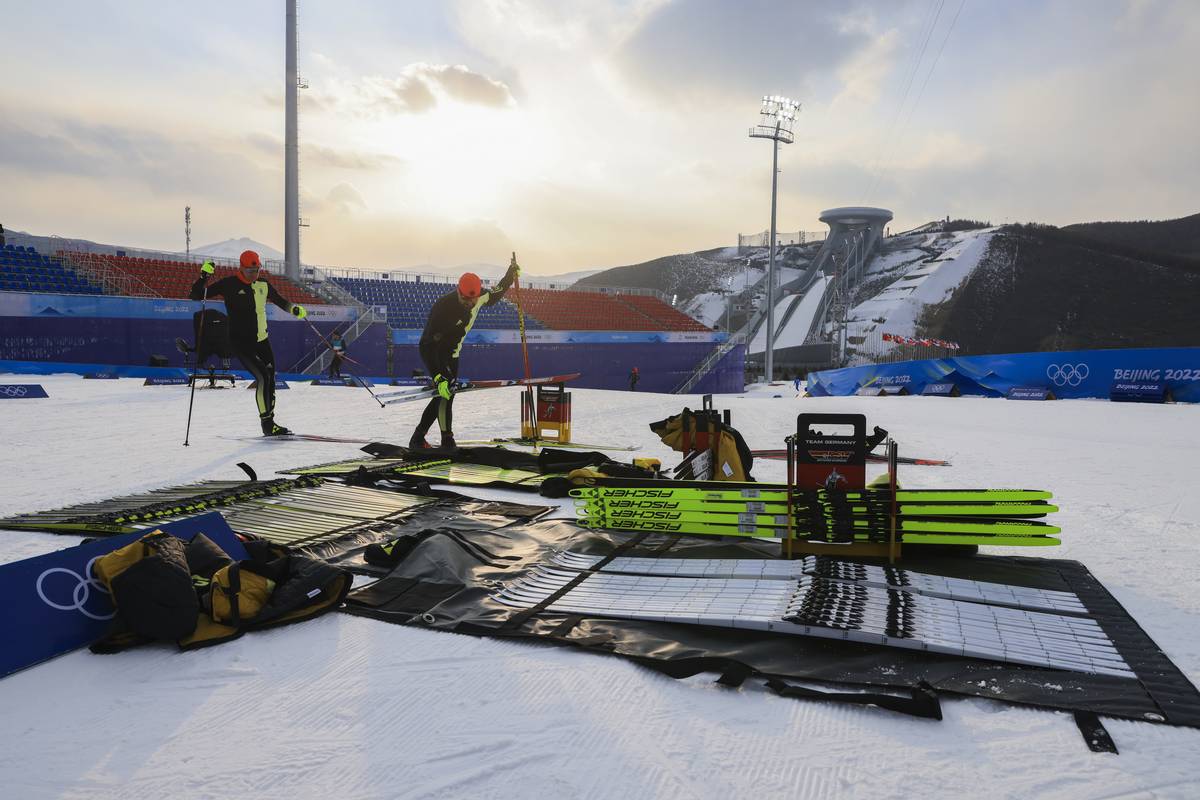
The German biathlon team tests skis during the 2022 Olympic Winter Games in Zhangjiakou, CHN. (Photo: NordicFocus)
As a serviceman working at the highest level of sport, Nystad also offered a thought-prompt on the impact to athlete knowledge and the ability to develop a new generation of wax technicians under a protocol, regardless of brand.
“If you want to educate athletes to also be able to become great service people at World Cup level races – if you take away that experience in club skiing or in high school skiing or in collegiate skiing, you will have no resources that are going to be able to serve your American athletes going to World Cups or World Championships or Olympics. Where are they going to get the knowledge? Because it’s like anything else, if you want to become good at something, you have to work at it.”
According to Caldwell, incorporating a wax protocol is “reductionist attempt to level the playing field” that creates more disparity than equity. And so, the goal of leveling the playing field in cross country skiing remains “laudable”, but out of reach, and perhaps unattainable.
“I understand the discussion, but I think you have to cater to common sense,” Nystad concluded. “You can always tell people that we decide to [have] one pair skate, one pair classical. I think you can also try to have the waxes [matched]. But still be aware, it’s never going to be fair.”
Stay tuned next week for follow-up series which highlights some of the leagues who have enacted a waxing protocol, namely, the Wisconsin Nordic Ski League (high school & club), and coaches from Rocky Mountain, Intermountain, and the Pacific Northwest. This discussion includes the evolution and reasoning behind the protocols, and what advantages/disadvantages have been identified by each league.
FasterSkier shares insights into ski performance theory from Any Gerlach, Zach Caldwell, and Knut Nystad. (Photo: NordicFocus)
In November 2021, the Wisconsin Nordic Ski League (WNSL), which oversees both high school and club level youth programming state-wide, accepted a sponsorship proposal from Swix and Salomon, which would provide the league with $10,000 in funding per year for three years. The proposal also included stipulation that a standardized wax protocol using Swix waxes would be adopted by the league at all affiliated races, including the state championship.
In practice, this would look like an email going out to all coaches a day or two prior to the event indicating which of a subset of Swix glide waxing products should be used by athletes that weekend. Equivalent temperature range and performance level waxes from other companies would be disallowed. In the sponsorship presentation given to the league by Swix, the proposal promoted the simplicity and affordability of a unified wax call, and a shift in focus for coaches away from time-consuming wax testing to race day support of their athletes.
The concept is not new, and WNSL is not the first league to adopt such a protocol. An equivalent protocol has been used by the high school, club, and collegiate level ski programs in the Rocky Mountain region (RMN and RMISA) for the last six years, and has more recently been adopted by the Pacific Northwest and Intermountain Division junior club programs. On the whole, these policies have been seen as beneficial by these regions.
While an additional $30,000 of funding has the potential to profoundly impact the reach of the WNSL, which will be discussed in a subsequent story, the adoption of the corresponding wax protocol also raised red flags, particularly among members of the Independent Nordic Distributors of America (INDA). The INDA includes distributors of wax products from other smaller companies like Start, Vauhti, Star, and more, and are primarily based in the Midwest.
The two primary issues that were flagged were the restriction of trade should Swix monopolize the buyer market encompassed by the WNSL, and also whether limiting the available choices to a single option actually creates the equity and uniformity that one might anticipate from putting all skiers on the same wax. Instead, could it widen the opportunity gap between those who could afford high-end skis with condition specific grinds and those who could not?
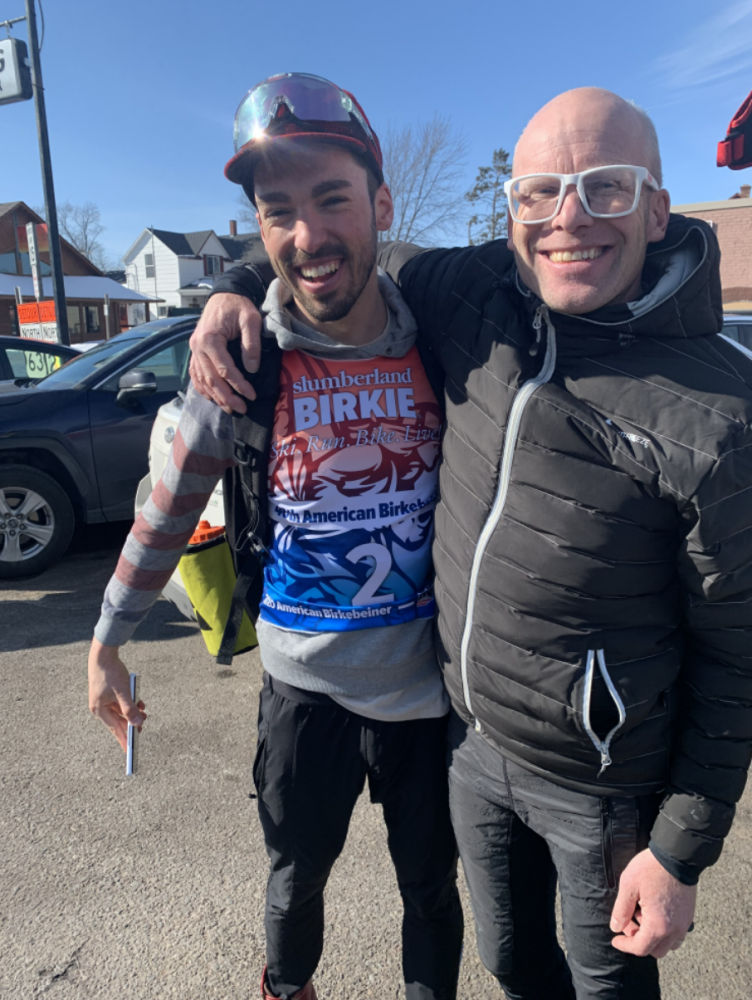
Enjoy Winter’s Andy Gerlach snaps a picture with 2020 Birkie Champion Ian Torchia (SMS T2). (Photo: EnjoyWinter.com)
In the fall, these issues were brought to FasterSkier by Andy Gerlach, director of Madison, WI based EnjoyWinter, which distributes Start, among other cross country related brands like Blitz Eyewear and Swenor rollerskis. With vested interests in the implications to his own business, but also as someone who offers brand-neutral education on wax theory for coaches, Gerlach actively opposed the decision by WNSL to accept the offer from Swix.
“The biggest argument against these exclusive sales agreements and proof that they are bad for the sport, and in fact illegal, is that they decrease the incentive for any other brand to fight for any part of a team’s or consumer’s business,” Gerlach said in the fall. “Why should my business continue to do wax clinics for Madnorski (Madison Nordic Ski Club) members if we know we are no longer getting a large chunk of their business. Why should any brand even visit Colorado clubs if we know we do not have a chance at a large chunk of the business there? Legal marketing arrangements should increase competition in the market, not decrease it. Change the agreements to marketing rights and not sales rights and every other brand would increase their efforts to reach the individual teams.”
After discussions among the cross-country sport committee during the recent U.S. Ski & Snowboard annual spring congress meetings, Gerlach summarized his objections to wax protocols to the following four points.
“They perpetuate a misconception that waxing is so difficult and mysterious. Our clinics state just the opposite.
“They perpetuate a misconception that extensive testing is effective and needed to select a glide wax that an athlete can race up to their abilities with. Our clinics state just the opposite.
“They increase the likely hood that those skiers with a quiver of skis will have the fastest skis. Multivariable mathematical analysis, as well as ski industry testing and ski sales figures shows this.
“They endorse one brand ‘because it is the most available’ and in so doing extends this advantage.”
There is plenty more involved in the debate on the legality and consequences on the business end of the decision whether to accept the sponsorship offer from Swix, which will be revisited in subsequent parts of this story. This installment, however, will focus on the underlying principles of ski performance theory, with input from experts, like Gerlach, on what factors ultimately determine ski speed, and whether restricting the waxes available for a given race would level the playing field by reducing variables, or adversely affect the pre-existing disparity between ski performance, thus limiting the potential of the skier clipped into the binding.
Brimming with insights into ski performance, this thought-provoking conversation should provide fodder for discussion within race-leagues at all levels as they consider waxing protocols and avenues to improve equity within the sport.
***
We’ll start with what Gerlach identified as the factors that affect the performance of a ski from most to least significant, and where in this process limiting a coach/athlete to a single wax from a single brand becomes significant.
“In my hierarchy of ski speed deciding factors, it’s a flexible ski, the freshness of the base is the next important, the structure, then the hardness of the wax, and then the brand,” Gerlach explained in a call. “Now we’re going to take away the hardness of the wax as a differentiator between them. And now, all we have as the only differentiator is the ski model, the freshness of the base, and the structure.”
The understanding of this theoretical model underscores the remainder of the question. When we hear “wax tech”, the name seems to imply the key player being adjusted and assessed is the wax. Gerlach explained that this reasoning is misguided.
“I, and scientific studies, will show you that 95% of this theoretical wax testing is not determining the fastest wax to apply that day. If it was, at US Nationals, or at any of these races, the line Saturday morning two hours before the race start would all be at one wax trailer. But you know, every coach comes up with their own thing… There is a different theoretical ideal wax for a Rossignol with an aggressive grind to the same Rossignol with a fine grind, and you would theoretically wax it differently. If you are testing on your Madshus cold skis and all your kids are on dried burnt out skis, or are on Fisher or on Salmon, theoretically, there’s a different wax [for each ski].”
It’s a counterintuitive concept to those, like myself, who prefer to focus on the technique and training aspects of the sport, versus the technical side. Why doesn’t putting everyone on Swix PS8 on a day forecasted to be in the right temperature range remove a factor that might create disparity between ski performance, thereby improving equity? Particularly in a larger state, like Colorado, where teams are driving long distances (through vastly different elevation zones) to race without knowing exactly what conditions will be like until arrival, I could see the appeal for coaches of removing a step in the planning process.
Swedish Technicians at work at a March, 2022 biathlon World Cup event in Oslo, NOR. (Photo: NordicFocus)
To simplify the answer on why equity may not be achievable with wax, Gerlach offered an analogy most skiers can relate to, regardless of their background knowledge in waxing theory.
“If you’ve ever shaved your legs or your face with a razor,” he began. “A sharp, brand-new razor is like a fresh ski with a fresh base. You don’t need shaving cream and that razor works great. But a dull razor – a dried, crappy base – you need that shaving cream. And you need the best shaving cream you can get, and it’s going to help that razor and that shave a whole lot more.”
How does this affect youth level programming? Ultimately, it accentuates the ever-growing “pay to play” problem of competitive sports. A newer, higher-end ski with a fresh base, or perhaps a quiver of skis that are ideal for different conditions, becomes much more important without the ability of a skier or coach to add versatility and improve the performance of a single pair of skis ski by utilizing a range of products to optimize the wax job.
“We have one ski with a great freshness of the base and a great structure, and one ski with a really dried up base. Had I applied wax to [the dry base], it does more to increase the ski speed than applying wax to a great ski… The more skis you can add to that quiver, all waxed the same, one of those is going to highly outperform the others. Versus when you had the ability to not only figure out which ski to go with, but which wax to go with. So by taking away variables that are easy to change, you make it more important to have a very good ski.”
To include additional knowledgeable voices in the discussion, FasterSkier also spoke with Zach Caldwell and Knut Nystad, two savants in the complex and nuanced world of wax and skis. Caldwell is a leading expert in ski selection, wax, and grinds in the US, and the co-owner of Caldwell Sport. As a distributor of Vauhti, Rode, Star, and other waxes, Caldwell is also a member of the INDA.
Nystad is the former head of the Norwegian Wax Team, who still works as a ski serviceman for the Norwegian program at the World Cup, World Championship, and Olympic level. Prior to this work in his home country, Nystad spent twelve years as the head coach at the University of Denver.
“The idea of having a fair competition and limiting variables in order to generate more fairness and equity in the racing and create equal opportunity and a lower barrier to entry is a really laudable goal, but it misses the point,” Caldwell said simply in a call.
“The fact is that it’s a pretty complex system that we’re working with, with a lot of additive contributing variables that contribute to a whole solution, including ski flex, base material, base preparations, waxing, hand structure, all of it. When you have a lot of variables available to you, you have a lot of different pathways to success. The peak performance that might be available [on a particular ski] can be considered something along the lines of terminal velocity; you’re just not really going to go past a certain level of performance [on a day], the performance that the snow is going to yield. But there are a lot of ways to get there.”
Inside the wax at a February SuperTour race weekend in Craftsbury, VT, where Zach Caldwell (left) supported SMS T2 athletes. (Photo: Facebook Caldwell Sport)
“As you begin to limit variables,” Caldwell explained, “you begin to place much more emphasis on other variables. They become proportionally much more important in determining how to get to the best performance possible [on the day]. And as you remove wax, which is a really inexpensive variable per application that can be put on specific to a day, you skew the emphasis toward skis base materials, grinds and hand structures.”
Individual variation among the skis and in the technique and strengths of the skier on those skis adds additional complexity to the scenario.
“Think about classic skis; this is a better way to imagine this,” Caldwell pitched. “Some athletes or some skis require different layering and build up of classic wax on a day. But if you’re saying, ‘Oh, you get two layers of extra blue. That’s it.’ That’s asinine. It means some people get to race and others basically have to herringbone.”
Nystad also questioned the premise of leveling the playing field by creating uniformity in the wax selection.
“Let’s start with the beginning,” Nystad said. “All of us that have done this for a long time, the only thing we know is that we don’t know. The only thing we know is that we need to test in order to get the answers. But what I can tell you from my experiences is that if you limit one factor, sometimes it just opens up another can of worms…
“There’s definitely good arguments for trying to make the sport as simple as possible. But I think that for the people that think that just by waxing with blue, that that’s going to make it more equitable. It is a sign to me that they don’t have that much in-depth knowledge.”
Knut Nystad provides insight into ski performance theory and why a one-wax call may widen the gap in cross country skiing. (Photo: knutnystad.com)
Without giving hierarchical ranking, Nystad also discussed the myriad of factors that contribute to the performance of a ski on a given day: the properties of the ski, including flex and splay, the quality of the base and its structure, the manual tools used, and the wax. “And then to top it all off, you have the method methodology that you use to apply the wax.”
He walked through various ways a particular wax could be applied to yield different results, before echoing Caldwell’s sentiments that equity and uniformity cannot be achieved by restricting the options for wax that can be applied to a ski.
“When people say, ‘Well, can’t we just all wax with the same thing? It will make it easier.’ Clearly it will make it easier; you have one less factor to think about. But if the intention was to make it more of an even playing field, it’s not necessarily the truth. Because when you go to a race, you’re only limited to try to test what you can afford from money, resources, and of course, time being one of those resources. So if you don’t have the test wax, what else can you test? Well, you can test many more skis, with many more properties with many more different bases, with many more structures, with many more manual tools.
“So it just opens up other things that you can test to get an advantage. And everything that you’re going to test if you’re going to have more skis, of course, that’s going to cost more. If you’re going to have more structures, different kinds of structures, that will also cost more. If you’re going to add manual tools, that will also cost more.”
Stay tuned for more insights from Gerlach, Caldwell, and Nystad in Part 2 of this story.
In this episode of the Devon Kershaw Show, we bring back Zach Caldwell, one of North America’s leading ski and wax experts. We get into the arcane and arguably misguided rules around the use of fluorocarbon waxes at high-level races, along with potential challenges for wax and ski technicians at the little-studied Beijing Olympic venue.
You can find a host of resources from Zach on skis, wax, and grinds that might more-directly apply to your own skiing and racing at CaldwellSport.com.
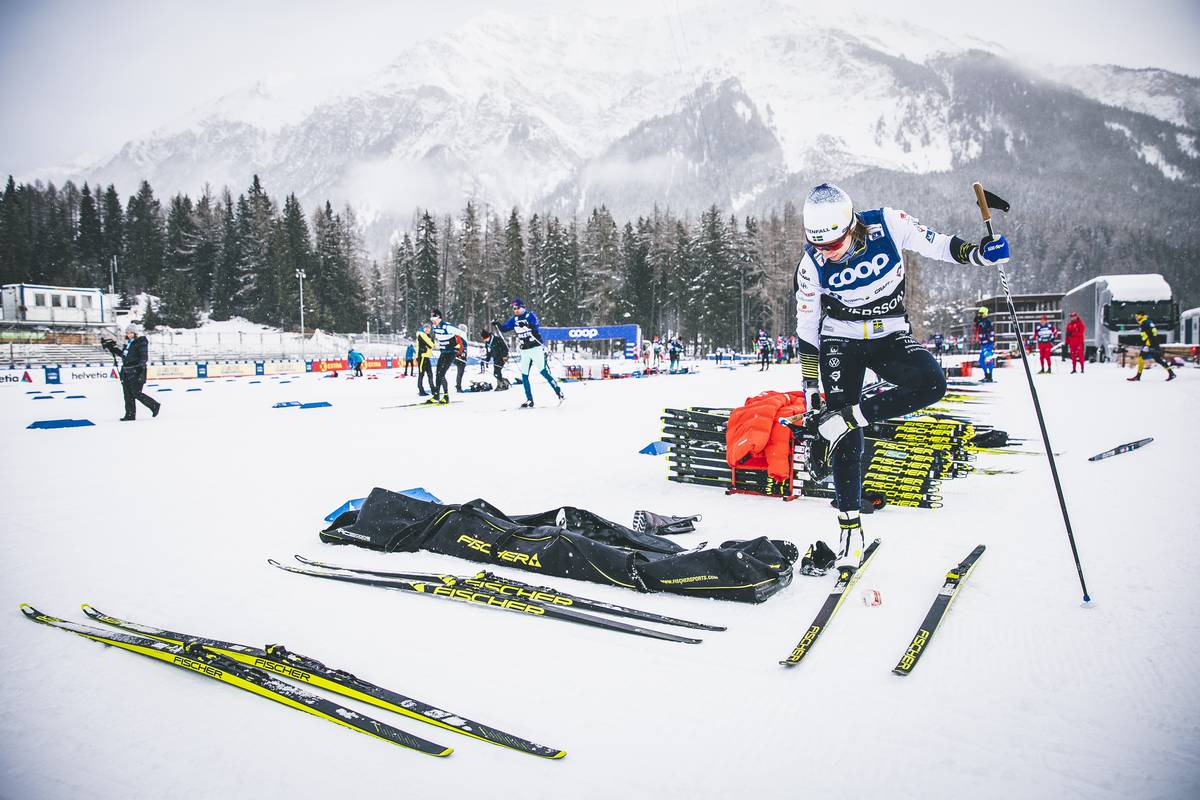
Testing the Fischer fleet in Davos. (Photo: NoridcFocus)
The cost of providing World Cup athletes with competitive skis is mounting at an alarming rate for teams without deep pockets.
This spring, coaches of US National Team athletes and staff from the Center of Excellence in Park City huddled around zoom for their annual meeting, called “Moving USA Skiing Forward.” Among the topics discussed were plans for the US Ski Team to keep pace with what Head Coach Matt Whitcomb calls the “waxing arms race.”
While high end ski service has never been cheap, costs have ballooned, in part due to the growing adoption of on-site grinding programs by well-funded national teams. The desire for teams to have grinding programs is expected to intensify should the fluorocarbon ban take effect in the 2022/23 season.
Cross Country Program Manager Chris Grover. (Photo: US Ski & Snowboard)
“A lot of technicians think it’s going to exacerbate some of the problems, because most people view the C8 fluorocarbons as being a great equalizer,” said Cross Country Program Manager Chris Grover. “There’s so many products that are so good… that they end up being quite similar in terms of ski speed.”
Because of the equalizing effect of fluoros, teams looking to gain a competitive edge have increasingly turned to ski selection, grinds, hand structures, and above all, testing. Grover said the challenge was to keep up with nations that can “take brand new skis and put a specific grind on them during the championships, and have the massive manpower needed to do the incredible amount of testing to figure out how every hand structure that they’re testing interacts with every one of the grinds that they’re testing, and doing all that before they even test an athlete’s fleet of skis, or apply those enhanced structures to the ski.”
As a result, Grover said that, “most nations are now spending much more on World Cup ski service than they do on their development budgets, or even their camp budgets.” A 2019 survey by FIS found that big ski nations spent 33% of their annual budget on ski service, compared to 15% for training costs. Dagbladet reported that of the costs teams pay at the World Cup itself, more than half goes towards race service.
When fluoros are phased out, Grover said it would, “put more pressure on the grinding and hand structure side of things, which is a place to spend a lot more money: a lot more R&D money, more testing money, more application and on the ground winter logistical money.”
Grover affirmed that “easily” a third of the US Ski Team budget has already been going toward ski service. He listed expenses such as paying wax techs, including their salary, lodging, and travel, as well as the cost of moving the wax truck around Europe. Add to that ski testing camps and purchasing wax. According to Grover, these costs are “putting immense pressure on all the teams.”
The USST wax truck, new in 2017, fully deployed. (Photo: Matt Whitcomb)
To catch up to the likes of Norway and Sweden, the US Ski Team has made large investments. In 2017 the team purchased a $600,000 wax truck. This season nine nations will haul their own waxing rigs around the World Cup circuit: Sweden, Norway, Finland, Russia, Germany, Switzerland, France, Canada, and the United States.
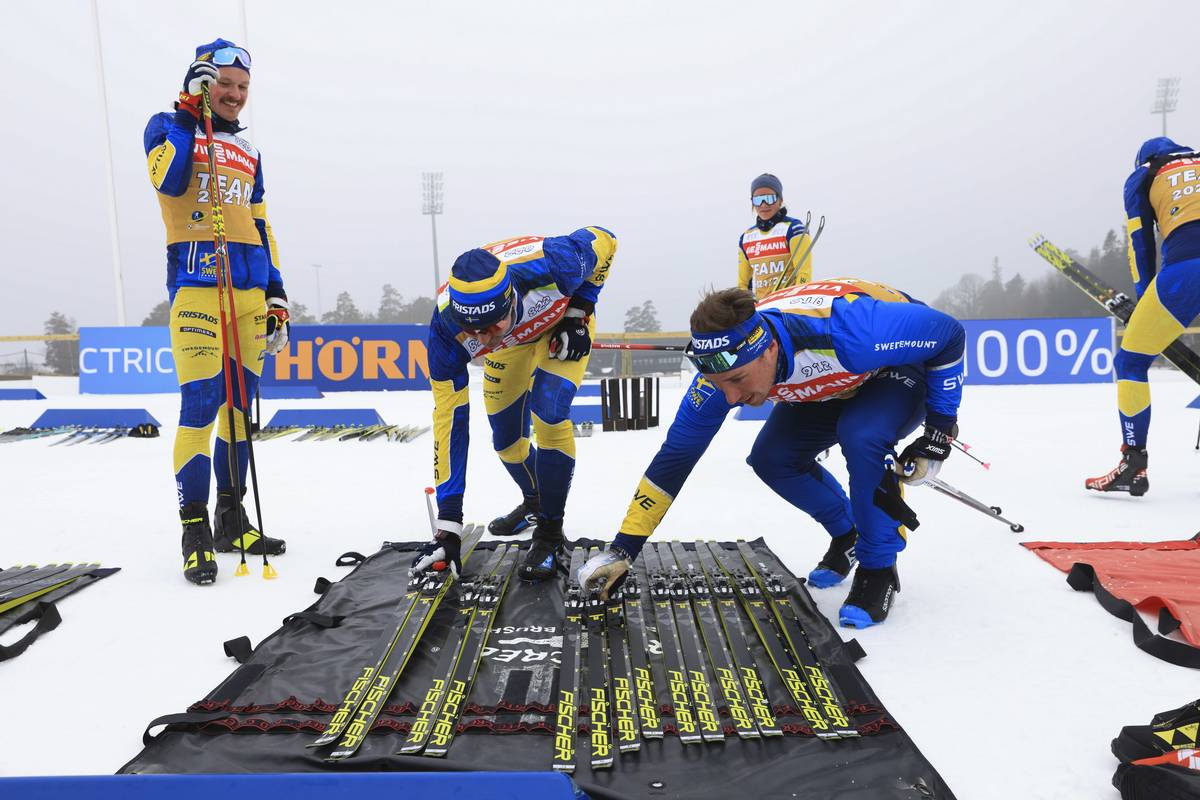
Where wax trucks were once the cutting edge, grinding is now at the forefront of elite ski service at championship events. “As many as five teams bring grinders to championships,” said Whitcomb. “In a championship that is very wet…[that can] be a huge benefit.”
With the past two World Championships being held in summer-like slush—conditions that allow grinding programs to shine—a US Ski Team grinding program has become more appealing. Currently, most US skiers use factory grinds which vary from company to company. As a result, it can be difficult, especially in very warm conditions, to find a hand structure that works over a variety of grinds.
The advantage to having an in-house grinding program is less venue specific, in the opinion of Zach Caldwell, ski-grinding guru and owner of Caldwell Sport, and has more to do with “overall control of the process.”
Zach Caldwell with a pair of Madshus skis.
Still, Caldwell said in a call with FasterSkier that he believed a team grinding program would be “putting the cart before the horse.” Caldwell outlined the challenges to starting a grinding program: “You can get a very competitive grinder for seventy thousand to a couple of hundred thousand dollars. [The real cost would be] at least one dedicated person who is really going to learn the trade.”
Added to that would be two to four testers to “run skis as often as you can get them out on the snow, around the world, to as many different venues as you can. A good structure needs to work in a lot of different places…this is where the factories come in — they’re testing all the time.”
As it stands, Caldwell said that the US Ski Team has a “very underfunded service department. They don’t have a single 12 month employee…I think there’s so many areas to do super beneficial work by just adding one, maybe two or three full time employees.”
To get a grinding program up and running would require paying “full time employees, every year, and figuring that it’s going to take several years to make any advantages — and that’s only if you have people good enough to be close to the best in the world doing it. It’s just a tough way to make a small advantage,” said Caldwell. “Just adding a championship grinding operation to what they’re already doing doesn’t make sense.”
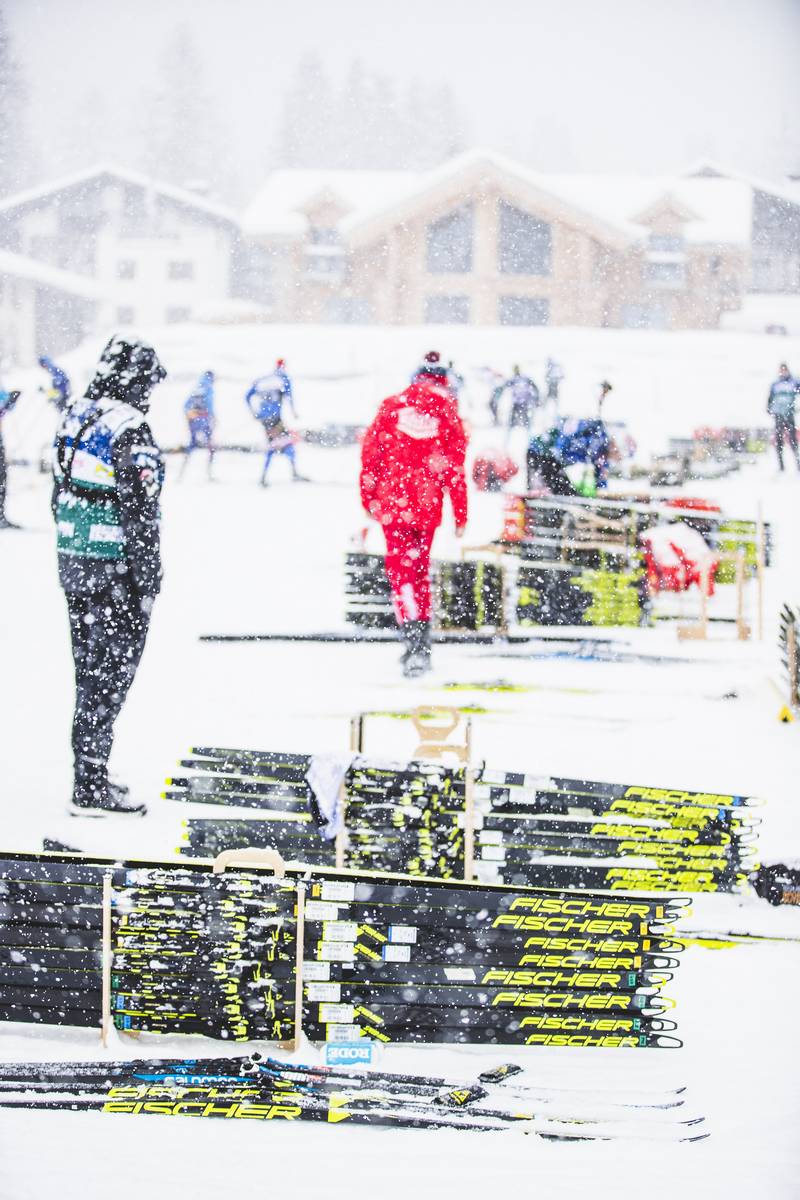
Testing the Salomon fleet in Davos. (Photo: NordicFocus)
The US Ski Team has been pursuing other initiatives to bridge the gap to leading wax nations. Gus Kaeding, who runs the analytics department for the US Ski Team, created a system to track weather conditions and skis used at World Cup events.
“Let’s take a place we go every year like Ruka, [Finland],” said Kaeding. “ [Previously] we just had the weather written down in notebooks somewhere. Now, every morning when the coaches arrive, they are able to attribute what skis they’re using to their athlete, all in a centralized system. We can look and see which skis performed and which didn’t, and what the weather conditions were.”
Kaeding felt that the old school method of logging conditions, waxes, and skis in notebooks was a “competitive disadvantage.” He pointed to the weather tracking system that Norway developed beginning in 2009, complete with their own weather stations at World Cup venues.
“They can tell you the weather conditions in Ruka from the last decade and a half and what happened down to the millisecond each day,” Kaeding said, adding, “They’re a decade ahead of us. In terms of information, there’s basically no way we can catch up to that, which is a bit frustrating.”
Nevertheless, Kaeding is optimistic that a couple of developments may help the team in the future. One is that a future fluoro ban may make much of other teams’ waxing databases less relevant. The second is the Beijing Olympic venue, which, apart from the Chinese ski team, has not been accessible to any of the teams.
This lack of access to the Chinese venue has hampered plans by Norway to conduct research and testing in advance. Normally, the Norwegian Gliding Project—a partnership between the Norwegian cross country, combined, and biathlon teams—conducts ski testing at an Olympic venue beginning four years in advance. In the lead up to the 2018 Games, the project spent 14.7 million NOK, equivalent to about $1.7 million USD. With the Beijing Olympic venue closed, the level of research a nation like Norway can have in its back pocket is severely limited.
“Frankly, when we go to a place, such as the Beijing Olympics — a venue no one’s ever been to — it gives us an advantage,” Kaeding said. “Because they don’t have 10 years of data on this place… It brings everyone to a more level playing field.”
Kaeding is among those who believe that a FIS ruling on limitations is the path to a fairer sport. “All the teams are dedicating such a high portion of our budgets just to improve the last 1% [of ski speed],” said Kaeding. “Which is a little ridiculous… I’m almost of the mind that we need to push harder on FIS to put something in place, and put more energy into doing that, because it’s going to benefit us if we can get on a more level playing field, and a lot of the other countries as well. Creating a more equal playing field should only help the overall health of the sport.”
Andy Newell (right) with U.S. Ski Team wax tech Patrick Moore (left). (Photo: John Lazenby/lazenbyphoto.com)
Whitcomb explained that the US Ski Team is “supporting measures by FIS to try and cut back on this to make it more affordable.” Over the years, many ideas to equalize the sport have been floated, and a few have been implemented with little effect.
“The takeaway,” said Grover, “is that there’s been all kinds of workarounds, and the bigger nations have actually figured out a way to continue to do what they’re doing.”
In 2015, FIS attempted to limit the size of service teams by capping the number of technicians a nation could bring to an event at 22. Norway found a workaround by partnering with Great Britain and thereby increasing their quota to 35. That has been a boon for British skiers, while increasing pressure on smaller nations to find a patron state. Ireland now partners with Sweden, and Australia has partnered with the U.S.
Caldwell felt that quotas on race technicians wouldn’t get to the heart of the issue, saying, “the resources that big teams bring to bear are often offsite and in the background. So just limiting on site accreditations doesn’t level the playing field. As long as Norway can show up and take 200 pairs of skis from the factory to test for [Therese Johaug] and take just six and send them to the World Cup for further testing—good luck.”
In 2019 measures were introduced to FIS to prevent teams from traveling with grinding machines or testing at championship venues years in advance. As of yet, the measures have not been passed.
Grover has a seat on the FIS working group within the Cross Country Committee that will discuss ideas for rule changes. He wrote FasterSkier that “currently there are no formal proposals in front of the FIS Cross Country Committee for this season. The working group is discussing possible measures for debate and implementation in the Spring of 2022.”
Among the measures he said the group will discuss are: “banning grinders from venues, limiting cooperation between nations, limiting the size of service teams (i.e. staff reductions), limiting access to testing tracks/race courses, [and] homogenized waxing by neutral parties.”
Lenzerheide, Switzerland World Cup, Sweden’s Ebba Andersson tests her Fischer fleet. (Photo: Nordic Focus)
“The challenge,” Grover wrote, “is that no measure alone is comprehensive and there are always workarounds. It will be interesting to see where the discussion goes and if there are any meaningful steps we can take as a community.”
Caldwell believes that if the goal of measures is to limit spending, they should target that issue head on. “You have to find an economic instrument to limit the costs, like a budget cap,” he said. “I don’t know how you regulate it, but you have to start there.” He added that: “The Norwegians are out there with a basically unlimited budget just looking for creative ways that add value that they can spend their money on. They’re setting a bar that’s difficult for smaller teams. They just are.”
These issues are not contained to the World Cup. The fluoro free future, already in place in different regions and circuits, is changing the priorities of teams and clubs domestically. Caldwell believes that when teams are no longer focused on fluoros they will, “make room in their schedule and budget to focus on other things.”
The cost of these new priorities — ski selection, grinding, hand structure, and the intensive testing that comes with each — will easily make up, and likely increase, the cost of competitive ski service domestically. Caldwell pointed to the fluoro free (EISA) collegiate circuit, saying, “College budgets aren’t changing — they’re going to spend the money.”
“It always comes down to resources,” said Caldwell. “To be competitive you’re going to spend what you can spend.”
For more debate on this topic, listen to this episode of the Devon Kershaw show.
With wildfire smoke obscuring mountain views and compromising easy breathing in much of the West, it’s safe to say it is summer. In this episode of the Devon Kershaw Show, we mostly chat with Zach Caldwell of Vermont’s Caldwell Sport.
Last season, during one of our conversations with Zach, we discussed some ideas we’d like to see in terms of an enhanced broadcast from FIS for their cross-country World Cup coverage. Zach came up with some interesting concepts — you’ll have to listen to the episode to learn more.
But to start things off, we catch up on summertime adventures and the news that Devon has begun medical school in Norway. It will be a few years, but we’re paging Doctor Kershaw.
Biathete Tiril Eckhoff (NOR) hands over the skis to Gerhard Urain, Nordic Race Director for Fischer. (Photo: NordicFocus)
Will there be enough skis this season? That’s the question every ski shop and many consumers are asking. With demand predicted to remain high this winter, and some unique challenges faced by ski producers, ski scarcity may remain a reality.
“I imagine if demand stays high we will see some significant shortages this season,” said Nathan Shultz, owner of Boulder Nordic Sport.
The problem, from a supply-side, started with the pandemic. People thought that the demand would be low and the most popular would be home-based activities like online games from Casinosters. “In the beginning, everyone freaked out and thought that no one was going to buy anything,” said Schulz. “Factories had to adapt to that expectation and then everything started going gangbusters, and demand escalated at a pace we haven’t seen. So on top of supply disruptions, there was a huge demand, everything sold out, and then the fire happened.”
In October 2020, a massive fire tore through the ski production line of Fischer’s factory in Mukachevo, Ukraine, requiring much of the production floor to be rebuilt. Most of the skis for the 20-21 season, however, had already been produced and were awaiting shipment in a separate facility.
Fischer—the world’s largest ski manufacturer—produced around sixty percent of its skis across all disciplines at the Ukrainian site, which handled ski production for several other brands as well. In all, it has been reported that a quarter of the world’s skis came out of the Mukachevo factory.
“Globally the loss of that factory is a big hit, and not only for Fischer but the brands that they manufacture for,” said Zach Caldwell of Caldwell Sport. Like many large ski factories, the Ukrainian factory produced cross country and alpine skis for a number of brands including Rossignol, Alpina, Scott, and Dynafit.
Jeff Courter, the Nordic Manager for Rossignol said the Fischer factory fire was, “shorting the worldwide ski supply because the factory made skis for a lot of different brands. When you think about finding a home for all those skis, not only for our brand, but for Fischer and anyone else they made skis for, that’s a lot of skis you have to find factories for. So that’s putting a lot of pressure on all the other ski factories as well.” (Rossignol’s high-end race skis are manufactured at their production facilities in Spain and France.)
“Without Covid, we might have been able to absorb [the Fischer factory loss]…but with Covid—impossible. So this is why all the big brands need to shut down for business early.” Said Robert Lazzaroni, the Regional Commercial Manager of Salomon, referring to the earlier than the normal deadline for retailers to order skis.
In a normal year, ski shops order equipment for the following season in the late spring and reorder products as demand requires. “Normally if we need something specific we call and get something,” said Schulz. “We do a lot of small juniors orders, because it’s so hard to know what juniors are going to need…we call Fischer if we need something.”
This year, the flexibility to order small batches on the fly has dissolved. “We’ve been told, ‘don’t expect any reorder capability,’” Schulz said. According to some ski reps, many retailers are left with little ski stock heading into the 2022 season and will have to rely on their preseason order made in March to get them through the winter.
“I believe the shops did learn the lesson last year with the crazy demand for our product,” said Lazzaroni. “And I think the shops did go a little bit heavier on the preseason versus the reorder.”
In recent years, with the retirement of Canada’s Alex Harvey, U.S. skier Jessie Diggins has become the face of the France based ski brand. (Photo: NordicFocus)
What was already a perfect storm of increased demand and faltering supply chains as the pandemic ensued, was only compounded by the Ukraine fire. Factories able to upscale their ski production worked at full capacity to meet the preseason order requirements.
Courter said that the Rossignol factories had been, “really maxing out on what it can make, and not only make, but ship in a timely manner. These production ceilings we have rarely, if ever, been bumped into until now—so it’s been a learning experience.”
Ski production has seasonal constraints as retailers need to receive products during their selling window, most of which happens between October and January. “We could keep making skis and boots all year,” said Courter, “but it’s not going to do the retailers any good if we send them a bunch of stuff in March.”
Fischer compensated for the production loss in part by transferring some of its Ukrainian ski makers to its factory in Ried, Austria allowing production there to ramp up, with the factory running additional shifts.
Steve Reeder, Fischer’s Nordic Sales Manager in the U.S., said that under the circumstances, Fischer was handling the demand well. ”Can we absolutely get as many as we want? No,” Reeder said, “but we’ll have more product out there this season than we did last season.”
Fischer’s high-end products are mainly produced in Austria and were unaffected by the fire. “The two factories have been separated on the nordic side by their core technologies,” said Reeder. “Ried [Austria] has specialized in Air Core, and the Ukraine is kind of a complete tree to ski facility. Everything other than our entry-level price point is Air Core, so it’s coming out of Ried.” Reeder continued, “For the FasterSkier audience there’s actually minimal impact from the fire. We’re still making the majority of our race ski product in Ried, Austria. So the supply concerns are focused more on the touring category which has been compounded by the impact that Covid has had on outdoor recreation sales, and the fact that the increase in business we’ve seen in the States is happening globally.”
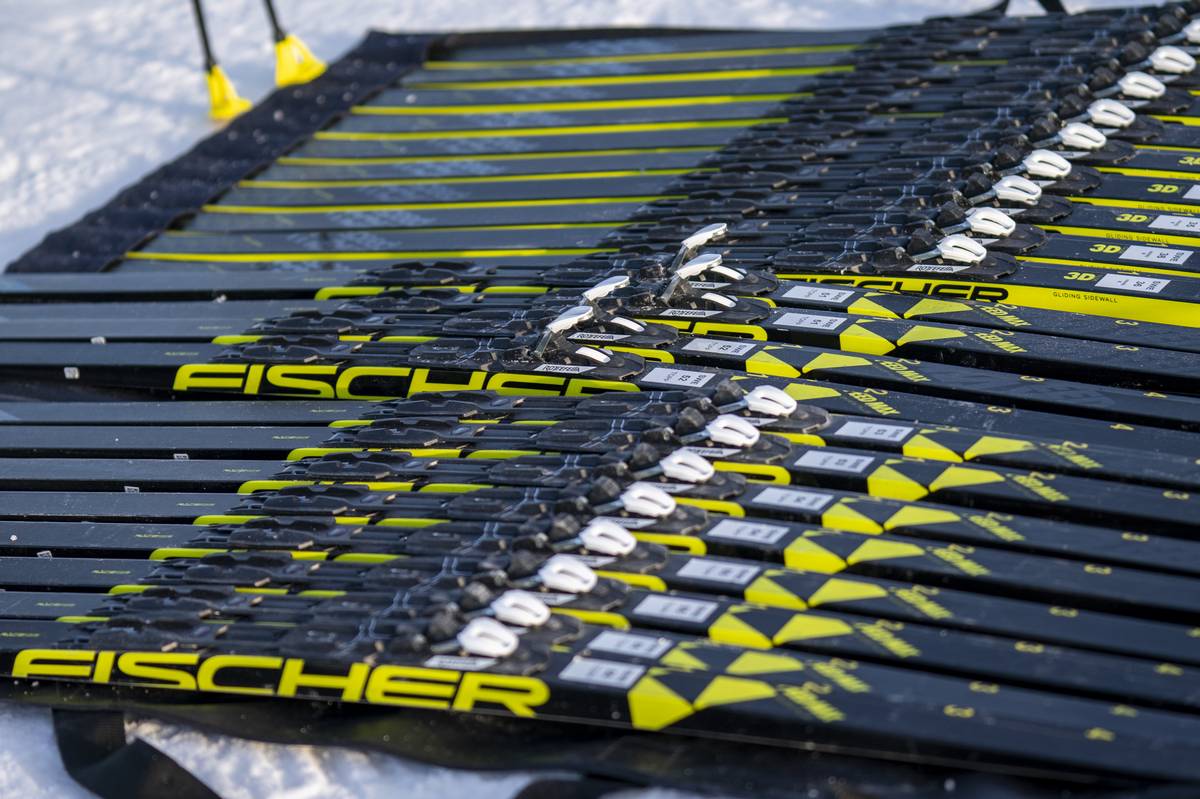
A fleet of Fischer race bred Speedmax. According to Fischer, production of the high-end race ski will not be affected by the Ukraine factory fire. (Photo: NordicFocus)
The supply-side strain is most acute on the recreational and backcountry ski category that sold so well last winter, according to ski reps and shops that spoke to FasterSkier. “Touring and backcountry is where, not only us, but a lot of the other brands will not have the availability, unfortunately,” Courter said.
“Already last year the supply [for touring] was very short, and this year we are facing known shortages,” Caldwell said. “I know we’ve been promised that our preseason orders would be filled, but on reorders we’re anticipating having zero availability.”
For high-end race skis, the situation is calmer, though demand for racing equipment has rebounded. “Even in the performance and race categories the demand is really high, which is great considering that last year was troubling to get races off the ground,” said Courter. With factories working at full tilt to produce orders, manufacturers are unable to produce an excess of high-end models. “With top-end race skis, we’re anticipating getting what we ordered,” Caldwell said, “but also anticipating some short supply as we get closer to winter.”
Apart from skis, there are ramifications for other nordic products due to the topsy turvy global supply chain.
“The wax folks I’ve talked to have acknowledged that material costs have gone up and their margins have gotten really lean. I wouldn’t be surprised to see costs go up at some point,” said Caldwell. “I bet some companies might introduce them already this year, but a lot of companies are stuck with what they’ve promised, so it might be something to recoup from in the future—but that’s a price thing. The absolute chemical that goes into it is pretty small, it’s not a big industry.”
Another question Caldwell has considered is whether ski poles will be affected by global pressures. “Who knows, maybe poles will be difficult with a ton of Asian carbon manufacturing,” said Caldwell who clarified that he was, “totally speculating.” He added that, “Pretty much every pole out there is made in Asia, and that Asian supply chain…I just don’t know at what point that becomes an issue. Because of the cross over into other industries, the ski pole factories aren’t always ski pole factories, so that introduces a level of vulnerability and knock-on effect from other supply chain issues and excess orders.”
While burgeoning demand, reduced stockpiles, and the loss of the largest ski factory have strained the industry, it is in a relatively better position than that of other outdoor sport manufacturers, notably the bike industry.
“I think everyone recognizes that the bike supply chain is really screwed up,” said Caldwell. “With skis, it’s a limited range of raw materials and according to the companies I’ve spoken with, they’re not seeing shortages in raw materials. So in terms of assembling the products, it’s not so much a problem, the problem is on the demand side and on the capacity of factories to produce the skis. The nice thing about skis is they make a finished product in one factory.”
The ski brands that spoke to FasterSkier were confident in their ability to deliver on their preseason orders, and to varying degrees, believe they may be able to offer reorders on high-end race skis. Shop owners, however, expressed some concern that orders would be delivered in full.
French World Cup athletes hover over the Rossignol goods. (Photo: NordicFocus)
In any case, possible ski shortages this upcoming winter will likely be decided by the size of retailers’ preseason orders and, most of all, snowfall. “Our sport is dependent on snow on the ground, so assuming that some of our markets like New England and the Midwest—if they get early snow, then there’ll be a point somewhere in the year that shops could get a little lean on in-stock product,” said Courter.
Lazzaroni put it succinctly, “If, and it’s always an if, we have a decent early winter, the industry will lack product. I do believe what we saw last winter will continue into this winter and there will be a crazy high demand for nordic product,” said Lazzaroni. “The question is, has our retailer network been optimistic enough, and crazy enough with their preseason order to cover future needs from the consumer? I don’t think so, to be honest.”
For skiers looking for new boards this winter, the message was clear: buy early. “People would be advised to get their names on orders early,” said Caldwell, “because I would be unsurprised to see some brands fall short
A U.S. ski technician holds different skis in the warm up area on the IBU World Cup. in Kontiolahti, Finland. (Photo: NordicFocus)
In this episode, we speak with Zach Caldwell — Putney, Vermont ski whisperer, and wax nerd at Caldwell Sport. We’ve received questions from listeners asking about the difficulty of waxing (for both skate and classic) as well as ski selection when the temperatures spike beyond the melting point for snow. That has been the case in Oberstdorf, Germany the last week, site of the 2021 Nordic Ski World Championships.
Testing skis and wax at the 2021 World Championships. (Photo: NordicFocus)
That said, it’s a “rest day” at World Champs, so no race breakdown in this episode — just wax and ski talk.
Jessie Diggins during training in Oberstdorf, Germany before the championships began. (Photo: NordicFocus)
As we slowly run out of fumes in this 8-stage epic, we debrief the Stage 6 happenings from the Tour de Ski. First, the Tour de Ski’s Stage 6 cliff notes: Diggins lands 9th on the stage but retains the overall lead, Brennan falls out of overall contention, Bolshunov wins, and Schumacher pops a top-10 for 8th place.
To round out the discussion today, we bring in ski and wax whisperer … and coach, Zach Caldwell. Caldwell was the longtime coach of Kris Freeman who posted up some fine results from the Val di Fiemme venue, home to the Tour’s final three stages.
All in all, a good day of racing.
Aerial view of the venue in Val di Fiemme. (Photo: NordicFocus)
Thanks again for listening as we too try to sprint into the Stage 7 and Stage 8 weekend.
With a kowtow to Zach Caldwell and Noah Hoffman, we are repurposing their recent video conversation about anti-doping reform. On Nordic Nation, you’ll find just the audio. If you are more visual by nature, you can find the video here.
Hoffman is a former longtime U.S. Ski Team member. Caldwell is Hoffman’s former coach and runs Vermont based Caldwell Sport.
In this conversation, you’ll get solid details about anti-doping policy in the U.S. and abroad. Think of this as an advanced level remote learning opportunity to up your game when discussing anti-doping affairs. From Noah’s involvement with Global Athlete, to details on the Rodchenkov Act, USADA, and efforts to magnify athlete voices via labor unions, Caldwell and Hoffman cover lots of ground.
For those that have followed Hoffman’s career, this is an opportunity to hear him as he emerges as a nascent expert in anti-doping policy. It is easy to envision Hoffman leading international clean sport efforts in the years ahead.
Noah Hoffman (left) and Zach Caldwell (right). This is a screenshot of the video, clicking the white triangle will not prompt the video to begin.
Over two days in March, the North American World Cup races were cancelled. Amid rising health concerns, NCAA Championships also shut down after one race; Junior Nationals after two races. Canadian National Championships never got off the ground. After the abrupt end of winter, people are trying to assess how the pandemic will affect the coming winter.
In The Atlantic, Juliette Kayyem posits that “From a public health perspective, the pandemic will not end for another 18 months.” She speculates that it may take 18 months to develop a suitable vaccine, which must then be distributed. How will this affect ski racing as we have come to know it?
While this metric pertains to alpine resorts, it’s stark any way you slice it: with spring break looming or in full swing, alpine lodging occupancy dropped 54% from March 2019 when alpine resorts began closing.
“The timing of it couldn’t be better for the ski industry,” said Zach Caldwell, proprietor of Caldwell Sport. “We lost the tail end of the season. That was a big bummer. We had most of the season and it was a good one. We in the industry have the luxury of being able to sit back, observe, and see what happens, and wait to finalize plans.”
If one can extrapolate from one retailer’s experience, sales cratered in March after a strong start to the year. Matt Liebsch, a co-owner of Pioneer Midwest in Minnesota, concurs. Pioneer did very well at the beginning of the year, but saw March sales fall off as social distancing set in.
“We had really good growth in January and February,” Liebsch said. Pioneer finished March down thirty percent in revenue compared to last year. Prior to coronavirus, Liebsch said, Pioneer would sell two to six pairs of race skis each day. “We’re at zero right now. When you shelter in place, I think that means you park your money in place. The virus has thrown things off.”
Federico Pellegrino of Italy testing skis in Falun, Sweden. (Photo: NordicFocus)
According to Jeff Courter, Rossignol North America’s nordic category manager, the bulk of its sales to retailers were complete by the time social distancing became the new normal.
“For any major ski brand industry-wide, [the pandemic] hit at a time where the majority of sales had really happened already. We missed out on a lot of opportunities to capitalize on spring sales and spring break. We’re trying to help our retailers in North America to try and get through the times,” Courter said. He added that spring break sales can help retailers clear out inventory so they can prepare for the coming year.
Typically, Liebsch makes two trips a year to Europe for custom ski picking as well as pre-ordering skis to sell off the rack. He said that bulk pre-season orders from manufacturers were generally due to vendors between late February and late March. They’re shipped to arrive in the U.S. between mid August and mid October. “That’s all in the books. It’s kind of a shot in the dark.”
“We try to [work with] our discerning, race-oriented customers that want a wet ski or a better ski than what they have in September, October,” said Liebsch. “That clears my plate for [recreational skiers] and the start of [Minnesota’s] high school race season in November and December. I don’t get to talk about grinds, race wax, or camber construction. I’m explaining to mom and dad the difference between a classic ski and a skate ski.”
“The majority of our orders [for the coming year] have already come in by mid-March,” Rossignol’s Courter said. “But anyone – not just us – any ski company in general, once we get a little farther into this, and kind of see how things lay out for the fall, some of the smaller retailers may have to make some adjustments to what they thought about bringing in.”
While most retailers have ordered skis for the coming season, it’s not known how the pandemic will affect manufacturing schedules. Citing the safety of its staff and their families, Courter said that one of Rossignol’s main factories, located in Spain, had closed down for safety reasons in early April. It’s scheduled to reopen on May 4.
Looking for ways to get back on schedule, Courter said that Rossi facilities would be running three shifts. Normally, their ski production is done by July. At present, this year they plan on making skis through August.
“The majority of the factories that we work with have been able to stay open,” Courter said. He added that one factory had experienced a slowdown as some raw materials haven’t been delivered.
Bryan Cook, Madshus USA sales manager, wrote in an email, “Generally, we are constantly producing skis with the majority happening between the months of December and April. This means that we are just about wrapping up all of our preseason orders for the coming season. We then look to ship the skis, via ocean, between the months of June and September, as most dealers request their product to be in store between September and November.”
Krista Pärmäkoski of Finland testing skis in Falun, Sweden. (Photo: Nordic Focus)
Zach Caldwell, proprietor of Vermont’s Caldwell Sport, also travels to Europe to pick skis. Speaking on April 13, he said the Austrian companies he works with underwent a mandatory shutdown, but are opening back up. According to Caldwell, they’re ready to schedule ski picking. While the ski companies seemed optimistic, Caldwell is waiting to see what happens when social distancing is relaxed.
“I can get to a ski factory and interact with about three people and pick the skis I need. What I do need to be able to do is travel. And that’s not something I’m willing to do right now, even if it was wide open. Once the international travel piece looks OK, there’s nothing standing between me and picking skis for people,” Caldwell said.
For both Caldwell and Liebsch, races next winter pose a bigger question than shipping schedules. How will the possibility, even the likelihood, of continued social distancing affect racing next winter?
“But both the competitive aspect and social aspect of competition is what drives a lot of our sport,” Caldwell said. “We’re going to lose a lot of people if we shut that off for a year. I think there are ways to prepare for a season of distancing measures, and that’s a bigger story from my perspective than what does the industry look like.”
“The biggest issue that I have is the prospect for racing next season,” he added. He’s concerned about the feasibility of having several hundred competitors, plus coaches and family, at Eastern Cups. [The Eastern Cup races are the New England qualifying races for Junior Nationals.]
Concerned about the impact social distancing may have on racing, Caldwell wrote to the New England Nordic Ski Association [NENSA], urging them to consider alternatives to traditional races.
“We should be making plans to ensure that there are competitive and social outlets for racers absent the ability to run [traditional race formats],” Caldwell said. “NENSA could put together a combination between Strava and NASTAR where they put standardized courses at touring centers and drop off chip timing. Develop an app that people can subscribe to and pay an entry fee with a head tax to check out a chip and go ski a course. Have the touring center handicap the snow speed with a ski trap and generate a score, generate a region wide points list and share it on social media.”
“There are a lot of models that can perpetuate that, absent an Eastern Cup circuit or a Craftsbury Marathon or whatever,” he added. “We as a sport need to be thinking about this because we’ve got a lot of lead time to prepare for this. We need to be thinking about that. One thing we can’t do is Zwift. We don’t have that technology in skiing.”
The wheels have been turning in New England when it comes to developing contingency plans. “This year is not going to look like anything we’ve ever had.” Amie Smith, Executive Director of NENSA, told FasterSkier.
“We’re saying, ‘what can it look like? What opportunities can we give our membership? How can we keep everyone connected during this time of sheltering at home?’” Smith acknowledged Caldwell’s email to NENSA, but didn’t touch on it directly.
Normally, NENSA conducts a regional elite group (REG) camp for juniors at Stratton Mountain School at the end of June. That’s been postponed to the end of August. Meanwhile, NENSA is devising ways to have a virtual camp instead. They are also planning virtual coaching clinics.
As for the coming winter, Smith asked, “Can we even gather? If crowds are limited to 50, we are going to have to totally change how we do Eastern Cups. It won’t be business as usual.”
Insofar as recreational skiing goes, Smith posited, “Would ski centers be able to open their lodges? How could they safely collect trail fees?” (Faster Skier contacted several ski centers for this article, but none responded.)
Some of the young skiers at the NENSA Eastern Cup in Craftsbury, Vermont. Young and old are welcome at the NENSA Eastern Cups. (Photo: John Lazenby)
“It’s not going to look like our normal race season, but hopefully we can have some great training, coaching education, race opportunities,” she said. “But we totally don’t know what that will look like. We need to have alternatives and ideas of how that would look. Will race starts be a minute apart? Will they be two minutes?
“Our staff is in a good place, we’re excited to see what we can put together and keep everyone engaged and feeling like there’s still a community,” Smith said. “Because I do hope we come out the other side, and that there will be a day when we don’t have to keep 6 or 9 or 15 feet apart, and that we can go back to doing our normal racing. But I don’t think that’s going to be next season.”
For the near term, it appears that business as usual on the race front and storefront is over.
The investment of early-season dollars and time as it relates to inventory will have to wait a bit longer to determine how the pandemic evolves and the gradual release of social distancing requirements. “I’m thinking we can still rebound and have a great winter next year, if we’ve got snow,” Liebsch said. “I’m confident that I’ll be ski picking in September,” Liebsch concluded. “If I’m not, the whole world has big issues.”
Relatively clutter free and ready for waxing inside the new USST wax truck. (Photo: Noah Hoffman)
There’s truth in jest as the saying goes. While FasterSkier’s April 1 piece made light of the issues, it hit home in some unexpected places. During one of FasterSkier’s conversations with the Environmental Protection Agency to examine why it had begun investigating the importation and sale of perfluorinated waxes, the EPA’s representatives cited the April 1 piece to question why FasterSkier had begun reporting on the issue. Whether readers appreciated the humor or not, the April 1 piece was intended as entertainment. This is our first story detailing what we’ve learned so far.
Let’s start with the EPA.
As part of a broader national compliance initiative, the EPA has begun auditing the ski wax industry. After emailing detailed questions to the EPA regarding its regulatory guidelines, the agency stated it was unable to speak broadly about the ski wax industry. It remains an ongoing enforcement issue for the EPA.
“EPA has identified certain ski waxes manufactured, processed or imported into the United States contain per- and polyfluoroalkyl substances (PFASs), also referred to as perfluorinated chemicals (PFCs), that may be in violation of the Toxic Substances Control Act (TSCA). These waxes were identified both in brick-and-mortar stores as well as available for sale domestically on e-commerce websites. As a matter of policy, the Agency is unable to discuss compliance monitoring targeting and/or investigations in more detail.”
Challenges for Swix and Toko in Winter 2018
Swix and Toko are the two largest brands of wax imported and distributed in the U.S. Both lines are imported and sold domestically by Swix USA. Swix USA is a subsidiary of its parent company, Swix Norway. According to Steve Poulin, CEO of Swix USA, the company was first contacted by the EPA during the winter of 2018 about meeting specific EPA mandates. In what became a steep learning curve regarding EPA compliance, Poulin said Swix/Toko began a review of “every product in every mixture.” We’ll explore what being EPA compliant entails later on, but it remains an exacting process that involves knowing the chemical recipe list for every Swix/Toko products imported, sold, and used in the U.S.
That formal review process began 18 months ago for Swix/Toko. Poulin said the company quarantined its entire wax line in June of 2018. They then chose not to sell perfluorinated products on their direct sales websites or ship product to their U.S. based retailers this past ski season. Many non-performance wax product, known as non-fluorinated waxes were shipped to retailers and sold.
“I decided to quarantine everything because I wanted to go through the full review and be 100 percent compliant and follow EPA regulations,” Poulin said. “I decided to be completely safe and I guess cautious, so we decided to quarantine our waxes and not ship anything until we went through the proper review process with the EPA. It was our decision.”
The Swix and Toko LF, HF, and top-coat/finishing product you may have purchased from online or brick and mortar shops was the back stock retailers possessed from this year’s inventory — shipped before June 2018 — after Swix/Toko has been contacted by the EPA. Alluring teens wall crosser in accidental lesbian fucking with horny border officer Super Hot Mandy Shows Us What Shes Got And Shes Still Got Plenty Blonde teen Lily Rader gets punished by boyfriends big dick Horny officer picked up an undocumented immigrant Two horny schoolgirls sharing the teachers cock Close up view of lesbian pussy pleasure A Dodgeball Where Youll Get Naked And Expected To Fuck Amazing Afternoon Hookup with Mom Agreeable milf gets a doggy position fucking Samantha Saint, Jayden Cole, Shyla Jennings and masturbation with a dildo Monique Symone Gets Picked Up And By W fuck pornjk.com
“I shipped wax to retailers before I quarantined the whole line … I did ship wax, early preseason orders, I filled stores up,” said Poulin. “Because we were not bound, we did not find any violations at that point. And then when we discovered the true complexity of what they were asking for and compliancy regulation, that is when I put a halt to it. To be completely safe and in cooperation with the EPA.”
Outside of the Swix and Toko wax lines, skiers interested in a competitive advantage through ski wax chemistry had perfluorinated options from brands like Vauhti, Start, Star, Solda, HWK, Rex, Holmenkol, and others. The impact of the current regulatory environment on those brands is less well understood, but most were available this season.
Poulin said in a July 8 phone call that Swix/Toko will be selling performance ski wax this upcoming season.
Speed Comes at a Cost: Fluorochemistry Background
Get ready for some basic O-Chem. (For your reference, click the image titled “A Toxic Family Tree” to assist with understanding perfluoros and their chemical lineage.)
According to Dr. Merle Plassmann, the lab manager at the ACES (Department of Environmental Science and Analytical Chemistry) at Stockholm University in Sweden, perfluorinated ski wax is complicated. Plassmann’s Ph.D research examined fluorinated compounds in ski wax and their presence and fate in the environment.
“Family tree” of PFASs, including examples of individual PFASs and the number of peer-reviewed articles on them since 2002 (most of the studies focused on long-chain PFCAs, PFSAs and their major precursors). (Source: Environ. Sci. Technol.20175152508-2518. A Never-Ending Story of Per- and Polyfluoroalkyl Substances (PFASs)? Zhanyun Wang†Jamie C. DeWitt‡Christopher P. Higgins§Ian T. Cousins*∥
Plassmann explained that his research detected numerous fluorinated compounds with carbon chains between C6-C22 in some ski waxes. He added that many fluorochemicals found in ski wax are not added deliberately but are impurities from the manufacturing process. He referred to those chemicals as PFAAs – or Perfluoroalkyl Acids. He also wrote that ski wax manufacturers do add semi-fluorinated and fully fluorinated alkanes to their product. Again, these compounds are long carbon chains with the “semi” versions partially fluorinated, the “full” versions are saturated with fluorine. Plassmann went onto explain that the constituent parts of today’s wax could be more complicated. He has not assayed ski wax since 2011.
Some skiers may throw caution to the wind and take ski speed at all cost. It’s well known that in certain conditions, perfluoros applied properly to a ski base makes those skis faster. So we asked Plassmann the burning question: What are the ingredients in ski wax that might be of concern?
“Of potential concern are not only the impurities (the PFAAs which show low levels but still can be found in the ski tracks afterwards) but also the main ingredients, which are either fully fluorinated alkanes or semi-fluorinated alkanes,” Plassmann replied. “To my knowledge, nobody has studied their environmental fate, except the one study we performed on their behaviour during snow melt and presence in snow and soil from a ski track in Sweden. Here we found that they strongly sorb to particles and thus can be found after snow melt in the soil underneath the ski tracks. But nothing is known regarding their possible breakdown. As the Carbon-Fluorine bond in molecules is a very strong bond, those chemicals will be very persistent, but for example with the semi-fluorinated alkanes, the not fluorinated part could be breaking down, thus potentially leading to the formation of PFAAs. This, however, has not been studied and shown to happen.”
In May of 2016, the EPA released a document explaining some of the health risks associated with exposure to certain perfluoros. They include thyroid disorders, hypertension and preeclampsia during pregnancy, and testicular and kidney cancer.
Bringing Science to the Market
When you head into the local shop and ask for the wax goods, the response can be confusing. We’ll refrain from using the term “pure fluoro”. There are varying percentages of fluorocarbons in gliding and kick wax product, none that we can confirm are 100 percent “pure” fluorocarbon. The products containing the highest percent perfluorinated compounds are used for glide and often come in the form of a powder, block, liquid, or gel.
All brands have their own trade secrets when it comes to percent perfluoro and hydrocarbons added. The terms used in the industry like low-fluoro, high-fluoro, and super-fluorinated are marketing terms, not a standard. Brand X might have a 40 percent perfluoro HF wax, brand Y, thirty percent. Amongst the super-fluorinated gliding products, those percentages vary too from brand to brand as do their naming devices. Start wax’s naming devices, for example, use the term “ultra high fluor glider” for its highest perfluoro content finishing product.
Hydrocarbon or paraffin wax is what we would consider the cheaper and sometimes less effective means to make a ski slide on snow. These waxes are perfluoro free.
We’ll refer to any wax with fluorinated compounds as perfluorinated wax.
PFAS, the broad group of perfluorinated substances to which PFAAs belong, are ubiquitous and can be toxic. From fire suppressing foams, stain-proof carpet and upholstery coatings, non-stick pans and food wrappers, and that snazzy waterproof jacket, fluorochemicals make these products “work”. The perfluoros in ski gliding products fall into the PFAS class.
This February, the EPA published a “Per- and Polyfluoroalkyl Substances (PFAS) Action Plan” to further address the issue of perfluoros in the environment. The action plan states, “there is evidence that continued exposure above specific levels to certain PFAS may lead to adverse health effects.”
Fluorochemicals were once considered a miracle. They are hydrophobic and repel grease, oils, and dirt. Better living through chemistry? That’s now up for debate as the EPA moves in.
The leading science journal Nature published a piece in February detailing how researchers have traced fluorochemicals in the environment back to their source. Fluorochemicals are not naturally occurring. They are all man made. So if it’s in the environment, its there due to direct use in the environment like fighting a fire at an oil-depot, or they are residual compounds from the manufacturing process that have not been contained.
(This oft-cited Scientific American article speaks to the bioaccumulation of ski wax chemicals in the blood.)
The chatter in the ski wax industry usually has to do with a subclass of PFAS called PFOAs. PFOAs will be banned in the EU for most uses starting July, 2020. In the ski wax industry, PFOAs, or what many ski-wax junkies call “C8”, is often referred to as the magic behind wicked fast skis: the actual perfluorinated turbo boost when conditions call for it. Those C8s will be replaced in perfluorinated ski products with C6 compounds. The C8 refers to a perfluoro with an eight carbon spine with fluorine atoms branching off. The C6 is a shorter six carbon spine.
Those PFOAs are often called “forever chemicals” due to their persistence in the environment. The carbon-fluorine bond is amongst the strongest known in chemistry. C6 compounds, however, reportedly breakdown more readily and are considered more benign. Many claim the C6 half-life in the environment is shorter.
Anecdotally, many ski wax experts report C8 perfluoro finishing products most often outperform C6 analogs. You probably all know someone hoarding C8 product right now. That raises several other questions about wax equity at all levels of racing.
For now, let’s put aside the O-chem and focus on the nuts and bolts of domestic regulations and remaining EPA compliant.
The EPA and the Toxic Substances Control Act: The Tools for Oversight
In 1976, during the heyday of the environmental movement in the U.S., the federal government sharpened the EPA’s regulatory teeth by passing the Toxic Substances Control Act (TSCA). The TSCA allows the EPA to better monitor the “production, importation, use, and disposal” of chemicals in the U.S.
For years, domestic ski wax producers and importers were literally off the EPA’s radar. In 2016 and 2017 the TSCA was updated with new guidelines. The hands off EPA stance evolved. The law’s 2016 amendment is called the Frank R. Lautenberg Chemical Safety for the 21st Century Act.
According to a Harvard University Science in the News article, the 2016 amendment, “gives the EPA the authority to ban new and existing chemicals that pose a risk to human health and the health of the environment. To do this, the EPA must now make an affirmative determination on all new chemicals and all new uses of existing chemicals.”
The prevalence of fluorinated compounds in the environment and the increased awareness of the potential health risks those compounds pose began to focus attention on fluoro-intensive processes. The outdoor textile industry is literally awash with perfluorocarbons — high tech fabrics that repel water owe that functional property to the carbon-fluorine bond.
A few degrees separated from outdoor performance textiles are perfluorinated ski waxes. If the EPA was following the supply chain tree to determine where fluorinated chemicals are used, at some point they’d branch-off to the ski wax industry.
The TSCA requires wax importers and domestic wax manufacturers (importers are considered manufacturers under TSCA) to properly document the chemicals used within the country.
In the past, before the EPA glanced at the ski wax industry, ski wax importers might simply declare “ski wax” on a TSCA import compliance checklist and claim the shipment complied with TSCA guidelines.
I certify that all chemical substances in this shipment comply with all applicable rules or orders under TSCA and that I am not offering a chemical substance for entry in violation of TSCA or any applicable rule or order there under.
I certify that all chemical substances in this shipment are not subject to TSCA. The statement must be typed or stamped on an appropriate entry document or commercial invoice or an attachment to that entry document or invoice.
With greater oversight, it appears the EPA found a disconnect between the chemicals contained in ski wax and what was being declared.
To be clear, none of the importers we spoke to acknowledged any intentional non-compliance. In other words, there was no intent to omit or misrepresent through their TSCA declarations. However, there appears to have been either confusion, misunderstanding, or a shift in how EPA scrutinized the forms or applied the standards that resulted in a major disruption to the ski wax market.
CAS Numbers: Millions of them
The TSCA regulatory comb is fine toothed. To meet TSCA compliance standards, wax importers require CAS numbers. CAS stands for the Chemical Abstracts Service. Every chemical substance disclosed in scientific publications are assigned a unique CAS number. Think of that number as the chemical’s numerical ID. Well beyond one hundred million chemical substances have been assigned CAS numbers. The EPA maintains a record of all the chemicals either produced within or imported into the U.S. This is known as the TSCA inventory. At its most basic, the TSCA inventory is a list of CAS numbers.
There is both a public inventory that is downloadable, and a private inventory that includes information for proprietary substances a company may not want publically available.
Here’s what’s at issue. Any material coming into the U.S., like a ski wax, must have all its chemical components, the parts that make up the sum, on the TSCA inventory. In other words, the importer must ensure that each chemical substance’s CAS number is registered on the TSCA inventory. (The TSCA inventory is organized by CAS number.) If an ingredient’s CAS number is not on the inventory, the substance cannot be imported. Further, those chemicals on the TSCA inventory must be approved for public use/consumption if sold in the marketplace.
Boulder Nordic Sport (BNS), the importer of record for several wax brands, was sent a subpoena from the EPA to ensure the CAS numbers of the perfluorinated compounds imported in their wax product were on the TSCA inventory.
“The letter from the EPA specifically asks only about fluorinated compounds,” BNS owner Nathan Schultz told FasterSkier on March 28. “However, legally, everything that is in those substances, everything that is in the wax, including dyes, colorings, perfumes, whatever, every chemical compound has to be on the TSCA inventory.”
Finding and cross-referencing CAS numbers on the TSCA inventory meant Schultz had the tedious task of obtaining a chemical specific ingredients list for every perfluoro containing product BNS imports. BNS imports Skigo wax, Holmenkol and Guru products.
“And so basically what people are finding out is that this really complex process of having to identify every compound in the substances that we are importing,” Schultz added.
“All these formulations are secret. That had been one of the challenges, that all of this information has to be kept confidential, and so we have to take extra steps to protect it from when the suppliers give it to us. One of the suppliers refused to give us the information. They say they will only give it directly to the EPA. Right now, there are some fluoros available that are on the TSCA inventory and they are OK to use. And then there are some that aren’t and the ones that aren’t are not available, they are off our site.”
In Schultz’s case, he began cataloging CAS numbers during the Federal Government’s shutdown which ran for 35 days beginning on December 22. So getting timely responses from the EPA was challenging.
As Schultz bolstered his knowledge of the TSCA, he learned that if a specific CAS number (or compound) is not on the TSCA inventory, importers do have a few options. One option is to apply for a pre-manufacture notice. (Again, importers are treated as manufacturers when it comes to TSCA compliance.)
A pre-manufacture notice is no small hurdle to jump. The notice must be filed 90 days prior to manufacture/import. The EPA also requires mounds of chemical related information including available test data on the effect to human health or the environment.
Another option to continue importing and selling a product with an ingredient not on the TSCA inventory is to file for a low volume exception. This is what it sounds like: it’s a way to declare that the substance in question will be manufactured/imported in low quantities. In this case, at or below 10,000 kg/year.
Each low volume exemption filed is for a specific chemical. If, for example, a type of performance wax contains 10 distinct chemicals, that’s 10 distinct low volume exceptions to be researched, filed, and paid for.
The potential cost associated with filing a single low volume exception is prohibitive for a small business like BNS. Those costs also don’t factor in potential legal fees.
“It is hard to say and it is also a challenge because a low fluoro paraffin wax is probably going to be 5% maybe 10% of the fluoro compound itself,” Schultz said as he contemplated how much perfluorinated substances were being imported via the wax industry. “So the pure fluoros, I would imagine in the entire U.S., we are certainly under 200-300 kg of just the fluorinated substances. The whole number is small when considering the fluorinated compounds and I mean, 100 kg, 1000 kg I don’t know what it is. I have not calculated that out. It is a small number. Certainly, all of the wax industry in the country could be under that 10,000 kg weight limit for a low-volume exemption. So relative to other uses, we are tiny.”
How did we get here?
Longtime industry insider, Andrew Gerlach, knows the ins and outs of importation. For many years he’s imported Start wax manufactured by Start Finland through his business Endurance Enterprises. According to Gerlach, Start products are the third most widely used nordic ski wax in the U.S.
Athletes, coaches, and techs test skis on the 2019 World Championships course in Seefeld, Austria. (Photo: John Lazenby/lazenbyphoto.com).
The common story about wax importation and environmental regulations that we heard from Gerlach and others was something premised on the notion that European safety guidelines are stricter. The assumption was U.S. importers of ski wax must be in TSCA compliance if the waxes in question could be sold within the European Union.
“We have been doing things the same old way for decades,” Gerlach said in early April. “The European manufacturers or primarily the European manufacturers of the wax have told us, have given us a broad opine of all the ingredients in our wax and said this meets or exceeds European standards for chemical transport chemical distribution chemical use. And therefore if it meets European standards, they are tougher in every aspect than American standards, so you are good to go. So we import wax and we have a very good understanding of the ingredients within that wax but not the final nature of their pure chemical compound because that is very proprietary and most of us are mere distributors of the brand and the products and not part of the parent company.”
The EPA’s involvement with ski wax has nothing to do with EU chemical regulations known as REACH. And the EU’s regulations on the use and sale of perfluoros have nothing to do with cross-referencing CAS numbers with the TSCA inventory and being EPA compliant.
That said, the domestic wax importation industry in the U.S., like Gerlach said, had been following Europe’s lead.
EU chemical regulations originate with REACH, or Regulation, Evaluation, Authorisation and Restriction of Chemicals. REACH dates back to 2006 and has evolved and been refined many times since. The REACH net has captured the use of PFOAs, or “C8”, in the supply chain.
PFOAs will be banned in the EU for most uses starting July, 2020. They will be replaced in the ski wax industry with C6 compounds.
“We have taken Europe’s word for it,” Gerlach said. “That if their products meet or exceed European REACH standards, which they have all, they are told in the research they are tougher than American standards. So we import the wax, and everytime we have an import shipment coming in, we sign a form that says these products comply to TSCA standards.”
Back in November 2018, Gerlach said he heard rumblings within the ski community that Swix and Toko were having issues selling product. He initially, like many people, thought this had to do with pending EU restrictions on the use of PFOAs.
C8 or C6, Gerlach assumed he was TSCA compliant. Good enough in Europe, by default, meant good enough in the States. But the story circles back to CAS numbers and the TSCA inventory.
“I felt that I had better figure out what was going on, because if Swix-Toko had errors, there is the likelihood that I had errors and every other wax company that is importing had errors because we are all pretty much importing like substances in the same manner,” Gerlach said.
Gerlach contacted an EPA official in Chicago since his company is registered in the Midwest. He left a voicemail and some follow up emails. Gerlach heard nothing back.
In the meantime, Gerlach said he conversed with Schultz at BNS and became better informed about the CAS number TSCA inventory dilemma. He also communicated with the EPA’s Washington D.C. bureau and received a response when the government shutdown ceased in January. During this time, Gerlach reached out to Start Finland to secure CAS information and detailed wax recipes.
“I discovered that the vast majority of ingredients in Start wax be it perfluoros, be it hydrocarbons, be it alcohol based liquids, petroleum based liquids, on and on, all used ingredients as Start signified since day one that are on the TSCA inventory,” Gerlach said. “We did have a couple waxes with CAS numbers not on the inventory and so overtime, it took a while to delve and discover and learn all these things.”
Gerlach self-imposed a ban on selling or continuing to import product he believes is not in full compliance with the TSCA. He even went a step further.
“We have done our own self-disclosure to the EPA, saying ‘hey we have imported, unknowingly, we have imported some wax with ingredients that are not on the TSCA inventory,” said Gerlach. “They amount to these items with this amount of volume in the past five years and this is what we are planning on doing etc. with them’. As far as I can tell from my brief discussions with the EPA, I just need to focus on my ingredients list and make sure they are on the TSCA inventory and with a double bullseye focus on the perfluorocarbons and make sure those are on the TSCA and if they are on the inventory they are good to go and there’s nothing to report.”
The TSCA compliant Start products, which Gerlach said was 97 percent of the Start Wax line, are still imported and distributed to dealers around the country. His non-compliant inventory remains under quarantine in his warehouse and is not included on next year’s price list. This self-imposed restriction was taken not due to any EPA action, but as a precaution until he is told what to do with those items by the EPA.
Gerlach also explained that moving forward, Start Finland’s ingredients would meet TSCA requirements. According to Gerlach, Start Finland does not produce its own perfluorocarbons for use in their waxes. They source that from a chemical manufacturer and supplier.
“Start Finland now examines the ingredients they are putting in beforehand, “ said Gerlach. “Before they start mixing up compounds, they make sure that the ingredients that they are using are on the TSCA inventory. I am talking milliliters of fluorocarbon and grams in all my waxes that are fluorinated and whatever the law is we need to follow it. I am much more educated on what is in our waxes than I was a year ago. And Start Finland is much more aware that being good enough in Europe is not necessarily in itself good enough for America.”
Gerlach’s initial chemical bookkeeping and self-reporting were steps. He was told by his lawyer to use a statute of limitations of five years for documenting what he had imported during that time span and discerning if it was on the TSCA inventory.
That five year limit appears to be an unofficial timeframe for the statute of limitations on importing non-TSCA compliant chemicals.
“A subpoena letter I have seen did not put a date on it,” Gerlach explained. “It said, tell us all about waxes with fluorocarbons in them and the times you have imported them. And surprisingly it did not give a time frame. It just said tell us everything.”
Exhausting his avenues to remove his “violating items” from circulation Gerlach contacted Start wax retailers.
“I have looked at my orders for the last two years of these and emailed the dealers and explained that if you have any in stock I will take it back,” said Gerlach. “I did a recall of any of the waxes and none of those waxes are left in stock. And so there is nothing to recall because it has been such small quantities.”
This was what Gerlach called a voluntary recall.
In years past, Swix USA has shared prime real estate with a retailer at the American Birkebeiner expo — they were housed within the same display.
Not this year. At the Swix concept area at the expo, Swix did not sell perfluorinated product. However, Swix perfluoro products were for sale through a retailer at the expo.
FasterSkier is unaware of any official recall of non-compliant ski wax product. According to Section Five of the TSCA, any chemical not on the TSCA inventory is considered a “new chemical”. “New chemicals” to be imported and used within the country are subject to rigorous guidelines to determine their fate. A recall of pre-existing non-compliant substances by importers/distributors and retailers appears not to be one of those steps.
A quick search on the web shows product still available for sale by retailers in limited quantities.
In my candid interview with Gerlach, he was mildly prophetic as we signed off.
“So, the earthquake has happened, no one is sure about the tsunami, but no matter what, there will be a shakeout of brands and or waxes because of this,” said Gerlach
In early May, I received an email from a reader saying HWK USA was no longer in business. At the time of publication, FasterSkier had not received a reply from HWK USA after messaging and emailing the company.
Ear to the Ground
Like Gerlach and Schultz, Caldwell of the eponymous Caldwell Sport based in Putney, VT. has had his ear to the ground. Caldwell is known for custom ski selection and grinding services, but also retails wax. In the past, he was an importer of Vauhti wax out of Finland. Vauhti is now imported by Park City, UT., based Sisu Sports.
Caldwell sells wax online, or onsite at select races during the season. He sells Rex, Rode, Star, and Vauhti products.
“So what I know is that the EPA instructed [Swix] to stop selling when they went through item by item and reviewed the contents of what they were selling — and that is it,” Caldwell said when asked what he knew about the direct discussions between Swix/Toko and the EPA.
At the time of our conversation on April 9, Caldwell said he had had no contact with the EPA to date.
Caldwell Sport’s role as a retailer rather than importer means its relationship with the TSCA is indirect. Caldwell Sport is not responsible under the TSCA, for ensuring the wax it sells is compliant — that remains the importer’s role.
“My understanding is that the EPA’s concern is with importation and that they are not concerned at the retail level,” Caldwell said. “They are concerned at the chasing things to their source, where they are coming into the country. So I have not heard of any retailer who is not an importer being instructed to stop selling product. For instance, no Swix retailer that I am aware of has been told they cannot sell Swix waxes. But Swix the importer which is also owned by Swix Norway has been told they cannot sell waxes which would mean both at wholesale and at retail.”
Caldwell’s process of obtaining perfluorinated wax products is simple. For example, he orders Vauhti product directly from SISU Sports. It then ships UPS from Utah to Vermont.
“As far as I know, there is no oversight of that aside from regular domestic shipping restrictions on air, on flammable goods for air shipments,” said Caldwell. “You cannot put some of the solvents on an airplane. So we have to be cautious about that and plan shipping. We are just ordering form those guys.”
For Caldwell Sport, it has been business as usual. Caldwell said he resupplied with Start and Vauhti this spring with no issues. Yet Caldwell was mindful of his stake in the high-end wax game. As a small business he is evaluating how to proceed as perfluorinated waxes come under scrutiny.
“From our point of view, the question has been whether we should try to anticipate action by the EPA and pre-order a whole bunch of stuff or whether we should continue to run as we normally do to run a lean family business,” said Caldwell. “We cannot afford to carry a huge quantity of really high-end wax because it cost a whole lot to have. As a family business retailer, we are in a position where we need to be pretty cautious about how far we stick our neck out on a lot of high-end product.”
Patrick Coffey, the Vauhti brand manager for Sisu Sports, emailed FasterSkier to state that as of May 24, he still had not been contacted by the EPA.
“There’s no reason for me to expect it at any given point, but given that it’s the offseason, my approach will be to see what we need to do to make sure that there will be no delays in delivery late summer when the product comes from Finland to Utah,” Coffey said during an April phone call.
“If someone within a government agency wants to get in touch with us and ask for information, I’m going to get that information,” said Coffey. “The goal here is not to keep our head down and hope nobody notices, I want to make sure that we’re in a position, because retailers are asking ‘are you able to bring product in?’ and I’ve told all of them at this point ‘yes’. If anything changes they will be the first to know, because I don’t want them to all of a sudden to realize in December that they are not getting product.”
The Bigger Picture
The wax industry remains a drop in the financial and environmental degradation bucket when considering the widespread use of perfluoros in industry. But, perfluorinated compounds are making news. High Country News published a piece about PFAS pollution on May 30. Several news outlets have reported that the state of New Hampshire is suing chemical giants 3M and DuPont “for damage it says has been caused by a class of potentially toxic chemicals found in pizza boxes, fast-food wrappers and drinking water,” according to a Boston.com piece.
The ski wax industry has been reforming when it comes to using the more caustic C8 and longer chain chemistry in its waxes. The type of fluorochemistry that has been newsworthy. Longchain fluorocarbons are on their way out and C6 chemistry is in.
Is the ski wax industry and the quest for ski speed to blame for shirking environmental regulations and drawing attention to itself? Probably not. It’s simply that the EPA has the law on its side and the science to support its stance to bring more oversight.
Although Swix and Toko did not ship perfluorinated wax last season, it appears the EPA is conducting a broader industry-wide review. Ski waxes are obviously not the domain of skinny skis alone. Imported and domestically manufactured alpine specific waxes fall within the same regulatory benchmarks applied to popular cross-country wax brands.
Fast skis are a drug. That first slide on a slippery pair of perfluoro soaked boards can be dreamy. But, everybody pays to play for that speed.
For now, it seems certain that your ski speed fix, thanks to modern chemistry, will and can be satiated when snow falls next winter. But the Swix/Toko challenge this season has the potential to be a more significant industry wide challenge moving forward. There’s no question, those little vials of speed be it in liquid, block, powder, gel, or fluorinated hydrocarbon form, will have regulatory fingerprints all over it.
Back in January 2016, Tad Elliott emerged back onto the national championship scene with a win in the men’s 30-kilometer freestyle mass start at U.S. Nationals in Houghton, Mich. It had been some time since the skier originally from Durango, Colorado had felt unleashed from the grips of the energy-sapping Epstein-Barr virus.
Elliott went on to make the 2017 Nordic Ski World Championship team in Lahti, Finland. There, it was hard to miss his stunning effort firing up the first big climb out of the stadium as he skied the third leg of the U.S. men’s 4 x 10 k relay. Talk about lightness and upward momentum. In Lahti, he also notched a 27th in the men’s 50 k skate. He is a former member of the U.S. Ski Team and a three-time World Championship team member. (Let’s not forget this is a two-sport athlete. On two-wheels, Elliott crushed as an elite mountain biker. He won two U23 National Championship in mountain biking.)
Tad Elliott (bib 36) and Kyle Bratrud (bib 39) during the men’s 30-kilometer skiathlon at the 2017 Lahti World Championships. (Photo: Matt Whitcomb)
Known as one of the finest skate skiers of his generation, Elliott’s upward trajectory unraveled in 2013 as he began struggling with symptoms of the Epstein-Barr virus. The winner of multiple national championships, Elliott began literally walking towards a life and a career premised on rest and recovery with the occasional aerobic stimulus to gradually bring him back into form.
Tad Elliott racing the third leg of the U.S. men’s 4 x 10 k relay at the 2017 Nordic World Championships on Friday in Lahti, Finland. (Photo: John Lazenby/Lazenbyphoto.com)
In this episode of Nordic Nation, we tracked down the now thirty-year-old Elliott on October 9th, where he has begun undergraduate studies in sport physiology at the University of Northern Michigan. Elliott is also applying what he learned during his racing career as an assistant coach with the storied NMU program. He has also begun a side gig consulting athletes struggling with recovery and those wanting to develop sustainable training plans.
We have the go-ahead to post his email. You can reach out to him at tadelliott2@gmail.com if you’ve got questions as it relates to his experience with overtraining and the rebound. And he drives an El Camino that we are informed is stored indoors somewhere back east.
Kris Freeman (Caldwell Sport) racing to 11th in the SuperTour classic sprint qualifier on Feb. 26 in Craftsbury, Vermont. He went on to place fourth in the final, and two days later, he was fourth in the 10 k freestyle there. (Photo: John Lazenby/Lazenbyphoto.com)
Chew on this for a minute: who stands as the greatest male U.S. distance skier in the “modern” era (defined by post-Bill Koch) of World Cup skiing?
Most likely at the top of that list would be 37-year-old Kris Freeman.
The New Hampshire native and longtime Granite State resident retired as a professional cross-country skier after this year’s U.S. Distance Nationals 50-kilometer classic race in late March in Craftsbury, Vermont. Freeman finished seventh in that race. A few days earlier, he placed fourth in the 1.3 k classic sprint, which was part of SuperTour Finals, also in Craftsbury.
“It was a very weird feeling to finish the 50 k in Craftsbury and pack up my skis and be like I am not going to race next year,” Freeman said during a phone call on April 3. “I got home and I have a three-bedroom home. One of the bedrooms is entirely dedicated to my ski stuff, and I am like, I should probably do something else with this room right now. It was a strange feeling.”
(Freeman and his wife, Amber, have about four months to re-purpose the ski gear room for a nursery. The couple is expecting their first baby in September.)
Kris Freeman skiing in the Sochi Olympics 15 k classic.
1980. That’s Freeman’s birth year. His nearly 40 trips around the sun don’t make him ancient in terms of athletic relevance on the national stage. It makes him a reminder of one athlete’s incredible longevity and focus. Freeman has never been in it to just finish.
He raced to win. That maxim held going into his final pro race, not as a sentimental notion, but as podium potential fact. No sane skier lining up with up Freeman could discount the force with “Team Freebird” sublimated on his lycrad backside.
First, the disappointment. Freeman did not qualify for his fifth Olympic team this year.
“I knew going in, two years ago or three years ago, that I was past the peak of my performance,” Freeman said. “I knew that I was losing a little bit each year. 2011 was my best season. I believe I was 31 that year, and I held that fitness together for another year and a half, and it has been slowly losing a little bit each year. After Sochi, I said I am going to take it a year at a time. What happened was I was enjoying what I was doing. I love ski racing.”
That year-by-year plan took Freeman to the cusp of qualifying for PyeongChang this past January. By his own estimation, had he skied 0.8 seconds faster in the U.S. nationals 30 k classic in Anchorage, Alaska, and edged out Eric Packer for second place, the 2018 Olympics would have been a possibility. Freeman was fourth overall and the third American in the 30 k. It is still conjecture, but second place in that race would have positioned Freeman for a potential fifth Olympic berth as a distance-skier selection*. (*For the logic behind that reasoning, see OWG section at end of this article.)
“I knew it wasn’t a guarantee that I would make the team, and I was damn close to making it,” Freeman reflected. “I was able to put together probably the best race of my year in Anchorage in that 30 k. I came up a half a second short. I don’t have any regrets extending my career another four years. I enjoyed it.”
Long before coming up a half-second short, Freeman’s quest for podiums and championship-team selection, more often than not, bore fruit. At U.S. nationals alone, he won 17 championship titles (see sidebar), placed second four times and third five times. Between 2006 and 2016, he won 15 SuperTour races and reached the podium eight other times in second or third place. That stat is more impressive considering Freeman didn’t race a single SuperTour between Jan. 4, 2007 and March 29, 2011.
Freeman’s National Titles:
1. Soldier Hollow 2000: 30 k classic
2-3. Rumford 2003: 15 k classic, 30 k classic
4-5 Soldier Hollow 2006: 15 k classic, 30 k skiathlon
6. Fort Kent 2006: 50 k classic*
7-8. Houghton 2007: 10 k skate, 15 k classic
9-10. Presque Isle 2007: 30 k skiathlon, 50 k skate*
11-12. Anchorage 2009: 10 k skate, classic sprint
13. Anchorage 2010: 15 k skate
14. Sun Valley 2011: 50 k classic*
15. Craftsbury 2012: 50 k skate*
16. Tahoe 2013: 50 k classic*
17. Houghton 2015: 30 k classic
* = Spring Series/U.S. Distance Nationals
His first national championship was in 2000 in the 30 k classic. (Freeman placed third overall but was the best placed American). At the 2001 national champs, Freeman proved he’d remain on the podium scene. He was third in a freestyle sprint. Two days later he was second in the 10 k classic. Freeman lost to first-place skier Justin Wadsworth. Otherwise, the 21-year-old Freeman defeated a legacy-rich field, which included his older brother, Justin Freeman. Ultimately, Freeman’s span of distance dominance lasted 16 years at the senior level.
Internationally, Freeman still sets the high-water mark standard for male distance skiers. He won the 30 k classic at the inaugural U23 World Championships in 2003. He raced at four consecutive Olympics stretching from Salt Lake City in 2002 to Sochi in 2014. His best results were a 22nd place in Salt Lake’s 15 k classic, and 14th in the 20 k skiathlon and 2oth in the 15 k classic, both at the 2006 Torino Games.
Freeman raced on the U.S. Ski Team (USST) from 2002 to 2013. On the World Cup, Freeman notched 10 individual top-10 results. His best finish was a fourth place in the 15 k classic in Kuusamo, Finland, in 2009.
He skied in eight consecutive World Championships. At 2003 World Championships in Val di Fiemme, Italy, he placed fourth in the 15 k classic, 10.6 seconds out of first and 2.1 seconds from bronze. It was a repeat at the 2009 World Championships in Liberec, Czech Republic, where Freeman also placed fourth in the 15 k classic, 17.7 seconds out of first and 1.3 seconds from bronze. Such was Freeman’s form that fifth-place skier Jaak Mae of Estonia was another 13 seconds behind Freeman in that 2009 race.
“Internationally, I think obviously winning Under-23 World Championships was just a great day,” Freeman said of his highlight international moment. “Listening to a scratchy national anthem was really cool. But at the same time, I think that the World Championships in Liberec, just the vibe that we had going on there. We had the nordic combiners sweep the wins that year, all three events. We had Lindsey Van win the ski jumping. Kikkan [Randall] was second. I was fourth. It just seemed we had a run to the podium ceremony every night. So I think Liberec was probably the highlight of my career. That place and that race.”
As far as the belief-in-medals movement is concerned, Freeman’s performances helped seed that optimism.
His Greatest Challenge
And his accomplishments are even more noteworthy considering he achieved them while managing Type 1 diabetes. During his four Olympics and tenure on the World Cup, Freeman’s diabetes was the news peg that exposed him to a broader audience. Since his diagnosis at age 20, he faced the challenges of regulating his blood sugar while competing amongst the world’s most fit athletes.
Kris Freeman on his way to claiming the 2012 US Distance Nationals 50 k freestyle title in Craftsbury, Vt.
“I had to be pretty resilient to disappointment because there are a lot of factors that go into ski racing,” Freeman explained about his race-day realities. “You’ve got to be fit. You’ve got to have good skis. You’ve got to get the wax right. And on top of that, I had blood-sugar management, and blood sugar is impacted by just about every hormone in your body, especially stress hormones. So when you are under stress they get even more complicated as you try to pinpoint how much insulin to give yourself.”
In the 30 k pursuit (now called the skiathlon) at the 2010 Olympics, Freeman miscalculated his blood-sugar requirements. The result was a literal hypoglycemic collapse that saw Freeman seeking a quick infusion of sugar before he continued racing. This stark anecdote reflects something that never makes the International Ski Federation’s (FIS) official results: the everyday emotional and physical stress diabetes had on Freeman. His result in that race, 45th place, tells the bare bones story: that 44 other skiers beat him. That would be judging a book by its cover.
In 2010, FasterSkier penned a comprehensive article on the lengths Freeman went to bring some normalcy to his training and racing. Zeroing in on the moving bullseye of his race-day blood sugar levels would have sunk most athletes and their support staff. As his primary coach for the bulk of his career, Zach Caldwell, who owns a business dedicated to ski flexes and wax combos, was also fixated on helping Freeman find the perfect recipe of low pre-race stress and dialed blood sugar.
Zach Caldwell (l) with Kris Freeman getting blood to measure sugar and lactate levels.
With the benefit of Caldwell’s and Freeman’s fastidiousness, Freeman’s career will be a case study for other diabetic endurance athletes. The simple documentation of his attempts at athletic normalcy is a significant legacy for diabetics in any endurance sport’s pipeline.
Asked if he could have replicated his storied career without diabetes, Freeman was quick to state that would be a “wasteful exercise”.
“I have had diabetes for so long now I cannot separate what would I be without it,” Freeman said. “I honestly don’t know and it’s a question I don’t try to answer. Would it have been an easier road for me? Absolutely. Would I have stayed with skiing as long as I did? I don’t know. Over time, I became more comfortable talking about some of the real difficulty of it or how it really has impacted certain races or certain seasons or certain aspects of my life. I think for a long time I was just scared of having diabetes and doing what I was doing, and that can close you off.”
From the K-90 to the Olympics
Freeman can be terse in his comments. He’s also forthright in his racing style — he’s more inclined to do the intimidating than being intimidated.
“I am not going to blame all of my cocky behavior on having diabetes,” Freeman clarified. “But, for sure, being cocky is a defense mechanism. It can also be deliberate intimidation, which I am just as guilty of. But, I think, over time, having diabetes has just taught me that being open with people around you and honest with yourself is the key to success in anything.”
Success began early for Freeman. To his core, Freeman is a cross-country skier. He became aware of that at a young age in Andover, New Hampshire. There, Freeman participated in the nordic-skiing and nordic-combined programs Proctor Academy offered to its students and Andover residents like Freeman.
Kris Freeman (c), Jed Hinkley (left), and Carl Van Loan (right) in a 1999 photo from the FIS World Junior Championships in Austria. (Photo: courtesy Proctor Academy)
From the age of 5 or 6, Freeman was going head to head with future nordic combined Olympians Jed Hinkley and Carl Van Loan, who also trained with the Proctor Academy program.
“We were intensely competitive with each other,” Freeman said of his duels with Hinkley and Van Loan. “So for sure, being in a competitive and well-supported program right from the get-go was huge.”
Freeman competed in multiple sports as an adolescent.
“But in the back of my head it was always cross-country skiing that was the most important,” Freeman said of his true passion. “I could win a soccer trophy or a ski-jumping meet, but if I was fifth in that cross-country race, I was going to be pissed off. I needed success there because that is what I identified with.”
Freeman explained that his last jump as a nordic combiner was after he turned 16. He jumped off the K-90 in Lake Placid, New York, and realized he was afraid while he noted his competitor, Billy Demong, seemed to be having fun high up on the jump tower.
Freeman’s identification with cross-country skiing took him to the University of Vermont, where he studied and skied during his freshman year. This is around the time Freeman formalized his relationship with Caldwell. Freeman recalled telling Caldwell he wanted to be an Olympian and asking Caldwell how this could happen.
“I don’t think it’s going to happen,” is how Freeman recalls Caldwell’s staid response. After impressing Caldwell with a tortuous double-pole workout, Caldwell and Freeman paired up. Freeman decided to forgo college and dedicate his energy on training with the USST.
While Freeman plans on taking a year or two away from the sport in his retirement, he eventually plans to coach nordic skiers. Freeman said he’ll bring to his coaching the blunt honesty and humility he learned from Caldwell.
“One thing I always liked about Zach is that when I screw up he tells me, and when he screws up he tells me,” Freeman said. “There is no ego, and there are no protecting feelings.”
Freeman also mentioned that he’ll bring to his future coaching the power to make athletes believe in their process. In terms of future plans, in the short term, he’s weighing his options and talking to his sponsors. Eventually, he’d like to write a book.
“When I have been at my most successful is when I have had a support team that makes me believe that what I am doing is right,” he said. “Whether it is or not, they cover my back once things don’t go great, and they just continually believe that what I am doing is the right thing to do. And that psychology makes you believe that you are doing the right thing. Because I have done the exact same training under different coaches and been told that I was doing things great and that I was doing things terribly, and it was the feedback I received that really affected my performance. That applies to more than just sport, but in life, too.”
Kris Freeman racing a 15 k freestyle at the 2008 World Cup in Gällivare, Sweden. (Photo: Fischer/NordicFocus)
In an Olympic year when Randall and Jessie Diggins cleared the gold-medal hurdle, Freeman explained he wasn’t surprised with the result, just simply relieved. Not being surprised speaks volumes to how far U.S. cross-country skiing has come.
Freeman, however, came of age as an elite skier during the 42-year-long Olympic medal drought bookended by Koch’s silver and the Randall-Diggins gold.
“As a dreamer back in 1997 versus a dreamer now in cross-country skiing, it is a lot easier and more realistic to dream about medals,” he reflected. “You would hear about these Norwegians that skied so fast and they are just this amazing force. Now, they are still really good, but they are beatable. I wonder what it would be like to be a skier growing up now compared to a skier growing up then.”
Current skiers like Diggins and U.S. women’s coach Matt Whitcomb frequently espouse the power of belief. The current crop of USST athletes are well-trained and certainly better supported than in the past. (wax truck, anybody?). There are now plenty of World Cup podiums and a handful of championship medals worth their weight in belief.
Freeman is confident. No athlete gets as far as he has without it. Yet, Freeman never brought up on his own that he deserves any credit for why U.S. skiers should have belief.
“Are you a reason skiers have belief?” this reporter asked 48 minutes into the interview.
“I hope that I am,” Freeman said without any hint of hubris. “I certainly came to believe that I could be one of the best in the world in skiing. I cannot say that when I was 16 that I really thought that I was going to be fighting for a medal at the World Championships. At that point, I was hoping to get to the World Championships and put up a good show.”
Freeman’s professional skiing show ends having inspired a generation of nordic skiers. And he’ll continue to inspire countless diabetic children who know him as a groundbreaker.
*Freeman and the Olympic Winter Games (OWG) Points List
Men’s OWG points scoring list. This list was in part used to determine the 2018 U.S. Olympic Cross-Country Team. (Screenshot from Excel spreadsheet)
Disclaimer: this is a mental exercise to illustrate Freeman’s point that he was close to making the 2018 Olympic team. We all know that if Freeman had different results, any of the leaders could have had different results, too.
For argument’s sake, had Freemen skied 0.8 seconds faster and finished second in the men’s 30 k classic at this year’s nationals, he would have received 35 points. Packer placed second in that race and received the 35 point-allotment. Freeman placed fourth, receiving 26 points as the third Amercian. On the OWG list, Freeman was eighth, with a combined 42 points from his two best distance finishes between the SuperTour and U.S. nationals.
Had Freeman placed second and nailed down those 35 points, that would have given him 51 points total, and tied him for third on the OWG list with Noah Hoffman. As tie-breakers go, both Hoffman and Freeman would have had a 2nd at U.S. nationals with bonus points and a 5th place. The first tie-breaker would have been each athlete’s third-place result. Hoffman, having skied period 1 on the World Cup, had no domestic third place result. By default, Freeman would have been third on the list.
Editor’s note: For the second-straight year, we’re presenting another 12-day holiday gift guide, brought to you by the one and only “FBD”, our gear-review guru. Kicking the series off, recommendations for recovery gifts to keep you and your ski buddies on the trails and injury free. See also: Day 1 | Day 2 | Day 3 | Day 4 | Day 5 | Day 6
***
Day 7: Nordic Tech
Since no one has more style, steez and flow than the FBD, we’re going to mix it up a bit today and bring in, for lack of a better expression, an expert guest speaker to help walk us through today’s gift suggestions for Nordic Tech. I actually tapped into two experts for today’s gift ideas, Nathan Schultz from Boulder Nordic Sport and Zach Caldwell from Caldwell Sport. Spoiler alert, the Colorado guy was super chill and low-key. The guy whose Twitter handle is @GrumpySkier, was, well, grumpy. And surly. And at times, just plain mean. But, since all of you are probably as tired of reading my labored prose as I am of producing it, I thought I’d offer up someone new about whom you can complain.
A few important points here:
For those of you out there who think I can dish it out, but can’t take it, you are in for a treat, as one of these so called experts comes at me pretty good. That’s OK though, I’m a big boy (especially “South of the Border,” if you know what I mean) and I can handle it. In fact, most of this doesn’t even count as abuse in Philadelphia, it’s called just a normal day.
Remember my quip on Friday about “special” people? Well, I swear to God that the comments that you will hear from Zach shorty were not staged because, A.), I would never lie to you people, I am too good a man and B.) if you know my boy Caldwell at all, you know that there was no way in hell that he would deliver this hilarious video on schedule, allowing it to be carefully reviewed and edited. Oh no, that would be too easy. Instead, Mr. Caldwell elected to sent it to me at 11:30 p.m., the night before publication (and the night in which I was leaving for the airport the next morning at 5 a.m. Awesome). The point here is that I had already published my column in which I refer to “special” people before he submitted this video. All of these events do, however, raise several serious questions about his time-management skills and most importantly, who really is the “special” one in this relationship.
Furthermore, I am greatly intrigued with Zach’s assertion that I take myself too seriously, as he clearly has not been following my earlier detailed descriptions on awkward and hopefully fictional encounters with my family physician regarding problems “downstairs,” allegedly related to dirty tractor seats and improper Speedo use. Does this sound like the work of a man, albeit a great, great man, taking himself too seriously? I’ll let you all decide, as I trust you people to do the right thing here.
Once you have drawn the correct and logical conclusion that Zach is clearly out of his mind, please send all angry comments to zach@CaldwellSport.com. Suggestions for the subject line include, but are not limited to: “FU Zach”, “FBD is a god”, or even “Leave Brittany Alone,” have we learned nothing from Anna Nicole Smith? I know it’s hard to see FBD as a human being, but trust me, he is. He’s a person. He’s like you or I. (Well, actually, much, much better, but you see my point).
So without further ado, we are now going to shift gears a little bit and depart from our wonderful, established format and let an angry Vermonter and my good buddy Zach Caldwell, take cheap shots at me while prattles on about how to properly tune skis.
Watch this video in its entirety, then find the links to all of the products shown in the categories below. Please note, as usual, I have better visibility on the nordic world than Zach does from his remote outpost in rural Vermont, so please don’t just listen to Zach’s demanding and bossy tone, as the other products listed here are also top notch, they’re just being presented with a little less fanfare, which is no way, shape or form is a reflection on their value or efficacy.
Don’t let Zach fool you on this, I have tested about 20 different models and I called HIM about this, since naturally he didn’t have it on his website (the things I do for that guy). Regardless of how much he badmouths it in the above video, since not all of us have relatives slaving away on a lathe to create custom tools for us, I think this groove scraper is the best one out there. As much as I can tell, so does Zach, I guess? Buy several, as everyone is going to borrow yours and never give them back.
(Note, these are also not yet available on the Caldwell Sport website, as apparently he needs to spend less time busting my balls and more time running his business. This tool is sweet though, so email Zach directly. Be sure to give him a hard time about not putting the products he is trying to sell in a place in where potential customers can actually purchases them. #Business101
This baby made the cut last year and is getting a rare “FBD retweet,” just because it is that good — it’s pretty rare that you can find an extremely high-quality product for under $10, so when you do, you get as much mileage out of that beast is possible. I mean, if you can’t spend $10 on someone’s gift, you probably shouldn’t be buying them a gift in the first place.
It has two beveled edges that peel away kick wax quickly and effectively and it is small enough to fit almost anywhere, in particular in your new wax box (more on that in a minute). It will change your kick-waxing life. Really.
Remember my assessment on Friday of coffee nerds? Well, move over coffee losers, as there’s a new sheriff in town, and he’s saying things like, “All professionals prefer a 3 mm scraper width.” How you can utter a phase such as that while maintaining even a shred of dignity is beyond me, but I don’t have a shirt that says, “You’re doing it wrong”, so what the hell do I know? Baller shirt, too, by the way: look for those in next year’s 12 DOFBD.
As for the thicker scraper and how to properly scape ski sidewalls, oh my God, could a person possibly be more patronizing? I can’t believe I let this guy grind my precious skis, as YES ZACH, I know to use the side of the scraper. You see the sh*t that I have to deal with, people?
Having said that, please also let the record note that I did buy the 5 mm scraper, as it does in fact work better for ski “technicians” of my very limited aptitude. DEMAND that he send you one with the custom FBD logo though, as this are already a collectors item. If he says no at first, just keep asking: he likes that.
Holmenkol Natural Wax Fluid is a truly “universal” wax for all snow types and temperatures. This wax not only performs well in the cold (unlike most universal waxes), it is made from sustainable sources (no petrochemicals) and is 100-percent biodegradable. Application is easy with an integrated sponge applicator and polishing felt. Use it for training or on waxless skis tip to tail to improve glide and protect the bases.
Also a great way to travel wax when when you are leaving from the venue with your hair on fire, you have 60 minutes to catch your flight at an airport that is 70 minutes a way and there isn’t an iron in sight. This magic goo got the FBD race fleet home safe and sound from Switzerland last year after Master Blaster Worlds and I never leave home without it. That is, when I remember it. #NotAlwaysThatPro
Have I told you how much I hate it when Zach is right about something, anything? Ironically, for a race just a few weeks ago, I had a few of the very knowledgeable people who Zach name-checks at the end of his hate-rant video prep my race skis with this product, and the skis were fast. How fast? Two podiums fast. If you buy them and don’t podium, call Zach, as he loves to field calls like this and he’s a very, very lonely man.
On a related note, if you send your skis in to him for a new grind (which you definitely should), please be sure to also demand that he return your skis with the EXACT SAME skis ties you send out. If you receive any other ski ties than the ones that you shipped, as always, keep calling until he finally returns the correct ones.
Star Liquid Paraffin Waxes (50 ml spray bottle. Each bottle is good for 15+ pairs of skis):
This was featured at 6:29 in the video and is also a personal FBD favorite. I don’t know what else to say here — use it, don’t use it, but I like it and Zach likes it, so take that for what it’s worth. I’m guessing that my recommendation carries more weight than Zach’s, mainly because I weight more than Zach and that’s just simple physics people. Either way, it’s a nice brush.
This might be more than many of you are willing to pay for a groove scraper, but it IS really nice, especially for ski brands with wider grooves. It is simple but unbelievably effective.
And before anyone gets all huffy about the price, this thing is bomber. It has two different diameter aluminum cylinders that never dull at either end of a solid plastic handle and it removes wax so well it will shock you the first time you use it.
SkiGo HF High Fluor Glider (45g): FBD pick for $30-$99
Universal wax is ubiquitous in the ski world, but previously its performance has generally been only good enough for recreational skiers looking for a simple solution. SkiGo has shattered that barrier with a truly “universal” racing wax. Available in HF and LF versions, SkiGo Universal wax is a high-quality racing wax that works well in aggressive cold snow AND warm, wet, soft snow. Many teams use it in all conditions as a reliable base layer and focus their energies on testing powders and topcoats instead of paraffin layers. The LF version ($70, 200g) is a great training wax and also good for wax standards in races that are LF-limited. HF Universal ($80, 45g) is an excellent racing synthetic paraffin. -18C/0F to +5C/41F.
Let’s assume that you’re drinking the Kool-Aid and you are going to get styled out with the latest and greatest swag shown here. How the hell are you going to get all of this crap to races? As usual, *I*, NOT ZACH, have you covered. Toko just released this amazing Soft Wax box and it is da bomb. It’s just the right size to transport essentially everything you need to your next local, national or even international race, yet it is also perfect for your bench at home. Load’er up once with all of the crap Zach is droning on about and boom, all of your problems are solved. Well, all of your waxing problems.
After seeing that terribly mean-spirited video and reading just these few short item descriptions, I’m sure you can imagine how much it pains me to admit that Zach is right about not one, but two things, but what the hell, here we go: I bought this brush from him last year and even with the hurtful, tech-shaming sticker, and his most-recent, very unnecessary, spiteful commentary, this is without a doubt my favorite brush. I use it to groom the Great Dane, my hair (head, back and “elsewhere”) and promise to some day try it on my skis.
Like every good nordic skier, I am a glutton for punishment: I do intervals with elite skiers, knowing full well that they are going to destroy me, yet I somehow feel the need to make myself miserable anyway. I ask some of the most hyper-critical coaches in the sport for technical feedback on my skiing, knowing full well that it will be delivered with searing sarcasm and bitting commentary, and perhaps worst of all, I somehow think it is a good idea to post another one of Zach’s videos, again, knowing full-well that I am going to take an absolute beating:
Zach does a pretty good job describing how this system works and why you should have it, and thusly I only have a few things to add, the first one of which is by far the most salient. When I was staying at Zach’s house just a few years ago, I asked him when he didn’t use Roto brushes. I’ve spent my fair share of time in World Cup wax cabins (as a matter of fact, I just did so this past weekend), so I’ve seen some of the best techs in the world prep skis. Almost 100 percent of them use Roto brushes. Sure, they are usually preparing lots of skis in a short period of time, but their ultimate goal is fast skis, so those guys follow whatever protocol yields the best possible outcome. This means using Roto brushes almost exclusively.
Armed with this knowledge, I asked Mr. Perfect a few years ago during my stay in Putney which one I should get. His response? “Goddamnit, FBD, you don’t need those stupid things, regular brushes are much better.” Ah, how the tables have turned … it’s been a wonderful journey watching the student become the master. Confronted about this very point yesterday via what was I’m sure a very painful phone conversation for him, he confessed, “Yeah, I was anti-roto for a while, but I have come around. Part of this is because drills are now much better, as are the Roto systems. Yes, I wasn’t that into them before, but this is my ‘must-have’ for this season.” All fair points.
I’ll even cut Zach a lille slack on this (very little) and allow for the possibility that he was correct on both occasions, as the technology has come a long way. What this means to you, is if you are also a stodgy Vermonter, or Midwesterner, or whateverner, and are one of those, “We never used those back in my day….” type of people, that’s OK, you probably did have a valid point “back in the day,” but the technology has improved significantly across the board in all aspects of the system and you can now produce better skis, with less effort, and in less time. I think that’s a winning formula for skiers at all levels.
If you’re a guy like me to loves skiing, but hates working on his skis (and is terrible at it, though not nearly as terrible Zach is laying out), this is a slam dunk, as I am out of the fume-choked garage faster than even, doing what I truly enjoy — skiing — on skis that are faster than ever.
If you’re into the tech side of the sport, you are even crazier if you don’t take the plunge, as ZC has about 50 combinations of brushes, felts, steels, cottons, tweeds, licorice, and other crazy compounds, diameters, durometers, and all of that crap, therein allowing you to lock yourself in your garage away from your annoying family for longer periods of time than ever before. Everyone wins. Your poor family doesn’t have to listen to your disjointed, rambling theories on the under-appreciated value of a good structure tool and you don’t have to listen to whatever the hell it is that normal people talk about these day. I literally have no idea, as about 99 percent of my conversations ultimately come back to structure tools for some strange reason.
As to how you execute this transaction, you can stick a toe in the water, wade in, or dive in head first to the deepest water that you can find. As you all know, I’m of the belief that is something is worth doing, it’s worth doing well (not to mention the fact that there’s no such thing as going too far), so my advice is to not just dive in, but go full “Acapulco Cliff diver” on this mo-fo and get the big-daddy set. That’s what I did and I don’t regret it for one second. Sure, I probably won’t use most of the attachments, and yes, the ones I do use I will most likely do so incorrectly, but I’ll have the best, and that makes me happy. Since I’ve been marooned in Philadelphia for WAY too long, I’ll also derive a perverse amount of satisfaction from knowing that I have a better set than most of you (in more ways than one). I know this is wrong, and this is most certainly not something that I am proud of, but it’s true.
Sure, you can chintz out if you want to and not go with the “professional package” (insert your own ‘package’ joke here), but don’t come crying to me when everyone at laughing at you behind your back as the guy with the incomplete Roto brush set. I have nightmares over stuff like that and I would hate to see this indignity befell you.
American Noah Hoffman (second from r) chases Germany’s Jonas Dobler (r) during the 10 k freestyle pursuit at Stage 3 of the 2016 Tour de Ski in Lenzerheide, Switzerland. (Photo: Madshus/NordicFocus)
At 27, Noah Hoffman has had a singular goal — to be one of the best cross-country skiers in the world. From his hometown of Aspen, Colo., to the Sun Valley Ski Education Foundation in 2007, to the U.S. Ski Team (USST) in 2008, Hoffman evolved into the country’s top distance skier.
Internationally, Hoffman (who switched clubs in 2009 to join Ski & Snowboard Club Vail) raised expectations after placing second in the 15-kilometer classic at the 2012 U23 World Championships in Erzurum, Turkey. But even earlier on, Hoffman, was tested in Europe on the World Cup circuit. In 2010, he raced seven individual World Cups, posting a best result of 31st in Gällivare, Sweden.
Over the years, Hoffman has illustrated much promise and on several occasions delivered. In the second World Cup distance race of the 2013/2014 season, he skied the fastest time of day in the 15 k freestyle pursuit in Kuusamo, Finland. A few weeks later in the Tour de Ski 35 k freestyle pursuit from Cortina to Toblach, Italy, Hoffman again placed first for cumulative time.
Hoffman getting a hard cast on his left leg after breaking his fibula at the start of the 2014/2015 World Cup season. (Photo: NoahHoffman.com)
The following season, Hoffman was seriously injured during his first World Cup race in Kuusamo. His lower leg break was significant, yet Hoffman returned for the 2015 World Championships the following February. Nonetheless, it was a season virtually lost.
Two years later, Hoffman, a member of the USST for the last eight seasons, was not renominated to the national team this spring. For the foreseeable future, he’ll be based in Hanover, N.H., where he’ll focus on training for the 2017/2018 World Cup season while working with his coach Zach Caldwell. According to Hoffman, he has been promised Period 1 start rights.
Despite the shift, his singular focus remains.
“My goal continues to be to execute good races, representative races, and to me, I believe that means that on the courses and days that suit me, of which there are numerous but not all on the World Cup, that I can be easily in the top 1o,” Hoffman said Monday on the phone from Putney, Vt. “And on a good day, I can be on a podium or be winning those races. And I’ve done that. I’ve done that twice before and that’s the level I want to be at.”
In a well-documented change, Hoffman embarked on a training experiment last year. Essentially, he blogged in June 2016 that his training load would increase from 678 training hours to a stated goal of 1,000 hours. (FasterSkier ran a story Hoffman’s plans a year ago.)
Athletes like Hoffman are under the microscope of a fastidious ski community, where time back and place often define how fans of the sport perceive its elite athletes. But the human component, the parts that make Hoffman a whole person, those are not so tidy and quantifiable like training hours and race results. At his core, Hoffman is a risk taker. He’s unafraid of failure and the potential Monday-morning-quarterback scrutiny.
Around this time last year, he decided to take a calculated gamble. He understood the downside. He understood the upside. He laid everything out there.
Middling on the World Cup and skiing stale, as he explained he’s felt for some time on the World Cup, were not why he pursued the sport at its highest level. After the big training load year, his intended outcome — consistent top World Cup finishes — never materilaized.
Seeing It Through
“I did the Peak Series which was a three-race series,” Hoffman said when asked to describe how his fitness sensations morphed as he accumulated the training load. “I did two of them in Park City last year.”
The races were purely mountain running, pretty much a test of aerobic fitness as courses ascend and descend some of the Wasatch’s local ski areas. The two events Hoffman contested were the Deer Valley and Snowbird races.
“Especially the Snowbird one, I was in really good shape for those,” he recalled. “I think I was putting down an effort that was World Cup podium. And I was like, that’s the type of representative effort of really good fitness that I am always looking for.”
Noah Hoffman racing to third in the Fonna Opp, the hill climb footrace that opened the 2015 Toppidrettsveka in Aure, Norway. He finished behind Norway’s Didrik Tønseth and Sweden’s Martin Johansson, respectively. (Photo: USSA)
Hoffman won the Deer Valley race. Ditto in Snowbird. Both races were during the summer.
Then Hoffman headed off to a USST camp in New Zealand in September. Hoffman said in 21 days, which included travel to and from New Zealand, he trained 77.5 hours — a lot by anybody’s standards.
Post-New Zealand, he said his sharpness when it came to high-end efforts dulled. Four days after returning from that training camp he competed at the Xterra Trail Running National Championship, a 21 k (13-mile) half marathon.
“And no surprise, jet lagged and tired, I just got completely blown out of the water,” Hoffman said. “But it wasn’t just bad, and we still wrote it off as just being jet lagged and tired. It was, like, catastrophically bad. It was on the order of being ten minutes back from a runner I had just crushed a month earlier.”
Hoffman placed seventh in that race. In Deer Valley, he finished more than 10 minutes ahead of the man who placed sixth at the Xterra Championship. Another runner Hoffman had beaten by 3 1/2 minutes in Deer Valley beat Hoffman by nearly the same margin at Xterra.
Hoffman entered another half marathon about two weeks later. He won that race, too, he said, by two to three minutes. All was fine until Hoffman noted his finish time was relatively slow compared to his other half-marathon times.
“So maybe it was just a slow day for some reason, and I kind of wrote that one off, too,” he said.
Then during a benchmark time-trial session with the Canadian national team and its top skier Alex Harvey at Soldier Hollow (SoHo) near Midway, Utah, Hoffman was disappointed.
“Alex caught me from 30 seconds down pretty early,” he recalled. “I had the same time trial with those guys the year before, and he had caught me from 15 seconds down, but not until right near the end of the race. And this year he caught me from 30 down pretty early on. And it was just another one of those just-not-quite-there. But again, I just wrote it off to training load.”
There was another disappointment — a muted time-trial performance with the USST in SoHo as well.
Heading into the season, Hoffman could recall the moments when the positive indicators should have fired but hadn’t. As the race season transpired, there remained the hope and faith that his body would absorb the training.
Noah Hoffman climbing to the high point of the 15 k freestyle course on at 2013 World Championships in Val di Fiemme, where he finished 15th for a career best.
“There was some OK skiing, but it just wasn’t great and it wasn’t feeling great,” Hoffman said of his race season. “It wasn’t clicking. I was just kind of there until I got really sick and then I wasn’t even close to being there. There was nothing good. Nothing. It wasn’t coming around. It was like in race results and in tests, and I could date it to New Zealand camp.”
What was not widely known was that Hoffman came down with an pneumonia following the pre-Olympic World Cups in PyeongChang, South Korea. Those races concluded on Feb. 5 and were followed by races in Otepää, Estonia, the weekend of Feb. 18-19, and then, wham, 2017 World Championships, which started Feb. 22 in Lahti, Finland.
His illness thoroughly wiped him out. The first race he contested at worlds was the 30 k skiathlon on Feb. 25, and he placed 57th of 58 finishers. Walking through the mixed zone post-race was a visibly wrecked looking skier— bloodshot eyes, sunken cheeks, a slow gait.
“I never lost hope until Oslo,” Hoffman said about finishing out the season after World Championships. The Oslo 50 k classic mass start at Holmenkollen was a short week after the 50 k freestyle mass start at worlds.
“Maybe it was really the 50 at worlds,” he continued. “Until the 50 at worlds, I never really lost belief that I wouldn’t turn the corner on it. I believed I could come around and have some really good results. I guess I didn’t have thoughts about calling the season until probably 10 k into the 50 at worlds … It was a long 40 k.”
He placed 50th out of 62 finishers in that final race of World Championships. At Holmenkollen, he finished 37th out of 47.
Hoffman remains a to-the-core Westerner. His move to the East Coast is a game changer. First and foremost, it’s lower in altitude than his longtime training base in Park City (which is 7,000 feet above sea level). Hanover is comparatively an oxygen bath at an altitude of 530 feet.
But as Hoffman’s ski career evolves, so does his perception of where he can be both happy and build World Cup level fitness.
“It had nothing to do with the altitude,” Hoffman said when asked why he hadn’t moved to a lower-altitude training base in the past. “It was just about not wanting to leave the Mountain West. I love the desert, I want it to be a part of my entire life … and being home, I mean, Park City was just as much home as Sun Valley or Aspen. I don’t have one specific place that is home, but I do consider the Mountain West and the Colorado Plateau of the United States to be home.
“I will say that over the last year, my justification for wanting to stay home, if you use that previous definition of home, was that I believed that being happy was important to skiing fast. And looking back on the last year I will say that I have always paid lip service to that fact. But now I actually believe it: that actually being happy is important to skiing fast. And so that is almost counterintuitive, that now I am moving away from what I believe makes me happy. But I no longer believe that I need to be in the West to be happy.”
Hoffman remains open to change, open about his training audacity and open to finding the silver lining in his non-USST status. After such a grind of a season, Hoffman could have folded. He could have traded his ski quiver for a stack of Ed Abbey books, a climbing rope, a mountain bike, and lighted out for the desert.
He’ll be back for at least one more go. He more or less decided that before knowing if he had been renamed to the national team or not.
“Zach and I did talk before that point about wanting to not let the team decision dictate whether I was going to ski race again or not,” Hoffman said. “Basically not wanting the coaches to have the control about ending my career, because that’s my decision to make. Zach really wanted me to actually make a decision about whether I was going to ski or not again before I found out about the team decision, and I certainly did a lot of thinking about it. I never made a declaration before I got [USST Head Coach Chris] Grover’s call that I wanted to ski again, but … I was talking as if I was going to ski again. I never felt totally done with the sport.
“I want to be one of the best skiers in the world and I believe that I can,” he added. “My goal has never been to qualify for the Olympics. I want to be skiing best in the world, and I believe I can do that all season long and I want to prove it.”
American Noah Hoffman (r) racing alongside Norway’s Daniel Stock during the 30 k skiathlon at this year’s World Cup in PyeongChang, South Korea. (Photo: Fischer/NordicFocus)
Monday afternoon, Noah Hoffman announced on his blog: “After my disappointing season, I was not renamed to the U.S. Ski Team,” he wrote.
Those were the words beginning the post’s fourth paragraph. As the lead into that news, Hoffman referenced his big-volume 2016/2017 training load and subsequent lackluster results, as well as his near off-the-grid month adventuring in Utah’s desert country.
As of late Monday night, the 2017/2018 U.S. Ski Team (USST) nominations had not been released publicly. USST Head Coach Chris Grover declined to comment on the team’s newest iteration or Hoffman not being renamed to the team until a formal announcement is made through the U.S. Ski & Snowboard Association (USSA).
Team nominations and configurations are a near constant work in progress. As every USST skier understands, renomination is no guarantee. At 27, Hoffman has been a member of the USST since 2008, is a 2014 Olympian, and represented the U.S. in the last four World Championships.
Noah Hoffman racing last December in Davos, Switzerland. (Photo: Toko/NordicFocus)
From the start of the World Cup season in Kuusamo, Finland, on Nov. 27, 2016, through the finale in Quebec City on March 19, Hoffman’s desired results never materialized. He skied the 15th-fastest time of day on the famed Alpe Cermis final stage of the 2017 Tour de Ski and placed 30th or better in four other World Cup races — scoring World Cup points. He had a season best of eighth place in the 30-kilometer skiathlon in PyeongChang, South Korea, but the PyeongChang field was thin without any seeded World Cup skiers in that race. So in effect, Hoffman’s eighth place came with an asterisk.
By the numbers, Hoffman’s potential renomination to the USST was a nailbiter. The USST’s non-discretionary criteria for national-team status is top 50 on the overall points list. Hoffman finished the season 51st with 123 points. The 50th placed skier on the list, Norway’s Håvard Solås Taugbøl, had 124 points.
“For the team nomination, there was more of a sense of relief of knowing,” Hoffman said on the phone Monday evening from Putney, Vt.
“I knew … literally, from coming back from Korea when I got sick, that it was going to be really, really close to being top 50 in the world if I didn’t score more points after that,” he added. “I probably didn’t know exactly how close I was going to be, but then in Quebec, it became clear that it was going to be really, really close to either hanging in the top 50 or not. So I finished the last race and I checked the overall list and saw that I was 51st and one point off of 50th and I was like, Well, I didn’t qualify, and I don’t really have any results.”
Hoffman understood that quantitatively, the season’s math might possibly add up to a renomination. Yet qualitatively, he acknowledged his 2016/2017 results were void of any eye-popping result.
“I couldn’t have been any closer,” Hoffman added. “One World Cup point after scoring a hundred and twenty something, but didn’t really have any results that were going to be totally clear that I could be discretioned on.”
Hoffman explained he was notified by Grover by phone approximately one month ago.
“I knew it was going to be a question,” Hoffman continued. “I suspected that was going to be the answer and now I know and we can all move on. It’s not personal in any way, shape or form.”
For the foreseeable future, Hoffman, a Colorado native, will live and train in Hanover, N.H., close to his coach Zach Caldwell, who resides in Putney. In addition, Hoffman has been offered World Cup Period 1 start rights.
“Grover said to take some time, figure out what I wanted to do and then come back to him and talk about start rights,” Hoffman explained of their initial conversation three to four weeks ago. He called Grover back a week or two later to discuss just that.
“Once I decided definitively that I wanted to ski again, I was pretty sure that I wanted to ski Period 1 as opposed to staying in this country and trying to make the Olympic team that way, which is probably the easier way,” he said. “Because I want to be one of the best skiers in the world and I believe that I can, my goal has never been to qualify for the Olympics. I want to be skiing best in the world and I believe I can do that all season long and I want to prove it.”
Stay tuned for a more in-depth story on Hoffman and news about the U.S. national-team nominations as they become available.
Editor’s note: This year, we opted for a spin on the holiday gift guide. Rest assured, we tasked the right guy — our gear-review guru — with the job of compiling a 12-day list of gift ideas (in various price ranges) for all the nordies in your life.
***
It’s only Day 4, but we’re getting picking up steam here, I can feel it. We’ve teed up a vast array of skiing-related products and gear, but no self-respective gear review is complete without diving headfirst, like Billy Demong into a shallow pool, into tech. And not just tech, TECH. Kinda like when Billy Ray Valentine fought off the police. “It wasn’t COP, it was COPS, with an ‘S’.” (Fast-forward to 7:30 in). This isn’t tech, it’s TECH (still not with a ‘s’, though)!
Like any good prima donna ski racer, I hate working on my skis. I just want them to be fast. Nathan Schultz and the gang at Boulder Nordic Sport have gotten me race-ready many-a-day. Usually if I ask them what they did, they tell me to STFU. This might seem a bit harsh, but it reality it works out well for everyone as I really don’t want to know, as this would perhaps lead me to think that next time I could do it myself, which we all know that I cannot. Thanks to some “tough love” from both Nathan and Zack Caldwell, I learned long ago that I’m actually better off NOT knowing what’s happening out there in those mysterious shipping containers, as I need to focus all of my energy into skiing fast. Since it’s the holiday season though, Nathan seems to have let his guard down a little, as he gave me one of his secrets, Holmenkol Natural Wax (comes in solid & fluid). I believe his exact quote was, “This stuff is amazing, not only it is fast, but even you can put it on, FBD.” No offense taken, as I’m still going to have him do it. I’m no dummy, this way I can blame him if the race doesn’t go well. #SoPro. Available at Boulder Nordic Sport.
On those warm, transformed days when any hard wax that grips wears too fast or ices, this binder lets you run a harder grip wax, solving both problems. A shoulder-season star. Available at CaldwellSport.com.
Speaking of Zach Caldwell and ski-tech curmudgeons, when Zach’s not busy shaming Tad Elliott and me into attempting to properly apply klister (in case you missed it yesterday, here’s the video again), Zach spends his free time putting together what is perhaps simultaneously both the most nerdy and the most awesome article on brushes ever written (be sure to watch the embedded video, too; it’s totally worth it). This of course begs the question: is this the only article on brushes ever written? I sure hope so, but regardless, it’s excellent. I’ll save you the humiliation of having a link to this video in your browser cache by cutting to the chase and telling you to simply get one of these: Red Creek Golden Magic Ultra Steel Brush. Available at Caldwell Sport.
Now we’re approaching super-nerd territory. Love it or hate it, fluoros are like pesticides and condoms — necessary evils. Again, I must have caught the head honcho on a good day, as Nathan was doling out all sorts of secrets. As noted earlier, I hate every part of this process (burning my skis, burning my beautiful, expansive eight-liter lungs, and burning a hole in the Ozone layer just so I can put Smullin in his place in races), so I made Nathan write the description on this one. I’ll see you in Hell, Schultz.
“These new fluorocarbon powders from Holmenkol are the result of 3 years of development and testing. The investment seems to have paid off – in testing over the winter of 2015-2016 we found this new line to be consistently at the top of our results, and many times far superior to everything else. As a bonus, the new raw materials in the Syntec line are not subject to the pending EU environmental fluorocarbon ban.” (After reading just this one paragraph, I bet you miss me already, right? Don’t lie.) Shop options (cold, mid & wet powder) at Boulder Nordic Sport.
Back to the ultimate ski curmudgeon, Caldwell (hell, his Twitter handle is @GrumpySkier, which pretty much says it all). I love talking to Zach as he’s perhaps the only person in the world more cantankerous than me, which is probably why we get along so well. You know how the saying goes though, “It pays to have friends in low places,” and trust me Zach excels here. He’s logged more time in World Cup wax cabins than almost anyone I know, so when I recommends an iron, you KNOW it’s legit. So legit, that I bought one. (Yes, yes, I know, you’re thinking, “I thought FBD never preps his skis…” HA, I got cha! I rarely race prep my skis. I prep my skis all of the time. So if I am going to be forced into this dreaded task, why not bring a gun to a knife fight and tackle the task with the best iron available to man. Thanks to my incredible foresight and vision, there is mind-blowing continuity in this recommendation as well, as this is the iron of choice when applying fluoros. #MindBlown. Available at Caldwell Sport.
Editor’s note: This year, we opted for a spin on the holiday gift guide. Rest assured, we tasked the right guy — our gear-review guru — with the job of compiling a 12-day list of gift ideas (in various price ranges) for all the nordies in your life.
***
By now you’re probably thinking, “What’s the deal with all of this clothing crap in this horribly played-out 12 Days of Christmas knockoff?” I’m a bad-ass skier who’s owned the same pair of Craft training pants since 2002. My money, ALL of my money, goes into gear that produces speed. You know, real gear. Fear not my agro friend with the nasty, clapped out pants covered in kick wax, we’ve got you covered with this latest installment.
deFUNKit Active Wash High Performance laundry detergent, FBD pick for under $30
The aforementioned dirt bag pants undoubtedly not only look played out, but I’m going to go out on a limb here and venture a guess that they also smell like ass. Fortunately, all is not lost here thanks to an amazing product called deFUNKit. My crackajack test team put this miracle solvent through its paces in more detail than you could even hope to imagine. If you’ve ever thought to yourself, “You know what I’d like to read tonight, an eight-page review filled with several examples of essentially the same theme of some loser wearing dirty underwear for a week.” Well, that makes two of us. You’re welcome. Available at deFUNKit.com.
Ah, gloves. If I had to hanker a guess into what people hate the most about skiing (other than the misery, the money, the hassle, the haters, the writers — speaking of haters –, and its rapidly dwindling availability), I’d place my money on two things: cold hands and cold feet. One step at a time here people, so let’s tackle hands first. The fine folks at Toko made sure that on my trip to Eagle Glacier in Alaska last summer, that I left with the latest and greatest in-hand tuxedos, the Toko Profi (in bad-ass “Winter Warrior” color).
These babies stood up to almost 30 hours of skiing in the dreaded 0.1° C (32 Fahrenheit) rain that seems to always coincide with all of my trips to AK and kept me coming back for more, so I’m sure they’ll do you right in the 30 seconds it takes you to scrape your car windshield. Available at TokoUS.com.
Like any good corporate weasel, I know all of the tricks of the trade, so for those of you keeping score at home you know that we still have $55 left in our budget. Anyone who has suffered the indignity and insanity of the corporate world knows that if you don’t use all of your budget, you lose it, so let’s double-down on Toko here and also go for a pair of their awesome overmitts. What I really like about these is they keep you very warm, but you don’t look like you’re about to go 15 rounds with Tyson. Since they fit over your pole straps, the fit and feel of your gloves is normal (because you’re wearing your normal gloves), but they do an excellent job of keeping your hands comfortable while warming up for races in your thinner, racing gloves or even for long cruisers on particularly cold training days. Available at TokoUS.com.
Spend your remaining $15 on gum and expense it as “miscellaneous” or else that d-bag CFO will knock $15 off of your 2017 budget. Man, I hate that dude. And that stupid job.
FS Staff Pick* (*not necessarily FBD tested)
Pole tube ($45 at Boulder Nordic Sport): For piece of mind when flying, obviously, but also for when throwing expensive, laterally fragile pieces of carbon into a Subaru, Rocket Box, back of a van, anywhere near FBD’s dogs, etc. Fischer Pole Tube Economy sold at Boulder Nordic Sport.
Cocoons over-sunglasses ($55): Professional-grade sunglasses designed to be worn over prescription eyewear. Like an 85 year old’s driving glasses, but cooler. Shop options at CocoonsEyewear.com.
OK, now we’re rolling — if you’re anything like me, you’ve purchased a few (or all) of the past few days of suggestions as gifts, but you’ve also been following the ol’ “One for you, one for me rule,” so you’re driving home each night like a maniac, racing the wife to the front door so that you can intercept all of the gifts you’ve purchased for yourself before she’s on to you (not literally, as you’ve been married way too long for this to still be an issue). Thanks to your complete disregard for speed limits and your advanced tactical and navigational skills, you’re home first: Mission accomplished. Now what to do with the loot. Stashing your latest collection of swag behind the bird feeder in the garage feels a little too shifty even for you, so as always, your boy FBD has your back: ironically, the solution is to order more stuff, this time in the form of this killer Patagucchi bag. Available at Patagonia.com.
FBD pro tip, go for one of the more colorful color options, as everyone and their brother has black bags and your whole ruse unravels pretty quickly when you need to fess up to the wife that some jerk at baggage claim walked off with your bag because it looked like his and he naturally disregarded the instructions to check the name tag (any frequent traveler can tell you that NO ONE does this, so it’s every man for himself at baggage claim). Now some fat dude in Florida has all of your sweet, new baselayers, gloves, and Oakleys and since you have his bag, you’re now stuck with 4 sets of K-Mart cotton tube socks, stained BVDs with blown-out waist bands and a ripped, neon tank top emblazoned with the slogan, “Official Bikini Inspector” (This is standard issue gear to all Florida residents).
This is a good one, a REALLY good one. Why? First of all, because it’s a ski recommendation. And secondly because it starts with a story involving two of my favorite people in skiing, Tad Elliott and Zach Caldwell. Please, please, please watch this hilarious video as not only is it funny as hell, but it will also make this recommendation make a lot more sense (kinda). It’s also very informative.
For those paying particularly close attention at the start, you’ll recall that Zach was dressing-down Tad for using fish scale skis on a warm day, but did he say anything about skis with skins? HA, a loop hole! While I agree with Zach in principle (so much so in fact that I just bought a new pair of klister skis (before I saw this video too, btw), I also completely see Tad’s perspective. And Tad’s a pro skier for heaven’s sake: the only activity that he has to worry about each day is skiing. If Tad doesn’t want to deal with kick waxing, well, that’s good enough for me. Add to this the fact that as Zach dutifully points out, climate change is upon us, so sadly the days of simply slapping on Extra Blue and going for a rip may be fewer and fewer, so even if you have the time, energy and know-how to kick wax, there are days when nailing the wax is not easy.
In fact, just last week at the West Yellowstone Ski Festival, we had a few days early in the week in which very experienced coaches and athletes alike were tearing their hair out trying to pick the correct wax. How did I respond to this adversity? I’m no fool, so I gave up. Or did I? After watching many skiers struggle with their kick, I did an about-face and high tailed it to the demo tents, demanding, “The best pair of skin skis money can buy.” To get me out of their tent as quickly as possible before I had the chance to interact with regular people, the Rossi team teed me up with a pair of these bad boys. The verdict? While most everyone else out on classic was waving their arms around like they were being engulfed by a swarm of bees, I had kick like a mule (I own donkeys, so I know what I’m talking about here people).
This raises the question, did I quit or was I merely smart enough to pick the right tool for the job? I’d say it’s the latter. Yes, you do need to know how to apply kick wax, whether it be hard wax or klister, but for the busy (or lazy) working professional who wants to be as efficient as possible on the “lunch ski” or any day with “tweener conditions,” these babies are the way to go. Available at Boulder Nordic Sport.
***
If you’re wondering how the hell we got here, or you just love my beautifully crafted preamble so much that you revisit every day before heading off to face the challenges of the working world, the introduction and backstory can be found here. If unlike most of America, you actually spend you time at work, working, you may have missed some of the previous days and they can be found here: Day 1 | Day 2
For years, Norway emitted a strong message, and it went something like this: we’re a paragon of clean sport and clean athletes who happen to dominate the cross-country ski world. Within the last three months, that image has been tarnished. Norway’s leading skiers Martin Johnsrud Sundby, and as of this past week, Therese Johaug, are embroiled in separate doping violations. And along with that news, sport-governing bodies like the World Anti-Doping Agency (WADA), the International Olympic Committee (IOC), and the International Ski Federation (FIS) are attempting to muddle through a post-McClaren Report world.
FasterSkier Editor-at-Large Chelsea Little on a trail run in the Alps. Little is based in Zurich, Switzerland. (Courtesy photo)
In this podcast episode, FasterSkier Editor-at-Large Chelsea Little gets front billing as she dives into some of her recent reporting involving nordic sport, doping and how to move forward. Little also gives some context to the Sundby case and fills us in on some of the details swirling around Johaug’s positive doping test.
From the 20,000-foot perspective, the leaders of anti-doping, presumably institutions like the IOC and WADA, continue to figure out how best to protect sport and athletes, and their own interest. After the IOC’s recent meetings where they issued a statement, or what they call a declaration, describing cultural norms of a new WADA, Little was still unsure how to decipher how the instututional players will modernize.
Little remarked that the language within the document is vague. “And somebody has to sort of get to the bottom of what that actually means, if you think that they know what that means,” Little said.
Razor-sharp logic to describe the back and forth world of doping in sport.
Click the play arrow below to listen to the podcast.