From the FasterSkier archive — posts syndicated from athletes’ and coaches’ own blogs between 2004 and 2012, kept online as published. Current coverage is at fasterskier.com.
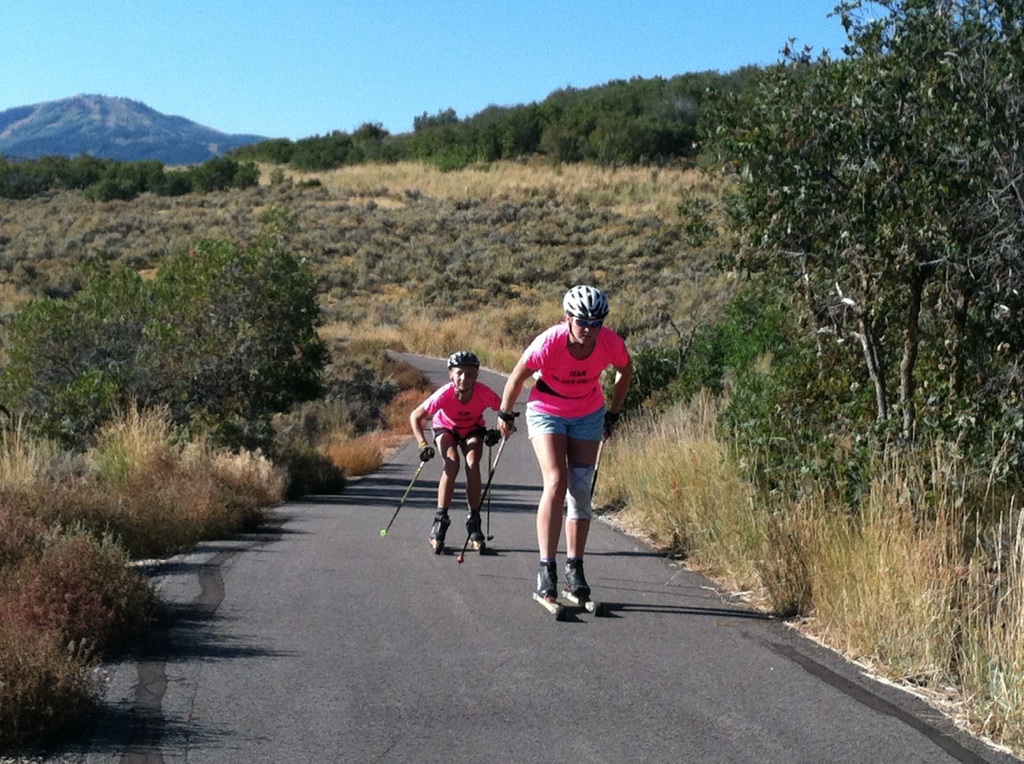
Zach Hall (far left) the new manager and head coach of team Soldier Hollow’s biathlon programs standing with his athletes during a training session this summer. (Photo: Sara Studebaker-Hall)
Last September, amidst the chatter of others gathered for the 11th annual U.S. Olympic and Paralympic Assembly in Colorado Springs, Colo., Sara Studebaker-Hall and the CEO of the Utah Olympic Legacy Foundation (UOLF), Colin Hilton, shook hands. Studebaker-Hall, a two-time Olympic biathlete, was attending the meeting as an athlete rep for the US Biathlon Board of Directors and was introduced to Hilton by US Biathlon Association (USBA) President and CEOMax Cobb.
The three were partaking in the U.S. Olympic and Paralympic Assembly’s two-day fall symposium, an event that included seminars on athlete rights and anti-doping. At the time of their introduction, Studebaker-Hall had no idea that her conversation with Hilton would evolve into a job opportunity and eventually, her return to the Intermountain region. Originally from Boise, Idaho, Studebaker-Hall was starting her third season as the assistant coach for the University of Alaska Anchorage (UAA).
But last fall, her coaching position and the future of the UAA Ski Team were in question. Financial restraints at Alaska’s state universities had put more than one cross-country ski program in limbo.
Back in Anchorage and also unsure about the future was Studebaker-Hall’s husband, Zach Hall, a former national-team biathlete himself. A native of Nikiski, Alaska, Hall had been working to develop a competitive youth biathlon program in Anchorage and was questioning whether or not it was time to make a career move.
Then Studebaker-Hall learned through Hilton that UOLF was looking to add a new biathlon program to Soldier Hollow, its cross-country ski resort in Midway, Utah. A world-class venue, the Soldier Hollow (SoHo) shooting range had hosted biathlon competitions during the 2002 Winter Olympic Games, yet no biathlon, development (devo) or competition (comp) teams existed in the SoHo or Midway area.
Team Soldier Hollow athletes Ingrid Norton and Pearl Harvey during a rollerski workout two years ago near Heber and Park City, Utah. (Photo: Morgan Smyth)
“One thing I look at is what are we doing with our venues, are we providing the sport we out to provide,” UOLF Vice President of Sport and Venues Marc Norman said on the phone in September. “The fact that we weren’t hosting [biathlon] and weren’t running any programs in it was a quick red flag for me.”
Along with the addition of a biathlon program, Team Soldier Hollow was also in need of a youth coach for its nordic program. From 2012 to 2015, Morgan Smyth served as the program manager, overseeing the Comp and Devo teams, the Youth League and the Charter School Ski Program. At the time of her departure, 145 kids were enrolled in SoHo’s programs — 10 on the Comp (competition) team, a number which has almost tripled since then.
“I left Soldier Hollow to work for Park City Nordic Ski Club [PNSC] as the Nordic Manager,” Smyth wrote in a recent email. “PNSC was part of the Utah Olympic Legacy Foundation. Ironically Soldier Hollow became a part of the Legacy Foundation less than a year later but I live in Park City so it was nice to work closer to home.
“I left Park City Nordic this fall and started a Physical Therapist Assistant program,” Smyth continued. “I am excited to try something new but plan to stay involved in the ski community. Hopefully coaching the younger kids during the winter months.”
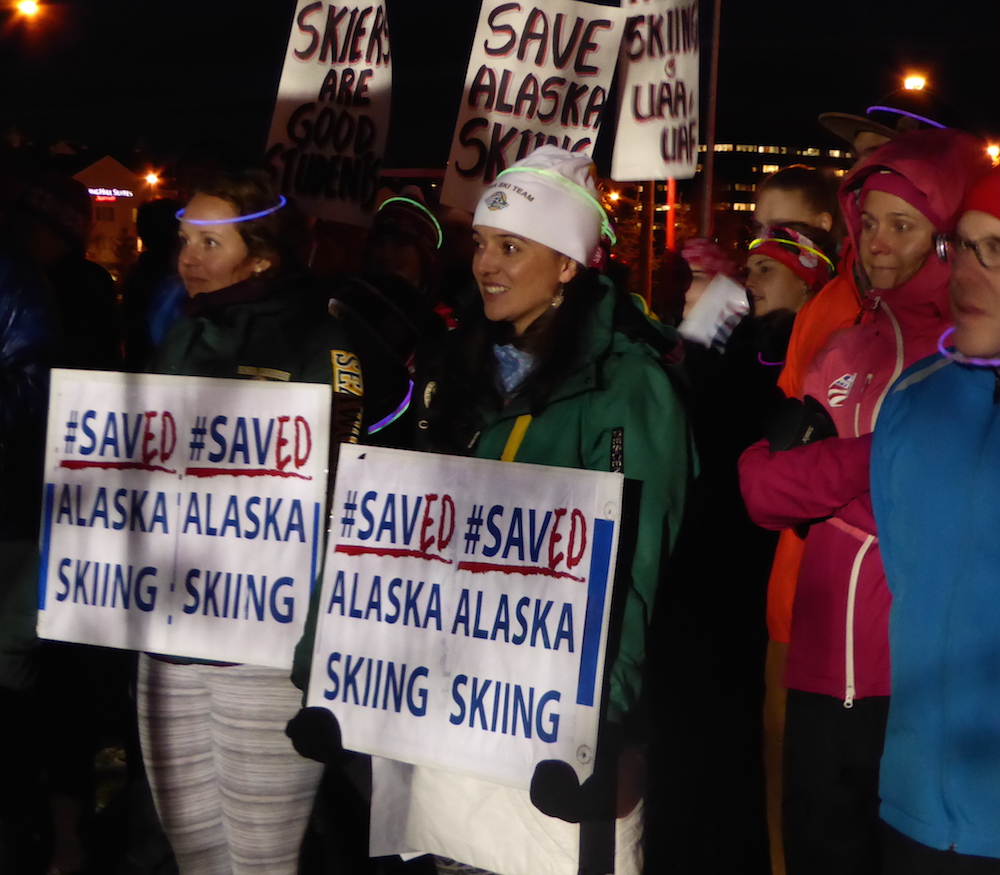
Former UAA assistant nordic coach Sara Studebaker-Hall (center, white hat) at the #savealaskaskiing rally in Anchorage, Alaska, on Nov. 10, 2016. Former UAA skier and current USST member Sadie Bjornsen (pink jacket) is to her left. (Photo: Gavin Kentch)
Last fall, after Studebaker-Hall returned to Anchorage, she and her husband were offered the opportunity to work with Team Soldier Hollow, with Hall heading the new biathlon program and Studebaker-Hall leading the pre-existing nordic ones. When the offer was made, theUAA Ski Team’s future remained uncertain, and the two ultimately accepted UOLF’s offer, viewing it too good to pass up.
“It was hard to leave UAA,” Studebaker-Hall explained on the phone earlier this summer. (The UAA Ski Team wasultimately saved three weeks after she and Hall accepted). “But moving to a head-coaching position and managing a program here and getting this off the ground was kind of a once in a lifetime opportunity, so we had to take it.”
Studebaker-Hall is now serving as the head coach and program manager for Team Soldier Hollow’sDevo Plus andComp teams. The competition team alone has 25 athletes, many of which Studebaker-Hall described as being “on the precipice of just getting going”. As she transitions from coaching collegiate skiers to juniors, she expects a few challenges mainly involving the mindset of younger skiers.
For most of the college skiers she’s coached, knowing the fundamentals of being an endurance athlete were automatic: get adequate amounts of rest between training sessions, practice good hydration. In contrast, a majority of her Team Soldier Hollow athletes are still learning the basic principles, such as the importance of recovery, nutrition and getting decent amounts of sleep.
“With youth kids, you’re trying to instill in them this idea that coming to training everyday is really important,” Studebaker-Hall observed, “Even just how to think about training, all these things I think that maybe I took for granted a little bit, that all the kids that I previously worked with knew already. That’s definitely a challenge, but one that I’m really excited about because these kids are so moldable.”
Most of the juniors she’ll coach this winter range in ages from 10 to 20 years old.
“They’re really ready to take in everything you say,” Studebaker-Hall continued. “You have a huge opportunity as a youth coach to do that for kids, maybe even more so than on a collegiate level, because you’re their first real coach.”
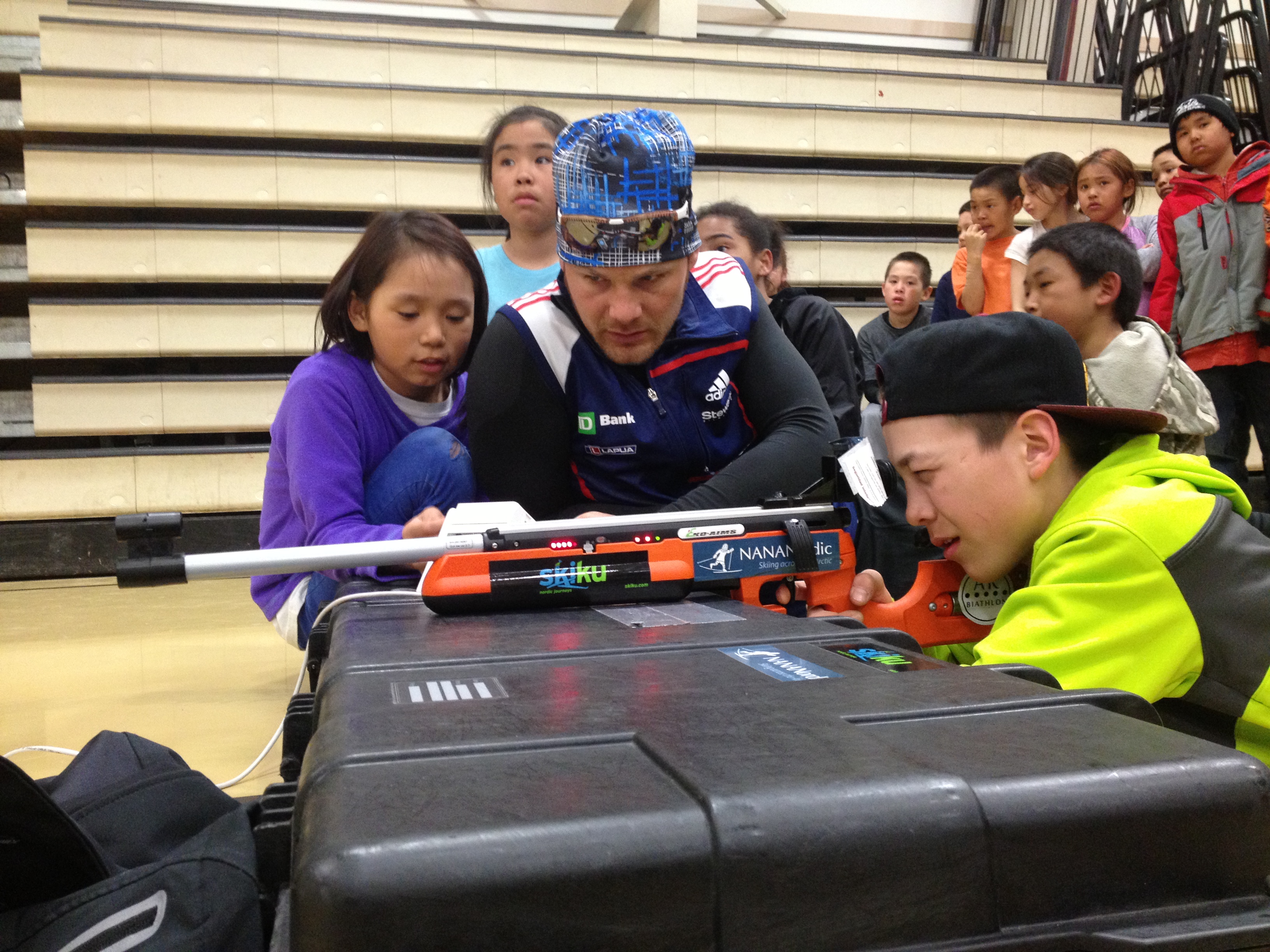
Zach Hall teaching shooting skills in 2014 at an indoor range in Kotzebue, Alaska, as part of the NANANordic program in the state’s Northwest Arctic Borough.
Though Studebaker-Hall only started working with Team Soldier Hollow this summer — Hall arrived last December — she’s already made a positive impression on many of her athletes. Pearl Harvey, 16, who has been involved with Soldier Hollow’s nordic program since she started walking, highlighted Studebaker-Hall’s interest seeing her athletes succeed.
“I have never had a coach so involved with technique and caring about my progression as a skier and a person,” Harvey, who hopes to one day receive a college scholarship for skiing, wrote in an email. “Sara, for me, is a big role model and she is shaping me as an athlete with being more conscious of my technique, eating, drinking and sleeping habits. She is also shaping me as a person and keeping us in check and making sure we are on the correct path.”
As Studebaker heads Soldier Hollow’s nordic programs, her husband is in charge of SoHo’s new biathlon programs: Intro Flex ,Devo Plus Flex and Comp Flex (development team). Hall estimates he has a total of 20 athletes in the biathlon program, though not all belong to Team Soldier Hollow. The Utah Nordic Alliance (TUNA), the Park City Nordic Ski Club or Wasatch Nordic have athletes participating in SoHo’s biathlon program, thanks to what they dubbed a “flex” program option. With this “flex” program, members from any of the surrounding nordic ski clubs can join Team Soldier Hollow for biathlon training without changing their club affiliation.
Racers at 2017 U23/Junior World Championships last February in Midway, Utah. (Photo: Team Soldier Hollow blog)
“We’ve got the only range in the area, so what we’re trying to do is work with all the area coaches to schedule training sessions, so that it works as much as we can with them working with their local nordic clubs, ” Hall said on the phone in July. “A big part of the program is just pushing general nordic development and adding opportunities with biathlon.”
Sparking interest is the first step for Hall, as well as getting the word out about the biathlon program. Having U23/Junior World Championships held at Soldier Hollow last season was also helpful in promoting the biathlon and nordic programs there, as well as giving younger athletes an idea of where skiing could take them.
“This is my first summer trying Biathlon, and I am loving it,” Lina Farra, 16, wrote in an email in September. “Both Zach and Sara have very high-level Biathlon experience, and that combined with their great passion for sport sets this program apart from others around the nation.”
SoHo is currently bidding to host an International Biathlon Union (IBU) World Cup in 2019. According to Studebaker-Hall, an exploratory committee is also forming for a potential Olympic bid — the last Olympics held at SoHo took place in 2002.
“From a programmatic standpoint, we definitely want to see Utah kids participating in this sport,” Norman said. “There’s no reason we shouldn’t have a strong biathlon program. That’s our goal, is to build up and be one of, if not the best biathlon programs in the nation. And have kids of all ages and abilities participating in biathlon.”
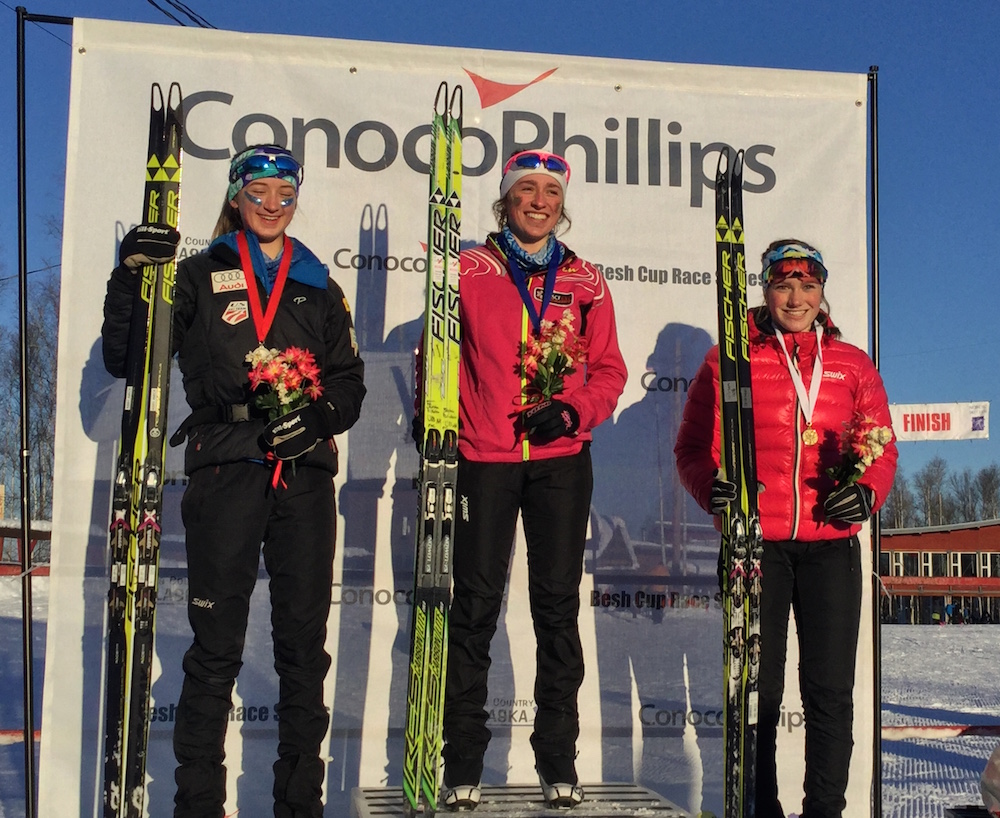
Jenna DiFolco (c) of FXC, Abby Amick of APU (l), and Addison Gibson of ANR (r) on the podium for the U18 girls division of the Besh Cup 5 k skate race in Fairbanks, Alaska, Feb. 4, 2017.
FAIRBANKS, Alaska — Alaska Airlines operates roughly 10 flights a day between Anchorage and Fairbanks. Last Friday morning many of those flights were packed with skiers, and ski bags piled up at baggage claim in Fairbanks, as Anchorage skiers streamed north for the final weekend of Besh Cup racing to select Alaska’s representatives to next month’s Junior Nationals in Lake Placid, N.Y. Two days later many of those same skiers returned south with plans to fly all the way to Lake Placid, where Team Alaska will have roughly equal representation from the state’s two largest cities.
The 2016/2017 Besh Cup series concluded with a pair of distance races at Birch Hill ski area: freestyle interval start on Saturday, classic mass start on Sunday. The weather for both days was Fairbanks at its mid-winter best, clear and sunny and relatively warm. Cold powder and hard glide waxes were de rigueur.
(The emphasis here is on relatively, as national FasterSkier readers might find Saturday’s race-time temperature of 10 degrees Fahrenheit, or Sunday’s reading of 2 degrees, objectively not all that warm. But it was -16 degrees at the airport on Sunday – Birch Hill’s elevated location on a hill above town often keeps it significantly warmer than the low-lying areas of central Fairbanks where official temperature readings are taken – and it is forecast to be -35 degrees in Fairbanks by later this week. So, relatively warm.)
The first race on Saturday was the boys 10-kilometer freestyle individual start for racers in the U18 division and older, 45 starters in all. The overall podium on Saturday was U18 skier Ti Donaldson of the Nordic Ski Club Fairbanks racing team (FXC), Senior skier Cody Priest of Alaska Nordic Racing (ANR), and U18 skier Josiah Alverts (ANR).
Among U20 men, FXC skier Benjamin Koenig was first, leading his teammate Logan Mowry in second and Dax Cvancara of ANR in third.
The U18 boys division, which saw two of the top-three overall finishers, had Donaldson in first, Alverts in second, and APU skier Tristan Wiese in third.
U16 boys raced a 5 k skate individual start, covering one lap of the blue course that 10 k skiers completed twice. Eli Hermanson of Alaska Winter Stars (AWS) led the all-Anchorage-area podium in the 5 k, followed by George Cvancara of ANR and Zanden McMullen of APU.
Finally, the U14 boys raced a 1 k skate ski-cross event, with jumps, gates, slaloms, and other technical challenges. The event is a crowd favorite that, race organizers wrote, “helps develop skiers’ abilities to ski in a ‘pack’ along with developing technical skills.” (It may also soon be coming to a race series near you! Here is an example from the 2016 Youth Olympic Games in Lillehammer.) In another Anchorage-area sweep, Aaron Maves of APU took the A-Final, followed by Rudy Schumacher of AWS and Konrad Renner from ANR.
On the girls side, a field of 57 racers (U16 and older) contested a 5 k skate individual start. At the end of one lap around the blue course, APU skier Maggie York took the overall victory by 40 seconds over FXC skier Jenna DiFolco, with Kendall Kramer (FXC) another 14 seconds back.
York also topped the U20 podium. She was followed there by Alyeska Daniels and Lupua Oba, both of FXC.
DiFolco, second overall, was first among U18 girls. Second in this division was Abby Amick of APU, with ANR’s Addison Gibson third.
U16 girls took third through fifth overall in the combined U16/U18/U20/Masters field for the 5 k (there were no Senior skiers in the race). Locals Kendall Kramer and Kaya Ratzlaff of FXC led this division, with Annika Hanestad (ANR) third.
U14 girls also raced a 1 k ski cross. First here was Quincy Donley of AWS, continuing her winning ways from the Anchorage and Soldotna Besh Cup weekends. She was followed across the finish line of the A-Final by Marit Flora of APU and Katey Houser of ANR.
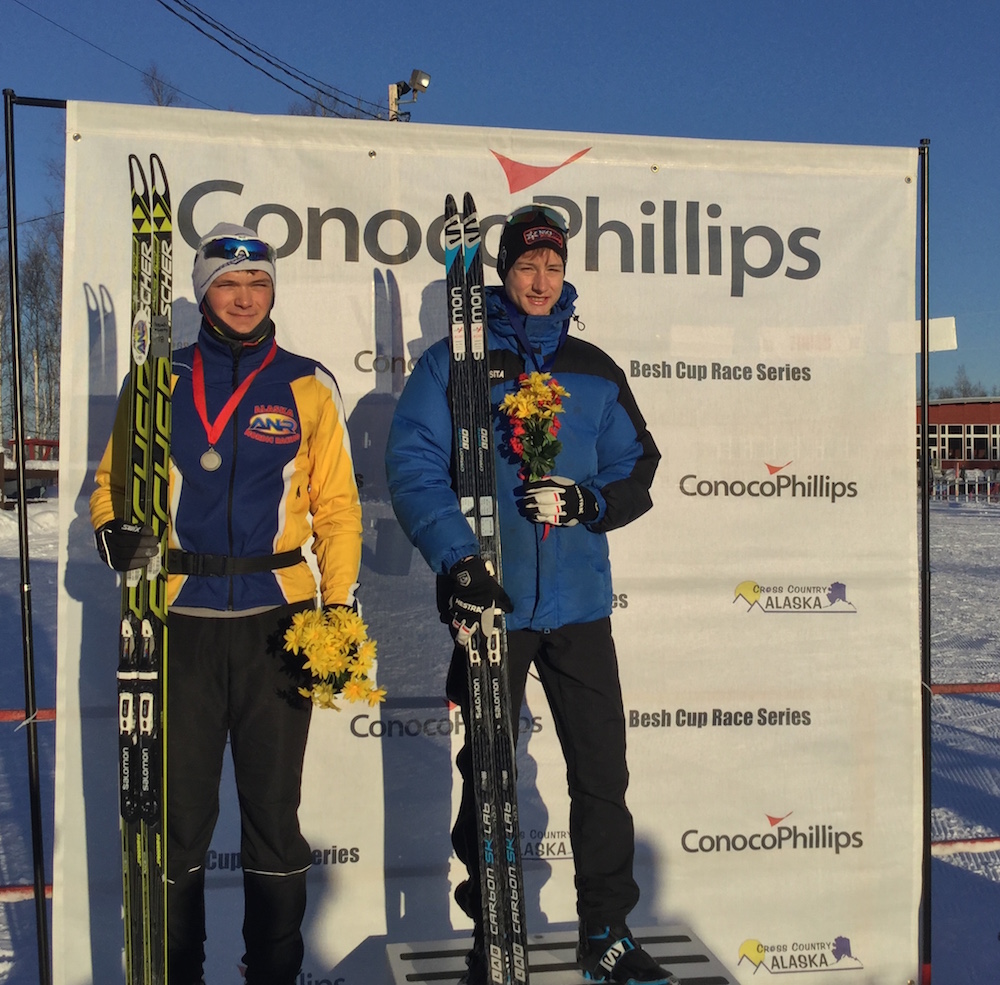
Ti Donaldson of FXC (r) and Josiah Alverts of ANR (l) on the podium for the U18 boys division of the Besh Cup 10 k skate race in Fairbanks, Alaska, Feb. 4, 2017.
Saturday’s overall winner for the boys race, U18 skier Ti Donaldson, was racing on home turf. “I’ve had a few wins [in the Besh Cup series] in the past,” Donaldson told FasterSkier in an in-person interview following the race. “Most of them have been in Fairbanks. I’m from here, so definitely a home-field advantage.”
Donaldson came in expecting a “brutal” race, based on his knowledge of the course and his time previewing it. “But I knew it would be pretty fast conditions,” he continued – “it was nice and hard, and it wasn’t too cold. So I was pretty excited to see how it would go, and really just wanted to work the transitions and stay strong on the climbs, and crest over. So I stuck to that plan, and it worked out pretty well.”
Donaldson was looking forward to 2017 Junior Nationals in March.
“I’d be thrilled with a top-five finish,” Donaldson said of his goals for next month. “Two years ago, when I was racing the same kids, I placed fourth in a race, and so I’d like to repeat that result. That would be a good goal of mine.”
Jenna DiFolco, the U18 girls winner and second-place overall skier, was also racing at home. She credited “my FXC coaches” for waxing her winning skis, and had hot cereal for breakfast, with raisins and dried cranberries, at home before heading out to Birch Hill.
The race was “really fun,” DiFolco recounted in an in-person interview. “Warming up, I didn’t feel so good, I was feeling kind of tired, maybe I’d overdone it this week. And then I expected this course to be really hard, because there are so many hills. And it was definitely, like, it was a rough course. But it went a lot better than I expected it to.”
DiFolco described her strategy for racing a one-lap 5 k course with nearly constant climbing or descending: “The first part is mostly downhill, so I kind of just started out like a sprint almost, because I knew I’d be able to recover on the downhill. And the first couple of hills I was just trying to keep it light, keep it relaxed, and then really start hammering up South Tower [the high point of the course], because I got a big break after that. And then the last two hills are basically just hard, really hard.”
Looking ahead to Lake Placid, DiFolco said that she was “hoping to get a couple top-10 finishes.” She added, “A big dream, it’d be a big stretch, but I’m hoping to get, like, a podium would be really, really cool. But top 15, top 10 would be awesome.”
Sunday saw classic mass starts instead of freestyle individual starts, and temperatures around 10 degrees colder, but otherwise it was more of the same. Seven of eight age-group winners from Saturday picked up a second victory on Sunday, as a pair of distance races rewarded skiers who were consistent in both techniques. (The first two weekends had featured one sprint and one distance race apiece, leading to greater variability in the podium finishers.)
Sunday’s classic race also rewarded skiers who were good at traditional classic skiing, in light of the relatively slow snow and the impressive elevation change of a Birch Hill race course.
The trails at Birch Hill are built on the side of, well, a hill (also, there are birch trees). The courses used for this weekend’s races were marked by an impressive Height Difference (the elevation change between the lowest and highest points on the course) of 89 meters within a 5-kilometer course. The World Cup skiathlon race that was contested in South Korea the same weekend, on the trails that will be used for the 2018 Winter Olympics in PyeongChang, featured height differences of only 58 and 41 meters on the two skiathlon courses.
In fact, a height difference of 89 meters is a greater elevation spread than was present on most of the traditional World Cup courses this season, including in Davos (84m), Lillehammer (74m), Falun (69m), and Ulricehamn (57m). That said, some of those courses had more average climb per kilometer than the Birch Hill 5 k course. But only some of them. This may help explain why the winning time for a 10 k skate on Saturday was 29:22 for the men, and 16:15 for 5 k for the women, in a race with some of the top junior skiers in the country. (Winning times for Sunday’s 10 k classic races were 32:17 and 37:53.)
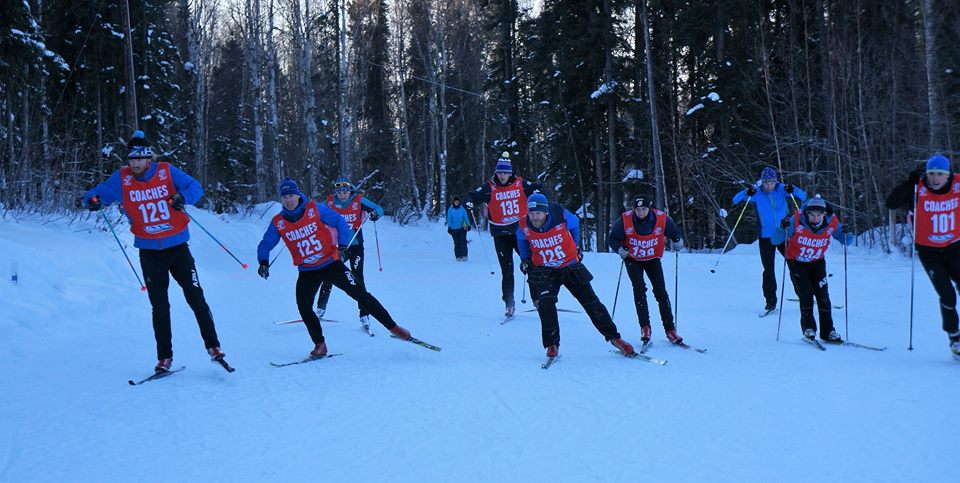
Coaches compete in the final ski-cross heat of the day, the coaches’ race, on Feb. 4 in Fairbanks, Alaska. Racers include Galen Johnston (129), Eric Strabel (125), Anson Moxness (126), and Pete Leonard (101). (Courtesy photo)
APU Devo and Master Coach Galen Johnston shared his thoughts on the effects of such a course profile after spending the weekend watching his athletes race up and down these hills. “One of the best parts of the weekend was to see how the combination of slow snow and lots of strideable sustained climbing put the focus of the [classic] races on striding and fitness rather than simply double pole strength,” Johnston wrote to FasterSkier on Monday.
“Courses designed like this can keep striding a viable, and even necessary part of classic skiing,” Johnston continued by email. “Birch Hill has some of the most progressive course designs that I’ve seen and it’s paying off. Skiers ski differently than they did even 10 years ago, and it’s really neat to see a course that can accommodate and challenge that change in style without turning things into an unskiable death march. Estle is keeping people very honest, but still allowing for ample fun,” Johnston concluded in reference to longtime Fairbanks race director and ski-course designer (and former U.S. Ski Team coach) John Estle.
On Sunday the best strider was DiFolco, who took first place in the 10 k classic mass start race by 19 seconds over Saturday’s winner York. Third overall was ANR skier Heidi Booher (ANR), another 23 seconds back.
York was again first in the U20 women division. The rest of the podium was also unchanged from Saturday, with Daniels in second and Oba in third.
DiFolco was again first among U18 girls. Second on Sunday was Booher, with Emma Nelson of ANR third.
There was a substantial drop-off in distance from U18 girls to U16 girls, with the latter group racing not 10 k but a 3 k classic mass start. First after just under 10 chaotic minutes was Kramer again, edging out her FXC teammate Ratzlaff by 0.7 seconds. Tjarn Bross rounded out the all-FXC podium in third.
U14 girls raced the same 3 k course as the U16 girls. And after 11 to 12 minutes of racing, it was precisely the same U14 girls podium as on Saturday: Donley, Flora, and Houser.
On the boys side, U18/U20/Senior/Masters skiers raced a 10 k classic mass start on the same course as the girls. First overall was Lukash Platil (officially unaffiliated, but listed on the University of Alaska Fairbanks (UAF) ski team roster), followed by Donaldson of FXC and Wiese of APU.
Platil was also first in the Senior men’s division. He was followed there by Kenny Brewer (now unaffiliated, formerly of UAF) and Matt Muffoletto (The Other Guys).
Among the U20 men, Koenig picked up his second first place of the weekend, and Mowry his second second place. Hamish Wolfe (APU) was third.
Donaldson and Wiese led the U18 boys. They were followed by Alverts, as the age group podium remained largely unchanged from Saturday.
The U16 boys raced a 3 k classic mass start. This was the only age group to see a new winner on Sunday, as Cvancara moved up from second the day before to nudge Hermanson down a step on the podium. Everett Cason of APU was third.
And the U14 boys (also 3 k classic) were again an all-Anchorage affair: Maves once again in first, Rowan Morse (APU) in second, and Schumacher in third.
Later Sunday afternoon a crowd gathered in the Birch Hill Recreation Center, ignoring Super Bowl LI then in progress, for the naming of Team Alaska for this year’s Junior Nationals (JNs).
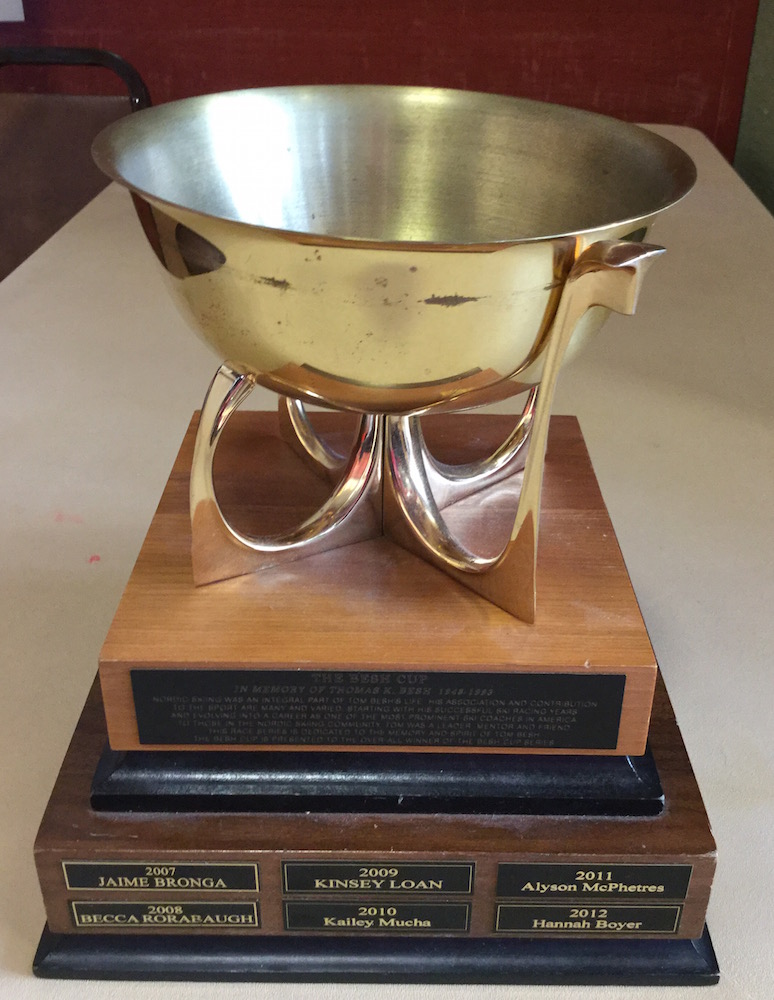
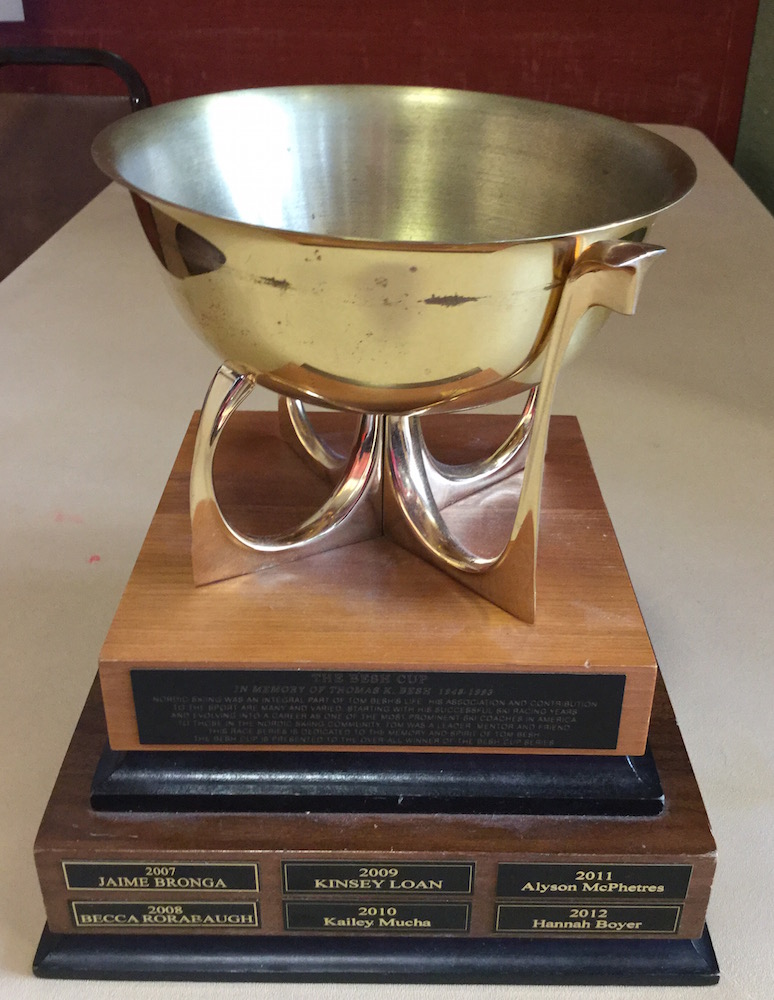
The Besh Cup Trophy, photographed in Fairbanks, Alaska, in February 2017.
Cross Country Alaska also awarded the Besh Cup Trophy, given to the U18 or U20 skier with the greatest number of JN qualifying points across all six races combined. This year’s winners were Josiah Alverts for the boys and Jenna DiFolco for the girls. Their names will be added to a trophy, Stanley Cup-style, that includes on its plinth recognizable names from American skiing such as David Norris, Becca Rorabaugh, Reese Hanneman, Andy Liebner, Zach Hall, Eric Strabel, Kate Pearson, and Rob Whitney.
While winning the Besh Cup Trophy is undeniably prestigious, it also necessarily rewards the best skier who was in Alaska all winter for the races, as opposed to competing Outside or internationally. For example, among U18/U20 girls, you may have heard that the University of Alaska Anchorage’s Hailey Swirbul was racing in Soldier Hollow, while Molly Gellert was on the Scandinavian Cup trip in Norway.
DiFolco graciously acknowledged as much, telling FasterSkier on Sunday soon after receiving the trophy, “I think some of the fastest skiers are not here, because they pre-qualified [for JNs] and they went on big trips.” But DiFolco still skied the races and earned the results, including two firsts and two seconds in the final four races of the series.
“It’s pretty cool,” DiFolco said of the season-long honor. “I never would have really expected this to happen a year ago. … I’m pretty proud of it. I’m happy with it.”
Shortly after the awards ceremony ended the migration began to repeat itself in reverse, as out-of-town skiers loaded up cars in the Birch Hill parking lot for the 7-hour drive south to Anchorage or paraded ski bags through the Fairbanks airport. The flight home for Anchorage skiers was marked by ski hats, team jackets, and quiet chatter, as athletes talked about next month’s trip to the East Coast and parents fretted about missed school days and makeup work.
Junior Nationals begin in Lake Placid in early March. The first race is a 5/10 k freestyle individual start on March 6.
FasterSkier is seeking contributions (written, photography or videography) from regional race circuits across North America. Please email info@fasterskier.com if interested.
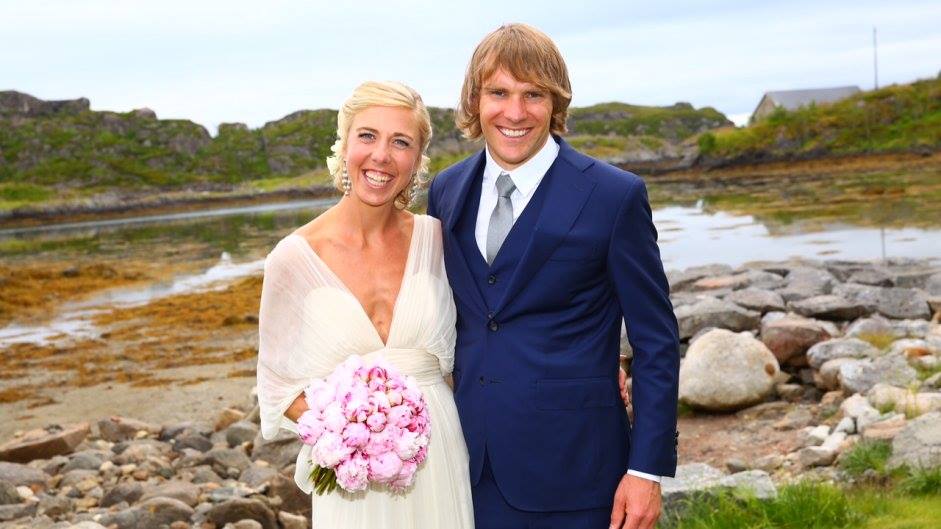
Skiers have been wearing a lot of white lately — or variations thereof. This past weekend, Canadian World Cup Team member Devon Kershaw and his Norwegian girlfriend, three-time Olympian Kristin Størmer Steira, tied the knot in Lofoten, Norway, where Steira has family ties.
Kristin Størmer Steira, of Norway, and Devon Kershaw, of Canada, were married last weekend in Lofoten, Norway. (Photo: CCC/Facebook)
Steira’s teammates, including Marit Bjørgen, Therese Johaug and Ingrid Flugstad Østberg, made the trip to the northern islands for the wedding, along with Canadian skiers Alex Harvey, Jess Cockney, Graham Nishikawa, Drew Goldsack, and Phil Widmer.
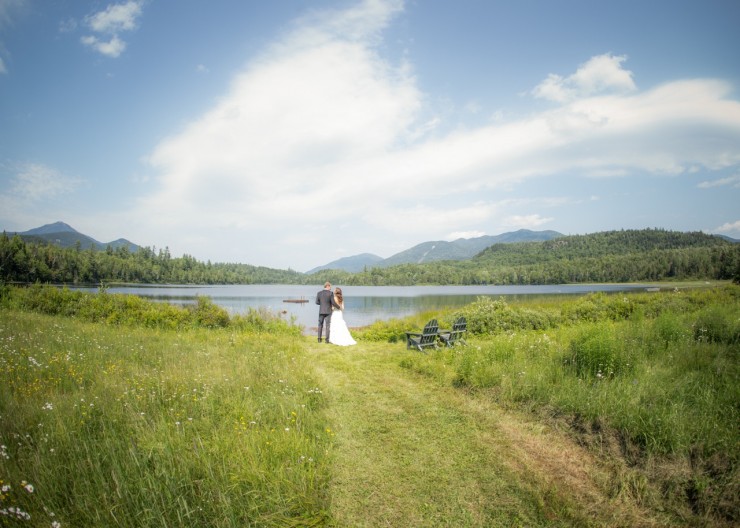
On July 11, US Biathlon’s Lowell Bailey wed Erika Edgley at Connery Pond (photos above) in North Elba, N.Y., then held a reception in front of the house where Bailey grew up in Lake Placid. Edgley is also from Lake Placid. They celebrated with about 120 guests from “all over the world,” Bailey explained in an email. “Americans, Brits, Germans!”
Bailey recently arrived in Stavanger, Norway, for the Blink Summer Ski Festival — a three-day series of rollerski races, starting this Thursday and ending Saturday. His teammates Leif Nordgren and Susan Dunklee also plan to participate.
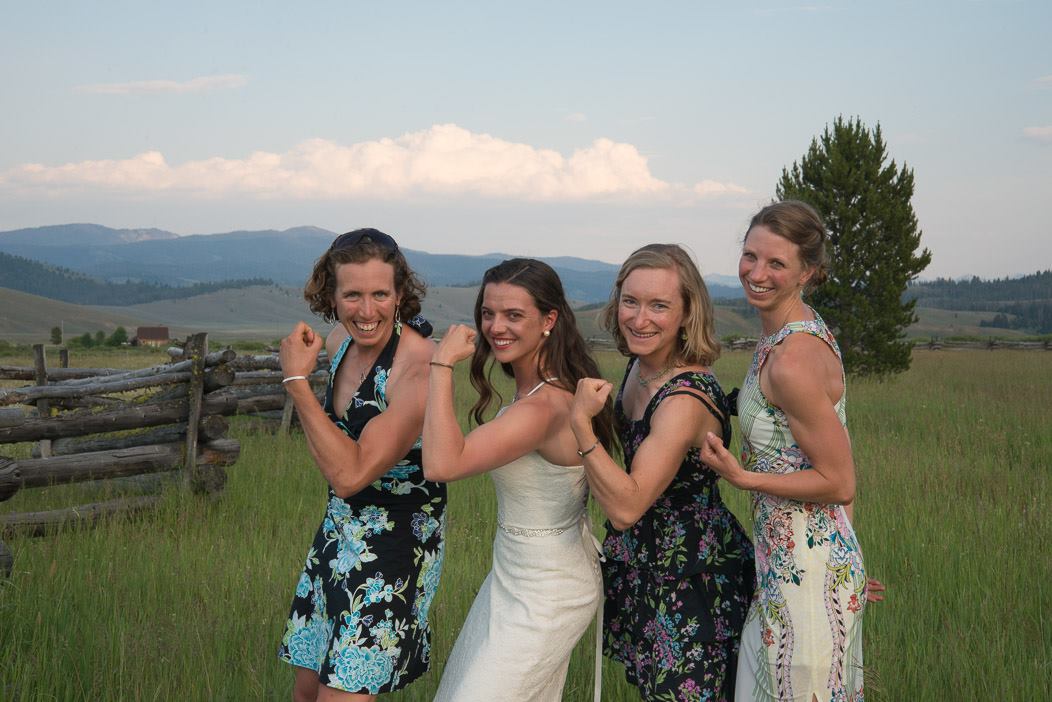
Sara Studebaker (second from l) married Zach Hall in mid July and celebrated with friends and former US Biathlon teammates Susan Dunklee (l), Hannah Dreissigacker (second from r), and Annelies Cook (r) in Stanley, Idaho. (Photo: Sara Studebaker/Facebook)
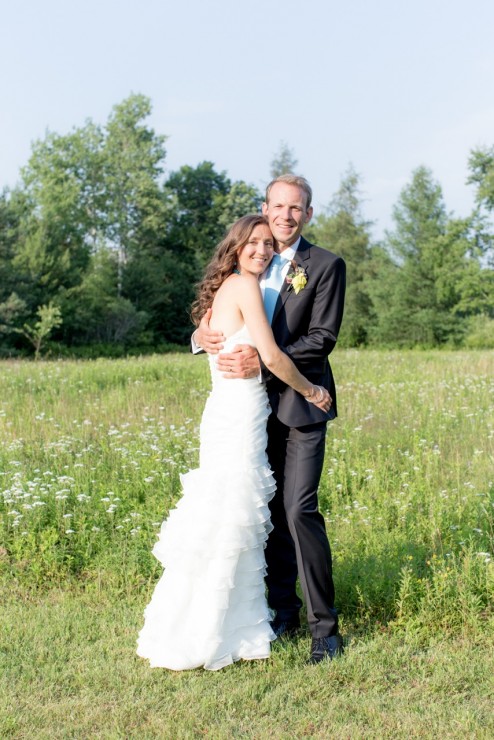
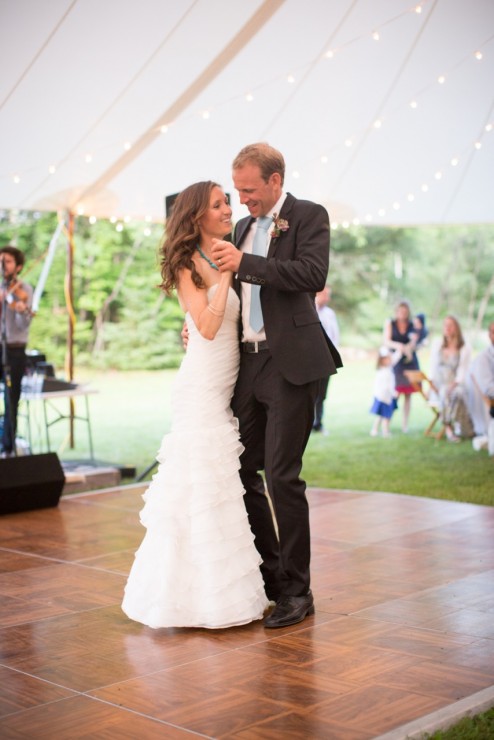
Also this month, former U.S. biathlete Sara Studebaker married another retired biathlete and current ski coach, Zach Hall, with her 2014 Olympic relay teammates Dunklee, Hannah Dreissigacker and Annelies Cook by her side in Stanley, Idaho.
And on July 18 near Canmore, Alberta, Canadian biathlete and Olympian Scott Perras married Jodi Etcheverry, a former biathlete, at a lakeside ceremony.
Longtime sweethearts, former U.S. skiers and now development coaches, Maria Stuber and Bryan Cook recently wed in their native Wisconsin.
U.S. Biathlon National Team member Susan Dunklee (top) instructs at the Craftsbury Outdoor Center last September in Craftsbury, Vt.
For the last five years, there has been an ammunition shortage in the U.S. The shortage is most acute in inexpensive rimfire-type ammunition, particularly .22-caliber, which is preferred by competitive and recreational shooters.
Though a careless web search can send you down a rabbit-hole of internet-forum conspiracy theories, the National Rifle Association (NRA) studied the problem and determined that the shortage was being caused by increased demand in the civilian market. President Barack Obama’s election in 2008 has created a lasting sense that gun and sales will be restricted, which has resulted in a five-year-long buying frenzy.
Steve Hornady, president of Hornady Ammunition, one of the nation’s leading ammunition manufacturers, explained the cause of the shortage to the NRA. “We’re working as hard as we can to get as much out as possible,” he said, according to Forbes.com. “People walk into the store, they don’t see as much as they want so they take everything they can get. The next guy who comes in can’t get anything, so he panics … ”
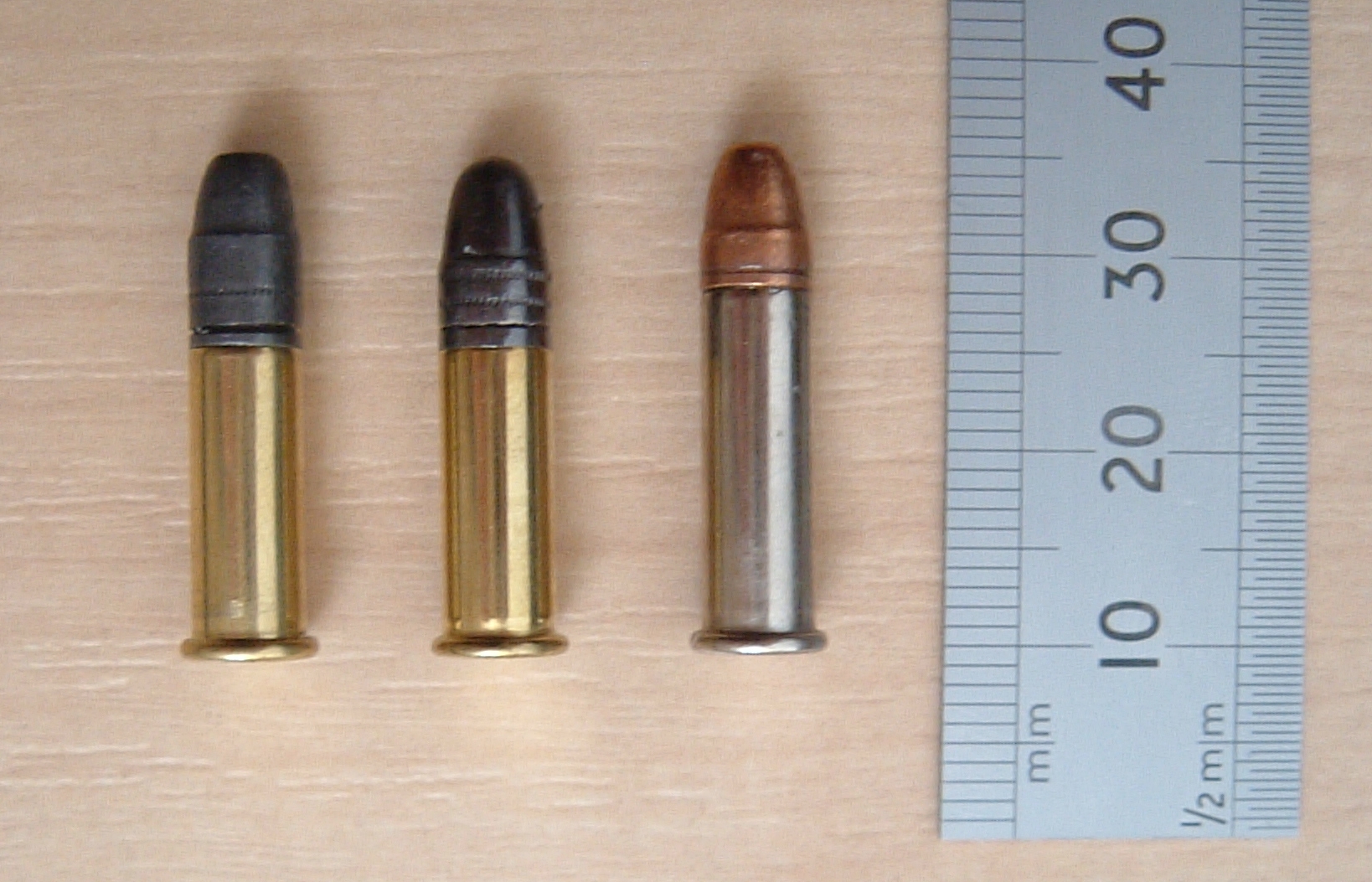
The .22 Long Rifle rimfire cartridge, the most common in the world. (Photo: Wikimedia Commons)
The .22 long rifle (.22lr) bullet has long been the bullet of choice for target and competition shooting due to accuracy, low recoil, and low cost. With retail shelves nation-wide empty, how have American biathlon clubs responded?
“Our club has been affected by ammunition shortages,” explained Zach Hall, head coach at AK Biathlon. “A large bulk order put in last year still hasn’t been produced by Federal, leaving many biathletes scrambling to find other sources of .22lr. Mostly, families with small stores of ammunition have resorted to sharing with those in need, and everyone is going out of their way to purchase more when they travel to the lower 48.”
But the shortage is not restricted to Alaska.
“The junior program isn’t being affected yet, but some of our masters are having to conserve ammo,” explained Eric Tremble of the Ethan Allen Biathlon Club in Jericho, VT, in an email. “We buy our ammo directly from Federal/CCI through their youth direct sale program where Federal sells ammunition directly to clubs to be used exclusively for youth shooting. It’s a great program except that it’s only offered when Federal has surplus.
“Because of the infrequency of the offers, we were proactive and bought the maximum allowed amount whenever we could. I put in big orders in 2011 and 2012, and we’ve been using that ever since. At one point I had an entire bookshelf filled with ammo, but now it’s down to three cases. Those three cases will get us through the rest of this summer and next winter. I’m hoping that Federal will be able to offer the youth program again before we run out.”
“Our club has been affected by ammunition shortages. … Mostly, families with small stores of ammunition have resorted to sharing with those in need, and everyone is going out of their way to purchase more when they travel to the lower 48.” — Zach Hall, AK Biathlon Head Coach
Seth Hubbard, of the Maine Winter Sports Center, encountered shortages in the past, but has enough ammo for the time being.
“The biggest thing that I am doing is that I am spending more time working on sourcing the ammo that we need as well as keeping an eye on our inventory as we move through training,” he wrote.
The shortage has been most account in the cheapest bullets, which are most popular with recreational shooters. However, even competitive biathletes use the cheaper ammo during training.
“The quality of ammo hasn’t been affected, though lower grade (cheaper) target ammo is more difficult to locate, especially in bulk,” Hall continued. “With .22 ammo being less prevalent it has been necessary to include more dry-fire drills as a precursor to live-fire training. Also, we have several high-tech laser rifles that have substantially expanded our training opportunities and reduced our direct reliance on ammo. We use the laser rifles to teach athletes a new concept and only when they have achieved a level of mastery over fundamentals do we add live ammo to the progression.”
For Hall’s team, however, the need resort to the laser rifles has been a bit of a silver lining.
“[The laser systems] allow for real-time monitoring and playback of aiming, shot placement, breathing, and follow through,” Hall explained. “As a coach I can diagnose issues on a laser rifle after only a few shots because I can see details of what’s happening during the whole shot process. With live ammunition some of that info is more difficult or impossible to discern without shooting through hundreds or even thousands of rounds.”
“Another benefit to the laser rifles is that I can use the system to teach young kids or athletes who may initially be apprehensive about the loud noise of a gun or anticipated kick,” Hall added. “Once they’ve learned the basics of shooting then we can introduce them to live-fire shooting and the transition is usually really comfortable and low stress.”
Like AK Biathlon, the Maine Winter Sports Center has encountered a shortage in the cheaper types of ammunition.
“The biggest shortage that I have encountered and heard other coaches dealing with has been on the lower-grade ammo that younger athletes may be using,” Hubbard wrote in an email. “This is the grade of ammo that you will see more commonly at your local sporting shop, when it is available. This ammo is very very hard to come by and I am sure that it is causing greater shortages with clubs and athletes, depending on how individuals are purchasing their ammo there can be long waits.”
But, as with all nordic sports, the coaches become personally invested in their athlete’s performance:
“We’ve also been using up my personal supply from when I was racing in the ’90s,” Tremble added.
U.S. national team biathlete Hannah Dreissigacker demos her sport for kids in a village in the Alaskan Arctic. Photo: Brendan Smith/ANTHC.
Note: a quick read of Alex Matthews’ piece on NANANordic, published yesterday, will be helpful but not essential background.
Anyone familiar with the NANANordic project – whether from a friend who has participated, reading about it online, or glimpsing tantalizing Facebook photos of skiing in the Arctic – will find Zach Hall’s account of how he got involved pretty familiar.
“Lars (Flora) posted on Facebook that he was looking for volunteers to coach in the Arctic… and I jumped on the chance,” Hall, an Anchorage-based former U.S. national team biathlete, told FasterSkier.
That’s the usual way the story starts: excitement at the chance to give something back while also getting something in return: a glimpse of a part of America that most people might go their whole lives never thinking about. The largest of the northwestern Alaskan region’s eleven villages has a population of roughly 3,000, a number that sounds tiny to city-dwellers and suburbanites alike; one that’s 1,800 miles from the northern border of the contiguous 48? It’s not a trip that many get to make.
Noorvik students learning to ski under the blue sky of the Arctic. Photo: Chris Arend, NANANordic.
Then, the adventure begins, and those feelings only get stronger as athletes work with students who have zero background in skiing, a different view of the world, and seemingly boundless enthusiasm.
“There’s something about being involved in a program that is launched and sustained by passionate people,” Hall said of his experience last year. “All the volunteer coaches were psyched to be there and the excitement was palpable from the students. I’ve been blessed throughout my ski career with so many people that invested time and energy into my development, and it’s fun and rewarding to be in a position to begin passing that on.”
As it happened, Hall’s biathlon skills gave him an extra opportunity to pass it on, something that Flora quickly picked up on. He asked Hall and his girlfriend, current national-teamer Sara Studebaker, to bring their rifles along and introduce the kids in the village of Kiana to biathlon last year.
It was such a success that Hall, who coaches a few juniors in the Anchorage area, took on the challenge of organizing a broader biathlon program for this year. From recruiting to logistics, he was in charge of getting biathletes to six different communities in the region.
A Different Biathlon Introduction
There’s a lot of reasons that Flora thought biathlon would be a good fit for the program.
“The patience and focus needed to participate in biathlon is amazing,” Flora, an Olympic cross-country skier, told FasterSkier. “In addition, the time needed to learn about gun safety, and practicing marksmanship are extremely valuable for students and skiers.”
But as Hall, Studebaker, and Flora learned when the biathletes demoed their sport in a single village last year, there are many more reasons that it was an excellent choice for the program. Unlike most people who are introduced to the sport through nordic skiing, the villagers could see real practical use in the combination of skiing and shooting. Furthermore, biathlon, which in modern times is a military sport, actually has its roots in their type of lifestyle.
An aerial view of the town of Noorvik, where Susan Dunklee helped out as a coach. Photo: Chris Arend, NANANordic.
“I would tell a story about the history of biathlon, tie in how peoples of the north have hunted on some form of ski for thousands of years and then describe the development of this most practical hunting method into one of the most popular winter Olympic sports,” Hall said.
And the kids got the message; coach Susan Dunklee said that after a demonstration, there was always a group that wanted to hang around and talk with her about hunting.
“The hunting link isn’t too hard to make for the kids since it’s such a way of life for them,” said Hall. “It’s convenient for villagers when the caribou pass near the village, but that’s not always the case. At over $10 a gallon, the price of fuel can make hunting on a snow machine cost prohibitive, so I also tried to get kids to think about skiing as a means of transportation that is economical and sustainable.”
So the participants definitely “got” the first part of Hall’s message. But the part about how this activity, old and necessary, transformed into a sport where each race broadcast on television is watched by over 15 million people?
They got that, too.
“We had several kids that told us they want to go to the Olympics as skiers,” Hall said.
Nuts and Bolts
Sam Dougherty and a student checking out the ice in Kotzebue. Photo: Carol Richards, NANANordic.
Besides looking at the big, inspirational and aspirational picture, Hall had to get down to the gritty details, too: how do you teach hundreds of kids a sport that involves an unfamiliar endurance component, as well as a firearm component with all of its associated safety headaches?
The biggest lesson from his first year with NANANordic is that there’s no single by-the-book way to teach biathlon to the kids.
“It’s important to be really flexible with the programming, so for this year the we wanted to get biathletes into a few more of the villages and then provide a framework for how to present biathlon but to ultimately leave it up to them to respond to the interest levels of the students as well as the climate of each village,” he said.
As such, he and Flora, along with school administrators in the villages, decided that no bullets would be fired. That’s right: biathlon without bullets. They would get the participants familiar with the sport and the guns, and in future years incorporate actual shooting instruction (the kids were certainly clamoring for it). Flora reported that he and Hall are working on getting more rifles to use next year.
Meanwhile, athletes in the six villages came up with a range of different ideas of how, and how much, to teach the sport. Many incorporated what they called “biathlon basketball,” combining skiing with the kids’ favorite other sport. Shots were taken into trash cans, and the penalty loop headed out around a ski pole stuck in the snow. Many of the instructors showed the kids the routine of skiing into a stage and shooting; Hannah Dreissigacker reportedly used a caribou fur as a shooting mat.
In other places, biathlon was less actively included. One was Kotzebue, where several-time World Junior Championship team member Sam Dougherty had taken time off from school at Montana State University to travel as an instructor. His problem? The kids had a little too much enthusiasm.
“Just because of the sheer number of hysterically infatuated and enthusiastic kids we had to have our eyes on, along with dozens of sled dog teams cruising around our usual ski spots in preparation for the big Kobuk 440 race, I decided it wasn’t a smart or safe idea to be wielding a rifle,” he explained. “My biathlon exposure was unfortunately limited to discussion with the older kids.”
But despite that, he still thought it was a valuable addition to the program.
“I related biathlon to hunting caribou. If you shoot and miss the caribou, it’ll run off and you have to chase it down to take another shot (penalty loop), but if you’re smart and steady you can take the caribou sooner and don’t have to travel as far,” Dougherty said. “It worked.”
The goal of NANANordic is to create sustainable ski programs in the village; further developing a biathlon program could be a big draw to that, in that it creates another attraction and helps keep more different kids interested in skiing.
“Overall I think what we did with biathlon was a success because it exposed kids to another facet of the Nordic skiing lifestyle, and they were really excited to learn more about the sport,” Hall said. “Rifles [are] another way to connect with kids and capture their imaginations. Some kids love the freedom of being able to go exploring, others just want to jump, and biathlon leverages their existing ties to firearms in a unique way that lets us pull them into the awesome world of Nordic.”
A New Area, and New Champions?
Both Hall and Dougherty have been Alaskan their whole lives, yet the experience of living in a village was completely new for them.
“Like most Alaskans, I had never been farther north than Fairbanks and never off the road system before,” Dougherty said. “I really didn’t know what to expect… in the beginning I was a stranger in my own state.”
“Bush Alaska” refers to the roadless area where all transport is by boat, plane, or snowmobile. Athletes were flown into the villages to coach; the absence of easy transportation means that life is much, much different than in the lower part of the state.
But for Hall, it was also unbelievably rich.
Future racers? Noorvik students go for a ski. Photo: Chris Arend, NANANordic.
“I had conceived of the Arctic as being a desolate place with villages that were all pretty similar to each other,” he said. “It’s not that simple. The area can certainly be desolate, but at closer examination you realize that the region teams with fish and wildlife and the people who live there have fascinating cultures that are intricately linked to the landscapes and resources that surround them.”
Dunklee was amazed at how the athletes were welcomed into the villages and befriended by family after family. Many were offered a full-access look at what it would be like to live in a village.
“Skiing around the village we saw fresh dead caribou in the back of snow mobile sleds, as well as bear and wolf skins hanging from porches,” she said of her time in Noorvik. “One couple in the village, Dave and Audrey, invited us over to dinner several times. They hunt and gather a lot of their own food, such as caribou, swan, and blueberries… Fresh caribou meat was plentiful but I would crave fruits and veggies if I stayed there long term. The people were super friendly and welcoming- that part would not be hard to get used to.”
Most of the kids in the NANA region will likely stay there. Dunklee said that some might move to Anchorage or other southern parts of the state – a few had already been through the city to visit relatives – but that life outside Alaska itself seemed very foreign to them. Her description of her home state of Vermont was met with mostly blank looks.
But the introduction to skiing may be changing that. For one thing, the vast number of volunteer coaches, many of whom have international racing experience, provided another glimpse of the world to their students. Racing, too, might appear on their radar screen. The kids certainly have the talent.
“I was so amazed at how fast these guys picked it up,” Dougherty said. “In one week, with every day being sub-zero temperatures, I was having to chase down kids that could give the middle school racing scene a run for its money in Anchorage… We had a great coaching staff, and with such an organized program, I wouldn’t be surprised if Alaska starts to see champion skiers coming out of the NANA region in years to come.”
After the recent passing of Canadian champion Shirley Firth and the renewed focus on that country’s now-defunct Territorial Experimental Ski Project, we asked Dougherty if he thought something similar could be put in place in the NANA region. After all, the prospect of moving kids from village to village for ski races is fairly daunting.
But there is a “no road” ski conference a few hundred miles south in a different group of villages, and Dougherty said that Alaska provides other opportunities, too, for kids to start to get involved in racing if they want to.
“The Arctic Winter Games is a sports competition for countries that touch the Arctic Circle,” he explained. “I went for snowshoe biathlon in 2006, and it’s a great way to get international race experience at a young age. The Russians and Norwegians are always very good. Qualifying for Team Alaska is split up by regions of the state, so the bush areas are always represented at these events as well as urban Alaska… I do know that many village kids look at Arctic Winter Games as the highest level of competition. I certainly did when I went as a youngster.”
For Grownups, too
Finally, while NANANordic is undoubtedly focused on the kids, Hall couldn’t deny that it was fun to give another group of athletes the chance to join the NANANordic experience.
“It didn’t take too much arm twisting to get other biathletes involved,” he said. “I’ve always felt that travel is one of the best ways to challenge the assumptions we all carry of places we’re not familiar with and NANANordic is doing a great job of creating what amounts to a cross cultural exchange that benefits everybody involved… I anticipated that the program would have a big impact on each of them and based on the feedback I’ve received so far, it did.”
The athletes weren’t just being nice when they talked to Hall; the experience had made a deep impression on them.
“We spent our time playing games on skis, just delighting in being outside, in being active, and sharing that with other people,” said Susan Dunklee, the top-ranked American woman on last year’s World Cup circuit. “Sometimes in the middle of the race season you can lose sight of what you love about skiing, and this was a great reminder for me.”
The trip wasn’t quite all fun and games; athletes also had the chance to challenge themselves in a way that was every bit as tough as racing, but also completely different. They were offered the opportunity to ski from one village to the next.
“Dylan Watts, Odin Brudie and myself skied 35 miles to Selawik,” Dunklee said. “We carried heavy packs with food, dry clothes and water, plus a rifle for safety. It was cold enough that I wasn’t able to stop moving for more than a couple minutes at a time or my fingers went numb. Going into it, I was very confident in my ability, but it turned out to be surprisingly tough. We skied for 6 hours and I bonked hard the last few miles. I recovered at the end by eating a piece of muktuk [whale blubber].”
Last year, when Hall and Studebaker skid 48 miles from Deering to Buckland, 30 of that over pack ice, they surprised themselves and everyone else.
“Kids in both villages couldn’t believe that it was possible because nobody had ever done it before,” Hall explained. “Trips like that are typically reserved only for airplanes, snow machines and the occasional dogsled. With one long ski we opened their imaginations to how incredible and capable the human body is!”
For Dunklee, who had never been to Alaska even to race, the trip opened up the wonders of the state, too.
“The terrain was mostly flat and treeless with some big hills off to one side,” she said. “Sometimes when the fog lifted we could see the trail stretching out for miles ahead of us. We passed wolf tracks and a herd of caribou.”
It will be a memory to hang onto as athletes hit the roads and trails this month, writing another season of hard training into the books.
Note: This is the second piece in a three-part series following several groups of biathletes as they negotiate the college question. Part one, which featured five top juniors who took a detour through college before returning to the international stage, ran last Monday. Stay tuned for part three next week.
Susan Dunklee celebrating her fifth-place finish at 2012 World Championships, which came in her fourth season as a biathlete. NordicFocus/USBA.
As I was standing near the finish waiting for U.S. biathlete Susan Dunklee to come through the mixed zone after the IBU World Championships women’s 15 k individual in Ruhpolding, Germany, I was approached by a gray-haired French journalist who usually sat at the table directly behind me in the media center. We had also shared a shuttle back into town one night, so he knew I was American.
“Who is this Susan Dunklee?” he asked me.
Dunklee was bib one that day, so it wasn’t surprising that she crossed the line first. Ultimately, she finished fifth in the race. It was one of the best results ever by a U.S. woman, tying Kari Swenson’s result at 1984 World Championships, and certainly a surprise to the sport’s European fanbase. I explained that it was her first season on the World Cup, and she had previously had just one top-20.
“She has only been doing biathlon for four years,” I said.
The French journalist’s eyebrows raised as if to say, go on.
“She was a skier in college, and then she learned how to shoot,” I continued. “Her father was in the Olympics in cross country skiing.”
He scribbled in his notebook, and then asked me Dunklee’s father’s name and which years he was an Olympian.
“I write for a newspaper,” he said. “I don’t have a lot of room. Usually, fifth place, maybe we mention it, maybe not. But this? This is interesting enough to put in. Thanks.”
* * *
During the 2011-2012 competition season, the U.S. Ski and Snowboard Association had 1,139 members with “cross country competitor” licenses. The U.S. Biathlon Association’s (USBA) year-end points list, by contrast, featured fewer than 200 athletes.
USBA’s numbers are even more grim in terms of development. While the masters biathlon scene has been growing in the U.S., that points list included just 37 junior men and 23 junior women. At World Junior Trials or U.S. Nationals, a field of 15 or so youth men (ages 18 and under) whittles down to just a handful of juniors (ages 19-20). Five or six women compete in each division. After the robust development teams of the 1990’s and early 2000’s were lost in a budget crunch, the junior national team is now largely symbolic.
That leaves the biathlon community with big questions: how do you develop a World Champion with such low numbers? What if top juniors leave the sport for college or other pursuits? (This happens.) By 2007, there was an undeniable talent gap in U.S. biathlon.
“Cory Salmela had developed a bunch of people on the junior team in the 1990’s, and I was taking over those juniors,” said James Upham, who was the USBA’s Development Coach at the time and is now the Nordic Head Coach for U.S. Paralympics. “We had pretty much pushed those guys onto the [senior] national team. So we said, well, we’ve got to have some more people because there aren’t enough clubs in America producing the high end biathletes that we’re looking for.”
Along with USBA CEO Max Cobb, Upham came up with a new idea: instead of looking at college as a sink that they lost athletes to, they would look at it as a source.
“We needed to find some talent, some fairly young talent, and maybe a little raw, someone that could be molded,” Upham told FasterSkier. “We felt like even in their early 20’s we could manage that– that it was good resources to put away if you had the engines and the attitudes, and that within four or five years [you could have] a World Champion.”
Sarah Konrad, an early indicator that skiers could learn to shoot. Photo: TeamToday.
He was also perhaps emboldened by the success of Sarah Konrad, who at age 37 and after just two years in biathlon finished 50th in the individual race at 2005 World Championships. She went on to the 2006 Torino Olympics, where she became the first U.S. woman to compete in two winter sports: skiing and biathlon.
With “engines and attitudes” as his manta, Upham began scouting the college field. He offered college juniors the chance to try biathlon at a training camp over the summer. If they showed some aptitude for shooting, Upham would offer them a spot on his re-tooled Development Team when they graduated. USBA provided a free place to live at the Olympic Training Center (OTC) in Lake Placid, a crash course on shooting, and the country’s best biathletes as training partners.
Could you really create a world-class biathlete starting at age 22? It was an unusual strategy, but Upham was confident that he could pull it off. He signed Caitlin Compton, who was coming off a season in which she took five SuperTour wins and represented the U.S. at FIS World Championships in Sapporo, Japan. She was joined by recent All-American Sara Studebaker, who had just helped captain Dartmouth to an NCAA title, and her boyfriend Zach Hall, another mainstay on the EISA circuit.
“It sounded like a really legitimate way to pursue a nordic sport at a high level,” said Hall, who had been contemplating how to swing a ski career financially. “You were able to go there and focus on it 100%.”
And in that very first year, Compton (now Gregg after her marriage to CXC teammate Brian Gregg) showed that the development program could work. It’s a forgotten fact that Gregg, who was a 2010 Olympian in skiing, had her first World Cup starts in biathlon and made the 2008 World Championship team. By her own admission she “didn’t know what [she] was doing” and told the online news site MinnPost that she estimated there were ten high-level female biathletes in the entire country.
But even if she benefitted from a small field in terms of selection, Gregg turned in strong performances. She finished 37th in the individual at World Championships in Ostersund, Sweden, hitting 16 of 20 targets and skiing the 29th-fastest time. She was the top American in the race.
Gregg left the team to return to skiing after just one season, but her success surely reinforced USBA’s confidence in its plan. Hall and Studebaker joined more experienced athletes on the “B” squad, and the Development Team started fresh with Dartmouth’s several-time All American Susan Dunklee, former junior national sprint champions Bill Bowler and Casey Simons from Northern Michigan University (NMU) and the University of Utah, and Jen Wygant, another NMU grad.
In 2009, Dunklee moved up to the “B” team and was replaced by Katrina Howe, a two-time NCAA competitor for the University of Vermont. The next year, the Development Team was cut – but Studebaker also became an Olympian. Even after it ended, the program was delivering what USBA had hoped for.
Engines and Attitudes, Exhaustion and Frustration
While Gregg had succeeded right away, the transition may have been more natural for her. She was 26 years old when she joined the team, and had already trained at a high level for several years. Before the younger recruits could match her results they needed to transform into senior athletes, which was challenging. There was no time to ease into the transition because Upham was trying to accomplish in a few years what usually took ten.
“It was a big increase in terms of training volume and overall intensity, and it was a little bit overwhelming to be training with the national team and surrounded by all of that,” Hall told FasterSkier in an interview. “That whole first year was crazy…. I was straight up exhausted all the time.”
He wasn’t quite sure of the numbers, but estimated that his training volume had jumped about 20% that first year. Upham has other stories, too. After the very first week in Lake Placid, Studebaker told him that she had never trained so many hours in a week before, ever. The next year, he encountered the same thing with his new crop of athletes.
“Going into the winter I remember Susan saying, ‘This is more classic skiing than I’ve ever done,’ and you’re a biathlete now– you don’t even race it!” Upham laughed. “It’s fun taking a college-level athlete who’s really gifted and smart, and putting them into a full-time training program. That transition is pretty tough and you don’t necessarily get better right away, but you put a huge amount of work in and it pays off… you see them doing really well later.”
Bowler, who had trained about 600 hours a year at NMU – “definitely on the upper end of the spectrum for a college skier” – was better prepared for the hours, but not necessarily for the intensity of national team training.
Bill Bowler and Zach Hall competing in Altenberg, Germany in 2011. Photo: Viktoria Franke.
“There’s a big difference between doing a 20-hour week with one or two intensity days, and one of those being classic, versus a 20-hour week with three skating intensities,” he told FasterSkier in an interview in Bend, Oregon, last week.
Then there was shooting, which added another roughly 200 or 300 hours to the training load without any immediate payoff; several of the athletes said that it takes a minimum of three years before shooting comes together. Until then it’s a lot of work, and at no point is hitting targets a guarantee.
“I’d like to say that biathlon gets easier, and it definitely does, but inherently biathlon is more tumultuous than nordic skiing,” Hall said. “No matter how good you get, there’s always that question… there’s so much that’s thrown into the mix with the shooting. You have a really good race and you have euphoria, and then the next race you can be behind from the first stage and then you’re out of it.”
While the endurance training was tough on athletes’ bodies, shooting tired their minds and tested their patience. They were immediately thrown into workouts with experienced senior national team athletes, which created a good learning environment. But it could be demoralizing to be the worst shooters day after day after day.
“I went into it being super focused,” Hall explained. “By nature I’m fairly detail-oriented when I approach training, and shooting ends up being all about the details. So every day is focusing on a million different details and trying to figure it out… For me it was challenging sometimes, because you know you’re not nearly as good [as the other athletes].”
The final piece of the transition was living at the OTC, which was ideal in many ways: no rent to pay, no meals to cook, a gym and coaches and training all in one place. But the austere building was the antithesis of the vibrant college campuses most athletes had recently called home.
“You live in a bubble,” Bowler said of the experience. “It’s a very focused environment all the time. It was good for me for certain chunks of time, but sometimes you need to get out to the real world a little bit, because biathlon is very far from the real world.”
Dunklee, too, needed a release. For the 2011 season, to the initial chagrin of her coaches, she joined the Craftsbury Green Racing Project so that she could get back to Vermont (she is still in Lake Placid more than half the time). She said it was a lifesaver for her mental health.
“I need balance and I need to use my mind,” she told FasterSkier last fall. “When training or racing isn’t going well, I need a means of distancing myself from biathlon.”
All of the changes were a lot to take in, and Upham knew it. To try to keep his team motivated, he read everything that he could about sports psychology. In his previous work with junior and senior biathletes he had seen racers hit a plateau even though they were physically capable of continued improvement. With his new team, Upham wanted to make sure athletes’ heads didn’t get in the way of their performance.
“The lifestyle change [is a big thing],” he said. “We worked on sports psychology every day. It’s not something that you read the book and suddenly you have it, it’s just practice, practice, practice, and forming habits. Most of our psychological aspect was, how do you deal with going from winning college races or being top ten, to internationally pretty much getting your butt kicked for a year or two?”
Mixing It Up in Europe
One measure of the Development Team’s success was that like Gregg, Dunklee and Studebaker made it to Europe in their first year as biathletes. It took the others a bit longer, but of the eight, all but Wygant have competed at the IBU Cup or European Championship level, if not higher.
Initially, a European tour added to the stress of the athletes’ transition.
“My first race I was in the 90’s in an IBU Cup, which is really a tough pill to swallow when you go over there and you have a race that you might be happy with in the United States,” Bowler said.
In her first season as a biathlete, Dunklee won a national title in the sprint. But on the IBU Cup, biathlon’s second tier of racing, her top finish was 35th. A year later, Simons also won a national championship, but when he competed at Open European Championships his best race left him 40th. Despite multiple international tours, Bowler hasn’t excelled; he didn’t crack the top 40 in an IBU Cup until 2012, when the circuit traveled to Canmore and field size shrunk by half.
But the athletes had plenty to fall back on, and they started improving.
“The first race Sara was ever in as a full-time biathlete, she cleaned [a four-stage race],” Upham explained. “She hit all 20 targets. I think there are a lot of biathletes out there who have still never done that! Zach, his second year he was our number one shooter in the country in terms of percentage. That just shows the amount of work they put in.”
After Gregg, Studebaker was the first one to make it onto the big stage (she had an advantage: dabbling in biathlon in high school had left her with some shooting background). In 2009, she earned her first World Cup start. She had dreamed big and hoped to make the World Championship team that year, but missed, in what she described as one of the biggest setbacks in her biathlon career.
Studebaker leading Andrea Henkel (GER) in the mixed relay at 2012 World Championships.
“I was pretty devastated after that,” she told FasterSkier. “I had been told that they may have a spot for me at the Vancouver World Cup [at the end of the season], but it took a while for it to be official. When I finally found out I would get to race, I was really excited and determined to make the most of it. In the sprint, I cleaned and scored a couple World Cup points.”
After a single weekend of racing, the 38th-place finish made Studebaker one of only three U.S. women to score World Cup points all year, which lifted her spirits and set her up to compete in the first period of World Cups the next season. She has been one of the team’s top performers ever since, and raced at the Vancouver Olympics.
In 2011, her fourth season as a biathlete, Studebaker collected four top-20 results. That put her 34th on the World Cup points list, the highest-ranking U.S. woman. Although the development team was no longer in existence, it was delivering the results USBA had expected in year four.
“We were really happy to see Sara have a top-15 result,” Cobb said. “It was right where she needed to be.”
Hall, too, faced disappointment before his World Cup debut. After competing in Altenberg, Germany, for the final round of trials for the 2010 Olympics, he wasn’t named to the team. Based on his performances there and the next weekend in Nove Mesto, Czech Republic, however, Hall received World Cup starts in Antholz, Italy. He finished 85th and 96th, but the experience showed him what biathlon really was, and what he was striving for.
“Over 15,000 spectators came out for each of the races so the atmosphere was electric,” Hall wrote on his blog at the time. “It’s really cool going from the U.S., where only a handful of people show up, to an area of the world where biathlon is the most widely televised sport and spectators come out in droves for an all-day party.”
While Studebaker excelled and Hall got sporadic tastes of World Cup action, Dunklee has ultimately become the poster child for the Development Team. Even in the beginning, she stood out as an obvious choice to bring to Lake Placid.
“Everyone can see world class aerobic potential if you ever see her do anything,” Upham marveled. “So how do we teach her how to shoot things, how do we refine her technique? We felt like we were pretty good at that. It wasn’t daunting to us, [we didn’t see it] as a great risk. And she had a great attitude as well, there was no denying that.”
But unlike Hall, it took her four whole years to make the World Cup despite having top-20’s and even a top-ten on the IBU Cup. She was crushed when she missed the Vancouver Olympics by a few spots, and she didn’t receive the consolation prize of World Cup rights, either.
At the beginning of the 2012 season, Dunklee capitalized on her first World Cup starts, placing 45th, 28th, and 32nd in the individual, sprint, and pursuit competitions in Ostersund, Sweden. Like Studebaker, she had scored World Cup points on her first try; the former Dartmouth teammates were the top Americans in all three races. Dunklee wasn’t going to get left at home again. She had her first top-20 in Antholz, then missed a single shot to finish fifth in the World Championships individual race, just seven seconds from a medal. In the final weekend of racing, she picked up top top-tens in Khanty-Mansiysk, Russia. Dunklee is currently ranked 34th on the World Cup – exactly the same position that Studebaker had one year ago.
“We had the feeling that it was probably going to be four years before they were ready to do something internationally,” Cobb said of the Development Team athletes. “When we were initially talking with the athletes, we said they had to be willing to give this a try for two seasons. We were thinking in the fourth season they could have top 20 results [on the World Cup].
“That’s what we saw with Susan,” he continued. “Yay!”
So You Want To Race?
USBA Women’s Coach Jonne Kahkonen told FasterSkier in the fall that the team was deliberately holding Dunklee in reserve until she was ready to excel at the World Cup level, but the athlete herself was chafing at the bit.
“I had become fixated on earning a World Cup spot,” she wrote in an e-mail this spring.
And if Dunklee was frustrated being stuck on the IBU Cup, her teammates were even more desperate to get in top-level races; between IBU Cup and Under-26 Open European Championship racing, Dunklee’s two tours represented as many or more European starts every year as any mid-level American biathlete.
Casey Simons at 2010 U.S. Nationals in Fort Kent, Maine.
The lack of high level racing and its benefits for development and motivation, said Hall, was one reason said that the program’s success and retention rate could have been better. After all, Simons left the sport in 2010 after a national title was not rewarded when team nominations came due; he declined to comment for this article. Hall himself retired in 2011. (Bowler and Howe are currently pursuing biathlon at the Biathlon Alberta Training Center and the Maine Winter Sports Center, respectively.)
Without going to Europe, the athletes were left to race against a NorAm field that is undeniably weak, especially compared to skiing’s SuperTour circuit. With the top five men and three or four women on the World Cup at all times in addition to the periodic IBU Cup tour, biathletes are competing against the same handful of people every weekend. They now more or less how things are going to shake out.
And that’s where the men were stuck. In 2007 when the Development Team started, Jay Hakkinen, Jeremy Teela, and Tim Burke had already scored multiple World Cup top-tens. Lowell Bailey had been in the top 20. By contrast, of the women only Lanny Barnes had a single top-20. Studebaker, Dunklee, and Gregg were certainly talented, but they were helped by the relative strength of the men’s and women’s national teams.
Hall didn’t want to offend his former teammates by implying that the women on the Development Team had it easier, but Studebaker confirmed as much. There was more of a gap on the women’s team, and she was there to fill it.
“Things may have been easy on the women’s side when I was starting out biathlon,” she wrote in an e-mail last week. “There were always more men competing, and that meant fewer of them had a chance to get international competition. It was definitely a little easier to get over to Europe and get on the IBU Cup at least, but it did take me a while to get to the World Cup level.”
Unfortunately for the men, the IBU Cup experience played a huge role in determining how quickly the athletes improved.
“As a developing biathlete, the most important thing is being in competition situations where you are forced to ski as fast as you can and shoot as fast as you can, and do that over and over again,” Hall said. “Everybody at USBA understands that there’s not a lot of opportunity for racing unless you make it to Europe. It’s a bit of a catch-22 right now.”
Studebaker believed that she and Dunklee had the ability to score World Cup points in their first outings thanks in large part to their many lower-level European race starts before they hit the big stage. And, both said, the racing and travel opportunities were carrots drawing them along when their new sport could begin to feel like a slog.
“I thought I’d try the sport for a year or two and then move on with my life,” Dunklee said. “Qualifying for a Europe trip was a huge factor in hooking me. I realized that if I gave my shooting time to develop, I could become a very good biathlete… I could not have justified [my dedication] if I only ever raced three or four other women at a handful of NorAms. I would have switched back to cross country where we do have a strong domestic circuit that can develop athletes.”
If she’d had to do the work that Hall did, she might not have stuck around.
“U.S. athletes do have to take initiative to keep the sport engaging and worthwhile,” Dunklee said. “In 2011 there were no NorAms in the peak of winter because all our biathlon officials were needed in Maine for the World Cups. I suspect the lack of race opportunities contributed to Zach’s decision to leave the sport when he did.”
In the Red
It did, said Hall. By the time he left the sport, the men’s team had only improved at the top: Tim Burke had worn the overall leader’s yellow bib, Bailey had begun racing better, and at 2011 World Championships youngster Leif Nordgren had made a splash with his first top-20 finish. Hall felt that he might be stuck racing NorAms for a long time.
“For me, I knew from the get-go that it was really slim odds that I could make [the Olympic] team,” Hall said. “I like slim odds, but I knew – and I like to think I’m pretty perceptive – it seemed as though the [men’s] relay team for the Games was already pretty much chosen.”
The other side of his decision was financial. As Bowler said: “It is a little bit alarming not to have any income.”
Studebaker had quickly progressed onto the “A” team, which provides stipends to athletes, so she had less to worry about. Dunklee eventually made that transition too, with a longer stop on the “B” team. And Bowler, while worried, seemed philosophical about the lack of funding.
Caitlin Gregg has returned to skiing; on the SuperTour, she can pick up prize money. Photo: Toko.
“I mean, there are plenty of people my age who are in grad school or medical school and they’re going backwards into debt, more so than I am,” he said. “The job market is tough right now, so in some ways it’s nice to be in biathlon. At least you’re doing something and you’re not unemployed. “
Hall, however, left Dartmouth with loans to pay, and it was impossible to have a job that earned him cash. Even when he made the “B” team and began receiving a small stipend, that money mostly went to getting out of debt from the first season. If there was one thing he thought that the Development Team could have done better, it would be to teach athletes how to sell themselves to sponsors. With USBA’s budget, he knew that receiving a stipend was too much to ask. But perhaps the federation could have helped athletes find funding from other sources.
“I pretty much went from Dartmouth right into a crash course on marketing, which I failed the first couple of years,” he said.
Imagine, suggested Bowler, that you are a cross-country skier struggling to find sponsorship dollars. Now imagine that your sport is even more obscure and less familiar to the general public.
“People are like, ‘what’s biathlon?’” he said. “I’ve been lucky that a lot of people have helped me out along the way.”
Upham knew that money was a problem– it’s not often, he pointed out, that Ivy League graduates make a several-year commitment to a job that leaves them with a bank account saying “zero.” It was one more pull on his athletes’ mental ability to focus on biathlon, and he tried to build it into his sports psychology sessions.
Another issue was the dearth of prize money on the NorAm circuit. In skiing, athletes can sometimes use prize money won in the U.S. to fund trips to Europe. But meaningful cash isn’t up for grabs for biathletes. If you win, you might be rewarded with $75.
In the end, it all added up to too much for Hall.
“There was just very little money, so being able to do anything outside of biathlon was really difficult, especially being able to travel home to Alaska,” he said. “I’m close to my family, so for me that was really difficult. It’s a lot of stress, and if there’s any way you can come up with to alleviate some of that financial stress you’ll probably end up with athletes who can perform better more consistently.”
Unfilled Gaps
While Dunklee and Studebaker are shoo-ins for Sochi and show that the Development Team was the perfect band-aid for the women’s team, Hall’s career can almost make it seem like the U.S. didn’t need the program to supplement it’s men’s squad. Unfortunately, that couldn’t be farther from the truth.
“I think anyone you talk to in biathlon recognizes that there’s a hole in our development program,” Upham said. “We’re really only getting one elite-level junior every couple of years. You need to have a couple of them in the program all the time, and you need to sink a ton of resources into getting those juniors to the next step.”
The U.S. men’s team may be as strong as it has ever been, but it’s also not a young team. Teela is 35, and on Hakkinen’s birthday in July he’ll catch up; Bailey is about to turn 31, and Burke is 30. At least two, if not more, of those athletes will likely retire after Sochi, and there aren’t many men waiting in the wings. Nordgren and Russell Currier are ready to take over, but there are only three or four other seniors who race at the IBU Cup level, and a small group of juniors.
“It’s really scary to think about the gap that’s there in development right now,” Studebaker said.
To all of the former Development Team athletes contacted for this story, refunding the program seemed like an obvious solution.
Dunklee in Ruhpolding. NordicFocus/USBA.
“There’s so much talent in the United States,” Bowler said. “Athletes could go over to Europe and have very good ski times on the biathlon circuit, and if you give them three years you could really see some results. There’s such a strong core group of men right now, at least through 2014, but beyond that it is going to be a problem because you need to get more athletes into it, and there’s just not a big pool of athletes in their early 20s that are really committed.”
And Cobb agreed. For years, USBA has known that it can’t have a strong senior national team made solely of career biathletes.
“It was always imagined that there would be two different tracks,” he said. “One for junior biathletes who want to continue training right on through, and then the other track let athletes come into the sport after college… the strongest skiers want to go and compete in college, and [a degree] is something most athletes want to get at some point. So we’re facing that reality pretty clearly and just saying, okay, well, given that that’s how it is, how do we create a program that accepts that?”
Right now, Cobb said, the organization cannot come up with the roughly $100,000 a year that he estimated it took to fund the Development Team; to pay for a full-fledged development system, including juniors, Upham thought USBA’s budget would have to double.
There will be a camp in Lake Placid this summer to introduce a few college skiers to the sport, but there’s no offer of a residency program at the end. USBA has all of its eggs in the high-performance basket – with great success at the sport’s highest level. But unlike skiing, biathlon does not have a strong club system which is capable of picking up the slack on the development front. In recent years only two clubs, the Maine Winter Sports Center and Craftsbury, have put athletes on the national team.
Meanwhile, the next Susan Dunklee or Sara Studebaker is probably in college right now, starting another summer of training for skiing. If the biathlon team could snag her – or him – they’d have a shot at developing a World Champion.
“For biathlon, you need to train really seriously for ten years,” Upham said. “Ten years, 10,000 hours. For most skilled or endurance type of sports, that’s what it takes to develop and be world class. If you start at 15, then at 25, bingo. World Champion. Fantastic. But if you start when you’re 22 out of college, you can still do it, maybe by the time you’re 31, 32. Maybe it’s accelerated, maybe you can do it even faster than that.”
Studebaker encountered setbacks in her fifth season, when she had just one top-20 and ended ranked 55th in the world. Dunklee might follow a straighter path to the top, or she might not. Regardless, Upham’s two disciples have made it clear: USBA might not need ten years.
(l-r) USBA President Max Cobb, Stan Dunklee, Susan Dunklee, USBA women's coach Jonne Kahkonen, and Judy Robitaille-Dunklee at the medals ceremony on Wednesday night. Stan (a 1976 and 1980 Olympic skier) and Judy, Dunklee's parents, traveled to Ruhpolding to watch her compete.
RUHPOLDING, Germany – When Susan Dunklee was leading Wednesday’s World Championship 15 k individual race, fans, coaches, and journalists alike were scratching their heads. Who is this Susan Dunklee?
The American World Cup rookie is not unknown on the circuit – coming in to these races she had scored World Cup points eight times and finished in the top 20 in a sprint in Antholz, Itlay – but she wasn’t too familiar, either. While the U.S. has seen four different men place in the top ten this season, the women’s team hasn’t had even one top-ten performance in years.
But the sight of an American at the women’s medal ceremony – Dunklee ended up fifth on the day, the best World Championships result ever by a U.S. woman – would not be nearly as surpring to European audiences as the story of how she got there, which highlights the unique challenges faced by the biathlon in North America. The sport has never had a huge base of athletes to draw on; like cross country skiing, it suffers from a lack of tradition and culture in the U.S. and Canada. Except that for biathlon, it’s even tougher to draw top talent.
In the early 2000’s, the U.S. Biathlon Association (USBA) started a development team to try to fight these issues, with the idea that the program could take talented skiers, turn them into biathletes, and supplement their base of junior biathletes, not all of whom made it through to the senior ranks. It provided a high-level introduction to the sport for many athletes over the last decade, although funding necessitated ending the program after the 2010 season.
Studebaker leading Andrea Henkel (GER) here at World Championships. Studebaker's best finish has been 38th in the individual.
Dunklee, who hadn’t shot a rifle until she decided to pick up biathlon in 2008, when she finished at Dartmouth College, has now become the most successful of that cohort of athletes. But plenty of others have represented the U.S. in international competition as well. Sara Studebaker, who had four World Cup top-twenties last year and one this year, had done biathlon as a junior, but not as her main focus; after graduating from Dartmouth in 2007, she joined the development team and was soon promoted to the national team proper. Dunklee and Studebaker were both NCAA All-Americans and members of their school’s team which won the NCAA Championship in 2007.
Studebaker’s boyfriend Zach Hall also joined the program straight from Dartmouth, and started two World Cup races before retiring at the end of last season. Bill Bowler, a former Northern Michigan University skier, has represented the U.S. in Continental Cup competitions and is now a member of the national “B” team. University of Vermont racer Katrina Howe also joined the program around the same time, and is now a full-time biathlete at the Maine Winter Sports Center.
None of these athletes picked up biathlon until they were in their early 20’s – which definitely can’t be said of the Europeans they are competing against. The broadcast of the men’s individual race here in Ruhpolding reportedly drew four million television viewers, and biathlon is the most popular winter sport for Europeans to watch. With such publicity, national team programs are robust and function like clockwork.
Dunklee and Studebaker’s competition consists of women who have been training for the sport since their mid teens at least, and in many cases even younger. Tora Berger, who won the individual race, has been a member of Norway’s national team since 2002. Second-place Marie Laure Brunet picked up biathlon at age 17. Bronze medalist Helena Ekholm, who was seven seconds ahead of Dunklee after four shooting stages and 15 k, is in her seventh year of senior Championship racing for Sweden. Dunklee is in her first.
USBA High Performance Director Bernd Eisenbichler, a former German skier who is well-acquainted with European development systems, said that it was highly unusual, although not unheard of, for an athlete to be top-ten at a Championship event after only four years of shooting training.
“The only one I can remember is Kati Wilhelm maybe, in two years she was World Champion in Pokljuka in 2001, but other than that, no,” Eisenbichler told FasterSkier.
Wilhelm represented Germany as a cross-country skier at the 1998 Olympics, then picked up biathlon in 1999 and went on to win 21 individual World Cup races.
Dunklee gets a hug from Matthias, her Swedish wax tech.
Wilhelm is probably a once-in-a-lifetime athlete, and Eisenbichler said that even though a successful transition between sports like the German’s is possible, it shouldn’t diminish Dunklee’s accomplishment.
“It was impressive,” he said.
(Dunklee is also an unusual athlete within the centralized, Olympic Training Center-based U.S. system, in that she spends about half her training time as a member of the Craftsbury Green Racing Project in Vermont. She travels to training camps in Lake Placid and elsewhere with the national team, and follows their training plan rather than working closely with Craftsbury coach Pepa Miloucheva, but the arrangement – while ultimately rewarding for everyone – has been hard work for both athlete and coaches.)
Did the U.S. team feel like her result made all the funding and work they had poured into a group of non-biathletes worthwhile?
“It is definitely a validation,” U.S. Biathlon Association President Max Cobb said in a trailside interview. “This is just thrilling, for her to do this today. It’s definitely a clear indicator of some huge potential.”
Eisenbichler thought that Dunklee’s anything-is-possible saga would boost morale on his team, which was slightly deflated after the men’s pursuit and individual races.
“I think that was missing a little, a little surprise performance for everyone,” he said. “We know that we can do it, and Tim [Burke] showed already that he can do it – tenth place was a super result. And now Susan with this sensational result, it will for sure have influence for the whole team and it will kick something positive into the weekend, where we will still have some really exciting racing going on.”
Additional commentary from the U.S. coaches can be seen in the video interviews below.
Disclaimer: The author was a teammate of Dunklee’s and Studebaker’s at Dartmouth College, and also a member of the Craftsbury Green Racing Project, but objectivity is always the priority for FasterSkier.
Zach Hall (NIKISKI, AK) was nominated to the U26 Championship Team. The U26 Championships will be held in conjunction with the European Championships in Otepaa, Estonia. This is the inaugural year for a championship for U26, and will be a great opportunity for the top young seniors to compete on the international level. It will be a very full schedule with all 5 Olympic formats being contested: Sprint, Pursuit, Individual, Mass Start and Relay.
Zach qualified for the U26 team by ranking first of among those not on the Olympic team in the percent back scoring in the IBU races in Altenberg, GER and Nove Mesto, CZE. As he did in the first round of the IBU cup qualification races at Mt Itasca, MN in December, Zach was able to be very consistent in the shooting range and on the ski tracks. In Nove Mesto CZE, he recorded his best international results, placing 36th (80% shooting) in the 20km Individual, and 29th (90% shooting) in the 10km Sprint against and very large and competitive field of 118 starters from 27 countries.
Up to 2 additional men and up to 4 total women will be added to the U26 WCH team based on results from the Olympics, as well as results from the North American Cup biathlon races in Jericho, VT on Feb 6-7, and Lake Placid, NY on Feb 12-13.
The second phase of U.S. Biathlon Team Selection Races took place today in Altenberg at the IBU Cup Sprint events. The U.S. biathletes competing in Altenburg are vying for two open spots on the U.S. Olympic Team for men’s biathlon and three spots on the women’s team.
Like their teammates in Oberhof, the U.S. athletes had to deal with similar weather challenges. Lowell Bailey (Lake Placid, NY) put his game together at the shooting range with just one miss overall. Good enough for a ninth place in the overall result list with Toni Lang (GER) winning the race. Kevin Patzoldt (Grand Rapids., MN) also qualified for tomorrow’s Pursuit with a 58th place after two misses.
Seven U.S. women qualified for the last team selection race tomorrow. Lanny Barnes (Durango, CO) showed the best performance with a 21st place after just one miss, Laura Spector (Lenox, MA) followed just a few seconds behind in 23rd, and Sara Studebaker (Boise, ID) scored another Top 30 ranking finishing 26th in today’s race.
IBU Cup Racing continues with the mens and women’s Pursuit on Sunday, Jan. 10 at 4am and 7am (EST), respectively. The U.S. biathletes will keep their two best scores and the top man and the top two women will be nominated to the 2010 U.S. Olympic Team and the final athletes for each team will be nominated by the staff. The U.S. Olympic Committee and U.S. Biathlon will officially announce the team on Monday, January 11, 2010.
Live race data from the Altenberg is available here.
US Biathlon Team Selection Race Results – Day Two:
ALTENBERG, Germany — The first phase of the U.S. Olympic Biathlon Team selection began today in Altenberg. U.S. biathletes competing in Altenburg are vying for two open spots on the Men’s Olympic Team and three spots on the Women’s Olympic Team. Trials began today with a time-trial Sprint race which was contested between the U.S. athletes, and was scored using percent-back – a formula in which the three top times are averaged together to get a base score. Race conditions were ideal for biathlon, with no wind and clear blue skies.
Lowell Bailey – US Biathlon
In the Men’s competition, Lowell Bailey (Lake Placid, NY) was able to overcome two penalties to beat Zach Hall (Nikiski, AK) by 9 seconds. Hall had a perfect day on the range and took second place, 23 seconds ahead of Leif Nordgren (Marine, MN), who had one penalty.
On the Women’s side Sara Studebaker (Boise, ID) missed one target and posted a blistering pace to win by 23 seconds over Laura Spector (Lenox, MA), who had a perfect day on the range. Tracy (Barnes) Colliander (Fort Kent, ME), with one miss, was 1 minute 20 seconds off Studebaker’s pace for third. “We had perfect conditions both overall and on the track.
The organizers prepared everything for us so we could have our trials despite the ongoing training for the IBU Cup”, said Bernd Eisenbichler U.S. Biathlon’s high performance director. “Everyone had the same conditions which is really important in a decisive race like that!. What really impressed both the coaches and me was the strong shooting of most of the athletes. Given the fact that these are really important races for them, they pulled it together just fine. The pressure must have been quite high but nevertheless we saw a lot of clean shootings today.” U.S. Olympic Biathlon Trials Results – Day One:
MEN POINTS Bailey 100.86 Hall 100.29 Nordgren 98.85 Roberts 98.60 Shepard 95.58 Patzolt 93.95
Racing continues with the start of the IBU Continental Cup on Saturday, Jan. 9 at 4am (EST). The U.S. biathletes will keep their two best scores and the top man and the top two women will be nominated to the U.S Team and the final athletes for each team nominated by the staff. The U.S. Olympic Committee will announce announce the team on Monday January 11, 2010. For today’s race results. Live race data from the Altenberg races will be available here.